EP4197967B1 - Verfahren und anlage zum herstellen von methanol und kohlenmonoxid - Google Patents
Verfahren und anlage zum herstellen von methanol und kohlenmonoxid Download PDFInfo
- Publication number
- EP4197967B1 EP4197967B1 EP21020646.2A EP21020646A EP4197967B1 EP 4197967 B1 EP4197967 B1 EP 4197967B1 EP 21020646 A EP21020646 A EP 21020646A EP 4197967 B1 EP4197967 B1 EP 4197967B1
- Authority
- EP
- European Patent Office
- Prior art keywords
- stream
- gas
- methanol
- reactor
- synthesis
- Prior art date
- Legal status (The legal status is an assumption and is not a legal conclusion. Google has not performed a legal analysis and makes no representation as to the accuracy of the status listed.)
- Active
Links
Images
Classifications
-
- B—PERFORMING OPERATIONS; TRANSPORTING
- B01—PHYSICAL OR CHEMICAL PROCESSES OR APPARATUS IN GENERAL
- B01D—SEPARATION
- B01D53/00—Separation of gases or vapours; Recovering vapours of volatile solvents from gases; Chemical or biological purification of waste gases, e.g. engine exhaust gases, smoke, fumes, flue gases, aerosols
- B01D53/02—Separation of gases or vapours; Recovering vapours of volatile solvents from gases; Chemical or biological purification of waste gases, e.g. engine exhaust gases, smoke, fumes, flue gases, aerosols by adsorption, e.g. preparative gas chromatography
-
- B—PERFORMING OPERATIONS; TRANSPORTING
- B01—PHYSICAL OR CHEMICAL PROCESSES OR APPARATUS IN GENERAL
- B01J—CHEMICAL OR PHYSICAL PROCESSES, e.g. CATALYSIS OR COLLOID CHEMISTRY; THEIR RELEVANT APPARATUS
- B01J19/00—Chemical, physical or physico-chemical processes in general; Their relevant apparatus
- B01J19/0006—Controlling or regulating processes
- B01J19/0013—Controlling the temperature of the process
-
- B—PERFORMING OPERATIONS; TRANSPORTING
- B01—PHYSICAL OR CHEMICAL PROCESSES OR APPARATUS IN GENERAL
- B01J—CHEMICAL OR PHYSICAL PROCESSES, e.g. CATALYSIS OR COLLOID CHEMISTRY; THEIR RELEVANT APPARATUS
- B01J19/00—Chemical, physical or physico-chemical processes in general; Their relevant apparatus
- B01J19/24—Stationary reactors without moving elements inside
- B01J19/245—Stationary reactors without moving elements inside placed in series
-
- C—CHEMISTRY; METALLURGY
- C01—INORGANIC CHEMISTRY
- C01B—NON-METALLIC ELEMENTS; COMPOUNDS THEREOF; METALLOIDS OR COMPOUNDS THEREOF NOT COVERED BY SUBCLASS C01C
- C01B3/00—Hydrogen; Gaseous mixtures containing hydrogen; Separation of hydrogen from mixtures containing it; Purification of hydrogen; Reversible storage of hydrogen
- C01B3/02—Production of hydrogen; Production of gaseous mixtures containing hydrogen
- C01B3/32—Production of hydrogen; Production of gaseous mixtures containing hydrogen by reaction of gaseous or liquid organic compounds with gasifying agents, e.g. water, carbon dioxide or air
- C01B3/34—Production of hydrogen; Production of gaseous mixtures containing hydrogen by reaction of gaseous or liquid organic compounds with gasifying agents, e.g. water, carbon dioxide or air by reaction of hydrocarbons with gasifying agents
-
- C—CHEMISTRY; METALLURGY
- C01—INORGANIC CHEMISTRY
- C01B—NON-METALLIC ELEMENTS; COMPOUNDS THEREOF; METALLOIDS OR COMPOUNDS THEREOF NOT COVERED BY SUBCLASS C01C
- C01B3/00—Hydrogen; Gaseous mixtures containing hydrogen; Separation of hydrogen from mixtures containing it; Purification of hydrogen; Reversible storage of hydrogen
- C01B3/02—Production of hydrogen; Production of gaseous mixtures containing hydrogen
- C01B3/32—Production of hydrogen; Production of gaseous mixtures containing hydrogen by reaction of gaseous or liquid organic compounds with gasifying agents, e.g. water, carbon dioxide or air
- C01B3/34—Production of hydrogen; Production of gaseous mixtures containing hydrogen by reaction of gaseous or liquid organic compounds with gasifying agents, e.g. water, carbon dioxide or air by reaction of hydrocarbons with gasifying agents
- C01B3/36—Production of hydrogen; Production of gaseous mixtures containing hydrogen by reaction of gaseous or liquid organic compounds with gasifying agents, e.g. water, carbon dioxide or air by reaction of hydrocarbons with gasifying agents using oxygen; using mixtures containing oxygen as gasifying agents
-
- C—CHEMISTRY; METALLURGY
- C01—INORGANIC CHEMISTRY
- C01B—NON-METALLIC ELEMENTS; COMPOUNDS THEREOF; METALLOIDS OR COMPOUNDS THEREOF NOT COVERED BY SUBCLASS C01C
- C01B3/00—Hydrogen; Gaseous mixtures containing hydrogen; Separation of hydrogen from mixtures containing it; Purification of hydrogen; Reversible storage of hydrogen
- C01B3/50—Separation of hydrogen or hydrogen-containing gases from gaseous mixtures, e.g. purification
-
- C—CHEMISTRY; METALLURGY
- C01—INORGANIC CHEMISTRY
- C01B—NON-METALLIC ELEMENTS; COMPOUNDS THEREOF; METALLOIDS OR COMPOUNDS THEREOF NOT COVERED BY SUBCLASS C01C
- C01B3/00—Hydrogen; Gaseous mixtures containing hydrogen; Separation of hydrogen from mixtures containing it; Purification of hydrogen; Reversible storage of hydrogen
- C01B3/50—Separation of hydrogen or hydrogen-containing gases from gaseous mixtures, e.g. purification
- C01B3/506—Separation of hydrogen or hydrogen-containing gases from gaseous mixtures, e.g. purification at low temperatures
-
- C—CHEMISTRY; METALLURGY
- C01—INORGANIC CHEMISTRY
- C01B—NON-METALLIC ELEMENTS; COMPOUNDS THEREOF; METALLOIDS OR COMPOUNDS THEREOF NOT COVERED BY SUBCLASS C01C
- C01B3/00—Hydrogen; Gaseous mixtures containing hydrogen; Separation of hydrogen from mixtures containing it; Purification of hydrogen; Reversible storage of hydrogen
- C01B3/50—Separation of hydrogen or hydrogen-containing gases from gaseous mixtures, e.g. purification
- C01B3/52—Separation of hydrogen or hydrogen-containing gases from gaseous mixtures, e.g. purification by contacting with liquids; Regeneration of used liquids
-
- C—CHEMISTRY; METALLURGY
- C01—INORGANIC CHEMISTRY
- C01B—NON-METALLIC ELEMENTS; COMPOUNDS THEREOF; METALLOIDS OR COMPOUNDS THEREOF NOT COVERED BY SUBCLASS C01C
- C01B32/00—Carbon; Compounds thereof
- C01B32/40—Carbon monoxide
-
- C—CHEMISTRY; METALLURGY
- C07—ORGANIC CHEMISTRY
- C07C—ACYCLIC OR CARBOCYCLIC COMPOUNDS
- C07C29/00—Preparation of compounds having hydroxy or O-metal groups bound to a carbon atom not belonging to a six-membered aromatic ring
- C07C29/15—Preparation of compounds having hydroxy or O-metal groups bound to a carbon atom not belonging to a six-membered aromatic ring by reduction of oxides of carbon exclusively
- C07C29/151—Preparation of compounds having hydroxy or O-metal groups bound to a carbon atom not belonging to a six-membered aromatic ring by reduction of oxides of carbon exclusively with hydrogen or hydrogen-containing gases
-
- C—CHEMISTRY; METALLURGY
- C07—ORGANIC CHEMISTRY
- C07C—ACYCLIC OR CARBOCYCLIC COMPOUNDS
- C07C29/00—Preparation of compounds having hydroxy or O-metal groups bound to a carbon atom not belonging to a six-membered aromatic ring
- C07C29/15—Preparation of compounds having hydroxy or O-metal groups bound to a carbon atom not belonging to a six-membered aromatic ring by reduction of oxides of carbon exclusively
- C07C29/151—Preparation of compounds having hydroxy or O-metal groups bound to a carbon atom not belonging to a six-membered aromatic ring by reduction of oxides of carbon exclusively with hydrogen or hydrogen-containing gases
- C07C29/1516—Multisteps
- C07C29/1518—Multisteps one step being the formation of initial mixture of carbon oxides and hydrogen for synthesis
-
- F—MECHANICAL ENGINEERING; LIGHTING; HEATING; WEAPONS; BLASTING
- F25—REFRIGERATION OR COOLING; COMBINED HEATING AND REFRIGERATION SYSTEMS; HEAT PUMP SYSTEMS; MANUFACTURE OR STORAGE OF ICE; LIQUEFACTION SOLIDIFICATION OF GASES
- F25J—LIQUEFACTION, SOLIDIFICATION OR SEPARATION OF GASES OR GASEOUS OR LIQUEFIED GASEOUS MIXTURES BY PRESSURE AND COLD TREATMENT OR BY BRINGING THEM INTO THE SUPERCRITICAL STATE
- F25J1/00—Processes or apparatus for liquefying or solidifying gases or gaseous mixtures
- F25J1/0002—Processes or apparatus for liquefying or solidifying gases or gaseous mixtures characterised by the fluid to be liquefied
- F25J1/0027—Oxides of carbon, e.g. CO2
-
- B—PERFORMING OPERATIONS; TRANSPORTING
- B01—PHYSICAL OR CHEMICAL PROCESSES OR APPARATUS IN GENERAL
- B01D—SEPARATION
- B01D2256/00—Main component in the product gas stream after treatment
- B01D2256/16—Hydrogen
-
- B—PERFORMING OPERATIONS; TRANSPORTING
- B01—PHYSICAL OR CHEMICAL PROCESSES OR APPARATUS IN GENERAL
- B01D—SEPARATION
- B01D2256/00—Main component in the product gas stream after treatment
- B01D2256/20—Carbon monoxide
-
- B—PERFORMING OPERATIONS; TRANSPORTING
- B01—PHYSICAL OR CHEMICAL PROCESSES OR APPARATUS IN GENERAL
- B01D—SEPARATION
- B01D2257/00—Components to be removed
- B01D2257/50—Carbon oxides
- B01D2257/504—Carbon dioxide
-
- B—PERFORMING OPERATIONS; TRANSPORTING
- B01—PHYSICAL OR CHEMICAL PROCESSES OR APPARATUS IN GENERAL
- B01J—CHEMICAL OR PHYSICAL PROCESSES, e.g. CATALYSIS OR COLLOID CHEMISTRY; THEIR RELEVANT APPARATUS
- B01J2219/00—Chemical, physical or physico-chemical processes in general; Their relevant apparatus
- B01J2219/00049—Controlling or regulating processes
- B01J2219/00051—Controlling the temperature
- B01J2219/00157—Controlling the temperature by means of a burner
-
- C—CHEMISTRY; METALLURGY
- C01—INORGANIC CHEMISTRY
- C01B—NON-METALLIC ELEMENTS; COMPOUNDS THEREOF; METALLOIDS OR COMPOUNDS THEREOF NOT COVERED BY SUBCLASS C01C
- C01B2203/00—Integrated processes for the production of hydrogen or synthesis gas
- C01B2203/02—Processes for making hydrogen or synthesis gas
- C01B2203/025—Processes for making hydrogen or synthesis gas containing a partial oxidation step
- C01B2203/0255—Processes for making hydrogen or synthesis gas containing a partial oxidation step containing a non-catalytic partial oxidation step
-
- C—CHEMISTRY; METALLURGY
- C01—INORGANIC CHEMISTRY
- C01B—NON-METALLIC ELEMENTS; COMPOUNDS THEREOF; METALLOIDS OR COMPOUNDS THEREOF NOT COVERED BY SUBCLASS C01C
- C01B2203/00—Integrated processes for the production of hydrogen or synthesis gas
- C01B2203/04—Integrated processes for the production of hydrogen or synthesis gas containing a purification step for the hydrogen or the synthesis gas
- C01B2203/0405—Purification by membrane separation
-
- C—CHEMISTRY; METALLURGY
- C01—INORGANIC CHEMISTRY
- C01B—NON-METALLIC ELEMENTS; COMPOUNDS THEREOF; METALLOIDS OR COMPOUNDS THEREOF NOT COVERED BY SUBCLASS C01C
- C01B2203/00—Integrated processes for the production of hydrogen or synthesis gas
- C01B2203/04—Integrated processes for the production of hydrogen or synthesis gas containing a purification step for the hydrogen or the synthesis gas
- C01B2203/0415—Purification by absorption in liquids
-
- C—CHEMISTRY; METALLURGY
- C01—INORGANIC CHEMISTRY
- C01B—NON-METALLIC ELEMENTS; COMPOUNDS THEREOF; METALLOIDS OR COMPOUNDS THEREOF NOT COVERED BY SUBCLASS C01C
- C01B2203/00—Integrated processes for the production of hydrogen or synthesis gas
- C01B2203/04—Integrated processes for the production of hydrogen or synthesis gas containing a purification step for the hydrogen or the synthesis gas
- C01B2203/046—Purification by cryogenic separation
-
- C—CHEMISTRY; METALLURGY
- C01—INORGANIC CHEMISTRY
- C01B—NON-METALLIC ELEMENTS; COMPOUNDS THEREOF; METALLOIDS OR COMPOUNDS THEREOF NOT COVERED BY SUBCLASS C01C
- C01B2203/00—Integrated processes for the production of hydrogen or synthesis gas
- C01B2203/04—Integrated processes for the production of hydrogen or synthesis gas containing a purification step for the hydrogen or the synthesis gas
- C01B2203/0465—Composition of the impurity
- C01B2203/047—Composition of the impurity the impurity being carbon monoxide
-
- C—CHEMISTRY; METALLURGY
- C01—INORGANIC CHEMISTRY
- C01B—NON-METALLIC ELEMENTS; COMPOUNDS THEREOF; METALLOIDS OR COMPOUNDS THEREOF NOT COVERED BY SUBCLASS C01C
- C01B2203/00—Integrated processes for the production of hydrogen or synthesis gas
- C01B2203/04—Integrated processes for the production of hydrogen or synthesis gas containing a purification step for the hydrogen or the synthesis gas
- C01B2203/0465—Composition of the impurity
- C01B2203/0475—Composition of the impurity the impurity being carbon dioxide
-
- C—CHEMISTRY; METALLURGY
- C01—INORGANIC CHEMISTRY
- C01B—NON-METALLIC ELEMENTS; COMPOUNDS THEREOF; METALLOIDS OR COMPOUNDS THEREOF NOT COVERED BY SUBCLASS C01C
- C01B2203/00—Integrated processes for the production of hydrogen or synthesis gas
- C01B2203/06—Integration with other chemical processes
- C01B2203/061—Methanol production
-
- C—CHEMISTRY; METALLURGY
- C01—INORGANIC CHEMISTRY
- C01B—NON-METALLIC ELEMENTS; COMPOUNDS THEREOF; METALLOIDS OR COMPOUNDS THEREOF NOT COVERED BY SUBCLASS C01C
- C01B2203/00—Integrated processes for the production of hydrogen or synthesis gas
- C01B2203/08—Methods of heating or cooling
- C01B2203/0805—Methods of heating the process for making hydrogen or synthesis gas
- C01B2203/0811—Methods of heating the process for making hydrogen or synthesis gas by combustion of fuel
- C01B2203/0822—Methods of heating the process for making hydrogen or synthesis gas by combustion of fuel the fuel containing hydrogen
-
- C—CHEMISTRY; METALLURGY
- C01—INORGANIC CHEMISTRY
- C01B—NON-METALLIC ELEMENTS; COMPOUNDS THEREOF; METALLOIDS OR COMPOUNDS THEREOF NOT COVERED BY SUBCLASS C01C
- C01B2203/00—Integrated processes for the production of hydrogen or synthesis gas
- C01B2203/08—Methods of heating or cooling
- C01B2203/0805—Methods of heating the process for making hydrogen or synthesis gas
- C01B2203/0811—Methods of heating the process for making hydrogen or synthesis gas by combustion of fuel
- C01B2203/0827—Methods of heating the process for making hydrogen or synthesis gas by combustion of fuel at least part of the fuel being a recycle stream
Definitions
- the invention relates to a process for producing methanol and pure carbon monoxide from a feed stream containing hydrocarbons.
- the present invention relates to a process for the parallel provision of synthesis gas for the production of methanol and pure carbon monoxide using gaseous or liquid carbon-containing feedstock such as preferably natural gas, but also heavy refinery residues and comparable carbon-containing residues in a partial oxidation process.
- the invention further relates to a plant for carrying out such a production process.
- Synthesis gases are gas mixtures containing hydrogen and carbon oxides that are used in various synthesis reactions.
- Methanol is an important, indispensable basic chemical in the chemical industry for further processing into end products.
- Subchapter 5 “Process Technology” describes various basic processes for the production of methanol.
- methanol is produced in a cyclic process in which a mixture of fresh and partially reacted synthesis gas is first fed to a water-cooled reactor (WCR) and then to a gas-cooled reactor (GCR), in each of which the synthesis gas is converted to methanol using a copper-based fixed bed catalyst.
- WCR water-cooled reactor
- GCR gas-cooled reactor
- the methanol produced in the process is separated from the recirculated synthesis gas, which is then passed through the gas-cooled reactor in countercurrent as a coolant and preheated to a temperature of 220 to 280 °C before being introduced into the first synthesis reactor.
- Part of the recirculated synthesis gas is removed from the process as a purge stream to prevent inert components from accumulating within the synthesis circuit.
- Unconverted methane from synthesis gas production is considered an inert component in the sense of methanol synthesis, since this also does not convert further under the conditions of methanol or ammonia synthesis.
- argon which enters the synthesis gas production via feed streams.
- the starting materials for the above-mentioned processes for producing synthesis gas are hydrocarbons such as natural gas with its main component methane or naphtha.
- Synthesis gases obtained by partial oxidation or autothermal reforming on the other hand, often have a stoichiometry number of ⁇ 1.9, occasionally even ⁇ 1.7. None of the reforming or partial oxidation processes considered on their own produces a synthesis gas product with the stoichiometric H 2 /CO ratio of 2 desired for methanol synthesis or with only a slight hydrogen excess.
- the further processing of the raw synthesis gas produced usually also includes a sorption process to separate other undesirable accompanying substances, for example by means of physical or chemical absorption or gas scrubbing.
- a sorption process to separate other undesirable accompanying substances, for example by means of physical or chemical absorption or gas scrubbing.
- Such processes can be used to safely remove undesirable components, in particular carbon dioxide (CO 2 ), from the desired main synthesis gas components hydrogen and carbon monoxide down to trace levels.
- CO 2 carbon dioxide
- a well-known and frequently used process is the Rectisol process, which involves scrubbing the raw synthesis gas with cryogenic methanol as an absorbent and is also described in principle in the above-mentioned literature.
- Cryogenic gas separation can be used to remove traces of higher hydrocarbons or carbon monoxide. This mainly uses liquid methane or liquid nitrogen to absorb higher boiling gases such as carbon monoxide. Exhaust gas streams obtained in this way can be used as fuel gas or alternatively separated by further cryogenic gas separation into a methane-rich gas stream and another gas stream containing carbon monoxide and hydrogen, if this is desired or necessary. Further details on cryogenic gas separation processes can be found in the literature. For example, see the textbook Häring, HW, Industrial Gases Processing, WILEY-VCH Verlag, Weinheim (2008 ), Chapter 5.2.3.6 "Cryogenic Separation Processes”.
- the patent DE 10214003 B4 describes a process for the co-production of carbon monoxide and methanol with low or possibly even no CO 2 emissions by catalytic or non-catalytic partial oxidation of a gaseous or liquid feedstock using oxygen and water vapor, whereby a portion of the synthesis gas produced is split off and the carbon dioxide contained in this gas is separated by a gas scrubber, recompressed and returned to the synthesis gas reactor via the feed injector or a similar device.
- the CO 2 content in the synthesis gas is usually too low for an optimal feed gas for methanol synthesis.
- lower CO 2 contents of the synthesis gas typically 2 to 4 vol. %) are obtained with a non-catalytic process than with a catalytic process (typically 6 to 8 vol. %), vol. %) values on a dry basis at the outlet of the reactor.
- This synthesis gas is usually diluted at the reactor inlet of the methanol synthesis reactor with recycled gas from the synthesis gas circuit of the methanol synthesis.
- the object of the present invention is therefore to provide a process and a plant which does not have the disadvantages of the prior art described and which in particular makes it possible to use as many of the material flows as possible in a process for the parallel production of methanol and pure carbon monoxide for material and/or energy purposes. Furthermore, the invention is intended to enable an optimal setting of the Stoichiometry number for methanol synthesis without importing hydrogen not produced in the process.
- Partial oxidation conditions or methanol synthesis conditions are to be understood as the process conditions known to the person skilled in the art, in particular temperature, pressure, residence time, as mentioned above by way of example and described in detail in the relevant literature, for example the patent specification DE 10214003 B4 , and in which at least a partial conversion, but preferably technically relevant conversions, of the reactants to the products of the respective process takes place.
- Corresponding partial oxidation reactors or methanol synthesis reactors are known to the specialist world and are described, for example, in the literature mentioned at the beginning.
- a sorption device is understood to mean a device that enables a fluid mixture, for example a gas mixture, to be separated into its components by means of a physical or chemical sorption process using a suitable sorbent, or to separate undesirable components from this mixture.
- the sorption process can be based on adsorption, i.e. binding of the substance or substances to be separated to a surface or interface of the solid adsorbent, or on absorption, i.e. absorption of the substance or substances to be separated into the volume of the liquid or solid absorbent.
- the substance or substances separated and bound by sorption are referred to as adsorbent or absorbate.
- the binding forces acting in this process can be physical or chemical in nature.
- a specific physical absorption process is gas scrubbing with cryogenic methanol, which uses methanol as an absorbent or washing agent, the temperature of which has been cooled to below ambient temperature, preferably below 0 °C, most preferably below -30 °C, using cryogenic processes. This process is known to those skilled in the art as the Rectisol process.
- dividing a material stream means splitting the stream into at least two partial streams whose material composition and phase state corresponds to that of the starting stream.
- separating a material stream means splitting the stream into at least two partial streams with the aid of a phase equilibrium, the composition of the resulting material streams differing from one another and from that of the starting stream.
- steam is synonymous with water vapor, unless otherwise specified in individual cases.
- water refers to water in the liquid state, unless otherwise specified in individual cases.
- a means is understood to be an object that enables or assists in achieving a goal.
- means for carrying out a specific process step are understood to be all those physical objects that the person skilled in the art would consider in order to be able to carry out this process step.
- the person skilled in the art will consider means for initiating or discharging of a material flow, take into account all transport and conveying devices, such as pipelines, pumps, compressors, valves and the corresponding openings in container walls, which appear necessary or useful to him on the basis of his specialist knowledge for carrying out this process step.
- a fluid connection between two areas or parts of a plant is understood to mean any type of connection that enables a fluid, for example a reaction product or a hydrocarbon fraction, to flow from one of the two areas to the other, regardless of any intermediate areas, components or required conveying means.
- the CO 2 content at the inlet to the methanol synthesis reactor is increased.
- lighter hydrocarbons such as natural gas are used as starting material in a partial oxidation process
- a more advantageous CO 2 content in the feed gas for methanol synthesis can be achieved.
- the energy for the post-compression and cooling of the compressor is lower than in the process described in the patent specification.
- DE 10214003 B4 taught process since the CO 2 mass flow and the pressure at the inlet to the methanol synthesis reactor are lower than in the partial oxidation reactor. Since the CO 2 does not have to be heated to the partial oxidation temperature, less oxygen is also required. This is also the case if a little more natural gas is used to compensate for the slightly lower raw synthesis gas flow from the partial oxidation reactor when no CO 2 and thus less carbon is fed into the partial oxidation reactor.
- the process according to the invention is characterized in that the hydrogen-rich gas stream is at least partially introduced into the methanol synthesis reactor. This provides a further possibility for setting the desired stoichiometry number SN for the methanol synthesis.
- the process according to the invention is characterized in that such a proportion of the hydrogen-rich gas stream is introduced into the methanol synthesis reactor that the stoichiometry number SN, which relates to the total of all material streams introduced into the methanol synthesis reactor at the reactor inlet of the methanol synthesis reactor, is between 1.8 and 2.4, preferably between 2.0 and 2.2. This provides a further possibility for setting the optimal stoichiometry number SN for the methanol synthesis.
- the method according to the invention is characterized in that the hydrogen-rich gas stream is at least partially fed to the burner of the heating device as a second heating gas. This makes it possible to reduce the CO2 emissions of the overall process, since carbon-based fuel is partially substituted for hydrogen.
- the method according to the invention is characterized in that a portion of the hydrocarbon-containing feed stream, preferably natural gas, is fed to the burner of the heating device as a third heating gas.
- Heating gas can thus be provided in a reliable manner, particularly when the method or plant is put into operation, since combustible waste streams such as the methanol synthesis purge stream are only available after the overall method, in particular the methanol synthesis, has been put into operation.
- the method according to the invention is characterized in that at least part of the methanol synthesis purge stream is fed to the burner of the heating device as a fourth heating gas.
- the methanol synthesis purge stream can be used thermally and hazardous substances contained therein, such as carbon monoxide, are neutralized. Furthermore, the flexibility with regard to the heating gases available is increased.
- the method according to the invention is characterized in that the heating device serves to generate steam, the steam generated serving at least partially as a moderator in the partial oxidation stage. In this way, the waste heat generated can be better utilized and the thermal efficiency of the method or plant is increased.
- the method according to the invention is characterized in that the heating device serves to generate steam, the steam generated being at least partially delivered to external consumers (export steam). This reduces the technical and energy expenditure for generating steam for the external consumers.
- the process according to the invention is characterized in that a gas stream containing carbon dioxide, which originates from a source external to the process, is additionally introduced into the methanol synthesis reactor. This provides a sink for the climate-damaging carbon dioxide.
- the process according to the invention is characterized in that the heating device serves to preheat the feed stream containing hydrocarbons and/or the stream of the oxygen-containing oxidizing agent. In this way, the waste heat generated can be better utilized and the thermal efficiency of the process or plant is increased.
- the process according to the invention is characterized in that the methanol synthesis purge stream is separated by means of a separation device, preferably a membrane separation device, into a first purge stream enriched in hydrogen and into a second purge stream depleted in hydrogen and enriched in carbon oxides and methane, wherein at least a portion of the first purge stream enriched in hydrogen is fed to the burner of the heating device as a fourth heating gas and wherein at least a portion of the second purge stream enriched in carbon oxides and The methane-enriched purge stream is then fed to the partial oxidation stage.
- a separation device preferably a membrane separation device
- the plant according to the invention is characterized in that it further comprises means which allow the hydrogen-rich gas stream to be at least partially supplied to the burner of the heating device as a second heating gas.
- the plant according to the invention is characterized in that it further comprises means which allow a part of the hydrocarbon-containing feed stream, preferably natural gas, to be supplied to the burner of the heating device as a third heating gas.
- the plant according to the invention is characterized in that it further comprises means which allow at least a portion of the methanol synthesis purge stream to be supplied to the burner of the heating device as a fourth heating gas.
- the plant according to the invention is characterized in that it further comprises means which allow the heating device to serve for steam generation, wherein the steam generated can be used at least partially as a moderator in the partial oxidation stage.
- the plant according to the invention is characterized in that it further comprises means which allow the heating device to serve for steam generation, wherein the steam generated can be at least partially delivered to external consumers (export steam).
- the plant according to the invention is characterized in that it further comprises means which allow a gas stream containing carbon dioxide, which originates from a source external to the process, to be additionally introduced into the methanol synthesis reactor.
- the plant according to the invention is characterized in that it further comprises means which allow the heating device to be used for preheating the hydrocarbon-containing feed stream and/or the stream of the oxygen-containing oxidizing agent.
- a feed stream containing hydrocarbons for example natural gas, in a preferred example natural gas with a methane content of at least 80 vol. %, is fed via line 11 to a non-catalytic partial oxidation stage (POX) 10.
- POX non-catalytic partial oxidation stage
- the oxygen required as an oxidizing agent for the partial oxidation is fed via line 13 to the partial oxidation stage.
- the non-catalytic partial oxidation stage is operated under partial oxidation conditions known per se.
- water vapor and/or carbon dioxide are optionally fed to the POX stage as a moderator.
- the partial oxidation stage can be designed as an autothermal reformer (ATR), which in one example is operated at a pressure of 60 bara.
- ATR autothermal reformer
- water vapor and/or carbon dioxide can optionally be fed to the ATR as a moderator.
- the feed stream containing hydrocarbons is at least partially converted under synthesis gas production conditions to a raw synthesis gas stream containing hydrogen (H 2 ), carbon monoxide (CO) and, in the sense of methanol synthesis, inert components such as methane (CH 4 ), which is discharged from the partial oxidation stage and divided into a first raw synthesis gas partial stream (line 14) and a second raw synthesis gas partial stream (line 16).
- H 2 hydrogen
- CO carbon monoxide
- inert components such as methane (CH 4 )
- the first raw synthesis gas partial stream is fed via line 14 to a methanol synthesis reactor 20, in which the first raw synthesis gas partial stream is at least partially converted under methanol synthesis conditions.
- the raw methanol product obtained is discharged from the methanol synthesis reactor 20 via line 18 and fed to further processing, conditioning, storage or to a consumer.
- the methanol synthesis purge stream is discharged from the methanol synthesis reactor via line 22.
- the second raw synthesis gas partial stream is introduced via line 16 into a sorption device 30 for removing carbon dioxide.
- the sorption device operates according to a physical sorption process that uses cryogenic methanol as an absorbent or scrubbing medium (Rectisol process). Details of this process are known to those skilled in the art. This results in further synergistic advantages since, in one example, part of the methanol produced in the methanol synthesis reactor 20 can be used as a scrubbing medium.
- parts of the devices for processing the raw methanol product discharged from the methanol synthesis reactor 20 via line 18 can also be used to regenerate the scrubbing medium loaded with carbon dioxide.
- waste heat from the devices for processing the raw methanol product is used to heat or preheat the scrubbing medium loaded with carbon dioxide, for example for the purpose of regeneration.
- the term "sorption device" and the reference number 30 are to be understood as including both the actual removal or separation of carbon dioxide, but also the regeneration of the sorbent used and the production of a gas stream enriched in carbon dioxide.
- the gas stream enriched in carbon dioxide is compressed to methanol synthesis pressure in a compressor 32, which is arranged in the line path of line 34, and according to the invention is fed to the methanol synthesis reactor 20 via line 34.
- line 34 flows into line 14, by means of which the first raw synthesis gas partial stream is introduced into the methanol synthesis reactor.
- line 34 flows directly into the methanol synthesis reactor.
- the hydrogen-rich gas stream is at least partially fed to a burner of a heating device 50 as heating gas.
- the entire hydrogen-rich gas stream is fed to the burner of the heating device 50 as heating gas.
- that portion of the hydrogen-rich gas stream which is not required to set the desired stoichiometry number for the methanol synthesis is fed to the burner of the heating device 50 as heating gas.
- line 44 flows into line 14, by means of which the first raw synthesis gas partial stream is introduced into the methanol synthesis reactor. In one example, line 44 flows directly into the methanol synthesis reactor.
- the burner of the heating device 50 is also supplied with a hydrocarbon-containing feed stream, for example natural gas, is supplied as fuel gas via line 56.
- a hydrocarbon-containing feed stream for example natural gas
- at least a portion of the methanol synthesis purge stream from the methanol synthesis reactor is also supplied as fuel gas to the burner of the heating device 50 via line 22.
- the heating device 50 is used to generate steam.
- boiler feed water is introduced into the heating device 50 via line 52 and evaporated therein.
- the steam generated is discharged from the heating device 50 via line 54.
- part of the steam generated is used as a moderator in the partial oxidation stage 10.
- at least part of the steam generated is delivered to external consumers (export steam).
- carbon dioxide from a CO 2 source external to the process is also introduced into the partial oxidation stage. This is particularly advantageous if the CO 2 stream external to the process is available at increased pressure, so that the compression effort before introduction into the partial oxidation stage is minimized or even eliminated entirely.
- additional carbon dioxide from a CO 2 source external to the process is introduced into the methanol synthesis reactor.
- hydrogen from an external hydrogen source is used to adjust the desired stoichiometry number for methanol synthesis.
- the following table shows a comparison of calculated characteristics of the invention with a process scheme according to the state of the art ( DE 10214003 B4 ) for a given production quantity of CO and methanol.
Landscapes
- Chemical & Material Sciences (AREA)
- Organic Chemistry (AREA)
- Chemical Kinetics & Catalysis (AREA)
- Engineering & Computer Science (AREA)
- Inorganic Chemistry (AREA)
- Combustion & Propulsion (AREA)
- Health & Medical Sciences (AREA)
- General Health & Medical Sciences (AREA)
- General Engineering & Computer Science (AREA)
- Thermal Sciences (AREA)
- Mechanical Engineering (AREA)
- Physics & Mathematics (AREA)
- Analytical Chemistry (AREA)
- General Chemical & Material Sciences (AREA)
- Oil, Petroleum & Natural Gas (AREA)
- Organic Low-Molecular-Weight Compounds And Preparation Thereof (AREA)
Description
- Die Erfindung betrifft ein Verfahren zum Herstellen von Methanol und reinem Kohlenmonoxid aus einem Kohlenwasserstoffe enthaltenden Einsatzstrom. Insbesondere betrifft die vorliegende Erfindung ein Verfahren zur parallelen Bereitstellung von Synthesegas für die Herstellung von Methanol und reinem Kohlenmonoxid unter Verwendung von gasförmigem oder flüssigem kohlenstoffhaltigem Einsatzmaterial wie bevorzugt Erdgas, aber auch schweren Raffinerierückständen und vergleichbaren kohlenstoffhaltigen Reststoffen in einem partiellen Oxidationsverfahren. Die Erfindung betrifft ferner eine Anlage zur Durchführung eines solchen Herstellungsverfahrens.
- Verfahren zur industriellen Herstellung von Methanol durch heterogen-katalytische Umsetzung von Synthesegas bzw. des hierin enthaltenen Wasserstoffs in geeigneten Synthesereaktoren sind der Fachwelt seit langem bekannt. Als Synthesegase bezeichnet man dabei Wasserstoff und Kohlenoxide enthaltende Gasgemische, die in verschiedenen Synthesereaktionen Verwendung finden.
- Methanol stellt eine wichtige, unverzichtbare Basischemikalie der chemischen Industrie für die Weiterverarbeitung zu Endprodukten dar. In Ullmann's Encyclopedia of Industrial Chemistry, Sixth Edition, 1998 Electronic Release, Kapitel "Methanol", Unterkapitel 5 "Process Technology" uwerden verschiedene Grundverfahren zur Herstellung von Methanol beschrieben.
- Ein moderneres, zweistufiges Verfahren zur Herstellung von Methanol ist beispielsweise aus der europäischen Patentschrift
EP 0 790 226 B1 bekannt. Das Methanol wird in einem Kreisprozess hergestellt, bei dem eine Mischung von frischem und teilweise reagiertem Synthesegas zunächst einem wassergekühlten Reaktor (WCR) und dann einem gasgekühlten Reaktor (GCR) zugeführt wird, in welchen das Synthesegas jeweils an einem kupferbasierten Festbett-Katalysator zu Methanol umgesetzt wird. Das in dem Prozess hergestellte Methanol wird von dem zurückzuführenden Synthesegas abgeschieden, welches dann als Kühlmittel im Gegenstrom durch den gasgekühlten Reaktor hindurchgeführt und auf eine Temperatur von 220 bis 280 °C vorgewärmt wird, bevor es in den ersten Synthesereaktor eingebracht wird. Ein Teil des zurückzuführenden Synthesegases wird als Spülstrom (sog. Purge) aus dem Verfahren entfernt, um zu verhindern, dass sich Inertkomponenten innerhalb des Synthesekreislaufes anreichern. - Als Inertkomponente im Sinne der Methanolsynthese wird dabei nicht umgesetztes Methan aus der Synthesegaserzeugung betrachtet, da sich dieses unter den Bedingungen der Methanol- bzw. Ammoniaksynthese ebenfalls nicht weiter umsetzt. Dasselbe gilt für Argon, das über Feedströme in die Synthesegaserzeugung gelangt.
- Es existieren unterschiedliche Verfahren zur Herstellung von Wasserstoff (H2) und Kohlenoxide wie Kohlenmonoxid (CO) und Kohlendioxid (CO2) umfassendem Synthesegas als Einsatzgas für die Methanolsynthese, beispielsweise die Dampfreformierung, die autotherme Reformierung (ATR), Kombinationen beider (sog. Combined Reforming) und die nichtkatalytische Partialoxidation (POX). Technische Einzelheiten dieser Verfahren sind der Fachwelt bekannt und werden beispielsweise in Ullmann's Encyclopedia of Industrial Chemistry, Sixth Edition, 1998 Electronic Release, Stichwort "Gas Production", im Detail erläutert. Im weiteren Sinne und für die Zwecke der vorliegenden Offenbarung wird dabei auch die autotherme Reformierung wegen des verwendeten Suaerstoffunterschusses gegeüber einer Totaloxidation bzw. vollständigen Verbrennung als partielles Oxidationsverfahren verstanden.
- Als Ausgangsstoffe der oben genannten Verfahren zur Synthesegaserzeugung dienen dabei Kohlenwasserstoffe wie Erdgas mit seiner Hauptkomponente Methan oder Naphtha. Die genannten Verfahren liefern unterschiedliche Verhältnisse der Produktkomponenten Kohlenmonoxid (CO) und Wasserstoff (H2), wie anhand der folgenden Reaktionsgleichungen ersichtlich ist:
2 CH4 + O2 = 2 CO + 4 H2 (Partialoxidation) 2 CH4 + ½ O2 + H2O = 2 CO + 5 H2 (autotherme Reformierung) 2 CH4 + 2 H2O = 2 CO + 6 H2 (reine Dampfreformierung) - Da bei der Partialoxidation oder der autothermen Reformierung mit einem Überschuss an Kohlenwasserstoff bzw. Unterschuss an Sauerstoff gearbeitet wird, um die Totaloxidation des Kohlenwasserstoffs zu Kohlendioxid zu unterdrücken, wird oft ein Synthesegas erhalten, dass in Bezug auf seine Verwendung als Einsatzgas für die Methanolsynthese ein Wasserstoffdefizit aufweist. Diese erfordert gemäß folgender Reaktionsgleichung
2 H2 + CO = CHsOH
ein H2/CO-Verhältnis von mindestens 2, unter praktischen Synthesebedingungen oft sogar etwas größer als 2, beispielsweise 2,1. Dieses Verhältnis wird üblicherweise als Stöchiometriezahl SN der Methanolsynthese formuliert, die berücksichtigt, dass auch Kohlendioxid zu Methanol reagiert:
SN = ([H2] - [CO2]) / ([CO] + [CO2]) ≥ 2 (z. B. 2,1)
- Mittels Partialoxidation oder autothermer Reformierung erhaltene Synthesegase weisen dagegen oft eine Stöchiometriezahl von ≤ 1,9, gelegentlich sogar ≤ 1,7 auf. Somit wird von keinem der Reformierungs- bzw. Partialoxidationsverfahren für sich betrachtet ein Synthesegasprodukt mit dem für die Methanolsynthese gewünschten, stöchiometrischen H2/CO-Verhältnis von 2 bzw. mit nur leichtem Wasserstoff-Überschuss erhalten.
- Wenn die Ausbeute an Wasserstoff auf Kosten des Kohlenmonoxids maximiert werden soll, ist es üblich, das Rohsynthesegas einer CO-Konvertierungsreaktion zu unterziehen, die auch als Wassergas-Shift-Reaktion (WGS) oder CO-Shift-Reaktion bezeichnet wird und gemäß nachfolgender Umsatzgleichung verläuft:
CO + H2O = CO2 + H2
- Die weitere Aufbereitung des erzeugten Rohsynthesegases umfasst zumeist auch ein Sorptionsverfahren zur Abtrennung weiterer unerwünschter Begleitstoffe, beispielsweise mittels physikalischer oder chemischer Absorption oder Gaswäsche. So können mit solchen Verfahren unerwünschte Bestandteile, insbesondere Kohlendioxid (CO2), von den erwünschten Synthesegas-Hauptbestandteilen Wasserstoff und Kohlenmonoxid sicher bis in den Spurenbereich entfernt werden. Ein bekanntes und häufig angewendetes Verfahren ist das Rectisol-Verfahren, das eine Wäsche des Rohsynthesegases mit tiefkaltem Methanol als Absorbens umfasst und ebenfalls im oben genannten Schrifttum grundsätzlich beschrieben wird.
- Zur Entfernung von Spuren höherer Kohlenwasserstoffe oder von Kohlenmonoxid kann die kryogene Gaszerlegung (sog. Coldbox) eingesetzt werden. Bei dieser wird hauptsächlich flüssiges Methan oder flüssiger Stickstoff verwendet, um höher siedende Gase wie Kohlenmonoxid zu absorbieren. Hierbei erhaltene Abgasströme können als Heizgas verwendet werden oder alternativ mittels weiterer kryogener Gaszerlegung in einen methanreichen Gasstrom und in einen weiteren, Kohlenmonoxid und Wasserstoff umfassenden Gasstrom aufgetrennt werden, falls dies erwünscht oder erforderlich ist. Weitere Einzelheiten zu Verfahren der kryogenen Gaszerlegung können dem Schrifttum entnommen werden, exemplarisch wird hierzu auf beispielsweise auf das Fachbuch Häring, H. W., Industrial Gases Processing, WILEY-VCH Verlag, Weinheim (2008), Chapter 5.2.3.6 "Cryogenic Separation Processes" verwiesen.
- Produktionsverfahren für die parallele Herstellung von Methanol und Kohlenmonoxid sind aus dem Stand der Technik an sich bereits bekannt. Das Patent
US 6,232,352 B1 beschreibt ein Verfahren zur gleichzeitigen Erzeugung von CO und Methanol für die Herstellung von Essigsäure durch Dampfreformierung. Bei diesem Verfahren wird durch die Befeuerung des Dampfreformers und des befeuerten Erhitzers für die Dampferzeugung eine große Menge an Kohlendioxid an die Atmosphäre abgegeben. Die CO2-Emission kann dabei mehr als 5 kg CO2 pro kg Methanol-Produkt betragen). - Das Patent
DE 10214003 B4 beschreibt ein Verfahren zur Co-Produktion von Kohlenmonoxid und Methanol mit geringer oder ggf. sogar ohne CO2-Emission durch katalytische oder nicht-katalytische partielle Oxidation eines gasförmigen oder flüssigen Einsatzstoffes unter Verwendung von Sauerstoff und Wasserdampf, wobei ein Teil des erzeugten Synthesegases abgespalten und das in diesem Gas enthaltene Kohlendioxid durch eine Gaswäsche abgetrennt, rekomprimiert und über den Feed-Injektor oder eine ähnliche Vorrichtung in den Synthesegasreaktor zurückgeführt wird. - Bei den bisher bekannten Verfahren zur Herstellung von Synthesegas für Methanol und zur Herstellung von CO durch Dampfreformierung stammt die Wärme für den Reformierungsprozess aus der Verbrennung fossiler Brennstoffe, in der Regel Erdgas , bei der eine erhebliche Menge an CO2 freigesetzt wird. Die Abscheidung dieses CO2 mittels Abtrennung und Speicherung, z. B. Untertage-Speicherung (Carbon Capture and Storage, CCS) ist grundsätzlich möglich, erfordert aber einen erheblichen technischen und energetischen Aufwand sowie einen Bestimmungsort für die Speicherung und einen Transport dorthin.
- In der oben beschriebenen Patentschrift
DE 10214003 B4 zur Co-Produktion von CO und Methanol wird das erzeugte CO2 mindestens teilweise zu der Partialoxidationsstufe zurückgeführt, was zu einer geringen CO2-Emission führt. Allerdings ist bei diesem Verfahren mindestens die Verdichtung zweier CO2-haltiger Prozessströme erforderlich. Darüber hinaus wird ein Teil des dem Partialoxidationsreaktor zugeführten CO2 in CO umgewandelt, was in einigen Fällen von Nachteil ist, da bekannt ist, dass für eine effiziente Umwandlung bei der Methanolsynthese eine Stöchiometriezahl von etwa 2 eingestellt werden sollte, wobei Werte zwischen 2,0 und 2,2 als optimal betrachtet werden. CO reduziert die Stöchiometriezahl gemäß der oben angegebenen Berechnungsformel. Insbesondere bei Anwendung einer nicht-katalytischen partiellen Oxidation (POX) ist der CO2 -Gehalt im Synthesegas in der Regel zu niedrig für ein optimales Einsatzgas für die Methanolsynthese. Generell werden bei einem nicht katalytischen Verfahren niedrigere CO2 -Gehalte des Synthesegases (typisch 2 bis 4 Vol.-%) erhalten als bei Anwendung eines katalytischen Verfahrens (typisch 6 bis 8 Vol.-%, Vol.-%-Werte jeweils auf Trockenbasis am Ausgang des Reaktors). Dieses Synthesegas wird in der Regel am Reaktoreingang des Methanolsynthesereaktors mit Recyclinggas aus dem Synthesegaskreislauf der Methanolsynthese verdünnt. - Bei dem in der oben genannten Patentveröffentlichung beschriebenen POX-Verfahren mit Erdgas als Einsatzgas wäre daher der aus der Partialoxidation resultierende CO2-Gehalt am Reaktoreingang des Methanolsynthesereaktors zu niedrig, was zu einer deutlich geringeren Effizienz des Methanolsynthese führen würde.
- Die Aufgabe der vorliegenden Erfindung besteht daher darin, ein Verfahren und eine Anlage anzugeben, das die beschriebenen Nachteile des Stands der Technik nicht aufweist und das es insbesondere ermöglicht, in einem Verfahren zur parallelen Erzeugung von Methanol und Rein-Kohlenmonoxid möglichst alle anfallenden Stoffströme stofflich und/oder energetisch zu nutzen. Ferner soll mit der Erfindung eine optimale Einstellung der Stöchiometriezahl für die Methanolsynthese ohne Import von nicht im Verfahren erzeugtem Wasserstoff ermöglicht werden.
- Diese Aufgabe wird in einem ersten Aspekt der Erfindung durch ein Verfahren mit den Merkmalen des Anspruchs 1 und durch eine Anlage mit den Merkmalen des Anspruchs 12 gelöst. Weitere Ausgestaltungen nach weiteren Aspekten der Erfindung ergeben sich aus den Unteransprüchen der jeweiligen Kategorie.
- Unter Partialoxidationsbedingungen oder Methanolsynthesebedingungen sind die dem Fachmann an sich bekannten Verfahrensbedingungen, insbesondere von Temperatur, Druck, Verweilzeit, zu verstehen, wie sie oben beispielhaft genannt und detailliert im einschlägigen Schrifttum, beispielsweise der Patentschrift
DE 10214003 B4 , erörtert werden und bei denen mindestens ein Teilumsatz, bevorzugt allerdings technisch relevante Umsätze der Edukte zu den Produkten des jeweiligen Verfahrens erfolgt. Dasselbe gilt für die Auswahl eines geeigneten Katalysators im Falle der Methanolsynthese bzw. des autothermen Reformierens. Entsprechende Partialoxidationsreaktoren bzw. Methanolsynthesereaktoren sind der Fachwelt an sich bekannt und beispielsweise in dem eingangs erwähnten Schrifttum beschrieben. - Unter einer Sorptionsvorrichtung wird im Rahmen der vorliegenden Offenbarung eine Vorrichtung verstanden, die es ermöglicht, dass ein Fluidgemisch, beispielsweise ein Gasgemisch, mittels eines physikalischen oder chemischen Sorptionsverfahrens unter Verwendung eines geeigneten Sorbens in seine Bestandteile aufgetrennt bzw. unerwünschte Komponenten aus diesem Gemisch abgetrennt werden können. Das Sorptionsverfahren kann dabei auf einer Adsorption, also einer Bindung des oder der abzutrennenden Stoffe an eine Oberfläche oder Grenzfläche des festen Adsorbens, oder auf einer Absorption, also einer Aufnahme des oder der abzutrennenden Stoffe in das Volumen des flüssigen oder festen Absorbens, beruhen. Der oder die abgetrennten und mittels Sorption gebundenen Stoffe werden als Ad- bzw. Absorbat bezeichnet. Die dabei wirkenden Bindungskräfte können physikalischer oder chemischer Art sein. Entsprechend wirken bei der physikalischen Sorption zumeist schwächere, unspezifischere Bindungskräfte, z. B. van-der-Waals-Kräfte, wohingegen bei der chemischen Sorption stärkere, spezifischere Bindungskräfte wirken und das Ad- bzw. Absorbat und/oder das Ad- bzw. Absorbens chemisch verändert wird.
- Ein spezifisches, physikalisches Absorptionsverfahren stellt die Gaswäsche mit tiefkaltem Methanol dar, das als Absorbens oder Waschmittel Methanol verwendet, dessen Temperatur mittels kälteerzeugender Verfahren unter die Umgebungstemperatur, bevorzugt unter 0 °C, meist bevorzugt unter - 30 °C abgekühlt wurde. Dieses Verfahren ist dem Fachmann unter der Bezeichnung Rectisol-Verfahren bekannt.
- Unter einem Aufteilen eines Stoffstroms ist im Zusammenhang mit der vorliegenden Erfindung ein Aufspalten des Stroms in mindestens zwei Teilströme zu verstehen, deren stoffliche Zusammensetzung und Phasenzustand derjenigen des Ausgangsstroms entspricht. Im Gegensatz hierzu ist mit dem Auftrennen eines Stoffstroms die Aufspalten des Stroms in mindestens zwei Teilströme unter Zuhilfenahme eines Phasengleichgewichts gemeint, wobei sich die Zusammensetzung der erhaltenen Stoffströme untereinander und von derjenigen des Ausgangsstroms unterscheidet.
- Für die Zwecke dieser Beschreibung ist Dampf synonym mit Wasserdampf zu verstehen, sofern es nicht im Einzelfall anders angegeben wird. Die Angabe "Wasser" bezieht sich dagegen auf Wasser im flüssigen Aggregatzustand, soweit nicht im Einzelfall anders angegeben.
- Unter einem Mittel wird eine Sache verstanden, die die Erreichung eines Zieles ermöglicht oder dabei behilflich ist. Insbesondere werden unter Mitteln zum Durchführen eines bestimmten Verfahrensschrittes alle diejenigen physischen Gegenstände verstanden, die der Fachmann in Betracht ziehen würde, um diesen Verfahrensschritt durchführen zu können. Beispielsweise wird der Fachmann als Mittel zum Einleiten oder Ausleiten eines Stoffstroms alle Transport- und Fördervorrichtungen, also z. B. Rohrleitungen, Pumpen, Verdichter, Ventile sowie die entsprechenden Durchtrittsöffnungen in Behälterwänden in Betracht ziehen, die ihm aufgrund seines Fachwissens zur Durchführung dieses Verfahrensschrittes notwendig oder sinnvoll erscheinen.
- Unter Fluidverbindung zwischen zwei Bereichen oder Anlagenteilen wird dabei jegliche Art von Verbindung verstanden, die es ermöglicht, dass ein Fluid, beispielsweise ein Reaktionsprodukt oder eine Kohlenwasserstofffraktion, von dem einen zu dem anderen der beiden Bereiche strömen kann, unbeachtlich etwaiger zwischengeschalteter Bereiche, Bauteile oder benötigter Fördermittel.
- Alle etwaigen Druckangaben erfolgen in bar als Absolutdruckeinheiten, abgekürzt bara, oder als Überdruckeinheiten, abgekürzt barg, wenn im jeweiligen Einzelzusammenhang nichts anderes angegeben wird.
- Der Erfindung liegt die Erkenntnis zugrunde, dass ausgehend von dem in der Patentschrift
DE 10214003 B4 gelehrten Verfahren unter Beibehaltung der deutlichen Reduzierung der CO2-Emissionen eine verbesserte Nutzung des abgetrennten CO2 und weitere Vorteile erhalten werden können. Dies wird erfindungsgemäß dadurch erreicht, dass das Kohlendioxid, das aus dem zweiten Rohsynthesegasteilstrom mittels der Sorptionsvorrichtung abgetrennt wird, mindestens teilweise in das Einsatzgas für den Methanolsynthesereaktor eingeleitet wird, anstatt es zu der Partialoxidationsstufe zurückzuführen. Dies führt zu den folgenden Vorteilen: - (a) Der CO2-Gehalt im Einsatzgas für die Methanolsynthese wird erhöht und die Stöchiometriezahl SN kann hierdurch auf den für die Methanolsynthese erwünschter Wert von etwas größer als 2, beispielsweise 2,1 eingestellt werden. Dies führt zu einer verbesserten Umsetzung im Methanolsynthesereaktor und einer höheren Effizienz der Methanolproduktion, insbesondere bei Verfahren mit Synthesegaserzeugung mittels Partialoxidation, beispielsweise mittels Erdgas-POX, bei dem der CO2-Gehalt im Syngas an sich vergleichsweise niedrig ist.
- (b) Der technische Aufwand und der Energiebedarf für die CO2-Kompression und die Kühlung des Verdichters reduzieren sich. Je nach CO/Methanol-Verhältnis reduziert sich der Energiebedarf um ca. 15 bis 20 %.
- (c) Der Sauerstoffbedarf reduziert sich.
- (d) Die Steuerung der Einleitung des abgetrennten CO2 in das im Einsatzgas für die Methanolsynthese ist weniger komplex als dessen Rückführen zum und Einleiten in den Partialoxidationsreaktor.
- Indem das abgetrennte CO2 direkt in das Einsatzgas für die Methanolsynthese eingeleitet wird, wird der CO2-Gehalt am Eintritt in den Methanolsynthesereaktor erhöht. Insbesondere wenn leichtere Kohlenwasserstoffe wie Erdgas als Ausgangsmaterial in einem Partialoxidationsprozess verwendet werden, kann hierdurch ein vorteilhafterer CO2-Gehalt im Einsatzgas für die Methanolsynthese erreicht werden. Die Energie für die Nachverdichtung und die Kühlung des Kompressors ist geringer als bei dem in der Patentschrift
DE 10214003 B4 gelehrten Verfahren, da der CO2-Stoffmengenstrom und der Druck am Eintritt in den Methanolsynthesereaktor niedriger sind als beim Partialoxidationsreaktor. Da das CO2 nicht auf die Partialoxidationstemperatur aufgeheizt werden muss, wird auch weniger Sauerstoff benötigt. Dies ist auch dann der Fall, wenn etwas mehr Erdgas verwendet wird, um den etwas geringeren Rohsynthesegasstrom aus dem Partialoxidationsreaktor auszugleichen, wenn kein CO2 und damit weniger Kohlenstoff in den Partialoxidationsreaktor geleitet wird. - In einem zweiten Aspekt der Erfindung ist das erfindungsgemäße Verfahren dadurch gekennzeichnet, dass der Wasserstoff-Reichgasstrom mindestens teilweise in den Methanolsynthesereaktor eingeleitet wird. Hierdurch besteht eine weitere Möglichkeit zum Einstellen der gewünschten Stöchiometriezahl SN für die Methanolsynthese.
- In einem dritten Aspekt der Erfindung ist das erfindungsgemäße Verfahren dadurch gekennzeichnet, dass ein solcher Anteil des Wasserstoff-Reichgasstroms in den Methanolsynthesereaktor eingeleitet wird, dass die Stöchiometriezahl SN, die sich auf die Gesamtheit aller in den Methanolsynthesereaktor eingeleiteten Stoffströme am Reaktoreingang des Methanolsynthesereaktors bezieht, zwischen 1,8 und 2,4, bevorzugt zwischen 2,0 und 2,2 liegt. Hierdurch besteht eine weitere Möglichkeit zum Einstellen der optimalen Stöchiometriezahl SN für die Methanolsynthese.
- In einem vierten Aspekt der Erfindung ist das erfindungsgemäße Verfahren dadurch gekennzeichnet, dass der Wasserstoff-Reichgasstrom mindestens teilweise dem Brenner der Heizvorrichtung als zweites Heizgas zugeführt wird. Hierdurch kann die CO2-Emission des Gesamtverfahrens reduziert werden, da kohlenstoffbasierter Brennstoff partiell gegen Wasserstoff substituiert wird.
- In einem fünften Aspekt der Erfindung ist das erfindungsgemäße Verfahren dadurch gekennzeichnet, dass dem Brenner der Heizvorrichtung ein Teil des Kohlenwasserstoffe enthaltenden Einsatzstroms, bevorzugt Erdgas, als drittes Heizgas zugeführt wird. Insbesondere bei Inbetriebnahme des Verfahrens bzw. der Anlage kann somit in zuverlässiger Weise Heizgas bereitgestellt werden, da brennbare Abfallströme wie beispielsweise der Methanolsynthese-Spülstrom erst nach der Inbetriebnahme des Gesamtverfahrens, insbesondere der Methanolsynthese, zur Verfügung stehen.
- In einem sechsten Aspekt der Erfindung ist das erfindungsgemäße Verfahren dadurch gekennzeichnet, dass dem Brenner der Heizvorrichtung mindestens ein Teil des Methanolsynthese-Spülstroms als viertes Heizgas zugeführt wird. Auf diese Weise kann der Methanolsynthese-Spülstrom thermisch genutzt werden und enthaltene Gefahrstoffe wie beispielsweise Kohlenmonoxid werden neutralisiert. Ferner wird die Flexibilität hinsichtlich der zur Verfügung stehenden Heizgase erhöht.
- In einem siebten Aspekt der Erfindung ist das erfindungsgemäße Verfahren dadurch gekennzeichnet, dass die Heizvorrichtung zur Dampferzeugung dient, wobei der erzeugte Dampf mindestens teilweise als Moderator in der Partialoxidationsstufe dient. Auf diese Weise kann die erzeugte Abwärme besser genutzt werden und der thermische Wirkungsgrad des Verfahrens bzw. der Anlage wird erhöht.
- In einem achten Aspekt der Erfindung ist das erfindungsgemäße Verfahren dadurch gekennzeichnet, dass die Heizvorrichtung zur Dampferzeugung dient, wobei der erzeugte Dampf mindestens teilweise an externe Verbraucher abgegeben wird (Exportdampf). Hierdurch reduziert sich der technische und energetische Aufwand zur Dampferzeugung bei den externen Verbrauchern.
- In einem neunten Aspekt der Erfindung ist das erfindungsgemäße Verfahren dadurch gekennzeichnet, dass zusätzlich ein Kohlendioxid enthaltender Gasstrom, der aus einer verfahrensexternen Quelle stammt, in den Methanolsynthesereaktor eingeleitet wird. Hierdurch steht eine Senke für das klimaschädliche Kohlendioxid zur Verfügung.
- In einem zehnten Aspekt der Erfindung ist das erfindungsgemäße Verfahren dadurch gekennzeichnet, dass die Heizvorrichtung zur Vorwärmung des Kohlenwasserstoffe enthaltenden Einsatzstroms und/oder des Stroms des Sauerstoff enthaltenden Oxidationsmittels dient. Auf diese Weise kann die erzeugte Abwärme besser genutzt werden und der thermische Wirkungsgrad des Verfahrens bzw. der Anlage wird erhöht.
- In einem elften Aspekt der Erfindung ist das erfindungsgemäße Verfahren dadurch gekennzeichnet, dass der Methanolsynthese-Spülstrom mittels einer Trennvorrichtung, bevorzugt einer Membrantrennvorrichtung, in einen ersten, an Wasserstoff angereicherten Spülstrom und in einen zweiten, an Wasserstoff abgereicherten und an Kohlenoxiden und Methan angereicherten Spülstrom aufgetrennt wird, wobei mindestens ein Teil des ersten, an Wasserstoff angereicherten Spülstroms dem Brenner der Heizvorrichtung als viertes Heizgas zugeführt wird und wobei mindestens ein Teil des zweiten, an Kohlenoxiden und Methan angereicherten Spülstroms zur Partialoxidationsstufe geführt wird. Auf diese Weise kann der Methanolsynthese-Spülstrom thermisch und stofflich genutzt werden und die CO2-Emission des Verfahrens bzw. der Anlage wird reduziert.
- In einem dreizehnten Aspekt der Erfindung ist die erfindungsgemäße Anlage dadurch gekennzeichnet, dass ferner Mittel umfasst werden, die es gestatten, dass der Wasserstoff-Reichgasstrom mindestens teilweise dem Brenner der Heizvorrichtung als zweites Heizgas zugeführt wird.
- Die mit diesem Aspekt verbundenen technischen Effekte und Vorteile entsprechen denen, die im Zusammenhang mit dem vierten Aspekt der Erfindung erörtert wurden.
- In einem vierzehnten Aspekt der Erfindung ist die erfindungsgemäße Anlage dadurch gekennzeichnet, dass ferner Mittel umfasst werden, die es gestatten, dass dem Brenner der Heizvorrichtung ein Teil des Kohlenwasserstoffe enthaltenden Einsatzstrom, bevorzugt Erdgas, als drittes Heizgas zugeführt wird.
- Die mit diesem Aspekt verbundenen technischen Effekte und Vorteile entsprechen denen, die im Zusammenhang mit dem fünften Aspekt der Erfindung erörtert wurden.
- In einem fünfzehnten Aspekt der Erfindung ist die erfindungsgemäße Anlage dadurch gekennzeichnet, dass ferner Mittel umfasst werden, die es gestatten, dass dem Brenner der Heizvorrichtung mindestens ein Teil des Methanolsynthese-Spülstroms als viertes Heizgas zugeführt wird.
- Die mit diesem Aspekt verbundenen technischen Effekte und Vorteile entsprechen denen, die im Zusammenhang mit dem sechsten Aspekt der Erfindung erörtert wurden.
- In einem sechzehnten Aspekt der Erfindung ist die erfindungsgemäße Anlage dadurch gekennzeichnet, dass ferner Mittel umfasst werden, die es gestatten, dass die Heizvorrichtung der Dampferzeugung dient, wobei der erzeugte Dampf mindestens teilweise als Moderator in der Partialoxidationsstufe verwendbar ist.
- Die mit diesem Aspekt verbundenen technischen Effekte und Vorteile entsprechen denen, die im Zusammenhang mit dem siebten Aspekt der Erfindung erörtert wurden.
- In einem siebzehnten Aspekt der Erfindung ist die erfindungsgemäße Anlage dadurch gekennzeichnet, dass ferner Mittel umfasst werden, die es gestatten, dass die Heizvorrichtung der Dampferzeugung dient, wobei der erzeugte Dampf mindestens teilweise an externe Verbraucher abgebbar ist (Exportdampf).
- Die mit diesem Aspekt verbundenen technischen Effekte und Vorteile entsprechen denen, die im Zusammenhang mit dem achten Aspekt der Erfindung erörtert wurden.
- In einem achtzehnten Aspekt der Erfindung ist die erfindungsgemäße Anlage dadurch gekennzeichnet, dass ferner Mittel umfasst werden, die es gestatten, dass zusätzlich ein Kohlendioxid enthaltender Gasstrom, der aus einer verfahrensexternen Quelle stammt, in den Methanolsynthesereaktor einleitbar ist.
- Die mit diesem Aspekt verbundenen technischen Effekte und Vorteile entsprechen denen, die im Zusammenhang mit dem neunten Aspekt der Erfindung erörtert wurden.
- In einem neunzehnten Aspekt der Erfindung ist die erfindungsgemäße Anlage dadurch gekennzeichnet, dass ferner Mittel umfasst werden, die es gestatten, dass die Heizvorrichtung zur Vorwärmung des Kohlenwasserstoffe enthaltenden Einsatzstroms und/oder des Stroms des Sauerstoff enthaltenden Oxidationsmittels verwendbar ist.
- Die mit diesem Aspekt verbundenen technischen Effekte und Vorteile entsprechen denen, die im Zusammenhang mit dem zehnten Aspekt der Erfindung erörtert wurden.
- In einem zwanzigsten Aspekt der Erfindung ist die erfindungsgemäße Anlage dadurch gekennzeichnet, dass ferner Mittel umfasst werden, die es gestatten, dass
- der Methanolsynthese-Spülstrom mittels einer Trennvorrichtung, bevorzugt einer Membrantrennvorrichtung, in einen ersten, an Wasserstoff angereicherten Spülstrom und in einen zweiten, an Wasserstoff abgereicherten und an Kohlenoxiden und Methan angereicherten Spülstrom auftrennbar ist,
- mindestens ein Teil des ersten, an Wasserstoff angereicherten Spülstroms dem Brenner der Heizvorrichtung als viertes Heizgas zuführbar ist,
- mindestens ein Teil des zweiten, an Kohlenoxiden und Methan angereicherten Spülstroms zur Partialoxidationsstufe zuführbar ist.
- Die mit diesem Aspekt verbundenen technischen Effekte und Vorteile entsprechen denen, die im Zusammenhang mit dem elften Aspekt der Erfindung erörtert wurden.
- Weiterbildungen, Vorteile und Anwendungsmöglichkeiten der Erfindung ergeben sich auch aus der nachfolgenden Beschreibung von Ausführungs- und Zahlenbeispielen und den Zeichnungen. Dabei bilden alle beschriebenen und/oder bildlich dargestellten Merkmale für sich oder in beliebiger Kombination die Erfindung, unabhängig von ihrer Zusammenfassung in den Ansprüchen oder deren Rückbeziehung.
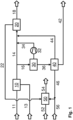
- Es zeigt die einzige Figur:
- Fig. 1
- eine schematische Darstellung des Verfahrens bzw. der Anlage gemäß einer Ausführungsform der Erfindung.
- In der in
Fig. 1 dargestellten Ausgestaltung eines Verfahrens bzw. einer Anlage gemäß der Erfindung wird über Leitung 11 ein Kohlenwasserstoffe enthaltender Einsatzstrom, beispielsweise Erdgas, in einem bevorzugten Beispiel Erdgas mit einem Methangehalt von mindestens 80 Vol.-%, einer nichtkatalytischen Partialoxidationsstufe (POX) 10 zugeführt. Der für die Partialoxidation als Oxidationsmittel benötigte Sauerstoff wird über Leitung 13 der Partialoxidationsstufe zugeführt. Die nichtkatalytische Partialoxidationsstufe wird unter an sich bekannten Partialoxidationsbedingungen betrieben. Als zusätzliches Betriebsmedium wird der POX-Stufe optional Wasserdampf und/oder Kohlendioxid als Moderator zugeführt. - In einem weiteren, bildlich nicht gezeigten Beispiel kann die Partialoxidationsstufe als Autothermreformer (ATR) ausgestaltet werden, der in einem Beispiel bei einem Druck von 60 bara betrieben wird. Als zusätzliches Betriebsmedium wird dem ATR optional Wasserdampf und/oder Kohlendioxid als Moderator zugeführt.
- In der Partialoxidationsstufe 10 erfolgt ein mindestens teilweises Umsetzen des Kohlenwasserstoffe enthaltenden Einsatzstroms unter Synthesegaserzeugungsbedingungen zu einem Wasserstoff (H2), Kohlenmonoxid (CO) und im Sinne der Methanolsynthese inerter Komponenten wie Methan (CH4) enthaltenden Rohsynthesegasstrom, der aus der Partialoxidationsstufe ausgeleitet und in einen ersten Rohsynthesegasteilstrom (Leitung 14) und in einen zweiten Rohsynthesegasteilstrom (Leitung 16) aufgeteilt wird.
- Über Leitung 14 wird der erste Rohsynthesegasteilstrom einem Methanolsynthesereaktor 20 zugeführt, in dem ein mindestens teilweises Umsetzen des ersten Rohsynthesegasteilstroms unter Methanolsynthesebedingungen folgt. Das dabei erhaltene Rohmethanolprodukt wird über Leitung 18 aus dem Methanolsynthesereaktor 20 ausgeleitet und der Weiterverarbeitung, Aufbereitung, Lagerung oder einem Verbraucher zugeführt.
- Für die Zwecke der vorliegenden Beschreibung ist der Begriff "Methanolsynthesereaktor" und das Bezugszeichen 20 so zu verstehen, dass hiervon sowohl der oder die katalytischen Reaktoren zur Methanolsynthese, aber auch weitere übliche und dem Fachmann geläufige, bildlich nicht gezeigte Bestandteile einer Methanolsyntheseeinheit umfasst werden:
- Leitungen und mindestens ein Verdichter zum Aufbau eines Kreislaufs für nicht umgesetztes Synthesegas,
- Kühler zum Abkühlen des Reaktorproduktstroms des Methanolsynthesereaktors,
- eine Phasentrennvorrichtung zum Auftrennen des abgekühlten Reaktorproduktstroms des Methanolsynthesereaktors in einen ersten Flüssigproduktstrom und einen ersten Restgasstrom, der nicht umgesetzte Synthesegasbestandteile und Inertkomponenten enthält,
- eine Vorrichtung zum Aufteilen des ersten Restgasstroms in einen Methanolsynthese-Spülstrom und in einen Recyclestrom, der zum Methanolsynthesereaktor zurückgeführt wird.
- Über Leitung 22 wird der Methanolsynthese-Spülstrom aus dem Methanolsynthesereaktor ausgeleitet.
- Über Leitung 16 wird der zweite Rohsynthesegasteilstrom in eine Sorptionsvorrichtung 30 zur Entfernung von Kohlendioxid eingeleitet. In einem Beispiel arbeitet die Sorptionsvorrichtung nach einem physikalischen Sorptionsverfahren, das tiefkaltes Methanol als Absorbens bzw. Waschmedium verwendet (Rectisol-Verfahren). Einzelheiten dieses Verfahrens sind dem Fachmann bekannt. Hierdurch ergeben sich weitere synergistische Vorteile, da in einem Beispiel ein Teil des in dem Methanolsynthesereaktor 20 erzeugten Methanols als Waschmedium verwendet werden kann. In einem Beispiel können Teile der Vorrichtungen zur Aufbereitung des über Leitung 18 aus dem Methanolsynthesereaktor 20 ausgeleiteten Rohmethanolprodukts auch zur Regenerierung des mit Kohlendioxid beladenen Waschmediums verwendet werden. In einem Beispiel wird Abwärme aus den Vorrichtungen zur Aufbereitung des Rohmethanolprodukts zum Erhitzen oder Vorwärmen des mit Kohlendioxid beladenen Waschmediums verwendet, beispielsweise zum Zwecke der Regenerierung.
- Für die Zwecke der vorliegenden Beschreibung ist der Begriff "Sorptionsvorrichtung" und das Bezugszeichen 30 so zu verstehen, dass hiervon sowohl die eigentliche Entfernung bzw. Abtrennung von Kohlendioxid, aber auch die Regenerierung des verwendeten Sorptionsmittels und die Gewinnung eines an Kohlendioxid angereicherten Gasstroms umfasst werden. Der an Kohlendioxid angereicherte Gasstrom wird in einem Verdichter 32, der im Leitungsweg der Leitung 34 angeordnet ist, auf Methanolsynthesedruck verdichtet und erfindungsgemäß über Leitung 34 dem Methanolsynthesereaktor 20 zugeführt. In einem Beispiel mündet Leitung 34 in Leitung 14 ein, mittels der der erste Rohsynthesegasteilstrom in den Methanolsynthesereaktor eingeleitet wird. In einem Beispiel mündet Leitung 34 direkt in den Methanolsynthesereaktor ein.
- Über Leitung 36 wird ein an Kohlendioxid abgereicherter Synthesegasstrom aus der Sorptionsvorrichtung 30 ausgeleitet, zu einer kryogenen Gaszerlegungsstufe 40 geführt und in diese eingeleitet. In der kryogenen Gaszerlegungsstufe erfolgt das Auftrennen des an Kohlendioxid abgereicherten Synthesegasstroms in folgende Teilströme:
- (1) Einen Kohlenmonoxid-Reichgasstrom. Dieser wird über Leitung 42 als Kohlenmonoxid-Produktstrom aus dem Verfahren ausgeleitet.
- (2) Einen Wasserstoff-Reichgasstrom. Dieser wird über Leitung 44 dem Methanolsynthesereaktor 20 zugeführt und dort zum Einstellen der gewünschten Stöchiometriezahl für die Methanolsynthese verwendet. In einem Beispiel liegt die somit eingestellte Stöchiometriezahl zwischen 1,8 und 2,4, bevorzugt zwischen 2,0 und 2,2. In einem Beispiel beträgt die somit eingestellte Stöchiometriezahl 2,1.
- In einem Beispiel (bildlich nicht gezeigt) wird der Wasserstoff-Reichgasstrom mindestens teilweise einem Brenner einer Heizvorrichtung 50 als Heizgas zugeführt. In einem Beispiel (bildlich nicht gezeigt) wird der gesamte Wasserstoff-Reichgasstrom dem Brenner der Heizvorrichtung 50 als Heizgas zugeführt, In einem Beispiel (bildlich nicht gezeigt) wird derjenige Anteil des Wasserstoff-Reichgasstroms dem Brenner der Heizvorrichtung 50 als Heizgas zugeführt, der zum Einstellen der gewünschten Stöchiometriezahl für die Methanolsynthese nicht benötigt wird.
- In einem Beispiel mündet Leitung 44 in Leitung 14 ein, mittels der der erste Rohsynthesegasteilstrom in den Methanolsynthesereaktor eingeleitet wird. In einem Beispiel mündet Leitung 44 direkt in den Methanolsynthesereaktor ein.
- (3) Einen Inertkomponenten, Methan, Wasserstoff und Kohlenmonoxid enthaltenden Abgasstrom. Dieser wird mindestens teilweise über Leitung 46 einem Brenner einer Heizvorrichtung 50 als Heizgas zugeführt. Dem Brenner der Heizvorrichtung 50 wird ferner über Leitung 56 ein Kohlenwasserstoffe enthaltender Einsatzstrom, beispielsweise Erdgas, als Brenngas zugeführt. In einem Beispiel wird dem Brenner der Heizvorrichtung 50 ferner über Leitung 22 mindestens ein Teil des Methanolsynthese-Spülstroms aus dem Methanolsynthesereaktor als Brenngas zugeführt.
- Die Heizvorrichtung 50 wird in einem Beispiel zur Dampferzeugung verwendet. Hierzu wird über Leitung 52 Kesselspeisewasser in die Heizvorrichtung 50 eingeleitet und in dieser verdampft. Der erzeugte Dampf wird über Leitung 54 aus der Heizvorrichtung 50 ausgeleitet. In einem Beispiel wird ein Teil des erzeugten Dampfs in der Partialoxidationsstufe 10 als Moderator verwendet. In einem Beispiel wird mindestens ein Teil des erzeugten Dampfs an externe Verbraucher abgegeben (Exportdampf).
- Weitere Vorteile und eine noch flexiblere Verfahrensgestaltung ergeben sich aus den folgenden Beispielen, die mit dem Grundverfahren gemäß der Erfindung kombinierbar sind:
In einem Beispiel wird zusätzlich Kohlendioxid aus einer verfahrensexternen CO2-Quelle in die Partialoxidationsstufe eingeleitet. Dies ist insbesondere dann vorteilhaft, wenn der verfahrensexterne CO2-Strom mit erhöhtem Druck zur Verfügung steht, so dass der Kompressionsaufwand vor Einleiten in die Partialoxidationsstufe minimiert wird oder sogar ganz entfällt. - In einem Beispiel wird zusätzlich Kohlendioxid aus einer verfahrensexternen CO2-Quelle in den Methanolsynthesereaktor eingeleitet.
- In einem Beispiel wird Wasserstoff aus einer verfahrensexternen Wasserstoffquelle verwendet, um die gewünschte Stöchiometriezahl für die Methanolsynthese einzustellen.
- Die nachfolgende Tabelle zeigt einen Vergleich berechneter Kenndaten der Erfindung mit einem Verfahrensschema gemäß Stand der Technik (
DE 10214003 B4 ) für eine vorgegebene Produktionsmenge von CO und Methanol.Tabelle: Vergleich berechneter Kenndaten der Erfindung mit einem Verfahrensschema gemäß Stand der Technik (DE 10214003 B4) für eine vorgegebene Produktionsmenge von CO und Methanol. Vergleichsbeispiel Erfindung CO-Produktion kg/h 14560 14558 MeOH-Produktion kg/h 34296 34308 Erdgas-Zufuhr kg/h 27914 27999 Sauerstoff-Zufuhr kg/h 35860 35621 kgSyngas/kgErdgas 2,071 2,015 Synthesegas zu CO kg/h 25949 25828 Synthesegas zu MeOH kg/h 31861 30585 CO2-Rückführung kg/h 2181 1938 Verdichterleistung kW 160 130 Verdichter Kühlleistung kW 140 117 Feedstrom MeOH kg/h 36856 37646 Stöchiometriezahl 2,085 2,086 CO2 zu MeOH Synthese Mol% 1,76% 2,74% CO zu MeOH Synthese Mol% 29,74% 28,43% H2 zu MeOH Synthese Mol% 67,43% 67,75% CO/CO2 zu MeOH Synth. 16,9 10,4 Überhitzter Dampf 40 bara kg/h 127431 124781 - Mit der Erfindung werden folgende Vorteile gegenüber dem Stand der Technik erhalten:
- Bereitstellung eines Gases mit höherem CO2-Gehalt, das für die Methanolsynthese besser geeignet ist, was zu einer höheren Effizienz der Methanolsynthese führt.
- Weniger CO2 muss auf einen niedrigeren Druck komprimiert werden. Die Einsparung hinsichtlich der Verdichterleistung und der Kühlleistung beträgt ca. 15 bis 20 %.
- Der Sauerstoffbedarf sinkt um ca. 0,5 bis 0,8 %.
- Eine um ca. 2 % geringere überschüssige Dampferzeugung kann von Vorteil sein, wenn keine externe Nutzung von Dampf und somit kein Dampfexport erwünscht ist.
-
- [10]
- Partialoxidationsstufe
- [11]
- Leitung
- [13]
- Leitung
- [14]
- Leitung
- [16]
- Leitung
- [18]
- Leitung
- [20]
- Methanolsynthesereaktor
- [22]
- Leitung
- [30]
- Sorptionsvorrichtung
- [32]
- Verdichter
- [34]
- Leitung
- [36]
- Leitung
- [40]
- kryogene Gaszerlegungsstufe
- [42]
- Leitung
- [44]
- Leitung
- [46]
- Leitung
- [50]
- Heizvorrichtung
- [52]
- Leitung
- [54]
- Leitung
- [56]
- Leitung
Claims (20)
- Verfahren zum Herstellen von Methanol und reinem Kohlenmonoxid aus einem Kohlenwasserstoffe enthaltenden Einsatzstrom, bevorzugt Erdgas, umfassend folgende Schritte:(a) Bereitstellen des Kohlenwasserstoffe enthaltenden Einsatzstroms,(b) Zuführen des Kohlenwasserstoffe enthaltenden Einsatzstroms zu einer Partialoxidationsstufe (POX),(c) mindestens teilweises Umsetzen des Kohlenwasserstoffe enthaltenden Einsatzstroms in der Partialoxidationsstufe mit einem Strom eines Sauerstoff enthaltenden Oxidationsmittels unter Partialoxidationsbedingungen und unter optionaler Anwesenheit eines Moderatorstroms, bevorzugt umfassend Dampf und/oder Kohlendioxid, zu einem Wasserstoff (H2), Kohlenmonoxid (CO), Kohlendioxid (CO2) und Methan (CH4) enthaltenden Rohsynthesegasstrom,(d) Ausleiten des Rohsynthesegasstroms aus der Synthesegaserzeugungsanlage und Aufteilen des Rohsynthesegasstroms in einen ersten Rohsynthesegasteilstrom und in einen zweiten Rohsynthesegasteilstrom,(e) Einleiten mindestens eines Teils des ersten Rohsynthesegasteilstroms in einen Methanolsynthesereaktor, mindestens teilweises Umsetzen des ersten Rohsynthesegasteilstroms in dem Methanolsynthesereaktor unter Methanolsynthesebedingungen,(f) Ausleiten eines Methanol enthaltenden ersten Reaktorproduktstroms aus dem Methanolsynthesereaktor, Abkühlen des ersten Reaktorproduktstroms unter seinen Taupunkt und Auftrennen des abgekühlten ersten Reaktorproduktstroms in einer Phasentrennvorrichtung in einen ersten Flüssigproduktstrom und einen ersten Restgasstrom, der nicht umgesetzte Synthesegasbestandteile und Inertkomponenten enthält, Ausleiten des ersten Flüssigproduktstroms aus dem Verfahren als Rohmethanolproduktstrom,(g) Aufteilen des ersten Restgasstroms in einen Methanolsynthese-Spülstrom und in einen Recyclestrom, der zum Methanolsynthesereaktor zurückgeführt wird,(h) Einleiten mindestens eines Teils des zweiten Rohsynthesegasteilstroms in eine Sorptionsvorrichtung zur Entfernung von Kohlendioxid mittels eines physikalischen oder chemischen Sorptionsverfahrens, Ausleiten eines an Kohlendioxid abgereicherten Synthesegasstroms und eines an Kohlendioxid angereicherten Gasstroms aus der Sorptionsvorrichtung,(j) Einleiten mindestens eines Teils des Kohlendioxid abgereicherten Synthesegasstroms in eine kryogene Gaszerlegungsstufe, Auftrennen des an Kohlendioxid abgereicherten Synthesegasstroms in der kryogenen Gaszerlegungsstufe in folgende Teilströme:(j1) einen Kohlenmonoxid-Reichgasstrom, der als Kohlenmonoxid-Produktstrom aus dem Verfahren ausgeleitet wird,(j2) einen Wasserstoff-Reichgasstrom,(j3) einen Inertkomponenten, Methan, Wasserstoff und Kohlenmonoxid enthaltenden Abgasstrom, der mindestens teilweise einem Brenner einer Heizvorrichtung als erstes Heizgas zugeführt wird,dadurch gekennzeichnet, dass der an Kohlendioxid angereicherte Gasstrom mindestens teilweise in den Methanolsynthesereaktor eingeleitet wird.
- Verfahren nach Anspruch 1, dadurch gekennzeichnet, dass der Wasserstoff-Reichgasstrom mindestens teilweise in den Methanolsynthesereaktor eingeleitet wird.
- Verfahren nach Anspruch 2, dadurch gekennzeichnet, dass ein solcher Anteil des Wasserstoff-Reichgasstroms in den Methanolsynthesereaktor eingeleitet wird, dass die Stöchiometriezahl SN, die sich auf die Gesamtheit aller in den Methanolsynthesereaktor eingeleiteten Stoffströme am Reaktoreingang des Methanolsynthesereaktors bezieht, zwischen 1,8 und 2,4, bevorzugt zwischen 2,0 und 2,2 liegt.
- Verfahren nach Anspruch 1 oder 2 oder 3, dadurch gekennzeichnet, dass der Wasserstoff-Reichgasstrom mindestens teilweise dem Brenner der Heizvorrichtung als zweites Heizgas zugeführt wird.
- Verfahren nach einem der vorigen Ansprüche, dadurch gekennzeichnet, dass dem Brenner der Heizvorrichtung ein Teil des Kohlenwasserstoffe enthaltenden Einsatzstrom, bevorzugt Erdgas, als drittes Heizgas zugeführt wird.
- Verfahren nach einem der vorigen Ansprüche, dadurch gekennzeichnet, dass dem Brenner der Heizvorrichtung mindestens ein Teil des Methanolsynthese-Spülstroms als viertes Heizgas zugeführt wird.
- Verfahren nach einem der vorigen Ansprüche, dadurch gekennzeichnet, dass die Heizvorrichtung zur Dampferzeugung dient, wobei der erzeugte Dampf mindestens teilweise als Moderator in der Partialoxidationsstufe dient.
- Verfahren nach einem der vorigen Ansprüche, dadurch gekennzeichnet, dass die Heizvorrichtung zur Dampferzeugung dient, wobei der erzeugte Dampf mindestens teilweise an externe Verbraucher abgegeben wird (Exportdampf).
- Verfahren nach einem der vorigen Ansprüche, dadurch gekennzeichnet, dass zusätzlich ein Kohlendioxid enthaltender Gasstrom, der aus einer verfahrensexternen Quelle stammt, in den Methanolsynthesereaktor eingeleitet wird.
- Verfahren nach einem der vorigen Ansprüche, dadurch gekennzeichnet, dass die Heizvorrichtung zur Vorwärmung des Kohlenwasserstoffe enthaltenden Einsatzstroms und/oder des Stroms des Sauerstoff enthaltenden Oxidationsmittels dient.
- Verfahren nach einem der vorigen Ansprüche, dadurch gekennzeichnet, dass der Methanolsynthese-Spülstrom mittels einer Trennvorrichtung, bevorzugt einer Membrantrennvorrichtung, in einen ersten, an Wasserstoff angereicherten Spülstrom und in einen zweiten, an Wasserstoff abgereicherten und an Kohlenoxiden und Methan angereicherten Spülstrom aufgetrennt wird, wobei mindestens ein Teil des ersten, an Wasserstoff angereicherten Spülstroms dem Brenner der Heizvorrichtung als viertes Heizgas zugeführt wird und wobei mindestens ein Teil des zweiten, an Kohlenoxiden und Methan angereicherten Spülstroms zur Partialoxidationsstufe geführt wird.
- Anlage zum Herstellen von Methanol und reinem Kohlenmonoxid aus einem Kohlenwasserstoffe enthaltenden Einsatzstrom, bevorzugt Erdgas, umfassend folgende, miteinander in Fluidverbindung stehende Bestandteile:(a) Mittel zum Bereitstellen des Kohlenwasserstoffe enthaltenden Einsatzstroms,(b) Mittel zum Zuführen des Kohlenwasserstoffe enthaltenden Einsatzstroms zu einer Partialoxidationsstufe (POX),(c) eine Partialoxidationsstufe, Mittel zum Zuführen eines Stroms eines Sauerstoff enthaltenden Oxidationsmittels zu der Partialoxidationsstufe, optional Mittel zum Zuführen eines Stroms eines Moderatorstroms zu der Partialoxidationsstufe, Mittel zum Ausleiten eines Wasserstoff (H2), Kohlenmonoxid (CO), Kohlendioxid (CO2) sowie Methan (CH4) enthaltenden Rohsynthesegasstroms aus der Partialoxidationsstufe,(d) Mittel zum Aufteilen des Rohsynthesegasstroms in einen ersten Rohsynthesegasteilstrom und in einen zweiten Rohsynthesegasteilstrom,(e) einen Methanolsynthesereaktor, Mittel zum Einleiten mindestens eines Teils des ersten Rohsynthesegasteilstroms in den Methanolsynthesereaktor,(f) Mittel zum Ausleiten eines Methanol enthaltenden ersten Reaktorproduktstroms aus dem Methanolsynthesereaktor, Mittel zum Abkühlen des ersten Reaktorproduktstroms unter seinen Taupunkt, eine Phasentrennvorrichtung zum Auftrennen des abgekühlten ersten Reaktorproduktstroms in einen ersten Flüssigproduktstrom und einen ersten Restgasstrom, der nicht umgesetzte Synthesegasbestandteile und Inertkomponenten enthält, Mittel zum Ausleiten des ersten Flüssigproduktstroms aus dem Verfahren als Rohmethanolproduktstrom,(g) Mittel zum Aufteilen des ersten Restgasstroms in einen Methanolsynthese-Spülstrom und in einen Recyclestrom, der zum Methanolsynthesereaktor zurückgeführt wird,(h) eine Sorptionsvorrichtung zur Entfernung von Kohlendioxid mittels eines physikalischen oder chemischen Sorptionsverfahrens, eine Heizvorrichtung mit mindestens einem Brenner, Mittel zum Einleiten mindestens eines Teils des zweiten Rohsynthesegasteilstroms in die Sorptionsvorrichtung, Mittel zum Ausleiten eines an Kohlendioxid abgereicherten Synthesegasstroms und eines an Kohlendioxid angereicherten Gasstroms aus der Sorptionsvorrichtung,(j) eine kryogene Gaszerlegungsstufe, geeignet zum Auftrennen des an Kohlendioxid abgereicherten Synthesegasstroms in der kryogenen Gaszerlegungsstufe in folgende Teilströme:(j1) einen Kohlenmonoxid-Reichgasstrom, der als Kohlenmonoxid-Produktstrom aus dem Verfahren ausgleitbar ist,(j2) einen Wasserstoff-Reichgasstrom,(j3) einen Methan, Wasserstoff und Kohlenmonoxid enthaltenden Abgasstrom, der mindestens teilweise dem mindestens einen Brenner der Heizvorrichtung als erstes Heizgas einleitbar ist, Mittel zum Einleiten mindestens eines Teils des Kohlendioxid abgereicherten Synthesegasstroms in die kryogene Gaszerlegungsstufe,dadurch gekennzeichnet, dass ferner Mittel umfasst werden, die es gestatten, dass der an Kohlendioxid angereicherte Gasstrom mindestens teilweise in den Methanolsynthesereaktor eingeleitet wird.
- Anlage nach Anspruch 12, dadurch gekennzeichnet, dass ferner Mittel umfasst werden, die es gestatten, dass der Wasserstoff-Reichgasstrom mindestens teilweise dem Brenner der Heizvorrichtung als zweites Heizgas zugeführt wird.
- Anlage nach einem der vorigen Ansprüche, dadurch gekennzeichnet, dass ferner Mittel umfasst werden, die es gestatten, dass dem Brenner der Heizvorrichtung ein Teil des Kohlenwasserstoffe enthaltenden Einsatzstrom, bevorzugt Erdgas, als drittes Heizgas zugeführt wird.
- Anlage nach einem der vorigen Ansprüche, dadurch gekennzeichnet, dass ferner Mittel umfasst werden, die es gestatten, dass dem Brenner der Heizvorrichtung mindestens ein Teil des Methanolsynthese-Spülstroms als viertes Heizgas zugeführt wird.
- Anlage nach einem der vorigen Ansprüche, dadurch gekennzeichnet, dass ferner Mittel umfasst werden, die es gestatten, dass die Heizvorrichtung der Dampferzeugung dient, wobei der erzeugte Dampf mindestens teilweise als Moderator in der Partialoxidationsstufe verwendbar ist.
- Anlage nach einem der vorigen Ansprüche, dadurch gekennzeichnet, dass ferner Mittel umfasst werden, die es gestatten, dass die Heizvorrichtung der Dampferzeugung dient, wobei der erzeugte Dampf mindestens teilweise an externe Verbraucher abgebbar ist (Exportdampf).
- Anlage nach einem der vorigen Ansprüche, dadurch gekennzeichnet, dass ferner Mittel umfasst werden, die es gestatten, dass zusätzlich ein Kohlendioxid enthaltender Gasstrom, der aus einer verfahrensexternen Quelle stammt, in den Methanolsynthesereaktor einleitbar ist.
- Anlage nach einem der vorigen Ansprüche, dadurch gekennzeichnet, dass ferner Mittel umfasst werden, die es gestatten, dass die Heizvorrichtung zur Vorwärmung des Kohlenwasserstoffe enthaltenden Einsatzstroms und/oder des Stroms des Sauerstoff enthaltenden Oxidationsmittels verwendbar ist.
- Anlage nach einem der vorigen Ansprüche, dadurch gekennzeichnet, dass ferner Mittel umfasst werden, die es gestatten, dass- der Methanolsynthese-Spülstrom mittels einer Trennvorrichtung, bevorzugt einer Membrantrennvorrichtung, in einen ersten, an Wasserstoff angereicherten Spülstrom und in einen zweiten, an Wasserstoff abgereicherten und an Kohlenoxiden und Methan angereicherten Spülstrom auftrennbar ist,- mindestens ein Teil des ersten, an Wasserstoff angereicherten Spülstroms dem Brenner der Heizvorrichtung als viertes Heizgas zuführbar ist,- mindestens ein Teil des zweiten, an Kohlenoxiden und Methan angereicherten Spülstroms zur Partialoxidationsstufe zuführbar ist.
Priority Applications (5)
| Application Number | Priority Date | Filing Date | Title |
|---|---|---|---|
| EP21020646.2A EP4197967B1 (de) | 2021-12-20 | 2021-12-20 | Verfahren und anlage zum herstellen von methanol und kohlenmonoxid |
| MYPI2022006603A MY206016A (en) | 2021-12-20 | 2022-11-23 | Process and plant producing methanol and carbon monoxide |
| CA3184608A CA3184608A1 (en) | 2021-12-20 | 2022-12-13 | Process and plant for producing methanol and carbon monoxide |
| CN202211593518.1A CN116282019A (zh) | 2021-12-20 | 2022-12-13 | 用于生产甲醇和一氧化碳的方法和设备 |
| US18/080,365 US20230192483A1 (en) | 2021-12-20 | 2022-12-13 | Process and plant for producing methanol and carbon monoxide |
Applications Claiming Priority (1)
| Application Number | Priority Date | Filing Date | Title |
|---|---|---|---|
| EP21020646.2A EP4197967B1 (de) | 2021-12-20 | 2021-12-20 | Verfahren und anlage zum herstellen von methanol und kohlenmonoxid |
Publications (2)
| Publication Number | Publication Date |
|---|---|
| EP4197967A1 EP4197967A1 (de) | 2023-06-21 |
| EP4197967B1 true EP4197967B1 (de) | 2024-10-09 |
Family
ID=79287782
Family Applications (1)
| Application Number | Title | Priority Date | Filing Date |
|---|---|---|---|
| EP21020646.2A Active EP4197967B1 (de) | 2021-12-20 | 2021-12-20 | Verfahren und anlage zum herstellen von methanol und kohlenmonoxid |
Country Status (5)
| Country | Link |
|---|---|
| US (1) | US20230192483A1 (de) |
| EP (1) | EP4197967B1 (de) |
| CN (1) | CN116282019A (de) |
| CA (1) | CA3184608A1 (de) |
| MY (1) | MY206016A (de) |
Families Citing this family (2)
| Publication number | Priority date | Publication date | Assignee | Title |
|---|---|---|---|---|
| EP4667449A1 (de) * | 2024-06-18 | 2025-12-24 | Linde GmbH | Verfahren und anlage zur herstellung von methanol |
| CN119707630A (zh) * | 2024-10-10 | 2025-03-28 | 浙江大学 | 生物质炭醇联产轻合成绿色甲醇方法、系统 |
Citations (2)
| Publication number | Priority date | Publication date | Assignee | Title |
|---|---|---|---|---|
| WO2003097523A2 (en) | 2002-05-20 | 2003-11-27 | Acetex (Cyprus) Limited | Integrated process for making acetic acid and methanol |
| US20040034110A1 (en) | 2002-03-27 | 2004-02-19 | Lurgi Ag | Process for the production of carbon monoxide and methanol |
Family Cites Families (2)
| Publication number | Priority date | Publication date | Assignee | Title |
|---|---|---|---|---|
| DE19605572A1 (de) | 1996-02-15 | 1997-08-21 | Metallgesellschaft Ag | Verfahren zum Erzeugen von Methanol |
| US6232352B1 (en) | 1999-11-01 | 2001-05-15 | Acetex Limited | Methanol plant retrofit for acetic acid manufacture |
-
2021
- 2021-12-20 EP EP21020646.2A patent/EP4197967B1/de active Active
-
2022
- 2022-11-23 MY MYPI2022006603A patent/MY206016A/en unknown
- 2022-12-13 CA CA3184608A patent/CA3184608A1/en active Pending
- 2022-12-13 CN CN202211593518.1A patent/CN116282019A/zh active Pending
- 2022-12-13 US US18/080,365 patent/US20230192483A1/en active Pending
Patent Citations (2)
| Publication number | Priority date | Publication date | Assignee | Title |
|---|---|---|---|---|
| US20040034110A1 (en) | 2002-03-27 | 2004-02-19 | Lurgi Ag | Process for the production of carbon monoxide and methanol |
| WO2003097523A2 (en) | 2002-05-20 | 2003-11-27 | Acetex (Cyprus) Limited | Integrated process for making acetic acid and methanol |
Non-Patent Citations (2)
| Title |
|---|
| DUTTA N N, PATIL G S: "DEVELOPMENTS IN CO SEPARATION", GAS SEPARATION & PURIFICATION, ELSEVIER, vol. 09, no. 04, 1 April 1995 (1995-04-01), pages 277 - 283, XP001206553, ISSN: 0950-4214, DOI: 10.1016/0950-4214(95)00011-Y |
| MAX APPL: "Modern Production Technologies", 1 January 1997, NITROGEN, THE JOURNAL OF THE WORLD NITROGEN AND METHANOL INDUSTRIES, article APPL MAX: "AMMONIA METHANOL HYDROGEN CARBON MONOXIDE", pages: 1 - 137, XP093027731 |
Also Published As
| Publication number | Publication date |
|---|---|
| EP4197967A1 (de) | 2023-06-21 |
| CA3184608A1 (en) | 2023-06-20 |
| US20230192483A1 (en) | 2023-06-22 |
| CN116282019A (zh) | 2023-06-23 |
| MY206016A (en) | 2024-11-25 |
Similar Documents
| Publication | Publication Date | Title |
|---|---|---|
| EP3954650B1 (de) | Verfahren und anlage zur herstellung von wasserstoff und abscheidung von kohlendioxid | |
| DE69311588T2 (de) | Verfahren zur integrierten Herstellung von Methanol und Ammoniak | |
| DE69935101T2 (de) | Synthesegasherstellung mittels leitender Mischmembranen mit integrierter Konvertierung zu flüssigen Produkten | |
| EP0816290B1 (de) | Verfahren zur Gewinnung von Kohlenmonoxid und Wasserstoff | |
| DE69617878T2 (de) | Herstellung von Ammoniak mittels Reformierung mit angereicherter Luft und Stickstoffeinspritzung im Synthesekreislauf | |
| DE69221556T2 (de) | Synthesegaserzeugung | |
| DE60027453T2 (de) | Verfahren zum Nachrüsten einer Methanolanlage zur Herstellung von Essigsäure | |
| EP3885312B1 (de) | Verfahren und anlage zum herstellen von reinem kohlenmonoxid und wasserstoff | |
| EP4098610A1 (de) | Verfahren und anlage zum herstellen von reinwasserstoff durch dampfreformierung mit niedriger kohlendioxid-emission | |
| DE102006023248C5 (de) | Verfahren und Anlage zur Herstellung von Synthesegas | |
| DE102004028200B3 (de) | Verfahren zur Durchführung heterogen katalytischer exothermer Gasphasenreaktionen für die Methanolsynthese | |
| EP3828132A1 (de) | Verfahren und anlage zum herstellen von reinwasserstoff | |
| EP3176152B1 (de) | Verfahren zur erzeugung von harnstoff | |
| DE102017204208A1 (de) | Verfahren und Anlage zur Erzeugung und Aufbereitung eines Synthesegasgemisches | |
| WO2023117130A1 (de) | Verfahren zur wasserstofferzeugung mit geringer kohlendioxidemission | |
| EP3323786A1 (de) | Verfahren zur kombinierten herstellung von methanol und ammoniak | |
| DE69817749T3 (de) | Verwendung von mittels leitenten Mischmembranen hergestelltem Synthesegas | |
| EP4197967A1 (de) | Verfahren und anlage zum herstellen von methanol und kohlenmonoxid | |
| EP4066921B1 (de) | Verfahren und anlage zum herstellen von methanol und ammoniak | |
| DE3015640A1 (de) | Verfahren zur erzeugung eines gasstroms fuer die ammoniak-synthese | |
| DE60203124T2 (de) | Integriertes kohlenwasserstoffsyntheseverfahren | |
| DE60131471T2 (de) | Reaktor zur reformierung von erdgas und gleichzeitige herstellung von wasserstoff | |
| EP3075706A1 (de) | Verfahren und eine anlage zur erzeugung von synthesegas | |
| DE102004013539A1 (de) | Verfahren zur Koproduktion von Methanol und Ammoniak aus Erdgas | |
| DE3518362A1 (de) | Verfahren zur herstellung von methanol |
Legal Events
| Date | Code | Title | Description |
|---|---|---|---|
| PUAI | Public reference made under article 153(3) epc to a published international application that has entered the european phase |
Free format text: ORIGINAL CODE: 0009012 |
|
| STAA | Information on the status of an ep patent application or granted ep patent |
Free format text: STATUS: THE APPLICATION HAS BEEN PUBLISHED |
|
| AK | Designated contracting states |
Kind code of ref document: A1 Designated state(s): AL AT BE BG CH CY CZ DE DK EE ES FI FR GB GR HR HU IE IS IT LI LT LU LV MC MK MT NL NO PL PT RO RS SE SI SK SM TR |
|
| STAA | Information on the status of an ep patent application or granted ep patent |
Free format text: STATUS: REQUEST FOR EXAMINATION WAS MADE |
|
| 17P | Request for examination filed |
Effective date: 20231221 |
|
| RBV | Designated contracting states (corrected) |
Designated state(s): AL AT BE BG CH CY CZ DE DK EE ES FI FR GB GR HR HU IE IS IT LI LT LU LV MC MK MT NL NO PL PT RO RS SE SI SK SM TR |
|
| GRAP | Despatch of communication of intention to grant a patent |
Free format text: ORIGINAL CODE: EPIDOSNIGR1 |
|
| STAA | Information on the status of an ep patent application or granted ep patent |
Free format text: STATUS: GRANT OF PATENT IS INTENDED |
|
| RIC1 | Information provided on ipc code assigned before grant |
Ipc: B01J 8/00 20060101ALI20240417BHEP Ipc: C07C 31/04 20060101ALI20240417BHEP Ipc: C07C 29/151 20060101ALI20240417BHEP Ipc: C01B 32/40 20170101ALI20240417BHEP Ipc: C01B 3/52 20060101ALI20240417BHEP Ipc: C01B 3/38 20060101ALI20240417BHEP Ipc: C01B 3/36 20060101AFI20240417BHEP |
|
| INTG | Intention to grant announced |
Effective date: 20240516 |
|
| GRAS | Grant fee paid |
Free format text: ORIGINAL CODE: EPIDOSNIGR3 |
|
| GRAA | (expected) grant |
Free format text: ORIGINAL CODE: 0009210 |
|
| STAA | Information on the status of an ep patent application or granted ep patent |
Free format text: STATUS: THE PATENT HAS BEEN GRANTED |
|
| AK | Designated contracting states |
Kind code of ref document: B1 Designated state(s): AL AT BE BG CH CY CZ DE DK EE ES FI FR GB GR HR HU IE IS IT LI LT LU LV MC MK MT NL NO PL PT RO RS SE SI SK SM TR |
|
| REG | Reference to a national code |
Ref country code: CH Ref legal event code: EP |
|
| REG | Reference to a national code |
Ref country code: DE Ref legal event code: R096 Ref document number: 502021005371 Country of ref document: DE |
|
| REG | Reference to a national code |
Ref country code: IE Ref legal event code: FG4D Free format text: LANGUAGE OF EP DOCUMENT: GERMAN |
|
| REG | Reference to a national code |
Ref country code: NL Ref legal event code: FP |
|
| REG | Reference to a national code |
Ref country code: LT Ref legal event code: MG9D |
|
| PG25 | Lapsed in a contracting state [announced via postgrant information from national office to epo] |
Ref country code: HR Free format text: LAPSE BECAUSE OF FAILURE TO SUBMIT A TRANSLATION OF THE DESCRIPTION OR TO PAY THE FEE WITHIN THE PRESCRIBED TIME-LIMIT Effective date: 20241009 Ref country code: IS Free format text: LAPSE BECAUSE OF FAILURE TO SUBMIT A TRANSLATION OF THE DESCRIPTION OR TO PAY THE FEE WITHIN THE PRESCRIBED TIME-LIMIT Effective date: 20250209 Ref country code: PT Free format text: LAPSE BECAUSE OF FAILURE TO SUBMIT A TRANSLATION OF THE DESCRIPTION OR TO PAY THE FEE WITHIN THE PRESCRIBED TIME-LIMIT Effective date: 20250210 |
|
| PG25 | Lapsed in a contracting state [announced via postgrant information from national office to epo] |
Ref country code: FI Free format text: LAPSE BECAUSE OF FAILURE TO SUBMIT A TRANSLATION OF THE DESCRIPTION OR TO PAY THE FEE WITHIN THE PRESCRIBED TIME-LIMIT Effective date: 20241009 |
|
| PG25 | Lapsed in a contracting state [announced via postgrant information from national office to epo] |
Ref country code: BG Free format text: LAPSE BECAUSE OF FAILURE TO SUBMIT A TRANSLATION OF THE DESCRIPTION OR TO PAY THE FEE WITHIN THE PRESCRIBED TIME-LIMIT Effective date: 20241009 |
|
| PG25 | Lapsed in a contracting state [announced via postgrant information from national office to epo] |
Ref country code: ES Free format text: LAPSE BECAUSE OF FAILURE TO SUBMIT A TRANSLATION OF THE DESCRIPTION OR TO PAY THE FEE WITHIN THE PRESCRIBED TIME-LIMIT Effective date: 20241009 |
|
| PG25 | Lapsed in a contracting state [announced via postgrant information from national office to epo] |
Ref country code: NO Free format text: LAPSE BECAUSE OF FAILURE TO SUBMIT A TRANSLATION OF THE DESCRIPTION OR TO PAY THE FEE WITHIN THE PRESCRIBED TIME-LIMIT Effective date: 20250109 |
|
| PG25 | Lapsed in a contracting state [announced via postgrant information from national office to epo] |
Ref country code: GR Free format text: LAPSE BECAUSE OF FAILURE TO SUBMIT A TRANSLATION OF THE DESCRIPTION OR TO PAY THE FEE WITHIN THE PRESCRIBED TIME-LIMIT Effective date: 20250110 Ref country code: LV Free format text: LAPSE BECAUSE OF FAILURE TO SUBMIT A TRANSLATION OF THE DESCRIPTION OR TO PAY THE FEE WITHIN THE PRESCRIBED TIME-LIMIT Effective date: 20241009 |
|
| PG25 | Lapsed in a contracting state [announced via postgrant information from national office to epo] |
Ref country code: PL Free format text: LAPSE BECAUSE OF FAILURE TO SUBMIT A TRANSLATION OF THE DESCRIPTION OR TO PAY THE FEE WITHIN THE PRESCRIBED TIME-LIMIT Effective date: 20241009 |
|
| PG25 | Lapsed in a contracting state [announced via postgrant information from national office to epo] |
Ref country code: RS Free format text: LAPSE BECAUSE OF FAILURE TO SUBMIT A TRANSLATION OF THE DESCRIPTION OR TO PAY THE FEE WITHIN THE PRESCRIBED TIME-LIMIT Effective date: 20250109 |
|
| PG25 | Lapsed in a contracting state [announced via postgrant information from national office to epo] |
Ref country code: SM Free format text: LAPSE BECAUSE OF FAILURE TO SUBMIT A TRANSLATION OF THE DESCRIPTION OR TO PAY THE FEE WITHIN THE PRESCRIBED TIME-LIMIT Effective date: 20241009 |
|
| PG25 | Lapsed in a contracting state [announced via postgrant information from national office to epo] |
Ref country code: MC Free format text: LAPSE BECAUSE OF FAILURE TO SUBMIT A TRANSLATION OF THE DESCRIPTION OR TO PAY THE FEE WITHIN THE PRESCRIBED TIME-LIMIT Effective date: 20241009 |
|
| REG | Reference to a national code |
Ref country code: DE Ref legal event code: R026 Ref document number: 502021005371 Country of ref document: DE |
|
| PG25 | Lapsed in a contracting state [announced via postgrant information from national office to epo] |
Ref country code: DK Free format text: LAPSE BECAUSE OF FAILURE TO SUBMIT A TRANSLATION OF THE DESCRIPTION OR TO PAY THE FEE WITHIN THE PRESCRIBED TIME-LIMIT Effective date: 20241009 |
|
| PLBI | Opposition filed |
Free format text: ORIGINAL CODE: 0009260 |
|
| PG25 | Lapsed in a contracting state [announced via postgrant information from national office to epo] |
Ref country code: EE Free format text: LAPSE BECAUSE OF FAILURE TO SUBMIT A TRANSLATION OF THE DESCRIPTION OR TO PAY THE FEE WITHIN THE PRESCRIBED TIME-LIMIT Effective date: 20241009 |
|
| PLAX | Notice of opposition and request to file observation + time limit sent |
Free format text: ORIGINAL CODE: EPIDOSNOBS2 |
|
| PG25 | Lapsed in a contracting state [announced via postgrant information from national office to epo] |
Ref country code: RO Free format text: LAPSE BECAUSE OF FAILURE TO SUBMIT A TRANSLATION OF THE DESCRIPTION OR TO PAY THE FEE WITHIN THE PRESCRIBED TIME-LIMIT Effective date: 20241009 |
|
| PG25 | Lapsed in a contracting state [announced via postgrant information from national office to epo] |
Ref country code: SK Free format text: LAPSE BECAUSE OF FAILURE TO SUBMIT A TRANSLATION OF THE DESCRIPTION OR TO PAY THE FEE WITHIN THE PRESCRIBED TIME-LIMIT Effective date: 20241009 |
|
| PLAB | Opposition data, opponent's data or that of the opponent's representative modified |
Free format text: ORIGINAL CODE: 0009299OPPO |
|
| PG25 | Lapsed in a contracting state [announced via postgrant information from national office to epo] |
Ref country code: CZ Free format text: LAPSE BECAUSE OF FAILURE TO SUBMIT A TRANSLATION OF THE DESCRIPTION OR TO PAY THE FEE WITHIN THE PRESCRIBED TIME-LIMIT Effective date: 20241009 |
|
| PG25 | Lapsed in a contracting state [announced via postgrant information from national office to epo] |
Ref country code: IT Free format text: LAPSE BECAUSE OF FAILURE TO SUBMIT A TRANSLATION OF THE DESCRIPTION OR TO PAY THE FEE WITHIN THE PRESCRIBED TIME-LIMIT Effective date: 20241009 |
|
| REG | Reference to a national code |
Ref country code: CH Ref legal event code: PL |
|
| 26 | Opposition filed |
Opponent name: JOHNSON MATTHEY PUBLIC LIMITED COMPANY Effective date: 20250708 |
|
| PG25 | Lapsed in a contracting state [announced via postgrant information from national office to epo] |
Ref country code: LU Free format text: LAPSE BECAUSE OF NON-PAYMENT OF DUE FEES Effective date: 20241220 |
|
| R26 | Opposition filed (corrected) |
Opponent name: JOHNSON MATTHEY DAVY TECHNOLOGIES LIMITED Effective date: 20250708 |
|
| PG25 | Lapsed in a contracting state [announced via postgrant information from national office to epo] |
Ref country code: SE Free format text: LAPSE BECAUSE OF FAILURE TO SUBMIT A TRANSLATION OF THE DESCRIPTION OR TO PAY THE FEE WITHIN THE PRESCRIBED TIME-LIMIT Effective date: 20241009 |
|
| PG25 | Lapsed in a contracting state [announced via postgrant information from national office to epo] |
Ref country code: CH Free format text: LAPSE BECAUSE OF NON-PAYMENT OF DUE FEES Effective date: 20241231 |
|
| PG25 | Lapsed in a contracting state [announced via postgrant information from national office to epo] |
Ref country code: IE Free format text: LAPSE BECAUSE OF NON-PAYMENT OF DUE FEES Effective date: 20241220 |
|
| PLBB | Reply of patent proprietor to notice(s) of opposition received |
Free format text: ORIGINAL CODE: EPIDOSNOBS3 |
|
| PGFP | Annual fee paid to national office [announced via postgrant information from national office to epo] |
Ref country code: DE Payment date: 20251211 Year of fee payment: 5 |
|
| PGFP | Annual fee paid to national office [announced via postgrant information from national office to epo] |
Ref country code: AT Payment date: 20260113 Year of fee payment: 5 |
|
| PGFP | Annual fee paid to national office [announced via postgrant information from national office to epo] |
Ref country code: NL Payment date: 20251219 Year of fee payment: 5 Ref country code: FR Payment date: 20251229 Year of fee payment: 5 |
|
| PGFP | Annual fee paid to national office [announced via postgrant information from national office to epo] |
Ref country code: BE Payment date: 20251219 Year of fee payment: 5 |
|
| PLAB | Opposition data, opponent's data or that of the opponent's representative modified |
Free format text: ORIGINAL CODE: 0009299OPPO |