EP4195034B1 - Fahrzeuginternes infotainmentsystem und verfahren zur aktualisierung davon - Google Patents
Fahrzeuginternes infotainmentsystem und verfahren zur aktualisierung davon Download PDFInfo
- Publication number
- EP4195034B1 EP4195034B1 EP20948579.6A EP20948579A EP4195034B1 EP 4195034 B1 EP4195034 B1 EP 4195034B1 EP 20948579 A EP20948579 A EP 20948579A EP 4195034 B1 EP4195034 B1 EP 4195034B1
- Authority
- EP
- European Patent Office
- Prior art keywords
- data
- vehicle
- user
- application
- memory
- Prior art date
- Legal status (The legal status is an assumption and is not a legal conclusion. Google has not performed a legal analysis and makes no representation as to the accuracy of the status listed.)
- Active
Links
Images









Classifications
-
- G—PHYSICS
- G06—COMPUTING OR CALCULATING; COUNTING
- G06F—ELECTRIC DIGITAL DATA PROCESSING
- G06F9/00—Arrangements for program control, e.g. control units
- G06F9/06—Arrangements for program control, e.g. control units using stored programs, i.e. using an internal store of processing equipment to receive or retain programs
- G06F9/44—Arrangements for executing specific programs
- G06F9/445—Program loading or initiating
- G06F9/44505—Configuring for program initiating, e.g. using registry, configuration files
-
- H—ELECTRICITY
- H04—ELECTRIC COMMUNICATION TECHNIQUE
- H04N—PICTORIAL COMMUNICATION, e.g. TELEVISION
- H04N21/00—Selective content distribution, e.g. interactive television or video on demand [VOD]
- H04N21/40—Client devices specifically adapted for the reception of or interaction with content, e.g. set-top-box [STB]; Operations thereof
- H04N21/41—Structure of client; Structure of client peripherals
- H04N21/414—Specialised client platforms, e.g. receiver in car or embedded in a mobile appliance
- H04N21/41422—Specialised client platforms, e.g. receiver in car or embedded in a mobile appliance located in transportation means, e.g. personal vehicle
-
- G—PHYSICS
- G06—COMPUTING OR CALCULATING; COUNTING
- G06F—ELECTRIC DIGITAL DATA PROCESSING
- G06F11/00—Error detection; Error correction; Monitoring
- G06F11/07—Responding to the occurrence of a fault, e.g. fault tolerance
- G06F11/14—Error detection or correction of the data by redundancy in operations
- G06F11/1446—Point-in-time backing up or restoration of persistent data
-
- G—PHYSICS
- G06—COMPUTING OR CALCULATING; COUNTING
- G06F—ELECTRIC DIGITAL DATA PROCESSING
- G06F9/00—Arrangements for program control, e.g. control units
- G06F9/06—Arrangements for program control, e.g. control units using stored programs, i.e. using an internal store of processing equipment to receive or retain programs
- G06F9/44—Arrangements for executing specific programs
- G06F9/445—Program loading or initiating
- G06F9/44505—Configuring for program initiating, e.g. using registry, configuration files
- G06F9/4451—User profiles; Roaming
Definitions
- the present disclosure relates to an in-vehicle infotainment system and a method for upgrading the same, and more particularly, to an in-vehicle infotainment system that can detachably upgrade, and a method for upgrading the in-vehicle infotainment system.
- a vehicle may be classified into an internal combustion engine vehicle, an external combustion engine vehicle, a gas turbine vehicle, an electric vehicle, or the like, according to a type of used motive power.
- An infotainment system is an integrated system of information and entertainment, and an in-vehicle infotainment system may refer to an integrated system of entertainment that can be enjoyed in a vehicle and information.
- an in-vehicle infotainment system capable of replacing a processor and a memory is required, and furthermore, there is a problem in that when the processor and the memory are replaced, existing user experience-based data is lost.
- US 2010/169981 A1 discloses a method and system for replacing, implementing and managing computer-related assets.
- US 2014/309862 A1 discloses a system to access one or more user profiles that govern one or more vehicle functions. The system cooperates with a processor and verification module which are adapted to verify, using one or more of biometric information, gesture recognition, facial recognition and device identification information.
- US 2002/053044 A1 discloses a method of restoring an operational state of a computer entity when the computer entity is in a system failure.
- An object of the present disclosure is to provide an in-vehicle infotainment system for a user to easily upgrade performance, and a method for upgrading the same.
- Another object of the present disclosure is to provide an in-vehicle infotainment system that can use existing user experience-based data intactly, even if equipment is replaced, and a method for upgrading the same.
- Another object of the present disclosure is to provide an in-vehicle infotainment system for safely storing, transmitting and receiving data by encrypting existing user experience-based data, and a method for upgrading the same.
- another object of the present disclosure is to provide an in-vehicle infotainment system that can use a memory for a longer period of time by dividing a non-replaced memory into a plurality of partitions, and a method for upgrading the same.
- the present disclosure provides an in-vehicle infotainment system including: a first device which is included in a vehicle, and includes a first memory; a second device which is electrically connected to the first device, is attachable or detachable to the vehicle or from the vehicle, and includes a second memory; and an interface configured to electrically connect the second device to the first device, wherein the first memory stores first data including user-customized data, the second device executes a first application based on the first data, and the first application is stored in the second memory.
- the third device executes a second application based on the first data, and the second application is stored in the third memory.
- the receiving first data includes recovering the first data based on the first data not being zero-defect.
- the plurality of partitions includes a first partition and a second partition to alternately store the first data.
- the first data is encrypted and stored in the first memory.
- the present disclosure has an effect of providing an in-vehicle infotainment system that can use existing user experience-based data intactly, even if equipment is replaced, and a method for upgrading the same.
- the present disclosure has an effect of providing an in-vehicle infotainment system for safely storing, transmitting and receiving data by encrypting existing user experience-based data, and a method for upgrading the same.
- FIG. 1 is a diagram showing a vehicle according to an embodiment of the present disclosure.
- a vehicle 10 is defined as a transportation means driving on a road or track.
- the vehicle 10 may be a concept including a car, a train, and a motorcycle.
- the vehicle 10 may be a concept including all of an internal combustion engine vehicle having an engine as a power source, a hybrid vehicle having an engine and an electric motor as a power source, an electric vehicle having an electric motor as a power source, and the like.
- the vehicle 10 may be a vehicle owned by an individual.
- the vehicle 10 may be a shared vehicle.
- the vehicle 10 may be an autonomous driving vehicle.
- next-generation radio access technology may be referred to as a new radio access technology (RAT) or a new radio (NR).
- RAT new radio access technology
- NR new radio
- V2X vehicle-to-everything
- the main ECU 240 may control the overall operation of at least one electronic device provided in the vehicle 10.
- the autonomous driving device 260 may perform a conversion operation from an autonomous driving mode to a manual driving mode or a conversion operation from the manual driving mode to the autonomous driving mode. For example, the autonomous driving device 260 may convert the mode of the vehicle 10 from the autonomous driving mode to the manual driving mode or may convert from the manual driving mode to the autonomous driving mode, based on a signal received from the user interface device 200.
- the sensing device 270 may sense the state of the vehicle.
- the sensing device 270 may include at least one of an inertial measurement unit (IMU) sensor, a collision sensor, a wheel sensor, a speed sensor, an inclination sensor, a weight sensor, a heading sensor, a position module, a vehicle forward/reverse sensor, a battery sensor, a fuel sensor, a tire sensor, a steering sensor, a temperature sensor, a humidity sensor, an ultrasonic sensor, an illuminance sensor, and a pedal position sensor.
- the inertial measurement unit (IMU) sensor may include one or more of an acceleration sensor, a gyro sensor, and a magnetic sensor.
- the sensing device 270 may generate vehicle state data, based on a signal generated by at least one sensor.
- the vehicle state data may be information generated based on data detected by various sensors provided inside a vehicle.
- the sensing device 270 may generate vehicle posture data, vehicle motion data, vehicle yaw data, vehicle roll data, vehicle pitch data, vehicle collision data, vehicle direction data, vehicle angle data, vehicle speed data, vehicle acceleration data, vehicle inclination data, vehicle forward/reverse data, vehicle weight data, battery data, fuel data, tire pressure data, vehicle interior temperature data, vehicle interior humidity data, steering wheel rotation angle data, vehicle exterior illumination data, pressure data applied to an acceleration pedal, pressure data applied to a brake pedal, and the like.
- the location data generating device 280 may generate location data of the vehicle 10.
- the location data generating device 280 may include at least one of a Global Positioning System (GPS) and a Differential Global Positioning System (DGPS).
- GPS Global Positioning System
- DGPS Differential Global Positioning System
- the location data generating device 280 may generate location data of the vehicle 10 based on a signal generated in at least one of GPS and DGPS.
- the location data generating device 280 may correct location data based on at least one of an Inertial Measurement Unit (IMU) of the sensing device 270 and a camera of the object detection device 210.
- IMU Inertial Measurement Unit
- the location data generating device 280 may be referred to as a Global Navigation Satellite System (GNSS).
- GNSS Global Navigation Satellite System
- FIG. 3 is a control block diagram of an autonomous driving device according to an embodiment of the present disclosure.
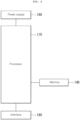
- the autonomous driving device 260 may include a memory 140, a processor 170, an interface 180, and a power supply 190.
- the memory 140 is electrically connected to the processor 170.
- the memory 140 may store basic data for a device or module, control data for operation control of a device or module, and input/output data.
- the memory 140 may store data processed by the processor 170.
- the memory 140 may be configured with at least one of ROM, RAM, EPROM, flash drive, and hard drive, in terms of hardware.
- the memory 140 may store various data for the overall operation of the autonomous driving device 260, such as a program for processing or controlling the processor 170.
- the memory 140 may be implemented integrally with the processor 170. In some embodiment, the memory 140 may be classified as a sub-configuration of the processor 170.
- the interface 180 may exchange signals with at least one electronic device provided in the vehicle 10 by wire or wirelessly.
- the interface 280 may exchange signals with at least one of the object detection device 210, the communication device 220, the driving control device 230, the main ECU 240, the operating control device 250, the sensing device 270, and the location data generating device 280, by wire or wirelessly.
- the interface 280 may be configured with at least one of a communication module, a terminal, a pin, a cable, a port, a circuit, an element, and a device.
- the processor 170 may be electrically connected to the memory 140, the interface 280, and the power supply 190 to exchange signals.
- the processor 170 may be implemented by using at least one of application specific integrated circuits (ASICs), digital signal processors (DSPs), digital signal processing devices (DSPDs), programmable logic devices (PLDs), field programmable gate arrays (FPGAs), processors, controllers, micro-controllers, microprocessors, and other electrical devices for performing other functions.
- ASICs application specific integrated circuits
- DSPs digital signal processors
- DSPDs digital signal processing devices
- PLDs programmable logic devices
- FPGAs field programmable gate arrays
- processors controllers, micro-controllers, microprocessors, and other electrical devices for performing other functions.
- the processor 170 may be operated by power provided from the power supply 190.
- the processor 170 may receive data, process data, generate a signal, and provide a signal while power is supplied by the power supply 190.
- the processor 170 may receive information from other electronic device in the vehicle 10 through the interface 180.
- the processor 170 may provide a control signal to other electronic device in the vehicle 10 through the interface 180.
- FIG. 4 is a signal flow diagram of an autonomous driving vehicle according to an embodiment of the present disclosure.
- the processor 170 may perform a reception operation.
- the processor 170 may receive data from at least one of the object detection device 210, the communication device 220, the sensing device 270, and the location data generating device 280, through the interface 180.
- the processor 170 may receive object data from the object detection device 210.
- the processor 170 may receive HD map data from the communication device 220.
- the processor 170 may receive vehicle state data from the sensing device 270.
- the processor 170 may receive location data from the location data generating device 280.
- the processor 170 may perform a processing/determination operation.
- the processor 170 may perform a processing/determination operation, based on driving situation information.
- the processor 170 may perform a processing/determination operation, based on at least one of object data, HD map data, vehicle state data, and location data.
- the processor 170 may generate driving plan data.
- the processor 170 may generate electronic horizon data.
- the electronic horizon data may be understood as driving plan data within a range from a point where the vehicle 10 is located to a horizon.
- the horizon may be understood as a point in front of a preset distance from a point where the vehicle 10 is located, based on a preset driving route.
- the horizon may mean a point to which the vehicle 10 can reach after a certain time from a point where the vehicle 10 is located along a preset driving route.
- the electronic horizon data may include horizon map data and horizon path data.
- the horizon map data may include at least one of topology data, road data, HD map data, and dynamic data.
- the horizon map data may include a plurality of layers.
- the horizon map data may include a first layer matching topology data, a second layer matching road data, a third layer matching HD map data, and a fourth layer matching dynamic data.
- the horizon map data may further include static object data.
- the topology data can be explained as a map created by connecting road centers.
- the topology data is suitable for roughly indicating the location of vehicle, and may be in the form of data mainly used in navigation for drivers.
- the topology data may be understood as data on road information excluding information related to lane.
- the topology data may be generated based on data received from an external server, through the communication device 220.
- the topology data may be based on data stored in at least one memory provided in the vehicle 10.
- the road data may include at least one of slope data of road, curvature data of road, and speed limit data of road.
- the road data may further include no-passing zone data.
- the road data may be based on data received from an external server, through the communication device 220.
- the road data may be based on data generated by the object detection device 210.
- the HD map data may be based on data received from an external server, through detailed topology information of lane unit of road, connection information of each lane, and characteristic information for vehicle localization (e.g. traffic signs, Lane Marking/attributes, Road furniture, etc.).
- the HD map data may be based on data received from an external server, through the communication device 220.
- the dynamic data may include various dynamic information that can be generated on the road.
- the dynamic data may include construction information, variable speed lane information, road surface condition information, traffic information, moving object information, and the like.
- the dynamic data may be based on data received from an external server, through the communication device 220.
- the dynamic data may be based on data generated by the object detection device 210.
- the processor 170 may provide map data within a range from a point where the vehicle 10 is located to the horizon.
- the horizon path data may be explained as a track that the vehicle 10 can follow within a range from a point where the vehicle 10 is located to the horizon.
- the horizon path data may include data representing a relative probability of selecting any one road at a decision point (e.g. a forked road, an intersection, crossroads, etc.).
- the relative probability may be calculated based on a time taken to reach a final destination. For example, at the decision point, if the time taken to reach a final destination in case of selecting a first road is shorter than in case of selecting a second road, the probability of selecting the first road can be calculated higher than the probability of selecting the second road.
- the processor 170 may transmit the generated control signal to the operating control device 250, through the interface 180.
- the operating control device 250 may transmit a control signal to at least one of the power train 251, the brake device 252, and the steering device 253.
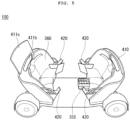
- FIG. 5 is a diagram illustrating the interior of a vehicle according to an embodiment of the present disclosure.
- FIG. 6 is a block diagram for explaining an in-vehicle cabin system according to an embodiment of the present disclosure.
- a in-vehicle cabin system 300 may be defined as a convenience system for a user using the vehicle 10.
- the cabin system 300 may be described as a top-level system including a display system 350, a cargo system 355, a seat system 360, and a payment system 365.
- the cabin system 300 may include a main controller 370, a memory 340, an interface 380, a power supply 390, an input device 310, an imaging device 320, a communication device 330, a display system 350, a cargo system 355, a seat system 360, and a payment system 365.
- the cabin system 300 may further include other components in addition to the components described in the present disclosure, or may not include some of the components described herein.
- the main controller 370 may be electrically connected to the input device 310, the communication device 330, the display system 350, the cargo system 355, the seat system 360, and the payment system 365 to exchange signals.
- the main controller 370 may control the input device 310, the communication device 330, the display system 350, the cargo system 355, the seat system 360, and the payment system 365.
- the main controller 370 may be implemented by using at least one of application specific integrated circuits (ASICs), digital signal processors (DSPs), digital signal processing devices (DSPDs), programmable logic devices (PLDs), field programmable gate arrays (FPGAs), processors, controllers, micro-controllers, microprocessors, and electrical devices for performing other functions.
- ASICs application specific integrated circuits
- DSPs digital signal processors
- DSPDs digital signal processing devices
- PLDs programmable logic devices
- FPGAs field programmable gate arrays
- processors controllers, micro-controllers, microprocessors, and electrical devices
- the main controller 370 may be configured with at least one sub-controller.
- the main controller 370 may include a plurality of sub-controllers.
- Each of the plurality of sub-controllers may individually control devices and systems included in a grouped cabin system 300.
- the devices and systems included in the cabin system 300 may be grouped by function, or grouped based on a seatable seat.
- the main controller 370 may include at least one processor 371.
- FIG. 6 illustrates that the main controller 370 includes a single processor 371, but the main controller 371 may include a plurality of processors.
- the processor 371 may be classified as any one of the sub-controllers described above.
- the processor 371 may receive a signal, information, or data from a user terminal, through the communication device 330.
- the user terminal may transmit a signal, information or data to the cabin system 300.
- the processor 371 may specify a user, based on image data received from at least one of an internal camera and an external camera included in the imaging device.
- the processor 371 may specify a user by applying an image processing algorithm to image data.
- the processor 371 may specify a user by comparing information received from a user terminal with the image data.
- the information may include at least one of route information of user, body information, passenger information, luggage information, location information, preferred contents information, preferred food information, disability information, and use history information.
- the main controller 370 may include an artificial intelligence agent 372.
- the artificial intelligence agent 372 may perform machine learning based on data obtained through the input device 310.
- the artificial intelligence agent 372 may control at least one of the display system 350, the cargo system 355, the seat system 360, and the payment system 365, based on the machine-learned result.
- the input device 310 may receive a user input.
- the input device 310 may convert a user input into an electrical signal.
- the electrical signal converted by the input device 310 may be converted into a control signal and provided to at least one of the display system 350, the cargo system 355, the seat system 360, and the payment system 365.
- At least one processor included in the main controller 370 or the cabin system 300 may generate a control signal based on an electrical signal received from the input device 310.
- the input device 310 may include at least one of a touch input device, a gesture input device, a mechanical input device, and a voice input device.
- the touch input device may convert a user's touch input into an electrical signal.
- the touch input device may include at least one touch sensor to detect a user's touch input.
- the touch input device may be formed integrally with at least one display included in the display system 350 to implement a touch screen. Such a touch screen may provide both an input interface and an output interface between the cabin system 300 and a user.
- the gesture input device may convert a user's gesture input into an electrical signal.
- the gesture input device may include at least one of an infrared sensor and an image sensor for detecting a user's gesture input.
- the input device 310 may include a gesture sensor, and may include a jog dial device formed to be able to put in and out from a part of a surrounding structure (e.g. at least one of a seat, an armrest, and a door).
- a jog dial device When the jog dial device is in a flat state with a surrounding structure, the jog dial device may serve as a gesture input device.
- the jog dial device When the jog dial device is in a protruding state in comparison with a surrounding structure, the jog dial device may serve as a mechanical input device.
- the voice input device may convert a user's voice input into an electrical signal.
- the voice input device may include at least one microphone.
- the voice input device may include a beam foaming MIC.
- the imaging device 320 may include at least one camera.
- the imaging device 320 may include at least one of an internal camera and an external camera.
- the internal camera may photograph an image inside the cabin.
- the external camera may photograph an image outside the vehicle.
- the internal camera may obtain an image in the cabin.
- the imaging device 320 may include at least one internal camera. It is preferable that the imaging device 320 includes cameras, while the number of cameras corresponds to the number of available passengers.
- the imaging device 320 may provide an image obtained by an internal camera.
- At least one processor included in the main controller 370 or the cabin system 300 may detect a user's motion based on the image obtained by the internal camera, generate a signal based on the detected motion, and provide to at least one of the display system 350, the cargo system 355, the seat system 360, and the payment system 365.
- the external camera may obtain an image outside the vehicle.
- the imaging device 320 may include at least one external camera.
- the imaging device 320 preferably includes cameras, while the number of cameras corresponds to the boarding door.
- the imaging device 320 may provide an image obtained by an external camera.
- At least one processor included in the main controller 370 or the cabin system 300 may obtain user information, based on an image obtained by an external camera.
- At least one processor included in the main controller 370 or the cabin system 300 may authenticate a user based on user information, or may obtain body information (e.g. height information, weight information, etc.) of user, passenger information of user, luggage information of user, and the like.
- body information e.g. height information, weight information, etc.
- the communication device 330 may wirelessly exchange signals with an external device.
- the communication device 330 may exchange signals with an external device through a network, or may directly exchange signals with an external device.
- the external device may include at least one of a server, a mobile terminal, and other vehicle.
- the communication device 330 may exchange signals with at least one user terminal.
- the communication device 330 may include at least one of an antenna, a radio frequency (RF) circuit capable of implementing at least one communication protocol, and an RF device to perform communication.
- RF radio frequency
- the communication device 330 may use a plurality of communication protocols.
- the communication device 330 may switch a communication protocol depending on a distance to the mobile terminal.
- the communication device may exchange signals with an external device, based on a Dedicated Short Range Communications (DSRC) technology based on IEEE 802.11p PHY/MAC layer technology and IEEE 1609 Network/Transport layer technology or Wireless Access in Vehicular Environment (WAVE) standard.
- DSRC Dedicated Short Range Communications
- the DSRC (or WAVE standard) technology is a communication standard prepared to provide an Intelligent Transport System (ITS) service through a short-distance dedicated communication between in-vehicle devices or between a roadside device and an in-vehicle device.
- the DSRC technology may use a frequency of 5.9 GHz band, and may be a communication method having a data transmission rate of 3 Mbps to 27 Mbps.
- the IEEE 802.11p technology can be combined with IEEE 1609 technology to support the DSRC technology (or WAVE standard).
- the display system 350 may display a graphic object.
- the display system 350 may include at least one display device.
- the display system 350 may include a publicly available first display device 410 and an individually available second display device 420.
- the first display device 410 may include at least one display 411 for outputting visual contents.
- the display 411 included in the first display device 410 may be implemented by at least one of a flat panel display, a curved display, a rollable display, and a flexible display.
- the first display device 410 may include a first display 411 which is located in the rearward direction of the seat and formed to be able to be put in and out of the cabin, and a first mechanism for moving the first display 411.
- the first display 411 may be disposed in a slot formed in the seat main frame to be able to be put in and out.
- the first display device 410 may further include a flexible area adjustment mechanism.
- the navigation information may include at least one of map information, set destination information, route information according to the destination setting, information on various objects on a route, lane information, and current location information of vehicle.
- the vehicle state information may include vehicle posture information, vehicle speed information, vehicle inclination information, vehicle weight information, vehicle direction information, vehicle battery information, vehicle fuel information, vehicle tire pressure information, vehicle steering information, vehicle interior temperature information, vehicle interior humidity information, pedal position information, vehicle engine temperature information, and the like.
- the second area 411b may be defined as a user interface area.
- the second area 411b may output an artificial intelligence agent screen.
- the second area 411b may be located in an area classified as the seat frame.
- the second display device 420 may include at least one display 421.
- the second display device 420 may provide the display 421 at a location where only individual passengers can check the content of display.
- the display 421 may be disposed in an arm rest of a seat.
- the second display device 420 may display a graphic object corresponding to user's personal information.
- the second display device 420 may include displays 421, while the number of displays 421 corresponds to the number of available passengers.
- the second display device 420 may implement a touch screen, by forming a mutual layer structure with a touch sensor or being formed as one body.
- the second display device 420 may display a graphic object for receiving a user input of seat adjustment or room temperature adjustment.
- the cargo system 355 may provide goods to a user according to a user's request.
- the cargo system 355 may be operated based on an electrical signal generated by the input device 310 or the communication device 330.
- the cargo system 355 may include a cargo box.
- the cargo box may be hidden in a portion of the bottom of the seat in a state in which the goods are loaded.
- the cargo box may be exposed to a cabin.
- a user may select necessary goods from among commodities loaded in the exposed cargo box.
- the cargo system 355 may include a sliding moving mechanism and a goods pop-up mechanism for exposure of the cargo box according to a user input.
- the cargo system 355 may include a plurality of cargo boxes to provide various types of goods. In the cargo box, a weight sensor for determining whether to provide for each goods may be built-in.
- the seat system 360 may provide a user with a customized seat for user.
- the seat system 360 may be operated based on an electrical signal generated by the input device 310 or the communication device 330.
- the seat system 360 may adjust at least one element of the seat, based on the obtained user body data.
- the seat system 360 may include a user detection sensor (e.g. a pressure sensor) for determining whether a user is seated.
- the seat system 360 may include a plurality of seats on which a plurality of users can sit individually. Any one of the plurality of seats may be disposed to face at least another one. At least two users inside the cabin can sit facing each other.
- FIG. 7 is a diagram for explaining a user's usage scenario according to an embodiment of the present disclosure.
- a first scenario (S111) is a user's destination prediction scenario.
- a user terminal may install an application capable of interworking with the cabin system 300.
- the user terminal may predict the destination of a user, based on user's contextual information through the application.
- the user terminal may provide vacancy information in the cabin through the application.
- the second scenario S112 is a cabin interior layout preparation scenario.
- the cabin system 300 may further include a scanning device for obtaining data about a user located outside the vehicle 300.
- the scanning device may scan a user to obtain user's body data and baggage data.
- the user's body data and the baggage data may be used to set a layout.
- the user's body data may be used for user authentication.
- the scanning device may include at least one image sensor.
- the image sensor may obtain a user image by using light of a visible light band or an infrared band.
- the seat system 360 may set a layout inside the cabin, based on at least one of the user's body data and the baggage data. For example, the seat system 360 may prepare a space for loading luggage or a space for installing a car seat.
- a third scenario (S113) is a user welcome scenario.
- the cabin system 300 may further include at least one guide light.
- the guide light may be disposed on the floor inside the cabin.
- the cabin system 300 may output a guide light so that a user is seated on a preset seat among a plurality of seats, when the user's boarding is detected.
- the main controller 370 may implement a moving light by sequentially lighting a plurality of light sources according to time from an opened door to a preset user seat.
- a fourth scenario (S114) is a seat adjustment service scenario.
- the seat system 360 may adjust at least one element of a seat matching the user, based on the obtained body information.
- a fifth scenario (S115) is a personal contents provision scenario.
- the display system 350 may receive user personal data, through the input device 310 or the communication device 330.
- the display system 350 may provide contents corresponding to the user personal data.
- a sixth scenario (S116) is a goods provision scenario.
- the cargo system 355 may receive user data through the input device 310 or the communication device 330.
- the user data may include preference data of user and destination data of user.
- the cargo system 355 may provide goods, based on the user data.
- a seventh scenario (S117) is a payment scenario.
- the payment system 365 may receive data for price calculation from at least one of the input device 310, the communication device 330, and the cargo system 355.
- the payment system 365 may calculate vehicle usage price of user, based on the received data.
- the payment system 365 may request payment of a fee from a user (e.g. user's mobile terminal) at the calculated price.
- An eighth scenario (S118) is a user's display system control scenario.
- the input device 310 may receive a user input formed in at least one type, and convert it into an electrical signal.
- the display system 350 may control displayed contents, based on the electrical signal.
- a ninth scenario (S119) is a multi-channel artificial intelligence (AI) agent scenario for a plurality of users.
- the artificial intelligence agent 372 may classify a user input for each of a plurality of users.
- the artificial intelligence agent 372 may control at least one of the display system 350, the cargo system 355, the seat system 360, and the payment system 365, based on an electrical signal which is obtained by converting the individual user input for a plurality of user.
- a tenth scenario is a multimedia contents provision scenario targeting a plurality of users.
- the display system 350 may provide contents that all users can watch together. In this case, the display system 350 may individually provide the same sound to a plurality of users through speakers provided for each seat.
- the display system 350 may provide contents that can be individually watched by a plurality of users. In this case, the display system 350 may provide individual sound through a speaker provided for each seat.
- An eleventh scenario is a user safety securing scenario.
- the main controller 370 may control an alarm for objects around vehicle to be output, through the display system 350.
- a twelfth scenario is a scenario for preventing loss of a user's belongings.
- the main controller 370 may obtain data about the user's belongings, through the input device 310.
- the main controller 370 may obtain user's movement data, through the input device 310.
- the main controller 370 may determine whether a user leaves the belongings to get off a vehicle, based on belongings data and movement data.
- the main controller 370 may control an alarm related to belongings to be output, through the display system 350.
- a thirteenth scenario S123 is a get-off report scenario.
- the main controller 370 may receive user's get-off data, through the input device 310. After the user gets off, the main controller 370 may provide report data according to getting off to user's mobile terminal, through the communication device 330.
- the report data may include total vehicle usage fee data.
- the in-vehicle infotainment system may include an in-vehicle infotainment system that can be replaced in a detachable manner.
- the vehicle described in the present disclosure may be a concept including all of an internal combustion engine vehicle having an engine as a power source, a hybrid vehicle having an engine and an electric motor as a power source, and an electric vehicle having an electric motor as a power source.
- the memory described in the present disclosure may store a plurality of application programs (or applications) operated in the in-vehicle infotainment system, data for operation of the system, and instructions. At least some of these application programs may be downloaded from an external server through wireless communication. Meanwhile, the application program may be stored in the memory, installed in the system, and operated by SoC.
- the memory described in the present disclosure may include a storage medium of at least one type of a flash memory type, a hard disk type, a solid state disk type (SSD), a silicon disk drive type (SDD), a multimedia card micro type, card type memory (e.g. SD or XD memory), random access memory (RAM), static random access memory (SRAM), read-only memory (ROM), electrically erasable programmable read-only memory (EEPROM), a programmable read-only memory (PROM), a magnetic memory, a magnetic disk, and an optical disk.
- a storage medium of at least one type of a flash memory type e.g. SD or XD memory
- card type memory e.g. SD or XD memory
- RAM random access memory
- SRAM static random access memory
- ROM read-only memory
- EEPROM electrically erasable programmable read-only memory
- PROM programmable read-only memory
- magnetic memory a magnetic disk, and an optical disk.
- the SoC described in the present disclosure may include a processor.
- the processor is a component capable of performing calculations and controlling other devices. Mainly, it may mean a central processing unit (CPU), an application processor (AP), a graphics processing unit (GPU), or the like.
- the CPU, AP, or GPU may include one or more cores therein, and the CPU, AP, or GPU may operate by using an operating voltage and a clock signal.
- the CPU or AP may consist of a few cores optimized for serial processing
- the GPU may consist of thousands of smaller and more efficient cores designed for parallel processing.
- FIG. 8 is a diagram illustrating a vehicle including an in-vehicle infotainment system according to the present disclosure
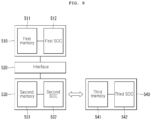
- FIG. 9 is a diagram illustrating an in-vehicle infotainment system according to the present disclosure.
- the vehicle 10 may include an in-vehicle infotainment system 500.
- the in-vehicle infotainment system 500 may include a first device 510, an interface 520, and a second device 530.
- the in-vehicle infotainment system 500 may further include a third device 540.
- the second device 530 and the third device 540 may be replaced with each other.
- the first device 510 may include a first memory 511 and a first SoC 512.
- the first device 510 may mean a vehicle 10 itself, or may mean an apparatus including the system 500 for controlling the vehicle 10.
- the first device 510 may mean a vehicle 10 itself, or an apparatus that is included in the vehicle 10 and cannot be easily replaced.
- the second device 530 may include a second memory 531 and a second SoC 532.
- the second device 530 may be replaced in a detachable manner.
- the second device 530 may be removed from the vehicle 10, and the third device 540 may be mounted in the vehicle 10.
- the first device 510 and the second device 530 or the third device 540 may be electrically connected to each other.
- the third device 540 may include a third memory 541 and a third Soc 542.
- the performance of the third device 540 may be higher than that of the second device 530.
- the clock of the third SoC 542 may be higher than the clock of the second SoC 532, or the capacity of the third memory 541 may be greater than the capacity of the second memory 531.
- a user may upgrade the infotainment system 500 of vehicle 10 by replacing the second device 530 with the third device 540.
- the present disclosure does not include only an upgrade case, but may include a device replacement scenario.
- the interface 520 is configured to connect the first device 510 and another device.
- the interface 520 transmits/receives data between the first device 510 and other device, and interfaces of various standards may be applied for more efficient transmission/reception.
- the in-vehicle infotainment system 500 may utilize an encryption means.
- the in-vehicle infotainment system 500 according to the present disclosure may transmit/receive data according to various encryption standards.
- Security may be important for user-customized data, or the like which may include personal information. Accordingly, when the first device 510 and other devices store data or transmit/receive data, security may be improved through an encryption process.
- FIGS. 10 and 11 are diagrams of a second device and a third device of the present disclosure.
- the second device 530 and the third device 540 may be connected to a second connecting portion 523, respectively.
- a first connecting portion 522 may be electrically connected to a first connecting portion 522 connected to the vehicle 10 or the first device 510. That is, the interface 520 may include the first connecting portion 522 and the second connecting portion 523, the first connecting portion 522 may be connected to the first device 510, and the second connecting portion 523 may be connected to the second device 530 and/or the third device 540.
- the first connecting portion 522 and the second connecting portion 523 may be electrically connected to transmit/receive data, and at this time, data may be encrypted and transmitted/received.
- the second device 530 and the third device 540 may receive first data from the first device 510, and execute an application based on the received first data.
- the application executed by the third device 540 may be stored in the third memory 541 of the third device 540.
- application A may be installed in the second device 530 and a user of the vehicle 10 may use the application A, thereby generating first data including user-customized data.
- the generated first data may be transmitted to the first device 510, and stored in the first device 510.
- the second device 530 may be replaced with the third device 540.
- the replaced third device 540 may receive first data including user-customized data from the first device 510.
- the third device 540 may execute an application based on the user-customized data of the received first data. Since the application executed in the third device 540 is executed based on the first data, not only the application data such as settings used by a user in the second device 530, but also user-customized data such as user information can be fetched intactly.
- Application data is data generated by the execution of a first application, and may be a type of user-customized data.
- the first application may temporarily back up the files used during a first execution in memory, and may perform faster execution by fetching again the temporarily backed up files during a second execution.
- Application data may mean data stored in a kind of cache memory.
- login information of the first application of the second device 530 or a user profile may also be fetched from the third device 540, and the second application of the third device 540 may log in by using the login information or the user profile.
- the in-vehicle infotainment system may include the first device 510 which is included in the vehicle 10 and includes the first memory 511, the second device 530 which is electrically connected to the first device 510, detachable from the vehicle 10, and includes the second memory 531, and the interface 520 electrically connecting the first device 510 and the second device 530.
- the first memory 511 may store first data including user-customized data, and the second device 530 may execute the first application based on the first data.
- the first application may be stored in the second memory 531. That is, the first data may be generated by executing the first application of the second device 530, and the first application may be stored in the second memory 531, and may be executed based on the first data of the first memory 511.
- the second device 530 may be replaced with the third device 540, and the second application installed in the third device 540 may be stored in the third memory 541.
- the second application of the third device 540 may be executed based on the first data of the first memory 511.
- the third device 540 may directly fetch the first data from the first memory 511 to execute the second application, and the third device 540 may also fetch and store the first data into the third memory 541, and execute the second application based on the first data stored in the third memory 541.
- the second device 530 or the third device 540 may be connected to the second connecting portion 523, and the second connecting portion 523 may have various types of interfaces. That is, the second connecting portion 523 may be inserted into the first connecting portion 522 in the form of an insertion terminal, or may be attached to the first connecting portion 522 in the form of a contact terminal.
- this is an example and the scope of the present disclosure is not limited thereto.
- FIG. 12 is a diagram illustrating a structure of a first memory according to the present disclosure.
- the first memory 511 may be divided into a system area 511a and an allocation area 511b.
- the areas according to a corresponding drawing may not mean a physical division, but may mean a set of memory cells. That is, the first memory 511 may store the first data including user-customized data.
- the system area 511a may include a kernel partition, a loop file system partition, and a data partition. That is, the system area 511a may mean a set of memory cells related to the operation of the system 500. Accordingly, even when an application (or an app package) is installed, data stored in the system area 511a is not changed.
- the kernel partition may be an area in which a kernel is stored
- the loop file system partition may be an area in which a loop file for a system is stored
- the data partition may be an area in which system data is stored.
- the first memory 511 may be divided into a plurality of partitions.
- the allocation area 511b may be divided into a plurality of partitions, and first data including the user-customized data and the application list may be stored in each partition.
- the user-customized data may include the user information or the user profile.
- the user-customized data may be data including the record of a user who uses an application, a propensity of the user, and the like.
- the user-customized data may mean all data generated by the user's use of the application.
- the application list may be a list of applications installed in the second device 530.
- the application list may be a list listing all applications installed in the second device 530.
- the application list may be transmitted to the third device 540, and the third device 540 may compare the installed applications with the received application list.
- the third device 540 may download an application that exists in the application list but is not currently installed from an external device or may receive and install it.
- the external device may be an external server.
- first data area 511b1 may be divided into first to fourth partitions.
- the number of partitions is just an example, and may be adjusted if necessary.
- the first partition may store first data, and the first data may be alternately stored in a plurality of partitions included in the first data area 511b1.
- the first data for the next device may be stored in the second partition.
- Next first data may be stored in the third partition.
- a plurality of partitions are alternately used to increase the lifespan of the memory.
- the first data may be encrypted and stored. Since the encrypted storage method is the same as or overlapping with the above-description, it is omitted.
- the allocation area 511b may further include an app package area 511b2.
- the app package area 511b2 may be a memory area in which an application represented by an APK file is installed. As such, more efficient memory utilization is possible and the lifespan of the memory can be increased by separating the app package area 511b2 and the first data area 511b1.
- the second preferred embodiment of the present disclosure may be described in terms of the in-vehicle infotainment system or the first device 510 included in the vehicle, but is not limited thereto.
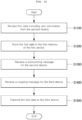
- FIGS. 13 to 16 are diagrams illustrating a method for upgrading an in-vehicle infotainment system according to the present disclosure.
- the upgrading method according to the present disclosure may be a method for upgrading an in-vehicle infotainment system by replacing the second device mounted in the vehicle 10 including the first device with the third device.
- the upgrade method may include a step (S1100) of receiving first data including user information from the second device 530, a step (S1200) of storing the received first data in the first memory 511 of the first device 510, a step (S1300) of receiving a dismounting message for the second device 530, a step (S1400) of receiving a coupling message for the third device 540, and a step (S1500) of transmitting the first data to the third device 540.
- a step (S1100) of receiving first data including user information from the second device 530 may include a step (S1100) of receiving first data including user information from the second device 530, a step (S1200) of storing the received first data in the first memory 511 of the first device 510, a step (S1300) of receiving a dismounting message for the second device 530, a step (S1400) of receiving a coupling message for the third device 540, and a step (S1500) of transmitting
- the dismounting message is a message (or signal) that is generated when it is detected that the second device 530 is connected (or mounted) with the interface 520 or the first device 510 and then the connection (or mounting) is disconnected.
- the dismounting message may be transmitted from the interface 520 to the first device 510. Alternatively, the dismounting message may be transmitted to the first device 510.
- the coupling message may be a message (or a signal) that is generated when it is detected that the second device 530 or the third device 540 is connected to the interface 520 or the first device 510.
- the coupling message may be transmitted from the interface 520 to the first device 510.
- the coupling message may be transmitted from the third device 540 to the first device 510.
- the coupling message may be transmitted to the first device 510.
- the third device 540 may execute the second application based on the first data, and a description thereof will be omitted below because it is the same as or overlaps with the above description.
- the first memory 511 may store first data
- the first memory 511 may include a plurality of partitions
- the first data may be alternately stored in the plurality of partitions. A description thereof will be omitted below because it is the same as or overlaps with the above description.
- the first data may include application data or application list information received from the second device 530, and the application list information may mean a list of a plurality of applications installed in the second device 530. A description thereof will be omitted below because it is the same as or overlaps with the above description.
- the first data may be encrypted and stored in the memory, and the first data may be encrypted and transmitted/received to and from the second device 530 and/or the third device 540.
- the description of encrypted storage and encrypted transmission/reception is the same as or overlap with the description in the first embodiment, it will be omitted.
- the third device 540 may receive the third application from an external server based on the application list information, install the third application in the third memory 541 based on the received file, and execute the third application. That is, the third application may mean an application that is installed in the second device but not installed in the third device 540.
- the step (S1100) of receiving the first data including the user information from the second device 530 may include a step (S1110) of detecting the occurrence of an event for the backup of the first data, and a step (S1120) of executing a zero-defect test for the first data.
- the first data may be received (S1130).
- the first data may be restored (S1140).
- the recovery of the first data it may return to the step (S1120) of executing a zero-defect test for the first data.
- the first data may be stored in the first memory 511.
- a step (S1200) of storing the received first data in the first memory 511 of the first device 510 may include a step (S1210) of comparing the first data with previous backup data, and a step (S1221) of stopping the operation when the first data and the backup data are the same.
- the step (S1200) of storing the received first data in the first memory 511 of the first device 510 may further include a step (S1210) of comparing the first data with the previous backup data, a step (S1220) of checking whether the partition to store the first data is the same as the partition used in the previous backup event, if the first data and the backup data are not the same, a step (S1231) of allocating the next partition, if both partitions are not identical, as a result of the check, and a step (S1241) of storing the first data in the next allocated partition.
- the step (S1200) of storing the received first data in the first memory 511 of the first device 510 may further include a step (S1230) of checking the zero-defect of the first data when both partitions are not identical as a result of the check, and a step (S1240) of storing the first data in the current partition of the first memory 511 when the first data is zero-defect.
- a step (S1500) of transmitting the first data to the third device 540 may include a step (S1510) of checking the OS type of the third device 540, and a step (S1520) of transmitting the first data to the third device 540, when the OS of the second device 530 and the OS of the third device 540 are the same OS, as a result of the check.
- the OS of the second device 530 is the Android-based version A and the OS of the third device 540 is the Android-based version B, it may be different depending on the difference in versions, but in general, it would be preferable to see it as a different OS.
- FIG. 17 is a diagram schematically illustrating a method for upgrading an in-vehicle infotainment system according to the present disclosure.
- the second device 530 may transmit the first data to the interface 520 (S101), and the interface 520 may transmit the first data to the first device 510 (S102).
- the second device 530 may be dismounted from the interface 520 (S103), the second device 530 may transmit a dismounting message to the interface 520 (S106), and the interface 520 may transmit a dismounting message to the first device 510 (S107).
- the first device 510 may perform a zero-defect test on the transmitted first data (S104), and then store the zero-defect first data (S105).
- the third device 540 may be coupled to the interface 520 from which the second device 530 is dismounted (S108), the third device 540 may transmit a coupling message to the interface 520 (S109), and the interface 520 may transmit a coupling message to the first device 510 (S110).
- the first device requests a OS check from the third device 540 (S111), and the third device 540 may transmit a response to the OS check request to the first device 510 (S112).
- the first device 510 may check whether the OS of the second device 530 and the OS of the third device 540 are the same OS based on the response (S113), and if it is determined that both OSs are not identical to each other (S114), the first device 510 may transmit the first data including the application list to the third device 540.
- the third device 540 may test the zero-defect of the first data including the application list and compare the application in the application list with the installed application (S116). As a result, the third device 540 may request an application that does not exist in the application list to the outside, and receive it from the outside and install it.
- the first device 510 may transmit the first data to the third device 540.
- FIGS. 18 to 20 are diagrams illustrating a detailed embodiment of an operation of an in-vehicle infotainment system according to the present disclosure.
- a checksum is a form of redundancy check, and may mean a method of protecting the zero-defect of transmitted data in space (electronic communication) or time (storage device) through error correction.
- the checksum data may mean data generated as a result of performing checksum.
- FIG. 18 is a diagram illustrating an example of an in-vehicle infotainment system according to the present disclosure.
- the second memory 531 of the second device 530 may store data (S201) and transmit the occurrence of a data storage event to a second SoC 532 (S202).
- the second SoC 532 may request a storage area checksum from the second memory 531 (S203). According to the request, the second memory 531 may transmit a checksum result to the second SoC 532 (S204).
- the second SoC 532 may request a data change from the first SoC 512 of the first device 510 (S205).
- the first SoC 512 may request checksum data from the second SoC 532 (S206), and accordingly, the second SoC 532 may transmit the checksum data to the first SoC 512 (S207).
- the first SoC 512 may request a checksum from the first memory 511 (S208), and the first memory 511 may transmit the checksum result to the first SoC 512.
- the first SoC 512 compares the checksum received from the second device 530 with the checksum received from the first memory 511 (S210), and as a result, checks that the checksums are different from each other (S211), and accordingly, the first SoC 512 may request storage data from the second SoC 532 (S212).
- the second SoC 532 may request storage data from the second memory 531 (S213), and the second memory 531 may transmit the storage data to the second SoC 532 (S214).
- the second SoC 532 transmits the storage data to the first SoC 512 (S215), the first SoC 512 transmits the storage data to the first memory 511 (S216), and the first memory (S216) 511) may store the transmitted data (S217).
- FIG. 19 is a diagram illustrating another example of an in-vehicle infotainment system according to the present disclosure.
- the second device 530 may further include a first profile module 533, and the first device 510 may further include a power supply 513.
- the first profile module 533 may receive user information from a user, and generate a user profile in which the user is registered based on the user information.
- the power supply 513 may be a device for supplying power to all components, and may be provided in the first device 510 or the vehicle 10.
- the first profile module 533 receives user information from a user (S301), the first profile module 533 transmits the user profile to the second memory 531 (S302), and the second memory 531 may store the user profile (S203).
- the second memory 531 may notify the second SoC 532 that a new user profile is stored (S304), and the second SoC 532 may request a storage area checksum from the second memory 531 (S305).
- the second memory 531 may transmit the checksum result to the second SoC 532 (S306).
- the second SoC 532 may notify the data change to the first SoC 512 of the first device 510 (S307), and the first SoC 512 may request checksum data from the second SoC 532 (S308). Accordingly, the second SoC 532 may transmit the checksum data to the first SoC 512 (S309), the first SoC 512 may request a checksum to the first memory 511 (S310), and the first memory 511 may transmit the checksum result to the first SoC 512 (S311).
- the first SoC 512 compares the results of both checksums (S312), and checks whether both checksums are different from each other (S313). If they are different, the first SoC 512 may request storage data from the second SoC 532 (S314).
- the second SoC 532 receiving the above request may request storage data to the second memory 531 (S315), and the second memory 531 may transmit the storage data to the second SoC 532 (S316). Accordingly, the second SoC 532 may transmit the storage data to the first SoC 512 (S317), the first SoC 512 may transmit the storage data to the first memory 511 (S318), and the first memory 511 may store the received data (S319).
- the power supply 513 requests the first SoC 512 to prohibit data change (S322), the first SoC 512 holds a data process in progress (S323), and the power supply 513 may transmit a power-off signal to the first SoC 512 (S324). Thereafter, the power supply 513 may finally turn off the entire vehicle 10 (S325).
- FIG. 20 is a diagram illustrating another example of an in-vehicle infotainment system according to the present disclosure.
- the third device 540 may further include a second profile module 543 and an app installation module 544.
- the second profile module 543 may be the same as or similar to the first profile module 533 of the second device 530. However, the second profile module 543 may obtain user-customized data, such as a user profile, from the first data stored in the first memory 511, without obtaining from a user's input.
- the app installation module 544 may be a module for managing an app package such as an APK file.
- a user may upgrade the second device 530 by replacing with the third device 540 (S401), and turn on the ignition of the vehicle 10 (S402).
- the first SoC 512 may request an upgrade version from the third SoC 542 (S403), and according to the request, the third SoC 542 may transmit version information to the first SoC 512 (S404).
- the first SoC 512 may check whether the version is upgraded based on the version information (S405).
- the first SoC 512 may transmit a notification message for notifying the third SoC 542 that there is first data stored in the first memory 511 (S406), the third Soc 542 may request a data storage preparation from the third memory 541 (S407), and the third memory 541 may transmit a data storage preparation complete message to the third Soc 542 (S408).
- the third Soc 542 may request transmission of the first data from the first SoC 512 (S409), the first SoC 512 may request the first data including the user-customized data from the first memory 511 (S410), and the first memory 511 may transmit the first data to the first SoC 512 (S411).
- the first SoC 512 may transmit the first data to the third Soc 542 (S412), the third Soc 542 may transmit the first data to the third memory 541 (S413), and the third memory 541 may store the first data (S414).
- the third memory 541 may transmit a first data storage completion message to the third Soc 542 (S415), and the third Soc 542 may transmit a first data update notification message to the second profile module 543 (S416).
- the second profile module 543 may transmit a first data request message to the third memory 541 (S417), and the third memory 541 may transmit the first data to the second profile module 543 (S418).
- the second profile module 543 may transmit a first data update completion message to the third Soc 542 (S419), the third Soc 542 may transmit an application list request message to the third memory 541 (S420), and the third memory 541 may transmit the application list to the third Soc 542 (S421).
- the third Soc 542 may transmit an app package transmission request message to the first SoC 512 (S422), and the first SoC 512 may transmit the app package transmission request message to the first memory 511 (S423).
- the first memory 511 may transmit an app package to the first SoC 512 (S424), the first SoC 512 may transmit the app package to the third Soc 542 (S425), and the third Soc 542 may transmit the app package to the app installation module 544 (S426).
- the app installation module 544 may store the app package (S427), and the app installation module 544 may transmit an app package storage completion message to the third Soc 542 (S428).
- Processes S422 to S428 are a series of loop algorithms and may be repeatedly executed until all app packages in the application list are installed.
Landscapes
- Engineering & Computer Science (AREA)
- Theoretical Computer Science (AREA)
- Software Systems (AREA)
- General Engineering & Computer Science (AREA)
- Physics & Mathematics (AREA)
- General Physics & Mathematics (AREA)
- Multimedia (AREA)
- Signal Processing (AREA)
- Quality & Reliability (AREA)
- Traffic Control Systems (AREA)
- Computer Security & Cryptography (AREA)
Claims (15)
- Fahrzeuginternes Infotainmentsystem (500), das aufweist:eine erste Vorrichtung (510), die in einem Fahrzeug enthalten ist und einen ersten Speicher (511) aufweist;eine zweite Vorrichtung (350), die elektrisch mit der ersten Vorrichtung verbunden ist, die an das Fahrzeug anbringbar oder vom Fahrzeug entfernbar ist, und einen zweiten Speicher (531) aufweist; undeine Schnittstelle (520), die konfiguriert ist, die zweite Vorrichtung elektrisch mit der ersten Vorrichtung zu verbinden,wobei in Reaktion auf das Ausführen einer ersten Anwendung die zweite Vorrichtung (530) konfiguriert ist, erste Daten zu erzeugen, die vom Benutzer angepasste Daten aufweisen, und die erzeugten ersten Daten an die erste Vorrichtung zu übertragen,wobei der erste Speicher (511) die ersten Daten, die die vom Benutzer angepassten Daten aufweisen, speichert, die zweite Vorrichtung die erste Anwendung basierend auf den ersten Daten ausführt, und die erste Anwendung im zweiten Speicher gespeichert wird,wobei die vom Benutzer angepassten Daten Anmeldeinformationen der ersten Anmeldung oder Benutzerprofilinformationen aufweisen,wobei in Reaktion darauf, dass die zweite Vorrichtung durch eine dritte Vorrichtung (540) ersetzt wird, die einen dritten Speicher (541) aufweist, die erste Vorrichtung konfiguriert ist, die ersten Daten, die die vom Benutzer angepassten Daten aufweisen, an die dritte Vorrichtung zu übertragen,wobei die erste Vorrichtung (510) konfiguriert ist, zu prüfen, ob ein Betriebssystem der zweiten Vorrichtung (530) gleich einem Betriebssystem der dritten Vorrichtung (540) ist und in Reaktion darauf, dass das Betriebssystem der dritten Vorrichtung (540) nicht gleich dem Betriebssystem der zweiten Vorrichtung (530) ist, Daten, die eine von der zweiten Vorrichtung (530) empfangene Anwendungsliste aufweisen, an die dritte Vorrichtung (540) zu übertragen,wobei die dritte Vorrichtung (540) konfiguriert ist, Anwendungen in der Anwendungsliste mit Anwendungen zu vergleichen, die in der dritten Vorrichtung (540) installiert sind, eine Anwendung anzufordern, die in der Anwendungsliste nicht vorhanden ist, die angeforderte Anwendung zu empfangen und zu installieren.
- Fahrzeuginternes Infotainmentsystem nach Anspruch 1,
wobei die dritte Vorrichtung (540) eine zweite Anwendung basierend auf den ersten Daten ausführt und die zweite Anwendung im dritten Speicher gespeichert wird. - Fahrzeuginternes Infotainmentsystem nach Anspruch 2,wobei die ersten Daten weiterhin Anwendungsdaten aufweisen, die von der zweiten Vorrichtung empfangen wurden, unddie dritte Vorrichtung die zweite Anwendung basierend auf den Anwendungsdaten ausführt.
- Fahrzeuginternes Infotainmentsystem nach einem der Ansprüche 1 bis 4, wobei der erste Speicher in mehrere Partitionen unterteilt ist.
- Fahrzeuginternes Infotainmentsystem nach Anspruch 4, wobei die mehreren Partitionen eine erste Partition aufweisen, um die ersten Daten zu speichern.
- Fahrzeuginternes Infotainmentsystem nach Anspruch 4, wobei die mehreren Partitionen eine erste Partition und eine zweite Partition aufweisen, um die ersten Daten abwechselnd zu speichern.
- Fahrzeuginternes Infotainmentsystem nach einem der Ansprüche 1 bis 6, wobei die ersten Daten im ersten Speicher verschlüsselt und gespeichert werden.
- Fahrzeuginternes Infotainmentsystem nach einem der Ansprüche 1 bis 7, wobei die ersten Daten verschlüsselt und an die zweite Vorrichtung übertragen werden.
- Fahrzeuginternes Infotainmentsystem nach einem der Ansprüche 1 bis 8,wobei die ersten Daten weiterhin Anwendungslisteninformationen aufweisen, die von der zweiten Vorrichtung empfangen wurden, undwobei die dritte Vorrichtung eine dritte Anwendung basierend auf den Anwendungslisteninformationen installiert.
- Verfahren zum Aktualisieren eines fahrzeuginternen Infotainmentsystems (500) durch Ersetzen einer zweiten Vorrichtung (530), die in einem Fahrzeug angebracht ist, das eine erste Vorrichtung (510) aufweist, durch eine dritte Vorrichtung (540), wobei das Verfahren aufweist:Empfangen (S1100) von ersten Daten, die vom Benutzer angepasste Daten aufweisen, von der zweiten Vorrichtung, wobei die vom Benutzer angepassten Daten basierend auf der Ausführung der ersten Anwendung erzeugt werden;Speichern (S1200) der ersten Daten in einem ersten Speicher der ersten Vorrichtung;Empfangen (S1300) einer Ausbaunachricht für die zweite Vorrichtung;Empfangen (S1400) einer Kopplungsnachricht für die dritte Vorrichtung; undÜbertragen (S1500) der ersten Daten an die dritte Vorrichtung,wobei die zweite Vorrichtung (530) die erste Anwendung basierend auf den ersten Daten ausführt,wobei die vom Benutzer angepassten Daten Anmeldeinformationen der ersten Anmeldung oder Benutzerprofilinformationen aufweisen,wobei das Übertragen (S1500) der ersten Daten an die dritte Vorrichtung das Übertragen der ersten Daten, die die vom Benutzer angepassten Daten aufweisen, an die dritte Vorrichtung aufweist,wobei die erste Vorrichtung (510) konfiguriert ist, zu prüfen, ob ein Betriebssystem der zweiten Vorrichtung (530) gleich einem Betriebssystem der dritten Vorrichtung (540) ist und in Reaktion darauf, dass das Betriebssystem der dritten Vorrichtung (540) nicht gleich dem Betriebssystem der zweiten Vorrichtung (530) ist, Daten, die eine von der zweiten Vorrichtung (530) empfangene Anwendungsliste aufweisen, an die dritte Vorrichtung (540) zu übertragen,wobei die dritte Vorrichtung (540) konfiguriert ist, Anwendungen in der Anwendungsliste mit Anwendungen zu vergleichen, die in der dritten Vorrichtung (540) installiert sind, eine Anwendung anzufordern, die in der Anwendungsliste nicht vorhanden ist, die angeforderte Anwendung zu empfangen und zu installieren.
- Verfahren nach Anspruch 10, wobei die dritte Vorrichtung eine zweite Anwendung basierend auf den ersten Daten ausführt.
- Verfahren nach einem der Ansprüche 10 bis 11, wobei das Empfangen erster Daten aufweist:Erfassen des Auftretens eines Ereignisses für eine Sicherung der ersten Daten;Ausführen eines Tests auf Fehlerfreiheit für die ersten Daten; undEmpfangen der ersten Daten basierend darauf, dass die ersten Daten fehlerfrei sind.
- Verfahren nach Anspruch 12, wobei das Empfangen von ersten Daten das Wiederherstellen der ersten Daten basierend darauf, dass die ersten Daten nicht fehlerfrei sind, aufweist.
- Verfahren nach einem der Ansprüche 10 bis 13, wobei der erste Speicher in mehrere Partitionen unterteilt ist,
wobei die ersten Daten in einer beliebigen der mehreren Partitionen gespeichert sind. - Verfahren nach Anspruch 14, wobei die mehreren Partitionen eine erste Partition und eine zweite Partition aufweisen, um die ersten Daten abwechselnd zu speichern.
Applications Claiming Priority (1)
| Application Number | Priority Date | Filing Date | Title |
|---|---|---|---|
| PCT/KR2020/010256 WO2022030658A1 (ko) | 2020-08-04 | 2020-08-04 | 차량용 인포테인먼트 시스템 및 이를 업그레이드하는 방법 |
Publications (3)
| Publication Number | Publication Date |
|---|---|
| EP4195034A1 EP4195034A1 (de) | 2023-06-14 |
| EP4195034A4 EP4195034A4 (de) | 2024-04-03 |
| EP4195034B1 true EP4195034B1 (de) | 2025-06-25 |
Family
ID=80118197
Family Applications (1)
| Application Number | Title | Priority Date | Filing Date |
|---|---|---|---|
| EP20948579.6A Active EP4195034B1 (de) | 2020-08-04 | 2020-08-04 | Fahrzeuginternes infotainmentsystem und verfahren zur aktualisierung davon |
Country Status (4)
| Country | Link |
|---|---|
| US (1) | US20230283828A1 (de) |
| EP (1) | EP4195034B1 (de) |
| KR (1) | KR102872509B1 (de) |
| WO (1) | WO2022030658A1 (de) |
Families Citing this family (2)
| Publication number | Priority date | Publication date | Assignee | Title |
|---|---|---|---|---|
| EP4530819A4 (de) * | 2022-09-29 | 2025-08-20 | Lg Electronics Inc | Signalverarbeitungsvorrichtung und anzeigevorrichtung für ein fahrzeug damit |
| TWI852607B (zh) * | 2023-06-06 | 2024-08-11 | 緯創資通股份有限公司 | 即時遷移方法及用來實現無縫即時遷移的系統 |
Family Cites Families (17)
| Publication number | Priority date | Publication date | Assignee | Title |
|---|---|---|---|---|
| GB2367656A (en) * | 2000-10-06 | 2002-04-10 | Hewlett Packard Co | Self-repairing operating system for computer entities |
| US8266124B2 (en) * | 2001-12-18 | 2012-09-11 | Caldvor Acquisitions Ltd., Llc | Integrated asset management |
| US7136728B2 (en) * | 2003-04-21 | 2006-11-14 | Hunter Engineering Company | Computerized wheel alignment system with improved stability and serviceability |
| US8831823B2 (en) * | 2009-10-15 | 2014-09-09 | Airbiquity Inc. | Centralized management of motor vehicle software applications and services |
| KR101952238B1 (ko) * | 2011-12-27 | 2019-02-27 | 삼성전자 주식회사 | 디스플레이장치 및 그 제어방법 |
| US20140309862A1 (en) * | 2013-04-15 | 2014-10-16 | Flextronics Ap, Llc | User profile exchange via vehicle supported communications protocol |
| US20160028870A1 (en) * | 2014-07-23 | 2016-01-28 | Lg Electronics Inc. | Method of sharing information of a mobile terminal for interworking between an in-vehicle infotainment system and the mobile terminal |
| KR101677645B1 (ko) * | 2014-11-03 | 2016-11-18 | 엘지전자 주식회사 | 이동 통신 시스템 및 그 제어 방법 |
| US9882779B2 (en) * | 2015-03-18 | 2018-01-30 | International Business Machines Corporation | Software version maintenance in a software defined network |
| US9886283B2 (en) * | 2015-05-01 | 2018-02-06 | GM Global Technology Operations LLC | Adaptive boot sequence for vehicle infotainment system |
| KR102400384B1 (ko) * | 2015-06-26 | 2022-05-23 | 삼성전자 주식회사 | 외장 메모리를 구비하는 전자장치 및 그 동작 방법 |
| KR101847495B1 (ko) * | 2015-08-31 | 2018-05-24 | 엘지전자 주식회사 | 인포테인먼트 디바이스 및 그 제어 방법 |
| US10555026B2 (en) * | 2015-12-29 | 2020-02-04 | The Directv Group, Inc. | Method and system for providing audio signals to an in-vehicle infotainment system |
| WO2018082105A1 (zh) * | 2016-11-07 | 2018-05-11 | 华为技术有限公司 | 利用外置sim卡切换车载业务的方法及装置 |
| KR102544475B1 (ko) * | 2018-02-05 | 2023-06-19 | 삼성전자주식회사 | 인포테인먼트 장치와 인포테인먼트 서비스 제공 방법 및 인포테인먼트 장치를 포함하는 차량용 전자 시스템 |
| JP6937887B2 (ja) * | 2018-02-21 | 2021-09-22 | 三菱電機株式会社 | 車載機能アクセス制御システム、車載装置および車載機能アクセス制御方法 |
| US20210241627A1 (en) * | 2020-01-31 | 2021-08-05 | Toyota Motor North America, Inc. | Overdue parking warning |
-
2020
- 2020-08-04 EP EP20948579.6A patent/EP4195034B1/de active Active
- 2020-08-04 KR KR1020227027777A patent/KR102872509B1/ko active Active
- 2020-08-04 US US18/019,743 patent/US20230283828A1/en active Pending
- 2020-08-04 WO PCT/KR2020/010256 patent/WO2022030658A1/ko not_active Ceased
Also Published As
| Publication number | Publication date |
|---|---|
| EP4195034A1 (de) | 2023-06-14 |
| US20230283828A1 (en) | 2023-09-07 |
| KR20230042201A (ko) | 2023-03-28 |
| WO2022030658A1 (ko) | 2022-02-10 |
| KR102872509B1 (ko) | 2025-10-16 |
| EP4195034A4 (de) | 2024-04-03 |
Similar Documents
| Publication | Publication Date | Title |
|---|---|---|
| EP4060482B1 (de) | Nahtlose container-aktualisierung in einem container-basierten fahrzeugsystem | |
| EP4060486B1 (de) | Behälterbasierte aktivierung einer neuen vorrichtung in einem fahrzeug | |
| US12517749B2 (en) | Signal processing device and display apparatus for vehicles including the same | |
| KR102263395B1 (ko) | 외부 이동 수단의 움직임과 관련된 데이터에 기반하여, 식별 정보가 변경된 외부 이동 수단을 확인하는 전자 장치 및 그 동작 방법 | |
| US20120053754A1 (en) | Electronic communications and control module | |
| EP4137926A1 (de) | Bildverarbeitungsvorrichtung für ein fahrzeug und verfahren zur anzeige visueller informationen auf einer in einem fahrzeug enthaltenen anzeige | |
| US20110106375A1 (en) | Method and system for providing an integrated platform for entertainment, information, communication, control and computing applications in vehicles | |
| WO2013052043A1 (en) | Electronic communications and control module | |
| EP4209401A1 (de) | System für ar-bildschirmbild eines fahrzeugs und verfahren zur bereitstellung eines ar-bildschirmbilddienstes eines fahrzeugs | |
| EP4195034B1 (de) | Fahrzeuginternes infotainmentsystem und verfahren zur aktualisierung davon | |
| US11675356B2 (en) | Method and system for providing clothing management service | |
| US20250298655A1 (en) | Signal processing device and display apparatus for vehicles including the same | |
| EP4177732A1 (de) | Informationsverarbeitungsvorrichtung, informationsverarbeitungsverfahren, informationsverarbeitungssystem und programm | |
| EP4603967A1 (de) | Informationsverarbeitungsvorrichtung und informationsverarbeitungsverfahren | |
| US20260073707A1 (en) | Electronic device, method and non-transitory computer readable storage medium identifying direction of movement of external object | |
| KR20220119640A (ko) | 멀티 모달 입력 기반의 서비스 제공 장치 및 서비스 제공 방법 | |
| US20260099944A1 (en) | Electronic device, method, and non-transitory computer-readable storage medium for use of camera in vehicle | |
| US20250156210A1 (en) | Signal processing device and vehicle display apparatus including same |
Legal Events
| Date | Code | Title | Description |
|---|---|---|---|
| STAA | Information on the status of an ep patent application or granted ep patent |
Free format text: STATUS: THE INTERNATIONAL PUBLICATION HAS BEEN MADE |
|
| PUAI | Public reference made under article 153(3) epc to a published international application that has entered the european phase |
Free format text: ORIGINAL CODE: 0009012 |
|
| STAA | Information on the status of an ep patent application or granted ep patent |
Free format text: STATUS: REQUEST FOR EXAMINATION WAS MADE |
|
| 17P | Request for examination filed |
Effective date: 20230304 |
|
| AK | Designated contracting states |
Kind code of ref document: A1 Designated state(s): AL AT BE BG CH CY CZ DE DK EE ES FI FR GB GR HR HU IE IS IT LI LT LU LV MC MK MT NL NO PL PT RO RS SE SI SK SM TR |
|
| DAV | Request for validation of the european patent (deleted) | ||
| DAX | Request for extension of the european patent (deleted) | ||
| REG | Reference to a national code |
Ref country code: DE Ref legal event code: R079 Free format text: PREVIOUS MAIN CLASS: G06F0008654000 Ipc: G06F0009445000 Ref document number: 602020053578 Country of ref document: DE |
|
| A4 | Supplementary search report drawn up and despatched |
Effective date: 20240305 |
|
| RIC1 | Information provided on ipc code assigned before grant |
Ipc: G06F 21/31 20130101ALN20240228BHEP Ipc: G06F 11/14 20060101ALI20240228BHEP Ipc: G06F 9/445 20180101AFI20240228BHEP |
|
| GRAP | Despatch of communication of intention to grant a patent |
Free format text: ORIGINAL CODE: EPIDOSNIGR1 |
|
| STAA | Information on the status of an ep patent application or granted ep patent |
Free format text: STATUS: GRANT OF PATENT IS INTENDED |
|
| RIC1 | Information provided on ipc code assigned before grant |
Ipc: G06F 21/31 20130101ALN20250217BHEP Ipc: G06F 11/14 20060101ALI20250217BHEP Ipc: G06F 9/445 20180101AFI20250217BHEP |
|
| INTG | Intention to grant announced |
Effective date: 20250226 |
|
| GRAS | Grant fee paid |
Free format text: ORIGINAL CODE: EPIDOSNIGR3 |
|
| GRAA | (expected) grant |
Free format text: ORIGINAL CODE: 0009210 |
|
| STAA | Information on the status of an ep patent application or granted ep patent |
Free format text: STATUS: THE PATENT HAS BEEN GRANTED |
|
| AK | Designated contracting states |
Kind code of ref document: B1 Designated state(s): AL AT BE BG CH CY CZ DE DK EE ES FI FR GB GR HR HU IE IS IT LI LT LU LV MC MK MT NL NO PL PT RO RS SE SI SK SM TR |
|
| REG | Reference to a national code |
Ref country code: GB Ref legal event code: FG4D |
|
| REG | Reference to a national code |
Ref country code: CH Ref legal event code: EP |
|
| REG | Reference to a national code |
Ref country code: CH Ref legal event code: EP |
|
| REG | Reference to a national code |
Ref country code: IE Ref legal event code: FG4D |
|
| REG | Reference to a national code |
Ref country code: DE Ref legal event code: R096 Ref document number: 602020053578 Country of ref document: DE |
|
| PG25 | Lapsed in a contracting state [announced via postgrant information from national office to epo] |
Ref country code: FI Free format text: LAPSE BECAUSE OF FAILURE TO SUBMIT A TRANSLATION OF THE DESCRIPTION OR TO PAY THE FEE WITHIN THE PRESCRIBED TIME-LIMIT Effective date: 20250625 |
|
| PGFP | Annual fee paid to national office [announced via postgrant information from national office to epo] |
Ref country code: DE Payment date: 20250805 Year of fee payment: 6 |
|
| REG | Reference to a national code |
Ref country code: LT Ref legal event code: MG9D |
|
| PG25 | Lapsed in a contracting state [announced via postgrant information from national office to epo] |
Ref country code: NO Free format text: LAPSE BECAUSE OF FAILURE TO SUBMIT A TRANSLATION OF THE DESCRIPTION OR TO PAY THE FEE WITHIN THE PRESCRIBED TIME-LIMIT Effective date: 20250925 Ref country code: GR Free format text: LAPSE BECAUSE OF FAILURE TO SUBMIT A TRANSLATION OF THE DESCRIPTION OR TO PAY THE FEE WITHIN THE PRESCRIBED TIME-LIMIT Effective date: 20250926 |
|
| PG25 | Lapsed in a contracting state [announced via postgrant information from national office to epo] |
Ref country code: BG Free format text: LAPSE BECAUSE OF FAILURE TO SUBMIT A TRANSLATION OF THE DESCRIPTION OR TO PAY THE FEE WITHIN THE PRESCRIBED TIME-LIMIT Effective date: 20250625 |
|
| PG25 | Lapsed in a contracting state [announced via postgrant information from national office to epo] |
Ref country code: HR Free format text: LAPSE BECAUSE OF FAILURE TO SUBMIT A TRANSLATION OF THE DESCRIPTION OR TO PAY THE FEE WITHIN THE PRESCRIBED TIME-LIMIT Effective date: 20250625 |
|
| PG25 | Lapsed in a contracting state [announced via postgrant information from national office to epo] |
Ref country code: RS Free format text: LAPSE BECAUSE OF FAILURE TO SUBMIT A TRANSLATION OF THE DESCRIPTION OR TO PAY THE FEE WITHIN THE PRESCRIBED TIME-LIMIT Effective date: 20250925 |
|
| PG25 | Lapsed in a contracting state [announced via postgrant information from national office to epo] |
Ref country code: LV Free format text: LAPSE BECAUSE OF FAILURE TO SUBMIT A TRANSLATION OF THE DESCRIPTION OR TO PAY THE FEE WITHIN THE PRESCRIBED TIME-LIMIT Effective date: 20250625 |
|
| REG | Reference to a national code |
Ref country code: NL Ref legal event code: MP Effective date: 20250625 |
|
| PG25 | Lapsed in a contracting state [announced via postgrant information from national office to epo] |
Ref country code: NL Free format text: LAPSE BECAUSE OF FAILURE TO SUBMIT A TRANSLATION OF THE DESCRIPTION OR TO PAY THE FEE WITHIN THE PRESCRIBED TIME-LIMIT Effective date: 20250625 |
|
| PG25 | Lapsed in a contracting state [announced via postgrant information from national office to epo] |
Ref country code: PT Free format text: LAPSE BECAUSE OF FAILURE TO SUBMIT A TRANSLATION OF THE DESCRIPTION OR TO PAY THE FEE WITHIN THE PRESCRIBED TIME-LIMIT Effective date: 20251027 |
|
| REG | Reference to a national code |
Ref country code: AT Ref legal event code: MK05 Ref document number: 1807182 Country of ref document: AT Kind code of ref document: T Effective date: 20250625 |
|
| PG25 | Lapsed in a contracting state [announced via postgrant information from national office to epo] |
Ref country code: IS Free format text: LAPSE BECAUSE OF FAILURE TO SUBMIT A TRANSLATION OF THE DESCRIPTION OR TO PAY THE FEE WITHIN THE PRESCRIBED TIME-LIMIT Effective date: 20251025 |
|
| PG25 | Lapsed in a contracting state [announced via postgrant information from national office to epo] |
Ref country code: AT Free format text: LAPSE BECAUSE OF FAILURE TO SUBMIT A TRANSLATION OF THE DESCRIPTION OR TO PAY THE FEE WITHIN THE PRESCRIBED TIME-LIMIT Effective date: 20250625 Ref country code: SM Free format text: LAPSE BECAUSE OF FAILURE TO SUBMIT A TRANSLATION OF THE DESCRIPTION OR TO PAY THE FEE WITHIN THE PRESCRIBED TIME-LIMIT Effective date: 20250625 |
|
| PG25 | Lapsed in a contracting state [announced via postgrant information from national office to epo] |
Ref country code: CZ Free format text: LAPSE BECAUSE OF FAILURE TO SUBMIT A TRANSLATION OF THE DESCRIPTION OR TO PAY THE FEE WITHIN THE PRESCRIBED TIME-LIMIT Effective date: 20250625 |
|
| PG25 | Lapsed in a contracting state [announced via postgrant information from national office to epo] |
Ref country code: PL Free format text: LAPSE BECAUSE OF FAILURE TO SUBMIT A TRANSLATION OF THE DESCRIPTION OR TO PAY THE FEE WITHIN THE PRESCRIBED TIME-LIMIT Effective date: 20250625 |
|
| PG25 | Lapsed in a contracting state [announced via postgrant information from national office to epo] |
Ref country code: EE Free format text: LAPSE BECAUSE OF FAILURE TO SUBMIT A TRANSLATION OF THE DESCRIPTION OR TO PAY THE FEE WITHIN THE PRESCRIBED TIME-LIMIT Effective date: 20250625 |
|
| PG25 | Lapsed in a contracting state [announced via postgrant information from national office to epo] |
Ref country code: SK Free format text: LAPSE BECAUSE OF FAILURE TO SUBMIT A TRANSLATION OF THE DESCRIPTION OR TO PAY THE FEE WITHIN THE PRESCRIBED TIME-LIMIT Effective date: 20250625 |
|
| PG25 | Lapsed in a contracting state [announced via postgrant information from national office to epo] |
Ref country code: ES Free format text: LAPSE BECAUSE OF FAILURE TO SUBMIT A TRANSLATION OF THE DESCRIPTION OR TO PAY THE FEE WITHIN THE PRESCRIBED TIME-LIMIT Effective date: 20250625 |
|
| PG25 | Lapsed in a contracting state [announced via postgrant information from national office to epo] |
Ref country code: RO Free format text: LAPSE BECAUSE OF FAILURE TO SUBMIT A TRANSLATION OF THE DESCRIPTION OR TO PAY THE FEE WITHIN THE PRESCRIBED TIME-LIMIT Effective date: 20250625 |
|
| REG | Reference to a national code |
Ref country code: CH Ref legal event code: H13 Free format text: ST27 STATUS EVENT CODE: U-0-0-H10-H13 (AS PROVIDED BY THE NATIONAL OFFICE) Effective date: 20260324 |
|
| PG25 | Lapsed in a contracting state [announced via postgrant information from national office to epo] |
Ref country code: MC Free format text: LAPSE BECAUSE OF FAILURE TO SUBMIT A TRANSLATION OF THE DESCRIPTION OR TO PAY THE FEE WITHIN THE PRESCRIBED TIME-LIMIT Effective date: 20250625 |
|
| PG25 | Lapsed in a contracting state [announced via postgrant information from national office to epo] |
Ref country code: DK Free format text: LAPSE BECAUSE OF FAILURE TO SUBMIT A TRANSLATION OF THE DESCRIPTION OR TO PAY THE FEE WITHIN THE PRESCRIBED TIME-LIMIT Effective date: 20250625 |
|
| PG25 | Lapsed in a contracting state [announced via postgrant information from national office to epo] |
Ref country code: LU Free format text: LAPSE BECAUSE OF NON-PAYMENT OF DUE FEES Effective date: 20250804 Ref country code: IT Free format text: LAPSE BECAUSE OF FAILURE TO SUBMIT A TRANSLATION OF THE DESCRIPTION OR TO PAY THE FEE WITHIN THE PRESCRIBED TIME-LIMIT Effective date: 20250625 |
|
| PG25 | Lapsed in a contracting state [announced via postgrant information from national office to epo] |
Ref country code: CH Free format text: LAPSE BECAUSE OF NON-PAYMENT OF DUE FEES Effective date: 20250831 |
|
| PLBE | No opposition filed within time limit |
Free format text: ORIGINAL CODE: 0009261 |
|
| STAA | Information on the status of an ep patent application or granted ep patent |
Free format text: STATUS: NO OPPOSITION FILED WITHIN TIME LIMIT |