EP4194023A1 - Disposable set and extracorporeal blood treatment apparatus for preventing degassing in an infusion fluid line - Google Patents
Disposable set and extracorporeal blood treatment apparatus for preventing degassing in an infusion fluid line Download PDFInfo
- Publication number
- EP4194023A1 EP4194023A1 EP21213423.3A EP21213423A EP4194023A1 EP 4194023 A1 EP4194023 A1 EP 4194023A1 EP 21213423 A EP21213423 A EP 21213423A EP 4194023 A1 EP4194023 A1 EP 4194023A1
- Authority
- EP
- European Patent Office
- Prior art keywords
- blood
- infusion
- line
- fluid
- pressure
- Prior art date
- Legal status (The legal status is an assumption and is not a legal conclusion. Google has not performed a legal analysis and makes no representation as to the accuracy of the status listed.)
- Pending
Links
Images



Classifications
-
- A—HUMAN NECESSITIES
- A61—MEDICAL OR VETERINARY SCIENCE; HYGIENE
- A61M—DEVICES FOR INTRODUCING MEDIA INTO, OR ONTO, THE BODY; DEVICES FOR TRANSDUCING BODY MEDIA OR FOR TAKING MEDIA FROM THE BODY; DEVICES FOR PRODUCING OR ENDING SLEEP OR STUPOR
- A61M1/00—Suction or pumping devices for medical purposes; Devices for carrying-off, for treatment of, or for carrying-over, body-liquids; Drainage systems
- A61M1/14—Dialysis systems; Artificial kidneys; Blood oxygenators ; Reciprocating systems for treatment of body fluids, e.g. single needle systems for hemofiltration or pheresis
- A61M1/16—Dialysis systems; Artificial kidneys; Blood oxygenators ; Reciprocating systems for treatment of body fluids, e.g. single needle systems for hemofiltration or pheresis with membranes
-
- A—HUMAN NECESSITIES
- A61—MEDICAL OR VETERINARY SCIENCE; HYGIENE
- A61M—DEVICES FOR INTRODUCING MEDIA INTO, OR ONTO, THE BODY; DEVICES FOR TRANSDUCING BODY MEDIA OR FOR TAKING MEDIA FROM THE BODY; DEVICES FOR PRODUCING OR ENDING SLEEP OR STUPOR
- A61M1/00—Suction or pumping devices for medical purposes; Devices for carrying-off, for treatment of, or for carrying-over, body-liquids; Drainage systems
- A61M1/36—Other treatment of blood in a by-pass of the natural circulatory system, e.g. temperature adaptation, irradiation ; Extra-corporeal blood circuits
- A61M1/3621—Extra-corporeal blood circuits
- A61M1/3639—Blood pressure control, pressure transducers specially adapted therefor
-
- A—HUMAN NECESSITIES
- A61—MEDICAL OR VETERINARY SCIENCE; HYGIENE
- A61M—DEVICES FOR INTRODUCING MEDIA INTO, OR ONTO, THE BODY; DEVICES FOR TRANSDUCING BODY MEDIA OR FOR TAKING MEDIA FROM THE BODY; DEVICES FOR PRODUCING OR ENDING SLEEP OR STUPOR
- A61M1/00—Suction or pumping devices for medical purposes; Devices for carrying-off, for treatment of, or for carrying-over, body-liquids; Drainage systems
- A61M1/34—Filtering material out of the blood by passing it through a membrane, i.e. hemofiltration or diafiltration
- A61M1/3401—Cassettes therefor
-
- A—HUMAN NECESSITIES
- A61—MEDICAL OR VETERINARY SCIENCE; HYGIENE
- A61M—DEVICES FOR INTRODUCING MEDIA INTO, OR ONTO, THE BODY; DEVICES FOR TRANSDUCING BODY MEDIA OR FOR TAKING MEDIA FROM THE BODY; DEVICES FOR PRODUCING OR ENDING SLEEP OR STUPOR
- A61M1/00—Suction or pumping devices for medical purposes; Devices for carrying-off, for treatment of, or for carrying-over, body-liquids; Drainage systems
- A61M1/34—Filtering material out of the blood by passing it through a membrane, i.e. hemofiltration or diafiltration
- A61M1/342—Adding solutions to the blood, e.g. substitution solutions
- A61M1/3424—Substitution fluid path
- A61M1/3431—Substitution fluid path upstream of the filter
-
- A—HUMAN NECESSITIES
- A61—MEDICAL OR VETERINARY SCIENCE; HYGIENE
- A61M—DEVICES FOR INTRODUCING MEDIA INTO, OR ONTO, THE BODY; DEVICES FOR TRANSDUCING BODY MEDIA OR FOR TAKING MEDIA FROM THE BODY; DEVICES FOR PRODUCING OR ENDING SLEEP OR STUPOR
- A61M1/00—Suction or pumping devices for medical purposes; Devices for carrying-off, for treatment of, or for carrying-over, body-liquids; Drainage systems
- A61M1/34—Filtering material out of the blood by passing it through a membrane, i.e. hemofiltration or diafiltration
- A61M1/342—Adding solutions to the blood, e.g. substitution solutions
- A61M1/3424—Substitution fluid path
- A61M1/3431—Substitution fluid path upstream of the filter
- A61M1/3434—Substitution fluid path upstream of the filter with pre-dilution and post-dilution
-
- A—HUMAN NECESSITIES
- A61—MEDICAL OR VETERINARY SCIENCE; HYGIENE
- A61M—DEVICES FOR INTRODUCING MEDIA INTO, OR ONTO, THE BODY; DEVICES FOR TRANSDUCING BODY MEDIA OR FOR TAKING MEDIA FROM THE BODY; DEVICES FOR PRODUCING OR ENDING SLEEP OR STUPOR
- A61M1/00—Suction or pumping devices for medical purposes; Devices for carrying-off, for treatment of, or for carrying-over, body-liquids; Drainage systems
- A61M1/34—Filtering material out of the blood by passing it through a membrane, i.e. hemofiltration or diafiltration
- A61M1/342—Adding solutions to the blood, e.g. substitution solutions
- A61M1/3424—Substitution fluid path
- A61M1/3437—Substitution fluid path downstream of the filter, e.g. post-dilution with filtrate
-
- A—HUMAN NECESSITIES
- A61—MEDICAL OR VETERINARY SCIENCE; HYGIENE
- A61M—DEVICES FOR INTRODUCING MEDIA INTO, OR ONTO, THE BODY; DEVICES FOR TRANSDUCING BODY MEDIA OR FOR TAKING MEDIA FROM THE BODY; DEVICES FOR PRODUCING OR ENDING SLEEP OR STUPOR
- A61M1/00—Suction or pumping devices for medical purposes; Devices for carrying-off, for treatment of, or for carrying-over, body-liquids; Drainage systems
- A61M1/36—Other treatment of blood in a by-pass of the natural circulatory system, e.g. temperature adaptation, irradiation ; Extra-corporeal blood circuits
- A61M1/3621—Extra-corporeal blood circuits
- A61M1/3622—Extra-corporeal blood circuits with a cassette forming partially or totally the blood circuit
- A61M1/36225—Extra-corporeal blood circuits with a cassette forming partially or totally the blood circuit with blood pumping means or components thereof
-
- A—HUMAN NECESSITIES
- A61—MEDICAL OR VETERINARY SCIENCE; HYGIENE
- A61M—DEVICES FOR INTRODUCING MEDIA INTO, OR ONTO, THE BODY; DEVICES FOR TRANSDUCING BODY MEDIA OR FOR TAKING MEDIA FROM THE BODY; DEVICES FOR PRODUCING OR ENDING SLEEP OR STUPOR
- A61M1/00—Suction or pumping devices for medical purposes; Devices for carrying-off, for treatment of, or for carrying-over, body-liquids; Drainage systems
- A61M1/36—Other treatment of blood in a by-pass of the natural circulatory system, e.g. temperature adaptation, irradiation ; Extra-corporeal blood circuits
- A61M1/3621—Extra-corporeal blood circuits
- A61M1/3622—Extra-corporeal blood circuits with a cassette forming partially or totally the blood circuit
- A61M1/36226—Constructional details of cassettes, e.g. specific details on material or shape
- A61M1/362265—Details of valves
-
- A—HUMAN NECESSITIES
- A61—MEDICAL OR VETERINARY SCIENCE; HYGIENE
- A61M—DEVICES FOR INTRODUCING MEDIA INTO, OR ONTO, THE BODY; DEVICES FOR TRANSDUCING BODY MEDIA OR FOR TAKING MEDIA FROM THE BODY; DEVICES FOR PRODUCING OR ENDING SLEEP OR STUPOR
- A61M39/00—Tubes, tube connectors, tube couplings, valves, access sites or the like, specially adapted for medical use
- A61M39/10—Tube connectors; Tube couplings
-
- A—HUMAN NECESSITIES
- A61—MEDICAL OR VETERINARY SCIENCE; HYGIENE
- A61M—DEVICES FOR INTRODUCING MEDIA INTO, OR ONTO, THE BODY; DEVICES FOR TRANSDUCING BODY MEDIA OR FOR TAKING MEDIA FROM THE BODY; DEVICES FOR PRODUCING OR ENDING SLEEP OR STUPOR
- A61M39/00—Tubes, tube connectors, tube couplings, valves, access sites or the like, specially adapted for medical use
- A61M39/22—Valves or arrangement of valves
- A61M39/28—Clamping means for squeezing flexible tubes, e.g. roller clamps
-
- A—HUMAN NECESSITIES
- A61—MEDICAL OR VETERINARY SCIENCE; HYGIENE
- A61M—DEVICES FOR INTRODUCING MEDIA INTO, OR ONTO, THE BODY; DEVICES FOR TRANSDUCING BODY MEDIA OR FOR TAKING MEDIA FROM THE BODY; DEVICES FOR PRODUCING OR ENDING SLEEP OR STUPOR
- A61M60/00—Blood pumps; Devices for mechanical circulatory actuation; Balloon pumps for circulatory assistance
- A61M60/10—Location thereof with respect to the patient's body
- A61M60/104—Extracorporeal pumps, i.e. the blood being pumped outside the patient's body
- A61M60/109—Extracorporeal pumps, i.e. the blood being pumped outside the patient's body incorporated within extracorporeal blood circuits or systems
- A61M60/113—Extracorporeal pumps, i.e. the blood being pumped outside the patient's body incorporated within extracorporeal blood circuits or systems in other functional devices, e.g. dialysers or heart-lung machines
-
- A—HUMAN NECESSITIES
- A61—MEDICAL OR VETERINARY SCIENCE; HYGIENE
- A61M—DEVICES FOR INTRODUCING MEDIA INTO, OR ONTO, THE BODY; DEVICES FOR TRANSDUCING BODY MEDIA OR FOR TAKING MEDIA FROM THE BODY; DEVICES FOR PRODUCING OR ENDING SLEEP OR STUPOR
- A61M60/00—Blood pumps; Devices for mechanical circulatory actuation; Balloon pumps for circulatory assistance
- A61M60/20—Type thereof
- A61M60/247—Positive displacement blood pumps
- A61M60/253—Positive displacement blood pumps including a displacement member directly acting on the blood
- A61M60/268—Positive displacement blood pumps including a displacement member directly acting on the blood the displacement member being flexible, e.g. membranes, diaphragms or bladders
- A61M60/279—Peristaltic pumps, e.g. roller pumps
-
- A—HUMAN NECESSITIES
- A61—MEDICAL OR VETERINARY SCIENCE; HYGIENE
- A61M—DEVICES FOR INTRODUCING MEDIA INTO, OR ONTO, THE BODY; DEVICES FOR TRANSDUCING BODY MEDIA OR FOR TAKING MEDIA FROM THE BODY; DEVICES FOR PRODUCING OR ENDING SLEEP OR STUPOR
- A61M60/00—Blood pumps; Devices for mechanical circulatory actuation; Balloon pumps for circulatory assistance
- A61M60/30—Medical purposes thereof other than the enhancement of the cardiac output
- A61M60/36—Medical purposes thereof other than the enhancement of the cardiac output for specific blood treatment; for specific therapy
- A61M60/37—Haemodialysis, haemofiltration or diafiltration
-
- A—HUMAN NECESSITIES
- A61—MEDICAL OR VETERINARY SCIENCE; HYGIENE
- A61M—DEVICES FOR INTRODUCING MEDIA INTO, OR ONTO, THE BODY; DEVICES FOR TRANSDUCING BODY MEDIA OR FOR TAKING MEDIA FROM THE BODY; DEVICES FOR PRODUCING OR ENDING SLEEP OR STUPOR
- A61M60/00—Blood pumps; Devices for mechanical circulatory actuation; Balloon pumps for circulatory assistance
- A61M60/50—Details relating to control
- A61M60/508—Electronic control means, e.g. for feedback regulation
- A61M60/538—Regulation using real-time blood pump operational parameter data, e.g. motor current
- A61M60/546—Regulation using real-time blood pump operational parameter data, e.g. motor current of blood flow, e.g. by adapting rotor speed
-
- A—HUMAN NECESSITIES
- A61—MEDICAL OR VETERINARY SCIENCE; HYGIENE
- A61M—DEVICES FOR INTRODUCING MEDIA INTO, OR ONTO, THE BODY; DEVICES FOR TRANSDUCING BODY MEDIA OR FOR TAKING MEDIA FROM THE BODY; DEVICES FOR PRODUCING OR ENDING SLEEP OR STUPOR
- A61M39/00—Tubes, tube connectors, tube couplings, valves, access sites or the like, specially adapted for medical use
- A61M39/22—Valves or arrangement of valves
- A61M39/24—Check- or non-return valves
- A61M2039/242—Check- or non-return valves designed to open when a predetermined pressure or flow rate has been reached, e.g. check valve actuated by fluid
-
- A—HUMAN NECESSITIES
- A61—MEDICAL OR VETERINARY SCIENCE; HYGIENE
- A61M—DEVICES FOR INTRODUCING MEDIA INTO, OR ONTO, THE BODY; DEVICES FOR TRANSDUCING BODY MEDIA OR FOR TAKING MEDIA FROM THE BODY; DEVICES FOR PRODUCING OR ENDING SLEEP OR STUPOR
- A61M39/00—Tubes, tube connectors, tube couplings, valves, access sites or the like, specially adapted for medical use
- A61M39/22—Valves or arrangement of valves
- A61M39/24—Check- or non-return valves
- A61M2039/2433—Valve comprising a resilient or deformable element, e.g. flap valve, deformable disc
-
- A—HUMAN NECESSITIES
- A61—MEDICAL OR VETERINARY SCIENCE; HYGIENE
- A61M—DEVICES FOR INTRODUCING MEDIA INTO, OR ONTO, THE BODY; DEVICES FOR TRANSDUCING BODY MEDIA OR FOR TAKING MEDIA FROM THE BODY; DEVICES FOR PRODUCING OR ENDING SLEEP OR STUPOR
- A61M2205/00—General characteristics of the apparatus
- A61M2205/33—Controlling, regulating or measuring
- A61M2205/3331—Pressure; Flow
-
- A—HUMAN NECESSITIES
- A61—MEDICAL OR VETERINARY SCIENCE; HYGIENE
- A61M—DEVICES FOR INTRODUCING MEDIA INTO, OR ONTO, THE BODY; DEVICES FOR TRANSDUCING BODY MEDIA OR FOR TAKING MEDIA FROM THE BODY; DEVICES FOR PRODUCING OR ENDING SLEEP OR STUPOR
- A61M2206/00—Characteristics of a physical parameter; associated device therefor
- A61M2206/10—Flow characteristics
Definitions
- the present invention relates to a disposable set and to an extracorporeal blood treatment apparatus for preventing degassing in an infusion fluid to be infused in an extracorporeal blood circuit.
- the present invention particularly relates to extracorporeal blood treatments, such as dialysis, blood oxygenation/CO 2 removal treatments, therapeutic plasma exchange and/or hemoperfusion, wherein a fluid is infused in the extracorporeal blood circuit at a junction point where negative pressure (pressure below external pressure, e.g. atmospheric pressure) occurs.
- negative pressure pressure below external pressure, e.g. atmospheric pressure
- the kidneys fulfil many functions, including the removal of water, the excretion of catabolites (or waste from the metabolism, for example urea and creatinine), the regulation of the concentration of the electrolytes in the blood (e.g. sodium, potassium, magnesium, calcium, bicarbonates, phosphates, chlorides) and the regulation of the acid/base equilibrium within the body, which is obtained in particular by the removal of weak acids and by the production of ammonium salts.
- the body accumulates water and waste from the metabolism and exhibits an excess of metabolites.
- a blood treatment involving extracorporeal circulation within a blood circuit through an exchanger having a semipermeable membrane (dialyzer) in which the patient's blood is circulated on one side of the membrane and a dialysis liquid, comprising the main electrolytes of the blood in concentrations close to those in the blood of a healthy subject, is circulated on the other side.
- the patient is connected to the extracorporeal blood circuit through a withdrawal (or arterial) and a return (or venous) line, the latter having respective needles at the end portions.
- a pressure difference is created between the two compartments of the dialyzer which are delimited by the semipermeable membrane, so that a fraction of the plasma fluid passes by ultrafiltration through the membrane into the compartment containing the dialysis liquid.
- the blood treatment which takes place in a dialyzer as regards waste from the metabolism and electrolytes results from two mechanisms of molecular transport through the membrane between the blood and the dialysis fluid.
- the dialysis fluid is prepared upstream of the dialyzer by mixing pure water with a plurality of predetermined substances, such as electrolytes and buffer, to be exchanged within the dialyzer with the patient's blood.
- Water comes from an online port receiving purified and de-ionized tap water (e.g., by reverse osmosis), to be subsequently further filtered within the apparatus so that a substantially endless water source is provided to the blood treatment apparatus for subsequent mixing with concentrates.
- the dialysis fluid is pre-prepared and housed in respective bags to feed the dialysis apparatus, i.e. in case of acute dialysis treatments.
- Treatment apparatuses configured to deliver hemofiltration or hemodiafiltration treatments or blood oxygenation/CO 2 removal treatments generally comprise an infusion line connected to the blood circuit of the disposable set: the infusion line may be used for infusing replacement fluid into the patient extracorporeal blood and/or to infuse one or more specific substances to control other blood parameters.
- a bicarbonate solution may be infused into the blood circuit for controlling blood acid-base balance of the patient during the dialysis treatment: a bag containing a bicarbonate liquid solution is usually provided to be connected to the blood circuit in order to allow a controlled infusion.
- an anticoagulant solution such as citrate
- a bag containing a citrate or other regional anticoagulant is usually provided to be connected to the blood circuit in order to allow a controlled infusion.
- a citrate solution is usually infused upstream the blood pump to achieve the local anticoagulation effects as soon as possible in the blood circuit.
- the blood pump generates a blood flow in the blood circuit; for example, a peristaltic pump conveys fluid by alternately squeezing and releasing the flexible tube of the pump, thereby moving the blood along an advancement direction.
- a pressure regimen is defined inside the blood circuit, wherein (usually) a negative pressure occurs upstream the blood pump and a positive pressure occurs downstream the blood pump.
- the circuit pressures in the blood lines are the consequences of several factors including (but not limited to) the blood pump pumping the fluid, the circuit pressure drops and pressure conditions at the line ends.
- Blood is withdrawn from a patient access through the withdrawal line and the blood pump generates the blood flow that (usually) contributes to determine a positive pressure regimen, namely a prevalence, downstream the pump, and a negative pressure regimen upstream the pump.
- the negative pressure namely a pressure lower than the atmospheric pressure, sometimes occurs at the pre-blood pump (PBP) infusion line that has an injection point into the blood withdrawal line upstream the blood pump.
- PBP pre-blood pump
- Such negative pressure may cause or promote generation of gases, i.e. bubbles, previously dissolved in the fluid.
- Solutions for PBP (Pre Blood Pump) infusion more particularly (but not exclusively) those containing bicarbonate, delivered e.g., during CRRT therapies, degas in case they are infused in negative pressure conditions. Some degassing may also be visually observed in the blood set along the PBP infusion line, from the outlet of the PBP pump to the PBP-access junction connector. Degassing of solutions along the PBP circuit, from the outlet of the PBP pump to the PBP solution injection site, is at the origin of numerous complaints dealing with both simple presence of air bubbles in the circuit (e.g., suspicion of leak) and/or accumulation of air and/or foam in the deaeration chamber requesting regular monitoring and adjustments.
- the infusion fluids may lead very easily to gas generation, alias degassing, when exposed to the low pressure occurring upstream the blood pump: a degassing chamber arranged downstream the blood pump may be provided to trap the air bubbles, thereby reducing the health risks for the patient: anyhow, the degassing chamber is ineffective to prevent the cause of the fluid degassing process.
- the more is the amount of bubbles in the blood circuit the more is the time frequency requested to periodically service the degassing chamber. Accumulation of foam in the deaeration chamber may lead to various failures when in excessive amounts (including loss of circuit and failure to return blood). Further, when assuming development of some blood activation at blood-air interface, a clotting risk increases.
- the objective of this invention is therefore to at least partially solve one or more of the drawbacks described above.
- a first objective is to provide a disposable set and an apparatus for reducing or preventing degassing in an infusion fluid when the latter is infused in a blood line upstream the blood pump in an extracorporeal blood treatment apparatus.
- a further aim is to increase safety level for the patient health, reducing risk of embolism and/or blood clotting.
- a further objective is to reduce the workload of the medical personnel in servicing the degassing chamber, in order to reduce required interventions.
- An aim is to increase the reliability of automatic level management in the chamber and further to decrease field problems and complaints related to degassing of solutions.
- a further objective is to provide a device for preventing degassing in an infusion fluid and, at the same time, keeping manufacturing costs of the device low.
- a 1 st aspect refers to a disposable set for an extracorporeal blood treatment apparatus (1), the disposable set (100) comprising:
- the disposable set further comprises a post infusion line (69) extending between a first end connected to the blood circuit (17) at a fluid access, and in particular to the blood return line (7), downstream the blood pump tract (6p), and a second end (63) for connection to an infusion substance source (64), wherein the blood pump tract (6p) is interposed between the second end (7b) of the blood return line (7), in particular the filtration unit (2), and the first end of the post infusion line (69).
- a post infusion line (69) extending between a first end connected to the blood circuit (17) at a fluid access, and in particular to the blood return line (7), downstream the blood pump tract (6p), and a second end (63) for connection to an infusion substance source (64), wherein the blood pump tract (6p) is interposed between the second end (7b) of the blood return line (7), in particular the filtration unit (2), and the first end of the post infusion line (69).
- the disposable set may comprise an additional pressure damper arranged proximate or at the first end of the post infusion line (69), the additional pressure damper being configured to prevent, or reduce an amount of, a return negative pressure to extend in the post infusion line (69) upstream the additional pressure damper.
- the additional pressure damper downstream the blood pump may be in accordance with any of the subsequent aspects detailing the pressure damper (40).
- a further independent aspect refers to a disposable set for an extracorporeal blood treatment apparatus (1), the disposable set (100) comprising:
- the second end (6b) of the blood withdrawal line (6) and the second end (7b) of the blood return line (7) are:
- the pressure damper (40) comprises a flow passage restrictor (41) wherein:
- the pressure damper (40) comprises a one-way valve (46) configured to allow fluid passage only in an infusion direction directed from the infusion line (51) towards the blood circuit (17), in particular towards the withdrawal line (17), and configured to move between an open position, in which the fluid passage is allowed in said infusion direction, and a closed position, in which fluid passage is prevented in both directions, in particular wherein fluid passage in a direction from the withdrawal line (6) to the infusion line (51) is prevented in any conditions.
- the one-way valve (46) is preset at an opening pressure threshold to switch between the closed and the open position and vice versa.
- the one-way valve (46) is preset at an opening pressure threshold to switch between the closed and the open position and vice versa, so that:
- the pressure damper (40) comprises said one-way valve (46), and wherein the preset opening pressure threshold of the one-way valve (46) corresponds to a differential pressure value higher than zero mmHg, in particular higher than 160 mmHg and particularly comprised between 160 and 500 mmHg, in particular between 190 and 450 mmHg, more in particular between 200 and 400 mmHg, more in detail between 240 and 350 mmHg.
- the opening pressure threshold of the one-way valve (46) is set about a maximum negative pressure allowed at the fluid access during standard working condition of the extracorporeal blood treatment apparatus (1).
- "About” is intended within +/-100 mmHg, particularly within +/-50 mmHg.
- the maximum allowed negative pressure is defined as a difference between the atmospheric pressure and minimal pressure reached in the blood line at the fluid access of the infusion line (51) during standard working condition of the extracorporeal blood treatment apparatus (1).
- the pressure damper (40) comprises said one-way valve (46), and wherein the one-way valve (46) comprises an internal diaphragm (46a) movable between the open position and the closed position, the internal diaphragm (46a) being preloaded in the closed position, said preload defining the preset opening pressure threshold, in particular the internal diaphragm being a flexible membrane made of a material between PVC, silicone, rubber or the like.
- said one-way valve (46) is arranged on the infusion line (51) at a distance from the first end of the infusion line (51) no longer than 6 cm, optionally no longer that 3 cm, in particular comprised between 0.1 cm and 6 cm, more in particular between 0.2 and 3 cm.
- the disposable set comprises a Luer lock connector (47) housing said one-way valve (46), in particular wherein said internal diaphragm (46a) is within an internal fluid passage of the Luer lock connector.
- the pressure damper (40) in a condition wherein a fluid flows through the pressure damper (40), is configured to determine a local pressure drop along a flow passage extension of the pressure damper, in particular wherein said local pressure drop is (preferably much) higher than a pressure drop defined by the infusion line (51) along the same length extension of the flow passage extension of the pressure damper (40).
- the pressure damper (40) is the flow passage restrictor (41), and wherein:
- the flow passage restrictor (41) comprises a flexible tube tract, in particular said tube tract being made of PVC, silicone, or biocompatible flexible material.
- the flow passage restrictor (41) comprises a septum defining the damper passage section, optionally the damper passage section axially extending:
- the disposable set comprises an infusion connector (48) including:
- the infusion connector is a three-way connector, in particular having two inlets and one outlet.
- the pressure damper (40) is arranged within the infusion inlet of the infusion connector, in particular the pressure damper (40) comprising the flow passage restrictor (41) or the one-way valve (46).
- the infusion connector is welded or glued to the infusion line (51) and to the blood line.
- the infusion connector is irremovably coupled to the infusion line (51) and to the blood line.
- the infusion line (51) comprises a respective infusion pump tract (51p) interposed between the first end and the second end of the infusion line (51), the infusion pump tract of the infusion line (51) being configured to be engaged by an infusion peristaltic pump configured to deliver a blood flow, at least during an operating condition, a positive pressure regimen is present downstream the infusion pump tract to allow the infusion fluid to flow in a direction towards the first end of the infusion line (51) and towards the blood withdrawal line (6).
- the pressure damper (40) is arranged on the infusion line (51) between the infusion pump tract (51p) and the blood circuit (17), in particular between the infusion pump tract (51p) and the blood withdrawal line (6).
- the infusion inlet of the infusion connector is part of the infusion line (51).
- the infusion connector is stiffer than the infusion line (51) and/or of the blood withdrawal line (6).
- the infusion line (51) is welded or glued to the infusion connector, in particular at a coupling portion.
- the infusion line (51) is connected to the infusion connector at a coupling portion, wherein an internal flow passage is substantially constant from the infusion line (51) up to the infusion connector, including the coupling portion, in particular wherein the coupling portion does not define a discontinuity in the internal flow passage.
- the infusion line (51) defines an internal flow passage having a fluid passage section substantially constant up to the pressure damper (40), the latter defining a discontinuity in the fluid passage section.
- the infusion line (51) is flexible, in particular more flexible than the infusion connector.
- the blood withdrawal line (6) is flexible, in particular more flexible than the infusion connector.
- the blood return line (7) is flexible, in particular more flexible than the infusion connector.
- the blood withdrawal line (6) of the blood circuit has a fluid passage section comprised between 3 mm 2 and 20 mm 2 or a diameter comprised between 2 mm and 5 mm.
- the infusion line (51) has a fluid passage section comprised between a diameter comprised between 1 mm and 4 (or 3) mm.
- the flow passage restrictor (41) of the pressure damper (40) has a fluid passage section comprised between 0.07 mm 2 and 0.28 mm 2 or a diameter comprised between 0.3 mm and 0.6 mm, more particularly a diameter comprised between 0.4 mm and 0.5 mm.
- the flow passage restrictor (41) of the pressure damper (40) extends by a length comprised between 20 mm and 200 mm or a length comprised between 55 mm and 150 mm.
- the flow passage restrictor (41) of the pressure damper (40) defines a sharp discontinuity for the fluid flow in the infusion line (51).
- the flow passage restrictor (41) or the one-way valve (46) are configured to define a pressure drop in the infusion fluid during an operating condition of the treatment apparatus, in particular when an infusion fluid flows within the infusion line (51) towards the blood withdrawal line (6).
- the disposable set further includes a fluid circuit comprising:
- the dialysis liquid supply line (8) comprises a respective supply pump tract configured to be engaged to a dialysis fluid pump (25), and wherein the effluent fluid line (13) comprises a respective pump tract configured to be engaged to a dialysate pump (26).
- the disposable set comprises the infusion substance source (10) connected to the second end of the infusion line (51), said infusion substance source (10) comprising an infusion bag housing a fluid infusion solution, in particular said infusion solution comprising one of a replacement fluid, saline, and a regional anticoagulant solution, optionally said infusion solution comprising one or more components between bicarbonate, acetate, lactate, citrate, and electrolytes.
- the one-way valve (46) is arranged on the infusion line (51) upstream the infusion connector, in particular the one-way valve (46) being arranged close to the infusion connector in particular at a distance from the infusion connector comprised between 0.1 cm and 6 cm, more in particular between 0.2 and 3 cm.
- the filtration unit (2) has a primary chamber (3) and a secondary chamber (4) separated by a semipermeable membrane (5).
- the access negative pressure is a pressure lower than the atmospheric pressure
- the positive pressure is a pressure higher than the atmospheric pressure
- the flow passage restrictor (41) defines an aperture, which put the infusion line (51) in fluid communication with the blood withdrawal line (6), said aperture being fixed in size in particular said aperture being not variable and not varying said size during an operating condition of the extracorporeal blood treatment apparatus.
- the flow passage restrictor (41) is defined by a restricting portion of the infusion line (51), said restricting portion of the infusion fluid being configured to be pinched by a clamp.
- the access negative pressure is the actual blood pressure at the junction point between the blood line (6, 7) and the infusion line (51).
- a 41 st aspect is directed to an assembly comprising:
- a 41 st bis aspect is directed to an assembly comprising:
- a 42 nd aspect is directed to an assembly comprising:
- said clamp comprises at least one between:
- a 44 th aspect is directed to an extracorporeal blood treatment apparatus comprising:
- a 45 th aspect is directed to an extracorporeal blood treatment apparatus comprising:
- control unit is configured to define a treatment condition wherein:
- the pressure damper (40) comprises the one-way valve (46), and wherein the control unit is configured to define:
- the system is not dependent on the infusion line (specifically the Pre-Blood-Pump infusion line) flow rate.
- Valve opening pressure is built in the design and the pressure drop through the valve is neglected.
- the opening pressure is selected to be higher than the (absolute value of the) minimal access pressure of the defined/designed access pressure operating range.
- minimum access pressure may be set to -250 mmHg; consequently the one-way valve (46) has ideally an opening pressure (slightly) above +250 mmHg as to obtain: P acc_min + P opening > 0
- the minimum access pressure plus the one-way valve (46) opening pressure is higher than zero.
- the one-way valve (46) closes as soon as the infusion circuit pressure becomes lower than the sum of the access pressure and opening pressure (P access + P opening ). Given to the circuit compliance, this happens with a (very) short delay after the infusion pump stop. Then, if the access pressure decreases, a very small amount of fluid will flow through the valve in order to keep infusion circuit pressure equaled to P access + P opening . However, at the same time no fluid/blood may flow 'up' from the blood line to the infusion line. In short, when the infusion pump is stopped, and if the pump is occlusive, the pressure upstream the valve will 'record' the lowest access pressure that will occur during the infusion pump stop. Once the infusion pump is resumed, the infusion will increase back to the current access pressure plus P opening .
- valve with (slightly) lower opening pressure e.g., +200 mmHg may also be accepted as few treatments operate below -200 mmHg and fluid degassing will be very low at (low) negative pressures > -50 mmHg.
- the opening pressure threshold of the one-way valve 46 may be set about (e.g., within +/-100 mmHg, particularly within +/-50 mmHg) a maximum negative pressure allowed at the fluid access during standard working condition of the extracorporeal blood treatment apparatus (1).
- control unit is configured to define a treatment condition wherein the blood pump (21) is set at a flow rate comprised between 50 ml/min and 600 ml/min, in particular between 100 ml/min and 350 ml/min, more in particular between 200 ml/min and 300 ml/min.
- the access negative pressure is present in the blood withdrawal line (6) upstream the blood pump tract (6p), in particular upstream the blood pump.
- the infusion pump is operatively connected to the control unit which is configured to selectively:
- the infusion pump is a positive displacement pump, such as a peristaltic pump or a finger pump, or a syringe pump (plunger acting on a syringe).
- the infusion substance source (10) is an infusion bag housing the infusion fluid, the extracorporeal blood treatment apparatus further comprising a scale operatively connected to the control unit and configured to weight the infusion substance source (10), wherein the control unit is configured to emit a signal representative of a weight of the infusion bag and to control the infusion flow rate by commanding the infusion pump (54) as a function of the weight signal.
- the infusion pump (54) is a peristaltic pump.
- the blood pump (21) is a peristaltic pump.
- the blood pump tract (6p) is interposed between the filtration unit (2) and the first end of the infusion line (51), in particular between a blood inlet of the filtration unit (2) and the first end of the infusion line (51).
- control unit is configured to control the apparatus to perform one between an ultrafiltration treatment (UF), particularly with regional anticoagulation, a haemodialysis treatment (HD), particularly with regional anticoagulation, a haemofiltration treatment (HF), haemodiafiltration treatment (HDF).
- UF ultrafiltration treatment
- HD haemodialysis treatment
- HF haemofiltration treatment
- HDF haemodiafiltration treatment
- control unit is configured to control the apparatus configured for CO 2 removal to perform a CO 2 removal treatment.
- the apparatus comprises a CO 2 removal device arranged on the blood return line (7).
- the CO 2 removal device is arranged between the blood outlet at the filtration unit (2) and the bubble trap.
- an ECMO circuit comprises at least:
- the pressure damper is arranged on the return line (7) of the disposable set (400) connected to the ECMO circuit (300) where a negative pressure is experienced.
- the blood withdrawal line (6) of the disposable set (100) is connected to the ECMO circuit (300) upstream (or optionally downstream) the blood pump (321) of the ECMO circuit (300).
- the blood return line (7) of the disposable set (100) is connected to the ECMO circuit (300) downstream (or optionally upstream) the blood pump (321) of the ECMO circuit (300).
- the blood pump (321) of the ECMO circuit is configured to promote blood flow in the ECMO circuit in a direction from the blood withdrawal duct (306) towards the blood return duct (307), in particular through the oxygenator (310).
- the disposable set (100) is connected to the ECMO circuit (300) by a removable connection system.
- control unit is configured to control the apparatus to perform a therapeutic plasma exchange treatment.
- upstream and downstream refer to a direction or trajectory of advancement of a fluid configured to flow within the connector or along the fluid line or duct during normal usage of the apparatus, for example during an extracorporeal blood treatment.
- the blood pump pumps blood from the patient vascular access along the blood withdrawal line, cross the filtration unit and back to the patient along the blood return line.
- Infusion fluids are infused from the respective fluid sources towards the blood circuit and into the blood.
- Dialysis fluid (if any) flows from the dialysis line to the filtration unit and towards the effluent line. Blood flow and dialysis flow are countercurrent in the filtration unit.
- the blood direction is defined by the respective blood pump from the blood withdrawal duct towards the blood return duct.
- the dialysis fluid may be on-line prepared or pre-packaged in sterile bags. Usually in CRRT apparatuses/applications the dialysis fluid, but also the replacement fluids (possibly also regional anticoagulant fluid and/or ion re-establishing solution fluid) are contained in (disposable) bags.
- Dialysate or effluent is the spent dialysis fluid, comprising the uremic toxins removed from the blood and may include ultrafiltrate fluid.
- regional anticoagulant as a substance which, once mixed with extracorporeal blood, substantially prevents blood coagulation in the extracorporeal blood circuit and which is quickly metabolized by the patient, thus avoiding systemic anticoagulation.
- degassing as a process wherein gases dissolved in a fluid, such as an infusion fluid or blood, tend to get free due to a local low pressure or due to fluid warming, which leads to separation of the gases from the liquid phase of the fluid, consequently generating bubbles into the fluid.
- negative pressure a pressure below the local atmospheric pressure.
- Reference number 100 is directed to a disposable set for an extracorporeal blood treatment apparatus, such as a hemodialysis apparatus for performing a haemodialysis treatment (HD), an ultrafiltration apparatus for performing an ultrafiltration treatment (UF), a haemofiltration apparatus for performing a haemofiltration treatment (HF) or a haemodiafiltration apparatus for performing a haemodiafiltration treatment (HDF).
- a hemodialysis apparatus for performing a haemodialysis treatment HD
- an ultrafiltration apparatus for performing an ultrafiltration treatment UF
- HF haemofiltration apparatus for performing a haemofiltration treatment
- HDF haemodiafiltration treatment
- the disposable set 100 may be directed to perform an extracorporeal blood treatment such as a Therapeutic Plasma Exchange (TPE) treatment.
- TPE Therapeutic Plasma Exchange
- the TPE treatment is a procedure wherein the patient's blood passes through an apheresis machine for plasma filtration and removal: plasma is then replaced by a replacement fluid, such as a plasma from a donor, albumin, or saline.
- the disposable set 100 may be directed to perform an extracorporeal blood treatment such as a HemoPerfusion treatment for blood purification: in particular HemoPerfusion treatment consists of the passage of the patient's blood through a device, usually a column, which contains adsorbent particles configured to remove toxins from blood, i.e. in case of treatment of poisoning.
- HemoPerfusion treatment consists of the passage of the patient's blood through a device, usually a column, which contains adsorbent particles configured to remove toxins from blood, i.e. in case of treatment of poisoning.
- the disposable set 100 may be directed to perform an extracorporeal blood treatment for CO 2 removal treatment from the blood: the CO 2 removal treatment may be performed during a dialysis treatment, or may be performed by itself through a blood circuit ad hoc.
- the disposable set 100 may be connected to a further extracorporeal blood treatment apparatus, such as an apparatus for blood oxygenation, namely an ExtraCorporeal Membrane Oxygenation ECMO treatment apparatus.
- a further extracorporeal blood treatment apparatus such as an apparatus for blood oxygenation, namely an ExtraCorporeal Membrane Oxygenation ECMO treatment apparatus.
- the disposable set 100 comprises blood and fluid lines configured to be associated to the respective treatment apparatus 1, for example to peristaltic pumps to promote fluid flow and respective sensors and actuators to operate the circuit.
- the pumps are not part of the disposable set 100, even if for sake of simplicity, the dot lines in figure 2 encompass also pumps (e.g., infusion pump 54, blood pump 21 and post-infusion pump).
- Syringe pump 9 and bags 10 and 64 may be part or may be not part of the disposable set depending on its configuration.
- the disposable set 100 comprises at least one filtration unit 2, which is configured to treat the blood withdrawn from the patient.
- the filtration unit 2 may be a filter for performing one between a haemodialysis treatment (HD), an ultrafiltration treatment (UF), a haemofiltration treatment (HF) and a haemodiafiltration treatment (HDF).
- the filtration unit 2 may alternatively be an absorber unit, or sorbent cartridge for a sorbent system in case of hemoperfusion treatments.
- the filtration unit 2 has a primary chamber 3 and a secondary chamber 4 separated by a semi-permeable membrane 5, wherein the primary chamber 3 receives the blood withdrawn from the patient, while the secondary chamber 4 receives waste products and fluid removed from the blood and discharges it through an outlet connected to an effluent fluid line 13.
- the membrane of the filtration unit may be selected to have different properties and performances.
- the secondary chamber of the filtration unit 2 further comprises, in addition to the outlet, an inlet configured to receive fluid, i.e. dialysis fluid, from a dialysis liquid supply line 8.
- the disposable set may comprise the effluent fluid line 13 connected to the outlet of the dialyzer 2: the effluent fluid line 13 may also comprise a respective effluent pump tract configured to be engaged to a dialysate pump 26.
- the disposable set may comprise a supply line 8 connected to the inlet of the dialyzer and configured to deliver dialysis fluid to the dialyzer 2.
- the dialysis liquid supply line 8 also comprises a respective supply pump tract configured to be engaged to a dialysis fluid pump 25 of the extracorporeal blood treatment apparatus.
- the blood circuit further comprises a blood withdrawal line 6 extending between a first end 6a connected to the filtration unit 2 and a second end for connection to a patient P.
- the blood withdrawal line 6 extends between a first end 6a connected to the inlet of the primary chamber 3 of the filtration unit 2 and a second end 6b for connection to a patient P.
- the blood withdrawal line 6 is configured to receive blood from the patient P and carry the blood along a withdrawn direction 200 from the second end 6b to the first end 6a of the blood withdrawal line 6.
- the blood circuit 17 further comprises a blood return line 7 extending between a first end 7a connected to the filtration unit 2 and a second end 7b for connection to said patient P.
- the blood return line 7 extends between a first end 7a connected to the outlet of the primary chamber 3 of the filtration unit 2 and a second end 7b for connection to a patient P.
- the blood return line 7 is configured to receive blood from the outlet of the filtration unit 2 and carry the blood along a return direction defined from the first end to the second end of the blood return line 7.
- the withdrawal line 6 and the return line 7 may be connected to the blood stream of the patient through a vascular access, through a needle, a catheter, or an access device.
- the withdrawal line 6 and the return line 7 may be made of a flexible material, for example PVC or other plastic based bio compatible material: the blood lines 6, 7 may also be transparent to allow an operator to see the blood flowing within the lines.
- the blood withdrawal line 6 of the blood circuit may have a fluid passage section comprised between 3 mm 2 and 20 mm 2 corresponding to inner diameters between 2 mm and 5 mm (the more common inner diameters are included between 2.5 mm and 4.5 mm).
- the blood withdrawal line 6 includes a pump tract 6p configured to be engaged to a blood pump 21 of the extracorporeal blood treatment apparatus which is configured to generate a blood flow and the blood circulates in the blood circuit in a direction 200 from the blood withdrawal line 6 towards the filtration unit 2.
- a positive pressure regimen is experienced downstream the blood pump tract 6p, and an access negative pressure regimen is experienced upstream the blood pump tract 6p.
- the access negative pressure is lower than the atmospheric pressure.
- the blood-pump 21 may be implemented by a pump-rotor element integrated with the dialyzer and operably connected to a magnetic field for its operation.
- the blood pump tract 6p may be a portion of the blood withdrawal line 6 itself, which is interposed between the first end 6a and the second end 6b of the blood withdrawal line 6.
- the blood withdrawal line 6 comprises:
- the blood pump tract 6p may be different with respect to the first and the second tracts of the blood withdrawal line 6 in terms of dimension and/or material.
- the blood pump tract 6p may have an external dimension, i.e. an external diameter, bigger than an external dimension, i.e. an external diameter, of the first and/or second tracts of the blood withdrawal line.
- the blood pump tract 6p may have an internal dimension, i.e. an internal diameter, defining the fluid passage of the blood pump tract 6p, which is bigger than an internal dimension, i.e. an internal diameter, of the first and/or second tracts of the blood withdrawal line.
- the blood pump tract 6p may be a different tube segment with respect to the first and the second tracts, wherein the blood pump tract 6p is engaged/coupled to the first and the second tracts by a gluing or welding step performed during a manufacturing process of the disposable set 100.
- the blood withdrawal line 6 has uniform section with the exclusion of the pump tract 6p that may have a slightly bigger inner section, e.g., 6-8 mm.
- the blood pump tract 6p may also has a stiffness/elasticity different from a stiffness of the first and the second tracts of the blood withdrawal line 6: for example the blood pump tract 6p may be more flexible or elastic than the first and the second tracts of the blood withdrawal line 6.
- the blood pump tract 6p in order to withstand the fatigue stresses caused by the peristaltic pump 21 of the external blood treatment apparatus, is made by a more flexible/elastic material with respect to a material of the first and/or second tracts of the blood withdrawal line 6.
- the blood circuit further comprises an infusion line 51 extending between a first end 51a connected to the blood withdrawal line 6 upstream the blood pump tract 6p at a fluid access, and a second end 51b for connection to an infusion substance source: the blood pump tract 6p is interposed between the filtration unit 2 and the first end 51a of the infusion line 51.
- the blood withdrawal line 6 and the infusion line 51 may be made by the same material, i.e. PVC, silicone, or other plastic based material.
- the blood withdrawal line 6 and the infusion line 51 may also have the same geometry, for example a circular cross section having constant internal diameter and constant external diameter.
- both the blood withdrawal line 6 and the infusion line 51 are flexible.
- the infusion line 51 may have a fluid passage section comprised between 0,7 mm 2 and 20 mm 2 or the fluid passage section may have a diameter comprised between 1 mm and 5 mm.
- the infusion substance source 10, connected or configured to be connected to the infusion line 51 may be an infusion bag.
- the bag may house a fluid infusion solution comprising one between bicarbonate, acetate, lactate, citrate, a replacement fluid, saline, and a regional anticoagulant solution.
- the disposable set may comprise the bag, which is connected to the second end 51b of the infusion line 51.
- the infusion line 51 may further comprise a respective infusion pump tract 51p interposed between the first and 51a the second end 51b of the infusion line 51: the infusion pump tract 51p of the infusion line 51 is configured to be engaged by an infusion pump 54, i.e.
- a peristaltic pump configured to determine, at least during an operating condition of the infusion pump 54, a positive pressure downstream the infusion pump tract 51p to allow infusion fluid to flow in a direction from the second to the first end of the infusion line 51 towards the blood withdrawal line 6.
- the infusion pump tract 51p may comprise the same features previously described according to the blood pump tract 6p of the blood withdrawal line 6.
- the infusion line 51 comprises:
- the infusion pump tract 51p may also has a stiffness/elasticity different with respect to a stiffness of the first and the second tracts of the infusion line 51: for example the infusion pump tract 51p may be more flexible/elastic than the first and the second tracts of the infusion line 51.
- the infusion pump tract in order to withstand the fatigue stresses caused by the peristaltic infusion pump 54 of the external blood treatment apparatus, is made by a more flexible/elastic material with respect to a material of the first and/or second tracts of the infusion line 51.
- the blood circuit 17 comprises an intersection portion where the infusion line 51 is joined to the blood withdrawal line 6 to allow the infusion fluid, flowing within the infusion line 51, to be infused into the blood withdrawal line: in particular the intersection portion includes an infusion connector 48 having a connector body defining an internal volume.
- the infusion connector comprises a blood inlet 48a and a blood outlet 48b fluidly communicating each other and with the internal volume of the connector, and wherein the blood inlet 48a is connected to the blood withdrawal line 6 and faces the second end 6b of the blood withdrawal line 6, while the blood outlet 48b is connected to the blood withdrawal line 6 and faces the blood pump tract 6p of the blood withdrawal line 6.
- the blood flows within the infusion connector in the withdrawal direction 200 from the blood inlet 48a to the blood outlet 48b of the infusion connector 48.
- the infusion connector 48 further comprises an infusion inlet 48c fluidly communicating with the internal volume of the connector body and connected to the first end 51a of the infusion line 51.
- the infusion inlet 48c, the blood inlet 48a and the blood outlet 48b are in fluid communication each other defining a three-way connector having two inlets and one outlet.
- the infusion connector 48 may be made by plastic material: in particular the infusion connector is generally stiffer than the infusion line 51 and/or of the blood withdrawal line 6. On the contrary, the infusion line 51 is flexible, in particular more flexible than the infusion connector 48. Analogously, the blood withdrawal line 6 is more flexible than the infusion connector: for example, the blood withdrawal line 6 may be as flexible as the infusion line 51.
- the infusion connector 48 may be in one piece with the blood withdrawal line 6 and with the infusion line 51: in this case, the first end of the infusion line 51 is welded or glued to the infusion inlet of the infusion connector. Also the blood withdrawal line 6 is welded or glued to the blood inlet and to the blood outlet of the infusion connector 48.
- the term “welded " may refer to thermal or chemical welding between the blood or infusion line 51 and the infusion connector.
- the infusion connector 48, the blood withdrawal line 6 and the infusion line 51 may define a non-separable fluid line set.
- the disposable set including the blood withdrawal line 6, the infusion line 51, the blood return line 7 and the dialyzer 2 may be in one piece, defining thereby a one piece disposable set 100. In particular no removable connectors may be provided in the disposable set for connection of the blood circuit to the infusion line 51 and the filter unit 2.
- the infusion fluid may be for example a replacement fluid or a saline or a regional anticoagulation fluid, depending on the specific treatment and/or on the specific step of an apparatus working sequence (e.g., priming vs patient blood treatment).
- the infusion fluid may include a buffer (e.g., bicarbonate, acetate or lactate), one or more electrolytes (e.g., sodium, magnesium, calcium, potassium, etc.), or a regional anticoagulant, such as citrate (e.g., trisodium citrate or citric acid).
- the infusion line 51 is connected to the infusion connector 48 at a coupling portion defining a discontinuity-free coupling in the flow passage.
- the negative pressure regimen in the blood line of the disposable set extends at least between the blood pump tract 6p of the blood withdrawal line 6 and the intersection portion with the infusion line 51: in particular the negative pressure regimen may also extend at least between the blood pump tract 6p of the blood withdrawal line 6 and the second end 6b of the blood withdrawal line 6 at the connection with the patient.
- the disposable set 100 further comprises a pressure damper 40 arranged towards or at the first end of the infusion line 51: in particular the pressure damper 40 may be arranged at the infusion connector, namely at the intersection between the blood withdrawal line 6 and the infusion line 51, or on the infusion line 51 in proximity of the intersection, i.e. at a distance from the intersection comprised between 0.1 cm and 6 cm, more in particular between 0.2 and 3 cm.
- the pressure damper 40 is arranged on the infusion line 51 between the infusion pump tract 51p and the blood withdrawal line 6.
- the pressure damper 40 is configured to prevent, or to reduce an amount of, the access negative pressure to extend in the infusion line 51 upstream the pressure damper 40 with respect to the direction of the infusion fluid: the direction of the infusion fluid is directed from the second end 51b to the first end 51a of the infusion line 51.
- the access negative pressure may cause degassing especially in the infusion fluid, thereby generating bubbles, which are problematic when present in the blood circuit for all the above explained reasons.
- the pressure damper 40 allows the infusion fluid in the infusion line 51 to be, during an operating condition of the blood treatment apparatus, at a pressure higher than the access negative pressure, thereby reducing or preventing degassing of the infusion fluid.
- a suitable restriction of the flow passage in the infusion line is obtained, but without preventing the fluid flow (i.e., the fluid passage, though restricted, is always open independent on the apparatus working condition).
- a suitable one-way valve is used with an opening threshold so to prevent fluid passage unless a certain pressure differential over the one way valve is present in the infusion line.
- the pressure damper 40 may be a flow passage restrictor 41 which comprises a damper passage section configured to allow the infusion fluid to pass through: the damper passage section is smaller than the fluid passage section of the infusion fluid: for example the damper passage section may be at least 50% smaller than the fluid passage section, in particular at least 80% smaller, in particular more than 90% smaller.
- the flow restrictor may define a fluid passage section having circular shape.
- the flow passage restrictor 41 of the pressure damper 40 may comprise a septum, e.g., having circular shape, having a fluid passage which reduces the fluid passage section with respect to the passage section of the infusion line 51.
- the septum should define a fluid passage having a cylindrical section with a diameter less than 0.4 mm in case a fluid passage length lower than 60 mm is desired.
- a metallic portion may be eventually used. Needles such as 33G (0.24 mm), 32G (0.26 mm), 30G (0.3 mm), 27G (0.41 mm) or 26G (0.45 mm) may be used. Portions of the required length may be indeed obtained.
- the fluid passage axially extends along a flow direction of the infusion line 51 by a fluid passage length comprised between 1 mm and 30 mm, in particular between 2 mm and 15 mm, in particular between 4 mm and 10 mm.
- the flow passage restrictor 41 of the pressure damper 40 may define a sharp discontinuity for the fluid flow in the infusion line 51.
- the damper passage section of the flow passage restrictor 41 is substantially constant along the fluid passage length.
- the flow passage restrictor 41 defines an aperture, which puts the infusion line 51 in fluid communication with the blood withdrawal line 6.
- the aperture is fixed in size: de facto the latter cannot be modified by an operator during the treatment.
- the flow restrictor of the pressure damper 40 may be arranged into the infusion connector, in particular inside the infusion inlet 48c of the infusion connector 48.
- the flow restrictor of the pressure damper 40 may be arranged on the infusion line 51 upstream, with respect to the flow direction of the infusion fluid, the infusion connector 48 and as close as possible to the blood withdrawn line 6.
- the pressure damper 40 may be a damper connector interposed between an upstream and a downstream tract of the infusion line 51, wherein the flow restrictor is arranged within said damper connector: this damper connector may extends along the infusion fluid direction by a length comprised between 5 mm and 30 mm, in particular between 10 and 20 mm.
- the damper connector may be stiffer than the infusion line 51 and made of a material different and stiffer than the material of the infusion line 51, for example the damper connector may be made of metal and the infusion line 51 of flexible PVC or silicone.
- the infusion line 51 defines an internal flow passage having a fluid passage section substantially constant up to the passage restrictor of the pressure damper 40: thus the passage restrictor defines a discontinuity in the fluid passage section to prevent the negative pressure to extend into the infusion line 51.
- the flow passage restrictor 41 is configured to define a pressure drop in the infusion fluid during an operating condition of the treatment apparatus, in particular when an infusion fluid flows within the infusion line 51 towards the blood withdrawal line 6.
- the pressure drop is considered as a differential pressure between the infusion line and the blood withdrawal line upstream the blood pump tract: in particular the pressure drop is considered as a differential pressure between a section just upstream the pressure damper 40, and a section just downstream the pressure damper 40.
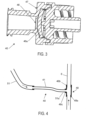
- Figure 4 shows a further embodiment wherein the flow passage restrictor 41 comprises a tube tract defining the first end of the infusion line: the tube tract has an internal diameter lower than the internal diameter of the infusion line and extends by a length higher than the passage restrictors described in the preceding embodiments.
- the damper passage of the tube tract extends by a length comprised between 30 mm and 200 mm, in particular between 40 mm and 160 mm, more in particular between 55 mm and 150 mm
- the damper passage section extends by a diameter comprised between 0.3 mm and 0.6 mm, in particular between 0.35 mm and 0.55 mm.
- the damper passage section has a diameter substantially equal to 0.5 mm
- the damper passage extends by a length substantially equal to 145 mm optionally ⁇ 15 mm
- the damper passage section has a diameter substantially equal to 0.4 mm
- the damper passage extends by a length substantially equal to 60 mm optionally ⁇ 10 mm.
- the diameter of the damper passage is substantially constant over the length.
- tube tract defining the flow passage restrictor 41 may be made of the same material of the rest of the infusion line, i.e. a flexible material, such as medical grade PVC, silicone, or of another bio compatible material.
- the internal diameter of the flow passage restrictor 41 depends on the length of the flow passage restrictor 41 and vice versa: indeed, given the properties of the infusion fluid and the flow rate set for the infusion fluid, the pressure drop across the pressure damper is defined by the damper passage section and by the length of flow passage restrictor 41.
- the damper passage section is proportional to the length of the flow passage restrictor 41: in other terms, the smaller is the damper passage section, the lower is the length of the flow passage restrictor 41 needed to obtain a sufficient pressure drop to avoid degassing of the infusion fluid in the infusion line 51.
- the flow passage restrictor 41 may be defined by a clamp 80 configured to clamp the infusion line 51 and to deform the infusion line so that the internal lumen is reduced (but not completely closed as normal clamps do).
- the clamp 80 acts on the external surface the infusion line 51, radially compressing the line and reducing the internal damper passage section.
- the clamp 80 may comprise a portable clamp 81, as schematically shown in figure 5 , comprising a clamping seat configured to receive a portion of the infusion line 51 and having a fixed size to determine a predefined lumen reduction of the infusion line 51 along a certain tube length: this type of clamp is designed according to a specific geometry, i.e.
- the clamp 80 may comprise a variable clamp 82, as shown in figure 6 , comprising a clamping seat configured to receive a portion of the infusion line 51 and having a regulator for varying the lumen reduction of the infusion line 51.
- the flow passage restrictor 41 defined by the clamp 80 is defined by the same geometrical features already described according to the previous embodiment, in particular in terms of damper passage section of the flow passage restrictor 41 and the length thereof.
- the clamp has a predefined length and is designed to determine the damper passage section of the flow passage restrictor 41 in order to reduce or avoid degassing of the infusion fluid.
- the pressure damper 40 may comprises a one-way valve 46 configured to allow fluid passage only along the infusion direction directed from the infusion line 51 towards the blood withdrawal line.
- the one-way valve 46 is configured to move between an open position, in which the fluid passage is allowed in the infusion direction, and a closed position, in which fluid passage is prevented in the infusion direction, in particular in both directions.
- the one-way valve only allows fluid flow only in one direction, namely the infusion direction: fluid flow in the opposite direction is always prevented.
- the one-way valve 46 may be preset at an opening pressure threshold to switch between the open and the closed position and vice versa, so that if a differential pressure between an upstream section and a downstream section of the one-way valve 46 is equal or higher than this opening pressure threshold, the one-way valve 46 is configured to switch to or to maintain the open position. Alternatively, if the differential pressure is lower than this opening pressure threshold, the one-way valve 46 is configured to switch to or to maintain the closed position.
- the opening pressure is defined as the differential pressures just upstream and just downstream section the one-way valve: in other terms, the upstream and downstream pressures al local pressure around the internal membrane of the one-way valve.
- the differential pressure is defined between a high pressure at the upstream section of the one-way valve 46, and a low pressure at the downstream section of the one-way valve 46: the high pressure is higher than the low pressure.
- the high pressure is the pressure in the infusion line 51 upstream, with respect to the infusion direction, to the one-way valve, while the low pressure is the access negative pressure proximal to the catheter/vascular access.
- the preset opening pressure threshold of the one-way valve 46 corresponds to a differential pressure value comprised between 160 and 500 mmHg, in particular between 190 and 450 mmHg, more in particular between 200 and 400 mmHg, more in detail between 240 and 350 mmHg.
- pressure ranges correspond to pressure regimens that normally raise when usual blood flow rates and infusion flow rates are generated within the disposable set. It is clear that the one-way valve opening threshold may be configured to the most common working conditions of the apparatus and, as above discusses, may be optimal for each and every working condition of the apparatus.
- the one-way valve 46 may comprise an internal diaphragm 46a movable between the open position and the closed position: the internal diaphragm may be a flexible membrane made of a material between silicone, rubber, PVC or the like.
- the internal diaphragm is preloaded in the closed position to define the preset opening pressure threshold.
- the internal diaphragm may have a semispherical shape so that a central portion of the internal diaphragm is axially shifted with respect to the external contour.
- the geometrical features of the internal diaphragm and the material thereof define the preload, and therefore the preset opening pressure threshold.
- the disposable set comprises a Luer lock connector 47 housing the one-way valve 46, wherein the internal diaphragm is within an internal fluid passage of the Luer lock connector.
- the Luer lock connector may be arranged on the infusion line 51, i.e. towards the first end 51a of the infusion line 51, for example at a distance from the first end of the infusion line 51 comprised between 0.1 cm and 6 cm, more in particular between 0.2 and 3 cm.
- the one-way valve 46 may be arranged inside the infusion connector 48, in particular inside the infusion inlet 48c of the infusion connector 48.
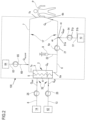
- the numeral 1 globally refers to the extracorporeal blood treatment apparatus, in particular for intensive care therapies, configured to receive the disposable set previously described.
- the extracorporeal blood treatment apparatus 1 is designed for performing any one of treatments like e.g., hemodialysis, hemofiltration, hemodiafiltration, and ultrafiltration.
- the apparatus according to figure 1 is particularly designed for continuous renal replacement therapies (CRRT).
- CRRT systems are configured for delivering very specific treatments designed for patients versing in acute states of illness and who have temporarily lost their kidney function in its entirety.
- CRRT systems may be structurally and/or operationally different from extracorporeal blood treatment systems designed for chronic patient care.
- acute patients temporarily experience complete loss of their kidney function typically due to a contemporaneous state of severe injury or during recovery from surgery. Consequently, acute patients are often extremely weak and typically not in a condition to be submitted to regular dialysis treatment, which may further deteriorate their state and lead to serious and possibly life-threatening complications.
- CRRT systems are designed to individually treat a patient exhibiting very poor health, without inducing further stress to the patient body, in particular without allowing vital parameters pertaining to the patient's blood to deviate from ideal or near-ideal values.
- CRRT systems are, thus, inherently characterized by one or more of the following features.
- CRRT involves renal replacement therapy, meaning an adjuvant therapy aimed firstly at facilitating continuous fluid removal in diuretic-resistant or acute renal failure patients. Therefore, CRRT systems inherently require a continuous net fluid removal from the patient.
- a CRRT system requires a fluid balance control system, such as a weight loss control system, configured to generate a continuous net weight loss rate (as opposed to merely controlling parameters to enable achieving a desired target weight loss as typically found in chronic patient care).
- a fluid balance control system such as a weight loss control system
- a weight loss control system configured to generate a continuous net weight loss rate (as opposed to merely controlling parameters to enable achieving a desired target weight loss as typically found in chronic patient care).
- acute patients experience extravascular fluid overload, which cannot be safely removed within a short period of time (e.g. within a few hours of chronic treatment) without causing potentially severe consequences (e.g. hypovolemic shock, arrhythmia, hypoxemia, hypoventilation, etc.).
- a CRRT system must inherently include a much more accurate control over system parameters, in particular flow rates, in order to ensure that the required low flow rates of both blood circulating extra-corporeally and of treatment fluid (infused in the extracorporeal circuit or diffused through the dialyzer) are used.
- CRRT treatment is performed continuously (e.g. for days or even weeks, without interruption/with minimal interruptions e.g., downtimes to change bags). Therefore, treatment settings in CRRT are based on flow rate settings, rather than settings pertaining to some specified treatment time (which would be unknown as acute patients may require treatment for an unknown time).
- CRRT renal replacement therapy involves therapy substituting kidney functions for a relatively long time period and, thus, a CRRT system further requires at least either fresh dialysis liquid exchange in the dialyzer (in order to remove unwanted substances from blood and to add desired substances to the blood by diffusion) and/or fresh infusion fluid in combination with ultrafiltration (in order to remove unwanted substances from blood and to add desired substances to the blood by convection).
- CRRT systems need to exhibit specific technical features enabling the system to:
- the CRRT machine is dressed using an integrated disposable set 100, wherein all the lines and the filtration unit are grouped together and already properly connected in the disposable set. Further, all the fluids are contained in pre-packaged bags (dialysis fluid or replacement fluids in bags of e.g., 2, 5 or 10 litres each) or pre-packaged syringes (heparin and/or concentrated calcium replacement solution).
- pre-packaged bags dialysis fluid or replacement fluids in bags of e.g., 2, 5 or 10 litres each
- pre-packaged syringes heparin and/or concentrated calcium replacement solution
- the apparatus 1 of figure 1 has an extracorporeal blood circuit 17, which takes blood from a patient P, for instance through a needle or a catheter or an implanted port or other access device (not shown), introduced into a vein or artery of said patient, and through the blood withdrawal line 6 takes said blood, for instance continuously, to the filtration unit 2.
- the connection with the infusion line 51 is provided immediately downstream from the blood collecting zone on the blood withdrawal line 6.
- the machine is equipped with the infusion substance source 10, containing an infusion fluid comprising for example one between bicarbonate, citrate or citric acid a replacement fluid, saline, and a regional anticoagulant solution; by using the infusion pump 54, for instance a peristaltic pump, it is possible to control the fluid flow within said infusion line 51 by introducing the infusion fluid directly into the blood with a direct connection to the blood withdrawal line 6.
- a known blood pressure sensor 48 may be arranged immediately downstream the infusion line 51, namely between the infusion line 51 and the blood pump 21.
- the apparatus comprises the blood pump 21 for controlling and managing the suitable blood flow Q b in the circuit.
- the blood pump 21 is generally a peristaltic pump acting either on the blood withdrawal line (as shown e.g. in figure 1 ) and/or on the blood return line.
- An operator may enter a set value for the blood flow rate Q b through a user interface 15 and a control unit 12, during treatment, is configured to control the blood pump based on the set blood flow rate.
- the blood pump 21 may be automatically controlled with no need of user input/prescription: in that case control unit 12 may control the blood pump 21 at a prefixed flow rate or at a flow rate calculated based on other parameters such as, for instance, other flow rates and constraints set by the medical operator (as apparent from the following description).
- the blood pump may also be controlled based on pressure; if the blood pump 21 is controlled based on the pressure signal detected upstream the blood pump then a pressure sensor 48 is present in the tract of bloodline upstream the blood pump 21: for instance the control unit 12 may be designed to drive the blood pump in a manner to keep the pressure detected by pressure sensor 48 within a prefixed range, or below a prefixed threshold.
- a gas exchanger 46 for removing CO 2 from circulating blood may be connected to the blood circuit.
- the gas exchanger 46 is in fluid communication with the blood circuit 17 to receive extracorporeal blood, allow CO 2 removal from blood and returning blood to the blood circuit at a downstream point.
- Figure 1 shows a gas exchanger 46 placed upstream the filtration unit 2; however, the gas exchanger may be alternatively positioned downstream the filtration unit on the blood return line 7.
- the CO 2 gas exchanger 46 is positioned downstream the filtration unit 2 on the blood return line 7, degassing in the blood withdrawal line increased its importance because air bubble in the filtration unit may cause blood clotting.
- the gas exchanger 46 is connected in series with the filtration unit 2 and is placed downstream the injection point 50 where the infusion solution is delivered to extracorporeal blood.
- the gas exchanger 46 has a blood chamber and a gas chamber separated by a membrane permeable to gases, in particular CO 2 ; the gas exchanger comprise a gas inlet, which may be connected to a gas source, such as the medical gas supply system in a hospital to receive pressurized air or oxygen for example, and a gas outlet in fluid communication with the gas chamber to discharge exhausted gas having removed CO 2 from extracorporeal blood.
- the blood inlet and the blood outlet put the extracorporeal blood circuit 17 in fluid communication with the gas exchanger blood chamber.
- the gas exchanger 46 may not be part of the dialysis apparatus should CO 2 removal be not necessary for the treatment.
- another pressure sensor 49 may be provided on the blood withdrawal line 6 for controlling the correct flow within the blood circuit: the pressure sensor 49 is interposed between the blood pump 21 and the filtration unit 2.
- the treated blood After passing through the primary chamber 3 of the filtration unit 2, where the suitable exchanges of substances, molecules and fluids occur by means of a semipermeable membrane, the treated blood enters the blood return line 7, first passing through the air separator 19, commonly known as "bubble trap", designed so as to ensure the detection and removal of air bubbles present in the blood.
- the treated blood getting out of the air separator 19, before being returned to the patient P passes through an air bubble sensor 55 verifying the absence of said dangerous formations within the treated blood that has to be re-introduced in the patient's blood circulation.
- the safety valve 20 or venous clamp
- the extracorporeal blood treatment apparatus of figure 1 is equipped with a dialysis fluid circuit 32, which is also provided with at least a dialysis supply line 8 leading into the filtration unit 2 and with an effluent (or dialysate) line 13 from the filtration unit.
- At least a primary fluid container, defining said dialysis liquid source 14, is designed to supply the supply line 8 of the dialysis fluid circuit 32 (generally the primary fluid container shall consist of one or more bags containing a suitable dialysis liquid).
- the supply line 8 includes actuator/s for conveying fluid such as at least a dialysis fluid pump 25 (in the embodiment of figure 1 a peristaltic pump) for controlling the flow rate Q dial of dialysis liquid from the bag and for defining a direction 200 of dialysis fluid circulation. Downstream from the dialysis fluid pump 25 in the direction of circulation 200 there is a branching 56 splitting the dialysis supply line 8 up into an intake branch 57 and an infusion branch 58.
- the infusion branch 58 is connected to the blood return line 7 of the blood circuit 17.
- the intake branch 57 conveys the fluid directly to the filtration unit 2 and in particular to the secondary chamber of said unit.
- the dialysis fluid circuit 32 is further equipped with a selector 59 for determining the percentages of fluid flow within the infusion branch 58 and the intake branch 57.
- said selector 59 may be positioned at least between a first operating condition in which it allows the passage of fluid in the intake branch 57 and blocks the passage in the infusion branch 58, and a second operating condition in which it allows the passage of fluid in the infusion branch 58 and blocks the passage in the intake branch 57.
- said selector 59 may consist of a valve element operating on the dialysis fluid circuit 32 by alternatively blocking the passage of fluid in either branch.
- Suitable selectors may be alternatively provided, which are able to establish a priori the amount of liquid that has to pass through both branches simultaneously. It will also be possible to vary the percentages of fluid in either branch as a function of time and of the pre-established therapies.
- the dialysis liquid through the intake branch 57 gets into the secondary chamber 4 of the filtration unit 2.
- the primary chamber 3 through which the blood flow passes is separated from the secondary chamber 4 through which the dialysis liquid passes through the semipermeable membrane 5 ensuring the suitable passage of the dangerous substances/molecules and of fluid from the blood towards the dialysis liquid mainly through convection and diffusion processes, and also ensuring through the same principles the passage of substances/molecules from the dialysis liquid towards the blood.
- the dialysis fluid then gets into the effluent line 13 and passes through a suitable effluent pressure sensor 60.
- An actuator is provided for conveying fluid, for instance a dialysate pump 26 controlling the flow rate Q eff in the effluent line 13 within the fluid circuit 32. Also said pump will generally be a peristaltic pump.
- the fluid to be eliminated then passes through a blood detector 61 and is conveyed into a collection container or bag 62.
- a further infusion line 51 for feeding fluid into the blood return line 7 of the blood circuit 17 may be provided.
- the infusion fluid is taken from at least an auxiliary container 64 and is sent directly to the blood return line 7 of the blood circuit 17 through actuator/s for conveying fluid, generally an infusion pump 65 (in the example a peristaltic pump) controlling its flow rate Q rep - total replacement flow rate.
- the infusion liquid may be introduced directly into the air separator 19.
- the infusion branch 58 of the dialysis fluid circuit 32 and the infusion line 63 are equipped with a common end length 66 letting fluid to enter into the blood circuit 17.
- the infusion line 63 comprises at least a pre-infusion branch 67 connected to the blood withdrawal line 6 of the blood circuit 17.
- an infusion branching 68 splitting the infusion line 63 up into the pre-infusion branch 67 and post-infusion branch 69.
- the pre-infusion branch 67 in particular, carries the fluid taken from the bag 64 into the blood withdrawal line 6 of the blood circuit 17 downstream from the blood pump 21 and downstream the gas exchanger 46 with respect to the direction of blood circulation.
- the infusion line 63 further comprises a selector 70 for determining the percentage of liquid flow to be sent to the post-infusion branch 69 and to the pre-infusion branch 67.
- the selector 70 placed near the branching 68 may be switched between at least a first operating condition in which it allows the passage of fluid in the pre-infusion branch 67 and blocks the passage in the post-infusion branch 69, and at least a second operating condition in which it allows the passage of fluid in the post-infusion branch 69 and blocks the passage in the pre-infusion branch 67.
- the other selector 70 will be able to determine the percentage of fluid that has to pass in each of the two branches and to possibly vary it in time in accordance with the planned therapies.
- the selector 59 and the other selector 70 will generally, though not necessarily, be of the same nature.
- the flow rate through the pre-infusion branch/line 67 may be determined by proper control of the infusion pump 65 and other selector 70; the control unit 12 may receive a pre-infusion ratio of replacement fluid flow PRE (a value between 0 and 1) and determine the pre-infusion flow rate Q rep.pre based on the pre-infusion ratio PRE and on total replacement flow rate Q rep .
- Q rep.pre PRE ⁇ Q rep .
- the apparatus may be equipped with scales 71 for determining at least the weight of the primary fluid container 14 and/or of the auxiliary fluid container 64 and/or of the infusion substance source 10 and/or of the collection container 62.
- said scales 71 comprises weight sensors, for instance respective scales A, B, C, D and E (for example at least an independent sensor for each fluid bag associated to the machine).
- control unit 12 active (at least) on the blood circuit 17 and in particular active on the pressure sensor 48 for reading pressure values, on the blood pump 21, on the gas exchanger 46, on the other pressure sensor 49, and on the device for detecting the presence of air bubbles 55 and on the respective safety valves 20, 27.
- the control unit 12 has also to control the dialysis fluid circuit 32 and, in particular, shall be input with the data detected by the scales A, B, C, D and (possibly) E and, concerning the weight of the bag 14, and shall act on the pump 25, on the selector 59, on the pressure sensor 60, then on the dialysate pump 26 and shall eventually receive the data detected by the scale A whose function is to determine the weight of the collection container 62.
- the control unit 12 shall also act on the infusion line 63 checking the weight of the auxiliary container 64 (checked by the scale C) and will be able to control both the infusion pump 54 65 and the other selector 70.
- the control unit 12 shall also act on the infusion line 51 detecting the weight of the infusion substance source 10 through the scale B and suitably controlling the infusion pump 54 according to the treatments to be carried out as below detailed and explained.
- the apparatus of figure 1 may be alternatively (or additionally) provided with a systemic anticoagulation system, such as a syringe pump 9 for injecting heparin downstream the blood pump 21.
- a systemic anticoagulation system such as a syringe pump 9 for injecting heparin downstream the blood pump 21.
- the control unit 12 is also connected to a memory and to user interface, for instance a graphic user interface, which receives operator's inputs and displays the apparatus outputs.
- a graphic user interface may include a touch screen, a display screen and/or hard keys for entering user's inputs or a combination thereof.
- the control unit 12 is also connected to the blood pump 21 and configured to control the blood pump 21 to determine a blood flow rate in the blood withdrawal line 6.
- the control unit is configured to define a treatment condition wherein the blood pump 21 is set at a flow rate comprised between 50 ml/min and 600 ml/min, in particular between 100 ml/min and 350 ml/min, more in particular between 200 ml/min and 300 ml/min.
- the blood flow rate is set by the physician and may vary depending on various factors including the vascular access, the patient conditions, and the type of treatment.
- the access negative pressure is experienced in the blood withdrawal line 6 upstream the blood pump tract 6p engaged by the blood pump 21.
- the infusion pump 54 is operatively connected to the control unit 12 which is configured to selectively control the infusion pump 54 to promote the infusion fluid to flow within the infusion line 51 and to deliver the infusion fluid into the blood withdrawal line 6: the control unit 12 may be configured to control the infusion pump 54 to set the flow rate of the infusion fluid typically between 200 ml/h and 4000 ml/h, in particular between 500 ml/h and 2000 ml/h, more in particular at a flow rate substantially close to 1000 ml/h and lower than 1600 ml/h. Also in this regard, the type of treatment, the infusion bag content, and other conditions determine the set infusion rate, which is however normally set in the above discussed ranges.
- the control unit may also be configured to deactivate the infusion pump 54 to arrest delivery of the infusion fluid.
- control unit may be configured to define a first condition and a second condition.
- the infusion pump 54 is active to generate the infusion fluid flow towards the blood withdrawal line 6 and the blood pump 21 is active to determine the blood flow in the blood circuit of the disposable set.
- the differential pressure across the one-way valve is higher than the preset opening pressure threshold of the one-way valve 46.This pressure difference causes the one-way valve 46 to switch to or to maintain the open position, allowing thereby the infusion fluid to be delivered into the blood withdrawal line 6.
- the infusion pump 54 generates an over pressure which, combined with the low pressure caused by the blood pressure, determines the aperture of the one-way valve 46.
- the infusion pump 54 is stopped to prevent infusion of the infusion fluid into the blood withdrawal line 6, while the blood pump is active: in the second condition the one-way valve 46 closes and prevents the infusion line 51 to be in fluid communication with the blood line. The access negative pressure is prevented to extend in the infusion line 51, thereby avoiding degassing of the infusion fluid.
- FIG. 7 shows an embodiment wherein a disposable set 100 for extracorporeal blood treatment, for example a dialysis treatment, is connected to an Extra Corporeal Membrane Oxygenation ECMO circuit 300, which is in turn configured for connection to the patient.
- the ECMO circuit 300 is fluidly interposed between the disposable set 100 and the patient's vascular accesses.
- the ECMO circuit is only very schematically represented in order to show a further extracorporeal blood flow circulation.
- the ECMO circuit includes all necessary lines and components for proper working. No further details are provided about a detailed embodiment of the ECMO circuit: anyhow, the skilled person knows the key features of an ECMO circuit and the main elements/devices associated without further explanation.
- the ECMO circuit is not per se part of the present invention, while it is an extra circuit where the disposable set 100 of the present invention may be coupled to, instead of directly connecting the disposable set 100 to the patient. Indeed, when blood oxygenation and a dialysis treatment are proper, a layout as the one proposed in figure 7 may be implemented in order to avoid multiple blood accesses to the patient.
- any suitable connection of the extracorporeal blood circuit 100 to the ECMO apparatus may be used.
- the blood withdrawal line 6 and/or the blood return line 7 may be connected to respective blood lines of the ECMO apparatus wherein positive or negative pressure occurs.
- Two examples of possible connection are below briefly described. However, what is relevant here is that: (i) the extracorporeal blood circuit 100 may not be directly connected to the patient access (ii) any one of the blood withdrawal line 6 and the blood return line 7 may experience a negative pressure regimen and therefore the corresponding pressure damper may be usefully applied at the junction point of any infusion line injecting into the blood circuit where there is a negative pressure in the blood at the junction point.
- the blood withdrawal line 6 of the disposable set 100 is connected to the ECMO circuit 300 downstream the blood pump 321 of the ECMO circuit, while the blood return line 7 of the disposable set 100 is connected to the ECMO circuit 300 upstream the blood pump 321 of the ECMO circuit.
- the blood withdrawal line 6 of the disposable line experience a positive pressure: thus, the pressure at the cross between the blood withdrawal line 6 and the infusion line 54 in the disposable set 100 prevents infusion fluid degassing.
- the blood return line 7 may experience a negative pressure regimen.
- the use of a pressure damper arranged proximate or at the first end of the post infusion line 69 may be used to prevent degassing in the post infusion line itself.
- the pressure damper is configured to prevent, or reduce an amount of, the negative pressure to extend in the post infusion line 69 upstream the pressure damper.
- the same embodiments of pressure dampers already discussed in the previous sections may be used here.
- the blood withdrawal line 6 of the disposable set 100 may be connected to the ECMO circuit 300 upstream the blood pump 321 of the ECMO circuit, while the blood return line 7 of the disposable set 100 may be connected to the ECMO circuit 300 downstream the blood pump 321 of the ECMO circuit.
- the pressure at the fluid access 48 between the blood withdrawal line 6 and the infusion line 54 in the disposable set 100 may be negative.
- the infusion fluid in the infusion line 51 may be subjected to a low pressure, which may cause fluid degassing.
- a disposable set according to the present invention may allow avoiding fluid degassing in the fluid line 51 when connected to an ECMO circuit, when the blood line having the infusion line 51 is connected to the ECMO circuit upstream the blood pump 321 of the ECMO circuit.
Landscapes
- Health & Medical Sciences (AREA)
- Heart & Thoracic Surgery (AREA)
- Engineering & Computer Science (AREA)
- Animal Behavior & Ethology (AREA)
- Public Health (AREA)
- Biomedical Technology (AREA)
- Hematology (AREA)
- Life Sciences & Earth Sciences (AREA)
- Veterinary Medicine (AREA)
- General Health & Medical Sciences (AREA)
- Anesthesiology (AREA)
- Vascular Medicine (AREA)
- Cardiology (AREA)
- Mechanical Engineering (AREA)
- Pulmonology (AREA)
- Urology & Nephrology (AREA)
- Emergency Medicine (AREA)
- External Artificial Organs (AREA)
Priority Applications (6)
| Application Number | Priority Date | Filing Date | Title |
|---|---|---|---|
| EP21213423.3A EP4194023A1 (en) | 2021-12-09 | 2021-12-09 | Disposable set and extracorporeal blood treatment apparatus for preventing degassing in an infusion fluid line |
| PCT/EP2022/085079 WO2023105009A1 (en) | 2021-12-09 | 2022-12-08 | Disposable set and extracorporeal blood treatment apparatus for preventing degassing in an infusion fluid line |
| US18/717,278 US20250041499A1 (en) | 2021-12-09 | 2022-12-08 | Disposable set and extracorporeal blood treatment apparatus for preventing degassing in an infusion fluid line |
| EP22834954.4A EP4444380A1 (en) | 2021-12-09 | 2022-12-08 | Disposable set and extracorporeal blood treatment apparatus for preventing degassing in an infusion fluid line |
| CN202280091231.0A CN118660727A (zh) | 2021-12-09 | 2022-12-08 | 用于防止输注流体管线中的脱气的一次性套件和体外血液处理设备 |
| JP2024534407A JP2024546749A (ja) | 2021-12-09 | 2022-12-08 | 注入ラインにおける脱気を防止するための使い捨てセット及び体外血液処理装置 |
Applications Claiming Priority (1)
| Application Number | Priority Date | Filing Date | Title |
|---|---|---|---|
| EP21213423.3A EP4194023A1 (en) | 2021-12-09 | 2021-12-09 | Disposable set and extracorporeal blood treatment apparatus for preventing degassing in an infusion fluid line |
Publications (1)
| Publication Number | Publication Date |
|---|---|
| EP4194023A1 true EP4194023A1 (en) | 2023-06-14 |
Family
ID=78828161
Family Applications (2)
| Application Number | Title | Priority Date | Filing Date |
|---|---|---|---|
| EP21213423.3A Pending EP4194023A1 (en) | 2021-12-09 | 2021-12-09 | Disposable set and extracorporeal blood treatment apparatus for preventing degassing in an infusion fluid line |
| EP22834954.4A Pending EP4444380A1 (en) | 2021-12-09 | 2022-12-08 | Disposable set and extracorporeal blood treatment apparatus for preventing degassing in an infusion fluid line |
Family Applications After (1)
| Application Number | Title | Priority Date | Filing Date |
|---|---|---|---|
| EP22834954.4A Pending EP4444380A1 (en) | 2021-12-09 | 2022-12-08 | Disposable set and extracorporeal blood treatment apparatus for preventing degassing in an infusion fluid line |
Country Status (5)
| Country | Link |
|---|---|
| US (1) | US20250041499A1 (https=) |
| EP (2) | EP4194023A1 (https=) |
| JP (1) | JP2024546749A (https=) |
| CN (1) | CN118660727A (https=) |
| WO (1) | WO2023105009A1 (https=) |
Citations (9)
| Publication number | Priority date | Publication date | Assignee | Title |
|---|---|---|---|---|
| WO2001091829A2 (en) * | 2000-06-01 | 2001-12-06 | Medivice Systems Ltd. | Priming device for medical infusion systems |
| EP2192937B1 (en) * | 2007-10-04 | 2011-12-07 | Gambro Lundia AB | An infusion apparatus |
| US9089653B2 (en) * | 2004-12-03 | 2015-07-28 | Gambro Uf Solutions, Inc. | Extracorporeal blood treatment and system having reversible blood pumps |
| US20170340796A1 (en) * | 2014-12-22 | 2017-11-30 | Fresenius Medical Care Deutschland Gmbh | Infusion Line With A Facility To Promote Mixing Of An Infusion Solution With A Further Fluid, Apparatuses And Method |
| EA033951B1 (ru) * | 2012-03-12 | 2019-12-12 | Фресениус Медикал Каре Деутчланд Гмбх | Инфузионная система для введения диализирующей жидкости |
| US20200054816A1 (en) * | 2017-01-12 | 2020-02-20 | Garbro Lundia Ab | Extracorporeal blood treatment apparatus and method for checking the connection of a soft bag in an extracorporeal blood treatment apparatus |
| US20200179588A1 (en) * | 2017-07-19 | 2020-06-11 | Gambro Lundia Ab | Apparatus for extracorporeal treatment of blood and method of priming an extracorporeal blood circuit |
| EP3838306A1 (en) * | 2018-11-08 | 2021-06-23 | Nikkiso Company Limited | Blood purification device |
| US20210213189A1 (en) * | 2018-11-08 | 2021-07-15 | Nikkiso Company Limited | Blood purification apparatus |
-
2021
- 2021-12-09 EP EP21213423.3A patent/EP4194023A1/en active Pending
-
2022
- 2022-12-08 EP EP22834954.4A patent/EP4444380A1/en active Pending
- 2022-12-08 JP JP2024534407A patent/JP2024546749A/ja active Pending
- 2022-12-08 US US18/717,278 patent/US20250041499A1/en active Pending
- 2022-12-08 CN CN202280091231.0A patent/CN118660727A/zh active Pending
- 2022-12-08 WO PCT/EP2022/085079 patent/WO2023105009A1/en not_active Ceased
Patent Citations (9)
| Publication number | Priority date | Publication date | Assignee | Title |
|---|---|---|---|---|
| WO2001091829A2 (en) * | 2000-06-01 | 2001-12-06 | Medivice Systems Ltd. | Priming device for medical infusion systems |
| US9089653B2 (en) * | 2004-12-03 | 2015-07-28 | Gambro Uf Solutions, Inc. | Extracorporeal blood treatment and system having reversible blood pumps |
| EP2192937B1 (en) * | 2007-10-04 | 2011-12-07 | Gambro Lundia AB | An infusion apparatus |
| EA033951B1 (ru) * | 2012-03-12 | 2019-12-12 | Фресениус Медикал Каре Деутчланд Гмбх | Инфузионная система для введения диализирующей жидкости |
| US20170340796A1 (en) * | 2014-12-22 | 2017-11-30 | Fresenius Medical Care Deutschland Gmbh | Infusion Line With A Facility To Promote Mixing Of An Infusion Solution With A Further Fluid, Apparatuses And Method |
| US20200054816A1 (en) * | 2017-01-12 | 2020-02-20 | Garbro Lundia Ab | Extracorporeal blood treatment apparatus and method for checking the connection of a soft bag in an extracorporeal blood treatment apparatus |
| US20200179588A1 (en) * | 2017-07-19 | 2020-06-11 | Gambro Lundia Ab | Apparatus for extracorporeal treatment of blood and method of priming an extracorporeal blood circuit |
| EP3838306A1 (en) * | 2018-11-08 | 2021-06-23 | Nikkiso Company Limited | Blood purification device |
| US20210213189A1 (en) * | 2018-11-08 | 2021-07-15 | Nikkiso Company Limited | Blood purification apparatus |
Also Published As
| Publication number | Publication date |
|---|---|
| EP4444380A1 (en) | 2024-10-16 |
| CN118660727A (zh) | 2024-09-17 |
| WO2023105009A1 (en) | 2023-06-15 |
| JP2024546749A (ja) | 2024-12-26 |
| US20250041499A1 (en) | 2025-02-06 |
Similar Documents
| Publication | Publication Date | Title |
|---|---|---|
| EP1590017B1 (en) | Extracorporeal blood treatment machine. | |
| CA2926718C (en) | Device and method for regulating and presetting the pump rate of blood pumps | |
| US7727391B2 (en) | Extracorporeal blood treatment machine | |
| US9814822B2 (en) | Plasma generation with dialysis systems | |
| CN110944692B (zh) | 用于操作血液治疗设备的方法、用于执行该方法的控制单元和治疗设备 | |
| US9095664B2 (en) | Method and system for providing priming and restitution liquids for an extracorporeal blood treatment | |
| ES2996859T3 (en) | Disposable circuit for extracorporeal treatment of blood, apparatus for extracorporeal treatment of blood and associated method | |
| US20250041499A1 (en) | Disposable set and extracorporeal blood treatment apparatus for preventing degassing in an infusion fluid line | |
| WO2021059817A1 (ja) | 血液浄化装置 | |
| EP3834861B1 (en) | Add-on module for an apparatus for extracorporeal treatment of blood and blood set provided with said add-on module | |
| JP7725878B2 (ja) | 血液浄化装置 | |
| Zaccaria et al. | Principles of extracorporeal circulation and transport phenomena | |
| EP4360667A1 (en) | Extracorporeal blood treatment apparatus | |
| US20230372594A1 (en) | Single lumen hybrid connection to legacy system |
Legal Events
| Date | Code | Title | Description |
|---|---|---|---|
| PUAI | Public reference made under article 153(3) epc to a published international application that has entered the european phase |
Free format text: ORIGINAL CODE: 0009012 |
|
| STAA | Information on the status of an ep patent application or granted ep patent |
Free format text: STATUS: THE APPLICATION HAS BEEN PUBLISHED |
|
| AK | Designated contracting states |
Kind code of ref document: A1 Designated state(s): AL AT BE BG CH CY CZ DE DK EE ES FI FR GB GR HR HU IE IS IT LI LT LU LV MC MK MT NL NO PL PT RO RS SE SI SK SM TR |
|
| STAA | Information on the status of an ep patent application or granted ep patent |
Free format text: STATUS: REQUEST FOR EXAMINATION WAS MADE |
|
| 17P | Request for examination filed |
Effective date: 20231214 |
|
| RBV | Designated contracting states (corrected) |
Designated state(s): AL AT BE BG CH CY CZ DE DK EE ES FI FR GB GR HR HU IE IS IT LI LT LU LV MC MK MT NL NO PL PT RO RS SE SI SK SM TR |
|
| GRAP | Despatch of communication of intention to grant a patent |
Free format text: ORIGINAL CODE: EPIDOSNIGR1 |
|
| STAA | Information on the status of an ep patent application or granted ep patent |
Free format text: STATUS: GRANT OF PATENT IS INTENDED |
|
| INTG | Intention to grant announced |
Effective date: 20260105 |
|
| RIN1 | Information on inventor provided before grant (corrected) |
Inventor name: POUCHOULIN, DOMINIQUE Inventor name: FRUGIER, ALAIN |
|
| GRAS | Grant fee paid |
Free format text: ORIGINAL CODE: EPIDOSNIGR3 |
|
| GRAA | (expected) grant |
Free format text: ORIGINAL CODE: 0009210 |
|
| STAA | Information on the status of an ep patent application or granted ep patent |
Free format text: STATUS: THE PATENT HAS BEEN GRANTED |