EP4180412A1 - Verfahren zur herstellung von iso-aldehyden aus n-olefinen - Google Patents
Verfahren zur herstellung von iso-aldehyden aus n-olefinen Download PDFInfo
- Publication number
- EP4180412A1 EP4180412A1 EP21208229.1A EP21208229A EP4180412A1 EP 4180412 A1 EP4180412 A1 EP 4180412A1 EP 21208229 A EP21208229 A EP 21208229A EP 4180412 A1 EP4180412 A1 EP 4180412A1
- Authority
- EP
- European Patent Office
- Prior art keywords
- bar
- olefin
- mpa
- hexene
- methyl
- Prior art date
- Legal status (The legal status is an assumption and is not a legal conclusion. Google has not performed a legal analysis and makes no representation as to the accuracy of the status listed.)
- Pending
Links
Classifications
-
- C—CHEMISTRY; METALLURGY
- C07—ORGANIC CHEMISTRY
- C07C—ACYCLIC OR CARBOCYCLIC COMPOUNDS
- C07C45/00—Preparation of compounds having >C = O groups bound only to carbon or hydrogen atoms; Preparation of chelates of such compounds
- C07C45/49—Preparation of compounds having >C = O groups bound only to carbon or hydrogen atoms; Preparation of chelates of such compounds by reaction with carbon monoxide
- C07C45/50—Preparation of compounds having >C = O groups bound only to carbon or hydrogen atoms; Preparation of chelates of such compounds by reaction with carbon monoxide by oxo-reactions
Definitions
- the invention relates to a process for preparing iso -aldehydes from n -olefins.
- 2-Methylbutanal is a substance that is in demand industrially. It serves as a starting substance for, for example, alcohols, acids, esters and amines. For example, 2-methylbutanal is used to produce scents and flavorings.
- 2-Methylbutanal can be produced by the hydroformylation of 2-butene. Due to the symmetry of 2-butene, it does not matter at which end of the double bond the aldehyde group is formed, since 2-methylbutanal is always formed.
- n-aldehyde or iso- aldehyde.
- the n-aldehyde is often the main product of the hydroformylation reaction.
- the technical object of the invention is to provide a process with which, starting from an n-olefin, a good yield of iso -aldehyde can be achieved.
- the object is achieved by a method according to claim 1.
- the term -(C 6 -C 20 )-aryl encompasses mono- or polycyclic aromatic hydrocarbon radicals. These have 6 to 20 ring atoms, particularly preferably 6 to 14 ring atoms, in particular 6 to 10 ring atoms.
- Aryl is in particular phenyl, naphthyl, indenyl, fluorenyl, anthracenyl, phenanthrenyl, naphthacenyl, chrysenyl, pyrenyl, coronenyl.
- aryl represents phenyl, naphthyl and antracenyl.
- the expression -(C 5 -C 12 )-cycloalkyl encompasses mono-, bi- or tricyclic hydrocarbon radicals having 5 to 12 carbon atoms. These include cyclopentyl, cyclohexyl, cycloheptyl, cyclooctyl, cyclododecyl, cyclopentadecyl, norbonyl or adamantyl.
- R 1 , R 2 , R 3 are selected from phenyl and cyclohexyl.
- At least one of the radicals R 1 , R 2 , R 3 is cyclohexyl.
- the compound of the formula ( I ) has the structure (1) or (2):
- the compound of the formula ( I ) has the structure (1):
- the feeding in process step c) takes place at a pressure in the range from 4.5 MPa (45 bar) to 5.5 MPa (55 bar).
- the heating in method step d) takes place at a temperature in the range from 100.degree. C. to 140.degree.
- the heating in method step d) takes place at a temperature in the range from 110.degree. C. to 130.degree.
- the Rh compound is added in an amount ranging from 10 ppm to 250 ppm, based on the n -olefin.
- the n -olefin is selected from: 1-propene, 1-butene, 1-pentene, 2-methyl-1-butene, 3-methyl-1-butene, 1-hexene, 2-methyl-1 -hexene, 3-methyl-1-hexene, 2-ethyl-1-hexene, 1-heptene, 2-methylheptene, 3-methylheptene, 1-octene, 2-methyloctene, 3-methyloctene, 2-ethyl-1-octene , 1-ninths.
- the solvent in process step a) is toluene.
- the hydroformylation was carried out in a 16 ml autoclave from the HEL group, Hertfordshire, Great Britain, equipped with constant pressure, gas flow measurement and gassing stirrer.
- the substrate n-octene was refluxed over sodium for several hours and distilled under argon.
- reaction solutions were prepared in advance under an argon atmosphere.
- the mass of toluene introduced in each case was determined for the GC analysis.
- 1.80 g of n-octene (16 mmol) were added.
- the autoclave was then heated to the desired temperature at a total pressure of 10 bar with stirring (900 rpm). After the reaction temperature had been reached, the synthesis gas pressure was increased to 50 bar and the reaction was carried out at constant pressure for 1 hour. After the reaction time had elapsed, the autoclave was cooled to room temperature, depressurized with stirring and purged with argon. Each 0.5 ml of the reaction mixtures were after Removed at the end of the reaction, diluted with 4 ml of pentane and analyzed by gas chromatography: HP 5890 Series II plus, PONA, 50 mx 0.2 mm x 0.5 ⁇ m. The quantitative determination of residual olefin and aldehyde was carried out against the solvent toluene as an internal standard.
Landscapes
- Chemical & Material Sciences (AREA)
- Organic Chemistry (AREA)
- Chemical Kinetics & Catalysis (AREA)
- Organic Low-Molecular-Weight Compounds And Preparation Thereof (AREA)
Abstract
Description
- Die Erfindung betrifft ein Verfahren zur Herstellung von iso-Aldehyden aus n-Olefinen.
- 2-Methylbutanal ist ein industriell gefragter Stoff. Er dient als Ausgangssubstanz für beispielsweise Alkoholen, Säuren, Estern und Aminen. So wird 2-Methylbutanal zum Beispiel für die Herstellung von Geruchs- und Aromastoffen verwendet.

- 2-Methylbutanal kann durch die Hydroformylierung von 2-Buten hergestellt werden. Aufgrund der Symmetrie von 2-Buten spielt es keine Rolle, an welchem Ende der Doppelbindung die Aldehydgruppe ausgebildet wird, da immer 2-Methylbutanal entsteht.
- Anders ist dies jedoch bei 1-Buten. Hier kann es zur Ausbildung es n-Aldehyds oder des iso-Aldehyds kommen. Oft stellt hierbei der n-Aldehyd das Hauptprodukt der Hydroformylierungsreaktion dar.
- Die technische Aufgabe der Erfindung ist die Bereitstellung eines Verfahrens mit welchem, ausgehend von einem n-Olefinen, eine gute Ausbeute an iso-Aldehyd erzielt werden kann.
- Die Aufgabe wird gelöst durch ein Verfahren gemäß Anspruch 1.
- Verfahren umfassend die Verfahrensschritte:
- a) Vorlegen einer Verbindung gemäß Formel (I):

- wobei R1, R2, R3 ausgewählt sind aus: -(C6-C20)-Aryl, -(C5-C12)-Cycloalkyl,
- und von Rh(acac)(CO)2 in einem Lösungsmittel, so dass ein Reaktionsgemisch entsteht;
- b) Zugabe eines n-Olefins zu dem Reaktionsgemisch;
- c) Zuführen von H2 und CO, wobei das Zuführen bei einem Druck erfolgt im Bereich von 4 MPa (40 bar) bis 6 MPa (60 bar);
- d) Erwärmen des Reaktionsgemisches aus a) bis c), wobei das n-Olefin zu einem iso-Aldehyd umgesetzt wird.
- Der Ausdruck -(C6-C20)-Aryl umfasst im Sinne der vorliegenden Erfindung mono- oder polycyclische aromatische Kohlenwasserstoffreste. Diese weisen 6 bis 20 Ringatome, besonders bevorzugt 6 bis 14 Ringatome, insbesondere 6 bis 10 Ringatome, auf. Aryl steht insbesondere für Phenyl, Naphthyl, Indenyl, Fluorenyl, Anthracenyl, Phenanthrenyl, Naphthacenyl, Chrysenyl, Pyrenyl, Coronenyl. Insbesondere steht Aryl für Phenyl, Naphthyl und Antracenyl.
- Der Ausdruck -(C5-C12)-Cycloalkyl umfasst im Sinne der vorliegenden Erfindung mono-, bi- oder tricyclische Kohlenwasserstoffreste mit 5 bis 12 Kohlenstoffatomen. Dazu zählen Cyclopentyl-, Cyclohexyl-, Cycloheptyl-, Cyclooctyl-, Cyclododecyl, Cyclopentadecyl-, Norbonyl- oder Adamantyl.
- In einer Variante des Verfahrens sind R1, R2, R3 ausgewählt aus Phenyl und Cyclohexyl.
- In einer Variante des Verfahrens steht mindestens einer der Reste R1, R2, R3 für Cyclohexyl.
- In einer Variante des Verfahrens weist die Verbindung gemäß Formel (I) die Struktur (1) oder (2) auf:

- In einer Variante des Verfahrens weist die Verbindung gemäß Formel (I) die Struktur (1) auf:

- In einer Variante des Verfahrens erfolgt das Zuführen in Verfahrensschritt c) bei einem Druck im Bereich von 4,5 MPa (45 bar) bis 5,5 MPa (55 bar).
- In einer Variante des Verfahrens erfolgt das Erwärmen in Verfahrensschritt d) auf eine Temperatur im Bereich von 100 °C bis 140 °C.
- In einer Variante des Verfahrens erfolgt das Erwärmen in Verfahrensschritt d) auf eine Temperatur im Bereich von 110 °C bis 130 °C.
- In einer Variante des Verfahrens wird die Rh-Verbindung in einer Menge bezogen auf das n-Olefin zugegeben im Bereich von 10 ppm bis 250 ppm.
- In einer Variante des Verfahrens ist das n-Olefin ausgewählt aus: 1-Propen, 1-Buten, 1-Penten, 2-Methyl-1-buten, 3-Methyl-1-buten, 1-Hexen, 2-Methyl-1-hexen, 3-Methyl-1-hexen, 2-Ethyl-1-hexen, 1-Heptene, 2-Methylheptene, 3-Methylheptene, 1-Octene, 2-Methylocten, 3-Methylocten, 2-Ethyl-1-octen, 1-Nonen.
- In einer Variante des Verfahrens ist das Lösungsmittel in Verfahrensschritt a) Toluol.
- Im Folgenden soll die Erfindung anhand von Ausführungsbeispielen näher erläutert werden.
- Die Hydroformylierung wurde in einem mit Druckkonstanthaltung, Gasflussmessung, und Begasungsrührer ausgestatteten 16 ml-Autoklaven der HEL group, Hertfordshire, Großbritannien, durchgeführt. Das Substrat (n-Octen) wurde mehrere Stunden über Natrium am Rückfluss erhitzt und unter Argon destilliert.
- Für die Versuche wurden die Reaktionslösungen vorab unter Argonatmosphäre vorbereitet. Hierfür wurden 0,0021 g Rh(acac)(CO)2 und die entsprechende Menge an Phosphitverbindung (L:Rh = 50:1) eingewogen und mit 8,0 ml Toluol aufgefüllt. Die jeweils eingebrachte Masse an Toluol wurde für die GC-Analyse bestimmt. Anschließend wurden 1,80 g n-Octen (16 mmol) hinzugegeben. Die vorbereiteten Lösungen wurden anschließend in den Autoklaven eingefüllt und dieser dreimal mit Argon und dreimal mit Synthesegas (Linde; H2 (99,999 %) : CO (99,997%) = 1:1) gespült. Dann wurde der Autoklav bei einem Gesamtdruck von 10 bar unter Rühren (900 U/min) auf die angestrebte Temperatur aufgeheizt. Nach Erreichen der Reaktionstemperatur wurde der Synthesegasdruck auf 50 bar erhöht und die Reaktion bei konstantem Druck für 1 h geführt. Der Autoklav wurde nach Ablauf der Reaktionszeit auf Raumtemperatur abgekühlt, unter Rühren entspannt und mit Argon gespült. Jeweils 0,5 ml der Reaktionsmischungen wurden nach Beenden der Reaktion entnommen, mit 4 ml Pentan verdünnt und gaschromatographisch analysiert: HP 5890 Series II plus, PONA, 50 m x 0,2 mm x 0,5 µm. Die quantitative Bestimmung von Restolefin und Aldehyd erfolgte gegen das Lösungsmittel Toluol als interner Standard.
- Der Versuch wurde mit den Verbindungen (1) bis (4) durchgeführt.


- [Rh]: 100 ppm, p: 50 bar, T: 120 °C; t: 1 h
Tabelle: Hydroformylierung von n-Octen Ligand Druck [bar] Ausbeute [%] iso [%] n [%] (1)* 50 62 96,2 3,8 (2)* 50 67 95,0 5,0 (3)* 50 51 93,5 6,5 (4) 50 66 71,0 29,0 * erfindungsgemäßes Verfahren
iso: Anteil des iso-Aldehyden an der erzielten Ausbeute
n: Anteil des n-Aldehyden an der erzielten Ausbeute - Die durchgeführten Versuche belegen, dass die gestellte Aufgabe durch ein erfindungsgemäßes Verfahren gelöst wird.
Claims (10)
- Verfahren umfassend die Verfahrensschritte:a) Vorlegen einer Verbindung gemäß Formel (I):
 wobei R1, R2, R3 ausgewählt sind aus: -(C6-C20)-Aryl, -(C5-C12)-Cycloalkyl,und von Rh(acac)(CO)2 in einem Lösungsmittel, so dass ein Reaktionsgemisch entsteht;b) Zugabe eines n-Olefins zu dem Reaktionsgemisch;c) Zuführen von H2 und CO, wobei das Zuführen bei einem Druck erfolgt im Bereich von 4 MPa (40 bar) bis 6 MPa (60 bar);d) Erwärmen des Reaktionsgemisches aus a) bis c), wobei das n-Olefin zu einem iso-Aldehyd umgesetzt wird.
 - Verfahren nach Anspruch 1,
wobei R1, R2, R3 ausgewählt sind aus Phenyl und Cyclohexyl. - Verfahren nach einem der Ansprüche 1 oder 2,
wobei mindestens einer der Reste R1, R2, R3 für Cyclohexyl steht. - Verfahren nach einem der Ansprüche 1 bis 3,
wobei die Verbindung gemäß Formel (I) die Struktur (1) oder (2) aufweist: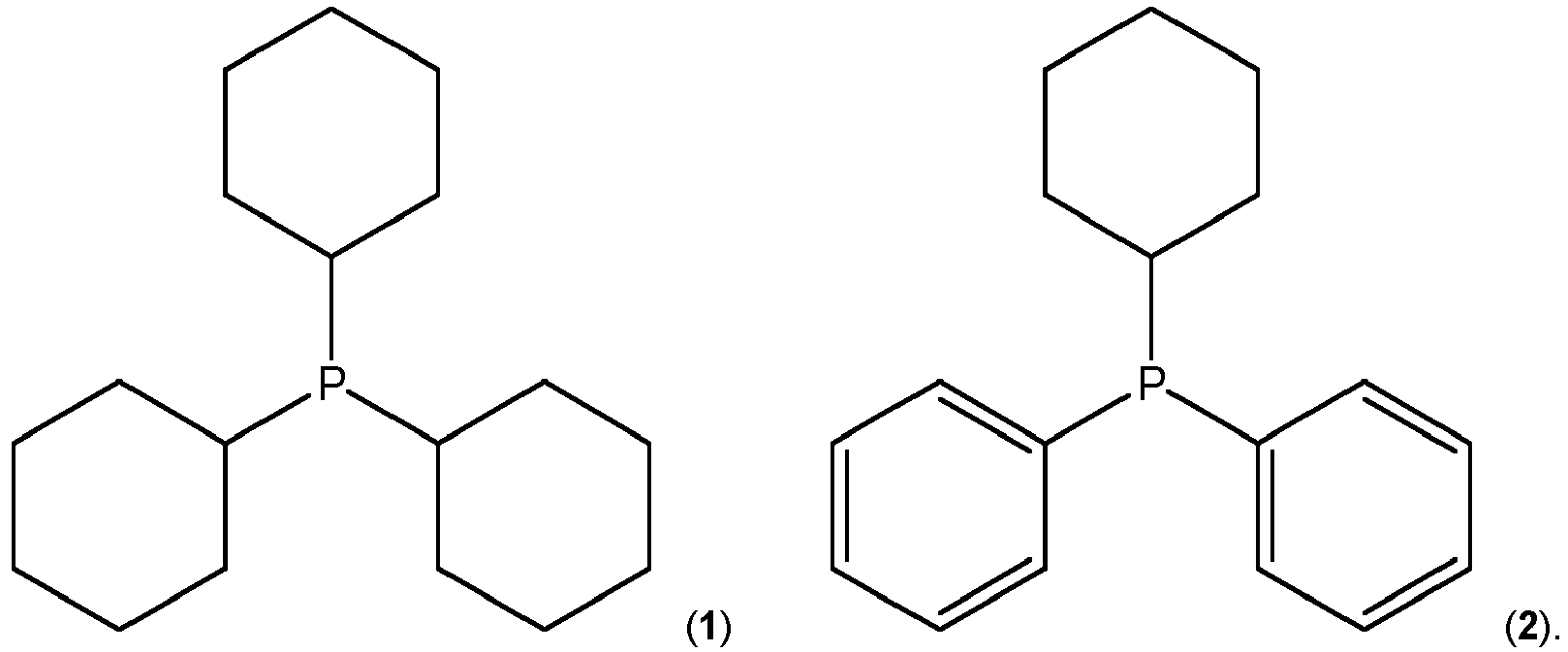
- Verfahren nach einem der Ansprüche 1 bis 4,
wobei die Verbindung gemäß Formel (I) die Struktur (1) aufweist:
- Verfahren nach einem der Ansprüche 1 bis 5,
wobei das Zuführen in Verfahrensschritt c) bei einem Druck erfolgt im Bereich von 4,5 MPa (45 bar) bis 5,5 MPa (55 bar). - Verfahren nach einem der Ansprüche 1 bis 6,
wobei das Erwärmen in Verfahrensschritt d) auf eine Temperatur erfolgt im Bereich von 100 °C bis 140 °C. - Verfahren nach einem der Ansprüche 1 bis 7,
wobei die Rh-Verbindung in einer Menge bezogen auf das n-Olefin zugegeben wird im Bereich von 10 ppm bis 250 ppm. - Verfahren nach einem der Ansprüche 1 bis 8,
wobei das n-Olefin ausgewählt ist aus: 1-Propen, 1-Buten, 1-Penten, 2-Methyl-1-buten, 3-Methyl-1-buten, 1-Hexen, 2-Methyl-1-hexen, 3-Methyl-1-hexen, 2-Ethyl-1-hexen, 1-Heptene, 2-Methylheptene, 3-Methylheptene, 1-Octene, 2-Methylocten, 3-Methylocten, 2-Ethyl-1-octen, 1-Nonen. - Verfahren nach einem der Ansprüche 1 bis 9,
wobei das Lösungsmittel in Verfahrensschritt a) Toluol ist.
Priority Applications (1)
| Application Number | Priority Date | Filing Date | Title |
|---|---|---|---|
| EP21208229.1A EP4180412A1 (de) | 2021-11-15 | 2021-11-15 | Verfahren zur herstellung von iso-aldehyden aus n-olefinen |
Applications Claiming Priority (1)
| Application Number | Priority Date | Filing Date | Title |
|---|---|---|---|
| EP21208229.1A EP4180412A1 (de) | 2021-11-15 | 2021-11-15 | Verfahren zur herstellung von iso-aldehyden aus n-olefinen |
Publications (1)
| Publication Number | Publication Date |
|---|---|
| EP4180412A1 true EP4180412A1 (de) | 2023-05-17 |
Family
ID=78621793
Family Applications (1)
| Application Number | Title | Priority Date | Filing Date |
|---|---|---|---|
| EP21208229.1A Pending EP4180412A1 (de) | 2021-11-15 | 2021-11-15 | Verfahren zur herstellung von iso-aldehyden aus n-olefinen |
Country Status (1)
| Country | Link |
|---|---|
| EP (1) | EP4180412A1 (de) |
Citations (3)
| Publication number | Priority date | Publication date | Assignee | Title |
|---|---|---|---|---|
| EP0215611A1 (de) * | 1985-09-03 | 1987-03-25 | Celanese Corporation | Herstellung von 2-Methylbutanal |
| WO2005028407A1 (en) * | 2003-09-23 | 2005-03-31 | Exxonmobil Chemical Patents Inc. | Hydroformylation of butenes comprising isobutylene |
| WO2005028404A1 (en) * | 2003-09-23 | 2005-03-31 | Exxonmobil Chemical Patents Inc. | Improvements in or relating to isobutylene |
-
2021
- 2021-11-15 EP EP21208229.1A patent/EP4180412A1/de active Pending
Patent Citations (3)
| Publication number | Priority date | Publication date | Assignee | Title |
|---|---|---|---|---|
| EP0215611A1 (de) * | 1985-09-03 | 1987-03-25 | Celanese Corporation | Herstellung von 2-Methylbutanal |
| WO2005028407A1 (en) * | 2003-09-23 | 2005-03-31 | Exxonmobil Chemical Patents Inc. | Hydroformylation of butenes comprising isobutylene |
| WO2005028404A1 (en) * | 2003-09-23 | 2005-03-31 | Exxonmobil Chemical Patents Inc. | Improvements in or relating to isobutylene |
Similar Documents
| Publication | Publication Date | Title |
|---|---|---|
| EP2947088B1 (de) | Verfahren zur katalytischen herstellung von aldehyden aus olefinen unter einsatz von monophosphit-gemischen | |
| EP3070093B1 (de) | Neue organophosphorverbindungen auf basis von anthracentriol | |
| DE10352260B3 (de) | Verfahren zur Herstellung von TCD-Alkohol DM | |
| EP2906574A1 (de) | Gemisch aus verschiedenen unsymmetrischen bisphosphiten und dessen verwendung als katalysatorgemisch in der hydroformylierung | |
| DE102010043558A1 (de) | Verfahren zur Hydroformylierung von ungesättigten Verbindungen | |
| EP2947091B1 (de) | Gemische von monophosphitligand und deren verwendung zur katalyse einer hydroformylierungsreaktion | |
| DE2931883C2 (de) | Verfahren zur Carbonylierung von olefinischen Verbindungen | |
| EP3763723B1 (de) | Bisphosphite mit einem geschlossenen und einem offenen flügelbaustein | |
| EP4074720B1 (de) | Gemisch von bisphosphiten mit einem offenen und einem geschlossenen flügelbaustein und dessen verwendung als katalysatorgemisch in der hydroformylierung | |
| EP3971195B1 (de) | Diphosphite mit einem offenen, 2,4-methylierten flügelbaustein | |
| DE19946475A1 (de) | Binuclearer Rhodium-Komplex mit zweizähnigem Chelat-Liganden und dessen Verwendung in einem Verfahren zur Herstellung eines Aldehyds | |
| EP3957643A1 (de) | Neue diphosphite auf basis von cis-butendiol-1,4 | |
| EP1604966A1 (de) | Verfahren zur Herstellung von Tricyclo-[5.2.1.0 2,6]-decan dimethylol | |
| EP4180411A1 (de) | Verfahren zur herstellung von iso-aldehyden aus n-olefinen unter einsatz von tricyclohexylphosphin | |
| DE69202886T2 (de) | Verfahren zur Herstellung eines Aldehyds. | |
| EP3318570B1 (de) | Phosphorigsäure-p,p'-[5,5',6,6'-tetramethyl-3,3'-bis(1-methylethyl)[1,1'-biphenyl]-2,2'-diyl] p,p,p',p'-tetrakis(2,4-dimethylphenyl)-ester in der hydroformylierung | |
| EP4008709B1 (de) | Verfahren zur herstellung polyzyklischer aliphatischer dialdehyde | |
| EP3816171B1 (de) | Phosphazyklische phosphite aus dem enol des benzoins | |
| EP4403545B1 (de) | Gemisch zweier konstitutionsisomeren bisphosphite | |
| EP4074722A1 (de) | Diphosphite mit einem offenen, 3-methylierten flügelbaustein | |
| DE2235466C3 (de) | 3-Phenylpropanale und 4-Phenylbutanale sowie ein Verfahren zu deren Herstellung | |
| EP4001254A1 (de) | Ru-katalysierte domino hydroformylierung/hydrierung/veresterung unter einsatz von imidazol-liganden | |
| DE3438851A1 (de) | Verfahren zur herstellung von olefinisch ungesaettigten verbindungen, insbesondere alkenolen | |
| EP4403563B1 (de) | Diphosphit mit einem me-flügelbaustein und einem tbu-flügelbaustein | |
| EP3763722A1 (de) | Bisphosphite mit einem offenen und einem geschlossenen flügelbaustein |
Legal Events
| Date | Code | Title | Description |
|---|---|---|---|
| PUAI | Public reference made under article 153(3) epc to a published international application that has entered the european phase |
Free format text: ORIGINAL CODE: 0009012 |
|
| STAA | Information on the status of an ep patent application or granted ep patent |
Free format text: STATUS: THE APPLICATION HAS BEEN PUBLISHED |
|
| AK | Designated contracting states |
Kind code of ref document: A1 Designated state(s): AL AT BE BG CH CY CZ DE DK EE ES FI FR GB GR HR HU IE IS IT LI LT LU LV MC MK MT NL NO PL PT RO RS SE SI SK SM TR |
|
| STAA | Information on the status of an ep patent application or granted ep patent |
Free format text: STATUS: REQUEST FOR EXAMINATION WAS MADE |
|
| 17P | Request for examination filed |
Effective date: 20230601 |
|
| RBV | Designated contracting states (corrected) |
Designated state(s): AL AT BE BG CH CY CZ DE DK EE ES FI FR GB GR HR HU IE IS IT LI LT LU LV MC MK MT NL NO PL PT RO RS SE SI SK SM TR |
|
| RAP1 | Party data changed (applicant data changed or rights of an application transferred) |
Owner name: EVONIK OXENO GMBH & CO. KG |
|
| STAA | Information on the status of an ep patent application or granted ep patent |
Free format text: STATUS: EXAMINATION IS IN PROGRESS |
|
| 17Q | First examination report despatched |
Effective date: 20250718 |