EP4177789A1 - Elektronische vorrichtung und identitätsauthentifizierungsverfahren - Google Patents
Elektronische vorrichtung und identitätsauthentifizierungsverfahren Download PDFInfo
- Publication number
- EP4177789A1 EP4177789A1 EP21831901.0A EP21831901A EP4177789A1 EP 4177789 A1 EP4177789 A1 EP 4177789A1 EP 21831901 A EP21831901 A EP 21831901A EP 4177789 A1 EP4177789 A1 EP 4177789A1
- Authority
- EP
- European Patent Office
- Prior art keywords
- fingerprint
- identity authentication
- light
- information
- nanometers
- Prior art date
- Legal status (The legal status is an assumption and is not a legal conclusion. Google has not performed a legal analysis and makes no representation as to the accuracy of the status listed.)
- Pending
Links
Images



Classifications
-
- G—PHYSICS
- G06—COMPUTING OR CALCULATING; COUNTING
- G06V—IMAGE OR VIDEO RECOGNITION OR UNDERSTANDING
- G06V40/00—Recognition of biometric, human-related or animal-related patterns in image or video data
- G06V40/10—Human or animal bodies, e.g. vehicle occupants or pedestrians; Body parts, e.g. hands
- G06V40/12—Fingerprints or palmprints
- G06V40/1382—Detecting the live character of the finger, i.e. distinguishing from a fake or cadaver finger
- G06V40/1394—Detecting the live character of the finger, i.e. distinguishing from a fake or cadaver finger using acquisition arrangements
-
- G—PHYSICS
- G06—COMPUTING OR CALCULATING; COUNTING
- G06V—IMAGE OR VIDEO RECOGNITION OR UNDERSTANDING
- G06V40/00—Recognition of biometric, human-related or animal-related patterns in image or video data
- G06V40/10—Human or animal bodies, e.g. vehicle occupants or pedestrians; Body parts, e.g. hands
- G06V40/12—Fingerprints or palmprints
- G06V40/13—Sensors therefor
- G06V40/1324—Sensors therefor by using geometrical optics, e.g. using prisms
-
- G—PHYSICS
- G06—COMPUTING OR CALCULATING; COUNTING
- G06V—IMAGE OR VIDEO RECOGNITION OR UNDERSTANDING
- G06V10/00—Arrangements for image or video recognition or understanding
- G06V10/10—Image acquisition
- G06V10/12—Details of acquisition arrangements; Constructional details thereof
- G06V10/14—Optical characteristics of the device performing the acquisition or on the illumination arrangements
- G06V10/147—Details of sensors, e.g. sensor lenses
-
- G—PHYSICS
- G06—COMPUTING OR CALCULATING; COUNTING
- G06F—ELECTRIC DIGITAL DATA PROCESSING
- G06F21/00—Security arrangements for protecting computers, components thereof, programs or data against unauthorised activity
- G06F21/30—Authentication, i.e. establishing the identity or authorisation of security principals
- G06F21/31—User authentication
- G06F21/32—User authentication using biometric data, e.g. fingerprints, iris scans or voiceprints
-
- G—PHYSICS
- G06—COMPUTING OR CALCULATING; COUNTING
- G06V—IMAGE OR VIDEO RECOGNITION OR UNDERSTANDING
- G06V10/00—Arrangements for image or video recognition or understanding
- G06V10/10—Image acquisition
- G06V10/12—Details of acquisition arrangements; Constructional details thereof
- G06V10/14—Optical characteristics of the device performing the acquisition or on the illumination arrangements
- G06V10/141—Control of illumination
-
- G—PHYSICS
- G06—COMPUTING OR CALCULATING; COUNTING
- G06V—IMAGE OR VIDEO RECOGNITION OR UNDERSTANDING
- G06V10/00—Arrangements for image or video recognition or understanding
- G06V10/10—Image acquisition
- G06V10/12—Details of acquisition arrangements; Constructional details thereof
- G06V10/14—Optical characteristics of the device performing the acquisition or on the illumination arrangements
- G06V10/143—Sensing or illuminating at different wavelengths
-
- G—PHYSICS
- G06—COMPUTING OR CALCULATING; COUNTING
- G06V—IMAGE OR VIDEO RECOGNITION OR UNDERSTANDING
- G06V10/00—Arrangements for image or video recognition or understanding
- G06V10/70—Arrangements for image or video recognition or understanding using pattern recognition or machine learning
- G06V10/74—Image or video pattern matching; Proximity measures in feature spaces
-
- G—PHYSICS
- G06—COMPUTING OR CALCULATING; COUNTING
- G06V—IMAGE OR VIDEO RECOGNITION OR UNDERSTANDING
- G06V40/00—Recognition of biometric, human-related or animal-related patterns in image or video data
- G06V40/10—Human or animal bodies, e.g. vehicle occupants or pedestrians; Body parts, e.g. hands
- G06V40/12—Fingerprints or palmprints
- G06V40/13—Sensors therefor
- G06V40/1318—Sensors therefor using electro-optical elements or layers, e.g. electroluminescent sensing
-
- G—PHYSICS
- G06—COMPUTING OR CALCULATING; COUNTING
- G06V—IMAGE OR VIDEO RECOGNITION OR UNDERSTANDING
- G06V40/00—Recognition of biometric, human-related or animal-related patterns in image or video data
- G06V40/10—Human or animal bodies, e.g. vehicle occupants or pedestrians; Body parts, e.g. hands
- G06V40/12—Fingerprints or palmprints
- G06V40/1365—Matching; Classification
-
- G—PHYSICS
- G06—COMPUTING OR CALCULATING; COUNTING
- G06V—IMAGE OR VIDEO RECOGNITION OR UNDERSTANDING
- G06V40/00—Recognition of biometric, human-related or animal-related patterns in image or video data
- G06V40/10—Human or animal bodies, e.g. vehicle occupants or pedestrians; Body parts, e.g. hands
- G06V40/12—Fingerprints or palmprints
- G06V40/1382—Detecting the live character of the finger, i.e. distinguishing from a fake or cadaver finger
-
- G—PHYSICS
- G06—COMPUTING OR CALCULATING; COUNTING
- G06V—IMAGE OR VIDEO RECOGNITION OR UNDERSTANDING
- G06V40/00—Recognition of biometric, human-related or animal-related patterns in image or video data
- G06V40/10—Human or animal bodies, e.g. vehicle occupants or pedestrians; Body parts, e.g. hands
- G06V40/12—Fingerprints or palmprints
- G06V40/1382—Detecting the live character of the finger, i.e. distinguishing from a fake or cadaver finger
- G06V40/1388—Detecting the live character of the finger, i.e. distinguishing from a fake or cadaver finger using image processing
-
- H—ELECTRICITY
- H10—SEMICONDUCTOR DEVICES; ELECTRIC SOLID-STATE DEVICES NOT OTHERWISE PROVIDED FOR
- H10K—ORGANIC ELECTRIC SOLID-STATE DEVICES
- H10K59/00—Integrated devices, or assemblies of multiple devices, comprising at least one organic light-emitting element covered by group H10K50/00
- H10K59/60—OLEDs integrated with inorganic light-sensitive elements, e.g. with inorganic solar cells or inorganic photodiodes
- H10K59/65—OLEDs integrated with inorganic image sensors
-
- G—PHYSICS
- G02—OPTICS
- G02B—OPTICAL ELEMENTS, SYSTEMS OR APPARATUS
- G02B5/00—Optical elements other than lenses
- G02B5/20—Filters
- G02B5/201—Filters in the form of arrays
Definitions
- This application pertains to the field of electronic devices, and specifically, relates to an electronic device and an identity authentication method.
- Embodiments of the present invention are intended to provide an electronic device and an identity authentication method, to resolve the problem of low security in identity authentication using fingerprints.
- the present invention is implemented as follows.
- an embodiment of the present invention provides an electronic device.
- the electronic device includes a light emitting assembly, a fingerprint chip, and a plurality of color filters, where
- an embodiment of the present invention provides an identity authentication method applied to the electronic device according to the first aspect.
- the method includes:
- an embodiment of the present invention provides an electronic device.
- the electronic device includes a processor, a memory, and a program or instructions stored in the memory and executable on the processor, where when the program or instructions are executed by the processor, the steps of the identity authentication method according to the second aspect are implemented.
- an embodiment of the present invention provides a readable storage medium, where the readable storage medium stores a program or instructions, and when the program or instructions are executed by a processor, the steps of the identity authentication method according to the second aspect are implemented.
- an embodiment of the present invention provides a chip, where the chip includes a processor and a communications interface, the communications interface is coupled to the processor, and the processor is configured to execute a program or instructions to implement the steps of the identity authentication method according to the second aspect.
- an electronic device includes a light emitting assembly, a fingerprint chip, and a plurality of color filters, where the light emitting assembly is disposed between encapsulation glass and a glass substrate of a display of the electronic device; the fingerprint chip is provided with a plurality of filter sub-regions that are spaced apart from each other; and the plurality of color filters are disposed between the display and the plurality of filter sub-regions respectively.
- the fingerprint chip acquires information about reflected light that passes through the plurality of color filters after light emitted by the light emitting assembly is incident on a target fingerprint and reflected. Therefore, authenticity of the target fingerprint can be verified in terms of pattern and spectrum, so as to identify artificially fake fingerprints, greatly improving security in identity authentication using fingerprints.
- FIG. 1 is a schematic diagram of partial structure of an electronic device according to an embodiment of the present invention.
- the electronic device 100 includes a light emitting assembly 102, a fingerprint chip 118, and a plurality of color filters 116, where the light emitting assembly 102 is disposed between encapsulation glass 110 and a glass substrate 112 of a display of the electronic device 100; the fingerprint chip 118 is provided with a plurality of filter sub-regions that are spaced apart from each other; and the plurality of color filters 116 are disposed between the display and the plurality of filter sub-regions respectively.
- the light emitting assembly 102 is configured to emit light.
- the light emitting assembly 102 is independent RGB pixels.
- the independent RGB pixels are located between the encapsulation glass 110 and the glass substrate 112 of the display of the electronic device 100.
- the independent RGB pixels are used to emit light.
- the display of the electronic device 100 includes a plurality of independent RGB pixels, and the plurality of independent RGB pixels correspond to red light, blue light, and green light respectively.
- the electronic device 100 controls emitting of light 104.
- the light 104 may be white light which is a mix of red light, blue light, and green light, or purple light which is a mix of red light and blue light, or yellow light which is a mix of red light and green light, or cyan light which is a mix of green light and blue light.
- the fingerprint chip 118 is a black and white chip configured to acquire reflected light 114 which passes through the plurality of color filters 116 after the light 104 emitted by the light emitting assembly 102 is incident on a target fingerprint 106 and reflected.
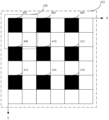
- the filter sub-regions may be regions on the fingerprint chip corresponding to color filters 402, 404, 406, 408, 410, 412, 414, 416, and 418 respectively.
- the filter sub-regions being spaced apart from each other means that none of the filter sub-regions touches another.
- the filter sub-regions on the fingerprint chip corresponding to the color filters 402, 404, 406, 408, 410, 412, 414, 416, and 418 respectively are not touching one another.
- spectral bands of the color filters 116 are spectral bands predetermined according to RGB sub-pixel spectrums corresponding to the light 104 emitted by the light emitting assembly 102.
- the color filter 116 for example, a red filter, can absorb most of non-red light in mixed light and allows red light to pass through.
- the spectral band of the color filter 116 is a spectral band corresponding to a color of the color filter 116.
- the red filter has a spectral band of 625 nanometers to 635 nanometers.
- a peak wavelength of an independent RGB sub-pixel spectrum is determined as a fundamental wavelength.
- a wavelength of a peak 320 of a B pixel spectrum is about 470 nanometers, and two single-point wavelengths adjacent to the fundamental wavelength are determined based on +/- 20 nanometers predefined, such that 450 nanometers, 470 nanometers, and 490 nanometers are selected in the blue part.
- 510 nanometers, 530 nanometers, and 550 nanometers are selected in the green part, and 610 nanometers, 630 nanometers, and 650 nanometers are selected in the red part.
- nine spectral bands are determined according to the nine single-point wavelengths and the predefined wavelength ranges.
- spectral bands typically center at single-point wavelengths, for example, 445 nanometers to 455 nanometers, 465 nanometers to 475 nanometers, 485 nanometers to 495 nanometers, 505 nanometers to 515 nanometers, 525 nanometers to 535 nanometers, 545 nanometers to 555 nanometers, 605 nanometers to 615 nanometers, 625 nanometers to 635 nanometers, and 645 nanometers to 655 nanometers.
- the spectral bands of the plurality of color filters 116 are the nine spectral bands determined according to a red pixel spectrum, a blue pixel spectrum, and a green pixel spectrum corresponding to the light 104, namely, 445 nanometers to 455 nanometers, 465 nanometers to 475 nanometers, 485 nanometers to 495 nanometers, 505 nanometers to 515 nanometers, 525 nanometers to 535 nanometers, 545 nanometers to 555 nanometers, 605 nanometers to 615 nanometers, 625 nanometers to 635 nanometers, and 645 nanometers to 655 nanometers.
- the plurality of color filters 116 are disposed between the display and the plurality of filter sub-regions respectively.
- the color filters 402, 404, 406, 408, 410, 412, 414, 416, and 418 are disposed between the display and the plurality of filter sub-regions on the fingerprint chip respectively.
- a preset quantity of filter sub-regions constitute a filter region, and the filter region is used for obtaining light intensity information of light which passes through the color filters 116 after the target fingerprint 106 reflects the light 104 emitted by the light emitting assembly 102.
- the filter region is a large unit 422, and the preset quantity is nine.
- One large unit 422 includes nine filter sub-regions, namely, the regions on the fingerprint chip corresponding to the color filters 402, 404, 406, 408, 410, 412, 414, 416, and 418 respectively.
- color filters 116 corresponding to two of the filter sub-regions which belong to one filter region have different spectral bands.
- the filter region is the large unit 422, and the preset quantity is nine.
- One large unit 422 includes nine filter sub-regions, namely, the regions on the fingerprint chip corresponding to the color filters 402, 404, 406, 408, 410, 412, 414, 416, and 418 respectively, and spectral bands of any two of the nine color filters differ.
- the light emitting assembly 102 in the display of the electronic device 100 emits the light 104, and the light 104 sequentially passes through the encapsulation glass 110 and a glass cover 108 and reaches the target fingerprint 106.
- the target fingerprint 106 absorbs part of the light 104 and reflects the rest, and the reflected light 114 sequentially passes through the glass cover 108, the encapsulation glass 110, the glass substrate 112, the color filters 116, and reaches the fingerprint chip 118.
- the color filters 116 adsorb part of the reflected light 114.
- the fingerprint chip 118 is connected to a circuit board 120.
- an electronic device includes a light emitting assembly, a fingerprint chip, and a plurality of color filters, where the light emitting assembly is disposed between encapsulation glass and a glass substrate of a display of the electronic device; the fingerprint chip is provided with a plurality of filter sub-regions that are spaced apart from each other; and the plurality of color filters are disposed between the display and the plurality of filter sub-regions respectively.
- the fingerprint chip acquires information about reflected light that passes through the plurality of color filters after light emitted by the light emitting assembly is incident on a target fingerprint and reflected. Therefore, authenticity of the target fingerprint can be verified in terms of pattern and spectrum, so as to identify artificially fake fingerprints, greatly improving security in identity authentication using fingerprints.
- FIG. 2 is a schematic flowchart of an identity authentication method according to an embodiment of the present invention which is applicable to the electronic device shown in FIG. 1 .
- step S202 in response to an identity authentication trigger operation, a light emitting assembly is controlled to emit light.
- the identity authentication trigger operation may be a press operation performed on a predetermined region on a display of the electronic device, or a tap operation, touch-and-hold operation, or double-tap operation on a predetermined functional button of the electronic device, or other predetermined operations.
- the identity authentication trigger operation is not particularly limited in the present invention.
- a finger corresponding to a target fingerprint presses a predetermined fingerprint region, and the display of the electronic device emits white light which illuminates the finger.
- the display of the electronic device includes a plurality of independent RGB pixels, and the plurality of independent RGB pixels correspond to red light, blue light, and green light respectively.
- the electronic device controls the independent RGB pixel to emit light.
- the light may be white light which is a mix of red light, blue light, and green light, or purple light which is a mix of red light and blue light, or yellow light which is a mix of red light and green light, or cyan light which is a mix of green light and blue light.
- the fingerprint chip may be a black and white chip.
- a color filter for example, a red filter, can absorb most of non-red light in mixed light and allow red light to pass through the color filter.
- a spectral band of the color filter is a spectral band corresponding to a color of the color filter.
- a spectral band of the red filter is 625 nanometers to 635 nanometers.
- the color filters 116 are located between the fingerprint chip 118 and the glass substrate 112 of the display of the electronic device.
- white light which is a mix of red light, blue light, and green light is generally preferred light, and a usable spectral band of the light is about 440 nanometers to 700 nanometers.
- a spectrogram of white light refer to a white spectrum 310 in FIG. 3 .
- a peak wavelength of an independent RGB sub-pixel spectrum is determined as a fundamental wavelength.
- a wavelength of a peak 320 of a B pixel spectrum is about 470 nanometers
- two single-point wavelengths adjacent to the fundamental wavelength are determined based on +/- 20 nanometers predefined, such that 450 nanometers, 470 nanometers, and 490 nanometers are selected in the blue part.
- 510 nanometers, 530 nanometers, and 550 nanometers are selected in the green part
- 610 nanometers, 630 nanometers, and 650 nanometers are selected in the red part.
- the purple light is a mix of two types of light, and thus six single-point wavelengths are selected.
- a wavelength of a peak 320 of a B pixel spectrum is about 470 nanometers, and two single-point wavelengths adjacent to a fundamental wavelength are determined based on +/- 15 nanometers predefined, meaning that 455 nanometers, 470 nanometers, and 485 nanometers are selected in the blue part.
- 615 nanometers, 630 nanometers, and 645 nanometers are selected.
- a predefined range for example, +/- 20 nanometers, for determining two single-point wavelengths adjacent to a fundamental wavelength may be determined according to a wavelength corresponding to half, or 1/3, or other predefined ratios of the peak of an independent RGB sub-pixel spectrum.
- the horizontal coordinate of the white spectrum 310 is wavelength in nanometers
- the vertical coordinate is radiation capability of the light for which the unit of measurement is ignored.
- the wavelength of the peak 320 of the B pixel spectrum is about 470 nanometers
- radiation capability of light with a wavelength of 450 nanometers or 490 nanometers is 1/2 that of light with a wavelength of 470 nanometers.
- two single-point wavelengths adjacent to the wavelength of the peak 320 of the B pixel spectrum do not overlap or intersect with other single-point wavelengths.
- 450 nanometers, 470 nanometers, and 490 nanometers are selected in the blue part
- 510 nanometers, 530 nanometers, and 550 nanometers are selected in the green part
- 490 nanometers selected in the blue part is definitely less than the three single-point wavelengths in the green part.
- the light emitted by the display of the electronic device may alternatively be a mix of light of other colors rather than red, blue, and green. Color of the light is not specifically limited in the present invention.
- the display of the electronic device may be an organic light-emitting diode (OLED, Organic Light-Emitting Diode) display or other displays.
- nine single-point wavelengths are determined.
- Nine spectral bands are determined according to the nine single-point wavelengths and predefined wavelength ranges. These spectral bands generally center at single-point wavelengths, for example, 445 nanometers to 455 nanometers, 465 nanometers to 475 nanometers, 485 nanometers to 495 nanometers, 505 nanometers to 515 nanometers, 525 nanometers to 535 nanometers, 545 nanometers to 555 nanometers, 605 nanometers to 615 nanometers, 625 nanometers to 635 nanometers, and 645 nanometers to 655 nanometers.
- the plurality of spectral bands have no overlapping wavelength ranges.
- the color filters 402, 404, 406, 408, 410, 412, 414, 416, and 418 are located above predetermined regions of the fingerprint chip respectively.
- Spectral bands of the nine color filters are the nine predetermined spectral bands respectively.
- “Above” herein refers to a direction pointing from the fingerprint chip to the outside of the display of the electronic device.
- a gap is present between color filters 520 and 530.
- the color filter may be rectangular, circular, or diamond. Shape of the color filter is not limited in the present invention.
- the color filters may also be distributed in a different shape than shown in FIG. 4 and FIG. 5 , and are distributed in other predefined shapes, provided that corresponding regions of the fingerprint chip below the plurality of color filters are spaced apart from each other.
- step S204 light intensity information corresponding to the target fingerprint and first pattern information of the target fingerprint are obtained, where the light intensity information is light intensity information of reflected light which passes through the plurality of color filters and reaches the fingerprint chip after the target fingerprint reflects the light.
- the display of the electronic device emits white light to illuminate a finger corresponding to the target fingerprint, and the light is reflected by the finger, passes through the display again and then through a camera and the plurality of color filters, and reaches the fingerprint chip.
- an apparatus for artificially faking fingerprints takes a fingerprint of a person as a template, and is shaped with a plastic material such as silicone. Such apparatus copies only pattern information of the fingerprint without considering biological features of the living body fingerprint.
- the apparatus also absorbs part of the white light, and then reflects the rest.
- spectrum information of the reflected light reflected by the living body fingerprint is obviously greatly different from that of the reflected light reflected by the apparatus for artificially faking fingerprints.
- the plurality of color filters correspond to a plurality of predetermined spectral bands respectively.
- a color filter When reflected light passes through a color filter, most of light not in the spectral band is absorbed by the color filter while light of that spectral band passes through the color filter and reaches the fingerprint chip, and the fingerprint chip receives light intensity of the light of the spectral band.
- nine spectral bands are predetermined, thirty-six color filters are disposed above predetermined regions of the fingerprint chip, and each nine color filters with different spectral bands are put into one large unit. Totally four large units are disposed above the fingerprint chip.
- “Above” herein refers to a direction pointing from the fingerprint chip to the outside of the display of the electronic device.
- the fingerprint chip can obtain light intensity information of the green light with a wavelength of 527 nanometers to 533 nanometers. Similarly, the fingerprint chip can obtain light intensity information of light of nine different spectral bands.
- step S206 first spectrum information corresponding to the target fingerprint is generated based on the light intensity information.
- generating, based on the light intensity information, first spectrum information corresponding to the target fingerprint includes: generating, based on light intensity information of reflected light of a plurality of spectral bands and the plurality of spectral bands, a spectral curve as the first spectrum information corresponding to the target fingerprint.
- a curve 340 can be drawn.
- the curve 340 can reflect spectrum information corresponding to the target fingerprint, and is determined as the first spectrum information.
- a curve generated based on nine points is not necessarily accurate spectrum information of the reflected light, but is enough for determining whether the spectrum information matches prestored second spectrum information for user identity authentication.
- step S208 user identity authentication is performed according to the first spectrum information, the first pattern information, and prestored second spectrum information and second pattern information for user identity authentication.
- the performing user identity authentication according to the first spectrum information, the first pattern information, and prestored second spectrum information and second pattern information for user identity authentication includes: determining whether the target fingerprint is a living body fingerprint, according to the first spectrum information and the prestored second spectrum information for user identity authentication; determining whether the first pattern information matches the second pattern information, according to the first pattern information and the prestored second pattern information for user identity authentication; and if the target fingerprint is a living body fingerprint and the first pattern information matches the second pattern information, determining that the user identity authentication is successful; or otherwise, determining that the user identity authentication is unsuccessful.
- the determining whether the first pattern information matches the second pattern information, according to the first pattern information and the prestored second pattern information for user identity authentication may be: determining pattern similarity between the first pattern information and the second pattern information according to the first pattern information and the second pattern information; and if the pattern similarity is greater than or equal to a preset pattern similarity threshold, determining that the first pattern information matches the second pattern information; or if the pattern similarity is less than the preset pattern similarity threshold, determining that the first pattern information does not match the second pattern information.
- the preset pattern similarity threshold is generally high, for example, 90%.
- the determining whether the first pattern information matches the second pattern information, according to the first pattern information and the prestored second pattern information for user identity authentication may alternatively be: determining whether the first pattern information matches the second pattern information, according to feature points of the first pattern information and feature points of the second pattern information.
- the determining whether the target fingerprint is a living body fingerprint, according to the first spectrum information and the prestored second spectrum information for user identity authentication includes: determining similarity between the first spectrum information and the second spectrum information according to the first spectrum information and the prestored second spectrum information for user identity authentication; and if the similarity is greater than or equal to a preset similarity threshold, determining that the target fingerprint is a living body fingerprint; or if the similarity is less than the preset similarity threshold, determining that the target fingerprint is not a living body fingerprint.
- the first spectrum information corresponding to the target fingerprint is obtained, and matching is performed between the first spectrum information obtained and spectrum information of an input fingerprint. If the similarity is low, for example, lower than 60%, the target fingerprint is determined not to be a living body fingerprint, and it is displayed on the screen that the user identity authentication is unsuccessful. If the similarity is high, for example, higher than or equal to 60%, the target fingerprint is determined to be a living body fingerprint. Generally, the preset similarity threshold is low, for example, 60%.
- the electronic device may first determine whether the target fingerprint is a living body fingerprint, and then determine whether the first pattern information matches the second pattern information; or first determine whether the first pattern information matches the second pattern information, and then determine whether the target fingerprint is a living body fingerprint; or perform the determining processes simultaneously. This is not particularly limited in the present invention.
- the electronic device determines that the user identity authentication is successful, only when the target fingerprint is a living body fingerprint and the first pattern information matches the second pattern information. In other cases, the electronic device determines that the user identity authentication is unsuccessful.
- the user identity authentication based on fingerprint identification may be applied to scenarios of unlocking electronic devices. Specifically, after the electronic device determines that the user identity authentication is successful according to the fingerprint, the electronic device unlocks user permissions to allow a user corresponding to the target fingerprint to use most of functions of the electronic device. For example, if a mobile phone determines, according to fingerprint identification, that a user corresponding to a target fingerprint is a user of the mobile phone, the mobile phone determines that user identity authentication is successful and disables lockscreen protection so that the user is able to use the mobile phone to conduct various activities such as making a call, surfing the internet, and playing games.
- the mobile phone determines, according to fingerprint identification, that the user corresponding to the target fingerprint is not a user of the mobile phone, the mobile phone determines that user identity authentication is unsuccessful and still retains the lockscreen protection state where the user is unable to use most of functions of the mobile phone.
- the target fingerprint when the target fingerprint is not a living body fingerprint and the first pattern information matches the second pattern information, it is obvious that the target fingerprint is an artificially fake fingerprint used by an unauthorized user who tries to impersonate someone else for user identity authentication, which brings about huge information security risks and economic risks to the one whose fingerprint has been faked.
- An artificially fake fingerprint takes a fingerprint of a person as a template, and is shaped with a plastic material such as silicone. Artificially fake fingerprints made in such way can crack an automated fingerprint identification system that is based on a traditional optical acquisition instrument. Different from fake fingerprints, skin of a human body has unique absorption and scattering features. Artificially fake fingerprints can copy pattern information of real fingerprints, but have no living features of the human body.
- the target fingerprint is a living body fingerprint and the first pattern information does not match the second pattern information, it means that a user corresponding to the target fingerprint is a user other than a user satisfying user identity authentication requirements, and thus the user identity authentication is unsuccessful.
- the target fingerprint when the target fingerprint is not a living body fingerprint and the first pattern information does not match the second pattern information, it may be the result of an artificially fake fingerprint used or a mis-operation by a user, and thus the user identity authentication is unsuccessful.
- the target fingerprint is determined not to be a living body fingerprint for consecutively a preset quantity of times
- switching is performed to a password-based user identity authentication mode. For example, if the target fingerprint is determined not to be a living body fingerprint for consecutively three times, the electronic device directly turns off a fingerprint identification function, and displays "Please enter password to unlock" on its screen. If the target fingerprint is determined not to be a living body fingerprint for consecutively a preset quantity of times, it means that an unauthorized user is possibly deliberately trying to crack the fingerprint identification-based user identity authentication mode. In this case, the fingerprint identification-based user identity authentication mode is subject to high risks. Therefore, it is necessary to turn off the fingerprint identification function and switch to another user identity authentication mode.
- switching may be performed alternatively to a facial recognition-based user identity authentication mode, a voice recognition-based user identity authentication mode, a user identity authentication mode based on dynamic mobile phone verification code, or the like.
- the new user identity authentication mode is not particularly limited in the present invention.
- switching may be performed alternatively to a user identity authentication prohibited mode for a preset time range. For example, if the target fingerprint is determined not to be a living body fingerprint for consecutively three times, the electronic device is unable to use user identity authentication within 24 hours, and is able to use user identity authentication again only after 24 hours.
- a user of the electronic device launches a fingerprint input interface and uses a finger to press a fingerprint region
- the display of the electronic device emits white light to illuminate the finger, and the light is reflected by the finger, passes through the display again and then through a camera, and reaches the fingerprint chip.
- the fingerprint chip generates spectrum information corresponding to the fingerprint, where the spectrum information is the prestored second spectrum information for user identity authentication; and the fingerprint chip outputs pattern information of the fingerprint, where the pattern information is the prestored second pattern information for user identity authentication.
- the second spectrum information and the second pattern information are stored in the electronic device.
- the light emitting assembly is controlled to emit light; then, light intensity information corresponding to a target fingerprint and first pattern information of the target fingerprint are obtained, where the light intensity information is light intensity information of reflected light which passes through the plurality of color filters and reaches the fingerprint chip after the target fingerprint reflects the light; then, based on the light intensity information, first spectrum information corresponding to the target fingerprint is generated; and finally, according to the first spectrum information, the first pattern information, and prestored second spectrum information and second pattern information for user identity authentication, user identity authentication is performed.
- light can be emitted to illuminate a target fingerprint, light intensity information and first pattern information are obtained, and first spectrum information is generated.
- User identity authentication is performed through verification of both the first spectrum information and the first pattern information.
- artificially fake fingerprints can be identified, greatly improving security in identity authentication using fingerprints.
- FIG. 3 is a schematic diagram of spectrum information according to an embodiment of the present invention.
- the spectrogram 310 is a spectrogram of white light which is a mix of red light (R pixels), blue light (B pixels), and green light (G pixels).
- a wavelength of a peak 320 of a B pixel spectrum is about 470 nanometers, and two single-point wavelengths adjacent to the fundamental wavelength are determined based on +/- 20 nanometers predefined, such that 450 nanometers, 470 nanometers, and 490 nanometers are selected in the blue part.
- 510 nanometers, 530 nanometers, and 550 nanometers are selected in the green part
- 610 nanometers, 630 nanometers, and 650 nanometers are selected in the red part.
- the light intensity information 330 is light intensity information of light of a spectral band of 465 nanometers to 475 nanometers which is determined according to the wavelength of the peak 320 of the B pixel spectrum. It should be noted that in the process that the white light is incident on the finger and reflected, passes through the color filters, and reaches the fingerprint chip, light intensity information of the reflected light which reaches the fingerprint chip is definitely weaker than in the spectrogram of the white light.
- the curve 340 is a curve determined based on the light intensity information 330 and light intensity information of light of other eight spectral bands. The curve 340 can reflect spectrum information corresponding to the target fingerprint, that is, the first spectrum information.
- FIG. 4 is a schematic diagram of positional arrangement of color filters according to an embodiment of the present invention.
- a direction X and a direction Y of the chip are defined, and a grid is formed accordingly, a 6*6 unit is taken as a large unit 422, and a 2*2 unit is taken as a small unit 420 in a large unit 422.
- a color filter with a spectral band of 445 nanometers to 455 nanometers is disposed above a square in the upper left corner of a small unit 420, and color filters with other eight spectral bands are disposed under the same principle. It should be noted that positions of the color filters with nine different spectral bands are interchangeable, which has no impact on the first spectrum information generated in subsequent steps.
- FIG. 3 shows only one large unit 422, and an actual fingerprint chip may be provided with a plurality of large units identical to the large unit 422.
- the color filters 402, 404, 406, 408, 410, 412, 414, 416, and 418 are located above predetermined regions of the fingerprint chip respectively.
- Spectral bands of the nine color filters are the nine predetermined spectral bands respectively, for example, 445 nanometers to 455 nanometers, 465 nanometers to 475 nanometers, 485 nanometers to 495 nanometers, 505 nanometers to 515 nanometers, 525 nanometers to 535 nanometers, 545 nanometers to 555 nanometers, 605 nanometers to 615 nanometers, 625 nanometers to 635 nanometers, and 645 nanometers to 655 nanometers.
- FIG. 5 is a schematic diagram of partial cross-sectional view of an electronic device according to an embodiment of the present invention, where the electronic device is capable of implementing an identity authentication method.
- a color filter 520 and a color filter 530 are disposed below a plurality of microlenses 510, and the color filter 520 and the color filter 530, with a gap therebetween, correspond to different spectral bands.
- Photodiodes 540 are disposed below the color filter 520 and the color filter 530, and below the photodiodes 540 are a plurality of wiring layers 550. It should be noted that “below” herein refers to a direction pointing from the outside of the display of the electronic device to the fingerprint chip.
- the identity authentication method provided in the embodiments of the present invention may be performed by an identity authentication apparatus or a control module for performing the identity authentication method in the identity authentication apparatus.
- the identity authentication method being performed by an identity authentication apparatus is used as an example to describe the identity authentication method provided in the embodiments of the present invention.
- FIG. 6 is a schematic diagram of a hardware structure of an electronic device according to an embodiment of the present invention.
- the electronic device 600 includes but is not limited to components such as a radio frequency unit 601, a network module 602, an audio output unit 603, an input unit 604, a sensor 605, a display unit 606, a user input unit 607, an interface unit 608, a memory 609, and a processor 610.
- the electronic device 100 may further include a power supply 611 (such as a battery) for supplying power to the components.
- the power supply may be logically connected to the processor 610 via a power management system. In this way, functions such as charge management, discharge management, and power consumption management are implemented via the power management system.
- the electronic device structure shown in FIG. 6 does not constitute any limitation on the electronic device.
- the electronic device may include more or fewer components than shown in the figure, or combine some of the components, or have the components arranged differently, which are not further described herein.
- the processor 610 is configured to implement the following steps: in response to an identity authentication trigger operation, controlling a light emitting assembly to emit light; obtaining light intensity information corresponding to a target fingerprint and first pattern information of the target fingerprint, where the light intensity information is light intensity information of reflected light which passes through a plurality of color filters and reaches a fingerprint chip after the target fingerprint reflects the light; generating, based on the light intensity information, first spectrum information corresponding to the target fingerprint; and performing user identity authentication according to the first spectrum information, the first pattern information, and prestored second spectrum information and second pattern information for user identity authentication.
- the light emitting assembly is controlled to emit light; then, light intensity information corresponding to a target fingerprint and first pattern information of the target fingerprint are obtained, where the light intensity information is light intensity information of reflected light which passes through the plurality of color filters and reaches the fingerprint chip after the target fingerprint reflects the light; then, based on the light intensity information, first spectrum information corresponding to the target fingerprint is generated; and finally, according to the first spectrum information, the first pattern information, and prestored second spectrum information and second pattern information for user identity authentication, user identity authentication is performed.
- light can be emitted to illuminate a target fingerprint, light intensity information and first pattern information are obtained, and first spectrum information is generated.
- User identity authentication is performed through verification of both the first spectrum information and the first pattern information.
- the processor 610 is further configured to generate, based on the light intensity information, first spectrum information corresponding to the target fingerprint, which includes: generating, based on the light intensity information of reflected light of a plurality of spectral bands and the plurality of spectral bands, a spectral curve as the first spectrum information corresponding to the target fingerprint.
- the processor 610 is further configured to perform user identity authentication according to the first spectrum information, the first pattern information, and prestored second spectrum information and second pattern information for user identity authentication, which includes: determining whether the target fingerprint is a living body fingerprint, according to the first spectrum information and the prestored second spectrum information for user identity authentication; determining whether the first pattern information matches the second pattern information, according to the first pattern information and the prestored second pattern information for user identity authentication; and if the target fingerprint is a living body fingerprint and the first pattern information matches the second pattern information, determining that the user identity authentication is successful; or otherwise, determining that the user identity authentication is unsuccessful.
- the processor 610 is further configured to determine whether the target fingerprint is a living body fingerprint, according to the first spectrum information and the prestored second spectrum information for user identity authentication, which includes: determining similarity between the first spectrum information and the second spectrum information, according to the first spectrum information and the prestored second spectrum information for user identity authentication; and if the similarity is greater than or equal to a preset similarity threshold, determining that the target fingerprint is a living body fingerprint; or if the similarity is less than the preset similarity threshold, determining that the target fingerprint is not a living body fingerprint.
- the processor 610 is further configured to, if the target fingerprint is determined not to be a living body fingerprint for consecutively a preset quantity of times, switch to a password-based user identity authentication mode.
- first spectrum information is generated based on light intensity information of reflected light of a plurality of spectral bands and the plurality of spectral bands.
- first spectrum information, first pattern information, and prestored second spectrum information and second pattern information for user identity authentication it is determined whether a target fingerprint is a living body fingerprint and whether the first pattern information matches the prestored information, and a user authentication result is determined based on the two determining results.
- Whether the target fingerprint is a living body fingerprint is determined according to a comparison of similarity between the first spectrum information and the second spectrum information against a preset similarity threshold, and if the target fingerprint is determined not to be a living body fingerprint for multiple times, switching of the user identity authentication mode is performed.
- first spectrum information can be obtained, and a user authentication result is determined based on double determining; and whether a target fingerprint is a living body fingerprint can be determined according to a comparison of similarity between two spectrum information against a preset similarity threshold.
- the input unit 604 may include a graphics processing unit (Graphics Processing Unit, GPU) 6041 and a microphone 6042.
- the graphics processing unit 6041 processes image data of a static picture or a video that is obtained by an image capture apparatus (for example, a camera) in an image capture mode or a video capture mode.
- the display unit 606 may include a display panel 6061, and the display panel 6061 may be configured in a form of a liquid crystal display, an organic light-emitting diode display, or the like.
- the user input unit 607 includes a touch panel 6071 and other input devices 6072.
- the touch panel 6071 is also referred to as a touchscreen.
- the touch panel 6071 may include two parts: a touch detection apparatus and a touch controller.
- the other input devices 6072 may include but are not limited to a physical keyboard, a functional button (such as a volume control button or a power on/off button), a trackball, a mouse, and a joystick, which are not further described herein.
- the memory 609 may be configured to store software programs and various data which include but are not limited to an application program and an operating system.
- the processor 610 may integrate an application processor and a modem processor.
- the application processor mainly processes an operating system, a user interface, an application program, and the like.
- the modem processor mainly processes wireless communication. It can be understood that the modem processor may alternatively be not integrated in the processor 610.
- An embodiment of the present invention further provides a readable storage medium, where the readable storage medium stores a program or instructions, and when the program or instructions are executed by a processor, the processes of the foregoing embodiments of the identity authentication method are implemented, with the same technical effects achieved. To avoid repetition, details are not described herein again.
- the processor is a processor in the electronic device in the foregoing embodiments.
- the readable storage medium includes a computer-readable storage medium such as a computer read-only memory (Read-Only Memory, ROM), a random access memory (Random Access Memory, RAM), a magnetic disk, or an optical disc.
- An embodiment of the present invention further provides a chip, where the chip includes a processor and a communications interface.
- the communications interface is coupled to the processor, and the processor is configured to execute a program or instructions to implement the processes of the foregoing embodiments of the identity authentication method, with the same technical effects achieved. To avoid repetition, details are not described herein again.
- the chip mentioned in this embodiment of the present invention may also be referred to as a system-level chip, a system chip, a chip system, a system-on-chip, or the like.
- the computer software product is stored in a storage medium (for example, ROM/RAM, a magnetic disk, or an optical disc), and includes several instructions for instructing a terminal (which may be a mobile phone, a computer, a server, an air conditioner, a network device, or the like) to perform the method described in the embodiments of the present invention.
- a storage medium for example, ROM/RAM, a magnetic disk, or an optical disc
- a terminal which may be a mobile phone, a computer, a server, an air conditioner, a network device, or the like
Landscapes
- Engineering & Computer Science (AREA)
- Theoretical Computer Science (AREA)
- Physics & Mathematics (AREA)
- General Physics & Mathematics (AREA)
- Multimedia (AREA)
- Human Computer Interaction (AREA)
- Computer Security & Cryptography (AREA)
- Computer Vision & Pattern Recognition (AREA)
- Software Systems (AREA)
- Inorganic Chemistry (AREA)
- Chemical & Material Sciences (AREA)
- Computer Hardware Design (AREA)
- General Engineering & Computer Science (AREA)
- General Health & Medical Sciences (AREA)
- Health & Medical Sciences (AREA)
- Sustainable Development (AREA)
- Life Sciences & Earth Sciences (AREA)
- Computing Systems (AREA)
- Databases & Information Systems (AREA)
- Evolutionary Computation (AREA)
- Artificial Intelligence (AREA)
- Medical Informatics (AREA)
- Vascular Medicine (AREA)
- Optics & Photonics (AREA)
- Measurement Of The Respiration, Hearing Ability, Form, And Blood Characteristics Of Living Organisms (AREA)
- Collating Specific Patterns (AREA)
- Image Input (AREA)
Applications Claiming Priority (2)
| Application Number | Priority Date | Filing Date | Title |
|---|---|---|---|
| CN202010631875.7A CN111881766A (zh) | 2020-07-03 | 2020-07-03 | 电子设备和身份认证方法 |
| PCT/CN2021/104003 WO2022002198A1 (zh) | 2020-07-03 | 2021-07-01 | 电子设备和身份认证方法 |
Publications (2)
| Publication Number | Publication Date |
|---|---|
| EP4177789A1 true EP4177789A1 (de) | 2023-05-10 |
| EP4177789A4 EP4177789A4 (de) | 2023-11-15 |
Family
ID=73151411
Family Applications (1)
| Application Number | Title | Priority Date | Filing Date |
|---|---|---|---|
| EP21831901.0A Pending EP4177789A4 (de) | 2020-07-03 | 2021-07-01 | Elektronische vorrichtung und identitätsauthentifizierungsverfahren |
Country Status (4)
| Country | Link |
|---|---|
| US (1) | US12026973B2 (de) |
| EP (1) | EP4177789A4 (de) |
| CN (1) | CN111881766A (de) |
| WO (1) | WO2022002198A1 (de) |
Families Citing this family (3)
| Publication number | Priority date | Publication date | Assignee | Title |
|---|---|---|---|---|
| CN111881766A (zh) | 2020-07-03 | 2020-11-03 | 维沃移动通信有限公司 | 电子设备和身份认证方法 |
| WO2023125329A1 (zh) * | 2021-12-31 | 2023-07-06 | 北京与光科技有限公司 | 活体指纹识别系统及其活体识别方法 |
| CN116828463B (zh) * | 2023-07-06 | 2024-07-16 | 广东海洋大学 | 基于多色白光led发光光谱的无人机身份确认方法 |
Family Cites Families (13)
| Publication number | Priority date | Publication date | Assignee | Title |
|---|---|---|---|---|
| WO2006093508A2 (en) * | 2004-06-01 | 2006-09-08 | Lumidigm, Inc. | Multispectral imaging biometrics |
| CN103679152B (zh) * | 2013-12-19 | 2016-08-17 | 何赛灵 | 基于光学图谱系统的真假指纹鉴别方法 |
| US10915618B2 (en) * | 2014-08-28 | 2021-02-09 | Facetec, Inc. | Method to add remotely collected biometric images / templates to a database record of personal information |
| CN106169074A (zh) * | 2016-07-08 | 2016-11-30 | 深圳市金立通信设备有限公司 | 一种指纹鉴权方法、装置及终端 |
| KR102490821B1 (ko) | 2018-01-23 | 2023-01-19 | 삼성전자주식회사 | 이미지 센서 및 그 제조 방법 |
| CN109255285A (zh) * | 2017-07-13 | 2019-01-22 | 三星电子株式会社 | 基于光学的指纹传感器、包含其的电子装置及其操作方法 |
| US10643051B2 (en) * | 2017-07-13 | 2020-05-05 | Samsung Electronics Co., Ltd. | Optics-based fingerprint sensor, electric device including optics-based fingerprint sensor, and operation method of electric device |
| CN108288018B (zh) * | 2017-11-30 | 2020-04-10 | 维沃移动通信有限公司 | 一种显示模组及移动终端 |
| WO2020061740A1 (zh) | 2018-09-25 | 2020-04-02 | 深圳市汇顶科技股份有限公司 | 指纹识别装置、方法和终端设备 |
| EP3693887B1 (de) * | 2018-12-13 | 2022-02-16 | Shenzhen Goodix Technology Co., Ltd. | Fingerabdruckerkennungsvorrichtung und -verfahren sowie elektronische vorrichtung |
| CN110046564B (zh) * | 2019-04-02 | 2021-07-20 | 深圳市合飞科技有限公司 | 一种多光谱活体指纹识别设备及识别方法 |
| CN111178335A (zh) * | 2020-02-27 | 2020-05-19 | 武汉华星光电技术有限公司 | 显示面板 |
| CN111881766A (zh) * | 2020-07-03 | 2020-11-03 | 维沃移动通信有限公司 | 电子设备和身份认证方法 |
-
2020
- 2020-07-03 CN CN202010631875.7A patent/CN111881766A/zh active Pending
-
2021
- 2021-07-01 EP EP21831901.0A patent/EP4177789A4/de active Pending
- 2021-07-01 WO PCT/CN2021/104003 patent/WO2022002198A1/zh not_active Ceased
-
2022
- 2022-12-30 US US18/148,571 patent/US12026973B2/en active Active
Also Published As
| Publication number | Publication date |
|---|---|
| CN111881766A (zh) | 2020-11-03 |
| US20230154231A1 (en) | 2023-05-18 |
| US12026973B2 (en) | 2024-07-02 |
| WO2022002198A1 (zh) | 2022-01-06 |
| EP4177789A4 (de) | 2023-11-15 |
Similar Documents
| Publication | Publication Date | Title |
|---|---|---|
| US12026973B2 (en) | Electronic device and identity authentication method | |
| KR102430083B1 (ko) | 지문 식별 장치 및 전자 기기 | |
| US10540533B2 (en) | Electronic device | |
| US11009978B2 (en) | OLED panel, OLED apparatus, fingerprint identification method and device thereof, and storage medium | |
| CN110263639B (zh) | 电子设备和读取其用户的指纹的方法、便携式电子设备 | |
| US9958988B2 (en) | Method for optically detecting a fingerprint or an object, and device with at least one screen | |
| US20120110663A1 (en) | Apparatus and method for inputting user password | |
| US10509940B2 (en) | Electronic device including sequential operation of light source subsets while acquiring biometric image data and related methods | |
| CN109709700A (zh) | 一种显示装置及使用该显示装置的电子设备 | |
| EP3403211B1 (de) | Benutzerschnittstelle für eine mobile vorrichtung | |
| JP2005062990A (ja) | 虹彩認証装置 | |
| US10007771B2 (en) | User interface for a mobile device | |
| CN104156652A (zh) | 模糊化校验密码的方法及密码校验设备 | |
| US20220222966A1 (en) | Imaging apparatus, imaging method, and program | |
| CN108604267A (zh) | 具有指纹验证的用户界面元件 | |
| US20090153293A1 (en) | System and method for controlling access to a handheld device by validating fingerprints | |
| US11126813B2 (en) | Fingerprint sensing device | |
| KR101552116B1 (ko) | 지문 입력 방향 및 손가락의 종류를 이용한 화면 잠금 기능을 가지는 이동 통신 단말기 | |
| US20200167542A1 (en) | Electronic Device, Method For Controlling The Same, And Computer Readable Storage Medium | |
| KR101228809B1 (ko) | 패스워드 입력 방법 및 장치, 이를 위한 기록 매체 | |
| WO2021078272A1 (zh) | 显示方法及电子设备 | |
| KR102000279B1 (ko) | 순환식 보안 키패드 및 중첩 이미지를 이용한 인증 방법 및 장치 | |
| EP2657886A2 (de) | Verfahren und Vorrichtung zur Erkennung eines 3D Objektes | |
| US11354395B2 (en) | Authentication method for a computing device using interactive game board and game piece images | |
| JP2013190992A (ja) | 情報処理端末、その認証方法、及び認証プログラム |
Legal Events
| Date | Code | Title | Description |
|---|---|---|---|
| STAA | Information on the status of an ep patent application or granted ep patent |
Free format text: STATUS: THE INTERNATIONAL PUBLICATION HAS BEEN MADE |
|
| PUAI | Public reference made under article 153(3) epc to a published international application that has entered the european phase |
Free format text: ORIGINAL CODE: 0009012 |
|
| STAA | Information on the status of an ep patent application or granted ep patent |
Free format text: STATUS: REQUEST FOR EXAMINATION WAS MADE |
|
| 17P | Request for examination filed |
Effective date: 20230131 |
|
| AK | Designated contracting states |
Kind code of ref document: A1 Designated state(s): AL AT BE BG CH CY CZ DE DK EE ES FI FR GB GR HR HU IE IS IT LI LT LU LV MC MK MT NL NO PL PT RO RS SE SI SK SM TR |
|
| REG | Reference to a national code |
Ref country code: DE Ref legal event code: R079 Free format text: PREVIOUS MAIN CLASS: G06K0009000000 Ipc: G06V0040120000 |
|
| DAV | Request for validation of the european patent (deleted) | ||
| DAX | Request for extension of the european patent (deleted) | ||
| A4 | Supplementary search report drawn up and despatched |
Effective date: 20231013 |
|
| RIC1 | Information provided on ipc code assigned before grant |
Ipc: G06V 10/74 20220101ALI20231009BHEP Ipc: G06V 10/147 20220101ALI20231009BHEP Ipc: G06V 10/143 20220101ALI20231009BHEP Ipc: G06V 40/13 20220101ALI20231009BHEP Ipc: G06F 21/32 20130101ALI20231009BHEP Ipc: G06V 40/12 20220101AFI20231009BHEP |
|
| STAA | Information on the status of an ep patent application or granted ep patent |
Free format text: STATUS: EXAMINATION IS IN PROGRESS |
|
| 17Q | First examination report despatched |
Effective date: 20250624 |