EP4177713A1 - Tactile presentation device, tactile presentation system, control device, and non-transitory computer-readable medium - Google Patents
Tactile presentation device, tactile presentation system, control device, and non-transitory computer-readable medium Download PDFInfo
- Publication number
- EP4177713A1 EP4177713A1 EP21833129.6A EP21833129A EP4177713A1 EP 4177713 A1 EP4177713 A1 EP 4177713A1 EP 21833129 A EP21833129 A EP 21833129A EP 4177713 A1 EP4177713 A1 EP 4177713A1
- Authority
- EP
- European Patent Office
- Prior art keywords
- vibration
- control device
- tactile presentation
- information
- media content
- Prior art date
- Legal status (The legal status is an assumption and is not a legal conclusion. Google has not performed a legal analysis and makes no representation as to the accuracy of the status listed.)
- Pending
Links
Images



Classifications
-
- G—PHYSICS
- G06—COMPUTING OR CALCULATING; COUNTING
- G06F—ELECTRIC DIGITAL DATA PROCESSING
- G06F3/00—Input arrangements for transferring data to be processed into a form capable of being handled by the computer; Output arrangements for transferring data from processing unit to output unit, e.g. interface arrangements
- G06F3/01—Input arrangements or combined input and output arrangements for interaction between user and computer
- G06F3/016—Input arrangements with force or tactile feedback as computer generated output to the user
-
- G—PHYSICS
- G06—COMPUTING OR CALCULATING; COUNTING
- G06F—ELECTRIC DIGITAL DATA PROCESSING
- G06F3/00—Input arrangements for transferring data to be processed into a form capable of being handled by the computer; Output arrangements for transferring data from processing unit to output unit, e.g. interface arrangements
- G06F3/01—Input arrangements or combined input and output arrangements for interaction between user and computer
- G06F3/03—Arrangements for converting the position or the displacement of a member into a coded form
- G06F3/0304—Detection arrangements using opto-electronic means
- G06F3/0317—Detection arrangements using opto-electronic means in co-operation with a patterned surface, e.g. absolute position or relative movement detection for an optical mouse or pen positioned with respect to a coded surface
- G06F3/0321—Detection arrangements using opto-electronic means in co-operation with a patterned surface, e.g. absolute position or relative movement detection for an optical mouse or pen positioned with respect to a coded surface by optically sensing the absolute position with respect to a regularly patterned surface forming a passive digitiser, e.g. pen optically detecting position indicative tags printed on a paper sheet
-
- G—PHYSICS
- G06—COMPUTING OR CALCULATING; COUNTING
- G06F—ELECTRIC DIGITAL DATA PROCESSING
- G06F3/00—Input arrangements for transferring data to be processed into a form capable of being handled by the computer; Output arrangements for transferring data from processing unit to output unit, e.g. interface arrangements
- G06F3/01—Input arrangements or combined input and output arrangements for interaction between user and computer
- G06F3/03—Arrangements for converting the position or the displacement of a member into a coded form
- G06F3/033—Pointing devices displaced or positioned by the user, e.g. mice, trackballs, pens or joysticks; Accessories therefor
- G06F3/0346—Pointing devices displaced or positioned by the user, e.g. mice, trackballs, pens or joysticks; Accessories therefor with detection of the device orientation or free movement in a three-dimensional [3D] space, e.g. 3D mice, 6-DOF [six degrees of freedom] pointers using gyroscopes, accelerometers or tilt-sensors
-
- G—PHYSICS
- G06—COMPUTING OR CALCULATING; COUNTING
- G06F—ELECTRIC DIGITAL DATA PROCESSING
- G06F3/00—Input arrangements for transferring data to be processed into a form capable of being handled by the computer; Output arrangements for transferring data from processing unit to output unit, e.g. interface arrangements
- G06F3/01—Input arrangements or combined input and output arrangements for interaction between user and computer
- G06F3/03—Arrangements for converting the position or the displacement of a member into a coded form
- G06F3/033—Pointing devices displaced or positioned by the user, e.g. mice, trackballs, pens or joysticks; Accessories therefor
- G06F3/0354—Pointing devices displaced or positioned by the user, e.g. mice, trackballs, pens or joysticks; Accessories therefor with detection of two-dimensional [2D] relative movements between the device, or an operating part thereof, and a plane or surface, e.g. 2D mice, trackballs, pens or pucks
- G06F3/03545—Pens or stylus
-
- G—PHYSICS
- G06—COMPUTING OR CALCULATING; COUNTING
- G06F—ELECTRIC DIGITAL DATA PROCESSING
- G06F3/00—Input arrangements for transferring data to be processed into a form capable of being handled by the computer; Output arrangements for transferring data from processing unit to output unit, e.g. interface arrangements
- G06F3/01—Input arrangements or combined input and output arrangements for interaction between user and computer
- G06F3/03—Arrangements for converting the position or the displacement of a member into a coded form
- G06F3/041—Digitisers, e.g. for touch screens or touch pads, characterised by the transducing means
- G06F3/044—Digitisers, e.g. for touch screens or touch pads, characterised by the transducing means by capacitive means
- G06F3/0441—Digitisers, e.g. for touch screens or touch pads, characterised by the transducing means by capacitive means using active external devices, e.g. active pens, for receiving changes in electrical potential transmitted by the digitiser, e.g. tablet driving signals
Definitions
- the presently disclosed subject matter relates to a device and system for presenting a tactile sensation to a user with a vibration source.
- the presently disclosed subject matter also relates to a control device for causing the vibration source in the device or system to generate vibration.
- the presently disclosed subject matter also relates to a non-transitory computer-readable medium having stored a computer program adapted to be executed by a processor installed in the control device.
- WO 2008/078523 A1 discloses an electronic input device simulating a writing tool as an example of a tactile presentation device.
- the device includes a vibration source configured to generate, in response to detection of a writing operation performed by a user, vibration corresponding to the operation. With the vibration, a tactile sensation is presented to the user as if handwritten is exhibited.
- tactile presentation device comprising:
- an illustrative aspect of the presently disclosed subject matter provides a control device adapted to be installed in a tactile presentation device having a shape capable of being held by a user, the control device comprising:
- an illustrative aspect of the presently disclosed subject matter provides a non-transitory computer-readable medium having stored a computer program adapted to be executed by a processor installed in a control device that is adapted to be installed in a tactile presentation device having a shape capable of being held by a user, the computer program being configured to, when executed, to cause the control device to:
- a tactile presentation system comprising:
- control device comprising:
- an illustrative aspect of the presently disclosed subject matter provides a non-transitory computer-readable medium having stored a computer program adapted to be executed by a processor installed in a control device, the computer program being configured to, when executed, to cause the control device to:
- the tactile sensation to be presented a user through the vibration source can be exhibited or changed in association with the position in the media content.
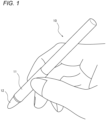
- FIG 1 illustrates a tactile presentation device 10 according to a first embodiment.
- the tactile presentation device 10 includes a housing 11 having a shape capable of being held by a user.
- the housing 11 has a shape capable of being held by fingers of a user, but may have a shape capable of being held by a hand, or may have a shape capable of being held by another body part.
- the user causes the tactile presentation device 10 to approach a specific position in media contents M illustrated in FIGS. 2 and 3 to receive a presentation of vibration corresponding to a content at that position.
- the media content M may be printed on a book 20 as illustrated in FIG 4 , or may be displayed on a screen 31 of a display device 30 as illustrated in FIG 5 .
- Identification information is provided on the media content M in a manner that would not obstruct visual recognition of the content.
- the identification information is provided in the form of an optically readable code. Examples of such identification information include a one-dimensional code such as a bar code, and a two-dimensional code such as a QR code (registered trademark) or a Grid Onput (registered trademark).
- the identification information is prepared so as to include at least information for specifying a position in the media content M.
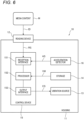
- FIG 6 illustrates a functional configuration of the tactile presentation device 10.
- the tactile presentation device 10 includes a reading device 12.
- the reading device 12 is installed in the housing 11.
- the reading device 12 has a configuration capable of optically reading the identification information ID provided on the media content M.
- the reading device 12 includes a light source for emitting infrared light, and a light-receiving element for outputting a reading signal RS according to the intensity of reflected light.
- the identification information ID itself is not visually recognized by the user, but is read as a portion where the intensity of the reflected light is low.
- the reading signal RS corresponding to the identification information ID may be an analog signal or a digital signal.
- the tactile presentation device 10 includes a vibration source 13.
- the vibration source 13 is installed in the housing 11.
- the vibration source 13 is a device for generating vibration.
- the vibration source 13 can be implemented by a voice coil, an actuator, a piezoelectric element, an eccentric motor, and the like.
- the vibration generated by the vibration source 13 is presented to the user as a tactile sensation through the housing 11.
- the tactile presentation device 10 includes a storage 14.
- the storage 14 stores vibration waveform information VW associated with the identification information ID.
- the vibration waveform information VW represents a waveform of the vibration generated by the vibration source 13.
- the storage 14 can be implemented by a semiconductor memory or the like.
- the tactile presentation device 10 includes a control device 15.
- the control device 15 is installed in the housing 11.
- the control device 15 includes a reception interface 151.
- the reception interface 151 is configured as a hardware interface capable of receiving the reading signal RS outputted from the reading device 12. In a case where the reading signal RS is an analog signal, the reception interface 151 is equipped with an appropriate conversion circuit including an A/D converter.
- the control device 15 includes a processor 152.
- the processor 152 is configured to read out the vibration waveform information VW associated with the identification information ID corresponding to the reading signal RS received by the reception interface 151 from the storage 14.
- the control device 15 includes an output interface 153.
- the processor 152 is configured to output a control signal CS for causing the vibration source 13 to generate vibration corresponding to the vibration waveform information VW from the output interface 153. That is, the output interface 153 is configured as a hardware interface capable of outputting the control signal CS.
- the control signal CS may be a digital signal or an analog signal. In a case where the control signal CS is an analog signal, the output unit 153 is equipped with an appropriate conversion circuit including a D/A converter.
- the vibration source 13 having received the control signal CS generates vibration corresponding to the vibration waveform information VW.
- the vibration is presented as a tactile sensation to the user holding the housing 11.
- a plurality of kinds of vehicles and a plurality of kinds of living creatures are depicted in the media content M illustrated in FIG 2 .
- An identification information ID for specifying the position of each picture in the media content M is provided in a portion where each picture is drawn.
- the storage 14 of the tactile presentation device 10 stores vibration waveform information VW corresponding to a traveling sound of each vehicle, and a voice sound of each living creature.
- identification information ID corresponding to the position of the picture is read.
- the reading device 12 outputs a reading signal RS corresponding to the identification information ID as read.
- the reception interface 151 of the control device 15 receives the reading signal RS.
- the processor 152 of the control device 15 reads out vibration waveform information VW associated with the identification information ID corresponding to the reading signal RS from the storage 14.
- the vibration waveform information VW represents a vibration waveform corresponding to a voice sound of the dog.
- the processor 152 outputs a control signal CS for causing the vibration source 13 to generate vibration corresponding to the vibration waveform information VW from the output interface 153, while causing a sound source (not illustrated) to output the voice sound of the dog.
- the user who caused the tactile presentation device 10 to approach the depicted dog hears the voice sound of the dog and receives a tactile sensation corresponding to the voice sound of the dog.
- identification information ID corresponding to the position of the depicted motorcycle is read.
- the reading device 12 outputs a reading signal RS corresponding to the identification information ID as read.
- the reception interface 151 of the control device 15 receives the reading signal RS.
- the processor 152 of the control device 15 reads out vibration waveform information VW associated with the identification information ID corresponding to the reading signal RS from the storage 14.
- the vibration waveform information VW represents a vibration waveform corresponding to a traveling sound of the motorcycle.
- the processor 152 outputs a control signal CS for causing the vibration source 13 to generate vibration corresponding to the vibration waveform information VW from the output interface 153, while causing the sound source (not illustrated) to output the traveling sound of the motorcycle.
- the user who caused the tactile presentation device 10 to approach the depicted motorcycle hears the traveling sound of the motorcycle and receives a tactile sensation corresponding to the traveling sound of the motorcycle.
- a circuit course is depicted in the media content M illustrated in FIG 2 .
- the circuit course includes a normal pavement section, a wooden bridge section, and a stone pavement section. In a portion where each section is depicted, identification information ID for specifying the position of the picture in the media content M is provided.
- identification information ID corresponding to the position of the normal pavement section is read by the reading device 12.
- the reading device 12 outputs a reading signal RS corresponding to the identification information ID as read.
- the reception interface 151 of the control device 15 receives the reading signal RS.
- the processor 152 of the control device 15 may be configured to output a control signal CS for causing the vibration source 13 to generate vibration corresponding to a traveling sound of a vehicle selected in advance from the output interface 153.
- the processor 152 may be configured to, when the tactile presentation device 10 traces the wooden bridge section or the stone pavement section, output a control signal CS for causing the vibration source 13 to generate vibration corresponding to a traveling sound modulated as if the vehicle is traveling over a wooden bridge or a stone pavement from the output interface 153.
- the processor 152 causes the sound source (not illustrated) to output a traveling sound of the motorcycle, and causes the vibration source 13 to generate vibration corresponding to the traveling sound.
- the tactile presentation device 10 traces the wood bridge section, the traveling sound of the motorcycle outputted from the sound source changes as if it were crossing the wood bridge, and the tactile presented also changes.
- the user is an infant, not only it is possible to prompt the user to be interested in the living creatures or the vehicles, but also it is possible to prompt the user to acquire a technique of writing characters through an act of tracing a route.
- an orchestra is depicted.
- identification information ID for specifying a position of the depicted instrument in the media content M is provided.
- the storage 14 of the tactile presentation device 10 stores vibration waveform information VW corresponding to a performance sound of each instrument.
- identification information ID corresponding to the position of the depicted clarinet is read.
- the reading device 12 outputs a reading signal RS corresponding to the identification information ID as read.
- the reception interface 151 of the control device 15 receives the reading signal RS.
- the processor 152 of the control device 15 reads out vibration waveform information VW associated with the identification information ID corresponding to the reading signal RS from the storage 14.
- the vibration waveform information VW represents a vibration waveform corresponding to a performance sound of the clarinet.
- the processor 152 outputs a control signal CS for causing the vibration source 13 to generate vibration corresponding to the vibration waveform information VW from the output interface 153, while causing the sound source (not illustrated) to output the performance sound of the clarinet.
- the user who caused the tactile presentation device 10 to approach the depicted clarinet hears the performance sound of the clarinet and receives a tactile sensation corresponding to the performance sound of the clarinet.
- a plurality of marks each designating a specific tune are provided.
- identification information ID for specifying the position of the mark in the media content M is provided.
- identification information ID corresponding to the position of the mark is read by the reading device 12.
- the reading device 12 outputs a reading signal RS corresponding to the identification information ID as read.
- the reception interface 151 of the control device 15 receives the reading signal RS.
- the processor 152 of the control device 15 may be configured to output, from the output interface 153, a control signal CS for causing the vibration source 13 to generate vibration corresponding to a sound of the tune corresponding to the mark performed with an instrument selected in advance.
- the processor 152 may be configured to, when the user causes the tactile presentation device 10 to approach another depicted instrument during the performance of the tune, output a control signal CS for causing the vibration source 13 to overlap vibration corresponding to a performance sound of the instrument from the output interface 153.
- the processor 152 causes the sound source (not illustrated) to output a sound of the clarinet performing the "TUNE1", and causes the vibration source 13 to generate vibration corresponding to the performance sound.
- the tactile presentation device 10 causes the tactile presentation device 10 to approach a depicted flute, a sound of the flute is overlapped with the performance of "TUNE1" outputted from the sound source, and a tactile sensation corresponding to the performance sound of the flute is presented in an overlapped manner.
- the user can experience a feeling as if he or she is directing an orchestra. In a case where the user is an infant, he or she can be prompted to gain a sense of sound and to be interested in concert.
- a cooking guide can be another example of the media content M in which sounds and tactile sensations are presented in the overlapped manner every time another picture is selected.
- the cooking guide may include pictures of foodstuffs and cookwares required for cooking a particular menu.
- the cookwares may include a knife, a frying pan, a pan, and the like.
- the processor 152 causes the vibration source 13 to output a sound for cooking the foodstuff, and also causes the vibration source 13 to generate vibration corresponding to the cooking.
- the processor 152 causes the vibration source 13 to output a sound for cooking the foodstuff, and also causes the vibration source 13 to generate vibration corresponding to the cooking.
- a sound and vibration corresponding to the cooking of the another foodstuff are outputted in the overlapped manner.
- the user can feel as if he or she is cooking. In a case where the user is an infant, it is possible to prompt the user to understand the foodstuffs and the cooking method.
- the tactile sensation to be presented a user through the vibration source 13 can be exhibited or changed in association with the position in the media content M.
- the tactile presentation technique it is possible to provide a user with an interesting experience related to media contents.
- the tactile presentation device 10 may include an acceleration detector 16.
- the acceleration detector 16 is configured to output an acceleration signal AS corresponding to acceleration applied to the housing 11 using a well-known technique.
- the acceleration signal AS may be a digital signal or an analog signal.
- the reception interface 151 of the control device 15 is configured as a hardware interface capable of additionally receiving the acceleration signal AS.
- the reception interface 151 is equipped with an appropriate conversion circuit including an A/D converter.
- the processor 152 of the control device 15 is configured to output a control signal CS for modulating the vibration generated by the vibration source 13 from the output interface 153 based on the acceleration signal AS received by the reception interface 151.
- the processor 152 changes the traveling sound outputted from the sound source as if the selected vehicle is accelerated. In a case where a decrease of the tracing speed is detected, the processor 152 changes the traveling sound outputted from the sound source as if the selected vehicle is decelerated. The processor 152 also changes the vibration generated from the vibration source 13 in accordance with the change in the traveling sound.
- the user can perform an operation of swinging the tactile presentation device 10 like a baton.
- a change in the swing speed of the tactile presentation device 10 is detected by the acceleration detector 16.
- the processor 152 changes the performance sound of the tune outputted from the sound source so as to increase the tempo.
- the processor 152 changes the performance sound of the tune outputted from the sound source so as to decrease the tempo.
- the processor 152 also changes the vibration generated from the vibration source 13 in accordance with the change in the performance sound.
- the tactile sensation to be presented can be changed by associating the operation speed of the tactile presentation device 10 and the media content M. Accordingly, an experience related to media contents can be provided to a user with increased variety.
- the processor 152 of the control device 15 having each function described above can be implemented by an exclusive integrated circuit such as a microcontroller, an ASIC, and an FPGA capable of executing a computer program for performing a process corresponding to each function.
- the above-described computer program is pre-installed in a memory element included in the exclusive integrated circuit.
- the memory element is an example of a non-transitory computer-readable medium having stored a computer program.
- the memory element may serve as the storage 14.
- the configuration of the present embodiment is merely illustrative for facilitating understanding of the presently disclosed subject matter.
- the configuration according to the present embodiment can be appropriately modified or changed without departing from the gist of the presently disclosed subject matter.
- the storage 14 in which the vibration waveform information VW is stored is installed in the housing 11.
- the storage 14 can be provided outside the housing 11.
- the storage 14 may be implemented by a hard disk device or the like.
- the communication between the control device 15 and the storage 14 may be performed by wired communication or wireless communication.
- the storage 14 is installed in the housing 11 as in the present embodiment, not only it is possible to suppress an increase in size and weight of the tactile presentation device 10 caused by the installation of the communication capability, but also it is possible to use the device independent of the communication environment.
- the housing 11 has a shape simulating a writing tool.
- the reading device 12 is provided at a position corresponding to the tip of the writing tool. According to such a configuration, the general operability of the tactile presentation device 10 is improved, so that the designation of a specific position in the media content M can be facilitated.
- the housing 11 may be configured to have an appropriate shape corresponding to the media content M.
- a sound source independent of the vibration source 13 is installed in the tactile presentation device 10.
- the vibration source 13 may also serve as the sound source.
- FIG 7 illustrates a functional configuration of a tactile presentation system 40 according to a second embodiment.
- the tactile presentation system 40 includes a display device 30, a locating device 50, a storage device 60, and a control device 70.
- the display device 30 includes a screen 31 on which the media content M is displayed.
- the locating device 50 includes a housing having a shape capable of being held by a user, similarly to the tactile presentation device 10 illustrated in FIG. 1 .
- the locating device 50 has a shape capable of designating a position in the media content M displayed on the screen 31 of the display device 30.
- the display device 30 includes a position detector 32.
- the position detector 32 is configured to specify a position in the media content M designated by the locating device 50.
- the surface of the screen 31 is configured to have a touch panel function.
- the touch panel function can be implemented by a pressure sensing method for detecting a pressure caused by contact of the locating device 50, an electrostatic capacitance method for detecting a change in the electrostatic capacitance caused by contact or approach of the locating device 50, or the like.
- a portion of the locating device 50 involved in the designation of the position in the media content M has a configuration corresponding to the method employed in the screen 31.
- the position detector 32 is configured to output position information PS corresponding to the position in the media content M designated by the locating device 50.
- the position information PS is configured to include coordinates of a position where the locating device 50 contacts or approaches in the screen 31.
- the position information PS may be in the form of digital data or analog data.
- the locating device 50 includes a vibration source 51.
- the vibration source 51 can be implemented by a voice coil, an actuator, a piezoelectric element, an eccentric motor, and the like.
- the vibration generated by the vibration source 51 is presented to the user as a tactile sensation through the housing of the locating device 50.
- the storage device 60 stores vibration waveform information VW associated with the position information PS.
- the vibration waveform information VW represents a waveform of the vibration generated by the vibration source 51.
- the storage device 60 can be implemented by a semiconductor memory, a hard disk device, or the like.
- the control device 70 includes a reception interface 71.
- the reception interface 71 is configured as a hardware interface capable of receiving the position information PS outputted from the position detector 32 of the display device 30.
- the reception interface 71 is equipped with an appropriate conversion circuit including an A/D converter.
- the control device 70 includes a processor 72.
- the processor 72 is configured to read out the vibration waveform information VW associated with the position information PS received by the reception interface 71 from the storage device 60.
- the control device 70 includes an output interface 73.
- the processor 72 is configured to output control information CS for causing the vibration source 51 of the locating device 50 to generate vibration corresponding to the vibration waveform information VW from the output interface 73. That is, the output interface 73 is configured as a hardware interface capable of outputting the control information CS.
- the control information CS may be in the form of digital data or analog data. In a case where the control information CS is analog data, the output interface 73 is equipped with an appropriate conversion circuit including a D/A converter.
- the vibration source 51 having received the control information CS generates vibration corresponding to the vibration waveform information VW.
- the vibration is presented as a tactile sensation to a user holding the housing of the locating device 50.
- the position information PS indicative of the coordinates of the screen 31 corresponding to the position is outputted from the position detector 32.
- the reception interface 71 of the control device 70 receives the position information PS.
- the processor 72 of the control device 70 reads out vibration waveform information VW associated with the position information PS from the storage device 60.
- the vibration waveform information VW represents a vibration waveform corresponding to a voice sound of the dog.
- the processor 72 outputs control information CS for causing the vibration source 51 to generate vibration corresponding to the vibration waveform information VW from the output interface 73, while causing a sound source (not illustrated) to output the voice sound of the dog.
- the user who caused the locating device 50 to approach the depicted dog hears the voice sound of the dog and receives a tactile sensation corresponding to the voice sound of the dog.
- the tactile sensation to be presented a user through the vibration source 51 can be exhibited or changed in association with the position in the media content M.
- the tactile presentation technique it is possible to provide a user with an interesting experience related to media contents.
- the locating device 50 may include an acceleration detector 52.
- the acceleration detector 52 is configured to output acceleration information AS corresponding to the acceleration applied to the locating device 50 using a well-known technique.
- the acceleration information AS may be in the form of digital data or analog data.
- the reception interface 71 of the control device 70 is configured as a hardware interface capable of additionally receiving the acceleration information AS.
- the reception interface 71 is equipped with an appropriate conversion circuit including an A/D converter.
- the processor 72 of the control device 70 is configured to output control information CS for modulating the vibration generated by the vibration source 51 from the output interface 73 based on the acceleration information AS received by the reception interface 71.
- the tactile sensation to be presented can be changed by associating the operation speed of the locating device 50 and the media content M. Accordingly, an experience related to media contents can be provided to a user with increased variety.
- the processor 72 of the control device 70 having various functions described above can be implemented by a general-purpose microprocessor operating in cooperation with a general-purpose memory.
- Examples of the general-purpose microprocessor include a CPU, an MPU, and a GPU.
- Examples of the general-purpose memory include a ROM and a RAM.
- a computer program for executing the above-described processing can be stored in the ROM.
- the ROM is an example of a non-transitory computer-readable medium having recorded a computer program.
- the general-purpose microprocessor designates at least a part of the computer program stored in the ROM, loads the program on the RAM, and executes the processing described above in cooperation with the RAM.
- the above-described computer program may be pre-installed in the general-purpose memory, or may be downloaded from an external server device via a communication network and then installed in the general-purpose memory.
- the external server device is an example of the non-transitory computer-readable medium having stored the computer program.
- the processor 72 may be implemented by an exclusive integrated circuit capable of executing the above-described computer program, such as a microcontroller, an ASIC, and an FPGA.
- the above-described computer program is pre-installed in a memory element included in the exclusive integrated circuit.
- the memory element is an example of a non-transitory computer-readable medium having stored a computer program.
- the processor 72 may also be implemented by a combination of a general-purpose microprocessor and an exclusive integrated circuit.
- the storage device 60 and the control device 70 may be installed in the locating device 50 or the display device 30. Alternatively, the storage device 60 and the control device 70 may be installed in an independent device capable of communicating with the display device 30 and the locating device 50 via a communication network.
- the storage device 60 and the control device 70 are installed in the locating device 50, since the tactile presentation is performed when once the position information PS outputted from the position detector 32 of the display device 30 is transmitted to the locating device 50, it is possible to suppress the amount of communication performed between the display device 30 and the locating device 50 to a necessary minimum.
- the locating device 50 can perform the tactile presentation as long as at least the vibration source 51 adapted to operate in response to the control information CS is provided. Accordingly, the configuration of the locating device 50 can be simplified. As a result, it is possible to suppress an increase in size and weight of the locating device 50.
- the display device 30 is a general-purpose device such as a portable information terminal, a processor having a sufficient processing capability and/or a memory having a sufficient storage capacity can be used, so that it is possible to suppress a decrease in the responsiveness of the tactile presentation.
- the storage device 60 and the control device 70 are installed in independent devices, it is possible to improve the flexibility with respect to the update of the computer program to be executed by the processor 72 and/or the vibration waveform information VW. This fact may be the same as in a case where the storage device 60 and the control device 70 are installed in the display device 30 as a general-purpose device capable of downloading a computer program and data from an external device through a communication network.
- the configuration of the present embodiment is merely illustrative for facilitating understanding of the presently disclosed subject matter.
- the configuration according to the present embodiment can be appropriately modified or changed without departing from the gist of the presently disclosed subject matter.
- a sound source independent of the vibration source 51 is installed in the locating device 50.
- the vibration source 51 may also serve as the sound source.
- the sound source may be installed in the display device 30.
Landscapes
- Engineering & Computer Science (AREA)
- General Engineering & Computer Science (AREA)
- Theoretical Computer Science (AREA)
- Human Computer Interaction (AREA)
- Physics & Mathematics (AREA)
- General Physics & Mathematics (AREA)
- User Interface Of Digital Computer (AREA)
Abstract
Description
- The presently disclosed subject matter relates to a device and system for presenting a tactile sensation to a user with a vibration source. The presently disclosed subject matter also relates to a control device for causing the vibration source in the device or system to generate vibration. The presently disclosed subject matter also relates to a non-transitory computer-readable medium having stored a computer program adapted to be executed by a processor installed in the control device.
-
WO 2008/078523 A1 discloses an electronic input device simulating a writing tool as an example of a tactile presentation device. The device includes a vibration source configured to generate, in response to detection of a writing operation performed by a user, vibration corresponding to the operation. With the vibration, a tactile sensation is presented to the user as if handwritten is exhibited. - It is demanded to provide a new application of the tactile presentation technique.
- In order to meet the demand described above, tactile presentation device, comprising:
- a hosing having a shape capable of being held by a user;
- a reading device installed in the housing and configured to read identification information that is associated with a position in a media content;
- a vibration source installed in the housing and capable of generating vibration; and
- a control device installed in the housing and configured to cause the vibration source to generate vibration corresponding to vibration waveform information that is associated with the identification information.
- In order to meet the demand described above, an illustrative aspect of the presently disclosed subject matter provides a control device adapted to be installed in a tactile presentation device having a shape capable of being held by a user, the control device comprising:
- a reception interface configured to receive identification information that is associated with a position in a media content; and
- a processor configured to cause a vibration source to generate vibration corresponding to vibration waveform information that is associated with the identification information.
- In order to meet the demand described above, an illustrative aspect of the presently disclosed subject matter provides a non-transitory computer-readable medium having stored a computer program adapted to be executed by a processor installed in a control device that is adapted to be installed in a tactile presentation device having a shape capable of being held by a user, the computer program being configured to, when executed, to cause the control device to:
- receive identification information that is associated with a position in a media content; and
- cause a vibration source to generate vibration corresponding to vibration waveform information that is associated with the identification information.
- In order to meet the demand described above, an illustrative aspect of the presently disclosed subject matter provides a tactile presentation system, comprising:
- a display device capable of displaying a media content;
- a locating device having a shape capable of being held by a user and configured to designate a position in the media content;
- a position detector installed in the display device and configured to output position information corresponding to a position in the media content that is designated by the locating device;
- a vibration source installed in the locating device;
- a storage device storing vibration waveform information that is associated with the position information; and
- a control device configured to cause the vibration source to generate vibration corresponding to the vibration waveform information.
- In order to meet the demand described above, an illustrative aspect of the presently disclosed subject matter provides a control device, comprising:
- a reception interface configured to receive position information corresponding to a position in a media content that is displayed by a display device and designated by a locating device; and
- a processor configured to cause a vibration source to generate vibration corresponding to vibration waveform information that is associated with the position information.
- In order to meet the demand described above, an illustrative aspect of the presently disclosed subject matter provides a non-transitory computer-readable medium having stored a computer program adapted to be executed by a processor installed in a control device, the computer program being configured to, when executed, to cause the control device to:
- receive position information corresponding to a position in a media content that is displayed by a display device and designated by a locating device; and
- cause a vibration source to generate vibration corresponding to vibration waveform information that is associated with the position information.
- According to the configuration of each of the illustrative aspects, the tactile sensation to be presented a user through the vibration source can be exhibited or changed in association with the position in the media content. As a result, as a new application of the tactile presentation technique, it is possible to provide a user with an interesting experience related to media contents.
-
-
FIG 1 illustrates a tactile presentation device according to a first embodiment. -
FIG 2 illustrates an exemplary media content. -
FIG 3 illustrates another exemplary media content. -
FIG 4 illustrates a book providing a media content. -
FIG 5 illustrates a display device providing a media content. -
FIG 6 illustrates a functional configuration of the tactile presentation device ofFIG 1 . -
FIG 7 illustrates a tactile presentation system according to a second embodiment. - Exemplary embodiments will be described in detail below with reference to the accompanying drawings. In each of the drawings used in the following description, the scale is appropriately changed in order to make each of the members have a recognizable size.
-
FIG 1 illustrates atactile presentation device 10 according to a first embodiment. Thetactile presentation device 10 includes ahousing 11 having a shape capable of being held by a user. In this example, thehousing 11 has a shape capable of being held by fingers of a user, but may have a shape capable of being held by a hand, or may have a shape capable of being held by another body part. - The user causes the
tactile presentation device 10 to approach a specific position in media contents M illustrated inFIGS. 2 and 3 to receive a presentation of vibration corresponding to a content at that position. The media content M may be printed on abook 20 as illustrated inFIG 4 , or may be displayed on ascreen 31 of adisplay device 30 as illustrated inFIG 5 . - Identification information is provided on the media content M in a manner that would not obstruct visual recognition of the content. The identification information is provided in the form of an optically readable code. Examples of such identification information include a one-dimensional code such as a bar code, and a two-dimensional code such as a QR code (registered trademark) or a Grid Onput (registered trademark). The identification information is prepared so as to include at least information for specifying a position in the media content M.
-
FIG 6 illustrates a functional configuration of thetactile presentation device 10. Thetactile presentation device 10 includes areading device 12. Thereading device 12 is installed in thehousing 11. Thereading device 12 has a configuration capable of optically reading the identification information ID provided on the media content M. For example, in a case where the identification information ID is printed on thebook 20 with carbon ink or stealth ink absorbing infrared light, thereading device 12 includes a light source for emitting infrared light, and a light-receiving element for outputting a reading signal RS according to the intensity of reflected light. According to such a configuration, the identification information ID itself is not visually recognized by the user, but is read as a portion where the intensity of the reflected light is low. The reading signal RS corresponding to the identification information ID may be an analog signal or a digital signal. - The
tactile presentation device 10 includes avibration source 13. Thevibration source 13 is installed in thehousing 11. Thevibration source 13 is a device for generating vibration. Thevibration source 13 can be implemented by a voice coil, an actuator, a piezoelectric element, an eccentric motor, and the like. The vibration generated by thevibration source 13 is presented to the user as a tactile sensation through thehousing 11. - The
tactile presentation device 10 includes astorage 14. Thestorage 14 stores vibration waveform information VW associated with the identification information ID. The vibration waveform information VW represents a waveform of the vibration generated by thevibration source 13. Thestorage 14 can be implemented by a semiconductor memory or the like. - The
tactile presentation device 10 includes acontrol device 15. Thecontrol device 15 is installed in thehousing 11. Thecontrol device 15 includes areception interface 151. Thereception interface 151 is configured as a hardware interface capable of receiving the reading signal RS outputted from thereading device 12. In a case where the reading signal RS is an analog signal, thereception interface 151 is equipped with an appropriate conversion circuit including an A/D converter. - The
control device 15 includes aprocessor 152. Theprocessor 152 is configured to read out the vibration waveform information VW associated with the identification information ID corresponding to the reading signal RS received by thereception interface 151 from thestorage 14. - The
control device 15 includes anoutput interface 153. Theprocessor 152 is configured to output a control signal CS for causing thevibration source 13 to generate vibration corresponding to the vibration waveform information VW from theoutput interface 153. That is, theoutput interface 153 is configured as a hardware interface capable of outputting the control signal CS. The control signal CS may be a digital signal or an analog signal. In a case where the control signal CS is an analog signal, theoutput unit 153 is equipped with an appropriate conversion circuit including a D/A converter. - The
vibration source 13 having received the control signal CS generates vibration corresponding to the vibration waveform information VW. The vibration is presented as a tactile sensation to the user holding thehousing 11. - Referring to
FIGS. 2 and 3 , some specific exemplary operations of thetactile presentation device 10 configured as described above will be described. - A plurality of kinds of vehicles and a plurality of kinds of living creatures are depicted in the media content M illustrated in
FIG 2 . An identification information ID for specifying the position of each picture in the media content M is provided in a portion where each picture is drawn. Thestorage 14 of thetactile presentation device 10 stores vibration waveform information VW corresponding to a traveling sound of each vehicle, and a voice sound of each living creature. - As an example, when the user causes the
reading device 12 of thetactile presentation device 10 to approach a depicted dog, identification information ID corresponding to the position of the picture is read. Thereading device 12 outputs a reading signal RS corresponding to the identification information ID as read. Thereception interface 151 of thecontrol device 15 receives the reading signal RS. Theprocessor 152 of thecontrol device 15 reads out vibration waveform information VW associated with the identification information ID corresponding to the reading signal RS from thestorage 14. The vibration waveform information VW represents a vibration waveform corresponding to a voice sound of the dog. As a result, the position of the picture of the dog identified through thereading device 12 and the vibration waveform corresponding to the voice sound of the dog are associated with each other. - The
processor 152 outputs a control signal CS for causing thevibration source 13 to generate vibration corresponding to the vibration waveform information VW from theoutput interface 153, while causing a sound source (not illustrated) to output the voice sound of the dog. The user who caused thetactile presentation device 10 to approach the depicted dog hears the voice sound of the dog and receives a tactile sensation corresponding to the voice sound of the dog. - As another example, when the user causes the
reading device 12 of thetactile presentation device 10 to approach a depicted motorcycle, identification information ID corresponding to the position of the depicted motorcycle is read. Thereading device 12 outputs a reading signal RS corresponding to the identification information ID as read. Thereception interface 151 of thecontrol device 15 receives the reading signal RS. Theprocessor 152 of thecontrol device 15 reads out vibration waveform information VW associated with the identification information ID corresponding to the reading signal RS from thestorage 14. The vibration waveform information VW represents a vibration waveform corresponding to a traveling sound of the motorcycle. As a result, the position of the depicted motorcycle identified through thereading device 12 and the vibration waveform corresponding to the traveling sound of the motorcycle are associated with each other. - The
processor 152 outputs a control signal CS for causing thevibration source 13 to generate vibration corresponding to the vibration waveform information VW from theoutput interface 153, while causing the sound source (not illustrated) to output the traveling sound of the motorcycle. The user who caused thetactile presentation device 10 to approach the depicted motorcycle hears the traveling sound of the motorcycle and receives a tactile sensation corresponding to the traveling sound of the motorcycle. - A circuit course is depicted in the media content M illustrated in
FIG 2 . The circuit course includes a normal pavement section, a wooden bridge section, and a stone pavement section. In a portion where each section is depicted, identification information ID for specifying the position of the picture in the media content M is provided. - When the user moves the
tactile presentation device 10 so as to trace the normal pavement section of the circuit course, identification information ID corresponding to the position of the normal pavement section is read by thereading device 12. Thereading device 12 outputs a reading signal RS corresponding to the identification information ID as read. Thereception interface 151 of thecontrol device 15 receives the reading signal RS. In this case, theprocessor 152 of thecontrol device 15 may be configured to output a control signal CS for causing thevibration source 13 to generate vibration corresponding to a traveling sound of a vehicle selected in advance from theoutput interface 153. In addition, theprocessor 152 may be configured to, when thetactile presentation device 10 traces the wooden bridge section or the stone pavement section, output a control signal CS for causing thevibration source 13 to generate vibration corresponding to a traveling sound modulated as if the vehicle is traveling over a wooden bridge or a stone pavement from theoutput interface 153. - For example, after the motorcycle is selected as described above, when the user traces the normal pavement section of the circuit course with the
tactile presentation device 10, theprocessor 152 causes the sound source (not illustrated) to output a traveling sound of the motorcycle, and causes thevibration source 13 to generate vibration corresponding to the traveling sound. When thetactile presentation device 10 traces the wood bridge section, the traveling sound of the motorcycle outputted from the sound source changes as if it were crossing the wood bridge, and the tactile presented also changes. In a case where the user is an infant, not only it is possible to prompt the user to be interested in the living creatures or the vehicles, but also it is possible to prompt the user to acquire a technique of writing characters through an act of tracing a route. - In the media content M illustrated in
FIG 3 , an orchestra is depicted. At a position where each of wind string instruments is depicted, identification information ID for specifying a position of the depicted instrument in the media content M is provided. Thestorage 14 of thetactile presentation device 10 stores vibration waveform information VW corresponding to a performance sound of each instrument. - As an example, when the user causes the
reading device 12 of thetactile presentation device 10 to approach a depicted clarinet, identification information ID corresponding to the position of the depicted clarinet is read. Thereading device 12 outputs a reading signal RS corresponding to the identification information ID as read. Thereception interface 151 of thecontrol device 15 receives the reading signal RS. Theprocessor 152 of thecontrol device 15 reads out vibration waveform information VW associated with the identification information ID corresponding to the reading signal RS from thestorage 14. The vibration waveform information VW represents a vibration waveform corresponding to a performance sound of the clarinet. As a result, the position of the depicted clarinet identified through thereading device 12 and the vibration waveform corresponding to the performance sound of the clarinet are associated with each other. - The
processor 152 outputs a control signal CS for causing thevibration source 13 to generate vibration corresponding to the vibration waveform information VW from theoutput interface 153, while causing the sound source (not illustrated) to output the performance sound of the clarinet. The user who caused thetactile presentation device 10 to approach the depicted clarinet hears the performance sound of the clarinet and receives a tactile sensation corresponding to the performance sound of the clarinet. - In the media content M illustrated in
FIG 3 , a plurality of marks each designating a specific tune are provided. In a portion where each mark is provided, identification information ID for specifying the position of the mark in the media content M is provided. - When the user causes the
tactile presentation device 10 to approach a mark representing a specific tune, identification information ID corresponding to the position of the mark is read by thereading device 12. Thereading device 12 outputs a reading signal RS corresponding to the identification information ID as read. Thereception interface 151 of thecontrol device 15 receives the reading signal RS. In this case, theprocessor 152 of thecontrol device 15 may be configured to output, from theoutput interface 153, a control signal CS for causing thevibration source 13 to generate vibration corresponding to a sound of the tune corresponding to the mark performed with an instrument selected in advance. In addition, theprocessor 152 may be configured to, when the user causes thetactile presentation device 10 to approach another depicted instrument during the performance of the tune, output a control signal CS for causing thevibration source 13 to overlap vibration corresponding to a performance sound of the instrument from theoutput interface 153. - For example, after the clarinet is selected as described above, when the user causes the
tactile presentation device 10 to approach a mark indicating "TUNE1", theprocessor 152 causes the sound source (not illustrated) to output a sound of the clarinet performing the "TUNE1", and causes thevibration source 13 to generate vibration corresponding to the performance sound. Thereafter, when the user causes thetactile presentation device 10 to approach a depicted flute, a sound of the flute is overlapped with the performance of "TUNE1" outputted from the sound source, and a tactile sensation corresponding to the performance sound of the flute is presented in an overlapped manner. As a result, the user can experience a feeling as if he or she is directing an orchestra. In a case where the user is an infant, he or she can be prompted to gain a sense of sound and to be interested in concert. - A cooking guide can be another example of the media content M in which sounds and tactile sensations are presented in the overlapped manner every time another picture is selected. For example, the cooking guide may include pictures of foodstuffs and cookwares required for cooking a particular menu. The cookwares may include a knife, a frying pan, a pan, and the like. When the user selects a depicted specific foodstuff after selecting the depicted knife, the
processor 152 causes the sound source (not illustrated) to output a sound for cutting the foodstuff, and causes thevibration source 13 to generate vibration corresponding to the cutting. When the user selects a specific depicted foodstuff after selecting the depicted frying pan, theprocessor 152 causes thevibration source 13 to output a sound for cooking the foodstuff, and also causes thevibration source 13 to generate vibration corresponding to the cooking. When the user further selects another foodstuff, a sound and vibration corresponding to the cooking of the another foodstuff are outputted in the overlapped manner. As a result, the user can feel as if he or she is cooking. In a case where the user is an infant, it is possible to prompt the user to understand the foodstuffs and the cooking method. - According to the configuration of the present embodiment, the tactile sensation to be presented a user through the
vibration source 13 can be exhibited or changed in association with the position in the media content M. As a result, as a new application of the tactile presentation technique, it is possible to provide a user with an interesting experience related to media contents. - As illustrated in
FIG 6 , thetactile presentation device 10 may include anacceleration detector 16. Theacceleration detector 16 is configured to output an acceleration signal AS corresponding to acceleration applied to thehousing 11 using a well-known technique. The acceleration signal AS may be a digital signal or an analog signal. - In this example, the
reception interface 151 of thecontrol device 15 is configured as a hardware interface capable of additionally receiving the acceleration signal AS. In a case where the acceleration signal AS is an analog signal, thereception interface 151 is equipped with an appropriate conversion circuit including an A/D converter. - In this example, the
processor 152 of thecontrol device 15 is configured to output a control signal CS for modulating the vibration generated by thevibration source 13 from theoutput interface 153 based on the acceleration signal AS received by thereception interface 151. - As an example, in the case of the media content M illustrated in
FIG 2 , a change in the speed of which thetactile presentation device 10 traces the circuit course is detected by theacceleration detector 16. In a case where an increase of the tracing speed is detected, theprocessor 152 changes the traveling sound outputted from the sound source as if the selected vehicle is accelerated. In a case where a decrease of the tracing speed is detected, theprocessor 152 changes the traveling sound outputted from the sound source as if the selected vehicle is decelerated. Theprocessor 152 also changes the vibration generated from thevibration source 13 in accordance with the change in the traveling sound. - As another example, in the case of the media content M illustrated in
FIG 3 , the user can perform an operation of swinging thetactile presentation device 10 like a baton. A change in the swing speed of thetactile presentation device 10 is detected by theacceleration detector 16. In a case where an increase of the swing speed is detected, theprocessor 152 changes the performance sound of the tune outputted from the sound source so as to increase the tempo. In a case where a decrease of the swing speed is detected, theprocessor 152 changes the performance sound of the tune outputted from the sound source so as to decrease the tempo. Theprocessor 152 also changes the vibration generated from thevibration source 13 in accordance with the change in the performance sound. - According to the configuration as described above, the tactile sensation to be presented can be changed by associating the operation speed of the
tactile presentation device 10 and the media content M. Accordingly, an experience related to media contents can be provided to a user with increased variety. - The
processor 152 of thecontrol device 15 having each function described above can be implemented by an exclusive integrated circuit such as a microcontroller, an ASIC, and an FPGA capable of executing a computer program for performing a process corresponding to each function. In this case, the above-described computer program is pre-installed in a memory element included in the exclusive integrated circuit. The memory element is an example of a non-transitory computer-readable medium having stored a computer program. The memory element may serve as thestorage 14. - The configuration of the present embodiment is merely illustrative for facilitating understanding of the presently disclosed subject matter. The configuration according to the present embodiment can be appropriately modified or changed without departing from the gist of the presently disclosed subject matter.
- In the present embodiment, the
storage 14 in which the vibration waveform information VW is stored is installed in thehousing 11. However, as long as thetactile presentation device 10 can be equipped with a communication capability, thestorage 14 can be provided outside thehousing 11. In this case, thestorage 14 may be implemented by a hard disk device or the like. The communication between thecontrol device 15 and thestorage 14 may be performed by wired communication or wireless communication. - In a case where the
storage 14 is installed in thehousing 11 as in the present embodiment, not only it is possible to suppress an increase in size and weight of thetactile presentation device 10 caused by the installation of the communication capability, but also it is possible to use the device independent of the communication environment. - In the present embodiment, as illustrated in
FIG 1 , thehousing 11 has a shape simulating a writing tool. Thereading device 12 is provided at a position corresponding to the tip of the writing tool. According to such a configuration, the general operability of thetactile presentation device 10 is improved, so that the designation of a specific position in the media content M can be facilitated. However, based on a viewpoint of providing a user with an interesting experience related to media contents, thehousing 11 may be configured to have an appropriate shape corresponding to the media content M. - In the above description, a sound source independent of the
vibration source 13 is installed in thetactile presentation device 10. However, thevibration source 13 may also serve as the sound source. -
FIG 7 illustrates a functional configuration of atactile presentation system 40 according to a second embodiment. Thetactile presentation system 40 includes adisplay device 30, a locatingdevice 50, astorage device 60, and acontrol device 70. - As described with reference to
FIG. 3 , thedisplay device 30 includes ascreen 31 on which the media content M is displayed. - The locating
device 50 includes a housing having a shape capable of being held by a user, similarly to thetactile presentation device 10 illustrated inFIG. 1 . The locatingdevice 50 has a shape capable of designating a position in the media content M displayed on thescreen 31 of thedisplay device 30. - The
display device 30 includes aposition detector 32. Theposition detector 32 is configured to specify a position in the media content M designated by the locatingdevice 50. Specifically, the surface of thescreen 31 is configured to have a touch panel function. The touch panel function can be implemented by a pressure sensing method for detecting a pressure caused by contact of the locatingdevice 50, an electrostatic capacitance method for detecting a change in the electrostatic capacitance caused by contact or approach of the locatingdevice 50, or the like. A portion of the locatingdevice 50 involved in the designation of the position in the media content M has a configuration corresponding to the method employed in thescreen 31. - The
position detector 32 is configured to output position information PS corresponding to the position in the media content M designated by the locatingdevice 50. Specifically, the position information PS is configured to include coordinates of a position where the locatingdevice 50 contacts or approaches in thescreen 31. The position information PS may be in the form of digital data or analog data. - The locating
device 50 includes avibration source 51. Thevibration source 51 can be implemented by a voice coil, an actuator, a piezoelectric element, an eccentric motor, and the like. The vibration generated by thevibration source 51 is presented to the user as a tactile sensation through the housing of the locatingdevice 50. - The
storage device 60 stores vibration waveform information VW associated with the position information PS. The vibration waveform information VW represents a waveform of the vibration generated by thevibration source 51. Thestorage device 60 can be implemented by a semiconductor memory, a hard disk device, or the like. - The
control device 70 includes areception interface 71. Thereception interface 71 is configured as a hardware interface capable of receiving the position information PS outputted from theposition detector 32 of thedisplay device 30. In a case where the position information PS is an analog signal, thereception interface 71 is equipped with an appropriate conversion circuit including an A/D converter. - The
control device 70 includes aprocessor 72. Theprocessor 72 is configured to read out the vibration waveform information VW associated with the position information PS received by thereception interface 71 from thestorage device 60. - The
control device 70 includes anoutput interface 73. Theprocessor 72 is configured to output control information CS for causing thevibration source 51 of the locatingdevice 50 to generate vibration corresponding to the vibration waveform information VW from theoutput interface 73. That is, theoutput interface 73 is configured as a hardware interface capable of outputting the control information CS. The control information CS may be in the form of digital data or analog data. In a case where the control information CS is analog data, theoutput interface 73 is equipped with an appropriate conversion circuit including a D/A converter. - The
vibration source 51 having received the control information CS generates vibration corresponding to the vibration waveform information VW. The vibration is presented as a tactile sensation to a user holding the housing of the locatingdevice 50. - For example, in a case where the media content M illustrated in
FIG 2 is displayed on thedisplay device 30, when the user causes the locatingdevice 50 to approach a position where a dog is depicted, the position information PS indicative of the coordinates of thescreen 31 corresponding to the position is outputted from theposition detector 32. Thereception interface 71 of thecontrol device 70 receives the position information PS. Theprocessor 72 of thecontrol device 70 reads out vibration waveform information VW associated with the position information PS from thestorage device 60. The vibration waveform information VW represents a vibration waveform corresponding to a voice sound of the dog. As a result, the position of the depicted dog designated by the locatingdevice 50 and the vibration waveform corresponding to a voice sound of the dog are associated with each other. - The
processor 72 outputs control information CS for causing thevibration source 51 to generate vibration corresponding to the vibration waveform information VW from theoutput interface 73, while causing a sound source (not illustrated) to output the voice sound of the dog. The user who caused the locatingdevice 50 to approach the depicted dog hears the voice sound of the dog and receives a tactile sensation corresponding to the voice sound of the dog. - Other examples relating to the tactile presentation performed by the
tactile presentation device 10 described with reference toFIGS. 2 and 3 are applicable to the tactile presentation performed by the locatingdevice 50. Accordingly, repetitive descriptions for those will be omitted. - According to the configuration of the present embodiment, the tactile sensation to be presented a user through the
vibration source 51 can be exhibited or changed in association with the position in the media content M. As a result, as a new application of the tactile presentation technique, it is possible to provide a user with an interesting experience related to media contents. - As illustrated in
FIG 7 , the locatingdevice 50 may include anacceleration detector 52. Theacceleration detector 52 is configured to output acceleration information AS corresponding to the acceleration applied to the locatingdevice 50 using a well-known technique. The acceleration information AS may be in the form of digital data or analog data. - In this example, the
reception interface 71 of thecontrol device 70 is configured as a hardware interface capable of additionally receiving the acceleration information AS. In a case where the acceleration information AS is in the form of analog data, thereception interface 71 is equipped with an appropriate conversion circuit including an A/D converter. - In this example, the
processor 72 of thecontrol device 70 is configured to output control information CS for modulating the vibration generated by thevibration source 51 from theoutput interface 73 based on the acceleration information AS received by thereception interface 71. - Other examples relating to the tactile modification performed by the
tactile presentation device 10 described with reference toFIGS. 2 and 3 are applicable to the tactile modification performed by the locatingdevice 50. Accordingly, repetitive descriptions for those will be omitted. - According to the configuration as described above, the tactile sensation to be presented can be changed by associating the operation speed of the locating
device 50 and the media content M. Accordingly, an experience related to media contents can be provided to a user with increased variety. - The
processor 72 of thecontrol device 70 having various functions described above can be implemented by a general-purpose microprocessor operating in cooperation with a general-purpose memory. Examples of the general-purpose microprocessor include a CPU, an MPU, and a GPU. Examples of the general-purpose memory include a ROM and a RAM. In this case, a computer program for executing the above-described processing can be stored in the ROM. The ROM is an example of a non-transitory computer-readable medium having recorded a computer program. The general-purpose microprocessor designates at least a part of the computer program stored in the ROM, loads the program on the RAM, and executes the processing described above in cooperation with the RAM. The above-described computer program may be pre-installed in the general-purpose memory, or may be downloaded from an external server device via a communication network and then installed in the general-purpose memory. In this case, the external server device is an example of the non-transitory computer-readable medium having stored the computer program. - The
processor 72 may be implemented by an exclusive integrated circuit capable of executing the above-described computer program, such as a microcontroller, an ASIC, and an FPGA. In this case, the above-described computer program is pre-installed in a memory element included in the exclusive integrated circuit. The memory element is an example of a non-transitory computer-readable medium having stored a computer program. Theprocessor 72 may also be implemented by a combination of a general-purpose microprocessor and an exclusive integrated circuit. - The
storage device 60 and thecontrol device 70 may be installed in the locatingdevice 50 or thedisplay device 30. Alternatively, thestorage device 60 and thecontrol device 70 may be installed in an independent device capable of communicating with thedisplay device 30 and the locatingdevice 50 via a communication network. - In a case where the
storage device 60 and thecontrol device 70 are installed in the locatingdevice 50, since the tactile presentation is performed when once the position information PS outputted from theposition detector 32 of thedisplay device 30 is transmitted to the locatingdevice 50, it is possible to suppress the amount of communication performed between thedisplay device 30 and the locatingdevice 50 to a necessary minimum. - In a case where the
storage device 60 and thecontrol device 70 are installed in thedisplay device 30, the locatingdevice 50 can perform the tactile presentation as long as at least thevibration source 51 adapted to operate in response to the control information CS is provided. Accordingly, the configuration of the locatingdevice 50 can be simplified. As a result, it is possible to suppress an increase in size and weight of the locatingdevice 50. In addition, in a case where thedisplay device 30 is a general-purpose device such as a portable information terminal, a processor having a sufficient processing capability and/or a memory having a sufficient storage capacity can be used, so that it is possible to suppress a decrease in the responsiveness of the tactile presentation. - In a case where the
storage device 60 and thecontrol device 70 are installed in independent devices, it is possible to improve the flexibility with respect to the update of the computer program to be executed by theprocessor 72 and/or the vibration waveform information VW. This fact may be the same as in a case where thestorage device 60 and thecontrol device 70 are installed in thedisplay device 30 as a general-purpose device capable of downloading a computer program and data from an external device through a communication network. - The configuration of the present embodiment is merely illustrative for facilitating understanding of the presently disclosed subject matter. The configuration according to the present embodiment can be appropriately modified or changed without departing from the gist of the presently disclosed subject matter.
- In the above description, a sound source independent of the
vibration source 51 is installed in the locatingdevice 50. However, thevibration source 51 may also serve as the sound source. Alternatively, the sound source may be installed in thedisplay device 30. - The present application is based on
Japanese Patent Application No. 2020-114178 filed on July 1, 2020
Claims (12)
- A tactile presentation device, comprising:a hosing having a shape capable of being held by a user;a reading device installed in the housing and configured to read identification information that is associated with a position in a media content;a vibration source installed in the housing and capable of generating vibration; anda control device installed in the housing and configured to cause the vibration source to generate vibration corresponding to vibration waveform information that is associated with the identification information.
- The tactile presentation device according to claim 1, further comprising:an acceleration detector installed in the housing and configured to output an acceleration signal corresponding to acceleration applied to the housing,wherein the control device configured to cause the vibration source to change the vibration in accordance with the acceleration signal.
- The tactile presentation device according to claim 1 or 2, further comprising:
a storage installed in the housing and storing the vibration waveform information. - The tactile presentation device according to any one of claims 1 to 3,wherein the housing has a shape simulating a writing tool; andwherein the reading device is disposed at a position corresponding to a tip end of the writing tool.
- A control device adapted to be installed in a tactile presentation device having a shape capable of being held by a user, the control device comprising:a reception interface configured to receive identification information that is associated with a position in a media content; anda processor configured to cause a vibration source to generate vibration corresponding to vibration waveform information that is associated with the identification information.
- A non-transitory computer-readable medium having stored a computer program adapted to be executed by a processor installed in a control device that is adapted to be installed in a tactile presentation device having a shape capable of being held by a user, the computer program being configured to, when executed, to cause the control device to:receive identification information that is associated with a position in a media content; andcause a vibration source to generate vibration corresponding to vibration waveform information that is associated with the identification information.
- A tactile presentation system, comprising:a display device capable of displaying a media content;a locating device having a shape capable of being held by a user and configured to designate a position in the media content;a position detector installed in the display device and configured to output position information corresponding to a position in the media content that is designated by the locating device;a vibration source installed in the locating device;a storage device storing vibration waveform information that is associated with the position information; anda control device configured to cause the vibration source to generate vibration corresponding to the vibration waveform information.
- The tactile presentation system according to claim 7, further comprising:an acceleration detector configured to output acceleration information corresponding to acceleration applied to the locating device,wherein the control device configured to cause the vibration source to change the vibration in accordance with the acceleration information.
- The tactile presentation system according to claim 7 or 8,
wherein the control device and the storage device are installed in the locating device. - The tactile presentation system according to claim 7 or 8,
wherein the control device and the storage device are installed in the display device. - A control device, comprising:a reception interface configured to receive position information corresponding to a position in a media content that is displayed by a display device and designated by a locating device; anda processor configured to cause a vibration source to generate vibration corresponding to vibration waveform information that is associated with the position information.
- A non-transitory computer-readable medium having stored a computer program adapted to be executed by a processor installed in a control device, the computer program being configured to, when executed, to cause the control device to:receive position information corresponding to a position in a media content that is displayed by a display device and designated by a locating device; andcause a vibration source to generate vibration corresponding to vibration waveform information that is associated with the position information.
Applications Claiming Priority (2)
| Application Number | Priority Date | Filing Date | Title |
|---|---|---|---|
| JP2020114178A JP2022012375A (en) | 2020-07-01 | 2020-07-01 | Tactile presentation device, tactile presentation system, control device, and computer program |
| PCT/JP2021/023741 WO2022004517A1 (en) | 2020-07-01 | 2021-06-23 | Tactile presentation device, tactile presentation system, control device, and non-transitory computer-readable medium |
Publications (2)
| Publication Number | Publication Date |
|---|---|
| EP4177713A1 true EP4177713A1 (en) | 2023-05-10 |
| EP4177713A4 EP4177713A4 (en) | 2024-10-16 |
Family
ID=79316130
Family Applications (1)
| Application Number | Title | Priority Date | Filing Date |
|---|---|---|---|
| EP21833129.6A Pending EP4177713A4 (en) | 2020-07-01 | 2021-06-23 | TACTILE DISPLAY DEVICE, TACTILE DISPLAY SYSTEM, CONTROL DEVICE AND NON-TRANSITIOUS COMPUTER-READABLE MEDIUM |
Country Status (5)
| Country | Link |
|---|---|
| US (1) | US12216826B2 (en) |
| EP (1) | EP4177713A4 (en) |
| JP (2) | JP2022012375A (en) |
| CN (1) | CN115735180A (en) |
| WO (1) | WO2022004517A1 (en) |
Families Citing this family (2)
| Publication number | Priority date | Publication date | Assignee | Title |
|---|---|---|---|---|
| JP2022012375A (en) * | 2020-07-01 | 2022-01-17 | 株式会社東海理化電機製作所 | Tactile presentation device, tactile presentation system, control device, and computer program |
| JP2024007825A (en) * | 2022-07-06 | 2024-01-19 | 株式会社東海理化電機製作所 | Vibration devices and units |
Family Cites Families (46)
| Publication number | Priority date | Publication date | Assignee | Title |
|---|---|---|---|---|
| JPS634320A (en) * | 1986-06-24 | 1988-01-09 | Fujitsu Ltd | Drawing input and output device |
| JPH10149163A (en) * | 1996-11-20 | 1998-06-02 | Casio Comput Co Ltd | Tone generator |
| US5945656A (en) * | 1997-05-27 | 1999-08-31 | Lemelson; Jerome H. | Apparatus and method for stand-alone scanning and audio generation from printed material |
| JP4567817B2 (en) * | 1997-09-11 | 2010-10-20 | ソニー株式会社 | Information processing apparatus and control method thereof |
| JP2000093663A (en) * | 1998-09-18 | 2000-04-04 | Takara Co Ltd | Play toys |
| JP2000267784A (en) * | 1999-03-16 | 2000-09-29 | Fuji Xerox Co Ltd | Device for presenting tactile sense |
| US20020107885A1 (en) * | 2001-02-01 | 2002-08-08 | Advanced Digital Systems, Inc. | System, computer program product, and method for capturing and processing form data |
| US6915103B2 (en) * | 2002-07-31 | 2005-07-05 | Hewlett-Packard Development Company, L.P. | System for enhancing books with special paper |
| JP4231947B2 (en) * | 2002-09-26 | 2009-03-04 | 健治 吉田 | Icon formed on the medium |
| EP1548635B1 (en) | 2002-09-26 | 2009-06-24 | Kenji Yoshida | Information reproduction/i/o method using dot pattern and information reproduction device |
| EP1695194A4 (en) * | 2003-12-19 | 2011-11-02 | Intel Corp | Creating responses for an electronic pen-computer multimedia interactive system |
| US7639876B2 (en) * | 2005-01-14 | 2009-12-29 | Advanced Digital Systems, Inc. | System and method for associating handwritten information with one or more objects |
| JP5162873B2 (en) * | 2006-09-29 | 2013-03-13 | 株式会社Jvcケンウッド | Pen-type musical score input device, music playback system, and music playback program |
| KR100807930B1 (en) * | 2006-12-04 | 2008-02-28 | 한국정보통신대학교 산학협력단 | Electronic pen for tactile feedback and pen computer system using the same |
| WO2008078523A1 (en) | 2006-12-25 | 2008-07-03 | Konica Minolta Holdings, Inc. | Handwriting electronic input system |
| JP2008287565A (en) * | 2007-05-18 | 2008-11-27 | Dainippon Printing Co Ltd | Pen device and program used therefor |
| CN101689187A (en) * | 2007-05-29 | 2010-03-31 | 智思博公司 | Multi-modal smartpen computing system |
| JP4873376B2 (en) * | 2007-08-27 | 2012-02-08 | 大日本印刷株式会社 | Terminal device and program used therefor |
| KR100938260B1 (en) * | 2007-09-20 | 2010-01-22 | 한국전자통신연구원 | A device and system for providing sensation effect on touch screen |
| JP5235549B2 (en) * | 2008-07-30 | 2013-07-10 | インターナショナル・ビジネス・マシーンズ・コーポレーション | Apparatus and method for presenting information |
| ITTV20090049A1 (en) * | 2009-03-19 | 2010-09-20 | Lifeview Srl | INTERACTIVE MULTIMEDIA READING SYSTEM. |
| JP5369933B2 (en) * | 2009-06-25 | 2013-12-18 | 富士ゼロックス株式会社 | POSITION INDICATOR CONTROL DEVICE, POSITION INDICATOR, AND PROGRAM |
| JP2012226452A (en) * | 2011-04-15 | 2012-11-15 | Dainippon Printing Co Ltd | Electronic pen, control method and program of electronic pen, cradle device, and control method and program of cradle device |
| JP2013061766A (en) * | 2011-09-13 | 2013-04-04 | Panasonic Corp | Touch pen |
| JP2013076720A (en) * | 2011-09-29 | 2013-04-25 | Dainippon Printing Co Ltd | Computer device, electronic pen system and program |
| CN103870060B (en) * | 2012-12-13 | 2017-09-12 | 意美森公司 | Haptic system with increased LRA bandwidth |
| KR102091077B1 (en) * | 2012-12-14 | 2020-04-14 | 삼성전자주식회사 | Mobile terminal and method for controlling feedback of an input unit, and the input unit and method therefor |
| JPWO2014103274A1 (en) * | 2012-12-28 | 2017-01-12 | パナソニックIpマネジメント株式会社 | Display control system and reader |
| KR102104910B1 (en) * | 2013-02-28 | 2020-04-27 | 삼성전자주식회사 | Portable apparatus for providing haptic feedback with an input unit and method therefor |
| US9992491B2 (en) * | 2013-03-15 | 2018-06-05 | Immersion Corporation | Method and apparatus for encoding and decoding haptic information in multi-media files |
| JP2014222488A (en) * | 2013-05-14 | 2014-11-27 | 株式会社東芝 | Drawing device and drawing system |
| JP2014222492A (en) * | 2013-05-14 | 2014-11-27 | 株式会社東芝 | Drawing device and drawing system |
| KR101815720B1 (en) * | 2013-05-21 | 2018-01-05 | 삼성전자주식회사 | Method and apparatus for controlling for vibration |
| WO2014202819A1 (en) * | 2013-06-17 | 2014-12-24 | Nokia Corporation | An apparatus for a 3-d stylus-actuable graphical user interface and associated methods |
| US10061385B2 (en) * | 2016-01-22 | 2018-08-28 | Microsoft Technology Licensing, Llc | Haptic feedback for a touch input device |
| TWI655560B (en) * | 2016-03-28 | 2019-04-01 | 原相科技股份有限公司 | Pen-typed navigation device and related navigation module |
| US10671186B2 (en) | 2016-06-15 | 2020-06-02 | Microsoft Technology Licensing, Llc | Autonomous haptic stylus |
| US10725544B1 (en) * | 2016-09-09 | 2020-07-28 | Apple Inc. | Pencil haptics |
| US10921907B2 (en) * | 2016-09-19 | 2021-02-16 | Apple Inc. | Multipurpose stylus with exchangeable modules |
| DE102017111144A1 (en) * | 2017-05-22 | 2018-11-22 | Tiger Media International GmbH | Method and device for storing and outputting digital audio data |
| JP2019066960A (en) * | 2017-09-28 | 2019-04-25 | 日本電産株式会社 | Vibration system |
| JP6696699B2 (en) | 2017-11-15 | 2020-05-20 | 株式会社東芝 | Power control device, power control method, and power control program |
| WO2019245868A1 (en) * | 2018-06-19 | 2019-12-26 | Tornier, Inc. | Automated instrument or component assistance using mixed reality in orthopedic surgical procedures |
| US10691209B2 (en) * | 2018-06-19 | 2020-06-23 | Apple Inc. | Stylus with haptic feedback for texture simulation |
| JP7256611B2 (en) | 2018-07-11 | 2023-04-12 | 任天堂株式会社 | Touch pen attachment, operation system and game system |
| JP2022012375A (en) * | 2020-07-01 | 2022-01-17 | 株式会社東海理化電機製作所 | Tactile presentation device, tactile presentation system, control device, and computer program |
-
2020
- 2020-07-01 JP JP2020114178A patent/JP2022012375A/en not_active Ceased
-
2021
- 2021-06-23 WO PCT/JP2021/023741 patent/WO2022004517A1/en not_active Ceased
- 2021-06-23 EP EP21833129.6A patent/EP4177713A4/en active Pending
- 2021-06-23 US US18/013,710 patent/US12216826B2/en active Active
- 2021-06-23 CN CN202180046729.0A patent/CN115735180A/en active Pending
-
2024
- 2024-04-24 JP JP2024070420A patent/JP7695443B2/en active Active
Also Published As
| Publication number | Publication date |
|---|---|
| US20230315205A1 (en) | 2023-10-05 |
| EP4177713A4 (en) | 2024-10-16 |
| US12216826B2 (en) | 2025-02-04 |
| JP2024097814A (en) | 2024-07-19 |
| JP7695443B2 (en) | 2025-06-18 |
| CN115735180A (en) | 2023-03-03 |
| WO2022004517A1 (en) | 2022-01-06 |
| JP2022012375A (en) | 2022-01-17 |
Similar Documents
| Publication | Publication Date | Title |
|---|---|---|
| CN100578431C (en) | Method and apparatus for associating user handwriting with user writable elements | |
| US8040328B2 (en) | Books, papers, and downloaded information to facilitate human interaction with computers | |
| AU2004214467B2 (en) | Hand-held interactive electronic device | |
| US12216826B2 (en) | Tactile presentation device, tactile presentation system, control device, and non-transitory computer-readable medium | |
| US20120110007A1 (en) | Outputting a saved hand-formed expression | |
| EP1681621A1 (en) | Device with user interface having interactive elements on a writable surface | |
| CN107978303A (en) | The intelligent measurement and reponse system of intelligent piano | |
| US9329686B2 (en) | Haptic feedback method, haptic feedback apparatus, electronic device and stylus | |
| WO2008013761B1 (en) | Associating a region on a surface with a sound or with another region | |
| US20060209017A1 (en) | Acquisition of a user expression and an environment of the expression | |
| KR20100132052A (en) | Separate applications for print | |
| JP2021192213A (en) | Handwritten data generation device, handwritten data reproduction device, and data structure for digital ink | |
| JP5736005B2 (en) | Input processing device, information processing device, information processing system, input processing method, information processing method, input processing program, and information processing program | |
| JP2016024519A (en) | Electronic device remote control system and program | |
| CN100573419C (en) | Method and system for associating printed material with responses generated by a computer system | |
| JP6168117B2 (en) | Musical score information generating apparatus, musical score information generating method, and program | |
| JP2022189711A5 (en) | ||
| JP4990704B2 (en) | Document position information processing system and document position information processing method | |
| JPH10268751A (en) | Fingering practice sheet for keyboard instruments | |
| JP5742303B2 (en) | Musical sound generation control device and musical sound generation control program | |
| JP5810691B2 (en) | Musical score information generating apparatus and musical score information generating program | |
| KR100805259B1 (en) | Interactive interface generated by the user | |
| KR20100083519A (en) | Actual feeling book systme for multimodal immersive interaction and method therefor | |
| KR20190081198A (en) | Finger gloves with OID technique | |
| JP6782491B2 (en) | Musical tone generator, musical tone generator and program |
Legal Events
| Date | Code | Title | Description |
|---|---|---|---|
| STAA | Information on the status of an ep patent application or granted ep patent |
Free format text: STATUS: THE INTERNATIONAL PUBLICATION HAS BEEN MADE |
|
| PUAI | Public reference made under article 153(3) epc to a published international application that has entered the european phase |
Free format text: ORIGINAL CODE: 0009012 |
|
| STAA | Information on the status of an ep patent application or granted ep patent |
Free format text: STATUS: REQUEST FOR EXAMINATION WAS MADE |
|
| 17P | Request for examination filed |
Effective date: 20221230 |
|
| AK | Designated contracting states |
Kind code of ref document: A1 Designated state(s): AL AT BE BG CH CY CZ DE DK EE ES FI FR GB GR HR HU IE IS IT LI LT LU LV MC MK MT NL NO PL PT RO RS SE SI SK SM TR |
|
| DAV | Request for validation of the european patent (deleted) | ||
| DAX | Request for extension of the european patent (deleted) | ||
| RIC1 | Information provided on ipc code assigned before grant |
Ipc: G06F 3/042 20060101ALI20240426BHEP Ipc: G06F 3/03 20060101ALI20240426BHEP Ipc: G06F 3/01 20060101AFI20240426BHEP |
|
| A4 | Supplementary search report drawn up and despatched |
Effective date: 20240912 |
|
| RIC1 | Information provided on ipc code assigned before grant |
Ipc: G06F 3/042 20060101ALI20240906BHEP Ipc: G06F 3/03 20060101ALI20240906BHEP Ipc: G06F 3/01 20060101AFI20240906BHEP |
|
| RIC1 | Information provided on ipc code assigned before grant |
Ipc: G06F 3/01 20060101AFI20260323BHEP Ipc: G06F 3/03 20060101ALI20260323BHEP Ipc: G06F 3/0354 20130101ALI20260323BHEP |
|
| GRAP | Despatch of communication of intention to grant a patent |
Free format text: ORIGINAL CODE: EPIDOSNIGR1 |
|
| STAA | Information on the status of an ep patent application or granted ep patent |
Free format text: STATUS: GRANT OF PATENT IS INTENDED |