EP4177558B1 - Module assurant une atténuation d'ondes acoustiques et un échange thermique - Google Patents
Module assurant une atténuation d'ondes acoustiques et un échange thermique Download PDFInfo
- Publication number
- EP4177558B1 EP4177558B1 EP22205241.7A EP22205241A EP4177558B1 EP 4177558 B1 EP4177558 B1 EP 4177558B1 EP 22205241 A EP22205241 A EP 22205241A EP 4177558 B1 EP4177558 B1 EP 4177558B1
- Authority
- EP
- European Patent Office
- Prior art keywords
- wall
- module
- recess
- step during
- fluid
- Prior art date
- Legal status (The legal status is an assumption and is not a legal conclusion. Google has not performed a legal analysis and makes no representation as to the accuracy of the status listed.)
- Active
Links
Images


Classifications
-
- F—MECHANICAL ENGINEERING; LIGHTING; HEATING; WEAPONS; BLASTING
- F02—COMBUSTION ENGINES; HOT-GAS OR COMBUSTION-PRODUCT ENGINE PLANTS
- F02C—GAS-TURBINE PLANTS; AIR INTAKES FOR JET-PROPULSION PLANTS; CONTROLLING FUEL SUPPLY IN AIR-BREATHING JET-PROPULSION PLANTS
- F02C7/00—Features, components parts, details or accessories, not provided for in, or of interest apart form groups F02C1/00 - F02C6/00; Air intakes for jet-propulsion plants
- F02C7/04—Air intakes for gas-turbine plants or jet-propulsion plants
- F02C7/045—Air intakes for gas-turbine plants or jet-propulsion plants having provisions for noise suppression
-
- F—MECHANICAL ENGINEERING; LIGHTING; HEATING; WEAPONS; BLASTING
- F28—HEAT EXCHANGE IN GENERAL
- F28F—DETAILS OF HEAT-EXCHANGE AND HEAT-TRANSFER APPARATUS, OF GENERAL APPLICATION
- F28F7/00—Elements not covered by group F28F1/00, F28F3/00 or F28F5/00
- F28F7/02—Blocks traversed by passages for heat-exchange media
-
- B—PERFORMING OPERATIONS; TRANSPORTING
- B32—LAYERED PRODUCTS
- B32B—LAYERED PRODUCTS, i.e. PRODUCTS BUILT-UP OF STRATA OF FLAT OR NON-FLAT, e.g. CELLULAR OR HONEYCOMB, FORM
- B32B3/00—Layered products comprising a layer with external or internal discontinuities or unevennesses, or a layer of non-planar shape; Layered products comprising a layer having particular features of form
- B32B3/02—Layered products comprising a layer with external or internal discontinuities or unevennesses, or a layer of non-planar shape; Layered products comprising a layer having particular features of form characterised by features of form at particular places, e.g. in edge regions
- B32B3/08—Layered products comprising a layer with external or internal discontinuities or unevennesses, or a layer of non-planar shape; Layered products comprising a layer having particular features of form characterised by features of form at particular places, e.g. in edge regions characterised by added members at particular parts
- B32B3/085—Layered products comprising a layer with external or internal discontinuities or unevennesses, or a layer of non-planar shape; Layered products comprising a layer having particular features of form characterised by features of form at particular places, e.g. in edge regions characterised by added members at particular parts spaced apart pieces on the surface of a layer
-
- B—PERFORMING OPERATIONS; TRANSPORTING
- B32—LAYERED PRODUCTS
- B32B—LAYERED PRODUCTS, i.e. PRODUCTS BUILT-UP OF STRATA OF FLAT OR NON-FLAT, e.g. CELLULAR OR HONEYCOMB, FORM
- B32B3/00—Layered products comprising a layer with external or internal discontinuities or unevennesses, or a layer of non-planar shape; Layered products comprising a layer having particular features of form
- B32B3/26—Layered products comprising a layer with external or internal discontinuities or unevennesses, or a layer of non-planar shape; Layered products comprising a layer having particular features of form characterised by a particular shape of the outline of the cross-section of a continuous layer; characterised by a layer with cavities or internal voids ; characterised by an apertured layer
- B32B3/266—Layered products comprising a layer with external or internal discontinuities or unevennesses, or a layer of non-planar shape; Layered products comprising a layer having particular features of form characterised by a particular shape of the outline of the cross-section of a continuous layer; characterised by a layer with cavities or internal voids ; characterised by an apertured layer characterised by an apertured layer, the apertures going through the whole thickness of the layer, e.g. expanded metal, perforated layer, slit layer regular cells B32B3/12
-
- B—PERFORMING OPERATIONS; TRANSPORTING
- B32—LAYERED PRODUCTS
- B32B—LAYERED PRODUCTS, i.e. PRODUCTS BUILT-UP OF STRATA OF FLAT OR NON-FLAT, e.g. CELLULAR OR HONEYCOMB, FORM
- B32B3/00—Layered products comprising a layer with external or internal discontinuities or unevennesses, or a layer of non-planar shape; Layered products comprising a layer having particular features of form
- B32B3/26—Layered products comprising a layer with external or internal discontinuities or unevennesses, or a layer of non-planar shape; Layered products comprising a layer having particular features of form characterised by a particular shape of the outline of the cross-section of a continuous layer; characterised by a layer with cavities or internal voids ; characterised by an apertured layer
- B32B3/30—Layered products comprising a layer with external or internal discontinuities or unevennesses, or a layer of non-planar shape; Layered products comprising a layer having particular features of form characterised by a particular shape of the outline of the cross-section of a continuous layer; characterised by a layer with cavities or internal voids ; characterised by an apertured layer characterised by a layer formed with recesses or projections, e.g. hollows, grooves, protuberances, ribs
-
- B—PERFORMING OPERATIONS; TRANSPORTING
- B64—AIRCRAFT; AVIATION; COSMONAUTICS
- B64D—EQUIPMENT FOR FITTING IN OR TO AIRCRAFT; FLIGHT SUITS; PARACHUTES; ARRANGEMENT OR MOUNTING OF POWER PLANTS OR PROPULSION TRANSMISSIONS IN AIRCRAFT
- B64D33/00—Arrangement in aircraft of power plant parts or auxiliaries not otherwise provided for
- B64D33/02—Arrangement in aircraft of power plant parts or auxiliaries not otherwise provided for of combustion air intakes
-
- B—PERFORMING OPERATIONS; TRANSPORTING
- B64—AIRCRAFT; AVIATION; COSMONAUTICS
- B64F—GROUND OR AIRCRAFT-CARRIER-DECK INSTALLATIONS SPECIALLY ADAPTED FOR USE IN CONNECTION WITH AIRCRAFT; DESIGNING, MANUFACTURING, ASSEMBLING, CLEANING, MAINTAINING OR REPAIRING AIRCRAFT, NOT OTHERWISE PROVIDED FOR; HANDLING, TRANSPORTING, TESTING OR INSPECTING AIRCRAFT COMPONENTS, NOT OTHERWISE PROVIDED FOR
- B64F5/00—Designing, manufacturing, assembling, cleaning, maintaining or repairing aircraft, not otherwise provided for; Handling, transporting, testing or inspecting aircraft components, not otherwise provided for
- B64F5/10—Manufacturing or assembling aircraft, e.g. jigs therefor
-
- E—FIXED CONSTRUCTIONS
- E04—BUILDING
- E04B—GENERAL BUILDING CONSTRUCTIONS; WALLS, e.g. PARTITIONS; ROOFS; FLOORS; CEILINGS; INSULATION OR OTHER PROTECTION OF BUILDINGS
- E04B1/00—Constructions in general; Structures which are not restricted either to walls, e.g. partitions, or floors or ceilings or roofs
- E04B1/62—Insulation or other protection; Elements or use of specified material therefor
- E04B1/74—Heat, sound or noise insulation, absorption, or reflection; Other building methods affording favourable thermal or acoustical conditions, e.g. accumulating of heat within walls
- E04B1/82—Heat, sound or noise insulation, absorption, or reflection; Other building methods affording favourable thermal or acoustical conditions, e.g. accumulating of heat within walls specifically with respect to sound only
- E04B1/84—Sound-absorbing elements
- E04B1/86—Sound-absorbing elements slab-shaped
-
- F—MECHANICAL ENGINEERING; LIGHTING; HEATING; WEAPONS; BLASTING
- F02—COMBUSTION ENGINES; HOT-GAS OR COMBUSTION-PRODUCT ENGINE PLANTS
- F02C—GAS-TURBINE PLANTS; AIR INTAKES FOR JET-PROPULSION PLANTS; CONTROLLING FUEL SUPPLY IN AIR-BREATHING JET-PROPULSION PLANTS
- F02C7/00—Features, components parts, details or accessories, not provided for in, or of interest apart form groups F02C1/00 - F02C6/00; Air intakes for jet-propulsion plants
- F02C7/24—Heat or noise insulation
-
- G—PHYSICS
- G10—MUSICAL INSTRUMENTS; ACOUSTICS
- G10K—SOUND-PRODUCING DEVICES; METHODS OR DEVICES FOR PROTECTING AGAINST, OR FOR DAMPING, NOISE OR OTHER ACOUSTIC WAVES IN GENERAL; ACOUSTICS NOT OTHERWISE PROVIDED FOR
- G10K11/00—Methods or devices for transmitting, conducting or directing sound in general; Methods or devices for protecting against, or for damping, noise or other acoustic waves in general
- G10K11/16—Methods or devices for protecting against, or for damping, noise or other acoustic waves in general
- G10K11/162—Selection of materials
- G10K11/168—Plural layers of different materials, e.g. sandwiches
-
- G—PHYSICS
- G10—MUSICAL INSTRUMENTS; ACOUSTICS
- G10K—SOUND-PRODUCING DEVICES; METHODS OR DEVICES FOR PROTECTING AGAINST, OR FOR DAMPING, NOISE OR OTHER ACOUSTIC WAVES IN GENERAL; ACOUSTICS NOT OTHERWISE PROVIDED FOR
- G10K11/00—Methods or devices for transmitting, conducting or directing sound in general; Methods or devices for protecting against, or for damping, noise or other acoustic waves in general
- G10K11/16—Methods or devices for protecting against, or for damping, noise or other acoustic waves in general
- G10K11/172—Methods or devices for protecting against, or for damping, noise or other acoustic waves in general using resonance effects
-
- B—PERFORMING OPERATIONS; TRANSPORTING
- B32—LAYERED PRODUCTS
- B32B—LAYERED PRODUCTS, i.e. PRODUCTS BUILT-UP OF STRATA OF FLAT OR NON-FLAT, e.g. CELLULAR OR HONEYCOMB, FORM
- B32B2605/00—Vehicles
- B32B2605/18—Aircraft
-
- B—PERFORMING OPERATIONS; TRANSPORTING
- B32—LAYERED PRODUCTS
- B32B—LAYERED PRODUCTS, i.e. PRODUCTS BUILT-UP OF STRATA OF FLAT OR NON-FLAT, e.g. CELLULAR OR HONEYCOMB, FORM
- B32B3/00—Layered products comprising a layer with external or internal discontinuities or unevennesses, or a layer of non-planar shape; Layered products comprising a layer having particular features of form
- B32B3/10—Layered products comprising a layer with external or internal discontinuities or unevennesses, or a layer of non-planar shape; Layered products comprising a layer having particular features of form characterised by a discontinuous layer, i.e. formed of separate pieces of material
- B32B3/12—Layered products comprising a layer with external or internal discontinuities or unevennesses, or a layer of non-planar shape; Layered products comprising a layer having particular features of form characterised by a discontinuous layer, i.e. formed of separate pieces of material characterised by a layer of regularly- arranged cells, e.g. a honeycomb structure
-
- B—PERFORMING OPERATIONS; TRANSPORTING
- B64—AIRCRAFT; AVIATION; COSMONAUTICS
- B64D—EQUIPMENT FOR FITTING IN OR TO AIRCRAFT; FLIGHT SUITS; PARACHUTES; ARRANGEMENT OR MOUNTING OF POWER PLANTS OR PROPULSION TRANSMISSIONS IN AIRCRAFT
- B64D33/00—Arrangement in aircraft of power plant parts or auxiliaries not otherwise provided for
- B64D33/02—Arrangement in aircraft of power plant parts or auxiliaries not otherwise provided for of combustion air intakes
- B64D2033/0206—Arrangement in aircraft of power plant parts or auxiliaries not otherwise provided for of combustion air intakes comprising noise reduction means, e.g. acoustic liners
-
- B—PERFORMING OPERATIONS; TRANSPORTING
- B64—AIRCRAFT; AVIATION; COSMONAUTICS
- B64D—EQUIPMENT FOR FITTING IN OR TO AIRCRAFT; FLIGHT SUITS; PARACHUTES; ARRANGEMENT OR MOUNTING OF POWER PLANTS OR PROPULSION TRANSMISSIONS IN AIRCRAFT
- B64D33/00—Arrangement in aircraft of power plant parts or auxiliaries not otherwise provided for
- B64D33/02—Arrangement in aircraft of power plant parts or auxiliaries not otherwise provided for of combustion air intakes
- B64D2033/024—Arrangement in aircraft of power plant parts or auxiliaries not otherwise provided for of combustion air intakes comprising cooling means
-
- E—FIXED CONSTRUCTIONS
- E04—BUILDING
- E04B—GENERAL BUILDING CONSTRUCTIONS; WALLS, e.g. PARTITIONS; ROOFS; FLOORS; CEILINGS; INSULATION OR OTHER PROTECTION OF BUILDINGS
- E04B1/00—Constructions in general; Structures which are not restricted either to walls, e.g. partitions, or floors or ceilings or roofs
- E04B1/62—Insulation or other protection; Elements or use of specified material therefor
- E04B1/74—Heat, sound or noise insulation, absorption, or reflection; Other building methods affording favourable thermal or acoustical conditions, e.g. accumulating of heat within walls
- E04B2001/742—Use of special materials; Materials having special structures or shape
- E04B2001/748—Honeycomb materials
-
- E—FIXED CONSTRUCTIONS
- E04—BUILDING
- E04B—GENERAL BUILDING CONSTRUCTIONS; WALLS, e.g. PARTITIONS; ROOFS; FLOORS; CEILINGS; INSULATION OR OTHER PROTECTION OF BUILDINGS
- E04B1/00—Constructions in general; Structures which are not restricted either to walls, e.g. partitions, or floors or ceilings or roofs
- E04B1/62—Insulation or other protection; Elements or use of specified material therefor
- E04B1/74—Heat, sound or noise insulation, absorption, or reflection; Other building methods affording favourable thermal or acoustical conditions, e.g. accumulating of heat within walls
- E04B1/82—Heat, sound or noise insulation, absorption, or reflection; Other building methods affording favourable thermal or acoustical conditions, e.g. accumulating of heat within walls specifically with respect to sound only
- E04B1/84—Sound-absorbing elements
- E04B2001/8423—Tray or frame type panels or blocks, with or without acoustical filling
- E04B2001/8433—Tray or frame type panels or blocks, with or without acoustical filling with holes in their face
-
- E—FIXED CONSTRUCTIONS
- E04—BUILDING
- E04B—GENERAL BUILDING CONSTRUCTIONS; WALLS, e.g. PARTITIONS; ROOFS; FLOORS; CEILINGS; INSULATION OR OTHER PROTECTION OF BUILDINGS
- E04B1/00—Constructions in general; Structures which are not restricted either to walls, e.g. partitions, or floors or ceilings or roofs
- E04B1/62—Insulation or other protection; Elements or use of specified material therefor
- E04B1/74—Heat, sound or noise insulation, absorption, or reflection; Other building methods affording favourable thermal or acoustical conditions, e.g. accumulating of heat within walls
- E04B1/82—Heat, sound or noise insulation, absorption, or reflection; Other building methods affording favourable thermal or acoustical conditions, e.g. accumulating of heat within walls specifically with respect to sound only
- E04B1/84—Sound-absorbing elements
- E04B2001/8457—Solid slabs or blocks
- E04B2001/8476—Solid slabs or blocks with acoustical cavities, with or without acoustical filling
- E04B2001/848—Solid slabs or blocks with acoustical cavities, with or without acoustical filling the cavities opening onto the face of the element
- E04B2001/8485—Solid slabs or blocks with acoustical cavities, with or without acoustical filling the cavities opening onto the face of the element the opening being restricted, e.g. forming Helmoltz resonators
-
- F—MECHANICAL ENGINEERING; LIGHTING; HEATING; WEAPONS; BLASTING
- F05—INDEXING SCHEMES RELATING TO ENGINES OR PUMPS IN VARIOUS SUBCLASSES OF CLASSES F01-F04
- F05D—INDEXING SCHEME FOR ASPECTS RELATING TO NON-POSITIVE-DISPLACEMENT MACHINES OR ENGINES, GAS-TURBINES OR JET-PROPULSION PLANTS
- F05D2250/00—Geometry
- F05D2250/20—Three-dimensional
- F05D2250/28—Three-dimensional patterned
- F05D2250/283—Three-dimensional patterned honeycomb
-
- F—MECHANICAL ENGINEERING; LIGHTING; HEATING; WEAPONS; BLASTING
- F05—INDEXING SCHEMES RELATING TO ENGINES OR PUMPS IN VARIOUS SUBCLASSES OF CLASSES F01-F04
- F05D—INDEXING SCHEME FOR ASPECTS RELATING TO NON-POSITIVE-DISPLACEMENT MACHINES OR ENGINES, GAS-TURBINES OR JET-PROPULSION PLANTS
- F05D2260/00—Function
- F05D2260/96—Preventing, counteracting or reducing vibration or noise
-
- F—MECHANICAL ENGINEERING; LIGHTING; HEATING; WEAPONS; BLASTING
- F28—HEAT EXCHANGE IN GENERAL
- F28D—HEAT-EXCHANGE APPARATUS, NOT PROVIDED FOR IN ANOTHER SUBCLASS, IN WHICH THE HEAT-EXCHANGE MEDIA DO NOT COME INTO DIRECT CONTACT
- F28D21/00—Heat-exchange apparatus not covered by any of the groups F28D1/00 - F28D20/00
- F28D2021/0019—Other heat exchangers for particular applications; Heat exchange systems not otherwise provided for
- F28D2021/0021—Other heat exchangers for particular applications; Heat exchange systems not otherwise provided for for aircrafts or cosmonautics
-
- F—MECHANICAL ENGINEERING; LIGHTING; HEATING; WEAPONS; BLASTING
- F28—HEAT EXCHANGE IN GENERAL
- F28F—DETAILS OF HEAT-EXCHANGE AND HEAT-TRANSFER APPARATUS, OF GENERAL APPLICATION
- F28F2265/00—Safety or protection arrangements; Arrangements for preventing malfunction
- F28F2265/28—Safety or protection arrangements; Arrangements for preventing malfunction for preventing noise
-
- Y—GENERAL TAGGING OF NEW TECHNOLOGICAL DEVELOPMENTS; GENERAL TAGGING OF CROSS-SECTIONAL TECHNOLOGIES SPANNING OVER SEVERAL SECTIONS OF THE IPC; TECHNICAL SUBJECTS COVERED BY FORMER USPC CROSS-REFERENCE ART COLLECTIONS [XRACs] AND DIGESTS
- Y02—TECHNOLOGIES OR APPLICATIONS FOR MITIGATION OR ADAPTATION AGAINST CLIMATE CHANGE
- Y02T—CLIMATE CHANGE MITIGATION TECHNOLOGIES RELATED TO TRANSPORTATION
- Y02T50/00—Aeronautics or air transport
- Y02T50/60—Efficient propulsion technologies, e.g. for aircraft
Definitions
- the present invention relates to a module ensuring attenuation of acoustic waves generated by the flow of a first fluid and also allowing a heat exchange between this first fluid and a second fluid, a method of producing such a module, an aircraft nacelle comprising such modules, as well as an aircraft having such a module.
- a turbomachine of an aircraft in particular a bypass turbomachine, has an air stream that opens at the front and through which fresh air enters the turbomachine.
- the air stream is delimited by walls that channel the air. Part of the air is used to carry out a heat exchange with fluids of the aircraft.
- heat exchangers are installed at the level of the walls.
- the inside of the vein is also lined with structures ensuring attenuation of the acoustic waves generated by the flow of air in the vein and thus making it possible to attenuate the noise of the turbomachine.
- Such structures generally comprise an openwork wall which is oriented towards the inside of the vein and at the rear of which is arranged a set of cavities, in particular honeycomb cavities.
- the cavities form quarter-wave resonators which attenuate a particular frequency.
- An implementation of heat exchangers at the level of the vein walls reduces the space allocated to the acoustic structures which can cause an increase in the noise of the turbomachine and it is therefore necessary to set up a structure which ensures both attenuation of the acoustic waves and a heat exchange without limiting the attenuation surface.
- An object of the present invention is to propose a module ensuring attenuation of the acoustic waves generated by the flow of a first fluid and a heat exchange between this first fluid and a second fluid.
- the heat exchanger comprises pipes which snake in the recess, a supply pipe which channels the second fluid from its area of use to the pipes and an extraction pipe which channels the second fluid from the pipes to its area of use.
- the supply pipe and the extraction pipe pass through the honeycomb structure, the floor and the second wall through a bore.
- the module comprises, for each supply and extraction pipe, a seal which is positioned around said pipe and closes the bore at the floor and the second wall.
- the module has a rim which is fixed around the floor and extends from the floor to the ceiling.
- the module comprises foam between the edge and the honeycomb structure.
- the module has, along the periphery of the ceiling, a gap between the edge and the ceiling, and a putty is deposited to seal the gap.
- the ceiling overflows over the edge with a groove.
- the invention also proposes a nacelle of an aircraft comprising an external wall and an internal wall delimiting an air vein and where the external wall and/or the internal wall carry at least one module according to one of the preceding variants and where the first wall is oriented towards the inside of the vein.
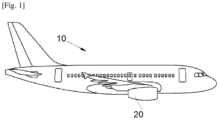
- FIG. 1 shows an aircraft 10 which has a nacelle 20 inside which a turbomachine is arranged. Inside the nacelle 20 is arranged an air stream which passes through the nacelle and the turbomachine. The air stream is thus delimited by an external wall (also called OFS “outer fixed structure”) and an internal wall (also called IFS “internal fixed structure”) of the nacelle 20.
- an external wall also called OFS "outer fixed structure”
- IFS internal fixed structure
- FIG. 2 shows a module 100 according to the invention which ensures, on the one hand, acoustic attenuation of the noise generated by a first fluid flowing along this module 100 and, on the other hand, a heat exchange between the first fluid and a second fluid circulating inside this module 100.
- Such a module 100 may be placed at the external wall and/or the internal wall of the nacelle 20 or in another environment as long as it is necessary to attenuate the noise generated by the flow of a first fluid and to carry out a heat exchange between the first fluid and a second fluid.
- a module 100 covers the surface of the wall on which it is fixed and there may be several of these modules 100 carried by said wall.
- the module takes the form of a paving stone but it can take another form so as to adapt to the geometry of the wall on which it is fixed.
- the module 100 comprises a first wall 102 (cut on the left) which is perforated and therefore crossed by holes 103a and a second wall 104 at a distance and, here, parallel to the first wall 102.
- the first wall 102 is in contact with the first fluid, in particular a gas, which flows in the vein along said first wall 102 and which is represented here by the arrow F.
- the second wall 104 is solid and fixed to the wall which delimits the vein.
- the module 100 also includes a plurality of intermediate walls 106 that extend from the second wall 104 toward the first wall 102.
- the intermediate walls 106 extend perpendicular to the first wall 102 and the second wall 104.
- the intermediate walls 106 are arranged and secured to each other so as to form cells 108, which here are of hexagonal section and extend from the second wall 104 towards the first wall 102.
- Each cell 108 has a first end secured to the second wall 104 and a second end.
- the intermediate walls 106 thus together define a honeycomb structure 109 which has a first end secured to the second wall 104 and a second end.
- the first wall 102 has a cutout 152, which here is rectangular in shape.
- the module 100 comprises a recess 150 made in the honeycomb structure 109 and delimited between a floor 154 and a ceiling 156.
- the ceiling 156 (cut here on the left) closes the cutout 152 and is also perforated and therefore crossed by holes 103b. To limit aerodynamic impacts, the ceiling 156 and the first wall 102 are generally aligned.
- the floor 154 extends at a distance from the ceiling 156, and here parallel to it, and it is sunk inside the module 100 towards the second wall 104.
- the floor 154 here covers generally the same surface as the ceiling 156.
- the floor 154 is also perforated and therefore crossed by holes 103c.
- the second end of each cell 108 and therefore the second end of the cell structure 109 are integral with the first wall 102 and at the recess 150, the second end of each cell 108 and therefore the second end of the cell structure 109 are integral with the floor 154.
- the intermediate walls 106 are therefore shorter at the recess 150 than outside the recess 150.
- the first wall 102 is oriented towards the inside of the vein.
- the first fluid which is here air, flows along the first wall 102 and the holes 103a-c ensure the penetration of a portion of the air into the cells 108 and therefore the attenuation of the acoustic waves generated by the flow of air.
- the air passes through the first wall 102 or the ceiling 156 and the floor 154 before reaching a cell 108.
- the module 100 also comprises a heat exchanger 180 which is fixed inside the recess 150 between the floor 154 and the ceiling 156 and in which a second fluid circulates which may be for example oil from the turbomachine and which is cooled by heat exchange through the heat exchanger 180 with the first fluid.
- the fixing of the heat exchanger 180 is carried out for example using inserts implanted in the honeycomb structure 109 and clamping screws cooperating with these inserts.
- the heat exchanger 180 here comprises pipes 182 which wind in the recess 150.
- the heat exchanger 180 comprises a supply pipe 184 which channels the second fluid from its area of use up to the pipes 182 and an extraction pipe 186 which channels the second fluid from the pipes 182 to its area of use.
- the supply pipe 184 and the extraction pipe 186 pass through the honeycomb structure 109, the second wall 104 and the floor 154 through bores provided for this purpose.
- the heat exchanger 180 is thus integrated into the module 100 without reducing the surface area associated with acoustic attenuation while ensuring the rigidity of the module due to the presence of the cells 108 over the entire surface of the module 100.
- a method for producing such a module 100 comprises, for example, a first supply step during which the cellular structure 109 is provided.
- the production method continues with a shaping step during which the cellular structure 109 thus provided is shaped to produce the recess 150 and any bores made in the floor 154 for the passage of the supply pipe 184 and the extraction pipe 186 and the fixing inserts of the heat exchanger 180.
- the cellular structure 109 is made, for example, of metal (aluminum and its alloys, titanium and its alloys) or of synthetic fibers ( Nomex® , Kevlar® ). Before producing the bores, a resin can be injected into the cells where the bores will be made to facilitate their machining.
- the method comprises a second supply step during which a shell is provided.
- the shell comprises the floor 154 perforated and pierced with any bores for the passage of the supply pipe 184 and the extraction pipe 186 and the fixing inserts of the heat exchanger 180.
- the shell may also comprise guides for the subsequent installation of the heat exchanger 180.
- the shell also includes a rim 158 which is fixed around the floor 154 and extends from the floor 154 to the ceiling 156 so as to delimit the recess 150 laterally.
- the hull is made, for example, of metal (aluminum and its alloys, titanium and its alloys) or of composite materials.
- the method then comprises a first fixing step during which the shell is fixed in the recess 150.
- the fixing of the shell is carried out for example by gluing the floor 154 on the honeycomb structure 109 using a crosslinked adhesive.
- the crosslinking of the adhesive can be carried out directly on the shell or on the honeycomb structure 109.
- intumescent adhesive which expands during polymerization is injected between the rim 158 and the honeycomb structure 109.
- an openwork sheet 160 constituting thermal protection is fixed between the honeycomb structure 109 and the floor 154.
- the openwork sheet 160 is for example a carbon sheet.
- the method comprises a third supply step during which the first perforated wall 102 cut according to the cut 152 is provided.
- the first wall 102 is made for example of metal (aluminum and its alloys, titanium and its alloys) or of composite materials.
- the method comprises a fourth supply step during which the second wall 104 is supplied.
- the second wall 104 is made for example of metal (aluminum and its alloys, titanium and its alloys, steel and its alloys) or of composite materials.
- the method then comprises a second fixing step during which the first wall 102 and the second wall 104 are fixed, for example by gluing, on either side of the honeycomb structure 109.
- the first wall 102 is fixed on the side of the recess 150 by aligning the cutout 152 with the recess 150 and the second wall 104 is fixed on the side opposite the recess 150.
- the method comprises a fifth supply step during which the exchanger 180 is supplied and a third fixing step during which the exchanger 180 is fixed in the recess 150, optionally by passing the supply pipe 184 and the extraction pipe 186 through the honeycomb structure 109.
- the method comprises a sixth supply step during which the perforated ceiling 156 is supplied and a fourth fixing step during which the ceiling 156 is fixed above the exchanger 180 to close the recess 150.
- a thermal protection may optionally be fixed against the second wall 104.
- FIG. 3 shows an example arrangement at the supply line 184 but a similar arrangement can be made for the extraction line 186.
- a bore 302 is made through the honeycomb structure 109 as well as the floor 154 and the second wall 104 and the supply pipe 184 is housed in the bore 302.
- the bore 302 also passes through the thermal protection.
- the module comprises a seal 304a-b which is positioned around the supply pipe 184 and closes the bore 302 at the floor 154 and respectively the second wall 104.
- Each seal 304a-b is made for example of silicone reinforced if necessary with ceramics and glass fibers.
- the extent of the ceiling 156 is smaller than the extent of the rim 158 of the shell.
- the module 100 then has, along the periphery of the ceiling 156, a gap between the rim 158 and the ceiling 156. To close this gap, a mastic is deposited to close the gap and seal it. This mastic also makes it possible to absorb geometric variations due to thermal expansion.
- the extent of the ceiling 156 is greater than the extent of the rim 158 of the hull and the ceiling 156 then overflows onto the rim 158 with edging to limit the aerodynamic impact.
- the edging consists of filling the vertical gap between the ceiling 156 and the rim 158 with a double-folded surface which is flush with the ceiling 156 and the rim 158 and which is produced for example with a putty.
- Any other shape that reduces aerodynamic disturbances can be used, such as a chamfer.
- the ceiling 156 is fixed for example using clamping screws which are screwed through said ceiling 156 into holes provided for this purpose.
- the holes are advantageously oblong holes oriented according to different orientations to absorb the geometric variations of the ceiling 156 due to thermal expansions.
Landscapes
- Engineering & Computer Science (AREA)
- Chemical & Material Sciences (AREA)
- Combustion & Propulsion (AREA)
- Physics & Mathematics (AREA)
- Acoustics & Sound (AREA)
- Mechanical Engineering (AREA)
- General Engineering & Computer Science (AREA)
- Multimedia (AREA)
- Manufacturing & Machinery (AREA)
- Aviation & Aerospace Engineering (AREA)
- Architecture (AREA)
- Transportation (AREA)
- Civil Engineering (AREA)
- Structural Engineering (AREA)
- Electromagnetism (AREA)
- Thermal Sciences (AREA)
- Heat-Exchange Devices With Radiators And Conduit Assemblies (AREA)
- Cooling Or The Like Of Electrical Apparatus (AREA)
Description
- La présente invention concerne un module assurant une atténuation d'ondes acoustiques générées par l'écoulement d'un premier fluide et permettant également un échange thermique entre ce premier fluide et un deuxième fluide, un procédé de réalisation d'un tel module, une nacelle d'aéronef comportant de tels modules, ainsi qu'un aéronef présentant un tel module.
- Une turbomachine d'un aéronef, en particulier une turbomachine à double flux, présente une veine d'air qui s'ouvre à l'avant et par laquelle l'air frais pénètre dans la turbomachine. La veine d'air est délimitée par des parois qui canalisent l'air. Une partie de l'air est utilisée pour réaliser un échange thermique avec des fluides de l'aéronef. À cette fin, des échangeurs thermiques sont mis en place au niveau des parois.
- L'intérieur de la veine est également tapissé de structures assurant une atténuation des ondes acoustiques générées par l'écoulement de l'air dans la veine et permettant ainsi d'atténuer le bruit de la turbomachine. De telles structures comprennent généralement une paroi ajourée qui est orientée vers l'intérieur de la veine et à l'arrière de laquelle est disposé un ensemble de cavités en particulier en nid d'abeilles. Les cavités forment des résonateurs quart d'onde qui atténuent une fréquence particulière.
- Une implémentation d'échangeurs thermiques au niveau des parois de la veine diminue l'espace affecté aux structures acoustiques ce qui peut engendrer une augmentation du bruit de la turbomachine et il est donc nécessaire de mettre en place une structure qui assure à la fois une atténuation des ondes acoustiques et un échange thermique sans limiter la surface d'atténuation.
- Les documents
US-A-2011/126544 etFR-A-2 960 334 - Un objet de la présente invention est de proposer un module assurant une atténuation des ondes acoustiques générées par l'écoulement d'un premier fluide et un échange thermique entre ce premier fluide et un deuxième fluide.
- À cet effet, est proposé un module assurant une atténuation acoustique d'un écoulement d'un premier fluide et un échange thermique entre le premier fluide et un deuxième fluide, le module comportant :
- une première paroi qui est ajourée, le long de laquelle ledit premier fluide s'écoule,
- une deuxième paroi,
- une structure alvéolaire délimitant des alvéoles s'étendant de la deuxième paroi vers la première paroi, et présentant une première extrémité solidaire de la deuxième paroi et une deuxième extrémité, et
- un échangeur thermique dans lequel circule le deuxième fluide,
- Avantageusement, l'échangeur thermique comporte des canalisations qui serpentent dans l'évidement, une canalisation d'apport qui canalise le deuxième fluide depuis sa zone d'utilisation jusqu'aux canalisations et une canalisation d'extraction qui canalise le deuxième fluide depuis les canalisations jusqu'à sa zone d'utilisation.
- Avantageusement, la canalisation d'apport et la canalisation d'extraction traversent la structure alvéolaire, le plancher et la deuxième paroi à travers un alésage. Avantageusement, le module comporte pour chaque canalisation d'apport et d'extraction, un joint qui se positionne autour de ladite canalisation et obture l'alésage au niveau du plancher et de la deuxième paroi.
- Avantageusement, le module comporte un rebord qui est fixé autour du plancher et s'étend du plancher jusqu'au plafond.
- Avantageusement, le module comporte de la mousse entre le rebord et la structure alvéolaire. Selon un mode de réalisation particulier, le module présente le long de la périphérie du plafond, un écart entre le rebord et le plafond, et un mastic est déposé pour obturer l'écart. Selon un mode de réalisation particulier, le plafond déborde sur le rebord avec soyage.
- L'invention propose également un procédé de réalisation d'un module selon la variante précédente, où ledit procédé comporte :
- une première étape de fourniture au cours de laquelle la structure alvéolaire est fournie,
- une étape de conformation au cours de laquelle la structure alvéolaire ainsi fournie est conformée pour réaliser l'évidement,
- une deuxième étape de fourniture au cours de laquelle une coque comportant le plancher ajouré est fournie,
- une première étape de fixation au cours de laquelle la coque est fixée dans l'évidement,
- une troisième étape de fourniture au cours de laquelle la première paroi ajourée et découpée selon la découpe est fournie,
- une quatrième étape de fourniture au cours de laquelle la deuxième paroi est fournie,
- une deuxième étape de fixation au cours de laquelle la première paroi et la deuxième paroi sont fixées de part et d'autre de la structure alvéolaire,
- une cinquième étape de fourniture au cours de laquelle l'échangeur est fourni,
- une troisième étape de fixation au cours de laquelle l'échangeur est fixé dans l'évidement,
- une sixième étape de fourniture au cours de laquelle le plafond ajouré est fourni, et
- une quatrième étape de fixation au cours de laquelle le plafond est fixé au-dessus de l'échangeur pour obturer l'évidement.
- L'invention propose également une nacelle d'un aéronef comportant une paroi externe et une paroi interne délimitant une veine d'air et où la paroi externe et/ou la paroi interne portent au moins un module selon l'une des variantes précédentes et où la première paroi est orientée vers l'intérieur de la veine.
- Les caractéristiques de l'invention mentionnées ci-dessus, ainsi que d'autres, apparaîtront plus clairement à la lecture de la description suivante d'un exemple de réalisation, ladite description étant faite en relation avec les dessins joints, parmi lesquels :
- [
Fig. 1 ] est une vue de côté d'un aéronef selon l'invention, - [
Fig. 2 ] est une vue en perspective d'un module selon l'invention, et - [
Fig. 3 ] est une vue en coupe au niveau d'une canalisation traversant une structure alvéolaire du module selon l'invention, - La
Fig. 1 montre un aéronef 10 qui présente une nacelle 20 à l'intérieur de laquelle est disposée une turbomachine. À l'intérieur de la nacelle 20 est arrangée une veine d'air qui traverse la nacelle et la turbomachine. La veine d'air est ainsi délimitée par une paroi externe (également appelée OFS « outer fixed structure ») et une paroi interne (également appelée IFS « internal fixed structure ») de la nacelle 20. - La
Fig. 2 montre un module 100 selon l'invention qui assure, d'une part, une atténuation acoustique des bruits générés par un premier fluide s'écoulant le long de ce module 100 et, d'autre part, un échange thermique entre le premier fluide et un deuxième fluide circulant à l'intérieur de ce module 100. - Un tel module 100 peut être mis en place au niveau de la paroi externe ou/et de la paroi interne de la nacelle 20 ou dans un autre environnement tant qu'il est nécessaire d'atténuer le bruit généré par l'écoulement d'un premier fluide et de réaliser un échange thermique entre le premier fluide et un deuxième fluide. Un tel module 100 tapisse la surface de la paroi sur laquelle il est fixé et il peut y avoir plusieurs de ces modules 100 portés par ladite paroi. Dans le mode de réalisation de l'invention présenté à la
Fig. 2 , le module prend une forme de pavé mais il peut prendre une autre forme de manière à s'adapter à la géométrie de la paroi sur laquelle il est fixé. - Le module 100 comporte une première paroi 102 (coupée à gauche) qui est ajourée et donc traversée de trous 103a et une deuxième paroi 104 à distance et, ici, parallèle à la première paroi 102.
- La première paroi 102 est en contact avec le premier fluide, en particulier un gaz, qui s'écoule dans la veine le long de ladite première paroi 102 et qui est représenté ici par la flèche F.
- La deuxième paroi 104 est pleine et fixée à la paroi qui délimite la veine.
- Le module 100 comporte également une pluralité de parois intermédiaires 106 qui s'étendent à partir de la deuxième paroi 104 vers la première paroi 102. Dans le mode de réalisation de l'invention présenté ici, les parois intermédiaires 106 s'étendent perpendiculairement à la première paroi 102 et à la deuxième paroi 104.
- Les parois intermédiaires 106 sont disposées et solidaires les unes des autres de manière à former des alvéoles 108, qui sont ici de section hexagonale et s'étendent de la deuxième paroi 104 vers la première paroi 102. Chaque alvéole 108 présente une première extrémité solidaire de la deuxième paroi 104 et une deuxième extrémité.
- Les parois intermédiaires 106 définissent ainsi ensemble une structure alvéolaire 109 qui présente une première extrémité solidaire de la deuxième paroi 104 et une deuxième extrémité.
- La première paroi 102 présente une découpe 152, qui est ici de forme rectangulaire.
- Le module 100 comporte un évidement 150 réalisé dans la structure alvéolaire 109 et délimité entre un plancher 154 et un plafond 156.
- Le plafond 156 (coupé ici à gauche) obture la découpe 152 et est également ajouré et donc traversé de trous 103b. Pour limiter les impacts aérodynamiques, le plafond 156 et la première paroi 102 sont globalement alignés.
- Le plancher 154 s'étend à distance du plafond 156, et ici parallèlement à celui-ci, et il est enfoncé à l'intérieur du module 100 vers la deuxième paroi 104. Le plancher 154 couvre ici globalement la même surface que le plafond 156. Le plancher 154 est également ajouré et donc traversé de trous 103c.
- En dehors de l'évidement 150, la deuxième extrémité de chaque alvéole 108 et donc la deuxième extrémité de la structure alvéolaire 109 sont solidaires de la première paroi 102 et au niveau de l'évidement 150, la deuxième extrémité de chaque alvéole 108 et donc la deuxième extrémité de la structure alvéolaire 109 sont solidaires du plancher 154. Les parois intermédiaires 106 sont donc plus courtes au niveau de l'évidement 150 qu'en dehors de l'évidement 150.
- Dans le cas d'un écoulement du premier fluide, préférentiellement un gaz, dans la veine, la première paroi 102 est orientée vers l'intérieur de la veine. Le premier fluide, qui est ici l'air, s'écoule le long de la première paroi 102 et les trous 103a-c assurent la pénétration d'une partie de l'air dans les alvéoles 108 et donc l'atténuation des ondes acoustiques générées par l'écoulement de l'air. Selon la position, l'air traverse la première paroi 102 ou le plafond 156 et le plancher 154 avant d'atteindre une alvéole 108.
- Le fait que les alvéoles 108 sont solidaires les unes des autres même sous l'évidement 150 permet d'assurer que le module 100 constitue un élément structurel.
- Le module 100 comporte également un échangeur thermique 180 qui est fixé à l'intérieur de l'évidement 150 entre le plancher 154 et le plafond 156 et dans lequel circule un deuxième fluide qui peut être par exemple de l'huile de la turbomachine et qui se refroidit par échange thermique à travers l'échangeur thermique 180 avec le premier fluide. La fixation de l'échangeur thermique 180 est réalisée par exemple à l'aide d'inserts implantés dans la structure alvéolaire 109 et de vis de serrage coopérant avec ces inserts.
- L'échangeur thermique 180 comporte ici des canalisations 182 qui serpentent dans l'évidement 150.
- Pour assurer la circulation du deuxième fluide dans les canalisations 182, l'échangeur thermique 180 comporte une canalisation d'apport 184 qui canalise le deuxième fluide depuis sa zone d'utilisation jusqu'aux canalisations 182 et une canalisation d'extraction 186 qui canalise le deuxième fluide depuis les canalisations 182 jusqu'à sa zone d'utilisation.
- Dans le mode de réalisation de l'invention présenté sur la
Fig. 2 , la canalisation d'apport 184 et la canalisation d'extraction 186 traversent la structure alvéolaire 109, la deuxième paroi 104 et le plancher 154 à travers des alésages prévus à cet effet. - L'échangeur thermique 180 est ainsi intégré au module 100 sans réduire la surface associée à l'atténuation acoustique tout en assurant la rigidité du module du fait de la présence des alvéoles 108 sur toute la surface du module 100.
- Dans le mode de réalisation de l'invention présenté à la
Fig. 2 , il y a un seul évidement 150 et un seul échangeur thermique 180, mais il est possible d'avoir plusieurs évidements 150 réalisés à l'intérieur du même module 100 et d'avoir un échangeur thermique 180 par évidement 150. - Un procédé de réalisation d'un tel module 100 comporte par exemple une première étape de fourniture au cours de laquelle la structure alvéolaire 109 est fournie. Le procédé de réalisation se poursuit par une étape de conformation au cours de laquelle la structure alvéolaire 109 ainsi fournie est conformée pour réaliser l'évidement 150 et les éventuels alésages réalisés dans le plancher 154 pour le passage de la canalisation d'apport 184 et de la canalisation d'extraction 186 et des inserts de fixation de l'échangeur thermique 180. La structure alvéolaire 109 est réalisée par exemple en métal (aluminium et ses alliages, titane et ses alliages) ou en fibres synthétiques (Nomex ®, Kevlar ®). Avant la réalisation des alésages, une résine peut être injectée dans les alvéoles où seront réalisés les alésages pour en faciliter l'usinage.
- Le procédé comporte une deuxième étape de fourniture au cours de laquelle une coque est fournie. La coque comporte le plancher 154 ajouré et percé des éventuels alésages pour le passage de la canalisation d'apport 184 et de la canalisation d'extraction 186 et des inserts de fixation de l'échangeur thermique 180. La coque peut également comporter des guides pour la mise en place ultérieure de l'échangeur thermique 180.
- Dans le mode de réalisation de l'invention présenté à la
Fig. 2 , la coque comporte également un rebord 158 qui est fixé autour du plancher 154 et s'étend du plancher 154 jusqu'au plafond 156 de manière à délimiter l'évidement 150 latéralement. - La coque est réalisée par exemple en métal (aluminium et ses alliages, titane et ses alliages) ou en matériaux composites.
- Le procédé comporte ensuite une première étape de fixation au cours de laquelle la coque est fixée dans l'évidement 150. La fixation de la coque est réalisée par exemple par collage du plancher 154 sur la structure alvéolaire 109 à l'aide d'un adhésif réticulé. La réticulation de l'adhésif peut être effectuée directement sur la coque ou sur la structure alvéolaire 109.
- Pour absorber les tolérances dimensionnelles et les dilations entre la coque et la structure alvéolaire 109, de l'adhésif intumescent qui s'expanse pendant la polymérisation est injecté entre le rebord 158 et la structure alvéolaire 109.
- De manière optionnelle, une feuille ajourée 160 constituant une protection thermique est fixée entre la structure alvéolaire 109 et le plancher 154. La feuille ajourée 160 est par exemple une feuille de carbone.
- Le procédé comporte une troisième étape de fourniture au cours de laquelle la première paroi 102 ajourée et découpée selon la découpe 152 est fournie. La première paroi 102 est réalisée par exemple en métal (aluminium et ses alliages, titane et ses alliages) ou en matériaux composites.
- Le procédé comporte une quatrième étape de fourniture au cours de laquelle la deuxième paroi 104 est fournie. La deuxième paroi 104 est réalisée par exemple en métal (aluminium et ses alliages, titane et ses alliages, acier et ses alliages) ou en matériaux composites.
- Le procédé comporte ensuite une deuxième étape de fixation au cours de laquelle la première paroi 102 et la deuxième paroi 104 sont fixées, par exemple par collage, de part et d'autre de la structure alvéolaire 109. La première paroi 102 est fixée du côté de l'évidement 150 en alignant la découpe 152 avec l'évidement 150 et la deuxième paroi 104 est fixée du côté opposé à l'évidement 150.
- Le procédé comporte une cinquième étape de fourniture au cours de laquelle l'échangeur 180 est fourni et une troisième étape de fixation au cours de laquelle l'échangeur 180 est fixé dans l'évidement 150 éventuellement en faisant traverser la structure alvéolaire 109 par la canalisation d'apport 184 et la canalisation d'extraction 186.
- Le procédé comporte une sixième étape de fourniture au cours de laquelle le plafond 156 ajouré est fourni et une quatrième étape de fixation au cours de laquelle le plafond 156 est fixé au-dessus de l'échangeur 180 pour obturer l'évidement 150.
- Une protection thermique peut éventuellement être fixée contre la deuxième paroi 104.
- La
Fig. 3 montre un exemple d'arrangement au niveau de la canalisation d'apport 184 mais un arrangement similaire peut être réalisé pour la canalisation d'extraction 186. - Un alésage 302 est réalisé à travers la structure alvéolaire 109 ainsi que le plancher 154 et la deuxième paroi 104 et la canalisation d'apport 184 est logée dans l'alésage 302.
- Dans le cas où une protection thermique est fixée contre la deuxième paroi 104, l'alésage 302 traverse également la protection thermique.
- Pour assurer l'étanchéité au niveau du plancher 154 et de la deuxième paroi 104, le module comporte un joint 304a-b qui se positionne autour de la canalisation d'apport 184 et obture l'alésage 302 au niveau du plancher 154 et respectivement de la deuxième paroi 104. Chaque joint 304a-b est réalisé par exemple en silicone renforcé si besoin avec des céramiques et des fibres de verre.
- Selon un mode de réalisation particulier, l'étendue du plafond 156 est plus petite que l'étendue du rebord 158 de la coque. Le module 100 présente alors, le long de la périphérie du plafond 156, un écart entre le rebord 158 et le plafond 156. Pour obturer cet écart, un mastic est déposé pour obturer l'écart et l'étanchéifier. Ce mastic permet également d'absorber les variations géométriques dues aux dilatations thermiques.
- Selon un autre mode de réalisation particulier, l'étendue du plafond 156 est plus grande que l'étendue du rebord 158 de la coque et le plafond 156 déborde alors sur le rebord 158 avec soyage pour limiter l'impact aérodynamique. Le soyage consiste à combler l'écart vertical entre le plafond 156 et le rebord 158 par une surface à double pliage qui affleure le plafond 156 et le rebord 158 et qui est réalisée par exemple avec un mastic.
- Toutes autres formes permettant de réduire les perturbations aérodynamiques peuvent être utilisées comme par exemple un chanfrein.
- La fixation du plafond 156 s'effectue par exemple à l'aide de vis de serrage qui se vissent à travers ledit plafond 156 dans des trous prévus à cet effet. Les trous sont avantageusement des trous oblongs orientés selon différentes orientations pour absorber les variations géométriques du plafond 156 dues aux dilatations thermiques.
Claims (10)
- Module (100) assurant une atténuation acoustique d'un écoulement d'un premier fluide et un échange thermique entre le premier fluide et un deuxième fluide, le module (100) comportant :- une première paroi (102) qui est ajourée, le long de laquelle ledit premier fluide s'écoule,- une deuxième paroi (104),- une structure alvéolaire (109) délimitant des alvéoles (108) s'étendant de la deuxième paroi (104) vers la première paroi (102), et présentant une première extrémité solidaire de la deuxième paroi (104) et une deuxième extrémité, et- un échangeur thermique (180) dans lequel circule le deuxième fluide,le module (100) étant caractérisé en ce que la première paroi (102) présente une découpe (152), en ce que le module (100) comporte un évidement (150) réalisé dans la structure alvéolaire (109) et délimité entre un plancher (154) et un plafond (156) qui sont ajourés, où le plafond (156) obture la découpe (152), où le plancher (154) s'étend à distance du plafond (156), où en dehors de l'évidement (150), la deuxième extrémité de la structure alvéolaire (109) est solidaire de la première paroi (102) et où au niveau de l'évidement (150), la deuxième extrémité de la structure alvéolaire (109) est solidaire du plancher (154), et en ce que l'échangeur thermique (180) est fixé à l'intérieur de l'évidement (150) entre le plancher (154) et le plafond (156).
- Module (100) selon la revendication 1, caractérisé en ce que l'échangeur thermique (180) comporte des canalisations (182) qui serpentent dans l'évidement (150), une canalisation d'apport (184) qui canalise le deuxième fluide depuis sa zone d'utilisation jusqu'aux canalisations (182) et une canalisation d'extraction (186) qui canalise le deuxième fluide depuis les canalisations (182) jusqu'à sa zone d'utilisation.
- Module (100) selon la revendication 2, caractérisé en ce que la canalisation d'apport (184) et la canalisation d'extraction (186) traversent la structure alvéolaire (109), le plancher (154) et la deuxième paroi (104) à travers un alésage (302).
- Module (100) selon la revendication 3, caractérisé en ce qu'il comporte pour chaque canalisation d'apport (184) et d'extraction (186), un joint (304a-b) qui se positionne autour de ladite canalisation (184, 186) et obture l'alésage (302) au niveau du plancher (154) et de la deuxième paroi (104).
- Module (100) selon l'une des revendications 1 à 4, caractérisé en ce qu'il comporte un rebord (158) qui est fixé autour du plancher (154) et s'étend du plancher (154) jusqu'au plafond (156).
- Module (100) selon la revendication 5, caractérisé en ce qu'il comporte de la mousse entre le rebord (158) et la structure alvéolaire (109).
- Module (100) selon l'une des revendications 5 ou 6, caractérisé en ce qu'il présente le long de la périphérie du plafond (156), un écart entre le rebord (158) et le plafond (156), et en ce qu'un mastic est déposé pour obturer l'écart.
- Module (100) selon l'une des revendications 5 ou 6, caractérisé en ce que le plafond (156) déborde sur le rebord (158) avec soyage.
- Procédé de réalisation d'un module (100) selon la revendication 1, où ledit procédé comporte :- une première étape de fourniture au cours de laquelle la structure alvéolaire (109) est fournie,- une étape de conformation au cours de laquelle la structure alvéolaire (109) ainsi fournie est conformée pour réaliser l'évidement (150),- une deuxième étape de fourniture au cours de laquelle une coque comportant le plancher (154) ajouré est fournie,- une première étape de fixation au cours de laquelle la coque est fixée dans l'évidement (150),- une troisième étape de fourniture au cours de laquelle la première paroi (102) ajourée et découpée selon la découpe (152) est fournie,- une quatrième étape de fourniture au cours de laquelle la deuxième paroi (104) est fournie,- une deuxième étape de fixation au cours de laquelle la première paroi (102) et la deuxième paroi (104) sont fixées de part et d'autre de la structure alvéolaire (109),- une cinquième étape de fourniture au cours de laquelle l'échangeur (180) est fourni,- une troisième étape de fixation au cours de laquelle l'échangeur (180) est fixé dans l'évidement (150),- une sixième étape de fourniture au cours de laquelle le plafond (156) ajouré est fourni, et- une quatrième étape de fixation au cours de laquelle le plafond (156) est fixé au-dessus de l'échangeur (180) pour obturer l'évidement (150).
- Nacelle (20) d'un aéronef (10) comportant une paroi externe et une paroi interne délimitant une veine d'air et où la paroi externe et/ou la paroi interne portent au moins un module (100) selon l'une des revendications 1 à 8 et où la première paroi (102) est orientée vers l'intérieur de la veine.
Applications Claiming Priority (1)
| Application Number | Priority Date | Filing Date | Title |
|---|---|---|---|
| FR2111740A FR3128778A1 (fr) | 2021-11-04 | 2021-11-04 | Module assurant une atténuation d’ondes acoustiques et un échange thermique |
Publications (2)
| Publication Number | Publication Date |
|---|---|
| EP4177558A1 EP4177558A1 (fr) | 2023-05-10 |
| EP4177558B1 true EP4177558B1 (fr) | 2025-01-01 |
Family
ID=79170817
Family Applications (1)
| Application Number | Title | Priority Date | Filing Date |
|---|---|---|---|
| EP22205241.7A Active EP4177558B1 (fr) | 2021-11-04 | 2022-11-03 | Module assurant une atténuation d'ondes acoustiques et un échange thermique |
Country Status (3)
| Country | Link |
|---|---|
| US (1) | US12163469B2 (fr) |
| EP (1) | EP4177558B1 (fr) |
| FR (1) | FR3128778A1 (fr) |
Family Cites Families (15)
| Publication number | Priority date | Publication date | Assignee | Title |
|---|---|---|---|---|
| SE515528C2 (sv) * | 1999-12-07 | 2001-08-20 | Saab Ab | Anordning vid en akustisk absorbent |
| EP2391542B1 (fr) * | 2009-02-02 | 2014-07-30 | Airbus Operations (S.A.S.) | Nacelle d'aeronef comprenant un systeme de traitement acoustique optimise |
| GB0920741D0 (en) * | 2009-11-27 | 2010-01-13 | Rolls Royce Plc | Air flow passage liner |
| FR2960334B1 (fr) | 2010-05-19 | 2012-08-03 | Snecma | Panneau de traitement acoustique multicouches |
| FR2970433B1 (fr) * | 2011-01-13 | 2013-01-04 | Aircelle Sa | Procede de reparation d'au moins une partie d'un panneau acoustique pour une nacelle |
| US8919494B2 (en) * | 2012-07-31 | 2014-12-30 | Rohr, Inc. | Electric heater for integration into an aircraft acoustic panel |
| US9127452B1 (en) * | 2014-04-11 | 2015-09-08 | Rohr, Inc. | Porous septum cap |
| FR3023538B1 (fr) * | 2014-07-11 | 2016-07-15 | Aircelle Sa | Levre avant de nacelle de turboreacteur comportant des percages d’air chaud en amont de panneaux acoustiques |
| US20160017810A1 (en) * | 2014-07-21 | 2016-01-21 | United Technologies Corporation | Acoustic liner heat exchanger |
| FR3070674B1 (fr) * | 2017-09-06 | 2019-09-13 | Safran Nacelles | Integration a la levre acoustique degivree |
| FR3072649B1 (fr) * | 2017-10-20 | 2019-11-08 | Airbus Operations | Systeme de protection contre le givre pour nacelle de moteur d'aeronef |
| FR3074776B1 (fr) * | 2017-12-13 | 2020-02-28 | Safran Nacelles | Levre d’entree d’air de nacelle pour turboreacteur |
| FR3087420B1 (fr) * | 2018-10-19 | 2021-03-12 | Airbus Operations Sas | Nacelle de moteur d’aeronef comprenant un systeme de protection contre le givre. |
| FR3087573A1 (fr) * | 2018-10-19 | 2020-04-24 | Airbus Operations (S.A.S.) | Turbomachine equipee d’un systeme thermo-acoustique. |
| FR3111002B1 (fr) * | 2020-05-29 | 2022-06-17 | Airbus Operations Sas | Procédé de fabrication d'une structure alvéolaire d’insonorisation incluant un diaphragme, et structure alvéolaire d’insonorisation obtenue |
-
2021
- 2021-11-04 FR FR2111740A patent/FR3128778A1/fr not_active Ceased
-
2022
- 2022-11-02 US US17/979,023 patent/US12163469B2/en active Active
- 2022-11-03 EP EP22205241.7A patent/EP4177558B1/fr active Active
Also Published As
| Publication number | Publication date |
|---|---|
| EP4177558A1 (fr) | 2023-05-10 |
| US20230138228A1 (en) | 2023-05-04 |
| FR3128778A1 (fr) | 2023-05-05 |
| US12163469B2 (en) | 2024-12-10 |
Similar Documents
| Publication | Publication Date | Title |
|---|---|---|
| BE1023531B1 (fr) | Dispositif degivrant de bec de separation de compresseur de turbomachine axiale | |
| EP0321320B1 (fr) | Chambre de combustion pour turbomachine possédant un convergent à doubles parois | |
| EP2821597B1 (fr) | Bec de séparation avec tôle formant une surface de guidage du flux et un canal de dégivrage | |
| FR2752392A1 (fr) | Panneau sandwich en nid d'abeille ventile et procede de ventilation d'un tel panneau | |
| FR3041704A1 (fr) | Panneau d'echange thermique et de reduction de bruit pour un ensemble propulsif | |
| FR3051019A1 (fr) | Structure assurant une attenuation d'ondes acoustiques et un echange thermique | |
| EP2167798A2 (fr) | Turboreacteur pour aeronef | |
| EP3931435B1 (fr) | Système alvéolaire dilatable pour panneau sandwich | |
| BE1014570A4 (fr) | Procede de fabrication d'une structure cannelee et structure obtenue par ce procede. | |
| WO2016102691A2 (fr) | Paroi acoustique à échangeur thermique intégré | |
| EP1270101A1 (fr) | Structure tubulaire mince cloisonnée et son procédé de fabrication | |
| EP4177558B1 (fr) | Module assurant une atténuation d'ondes acoustiques et un échange thermique | |
| FR3055612A1 (fr) | Structure compartimentee pour le traitement acoustique et le degivrage d'une nacelle d'aeronef et nacelle d'aeronef incorporant ladite structure | |
| FR3120352A1 (fr) | Entree d’air de nacelle munie d’un système de protection contre la glace mixte | |
| FR3097257A1 (fr) | Echangeur thermique de refroidissement d'un moteur propulsif d'aéronef. | |
| WO2003046456A1 (fr) | Profils de tube pour echangeur thermique | |
| JP2008544205A (ja) | 太陽熱コレクタ | |
| EP3581781B1 (fr) | Systeme de propulsion d'un aeronef comportant une structure interieure fixe presentant une fente d'evacuation | |
| CN114578542B (zh) | 一种适用于太阳望远镜热光阑的消光筒及其加工工艺 | |
| EP4455016B1 (fr) | Structure intérieure fixe pour une nacelle d'aéronef | |
| WO2015004359A1 (fr) | Dispositif d'échange thermique et procédé de fabrication d'un tel dispositif | |
| EP4455542B1 (fr) | Réservoir comprenant des enceintes interne et externe ainsi qu au moins un conduit traversant lesdites enceintes et suivant une trajectoire courbe entre lesdites enceintes | |
| EP4462012B1 (fr) | Réservoir comprenant des enceintes internes et externes ainsi qu'au moins un conduit traversant au moins une plaque de fermeture déformable | |
| FR3029831A1 (fr) | Procede pour la reparation d’un panneau acoustique en materiau composite | |
| EP3001133A1 (fr) | Échangeur de chaleur pour véhicule automobile |
Legal Events
| Date | Code | Title | Description |
|---|---|---|---|
| PUAI | Public reference made under article 153(3) epc to a published international application that has entered the european phase |
Free format text: ORIGINAL CODE: 0009012 |
|
| STAA | Information on the status of an ep patent application or granted ep patent |
Free format text: STATUS: THE APPLICATION HAS BEEN PUBLISHED |
|
| AK | Designated contracting states |
Kind code of ref document: A1 Designated state(s): AL AT BE BG CH CY CZ DE DK EE ES FI FR GB GR HR HU IE IS IT LI LT LU LV MC ME MK MT NL NO PL PT RO RS SE SI SK SM TR |
|
| STAA | Information on the status of an ep patent application or granted ep patent |
Free format text: STATUS: REQUEST FOR EXAMINATION WAS MADE |
|
| 17P | Request for examination filed |
Effective date: 20231108 |
|
| RBV | Designated contracting states (corrected) |
Designated state(s): AL AT BE BG CH CY CZ DE DK EE ES FI FR GB GR HR HU IE IS IT LI LT LU LV MC ME MK MT NL NO PL PT RO RS SE SI SK SM TR |
|
| GRAP | Despatch of communication of intention to grant a patent |
Free format text: ORIGINAL CODE: EPIDOSNIGR1 |
|
| STAA | Information on the status of an ep patent application or granted ep patent |
Free format text: STATUS: GRANT OF PATENT IS INTENDED |
|
| RIC1 | Information provided on ipc code assigned before grant |
Ipc: G10K 11/172 20060101ALI20240712BHEP Ipc: G10K 11/16 20060101ALI20240712BHEP Ipc: F28F 7/02 20060101AFI20240712BHEP |
|
| INTG | Intention to grant announced |
Effective date: 20240731 |
|
| GRAS | Grant fee paid |
Free format text: ORIGINAL CODE: EPIDOSNIGR3 |
|
| GRAA | (expected) grant |
Free format text: ORIGINAL CODE: 0009210 |
|
| STAA | Information on the status of an ep patent application or granted ep patent |
Free format text: STATUS: THE PATENT HAS BEEN GRANTED |
|
| AK | Designated contracting states |
Kind code of ref document: B1 Designated state(s): AL AT BE BG CH CY CZ DE DK EE ES FI FR GB GR HR HU IE IS IT LI LT LU LV MC ME MK MT NL NO PL PT RO RS SE SI SK SM TR |
|
| REG | Reference to a national code |
Ref country code: GB Ref legal event code: FG4D Free format text: NOT ENGLISH |
|
| REG | Reference to a national code |
Ref country code: CH Ref legal event code: EP |
|
| REG | Reference to a national code |
Ref country code: DE Ref legal event code: R096 Ref document number: 602022009293 Country of ref document: DE |
|
| REG | Reference to a national code |
Ref country code: IE Ref legal event code: FG4D Free format text: LANGUAGE OF EP DOCUMENT: FRENCH |
|
| REG | Reference to a national code |
Ref country code: LT Ref legal event code: MG9D |
|
| REG | Reference to a national code |
Ref country code: NL Ref legal event code: MP Effective date: 20250101 |
|
| REG | Reference to a national code |
Ref country code: AT Ref legal event code: MK05 Ref document number: 1756635 Country of ref document: AT Kind code of ref document: T Effective date: 20250101 |
|
| PG25 | Lapsed in a contracting state [announced via postgrant information from national office to epo] |
Ref country code: NL Free format text: LAPSE BECAUSE OF FAILURE TO SUBMIT A TRANSLATION OF THE DESCRIPTION OR TO PAY THE FEE WITHIN THE PRESCRIBED TIME-LIMIT Effective date: 20250101 |
|
| PG25 | Lapsed in a contracting state [announced via postgrant information from national office to epo] |
Ref country code: FI Free format text: LAPSE BECAUSE OF FAILURE TO SUBMIT A TRANSLATION OF THE DESCRIPTION OR TO PAY THE FEE WITHIN THE PRESCRIBED TIME-LIMIT Effective date: 20250101 |
|
| PG25 | Lapsed in a contracting state [announced via postgrant information from national office to epo] |
Ref country code: PL Free format text: LAPSE BECAUSE OF FAILURE TO SUBMIT A TRANSLATION OF THE DESCRIPTION OR TO PAY THE FEE WITHIN THE PRESCRIBED TIME-LIMIT Effective date: 20250101 |
|
| PG25 | Lapsed in a contracting state [announced via postgrant information from national office to epo] |
Ref country code: ES Free format text: LAPSE BECAUSE OF FAILURE TO SUBMIT A TRANSLATION OF THE DESCRIPTION OR TO PAY THE FEE WITHIN THE PRESCRIBED TIME-LIMIT Effective date: 20250101 |
|
| PG25 | Lapsed in a contracting state [announced via postgrant information from national office to epo] |
Ref country code: IS Free format text: LAPSE BECAUSE OF FAILURE TO SUBMIT A TRANSLATION OF THE DESCRIPTION OR TO PAY THE FEE WITHIN THE PRESCRIBED TIME-LIMIT Effective date: 20250501 Ref country code: NO Free format text: LAPSE BECAUSE OF FAILURE TO SUBMIT A TRANSLATION OF THE DESCRIPTION OR TO PAY THE FEE WITHIN THE PRESCRIBED TIME-LIMIT Effective date: 20250401 |
|
| PG25 | Lapsed in a contracting state [announced via postgrant information from national office to epo] |
Ref country code: HR Free format text: LAPSE BECAUSE OF FAILURE TO SUBMIT A TRANSLATION OF THE DESCRIPTION OR TO PAY THE FEE WITHIN THE PRESCRIBED TIME-LIMIT Effective date: 20250101 |
|
| PG25 | Lapsed in a contracting state [announced via postgrant information from national office to epo] |
Ref country code: LV Free format text: LAPSE BECAUSE OF FAILURE TO SUBMIT A TRANSLATION OF THE DESCRIPTION OR TO PAY THE FEE WITHIN THE PRESCRIBED TIME-LIMIT Effective date: 20250101 Ref country code: PT Free format text: LAPSE BECAUSE OF FAILURE TO SUBMIT A TRANSLATION OF THE DESCRIPTION OR TO PAY THE FEE WITHIN THE PRESCRIBED TIME-LIMIT Effective date: 20250502 |
|
| PG25 | Lapsed in a contracting state [announced via postgrant information from national office to epo] |
Ref country code: GR Free format text: LAPSE BECAUSE OF FAILURE TO SUBMIT A TRANSLATION OF THE DESCRIPTION OR TO PAY THE FEE WITHIN THE PRESCRIBED TIME-LIMIT Effective date: 20250402 Ref country code: BG Free format text: LAPSE BECAUSE OF FAILURE TO SUBMIT A TRANSLATION OF THE DESCRIPTION OR TO PAY THE FEE WITHIN THE PRESCRIBED TIME-LIMIT Effective date: 20250101 |
|
| PG25 | Lapsed in a contracting state [announced via postgrant information from national office to epo] |
Ref country code: AT Free format text: LAPSE BECAUSE OF FAILURE TO SUBMIT A TRANSLATION OF THE DESCRIPTION OR TO PAY THE FEE WITHIN THE PRESCRIBED TIME-LIMIT Effective date: 20250101 |
|
| PG25 | Lapsed in a contracting state [announced via postgrant information from national office to epo] |
Ref country code: CZ Free format text: LAPSE BECAUSE OF FAILURE TO SUBMIT A TRANSLATION OF THE DESCRIPTION OR TO PAY THE FEE WITHIN THE PRESCRIBED TIME-LIMIT Effective date: 20250101 |
|
| PG25 | Lapsed in a contracting state [announced via postgrant information from national office to epo] |
Ref country code: SE Free format text: LAPSE BECAUSE OF FAILURE TO SUBMIT A TRANSLATION OF THE DESCRIPTION OR TO PAY THE FEE WITHIN THE PRESCRIBED TIME-LIMIT Effective date: 20250101 |
|
| REG | Reference to a national code |
Ref country code: DE Ref legal event code: R097 Ref document number: 602022009293 Country of ref document: DE |
|
| PG25 | Lapsed in a contracting state [announced via postgrant information from national office to epo] |
Ref country code: SM Free format text: LAPSE BECAUSE OF FAILURE TO SUBMIT A TRANSLATION OF THE DESCRIPTION OR TO PAY THE FEE WITHIN THE PRESCRIBED TIME-LIMIT Effective date: 20250101 |
|
| PG25 | Lapsed in a contracting state [announced via postgrant information from national office to epo] |
Ref country code: DK Free format text: LAPSE BECAUSE OF FAILURE TO SUBMIT A TRANSLATION OF THE DESCRIPTION OR TO PAY THE FEE WITHIN THE PRESCRIBED TIME-LIMIT Effective date: 20250101 |
|
| PG25 | Lapsed in a contracting state [announced via postgrant information from national office to epo] |
Ref country code: IT Free format text: LAPSE BECAUSE OF FAILURE TO SUBMIT A TRANSLATION OF THE DESCRIPTION OR TO PAY THE FEE WITHIN THE PRESCRIBED TIME-LIMIT Effective date: 20250101 |
|
| PG25 | Lapsed in a contracting state [announced via postgrant information from national office to epo] |
Ref country code: EE Free format text: LAPSE BECAUSE OF FAILURE TO SUBMIT A TRANSLATION OF THE DESCRIPTION OR TO PAY THE FEE WITHIN THE PRESCRIBED TIME-LIMIT Effective date: 20250101 |
|
| PG25 | Lapsed in a contracting state [announced via postgrant information from national office to epo] |
Ref country code: RO Free format text: LAPSE BECAUSE OF FAILURE TO SUBMIT A TRANSLATION OF THE DESCRIPTION OR TO PAY THE FEE WITHIN THE PRESCRIBED TIME-LIMIT Effective date: 20250101 |
|
| PG25 | Lapsed in a contracting state [announced via postgrant information from national office to epo] |
Ref country code: SK Free format text: LAPSE BECAUSE OF FAILURE TO SUBMIT A TRANSLATION OF THE DESCRIPTION OR TO PAY THE FEE WITHIN THE PRESCRIBED TIME-LIMIT Effective date: 20250101 |
|
| PLBE | No opposition filed within time limit |
Free format text: ORIGINAL CODE: 0009261 |
|
| STAA | Information on the status of an ep patent application or granted ep patent |
Free format text: STATUS: NO OPPOSITION FILED WITHIN TIME LIMIT |
|
| 26N | No opposition filed |
Effective date: 20251002 |
|
| PGFP | Annual fee paid to national office [announced via postgrant information from national office to epo] |
Ref country code: DE Payment date: 20251119 Year of fee payment: 4 |
|
| PGFP | Annual fee paid to national office [announced via postgrant information from national office to epo] |
Ref country code: FR Payment date: 20251126 Year of fee payment: 4 |