EP4175331A1 - Strassenseitige einheit für v2x-dienst - Google Patents
Strassenseitige einheit für v2x-dienst Download PDFInfo
- Publication number
- EP4175331A1 EP4175331A1 EP20942931.5A EP20942931A EP4175331A1 EP 4175331 A1 EP4175331 A1 EP 4175331A1 EP 20942931 A EP20942931 A EP 20942931A EP 4175331 A1 EP4175331 A1 EP 4175331A1
- Authority
- EP
- European Patent Office
- Prior art keywords
- message
- rsu
- server
- area
- subscription
- Prior art date
- Legal status (The legal status is an assumption and is not a legal conclusion. Google has not performed a legal analysis and makes no representation as to the accuracy of the status listed.)
- Pending
Links
- 238000004891 communication Methods 0.000 claims description 40
- 230000006870 function Effects 0.000 claims description 16
- 230000015654 memory Effects 0.000 claims description 13
- 238000007726 management method Methods 0.000 description 18
- 238000012545 processing Methods 0.000 description 12
- 238000000034 method Methods 0.000 description 10
- 238000001914 filtration Methods 0.000 description 6
- 230000008569 process Effects 0.000 description 6
- 238000006243 chemical reaction Methods 0.000 description 4
- 238000005516 engineering process Methods 0.000 description 4
- 230000001133 acceleration Effects 0.000 description 3
- 230000010267 cellular communication Effects 0.000 description 3
- 230000008859 change Effects 0.000 description 3
- 230000033001 locomotion Effects 0.000 description 3
- 230000004044 response Effects 0.000 description 3
- 230000001413 cellular effect Effects 0.000 description 2
- 239000000523 sample Substances 0.000 description 2
- 238000012546 transfer Methods 0.000 description 2
- 230000005540 biological transmission Effects 0.000 description 1
- 238000002485 combustion reaction Methods 0.000 description 1
- 238000010276 construction Methods 0.000 description 1
- 238000013523 data management Methods 0.000 description 1
- 238000012217 deletion Methods 0.000 description 1
- 230000037430 deletion Effects 0.000 description 1
- 230000007774 longterm Effects 0.000 description 1
- 238000012986 modification Methods 0.000 description 1
- 230000004048 modification Effects 0.000 description 1
- 230000003287 optical effect Effects 0.000 description 1
- 238000005192 partition Methods 0.000 description 1
- 230000002093 peripheral effect Effects 0.000 description 1
- 239000007787 solid Substances 0.000 description 1
Images




Classifications
-
- H—ELECTRICITY
- H04—ELECTRIC COMMUNICATION TECHNIQUE
- H04W—WIRELESS COMMUNICATION NETWORKS
- H04W4/00—Services specially adapted for wireless communication networks; Facilities therefor
- H04W4/30—Services specially adapted for particular environments, situations or purposes
- H04W4/40—Services specially adapted for particular environments, situations or purposes for vehicles, e.g. vehicle-to-pedestrians [V2P]
-
- H—ELECTRICITY
- H04—ELECTRIC COMMUNICATION TECHNIQUE
- H04L—TRANSMISSION OF DIGITAL INFORMATION, e.g. TELEGRAPHIC COMMUNICATION
- H04L67/00—Network arrangements or protocols for supporting network services or applications
- H04L67/01—Protocols
- H04L67/12—Protocols specially adapted for proprietary or special-purpose networking environments, e.g. medical networks, sensor networks, networks in vehicles or remote metering networks
-
- H—ELECTRICITY
- H04—ELECTRIC COMMUNICATION TECHNIQUE
- H04W—WIRELESS COMMUNICATION NETWORKS
- H04W4/00—Services specially adapted for wireless communication networks; Facilities therefor
- H04W4/02—Services making use of location information
- H04W4/021—Services related to particular areas, e.g. point of interest [POI] services, venue services or geofences
-
- H—ELECTRICITY
- H04—ELECTRIC COMMUNICATION TECHNIQUE
- H04W—WIRELESS COMMUNICATION NETWORKS
- H04W4/00—Services specially adapted for wireless communication networks; Facilities therefor
- H04W4/02—Services making use of location information
- H04W4/025—Services making use of location information using location based information parameters
-
- H—ELECTRICITY
- H04—ELECTRIC COMMUNICATION TECHNIQUE
- H04W—WIRELESS COMMUNICATION NETWORKS
- H04W76/00—Connection management
- H04W76/10—Connection setup
- H04W76/11—Allocation or use of connection identifiers
-
- H—ELECTRICITY
- H04—ELECTRIC COMMUNICATION TECHNIQUE
- H04W—WIRELESS COMMUNICATION NETWORKS
- H04W88/00—Devices specially adapted for wireless communication networks, e.g. terminals, base stations or access point devices
- H04W88/16—Gateway arrangements
Definitions
- the present disclosure relates to a method for vehicle-to-everything (V2X) service and a server using the same.
- V2X vehicle-to-everything
- a vehicle is an apparatus which moves a passenger from one place to another place.
- a representative example is a car.
- a vehicle-to-everything (V2X) communication technology which means vehicle-to-object communication, refers to a technology in which the vehicle communicates with other vehicles, pedestrians, road infrastructures, servers, and the like to provide a series of services.
- V2X vehicle-to-everything
- V2X For the V2X, standardization organizations such as Institute of Electrical and Electronics Engineers (IEEE), 3rd Generation Partnership Project (3GPP), etc. provide various communication specifications.
- DSRC Dedicated Short Range Communications
- C-V2X Cellular-V2X
- V2X has focused on vehicle safety through direct communication between vehicles, but recently V2X includes vehicle-to-infrastructure communication for communicating with peripheral devices via a network.
- a Road Side Unit (RSU) device refers to a device that is disposed along or on a the road and operates as a gateway between V2X devices (e.g., vehicles, etc.) and infrastructure.
- the RSU communicates with the V2X device through direct communication such as DSRC and C-V2X, and obtains traffic information such as the speed or location of the V2X device.
- RSUs can generally be placed on fixed objects located around the road, such as traffic lights and street lights.
- V2X technology Attempts are being made to extend V2X technology to be applied to pedestrians and other electronic devices, rather than simply being used for vehicle safety, such as vehicle-to-vehicle and vehicle-to-peripheral devices. Accordingly, the function of the RSU also needs to be expanded.
- the present disclosure provides relates to a road side unit (RSU) device for vehicle-to-everything (V2X) service.
- RSU road side unit
- V2X vehicle-to-everything
- an RSU device for V2X service includes a processor, and a memory operatively coupled with the processor and configured to store instructions that, when executed by the processor, cause the RSU device to perform functions.
- the functions include transmitting, to a V2X server, a message for configuring an RSU subscription area for a V2X service, receiving, from the V2X server, at least one first V2X message published by at least one first V2X device associated with the RSU subscription area, and transmitting, to a second V2X device within an RSU management area managed by the RSU device, a second V2X message obtained based on the at least one received first V2X message.
- a non-transitory computer-readable medium having computer-readable instructions stored thereon that are executable by a processor to transmit, to a V2X server, a message for configuring a road side unit (RSU) subscription area for a V2X service, receive, from the V2X server, at least one first V2X message published by at least one first V2X device associated with the RSU subscription area, and transmit, to a second V2X device within an RSU management area managed by an RSU device, a second V2X message obtained based on the at least one received first V2X message.
- RSU road side unit
- a vehicle according to an embodiment of the present specification can be defined as a means of transport traveling on a road or track.
- Vehicles may include automobiles, ships, aircraft, trains, motorcycles, bicycles, and the like.
- the vehicle may include an internal combustion engine vehicle having an engine as a power source, a hybrid vehicle having an engine and an electric motor as a power source, an electric vehicle having an electric motor as a power source, and combinations thereof.
- a vehicle-to-everything (V2X) device refers to a device that provides V2X functions and V2X services to users based on software, and is also referred to as a SoftV2X device.
- the V2X device may be implemented based on hardware and/or software in an electronic device operated by a user such as User Equipment (UE), mobile station (MS), mobile terminal (MT), user terminal (UT), cellular phone, laptop, handheld device, tablet, drone, consumer electronics, and the like.
- the V2X device may be mounted on a vehicle or electronic device as an on-board unit (OBU) to provide V2X functions and services to the vehicle.
- a V2X device disposed inside or outside the vehicle may be connected to the vehicle through a wireless interface to provide V2X functions and V2X services to the vehicle.
- FIG. 1 shows a system to which an embodiment of the present specification is applied.
- a system includes a V2X device 100 and a V2X server 200.
- the V2X device 100 may communicate with the V2X server 200 through the base station 310 or a Road Side Unit (RSU) 320.
- the V2X device 100 may communicate with the base station 310, the RSU 320, a neighbor vehicle 350 and/or a neighbor V2X device using a wireless communication protocol.
- the wireless communication protocol may include Dedicated Short Range Communications (DSRC), Cellular-V2X (C-V2X), WiFi, BLUETOOTH and/or cellular communication protocols based on 3rd Generation Partnership Project (3GPP) (e.g. Wideband Code Division Multiple Access (WCDMA), Long Term Evolution (LTE), New Radio (NR), etc.).
- 3GPP 3rd Generation Partnership Project
- the V2X server 200 receives one or more V2X messages from the V2X device 100 within a managed area.
- the V2X server 200 may forward the one or more collected V2X messages to the subscribing V2X device 100.
- the V2X message may periodically or aperiodically be transmitted to the V2X server 200 by the V2X device 100 (or RSU 320), and is a message providing status information of the V2X device 100 (or device managed by the RSU 320). For example, the V2X device 100 may transmit 10 V2X messages per second.
- the V2X server 200 collects V2X messages from multiple V2X devices, and forwards the V2X messages to subscribing V2X devices.
- V2X ID A temporary identifier (ID) for identifying the V2X device sendinq this message. It is randomly selected by the V2X device and may be changed periodically. The size can be 4 octets.
- Position Indicates the location of the V2X device. May contain latitude, longitude and elevation. Position Accuracy Including the quality of various parameters used to model the accuracy of positioning. Velocity Indicates the velocity of the V2X device. Heading Indicates the current heading (direction of motion) of the V2X device.
- Path History defines a geometric path reflecting V2X device's movement over some period of time and/or distance Acceleration Indicates the acceleration of the V2X device. May include a set of acceleration values for three orthogonal directions of the V2X device: a longitudinal axis, a lateral axis, and a vertical axis.
- Device Type Indicates the type of V2X device. Example: pedestrian, automobile, bicycle, etc. Publishing Area To be described later
- the V2X message transmitted by the V2X device 100 to the V2X server 200 is called an uplink (UL) V2X message
- the V2X message transmitted by the V2X server 200 to the V2X device 100 is called a downlink (DL) V2X message.
- the V2X device 100 may include a processor 110 and a memory 120.
- the processor 110 implements the functions of the V2X device 100 and may include one or more software modules.
- the V2X device 100 may further include various additional devices according to functions such as a display, a user interface, and a wireless modem.
- the V2X server 200 is connected to one or more base stations 310 and/or RSU 320 and includes computing hardware that provides V2X functions and V2X services to the V2X device 100.
- the V2X server 200 may be a Mobile/Mutli-access Edge Computing (MEC)-based server or a centralized-based server.
- the V2X server 200 may be called another name, such as a Geocast server or a SoftV2X server.
- the V2X server 200 may include a processor 210 and a memory 220.
- the processor 210 implements the function of the V2X server 200, and may include one or more software modules.
- the processors 110 and 210 may include Application-Specific Integrated Circuits (ASICs), Central Processing Unit (CPU), Application Processor (AP), Digital Signal Processor (DSP), Digital Signal Processing Device (DSPD), Programmable Logic Device (PLD), Field Programmable Gate Array (FPGA), micro-controller, chipset, logic circuits, data processing device and/or combinations thereof.
- ASICs Application-Specific Integrated Circuits
- CPU Central Processing Unit
- AP Application Processor
- DSP Digital Signal Processor
- DSPD Digital Signal Processing Device
- PLD Programmable Logic Device
- FPGA Field Programmable Gate Array
- micro-controller chipset, logic circuits, data processing device and/or combinations thereof.
- the software code for performing the functions described herein may be stored in the memories 120 and 220 and executed by the processors 110 and 210.
- Memories 120 and 220 may store information accessible by processors 110 and 210. The information may include instructions executable by the processors 110 and 210 and/or data processed by the processor. Memories 120 and 220 may include any form of computer-readable medium operable to store information.
- the memories 120 and 220 include read only memory (ROM), random access memory (RAM), digital video disc (DVD), optical disc, flash memory, solid state drive (SSD), hard drive and combinations thereof.
- Message Queuing Telemetry Transport is used as a message queuing protocol between the V2X device 100 and the V2X server 200, but this is only an example.
- Advanced Message Queuing Protocol AMQP
- HTTP HyperText Transfer Protocol
- vendor specific protocols may be used.
- a tile refers to a geographic basic unit for setting a subscription area.
- a rectangle is shown in the form of a tile, but it is only an example. There are no restrictions on the shape of the tile, such as polygons or circles.
- FIG. 2 shows an example of a tile using a quadtree.
- the quadtree represents a partition of space in two dimensions by decomposing a map (i.e. world map) into four equal quadrants, subquadrants, and so on.
- the size of a quadrant varies according to a zoom level, and each quadrant corresponds to a tile. Here, the case where the levels are 1, 2, and 3 is shown. The larger the level, the smaller the size of the tile.
- a unique ID is assigned to a tile.
- the tile ID may have the number of bits corresponding to the level.
- the V2X device may acquire the ID of the tile in which it is located based on its location information (e.g. latitude and longitude).
- the V2X device and/or the V2X server may adjust the size of the area by adjusting the level according to the situation.
- the area for the V2X service is defined as follows.
- the management area includes one or more tiles.
- the subscription area The area where the V2X device requests a subscription to the V2X server.
- the subscription area may be referred to as another name, such as a concerned area, an impact area, or a geocast area.
- the subscription area contains one or more tiles.
- the subscription area may be included in one management area, and may be defined across a plurality of management areas managed by a plurality of V2X servers.
- the publishing area may include one tile in each level.
- the publishing area may indicate a tile where the V2X device is currently located. Some or all of the publishing area may overlap with the subscription area.
- FIG. 3 shows an example in which a subscription area is set.
- a first subscription area is set to the first V2X device 410, and a second subscription area is set to the second V2X device 450.
- Each V2X device can set/change/delete the subscription area periodically or aperiodically (e.g. when its location is changed).
- Each V2X device can request setting/change/deletion of the subscription area to the V2X server.
- the number of tiles included in the first subscription area is 9 and the number of tiles included in the second subscription area is 25, but the number of tiles included in the subscription area or the shape of the subscription area is not limited.
- the subscription area may include a tile in which the V2X device is located.
- the subscription area may include one or more tiles other than a tile in which the V2X device is located.
- the first V2X device 410 may generate a first V2X message and periodically send the first V2X message to the V2X server.
- the second V2X device 450 may generate a second V2X message and periodically send the second V2X message to the V2X server.
- the V2X server may forward one or more V2X messages received in or around a subscription area to the V2X device related to the subscription area.
- a device that sets a subscription area may be referred to as a "subscriber device”.
- a device that transmits a V2X message to a V2X server can be referred to as a "provider device”.
- a V2X device may be a subscriber device, a provider device, or both a subscriber device and a provider device.
- the V2X server may forward the V2X messages transmitted by the provider devices in the management area to the subscriber device.
- the V2X server may deliver the V2X message of a provider device "associated" to the subscription area of a subscriber device to the subscriber device.
- a provider device associated with a subscription area of a subscriber device may be referred to as a "subscribed provider device".
- the provider device associated with the subscription area of the subscriber device may satisfy at least one of the following conditions (i) to (iii): (i) Part or all of the publishing area of the provider device overlaps with the subscription area of the subscriber device. (ii) some or all of the subscription area of the provider device overlaps the subscription area of the subscriber device; and/or (iii) The location where the provider device transmits the V2X message is within the subscription area of the subscriber device.
- the V2X server delivers V2X messages received in the first subscription area to the first V2X device 410.
- the V2X server delivers V2X messages received in the second subscription area to the second V2X device 450.
- the V2X server may forward the first V2X message to the second V2X device 450.
- the second V2X device 450 is a subscriber device, and the first V2X device 410 is a subscribed provider device.
- the V2X server Since the second V2X device 450 is not located in the first subscription area (which means that condition (i) or condition (iii) is not satisfied), the V2X server does not forward the second V2X message to the first V2X device 410.
- the second V2X device 450 is not a provider device of the first V2X device 410. If condition (ii) is considered, the second V2X device 450 may be a provider device of the first V2X device 410.
- FIG. 4 is a flowchart illustrating a method for a V2X service according to an embodiment of the present specification.
- a V2X device sends a subscription request for requesting subscription of the V2X service to a V2X server.
- the subscription request may include information about the identifier, location, etc. of the V2X device.
- the V2X server may transmit a subscription response for granting or rejecting subscription to the V2X device in response to the subscription request.
- the V2X device may send the area configuration related to the V2X service to the V2X server.
- the area configuration may be included in a separate message or included in the subscription request.
- the area configuration includes information about configuration and/or modification of the subscription area.
- the V2X server may collect V2X messages from V2X devices in the management area, and perform message filtering.
- the V2X server receives the first V2X message from the second V2X device (step S541), and receives the second V2X message from the third V2X device (step S542). Assume that the second V2X device belongs to the subscription area of the first V2X device, but the third V2X device does not belong to the subscription area of the first V2X device.
- the V2X server publishes the first V2X message belonging to the subscription area of the first V2X device to the first V2X device.
- the first V2X device is a subscriber device and the second V2X device is a provider device. Since a V2X message of the third V2X device is not delivered to the first V2X device, the third V2X device is not a provider device of the first V2X device.
- the plurality of V2X messages may be published separately or as a single message.
- V2X server filters the V2X messages to be transmitted to V2X devices that have completed the subscription request.
- Message filtering may be referred to as a process of selecting a subscribed provider device associated with a subscriber device among a plurality of provider devices.
- Filtering conditions may be defined differently depending on the subscription area and/or the state of the V2X device. For example, if the number of V2X devices in the subscription area is large, the filtering conditions may be modified so that more messages are filtered out. Filtering condition may be related to the degree of risk of the V2X device.
- FIG. 5 shows the operation of a legacy RSU.
- a legacy RSU 510 is disposed around a road, and can communicate with a vehicle 521 and a pedestrian 522 through a wireless medium based on a direct communication protocol (e.g. DSRC, C-V2X, etc.).
- a direct communication protocol e.g. DSRC, C-V2X, etc.
- a V2X device supporting only communication and/or device-to-device direct communication with the legacy RSU 510 is referred to as a legacy V2X device.
- the vehicle 521 and the pedestrian 522 are legacy V2X devices.
- the legacy RSU 510 is connected to an Intelligent Transport System (ITS) server 530 through an internet protocol (IP) network to obtain traffic information such as road conditions and dangerous sections, or information received from legacy V2X devices to the ITS server 530.
- ITS server 530 is a server that collects and provides traffic information, and may be referred to as a traffic control center, an ITS center, an application server, and the like.
- the legacy RSU 510 may receive a message broadcast by the legacy V2X device, and may deliver this message to the ITS server 530.
- the legacy RSU 510 may generate a Road Side Alert (RSA) message having traffic information obtained from the ITS server 530 and transmit the RSA message to the legacy V2X device.
- the legacy RSU 510 may transmit a MAP data message having geographic road information and a Signal Phase And Timing (SPAT) message having an intersection state to the legacy V2X device.
- RSA Road Side Alert
- SPAT Signal Phase And Timing
- the legacy V2X device may transmit a Signal Request Message (SRM) for requesting priority at the intersection to the RSU 510.
- SRM Signal Request Message
- the legacy RSU 510 receiving the SRM may transmit a Signal Status Message (SSM), which is a response to the priority request, to the legacy V2X device.
- SSM Signal Status Message
- the legacy RSU 510 may transmit a Probe Data Management (PDM) message having a list of information to be collected by the ITS server 530 to the legacy V2X device.
- the legacy V2X device that has received the PDM message may transmit a Probe Vehicle Data (PVD) message having the collected information to the legacy RSU 510.
- the legacy RSU 510 sends the collected information to the ITS server 530.
- PDM Probe Data Management
- PVD Probe Vehicle Data
- the legacy V2X device is provided with a V2X service using direct communication between devices or the legacy RSU 510.
- the V2X device according to the embodiment of the present specification is provided with a V2X service through communication with the V2X server.
- An RSU device that can operate with a V2X server is proposed.
- FIG. 6 shows the connection of the RSU device for the V2X service according to an embodiment of the present specification.
- a first RSU device 611 is connected to a V2X server 640 via an IP network through a cellular network using a base station 630.
- a second RSU 612 is directly connected to the IP network, and is connected to the V2X server 640.
- the first RSU device 611 and the second RSU device 612 may also be connected to the ITS server 650.
- the V2X server 640 and the ITS server 650 are shown to be separated, but may be implemented by one or more servers.
- the ITS server 650 may receive information collected by the V2X server 640.
- the RSUs 611 and 612 may be connected to the V2X server 640 and/or the V2X device 620 based on various wireless/wired communication protocols such as DSRC, C-V2X, cellular communication or a dedicated link.
- the RSUs 611 and 612 receive a message from the V2X server 640 through a wireless link or wired link such as ethernet, IP network, etc., and transmit a radio signal to the V2X device 620 through a wireless link such as DSRC, C-V2X, etc.
- the RSUs 611 and 612 may receive a message from the V2X device 620 via a wireless link, and deliver this message to the V2X server 640 via a wireless link or a wired link.
- RSUs 611 and 612 and the V2X server 640 are separated, this is only an example.
- the RSUs 611 and 612 and the V2X server 640 may be integrally implemented, or the RSUs 611 and 612 may perform some of the functions of the V2X server 640.
- the RSUs 611 and 612 may include a memory and a processor.
- the memory may store information accessible by the processor.
- the information may include instructions executable by the processor and/or data processed by the processor.
- the RSUs 611 and 612 may further include a wireless modem for wireless link communication and a wired modem for wired link communication.
- the RSUs 611 and 612 may receive various events through the V2X server 640 and broadcast to V2X devices.
- the event may include surrounding accidents, emergency vehicle access, road construction sections, weather-related information (poor visibility due to fog, road flooding, etc.), and the like.
- the RSUs 611 and 612 may receive various events through the ITS server 650 and transmit this event to the V2X server 640 or the V2X device.
- the RSUs 611 and 612 may receive events from V2X devices and provide them to the V2X server 640.
- FIG. 7 shows an example of a software architecture between the RSU and the V2X server.
- Each module may be implemented in software, stored in a memory, and executed by a processor. Not all modules are required. Some modules may be omitted or modified, and more modules may be added. The name of each module is merely an example, not a limitation.
- An RSU 710 may include an infrastructure communication module 711, a message processing module 712, a message relay module 713, an area calculator 714, a Message Queuing Telemetry Transport (MQTT) client protocol module 715 and a network stack module 716.
- MQTT Message Queuing Telemetry Transport
- the infrastructure communication module 711 may communicate with an infrastructure such as an ITS server to deliver the received message to the V2X device.
- the message processing module 712 receives and processes the message from the V2X device.
- the message processing module 712 generates and forwards a message to be delivered to a V2X server 750.
- the message processing module 712 receives a message from the V2X server 750, and delivers this message to the V2X device.
- the message relay module 713 determines whether to forward the message to the V2X device or the V2X server 750.
- the message relay module 713 may filter the received messages and deliver the filtered message to the V2X device or the V2X server 750.
- the area calculator 714 calculates the area for the operation of the RSU 710.
- the area calculator 714 may calculate the RSU subscription area for the RSU 710.
- the area calculator 714 may calculate the publishing area for the legacy V2X device.
- the MQTT client protocol 715 implements the MQTT client protocol
- the V2X server 750 may include an RSU selection module 751, a message processing module 752, an MQTT server protocol module 753, and a network stack module 756.
- the RSU selection module 751 selects an RSU to which the message of the V2X device is to be delivered, from among a plurality of RSUs, based on the location/direction of the V2X device.
- the message processing module 752 processes a message received from the RSU 710 and/or the V2X device.
- the message processing module 752 may filter duplicated messages.
- the MQTT server protocol module 753 implements the MQTT server protocol.
- the network stack modules 716 and 756 implement IP network interfaces such as transmission control protocol/internet protocol (TCP/IP), user datagram protocol/internet protocol (UDP/IP), etc.
- TCP/IP transmission control protocol/internet protocol
- UDP/IP user datagram protocol/internet protocol
- MQTT is used as a message protocol, but this is only an example.
- Advanced Message Queuing Protocol AMQP
- HTTP HyperText Transfer Protocol
- vendor specific protocols may be used.
- An RSU management area refers to a geographic area managed by an RSU.
- the RSU management area may include an area to which a radio frequency (RF) signal of the RSU arrives.
- a V2X device located in the RSU management area may receive a message transmitted by the RSU.
- RF radio frequency
- the RSU subscription area is the area where the RSU requests a subscription to the V2X server.
- An RSU subscription area may include one or more tiles.
- the RSU subscription area is defined by the RSU and may be configured simultaneously with or separately from a subscription request.
- the RSU subscription area may be predefined for each RSU by the V2X server.
- the RSU subscription area may overlap with the RSU management area, and there is no limitation in configuring these areas.
- the V2X server may deliver the V2X message of a V2X device 'associated' with the RSU subscription area to the RSU.
- the V2X device associated with the RSU subscription area may satisfy at least one of the following conditions (i) to (iii): (i) part or all of the publishing area of the V2X device overlaps with the RSU subscription area; (ii) part or all of the subscription area of the V2X device overlaps with the RSU subscription area; and (iii) the location where the V2X device transmits the V2X message is within the RSU subscription area.
- FIG. 8 shows an example of area setting for an RSU.
- An RSU 810 configures an RSU subscription area 820 and transmits information about the RSU subscription area 820 to a V2X server (not shown).
- the RSU 810 may configure or change the RSU subscription area 820 based on the size of the RSU management area, a road type, a traffic volume, and the like.
- first legacy V2X device 821 In the RSU subscription area of the RSU 810, there are a first legacy V2X device 821, a second legacy V2X device 822, and a first V2X device 831.
- a second V2X device 832 is placed outside the RSU subscription area of the RSU 810.
- the number or arrangement of V2X devices is only an example.
- the legacy V2X device refers to a device that communicates with the RSU based on a direct communication protocol, and a message exchanged between the legacy V2X device and the RSU is referred to as a legacy V2X message.
- the direct communication protocol may include DSRC and C-V2X.
- a legacy V2X message is a broadcast message. This means that a device within a distant that the transmitting device's signal reaches can receive a legacy V2X message.
- Table 2 shows examples of information elements included in the legacy V2X message. Not all information elements are required, and names are examples only. [Table 2] Name Description Temporary ID An identifier randomly selected by the legacy V2X device. Position Indicates the location of the legacy V2X device. May contain latitude, lonqitude and elevation. Velocity Indicates the velocity of the legacy V2X device. Heading Indicates the current heading (direction of motion) of the legacy V2X device. Traffic Information Information about surrounding traffic conditions on the legacy V2X devices Sensor Information Information obtained from sensors such as LiDAR or CCTV
- a V2X device refers to a device that communicates with a V2X server based on a wireless communication protocol, and the message exchanged between the V2X device and the V2X server is called a V2X message.
- the V2X message is a message transmitted to a specific destination. This means that a V2X device which is not a destination device cannot receive the V2X message even when the V2X device is located within a distant of the device's signal. Examples of information included in the V2X message are shown in Table 1.
- Legacy V2X messages and V2X messages are generated based on different communication protocols. Therefore, in order to deliver these messages, the RSU and V2X server can perform the conversion from a legacy V2X message to a V2X message or from a V2X message to a legacy V2X message.
- the legacy V2X devices 821 and 822 may broadcast legacy V2X messages periodically or aperiodically.
- the RSU 810 receives the broadcast V2X messages, and generates a V2X message based on the broadcast V2X messages.
- the V2X message may be generated according to the MQTT protocol based on the legacy V2X message, and may further include additional information.
- the additional information may include information on the publishing area of the corresponding legacy V2X device.
- the RSU 810 calculates a publishing area based on the location of the legacy V2X device.
- the RSU 810 transmits a V2X message with the calculated publishing area to the V2X server.
- the V2X server may transmit a message to a subscriber device based on the received V2X message. Although the second V2X device 832 is not within the RSU subscription area 820a, the publishing area of the first legacy V2X device 821 overlaps the subscription area 832a of the second V2X device 832.
- the V2X server transmits the V2X message obtained based on the legacy V2X message transmitted by the legacy V2X device 821 to the second V2X device 832.
- the V2X message of the second legacy V2X device 822 is received by the RSU 810 and delivered to the V2X server. However, the V2X server does not deliver the V2X message of the second legacy V2X device 822 to the second V2X device 832. This is because the second legacy V2X device 822 is not within the subscription area 832a of the second V2X device 832.
- the RSU 810 may receive a V2X message transmitted by the second V2X device 832 through the V2X server.
- the V2X server that has received the V2X message transmitted by the second V2X device 832 delivers the V2X message to the RSU 810. This is because the RSU subscription area 820 overlaps with the subscription area 832a of the second V2X device 832.
- the RSU 810 may convert the received V2X message of the second V2X device 832 into a legacy V2X message, and broadcast the converted legacy V2X message to V2X devices within the RSU management area. That is, the legacy V2X devices 821 and 822 may receive the legacy V2X message generated based on the V2X message of the second V2X device 832.
- the RSU 810 may determine whether to deliver the V2X message in consideration of the location/heading/speed of the provider device.
- the RSU 810 can filter the received V2X messages, and may not deliver unnecessary messages. For example, if the provider device is traveling in a direction away from the RSU 810 at the boundary of the management area of the RSU 810, and the legacy V2X device is at a relatively long distance from the provider device, the RSU 810 may not deliver the received V2X message.
- FIG. 9 shows an example of processing a duplicate message.
- RSU management areas of a first RSU 910 and a second RSU 920 are overlapped with each other.
- a legacy V2X device 930 is located in the overlapping area.
- a legacy V2X message transmitted by the legacy V2X device 930 is received by both the first RSU 910 and the second RSU 920.
- the first RSU 910 and the second RSU 920 may generate a first V2X message and a second V2X message, respectively, based on the legacy V2X message, and transmit these V2X messages to a V2X server 940.
- at least one of the first RSU 910 and the second RSU 920 may forward the received legacy V2X message to the V2X server without a conversion process.
- the V2X server 940 may determine whether the received message is a duplicate message.
- the V2X message may further include a message counter and/or a message sequence number.
- the V2X server 940 may determine whether the message is a duplicate message based on the V2X ID and the message counter (or message sequence number).
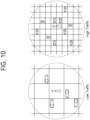
- FIG. 10 shows an example of adjusting the size of a tile.
- An RSU device can adjust the tile size according to the surrounding environment. Adjusting the tile size may include adjusting the size of the subscription area or adjusting the number of tiles included in the subscription area without changing the size of the subscription area. Also, adjusting the tile size may include adjusting the size of the publishing area or adjusting the number of tiles included in the presentation area without changing the size of the presentation area.
- the RSU can adjust the tile size according to the surrounding environment such as the speed of the V2X device, the traffic situation, the occurrence of an accident, etc. For example, in order to provide a more granular V2X service for each device, the tile size can be made smaller in a situation of high traffic than compared to a low traffic situation.
- FIG. 11 shows another example of adjusting the tile size.
- An RSU device may set tiles with different sizes within the RSU management area.
- the RSU can adjust the tile size for each V2X device or according to the surrounding environment of the V2X device.
- FIG. 12 shows an example of a message flow from a V2X device to a legacy V2X device.
- step S1210 an RSU sends a subscription request to a V2X server, and sets an RSU subscription area.
- a V2X device sends a subscription request to the V2X server, and sets the subscription area.
- the V2X device sends a V2X message to the V2X server.
- step S1230 if part or all of the RSU subscription area overlaps with the publishing area (and/or subscription area) of the V2X device, the V2X server delivers the V2X message to the RSU.
- step S1240 the RSU determines whether to relay the received V2X message.
- the RSU may consider the speed/direction/position of the V2X device.
- step S1250 the RSU converts the received V2X message into a legacy V2X message, and broadcasts the converted legacy V2X message.
- the legacy V2X device in the RSU management area may receive the broadcast legacy V2X message.
- the RSU converts the V2X message to the legacy V2X message
- the V2X server may process the conversion and send the converted legacy V2X message to the RSU.
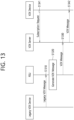
- FIG. 13 shows an example of a message flow from a legacy V2X device to a V2X device.
- step S1310 an RSU receives a legacy V2X message from a legacy V2X device.
- step S1320 the RSU generates a V2X message based on the legacy V2X message.
- the RSU calculates the publishing area of the legacy V2X device, and information about the publishing area may be included in the V2X message.
- step S1330 the RSU transmits a V2X message to a V2X server.
- step S1341 a V2X device sends a subscription request to the V2X server, and sets the subscription area.
- step S1342 the V2X server transmits the V2X message to the V2X device when the publishing area of the legacy V2X device overlaps with the subscription area. Accordingly, information of the legacy V2X device may be provided to the V2X device through the RSU.
- the RSU converts the legacy V2X message to the V2X message, but the RSU may deliver the legacy V2X message to the V2X server.
- the V2X server may process the conversion and send the converted V2X message to the V2X device.
- the RSU may receive an information message with traffic information from an ITS center.
- the RSU may generate a legacy V2X message or a V2X message based on the received information message.
- the RSU can send the generated V2X message to the V2X server.
Landscapes
- Engineering & Computer Science (AREA)
- Computer Networks & Wireless Communication (AREA)
- Signal Processing (AREA)
- Health & Medical Sciences (AREA)
- Computing Systems (AREA)
- General Health & Medical Sciences (AREA)
- Medical Informatics (AREA)
- Mobile Radio Communication Systems (AREA)
Applications Claiming Priority (1)
| Application Number | Priority Date | Filing Date | Title |
|---|---|---|---|
| PCT/KR2020/008509 WO2022004904A1 (ko) | 2020-06-30 | 2020-06-30 | V2x 서비스를 위한 로드 사이드 유닛 |
Publications (2)
| Publication Number | Publication Date |
|---|---|
| EP4175331A1 true EP4175331A1 (de) | 2023-05-03 |
| EP4175331A4 EP4175331A4 (de) | 2024-03-13 |
Family
ID=79316421
Family Applications (1)
| Application Number | Title | Priority Date | Filing Date |
|---|---|---|---|
| EP20942931.5A Pending EP4175331A4 (de) | 2020-06-30 | 2020-06-30 | Strassenseitige einheit für v2x-dienst |
Country Status (5)
| Country | Link |
|---|---|
| US (1) | US12250616B2 (de) |
| EP (1) | EP4175331A4 (de) |
| KR (1) | KR102865133B1 (de) |
| CN (1) | CN114766094B (de) |
| WO (1) | WO2022004904A1 (de) |
Families Citing this family (4)
| Publication number | Priority date | Publication date | Assignee | Title |
|---|---|---|---|---|
| CN118200353A (zh) * | 2020-12-28 | 2024-06-14 | 华为技术有限公司 | 用于车联网的数据传输方法、装置、存储介质和系统 |
| US12133079B2 (en) * | 2022-09-30 | 2024-10-29 | Ford Global Technologies, Llc | Pre-security message verification |
| US12538106B2 (en) * | 2023-05-30 | 2026-01-27 | Lg Electronics Inc. | Method and apparatus for operating user equipment supporting soft vehicle to everything related to bluetooth low energy |
| KR20250033906A (ko) | 2023-08-30 | 2025-03-10 | 한국공학대학교산학협력단 | 직진성 신호를 이용하여 전/후방 차량과 무선 통신을 수행하는 차량 제어 시스템 및 그 동작 방법 |
Family Cites Families (21)
| Publication number | Priority date | Publication date | Assignee | Title |
|---|---|---|---|---|
| US20130278441A1 (en) | 2012-04-24 | 2013-10-24 | Zetta Research and Development, LLC - ForC Series | Vehicle proxying |
| WO2016152097A1 (ja) * | 2015-03-20 | 2016-09-29 | 日本電気株式会社 | 車両通信システム、基地局、サーバ装置、メッセージ送信方法、車両関連サービス提供方法及び可読媒体 |
| US10554708B2 (en) | 2015-03-27 | 2020-02-04 | Qualcomm Incorporated | Point-to-multipoint broadcast assisted vehicle-to-X broadcast |
| WO2016209022A1 (ko) * | 2015-06-24 | 2016-12-29 | 엘지전자 주식회사 | V2x 통신에서의 알람 메시지 송신 방법 및 이를 위한 장치 |
| JP6805177B2 (ja) | 2015-07-13 | 2020-12-23 | インテル コーポレイション | V2x通信のための機器及びコンピュータプログラム |
| CN106507449B (zh) | 2015-09-07 | 2021-01-26 | 中兴通讯股份有限公司 | 车联网通信的控制方法及装置 |
| JP6812979B2 (ja) * | 2015-09-18 | 2021-01-13 | 日本電気株式会社 | Rsu装置、制御ノード、及びこれらの方法 |
| KR102105289B1 (ko) * | 2015-09-18 | 2020-04-28 | 닛본 덴끼 가부시끼가이샤 | 기지국, 무선 단말, 및 그들의 방법 |
| KR101714250B1 (ko) | 2015-10-28 | 2017-03-08 | 현대자동차주식회사 | 주변 차량의 이동 경로의 예측 방법 |
| CN113556691B (zh) * | 2016-04-01 | 2022-12-02 | 北京三星通信技术研究有限公司 | 一种发送v2x消息的方法及装置 |
| WO2017176329A1 (en) * | 2016-04-05 | 2017-10-12 | Intel IP Corporation | Devices and methods for mec v2x |
| US20170330457A1 (en) | 2016-05-10 | 2017-11-16 | Zte Corporation | Techniques for vehicle based message transmission and reception |
| WO2017206019A1 (zh) * | 2016-05-30 | 2017-12-07 | 华为技术有限公司 | 交通消息传递的方法、装置、车载终端及及服务器 |
| JP6699610B2 (ja) * | 2016-12-20 | 2020-05-27 | 株式会社オートネットワーク技術研究所 | 車車間通信システム、路側通信装置及び車車間通信方法 |
| MX2019008120A (es) * | 2017-01-05 | 2019-10-24 | Fraunhofer Ges Forschung | Generacion y uso de mapas de alta definicion (hd). |
| US20190173951A1 (en) * | 2017-12-01 | 2019-06-06 | GM Global Technology Operations LLC | Vehicle communication using publish-subscribe messaging protocol |
| CN110769021B (zh) * | 2018-07-26 | 2023-02-14 | 华为云计算技术有限公司 | 一种信息推送方法、装置及系统 |
| CN110784328B (zh) | 2018-07-27 | 2021-12-14 | 华为技术有限公司 | 一种车联网通信解决方案 |
| WO2020054812A1 (en) * | 2018-09-13 | 2020-03-19 | Sharp Kabushiki Kaisha | Selection of radio access technologies for v2x messages |
| EP3709594B1 (de) * | 2019-03-13 | 2023-09-13 | Nxp B.V. | Drahtlose fahrzeugkommunikationen mit kanalzuweisung |
| KR102103823B1 (ko) * | 2019-08-28 | 2020-04-24 | (주)세스트 | V2x 통신 시스템 및 그 처리 방법 |
-
2020
- 2020-06-30 CN CN202080085164.2A patent/CN114766094B/zh active Active
- 2020-06-30 US US17/776,879 patent/US12250616B2/en active Active
- 2020-06-30 WO PCT/KR2020/008509 patent/WO2022004904A1/ko not_active Ceased
- 2020-06-30 EP EP20942931.5A patent/EP4175331A4/de active Pending
- 2020-06-30 KR KR1020227010981A patent/KR102865133B1/ko active Active
Also Published As
| Publication number | Publication date |
|---|---|
| CN114766094A (zh) | 2022-07-19 |
| US20220345860A1 (en) | 2022-10-27 |
| KR20230029573A (ko) | 2023-03-03 |
| EP4175331A4 (de) | 2024-03-13 |
| CN114766094B (zh) | 2025-03-25 |
| KR102865133B1 (ko) | 2025-09-29 |
| US12250616B2 (en) | 2025-03-11 |
| WO2022004904A1 (ko) | 2022-01-06 |
Similar Documents
| Publication | Publication Date | Title |
|---|---|---|
| US12250616B2 (en) | Road side unit for V2X service | |
| US12464327B2 (en) | Device and server for multicast service | |
| EP4175332B1 (de) | Verfahren für v2x-dienst und vorrichtung damit | |
| EP4156730B1 (de) | Vorrichtung und verfahren für v2x-dienst | |
| EP4664941A1 (de) | Betriebsverfahren und vorrichtung zur gemeinsamen nutzung und übertragung von informationen im zusammenhang mit v2x-dienst über einen server und eine rsu-vorrichtung | |
| US12470900B2 (en) | Server and road side unit for V2X service | |
| US12225441B2 (en) | Server, method and device for V2X service | |
| US12375892B2 (en) | Device using local server for V2X service | |
| US12540998B2 (en) | Method and apparatus for operating server in relation to pre-assessment of risk |
Legal Events
| Date | Code | Title | Description |
|---|---|---|---|
| STAA | Information on the status of an ep patent application or granted ep patent |
Free format text: STATUS: THE INTERNATIONAL PUBLICATION HAS BEEN MADE |
|
| PUAI | Public reference made under article 153(3) epc to a published international application that has entered the european phase |
Free format text: ORIGINAL CODE: 0009012 |
|
| STAA | Information on the status of an ep patent application or granted ep patent |
Free format text: STATUS: REQUEST FOR EXAMINATION WAS MADE |
|
| 17P | Request for examination filed |
Effective date: 20220811 |
|
| AK | Designated contracting states |
Kind code of ref document: A1 Designated state(s): AL AT BE BG CH CY CZ DE DK EE ES FI FR GB GR HR HU IE IS IT LI LT LU LV MC MK MT NL NO PL PT RO RS SE SI SK SM TR |
|
| DAV | Request for validation of the european patent (deleted) | ||
| DAX | Request for extension of the european patent (deleted) | ||
| A4 | Supplementary search report drawn up and despatched |
Effective date: 20240208 |
|
| RIC1 | Information provided on ipc code assigned before grant |
Ipc: H04W 88/16 20090101ALI20240202BHEP Ipc: H04W 4/02 20180101ALI20240202BHEP Ipc: H04W 4/40 20180101AFI20240202BHEP |