EP4173847B1 - Fahrzeugluftreifen - Google Patents
Fahrzeugluftreifen Download PDFInfo
- Publication number
- EP4173847B1 EP4173847B1 EP22201514.1A EP22201514A EP4173847B1 EP 4173847 B1 EP4173847 B1 EP 4173847B1 EP 22201514 A EP22201514 A EP 22201514A EP 4173847 B1 EP4173847 B1 EP 4173847B1
- Authority
- EP
- European Patent Office
- Prior art keywords
- groove
- grooves
- blind
- rib
- blind grooves
- Prior art date
- Legal status (The legal status is an assumption and is not a legal conclusion. Google has not performed a legal analysis and makes no representation as to the accuracy of the status listed.)
- Active
Links
Images

Classifications
-
- B—PERFORMING OPERATIONS; TRANSPORTING
- B60—VEHICLES IN GENERAL
- B60C—VEHICLE TYRES; TYRE INFLATION; TYRE CHANGING; CONNECTING VALVES TO INFLATABLE ELASTIC BODIES IN GENERAL; DEVICES OR ARRANGEMENTS RELATED TO TYRES
- B60C11/00—Tyre tread bands; Tread patterns; Anti-skid inserts
- B60C11/03—Tread patterns
- B60C11/0306—Patterns comprising block rows or discontinuous ribs
-
- B—PERFORMING OPERATIONS; TRANSPORTING
- B60—VEHICLES IN GENERAL
- B60C—VEHICLE TYRES; TYRE INFLATION; TYRE CHANGING; CONNECTING VALVES TO INFLATABLE ELASTIC BODIES IN GENERAL; DEVICES OR ARRANGEMENTS RELATED TO TYRES
- B60C11/00—Tyre tread bands; Tread patterns; Anti-skid inserts
- B60C11/03—Tread patterns
- B60C2011/0337—Tread patterns characterised by particular design features of the pattern
- B60C2011/0339—Grooves
- B60C2011/0341—Circumferential grooves
- B60C2011/0344—Circumferential grooves provided at the equatorial plane
-
- B—PERFORMING OPERATIONS; TRANSPORTING
- B60—VEHICLES IN GENERAL
- B60C—VEHICLE TYRES; TYRE INFLATION; TYRE CHANGING; CONNECTING VALVES TO INFLATABLE ELASTIC BODIES IN GENERAL; DEVICES OR ARRANGEMENTS RELATED TO TYRES
- B60C11/00—Tyre tread bands; Tread patterns; Anti-skid inserts
- B60C11/03—Tread patterns
- B60C2011/0337—Tread patterns characterised by particular design features of the pattern
- B60C2011/0339—Grooves
- B60C2011/0358—Lateral grooves, i.e. having an angle of 45 to 90 degees to the equatorial plane
- B60C2011/0365—Lateral grooves, i.e. having an angle of 45 to 90 degees to the equatorial plane characterised by width
-
- B—PERFORMING OPERATIONS; TRANSPORTING
- B60—VEHICLES IN GENERAL
- B60C—VEHICLE TYRES; TYRE INFLATION; TYRE CHANGING; CONNECTING VALVES TO INFLATABLE ELASTIC BODIES IN GENERAL; DEVICES OR ARRANGEMENTS RELATED TO TYRES
- B60C11/00—Tyre tread bands; Tread patterns; Anti-skid inserts
- B60C11/03—Tread patterns
- B60C2011/0337—Tread patterns characterised by particular design features of the pattern
- B60C2011/0339—Grooves
- B60C2011/0358—Lateral grooves, i.e. having an angle of 45 to 90 degees to the equatorial plane
- B60C2011/0367—Lateral grooves, i.e. having an angle of 45 to 90 degees to the equatorial plane characterised by depth
- B60C2011/0369—Lateral grooves, i.e. having an angle of 45 to 90 degees to the equatorial plane characterised by depth with varying depth of the groove
-
- B—PERFORMING OPERATIONS; TRANSPORTING
- B60—VEHICLES IN GENERAL
- B60C—VEHICLE TYRES; TYRE INFLATION; TYRE CHANGING; CONNECTING VALVES TO INFLATABLE ELASTIC BODIES IN GENERAL; DEVICES OR ARRANGEMENTS RELATED TO TYRES
- B60C11/00—Tyre tread bands; Tread patterns; Anti-skid inserts
- B60C11/03—Tread patterns
- B60C2011/0337—Tread patterns characterised by particular design features of the pattern
- B60C2011/0339—Grooves
- B60C2011/0358—Lateral grooves, i.e. having an angle of 45 to 90 degees to the equatorial plane
- B60C2011/0372—Lateral grooves, i.e. having an angle of 45 to 90 degees to the equatorial plane with particular inclination angles
-
- B—PERFORMING OPERATIONS; TRANSPORTING
- B60—VEHICLES IN GENERAL
- B60C—VEHICLE TYRES; TYRE INFLATION; TYRE CHANGING; CONNECTING VALVES TO INFLATABLE ELASTIC BODIES IN GENERAL; DEVICES OR ARRANGEMENTS RELATED TO TYRES
- B60C11/00—Tyre tread bands; Tread patterns; Anti-skid inserts
- B60C11/03—Tread patterns
- B60C2011/0337—Tread patterns characterised by particular design features of the pattern
- B60C2011/0339—Grooves
- B60C2011/0381—Blind or isolated grooves
Definitions
- the invention relates to a pneumatic vehicle tire with a tread with at least one central profile rib, delimited on each side by a circumferential groove, with an outer rib surface located in the tread periphery, wherein the central profile rib is provided with first blind grooves opening into one circumferential groove and with second blind grooves opening into the other circumferential groove, offset from the first blind grooves in the circumferential direction and extending without overlapping with them in the circumferential direction, wherein each blind groove is delimited by two groove flanks, a groove base and an end flank located inside the profile rib, extending to the outer rib surface and having a maximum width of 2.5 mm to 10.0 mm.
- Such a pneumatic vehicle tire is known, for example, from EP 0 588 781 A1 known.
- the pneumatic vehicle tire has a tread with a central profile rib, which is bordered on each side by a circumferential groove and runs in the area of the tire's equatorial plane, and shoulder-side profile bands that are significantly wider than this.
- first blind grooves are formed that lead into one circumferential groove and second blind grooves lead into the other circumferential groove, offset from the first blind grooves in the circumferential direction and running without overlapping with them in the circumferential direction.
- transverse grooves are formed that extend beyond the lateral edges of the ground contact area and end at a distance in front of the respective circumferential groove.
- the tire should be suitable for high driving speeds and have good water drainage capacity and good handling properties.
- the tyre has a directional tread with a circumferential groove on each side, in the area the tire equatorial plane, which is provided with first blind grooves opening into one circumferential groove and second blind grooves opening into the other circumferential groove, offset from the first blind grooves in the circumferential direction and extending with no overlap in the circumferential direction.
- the blind grooves run continuously in a curved manner.
- the middle profile ribs are each provided with transverse grooves that lead into the adjacent circumferential grooves.
- the transverse grooves viewed from above, are each made up of an edge section that leads into one circumferential groove, an edge section that leads into the other circumferential groove and a central section, with one edge section being offset from the other edge section in the circumferential direction.
- the transverse grooves each have a constant, maximum width of 0.5 mm to 3.0 mm.
- the edge sections have a depth of 60% to 100% of the depth of the circumferential grooves.
- the central section ends in the radial direction at a depth of 5% to 40% of the depth of the circumferential grooves.
- the tire should have good drainage performance and uniform abrasion behavior.
- Another pneumatic vehicle tire is from the EP31732523 A1 known, whose tread has three circumferential grooves that separate four profile ribs from each other.
- the middle profile ribs are each provided with transverse grooves that flow into the adjacent circumferential grooves.
- the design of the grooves in the middle rows of blocks is intended to significantly improve wet performance.
- Tread ribs that are provided with blind grooves and do not have any transverse grooves running through them are more rigid than tread ribs with transverse grooves running through them and are beneficial in terms of tire-road noise because blind grooves, unlike transverse grooves running through them, counteract the propagation of sound waves along the tread pattern.
- snow can easily accumulate in blind grooves and is compacted more efficiently than in transverse grooves running through them, so blind grooves are particularly beneficial for traction properties on snow in this respect.
- Tread ribs with transverse grooves running through them are superior to tread ribs with blind grooves, especially in terms of their drainage properties. However, transverse grooves running through them are less effective with regard to snow-to-snow friction.
- the invention is therefore based on the object of resolving the conflicting objectives between traction behavior on snow and drainage performance better than before in a pneumatic vehicle tire of the type mentioned at the beginning, taking into account the lowest possible tire-road noise.
- the blind grooves become shallower towards their end flanks at least over a base section of their groove base on the inside of the rib adjoining the respective end flank and have their smallest depth in the area of the base section on the inside of the rib, wherein incision-like grooves are provided which extend from the outer surface of the rib and are narrower than the blind grooves, each of which runs between a first blind groove and a second blind groove, has a width of 0.4 mm to 4.0 mm and a maximum depth which is greater than the smallest depths of the blind grooves and, viewed in plan view, is each composed of three straight sections which enclose angles of 100° to 150° with one another, wherein the maximum width of the blind grooves is 130% to 250% of the width of the incision-like groove running between them.
- the notched groove running between the blind grooves is deeper in the radial direction than the adjacent areas of the blind grooves and is thus designed like a pocket, which allows snow to collect effectively in the notched groove when driving on snow.
- the angled The angled sections of the groove ensure that the accumulated snow is held firmly in place. The effect of snow-snow friction improves traction on snow. At the same time, the angled sections form a sound barrier, suppressing the propagation of sound waves through the groove combination formed, so that tire-road noise is kept to a minimum.
- the groove When driving on wet roads, the groove absorbs water and therefore contributes to the drainage of the tread rib, with water being quickly drained into the circumferential grooves via the blind grooves, which become shallower towards the groove and therefore deeper towards the circumferential groove. The drainage performance is therefore also improved.
- angles which the sections of the incision-like grooves form with one another are each 110° to 140°, preferably 115° to 135°. Incision-like grooves angled in this way resolve the aforementioned conflict of objectives between traction behavior on snow and drainage performance in a particularly advantageous manner.
- angles which the sections of the notch-like grooves enclose with each other lie on the same side of the notch-like groove.
- the maximum depth of the incision-like grooves is 55% to 100%, in particular 60% to 80%, preferably 65% to 70%, of the profile depth, wherein preferably at least the central section of each incision-like groove extends to the maximum depth over its entire extent.
- a further preferred embodiment is characterized in that the smallest depth of each blind groove is 10% to 40%, in particular 20% to 30%, preferably 25% to 35%, of the profile depth.
- the respective minimum depths are favorable for the drainage performance.
- the respective maximum depths are in view of the snow accumulation and the subsequent snow compaction in the incision-like groove is advantageous.
- the specified depth ranges lead to particularly advantageous balanced effects with regard to traction behavior on snow and drainage performance, so that this design contributes to a particularly favorable solution to the conflicting objectives.
- the smallest depth of each blind groove is 2.0 mm to 7.0 mm, in particular 2.0 mm to 4.0 mm, smaller than the maximum depth of the incision-like groove. This further improves above all the snow accumulation and the subsequent snow compaction in the incision-like groove.
- incision-like grooves are provided which open into one blind groove via one groove flank and into the other blind groove via the end flank.
- a further preferred embodiment is characterized in that the blind grooves and the notch-like grooves - based on the associated groove center line - each have a length determined on the rib outer surface and projected in the axial direction, wherein the length of the blind grooves is 20% to 45% of the width of the profile rib determined on the rib outer surface and projected in the axial direction and wherein the length of the notch-like grooves is 25% to 55%, in particular 35% to 45%, of the width of the profile rib determined on the rib outer surface and projected in the axial direction.
- the base section of the groove base of the blind grooves on the inside of the rib has a length of 65% to 90% of the length of the blind groove projected in the axial direction relative to the groove center line, determined on the outside of the rib.
- the base section of the groove base of the blind grooves on the inside of the ribs viewed in the longitudinal section through the blind grooves aligned along the groove center line, runs at a constant angle to the radial direction.
- the groove base of the blind grooves is made up of the base section on the inside of the rib and a base section on the outside of the rib, wherein the base section on the outside of the rib, viewed in the longitudinal section through the blind grooves aligned along the groove center line, has a constant distance of 1.0 mm to 2.0 mm, in particular 1.3 mm to 1.7 mm, from the level of the profile depth in the radial direction. This helps to maintain a certain rigidity at the edge areas of the profile rib and is beneficial for the traction properties on snow.
- the first blind grooves have an offset of 3.0 mm to 15.0 mm, in particular 4.0 mm to 10.0 mm, to the second blind grooves, determined between the end flanks in the circumferential direction, with the incision-like grooves running between blind grooves having this offset to one another.
- the offset is advantageous for the tire-road noise, and short drainage paths are formed within the groove combination, which are particularly advantageous for the drainage behavior.
- the maximum width of the sack grooves is 3.0 mm to 5.0 mm, the maximum width of the sack grooves being in particular 180% to 220% of the width of the notch-like groove running between them. Snow can collect particularly effectively in the correspondingly narrow, notch-like groove. The correspondingly wide sack grooves are good for drainage.
- the blind grooves viewed from above, run straight and in opposite directions with respect to the axial direction inclined to one another, with the first blind grooves running at an angle of 5 to 25°, in particular 10° to 20°, to the axial direction and the second blind grooves running at an angle of 25° to 45°, in particular 30° to 40°, to the axial direction. This is advantageous for the tire-road noise and for drainage.
- each rib block is provided with at least two, preferably three, incisions with a width of 0.4 mm to 1.0 mm and a depth of 30% to 90% of the profile depth, whereby these incisions include incisions that open into the blind grooves in the area of the base section on the inside of the rib and whereby these incisions preferably include incisions that run in addition to a circumferential groove.
- Such incisions additionally improve the drainage of the profile rib.
- Pneumatic vehicle tires designed according to the invention are tires for motor vehicles, in particular for multi-track motor vehicles, and preferably tires of radial design for passenger cars, vans or light trucks (small vans with GVW ⁇ 3.5 t, light trucks with GVW ⁇ 7.5 t).
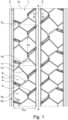
- Fig.1 shows a top view of a central section of a tread of a pneumatic vehicle tire.
- the tire equatorial plane is indicated by a line AA.
- the tread has two central profile ribs 1 running in the circumferential direction, which are separated by a central circumferential groove 2 that runs straight in plan view and are each delimited on the outside of the tread by a shoulder-side circumferential groove 3 that runs straight in plan view to shoulder-side profile ribs that are not shown.
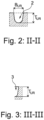
- the circumferential grooves 2, 3 are each in the intended profile depth T UR ( Fig. 2, Fig. 3 ), which for the preferred tire type is usually 6.5 mm to 13.0 mm, and have a width B UR ( Fig. 2 , shown for the central circumferential groove 2) of preferably 6.0 mm to 13.0 mm. If the circumferential grooves 2, 3 are of different depths, the tread depth T UR is understood to be the depth of the deeper circumferential groove 2, 3.
- middle profile ribs 1 which will be discussed in more detail below, is such in the exemplary embodiment that one middle profile rib 1 can be transferred into the other middle profile rib 1 by a 180° rotation.
- the shoulder-side profile ribs (not shown) are designed asymmetrically in a manner analogous to the middle profile ribs 1, so that the tread is aligned with respect to the tire equatorial plane (line AA) has an asymmetrical shape and the vehicle pneumatic tire has no preferred orientation on the vehicle axis.
- Each central profile rib 1 has an outer rib surface 1a located in the tread periphery and a width b PR determined on the outer rib surface 1a in the axial direction and is provided with a number of blind grooves 4 following one another in the circumferential direction and a number of blind grooves 5 following one another in the circumferential direction, the number of blind grooves 4 corresponding to the number of blind grooves 5.
- the blind grooves 4 run parallel to one another, straight and rising to the left, i.e. from bottom right to top left, and open into the respective shoulder-side circumferential groove 3.
- the blind grooves 5 run, viewed in the plan view mentioned, parallel to one another, straight and rising to the right, i.e.
- blind grooves 4 from bottom left to top right, open into the central circumferential groove 2, are offset from the blind grooves 4 in the circumferential direction and run with no overlap to the blind grooves 4 in the circumferential direction.
- "Running without overlap” means that between the blind grooves 4 and the blind grooves 5 there is a circumferential section of the respective middle profile rib 1 that is free of blind grooves 4, 5 (section running all the way around in the circumferential direction).
- the blind grooves 5 from one middle profile rib 1 essentially run in continuation of the blind grooves 5 from the other middle profile rib 1.
- each middle profile rib 1 incision-like grooves 6 are formed which run parallel to one another in plan view and between a blind groove 4 and a blind groove 5, with incision-like grooves 6 running between all blind grooves 4, 5 and with one incision-like groove 6 together with the adjoining blind grooves 4, 5 forming a groove combination K which traverses the respective middle profile rib 1.
- the groove combinations K structure the respective middle profile rib 1 into rib blocks 1b which follow one another in the circumferential direction, with groove combinations K which follow one another in the circumferential direction being separated from one another in the circumferential direction as smallest possible distances determined mutual distances a 1 of preferably 20.0 mm to 35.0 mm.
- the left-rising blind grooves 4 viewed in plan view and in each case relative to a groove center line m SR1 following the groove course, extend to the axial direction at an angle ⁇ of 5° to 25°, in particular from 10° to 20°
- the blind grooves 4, 5 belonging to the same groove combination K are designed to be offset in the circumferential direction in such a way that between those ends of the blind grooves 4, 5 which are the furthest apart from each other in the circumferential direction - in the exemplary embodiment, these ends are the rib-inside end of the blind groove 4 and the rib-outside end of the blind groove 5 - there is a largest offset v 1 determined in the circumferential direction and related to the groove center lines m SR1 , m SR2 .
- the blind groove 4, 5 - each determined at the level of the rib outer surface 1a - has a maximum width b SR1 (blind groove 4), b SR2 (blind groove 5) measured perpendicular to the groove center line m SR1 , m SR2 of 2.5 mm to 10.0 mm, in particular from 3.0 mm to 5.0 mm, and a length c SR1 (blind groove 4), c SR2 (blind groove 5) projected in the axial direction relative to the groove center line m SR1 , m SR2 , wherein the length c SR1 is 20% to 45%, in particular up to 30%, of the already mentioned width b PR of the middle profile rib 1 and the length c SR2 is 20% to 45%, in particular 30% to 40%, preferably at least 35%, of the width b PR of the middle profile rib 1
- the blind groove 4, 5 is formed by two groove flanks 4a (blind groove 4, cf.
- the blind grooves 4, 5 belonging to the same groove combination K have an offset v 2 of preferably 3.0 mm to 15.0 mm, particularly preferably 4.0 mm to 10.0 mm, determined between their end flanks 4c, 5c in the circumferential direction and related to the groove center lines m SR1 , m SR2 .
- angles ⁇ and ⁇ already mentioned and the offset v 2 are in particular coordinated with one another in such a way that an auxiliary line h 1 running in a straight extension of the groove center line m SR2 in plan view intersects the groove center line m SR1 .
- the groove flanks 4a, 5a viewed in the cross-section oriented perpendicular to the associated groove center line m SR1 , m SR2 in plan view, run to the radial direction at preferably corresponding angles ⁇ of 0° to 5°, in particular of 1° to 3°.
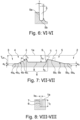
- the groove base 4b, 5b is, viewed in the last mentioned cross section, flat U-shaped and continues - as Fig.7 in combination with Fig.4 shows - viewed in the longitudinal section through the blind groove 4, 5 aligned along the respective groove center line m SR1 , m SR2 , from a base section 4b a (groove base 4b), 5b a (groove base 5b) on the outside of the rib that runs to the shoulder-side circumferential groove 3 (blind groove 4) or to the central circumferential groove 2 (blind groove 5), a base section 4b i (groove base 4b), 5b i (groove base 5b) on the inside of the rib that runs in a ramp-like manner and adjoins the end flank 4c or 5c, as well as an optional transition rounding 4bü (groove base 4b), 5bü (groove base 5b) formed between the two base sections 4b a , 4b i or 5b a , 5
- the base section 4b a , 5b a on the outside of the rib has a constant distance a 2 of 1.0 mm to 2.0 mm, in particular 1.3 mm to 1.7 mm, from the level of the profile depth T UR in the radial direction.
- the base section 4b i , 5b i on the inside of the rib has a length c 1 ( Fig.4 , basic section 4b i ), c 2 ( Fig.4 , basic section 5b i ), where the length c 1 is 65% to 85% of the length c SR1 ( Fig.4 ) of the blind groove 4 and the length c 2 80% to 90% of length c SR2 ( Fig.4 ) of the blind groove 5.
- the base section 4b i , 5b i on the inside of the rib is, viewed in the longitudinal section mentioned, inclined to the radial direction at a constant angle ⁇ (base section 4b i ), ⁇ (base section 5b i ), the inclination being such that the blind groove 4, 5 extends over the extension of the base section 4b i , 5b i starting from the end of the base section 4b i , 5b i on the outside of the rib, which is closer to the circumferential groove 2 or 3, in the direction of the end flank 4c, 5c ( Fig.4 ) becomes continuously shallower and has a minimum depth t 1 (depth at the shallowest point, shown only for the base section 4b i) determined in the radial direction of 10% to 40%, in particular 20% to 30%, preferably 25% to 35%, of the profile depth T UR in the area of the base section 4b i , 5b i .
- the end flank 4c, 5c runs, viewed in the longitudinal section mentioned, in the radial direction or at an angle of up to 3° to this and has a boundary edge 4c' ( Fig.4 , end flank 4c), 5c' ( Fig.4 , end flank 5c) which, viewed in plan view, runs at an angle of 0° to +/- 3°, in particular 0°, to the circumferential direction.
- the incision-like groove 6 is made up, viewed in plan view, of a straight central section 6a, a straight lateral section 6b running to the end flank 4c and a straight lateral section 6c running to the groove flank 5a, wherein the central section 6a forms an angle ⁇ of 100° to 150°, in particular of 110° to 140° with each lateral section 6b, 6c - based on a groove center line m R following the groove course in plan view. preferably from 115° to 135°, and the notch-like groove 6 is trapezoidal in shape so that the angles ⁇ are on the same side of the groove center line m R.
- the notch-like groove 6 is formed by two groove flanks 7 running in the radial direction (cf. Fig.8 ), a groove base 8 and two end flanks 9 located on the blind grooves 4, 5 ( Fig.7 ) is limited.
- the incision-like groove 6 has a constant width b R between the groove flanks 7 (cf. Fig.8 ) of 0.4 mm to 4.0 mm, preferably of 0.8 mm to 2.0 mm, in particular of up to 1.2 mm, a length c R , determined at the level of the rib outer surface 1a, related to the groove center line m R , projected in the axial direction, of 25% to 55%, preferably of 35% to 45%, of the width b PR of the profile rib 1 and - as Fig.8 shows - in the radial direction a maximum depth t R (depth at the deepest point) of 55% to 100%, in particular 60% to 80%, preferably 65% to 70%, profile depth T UR , determined relative to the level of the rib outer surface 1a and greater than the mentioned smallest depths t 1 of the blind grooves 4, 5, wherein the groove 6, viewed in the longitudinal section running along the groove center line m R , is trough-shaped.
- the maximum depth t R of the incision-like groove 6 and the already mentioned smallest depth t 1 of each blind groove 4, 5 are preferably coordinated with one another in such a way that the smallest depth t 1 of each blind groove 4, 5 is 2.0 mm to 7.0 mm, in particular 2.0 mm to 4.0 mm, smaller than the maximum depth t R of the groove 6.
- the central section 6a viewed in plan view, runs at least over the majority of the length c R of the groove 6 and parallel to the blind groove 5 and extends over its entire extent to the mentioned maximum depth t R (cf. Fig.7 ).
- the lateral section 6b runs in plan view and in relation to the groove center line m R in extension of the groove center line m SR1 of the blind groove 4.
- the lateral section 6c runs in plan view and in relation to the groove center line m R in the circumferential direction.
- the groove base 8 runs at the mentioned maximum depth t R (cf. Fig.7 ), ends at the side sections 6b, 6c or can - as in Fig.4 shown - extend slightly into the lateral sections 6b, 6c.
- the end flanks 9, viewed in the longitudinal section aligned along the groove center line m R are elongated S-shaped in the radial direction, connect both continuously (without kinks) to the groove base 8 and continuously to the base sections 4b i and 5b i and run - in each case with respect to a straight auxiliary line h 2 connecting their two ends - to the radial direction at an angle ⁇ of 30° to 50°, in particular of 35° to 45°.
- the end flanks 9 can have a sharp mouth edge at their radially outer end located on the blind groove 4, 5, so that they do not connect continuously to the respective base section 4b i , 5b i .
- each rib block 1b has three incisions 10, 11, 12 with a width of 0.4 mm to 1.0 mm and a depth of 30% to 90% of the profile depth T UR ( Fig. 2, Fig. 3 ) trained.
- the incisions 10, 11 originate from the same groove combination K, wherein the incision 10, viewed in plan view, runs straight, to the axial direction at an angle ⁇ of 35° to 55° and between the corresponding groove 6 and the central circumferential groove 2, and wherein the incision 10 opens into the groove 6 on the outside of the bend of the mutual connection area of the sections 6a, 6c.
- the incision 11 runs between the blind groove 4 and the respective shoulder-side circumferential groove 3 and, viewed in plan view, is composed of an incision section 11a running in the circumferential direction and adjoining the blind groove 4, and an incision section 11b running to the shoulder-side circumferential groove 3 and to the axial direction at an angle ⁇ of 25° to 45°.
- the incision 12 runs, viewed in plan view, straight and at an angle ⁇ of 35° to 55° to the axial direction, opens into the incision 11 at the mutual connection area of the incision sections 11a, 11b or ends just before the incision 11 and runs to the blind groove 5 of that groove combination K from which the incisions 10, 11 in this rib block 1b.
- the incisions 11, 12 give each rib block 1b four block segments 1b'.
- the incisions are optional. At least one central profile rib with blind grooves and incision-like grooves running between them is provided.
- the incision-like grooves running between the blind grooves can also be made up of three sections in such a way that they do not run trapezoidally, but in a zigzag shape, i.e. slightly Z-shaped or mirrored Z-shaped.
- the circumferential grooves can each run in a wave-like or zigzag shape in a plan view.
- the width of the profile rib determined on the outer surface of the rib in the axial direction is determined as the maximum width (width at the widest point(s) of the profile rib).
Landscapes
- Engineering & Computer Science (AREA)
- Mechanical Engineering (AREA)
- Tires In General (AREA)
Description
- Die Erfindung betrifft einen Fahrzeugluftreifen mit einem Laufstreifen mit zumindest einer, an jeder Seite von einer Umfangsrille begrenzten mittleren Profilrippe mit einer in der Laufstreifenperipherie liegenden Rippenaußenfläche, wobei die mittlere Profilrippe mit in die eine Umfangsrille einmündenden ersten Sackrillen und mit in die andere Umfangsrille einmündenden, zu den ersten Sackrillen in Umfangsrichtung versetzt ausgebildeten und zu diesen bezüglich der Umfangsrichtung überlappungsfrei verlaufenden, zweiten Sackrillen versehen ist, wobei jede Sackrille durch zwei Rillenflanken, einen Rillengrund sowie eine im Inneren der Profilrippe liegende, zur Rippenaußenfläche verlaufende Endflanke begrenzt ist und eine maximale Breite von 2,5 mm bis 10,0 mm aufweist.
- Ein derartiger Fahrzeugluftreifen ist beispielsweise aus der
EP 0 588 781 A1 bekannt. Der Fahrzeugluftreifen weist einen Laufstreifen mit einer an jeder Seite von je einer Umfangsrille begrenzten, im Bereich der Reifenäquatorialebene verlaufenden, mittleren Profilrippe und gegenüber dieser deutlich breiter ausgeführten, schulterseitigen Profilbändern auf. In der mittleren Profilrippe sind in die eine Umfangsrille einmündende, erste Sackrillen und in die andere Umfangsrille einmündende, zu den ersten Sackrillen in Umfangsrichtung versetzte und bezüglich der Umfangsrichtung zu diesen überlappungsfrei verlaufende zweite Sackrillen ausgebildet. In den schulterseitigen Profilbändern sind über die seitlichen Ränder der Bodenaufstandsfläche hinausverlaufende Querrillen ausgebildet, welche in einem Abstand vor der jeweiligen Umfangsrille enden. Der Reifen soll für hohe Fahrgeschwindigkeiten geeignet sein und eine gutes Wasserdrainagevermögen sowie gute Handlingeigenschaften aufweisen. - Ein weiterer Fahrzeuglauftreifen der eingangs genannten Art ist aus der
EP 0 863 026 A2 bekannt. Der Reifen weist einen laufrichtungsgebundenen Laufstreifen mit einer an jeder Seite von einer Umfangsrille begrenzten, im Bereich der Reifenäquatorialebene verlaufenden, mittleren Profilrippe auf, welche mit in die eine Umfangsrille einmündenden, ersten Sackrillen und in die andere Umfangsrille einmündenden, zu den ersten Sackrillen in Umfangsrichtung versetzten und bezüglich der Umfangsrichtung zu diesen überlappungsfrei verlaufenden, zweiten Sackrillen versehen ist. Die Sackrillen verlaufen durchgehend gebogen. - Aus der
EP 3 888 944 A1 ist ein Fahrzeugluftreifen mit einem Laufstreifen mit vier Umfangsrillen, welche fünf Profilrippen voneinander trennen, bekannt. Die mittleren Profilrippen sind jeweils mit in die angrenzenden Umfangsrillen einmündenden Querrillen versehen. Die Querrillen setzten sich, in Draufsicht betrachtet, jeweils aus einem in die eine Umfangsrille einmündenden, randseitigen Abschnitt, einem in die andere Umfangsrille einmündenden, randseitigen Abschnitt und einem zentralen Abschnitt zusammen, wobei der eine randseitige Abschnitt zum anderen randseitigen Abschnitt in Umfangsrichtung versetzt ausgebildet ist. Die Querrillen weisen jeweils eine konstante, maximale Breite von 0,5 mm bis 3,0 mm auf. Die randseitigen Abschnitte weisen eine Tiefe von 60% bis 100% der Tiefe der Umfangsrillen auf. Der zentrale Abschnitt endet in radialer Richtung in einer Tiefe von 5% bis 40% der Tiefe der Umfangsrillen. Der Reifen soll eine gute Entwässerungsperformance sowie ein gleichmäßiges Abriebverhalten aufweisen. Ein weiterer Fahrzeugluftreifen ist aus derEP31732523 A1 - Profilrippen, welche mit Sackrillen versehen sind und keine durchquerenden Querrillen aufweisen, zeigen -gegenüber Profilrippen mit durchquerenden Querrillen - eine höhere Steifigkeit und sind - da Sackrillen im Gegensatz zu durchquerenden Querrillen der Ausbreitung von Schallwellen am Laufstreifenprofil entgegenwirken - im Hinblick auf das Reifen-Fahrbahn-Geräusch günstig. Auf Schneefahrbahnen kann sich in Sackrillen gut Schnee ansammeln, insbesondere wird dieser effizienter verdichtet als in durchquerenden Querrillen, sodass Sackrillen in dieser Hinsicht für die Traktionseigenschaften auf Schnee besonders vorteilhaft sind.
- Profilrippen mit durchquerenden Querrillen sind Profilrippen mit Sackrillen vor allem hinsichtlich ihres Entwässerungsverhaltens überlegen. Im Hinblick auf Schnee-Schnee-Reibung sind durchquerende Querrillen jedoch weniger effektiv.
- Zwischen dem Traktionsverhalten auf Schnee sowie der Entwässerungsperformance liegt somit ein Zielkonflikt vor - die Verbesserung der einen Eigenschaft geht üblicherweise mit der Verschlechterung der anderen Eigenschaft einher.
- Der Erfindung liegt daher die Aufgabe zugrunde, bei einem Fahrzeugluftreifen der eingangs genannten Art unter Bedachtnahme auf ein möglichst geringes Reifen-Fahrbahn-Geräusch den Zielkonflikt zwischen dem Traktionsverhalten auf Schnee und der Entwässerungsperformance besser als bisher zu lösen.
- Gelöst wird die gestellte Aufgabe erfindungsgemäß dadurch, dass die Sackrillen zumindest über einen an die jeweilige Endflanke anschließenden rippeninnenseitigen Grundabschnitt ihres Rillengrundes zu ihren Endflanken seichter werden und im Bereich des rippeninnenseitigen Grundabschnittes ihre kleinste Tiefe aufweisen, wobei von der Rippenaußenfläche ausgehende, schmäler als die Sackrillen ausgeführte, einschnittartige Rillen vorgesehen sind, welche jeweils zwischen einer ersten Sackrille und einer zweiten Sackrille verlaufen, eine Breite von 0,4 mm bis 4,0 mm und eine gegenüber den kleinsten Tiefen der Sackrillen größer ausgeführte maximale Tiefe aufweisen und sich, in Draufsicht betrachtet, jeweils aus drei gerade verlaufenden, miteinander Winkeln von je 100° bis 150° einschließenden Abschnitten zusammensetzen, wobei die maximale Breite der Sackrillen 130% bis 250% der Breite der zwischen ihnen verlaufenden einschnittartigen Rille beträgt.
- Die zwischen den Sackrillen verlaufende einschnittartige Rille ist gegenüber den angrenzenden Bereichen der Sackrillen in radialer Richtung tiefer und somit taschenartig ausgeführt, wodurch sich beim Fahren auf Schnee in der einschnittartigen Rille auf effektive Weise Schnee ansammeln kann. Die gewinkelt verlaufenden Abschnitte der einschnittartigen Rille sorgen für einen guten Halt des angesammelten Schnees. Über den Effekt der Schnee-Schnee-Reibung ist somit das Traktionsverhalten auf Schnee verbessert. Gleichzeitig bilden die gewinkelt verlaufenden Abschnitte eine Schallbarriere, sie unterdrücken also die Ausbreitung von Schallwellen durch die gebildete Rillenkombination, sodass ein geringes Reifen-Fahrbahn-Geräusch erhalten bleibt. Beim Fahren auf nasser Fahrbahn nimmt die einschnittartige Rille Wasser auf, trägt daher zur Entwässerung der Profilrippe bei, wobei über die zur einschnittartigen Rille seichter werdenden, daher zu den Umfangsrille tiefer werdenden Sackrillen Wasser zügig in die Umfangsrillen abgeleitet wird. Die Entwässerungsperformance ist daher ebenfalls verbessert.
- Gemäß einer bevorzugten Ausführung betragen die Winkel, welche die Abschnitte der einschnittartigen Rillen miteinander einschließen, jeweils 110° bis 140°, bevorzugt 115° bis 135°. Derart gewinkelte einschnittartige Rillen lösen den erwähnten Zielkonflikt zwischen dem Traktionsverhalten auf Schnee und der Entwässerungsperformance auf besonders vorteilhafte Weise.
- Gemäß einer weiteren bevorzugten Ausführung liegen die Winkel, welche die Abschnitte der einschnittartigen Rillen miteinander einschließen, an derselben Seite der einschnittartigen Rille.
- Im Hinblick auf die Entwässerungsperformance ist es günstig, wenn die maximale Tiefe der einschnittartigen Rillen 55% bis 100%, insbesondere 60% bis 80%, bevorzugt 65% bis 70%, der Profiltiefe beträgt, wobei vorzugsweise zumindest der zentrale Abschnitt jeder einschnittartigen Rille über ihre gesamte Erstreckung auf die maximale Tiefe reicht.
- Eine weitere bevorzugten Ausführung ist dadurch gekennzeichnet, dass die kleinste Tiefe jeder Sackrille 10% bis 40%, insbesondere 20% bis 30%, bevorzugt 25% bis 35%, der Profiltiefe beträgt. Die jeweiligen Mindesttiefen sind für die Entwässerungsperformance günstig. Die jeweiligen Maximaltiefen sind im Hinblick auf die Schneeansammlung und die darauffolgende Schneeverdichtung in der einschnittartigen Rille von Vorteil. Die angegebenen Tiefenbereiche führen zu besonders vorteilhaft ausgeglichenen Effekten bezüglich des Traktionsverhaltens auf Schnee und bezüglich der Entwässerungsperformance, sodass diese Ausführung zu einer besonders günstigen Lösung des Zielkonfliktes beiträgt.
- Gemäß einer weiteren bevorzugten Ausführung ist die kleinste Tiefe jeder Sackrille um 2,0 mm bis 7,0 mm, insbesondere um 2,0 mm bis 4,0 mm, kleiner als die maximale Tiefe der einschnittartigen Rille. Dies verbessert vor allem die Schneeansammlung und die darauffolgende Schneeverdichtung in der einschnittartigen Rille weiter.
- Bevorzugter Weise sind einschnittartige Rillen vorgesehen, welche in die eine Sackrille über eine Rillenflanke und in die andere Sackrille über die Endflanke einmünden.
- Eine weitere bevorzugte Ausführung ist dadurch gekennzeichnet, dass die Sackrillen und die einschnittartigen Rillen - bezogen die zugehörige Rillenmittmittellinie - jeweils eine an der Rippenaußenfläche ermittelte, in die axiale Richtung projizierte Länge aufweisen, wobei die Länge der Sackrillen 20% bis 45% der an der Rippenaußenfläche ermittelten, in die axiale Richtung projizierten Breite der Profilrippe beträgt und wobei die Länge der einschnittartigen Rillen 25% bis 55%, insbesondere 35% bis 45%, der an der Rippenaußenfläche ermittelten, in die axiale Richtung projizierten Breite der Profilrippe beträgt.
- Ferner trägt es zu einer besonders vorteilhaften Lösung des Zielkonfliktes zwischen dem Traktionsverhalten auf Schnee und der Entwässerungsperformance bei, wenn der rippeninnenseitige Grundabschnitt des Rillengrundes der Sackrillen eine an der Rippenaußenfläche ermittelte, auf die Rillenmittellinie bezogene, in die axiale Richtung projizierte Länge von 65% bis 90% der auf die Rillenmittellinie bezogenen, in axiale Richtung projizierten Länge der Sackrille aufweist.
- Für die Entwässerung ist ferner günstig, wenn der rippeninnenseitige Grundabschnitt des Rillengrundes der Sackrillen, im entlang der Rillenmittellinie ausgerichteten Längsschnitt durch die Sackrillen betrachtet, zur radialen Richtung unter einem konstanten Winkel verläuft.
- Gemäß einer weiteren bevorzugten Ausführung setzt sich der Rillengrund der Sackrillen aus dem rippeninnenseitigen Grundabschnitt und einem rippenaußenseitigen Grundabschnitt zusammen, wobei der rippenaußenseitige Grundabschnitt, im entlang der Rillenmittellinie ausgerichteten Längsschnitt durch die Sackrillen betrachtet, zum Niveau der Profiltiefe in radialer Richtung einen konstanten Abstand von 1,0 mm bis 2,0 mm, insbesondere von 1,3 mm bis 1,7 mm aufweist. Dies trägt zur Aufrechterhaltung einer gewissen Steifigkeit an den Randbereichen der Profilrippe bei und ist für die Traktionseigenschaften auf Schnee günstig.
- Bevorzugt weisen die ersten Sackrillen zu den zweiten Sackrillen einen zwischen den Endflanken in Umfangsrichtung ermittelten Versatz von 3,0 mm bis 15,0 mm, insbesondere von 4,0 mm bis 10,0 mm, auf, wobei die einschnittartigen Rillen zwischen diesen Versatz zueinander aufweisenden Sackrillen verlaufen. Der Versatz ist einerseits für das Reifen-Fahrbahn-Geräusch vorteilhaft, wobei ferner innerhalb der Rillenkombination für das Entwässerungsverhalt besonders vorteilhafte, kurze Drainagewege gebildet sind.
- Gemäß einer weiteren bevorzugten Ausführung beträgt die maximale Breite der Sackrillen 3,0 mm bis 5,0 mm, wobei die maximale Breite der Sackrillen insbesondere 180% bis 220% der Breite der zwischen ihnen verlaufenden einschnittartigen Rille beträgt. In der entsprechend schmalen, einschnittartigen Rille kann sich Schnee besonders effektiv ansammeln. Die entsprechend breiten Sackrillen sind für die Entwässerung günstig.
- Gemäß einer weiteren bevorzugten Ausführung verlaufen die Sackrillen, in Draufsicht betrachtet, gerade sowie bezüglich der axialen Richtung gegensinnig zueinander geneigt, wobei die ersten Sackrillen zur axialen Richtung unter einem Winkel von 5 bis 25°, insbesondere von 10° bis 20°, und die zweiten Sackrillen zur axialen Richtung unter einem Winkel von 25° bis 45°, insbesondere von 30° bis 40°, verlaufen. Dies ist für das Reifen-Fahrbahn-Geräusch sowie für die Entwässerung vorteilhaft.
- Durch die Sackrillen und einschnittartigen Rillen ist die mittlere Profilrippe in in Umfangsrichtung aufeinanderfolgende Rippenblöcke strukturiert. Bevorzugter Weise ist jeder Rippenblock mit zumindest zwei, bevorzugt mit drei, Einschnitten mit einer Breite von 0,4 mm bis 1,0 mm und einer Tiefe von 30% bis 90% der Profiltiefe versehen, wobei zu diesen Einschnitten Einschnitte gehören, welche im Bereich des rippeninnenseitigen Grundabschnittes in die Sackrillen einmünden und wobei zu diesen Einschnitten vorzugsweise Einschnitte gehören, welche zusätzlich zu einer Umfangsrille verlaufen. Solche Einschnitte verbessern die Entwässerung der Profilrippe zusätzlich.
- Weitere Merkmale, Vorteile und Einzelheiten der Erfindung werden nun anhand der Zeichnung, die schematisch ein Ausführungsbeispiel der Erfindung zeigt, näher beschrieben. Dabei zeigen
-
Fig. 1 eine vereinfachte Draufsicht auf einen in die Ebene abgewickelten Ausschnitt eines Laufstreifens eines Fahrzeugluftreifens mit einer Ausführungsvariante der Erfindung, -
Fig. 2 einen Schnitt entlang der Linie II-II derFig. 1 , -
Fig. 3 einen Schnitt entlang der Linie III-III derFig. 1 , -
Fig. 4 eine vergrößerte Draufsicht auf das Detail Z4 derFig. 1 , -
Fig. 5 einen Schnitt entlang der Linie V-V derFig. 4 , -
Fig. 6 einen Schnitt entlang der Linie VI-VI derFig. 4 , -
Fig. 7 einen Schnitt entlang der Linie VII-VII derFig. 4 und -
Fig. 8 einen Schnitt entlang der Linie VIII-VIII derFig. 4 . - Gemäß der Erfindung ausgeführte Fahrzeugluftreifen sind Reifen für Kraftfahrzeuge, insbesondere für mehrspurige Kraftfahrzeuge, sowie vorzugsweise Reifen in Radialbauart für Personenkraftwagen, Vans oder Light-Trucks (Kleintransporter mit zGM ≤ 3,5 t, leichte LKWs mit zGM ≤ 7,5 t).
-
Fig. 1 zeigt eine Draufsicht auf einen zentralen Ausschnitt eines Laufstreifens eines Fahrzeugluftreifens. Die Reifenäquatorialebene ist durch eine Linie A-A angedeutet. Der Laufstreifen weist zwei in Umfangsrichtung umlaufende mittlere Profilrippen 1 auf, welche durch eine in Draufsicht gerade verlaufende, zentrale Umfangsrille 2 getrennt und laufstreifenaußenseitig jeweils durch eine in Draufsicht gerade verlaufende schulterseitige Umfangsrille 3 zu nicht gezeigten schulterseitigen Profilrippen begrenzt sind. Die Umfangsrillen 2, 3 sind jeweils in der vorgesehenen Profiltiefe TUR (Fig. 2, Fig. 3 ) ausgeführt, welche für den bevorzugten Reifentyp üblicherweise 6,5 mm bis 13,0 mm beträgt, und weisen an der Laufstreifenperipherie in axialer Richtung jeweils eine Breite BUR (Fig. 2 , gezeigt für die zentrale Umfangsrille 2) von vorzugsweise 6,0 mm bis 13,0 mm auf. Sind die Umfangsrillen 2, 3 verschieden tief ausgeführt, wird unter der Profiltiefe TUR die Tiefe der tieferen Umfangsrille 2, 3 verstanden. - Die Ausgestaltung der mittleren Profilrippen 1, auf welche noch genauer eingegangen wird, ist beim Ausführungsbeispiel derart, dass die eine mittlere Profilrippe 1 durch eine 180°-Drehung in die andere mittlere Profilrippe 1 überführbar ist. Bevorzugter Weise sind die nicht gezeigten schulterseitigen Profilrippen in analoger Weise zu den mittleren Profilrippen 1 asymmetrisch ausgeführt, sodass der Laufstreifen bezüglich der Reifenäquatorialebene (Linie A-A) eine asymmetrische Gestalt aufweist und der Fahrzeugluftreifen keine bevorzugte Orientierung auf der Achse des Fahrzeuges besitzt.
- Jede mittlere Profilrippe 1 weist eine in der Laufstreifenperipherie liegende Rippenaußenfläche 1a sowie eine an der Rippenaußenfläche 1a in axialer Richtung ermittelte Breite bPR auf und ist mit einer Anzahl von in Umfangsrichtung aufeinanderfolgenden Sackrillen 4 und einer Anzahl von in Umfangsrichtung aufeinanderfolgenden Sackrillen 5 versehen, wobei die Anzahl der Sackrillen 4 mit der Anzahl der Sackrillen 5 übereinstimmt. Die Sackrillen 4 verlaufen, betrachtet in Draufsicht auf den Laufstreifen und vertikal verlaufender Reifenäquatorialebene (Linie A-A), parallel zueinander, gerade sowie linkssteigend, also von rechts unten nach links oben, und münden in die jeweilige schulterseitige Umfangsrille 3 ein. Die Sackrillen 5 verlaufen, in der erwähnten Draufsicht betrachtet, parallel zueinander, gerade sowie rechtssteigend, also von links unten nach rechts oben, münden in die zentrale Umfangsrille 2 ein, sind zu den Sackrillen 4 in Umfangsrichtung versetzt und verlaufen bezüglich der Umfangsrichtung überlappungsfrei zu den Sackrillen 4. "Überlappungsfrei verlaufen" bedeutet, dass zwischen den Sackrillen 4 und den Sackrillen 5 ein von Sackrillen 4, 5 freier Umfangsabschnitt (in Umfangsrichtung umlaufender Abschnitt) der jeweiligen mittleren Profilrippe 1 vorhanden ist. Die Sackrillen 5 aus der einen mittleren Profilrippe 1 verlaufen im Wesentlichen in Fortsetzung zu den Sackrillen 5 aus der anderen mittleren Profilrippe 1.
- In jeder mittleren Profilrippe 1 sind darüber hinaus in Draufsicht parallel zueinander sowie jeweils zwischen einer Sackrille 4 und einer Sackrille 5 verlaufende einschnittartige Rillen 6 ausgebildet, wobei zwischen sämtlichen Sackrillen 4, 5 einschnittartige Rillen 6 verlaufen und wobei je eine einschnittartige Rille 6 gemeinsam mit den anschließenden Sackrillen 4, 5 eine die jeweilige mittlere Profilrippe 1 durchquerende Rillenkombination K bildet. Die Rillenkombinationen K strukturieren die jeweilige mittlere Profilrippe 1 in in Umfangsrichtung aufeinanderfolgende Rippenblöcke 1b, wobei in Umfangsrichtung aufeinanderfolgende Rillenkombinationen K in Umfangsrichtung voneinander als kleinstmögliche Abstände ermittelte gegenseitige Abstände a1 von vorzugsweise 20,0 mm bis 35,0 mm aufweisen.
- Gemäß
Fig. 4 erstrecken sich die linkssteigend verlaufenden Sackrillen 4, betrachtet in Draufsicht und jeweils bezogen auf eine dem Rillenverlauf folgende Rillenmittellinie mSR1, zur axialen Richtung unter einem Winkel α von 5° bis 25°, insbesondere von 10° bis 20°, und die rechtssteigend verlaufenden Sackrillen 5 erstrecken sich, in der erwähnten Draufsicht betrachtet und jeweils bezogen auf eine dem Rillenverlauf folgende Rillenmittellinie mSR2, zur axialen Richtung unter einem Winkel β von 25° bis 45°, insbesondere von 30° bis 40°. Die zur selben Rillenkombination K gehörenden Sackrillen 4, 5 sind derart in Umfangsrichtung versetzt ausgebildet, dass zwischen jenen Enden der Sackrillen 4, 5, welche voneinander in Umfangsrichtung am weitesten voneinander beabstandet sind, beim Ausführungsbeispiel sind diese Enden das rippeninnenseitige Ende der Sackrille 4 und das rippenaußenseitige Ende der Sackrille 5, ein in Umfangsrichtung ermittelter, auf die Rillenmittelinien mSR1, mSR2 bezogener größter Versatz v1 vorliegt. - Die weitere Ausgestaltung der Rillenkombinationen K wird nachfolgend anhand einer einzelnen Rillenkombination K erläutert.
- Wie
Fig. 4 zeigt, weist die Sackrille 4, 5 - jeweils ermittelt am Niveau der Rippenaußenfläche 1a - eine senkrecht zur Rillenmittellinie mSR1, mSR2 gemessene maximale Breite bSR1 (Sackrille 4), bSR2 (Sackrille 5) von 2,5 mm bis 10,0 mm, insbesondere von 3,0 mm bis 5,0 mm, und eine auf die Rillenmittellinie mSR1, mSR2 bezogene, in die axiale Richtung projizierte Länge cSR1 (Sackrille 4), cSR2 (Sackrille 5) auf, wobei die Länge cSR1 20% bis 45%, insbesondere bis zu 30%, der bereits erwähnten Breite bPR der mittleren Profilrippe 1 und die Länge cSR2 20% bis 45%, insbesondere 30% bis 40%, bevorzugt zumindest 35%, der Breite bPR der mittleren Profilrippe 1 beträgt. Die Sackrille 4, 5 ist durch zwei Rillenflanken 4a (Sackrille 4, vergl.Fig. 5 ), 5a (Sackrille 5, vergl.Fig. 6 ), einen Rillengrund 4b (Sackrille 4, vergl.Fig. 5 ), 5b (Sackrille 5, vergl.Fig. 6 ) und eine im Inneren der mittleren Profilrippe 1 liegende Endflanke 4c (Sackrille 4), 5c (Sackrille 5) begrenzt. Die zur selben Rillenkombination K gehörenden Sackrillen 4, 5 weisen einen zwischen ihren Endflanken 4c, 5c in Umfangsrichtung ermittelten, auf die Rillenmittellinien mSR1, mSR2 bezogenen Versatz v2 von vorzugsweise 3,0 mm bis 15,0 mm, besonders bevorzugt von 4,0 mm bis 10,0 mm, auf. Die bereits erwähnten Winkel α und β sowie der Versatz v2 sind insbesondere derart aufeinander abgestimmt, dass eine in Draufsicht in geradliniger Verlängerung der Rillenmittellinie mSR2 verlaufende Hilfslinie h1 die Rillenmittellinie mSR1 schneidet. - Gemäß
Fig. 5 undFig. 6 verlaufen die Rillenflanken 4a, 5a, im in Draufsicht senkrecht zur zugehörigen Rillenmittellinie mSR1, mSR2 ausgerichteten Querschnitt betrachtet, zur radialen Richtung unter vorzugsweise übereinstimmenden Winkeln γ von 0° bis 5°, insbesondere von 1° bis 3°. - Der Rillengrund 4b, 5b ist, im zuletzt erwähnten Querschnitt betrachtet, flach U-förmig ausgeführt und setzt sich - wie
Fig. 7 in Kombination mitFig. 4 zeigt - im entlang der jeweiligen Rillenmittellinie mSR1, mSR2 ausgerichteten Längsschnitt durch die Sackrille 4, 5 betrachtet, aus einem zur schulterseitigen Umfangsrille 3 (Sackrille 4) bzw. zur zentralen Umfangsrille 2 (Sackrille 5) verlaufenden, rippenaußenseitigen Grundabschnitt 4ba (Rillengrund 4b), 5ba (Rillengrund 5b), einem an die Endflanke 4c bzw. 5c anschließenden, rampenartig verlaufenden, rippeninnenseitigen Grundabschnitt 4bi (Rillengrund 4b), 5bi (Rillengrund 5b) sowie einer zwischen den beiden Grundabschnitten 4ba, 4bi bzw. 5ba, 5bi ausgebildeten, optionalen Übergangsrundung 4bü (Rillengrund 4b), 5bü (Rillengrund 5b) zusammen. GemäßFig. 7 weist der rippenaußenseitige Grundabschnitt 4ba, 5ba, im erwähnten Längsschnitt betrachtet, zum Niveau der Profiltiefe TUR in radialer Richtung einen konstanten Abstand a2 von 1,0 mm bis 2,0 mm, insbesondere von 1,3 mm bis 1,7 mm, auf. Der rippeninnenseitige Grundabschnitt 4bi, 5bi weist eine am Niveau der Rippenaußenfläche 1a ermittelte, auf die entsprechende Rillenmittellinie mSR1, mSR2 bezogene, in die axiale Richtung projizierte Länge c1 (Fig. 4 , Grundabschnitt 4bi), c2 (Fig. 4 , Grundabschnitt 5bi) auf, wobei die Länge c1 65% bis 85% der Länge cSR1 (Fig. 4 ) der Sackrille 4 und die Länge c2 80% bis 90% der Länge cSR2 (Fig. 4 ) der Sackrille 5 beträgt. Der rippeninnenseitige Grundabschnitt 4bi, 5bi ist, im erwähnten Längsschnitt betrachtet, zur radialen Richtung unter einem konstanten Winkel δ (Grundabschnitt 4bi), ε (Grundabschnitt 5bi) geneigt, wobei die Neigung derart ist, dass die Sackrille 4, 5 über die Erstreckung des Grundabschnittes 4bi, 5bi ausgehend vom näher zur Umfangsrille 2 bzw. 3 liegenden, rippenaußenseitigen Ende des Grundabschnittes 4bi, 5bi in Richtung zur Endflanke 4c, 5c (Fig. 4 ) kontinuierlich seichter wird und im Bereich des Grundabschnittes 4bi, 5bi eine in radialer Richtung ermittelte kleinste Tiefe t1 (Tiefe an der seichtesten Stelle, nur für den Grundabschnitt 4bi gezeigt) von 10% bis 40%, insbesondere von 20% bis 30%, bevorzugt von 25% bis 35%, der Profiltiefe TUR aufweist. Die inFig. 7 an dem einen Ende des rippeninnenseitigen Grundabschnittes 5bi kaum sichtbare Einbuchtung ist lediglich eine Folge der Lage der Schnittlinie VII-VII (sieheFig. 4 und vergl. Rundung des Rillengrundes 5b inFig. 6 ). - Die Endflanke 4c, 5c verläuft, im erwähnten Längsschnitt betrachtet, in radialer Richtung oder zu dieser unter einem Winkel von bis zu 3° und weist an der Rippenaußenfläche 1a eine Begrenzungskante 4c' (
Fig. 4 , Endflanke 4c), 5c' (Fig. 4 , Endflanke 5c) auf, welche, in Draufsicht betrachtet, zur Umfangsrichtung unter einem Winkel von 0° bis +/- 3°, insbesondere von 0°, verläuft. - Gemäß
Fig. 4 verläuft die bereits erwähnte einschnittartige Rille 6 derart, dass sie von der ebenfalls bereits erwähnten Hilfslinie h1 nicht geschnitten ist, wobei die einschnittartige Rille 6 über die Endflanke 4c in die linkssteigend verlaufende Sackrille 4 und über die entsprechende Rillenflanke 5a in die rechtssteigend verlaufende Sackrille 5 einmündet. Die einschnittartige Rille 6 setzt sich, in Draufsicht betrachtet, aus einem gerade verlaufenden zentralen Abschnitt 6a, einem gerade sowie zur Endflanke 4c verlaufenden seitlichen Abschnitt 6b und einem gerade sowie zur Rillenflanke 5a verlaufenden seitlichen Abschnitt 6c zusammen, wobei der zentrale Abschnitt 6a mit jedem seitlichen Abschnitt 6b, 6c - bezogen auf eine in Draufsicht dem Rillenverlauf folgende Rillenmittmittellinie mR-jeweils einen Winkel µ von 100° bis 150°, insbesondere von 110° bis 140°, bevorzugt von 115° bis 135°, einschließt und die einschnittartige Rille 6 insgesamt trapezförmig verläuft, sodass die Winkeln µ an derselben Seite der Rillenmittellinie mR vorliegen. Die einschnittartige Rille 6 ist durch zwei in radialer Richtung verlaufende Rillenflanke 7 (vergl.Fig. 8 ), einen Rillengrund 8 und zwei an den Sackrillen 4, 5 liegenden Endflanken 9 (Fig. 7 ) begrenzt. - Die einschnittartige Rille 6 weist zwischen den Rillenflanken 7 eine konstante Breite bR (vergl.
Fig. 8 ) von 0,4 mm bis 4,0 mm, bevorzugt von 0,8 mm bis 2,0 mm, insbesondere von bis zu 1,2 mm, eine am Niveau der Rippenaußenfläche 1a ermittelte, auf die Rillenmittellinie mR bezogene, in die axiale Richtung projizierte Länge cR von 25% bis 55%, bevorzugt von 35% bis 45%, der Breite bPR der Profilrippe 1 und - wieFig. 8 zeigt - in radialer Richtung eine gegenüber dem Niveau der Rippenaußenfläche 1a ermittelte, größer als die erwähnten kleinsten Tiefen t1 der Sackrillen 4, 5 ausgeführte maximale Tiefe tR (Tiefe an der tiefsten Stelle) von 55% bis 100%, insbesondere 60% bis 80%, bevorzugt 65% bis 70%, Profiltiefe TUR auf, wobei die Rille 6, im entlang der Rillenmittellinie mR verlaufenden Längsschnitt betrachtet, wannenförmig ausgeführt ist. - Die maximale Tiefe tR der einschnittartigen Rille 6 und die bereits erwähnte, kleinste Tiefe t1 jeder Sackrille 4, 5 sind vorzugsweise derart aufeinander abgestimmt, dass kleinste Tiefe t1 jeder Sackrille 4, 5 um 2,0 mm bis 7,0 mm, insbesondere um 2,0 mm bis 4,0 mm, kleiner ist als die maximale Tiefe tR der Rille 6.
- Der zentrale Abschnitt 6a verläuft, in Draufsicht betrachtet, zumindest über den Großteil der Länge cR der Rille 6 sowie parallel zur Sackrille 5 und reicht über seine gesamte Erstreckung auf die erwähnte maximale Tiefe tR (vergl.
Fig. 7 ). GemäßFig. 4 verläuft der seitliche Abschnitt 6b in Draufsicht und bezogen auf die Rillenmittellinie mR in Verlängerung der Rillenmittelline mSR1 der Sackrille 4. Der seitliche Abschnitt 6c verläuft in Draufsicht und bezogen auf die Rillenmittellinie mR in Umfangsrichtung. Der Rillengrund 8 verläuft auf der erwähnten maximalen Tiefe tR (vergl.Fig. 7 ), endet an den seitlichen Abschnitten 6b, 6c oder kann - wie inFig. 4 gezeigt - in die seitlichen Abschnitte 6b, 6c geringfügig hineinverlaufen. - Wie
Fig. 7 zeigt, sind die Endflanken 9, im entlang der Rillenmittellinie mR ausgerichteten Längsschnitt betrachtet, in radialer Richtung langgestreckt S-förmig, schließen sowohl stetig (knickfrei) an den Rillengrund 8 als auch stetig an die Grundabschnitt 4bi bzw. 5bi an und verlaufen - jeweils bezogen auf eine ihre beiden Enden verbindende gerade Hilfslinie h2 - zur radialen Richtung unter einem Winkel η von 30° bis 50°, insbesondere von 35° bis 45°. Alternativ können die Endflanken 9 an ihrem an der Sackrille 4, 5 liegenden radial äußeren Ende eine scharfe Mündungskante aufweisen, sodass diese nicht stetig an den jeweiligen Grundabschnitt 4bi, 5bi anschließen. - Wie
Fig. 1 zeigt, sind beim gezeigten Ausführungsbeispiel in jedem Rippenblock 1b jeweils drei Einschnitte 10, 11, 12 mit einer Breite von 0,4 mm bis 1,0 mm und einer Tiefe von 30% bis 90% der Profiltiefe TUR (Fig. 2, Fig. 3 ) ausgebildet. GemäßFig. 4 gehen die Einschnitte 10, 11 von derselben Rillenkombination K aus, wobei der Einschnitt 10, in Draufsicht betrachtet, gerade, zur axialen Richtung unter einem Winkel θ von 35° bis 55° sowie zwischen der entsprechenden Rille 6 und der zentralen Umfangsrille 2 verläuft und wobei der Einschnitt 10 an der Knickaußenseite des gegenseitigen Anschlussbereiches der Abschnitte 6a, 6c in die Rille 6 einmündet. Der Einschnitt 11 verläuft zwischen der Sackrille 4 und der jeweiligen schulterseitigen Umfangsrille 3 und setzt sich, in Draufsicht betrachtet, aus einem in Umfangsrichtung verlaufenden, an die Sackrille 4 anschließenden Einschnittabschnitt 11a und einem zur schulterseitigen Umfangsrille 3 sowie zur axialen Richtung unter einem Winkel λ von 25° bis 45° verlaufenden Einschnittabschnitt 11b zusammen. Der Einschnitt 12 verläuft, in Draufsicht betrachtet, gerade sowie zur axialen Richtung unter einem Winkel κ von 35° bis 55°, mündet am gegenseitigen Anschlussbereich der Einschnittabschnitte 11a, 11b in den Einschnitt 11 ein oder endet knapp vor dem Einschnitt 11 und verläuft zur Sackrille 5 von jener Rillenkombination K, von welcher die Einschnitte 10, 11 in diesem Rippenblock 1b nicht ausgehen. Die Einschnitte 11, 12 verleihen jedem Rippenblock 1b vier Blocksegmente 1b'. - Die Erfindung ist auf das beschriebene Ausführungsbeispiel nicht beschränkt.
- Insbesondere sind die Einschnitte optional. Es ist zumindest eine mittlere Profilrippe mit Sackrillen und zwischen diesen verlaufenden einschnittartigen Rillen vorgesehen. Die einschnittartigen Rillen, welche zwischen den Sackrillen verlaufen, können sich auch derart aus drei Abschnitten zusammensetzen, dass diese nicht trapezförmig, sondern zick-zack-förmig, also schwach Z-förmig bzw. gespiegelt Z-förmig, verlaufen. Die Umfangsrillen können in Draufsicht jeweils wellen- oder zick-zack-förmig verlaufen. Ist zumindest eine derart verlaufende, die zumindest eine mittlere Profilrippe mitbegrenzende Umfangsrille vorgesehen, ist die an der Rippenaußenfläche in axialer Richtung ermittelte Breite der Profilrippe als maximale Breite (Breite an der bzw. den breitesten Stelle(n) der Profilrippe) ermittelt.
-
- 1
- mittlere Profilrippe
- 1a
- Rippenaußenfläche
- 1b
- Rippenblock
- 1b'
- Blocksegment
- 2
- zentrale Umfangsrille
- 3
- schulterseitige Umfangsrille
- 4
- Sackrille
- 4a
- Rillenflanke
- 4b
- Rillengrund
- 4ba
- rippenaußenseitiger Grundabschnitt
- 4bi
- rippeninnenseitiger Grundabschnitt
- 4bü
- Übergangsrundung
- 4c
- Endflanke
- 4c
- Begrenzungskante
- 5
- Sackrille
- 5a
- Rillenflanke
- 5b
- Rillengrund
- 5b
- rippenaußenseitiger Grundabschnitt
- 5bi
- rippeninnenseitiger Grundabschnitt
- 5bü
- Übergangsrundung
- 5c
- Endflanke
- 5c'
- Begrenzungskante
- 6.
- einschnittartige Rille
- 6a
- zentraler Abschnitt
- 6b
- seitlicher Abschnitt
- 6c
- seitlicher Abschnitt
- 7
- Rillenflanke
- 8
- Rillengrund
- 9
- Endflanke
- 10
- Einschnitt
- 11
- Einschnitt
- 11a
- Einschnittabschnitt
- 11b
- Einschnittabschnitt
- 12
- Einschnitt
- A-A
- Linie (Reifenäquatorialebene)
- a1, a2
- Abstand
- bR, bPR
- Breite
- bSR1, bSR2
- maximale Breite
- BUR
- Breite
- c1, c2
- Länge
- cR
- Länge
- cSR1, cSR2
- Länge
- h1, h2
- Hilfslinie
- K
- Rillenkombination
- mR, mSR1, mSR2
- Rillenmittellinie
- t1
- kleinste Tiefe
- tR
- maximale Tiefe
- TUR
- Profiltiefe
- v1
- größter Versatz
- v2
- Versatz
- Z4
- Detail
- α, β, γ, δ, ε, η, θ, λ, κ, µ
- Winkel
Claims (15)
- Fahrzeugluftreifen mit einem Laufstreifen mit zumindest einer, an jeder Seite von einer Umfangsrille (2, 3) begrenzten mittleren Profilrippe (1) mit einer in der Laufstreifenperipherie liegenden Rippenaußenfläche (1a), wobei die mittlere Profilrippe (1) mit in die eine Umfangsrille (3) einmündenden ersten Sackrillen (4) und mit in die andere Umfangsrille (2) einmündenden, zu den ersten Sackrillen (4) in Umfangsrichtung versetzt ausgebildeten und zu diesen bezüglich der Umfangsrichtung überlappungsfrei verlaufenden, zweiten Sackrillen (5) versehen ist, wobei jede Sackrille (4, 5) durch zwei Rillenflanken (4a, 5a), einen Rillengrund (4b, 5b) sowie eine im Inneren der Profilrippe (1) liegende, zur Rippenaußenfläche (1a) verlaufende Endflanke (4c, 5c) begrenzt ist und eine maximale Breite (bSR1, bSR2) von 2,5 mm bis 10,0 mm aufweist,wobei die Sackrillen (4, 5) zumindest über einen an die jeweilige Endflanke (4c, 5c) anschließenden rippeninnenseitigen Grundabschnitt (4bi, 5bi) ihres Rillengrundes (4b, 5b) zu ihren Endflanken (4c, 5c) seichter werden und im Bereich des rippeninnenseitigen Grundabschnittes (4bi, 5bi) ihre kleinste Tiefe (t1) aufweisen, wobei von der Rippenaußenfläche (1a) ausgehende, schmäler als die Sackrillen (4, 5) ausgeführte, einschnittartige Rillen (6) vorgesehen sind, welche jeweils zwischen einer ersten Sackrille (4) und einer zweiten Sackrille (5) verlaufen, und eine Breite (bR) von 0,4 mm bis 4,0 mm aufweisen,dadurch gekennzeichnet,dass die einschnittartigen Rillen (6)eine gegenüber den kleinsten Tiefen (t1) der Sackrillen (4, 5) größer ausgeführte maximale Tiefe (tR) aufweisen und sich, in Draufsicht betrachtet, jeweils aus drei gerade verlaufenden, miteinander Winkeln (µ) von je 100° bis 150° einschließenden Abschnitten (6a, 6b, 6c) zusammensetzen, wobei die maximale Breite (bSR1, bSR2) der Sackrillen (4, 5) 130% bis 250% der Breite (bR) der zwischen ihnen verlaufenden einschnittartigen Rille (6) beträgt.
- Fahrzeugluftreifen nach Anspruch 1, dadurch gekenzeichnet,
dass die Winkel (µ), welche die Abschnitte (6a, 6b, 6c) der einschnittartigen Rillen (6) miteinander einschließen, jeweils 110° bis 140°, bevorzugt 115° bis 135°, betragen. - Fahrzeugluftreifen nach Anspruch 1 oder 2, dadurch gekenzeichnet, dass die Winkel (µ), welche die Abschnitte (6a, 6b, 6c) der einschnittartigen Rillen (6) miteinander einschließen, an derselben Seite der einschnittartigen Rille (6) liegen.
- Fahrzeugluftreifen nach einem der Ansprüche 1 bis 3, dadurch gekenzeichnet, dass die maximale Tiefe (tR) der einschnittartigen Rillen (6) 55% bis 100%, insbesondere 60% bis 80%, bevorzugt 65% bis 70%, der Profiltiefe (TUR) beträgt, wobei vorzugsweise zumindest der zentrale Abschnitt (6a) jeder einschnittartigen Rille (6) über ihre gesamte Erstreckung auf die maximale Tiefe (tR) reicht.
- Fahrzeugluftreifen nach einem der Ansprüche 1 bis 4,
dadurch gekenzeichnet, dass die kleinste Tiefe (t1) jeder Sackrille (4, 5) 10% bis 40%, insbesondere 20% bis 30%, bevorzugt 25% bis 35%, der Profiltiefe (TUR) beträgt. - Fahrzeugluftreifen nach einem der Ansprüche 1 bis 5, dadurch gekenzeichnet, dass die kleinste Tiefe (t1) jeder Sackrille (4, 5) um 2,0 mm bis 7,0 mm, insbesondere um 2,0 mm bis 4,0 mm, kleiner ist als die maximale Tiefe (tR) der einschnittartigen Rille (6).
- Fahrzeugluftreifen nach einem der Ansprüche 1 bis 6, dadurch gekenzeichnet, dass einschnittartige Rillen (6) vorgesehen sind, welche in die eine Sackrille (5) über eine Rillenflanke (5a) und in die andere Sackrille (4) über die Endflanke (4c) einmünden.
- Fahrzeugluftreifen nach einem der Ansprüche 1 bis 7, dadurch gekenzeichnet, dass die Sackrillen (4, 5) und die einschnittartigen Rillen (6) - bezogen die zugehörige Rillenmittmittellinie (mSR1, mSR2, mR) - jeweils eine an der Rippenaußenfläche (1a) ermittelte, in die axiale Richtung projizierte Länge (cSR1, cSR2, cR) aufweisen, wobei die Länge (cSR1, cSR2) der Sackrillen (4, 5) 20% bis 45% der an der Rippenaußenfläche (1a) ermittelten, in die axiale Richtung projizierten Breite (bPR) der Profilrippe (1) beträgt und wobei die Länge (cR) der einschnittartigen Rillen (6) 25% bis 55%, insbesondere 35% bis 45%, der an der Rippenaußenfläche (1a) ermittelten, in die axiale Richtung projizierten Breite (bPR) der Profilrippe (1) beträgt.
- Fahrzeugluftreifen nach einem der Ansprüche 1 bis 8, dadurch gekenzeichnet, dass der rippeninnenseitige Grundabschnitt (4bi, 5bi) des Rillengrundes (4b, 5b) der Sackrillen (4, 5) eine an der Rippenaußenfläche (1a) ermittelte, auf die Rillenmittellinie (mSR1, mSR2) bezogene, in die axiale Richtung projizierte Länge (c1, c2) von 65% bis 90% der auf die Rillenmittellinie (mSR1, mSR2) bezogenen, in axiale Richtung projizierten Länge (cSR1, cSR2) der Sackrille (4, 5) aufweist.
- Fahrzeugluftreifen nach einem der Ansprüche 1 bis 9, dadurch gekenzeichnet, dass der rippeninnenseitige Grundabschnitt (4bi, 5bi) des Rillengrundes (4b, 5b) der Sackrillen (4, 5), im entlang der Rillenmittellinie (mSR1, mSR2) ausgerichteten Längsschnitt durch die Sackrillen (4, 5) betrachtet, zur radialen Richtung unter einem konstanten Winkel (δ, ε) verläuft.
- Fahrzeugluftreifen nach einem der Ansprüche 1 bis 10, dadurch gekenzeichnet, dass sich der Rillengrund (4b, 5b) der Sackrillen (4, 5) aus dem rippeninnenseitigen Grundabschnitt (4bi, 5bi) und einem rippenaußenseitigen Grundabschnitt (4ba, 5ba) zusammensetzt, wobei der rippenaußenseitige Grundabschnitt (4ba, 5ba), im entlang der Rillenmittellinie (mSR1, mSR2) ausgerichteten Längsschnitt durch die Sackrillen (4, 5) betrachtet, zum Niveau der Profiltiefe (TUR) in radialer Richtung einen konstanten Abstand (a2) von 1,0 mm bis 2,0 mm, insbesondere von 1,3 mm bis 1,7 mm aufweist.
- Fahrzeugluftreifen nach einem der Ansprüche 1 bis 11, dadurch gekenzeichnet, dass die ersten Sackrillen (4) zu den zweiten Sackrillen (5) einen zwischen den Endflanken (4c, 5c) in Umfangsrichtung ermittelten Versatz (v2) von 3,0 mm bis 15,0 mm, insbesondere von 4,0 mm bis 10,0 mm, aufweisen, wobei die einschnittartigen Rillen (6) zwischen diesen Versatz (v2) zueinander aufweisenden Sackrillen (4, 5) verlaufen.
- Fahrzeugluftreifen nach einem der Ansprüche 1 bis 12, dadurch gekenzeichnet, dass die maximale Breite (bSR1, bSR2) der Sackrillen (4, 5) 3,0 mm bis 5,0 mm beträgt, wobei die maximale Breite (bSR1, bSR2) der Sackrillen (4, 5) insbesondere 180% bis 220% der Breite (bR) der zwischen ihnen verlaufenden einschnittartigen Rille (6) beträgt.
- Fahrzeugluftreifen nach einem der Ansprüche 1 bis 13, dadurch gekenzeichnet, dass die Sackrillen (4, 5), in Draufsicht betrachtet gerade sowie bezüglich der axialen Richtung gegensinnig zueinander geneigt verlaufen, wobei die ersten Sackrillen (4) zur axialen Richtung unter einem Winkel (α) von 5 bis 25°, insbesondere von 10° bis 20°, und die zweiten Sackrillen (5) zur axialen Richtung unter einem Winkel (β) von 25° bis 45°, insbesondere von 30° bis 40°, verlaufen.
- Fahrzeugluftreifen mit einem Laufstreifen, wobei die zumindest eine Profilrippe (1) durch die Sackrillen (4, 5) und einschnittartige Rillen (6) in in Umfangsrichtung aufeinanderfolgende Rippenblöcke (1b) strukturiert ist, nach einem der Ansprüche 1 bis 14, dadurch gekennzeichnet, dass jeder Rippenblock (1b) mit zumindest zwei, bevorzugt mit drei, Einschnitten (10, 11, 12) mit einer Breite von 0,4 mm bis 1,0 mm und einer Tiefe von 30% bis 90% der Profiltiefe (TUR) versehen ist, wobei zu diesen Einschnitten (10, 11, 12) Einschnitte (10, 11, 12) gehören, welche im Bereich des rippeninnenseitigen Grundabschnittes (4bi, 5bi) in die Sackrillen (4, 5) einmünden und wobei zu diesen Einschnitten (10, 11, 12) vorzugsweise Einschnitte (10, 11) gehören, welche zusätzlich zu einer Umfangsrille (2, 3) verlaufen.
Applications Claiming Priority (1)
| Application Number | Priority Date | Filing Date | Title |
|---|---|---|---|
| DE102021212262.0A DE102021212262A1 (de) | 2021-10-29 | 2021-10-29 | Fahrzeugluftreifen |
Publications (2)
| Publication Number | Publication Date |
|---|---|
| EP4173847A1 EP4173847A1 (de) | 2023-05-03 |
| EP4173847B1 true EP4173847B1 (de) | 2024-09-18 |
Family
ID=83693137
Family Applications (1)
| Application Number | Title | Priority Date | Filing Date |
|---|---|---|---|
| EP22201514.1A Active EP4173847B1 (de) | 2021-10-29 | 2022-10-14 | Fahrzeugluftreifen |
Country Status (2)
| Country | Link |
|---|---|
| EP (1) | EP4173847B1 (de) |
| DE (1) | DE102021212262A1 (de) |
Families Citing this family (1)
| Publication number | Priority date | Publication date | Assignee | Title |
|---|---|---|---|---|
| DE102023206217A1 (de) | 2023-06-30 | 2025-01-02 | Continental Reifen Deutschland Gmbh | Fahrzeugluftreifen |
Family Cites Families (8)
| Publication number | Priority date | Publication date | Assignee | Title |
|---|---|---|---|---|
| AT400832B (de) | 1992-09-15 | 1996-03-25 | Semperit Ag | Fahrzeugreifen |
| DE19708612A1 (de) | 1997-03-03 | 1998-09-10 | Sp Reifenwerke Gmbh | Fahrzeugreifen |
| JP5157203B2 (ja) * | 2007-03-13 | 2013-03-06 | 横浜ゴム株式会社 | 空気入りタイヤ |
| JP6582726B2 (ja) * | 2015-08-20 | 2019-10-02 | 住友ゴム工業株式会社 | タイヤ |
| DE102015223356A1 (de) * | 2015-11-25 | 2017-06-01 | Continental Reifen Deutschland Gmbh | Fahrzeugluftreifen |
| JP7095371B2 (ja) * | 2018-04-06 | 2022-07-05 | 住友ゴム工業株式会社 | タイヤ |
| JP7070009B2 (ja) * | 2018-04-16 | 2022-05-18 | 住友ゴム工業株式会社 | タイヤ |
| JP7131337B2 (ja) * | 2018-11-29 | 2022-09-06 | 横浜ゴム株式会社 | 空気入りタイヤ |
-
2021
- 2021-10-29 DE DE102021212262.0A patent/DE102021212262A1/de active Pending
-
2022
- 2022-10-14 EP EP22201514.1A patent/EP4173847B1/de active Active
Also Published As
| Publication number | Publication date |
|---|---|
| EP4173847A1 (de) | 2023-05-03 |
| DE102021212262A1 (de) | 2023-05-04 |
Similar Documents
| Publication | Publication Date | Title |
|---|---|---|
| EP3383670B1 (de) | Fahrzeugluftreifen | |
| DE112017002199B4 (de) | Luftreifen | |
| DE102007061148A1 (de) | Fahrzeugluftreifen | |
| EP1529659B1 (de) | Fahrzeugluftreifen | |
| EP3643527B1 (de) | Fahrzeugluftreifen | |
| EP4173847B1 (de) | Fahrzeugluftreifen | |
| EP3009276B1 (de) | Fahrzeugluftreifen | |
| EP2138327B1 (de) | Laufflächenprofil für einen Fahrzeugluftreifen | |
| EP3441241B1 (de) | Fahrzeugluftreifen | |
| EP3628511B1 (de) | Fahrzeugluftreifen | |
| EP3765311B1 (de) | Fahrzeugluftreifen | |
| EP4163130B1 (de) | Fahrzeugluftreifen | |
| EP4244079B1 (de) | Fahrzeugluftreifen | |
| EP3300925B1 (de) | Fahrzeugluftreifen | |
| DE102008029660A1 (de) | Fahrzeugluftreifen | |
| EP4347276B1 (de) | Fahrzeugluftreifen | |
| DE102008029658A1 (de) | Fahrzeugluftreifen | |
| EP4227117B1 (de) | Fahrzeugluftreifen | |
| EP3277524B1 (de) | Fahrzeugluftreifen | |
| EP4140776B1 (de) | Fahrzeugluftreifen | |
| EP4197816B1 (de) | Fahrzeugluftreifen | |
| EP4363243B1 (de) | Fahrzeugluftreifen | |
| EP4281297B1 (de) | Fahrzeugluftreifen | |
| EP3310592B1 (de) | Fahrzeugluftreifen | |
| EP4650191A1 (de) | Fahrzeugreifen |
Legal Events
| Date | Code | Title | Description |
|---|---|---|---|
| PUAI | Public reference made under article 153(3) epc to a published international application that has entered the european phase |
Free format text: ORIGINAL CODE: 0009012 |
|
| STAA | Information on the status of an ep patent application or granted ep patent |
Free format text: STATUS: THE APPLICATION HAS BEEN PUBLISHED |
|
| AK | Designated contracting states |
Kind code of ref document: A1 Designated state(s): AL AT BE BG CH CY CZ DE DK EE ES FI FR GB GR HR HU IE IS IT LI LT LU LV MC ME MK MT NL NO PL PT RO RS SE SI SK SM TR |
|
| STAA | Information on the status of an ep patent application or granted ep patent |
Free format text: STATUS: REQUEST FOR EXAMINATION WAS MADE |
|
| 17P | Request for examination filed |
Effective date: 20231103 |
|
| RBV | Designated contracting states (corrected) |
Designated state(s): AL AT BE BG CH CY CZ DE DK EE ES FI FR GB GR HR HU IE IS IT LI LT LU LV MC ME MK MT NL NO PL PT RO RS SE SI SK SM TR |
|
| RAP3 | Party data changed (applicant data changed or rights of an application transferred) |
Owner name: CONTINENTAL REIFEN DEUTSCHLAND GMBH |
|
| GRAP | Despatch of communication of intention to grant a patent |
Free format text: ORIGINAL CODE: EPIDOSNIGR1 |
|
| STAA | Information on the status of an ep patent application or granted ep patent |
Free format text: STATUS: GRANT OF PATENT IS INTENDED |
|
| INTG | Intention to grant announced |
Effective date: 20240415 |
|
| GRAS | Grant fee paid |
Free format text: ORIGINAL CODE: EPIDOSNIGR3 |
|
| GRAA | (expected) grant |
Free format text: ORIGINAL CODE: 0009210 |
|
| STAA | Information on the status of an ep patent application or granted ep patent |
Free format text: STATUS: THE PATENT HAS BEEN GRANTED |
|
| AK | Designated contracting states |
Kind code of ref document: B1 Designated state(s): AL AT BE BG CH CY CZ DE DK EE ES FI FR GB GR HR HU IE IS IT LI LT LU LV MC ME MK MT NL NO PL PT RO RS SE SI SK SM TR |
|
| P01 | Opt-out of the competence of the unified patent court (upc) registered |
Free format text: CASE NUMBER: APP_46567/2024 Effective date: 20240812 |
|
| REG | Reference to a national code |
Ref country code: GB Ref legal event code: FG4D Free format text: NOT ENGLISH |
|
| REG | Reference to a national code |
Ref country code: CH Ref legal event code: EP |
|
| REG | Reference to a national code |
Ref country code: IE Ref legal event code: FG4D Free format text: LANGUAGE OF EP DOCUMENT: GERMAN |
|
| REG | Reference to a national code |
Ref country code: DE Ref legal event code: R096 Ref document number: 502022001697 Country of ref document: DE |
|
| REG | Reference to a national code |
Ref country code: NL Ref legal event code: FP |
|
| REG | Reference to a national code |
Ref country code: LT Ref legal event code: MG9D |
|
| PG25 | Lapsed in a contracting state [announced via postgrant information from national office to epo] |
Ref country code: NO Free format text: LAPSE BECAUSE OF FAILURE TO SUBMIT A TRANSLATION OF THE DESCRIPTION OR TO PAY THE FEE WITHIN THE PRESCRIBED TIME-LIMIT Effective date: 20241218 |
|
| PG25 | Lapsed in a contracting state [announced via postgrant information from national office to epo] |
Ref country code: GR Free format text: LAPSE BECAUSE OF FAILURE TO SUBMIT A TRANSLATION OF THE DESCRIPTION OR TO PAY THE FEE WITHIN THE PRESCRIBED TIME-LIMIT Effective date: 20241219 Ref country code: FI Free format text: LAPSE BECAUSE OF FAILURE TO SUBMIT A TRANSLATION OF THE DESCRIPTION OR TO PAY THE FEE WITHIN THE PRESCRIBED TIME-LIMIT Effective date: 20240918 |
|
| PG25 | Lapsed in a contracting state [announced via postgrant information from national office to epo] |
Ref country code: BG Free format text: LAPSE BECAUSE OF FAILURE TO SUBMIT A TRANSLATION OF THE DESCRIPTION OR TO PAY THE FEE WITHIN THE PRESCRIBED TIME-LIMIT Effective date: 20240918 |
|
| PG25 | Lapsed in a contracting state [announced via postgrant information from national office to epo] |
Ref country code: LV Free format text: LAPSE BECAUSE OF FAILURE TO SUBMIT A TRANSLATION OF THE DESCRIPTION OR TO PAY THE FEE WITHIN THE PRESCRIBED TIME-LIMIT Effective date: 20240918 |
|
| PG25 | Lapsed in a contracting state [announced via postgrant information from national office to epo] |
Ref country code: HR Free format text: LAPSE BECAUSE OF FAILURE TO SUBMIT A TRANSLATION OF THE DESCRIPTION OR TO PAY THE FEE WITHIN THE PRESCRIBED TIME-LIMIT Effective date: 20240918 |
|
| PG25 | Lapsed in a contracting state [announced via postgrant information from national office to epo] |
Ref country code: RS Free format text: LAPSE BECAUSE OF FAILURE TO SUBMIT A TRANSLATION OF THE DESCRIPTION OR TO PAY THE FEE WITHIN THE PRESCRIBED TIME-LIMIT Effective date: 20241218 |
|
| PG25 | Lapsed in a contracting state [announced via postgrant information from national office to epo] |
Ref country code: RS Free format text: LAPSE BECAUSE OF FAILURE TO SUBMIT A TRANSLATION OF THE DESCRIPTION OR TO PAY THE FEE WITHIN THE PRESCRIBED TIME-LIMIT Effective date: 20241218 Ref country code: NO Free format text: LAPSE BECAUSE OF FAILURE TO SUBMIT A TRANSLATION OF THE DESCRIPTION OR TO PAY THE FEE WITHIN THE PRESCRIBED TIME-LIMIT Effective date: 20241218 Ref country code: LV Free format text: LAPSE BECAUSE OF FAILURE TO SUBMIT A TRANSLATION OF THE DESCRIPTION OR TO PAY THE FEE WITHIN THE PRESCRIBED TIME-LIMIT Effective date: 20240918 Ref country code: HR Free format text: LAPSE BECAUSE OF FAILURE TO SUBMIT A TRANSLATION OF THE DESCRIPTION OR TO PAY THE FEE WITHIN THE PRESCRIBED TIME-LIMIT Effective date: 20240918 Ref country code: GR Free format text: LAPSE BECAUSE OF FAILURE TO SUBMIT A TRANSLATION OF THE DESCRIPTION OR TO PAY THE FEE WITHIN THE PRESCRIBED TIME-LIMIT Effective date: 20241219 Ref country code: FI Free format text: LAPSE BECAUSE OF FAILURE TO SUBMIT A TRANSLATION OF THE DESCRIPTION OR TO PAY THE FEE WITHIN THE PRESCRIBED TIME-LIMIT Effective date: 20240918 Ref country code: BG Free format text: LAPSE BECAUSE OF FAILURE TO SUBMIT A TRANSLATION OF THE DESCRIPTION OR TO PAY THE FEE WITHIN THE PRESCRIBED TIME-LIMIT Effective date: 20240918 |
|
| PG25 | Lapsed in a contracting state [announced via postgrant information from national office to epo] |
Ref country code: IS Free format text: LAPSE BECAUSE OF FAILURE TO SUBMIT A TRANSLATION OF THE DESCRIPTION OR TO PAY THE FEE WITHIN THE PRESCRIBED TIME-LIMIT Effective date: 20250118 Ref country code: PT Free format text: LAPSE BECAUSE OF FAILURE TO SUBMIT A TRANSLATION OF THE DESCRIPTION OR TO PAY THE FEE WITHIN THE PRESCRIBED TIME-LIMIT Effective date: 20250120 |
|
| PG25 | Lapsed in a contracting state [announced via postgrant information from national office to epo] |
Ref country code: RO Free format text: LAPSE BECAUSE OF FAILURE TO SUBMIT A TRANSLATION OF THE DESCRIPTION OR TO PAY THE FEE WITHIN THE PRESCRIBED TIME-LIMIT Effective date: 20240918 Ref country code: SM Free format text: LAPSE BECAUSE OF FAILURE TO SUBMIT A TRANSLATION OF THE DESCRIPTION OR TO PAY THE FEE WITHIN THE PRESCRIBED TIME-LIMIT Effective date: 20240918 |
|
| PG25 | Lapsed in a contracting state [announced via postgrant information from national office to epo] |
Ref country code: ES Free format text: LAPSE BECAUSE OF FAILURE TO SUBMIT A TRANSLATION OF THE DESCRIPTION OR TO PAY THE FEE WITHIN THE PRESCRIBED TIME-LIMIT Effective date: 20240918 |
|
| PG25 | Lapsed in a contracting state [announced via postgrant information from national office to epo] |
Ref country code: EE Free format text: LAPSE BECAUSE OF FAILURE TO SUBMIT A TRANSLATION OF THE DESCRIPTION OR TO PAY THE FEE WITHIN THE PRESCRIBED TIME-LIMIT Effective date: 20240918 |
|
| PG25 | Lapsed in a contracting state [announced via postgrant information from national office to epo] |
Ref country code: CZ Free format text: LAPSE BECAUSE OF FAILURE TO SUBMIT A TRANSLATION OF THE DESCRIPTION OR TO PAY THE FEE WITHIN THE PRESCRIBED TIME-LIMIT Effective date: 20240918 Ref country code: PL Free format text: LAPSE BECAUSE OF FAILURE TO SUBMIT A TRANSLATION OF THE DESCRIPTION OR TO PAY THE FEE WITHIN THE PRESCRIBED TIME-LIMIT Effective date: 20240918 |
|
| PG25 | Lapsed in a contracting state [announced via postgrant information from national office to epo] |
Ref country code: IT Free format text: LAPSE BECAUSE OF FAILURE TO SUBMIT A TRANSLATION OF THE DESCRIPTION OR TO PAY THE FEE WITHIN THE PRESCRIBED TIME-LIMIT Effective date: 20240918 Ref country code: SK Free format text: LAPSE BECAUSE OF FAILURE TO SUBMIT A TRANSLATION OF THE DESCRIPTION OR TO PAY THE FEE WITHIN THE PRESCRIBED TIME-LIMIT Effective date: 20240918 |
|
| REG | Reference to a national code |
Ref country code: DE Ref legal event code: R097 Ref document number: 502022001697 Country of ref document: DE |
|
| PG25 | Lapsed in a contracting state [announced via postgrant information from national office to epo] |
Ref country code: MC Free format text: LAPSE BECAUSE OF FAILURE TO SUBMIT A TRANSLATION OF THE DESCRIPTION OR TO PAY THE FEE WITHIN THE PRESCRIBED TIME-LIMIT Effective date: 20240918 |
|
| PG25 | Lapsed in a contracting state [announced via postgrant information from national office to epo] |
Ref country code: DK Free format text: LAPSE BECAUSE OF FAILURE TO SUBMIT A TRANSLATION OF THE DESCRIPTION OR TO PAY THE FEE WITHIN THE PRESCRIBED TIME-LIMIT Effective date: 20240918 |
|
| PG25 | Lapsed in a contracting state [announced via postgrant information from national office to epo] |
Ref country code: LU Free format text: LAPSE BECAUSE OF NON-PAYMENT OF DUE FEES Effective date: 20241014 Ref country code: BE Free format text: LAPSE BECAUSE OF NON-PAYMENT OF DUE FEES Effective date: 20241031 |
|
| PLBE | No opposition filed within time limit |
Free format text: ORIGINAL CODE: 0009261 |
|
| STAA | Information on the status of an ep patent application or granted ep patent |
Free format text: STATUS: NO OPPOSITION FILED WITHIN TIME LIMIT |
|
| REG | Reference to a national code |
Ref country code: BE Ref legal event code: MM Effective date: 20241031 |
|
| 26N | No opposition filed |
Effective date: 20250619 |
|
| PG25 | Lapsed in a contracting state [announced via postgrant information from national office to epo] |
Ref country code: SE Free format text: LAPSE BECAUSE OF FAILURE TO SUBMIT A TRANSLATION OF THE DESCRIPTION OR TO PAY THE FEE WITHIN THE PRESCRIBED TIME-LIMIT Effective date: 20240918 |
|
| PG25 | Lapsed in a contracting state [announced via postgrant information from national office to epo] |
Ref country code: FR Free format text: LAPSE BECAUSE OF NON-PAYMENT OF DUE FEES Effective date: 20241118 |
|
| PG25 | Lapsed in a contracting state [announced via postgrant information from national office to epo] |
Ref country code: IE Free format text: LAPSE BECAUSE OF NON-PAYMENT OF DUE FEES Effective date: 20241014 |
|
| PGFP | Annual fee paid to national office [announced via postgrant information from national office to epo] |
Ref country code: NL Payment date: 20251021 Year of fee payment: 4 |
|
| PGFP | Annual fee paid to national office [announced via postgrant information from national office to epo] |
Ref country code: DE Payment date: 20251031 Year of fee payment: 4 |
|
| PGFP | Annual fee paid to national office [announced via postgrant information from national office to epo] |
Ref country code: AT Payment date: 20260113 Year of fee payment: 4 |
|
| PG25 | Lapsed in a contracting state [announced via postgrant information from national office to epo] |
Ref country code: CY Free format text: LAPSE BECAUSE OF FAILURE TO SUBMIT A TRANSLATION OF THE DESCRIPTION OR TO PAY THE FEE WITHIN THE PRESCRIBED TIME-LIMIT; INVALID AB INITIO Effective date: 20221014 |
|
| PG25 | Lapsed in a contracting state [announced via postgrant information from national office to epo] |
Ref country code: HU Free format text: LAPSE BECAUSE OF FAILURE TO SUBMIT A TRANSLATION OF THE DESCRIPTION OR TO PAY THE FEE WITHIN THE PRESCRIBED TIME-LIMIT; INVALID AB INITIO Effective date: 20221014 |