EP4173731A1 - Informationsverarbeitungsvorrichtung, sortiersystem und programm - Google Patents
Informationsverarbeitungsvorrichtung, sortiersystem und programm Download PDFInfo
- Publication number
- EP4173731A1 EP4173731A1 EP21833405.0A EP21833405A EP4173731A1 EP 4173731 A1 EP4173731 A1 EP 4173731A1 EP 21833405 A EP21833405 A EP 21833405A EP 4173731 A1 EP4173731 A1 EP 4173731A1
- Authority
- EP
- European Patent Office
- Prior art keywords
- information
- region
- identification
- control unit
- identification information
- Prior art date
- Legal status (The legal status is an assumption and is not a legal conclusion. Google has not performed a legal analysis and makes no representation as to the accuracy of the status listed.)
- Withdrawn
Links
Images





Classifications
-
- B—PERFORMING OPERATIONS; TRANSPORTING
- B07—SEPARATING SOLIDS FROM SOLIDS; SORTING
- B07C—POSTAL SORTING; SORTING INDIVIDUAL ARTICLES, OR BULK MATERIAL FIT TO BE SORTED PIECE-MEAL, e.g. BY PICKING
- B07C3/00—Sorting according to destination
- B07C3/10—Apparatus characterised by the means used for detection ofthe destination
- B07C3/14—Apparatus characterised by the means used for detection ofthe destination using light-responsive detecting means
-
- B—PERFORMING OPERATIONS; TRANSPORTING
- B07—SEPARATING SOLIDS FROM SOLIDS; SORTING
- B07C—POSTAL SORTING; SORTING INDIVIDUAL ARTICLES, OR BULK MATERIAL FIT TO BE SORTED PIECE-MEAL, e.g. BY PICKING
- B07C5/00—Sorting according to a characteristic or feature of the articles or material being sorted, e.g. by control effected by devices which detect or measure such characteristic or feature; Sorting by manually actuated devices, e.g. switches
- B07C5/34—Sorting according to other particular properties
- B07C5/342—Sorting according to other particular properties according to optical properties, e.g. colour
-
- B—PERFORMING OPERATIONS; TRANSPORTING
- B07—SEPARATING SOLIDS FROM SOLIDS; SORTING
- B07C—POSTAL SORTING; SORTING INDIVIDUAL ARTICLES, OR BULK MATERIAL FIT TO BE SORTED PIECE-MEAL, e.g. BY PICKING
- B07C3/00—Sorting according to destination
- B07C3/02—Apparatus characterised by the means used for distribution
-
- B—PERFORMING OPERATIONS; TRANSPORTING
- B25—HAND TOOLS; PORTABLE POWER-DRIVEN TOOLS; MANIPULATORS
- B25J—MANIPULATORS; CHAMBERS PROVIDED WITH MANIPULATION DEVICES
- B25J9/00—Program-controlled manipulators
- B25J9/16—Program controls
- B25J9/1679—Program controls characterised by the tasks executed
-
- B—PERFORMING OPERATIONS; TRANSPORTING
- B25—HAND TOOLS; PORTABLE POWER-DRIVEN TOOLS; MANIPULATORS
- B25J—MANIPULATORS; CHAMBERS PROVIDED WITH MANIPULATION DEVICES
- B25J9/00—Program-controlled manipulators
- B25J9/16—Program controls
- B25J9/1694—Program controls characterised by use of sensors other than normal servo-feedback from position, speed or acceleration sensors, perception control, multi-sensor controlled systems, sensor fusion
- B25J9/1697—Vision controlled systems
-
- G—PHYSICS
- G06—COMPUTING OR CALCULATING; COUNTING
- G06T—IMAGE DATA PROCESSING OR GENERATION, IN GENERAL
- G06T1/00—General purpose image data processing
- G06T1/0014—Image feed-back for automatic industrial control, e.g. robot with camera
-
- G—PHYSICS
- G06—COMPUTING OR CALCULATING; COUNTING
- G06T—IMAGE DATA PROCESSING OR GENERATION, IN GENERAL
- G06T7/00—Image analysis
- G06T7/10—Segmentation; Edge detection
- G06T7/11—Region-based segmentation
-
- G—PHYSICS
- G06—COMPUTING OR CALCULATING; COUNTING
- G06T—IMAGE DATA PROCESSING OR GENERATION, IN GENERAL
- G06T7/00—Image analysis
- G06T7/70—Determining position or orientation of objects or cameras
- G06T7/73—Determining position or orientation of objects or cameras using feature-based methods
- G06T7/74—Determining position or orientation of objects or cameras using feature-based methods involving reference images or patches
-
- G—PHYSICS
- G06—COMPUTING OR CALCULATING; COUNTING
- G06V—IMAGE OR VIDEO RECOGNITION OR UNDERSTANDING
- G06V20/00—Scenes; Scene-specific elements
- G06V20/50—Context or environment of the image
- G06V20/52—Surveillance or monitoring of activities, e.g. for recognising suspicious objects
-
- G—PHYSICS
- G06—COMPUTING OR CALCULATING; COUNTING
- G06V—IMAGE OR VIDEO RECOGNITION OR UNDERSTANDING
- G06V30/00—Character recognition; Recognising digital ink; Document-oriented image-based pattern recognition
- G06V30/10—Character recognition
- G06V30/14—Image acquisition
- G06V30/1444—Selective acquisition, locating or processing of specific regions, e.g. highlighted text, fiducial marks or predetermined fields
- G06V30/1448—Selective acquisition, locating or processing of specific regions, e.g. highlighted text, fiducial marks or predetermined fields based on markings or identifiers characterising the document or the area
-
- G—PHYSICS
- G06—COMPUTING OR CALCULATING; COUNTING
- G06V—IMAGE OR VIDEO RECOGNITION OR UNDERSTANDING
- G06V30/00—Character recognition; Recognising digital ink; Document-oriented image-based pattern recognition
- G06V30/10—Character recognition
- G06V30/14—Image acquisition
- G06V30/146—Aligning or centring of the image pick-up or image-field
- G06V30/147—Determination of region of interest
-
- G—PHYSICS
- G06—COMPUTING OR CALCULATING; COUNTING
- G06V—IMAGE OR VIDEO RECOGNITION OR UNDERSTANDING
- G06V30/00—Character recognition; Recognising digital ink; Document-oriented image-based pattern recognition
- G06V30/40—Document-oriented image-based pattern recognition
- G06V30/42—Document-oriented image-based pattern recognition based on the type of document
- G06V30/424—Postal images, e.g. labels or addresses on parcels or postal envelopes
-
- B—PERFORMING OPERATIONS; TRANSPORTING
- B07—SEPARATING SOLIDS FROM SOLIDS; SORTING
- B07C—POSTAL SORTING; SORTING INDIVIDUAL ARTICLES, OR BULK MATERIAL FIT TO BE SORTED PIECE-MEAL, e.g. BY PICKING
- B07C2501/00—Sorting according to a characteristic or feature of the articles or material to be sorted
- B07C2501/0063—Using robots
-
- G—PHYSICS
- G05—CONTROLLING; REGULATING
- G05B—CONTROL OR REGULATING SYSTEMS IN GENERAL; FUNCTIONAL ELEMENTS OF SUCH SYSTEMS; MONITORING OR TESTING ARRANGEMENTS FOR SUCH SYSTEMS OR ELEMENTS
- G05B2219/00—Program-control systems
- G05B2219/30—Nc systems
- G05B2219/40—Robotics, robotics mapping to robotics vision
- G05B2219/40078—Sort objects, workpieces
-
- G—PHYSICS
- G05—CONTROLLING; REGULATING
- G05B—CONTROL OR REGULATING SYSTEMS IN GENERAL; FUNCTIONAL ELEMENTS OF SUCH SYSTEMS; MONITORING OR TESTING ARRANGEMENTS FOR SUCH SYSTEMS OR ELEMENTS
- G05B2219/00—Program-control systems
- G05B2219/30—Nc systems
- G05B2219/40—Robotics, robotics mapping to robotics vision
- G05B2219/40607—Fixed camera to observe workspace, object, workpiece, global
-
- G—PHYSICS
- G05—CONTROLLING; REGULATING
- G05B—CONTROL OR REGULATING SYSTEMS IN GENERAL; FUNCTIONAL ELEMENTS OF SUCH SYSTEMS; MONITORING OR TESTING ARRANGEMENTS FOR SUCH SYSTEMS OR ELEMENTS
- G05B2219/00—Program-control systems
- G05B2219/30—Nc systems
- G05B2219/45—Nc applications
- G05B2219/45047—Sorting
Definitions
- Embodiments of the present invention relate to an information processing device, a sorting system, and a program.
- a system for sorting packages such as letters, documents, and parcels into destinations or others by using a robot arm has been used in a work in postal and parcel delivery services and so forth.
- Patent Document 1 JP 2019-150904 A
- processing of recognizing the shape of the package may be performed when the robot arm performs a holding operation for holding a package.
- the shape of the package is irregular or if multiple packages are randomly stacked, it is difficult to accurately recognize the shape of each package, and there is a possibility that the holding operation is not appropriately performed.
- one of the objects of the embodiment is to provide an information processing device, a sorting system, and a program capable of implementing an appropriate holding operation regardless of the shape of a package.
- An information processing device includes a connection unit, a recognition control unit, and an output unit.
- the connection unit is configured to connect to an imaging device.
- the imaging device images a region on which an object to be handled by using a load handling device is placed.
- the recognition control unit is configured to acquire image information about the region via the connection unit, detect, from the image information, an identification region in which identification information attached to the object is included, and recognize the identification information in the identification region.
- the output unit is configured to output region information related to the identification region detected by the recognition control unit and the identification information recognized by the recognition control unit.
- FIG. 1 is a diagram illustrating an example of a configuration of a sorting system 1 according to an embodiment.
- the sorting system 1 is a system that sorts packages 3 (objects) stacked in a box 2 into predetermined sorting destinations.
- the box 2 is a container that contains the packages 3 to be sorted. Note that the box 2 is an example of means for storing the packages 3. A load-carrying platform, a pallet, a cage carriage, and so forth may be used instead of the box 2.
- a sorting pocket 4 is a sorting destination of the package 3 and is partitioned on the basis of a predetermined criterion (for example, a destination of the package 3).
- the sorting system 1 includes a robot arm 11 (load handling device), a camera 12 (imaging device), and a control device 13 (information processing device).
- the robot arm 11, the camera 12, and the control device 13 are configured to be able to communicate with each other via a network 14.
- the network 14 may be, for example, a local area network (LAN) or a cloud system.
- the configuration of the robot arm 11 will be described.
- the robot arm 11 is an apparatus that holds the package 3 stored in the box 2, lifts the held package 3, and moves the package 3 to the sorting pocket 4 which is a sorting destination.
- the robot arm 11 includes a holding mechanism 21, an arm mechanism 22, a contact sensor 23, and a drive control mechanism 24.
- the holding mechanism 21 is a mechanism that holds the package 3.
- the holding mechanism 21 according to the present embodiment includes a suction pad that sucks the package 3.
- the suction pad sucks and holds the package 3 by making the internal space negative pressure in a state of being in contact with the surface of the package 3.
- the suction pad is controlled by a control signal from the drive control mechanism 24.
- the configuration of the holding mechanism 21 is not limited thereto, and may be, for example, a configuration using a grappa that grips the package 3 by pinching the package 3 with finger-like members.
- the arm mechanism 22 is a mechanism that moves the holding mechanism 21.
- the arm mechanism 22 includes arms and a joint mechanism that connects the arms.
- the joint mechanism incorporates an actuator which is controlled by a control signal from the drive control mechanism 24.
- the contact sensor 23 is a sensor that detects stress applied to the holding mechanism 21.
- the contact sensor 23 detects, for example, stress applied to the holding mechanism 21 in the vertical direction.
- the contact sensor 23 transmits a detection result to the drive control mechanism 24. Note that the contact sensor 23 may also detect stress applied to the arm mechanism 22.
- the drive control mechanism 24 controls operations of the holding mechanism 21 and the arm mechanism 22 on the basis of the operation information output by the control device 13.
- the drive control mechanism 24 is configured by using, for example, a microprocessor, a memory, an application specific integrated circuit (ASIC), and so forth.
- the drive control mechanism 24 generates a control signal for controlling the holding mechanism 21 and the arm mechanism 22 in accordance with operation information supplied by the control device 13.
- the operation information includes: information for implementing a holding operation of holding the package 3 by the holding mechanism 21, and information for implementing a sorting operation of moving the held package 3 toward a sorting destination.
- the drive control mechanism 24 may be configured as a sequencer.
- the camera 12 is an apparatus that acquires image information about the package 3 stored in the box 2.
- the camera 12 outputs the image information to the control device 13 via the network 14.
- the camera 12 is, for example, a monocular camera configured by using a lens and an imaging element which converts light formed by the lens into an electric signal. Such a configuration allows the camera 12 to acquire image information constituting a raster image in which coordinates (pixels) having color information are two-dimensionally arranged. Note that the raster image may be a color image or a monochrome image.
- the angle of view of the lens of the camera 12 is adjusted so as to image a region including the box 2 in which the package 3 is stored.
- the optical axis of the lens of the camera 12 is adjusted to face the bottom surface of the box 2, in other words, adjusted to be parallel to the vertical direction.
- the camera 12 images a predetermined range including the box 2 in a direction facing the bottom surface of the box 2 and then acquires a raster image.
- An image in a predetermined range including the box 2 is hereinafter referred to as a box image.
- FIG. 2 is a diagram illustrating an example of a box image 51 according to the embodiment.
- the box image 51 illustrated in FIG. 2 is a two-dimensional image obtained by imaging the inside of the box 2 from above. A state where plural packages 3 are randomly stacked in the box 2 is illustrated here. Identification information 10 to be described below is attached to each package 3.
- the control device 13 creates operation information for controlling the operation of the robot arm 11 on the basis of the image information (box image 51) acquired by the camera 12.
- the control device 13 outputs the operation information to the drive control mechanism 24.
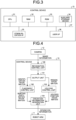
- FIG. 3 is a block diagram illustrating an example of a hardware configuration of the control device 13 according to the embodiment.
- the control device 13 illustrated in FIG. 3 includes a central processing unit (CPU) 31, a random access memory (RAM) 32, a read only memory (ROM) 33, an auxiliary storage device 34, a communication interface (I/F) 35 (connection unit), a user I/F 36, and a bus 37.
- CPU central processing unit
- RAM random access memory
- ROM read only memory
- I/F communication interface
- the CPU 31 performs predetermined control arithmetic processing using the RAM 32 as a working area in accordance with computer programs stored in the ROM 33 and the auxiliary storage device 34.
- the auxiliary storage device 34 is a nonvolatile memory or the like.
- the auxiliary storage device 34 stores various kinds of data necessary for the CPU 31 to execute processing.
- the communication I/F 35 is a device that enables transmission and reception of information to and from external devices (the camera 12, the drive control mechanism 24, and so forth) via an appropriate computer network (the network 14 or the like).
- the user I/F 36 is a device that enables input and output of information between the control device 13 and a user, and is, for example, a keyboard, a mouse, a touch panel mechanism, a microphone, a display, a speaker, or the like.
- the CPU 31, the RAM 32, the ROM 33, the auxiliary storage device 34, the communication I/F 35, and the user I/F 36 are connected via the bus 37 so that they can communicate with each other.
- FIG. 4 is a block diagram illustrating an example of a functional configuration of the control device 13 according to the embodiment.
- the control device 13 illustrated in FIG. 4 includes a recognition control unit 100, an output unit 101, a placement control unit 102, a holding control unit 103, and an operation information generation unit 104.
- These functional elements 100 to 104 are implemented by, for example, collaboration between the hardware configurations illustrated in FIG. 3 and the computer program. Note that these functional elements 100 to 104 may be configured by pieces of hardware which are physically separated.
- the recognition control unit 100 acquires the image information (box image 51) acquired by the camera 12 via the connection unit (communication I/F 35 and so forth) connecting the control device 13 and the camera 12.
- the recognition control unit 100 detects, from the acquired image information, an identification region in which the identification information 10 attached to the package 3 is included, and generates region information related to the identification region.
- the recognition control unit 100 recognizes the identification information 10 in the detected identification region.
- the identification information 10 is information corresponding to a sorting destination of the package 3.
- the identification information 10 may be, for example, a character string, a barcode, or a two-dimensional code, each indicating a destination (a postal code, an address, or the like) or a transport destination (the sorting pocket 4 and so forth) of the package 3.
- the output unit 101 outputs the identification information 10 recognized by the recognition control unit 100 to the placement control unit 102.
- the output unit 101 outputs, to the holding control unit 103, the region information related to the identification region detected by the recognition control unit 100.
- the placement control unit 102 sets, on the basis of the identification information 10 output from the output unit 101, a sorting destination on which the package 3 held by the robot arm 11 is to be placed.
- the holding control unit 103 sets, within the identification region, a holding position at which the holding mechanism 21 of the robot arm 11 holds the package 3, on the basis of the region information output from the output unit 101.
- the operation information generation unit 104 generates operation information for controlling the operation of the robot arm 11, on the basis of the sorting destination information indicating the sorting destination set by the placement control unit 102 and the holding position information indicating the holding position set by the holding control unit 103.
- the holding position is set on the basis of the position of the identification information 10.
- an appropriate holding operation can be implemented without requiring information, which has difficulty in recognition, such as the shape of the package 3 itself or the position of the package 3 in a three-dimensional space.
- FIG. 5 is a block diagram illustrating an example of a specific functional configuration of the recognition control unit 100 according to the embodiment.
- the recognition control unit 100 illustrated in FIG. 5 includes an optical character recognition (OCR) processing unit 111, a barcode reading unit 112, a two-dimensional code reading unit 113, an identification information acquisition unit 114, and a region information acquisition unit 115.
- OCR optical character recognition
- the OCR processing unit 111 converts image data of a character string into text data (character code).
- the OCR processing unit 111 acquires, from the box image 51, text data indicating a destination and so forth written on the package 3.
- the OCR processing unit 111 performs image recognition processing by using a given parameter set.
- the parameter set refers to a set of parameters used for one or more processes included in the image recognition processing.
- the parameter set includes, for example, a threshold value for binarization processing and a threshold value for determining success/failure of character recognition.
- the parameter set may also include, for example, a threshold value used for processing red-green-blue (RGB) information when a color image is converted into a binary image.
- RGB red-green-blue
- the threshold value used for processing the RGB information includes a threshold value for recognizing a frame line (background other than characters in an address entry field) colored by red, green, or the like, which is RGB information included in an image, or a threshold value for processing (erasing) the recognized frame line.
- the parameter set includes a threshold value for determining a contrast to be adjusted in accordance with a change in density of a printed or written character, a threshold value for determining a label size (a region in which an individual character is recognized in a character string) of an individual character included in an image, and others.
- the threshold value for determining the label size is a threshold value that is adjusted to appropriately recognize a character in a case where the character is blurred (the label size is large) or a part of the character disappears (the label size is small).
- the barcode reading unit 112 reads a barcode attached to the package 3 from the box image 51 and acquires barcode data indicating the configuration of the barcode.
- the two-dimensional code reading unit 113 reads a two-dimensional code attached to the package 3 from the box image 51 and acquires two-dimensional code data indicating the configuration of the two-dimensional code.
- the identification information acquisition unit 114 outputs, to the output unit 101, the text data acquired by the OCR processing unit 111, the barcode data acquired by the barcode reading unit 112, or the two-dimensional code data acquired by the two-dimensional code reading unit 113.
- the region information acquisition unit 115 acquires region information related to the identification region including the identification information 10, from the OCR processing unit 111, the barcode reading unit 112, or the two-dimensional code reading unit 113.
- the region information includes information indicating a position of an identification region in a region in which the package 3 is placed (in the present embodiment, a region inside the box 2).
- the region information may be acquired on the basis of, for example, coordinate information indicating a region (reading region) in the box image 51 read when the identification information 10 is detected.
- the region information acquisition unit 115 outputs the region information to the output unit 101.
- the recognition control unit 100 includes the OCR processing unit 111, the barcode reading unit 112, and the two-dimensional code reading unit 113 is described, the configuration of the recognition control unit 100 is not limited thereto.
- the recognition control unit 100 may include at least one of these units in accordance with the type of the identification information 10 to be used.
- FIG. 6 is a block diagram illustrating an example of a specific functional configuration of the placement control unit 102 according to the embodiment.
- the placement control unit 102 illustrated in FIG. 6 includes an acquisition unit 121, a destination data base (DB) 122, and an external search unit 123.
- DB destination data base
- the acquisition unit 121 acquires sorting destination information indicating the sorting destination of the package 3 to which the identification information 10 has been attached.
- the acquisition unit 121 outputs the sorting destination information to the operation information generation unit 104.
- the destination DB 122 holds data in which the identification information 10 and the sorting destination are associated with each other (for example, a table in which an address and a tray of the sorting pocket 4 are associated with each other).
- the acquisition unit 121 searches the destination DB 122 to acquire sorting destination information indicating the sorting destination corresponding to the identification information 10 acquired from the output unit 101.
- the external search unit 123 is a search engine capable of performing a search using text data as a keyword and extracting predetermined information.
- the acquisition unit 121 extracts predetermined information from the external search unit 123 by using the text data acquired from the output unit 101 as a keyword, and treats the extracted information as sorting destination information.
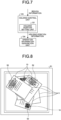
- FIG. 7 is a block diagram illustrating an example of a specific functional configuration of the holding control unit 103 according to the embodiment.
- the holding control unit 103 illustrated in FIG. 7 includes a holding position setting unit 131.
- the holding position setting unit 131 sets a holding position within the identification region on the basis of the region information acquired from the output unit 101.
- FIG. 8 is a diagram illustrating a first example of the identification region 52 according to the embodiment.
- the identification region 52 illustrated in FIG. 8 has a rectangular shape that is set to include the entire identification information 10 for each piece of the identification information 10.
- Each side of the identification region 52 according to the present example is parallel to each corresponding side of the box image 51.
- FIG. 9 is a diagram illustrating a second example of the identification region 52 according to the embodiment.
- the identification region 52 illustrated in FIG. 9 has a rectangular shape that is set to include the entire identification information 10 for each piece of the identification information 10.
- each side of the identification region 52 illustrated in FIG. 9 is inclined along the region where the identification information 10 exists. With this setting, it is possible to reduce the proportion of regions other than the identification information 10 included in the identification region 52.
- the identification region 52 may be formed with, for example, a polygonal shape other than a rectangular shape, a circular shape, a free curve, or others.
- the holding position setting unit 131 sets a holding position (a position at which the holding mechanism 21 holds the package 3) within the identification region 52 as described above.
- the holding position setting unit 131 sets, for example, a substantial surface gravity center or a substantial center of the identification region 52, as the holding position.
- the holding position setting unit 131 outputs holding position information indicating the holding position to the operation information generation unit 104.
- FIG. 10 is a diagram illustrating a first example of a holding position 53 according to the embodiment.
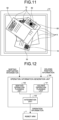
- FIG. 11 is a diagram illustrating a second example of the holding position 53 according to the embodiment.
- the holding position 53 illustrated in FIG. 10 corresponds to the identification region 52 illustrated in FIG. 8 .
- the holding position 53 illustrated in FIG. 11 corresponds to the identification region 52 illustrated in FIG. 9 .
- the holding position 53 is set within the identification region 52, so that the package 3 can be reliably held even when the shape of the package 3 itself cannot be recognized.
- FIG. 12 is a block diagram illustrating an example of a specific functional configuration of the operation information generation unit 104 according to the embodiment.
- the operation information generation unit 104 illustrated in FIG. 12 includes a holding operation planning unit 141, a sorting operation planning unit 142, and an integration unit 143.
- the holding operation planning unit 141 plans a holding operation, which is an operation until the robot arm 11 holds the package 3, on the basis of the holding position information acquired from the holding control unit 103.
- the holding operation includes an operation of moving the arm mechanism 22 so as to move the holding mechanism 21 to the holding position 53, an operation of holding the package 3 by the holding mechanism 21 that has reached the holding position 53 (by making the inside of the suction pad negative pressure), and so forth.
- the sorting operation planning unit 142 plans a sorting operation, which is an operation of moving the package 3 to the sorting destination by the robot arm 11, on the basis of the sorting destination information acquired from the sorting destination specifying unit 102.
- the sorting operation includes an operation of moving the arm mechanism 22 so as to move the holding mechanism 21 holding the package 3 from the holding position 53 to a sorting destination (for instance, a specific tray in the sorting pocket 4), an operation of causing the holding mechanism 21 that has reached the sorting destination to release the package 3 (by releasing the negative pressure in the suction pad), and so forth.
- the integration unit 143 integrates the holding operation planned by the holding operation planning unit 141 and the sorting operation planned by the sorting operation planning unit 142, and then generates operation information indicating an overall operation plan of the robot arm 11.
- the integration unit 143 outputs the operation information to the robot arm 11 (drive control mechanism 24).
- FIG. 13 is a sequence diagram illustrating an example of a processing flow in the control device 13 according to the embodiment.
- the holding control unit 103 Upon detecting the identification region 52 by the recognition control unit 100 and outputting the region information by the output unit 101 (S101), the holding control unit 103 sets the holding position 53 on the basis of the region information (S102) and outputs, to the operation information generation unit 104, the holding position information indicating the holding position 53 (S103).
- the operation information generation unit 104 plans a holding operation based on the acquired holding position information (S104).
- the placement control unit 102 Upon recognizing the identification information 10 by the recognition control unit 100 and outputting the identification information 10 by the output unit 101 (S105), the placement control unit 102 specifies a sorting destination corresponding to the identification information 10 (S106) and outputs, to the operation information generation unit 104, sorting destination information indicating the sorting destination (S107).
- the operation information generation unit 104 plans a sorting operation based on the acquired sorting destination information (S108).
- the operation information generation unit 104 then generates operation information indicating a comprehensive operation plan in which the holding operation and the sorting operation are integrated, and outputs the operation information to the drive control mechanism 24 of the robot arm 11 (S 109).
- FIG. 14 is a flowchart illustrating an example of a processing flow in the sorting system 1 according to the embodiment.
- the drive control mechanism 24 determines whether or not operation information has been received from the control device 13 (S202). In a case where the drive control mechanism 24 has not received the operation information (S202: No), the camera 12 continues imaging (S201), in other words, the drive control mechanism 24 waits for reception of the operation information. In a case where the drive control mechanism 24 has received the operation information (S202: Yes), the drive control mechanism causes the robot arm 11 to perform a holding operation (S203).
- the drive control mechanism 24 determines whether or not the holding of the package 3 by the holding mechanism 21 is successful (S204).
- the determination in step S204 can be performed on the basis of, for example, a detection result by the contact sensor 23.
- the drive control mechanism 24 subsequently causes the robot arm 11 to perform a sorting operation (S205).
- the drive control mechanism 24 performs error processing (S206).
- the error processing is processing for avoiding a problem caused by a failure in holding the package 3. Details of the error processing is not be particularly limited, but may be, for example, a notification to an administrator, a stop of the system, or a re-execution of the holding operation.
- a computer program for implementing various functions in the control device 13 according to the above-described embodiment can be provided by being recorded in a computer-readable recording medium such as a compact disc (CD) -ROM, a flexible disk (FD), a CD-recordable (CD-R), or a digital versatile disk (DVD) as a file in an installable format or an executable format.
- the computer program may be provided or distributed via a network such as the Internet.
- the configuration is exemplified, in which the control device 13 and the drive control mechanism 24 are separately provided.
- the configuration may be implemented such that the control device 13 and the drive control mechanism 24 are integrated as one body.
- the configuration is exemplified, in which one robot arm 11 is controlled by one control device 13, but is not limited thereto.
- a plurality of robot arms 11 may be controlled by one control device 13.
- the holding position 53 is set on the basis of the position of the identification information 10, so that an appropriate holding operation can be implemented regardless of the shape of the package 3 itself.
- the sorting system 1 it is possible to provide the sorting system 1 with high reliability.
Landscapes
- Engineering & Computer Science (AREA)
- Theoretical Computer Science (AREA)
- Physics & Mathematics (AREA)
- General Physics & Mathematics (AREA)
- Computer Vision & Pattern Recognition (AREA)
- Multimedia (AREA)
- Robotics (AREA)
- Mechanical Engineering (AREA)
- Artificial Intelligence (AREA)
- Manipulator (AREA)
- Sorting Of Articles (AREA)
- Image Analysis (AREA)
- Specific Conveyance Elements (AREA)
Applications Claiming Priority (2)
| Application Number | Priority Date | Filing Date | Title |
|---|---|---|---|
| JP2020112017A JP7481926B2 (ja) | 2020-06-29 | 2020-06-29 | 情報処理装置、仕分システム、及びプログラム |
| PCT/JP2021/023807 WO2022004525A1 (ja) | 2020-06-29 | 2021-06-23 | 情報処理装置、仕分システム、及びプログラム |
Publications (2)
| Publication Number | Publication Date |
|---|---|
| EP4173731A1 true EP4173731A1 (de) | 2023-05-03 |
| EP4173731A4 EP4173731A4 (de) | 2024-05-22 |
Family
ID=79316093
Family Applications (1)
| Application Number | Title | Priority Date | Filing Date |
|---|---|---|---|
| EP21833405.0A Withdrawn EP4173731A4 (de) | 2020-06-29 | 2021-06-23 | Informationsverarbeitungsvorrichtung, sortiersystem und programm |
Country Status (4)
| Country | Link |
|---|---|
| US (1) | US20230271225A1 (de) |
| EP (1) | EP4173731A4 (de) |
| JP (1) | JP7481926B2 (de) |
| WO (1) | WO2022004525A1 (de) |
Cited By (1)
| Publication number | Priority date | Publication date | Assignee | Title |
|---|---|---|---|---|
| WO2024240397A1 (de) * | 2023-05-19 | 2024-11-28 | Körber Supply Chain Logistics Gmbh | System zum sortieren von poststücken und verfahren zum sortieren von poststücken |
Families Citing this family (1)
| Publication number | Priority date | Publication date | Assignee | Title |
|---|---|---|---|---|
| CN116331763B (zh) * | 2023-04-17 | 2023-12-05 | 中建幕墙有限公司 | 建筑幕墙型材处理装置及方法 |
Family Cites Families (6)
| Publication number | Priority date | Publication date | Assignee | Title |
|---|---|---|---|---|
| CN101882207B (zh) * | 2010-06-01 | 2012-06-20 | 福建新大陆电脑股份有限公司 | Data Matrix码条码解码芯片及其解码方法 |
| US9138895B2 (en) * | 2014-01-10 | 2015-09-22 | Recognition Robotics, Inc. | Method for picking up an article using a robot arm and associated system |
| JP6852518B2 (ja) * | 2017-03-31 | 2021-03-31 | 日本電気株式会社 | 宛先認識装置、小包自動区分システム、宛先認識方法及びプログラム |
| CN107597600B (zh) * | 2017-09-26 | 2019-08-30 | 北京京东振世信息技术有限公司 | 分拣系统和分拣方法 |
| JP7005388B2 (ja) | 2018-03-01 | 2022-01-21 | 株式会社東芝 | 情報処理装置及び仕分システム |
| CN109772718B (zh) * | 2019-02-12 | 2020-12-01 | 北京极智嘉科技有限公司 | 包裹地址识别系统、识别方法和包裹分拣系统、分拣方法 |
-
2020
- 2020-06-29 JP JP2020112017A patent/JP7481926B2/ja active Active
-
2021
- 2021-06-23 WO PCT/JP2021/023807 patent/WO2022004525A1/ja not_active Ceased
- 2021-06-23 EP EP21833405.0A patent/EP4173731A4/de not_active Withdrawn
- 2021-06-23 US US18/002,547 patent/US20230271225A1/en active Pending
Cited By (1)
| Publication number | Priority date | Publication date | Assignee | Title |
|---|---|---|---|---|
| WO2024240397A1 (de) * | 2023-05-19 | 2024-11-28 | Körber Supply Chain Logistics Gmbh | System zum sortieren von poststücken und verfahren zum sortieren von poststücken |
Also Published As
| Publication number | Publication date |
|---|---|
| EP4173731A4 (de) | 2024-05-22 |
| JP7481926B2 (ja) | 2024-05-13 |
| JP2022011111A (ja) | 2022-01-17 |
| WO2022004525A1 (ja) | 2022-01-06 |
| US20230271225A1 (en) | 2023-08-31 |
Similar Documents
| Publication | Publication Date | Title |
|---|---|---|
| US12233548B2 (en) | Robotic system with enhanced scanning mechanism | |
| US20170066597A1 (en) | Information processing device, information processing system, distribution system, information processing method, and program storage medium | |
| CN108349083B (zh) | 用于提供各种物体的分拣的分拣系统和方法 | |
| US9171278B1 (en) | Item illumination based on image recognition | |
| CN109513629B (zh) | 包裹分拣方法、装置和计算机可读存储介质 | |
| JP2019509559A (ja) | センサ誘導式ロボットを用いたボックスの位置特定、分離、およびピッキング | |
| US12487337B2 (en) | LiDAR based monitoring in material handling environment | |
| CN113351522A (zh) | 物品分拣方法、装置及系统 | |
| CN104889063A (zh) | 邮递物分拣处理系统 | |
| EP4173731A1 (de) | Informationsverarbeitungsvorrichtung, sortiersystem und programm | |
| CN113635319A (zh) | 用于识别和处理各种物体的机器人系统和方法 | |
| US20240158123A1 (en) | System and method for building machine learning or deep learning data sets for recognizing labels on items | |
| JP6367171B2 (ja) | 配達支援システム、配達支援装置、及び配達支援プログラム | |
| US20230368052A1 (en) | Inference calculation processing device and inference calculation processing method | |
| US11969760B1 (en) | Singulation and sortation defect detection | |
| JP6852518B2 (ja) | 宛先認識装置、小包自動区分システム、宛先認識方法及びプログラム | |
| JP2013067499A (ja) | 検品装置、検品システム、検品方法及びプログラム | |
| US10891879B1 (en) | Repurposed packages | |
| JP2021146404A (ja) | 制御装置及びプログラム | |
| JP2019199335A (ja) | 情報処理装置、情報処理プログラム、及び仕分システム | |
| RU2597572C1 (ru) | Устройство распознавания адреса, устройство сортировки, интегрированное устройство распознавания адреса и способ распознавания адреса | |
| CN211732706U (zh) | 一种货物存放系统 | |
| EP4250033A1 (de) | Robotisches vereinzelungssystem mit automatischem routing von manuell abgetasteten verpackungen | |
| CN111386533B (zh) | 使用对称定位的空白区域检测和识别图像数据中图形字符表示的方法和装置 | |
| CN113728356B (zh) | 图像识别方法以及图像识别装置 |
Legal Events
| Date | Code | Title | Description |
|---|---|---|---|
| STAA | Information on the status of an ep patent application or granted ep patent |
Free format text: STATUS: THE INTERNATIONAL PUBLICATION HAS BEEN MADE |
|
| PUAI | Public reference made under article 153(3) epc to a published international application that has entered the european phase |
Free format text: ORIGINAL CODE: 0009012 |
|
| STAA | Information on the status of an ep patent application or granted ep patent |
Free format text: STATUS: REQUEST FOR EXAMINATION WAS MADE |
|
| 17P | Request for examination filed |
Effective date: 20221128 |
|
| AK | Designated contracting states |
Kind code of ref document: A1 Designated state(s): AL AT BE BG CH CY CZ DE DK EE ES FI FR GB GR HR HU IE IS IT LI LT LU LV MC MK MT NL NO PL PT RO RS SE SI SK SM TR |
|
| DAV | Request for validation of the european patent (deleted) | ||
| DAX | Request for extension of the european patent (deleted) | ||
| REG | Reference to a national code |
Ref country code: DE Ref legal event code: R079 Free format text: PREVIOUS MAIN CLASS: B07C0005342000 Ipc: G06V0030140000 |
|
| A4 | Supplementary search report drawn up and despatched |
Effective date: 20240418 |
|
| RIC1 | Information provided on ipc code assigned before grant |
Ipc: B25J 9/16 20060101ALI20240412BHEP Ipc: B07C 5/342 20060101ALI20240412BHEP Ipc: G06V 20/52 20220101ALI20240412BHEP Ipc: G06V 30/424 20220101ALI20240412BHEP Ipc: G06V 30/146 20220101ALI20240412BHEP Ipc: G06V 30/14 20220101AFI20240412BHEP |
|
| GRAP | Despatch of communication of intention to grant a patent |
Free format text: ORIGINAL CODE: EPIDOSNIGR1 |
|
| STAA | Information on the status of an ep patent application or granted ep patent |
Free format text: STATUS: GRANT OF PATENT IS INTENDED |
|
| INTG | Intention to grant announced |
Effective date: 20250402 |
|
| STAA | Information on the status of an ep patent application or granted ep patent |
Free format text: STATUS: THE APPLICATION IS DEEMED TO BE WITHDRAWN |
|
| 18D | Application deemed to be withdrawn |
Effective date: 20250805 |