EP4171073B1 - Informationssendeverfahren und computerprogramm - Google Patents
Informationssendeverfahren und computerprogramm Download PDFInfo
- Publication number
- EP4171073B1 EP4171073B1 EP21841633.7A EP21841633A EP4171073B1 EP 4171073 B1 EP4171073 B1 EP 4171073B1 EP 21841633 A EP21841633 A EP 21841633A EP 4171073 B1 EP4171073 B1 EP 4171073B1
- Authority
- EP
- European Patent Office
- Prior art keywords
- terminal
- resource
- information
- resource set
- resources
- Prior art date
- Legal status (The legal status is an assumption and is not a legal conclusion. Google has not performed a legal analysis and makes no representation as to the accuracy of the status listed.)
- Active
Links
Images





Classifications
-
- H—ELECTRICITY
- H04—ELECTRIC COMMUNICATION TECHNIQUE
- H04W—WIRELESS COMMUNICATION NETWORKS
- H04W4/00—Services specially adapted for wireless communication networks; Facilities therefor
- H04W4/70—Services for machine-to-machine communication [M2M] or machine type communication [MTC]
-
- H—ELECTRICITY
- H04—ELECTRIC COMMUNICATION TECHNIQUE
- H04W—WIRELESS COMMUNICATION NETWORKS
- H04W72/00—Local resource management
- H04W72/20—Control channels or signalling for resource management
- H04W72/25—Control channels or signalling for resource management between terminals via a wireless link, e.g. sidelink
-
- H—ELECTRICITY
- H04—ELECTRIC COMMUNICATION TECHNIQUE
- H04W—WIRELESS COMMUNICATION NETWORKS
- H04W72/00—Local resource management
- H04W72/02—Selection of wireless resources by user or terminal
-
- H—ELECTRICITY
- H04—ELECTRIC COMMUNICATION TECHNIQUE
- H04W—WIRELESS COMMUNICATION NETWORKS
- H04W72/00—Local resource management
- H04W72/20—Control channels or signalling for resource management
-
- H—ELECTRICITY
- H04—ELECTRIC COMMUNICATION TECHNIQUE
- H04W—WIRELESS COMMUNICATION NETWORKS
- H04W72/00—Local resource management
- H04W72/50—Allocation or scheduling criteria for wireless resources
- H04W72/56—Allocation or scheduling criteria for wireless resources based on priority criteria
- H04W72/566—Allocation or scheduling criteria for wireless resources based on priority criteria of the information or information source or recipient
-
- H—ELECTRICITY
- H04—ELECTRIC COMMUNICATION TECHNIQUE
- H04W—WIRELESS COMMUNICATION NETWORKS
- H04W72/00—Local resource management
- H04W72/50—Allocation or scheduling criteria for wireless resources
- H04W72/54—Allocation or scheduling criteria for wireless resources based on quality criteria
- H04W72/542—Allocation or scheduling criteria for wireless resources based on quality criteria using measured or perceived quality
Definitions
- This application relates to the field of communication, and in particular, to an information sending method and a computer program.
- a sidelink (sidelink) connection technology is a technology used by terminal devices to directly communicate with each other on radio resources.
- the sidelink technology is an important branch of a cellular Internet of Things technology, and is first applied in a D2D (Device to Device, device to device) communication scenario.
- the sidelink technology creates a broad prospect for application of the Internet of Things, the Internet of Vehicles, and the like, and fundamentally changes a communication architecture and operation of a conventional cellular network.
- there are two resource allocation manners In one manner, resource allocation relies on a base station. In the other manner, resource allocation is based on autonomous selection by a terminal. When resource allocation is based on autonomous selection by the terminal, a resource conflict may occur because central control and allocation are not implemented in resource selection.
- WO 2020/064553 A1 discloses an apparatus for a wireless communication system.
- the wireless communication system includes one or more base stations and a plurality of user devices, UEs.
- the apparatus is configured to be connected to one or more UEs via a sidelink for a sidelink communication with the one or more UEs, the apparatus and the one or more UEs forming a group of UEs and using a set of group resources to be used for the sidelink communication within the group of UEs.
- the apparatus is configured to select resources from a set of resources provided by the wireless communication system so as to alter or completely change the set of group resources to be used for the sidelink communication within the group of UEs.
- Embodiments of this application provide an information sending method and computer program, so that a group member can report first information to a group header when a sidelink technology is used, and the group header determines a resource for sidelink communication based on the received first information, and sends the resource for sidelink communication to the group member. Therefore, a probability that a resource conflict occurs when a group of devices perform sidelink communication is reduced, and communication performance of the entire group is improved.
- an embodiment of this application provides an information sending method applied to a wireless communication system, where the wireless communication system includes a first terminal and a second terminal, and there is one or more second terminals.
- the method includes:
- the first terminal sends a first indication message to the second terminal, where the first indication message indicates the second terminal to report first information
- the second terminal sends the first information to the first terminal, and the first terminal determines the first resource set based on the first information.
- the resource in the first resource set is the resource for sidelink communication. In this way, the resource for sidelink communication can be accurately determined, and a probability that a resource conflict occurs when a group of devices perform sidelink communication can be reduced.
- the channel state information of a channel resource is first-type state information, and the first-type state information indicates whether channel quality of the channel resource reaches a first threshold;
- At least one of the first terminal and the second terminal performs sidelink communication on the resource in the first resource set.
- the first indication message includes an indication of a type of reported content
- the type of reported content is one or more of the first-type state information, the second-type state information, or the third-type state information.
- that the first resource set is determined by the first terminal based on the first information includes:
- the first terminal first determines the second resource set based on the second information to ensure sufficient resources for the first terminal, and then determines the third resource set based on the first information and the second information to meet a resource requirement of the entire group.
- the first information is an interference set obtained through measurement performed by the second terminal
- a method for determining the third resource set by the first terminal includes at least one of the following:
- the first terminal arranges, based on traffic volumes of second terminals in descending order, interference sets obtained through measurement performed by the second terminals, and selects, according to the arrangement order, resources with the minimum interference in the interference sets as the resources in the third resource set; or
- the first indication message includes an indication of a to-be-measured resource set, and the to-be-measured resource set indicates a position of a channel resource measured by the second terminal.
- the wireless communication system further includes a third terminal, the third terminal belongs to another group, and the first information includes information about interference from the third terminal to a to-be-measured resource in the to-be-measured resource set.
- the first terminal considers interference to the to-be-measured resource from an adjacent terminal in another group, so that a determined resource for sidelink communication is accurate.
- the first indication message includes an indication of a sending mechanism for the first information
- the sending mechanism for the first information includes reporting the first information on an autonomously selected resource or reporting the first information on a reserved resource.
- the first indication message includes an indication of a report occasion, and the report occasion includes periodic report or aperiodic report.
- that the first terminal sends a first indication message to the second terminal includes: The first terminal measures a distance between the first terminal and the second terminal, and when the distance changes and reaches a first distance threshold, the first terminal sends the first indication message to the second terminal. In this way, untimely report of the first information caused by a great change in a position of the second terminal can be prevented.
- that the second terminal receives the first indication message and reports the first information to the first terminal includes:
- the second terminal receives the first indication message, and reports the first information to the first terminal by using a radio resource control RRC message, a media control element MCE message, or a sidelink control indicator SCI message.
- that the first resource set is determined by the first terminal based on the first information includes:
- that the first terminal sends a second indication message to the second terminal includes:
- the first terminal sends the second indication message to the second terminal by using a radio resource control RRC message, a media control element MCE message, or a sidelink control indicator SCI message.
- an embodiment of this application provides a computer program product including instructions which, when executed by a wireless communication system, cause the wireless communication system to perform the method in the first aspect.
- a plurality of in this application refers to two or more than two.
- the term “and/or” describes an association relationship between associated objects and represents that three relationships may exist.
- a and/or B may represent the following three cases: Only A exists, both A and B exist, and only B exists.
- the character "/" usually indicates an "or" relationship between associated objects.
- a mobile communication network gradually evolves to a 5G NR (New Radio, new radio) system.
- a sidelink (sidelink) technology is introduced.
- terminal devices can directly communicate by using radio resources.
- a sidelink (sidelink) is different from an uplink (uplink) and a downlink (downlink) between a terminal device and a base station.
- the sidelink is a link between terminal devices, and corresponds to a PC5 interface.
- a PSCCH Physical Sidelink Control Channel, physical sidelink control channel
- a PSSCH Physical Sidelink Shared Channel, physical sidelink shared channel
- a PSBCH Physical Sidelink Broadcast Channel, physical sidelink broadcast channel
- a PSFCH Physical Sidelink Feedback Channel, physical sidelink feedback channel
- the first three physical channels are used in the sidelink technology of the LTE system, and the PSFCH is a physical channel newly introduced in the sidelink technology of the NR system to support HARQ (Hybrid Automatic Repeat Request, hybrid automatic repeat request) transmission.
- the PSSCH transmits sidelink data information.
- the PSCCH mainly transmits sidelink control information, that is, transmits a sidelink control information (Sidelink Control Information, SCI) message.
- SCI Sidelink Control Information
- the sidelink is first introduced in the LTE system, and is mainly applied to D2D (Device to Device, device to device) communication technologies.
- a main purpose is to ensure effective public safety communication (Public Safety Communication).
- V2X Vehicle to Everything, vehicle to everything
- the concept of V2X is then introduced into the LTE system, and the sidelink is also a part of V2X standardization.
- the sidelink is defined as a communication mode in which direct proximity-based communication between terminal devices is implemented through a PC5 interface. According to the latest release of 3GPP (3rd Generation Partnership Project, 3rd generation partnership project), sidelink resource allocation that is based on air interface assistance and PC5 interface management is the next research priority.
- the research helps meet communication performance requirements of V2X in the NR system such as a latency and reliability. This research is of great significance to a communication scenario in which a user can autonomously select a resource when the user can perform V2X communication only through a sidelink.
- FIG. 2 A sidelink communication process is shown in FIG. 2 , and is divided into two parts: synchronization and communication.
- synchronization and communication In the synchronization process, to enable all terminal devices to enter a synchronization state, currently, there are two sidelink synchronization procedures: a synchronization procedure based on GNSS (Global Navigation Satellite System, global navigation satellite system) and a synchronization procedure based on a base station.
- GNSS Global Navigation Satellite System, global navigation satellite system
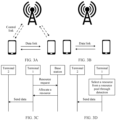
- FIG. 3A shows a resource allocation manner in which a base station participates. In this resource allocation manner, there is a control link between a base station and a terminal device.
- FIG. 3B shows a manner in which resource allocation is based on autonomous selection of a terminal. In this resource allocation manner, there are no control links between a base station and a terminal device.
- FIG. 3C provides a specific procedure of the resource allocation manner in which a base station participates.
- the terminal 1 sends a resource request to a base station.
- the base station After receiving the resource request, the base station sends an allocated resource to the terminal 1 by using a DCI (Downlink Control Indicator, downlink control indicator).
- the terminal 1 After receiving the DCI message, the terminal 1 sends the data to a terminal 2 on a resource indicated in the DCI message. It can be learned from the foregoing procedure that, according to the resource allocation manner in which the base station participates, the sidelink resource for the terminal is allocated by the base station. Therefore, a resource conflict usually does not occur when the resource allocation manner shown in FIG. 3C is applied.
- FIG. 3D shows a specific procedure of the allocation manner in which a terminal autonomously selects a resource.
- the terminal 1 first performs resource sensing (Resource Sensing).
- Resource Sensing resource sensing
- the terminal 1 measures all resources in a resource pool, and then selects a group of resources from the resource pool to send the data.
- resource pool configuration There are two scenarios of resource pool configuration. In one scenario, a terminal is in a network coverage area of a base station, and the resource pool configuration may be obtained from a system message of the base station. In another scenario, the terminal is not in the network coverage area of the base station, and resource pool configuration is preconfigured.
- the sidelink technology can be applied in a plurality of scenarios, including typical application scenarios such as a home scenario, a meeting room scenario, a multiplayer gaming scenario, and a vehicle platooning scenario.
- Each application scenario includes a plurality of terminals.
- terminal devices such as a mobile phone, a television, a PC, a tablet, a stereo, a band, and a headset are included;
- terminal devices such as a large screen, a PC, a mobile phone, and a tablet are included;
- the multiplayer gaming scenario a plurality of gaming terminals are included;
- the vehicle platooning scenario includes a plurality of moving vehicles, pedestrians, and roadside units RSUs.
- FIG. 3E shows a typical home scenario 30 in which the sidelink technology is used.
- the scenario includes a mobile phone 31, a PC 32, a television 33, a sound box 34, a tablet 35, a headset 36, and a band 37.
- the devices can directly communicate with each other through a sidelink.
- FIG. 3F shows a typical vehicle platooning scenario in which the sidelink technology is used.
- the scenario includes a pedestrian terminal device 311, a vehicle 312, a roadside unit RSU 313, a vehicle 314, and a base station 316.
- the devices can communicate with each other.
- V2V Vehicle to Vehicle
- V2I Vehicle to Infrastructure
- V2P Vehicle to Pedestrian
- V2N Vehicle to Network
- a mechanism in which a group (Group) is used as the unit becomes a research focus, where the group is also referred to as a communication group.
- the mechanism in which a group is used as the unit has many advantages. Specifically, in a heavy-load scenario, if all pieces of user equipment independently contend for resources, there is a high probability that a resource conflict occurs. If a group header coordinates resource allocation, the probability that the resource conflict occurs can be greatly reduced. Coarse-grained resource negotiation is performed among groups, and resource allocation in a group is performed by a group header. In this way, resource utilization efficiency can be improved. In addition, because information exchange with the base station is reduced, an air interface latency can be reduced.
- FIG. 4A shows an application scenario of an embodiment of this application.
- a plurality of terminals form a group to improve communication efficiency.
- a terminal 10 is a group header.
- the group header may also be referred to as a group header terminal or a group header device.
- the group header can implement some functions of a base station to achieve unified management over the entire group.
- a terminal is a device that provides voice/data connectivity for a user, for example, a handheld device or an in-vehicle device that has a wireless connection function.
- the terminal may also be referred to as user equipment (User Equipment, UE), an access terminal (Access Terminal), a user unit (User Unit), a user station (User Station), a mobile station (Mobile Station), a remote station (Remote Station), a remote terminal (Remote Terminal), mobile equipment (Mobile Equipment), a user terminal (User Terminal), wireless telecom equipment (Wireless Telecom Equipment), a user agent (User Agent), user equipment (User Equipment) or a user apparatus.
- user equipment User Equipment
- UE user equipment
- the terminal may be a station (Station, STA) in a wireless local area network (Wireless Local Area Network, WLAN), a cellular phone, a cordless phone, a session initiation protocol (Session Initiation Protocol, SIP) phone, a wireless local loop (Wireless Local Loop, WLL) station, a personal digital assistant (Personal Digital Assistant, PDA) device, a handheld device having a wireless communication function, a computing device or another processing device connected to a wireless modem, an in-vehicle device, a wearable device, a terminal in a next generation communication system (for example, a fifth-generation (Fifth-Generation, 5G) communication network), a terminal in a future evolved public land mobile network (Public Land Mobile Network, PLMN), or the like.
- a station STA
- WLAN wireless Local Area Network
- WLAN Wireless Local Area Network
- SIP Session Initiation Protocol
- WLL Wireless Local Loop
- PDA Personal Digital Assistant
- PDA Personal Digital
- the terminal is a terminal that usually works on the ground, for example, an in-vehicle device.
- a chip deployed in the foregoing device may also be referred to as a terminal.
- the terminal may alternatively be a wearable device.
- the wearable device may alternatively be referred to as intelligent wearable device, and is a generic term for wearable devices such as glasses, gloves, watches, clothes, and shoes that are developed based on intelligent design of daily wearing by using wearable technologies.
- the wearable device is a portable device that can be directly worn on a body or integrated into a piece of clothing or an accessory of a user.
- the wearable device is a hardware device, and implements powerful functions through software support, data exchange, and cloud interaction.
- intelligent wearable devices include full-featured and large-size devices that can implement complete or partial functions without depending on smartphones, for example, smart watches or smart glasses, and include devices that focus only on a specific type of application and need to be used together with another device such as a smartphone, for example, various smart bands and smart jewelry used for vital sign monitoring.
- the terminal 10 serving as the group header in FIG. 4A is a type of terminal. However, the terminal 10 can only implement some functions of a base station, to be specific, implement a central control function and configure a resource for another terminal.
- the terminal 10 serves as the group header, and other terminals are group members, where the group member may also be referred to as a group member terminal or a group member device.
- the terminal may accept a user setting to enable a sidelink group function, which is a function of a third-party application of the terminal or a system application of the terminal.
- a user may enable a group function by turning on a switch 402 of the sidelink group.
- the terminal accepts the user operation, and turns on the sidelink group switch.
- the terminal finds that there are two groups around, which are a Group 1 and a Group 2.
- the terminal may accept user selection to join a group, or the terminal may autonomously perform selection to join a group. In this way, the user can decide whether to enable the group function and select a group the terminal is to join. Consequently, terminal security and user experience are enhanced.
- Embodiments of this application mainly relate to inter-group resource contention in the sidelink technology.
- a group resource is contended for with a group being a unit, or a resource is independently contended for with a terminal device being a unit.
- resources for groups may be orthogonal to each other, or may overlap.
- the group header wins a resource for the entire group among resources for groups.
- signal interference is strong on the overlapping resources. Therefore, two group headers that are close avoid selecting overlapping resources, to improve a probability of successful signal demodulation.
- two group headers that are far away from each other select overlapping resources as much as possible. Consequently, a group header obtains different resources through contention at different locations, and some resources are not suitable for group members.
- a group header in Group B-1 is far away from the Group A. Therefore, when contending for a resource, the group header in Group B-1 may determine that interference from the Group A to the Group B-1 is low, and therefore select a resource that overlaps or coincides with a resource for the Group A. However, a bottom-left group member of the Group B-1 is close to the Group A. Selecting a resource that coincides with the resource for the Group A results in high interference. Consequently, performance of these user equipments is poor.
- a group header in Group B-2 is close to the Group A.
- the group header in Group B-2 may determine that interference from the Group A to the Group B-2 is high, and therefore select a resource completely different from the resource for the Group A.
- a bottom-right group member of Group B-2 is far away from the Group A. Therefore, the group member can use a resource overlapping with the resource for the Group A. As a result, resource utilization is low.
- an embodiment of this application provides an information sending method to assist a group header in resource selection.
- Resources are selected for communication between group members. Therefore, obtaining feedback from group members is an important means to ensure resource selection performance.
- a group member terminal device measures resource occupation on a channel, and reports a measurement result to a group header. Based on a measurement result of the group header and the result reported by the group member, the group header determines a final resource for sidelink communication, and sends the resource for sidelink communication to all group members, thereby ensuring group communication performance.
- FIG. 6 shows a generalized procedure of an information sending method according to an embodiment of this application.
- the method is applied to a wireless communication system that includes a first terminal and a second terminal, where the first terminal is a group header, the second terminal is a group member, and there is one or more second terminals.
- the method mainly includes the following steps.
- the first terminal sends a first indication message to the second terminal, where the first indication message indicates the second terminal to report first information.
- the first indication message includes an indication of a first information report occasion, an indication of a to-be-measured resource set, an indication of a type of reported content, an indication of a measurement threshold, an indication of a sending mechanism for the first information, and the like.
- the second terminal reports the first information to the first terminal.
- the first information indicates channel state information of a channel resource, where the channel resource is a resource that the first terminal indicates the second terminal to measure. Specifically, the second terminal measures the resource according to the first indication message sent by the first terminal, and periodically or aperiodically reports the first information to the first terminal after the measurement is completed.
- the first information includes interference information that is of a corresponding to-be-measured resource and that is collected by the second terminal.
- the interference information includes, for example, information about interference from an adjacent terminal to the to-be-measured resource, where the adjacent terminal may include a terminal in a group to which the second terminal belongs or a terminal in an adjacent group.
- the first terminal selects a resource based on the interference information, to avoid interference from the adjacent group to transmission on resources in the group. This improves transmission efficiency.
- the interference information also includes information about interference from a non-adjacent terminal to the to-be-measured resource.
- the second terminal when measuring the to-be-measured resource, measures only interference from a terminal device that is in another group to the to-be-measured resource.
- the first information includes only interference from a terminal device in another group to the to-be-measured resource.
- the second terminal completes resource measurement before receiving the first indication message from the first terminal, and directly reports the first information according to the indication when receiving the first indication message sent by the first terminal.
- the first terminal sends a second indication message to the second terminal, where the second indication message indicates information about a first resource set, the first resource set is determined by the first terminal based on the received first information, and a resource in the first resource set is a resource for sidelink communication. Specifically, the first terminal determines the first resource set based on second information and the first information that is reported by the second terminal, where the second information is a set obtained through measurement performed by the first terminal. Then the first terminal sends the first resource set to the second terminal in the group by sending the second indication message.
- FIG. 7A shows an information sending method according to an embodiment of this application.
- the method is applied to a wireless communication system that includes a first terminal and a second terminal, where the first terminal is a group header, the second terminal is a group member, and there is one or more second terminals.
- the method is about reporting first-type state information, and mainly includes the following steps.
- the first terminal sends a first indication message to the second terminal, where the first indication message indicates the second terminal to report first information.
- the first information indicates channel state information of a channel resource, where the channel resource is a resource that the first terminal indicates the second terminal to measure.
- the first terminal after the first terminal is selected as the group header, the first terminal sends the first indication message to the second terminal, to indicate the second terminal to report the first information.
- the first terminal after the first terminal detects a newly added second terminal, in other words, detects a newly added group member device, the first terminal sends the first indication message to the newly added second terminal or all second terminals, to indicate the newly added second terminal or all the second terminals to report first information.
- the first indication message includes the following types of indication information.
- Periodic report configuration means that once receiving the configuration, the second terminal performs corresponding measurement and reports the first information to the first terminal on a fixed cycle.
- the cycle may be 1 ms, 2 ms, 5 ms, 10 ms, 20 ms, 40 ms, 80 ms, 160 ms, or 320 ms.
- the first terminal may separately configure a measurement cycle and a report cycle for the second terminal.
- a specific measurement cycle and report cycle may be the same or different.
- the first terminal measures a moving speed of the second terminal, or the second terminal reports the moving speed to the first terminal.
- the first terminal configures different cycles based on moving speeds of the second terminal.
- the aperiodic report configuration means that the first terminal indicates, based on a requirement, the second terminal to report the first information, and the second terminal reports the first information at a specific moment after receiving the indication.
- the first terminal dynamically indicates, in the indication information, the second terminal to report the first information at a specific moment.
- the second terminal when receiving the indication information sent by the first terminal, the second terminal reports the first information after default duration.
- the first terminal measures a distance between the first terminal and the second terminal. When the distance changes and reaches a first distance threshold, the first terminal sends, to the second terminal, an indication for reporting the first information, to trigger the second terminal to aperiodically report the first information.
- the first terminal configures a to-be-measured resource set for the second terminal.
- the second terminal measures and reports to-be-measured resources in the to-be-measured resource set.
- the to-be-measured resource set indicates a position of a channel resource measured by the second terminal.
- the to-be-measured resource set is a universal set or a subset of a resource pool of the first terminal.
- the first terminal indicates the universal set or the subset of the resource pool as the to-be-measured resource set for the second terminal based on historical resource usage. For example, according to statistics, if bit error rates of some resources in the resource pool are high, these resources are not included the to-be-measured resource set.
- second terminals report terminal capabilities to the first terminal in advance, and the first terminal configures different to-be-measured resource sets based on performance differences of the second terminals. For example, a to-be-measured resource set configured for a low-performance second terminal includes less resources, and a to-be-measured resource set configured for a high-performance second terminal includes more resources.
- the type of reported content is first-type state information, where the first-type state information indicates whether channel quality of a channel resource reaches a first threshold.
- the channel quality includes RSRP (Reference Signal Received Power, reference signal received power), an SINR (Signal to Interference plus Noise Ratio, signal to interference plus noise ratio), RSRQ (Reference Signal Received Quality, reference signal received quality), or the like.
- the second terminal may set 1 for a resource whose measurement value reaches the measurement threshold, and set 0 for a resource whose measurement value does not reach the measurement threshold.
- a to-be-measured resource set configured by the first terminal is S and includes five to-be-measured resources. Measurement values of a resource 1 and a resource 5 are below the measurement threshold. In this case, the second terminal sets 1 for the corresponding resources. Measurement values of other resources are not below the measurement threshold, and then the second terminal sets 0 for the corresponding resources.
- the first terminal may indicate a measurement threshold in the type of reported content for group member devices.
- the threshold may be a default value, and the second terminal uses the default value.
- the measurement threshold when interference in the indication of a type of reported content is RSRP, the measurement threshold may be -60 dBm, -65 dBm, -70 dBm, -75 dBm, -80 dBm, -85 dBm, and the like.
- a report indication of the first information is configured by the first terminal, and the report is performed on a reserved resource. After receiving the indication, the second terminal reports the first information on the reserved resource. In this way, it can be ensured that the first terminal receives, in an estimated period, first information reported by all the second terminals.
- a report indication of the first information is configured by the first terminal, and the report is performed on an autonomously selected resource.
- the second terminal After receiving the indication, the second terminal needs to sense a resource, and reports the first information to the first terminal when sensing an appropriate resource. For this reporting manner, because a resource conflict may occur when the appropriate resource is obtained through sensing, the first terminal needs to start a timer to determine whether the first information reported by the second terminal is received in time.
- the first terminal may pack the foregoing several types of indication information into one message and send the message to the second terminal, or may send the information to the second terminal by using several messages. This is not limited in this embodiment of this application.
- the first terminal may send the first indication message to the second terminal by sending a message such as an RRC (Radio Resource Control, radio resource control) message, an MCE (MAC Control Element, MAC control element) message, or an SCI (Sidelink Control Indicator, sidelink control indicator) message.
- RRC Radio Resource Control, radio resource control
- MCE MAC Control Element, MAC control element
- SCI Servicelink Control Indicator, sidelink control indicator
- a type of the bearer message is not limited in this embodiment of this application.
- the first terminal After obtaining an appropriate resource through sensing, the first terminal sends the first indication message to the second terminal. Because a resource conflict may occur when the appropriate resource is obtained through sensing, the first terminal may increase a probability of successfully sending the first indication message by sending the message for a plurality of times
- the first terminal and the second terminal perform resource measurement. Specifically, the second terminal measures the to-be-measured resources in the to-be-measured resource set indicated by the first terminal.
- the first terminal may measure all resources in the resource pool, or perform measurement based on a union of to-be-measured resource sets configured for all second terminals.
- the second terminal and the first terminal perform RSRP measurement on each resource. If the second terminal is a terminal device that cannot perform sensing or a terminal device that can perform sensing only at a specific level, the second terminal may obtain a measurement result by receiving measurement information shared by an ambient second terminal.
- the terminal device that cannot perform sensing is usually a terminal device having a high requirement for power consumption, for example, a mobile phone or an Internet of Things mobile device.
- the terminal device that can perform sensing only at a specific level is usually a terminal device with low performance, for example, a terminal device of a roadside unit, and cannot achieve full resource sensing.
- the first terminal and the second terminal do not determine whether interference to the to-be-measured resource comes from a terminal device in the current group or a terminal device in another group. In other words, interference to the to-be-measured resource by all terminal devices is measured.
- the first terminal and the second terminal measures only interference from a terminal device in another group to the to-be-measured resource.
- a zero power CSI (Channel State Information) reference signal mechanism may be used to obtain the interference from a terminal device in another group to the to-be-measured resource.
- a time-frequency position of a zero power CSI reference signal is associated with a group. To be specific, time-frequency positions of zero power CSI reference signals used by terminal devices in a group are the same, and time-frequency positions of zero power CSI reference signals in different groups are different.
- a transmit power of a terminal device in the current group is zero on a time-frequency resource of a corresponding zero-power CSI reference signal
- signal energy obtained by the terminal device in the current group through measurement on the time-frequency resource of the zero power CSI reference signal corresponding to the current group is interference from a terminal device in another group.
- an SCI (Sidelink Control Indicator) mechanism multicast in the current group may be used to obtain the interference from a terminal device in another group to the to-be-measured resource.
- a terminal device in a group may receive an SCI of the group, measure RSRP (Reference Signal Received Power) of a PSSCH DMRS (Demodulation Reference Signal) indicated in the SCI, perform linear averaging when there are a plurality of DMRS symbols, and normalize the RSRP obtained through measurement into RSRP on each RE (Resource Element).
- the terminal device in the group may measure the to-be-measured resource to obtain an RSSI (Received Signal Strength Indicator), and normalize the RSSI obtained through measurement into an RSSI (Received Signal Strength Indicator) on each RE.
- RSSI Receiveived Signal Strength Indicator
- the RSRP on each RE is subtracted from the RSSI on each RE to obtain interference from a terminal device in another group to the to-be-measured resource.
- a terminal device in a group directly measures the to-be-measured resource to obtain an RSSI, and normalizes the RSSI obtained through measurement into an RSSI on each RE.
- the RSSI on each RE is considered as interference from a terminal device in another group to the to-be-measured resource.
- An implementation of obtaining the interference to a to-be-measured resource by a terminal device in another group is not limited in this embodiment of this application.
- step S702 is performed before S701.
- the second terminal completes measurement of all resources in the resource pool before receiving the first indication message sent by the first terminal.
- the resource pool may be obtained from the base station, or may be preconfigured. In this way, after receiving the first indication message, the second terminal may directly report the first information based on the indication information.
- the second terminal reports the first information to the first terminal.
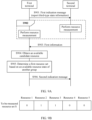
- the second terminal reports the first information at fixed moments according to a cycle, as shown in FIG. 7C .
- a measurement cycle and a report cycle may be different.
- the first terminal may dynamically indicate the second terminal to report the first information at a specific moment, or when receiving the indication message, the second terminal reports the first information at a moment after default duration (n duration), as shown in FIG. 7D .
- the first terminal may selectively trigger some second terminals to aperiodically report the first information. For example, when the first terminal needs to obtain first information of a specific second terminal, the first terminal may indicate only the second terminal to aperiodically report the first information.
- the second terminal After confirming a report moment, the second terminal sends the first information to the first terminal according to a specific sending mechanism configured by the first terminal.
- the sending mechanism configured by the first terminal is to report the first information on a reserved resource
- the second terminal reports the first information on the reserved resource.
- the sending mechanism configured by the first terminal is to report the first information on an autonomously selected resource
- the second terminal first senses the resource, and then reports the first information.
- the first information reported by the second terminal includes M bits, where M is a quantity of to-be-measured resources in the to-be-measured resource set indicated by the first terminal, and each bit represents whether a measurement result of one resource reaches a measurement threshold.
- M is a quantity of to-be-measured resources in the to-be-measured resource set indicated by the first terminal
- each bit represents whether a measurement result of one resource reaches a measurement threshold.
- a corresponding bit is set to 1.
- the corresponding bit is set to 0.
- the first terminal may obtain a measurement result of each resource due to a one-to-one correspondence.
- the first information reported by the second terminal includes M bytes, where M is a quantity of resources indicated by the first terminal, and each byte represents whether a measurement result of a resource reaches a measurement threshold.
- M is a quantity of resources indicated by the first terminal
- each byte represents whether a measurement result of a resource reaches a measurement threshold.
- a measurement result of a resource is below the measurement threshold
- a corresponding byte is set to a value other than 0.
- the corresponding byte is set to 0.
- the first information reported by the second terminal includes time-frequency positions and measurement results of resources in a group. In this way, after the first terminal receives the first information reported by the second terminal, the first terminal may directly obtain a measurement result of a resource at a specific time-frequency position.
- FIG. 7E shows an example of storing first information of a second terminal in a table.
- a blank position in the table indicates that the first terminal does not indicate the second terminal to measure a resource block at the position.
- the first terminal does not indicate a second terminal 2 to measure a resource 1.
- the first terminal may store the first information reported by the second terminal in another manner. This is not limited in this embodiment of this application.
- the second terminal use a message to carry the first information, such as an RRC (Radio Resource Control, radio resource control) message, an MCE (MAC Control Element, MAC control element) message, and an SCI (Sidelink Control Indicator, sidelink control indicator) message.
- the SCI message is carried by using a control channel (Physical Sidelink Control Channel, physical sidelink control channel). Therefore, a user identifier of the second terminal implementing report needs to be included in the first information, so that the first terminal can identify the second terminal that reports the first information.
- the RRC message and the MCE message are carried by using a data channel (Physical Sidelink Shared Channel, physical sidelink shared channel). Therefore, when receiving the first information, the first terminal may identify, based on scrambling information, the second terminal implementing report.
- the second terminal after the second terminal reports the first information to the first terminal, the second terminal measures a distance between the second terminal and the first terminal. When the distance changes and reaches a second distance threshold, the second terminal actively reports the first information to the first terminal. In this way, untimely report of the first information caused by a great change in a position of the second terminal can be prevented.
- the wireless communication system further includes a third terminal.
- the third terminal belongs to another group.
- the first information includes information about interference from the third terminal to the to-be-measured resources in the to-be-measured resource set.
- the first terminal obtains available candidate resources. Specifically, the first terminal performs decision-making, based on the first information reported by the second terminal and second information, to obtain the available candidate resource, where the first information is a resource set obtained through measurement performed by the second terminal, and the second information is a resource set obtained through measurement performed by the first terminal.
- the first information includes a first measurement result obtained through measurement performed by the second terminal on the to-be-measured resources in the to-be-measured resource set, and the first terminal measures the to-be-measured resources in the to-be-measured resource set to obtain a second measurement result.
- the first terminal uses a resource in an intersection of the first measurement result and the second measurement result as an available candidate resource.
- resource sets obtained through measurement performed by the second terminals are respectively S 1 , S 2 , ..., and S N , where N is a quantity of group members.
- a resource set obtained through measurement performed by the first terminal is S 0 , and a quantity of elements in the resource set S 0 is
- a quantity of available candidate resources determined by the first terminal is K, and the available candidate resources include a second resource set and a third resource set.
- the first terminal determines the second resource set based on the first information and the second information. Specifically, the first terminal selects K1 resources from a fourth resource set S' , and a set including the selected K1 resources is S 0 K 1 , that is, the second resource set. A percentage of resources in the fourth resource set S' that are measured by the second terminal and whose measurement results reach a measurement threshold is greater than or equal to a first percentage. The first percentage may be 60%, 80%, or the like. If the first percentage is 100%, it indicates that an intersection is needed. If the first percentage is 1/ N , it indicates that a union is needed.
- a percentage of resources in the fourth resource set S ' that are measured by the first terminal and the second terminal and whose measurement results meet a measurement threshold is greater than or equal to a first percentage.
- the first percentage may be 60%, 80%, or the like. If the first percentage is 100%, it indicates that an intersection is needed. If the first percentage is 1/(1 + N ), it means to a union is needed. An intersection of S ' and S 0 is S' ⁇ S 0 , and a quantity of elements in S' ⁇ S 0 is
- the group header selects the K1 resources from S' ⁇ S 0 as available candidate resources, where the K1 resources are K1 resources with the minimum interference in the resource set S 0 obtained through measurement performed by the first terminal; or the K1 resources are K1 resources randomly selected from S' ⁇ S 0 .
- the first terminal selects all resources in S' ⁇ S 0 as available candidate resources, and selects K1-
- the first terminal determines the third resource set based on the first information and the second information. Specifically, the first terminal selects K-K1 resources from unselected resources as available candidate resources, where a set including the K-K1 resources is the third resource set.
- S" is a relative complement of S 0 K 1 in S' , that is, an element in S" belongs to S' but does not belong to S 0 K 1 , and a quantity of elements in the relative complement S" is
- K-K1 is less than or equal to
- K-K1 is greater than
- the first terminal selects all resources in S" as available candidate resources, and then randomly selects K-K1-
- resources are preferentially selected from a resource set obtained through measurement performed by the second terminal with a large traffic volume as available candidate resources. If resources are insufficient, resources with the minimum interference are constantly selected from S 0 as available candidate resources until a resource requirement of the first terminal is met. During resource selection, a selected resource is not selected again.
- K1 may be equal to that of K.
- the requirement for available candidate resources can be met after the first terminal directly selects K1 resources from the fourth resource set.
- the first terminal determines the first resource set based on available candidate resources in the current group and an available resource state sent by a fourth terminal, where a resource in the first resource set is a resource for sidelink communication, and the fourth terminal is a group header of another group. Specifically, after determining an available resource, the fourth terminal sends an available resource state to the first terminal, and the first terminal finally determines the first resource set based on the available candidate resources determined in step S704 and the available resource state of the another group.
- the available candidate resources obtained in step S704 are a resource 1, a resource 2, a resource 3, a resource 4, and a resource 5, and received available resources sent by the fourth terminal are the resource 3 and the resource 4.
- the first terminal decides that the first resource set includes the resource 1, the resource 2, and the resource 5.
- the first terminal notifies the fourth terminal of the first resource set.
- the first terminal may report the available candidate resources to the base station.
- the base station performs decision-making to obtain the available resources for the group to which the first terminal belongs, and then configures the available resources to the first terminal.
- step S705 is not performed.
- the available candidate resources obtained in step S704 are directly used as the first resource set.
- the first terminal directly determines the first resource set based on the received first information, and does not need to notify a group header in another group of the first resource set.
- the first terminal directly performs step S706.
- the first terminal sends a second indication message to the second terminal, where the second indication message indicates information of the first resource set.
- the first terminal sends the first resource set determined in step S705 to the second terminal.
- the first terminal uses the available candidate resources obtained in S704 as the first resource set, and sends the first resource set to the second terminal.
- At least one of the first terminal and the second terminal performs sidelink communication on a resource in the first resource set. This step is not shown in FIG. 7A . Specifically, when the terminal device, including the first terminal and the second terminal, in the group needs to send data to another device in the group, the terminal device senses resources in the first resource set to obtain an appropriate sidelink resource, and then sends the data on the sidelink resource.
- FIG. 8A shows an information report method according to an embodiment of this application.
- the method is applied to a wireless communication system that includes a first terminal and a second terminal, where the first terminal is a group header, the second terminal is a group member, and there is one or more second terminals.
- the method is about reporting second-type state information, and mainly includes the following steps.
- the first terminal sends a first indication message to the second terminal, where the first indication message indicates the second terminal to report first information.
- the indication information in the first indication message is the same as that described in step S701 in FIG. 7A except an indication of a type of reported content and an indication of a measurement threshold. Details are not described herein again.
- a type of reported content is second-type state information
- the second-type state information is channel quality of a channel resource.
- the channel quality includes RSRP (Reference Signal Receiving Power, reference signal receiving power), an SINR (Signal to Interference plus Noise Ratio, signal to interference plus noise ratio), RSRQ (Reference Signal Receiving Quality, reference signal receiving quality), or the like.
- RSRP Reference Signal Receiving Power, reference signal receiving power
- SINR Signal to Interference plus Noise Ratio, signal to interference plus noise ratio
- RSRQ Reference Signal Receiving Quality, reference signal receiving quality
- interference values that are of the five resources and that are obtained through measurement performed by the second terminal are respectively -80 dBm, -85 dBm, -75 dBm, -70 dBm, and -80 dBm.
- the first terminal does not need to send the measurement threshold indication to the second terminal.
- the first terminal and the second terminal perform resource measurement.
- a specific measurement manner is the same as that described in step S702, and details are not described herein again.
- step S802 is performed before S801.
- the second terminal completes measurement of all resources in the resource pool before receiving the first indication message sent by the first terminal.
- the resource pool may be obtained from a base station, or may be preconfigured. In this way, after receiving the first indication message, the second terminal directly reports the first information based on the indication information.
- the second terminal reports the first information to the first terminal. Specifically, except reported content, content in the first information is the same as that in step S703 in FIG. 7A . Details are not described herein again.
- the second terminal reports a specific interference value to the first terminal after measuring a specified resource.
- the second terminal measures a specified resource to obtain an interference value without performing any processing, and directly reports the specific interference value to the first terminal.
- the second terminal measures a specified resource to obtain an interference value and performs processing such as filtering and smoothing, and reports a measurement result obtained through processing to the first terminal.
- the first terminal obtains available candidate resources. Specifically, the first terminal performs decision-making, based on the first information reported by the second terminal and second information, to obtain available candidate resources, where the first information is an interference set obtained through measurement performed by the second terminal, and the second information is an interference set obtained through measurement performed by the first terminal.
- Interference sets obtained through measurement performed by second terminals are S 1 , S 2 , ..., and S N , where N is a quantity of group members, and an interference set obtained through measurement performed by the first terminal is S 0 .
- K available candidate resources are determined by the first terminal.
- the available candidate resources include a second resource set and a third resource set.
- the first terminal determines the second resource set based on the second information.
- the second information is a resource set obtained through measurement performed by the first terminal, that is, S 0 .
- the second resource set is determined by the first terminal from a fourth resource set, where the fourth resource set is the resource set S 0 obtained through measurement performed by the first terminal in this embodiment.
- the first terminal selects K1 resources with the least interference from S 0 as available candidate resources, where K1 is less than or equal to K.
- the first terminal determines the third resource set based on the first information and the second information.
- the first terminal selects K-K1 resources as available candidate resources from resources that have not been selected.
- a set including the K-K1 resources is the third resource set, and the quantity K-K1 of resources in the third resource set is a third quantity.
- the first terminal arranges, in descending order based on traffic volumes of second terminals, interference sets obtained through measurement performed by the second terminals.
- the interference sets obtained through measurement performed by the second terminals are S 1 ′ , S 2 ′ , ..., and S N ′ , where S 1 ′ is an interference set obtained through measurement performed by a second terminal with the largest traffic volume, and S N ′ is an interference set obtained through measurement performed by a second terminal with the smallest traffic volume.
- the first terminal keeps selecting resources with the minimum interference from the interference sets arranged in descending order as available candidate resources, until K-K1 available candidate resources are selected. During resource selection, a selected resource is not selected again.
- the first terminal calculates average interference of each resource.
- the first terminal selects K-K1 resources with the minimum average interference as available candidate resources. A selected resource is not selected again during resource selection.
- the first terminal converts the interference value of each resource into spectral efficiency.
- the interference value obtained through measurement is an RSRP value
- the first terminal selects K-K1 resources with the minimum transmission periods as available candidate resources. A selected resource is not selected again during resource selection.
- K1 may be equal to that of K.
- the requirement for available candidate resources can be met after the first terminal directly selects K1 resources from the fourth resource set.
- the first terminal may set different measurement thresholds based on terminal capabilities reported by the second terminals. For example, for a terminal that does not have a high requirement on a latency and a throughput, the first terminal may set a high measurement threshold, and for a terminal having a high requirement on the latency and the throughput, the first terminal may set a low measurement threshold. In this way, available candidate resources obtained by different second terminals are different.
- the first terminal determines a first resource set based on the available candidate resources in the group to which the first terminal belongs and an available resource state sent by a group header in another group, where a resource in the first resource set is a resource for sidelink communication. This step is the same as step S705 in FIG. 7A . Details are not described herein again.
- step S804 if the available candidate resources obtained by different second terminals in step S804 are different, different first resource sets are determined by the first terminal for different second terminals based on an available resource state sent by a group header of another group. After the first terminal obtains the first resource set for each second terminal, the first terminal notifies the group header in the another group of an intersection of the first resource sets for all the second terminals.
- the first terminal sends a second indication message to the second terminal, where the second indication message indicates information of the first resource set.
- This step is the same as step S706 in FIG. 7A . Details are not described herein again.
- first resource sets obtained through decision-making for different second terminals are different, first resource sets sent by the first terminal to different second terminals are also different.
- At least one of the first terminal and the second terminal performs sidelink communication on a resource in the first resource set. This step is not shown in FIG. 8A . This step is the same as step S707 in FIG. 7A . Details are not described herein again.
- FIG. 9A shows an information sending method according to an embodiment of this application.
- the method is applied to a wireless communication system that includes a first terminal and a second terminal, where the first terminal is a group header, the second terminal is a group member, and there is one or more second terminals.
- the method is about reporting third-type state information, and mainly includes the following steps.
- the first terminal sends a first indication message to the second terminal, where the first indication message indicates the first terminal to report first information.
- indication information in the first indication message is the same as the information described in step S701 in FIG. 7A except an indication of a type of reported content and an indication of a measurement threshold. Details are not described herein again.
- the type of reported content is third-type state information
- the third-type state information indicates whether a bit error rate of a channel resource reaches a second threshold.
- the second terminal collects a bit error rate of data transmission on a measured resource indicated by the first terminal.
- a measurement threshold configured by the first terminal that is, a second threshold, may be 1%, 5%, 10%, or the like.
- the second terminal may use a default measurement threshold, for example, 5%, and does not need to obtain the measurement threshold from the first terminal.
- the first terminal and the second terminal perform resource measurement. Because measurement of a bit error rate of a resource requires service data transmission on the resource, the bit error rate can be obtained only after data transmission is performed for a period of time.
- the type of reported content in this embodiment may be indicated by the first terminal after other types of reported content are used for operation for a period of time, to obtain better performance.
- the first terminal sends the indication of a type of reported content in this embodiment to the second terminal at an initial stage, and the second terminal reports the first information to the first terminal after data transmission is performed for a period of time.
- step S902 is performed before S901.
- the second terminal performs data transmission for a period of time and obtains a bit error rate of a used resource before receiving the first indication message sent by the first terminal. In this way, after receiving the first indication message, the second terminal directly reports the first information based on the indication information.
- the second terminal reports the first information to the first terminal. Specifically, except reported content, content in the information is the same as that in step S703 in FIG. 7A . Details are not described herein again.
- the second terminal reports a measurement result of a specific resource to the first terminal.
- a measurement resource set configured by the first terminal is S, including five measured resources. Bit error rates of a resource 2 and a resource 3 are below a bit error rate threshold. In this case, 1 is set for the corresponding resources. If bit error rates of remaining resources are not below the bit error rate threshold, 0 is set on the corresponding resources.
- the first terminal obtains available candidate resources. Specifically, the first terminal performs decision-making, based on the first information reported by the second terminal and the measurement information obtained by the first terminal, to obtain the available candidate resources. This step is the same as step S704 in FIG. 7A . Details are not described herein again.
- the first terminal determines a first resource set based on available candidate resources in a group to which the first terminal belongs and an available resource state sent by a group header in another group, where a resource in the first resource set is a resource for sidelink communication. This step is the same as step S705 in FIG. 7A . Details are not described herein again.
- the first terminal sends a second indication message to the second terminal, where the second indication message indicates information of the first resource set.
- This step is the same as step S706 in FIG. 7A . Details are not described herein again.
- At least one of the first terminal and the second terminal performs sidelink communication on the resource in the first resource set. This step is not shown in FIG. 9A . This step is the same as step S707 in FIG. 7A . Details are not described herein again.
- a group header can perform unified management to provide reliable information input. This can resolve problems of strong interference on an edge terminal device and low resource utilization in the group, and improve system communication performance. It can be learned from the foregoing embodiments that the information report methods provided in the three embodiments have respective advantages.
- the first information reported by the group member device is simple. In this way, fewer resources are occupied when the group member device reports the first information.
- the group member device reports a specific measurement value of a resource.
- the group header can perform differentiated processing on different group member devices based on specific measurement values.
- the group header may determine a resource for sidelink communication based on a bit error state in actual data transmission.
- the group header may change content in the first indication message for different scenarios.
- the group header first uses the method for reporting the first-type state information. After running for a period of time, the group header may use the method for reporting the third-type state information. In this way, the group header may obtain a bit error state of a resource, and obtain a resource for sidelink communication based on the bit error state. Consequently, a resource for sidelink communication obtained through decision-making is accurate.
- a bit error rate reaches a threshold
- an indication for reporting first information is switched to the method for reporting the second-type state information.
- a measurement result reported by a group member device can be accurate, and differentiated processing can be performed on group member devices. Therefore, the system efficiency of the entire group is improved.
- the following shows an information report method according to an embodiment of this application.
- the method is applied to a wireless communication system that includes a first terminal and a second terminal, where the first terminal is a group header in a first group.
- the method includes the following steps.
- the second terminal sends a group joining application to the first terminal, and in response to a received application approval message sent by the group header, joins a first group to become a member of the first group.
- the second terminal may receive a first operation, that is, user selection, and join the first group as shown in FIG. 4B and FIG. 4C .
- the second terminal can autonomously choose to join the first group. For example, the second terminal chooses to join a group whose group header is closest to the second terminal.
- the second terminal reports first information to the first terminal, where the first information is information for assisting the first terminal in selecting a first resource set, and a resource in the first resource set is a resource for sidelink communication.
- the second terminal after the second terminal joins the first group and becomes the member of the first group, the second terminal reports the first information to the first terminal, where the reported first information is of a default type.
- the first terminal after detecting a new first-group member, the first terminal sends a first indication message to the first-group member, and the first-group member reports the first information to the first terminal according to the first indication message. Details about the first indication message are the same as those described in step S701 in FIG. 7 . The details are not described herein again.
- the second terminal receives a second indication message sent by the first terminal, where the second indication message is information indicating the first resource set. Details about determining and sending the first resource set are the same as those described in steps S704 to S706 in FIG. 7 . The details are not described herein again.
- all terminals support report of first information of a specific type.
- all the terminals support report of first-type state information.
- a terminal autonomously reports the first information to a group header on a default cycle or based on a change of distance between the terminal and the group header.
- the group member device does not need to wait for a first indication message sent by the group header, to report the first information to the group header.
- FIG. 11 shows a method for triggering, by a group header, a group member to report first information according to an embodiment of this application. The method includes the following steps.
- the group header decides to execute a first information report procedure.
- the group header may be manually set to execute the first information report procedure.
- the group header detects a current resource conflict probability, and executes the first information report procedure when the resource conflict probability reaches a threshold.
- the base station may configure the group header to execute the first information report procedure.
- the group header sends a first indication message to the group member device, where the first indication message indicates the group member device to report the first information. Descriptions of this step are the same as those in the embodiments of FIG. 7 to FIG. 9 . Details are not described herein again.
- the following shows an information sending method according to an embodiment of this application.
- the method is applied to a wireless communication system that includes a first terminal, a second terminal, and a third terminal, where the first terminal and the second terminal belong to a same communication group, the first terminal is a group header, and the second terminal is a group member.
- the method includes the following steps.
- the first terminal sends a first indication message to the second terminal, where the first indication message indicates the second terminal to report first information, and the first indication message includes an indication of a to-be-measure resource set.
- the second terminal reports the first information to the first terminal according to the first indication message, where the first information includes information about interference from the third terminal to a to-be-measured resource in the to-be-measured resources set.
- the first terminal sends a second indication message to the second terminal, where the second indication message indicates information about a first resource set, a resource in the first resource set is a resource for sidelink communication, and the first resource set do not include a resource that is in the to-be-measured resource set and on which interference from the third terminal meets a preset condition.
- the first resource set does not include a resource that is in the to-be-measured resource set and whose information about interference from the third terminal reaches an interference threshold.
- the first resource set does not include a resource that is in the to-be-measured resource set and whose information about interference from the third terminal, the second terminal, and the first terminal reaches the interference threshold.
- At least one of the first terminal and the second terminal performs sidelink communication on the resource in the first resource set.
- the foregoing embodiments of this application may also be applied to other communication system technologies, for example, applied to wireless communication systems using technologies such as Wi-Fi, ZigBee, Bluetooth, and NFC (Near Field Communication, Near Field Communication).
- technologies such as Wi-Fi, ZigBee, Bluetooth, and NFC (Near Field Communication, Near Field Communication).
- FIG. 13 shows an information sending apparatus according to an embodiment of this application.
- the apparatus may be implemented as a part of the terminal or the entire terminal in embodiments of this application by using software, hardware, or a combination thereof.
- the apparatus includes: a configuration sending unit 1301, a configuration receiving unit 1302, a measurement unit 1303, an auxiliary information report unit 1304, an available resource decision-making unit 1305, and an available resource configuration unit 1306.
- the configuration sending unit 1301 is configured to send a first indication message to a group member device when the apparatus is used as a group header.
- the configuration receiving unit 1302 is configured to: when the apparatus is used as a group member device, receive a first indication message sent by a group header.
- the measurement unit 1303 is configured to measure a resource when the apparatus is used as a group member device or a group header.
- the auxiliary information report unit 1304 is configured to generate first information and report the first information to a group header when the apparatus is used as a group member device.
- the available resource decision-making unit 1305 is configured to: when the apparatus is used as a group header, perform decision-making, based on first information reported by a group member device and measurement information of the apparatus, to obtain a resource for sidelink communication.
- the available resource configuration unit 1306 is configured to configure a resource for sidelink communication to a group member device when the apparatus is used as a group header.
- FIG. 14 is a schematic diagram of a structure of a terminal according to an embodiment of this application.
- the terminal includes a processor 1401, a receiver 1402, a transmitter 1403, a memory 1404, and a bus 1405.
- the processor 1401 includes one or more processing cores.
- the processor 1401 runs a software program and a module, to execute various functional applications and perform information processing.
- the receiver 1402 and the transmitter 1403 may be implemented as a communication component, and the communication component may be a baseband chip.
- the memory 1404 is connected to the processor 1401 by using the bus 1405.
- the memory 1404 may be configured to store at least one program instruction, and the processor 1401 is configured to execute the at least one program instruction, to implement the technical solutions in the foregoing embodiments. Implementation principles and technical effects thereof are similar to those of the foregoing method embodiments. Details are not described herein again.
- the processor can read a software program in the memory, interpret and execute instructions of the software program, and process data of the software program.
- the processor needs to send data (for example, a random access preamble) through an antenna
- the processor outputs a baseband signal to a control circuit; and the control circuit performs radio frequency processing on the baseband signal and then sends the radio frequency signal in a form of an electromagnetic wave through the antenna.
- the control circuit receives a radio frequency signal through the antenna, converts the radio frequency signal into the baseband signal, and outputs the baseband signal to the processor.
- the processor converts the baseband signal into data and processes the data.
- FIG. 15 is a schematic diagram of a structure of a cockpit domain controller system according to an embodiment of this application.
- the cockpit domain controller system is applied to a vehicle, or this embodiment of this application may be applied to a large smart factory, an unmanned aerial vehicle device, or the like.
- the cockpit domain controller system includes a processor 1501, a receiver 1502, a transmitter 1503, a memory 1504, and a bus 1505.
- the processor 1501 runs a software program and a module, to perform application of various functions and information processing.
- the receiver 1502 and the transmitter 1503 may be implemented as a communication component, and the communication component may be a baseband chip.
- the memory 1504 is connected to the processor 1501 by using the bus 1505.
- the memory 1504 may be configured to store at least one program instruction, and the processor 1501 is configured to execute the at least one program instruction, to implement the technical solutions in the foregoing embodiments. Implementation principles and technical effects thereof are similar to those of the foregoing method embodiments. Details are not described herein again.
- FIG. 16 is a schematic diagram of a structure of a roadside device according to an embodiment of this application.
- the roadside device is applied to the Internet of Vehicles.
- the roadside device includes a processor 1601, a receiver 1602, a transmitter 1603, a memory 1604, and a bus 1605.
- the processor 1601 runs a software program and a module, to perform application of various functions and information processing.
- the receiver 1602 and the transmitter 1603 may be implemented as a communication component, and the communication component may be a baseband chip.
- the memory 1604 is connected to the processor 1601 by using the bus 1605.
- the memory 1604 may be configured to store at least one program instruction, and the processor 1601 is configured to execute the at least one program instruction, to implement the technical solutions in the foregoing embodiments. Implementation principles and technical effects thereof are similar to those in the foregoing method embodiments, and details are not described herein again.
- FIG. 14 to FIG. 16 there may be a plurality of processors and memories.
- the memory may also be referred to as storage medium, storage device, or the like. This is not limited in embodiments of this application.
- the processor may include a baseband processor and a central processing unit.
- the baseband processor is mainly configured to process communication data
- the central processing unit is mainly configured to execute a software program and process data of the software program.
- the baseband processor and the central processing unit may be integrated into one processor, or may be independent processors, and are connected by using a bus or the like.
- the terminal may include a plurality of baseband processors to adapt to different network standards, the terminal may include a plurality of central processing units to enhance a processing capability, and components of the terminal may be connected by various buses.
- the baseband processor may also be referred to as baseband processing circuit or baseband processing chip.
- the central processing unit may also be referred to as central processing circuit or central processing chip.
- a function of processing communication protocols and communication data may be configured in the processor, or may be stored in the memory in a form of a software program.
- the processor executes the software program to implement a baseband processing function.
- the memory may be integrated into the processor, or may be independent of the processor.
- the memory includes a cache, and may store frequently accessed data/instructions.
- the processor may be a general-purpose processor, a digital signal processor, an application-specific integrated circuit, a field-programmable gate array or another programmable logic device, a discrete gate or transistor logic device, or a discrete hardware component, and can implement or perform the methods, steps, and logical block diagrams disclosed in embodiments of this application.
- the general-purpose processor may be a microprocessor, or may be any conventional processor or the like. The steps in the methods disclosed with reference to embodiments of this application may be directly performed by a hardware processor, or may be performed by a combination of hardware and a software module in the processor.
- the memory may be a nonvolatile memory such as a hard disk drive (hard disk drive, HDD) or a solid-state drive (solid-state drive, SSD), or may be a volatile memory (volatile memory) such as a random-access memory (random-access memory, RAM).
- the memory is any other medium that can carry or store expected program code in a form of an instruction or a data structure and that can be accessed by a computer, but is not limited thereto.
- the memory in embodiments of this application may alternatively be a circuit or any other apparatus that can implement a storage function, and is configured to store program instructions and/or data. All or some of the methods provided in embodiments of this application may be implemented by using software, hardware, firmware, or any combination thereof. When software is used to implement the embodiments, all or some of the embodiments may be implemented in a form of a computer program product.
- the computer program product includes one or more computer instructions. When the computer program instructions are loaded and executed on a computer, the procedures or functions according to embodiments of this application are all or partially generated.
- the computer may be a general-purpose computer, a dedicated computer, a computer network, a network device, user equipment, or another programmable apparatus.
- the computer instructions may be stored in a computer-readable storage medium or may be transmitted from a computer-readable storage medium to another computer-readable storage medium.
- the computer instructions may be transmitted from a website, computer, server, or data center to another website, computer, server, or data center in a wired manner (for example, a coaxial cable, an optical fiber, or a digital subscriber line (Digital Subscriber Line, DSL)) or a wireless manner (for example, infrared, radio, and microwave).
- the computer-readable storage medium may be any usable medium accessible by a computer, or a data storage device, such as a server or a data center, integrating one or more usable media.
- the usable medium may be a magnetic medium (for example, a floppy disk, a hard disk drive, or a magnetic tape), an optical medium (for example, a digital video disc (digital video disc, DVD)), a semiconductor medium (for example, an SSD), or the like.
- a magnetic medium for example, a floppy disk, a hard disk drive, or a magnetic tape
- an optical medium for example, a digital video disc (digital video disc, DVD)
- a semiconductor medium for example, an SSD
- An embodiment of this application provides a computer program product.
- the computer program product When the computer program product is run on a terminal, the terminal is enabled to implement the technical solutions in the foregoing embodiments. Implementation principles and technical effects thereof are similar to those of the foregoing related embodiments, and details are not described herein again.
- An embodiment of this application provides a computer-readable storage medium, where the computer-readable storage medium stores program instructions.
- the program instructions are executed by a terminal, the terminal is enabled to perform the technical solutions in the foregoing embodiments.
- Implementation principles and technical effects thereof are similar to those in the foregoing related embodiments, and details are not described herein again.
- the foregoing embodiments are merely intended for describing the technical solutions of this application, but not for limiting this application.
Landscapes
- Engineering & Computer Science (AREA)
- Computer Networks & Wireless Communication (AREA)
- Signal Processing (AREA)
- Quality & Reliability (AREA)
- Mobile Radio Communication Systems (AREA)
Claims (15)
- Informationssendeverfahren, das auf ein drahtloses Kommunikationssystem angewendet wird, wobei das drahtlose Kommunikationssystem ein erstes Endgerät und ein zweites Endgerät umfasst, ein oder mehrere zweite Endgeräte vorhanden sind und das Verfahren Folgendes umfasst:Senden (S601) durch das erste Endgerät einer ersten Angabenachricht an das zweite Endgerät, wobei die erste Angabenachricht angibt, dass das zweite Endgerät erste Informationen melden soll;Melden (S602) durch das zweite Endgerät der ersten Informationen an das erste Endgerät gemäß der ersten Angabenachricht, wobei die ersten Informationen Kanalzustandsinformationen eines Kanalbetriebsmittels angeben; undSenden (S603) durch das erste Endgerät einer zweiten Angabenachricht an das zweite Endgerät, wobei die zweite Angabenachricht Informationen über eine erste Betriebsmittelgruppe angibt, wobei die erste Betriebsmittelgruppe durch das erste Endgerät anhand der ersten Informationen bestimmt wird und ein Betriebsmittel in der ersten Betriebsmittelgruppe ein Betriebsmittel für eine "Sidelink"-Kommunikation ist, wobei die Kanalzustandsinformationen eines Kanalbetriebsmittels Zustandsinformationen eines ersten Typs sind und die Zustandsinformationen eines ersten Typs angeben, ob eine Kanalqualität des Kanalbetriebsmittels einen ersten Schwellenwert erreicht; oderdie Kanalzustandsinformationen eines Kanalbetriebsmittels Zustandsinformationen eines zweiten Typs sind und die Zustandsinformationen eines zweiten Typs eine Kanalqualität des Kanalbetriebsmittels sind; oderdie Kanalzustandsinformationen eines Kanalbetriebsmittels Zustandsinformationen eines dritten Typs sind und die Zustandsinformationen eines dritten Typs angeben, ob eine Bitfehlerrate des Kanalbetriebsmittels einen zweiten Schwellenwert erreicht; unddie Kanalqualität eine empfangene Leistung eines Referenzsignals, RSRP, ein Signalzu-Interferenz-plus-Rausch-Verhältnis, SINR, oder eine empfangene Qualität des Referenzsignals, RSRQ, umfasst,wobei die Kanalzustandsinformationen des Kanalbetriebsmittels von den Zustandsinformationen des ersten Typs zu den Zustandsinformationen des dritten Typs gewechselt werden, nachdem eine Datenübertragung für eine Zeitperiode ausgeführt wird, unddie Kanalzustandsinformationen des Kanalbetriebsmittels anhand der Bitfehlerrate des Kanalbetriebsmittels von den Zustandsinformationen des dritten Typs zu den Zustandsinformationen des zweiten Typs gewechselt werden.
- Verfahren nach Anspruch 1, wobei das Verfahren ferner umfasst:
Ausführen durch das erste Endgerät und/oder das zweite Endgerät einer "Sidelink"-Kommunikation auf dem Betriebsmittel in der ersten Betriebsmittelgruppe. - Verfahren nach Anspruch 2, wobei die erste Angabenachricht eine Angabe eines Typs eines gemeldeten Inhalts umfasst und der Typ des gemeldeten Inhalts die Zustandsinformationen des ersten Typs und/oder die Zustandsinformationen des zweiten Typs und/oder die Zustandsinformationen des dritten Typs sind.
- Verfahren nach einem der Ansprüche 1 bis 3, wobei, dass die erste Betriebsmittelgruppe durch das erste Endgerät anhand der ersten Informationen bestimmt wird, Folgendes umfasst:das erste Endgerät bestimmt eine zweite Betriebsmittelgruppe anhand zweiter Informationen, wobei die zweiten Informationen eine Gruppe sind, die durch eine Messung, die durch das erste Endgerät ausgeführt wird, erhalten werden, wobei die zweite Betriebsmittelgruppe durch das erste Endgerät aus einer vierten Betriebsmittelgruppe bestimmt wird und ein Prozentanteil von Betriebsmitteln in der vierten Betriebsmittelgruppe, die durch das zweite Endgerät gemessen werden und deren Messergebnisse einen Messschwellenwert erreichen, größer als ein erster Prozentanteil oder gleich diesem ist oder ein Prozentanteil von Betriebsmitteln in der vierten Betriebsmittelgruppe, die durch das erste Endgerät und das zweite Endgerät gemessen werden und deren Messergebnisse den Messschwellenwert erreichen, größer als der erste Prozentanteil oder gleich diesem ist oder die vierte Betriebsmittelgruppe eine Gruppe ist, durch die eine Messung erhalten wird, die durch das erste Endgerät ausgeführt wird; unddas erste Endgerät bestimmt eine dritte Betriebsmittelgruppe anhand der ersten Informationen und der zweiten Informationen, wobei eine Anzahl von Betriebsmitteln in der dritten Betriebsmittelgruppe eine dritte Anzahl ist und die erste Betriebsmittelgruppe die zweite Betriebsmittelgruppe und die dritte Betriebsmittelgruppe umfasst.
- Verfahren nach Anspruch 4, wobei dann, wenn der Typ des gemeldeten Inhalts die Zustandsinformationen des ersten Typs oder die Zustandsinformationen des zweiten Typs sind, die ersten Informationen eine Betriebsmittelgruppe sind, die durch eine Messung erhalten wird, die durch das zweite Endgerät ausgeführt wird, und die dritte Betriebsmittelgruppe durch das erste Endgerät zufällig oder gemäß einem Prinzip, das eine Verkehrsmenge priorisiert, bestimmt wird.
- Verfahren nach Anspruch 4, wobei dann, wenn der Typ des gemeldeten Inhalts die Zustandsinformationen des dritten Typs sind, die ersten Informationen eine Interferenzgruppe sind, die durch eine Messung erhalten werden, die durch das zweite Endgerät ausgeführt wird, und ein Verfahren zum Bestimmen der dritten Betriebsmittelgruppe durch das erste Endgerät mindestens eines des Folgenden umfasst:das erste Endgerät ordnet Interferenzgruppen, die durch eine Messung erhalten werden, die durch die zweiten Endgeräte ausgeführt werden, anhand von Verkehrsmengen der zweiten Endgeräte in absteigender Reihenfolge an und wählt gemäß der Anordnungsreihenfolge Betriebsmittel mit der minimalen Interferenz in den Interferenzgruppen als die Betriebsmittel in der dritten Betriebsmittelgruppe aus;
oderdas erste Endgerät berechnet eine mittlere Interferenz der Betriebsmittel anhand der Interferenzgruppe, die durch einen Messung, die durch das zweite Endgerät ausgeführt wird, erhalten wird, und wählt Betriebsmittel, die von der dritten Anzahl sind und deren mittlere Interferenz der Betriebsmittel das Minimum ist, als die Betriebsmittel in der dritten Betriebsmittelgruppe aus;
oderdas erste Endgerät setzt einen Betriebsmittelinterferenzwert in eine spektrale Effizienz anhand der durch eine Messung, die durch das zweite Endgerät ausgeführt wird, erhaltenen Interferenzgruppe um, erhält eine Übertragungsperiode eines Betriebsmittels durch eine Berechnung, die anhand einer Verkehrsmenge des zweiten Endgeräts ausgeführt wird, und wählt Betriebsmittel, die von der dritten Anzahl sind und deren Übertragungsperioden das Minimum sind, als Betriebsmittel in der dritten Betriebsmittelgruppe aus. - Verfahren nach einem der Ansprüche 1 bis 6, wobei die erste Angabenachricht eine Angabe einer zu messenden Betriebsmittelgruppe umfasst und die zu messende Betriebsmittelgruppe eine Position eines Kanalbetriebsmittels angibt, das durch das zweite Endgerät gemessen wird.
- Verfahren nach Anspruch 8, wobei das drahtlose Kommunikationssystem ferner ein drittes Endgerät umfasst, wobei das dritte Endgerät zu einer anderen Gruppe gehört und die ersten Informationen Informationen über eine Interferenz von dem dritten Endgerät zu einem zu messenden Betriebsmittel in der zu messenden Betriebsmittelgruppe umfassen.
- Verfahren nach einem der Ansprüche 1 bis 8, wobei die erste Angabenachricht eine Angabe eines Sendemechanismus für die ersten Informationen umfasst und der Sendemechanismus für die ersten Informationen umfasst, die ersten Informationen auf einem autonom ausgewählten Betriebsmittel zu melden oder die ersten Informationen auf einem reservierten Betriebsmittel zu melden.
- Verfahren nach einem der Ansprüche 1 bis 9, wobei die erste Angabenachricht eine Angabe einer Meldungsgelegenheit umfasst und ein Typ der Meldegelegenheit einen periodischen Bericht oder einen nicht periodischen Bericht umfasst.
- Verfahren nach einem der Ansprüche 1 bis 10, wobei das Senden durch das erste Endgerät einer ersten Angabenachricht an das zweite Endgerät umfasst:
Messen durch das erste Endgerät eines Abstands zwischen dem ersten Endgerät und dem zweiten Endgerät und dann, wenn sich der Abstand ändert und einen ersten Abstandsschwellenwert erreicht, Senden durch das erste Endgerät der ersten Angabenachricht an das zweite Endgerät. - Verfahren nach einem der Ansprüche 1 bis 11, wobei das Melden durch das zweite Endgerät der ersten Informationen an das erste Endgerät anhand der ersten Angabenachricht Folgendes umfasst:
Melden durch das zweite Endgerät der ersten Informationen an das erste Endgerät anhand der ersten Angabeinformationen durch Verwenden einer Funkbetriebsmittelsteuernachricht, RRC-Nachricht, einer Mediensteuerelementnachricht, MCE-Nachricht, oder einer "Sidelink"-Steuerindikatornachricht, SCI-Nachricht. - Verfahren nach einem der Ansprüche 1 bis 12, wobei, dass die erste Betriebsmittelgruppe durch das erste Endgerät anhand der ersten Informationen bestimmt wird, Folgendes umfasst:die erste Betriebsmittelgruppe wird durch das erste Endgerät anhand der empfangenen ersten Informationen und eines empfangenen verfügbaren Betriebsmittelzustands, der durch ein viertes Endgerät gesendet wird, bestimmt, wobei das vierte Endgerät ein Gruppenkopf einer anderen Gruppe ist; oderdie erste Betriebsmittelgruppe wird unmittelbar durch das erste Endgerät anhand der empfangenen ersten Informationen bestimmt.
- Verfahren nach einem der Ansprüche 1 bis 13, wobei das Senden durch das erste Endgerät einer zweiten Angabenachricht an das zweite Endgerät Folgendes umfasst:
Senden durch das erste Endgerät der zweiten Angabenachricht an das zweite Endgerät durch Verwenden einer Funkbetriebsmittelsteuernachricht, RRC-Nachricht, einer Mediensteuerelementnachricht, MCE-Nachricht, oder einer "Sidelink"-Steuerindikatornachricht, SCI-Nachricht. - Computerprogramm, das Anweisungen enthält, die dann, wenn sie durch ein drahtloses Kommunikationssystem ausgeführt werden, bewirken, dass das drahtlose Kommunikationssystem das Verfahren nach einem der Ansprüche 1 bis 14 ausführt.
Applications Claiming Priority (3)
| Application Number | Priority Date | Filing Date | Title |
|---|---|---|---|
| CN202010694431 | 2020-07-17 | ||
| CN202010975473.9A CN113950030B (zh) | 2020-07-17 | 2020-09-16 | 一种信息发送的方法及装置 |
| PCT/CN2021/106166 WO2022012565A1 (zh) | 2020-07-17 | 2021-07-14 | 一种信息发送的方法及装置 |
Publications (3)
| Publication Number | Publication Date |
|---|---|
| EP4171073A1 EP4171073A1 (de) | 2023-04-26 |
| EP4171073A4 EP4171073A4 (de) | 2023-11-22 |
| EP4171073B1 true EP4171073B1 (de) | 2025-05-21 |
Family
ID=79327251
Family Applications (1)
| Application Number | Title | Priority Date | Filing Date |
|---|---|---|---|
| EP21841633.7A Active EP4171073B1 (de) | 2020-07-17 | 2021-07-14 | Informationssendeverfahren und computerprogramm |
Country Status (6)
| Country | Link |
|---|---|
| US (1) | US20230292355A1 (de) |
| EP (1) | EP4171073B1 (de) |
| JP (1) | JP7575566B2 (de) |
| CN (1) | CN113950030B (de) |
| BR (1) | BR112023000818A2 (de) |
| WO (1) | WO2022012565A1 (de) |
Families Citing this family (7)
| Publication number | Priority date | Publication date | Assignee | Title |
|---|---|---|---|---|
| US12185279B2 (en) * | 2020-10-23 | 2024-12-31 | Qualcomm Incorporated | Receiver assisted sidelink resource allocation using an adaptive threshold |
| US12335947B2 (en) | 2020-10-23 | 2025-06-17 | Qualcomm Incorporated | Resource allocation techniques for sidelink transmissions, and dynamic selection between resource allocation techniques based on sidelink communication reliability |
| US12238767B2 (en) * | 2020-10-30 | 2025-02-25 | Qualcomm Incorporated | Channel occupancy information multi-access reporting |
| CN115442773B (zh) * | 2021-06-04 | 2025-06-10 | 华为技术有限公司 | 资源选择的方法和装置 |
| US12301489B2 (en) * | 2021-09-22 | 2025-05-13 | Qualcomm Incorporated | Managing wireless communications for leaky-wave antennas |
| CN117376941A (zh) * | 2022-06-30 | 2024-01-09 | 中兴通讯股份有限公司 | 终端的公共信号测量方法、终端及存储介质 |
| CN120419263A (zh) * | 2022-12-22 | 2025-08-01 | 上海诺基亚贝尔股份有限公司 | 分布式干扰感测 |
Family Cites Families (16)
| Publication number | Priority date | Publication date | Assignee | Title |
|---|---|---|---|---|
| WO2011129575A2 (ko) * | 2010-04-12 | 2011-10-20 | 엘지전자 주식회사 | 그룹 기반 m2m 통신을 수행하기 위한 장치 및 그 방법 |
| CN103260258A (zh) * | 2013-05-10 | 2013-08-21 | 南京邮电大学 | 一种蜂窝终端直通系统中资源分配和资源复用联合方法 |
| CN105165032A (zh) * | 2014-03-21 | 2015-12-16 | 华为技术有限公司 | 一种在d2d通信中建立用户组的组头的方法和装置 |
| JP6707645B2 (ja) * | 2016-01-29 | 2020-06-10 | オッポ広東移動通信有限公司Guangdong Oppo Mobile Telecommunications Corp., Ltd. | サイドリンクデータ伝送のための方法及び端末 |
| WO2019090522A1 (zh) * | 2017-11-08 | 2019-05-16 | Oppo广东移动通信有限公司 | D2d通信中资源配置的方法、终端设备和网络设备 |
| CN110139237B (zh) * | 2018-02-02 | 2022-06-28 | 大唐移动通信设备有限公司 | 一种资源分配管理方法及设备 |
| CN110380828B (zh) * | 2018-04-13 | 2021-05-07 | 维沃移动通信有限公司 | Sidelink的操作方法和终端 |
| US10863447B2 (en) | 2018-07-11 | 2020-12-08 | Samsung Electronics Co., Ltd. | Method and apparatus for multi-antenna transmission in vehicle to vehicle communication |
| JP7602453B2 (ja) | 2018-08-09 | 2024-12-18 | インターデイジタル パテント ホールディングス インコーポレイテッド | 5G eV2Xのためのリソース管理 |
| CN110891314B (zh) * | 2018-09-11 | 2022-08-19 | 华为技术有限公司 | 一种通信方法、资源分配方法及装置 |
| CN113179674B (zh) * | 2018-09-26 | 2025-01-17 | 弗劳恩霍夫应用研究促进协会 | V2x动态组播资源分配 |
| CN111130733B (zh) * | 2018-11-01 | 2022-01-14 | 华为技术有限公司 | 控制信息传输方法、装置及设备 |
| CN111148205B (zh) * | 2018-11-02 | 2022-03-25 | 华为技术有限公司 | 发送功率的确定方法和装置 |
| CN113287357B (zh) * | 2019-01-11 | 2023-08-01 | Lg电子株式会社 | 在无线通信系统中发送反馈信息的方法 |
| CN111277949B (zh) * | 2019-01-25 | 2021-05-28 | 维沃移动通信有限公司 | 信息上报方法、资源分配方法、第一终端及第二终端 |
| KR20230005162A (ko) * | 2020-03-20 | 2023-01-09 | 프라운호퍼-게젤샤프트 추르 푀르데룽 데어 안제반텐 포르슝 에 파우 | Nr 사이드링크 지원 정보 메시지 |
-
2020
- 2020-09-16 CN CN202010975473.9A patent/CN113950030B/zh active Active
-
2021
- 2021-07-14 EP EP21841633.7A patent/EP4171073B1/de active Active
- 2021-07-14 BR BR112023000818A patent/BR112023000818A2/pt unknown
- 2021-07-14 WO PCT/CN2021/106166 patent/WO2022012565A1/zh not_active Ceased
- 2021-07-14 JP JP2023502887A patent/JP7575566B2/ja active Active
- 2021-07-14 US US18/005,656 patent/US20230292355A1/en active Pending
Also Published As
| Publication number | Publication date |
|---|---|
| WO2022012565A1 (zh) | 2022-01-20 |
| EP4171073A1 (de) | 2023-04-26 |
| JP7575566B2 (ja) | 2024-10-29 |
| CN113950030B (zh) | 2025-04-25 |
| US20230292355A1 (en) | 2023-09-14 |
| EP4171073A4 (de) | 2023-11-22 |
| JP2023533365A (ja) | 2023-08-02 |
| CN113950030A (zh) | 2022-01-18 |
| BR112023000818A2 (pt) | 2023-02-07 |
Similar Documents
| Publication | Publication Date | Title |
|---|---|---|
| EP4171073B1 (de) | Informationssendeverfahren und computerprogramm | |
| US11849426B2 (en) | Systems and methods for sharing a resource pool in sidelink communications | |
| CN111989585B (zh) | 相对定位的方法、终端、基站、通信设备及存储介质 | |
| CN110741710B (zh) | 设备对设备通信的方法和终端设备 | |
| EP3965508B1 (de) | Kommunikationsverfahren, -vorrichtung und -computerprogrammprodukt | |
| US20210211845A1 (en) | User equipment and method of vehicle-to-everything communication of same | |
| US10992527B2 (en) | Subframe configuration method and device | |
| CN114125939B (zh) | 资源指示、资源选择方法及装置 | |
| CN110235494A (zh) | 资源选择方法 | |
| WO2012134551A2 (en) | Random access techniques for fixed devices in mobile broadband networks | |
| CN115669002B (zh) | 一种通信方法及装置 | |
| RU2768254C2 (ru) | Способ и устройство для передачи информации | |
| US20250081212A1 (en) | Methods and apparatuses for sidelink positioning | |
| JP2021517416A (ja) | 信号伝送方法、ネットワーク装置及び端末装置 | |
| JP2018528704A (ja) | 車両用送信のための速度依存の送信フォーマット | |
| US20250350999A1 (en) | Beam measurement method, apparatus, and system | |
| CN113518381A (zh) | 一种资源确定的方法、装置及终端设备 | |
| WO2022141608A1 (zh) | 一种通信方法和通信装置 | |
| CN112640347A (zh) | 无线通信的方法、终端设备和网络设备 | |
| WO2015131493A1 (zh) | 一种d2d通信的设备发现方法及装置 | |
| EP3767836A1 (de) | Verfahren und vorrichtung zur signalübertragung | |
| US20230232399A1 (en) | Method for transmitting information, and communication device | |
| WO2024073896A1 (en) | Opportunistic rx beam alignment for sidelink operation in fr2 | |
| US20250374249A1 (en) | Sidelink beam training method and apparatus | |
| CN115088341B (zh) | 数据传输方法及装置 |
Legal Events
| Date | Code | Title | Description |
|---|---|---|---|
| STAA | Information on the status of an ep patent application or granted ep patent |
Free format text: STATUS: THE INTERNATIONAL PUBLICATION HAS BEEN MADE |
|
| PUAI | Public reference made under article 153(3) epc to a published international application that has entered the european phase |
Free format text: ORIGINAL CODE: 0009012 |
|
| STAA | Information on the status of an ep patent application or granted ep patent |
Free format text: STATUS: REQUEST FOR EXAMINATION WAS MADE |
|
| 17P | Request for examination filed |
Effective date: 20230119 |
|
| AK | Designated contracting states |
Kind code of ref document: A1 Designated state(s): AL AT BE BG CH CY CZ DE DK EE ES FI FR GB GR HR HU IE IS IT LI LT LU LV MC MK MT NL NO PL PT RO RS SE SI SK SM TR |
|
| REG | Reference to a national code |
Ref country code: DE Ref legal event code: R079 Free format text: PREVIOUS MAIN CLASS: H04W0004020000 Ipc: H04W0072250000 Ref country code: DE Ref legal event code: R079 Ref document number: 602021031246 Country of ref document: DE Free format text: PREVIOUS MAIN CLASS: H04W0004020000 Ipc: H04W0072250000 |
|
| DAV | Request for validation of the european patent (deleted) | ||
| DAX | Request for extension of the european patent (deleted) | ||
| A4 | Supplementary search report drawn up and despatched |
Effective date: 20231023 |
|
| RIC1 | Information provided on ipc code assigned before grant |
Ipc: H04W 72/54 20230101ALN20231017BHEP Ipc: H04W 72/25 20230101AFI20231017BHEP |
|
| GRAP | Despatch of communication of intention to grant a patent |
Free format text: ORIGINAL CODE: EPIDOSNIGR1 |
|
| STAA | Information on the status of an ep patent application or granted ep patent |
Free format text: STATUS: GRANT OF PATENT IS INTENDED |
|
| RIC1 | Information provided on ipc code assigned before grant |
Ipc: H04W 72/54 20230101ALN20250107BHEP Ipc: H04W 72/25 20230101AFI20250107BHEP |
|
| INTG | Intention to grant announced |
Effective date: 20250120 |
|
| RIC1 | Information provided on ipc code assigned before grant |
Ipc: H04W 72/54 20230101ALN20250113BHEP Ipc: H04W 72/25 20230101AFI20250113BHEP |
|
| P01 | Opt-out of the competence of the unified patent court (upc) registered |
Free format text: CASE NUMBER: APP_10189/2025 Effective date: 20250227 |
|
| GRAS | Grant fee paid |
Free format text: ORIGINAL CODE: EPIDOSNIGR3 |
|
| GRAA | (expected) grant |
Free format text: ORIGINAL CODE: 0009210 |
|
| STAA | Information on the status of an ep patent application or granted ep patent |
Free format text: STATUS: THE PATENT HAS BEEN GRANTED |
|
| AK | Designated contracting states |
Kind code of ref document: B1 Designated state(s): AL AT BE BG CH CY CZ DE DK EE ES FI FR GB GR HR HU IE IS IT LI LT LU LV MC MK MT NL NO PL PT RO RS SE SI SK SM TR |
|
| REG | Reference to a national code |
Ref country code: GB Ref legal event code: FG4D |
|
| REG | Reference to a national code |
Ref country code: CH Ref legal event code: EP |
|
| REG | Reference to a national code |
Ref country code: DE Ref legal event code: R096 Ref document number: 602021031246 Country of ref document: DE |
|
| REG | Reference to a national code |
Ref country code: IE Ref legal event code: FG4D |
|
| PGFP | Annual fee paid to national office [announced via postgrant information from national office to epo] |
Ref country code: GB Payment date: 20250529 Year of fee payment: 5 |
|
| REG | Reference to a national code |
Ref country code: NL Ref legal event code: MP Effective date: 20250521 |
|
| PG25 | Lapsed in a contracting state [announced via postgrant information from national office to epo] |
Ref country code: ES Free format text: LAPSE BECAUSE OF FAILURE TO SUBMIT A TRANSLATION OF THE DESCRIPTION OR TO PAY THE FEE WITHIN THE PRESCRIBED TIME-LIMIT Effective date: 20250521 Ref country code: FI Free format text: LAPSE BECAUSE OF FAILURE TO SUBMIT A TRANSLATION OF THE DESCRIPTION OR TO PAY THE FEE WITHIN THE PRESCRIBED TIME-LIMIT Effective date: 20250521 Ref country code: PT Free format text: LAPSE BECAUSE OF FAILURE TO SUBMIT A TRANSLATION OF THE DESCRIPTION OR TO PAY THE FEE WITHIN THE PRESCRIBED TIME-LIMIT Effective date: 20250922 |
|
| REG | Reference to a national code |
Ref country code: LT Ref legal event code: MG9D |
|
| PG25 | Lapsed in a contracting state [announced via postgrant information from national office to epo] |
Ref country code: NO Free format text: LAPSE BECAUSE OF FAILURE TO SUBMIT A TRANSLATION OF THE DESCRIPTION OR TO PAY THE FEE WITHIN THE PRESCRIBED TIME-LIMIT Effective date: 20250821 Ref country code: GR Free format text: LAPSE BECAUSE OF FAILURE TO SUBMIT A TRANSLATION OF THE DESCRIPTION OR TO PAY THE FEE WITHIN THE PRESCRIBED TIME-LIMIT Effective date: 20250822 |
|
| PG25 | Lapsed in a contracting state [announced via postgrant information from national office to epo] |
Ref country code: NL Free format text: LAPSE BECAUSE OF FAILURE TO SUBMIT A TRANSLATION OF THE DESCRIPTION OR TO PAY THE FEE WITHIN THE PRESCRIBED TIME-LIMIT Effective date: 20250521 Ref country code: PL Free format text: LAPSE BECAUSE OF FAILURE TO SUBMIT A TRANSLATION OF THE DESCRIPTION OR TO PAY THE FEE WITHIN THE PRESCRIBED TIME-LIMIT Effective date: 20250521 |
|
| PG25 | Lapsed in a contracting state [announced via postgrant information from national office to epo] |
Ref country code: BG Free format text: LAPSE BECAUSE OF FAILURE TO SUBMIT A TRANSLATION OF THE DESCRIPTION OR TO PAY THE FEE WITHIN THE PRESCRIBED TIME-LIMIT Effective date: 20250521 |
|
| PG25 | Lapsed in a contracting state [announced via postgrant information from national office to epo] |
Ref country code: HR Free format text: LAPSE BECAUSE OF FAILURE TO SUBMIT A TRANSLATION OF THE DESCRIPTION OR TO PAY THE FEE WITHIN THE PRESCRIBED TIME-LIMIT Effective date: 20250521 |
|
| PGFP | Annual fee paid to national office [announced via postgrant information from national office to epo] |
Ref country code: AT Payment date: 20251020 Year of fee payment: 5 |
|
| PG25 | Lapsed in a contracting state [announced via postgrant information from national office to epo] |
Ref country code: RS Free format text: LAPSE BECAUSE OF FAILURE TO SUBMIT A TRANSLATION OF THE DESCRIPTION OR TO PAY THE FEE WITHIN THE PRESCRIBED TIME-LIMIT Effective date: 20250821 |
|
| PG25 | Lapsed in a contracting state [announced via postgrant information from national office to epo] |
Ref country code: IS Free format text: LAPSE BECAUSE OF FAILURE TO SUBMIT A TRANSLATION OF THE DESCRIPTION OR TO PAY THE FEE WITHIN THE PRESCRIBED TIME-LIMIT Effective date: 20250921 |
|
| PG25 | Lapsed in a contracting state [announced via postgrant information from national office to epo] |
Ref country code: LV Free format text: LAPSE BECAUSE OF FAILURE TO SUBMIT A TRANSLATION OF THE DESCRIPTION OR TO PAY THE FEE WITHIN THE PRESCRIBED TIME-LIMIT Effective date: 20250521 |
|
| REG | Reference to a national code |
Ref country code: AT Ref legal event code: MK05 Ref document number: 1797987 Country of ref document: AT Kind code of ref document: T Effective date: 20250521 |
|
| PG25 | Lapsed in a contracting state [announced via postgrant information from national office to epo] |
Ref country code: DK Free format text: LAPSE BECAUSE OF FAILURE TO SUBMIT A TRANSLATION OF THE DESCRIPTION OR TO PAY THE FEE WITHIN THE PRESCRIBED TIME-LIMIT Effective date: 20250521 Ref country code: SM Free format text: LAPSE BECAUSE OF FAILURE TO SUBMIT A TRANSLATION OF THE DESCRIPTION OR TO PAY THE FEE WITHIN THE PRESCRIBED TIME-LIMIT Effective date: 20250521 Ref country code: AT Free format text: LAPSE BECAUSE OF FAILURE TO SUBMIT A TRANSLATION OF THE DESCRIPTION OR TO PAY THE FEE WITHIN THE PRESCRIBED TIME-LIMIT Effective date: 20250521 |
|
| PG25 | Lapsed in a contracting state [announced via postgrant information from national office to epo] |
Ref country code: CZ Free format text: LAPSE BECAUSE OF FAILURE TO SUBMIT A TRANSLATION OF THE DESCRIPTION OR TO PAY THE FEE WITHIN THE PRESCRIBED TIME-LIMIT Effective date: 20250521 |
|
| PG25 | Lapsed in a contracting state [announced via postgrant information from national office to epo] |
Ref country code: EE Free format text: LAPSE BECAUSE OF FAILURE TO SUBMIT A TRANSLATION OF THE DESCRIPTION OR TO PAY THE FEE WITHIN THE PRESCRIBED TIME-LIMIT Effective date: 20250521 |
|
| PG25 | Lapsed in a contracting state [announced via postgrant information from national office to epo] |
Ref country code: SK Free format text: LAPSE BECAUSE OF FAILURE TO SUBMIT A TRANSLATION OF THE DESCRIPTION OR TO PAY THE FEE WITHIN THE PRESCRIBED TIME-LIMIT Effective date: 20250521 |
|
| PG25 | Lapsed in a contracting state [announced via postgrant information from national office to epo] |
Ref country code: IT Free format text: LAPSE BECAUSE OF FAILURE TO SUBMIT A TRANSLATION OF THE DESCRIPTION OR TO PAY THE FEE WITHIN THE PRESCRIBED TIME-LIMIT Effective date: 20250521 |
|
| PG25 | Lapsed in a contracting state [announced via postgrant information from national office to epo] |
Ref country code: RO Free format text: LAPSE BECAUSE OF FAILURE TO SUBMIT A TRANSLATION OF THE DESCRIPTION OR TO PAY THE FEE WITHIN THE PRESCRIBED TIME-LIMIT Effective date: 20250521 |