EP4168613B1 - Prosthetic repair fabric - Google Patents
Prosthetic repair fabric Download PDFInfo
- Publication number
- EP4168613B1 EP4168613B1 EP21758185.9A EP21758185A EP4168613B1 EP 4168613 B1 EP4168613 B1 EP 4168613B1 EP 21758185 A EP21758185 A EP 21758185A EP 4168613 B1 EP4168613 B1 EP 4168613B1
- Authority
- EP
- European Patent Office
- Prior art keywords
- approximately
- lbs
- mesh
- inches
- monofilament
- Prior art date
- Legal status (The legal status is an assumption and is not a legal conclusion. Google has not performed a legal analysis and makes no representation as to the accuracy of the status listed.)
- Active
Links
Images


Classifications
-
- D—TEXTILES; PAPER
- D04—BRAIDING; LACE-MAKING; KNITTING; TRIMMINGS; NON-WOVEN FABRICS
- D04B—KNITTING
- D04B21/00—Warp knitting processes for the production of fabrics or articles not dependent on the use of particular machines; Fabrics or articles defined by such processes
- D04B21/10—Open-work fabrics
- D04B21/12—Open-work fabrics characterised by thread material
-
- A—HUMAN NECESSITIES
- A61—MEDICAL OR VETERINARY SCIENCE; HYGIENE
- A61F—FILTERS IMPLANTABLE INTO BLOOD VESSELS; PROSTHESES; DEVICES PROVIDING PATENCY TO, OR PREVENTING COLLAPSING OF, TUBULAR STRUCTURES OF THE BODY, e.g. STENTS; ORTHOPAEDIC, NURSING OR CONTRACEPTIVE DEVICES; FOMENTATION; TREATMENT OR PROTECTION OF EYES OR EARS; BANDAGES, DRESSINGS OR ABSORBENT PADS; FIRST-AID KITS
- A61F2/00—Filters implantable into blood vessels; Prostheses, i.e. artificial substitutes or replacements for parts of the body; Appliances for connecting them with the body; Devices providing patency to, or preventing collapsing of, tubular structures of the body, e.g. stents
- A61F2/0063—Implantable repair or support meshes, e.g. hernia meshes
-
- A—HUMAN NECESSITIES
- A61—MEDICAL OR VETERINARY SCIENCE; HYGIENE
- A61F—FILTERS IMPLANTABLE INTO BLOOD VESSELS; PROSTHESES; DEVICES PROVIDING PATENCY TO, OR PREVENTING COLLAPSING OF, TUBULAR STRUCTURES OF THE BODY, e.g. STENTS; ORTHOPAEDIC, NURSING OR CONTRACEPTIVE DEVICES; FOMENTATION; TREATMENT OR PROTECTION OF EYES OR EARS; BANDAGES, DRESSINGS OR ABSORBENT PADS; FIRST-AID KITS
- A61F2/00—Filters implantable into blood vessels; Prostheses, i.e. artificial substitutes or replacements for parts of the body; Appliances for connecting them with the body; Devices providing patency to, or preventing collapsing of, tubular structures of the body, e.g. stents
- A61F2/0063—Implantable repair or support meshes, e.g. hernia meshes
- A61F2002/0068—Implantable repair or support meshes, e.g. hernia meshes having a special mesh pattern
-
- D—TEXTILES; PAPER
- D10—INDEXING SCHEME ASSOCIATED WITH SUBLASSES OF SECTION D, RELATING TO TEXTILES
- D10B—INDEXING SCHEME ASSOCIATED WITH SUBLASSES OF SECTION D, RELATING TO TEXTILES
- D10B2509/00—Medical; Hygiene
- D10B2509/08—Hernia repair mesh
Definitions
- the present disclosure relates to a prosthetic repair fabric, and more particularly to a prosthetic repair fabric for use in soft tissue and muscle wall repair.
- Implantable repair fabrics are employed by surgeons for soft tissue repair and reconstruction, including the repair of anatomical defects such as soft tissue and muscle wall defects.
- the fabric is typically sutured, stapled, tacked, or otherwise provisionally anchored in place over, under or within the defect. Tissue integration with the fabric, such as tissue ingrowth into and/or along the mesh fabric, eventually completes the repair.
- Soft tissue and muscle wall defect repairs may be accomplished using various surgical techniques, including open, laparoscopic and hybrid (e.g., Kugel procedure) techniques.
- open procedures a repair fabric is placed through a relatively large incision made in the abdominal wall and layers of tissue and then the defect is filled or covered with the repair fabric.
- laparoscopic and hybrid procedures the fabric may be collapsed, such as by rolling or folding, into a reduced configuration for entry into a subject, either directly through a comparatively smaller incision or through a slender laparoscopic cannula that is placed through the incision.
- Scar tissue may form about a repair fabric into a scar plate as tissue ingrowth occurs.
- the volume and rigidity of the scar plate that forms about the fabric may be affected by various factors, including the amount of foreign material introduced into a patient by the fabric.
- an implantable prosthetic repair fabric comprises a knit mesh that includes a plurality of generally polygonal shaped primary pores defined by knitted strands of first filaments having a first diameter; and a pair of individual second filaments that extend across each primary pore to define a plurality of secondary pores within each primary pore, each of the pair of individual second filaments extending substantially parallel to one another, each of the second filaments having a second diameter which is greater than the first diameter.
- the implantable prosthetic repair fabric according to claim 1 comprises a biologically compatible, implantable dual bar warp knit mesh produced according to a first bar pattern chain of 4/2 4/6 4/2 6/8 6/4 6/8 and a second bar pattern chain of 6/8 2/0 6/8 4/2 8/10 4/2.
- the mesh has a ball burst strength of 15.88 kg to 19.23 kg (35 lbs to 42.4 lbs), a suture pullout strength of 4.08 kg to 4.99 kg (9 lbs to 11 lbs) in the machine direction and 3.40 kg to 4.31 kg (7.5 lbs to 9.5 lbs) in the cross direction, and a tensile strength of 5.35 kg to 7.62 kg (11.8 lbs to 16.8 lbs) in the machine direction and 15.51 kg to 21.41 kg (34.2 lbs to 47.2 lbs) in the cross direction.
- Embodiments of the present disclosure include a prosthetic fabric comprising a mesh fabric that is relatively flexible, thin and light weight and meets the performance and physical characteristics for soft tissue repair and reconstruction procedures.
- the surgical repair fabric may be used for reinforcing and closing soft tissue defects, and is particularly indicated for chest wall reconstruction and/or the repair of hernias, such as inguinal hernias.
- the mesh fabric is formed of a biologically compatible, flexible and strong implantable material.
- the mesh fabric may employ a knit construction that provides relatively large openings or pores to ensure good visibility of the underlying anatomy without sacrificing mechanical properties of the mesh.
- the porous character of the fabric allows tissue infiltration to incorporate the prosthetic.
- the knitted fabric is sufficiently strong and structured to prevent or minimize potential pullout of anchoring fasteners, such as sutures, staples, tacks, and the like.
- the flexible repair fabric may promote an easy reduction in size for entry into the subject. In this manner, the flexible fabric may be collapsed into a slender configuration, such as a roll, which can be supported in, and advanced through, a narrow laparoscopic cannula for use in laparoscopic procedures.
- the mesh fabric employs a relatively lighter weight, thinner, and/or more flexible fabric construction that may introduce less foreign body material into a patient as compared to other repair fabrics.
- the porous prosthetic repair fabric allows a prompt fibroblastic response through the interstices of the mesh, forming a secure fibrous/prosthetic layer.
- the fabric may promote a thinner and more compliant scar plate that may result in a relatively more comfortable soft tissue or muscle wall repair for a patient.
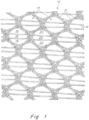
- the repair fabric comprises a knit mesh 10 including knitted strands of filaments 12 that define larger, primary pores 14 arranged in a uniform pattern.
- a pair of individual filaments 16 extend across the primary pores to define a plurality of smaller, secondary pores 18 therein.
- the primary pores 14 are bounded by knitted strands of filaments 12. However, it is to be appreciated that one of more boundaries of the primary pores 14 may be defined by individual filaments as would be apparent to one of skill in the art. As shown, the primary pores 14 may have a generally polygon shape, such as hexagon, diamond or square shaped, although aspects of the disclosure are not limited. In this regard, it is to be understood that other pore shapes are also contemplated, including, but not limited to, circular, non-circular, round, oval and the like, as would be apparent to one of skill in the art.
- the prosthetic repair fabric may be constructed to increase flexibility and/or reduce the overall weight per unit area of the fabric. Such properties may facilitate an easier collapse of the repair fabric for introduction into a patient. These properties may also provide for easier manipulation of the repair fabric about the surgical site within the patient.
- the primary pores 14 have an area of approximately 0.0665 to 0.0794 cm 2 (0.01032 to 0.01233 square inches). In this regard, less material may be used to produce a given area of mesh, which may result in a reduced weight mesh. Additionally, the generally greater spacing between the strands of filaments 12 that are associated with the larger primary pores 14 may also contribute to a more flexible mesh. It is to be appreciated, however, that the size of the primary pores may vary as would be apparent to one of skill in the art, as aspects of the disclosure are not limited in this respect.
- each primary pore 14 is subdivided into a plurality of secondary pores 18 by a pair of individual or single filaments 16.
- the pair of filaments 16 divides the primary pore 14 into a pair of generally triangular secondary 20 pores and a generally rectangular secondary pore 22 that is positioned between the two generally triangular secondary pores 20. It is to be appreciated, however, that the shapes of secondary pores and/or numbers of secondary pores within each primary pore, if desired, may vary as would be apparent to one of skill in the art, as aspects of the disclosure are not limited in this respect.
- the pair of individual filaments 16 extend substantially parallel to one another across the primary pores 14. As illustrated, the pair of parallel filaments 16 may be generally in linear alignment with corresponding pairs of filaments in adjacent primary pores. However, it is to be understood that the individual filaments may be positioned and oriented in other suitable arrangement within the scope of the claims.
- the prosthetic repair fabric may be constructed so as to be provisionally anchored to tissue or muscle using a wide variety of fasteners, such as sutures, staples, spiral tacks, Q-rings and the like.
- the individual filaments 16 that extend across the primary pores may provide additional features for engaging the fasteners used to anchor the fabric.
- repair fabrics may be anchored to tissue and/or mesh with fasteners, such as spiral tacks and Q-ring constructs, that have relatively small features for engaging and holding the repair fabric in place.
- the smaller, secondary pores 18 associated with the individual filaments may provide for improved engagement with the fasteners in a manner that is sufficiently strong and structured to prevent or minimize pullout. It is to be appreciated that the size of the secondary pores may vary as would be apparent to one of skill in the art, as aspects of the disclosure are not limited in this respect.
- the mesh fabric includes first filaments 12 having a first diameter to form the primary pores and second filaments 16 having a second diameter that is different from the first diameter extending across the primary pores.
- the second filaments 16 have a second diameter that is greater than the first diameter of the first filaments.
- the knit mesh 10 may be produced in a lapping pattern by using two partially threaded guide bars to knit the pattern over three needles in a six course repeat.
- the fabric structure may be of an atlas type where each knitted end travels more than two needles, which may prevent unraveling of the mesh.
- the repair fabric may employ a dual bar warp knit mesh structure produced using two guide bars moving according to a first bar pattern chain of 4/2 4/6 4/2 6/8 6/4 6/8 (identified as reference 24) and a second bar pattern chain of 6/8 2/0 6/8 4/2 8/10 4/2 (identified as reference 26).
- the mesh may be knitted on a single needle bar, 24 gauge Rachelle knitting machine.
- the mesh may be fabricated with approximately 34 to 36 courses per 25.4 mm (34 to 36 courses per inch) and approximately 12 to 17 wales per 25.4 mm (12 to 17 wales per inch). It is to be appreciated, however, that the mesh fabric may be knitted using any suitable knit pattern as would be apparent to one of skill in the art, as aspects of the disclosure are not limited in this respect.
- the knit mesh may be produced at various widths apparent to one of skill in the art, such as from 1 inch to 80 inches, depending on the intended application for which the repair fabric is being produced.
- the fabric may be washed to remove foreign matter, such as residual processing lubricant.
- a cleaning agent such as Triton X-100, may be used to aid in the removal of such foreign matter.
- the mesh may be dried at a temperature lower than the heat set and melt temperatures of the material, as would be apparent to one of skill in the art.
- Embodiments of the knit mesh may be heat set to impart a shape memory to the mesh and the prosthetic fabric formed of the mesh.
- the fabric is heat set to have a generally planar shape memory. In this manner, after the fabric is collapsed and inserted into a patient, the fabric may revert back to the planar configuration for appropriate placement against tissue of the patient. It is to be appreciated that other embodiments of the fabric may be provided with a shape memory that corresponds to configurations different than planar, or to have no shape memory at all, as aspects of the disclosure are not limited in this regard.
- the knit mesh may be heat set under tension, in a crochet hoop or tentering frame.
- the heat set may be applied while the mesh knit is being stretched in a particular direction to help set the mesh into a particular configuration.
- the knit mesh is stretched in the cross machine knit direction and simultaneously allowed to partially relax or contract in the machine direction to a fixed point while heat is applied to set the mesh. It is to be understood, however, that other techniques apparent to one of skill in the art may be used to heat set the knit mesh, as aspects of the disclosure are not limited in this respect.
- the knitted mesh may be desirable to smooth the knitted mesh to reduce the texture or surface roughness of the mesh.
- the knitted mesh is lightly pressed between a pair of plates which includes a heated plate that is pressed against the rough surface of the mesh to reduce high spots of the mesh and to heat set it to smooth its surface.
- the fabric may be smoothed using any suitable process apparent to one of skill in the art. For example, the fabric may be smoothed by passing the knitted mesh between a pair of heated rollers during the washing and drying process.
- the filaments that are used to fabricate the repair fabric may contribute to the resulting mechanical properties of the fabric.
- the repair fabric is knitted with first filaments 12 having a diameter of approximately 0.1143 to 0.1295 mm (0.0045 to 0.0051 inches) (first bar pattern chain), and preferably a diameter of approximately 0.1219 mm (0.0048 inches), and second filaments 16 having a diameter of approximately 0.0063 to 0.1905 mm (0.0063 to 0.0075 inches) (second bar pattern chain), and preferably a diameter of approximately 0.1905 mm (0.0075 inches). Filaments of these diameters may contribute to an enhanced handling and increased strength properties of the overall repair fabric.
- the fabric has a thickness of approximately 0.589 to 0.610 mm (0.022 to 0.024 inches), and preferably a thickness of approximately 5.715 to 5.969 mm (0.0225 to 0.0235 inches). In one illustrative embodiment, the fabric has a weight per unit area of approximately 0.010 to 0.011 grams/cm 2 (0.066 to 0.069 grams per square inch). It is to be appreciated, however, that the fabric may be fabricated to have any thickness and/or weight per unit area apparent to one of skill in the art that is suitable for a desired application, as aspects of the disclosure are not limited in this respect.
- the filaments used to fabricate the mesh fabric comprise a polypropylene monofilament, which is inert in the presence of infection, is non-wettable and has a low foreign body reaction.
- the monofilaments are formed of Aran Biomedical ProTex Med Polypropylene resin PPS50156 and PPS50157.
- the first monofilament has a denier of approximately 98 ⁇ 11 (10.89 ⁇ 1.22 tex) and the second monofilament has a denier of approximately 240 ⁇ 20 (26.67 ⁇ 2.22 tex).
- the first and second monofilaments have a tenacity of approximately 5.4 to 7.65 decitex (6.0 to 8.5 grams/denier), with a nominal tenacity of approximately 5.58 decitex (6.2 grams/denier).
- filaments of different configurations, properties and/or materials may be employed to fabricate the fabric.
- the filaments may comprise multifilaments or monofilaments having different mechanical characteristics as would be apparent to one of skill in the art, within the scope of the claims.
- Suture Pullout Strength A sample of mesh measuring at least 25.4 mm x 25.4 mm (1 inch x 1 inch) (Embodiment #1) or at least 12.7 mm x 76.2 mm (0.5 inch x 3 inches) (comparative mesh fabrics) was prepared and clamped in the lower jaw of an MTS TM or equivalent tensile test machine. The long dimension of the sample should be parallel with its orientation designation (machine or cross-machine). At least 12.7 mm (0.5 inch) (Embodiment #1) or at least 25.4 mm (1 inch) (comparative mesh fabrics) of the mesh was exposed above the jaw. A spring steel wire with a diameter of approximately 0.482 mm (0.019 inches) was placed through the mesh to simulate a suture.
- the wire was placed 5 ⁇ 1mm from the edge of the mesh.
- the wire suture was looped back and both ends were attached to the upper jaw of the tensile machine.
- the suture was then pulled at a rate of 127 mm (5 inches) per minute through the mesh.
- the peak force was recorded for 4 to 10 samples tested in both the machine and cross directions of the mesh and the average force was calculated for at least 10 total measurements in each direction.
- Pore Size A sample of mesh was placed on an optical coordinate measurement device such as a Tesa Vision (35x) or equivalent.
- each primary pore has a generally hexagon shape which contains two generally triangular pores and a generally rectangular pore in the middle section.
- the length L of each leg of the primary pore was measured dimensionally between each pair of end points A-B, B-C, C-D, D-E, E-F and F-A, as illustrated by dashed lines in FIG. 3 .
- Tensile (Break) Strength and Elongation at Break A mesh sample measuring approximately 25.4 mm x 152 mm (1 inch x 6 inches) was placed into the pneumatic jaws of an MTS TM tensile tester or equivalent device. The sample was oriented so that the knit direction being tested was parallel to the 152 mm (6 inch) length. The ends of the 152 mm (6 inch) sample were gripped in the lower and upper jaws of the tester. Starting with a minimum separation of 50.8 mm (2 inches), the sample was pulled at a constant rate of 304.8 mm (12 inches) per minute until the sample broke. The peak load and elongation at break were recorded. The samples were tested in both the cross direction and the machine direction. The averages of at least 10 total measurements taken from 4 to 10 samples were then calculated for each direction.
- Mesh Thickness A sample of mesh was measured using a standard thickness snap gage with an approximate 9.65 mm (0.38 inch) diameter pressure foot that is lightly spring loaded. The thickness was measured by lowering the foot onto the mesh. Measurements were taken to the nearest 0.0025 mm (0.0001 inch). At least five sheets of mesh were measured in total and a combined average was calculated.
- Mesh Weight/Unit Area Using a sample size of at least four pieces of mesh that measured at least approximately 50.8 mm x 50.8 mm (2 inches x 2 inches), the weight of each sample was measured in grams to the nearest 0.0001 gram. The area was calculated by measuring the length and width dimensions taken to the nearest 0.025 mm (0.001 inch), minus the area of any radiused corner. The weight per unit area was calculated for each sample using the weight and unit area. The average weight per unit area was calculated by combining and averaging the weight per unit area for each sample.
- Burst Strength This test method was derived from the ANSI/AAMI VP20-1994 Section 8.3.3.2 and ASTM Ball Burst method D3787-01.
- a mesh sample was placed on top of a circular O-ring measuring approximately 25.4 mm (1 inch) in diameter.
- the O-ring was seated in a grooved plate in a fixture with a hole in the middle of plate containing the O-ring.
- the fixture was attached to the lower jaw in an MTS TM or equivalent test machine.
- the plate with the mesh was raised and clamped against an upper plate in the fixture, compressing the mesh sample.
- the upper plate also contained a hole with the same diameter as the lower plate.
- the holes in the fixture plates are dimensioned to be just slightly larger than and to accept a rounded ball tipped rod that has a 9.65 mm (0.38 inch) diameter tip.
- the rod was connected to an upper jaw of the test machine that was moved down through the sample at a constant rate of 304.8 mm (12 inches) per minute.
- the peak load was recorded for at least 10 samples.
- the average burst strength was then calculated based on the peak loads for the samples.
Landscapes
- Health & Medical Sciences (AREA)
- Engineering & Computer Science (AREA)
- Vascular Medicine (AREA)
- Life Sciences & Earth Sciences (AREA)
- Oral & Maxillofacial Surgery (AREA)
- Transplantation (AREA)
- Biomedical Technology (AREA)
- Heart & Thoracic Surgery (AREA)
- Veterinary Medicine (AREA)
- Cardiology (AREA)
- Animal Behavior & Ethology (AREA)
- General Health & Medical Sciences (AREA)
- Public Health (AREA)
- Textile Engineering (AREA)
- Prostheses (AREA)
- Knitting Of Fabric (AREA)
- Materials For Medical Uses (AREA)
Description
- The present disclosure relates to a prosthetic repair fabric, and more particularly to a prosthetic repair fabric for use in soft tissue and muscle wall repair.
- Implantable repair fabrics are employed by surgeons for soft tissue repair and reconstruction, including the repair of anatomical defects such as soft tissue and muscle wall defects. The fabric is typically sutured, stapled, tacked, or otherwise provisionally anchored in place over, under or within the defect. Tissue integration with the fabric, such as tissue ingrowth into and/or along the mesh fabric, eventually completes the repair.
- Soft tissue and muscle wall defect repairs may be accomplished using various surgical techniques, including open, laparoscopic and hybrid (e.g., Kugel procedure) techniques. During open procedures, a repair fabric is placed through a relatively large incision made in the abdominal wall and layers of tissue and then the defect is filled or covered with the repair fabric. During laparoscopic and hybrid procedures, the fabric may be collapsed, such as by rolling or folding, into a reduced configuration for entry into a subject, either directly through a comparatively smaller incision or through a slender laparoscopic cannula that is placed through the incision.
- Various repair fabrics are known and used for repairing soft tissue and muscle wall defects. BARD MESH and VISILEX, available from C.R Bard, and the repair fabric described in
US 2010/0049222 A1 orUS9416471 B2 - Scar tissue may form about a repair fabric into a scar plate as tissue ingrowth occurs. The volume and rigidity of the scar plate that forms about the fabric may be affected by various factors, including the amount of foreign material introduced into a patient by the fabric.
- It is an object of the disclosure to provide a prosthetic repair fabric for repair of soft tissue and muscle wall defects.
- According to the invention, an implantable prosthetic repair fabric comprises a knit mesh that includes a plurality of generally polygonal shaped primary pores defined by knitted strands of first filaments having a first diameter; and a pair of individual second filaments that extend across each primary pore to define a plurality of secondary pores within each primary pore, each of the pair of individual second filaments extending substantially parallel to one another, each of the second filaments having a second diameter which is greater than the first diameter.
- In one illustrative embodiment, the implantable prosthetic repair fabric according to claim 1 comprises a biologically compatible, implantable dual bar warp knit mesh produced according to a first bar pattern chain of 4/2 4/6 4/2 6/8 6/4 6/8 and a second bar pattern chain of 6/8 2/0 6/8 4/2 8/10 4/2. The mesh has a ball burst strength of 15.88 kg to 19.23 kg (35 lbs to 42.4 lbs), a suture pullout strength of 4.08 kg to 4.99 kg (9 lbs to 11 lbs) in the machine direction and 3.40 kg to 4.31 kg (7.5 lbs to 9.5 lbs) in the cross direction, and a tensile strength of 5.35 kg to 7.62 kg (11.8 lbs to 16.8 lbs) in the machine direction and 15.51 kg to 21.41 kg (34.2 lbs to 47.2 lbs) in the cross direction.
- Various embodiments of the disclosure will now be described, by way of example, with reference to the accompanying drawings, in which:
-
FIG. 1 is an enlarged plan view of a dual bar warp knit, mesh fabric according to an illustrative embodiment of the present disclosure; -
FIGS. 2A-2B illustrate the chain lapping pattern for the mesh fabric ofFIG. 1 ; and -
FIG. 3 is a schematic illustration for determining the area of a primary cell. - Embodiments of the present disclosure include a prosthetic fabric comprising a mesh fabric that is relatively flexible, thin and light weight and meets the performance and physical characteristics for soft tissue repair and reconstruction procedures. The surgical repair fabric may be used for reinforcing and closing soft tissue defects, and is particularly indicated for chest wall reconstruction and/or the repair of hernias, such as inguinal hernias. The mesh fabric is formed of a biologically compatible, flexible and strong implantable material.
- The mesh fabric may employ a knit construction that provides relatively large openings or pores to ensure good visibility of the underlying anatomy without sacrificing mechanical properties of the mesh. The porous character of the fabric allows tissue infiltration to incorporate the prosthetic. The knitted fabric is sufficiently strong and structured to prevent or minimize potential pullout of anchoring fasteners, such as sutures, staples, tacks, and the like. The flexible repair fabric may promote an easy reduction in size for entry into the subject. In this manner, the flexible fabric may be collapsed into a slender configuration, such as a roll, which can be supported in, and advanced through, a narrow laparoscopic cannula for use in laparoscopic procedures.
- The mesh fabric employs a relatively lighter weight, thinner, and/or more flexible fabric construction that may introduce less foreign body material into a patient as compared to other repair fabrics. The porous prosthetic repair fabric allows a prompt fibroblastic response through the interstices of the mesh, forming a secure fibrous/prosthetic layer. The fabric may promote a thinner and more compliant scar plate that may result in a relatively more comfortable soft tissue or muscle wall repair for a patient.
- In one illustrative embodiment shown in
FIG. 1 , the repair fabric comprises aknit mesh 10 including knitted strands of filaments 12 that define larger,primary pores 14 arranged in a uniform pattern. A pair ofindividual filaments 16 extend across the primary pores to define a plurality of smaller,secondary pores 18 therein. - In the illustrated embodiment, the
primary pores 14 are bounded by knitted strands of filaments 12. However, it is to be appreciated that one of more boundaries of theprimary pores 14 may be defined by individual filaments as would be apparent to one of skill in the art. As shown, theprimary pores 14 may have a generally polygon shape, such as hexagon, diamond or square shaped, although aspects of the disclosure are not limited. In this regard, it is to be understood that other pore shapes are also contemplated, including, but not limited to, circular, non-circular, round, oval and the like, as would be apparent to one of skill in the art. - The prosthetic repair fabric may be constructed to increase flexibility and/or reduce the overall weight per unit area of the fabric. Such properties may facilitate an easier collapse of the repair fabric for introduction into a patient. These properties may also provide for easier manipulation of the repair fabric about the surgical site within the patient. In one illustrative embodiment, the
primary pores 14 have an area of approximately 0.0665 to 0.0794 cm2 (0.01032 to 0.01233 square inches). In this regard, less material may be used to produce a given area of mesh, which may result in a reduced weight mesh. Additionally, the generally greater spacing between the strands of filaments 12 that are associated with the largerprimary pores 14 may also contribute to a more flexible mesh. It is to be appreciated, however, that the size of the primary pores may vary as would be apparent to one of skill in the art, as aspects of the disclosure are not limited in this respect. - For some applications, it may be desirable to provide
secondary pores 18 within theprimary pores 14. In one illustrative embodiment shown inFIG. 1 , eachprimary pore 14 is subdivided into a plurality ofsecondary pores 18 by a pair of individual orsingle filaments 16. In the illustrative embodiment, the pair offilaments 16 divides theprimary pore 14 into a pair of generally triangular secondary 20 pores and a generally rectangularsecondary pore 22 that is positioned between the two generally triangularsecondary pores 20. It is to be appreciated, however, that the shapes of secondary pores and/or numbers of secondary pores within each primary pore, if desired, may vary as would be apparent to one of skill in the art, as aspects of the disclosure are not limited in this respect. - In one illustrative embodiment as shown in
FIG. 1 , the pair ofindividual filaments 16 extend substantially parallel to one another across theprimary pores 14. As illustrated, the pair ofparallel filaments 16 may be generally in linear alignment with corresponding pairs of filaments in adjacent primary pores. However, it is to be understood that the individual filaments may be positioned and oriented in other suitable arrangement within the scope of the claims. - The prosthetic repair fabric may be constructed so as to be provisionally anchored to tissue or muscle using a wide variety of fasteners, such as sutures, staples, spiral tacks, Q-rings and the like. The
individual filaments 16 that extend across the primary pores may provide additional features for engaging the fasteners used to anchor the fabric. It is to be appreciated that repair fabrics may be anchored to tissue and/or mesh with fasteners, such as spiral tacks and Q-ring constructs, that have relatively small features for engaging and holding the repair fabric in place. The smaller,secondary pores 18 associated with the individual filaments may provide for improved engagement with the fasteners in a manner that is sufficiently strong and structured to prevent or minimize pullout. It is to be appreciated that the size of the secondary pores may vary as would be apparent to one of skill in the art, as aspects of the disclosure are not limited in this respect. - In one illustrative embodiment, the mesh fabric includes first filaments 12 having a first diameter to form the primary pores and
second filaments 16 having a second diameter that is different from the first diameter extending across the primary pores. Thesecond filaments 16 have a second diameter that is greater than the first diameter of the first filaments. Such an arrangement enhances the handling of the mesh fabric by increasing its stiffness. - In one illustrative embodiment, the
knit mesh 10 may be produced in a lapping pattern by using two partially threaded guide bars to knit the pattern over three needles in a six course repeat. The fabric structure may be of an atlas type where each knitted end travels more than two needles, which may prevent unraveling of the mesh. - In one illustrative embodiment shown in
FIG. 2 , the repair fabric may employ a dual bar warp knit mesh structure produced using two guide bars moving according to a first bar pattern chain of 4/2 4/6 4/2 6/8 6/4 6/8 (identified as reference 24) and a second bar pattern chain of 6/8 2/0 6/8 4/2 8/10 4/2 (identified as reference 26). The mesh may be knitted on a single needle bar, 24 gauge Rachelle knitting machine. The mesh may be fabricated with approximately 34 to 36 courses per 25.4 mm (34 to 36 courses per inch) and approximately 12 to 17 wales per 25.4 mm (12 to 17 wales per inch). It is to be appreciated, however, that the mesh fabric may be knitted using any suitable knit pattern as would be apparent to one of skill in the art, as aspects of the disclosure are not limited in this respect. - The knit mesh may be produced at various widths apparent to one of skill in the art, such as from 1 inch to 80 inches, depending on the intended application for which the repair fabric is being produced.
- Following knitting, the fabric may be washed to remove foreign matter, such as residual processing lubricant. A cleaning agent, such as Triton X-100, may be used to aid in the removal of such foreign matter. Following washing, the mesh may be dried at a temperature lower than the heat set and melt temperatures of the material, as would be apparent to one of skill in the art.
- Embodiments of the knit mesh may be heat set to impart a shape memory to the mesh and the prosthetic fabric formed of the mesh. In one illustrative embodiment, the fabric is heat set to have a generally planar shape memory. In this manner, after the fabric is collapsed and inserted into a patient, the fabric may revert back to the planar configuration for appropriate placement against tissue of the patient. It is to be appreciated that other embodiments of the fabric may be provided with a shape memory that corresponds to configurations different than planar, or to have no shape memory at all, as aspects of the disclosure are not limited in this regard.
- If desired, the knit mesh may be heat set under tension, in a crochet hoop or tentering frame. The heat set may be applied while the mesh knit is being stretched in a particular direction to help set the mesh into a particular configuration. In one illustrative embodiment, the knit mesh is stretched in the cross machine knit direction and simultaneously allowed to partially relax or contract in the machine direction to a fixed point while heat is applied to set the mesh. It is to be understood, however, that other techniques apparent to one of skill in the art may be used to heat set the knit mesh, as aspects of the disclosure are not limited in this respect.
- For some applications, it may be desirable to smooth the knitted mesh to reduce the texture or surface roughness of the mesh. In one illustrative embodiment, the knitted mesh is lightly pressed between a pair of plates which includes a heated plate that is pressed against the rough surface of the mesh to reduce high spots of the mesh and to heat set it to smooth its surface. It is to be appreciated, however, that the fabric may be smoothed using any suitable process apparent to one of skill in the art. For example, the fabric may be smoothed by passing the knitted mesh between a pair of heated rollers during the washing and drying process.
- The filaments that are used to fabricate the repair fabric may contribute to the resulting mechanical properties of the fabric. In one illustrative embodiment, the repair fabric is knitted with first filaments 12 having a diameter of approximately 0.1143 to 0.1295 mm (0.0045 to 0.0051 inches) (first bar pattern chain), and preferably a diameter of approximately 0.1219 mm (0.0048 inches), and
second filaments 16 having a diameter of approximately 0.0063 to 0.1905 mm (0.0063 to 0.0075 inches) (second bar pattern chain), and preferably a diameter of approximately 0.1905 mm (0.0075 inches). Filaments of these diameters may contribute to an enhanced handling and increased strength properties of the overall repair fabric. - In one illustrative embodiment, the fabric has a thickness of approximately 0.589 to 0.610 mm (0.022 to 0.024 inches), and preferably a thickness of approximately 5.715 to 5.969 mm (0.0225 to 0.0235 inches). In one illustrative embodiment, the fabric has a weight per unit area of approximately 0.010 to 0.011 grams/cm2 (0.066 to 0.069 grams per square inch). It is to be appreciated, however, that the fabric may be fabricated to have any thickness and/or weight per unit area apparent to one of skill in the art that is suitable for a desired application, as aspects of the disclosure are not limited in this respect.
- In one illustrative embodiment, the filaments used to fabricate the mesh fabric comprise a polypropylene monofilament, which is inert in the presence of infection, is non-wettable and has a low foreign body reaction. In one illustrative embodiment, the monofilaments are formed of Aran Biomedical ProTex Med Polypropylene resin PPS50156 and PPS50157. In one embodiment, the first monofilament has a denier of approximately 98±11 (10.89±1.22 tex) and the second monofilament has a denier of approximately 240±20 (26.67±2.22 tex). In one embodiment, the first and second monofilaments have a tenacity of approximately 5.4 to 7.65 decitex (6.0 to 8.5 grams/denier), with a nominal tenacity of approximately 5.58 decitex (6.2 grams/denier). It is to be appreciated, however, that filaments of different configurations, properties and/or materials may be employed to fabricate the fabric. For example, the filaments may comprise multifilaments or monofilaments having different mechanical characteristics as would be apparent to one of skill in the art, within the scope of the claims.
- The following examples are illustrative only and are not intended to limit the scope of the present disclosure.
- Physical properties of a representative two bar warp knit mesh fabric produced from 0.1219 mm (0.0048 inch) (first bar) and 0.1905 mm (0.0075 inch) (second bar) polypropylene monofilament according to the illustrative embodiment shown in
FIGS. 1 and2 (labeled Embodiment #1 in Table 1) were evaluated and compared to several known mesh fabrics (comparative mesh fabrics). Physical and performance characteristics were tested including mesh thickness, pore size, mesh weight per unit area, suture pull out strength, burst strength, tear resistance, tensile (break) strength and elongation at break, and stiffness. Testing methodology and results appear below in Table 1, where mean results and ranges are reported from several test samples (ranges appear in parentheses). - Suture Pullout Strength: A sample of mesh measuring at least 25.4 mm x 25.4 mm (1 inch x 1 inch) (Embodiment #1) or at least 12.7 mm x 76.2 mm (0.5 inch x 3 inches) (comparative mesh fabrics) was prepared and clamped in the lower jaw of an MTS™ or equivalent tensile test machine. The long dimension of the sample should be parallel with its orientation designation (machine or cross-machine). At least 12.7 mm (0.5 inch) (Embodiment #1) or at least 25.4 mm (1 inch) (comparative mesh fabrics) of the mesh was exposed above the jaw. A spring steel wire with a diameter of approximately 0.482 mm (0.019 inches) was placed through the mesh to simulate a suture. The wire was placed 5±1mm from the edge of the mesh. The wire suture was looped back and both ends were attached to the upper jaw of the tensile machine. The suture was then pulled at a rate of 127 mm (5 inches) per minute through the mesh. The peak force was recorded for 4 to 10 samples tested in both the machine and cross directions of the mesh and the average force was calculated for at least 10 total measurements in each direction.
- Pore Size: A sample of mesh was placed on an optical coordinate measurement device such as a Tesa Vision (35x) or equivalent.
- For embodiment#1, each primary pore has a generally hexagon shape which contains two generally triangular pores and a generally rectangular pore in the middle section. The length L of each leg of the primary pore was measured dimensionally between each pair of end points A-B, B-C, C-D, D-E, E-F and F-A, as illustrated by dashed lines in
FIG. 3 . The pore area of the primary pore was calculated based on the area of a hexagon as follows, where Laverage is the average length of each leg:
- Tensile (Break) Strength and Elongation at Break: A mesh sample measuring approximately 25.4 mm x 152 mm (1 inch x 6 inches) was placed into the pneumatic jaws of an MTS™ tensile tester or equivalent device. The sample was oriented so that the knit direction being tested was parallel to the 152 mm (6 inch) length. The ends of the 152 mm (6 inch) sample were gripped in the lower and upper jaws of the tester. Starting with a minimum separation of 50.8 mm (2 inches), the sample was pulled at a constant rate of 304.8 mm (12 inches) per minute until the sample broke. The peak load and elongation at break were recorded. The samples were tested in both the cross direction and the machine direction. The averages of at least 10 total measurements taken from 4 to 10 samples were then calculated for each direction.
- Mesh Thickness: A sample of mesh was measured using a standard thickness snap gage with an approximate 9.65 mm (0.38 inch) diameter pressure foot that is lightly spring loaded. The thickness was measured by lowering the foot onto the mesh. Measurements were taken to the nearest 0.0025 mm (0.0001 inch). At least five sheets of mesh were measured in total and a combined average was calculated.
- Mesh Weight/Unit Area: Using a sample size of at least four pieces of mesh that measured at least approximately 50.8 mm x 50.8 mm (2 inches x 2 inches), the weight of each sample was measured in grams to the nearest 0.0001 gram. The area was calculated by measuring the length and width dimensions taken to the nearest 0.025 mm (0.001 inch), minus the area of any radiused corner. The weight per unit area was calculated for each sample using the weight and unit area. The average weight per unit area was calculated by combining and averaging the weight per unit area for each sample.
- Burst Strength: This test method was derived from the ANSI/AAMI VP20-1994 Section 8.3.3.2 and ASTM Ball Burst method D3787-01. A mesh sample was placed on top of a circular O-ring measuring approximately 25.4 mm (1 inch) in diameter. The O-ring was seated in a grooved plate in a fixture with a hole in the middle of plate containing the O-ring. The fixture was attached to the lower jaw in an MTS™ or equivalent test machine. The plate with the mesh was raised and clamped against an upper plate in the fixture, compressing the mesh sample. The upper plate also contained a hole with the same diameter as the lower plate. The holes in the fixture plates are dimensioned to be just slightly larger than and to accept a rounded ball tipped rod that has a 9.65 mm (0.38 inch) diameter tip. The rod was connected to an upper jaw of the test machine that was moved down through the sample at a constant rate of 304.8 mm (12 inches) per minute. The peak load was recorded for at least 10 samples. The average burst strength was then calculated based on the peak loads for the samples.
- Tear Resistance: A mesh sample measuring approximately 50.8 mm x 50.8 mm (2 inches x 2 inches) was prepared. A 25.4 mm (1 inch) slit was cut in one side (the direction to be tested) at the midpoint to form two mesh sections. One section of mesh was clamped in the lower jaw of a pneumatic fixture and the other was clamped in the top jaw of the fixture. Starting with the jaws at a minimum spacing of 25.4 mm (1 inch), the mesh was pulled at a rate of 304.8 mm (12 inches) per minute until the tear was completed. The peak force was recorded. Samples were tested in the cross direction and the machine direction (Embodiment #1), and the cross direction, the machine direction, and the diagonal direction (comparative mesh fabrics). The averages of at least 10 total measurements taken from 4 to 10 samples were then calculated for each group direction.
TABLE I Embodiment #1 BARD Soft Mesh BARD MESH Ethicon PROLENE Soft Mesh Ethicon MERSILENE Mesh Suture Pullout (lbs) Machine Direction 4.6kg (10.2) 3.7 kg (8.2) 5.5 kg (12.16) 2.4 kg (5.4) 0.79 kg (1.75) 2.77-5.85 kg (6.1 to 12.9) 3.22-4.35 kg (7.1 - 9.6) 4.15-6.48 kg (9.14 - 14.29) 1.77-2.99 kg (3.9 - 6.6) 0.60-1.06 kg (1.33 - 2.33) Cross Direction 3.86 kg (8.5) 3.04 kg (6.7) 3.62 kg (7.97) 2.86 kg (6.3) 0.98 kg (2.17) 1.45-0.68 kg (3.2 - 15.0) 2.18-3.63 kg (4.8 - 8.0) 3.12-4.41 kg (6.87 - 973) 2.35-3.63 kg (5.2 - 8.0) 0.69-1.12 kg (1.53 - 2.47) Pore Size (inches2) Large Cell 0.07052 cm2 (0.01093) 0.06290 cm2 (0.00975) n/a 0.06071 cm2 (0.00941) n/a 0.06658-0.07955 cm2 (0.01032 - 0.01233) 0.05748-0.06665 cm2 (0.00891 - 0.01033) 0.05181-0.0671 cm2 (0.00803 - 0.0104) Small Pore n/a 0.01587 cm2 (0.00246) 0.00548 cm2 (0.00085) cm2 (0.00386) 0.00794 cm2 (0.00123) 0.01419-0.02065 cm2 (0.00220 - 0.00320) 0.00400-0.0065 cm2 (0.00062 - 0.00100) 0.02303-0.02787 cm2 (0.00357 - 0.00432) 0.00671-0.00897 cm2 (0.00104 - 0.00139) Tensile (Break) Strength (lbs) Machine Direction 363.2 kg (14.3) 303.02 kg (11.93) 551.18 kg (21.7) 561.59 kg (22.11) 576.6 kg (22.7) 241.3 to 411.5 kg (9.5 to 16.2) 255.78-386.08 kg (10.07 - 15.20) 353.1-680.7 kg (13.9 - 26.8) 457.45 to 680.7 kg (18.01 - 26.8) 515.6-660.4 kg (20.3 - 26) Cross Direction 1,033.8 kg (40.7) 1,113.54 kg (43.84) 1.267.5 kg (49.9) 558.04 kg (21.97) 266.7 kg (10.5) 718.8-1,325.9 kg (28.3 to 52.2) 895.60-1,228.85 kg (35.26 - 48.38) 1,084.6-1,473.2 kg (42.7 - 58.0) 482.60-660.65kg (19.00 - 26.01) 226.1-304.8 kg (89 - 12) Elongation at Break (%) Machine Direction 77.4 (68 - 86.5) 61.8 (26.0 - 94.5) 43 (30 - 50) 69.25 (59 - 79.5) 24 (22 - 26) Cross Direction 34.7 (20 - 40) 49 (40.5 - 54) 30 (25 - 35) 54.5 (49.5 - 63.5) 25 (21 - 29) Mesh Thickness (Inches) 0.5817mm (0.0229) 0.4420mm (0.0174) 0.7061mm (0.0278) 0.4267mm (0.0168) 0.5156mm (0.0203) 0.5715-0.5969 mm (0.0225 - 0.0235) 0.4267-0.4369 mm (0.0168 - 0.0172) 0.6934-0.7518 mm (0.0273 - 0.0296) 0.4140-0.4369 mm (0.0163 - 00172) 0.5080-0.5182 mm (0.0200 - 0.0204) Weight/Unit Area (gms/ inches2) 104.0 g/m2 (0.0671) 43.7 g/m2 (0.0282) 105.4 g/m2 (0.0680) 444.9 g/m2 (0.0287) 42.47 g/m2 (0.0274) 102.5-107.0 g/m2 (0.0661 - 0.0690) 42.5-45.4 g/m2 (0.0274 - 0.0293) 100.8-110.1 g/m2 (0.065 - 0.071) 42.3-45.9 g/m2 (0.0273 - 0.0296) 40.3-46.5 g/m2 (0.026 - 0.030) Tear Resistance (lbs) Machine Direction 3.94 kg (8.69) kg (6.36) kg (10.31) kg (6.05) kg (1.53) 3.34-4.69 kg (7.37 - 10.33) 2.43-3.16 kg (5.35 - 696) 3.30-6.66 kg (7.27 - 14.68) 2.13-3.24 kg (4.70 - 7.15) 0.60-0.85 kg (1.33 - 1.87) Cross Direction 4.35 kg (9.60) 2.48 kg (5.46) 4.99 kg (11.01) 2.59 kg (5.72) 0.68 kg (1.50) 3.35-4.96 kg (7.38 - 10.93) 2.20-2.86 kg (4.84 - 6.30) 4.27-6.21 kg (9.41 - 13.68) 2.17-2.92 kg (4.78 - 6.43) 0.60-0.79 kg (1.33 - 1.74) Diagonal Direction n/a 2.69 kg (5.94) 4.91 kg (10.83) 2.71 kg (5.97) 0.65 kg (1.44) 2.35-3.09 kg (5.18 - 682) 3.27-6.47 kg (7.20 - 14.26) 2.39-3.02 kg (5.27 - 6.65) 0.58-0.73 kg (1.27 - 1.60) Ball Burst (3/8" ball, lbs) 16.70 kg (36.82) 13.23 kg (29.17) 30.84 kg (67.98) 14.07 kg (31.01) 8.21 kg (18.1) 12.36-19.22 kg (27.24 - 42.38) 11.35-15.85 kg (25.02 - 34.94) 28.87-33.66 kg (63.64 - 74.21) 12.06-15.93 kg (26.58 - 35.13) 7.26-8.80 kg (16.0 - 19.4) Mesh Construction Courses (per 25.4 mm) (per inch) 36 34.6 (34-36) 54.5 45.6 (44 - 48) 72 Wales (per 25.4 mm) (per inch) 14 (13.5 - 14.5) 14.1 (12-17) 15.5 16.2 (16 - 18) 47 - It should be understood that the foregoing description of the disclosure is intended merely to be illustrative thereof and that other embodiments and modifications of the disclosure are within the scope of the disclosure recited in the claims appended hereto.
Claims (15)
- An implantable prosthetic repair fabric, comprising:a knit mesh (10) that includes a plurality of generally polygonal shaped primary pores (14) defined by knitted strands of first filaments (12) having a first diameter; anda pair of individual second filaments (16) that extend across each primary pore (14) to define a plurality of secondary pores (18) within each primary pore (14), each of the pair of individual second filaments (16) extending substantially parallel to one another, each of the second filaments (16) having a second diameter which is greater than the first diameter.
- The implantable prosthetic repair fabric according to claim 1,wherein each primary pore (14) has an area of approximately 0.0665 to 0.0794 cm2 (0.0103 to 0.0123 square inches); orwherein the primary pores (14) are generally hexagonal shaped; orwherein the mesh (10) is formed of knitted first and second monofilaments (12, 16).
- The implantable prosthetic repair fabric according to claim 2,wherein the first and second monofilaments (12, 16) include polypropylene monofilament;optionally wherein the first monofilament (12) has a diameter of approximately 0.1143 to 0.1295 mm (0.0045 to 0.0051 inches) and the second monofilament (16) has a diameter of approximately 0.0063 to 0.1905 mm (0.0063 to 0.0075 inches); oroptionally wherein the first monofilament (12) has a diameter of approximately 0.1219 mm (0.0048 inches) and the second monofilament (16) has a diameter of approximately 0.1905 mm (0.0075 inches); oroptionally wherein the first monofilament (12) has a denier of approximately 98±11 (10.89±1.22 tex) and the second monofilament (16) has a denier of approximately 240±20 (26.67±2.22 tex); oroptionally wherein the first and second monofilaments (12, 16) have a tenacity of approximately 5.4 to 7.65 decitex (6.00 to 8.50 grams per denier); oroptionally wherein the first and second monofilaments (12, 16) have a tenacity of approximately 5.58 decitex (6.2 grams per denier).
- The implantable prosthetic repair fabric according to claim 1,wherein the mesh (10) has a knit construction that includes approximately 34 to 36 courses per 25.4 mm (34 to 36 courses per inch) and approximately 12 to 17 wales per 25.4 mm (12 to 17 wales per inch); orwherein the mesh (10) has a weight per unit area of approximately 0.0102 to 0.0107 grams/cm2 (0.0661 to 0.0690 grams per square inch); orwherein the mesh (10) has a thickness of approximately 0.589 to 0.610 mm (0.022 to 0.024 inches).
- The implantable prosthetic repair fabric according to claim 1, comprising:
a biologically compatible, implantable dual bar warp knit mesh (10) produced according to a first bar pattern chain of 4/2 4/6 4/2 6/8 6/4 6/8 (24) and a second bar pattern chain of 6/8 2/0 6/8 4/2 8/10 4/2 (26), the first monofilaments (12) being knitted according to the first bar pattern chain (24) and the second monofilaments (16) being knitted according to the second bar pattern chain (26). - The implantable prosthetic repair fabric according to claim 5, wherein the first and second monofilaments (12, 16) include polypropylene monofilament.
- The implantable prosthetic repair fabric according to claim 5,wherein the first monofilament (12) has a diameter of approximately 0.1143 to 0.1295 mm (0.0045 to 0.0051 inches) and the second monofilament (16) has a diameter of approximately 0.0063 to 0.1905 mm (0.0063 to 0.0075 inches);optionally wherein the first monofilament (12) has a diameter of approximately 0.1219 mm (0.0048 inches) and the second monofilament (16) has a diameter of approximately 0.1905 mm (0.0075 inches).
- The implantable prosthetic repair fabric according to claim 5,wherein the first monofilament (12) has a denier of approximately 98±11 (10.89±1.22 tex) and the second monofilament (16) has a denier of approximately 240±20 (26.67±2.22 tex); orwherein the first and second monofilaments (12, 16) have a tenacity of approximately 5.4 to 7.65 decitex (6.00 to 8.50 grams per denier);optionally wherein the first and second monofilaments (12, 16) have a tenacity of approximately 5.58 decitex (6.2 grams per denier).
- The implantable prosthetic repair fabric according to claim 5,wherein the mesh has a knit construction that includes approximately 34 to 36 courses per 25.4 mm (34 to 36 courses per inch) and approximately 12 to 17 wales per 25.4 mm (12 to 17 wales per inch); orwherein the mesh (10) has a weight per unit area of approximately 0.0102 to 0.0107 grams/cm2 (0.0661 to 0.0690 grams per square inch); orwherein the mesh (10) has a thickness of approximately 0.589 to 0.610 mm (0.022 to 0.024 inches).
- The implantable prosthetic repair fabric according to claim 5, wherein the mesh (10) has a ball burst strength of 15.88 kg to 19.23 kg (35 lbs to 42.4 lbs).
- The implantable prosthetic repair fabric according to claim 10,
wherein the mesh (10) has a ball burst strength of 16.33 kg to 18.14 kg (36 lbs to 40 lbs); optionally wherein the mesh (10) has a ball burst strength of 16.33 kg to 17.69 kg (36 lbs to 39 lbs). - The implantable prosthetic repair fabric according to claim 5,wherein the mesh (10) has a suture pullout strength of 4.08 kg to 4.99 kg (9 lbs to 11 lbs) in the machine direction and 3.40 kg to 4.31 kg (7.5 lbs to 9.5 lbs) in the cross direction;optionally wherein the mesh (10) has a suture pullout strength of approximately 4.63 kg (10.2 lbs) in the machine direction and approximately 3.86 kg (8.5 lbs) in the cross direction.
- The implantable prosthetic repair fabric according to claim 5,
wherein the mesh (10) has a tensile strength of 5.35 kg to 7.62 kg (11.8 lbs to 16.8 lbs) in the machine direction and 15.51 kg to 21.41 kg (34.2 lbs to 47.2 lbs) in the cross direction; optionally wherein the mesh (10) has a tensile strength of approximately 6.49 kg (14.3 lbs) in the machine direction and approximately 18.46 kg (40.7 lbs) in the cross direction. - The implantable prosthetic repair fabric according to claim 10, wherein:
the mesh (10) has a suture pullout strength of 4.08 kg to 4.99 kg (9 lbs to 11 lbs) in the machine direction and 3.40 kg to 4.31 kg (7.5 lbs to 9.5 lbs) in the cross direction, and a tensile strength of 5.35 kg to 7.62 kg (11.8 lbs to 16.8 lbs) in the machine direction and 15.51 kg to 21.41 kg (34.2 lbs to 47.2 lbs) in the cross direction. - The implantable prosthetic repair fabric according to claim 14,wherein the mesh (10) has a ball burst strength of 16.33 kg to 17.69 kg (36 lbs to 39 lbs): orwherein the mesh (10) has a suture pullout strength of approximately 4.63 kg (10.2 lbs) in the machine direction and approximately 3.86 kg (8.5 lbs) in the cross direction; orwherein the mesh (10) has a tensile strength of approximately 6.49 kg (14.3 lbs) in the machine direction and approximately 18.46 kg (40.7 lbs) in the cross direction; orwherein the mesh (10) has a knit construction that includes approximately 34 to 36 courses per 25.4 mm (34 to 36 courses per inch) and approximately 12 to 17 wales per 25.4 mm (12 to 17 wales per inch); orwherein the mesh (10) has a weight per unit area of approximately 0.0102 to 0.0107 grams/cm2 (0.0661 to 0.0690 grams per square inch); orwherein the mesh (10) has a thickness of approximately 0.589 to 0.610 mm (0.022 to 0.024 inches).
Priority Applications (1)
| Application Number | Priority Date | Filing Date | Title |
|---|---|---|---|
| EP25167259.8A EP4553209A3 (en) | 2020-06-19 | 2021-06-15 | Prosthetic repair fabric |
Applications Claiming Priority (2)
| Application Number | Priority Date | Filing Date | Title |
|---|---|---|---|
| US16/907,104 US12697199B2 (en) | 2020-06-19 | 2020-06-19 | Prosthetic repair fabric |
| PCT/US2021/037320 WO2021257501A1 (en) | 2020-06-19 | 2021-06-15 | Prosthetic repair fabric |
Related Child Applications (1)
| Application Number | Title | Priority Date | Filing Date |
|---|---|---|---|
| EP25167259.8A Division EP4553209A3 (en) | 2020-06-19 | 2021-06-15 | Prosthetic repair fabric |
Publications (2)
| Publication Number | Publication Date |
|---|---|
| EP4168613A1 EP4168613A1 (en) | 2023-04-26 |
| EP4168613B1 true EP4168613B1 (en) | 2025-04-02 |
Family
ID=77412307
Family Applications (2)
| Application Number | Title | Priority Date | Filing Date |
|---|---|---|---|
| EP25167259.8A Pending EP4553209A3 (en) | 2020-06-19 | 2021-06-15 | Prosthetic repair fabric |
| EP21758185.9A Active EP4168613B1 (en) | 2020-06-19 | 2021-06-15 | Prosthetic repair fabric |
Family Applications Before (1)
| Application Number | Title | Priority Date | Filing Date |
|---|---|---|---|
| EP25167259.8A Pending EP4553209A3 (en) | 2020-06-19 | 2021-06-15 | Prosthetic repair fabric |
Country Status (12)
| Country | Link |
|---|---|
| US (1) | US12697199B2 (en) |
| EP (2) | EP4553209A3 (en) |
| JP (2) | JP2023530071A (en) |
| KR (1) | KR20230029799A (en) |
| CN (2) | CN115702265A (en) |
| AU (1) | AU2021293874B2 (en) |
| BR (1) | BR112022025523A2 (en) |
| CA (1) | CA3183590A1 (en) |
| ES (1) | ES3026887T3 (en) |
| MX (1) | MX2022015991A (en) |
| WO (1) | WO2021257501A1 (en) |
| ZA (1) | ZA202212561B (en) |
Families Citing this family (4)
| Publication number | Priority date | Publication date | Assignee | Title |
|---|---|---|---|---|
| US12697199B2 (en) * | 2020-06-19 | 2026-08-04 | Davol Inc. | Prosthetic repair fabric |
| US11879189B2 (en) * | 2021-04-07 | 2024-01-23 | Ball Fabrics, Inc. | Visual barrier windscreen, including knitted interlocking chains forming wind passage holes, and associated methods |
| DE112024001652T5 (en) * | 2023-04-10 | 2026-01-29 | Atex Technologies, Inc. | NET WITH REINFORCED EDGES AND METHOD FOR ITS MANUFACTURING |
| KR102875668B1 (en) * | 2023-06-19 | 2025-10-23 | 주식회사 티엠디랩 | Biocompatible polymer based medical mesh devices that are easy to change shape, fabrication and use thereof |
Family Cites Families (279)
| Publication number | Priority date | Publication date | Assignee | Title |
|---|---|---|---|---|
| US3124136A (en) | 1964-03-10 | Method of repairing body tissue | ||
| DE892663C (en) | 1951-11-17 | 1953-10-08 | Edelgard Hartung | Seal for thoracic surgery |
| US2671444A (en) | 1951-12-08 | 1954-03-09 | Jr Benjamin F Pease | Nonmetallic mesh surgical insert for hernia repair |
| US3054406A (en) | 1958-10-17 | 1962-09-18 | Phillips Petroleum Co | Surgical mesh |
| US3108357A (en) | 1962-06-20 | 1963-10-29 | William J Liebig | Compound absorbable prosthetic implants, fabrics and yarns therefor |
| US3276448A (en) | 1962-12-14 | 1966-10-04 | Ethicon Inc | Collagen coated fabric prosthesis |
| US3463158A (en) | 1963-10-31 | 1969-08-26 | American Cyanamid Co | Polyglycolic acid prosthetic devices |
| US3272204A (en) | 1965-09-22 | 1966-09-13 | Ethicon Inc | Absorbable collagen prosthetic implant with non-absorbable reinforcing strands |
| DE1492434A1 (en) | 1965-10-15 | 1969-12-04 | Ludwig Povel & Co Kg | Bandage material |
| US3559214A (en) | 1968-10-17 | 1971-02-02 | William J Pangman | Compound prosthesis |
| US3878565A (en) | 1971-07-14 | 1975-04-22 | Providence Hospital | Vascular prosthesis with external pile surface |
| US3853462A (en) | 1972-02-23 | 1974-12-10 | Meadox Medicals Inc | Compaction of polyester fabric materials |
| US3945052A (en) | 1972-05-01 | 1976-03-23 | Meadox Medicals, Inc. | Synthetic vascular graft and method for manufacturing the same |
| US3805301A (en) | 1972-07-28 | 1974-04-23 | Meadox Medicals Inc | Tubular grafts having indicia thereon |
| US3875928A (en) | 1973-08-16 | 1975-04-08 | Angelchik Jean P | Method for maintaining the reduction of a sliding esophageal hiatal hernia |
| US3988411A (en) | 1974-02-11 | 1976-10-26 | American Cyanamid Company | Spinning and shaping poly-(N-acetyl-D-glucosamine) |
| US3986828A (en) | 1974-03-05 | 1976-10-19 | Meadox Medicals, Inc. | Polymer fabric compacting process |
| FR2278348A2 (en) | 1974-06-28 | 1976-02-13 | Rhone Poulenc Ind | BIORESORBABLE SURGICAL ARTICLES |
| US4015451A (en) | 1975-10-08 | 1977-04-05 | E. I. Du Pont De Nemours And Company | Warp knit fabric |
| US4141087A (en) | 1977-01-19 | 1979-02-27 | Ethicon, Inc. | Isomorphic copolyoxalates and sutures thereof |
| US4064712A (en) | 1977-01-21 | 1977-12-27 | E. I. Du Pont De Nemours And Company | Warp knit product and process |
| US4193137A (en) | 1977-05-06 | 1980-03-18 | Meadox Medicals, Inc. | Warp-knitted double-velour prosthesis |
| US4391106A (en) | 1978-02-22 | 1983-07-05 | Karl Otto Braun K.G. | Wound dressing |
| DE2965756D1 (en) | 1978-11-20 | 1983-07-28 | Ici Plc | A process for setting a product comprising electrostatically spun fibres, and products prepared according to this process |
| US4476697A (en) | 1980-04-21 | 1984-10-16 | Karl Otto Braun Kg | Wound dressing |
| US4452245A (en) | 1980-06-06 | 1984-06-05 | Usher Francis C | Surgical mesh and method |
| US4347847A (en) | 1980-06-06 | 1982-09-07 | Usher Francis C | Method of hernia repair |
| US4576608A (en) | 1980-11-06 | 1986-03-18 | Homsy Charles A | Porous body-implantable polytetrafluoroethylene |
| US4478665A (en) | 1980-11-06 | 1984-10-23 | W. L. Gore & Associates, Inc. | Method for manufacturing highly porous, high strength PTFE articles |
| US4385093A (en) | 1980-11-06 | 1983-05-24 | W. L. Gore & Associates, Inc. | Multi-component, highly porous, high strength PTFE article and method for manufacturing same |
| US4441215A (en) | 1980-11-17 | 1984-04-10 | Kaster Robert L | Vascular graft |
| GR77865B (en) | 1982-03-25 | 1984-09-25 | Coats Ltd J & P | |
| US4403604A (en) | 1982-05-13 | 1983-09-13 | Wilkinson Lawrence H | Gastric pouch |
| US4573999A (en) | 1983-10-14 | 1986-03-04 | Netto Daniel J | Human breast prosthesis |
| US6221102B1 (en) | 1983-12-09 | 2001-04-24 | Endovascular Technologies, Inc. | Intraluminal grafting system |
| US4499139A (en) | 1984-03-02 | 1985-02-12 | The Kendall Company | Microsized fabric |
| US4555378A (en) | 1984-04-13 | 1985-11-26 | Dick Martin Design Ltd. | Method of forming thermoplastic perforated sheet |
| US4633873A (en) | 1984-04-26 | 1987-01-06 | American Cyanamid Company | Surgical repair mesh |
| US4728328A (en) | 1984-10-19 | 1988-03-01 | Research Corporation | Cuffed tubular organic prostheses |
| US4596728A (en) | 1985-02-01 | 1986-06-24 | The Johns Hopkins University | Low temperature heat shrinkable polymer material |
| FR2577807B1 (en) | 1985-02-22 | 1993-12-03 | Ethnor | ABSORBABLE COMPOSITE SURGICAL MATERIAL, PREPARATION METHOD, RESORBABLE PROSTHESIS MADE FROM SUCH MATERIAL AND USE OF SUCH A PROSTHESIS |
| US4923470A (en) | 1985-04-25 | 1990-05-08 | American Cyanamid Company | Prosthetic tubular article made with four chemically distinct fibers |
| US4652264A (en) | 1985-04-25 | 1987-03-24 | American Cyanamid Company | Prosthetic tubular article |
| US4997440A (en) | 1985-04-25 | 1991-03-05 | American Cyanamid Company | Vascular graft with absorbable and nonabsorbable components |
| US4655221A (en) | 1985-05-06 | 1987-04-07 | American Cyanamid Company | Method of using a surgical repair mesh |
| US4657804A (en) | 1985-08-15 | 1987-04-14 | Chicopee | Fusible fiber/microfine fiber laminate |
| US5002551A (en) | 1985-08-22 | 1991-03-26 | Johnson & Johnson Medical, Inc. | Method and material for prevention of surgical adhesions |
| US5007916A (en) | 1985-08-22 | 1991-04-16 | Johnson & Johnson Medical, Inc. | Method and material for prevention of surgical adhesions |
| US4693720A (en) | 1985-09-23 | 1987-09-15 | Katecho, Incorporated | Device for surgically repairing soft tissues and method for making the same |
| US4769038A (en) | 1986-03-18 | 1988-09-06 | C. R. Bard, Inc. | Prostheses and techniques and repair of inguinal and femoral hernias |
| US4695500A (en) | 1986-07-10 | 1987-09-22 | Johnson & Johnson Products, Inc. | Stabilized fabric |
| AU593267B2 (en) | 1986-07-22 | 1990-02-08 | Paul O'keeffe | Implantable fabric pouch for mammary prothesis |
| CA1303298C (en) | 1986-08-06 | 1992-06-16 | Alain Carpentier | Flexible cardiac valvular support prosthesis |
| EP0303496A1 (en) | 1987-08-12 | 1989-02-15 | Ethicon, Inc. | Resorbable surgical meshwork, prostheses of this meshwork and surgical uses thereof |
| US4841948A (en) | 1987-10-06 | 1989-06-27 | Mcghan Medical Corporation | Concave gase tissue expander |
| US4955907A (en) | 1987-12-22 | 1990-09-11 | Ledergerber Walter J | Implantable prosthetic device |
| US5282856A (en) | 1987-12-22 | 1994-02-01 | Ledergerber Walter J | Implantable prosthetic device |
| US5092884A (en) | 1988-03-24 | 1992-03-03 | American Cyanamid Company | Surgical composite structure having absorbable and nonabsorbable components |
| WO1989009034A1 (en) | 1988-03-25 | 1989-10-05 | Vitebsky Tekhnologichesky Institut Legkoi Promyshl | Element for surgical strengthening of a deformed sclera of the eyeball |
| US4883486A (en) | 1988-05-31 | 1989-11-28 | Indu Kapadia | Prosthetic ligament |
| US4902508A (en) | 1988-07-11 | 1990-02-20 | Purdue Research Foundation | Tissue graft composition |
| US5222987A (en) | 1989-04-12 | 1993-06-29 | Imperial Chemical Industries Plc | Composite material for use in a prosthetic device |
| WO1991007145A1 (en) | 1989-11-22 | 1991-05-30 | Indu Kapadia | Prosthetic ligament |
| US5141522A (en) | 1990-02-06 | 1992-08-25 | American Cyanamid Company | Composite material having absorbable and non-absorbable components for use with mammalian tissue |
| DE9004782U1 (en) | 1990-04-27 | 1990-07-05 | Aesculap AG, 7200 Tuttlingen | Modelling mesh for medical purposes |
| US5147398A (en) | 1990-05-04 | 1992-09-15 | Lynn Lawrence A | Multiple compartment breast prosthesis |
| US5424117A (en) | 1990-06-29 | 1995-06-13 | Standard Textile Co. Inc. | Fabrics for surgical gowns and the like and method of making same and textile products made therefrom |
| US5178630A (en) | 1990-08-28 | 1993-01-12 | Meadox Medicals, Inc. | Ravel-resistant, self-supporting woven graft |
| US5141515A (en) | 1990-10-11 | 1992-08-25 | Eberbach Mark A | Apparatus and methods for repairing hernias |
| US5116360A (en) | 1990-12-27 | 1992-05-26 | Corvita Corporation | Mesh composite graft |
| WO1992013500A1 (en) | 1991-02-08 | 1992-08-20 | Surgical Innovations, Inc. | Method and apparatus for repair of inguinal hernias |
| US5116370A (en) | 1991-03-22 | 1992-05-26 | Foglietti Mark A | Breast prosthesis with female and male adapter snaps |
| US5383925A (en) | 1992-09-14 | 1995-01-24 | Meadox Medicals, Inc. | Three-dimensional braided soft tissue prosthesis |
| US5391164A (en) | 1991-05-03 | 1995-02-21 | Giampapa; Vincent C. | Subcutaneous implantable multiple-agent delivery system |
| US5356429A (en) | 1991-05-16 | 1994-10-18 | Seare William J Jr | Body pocket maintenance prosthesis |
| US5865728A (en) | 1991-05-29 | 1999-02-02 | Origin Medsystems, Inc. | Method of using an endoscopic inflatable lifting apparatus to create an anatomic working space |
| US5462781A (en) | 1991-06-14 | 1995-10-31 | W. L. Gore & Associates, Inc. | Surface modified porous expanded polytetrafluoroethylene and process for making |
| JP3269830B2 (en) | 1991-07-08 | 2002-04-02 | アルケア株式会社 | Substrate for holding curable resin composition for orthopedic surgery |
| US5112352A (en) | 1991-07-18 | 1992-05-12 | Brian Novack | Pectoral implant and method for implanting the same |
| CA2075080A1 (en) | 1991-08-02 | 1993-02-03 | Ralph A. Dematteis | Method and apparatus for laparoscopic repair of hernias |
| US5146933A (en) | 1991-09-20 | 1992-09-15 | Dow Corning Wright Corporation | Implantable prosthetic device and tethered inflation valve for volume |
| US5366504A (en) | 1992-05-20 | 1994-11-22 | Boston Scientific Corporation | Tubular medical prosthesis |
| FR2682284A1 (en) | 1991-10-14 | 1993-04-16 | Dessapt Bernard | Mammary prosthesis |
| US5292328A (en) | 1991-10-18 | 1994-03-08 | United States Surgical Corporation | Polypropylene multifilament warp knitted mesh and its use in surgery |
| US5236454A (en) | 1991-11-04 | 1993-08-17 | Miller Archibald S | Stacked breast implant |
| EP0544485B1 (en) | 1991-11-25 | 1995-03-08 | Cook Incorporated | Tissue aperture repair device |
| US5258000A (en) | 1991-11-25 | 1993-11-02 | Cook Incorporated | Tissue aperture repair device |
| US5306296A (en) | 1992-08-21 | 1994-04-26 | Medtronic, Inc. | Annuloplasty and suture rings |
| WO1993015690A2 (en) | 1992-01-27 | 1993-08-19 | Medtronic, Inc. | Annuloplasty and suture rings |
| WO1993017635A1 (en) | 1992-03-04 | 1993-09-16 | C.R. Bard, Inc. | Composite prosthesis and method for limiting the incidence of postoperative adhesions |
| US5456711A (en) | 1992-05-15 | 1995-10-10 | Intervascular Inc. | Warp knitted carotid patch having finished selvedged edges |
| US5766246A (en) | 1992-05-20 | 1998-06-16 | C. R. Bard, Inc. | Implantable prosthesis and method and apparatus for loading and delivering an implantable prothesis |
| US6312442B1 (en) | 1992-06-02 | 2001-11-06 | General Surgical Innovations, Inc. | Method for developing an anatomic space for laparoscopic hernia repair |
| US5304187A (en) | 1992-06-30 | 1994-04-19 | United States Surgical Corporation | Surgical element deployment apparatus |
| IT1256928B (en) | 1992-08-06 | 1995-12-27 | Sorin Biomedica Spa | PROCEDURE FOR THE REALIZATION OF TEXTILE PROSTHESES, FOR EXAMPLE VASCULAR PROSTHESES, AND TEXTILE PROSTHESES OBTAINABLE WITH SUCH PROCEDURE |
| DE9212261U1 (en) | 1992-09-11 | 1992-12-24 | Dr. Helbig GmbH & Co Orthopädische Produkte KG, 8204 Brannenburg | Breast prosthesis container |
| US5381943A (en) | 1992-10-09 | 1995-01-17 | Ethicon, Inc. | Endoscopic surgical stapling instrument with pivotable and rotatable staple cartridge |
| US5725577A (en) | 1993-01-13 | 1998-03-10 | Saxon; Allen | Prosthesis for the repair of soft tissue defects |
| US5743917A (en) | 1993-01-13 | 1998-04-28 | Saxon; Allen | Prosthesis for the repair of soft tissue defects |
| US5356432B1 (en) | 1993-02-05 | 1997-02-04 | Bard Inc C R | Implantable mesh prosthesis and method for repairing muscle or tissue wall defects |
| US5368602A (en) | 1993-02-11 | 1994-11-29 | De La Torre; Roger A. | Surgical mesh with semi-rigid border members |
| US5433996A (en) | 1993-02-18 | 1995-07-18 | W. L. Gore & Associates, Inc. | Laminated patch tissue repair sheet material |
| GB9306812D0 (en) | 1993-04-01 | 1993-05-26 | Vascutek Ltd | Textile prostheses |
| US5554437A (en) | 1993-04-06 | 1996-09-10 | Hercules Incorporated | Gamma-sterilizable barrier fabrics |
| US5480423A (en) | 1993-05-20 | 1996-01-02 | Boston Scientific Corporation | Prosthesis delivery |
| GB9317490D0 (en) | 1993-08-23 | 1993-10-06 | Hercules Inc | Diaper barrier leg-cuff fabrics |
| IL110602A0 (en) | 1993-08-23 | 1994-11-11 | Hercules Inc | Barrier element fabrics, barrier elements and protective articles comprising such elements |
| FR2709947B1 (en) | 1993-09-13 | 1995-11-10 | Bard Sa Laboratoires | Curved prosthetic mesh and its manufacturing process. |
| CA2149900C (en) | 1993-09-24 | 2003-06-24 | Yasuo Shikinami | Implant material |
| US5466258A (en) | 1993-11-12 | 1995-11-14 | Porex Surgical, Inc. | Orbital implant |
| US5468242A (en) | 1993-11-19 | 1995-11-21 | Leibinger Gmbh | Form-fitting mesh implant |
| US6113623A (en) | 1994-04-20 | 2000-09-05 | Cabinet Beau De Lomenie | Prosthetic device and method for eventration repair |
| FR2719762B1 (en) | 1994-05-13 | 1996-07-12 | Smith & Nephew Richards France | Trochlear implant for femoro-patellar prosthesis and its fitting instrumentation. |
| FR2719993A1 (en) | 1994-05-20 | 1995-11-24 | Yves Leclerc | Fixing for prosthetic hernia patch |
| US5683451A (en) | 1994-06-08 | 1997-11-04 | Cardiovascular Concepts, Inc. | Apparatus and methods for deployment release of intraluminal prostheses |
| FI952751A7 (en) | 1994-06-15 | 1995-12-16 | Meadox Medicals Inc | Surgical support network |
| US5458636A (en) | 1994-07-20 | 1995-10-17 | U.S. Biomaterials Corporation | Prosthetic device for repair and replacement of fibrous connective tissue |
| GB9415125D0 (en) | 1994-07-27 | 1994-09-14 | Notaras Mitchell J | Surgical product and its use |
| JP2802244B2 (en) | 1994-08-29 | 1998-09-24 | オリンパス光学工業株式会社 | Endoscope sheath |
| EP1304085A3 (en) | 1994-09-16 | 2004-01-21 | Ethicon Endo-Surgery, Inc. | Biodegradable tissue marking device |
| US5916225A (en) | 1994-09-29 | 1999-06-29 | Surgical Sense, Inc. | Hernia mesh patch |
| US6280453B1 (en) | 1994-09-29 | 2001-08-28 | Bard Asdi Inc. | Hernia mesh patch with stiffener line segment |
| US6176863B1 (en) | 1994-09-29 | 2001-01-23 | Bard Asdi Inc. | Hernia mesh patch with I-shaped filament |
| US6171318B1 (en) | 1994-09-29 | 2001-01-09 | Bard Asdi Inc. | Hernia mesh patch with stiffening layer |
| US6290708B1 (en) | 1994-09-29 | 2001-09-18 | Bard Asdi Inc. | Hernia mesh patch with seal stiffener |
| US5769864A (en) | 1994-09-29 | 1998-06-23 | Surgical Sense, Inc. | Hernia mesh patch |
| US6174320B1 (en) | 1994-09-29 | 2001-01-16 | Bard Asdi Inc. | Hernia mesh patch with slit |
| US5716404A (en) | 1994-12-16 | 1998-02-10 | Massachusetts Institute Of Technology | Breast tissue engineering |
| AUPN174495A0 (en) | 1995-03-15 | 1995-04-06 | Ketharanathan, Vettivetpillai | Surgical prostheses |
| US20020095218A1 (en) | 1996-03-12 | 2002-07-18 | Carr Robert M. | Tissue repair fabric |
| US5645549A (en) | 1995-04-24 | 1997-07-08 | Danek Medical, Inc. | Template for positioning interbody fusion devices |
| WO1996034634A1 (en) | 1995-05-01 | 1996-11-07 | Sam Yang Co. Ltd. | Implantable bioresorbable membrane and method for the preparation thereof |
| IL118065A0 (en) | 1995-05-04 | 1996-08-04 | Johnson & Johnson Vision Prod | Aspheric toric lens designs |
| GB9510624D0 (en) | 1995-05-25 | 1995-07-19 | Ellis Dev Ltd | Textile surgical implants |
| FR2735015B1 (en) | 1995-06-12 | 1998-02-13 | Microval | INTERNAL PROSTHESIS IN THE FORM OF A TEXTILE OR OTHER MEDIUM AND ITS COELIOSCOPIC INSERTION APPARATUS |
| US5569273A (en) | 1995-07-13 | 1996-10-29 | C. R. Bard, Inc. | Surgical mesh fabric |
| US5584884A (en) | 1995-07-27 | 1996-12-17 | Anthony S. Pignataro | Mammary prosthesis and method of surgically implanting same |
| EP0955954B1 (en) | 1996-01-05 | 2005-03-16 | Medtronic, Inc. | Expansible endoluminal prostheses |
| WO1997035533A1 (en) | 1996-03-25 | 1997-10-02 | Enrico Nicolo | Surgical mesh prosthetic material and methods of use |
| DE19613730C2 (en) | 1996-03-26 | 2002-08-14 | Ethicon Gmbh | Flat implant for strengthening or closing body tissue |
| US6113634A (en) | 1996-04-23 | 2000-09-05 | F + E Gesellschaft fur Bekleidungsinnovation mbH & Co. KG | Breast prosthesis and method for making the same |
| US5716408A (en) | 1996-05-31 | 1998-02-10 | C.R. Bard, Inc. | Prosthesis for hernia repair and soft tissue reconstruction |
| US5755783A (en) | 1996-07-29 | 1998-05-26 | Stobie; Robert | Suture rings for rotatable artificial heart valves |
| EP0827724A3 (en) | 1996-09-09 | 1998-05-06 | Herniamesh S.r.l. | Prosthesis for hernioplasty with preformed monofilament polypropylene mesh |
| US5676146B1 (en) | 1996-09-13 | 2000-04-18 | Osteotech Inc | Surgical implant containing a resorbable radiopaque marker and method of locating such within a body |
| US5716409A (en) | 1996-10-16 | 1998-02-10 | Debbas; Elie | Reinforcement sheet for use in surgical repair |
| FR2754705B1 (en) | 1996-10-18 | 1998-12-18 | Cogent Sarl | ANATOMICAL PROSTHESIS FOR THE REPAIR OF HERNIA BY LAPAROSCOPIC OR OPEN ROUTE |
| US5895424A (en) | 1996-11-12 | 1999-04-20 | Mentor Corporation | Prosthesis having an alignment indicator and method of using same |
| US6162537A (en) | 1996-11-12 | 2000-12-19 | Solutia Inc. | Implantable fibers and medical articles |
| US6315791B1 (en) | 1996-12-03 | 2001-11-13 | Atrium Medical Corporation | Self-expanding prothesis |
| EP0965310A4 (en) | 1996-12-06 | 2003-03-19 | Tapic Int Co Ltd | Artificial blood vessel |
| DE19653720A1 (en) | 1996-12-10 | 1998-06-18 | Biotronik Mess & Therapieg | Stent |
| US6074419A (en) | 1996-12-31 | 2000-06-13 | St. Jude Medical, Inc. | Indicia for prosthetic device |
| ES2289773T3 (en) | 1997-02-28 | 2008-02-01 | Covidien Ag | METHOD OF PRODUCING A FABRIC. |
| CA2256644C (en) | 1997-04-11 | 2006-05-23 | Bristol-Myers Squibb Company | Knitted wound dressings and method for making same |
| US6120539A (en) | 1997-05-01 | 2000-09-19 | C. R. Bard Inc. | Prosthetic repair fabric |
| US6306154B1 (en) | 1997-06-18 | 2001-10-23 | Bhk Holding | Hemostatic system for body cavities |
| US6066776A (en) | 1997-07-16 | 2000-05-23 | Atrium Medical Corporation | Self-forming prosthesis for repair of soft tissue defects |
| FR2766698B1 (en) | 1997-08-01 | 1999-11-05 | Cogent Sarl | ADJUSTED THREE-DIMENSIONAL PROSTHETIC FABRIC |
| FR2766716B1 (en) | 1997-08-01 | 2000-02-18 | Cogent Sarl | COMPOSITE PROSTHESIS FOR PREVENTION OF POST-SURGICAL ADHESIONS AND PROCESS FOR OBTAINING SAME |
| US6042592A (en) | 1997-08-04 | 2000-03-28 | Meadox Medicals, Inc. | Thin soft tissue support mesh |
| FR2767672B1 (en) | 1997-08-27 | 1999-11-26 | Ethnor | PROSTHESES FOR SEALING HERNIA CANALS |
| US6241768B1 (en) | 1997-08-27 | 2001-06-05 | Ethicon, Inc. | Prosthetic device for the repair of a hernia |
| US6090116A (en) | 1997-10-03 | 2000-07-18 | D'aversa; Margaret M. | Knitted surgical mesh |
| FR2769825B1 (en) | 1997-10-22 | 1999-12-03 | Cogent Sarl | PROSTHETIC IMPLANT, ANATOMIC CHANNEL SHUTTER, AND SHUTTER ASSEMBLY COMPRISING SAME |
| US6004333A (en) | 1997-10-31 | 1999-12-21 | Ethicon Endo-Surgery, Inc. | Prosthetic with collagen for tissue repair |
| US5972007A (en) | 1997-10-31 | 1999-10-26 | Ethicon Endo-Surgery, Inc. | Energy-base method applied to prosthetics for repairing tissue defects |
| CA2251235C (en) | 1997-11-25 | 2006-09-05 | Yuval Leiber | Modified shuss knitted netting |
| US6179872B1 (en) | 1998-03-17 | 2001-01-30 | Tissue Engineering | Biopolymer matt for use in tissue repair and reconstruction |
| US6319264B1 (en) | 1998-04-03 | 2001-11-20 | Bionx Implants Oy | Hernia mesh |
| DE69836200T2 (en) | 1998-04-14 | 2007-08-23 | Tranquil Prospects Ltd. | Implant material and process for its preparation |
| EP1082071B1 (en) | 1998-06-05 | 2009-03-04 | Organogenesis Inc. | Method of preparing a vascular prosthesis |
| FR2779937B1 (en) | 1998-06-23 | 2000-08-11 | Sofradim Production | ADJUSTED ISOELASTIC PROSTHETIC FABRIC |
| US6159239A (en) | 1998-08-14 | 2000-12-12 | Prodesco, Inc. | Woven stent/graft structure |
| US6723133B1 (en) | 1998-09-11 | 2004-04-20 | C. R. Bard, Inc. | Performed curved prosthesis having a reduced incidence of developing wrinkles or folds |
| FR2783156B1 (en) | 1998-09-11 | 2001-01-05 | Bard Corporate | GALBE PROSTHETIC NET FITTING TO EXTERNAL ILIAC VESSELS |
| FR2783155B1 (en) | 1998-09-11 | 2001-01-05 | Bard Corporate | PROSTHETIC NET GALBE NOT FURLING |
| US6740122B1 (en) | 1998-09-11 | 2004-05-25 | C. R. Bard, Inc. | Preformed curved prosthesis that is adapted to the external iliac vessels |
| EP0986993A1 (en) | 1998-09-16 | 2000-03-22 | Ermanno Ennio Trabucco | Mesh plug kit for the inguinal box surgical technique for hernioplasty |
| US20010049538A1 (en) | 1999-07-16 | 2001-12-06 | Ermanno E. Trabucco | Mesh plug kit for the inguinal box surgical technique for hernioplasty |
| CN1210451C (en) | 1998-10-14 | 2005-07-13 | 旭土建株式会社 | 3-D structure net and composite material using the net |
| IT246470Y1 (en) | 1999-01-19 | 2002-04-09 | Beretta Luciano | MODEL OF BIOCOMPATIBLE PROSTHESIS SUITABLE FOR THE SURGICAL CORRECTION OF INGUINAL HERNIAS |
| US6977231B1 (en) | 1999-01-21 | 2005-12-20 | Nipro Corporation | Suturable adhesion-preventing membrane |
| AU774924B2 (en) | 1999-01-22 | 2004-07-15 | W.L. Gore & Associates, Inc. | Covered endoprosthesis and delivery system |
| US6673102B1 (en) | 1999-01-22 | 2004-01-06 | Gore Enterprises Holdings, Inc. | Covered endoprosthesis and delivery system |
| US20030040809A1 (en) | 1999-03-20 | 2003-02-27 | Helmut Goldmann | Flat implant for use in surgery |
| DE19912648A1 (en) | 1999-03-20 | 2000-09-21 | Aesculap Ag & Co Kg | Flat implant, method for its production and use in surgery |
| US6287316B1 (en) | 1999-03-26 | 2001-09-11 | Ethicon, Inc. | Knitted surgical mesh |
| DE19915722A1 (en) | 1999-04-08 | 2000-10-12 | Huesker Synthetic Gmbh & Co | Textile lattice structure, especially geogrid |
| US6258124B1 (en) | 1999-05-10 | 2001-07-10 | C. R. Bard, Inc. | Prosthetic repair fabric |
| US6383201B1 (en) | 1999-05-14 | 2002-05-07 | Tennison S. Dong | Surgical prosthesis for repairing a hernia |
| GB9912240D0 (en) | 1999-05-27 | 1999-07-28 | Smith & Nephew | Implantable medical devices |
| EP1060714B1 (en) | 1999-06-08 | 2006-08-02 | Ethicon, Inc. | Knitted surgical mesh |
| US6521555B1 (en) | 1999-06-16 | 2003-02-18 | First Quality Nonwovens, Inc. | Method of making media of controlled porosity and product thereof |
| DE19928635C1 (en) | 1999-06-23 | 2000-10-05 | Saechsisches Textilforsch Inst | Multi-axial warp knitted fabric has at least two diagonal yarn systems with standing wefts and structured part-wefts on variable alignments to give force lines in all directions |
| DE19942611C1 (en) | 1999-08-31 | 2001-07-05 | Ethicon Gmbh | Reinforced flat implant |
| US6287293B1 (en) | 1999-09-28 | 2001-09-11 | C. R. Bard, Inc. | Method and apparatus for locating the injection point of an implanted medical device |
| DE19954166A1 (en) | 1999-11-10 | 2001-05-17 | Inst Textil & Faserforschung | Flat implant, method for its production and use in surgery |
| US7004977B2 (en) | 1999-11-24 | 2006-02-28 | A Enterprises, Inc. | Soft tissue substitute and method of soft tissue reformation |
| US6253581B1 (en) | 1999-11-29 | 2001-07-03 | Milliken & Company | Radar dispersion fabrics |
| CN100398715C (en) | 1999-12-16 | 2008-07-02 | 株式会社可隆 | Warp knitted fabric having excellent hand feeling and method for producing the same |
| ATE283715T1 (en) | 1999-12-17 | 2004-12-15 | Genzyme Corp | SURGICAL PROSTHESIS |
| WO2001067985A1 (en) | 2000-03-10 | 2001-09-20 | Paracor Surgical, Inc. | Expandable cardiac harness for treating congestive heart failure |
| US6425924B1 (en) | 2000-03-31 | 2002-07-30 | Ethicon, Inc. | Hernia repair prosthesis |
| DE10019604C2 (en) | 2000-04-20 | 2002-06-27 | Ethicon Gmbh | implant |
| FR2807937B1 (en) | 2000-04-20 | 2002-08-02 | Sofradim Production | GRIPPED PROSTHETIC KNIT, MANUFACTURING METHOD THEREOF AND REINFORCEMENT IMPLANT FOR THE TREATMENT OF WALL DEFICITS |
| FR2807936B1 (en) | 2000-04-20 | 2002-08-02 | Sofradim Production | ABDOMINAL WALL REINFORCEMENT FOR THE TREATMENT OF INGUINAL HERNIA BY ANTERIOR VOLTAGE-FREE |
| ES2173796B1 (en) | 2000-06-20 | 2003-12-16 | Caneiro Juan Manuel Bellon | WALL PROTESIS THAT STIMULATES AND MODULES THE CONJUNCTIVE FABRIC, IS INTEGRATED TO THE FABRIC AND ALLOWS THE MESOTELIAL DEPOSIT, AVOIDING ADHERENCES AND VISCERAL EROSIONS. |
| US6610006B1 (en) | 2000-07-25 | 2003-08-26 | C. R. Bard, Inc. | Implantable prosthesis |
| DE10041347A1 (en) | 2000-08-23 | 2002-03-07 | Ethicon Gmbh | Flat implant |
| DE10043396C1 (en) | 2000-09-04 | 2002-06-20 | Ethicon Gmbh | Flexible implant |
| EP1320390A2 (en) | 2000-09-18 | 2003-06-25 | Organogenesis Inc. | Bioengineered flat sheet graft prosthesis and its use |
| US6652574B1 (en) | 2000-09-28 | 2003-11-25 | Vascular Concepts Holdings Limited | Product and process for manufacturing a wire stent coated with a biocompatible fluoropolymer |
| US6296607B1 (en) | 2000-10-20 | 2001-10-02 | Praxis, Llc. | In situ bulking device |
| US6547820B1 (en) | 2000-10-03 | 2003-04-15 | Scimed Life Systems, Inc. | High profile fabric graft for arteriovenous access |
| DE10050199A1 (en) | 2000-10-11 | 2002-04-25 | Ethicon Gmbh | Areal implant having a flexible basic structure on a polymer basis, contains ultrasonically detectable elements, which contain or produce gas and set up for detectability for at least four weeks after implantation |
| JP3490070B2 (en) | 2000-12-05 | 2004-01-26 | 健一 横山 | Stretch fabric material for medical use |
| US6599323B2 (en) | 2000-12-21 | 2003-07-29 | Ethicon, Inc. | Reinforced tissue implants and methods of manufacture and use |
| US6852330B2 (en) | 2000-12-21 | 2005-02-08 | Depuy Mitek, Inc. | Reinforced foam implants with enhanced integrity for soft tissue repair and regeneration |
| US6783554B2 (en) | 2001-02-20 | 2004-08-31 | Atrium Medical Corporation | Pile mesh prosthesis |
| FR2822383B1 (en) | 2001-03-23 | 2004-12-17 | Perouse Lab | PROSTHESIS FOR PLASTIC RECONSTRUCTION WITH IMPROVED HYDROPHILICITY PROPERTIES, AND METHOD FOR OBTAINING SAME |
| GB0108088D0 (en) | 2001-03-30 | 2001-05-23 | Browning Healthcare Ltd | Surgical implant |
| US6726696B1 (en) | 2001-04-24 | 2004-04-27 | Advanced Catheter Engineering, Inc. | Patches and collars for medical applications and methods of use |
| DE10123934A1 (en) | 2001-05-17 | 2002-12-05 | Ethicon Gmbh | Flat implant |
| US20020187694A1 (en) | 2001-06-11 | 2002-12-12 | Brighton Thomas B. | Mesh reinforced breathable plastic film |
| EP1411997B2 (en) | 2001-06-26 | 2019-03-27 | FEG Textiltechnik Forschungs- und Entwicklungsgesellschaft MbH | Textile implant made of monofil threads from polyvinyl fluoride |
| US20030004581A1 (en) | 2001-06-27 | 2003-01-02 | Rousseau Robert A. | Implantable prosthetic mesh system |
| US6554855B1 (en) | 2001-07-03 | 2003-04-29 | Scimed Life Systems, Inc. | Low profile, high stretch, low dilation knit prosthetic device |
| US6540773B2 (en) | 2001-07-03 | 2003-04-01 | Scimed Life Systems, Inc. | Low profile, high stretch knit prosthetic device |
| US6939372B2 (en) | 2001-07-03 | 2005-09-06 | Scimed Life Systems, Inc. | Low profile, high stretch, low dilation knit prosthetic device |
| US6668598B2 (en) | 2001-07-04 | 2003-12-30 | Asahi Kasei Kabushiki Kaisha | Warp knitted fabric |
| ES2183736B1 (en) | 2001-08-03 | 2004-06-16 | Bard De España, S.A. | IMPLANTABLE WALL PROTESIS IN THE FOCUS OF THE WOUND FOR REINFORCEMENT OF ABDOMINAL WALL CLOSURE. |
| FR2829922B1 (en) | 2001-09-21 | 2004-06-18 | Sofradim Production | COMPLETE AND UNIVERSAL IMPLANT FOR THE REPAIR OF HERNIA BY ANTERIOR |
| US7087065B2 (en) | 2001-10-04 | 2006-08-08 | Ethicon, Inc. | Mesh for pelvic floor repair |
| US6800082B2 (en) | 2001-10-19 | 2004-10-05 | Ethicon, Inc. | Absorbable mesh device |
| DE60234863D1 (en) | 2001-11-21 | 2010-02-04 | Porex Corp | DISCRETE HYDROPHIL HYDROPHOBIC POROUS MATERIALS AND MANUFACTURING METHOD THEREFOR |
| US6790213B2 (en) | 2002-01-07 | 2004-09-14 | C.R. Bard, Inc. | Implantable prosthesis |
| US7708771B2 (en) | 2002-02-26 | 2010-05-04 | Endovascular Technologies, Inc. | Endovascular graft device and methods for attaching components thereof |
| US6755868B2 (en) | 2002-03-22 | 2004-06-29 | Ethicon, Inc. | Hernia repair device |
| US7105021B2 (en) | 2002-04-25 | 2006-09-12 | Scimed Life Systems, Inc. | Implantable textile prostheses having PTFE cold drawn yarns |
| DE10221320A1 (en) | 2002-05-07 | 2003-11-27 | Gfe Medizintechnik Gmbh | Flat implant made of textile thread material, especially hernia mesh |
| JP3973483B2 (en) | 2002-05-08 | 2007-09-12 | Ykk株式会社 | Elastic warp knitted fabric |
| US6736823B2 (en) | 2002-05-10 | 2004-05-18 | C.R. Bard, Inc. | Prosthetic repair fabric |
| US6841492B2 (en) | 2002-06-07 | 2005-01-11 | Honeywell International Inc. | Bi-directional and multi-axial fabrics and fabric composites |
| DE60336658D1 (en) | 2002-07-17 | 2011-05-19 | Proxy Biomedical Ltd | Membrane for medical implantation |
| US7011676B2 (en) | 2002-09-05 | 2006-03-14 | Scimed Life Systems, Inc. | Flat knitted stent and method of making the same |
| US8142515B2 (en) | 2002-11-04 | 2012-03-27 | Sofradim Production | Prosthesis for reinforcement of tissue structures |
| US7582576B2 (en) | 2002-12-11 | 2009-09-01 | Dsm Ip Assets B.V. | Surgical soft tissue mesh |
| US20050010239A1 (en) | 2003-02-21 | 2005-01-13 | Chefitz Allen B. | Hernia mesh-device with tissue adhesive |
| DE10307946B4 (en) | 2003-02-25 | 2014-06-18 | Johnson & Johnson Medical Gmbh | Surgical implant |
| US20040176658A1 (en) | 2003-03-03 | 2004-09-09 | Mcmurray Brian | Warp knit fabrics useful for medical articles and methods of making same |
| ATE416717T1 (en) | 2003-03-17 | 2008-12-15 | Ev3 Endovascular Inc | STENT WITH LAMINATED THIN FILM COMPOSITE |
| US20040185734A1 (en) | 2003-03-21 | 2004-09-23 | Gray Hugh Douglas | Reinforced fabric substrate and method for making the same |
| US6840066B2 (en) | 2003-04-28 | 2005-01-11 | Hickory Springs Manufacturing Company | Webbing reinforced with high-performance polymeric yarns |
| US20040260315A1 (en) | 2003-06-17 | 2004-12-23 | Dell Jeffrey R. | Expandable tissue support member and method of forming the support member |
| FR2859624B1 (en) | 2003-09-16 | 2005-12-02 | Sofradim Production | PROTHETIC KNIT WITH VARIABLE PROPERTIES |
| US20050070930A1 (en) | 2003-09-30 | 2005-03-31 | Gene W. Kammerer | Implantable surgical mesh |
| EP1771124B1 (en) | 2004-03-30 | 2010-12-29 | Proxy Biomedical Limited | Treated surgical mesh comprising monofilament fibres |
| US7364587B2 (en) | 2004-09-10 | 2008-04-29 | Scimed Life Systems, Inc. | High stretch, low dilation knit prosthetic device and method for making the same |
| DE102006011903A1 (en) * | 2006-03-09 | 2007-09-13 | Aesculap Ag & Co. Kg | Flat implant, especially hernia mesh |
| US7614258B2 (en) | 2006-10-19 | 2009-11-10 | C.R. Bard, Inc. | Prosthetic repair fabric |
| CN106974691A (en) * | 2008-05-02 | 2017-07-25 | 斯昆特医疗公司 | Thread device for treating vascular defects |
| US9416471B2 (en) * | 2008-06-27 | 2016-08-16 | Herniamesh S.R.L. | Lightweight quadriaxial surgical mesh |
| EP2378983A4 (en) * | 2008-12-19 | 2014-04-09 | Bard Inc C R | IMPLANTABLE PROSTHESIS |
| US8821585B2 (en) | 2010-06-14 | 2014-09-02 | Ethicon, Inc. | Composite anisotropic tissue reinforcing implants having alignment markers and methods of manufacturing same |
| FR2985271B1 (en) * | 2011-12-29 | 2014-01-24 | Sofradim Production | KNITTED PICOTS |
| FR2985170B1 (en) * | 2011-12-29 | 2014-01-24 | Sofradim Production | PROSTHESIS FOR INGUINAL HERNIA |
| US9713519B2 (en) | 2012-01-06 | 2017-07-25 | Atrium Medical Corporation | Implantable prosthesis |
| EA031521B1 (en) | 2012-03-26 | 2019-01-31 | Пфм Медикал, Инк. | Biocompatible mesh implant |
| CN103055346B (en) * | 2013-01-30 | 2015-01-28 | 常州市三联星海医疗器械制造有限公司 | Anti-adhesion hernia repair patch and weaving method thereof |
| BR112015021365A2 (en) | 2013-03-15 | 2017-07-18 | Allergan Inc | silk medical device for use in breast augmentation and breast reconstruction |
| US9655715B2 (en) | 2013-07-11 | 2017-05-23 | Tepha, Inc. | Absorbable implants for plastic surgery |
| CR20160058A (en) * | 2013-08-02 | 2016-08-08 | Herniamesh S R L | METHOD FOR MANUFACTURING A LIGHT QUATRIAXIAL SURGICAL MESH |
| WO2015167807A1 (en) | 2014-04-30 | 2015-11-05 | Tepha, Inc. | Three-dimensional resorbable implants for tissue reinforcement and hernia repair |
| US8956394B1 (en) * | 2014-08-05 | 2015-02-17 | Woven Orthopedic Technologies, Llc | Woven retention devices, systems and methods |
| DE102014012717A1 (en) * | 2014-08-27 | 2016-03-03 | Johnson & Johnson Medical Gmbh | Surgical implant |
| ES2953544T3 (en) | 2018-02-09 | 2023-11-14 | Tepha Inc | Full contour breast implant |
| US12697199B2 (en) * | 2020-06-19 | 2026-08-04 | Davol Inc. | Prosthetic repair fabric |
| US11413129B2 (en) | 2020-06-19 | 2022-08-16 | Davol Inc. | Implantable prosthesis |
-
2020
- 2020-06-19 US US16/907,104 patent/US12697199B2/en active Active
-
2021
- 2021-06-15 CA CA3183590A patent/CA3183590A1/en active Pending
- 2021-06-15 AU AU2021293874A patent/AU2021293874B2/en active Active
- 2021-06-15 BR BR112022025523A patent/BR112022025523A2/en unknown
- 2021-06-15 ES ES21758185T patent/ES3026887T3/en active Active
- 2021-06-15 CN CN202180043100.0A patent/CN115702265A/en active Pending
- 2021-06-15 EP EP25167259.8A patent/EP4553209A3/en active Pending
- 2021-06-15 KR KR1020237001736A patent/KR20230029799A/en not_active Withdrawn
- 2021-06-15 WO PCT/US2021/037320 patent/WO2021257501A1/en not_active Ceased
- 2021-06-15 EP EP21758185.9A patent/EP4168613B1/en active Active
- 2021-06-15 JP JP2022570360A patent/JP2023530071A/en active Pending
- 2021-06-15 MX MX2022015991A patent/MX2022015991A/en unknown
- 2021-06-21 CN CN202121381390.3U patent/CN216365418U/en active Active
-
2022
- 2022-11-17 ZA ZA2022/12561A patent/ZA202212561B/en unknown
-
2025
- 2025-09-19 JP JP2025156456A patent/JP2026004362A/en active Pending
Also Published As
| Publication number | Publication date |
|---|---|
| WO2021257501A1 (en) | 2021-12-23 |
| CA3183590A1 (en) | 2021-12-23 |
| KR20230029799A (en) | 2023-03-03 |
| BR112022025523A2 (en) | 2023-01-17 |
| CN216365418U (en) | 2022-04-26 |
| AU2021293874B2 (en) | 2026-08-06 |
| EP4553209A2 (en) | 2025-05-14 |
| ZA202212561B (en) | 2026-03-25 |
| EP4553209A3 (en) | 2025-07-16 |
| EP4168613A1 (en) | 2023-04-26 |
| US20210393390A1 (en) | 2021-12-23 |
| JP2023530071A (en) | 2023-07-13 |
| US12697199B2 (en) | 2026-08-04 |
| CN115702265A (en) | 2023-02-14 |
| JP2026004362A (en) | 2026-01-14 |
| MX2022015991A (en) | 2023-02-01 |
| ES3026887T3 (en) | 2025-06-12 |
| AU2021293874A1 (en) | 2023-01-19 |
Similar Documents
| Publication | Publication Date | Title |
|---|---|---|
| US7900484B2 (en) | Prosthetic repair fabric | |
| EP4553209A2 (en) | Prosthetic repair fabric | |
| JP3692540B2 (en) | Surgical mesh cloth | |
| EP2373252B1 (en) | A prosthetic device and method of manufacturing the same | |
| US12138148B2 (en) | Implantable prosthesis | |
| JP6633054B2 (en) | Surgical implant | |
| CN216495852U (en) | Implantable prosthesis | |
| AU2003292332A1 (en) | Support prosthesis for tissular structures | |
| MXPA97010446A (en) | Quirurg mesh fabric |
Legal Events
| Date | Code | Title | Description |
|---|---|---|---|
| STAA | Information on the status of an ep patent application or granted ep patent |
Free format text: STATUS: UNKNOWN |
|
| STAA | Information on the status of an ep patent application or granted ep patent |
Free format text: STATUS: THE INTERNATIONAL PUBLICATION HAS BEEN MADE |
|
| PUAI | Public reference made under article 153(3) epc to a published international application that has entered the european phase |
Free format text: ORIGINAL CODE: 0009012 |
|
| STAA | Information on the status of an ep patent application or granted ep patent |
Free format text: STATUS: REQUEST FOR EXAMINATION WAS MADE |
|
| 17P | Request for examination filed |
Effective date: 20230118 |
|
| AK | Designated contracting states |
Kind code of ref document: A1 Designated state(s): AL AT BE BG CH CY CZ DE DK EE ES FI FR GB GR HR HU IE IS IT LI LT LU LV MC MK MT NL NO PL PT RO RS SE SI SK SM TR |
|
| DAV | Request for validation of the european patent (deleted) | ||
| DAX | Request for extension of the european patent (deleted) | ||
| STAA | Information on the status of an ep patent application or granted ep patent |
Free format text: STATUS: EXAMINATION IS IN PROGRESS |
|
| 17Q | First examination report despatched |
Effective date: 20240425 |
|
| GRAP | Despatch of communication of intention to grant a patent |
Free format text: ORIGINAL CODE: EPIDOSNIGR1 |
|
| STAA | Information on the status of an ep patent application or granted ep patent |
Free format text: STATUS: GRANT OF PATENT IS INTENDED |
|
| INTG | Intention to grant announced |
Effective date: 20241021 |
|
| GRAS | Grant fee paid |
Free format text: ORIGINAL CODE: EPIDOSNIGR3 |
|
| GRAA | (expected) grant |
Free format text: ORIGINAL CODE: 0009210 |
|
| STAA | Information on the status of an ep patent application or granted ep patent |
Free format text: STATUS: THE PATENT HAS BEEN GRANTED |
|
| AK | Designated contracting states |
Kind code of ref document: B1 Designated state(s): AL AT BE BG CH CY CZ DE DK EE ES FI FR GB GR HR HU IE IS IT LI LT LU LV MC MK MT NL NO PL PT RO RS SE SI SK SM TR |
|
| REG | Reference to a national code |
Ref country code: GB Ref legal event code: FG4D |
|
| REG | Reference to a national code |
Ref country code: CH Ref legal event code: EP |
|
| REG | Reference to a national code |
Ref country code: IE Ref legal event code: FG4D |
|
| REG | Reference to a national code |
Ref country code: DE Ref legal event code: R096 Ref document number: 602021028582 Country of ref document: DE |
|
| P01 | Opt-out of the competence of the unified patent court (upc) registered |
Free format text: CASE NUMBER: APP_16129/2025 Effective date: 20250402 |
|
| REG | Reference to a national code |
Ref country code: ES Ref legal event code: FG2A Ref document number: 3026887 Country of ref document: ES Kind code of ref document: T3 Effective date: 20250612 |
|
| PGFP | Annual fee paid to national office [announced via postgrant information from national office to epo] |
Ref country code: AT Payment date: 20250721 Year of fee payment: 5 |
|
| REG | Reference to a national code |
Ref country code: NL Ref legal event code: MP Effective date: 20250402 |
|
| PG25 | Lapsed in a contracting state [announced via postgrant information from national office to epo] |
Ref country code: NL Free format text: LAPSE BECAUSE OF FAILURE TO SUBMIT A TRANSLATION OF THE DESCRIPTION OR TO PAY THE FEE WITHIN THE PRESCRIBED TIME-LIMIT Effective date: 20250402 |
|
| REG | Reference to a national code |
Ref country code: AT Ref legal event code: MK05 Ref document number: 1781350 Country of ref document: AT Kind code of ref document: T Effective date: 20250402 |
|
| PG25 | Lapsed in a contracting state [announced via postgrant information from national office to epo] |
Ref country code: FI Free format text: LAPSE BECAUSE OF FAILURE TO SUBMIT A TRANSLATION OF THE DESCRIPTION OR TO PAY THE FEE WITHIN THE PRESCRIBED TIME-LIMIT Effective date: 20250402 Ref country code: PT Free format text: LAPSE BECAUSE OF FAILURE TO SUBMIT A TRANSLATION OF THE DESCRIPTION OR TO PAY THE FEE WITHIN THE PRESCRIBED TIME-LIMIT Effective date: 20250804 |
|
| PGFP | Annual fee paid to national office [announced via postgrant information from national office to epo] |
Ref country code: ES Payment date: 20250701 Year of fee payment: 5 |
|
| REG | Reference to a national code |
Ref country code: LT Ref legal event code: MG9D |
|
| PG25 | Lapsed in a contracting state [announced via postgrant information from national office to epo] |
Ref country code: NO Free format text: LAPSE BECAUSE OF FAILURE TO SUBMIT A TRANSLATION OF THE DESCRIPTION OR TO PAY THE FEE WITHIN THE PRESCRIBED TIME-LIMIT Effective date: 20250702 Ref country code: GR Free format text: LAPSE BECAUSE OF FAILURE TO SUBMIT A TRANSLATION OF THE DESCRIPTION OR TO PAY THE FEE WITHIN THE PRESCRIBED TIME-LIMIT Effective date: 20250703 |
|
| PG25 | Lapsed in a contracting state [announced via postgrant information from national office to epo] |
Ref country code: PL Free format text: LAPSE BECAUSE OF FAILURE TO SUBMIT A TRANSLATION OF THE DESCRIPTION OR TO PAY THE FEE WITHIN THE PRESCRIBED TIME-LIMIT Effective date: 20250402 |
|
| PG25 | Lapsed in a contracting state [announced via postgrant information from national office to epo] |
Ref country code: BG Free format text: LAPSE BECAUSE OF FAILURE TO SUBMIT A TRANSLATION OF THE DESCRIPTION OR TO PAY THE FEE WITHIN THE PRESCRIBED TIME-LIMIT Effective date: 20250402 |
|
| PG25 | Lapsed in a contracting state [announced via postgrant information from national office to epo] |
Ref country code: HR Free format text: LAPSE BECAUSE OF FAILURE TO SUBMIT A TRANSLATION OF THE DESCRIPTION OR TO PAY THE FEE WITHIN THE PRESCRIBED TIME-LIMIT Effective date: 20250402 |
|
| PG25 | Lapsed in a contracting state [announced via postgrant information from national office to epo] |
Ref country code: AT Free format text: LAPSE BECAUSE OF FAILURE TO SUBMIT A TRANSLATION OF THE DESCRIPTION OR TO PAY THE FEE WITHIN THE PRESCRIBED TIME-LIMIT Effective date: 20250402 |
|
| PG25 | Lapsed in a contracting state [announced via postgrant information from national office to epo] |
Ref country code: RS Free format text: LAPSE BECAUSE OF FAILURE TO SUBMIT A TRANSLATION OF THE DESCRIPTION OR TO PAY THE FEE WITHIN THE PRESCRIBED TIME-LIMIT Effective date: 20250702 |
|
| PG25 | Lapsed in a contracting state [announced via postgrant information from national office to epo] |
Ref country code: IS Free format text: LAPSE BECAUSE OF FAILURE TO SUBMIT A TRANSLATION OF THE DESCRIPTION OR TO PAY THE FEE WITHIN THE PRESCRIBED TIME-LIMIT Effective date: 20250802 |
|
| PG25 | Lapsed in a contracting state [announced via postgrant information from national office to epo] |
Ref country code: LV Free format text: LAPSE BECAUSE OF FAILURE TO SUBMIT A TRANSLATION OF THE DESCRIPTION OR TO PAY THE FEE WITHIN THE PRESCRIBED TIME-LIMIT Effective date: 20250402 |
|
| REG | Reference to a national code |
Ref country code: DE Ref legal event code: R097 Ref document number: 602021028582 Country of ref document: DE |
|
| PG25 | Lapsed in a contracting state [announced via postgrant information from national office to epo] |
Ref country code: DK Free format text: LAPSE BECAUSE OF FAILURE TO SUBMIT A TRANSLATION OF THE DESCRIPTION OR TO PAY THE FEE WITHIN THE PRESCRIBED TIME-LIMIT Effective date: 20250402 Ref country code: SM Free format text: LAPSE BECAUSE OF FAILURE TO SUBMIT A TRANSLATION OF THE DESCRIPTION OR TO PAY THE FEE WITHIN THE PRESCRIBED TIME-LIMIT Effective date: 20250402 |
|
| PG25 | Lapsed in a contracting state [announced via postgrant information from national office to epo] |
Ref country code: CZ Free format text: LAPSE BECAUSE OF FAILURE TO SUBMIT A TRANSLATION OF THE DESCRIPTION OR TO PAY THE FEE WITHIN THE PRESCRIBED TIME-LIMIT Effective date: 20250402 |
|
| PG25 | Lapsed in a contracting state [announced via postgrant information from national office to epo] |
Ref country code: EE Free format text: LAPSE BECAUSE OF FAILURE TO SUBMIT A TRANSLATION OF THE DESCRIPTION OR TO PAY THE FEE WITHIN THE PRESCRIBED TIME-LIMIT Effective date: 20250402 |
|
| PG25 | Lapsed in a contracting state [announced via postgrant information from national office to epo] |
Ref country code: SK Free format text: LAPSE BECAUSE OF FAILURE TO SUBMIT A TRANSLATION OF THE DESCRIPTION OR TO PAY THE FEE WITHIN THE PRESCRIBED TIME-LIMIT Effective date: 20250402 |
|
| REG | Reference to a national code |
Ref country code: CH Ref legal event code: H13 Free format text: ST27 STATUS EVENT CODE: U-0-0-H10-H13 (AS PROVIDED BY THE NATIONAL OFFICE) Effective date: 20260127 |
|
| PG25 | Lapsed in a contracting state [announced via postgrant information from national office to epo] |
Ref country code: MC Free format text: LAPSE BECAUSE OF FAILURE TO SUBMIT A TRANSLATION OF THE DESCRIPTION OR TO PAY THE FEE WITHIN THE PRESCRIBED TIME-LIMIT Effective date: 20250402 |
|
| PLBE | No opposition filed within time limit |
Free format text: ORIGINAL CODE: 0009261 |
|
| STAA | Information on the status of an ep patent application or granted ep patent |
Free format text: STATUS: NO OPPOSITION FILED WITHIN TIME LIMIT |
|
| PG25 | Lapsed in a contracting state [announced via postgrant information from national office to epo] |
Ref country code: RO Free format text: LAPSE BECAUSE OF FAILURE TO SUBMIT A TRANSLATION OF THE DESCRIPTION OR TO PAY THE FEE WITHIN THE PRESCRIBED TIME-LIMIT Effective date: 20250402 |
|
| REG | Reference to a national code |
Ref country code: CH Ref legal event code: L10 Free format text: ST27 STATUS EVENT CODE: U-0-0-L10-L00 (AS PROVIDED BY THE NATIONAL OFFICE) Effective date: 20260211 |
|
| PG25 | Lapsed in a contracting state [announced via postgrant information from national office to epo] |
Ref country code: LU Free format text: LAPSE BECAUSE OF NON-PAYMENT OF DUE FEES Effective date: 20250615 |
|
| REG | Reference to a national code |
Ref country code: BE Ref legal event code: MM Effective date: 20250630 |
|
| 26N | No opposition filed |
Effective date: 20260105 |
|
| PG25 | Lapsed in a contracting state [announced via postgrant information from national office to epo] |
Ref country code: IE Free format text: LAPSE BECAUSE OF NON-PAYMENT OF DUE FEES Effective date: 20250615 |
|
| PG25 | Lapsed in a contracting state [announced via postgrant information from national office to epo] |
Ref country code: BE Free format text: LAPSE BECAUSE OF NON-PAYMENT OF DUE FEES Effective date: 20250630 |
|
| PG25 | Lapsed in a contracting state [announced via postgrant information from national office to epo] |
Ref country code: CH Free format text: LAPSE BECAUSE OF NON-PAYMENT OF DUE FEES Effective date: 20250630 |
|
| PG25 | Lapsed in a contracting state [announced via postgrant information from national office to epo] |
Ref country code: LT Free format text: LAPSE BECAUSE OF FAILURE TO SUBMIT A TRANSLATION OF THE DESCRIPTION OR TO PAY THE FEE WITHIN THE PRESCRIBED TIME-LIMIT Effective date: 20250402 |
|
| PGFP | Annual fee paid to national office [announced via postgrant information from national office to epo] |
Ref country code: GB Payment date: 20260520 Year of fee payment: 6 |
|
| PGFP | Annual fee paid to national office [announced via postgrant information from national office to epo] |
Ref country code: IT Payment date: 20260520 Year of fee payment: 6 |
|
| PGFP | Annual fee paid to national office [announced via postgrant information from national office to epo] |
Ref country code: DE Payment date: 20260520 Year of fee payment: 6 |
|
| PGFP | Annual fee paid to national office [announced via postgrant information from national office to epo] |
Ref country code: FR Payment date: 20260520 Year of fee payment: 6 |
|
| PG25 | Lapsed in a contracting state [announced via postgrant information from national office to epo] |
Ref country code: SE Free format text: LAPSE BECAUSE OF FAILURE TO SUBMIT A TRANSLATION OF THE DESCRIPTION OR TO PAY THE FEE WITHIN THE PRESCRIBED TIME-LIMIT Effective date: 20250402 Ref country code: CY Free format text: LAPSE BECAUSE OF FAILURE TO SUBMIT A TRANSLATION OF THE DESCRIPTION OR TO PAY THE FEE WITHIN THE PRESCRIBED TIME-LIMIT Effective date: 20250402 |