EP4167337A1 - Additive for non-aqueous electrolyte, non-aqueous electrolyte, and power storage device - Google Patents
Additive for non-aqueous electrolyte, non-aqueous electrolyte, and power storage device Download PDFInfo
- Publication number
- EP4167337A1 EP4167337A1 EP21851292.9A EP21851292A EP4167337A1 EP 4167337 A1 EP4167337 A1 EP 4167337A1 EP 21851292 A EP21851292 A EP 21851292A EP 4167337 A1 EP4167337 A1 EP 4167337A1
- Authority
- EP
- European Patent Office
- Prior art keywords
- group
- formula
- carbon atoms
- substituted
- electrolyte solution
- Prior art date
- Legal status (The legal status is an assumption and is not a legal conclusion. Google has not performed a legal analysis and makes no representation as to the accuracy of the status listed.)
- Withdrawn
Links
Images

Classifications
-
- H—ELECTRICITY
- H01—ELECTRIC ELEMENTS
- H01G—CAPACITORS; CAPACITORS, RECTIFIERS, DETECTORS, SWITCHING DEVICES, LIGHT-SENSITIVE OR TEMPERATURE-SENSITIVE DEVICES OF THE ELECTROLYTIC TYPE
- H01G11/00—Hybrid capacitors, i.e. capacitors having different positive and negative electrodes; Electric double-layer [EDL] capacitors; Processes for the manufacture thereof or of parts thereof
- H01G11/54—Electrolytes
- H01G11/58—Liquid electrolytes
- H01G11/64—Liquid electrolytes characterised by additives
-
- H—ELECTRICITY
- H01—ELECTRIC ELEMENTS
- H01M—PROCESSES OR MEANS, e.g. BATTERIES, FOR THE DIRECT CONVERSION OF CHEMICAL ENERGY INTO ELECTRICAL ENERGY
- H01M10/00—Secondary cells; Manufacture thereof
- H01M10/05—Accumulators with non-aqueous electrolyte
- H01M10/056—Accumulators with non-aqueous electrolyte characterised by the materials used as electrolytes, e.g. mixed inorganic/organic electrolytes
- H01M10/0564—Accumulators with non-aqueous electrolyte characterised by the materials used as electrolytes, e.g. mixed inorganic/organic electrolytes the electrolyte being constituted of organic materials only
- H01M10/0566—Liquid materials
- H01M10/0567—Liquid materials characterised by the additives
-
- H—ELECTRICITY
- H01—ELECTRIC ELEMENTS
- H01G—CAPACITORS; CAPACITORS, RECTIFIERS, DETECTORS, SWITCHING DEVICES, LIGHT-SENSITIVE OR TEMPERATURE-SENSITIVE DEVICES OF THE ELECTROLYTIC TYPE
- H01G11/00—Hybrid capacitors, i.e. capacitors having different positive and negative electrodes; Electric double-layer [EDL] capacitors; Processes for the manufacture thereof or of parts thereof
- H01G11/22—Electrodes
- H01G11/30—Electrodes characterised by their material
-
- H—ELECTRICITY
- H01—ELECTRIC ELEMENTS
- H01M—PROCESSES OR MEANS, e.g. BATTERIES, FOR THE DIRECT CONVERSION OF CHEMICAL ENERGY INTO ELECTRICAL ENERGY
- H01M10/00—Secondary cells; Manufacture thereof
- H01M10/05—Accumulators with non-aqueous electrolyte
- H01M10/052—Li-accumulators
-
- H—ELECTRICITY
- H01—ELECTRIC ELEMENTS
- H01M—PROCESSES OR MEANS, e.g. BATTERIES, FOR THE DIRECT CONVERSION OF CHEMICAL ENERGY INTO ELECTRICAL ENERGY
- H01M10/00—Secondary cells; Manufacture thereof
- H01M10/05—Accumulators with non-aqueous electrolyte
- H01M10/052—Li-accumulators
- H01M10/0525—Rocking-chair batteries, i.e. batteries with lithium insertion or intercalation in both electrodes; Lithium-ion batteries
-
- H—ELECTRICITY
- H01—ELECTRIC ELEMENTS
- H01M—PROCESSES OR MEANS, e.g. BATTERIES, FOR THE DIRECT CONVERSION OF CHEMICAL ENERGY INTO ELECTRICAL ENERGY
- H01M10/00—Secondary cells; Manufacture thereof
- H01M10/05—Accumulators with non-aqueous electrolyte
- H01M10/056—Accumulators with non-aqueous electrolyte characterised by the materials used as electrolytes, e.g. mixed inorganic/organic electrolytes
- H01M10/0564—Accumulators with non-aqueous electrolyte characterised by the materials used as electrolytes, e.g. mixed inorganic/organic electrolytes the electrolyte being constituted of organic materials only
- H01M10/0566—Liquid materials
- H01M10/0568—Liquid materials characterised by the solutes
-
- H—ELECTRICITY
- H01—ELECTRIC ELEMENTS
- H01M—PROCESSES OR MEANS, e.g. BATTERIES, FOR THE DIRECT CONVERSION OF CHEMICAL ENERGY INTO ELECTRICAL ENERGY
- H01M10/00—Secondary cells; Manufacture thereof
- H01M10/05—Accumulators with non-aqueous electrolyte
- H01M10/056—Accumulators with non-aqueous electrolyte characterised by the materials used as electrolytes, e.g. mixed inorganic/organic electrolytes
- H01M10/0564—Accumulators with non-aqueous electrolyte characterised by the materials used as electrolytes, e.g. mixed inorganic/organic electrolytes the electrolyte being constituted of organic materials only
- H01M10/0566—Liquid materials
- H01M10/0569—Liquid materials characterised by the solvents
-
- H—ELECTRICITY
- H01—ELECTRIC ELEMENTS
- H01M—PROCESSES OR MEANS, e.g. BATTERIES, FOR THE DIRECT CONVERSION OF CHEMICAL ENERGY INTO ELECTRICAL ENERGY
- H01M10/00—Secondary cells; Manufacture thereof
- H01M10/42—Methods or arrangements for servicing or maintenance of secondary cells or secondary half-cells
- H01M10/4235—Safety or regulating additives or arrangements in electrodes, separators or electrolyte
-
- H—ELECTRICITY
- H01—ELECTRIC ELEMENTS
- H01M—PROCESSES OR MEANS, e.g. BATTERIES, FOR THE DIRECT CONVERSION OF CHEMICAL ENERGY INTO ELECTRICAL ENERGY
- H01M4/00—Electrodes
- H01M4/02—Electrodes composed of, or comprising, active material
- H01M4/36—Selection of substances as active materials, active masses, active liquids
- H01M4/48—Selection of substances as active materials, active masses, active liquids of inorganic oxides or hydroxides
- H01M4/50—Selection of substances as active materials, active masses, active liquids of inorganic oxides or hydroxides of manganese
- H01M4/505—Selection of substances as active materials, active masses, active liquids of inorganic oxides or hydroxides of manganese of mixed oxides or hydroxides containing manganese for inserting or intercalating light metals, e.g. LiMn2O4 or LiMn2OxFy
-
- H—ELECTRICITY
- H01—ELECTRIC ELEMENTS
- H01M—PROCESSES OR MEANS, e.g. BATTERIES, FOR THE DIRECT CONVERSION OF CHEMICAL ENERGY INTO ELECTRICAL ENERGY
- H01M4/00—Electrodes
- H01M4/02—Electrodes composed of, or comprising, active material
- H01M4/36—Selection of substances as active materials, active masses, active liquids
- H01M4/48—Selection of substances as active materials, active masses, active liquids of inorganic oxides or hydroxides
- H01M4/52—Selection of substances as active materials, active masses, active liquids of inorganic oxides or hydroxides of nickel, cobalt or iron
- H01M4/525—Selection of substances as active materials, active masses, active liquids of inorganic oxides or hydroxides of nickel, cobalt or iron of mixed oxides or hydroxides containing iron, cobalt or nickel for inserting or intercalating light metals, e.g. LiNiO2, LiCoO2 or LiCoOxFy
-
- H—ELECTRICITY
- H01—ELECTRIC ELEMENTS
- H01M—PROCESSES OR MEANS, e.g. BATTERIES, FOR THE DIRECT CONVERSION OF CHEMICAL ENERGY INTO ELECTRICAL ENERGY
- H01M6/00—Primary cells; Manufacture thereof
- H01M6/14—Cells with non-aqueous electrolyte
- H01M6/16—Cells with non-aqueous electrolyte with organic electrolyte
- H01M6/162—Cells with non-aqueous electrolyte with organic electrolyte characterised by the electrolyte
- H01M6/168—Cells with non-aqueous electrolyte with organic electrolyte characterised by the electrolyte by additives
-
- H—ELECTRICITY
- H01—ELECTRIC ELEMENTS
- H01G—CAPACITORS; CAPACITORS, RECTIFIERS, DETECTORS, SWITCHING DEVICES, LIGHT-SENSITIVE OR TEMPERATURE-SENSITIVE DEVICES OF THE ELECTROLYTIC TYPE
- H01G11/00—Hybrid capacitors, i.e. capacitors having different positive and negative electrodes; Electric double-layer [EDL] capacitors; Processes for the manufacture thereof or of parts thereof
- H01G11/04—Hybrid capacitors
- H01G11/06—Hybrid capacitors with one of the electrodes allowing ions to be reversibly doped thereinto, e.g. lithium ion capacitors [LIC]
-
- H—ELECTRICITY
- H01—ELECTRIC ELEMENTS
- H01M—PROCESSES OR MEANS, e.g. BATTERIES, FOR THE DIRECT CONVERSION OF CHEMICAL ENERGY INTO ELECTRICAL ENERGY
- H01M4/00—Electrodes
- H01M4/02—Electrodes composed of, or comprising, active material
- H01M2004/026—Electrodes composed of, or comprising, active material characterised by the polarity
- H01M2004/028—Positive electrodes
-
- H—ELECTRICITY
- H01—ELECTRIC ELEMENTS
- H01M—PROCESSES OR MEANS, e.g. BATTERIES, FOR THE DIRECT CONVERSION OF CHEMICAL ENERGY INTO ELECTRICAL ENERGY
- H01M2300/00—Electrolytes
- H01M2300/0017—Non-aqueous electrolytes
- H01M2300/0025—Organic electrolyte
-
- H—ELECTRICITY
- H01—ELECTRIC ELEMENTS
- H01M—PROCESSES OR MEANS, e.g. BATTERIES, FOR THE DIRECT CONVERSION OF CHEMICAL ENERGY INTO ELECTRICAL ENERGY
- H01M2300/00—Electrolytes
- H01M2300/0017—Non-aqueous electrolytes
- H01M2300/0025—Organic electrolyte
- H01M2300/0028—Organic electrolyte characterised by the solvent
- H01M2300/0037—Mixture of solvents
-
- Y—GENERAL TAGGING OF NEW TECHNOLOGICAL DEVELOPMENTS; GENERAL TAGGING OF CROSS-SECTIONAL TECHNOLOGIES SPANNING OVER SEVERAL SECTIONS OF THE IPC; TECHNICAL SUBJECTS COVERED BY FORMER USPC CROSS-REFERENCE ART COLLECTIONS [XRACs] AND DIGESTS
- Y02—TECHNOLOGIES OR APPLICATIONS FOR MITIGATION OR ADAPTATION AGAINST CLIMATE CHANGE
- Y02E—REDUCTION OF GREENHOUSE GAS [GHG] EMISSIONS, RELATED TO ENERGY GENERATION, TRANSMISSION OR DISTRIBUTION
- Y02E60/00—Enabling technologies; Technologies with a potential or indirect contribution to GHG emissions mitigation
- Y02E60/10—Energy storage using batteries
Definitions
- the present disclosure relates to an additive for a nonaqueous electrolyte solution.
- the present disclosure further relates to a nonaqueous electrolyte solution containing the additive for a nonaqueous electrolyte solution, and an electricity storage device using the nonaqueous electrolyte solution.
- nonaqueous electrolyte solution secondary batteries typified by lithium ion batteries and electricity storage devices such as an electric double layer capacitor have been widely studied. Since the lithium ion batteries have a high working voltage and a high energy density, they are used as a power source for electronic devices such as laptop computers, electric vehicles, or electricity storage. Since these lithium ion batteries have a higher energy density than lead-acid batteries or nickel-cadmium batteries, and have a higher capacity realized, there is an increasing demand for lithium ion batteries as batteries having a high output as well as a high energy density with a high capacity, which can be installed in hybrid and electric vehicles.
- a method of adding various additives to an electrolyte solution has been studied.
- the additives are decomposed during an initial charge/discharge to form a film called a solid electrolyte interface (SEI) on a surface of an electrode. Since the SEI is formed during the initial cycle of the charge/discharge cycles, consumption of electricity for decomposition of a solvent and the like in the electrolyte solution is reduced, the lithium ions can be transferred between electrodes through the SEI.
- SEI solid electrolyte interface
- formation of the SEI prevents the deterioration of electricity storage devices such as a nonaqueous electrolyte solution secondary battery in a case where the charge/discharge cycles are repeated, and thus contributes to an improvement of battery characteristics, storage characteristics, load characteristics, or the like.
- Patent Literature 1 discloses that the charge/discharge cycle characteristics of a lithium secondary battery are improved by adding 1,3-propanesultone (PS) as a compound that forms an SEI into an electrolyte solution.
- Patent Literature 2 discloses that the discharge characteristics and the like of a lithium secondary battery are improved by adding a derivative of vinylene carbonate (VC) as an additive.
- Patent Literatures 3 and 4 disclose that the addition of a cyclic disulfonic acid ester as an additive improves battery performances such as cycle characteristics.
- Patent Literature 5 discloses that a charge/discharge efficiency, storage characteristics, and cycle characteristics are improved by incorporating a vinylene carbonate compound and/or a vinylethylene carbonate compound, and an acid anhydride into a nonaqueous electrolyte solution.
- nonaqueous electrolyte solutions using additives in the related art have not yet been sufficiently effective in achieving both a reduction in a battery resistance and the maintenance of a battery capacity.
- One aspect of the present disclosure relates to an additive for a nonaqueous electrolyte solution for obtaining an electricity storage device having a low initial resistance and an excellent discharge capacity maintenance rate.
- another aspect of the present disclosure relates to a nonaqueous electrolyte solution using an additive for a nonaqueous electrolyte solution, and an electricity storage device using the nonaqueous electrolyte solution.
- the present inventors have conducted intensive studies in order to solve the problems, and as a result, they have found that it is possible to achieve both a reduction in an initial resistance and a discharge capacity maintenance rate in an electricity storage device by an additive for a nonaqueous electrolyte solution, including a combination of a specific cyclic sulfone compound and at least one compound selected from the group consisting of a specific carbonate compound, a specific cyclic sulfone compound, and a specific cyclic disulfonic acid ester compound.
- One aspect of the present disclosure relates to an additive for a nonaqueous electrolyte solution, containing a first compound represented by Formula (1), and at least one second compound selected from the group consisting of a compound represented by Formula (2-1), a compound represented by Formula (2-2), and a compound represented by Formula (2-3).
- Q represents an alkenylene group having 4 to 8 carbon atoms, which may be substituted, the alkenylene group forming a cyclic group together with a sulfur atom of a sulfonyl group
- X represents a sulfonyl group, a carbonyl group, or a phosphoryl group.
- R 1 represents an alkyl group having 1 to 4 carbon atoms, which may be substituted, an alkenyl group having 2 to 6 carbon atoms, which may be substituted, an alkynyl group having 2 to 6 carbon atoms, which may be substituted, an aryl group which may be substituted, an alkoxy group having 1 to 4 carbon atoms, which may be substituted, an alkenyloxy group having 2 to 6 carbon atoms, which may be substituted, an alkynyloxy group having 2 to 6 carbon atoms, which may be substituted, or an aryloxy group which may be substituted, and n represents 1 or 2.
- Z 1 represents an alkylene group having 1 to 3 carbon atoms, which may be substituted, or an alkenylene group having 2 to 4 carbon atoms, which may be substituted.
- Y represents an alkylene group having 1 to 3 carbon atoms, or an alkenylene group having 2 to 4 carbon atoms, which may be substituted
- J represents an oxygen atom or a single bond
- m represents 1 or 2.
- W 1 and W 2 each independently represent a substituted or unsubstituted alkylene group having 1 to 3 carbon atoms, which may be branched, a substituted or unsubstituted perfluoroalkylene group having 1 to 3 carbon atoms, which may be branched, or a substituted or unsubstituted fluoroalkylene group having 1 to 3 carbon atoms, which may be branched.
- an additive for a nonaqueous electrolyte solution for obtaining an electricity storage device having a low initial resistance and an excellent discharge capacity maintenance rate.
- the additive for a nonaqueous electrolyte solution according to one aspect of the present disclosure can form a solid electrolyte interface (SEI) that is stable on an electrode surface in a case of being used in an electricity storage device such as a nonaqueous electrolyte solution secondary battery and an electric double layer capacitor to improve a capacity maintenance rate during a cycle test and reduce an increase in a resistance during the cycle test.
- SEI solid electrolyte interface
- the additive for a nonaqueous electrolyte solution according to one aspect of the present disclosure has a more remarkable effect, as compared with technology in the related, particularly in a case where a lithium-containing composite oxide with a high Ni ratio is used as a positive electrode active material.
- Fig. 1 is a cross-sectional view showing an example of an electricity storage device.
- the present invention is not limited to the following examples.
- the additive for nonaqueous electrolyte solution include a first compound represented by Formula (1), and at least one second compound selected from the group consisting of a compound represented by Formula (2-1) (hereinafter also referred to as a "carbonate compound”), a compound represented by Formula (2-2) (hereinafter also referred to as a “cyclic sulfone compound”), and a compound represented by Formula (2-3) (hereinafter also referred to as a "cyclic disulfonic acid ester compound”).
- a compound represented by Formula (2-1) hereinafter also referred to as a "carbonate compound”
- a compound represented by Formula (2-2) hereinafter also referred to as a “cyclic sulfone compound”
- a compound represented by Formula (2-3) hereinafter also referred to as a "cyclic disulfonic acid ester compound”
- Q represents an alkenylene group having 4 to 8 carbon atoms, which may be substituted, the alkenylene group forming a cyclic group together with a sulfur atom of a sulfonyl group.
- X represents a sulfonyl group, a carbonyl group, or a phosphoryl group.
- R 1 represents an alkyl group having 1 to 4 carbon atoms, which may be substituted, an alkenyl group having 2 to 6 carbon atoms, which may be substituted, an alkynyl group having 2 to 6 carbon atoms, which may be substituted, an aryl group which may be substituted, an alkoxy group having 1 to 4 carbon atoms, which may be substituted, an alkenyloxy group having 2 to 6 carbon atoms, which may be substituted, an alkynyloxy group having 2 to 6 carbon atoms, which may be substituted, or an aryloxy group which may be substituted, n represents 1 or 2.
- Z 1 represents an alkylene group having 1 to 3 carbon atoms, which may be substituted, or an alkenylene group having 2 to 4 carbon atoms, which may be substituted.
- Y represents an alkylene group having 1 to 3 carbon atoms, or an alkenylene group having 2 to 4 carbon atoms, which may be substituted
- J represents an oxygen atom or a single bond
- m represents 1 or 2.
- W 1 and W 2 each independently represent a substituted or unsubstituted alkylene group having 1 to 3 carbon atoms, which may be branched, a substituted or unsubstituted perfluoroalkylene group having 1 to 3 carbon atoms, which may be branched, or a substituted or unsubstituted fluoroalkylene group having 1 to 3 carbon atoms, which may be branched.
- X in Formula (1) represents a sulfonyl group, a carbonyl group, or a phosphoryl group.
- n 2
- two R 1 's may be the same as or different from each other. From the viewpoint of further reducing the initial resistance, X may be a sulfonyl group.
- Q is an alkenylene group having 4 to 8 carbon atoms, which forms a cyclic group together with a sulfur atom of a sulfonyl group, and is substituted with a group represented by -O-X-(R 1 ) n at any position. Q may be further substituted with a substituent other than -O-X-(R 1 ) n .
- the substituent other than -O-X-(R 1 ) n may be, for example, a halogen atom.
- the alkenylene group as Q in Formula (1) may have a double bond formed by a carbon atom bonded to a sulfur atom of a sulfonyl group, and a carbon atom adjacent thereto.
- R 1 in Formula (1) is an alkyl group having 1 to 4 carbon atoms, an alkenyl group having 2 to 6 carbon atoms, an alkynyl group having 2 to 6 carbon atoms, an alkoxy group having 1 to 4 carbon atoms, an alkenyloxy group having 2 to 6 carbon atoms, or an alkynyloxy group having 2 to 6 carbon atoms
- a substituent which may be contained in these groups may be, for example, a halogen atom, an aryl group, a halogenated aryl group (for example, fluorinated aryl groups such as a 2-fluorophenyl group, a 3-fluorophenyl group, a 4-fluorophenyl group, and a perfluorophenyl group), an alkoxy group, a halogenated alkoxy group, or a combination thereof.
- a substituent which may be contained in the group may be, for example, a halogen atom, an alkyl group, a halogenated alkyl group (for example, fluorinated alkyl groups such as a trifluoromethyl group and a 2,2,2-trifluoroethyl group), an alkoxy group, a halogenated alkoxy group, or a combination thereof.
- the expression, "may be substituted with a halogen atom” means that at least one hydrogen atom in each group may be substituted with a halogen atom.
- the halogen atom in this case include an iodine atom, a bromine atom, and a fluorine atom. From the viewpoint that the battery resistance is lowered, the fluorine atom can be selected.
- the alkyl group having 1 to 4 carbon atoms may be substituted with a halogen atom, an aryl group, or a halogenated aryl group.
- the alkyl group having 1 to 4 carbon atoms, which may be substituted with a halogen atom, an aryl group, or a halogenated aryl group include a methyl group, an ethyl group, an n-propyl group, an isopropyl group, an n-butyl group, an isobutyl group, and a tert-butyl group.
- the methyl group may be selected as the alkyl group.
- the alkenyl group having 2 to 6 carbon atoms may be substituted with a halogen atom.
- the alkenyl group having 2 to 6 carbon atoms, which may be substituted with a halogen atom include a vinyl group, an allyl group, an isopropenyl group, a 1-butenyl group, a 2-butenyl group, a 3-butenyl group, an isobutenyl group, and a 1,1-difluoro-1-propenyl group.
- the allyl group which may be substituted with a halogen atom may be selected as the alkenyl group having 2 to 6 carbon atoms.
- the alkynyl group having 2 to 6 carbon atoms may be substituted with a halogen atom.
- the alkynyl group having 2 to 6 carbon atoms, which may be substituted with a halogen atom include a 1-propynyl group, a 2-propynyl group, a 1-butynyl group, a 2-butynyl group, and a 3-butynyl group.
- the 2-propynyl group which may be substituted with a halogen atom may be selected as the alkynyl group having 2 to 6 carbon atoms.
- the aryl group may be substituted with a halogen atom, an alkyl group, or a halogenated alkyl group.
- the aryl group which may be substituted with a halogen atom, an alkyl group, or a halogenated alkyl group include a phenyl group, a tosyl group, a xylyl group, and a naphthyl group.
- the alkoxy group having 1 to 4 carbon atoms may be substituted with a halogen atom, an aryl group, or a halogenated aryl group.
- the alkoxy group having 1 to 4 carbon atoms, which may be substituted with a halogen atom, an aryl group, or a halogenated aryl group include a methoxy group, an ethoxy group, an n-propoxy group, an n-butoxy group, and a 2,2,2-trifluoroethoxy group.
- the alkenyloxy group having 2 to 6 carbon atoms may be substituted with a halogen atom.
- alkenyloxy group having 2 to 6 carbon atoms which may be substituted with a halogen atom, include a 2-propenyloxy group, a 1-methyl-2-propenyloxy group, a 2-methyl-2-propenyloxy group, a 2-butenyloxy group, and a 3-butenyloxy group.
- the alkynyloxy group having 2 to 6 carbon atoms may be substituted with a halogen atom.
- the alkynyloxy group having 2 to 6 carbon atoms, which may be substituted with a halogen atom include a 2-propynyloxy group, a 1-methyl-2-propynyloxy group, a 2-methyl-2-propynyloxy group, a 2-butynyloxy group, and a 3-butynyloxy group.
- the aryloxy group may be substituted with a halogen atom, an alkyl group, a halogenated alkyl group, or an alkoxy group.
- the aryl group which may be substituted with a halogen atom, an alkyl group, a halogenated alkyl group, or an alkoxy group include a phenoxy group, a 2-methylphenoxy group, a 3-methylphenoxy group, a 4-methylphenoxy group, a 2-ethylphenoxy group, a 3-ethylphenoxy group, a 4-ethylphenoxy group, a 2-methoxyphenoxy group, a 3-methoxyphenoxy group, a 4-methoxyphenoxy group, and a perfluorophenoxy group.
- R 1 in Formula (1) may be an alkyl group having 1 to 3 carbon atoms, which may be substituted with a halogen atom, an alkenyl group having 2 to 4 carbon atoms, which may be substituted with a halogen atom, an alkynyl group having 2 to 4 carbon atoms, which may be substituted with a halogen atom, or an aryl group which may be substituted with a halogen atom.
- R 1 in Formula (1) may be an alkenyl group having 2 to 4 carbon atoms, which may be substituted with a halogen atom, an alkynyl group having 2 to 4 carbon atoms, which may be substituted with a halogen atom, an aryl group which may be substituted with a halogen atom, an alkyl group, or a halogenated alkyl group, an alkenyloxy group having 2 to 4 carbon atoms, which may be substituted with a halogen atom, an alkynyloxy group having 2 to 4 carbon atoms, which may be substituted with a halogen atom, or an aryloxy group which may be substituted with a halogen atom, an alkyl group, a halogenated alkyl group, or an alkoxy group.
- R 1 in Formula (1) may be an alkenyloxy group having 2 to 4 carbon atoms, which may be substituted with a halogen atom, an alkynyloxy group having 2 to 4 carbon atoms, which may be substituted with a halogen atom, or an aryloxy group which may be substituted with a halogen atom, an alkyl group, a halogenated alkyl group, or an alkoxy group.
- the compound represented by Formula (1) may be a compound represented by Formula (3).
- X, R 1 , and n have the same definitions as X, R 1 and n in Formula (1), respectively.
- the first compound represented by Formula (1) or Formula (3) may be, for example, one or more selected from compounds represented by Formula (1-1), (1-2), (1-3), (1-4), (1-5), (1-6), (1-7), (1-8), (1-9), (1-10), (1-11), (1-12), or (1-13). From the viewpoint that the initial resistance is further reduced, the first compound represented by Formula (1) or Formula (3) may be one or more selected from the compounds represented by (1-6), (1-7), (1-8), (1-9), (1-10), (1-11), (1-12), or (1-13).
- Z 1 in Formula (2-1) may be an alkylene group having 2 or 3 carbon atoms, which may be substituted, or an alkenylene group having 2 or 3 carbon atoms, which may be substituted.
- the carbonate compound represented by Formula (2-1) may be, for example, one or more selected from compounds represented by Formula (2-1a), (2-1b), (2-1c), (2-1d), (2-1e), (2-1f), (2-1g), (2-1h), or (2-1i). From the viewpoint that the negative electrode can be further protected, the compound represented by Formula (2-1a), the compound represented by Formula (2-1i), or a combination thereof may be used.
- Y in Formula (2-2) may be an alkylene group having 2 or 3 carbon atoms, which may be substituted, or an alkenylene group having 2 or 3 carbon atoms, which may be substituted.
- J may be an oxygen atom and m may be 2.
- the cyclic sulfone compound represented by Formula (2-2) may be, for example, one or more selected from the compounds represented by Formula (2-2a), (2-2b), (2-2c), or (2-2d). From the viewpoint that the negative electrode can be further protected, the compound represented by Formula (2-2a), the compound represented by Formula (2-2c), or a combination thereof may be used.
- an alkylene group having 1 or 2 carbon atoms, a perfluoroalkylene group having 1 or 2 carbon atoms, or a fluoroalkylene group having 1 or 2 carbon atoms may be selected as W 1 and W 2 in Formula (2-3).
- W 1 and W 2 may be a methylene group, an ethylene group, a fluoromethylene group, or a perfluoromethylene group.
- the cyclic disulfonic acid ester compound represented by Formula (2-3) may be, for example, one or more selected from compounds represented by Formula (2-3a), (2-3b), (2-3c), (2-3d), (2-3e), (2-3f), (2-3g), or (2-3h). From the viewpoint that the negative electrode can be further protected, the compound represented by Formula (2-3a) may be selected.
- a ratio of the content of the first compound to the content of the second compound may be 1:0.1 to 1:20, or may be 1:0.25 to 1:5, in terms of a mass ratio.
- the ratio of the contents is a ratio of each content of the two or more second compounds (the content of the compound represented by Formula (2-1), the compound represented by Formula (2-2), or the compound represented by Formula (2-3)).
- the ratio of the content of the first compound to the content of each of the compound represented by Formula (2-1) and the compound represented by Formula (2-2) may be 1:0.1 to 1:30 in terms of a mass ratio.
- the compound represented by Formula (1) can be synthesized using available raw materials and combining ordinary reactions thereof.
- the compound represented by Formula (1) may be produced according to the method described in WO2018/164124 .
- a commercial product may be used as the second compound.
- the compound represented by Formula (2-1) may be produced, for example, according to the method described in Japanese Unexamined Patent Publication No. 2010-138157 or Japanese Unexamined Patent Publication No. 11-180974 .
- the compound represented by Formula (2-2) may be produced, for example, according to the method described in Japanese Unexamined Patent Publication No. 2001-52738 .
- the compound represented by Formula (2-3) may be produced, for example, according to the method described in Japanese Unexamined Patent Publication No. 2005-336155 .
- the additive for a nonaqueous electrolyte solution according to the present disclosure may include, in addition to the first compound and the second compound, other compounds and/or components which can contribute to SEI formation within a range that does not significantly impair the effect of the present invention.
- other compounds and/or components include a negative electrode protective agent, a positive electrode protective agent, a flame retardant, an antistatic agent, lithium monofluorophosphate, lithium difluorophosphate, and succinonitrile.
- nonaqueous electrolyte solution contains the first compound and the second compound, and an electrolyte.
- the nonaqueous electrolyte solution according to the present disclosure may further contain, as a nonaqueous solvent, a compound different from the first compound and the second compound as an additive.
- a part or all of the first compound and/or the second compound may serve as both an additive and a nonaqueous solvent.
- the content of the first compound as an additive may be 0.05% by mass to 5% by mass with respect to the total amount of the nonaqueous electrolyte solution.
- the content of the first compound may be 0.1 % by mass or more, or may be 3% by mass or less, with respect to the total amount of the nonaqueous electrolyte solution.
- the content of the first compound may be more than 5% by mass and 99% by mass or less with respect to the total amount of the nonaqueous electrolyte solution.
- the nonaqueous solvent is usually a compound different from the first compound.
- the content of the second compound as an additive may be 0.05% by mass to 5% by mass with respect to the total amount of the nonaqueous electrolyte solution.
- the content of the second compound may be 0.1 % by mass or more, or may be 3% by mass or less, with respect to the total amount of the nonaqueous electrolyte solution.
- the second compounds are two or more compounds selected from the compound represented by Formula (2-1), the compound represented by Formula (2-2), and the compound represented by Formula (2-3), the content is each content of the two or more second compounds.
- the content of the compound serving as both an additive and a nonaqueous solvent among the second compounds may be more than 5% by mass and 99% by mass or less with respect to the total amount of the nonaqueous electrolyte solution.
- the nonaqueous solvent is usually a compound different from the compound represented by Formula (2-1).
- the nonaqueous solvent is usually a compound different from the compound represented by Formula (2-2).
- the nonaqueous solvent is usually a compound different from the compound represented by Formula (2-3).
- the total content of the first compound and the second compound as additives may be 0.1% by mass to 10% by mass with respect to the total amount of the nonaqueous electrolyte solution.
- the total content of the first compound and the second compound is 10% by mass or less, there is little possibility that a thick SEI will be formed on the electrode and the resistance will increase.
- the total content of the first compound and the second compound is 0.1% by mass or more, the effect of improving resistance characteristics is further enhanced.
- the nonaqueous solvent is usually a compound different from the first compound and the second compound.
- the total content of the first compound and the two kinds of the second compounds may be 0.1% by mass to 10% by mass with respect to the total amount of the nonaqueous electrolyte solution.
- the total content of the first compound and the three kinds of the second compounds may be 0.5% by mass to 10% by mass with respect to the total amount of the nonaqueous electrolyte solution.
- a ratio of the content of the first compound to the content of the second compound in the nonaqueous electrolyte solution may be in the same range as the ratio in the additive for a nonaqueous electrolyte solution.
- the electrolyte may be a lithium salt which serves as an ion source of lithium ions.
- the electrolyte may be at least one selected from the group consisting of LiAlCl 4 , LiBF 4 , LiPF 6 , LiClO 4 , lithium bistrifluoromethanesulfonimide (LiTFSI), lithium bisfluorosulfonimide (LiFSI), LiAsF 6 , and LiSbF 6 .
- LiBF 4 and/or LiPF 6 may be selected as the electrolyte from the viewpoints that it has a high degree of dissociation, can enhance the ion conductivity of the electrolyte solution, and has an action of reducing a deterioration of the performance of an electricity storage device caused by a long-term use due to the oxidation-reduction resistance characteristics.
- the electrolyte may be used alone or in combination of two or more kinds thereof.
- electrolyte is LiBF 4 and/or LiPF 6
- these may be combined with a cyclic carbonate and a chain carbonate as the nonaqueous solvent.
- electrolyte is LiBF 4 and/or LiPF 6
- these may be combined with ethylene carbonate and diethyl carbonate as the nonaqueous solvent.
- the concentration of the electrolyte in the nonaqueous electrolyte solution may be 0.1 mol/L or more, or may be 2.0 mol/L or less with respect to the volume of the nonaqueous electrolyte solution.
- concentration of the electrolyte is 0.1 mol/L or more, it is easy to sufficiently secure the electrical conductivity of the nonaqueous electrolyte solution. Therefore, it is easy to obtain stable discharge characteristics and charge characteristics of the electricity storage device.
- the concentration of the electrolyte is 2.0 mol/L or less, it is possible to reduce an increase in the viscosity of the nonaqueous electrolyte solution, and it is particularly easy to secure the mobility of ions.
- the concentration of the electrolyte may be 0.5 mol/L or more, and may be 1.5 mol/L or less.
- the nonaqueous electrolyte solution may further contain a nonaqueous solvent.
- the nonaqueous solvent may be the same compound as the first compound or the second compound, or may be a compound different from the first compound and the second compound, and the compound represented by Formula (2-1a) may be used as the nonaqueous solvent.
- the content of the compound represented by Formula (2-1a), which serves as both an additive and a nonaqueous solvent, is usually more than 5% by mass with respect to the total amount of the nonaqueous electrolyte solution.
- the nonaqueous electrolyte solution may or may not include, as an additive, a second compound different from the compound represented by Formula (2-1a).
- the aprotic solvent may be at least one selected from the group consisting of a cyclic carbonate, a chain carbonate, an aliphatic carboxylic acid ester, a lactone, a lactam, a cyclic ether, a chain ether, a sulfone, a nitrile, and a halogen derivative thereof.
- the cyclic carbonate or the chain carbonate can be selected, and a combination of the cyclic carbonate and the chain carbonate can also be selected.
- Examples of the cyclic carbonate include ethylene carbonate, propylene carbonate, butylene carbonate, and fluoroethylene carbonate.
- Examples of the chain carbonate include dimethyl carbonate, diethyl carbonate, and ethyl methyl carbonate.
- Examples of the aliphatic carboxylic acid ester include methyl acetate, ethyl acetate, methyl propionate, ethyl propionate, methyl butyrate, methyl isobutyrate, and methyl trimethylacetate.
- Examples of the lactone include ⁇ -butyrolactone.
- Examples of the lactam include ⁇ -caprolactam and N-methylpyrrolidone.
- Examples of the cyclic ether include tetrahydrofuran, 2-methyltetrahydrofuran, tetrahydropyran, and 1,3-dioxolane.
- Examples of the chain ether include 1,2-diethoxyethane and ethoxymethoxyethane.
- Examples of the sulfone include sulfolane.
- Examples of the nitrile include acetonitrile.
- Examples of the halogen derivative include 4-fluoro-1,3-dioxolan-2-one, 4-chloro-1,3-dioxolan-2-one, and 4,5-difluoro-1,3-dioxolan-2-one.
- These nonaqueous solvents may be used alone or in combination of two or more kinds thereof. These nonaqueous solvents are particularly suitable for use in nonaqueous electrolyte solution secondary batteries such as a lithium ion battery.
- the content of the nonaqueous solvent in the nonaqueous electrolyte solution may be, for example, 70% to 99% by mass with respect to the total amount of the nonaqueous electrolyte solution.
- the content of the first compound and the second compound that serve as both an additive and a nonaqueous solvent may be 70% to 99% by mass with respect to the total amount of the nonaqueous electrolyte solution, and the total of the content of the first compound and the second compound that serve as both an additive and a nonaqueous solvent, and the content of other nonaqueous solvents may be 70% to 99% by mass with respect to the total amount of the nonaqueous electrolyte solution.
- An electricity storage device is mainly composed of the nonaqueous electrolyte solution, a positive electrode, and a negative electrode.
- Specific examples of the electricity storage device include nonaqueous electrolyte solution secondary batteries (a lithium ion battery and the like).
- the nonaqueous electrolyte solution according to the present disclosure is particularly effective in applications of the lithium ion battery.
- Fig. 1 is a cross-sectional view schematically showing an example of an electricity storage device.
- the electricity storage device 1 shown in Fig. 1 is a nonaqueous electrolyte solution secondary battery.
- the electricity storage device 1 includes a positive electrode plate 4 (positive electrode), a negative electrode plate 7 (negative electrode) facing the positive electrode plate 4, a nonaqueous electrolyte solution 8 disposed between the positive electrode plate 4 and the negative electrode plate 7, and a separator 9 provided in the nonaqueous electrolyte solution 8.
- the positive electrode plate 4 has a positive electrode collector 2 and a positive electrode active material layer 3 provided on the side of the nonaqueous electrolyte solution 8.
- the negative electrode plate 7 has a negative electrode collector 5 and a negative electrode active material layer 6 provided on the side of the nonaqueous electrolyte solution 8.
- the nonaqueous electrolyte solution 8 the nonaqueous electrolyte solution according to the above-mentioned embodiment can be used.
- Fig. 1 shows the nonaqueous electrolyte solution secondary battery as the electricity storage device, an electricity storage device obtained by application of the nonaqueous electrolyte solution is not limited thereto, and it may be another electricity storage device such as an electric double layer capacitor.
- the positive electrode collector 2 and the negative electrode collector 5 may be, for example, a metal foil formed of a metal such as aluminum, copper, nickel, and stainless steel.
- the positive electrode active material layer 3 includes a positive electrode active material.
- the positive electrode active material may be a lithium-containing composite oxide.
- Specific examples of the lithium-containing composite oxide include LiMnO 2 , LiFeO 2 , LiMn 2 O 4 , Li 2 FeSiO 4 , LiNiCoMnO 2 , LiNi 5 Co 2 Mn 3 O 2 , Li z Ni (1-x-y) Co x M y O 2 (x, y, and z are numerical values satisfying 0 ⁇ x ⁇ 0.40, 0 ⁇ y ⁇ 0.40, and 0.90 ⁇ z ⁇ 1.20, respectively, and M represents at least one element selected from Mn, V, Mg, Mo, Nb, and Al), LiFePO 4 , and Li z CO (1-x) M x O 2 (where x and z are numerical values satisfying 0 ⁇ x ⁇ 0.1 and 0.97 ⁇ z ⁇ 1. 20, respectively, and M represents at least one element selected from
- the positive electrode active material may be Li z Ni (1-x-y) Co x M y O 2 (x, y, and z represent numerical values satisfying 0.01 ⁇ x ⁇ 0.20, 0 ⁇ y ⁇ 0.30, and 0.90 ⁇ z ⁇ 1.20, respectively, and M represents at least one element selected from the group consisting of Mn, V, Mg, Mo, Nb, and Al), Li z Ni (1-x-y) Co x M y O 2 (x, y, and z are numerical values satisfying 0.01 ⁇ x ⁇ 0.15, 0 ⁇ y ⁇ 0.15, and 0.97 ⁇ z ⁇ 1.20, respectively, and M is at least one element selected from Mn, Ni, V, Mg, Mo, Nb, and Al), or Li z CO (1-x) M x O 2 (where x and z are numerical values satisfying 0 ⁇
- M represents at least one element selected from Mn, V, Mg, Mo, Nb, and Al).
- a positive electrode active material with a high Ni ratio such as Li z Ni (1-x-y )Co x M y O 2 (x, y, and z are numerical values satisfying 0.01 ⁇ x ⁇ 0.20, 0 ⁇ y ⁇ 0.30, and 0.90 ⁇ z ⁇ 1.20, respectively, and M represents at least one element selected from Mn, Ni, V, Mg, Mo, Nb, and Al) is used, a deterioration in the capacity tends to occur easily. However, even in that case, it is possible to effectively reduce the deterioration in the capacity by a combination of the first compound and the second compound.
- the negative electrode active material layer 6 includes a negative electrode active material.
- the negative electrode active material may be a material capable of absorbing and releasing lithium. Examples of such materials include carbon materials such as graphite and amorphous carbon, and oxide materials such as indium oxide, silicon oxide, tin oxide, lithium titanate, zinc oxide, and lithium oxide.
- the negative electrode active material may be a lithium metal or a metallic material capable of forming an alloy with lithium. Specific examples of a metal capable of forming an alloy with lithium include Cu, Sn, Si, Co, Mn, Fe, Sb, and Ag. Binary or ternary alloys containing these metals and lithium can also be used as the negative electrode active material. These negative electrode active materials may be used alone or in combination of two or more kinds thereof.
- a carbon material such as graphite and an Si-based active material such as Si, an Si alloy, and an Si oxide may be combined as the negative electrode active materials.
- graphite and the Si-based active material may be combined as the negative electrode active material.
- the mass ratio of the Si-based active material to the total mass of the carbon material and the Si-based active material may be 0.5% by mass or more and 95% by mass or less, 1% by mass or more and 50% by mass or less, or 2% by mass or more and 40% by mass or less.
- the positive electrode active material layer 3 and the negative electrode active material layer 6 may further include a binder.
- the binder include polyvinylidene fluoride (PVdF), a vinylidene fluoride-hexafluoropropylene copolymer, a vinylidene fluoride-tetrafluoroethylene copolymer, a styrene-butadiene copolymerized rubber, carboxymethyl cellulose, polytetrafluoroethylene, polypropylene, polyethylene, polyimide, polyamideimide, polyacrylic acid, polyvinyl alcohol, acrylic acid-polyacrylonitrile, polyacrylamide, polymethacrylic acid, and a copolymer thereof.
- the binders may be the same as or different from each other in the positive electrode active material layer and the negative electrode active material layer.
- the separator 9 may be, for example, a porous film made of polyethylene, polypropylene, fluororesin, and the like.
- the present invention is not limited to the following Examples.
- LiPF 6 as an electrolyte was dissolved in the nonaqueous mixed solvent to a concentration of 1.0 mol/L.
- To the obtained solution were added the compound represented by Formula (1-6) and the compound represented by Formula (2-1a) as an additive for a nonaqueous electrolyte solution, thereby preparing a nonaqueous electrolyte solution.
- the content of the compound represented by Formula (1-6) was 1.0% by mass with respect to the total amount of the nonaqueous electrolyte solution.
- the content of the compound represented by Formula (2-1a) was 1.0% by mass with respect to the total amount of the nonaqueous electrolyte solution.
- a nonaqueous electrolyte solution was prepared in the same manner as in Example 1, except that the compound represented by Formula (2-1a) was changed to the above-mentioned compound represented by Formula (2-1i).
- a nonaqueous electrolyte solution was prepared in the same manner as in Example 1, except that the compound represented by Formula (2-1a) was changed to the compound represented by Formula (2-2a), and the contents of the compound represented by Formula (1-6) and the compound represented by Formula (2-2a) were set to 0.5% by mass and 0.5% by mass, respectively.
- a nonaqueous electrolyte solution was prepared in the same manner as in Example 3, except that the compound represented by Formula (2-2a) was changed to the above-mentioned compound represented by Formula (2-3a).
- a nonaqueous electrolyte solution was prepared in the same manner as in Example 1, except that the compound represented by Formula (1-6) and the compound represented by Formula (2-1a) were not added.
- a nonaqueous electrolyte solution was prepared in the same manner as in Example 1, except that the compound represented by Formula (2-1a) was not added.
- a nonaqueous electrolyte solution was prepared in the same manner as in Example 1, except that the compound represented by Formula (1-6) was not added and the compound represented by Formula (2-1a) was changed to the compound represented by Formula (2-1i).
- a nonaqueous electrolyte solution was prepared in the same manner as in Example 1, except that the compound represented by Formula (1-6) was not added and the compound represented by Formula (2-1a) was changed to the compound represented by Formula (2-2a).
- a nonaqueous electrolyte solution was prepared in the same manner as in Example 1, except that the compound represented by Formula (1-6) was not added and the compound represented by Formula (2-1a) was changed to the compound represented by Formula (2-3a).
- LiNi 0.5 Co 0.2 Mn 0.3 O 2 as a positive electrode active material and carbon black as an electrical conductivity-imparting agent were dry-mixed.
- a mixture thus obtained was uniformly dispersed in N-methyl-2-pyrrolidone (NMP) in which polyvinylidene fluoride (PVDF) as a binder had been dissolved, thereby manufacturing a slurry.
- NMP N-methyl-2-pyrrolidone
- PVDF polyvinylidene fluoride
- the obtained slurry was applied to both surfaces of an aluminum metal foil (rectangular, thickness: 20 ⁇ m).
- the coating film was dried to remove NMP and the whole film was then pressed to obtain a positive electrode sheet having an aluminum metal foil as a positive electrode collector and a positive electrode active material layer formed on both surfaces thereof.
- the ratio of the solid contents in the positive electrode sheet was set to positive electrode active material: electrical conductivity-imparting agent:PVDF of 92:5:3 in terms of
- Graphite powder as a negative electrode active material, a styrene-butadiene rubber (SBR) as a binder, and carboxymethyl cellulose (CMC) as a thickener were uniformly dispersed in water including to manufacture a slurry.
- the obtained slurry was applied to one surface of a copper foil (rectangular, thickness: 10 ⁇ m).
- the coating film was dried to remove water and the whole film was then pressed to obtain a negative electrode sheet having the copper foil as a negative electrode collector and a negative electrode active material layer formed on one surface thereof.
- the manufactured positive electrode sheet and negative electrode sheet were laminated in the order of the negative electrode sheet, the separator made of polyethylene, the positive electrode sheet, the separator made of polyethylene, and the negative electrode sheet to create a battery element.
- This battery element was put into a bag formed of a laminated film having aluminum (thickness: 40 ⁇ m) and resin layers coating both surfaces thereof in such a way that the terminals of the positive electrode sheet and the negative electrode sheet protruded from the bag.
- each of the nonaqueous electrolyte solutions obtained in Examples and Comparative Examples was poured into the bag.
- the bag was vacuum-sealed to obtain a sheet-shaped nonaqueous electrolyte solution secondary battery. Further, in order to increase the adhesiveness between the electrodes, the sheet-shaped nonaqueous electrolyte solution secondary battery was sandwiched between glass plates and pressurized.
- the obtained nonaqueous electrolyte solution secondary battery was charged to 4.2 V with a current corresponding to 0.2 C at 25°C and then aged by keeping it at 45°C for 24 hours. Thereafter, the nonaqueous electrolyte solution secondary battery was discharged to 3 V with a current corresponding to 0.2 C at 25°C. Subsequently, the nonaqueous electrolyte solution secondary battery was subjected to an initial charge/discharge in which an operation of charging to 4.2 V with a current corresponding to 0.2 C and discharging to 3 V with a current corresponding to 0.2 C was repeated in three cycles, thereby stabilizing the nonaqueous electrolyte solution secondary battery.
- an initial charge/discharge in which a charge/discharge was performed at a current corresponding to 1 C was performed, and the discharge capacity was measured and defined as an "initial capacity". Further, after the initial charge/discharge, the nonaqueous electrolyte solution secondary battery charged to 50% of the initial capacity was discharged at a current corresponding to 0.2 C, and a change in the battery voltage was observed. Thereafter, a DCR ( ⁇ ) was calculated by reading a change in the voltage in a case where the discharge rate was changed to 0.5 C, 1.0 C, and 2.0 C while resting for 10 minutes, and the obtained value was referred to as an "initial DCR ( ⁇ )".
- the DCR indicates a resistance value of a battery, and it can be said that the lower the DCR value, the higher the output characteristics of the battery.
- Discharge capacity maintenance rate (Capacity after cycles)/(Initial capacity).
- 1 electricity storage device (nonaqueous electrolyte solution secondary battery), 2: positive electrode collector, 3: positive electrode active material layer, 4: positive electrode plate, 5: negative electrode collector, 6: negative electrode active material layer, 7: negative electrode plate, 8: nonaqueous electrolyte solution, 9: separator.
Landscapes
- Chemical & Material Sciences (AREA)
- Engineering & Computer Science (AREA)
- Chemical Kinetics & Catalysis (AREA)
- Electrochemistry (AREA)
- General Chemical & Material Sciences (AREA)
- Manufacturing & Machinery (AREA)
- Inorganic Chemistry (AREA)
- Power Engineering (AREA)
- General Physics & Mathematics (AREA)
- Condensed Matter Physics & Semiconductors (AREA)
- Physics & Mathematics (AREA)
- Microelectronics & Electronic Packaging (AREA)
- Materials Engineering (AREA)
- Secondary Cells (AREA)
Abstract
Description
- The present disclosure relates to an additive for a nonaqueous electrolyte solution. The present disclosure further relates to a nonaqueous electrolyte solution containing the additive for a nonaqueous electrolyte solution, and an electricity storage device using the nonaqueous electrolyte solution.
- In recent years, along with an increase in attention to solving environmental problems and establishing a sustainable recycling-based society, nonaqueous electrolyte solution secondary batteries typified by lithium ion batteries and electricity storage devices such as an electric double layer capacitor have been widely studied. Since the lithium ion batteries have a high working voltage and a high energy density, they are used as a power source for electronic devices such as laptop computers, electric vehicles, or electricity storage. Since these lithium ion batteries have a higher energy density than lead-acid batteries or nickel-cadmium batteries, and have a higher capacity realized, there is an increasing demand for lithium ion batteries as batteries having a high output as well as a high energy density with a high capacity, which can be installed in hybrid and electric vehicles.
- Among the battery performances required for the lithium ion batteries, a long life is required, particularly for lithium ion batteries for automobiles. In other words, it is a major issue to sufficiently satisfy a need to reduce the resistance of batteries by maintaining the capacity of the batteries.
- As a method of obtaining a long-life battery, a method of adding various additives to an electrolyte solution has been studied. The additives are decomposed during an initial charge/discharge to form a film called a solid electrolyte interface (SEI) on a surface of an electrode. Since the SEI is formed during the initial cycle of the charge/discharge cycles, consumption of electricity for decomposition of a solvent and the like in the electrolyte solution is reduced, the lithium ions can be transferred between electrodes through the SEI. That is, formation of the SEI prevents the deterioration of electricity storage devices such as a nonaqueous electrolyte solution secondary battery in a case where the charge/discharge cycles are repeated, and thus contributes to an improvement of battery characteristics, storage characteristics, load characteristics, or the like.
- For example, Patent Literature 1 discloses that the charge/discharge cycle characteristics of a lithium secondary battery are improved by adding 1,3-propanesultone (PS) as a compound that forms an SEI into an electrolyte solution.
Patent Literature 2 discloses that the discharge characteristics and the like of a lithium secondary battery are improved by adding a derivative of vinylene carbonate (VC) as an additive.Patent Literatures Patent Literature 5 discloses that a charge/discharge efficiency, storage characteristics, and cycle characteristics are improved by incorporating a vinylene carbonate compound and/or a vinylethylene carbonate compound, and an acid anhydride into a nonaqueous electrolyte solution. -
- [Patent Literature 1]
Japanese Unexamined Patent Publication No. S63-102173 - [Patent Literature 2]
Japanese Unexamined Patent Publication No. H5-74486 - [Patent Literature 3]
Japanese Unexamined Patent Publication No. 2004-281368 - [Patent Literature 4]
Japanese Unexamined Patent Publication No. 2015-138597 - [Patent Literature 5]
Japanese Unexamined Patent Publication No. 2002-352852 - [Patent Literature 6]
WO2018/164124 - [Patent Literature 7]
Japanese Unexamined Patent Publication No. 2010-138157 - [Patent Literature 8]
Japanese Unexamined Patent Publication No. H11-180974 - [Patent Literature 9]
Japanese Unexamined Patent Publication No. 2001-52738 - [Patent Literature 10]
Japanese Unexamined Patent Publication No. 2005-336155 - However, nonaqueous electrolyte solutions using additives in the related art have not yet been sufficiently effective in achieving both a reduction in a battery resistance and the maintenance of a battery capacity.
- One aspect of the present disclosure relates to an additive for a nonaqueous electrolyte solution for obtaining an electricity storage device having a low initial resistance and an excellent discharge capacity maintenance rate. In addition, another aspect of the present disclosure relates to a nonaqueous electrolyte solution using an additive for a nonaqueous electrolyte solution, and an electricity storage device using the nonaqueous electrolyte solution.
- The present inventors have conducted intensive studies in order to solve the problems, and as a result, they have found that it is possible to achieve both a reduction in an initial resistance and a discharge capacity maintenance rate in an electricity storage device by an additive for a nonaqueous electrolyte solution, including a combination of a specific cyclic sulfone compound and at least one compound selected from the group consisting of a specific carbonate compound, a specific cyclic sulfone compound, and a specific cyclic disulfonic acid ester compound.
- One aspect of the present disclosure relates to an additive for a nonaqueous electrolyte solution, containing a first compound represented by Formula (1), and at least one second compound selected from the group consisting of a compound represented by Formula (2-1), a compound represented by Formula (2-2), and a compound represented by Formula (2-3).

- In Formula (1), Q represents an alkenylene group having 4 to 8 carbon atoms, which may be substituted, the alkenylene group forming a cyclic group together with a sulfur atom of a sulfonyl group, and X represents a sulfonyl group, a carbonyl group, or a phosphoryl group. R1 represents an alkyl group having 1 to 4 carbon atoms, which may be substituted, an alkenyl group having 2 to 6 carbon atoms, which may be substituted, an alkynyl group having 2 to 6 carbon atoms, which may be substituted, an aryl group which may be substituted, an alkoxy group having 1 to 4 carbon atoms, which may be substituted, an alkenyloxy group having 2 to 6 carbon atoms, which may be substituted, an alkynyloxy group having 2 to 6 carbon atoms, which may be substituted, or an aryloxy group which may be substituted, and n represents 1 or 2.

- In Formula (2-1), Z1 represents an alkylene group having 1 to 3 carbon atoms, which may be substituted, or an alkenylene group having 2 to 4 carbon atoms, which may be substituted.

- In Formula (2-2), Y represents an alkylene group having 1 to 3 carbon atoms, or an alkenylene group having 2 to 4 carbon atoms, which may be substituted, J represents an oxygen atom or a single bond, and m represents 1 or 2.

- In Formula (2-3), W1 and W2 each independently represent a substituted or unsubstituted alkylene group having 1 to 3 carbon atoms, which may be branched, a substituted or unsubstituted perfluoroalkylene group having 1 to 3 carbon atoms, which may be branched, or a substituted or unsubstituted fluoroalkylene group having 1 to 3 carbon atoms, which may be branched.
- According to one aspect of the present disclosure, provided is an additive for a nonaqueous electrolyte solution for obtaining an electricity storage device having a low initial resistance and an excellent discharge capacity maintenance rate. The additive for a nonaqueous electrolyte solution according to one aspect of the present disclosure can form a solid electrolyte interface (SEI) that is stable on an electrode surface in a case of being used in an electricity storage device such as a nonaqueous electrolyte solution secondary battery and an electric double layer capacitor to improve a capacity maintenance rate during a cycle test and reduce an increase in a resistance during the cycle test. The additive for a nonaqueous electrolyte solution according to one aspect of the present disclosure has a more remarkable effect, as compared with technology in the related, particularly in a case where a lithium-containing composite oxide with a high Ni ratio is used as a positive electrode active material.
-
Fig. 1 is a cross-sectional view showing an example of an electricity storage device. - The present invention is not limited to the following examples.
- On example of the additive for nonaqueous electrolyte solution include a first compound represented by Formula (1), and at least one second compound selected from the group consisting of a compound represented by Formula (2-1) (hereinafter also referred to as a "carbonate compound"), a compound represented by Formula (2-2) (hereinafter also referred to as a "cyclic sulfone compound"), and a compound represented by Formula (2-3) (hereinafter also referred to as a "cyclic disulfonic acid ester compound").

- In Formula (1), Q represents an alkenylene group having 4 to 8 carbon atoms, which may be substituted, the alkenylene group forming a cyclic group together with a sulfur atom of a sulfonyl group. X represents a sulfonyl group, a carbonyl group, or a phosphoryl group. R1 represents an alkyl group having 1 to 4 carbon atoms, which may be substituted, an alkenyl group having 2 to 6 carbon atoms, which may be substituted, an alkynyl group having 2 to 6 carbon atoms, which may be substituted, an aryl group which may be substituted, an alkoxy group having 1 to 4 carbon atoms, which may be substituted, an alkenyloxy group having 2 to 6 carbon atoms, which may be substituted, an alkynyloxy group having 2 to 6 carbon atoms, which may be substituted, or an aryloxy group which may be substituted, n represents 1 or 2.

- In Formula (2-1), Z1 represents an alkylene group having 1 to 3 carbon atoms, which may be substituted, or an alkenylene group having 2 to 4 carbon atoms, which may be substituted.

- In Formula (2-2), Y represents an alkylene group having 1 to 3 carbon atoms, or an alkenylene group having 2 to 4 carbon atoms, which may be substituted, J represents an oxygen atom or a single bond, and m represents 1 or 2.

- In Formula (2-3), W1 and W2 each independently represent a substituted or unsubstituted alkylene group having 1 to 3 carbon atoms, which may be branched, a substituted or unsubstituted perfluoroalkylene group having 1 to 3 carbon atoms, which may be branched, or a substituted or unsubstituted fluoroalkylene group having 1 to 3 carbon atoms, which may be branched.
- X in Formula (1) represents a sulfonyl group, a carbonyl group, or a phosphoryl group. Typically, in a case where X is a sulfonyl group (-S(=O)2-) or a carbonyl group (-C(=O)-), n is 1, and in a case where X is a phosphoryl group (-P(=O)<), n is 2. In a case of n = 2, two R1's may be the same as or different from each other. From the viewpoint of further reducing the initial resistance, X may be a sulfonyl group.
- In Formula (1), Q is an alkenylene group having 4 to 8 carbon atoms, which forms a cyclic group together with a sulfur atom of a sulfonyl group, and is substituted with a group represented by -O-X-(R1)n at any position. Q may be further substituted with a substituent other than -O-X-(R1)n. The substituent other than -O-X-(R1)n may be, for example, a halogen atom. The alkenylene group as Q in Formula (1) may have a double bond formed by a carbon atom bonded to a sulfur atom of a sulfonyl group, and a carbon atom adjacent thereto.
- In a case where R1 in Formula (1) is an alkyl group having 1 to 4 carbon atoms, an alkenyl group having 2 to 6 carbon atoms, an alkynyl group having 2 to 6 carbon atoms, an alkoxy group having 1 to 4 carbon atoms, an alkenyloxy group having 2 to 6 carbon atoms, or an alkynyloxy group having 2 to 6 carbon atoms, a substituent which may be contained in these groups may be, for example, a halogen atom, an aryl group, a halogenated aryl group (for example, fluorinated aryl groups such as a 2-fluorophenyl group, a 3-fluorophenyl group, a 4-fluorophenyl group, and a perfluorophenyl group), an alkoxy group, a halogenated alkoxy group, or a combination thereof. In a case where R1 is an aryl group or an aryloxy group, a substituent which may be contained in the group may be, for example, a halogen atom, an alkyl group, a halogenated alkyl group (for example, fluorinated alkyl groups such as a trifluoromethyl group and a 2,2,2-trifluoroethyl group), an alkoxy group, a halogenated alkoxy group, or a combination thereof. In the present specification, the expression, "may be substituted with a halogen atom", means that at least one hydrogen atom in each group may be substituted with a halogen atom. Examples of the halogen atom in this case include an iodine atom, a bromine atom, and a fluorine atom. From the viewpoint that the battery resistance is lowered, the fluorine atom can be selected.
- In R1 in Formula (1), the alkyl group having 1 to 4 carbon atoms may be substituted with a halogen atom, an aryl group, or a halogenated aryl group. Examples of the alkyl group having 1 to 4 carbon atoms, which may be substituted with a halogen atom, an aryl group, or a halogenated aryl group include a methyl group, an ethyl group, an n-propyl group, an isopropyl group, an n-butyl group, an isobutyl group, and a tert-butyl group. From the viewpoint that the battery resistance is easily lowered, the methyl group may be selected as the alkyl group.
- In R1 in Formula (1), the alkenyl group having 2 to 6 carbon atoms may be substituted with a halogen atom. Examples of the alkenyl group having 2 to 6 carbon atoms, which may be substituted with a halogen atom, include a vinyl group, an allyl group, an isopropenyl group, a 1-butenyl group, a 2-butenyl group, a 3-butenyl group, an isobutenyl group, and a 1,1-difluoro-1-propenyl group. From the viewpoint of facilitating the formation of a stronger SEI, the allyl group which may be substituted with a halogen atom may be selected as the alkenyl group having 2 to 6 carbon atoms.
- In R1 in Formula (1), the alkynyl group having 2 to 6 carbon atoms may be substituted with a halogen atom. Examples of the alkynyl group having 2 to 6 carbon atoms, which may be substituted with a halogen atom, include a 1-propynyl group, a 2-propynyl group, a 1-butynyl group, a 2-butynyl group, and a 3-butynyl group. From the viewpoint that a stronger SEI is easily formed, the 2-propynyl group which may be substituted with a halogen atom may be selected as the alkynyl group having 2 to 6 carbon atoms.
- In R1 in Formula (1), the aryl group may be substituted with a halogen atom, an alkyl group, or a halogenated alkyl group. Examples of the aryl group which may be substituted with a halogen atom, an alkyl group, or a halogenated alkyl group include a phenyl group, a tosyl group, a xylyl group, and a naphthyl group.
- In R1 in Formula (1), the alkoxy group having 1 to 4 carbon atoms may be substituted with a halogen atom, an aryl group, or a halogenated aryl group. Examples of the alkoxy group having 1 to 4 carbon atoms, which may be substituted with a halogen atom, an aryl group, or a halogenated aryl group include a methoxy group, an ethoxy group, an n-propoxy group, an n-butoxy group, and a 2,2,2-trifluoroethoxy group.
- In R1 in Formula (1), the alkenyloxy group having 2 to 6 carbon atoms may be substituted with a halogen atom. Examples of the alkenyloxy group having 2 to 6 carbon atoms, which may be substituted with a halogen atom, include a 2-propenyloxy group, a 1-methyl-2-propenyloxy group, a 2-methyl-2-propenyloxy group, a 2-butenyloxy group, and a 3-butenyloxy group.
- In R1 in Formula (1), the alkynyloxy group having 2 to 6 carbon atoms may be substituted with a halogen atom. Examples of the alkynyloxy group having 2 to 6 carbon atoms, which may be substituted with a halogen atom, include a 2-propynyloxy group, a 1-methyl-2-propynyloxy group, a 2-methyl-2-propynyloxy group, a 2-butynyloxy group, and a 3-butynyloxy group.
- In R1 in Formula (1), the aryloxy group may be substituted with a halogen atom, an alkyl group, a halogenated alkyl group, or an alkoxy group. Examples of the aryl group which may be substituted with a halogen atom, an alkyl group, a halogenated alkyl group, or an alkoxy group include a phenoxy group, a 2-methylphenoxy group, a 3-methylphenoxy group, a 4-methylphenoxy group, a 2-ethylphenoxy group, a 3-ethylphenoxy group, a 4-ethylphenoxy group, a 2-methoxyphenoxy group, a 3-methoxyphenoxy group, a 4-methoxyphenoxy group, and a perfluorophenoxy group.
- From the viewpoint that the battery resistance is more easily lowered, R1 in Formula (1) may be an alkyl group having 1 to 3 carbon atoms, which may be substituted with a halogen atom, an alkenyl group having 2 to 4 carbon atoms, which may be substituted with a halogen atom, an alkynyl group having 2 to 4 carbon atoms, which may be substituted with a halogen atom, or an aryl group which may be substituted with a halogen atom.
- By allowing R1 in Formula (1) to contain a group having an unsaturated bond, a stronger SEI is easily formed, whereby the capacity maintenance rate is further improved. From such a viewpoint, R1 may be an alkenyl group having 2 to 4 carbon atoms, which may be substituted with a halogen atom, an alkynyl group having 2 to 4 carbon atoms, which may be substituted with a halogen atom, an aryl group which may be substituted with a halogen atom, an alkyl group, or a halogenated alkyl group, an alkenyloxy group having 2 to 4 carbon atoms, which may be substituted with a halogen atom, an alkynyloxy group having 2 to 4 carbon atoms, which may be substituted with a halogen atom, or an aryloxy group which may be substituted with a halogen atom, an alkyl group, a halogenated alkyl group, or an alkoxy group.
- From the viewpoint that a more excellent ion conductivity is exhibited, R1 in Formula (1) may be an alkenyloxy group having 2 to 4 carbon atoms, which may be substituted with a halogen atom, an alkynyloxy group having 2 to 4 carbon atoms, which may be substituted with a halogen atom, or an aryloxy group which may be substituted with a halogen atom, an alkyl group, a halogenated alkyl group, or an alkoxy group.
- The compound represented by Formula (1) may be a compound represented by Formula (3).

- In Formula (3), X, R1, and n have the same definitions as X, R1 and n in Formula (1), respectively.
- The first compound represented by Formula (1) or Formula (3) may be, for example, one or more selected from compounds represented by Formula (1-1), (1-2), (1-3), (1-4), (1-5), (1-6), (1-7), (1-8), (1-9), (1-10), (1-11), (1-12), or (1-13).
From the viewpoint that the initial resistance is further reduced, the first compound represented by Formula (1) or Formula (3) may be one or more selected from the compounds represented by (1-6), (1-7), (1-8), (1-9), (1-10), (1-11), (1-12), or (1-13).


- With regard to the carbonate compound represented by Formula (2-1) as the second compound, from the viewpoint that a stronger SEI is easily formed, Z1 in Formula (2-1) may be an alkylene group having 2 or 3 carbon atoms, which may be substituted, or an alkenylene group having 2 or 3 carbon atoms, which may be substituted.
- The carbonate compound represented by Formula (2-1) may be, for example, one or more selected from compounds represented by Formula (2-1a), (2-1b), (2-1c), (2-1d), (2-1e), (2-1f), (2-1g), (2-1h), or (2-1i). From the viewpoint that the negative electrode can be further protected, the compound represented by Formula (2-1a), the compound represented by Formula (2-1i), or a combination thereof may be used.

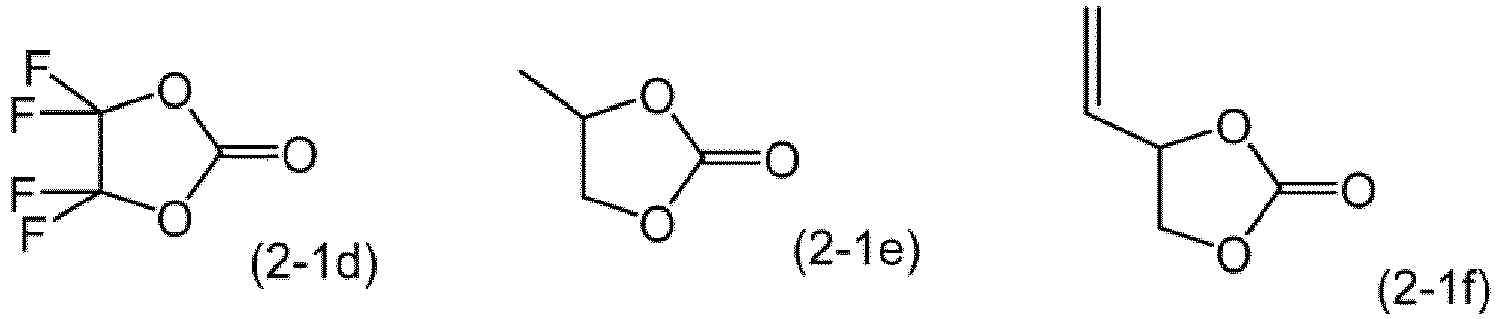

- With regard to the cyclic sulfone compound represented by Formula (2-2) as the second compound, from the viewpoint that an SEI is further easily formed, Y in Formula (2-2) may be an alkylene group having 2 or 3 carbon atoms, which may be substituted, or an alkenylene group having 2 or 3 carbon atoms, which may be substituted. J may be an oxygen atom and m may be 2.
- The cyclic sulfone compound represented by Formula (2-2) may be, for example, one or more selected from the compounds represented by Formula (2-2a), (2-2b), (2-2c), or (2-2d). From the viewpoint that the negative electrode can be further protected, the compound represented by Formula (2-2a), the compound represented by Formula (2-2c), or a combination thereof may be used.

- With respect to the cyclic disulfonic acid ester compound represented by Formula (2-3) as the second compound, from the viewpoint that a stronger SEI is easily formed, an alkylene group having 1 or 2 carbon atoms, a perfluoroalkylene group having 1 or 2 carbon atoms, or a fluoroalkylene group having 1 or 2 carbon atoms may be selected as W1 and W2 in Formula (2-3). W1 and W2 may be a methylene group, an ethylene group, a fluoromethylene group, or a perfluoromethylene group.
- The cyclic disulfonic acid ester compound represented by Formula (2-3) may be, for example, one or more selected from compounds represented by Formula (2-3a), (2-3b), (2-3c), (2-3d), (2-3e), (2-3f), (2-3g), or (2-3h). From the viewpoint that the negative electrode can be further protected, the compound represented by Formula (2-3a) may be selected.


- In the additive for a nonaqueous electrolyte solution, a ratio of the content of the first compound to the content of the second compound (the content of the first compound:the content of the second compound) may be 1:0.1 to 1:20, or may be 1:0.25 to 1:5, in terms of a mass ratio. In a case where the additive for a nonaqueous electrolyte solution contains two or more compounds of the compounds represented by Formula (2-1), the compound represented by Formula (2-2), and the compound represented by Formula (2-3) as the second compound, the ratio of the contents is a ratio of each content of the two or more second compounds (the content of the compound represented by Formula (2-1), the compound represented by Formula (2-2), or the compound represented by Formula (2-3)). As a result, the effect of the combination of the first compound and the second compound is more remarkable. From the same point of view, the ratio of the contents of the respective compounds can be set as follows.
- In a case where the additive for a nonaqueous electrolyte solution contains the compound represented by Formula (2-1) and the compound represented by Formula (2-2) as the second compound, the ratio of the content of the first compound to the content of each of the compound represented by Formula (2-1) and the compound represented by Formula (2-2) (the content of the first compound:the content of the compound represented by Formula (2-1) or the content of the compound represented by Formula (2-2)) may be 1:0.1 to 1:30 in terms of a mass ratio.
- The compound represented by Formula (1) can be synthesized using available raw materials and combining ordinary reactions thereof. For example, the compound represented by Formula (1) may be produced according to the method described in
WO2018/164124 . - A commercial product may be used as the second compound. The compound represented by Formula (2-1) may be produced, for example, according to the method described in
Japanese Unexamined Patent Publication No. 2010-138157 Japanese Unexamined Patent Publication No. 11-180974 Japanese Unexamined Patent Publication No. 2001-52738 Japanese Unexamined Patent Publication No. 2005-336155 - The additive for a nonaqueous electrolyte solution according to the present disclosure may include, in addition to the first compound and the second compound, other compounds and/or components which can contribute to SEI formation within a range that does not significantly impair the effect of the present invention. Examples of such other compounds and/or components include a negative electrode protective agent, a positive electrode protective agent, a flame retardant, an antistatic agent, lithium monofluorophosphate, lithium difluorophosphate, and succinonitrile.
- An example of the nonaqueous electrolyte solution contains the first compound and the second compound, and an electrolyte. The nonaqueous electrolyte solution according to the present disclosure may further contain, as a nonaqueous solvent, a compound different from the first compound and the second compound as an additive. A part or all of the first compound and/or the second compound may serve as both an additive and a nonaqueous solvent.
- The content of the first compound as an additive may be 0.05% by mass to 5% by mass with respect to the total amount of the nonaqueous electrolyte solution. The content of the first compound may be 0.1 % by mass or more, or may be 3% by mass or less, with respect to the total amount of the nonaqueous electrolyte solution. In a case where the first compound serves as both an additive and a nonaqueous solvent, the content of the first compound may be more than 5% by mass and 99% by mass or less with respect to the total amount of the nonaqueous electrolyte solution. In a case where the content of the first compound is 5% by mass or less, the nonaqueous solvent is usually a compound different from the first compound.
- The content of the second compound as an additive may be 0.05% by mass to 5% by mass with respect to the total amount of the nonaqueous electrolyte solution. The content of the second compound may be 0.1 % by mass or more, or may be 3% by mass or less, with respect to the total amount of the nonaqueous electrolyte solution. In a case where the second compounds are two or more compounds selected from the compound represented by Formula (2-1), the compound represented by Formula (2-2), and the compound represented by Formula (2-3), the content is each content of the two or more second compounds. The content of the compound serving as both an additive and a nonaqueous solvent among the second compounds may be more than 5% by mass and 99% by mass or less with respect to the total amount of the nonaqueous electrolyte solution. In a case where the content of the compound represented by Formula (2-1) is 5% by mass or less, the nonaqueous solvent is usually a compound different from the compound represented by Formula (2-1). In a case where the content of the compound represented by Formula (2-2) is 5% by mass or less, the nonaqueous solvent is usually a compound different from the compound represented by Formula (2-2). In a case where the content of the compound represented by Formula (2-3) is 5% by mass or less, the nonaqueous solvent is usually a compound different from the compound represented by Formula (2-3).
- The total content of the first compound and the second compound as additives may be 0.1% by mass to 10% by mass with respect to the total amount of the nonaqueous electrolyte solution. In a case where the total content of the first compound and the second compound is 10% by mass or less, there is little possibility that a thick SEI will be formed on the electrode and the resistance will increase. In a case where the total content of the first compound and the second compound is 0.1% by mass or more, the effect of improving resistance characteristics is further enhanced. In a case where the total content of the first compound and the second compound is 0.1% by mass to 10% by mass, the nonaqueous solvent is usually a compound different from the first compound and the second compound.
- From the same viewpoint, even in a case where the nonaqueous electrolyte solution contains two kinds selected from the group consisting of the compound represented by Formula (2-1), the compound represented by Formula (2-2), and the compound represented by Formula (2-3) as the second compound, the total content of the first compound and the two kinds of the second compounds may be 0.1% by mass to 10% by mass with respect to the total amount of the nonaqueous electrolyte solution.
- Further, from the same viewpoint, in a case where the nonaqueous electrolyte solution contains three kinds of the compound represented by Formula (2-1), the compound represented by Formula (2-2), and the compound represented by Formula (2-3) as the second compound, the total content of the first compound and the three kinds of the second compounds may be 0.5% by mass to 10% by mass with respect to the total amount of the nonaqueous electrolyte solution.
- A ratio of the content of the first compound to the content of the second compound in the nonaqueous electrolyte solution may be in the same range as the ratio in the additive for a nonaqueous electrolyte solution.
- The electrolyte may be a lithium salt which serves as an ion source of lithium ions. The electrolyte may be at least one selected from the group consisting of LiAlCl4, LiBF4, LiPF6, LiClO4, lithium bistrifluoromethanesulfonimide (LiTFSI), lithium bisfluorosulfonimide (LiFSI), LiAsF6, and LiSbF6. It is preferable that LiBF4 and/or LiPF6 may be selected as the electrolyte from the viewpoints that it has a high degree of dissociation, can enhance the ion conductivity of the electrolyte solution, and has an action of reducing a deterioration of the performance of an electricity storage device caused by a long-term use due to the oxidation-reduction resistance characteristics. The electrolyte may be used alone or in combination of two or more kinds thereof.
- In a case where the electrolyte is LiBF4 and/or LiPF6, these may be combined with a cyclic carbonate and a chain carbonate as the nonaqueous solvent. In a case where the electrolyte is LiBF4 and/or LiPF6, these may be combined with ethylene carbonate and diethyl carbonate as the nonaqueous solvent.
- The concentration of the electrolyte in the nonaqueous electrolyte solution may be 0.1 mol/L or more, or may be 2.0 mol/L or less with respect to the volume of the nonaqueous electrolyte solution. In a case where the concentration of the electrolyte is 0.1 mol/L or more, it is easy to sufficiently secure the electrical conductivity of the nonaqueous electrolyte solution. Therefore, it is easy to obtain stable discharge characteristics and charge characteristics of the electricity storage device. In a case where the concentration of the electrolyte is 2.0 mol/L or less, it is possible to reduce an increase in the viscosity of the nonaqueous electrolyte solution, and it is particularly easy to secure the mobility of ions. In a case where the mobility of the ions is insufficient, the electrical conductivity of the electrolyte solution cannot be sufficiently ensured, and there is a possibility that the charge/discharge characteristics and the like of the electricity storage device are hindered. From the same viewpoint, the concentration of the electrolyte may be 0.5 mol/L or more, and may be 1.5 mol/L or less.
- The nonaqueous electrolyte solution may further contain a nonaqueous solvent. The nonaqueous solvent may be the same compound as the first compound or the second compound, or may be a compound different from the first compound and the second compound, and the compound represented by Formula (2-1a) may be used as the nonaqueous solvent. The content of the compound represented by Formula (2-1a), which serves as both an additive and a nonaqueous solvent, is usually more than 5% by mass with respect to the total amount of the nonaqueous electrolyte solution. In that case, the nonaqueous electrolyte solution may or may not include, as an additive, a second compound different from the compound represented by Formula (2-1a).
- From the viewpoints of, for example, reducing the viscosity of a nonaqueous electrolyte solution thus obtained to a lower value, it is possible to select an aprotic solvent as the nonaqueous solvent. The aprotic solvent may be at least one selected from the group consisting of a cyclic carbonate, a chain carbonate, an aliphatic carboxylic acid ester, a lactone, a lactam, a cyclic ether, a chain ether, a sulfone, a nitrile, and a halogen derivative thereof. As the aprotic solvent, the cyclic carbonate or the chain carbonate can be selected, and a combination of the cyclic carbonate and the chain carbonate can also be selected.
- Examples of the cyclic carbonate include ethylene carbonate, propylene carbonate, butylene carbonate, and fluoroethylene carbonate. Examples of the chain carbonate include dimethyl carbonate, diethyl carbonate, and ethyl methyl carbonate. Examples of the aliphatic carboxylic acid ester include methyl acetate, ethyl acetate, methyl propionate, ethyl propionate, methyl butyrate, methyl isobutyrate, and methyl trimethylacetate. Examples of the lactone include γ-butyrolactone. Examples of the lactam include ε-caprolactam and N-methylpyrrolidone. Examples of the cyclic ether include tetrahydrofuran, 2-methyltetrahydrofuran, tetrahydropyran, and 1,3-dioxolane. Examples of the chain ether include 1,2-diethoxyethane and ethoxymethoxyethane. Examples of the sulfone include sulfolane. Examples of the nitrile include acetonitrile. Examples of the halogen derivative include 4-fluoro-1,3-dioxolan-2-one, 4-chloro-1,3-dioxolan-2-one, and 4,5-difluoro-1,3-dioxolan-2-one. These nonaqueous solvents may be used alone or in combination of two or more kinds thereof. These nonaqueous solvents are particularly suitable for use in nonaqueous electrolyte solution secondary batteries such as a lithium ion battery.
- The content of the nonaqueous solvent in the nonaqueous electrolyte solution may be, for example, 70% to 99% by mass with respect to the total amount of the nonaqueous electrolyte solution. In a case where the first compound, the second compound, or a both thereof serve as both an additive and a nonaqueous solvent, the content of the first compound and the second compound that serve as both an additive and a nonaqueous solvent may be 70% to 99% by mass with respect to the total amount of the nonaqueous electrolyte solution, and the total of the content of the first compound and the second compound that serve as both an additive and a nonaqueous solvent, and the content of other nonaqueous solvents may be 70% to 99% by mass with respect to the total amount of the nonaqueous electrolyte solution.
- An electricity storage device according to the present disclosure is mainly composed of the nonaqueous electrolyte solution, a positive electrode, and a negative electrode. Specific examples of the electricity storage device include nonaqueous electrolyte solution secondary batteries (a lithium ion battery and the like). The nonaqueous electrolyte solution according to the present disclosure is particularly effective in applications of the lithium ion battery.
-
Fig. 1 is a cross-sectional view schematically showing an example of an electricity storage device. The electricity storage device 1 shown inFig. 1 is a nonaqueous electrolyte solution secondary battery. The electricity storage device 1 includes a positive electrode plate 4 (positive electrode), a negative electrode plate 7 (negative electrode) facing thepositive electrode plate 4, anonaqueous electrolyte solution 8 disposed between thepositive electrode plate 4 and thenegative electrode plate 7, and a separator 9 provided in thenonaqueous electrolyte solution 8. Thepositive electrode plate 4 has apositive electrode collector 2 and a positive electrodeactive material layer 3 provided on the side of thenonaqueous electrolyte solution 8. Thenegative electrode plate 7 has anegative electrode collector 5 and a negative electrode active material layer 6 provided on the side of thenonaqueous electrolyte solution 8. As thenonaqueous electrolyte solution 8, the nonaqueous electrolyte solution according to the above-mentioned embodiment can be used. AlthoughFig. 1 shows the nonaqueous electrolyte solution secondary battery as the electricity storage device, an electricity storage device obtained by application of the nonaqueous electrolyte solution is not limited thereto, and it may be another electricity storage device such as an electric double layer capacitor. - The
positive electrode collector 2 and thenegative electrode collector 5 may be, for example, a metal foil formed of a metal such as aluminum, copper, nickel, and stainless steel. - The positive electrode
active material layer 3 includes a positive electrode active material. The positive electrode active material may be a lithium-containing composite oxide. Specific examples of the lithium-containing composite oxide include LiMnO2, LiFeO2, LiMn2O4, Li2FeSiO4, LiNiCoMnO2, LiNi5Co2Mn3O2, LizNi(1-x-y)CoxMyO2 (x, y, and z are numerical values satisfying 0 ≤ x ≤ 0.40, 0 ≤ y < 0.40, and 0.90 ≤ z ≤ 1.20, respectively, and M represents at least one element selected from Mn, V, Mg, Mo, Nb, and Al), LiFePO4, and LizCO(1-x)MxO2 (where x and z are numerical values satisfying 0 ≤ x ≤ 0.1 and 0.97 ≤ z ≤ 1. 20, respectively, and M represents at least one element selected from the group consisting of Mn, Ni, V, Mg, Mo, Nb, and Al.). - Since the additive for a nonaqueous electrolyte solution according to the present disclosure can effectively cover the electrode surface, the positive electrode active material may be LizNi(1-x-y)CoxMyO2 (x, y, and z represent numerical values satisfying 0.01 ≤ x ≤ 0.20, 0 ≤ y ≤ 0.30, and 0.90 ≤ z ≤ 1.20, respectively, and M represents at least one element selected from the group consisting of Mn, V, Mg, Mo, Nb, and Al), LizNi(1-x-y)CoxMyO2 (x, y, and z are numerical values satisfying 0.01 ≤ x ≤ 0.15, 0 ≤ y ≤ 0.15, and 0.97 ≤ z ≤ 1.20, respectively, and M is at least one element selected from Mn, Ni, V, Mg, Mo, Nb, and Al), or LizCO(1-x)MxO2 (where x and z are numerical values satisfying 0 ≤ x ≤ 0. 1 and 0.97 ≤ z ≤ 1.20, respectively, and M represents at least one element selected from Mn, V, Mg, Mo, Nb, and Al). In particular, in a case where a positive electrode active material with a high Ni ratio, such as LizNi(1-x-y)CoxMyO2 (x, y, and z are numerical values satisfying 0.01 ≤ x ≤ 0.20, 0 ≤ y ≤ 0.30, and 0.90 ≤ z ≤ 1.20, respectively, and M represents at least one element selected from Mn, Ni, V, Mg, Mo, Nb, and Al) is used, a deterioration in the capacity tends to occur easily. However, even in that case, it is possible to effectively reduce the deterioration in the capacity by a combination of the first compound and the second compound.
- The negative electrode active material layer 6 includes a negative electrode active material. The negative electrode active material may be a material capable of absorbing and releasing lithium. Examples of such materials include carbon materials such as graphite and amorphous carbon, and oxide materials such as indium oxide, silicon oxide, tin oxide, lithium titanate, zinc oxide, and lithium oxide. The negative electrode active material may be a lithium metal or a metallic material capable of forming an alloy with lithium. Specific examples of a metal capable of forming an alloy with lithium include Cu, Sn, Si, Co, Mn, Fe, Sb, and Ag. Binary or ternary alloys containing these metals and lithium can also be used as the negative electrode active material. These negative electrode active materials may be used alone or in combination of two or more kinds thereof.
- From the viewpoint of achieving a higher energy density, a carbon material such as graphite and an Si-based active material such as Si, an Si alloy, and an Si oxide may be combined as the negative electrode active materials. From the viewpoint of achieving both of the cycle characteristics and the higher energy density, graphite and the Si-based active material may be combined as the negative electrode active material. With regard to such a combination, the mass ratio of the Si-based active material to the total mass of the carbon material and the Si-based active material may be 0.5% by mass or more and 95% by mass or less, 1% by mass or more and 50% by mass or less, or 2% by mass or more and 40% by mass or less.
- The positive electrode
active material layer 3 and the negative electrode active material layer 6 may further include a binder. Examples of the binder include polyvinylidene fluoride (PVdF), a vinylidene fluoride-hexafluoropropylene copolymer, a vinylidene fluoride-tetrafluoroethylene copolymer, a styrene-butadiene copolymerized rubber, carboxymethyl cellulose, polytetrafluoroethylene, polypropylene, polyethylene, polyimide, polyamideimide, polyacrylic acid, polyvinyl alcohol, acrylic acid-polyacrylonitrile, polyacrylamide, polymethacrylic acid, and a copolymer thereof. The binders may be the same as or different from each other in the positive electrode active material layer and the negative electrode active material layer. - The separator 9 may be, for example, a porous film made of polyethylene, polypropylene, fluororesin, and the like.
- Specific forms such as a shape and a thickness of each of members constituting the electricity storage device can be set as appropriate by those skilled in the art. The configurations of the electricity storage device are not limited to the example of
Fig. 1 and modifications can be made as appropriate. - The present invention is not limited to the following Examples.
- Ethylene carbonate (EC) and diethyl carbonate (DEC) were mixed at a volume ratio of EC:EMC = 30:70 to obtain a nonaqueous mixed solvent. LiPF6 as an electrolyte was dissolved in the nonaqueous mixed solvent to a concentration of 1.0 mol/L. To the obtained solution were added the compound represented by Formula (1-6) and the compound represented by Formula (2-1a) as an additive for a nonaqueous electrolyte solution, thereby preparing a nonaqueous electrolyte solution. The content of the compound represented by Formula (1-6) was 1.0% by mass with respect to the total amount of the nonaqueous electrolyte solution. The content of the compound represented by Formula (2-1a) was 1.0% by mass with respect to the total amount of the nonaqueous electrolyte solution.
- A nonaqueous electrolyte solution was prepared in the same manner as in Example 1, except that the compound represented by Formula (2-1a) was changed to the above-mentioned compound represented by Formula (2-1i).
- A nonaqueous electrolyte solution was prepared in the same manner as in Example 1, except that the compound represented by Formula (2-1a) was changed to the compound represented by Formula (2-2a), and the contents of the compound represented by Formula (1-6) and the compound represented by Formula (2-2a) were set to 0.5% by mass and 0.5% by mass, respectively.
- A nonaqueous electrolyte solution was prepared in the same manner as in Example 3, except that the compound represented by Formula (2-2a) was changed to the above-mentioned compound represented by Formula (2-3a).
- A nonaqueous electrolyte solution was prepared in the same manner as in Example 1, except that the compound represented by Formula (1-6) and the compound represented by Formula (2-1a) were not added.
- A nonaqueous electrolyte solution was prepared in the same manner as in Example 1, except that the compound represented by Formula (2-1a) was not added.
- A nonaqueous electrolyte solution was prepared in the same manner as in Example 1, except that the compound represented by Formula (1-6) was not added and the compound represented by Formula (2-1a) was changed to the compound represented by Formula (2-1i).
- A nonaqueous electrolyte solution was prepared in the same manner as in Example 1, except that the compound represented by Formula (1-6) was not added and the compound represented by Formula (2-1a) was changed to the compound represented by Formula (2-2a).
- A nonaqueous electrolyte solution was prepared in the same manner as in Example 1, except that the compound represented by Formula (1-6) was not added and the compound represented by Formula (2-1a) was changed to the compound represented by Formula (2-3a).
- LiNi0.5Co0.2Mn0.3O2 as a positive electrode active material and carbon black as an electrical conductivity-imparting agent were dry-mixed. A mixture thus obtained was uniformly dispersed in N-methyl-2-pyrrolidone (NMP) in which polyvinylidene fluoride (PVDF) as a binder had been dissolved, thereby manufacturing a slurry. The obtained slurry was applied to both surfaces of an aluminum metal foil (rectangular, thickness: 20 µm). The coating film was dried to remove NMP and the whole film was then pressed to obtain a positive electrode sheet having an aluminum metal foil as a positive electrode collector and a positive electrode active material layer formed on both surfaces thereof. The ratio of the solid contents in the positive electrode sheet was set to positive electrode active material: electrical conductivity-imparting agent:PVDF of 92:5:3 in terms of a mass ratio.
- Graphite powder as a negative electrode active material, a styrene-butadiene rubber (SBR) as a binder, and carboxymethyl cellulose (CMC) as a thickener were uniformly dispersed in water including to manufacture a slurry. The obtained slurry was applied to one surface of a copper foil (rectangular, thickness: 10 µm). The coating film was dried to remove water and the whole film was then pressed to obtain a negative electrode sheet having the copper foil as a negative electrode collector and a negative electrode active material layer formed on one surface thereof. The ratio of the solid contents in the negative electrode sheet was set to negative electrode active material:CMC:SBR = 98:1:1 in terms of a mass ratio.
- The manufactured positive electrode sheet and negative electrode sheet were laminated in the order of the negative electrode sheet, the separator made of polyethylene, the positive electrode sheet, the separator made of polyethylene, and the negative electrode sheet to create a battery element. This battery element was put into a bag formed of a laminated film having aluminum (thickness: 40 µm) and resin layers coating both surfaces thereof in such a way that the terminals of the positive electrode sheet and the negative electrode sheet protruded from the bag. Subsequently, each of the nonaqueous electrolyte solutions obtained in Examples and Comparative Examples was poured into the bag. The bag was vacuum-sealed to obtain a sheet-shaped nonaqueous electrolyte solution secondary battery. Further, in order to increase the adhesiveness between the electrodes, the sheet-shaped nonaqueous electrolyte solution secondary battery was sandwiched between glass plates and pressurized.
- The obtained nonaqueous electrolyte solution secondary battery was charged to 4.2 V with a current corresponding to 0.2 C at 25°C and then aged by keeping it at 45°C for 24 hours. Thereafter, the nonaqueous electrolyte solution secondary battery was discharged to 3 V with a current corresponding to 0.2 C at 25°C. Subsequently, the nonaqueous electrolyte solution secondary battery was subjected to an initial charge/discharge in which an operation of charging to 4.2 V with a current corresponding to 0.2 C and discharging to 3 V with a current corresponding to 0.2 C was repeated in three cycles, thereby stabilizing the nonaqueous electrolyte solution secondary battery. Thereafter, an initial charge/discharge in which a charge/discharge was performed at a current corresponding to 1 C was performed, and the discharge capacity was measured and defined as an "initial capacity". Further, after the initial charge/discharge, the nonaqueous electrolyte solution secondary battery charged to 50% of the initial capacity was discharged at a current corresponding to 0.2 C, and a change in the battery voltage was observed. Thereafter, a DCR (Ω) was calculated by reading a change in the voltage in a case where the discharge rate was changed to 0.5 C, 1.0 C, and 2.0 C while resting for 10 minutes, and the obtained value was referred to as an "initial DCR (Ω)". The DCR indicates a resistance value of a battery, and it can be said that the lower the DCR value, the higher the output characteristics of the battery.
- With regard to each of the nonaqueous electrolyte solution secondary batteries obtained above, a charge/discharge cycle test with a charge rate of 1 C, a discharge rate of 1 C, a charge cut-off voltage of 4.2 V, and a discharge cut-off voltage of 3 V was performed in 200 cycles. Thereafter, a charge/discharge was performed at 1 C, and the discharge capacity was measured and defined as a "capacity after cycles". Further, after the cycle test, the DCR of the nonaqueous electrolyte solution secondary battery charged to 50% of the capacity after the cycles was measured and defined as a "DCR (Ω) after cycles". Tables 1 and 2 show the initial DCR, the DCR after cycles, and the discharge capacity maintenance rate of each battery. The discharge capacity maintenance rate is calculated by an equation: Discharge capacity maintenance rate = (Capacity after cycles)/(Initial capacity).
[Table 1] First compound Second compound Initial DCR (Ω) DCR after cycles (Ω) Discharge capacity maintenance rate (%) Type Content (% by mass) Type Content (% by mass) Example 1 (1-6) 1.0 (2-1a) 1.0 0.54 0.62 88 Example 2 (1-6) 1.0 (2-1i) 1.0 0.58 0.61 89 Example 3 (1-6) 0.5 (2-2a) 0.5 0.61 0.68 87 Example 4 (1-6) 0.5 (2-3a) 0.5 0.62 0.48 89 [Table 2] First compound Second compound Initial DCR (Ω) DCR after cycles (Ω) Discharge capacity maintenance rate (%) Type Content (% by mass) Type Content (% by mass) Comparative Example 1 - - - - 0.65 1.1 65 Comparative Example 2 (1-6) 1.0 - - 0.52 0.68 83 Comparative Example 3 - - (2-1i) 1.0 0.71 0.96 89 Comparative Example 4 - - (2-2a) 1.0 0.69 0.86 85 Comparative Example 5 - - (2-3a) 1.0 0.72 0.53 90 - From these experimental results, it was confirmed that the combination of the first compound and the second compound provided an electricity storage device with a low initial resistance and a long life.
- 1: electricity storage device (nonaqueous electrolyte solution secondary battery), 2: positive electrode collector, 3: positive electrode active material layer, 4: positive electrode plate, 5: negative electrode collector, 6: negative electrode active material layer, 7: negative electrode plate, 8: nonaqueous electrolyte solution, 9: separator.
Claims (9)
- An additive for a nonaqueous electrolyte solution, comprising:a first compound represented by Formula (1); andat least one second compound selected from the group consisting of a compound represented by Formula (2-1), a compound represented by Formula (2-2), and a compound represented by Formula (2-3),
 in Formula (1),Q represents an alkenylene group having 4 to 8 carbon atoms, which may be substituted, the alkenylene group forming a cyclic group together with a sulfur atom of a sulfonyl group, X represents a sulfonyl group, a carbonyl group, or a phosphoryl group, R1 represents an alkyl group having 1 to 4 carbon atoms, which may be substituted, an alkenyl group having 2 to 6 carbon atoms, which may be substituted, an alkynyl group having 2 to 6 carbon atoms, which may be substituted, an aryl group which may be substituted, an alkoxy group having 1 to 4 carbon atoms, which may be substituted, an alkenyloxy group having 2 to 6 carbon atoms, which may be substituted, an alkynyloxy group having 2 to 6 carbon atoms, which may be substituted, or an aryloxy group which may be substituted, and n represents 1 or 2,
 in Formula (2-1), Z1 represents an alkylene group having 1 to 3 carbon atoms, which may be substituted, or an alkenylene group having 2 to 4 carbon atoms, which may be substituted,
 in Formula (2-2), Y represents an alkylene group having 1 to 3 carbon atoms, or an alkenylene group having 2 to 4 carbon atoms, which may be substituted, J represents an oxygen atom or a single bond, and m represents 1 or 2,
 in Formula (2-3), W1 and W2 each independently represent a substituted or unsubstituted alkylene group having 1 to 3 carbon atoms, which may be branched, a substituted or unsubstituted perfluoroalkylene group having 1 to 3 carbon atoms, which may be branched, or a substituted or unsubstituted fluoroalkylene group having 1 to 3 carbon atoms, which may be branched.
 - The additive for a nonaqueous electrolyte solution according to claim 1,wherein the compound represented by Formula (1) is a compound represented by Formula (3),
 in Formula (3), X, R1, and n have the same definitions as X, R1 and n in Formula (1), respectively.
 - The additive for a nonaqueous electrolyte solution according to claim 1 or 2,
wherein R1 is an alkyl group having 1 to 3 carbon atoms, which may be substituted with a halogen atom, an alkenyl group having 2 to 4 carbon atoms, which may be substituted with a halogen atom, an alkynyl group having 2 to 4 carbon atoms, which may be substituted with a halogen atom, or an aryl group which may be substituted with a halogen atom. - A nonaqueous electrolyte solution comprising:the additive for a nonaqueous electrolyte solution according to any one of claims 1 to 3;a nonaqueous solvent; andan electrolyte.
- The nonaqueous electrolyte solution according to claim 4,wherein a content of the first compound is 0.05% by mass to 5% by mass with respect to a total amount of the nonaqueous electrolyte solution,a content of each of the compound represented by Formula (2-1), the compound represented by Formula (2-2), and the compound represented by Formula (2-3) in a case where any one of these compounds is included in the nonaqueous electrolyte solution is 0.05% by mass to 5% by mass with respect to the total amount of the nonaqueous electrolyte solution, andthe nonaqueous solvent is a compound different from the first compound and the second compound.
- The nonaqueous electrolyte solution according to claim 4 or 5,
wherein the electrolyte includes a lithium salt. - An electricity storage device comprising:the nonaqueous electrolyte solution according to any one of claims 4 to 6;a positive electrode including a positive electrode active material; anda negative electrode including a negative electrode active material.
- The electricity storage device according to claim 7,
wherein the positive electrode active material includes a lithium-containing composite oxide represented by LizNi(1-x-y)CoxMyO2 (x, y, and z are numerical values satisfying 0 ≤ x ≤ 0.40, 0 ≤ y ≤ 0.40, and 0.90 ≤ z ≤ 1.20, respectively, and M represents at least one element selected from the group consisting of Mn, V, Mg, Mo, Nb, and Al). - The electricity storage device according to claim 7,
wherein the positive electrode active material includes a lithium-containing composite oxide represented by LizNi(1-x-y)CoxMyO2 (x, y, and z are numerical values satisfying 0.01 ≤ x ≤ 0.20, 0 ≤ y ≤ 0.30, and 0.90 ≤ z ≤ 1.20, respectively, and M represents at least one element selected from the group consisting of Mn, V, Mg, Mo, Nb, and Al).
Applications Claiming Priority (2)
| Application Number | Priority Date | Filing Date | Title |
|---|---|---|---|
| JP2020131021 | 2020-07-31 | ||
| PCT/JP2021/027574 WO2022025002A1 (en) | 2020-07-31 | 2021-07-26 | Additive for non-aqueous electrolyte, non-aqueous electrolyte, and power storage device |
Publications (2)
| Publication Number | Publication Date |
|---|---|
| EP4167337A1 true EP4167337A1 (en) | 2023-04-19 |
| EP4167337A4 EP4167337A4 (en) | 2025-04-23 |
Family
ID=80036196
Family Applications (1)
| Application Number | Title | Priority Date | Filing Date |
|---|---|---|---|
| EP21851292.9A Withdrawn EP4167337A4 (en) | 2020-07-31 | 2021-07-26 | ADDITIVE FOR NONAQUEOUS ELECTROLYTE, NONAQUEOUS ELECTROLYTE AND ENERGY STORAGE DEVICE |
Country Status (7)
| Country | Link |
|---|---|
| US (1) | US20230261261A1 (en) |
| EP (1) | EP4167337A4 (en) |
| JP (1) | JPWO2022025002A1 (en) |
| KR (1) | KR20230044180A (en) |
| CN (1) | CN116171481A (en) |
| TW (1) | TW202206419A (en) |
| WO (1) | WO2022025002A1 (en) |
Cited By (1)
| Publication number | Priority date | Publication date | Assignee | Title |
|---|---|---|---|---|
| EP4207421A4 (en) * | 2020-09-14 | 2024-09-25 | Sumitomo Seika Chemicals Co., Ltd. | Additive for non-aqueous electrolyte, non-aqueous electrolyte, and power storage device |
Family Cites Families (15)
| Publication number | Priority date | Publication date | Assignee | Title |
|---|---|---|---|---|
| JP2597091B2 (en) | 1986-10-16 | 1997-04-02 | 日立マクセル株式会社 | Lithium secondary battery |
| JP3066126B2 (en) | 1991-09-10 | 2000-07-17 | 三洋電機株式会社 | Non-aqueous electrolyte battery |
| JP4162743B2 (en) | 1997-12-15 | 2008-10-08 | 三菱化学株式会社 | Process for producing vinylene carbonate |
| JP3815180B2 (en) | 1999-06-01 | 2006-08-30 | 宇部興産株式会社 | Nonaqueous electrolyte and lithium secondary battery using the same |
| JP2001266939A (en) * | 2000-03-16 | 2001-09-28 | Mitsubishi Gas Chem Co Inc | Non-aqueous electrolytic solution for lithium ion secondary battery |
| JP5239106B2 (en) | 2001-05-23 | 2013-07-17 | 三菱化学株式会社 | Non-aqueous electrolyte secondary battery |
| JP4033074B2 (en) | 2002-08-29 | 2008-01-16 | 日本電気株式会社 | Secondary battery electrolyte and secondary battery using the same |
| JP4588407B2 (en) | 2004-04-28 | 2010-12-01 | 住友化学株式会社 | Method for producing cyclic disulfonic acid ester |
| JP5600876B2 (en) | 2008-02-28 | 2014-10-08 | ダイキン工業株式会社 | Process for producing 4-fluoro-1,3-dioxolan-2-one |
| JP6209973B2 (en) | 2014-01-20 | 2017-10-11 | ソニー株式会社 | Lithium ion secondary battery, battery pack, electronic device, electric vehicle, power storage device, and power system |
| US20180138551A1 (en) * | 2015-05-26 | 2018-05-17 | Mitsui Chemicals, Inc. | Non-aqueous electrolyte solution for battery and lithium secondary battery |
| CN108028427B (en) * | 2015-09-09 | 2022-01-14 | 住友精化株式会社 | Additive for nonaqueous electrolyte solution, and electricity storage device |
| JP2019164879A (en) * | 2016-07-19 | 2019-09-26 | 住友精化株式会社 | Additive for nonaqueous electrolyte solutions, nonaqueous electrolyte solution, and electricity storage device |
| CN110383565B (en) * | 2017-03-07 | 2022-08-23 | 住友精化株式会社 | Additive for nonaqueous electrolyte solution, and electricity storage device |
| KR102573627B1 (en) * | 2017-03-08 | 2023-08-31 | 스미토모 세이카 가부시키가이샤 | Additives for non-aqueous electrolytes, non-aqueous electrolytes and electrical storage devices |
-
2021
- 2021-07-26 JP JP2022540299A patent/JPWO2022025002A1/ja active Pending
- 2021-07-26 US US18/005,156 patent/US20230261261A1/en active Pending
- 2021-07-26 EP EP21851292.9A patent/EP4167337A4/en not_active Withdrawn
- 2021-07-26 KR KR1020237000151A patent/KR20230044180A/en not_active Ceased
- 2021-07-26 WO PCT/JP2021/027574 patent/WO2022025002A1/en not_active Ceased
- 2021-07-26 CN CN202180058925.XA patent/CN116171481A/en active Pending
- 2021-07-28 TW TW110127643A patent/TW202206419A/en unknown
Cited By (1)
| Publication number | Priority date | Publication date | Assignee | Title |
|---|---|---|---|---|
| EP4207421A4 (en) * | 2020-09-14 | 2024-09-25 | Sumitomo Seika Chemicals Co., Ltd. | Additive for non-aqueous electrolyte, non-aqueous electrolyte, and power storage device |
Also Published As
| Publication number | Publication date |
|---|---|
| TW202206419A (en) | 2022-02-16 |
| KR20230044180A (en) | 2023-04-03 |
| EP4167337A4 (en) | 2025-04-23 |
| CN116171481A (en) | 2023-05-26 |
| WO2022025002A1 (en) | 2022-02-03 |
| JPWO2022025002A1 (en) | 2022-02-03 |
| US20230261261A1 (en) | 2023-08-17 |
Similar Documents
| Publication | Publication Date | Title |
|---|---|---|
| EP3595072B1 (en) | Additive for non-aqueous electrolytic solutions, non-aqueous electrolytic solution, and electrical storage device | |
| EP3349290B1 (en) | Additive for nonaqueous electrolyte solutions, nonaqueous electrolyte solution, and electricity storage device | |
| US9954254B2 (en) | Electrolyte for lithium secondary battery and lithium secondary battery including the same | |
| US10601069B2 (en) | Non-aqueous electrolyte additive, and non-aqueous electrolyte for lithium secondary battery comprising the same and lithium secondary battery | |
| CN109792086B (en) | Nonaqueous electrolyte for lithium secondary battery and lithium secondary battery containing the same | |
| KR20070103296A (en) | Non-aqueous secondary battery | |
| US11876177B2 (en) | Non-aqueous electrolyte solution for lithium secondary battery and lithium secondary battery including the same | |
| JP5062459B2 (en) | Nonaqueous electrolyte secondary battery | |
| JP2019164879A (en) | Additive for nonaqueous electrolyte solutions, nonaqueous electrolyte solution, and electricity storage device | |
| WO2019163367A1 (en) | Non-aqueous electrolyte secondary battery | |
| US12021191B2 (en) | Additive for nonaqueous electrolyte solutions, nonaqueous electrolyte solution and electricity storage device | |
| EP4167337A1 (en) | Additive for non-aqueous electrolyte, non-aqueous electrolyte, and power storage device | |
| CN101855771B (en) | Lithium secondary battery containing additive for improving high temperature characteristics | |
| KR102633568B1 (en) | Electrolyte additive for secondary battery, non-aqueous electrolyte for lithium secondary battery comprising the same and lithium secondary battery | |
| EP4207421A1 (en) | Additive for non-aqueous electrolyte, non-aqueous electrolyte, and power storage device | |
| CN117242615A (en) | Electrolyte additive, electrolyte for lithium secondary battery containing same, and lithium secondary battery | |
| JP7020208B2 (en) | Electrolyte and lithium-ion battery | |
| KR20220133683A (en) | Additives for non-aqueous electrolyte, non-aqueous electrolyte comprising the same and lithium secondary battery | |
| JP6086116B2 (en) | ELECTROLYTE SOLUTION FOR LITHIUM SECONDARY BATTERY AND LITHIUM SECONDARY BATTERY CONTAINING THE SAME | |
| KR20250104000A (en) | Electrolyte composition for high silicon anode based lithium secondary battery and lithium secondary battery containing thereof | |
| KR20260052771A (en) | Lithium secondary battery | |
| KR20230169345A (en) | Non-aqueous electrolyte for batteries, lithium secondary battery precursor, manufacturing method of lithium secondary battery, and lithium secondary battery |
Legal Events
| Date | Code | Title | Description |
|---|---|---|---|
| STAA | Information on the status of an ep patent application or granted ep patent |
Free format text: STATUS: THE INTERNATIONAL PUBLICATION HAS BEEN MADE |
|
| PUAI | Public reference made under article 153(3) epc to a published international application that has entered the european phase |
Free format text: ORIGINAL CODE: 0009012 |
|
| STAA | Information on the status of an ep patent application or granted ep patent |
Free format text: STATUS: REQUEST FOR EXAMINATION WAS MADE |
|
| 17P | Request for examination filed |
Effective date: 20230112 |
|
| AK | Designated contracting states |
Kind code of ref document: A1 Designated state(s): AL AT BE BG CH CY CZ DE DK EE ES FI FR GB GR HR HU IE IS IT LI LT LU LV MC MK MT NL NO PL PT RO RS SE SI SK SM TR |
|
| DAV | Request for validation of the european patent (deleted) | ||
| DAX | Request for extension of the european patent (deleted) | ||
| REG | Reference to a national code |
Ref country code: DE Ref legal event code: R079 Free format text: PREVIOUS MAIN CLASS: H01M0010056700 Ipc: H01G0011640000 |
|
| A4 | Supplementary search report drawn up and despatched |
Effective date: 20250320 |
|
| RIC1 | Information provided on ipc code assigned before grant |
Ipc: H01G 11/06 20130101ALN20250314BHEP Ipc: H01M 4/02 20060101ALI20250314BHEP Ipc: H01M 10/0525 20100101ALI20250314BHEP Ipc: H01M 10/42 20060101ALI20250314BHEP Ipc: H01M 10/0569 20100101ALI20250314BHEP Ipc: H01M 10/0568 20100101ALI20250314BHEP Ipc: H01M 10/052 20100101ALI20250314BHEP Ipc: H01M 6/16 20060101ALI20250314BHEP Ipc: H01M 4/525 20100101ALI20250314BHEP Ipc: H01M 4/505 20100101ALI20250314BHEP Ipc: H01G 11/30 20130101ALI20250314BHEP Ipc: H01M 10/0567 20100101ALI20250314BHEP Ipc: H01G 11/64 20130101AFI20250314BHEP |
|
| STAA | Information on the status of an ep patent application or granted ep patent |
Free format text: STATUS: THE APPLICATION IS DEEMED TO BE WITHDRAWN |
|
| 18D | Application deemed to be withdrawn |
Effective date: 20251009 |