EP4166346B1 - Fahrradradabdeckung - Google Patents
Fahrradradabdeckung Download PDFInfo
- Publication number
- EP4166346B1 EP4166346B1 EP22201569.5A EP22201569A EP4166346B1 EP 4166346 B1 EP4166346 B1 EP 4166346B1 EP 22201569 A EP22201569 A EP 22201569A EP 4166346 B1 EP4166346 B1 EP 4166346B1
- Authority
- EP
- European Patent Office
- Prior art keywords
- drive side
- disc
- side disc
- bicycle wheel
- wheel
- Prior art date
- Legal status (The legal status is an assumption and is not a legal conclusion. Google has not performed a legal analysis and makes no representation as to the accuracy of the status listed.)
- Active
Links
Images




Classifications
-
- B—PERFORMING OPERATIONS; TRANSPORTING
- B60—VEHICLES IN GENERAL
- B60B—VEHICLE WHEELS; CASTORS; AXLES FOR WHEELS OR CASTORS; INCREASING WHEEL ADHESION
- B60B7/00—Wheel cover discs, rings, or the like, for ornamenting, protecting, venting, or obscuring, wholly or in part, the wheel body, rim, hub, or tyre sidewall, e.g. wheel cover discs, wheel cover discs with cooling fins
- B60B7/0026—Wheel cover discs, rings, or the like, for ornamenting, protecting, venting, or obscuring, wholly or in part, the wheel body, rim, hub, or tyre sidewall, e.g. wheel cover discs, wheel cover discs with cooling fins characterised by the surface
- B60B7/0066—Wheel cover discs, rings, or the like, for ornamenting, protecting, venting, or obscuring, wholly or in part, the wheel body, rim, hub, or tyre sidewall, e.g. wheel cover discs, wheel cover discs with cooling fins characterised by the surface the dominant aspect being the surface structure
- B60B7/0073—Wheel cover discs, rings, or the like, for ornamenting, protecting, venting, or obscuring, wholly or in part, the wheel body, rim, hub, or tyre sidewall, e.g. wheel cover discs, wheel cover discs with cooling fins characterised by the surface the dominant aspect being the surface structure being completely closed, i.e. having no cooling openings for the brakes
-
- B—PERFORMING OPERATIONS; TRANSPORTING
- B60—VEHICLES IN GENERAL
- B60B—VEHICLE WHEELS; CASTORS; AXLES FOR WHEELS OR CASTORS; INCREASING WHEEL ADHESION
- B60B7/00—Wheel cover discs, rings, or the like, for ornamenting, protecting, venting, or obscuring, wholly or in part, the wheel body, rim, hub, or tyre sidewall, e.g. wheel cover discs, wheel cover discs with cooling fins
- B60B7/0006—Wheel cover discs, rings, or the like, for ornamenting, protecting, venting, or obscuring, wholly or in part, the wheel body, rim, hub, or tyre sidewall, e.g. wheel cover discs, wheel cover discs with cooling fins for cycle wheels or similar
-
- B—PERFORMING OPERATIONS; TRANSPORTING
- B60—VEHICLES IN GENERAL
- B60B—VEHICLE WHEELS; CASTORS; AXLES FOR WHEELS OR CASTORS; INCREASING WHEEL ADHESION
- B60B7/00—Wheel cover discs, rings, or the like, for ornamenting, protecting, venting, or obscuring, wholly or in part, the wheel body, rim, hub, or tyre sidewall, e.g. wheel cover discs, wheel cover discs with cooling fins
- B60B7/06—Fastening arrangements therefor
- B60B7/061—Fastening arrangements therefor characterised by the part of the wheels to which the discs, rings or the like are mounted
- B60B7/065—Fastening arrangements therefor characterised by the part of the wheels to which the discs, rings or the like are mounted to the disc
-
- B—PERFORMING OPERATIONS; TRANSPORTING
- B60—VEHICLES IN GENERAL
- B60B—VEHICLE WHEELS; CASTORS; AXLES FOR WHEELS OR CASTORS; INCREASING WHEEL ADHESION
- B60B7/00—Wheel cover discs, rings, or the like, for ornamenting, protecting, venting, or obscuring, wholly or in part, the wheel body, rim, hub, or tyre sidewall, e.g. wheel cover discs, wheel cover discs with cooling fins
- B60B7/06—Fastening arrangements therefor
- B60B7/08—Fastening arrangements therefor having gripping elements consisting of formations integral with the cover
-
- B—PERFORMING OPERATIONS; TRANSPORTING
- B60—VEHICLES IN GENERAL
- B60B—VEHICLE WHEELS; CASTORS; AXLES FOR WHEELS OR CASTORS; INCREASING WHEEL ADHESION
- B60B7/00—Wheel cover discs, rings, or the like, for ornamenting, protecting, venting, or obscuring, wholly or in part, the wheel body, rim, hub, or tyre sidewall, e.g. wheel cover discs, wheel cover discs with cooling fins
- B60B7/06—Fastening arrangements therefor
- B60B7/14—Fastening arrangements therefor comprising screw-threaded means
-
- B—PERFORMING OPERATIONS; TRANSPORTING
- B62—LAND VEHICLES FOR TRAVELLING OTHERWISE THAN ON RAILS
- B62J—CYCLE SADDLES OR SEATS; AUXILIARY DEVICES OR ACCESSORIES SPECIALLY ADAPTED TO CYCLES AND NOT OTHERWISE PROVIDED FOR, e.g. ARTICLE CARRIERS OR CYCLE PROTECTORS
- B62J17/00—Weather guards for riders; Fairings or stream-lining parts not otherwise provided for
-
- B—PERFORMING OPERATIONS; TRANSPORTING
- B60—VEHICLES IN GENERAL
- B60B—VEHICLE WHEELS; CASTORS; AXLES FOR WHEELS OR CASTORS; INCREASING WHEEL ADHESION
- B60B1/00—Spoked wheels; Spokes thereof
- B60B1/003—Spoked wheels; Spokes thereof specially adapted for bicycles
-
- B—PERFORMING OPERATIONS; TRANSPORTING
- B60—VEHICLES IN GENERAL
- B60B—VEHICLE WHEELS; CASTORS; AXLES FOR WHEELS OR CASTORS; INCREASING WHEEL ADHESION
- B60B2900/00—Purpose of invention
- B60B2900/10—Reduction of
- B60B2900/121—Resisting forces
- B60B2900/1216—Resisting forces due to air-drag
-
- B—PERFORMING OPERATIONS; TRANSPORTING
- B60—VEHICLES IN GENERAL
- B60Y—INDEXING SCHEME RELATING TO ASPECTS CROSS-CUTTING VEHICLE TECHNOLOGY
- B60Y2200/00—Type of vehicle
- B60Y2200/10—Road Vehicles
- B60Y2200/13—Bicycles; Tricycles
-
- B—PERFORMING OPERATIONS; TRANSPORTING
- B60—VEHICLES IN GENERAL
- B60Y—INDEXING SCHEME RELATING TO ASPECTS CROSS-CUTTING VEHICLE TECHNOLOGY
- B60Y2200/00—Type of vehicle
- B60Y2200/10—Road Vehicles
- B60Y2200/13—Bicycles; Tricycles
- B60Y2200/134—Racing bikes
-
- Y—GENERAL TAGGING OF NEW TECHNOLOGICAL DEVELOPMENTS; GENERAL TAGGING OF CROSS-SECTIONAL TECHNOLOGIES SPANNING OVER SEVERAL SECTIONS OF THE IPC; TECHNICAL SUBJECTS COVERED BY FORMER USPC CROSS-REFERENCE ART COLLECTIONS [XRACs] AND DIGESTS
- Y02—TECHNOLOGIES OR APPLICATIONS FOR MITIGATION OR ADAPTATION AGAINST CLIMATE CHANGE
- Y02T—CLIMATE CHANGE MITIGATION TECHNOLOGIES RELATED TO TRANSPORTATION
- Y02T10/00—Road transport of goods or passengers
- Y02T10/80—Technologies aiming to reduce greenhouse gasses emissions common to all road transportation technologies
- Y02T10/88—Optimized components or subsystems, e.g. lighting, actively controlled glasses
Definitions
- the present invention relates to a bicycle wheel cover, and in particular to a bicycle wheel cover for being attached to a spoke wheel to enhance the aerodynamic performance of the wheel.
- the invention also relates to a process for manufacture of a bicycle wheel cover.
- Disc wheels i.e. solid wheels
- Disc wheels can provide significant improvements in aerodynamic performance of a bicycle as compared to spoke wheels.
- disc wheels are often prohibitively expensive for most users to purchase.
- a bicycle wheel cover that would allow converting a spoke wheel to a disc wheel at a lower cost than a dedicated disc wheel.
- existing such bicycle wheel covers suffer from a number of drawbacks. They are often easily damaged or deformed (e.g. warped) in use, for example by air flow around the wheel, and during installation. Further, existing covers are frequently not securely fixed to the bicycle wheel which may causes the cover to come away from wheel in use, particularly under the typical aerodynamic forces involved. Detachment of the cover from the wheel in use increases drag (and so reduce performance of the wheel) and can even presents a safety risk (e.g. if the cover detaches from the wheel entirely). Moreover, existing covers are often custom made to fit specific wheels which may increase manufacturing costs and reduce utility for users as they cannot re-use a cover for multiple different wheels.
- WO2020222012A1 describes a bicycle wheel system comprising a bicycle wheel and at least one wheel cover.
- the bicycle wheel comprises attachment means for removably attaching the wheel cover to the bicycle wheel.
- the wheel cover is interchangeable with wheel covers of different dimensions (e.g. rim depths, profiles and/or widths) such that the wheel cover fitted to the bicycle wheel is suited to the riding conditions.
- the wheel cover can be chosen to minimise the aerodynamic drag of the bicycle wheel and/or how readily the bicycle wheel might catch a crosswind, which can be two competing considerations.
- the wheel cover can be interchanged with another wheel cover (or simply removed) without removing the bicycle wheel from the bicycle frame.
- the wheel cover has a planar portion at its radially outer side and a domed portion extending in radially inner direction.
- the present invention seeks to at least partially alleviate the above-mentioned disadvantages.
- a bicycle wheel cover comprising: a drive side disc having a drive side disc body adapted to cover the drive side of a bicycle wheel; and a non-drive side disc having a non-drive side disc body adapted to cover the non-drive side of a bicycle wheel, the non-drive side disc body comprising an inner domed portion and an outer planar portion, wherein: at least one of the drive side and non-drive side discs comprises a wheel securement structure arranged to permit a connection between the disc and a bicycle wheel; at least one of the drive side and non-drive side discs comprises a disc securement structure arranged to permit a connection between the discs; and the drive side disc body is domed between its inner edge and its outer edge.
- the doming of the drive side disc body is shallower than the doming of the domed portion of the non-drive side disc body.
- the doming of the drive side disc body and/or the doming of the domed portion of the non-drive side disc body has a constant gradient.
- the doming of the drive side disc body and/or the doming of the domed portion of the non-drive side disc body has a gradient that varies along the disc radius, preferably wherein the gradient increases with radius.
- the drive side and/or non-drive side disc body comprises a central opening arranged to receive a bicycle wheel hub, and wherein the wheel securement structure is located around (preferably at) the central opening of at least one of the discs.
- the wheel securement structure is located on the drive side disc, preferably solely on the drive side disc.
- the wheel securement structure is arranged to permit a connection with at least one spoke of a bicycle wheel.
- the wheel securement structure comprises apertures arranged to receive a tie for connecting with a spoke of a bicycle wheel.
- the apertures are arranged in a circular formation.
- the apertures are arranged in groups, each group spaced apart from one another.
- the apertures are arranged in groups of three or more, preferably in groups of between three and five apertures, more preferably in groups of four apertures.
- the disc securement structure comprises a structure located on the outer planar portion of the non-drive side disc body, and a corresponding structure located on the drive side disc body.
- the disc securement structure comprises corresponding apertures through each of the drive side disc body and non-drive side disc body, the apertures being adapted to receive a screw.
- the apertures are arranged in a circular formation, preferably wherein the apertures are equally distributed around the circular formation.
- At least one of the drive side disc body and the non-drive side disc body is rigid, preferably wherein both the drive side and non-drive side disc bodies are rigid.
- the drive side disc body and/or the non-drive side disc body are formed as a single piece around their circumferences.
- At least one of the drive side and non-drive side disc bodies is formed of acrylonitrile butadiene styrene, preferably wherein both the drive side and non-drive side disc bodies are formed of acrylonitrile butadiene styrene.
- a kit of parts comprising: a bicycle wheel cover as previously described, and an annular spacer, wherein the annular spacer comprises a central opening adapted to receive a bicycle wheel hub, and wherein the outer diameter of the annular spacer is more than or equal to the diameter of a central opening of the drive side and/or non-drive side disc body.
- a method of manufacturing bicycle wheel cover comprising: heating a material sheet; moulding the heated sheet over a mould, the mould comprising heating and/or cooling elements for controlling the temperature of the mould; and cutting the moulded sheet to form the bicycle wheel cover, wherein, while moulding the heated sheet over the mould, the heating and/or cooling elements are controlled to maintain the mould at a substantially constant temperature.
- the step of moulding the heating sheet over the mould comprises using a vacuum pump to pull the sheet onto the mould.
- the mould is formed of an air porous material.
- the mould comprises water pipes for cooling the mould.
- the mould comprises a domed inner portion and a flat outer portion
- the sheet after being moulded over the mould, also comprises a domed inner portion and a flat outer portion.
- the method is a method of manufacturing a bicycle cover as previously described.
- the term "domed” or “doming” or related terms preferably connote a dome-shaped structure. These terms include structures with a rounded or hemi-spherical type shape. These terms also include conical or funnel shaped structures with a constant gradient. These terms also include flat-topped dome-shaped or cone-shaped structures. The term “domed” is interchangeable with the term “conical”.
- inner and outer preferably connote locations on a disc of the wheel cover that are respectively closer to or further from the centre of the disc.
- centre means the inner most part of a disc, which may be the centre of a central opening in the disc or the inner most part of the disc body (i.e. the inner edge) depending on the context.
- the term "rigid”, when used with reference to a disc of the bicycle wheel cover, is used to mean that the disc does not bend under its own weight, such that the disc is substantially stiff when handled by a user.
- the bicycle wheel cover disclosed herein comprises two main parts: a drive side disc; and a non-drive side disc.
- the two discs fit together to form a wheel cover which can be used to convert a spoke wheel to a disc wheel.
- At least one of the discs comprises a wheel securement structure which is arranged to permit connection of that disc to the wheel, and at least one of the discs comprises a disc securement structure which is arranged to permit a connection between of the two discs.
- the discs of the bicycle wheel cover are secured to one another (via the disc securement structure) and then to the bicycle wheel itself (via the wheel securement structure).
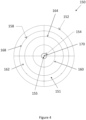
- Figures 1 to 3 show a disc 100 of the bicycle wheel cover for covering a drive side of a spoke bicycle wheel.
- the drive side disc 100 comprises a body 101 having a circular outer edge 102, and a concentric circular inner edge 104.
- the inner edge 104 surrounds a central opening 105 in the disc body 101.
- the outer edge 102 is shaped to fit a rim of the bicycle wheel such that the drive side disc body 101 is arranged to cover the spokes of the wheel when the drive side disc 100 is attached to the wheel.
- the drive side disc 100 allows converting a spoke bicycle wheel to a disc wheel.
- the inner edge 104 and central opening 105 are sized and shaped to receive a hub of the wheel through the opening 105 when the drive side disc 100 is attached to the bicycle wheel.
- Example dimensions of the inner and outer edges are listed below.
- a chamfer is provided around the outer edge 102. This may reduce damage to the rim of the wheel during fitting of the disc 100 and in use.
- the drive side disc body 101 is domed between its centre (that is, the inner edge 104 around the central opening 105) and the outer edge 102. Therefore, the inner edge 104 and central opening 105 are raised (by a distance 132) as compared to the outer edge 102 of the drive side disc 100. Accordingly, the disc body 101 accommodates the shape of the spokes which are typically at an angle to the plane of the wheel rim and extend out beyond the plane of the wheel rim.
- the degree of doming of the drive side disc body 101 i.e. the distance 132) is selected so that, when the drive side disc 100 is attached to the wheel, the doming of the drive side disc body 101 is sufficiently large to accommodate the wheel spokes but sufficiently small that there is a slight clearance between the disc body 101 and the gear cassette.
- the drive side disc body 101 is formed as a single piece around its circumference; that is, there is no continuous gap in the disc between the inner edge 104 and the outer edge 102.
- the drive side disc body 101 is rigid (that is, it does not bend under its own weight, e.g. if held horizontally from its outer edge 102) and it is preferably made from acrylonitrile butadiene styrene (ABS) thermoplastic.
- ABS acrylonitrile butadiene styrene
- the rim is provided with a protective layer (e.g. electrical tape) around some or all of its circumference so that, when the drive side disc 100 is attached to the wheel, the protective layer is positioned between the rim and the disc body 101 at the contact surface between the rim and the disc body 101.
- a protective layer e.g. electrical tape
- the drive side disc 100 also comprises a valve aperture 122 for a valve of the wheel, so that the wheel can be inflated when the drive side disc 100 is still attached to it.
- Possible dimensions and location of the valve aperture 122 on the wheel are provided in the table below.
- the drive side disc 100 further comprises a cover (not shown) for the valve aperture 122.
- the valve aperture cover is removably attachable to and detachable from the valve aperture 122 so that it can be removed for inflating the wheel and reattached to cover the aperture 122 during cycling to improve aerodynamic performance of the disc 100 in use.
- the cover may be made from a flexible rubber material that can be pushed into the aperture 122.
- the cover may be for single use only - for example, a plaster that can be stuck on to the disc 100 surface over the aperture 122.
- the drive side disc 100 further comprises a wheel securement structure which is arranged to permit connection of the drive side disc 100 to the wheel.
- the wheel securement structure comprises apertures 106 through the drive side disc body 101.
- the apertures 106 are arranged in a circular formation 116.
- the circular formation 116 of the apertures 106 surrounds the central opening 105.
- the circular formation 116 of apertures 106 is centred on a centre point 120 of the drive side disc 100 such that the circular formation 116 is concentric with the inner edge 104 of the central opening 105 and concentric with the outer edge 102 (i.e. the perimeter) of the drive side disc body 101. In this way, the apertures 106 surround the inner edge 104.
- the apertures 106 are arranged in groups of two or more; such as in groups of three or five apertures.
- the apertures 106 are arranged in groups of four apertures.
- the group of apertures 106 are arranged adjacent one another around the circular formation 116.
- Each of the groups of four apertures is spaced apart from one another around the circular formation 116. The spacing between the groups of apertures 106 ensures that the disc body 101 is not structurally weakened by the apertures 106 through it.
- the apertures 106 are arranged to receive engagement means (not shown) for securing the disc 100 to the spokes.
- the engagement means is a tie, preferably a cable/zip tie, and the drive side disc 100 is attached to the spokes by:
- This process is then repeated for a plurality of spokes (preferably at least four spokes, evenly distributed around the circular arrangement of apertures 106, i.e. around 90 degrees apart) to secure the drive side disc 100 to the spokes and thereby to the wheel.
- spokes preferably at least four spokes, evenly distributed around the circular arrangement of apertures 106, i.e. around 90 degrees apart
- the disc 100 comprises 12 groups of apertures 106 (each group comprising 4 apertures), each group of apertures intended to provide a means to secure a table tie to one spoke, so a total of forty-eight apertures 106.
- securing the drive side disc 100 to the wheel towards the centre of the disc is advantageous because it has the effect of pulling the drive side disc 100 tight against the wheel, close to the spokes.
- This has a number of advantageous. Firstly, this improves the aerodynamic performance of the wheel cover by making the wheel cover more streamlined through the air.
- pulling the drive side disc 100 closely against the spokes of the wheel ensures a clearance between the drive side disc 100 thus preventing the disc 100 from rubbing on the gear cassette while freewheeling (when the gear cassette is static, but the wheel is rotating).
- engagement means other than cable ties could be used instead - e.g. strings or Velcro straps.
- an alternative first set of engagement features for attaching the drive side disc 100 to the wheel could be provided, for example annular snap-fit connection points could be provide on the inside surface of the disc 100 to provide a snap fit connection with spokes of the wheel.
- the drive side disc 100 also comprise part of a disc securement structure which is arranged to permit a connection between the drive side disc and the non-drive side disc.
- the disc securement structure on the drive side disc 100 comprises further apertures 108 through the drive side disc body 101.
- the apertures 108 of the disc securement structure are arranged symmetrically in a circular formation 118 centred on a centre point 120 of the disc 100. That is, the circular formation 118 of the apertures 108 of the disc securement structure us concentric with the circular formation 116 of the apertures 106 of the wheel securement structure.
- the apertures 108 of the disc securement structure are arranged individually, rather than in groups, and are spaced apart such that the apertures 108 are distributed equidistant around the circular formation 118. Spacing the apertures 108 apart in this way ensures that the structural integrity of the drive side disc body 101 is not compromised by the apertures 108.
- the apertures 108 of the drive side discs are sized and shaped to receive a retaining screw (e.g. of 15mm-20-25mm dimensions) through each aperture to connect together the drive side disc 100 and the non-drive side disc.
- a retaining screw e.g. of 15mm-20-25mm dimensions
- the circular formation 118 of evenly distributed apertures 108 is thus advantageous because it provides for an even distribution of forces between each aperture 108 which ensures a more secure connection between the two discs as well as improved durability.
- Figures 4 to 6 show another disc 150 of the bicycle wheel cover for covering a non-drive side of a spoke bicycle wheel.
- the non-drive side disc 150 comprises a body 151 having a circular outer edge 152, and a concentric circular inner edge 154.
- the inner edge 154 surrounds a central opening 155 in the disc body 151.
- the outer edge 152 is shaped to fit a rim of the bicycle wheel such that the non-drive side disc body 151 is arranged to cover the spokes of the non-drive side of the wheel when the non-drive side disc 150 is attached to the wheel.
- the non-drive side disc 150 allows converting a spoke bicycle wheel to a disc wheel.
- the inner edge 154 and central opening 155 are sized and shaped to receive a hub of the wheel through the opening 155 when the non-drive side disc 150 is attached to the bicycle wheel.
- Example dimensions of the inner and outer edges are listed below.
- a chamfer is provided around the outer edge 152. This may reduce damage to the rim of the wheel during fitting of the disc 150 and in use.
- the non-drive side disc body 151 comprises an inner domed portion 160 and an outer planar portion 162.
- Figures 4 and 5 show the boundary 164 between the inner domed portion 160 and the outer planar portion 162 of the non-drive side disc body 151.
- the non-drive side disc body 151 is formed as a single piece around its circumference; that is, there is no continuous gap in the disc between the inner edge 154 and the outer edge 152.
- the non-drive side disc body 151 is rigid (that is, it does not bend under its own weight, e.g. if held horizontally from its outer edge 152) and it is preferably made from acrylonitrile butadiene styrene (ABS) thermoplastic.
- ABS acrylonitrile butadiene styrene
- the inner domed portion 160 is domed between its centre (that is, the inner edge 154 of the central opening 155) and the boundary 164 with the outer planar portion 162.
- the outer planar portion 162 of the non-drive side disc body 151 is flat and extends from the boundary 164 between the inner and outer portions to the outer edge 152 of the non-drive side disc body 151. Therefore, the inner edge 154 and central opening 155 are raised (by a distance 182) as compared to the outer planar portion 162 of the non-drive side disc 150. Accordingly, the non-drive side disc body 151 accommodates the shape of the spokes which are typically at an angle to the plane of the wheel rim and extend out beyond the plane of the wheel rim (particularly at the centre of the wheel).
- the degree of doming of the non-drive side disc body 151 (i.e. the distance 182) is selected so that, when the non-drive side disc 150 is attached to the wheel, the doming of the non-drive side disc body 151 is sufficiently large to accommodate the wheel spokes but sufficiently small that there is a slight clearance between the disc body 101 and any brake (e.g. a disc brake) outside the non-drive side disc 150.
- the doming of the inner domed portion 160 is shown in Figures 5 and 6 to be of a constant gradient (i.e. the domed portion 160 has a conical shape, albeit with a flat top due to the central opening 155) in other examples the gradient of the doming might vary along the distance from the centre of the disc 150 (i.e. the doming might vary with radius) - specifically, the gradient of the doming might increase (i.e. drop down more steeply to the planar outer portion 162) further from the centre of the disc (i.e. with larger radius).
- the degree of doming of the non-drive side disc 150 (i.e. the distance 182) is larger than the degree of doming of the drive side disc 100 (i.e. the distance 132).
- the reason for this is that, on a typical bicycle wheel, the spokes protrude further out from the plane of the bicycle wheel on the non-drive side in order to centre the wheel on the wheel axis, since there is no gear cassette on the non-drive side of the wheel axis.
- the asymmetric doming of the drive side and non-drive sides discs of the present wheel cover is advantageous because it accommodates for the inherent asymmetry in the doming of the spokes of a typical bicycle wheel - this is particularly advantageous over existing bicycle wheel covers which have identical or interchangeable drive side and non-drive side wheel covers which thus do not accommodate for the asymmetry of the bicycle wheel spokes.
- the outer planar portion 162 is planar in the sense that it is flat (i.e. is it not domed or curved) and that is extends out from the boundary 164 to the outer edge 152 in the plane of the non-drive side disc 150 (which plane is parallel to the plane of a wheel rim when the non-drive side disc 150 is attached to a wheel.
- the outer planar portion 164 thus acts as a flange surrounding the inner domed portion 162 in order to facilitate connection between the non-drive side disc 151 and the drive side disc 100 to connect the discs together across a wheel.
- the planar outer portion 162 provides a face-to-face contact with the rim of a bicycle wheel when the non-drive side disc 150 is attached to the wheel. This is because the planar outer portion 162 will overlap with the side face of the wheel rim. This provides a number of advantages. First, this allows for easier attachment of the non-drive side disc 150 to the wheel because the planar outer portion 162 will lie flat again the wheel rim while the non-drive side disc 150 is being attached to a wheel (which would not be achieved if the disc 150 was domed all the way to its outer edge 152).
- the face-to-face contact between the outer planar portion 162 at the wheel rim provides a tighter seal between the non-drive side disc 150 and the wheel rim as compared to a disc which meets the rim at an angle (i.e. one that is domed all the way to its outer edge). This makes it less likely that the non-drive side disc 150 will come away from the rim in use (under air drag) and so improves aerodynamic performance and improves safety for the user.
- the rim is provided with a protective layer (e.g. electrical tape) around some or all of its circumference so that, when the non-drive side disc 150 is attached to the wheel, the protective layer is positioned between the rim and the planar outer portion 162 at the contact surface between the rim and the planar outer portion 162.
- a protective layer e.g. electrical tape
- the non-drive side disc 150 may be used for wheels with rim brakes or disc brakes (the brakes being located on the non-drive side of the rear wheel of a bicycle).
- Embodiments of the non-drive side disc 150 suitable for disc brake wheels have a shallower doming as compared to embodiments suitable for rim brake wheels. This is in order to compensate for the presence of a disc brake calliper on the wheel axis outside the non-drive side disc. This is achieved by sizing the non-drive side disc body 151 such that, when the non-drive side disc 150 is attached to a wheel, the doming of the disc body 151 is sufficient to clear the spokes of the wheel, but shallow enough not to extend out to the disc brake calliper.
- the doming need not be reduced - instead the diameter of the disc might be reduced to ensure that a portion of the rim is exposed (even when the disc 150 is attached to the wheel) which can be contacted by the rim brake.
- the non-drive side disc 150 also comprise another part of the disc securement structure which is arranged to permit a connection between the drive side disc and the non-drive side disc.
- the disc securement structure on the non-drive side disc 150 comprises further apertures 158 through the non-drive side disc body 151.
- the apertures 158 of the disc securement structure are arranged symmetrically in a circular formation 168 centred on a centre point 170 of the disc 150. That is, the circular formation 168 of the apertures 158 of the disc securement structure is concentric with the inner edge 154 and outer edge 152 of the non-drive side disc 150.
- the apertures 158 of the disc securement structure are arranged individually, rather than in groups, and are spaced apart such that the apertures 158 are distributed equidistant around the circular formation 168. Spacing the apertures 158 apart in this way ensures that the structural integrity of the non-drive side disc body 151 is not compromised by the apertures 158.
- the position of the apertures 158 of the disc securement structure of the non-drive side disc 150 correspond to the positions of the apertures 108 of the disc securement structure of the drive side disc 100.
- a retaining screw (e.g. of 15mm-20-25mm dimensions) is passed through an aperture 108 of the disc securement structure of the drive side disc 100 and through a corresponding aperture 158 of the corresponding disc securement structure of the non-drive side disc 150.
- the screw is then secured with a nut on the non-drive side and tightened to secure the two discs together.
- the screw could equally be passed from the non-drive side to the drive side and secured by a nut on the drive side.
- the circular formation 168 of evenly distributed apertures 108 is thus advantageous because it provides for an even distribution of forces between each aperture 108 which ensures a more secure connection between the two discs as well as improved durability.
- the bicycle wheel cover is described above as comprising discs formed of a thermoplastic material, preferably acrylonitrile butadiene styrene (ABS) thermoplastic, and the process for forming such thermoplastic disc by thermoforming is described below.
- ABS acrylonitrile butadiene styrene
- the bicycle wheel cover may instead comprise discs formed of carbon, or a carbon-based material, or a carbon composite material.
- Such discs may be produced for example using either a compression moulded carbon composite or a resin infused carbon composite laminate.
- the laminate may consist of virgin fibre, or of recycled carbon fibre, or of a mixture thereof.
- the tooling used for manufacturing these carbon, carbon-based or carbon composite discs may be metallic or composite.
- the tooling may be open or close moulded and cured using heat or at ambient temperature. The cured component of the tooling will be machined either by hand or using a CNC machine as a secondary operation.
- the discs may comprise surface formations to improve the aerodynamic performance of the discs.
- the discs may comprise surface dimples, similar to the dimples formed on golf balls.
- the dimples may be formed on the discs, for example, by machining the discs after the discs are formed, or - if the discs are formed by moulding - by incorporating protrusions on the moulds so as to produce surface dimples on the discs at the same time as the discs are moulded to shape.
- providing surface dimples on the discs may improve the aerodynamic performance of the discs, thus improving the aerodynamic performance of a bicycle to which the discs are attached to form a wheel cover.
- the aerodynamic advantages of dimpled surfaces - such as dimpled golf balls - are known.
- dimples may improve aerodynamic performance of the bicycle wheel cover discs by causing the boundary layer of air on the upstream side of the disc to transition from laminar to turbulent.
- the turbulent boundary layer is able to remain attached to the surface of the disc longer than a laminar boundary with fewer eddies and so creates a narrower low-pressure wake behind the bicycle, and hence less pressure drag.
- Table 1 below shows example dimensions for various versions of the disc 100. Each version of the disc in Table 1 is for use with wheels having dimensions in a particular range, specifically:
- wheels with a small rim depth require a disc with a larger diameter such that there is sufficient overlap between the disc and the rim to provide a secure fit.
- wheels with different dimensions one or more of the below dimensions may be adjusted - e.g. for a smaller wheel, the outer edge 102 diameter may be reduced.
- each of the embodiments detailed in Table 1 The inventors have carefully chosen the dimensions of each of the embodiments detailed in Table 1 following extensive experimentation to maximise aerodynamic performance of the disc 100. Further, the dimensions were chosen to ensure that each embodiment is suitable for a range of wheel dimensions, thus increasing utility to the user (who can re-use the same disc 100 for a range of wheels) and simplifying the manufacturing process as fewer different embodiments/models need to be manufactured so larger scale production of each embodiment is possible (i.e. there is no need to custom make the disc 100 for each specific user/wheel).
- each embodiment are configured to allow the disc 100 to sit against the wheel and allow the disc 100 surface to follow the fall of the spokes to meet the rim of the wheel.
- the positioning and number of outer apertures 108 in the embodiments may provide an improved trade-off between installation time (which increases with the number of apertures) and a secure fit.
- the inventors have found that an inner edge diameter of 75mm may allow the disc 100 to clear the hub's flange on a wide range of wheels and may allow the disc 100 to fit flusher on the wheel and to 'hug' the spokes (i.e. reduce the distance between the spokes and the disc 100).
- Figure 7 shows an example method 200 for manufacturing the drive side disc 100 or the non-drive side disc 150.
- Method 200 uses thermoforming (as describe in further detail below) which provides a cost-effective method of manufacturing a rigid disc with good aerodynamic properties.
- a material sheet is provided so that it may be operated on in subsequent steps of method 200.
- the sheet is a thermoplastic sheet, preferably a 1.5mm sheet made from acrylonitrile butadiene styrene (ABS).
- step 202 also comprises manufacturing the ABS sheet, preferably by extruding the ABS sheet. The inventors have found that ABS provides an improved trade-off between cost and performance and provides a high-performance disc at reduced cost.
- thermoforming module comprises: a mould that defines the desired shape of the disc, heaters (in the form of a programmed heater bank) for heating the ABS sheet, and a clamp and a vacuum pump for pressing the sheet onto the mould.
- thermoforming process starts with setting up of the thermoforming module to ensure that the clamp is in the correct position in order to obtain a full vacuum seal guaranteeing the shape and definition of the disc during the forming process.
- the thermoforming module is preferably CNC (Computer Numerical Control) controlled, and as the next step after the initial set up, heater and forming settings for the thermoforming process are input into the module.
- the sheet is then heated and placed onto the mould in the thermoforming module.
- the sheet is preferably heated uniformly prior to forming (i.e. when still flat) to ensure a substantially constant temperature across the sheet's surface.
- the mould is moved towards the heated sheet while the sheet is held stationary by the clamp.
- a vacuum is then applied, using the vacuum pump, to press the sheet onto the mould thereby to further form the plastic sheet to the shape of the mould.
- the vacuum causes the sheet to press into the mould in a uniform manner and allows achieving good reproduction of the mould shape by the sheet.
- further overpressure is applied using a pressure box arranged on top of the clamp. This allows a yet further improvement in the reproduction of the shape of the mould by the sheet.
- the moulds used for forming the drive side disc 100 and the non-drive side disc 150 are different so as to produce the different disc shapes.
- the moulds for producing the drive side disc have a domed portion that has a diameter equal to the diameter of the intended disc so that the resultant disc is curved from its centre to its outer edge
- the moulds for the non-drive side disc have an inner domed portion (corresponding to the size of the inner domed portion of the intended disc) and an outer flat portion (corresponding to the size of the intended outer planar portion of the disc) so that the sheet (which is flat before forming) also comprises a domed inner portion 160 and a flat outer portion 162 after forming.
- Different moulds having different dimensions are used for the different disc versions shown in Table 1 above to form discs having the dimensions shown.
- the mould is temperature controlled via cooling elements in the mould.
- the cooling elements comprise cooling tubes carrying a flow of water to carry heat away from the mould thereby to cool the mould while the heated sheet is being moulded over the mould.
- the cooling elements are controlled so as to maintain the mould at a constant temperature during the forming process. Maintaining the mould at a constant temperature maintains dimensional stability of the sheet (i.e. the constant temperature ensures that the dimensions of the sheet remain constant during the forming process, rather than the sheet expanding and contracting under heating and cooling) and shape stability of the sheet (i.e. each part of the sheet is maintained at the same temperature, so each part deforms equally) during the forming process, reducing the probability of distortion of the sheet.
- the temperature at which the mould is maintained is preferably between 40°C and 60°C, more preferably between 45°C and 55°C, yet more preferably 50°C. This preferred temperature (range) enables achieving optimal dimensional stability of the sheet, in particular when using a curved mould required to form the curved/domed parts of the disc 100, 150).
- the mould is preferably made from a material with a high specific heat capacity to enable fast heat transfer from the cooling tubes to this sheet-facing surface (despite the tubes being arranged at the opposite surface of the mould).
- the mould is made from metal, such as Aluminium.
- the (metal) mould is at least partially porous, in particular porous to air.
- the air-porous mould thus allows air to pass through it meaning that the vacuum pump can more effectively suck the sheet down onto the mould. This has the effect of reducing the number of defects in the sheet and ensuring that the sheet more accurately reproduce the shape of the mould.
- the temperature control of the mould and the air porous mould together therefore provide a synergistic effect, which results in a number of technical advantages including: ensuring dimensional stability of the sheet during moulding to reduce defects; ensuring shape stability of the sheet during moulding to reduce defects; and ensuring accurate reproduction of the shape of the mould by the sheet.
- step 206 the formed disc is taken out of the thermoforming module and excess material is removed (e.g. cut) from the disc.
- the sheet provided at step 202 is larger than the mould used at step 204 to allow attachment of the sheet to the thermoforming machine (the excess material is required so that the sheet can be clamped at its edges during moulding).
- This excess material is removed at step 206 which improves structural stability of the disc and reduce the chances of it distorting during cooling, thus giving a uniform shape.
- Step 206 is preferably performed immediately after thermoforming at step 204 (i.e. while the sheet is still hot, that is, still substantially at the temperature at which it was moulded), so that disc can cool down with the excess material removed which reduces the risk of the material deforming while cooling.
- the disc is machined.
- The, typically square or rectangular, sheet processed at step 206 is cut to the desired (in this example, circular) shape to form the disc body 101, 151, and other required features are machined in the disc - e.g. for the drive side disc, opening 105, apertures 106, 108, and 122, and for the non-drive side disc opening 155 and apertures 158.
- the machining at step 208 is preferably done using a 5-axis CNC-controlled machining module.
- the machining module uses a former and presses the disc into a trimming fixture using a vacuum, and then uses a cutting tool to machine the disc into the desired shape.
- the machining module may be CNC programmed for each embodiment of the disc (e.g. for each version listed in Table 1).
- the disc is deburred to remove unwanted material left over from the thermoforming step 204 or machining step 208.
- the disc may be deburred manually using a pen cutter or a blade, or via a dry ice blasting process.
- a marking is added to the disc.
- a logo or other marking e.g. unit number
- hot blocking or embossing is optionally provided.
Landscapes
- Engineering & Computer Science (AREA)
- Mechanical Engineering (AREA)
- Braking Arrangements (AREA)
- Automatic Cycles, And Cycles In General (AREA)
- General Details Of Gearings (AREA)
Claims (15)
- Fahrradradabdeckung, die Folgendes umfasst:eine antriebsseitige Scheibe (100) mit einem antriebsseitigen Scheibenkörper (101), der dafür ausgelegt ist, die Antriebsseite eines Fahrradrads abzudecken; undeine nicht-antriebsseitige Scheibe (150) mit einem nicht-antriebsseitigen Scheibenkörper (151), der dafür ausgelegt ist, die nicht-antriebsseitige Seite eines Fahrradrades abzudecken, wobei der nicht-antriebsseitige Scheibenkörper einen radialen inneren gewölbten Abschnitt (160) und einen radialen äußeren planaren Abschnitt (162) umfasst,wobei:mindestens eine der antriebsseitigen und nicht-antriebsseitigen Scheiben eine Radbefestigungsstruktur umfasst, die dafür ausgelegt ist, eine Verbindung zwischen der Scheibe und einem Fahrradrad zu ermöglichen;mindestens eine der antriebsseitigen und nicht-antriebsseitigen Scheiben eine Scheibenbefestigungsstruktur umfasst, die dafür ausgelegt ist, eine Verbindung zwischen den Scheiben zu ermöglichen; undder antriebsseitige Scheibenkörper (101) zwischen seinem inneren Rand (104) und seinem äußeren Rand (102) gewölbt ist.
- Fahrradradabdeckung nach Anspruch 1, wobei die Wölbung des antriebsseitigen Scheibenkörpers (101) flacher ist als die Wölbung des gewölbten Teils (160) des nicht-antriebsseitigen Scheibenkörpers (151).
- Fahrradradabdeckung nach Anspruch 1 oder 2, wobei die Wölbung des antriebsseitigen Scheibenkörpers (101) und/oder die Wölbung des gewölbten Abschnitts (160) des nicht-antriebsseitigen Scheibenkörpers (151) Folgendes aufweist:einen konstanten Gradienten; odereinen Gradienten, der sich entlang des Scheibenradius verändert.
- Fahrradradabdeckung nach einem der vorhergehenden Ansprüche, wobei die Wölbung des antriebsseitigen Scheibenkörpers (101) und/oder die Wölbung des gewölbten Abschnitts (160) des nicht-antriebsseitigen Scheibenkörpers (151) eine mit dem Radius zunehmende Steigung aufweist.
- Fahrradradabdeckung nach einem der vorhergehenden Ansprüche, wobei der antriebsseitige und/oder nicht-antriebsseitige Scheibenkörper eine zentrale Öffnung (105, 155) umfasst, die zur Aufnahme einer Fahrradradnabe ausgelegt ist, und wobei die Radbefestigungsstruktur um die zentrale Öffnung von mindestens einer der Scheiben angeordnet ist.
- Fahrradradabdeckung nach einem der vorhergehenden Ansprüche, wobei die Radbefestigungsstruktur an der antriebsseitigen Scheibe (100), vorzugsweise ausschließlich an der antriebsseitigen Scheibe, angeordnet ist.
- Fahrradradabdeckung nach einem der vorhergehenden Ansprüche, wobei die Radbefestigungsstruktur dafür ausgelegt ist, eine Verbindung mit mindestens einer Speiche eines Fahrradrads zu ermöglichen.
- Fahrradradabdeckung nach Anspruch 7, wobei die Radbefestigungsstruktur Öffnungen (106) umfasst, die dafür ausgelegt sind, eine Verbindung mit einer Speiche eines Fahrradrads aufzunehmen, vorzugsweise wobei die Öffnungen in einer kreisförmigen Formation (116) ausgelegt sind.
- Fahrradradabdeckung nach Anspruch 8, wobei die Öffnungen (106) in Gruppen ausgelegt sind, wobei jede Gruppe voneinander beabstandet ist, vorzugsweise wobei die Öffnungen in Gruppen von drei oder mehr, noch bevorzugter in Gruppen von drei bis fünf Öffnungen und noch bevorzugter in Gruppen von vier Öffnungen ausgelegt sind.
- Fahrradradabdeckung nach einem der vorhergehenden Ansprüche, wobei die Scheibenbefestigungsstruktur eine Struktur umfasst, die sich auf dem äußeren ebenen Teil (162) des Scheibenkörpers (151) der Nicht-Antriebsseite befindet, und eine entsprechende Struktur, die sich auf dem Scheibenkörper (101) der Antriebsseite befindet.
- Fahrradradabdeckung nach Anspruch 10, wobei die Scheibenbefestigungsstruktur entsprechende Öffnungen (108, 158) durch den antriebsseitigen Scheibenkörper (101) und den nicht-antriebsseitigen Scheibenkörper (151) umfasst, wobei die Öffnungen zur Aufnahme einer Schraube ausgelegt sind, vorzugsweise wobei die Öffnungen in einer kreisförmigen Anordnung (118, 168) ausgelegt sind, noch bevorzugter wobei die Öffnungen (108, 158) gleichmäßig um die kreisförmige Anordnung (118, 168) herum verteilt sind.
- Fahrradradabdeckung nach einem der vorhergehenden Ansprüche, wobei mindestens einer der antriebsseitigen Scheibenkörper (101) und der nicht-antriebsseitigen Scheibenkörper (151) starr ist, vorzugsweise wobei sowohl die antriebsseitigen als auch die nicht-antriebsseitigen Scheibenkörper starr sind.
- Fahrradradabdeckung nach einem der vorhergehenden Ansprüche, wobei der antriebsseitige Scheibenkörper (101) und/oder der nicht-antriebsseitige Scheibenkörper (151) um ihren Umfang herum als ein einziges Stück gebildet sind.
- Fahrradradabdeckung nach einem der vorhergehenden Ansprüche, wobei mindestens einer, vorzugsweise beide, der antriebsseitigen und der nicht-antriebsseitigen Scheibenkörper aus Folgendem gebildet sind:Acrylnitril-Butadien-Styrol; oderKohlenstoff, einem Material auf Kohlenstoffbasis oder einem Kohlenstoffverbundmaterial, wobei die antriebsseitigen und/oder nicht-antriebsseitigen Scheibenkörper vorzugsweise Oberflächenvertiefungen umfassen.
- Teilesatz, der Folgendes umfasst:eine Fahrradradabdeckung nach einem der vorhergehenden Ansprüche, undeinen ringförmigen Abstandshalter, wobei der ringförmige Abstandshalter eine zentrale Öffnung umfasst, die dafür ausgelegt ist, eine Fahrradradnabe aufzunehmen, und wobei der Außendurchmesser des ringförmigen Abstandshalters größer als oder gleich dem Durchmesser einer zentralen Öffnung (105, 155) des antriebsseitigen und/oder nicht-antriebsseitigen Scheibenkörpers ist.
Applications Claiming Priority (1)
| Application Number | Priority Date | Filing Date | Title |
|---|---|---|---|
| GB2114787.1A GB2612028A (en) | 2021-10-15 | 2021-10-15 | Bicycle wheel cover |
Publications (4)
| Publication Number | Publication Date |
|---|---|
| EP4166346A1 EP4166346A1 (de) | 2023-04-19 |
| EP4166346C0 EP4166346C0 (de) | 2024-08-07 |
| EP4166346B1 true EP4166346B1 (de) | 2024-08-07 |
| EP4166346B8 EP4166346B8 (de) | 2024-09-18 |
Family
ID=78718425
Family Applications (1)
| Application Number | Title | Priority Date | Filing Date |
|---|---|---|---|
| EP22201569.5A Active EP4166346B8 (de) | 2021-10-15 | 2022-10-14 | Fahrradradabdeckung |
Country Status (3)
| Country | Link |
|---|---|
| EP (1) | EP4166346B8 (de) |
| ES (1) | ES2993594T3 (de) |
| GB (1) | GB2612028A (de) |
Family Cites Families (4)
| Publication number | Priority date | Publication date | Assignee | Title |
|---|---|---|---|---|
| US4202582A (en) * | 1978-09-27 | 1980-05-13 | Seltman Irving E | Cycle safety disc |
| US4729604A (en) * | 1986-11-18 | 1988-03-08 | Huffy Corporation | Bicycle wheel shroud |
| US6793294B2 (en) * | 2002-10-22 | 2004-09-21 | Giant Manufacturing Co., Ltd. | Wheel assembly with spoke-covering members |
| GB2583717A (en) * | 2019-04-30 | 2020-11-11 | Streamline Cycling Ltd | Bicycle wheel system |
-
2021
- 2021-10-15 GB GB2114787.1A patent/GB2612028A/en active Pending
-
2022
- 2022-10-14 ES ES22201569T patent/ES2993594T3/es active Active
- 2022-10-14 EP EP22201569.5A patent/EP4166346B8/de active Active
Also Published As
| Publication number | Publication date |
|---|---|
| ES2993594T3 (en) | 2025-01-02 |
| EP4166346C0 (de) | 2024-08-07 |
| GB2612028A (en) | 2023-04-26 |
| EP4166346A1 (de) | 2023-04-19 |
| GB202114787D0 (en) | 2021-12-01 |
| EP4166346B8 (de) | 2024-09-18 |
Similar Documents
| Publication | Publication Date | Title |
|---|---|---|
| EP2648893B1 (de) | Verfahren zur herstellung einer verbundstruktur mit einem flansch | |
| US9415628B2 (en) | Light-weight vehicle wheels with carbon fiber inserts | |
| EP0366049B1 (de) | Verfahren zum Fliessdrücken, Fliessdrückvorrichtung, Fliessdrücken von Rohmaterial, Fliessdrückverfahren und -vorrichtung für ein Fahrzeugrad | |
| US5143426A (en) | Vehicle wheel construction | |
| EP4166346B1 (de) | Fahrradradabdeckung | |
| CN112236310B (zh) | 用于自行车车轮的轮辋、轮辋部件和轮辋组件及其制造方法 | |
| TW201703967A (zh) | 模製方法及模製工具 | |
| CN110871229B (zh) | 汽车铝合金轮毂旋压工艺 | |
| US11858294B2 (en) | Disc wheel with internal bracing | |
| EP1854616B1 (de) | Vorrichtung und Verfahren zum Herstellen einer dünnen Platte aus polymerem Material mittels Vakuumformen | |
| US20020192327A1 (en) | Holding device for holding an article and a plant for heat treatment of an article | |
| CN105408124A (zh) | 由热塑性聚合物获得的车辆车轮 | |
| CA2593519A1 (en) | Novel thermoplastic part, tool and method for the manufacturing thereof | |
| WO2016145387A1 (en) | Bicycle rim and wheel | |
| WO2017127259A1 (en) | Adjustable tire mold | |
| CN110948905A (zh) | 一种蜂窝夹层结构格栅的净尺寸成型方法 | |
| EP3888935B1 (de) | Verfahren zur montage einer radabdeckung an einem rad, abdeckungsmatrize und verwendung einer abdeckungsmatrize | |
| JPH04503641A (ja) | プラスチック被覆部品の製造方法 | |
| CN220163563U (zh) | 旋状轮辐的高强度轮毂 | |
| JP2504689B2 (ja) | 合成樹脂製ナット部材 | |
| AU716795B2 (en) | Cross flow fan for air conditioner | |
| CN220946231U (zh) | 制作箱体的模具 | |
| CN217777757U (zh) | 一种挡泥板成型模具 | |
| CN215943460U (zh) | 一种轮胎模具排气塞 | |
| JP2811001B2 (ja) | 中空車輪の製造方法 |
Legal Events
| Date | Code | Title | Description |
|---|---|---|---|
| PUAI | Public reference made under article 153(3) epc to a published international application that has entered the european phase |
Free format text: ORIGINAL CODE: 0009012 |
|
| STAA | Information on the status of an ep patent application or granted ep patent |
Free format text: STATUS: THE APPLICATION HAS BEEN PUBLISHED |
|
| AK | Designated contracting states |
Kind code of ref document: A1 Designated state(s): AL AT BE BG CH CY CZ DE DK EE ES FI FR GB GR HR HU IE IS IT LI LT LU LV MC ME MK MT NL NO PL PT RO RS SE SI SK SM TR |
|
| STAA | Information on the status of an ep patent application or granted ep patent |
Free format text: STATUS: REQUEST FOR EXAMINATION WAS MADE |
|
| 17P | Request for examination filed |
Effective date: 20231018 |
|
| RBV | Designated contracting states (corrected) |
Designated state(s): AL AT BE BG CH CY CZ DE DK EE ES FI FR GB GR HR HU IE IS IT LI LT LU LV MC ME MK MT NL NO PL PT RO RS SE SI SK SM TR |
|
| RIC1 | Information provided on ipc code assigned before grant |
Ipc: B60B 1/00 20060101ALN20240103BHEP Ipc: B60B 7/14 20060101ALI20240103BHEP Ipc: B60B 7/08 20060101ALI20240103BHEP Ipc: B60B 7/06 20060101ALI20240103BHEP Ipc: B60B 7/00 20060101AFI20240103BHEP |
|
| RIC1 | Information provided on ipc code assigned before grant |
Ipc: B60B 1/00 20060101ALN20240111BHEP Ipc: B60B 7/14 20060101ALI20240111BHEP Ipc: B60B 7/08 20060101ALI20240111BHEP Ipc: B60B 7/06 20060101ALI20240111BHEP Ipc: B60B 7/00 20060101AFI20240111BHEP |
|
| GRAP | Despatch of communication of intention to grant a patent |
Free format text: ORIGINAL CODE: EPIDOSNIGR1 |
|
| STAA | Information on the status of an ep patent application or granted ep patent |
Free format text: STATUS: GRANT OF PATENT IS INTENDED |
|
| GRAJ | Information related to disapproval of communication of intention to grant by the applicant or resumption of examination proceedings by the epo deleted |
Free format text: ORIGINAL CODE: EPIDOSDIGR1 |
|
| GRAP | Despatch of communication of intention to grant a patent |
Free format text: ORIGINAL CODE: EPIDOSNIGR1 |
|
| GRAJ | Information related to disapproval of communication of intention to grant by the applicant or resumption of examination proceedings by the epo deleted |
Free format text: ORIGINAL CODE: EPIDOSDIGR1 |
|
| GRAP | Despatch of communication of intention to grant a patent |
Free format text: ORIGINAL CODE: EPIDOSNIGR1 |
|
| INTG | Intention to grant announced |
Effective date: 20240219 |
|
| INTG | Intention to grant announced |
Effective date: 20240227 |
|
| INTG | Intention to grant announced |
Effective date: 20240306 |
|
| RIC1 | Information provided on ipc code assigned before grant |
Ipc: B60B 1/00 20060101ALN20240227BHEP Ipc: B60B 7/14 20060101ALI20240227BHEP Ipc: B60B 7/08 20060101ALI20240227BHEP Ipc: B60B 7/06 20060101ALI20240227BHEP Ipc: B60B 7/00 20060101AFI20240227BHEP |
|
| GRAS | Grant fee paid |
Free format text: ORIGINAL CODE: EPIDOSNIGR3 |
|
| GRAA | (expected) grant |
Free format text: ORIGINAL CODE: 0009210 |
|
| STAA | Information on the status of an ep patent application or granted ep patent |
Free format text: STATUS: THE PATENT HAS BEEN GRANTED |
|
| REG | Reference to a national code |
Ref country code: DE Ref legal event code: R081 Ref document number: 602022005146 Country of ref document: DE Owner name: EZ GAINS LTD, WATERBEACH, GB Free format text: FORMER OWNER: EZ GAINS LTD, CAMBRIDGE, GB |
|
| AK | Designated contracting states |
Kind code of ref document: B1 Designated state(s): AL AT BE BG CH CY CZ DE DK EE ES FI FR GB GR HR HU IE IS IT LI LT LU LV MC ME MK MT NL NO PL PT RO RS SE SI SK SM TR |
|
| REG | Reference to a national code |
Ref country code: GB Ref legal event code: FG4D |
|
| RAP4 | Party data changed (patent owner data changed or rights of a patent transferred) |
Owner name: EZ GAINS LTD |
|
| REG | Reference to a national code |
Ref country code: CH Ref legal event code: EP |
|
| REG | Reference to a national code |
Ref country code: IE Ref legal event code: FG4D |
|
| REG | Reference to a national code |
Ref country code: DE Ref legal event code: R096 Ref document number: 602022005146 Country of ref document: DE |
|
| REG | Reference to a national code |
Ref country code: CH Ref legal event code: PK Free format text: BERICHTIGUNG B8 |
|
| U01 | Request for unitary effect filed |
Effective date: 20240902 |
|
| U07 | Unitary effect registered |
Designated state(s): AT BE BG DE DK EE FI FR IT LT LU LV MT NL PT RO SE SI Effective date: 20240911 |
|
| U20 | Renewal fee for the european patent with unitary effect paid |
Year of fee payment: 3 Effective date: 20241023 |
|
| REG | Reference to a national code |
Ref country code: ES Ref legal event code: FG2A Ref document number: 2993594 Country of ref document: ES Kind code of ref document: T3 Effective date: 20250102 |
|
| PG25 | Lapsed in a contracting state [announced via postgrant information from national office to epo] |
Ref country code: NO Free format text: LAPSE BECAUSE OF FAILURE TO SUBMIT A TRANSLATION OF THE DESCRIPTION OR TO PAY THE FEE WITHIN THE PRESCRIBED TIME-LIMIT Effective date: 20241107 |
|
| PG25 | Lapsed in a contracting state [announced via postgrant information from national office to epo] |
Ref country code: PL Free format text: LAPSE BECAUSE OF FAILURE TO SUBMIT A TRANSLATION OF THE DESCRIPTION OR TO PAY THE FEE WITHIN THE PRESCRIBED TIME-LIMIT Effective date: 20240807 Ref country code: GR Free format text: LAPSE BECAUSE OF FAILURE TO SUBMIT A TRANSLATION OF THE DESCRIPTION OR TO PAY THE FEE WITHIN THE PRESCRIBED TIME-LIMIT Effective date: 20241108 |
|
| PG25 | Lapsed in a contracting state [announced via postgrant information from national office to epo] |
Ref country code: IS Free format text: LAPSE BECAUSE OF FAILURE TO SUBMIT A TRANSLATION OF THE DESCRIPTION OR TO PAY THE FEE WITHIN THE PRESCRIBED TIME-LIMIT Effective date: 20241207 |
|
| PG25 | Lapsed in a contracting state [announced via postgrant information from national office to epo] |
Ref country code: HR Free format text: LAPSE BECAUSE OF FAILURE TO SUBMIT A TRANSLATION OF THE DESCRIPTION OR TO PAY THE FEE WITHIN THE PRESCRIBED TIME-LIMIT Effective date: 20240807 |
|
| PG25 | Lapsed in a contracting state [announced via postgrant information from national office to epo] |
Ref country code: RS Free format text: LAPSE BECAUSE OF FAILURE TO SUBMIT A TRANSLATION OF THE DESCRIPTION OR TO PAY THE FEE WITHIN THE PRESCRIBED TIME-LIMIT Effective date: 20241107 |
|
| PG25 | Lapsed in a contracting state [announced via postgrant information from national office to epo] |
Ref country code: RS Free format text: LAPSE BECAUSE OF FAILURE TO SUBMIT A TRANSLATION OF THE DESCRIPTION OR TO PAY THE FEE WITHIN THE PRESCRIBED TIME-LIMIT Effective date: 20241107 Ref country code: PL Free format text: LAPSE BECAUSE OF FAILURE TO SUBMIT A TRANSLATION OF THE DESCRIPTION OR TO PAY THE FEE WITHIN THE PRESCRIBED TIME-LIMIT Effective date: 20240807 Ref country code: NO Free format text: LAPSE BECAUSE OF FAILURE TO SUBMIT A TRANSLATION OF THE DESCRIPTION OR TO PAY THE FEE WITHIN THE PRESCRIBED TIME-LIMIT Effective date: 20241107 Ref country code: IS Free format text: LAPSE BECAUSE OF FAILURE TO SUBMIT A TRANSLATION OF THE DESCRIPTION OR TO PAY THE FEE WITHIN THE PRESCRIBED TIME-LIMIT Effective date: 20241207 Ref country code: HR Free format text: LAPSE BECAUSE OF FAILURE TO SUBMIT A TRANSLATION OF THE DESCRIPTION OR TO PAY THE FEE WITHIN THE PRESCRIBED TIME-LIMIT Effective date: 20240807 Ref country code: GR Free format text: LAPSE BECAUSE OF FAILURE TO SUBMIT A TRANSLATION OF THE DESCRIPTION OR TO PAY THE FEE WITHIN THE PRESCRIBED TIME-LIMIT Effective date: 20241108 |
|
| PG25 | Lapsed in a contracting state [announced via postgrant information from national office to epo] |
Ref country code: SM Free format text: LAPSE BECAUSE OF FAILURE TO SUBMIT A TRANSLATION OF THE DESCRIPTION OR TO PAY THE FEE WITHIN THE PRESCRIBED TIME-LIMIT Effective date: 20240807 |
|
| PG25 | Lapsed in a contracting state [announced via postgrant information from national office to epo] |
Ref country code: CZ Free format text: LAPSE BECAUSE OF FAILURE TO SUBMIT A TRANSLATION OF THE DESCRIPTION OR TO PAY THE FEE WITHIN THE PRESCRIBED TIME-LIMIT Effective date: 20240807 |
|
| PG25 | Lapsed in a contracting state [announced via postgrant information from national office to epo] |
Ref country code: SK Free format text: LAPSE BECAUSE OF FAILURE TO SUBMIT A TRANSLATION OF THE DESCRIPTION OR TO PAY THE FEE WITHIN THE PRESCRIBED TIME-LIMIT Effective date: 20240807 |
|
| PLBE | No opposition filed within time limit |
Free format text: ORIGINAL CODE: 0009261 |
|
| STAA | Information on the status of an ep patent application or granted ep patent |
Free format text: STATUS: NO OPPOSITION FILED WITHIN TIME LIMIT |
|
| PG25 | Lapsed in a contracting state [announced via postgrant information from national office to epo] |
Ref country code: MC Free format text: LAPSE BECAUSE OF FAILURE TO SUBMIT A TRANSLATION OF THE DESCRIPTION OR TO PAY THE FEE WITHIN THE PRESCRIBED TIME-LIMIT Effective date: 20240807 |
|
| 26N | No opposition filed |
Effective date: 20250508 |
|
| REG | Reference to a national code |
Ref country code: CH Ref legal event code: U11 Free format text: ST27 STATUS EVENT CODE: U-0-0-U10-U11 (AS PROVIDED BY THE NATIONAL OFFICE) Effective date: 20251101 |
|
| U20 | Renewal fee for the european patent with unitary effect paid |
Year of fee payment: 4 Effective date: 20251015 |
|
| PGFP | Annual fee paid to national office [announced via postgrant information from national office to epo] |
Ref country code: CH Payment date: 20251101 Year of fee payment: 4 |
|
| PGFP | Annual fee paid to national office [announced via postgrant information from national office to epo] |
Ref country code: IE Payment date: 20251020 Year of fee payment: 4 |
|
| PG25 | Lapsed in a contracting state [announced via postgrant information from national office to epo] |
Ref country code: CY Free format text: LAPSE BECAUSE OF FAILURE TO SUBMIT A TRANSLATION OF THE DESCRIPTION OR TO PAY THE FEE WITHIN THE PRESCRIBED TIME-LIMIT; INVALID AB INITIO Effective date: 20221014 |
|
| PGFP | Annual fee paid to national office [announced via postgrant information from national office to epo] |
Ref country code: ES Payment date: 20251205 Year of fee payment: 4 |