EP4160491B1 - Simulation von quantenschaltungen - Google Patents
Simulation von quantenschaltungen Download PDFInfo
- Publication number
- EP4160491B1 EP4160491B1 EP22193793.1A EP22193793A EP4160491B1 EP 4160491 B1 EP4160491 B1 EP 4160491B1 EP 22193793 A EP22193793 A EP 22193793A EP 4160491 B1 EP4160491 B1 EP 4160491B1
- Authority
- EP
- European Patent Office
- Prior art keywords
- quantum
- quantum circuit
- qubit
- qubits
- circuit
- Prior art date
- Legal status (The legal status is an assumption and is not a legal conclusion. Google has not performed a legal analysis and makes no representation as to the accuracy of the status listed.)
- Active
Links
Images




Classifications
-
- G—PHYSICS
- G06—COMPUTING OR CALCULATING; COUNTING
- G06F—ELECTRIC DIGITAL DATA PROCESSING
- G06F30/00—Computer-aided design [CAD]
- G06F30/30—Circuit design
- G06F30/32—Circuit design at the digital level
- G06F30/33—Design verification, e.g. functional simulation or model checking
-
- G—PHYSICS
- G06—COMPUTING OR CALCULATING; COUNTING
- G06F—ELECTRIC DIGITAL DATA PROCESSING
- G06F30/00—Computer-aided design [CAD]
- G06F30/30—Circuit design
- G06F30/32—Circuit design at the digital level
- G06F30/33—Design verification, e.g. functional simulation or model checking
- G06F30/3308—Design verification, e.g. functional simulation or model checking using simulation
-
- G—PHYSICS
- G06—COMPUTING OR CALCULATING; COUNTING
- G06N—COMPUTING ARRANGEMENTS BASED ON SPECIFIC COMPUTATIONAL MODELS
- G06N10/00—Quantum computing, i.e. information processing based on quantum-mechanical phenomena
- G06N10/20—Models of quantum computing, e.g. quantum circuits or universal quantum computers
-
- G—PHYSICS
- G06—COMPUTING OR CALCULATING; COUNTING
- G06N—COMPUTING ARRANGEMENTS BASED ON SPECIFIC COMPUTATIONAL MODELS
- G06N10/00—Quantum computing, i.e. information processing based on quantum-mechanical phenomena
- G06N10/80—Quantum programming, e.g. interfaces, languages or software-development kits for creating or handling programs capable of running on quantum computers; Platforms for simulating or accessing quantum computers, e.g. cloud-based quantum computing
-
- G—PHYSICS
- G06—COMPUTING OR CALCULATING; COUNTING
- G06F—ELECTRIC DIGITAL DATA PROCESSING
- G06F7/00—Methods or arrangements for processing data by operating upon the order or content of the data handled
- G06F7/38—Methods or arrangements for performing computations using exclusively denominational number representation, e.g. using binary, ternary, decimal representation
- G06F7/48—Methods or arrangements for performing computations using exclusively denominational number representation, e.g. using binary, ternary, decimal representation using non-contact-making devices, e.g. tube, solid state device; using unspecified devices
- G06F7/544—Methods or arrangements for performing computations using exclusively denominational number representation, e.g. using binary, ternary, decimal representation using non-contact-making devices, e.g. tube, solid state device; using unspecified devices for evaluating functions by calculation
- G06F7/5443—Sum of products
-
- G—PHYSICS
- G06—COMPUTING OR CALCULATING; COUNTING
- G06N—COMPUTING ARRANGEMENTS BASED ON SPECIFIC COMPUTATIONAL MODELS
- G06N10/00—Quantum computing, i.e. information processing based on quantum-mechanical phenomena
- G06N10/40—Physical realisations or architectures of quantum processors or components for manipulating qubits, e.g. qubit coupling or qubit control
-
- G—PHYSICS
- G06—COMPUTING OR CALCULATING; COUNTING
- G06N—COMPUTING ARRANGEMENTS BASED ON SPECIFIC COMPUTATIONAL MODELS
- G06N7/00—Computing arrangements based on specific mathematical models
- G06N7/01—Probabilistic graphical models, e.g. probabilistic networks
Definitions
- This specification relates to quantum computing.
- a quantum circuit is a model for quantum computation in which a computation is a sequence of quantum logic gates - reversible transformations on an n-qubit register.
- the described systems and methods result in a more efficient use of computational resources and provide computational and practical improvements over existing methods for simulating a quantum circuit. Furthermore, the described systems and methods can be used to improve quantum computing hardware. For example, simulation results generated by the systems and methods described in this specification may be used to calibrate or validate quantum computing hardware, or to determine adjustments that may improve the accuracy or efficiency of existing quantum computing hardware.
- Components of the quantum computing hardware 112 may include but is not limited to multiple qubits, quantum circuits (including quantum logic gates), control and measurement devices. Generally, the type of components included in the quantum computing hardware 112 may be dependent on the physical realizations of qubits included in the quantum computing hardware 112 and the type of computations performed by the quantum computing hardware 112.
- the qubits may be superconducting qubits, e.g., e.g., superconducting charge qubits, superconducting flux qubits or superconducting phase qubits.
- the quantum computing hardware 112 may include one or more quantum circuits that implement controlled-phase quantum logic gates (e.g., controlled-Z quantum logic gates) as two-qubit gates, as well as other single qubit and multiple qubit gates.
- the quantum circuits included in the quantum hardware 112 may include low depth quantum circuits, e.g., circuits whose depth is not more than approximately linear in L for circuits implemented in a two-dimensional lattice of L by L qubits.
- the quantum computing hardware may include quantum circuits that operate on a two-dimensional lattice of qubits.
- the quantum circuits may include the following set of quantum logic gates for a circuit with a depth d of clock cycles: (1) two-qubit quantum logic gates comprising controlled-phase (CZ) quantum logic gates, and (2) single qubit gates comprising gates from the set ⁇ X 1/2 , Y 1/2 , T ⁇ , where X 1/2 represents a ⁇ 2 rotation around the X axis of the Bloch sphere, Y 1/2 represents a ⁇ 2 rotation around the Y axis of the Bloch sphere, and T represents a non-Clifford diagonal matrix 1 e i ⁇ 4 .
- the classical processor 102 may receive as input data specifying a quantum circuit to be simulated, e.g., input data 104.
- the classical processor 102 may receive input data specifying properties of a quantum circuit included in quantum hardware 112.
- the classical processor 102 may generate as output data representing processed input data 104, e.g., output data 106.
- the generated output data 106 may include data representing a probability of obtaining a particular bit string after application of a final clock cycle of the quantum circuit specified by input data 104 on a system of qubits.
- the generated output data 106 may be provided to the post processing module 108 for processing or analyzing, e.g., as part of a quantum simulation process. For example, output data representing probabilities that different bit strings are output after application of the quantum circuit on a system of qubits may be processed or analyzed by the post processing module 108 to determine properties of the quantum circuit, e.g., its performance, or to calibrate, validate or benchmark the quantum circuit.
- the post processing module 108 may generate as output data representing determined properties of the quantum circuit, e.g., simulation data 110.
- the post processing module 108 may further generate as output data representing one or more adjustments 114 that may be used to adjust quantum hardware, e.g., quantum hardware 112.
- the post processing module 108 may determine adjustments to the quantum circuit specified by the received input data 104 using the generated simulation data 110.
- the simulation data 110 may be used with cross-entropy benchmarking to estimate an experimental fidelity of the quantum circuit and quantum logic gates implementation. An outer loop may then be performed to find optimal experimental controls to improve the fidelity.
- the classical processor 102 may include a processor with enhanced computational capabilities, e.g., a workstation.
- a processor with enhanced computational capabilities e.g., a workstation.
- the classical processor 102 may include clusters of tensor processing units and central processing units, e.g., that run TensorFlow,
- FIG. 2 is a flow diagram of an example process 200 for simulating a quantum circuit that includes multiple quantum logic gates.
- the process 200 will be described as being performed by a system of one or more classical computing devices located in one or more locations.
- the system 100 of FIG. 1 appropriately programmed in accordance with this specification, can perform the process 200.
- the system represents the multiple quantum logic gates as functions ⁇ of one or more classical Boolean variables (step 202).
- Each classical Boolean variable may be given by b j k with the index j enumerating the qubits on which the quantum circuit operates, and the superscript k enumerating new variables along the worldline of a qubit j.
- the functions ⁇ define an undirected graphical model with each classical Boolean variable b j k representing a vertex in the undirected graphical model and each function ⁇ of respective classical Boolean variables representing a clique between vertices corresponding to the respective classical Boolean variables.
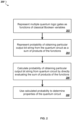
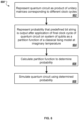
- FIG. 6 is a flow diagram of an example process 600 for partition function simulation of a quantum circuit.
- the process 600 will be described as being performed by a system of one or more classical computing devices located in one or more locations.
- the system 100 of FIG. 1 appropriately programmed in accordance with this specification, can perform the process 600.
- the system represents the quantum circuit as a product of unitary matrices U ( t ) corresponding to a sequence of clock cycles t ⁇ ⁇ 1, ..., d ⁇ (step 602).
- the quantum circuit may be a circuit that is configured to operate on a system of qubits arranged as a two-dimensional lattice, e.g., with nearest neighbor connectivity.
- the system represents a probability that a predefined bit string is output after application of a final clock cycle of the quantum circuit on a system of qubits as a partition function of a classical Ising model at imaginary temperature (step 604).
- x ⁇ represents the predefined bit string
- ⁇ d ⁇ represents the state of the system of n qubits after application of the final clock cycle d of the quantum circuit
- U ( t ) represents the product of unitary matrices corresponding to the sequence of clock cycles 1 to d, and
- each qubit j may have a sequence of two-sparse gates applied to it.
- the length of this sequence may be denoted as d(j) + 1 (this includes a 0-th cycle formed by a layer of Hadamard gates applied to each qubit).
- the value of s j k in the sequence may determine the state of the qubit immediately after the action of the k -th two-sparse gate.
- the explicit form of the two-sparse gates shows that the absolute values of the probability amplitudes associated with different paths are all the same and equal to 2 -G / 2 .
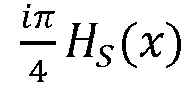
- the system may then determine values of the phase factors i ⁇ 4 H S x accumulated as a sum of discrete phase changes associated with individual quantum logic gates in the quantum circuit.
- the system may introduce coefficients d(j, t) equal to the number of two-sparse gates applied to qubit j over the first t cycles (including the 0-th cycle of Hadamard gates).
- b ij k ⁇ k , d i ⁇ 1 ⁇ ij 2 ⁇ j d j ⁇ 1 + J ij kd j
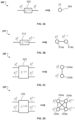
- the above equations (17) - (24) enable the system to define the structure of the graphical model.
- the system further describes the evolution of qubit states under the action of the quantum logic gates in the quantum circuit by introducing a third dimension to describe the graph of Ising couplings given in equation (21).
- For each qubit j a worldline with a grid of points enumerated by t ⁇ [1 ... d ] is introduced, with each point corresponding to a layer.
- the graphical model corresponding to the coefficients J ij kl therefore represents a quasi three-dimensional structure formed by worldlines corresponding to qubits located on a 2D lattice.
- equation (21) in the same worldline only neighboring vertices are coupled.
- the strength of the coupling is +/- 1 ⁇ 2 depending on the type of the two-sparse gate.
- each vertex can be "laterally" coupled to other vertices located on the neighboring worldlines.
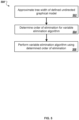
- the system approximates the treewidth of the graphical model (step 704).
- the treewidth of the graphical model is defined as the minimum induced width of the graphical model (graph) over all possible elimination orders of the graph.
- An elimination order is an ordering of vertices, and when a vertex X is eliminated, edges are added between all vertices connected to X.
- the induced width of an elimination order is the size of the maximum clique over all graphs formed followed the elimination order.
- a clique is a set of vertices where all pairs of vertices are connected by a link.
- the treewidth may be determined one of multiple possible heuristic algorithms, such as QuickBB.
- the system may store approximated treewidths in a cache.
- approximating the treewidth of the graphical model may include determining that the graphical model matches a previously generated graphical model and querying the cache to retrieve a previously computed treewidth for the graphical model.
- the system determines the ordering of the variable elimination algorithm using the determined treewidth (step 706).
- the order of elimination for the variable elimination algorithm is the same as the order of elimination of vertices described above with reference to step 704.
- the quantum circuits used to generate plot 800 included circuits described above with reference to FIG. 1 , namely quantum circuits with 6x6, 7x6, and 7x7 qubits as a function of circuit depth that (1) start with a cycle of Hadamard gates (0-th clock cycle), and (2) repeat for d clock cycles: (a) place controlled-phase (CZ) gates alternating between eight configurations, and (b) place single-qubit gates chosen at random from the set ⁇ X 1/2 , Y 1/2 , T ⁇ at all qubits that are not occupied by the CZ gates at the same cycle (subject to the restrictions below).
- CZ place controlled-phase
- the gate X 1/2 (or Y 1/2) represents a ⁇ 2 rotation around the X (or Y ) axis of the Bloch sphere, and T represents a non-Clifford diagonal matrix ⁇ 1, e i ⁇ / 4 ⁇ .
- single-qubit gates are placed subject to the following rules: (1) Place a gate at qubit q only if this qubit is occupied by a CZ gate in the previous cycle; (2) Place a T gate at qubit q if there are no single qubit gates in the previous cycles at qubit q except for the initial cycle of Hadamard gates; (3) Any gate at qubit q should be different from the gate at qubit q in the previous cycle.
Landscapes
- Engineering & Computer Science (AREA)
- Theoretical Computer Science (AREA)
- Physics & Mathematics (AREA)
- General Physics & Mathematics (AREA)
- General Engineering & Computer Science (AREA)
- Evolutionary Computation (AREA)
- Software Systems (AREA)
- Computer Hardware Design (AREA)
- Data Mining & Analysis (AREA)
- Mathematical Optimization (AREA)
- Pure & Applied Mathematics (AREA)
- Computing Systems (AREA)
- Mathematical Analysis (AREA)
- Mathematical Physics (AREA)
- Condensed Matter Physics & Semiconductors (AREA)
- Computational Mathematics (AREA)
- Artificial Intelligence (AREA)
- Geometry (AREA)
- Management, Administration, Business Operations System, And Electronic Commerce (AREA)
- Tests Of Electronic Circuits (AREA)
- Design And Manufacture Of Integrated Circuits (AREA)
Claims (8)
- Computerimplementiertes Verfahren zum Simulieren einer Quantenschaltung, wobei das Verfahren Folgendes umfasst:Empfangen von Daten, die die Quantenschaltung darstellen;Erzeugen einer Simulation der Quantenschaltung unter Verwendung der empfangenen Daten, umfassend:Darstellen (602) der Quantenschaltung als Produkt von unitären Matrizen, die einer Sequenz von Taktzyklen entsprechen, wobei jede unitäre Matrix in dem Produkt von unitären Matrizen einem Taktzyklus in der Sequenz von Taktzyklen entspricht;Darstellen (604) einer Wahrscheinlichkeit, dass eine vordefinierte Bitfolge nach Anwendung eines finalen Taktzyklus der Quantenschaltung auf ein System von Qubits als Partitionsfunktion eines klassischen Ising-Modells bei imaginärer Temperatur ausgegeben wird,wobei die Wahrscheinlichkeit, dass eine vordefinierte Bitfolge nach Anwendung eines finalen Taktzyklus der Quantenschaltung auf ein System von Qubits ausgegeben wird, gegeben ist durch
 wobei |x〉 die vordefinierte Bitfolge darstellt, |ψd 〉 den Zustand des Systems aus n Qubits nach Anwendung des finalen Taktzyklus d der Quantenschaltung darstellt, U (t) das Produkt der unitären Matrizen darstellt, die der Sequenz der Taktzyklen 1 bis d entsprechen, und
 wobei die Wahrscheinlichkeit, die als eine Partitionsfunktion eines klassischen Ising-Modells bei imaginärer Temperatur dargestellt ist, gleich einem Pfad-Integral ist, das mehrere Phasenfaktoren umfasst, die Pfaden in dem Pfadintegral zugeordnet sind, und wobei Werte der Phasenfaktoren als eine Summe diskreter Phasenänderungen akkumuliert werden, die Quantenlogikgattern in der Quantenschaltung zugeordnet sind; und genaues Berechnen (606) der Partitionsfunktion zum Bestimmen der Wahrscheinlichkeit, dass die vordefinierte Bitfolge nach Anwendung des finalen Taktzyklus der Quantenschaltung auf das System von Qubits ausgegeben wird, wobei das genaue Berechnen Folgendes umfasst:Darstellen des klassischen Ising-Modells als grafisches Modell, wobei das grafische Modell Knoten umfasst, die Spins in dem klassischen Ising-Modell darstellen, und Kanten die Interaktionen zwischen Spins darstellen;Bestimmen der Baumbreite des grafischen Modells; undAnwenden eines Eliminationsalgorithmus für variable Größen unter Verwendung der bestimmten Baumbreite zum Durchführen einer exakten Schlussfolgerung auf das grafische Modell, um die Trennwandfunktion des klassischen Ising-Modells zu berechnen; undBestimmen einer oder mehrerer Eigenschaften der Quantenschaltung unter Verwendung der erzeugten Simulation, wobei das Bestimmen Folgendes umfasst:
Verwenden der bestimmten Wahrscheinlichkeit, dass die vordefinierte Zeichenfolge ausgegeben wird, um (i) die Quantenberechnungs-Hardware, die die Quantenschaltung implementiert, zu kalibrieren, (ii) zu validieren oder (iii) zu benchmarken. - Verfahren nach Anspruch 1, wobei die Quantenschaltung Quantenlogikgatter zur Anwendung auf Qubits beinhaltet, die als zweidimensionales Gitter angeordnet sind.
- Verfahren nach einem der Ansprüche 1-2, wobei die Quantenschaltung (i) phasengesteuerte, (ii) X 1/2, (iii) Y 1/2- und (iv) Nicht-Clifford-T-Quantenlogikgatter umfasst.
- Verfahren nach einem der Ansprüche 1-3, wobei die Quantenschaltung eine Tiefe von d Taktzyklen umfasst.
- Verfahren nach einem der Ansprüche 1 bis 4, wobei die imaginäre Temperatur

- Verfahren nach einem der Ansprüche 1-5, wobei die Trennwandfunktion des klassischen Ising-Modells bei imaginärer Temperatur gegeben ist durch

- System, umfassend einen oder mehrere Computer und eine oder mehrere Speichervorrichtungen, die Anweisungen speichern, die, wenn sie durch den einen oder die mehreren Computern ausgeführt werden, den einen oder die mehreren Computer veranlassen, das Verfahren nach einem der Ansprüche 1 bis 6 durchzuführen.
- Nichttransitorisches Computerspeichermedium, das mit Anweisungen codiert ist, die, wenn sie durch einen oder mehrere Computer ausgeführt werden, den einen oder die mehreren Computer veranlassen, das Verfahren nach einem der Ansprüche 1 bis 6 durchzuführen.
Applications Claiming Priority (3)
| Application Number | Priority Date | Filing Date | Title |
|---|---|---|---|
| US201762574050P | 2017-10-18 | 2017-10-18 | |
| PCT/US2017/067083 WO2019078907A1 (en) | 2017-10-18 | 2017-12-18 | SIMULATION OF QUANTUM CIRCUITS |
| EP17829097.9A EP3682383B1 (de) | 2017-10-18 | 2017-12-18 | Simulation von quantenschaltungen |
Related Parent Applications (1)
| Application Number | Title | Priority Date | Filing Date |
|---|---|---|---|
| EP17829097.9A Division EP3682383B1 (de) | 2017-10-18 | 2017-12-18 | Simulation von quantenschaltungen |
Publications (2)
| Publication Number | Publication Date |
|---|---|
| EP4160491A1 EP4160491A1 (de) | 2023-04-05 |
| EP4160491B1 true EP4160491B1 (de) | 2025-07-02 |
Family
ID=60957461
Family Applications (2)
| Application Number | Title | Priority Date | Filing Date |
|---|---|---|---|
| EP17829097.9A Active EP3682383B1 (de) | 2017-10-18 | 2017-12-18 | Simulation von quantenschaltungen |
| EP22193793.1A Active EP4160491B1 (de) | 2017-10-18 | 2017-12-18 | Simulation von quantenschaltungen |
Family Applications Before (1)
| Application Number | Title | Priority Date | Filing Date |
|---|---|---|---|
| EP17829097.9A Active EP3682383B1 (de) | 2017-10-18 | 2017-12-18 | Simulation von quantenschaltungen |
Country Status (5)
| Country | Link |
|---|---|
| US (2) | US11556686B2 (de) |
| EP (2) | EP3682383B1 (de) |
| CN (1) | CN111247538B (de) |
| CA (2) | CA3133427A1 (de) |
| WO (1) | WO2019078907A1 (de) |
Families Citing this family (47)
| Publication number | Priority date | Publication date | Assignee | Title |
|---|---|---|---|---|
| CA3133427A1 (en) * | 2017-10-18 | 2019-04-25 | Google Llc | Simulation of quantum circuits |
| CN110428055A (zh) * | 2018-04-27 | 2019-11-08 | 阿里巴巴集团控股有限公司 | 量子计算方法和设备 |
| WO2020047661A1 (en) * | 2018-09-04 | 2020-03-12 | Lumerical Inc. | System and method for simulating and analyzing quantum circuits |
| US11245584B2 (en) * | 2018-10-15 | 2022-02-08 | Red Hat, Inc. | Software defined network optimization using quantum computing |
| US10901896B2 (en) * | 2018-11-27 | 2021-01-26 | International Business Machines Corporation | Cached result use through quantum gate rewrite |
| US11586792B2 (en) * | 2018-12-06 | 2023-02-21 | International Business Machines Corporation | Scheduling fusion for quantum computing simulation |
| US10803215B2 (en) * | 2018-12-18 | 2020-10-13 | International Business Machines Corporation | Incremental generation of quantum circuits |
| FR3091388B1 (fr) * | 2018-12-26 | 2022-06-10 | Bull Sas | Procédé de compilation d’un circuit quantique sur un processeur quantique à ions piégés |
| WO2020223850A1 (en) * | 2019-05-05 | 2020-11-12 | Supreme Qi Pte Ltd | System and method for quantum circuit simulation |
| CN111915011B (zh) * | 2019-05-07 | 2023-11-03 | 本源量子计算科技(合肥)股份有限公司 | 一种单振幅量子计算模拟方法 |
| CN114096970B (zh) | 2019-06-28 | 2025-10-28 | 谷歌有限责任公司 | 测量量子态纯度 |
| US12511572B2 (en) * | 2019-06-28 | 2025-12-30 | Google Llc | Estimating the fidelity of quantum logic gates and quantum circuits |
| CN113128015B (zh) * | 2019-12-31 | 2023-04-07 | 合肥本源量子计算科技有限责任公司 | 预估单振幅模拟量子计算所需资源的方法和系统 |
| US12015705B1 (en) | 2020-04-03 | 2024-06-18 | Google Llc | Verified quantum random number generation for cryptographic applications |
| US11556832B2 (en) | 2020-05-12 | 2023-01-17 | International Business Machines Corporation | Randomized benchmarking by exploiting the structure of the Clifford group |
| CN113850389B (zh) * | 2020-06-28 | 2023-08-11 | 本源量子计算科技(合肥)股份有限公司 | 一种量子线路的构建方法及装置 |
| CN112073221B (zh) * | 2020-08-14 | 2022-08-16 | 合肥本源量子计算科技有限责任公司 | 一种实现网络节点排序的方法及装置 |
| WO2022115156A2 (en) * | 2020-09-30 | 2022-06-02 | IonQ, Inc. | Optimizing circuit compiler for trapped-ion quantum computers |
| CN114418105B (zh) * | 2020-10-28 | 2023-08-08 | 本源量子计算科技(合肥)股份有限公司 | 一种基于量子线路处理量子应用问题的方法及装置 |
| CN114511093B (zh) * | 2020-11-16 | 2023-06-09 | 中国人民解放军国防科技大学 | 玻色子系统模拟方法 |
| CN112488317B (zh) * | 2020-11-27 | 2021-09-21 | 北京百度网讯科技有限公司 | 量子控制中的仿真方法、装置、经典计算机及存储介质 |
| CN112633507B (zh) * | 2020-11-27 | 2024-05-07 | 本源量子计算科技(合肥)股份有限公司 | 一种将复向量编码到量子线路的方法及装置 |
| US12229603B2 (en) * | 2020-12-31 | 2025-02-18 | IonQ, Inc. | Optimal calibration of gates in a quantum computing system |
| JP7825230B2 (ja) * | 2021-03-09 | 2026-03-06 | 株式会社グリッド | 量子回路におけるvc次元境界の計算方法およびプログラム |
| US11348027B1 (en) * | 2021-03-22 | 2022-05-31 | Alibaba Singapore Holding Private Limited | Methods and systems of fully-randomized benchmarking for quantum circuits |
| CN113379058B (zh) * | 2021-06-08 | 2022-04-01 | 北京百度网讯科技有限公司 | 量子模拟方法及装置、电子设备及存储介质 |
| US11294797B1 (en) * | 2021-06-22 | 2022-04-05 | Classiq Technologies LTD. | Debugger for quantum computers |
| JP7658849B2 (ja) * | 2021-08-17 | 2025-04-08 | 株式会社日立製作所 | 量子コンピュータシステムおよび量子コンピュータシステムの運用方法 |
| CN115730669B (zh) * | 2021-08-30 | 2024-06-14 | 本源量子计算科技(合肥)股份有限公司 | 一种量子线路的处理方法、装置及量子计算机操作系统 |
| CN115730670B (zh) * | 2021-08-31 | 2024-07-16 | 本源量子计算科技(合肥)股份有限公司 | 模式文件的生成方法、装置、介质及电子装置 |
| CN115775030B (zh) * | 2021-09-06 | 2024-07-16 | 本源量子计算科技(合肥)股份有限公司 | 基于模式匹配的量子程序重写方法、装置及电子装置 |
| CN113807525B (zh) * | 2021-09-22 | 2022-05-27 | 北京百度网讯科技有限公司 | 量子电路操作方法及装置、电子设备和介质 |
| US12455991B2 (en) * | 2021-12-08 | 2025-10-28 | International Business Machines Corporation | Circuit serialization for parameterized circuit simulation |
| US12367411B2 (en) | 2021-12-14 | 2025-07-22 | International Business Machines Corporation | Enablement of sampling-optimization for gate-level simulation |
| CN116415671A (zh) * | 2021-12-29 | 2023-07-11 | 美天精智(北京)科技有限公司 | 不确定条件下量子电路结构搜索策略的熵决策 |
| CN114418107B (zh) * | 2022-01-17 | 2022-10-18 | 北京百度网讯科技有限公司 | 酉算子编译方法、计算设备、装置及存储介质 |
| CN116523055B (zh) * | 2022-01-20 | 2024-08-20 | 腾讯科技(深圳)有限公司 | 量子电路的制备方法、装置、设备、介质及产品 |
| US20230385679A1 (en) * | 2022-05-31 | 2023-11-30 | Alibaba (China) Co., Ltd. | Polynomial-time linear cross-entropy benchmarking |
| CN115376238B (zh) * | 2022-08-17 | 2024-05-07 | 国开启科量子技术(北京)有限公司 | 一种基于量子选票的分组式计票方法及装置 |
| CN117852659A (zh) * | 2022-09-30 | 2024-04-09 | 本源量子计算科技(合肥)股份有限公司 | 量子线路生成方法、装置、存储介质及电子装置 |
| CN115907025B (zh) * | 2022-12-06 | 2023-08-22 | 北京百度网讯科技有限公司 | 量子网络协议仿真方法、装置及电子设备 |
| CN116341667B (zh) * | 2023-04-03 | 2024-03-12 | 正则量子(北京)技术有限公司 | 一种量子线路搭建方法及设备 |
| EP4550220A1 (de) * | 2023-11-01 | 2025-05-07 | Electronics and Telecommunications Research Institute | Vorrichtung und verfahren zur quantensimulationsbeschleunigung |
| CN117787424B (zh) * | 2023-12-20 | 2025-03-11 | 北京百度网讯科技有限公司 | 量子电路处理方法、装置及电子设备 |
| JP2025144313A (ja) | 2024-03-19 | 2025-10-02 | 富士通株式会社 | シミュレーションプログラム、情報処理装置およびシミュレーション方法 |
| CN118331541B (zh) * | 2024-06-17 | 2024-08-09 | 中央民族大学 | 具有受控概率幅度的量子随机数生成方法、系统及介质 |
| CN119250217B (zh) * | 2024-09-25 | 2025-11-11 | 中电信量子信息科技集团有限公司 | 基于子空间映射表的量子仿真器 |
Family Cites Families (18)
| Publication number | Priority date | Publication date | Assignee | Title |
|---|---|---|---|---|
| WO2009152180A2 (en) * | 2008-06-10 | 2009-12-17 | D-Wave Systems Inc. | Parameter learning system for solvers |
| US8593175B2 (en) * | 2011-12-15 | 2013-11-26 | Micron Technology, Inc. | Boolean logic in a state machine lattice |
| CN108256651B (zh) * | 2013-06-28 | 2022-09-06 | D-波系统公司 | 用于对数据进行量子处理的方法 |
| US9721209B2 (en) * | 2013-10-14 | 2017-08-01 | Microsoft Technology Licensing, Llc | Method and system for efficient decomposition of single-qubit quantum gates into Fibonacci anyon braid circuits |
| CN107004162A (zh) * | 2014-12-05 | 2017-08-01 | 微软技术许可有限责任公司 | 量子深度学习 |
| CA3133427A1 (en) * | 2017-10-18 | 2019-04-25 | Google Llc | Simulation of quantum circuits |
| WO2019104443A1 (en) * | 2017-12-01 | 2019-06-06 | 1Qb Information Technologies Inc. | Systems and methods for stochastic optimization of a robust inference problem |
| WO2020056324A1 (en) * | 2018-09-13 | 2020-03-19 | Psiquantum, Corp. | Method and system for multirail encoding of quantum bits |
| EP3891668A4 (de) * | 2018-12-06 | 2023-01-25 | 1QB Information Technologies Inc. | Durch künstliche intelligenz angesteuerte quantenberechnung |
| WO2021011765A1 (en) * | 2019-07-17 | 2021-01-21 | President And Fellows Of Harvard College | Nanophotonic quantum memory |
| US11797872B2 (en) * | 2019-09-20 | 2023-10-24 | Microsoft Technology Licensing, Llc | Quantum bit prediction |
| JP2021184148A (ja) * | 2020-05-21 | 2021-12-02 | 富士通株式会社 | 最適化装置、最適化方法、および最適化プログラム |
| US12045743B2 (en) * | 2020-09-24 | 2024-07-23 | Microsoft Technology Licensing, Llc | Mixing techniques for probabilistic quantum circuits with fallback |
| US20220138538A1 (en) * | 2020-10-29 | 2022-05-05 | Nell Watson Ltd | Maximum Entropy Boltzmann Machines |
| US12499379B2 (en) * | 2020-12-16 | 2025-12-16 | International Business Machines Corporation | Readout-error mitigation for quantum expectation |
| US20240211745A1 (en) * | 2021-04-17 | 2024-06-27 | University Of Rochester | Bistable resistively-coupled system |
| JP7557160B2 (ja) * | 2021-08-25 | 2024-09-27 | 日本電信電話株式会社 | イジングモデルの計算装置 |
| US20230297865A1 (en) * | 2022-03-18 | 2023-09-21 | International Business Machines Corporation | Quantum-classical markov chain monte carlo |
-
2017
- 2017-12-18 CA CA3133427A patent/CA3133427A1/en active Pending
- 2017-12-18 EP EP17829097.9A patent/EP3682383B1/de active Active
- 2017-12-18 WO PCT/US2017/067083 patent/WO2019078907A1/en not_active Ceased
- 2017-12-18 US US16/754,998 patent/US11556686B2/en active Active
- 2017-12-18 CA CA3079533A patent/CA3079533A1/en active Pending
- 2017-12-18 CN CN201780096102.XA patent/CN111247538B/zh active Active
- 2017-12-18 EP EP22193793.1A patent/EP4160491B1/de active Active
-
2022
- 2022-12-13 US US18/080,614 patent/US12299533B2/en active Active
Non-Patent Citations (1)
| Title |
|---|
| FUJII KEISUKE ET AL: "Commuting quantum circuits and complexity of Ising partition functions", NEW JOURNAL OF PHYSICS, vol. 19, no. 3, 30 August 2016 (2016-08-30), pages 033003, XP093024988, Retrieved from the Internet <URL:https://arxiv.org/pdf/1311.2128.pdf> DOI: 10.1088/1367-2630/aa5fdb * |
Also Published As
| Publication number | Publication date |
|---|---|
| EP3682383A1 (de) | 2020-07-22 |
| WO2019078907A1 (en) | 2019-04-25 |
| US20210192114A1 (en) | 2021-06-24 |
| CA3079533A1 (en) | 2019-04-25 |
| US20230118636A1 (en) | 2023-04-20 |
| US12299533B2 (en) | 2025-05-13 |
| EP4160491A1 (de) | 2023-04-05 |
| CA3133427A1 (en) | 2019-04-25 |
| EP3682383B1 (de) | 2022-09-21 |
| US11556686B2 (en) | 2023-01-17 |
| CN111247538A (zh) | 2020-06-05 |
| CN111247538B (zh) | 2024-08-16 |
Similar Documents
| Publication | Publication Date | Title |
|---|---|---|
| EP4160491B1 (de) | Simulation von quantenschaltungen | |
| US11586969B2 (en) | Quantum circuit optimization using windowed quantum arithmetic | |
| US12346770B2 (en) | Variational quantum state preparation | |
| JP7614424B2 (ja) | 量子ゲートを実現するための万能制御 | |
| CA3102290C (en) | Preparing superpositions of computational basis states on a quantum computer | |
| EP3926552B1 (de) | Quantenschaltkreise mit reduzierter t gatter-anzahl | |
| US20220067567A1 (en) | Verified quantum phase estimation | |
| US20200065439A1 (en) | Simulating materials using quantum computation | |
| Lee et al. | An FPGA‐Based Quantum Computing Emulation Framework Based on Serial‐Parallel Architecture | |
| EP3983960B1 (de) | Effiziente und rauschrobuste messungen für die quantenchemie | |
| CN115545207A (zh) | 多个本征值的量子相位估计 | |
| JP2023550324A (ja) | 量子誤差軽減ための仮想抽出 | |
| EP4036816A1 (de) | Verringerung von fehlern in algorithmen, die unter verwendung von quanteninformationsprozessoren ausgeführt werden | |
| CN115630704B (zh) | 多体问题的求解方法及量子计算系统 | |
| Wilkens et al. | Benchmarking bosonic and fermionic dynamics | |
| GB2609016A (en) | Determining matching data | |
| Ferreira | Feynman Path-Sum Quantum Computer Simulator | |
| US20250217688A1 (en) | Privacy-Preserving Quantum Computation Using Masked Quantum Circuit | |
| Demetriou | An Efficiency Comparison of Quantum Variational and Classical Satisfiability Algorithms for Debugging Combinational Logic Circuits | |
| Lashomb | High-Degree Polynomial Noise Subtraction and Multipolynomial Monte Carlo Trace Estimation in Lattice QCD |
Legal Events
| Date | Code | Title | Description |
|---|---|---|---|
| PUAI | Public reference made under article 153(3) epc to a published international application that has entered the european phase |
Free format text: ORIGINAL CODE: 0009012 |
|
| STAA | Information on the status of an ep patent application or granted ep patent |
Free format text: STATUS: THE APPLICATION HAS BEEN PUBLISHED |
|
| AC | Divisional application: reference to earlier application |
Ref document number: 3682383 Country of ref document: EP Kind code of ref document: P |
|
| AK | Designated contracting states |
Kind code of ref document: A1 Designated state(s): AL AT BE BG CH CY CZ DE DK EE ES FI FR GB GR HR HU IE IS IT LI LT LU LV MC MK MT NL NO PL PT RO RS SE SI SK SM TR |
|
| STAA | Information on the status of an ep patent application or granted ep patent |
Free format text: STATUS: REQUEST FOR EXAMINATION WAS MADE |
|
| 17P | Request for examination filed |
Effective date: 20231004 |
|
| RBV | Designated contracting states (corrected) |
Designated state(s): AL AT BE BG CH CY CZ DE DK EE ES FI FR GB GR HR HU IE IS IT LI LT LU LV MC MK MT NL NO PL PT RO RS SE SI SK SM TR |
|
| STAA | Information on the status of an ep patent application or granted ep patent |
Free format text: STATUS: EXAMINATION IS IN PROGRESS |
|
| 17Q | First examination report despatched |
Effective date: 20240306 |
|
| GRAP | Despatch of communication of intention to grant a patent |
Free format text: ORIGINAL CODE: EPIDOSNIGR1 |
|
| STAA | Information on the status of an ep patent application or granted ep patent |
Free format text: STATUS: GRANT OF PATENT IS INTENDED |
|
| RIC1 | Information provided on ipc code assigned before grant |
Ipc: G06N 7/01 20230101ALN20250116BHEP Ipc: G06N 10/40 20220101ALN20250116BHEP Ipc: G06F 30/33 20200101ALI20250116BHEP Ipc: G06N 10/20 20220101ALI20250116BHEP Ipc: G06N 10/80 20220101AFI20250116BHEP |
|
| INTG | Intention to grant announced |
Effective date: 20250124 |
|
| GRAS | Grant fee paid |
Free format text: ORIGINAL CODE: EPIDOSNIGR3 |
|
| GRAA | (expected) grant |
Free format text: ORIGINAL CODE: 0009210 |
|
| STAA | Information on the status of an ep patent application or granted ep patent |
Free format text: STATUS: THE PATENT HAS BEEN GRANTED |
|
| AC | Divisional application: reference to earlier application |
Ref document number: 3682383 Country of ref document: EP Kind code of ref document: P |
|
| AK | Designated contracting states |
Kind code of ref document: B1 Designated state(s): AL AT BE BG CH CY CZ DE DK EE ES FI FR GB GR HR HU IE IS IT LI LT LU LV MC MK MT NL NO PL PT RO RS SE SI SK SM TR |
|
| REG | Reference to a national code |
Ref country code: GB Ref legal event code: FG4D |
|
| P01 | Opt-out of the competence of the unified patent court (upc) registered |
Free format text: CASE NUMBER: APP_26353/2025 Effective date: 20250603 |
|
| REG | Reference to a national code |
Ref country code: CH Ref legal event code: EP |
|
| REG | Reference to a national code |
Ref country code: DE Ref legal event code: R096 Ref document number: 602017090402 Country of ref document: DE |
|
| REG | Reference to a national code |
Ref country code: IE Ref legal event code: FG4D |
|
| REG | Reference to a national code |
Ref country code: NL Ref legal event code: MP Effective date: 20250702 |
|
| PG25 | Lapsed in a contracting state [announced via postgrant information from national office to epo] |
Ref country code: PT Free format text: LAPSE BECAUSE OF FAILURE TO SUBMIT A TRANSLATION OF THE DESCRIPTION OR TO PAY THE FEE WITHIN THE PRESCRIBED TIME-LIMIT Effective date: 20251103 |
|
| PG25 | Lapsed in a contracting state [announced via postgrant information from national office to epo] |
Ref country code: NL Free format text: LAPSE BECAUSE OF FAILURE TO SUBMIT A TRANSLATION OF THE DESCRIPTION OR TO PAY THE FEE WITHIN THE PRESCRIBED TIME-LIMIT Effective date: 20250702 |
|
| REG | Reference to a national code |
Ref country code: AT Ref legal event code: MK05 Ref document number: 1810094 Country of ref document: AT Kind code of ref document: T Effective date: 20250702 |
|
| PG25 | Lapsed in a contracting state [announced via postgrant information from national office to epo] |
Ref country code: IS Free format text: LAPSE BECAUSE OF FAILURE TO SUBMIT A TRANSLATION OF THE DESCRIPTION OR TO PAY THE FEE WITHIN THE PRESCRIBED TIME-LIMIT Effective date: 20251102 |
|
| PGFP | Annual fee paid to national office [announced via postgrant information from national office to epo] |
Ref country code: GB Payment date: 20251229 Year of fee payment: 9 |
|
| PG25 | Lapsed in a contracting state [announced via postgrant information from national office to epo] |
Ref country code: NO Free format text: LAPSE BECAUSE OF FAILURE TO SUBMIT A TRANSLATION OF THE DESCRIPTION OR TO PAY THE FEE WITHIN THE PRESCRIBED TIME-LIMIT Effective date: 20251002 |
|
| REG | Reference to a national code |
Ref country code: LT Ref legal event code: MG9D |
|
| PG25 | Lapsed in a contracting state [announced via postgrant information from national office to epo] |
Ref country code: AT Free format text: LAPSE BECAUSE OF FAILURE TO SUBMIT A TRANSLATION OF THE DESCRIPTION OR TO PAY THE FEE WITHIN THE PRESCRIBED TIME-LIMIT Effective date: 20250702 |
|
| PG25 | Lapsed in a contracting state [announced via postgrant information from national office to epo] |
Ref country code: FI Free format text: LAPSE BECAUSE OF FAILURE TO SUBMIT A TRANSLATION OF THE DESCRIPTION OR TO PAY THE FEE WITHIN THE PRESCRIBED TIME-LIMIT Effective date: 20250702 |
|
| PG25 | Lapsed in a contracting state [announced via postgrant information from national office to epo] |
Ref country code: HR Free format text: LAPSE BECAUSE OF FAILURE TO SUBMIT A TRANSLATION OF THE DESCRIPTION OR TO PAY THE FEE WITHIN THE PRESCRIBED TIME-LIMIT Effective date: 20250702 |
|
| PG25 | Lapsed in a contracting state [announced via postgrant information from national office to epo] |
Ref country code: GR Free format text: LAPSE BECAUSE OF FAILURE TO SUBMIT A TRANSLATION OF THE DESCRIPTION OR TO PAY THE FEE WITHIN THE PRESCRIBED TIME-LIMIT Effective date: 20251003 |
|
| PG25 | Lapsed in a contracting state [announced via postgrant information from national office to epo] |
Ref country code: SE Free format text: LAPSE BECAUSE OF FAILURE TO SUBMIT A TRANSLATION OF THE DESCRIPTION OR TO PAY THE FEE WITHIN THE PRESCRIBED TIME-LIMIT Effective date: 20250702 Ref country code: CZ Free format text: LAPSE BECAUSE OF FAILURE TO SUBMIT A TRANSLATION OF THE DESCRIPTION OR TO PAY THE FEE WITHIN THE PRESCRIBED TIME-LIMIT Effective date: 20250702 |
|
| PG25 | Lapsed in a contracting state [announced via postgrant information from national office to epo] |
Ref country code: LV Free format text: LAPSE BECAUSE OF FAILURE TO SUBMIT A TRANSLATION OF THE DESCRIPTION OR TO PAY THE FEE WITHIN THE PRESCRIBED TIME-LIMIT Effective date: 20250702 |
|
| PG25 | Lapsed in a contracting state [announced via postgrant information from national office to epo] |
Ref country code: BG Free format text: LAPSE BECAUSE OF FAILURE TO SUBMIT A TRANSLATION OF THE DESCRIPTION OR TO PAY THE FEE WITHIN THE PRESCRIBED TIME-LIMIT Effective date: 20250702 Ref country code: PL Free format text: LAPSE BECAUSE OF FAILURE TO SUBMIT A TRANSLATION OF THE DESCRIPTION OR TO PAY THE FEE WITHIN THE PRESCRIBED TIME-LIMIT Effective date: 20250702 |
|
| PG25 | Lapsed in a contracting state [announced via postgrant information from national office to epo] |
Ref country code: RS Free format text: LAPSE BECAUSE OF FAILURE TO SUBMIT A TRANSLATION OF THE DESCRIPTION OR TO PAY THE FEE WITHIN THE PRESCRIBED TIME-LIMIT Effective date: 20251002 |
|
| PG25 | Lapsed in a contracting state [announced via postgrant information from national office to epo] |
Ref country code: ES Free format text: LAPSE BECAUSE OF FAILURE TO SUBMIT A TRANSLATION OF THE DESCRIPTION OR TO PAY THE FEE WITHIN THE PRESCRIBED TIME-LIMIT Effective date: 20250702 |
|
| PG25 | Lapsed in a contracting state [announced via postgrant information from national office to epo] |
Ref country code: RO Free format text: LAPSE BECAUSE OF FAILURE TO SUBMIT A TRANSLATION OF THE DESCRIPTION OR TO PAY THE FEE WITHIN THE PRESCRIBED TIME-LIMIT Effective date: 20250702 |
|
| PG25 | Lapsed in a contracting state [announced via postgrant information from national office to epo] |
Ref country code: SM Free format text: LAPSE BECAUSE OF FAILURE TO SUBMIT A TRANSLATION OF THE DESCRIPTION OR TO PAY THE FEE WITHIN THE PRESCRIBED TIME-LIMIT Effective date: 20250702 |
|
| PG25 | Lapsed in a contracting state [announced via postgrant information from national office to epo] |
Ref country code: DK Free format text: LAPSE BECAUSE OF FAILURE TO SUBMIT A TRANSLATION OF THE DESCRIPTION OR TO PAY THE FEE WITHIN THE PRESCRIBED TIME-LIMIT Effective date: 20250702 |
|
| PGFP | Annual fee paid to national office [announced via postgrant information from national office to epo] |
Ref country code: DE Payment date: 20251229 Year of fee payment: 9 |
|
| PG25 | Lapsed in a contracting state [announced via postgrant information from national office to epo] |
Ref country code: IT Free format text: LAPSE BECAUSE OF FAILURE TO SUBMIT A TRANSLATION OF THE DESCRIPTION OR TO PAY THE FEE WITHIN THE PRESCRIBED TIME-LIMIT Effective date: 20250702 |