EP4158176B1 - Verfahren zur modellbasierten steuerung und regelung einer brennkraftmaschine - Google Patents
Verfahren zur modellbasierten steuerung und regelung einer brennkraftmaschine Download PDFInfo
- Publication number
- EP4158176B1 EP4158176B1 EP21729461.0A EP21729461A EP4158176B1 EP 4158176 B1 EP4158176 B1 EP 4158176B1 EP 21729461 A EP21729461 A EP 21729461A EP 4158176 B1 EP4158176 B1 EP 4158176B1
- Authority
- EP
- European Patent Office
- Prior art keywords
- quality measure
- discrete
- internal combustion
- calculated
- combustion engine
- Prior art date
- Legal status (The legal status is an assumption and is not a legal conclusion. Google has not performed a legal analysis and makes no representation as to the accuracy of the status listed.)
- Active
Links
Images



Classifications
-
- F—MECHANICAL ENGINEERING; LIGHTING; HEATING; WEAPONS; BLASTING
- F02—COMBUSTION ENGINES; HOT-GAS OR COMBUSTION-PRODUCT ENGINE PLANTS
- F02D—CONTROLLING COMBUSTION ENGINES
- F02D41/00—Electrical control of supply of combustible mixture or its constituents
- F02D41/02—Circuit arrangements for generating control signals
- F02D41/14—Introducing closed-loop corrections
- F02D41/1401—Introducing closed-loop corrections characterised by the control or regulation method
- F02D41/1406—Introducing closed-loop corrections characterised by the control or regulation method with use of a optimisation method, e.g. iteration
-
- F—MECHANICAL ENGINEERING; LIGHTING; HEATING; WEAPONS; BLASTING
- F02—COMBUSTION ENGINES; HOT-GAS OR COMBUSTION-PRODUCT ENGINE PLANTS
- F02D—CONTROLLING COMBUSTION ENGINES
- F02D41/00—Electrical control of supply of combustible mixture or its constituents
- F02D41/02—Circuit arrangements for generating control signals
- F02D41/14—Introducing closed-loop corrections
- F02D41/1401—Introducing closed-loop corrections characterised by the control or regulation method
- F02D41/1402—Adaptive control
-
- F—MECHANICAL ENGINEERING; LIGHTING; HEATING; WEAPONS; BLASTING
- F02—COMBUSTION ENGINES; HOT-GAS OR COMBUSTION-PRODUCT ENGINE PLANTS
- F02D—CONTROLLING COMBUSTION ENGINES
- F02D41/00—Electrical control of supply of combustible mixture or its constituents
- F02D41/30—Controlling fuel injection
- F02D41/3005—Details not otherwise provided for
-
- F—MECHANICAL ENGINEERING; LIGHTING; HEATING; WEAPONS; BLASTING
- F02—COMBUSTION ENGINES; HOT-GAS OR COMBUSTION-PRODUCT ENGINE PLANTS
- F02D—CONTROLLING COMBUSTION ENGINES
- F02D41/00—Electrical control of supply of combustible mixture or its constituents
- F02D41/02—Circuit arrangements for generating control signals
- F02D41/14—Introducing closed-loop corrections
- F02D41/1401—Introducing closed-loop corrections characterised by the control or regulation method
- F02D2041/1412—Introducing closed-loop corrections characterised by the control or regulation method using a predictive controller
-
- F—MECHANICAL ENGINEERING; LIGHTING; HEATING; WEAPONS; BLASTING
- F02—COMBUSTION ENGINES; HOT-GAS OR COMBUSTION-PRODUCT ENGINE PLANTS
- F02D—CONTROLLING COMBUSTION ENGINES
- F02D41/00—Electrical control of supply of combustible mixture or its constituents
- F02D41/02—Circuit arrangements for generating control signals
- F02D41/14—Introducing closed-loop corrections
- F02D41/1401—Introducing closed-loop corrections characterised by the control or regulation method
- F02D2041/1433—Introducing closed-loop corrections characterised by the control or regulation method using a model or simulation of the system
-
- F—MECHANICAL ENGINEERING; LIGHTING; HEATING; WEAPONS; BLASTING
- F02—COMBUSTION ENGINES; HOT-GAS OR COMBUSTION-PRODUCT ENGINE PLANTS
- F02D—CONTROLLING COMBUSTION ENGINES
- F02D2200/00—Input parameters for engine control
- F02D2200/02—Input parameters for engine control the parameters being related to the engine
- F02D2200/04—Engine intake system parameters
- F02D2200/0402—Engine intake system parameters the parameter being determined by using a model of the engine intake or its components
-
- F—MECHANICAL ENGINEERING; LIGHTING; HEATING; WEAPONS; BLASTING
- F02—COMBUSTION ENGINES; HOT-GAS OR COMBUSTION-PRODUCT ENGINE PLANTS
- F02D—CONTROLLING COMBUSTION ENGINES
- F02D35/00—Controlling engines, dependent on conditions exterior or interior to engines, not otherwise provided for
- F02D35/02—Controlling engines, dependent on conditions exterior or interior to engines, not otherwise provided for on interior conditions
Definitions
- the invention relates to a method for model-based control and regulation of an internal combustion engine, in which a quality measure is calculated by an optimizer and set as decisive for the operating point of the internal combustion engine.
- ECU engine control unit
- characteristic curves and maps are usually applied in the ECU's software. These are used to calculate the engine's manipulated variables, such as the start of injection and the required rail pressure, from the desired power output.
- These characteristic curves/maps are populated with data on a test bench at the engine manufacturer's plant.
- the multitude of these characteristic curves/maps and the correlation between them requires a significant amount of tuning effort.
- a method for model-based control and regulation of an internal combustion engine in which the setpoints for the injection system actuators are calculated using a combustion model, and the setpoints for the gas path actuators are calculated using a gas path model. Both the combustion model and the gas path model are based on Gaussian process models. From the setpoints, an optimizer determines a quality measure and predicts how the quality measure will change if the setpoints change within a prediction horizon. would develop. Once the best possible quality measure has been calculated, the optimizer sets the injection system setpoints and the gas path setpoints as decisive for the operating point of the internal combustion engine.
- Control variables with discrete switching states include, for example, the activation of the second exhaust gas turbocharger during serial turbocharging, cylinder bank deactivation, the activation of pre- or post-injection, and the open or closed position of various valves.
- So-called branch and bound methods for finding optimal solutions for discrete control variables are very computationally intensive, since in the worst case, all possible combinations of the discrete control variables must be investigated.
- Their application in an internal combustion engine quickly leads to very complex structures that cannot be represented on an engine control unit.
- the invention is based on the object of improving the previously described model-based method with regard to the integration of manipulated variables.
- the process is carried out in three steps.
- the optimizer calculates a pre-optimized quality measure depending on the operating situation, whereby the discrete manipulated variables with discrete setting values are interpreted as continuous manipulated variables with a continuous setting range.
- the pre-optimized quality measure is a calculated value, meaning it is not applied to the internal combustion engine.
- these continuous manipulated variables are quantized and set as new discrete manipulated variables with discrete setting values. Quantization is performed using switching thresholds and hysteresis.
- the optimizer calculates a re-optimized quality measure depending on the new discrete manipulated variables and the operating situation of the internal combustion engine and sets it as the decisive factor for the internal combustion engine's operating point.
- the new discrete manipulated variables are assumed to be fixed. As such, they no longer represent a degree of freedom for optimization within the predicted horizon.
- the remaining Continuous control variables are reoptimized so that the solution is the best possible with regard to the fixed new control variables.
- the operating situation of the internal combustion engine includes both the external conditions, in particular the emission limits or the desired power output, as well as the current operating point. Both the pre-optimized performance measure and the post-optimized performance measure are determined by calculating the injection system setpoints for controlling the injection system actuators, such as the target rail pressure, using the combustion model, calculating the gas path setpoints for controlling the gas path actuators using a gas path model, and then modifying these setpoints with the aim of finding the minimum.
- the invention allows the solution of optimization tasks with partially continuous-value and partially discrete-value input variables, even with limited computing capacity for the optimization method used.
- the invention uses a serial methodology. Only in this way can the quality measure and the resulting values for the manipulated variables be fully calculated on an engine control unit.
- the Figure 1 shows a system diagram of an electronically controlled internal combustion engine 1 with a common rail system.
- the common rail system comprises the following mechanical components: a low-pressure pump 3 for pumping fuel from a fuel tank 2, a variable intake throttle 4 for Influencing the flow of fuel volume, a high-pressure pump 5 for pumping the fuel under increased pressure, a rail 6 for storing the fuel, and injectors 7 for injecting the fuel into the combustion chambers of the internal combustion engine 1.
- the common rail system can also be designed with individual accumulators, in which case, for example, an individual accumulator 8 is integrated into the injector 7 as an additional buffer volume.
- the other functionality of the common rail system is assumed to be known.
- the gas path shown includes both the air supply and the exhaust gas discharge.
- the following are arranged in the air supply: the compressor of an exhaust gas turbocharger 11, a charge air cooler 12, a throttle valve 13, an inlet point 14 for combining the charge air with the recirculated exhaust gas and a variably controllable inlet valve 15.
- the following are arranged in the exhaust gas duct: a variably controllable outlet valve 16, an EGR actuator 17, the turbine of the exhaust gas turbocharger 11 and a turbine bypass valve 18.
- the operation of the internal combustion engine 1 is determined by an electronic control unit 10 (ECU).
- the electronic control unit 10 contains the usual components of a microcomputer system, such as a microprocessor, I/O modules, buffers, and memory modules (EEPROM, RAM).
- the operating data relevant to the operation of the internal combustion engine 1 are applied as models in the memory modules.
- the electronic control unit 10 uses these to calculate the output variables from the input variables.
- the other sensor signals not shown are summarized under the input variable EIN, for example the coolant temperatures.
- FIG 1 are represented as output variables of the electronic control unit 10: a PWM signal for controlling the intake throttle 4, a ve signal for controlling the injectors 7 (start/end of injection), a DK control signal for controlling the throttle valve 13, a VVT control signal for controlling the intake or exhaust valve, an EGR control signal for controlling the EGR actuator 17, a TBP control signal for controlling the turbine bypass valve 18 and an output variable AUS.
- the output variable AUS represents the further control signals for controlling and regulating the internal combustion engine 1, for example, a control signal for activating a second exhaust gas turbocharger at a register charge.
- the throttle valve 13, the EGR actuator 17, the turbine bypass valve 18, or the throttle valve 4 can be controlled with a continuous control signal and are therefore adjustable within a continuous range of values.
- a discrete control variable would be the control signal for activating a second exhaust gas turbocharger, since this control signal can only assume individual discrete values; intermediate values therefore do not exist.
- the Figure 2 shows a model-based system diagram.
- a combustion model 19 a gas path model 20, and an optimizer 21 are listed within the electronic control unit 10.
- Both the combustion model 19 and the gas path model 20 represent the system behavior of the internal combustion engine as mathematical equations, for example in the form of Gaussian process models.
- the combustion model 19 statically represents the combustion processes.
- the gas path model 20 represents the dynamic behavior of the air flow and exhaust gas flow.
- the combustion model 19 contains individual models, for example, for NOx and soot formation, for the exhaust gas temperature, for the exhaust gas mass flow, and for the peak pressure. These individual models, in turn, depend on the boundary conditions in the cylinder and the injection parameters.
- the combustion model 19 is determined on a reference internal combustion engine in a test bench run, the so-called DoE test bench run (DoE: Design of Experiments).
- DoE test bench run operating parameters and control variables are systematically varied with the aim of replicating the overall behavior of the internal combustion engine as a function of engine variables and environmental conditions.
- the optimizer 21 evaluates the combustion model 19 with regard to the target torque M(TARGET), the emission limits, the environmental conditions, for example, the humidity phi of the charge air, and the operating situation of the internal combustion engine.
- the operating situation is defined by the engine speed nIST, the charge air temperature TLL, the charge air pressure pLL, etc.
- the function of the optimizer 21 is to evaluate the injection system target values for controlling the injection system actuators and the gas path target values for controlling the gas path actuators. In doing so, the optimizer 21 selects the solution that minimizes a quality measure.
- w1, w2, and w3 represent a corresponding weighting factor.
- nitrogen oxide emissions result from the charge air humidity phi, the charge air temperature TLL, the start of injection SB, and the rail pressure pCR.
- the optimizer 21 determines the best possible quality measure via minimum finding by calculating a first quality measure at a first point in time, varying the injection system setpoints and the gas path setpoints, and using this to predict a second quality measure within the prediction horizon. Based on the deviation between the two quality measures, the optimizer 21 then determines a minimum quality measure and sets this as the decisive factor for the internal combustion engine. For the example shown in the figure, this is the target rail pressure pCR(SL) for the injection system.
- the target rail pressure pCR(SL) is the reference variable for the lower-level rail pressure control loop 22.
- the manipulated variable of the rail pressure control loop 22 corresponds to the PWM signal for actuating the intake throttle.
- the optimizer 21 indirectly determines the gas path setpoints.
- these are a lambda setpoint LAM(SL) and an EGR setpoint AGR(SL) for the specification of the two subordinate control circuits 23 and 24.
- the feedback measured variables MESS are read in by the electronic control unit 10.
- the measured variables MESS include both directly measured physical variables and auxiliary variables calculated from them.
- the lambda actual value LAM(IST) and the EGR actual value AGR(IST) are read in.
- the reference symbol SG summarizes the manipulated variables of the internal combustion engine. This includes both the continuous manipulated variables with a continuous setting range and the discrete manipulated variables with discrete setting values.
- Continuous manipulated variables can be continuously adjusted between a minimum and maximum value, for example the start and end of injection with which the injector ( Fig. 1 : 7) is applied directly.
- Discrete manipulated variables with discrete setting values can only be set in stages as fixed values, for example, cylinder deactivation.
- the Figure 3 shows a block diagram with the operating situation BS of the internal combustion engine as the input variable and the quality measure as the output variable, here referred to as the post-optimized quality measure J(NA).
- the block diagram shows a pre-optimization 25, a quantization 26, and a post-optimization 27.
- a pre-optimized quality measure J(VO) is calculated using the pre-optimization 25, in which the discrete manipulated variables with discrete setting values are interpreted as continuous manipulated variables with a continuous setting range.
- the pre-optimized quality measure J(VO) is a purely internal calculation variable that has no access to the actuators of the internal combustion engine. In other words: the pre-optimized quality measure J(VO) is access-free and is not applied to the internal combustion engine.
- new discrete manipulated variables SG(new) are calculated from the continuous manipulated variables SG(k) using quantization 26. For the pre-injection, a fixed assignment to pre-injection activated or pre-injection deactivated is therefore made again in quantization.
- Quantization 26 offers the advantage that, for example, the variable valve timing can be set to three discrete values, namely minimum, average, and maximum, for example 450°, 495°, and 540° crankshaft angle. This significantly reduces the computational effort required for the subsequent determination of the re-optimized quality measure. During quantization 26, the calculated values are also stabilized using optional hysteresis bands. In a third step, the new discrete manipulated variables SG(new) and the operating situation are combined, and the optimizer calculates a re-optimized quality measure J(NA). When calculating the re-optimized quality measure J(NA), the new discrete manipulated variables SG(new) are not changed.
- the re-optimized quality measure J(NA) corresponds to the minimum quality measure J(min), which is used by the optimizer as is set decisively for the operating point of the internal combustion engine (1), i.e. is switched on to the internal combustion engine.
- the optimized quality measure calculated in the re-optimization subroutine is set as the minimized quality measure J(min), which determines the operating point of the internal combustion engine. Subsequently, a check is performed at S10 to determine whether an engine stop has been initiated. If this is not the case, query result S10: no, and the program branches back to point B. Otherwise, the program flowchart is terminated.
- a first quality measure J1(VO) of the pre-optimization is calculated using equation (1).
- the key feature here is that when calculating the first quality measure J1(VO), in addition to the continuous manipulated variables with a continuous control range, the discrete manipulated variables with discrete values are interpreted as continuous manipulated variables via interpolation.
- a control variable i is set to zero.
- the initial values are changed and calculated as new setpoints for the manipulated variables.
- the control variable i is incremented by one.
- a second quality measure J2(VO) of the pre-optimization is then forecast at S5 within the prediction horizon, for example for the next 8 seconds.
- the second quality measure J2(VO) is subtracted from the first quality measure J1(VO) and compared with a limit value GW.
- the further progress of the quality measure is checked by calculating the difference between the two quality measures. Alternatively, the number of times an optimization has already been run is checked by comparing the control variable i with a limit value iGW. The two limit value considerations therefore serve as a termination criterion for further optimization. If further optimization is possible, query result S6: no, the program branches back to point A.
- the optimizer terminates the second quality measure J2(VO) is output as a pre-optimized quality measure J(VO) together with the calculated control variables and is fed into the main program of the Figure 4 returned.
- the pre-optimized quality measure J(VO) is a purely calculated value, i.e., the optimizer does not apply the calculated injection system setpoints, the calculated gas path setpoints, and the calculated manipulated variables to the internal combustion engine.
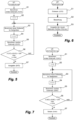
- the quantization subroutine is shown.
- the pre-optimized quality measure J(VO) is read in with the corresponding manipulated variables.
- those manipulated variables with original discrete setting values are discretized.
- This is done at S2 using corresponding threshold values with a hysteresis band.
- the hysteresis band prevents oscillating calculated values.
- other logic can be used which prevents rapid switching, for example, a time control.
- the new discrete manipulated variables SG(new) are output and fed into the main program of the Figure 4 returned.
- the re-optimisation sub-program is shown as a program flow chart.
- a re-optimised quality measure is determined from the operating situation of the internal combustion engine and the new discrete manipulated variables SG(new).
- the new discrete manipulated variables are not adjusted.
- a first quality measure J1(NA) of the re-optimisation is calculated using equation (1).
- a control variable i is set to zero.
- the initial values are changed and calculated as new target values for the manipulated variables.
- the control variable i is increased by one.
- a second quality measure J2(NA) of the re-optimisation is then forecast at S5 within the prediction horizon, for example for the next 8 seconds.
- the second quality measure J2(VO) is subtracted from the first quality measure J1(VO) and compared with a limit value GW.
- the further progress of the quality measure is checked by calculating the difference between the two quality measures. Alternatively, the number of times an optimization has already been run is checked by comparing the control variable i with a limit value iGW. The two limit value considerations therefore serve as a termination criterion for further optimization. If further optimization is possible, query result S6: no, the program branches back to point A. Otherwise, at S7 the optimizer outputs the second quality measure J2(VO) as the minimum quality measure J(min) and transfers it to the main program of the Figure 4 returned.
- the two Figures 8 and 9 show in a comparison the course of selected variables over time in seconds.
- the variables shown are: the variable valve timing VVT in degrees crankshaft angle, the start of injection SB in degrees before top dead center (TDC), the combustion pressure pZYL in the cylinder and the engine speed nMOT.
- the combustion pressure pZYL the maximum permissible combustion pressure pMAX is shown as a dashed line.
- On the left half of the drawing, these variables are shown when applying the previous optimization, while on the right half of the drawing, they are shown when applying the invention.
- the representation of the Figure 8 and the Figure 9 a gradually increasing target torque is used as the input variable. First, the variables are calculated according to the Figure 8 described.
- the optimizer calculates a pre-optimized quality measure based on the operating situation via pre-optimization.
- the discrete manipulated variables with discrete setting values are interpreted as continuous manipulated variables with a continuous setting range.
- VVT variable valve control
- the pre-optimized quality measure corresponds to a calculated start of injection SB and the corresponding cylinder pressure pZYL.
- the maximum value pMAX is maintained for the cylinder pressure pZYL.
- the manipulated variables result in an increasing engine speed nMOT during the observation period.
- the VVT curve shown corresponds to the curve after quantization. This clearly shows that, in contrast to the representation of the Figure 8 , the VVT curve shows only three discrete values, namely 450°, 495°, and 540° crankshaft angle.
- the advantage is that the VVT actuator can be controlled with just three values, which significantly reduces computational effort.
- the optimized quality measure is calculated from the VVT curve based on the operating situation of the internal combustion engine. Corresponding to this is the curve of the start of injection (SB) and the cylinder pressure (pZYL), which also remains below the maximum value (pMAX) in this case.
Landscapes
- Engineering & Computer Science (AREA)
- Chemical & Material Sciences (AREA)
- Combustion & Propulsion (AREA)
- Mechanical Engineering (AREA)
- General Engineering & Computer Science (AREA)
- Combined Controls Of Internal Combustion Engines (AREA)
- Electrical Control Of Air Or Fuel Supplied To Internal-Combustion Engine (AREA)
Description
- Die Erfindung betrifft ein Verfahren zur modellbasierten Steuerung und Regelung einer Brennkraftmaschine, bei dem von einem Optimierer ein Gütemaß berechnet und als maßgeblich für den Betriebspunkt der Brennkraftmaschine gesetzt wird.
- Das Verhalten einer Brennkraftmaschine wird maßgeblich über ein Motorsteuergerät in Abhängigkeit eines Leistungswunsches bestimmt. Hierzu sind in der Software des Motorsteuergeräts üblicherweise entsprechende Kennlinien und Kennfelder appliziert. Über diese werden aus dem Leistungswunsch die Stellgrößen der Brennkraftmaschine berechnet, zum Beispiel der Spritzbeginn und ein erforderlicher Raildruck. Mit Daten bestückt werden diese Kennlinien/Kennfelder beim Hersteller der Brennkraftmaschine auf einem Prüfstand. Die Vielzahl dieser Kennlinien/Kennfelder und die Korrelation der Kennlinien/Kennfelder untereinander verursachen allerdings einen hohen Abstimmungsaufwand.
- In der Praxis wird daher versucht den Abstimmungsaufwand durch die Verwendung von mathematischen Modellen zu reduzieren. So beschreibt zum Beispiel die
DE 10 2006 004 516 B3 ein Bayesnetz mit Wahrscheinlichkeitstabellen zur Festlegung einer Einspritzmenge und dieUS 2011/0172897 A1 ein Verfahren zur Adaption des Spritzbeginns sowie der Spritzmenge über Verbrennungsmodelle mittels neuronaler Netze. Da hierbei trainierten Daten abgebildet werden, müssen diese zuerst bei einem Prüfstandslauf gelernt werden. - Aus der
DE 10 2017 005 783 A1 ist ein Verfahren zur modellbasierten Steuerung und Regelung einer Brennkraftmaschine bekannt, bei dem über ein Verbrennungsmodell die Sollwerte für die Einspritzsystem-Stellglieder und über ein Gaspfadmodell die Sollwerte für die Gaspfad-Stellglieder berechnet werden. Sowohl das Verbrennungsmodell als auch das Gaspfadmodell basieren auf Gauß-Prozessmodellen. Aus den Sollwerten bestimmt ein Optimierer wiederum ein Gütemaß und prognostiziert wie sich das Gütemaß bei einer Veränderung der Sollwerte innerhalb eines Prädiktionshorizonts entwickeln würde. Ist das bestmögliche Gütemaß berechnet, so setzt der Optimierer die Einspritzsystem-Sollwerte und die Gaspfad-Sollwerte als maßgeblich für den Betriebspunkt der Brennkraftmaschine. - Aus der
WO 2018/234093 A1 ist ein Verfahren zur modellbasierten Steuerung und Regelung einer Brennkraftmaschine bekannt, die eine Optimierung aufweist. - Bei Prüfstandsversuchen hat es sich gezeigt, dass die Einbindung von Stellgrößen mit diskreten Schaltzuständen in das zuvor beschriebene modellbasierte Verfahren noch nicht zufriedenstellend ist. Unter Stellgrößen mit diskreten Schaltzuständen sind zum Beispiel die Zuschaltung des zweiten Abgasturboladers bei einer Registeraufladung, eine Zylinderbank-Abschaltung, die Aktivierung einer Vor- oder Nacheinspritzung und die Auf- oder Schließstellung diverser Klappen zu verstehen. Sogenannte Branch- und Boundverfahren zur optimalen Lösungsfindung bei diskreten Stellgrößen sind sehr rechenaufwendig, da im schlechtesten Fall alle kombinatorischen Möglichkeiten der diskreten Stellgrößen untersucht werden müssen. Deren Anwendung bei einer Brennkraftmaschine führt rasch zu sehr komplexen Strukturen, welche auf einem Motorsteuergerät nicht darstellbar sind.
- Der Erfindung liegt die Aufgabe zugrunde, das zuvor beschriebene modellbasierte Verfahren hinsichtlich der Einbindung von Stellgrößen zu verbessern.
- Gelöst wird diese Aufgabe durch die Merkmale von Anspruch 1. Die Ausgestaltungen sind in den Unteransprüchen dargestellt.
- Das Verfahren wird in drei Schritten ausgeführt. Im ersten Schritt berechnet der Optimierer in Abhängigkeit der Betriebssituation ein voroptimiertes Gütemaß, wobei die diskrete Stellgrößen mit diskreten Einstellwerten als kontinuierliche Stellgrößen mit einem kontinuierlichen Einstellbereich interpretiert werden. Das voroptimierte Gütemaß ist eine Rechengröße, das heißt, dieses wird nicht der Brennkraftmaschine aufgeschaltet. Im zweiten Schritt werden dann diese kontinuierlichen Stellgrößen quantisiert und als neue diskrete Stellgrößen mit diskreten Einstellwerten gesetzt. Die Quantisierung erfolgt anhand von Schaltschwellen nebst Hysterese. Schließlich wird dann im dritten Schritt vom Optimierer ein nachoptimiertes Gütemaß in Abhängigkeit der neuen diskreten Stellgrößen und der Betriebssituation der Brennkraftmaschine berechnet und als maßgeblich für den Betriebspunkt der Brennkraftmaschine gesetzt. Bei der Berechnung des nachoptimierten Gütemaßes werden allerdings die neuen diskreten Stellgröße als fest angenommen. Sie stellen insofern keinen Freiheitsgrad mehr für die Optimierung innerhalb des prädizierten Horizonts dar. Die übrigen kontinuierlichen Stellgrößen werden so reoptimiert, dass die Lösung bezüglich der fixierten neuen Stellgrößen bestmöglich ist.
- Unter Betriebssituation der Brennkraftmaschine sind sowohl die äußeren Rahmenbedingungen, insbesondere die Emissionsgrenzwerte oder der Leistungswunsch, als auch der aktuelle Betriebspunkt zu verstehen. Sowohl das voroptimierte Gütemaß als auch das nachoptimierte Gütemaß werden bestimmt, indem über das Verbrennungsmodell die Einspritzsystem-Sollwerte zur Ansteuerung der Einspritzsystem-Stellglieder, zum Beispiel der Soll-Raildruck, berechnet werden, über ein Gaspfadmodell die Gaspfad-Sollwerte zur Ansteuerung der Gaspfad-Stellglieder berechnet werden und anschließend vom Optimierer diese Sollwerte mit dem Ziel einer Minimumfindung verändert werden.
- Die Erfindung gestattet die Lösung von Optimierungsaufgaben mit teilweise wertkontinuierlichen und teilweise wertdiskreten Eingangsgrößen bei beschränkter Rechenkapazität für das verwendete Optimierungsverfahren. Anstelle einer parallelen Berechnung der Stellgrößen, wie es für die Umsetzung von Branch- and-BoundVerfahren erforderlich ist, verwendet die Erfindung eine serielle Methodik. Erst hierdurch können das Gütemaß und die hieraus sich ergebenden Werte für die Stellgrößen vollumfänglich auf einem Motorsteuergerät berechnet werden.
- In den Figuren ist ein bevorzugtes Ausführungsbeispiel dargestellt. Es zeigen:
- Fig. 1
- ein Systemschaubild,
- Fig. 2
- ein modellbasiertes Systemschaubild,
- Fig. 3
- ein Blockschaltbild,
- Fig. 4
- einen Programm-Ablaufplan,
- Fig. 5
- ein Unterprogramm,
- Fig. 6
- ein Unterprogramm,
- Fig. 7
- ein Unterprogramm,
- Fig. 8
- Zeitdiagramme und
- Fig. 9
- Zeitdiagramme.
- Die
Figur 1 zeigt ein Systemschaubild einer elektronisch gesteuerten Brennkraftmaschine 1 mit einem Common-Railsystem. Das Common-Railsystem umfasst folgende mechanische Komponenten: eine Niederdruckpumpe 3 zur Förderung von Kraftstoff aus einem Kraftstofftank 2, eine veränderbare Saugdrossel 4 zur Beeinflussung des durchströmenden Kraftstoff-Volumenstroms, eine Hochdruckpumpe 5 zur Förderung des Kraftstoffs unter Druckerhöhung, ein Rail 6 zum Speichern des Kraftstoffs und Injektoren 7 zum Einspritzen des Kraftstoffs in die Brennräume der Brennkraftmaschine 1. Optional kann das Common-Railsystem auch mit Einzelspeichern ausgeführt sein, wobei dann zum Beispiel im Injektor 7 ein Einzelspeicher 8 als zusätzliches Puffervolumen integriert ist. Die weitere Funktionalität des Common-Railsystem wird als bekannt vorausgesetzt. Der dargestellte Gaspfad umfasst sowohl die Luftzuführung als auch die Abgasabführung. In der Luftzuführung sind angeordnet: der Verdichter eines Abgasturboladers 11, eine Ladeluftkühler 12, eine Drosselklappe 13, eine Einmündungsstelle 14 zur Zusammenführung der Ladeluft mit dem rückgeführten Abgas und ein variabel ansteuerbares Einlassventil 15. In der Abgasführung sind angeordnet: ein variabel ansteuerbares Auslassventil 16, ein AGR-Stellglied 17, die Turbine des Abgasturboladers 11 und ein Turbinen-Bypassventil 18. - Die Betriebsweise der Brennkraftmaschine 1 wird durch ein elektronisches Steuergerät 10 (ECU) bestimmt. Das elektronische Steuergerät 10 beinhaltet die üblichen Bestandteile eines Mikrocomputersystems, beispielsweise einen Mikroprozessor, I/O-Bausteine, Puffer und Speicherbausteine (EEPROM, RAM). In den Speicherbausteinen sind die für den Betrieb der Brennkraftmaschine 1 relevanten Betriebsdaten als Modelle appliziert. Über diese berechnet das elektronische Steuergerät 10 aus den Eingangsgrößen die Ausgangsgrößen. In der
Figur 1 sind exemplarisch folgende Eingangsgrößen dargestellt: Ein Sollmoment M(SOLL), welches von einem Bediener vorgegeben wird, der Ist-Raildruck pCR, der mittels eines Rail-Drucksensors 9 gemessen wird, die Motordrehzahl nIST, der Ladeluftdruck pLL, die Ladelufttemperatur TLL, die Feuchte phi der Ladeluft, die Abgastemperatur TAbgas, das Luft-Kraftstoffverhältnis Lambda, der NOx-Istwert, optional der Druck pES des Einzelspeichers 8 und eine Eingangsgröße EIN. Unter der Eingangsgröße EIN sind die weiteren nicht dargestellten Sensorsignale zusammengefasst, beispielsweise die Kühlmitteltemperaturen. InFigur 1 sind als Ausgangsgrößen des elektronischen Steuergeräts 10 dargestellt: ein Signal PWM zur Ansteuerung der Saugdrossel 4, ein Signal ve zur Ansteuerung der Injektoren 7 (Spritzbeginn/ Spritzende), ein Stellsignal DK zur Ansteuerung der Drosselklappe 13, ein Stellsignal VVT zur Ansteuerung des Einlass- bzw. Auslassventils, ein Stellsignal AGR zur Ansteuerung des AGR-Stellglieds 17, ein Stellsignal TBP zur Ansteuerung des Turbinen-Bypassventils 18 und eine Ausgangsgröße AUS. Die Ausgangsgröße AUS steht stellvertretend für die weiteren Stellsignale zur Steuerung und Regelung der Brennkraftmaschine 1, beispielsweise für ein Stellsignal zur Aktivierung eines zweiten Abgasturboladers bei einer Registeraufladung. Bei der Darstellung derFigur 1 sind beispielsweise die Drosselklappe 13, das AGR-Stellglied 17, das Turbinen-Bypassventil 18 oder die Saudrossel 4 mit einem kontinuierlichen Stellsignal ansteuerbar und sind daher in einem kontinuierlichen Wertebereich einstellbar. Eine diskrete Stellgröße wäre hingegen das Stellsignal zur Aktivierung eines zweiten Abgasturboladers, da dieses Stellsignal nur einzelne diskrete Werte annehmen kann, Zwischenwerte also nicht existieren. - Die
Figur 2 zeigt ein modellbasiertes Systemschaubild. Bei dieser Darstellung sind innerhalb des elektronischen Steuergeräts 10 ein Verbrennungsmodell 19, ein Gaspfadmodell 20 und ein Optimierer 21 aufgeführt. Sowohl das Verbrennungsmodell 19 als auch das Gaspfadmodell 20 bilden das Systemverhalten der Brennkraftmaschine als mathematische Gleichungen ab, beispielsweise in Form von Gauß-Prozessmodellen. Das Verbrennungsmodell 19 bildet statisch die Vorgänge bei der Verbrennung ab. Im Unterschied hierzu bildet das Gaspfadmodell 20 das dynamische Verhalten der Luftführung und der Abgasführung ab. Das Verbrennungsmodell 19 beinhaltet Einzelmodelle zum Beispiel für die NOx- und Rußentstehung, für die Abgastemperatur, für den Abgasmassenstrom und für den Spitzendruck. Diese Einzelmodelle wiederum sind abhängig von den Randbedingungen im Zylinder und den Parametern der Einspritzung. Bestimmt wird das Verbrennungsmodell 19 bei einer Referenz-Brennkraftmaschine in einem Prüfstandslauf, dem sogenannte DoE-Prüfstandslauf (DoE: Design of Experiments). Beim DoE-Prüfstandslauf werden systematisch Betriebsparameter und Stellgrößen mit dem Ziel variiert, das Gesamtverhalten der Brennkraftmaschine in Abhängigkeit von motorischen Größen und Umweltrandbedingungen abzubilden. Der Optimierer 21 wertet das Verbrennungsmodell 19 aus und zwar hinsichtlich des Sollmoments M(SOLL), der Emissionsgrenzwerte, der Umweltrandbedingungen, zum Beispiel die Feuchte phi der Ladeluft, und der Betriebssituation der Brennkraftmaschine. Definiert wird die Betriebssituation durch die Motordrehzahl nIST, die Ladelufttemperatur TLL, den Ladeluftdruck pLL usw.. Die Funktion des Optimierers 21 besteht nun darin die Einspritzsystem-Sollwerte zur Ansteuerung der Einspritzsystem-Stellglieder und die Gaspfad-Sollwerte zur Ansteuerung der Gaspfad-Stellglieder zu bewerten. Hierbei wählt der Optimierer 21 diejenige Lösung aus, bei der ein Gütemaß minimiert wird. Berechnet wird das Gütemaß als Integral der quadratischen Soll-Istabweichungen innerhalb des Prädiktionshorizonts. Beispielsweise in der Form:
- Hierin bedeuten w1, w2 und w3 einen entsprechenden Gewichtungsfaktor. Bekanntermaßen ergeben sich die Stickoxidemission aus der Feuchte phi der Ladeluft, der Ladelufttemperatur TLL, dem Spritzbeginn SB und dem Raildruck pCR.
- Vom Optimierer 21 wird das bestmögliche Gütemaß über Minimumfindung ermittelt, indem zu einem ersten Zeitpunkt ein erstes Gütemaß berechnet wird, die Einspritzsystem-Sollwerte sowie die Gaspfad-Sollwerte variiert werden und anhand dieser ein zweites Gütemaß innerhalb des Prädiktionshorizonts prognostiziert wird. Anhand der Abweichung der beiden Gütemaße zueinander legt dann der Optimierer 21 ein minimales Gütemaß fest und setzt dieses als maßgeblich für die Brennkraftmaschine. Für das in der Figur dargestellte Beispiel ist dies für das Einspritzsystem der Soll-Raildruck pCR(SL). Der Soll-Raildruck pCR(SL) ist die Führungsgröße für den unterlagerten Raildruck-Regelkreis 22. Die Stellgröße des Raildruck-Regelkreises 22 entspricht dem PWM-Signal zu Beaufschlagung der Saugdrossel. Für den Gaspfad bestimmt der Optimierer 21 mittelbar die Gaspfad-Sollwerte. Bei dem dargestellten Beispiel sind dies ein Lambda-Sollwert LAM(SL) und ein AGR-Sollwert AGR(SL) zur Vorgabe für die beiden unterlagerten Regelkreise 23 und 24. Die rückgeführten Messgrößen MESS werden vom elektronischen Steuergerät 10 eingelesen. Unter den Messgrößen MESS sind sowohl unmittelbar gemessene physikalische Größen als auch daraus berechnete Hilfsgrößen zu verstehen. Bei dem dargestellten Beispiel werden der Lambda-Istwert LAM(IST) und der AGR-Istwert AGR(IST) eingelesen. Mit dem Bezugszeichen SG sind die Stellgrößen der Brennkraftmaschine zusammengefasst. Hierunter fallen sowohl die kontinuierlichen Stellgrößen mit einem kontinuierlichen Einstellbereich als auch die diskreten Stellgrößen mit diskreten Einstellwerten. Kontinuierliche Stellgrößen können zwischen einem minimalen und maximalen Wert stufenlos verstellt werden, beispielsweise der Spritzbeginn und das Spritzende mit welchen der Injektor (
Fig. 1 : 7) unmittelbar beaufschlagt wird. Diskrete Stellgrößen mit diskreten Einstellwerten können nur gestuft in Festwerten eingestellt werden, beispielweise eine Zylinderabschaltung. - Die
Figur 3 zeigt ein Blockschaltbild mit der Betriebssituation BS der Brennkraftmaschine als Eingangsgröße und dem Gütemaß als Ausgangsgröße, hier als nachoptimiertes Gütemaß J(NA) bezeichnet. Innerhalb des Blockschaltbilds sind eine Voroptimierung 25, eine Quantisierung 26 und eine Nachoptimierung 27, dargestellt. In einem ersten Schritt wird über die Voroptimierung 25 ein voroptimiertes Gütemaß J(VO) berechnet, bei dem die diskreten Stellgrößen mit diskreten Einstellwerten als kontinuierliche Stellgrößen mit einem kontinuierlich Einstellbereich interpretiert werden. - Ein Beispiel für eine diskrete Stellgröße ist die Voreinspritzung, welche nur aktiviert oder deaktiviert sein kann. Durch den Einsatz der Voreinspritzung kann der Spitzendruck der Verbrennung deutlich abgesenkt werden. Daneben ändern sich bei aktivierter Voreinspritzung aber auch alle andere Verbrennungsgrößen wie beispielsweise die NOx-Emission oder die Partikelanzahl. Die Brennkraftmaschine wird einmal mit aktivierter Voreinspritzung und einmal mit deaktivierter Voreinspritzung vermessen. Damit ergeben sich zwei separate Verbrennungsmodelle. Bei der Berechnung des voroptimierten Gütemaßes J(VO) werden vom Optimierer Zwischenwerte interpoliert, dies bedeutet, dass durch die Interpolation zwischen diesen beiden Verbrennungsmodellen der Zustand Voreinspritzung aktiviert oder deaktiviert künstlich in eine kontinuierliche Eingangsgröße gewandelt werden. In der Voroptimierung 25 wird dann diese Größe kontinuierlich verwendet. In der
Figur 3 sind diese kontinuierlichen Stellgrößen als SG(k) bezeichnet. Das voroptimierte Gütemaß J(VO) ist eine rein interne Rechengröße, welches keinen Zugriff auf die Stellglieder der Brennkraftmaschine hat. Mit anderen Worten: das voroptimierte Gütemaß J(VO) ist zugriffsfrei und wird der Brennkraftmaschine nicht aufgeschaltet. In einem zweiten Schritt werden über die Quantisierung 26 neue diskrete Stellgrößen SG(neu) aus den kontinuierlichen Stellgrößen SG(k) berechnet. Für die Voreinspritzung wird folglich in der Quantisierung wieder eine feste Zuordnung zu Voreinspritzung aktiviert oder Voreinspritzung deaktiviert vorgenommen. Die Quantisierung 26 bietet den Vorteil, dass zum Beispiel die variable Ventilsteuerung auf drei diskrete Werte, nämlich Minimum, Mittelwert und Maximum festgelegt werden, zum Beispiel 450°, 495° und 540° Kurbelwellenwinkel. Dies reduziert im erheblichen Maße den Rechenaufwand bei der nachfolgenden Bestimmung des nachoptimierten Gütemaßes. Bei der Quantisierung 26 werden zudem die berechneten Werte über optionale Hysteresebänder stabilisiert. In einem dritten Schritt werden die neuen diskreten Stellgrößen SG(neu) und die Betriebssituation zusammengeführt und vom Optimierer ein nachoptimiertes Gütemaß J(NA) berechnet. Bei der Berechnung des nachoptimierten Gütemaßes J(NA) werden die neuen diskreten Stellgrößen SG(neu) nicht verändert. Insofern sind diese kein Freiheitsgrad bei der Berechnung des nachoptimierten Gütemaßes J(NA). In der Nachoptimierung werden die tatsächlich kontinuierlichen Stellgrößen an den aus der Quantisierung vorgegebenen Verlauf zum Beispiel der Voreinspritzung angepasst. Mit anderen Worten: Bei der Nachoptimierung werden die Stellgrößen variiert, die auch real durch kontinuierliche Stellgrößen beschrieben werden. Das nachoptimierte Gütemaß J(NA) entspricht dem minimalen Gütemaß J(min), welches vom Optimierer als maßgeblich für den Betriebspunkt der Brennkraftmaschine (1) gesetzt wird, also der Brennkraftmaschine aufgeschaltet wird. - In der
Figur 4 ist das Verfahren in einem Programm-Ablaufplan dargestellt. Nach der Initialisierung bei S1 wird bei S2 geprüft, ob der Startvorgang beendet ist. Läuft dieser noch, Abfrageergebnis S2: nein, wird zum Punkt A zurückverzweigt. Ist der Startvorgang beendet, so wird bei S3 die Betriebssituation der Brennkraftmaschine erfasst. Definiert wird die Betriebssituation durch die Motordrehzahl nIST, die Ladelufttemperatur TLL, den Ladeluftdruck pLL usw.. Bei S4 wird das Unterprogramm Optimierer aufgerufen und die Anfangswerte, zum Beispiel der Spritzbeginn, bei S5 erzeugt. Bei den Schritten S6 bis S8 werden nacheinander die Unterprogramm Voroptimierung, Quantisierung und Nachoptimierung aufgerufen. Diese Unterprogramme werden in Verbindung mit denFiguren 5 bis 7 beschrieben. Das im Unterprogramm Nachoptimierung berechnete nachoptimierte Gütemaß wird als minimiertes Gütemaß J(min) gesetzt, welches den Betriebspunkt der Brennkraftmaschine bestimmt. Im Anschluss daran wird bei S10 geprüft, ob ein Motorstopp initiiert wurde. Ist dies nicht der Fall, Abfrageergebnis S10: nein, wird zum Punkt B zurückverzweigt. Anderenfalls ist der Programm-Ablaufplan beendet. - In der
Figur 5 ist das Unterprogramm Voroptimierung als Programm-Ablaufplan dargestellt. Bei S1 wird ein erstes Gütemaß J1(VO) der Voroptimierung anhand der Gleichung (1) berechnet. Wesentliches Merkmal ist hierbei, dass bei der Berechnung des ersten Gütemaßes J1(VO) neben den kontinuierlichen Stellgrößen mit einem kontinuierlichen Stellbereich, die diskreten Stellgrößen mit diskreten Werten über Interpolation als kontinuierliche Stellgrößen interpretiert werden. Bei S2 wird eine Laufvariable i auf null gesetzt. Danach werden bei S3 die Anfangswerte verändert und als neue Sollwerte für die Stellgrößen berechnet. Bei S4 wird die Laufvariable i um eins erhöht. Anhand der neuen Sollwerte wird dann bei S5 ein zweites Gütemaß J2(VO) der Voroptimierung innerhalb des Prädiktionshorizonts, zum Beispiel für die nächsten 8 Sekunden, prognostiziert. Bei S6 wird das zweite Gütemaß J2(VO) vom ersten Gütemaß J1(VO) subtrahiert und mit einem Grenzwert GW verglichen. Über die Differenzbildung der beiden Gütemaße wird der weitere Fortschritt des Gütemaßes abgeprüft. Alternativ wird anhand des Vergleichs der Laufvariablen i mit einem Grenzwert iGW geprüft, wie oft bereits eine Optimierung durchlaufen wurde. Die beiden Grenzwertbetrachtungen sind insofern ein Abbruchkriterium für eine weitere Optimierung. Ist eine weitere Optimierung möglich, Abfrageergebnis S6: nein, so wird zum Punkt A zurück verzweigt. Anderenfalls wird bei S7 vom Optimierer das zweite Gütemaß J2(VO) als voroptimiertes Gütemaß J(VO) zusammen mit den dabei berechneten Stellgrößen ausgegeben und in das Hauptprogramm derFigur 4 zurückgekehrt. Das voroptimierte Gütemaß J(VO) ist eine reine Rechengröße, das heißt, vom Optimierer werden die berechneten Einspritzsystem-Sollwerte, die berechneten Gaspfad-Sollwerte und die berechneten Stellgrößen nicht der Brennkraftmaschine aufgeschaltet. - In der
Figur 6 ist das Unterprogramm Quantisierung dargestellt. Bei S1 wird das voroptimierte Gütemaß J(VO) mit den zugehörigen Stellgrößen eingelesen. Anschließend werden diejenigen Stellgrößen mit ursprünglichen diskreten Einstellwerten diskretisiert. Dies erfolgt bei S2 anhand von entsprechenden Schwellwerten mit einem Hystereseband. Über das Hystereseband werden pendelnde Berechnungswerte vermieden. Anstelle eines Hysteresebands lassen sich auch andere Logiken verwenden, welche ein schnelles Umschalten verhindern, zum Beispiel eine Zeitsteuerung. Danach werden bei S3 die neuen diskreten Stellgrößen SG(neu) ausgegeben und in das Hauptprogramm derFigur 4 zurückgekehrt. - In der
Figur 7 ist das Unterprogramm Nachoptimierung als Programm-Ablaufplan dargestellt. Über das Unterprogramm Nachoptimierung wird ein nachoptimiertes Gütemaß aus der Betriebssituation der Brennkraftmaschine und den neuen diskreten Stellgrößen SG(neu) bestimmt. Bei der Berechnung des nachoptimierten Gütemaßes werden die neuen diskreten Stellgrößen nicht nachgeführt. Bei S1 wird ein erstes Gütemaß J1(NA) der Nachoptimierung anhand der Gleichung (1) berechnet. Bei S2 wird eine Laufvariable i auf null gesetzt. Danach werden bei S3 die Anfangswerte verändert und als neue Sollwerte für die Stellgrößen berechnet. Bei S4 wird die Laufvariable i um eins erhöht. Anhand der neuen Sollwerte wird dann bei S5 ein zweites Gütemaß J2(NA) der Nachoptimierung innerhalb des Prädiktionshorizonts, zum Beispiel für die nächsten 8 Sekunden, prognostiziert. Bei S6 wird das zweite Gütemaß J2(VO) vom ersten Gütemaß J1(VO) subtrahiert und mit einem Grenzwert GW verglichen. Über die Differenzbildung der beiden Gütemaße wird der weitere Fortschritt des Gütemaßes abgeprüft. Alternativ wird anhand des Vergleichs der Laufvariablen i mit einem Grenzwert iGW geprüft, wie oft bereits eine Optimierung durchlaufen wurde. Die beiden Grenzwertbetrachtungen sind insofern ein Abbruchkriterium für eine weitere Optimierung. Ist eine weitere Optimierung möglich, Abfrageergebnis S6: nein, so wird zum Punkt A zurück verzweigt. Anderenfalls wird bei S7 vom Optimierer das zweite Gütemaß J2(VO) als minimales Gütemaß J(min) ausgegeben und in das Hauptprogramm derFigur 4 zurückgekehrt. - Die beiden
Figuren 8 und 9 zeigen in einer Gegenüberstellung den Verlauf von ausgewählten Größen über der Zeit in Sekunden. Dargestellte Größen sind: die variabel Ventilsteuerung VVT in Grad Kurbelwellenwinkel, der Spritzbeginn SB in Grad vor dem oberen Totpunkt (OT), der Verbrennungsdruck pZYL im Zylinder und die Motordrehzahl nMOT. Für den Verbrennungsdruck pZYL ist ergänzend der maximal zulässige Verbrennungsdruck pMAX als gestrichelte Linie eingezeichnet. Auf der linken Zeichnungsblatthälfte sind diese Größen bei Anwendung der bisherigen Optimierung dargestellt, während auf der rechten Zeichnungsblatthälfte diese Größen bei Anwendung der Erfindung dargestellt sind. Der Darstellung derFigur 8 und derFigur 9 ist ein stufenförmig ansteigendes Soll-Moment als Eingangsgröße zugrunde gelegt. Zunächst werden die Größen gemäß derFigur 8 beschrieben. In einem ersten Schritt wird vom Optimierer anhand der Betriebssituation über die Voroptimierung ein voroptimiertes Gütemaß berechnet. Bei dieser Berechnung werden die diskrete Stellgrößen mit diskreten Einstellwerten als kontinuierliche Stellgrößen mit einem kontinuierlichen Einstellbereich interpretiert. Für die variable Ventilsteuerung VVT ergibt sich dabei über den kompletten Zeitbereich ein kontinuierlicher Verlauf mit beliebigen Zwischenwerten. Für das VVT-Stellglied zur Ansteuerung des variablen Ventils mit drei definierten Stellerpositionen ist ein solcher Verlauf aber nicht darstellbar. Zum voroptimierten Gütemaß korrespondieren ein berechneter Spritzbeginn SB und der entsprechende Zylinderdruck pZYL. Beim Zylinderdruck pZYL wird der maximale Wert pMAX eingehalten. Aus den Stellgröße resultiert eine ansteigende Motordrehzahl nMOT im Betrachtungszeitraum. Nachfolgend wird dieFigur 9 beschrieben. Der dargestellte VVT-Verlauf entspricht dem Verlauf nach der Quantisierung. Hierbei wird deutlich, dass im Unterschied zur Darstellung derFigur 8 , der VVT-Verlauf nur drei diskrete Werte zeigt, nämlich 450°, 495° und 540° Kurbelwellenwinkel. Von Vorteil ist, dass das VVT-Stellglied mit lediglich drei Werten angesteuert werden kann, wodurch sich der Rechenaufwand deutlich reduziert. Aus dem VVT-Verlauf wird anhand der Betriebssituation der Brennkraftmaschine das nachoptimierte Gütemaß berechnet. Zu diesem korrespondiert der Verlauf des Spritzbeginns SB und der Zylinderdruck pZYL, der auch in diesem Fall unterhalb des maximalen Werts pMAX bleibt. -
- 1
- Brennkraftmaschine
- 2
- Kraftstofftank
- 3
- Niederdruckpumpe
- 4
- Saugdrossel
- 5
- Hochdruckpumpe
- 6
- Rail
- 7
- Injektor
- 8
- Einzelspeicher
- 9
- Rail-Drucksensor
- 10
- Elektronisches Steuergerät
- 11
- Abgasturbolader
- 12
- Ladeluftkühler
- 13
- Drosselklappe
- 14
- Einmündungsstelle
- 15
- Einlassventil, variabel ansteuerbar
- 16
- Auslassventil, variabel ansteuerbar
- 17
- AGR-Stellglied (AGR: Abgasrückführung)
- 18
- Turbinen-Bypassventil
- 19
- Verbrennungsmodell
- 20
- Gaspfadmodell
- 21
- Optimierer
- 22
- Raildruck-Regelkreis
- 23
- Lambda-Regelkreis
- 24
- AGR-Regelkreis
- 25
- Voroptimierung
- 26
- Quantisierung
- 27
- Nachoptimierung
Claims (5)
- Verfahren zur modellbasierten Steuerung und Regelung einer Brennkraftmaschine (1), bei dem von einem Optimierer (21) in einem ersten Schritt ein voroptimiertes Gütemaß (J(VO)) in Abhängigkeit der Betriebssituation (BS) berechnet wird, wobei bei der Berechnung des voroptimierten Gütemaßes (J(VO)) neben weiteren kontinuierlichen Stellgrößen mit einem kontinuierlichen Stellbereich diskrete Stellgrößen mit diskreten Einstellwerten als kontinuierliche Stellgrößen (SG(k)) mit einem kontinuierlichen Einstellbereich interpretiert werden, bei dem in einem zweiten Schritt diese kontinuierlichen Stellgrößen (SG(k)) quantisiert und als neue diskrete Stellgrößen (SG(neu)) mit diskreten Einstellwerten gesetzt werden, bei dem vom Optimierer (21) in einem dritten Schritt ein nachoptimiertes Gütemaß (J(NA)) in Abhängigkeit der neuen diskreten Stellgrößen (SG(neu)) und der Betriebssituation (BS) der Brennkraftmaschine (1) berechnet wird, wobei die neuen diskreten Stellgrößen (SG(neu)) als fest angenommen und die weiteren kontinuierlichen Stellgrößen reoptimiert werden, und vom Optimierer (21) das nachoptimierte Gütemaß (J(NA)) als maßgeblich für den Betriebspunkt der Brennkraftmaschine (1) gesetzt wird.
- Verfahren nach Anspruch 1, dadurch gekennzeichnet, dass das voroptimierte Gütemaß (J(VO)) bestimmt wird, indem über ein Verbrennungsmodell (19) Einspritzsystem-Sollwerte zur Ansteuerung von Einspritzsystem-Stellgliedern berechnet werden, indem über ein Gaspfadmodell (20) Gaspfad-Sollwerte zur Ansteuerung von Gaspfad-Stellgliedern berechnet werden und indem die kontinuierlichen Stellgrößen (SG(k)) über Interpolation aus den diskreten Einstellwerten der diskreten Stellgrößen berechnet werden.
- Verfahren nach Anspruch 2, dadurch gekennzeichnet, dass das voroptimierte Gütemaß (J(VO)) der Brennkraftmaschine (1) nicht aufgeschaltet wird.
- Verfahren nach Anspruch 3, dadurch gekennzeichnet, dass im zweiten Schritt die kontinuierlichen Stellgrößen (SG(k)) über Schaltschwellen nebst Hysterese quantisiert werden.
- Verfahren nach Anspruch 1, dadurch gekennzeichnet, dass das nachoptimierte Gütemaß (J(NA)) im dritten Schritt bestimmt wird, indem über das Verbrennungsmodell (19) Einspritzsystem-Sollwerte zur Ansteuerung von Einspritzsystem-Stellgliedern berechnet werden, über das Gaspfadmodell (20) Gaspfad-Sollwerte zur Ansteuerung von Gaspfad-Stellgliedern berechnet werden und indem vom Optimierer (21) die Einspritzsystem-Sollwerte und die Gaspfad-Sollwerte bei konstanten neuen diskreten Stellgrößen (SG(neu)) mit dem Ziel einer Minimumfindung innerhalb eines Prädiktionshorizonts verändert werden.
Applications Claiming Priority (2)
| Application Number | Priority Date | Filing Date | Title |
|---|---|---|---|
| DE102020003174.9A DE102020003174B4 (de) | 2020-05-27 | 2020-05-27 | Verfahren zur modellbasierten Steuerung und Regelung einer Brennkraftmaschine |
| PCT/EP2021/063945 WO2021239752A1 (de) | 2020-05-27 | 2021-05-25 | Verfahren zur modellbasierten steuerung und regelung einer brennkraftmaschine |
Publications (2)
| Publication Number | Publication Date |
|---|---|
| EP4158176A1 EP4158176A1 (de) | 2023-04-05 |
| EP4158176B1 true EP4158176B1 (de) | 2025-05-14 |
Family
ID=76250316
Family Applications (1)
| Application Number | Title | Priority Date | Filing Date |
|---|---|---|---|
| EP21729461.0A Active EP4158176B1 (de) | 2020-05-27 | 2021-05-25 | Verfahren zur modellbasierten steuerung und regelung einer brennkraftmaschine |
Country Status (5)
| Country | Link |
|---|---|
| US (1) | US11788484B2 (de) |
| EP (1) | EP4158176B1 (de) |
| CN (1) | CN115720605B (de) |
| DE (1) | DE102020003174B4 (de) |
| WO (1) | WO2021239752A1 (de) |
Families Citing this family (3)
| Publication number | Priority date | Publication date | Assignee | Title |
|---|---|---|---|---|
| DE102020000327B4 (de) * | 2020-01-21 | 2024-06-27 | Rolls-Royce Solutions GmbH | Verfahren zur modellbasierten Steuerung und Regelung einer Brennkraftmaschine |
| GB2615843B (en) * | 2022-05-26 | 2024-12-04 | Secondmind Ltd | Engine control unit calibration |
| DE102024113785A1 (de) * | 2024-05-16 | 2025-11-20 | Bayerische Motoren Werke Aktiengesellschaft | Verfahren zum Betreiben einer Verbrennungskraftmaschine eines Kraftfahrzeugs |
Family Cites Families (8)
| Publication number | Priority date | Publication date | Assignee | Title |
|---|---|---|---|---|
| DE102006004516B3 (de) | 2006-02-01 | 2007-03-08 | Mtu Friedrichshafen Gmbh | Bayes-Netz zur Steuerung und Regelung einer Brennkraftmaschine |
| JP5006947B2 (ja) | 2010-01-14 | 2012-08-22 | 本田技研工業株式会社 | プラントの制御装置 |
| JP2016528817A (ja) * | 2013-08-01 | 2016-09-15 | 華為技術有限公司Huawei Technologies Co.,Ltd. | アップリンク電力制御方法およびその装置 |
| DE102017005783B4 (de) * | 2017-06-20 | 2021-12-02 | Mtu Friedrichshafen Gmbh | Verfahren zur modellbasierten Steuerung und Regelung einer Brennkraftmaschine |
| DE102017114731A1 (de) * | 2017-06-30 | 2019-01-03 | Technische Universität Dortmund | Verfahren zum regeln eines mechatronischen systems, regelungseinheit für ein mechatronisches system und mechatronisches system |
| DE102017009582B3 (de) | 2017-10-16 | 2018-07-26 | Mtu Friedrichshafen Gmbh | Verfahren zur modellbasierten Steuerung und Regelung einer Brennkraftmaschine |
| DE102018001727B4 (de) | 2018-03-05 | 2021-02-11 | Mtu Friedrichshafen Gmbh | Verfahren zur modellbasierten Steuerung und Regelung einer Brennkraftmaschine |
| US10550786B1 (en) | 2018-10-02 | 2020-02-04 | GM Global Technology Operations LLC | Predictive torque management for powertrain having continuous actuators and multiple discrete modes |
-
2020
- 2020-05-27 DE DE102020003174.9A patent/DE102020003174B4/de active Active
-
2021
- 2021-05-25 CN CN202180038060.0A patent/CN115720605B/zh active Active
- 2021-05-25 WO PCT/EP2021/063945 patent/WO2021239752A1/de not_active Ceased
- 2021-05-25 EP EP21729461.0A patent/EP4158176B1/de active Active
-
2022
- 2022-11-23 US US17/993,578 patent/US11788484B2/en active Active
Also Published As
| Publication number | Publication date |
|---|---|
| CN115720605A (zh) | 2023-02-28 |
| DE102020003174A1 (de) | 2021-12-02 |
| US11788484B2 (en) | 2023-10-17 |
| DE102020003174B4 (de) | 2022-03-24 |
| CN115720605B (zh) | 2025-04-11 |
| EP4158176A1 (de) | 2023-04-05 |
| US20230093283A1 (en) | 2023-03-23 |
| WO2021239752A1 (de) | 2021-12-02 |
Similar Documents
| Publication | Publication Date | Title |
|---|---|---|
| EP3762597B1 (de) | Verfahren zur modellbasierten steuerung und regelung einer brennkraftmaschine | |
| DE102017009582B3 (de) | Verfahren zur modellbasierten Steuerung und Regelung einer Brennkraftmaschine | |
| EP3698032B1 (de) | Verfahren zur modellbasierten steuerung und regelung einer brennkraftmaschine | |
| DE112007003300T5 (de) | Dynamische Steuerung eines homogen kompressionsgezündeten Verbrennungsmotors | |
| DE102020003174B4 (de) | Verfahren zur modellbasierten Steuerung und Regelung einer Brennkraftmaschine | |
| WO2018234093A1 (de) | Verfahren zur modellbasierten steuerung und regelung einer brennkraftmaschine | |
| DE102004026405B4 (de) | Verfahren zum Betreiben einer Brennkraftmaschine | |
| EP3599359B1 (de) | Verfahren zum steuern und/oder regeln des betriebs eines verbrennungsmotors, insbesondere eines verbrennungsmotors eines kraftfahrzeugs, insbesondere zumindest teilweise arbeitend nach dem miller-verfahren | |
| DE60013540T2 (de) | Verfahren und Einrichtung zur Einlassluftsteuerung mit variabler Ventilsteuerung | |
| EP3155247B1 (de) | Verfahren und steuereinheit zum ausführen eines gaswechsels in einem zylinder einer verbrennungskraftmaschine sowie verbrennungskraftmaschine mit einer solchen steuereinheit | |
| DE102007025077A1 (de) | Verfahren zum Betreiben einer Brennkraftmaschine | |
| DE102007007945A1 (de) | Verfahren zum Einstellen einer Abgasrückführrate einer Brennkraftmaschine | |
| EP3833860A1 (de) | Verfahren zur modellbasierten steuerung und regelung einer brennkraftmaschine | |
| DE10234719B3 (de) | Verfahren zur Füllungsregelung einer Brennkraftmaschine | |
| WO2021037643A1 (de) | Verfahren zur modellbasierten steuerung und regelung einer brennkraftmaschine | |
| EP3784892B1 (de) | Verfahren zum betreiben eines verbrennungsmotors | |
| WO2018046212A1 (de) | Verfahren und vorrichtung zur steuerung der nach einem gaswechselvorgang im zylinder einer brennkraftmaschine verbleibenden restgasmasse und/oder der während eines gaswechselvorgangs in den abgaskrümmer der brennkraftmaschine gespülten spülluftmasse | |
| EP4111044A1 (de) | Verfahren zur modellbasierten steuerung und regelung einer brennkraftmaschine | |
| WO2004055345A1 (de) | Verfahren zum steuern eines umschaltvorganges einer brennkraftmaschine | |
| WO2018158089A1 (de) | Verfahren und vorrichtung zur steuerung eines von einem abgasturbolader aufgeladenen verbrennungsmotors | |
| WO2018158076A1 (de) | Verfahren und vorrichtung zur ventilhubumschaltsteuerung eines verbrennungsmotors | |
| DE102024209127A1 (de) | Verfahren zum Betreiben einer Brennkraftmaschine mit gasförmigem Brennstoff, sowie Computerprogrammprodukt und Steuergerät | |
| DE102024107285A1 (de) | Steuerungseinrichtung und Steuerungsverfahren für Brennkraftmaschine | |
| DE102015216099A1 (de) | Verfahren und Vorrichtung zum Betreiben eines Verbrennungsmotors mit Abgasrückführung | |
| DE102015214363A1 (de) | Verfahren zum Bearbeiten von Sensorsignalen |
Legal Events
| Date | Code | Title | Description |
|---|---|---|---|
| STAA | Information on the status of an ep patent application or granted ep patent |
Free format text: STATUS: UNKNOWN |
|
| STAA | Information on the status of an ep patent application or granted ep patent |
Free format text: STATUS: THE INTERNATIONAL PUBLICATION HAS BEEN MADE |
|
| PUAI | Public reference made under article 153(3) epc to a published international application that has entered the european phase |
Free format text: ORIGINAL CODE: 0009012 |
|
| STAA | Information on the status of an ep patent application or granted ep patent |
Free format text: STATUS: REQUEST FOR EXAMINATION WAS MADE |
|
| 17P | Request for examination filed |
Effective date: 20230102 |
|
| AK | Designated contracting states |
Kind code of ref document: A1 Designated state(s): AL AT BE BG CH CY CZ DE DK EE ES FI FR GB GR HR HU IE IS IT LI LT LU LV MC MK MT NL NO PL PT RO RS SE SI SK SM TR |
|
| P01 | Opt-out of the competence of the unified patent court (upc) registered |
Effective date: 20230531 |
|
| DAV | Request for validation of the european patent (deleted) | ||
| DAX | Request for extension of the european patent (deleted) | ||
| GRAP | Despatch of communication of intention to grant a patent |
Free format text: ORIGINAL CODE: EPIDOSNIGR1 |
|
| STAA | Information on the status of an ep patent application or granted ep patent |
Free format text: STATUS: GRANT OF PATENT IS INTENDED |
|
| INTG | Intention to grant announced |
Effective date: 20241218 |
|
| GRAS | Grant fee paid |
Free format text: ORIGINAL CODE: EPIDOSNIGR3 |
|
| GRAA | (expected) grant |
Free format text: ORIGINAL CODE: 0009210 |
|
| STAA | Information on the status of an ep patent application or granted ep patent |
Free format text: STATUS: THE PATENT HAS BEEN GRANTED |
|
| AK | Designated contracting states |
Kind code of ref document: B1 Designated state(s): AL AT BE BG CH CY CZ DE DK EE ES FI FR GB GR HR HU IE IS IT LI LT LU LV MC MK MT NL NO PL PT RO RS SE SI SK SM TR |
|
| REG | Reference to a national code |
Ref country code: GB Ref legal event code: FG4D Free format text: NOT ENGLISH |
|
| REG | Reference to a national code |
Ref country code: CH Ref legal event code: EP |
|
| REG | Reference to a national code |
Ref country code: DE Ref legal event code: R096 Ref document number: 502021007474 Country of ref document: DE |
|
| REG | Reference to a national code |
Ref country code: IE Ref legal event code: FG4D Free format text: LANGUAGE OF EP DOCUMENT: GERMAN |
|
| PGFP | Annual fee paid to national office [announced via postgrant information from national office to epo] |
Ref country code: DE Payment date: 20250530 Year of fee payment: 5 |
|
| PGFP | Annual fee paid to national office [announced via postgrant information from national office to epo] |
Ref country code: GB Payment date: 20250618 Year of fee payment: 5 |
|
| PGFP | Annual fee paid to national office [announced via postgrant information from national office to epo] |
Ref country code: AT Payment date: 20250721 Year of fee payment: 5 |
|
| REG | Reference to a national code |
Ref country code: NL Ref legal event code: MP Effective date: 20250514 |
|
| PG25 | Lapsed in a contracting state [announced via postgrant information from national office to epo] |
Ref country code: PT Free format text: LAPSE BECAUSE OF FAILURE TO SUBMIT A TRANSLATION OF THE DESCRIPTION OR TO PAY THE FEE WITHIN THE PRESCRIBED TIME-LIMIT Effective date: 20250915 Ref country code: ES Free format text: LAPSE BECAUSE OF FAILURE TO SUBMIT A TRANSLATION OF THE DESCRIPTION OR TO PAY THE FEE WITHIN THE PRESCRIBED TIME-LIMIT Effective date: 20250514 Ref country code: FI Free format text: LAPSE BECAUSE OF FAILURE TO SUBMIT A TRANSLATION OF THE DESCRIPTION OR TO PAY THE FEE WITHIN THE PRESCRIBED TIME-LIMIT Effective date: 20250514 |
|
| REG | Reference to a national code |
Ref country code: LT Ref legal event code: MG9D |
|
| PG25 | Lapsed in a contracting state [announced via postgrant information from national office to epo] |
Ref country code: NO Free format text: LAPSE BECAUSE OF FAILURE TO SUBMIT A TRANSLATION OF THE DESCRIPTION OR TO PAY THE FEE WITHIN THE PRESCRIBED TIME-LIMIT Effective date: 20250814 Ref country code: GR Free format text: LAPSE BECAUSE OF FAILURE TO SUBMIT A TRANSLATION OF THE DESCRIPTION OR TO PAY THE FEE WITHIN THE PRESCRIBED TIME-LIMIT Effective date: 20250815 |
|
| PG25 | Lapsed in a contracting state [announced via postgrant information from national office to epo] |
Ref country code: PL Free format text: LAPSE BECAUSE OF FAILURE TO SUBMIT A TRANSLATION OF THE DESCRIPTION OR TO PAY THE FEE WITHIN THE PRESCRIBED TIME-LIMIT Effective date: 20250514 Ref country code: NL Free format text: LAPSE BECAUSE OF FAILURE TO SUBMIT A TRANSLATION OF THE DESCRIPTION OR TO PAY THE FEE WITHIN THE PRESCRIBED TIME-LIMIT Effective date: 20250514 |
|
| PG25 | Lapsed in a contracting state [announced via postgrant information from national office to epo] |
Ref country code: BG Free format text: LAPSE BECAUSE OF FAILURE TO SUBMIT A TRANSLATION OF THE DESCRIPTION OR TO PAY THE FEE WITHIN THE PRESCRIBED TIME-LIMIT Effective date: 20250514 |
|
| PG25 | Lapsed in a contracting state [announced via postgrant information from national office to epo] |
Ref country code: HR Free format text: LAPSE BECAUSE OF FAILURE TO SUBMIT A TRANSLATION OF THE DESCRIPTION OR TO PAY THE FEE WITHIN THE PRESCRIBED TIME-LIMIT Effective date: 20250514 |
|
| PGFP | Annual fee paid to national office [announced via postgrant information from national office to epo] |
Ref country code: FR Payment date: 20250708 Year of fee payment: 5 |
|
| PG25 | Lapsed in a contracting state [announced via postgrant information from national office to epo] |
Ref country code: RS Free format text: LAPSE BECAUSE OF FAILURE TO SUBMIT A TRANSLATION OF THE DESCRIPTION OR TO PAY THE FEE WITHIN THE PRESCRIBED TIME-LIMIT Effective date: 20250814 |
|
| PG25 | Lapsed in a contracting state [announced via postgrant information from national office to epo] |
Ref country code: IS Free format text: LAPSE BECAUSE OF FAILURE TO SUBMIT A TRANSLATION OF THE DESCRIPTION OR TO PAY THE FEE WITHIN THE PRESCRIBED TIME-LIMIT Effective date: 20250914 |
|
| PG25 | Lapsed in a contracting state [announced via postgrant information from national office to epo] |
Ref country code: LV Free format text: LAPSE BECAUSE OF FAILURE TO SUBMIT A TRANSLATION OF THE DESCRIPTION OR TO PAY THE FEE WITHIN THE PRESCRIBED TIME-LIMIT Effective date: 20250514 |
|
| REG | Reference to a national code |
Ref country code: CH Ref legal event code: H13 Free format text: ST27 STATUS EVENT CODE: U-0-0-H10-H13 (AS PROVIDED BY THE NATIONAL OFFICE) Effective date: 20251223 |
|
| PG25 | Lapsed in a contracting state [announced via postgrant information from national office to epo] |
Ref country code: SM Free format text: LAPSE BECAUSE OF FAILURE TO SUBMIT A TRANSLATION OF THE DESCRIPTION OR TO PAY THE FEE WITHIN THE PRESCRIBED TIME-LIMIT Effective date: 20250514 Ref country code: DK Free format text: LAPSE BECAUSE OF FAILURE TO SUBMIT A TRANSLATION OF THE DESCRIPTION OR TO PAY THE FEE WITHIN THE PRESCRIBED TIME-LIMIT Effective date: 20250514 |
|
| PG25 | Lapsed in a contracting state [announced via postgrant information from national office to epo] |
Ref country code: LU Free format text: LAPSE BECAUSE OF NON-PAYMENT OF DUE FEES Effective date: 20250525 |
|
| PG25 | Lapsed in a contracting state [announced via postgrant information from national office to epo] |
Ref country code: CH Free format text: LAPSE BECAUSE OF NON-PAYMENT OF DUE FEES Effective date: 20250531 |
|
| PG25 | Lapsed in a contracting state [announced via postgrant information from national office to epo] |
Ref country code: CZ Free format text: LAPSE BECAUSE OF FAILURE TO SUBMIT A TRANSLATION OF THE DESCRIPTION OR TO PAY THE FEE WITHIN THE PRESCRIBED TIME-LIMIT Effective date: 20250514 |
|
| PG25 | Lapsed in a contracting state [announced via postgrant information from national office to epo] |
Ref country code: EE Free format text: LAPSE BECAUSE OF FAILURE TO SUBMIT A TRANSLATION OF THE DESCRIPTION OR TO PAY THE FEE WITHIN THE PRESCRIBED TIME-LIMIT Effective date: 20250514 |
|
| PG25 | Lapsed in a contracting state [announced via postgrant information from national office to epo] |
Ref country code: SK Free format text: LAPSE BECAUSE OF FAILURE TO SUBMIT A TRANSLATION OF THE DESCRIPTION OR TO PAY THE FEE WITHIN THE PRESCRIBED TIME-LIMIT Effective date: 20250514 |
|
| PG25 | Lapsed in a contracting state [announced via postgrant information from national office to epo] |
Ref country code: IT Free format text: LAPSE BECAUSE OF FAILURE TO SUBMIT A TRANSLATION OF THE DESCRIPTION OR TO PAY THE FEE WITHIN THE PRESCRIBED TIME-LIMIT Effective date: 20250514 |
|
| REG | Reference to a national code |
Ref country code: BE Ref legal event code: MM Effective date: 20250531 |
|
| PG25 | Lapsed in a contracting state [announced via postgrant information from national office to epo] |
Ref country code: RO Free format text: LAPSE BECAUSE OF FAILURE TO SUBMIT A TRANSLATION OF THE DESCRIPTION OR TO PAY THE FEE WITHIN THE PRESCRIBED TIME-LIMIT Effective date: 20250514 |
|
| REG | Reference to a national code |
Ref country code: DE Ref legal event code: R097 Ref document number: 502021007474 Country of ref document: DE |
|
| PG25 | Lapsed in a contracting state [announced via postgrant information from national office to epo] |
Ref country code: MC Free format text: LAPSE BECAUSE OF FAILURE TO SUBMIT A TRANSLATION OF THE DESCRIPTION OR TO PAY THE FEE WITHIN THE PRESCRIBED TIME-LIMIT Effective date: 20250514 |
|
| PLBE | No opposition filed within time limit |
Free format text: ORIGINAL CODE: 0009261 |
|
| STAA | Information on the status of an ep patent application or granted ep patent |
Free format text: STATUS: NO OPPOSITION FILED WITHIN TIME LIMIT |
|
| REG | Reference to a national code |
Ref country code: CH Ref legal event code: L10 Free format text: ST27 STATUS EVENT CODE: U-0-0-L10-L00 (AS PROVIDED BY THE NATIONAL OFFICE) Effective date: 20260325 |
|
| PG25 | Lapsed in a contracting state [announced via postgrant information from national office to epo] |
Ref country code: IE Free format text: LAPSE BECAUSE OF NON-PAYMENT OF DUE FEES Effective date: 20250525 |
|
| PG25 | Lapsed in a contracting state [announced via postgrant information from national office to epo] |
Ref country code: BE Free format text: LAPSE BECAUSE OF NON-PAYMENT OF DUE FEES Effective date: 20250531 |
|
| 26N | No opposition filed |
Effective date: 20260217 |