EP4156437B1 - Stromverteilungssystem für eine hausanlage mit mehreren elektrischen quellen - Google Patents
Stromverteilungssystem für eine hausanlage mit mehreren elektrischen quellen Download PDFInfo
- Publication number
- EP4156437B1 EP4156437B1 EP22197840.6A EP22197840A EP4156437B1 EP 4156437 B1 EP4156437 B1 EP 4156437B1 EP 22197840 A EP22197840 A EP 22197840A EP 4156437 B1 EP4156437 B1 EP 4156437B1
- Authority
- EP
- European Patent Office
- Prior art keywords
- electrical
- connection device
- distribution system
- connection
- connection point
- Prior art date
- Legal status (The legal status is an assumption and is not a legal conclusion. Google has not performed a legal analysis and makes no representation as to the accuracy of the status listed.)
- Active
Links
Images




Classifications
-
- H—ELECTRICITY
- H02—GENERATION; CONVERSION OR DISTRIBUTION OF ELECTRIC POWER
- H02J—ELECTRIC POWER NETWORKS; CIRCUIT ARRANGEMENTS OR SYSTEMS FOR SUPPLYING OR DISTRIBUTING ELECTRIC POWER; SYSTEMS FOR STORING ELECTRIC ENERGY
- H02J3/00—Circuit arrangements for AC mains or AC distribution networks
- H02J3/04—Arrangements for connecting networks of the same frequency but supplied from different sources
- H02J3/06—Controlling the transfer of power between connected networks; Controlling load sharing between connected networks
-
- H—ELECTRICITY
- H02—GENERATION; CONVERSION OR DISTRIBUTION OF ELECTRIC POWER
- H02J—ELECTRIC POWER NETWORKS; CIRCUIT ARRANGEMENTS OR SYSTEMS FOR SUPPLYING OR DISTRIBUTING ELECTRIC POWER; SYSTEMS FOR STORING ELECTRIC ENERGY
- H02J3/00—Circuit arrangements for AC mains or AC distribution networks
- H02J3/007—Arrangements for selectively connecting one or more loads to one or more power sources or power lines
-
- B—PERFORMING OPERATIONS; TRANSPORTING
- B60—VEHICLES IN GENERAL
- B60L—PROPULSION OF ELECTRICALLY-PROPELLED VEHICLES; SUPPLYING ELECTRIC POWER FOR AUXILIARY EQUIPMENT OF ELECTRICALLY-PROPELLED VEHICLES; ELECTRODYNAMIC BRAKE SYSTEMS FOR VEHICLES IN GENERAL; MAGNETIC SUSPENSION OR LEVITATION FOR VEHICLES; MONITORING OPERATING VARIABLES OF ELECTRICALLY-PROPELLED VEHICLES; ELECTRIC SAFETY DEVICES FOR ELECTRICALLY-PROPELLED VEHICLES
- B60L50/00—Electric propulsion with power supplied within the vehicle
- B60L50/50—Electric propulsion with power supplied within the vehicle using propulsion power supplied by batteries or fuel cells
- B60L50/60—Electric propulsion with power supplied within the vehicle using propulsion power supplied by batteries or fuel cells using power supplied by batteries
-
- H—ELECTRICITY
- H02—GENERATION; CONVERSION OR DISTRIBUTION OF ELECTRIC POWER
- H02B—BOARDS, SUBSTATIONS OR SWITCHING ARRANGEMENTS FOR THE SUPPLY OR DISTRIBUTION OF ELECTRIC POWER
- H02B1/00—Frameworks, boards, panels, desks, casings; Details of substations or switching arrangements
- H02B1/20—Bus-bar or other wiring layouts, e.g. in cubicles, in switchyards
-
- H—ELECTRICITY
- H02—GENERATION; CONVERSION OR DISTRIBUTION OF ELECTRIC POWER
- H02J—ELECTRIC POWER NETWORKS; CIRCUIT ARRANGEMENTS OR SYSTEMS FOR SUPPLYING OR DISTRIBUTING ELECTRIC POWER; SYSTEMS FOR STORING ELECTRIC ENERGY
- H02J3/00—Circuit arrangements for AC mains or AC distribution networks
- H02J3/04—Arrangements for connecting networks of the same frequency but supplied from different sources
-
- H—ELECTRICITY
- H02—GENERATION; CONVERSION OR DISTRIBUTION OF ELECTRIC POWER
- H02J—ELECTRIC POWER NETWORKS; CIRCUIT ARRANGEMENTS OR SYSTEMS FOR SUPPLYING OR DISTRIBUTING ELECTRIC POWER; SYSTEMS FOR STORING ELECTRIC ENERGY
- H02J3/00—Circuit arrangements for AC mains or AC distribution networks
- H02J3/38—Arrangements for feeding a single network from two or more generators or sources in parallel; Arrangements for feeding already energised networks from additional generators or sources in parallel
- H02J3/381—Dispersed generators
-
- H—ELECTRICITY
- H02—GENERATION; CONVERSION OR DISTRIBUTION OF ELECTRIC POWER
- H02J—ELECTRIC POWER NETWORKS; CIRCUIT ARRANGEMENTS OR SYSTEMS FOR SUPPLYING OR DISTRIBUTING ELECTRIC POWER; SYSTEMS FOR STORING ELECTRIC ENERGY
- H02J2101/00—Supply or distribution of decentralised, dispersed or local electric power generation
- H02J2101/20—Dispersed power generation using renewable energy sources
- H02J2101/22—Solar energy
- H02J2101/24—Photovoltaics
-
- H—ELECTRICITY
- H02—GENERATION; CONVERSION OR DISTRIBUTION OF ELECTRIC POWER
- H02J—ELECTRIC POWER NETWORKS; CIRCUIT ARRANGEMENTS OR SYSTEMS FOR SUPPLYING OR DISTRIBUTING ELECTRIC POWER; SYSTEMS FOR STORING ELECTRIC ENERGY
- H02J2103/00—Details of circuit arrangements for mains or AC distribution networks
- H02J2103/30—Simulating, planning, modelling, reliability check or computer assisted design [CAD] of electric power networks
- H02J2103/35—Grid-level management of power transmission or distribution systems, e.g. load flow analysis or active network management
-
- H—ELECTRICITY
- H02—GENERATION; CONVERSION OR DISTRIBUTION OF ELECTRIC POWER
- H02J—ELECTRIC POWER NETWORKS; CIRCUIT ARRANGEMENTS OR SYSTEMS FOR SUPPLYING OR DISTRIBUTING ELECTRIC POWER; SYSTEMS FOR STORING ELECTRIC ENERGY
- H02J2105/00—Networks for supplying or distributing electric power characterised by their spatial reach or by the load
- H02J2105/50—Networks for supplying or distributing electric power characterised by their spatial reach or by the load for selectively controlling the operation of the loads
- H02J2105/52—Networks for supplying or distributing electric power characterised by their spatial reach or by the load for selectively controlling the operation of the loads for limitation of the power consumption in the networks or in one section of the networks, e.g. load shedding or peak shaving
- H02J2105/53—Networks for supplying or distributing electric power characterised by their spatial reach or by the load for selectively controlling the operation of the loads for limitation of the power consumption in the networks or in one section of the networks, e.g. load shedding or peak shaving for partial power limitation, e.g. entering degraded or current limitation modes
-
- Y—GENERAL TAGGING OF NEW TECHNOLOGICAL DEVELOPMENTS; GENERAL TAGGING OF CROSS-SECTIONAL TECHNOLOGIES SPANNING OVER SEVERAL SECTIONS OF THE IPC; TECHNICAL SUBJECTS COVERED BY FORMER USPC CROSS-REFERENCE ART COLLECTIONS [XRACs] AND DIGESTS
- Y02—TECHNOLOGIES OR APPLICATIONS FOR MITIGATION OR ADAPTATION AGAINST CLIMATE CHANGE
- Y02B—CLIMATE CHANGE MITIGATION TECHNOLOGIES RELATED TO BUILDINGS, e.g. HOUSING, HOUSE APPLIANCES OR RELATED END-USER APPLICATIONS
- Y02B10/00—Integration of renewable energy sources in buildings
- Y02B10/10—Photovoltaic [PV]
-
- Y—GENERAL TAGGING OF NEW TECHNOLOGICAL DEVELOPMENTS; GENERAL TAGGING OF CROSS-SECTIONAL TECHNOLOGIES SPANNING OVER SEVERAL SECTIONS OF THE IPC; TECHNICAL SUBJECTS COVERED BY FORMER USPC CROSS-REFERENCE ART COLLECTIONS [XRACs] AND DIGESTS
- Y02—TECHNOLOGIES OR APPLICATIONS FOR MITIGATION OR ADAPTATION AGAINST CLIMATE CHANGE
- Y02E—REDUCTION OF GREENHOUSE GAS [GHG] EMISSIONS, RELATED TO ENERGY GENERATION, TRANSMISSION OR DISTRIBUTION
- Y02E10/00—Energy generation through renewable energy sources
- Y02E10/50—Photovoltaic [PV] energy
- Y02E10/56—Power conversion systems, e.g. maximum power point trackers
Definitions
- the invention relates to an electricity distribution system for a domestic installation.
- domestic installation applies to residential electricity distribution installations, but also to electricity distribution installations of comparable electrical consumption, e.g. office or commercial buildings.
- Local power sources are often connected to existing distribution systems. This is the case, for example, when photovoltaic generators are installed on a house that already has an electricity distribution system from an electricity distribution network (the "grid").
- the main power source i.e. the electricity distribution network
- the main circuit breaker is unable to protect the local installation in the case where the total electric current (I total) equal to the sum of the current from the network (I_grid) and the current from the local source (I_PV) would be greater than a safety threshold I_threshold (e.g. 63 Amps) when both sources generate electricity that is consumed by the loads of the domestic installation, since the main circuit breaker is not located on the same branch of the installation as the local power source.
- I_grid the safety threshold
- I_threshold e.g. 63 Amps
- the patent application US 2021/083506 A1 describes an electrical load management system comprising a plurality of branch circuits, a sensor system, and a control circuit.
- the patent application WO 2018234330 A1 describes a method and architecture for powering a domestic network on board a passenger cabin for electronic equipment requiring voltage levels similar to those of terrestrial domestic types.
- the installation must be easy to implement, so that it can be easily installed by electricians without the need to build complex distribution boards requiring a large quantity of connectors and connection wires, which are time-consuming and costly to implement.
- the invention proposes, according to one aspect, an electrical distribution system for distributing electrical currents between an electrical distribution network and a domestic distribution installation according to claim 1.
- the proposed electrical distribution system is compact thanks to the particular arrangement of the connection device, and its installation by electricians is particularly easy.
- the safety of the electrical distribution system is ensured by the connection device (or distributor) and the respective switching devices.
- the electrical distribution system according to the invention may also have one or more of the characteristics of claims 2 to 12, taken independently or in any technically conceivable combination.
- the invention relates to an electrical installation, in particular for domestic use, comprising an electrical distribution system as briefly described above.
- FIG. 1 to 3 schematically represent embodiments of an electricity distribution system 10 corresponding to the invention for a domestic installation 1.
- a polyphase installation can be three-pole, comprising three phase conductors, or four-pole, comprising three phase conductors and a neutral conductor.
- connection point is a point with electrical connection terminals, a connection point which can be single-phase or polyphase (e.g. three-phase) depending on the situation.
- At least a portion of the components of the system 10 are housed in an electrical panel, the latter being able to be at least partially installed in an electrical panel (for example a wall panel) or in an electrical cabinet.
- the electricity distribution system 10 is configured to be powered by a main electrical power source 12, which is preferably an electrical distribution network 12 (or "grid” in English) and by at least one auxiliary power source 14, and to supply electricity to a plurality of loads.
- a main electrical power source 12 which is preferably an electrical distribution network 12 (or "grid” in English) and by at least one auxiliary power source 14, and to supply electricity to a plurality of loads.
- the number and nature of the auxiliary electrical power sources 14 may be different according to the possible embodiments.
- the electrical distribution network 12 is connected to the electricity distribution system 10 via an electrical protection device 11, for example a circuit breaker, or a fuse, or a power limiting meter.
- an electrical protection device 11 for example a circuit breaker, or a fuse, or a power limiting meter.
- auxiliary power sources 14 are available.
- one of the auxiliary power sources is a photovoltaic energy source or photovoltaic generator (e.g. photovoltaic panels) 16.
- the electrical installation 1 may comprise several photovoltaic generators.
- the installation 1 also comprises a battery electricity storage system 18, for example of the “dimmable” type (with a dimmer), which can be a so-called hybrid auxiliary electrical power source, i.e. which can be both a source of electricity or a load, consuming electricity, during a recharging phase.
- a battery electricity storage system 18 for example of the “dimmable” type (with a dimmer), which can be a so-called hybrid auxiliary electrical power source, i.e. which can be both a source of electricity or a load, consuming electricity, during a recharging phase.
- the installation 1 further comprises an electric vehicle or a charging station for an electric vehicle 20, which is a hybrid source, as well as the electricity storage system 18, an electric vehicle being able to be a reversible electrical storage device (“EV to grid” configuration).
- an electric vehicle or a charging station for an electric vehicle 20 which is a hybrid source, as well as the electricity storage system 18, an electric vehicle being able to be a reversible electrical storage device (“EV to grid” configuration).
- the installation 1 comprises, as a variant or in addition, one or more electric vehicles (EV) 20 adapted only to operate as a load (configuration “grid to EV”) when they are connected for recharging.
- EV electric vehicles
- Electric vehicles are among the critical (or main) loads, likely to consume significant electrical power and/or consume high intensity electrical currents and/or be active continuously for long periods (for example more than 10 hours).
- the electrical installation 1 comprises a plurality of domestic electrical loads 22 (or secondary loads), for example radiators, household appliances, multimedia devices, computer equipment, lighting fixtures, these examples not being limiting.
- the domestic (or secondary) loads consume less electrical power or a lower current intensity than the critical loads, and their operation is generally intermittent.
- domestic loads 22 are connected, via respective protection and switching devices 24, 26, which are for example circuit breakers, to a domestic electrical panel 30.
- This domestic electrical panel 30 may, for example, be a conventional domestic panel limited to 63 Amps (63 A).
- the domestic electrical panel 30 is connected to the electrical distribution system 10 via a switch 28, capable of providing local sectioning.
- the domestic electrical panel 30, as well as its power cable, are protected by a protection device 46.
- the electrical installation 1 may also include several loads to be supplied with electricity, these loads being able to include a water heater, or a heat pump (or air conditioner, or more generally a domestic heating installation), or an air conditioner or a swimming pool heating system. These other loads to be supplied may be connected to the electricity distribution system 10 via an electrical panel such as the domestic electrical panel 30 or, alternatively, connected directly to the electricity distribution system 10.
- the electrical distribution system 10 is configured to distribute the electricity supplied by the respective main and auxiliary power sources to the connected loads, according to the punctual needs, while ensuring overall safety, in particular by ensuring that the current carried does not exceed predetermined current thresholds.
- the electrical distribution system 10 may include a lightning protection device 32, connected to ground at a point 33.
- the lightning protection device 32 is connected, in the electrical distribution system 10, adjacent to and downstream of the electrical distribution network connection, as described in more detail below with reference to the embodiments.
- the electrical distribution system 10 comprises an electrical connection device 36, arranged to distribute an electric current in the installation, in the manner of a distributor.
- connection device 36 is arranged to be connected respectively to the electrical distribution network 12, which forms a main electrical power source, via a main switching device 38, and to each auxiliary electrical power source 34, via an associated auxiliary switching device.
- Each switching device is for example a switch or a circuit breaker, configured to switch between two states respectively authorizing or preventing the flow of electric current on the electrical conductors to which it is connected.
- the photovoltaic generator 16 is connected to the connection device 36 via a switching device called auxiliary switching device 40, the electricity storage system 18 via a switching device auxiliary 42, the electric vehicle 20 is connected to the connection device 36 via an auxiliary switching device 44.
- the domestic electrical panel 30, to which the loads 20 are connected is connected to the connection device 36 via a switching device called a load device 46.
- the distribution system 10 comprises a lightning protection device 32
- the latter is connected to the connection device 36 via an associated switching device 45, the switching device 45 being for example a circuit breaker.
- the lightning protection device 32 and the switching device 45 are combined.
- the lightning protection device is connected to the connection device 36 in proximity to, for example next to, the connection point of the main power source.
- minimizing the cable length between the connection of the lightning protection device and the connection point of the main source makes it possible to maximize the effectiveness of the lightning protection device.
- the lightning protection device is connected to the connection device at a connection point 52 located next to (e.g. immediately adjacent to) the connection point 58 to which the electrical distribution network 12 is connected.
- the electrical connection device 36 is formed of one or more electrical conductors or connection bars (in English "busbar"), each connection bar being associated with an electrical phase and one with the neutral line (or neutral conductor), depending on the type of installation.
- the conduction bars are made of copper, for example.
- each connecting bar is formed by a plurality of conductive sections, electrically connected to form a conduction path.
- the electrical connection device 36 can be considered as being linear (also called a “connection comb"), with several “stages", each stage corresponding to a connection bar.
- connection comb linear
- all the elements of the electricity distribution system 10 of the installation 1, electrical power sources and loads, are connected to each connection bar, in the manner described in more detail below, the connection device 36 making it possible to make the connection on a connection stage.
- the electrical connection device 36 comprises a first end 53, for example the left end in the example of the figure 1 , and a second end 55, for example the right end of the figure 1 .
- first end and second end refer to the spatial arrangement of the connection device 36.
- the respective references 53 and 55 designate the respective opposite ends (or edges) of the connection device 36, and not connection points (or “pins”) dedicated to electrical connections to the connection device 36.
- connection point called a first end (respectively a second end) is a connection point close to the first end (respectively the second end), in the sense of spatial proximity.
- it is the right end of the connecting device 36 which is the first end and the left end of the connecting device 36 which is the second end.
- connection device 36 being linear
- first and second ends respectively designate the opposite ends of this connection device.
- each electrical power source e.g. the distribution network on the one hand and the auxiliary electrical power sources on the other hand
- connection device 36 is connected to the connection device 36 via a corresponding switching apparatus near one of the opposite ends, the loads being connected to the connection device between the respective power sources.
- Each switching device is preferably bidirectional.
- each switching device has a first connection point, input (or upstream) or output (or downstream) depending on the direction of the electric current, and a second connection point, output (downstream) of the input (upstream) depending on the direction of the electric current.
- the connection points are located on either side of the switching device.
- the main switching device 38 comprises a first connection point 56 and a second connection point 58.
- the main electrical power source eg the distribution network 12
- the second connection point 58 of the main switching apparatus 38 being connected to the connection device 36, near the first end 53 of the connection device 36.
- the main electrical power source e.g. the distribution network 12
- the connection device 36 via the switching apparatus 38, near the first end of the connection device.
- the auxiliary power sources 14 are connected next to each other, close to the second end 55 of the connection device.
- the photovoltaic generator 16 is connected to the first connection point 60 of the auxiliary switching device 40, the second connection point 62 of the auxiliary switching device 40 being connected to the connection device 36.
- the battery electricity storage system 18 is connected to the first connection point 64 of the auxiliary switching device 42, the second connection point 66 of the auxiliary switching device 42 being connected to the connection device 36.
- the electric vehicle 20, forming part in the illustrated embodiment of the auxiliary electrical power sources 14, is connected to the first connection point 68 of the auxiliary switching device 44, the second connection point 70 of the auxiliary switching device 44 being connected to the connection device 36.
- the domestic electrical panel 30, carrying the loads 22, is connected to the first connection point 72 of the load switching device 46, the second connection point 74 of the load switching device 46 being connected to the connection device 36.
- the arrangement of the connections is carried out in such a way that the load(s) are each connected at a so-called intermediate connection point, located between the first end connection point, used to connect the main power source and the or each second end connection point, used to connect the auxiliary electrical power sources.
- connection points of the connection device is variable, depending on the embodiments, this number being able to be any.
- the number of loads and auxiliary electrical power sources is variable.
- the arrangement of the electrical distribution system 10 is such that the sources are respectively connected near the ends of the connection device 36, respectively the distribution network near a first end (or a first side) and the auxiliary power source(s) near the second end (or another side), opposite the first end, and the loads are all connected between the sources.
- all the auxiliary power sources 14 are connected to the connection device 36 starting from the second end 55 of the connection device 36 towards the first end 53 of the connection device, one after the other, whether they are auxiliary power sources that only supply electricity (e.g. a photovoltaic generator) or hybrid auxiliary power sources (hybrid sources), that supply and consume electricity.
- auxiliary power sources that only supply electricity (e.g. a photovoltaic generator) or hybrid auxiliary power sources (hybrid sources), that supply and consume electricity.
- the auxiliary electrical power sources e.g. 16; 18
- the hybrid auxiliary electrical power sources e.g. 20
- each electrical power source e.g. the distribution network on the one hand and the auxiliary electrical power sources on the other hand, are connected to the connection device via a corresponding switching device.
- connection device 36 is sized (or calibrated) to support and distribute a current of electrical intensity, called maximum current threshold, equal to the maximum between the maximum electrical current supplied by the electrical distribution network (or more generally, by the source(s) connected near the first end) and the sum of the maximum electrical currents supplied by the plurality of auxiliary electrical sources (or more generally, by the source(s) connected near the second end).
- maximum current threshold a current of electrical intensity
- connection device 36 is rated to support 63 Amps, while being adapted to provide a total of 111 Amps to the loads connected between the respective main and auxiliary sources.
- this allows for simplification and saving of resources, for example of materials forming the connection bars of the connection device compared to a conventional distributor, which, to support a distribution of 111 Amps, must be sized accordingly.
- the installation 1 further comprises a backup generator 76, for example an electric generator set, the connection device 36 being configured to also distribute the electricity supplied by the emergency generator 76, when this replaces the distribution network and forms the main alternative electricity source.
- a backup generator 76 for example an electric generator set
- the connection device 36 being configured to also distribute the electricity supplied by the emergency generator 76, when this replaces the distribution network and forms the main alternative electricity source.
- the emergency generator 76 (or emergency source) comprises an interlocking device 78 (or safety interlock), called “interlocking device” in English, which makes it possible to interlock the main switching device and the switching device 75, via which the emergency generator is connected to the connection device 36, so as to ensure that only one of the main electrical power sources 12 or 76 is connected to the connection device 36 at the same time.
- the switching device 75 is for example a disconnector switch.
- the interlocking device 78 makes it possible to choose between, on the one hand, the emergency source 76 and, on the other hand, the distribution network 12 to supply the connection device 36 via the first end 53 of the connection device.
- FIG 3 illustrates in more detail an embodiment of the electrical distribution system 10, in the case of a single-phase installation with neutral, in which the electric current is conveyed by a phase conductor (denoted L) and a neutral conductor (denoted N), also called a neutral line.
- a phase conductor denoted L
- N neutral conductor
- each electrical source and each electrical load has a phase connector (L) and a neutral connector (N).
- electrical loads may also have an earthing connector (denoted PE).
- the connecting device such as a 35L connection bar which is a phase conductor and a 35N connection bar which is a neutral conductor.
- an additional load 21 for example a purely electricity-consuming electric vehicle, which is connected to the connection device 36 via a load switching device 43.
- the electrical connections comprise measuring devices, represented by the symbol “W” in the figure, capable of measuring the electrical power supplied by the electrical sources (in particular by the network 12 and by each auxiliary power source 16, 18, 20) and/or the electrical power passing through the various switching devices.
- This may, for example, be one or more current sensors and/or voltage sensors and/or Wattmeters (W) and/or any equivalent or suitable measuring device.
- W Wattmeters
- a first measuring device 75 is associated with the network 12
- measuring devices 79, 81 are associated with the auxiliary power sources 16, 18, and devices 83, 85 are associated with the hybrid sources or loads 20, 21.
- These measuring devices provide current and/or voltage and/or power measurements which are provided to an electronic control device 100, which is configured to automatically manage the distribution of the electric current between the electric loads, in particular in the case of exceeding the maximum current threshold for which the connection device is calibrated, but the maximization of self-consumption, and many other usage scenarios.
- the electronic control device 100 is associated with control lines each provided with a controllable switch 130, 132, such as a relay or a semiconductor power switch, which respectively enable the triggering of the switching of the switching and protection devices 24-1 and 24-2, in order to regulate the electrical consumption of the loads 22 connected to the various branches.
- a controllable switch 130, 132 such as a relay or a semiconductor power switch, which respectively enable the triggering of the switching of the switching and protection devices 24-1 and 24-2, in order to regulate the electrical consumption of the loads 22 connected to the various branches.
- the electronic control device comprises or is connected to a communications interface 140, which allows various communication functionalities, for example with an external network (e.g. Internet), which allows remote control functions to be carried out.
- a communications interface 140 which allows various communication functionalities, for example with an external network (e.g. Internet), which allows remote control functions to be carried out.
- the electronic control device 100 is configured to implement a method for managing the distribution of the electrical current supplied/consumed, according to the current and/or voltage and/or power measurements provided by the various measuring devices (e.g. sensors), and the current or power limits imposed, in particular by the calibration of the connection device 36, and by the electrical distribution network.
- the electronic control device 100 is configured to manage power supply parameters of at least part of the electrical loads in order to reduce the current consumed and/or manage at least part of the operating parameters of at least part of the auxiliary electrical power sources in order to reduce the current delivered by these sources.
- the lightning protection device 32 comprises one or more varistors connected between the connection device 36 and an earth connection point 33 of the electrical installation connected to the connection terminal block 67.
- a varistor is connected to each electrical conductor 35L, 35N (one for the phase L and one for the neutral N) of the connection device 36, via a switching device 45, which is preferably a switching and protection device, for example a circuit breaker.
- the emergency source 76 comprises a protection device 65, connected between the disconnecting switch 75 and the connection terminal block 67.
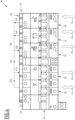
- FIG 4 is a schematic representation of a view of an assembly 90, integrating an electricity distribution system comprising a connection device 36 according to one embodiment.
- the assembly 90 is for example an electrical panel, for example a wall panel, or an electrical cabinet.
- the electrical distribution system is configured to distribute electricity from a primary power source which is the distribution network 12, and auxiliary power sources 16, 18, to respective loads 20, 22.
- the arrows shown below the assembly 90 indicate the direction of flow of the electric current forming an electric conduction path in the electrical distribution system, in an exemplary operation.
- connection device 36 comprises, on the front, phase connection points L alternating with neutral connection points N, arranged at a chosen distance, for example 18 mm and 36 mm, suitable for the connection of the corresponding switching devices, such as circuit breakers, for domestic installations.
- the 90 assembly is particularly compact.
- connection device 36 forming part of the assembly 90 comprises, on a visible face, foolproof elements, intended to guide the installation by an electrician, in particular by indicating the order of arrangement of the connections of the electrical devices (sources and loads), starting from the lightning protection device, followed by the electrical distribution network, any loads and then the auxiliary electricity sources, hybrid or not.
- the foolproof elements are for example positioned at the connection terminals (in English "pins") allowing the connection to the respective connection points of the connection device 36.
- foolproofing devices makes it easier to connect electrical devices to the “pins” of the connection device 36.
- Source 18 is a hybrid source, capable of operating both as a power supply source and as an electricity-consuming load.
- the distribution network 12 is a remote source where energy can be drawn from or injected, capable of receiving the electricity produced by one or more of the auxiliary power sources when the electricity produced by these auxiliary power sources is not consumed by the loads connected between the main power source and the auxiliary power sources.
- an electrical conduction path is illustrated using arrows above the connection device 36.
- the electrical distribution network 12 supplies 63 A.
- the domestic loads 22 (the reference 22 here designating the distribution panel 30 comprising several connected domestic loads) consume 47 A.
- auxiliary power source 16 e.g. a photovoltaic generator
- auxiliary power source 18 e.g. a battery electricity storage system
- the auxiliary electrical power sources provide 16 A in this example.
- the electric vehicle 20 consumes, in order to charge itself, a current of intensity 32A, this current being supplied via the connection device 36, on the one hand by the remaining 16A of the current supplied by the electrical distribution network, and on the other hand, by the auxiliary power sources 16 and 18 jointly.
- a connection device calibrated to convey 63A is capable of supplying the current consumed, without requiring the implementation of electronic regulation of the electricity distribution.
- the conduction path is such that the limit of 63A (maximum authorized current threshold) is not exceeded on any of the respective conductors of the connection device 36.
- connection device 36 has been described above in the case of a single-phase installation. It is understood that as a variant, in a polyphase electrical distribution system 10, for example three-phase and neutral, the configurations described are generalized for each of the electrical phases and the neutral line.
- the connection device comprises as many conduction bars as there are phases, and if necessary by adding a neutral conductor.
- the generalization for a polyphase system is simple, the connection of the sources and the respective loads being made by corresponding polyphase connection points.
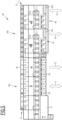
- FIG. 5 schematically represents a view of an assembly 90' integrating an electrical distribution system according to a variant of the embodiment of the Figure 4 , integrating an electricity distribution system comprising a connection device 36' according to one embodiment.
- the same elements of the assembly 90' are designated with the same reference numbers as in the preceding figures, in particular with a bonus for a variant of an element.
- Figure 5 shows a three-phase embodiment with phases L1, L2, L3 and neutral line N.
- the assembly 90' is for example an electrical panel, for example a wall panel, or an electrical cabinet.
- the electrical distribution system is configured to distribute electricity from a primary power source which is the distribution network 12, and auxiliary power sources 16 to respective loads 20, 22.
- the arrows shown below the 90' assembly indicate the direction of flow of the electric current (three-phase) forming an electric conduction path in the electrical distribution system, in an example of operation.
- the electrical connection device 36' essentially corresponds to the electrical connection device 36 of the Figures 1 to 4 . Unlike the Figures 1 to 4 the 36' connection device is suitable for use in a 90' assembly for three-phase currents.
- the electrical 36' connection device can be considered as being linear (also called a "connection comb"), with several "stages", each stage corresponding to a connection bar, respectively one bar for each phase L1, L2, L3 and the neutral conductor N. Therefore, the connection points are three-phase.
- connection device 36' comprises, on the front, on a first section 36a', three-phase connection points comprising electrical connection terminals of the phases L1, L2, L3 alternating, in groups, with neutral connection terminals N, arranged at a chosen distance, for example 18 mm and 36 mm, suitable for the connection of the corresponding switching devices 32', 38', 40', 44', 46', such as circuit breakers, for domestic installations for the lightning protection device, the network 12 and the domestic electrical loads 22.
- connection device 36' comprises, on the front, on a second section 36b' adjacent to the first section 36a', connection points comprising electrical connection terminals of the phases L1, L2, L3 alternating with neutral connection terminals N, arranged at a selected distance, for example 18mm and 36mm, suitable for the connection of the corresponding switching devices, such as circuit breakers, in particular for the load concerning the electric vehicle, i.e. the charging station or the vehicle, and the auxiliary power sources 16.
- the circuit breaker for example for the auxiliary power source 16 or the load concerning the electric vehicle 20 are respectively connected to the three phases L1, L2, L3 and to the neutral conductor N. In one embodiment the circuit breaker(s) are not connected to all the connection points above them.
- the switching device 44' is only connected on the left to the connection terminal of the neutral conductor N and then to the connection terminals of the conductors L2, L3 and L1 of the connection device 36'.
- the other connection terminals above the 44' switching device remain unused.
- auxiliary switching devices 40, 44 may be connected laterally to the auxiliary switching devices 40, 44 without being connected to the connection device 36', for example an undervoltage release 44a', 40a'.
- the 90 assembly is particularly compact.
- connection device 36' forming part of the assembly 90' comprises, on a visible face, foolproof elements, intended to guide the installation by an electrician.
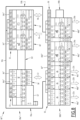
- figure 6 schematically represents a view of a 90" assembly integrating an electrical distribution system according to a variant of the embodiment of the Figure 5 , integrating an electricity distribution system comprising a connection device 36' according to an embodiment which is identical to the connection device 36' of the figure 5 .
- the same elements of the 90" assembly are designated with the same reference numbers as on the figure 5 .
- There Figure 6 shows a three-phase embodiment with phases L1, L2, L3 and neutral line N.
- the 90" assembly is for example an electrical panel, for example a wall panel, or an electrical cabinet.
- the electrical distribution system is configured to distribute electricity from a primary power source which is the distribution network 12, and auxiliary power sources 16 to respective loads 20a, 20b, 22.
- the arrows shown below the 90" assembly indicate the direction of flow of the electric current (single-phase or three-phase) forming an electric conduction path in the electrical distribution system, in an example of operation.
- the assembly comprises two auxiliary switching devices 44a", 44b" for the loads 20a, 20b.
- the two switching devices are respectively single-phase and only connected to single-phase points, here respectively the phase L2, and for the neutral conductor N.
- the loads 20a, 20b are, for example, respectively an electric vehicle.
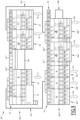
- FIG. 7 schematically represents a view of a 90'' assembly integrating an electrical distribution system according to a variant of the embodiment of the Figure 5 , integrating an electricity distribution system comprising a 36'' connection device according to one embodiment.
- the same elements of the 90′′′ assembly are designated with the same reference numbers as in the preceding figures, in particular with three primes for the variants of an element.
- Figure 7 shows a three-phase embodiment with phases L1, L2, L3 and neutral line N.
- the 90'' assembly is for example an electrical panel, for example a wall panel, or an electrical cabinet.
- the electrical distribution system is configured to distribute electricity from a main power source which is the distribution network 12, and auxiliary power sources 16, 18 to respective loads 20a, 20b, 22a, 22b, 22c.
- the loads 20a, 20b, 22a, 22b, 22c correspond respectively to the loads 20, 22 of the Figures 1 to 4 .
- the 90'" assembly comprises two rows, namely an upper row 90a′′′ and a lower row 90b′′′. In another embodiment the 90′′′ assembly comprises three rows.
- the arrows shown below the 90′′′ assembly indicate the direction of flow of the electric current (three-phase) forming an electric conduction path in the electrical distribution system, in an example of operation.
- the 36′′′ electrical connection device corresponds electrically to the 36' electrical connection device of the Figures 5 Or 6 .
- the 36′′′ electrical connection device comprises several linear sections 36a′′′, 36b′′′, 36c′′′ (also called “connection comb”), with several “stages”, each stage corresponding to a connection bar, respectively one bar for each phase L1, L2, L3 and the neutral conductor N.
- connection device 36′′′ comprises, on the front, for each section 36a′′′, 36b′′′, 36c′′′ connection points comprising electrical connection terminals of the phases L1, L2, L3 alternating, in particular in groups, with connection terminals neutral N phase L1, L2, L3.
- the connection terminals are arranged at a chosen distance, for example 18mm and 36mm, suitable for the connection of the corresponding switching devices, such as circuit breakers.
- the first section 36a′′′ and the third section 36c′′′ are arranged in the first row 90a′′′ and the second section 36b′′′ is arranged in the second row 90b′′′.
- the conductors, e.g. bars, of the first section 36a′′′ are respectively electrically connected or connected to the corresponding conductors, e.g. bars, of the second section 36b′′′, in particular at a first end 92 or in the vicinity of the first end of the second section 36b′′′.
- the conductors, e.g. bars, of the third section 36c′′′ are respectively electrically connected to the corresponding conductors, e.g. bars, of the second section 36b′′′, in particular at a second end 93 or in the vicinity of the second end of the second section 36b′′′.
- the electrical connections between the sections 36a′′′, 36b′′′ and 36c′′′ are established by one or more cables 93a, 93b.
- the switching devices 32', 38' such as circuit breakers for the lightning protection device and the network 12 are connected to the first section 36a′′′.
- the switching devices 44a′′′,44b′′′,46a′′′, 46b′′′, 46c′′′ such as circuit breakers for the device for the household electrical loads 22a, 22b, 22c, 20a, 20b are connected to the second section 36b′′′.
- the switching devices 40', 42' such as circuit breakers for the device for the auxiliary power sources 16, 18 are connected to the third section 36b′′′.
- the 36′′′ connection device forming part of the 90′′′ assembly comprises, on a visible face, foolproof elements, intended to guide the installation by an electrician.
- Figure 7 further shows two mechanical fixing rails 94a, 94b for the various switching devices defining the two rows 90a′′′, 90b′′′.
- the method of realization of the figure 7 is electrically identical, that is to say from an electrical circuit point of view, to the embodiment of the preceding figures, in particular of the figures 5 And 6 .
- the second end 55 from an electrical point of view, is located on the left on the third section 36c′′′ of the connection device 36′′′ on the figure 7 . Therefore, the switching apparatus of the auxiliary power supply sources are connected to a second end connection point, in particular at least from an electrical point of view, of the connection device 36′′′, located near a second end 55.
- the purely electricity-consuming loads are connected, electrically, between the main power source 12 and the auxiliary power sources 16, 18 to the connection device 36′′′.
- each load switching device being connected to an intermediate connection point being electrically, that is to say from an electrical circuit point of view, between said first connection point and the or each second connection point.
- FIG 8 schematically represents a view of a 90 ⁇ assembly integrating an electrical distribution system according to a variant of the embodiment of the Figure 7 .
- the only difference from the 90′′′ assembly of the Figure 7 is an additional electrical connection 93c between the first section 36a′′′ and the third section 36c′′′ of the connection device 36′′′.
- the conductors, for example the bars, of the third section 36c′′′ are respectively electrically connected to the corresponding conductors, for example bars, of the first section 36a′′′.
- the additional electrical connection 93c makes it possible, when the auxiliary power sources 16, 18 produce energy exceeding the consumption of the energy by the loads 20a, 20b, 22a, 22b, 22c, to directly inject this excess energy into the electrical distribution network 12, without passing through the second section 36b′′′ of the connection device 36′′′.
- This additional electrical connection 93c makes it possible to reduce the flow of electric current in the second section 36b′′′ of the connection device 36′′′.
- the purely electricity-consuming loads 22a, 22b, 22c 20a, 20b are electrically connected between the main power source 12 and the auxiliary power source(s) 16, 18 to the connection device 36′′′.
- connection device 36'" comprises only a first section 36a'"” and a second section 36b′′′ ⁇ .
- the first section 36a'"" integrates in its intermediate part the function of the additional electrical connection 93c of the connection device 36′′′ of the Figure 8 .
- the proposed distribution system is particularly compact, and its implementation is suitable for an existing installation, making the electrician's work easier.
- connection device it is possible to modify for example the number of auxiliary power supply sources, for example by adding an additional auxiliary power supply source and removing one of the loads, provided that the additional auxiliary power supply source is connected in such a way that all the purely consumer loads electricity are electrically connected between the main power source and the auxiliary power source(s).
Landscapes
- Engineering & Computer Science (AREA)
- Power Engineering (AREA)
- Life Sciences & Earth Sciences (AREA)
- Sustainable Development (AREA)
- Sustainable Energy (AREA)
- Transportation (AREA)
- Mechanical Engineering (AREA)
- Supply And Distribution Of Alternating Current (AREA)
Claims (13)
- Stromverteilungssystem zum Verteilen von elektrischen Strömen zwischen einem Stromverteilungsnetz und einer Hausverteilungsanlage (1), wobei das Stromverteilungssystem (10) Folgendes umfasst- eine Anschlussvorrichtung (36), die ausgebildet ist, um in der Anlage (1) elektrischen Strom aus Quellen zu verteilen, umfassend ein Stromverteilungsnetz (12) und mindestens eine Hilfsstromquelle (14, 16, 18, 20, 20a, 20b) zu mindestens einer Strom verbrauchenden Last (21, 22, 22a, 22b, 22c),- wobei die Anschlussvorrichtung (36, 36', 36‴, 36ʺʺ) mindestens einen linearen Abschnitt umfasst, wobei jeder lineare Abschnitt eine Vielzahl von elektrischen Leitern (35L, 35N) umfasst, die angepasst sind, um den elektrischen Strom entlang eines elektrischen Leitungswegs zu leiten,- das System (10) ein Hauptschaltgerät (38) umfasst, das zwischen dem Stromverteilungsnetz (12) und einem ersten Anschlusspunkt (58) verbunden ist, wobei das Hauptschaltgerät (38) konfiguriert ist, um zwischen zwei Zuständen zu schalten, die den Fluss von elektrischem Strom von dem Stromverteilungsnetz (12) zu der Anschlussvorrichtung (36, 36', 36‴, 36‴ʺ) jeweils zulassen oder verhindern,- für die oder jede Hilfsstromquelle (14, 16, 18, 20, 20a, 20b) jeweils ein Hilfsschaltgerät (40, 42, 44, 40', 44', 44a‴, 44b‴, 46', 46a‴, 46b‴, 46c‴), das zwischen der Hilfsstromquelle und einem zweiten Anschlusspunkt (62, 66, 70) verbunden ist, wobei jedes Hilfsschaltgerät konfiguriert ist, um zwischen zwei Zuständen zu schalten, die jeweils den Fluss von elektrischem Strom von der assoziierten Hilfsstromquelle zu der Anschlussvorrichtung (36, 36', 36‴, 36‴ʺ) zulassen oder verhindern,- das Stromverteilungssystem (10) ferner umfassend mindestens ein Lastschaltgerät (42, 42', 44, 46, 44', 44a‴, 44b‴, 46', 46a‴, 46b‴, 46c‴), das zwischen mindestens einer Last (30, 22, 22a, 22b, 22c) und der Anschlussvorrichtung (36) verbunden ist, wobei das Lastschaltgerät konfiguriert ist, um zwischen zwei Zuständen zu schalten, die jeweils den Fluss von elektrischem Strom von der Anschlussvorrichtung zu mindestens einer stromverbrauchenden Last (22, 22a, 22b, 22c) zulassen oder verhindern,- wobei das oder jedes Lastschaltgerät (42, 42', 44, 46, 44', 44a‴, 44b‴, 46', 46a‴, 46b‴, 46c‴) an einem Zwischenanschlusspunkt (70, 74), der elektrisch zwischen dem ersten Anschlusspunkt und dem oder jedem zweiten Anschlusspunkt liegt, elektrisch mit der Anschlussvorrichtung (36, 36', 36‴, 36ʺʺ) verbunden ist, wobei das System dadurch gekennzeichnet ist, dass die elektrischen Leiter der Anschlussvorrichtung (36) kalibriert sind, um einen Strom mit einer elektrischen Stromstärke mit einer maximalen Stromschwelle zu führen, wobei die maximale Stromschwelle gleich wie das Maximum zwischen dem maximalen elektrischen Strom, der von dem Stromverteilungsnetz (12) bereitgestellt wird, und der Summe der maximalen elektrischen Ströme, die von der oder den mehreren elektrischen Hilfsquellen (14) bereitgestellt werden, ist.
- Stromverteilungssystem nach Anspruch 1, wobei der erste Anschlusspunkt (58) ein Anschlusspunkt des ersten Endes der Anschlussvorrichtung ist, der sich in der Nähe eines ersten Endes (53) der Anschlussvorrichtung (36, 36', 36‴) befindet, und der zweite Anschlusspunkt (62, 66, 70) ein Anschlusspunkt (62, 66, 70) des zweiten Endes der elektrischen Anschlussvorrichtung ist, wobei sich der oder jeder Anschlusspunkt des zweiten Endes in der Nähe eines zweiten Endes (55) der Anschlussvorrichtung (36) gegenüber dem ersten Ende (53) befindet.
- Stromverteilungssystem nach Anspruch 1 oder 2, wobei in der Anschlussvorrichtung (36, 36', 36‴, 36‴ʺ) jeder elektrische Leiter eine Stromschiene aus einem elektrisch leitenden Material ist, wobei jede Stromschiene mit einer elektrischen Phase oder einem Neutralleiter assoziiert ist.
- Stromverteilungssystem nach Anspruch 3, wobei jeder Leiter aus einer Vielzahl von elektrisch verbundenen leitenden Abschnitten besteht, um eine Leiterschiene zu bilden.
- Stromverteilungssystem nach einem der Ansprüche 1 bis 4, wobei mindestens eine der Hilfsstromquellen (14, 18, 20, 20a, 20b) eine Hybridquelle ist, die konfiguriert ist, um elektrischen Strom bereitzustellen oder aufzunehmen, wobei die oder jede Hybridquelle an einem Anschlusspunkt, der elektrisch zwischen dem oder jedem zweiten Anschlusspunkt und dem oder jedem Zwischenanschlusspunkt (70, 74) liegt, mit der Anschlussvorrichtung (36, 36', 36‴, 36‴ʺ) verbunden ist.
- Stromverteilungssystem nach Anspruch 5, wobei mindestens eine Hybridquelle ein batteriebetriebenes Stromspeichersystem (18) oder ein Elektrofahrzeug (20) ist.
- System nach einem der Ansprüche 1 bis 6, wobei mindestens eine stromverbrauchende Last ein Elektrofahrzeug (20) ist.
- Stromverteilungssystem nach einem der Ansprüche 1 bis 7, wobei die Hilfsstromquellen einen oder mehrere photovoltaische Generatoren umfassen.
- Stromverteilungssystem nach einem der Ansprüche 1 bis 8, ferner umfassend eine Blitzschutzvorrichtung (32), die neben dem Hauptschaltgerät (38), insbesondere gegenüber dem zweiten Ende (55), mit der Anschlussvorrichtung verbunden ist.
- Stromverteilungssystem nach einem der Ansprüche 1 bis 9, umfassend Codierungselemente, die auf einer sichtbaren Seite eines Gehäuses, das die Anschlussvorrichtung (36) umfasst, positioniert sind, um die Verbindungen des Verteilungsnetzes, der Hilfsstromquellen und Lasten in dem Stromverteilungssystem zu führen.
- Stromverteilungssystem nach einem der vorherigen Ansprüche, wobei die Anschlussvorrichtung (36) linear ist.
- Stromverteilungssystem nach einem der vorherigen Ansprüche 2 bis 11, wobei das oder jedes Lastschaltgerät (44, 46, 44', 46') mit der Anschlussvorrichtung (36, 36') an einem Zwischenanschlusspunkt (70, 74) verbunden ist, der sich zwischen dem Anschlusspunkt des ersten Endes und dem oder jedem Anschlusspunkt des zweiten Endes befindet.
- Stromverteilungsanlage, umfassend ein Stromverteilungssystem nach einem der vorherigen Ansprüche.
Applications Claiming Priority (3)
| Application Number | Priority Date | Filing Date | Title |
|---|---|---|---|
| FR2110100A FR3127648A1 (fr) | 2021-09-24 | 2021-09-24 | Système de distribution d’électricité pour une installation domestique, procédé de gestion d’un tel système de distribution d’électricité |
| EP22305033.7A EP4156438B1 (de) | 2021-09-24 | 2022-01-14 | Stromverteilungssystem für eine heimanlage mit mehreren stromquellen |
| EP22306155 | 2022-07-29 |
Publications (3)
| Publication Number | Publication Date |
|---|---|
| EP4156437A1 EP4156437A1 (de) | 2023-03-29 |
| EP4156437C0 EP4156437C0 (de) | 2024-09-18 |
| EP4156437B1 true EP4156437B1 (de) | 2024-09-18 |
Family
ID=83362474
Family Applications (1)
| Application Number | Title | Priority Date | Filing Date |
|---|---|---|---|
| EP22197840.6A Active EP4156437B1 (de) | 2021-09-24 | 2022-09-26 | Stromverteilungssystem für eine hausanlage mit mehreren elektrischen quellen |
Country Status (4)
| Country | Link |
|---|---|
| US (1) | US12456862B2 (de) |
| EP (1) | EP4156437B1 (de) |
| CN (1) | CN115864362A (de) |
| AU (1) | AU2022235584A1 (de) |
Families Citing this family (2)
| Publication number | Priority date | Publication date | Assignee | Title |
|---|---|---|---|---|
| FR3150357A1 (fr) * | 2023-06-21 | 2024-12-27 | Michaud | Système d’alimentation électrique d’un bâtiment |
| JP2025080074A (ja) * | 2023-11-13 | 2025-05-23 | トヨタ自動車株式会社 | 管理装置、制御プログラム、及び制御方法 |
Family Cites Families (10)
| Publication number | Priority date | Publication date | Assignee | Title |
|---|---|---|---|---|
| FR2432789A1 (fr) | 1978-08-01 | 1980-02-29 | Brun Pierre | Repartiteur-limiteur de puissance pour installations electriques |
| US7692332B2 (en) * | 2007-08-30 | 2010-04-06 | Briggs And Stratton Corporation | Transfer switch |
| US8390977B2 (en) * | 2010-02-26 | 2013-03-05 | Advanced Energy Industries, Inc | Solar power inverters, including solar power inverters having surge protective devices, and associated methods |
| EP4585932A2 (de) * | 2013-04-13 | 2025-07-16 | Honey Badger International Pty Ltd | Energieerzeugungslastausgleich |
| WO2016176727A1 (en) | 2015-05-01 | 2016-11-10 | The University Of Sydney | Operation scheduling of power generation, storage and load |
| KR20190033620A (ko) * | 2016-08-09 | 2019-03-29 | 엠에이치아이 베스타스 오프쇼어 윈드 에이/에스 | 풍력 터빈 제어 방법 및 시스템 |
| US11316471B2 (en) * | 2016-11-08 | 2022-04-26 | Tesla, Inc. | Manual transfer switch for onsite energy generation and storage systems |
| FR3067875B1 (fr) | 2017-06-20 | 2019-07-19 | Latelec | Procede et architecture d'alimentation electrique de reseau domestique embarque |
| US11811261B2 (en) * | 2019-04-19 | 2023-11-07 | Sunpower Corporation | Backup load energy control system |
| EP4032161A1 (de) | 2019-09-17 | 2022-07-27 | Span. IO, Inc. | Systeme und verfahren zur verwaltung elektrischer lasten |
-
2022
- 2022-09-19 US US17/947,268 patent/US12456862B2/en active Active
- 2022-09-21 AU AU2022235584A patent/AU2022235584A1/en active Pending
- 2022-09-23 CN CN202211165922.9A patent/CN115864362A/zh active Pending
- 2022-09-26 EP EP22197840.6A patent/EP4156437B1/de active Active
Also Published As
| Publication number | Publication date |
|---|---|
| US12456862B2 (en) | 2025-10-28 |
| EP4156437A1 (de) | 2023-03-29 |
| EP4156437C0 (de) | 2024-09-18 |
| US20230096943A1 (en) | 2023-03-30 |
| CN115864362A (zh) | 2023-03-28 |
| AU2022235584A1 (en) | 2023-04-13 |
Similar Documents
| Publication | Publication Date | Title |
|---|---|---|
| JP7611906B2 (ja) | 分散型エネルギ資源デバイスで使用するためのメータ及びソケット | |
| EP4156437B1 (de) | Stromverteilungssystem für eine hausanlage mit mehreren elektrischen quellen | |
| JP7483721B2 (ja) | 分散型エネルギ資源デバイスを接続および計測するための方法およびシステム | |
| EP3959139A1 (de) | Stromversorgungsnetz für ein flugzeug | |
| US20230288451A1 (en) | Electric meter collar adaptor to divert power to distributed power generation resources | |
| US20120326518A1 (en) | Parallel electric service system and method using meter socket and load center combination | |
| EP3108725B1 (de) | Leistungsverteilerkasten mit einer eingangsleistungssammelschiene | |
| US9728972B2 (en) | Alternative energy bus bar by pass breaker, methods of use and installation | |
| WO2024010888A1 (en) | Meter for use with a distributed energy resource device | |
| US11018619B2 (en) | Photovoltaic cabling optimization for solar trackers using a plug and play harness configuration | |
| EP0901143B1 (de) | Anordnung zum Zusammenbauen und Verbinden elektrischer Leistungsapparatemodule wie Schutzschalter | |
| US12015273B2 (en) | Electricity distribution system for a domestic installation comprising multiple electrical sources | |
| EP4156438B1 (de) | Stromverteilungssystem für eine heimanlage mit mehreren stromquellen | |
| US20180069381A1 (en) | Alternative energy bus bar by pass breaker | |
| EP2774182A1 (de) | Sicherheitsvorrichtung für pv-modul | |
| FR2694845A1 (fr) | Tableau de distribution électrique d'étage d'immeuble. | |
| FR3038151A1 (fr) | Alimentation electrique d'une charge avec barre de distribution segmentee |
Legal Events
| Date | Code | Title | Description |
|---|---|---|---|
| PUAI | Public reference made under article 153(3) epc to a published international application that has entered the european phase |
Free format text: ORIGINAL CODE: 0009012 |
|
| STAA | Information on the status of an ep patent application or granted ep patent |
Free format text: STATUS: THE APPLICATION HAS BEEN PUBLISHED |
|
| AK | Designated contracting states |
Kind code of ref document: A1 Designated state(s): AL AT BE BG CH CY CZ DE DK EE ES FI FR GB GR HR HU IE IS IT LI LT LU LV MC MK MT NL NO PL PT RO RS SE SI SK SM TR |
|
| STAA | Information on the status of an ep patent application or granted ep patent |
Free format text: STATUS: REQUEST FOR EXAMINATION WAS MADE |
|
| 17P | Request for examination filed |
Effective date: 20230904 |
|
| RBV | Designated contracting states (corrected) |
Designated state(s): AL AT BE BG CH CY CZ DE DK EE ES FI FR GB GR HR HU IE IS IT LI LT LU LV MC MK MT NL NO PL PT RO RS SE SI SK SM TR |
|
| GRAP | Despatch of communication of intention to grant a patent |
Free format text: ORIGINAL CODE: EPIDOSNIGR1 |
|
| STAA | Information on the status of an ep patent application or granted ep patent |
Free format text: STATUS: GRANT OF PATENT IS INTENDED |
|
| INTG | Intention to grant announced |
Effective date: 20240415 |
|
| GRAS | Grant fee paid |
Free format text: ORIGINAL CODE: EPIDOSNIGR3 |
|
| GRAA | (expected) grant |
Free format text: ORIGINAL CODE: 0009210 |
|
| STAA | Information on the status of an ep patent application or granted ep patent |
Free format text: STATUS: THE PATENT HAS BEEN GRANTED |
|
| AK | Designated contracting states |
Kind code of ref document: B1 Designated state(s): AL AT BE BG CH CY CZ DE DK EE ES FI FR GB GR HR HU IE IS IT LI LT LU LV MC MK MT NL NO PL PT RO RS SE SI SK SM TR |
|
| REG | Reference to a national code |
Ref country code: GB Ref legal event code: FG4D Free format text: NOT ENGLISH |
|
| REG | Reference to a national code |
Ref country code: CH Ref legal event code: EP |
|
| REG | Reference to a national code |
Ref country code: IE Ref legal event code: FG4D Free format text: LANGUAGE OF EP DOCUMENT: FRENCH |
|
| REG | Reference to a national code |
Ref country code: DE Ref legal event code: R096 Ref document number: 602022006178 Country of ref document: DE |
|
| U01 | Request for unitary effect filed |
Effective date: 20241018 |
|
| U07 | Unitary effect registered |
Designated state(s): AT BE BG DE DK EE FI FR IT LT LU LV MT NL PT RO SE SI Effective date: 20241031 |
|
| U20 | Renewal fee for the european patent with unitary effect paid |
Year of fee payment: 3 Effective date: 20241029 |
|
| PG25 | Lapsed in a contracting state [announced via postgrant information from national office to epo] |
Ref country code: NO Free format text: LAPSE BECAUSE OF FAILURE TO SUBMIT A TRANSLATION OF THE DESCRIPTION OR TO PAY THE FEE WITHIN THE PRESCRIBED TIME-LIMIT Effective date: 20241218 |
|
| PG25 | Lapsed in a contracting state [announced via postgrant information from national office to epo] |
Ref country code: GR Free format text: LAPSE BECAUSE OF FAILURE TO SUBMIT A TRANSLATION OF THE DESCRIPTION OR TO PAY THE FEE WITHIN THE PRESCRIBED TIME-LIMIT Effective date: 20241219 |
|
| PG25 | Lapsed in a contracting state [announced via postgrant information from national office to epo] |
Ref country code: HR Free format text: LAPSE BECAUSE OF FAILURE TO SUBMIT A TRANSLATION OF THE DESCRIPTION OR TO PAY THE FEE WITHIN THE PRESCRIBED TIME-LIMIT Effective date: 20240918 |
|
| PG25 | Lapsed in a contracting state [announced via postgrant information from national office to epo] |
Ref country code: RS Free format text: LAPSE BECAUSE OF FAILURE TO SUBMIT A TRANSLATION OF THE DESCRIPTION OR TO PAY THE FEE WITHIN THE PRESCRIBED TIME-LIMIT Effective date: 20241218 |
|
| PG25 | Lapsed in a contracting state [announced via postgrant information from national office to epo] |
Ref country code: RS Free format text: LAPSE BECAUSE OF FAILURE TO SUBMIT A TRANSLATION OF THE DESCRIPTION OR TO PAY THE FEE WITHIN THE PRESCRIBED TIME-LIMIT Effective date: 20241218 Ref country code: NO Free format text: LAPSE BECAUSE OF FAILURE TO SUBMIT A TRANSLATION OF THE DESCRIPTION OR TO PAY THE FEE WITHIN THE PRESCRIBED TIME-LIMIT Effective date: 20241218 Ref country code: HR Free format text: LAPSE BECAUSE OF FAILURE TO SUBMIT A TRANSLATION OF THE DESCRIPTION OR TO PAY THE FEE WITHIN THE PRESCRIBED TIME-LIMIT Effective date: 20240918 Ref country code: GR Free format text: LAPSE BECAUSE OF FAILURE TO SUBMIT A TRANSLATION OF THE DESCRIPTION OR TO PAY THE FEE WITHIN THE PRESCRIBED TIME-LIMIT Effective date: 20241219 |
|
| PG25 | Lapsed in a contracting state [announced via postgrant information from national office to epo] |
Ref country code: IS Free format text: LAPSE BECAUSE OF FAILURE TO SUBMIT A TRANSLATION OF THE DESCRIPTION OR TO PAY THE FEE WITHIN THE PRESCRIBED TIME-LIMIT Effective date: 20250118 |
|
| PG25 | Lapsed in a contracting state [announced via postgrant information from national office to epo] |
Ref country code: SM Free format text: LAPSE BECAUSE OF FAILURE TO SUBMIT A TRANSLATION OF THE DESCRIPTION OR TO PAY THE FEE WITHIN THE PRESCRIBED TIME-LIMIT Effective date: 20240918 |
|
| PG25 | Lapsed in a contracting state [announced via postgrant information from national office to epo] |
Ref country code: ES Free format text: LAPSE BECAUSE OF FAILURE TO SUBMIT A TRANSLATION OF THE DESCRIPTION OR TO PAY THE FEE WITHIN THE PRESCRIBED TIME-LIMIT Effective date: 20240918 |
|
| PG25 | Lapsed in a contracting state [announced via postgrant information from national office to epo] |
Ref country code: PL Free format text: LAPSE BECAUSE OF FAILURE TO SUBMIT A TRANSLATION OF THE DESCRIPTION OR TO PAY THE FEE WITHIN THE PRESCRIBED TIME-LIMIT Effective date: 20240918 Ref country code: CZ Free format text: LAPSE BECAUSE OF FAILURE TO SUBMIT A TRANSLATION OF THE DESCRIPTION OR TO PAY THE FEE WITHIN THE PRESCRIBED TIME-LIMIT Effective date: 20240918 |
|
| PG25 | Lapsed in a contracting state [announced via postgrant information from national office to epo] |
Ref country code: SK Free format text: LAPSE BECAUSE OF FAILURE TO SUBMIT A TRANSLATION OF THE DESCRIPTION OR TO PAY THE FEE WITHIN THE PRESCRIBED TIME-LIMIT Effective date: 20240918 |
|
| PG25 | Lapsed in a contracting state [announced via postgrant information from national office to epo] |
Ref country code: MC Free format text: LAPSE BECAUSE OF FAILURE TO SUBMIT A TRANSLATION OF THE DESCRIPTION OR TO PAY THE FEE WITHIN THE PRESCRIBED TIME-LIMIT Effective date: 20240918 |
|
| PLBE | No opposition filed within time limit |
Free format text: ORIGINAL CODE: 0009261 |
|
| STAA | Information on the status of an ep patent application or granted ep patent |
Free format text: STATUS: NO OPPOSITION FILED WITHIN TIME LIMIT |
|
| PG25 | Lapsed in a contracting state [announced via postgrant information from national office to epo] |
Ref country code: IE Free format text: LAPSE BECAUSE OF NON-PAYMENT OF DUE FEES Effective date: 20240926 |
|
| 26N | No opposition filed |
Effective date: 20250619 |
|
| U20 | Renewal fee for the european patent with unitary effect paid |
Year of fee payment: 4 Effective date: 20250925 |
|
| PG25 | Lapsed in a contracting state [announced via postgrant information from national office to epo] |
Ref country code: CY Free format text: LAPSE BECAUSE OF FAILURE TO SUBMIT A TRANSLATION OF THE DESCRIPTION OR TO PAY THE FEE WITHIN THE PRESCRIBED TIME-LIMIT; INVALID AB INITIO Effective date: 20220926 |
|
| PG25 | Lapsed in a contracting state [announced via postgrant information from national office to epo] |
Ref country code: HU Free format text: LAPSE BECAUSE OF FAILURE TO SUBMIT A TRANSLATION OF THE DESCRIPTION OR TO PAY THE FEE WITHIN THE PRESCRIBED TIME-LIMIT; INVALID AB INITIO Effective date: 20220926 |