EP4155434A1 - Startup method for electrolytic sulfuric acid solution manufacturing system - Google Patents
Startup method for electrolytic sulfuric acid solution manufacturing system Download PDFInfo
- Publication number
- EP4155434A1 EP4155434A1 EP20936154.2A EP20936154A EP4155434A1 EP 4155434 A1 EP4155434 A1 EP 4155434A1 EP 20936154 A EP20936154 A EP 20936154A EP 4155434 A1 EP4155434 A1 EP 4155434A1
- Authority
- EP
- European Patent Office
- Prior art keywords
- sulfuric acid
- solution
- electrolytic
- acid solution
- concentration
- Prior art date
- Legal status (The legal status is an assumption and is not a legal conclusion. Google has not performed a legal analysis and makes no representation as to the accuracy of the status listed.)
- Withdrawn
Links
Images
Classifications
-
- C—CHEMISTRY; METALLURGY
- C25—ELECTROLYTIC OR ELECTROPHORETIC PROCESSES; APPARATUS THEREFOR
- C25B—ELECTROLYTIC OR ELECTROPHORETIC PROCESSES FOR THE PRODUCTION OF COMPOUNDS OR NON-METALS; APPARATUS THEREFOR
- C25B1/00—Electrolytic production of inorganic compounds or non-metals
- C25B1/01—Products
- C25B1/22—Inorganic acids
-
- C—CHEMISTRY; METALLURGY
- C25—ELECTROLYTIC OR ELECTROPHORETIC PROCESSES; APPARATUS THEREFOR
- C25B—ELECTROLYTIC OR ELECTROPHORETIC PROCESSES FOR THE PRODUCTION OF COMPOUNDS OR NON-METALS; APPARATUS THEREFOR
- C25B1/00—Electrolytic production of inorganic compounds or non-metals
- C25B1/01—Products
- C25B1/28—Per-compounds
- C25B1/29—Persulfates
-
- C—CHEMISTRY; METALLURGY
- C25—ELECTROLYTIC OR ELECTROPHORETIC PROCESSES; APPARATUS THEREFOR
- C25B—ELECTROLYTIC OR ELECTROPHORETIC PROCESSES FOR THE PRODUCTION OF COMPOUNDS OR NON-METALS; APPARATUS THEREFOR
- C25B15/00—Operating or servicing cells
-
- C—CHEMISTRY; METALLURGY
- C25—ELECTROLYTIC OR ELECTROPHORETIC PROCESSES; APPARATUS THEREFOR
- C25B—ELECTROLYTIC OR ELECTROPHORETIC PROCESSES FOR THE PRODUCTION OF COMPOUNDS OR NON-METALS; APPARATUS THEREFOR
- C25B15/00—Operating or servicing cells
- C25B15/02—Process control or regulation
- C25B15/021—Process control or regulation of heating or cooling
-
- C—CHEMISTRY; METALLURGY
- C25—ELECTROLYTIC OR ELECTROPHORETIC PROCESSES; APPARATUS THEREFOR
- C25B—ELECTROLYTIC OR ELECTROPHORETIC PROCESSES FOR THE PRODUCTION OF COMPOUNDS OR NON-METALS; APPARATUS THEREFOR
- C25B15/00—Operating or servicing cells
- C25B15/02—Process control or regulation
- C25B15/023—Measuring, analysing or testing during electrolytic production
- C25B15/025—Measuring, analysing or testing during electrolytic production of electrolyte parameters
- C25B15/027—Temperature
-
- C—CHEMISTRY; METALLURGY
- C25—ELECTROLYTIC OR ELECTROPHORETIC PROCESSES; APPARATUS THEREFOR
- C25B—ELECTROLYTIC OR ELECTROPHORETIC PROCESSES FOR THE PRODUCTION OF COMPOUNDS OR NON-METALS; APPARATUS THEREFOR
- C25B15/00—Operating or servicing cells
- C25B15/08—Supplying or removing reactants or electrolytes; Regeneration of electrolytes
- C25B15/087—Recycling of electrolyte to electrochemical cell
-
- C—CHEMISTRY; METALLURGY
- C25—ELECTROLYTIC OR ELECTROPHORETIC PROCESSES; APPARATUS THEREFOR
- C25B—ELECTROLYTIC OR ELECTROPHORETIC PROCESSES FOR THE PRODUCTION OF COMPOUNDS OR NON-METALS; APPARATUS THEREFOR
- C25B9/00—Cells or assemblies of cells; Constructional parts of cells; Assemblies of constructional parts, e.g. electrode-diaphragm assemblies; Process-related cell features
- C25B9/13—Single electrolytic cells with circulation of an electrolyte
Definitions
- the present invention relates to a startup method for a system for manufacturing an electrolytic sulfuric acid solution suitable for an etching process that is performed prior to the washing and modification of the surfaces of various materials, in particular performed prior to the plating process for the surfaces of plastic materials.
- Sulfuric acid solution containing a persulfuric acid component such as peroxomonosulfuric acid or peroxodisulfuric acid has extremely strong oxidizing properties. Using this strong oxidizing properties, sulfuric acid solution containing a persulfuric acid component is used for washing and surface modification of various materials such as metals, silicon, glass, and plastics.
- Sulfuric acid solution containing a persulfuric acid component can be generated by electrolyzing a solution composed mainly of a sulfuric acid component.
- a system for manufacturing an oxidizing solution containing a persulfuric acid component generated by electrolyzing the solution composed mainly of a sulfuric acid component (the oxidizing solution may be referred to as an electrolytic sulfuric acid solution, hereinafter) is composed, for example, of a storage tank that stores the electrolytic sulfuric acid solution, an electrolytic cell and a DC power source, a pipe equipped with a circulation pump for circulating the solution between the storage tank and the electrolytic cell, a heater and/or heat exchanger for heating/cooling the circulating liquid, and other necessary components.
- Patent Document 1 describes, as a method of manufacturing the electrolytic sulfuric acid using such a system, a technique for manufacturing the electrolytic sulfuric acid to be applied to an etching process for a resin surface performed for plating the surface of a plastic material.
- Patent Document 1 further describes generating a persulfuric acid solution such as peroxodisulfuric acid through filling a cell with sulfuric acid having a predetermined concentration in the initial state and energizing an anode and a cathode with a predetermined current from a DC power source unit to electrolyze the sulfuric acid.
- a persulfuric acid solution such as peroxodisulfuric acid
- Patent Document 1 also describes, as a comparative example, an example in which a mixed solution of sulfuric acid and hydrogen peroxide is used as substitute for the electrolytic sulfuric acid solution to etch the surface of an ABS resin, and teaches that the comparative example allows a plating film to be formed, but has a problem in the long-term stability of the process due to the consumption of hydrogen peroxide.
- the washing and modification processes for the surfaces of various materials using an electrolytic sulfuric acid solution is a very effective method in terms of the influence on environment.
- the system for manufacturing an electrolytic sulfuric acid solution is not in a state in which the washing and modification processes can be immediately performed for the surfaces of various materials, such as during initial startup of the system after its completion, during startup of the system after replacement of the electrolytic sulfuric acid solution, or during re-startup of the system when the concentration of persulfuric acid that is an effective component in the electrolytic sulfuric acid solution decreases due to shutdown of the system.
- such a problem is that, in a manufacturing line for plated components that uses an electrolytic sulfuric acid solution for the etching process for the resin surface performed to plate the plastic material surface, the electrolysis has to be continued until liquid properties for providing effective etching effects can be obtained while circulating the sulfuric acid solution adjusted to a predetermined concentration through the electrolytic cell after re-startup when replacing the etchant due to periodic check of the etching tank, etc. or after re-startup of the electrolytic sulfuric acid solution manufacturing system; therefore, it takes a long time to start manufacturing plated components, and a large amount of energy is consumed before starting to manufacture plated products.
- Such problems are particularly conspicuous when the amount of solution held in the electrolytic sulfuric acid solution manufacturing system is large, such as when the volume of an etching tank for a pre-plating preprocess is large.
- the present invention has been made in view of the above problems, and an object of the present invention is to provide a startup method for an electrolytic sulfuric acid solution manufacturing system that can complete, in a short time, the startup of the system for manufacturing an electrolytic sulfuric acid solution containing a persulfuric acid component generated by electrolyzing sulfuric acid and can reduce the energy consumption.
- the present invention provides a startup method for an electrolytic sulfuric acid solution manufacturing system, the system manufacturing an oxidizing solution containing a persulfuric acid component generated by electrolyzing a solution composed mainly of a sulfuric acid component, the startup method comprising: adding hydrogen peroxide water to all or part of the solution composed mainly of the sulfuric acid component present in the system to adjust oxidizing power of the solution composed mainly of the sulfuric acid component to an enhanced state; and supplying the solution to an electrolytic cell to perform electrolysis (Invention 1).
- startup of the system may preferably take place either during an initial operation after completion of the system, or after replacement of the oxidizing solution containing the persulfuric acid component in the system, or during an operation after the concentration of the persulfuric acid component in the oxidizing solution stored in the system decreases due to shutdown of the system (Invention 2).
- the oxidant concentration (persulfuric acid concentration) of the solution composed mainly of the sulfuric acid component held in the system is lower than the target oxidant concentration of the oxidizing solution.
- the oxidizing solution having the target oxidant concentration can be produced in a short time through adding hydrogen peroxide water to the solution composed mainly of the sulfuric acid component in the system to adjust the oxidizing power to an enhanced state and then performing the electrolysis in the electrolytic cell.
- the solution composed mainly of a sulfuric acid component held in the system encompasses not only a solution that contains no persulfuric acid component but also an oxidizing solution in a state in which the oxidant concentration (persulfuric acid concentration) decreases to a value lower than a target value.
- the startup method may preferably comprise further adding sulfuric acid and/or water to all or part of the solution composed mainly of the sulfuric acid component present in the system (Invention 3).
- both the oxidant concentration and the sulfuric acid concentration of the solution composed mainly of the sulfuric acid component present in the system can be respective suitable concentrations for the intended processing.
- the startup method may preferably comprise: a concentration adjustment step of adding the hydrogen peroxide water, sulfuric acid, and/or water in response to a measured value of a sulfuric acid concentration and/or a persulfuric acid concentration in the solution composed mainly of the sulfuric acid component present in the system; an electrolytic processing step of electrolyzing the solution in response to the measured value of each concentration so that the persulfuric acid concentration becomes a target value; and a temperature adjustment step of heating or cooling the solution in response to a measured value of temperature so that the temperature of the oxidizing solution becomes a target value (Invention 4).
- the oxidizing solution containing a persulfuric acid component having a persulfuric acid concentration, a sulfuric acid concentration, and a temperature suitable for the intended processing can be efficiently supplied in a short time after the startup of the system.
- the system may preferably comprise: a storage tank that stores the oxidizing solution; an electrolytic cell that processes the oxidizing solution; a circulation pipe provided with a liquid feed mechanism for circulating the solution between the storage tank and the electrolytic cell; a control mechanism that controls the temperature of the oxidizing solution in the storage tank and/or the temperature of the solution supplied to the electrolytic cell; a hydrogen peroxide addition mechanism; and an addition mechanism for sulfuric acid and/or water (Invention 5).
- the solution composed mainly of the sulfuric acid component is electrolyzed in the electrolytic cell to generate an oxidizing solution containing a persulfuric acid component, the oxidizing solution is stored in the storage tank, the oxidizing solution is circulated between the storage tank and the electrolytic cell, and the temperature control is performed when the desired oxidant concentration and sulfuric acid concentration are achieved.
- the oxidizing solution which contains the persulfuric acid component having the desired sulfuric acid concentration, persulfuric acid concentration, and temperature, to be manufactured.
- the electrolytic sulfuric acid solution manufacturing system when the electrolytic sulfuric acid solution manufacturing system is started up, it is possible to significantly reduce the time and energy consumption required for startup of the electrolytic sulfuric acid solution manufacturing system through adding the hydrogen peroxide water from the hydrogen peroxide water addition mechanism to the solution composed mainly of the sulfuric acid component present in the system to bring the persulfuric acid concentration of the oxidizing solution close to the target value, adding the sulfuric acid and/or water from the addition mechanism for sulfuric acid and/or water thereby to adjust the sulfuric acid concentration to prepare a liquid to be electrolyzed, and supplying this to the electrolytic cell for electrolytic processing.
- the startup method for an electrolytic sulfuric acid solution manufacturing system of the present invention it is possible to significantly reduce the time and energy consumption required for startup of the electrolytic sulfuric acid solution manufacturing system through adding hydrogen peroxide water to all or part of the solution composed mainly of the sulfuric acid component, which is present in the system when the electrolytic sulfuric acid solution manufacturing system is started up, to adjust the oxidizing power of the solution composed mainly of the sulfuric acid component to an enhanced state and then performing the electrolysis in the electrolytic cell.
- the electrolytic sulfuric acid solution to be manufactured is an oxidizing solution that contains a persulfuric acid component generated by electrolyzing a solution composed mainly of a sulfuric acid component.
- peroxodisulfuric acid is generated in accordance with Reaction Formula (1) as below. 2HSO 4 - ⁇ H 2 S 2 O 8 +2e - ... (1)
- the electrolytic liquid of sulfuric acid contains mixed oxidizing substances such as peroxodisulfuric acid, peroxomonosulfuric acid (here, peroxodisulfuric acid and peroxomonosulfuric acid are collectively referred to as persulfuric acid), and hydrogen peroxide. All of these have strong oxidizing power.
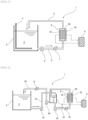
- FIG. 1 illustrates an electrolytic sulfuric acid solution manufacturing system according to a first embodiment to which the startup method for an electrolytic sulfuric acid solution manufacturing system of the present invention can be applied.
- an electrolytic sulfuric acid solution manufacturing system 1 includes a storage tank 2 that receives an electrolytic sulfuric acid solution 3 and a heater 4 as a temperature control mechanism disposed in the storage tank 2.
- the storage tank 2 is provided with a circulation pipe 5 that exits from the bottom portion of the storage tank 2 and returns to the storage tank 2.
- the circulation pipe 5 is provided with a circulation pump 6 as a liquid feed mechanism, a heat exchanger 7 for cooling as a temperature control mechanism, and an electrolytic cell 8 connected to a DC power source 9 in this order from the outlet side (base end side).
- An anode electrode 8A, a bipolar electrode 8B, and a cathode electrode 8C are provided in the electrolytic cell 8.
- a method of manufacturing the electrolytic sulfuric acid solution 3 using the electrolytic sulfuric acid solution manufacturing system 1 as described above will then be described.
- a solution composed mainly of sulfuric acid is put into the storage tank 2 and supplied to the electrolytic cell 8 through the circulation pipe 5 by the circulation pump 6.
- the solution composed mainly of sulfuric acid is energized with a predetermined current from the DC power source 9 to electrolyze the solution, thereby manufacturing an oxidizing solution (electrolytic sulfuric acid solution 3) containing a persulfuric acid component such as peroxodisulfuric acid generated by the electrolysis.
- an oxidizing solution electrolytic sulfuric acid solution 3
- the electrolytic sulfuric acid solution 3 is returned to the storage tank 2 through the circulation pipe 5, and this is repeated for circulation.
- the current amount in the electrolytic cell 8 may be controlled so that the concentration of persulfuric acid such as peroxodisulfuric acid generated by the electrolytic sulfuric acid solution 3 becomes a desired concentration in accordance with the processing using the electrolytic sulfuric acid solution 3.
- intended processing such as etching of a resin molded article may be performed.
- the electrolytic sulfuric acid solution manufacturing system 1 when the electrolytic sulfuric acid solution manufacturing system 1 is started up, specifically, such as during an initial operation after completion of the electrolytic sulfuric acid solution manufacturing system 1, after replacement of the electrolytic sulfuric acid solution 3 in the system 1, or during an operation after the concentration of the persulfuric acid component in the electrolytic sulfuric acid solution 3 stored in the system decreases due to shutdown of the system 1, the electrolytic sulfuric acid solution 3 stored in the storage tank 2 cannot be used without any modification because the concentration of the persulfuric acid component is lower than a target concentration for the desired processing.
- adjustment is performed so that the desired persulfuric acid concentration and sulfuric acid concentration are reached in a short time when starting up the electrolytic sulfuric acid solution manufacturing system 1 (concentration adjustment step).
- This adjustment may include, for example, adding hydrogen peroxide water and, if necessary, further adding sulfuric acid and/or water, thereby manufacturing a liquid to be electrolyzed in which respective ratios (concentrations) are adjusted.
- persulfuric acid concentration can be adjusted by mixing sulfuric acid and hydrogen peroxide to generate a persulfuric acid (peroxomonosulfuric acid) component having strong oxidizing properties through a reaction of Formula (4) as below.
- hydrogen peroxide water having any concentration, such as 35 wt% hydrogen peroxide water used as a general industrial chemical, can be used, but it may be preferred to use a high-concentration hydrogen peroxide water because it requires only a small additive amount to achieve a desired value of the oxidant concentration in the electrolytic sulfuric acid solution 3, and general industrial chemicals and EL grade chemicals for electronics industries can be used properly.
- the sulfuric acid used in the reaction of the above formula (4) may preferably have a concentration of 70 to 98 wt%, but general industrial chemicals and EL grade chemicals for electronics industries can be used properly.
- the liquid has to be diluted, but if hydrogen peroxide water is used for this dilution, the oxidizing properties of the liquid to be electrolyzed may become unduly high, so in such a case, it may be preferred to add water for dilution.
- City water such as tap water can be used for diluting sulfuric acid, but it may be desired to use pure water to avoid various cations and anions from being mixed in, and ultrapure water can also be used depending on the target objects applied to washing or modification of the surfaces of various materials.
- the method of adding these components is not particularly limited, but a preferred method may include preliminarily dissolving concentrated sulfuric acid in water in accordance with the final concentration of sulfuric acid, filling the storage tank 2 of the electrolytic sulfuric acid solution manufacturing system 1 with the sulfuric acid solution, and slowly mixing hydrogen peroxide water to prepare the liquid to be electrolyzed while paying attention to sudden reactions. Additionally or alternatively, another method may be employed to fill the storage tank 2 with the liquid to be electrolyzed, which is obtained by separately mixing a concentration-adjusted sulfuric acid solution and hydrogen peroxide water. In the stage of this operation, the circulation pump 6 is operated and the electrolytic cell 8 is energized to start electrolysis of the circulating liquid (liquid to be electrolyzed).
- the additive amount of hydrogen peroxide water, sulfuric acid, and water may be determined based on the results of measuring the properties of the electrolytic sulfuric acid solution 3 at startup.
- an oxidant concentration meter and/or a sulfuric acid concentration meter may be installed in the storage tank 2 and/or the circulation pipe 5, and the additive amount of hydrogen peroxide water, sulfuric acid, or pure water may be determined based on the measurement results.
- an operation for increasing the persulfuric acid concentration (oxidant concentration) may be performed to add hydrogen peroxide water and, if necessary, sulfuric acid and/or water.
- the method of measuring the persulfuric acid concentration is not particularly limited, provided that it is a method capable of measuring a correct value, and an absorption photometry method, a redox titration method, a Raman spectrometric method, a polarographic method, a potentiometric method, etc. can be used.
- the method of measuring the sulfuric acid concentration is not particularly limited, provided that it is a method capable of measuring a correct value, and a density measurement method, a neutralization titration method, an ultrasonic propagation velocity measurement method, a pack testing method, etc. can be used.
- the sulfuric acid solution (liquid to be electrolyzed) in which the persulfuric acid concentration (oxidant concentration) is improved is supplied to the electrolytic cell 8 and electrolyzed, and the electrolysis is continued, if necessary while circulating the solution, until and the persulfuric acid concentration and the sulfuric acid concentration reach the target values (electrolytic processing step). Furthermore, the temperature of the electrolytic sulfuric acid solution 3 in the storage tank 2 may be adjusted to the target temperature by heating with the heater 4 so as to reach a desired temperature (temperature adjustment step).
- a second embodiment of the present invention will then be described.
- the second embodiment exhibits the same effects as those in the previously described first embodiment except that the electrolytic sulfuric acid solution manufacturing system 1 is different.
- FIG. 2 illustrates an electrolytic sulfuric acid solution manufacturing system according to the second embodiment to which the startup method for an electrolytic sulfuric acid solution manufacturing system of the present invention can be applied.
- the electrolytic sulfuric acid solution manufacturing system 1 is provided with a storage tank 2 that receives an electrolytic sulfuric acid solution 3, a pipe 5A that exits from the bottom portion of the storage tank 2 and communicates with an intermediate tank 10, and a pipe 5B that returns from the intermediate tank 10 to the storage tank 2.
- the pipe 5A is provided with a liquid feed pump 6A as a liquid feed mechanism while the pipe 5B is provided with a liquid feed pump 6B as a liquid feed mechanism and a heat exchanger 7A for cooling as a temperature control mechanism.
- the bottom portion of the intermediate tank 10 is provided with a circulation pipe 5C that exits from the bottom portion of the intermediate tank 10 and returns to the intermediate tank 10.
- the circulation pipe 5C is provided with a circulation pump 6C as a liquid feed mechanism, a heat exchanger 7B for cooling as a temperature control mechanism, and an electrolytic cell 8 connected to a DC power source 9 in this order from the outlet side (base end side).
- An anode electrode 8A, a bipolar electrode 8B, and a cathode electrode 8C are provided in the electrolytic cell 8.
- a method of manufacturing the electrolytic sulfuric acid solution 3 using the electrolytic sulfuric acid solution manufacturing system 1 as described above will then be described.
- a solution composed mainly of sulfuric acid is put into the intermediate tank 10 and supplied from the intermediate tank 10 to the electrolytic cell 8 through the circulation pipe 5C by the circulation pump 6C, and the electrolytic cell 8 is energized with a predetermined current from the DC power source 9 to electrolyze the solution composed mainly of sulfuric acid, thereby manufacturing an oxidizing solution (electrolytic sulfuric acid solution 3) containing a persulfuric acid component such as peroxodisulfuric acid.
- the oxidizing solution (electrolytic sulfuric acid solution 3) may be preferably cooled by the heat exchanger 7B for cooling.
- the electrolytic sulfuric acid solution 3 is returned to the intermediate tank 10 through the circulation pipe 5C and supplied from the pipe 5B to the storage tank 2 by the liquid feed pump 6B.
- it may be preferred to heat the electrolytic sulfuric acid solution 3 by the heat exchanger 7A for heating so that the temperature of the electrolytic sulfuric acid solution 3 becomes a desired temperature in accordance with the processing using the electrolytic sulfuric acid solution 3.
- the current amount in the electrolytic cell 8 may be controlled so that the concentration of persulfuric acid such as peroxodisulfuric acid generated by the electrolytic sulfuric acid solution 3 becomes a desired concentration in accordance with the processing using the electrolytic sulfuric acid solution 3. Then, using the electrolytic sulfuric acid solution 3, intended processing such as etching of a resin molded article may be performed.
- hydrogen peroxide water and, if necessary, sulfuric acid and/or water may be added as in the previously described first embodiment.
- the positions at which the hydrogen peroxide water, sulfuric acid, and/or water are added are not particularly limited, and they can be added to the storage tank 2, the intermediate tank 10, the pipes 5A and 5B, the circulation pipe 5C, etc., but may be generally added to the intermediate tank 10.
- the method of addition is also not particularly limited, and a general-purpose method such as addition using a pump can be applied.
- the liquid to be electrolyzed is prepared by adding hydrogen peroxide water to the sulfuric acid solution
- the electrolytic sulfuric acid solution 3 is made by circulating the liquid to be electrolyzed between the intermediate tank 10 and the electrolytic cell 8 until the liquid has the oxidizing power close to the oxidizing properties required for various processes including a modification process, and then the electrolytic sulfuric acid solution 3 can be adjusted to a predetermined temperature and supplied to the storage tank 2; therefore, the storage tank 2 can be used as a processing tank without any modification.
- the electrolytic sulfuric acid solution 3 can be manufactured in parallel with the desired processing in the storage tank 2.
- the storage tank 2 can be used as an etching tank in a plated component manufacturing line that uses an electrolytic sulfuric acid solution for a resin surface etching process performed for plating the surface of a plastic material.
- the electrolytic sulfuric acid solution 3 having desired concentrations of persulfuric acid and sulfuric acid can be obtained in a short time through preparing the liquid to be electrolyzed having enhanced oxidizing properties by adding hydrogen peroxide water and, if necessary, sulfuric acid and/or water during startup of the electrolytic sulfuric acid solution manufacturing system 1 and energizing the electrolytic cell 8 to perform electrolysis of the liquid to be electrolyzed, and the startup of the electrolytic sulfuric acid solution manufacturing system can be completed in a short time.
- persulfates such as sodium persulfate, potassium persulfate, and ammonium persulfate or other similar salts are not added, and therefore cationic components other than hydrogen ions caused by persulfates are not mixed into the electrolytic sulfuric acid solution. Furthermore, there can also be obtained an effect that handling is easy because only a liquid is added.
- the startup method for an electrolytic sulfuric acid solution manufacturing system of the present invention has been heretofore described with reference to the accompanying drawings, the present invention is not limited to the above embodiments, and various modifications are possible.
- the means for adding sulfuric acid, hydrogen peroxide water, and water may be assisted by a calculation/control means such as a personal computer that controls respective additive amounts to optimum values based on the measurement results of the sulfuric acid concentration meter and the oxidant concentration meter, and the addition of sulfuric acid, hydrogen peroxide water, and water and/or the control of the electrolysis time (circulation time) for the electrolytic cell 8 may be automated.
- the sulfuric acid concentration, persulfuric acid concentration, and temperature of the electrolytic sulfuric acid solution 3 can be varied in accordance with the object to be processed.
- a sulfuric acid concentration of 78 wt%, a persulfuric acid concentration of 7 g/L as S 2 O 8 , and a temperature of 60°C were set as the liquid properties of the electrolytic sulfuric acid solution 3 containing a persulfuric acid component used for resin etching as preprocessing for plating an ABS resin molded article, and the electrolytic sulfuric acid solution 3 was manufactured by the following steps using the electrolytic sulfuric acid solution manufacturing system 1 illustrated in FIG.1 .
- the electrolytic cell 8 was energized with a current of 20 A applied between the anode electrode 8A and the cathode electrode 8C from the DC power source 9 to perform electrolysis of the circulating sulfuric acid solution.
- As the anode electrode 8A, the cathode electrode 8C, and the bipolar electrode 8B electrodes obtained by forming diamond films on the surfaces of silicon wafers (diamond electrodes) were used.
- the electrode areas of the anode electrode 8A and the cathode electrode 8C were both set to 5.2 dm 2 . Then, the circulating liquid (sulfuric acid solution) passed through the electrolytic cell 8 was returned to the storage tank 2.
- the persulfuric acid concentration in the circulating liquid was appropriately measured, and the electrolysis in the electrolytic cell 8 was continued while circulating the liquid until the properties of the circulating liquid would reach the liquid properties used for etching set as above, thereby manufacturing the electrolytic sulfuric acid solution 3.
- the electrolytic sulfuric acid solution 3 in the storage tank 2 was heated to a set temperature (60°C) using an electric heater (heater 4) installed in the storage tank 2.
- the persulfuric acid concentration was obtained from the difference between the oxidant concentration measured by an iodine titration method and the oxidant concentration measured by a permanganic acid titration method.
- the iodine titration method refers to a method that includes adding KI to a small amount of a measurement target liquid to liberate I 2 , titrating the I 2 with a Na 2 S 2 O 3 standard solution to obtain the amount of I 2 , and obtaining an oxidant concentration from the amount of I 2 , and the total oxidant component concentration is measured.
- the permanganic acid titration refers to a measurement method in which a small amount of a measurement target liquid is titrated with potassium permanganate, and only the hydrogen peroxide concentration in the measurement target liquid can be obtained.
- the persulfuric acid concentration is calculated by subtracting the oxidant concentration corresponding to the hydrogen peroxide concentration from the total oxidant concentration obtained by the iodine titration method.
- Etching was performed by immersing an ABS resin test piece (BULKSAM TM-25, available from Techno-UMG Co., Ltd.: 40 mm ⁇ 130 mm ⁇ t3 mm) in the electrolytic sulfuric acid solution 3 manufactured as described above for 10 minutes. Specifically, the test piece attached to a jig was immersed in the storage tank 2. Then, the etched test piece was immersed in warm water at 50°C for 10 minutes, and then washed with water and further immersed in a neutralizing liquid (concentrated hydrochloric acid 50 mL/L, 35°C) for 1 minute.
- a neutralizing liquid concentrated hydrochloric acid 50 mL/L, 35°C
- the test piece was immersed in a palladium-tin colloidal catalyst liquid (palladium concentration 0.11 g/L, tin concentration 10.7 g/L, concentrated hydrochloric acid 180 mL/L, 40°C) for 2 minutes, washed with water, and then immersed in an activation liquid (concentrated hydrochloric acid 100 mL/L, 40°C) for 10 minutes to perform the activation process.
- an activation liquid concentrated hydrochloric acid 100 mL/L, 40°C
- the plating process was performed by immersing the test piece in an electroless nickel plating liquid (nickel concentration 8.0 g/L, pH 9.0, 40°C) for 15 minutes. It has been confirmed that silver-colored nickel plating is deposited on the entire surface of the test piece subjected to the plating process step.
- a sulfuric acid concentration of 78 wt%, a persulfuric acid concentration of 7 g/L as S 2 O 8 , and a temperature of 60°C were set as the liquid properties of the electrolytic sulfuric acid solution 3 containing a persulfuric acid component used for resin etching as preprocessing for plating an ABS resin molded article, and the electrolytic sulfuric acid solution 3 was manufactured by the following steps using the same electrolytic sulfuric acid solution manufacturing system 1 as in Comparative Example 1.
- the electrolytic cell 8 was energized under the same conditions as in Comparative Example 1 described above, and the circulating liquid passed through the electrolytic cell 8 was returned to the storage tank 2. During this operation, the persulfuric acid concentration in the circulating liquid was appropriately measured, and the electrolysis was continued until the properties of the circulating liquid would reach the liquid properties used for etching set as above, thereby manufacturing the electrolytic sulfuric acid solution 3. In this operation, the electrolytic sulfuric acid solution 3 in the storage tank 2 was heated to a set temperature (60°C) using an electric heater (heater 4) installed in the storage tank 2.
- the ABS resin test piece was subjected to the etching process and pre-plating process under the same conditions as in Comparative Example 1 and then further subjected to the plating process. As in Comparative Example 1, it has been confirmed that silver-colored nickel plating is deposited on the entire surface of the test piece subjected to the plating process step.
Landscapes
- Chemical & Material Sciences (AREA)
- Engineering & Computer Science (AREA)
- Metallurgy (AREA)
- Chemical Kinetics & Catalysis (AREA)
- Electrochemistry (AREA)
- Materials Engineering (AREA)
- Organic Chemistry (AREA)
- Inorganic Chemistry (AREA)
- Automation & Control Theory (AREA)
- Analytical Chemistry (AREA)
- Life Sciences & Earth Sciences (AREA)
- Sustainable Development (AREA)
- Electrolytic Production Of Non-Metals, Compounds, Apparatuses Therefor (AREA)
Abstract
Description
- The present invention relates to a startup method for a system for manufacturing an electrolytic sulfuric acid solution suitable for an etching process that is performed prior to the washing and modification of the surfaces of various materials, in particular performed prior to the plating process for the surfaces of plastic materials.
- Sulfuric acid solution containing a persulfuric acid component such as peroxomonosulfuric acid or peroxodisulfuric acid has extremely strong oxidizing properties. Using this strong oxidizing properties, sulfuric acid solution containing a persulfuric acid component is used for washing and surface modification of various materials such as metals, silicon, glass, and plastics.
- Sulfuric acid solution containing a persulfuric acid component can be generated by electrolyzing a solution composed mainly of a sulfuric acid component. A system for manufacturing an oxidizing solution containing a persulfuric acid component generated by electrolyzing the solution composed mainly of a sulfuric acid component (the oxidizing solution may be referred to as an electrolytic sulfuric acid solution, hereinafter) is composed, for example, of a storage tank that stores the electrolytic sulfuric acid solution, an electrolytic cell and a DC power source, a pipe equipped with a circulation pump for circulating the solution between the storage tank and the electrolytic cell, a heater and/or heat exchanger for heating/cooling the circulating liquid, and other necessary components. The electrolytic sulfuric acid solution is generated by energizing electrodes in the electrolytic cell to perform electrolysis while circulating the solution composed mainly of a sulfuric acid component.
Patent Document 1 describes, as a method of manufacturing the electrolytic sulfuric acid using such a system, a technique for manufacturing the electrolytic sulfuric acid to be applied to an etching process for a resin surface performed for plating the surface of a plastic material. - In the method of manufacturing an electrolytic sulfuric acid described in
Patent Document 1, sulfuric acid is electrolyzed to obtain an electrolytic sulfuric acid solution so that the sulfuric acid concentration is 60 to 87 wt%, the temperature of the solution is 50°C to 80°C, and the persulfuric acid concentration is 3 g/L or more. By etching the surface of an ABS resin with the electrolytic sulfuric acid solution, butadiene components are dissolved from the ABS-based resin surface, and hydrophilic functional groups are exposed to roughen the surface. When plating is applied to the ABS-based resin thus subjected to the etching process, a sufficiently adherent plating can be deposited. This etching process with the electrolytic sulfuric acid solution has been proposed as an effective processing method that has less environmental burden than resin etching conventionally performed using chromic acid.Patent Document 1 further describes generating a persulfuric acid solution such as peroxodisulfuric acid through filling a cell with sulfuric acid having a predetermined concentration in the initial state and energizing an anode and a cathode with a predetermined current from a DC power source unit to electrolyze the sulfuric acid.Patent Document 1 also describes, as a comparative example, an example in which a mixed solution of sulfuric acid and hydrogen peroxide is used as substitute for the electrolytic sulfuric acid solution to etch the surface of an ABS resin, and teaches that the comparative example allows a plating film to be formed, but has a problem in the long-term stability of the process due to the consumption of hydrogen peroxide. - [Patent Document 1]
JP2019-044229A - Thus, the washing and modification processes for the surfaces of various materials using an electrolytic sulfuric acid solution is a very effective method in terms of the influence on environment. The system for manufacturing an electrolytic sulfuric acid solution, however, is not in a state in which the washing and modification processes can be immediately performed for the surfaces of various materials, such as during initial startup of the system after its completion, during startup of the system after replacement of the electrolytic sulfuric acid solution, or during re-startup of the system when the concentration of persulfuric acid that is an effective component in the electrolytic sulfuric acid solution decreases due to shutdown of the system. That is, when starting up the electrolytic sulfuric acid solution manufacturing system as described previously, a preparatory stage has to be performed to operate an electrolytic cell to continue electrolysis until the electrolytic sulfuric acid solution in which the concentration of sulfuric acid solution itself or persulfuric acid decreases has a predetermined persulfuric acid concentration for any purpose. As such, there is a problem in that energy is required to obtain the electrolytic sulfuric acid solution having a persulfuric acid concentration necessary for the washing and modification processes for the surfaces of various materials and the system cannot be started up in a short time.
- Specifically, such a problem is that, in a manufacturing line for plated components that uses an electrolytic sulfuric acid solution for the etching process for the resin surface performed to plate the plastic material surface, the electrolysis has to be continued until liquid properties for providing effective etching effects can be obtained while circulating the sulfuric acid solution adjusted to a predetermined concentration through the electrolytic cell after re-startup when replacing the etchant due to periodic check of the etching tank, etc. or after re-startup of the electrolytic sulfuric acid solution manufacturing system; therefore, it takes a long time to start manufacturing plated components, and a large amount of energy is consumed before starting to manufacture plated products. Such problems are particularly conspicuous when the amount of solution held in the electrolytic sulfuric acid solution manufacturing system is large, such as when the volume of an etching tank for a pre-plating preprocess is large.
- The present invention has been made in view of the above problems, and an object of the present invention is to provide a startup method for an electrolytic sulfuric acid solution manufacturing system that can complete, in a short time, the startup of the system for manufacturing an electrolytic sulfuric acid solution containing a persulfuric acid component generated by electrolyzing sulfuric acid and can reduce the energy consumption.
- To achieve the above object, first, the present invention provides a startup method for an electrolytic sulfuric acid solution manufacturing system, the system manufacturing an oxidizing solution containing a persulfuric acid component generated by electrolyzing a solution composed mainly of a sulfuric acid component, the startup method comprising: adding hydrogen peroxide water to all or part of the solution composed mainly of the sulfuric acid component present in the system to adjust oxidizing power of the solution composed mainly of the sulfuric acid component to an enhanced state; and supplying the solution to an electrolytic cell to perform electrolysis (Invention 1). In the above invention (Invention 1), startup of the system may preferably take place either during an initial operation after completion of the system, or after replacement of the oxidizing solution containing the persulfuric acid component in the system, or during an operation after the concentration of the persulfuric acid component in the oxidizing solution stored in the system decreases due to shutdown of the system (Invention 2).
- During startup of the system for manufacturing an oxidizing solution containing a persulfuric acid component generated by electrolyzing a solution composed mainly of a sulfuric acid component, that is, during the initial operation after completion of the system, or after replacement of the sulfuric acid containing solution in the system, or during the operation after the concentration of the persulfuric acid component in the electrolytic sulfuric acid solution stored in the system decreases due to shutdown of the system, or in a similar situation as above, the oxidant concentration (persulfuric acid concentration) of the solution composed mainly of the sulfuric acid component held in the system is lower than the target oxidant concentration of the oxidizing solution. According to the invention (
Invention 1, 2), the oxidizing solution having the target oxidant concentration can be produced in a short time through adding hydrogen peroxide water to the solution composed mainly of the sulfuric acid component in the system to adjust the oxidizing power to an enhanced state and then performing the electrolysis in the electrolytic cell. This can significantly reduce the time and energy consumption required for startup of the electrolytic sulfuric acid solution manufacturing system. In the present invention, the solution composed mainly of a sulfuric acid component held in the system encompasses not only a solution that contains no persulfuric acid component but also an oxidizing solution in a state in which the oxidant concentration (persulfuric acid concentration) decreases to a value lower than a target value. - In the above inventions (
Invention 1, 2), the startup method may preferably comprise further adding sulfuric acid and/or water to all or part of the solution composed mainly of the sulfuric acid component present in the system (Invention 3). - According to the invention (Invention 3), both the oxidant concentration and the sulfuric acid concentration of the solution composed mainly of the sulfuric acid component present in the system can be respective suitable concentrations for the intended processing.
- In the above invention (Invention 3), the startup method may preferably comprise: a concentration adjustment step of adding the hydrogen peroxide water, sulfuric acid, and/or water in response to a measured value of a sulfuric acid concentration and/or a persulfuric acid concentration in the solution composed mainly of the sulfuric acid component present in the system; an electrolytic processing step of electrolyzing the solution in response to the measured value of each concentration so that the persulfuric acid concentration becomes a target value; and a temperature adjustment step of heating or cooling the solution in response to a measured value of temperature so that the temperature of the oxidizing solution becomes a target value (Invention 4).
- According to the invention (Invention 4), the oxidizing solution containing a persulfuric acid component having a persulfuric acid concentration, a sulfuric acid concentration, and a temperature suitable for the intended processing can be efficiently supplied in a short time after the startup of the system.
- In the above invention (
Invention 3 or 4), the system may preferably comprise: a storage tank that stores the oxidizing solution; an electrolytic cell that processes the oxidizing solution; a circulation pipe provided with a liquid feed mechanism for circulating the solution between the storage tank and the electrolytic cell; a control mechanism that controls the temperature of the oxidizing solution in the storage tank and/or the temperature of the solution supplied to the electrolytic cell; a hydrogen peroxide addition mechanism; and an addition mechanism for sulfuric acid and/or water (Invention 5). - According to the invention (Invention 5), during normal operation of the electrolytic sulfuric acid solution manufacturing system, the solution composed mainly of the sulfuric acid component is electrolyzed in the electrolytic cell to generate an oxidizing solution containing a persulfuric acid component, the oxidizing solution is stored in the storage tank, the oxidizing solution is circulated between the storage tank and the electrolytic cell, and the temperature control is performed when the desired oxidant concentration and sulfuric acid concentration are achieved. This allows the oxidizing solution, which contains the persulfuric acid component having the desired sulfuric acid concentration, persulfuric acid concentration, and temperature, to be manufactured. Then, when the electrolytic sulfuric acid solution manufacturing system is started up, it is possible to significantly reduce the time and energy consumption required for startup of the electrolytic sulfuric acid solution manufacturing system through adding the hydrogen peroxide water from the hydrogen peroxide water addition mechanism to the solution composed mainly of the sulfuric acid component present in the system to bring the persulfuric acid concentration of the oxidizing solution close to the target value, adding the sulfuric acid and/or water from the addition mechanism for sulfuric acid and/or water thereby to adjust the sulfuric acid concentration to prepare a liquid to be electrolyzed, and supplying this to the electrolytic cell for electrolytic processing.
- According to the startup method for an electrolytic sulfuric acid solution manufacturing system of the present invention, it is possible to significantly reduce the time and energy consumption required for startup of the electrolytic sulfuric acid solution manufacturing system through adding hydrogen peroxide water to all or part of the solution composed mainly of the sulfuric acid component, which is present in the system when the electrolytic sulfuric acid solution manufacturing system is started up, to adjust the oxidizing power of the solution composed mainly of the sulfuric acid component to an enhanced state and then performing the electrolysis in the electrolytic cell.
-
-
FIG. 1 is a schematic diagram illustrating an electrolytic sulfuric acid solution manufacturing system according to a first embodiment to which the startup method for an electrolytic sulfuric acid solution manufacturing system of the present invention can be applied. -
FIG. 2 is a schematic diagram illustrating an electrolytic sulfuric acid solution manufacturing system according to a second embodiment to which the startup method for an electrolytic sulfuric acid solution manufacturing system of the present invention can be applied. - Hereinafter, the startup method for an electrolytic sulfuric acid solution manufacturing system will be described in detail with reference to the accompanying drawings.
- In the present embodiment, the electrolytic sulfuric acid solution to be manufactured is an oxidizing solution that contains a persulfuric acid component generated by electrolyzing a solution composed mainly of a sulfuric acid component. Here, when sulfuric acid is electrolyzed, peroxodisulfuric acid is generated in accordance with Reaction Formula (1) as below.
2HSO4 -→H2S2O8+2e-... (1)
- In addition, from the peroxodisulfuric acid, peroxomonosulfuric acid is generated in an equilibrium reaction represented by Formula (2), and hydrogen peroxide is generated in an equilibrium reaction represented by Formula (3). Thus, the electrolytic liquid of sulfuric acid contains mixed oxidizing substances such as peroxodisulfuric acid, peroxomonosulfuric acid (here, peroxodisulfuric acid and peroxomonosulfuric acid are collectively referred to as persulfuric acid), and hydrogen peroxide. All of these have strong oxidizing power.
H2S2O8+H2O↔H2SO5+H2SO4... (2)
H2SO5+H2O↔H2O2+H2SO4... (3)
- An electrolytic sulfuric acid solution manufacturing system for manufacturing the electrolytic sulfuric acid solution as described above will then be described.
FIG. 1 illustrates an electrolytic sulfuric acid solution manufacturing system according to a first embodiment to which the startup method for an electrolytic sulfuric acid solution manufacturing system of the present invention can be applied. - In
FIG. 1 , an electrolytic sulfuric acidsolution manufacturing system 1 includes astorage tank 2 that receives an electrolyticsulfuric acid solution 3 and aheater 4 as a temperature control mechanism disposed in thestorage tank 2. Thestorage tank 2 is provided with acirculation pipe 5 that exits from the bottom portion of thestorage tank 2 and returns to thestorage tank 2. Thecirculation pipe 5 is provided with acirculation pump 6 as a liquid feed mechanism, aheat exchanger 7 for cooling as a temperature control mechanism, and anelectrolytic cell 8 connected to a DC power source 9 in this order from the outlet side (base end side). Ananode electrode 8A, abipolar electrode 8B, and acathode electrode 8C are provided in theelectrolytic cell 8. - A method of manufacturing the electrolytic
sulfuric acid solution 3 using the electrolytic sulfuric acidsolution manufacturing system 1 as described above will then be described. First, a solution composed mainly of sulfuric acid is put into thestorage tank 2 and supplied to theelectrolytic cell 8 through thecirculation pipe 5 by thecirculation pump 6. Then, the solution composed mainly of sulfuric acid is energized with a predetermined current from the DC power source 9 to electrolyze the solution, thereby manufacturing an oxidizing solution (electrolytic sulfuric acid solution 3) containing a persulfuric acid component such as peroxodisulfuric acid generated by the electrolysis. During this operation, it may be preferred to cool the electrolyticsulfuric acid solution 3 by theheat exchanger 7 in order to improve the electrolysis efficiency in theelectrolytic cell 8. The electrolyticsulfuric acid solution 3 is returned to thestorage tank 2 through thecirculation pipe 5, and this is repeated for circulation. In this operation, the current amount in theelectrolytic cell 8 may be controlled so that the concentration of persulfuric acid such as peroxodisulfuric acid generated by the electrolyticsulfuric acid solution 3 becomes a desired concentration in accordance with the processing using the electrolyticsulfuric acid solution 3. Then, it may be preferred to heat the electrolyticsulfuric acid solution 3 stored in thestorage tank 2 by theheater 4 so that the temperature of the electrolyticsulfuric acid solution 3 becomes a desired temperature in accordance with the processing using the electrolyticsulfuric acid solution 3. Using the electrolyticsulfuric acid solution 3 thus charged in thestorage tank 2, intended processing such as etching of a resin molded article may be performed. - In the steps of manufacturing the electrolytic sulfuric acid solution as described above, when the electrolytic sulfuric acid
solution manufacturing system 1 is started up, specifically, such as during an initial operation after completion of the electrolytic sulfuric acidsolution manufacturing system 1, after replacement of the electrolyticsulfuric acid solution 3 in thesystem 1, or during an operation after the concentration of the persulfuric acid component in the electrolyticsulfuric acid solution 3 stored in the system decreases due to shutdown of thesystem 1, the electrolyticsulfuric acid solution 3 stored in thestorage tank 2 cannot be used without any modification because the concentration of the persulfuric acid component is lower than a target concentration for the desired processing. In the prior art, therefore, the circulation of the electrolyticsulfuric acid solution 3 has to be continued between thestorage tank 2, thecirculation pipe 5, and theelectrolytic cell 8 until the desired persulfuric acid concentration is achieved. There has thus been a problem in that it takes a long time and a large amount of energy to obtain the electrolyticsulfuric acid solution 3 having a desired persulfuric acid concentration and the electrolytic sulfuric acidsolution manufacturing system 1 cannot be started up in a short time. - In the present embodiment, therefore, adjustment is performed so that the desired persulfuric acid concentration and sulfuric acid concentration are reached in a short time when starting up the electrolytic sulfuric acid solution manufacturing system 1 (concentration adjustment step). This adjustment may include, for example, adding hydrogen peroxide water and, if necessary, further adding sulfuric acid and/or water, thereby manufacturing a liquid to be electrolyzed in which respective ratios (concentrations) are adjusted.
- This is because the persulfuric acid concentration can be adjusted by mixing sulfuric acid and hydrogen peroxide to generate a persulfuric acid (peroxomonosulfuric acid) component having strong oxidizing properties through a reaction of Formula (4) as below.
H2SO4+H2O2↔H2SO5+H2O ... (4)
- Here, for the hydrogen peroxide water to be added, hydrogen peroxide water having any concentration, such as 35 wt% hydrogen peroxide water used as a general industrial chemical, can be used, but it may be preferred to use a high-concentration hydrogen peroxide water because it requires only a small additive amount to achieve a desired value of the oxidant concentration in the electrolytic
sulfuric acid solution 3, and general industrial chemicals and EL grade chemicals for electronics industries can be used properly. - The sulfuric acid used in the reaction of the above formula (4) may preferably have a concentration of 70 to 98 wt%, but general industrial chemicals and EL grade chemicals for electronics industries can be used properly.
- When the sulfuric acid concentration of the liquid to be electrolyzed is unduly high, the liquid has to be diluted, but if hydrogen peroxide water is used for this dilution, the oxidizing properties of the liquid to be electrolyzed may become unduly high, so in such a case, it may be preferred to add water for dilution. City water such as tap water can be used for diluting sulfuric acid, but it may be desired to use pure water to avoid various cations and anions from being mixed in, and ultrapure water can also be used depending on the target objects applied to washing or modification of the surfaces of various materials.
- The method of adding these components is not particularly limited, but a preferred method may include preliminarily dissolving concentrated sulfuric acid in water in accordance with the final concentration of sulfuric acid, filling the
storage tank 2 of the electrolytic sulfuric acidsolution manufacturing system 1 with the sulfuric acid solution, and slowly mixing hydrogen peroxide water to prepare the liquid to be electrolyzed while paying attention to sudden reactions. Additionally or alternatively, another method may be employed to fill thestorage tank 2 with the liquid to be electrolyzed, which is obtained by separately mixing a concentration-adjusted sulfuric acid solution and hydrogen peroxide water. In the stage of this operation, thecirculation pump 6 is operated and theelectrolytic cell 8 is energized to start electrolysis of the circulating liquid (liquid to be electrolyzed). - The additive amount of hydrogen peroxide water, sulfuric acid, and water (pure water) may be determined based on the results of measuring the properties of the electrolytic
sulfuric acid solution 3 at startup. For example, an oxidant concentration meter and/or a sulfuric acid concentration meter may be installed in thestorage tank 2 and/or thecirculation pipe 5, and the additive amount of hydrogen peroxide water, sulfuric acid, or pure water may be determined based on the measurement results. Specifically, when the persulfuric acid concentration of the electrolyticsulfuric acid solution 3 is lower than the target value, an operation for increasing the persulfuric acid concentration (oxidant concentration) may be performed to add hydrogen peroxide water and, if necessary, sulfuric acid and/or water. Here, the method of measuring the persulfuric acid concentration is not particularly limited, provided that it is a method capable of measuring a correct value, and an absorption photometry method, a redox titration method, a Raman spectrometric method, a polarographic method, a potentiometric method, etc. can be used. - When the sulfuric acid concentration measured by the sulfuric acid concentration meter is lower than the target value, sulfuric acid may be added to adjust the concentration. On the other hand, when the sulfuric acid concentration is higher than the target value, water and/or hydrogen peroxide water may be added to adjust the concentration. Here, the method of measuring the sulfuric acid concentration is not particularly limited, provided that it is a method capable of measuring a correct value, and a density measurement method, a neutralization titration method, an ultrasonic propagation velocity measurement method, a pack testing method, etc. can be used.
- Then, the sulfuric acid solution (liquid to be electrolyzed) in which the persulfuric acid concentration (oxidant concentration) is improved is supplied to the
electrolytic cell 8 and electrolyzed, and the electrolysis is continued, if necessary while circulating the solution, until and the persulfuric acid concentration and the sulfuric acid concentration reach the target values (electrolytic processing step). Furthermore, the temperature of the electrolyticsulfuric acid solution 3 in thestorage tank 2 may be adjusted to the target temperature by heating with theheater 4 so as to reach a desired temperature (temperature adjustment step). - A second embodiment of the present invention will then be described. The second embodiment exhibits the same effects as those in the previously described first embodiment except that the electrolytic sulfuric acid
solution manufacturing system 1 is different. -
FIG. 2 illustrates an electrolytic sulfuric acid solution manufacturing system according to the second embodiment to which the startup method for an electrolytic sulfuric acid solution manufacturing system of the present invention can be applied. InFIG. 2 , the electrolytic sulfuric acidsolution manufacturing system 1 is provided with astorage tank 2 that receives an electrolyticsulfuric acid solution 3, apipe 5A that exits from the bottom portion of thestorage tank 2 and communicates with anintermediate tank 10, and apipe 5B that returns from theintermediate tank 10 to thestorage tank 2. Thepipe 5A is provided with a liquid feed pump 6A as a liquid feed mechanism while thepipe 5B is provided with aliquid feed pump 6B as a liquid feed mechanism and aheat exchanger 7A for cooling as a temperature control mechanism. The bottom portion of theintermediate tank 10 is provided with a circulation pipe 5C that exits from the bottom portion of theintermediate tank 10 and returns to theintermediate tank 10. The circulation pipe 5C is provided with acirculation pump 6C as a liquid feed mechanism, aheat exchanger 7B for cooling as a temperature control mechanism, and anelectrolytic cell 8 connected to a DC power source 9 in this order from the outlet side (base end side). Ananode electrode 8A, abipolar electrode 8B, and acathode electrode 8C are provided in theelectrolytic cell 8. - A method of manufacturing the electrolytic
sulfuric acid solution 3 using the electrolytic sulfuric acidsolution manufacturing system 1 as described above will then be described. First, a solution composed mainly of sulfuric acid is put into theintermediate tank 10 and supplied from theintermediate tank 10 to theelectrolytic cell 8 through the circulation pipe 5C by thecirculation pump 6C, and theelectrolytic cell 8 is energized with a predetermined current from the DC power source 9 to electrolyze the solution composed mainly of sulfuric acid, thereby manufacturing an oxidizing solution (electrolytic sulfuric acid solution 3) containing a persulfuric acid component such as peroxodisulfuric acid. To improve the electrolysis efficiency in theelectrolytic cell 8, the oxidizing solution (electrolytic sulfuric acid solution 3) may be preferably cooled by theheat exchanger 7B for cooling. The electrolyticsulfuric acid solution 3 is returned to theintermediate tank 10 through the circulation pipe 5C and supplied from thepipe 5B to thestorage tank 2 by theliquid feed pump 6B. During this operation, it may be preferred to heat the electrolyticsulfuric acid solution 3 by theheat exchanger 7A for heating so that the temperature of the electrolyticsulfuric acid solution 3 becomes a desired temperature in accordance with the processing using the electrolyticsulfuric acid solution 3. In this operation, the current amount in theelectrolytic cell 8 may be controlled so that the concentration of persulfuric acid such as peroxodisulfuric acid generated by the electrolyticsulfuric acid solution 3 becomes a desired concentration in accordance with the processing using the electrolyticsulfuric acid solution 3. Then, using the electrolyticsulfuric acid solution 3, intended processing such as etching of a resin molded article may be performed. - In the second embodiment as described above, during the startup of the electrolytic sulfuric acid
solution manufacturing system 1, hydrogen peroxide water and, if necessary, sulfuric acid and/or water may be added as in the previously described first embodiment. In this case, the positions at which the hydrogen peroxide water, sulfuric acid, and/or water are added are not particularly limited, and they can be added to thestorage tank 2, theintermediate tank 10, thepipes intermediate tank 10. The method of addition is also not particularly limited, and a general-purpose method such as addition using a pump can be applied. - Thus, according to the second embodiment, the liquid to be electrolyzed is prepared by adding hydrogen peroxide water to the sulfuric acid solution, the electrolytic
sulfuric acid solution 3 is made by circulating the liquid to be electrolyzed between theintermediate tank 10 and theelectrolytic cell 8 until the liquid has the oxidizing power close to the oxidizing properties required for various processes including a modification process, and then the electrolyticsulfuric acid solution 3 can be adjusted to a predetermined temperature and supplied to thestorage tank 2; therefore, thestorage tank 2 can be used as a processing tank without any modification. Furthermore, the electrolyticsulfuric acid solution 3 can be manufactured in parallel with the desired processing in thestorage tank 2. For example, thestorage tank 2 can be used as an etching tank in a plated component manufacturing line that uses an electrolytic sulfuric acid solution for a resin surface etching process performed for plating the surface of a plastic material. - According to the startup method for an electrolytic sulfuric acid solution manufacturing system of the above-described first and second embodiments, the electrolytic
sulfuric acid solution 3 having desired concentrations of persulfuric acid and sulfuric acid can be obtained in a short time through preparing the liquid to be electrolyzed having enhanced oxidizing properties by adding hydrogen peroxide water and, if necessary, sulfuric acid and/or water during startup of the electrolytic sulfuric acidsolution manufacturing system 1 and energizing theelectrolytic cell 8 to perform electrolysis of the liquid to be electrolyzed, and the startup of the electrolytic sulfuric acid solution manufacturing system can be completed in a short time. Through this operation, a solution having the oxidizing power close to the oxidizing properties required for the washing process and modification process for the surfaces of various materials can be obtained by a short-time electrolytic process, and it is possible to significantly reduce the use amount of energy required for starting the washing and modification processes. - Moreover, according to the present embodiments, persulfates such as sodium persulfate, potassium persulfate, and ammonium persulfate or other similar salts are not added, and therefore cationic components other than hydrogen ions caused by persulfates are not mixed into the electrolytic sulfuric acid solution. Furthermore, there can also be obtained an effect that handling is easy because only a liquid is added.
- While the startup method for an electrolytic sulfuric acid solution manufacturing system of the present invention has been heretofore described with reference to the accompanying drawings, the present invention is not limited to the above embodiments, and various modifications are possible. For example, the means for adding sulfuric acid, hydrogen peroxide water, and water may be assisted by a calculation/control means such as a personal computer that controls respective additive amounts to optimum values based on the measurement results of the sulfuric acid concentration meter and the oxidant concentration meter, and the addition of sulfuric acid, hydrogen peroxide water, and water and/or the control of the electrolysis time (circulation time) for the
electrolytic cell 8 may be automated. Moreover, the sulfuric acid concentration, persulfuric acid concentration, and temperature of the electrolyticsulfuric acid solution 3 can be varied in accordance with the object to be processed. - An example and a comparative example will be illustrated below to describe the present invention more specifically. Note, however, that the present invention is not limited by these descriptions.
- A sulfuric acid concentration of 78 wt%, a persulfuric acid concentration of 7 g/L as S2O8, and a temperature of 60°C were set as the liquid properties of the electrolytic
sulfuric acid solution 3 containing a persulfuric acid component used for resin etching as preprocessing for plating an ABS resin molded article, and the electrolyticsulfuric acid solution 3 was manufactured by the following steps using the electrolytic sulfuric acidsolution manufacturing system 1 illustrated inFIG.1 . - First, pure water and 96 wt% sulfuric acid were added/mixed in the
storage tank 2 so that the total liquid volume would be 15 L, and a sulfuric acid solution was prepared so that the sulfuric acid concentration would be 78 wt%. The sulfuric acid solution was supplied to theelectrolytic cell 8 through thecirculation pipe 5 at a flow rate of 2 L/min by operating thecirculation pump 6. During this operation, the liquid temperature of the sulfuric acid solution circulating through theelectrolytic cell 8 was adjusted by using theheat exchanger 7 so as to be 50°C or lower. - The
electrolytic cell 8 was energized with a current of 20 A applied between theanode electrode 8A and thecathode electrode 8C from the DC power source 9 to perform electrolysis of the circulating sulfuric acid solution. As theanode electrode 8A, thecathode electrode 8C, and thebipolar electrode 8B, electrodes obtained by forming diamond films on the surfaces of silicon wafers (diamond electrodes) were used. The electrode areas of theanode electrode 8A and thecathode electrode 8C were both set to 5.2 dm2. Then, the circulating liquid (sulfuric acid solution) passed through theelectrolytic cell 8 was returned to thestorage tank 2. During this operation, the persulfuric acid concentration in the circulating liquid (sulfuric acid solution) was appropriately measured, and the electrolysis in theelectrolytic cell 8 was continued while circulating the liquid until the properties of the circulating liquid would reach the liquid properties used for etching set as above, thereby manufacturing the electrolyticsulfuric acid solution 3. In this operation, the electrolyticsulfuric acid solution 3 in thestorage tank 2 was heated to a set temperature (60°C) using an electric heater (heater 4) installed in thestorage tank 2. - Here, the persulfuric acid concentration was obtained from the difference between the oxidant concentration measured by an iodine titration method and the oxidant concentration measured by a permanganic acid titration method. Here, the iodine titration method refers to a method that includes adding KI to a small amount of a measurement target liquid to liberate I2, titrating the I2 with a Na2S2O3 standard solution to obtain the amount of I2, and obtaining an oxidant concentration from the amount of I2, and the total oxidant component concentration is measured. On the other hand, the permanganic acid titration refers to a measurement method in which a small amount of a measurement target liquid is titrated with potassium permanganate, and only the hydrogen peroxide concentration in the measurement target liquid can be obtained. The persulfuric acid concentration is calculated by subtracting the oxidant concentration corresponding to the hydrogen peroxide concentration from the total oxidant concentration obtained by the iodine titration method.
- Through these steps, it took 2.5 hours to manufacture the electrolytic
sulfuric acid solution 3 having the set liquid properties. The power consumption required for the electrolysis during the steps was 1 kWh. - Etching was performed by immersing an ABS resin test piece (BULKSAM TM-25, available from Techno-UMG Co., Ltd.: 40 mm×130 mm×t3 mm) in the electrolytic
sulfuric acid solution 3 manufactured as described above for 10 minutes. Specifically, the test piece attached to a jig was immersed in thestorage tank 2. Then, the etched test piece was immersed in warm water at 50°C for 10 minutes, and then washed with water and further immersed in a neutralizing liquid (concentratedhydrochloric acid 50 mL/L, 35°C) for 1 minute. Then, the test piece was immersed in a palladium-tin colloidal catalyst liquid (palladium concentration 0.11 g/L, tin concentration 10.7 g/L, concentrated hydrochloric acid 180 mL/L, 40°C) for 2 minutes, washed with water, and then immersed in an activation liquid (concentrated hydrochloric acid 100 mL/L, 40°C) for 10 minutes to perform the activation process. After washing the test piece with water, the plating process was performed by immersing the test piece in an electroless nickel plating liquid (nickel concentration 8.0 g/L, pH 9.0, 40°C) for 15 minutes. It has been confirmed that silver-colored nickel plating is deposited on the entire surface of the test piece subjected to the plating process step. - The same ABS resin test piece as that used in Comparative Example 1 was subjected to the pre-plating process without performing the etching process under the same conditions as in Comparative Example 1 and was further subjected to the plating process. On the test piece subjected to the plating process, the plating was sparsely deposited on about 10% or less of the surface area, and it has been found that the test piece is unsuitable as a plated product without the etching process.
- A sulfuric acid concentration of 78 wt%, a persulfuric acid concentration of 7 g/L as S2O8, and a temperature of 60°C were set as the liquid properties of the electrolytic
sulfuric acid solution 3 containing a persulfuric acid component used for resin etching as preprocessing for plating an ABS resin molded article, and the electrolyticsulfuric acid solution 3 was manufactured by the following steps using the same electrolytic sulfuric acidsolution manufacturing system 1 as in Comparative Example 1. - First, pure water and 96 wt% sulfuric acid were added/mixed in the
storage tank 2 so that the total liquid volume would be 15 L, and a sulfuric acid solution was prepared so that the sulfuric acid concentration would be 78 wt%. The sulfuric acid solution was supplied to theelectrolytic cell 8 through thecirculation pipe 5 at a flow rate of 2 L/min by operating thecirculation pump 6. During this operation, thecirculation pump 6 was operated to circulate the sulfuric acid solution between thecirculation pipe 5 and thestorage tank 2 in a state in which theelectrolytic cell 8 was not operated, that is, electrolysis of the solution was not performed. - Then, 0.05 L of 35 wt% hydrogen peroxide water was added to the
storage tank 2. The liquid temperature rises due to the addition of the hydrogen peroxide water, so the liquid was cooled to 50°C or lower using theheat exchanger 7. After that, the sulfuric acid concentration in the sulfuric acid solution was measured, a small amount of 96 wt% sulfuric acid was added in response to the measurement result to adjust the sulfuric acid concentration to 78 wt%, and the liquid to be electrolyzed was thus obtained. Thereafter, theelectrolytic cell 8 was operated, and thecirculation pump 6 was operated to supply the liquid to be electrolyzed from thecirculation pipe 5 to theelectrolytic cell 8 at a flow rate of 2 L/min. During this operation, the liquid temperature of the liquid to be electrolyzed supplied to theelectrolytic cell 8 was adjusted by using theheat exchanger 7 so as to be 50°C or lower. - The
electrolytic cell 8 was energized under the same conditions as in Comparative Example 1 described above, and the circulating liquid passed through theelectrolytic cell 8 was returned to thestorage tank 2. During this operation, the persulfuric acid concentration in the circulating liquid was appropriately measured, and the electrolysis was continued until the properties of the circulating liquid would reach the liquid properties used for etching set as above, thereby manufacturing the electrolyticsulfuric acid solution 3. In this operation, the electrolyticsulfuric acid solution 3 in thestorage tank 2 was heated to a set temperature (60°C) using an electric heater (heater 4) installed in thestorage tank 2. - Through these steps, it took 10 minutes to prepare the electrolytic
sulfuric acid solution 3 having the set liquid properties. The power consumption required for the electrolysis during the steps was 0.07 kWh. From these facts, it can be found that both the required time and the power consumption are about 1/15 as compared to those in Comparative Example 1, the startup of the system can be completed in a short time, and the energy consumption can be significantly reduced. - Using the electrolytic
sulfuric acid solution 3 manufactured as described above, the ABS resin test piece was subjected to the etching process and pre-plating process under the same conditions as in Comparative Example 1 and then further subjected to the plating process. As in Comparative Example 1, it has been confirmed that silver-colored nickel plating is deposited on the entire surface of the test piece subjected to the plating process step. -
- 1 Electrolytic sulfuric acid solution manufacturing system
- 2 Storage tank
- 3 Electrolytic sulfuric acid solution
- 4 Heater (temperature control mechanism)
- 5, 5C Circulation pipe
- 5A Pipe
- 5B Pipe
- 6, 6C Circulation pump
- 6A, 6B Liquid feed pump
- 7 Heat exchanger (temperature control mechanism)
- 7A Heat exchanger for heating (temperature control
- mechanism)
- 7B Heat exchanger for cooling (temperature control mechanism)
- 8 Electrolytic cell
- 8A Anode electrode
- 8B Bipolar electrode
- 8C Cathode electrode
- 9 DC power source
- 10 Intermediate tank
Claims (5)
- A startup method for an electrolytic sulfuric acid solution manufacturing system, the system manufacturing an oxidizing solution containing a persulfuric acid component generated by electrolyzing a solution composed mainly of a sulfuric acid component, the startup method comprising:adding hydrogen peroxide water to all or part of the solution composed mainly of the sulfuric acid component present in the system to adjust oxidizing power of the solution composed mainly of the sulfuric acid component to an enhanced state; andsupplying the solution to an electrolytic cell to perform electrolysis.
- The startup method for an electrolytic sulfuric acid solution manufacturing system according to claim 1, wherein startup of the system takes place either during an initial operation after completion of the system, or after replacement of the oxidizing solution containing the persulfuric acid component in the system, or during an operation after the concentration of the persulfuric acid component in the oxidizing solution stored in the system decreases due to shutdown of the system.
- The startup method for an electrolytic sulfuric acid solution manufacturing system according to claim 1 or 2, comprising
further adding sulfuric acid and/or water to all or part of the solution composed mainly of the sulfuric acid component present in the system. - The startup method for an electrolytic sulfuric acid solution manufacturing system according to claim 3, comprising:a concentration adjustment step of adding the hydrogen peroxide water, sulfuric acid, and/or water in response to a measured value of a sulfuric acid concentration and/or a persulfuric acid concentration in the solution composed mainly of the sulfuric acid component present in the system;an electrolytic processing step of electrolyzing the solution in response to the measured value of each concentration so that the persulfuric acid concentration becomes a target value; anda temperature adjustment step of heating or cooling the solution in response to a measured value of temperature so that the temperature of the oxidizing solution becomes a target value.
- The startup method for an electrolytic sulfuric acid solution manufacturing system according to claim 3 or 4, wherein the system comprises:a storage tank that stores the oxidizing solution;an electrolytic cell that processes the oxidizing solution;a circulation pipe provided with a liquid feed mechanism for circulating the solution between the storage tank and the electrolytic cell;a control mechanism that controls the temperature of the oxidizing solution in the storage tank and/or the temperature of the solution supplied to the electrolytic cell;a hydrogen peroxide addition mechanism; andan addition mechanism for sulfuric acid and/or water.
Applications Claiming Priority (2)
| Application Number | Priority Date | Filing Date | Title |
|---|---|---|---|
| JP2020086988A JP7484407B2 (en) | 2020-05-18 | 2020-05-18 | Method for starting up an electrolytic sulfuric acid solution production system |
| PCT/JP2020/034959 WO2021234978A1 (en) | 2020-05-18 | 2020-09-15 | Startup method for electrolytic sulfuric acid solution manufacturing system |
Publications (1)
| Publication Number | Publication Date |
|---|---|
| EP4155434A1 true EP4155434A1 (en) | 2023-03-29 |
Family
ID=78606144
Family Applications (1)
| Application Number | Title | Priority Date | Filing Date |
|---|---|---|---|
| EP20936154.2A Withdrawn EP4155434A1 (en) | 2020-05-18 | 2020-09-15 | Startup method for electrolytic sulfuric acid solution manufacturing system |
Country Status (5)
| Country | Link |
|---|---|
| US (1) | US20230079765A1 (en) |
| EP (1) | EP4155434A1 (en) |
| JP (1) | JP7484407B2 (en) |
| CN (1) | CN115298360A (en) |
| WO (1) | WO2021234978A1 (en) |
Family Cites Families (16)
| Publication number | Priority date | Publication date | Assignee | Title |
|---|---|---|---|---|
| US5520793A (en) * | 1995-04-03 | 1996-05-28 | Benham Electrosynthesis Company, Inc. | Methods of producing hydrogen iodide electrochemically |
| JP2003073878A (en) * | 2001-08-30 | 2003-03-12 | Nittetsu Mining Co Ltd | Treatment method of waste copper sulfate solution by electrolysis |
| JP4462146B2 (en) * | 2004-09-17 | 2010-05-12 | 栗田工業株式会社 | Sulfuric acid recycling type cleaning system and sulfuric acid recycling type persulfuric acid supply device |
| JP4600667B2 (en) * | 2005-03-30 | 2010-12-15 | 栗田工業株式会社 | Sulfuric acid recycling type cleaning system and sulfuric acid recycling type cleaning method |
| JP2007103518A (en) * | 2005-09-30 | 2007-04-19 | Kurita Water Ind Ltd | Cleaning device and cleaning method |
| JP5605530B2 (en) * | 2008-01-11 | 2014-10-15 | 栗田工業株式会社 | Electrolysis method |
| JP2011192779A (en) * | 2010-03-15 | 2011-09-29 | Kurita Water Ind Ltd | Method and system for cleaning electronic material |
| US20130008354A1 (en) * | 2011-01-18 | 2013-01-10 | Constantz Brent R | Methods and systems of bicarbonate solution |
| JP2012180538A (en) * | 2011-02-28 | 2012-09-20 | Kurita Water Ind Ltd | Method and apparatus for electrolyzing sulfuric acid |
| JP5710345B2 (en) * | 2011-03-31 | 2015-04-30 | ペルメレック電極株式会社 | Method for measuring total concentration of oxidizing substance, concentration meter for measuring total concentration of oxidizing substance, and sulfuric acid electrolysis apparatus using the same |
| JP5854230B2 (en) * | 2012-12-13 | 2016-02-09 | 栗田工業株式会社 | Substrate cleaning liquid and substrate cleaning method |
| JP6024936B2 (en) * | 2013-07-23 | 2016-11-16 | 栗田工業株式会社 | Method for measuring total oxidizing substance concentration, substrate cleaning method and substrate cleaning system |
| JP2016167560A (en) * | 2015-03-10 | 2016-09-15 | 栗田工業株式会社 | Production method of electrolytic sulfuric acid solution and production apparatus of electrolytic sulfuric acid solution |
| JP6669354B2 (en) * | 2016-03-25 | 2020-03-18 | 独立行政法人国立高等専門学校機構 | How to process composites |
| JP6750293B2 (en) * | 2016-04-28 | 2020-09-02 | 栗田工業株式会社 | How to treat plastic surface |
| JP2019044229A (en) | 2017-09-01 | 2019-03-22 | 栗田工業株式会社 | Plating pretreatment method for abs resin surface, plating treatment method for abs resin surface, and abs resin-plated product |
-
2020
- 2020-05-18 JP JP2020086988A patent/JP7484407B2/en active Active
- 2020-09-15 WO PCT/JP2020/034959 patent/WO2021234978A1/en not_active Ceased
- 2020-09-15 CN CN202080098615.6A patent/CN115298360A/en active Pending
- 2020-09-15 US US17/912,910 patent/US20230079765A1/en active Pending
- 2020-09-15 EP EP20936154.2A patent/EP4155434A1/en not_active Withdrawn
Also Published As
| Publication number | Publication date |
|---|---|
| US20230079765A1 (en) | 2023-03-16 |
| WO2021234978A1 (en) | 2021-11-25 |
| JP2021181594A (en) | 2021-11-25 |
| JP7484407B2 (en) | 2024-05-16 |
| CN115298360A (en) | 2022-11-04 |
Similar Documents
| Publication | Publication Date | Title |
|---|---|---|
| US5298280A (en) | Process for producing an electrode by electroless deposition | |
| TWI419999B (en) | Electrolysis method | |
| Karimi et al. | Process parameter impacts on adiponitrile current efficiency and cell voltage of an electromembrane reactor using emulsion-type catholyte | |
| WO2019123741A1 (en) | Surface treatment method for aluminum or aluminum alloy | |
| JP2000265289A (en) | Device and method for producing hypochlorite | |
| US20230079765A1 (en) | Startup method for electrolytic sulfuric acid solution manufacturing system | |
| CN112301366A (en) | A method for preparing ammonium persulfate based on titanium-based platinum anode electrode electrolysis | |
| JPH04362199A (en) | Electroplating device | |
| CN111032910A (en) | Method for pre-plating surface of ABS resin, method for plating surface of ABS resin, and ABS resin plated product | |
| JP2010156033A (en) | Apparatus and method for producing persulfuric acid | |
| JP2006228899A (en) | Sulfuric acid recycling cleaning system | |
| EP4144885A1 (en) | Etching method for resin molded article and etching process system for resin molded article | |
| JP5387250B2 (en) | Method and apparatus for producing perchlorate | |
| JP6988977B1 (en) | Etching method of resin molded product and etching processing system of resin molded product | |
| JP4407557B2 (en) | Sulfuric acid recycling cleaning method and sulfuric acid recycling cleaning system | |
| JP4600667B2 (en) | Sulfuric acid recycling type cleaning system and sulfuric acid recycling type cleaning method | |
| JP3786863B2 (en) | Washing water production equipment | |
| JP5592611B2 (en) | Persulfuric acid production apparatus and persulfuric acid production method | |
| JP2002224674A (en) | Apparatus and method for manufacturing substrate washing water, substrate washing water manufactured by the same, and method for washing substrate by using substrate washing water | |
| WO2009098756A1 (en) | Process and apparatus for producing high-purity aqueous copper sulfate solution or aqueous copper sulfate solution containing iron sulfate, and high-purity aqueous copper sulfate solution or aqueous copper sulfate solution containing iron sulfate | |
| KR101159259B1 (en) | Electroless black sulfurie trivalent chromium plating solution and method plating | |
| TW538146B (en) | Liquid plasma polishing method | |
| JP2008038213A (en) | Method and apparatus for producing copper sulfate aqueous solution containing particularly high purity copper sulfate aqueous solution or iron sulfate, and copper sulfate aqueous solution containing particularly high purity copper sulfate aqueous solution or iron sulfate | |
| JP4816888B2 (en) | Sulfuric acid recycling cleaning system | |
| JP6477831B1 (en) | Method for hydrophilizing polyphenylene sulfide resin |
Legal Events
| Date | Code | Title | Description |
|---|---|---|---|
| STAA | Information on the status of an ep patent application or granted ep patent |
Free format text: STATUS: THE INTERNATIONAL PUBLICATION HAS BEEN MADE |
|
| PUAI | Public reference made under article 153(3) epc to a published international application that has entered the european phase |
Free format text: ORIGINAL CODE: 0009012 |
|
| STAA | Information on the status of an ep patent application or granted ep patent |
Free format text: STATUS: REQUEST FOR EXAMINATION WAS MADE |
|
| 17P | Request for examination filed |
Effective date: 20220916 |
|
| AK | Designated contracting states |
Kind code of ref document: A1 Designated state(s): AL AT BE BG CH CY CZ DE DK EE ES FI FR GB GR HR HU IE IS IT LI LT LU LV MC MK MT NL NO PL PT RO RS SE SI SK SM TR |
|
| DAV | Request for validation of the european patent (deleted) | ||
| DAX | Request for extension of the european patent (deleted) | ||
| STAA | Information on the status of an ep patent application or granted ep patent |
Free format text: STATUS: THE APPLICATION HAS BEEN WITHDRAWN |
|
| 18W | Application withdrawn |
Effective date: 20240911 |