EP4155427B1 - Al-plated hot stamped steel material - Google Patents
Al-plated hot stamped steel material Download PDFInfo
- Publication number
- EP4155427B1 EP4155427B1 EP21809842.4A EP21809842A EP4155427B1 EP 4155427 B1 EP4155427 B1 EP 4155427B1 EP 21809842 A EP21809842 A EP 21809842A EP 4155427 B1 EP4155427 B1 EP 4155427B1
- Authority
- EP
- European Patent Office
- Prior art keywords
- coating
- chemical conversion
- content
- steel material
- based compounds
- Prior art date
- Legal status (The legal status is an assumption and is not a legal conclusion. Google has not performed a legal analysis and makes no representation as to the accuracy of the status listed.)
- Active
Links
Images

Classifications
-
- B—PERFORMING OPERATIONS; TRANSPORTING
- B32—LAYERED PRODUCTS
- B32B—LAYERED PRODUCTS, i.e. PRODUCTS BUILT-UP OF STRATA OF FLAT OR NON-FLAT, e.g. CELLULAR OR HONEYCOMB, FORM
- B32B15/00—Layered products comprising a layer of metal
- B32B15/01—Layered products comprising a layer of metal all layers being exclusively metallic
- B32B15/012—Layered products comprising a layer of metal all layers being exclusively metallic one layer being formed of an iron alloy or steel, another layer being formed of aluminium or an aluminium alloy
-
- C—CHEMISTRY; METALLURGY
- C23—COATING METALLIC MATERIAL; COATING MATERIAL WITH METALLIC MATERIAL; CHEMICAL SURFACE TREATMENT; DIFFUSION TREATMENT OF METALLIC MATERIAL; COATING BY VACUUM EVAPORATION, BY SPUTTERING, BY ION IMPLANTATION OR BY CHEMICAL VAPOUR DEPOSITION, IN GENERAL; INHIBITING CORROSION OF METALLIC MATERIAL OR INCRUSTATION IN GENERAL
- C23C—COATING METALLIC MATERIAL; COATING MATERIAL WITH METALLIC MATERIAL; SURFACE TREATMENT OF METALLIC MATERIAL BY DIFFUSION INTO THE SURFACE, BY CHEMICAL CONVERSION OR SUBSTITUTION; COATING BY VACUUM EVAPORATION, BY SPUTTERING, BY ION IMPLANTATION OR BY CHEMICAL VAPOUR DEPOSITION, IN GENERAL
- C23C2/00—Hot-dipping or immersion processes for applying the coating material in the molten state without affecting the shape; Apparatus therefor
- C23C2/04—Hot-dipping or immersion processes for applying the coating material in the molten state without affecting the shape; Apparatus therefor characterised by the coating material
- C23C2/12—Aluminium or alloys based thereon
-
- C—CHEMISTRY; METALLURGY
- C23—COATING METALLIC MATERIAL; COATING MATERIAL WITH METALLIC MATERIAL; CHEMICAL SURFACE TREATMENT; DIFFUSION TREATMENT OF METALLIC MATERIAL; COATING BY VACUUM EVAPORATION, BY SPUTTERING, BY ION IMPLANTATION OR BY CHEMICAL VAPOUR DEPOSITION, IN GENERAL; INHIBITING CORROSION OF METALLIC MATERIAL OR INCRUSTATION IN GENERAL
- C23C—COATING METALLIC MATERIAL; COATING MATERIAL WITH METALLIC MATERIAL; SURFACE TREATMENT OF METALLIC MATERIAL BY DIFFUSION INTO THE SURFACE, BY CHEMICAL CONVERSION OR SUBSTITUTION; COATING BY VACUUM EVAPORATION, BY SPUTTERING, BY ION IMPLANTATION OR BY CHEMICAL VAPOUR DEPOSITION, IN GENERAL
- C23C22/00—Chemical surface treatment of metallic material by reaction of the surface with a reactive liquid, leaving reaction products of surface material in the coating, e.g. conversion coatings, passivation of metals
- C23C22/05—Chemical surface treatment of metallic material by reaction of the surface with a reactive liquid, leaving reaction products of surface material in the coating, e.g. conversion coatings, passivation of metals using aqueous solutions
- C23C22/06—Chemical surface treatment of metallic material by reaction of the surface with a reactive liquid, leaving reaction products of surface material in the coating, e.g. conversion coatings, passivation of metals using aqueous solutions using aqueous acidic solutions with pH less than 6
- C23C22/07—Chemical surface treatment of metallic material by reaction of the surface with a reactive liquid, leaving reaction products of surface material in the coating, e.g. conversion coatings, passivation of metals using aqueous solutions using aqueous acidic solutions with pH less than 6 containing phosphates
- C23C22/08—Orthophosphates
- C23C22/12—Orthophosphates containing zinc cations
-
- C—CHEMISTRY; METALLURGY
- C23—COATING METALLIC MATERIAL; COATING MATERIAL WITH METALLIC MATERIAL; CHEMICAL SURFACE TREATMENT; DIFFUSION TREATMENT OF METALLIC MATERIAL; COATING BY VACUUM EVAPORATION, BY SPUTTERING, BY ION IMPLANTATION OR BY CHEMICAL VAPOUR DEPOSITION, IN GENERAL; INHIBITING CORROSION OF METALLIC MATERIAL OR INCRUSTATION IN GENERAL
- C23C—COATING METALLIC MATERIAL; COATING MATERIAL WITH METALLIC MATERIAL; SURFACE TREATMENT OF METALLIC MATERIAL BY DIFFUSION INTO THE SURFACE, BY CHEMICAL CONVERSION OR SUBSTITUTION; COATING BY VACUUM EVAPORATION, BY SPUTTERING, BY ION IMPLANTATION OR BY CHEMICAL VAPOUR DEPOSITION, IN GENERAL
- C23C22/00—Chemical surface treatment of metallic material by reaction of the surface with a reactive liquid, leaving reaction products of surface material in the coating, e.g. conversion coatings, passivation of metals
- C23C22/73—Chemical surface treatment of metallic material by reaction of the surface with a reactive liquid, leaving reaction products of surface material in the coating, e.g. conversion coatings, passivation of metals characterised by the process
-
- C—CHEMISTRY; METALLURGY
- C23—COATING METALLIC MATERIAL; COATING MATERIAL WITH METALLIC MATERIAL; CHEMICAL SURFACE TREATMENT; DIFFUSION TREATMENT OF METALLIC MATERIAL; COATING BY VACUUM EVAPORATION, BY SPUTTERING, BY ION IMPLANTATION OR BY CHEMICAL VAPOUR DEPOSITION, IN GENERAL; INHIBITING CORROSION OF METALLIC MATERIAL OR INCRUSTATION IN GENERAL
- C23C—COATING METALLIC MATERIAL; COATING MATERIAL WITH METALLIC MATERIAL; SURFACE TREATMENT OF METALLIC MATERIAL BY DIFFUSION INTO THE SURFACE, BY CHEMICAL CONVERSION OR SUBSTITUTION; COATING BY VACUUM EVAPORATION, BY SPUTTERING, BY ION IMPLANTATION OR BY CHEMICAL VAPOUR DEPOSITION, IN GENERAL
- C23C22/00—Chemical surface treatment of metallic material by reaction of the surface with a reactive liquid, leaving reaction products of surface material in the coating, e.g. conversion coatings, passivation of metals
- C23C22/78—Pretreatment of the material to be coated
-
- C—CHEMISTRY; METALLURGY
- C23—COATING METALLIC MATERIAL; COATING MATERIAL WITH METALLIC MATERIAL; CHEMICAL SURFACE TREATMENT; DIFFUSION TREATMENT OF METALLIC MATERIAL; COATING BY VACUUM EVAPORATION, BY SPUTTERING, BY ION IMPLANTATION OR BY CHEMICAL VAPOUR DEPOSITION, IN GENERAL; INHIBITING CORROSION OF METALLIC MATERIAL OR INCRUSTATION IN GENERAL
- C23C—COATING METALLIC MATERIAL; COATING MATERIAL WITH METALLIC MATERIAL; SURFACE TREATMENT OF METALLIC MATERIAL BY DIFFUSION INTO THE SURFACE, BY CHEMICAL CONVERSION OR SUBSTITUTION; COATING BY VACUUM EVAPORATION, BY SPUTTERING, BY ION IMPLANTATION OR BY CHEMICAL VAPOUR DEPOSITION, IN GENERAL
- C23C28/00—Coating for obtaining at least two superposed coatings either by methods not provided for in a single one of groups C23C2/00 - C23C26/00 or by combinations of methods provided for in subclasses C23C and C25C or C25D
- C23C28/30—Coatings combining at least one metallic layer and at least one inorganic non-metallic layer
- C23C28/32—Coatings combining at least one metallic layer and at least one inorganic non-metallic layer including at least one pure metallic layer
- C23C28/321—Coatings combining at least one metallic layer and at least one inorganic non-metallic layer including at least one pure metallic layer with at least one metal alloy layer
-
- C—CHEMISTRY; METALLURGY
- C23—COATING METALLIC MATERIAL; COATING MATERIAL WITH METALLIC MATERIAL; CHEMICAL SURFACE TREATMENT; DIFFUSION TREATMENT OF METALLIC MATERIAL; COATING BY VACUUM EVAPORATION, BY SPUTTERING, BY ION IMPLANTATION OR BY CHEMICAL VAPOUR DEPOSITION, IN GENERAL; INHIBITING CORROSION OF METALLIC MATERIAL OR INCRUSTATION IN GENERAL
- C23C—COATING METALLIC MATERIAL; COATING MATERIAL WITH METALLIC MATERIAL; SURFACE TREATMENT OF METALLIC MATERIAL BY DIFFUSION INTO THE SURFACE, BY CHEMICAL CONVERSION OR SUBSTITUTION; COATING BY VACUUM EVAPORATION, BY SPUTTERING, BY ION IMPLANTATION OR BY CHEMICAL VAPOUR DEPOSITION, IN GENERAL
- C23C28/00—Coating for obtaining at least two superposed coatings either by methods not provided for in a single one of groups C23C2/00 - C23C26/00 or by combinations of methods provided for in subclasses C23C and C25C or C25D
- C23C28/30—Coatings combining at least one metallic layer and at least one inorganic non-metallic layer
- C23C28/34—Coatings combining at least one metallic layer and at least one inorganic non-metallic layer including at least one inorganic non-metallic material layer, e.g. metal carbide, nitride, boride, silicide layer and their mixtures, enamels, phosphates and sulphates
-
- B—PERFORMING OPERATIONS; TRANSPORTING
- B32—LAYERED PRODUCTS
- B32B—LAYERED PRODUCTS, i.e. PRODUCTS BUILT-UP OF STRATA OF FLAT OR NON-FLAT, e.g. CELLULAR OR HONEYCOMB, FORM
- B32B15/00—Layered products comprising a layer of metal
- B32B15/01—Layered products comprising a layer of metal all layers being exclusively metallic
- B32B15/013—Layered products comprising a layer of metal all layers being exclusively metallic one layer being formed of an iron alloy or steel, another layer being formed of a metal other than iron or aluminium
-
- C—CHEMISTRY; METALLURGY
- C22—METALLURGY; FERROUS OR NON-FERROUS ALLOYS; TREATMENT OF ALLOYS OR NON-FERROUS METALS
- C22C—ALLOYS
- C22C38/00—Ferrous alloys, e.g. steel alloys
- C22C38/001—Ferrous alloys, e.g. steel alloys containing N
-
- C—CHEMISTRY; METALLURGY
- C22—METALLURGY; FERROUS OR NON-FERROUS ALLOYS; TREATMENT OF ALLOYS OR NON-FERROUS METALS
- C22C—ALLOYS
- C22C38/00—Ferrous alloys, e.g. steel alloys
- C22C38/002—Ferrous alloys, e.g. steel alloys containing In, Mg, or other elements not provided for in one single group C22C38/001 - C22C38/60
-
- C—CHEMISTRY; METALLURGY
- C22—METALLURGY; FERROUS OR NON-FERROUS ALLOYS; TREATMENT OF ALLOYS OR NON-FERROUS METALS
- C22C—ALLOYS
- C22C38/00—Ferrous alloys, e.g. steel alloys
- C22C38/02—Ferrous alloys, e.g. steel alloys containing silicon
-
- C—CHEMISTRY; METALLURGY
- C22—METALLURGY; FERROUS OR NON-FERROUS ALLOYS; TREATMENT OF ALLOYS OR NON-FERROUS METALS
- C22C—ALLOYS
- C22C38/00—Ferrous alloys, e.g. steel alloys
- C22C38/04—Ferrous alloys, e.g. steel alloys containing manganese
-
- C—CHEMISTRY; METALLURGY
- C22—METALLURGY; FERROUS OR NON-FERROUS ALLOYS; TREATMENT OF ALLOYS OR NON-FERROUS METALS
- C22C—ALLOYS
- C22C38/00—Ferrous alloys, e.g. steel alloys
- C22C38/06—Ferrous alloys, e.g. steel alloys containing aluminium
-
- C—CHEMISTRY; METALLURGY
- C22—METALLURGY; FERROUS OR NON-FERROUS ALLOYS; TREATMENT OF ALLOYS OR NON-FERROUS METALS
- C22C—ALLOYS
- C22C38/00—Ferrous alloys, e.g. steel alloys
- C22C38/14—Ferrous alloys, e.g. steel alloys containing titanium or zirconium
-
- C—CHEMISTRY; METALLURGY
- C22—METALLURGY; FERROUS OR NON-FERROUS ALLOYS; TREATMENT OF ALLOYS OR NON-FERROUS METALS
- C22C—ALLOYS
- C22C38/00—Ferrous alloys, e.g. steel alloys
- C22C38/18—Ferrous alloys, e.g. steel alloys containing chromium
- C22C38/38—Ferrous alloys, e.g. steel alloys containing chromium with more than 1.5% by weight of manganese
-
- C—CHEMISTRY; METALLURGY
- C25—ELECTROLYTIC OR ELECTROPHORETIC PROCESSES; APPARATUS THEREFOR
- C25D—PROCESSES FOR THE ELECTROLYTIC OR ELECTROPHORETIC PRODUCTION OF COATINGS; ELECTROFORMING; APPARATUS THEREFOR
- C25D3/00—Electroplating: Baths therefor
- C25D3/02—Electroplating: Baths therefor from solutions
- C25D3/22—Electroplating: Baths therefor from solutions of zinc
-
- C—CHEMISTRY; METALLURGY
- C25—ELECTROLYTIC OR ELECTROPHORETIC PROCESSES; APPARATUS THEREFOR
- C25D—PROCESSES FOR THE ELECTROLYTIC OR ELECTROPHORETIC PRODUCTION OF COATINGS; ELECTROFORMING; APPARATUS THEREFOR
- C25D3/00—Electroplating: Baths therefor
- C25D3/02—Electroplating: Baths therefor from solutions
- C25D3/48—Electroplating: Baths therefor from solutions of gold
Definitions
- the present invention relates to an Al-plated hot stamped steel material, more particularly relates to an Al-plated hot stamped steel material which is chemically converted.
- Hot stamping is a technique for hot shaping which shapes a material supplied for shaping after heating it.
- the material is shaped after being heated, therefore at the time of shaping, the steel material is soft and has excellent shapeability. Therefore, even a high strength steel material can be formed into a complicated shape with a good precision.
- the shaped steel material has sufficient strength since it is hardened at the same time as being shaped by the press die.
- PTL 1 describes a hot dip zinc-based coated steel sheet provided with a surface treated layer containing one or more oxides having particle sizes of 5 nm or more and 500 nm or less selected from zirconia, lanthanum oxide, cerium oxide, and neodymium oxide in a range per side of 0.2 g/m 2 or more and 2 g/m 2 or less and, furthermore, containing magnesium oxide, calcium oxide, or zinc oxide in a range per side of 0.2 g/m 2 or more and 5.0 g/m 2 or less. Further, PTL 1 teaches that the phosphate treatability is improved by the presence of magnesium oxide, calcium oxide, or zinc oxide at the surface layer of the surface treated layer after hot pressing.
- PTL 2 describes a surface treatment solution for a plated steel sheet for hot pressing containing a ZnO aqueous dispersion (A) and an aqueous dispersible organic resin (B) wherein the ZnO aqueous dispersion (A) contains water and ZnO particles with an average particle size of 10 to 300 nm, the aqueous dispersible organic resin (B) has an emulsion average particle size of 5 to 300 nm, and a mass ratio (W A /W B ) of a mass (W A ) of ZnO particles in the ZnO aqueous dispersion and a mass (W B ) of solid content of the aqueous dispersible organic resin is 30/70 to 95/5.
- PTL 2 describes that by using the above surface treatment solution to form a surface treated coating containing ZnO particles and an aqueous dispersible organic resin in a specific mass ratio on the surface of a plated steel sheet, it is possible to secure waterproofness of the film, solvent resistance, and adhesion with the plated steel sheet and obtain a plated steel sheet stably excellent in hot lubrication ability, chemical conversion ability after hot pressing, corrosion resistance after coating, and spot weldability.
- PTL 2 describes that by including in the above surface treatment solution at least one additive (C) selected from compounds containing elements selected from the group consisting of B, Mg, Si, Ca, Ti, V, Zr, W, and Ce, it is possible to further improve the corrosion resistance after coating.
- a plating layer containing an alloy layer containing Al and Fe and in some cases further Si is formed on the steel base material by Fe diffusing from the steel base material (base iron) due to the hot stamping, then in general chemical conversion is applied to form a phosphate film or other chemical conversion coating and furthermore coating is performed by electrodeposition coating, etc.
- the above alloy layer formed on the steel base material is relatively hard, therefore the Al-plated hot stamped steel material provided with the plating layer containing the alloy layer and furthermore treated by chemical conversion is resistant to defects reaching the steel base material and in general is excellent in corrosion resistance after coating.
- PTL 1 The invention described in PTL 1 relates to hot dip zinc-based coated steel sheet. For this reason, PTL 1 does not describe or suggest in any way an Al-plated hot stamped steel material and improvement of its corrosion resistance after coating.
- PTL 2 describes that by forming a surface treated coating containing ZnO particles and an aqueous dispersible organic resin in a specific mass ratio on the surface of a plated steel sheet, it is possible to obtain a plated steel sheet excellent in corrosion resistance after coating, etc.
- the organic resin contained in the surface treated coating is liable to have part of the carbon forming it burned up under the high temperature at the time of hot stamping and furthermore rob oxygen from part of the adjoining ZnO particles when burning in this way.
- the present invention was made in consideration of the above and has as its object to provide improved corrosion resistance after coating in an Al-plated hot stamped steel material treated for chemical conversion after hot stamping.
- the present invention by forming a chemical conversion coating containing zinc phosphate-based crystals and Ce-based compounds deposited on the surfaces of the zinc phosphate-based crystals and, furthermore, by suitable controlling the amounts of deposition of these, etc., even if a defect reaching the steel base material is formed in the Al-plated hot stamped steel material, at the defect part, Ce can be eluted from the above Ce-based compounds and form a protective film at the cathodic reaction region of the exposed part of the steel base material, therefore it becomes possible to suppress progression of the cathodic reaction at the exposed part of the steel base material. As a result, according to the present invention, it is possible to obtain an Al-plated hot stamped steel material in which occurrence of coating film blisters, etc., is remarkably inhibited and in which corrosion resistance after coating, in particular long term corrosion resistance after coating, is excellent.
- an Al-based plated steel sheet for hot stamping first, in general, a plating layer containing Al and Si is formed on a steel base material (base iron). By performing hot stamping, Fe diffuses from the steel base material whereby a plating layer containing an alloy layer made of Al-Fe-Si, etc., is formed on the steel base material. Next, in general, this is chemically converted whereby a phosphate film or other chemical conversion coating is formed. Furthermore, a coating is formed by electrodeposition coating, etc.
- the Al-plated hot stamped steel material provided with the plating layer containing the alloy layer and furthermore treated by chemical conversion is resistant to defects reaching the steel base material and in general is excellent in corrosion resistance after coating.
- the steel base material will become increasingly corroded and the corrosion resistance after coating is liable to fall.
- the inventors studied the constituents in a chemical conversion coating obtained by chemical conversion of an Al-plated hot stamped steel material provided with a surface treated layer containing zinc (Zn). As a result, the inventors discovered that it is effective to include cerium (Ce) as a corrosion inhibitor in the chemical conversion coating.
- the inventors discovered that by adding Ce to a surface treated layer containing Zn and chemically converting this, a chemical conversion coating containing zinc phosphate-based crystals and Ce-based compounds deposited on the surface of the zinc phosphate-based crystals is formed and, furthermore, and that by suitably controlling the amounts of deposition of these, etc., even if a defect reaching the steel base material is formed in the Al-plated hot stamped steel material, Ce can be eluted from the above Ce-based compounds at the defect part so as to form a protective film at the cathodic reaction region of the exposed part of the steel base material, therefore it becomes possible to suppress progression of the cathodic reaction at the exposed part of the steel base material. As a result, the inventors discovered that it is possible to obtain an Al-plated hot stamped steel material in which occurrence of coating film blisters, etc., is remarkably inhibited and in which corrosion resistance after coating, in particular long term corrosion resistance after coating, is excellent.
- Ce ions in particular trivalent and/or tetravalent Ce ions, are eluted from the Ce-based compounds. Further, it is believed that the eluted Ce ions move toward the exposed part of the steel base material which has become an alkali environment due to progression of the cathodic reaction (O 2 +2H 2 O+4e - ⁇ 4OH - ) so as to maintain electrical neutrality.
- Ce ions are stably present in an alkali environment in the form of hydroxides, therefore precipitate as cerium hydroxide consisting of Ce(OH) 3 and/or Ce(OH) 4 .
- this precipitated film acts as a protective film and inhibits further progression of the cathodic reaction at the exposed part of the steel base material.
- the steel base material according to an embodiment of the present invention may be any steel material having a thickness and chemical composition generally used in hot stamped bodies. More particularly, the present invention, as described above, has as its object the provision of improved corrosion resistance after coating in an Al-plated hot stamped steel material treated by chemical conversion after hot stamping and achieves that object by forming on the Al-plating layer a chemical conversion coating containing zinc phosphate-based crystals and Ce-based compounds deposited on the zinc phosphate-based crystals and furthermore suitably controlling the amount of deposition of the zinc phosphate-based crystals and the area ratio of the Ce-based compounds.
- the chemical composition of the steel base material is not an essential technical feature in achieving the object of the present invention, therefore is not particularly limited and may be suitably determined within the range generally used in hot stamped bodies.
- the preferable chemical composition of the steel base material according to an embodiment of the present invention will be explained in detail, but these explanations are intended as simple illustrations and are not intended to limit the present invention to one using a steel base material having such a specific chemical composition.
- a steel material having a 0.3 to 2.3 mm thickness and/or containing a chemical composition comprised of, by mass%, C: 0.01 to 0.55%, Si: 2.00% or less, Mn: 0.01 to 3.50%, P: 0.100% or less, S: 0.050% or less, Al: 0.001 to 0.100%, N: 0.020% or less, and a balance of Fe and impurities can be mentioned.
- the constituents contained in the above steel base material which is preferably applied in the Al-plated hot stamped steel material according to an embodiment of the present invention will be explained in more detail.
- the "%" relating to the contents of the constituents means “mass%" unless otherwise indicated.
- Carbon (C) is an element unavoidably contained in steel and/or included so as to secure the targeted mechanical strength. Excessively reducing the C content causes the refining costs to increase, therefore the C content is preferably 0.01% or more. Further, if the C content is low, a need arises to include other alloy elements in large amounts so as to secure the mechanical strength, therefore from the viewpoint of securing the mechanical strength, the C content is preferably 0.05% or more, 0.10% or more, or 0.20% or more. On the other hand, if including C in excess, the steel material can be made further harder, but becomes brittle and sometimes hot dip cracks form. Therefore, the C content is preferably 0.55% or less. From the viewpoint of preventing hot dip cracks, the content is more preferably 0.50% or less, 0.40% or less, or 0.30% or less.
- Silicon (Si) is an element which is added as a deoxidizer and otherwise unavoidably included in the refining process of steel and an element having the effect of improving strength.
- the Si content may be 0%, but from the viewpoint of improving strength, it is preferably 0.01% or more.
- the Si content may be 0.05% or more or 0.10% or more.
- excessive inclusion of Si sometimes causes a drop in ductility in the hot rolling step at the time of production of steel sheet or as a result causes deterioration of the surface properties.
- the Si content is preferably 2.00% or less.
- the Si content may be 1.50% or less or 1.00% or less.
- Si is an easily oxidizable element.
- the Si content is relatively high, at the time of hot dip coating, there is a possibility of the wettability falling and nonplating defects arising. Therefore, more preferably, the Si content is 0.60% or less.
- Manganese (Mn) also, like Si, is an element which is added as a deoxidizer and otherwise unavoidably included in the refining process of steel, but has the effects of improving the strength and improving the hardenability and, furthermore, has the effect of suppressing the hot embrittlement due to S. Inclusion of 0.01% or more is preferable.
- the Mn content may be 0.10% or more, 0.20% or more, 0.30% or more, 0.40% or more, or 0.50% or more.
- the Mn content is preferably 3.50% or less.
- the Mn content may be 3.00% or less, 2.00% or less or 1.00% or less.
- Phosphorus (P) is an unavoidably contained element, but is also a solution strengthening element and is an element which can improve the strength of a steel material at relatively low cost.
- the P content is preferably 0.100% or less.
- the P content may be 0.050% or less or 0.020% or less.
- the lower limit of the P content may be 0%, but from the refining limit is preferably 0.001%.
- the P content may be 0.003% or more or 0.005% or more.
- S Sulfur
- MnS act as starting points for breakage and sometimes harm ductility and toughness and become a cause of inferior workability.
- the lower the S content the more preferable. 0.050% or less is more preferable.
- the S content may be 0.020% or less or 0.010% or less.
- the lower limit of the S content may be 0%, but from the costs of production is preferably 0.001%.
- the S content may be 0.002% or more or 0.003% or more.
- Aluminum (Al) is an element used as a deoxidizer at the time of steelmaking. From the refining limit, the lower limit of the Al content is preferably 0.001%. For example, the Al content may be 0.005% or more or 0.010% or more. Further, Al is an element obstructing plateability, therefore the upper limit of the Al content is preferably 0.100%. For example, the Al content may be 0.080% or less or 0.050% or less.
- Nitrogen (N) is also an unavoidably included element.
- the upper limit of the N content is preferably 0.020%.
- the N content may be 0.015% or less or 0.010% or less.
- the lower limit of the N content may be 0%, but from the cost in production is preferably 0.001%.
- the N content may be 0.002% or more or 0.003% or more.
- the steel base material may optionally contain one or more of Ti: 0 to 0.100%, B: 0 to 0.0100%, Cr: 0 to 1.00%, Ni: 0 to 5.00%, Mo: 0 to 2.000%, Cu: 0 to 1.000%, Nb: 0 to 1.000%, Sn: 0 to 1.000%, Ca: 0 to 0.1000%, and REM: 0 to 0.0100%.
- Ti 0 to 0.100%
- B 0 to 0.0100%
- Cr 0 to 1.00%
- Mo 0 to 2.000%
- Cu 0 to 1.000%
- Nb 0 to 1.000%
- Sn 0 to 1.000%
- Ca 0 to 0.1000%
- REM 0 to 0.0100%
- Titanium (Ti) is one of the strengthening elements and an element improving the heat resistance of the Al-based plating layer.
- the Ti content may be 0%, but to obtain the effect of improvement of the strength or improvement of the heat resistance, the Ti content is preferably 0.001% or more.
- the Ti content may be 0.005% or more, 0.010% or more, or 0.015% or more.
- the Ti content is preferably 0.100% or less.
- the Ti content may be 0.080% or less or 0.050% or less.
- Boron (B) is an element having the effect of acting to improve the strength of the steel material at the time of hardening.
- the B content may be 0%, but to obtain such an effect, the B content is preferably 0.0001% or more.
- the B content may be 0.0003% or more, 0.0010% or more, or 0.0020% or more.
- inclusions for example, BN, borocarbides, etc.
- the B content is preferably 0.0100% or less.
- the B content may be 0.0080% or less or 0.0060% or less.
- Chrome (Cr) has the effect of suppressing the formation of nitrides formed at the interface of the Al-based plating layer which would cause the Al-based plating layer to peel off. Further, Cr is also an element improving the wear resistance and improving the hardenability.
- the Cr content may be 0%, but to obtain these effects, the Cr content is preferably 0.01% or more. The Cr content may be 0.05% or more or 0.10% or more. On the other hand, if excessively including Cr, not only do the above effects become saturated, but also the production costs of the steel material rise. Therefore, the Cr content is preferably 1.00% or less. The Cr content may be 0.80% or less or 0.50% or less.
- Nickel (Ni) has the effect of improving the hardenability at the time of hot pressing and also has the effect of raising the corrosion resistance of the steel material itself.
- the Ni content may be 0%, but to obtain these effects, the Ni content is preferably 0.01% or more.
- the Ni content may be 0.05% or more or 0.10% or more.
- the Ni content is preferably 5.00% or less.
- the Ni content may be 3.00% or less or 2.00% or less.
- Molybdenum has the effect of improving the hardenability at the time of hot pressing and also has the effect of raising the corrosion resistance of the steel material itself.
- the Mo content may be 0%, but to obtain these effects, the Mo content is preferably 0.001 % or more.
- the Mo content may be 0.005% or more, 0.010% or more, or 0.100% or more.
- the Mo content is preferably 2.000% or less.
- the Mo content may be 1.500% or less or 1.000% or less.
- Copper (Cu) has the effect of improving the hardenability at the time of hot pressing and also has the effect of raising the corrosion resistance of the steel material itself.
- the Cu content may be 0%, but to obtain these effects, the Cu content is preferably 0.001 % or more.
- the Cu content may be 0.005% or more, 0.010% or more, or 0.050% or more.
- the Cu content is preferably 1.000% or less.
- the Cu content may be 0.500% or less or 0.200% or less.
- Niobium (Nb) is an element contributing to precipitation strengthening, etc.
- the Nb content may be 0%, but to obtain this effect, the Nb content is preferably 0.001 % or more.
- the Nb content may be 0.005% or more or 0.010% or more.
- the Nb content is preferably 1.000% or less.
- the Nb content may be 0.500% or less or 0.200% or less.
- Tin (Sn) is an element effective for improving the corrosion resistance.
- the Sn content may be 0%, but to obtain such an effect, the Sn content is preferably 0.001% or more.
- the Sn content may be 0.005% or more or 0.010% or more.
- the Sn content is preferably 1.000% or less.
- the Sn content may be 0.500% or less or 0.200% or less.
- the Ca content is an element for controlling inclusions.
- the Ca content may be 0%, but to obtain such an effect, the Ca content is preferably 0.0001% or more.
- the Ca content may be 0.0002% or more, 0.0010% or more, or 0.0020% or more.
- the Ca content is preferably 0.1000% or less.
- the Ca content may be 0.0500% or less or 0.0100% or less.
- the REM are elements for controlling inclusions.
- the REM content may be 0%, but to obtain such an effect, the REM content is preferably 0.0001 % or more.
- the REM content may be 0.0002% or more, 0.0005% or more, or 0.0010% or more.
- the REM content is preferably 0.0100% or less.
- the REM content may be 0.0080% or less or 0.0050% or less.
- REM means one or more elements selected from the group consisting of scandium (Sc) of atomic number 21, yttrium (Y) of atomic number 39, and the lanthanoids of lanthanum (La) of atomic number 57 to lutetium (Lu) of atomic number 71.
- the REM content is the total content of these elements.
- the steel base material according to an embodiment of the present invention may suitably contain other elements in a range not detracting from the effect of the present invention explained in this Description in addition to or in place of the above optional elements.
- W, V, Sb, and other elements may be suitably included.
- the balance other than the above constituents consists of Fe and impurities.
- the impurities in the steel base material are constituents, etc., entering due to various factors in the production process such as the ore, scrap or other raw materials when industrially producing the Al-plated hot stamped steel material according to an embodiment of the present invention.
- an Al-plating layer is formed on at least one side of the steel base material, i.e., on one side or both sides of the steel base material.
- the "Al-plating layer” means a plating layer in which the chemical composition right after plating mainly consists of Al, more specifically, a plating layer in which the chemical composition right after plating comprises more than 50 mass% of Al. If performing hot stamping, Fe diffuses from the steel base material to inside the Al-plating layer, therefore the chemical composition of the Al-plating layer changes depending on the heat treatment conditions (heating temperature, holding time, etc.) at the time of hot stamping.
- the chemical composition of the Al-plating layer according to an embodiment of the present invention after hot stamping does not necessarily have to be Al: more than 50 mass%.
- the Al-plating layer according to an embodiment of the present invention preferably contains Si.
- Si silicon
- Fe diffuses from the steel base material and that the diffused Fe reacts with the Al in the plating layer whereby an Al-Fe alloy layer is formed at the interface of the plating layer and the steel base material.
- An Al-Fe alloy layer is a hard layer, therefore if an Al-Fe alloy layer is excessively formed, for example, the shapeability of the steel sheet at the time of cold working is liable to be impaired.
- the Si in the Al-plating layer has the function of suppressing the formation of such an Al-Fe alloy layer.
- the Al-plating layer according to an embodiment of the present invention after hot stamping is alloyed with the Fe diffusing from the steel base material into the Al-plating layer at the time of hot stamping, whereby a relatively hard Al-Fe-Si alloy layer can be included.
- a relatively hard Al-Fe-Si alloy layer can be included.
- the Al-plating layer according to an embodiment of the present invention may also suitably contain other elements in a range not obstructing the effect of the present invention.
- the Al-plating layer may, in addition to Si, optionally contain Mg, Sr, mischmetal, or other elements for improving the corrosion resistance of the Al-plating layer and/or may contain other elements known to persons skilled in the art as added elements in an Al-plating layer.
- the balance other than the above constituents i.e., Si, Mg, Ca, Sr, mischmetal, and other elements and/or other added elements known to persons skilled in the art
- the "impurities" in the Al-plating layer are raw materials first and foremost and other constituents, etc., entering due to various factors in the production process when producing an Al-plating layer (however, excluding Fe eluted from the steel base material into the plating bath and Fe diffusing from the steel base material into the Al-plating layer at the time of hot stamping).
- the Al-plating layer is formed with a chemical conversion coating containing zinc phosphate-based crystals and Ce-based compounds deposited on the surfaces of the zinc phosphate-based crystals.
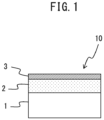
- FIG. 1 is a schematic view showing the Al-plated hot stamped steel material according to an embodiment of the present invention. In FIG. 1 , for simplification, only one side part of the Al-plated hot stamped steel material is shown, but naturally the Al-plated hot stamped steel material according to an embodiment of the present invention may have Al-plating layers, etc., on both sides not on just one side of the steel base material. Referring to FIG.
- the Al-plated hot stamped steel material 10 has a structure where one side of the steel base material (base iron) 1 is formed with the Al-plating layer 2 and where the Al-plating layer 2 is formed with the chemical conversion coating 3 containing zinc phosphate-based crystals and Ce-based compounds deposited on the surfaces of the zinc phosphate-based crystals.
- the chemical conversion coating containing the zinc phosphate-based crystals further contains Ce-based compounds deposited on the zinc phosphate-based crystals. Due to this, even if a defect were formed which would reach the Al-plated hot stamped steel material, it is possible to make the cerium constituent, more specifically the Ce ions, in particular the trivalent and/or tetravalent Ce ions, elute from the defect part and form a protective film at the cathodic reaction region of the exposed part of the steel base material, more specifically a protective film comprised of Ce(OH) 3 and/or Ce(OH) 4 , therefore it becomes possible to suppress the further progression of the cathodic reaction at the exposed part of the steel base material.
- the chemical conversion coating according to an embodiment of the present invention may also contain zinc oxide (for example zinc oxide particles) and other Zn-containing compounds. That is to say, as explained in detail later, the chemical conversion coating is, for example, formed by chemical conversion of a film containing Zn-containing compounds, therefore sometimes at the time of the chemical conversion, some of the Zn-containing compounds will not react but will remain in the final chemical conversion coating.
- the amount of deposition of the zinc phosphate-based crystals in the chemical conversion coating is, converted to metal Zn, 0.3 g/m 2 or more, preferably 1.0 g/m 2 or more, more preferably1.5 g/m 2 or more, most preferably 2.0 g/m 2 or more.
- the amount of deposition of the zinc phosphate-based crystals may be, converted to metal Zn, 4.0 g/m 2 or less, for example, 3.5 g/m 2 or less, 3.0 g/m 2 or less, or 2.5 g/m 2 or less.
- the amount of deposition of the zinc phosphate-based crystals in the chemical conversion coating is determined by measuring the amount of deposition of metal Zn in the chemical conversion coating by fluorescent X-ray analysis based on JIS G 3314: 2011.
- the zinc phosphate-based crystals may be any suitable compounds known to persons skilled in the art. While not particularly limited, for example, at least one compound of hopeite (Zn 3 (PO 4 ) 2 ⁇ 4H 2 O) and phosphophyllite (Zn 2 Fe 2+ (PO 4 ) 2 ⁇ 4H 2 O) is preferably contained. By including these compounds, high coating film adhesion can be obtained and in turn the corrosion resistance after coating can be reliably improved.
- the Al-plated hot stamped steel material according to an embodiment of the present invention may be used as chemically converted or may be used coated by electrodeposition coating, etc., after chemical conversion.
- the zinc phosphate-based crystals which had been present in the chemical conversion coating as hopeite will change, at least in part or in total, to Zn 6 Al 2 (OH) 1 6 CO 3 ⁇ 4H 2 O after the electrodeposition coating.
- the "zinc phosphate-based crystals” include not only hopeite and phosphophyllite and other compounds, but also Zn-containing compounds derived from these compounds, i.e., Zn 6 Al 2 (OH) 16 CO 3 ⁇ 4H 2 O derived from hopeite, etc.
- the coating film adhesion is improved while the corrosion resistance after coating is improved by the Ce-based compounds.
- the Ce-based compounds are present in a state deposited on the surfaces of the zinc phosphate-based crystals in the chemical conversion coating.
- the chemical conversion coating has a structure of zinc phosphate-based crystals on the surface of which Ce-based compounds smaller than the zinc phosphate-based crystals are deposited.
- FIGS. 2A and 2B show images observed by a scan electron microscope (SEM) of the chemical conversion coating.
- SEM scan electron microscope
- FIG. 2A shows an SEM image of the chemical conversion coating according to an embodiment of the present invention containing zinc phosphate-based crystals and Ce-based compounds
- FIG. 2B shows a cross-sectional SEM image of a chemical conversion coating containing only zinc phosphate-based crystals and not containing Ce-based compounds.
- the zinc phosphate-based crystals 4 are present in a state relatively densely aggregated. Further, if referring to FIG. 2A , it will be understood that the chemical conversion coating according to an embodiment of the present invention, as shown by the arrow marks, has a structure where the surfaces of the zinc phosphate-based crystals 4 have Ce-based compounds 5 smaller than the zinc phosphate-based crystals deposited on them.
- the zinc phosphate-based crystals 4 can be made to aggregate relatively densely with each other and the space between the zinc phosphate-based crystals 4 can be made smaller, therefore it is possible to make the elution of Ce from the Ce-based compounds 5 deposited on these crystals proceed relatively slowly. Therefore, such a structure is extremely advantageous from the viewpoint of achieving long term corrosion resistance after coating.
- part of the Ce-based compounds 5 may be taken into the inside of the zinc phosphate-based crystals 4.
- Ce-based compounds 5 are taken into the inside of the zinc phosphate-based crystals 4
- elution of Ce from the Ce-based compounds 5 to the cathodic reaction region of the exposed part of the steel base material becomes relatively difficult, therefore sufficient corrosion resistance after coating is liable to be unable to be achieved. Therefore, from the viewpoint of making the corrosion resistance after coating rise, making the chemical conversion coating contain Ce-based compounds deposited on the surfaces of the zinc phosphate-based crystals becomes extremely important.
- the area ratio of the Ce-based compounds in the chemical conversion coating is controlled to 0.5 to 25%. If the area ratio of the Ce-based compounds in the chemical conversion coating is low, the effect obtained by addition of the Ce-based compounds, i.e., the effect of improvement of the corrosion resistance after coating, cannot be sufficiently manifested.
- the area ratio of the Ce-based compounds in the chemical conversion coating may be 1% or more, 3% or more, 5% or more, or 10% or more and/or may be 22% or less, 20% or less, 18% or less, or 15% or less.
- the area ratio of the Ce-based compounds in the chemical conversion coating is determined by measuring the surface of the chemical conversion coating by an EPMA (electron probe microanalyzer) under conditions of a beam diameter of 10 ⁇ m, a step interval of 10 ⁇ m, and number of steps of 500 points ⁇ 500 points and calculating the percentage of the Ce-based compounds in the total (500 points ⁇ 500 points).
- EPMA electron probe microanalyzer
- the amount of deposition of the Ce-based compounds in the chemical conversion coating is preferably, converted to metal Ce, 1.0 to 280 mg/m 2 . If the amount of deposition of the Ce-based compounds in the chemical conversion coating is small, in the same way as the case of the area ratio of Ce-based compounds, in some cases the effect obtained by addition of Ce-based compounds, i.e., the effect of improvement of the corrosion resistance after coating, cannot be sufficiently manifested.
- the amount of deposition of the Ce-based compounds in the chemical conversion coating is too large, in the chemical conversion coating, the amount of elution of Ce ions becomes greater, therefore sometimes the bonding interface with the coating film will be reduced, the coating film adhesion will fall, and, as a result, a drop in the corrosion resistance after coating will be invited.
- the amount of deposition of the Ce-based compounds in the chemical conversion coating may be 5 mg/m 2 or more, 10 mg/m 2 or more, 30 mg/m 2 or more, 50 mg/m 2 or more, or 100 mg/m 2 or more and/or 250 mg/m 2 or less, 220 mg/m 2 or less, 200 mg/m 2 or less, 180 mg/m 2 or less, or 150 mg/m 2 or less.
- the amount of deposition of the Ce-based compounds in the chemical conversion coating is determined by measuring the amount of deposition of metal Ce in the chemical conversion coating by fluorescent X-ray analysis based on JIS G 3314: 2011.
- Ce-based compounds any suitable compounds able to elute Ce ions may be used. While not particularly limited, for example, at least one compound selected from the group consisting of cerium oxide (CeO 2 ), cerium hydroxide (III) (Ce(OH) 3 ), and cerium hydroxide (IV) (Ce(OH) 4 ) is preferably included. Including at least one compound of Ce(OH) 3 and Ce(OH) 4 is more preferable and including Ce(OH) 3 is most preferable.
- Ce-based compounds Even if a defect were formed in the Al-plated hot stamped steel material which would reach the steel base material, it is possible to make the trivalent and/or tetravalent Ce ions elute from the Ce-based compounds at the defect part and form a protective film comprised of Ce(OH) 3 and/or Ce(OH) 4 at the cathodic reaction region of the exposed part of the steel base material, therefore it becomes possible to suppress the further progression of the cathodic reaction at the exposed part of the steel base material.
- Ce ions are stably present in an alkali environment in the form of hydroxides, therefore again cerium hydroxide comprised of Ce(OH) 3 and/or Ce(OH) 4 is formed and precipitates or this precipitated film acts as a protective film to inhibit further progression of the cathodic reaction at the exposed part of the steel base material.
- CeO 2 is present in the chemical conversion coating as the Ce-based compound, since CeO 2 can elute Ce ions in particular without restriction as to being in an acidic environment or alkali environment, after eluting Ce ions, it is possible to inhibit the further progression of the cathodic reaction at the exposed part of the steel base material by a mechanism similar to the case of including Ce(OH) 3 and/or Ce(OH) 4 as Ce-based compounds.
- the Al-plated hot stamped steel material according to an embodiment of the present invention having the above features can be produced by a method comprising
- a steel sheet having a predetermined thickness and composition is formed on at least one side with an Al-plating layer by the Sendzimir process, etc.
- the steel sheet is not particularly limited, but, for example, as explained above in relation to the steel base material, it may be one having a thickness of 0.3 to 2.3 mm and/or having a chemical composition comprised of, by mass%, C: 0.01 to 0.55%, Si: 2.00% or less, Mn: 0.01 to 3.50%, P: 0.100% or less, S: 0.050% or less, Al: 0.001 to 0.100%, N: 0.020% or less, and a balance of Fe and impurities and optionally further containing one or more of Ti: 0 to 0.100%, B: 0 to 0.0100%, Cr: 0 to 1.00%, Ni: 0 to 5.00%, Mo: 0 to 2.000%, Cu: 0 to 1.000%, Nb: 0 to 1.000%, Sn: 0 to
- the above steel sheet in particular cold-rolled steel sheet, is annealed in an N 2 -H 2 mixed gas atmosphere at a predetermined temperature and time, for example a temperature of 750 to 850°C for 10 seconds to 5 minutes, then is cooled down to the vicinity of a plating bath temperature in a nitrogen atmosphere or other inert atmosphere.
- this steel sheet is dipped in an Al plating bath containing 3 to 15 mass% of Si at a 600 to 750°C in temperature for 0.1 to 60 seconds, then is pulled out and immediately blown with N 2 gas or air by the gas wiping method so as to adjust the amount of deposition of Al plating to a predetermined range, for example, 40 to 200 g/m 2 in range on the two sides.
- the steel sheet is blown with air, etc., to cool it whereby an Al-plating layer is formed on one side or both sides of the steel sheet.
- the steel sheet on which the Al-plating layer is formed is hot pressed.
- the above hot pressing can be performed by any method known to a person skilled in the art.
- the Al-plated steel sheet can be heated by an approximately 3 to 300°C/s rate of temperature rise up to the Ac3 point or more in temperature, generally approximately 850 to 1000°C in temperature, then hot pressed over a predetermined time.
- 850°C heating temperature With a less than 850°C heating temperature, a sufficient hardness may not be obtained, therefore this is not preferable.
- the heating temperature is more than 1000°C, due to the excessive diffusion of Fe from the steel base material to the Al-plating layer, sometimes the alloying of the Al and Fe progresses too much.
- the hardening by the die at the time of hot pressing is not particularly limited, but, for example, after leaving the heating furnace, the steel sheet is cooled by an average cooling rate of 30°C/s until the temperature falls to 400°C.
- the Al-plating layer is formed with a chemical conversion coating.
- the chemical conversion coating can be formed by various methods. While not particularly limited, for example, it may be formed by forming a coating containing Zn-containing compounds and/or Ce-containing compounds after the hot pressing step, then chemically converting the coating or may be formed by forming in advance a coating containing Zn-containing compounds and/or Ce-containing compounds before the hot pressing step, then hot pressing, then chemically converting the coating.
- the former forming coating containing Zn-containing compounds and/or Ce-containing compounds after the hot pressing step, then chemically converting
- the former forming coating containing Zn-containing compounds and/or Ce-containing compounds after the hot pressing step, then chemically converting
- the amount of deposition of Zn converted to metal can be adjusted by the number of charged coulombs at the time of electrolytic plating. Further, the area ratio and/or amount of deposition of the Ce-based compounds can be controlled to the desired ranges by suitably adjusting the spray time, spray pressure, concentration, etc., of the aqueous solution of cerium oxide sol.
- the amount of deposition of Zn converted to metal can be controlled to the desired range by suitably adjusting the concentration, amount of coating, etc., of the gel aqueous solution of the zinc oxide.
- the area ratio and/or amount of deposition of the Ce-based compounds can be controlled to the desired ranges by suitably adjusting the spray time, spray pressure, concentration, etc., of the cerium (III) carbonate octahydrate, etc.
- chemical conversion can be performed under any suitable conditions known to persons skilled in the art.
- any of the above examples if dipping the steel material in an aqueous solution containing Ce-based compounds so as to coat the Ce-based compounds instead of spray coating the Ce-based compounds, the amount of deposition of the Ce-based compounds would become too great and control to within a suitable range would no longer be possible. As a result, in the finally obtained chemical conversion coating, the area ratio of the Ce-based compounds would greatly exceed 25% and sometimes reach 100%. In such a case, in the chemical conversion coating, the amount of elution of Ce ions would become greater, therefore the bonding interface with the coating film would be reduced and a drop in the coating film adhesion would be invited.
- the chemically converted Al-plated hot stamped steel material may, in accordance with need, by coated by electrodeposition coating, etc.
- the coating treatment can be performed under any suitable conditions known to persons skilled in the art.
- the Al-plated hot stamped steel material according to an embodiment of the present invention may be used in the state after chemical conversion or in the state coated, as described above, by electrodeposition coating, etc., after chemical conversion. Furthermore, the Al-plated hot stamped steel material according to an embodiment of the present invention does not change in the constitution of the chemical conversion coating before and after coating and, in addition, does not inherently change in the constitution of the chemical conversion coating even after the coating is removed using a stripper, etc., after coating. Therefore, the Al-plated hot stamped steel material according to an embodiment of the present invention includes not only an Al-plated hot stamped steel material as chemically converted and coated after chemical conversion, but also an Al-plated hot stamped steel material from which the once applied coating is removed.
- steel materials for the Al-plated hot stamped steel material according to the present invention were produced under various conditions and were examined for their coating film adhesion and corrosion resistance after coating.
- cold-rolled steel sheet (sheet thickness 1.4 mm) having a chemical composition comprising, by mass%, C: 0.22%, Si: 0.12%, Mn: 1.25%, P: 0.010%, S: 0.005%, Al: 0.040%, N: 0.001%, Ti: 0.020%, B: 0.0030%, and a balance of Fe and impurities was formed on its two sides with Al-plating layers by the Sendzimir process. More specifically, first, the above cold-rolled steel sheet was annealed in an N 2 -H 2 mixed gas (H 2 4%, N 2 balance) atmosphere at 800°C for 1 minute, then was cooled down to the vicinity of the plating bath temperature in a nitrogen atmosphere.
- N 2 -H 2 mixed gas H 2 4%, N 2 balance
- this steel sheet was dipped in an Al plating bath containing 9 mass% of Si at a temperature of 670°C for 3 seconds, then was pulled out and immediately blown with N 2 gas by the gas wiping method to adjust the amounts of deposition of Al plating on the two sides to 160 g/m (single side 80 g/m).
- the steel sheet was blown with air to cool it and thereby form an Al-plating layer on the two sides of the steel sheet.
- the cooled Al-plated steel sheet was cut into a 120 mm ⁇ 200 mm size and loaded into a furnace simulating hot stamping, next was set on a 70 mm ⁇ 70 mm SiC table with the evaluated surface facing upward and held at 900°C ⁇ 10°C for 1 minute.
- the Al-plated steel sheet was taken out from the furnace, then was immediately clamped by a stainless steel die and rapidly cooled by an approximately 150°C/s cooling rate.
- the end parts of the obtained steel material were cut off to obtain from the center part a steel material of 70 mm ⁇ 150 mm size.
- the obtained steel material was dipped in a 10% hydrochloric acid aqueous solution for 5 seconds, then was rinsed and cleaned as pickling treatment.
- the surfaces of the Al-plating layers were cathodically electrolyzed at 30 A/dm 2 in a 50°C electrolytic Zn plating solution (Zn 2 SO 4 : 200 g/L+ZnCl 2 : 100 g/L+(NH 4 ) 2 SO 4 : 30 g/L).
- the amount of deposition of Zn converted to metal was adjusted by the number of charged coulombs.
- the obtained electrolytic Zn plating surface was spray coated by an aqueous solution of a predetermined amount of 1% cerium oxide sol (product name Needral, made by Taki Chemical Co., Ltd.) by a suitable spraying time and spraying pressure to give an area ratio of Ce-based compounds of the value shown in Table 1 and then allowed to naturally dry.
- a cerium oxide sol product name Needral, made by Taki Chemical Co., Ltd.
- the obtained steel material was chemically converted by a chemical conversion solution (PB-SX35 made by Nihon Parkerizing Co., Ltd.).
- PB-SX35 made by Nihon Parkerizing Co., Ltd.
- the chemical converted steel material was coated with an electrodeposition coating (Powemix 110 made by Nippon Paint) to a film thickness of 15 ⁇ m and baked at 170°C.
- the obtained steel material was measured for the amount of deposition of the zinc phosphate-based crystals (converted to metal Zn) and the amount of deposition of Ce-based compounds (converted to metal Ce) and the area ratio of Ce-based compounds in the chemical conversion coating and was further evaluated for coating film adhesion and the corrosion resistance after coating.
- Each steel material was coated on its coating film surface with a coating film peeling agent (Skeleton NC 651NC made by Natoco Co., Ltd.) by a brush, then wiping off any rise in the coating film by a sponge.
- the exposed chemical conversion coating was measured for amounts of deposition of metal Zn and metal Ce by fluorescent X-ray analysis based on JIS G 3314: 2011 to thereby determine the amounts of deposition of zinc phosphate-based crystals and Ce-based compounds in the chemical conversion coating.
- the area ratio of the Ce-based compounds in the chemical conversion coating was similarly determined by measuring the surface of the chemical conversion coating at the steel material after peeling off the coating film using a coating film peeling agent by an EPMA (electron probe microanalyzer) under conditions of a beam diameter of 10 ⁇ m, a current value of 10 -6 A, a step interval of 10 ⁇ m, and number of steps of 500 points ⁇ 500 points and calculating the percentage of the Ce-based compounds (number of points of strength of 10 cps or more) in the total (500 points ⁇ 500 points).
- EPMA electron probe microanalyzer
- the coating film adhesion was evaluated by immersing the coated steel material in 40°C warm water for 200 hours, then wiping off the moisture by a paper towel, then performing a tape peeling test based on JIS K 5600-5-6: 1999. More specifically, it was evaluated by six stages shown in Table 1 of Chapter 8.3 of that standard. Cases of a score of 0 (edges of cuts completely smooth with no peeling at any of the parts of the lattice) and a score of 1 (slight peeling of coating film at intersecting points of cuts, effects at cross cut parts clearly not more than 5%) were considered passing. On the other hand, a case of a score of 2 or more was considered failing.
- the corrosion resistance after coating was evaluated by performing the SAE J2334 test on the coated steel material and measuring the coating film blister width, more specifically, a coating film was given a cut (defect) by an acrylic cutter. It was checked that the cut reached the steel base.
- the width of the coating film blister (maximum value at one side) from the cut part after 200 cycles in the SAE J2334 test was measured for the thus confirmed steel material.
- the smaller the value of the "coating film blister width" in Table 1 the better the corrosion resistance after coating of the steel material meant.
- Table 1 as a comparative example, the results of a test of a steel material provided with a chemical conversion coating not containing any Ce-based compounds are also shown (Comparative Example 1 in Table 1).
- the coating film blister width (maximum value at one side) in the case of performing a similar test on a GA material (hot dip galvannealed steel sheet, amount of deposition on one side 45 g/m 2 ) was 6 mm, therefore in the present test, a coating film blister width of 6 mm or less was deemed passing and one of more than 6 mm was deemed failing.
- Table 1 The results are shown in Table 1.
- Table 1 No. Zinc phosphate-based crystals Ce-based compounds Coating film adhesion Coating film blister width (mm) Remarks Amount of deposition (converted to Zn) (g/m 2 ) Type Area ratio (%) Amount of deposition (converted to Ce) (mg/m 2 ) Type 1 2.2 Hopeite Zn 6 Al 2 (OH) 16 CO 3 4H 2 O - 0 0 - 0 8 Comp. ex. 2 2.1 Hopeite 0.5 0.5 CeO 2 0 6 Ex. Ce(OH) 3 3 3 2.2 Hopeite 1 1 CeO 2 0 6 Ex.
- Ce(OH) 4 9 2.0 Hopeite Phosphophyllite 10 30 CeO 2 0 3 Ex. Ce(OH) 3 Ce(OH) 4 10 4.0 Hopeite Phosphophyllite 10 30 CeO 2 1 5 Ex. Ce(OH) 3 Ce(OH) 4 11 2.2 Hopeite 13 100 Ce(OH) 3 0 4.5 Ex. Ce(OH) 4 12 2.2 Hopeite Zn 6 Al 2 (OH) 16 CO 3 ⁇ 4H 2 O 20 200 CeO 2 1 5 Ex. Ce(OH) 3 Ce(OH) 4 13 2.1 Hopeite 25 250 Ce(OH) 3 1 5.5 Ex. Ce(OH) 4 14 2.2 Hopeite Zn 6 Al 2 (OH ) 16 CO 3 ⁇ 4H 2 O 30 300 Ce(OH) 3 2 7 Comp. ex. Ce(OH) 4 15 4.5 Hopeite 13 100 Ce(OH) 3 1 8 Comp. ex. Ce(OH) 4 The bold underlines show outside the scope of the present invention.
- Comparative Example 1 in which the chemical conversion coating does not contain Ce-based compounds, only naturally the effect of improvement of the corrosion resistance after coating due to the addition of Ce-based compounds was not obtained. As a result, the coating film blister width became 8 mm and a lower corrosion resistance after coating was exhibited compared with the 6 mm of a GA material. In Comparative Example 6, the amount of deposition of the zinc phosphate-based crystals was low, therefore the corrosion resistance after coating fell. The results of Comparative Example 6 were that the coating film adhesion was evaluated as being passing with a score of 1, but it is believed that this was due to the relatively low coating film adhesion exhibited in the range of the score of 1.
- Comparative Example 14 the area ratio of the Ce compounds was high, therefore in the chemical conversion coating, the amount of deposition of the elutable Ce-based compounds became greater, the coating film adhesion fell, and in relation to this, the corrosion resistance after coating fell.
- Comparative Example 15 the amount of deposition of the zinc phosphate-based crystals was large, therefore the corrosion resistance after coating fell. It is believed that as a result of the chemical conversion coating becoming thicker, the elution of Ce to the cathodic reaction region of the exposed part of the steel base material was inhibited.
Landscapes
- Chemical & Material Sciences (AREA)
- Chemical Kinetics & Catalysis (AREA)
- Engineering & Computer Science (AREA)
- Materials Engineering (AREA)
- Mechanical Engineering (AREA)
- Metallurgy (AREA)
- Organic Chemistry (AREA)
- Inorganic Chemistry (AREA)
- General Chemical & Material Sciences (AREA)
- Coating With Molten Metal (AREA)
- Chemical Treatment Of Metals (AREA)
- Other Surface Treatments For Metallic Materials (AREA)
Applications Claiming Priority (2)
| Application Number | Priority Date | Filing Date | Title |
|---|---|---|---|
| JP2020086561 | 2020-05-18 | ||
| PCT/JP2021/012395 WO2021235083A1 (ja) | 2020-05-18 | 2021-03-24 | Alめっきホットスタンプ鋼材 |
Publications (3)
| Publication Number | Publication Date |
|---|---|
| EP4155427A1 EP4155427A1 (en) | 2023-03-29 |
| EP4155427A4 EP4155427A4 (en) | 2023-03-29 |
| EP4155427B1 true EP4155427B1 (en) | 2024-08-14 |
Family
ID=78708439
Family Applications (1)
| Application Number | Title | Priority Date | Filing Date |
|---|---|---|---|
| EP21809842.4A Active EP4155427B1 (en) | 2020-05-18 | 2021-03-24 | Al-plated hot stamped steel material |
Country Status (7)
| Country | Link |
|---|---|
| US (1) | US11905600B2 (enExample) |
| EP (1) | EP4155427B1 (enExample) |
| JP (1) | JP7453583B2 (enExample) |
| KR (1) | KR102892579B1 (enExample) |
| CN (1) | CN115443350B (enExample) |
| MX (1) | MX2022014404A (enExample) |
| WO (1) | WO2021235083A1 (enExample) |
Families Citing this family (3)
| Publication number | Priority date | Publication date | Assignee | Title |
|---|---|---|---|---|
| EP4339324A1 (de) * | 2022-09-19 | 2024-03-20 | ThyssenKrupp Steel Europe AG | Stahlflachprodukt mit einer aktivierungsschicht für die warmumformung |
| EP4438757A1 (de) * | 2023-03-28 | 2024-10-02 | ThyssenKrupp Steel Europe AG | Schmelztauchbeschichtetes und phosphatiertes stahlflachprodukt für die warmumformung |
| WO2025234462A1 (ja) * | 2024-05-10 | 2025-11-13 | 日本製鉄株式会社 | ホットスタンプ用アルミめっき鋼板およびその製造方法 |
Family Cites Families (8)
| Publication number | Priority date | Publication date | Assignee | Title |
|---|---|---|---|---|
| DE4041091A1 (de) * | 1990-12-21 | 1992-06-25 | Metallgesellschaft Ag | Verfahren zur nachspuelung von konversionsschichten |
| DE19511573A1 (de) * | 1995-03-29 | 1996-10-02 | Henkel Kgaa | Verfahren zur Phosphatierung mit metallhaltiger Nachspülung |
| JP2000313966A (ja) * | 1999-04-27 | 2000-11-14 | Sumitomo Metal Ind Ltd | 塗装後耐食性に優れる表面処理鋼板 |
| JP2005048200A (ja) * | 2003-07-29 | 2005-02-24 | Jfe Steel Kk | 耐食性および皮膜外観に優れる表面処理鋼板 |
| JP5462467B2 (ja) * | 2008-10-31 | 2014-04-02 | 日本パーカライジング株式会社 | 金属材料用化成処理液および処理方法 |
| RU2584105C2 (ru) * | 2012-02-14 | 2016-05-20 | Ниппон Стил Энд Сумитомо Метал Корпорейшн | Плакированная толстолистовая сталь для горячего прессования и способ горячего прессования плакированной толстолистовой стали |
| WO2016159307A1 (ja) | 2015-03-31 | 2016-10-06 | 新日鐵住金株式会社 | 溶融亜鉛系めっき鋼板 |
| MX2017015525A (es) | 2015-06-04 | 2018-02-21 | Nippon Steel & Sumitomo Metal Corp | Liquido de tratamiento de superficie para lamina de acero chapada que se prensara en caliente. |
-
2021
- 2021-03-24 EP EP21809842.4A patent/EP4155427B1/en active Active
- 2021-03-24 MX MX2022014404A patent/MX2022014404A/es unknown
- 2021-03-24 US US17/910,289 patent/US11905600B2/en active Active
- 2021-03-24 CN CN202180031244.4A patent/CN115443350B/zh active Active
- 2021-03-24 WO PCT/JP2021/012395 patent/WO2021235083A1/ja not_active Ceased
- 2021-03-24 KR KR1020227036786A patent/KR102892579B1/ko active Active
- 2021-03-24 JP JP2022524293A patent/JP7453583B2/ja active Active
Also Published As
| Publication number | Publication date |
|---|---|
| US20230138051A1 (en) | 2023-05-04 |
| MX2022014404A (es) | 2022-12-07 |
| JPWO2021235083A1 (enExample) | 2021-11-25 |
| KR102892579B1 (ko) | 2025-11-28 |
| JP7453583B2 (ja) | 2024-03-21 |
| WO2021235083A1 (ja) | 2021-11-25 |
| CN115443350B (zh) | 2024-01-02 |
| US11905600B2 (en) | 2024-02-20 |
| EP4155427A1 (en) | 2023-03-29 |
| EP4155427A4 (en) | 2023-03-29 |
| CN115443350A (zh) | 2022-12-06 |
| KR20220156925A (ko) | 2022-11-28 |
Similar Documents
| Publication | Publication Date | Title |
|---|---|---|
| CN102597322B (zh) | 热压部件以及其制造方法 | |
| EP2816139B1 (en) | Plated steel plate for hot pressing and hot pressing method of plated steel plate | |
| EP3623493A1 (en) | Fe-Al PLATED HOT-STAMPED MEMBER AND METHOD FOR PRODUCING Fe-Al PLATED HOT-STAMPED MEMBER | |
| JP5146607B2 (ja) | 合金化溶融亜鉛めっき鋼板とその製造方法 | |
| KR101772308B1 (ko) | 핫 스탬프 성형체 및 핫 스탬프 성형체의 제조 방법 | |
| EP2728032A2 (en) | Plated steel sheet having plated layer with excellent stability for hot press molding | |
| EP4155427B1 (en) | Al-plated hot stamped steel material | |
| CN110325667A (zh) | Al系镀覆钢板 | |
| US12385111B2 (en) | Hot stamped steel | |
| EP4215294A1 (en) | Hot-pressed member, steel sheet for hot-pressing, and methods for producing same | |
| KR101978014B1 (ko) | 고강도 강판 및 고강도 용융 아연 도금 강판 그리고 그것들의 제조 방법 | |
| EP4116457B1 (en) | Hot pressed member and method of producing same. and coated steel sheet for hot press forming | |
| EP4230756A1 (en) | Plated steel sheet for automobile structural members | |
| JP5817770B2 (ja) | 化成処理性および塗装後耐食性に優れ、かつ摺動性も良好な高強度冷延鋼板の製造方法 | |
| WO2021019829A1 (ja) | 熱間プレス部材および熱間プレス用鋼板ならびにそれらの製造方法 | |
| EP4155004A1 (en) | Hot-stamp molded article and method for manufacturing same, and al-plated steel sheet | |
| JP5625442B2 (ja) | 耐遅れ破壊性に優れた引張強度1180MPa以上を有する高強度鋼板 | |
| EP4538416A1 (en) | Plated steel sheet for hot press forming, having excellent plating quality, steel sheet and manufacturing method therefor | |
| WO2024202201A1 (ja) | 熱間プレス部材 |
Legal Events
| Date | Code | Title | Description |
|---|---|---|---|
| STAA | Information on the status of an ep patent application or granted ep patent |
Free format text: STATUS: THE INTERNATIONAL PUBLICATION HAS BEEN MADE |
|
| PUAI | Public reference made under article 153(3) epc to a published international application that has entered the european phase |
Free format text: ORIGINAL CODE: 0009012 |
|
| STAA | Information on the status of an ep patent application or granted ep patent |
Free format text: STATUS: REQUEST FOR EXAMINATION WAS MADE |
|
| 17P | Request for examination filed |
Effective date: 20221119 |
|
| A4 | Supplementary search report drawn up and despatched |
Effective date: 20230210 |
|
| AK | Designated contracting states |
Kind code of ref document: A1 Designated state(s): AL AT BE BG CH CY CZ DE DK EE ES FI FR GB GR HR HU IE IS IT LI LT LU LV MC MK MT NL NO PL PT RO RS SE SI SK SM TR |
|
| DAV | Request for validation of the european patent (deleted) | ||
| DAX | Request for extension of the european patent (deleted) | ||
| GRAP | Despatch of communication of intention to grant a patent |
Free format text: ORIGINAL CODE: EPIDOSNIGR1 |
|
| STAA | Information on the status of an ep patent application or granted ep patent |
Free format text: STATUS: GRANT OF PATENT IS INTENDED |
|
| RIC1 | Information provided on ipc code assigned before grant |
Ipc: C25D 3/48 20060101ALN20231128BHEP Ipc: C25D 3/22 20060101ALN20231128BHEP Ipc: C22C 38/38 20060101ALN20231128BHEP Ipc: C22C 38/14 20060101ALN20231128BHEP Ipc: C22C 38/04 20060101ALN20231128BHEP Ipc: C22C 38/02 20060101ALN20231128BHEP Ipc: B32B 15/01 20060101ALN20231128BHEP Ipc: C23C 22/73 20060101ALI20231128BHEP Ipc: C23C 22/12 20060101ALI20231128BHEP Ipc: C23C 2/12 20060101AFI20231128BHEP |
|
| INTG | Intention to grant announced |
Effective date: 20231214 |
|
| GRAJ | Information related to disapproval of communication of intention to grant by the applicant or resumption of examination proceedings by the epo deleted |
Free format text: ORIGINAL CODE: EPIDOSDIGR1 |
|
| STAA | Information on the status of an ep patent application or granted ep patent |
Free format text: STATUS: REQUEST FOR EXAMINATION WAS MADE |
|
| GRAP | Despatch of communication of intention to grant a patent |
Free format text: ORIGINAL CODE: EPIDOSNIGR1 |
|
| STAA | Information on the status of an ep patent application or granted ep patent |
Free format text: STATUS: GRANT OF PATENT IS INTENDED |
|
| INTC | Intention to grant announced (deleted) | ||
| RIC1 | Information provided on ipc code assigned before grant |
Ipc: C25D 3/48 20060101ALN20240404BHEP Ipc: C25D 3/22 20060101ALN20240404BHEP Ipc: C22C 38/38 20060101ALN20240404BHEP Ipc: C22C 38/14 20060101ALN20240404BHEP Ipc: C22C 38/04 20060101ALN20240404BHEP Ipc: C22C 38/02 20060101ALN20240404BHEP Ipc: B32B 15/01 20060101ALN20240404BHEP Ipc: C23C 22/73 20060101ALI20240404BHEP Ipc: C23C 22/12 20060101ALI20240404BHEP Ipc: C23C 2/12 20060101AFI20240404BHEP |
|
| INTG | Intention to grant announced |
Effective date: 20240430 |
|
| RIC1 | Information provided on ipc code assigned before grant |
Ipc: C25D 3/48 20060101ALN20240422BHEP Ipc: C25D 3/22 20060101ALN20240422BHEP Ipc: C22C 38/38 20060101ALN20240422BHEP Ipc: C22C 38/14 20060101ALN20240422BHEP Ipc: C22C 38/04 20060101ALN20240422BHEP Ipc: C22C 38/02 20060101ALN20240422BHEP Ipc: B32B 15/01 20060101ALN20240422BHEP Ipc: C23C 22/73 20060101ALI20240422BHEP Ipc: C23C 22/12 20060101ALI20240422BHEP Ipc: C23C 2/12 20060101AFI20240422BHEP |
|
| GRAS | Grant fee paid |
Free format text: ORIGINAL CODE: EPIDOSNIGR3 |
|
| GRAA | (expected) grant |
Free format text: ORIGINAL CODE: 0009210 |
|
| STAA | Information on the status of an ep patent application or granted ep patent |
Free format text: STATUS: THE PATENT HAS BEEN GRANTED |
|
| AK | Designated contracting states |
Kind code of ref document: B1 Designated state(s): AL AT BE BG CH CY CZ DE DK EE ES FI FR GB GR HR HU IE IS IT LI LT LU LV MC MK MT NL NO PL PT RO RS SE SI SK SM TR |
|
| REG | Reference to a national code |
Ref country code: GB Ref legal event code: FG4D |
|
| REG | Reference to a national code |
Ref country code: CH Ref legal event code: EP |
|
| REG | Reference to a national code |
Ref country code: DE Ref legal event code: R096 Ref document number: 602021017322 Country of ref document: DE |
|
| REG | Reference to a national code |
Ref country code: IE Ref legal event code: FG4D |
|
| REG | Reference to a national code |
Ref country code: LT Ref legal event code: MG9D |
|
| REG | Reference to a national code |
Ref country code: NL Ref legal event code: MP Effective date: 20240814 |
|
| PG25 | Lapsed in a contracting state [announced via postgrant information from national office to epo] |
Ref country code: NO Free format text: LAPSE BECAUSE OF FAILURE TO SUBMIT A TRANSLATION OF THE DESCRIPTION OR TO PAY THE FEE WITHIN THE PRESCRIBED TIME-LIMIT Effective date: 20241114 |
|
| REG | Reference to a national code |
Ref country code: AT Ref legal event code: MK05 Ref document number: 1713352 Country of ref document: AT Kind code of ref document: T Effective date: 20240814 |
|
| PG25 | Lapsed in a contracting state [announced via postgrant information from national office to epo] |
Ref country code: FI Free format text: LAPSE BECAUSE OF FAILURE TO SUBMIT A TRANSLATION OF THE DESCRIPTION OR TO PAY THE FEE WITHIN THE PRESCRIBED TIME-LIMIT Effective date: 20240814 Ref country code: GR Free format text: LAPSE BECAUSE OF FAILURE TO SUBMIT A TRANSLATION OF THE DESCRIPTION OR TO PAY THE FEE WITHIN THE PRESCRIBED TIME-LIMIT Effective date: 20241115 Ref country code: NL Free format text: LAPSE BECAUSE OF FAILURE TO SUBMIT A TRANSLATION OF THE DESCRIPTION OR TO PAY THE FEE WITHIN THE PRESCRIBED TIME-LIMIT Effective date: 20240814 Ref country code: PT Free format text: LAPSE BECAUSE OF FAILURE TO SUBMIT A TRANSLATION OF THE DESCRIPTION OR TO PAY THE FEE WITHIN THE PRESCRIBED TIME-LIMIT Effective date: 20241216 Ref country code: PL Free format text: LAPSE BECAUSE OF FAILURE TO SUBMIT A TRANSLATION OF THE DESCRIPTION OR TO PAY THE FEE WITHIN THE PRESCRIBED TIME-LIMIT Effective date: 20240814 |
|
| PG25 | Lapsed in a contracting state [announced via postgrant information from national office to epo] |
Ref country code: BG Free format text: LAPSE BECAUSE OF FAILURE TO SUBMIT A TRANSLATION OF THE DESCRIPTION OR TO PAY THE FEE WITHIN THE PRESCRIBED TIME-LIMIT Effective date: 20240814 |
|
| PG25 | Lapsed in a contracting state [announced via postgrant information from national office to epo] |
Ref country code: LV Free format text: LAPSE BECAUSE OF FAILURE TO SUBMIT A TRANSLATION OF THE DESCRIPTION OR TO PAY THE FEE WITHIN THE PRESCRIBED TIME-LIMIT Effective date: 20240814 |
|
| PG25 | Lapsed in a contracting state [announced via postgrant information from national office to epo] |
Ref country code: AT Free format text: LAPSE BECAUSE OF FAILURE TO SUBMIT A TRANSLATION OF THE DESCRIPTION OR TO PAY THE FEE WITHIN THE PRESCRIBED TIME-LIMIT Effective date: 20240814 Ref country code: IS Free format text: LAPSE BECAUSE OF FAILURE TO SUBMIT A TRANSLATION OF THE DESCRIPTION OR TO PAY THE FEE WITHIN THE PRESCRIBED TIME-LIMIT Effective date: 20241214 |
|
| PG25 | Lapsed in a contracting state [announced via postgrant information from national office to epo] |
Ref country code: HR Free format text: LAPSE BECAUSE OF FAILURE TO SUBMIT A TRANSLATION OF THE DESCRIPTION OR TO PAY THE FEE WITHIN THE PRESCRIBED TIME-LIMIT Effective date: 20240814 |
|
| PG25 | Lapsed in a contracting state [announced via postgrant information from national office to epo] |
Ref country code: ES Free format text: LAPSE BECAUSE OF FAILURE TO SUBMIT A TRANSLATION OF THE DESCRIPTION OR TO PAY THE FEE WITHIN THE PRESCRIBED TIME-LIMIT Effective date: 20240814 Ref country code: RS Free format text: LAPSE BECAUSE OF FAILURE TO SUBMIT A TRANSLATION OF THE DESCRIPTION OR TO PAY THE FEE WITHIN THE PRESCRIBED TIME-LIMIT Effective date: 20241114 |
|
| PG25 | Lapsed in a contracting state [announced via postgrant information from national office to epo] |
Ref country code: RS Free format text: LAPSE BECAUSE OF FAILURE TO SUBMIT A TRANSLATION OF THE DESCRIPTION OR TO PAY THE FEE WITHIN THE PRESCRIBED TIME-LIMIT Effective date: 20241114 Ref country code: PT Free format text: LAPSE BECAUSE OF FAILURE TO SUBMIT A TRANSLATION OF THE DESCRIPTION OR TO PAY THE FEE WITHIN THE PRESCRIBED TIME-LIMIT Effective date: 20241216 Ref country code: PL Free format text: LAPSE BECAUSE OF FAILURE TO SUBMIT A TRANSLATION OF THE DESCRIPTION OR TO PAY THE FEE WITHIN THE PRESCRIBED TIME-LIMIT Effective date: 20240814 Ref country code: NO Free format text: LAPSE BECAUSE OF FAILURE TO SUBMIT A TRANSLATION OF THE DESCRIPTION OR TO PAY THE FEE WITHIN THE PRESCRIBED TIME-LIMIT Effective date: 20241114 Ref country code: NL Free format text: LAPSE BECAUSE OF FAILURE TO SUBMIT A TRANSLATION OF THE DESCRIPTION OR TO PAY THE FEE WITHIN THE PRESCRIBED TIME-LIMIT Effective date: 20240814 Ref country code: LV Free format text: LAPSE BECAUSE OF FAILURE TO SUBMIT A TRANSLATION OF THE DESCRIPTION OR TO PAY THE FEE WITHIN THE PRESCRIBED TIME-LIMIT Effective date: 20240814 Ref country code: IS Free format text: LAPSE BECAUSE OF FAILURE TO SUBMIT A TRANSLATION OF THE DESCRIPTION OR TO PAY THE FEE WITHIN THE PRESCRIBED TIME-LIMIT Effective date: 20241214 Ref country code: HR Free format text: LAPSE BECAUSE OF FAILURE TO SUBMIT A TRANSLATION OF THE DESCRIPTION OR TO PAY THE FEE WITHIN THE PRESCRIBED TIME-LIMIT Effective date: 20240814 Ref country code: GR Free format text: LAPSE BECAUSE OF FAILURE TO SUBMIT A TRANSLATION OF THE DESCRIPTION OR TO PAY THE FEE WITHIN THE PRESCRIBED TIME-LIMIT Effective date: 20241115 Ref country code: FI Free format text: LAPSE BECAUSE OF FAILURE TO SUBMIT A TRANSLATION OF THE DESCRIPTION OR TO PAY THE FEE WITHIN THE PRESCRIBED TIME-LIMIT Effective date: 20240814 Ref country code: ES Free format text: LAPSE BECAUSE OF FAILURE TO SUBMIT A TRANSLATION OF THE DESCRIPTION OR TO PAY THE FEE WITHIN THE PRESCRIBED TIME-LIMIT Effective date: 20240814 Ref country code: BG Free format text: LAPSE BECAUSE OF FAILURE TO SUBMIT A TRANSLATION OF THE DESCRIPTION OR TO PAY THE FEE WITHIN THE PRESCRIBED TIME-LIMIT Effective date: 20240814 Ref country code: AT Free format text: LAPSE BECAUSE OF FAILURE TO SUBMIT A TRANSLATION OF THE DESCRIPTION OR TO PAY THE FEE WITHIN THE PRESCRIBED TIME-LIMIT Effective date: 20240814 |
|
| PGFP | Annual fee paid to national office [announced via postgrant information from national office to epo] |
Ref country code: DE Payment date: 20250331 Year of fee payment: 5 |
|
| PG25 | Lapsed in a contracting state [announced via postgrant information from national office to epo] |
Ref country code: DK Free format text: LAPSE BECAUSE OF FAILURE TO SUBMIT A TRANSLATION OF THE DESCRIPTION OR TO PAY THE FEE WITHIN THE PRESCRIBED TIME-LIMIT Effective date: 20240814 Ref country code: RO Free format text: LAPSE BECAUSE OF FAILURE TO SUBMIT A TRANSLATION OF THE DESCRIPTION OR TO PAY THE FEE WITHIN THE PRESCRIBED TIME-LIMIT Effective date: 20240814 Ref country code: SM Free format text: LAPSE BECAUSE OF FAILURE TO SUBMIT A TRANSLATION OF THE DESCRIPTION OR TO PAY THE FEE WITHIN THE PRESCRIBED TIME-LIMIT Effective date: 20240814 |
|
| PG25 | Lapsed in a contracting state [announced via postgrant information from national office to epo] |
Ref country code: EE Free format text: LAPSE BECAUSE OF FAILURE TO SUBMIT A TRANSLATION OF THE DESCRIPTION OR TO PAY THE FEE WITHIN THE PRESCRIBED TIME-LIMIT Effective date: 20240814 |
|
| PG25 | Lapsed in a contracting state [announced via postgrant information from national office to epo] |
Ref country code: CZ Free format text: LAPSE BECAUSE OF FAILURE TO SUBMIT A TRANSLATION OF THE DESCRIPTION OR TO PAY THE FEE WITHIN THE PRESCRIBED TIME-LIMIT Effective date: 20240814 |
|
| PGFP | Annual fee paid to national office [announced via postgrant information from national office to epo] |
Ref country code: FR Payment date: 20250131 Year of fee payment: 5 |
|
| PG25 | Lapsed in a contracting state [announced via postgrant information from national office to epo] |
Ref country code: SK Free format text: LAPSE BECAUSE OF FAILURE TO SUBMIT A TRANSLATION OF THE DESCRIPTION OR TO PAY THE FEE WITHIN THE PRESCRIBED TIME-LIMIT Effective date: 20240814 Ref country code: IT Free format text: LAPSE BECAUSE OF FAILURE TO SUBMIT A TRANSLATION OF THE DESCRIPTION OR TO PAY THE FEE WITHIN THE PRESCRIBED TIME-LIMIT Effective date: 20240814 |
|
| REG | Reference to a national code |
Ref country code: DE Ref legal event code: R097 Ref document number: 602021017322 Country of ref document: DE |
|
| PLBE | No opposition filed within time limit |
Free format text: ORIGINAL CODE: 0009261 |
|
| STAA | Information on the status of an ep patent application or granted ep patent |
Free format text: STATUS: NO OPPOSITION FILED WITHIN TIME LIMIT |
|
| 26N | No opposition filed |
Effective date: 20250515 |
|
| PG25 | Lapsed in a contracting state [announced via postgrant information from national office to epo] |
Ref country code: SE Free format text: LAPSE BECAUSE OF FAILURE TO SUBMIT A TRANSLATION OF THE DESCRIPTION OR TO PAY THE FEE WITHIN THE PRESCRIBED TIME-LIMIT Effective date: 20240814 |
|
| PG25 | Lapsed in a contracting state [announced via postgrant information from national office to epo] |
Ref country code: MC Free format text: LAPSE BECAUSE OF FAILURE TO SUBMIT A TRANSLATION OF THE DESCRIPTION OR TO PAY THE FEE WITHIN THE PRESCRIBED TIME-LIMIT Effective date: 20240814 |
|
| REG | Reference to a national code |
Ref country code: CH Ref legal event code: H13 Free format text: ST27 STATUS EVENT CODE: U-0-0-H10-H13 (AS PROVIDED BY THE NATIONAL OFFICE) Effective date: 20251023 |
|
| PG25 | Lapsed in a contracting state [announced via postgrant information from national office to epo] |
Ref country code: LU Free format text: LAPSE BECAUSE OF NON-PAYMENT OF DUE FEES Effective date: 20250324 |
|
| GBPC | Gb: european patent ceased through non-payment of renewal fee |
Effective date: 20250324 |