EP4155229A1 - Paper container for packed food - Google Patents
Paper container for packed food Download PDFInfo
- Publication number
- EP4155229A1 EP4155229A1 EP21756780.9A EP21756780A EP4155229A1 EP 4155229 A1 EP4155229 A1 EP 4155229A1 EP 21756780 A EP21756780 A EP 21756780A EP 4155229 A1 EP4155229 A1 EP 4155229A1
- Authority
- EP
- European Patent Office
- Prior art keywords
- layer
- thermoplastic resin
- main component
- resin
- container
- Prior art date
- Legal status (The legal status is an assumption and is not a legal conclusion. Google has not performed a legal analysis and makes no representation as to the accuracy of the status listed.)
- Pending
Links
- 235000021485 packed food Nutrition 0.000 title 1
- 239000010410 layer Substances 0.000 claims abstract description 329
- 229920005992 thermoplastic resin Polymers 0.000 claims abstract description 118
- 229920013716 polyethylene resin Polymers 0.000 claims abstract description 54
- 235000013305 food Nutrition 0.000 claims abstract description 42
- 239000012790 adhesive layer Substances 0.000 claims abstract description 41
- 229920005989 resin Polymers 0.000 claims abstract description 32
- 239000011347 resin Substances 0.000 claims abstract description 32
- 239000012611 container material Substances 0.000 claims abstract description 24
- 239000002994 raw material Substances 0.000 claims abstract description 21
- 229920005648 ethylene methacrylic acid copolymer Polymers 0.000 claims abstract description 19
- 150000005846 sugar alcohols Polymers 0.000 claims abstract description 16
- -1 polypropylene Polymers 0.000 claims abstract description 15
- 230000004888 barrier function Effects 0.000 claims abstract description 13
- 239000003795 chemical substances by application Substances 0.000 claims abstract description 11
- 238000013329 compounding Methods 0.000 claims abstract description 11
- 238000002156 mixing Methods 0.000 claims abstract description 9
- 229920003171 Poly (ethylene oxide) Polymers 0.000 claims abstract description 8
- 229920005672 polyolefin resin Polymers 0.000 claims abstract description 8
- 239000004743 Polypropylene Substances 0.000 claims abstract description 7
- 229920001155 polypropylene Polymers 0.000 claims abstract description 7
- 238000001125 extrusion Methods 0.000 claims description 5
- 239000007788 liquid Substances 0.000 abstract description 8
- 230000032798 delamination Effects 0.000 description 11
- 235000013527 bean curd Nutrition 0.000 description 9
- 239000000463 material Substances 0.000 description 8
- 239000000853 adhesive Substances 0.000 description 5
- 230000001070 adhesive effect Effects 0.000 description 5
- 238000004519 manufacturing process Methods 0.000 description 5
- 238000010438 heat treatment Methods 0.000 description 4
- 230000001112 coagulating effect Effects 0.000 description 3
- 238000007789 sealing Methods 0.000 description 3
- 238000005516 engineering process Methods 0.000 description 2
- 229920000092 linear low density polyethylene Polymers 0.000 description 2
- 239000004707 linear low-density polyethylene Substances 0.000 description 2
- 229920001684 low density polyethylene Polymers 0.000 description 2
- 239000004702 low-density polyethylene Substances 0.000 description 2
- 235000010469 Glycine max Nutrition 0.000 description 1
- 244000068988 Glycine max Species 0.000 description 1
- 235000006089 Phaseolus angularis Nutrition 0.000 description 1
- 235000010711 Vigna angularis Nutrition 0.000 description 1
- 240000007098 Vigna angularis Species 0.000 description 1
- 229910052782 aluminium Inorganic materials 0.000 description 1
- XAGFODPZIPBFFR-UHFFFAOYSA-N aluminium Chemical compound [Al] XAGFODPZIPBFFR-UHFFFAOYSA-N 0.000 description 1
- 239000000701 coagulant Substances 0.000 description 1
- 239000000805 composite resin Substances 0.000 description 1
- 230000000694 effects Effects 0.000 description 1
- 238000010828 elution Methods 0.000 description 1
- 239000011888 foil Substances 0.000 description 1
- 235000015110 jellies Nutrition 0.000 description 1
- 239000008274 jelly Substances 0.000 description 1
- 229910052751 metal Inorganic materials 0.000 description 1
- 239000002184 metal Substances 0.000 description 1
- 239000008267 milk Substances 0.000 description 1
- 210000004080 milk Anatomy 0.000 description 1
- 235000013336 milk Nutrition 0.000 description 1
- 235000011962 puddings Nutrition 0.000 description 1
- 238000004064 recycling Methods 0.000 description 1
- 238000003860 storage Methods 0.000 description 1
- 239000000126 substance Substances 0.000 description 1
- 229920003002 synthetic resin Polymers 0.000 description 1
- 239000000057 synthetic resin Substances 0.000 description 1
Images

Classifications
-
- B—PERFORMING OPERATIONS; TRANSPORTING
- B65—CONVEYING; PACKING; STORING; HANDLING THIN OR FILAMENTARY MATERIAL
- B65D—CONTAINERS FOR STORAGE OR TRANSPORT OF ARTICLES OR MATERIALS, e.g. BAGS, BARRELS, BOTTLES, BOXES, CANS, CARTONS, CRATES, DRUMS, JARS, TANKS, HOPPERS, FORWARDING CONTAINERS; ACCESSORIES, CLOSURES, OR FITTINGS THEREFOR; PACKAGING ELEMENTS; PACKAGES
- B65D85/00—Containers, packaging elements or packages, specially adapted for particular articles or materials
- B65D85/70—Containers, packaging elements or packages, specially adapted for particular articles or materials for materials not otherwise provided for
- B65D85/72—Containers, packaging elements or packages, specially adapted for particular articles or materials for materials not otherwise provided for for edible or potable liquids, semiliquids, or plastic or pasty materials
-
- B—PERFORMING OPERATIONS; TRANSPORTING
- B65—CONVEYING; PACKING; STORING; HANDLING THIN OR FILAMENTARY MATERIAL
- B65D—CONTAINERS FOR STORAGE OR TRANSPORT OF ARTICLES OR MATERIALS, e.g. BAGS, BARRELS, BOTTLES, BOXES, CANS, CARTONS, CRATES, DRUMS, JARS, TANKS, HOPPERS, FORWARDING CONTAINERS; ACCESSORIES, CLOSURES, OR FITTINGS THEREFOR; PACKAGING ELEMENTS; PACKAGES
- B65D65/00—Wrappers or flexible covers; Packaging materials of special type or form
- B65D65/38—Packaging materials of special type or form
- B65D65/40—Applications of laminates for particular packaging purposes
-
- B—PERFORMING OPERATIONS; TRANSPORTING
- B32—LAYERED PRODUCTS
- B32B—LAYERED PRODUCTS, i.e. PRODUCTS BUILT-UP OF STRATA OF FLAT OR NON-FLAT, e.g. CELLULAR OR HONEYCOMB, FORM
- B32B15/00—Layered products comprising a layer of metal
- B32B15/04—Layered products comprising a layer of metal comprising metal as the main or only constituent of a layer, which is next to another layer of the same or of a different material
- B32B15/08—Layered products comprising a layer of metal comprising metal as the main or only constituent of a layer, which is next to another layer of the same or of a different material of synthetic resin
- B32B15/082—Layered products comprising a layer of metal comprising metal as the main or only constituent of a layer, which is next to another layer of the same or of a different material of synthetic resin comprising vinyl resins; comprising acrylic resins
-
- B—PERFORMING OPERATIONS; TRANSPORTING
- B32—LAYERED PRODUCTS
- B32B—LAYERED PRODUCTS, i.e. PRODUCTS BUILT-UP OF STRATA OF FLAT OR NON-FLAT, e.g. CELLULAR OR HONEYCOMB, FORM
- B32B15/00—Layered products comprising a layer of metal
- B32B15/04—Layered products comprising a layer of metal comprising metal as the main or only constituent of a layer, which is next to another layer of the same or of a different material
- B32B15/08—Layered products comprising a layer of metal comprising metal as the main or only constituent of a layer, which is next to another layer of the same or of a different material of synthetic resin
- B32B15/085—Layered products comprising a layer of metal comprising metal as the main or only constituent of a layer, which is next to another layer of the same or of a different material of synthetic resin comprising polyolefins
-
- B—PERFORMING OPERATIONS; TRANSPORTING
- B32—LAYERED PRODUCTS
- B32B—LAYERED PRODUCTS, i.e. PRODUCTS BUILT-UP OF STRATA OF FLAT OR NON-FLAT, e.g. CELLULAR OR HONEYCOMB, FORM
- B32B15/00—Layered products comprising a layer of metal
- B32B15/20—Layered products comprising a layer of metal comprising aluminium or copper
-
- B—PERFORMING OPERATIONS; TRANSPORTING
- B32—LAYERED PRODUCTS
- B32B—LAYERED PRODUCTS, i.e. PRODUCTS BUILT-UP OF STRATA OF FLAT OR NON-FLAT, e.g. CELLULAR OR HONEYCOMB, FORM
- B32B27/00—Layered products comprising a layer of synthetic resin
- B32B27/06—Layered products comprising a layer of synthetic resin as the main or only constituent of a layer, which is next to another layer of the same or of a different material
- B32B27/08—Layered products comprising a layer of synthetic resin as the main or only constituent of a layer, which is next to another layer of the same or of a different material of synthetic resin
-
- B—PERFORMING OPERATIONS; TRANSPORTING
- B32—LAYERED PRODUCTS
- B32B—LAYERED PRODUCTS, i.e. PRODUCTS BUILT-UP OF STRATA OF FLAT OR NON-FLAT, e.g. CELLULAR OR HONEYCOMB, FORM
- B32B27/00—Layered products comprising a layer of synthetic resin
- B32B27/06—Layered products comprising a layer of synthetic resin as the main or only constituent of a layer, which is next to another layer of the same or of a different material
- B32B27/10—Layered products comprising a layer of synthetic resin as the main or only constituent of a layer, which is next to another layer of the same or of a different material of paper or cardboard
-
- B—PERFORMING OPERATIONS; TRANSPORTING
- B32—LAYERED PRODUCTS
- B32B—LAYERED PRODUCTS, i.e. PRODUCTS BUILT-UP OF STRATA OF FLAT OR NON-FLAT, e.g. CELLULAR OR HONEYCOMB, FORM
- B32B27/00—Layered products comprising a layer of synthetic resin
- B32B27/30—Layered products comprising a layer of synthetic resin comprising vinyl (co)polymers; comprising acrylic (co)polymers
- B32B27/308—Layered products comprising a layer of synthetic resin comprising vinyl (co)polymers; comprising acrylic (co)polymers comprising acrylic (co)polymers
-
- B—PERFORMING OPERATIONS; TRANSPORTING
- B32—LAYERED PRODUCTS
- B32B—LAYERED PRODUCTS, i.e. PRODUCTS BUILT-UP OF STRATA OF FLAT OR NON-FLAT, e.g. CELLULAR OR HONEYCOMB, FORM
- B32B27/00—Layered products comprising a layer of synthetic resin
- B32B27/32—Layered products comprising a layer of synthetic resin comprising polyolefins
-
- B—PERFORMING OPERATIONS; TRANSPORTING
- B32—LAYERED PRODUCTS
- B32B—LAYERED PRODUCTS, i.e. PRODUCTS BUILT-UP OF STRATA OF FLAT OR NON-FLAT, e.g. CELLULAR OR HONEYCOMB, FORM
- B32B37/00—Methods or apparatus for laminating, e.g. by curing or by ultrasonic bonding
- B32B37/14—Methods or apparatus for laminating, e.g. by curing or by ultrasonic bonding characterised by the properties of the layers
- B32B37/15—Methods or apparatus for laminating, e.g. by curing or by ultrasonic bonding characterised by the properties of the layers with at least one layer being manufactured and immediately laminated before reaching its stable state, e.g. in which a layer is extruded and laminated while in semi-molten state
- B32B37/153—Methods or apparatus for laminating, e.g. by curing or by ultrasonic bonding characterised by the properties of the layers with at least one layer being manufactured and immediately laminated before reaching its stable state, e.g. in which a layer is extruded and laminated while in semi-molten state at least one layer is extruded and immediately laminated while in semi-molten state
-
- B—PERFORMING OPERATIONS; TRANSPORTING
- B32—LAYERED PRODUCTS
- B32B—LAYERED PRODUCTS, i.e. PRODUCTS BUILT-UP OF STRATA OF FLAT OR NON-FLAT, e.g. CELLULAR OR HONEYCOMB, FORM
- B32B7/00—Layered products characterised by the relation between layers; Layered products characterised by the relative orientation of features between layers, or by the relative values of a measurable parameter between layers, i.e. products comprising layers having different physical, chemical or physicochemical properties; Layered products characterised by the interconnection of layers
- B32B7/04—Interconnection of layers
- B32B7/12—Interconnection of layers using interposed adhesives or interposed materials with bonding properties
-
- B—PERFORMING OPERATIONS; TRANSPORTING
- B65—CONVEYING; PACKING; STORING; HANDLING THIN OR FILAMENTARY MATERIAL
- B65D—CONTAINERS FOR STORAGE OR TRANSPORT OF ARTICLES OR MATERIALS, e.g. BAGS, BARRELS, BOTTLES, BOXES, CANS, CARTONS, CRATES, DRUMS, JARS, TANKS, HOPPERS, FORWARDING CONTAINERS; ACCESSORIES, CLOSURES, OR FITTINGS THEREFOR; PACKAGING ELEMENTS; PACKAGES
- B65D25/00—Details of other kinds or types of rigid or semi-rigid containers
- B65D25/14—Linings or internal coatings
-
- B—PERFORMING OPERATIONS; TRANSPORTING
- B32—LAYERED PRODUCTS
- B32B—LAYERED PRODUCTS, i.e. PRODUCTS BUILT-UP OF STRATA OF FLAT OR NON-FLAT, e.g. CELLULAR OR HONEYCOMB, FORM
- B32B2270/00—Resin or rubber layer containing a blend of at least two different polymers
-
- B—PERFORMING OPERATIONS; TRANSPORTING
- B32—LAYERED PRODUCTS
- B32B—LAYERED PRODUCTS, i.e. PRODUCTS BUILT-UP OF STRATA OF FLAT OR NON-FLAT, e.g. CELLULAR OR HONEYCOMB, FORM
- B32B2323/00—Polyalkenes
- B32B2323/04—Polyethylene
-
- B—PERFORMING OPERATIONS; TRANSPORTING
- B32—LAYERED PRODUCTS
- B32B—LAYERED PRODUCTS, i.e. PRODUCTS BUILT-UP OF STRATA OF FLAT OR NON-FLAT, e.g. CELLULAR OR HONEYCOMB, FORM
- B32B2323/00—Polyalkenes
- B32B2323/10—Polypropylene
-
- B—PERFORMING OPERATIONS; TRANSPORTING
- B32—LAYERED PRODUCTS
- B32B—LAYERED PRODUCTS, i.e. PRODUCTS BUILT-UP OF STRATA OF FLAT OR NON-FLAT, e.g. CELLULAR OR HONEYCOMB, FORM
- B32B2439/00—Containers; Receptacles
- B32B2439/70—Food packaging
-
- Y—GENERAL TAGGING OF NEW TECHNOLOGICAL DEVELOPMENTS; GENERAL TAGGING OF CROSS-SECTIONAL TECHNOLOGIES SPANNING OVER SEVERAL SECTIONS OF THE IPC; TECHNICAL SUBJECTS COVERED BY FORMER USPC CROSS-REFERENCE ART COLLECTIONS [XRACs] AND DIGESTS
- Y02—TECHNOLOGIES OR APPLICATIONS FOR MITIGATION OR ADAPTATION AGAINST CLIMATE CHANGE
- Y02W—CLIMATE CHANGE MITIGATION TECHNOLOGIES RELATED TO WASTEWATER TREATMENT OR WASTE MANAGEMENT
- Y02W30/00—Technologies for solid waste management
- Y02W30/50—Reuse, recycling or recovery technologies
- Y02W30/80—Packaging reuse or recycling, e.g. of multilayer packaging
Definitions
- the present invention relates to a paper container for a filled food to be used for manufacturing a food filled in a container, such as tofu in a container, obtained by filling a material of the food into the container, hermetically sealing the container, and heating and coagulating the material.
- a food such as tofu, soft adzukibean jelly, or pudding, which is manufactured by filling a material of the food into a container, hermetically sealing the container, and heating and coagulating the material (hereinafter referred to as "filled food").
- a tofu material containing soybean milk and a coagulant is filled into a container, and the container is hermetically sealed. Then, the container into which the tofu material is filled is heated at a temperature of from 60 degrees to 100 degrees, thereby manufacturing filled tofu (see, for example, Patent Literature 1).
- a metal container for example, a metal container, a synthetic resin container, and a paper container are known.
- the paper container has been widely used in view of, for example, ease of disposal after use, and recycling characteristics.
- a paper container for hermetically accommodating a food there is known a paper container formed of a paper container material including, from an outer surface side to an inner surface side thereof, a thermoplastic resin layer containing a polyethylene resin as a main component, a paper base layer, a thermoplastic resin layer containing a polyethylene resin as a main component, a barrier layer, and a thermoplastic resin layer that contains a polyethylene resin as a main component and is formed as an innermost layer (see, for example, Patent Literature 2).
- polyolefin-based resin composite obtained by adding, to a polyolefin-based resin, a compounding agent selected from polyhydric alcohols or polyhydric alcohol derivatives, and polyoxyethylene derivatives (see, for example, Patent Literature 3).
- Patent Literature 3 When the technology as described in Patent Literature 3 is applied to the innermost layer of the paper container material as described in Patent Literature 2, separability is improved between the inner surface of the paper container and the food, and hence the food can be easily taken out of the paper container.
- thermoplastic resin layer that contains a polyethylene resin as a main component and forms the innermost layer of the paper container material
- a polyethylene resin film to which a compounding agent selected from polyhydric alcohols or polyhydric alcohol derivatives, and polyoxyethylene derivatives is added, is laminated and formed as an innermost layer.
- the paper container formed of the paper container material thus obtained is used as a container for a filled food, delamination occurs between the polyethylene resin layer, which includes the compounding agent added thereto and forms the innermost layer, and the thermoplastic resin layer, which contains a polyethylene resin as a main component and is arranged on an inner side of the polyethylene resin layer, and thus a content liquid may leak in some cases.
- a paper container for a filled food formed of a container material including, from an outer surface side to an inner surface side thereof, a thermoplastic resin layer (layer A) containing a polyethylene resin as a main component, a paper base layer (layer B), a thermoplastic resin layer (layer C) containing a polyethylene resin as a main component, a barrier layer (layer D), an adhesive layer (layer E) containing an ethylene-methacrylic acid copolymer resin as a main component, a thermoplastic resin layer (layer F) containing a polyethylene resin as a main component, a thermoplastic resin layer (layer G) obtained by blending a polyethylene resin and a polypropylene resin, and a thermoplastic resin layer (layer H) obtained by adding, to a polyolefin-based resin, a compounding agent selected from polyhydric alcohols or polyhydric alcohol derivatives, and polyoxyethylene derivatives (see,
- Patent Literature 4
- the paper container for a filled food as described in Patent Literature 4 has a laminate structure in which the thermoplastic resin layer (layer G) obtained by blending a polyethylene resin and a polypropylene resin is interposed between the thermoplastic resin layer (layer H) and the thermoplastic resin layer (layer F) that contains a polyethylene resin as a main component and is arranged on the inner side of the thermoplastic resin layer (layer H).
- thermoplastic resin layer (layer H) in manufacturing processes of filling a material of the food such as tofu into a container, hermetically sealing the container, and heating and coagulating the material, elution of the compounding agent from the thermoplastic resin layer (layer H) being the innermost layer is suppressed by the thermoplastic resin layer (layer G), and the compounding agent can be prevented from being transferred to the thermoplastic resin layer (layer F). Accordingly, the thermoplastic resin layer (layer H) can be prevented from being delaminated from the thermoplastic resin layer (layer F), thereby being capable of obtaining the paper container for a filled food free from leakage of the content liquid.
- the thermoplastic resin layer (layer F) containing a polyethylene resin as a main component is laminated in a multilayered manner.
- the adhesive layer (layer E) and the thermoplastic resin layer (layer F) respectively contain different resins, that is, an ethylene-methacrylic acid copolymer resin and a polyethylene resin as main components. Accordingly, it cannot be said that adhesiveness between the adhesive layer (layer E) and the thermoplastic resin layer (layer F) is high.
- Adhesive strength between the adhesive layer (layer E) and the thermoplastic resin layer (layer F) is a condition required to maintain performance of the paper container for a filled food, but adhesiveness between an ethylene-methacrylic acid copolymer resin and a polyethylene resin is not high. Accordingly, there is a problem in that, due to long storage in the paper container for a filled food, or due to a heating treatment in a manufacturing process, for example, when the filled food is tofu, the adhesive strength between the adhesive layer (layer E) and the thermoplastic resin layer (layer F) is reduced, with the result that delamination may occur between the adhesive layer (layer E) and the thermoplastic resin layer (layer F) to cause leakage of the content liquid.
- a paper container for a filled food which is formed of a container material including, from an outer surface side to an inner surface side of the container material: a thermoplastic resin layer (layer A) containing a polyethylene resin as a main component; a paper base layer (layer B); a thermoplastic resin layer (layer C) containing a polyethylene resin as a main component; a barrier layer (layer D); an adhesive layer (layer E) containing an ethylene-methacrylic acid copolymer resin as a main component; a thermoplastic resin layer (layer I) containing a polyethylene resin as a main component; a thermoplastic resin layer (layer F) containing a polyethylene resin as a main component; a thermoplastic resin layer (layer G) obtained by blending a polyethylene resin and a polypropylene resin; and a thermoplastic resin layer (layer H) obtained by adding, to a polyolefin-based resin, a compound
- the adhesive layer (layer E) containing an ethylene-methacrylic acid copolymer resin as a main component and the thermoplastic resin layer (layer I) containing a polyethylene resin as a main component are formed into a laminated state through coextrusion of raw materials.
- the raw material of the adhesive layer (layer E) containing an ethylene-methacrylic acid copolymer resin as a main component and the raw material of the thermoplastic resin layer (layer I) containing a polyethylene resin as a main component are brought into contact with each other, and contact surface sides are brought into a mixed state, with the result that the adhesive layer (layer E) and the thermoplastic resin layer (layer I) have the laminate structure free from delamination.
- the thermoplastic resin layer (layer F) is laminated in a multilayered manner on the thermoplastic resin layer (layer I) laminated on the adhesive layer (layer E).
- thermoplastic resin layer (layer I) and the thermoplastic resin layer (layer F) because the thermoplastic resin layer (layer I) and the thermoplastic resin layer (layer F) contain the same resin. Therefore, unlike the paper container for a filled food as described in Patent Literature 4, there is no problem in that delamination occurs between the adhesive layer (layer E) and the thermoplastic resin layer (layer F), and hence occurrence of a situation such as leakage of a content liquid due to delamination can be prevented.
- the coextrusion, which is described in claim 1, of the adhesive layer (layer E) containing an ethylene-methacrylic acid copolymer resin as a main component and the thermoplastic resin layer (layer I) containing a polyethylene resin as a main component is performed through T-die extrusion.
- the coextrusion, which is described in claim 1, of the adhesive layer (layer E) containing an ethylene-methacrylic acid copolymer resin as a main component and the thermoplastic resin layer (layer I) containing a polyethylene resin as a main component is performed through the T-die extrusion.
- the raw material of the adhesive layer (layer E) containing an ethylene-methacrylic acid copolymer resin as a main component and the raw material of the thermoplastic resin layer (layer I) containing a polyethylene resin as a main component are brought into contact with each other in a T die, and thus a mixing extent of the raw materials is increased, with the result that the adhesive layer (layer E) and the thermoplastic resin layer (layer I) have the laminate structure further free from delamination. Accordingly, occurrence of a situation such as leakage of the content liquid due to delamination can be more reliably prevented.
- FIG. 1 is an explanatory view for illustrating an example of a laminate structure of a container material for forming a paper container for a filled food according to the present invention.
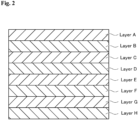
- FIG. 2 is an explanatory view for illustrating a laminate structure of a container material for forming a related-art paper container for a filled food.
- FIG. 1 is an explanatory view for illustrating an example of a laminate structure of a container material for forming a paper container for a filled food according to the present invention.
- the paper container for a filled food is formed of a container material including, from an outer surface side to an inner surface side of the container material: a thermoplastic resin layer (layer A) containing a polyethylene resin as a main component; a paper base layer (layer B); a thermoplastic resin layer (layer C) containing a polyethylene resin as a main component; a barrier layer (layer D); an adhesive layer (layer E) containing an ethylene-methacrylic acid copolymer resin as a main component; a thermoplastic resin layer (layer I) containing a polyethylene resin as a main component; a thermoplastic resin layer (layer F) containing a polyethylene resin as a main component; a thermoplastic resin layer (layer G) obtained by blending a polyethylene resin and a polypropylene resin; and a thermoplastic resin layer (layer H) obtained by adding, to a polyolefin-based resin, a compounding agent selected from polyhydric alcohols or polyhydric alcohol derivatives, and polyoxyethylene derivatives
- the adhesive layer (layer E) containing an ethylene-methacrylic acid copolymer resin as a main component and the thermoplastic resin layer (layer I) containing a polyethylene resin as a main component are formed into a laminated state through coextrusion of raw materials.
- thermoplastic resin layer (layer C) contains a linear low-density polyethylene resin (LLDPE) as a component
- the thermoplastic resin layer (layer F) contains a high-pressure-processed low-density polyethylene resin (LDPE) as a component
- LDPE high-pressure-processed low-density polyethylene resin
- barrier layer (layer D) is used as the barrier layer (layer D).
- thermoplastic resin layer (layer I) containing a polyethylene resin as a main component is laminated between the adhesive layer (layer E) and the thermoplastic resin layer (layer F) of the laminate structure laminated as described above.
- thermoplastic resin layer (layer A) is laminated in a multilayered manner on an outer surface of the paper base layer (layer B).
- thermoplastic resin layer (layer C) containing a polyethylene resin as a main component is laminated in a multilayered manner on an inner surface of the paper base layer (layer B), and the barrier layer (layer D) is laminated in a multilayered manner on the thermoplastic resin layer (layer C).
- the adhesive layer (layer E) and the thermoplastic resin layer (layer I) are laminated in a multilayered manner on the barrier layer (layer D) in the stated order.
- a raw material of the adhesive layer (layer E) and a raw material of the thermoplastic resin layer (layer I) are laminated in a multilayered manner on the barrier layer (layer D) through coextrusion.
- T-die extrusion is employed as the coextrusion of the raw materials of the adhesive layer (layer E) and the thermoplastic resin layer (layer I).
- thermoplastic resin layer (layer F), the thermoplastic resin layer (layer G), and the thermoplastic resin layer (layer H) are laminated in a multilayered manner on the thermoplastic resin layer (layer I) in the stated order.
- thermoplastic resin layer (layer F), the thermoplastic resin layer (layer G), and the thermoplastic resin layer (layer H) When the thermoplastic resin layer (layer F), the thermoplastic resin layer (layer G), and the thermoplastic resin layer (layer H) are laminated, a three-layer film including the thermoplastic resin layer (layer F), the thermoplastic resin layer (layer G), and the thermoplastic resin layer (layer H) may be laminated in a multilayered manner on the thermoplastic resin layer (layer I).
- the thermoplastic resin layer (layer F), the thermoplastic resin layer (layer G), and the thermoplastic resin layer (layer H) may be laminated in a multilayered manner on the thermoplastic resin layer (layer I) through coextrusion of raw materials thereof.
- thermoplastic resin layer (layer A) is laminated on the outer surface of the paper base layer (layer B).
- thermoplastic resin layer (layer C), the barrier layer (layer D), the adhesive layer (layer E), the thermoplastic resin layer (layer I), the thermoplastic resin layer (layer F), the thermoplastic resin layer (layer G), and the thermoplastic resin layer (layer H) are laminated on the inner surface side of the paper base layer (layer B)
- the thermoplastic resin layer (layer A) may be laminated on the outer surface of the paper base layer (layer B) lastly.
- the adhesive layer (layer E) and the thermoplastic resin layer (layer I) are formed into the laminated state through coextrusion of raw materials, and hence the raw materials are brought into contact with each other. Accordingly, even when the adhesive layer (layer E) and the thermoplastic resin layer (layer I) contain different resins as main components, contact surface sides are brought into a mixed state, and thus the adhesive layer (layer E) and the thermoplastic resin layer (layer I) have the laminate structure free from delamination.
- thermoplastic resin layer (layer F) is laminated in a multilayered manner on the thermoplastic resin layer (layer I) laminated on the adhesive layer (layer E). Accordingly, high adhesive strength is obtained between the adhesive layer (layer E) and the thermoplastic resin layer (layer I) laminated on the adhesive layer (layer E) because the thermoplastic resin layer (layer I) and the thermoplastic resin layer (layer F) contain the same resin.
- the coextrusion of the raw material of the adhesive layer (layer E) and the raw material of the thermoplastic resin layer (layer I) is performed through the T-die extrusion. Accordingly, the raw material of the adhesive layer (layer E) and the raw material of the thermoplastic resin layer (layer I) are brought into contact and mixed with each other in a T die, and thus a mixing extent of the raw materials is increased, with the result that the adhesive layer (layer E) and the thermoplastic resin layer (layer I) have the laminate structure further free from delamination.
Landscapes
- Engineering & Computer Science (AREA)
- Mechanical Engineering (AREA)
- Laminated Bodies (AREA)
- Wrappers (AREA)
- Packages (AREA)
Abstract
Description
- The present invention relates to a paper container for a filled food to be used for manufacturing a food filled in a container, such as tofu in a container, obtained by filling a material of the food into the container, hermetically sealing the container, and heating and coagulating the material.
- There is known a food, such as tofu, soft adzukibean jelly, or pudding, which is manufactured by filling a material of the food into a container, hermetically sealing the container, and heating and coagulating the material (hereinafter referred to as "filled food").
- For example, when the filled food is tofu, a tofu material containing soybean milk and a coagulant is filled into a container, and the container is hermetically sealed. Then, the container into which the tofu material is filled is heated at a temperature of from 60 degrees to 100 degrees, thereby manufacturing filled tofu (see, for example, Patent Literature 1).
- As containers to be used for the filled food including filled tofu, for example, a metal container, a synthetic resin container, and a paper container are known. However, the paper container has been widely used in view of, for example, ease of disposal after use, and recycling characteristics. As a paper container for hermetically accommodating a food, there is known a paper container formed of a paper container material including, from an outer surface side to an inner surface side thereof, a thermoplastic resin layer containing a polyethylene resin as a main component, a paper base layer, a thermoplastic resin layer containing a polyethylene resin as a main component, a barrier layer, and a thermoplastic resin layer that contains a polyethylene resin as a main component and is formed as an innermost layer (see, for example, Patent Literature 2).
- However, when the paper container formed of the paper container material as described in Patent Literature 2 is used as a container for a filled food, separability is poor between the food coagulated in the container and the thermoplastic resin layer that contains a polyethylene resin as a main component and forms an inner surface of the container, and thus the food adheres to the inner surface of the container when being taken out of the container. Accordingly, it may be difficult to take out the food, or a part of the food may be chipped.
- As a substance for improving separability between the inner surface of the container and the food coagulated in the container, there has been proposed a polyolefin-based resin composite obtained by adding, to a polyolefin-based resin, a compounding agent selected from polyhydric alcohols or polyhydric alcohol derivatives, and polyoxyethylene derivatives (see, for example, Patent Literature 3).
- When the technology as described in Patent Literature 3 is applied to the innermost layer of the paper container material as described in Patent Literature 2, separability is improved between the inner surface of the paper container and the food, and hence the food can be easily taken out of the paper container.
- As an example of applying the technology as described in Patent Literature 3 to the innermost layer of the paper container material as described in Patent Literature 2, it is conceivable that, on the above-mentioned thermoplastic resin layer that contains a polyethylene resin as a main component and forms the innermost layer of the paper container material, a polyethylene resin film, to which a compounding agent selected from polyhydric alcohols or polyhydric alcohol derivatives, and polyoxyethylene derivatives is added, is laminated and formed as an innermost layer.
- However, when the paper container formed of the paper container material thus obtained is used as a container for a filled food, delamination occurs between the polyethylene resin layer, which includes the compounding agent added thereto and forms the innermost layer, and the thermoplastic resin layer, which contains a polyethylene resin as a main component and is arranged on an inner side of the polyethylene resin layer, and thus a content liquid may leak in some cases.
- As a device for solving the above-mentioned problem, as illustrated in
FIG. 2 , there has been proposed a paper container for a filled food formed of a container material including, from an outer surface side to an inner surface side thereof, a thermoplastic resin layer (layer A) containing a polyethylene resin as a main component, a paper base layer (layer B), a thermoplastic resin layer (layer C) containing a polyethylene resin as a main component, a barrier layer (layer D), an adhesive layer (layer E) containing an ethylene-methacrylic acid copolymer resin as a main component, a thermoplastic resin layer (layer F) containing a polyethylene resin as a main component, a thermoplastic resin layer (layer G) obtained by blending a polyethylene resin and a polypropylene resin, and a thermoplastic resin layer (layer H) obtained by adding, to a polyolefin-based resin, a compounding agent selected from polyhydric alcohols or polyhydric alcohol derivatives, and polyoxyethylene derivatives (see, for example, - The paper container for a filled food as described in Patent Literature 4 has a laminate structure in which the thermoplastic resin layer (layer G) obtained by blending a polyethylene resin and a polypropylene resin is interposed between the thermoplastic resin layer (layer H) and the thermoplastic resin layer (layer F) that contains a polyethylene resin as a main component and is arranged on the inner side of the thermoplastic resin layer (layer H). Accordingly, in manufacturing processes of filling a material of the food such as tofu into a container, hermetically sealing the container, and heating and coagulating the material, elution of the compounding agent from the thermoplastic resin layer (layer H) being the innermost layer is suppressed by the thermoplastic resin layer (layer G), and the compounding agent can be prevented from being transferred to the thermoplastic resin layer (layer F). Accordingly, the thermoplastic resin layer (layer H) can be prevented from being delaminated from the thermoplastic resin layer (layer F), thereby being capable of obtaining the paper container for a filled food free from leakage of the content liquid.
-
- [PTL 1]
JP 2014-187975 A1 - [PTL 2]
JP 2004-17984 A - [PTL 3]
JP 7-62163 A - [PTL 4]
JP 2017-24762 A - In the container material to be used for the paper container for a filled food as described in Patent Literature 4, on the adhesive layer (layer E) that contains an ethylene-methacrylic acid copolymer resin as a main component and is laminated on the barrier layer (layer D), the thermoplastic resin layer (layer F) containing a polyethylene resin as a main component is laminated in a multilayered manner. However, the adhesive layer (layer E) and the thermoplastic resin layer (layer F) respectively contain different resins, that is, an ethylene-methacrylic acid copolymer resin and a polyethylene resin as main components. Accordingly, it cannot be said that adhesiveness between the adhesive layer (layer E) and the thermoplastic resin layer (layer F) is high.
- Adhesive strength between the adhesive layer (layer E) and the thermoplastic resin layer (layer F) is a condition required to maintain performance of the paper container for a filled food, but adhesiveness between an ethylene-methacrylic acid copolymer resin and a polyethylene resin is not high. Accordingly, there is a problem in that, due to long storage in the paper container for a filled food, or due to a heating treatment in a manufacturing process, for example, when the filled food is tofu, the adhesive strength between the adhesive layer (layer E) and the thermoplastic resin layer (layer F) is reduced, with the result that delamination may occur between the adhesive layer (layer E) and the thermoplastic resin layer (layer F) to cause leakage of the content liquid.
- It is an object of the present invention to provide a paper container for a filled food capable of increasing initial adhesive strength in a laminate, and preventing leakage of a content liquid due to delamination.
- In order to achieve the above-mentioned object, according to the invention described in claim 1, there is provided a paper container for a filled food, which is formed of a container material including, from an outer surface side to an inner surface side of the container material: a thermoplastic resin layer (layer A) containing a polyethylene resin as a main component; a paper base layer (layer B); a thermoplastic resin layer (layer C) containing a polyethylene resin as a main component; a barrier layer (layer D); an adhesive layer (layer E) containing an ethylene-methacrylic acid copolymer resin as a main component; a thermoplastic resin layer (layer I) containing a polyethylene resin as a main component; a thermoplastic resin layer (layer F) containing a polyethylene resin as a main component; a thermoplastic resin layer (layer G) obtained by blending a polyethylene resin and a polypropylene resin; and a thermoplastic resin layer (layer H) obtained by adding, to a polyolefin-based resin, a compounding agent selected from polyhydric alcohols or polyhydric alcohol derivatives, and polyoxyethylene derivatives, wherein the adhesive layer (layer E) containing an ethylene-methacrylic acid copolymer resin as a main component and the thermoplastic resin layer (layer I) containing a polyethylene resin as a main component are formed into a laminated state through coextrusion of raw materials.
- According to the invention described in claim 1, the adhesive layer (layer E) containing an ethylene-methacrylic acid copolymer resin as a main component and the thermoplastic resin layer (layer I) containing a polyethylene resin as a main component are formed into a laminated state through coextrusion of raw materials. Accordingly, at the time of the coextrusion, the raw material of the adhesive layer (layer E) containing an ethylene-methacrylic acid copolymer resin as a main component and the raw material of the thermoplastic resin layer (layer I) containing a polyethylene resin as a main component are brought into contact with each other, and contact surface sides are brought into a mixed state, with the result that the adhesive layer (layer E) and the thermoplastic resin layer (layer I) have the laminate structure free from delamination. Further, the thermoplastic resin layer (layer F) is laminated in a multilayered manner on the thermoplastic resin layer (layer I) laminated on the adhesive layer (layer E). Accordingly, high adhesive strength is obtained between the thermoplastic resin layer (layer I) and the thermoplastic resin layer (layer F) because the thermoplastic resin layer (layer I) and the thermoplastic resin layer (layer F) contain the same resin. Therefore, unlike the paper container for a filled food as described in Patent Literature 4, there is no problem in that delamination occurs between the adhesive layer (layer E) and the thermoplastic resin layer (layer F), and hence occurrence of a situation such as leakage of a content liquid due to delamination can be prevented.
- According to the invention described in claim 2, the coextrusion, which is described in claim 1, of the adhesive layer (layer E) containing an ethylene-methacrylic acid copolymer resin as a main component and the thermoplastic resin layer (layer I) containing a polyethylene resin as a main component is performed through T-die extrusion.
- According to the invention described in claim 2, the coextrusion, which is described in claim 1, of the adhesive layer (layer E) containing an ethylene-methacrylic acid copolymer resin as a main component and the thermoplastic resin layer (layer I) containing a polyethylene resin as a main component is performed through the T-die extrusion. Accordingly, at the time of the coextrusion, the raw material of the adhesive layer (layer E) containing an ethylene-methacrylic acid copolymer resin as a main component and the raw material of the thermoplastic resin layer (layer I) containing a polyethylene resin as a main component are brought into contact with each other in a T die, and thus a mixing extent of the raw materials is increased, with the result that the adhesive layer (layer E) and the thermoplastic resin layer (layer I) have the laminate structure further free from delamination. Accordingly, occurrence of a situation such as leakage of the content liquid due to delamination can be more reliably prevented.
- According to the paper container for a filled food of the present invention, occurrence of a situation such as leakage of a content liquid due to delamination can be prevented.
-
FIG. 1 is an explanatory view for illustrating an example of a laminate structure of a container material for forming a paper container for a filled food according to the present invention. -
FIG. 2 is an explanatory view for illustrating a laminate structure of a container material for forming a related-art paper container for a filled food. - Now, an example of a paper container for a filled food according to an embodiment of the present invention is described in detail with reference to the drawings.
-
FIG. 1 is an explanatory view for illustrating an example of a laminate structure of a container material for forming a paper container for a filled food according to the present invention. - The paper container for a filled food according to this embodiment is formed of a container material including, from an outer surface side to an inner surface side of the container material: a thermoplastic resin layer (layer A) containing a polyethylene resin as a main component; a paper base layer (layer B); a thermoplastic resin layer (layer C) containing a polyethylene resin as a main component; a barrier layer (layer D); an adhesive layer (layer E) containing an ethylene-methacrylic acid copolymer resin as a main component; a thermoplastic resin layer (layer I) containing a polyethylene resin as a main component; a thermoplastic resin layer (layer F) containing a polyethylene resin as a main component; a thermoplastic resin layer (layer G) obtained by blending a polyethylene resin and a polypropylene resin; and a thermoplastic resin layer (layer H) obtained by adding, to a polyolefin-based resin, a compounding agent selected from polyhydric alcohols or polyhydric alcohol derivatives, and polyoxyethylene derivatives. The adhesive layer (layer E) containing an ethylene-methacrylic acid copolymer resin as a main component and the thermoplastic resin layer (layer I) containing a polyethylene resin as a main component are formed into a laminated state through coextrusion of raw materials.
- In the above-mentioned laminate structure of the container material, a laminate structure including the thermoplastic resin layer (layer A) containing a polyethylene resin as a main component, the paper base layer (layer B), the thermoplastic resin layer (layer C) containing a polyethylene resin as a main component, the barrier layer (layer D), the adhesive layer (layer E) containing an ethylene-methacrylic acid copolymer resin as a main component, the thermoplastic resin layer (layer F) containing a polyethylene resin as a main component, the thermoplastic resin layer (layer G) obtained by blending a polyethylene resin and a polypropylene resin, and the thermoplastic resin layer (layer H) obtained by adding, to a polyolefin-based resin, a compounding agent selected from polyhydric alcohols or polyhydric alcohol derivatives, and polyoxyethylene derivatives is not different from that of the container material to be used for the related-art paper container for a filled food as described in Patent Literature 4.
- In this embodiment, the thermoplastic resin layer (layer C) contains a linear low-density polyethylene resin (LLDPE) as a component, and the thermoplastic resin layer (layer F) contains a high-pressure-processed low-density polyethylene resin (LDPE) as a component. Further, aluminum foil is used as the barrier layer (layer D).
- In the container material for forming the paper container for a filled food according to the present invention, the thermoplastic resin layer (layer I) containing a polyethylene resin as a main component is laminated between the adhesive layer (layer E) and the thermoplastic resin layer (layer F) of the laminate structure laminated as described above.
- Description is made of an example of manufacture of the container material having the laminate structure described above.
- First, the thermoplastic resin layer (layer A) is laminated in a multilayered manner on an outer surface of the paper base layer (layer B).
- Next, the thermoplastic resin layer (layer C) containing a polyethylene resin as a main component is laminated in a multilayered manner on an inner surface of the paper base layer (layer B), and the barrier layer (layer D) is laminated in a multilayered manner on the thermoplastic resin layer (layer C).
- Next, the adhesive layer (layer E) and the thermoplastic resin layer (layer I) are laminated in a multilayered manner on the barrier layer (layer D) in the stated order. When the adhesive layer (layer E) and the thermoplastic resin layer (layer I) are laminated, a raw material of the adhesive layer (layer E) and a raw material of the thermoplastic resin layer (layer I) are laminated in a multilayered manner on the barrier layer (layer D) through coextrusion. In this embodiment, as the coextrusion of the raw materials of the adhesive layer (layer E) and the thermoplastic resin layer (layer I), T-die extrusion is employed.
- Next, the thermoplastic resin layer (layer F), the thermoplastic resin layer (layer G), and the thermoplastic resin layer (layer H) are laminated in a multilayered manner on the thermoplastic resin layer (layer I) in the stated order.
- When the thermoplastic resin layer (layer F), the thermoplastic resin layer (layer G), and the thermoplastic resin layer (layer H) are laminated, a three-layer film including the thermoplastic resin layer (layer F), the thermoplastic resin layer (layer G), and the thermoplastic resin layer (layer H) may be laminated in a multilayered manner on the thermoplastic resin layer (layer I). Alternatively, the thermoplastic resin layer (layer F), the thermoplastic resin layer (layer G), and the thermoplastic resin layer (layer H) may be laminated in a multilayered manner on the thermoplastic resin layer (layer I) through coextrusion of raw materials thereof.
- In this embodiment, first, the thermoplastic resin layer (layer A) is laminated on the outer surface of the paper base layer (layer B). However, after the thermoplastic resin layer (layer C), the barrier layer (layer D), the adhesive layer (layer E), the thermoplastic resin layer (layer I), the thermoplastic resin layer (layer F), the thermoplastic resin layer (layer G), and the thermoplastic resin layer (layer H) are laminated on the inner surface side of the paper base layer (layer B), the thermoplastic resin layer (layer A) may be laminated on the outer surface of the paper base layer (layer B) lastly.
- In the paper container for a filled food formed of the container material having the laminate structure manufactured as described above, the adhesive layer (layer E) and the thermoplastic resin layer (layer I) are formed into the laminated state through coextrusion of raw materials, and hence the raw materials are brought into contact with each other. Accordingly, even when the adhesive layer (layer E) and the thermoplastic resin layer (layer I) contain different resins as main components, contact surface sides are brought into a mixed state, and thus the adhesive layer (layer E) and the thermoplastic resin layer (layer I) have the laminate structure free from delamination.
- The thermoplastic resin layer (layer F) is laminated in a multilayered manner on the thermoplastic resin layer (layer I) laminated on the adhesive layer (layer E). Accordingly, high adhesive strength is obtained between the adhesive layer (layer E) and the thermoplastic resin layer (layer I) laminated on the adhesive layer (layer E) because the thermoplastic resin layer (layer I) and the thermoplastic resin layer (layer F) contain the same resin.
- In this embodiment, the coextrusion of the raw material of the adhesive layer (layer E) and the raw material of the thermoplastic resin layer (layer I) is performed through the T-die extrusion. Accordingly, the raw material of the adhesive layer (layer E) and the raw material of the thermoplastic resin layer (layer I) are brought into contact and mixed with each other in a T die, and thus a mixing extent of the raw materials is increased, with the result that the adhesive layer (layer E) and the thermoplastic resin layer (layer I) have the laminate structure further free from delamination.
Claims (2)
- A paper container for a filled food, which is formed of a container material comprising, from an outer surface side to an inner surface side of the container material:a thermoplastic resin layer (layer A) containing a polyethylene resin as a main component;a paper base layer (layer B);a thermoplastic resin layer (layer C) containing a polyethylene resin as a main component;a barrier layer (layer D);an adhesive layer (layer E) containing an ethylene-methacrylic acid copolymer resin as a main component;a thermoplastic resin layer (layer I) containing a polyethylene resin as a main component;a thermoplastic resin layer (layer F) containing a polyethylene resin as a main component;a thermoplastic resin layer (layer G) obtained by blending a polyethylene resin and a polypropylene resin; anda thermoplastic resin layer (layer H) obtained by adding, to a polyolefin-based resin, a compounding agent selected from polyhydric alcohols or polyhydric alcohol derivatives, and polyoxyethylene derivatives,wherein the adhesive layer (layer E) containing an ethylene-methacrylic acid copolymer resin as a main component and the thermoplastic resin layer (layer I) containing a polyethylene resin as a main component are formed into a laminated state through coextrusion of raw materials.
- The paper container for a filled food according to claim 1, wherein the coextrusion of the adhesive layer (layer E) containing an ethylene-methacrylic acid copolymer resin as a main component and the thermoplastic resin layer (layer I) containing a polyethylene resin as a main component is performed through T-die extrusion.
Applications Claiming Priority (2)
| Application Number | Priority Date | Filing Date | Title |
|---|---|---|---|
| JP2020024799A JP7075424B2 (en) | 2020-02-17 | 2020-02-17 | Filled food paper container |
| PCT/JP2021/005781 WO2021166919A1 (en) | 2020-02-17 | 2021-02-16 | Paper container for packed food |
Publications (2)
| Publication Number | Publication Date |
|---|---|
| EP4155229A1 true EP4155229A1 (en) | 2023-03-29 |
| EP4155229A4 EP4155229A4 (en) | 2024-08-14 |
Family
ID=77391930
Family Applications (1)
| Application Number | Title | Priority Date | Filing Date |
|---|---|---|---|
| EP21756780.9A Pending EP4155229A4 (en) | 2020-02-17 | 2021-02-16 | Paper container for packed food |
Country Status (6)
| Country | Link |
|---|---|
| EP (1) | EP4155229A4 (en) |
| JP (1) | JP7075424B2 (en) |
| KR (1) | KR102771971B1 (en) |
| CN (1) | CN115697854B (en) |
| AU (1) | AU2021222526A1 (en) |
| WO (1) | WO2021166919A1 (en) |
Family Cites Families (11)
| Publication number | Priority date | Publication date | Assignee | Title |
|---|---|---|---|---|
| JPH0762163A (en) | 1993-08-25 | 1995-03-07 | Tonen Chem Corp | Polyolefin resin composition for food container |
| JP2001526984A (en) * | 1997-12-31 | 2001-12-25 | キンバリー クラーク ワールドワイド インコーポレイテッド | Microlayer breathable film of degradable polymer and thermoplastic elastomer |
| JP2001278330A (en) * | 2000-03-31 | 2001-10-10 | Nihon Tetra Pak Kk | Laminated packaging material and method of manufacturing laminated packaging material |
| JP2004017984A (en) | 2002-06-13 | 2004-01-22 | Dainippon Printing Co Ltd | Laminated paper container and retorted paper container |
| JP2006035466A (en) * | 2004-07-22 | 2006-02-09 | Nippon Paper Industries Co Ltd | Laminated sheet and manufacturing method thereof |
| CN101879808B (en) * | 2010-06-22 | 2012-03-28 | 李民 | Bonding method of fluoroplastic layer and polyester layer |
| WO2014024913A1 (en) * | 2012-08-10 | 2014-02-13 | 日本製紙株式会社 | Multilayered paper container |
| JP6322894B2 (en) | 2013-03-28 | 2018-05-16 | 不二製油株式会社 | Filled tofu |
| US9926101B2 (en) * | 2013-10-07 | 2018-03-27 | Nakamoto Packs Co., Ltd. | Laminated material for paper containers and paper containers using it |
| JP6660112B2 (en) * | 2015-07-24 | 2020-03-04 | 日本製紙株式会社 | Filled food paper container |
| DE102017201449A1 (en) * | 2017-01-30 | 2018-08-02 | Sig Technology Ag | Sheet-like composite for producing dimensionally stable food containers with a barrier layer, which has a barrier substrate layer and an inwardly-facing barrier material layer |
-
2020
- 2020-02-17 JP JP2020024799A patent/JP7075424B2/en active Active
-
2021
- 2021-02-16 CN CN202180028978.7A patent/CN115697854B/en active Active
- 2021-02-16 AU AU2021222526A patent/AU2021222526A1/en active Pending
- 2021-02-16 KR KR1020227031958A patent/KR102771971B1/en active Active
- 2021-02-16 EP EP21756780.9A patent/EP4155229A4/en active Pending
- 2021-02-16 WO PCT/JP2021/005781 patent/WO2021166919A1/en not_active Ceased
Also Published As
| Publication number | Publication date |
|---|---|
| CN115697854A (en) | 2023-02-03 |
| KR20220140822A (en) | 2022-10-18 |
| AU2021222526A1 (en) | 2022-10-13 |
| WO2021166919A1 (en) | 2021-08-26 |
| JP2021127172A (en) | 2021-09-02 |
| KR102771971B1 (en) | 2025-02-21 |
| JP7075424B2 (en) | 2022-05-25 |
| EP4155229A4 (en) | 2024-08-14 |
| CN115697854B (en) | 2025-01-07 |
Similar Documents
| Publication | Publication Date | Title |
|---|---|---|
| KR102285623B1 (en) | Packing member, case for battery, and battery | |
| US3552638A (en) | Peel-open thermoplastic package for sterilized articles | |
| JP4522562B2 (en) | Packaging materials and containers | |
| US5501887A (en) | Resin laminate | |
| KR20160141758A (en) | Thermoforming sheets and thermoformed containers prepared therefrom | |
| TW201807862A (en) | External storage material and power storage device for power storage device | |
| JPS63179741A (en) | Composite film simultaneously having easily peelable property and heat sealing property | |
| US20230088010A1 (en) | A multilayer lidding film based on polyethylene | |
| US20240343026A1 (en) | Multilayer film, packaging material, and package | |
| EP3050815B1 (en) | Layer separating container | |
| JP2018076127A (en) | Packaging materials and molded cases | |
| JP2017019527A (en) | Packaging materials and packages | |
| KR102064094B1 (en) | Flushproof Sheets for Packaging Tubes | |
| KR102771971B1 (en) | Paper containers for food filling | |
| JP3867474B2 (en) | Easy-open composite film and packaging container | |
| JP2014063679A (en) | Terminal adhesive tape and method for manufacturing the tape | |
| JPS61279552A (en) | Sealant film and cover material | |
| JP2006027627A (en) | Bag for microwave oven heating | |
| JP2023123060A (en) | Multilayer films, packaging sheets, and food containers | |
| JP5509551B2 (en) | Method for manufacturing laminate for Rondel molded body, method for manufacturing Rondel molded body, and method for manufacturing tube container | |
| JP6660112B2 (en) | Filled food paper container | |
| JP7639290B2 (en) | Multilayer film, food packaging sheet, food container, and method for manufacturing container | |
| JPH10193531A (en) | Multilayer sheet | |
| JPH0133332Y2 (en) | ||
| CN212171549U (en) | Packaging material for battery |
Legal Events
| Date | Code | Title | Description |
|---|---|---|---|
| STAA | Information on the status of an ep patent application or granted ep patent |
Free format text: STATUS: THE INTERNATIONAL PUBLICATION HAS BEEN MADE |
|
| PUAI | Public reference made under article 153(3) epc to a published international application that has entered the european phase |
Free format text: ORIGINAL CODE: 0009012 |
|
| STAA | Information on the status of an ep patent application or granted ep patent |
Free format text: STATUS: REQUEST FOR EXAMINATION WAS MADE |
|
| 17P | Request for examination filed |
Effective date: 20220916 |
|
| AK | Designated contracting states |
Kind code of ref document: A1 Designated state(s): AL AT BE BG CH CY CZ DE DK EE ES FI FR GB GR HR HU IE IS IT LI LT LU LV MC MK MT NL NO PL PT RO RS SE SI SK SM TR |
|
| DAV | Request for validation of the european patent (deleted) | ||
| DAX | Request for extension of the european patent (deleted) | ||
| A4 | Supplementary search report drawn up and despatched |
Effective date: 20240715 |
|
| RIC1 | Information provided on ipc code assigned before grant |
Ipc: B32B 27/10 20060101ALI20240709BHEP Ipc: B32B 27/08 20060101ALI20240709BHEP Ipc: B32B 27/32 20060101ALI20240709BHEP Ipc: B32B 7/12 20060101ALI20240709BHEP Ipc: B65D 85/72 20060101ALI20240709BHEP Ipc: B32B 15/085 20060101ALI20240709BHEP Ipc: B32B 15/082 20060101ALI20240709BHEP Ipc: B32B 27/30 20060101ALI20240709BHEP Ipc: B32B 15/20 20060101ALI20240709BHEP Ipc: B65D 65/40 20060101AFI20240709BHEP |