EP4155138B1 - Steer-by-wire-lenksystem und verfahren zum diebstahlschutz eines kraftfahrzeugs mit einem steer-by-wire-lenksystem - Google Patents
Steer-by-wire-lenksystem und verfahren zum diebstahlschutz eines kraftfahrzeugs mit einem steer-by-wire-lenksystem Download PDFInfo
- Publication number
- EP4155138B1 EP4155138B1 EP22186615.5A EP22186615A EP4155138B1 EP 4155138 B1 EP4155138 B1 EP 4155138B1 EP 22186615 A EP22186615 A EP 22186615A EP 4155138 B1 EP4155138 B1 EP 4155138B1
- Authority
- EP
- European Patent Office
- Prior art keywords
- steering
- control unit
- actuator
- rotational angle
- column module
- Prior art date
- Legal status (The legal status is an assumption and is not a legal conclusion. Google has not performed a legal analysis and makes no representation as to the accuracy of the status listed.)
- Active
Links
Images
Classifications
-
- B—PERFORMING OPERATIONS; TRANSPORTING
- B60—VEHICLES IN GENERAL
- B60R—VEHICLES, VEHICLE FITTINGS, OR VEHICLE PARTS, NOT OTHERWISE PROVIDED FOR
- B60R25/00—Fittings or systems for preventing or indicating unauthorised use or theft of vehicles
- B60R25/01—Fittings or systems for preventing or indicating unauthorised use or theft of vehicles operating on vehicle systems or fittings, e.g. on doors, seats or windscreens
- B60R25/02—Fittings or systems for preventing or indicating unauthorised use or theft of vehicles operating on vehicle systems or fittings, e.g. on doors, seats or windscreens operating on the steering mechanism
- B60R25/021—Fittings or systems for preventing or indicating unauthorised use or theft of vehicles operating on vehicle systems or fittings, e.g. on doors, seats or windscreens operating on the steering mechanism restraining movement of the steering column or steering wheel hub, e.g. restraining means controlled by ignition switch
-
- B—PERFORMING OPERATIONS; TRANSPORTING
- B60—VEHICLES IN GENERAL
- B60R—VEHICLES, VEHICLE FITTINGS, OR VEHICLE PARTS, NOT OTHERWISE PROVIDED FOR
- B60R25/00—Fittings or systems for preventing or indicating unauthorised use or theft of vehicles
- B60R25/01—Fittings or systems for preventing or indicating unauthorised use or theft of vehicles operating on vehicle systems or fittings, e.g. on doors, seats or windscreens
- B60R25/02—Fittings or systems for preventing or indicating unauthorised use or theft of vehicles operating on vehicle systems or fittings, e.g. on doors, seats or windscreens operating on the steering mechanism
- B60R25/021—Fittings or systems for preventing or indicating unauthorised use or theft of vehicles operating on vehicle systems or fittings, e.g. on doors, seats or windscreens operating on the steering mechanism restraining movement of the steering column or steering wheel hub, e.g. restraining means controlled by ignition switch
- B60R25/0215—Fittings or systems for preventing or indicating unauthorised use or theft of vehicles operating on vehicle systems or fittings, e.g. on doors, seats or windscreens operating on the steering mechanism restraining movement of the steering column or steering wheel hub, e.g. restraining means controlled by ignition switch using electric means, e.g. electric motors or solenoids
-
- B—PERFORMING OPERATIONS; TRANSPORTING
- B62—LAND VEHICLES FOR TRAVELLING OTHERWISE THAN ON RAILS
- B62D—MOTOR VEHICLES; TRAILERS
- B62D5/00—Power-assisted or power-driven steering
- B62D5/04—Power-assisted or power-driven steering electrical, e.g. using an electric servo-motor connected to, or forming part of, the steering gear
- B62D5/0457—Power-assisted or power-driven steering electrical, e.g. using an electric servo-motor connected to, or forming part of, the steering gear characterised by control features of the drive means as such
- B62D5/046—Controlling the motor
-
- B—PERFORMING OPERATIONS; TRANSPORTING
- B62—LAND VEHICLES FOR TRAVELLING OTHERWISE THAN ON RAILS
- B62D—MOTOR VEHICLES; TRAILERS
- B62D5/00—Power-assisted or power-driven steering
- B62D5/04—Power-assisted or power-driven steering electrical, e.g. using an electric servo-motor connected to, or forming part of, the steering gear
- B62D5/0457—Power-assisted or power-driven steering electrical, e.g. using an electric servo-motor connected to, or forming part of, the steering gear characterised by control features of the drive means as such
- B62D5/0481—Power-assisted or power-driven steering electrical, e.g. using an electric servo-motor connected to, or forming part of, the steering gear characterised by control features of the drive means as such monitoring the steering system, e.g. failures
Definitions
- the invention relates to a steer-by-wire steering system and a method for theft protection of a motor vehicle with a steer-by-wire steering system.
- a method for decelerating a servo motor of a steering device is known, in particular for protection in a maintenance operating situation and/or for theft protection, wherein the steering device comprises at least one control unit which is provided for setting at least one assistance torque of the servo motor in a normal operating mode, wherein a movement of the servo motor caused by an external force is monitored by evaluating a movement characteristic correlated with the movement of the servo motor and, depending on this, a deceleration process is triggered in which the servo motor is decelerated by means of the control unit.
- the control unit In the operating state for carrying out the deceleration process, the control unit is placed into a special deceleration operating mode in which at least one operating function of the control unit activated in the normal operating mode is deactivated and/or is not accessible to the control unit.
- the steering device can also be designed as a steer-by-wire steering system.
- a method for steering assistance of a motor vehicle wherein during normal operation steering instructions are implemented in a corresponding steering angle of steered wheels of the motor vehicle, wherein the steering angle is actively influenced independently of the steering instructions if operation of the motor vehicle by an unauthorized operator has been detected.
- a generic steer-by-wire steering system is known.
- DE 10 2013 109 527 A1 A method for operating a steering system in a vehicle with an electric motor for generating a torque that supports the steering movement is known, which torque is adjusted as a function of a steering operation determined by a sensor, wherein a torque opposite to a steering operation is generated to realize a steering wheel lock.
- the invention is based on the technical problem of creating a steer-by-wire steering system in which theft protection is improved and of providing a suitable method.
- the steer-by-wire steering system comprises a steering column module and a steering gear.
- the steering column module has at least one rotation angle sensor for detecting a steering wheel rotation angle on a steering handle, an actuator for generating a counter-torque on the steering handle, and at least one control unit.
- the actuator is preferably designed as an electric motor.
- the steering gear has at least one control unit, an actuator system for generating a rack force on a rack, and at least one sensor system for detecting or determining a rack position.
- the control units are connected via data communication, for example, via a bus system such as a CAN bus system.
- the steering gear control unit is configured to wake up periodically and/or situationally when the motor vehicle is parked and to detect or determine a current rack position, which is then compared with a previous rack position (when the motor vehicle is parked or during the last wake-up cycle). If the rack position changes, the control unit controls the steering gear actuator in such a way that it maintains the current rack position or another predetermined rack position with maximum rack force.
- Modern steering gears for example, can apply up to 9,500 N of rack force.
- the rack position is fixed or locked, so that steering is no longer possible.
- reaction times for example, 5 ms after wake-up, a A change in the rack position is detected, and locking occurs within a total of 20 ms. Thus, effective theft protection can be achieved with only minor software changes.
- control unit of the steering column module is configured to wake up periodically and/or situationally (i.e., event-driven) when the motor vehicle is parked and to detect a current steering wheel angle and compare it with a previous steering wheel angle.
- This previous steering wheel angle is, for example, the steering wheel angle that existed when the motor vehicle was parked or was measured during the last wake-up process. If the steering wheel angle changes (previous to current), the control unit controls the actuator of the steering column module such that it holds the current steering wheel angle or another predetermined steering wheel angle with maximum torque. If an attempt is then made to set a different steering wheel angle on the steering handle, the actuator counteracts this. The current steering wheel angle or the predetermined steering wheel angle is thus fixed or locked.
- the actuator can, for example, counteract a manual torque on the steering handle with up to 35 Nm, making the motor vehicle almost impossible to steer.
- the process is relatively fast. For example, a change in the steering wheel angle is detected approximately 5 ms after waking up, with locking occurring after a total of 20 ms.
- control unit of the steering column module is configured to transmit a control command to the control unit of the steering gear to lock a rack position
- the control unit of the steering gear is configured to transmit a control command to the control unit of the steering column module to lock a steering wheel rotation angle.
- control units are designed to communicate with each other in an encrypted manner in order to prevent or make software manipulation more difficult.
- the supply voltage connections of the actuator of the steering column module and/or the actuator of the steering gear are designed in such a way that they are short-circuited without the supply voltage plug being plugged in. Therefore, if an attempt is made to bypass the locking mechanism by pulling the supply voltage plug, The short circuit ensures that the actuators are as stiff as possible, since each movement generates short-circuit currents whose resulting electromagnetic forces counteract the movement.
- the invention is explained in more detail below using a preferred embodiment.
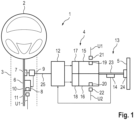
- the sole figure shows a schematic block diagram of a steer-by-wire steering system.
- the steer-by-wire steering system 1 shown has a steering handle 2, a steering column module 3, and a steering gear 4 connected to a rack 5.
- the steering handle 2 is designed, for example, as a steering wheel and is connected to a steering column 6 in the steering column module 3.
- the steering column module 3 also has at least one rotation angle sensor 7, an actuator 8, and a control unit 9.
- the rotation angle sensor 7 and the actuator 8 are arranged on the steering column 6, with the rotation angle sensor 7 detecting a steering wheel rotation angle on the steering handle 2 and transmitting it to the control unit 9.
- the actuator 8 generates a counter-torque on the steering column 6, which is noticeable as a counter-torque on the steering handle 2.
- the actuator 8 is preferably designed as an electric motor and is also referred to as a force feedback actuator.
- the actuator 8 has a supply voltage connection 10 into which a supply voltage plug 11 can be inserted in order to supply the actuator 8 with a voltage U1.
- the steering gear 4 has a control unit 12, an actuator 13, and a sensor system 14 for detecting or determining a rack position.
- the actuator 13 has two half-motors 15, 16, each of which is assigned its own power electronics 17, 18.
- the half-motors 15, 16 and their power electronics 17, 18 each have an independent voltage supply U1 and U2, respectively.
- Supply voltage connections 19, 20 are provided, into which supply voltage plugs 21, 22 can be inserted.
- Fig. 1 are shown in the unplugged state.
- the two half-motors 15, 16 operate on a common rotor 23, which is connected to the rack 5 via a gear 24.
- the sensor system 14, which is designed as a rotor position sensor, is assigned to the rotor 23. Based on the signals from the rotor position sensor and the known gear ratio of the gear 24, the control unit 12 can then determine the rack position.
- the control units 9, 12 are connected to one another via a bus system 25, with communication being encrypted.
- the control unit 9 and/or the control unit 12 are configured to wake up periodically and/or situationally when the motor vehicle is parked. This will now be explained using the control unit 9 as an example.
- the control unit 9 wakes up and receives the current steering wheel angle from the angle sensor 7.
- the control unit 9 compares this current steering wheel angle with a previous steering wheel angle (e.g., the steering wheel angle when the motor vehicle was parked or the angle from the last wake-up cycle). If there is a change, the control unit 9 assumes a theft attempt and controls the actuator 8 such that it maintains the current steering wheel angle or another predetermined steering wheel angle. If an attempt is then made to turn the steering handle, the actuator 8 counteracts this to maintain the position.
- the actuator 8 can For example, a maximum of 35 Nm can be applied, which is almost impossible to oversteer.
- control unit 9 sends a control command to control unit 12, causing actuator 13 to lock the current rack position, i.e., to hold it in position with maximum rack force against external forces. If control unit 12 was previously asleep, it is awakened by the control command from control unit 9.
- the procedure is similar if the control unit 12 is woken up periodically and/or situationally.
- the supply voltage connections 10, 19, 20 of the actuators 8, 13 are designed in such a way that they are short-circuited without the supply voltage plug 11, 21, 22 being plugged in.
Landscapes
- Engineering & Computer Science (AREA)
- Mechanical Engineering (AREA)
- Chemical & Material Sciences (AREA)
- Combustion & Propulsion (AREA)
- Transportation (AREA)
- Steering Control In Accordance With Driving Conditions (AREA)
- Power Steering Mechanism (AREA)
Description
- Die Erfindung betrifft ein Steer-by-Wire-Lenksystem und ein Verfahren zum Diebstahlschutz eines Kraftfahrzeugs mit einem Steer-by-Wire-Lenksystem.
- Aus der
DE 10 2017 218 830 A1 ist ein Verfahren zum Verzögern eines Servomotors einer Lenkvorrichtung bekannt, insbesondere zum Schutz in einer Wartungsbetriebssituation und/oder zur Diebstahlsicherung, wobei die Lenkvorrichtung zumindest eine Steuereinheit umfasst, welche dazu vorgesehen ist, in einem Normalbetriebsmodus zumindest ein Unterstützungsmoment des Servomotors einzustellen, wobei eine durch eine externe Kraft hervorgerufene Bewegung des Servomotors durch Auswerten einer mit der Bewegung des Servomotors korrelierten Bewegungskenngröße überwacht und in deren Abhängigkeit ein Verzögerungsvorgang ausgelöst wird, bei welchem der Servomotor mittels der Steuereinheit verzögert wird. Dabei wird die Steuereinheit in dem Betriebszustand zur Durchführung des Verzögerungsvorgangs in einen speziellen Verzögerungsbetriebsmodus versetzt, in dem wenigstens eine in dem Normalbetriebsmodus aktivierte Betriebsfunktion der Steuereinheit deaktiviert und/oder der Steuereinheit nicht zugänglich ist. Die Lenkvorrichtung kann dabei auch als Steer-by-Wire-Lenksystem ausgebildet sein. - Aus der
DE 10 2004 004 537 A1 ist ein Verfahren zur Lenkunterstützung eines Kraftfahrzeugs bekannt, wobei im Normalbetrieb Lenkanweisungen in einem entsprechenden Lenkwinkel von gelenkten Rädern des Kraftfahrzeugs umgesetzt werden, wobei aktiv unabhängig von den Lenkanweisungen auf den Lenkwinkel eingewirkt wird, wenn ein Betrieb des Kraftfahrzeugs durch eine nichtberechtigte Bedienperson erfasst worden ist. - Aus der
DE 10 2010 028 101 A1 ist ein Verfahren zum Blockieren eines Lenksystems bekannt, das mit einem Synchronmotor zur Lenkunterstützung ausgestattet ist, wobei mindestens zwei Phasen des Synchronmotors kurzgeschlossen werden. - Aus der
US 2020/269907 A1 ist ein gattungsgemäßes Steer-by-Wire-Lenksystem bekannt. Aus derDE 10 2013 109 527 A1 ist ein Verfahren zum Betrieb eines Lenksystems in einem Fahrzeug mit einem Elektromotor zur Erzeugung eines die Lenkbewegung unterstützenden Momentes bekannt, das in Abhängigkeit einer sensorisch ermittelten Lenkbetätigung eingestellt wird, wobei zur Realisierung einer Lenkradverriegelung ein einer Lenkbetätigung entgegengesetztes Moment erzeugt wird. - Der Erfindung liegt das technische Problem zugrunde, ein Steer-by-Wire-Lenksystem zu schaffen, bei dem der Diebstahlschutz verbessert ist sowie ein geeignetes Verfahren zur Verfügung zu stellen.
- Die Lösung des technischen Problems ergibt sich durch ein Steer-by-Wire-Lenksystem mit den Merkmalen des Anspruchs 1 sowie ein Verfahren mit den Merkmalen des Anspruchs 6. Weitere vorteilhafte Ausgestaltungen der Erfindung ergeben sich aus den Unteransprüchen.
- Das Steer-by-Wire-Lenksystem umfasst ein Lenksäulenmodul und ein Lenkgetriebe. Das Lenksäulenmodul weist mindestens einen Drehwinkelsensor zur Erfassung eines Lenkraddrehwinkels an einer Lenkhandhabe, einen Aktor zur Erzeugung eines Gegenmoments an der Lenkhandhabe und mindestens ein Steuergerät auf. Der Aktor ist vorzugsweise als Elektromotor ausgebildet. Das Lenkgetriebe weist mindestens ein Steuergerät, eine Aktorik zur Erzeugung einer Zahnstangenkraft auf eine Zahnstange und mindestens eine Sensorik zur Erfassung oder Ermittlung einer Zahnstangenposition auf, wobei die Steuergeräte datentechnisch verbunden sind, beispielsweise über ein Bussystem wie z.B. ein CAN-Bussystem.
- Dabei ist das Steuergerät des Lenkgetriebes derart ausgebildet, periodisch und/oder situativ im abgestellten Zustand des Kraftfahrzeugs aufzuwachen und eine aktuelle Zahnstangenposition zu erfassen oder zu ermitteln, die dann mit einer vorangegangenen Zahnstangenposition verglichen wird (bei Abstellung des Kraftfahrzeugs oder dem letzten Aufwachzyklus), wobei bei einer Veränderung der Zahnstangenposition das Steuergerät den Aktor des Lenkgetriebes derart ansteuert, dass dieser die aktuelle Zahnstangenposition oder eine andere vorbestimmte Zahnstangenposition mit maximaler Zahnstangenkraft hält. Heutige Lenkgetriebe können beispielsweise bis zu 9.500 N Zahnstangenkraft aufbringen. Auch hier wird die Zahnstangenposition fixiert bzw. verriegelt, sodass ein Lenken nicht mehr möglich ist. Hinsichtlich der Reaktionszeiten gilt, dass beispielsweise 5 ms nach dem Aufwecken eine Änderung der Zahnstangenposition erfasst wird und insgesamt 20 ms die Verriegelung erfolgt. Somit kann mit nur geringfügigen Software-Veränderungen ein wirksamer Diebstahlschutz realisiert werden.
- In einer Ausführungsform ist das Steuergerät des Lenksäulenmoduls derart ausgebildet, periodisch und/oder situativ (also ereignisgesteuert) im abgestellten Zustand des Kraftfahrzeugs aufzuwachen und einen aktuellen Lenkraddrehwinkel zu erfassen und mit einem vorangegangenen Lenkraddrehwinkel zu vergleichen. Dieser vorangegangene Lenkraddrehwinkel ist beispielsweise der Lenkraddrehwinkel, der vorlag, als das Kraftfahrzeug abgestellt wurde oder beim letzten Aufwachvorgang gemessen wurde. Bei einer Veränderung des Lenkraddrehwinkels (vorangegangener zu aktuellem) steuert das Steuergerät den Aktor des Lenksäulenmoduls derart an, dass dieser den aktuellen Lenkraddrehwinkel oder einen anderen vorbestimmten Lenkraddrehwinkel mit maximalem Drehmoment hält. Wird dann versucht, an der Lenkhandhabe einen anderen Lenkraddrehwinkel einzustellen, steuert der Aktor dagegen. Der aktuelle Lenkraddrehwinkel oder der vorbestimmte Lenkraddrehwinkel wird also fixiert bzw. verriegelt. Dabei kann der Aktor beispielsweise mit bis zu 35 Nm gegen ein Handmoment an der Lenkhandhabe gegenwirken, sodass das Kraftfahrzeug kaum lenkbar ist. Dabei ist der Vorgang relativ schnell. Beispielsweise wird eine Veränderung des Lenkraddrehwinkels ca. 5 ms nach dem Aufwecken erfasst, wobei nach insgesamt 20 ms die Verriegelung erfolgt.
- In einer weiteren Ausführungsform ist das Steuergerät des Lenksäulenmoduls derart ausgebildet, einen Steuerbefehl an das Steuergerät des Lenkgetriebes zu übermitteln, um eine Zahnstangenposition zu verriegeln, und/oder ist das Steuergerät des Lenkgetriebes derart ausgebildet, einen Steuerbefehl an das Steuergerät des Lenksäulenmoduls zu übermitteln, um einen Lenkraddrehwinkel zu verriegeln. Hierdurch wird der Diebstahlschutz weiter verbessert, da jeweils beide Aktoren ihre zugeordneten Winkel verriegeln.
- In einer weiteren Ausführungsform sind die Steuergeräte derart ausgebildet, verschlüsselt miteinander zu kommunizieren, um so Software-Manipulationen zu verhindern bzw. zu erschweren.
- In einer weiteren Ausführungsform sind die Versorgungsspannungsanschlüsse des Aktors des Lenksäulenmoduls und/oder des Aktors des Lenkgetriebes derart ausgebildet, dass diese ohne gesteckten Versorgungsspannungsstecker kurzgeschlossen sind. Wird also versucht, die Verriegelung durch ziehen der Versorgungsspannungsstecker zu überbrücken, so wird durch den Kurzschluss sichergestellt, dass die Aktoren maximal schwergängig sind, da eine Bewegung jeweils Kurzschlussströme erzeugt, deren resultierenden elektromagnetischen Kräfte der Bewegung entgegenwirken.
- Hinsichtlich der verfahrensmäßigen Ausgestaltung wird vollinhaltlich auf die vorangegangenen Ausführungen Bezug genommen.
- Die Erfindung wird nachfolgend anhand eines bevorzugten Ausführungsbeispiels näher erläutert. Die einzige Figur zeugt ein schematisches Blockschaltbild eines Steer-by-Wire-Lenksystems.
- Das in
Fig. 1 dargestellte Steer-by-Wire-Lenksystem 1 weist eine Lenkhandhabe 2, ein Lenksäulenmodul 3 und ein Lenkgetriebe 4 auf, das mit einer Zahnstange 5 verbunden ist. Die Lenkhandhabe 2 ist beispielsweise als Lenkrad ausgebildet und mit einer Lenksäule 6 im Lenksäulenmodul 3 verbunden. Weiter weist das Lenksäulenmodul 3 mindestens einen Drehwinkelsensor 7, einen Aktor 8 und ein Steuergerät 9 auf. Der Drehwinkelsensor 7 und der Aktor 8 sind dabei an der Lenksäule 6 angeordnet, wobei der Drehwinkelsensor 7 einen Lenkraddrehwinkel an der Lenkhandhabe 2 erfasst und dem Steuergerät 9 übermittelt. Der Aktor 8 erzeugt ein Gegenmoment an der Lenksäule 6, das an der Lenkhandhabe 2 als Gegenmoment spürbar ist. Der Aktor 8 ist vorzugsweise als Elektromotor ausgebildet und wird auch als Force-Feedback-Aktor bezeichnet. Der Aktor 8 weist einen Versorgungsspannungsanschluss 10 auf, in den ein Versorgungsspannungsstecker 11 eingesteckt werden kann, um den Aktor 8 mit einer Spannung U1 zu versorgen. - Das Lenkgetriebe 4 weist ein Steuergerät 12, einen Aktor 13 und eine Sensorik 14 zur Erfassung oder Ermittlung einer Zahnstangenposition auf. Der Aktor 13 weist zwei Halbmotoren 15, 16 auf, denen jeweils eine eigene Leistungselektronik 17, 18 zugeordnet ist. Die Halbmotoren 15, 16 sowie ihre Leistungselektroniken 17, 18 weisen jeweils eine unabhängige Spannungsversorgung U1 bzw. U2 auf. Dabei sind jeweils Versorgungsspannungsanschlüsse 19, 20 vorhanden, in die Versorgungsspannungsstecker 21, 22 eingesteckt werden können, die in
Fig. 1 im ungesteckten Zustand dargestellt sind. Die beiden Halbmotoren 15, 16 arbeiten auf einem gemeinsamen Rotor 23, der über ein Getriebe 24 mit der Zahnstange 5 verbunden ist. Dem Rotor 23 ist die Sensorik 14 zugeordnet, die als Rotorlagesensor ausgebildet ist. Anhand der Signale des Rotorlagesensors und der bekannten Übersetzung des Getriebes 24 kann dann das Steuergerät 12 die Zahnstangenposition ermitteln. Die Steuergeräte 9, 12 sind über ein Bussystem 25 miteinander verbunden, wobei die Kommunikation verschlüsselt ist. - Das Steuergerät 9 und/oder das Steuergerät 12 sind nun derart ausgebildet, dass diese periodisch und/oder situativ im abgestellten Zustand des Kraftfahrzeuges aufwachen. Dies soll nun anhand des Steuergeräts 9 erläutert werden. Das Steuergerät 9 wacht auf und erhält den aktuellen Lenkraddrehwinkel vom Drehwinkelsensor 7. Das Steuergerät 9 vergleicht diesen aktuellen Lenkraddrehwinkel mit einem vorangegangenen Lenkraddrehwinkel (z.B. dem Lenkraddrehwinkel beim Abstellen des Kraftfahrzeugs oder den vom letzten Aufwachzyklus). Bei einer Veränderung geht das Steuergerät 9 von einem Diebstahlversuch aus und steuert den Aktor 8 derart an, dass dieser den aktuellen Lenkraddrehwinkel oder einen anderen vorbestimmten Lenkraddrehwinkel hält. Wird dann versucht, die Lenkhandhabe zu drehen, so arbeitet der Aktuator 8 dagegen, um die Position zu halten. Dabei kann der Aktor 8 beispielsweise maximal 35 Nm aufbringen, die kaum zu überlenken sind. Gleichzeitig sendet das Steuergerät 9 an das Steuergerät 12 einen Steuerbefehl, dass der Aktor 13 die aktuelle Zahnstangenposition verriegelt, also mit maximaler Zahnstangenkraft gegen äußere Kräfte in der Position hält. Sollte das Steuergerät 12 zuvor geschlafen haben, so wird dieses durch den Steuerbefehl des Steuergeräts 9 geweckt.
- Entsprechend ist der Ablauf, wenn das Steuergerät 12 periodisch und/oder situativ aufgeweckt wird.
- Als weitere Schutzmaßnahme sind die Versorgungsspannungsanschlüsse 10, 19, 20 der Aktoren 8, 13 derart ausgebildet, dass diese ohne gesteckten Versorgungsspannungsstecker 11, 21, 22 kurzgeschlossen sind.
-
- 1
- Steer-by-Wire-Lenksystem
- 2
- Lenkhandhabe
- 3
- Lenksäulenmodul
- 4
- Lenkgetriebe
- 5
- Zahnstange
- 6
- Lenksäule
- 7
- Drehwinkelsensor
- 8
- Aktor
- 9
- Steuergerät
- 10
- Versorgungsspannungsanschluss
- 11
- Versorgungsspannungsstecker
- 12
- Steuergerät
- 13
- Aktor
- 14
- Sensorik
- 15, 16
- Halbmotor
- 17, 18
- Leistungselektronik
- 19, 20
- Versorgungsspannungsanschluss
- 21, 22
- Versorgungsspannungsstecker
- 23
- Rotor
- 24
- Getriebe
- 25
- Bussystem
Claims (10)
- Steer-by-Wire-Lenksystem (1), umfassend ein Lenksäulenmodul (3) und ein Lenkgetriebe (4), wobei das Lenksäulenmodul (3) mindestens einen Drehwinkelsensor (7) zur Erfassung eines Lenkraddrehwinkels an einer Lenkhandhabe (2), einen Aktor (8) zur Erzeugung eines Gegenmoments an der Lenkhandhabe (2) und mindestens ein Steuergerät (9) aufweist, und wobei das Lenkgetriebe (4) mindestens ein Steuergerät (12), einen Aktor (13) zur Erzeugung einer Zahnstangenkraft auf eine Zahnstange (5) und mindestens eine Sensorik (14) zur Erfassung oder Ermittlung einer Zahnstangenposition aufweist, wobei die Steuergeräte (9, 12) datentechnisch verbunden sind,
dadurch gekennzeichnet, dass
das Steuergerät (12) des Lenkgetriebes (4) derart ausgebildet ist, periodisch und/oder situativ im abgestellten Zustand aufzuwachen und eine aktuelle Zahnstangenposition zu erfassen oder zu ermitteln, wobei bei einer Veränderung der Zahnstangenposition das Steuergerät (12) den Aktor (13) des Lenkgetriebes (4) derart ansteuert, dass dieser die aktuelle Zahnstangenposition oder eine andere vorbestimmte Zahnstangenposition mit maximaler Zahnstangenkraft hält. - Steer-by-Wire-Lenksystem nach Anspruch 1, dadurch gekennzeichnet, dass das Steuergerät (9) des Lenksäulenmoduls (3) derart ausgebildet ist, periodisch und/oder situativ im abgestellten Zustand aufzuwachen und einen aktuellen Lenkraddrehwinkel zu erfassen, wobei bei einer Veränderung des Lenkraddrehwinkels das Steuergerät (9) den Aktor (8) des Lenksäulenmoduls (3) derart ansteuert, dass dieser den aktuellen Lenkraddrehwinkel oder einen anderen vorbestimmten Lenkraddrehwinkel mit maximalem Drehmoment hält.
- Steer-by-Wire-Lenksystem nach Anspruch 1 oder 2, dadurch gekennzeichnet, dass das Steuergerät (9) des Lenksäulenmoduls (3) derart ausgebildet ist, einen Steuerbefehl an das Steuergerät (12) des Lenkgetriebes (4) zu übermitteln, um eine Zahnstangenposition zu verriegeln und/oder
das Steuergerät (12) des Lenkgetriebes (4) derart ausgebildet ist, einen Steuerbefehl an das Steuergerät (9) des Lenksäulenmoduls (3) zu übermitteln, um einen Lenkraddrehwinkel zu verriegeln. - Steer-by-Wire-Lenksystem nach Anspruch 3, dadurch gekennzeichnet, dass die Steuergeräte (9, 12) derart ausgebildet sind, verschlüsselt miteinander zu kommunizieren.
- Steer-by-Wire-Lenksystem nach einem der vorangegangenen Ansprüche, dadurch gekennzeichnet, dass Versorgungsspannungsanschlüsse (10, 19, 20) des Aktors (8) des Lenksäulenmoduls (3) und/oder des Aktors (13) des Lenkgetriebes (4) derart ausgebildet sind, dass diese ohne gesteckten Versorgungsspannungsstecker (11, 21, 22) kurzgeschlossen sind.
- Verfahren zum Diebstahlschutz eines Kraftfahrzeugs mit einem Steer-by-Wire-Lenksystem (1), wobei das Steer-by-Wire-Lenksystem (1) ein Lenksäulenmodul (3) und ein Lenkgetriebe (4) umfasst, wobei das Lenksäulenmodul (3) mindestens einen Drehwinkelsensor (7) zur Erfassung eines Lenkraddrehwinkels an einer Lenkhandhabe (2), einen Aktor (8) zur Erzeugung eines Gegenmoments an der Lenkhandhabe (2) und mindestens ein Steuergerät (9) aufweist, und wobei das Lenkgetriebe (4) mindestens ein Steuergerät (12), eine Aktorik (13) zur Erzeugung einer Zahnstangenkraft auf eine Zahnstange und mindestens eine Sensorik (14) zur Erfassung oder Ermittlung einer Zahnstangenposition aufweist, wobei die Steuergeräte (9, 12) datentechnisch verbunden sind,
dadurch gekennzeichnet, dass
das Steuergerät (12) des Lenkgetriebes (4) periodisch und/oder situativ im abgestellten Zustand des Kraftfahrzeugs aufwacht und eine aktuelle Zahnstangenposition mittels der Sensorik (14) erfasst oder ermittelt und mit einer vorangegangenen Zahnstangenposition vergleicht, wobei bei einer Veränderung der Zahnstangenposition das Steuergerät (12) den Aktor (13) des Lenkgetriebes (4) derart ansteuert, dass dieser die aktuelle Zahnstangenposition oder eine andere vorbestimmte Zahnstangenposition mit maximaler Zahnstangenkraft hält. - Verfahren nach Anspruch 6, dadurch gekennzeichnet, dass das Steuergerät (9) des Lenksäulenmoduls (3) periodisch und/oder situativ im abgestellten Zustand des Kraftfahrzeugs aufwacht und einen aktuellen Lenkraddrehwinkel des Drehwinkelsensors (7) erfasst und mit einem vergangenen Lenkraddrehwinkel vergleicht, wobei bei einer Veränderung des Lenkraddrehwinkels das Steuergerät (9) den Aktor (8) des Lenksäulenmoduls (3) derart ansteuert, dass dieser den aktuellen Lenkraddrehwinkel oder einen anderen vorbestimmten Lenkraddrehwinkel mit maximalen Drehmoment hält
- Verfahren nach Anspruch 6 oder 7, dadurch gekennzeichnet, dass das Steuergerät (9) des Lenksäulenmoduls (3) einen Steuerbefehl an das Steuergerät (12) des Lenkgetriebes (4) übermittelt, um eine Zahnstangenposition zu verriegeln und/oder das Steuergerät (12) des Lenkgetriebes (4) einen Steuerbefehl an das Steuergerät (9) des Lenksäulenmoduls (3) übermittelt, um einen Lenkraddrehwinkel zu verriegeln.
- Verfahren nach Anspruch 8, dadurch gekennzeichnet, dass die Steuergeräte (9, 12) verschlüsselt miteinander kommunizieren.
- Verfahren nach einem der Ansprüche 6 bis 9, dadurch gekennzeichnet, dass durch Abziehen eines Versorgungsspannungssteckers (11, 21, 22) aus einem Versorgungsspannungsanschluss (10, 19, 20) des Aktors (8) des Lenksäulenmoduls (3) und/oder des Aktors (13) des Lenkgetriebes (4) die Versorgungsspannungsanschlüsse (01, 19, 20) automatisch kurzgeschlossen werden.
Applications Claiming Priority (1)
| Application Number | Priority Date | Filing Date | Title |
|---|---|---|---|
| DE102021210709.5A DE102021210709A1 (de) | 2021-09-24 | 2021-09-24 | Steer-by-Wire-Lenksystem und Verfahren zum Diebstahlschutz eines Kraftfahrzeugs mit einem Steer-by-Wire-Lenksystem |
Publications (2)
| Publication Number | Publication Date |
|---|---|
| EP4155138A1 EP4155138A1 (de) | 2023-03-29 |
| EP4155138B1 true EP4155138B1 (de) | 2025-04-02 |
Family
ID=82702953
Family Applications (1)
| Application Number | Title | Priority Date | Filing Date |
|---|---|---|---|
| EP22186615.5A Active EP4155138B1 (de) | 2021-09-24 | 2022-07-25 | Steer-by-wire-lenksystem und verfahren zum diebstahlschutz eines kraftfahrzeugs mit einem steer-by-wire-lenksystem |
Country Status (3)
| Country | Link |
|---|---|
| EP (1) | EP4155138B1 (de) |
| CN (1) | CN115848311A (de) |
| DE (1) | DE102021210709A1 (de) |
Families Citing this family (2)
| Publication number | Priority date | Publication date | Assignee | Title |
|---|---|---|---|---|
| DE102023002356B3 (de) * | 2023-06-09 | 2024-10-02 | Mercedes-Benz Group AG | Verfahren zum Betreiben eines Fahrzeugs und Fahrzeug |
| JP2025070171A (ja) * | 2023-10-19 | 2025-05-02 | 株式会社ジェイテクト | 操舵制御装置および操舵制御方法 |
Family Cites Families (14)
| Publication number | Priority date | Publication date | Assignee | Title |
|---|---|---|---|---|
| US6268790B1 (en) * | 2000-03-24 | 2001-07-31 | Trw Inc. | Anti-theft method and apparatus |
| JP4019917B2 (ja) * | 2002-11-26 | 2007-12-12 | 株式会社ジェイテクト | 車両用操舵装置 |
| CN100368238C (zh) * | 2003-04-22 | 2008-02-13 | 日本精工株式会社 | 转向锁定装置 |
| DE102004004537A1 (de) | 2004-01-29 | 2005-08-18 | Volkswagen Ag | Lenkunterstützung als Wegfahrsperre |
| DE102006001357A1 (de) | 2006-01-11 | 2007-07-12 | Zf Lenksysteme Gmbh | Lenksystem |
| DE102008018560A1 (de) * | 2008-04-12 | 2009-10-15 | Bayerische Motoren Werke Aktiengesellschaft | Lenksystem eines Kraftfahrzeugs mit einer Lenkhandhabe und einem Aktuator |
| DE102010028101A1 (de) | 2010-04-22 | 2011-10-27 | Zf Lenksysteme Gmbh | Verfahren zum Blockieren eines Lenksystems |
| CN104995077B (zh) * | 2013-01-11 | 2017-03-08 | 日产自动车株式会社 | 转轮控制装置 |
| DE102013109527A1 (de) * | 2013-09-02 | 2015-03-05 | Zf Lenksysteme Gmbh | Verfahren zum betrieb eines lenksystems |
| JP6607372B2 (ja) * | 2015-06-16 | 2019-11-20 | 株式会社ジェイテクト | ステアリング装置 |
| DE102017201207B4 (de) | 2017-01-26 | 2024-06-27 | Volkswagen Aktiengesellschaft | Lenkungsvorrichtung für ein Kraftfahrzeug |
| DE102017218830B4 (de) | 2017-10-23 | 2024-12-05 | Robert Bosch Gmbh | Verfahren zum Verzögern eines Servomotors einer Lenkvorrichtung |
| EP3696053B1 (de) | 2019-02-15 | 2021-08-25 | Volkswagen Ag | Steer-by-wire-lenksystem für ein fahrzeug und verfahren zum betreiben eines steer-by-wire-lenksystems |
| JP7323301B2 (ja) * | 2019-02-27 | 2023-08-08 | 株式会社ジェイテクト | 操舵制御装置 |
-
2021
- 2021-09-24 DE DE102021210709.5A patent/DE102021210709A1/de active Pending
-
2022
- 2022-07-25 EP EP22186615.5A patent/EP4155138B1/de active Active
- 2022-09-23 CN CN202211163068.2A patent/CN115848311A/zh active Pending
Also Published As
| Publication number | Publication date |
|---|---|
| CN115848311A (zh) | 2023-03-28 |
| DE102021210709A1 (de) | 2023-03-30 |
| EP4155138A1 (de) | 2023-03-29 |
Similar Documents
| Publication | Publication Date | Title |
|---|---|---|
| EP3496995B1 (de) | Regelung eines steer-by-wire-lenksystems | |
| DE102014016017B4 (de) | Fahrzeug-Lenkvorrichtung mit einer Lenkradhemmung | |
| DE112009000853B4 (de) | Lenksteuersystem und Lenksteuerverfahren für ein Fahrzeug | |
| EP1332083B1 (de) | Verfahren zum steuern eines steer-by-wire-lenksystems | |
| EP4155138B1 (de) | Steer-by-wire-lenksystem und verfahren zum diebstahlschutz eines kraftfahrzeugs mit einem steer-by-wire-lenksystem | |
| EP2583882B1 (de) | Verfahren und Vorrichtung zum Betreiben eines Kraftfahrzeugs | |
| DE112015000941T5 (de) | Fahrzeugseitige Vorrichtungssteuereinheit und Lenkunterstützungsvorrichtung | |
| DE102019007715A1 (de) | Steer by Wire System | |
| DE10224758A1 (de) | Fahrzeuglenksystem | |
| DE10247975B4 (de) | Verfahren zum Betreiben einer Lenkung, ein Computerprogramm, ein Steuergerät sowie eine Lenkung für ein Fahrzeug | |
| EP2183133A1 (de) | Feststellbremsanlage und verfahren zum betreiben einer solchen | |
| EP3747733A1 (de) | Verfahren zum betreiben eines lenksystems | |
| DE102022214324A1 (de) | Lenksteuervorrichtung und -verfahren eines fahrzeugs | |
| WO2012065961A1 (de) | Verfahren zum betreiben einer hilfskraftlenkung | |
| DE102014105682A1 (de) | Verfahren zum Betreiben einer Hilfskraftlenkung | |
| DE19841913A1 (de) | Elektromechanischer Lenksteller mit mechanischer Rückfallebene | |
| DE102019215549A1 (de) | Verfahren zum Betrieb eines Fahrzeugs | |
| EP4173150A1 (de) | Sensoranordnung | |
| DE10333281A1 (de) | Verfahren zur Steuerung einer Schalteinrichtung | |
| EP3470301B1 (de) | Lenkungssteuersystem für ein lenksystem eines kraftfahrzeuges sowie verfahren zum betreiben eines lenkungssteuersystems | |
| WO2013131634A1 (de) | Verfahren zum automatisierten einparken eines mit einem aktiven parklenk-assistenzsystem und einer überlagerungslenkvorrichtung ausgestatteten kraftfahrzeugs | |
| EP2337727B1 (de) | Servo-lenksystem und verfahren zum betreiben eines servo-lenksystems | |
| WO2020244909A1 (de) | Verfahren zum betreiben eines steer-by-wire lenksystems | |
| DE102006001357A1 (de) | Lenksystem | |
| WO2024188388A1 (de) | Steer-by-wire-system für ein kraftfahrzeug sowie verfahren |
Legal Events
| Date | Code | Title | Description |
|---|---|---|---|
| PUAI | Public reference made under article 153(3) epc to a published international application that has entered the european phase |
Free format text: ORIGINAL CODE: 0009012 |
|
| STAA | Information on the status of an ep patent application or granted ep patent |
Free format text: STATUS: THE APPLICATION HAS BEEN PUBLISHED |
|
| AK | Designated contracting states |
Kind code of ref document: A1 Designated state(s): AL AT BE BG CH CY CZ DE DK EE ES FI FR GB GR HR HU IE IS IT LI LT LU LV MC MK MT NL NO PL PT RO RS SE SI SK SM TR |
|
| STAA | Information on the status of an ep patent application or granted ep patent |
Free format text: STATUS: REQUEST FOR EXAMINATION WAS MADE |
|
| 17P | Request for examination filed |
Effective date: 20230929 |
|
| RBV | Designated contracting states (corrected) |
Designated state(s): AL AT BE BG CH CY CZ DE DK EE ES FI FR GB GR HR HU IE IS IT LI LT LU LV MC MK MT NL NO PL PT RO RS SE SI SK SM TR |
|
| RIC1 | Information provided on ipc code assigned before grant |
Ipc: B60R 25/0215 20130101ALI20240724BHEP Ipc: B62D 5/04 20060101ALI20240724BHEP Ipc: B60R 25/021 20130101AFI20240724BHEP |
|
| GRAP | Despatch of communication of intention to grant a patent |
Free format text: ORIGINAL CODE: EPIDOSNIGR1 |
|
| STAA | Information on the status of an ep patent application or granted ep patent |
Free format text: STATUS: GRANT OF PATENT IS INTENDED |
|
| INTG | Intention to grant announced |
Effective date: 20241115 |
|
| RIN1 | Information on inventor provided before grant (corrected) |
Inventor name: VOLKMER, HEIKO Inventor name: DREYER, DIRK Inventor name: NIPPOLD, CHRISTOPH |
|
| GRAS | Grant fee paid |
Free format text: ORIGINAL CODE: EPIDOSNIGR3 |
|
| GRAA | (expected) grant |
Free format text: ORIGINAL CODE: 0009210 |
|
| STAA | Information on the status of an ep patent application or granted ep patent |
Free format text: STATUS: THE PATENT HAS BEEN GRANTED |
|
| AK | Designated contracting states |
Kind code of ref document: B1 Designated state(s): AL AT BE BG CH CY CZ DE DK EE ES FI FR GB GR HR HU IE IS IT LI LT LU LV MC MK MT NL NO PL PT RO RS SE SI SK SM TR |
|
| REG | Reference to a national code |
Ref country code: GB Ref legal event code: FG4D Free format text: NOT ENGLISH |
|
| REG | Reference to a national code |
Ref country code: CH Ref legal event code: EP |
|
| P01 | Opt-out of the competence of the unified patent court (upc) registered |
Free format text: CASE NUMBER: APP_11892/2025 Effective date: 20250311 |
|
| REG | Reference to a national code |
Ref country code: DE Ref legal event code: R096 Ref document number: 502022003397 Country of ref document: DE |
|
| REG | Reference to a national code |
Ref country code: IE Ref legal event code: FG4D Free format text: LANGUAGE OF EP DOCUMENT: GERMAN |
|
| REG | Reference to a national code |
Ref country code: NL Ref legal event code: MP Effective date: 20250402 |
|
| PG25 | Lapsed in a contracting state [announced via postgrant information from national office to epo] |
Ref country code: NL Free format text: LAPSE BECAUSE OF FAILURE TO SUBMIT A TRANSLATION OF THE DESCRIPTION OR TO PAY THE FEE WITHIN THE PRESCRIBED TIME-LIMIT Effective date: 20250402 |
|
| PG25 | Lapsed in a contracting state [announced via postgrant information from national office to epo] |
Ref country code: FI Free format text: LAPSE BECAUSE OF FAILURE TO SUBMIT A TRANSLATION OF THE DESCRIPTION OR TO PAY THE FEE WITHIN THE PRESCRIBED TIME-LIMIT Effective date: 20250402 Ref country code: ES Free format text: LAPSE BECAUSE OF FAILURE TO SUBMIT A TRANSLATION OF THE DESCRIPTION OR TO PAY THE FEE WITHIN THE PRESCRIBED TIME-LIMIT Effective date: 20250402 Ref country code: PT Free format text: LAPSE BECAUSE OF FAILURE TO SUBMIT A TRANSLATION OF THE DESCRIPTION OR TO PAY THE FEE WITHIN THE PRESCRIBED TIME-LIMIT Effective date: 20250804 |
|
| PGFP | Annual fee paid to national office [announced via postgrant information from national office to epo] |
Ref country code: DE Payment date: 20250731 Year of fee payment: 4 |
|
| REG | Reference to a national code |
Ref country code: LT Ref legal event code: MG9D |
|
| PG25 | Lapsed in a contracting state [announced via postgrant information from national office to epo] |
Ref country code: NO Free format text: LAPSE BECAUSE OF FAILURE TO SUBMIT A TRANSLATION OF THE DESCRIPTION OR TO PAY THE FEE WITHIN THE PRESCRIBED TIME-LIMIT Effective date: 20250702 Ref country code: GR Free format text: LAPSE BECAUSE OF FAILURE TO SUBMIT A TRANSLATION OF THE DESCRIPTION OR TO PAY THE FEE WITHIN THE PRESCRIBED TIME-LIMIT Effective date: 20250703 |
|
| PG25 | Lapsed in a contracting state [announced via postgrant information from national office to epo] |
Ref country code: PL Free format text: LAPSE BECAUSE OF FAILURE TO SUBMIT A TRANSLATION OF THE DESCRIPTION OR TO PAY THE FEE WITHIN THE PRESCRIBED TIME-LIMIT Effective date: 20250402 |
|
| PG25 | Lapsed in a contracting state [announced via postgrant information from national office to epo] |
Ref country code: BG Free format text: LAPSE BECAUSE OF FAILURE TO SUBMIT A TRANSLATION OF THE DESCRIPTION OR TO PAY THE FEE WITHIN THE PRESCRIBED TIME-LIMIT Effective date: 20250402 |
|
| PG25 | Lapsed in a contracting state [announced via postgrant information from national office to epo] |
Ref country code: HR Free format text: LAPSE BECAUSE OF FAILURE TO SUBMIT A TRANSLATION OF THE DESCRIPTION OR TO PAY THE FEE WITHIN THE PRESCRIBED TIME-LIMIT Effective date: 20250402 |
|
| PGFP | Annual fee paid to national office [announced via postgrant information from national office to epo] |
Ref country code: AT Payment date: 20251020 Year of fee payment: 4 Ref country code: FR Payment date: 20250725 Year of fee payment: 4 |
|
| PG25 | Lapsed in a contracting state [announced via postgrant information from national office to epo] |
Ref country code: RS Free format text: LAPSE BECAUSE OF FAILURE TO SUBMIT A TRANSLATION OF THE DESCRIPTION OR TO PAY THE FEE WITHIN THE PRESCRIBED TIME-LIMIT Effective date: 20250702 |
|
| PG25 | Lapsed in a contracting state [announced via postgrant information from national office to epo] |
Ref country code: IS Free format text: LAPSE BECAUSE OF FAILURE TO SUBMIT A TRANSLATION OF THE DESCRIPTION OR TO PAY THE FEE WITHIN THE PRESCRIBED TIME-LIMIT Effective date: 20250802 |
|
| PG25 | Lapsed in a contracting state [announced via postgrant information from national office to epo] |
Ref country code: LV Free format text: LAPSE BECAUSE OF FAILURE TO SUBMIT A TRANSLATION OF THE DESCRIPTION OR TO PAY THE FEE WITHIN THE PRESCRIBED TIME-LIMIT Effective date: 20250402 |
|
| REG | Reference to a national code |
Ref country code: DE Ref legal event code: R097 Ref document number: 502022003397 Country of ref document: DE |
|
| PG25 | Lapsed in a contracting state [announced via postgrant information from national office to epo] |
Ref country code: DK Free format text: LAPSE BECAUSE OF FAILURE TO SUBMIT A TRANSLATION OF THE DESCRIPTION OR TO PAY THE FEE WITHIN THE PRESCRIBED TIME-LIMIT Effective date: 20250402 Ref country code: SM Free format text: LAPSE BECAUSE OF FAILURE TO SUBMIT A TRANSLATION OF THE DESCRIPTION OR TO PAY THE FEE WITHIN THE PRESCRIBED TIME-LIMIT Effective date: 20250402 |
|
| PG25 | Lapsed in a contracting state [announced via postgrant information from national office to epo] |
Ref country code: CZ Free format text: LAPSE BECAUSE OF FAILURE TO SUBMIT A TRANSLATION OF THE DESCRIPTION OR TO PAY THE FEE WITHIN THE PRESCRIBED TIME-LIMIT Effective date: 20250402 |
|
| PG25 | Lapsed in a contracting state [announced via postgrant information from national office to epo] |
Ref country code: EE Free format text: LAPSE BECAUSE OF FAILURE TO SUBMIT A TRANSLATION OF THE DESCRIPTION OR TO PAY THE FEE WITHIN THE PRESCRIBED TIME-LIMIT Effective date: 20250402 |
|
| PG25 | Lapsed in a contracting state [announced via postgrant information from national office to epo] |
Ref country code: SK Free format text: LAPSE BECAUSE OF FAILURE TO SUBMIT A TRANSLATION OF THE DESCRIPTION OR TO PAY THE FEE WITHIN THE PRESCRIBED TIME-LIMIT Effective date: 20250402 |
|
| PG25 | Lapsed in a contracting state [announced via postgrant information from national office to epo] |
Ref country code: IT Free format text: LAPSE BECAUSE OF FAILURE TO SUBMIT A TRANSLATION OF THE DESCRIPTION OR TO PAY THE FEE WITHIN THE PRESCRIBED TIME-LIMIT Effective date: 20250402 |
|
| PLBE | No opposition filed within time limit |
Free format text: ORIGINAL CODE: 0009261 |
|
| STAA | Information on the status of an ep patent application or granted ep patent |
Free format text: STATUS: NO OPPOSITION FILED WITHIN TIME LIMIT |
|
| PG25 | Lapsed in a contracting state [announced via postgrant information from national office to epo] |
Ref country code: RO Free format text: LAPSE BECAUSE OF FAILURE TO SUBMIT A TRANSLATION OF THE DESCRIPTION OR TO PAY THE FEE WITHIN THE PRESCRIBED TIME-LIMIT Effective date: 20250402 |
|
| REG | Reference to a national code |
Ref country code: CH Ref legal event code: L10 Free format text: ST27 STATUS EVENT CODE: U-0-0-L10-L00 (AS PROVIDED BY THE NATIONAL OFFICE) Effective date: 20260211 |
|
| REG | Reference to a national code |
Ref country code: CH Ref legal event code: H13 Free format text: ST27 STATUS EVENT CODE: U-0-0-H10-H13 (AS PROVIDED BY THE NATIONAL OFFICE) Effective date: 20260224 |
|
| 26N | No opposition filed |
Effective date: 20260105 |
|
| PG25 | Lapsed in a contracting state [announced via postgrant information from national office to epo] |
Ref country code: LU Free format text: LAPSE BECAUSE OF NON-PAYMENT OF DUE FEES Effective date: 20250725 |
|
| REG | Reference to a national code |
Ref country code: BE Ref legal event code: MM Effective date: 20250731 |
|
| PG25 | Lapsed in a contracting state [announced via postgrant information from national office to epo] |
Ref country code: BE Free format text: LAPSE BECAUSE OF NON-PAYMENT OF DUE FEES Effective date: 20250731 |
|
| PG25 | Lapsed in a contracting state [announced via postgrant information from national office to epo] |
Ref country code: CH Free format text: LAPSE BECAUSE OF NON-PAYMENT OF DUE FEES Effective date: 20250731 |