EP4154745A1 - Kleidungsstück mit kaschiertechnologie - Google Patents
Kleidungsstück mit kaschiertechnologie Download PDFInfo
- Publication number
- EP4154745A1 EP4154745A1 EP22196728.4A EP22196728A EP4154745A1 EP 4154745 A1 EP4154745 A1 EP 4154745A1 EP 22196728 A EP22196728 A EP 22196728A EP 4154745 A1 EP4154745 A1 EP 4154745A1
- Authority
- EP
- European Patent Office
- Prior art keywords
- garment
- outer layer
- edge
- aspects
- affixed
- Prior art date
- Legal status (The legal status is an assumption and is not a legal conclusion. Google has not performed a legal analysis and makes no representation as to the accuracy of the status listed.)
- Pending
Links
Images





Classifications
-
- A—HUMAN NECESSITIES
- A41—WEARING APPAREL
- A41D—OUTERWEAR; PROTECTIVE GARMENTS; ACCESSORIES
- A41D1/00—Garments
- A41D1/06—Trousers
-
- A—HUMAN NECESSITIES
- A41—WEARING APPAREL
- A41D—OUTERWEAR; PROTECTIVE GARMENTS; ACCESSORIES
- A41D31/00—Materials specially adapted for outerwear
- A41D31/02—Layered materials
-
- A—HUMAN NECESSITIES
- A41—WEARING APPAREL
- A41D—OUTERWEAR; PROTECTIVE GARMENTS; ACCESSORIES
- A41D27/00—Details of garments or of their making
- A41D27/02—Linings
-
- A—HUMAN NECESSITIES
- A41—WEARING APPAREL
- A41D—OUTERWEAR; PROTECTIVE GARMENTS; ACCESSORIES
- A41D2400/00—Functions or special features of garments
- A41D2400/38—Shaping the contour of the body or adjusting the figure
-
- B—PERFORMING OPERATIONS; TRANSPORTING
- B32—LAYERED PRODUCTS
- B32B—LAYERED PRODUCTS, i.e. PRODUCTS BUILT-UP OF STRATA OF FLAT OR NON-FLAT, e.g. CELLULAR OR HONEYCOMB, FORM
- B32B2307/00—Properties of the layers or laminate
- B32B2307/40—Properties of the layers or laminate having particular optical properties
- B32B2307/402—Coloured
- B32B2307/404—Multi-coloured
-
- B—PERFORMING OPERATIONS; TRANSPORTING
- B32—LAYERED PRODUCTS
- B32B—LAYERED PRODUCTS, i.e. PRODUCTS BUILT-UP OF STRATA OF FLAT OR NON-FLAT, e.g. CELLULAR OR HONEYCOMB, FORM
- B32B2437/00—Clothing
Definitions
- a common issue with conventional garments is that they often do not hide a wearer's imperfections or undergarments beneath the garment. This is particularly true where the garment is a light shade, such as a pastel or white color, or a pattern thereof.
- garments have been designed with increased ply or tightness of the weave or knit of a fabric or by providing multiple layers of the same fabric. However, this does not always provide enough opacification to mask imperfections, garment construction, or undergarments, especially if the undergarments are white. Further, increasing ply or weave or knit tightness or layering the same fabric significantly increases the garment weight and causes the garments to become undesirably stiff or thick. There remains a need for garments, particularly light-weight or thin garments, that can adequately conceal a wearer's undergarments or imperfections.
- the concealing material comprises an inner layer and an outer layer overlaying the inner layer, wherein at least a portion of the outer layer is white- or pastel-colored, wherein at least a portion of the inner layer has a predetermined shade of gray, and wherein the garment is configured to conceal at least a portion of an undergarment, the garment's construction, or at least a portion of a wearer's natural anatomy when in use.
- the outer layer comprises an outer material.
- the outer material may comprise a knitted or woven fabric.
- the inner layer comprises an inner material.
- the inner layer comprises an adhesive layer. The inner material may be adhered to the outer layer with an adhesive layer.
- the inner material comprises an interior-only fiber knitted or woven onto at least a portion of an interior surface of the outer layer using a double knit or double weave configuration.
- the inner material comprises an inner coating directly coated on the outer layer.
- the garments disclosed herein have significant advantages over conventional garments in that they are thin and lightweight while still being able to adequately conceal garment construction, like pocket bags and seam allowance, and a wearer's undergarments or imperfections. Methods of making the garments with concealing material are also disclosed herein. In addition to the aspects and aspects described above, further aspects will become apparent by reference to the drawings and study of the following detailed description.
- superior indicates a direction that is closer to the wearer's head. Inferior indicates a direction that is closer to the wearer's feet. Upward, upper, or uppermost indicates a superior direction, or toward a wearer's head. Downward, lower, or lowermost indicates an inferior direction, or toward a wearer's feet.
- the longitudinal direction refers to an axis extending between the superior and inferior edges of the garment, or between the wearer's head and feet. Lateral indicates a positioning that is closer to the sides of the wearer. Medial indicates a positioning that is farther from the sides of the wearer.
- right and left are in reference to the wearer's body. Some of the figures can include the letters R and L as right and left directional indicators.
- spatially relative terms such as “beneath,” “below,” “lower,” “above,” “upper,” and the like, may be used herein for ease of description to describe one element or feature's relationship to another element(s) or feature(s) as illustrated in the figures. It will be understood that the spatially relative terms are intended to encompass different orientations of the device in use or operation in addition to the orientation depicted in the figures. For example, if a device in the figures is turned over, elements described as “below” or “beneath” other elements or features would then be oriented “above” the other elements or features. Thus, the term “below” can encompass both an orientation of above and below. The device may be otherwise oriented (rotated 90 degrees or at other orientations), and the spatially relative descriptors used herein interpreted accordingly.
- range format is merely for convenience and brevity and should not be construed as an inflexible limitation on the scope of the invention. Accordingly, the description of a range should be considered to have specifically disclosed all the possible subranges as well as individual numerical values within that range. For example, description of a range such as from 1 to 6 should be considered to have specifically disclosed subranges such as from 1 to 3, from 1 to 4, from 1 to 5, from 2 to 4, from 2 to 6, from 3 to 6, etc., as well as individual numbers within that range, for example, 1, 2, 2.7, 3, 4, 5, 5.3, 6 and any whole and partial increments therebetween. This applies regardless of the breadth of the range.
- the terms “substantially near” or “substantially abut” refer to a disclosed component, element, member, or article being positioned within at least about 85%, at least about 90%, at least about 91%, at least about 92%, at least about 93%, at least about 94%, at least about 95%, at least about 96%, at least about 97%, at least about 98%, at least about 99%, or about 100% of a component, element, member or article that it is described in reference to.
- Coupled and associated generally mean electrically, electromagnetically, and/or physically ( e . g ., mechanically or chemically) coupled or linked and do not exclude the presence of intermediate elements between the coupled or associated items. It will be understood that when an element is referred to as being “connected” or “coupled” to another element, it can be directly connected or coupled to the other element, or intervening elements may be present. In contrast, when an element is referred to as being “directly connected” or “directly coupled” to another element, there are no intervening elements present. Other words used to describe the relationship between elements or layers should be interpreted in a like fashion ( e .
- first the terms “first,” “second,” etc. may be used herein to describe various elements, components, regions, layers, and/or sections, these elements, components, regions, layers, and/or sections should not be limited by these terms. These terms are only used to distinguish one element, component, region, layer, or section from another element, component, region, layer, or a section. Thus, a first element, component, region, layer, or section discussed below could be termed a second element, component, region, layer, or section without departing from the teachings of exemplary aspects.
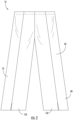
- FIG. 1 shows the front side of an exemplary garment 10 as disclosed herein.
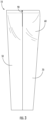
- FIG. 2 shows the back side of the same exemplary garment 10.
- FIGS. 3 and 4 show right and left sides of the garment 10, respectively.
- FIG. 5 shows the interior view of the front side of the garment 10.
- FIG. 6 shows the interior view of the back side of the same garment 10.
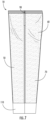
- FIGS. 7 and 8 show the interior view of the right and left sides of the garment 10, respectively.
- FIG. 9 shows a cross-sectional view of one aspect of the material of the garment 10 with concealing technology.
- FIG. 10 shows a cross-sectional view of another aspect of the material of the garment 10 with concealing technology.
- the garment 10 comprises a concealing material 60.
- FIG. 60 shows the garment 10 a concealing material 60.
- some aspects of the concealing material 60 comprise an outer layer 240 and an inner layer 250, wherein the inner layer 250 further comprises an adhesive layer 220 and an inner material 230, and the outer layer 240 comprises an outer material 210.
- other aspects of the concealing material 60 comprise an outer layer 240 and an inner layer 250, wherein the inner layer 250 comprises an inner material 230, and the outer layer 240 comprises an outer material.
- the inner material 230 is a fiber that is affixed to the outer layer 240 by a double knit or double weave configuration. In other aspects, the inner material 230 is a textile coating.
- the outer layer 240 is configured to cover at least a main portion of an exterior surface of the garment.
- the outer layer 240 comprises an outer material 210 that is a knitted or woven fabric.
- the knitted or woven fabric of the outer layer 240 can comprise threads of any fiber type known in the art and applicable to the desired used.
- the fiber type can comprise natural and/or synthetic fibers.
- Exemplary fiber types include, but are not limited to, cotton, nylon, viscose, elastane, polyester, wool, rayon, silk, linen, and hemp.
- At least a portion of the outer layer 240 can be white or a light shade, such as a pastel.
- the outer layer 240 can be any print or pattern including white or a light shade.
- the outer layer 240 has a print or pattern with white and at least one other color.
- the outer layer can be in the style of dressy, casual, or activewear, or any combination thereof.
- the inner layer 250 is configured to cover at least a portion of an interior surface of the garment 10. In some aspects, the inner layer 250 is configured to cover the entire interior surface of the garment 10. In other aspects, the inner layer 250 is configured to cover only a portion of the interior surface of the garment 10. For example, the inner layer 250 can be configured to cover the interior of the garment 10 where undergarments can typically be visible. In an upper body garment, the inner layer 250 can be configured to cover the interior surface of the garment in the wearer's bust area. In a lower body garment, the inner layer 250 can be configured to cover the interior surface of the garment in the wearer's lower torso and rear areas.
- the inner layer 250 is affixed to the outer layer 240 to create the concealing material that is then cut and used to assemble the garment. In other embodiments, the inner layer 250 is affixed to the outer layer 240 after the garment is completely or partially assembled.
- the inner layer 250 or inner material 230 can be a predetermined shade on the gray scale.
- the inner layer 250 or inner material 230, and particularly its gray shade provides opacity to the garment while in use so that the garment is not see-through.
- the inner layer 250 or inner material 230 masks cellulite, tattoos, or other markings or blemishes of the skin. Additionally, the inner layer 250 or inner material 230 masks undergarment color or the garment's construction, including seam allowance or pocket bags, for example.
- the inner material 230 comprises a knitted or woven fabric.
- the knitted or woven fabric can comprise threads of any fiber type known in the art that are suitable for the desired purpose.
- the fiber type can comprise natural and/or synthetic fibers. Exemplary fiber types include, but are not limited to, cotton, nylon, viscose, elastane, polyester, wool, rayon, silk, linen, and hemp.
- the knitted or woven fabric can comprise the same or different threads as the threads of the knitted or woven fabric of the outer material 210 of the outer layer 240.
- the inner material 230 can be configured to be lightweight to provide for comfortability, style, and breathability.
- the inner material 230 may be a lightweight fabric of 30 to 150 GSM, 30 to 120 GSM, 30 to 100 GSM, 30 to 80 GSM, or 30 to 50 GSM.
- the inner material 230 is of a lighter weight than the outer material 210.
- the inner material 230 may weigh 10%, 20%, 30%, 40%, or 50% less than the outer material 210. Either the threads of the knitted or woven fabric of the inner material 230, or the knitted or woven fabric of the inner material 230 itself can be dyed to reach the predetermined shade on the gray scale prior to assembly of the garment.
- the concealing material 60 comprises an adhesive layer 220 positioned between the outer and inner layers 240, 250.
- the adhesive layer 220 affixes at least a portion of an interior surface of the outer material 240 to at least a portion of an exterior surface of the inner material 230.
- the adhesive layer 220 affixes the entire interior surface of the outer material 210 to the entire exterior surface of the inner material 230.
- the inner material 230 is affixed to at least a portion of the outer material 210 via the adhesive layer 220 to create the concealing material 60 prior to cut and assembly of the garment 10.
- the inner material 230 is affixed to at least a portion of the outer material 210 via the adhesive layer 220 after the garment 10 is completely or partially assembled.
- the adhesive layer 220 prevents the inner material 230 and outer material 210 from separating or bunching separately, and thus it helps to create the outward appearance of a smooth garment 10.
- the adhesive layer 220 can comprise any adhesive capable of unreleasably adhering to a garment. Persons of ordinary skill in the art would readily recognize commercially available adhesives suitable for use in the garments disclosed herein.
- the adhesive layer 220 can comprise a pressure-sensitive adhesive, glue, or hot-melt adhesive. Exemplary adhesives that can be suitable for this application include, for instance, those disclosed in U.S. Patent No.
- the adhesive can comprise a rubber, standard acrylic, modified acrylic, silicone, or combination thereof.
- the adhesive can be a polyamide, polyurethane, or thermoplastic polyurethane (TPU) adhesive or glue, or a combination thereof.
- the concealing material 60 comprises an outer layer 240 and an inner layer 250 with no adhesive layer.
- the inner layer 250 comprises an inner material 230.
- the inner material 230 is an interior-only fiber that is knitted or woven onto the outer layer 240 using a double knit or double weave configuration. In other aspects, the inner material 230 is an inner coating.
- the inner material 230 can be configured to cover at least a portion of an interior surface of the outer layer 240. In some aspects, the inner material 230 is configured to cover the entire interior surface of the outer layer 240. In other aspects, the inner material 230 is configured to cover only a portion of the interior surface of the outer layer 240. For example, inner material 230 can be configured to cover the portion of the interior surface of the outer layer 240 where undergarments can typically be visible. In some embodiments, the inner coating of the inner material 230 is directly coated onto the knitted or woven fabric of the outer layer 240 prior to cutting of the concealing material or assembly of the garment 10.
- the inner coating of the inner material 230 is directly coated onto at least a portion of the interior surface of the outer layer 240 after the garment is completely or partially assembled.
- the inner layer 250 can be configured to cover the interior of the outer layer 240 in the wearer's bust area.
- the inner layer 250 can be configured to cover the interior of the outer layer 240 in the wearer's lower torso area.
- the inner coating can comprise a textile coating composition. Persons of ordinary skill in the art would readily recognize commercially available textile coating compositions suitable for use in the garments disclosed herein.
- the textile coating composition can comprise an aqueous adhesive solution.
- the textile coating composition can comprise polyvinyl acetate, ethylene vinyl acetate, polyvinyl alcohol, polyvinyl chloride, latex, styrene butadiene, acrylic, polyethersulfone, polyvinyl alcohol, styrene butadiene, polyurethane, thermoplastic polyurethane, or a combination thereof.
- FIGS. 1-8 depict a garment 10 disclosed herein as a pair of pants.
- the concealing technology can be applied to a variety of garments, including but not limited to, pants, shorts, skirts, shirts, tanks, camisoles, dresses, jackets, overalls, underwear, and brassiere.
- the depicted exemplary and unlimiting aspect of the garment 10 comprises a left side section and a right side section, forming left and right leg and left and right lower body torso spaces, respectively.
- the left and right side sections are affixed along a seam at the center of the garment configured to extend from a superior edge of a front side of the garment between the wearer's legs to a superior edge of a rear side of the garment.
- the garment further comprises a waistband 100 positioned circumferentially along a superior edge of an interior surface of the garment 10.
- a portion of each of the left and right side sections circumferentially folds upward and inward onto the inner surface of the left and right side sections, respectively.
- An upward and inward folded portion of a predetermined length is thereby formed for each of the left and right side sections.
- the bottom edge of the left and right side sections is each defined by a fold crease or a cuff 110.
- each leg section can further comprise one or more panels.
- each leg section comprises four panels: a first rear panel 120, 130, a second rear panel 70, 80, a first front panel 30, 40, and a second front panel 20, 50.
- the first rear panels 120, 130 are configured to cover at least a portion of medial areas of the rear of the wearer's legs to the wearer's waist
- the second rear panels 70, 80 are configured to cover at least a portion of a lateral areas of the rear of the wearer's legs to the wearer's waist.
- the first front panels 30, 40 are configured to cover at least a portion of medial areas of the front of the wearer's leg to the wearer's waist
- the second front panels 20, 50 are configured to cover at least a portion of lateral areas of the front of the wearer's legs to the wearer's waist.
- At least a portion of a first edge of a first rear panel 120, 130 is affixed to at least a portion of a first edge of a second rear panel 70, 80 by a seam.
- At least a portion of a second edge of a second rear panel 70, 80 is affixed to at least a portion of a first edge of a second front panel 20, 50 by a seam.
- At least a portion of a second edge of a second front panel 20, 50 is affixed to at least a portion of a first edge of a first front panel 30, 40 by a seam.
- a portion of a second edge of a first rear panel 120, 130 is affixed to a portion of a second edge of a first front panel 30, 40 via a continuous seam extending from an inferior edge of the right or left side section to the wearer's crotch area.
- the garment 10 can comprise at least one fastener 90 for the wearer's convenience in putting on or removing the garment 10.
- the fastener(s) 90 can be any conventional fastener, or combination thereof, known in the art, such as a zipper, button, toggle, stud, snap, popper, eyelet, buckle, hook and loop, hook and eye, magnet, frog, grommet, brooch, bucket loop, safety pin, laces, and fabric tie.
- the fastener(s) 90 can be configured to open or release in a longitudinal direction from a superior or inferior edge of the garment 10.
- the fastener(s) 90 can be positioned anywhere on the garment 10. In some aspects, the fastener(s) 90 can be placed at the most medial or lateral locations of the garment 10.
- the fastener(s) 90 can be positioned anywhere along a waist-encircling portion of the garment 10. In further aspects, the fastener(s) 90 can be positioned to partially or completely open a waistband 100 for easier removal of the garment 10. In some aspects where the garment is a shirt, tank, camisole, dress, jacket, overalls, or a brassiere, the fastener(s) 90 can be positioned anywhere along a torso-encircling portion of the garment. In further aspects, the fastener(s) 90 can be positioned to partially or completely open a torso-encircling band, overall shoulder straps, or a front or back area of the garment at a medial location for easier removal of the garment.
- the method of making the depicted aspect of the garment 10 comprises providing a concealing material 60.
- Providing a concealing material 60 can comprise the use of various techniques.
- the concealing material 60 can be constructed via lamination, fusing, or coating.
- Persons of ordinary skill in the art would readily recognize commercially available lamination, fusing, and textile coating techniques suitable for use in making the garments disclosed herein.
- Exemplary coating techniques that can be suitable for this application include, for instance, screen printing, pigment printing, digital printing, 3D printing, direct coating, spray coating, extrusion coating, or foamed coating.
- the concealing material 60 is constructed by providing an outer layer 240 and an inner material 230.
- the inner material 230 is adhered to at least a portion of the outer layer 240 using an adhesive layer 220 positioned between the inner material 230 and outer layer 240.
- at least a portion of an exterior surface of the inner material 230 can be laminated or fused to at least a portion of an interior surface of the outer layer 240.
- the concealing material 60 is constructed by providing an outer layer 240 and directly applying an inner material 230 comprising a coating to at least a portion of an interior surface of the outer layer 240 via a conventional textile printing or coating technique as disclosed herein.
- the concealing material 60 is constructed by providing an outer layer 240 and affixing an inner material 230 comprising an interior-only fiber that is knitted or woven onto at least a portion of an interior surface of the outer layer 240 via a double knit or double weave configuration.
- the method of making the aspect of the garment 10 depicted in the figures further comprises cutting the concealing material 60 into a left side section and a right side section, forming a left leg and lower torso space and a right leg and lower torso space.
- the method further comprises sewing the left and right side sections along a seam at a portion of the center of the garment, configured to extend from a superior edge of a front side of the garment 10, between the wearer's legs, and to a superior edge of a rear side of the garment 10.
- the method further comprises unreleasably affixing a waistband 100 circumferentially along a superior edge of an interior surface of the garment 10.
- the method can further comprise circumferentially folding, and affixing via a seam, a portion of each of the left and right side sections upward and inward onto the inner surface of the left and right side sections, respectively.
- Forming the left and right side sections can further comprise forming one or more panels.
- forming either the left or right side section comprises forming four panels: a first rear panel 120, 130, a second rear panel 70, 80, a first front panel 30, 40, and a second front panel 20, 50.
- At least a portion of a first edge of a first rear panel 120, 130 is affixed to at least a portion of a first edge of a second rear panel 70, 80 by a seam.
- At least a portion of a second edge of a second rear panel 70, 80 is affixed to at least a portion of a first edge of a second front panel 20, 50 by a seam.
- At least a portion of a second edge of a second front panel 20, 50 is affixed to at least a portion of a first edge of a first front panel 30, 40 by a seam.
- a portion of a second edge of a first rear panel 120, 130 is affixed to a portion of a second edge of a first front panel 30, 40 via a continuous seam extending from an inferior edge of the right or left side section to the wearer's crotch area.
- the method of making the garment 10 depicted herein can further comprise providing a fastener 90 configured to open anywhere along the wearer's waistband 100.
Landscapes
- Engineering & Computer Science (AREA)
- Textile Engineering (AREA)
- Details Of Garments (AREA)
Applications Claiming Priority (1)
| Application Number | Priority Date | Filing Date | Title |
|---|---|---|---|
| US17/480,764 US20230102170A1 (en) | 2021-09-21 | 2021-09-21 | Garment with concealing technology |
Publications (1)
| Publication Number | Publication Date |
|---|---|
| EP4154745A1 true EP4154745A1 (de) | 2023-03-29 |
Family
ID=83398220
Family Applications (1)
| Application Number | Title | Priority Date | Filing Date |
|---|---|---|---|
| EP22196728.4A Pending EP4154745A1 (de) | 2021-09-21 | 2022-09-20 | Kleidungsstück mit kaschiertechnologie |
Country Status (3)
| Country | Link |
|---|---|
| US (3) | US20230102170A1 (de) |
| EP (1) | EP4154745A1 (de) |
| CA (1) | CA3175213A1 (de) |
Families Citing this family (3)
| Publication number | Priority date | Publication date | Assignee | Title |
|---|---|---|---|---|
| US20230102170A1 (en) | 2021-09-21 | 2023-03-30 | Spanx, Llc | Garment with concealing technology |
| US20230413932A1 (en) * | 2022-06-28 | 2023-12-28 | Natalie Marie Strong | Concealment Garment |
| US20240164460A1 (en) * | 2022-11-18 | 2024-05-23 | Samuel Lenz | Scrubs with liners |
Citations (4)
| Publication number | Priority date | Publication date | Assignee | Title |
|---|---|---|---|---|
| EP1074189A2 (de) * | 1999-07-27 | 2001-02-07 | LEE Cooper Group Ltd. | Hose |
| US6414073B1 (en) | 1999-04-07 | 2002-07-02 | Nitto Denko Corporation | Pressure-sensitive adhesive material |
| US20090031470A1 (en) * | 2005-04-21 | 2009-02-05 | Toray Industries, Inc. | Pants |
| US20140165265A1 (en) * | 2012-09-10 | 2014-06-19 | Levi Strauss & Co. | Shaped Fit Sizing System with Body Shaping |
Family Cites Families (25)
| Publication number | Priority date | Publication date | Assignee | Title |
|---|---|---|---|---|
| US4993077A (en) * | 1990-03-08 | 1991-02-19 | Robison Maurice L | All weather garment |
| ATE322975T1 (de) * | 2001-09-19 | 2006-04-15 | Procter & Gamble | Farbbedruckte mehrschichtstruktur, ein damit hergestellter absorbierender artikel und verfahren zu deren herstellung |
| US7578008B2 (en) * | 2005-03-10 | 2009-08-25 | Ingrid Hunter | Garment protector and method of use thereof |
| JP3117929U (ja) | 2005-10-24 | 2006-01-19 | 東京ネオプリント株式会社 | シースルー機能を有する遮光幕 |
| JP5156410B2 (ja) | 2007-01-31 | 2013-03-06 | 有限会社杉本織物 | 多重織物と織物積層シート及びこれらを使用した防御衣服 |
| JP2011038191A (ja) | 2009-08-07 | 2011-02-24 | Tokai Senko Kk | 捺染織編物及び捺染方法 |
| CN202456451U (zh) | 2011-12-09 | 2012-10-03 | 林美慧 | 用于胸罩的衬垫结构 |
| TW201326500A (zh) | 2011-12-23 | 2013-07-01 | Fabricoat Ind Corp | 平織布之濕式塗佈方法 |
| JP5920068B2 (ja) | 2012-07-09 | 2016-05-18 | 日東紡績株式会社 | 基布の製造方法 |
| EP2879534B1 (de) * | 2012-08-02 | 2017-03-29 | Thinx Inc. | Feuchtigkeitsaufsaugende und leckagesichere unterwäsche |
| US9801420B2 (en) * | 2013-03-15 | 2017-10-31 | Spanx, Inc. | Abdominal-restraint garment and methods of assembling the same |
| US9326552B2 (en) * | 2013-03-15 | 2016-05-03 | Spanx, Inc. | Abdominal-restraint garment and methods of assembling the same |
| US10285461B2 (en) * | 2013-04-30 | 2019-05-14 | Spanx, Inc. | Reversible compression garments and methods of assembling and using same |
| US10368587B2 (en) * | 2014-11-04 | 2019-08-06 | Lori Bundschuh Oliver | Seamlessly transitioned, double layer, dual fabric garment |
| US10905172B2 (en) * | 2016-05-18 | 2021-02-02 | Blend or Bust Corporation | Garment |
| CN107650449A (zh) | 2016-07-25 | 2018-02-02 | 江阴市全顺纺织有限公司 | 降温褶皱与针织的复合织物 |
| JP3208480U (ja) | 2016-11-02 | 2017-01-12 | 株式会社シンユーテック | 遊技用椅子 |
| JP3213507U (ja) | 2017-06-29 | 2017-11-16 | 株式会社Shindo | 伸縮性装飾布帛 |
| US20190124999A1 (en) * | 2017-09-24 | 2019-05-02 | Jordan Blake Crump | Next generation underwear for men |
| US11793249B2 (en) * | 2018-05-07 | 2023-10-24 | David Michael Morelock | Water resistant protective wash garment |
| KR102109389B1 (ko) | 2018-11-01 | 2020-05-12 | (주)플리츠미 | 경량보온성 주름직물 제조방법 |
| CN210415721U (zh) | 2019-08-27 | 2020-04-28 | 海宁市金潮实业有限公司 | 一种加密复合篷布 |
| US11425941B1 (en) * | 2019-11-08 | 2022-08-30 | MaryMac Revisions, LLC | Comfort fit natural breast shaping nipple concealer |
| US11304458B2 (en) * | 2020-07-07 | 2022-04-19 | Coconut Grove Pads, Inc. | Reversibly wearable winged bra |
| US20230102170A1 (en) | 2021-09-21 | 2023-03-30 | Spanx, Llc | Garment with concealing technology |
-
2021
- 2021-09-21 US US17/480,764 patent/US20230102170A1/en not_active Abandoned
-
2022
- 2022-09-20 EP EP22196728.4A patent/EP4154745A1/de active Pending
- 2022-09-21 CA CA3175213A patent/CA3175213A1/en active Pending
-
2024
- 2024-08-14 US US18/804,797 patent/US12465102B2/en active Active
-
2025
- 2025-10-10 US US19/354,976 patent/US20260076427A1/en active Pending
Patent Citations (4)
| Publication number | Priority date | Publication date | Assignee | Title |
|---|---|---|---|---|
| US6414073B1 (en) | 1999-04-07 | 2002-07-02 | Nitto Denko Corporation | Pressure-sensitive adhesive material |
| EP1074189A2 (de) * | 1999-07-27 | 2001-02-07 | LEE Cooper Group Ltd. | Hose |
| US20090031470A1 (en) * | 2005-04-21 | 2009-02-05 | Toray Industries, Inc. | Pants |
| US20140165265A1 (en) * | 2012-09-10 | 2014-06-19 | Levi Strauss & Co. | Shaped Fit Sizing System with Body Shaping |
Also Published As
| Publication number | Publication date |
|---|---|
| US12465102B2 (en) | 2025-11-11 |
| US20230102170A1 (en) | 2023-03-30 |
| US20250057267A1 (en) | 2025-02-20 |
| CA3175213A1 (en) | 2023-03-21 |
| US20260076427A1 (en) | 2026-03-19 |
Similar Documents
| Publication | Publication Date | Title |
|---|---|---|
| US12465102B2 (en) | Garment with concealing technology | |
| US20190231006A1 (en) | Reversible compression garments and methods of assembling and using same | |
| US20160324238A1 (en) | Shirt and Undergarment Attachment | |
| US20110099677A1 (en) | Inner panel for garment | |
| US12604934B2 (en) | Waistband for a garment | |
| EP3393288B1 (de) | Tasche mit kante mit niedrigem profil | |
| US20150208734A1 (en) | Tops and Dresses with Hidden Control Lining | |
| US20180177248A1 (en) | Garment including selectively located ventilation panels of three-dimensional mesh | |
| US8819970B2 (en) | Multi-layered ornamental clothing | |
| US20180035725A1 (en) | Wrap-style breast-supportive tops | |
| US20180255854A1 (en) | Garment with integrated reinforcement panels and method of manufacture | |
| US20240215659A1 (en) | Garment with rear access space | |
| KR20050118648A (ko) | 브래지어 시스템이 통합된 의복 | |
| US11998068B2 (en) | Garment with rear access space | |
| US20110078840A1 (en) | Apparel having pockets permitting access beneath apparel layer | |
| CN114245716A (zh) | 服装制品 | |
| US20140041102A1 (en) | Woman's undergarment | |
| WO2009005533A1 (en) | Article of clothing with side access | |
| CN220512241U (zh) | 双层塑身服装 | |
| WO2018044296A1 (en) | Tuck no tuck apparel | |
| US20250221475A1 (en) | Patterned multi-layer fabric and shapewear | |
| US20190350282A1 (en) | Bottom hem of garment, and garment | |
| CN216453393U (zh) | 一种防走光女式衬衫 | |
| CN221437438U (zh) | 带有图样的多层面料及塑身衣 | |
| CN212139532U (zh) | 一体式前幅门襟结构及裤子 |
Legal Events
| Date | Code | Title | Description |
|---|---|---|---|
| PUAI | Public reference made under article 153(3) epc to a published international application that has entered the european phase |
Free format text: ORIGINAL CODE: 0009012 |
|
| STAA | Information on the status of an ep patent application or granted ep patent |
Free format text: STATUS: REQUEST FOR EXAMINATION WAS MADE |
|
| 17P | Request for examination filed |
Effective date: 20220920 |
|
| AK | Designated contracting states |
Kind code of ref document: A1 Designated state(s): AL AT BE BG CH CY CZ DE DK EE ES FI FR GB GR HR HU IE IS IT LI LT LU LV MC MK MT NL NO PL PT RO RS SE SI SK SM TR |
|
| STAA | Information on the status of an ep patent application or granted ep patent |
Free format text: STATUS: EXAMINATION IS IN PROGRESS |
|
| 17Q | First examination report despatched |
Effective date: 20240318 |