EP4154718A1 - Neues produktionsverfahren für backwaren mit füllungsinjektion nach dem backen - Google Patents
Neues produktionsverfahren für backwaren mit füllungsinjektion nach dem backen Download PDFInfo
- Publication number
- EP4154718A1 EP4154718A1 EP22190476.6A EP22190476A EP4154718A1 EP 4154718 A1 EP4154718 A1 EP 4154718A1 EP 22190476 A EP22190476 A EP 22190476A EP 4154718 A1 EP4154718 A1 EP 4154718A1
- Authority
- EP
- European Patent Office
- Prior art keywords
- mold
- dough
- baking
- bakery product
- product according
- Prior art date
- Legal status (The legal status is an assumption and is not a legal conclusion. Google has not performed a legal analysis and makes no representation as to the accuracy of the status listed.)
- Pending
Links
Images

Classifications
-
- A—HUMAN NECESSITIES
- A21—BAKING; EDIBLE DOUGHS
- A21D—TREATMENT OF FLOUR OR DOUGH FOR BAKING, e.g. BY ADDITION OF MATERIALS; BAKING; BAKERY PRODUCTS
- A21D13/00—Finished or partly finished bakery products
- A21D13/30—Filled, to be filled or stuffed products
- A21D13/32—Filled, to be filled or stuffed products filled or to be filled after baking, e.g. sandwiches
-
- A—HUMAN NECESSITIES
- A21—BAKING; EDIBLE DOUGHS
- A21D—TREATMENT OF FLOUR OR DOUGH FOR BAKING, e.g. BY ADDITION OF MATERIALS; BAKING; BAKERY PRODUCTS
- A21D13/00—Finished or partly finished bakery products
- A21D13/10—Multi-layered products
- A21D13/11—Multi-layered products made of two or more doughs, e.g. differing in composition, colour or structure
- A21D13/14—Multi-layered products made of two or more doughs, e.g. differing in composition, colour or structure with fillings
-
- A—HUMAN NECESSITIES
- A21—BAKING; EDIBLE DOUGHS
- A21D—TREATMENT OF FLOUR OR DOUGH FOR BAKING, e.g. BY ADDITION OF MATERIALS; BAKING; BAKERY PRODUCTS
- A21D13/00—Finished or partly finished bakery products
- A21D13/30—Filled, to be filled or stuffed products
- A21D13/32—Filled, to be filled or stuffed products filled or to be filled after baking, e.g. sandwiches
- A21D13/33—Edible containers, e.g. cups or cones
-
- A—HUMAN NECESSITIES
- A23—FOODS OR FOODSTUFFS; TREATMENT THEREOF, NOT COVERED BY OTHER CLASSES
- A23P—SHAPING OR WORKING OF FOODSTUFFS, NOT FULLY COVERED BY A SINGLE OTHER SUBCLASS
- A23P20/00—Coating of foodstuffs; Coatings therefor; Making laminated, multi-layered, stuffed or hollow foodstuffs
- A23P20/20—Making of laminated, multi-layered, stuffed or hollow foodstuffs, e.g. by wrapping in preformed edible dough sheets or in edible food containers
- A23P20/25—Filling or stuffing cored food pieces, e.g. combined with coring or making cavities
Definitions
- the invention relates to new production method for soft-centered bakery products such as crackers and biscuits, wherein, fillings are injected after baking into the bakery products of which the lower and top layers are stamped each other before baking and baked with the help of a mold (pan).
- the fillings of the filled bakery products are mostly put together with the dough before baking and subjected to heat effect (baked) together.
- sandwich products, wafers, products such as ravioli, filled roll wafers, filled sticks, and filled extruded products etc. which can be an alternative to filled (soft centered bakery products) as semi or fully closed bakery products, can be given as examples to said filled bakery products.
- fillings can be inject after baking into the hole which is occurred during baking.
- the quality of the filling is adversely affected due to the decomposition of the input components, melting of oil and infusion with the bakery product, the melting of sugar and forming crystallization in the boundary layer, the structural deterioration of components such as milk powder, whey powder due to heat.
- this problem is tried to be reduced by methods such as cooling the filling before baking in order to prevent heat and quality deterioration, low-temperature-long-time or high-temperature-short time baking, which adversely affects the quality of the final product.
- fillings that are not exposed to heat treatment cause losses in energy and product quality by being exposed to high temperatures (150-270°C) and heat transfer (heating unnecessarily), depending on the product type, due to the limitations of existing methods.
- cavities inside the products are formed in a high rate by using different baking bottom-molds(trays) suitable for product geometry, crust and cover dough method and high filling can be provided with completely equal volume and accuracy.
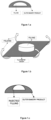
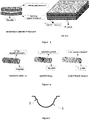
- FIG 1.a The method by which the bakery product and fillings are baked together is shown in Figure 1.a , products formed by placing filling before baking in bakery products that have been turned into folded pastry shown in Figure 1.b , bakery products with injectable filling after baking are shown in Figure 1.c , sandwich products such as biscuits, crackers and wafers made using non-flowing (viscous) fillings after baking are shown in Figure 1.d , coextruded products (low pressure coextruder, wafer roll, high pressure coextruder) that can be filled at the final stage of baking are shown in Figure 1.e .
- the invention is based on the principle of pre-baking two different doughs, it is possible to produce multi-component, higher quality products by adding fillings and particles that are not affected by heat before baking and when desired by adding fillings after baking, in a way that large particles are completely enclosed in the bakery product, which cannot be done in the prior art. It is also possible to make the product highly filled by injecting sensitive fillings that are affected by heat after baking.
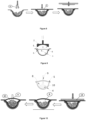
- the bottom mold (1) in which the bottom dough is shaped and baked, and the top mold (2), which shapes the dough placed in the bottom mold, are given. In this way, it is ensured that the product is produced with equal geometry and filling cavity.
- the bottom mold (1) has been shaped multiple times by rolling method from sheet as an alloy of steel or aluminum with a thickness of 1.4 mm to 4 mm, and the side of the bottom mold (1) facing the top mold (2) is also taken into account after baking, taking into account the adhesive property of the bakery product's component properties for easy removal from the mold; coated with a layer of PTFE (Teflon), silicone, titanium, hard chrome or glass ceramic.
- the mold design (3) design with special stopper on the top part of the bottom mold, is designed for proper sealing and sealing of the top dough layer into the cavity.
- mold releases (11) suitable for food are sprayed onto the bottom mold before the dough is shaped by placing it in the bottom mold ( Figure 4 ).
- the top mold (2) can be manufactured from plastic material suitable for food or metal materials coated with food-grade coating materials, depending on the type of dough, and can move with mechanisms (mechanical, robotic, pneumatic, hydraulic, servo etc.) that can move up and down to center the bottom mold (1) precisely.
- the dough portioned to the bottom mold (4) is given. Dough; deposit, wire cutting, cutting from the filo pastry, removing from the mold eye, etc. are precisely placed in the mold cavity.
- FIG. 7 shows schematically, shaping the dough in a homogeneous thickness and desired geometry by means of the top mold (2) and the bottom mold (1).
- the dough is prevented from deteriorating by bonding to the top mold (2), by blowing air through the holes (5) widely placed on the top mold surface.
- the top mold is heated with heaters (6) placed in the top mold (2) to prevent the dough from bonding to the top mold (2) in the part of the oil in the dough on the part that contacts the mold surface.
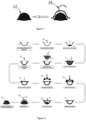
- Figure 9 shows the application of the top cover dough on the dough smeared on the bottom mold and the bonding stage (joining the bottom dough and the top dough).
- Figure 10 shows the injection stages of the post-baking filling (10) into the inner gap volume (8) formed during baking with special injectors (9) (with needles).
- the air (8) in the cavity during baking and the pressure created by the water vapor in the dough ensure uniformity of shape and the internal gap volume (8) is formed homogeneously.
- the doughs formed by the top and bottom covers and guaranteed inner gap are baked and after cooling the mold and dough temperature to a temperature where it cannot damage the filling, fillings (10) are made with needles (injectors) (9) in measuring geometry in accordance with product geometry and filling viscosity while the product is in the mold.
- the second filling can also be applied optionally after baking on the particles placed before baking or on the filling that can be baked.
- the products are removed from the mold (16) and turned into the final product (17) by various methods (vacuum, needl, tilting etc. ejectors).
- Figure 11 shows the stages of demolding and final product.
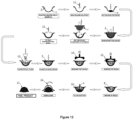
- Figure 12 shows the flowchart of particle application before baking and/or filling injection into bakery product after baking.
- 0.5 mm to 4 mm, preferably 0.8 mm bottom dough is used in the mold so that the carrier container to trap the filling can function.
- the top dough cover is also precisely assembled and bonded to the bottom dough in dimensions of 0.5-4 mm preferably 0.8 mm.
- Special design was carried out taking into account the changeability of product dimensions and the restriction of exiting from the mold in order to inject an equal amount of filling after baking to the bakery product (dough) for which the gap was formed in a controlled and uniform way. Mold material, coating material and soft radius geometries have been created that can make demolding easy.
- filling viscosity 500-20.000 cP preferably 5.000-15.000 cP, maximum filling amount 67% by volume, preferably 60%; 155% by weight, preferably 125%. It is possible to inject all kinds of water-based, oil-based, oil-water-based aerated and similar fluid fillings after baking without heat effect.
- a wide range of doughs such as biscuits, crackers and cookie dough are suitable for all injectable fillings whose quality is deteriorated by the effect of heat.
Landscapes
- Life Sciences & Earth Sciences (AREA)
- Engineering & Computer Science (AREA)
- Food Science & Technology (AREA)
- Chemical & Material Sciences (AREA)
- Polymers & Plastics (AREA)
- Bakery Products And Manufacturing Methods Therefor (AREA)
Applications Claiming Priority (1)
| Application Number | Priority Date | Filing Date | Title |
|---|---|---|---|
| TR202115100 | 2021-09-28 |
Publications (1)
| Publication Number | Publication Date |
|---|---|
| EP4154718A1 true EP4154718A1 (de) | 2023-03-29 |
Family
ID=82939995
Family Applications (1)
| Application Number | Title | Priority Date | Filing Date |
|---|---|---|---|
| EP22190476.6A Pending EP4154718A1 (de) | 2021-09-28 | 2022-08-16 | Neues produktionsverfahren für backwaren mit füllungsinjektion nach dem backen |
Country Status (1)
| Country | Link |
|---|---|
| EP (1) | EP4154718A1 (de) |
Citations (4)
| Publication number | Priority date | Publication date | Assignee | Title |
|---|---|---|---|---|
| US4209536A (en) * | 1977-09-21 | 1980-06-24 | P. Ferrero & C. S.p.A | Filled food product and method of making same |
| CN2134056Y (zh) * | 1992-05-28 | 1993-05-26 | 游有义 | 自动脱模糕果饼成型机 |
| US20080166456A1 (en) * | 2006-11-27 | 2008-07-10 | Olaf Christoph Kortum | Encased Snack |
| RU2720635C1 (ru) * | 2019-02-28 | 2020-05-12 | Виктор Иванович Лихошерстов | Способ выпекания полого внутри печенья из теста и устройство для его осуществления |
-
2022
- 2022-08-16 EP EP22190476.6A patent/EP4154718A1/de active Pending
Patent Citations (4)
| Publication number | Priority date | Publication date | Assignee | Title |
|---|---|---|---|---|
| US4209536A (en) * | 1977-09-21 | 1980-06-24 | P. Ferrero & C. S.p.A | Filled food product and method of making same |
| CN2134056Y (zh) * | 1992-05-28 | 1993-05-26 | 游有义 | 自动脱模糕果饼成型机 |
| US20080166456A1 (en) * | 2006-11-27 | 2008-07-10 | Olaf Christoph Kortum | Encased Snack |
| RU2720635C1 (ru) * | 2019-02-28 | 2020-05-12 | Виктор Иванович Лихошерстов | Способ выпекания полого внутри печенья из теста и устройство для его осуществления |
Non-Patent Citations (2)
| Title |
|---|
| ANONYMOUS: "Ovos Moles: A Look at Aveiro's Famous Delicacy - Portugalist", 31 July 2021 (2021-07-31), XP093009140, Retrieved from the Internet <URL:https://www.portugalist.com/ovos-moles/> [retrieved on 20221217] * |
| DATABASE GNPD [online] MINTEL; 31 July 2020 (2020-07-31), ANONYMOUS: "Nut and Nougat Cream Filled Wafer", XP093008939, retrieved from https://www.gnpd.com/sinatra/recordpage/7995941/ Database accession no. 7995941 * |
Similar Documents
| Publication | Publication Date | Title |
|---|---|---|
| EP1209979B1 (de) | Verfahren zur herstellung eines gebackenen, becherförmigen nahrungsmittels | |
| AT514376B1 (de) | Verfahren und Vorrichtung zur Herstellung unter Druck ausgebackener Waffelformkörper | |
| EP2281461B1 (de) | Kekse mit erhöhter Stabilität | |
| GB2516922A (en) | Packaged baked food item and method | |
| EP4154718A1 (de) | Neues produktionsverfahren für backwaren mit füllungsinjektion nach dem backen | |
| US5304386A (en) | Edible container and process for the fabrication thereof | |
| US3795183A (en) | Apparatus for making cakes | |
| RU2715851C2 (ru) | Печенье с наполнителем и соответствующий способ его получения | |
| TR2021015100A2 (tr) | Pi̇şme sonrasi dolgu enjekteli̇ unlu mamul ürünleri̇ i̇çi̇n yeni̇ üreti̇m yöntemi̇ | |
| RU198285U1 (ru) | Замороженный пищевой полуфабрикат с начинкой из мороженого | |
| CA3040077A1 (en) | Apparatus and method for the industrial manufacture of bakery products | |
| EP4154719A1 (de) | Essbares teigwandiges kuchenprodukt, das keine kochpfanne und kein backpapier benötigt, und herstellungsverfahren dafür | |
| WO2020112046A2 (en) | Production assembly and method for co-extruded filled edible product | |
| AT514352B1 (de) | Verfahren zur Herstellung eines Backproduktes mit einer im Wesentlichen versiegelten Trennfläche | |
| TR2021015099A2 (tr) | Pi̇şi̇rme tavasi ve pi̇şi̇rme kağidi gerekti̇rmeyen yeni̇lebi̇li̇r hamur ci̇darli kek ürünü ve üreti̇m yöntemi̇ | |
| WO2025038051A1 (en) | Assembly and method for coating a stick-shaped snack product | |
| JP2023101114A (ja) | チョコレート含浸せんべい及びその製造方法 | |
| EP3818833B1 (de) | Ausgabevorrichtung | |
| US11785953B2 (en) | System and method for coating food product | |
| WO2020050802A2 (en) | Biscuit with lipid based filler | |
| SU310637A1 (ru) | Способ производства заготовок пирожных «сахарная трубочка» | |
| WO2020022996A2 (en) | Production assembly and method for a multi-component snack product with molded cake body | |
| SK501302016U1 (sk) | Súprava formy na výrobu kornúta z cesta, tŕň, tvarovací kus a dutý kryt formy | |
| US20150037468A1 (en) | Bakery product and method of producing a bakery product |
Legal Events
| Date | Code | Title | Description |
|---|---|---|---|
| PUAI | Public reference made under article 153(3) epc to a published international application that has entered the european phase |
Free format text: ORIGINAL CODE: 0009012 |
|
| STAA | Information on the status of an ep patent application or granted ep patent |
Free format text: STATUS: THE APPLICATION HAS BEEN PUBLISHED |
|
| AK | Designated contracting states |
Kind code of ref document: A1 Designated state(s): AL AT BE BG CH CY CZ DE DK EE ES FI FR GB GR HR HU IE IS IT LI LT LU LV MC MK MT NL NO PL PT RO RS SE SI SK SM TR |
|
| STAA | Information on the status of an ep patent application or granted ep patent |
Free format text: STATUS: REQUEST FOR EXAMINATION WAS MADE |
|
| 17P | Request for examination filed |
Effective date: 20230823 |
|
| RBV | Designated contracting states (corrected) |
Designated state(s): AL AT BE BG CH CY CZ DE DK EE ES FI FR GB GR HR HU IE IS IT LI LT LU LV MC MK MT NL NO PL PT RO RS SE SI SK SM TR |
|
| STAA | Information on the status of an ep patent application or granted ep patent |
Free format text: STATUS: EXAMINATION IS IN PROGRESS |
|
| 17Q | First examination report despatched |
Effective date: 20240409 |