EP4154412B1 - Kommunikationsgateway zur verbindung eines lpwan-netzwerks und eines zellularen netzwerks - Google Patents
Kommunikationsgateway zur verbindung eines lpwan-netzwerks und eines zellularen netzwerks Download PDFInfo
- Publication number
- EP4154412B1 EP4154412B1 EP21725776.5A EP21725776A EP4154412B1 EP 4154412 B1 EP4154412 B1 EP 4154412B1 EP 21725776 A EP21725776 A EP 21725776A EP 4154412 B1 EP4154412 B1 EP 4154412B1
- Authority
- EP
- European Patent Office
- Prior art keywords
- lpwan
- chain
- gateway
- network
- group
- Prior art date
- Legal status (The legal status is an assumption and is not a legal conclusion. Google has not performed a legal analysis and makes no representation as to the accuracy of the status listed.)
- Active
Links
Images
Classifications
-
- H—ELECTRICITY
- H04—ELECTRIC COMMUNICATION TECHNIQUE
- H04B—TRANSMISSION
- H04B1/00—Details of transmission systems, not covered by a single one of groups H04B3/00 - H04B13/00; Details of transmission systems not characterised by the medium used for transmission
- H04B1/06—Receivers
- H04B1/10—Means associated with receiver for limiting or suppressing noise or interference
- H04B1/1027—Means associated with receiver for limiting or suppressing noise or interference assessing signal quality or detecting noise/interference for the received signal
- H04B1/1036—Means associated with receiver for limiting or suppressing noise or interference assessing signal quality or detecting noise/interference for the received signal with automatic suppression of narrow band noise or interference, e.g. by using tuneable notch filters
-
- H—ELECTRICITY
- H04—ELECTRIC COMMUNICATION TECHNIQUE
- H04B—TRANSMISSION
- H04B1/00—Details of transmission systems, not covered by a single one of groups H04B3/00 - H04B13/00; Details of transmission systems not characterised by the medium used for transmission
- H04B1/38—Transceivers, i.e. devices in which transmitter and receiver form a structural unit and in which at least one part is used for functions of transmitting and receiving
- H04B1/40—Circuits
-
- H—ELECTRICITY
- H04—ELECTRIC COMMUNICATION TECHNIQUE
- H04B—TRANSMISSION
- H04B1/00—Details of transmission systems, not covered by a single one of groups H04B3/00 - H04B13/00; Details of transmission systems not characterised by the medium used for transmission
- H04B1/06—Receivers
- H04B1/10—Means associated with receiver for limiting or suppressing noise or interference
- H04B1/1027—Means associated with receiver for limiting or suppressing noise or interference assessing signal quality or detecting noise/interference for the received signal
- H04B2001/1045—Adjacent-channel interference
-
- H—ELECTRICITY
- H04—ELECTRIC COMMUNICATION TECHNIQUE
- H04B—TRANSMISSION
- H04B1/00—Details of transmission systems, not covered by a single one of groups H04B3/00 - H04B13/00; Details of transmission systems not characterised by the medium used for transmission
- H04B1/06—Receivers
- H04B1/10—Means associated with receiver for limiting or suppressing noise or interference
- H04B1/1027—Means associated with receiver for limiting or suppressing noise or interference assessing signal quality or detecting noise/interference for the received signal
- H04B2001/1063—Means associated with receiver for limiting or suppressing noise or interference assessing signal quality or detecting noise/interference for the received signal using a notch filter
-
- H—ELECTRICITY
- H04—ELECTRIC COMMUNICATION TECHNIQUE
- H04W—WIRELESS COMMUNICATION NETWORKS
- H04W84/00—Network topologies
- H04W84/18—Self-organising networks, e.g. ad-hoc networks or sensor networks
-
- Y—GENERAL TAGGING OF NEW TECHNOLOGICAL DEVELOPMENTS; GENERAL TAGGING OF CROSS-SECTIONAL TECHNOLOGIES SPANNING OVER SEVERAL SECTIONS OF THE IPC; TECHNICAL SUBJECTS COVERED BY FORMER USPC CROSS-REFERENCE ART COLLECTIONS [XRACs] AND DIGESTS
- Y02—TECHNOLOGIES OR APPLICATIONS FOR MITIGATION OR ADAPTATION AGAINST CLIMATE CHANGE
- Y02D—CLIMATE CHANGE MITIGATION TECHNOLOGIES IN INFORMATION AND COMMUNICATION TECHNOLOGIES [ICT], I.E. INFORMATION AND COMMUNICATION TECHNOLOGIES AIMING AT THE REDUCTION OF THEIR OWN ENERGY USE
- Y02D30/00—Reducing energy consumption in communication networks
- Y02D30/70—Reducing energy consumption in communication networks in wireless communication networks
Definitions
- the invention relates to the field of wireless communications or radiocommunications; it relates more precisely to a gateway connecting a network conforming to a Low Power Wide Area Network (LPWAN) protocol to an access network to a cellular network (Radio Access Network, RAN); and even more precisely to such a gateway provided with filters at the level of the radio frequency processing chains (RF chains), which makes it possible to miniaturize it.
- LPWAN Low Power Wide Area Network
- RAN Radio Access Network
- RF chains radio frequency processing chains
- connected objects communicate wirelessly with the Internet.
- the Internet is supported by large infrastructure networks to which connected objects must have access through a gateway.
- the connected objects are organized in a star around the gateway and connected to it via radio.
- the signals coming from the connected objects arrive at the gateway on a first interface and cross it to join, via a second interface, an infrastructure network.
- this infrastructure is a cellular network, for example conforming to the GSM standard or a standard which inherits it; mainly 3G, 4G or 5G.
- the gateway therefore has a terminal function of a cellular network and accesses the core network by air.
- LPWAN which summarizes these two essential requirements (extensive low power network, low power allowing long autonomy) has become popular among those in the art. Therefore, the protocols that support the communication of connected objects with the Internet must be of the LPWAN type.
- the LPWAN networks considered in this application are for example compliant with standard EN 300 220 published by ETSI.
- An example of an LPWAN protocol that complies with this standard and whose specifications have been made public is LoRaWAN ® . Strictly speaking, the term LPWAN also applies to the access network of cellular networks (NB-IoT, LTE-M) but in this application, it will be reserved for the non-cellular network to which the gateway is connected.
- the aim of the invention is to electromagnetically isolate the two RF chains of a gateway connecting an LPWAN network and an access network to a cellular network and therefore having two RF chains towards two such networks respectively, at a level sufficient to avoid the degradation of the signal-to-noise ratio on the receivers of the RF chains when the gateway is miniature. More precisely, the level of isolation sought by the invention on the LPWAN RF chain is at least 20 dB and that sought on the cellular RF chain is at least 20 dB.
- the frequency bands of the two RF chains of the gateway are neighboring or even contiguous. For example, in some European countries, according to radio frequency regulations, you can use the 915 - 918 MHz band on the LPWAN network and the 880 - 915 MHz band for the cellular network uplink (LTE band 8). As neither of the receivers are perfect bandpass filters, they absorb unwanted radiation in frequencies neighboring the useful band and therefore those emitted by the other RF chain.
- the gateway must be small, approximately 10 cm.
- Mutual disruption of RF channels cannot be avoided by the simple solution of moving the antennas apart. Indeed, it is considered that to obtain good electromagnetic isolation, two antennas must be separated by at least a quarter of the length of the waves they emit; for example, 8.6 cm for a wave of 868 MHz. More generally, as the wavelength is inversely proportional to the frequency, the distance between the antennas must be relatively large for low frequencies, which is not compatible with the dimensions of the gateway and the desired frequencies.
- Another idea underlying the invention is to isolate the RF chains essentially by means of double filtering: a bandpass filter is introduced on the RF chain of the LPWAN, in the part common to reception and the emission, on the one hand; a notch filter on the RF chain of the cellular network. Each of these filters has the function of attenuating the power of the transmitted frequencies which disturb the other RF channel and also of immunizing each RF channel in reception against the emissions of the other channel.
- Another idea underlying the invention is that there may be one or more LPWAN networks to which the gateway provides access and one or more cellular networks to which the gateway provides access.
- the gateway may include one or more of the characteristics below.
- the gateway includes in the second RF chain a single notch filter and a second high-pass filter between the notch filter and the antenna.
- the gateway complies with the state of the art of a cellular RF chain.
- the gateway includes in the second RF chain a single notch filter connected directly to the antenna.
- this embodiment eliminates the need for a high-pass filter.
- the gateway is able to connect, on the one hand, a subgroup of LPWAN networks selected from a group of LPWAN networks operating in respective frequency bands and on the other hand, a cellular network.
- the transponder of the first RF chain includes a respective transceiver pair for each of the members of the LPWAN network group.
- the first RF chain comprises several filter blocks, each of them being associated with a respective member of the LPWAN network group and comprising an amplification block, a band-pass filter passing the frequencies in the respective frequency band of said member of the group of LPWAN networks and attenuating the power of frequencies outside this band.
- the first RF chain further comprises an LPWAN network multiplexer, arranged between the filtering blocks and the first high-pass filter.
- the second RF chain there are several notch filters mounted in parallel and associated respectively with each of the members of the LPWAN network group, the notch filter associated with a respective member of the LPWAN network group attenuating the power of the frequencies in the band of frequencies of said respective member of the LPWAN network group.
- the second RF chain further includes first and second notch filter multiplexers for selectively connecting the notch filters associated with a subgroup of selected LPWAN networks, which first and second notch filter multiplexers flank the notch filters, the second RF multiplexer notch filters being on the cellular antenna side.
- the gateway is able to create in its environment an LPWAN network possibly operating on several frequency bands.
- the gateway in the variant capable of connecting a subgroup of LPWAN networks selected from a group and a cellular network, further comprises a control block 16 with a man-machine interface which makes it possible to select the subgroup of LPWAN networks and a control unit configured to program the multiplexer of the first RF chain to connect the filter blocks associated with the respective members of the subgroup of LPWAN networks selected, and to program the first and second multiplexers of the second RF chain to connect the notch filters associated with the respective members of the selected LPWAN network subgroup
- the gateway in its variant capable of connecting a subgroup of LPWAN networks selected from a group to a cellular network, comprises in the second RF chain a second high-pass filter between the second notch filter multiplexer and the cellular antenna.
- the gateway in its variant capable of connecting to an LPWAN network selected from a group to a cellular network, comprises in the second RF chain several notch filters and the second notch filter multiplexer is connected directly to the antenna.
- said or each filter block of the first RF chain further comprises a channel selector arranged between the amplification block and the band-pass filter and configured to obtain half-duplex operation in the frequency band of the LPWAN network or the respective member of the associated LPWAN network group.
- the bandpass filter of said or each filtering block is configured to attenuate by at least 20 dB the power of frequencies outside the band of the LPWAN network or the respective member of the network group Associated LPWAN.
- said or each notch filter of the second RF chain is configured to attenuate by at least 20 dB the power of the frequencies in the frequency band of the LPWAN network or of the respective member of the LPWAN network group partner.
- the gateway comprises an electronic card on which the first RF chain and the second RF chain are mounted and whose size does not exceed 12 cm in three dimensions.
- the gateway comprises RF chains adapted to a difference of at most 8 MHz between the frequency bands of the cellular networks and the frequency bands of said networks LPWAN.
- the gateway is suitable for regions of the world where the Legislator has retained frequency bands separated by at most 8 MHz for LPWAN networks and cellular networks.
- the uplink or downlink signals on the first RF chain comply with standard EN 300 220.
- the bandpass filter(s) are chosen from the group of surface acoustic wave filters, volume acoustic wave filters and ceramic filters.
- the notch filter(s) are chosen from the group consisting of surface acoustic wave filters, volume acoustic wave filters and ceramic filters.
- the isolation of the first and second RF chains is completed by one or more antenna isolation techniques chosen from the group of antenna decoupling, the addition of parasitic antenna elements, faulty ground structures, neutralizing lines, dielectric walls, metamaterials.
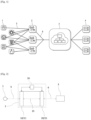
- connected objects 1 communicate with application servers 4.
- connected objects 1 emit data.
- Connected objects 1 are generally sensors such as electronic chips for tracking pets, smoke detectors, water meters, trash inspection chips, vending machine meters, gas meters . They take measurements which they digitize. They send them to application servers 4 which record them, apply various treatments to them, and redistribute them. In the other direction, the application servers 4 remote control the connected objects 1.
- the typical data network to which the servers are connected is the Internet and the typical architecture which implements this communication scheme is "the Internet Objects ".
- the connected objects 1 first communicate via a radio link 5 with a gateway 2.
- the radio link 5 between the connected objects 1 and the gateway 2 is of the LPWAN type, it complies with standard EN 300 220; for example and not limited to it complies with the public LoRaWAN ® specifications of the LoRa Alliance ® , a consortium of manufacturers which promotes these specifications.
- the gateway 2 retransmits the signals 5 coming from the connected objects 1 to an infrastructure network.
- the infrastructure network is a cellular network, compliant with the GSM standard or a standard that inherits it: 3G, 4G or 5G to cite the main standards.
- Gateway 2 is therefore an access terminal to a cellular network and communicates with the core of the cellular network by radio via an access network 6.
- Signals 6 reach the core of the cellular network via access servers 3.
- the cellular core access network will be abbreviated to “cellular network” throughout the remainder of the application unless further specificity is necessary.
- the frequencies used in the microwave links of the LPWAN network or the cellular network depend on the country where the gateway operates. They are defined at the global level by the international treaty subject to the ITU-R Regulations (International Telecommunications Union, Radiocommunications sector) which allocates, according to the technical term, that is to say, assigns the different frequencies to different Services in the three Regions of the world (“Regulation”, “Service” and “Region” are here the technical terms of the ITU-R) and imposes radiation patterns on transmitters in these frequencies; then at the national level these rules are specified and the right to operate the frequencies is defined.
- the frequencies of cellular networks in a given location are subject to concessions from the local State with a principle of exclusivity while LPWAN frequencies are free to use and can be shared by several operators who must then coordinate to work together.
- Gateway 2 is adaptable to any coherent set of national regulations (consistent in the sense that bands of different allocations do not overlap). Alternatively, it may only be suitable for a portion of the LPWAN and cellular communications bands of a single state's regulations. In another variation, it can be adapted to all bands intended for LPWAN and cellular communications in a given state's regulations.
- LPWAN networks are symmetrical in the sense that given a frequency usable on such a network, a terminal such as one of the connected objects 1 or the gateway 2 can transmit or receive at this frequency.
- Cellular access networks are asymmetrical: from the terminal such as gateway 2 towards the core of the network to which the terminal is subscribed, we speak of uplink and in the other direction, of downlink and the frequencies of an uplink and a network downlink are necessarily different.
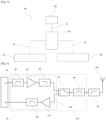
- Gateway 2 receives signals over the air on its RF chain 10/11 adapted to LPWAN networks, demodulates them and transmits them following an internal electrical circuit 15 to the RF chain 20/21, adapted to cellular networks, which modulates them and transmits them over the air to the heart of the cellular network. Communications can follow the opposite path.
- the dimensions of the gateway 2 are preferably of the order of magnitude of the connected objects 1.
- the applicant has produced a prototype of the gateway mounted on an electronic card of approximately 8 cm.
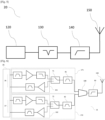
- the RF chain 10 includes a band unit of base not shown, a transponder 30.
- a transmission channel leading the uplink signal leaves from point 31 of the transponder and a reception channel leading the downlink signal ends at point 32 of the transponder.
- the rising signal is first filtered by a band-pass filter 40, then amplified by a power amplifier 50, then filtered by a low-pass filter 60, by a band-pass filter 80 and finally by a high-pass filter 90 and it arrives at the antenna 100.
- the signal comes from the antenna 100, it is filtered by the high-pass filter 90, then the band-pass filter 80 which are therefore common to the uplink and the downlink, as well as the antenna 100.
- the downlink signal is then amplified by a low noise amplifier 110 and finally filtered by a bandpass filter 120 before reaching the transponder 30 .
- the transmission and reception frequency bands in LPWAN networks are common.
- the LPWAN antennas therefore operate alternately in transmission mode or in reception mode (half-duplex operation) and a selector 70 must be provided in the RF chain to connect the uplink or downlink channel and the part of the RF chain common to both channels. .
- Gateway 2 will then include a duplexer in place of the selector 70 and the bandpass filter 80.
- the elements between the transponder 30 and the selector 70 form an amplification block 160.
- the amplification block 160, the selector 70 and the bandpass filter 80 form a filtering block.
- the notions of amplification block and filtering block are introduced for convenience for the clarity of the description.
- Filter 80 lets the LPWAN bands pass on transmission and eliminates the bands outside. In reality, there is no real elimination but mitigation. Thus the filter 80 attenuates the power of the frequencies emitted by the LPWAN RF chain 10 which interfere with reception in the cellular RF chain 20, that is to say those which are in the downlink bands of the cellular network.
- this filter also has the advantage of attenuating the frequencies emitted by the cellular RF chain 20 (the frequencies of the uplink of the cellular network) which interfere with reception in the LPWAN RF chain 10.
- the RF chain comprises a modem 120 which includes the baseband unit and the transponder, a notch filter 130, and an antenna 150. It is advantageous to insert a high-pass filter 140 between the notch filter 130 and the antenna 150 because we thus remain in conformity with the state of the art which makes it possible to reduce the industrialization costs. There is a single channel common to the uplink signal and the downlink signal.
- the 120 modem is universal, suitable for all cellular frequencies worldwide.
- the function of the filter 130 is to attenuate the power of the frequencies emitted by the cellular RF chain 20 (the frequencies in the uplink bands of the cellular network) which interfere with reception in the LPWAN RF chain 10. But it also has the advantage of attenuating the frequencies of the LPWAN RF chain 10 which interfere with reception in the cellular RF chain 20.
- Gateway 2 has been designed and built to operate in the 868 - 870 MHz LPWAN band and in the 700 MHz to 2200 MHz LTE cellular network bands.
- the gateway is intended for use in the EMEA region of the world (Europe, Middle East, Africa).
- the bandpass filter 80 inserted in the LPWAN 10 RF chain is a Surface Acoustic Wave (SAW) filter of the B3430 model from the manufacturer RF360. This filter attenuates the power of frequencies transmitted in the LTE downlink band by a minimum of 40 dB (power division by 10,000).
- SAW Surface Acoustic Wave
- the notch filter 130 inserted in the cellular RF chain 20 is a surface acoustic wave filter of the model WFB88C0869FH from the manufacturer NDK, which attenuates the power of the frequencies emitted in the LPWAN band 868 - 870 MHz by at least 20 dB ( division by 100 of the power) and typically up to 33 dB (division of the power by 2000).
- Gateway 2 was designed and built to operate in the 902 - 928 MHz band of LPWANs and in the bands of 700 MHz to 2200 MHz of LTE cellular networks.
- the gateway is intended for use in North America (USA, Canada, Mexico).
- the 80 bandpass filter inserted in the LPWAN 10 RF chain is a surface acoustic wave filter of the B2672 model from the manufacturer RF360. This filter attenuates the power of LTE frequencies by a minimum of 20 dB (power division by 100) and typically by 30 dB (power division by 1000).
- the notch filter 130 inserted in the cellular RF chain 20 is a surface acoustic wave filter of the WFH24A0915FE model from the manufacturer NDK, which attenuates the power of frequencies in the 902 - 928 MHz band by 20 dB typically (division by 100 of the power).
- Isolation can be supplemented by antenna design techniques. Let us cite the decoupling of antennas which allows a level of isolation of 10 to 15 dB to desired frequencies; parasitic antenna elements (radiative elements not electrically powered), allowing 20 dB of isolation; structures with defective ground (from the English term Defected Ground Structures for which there is no dedicated French equivalent; earth is taken in the sense of neutral electrical point), allowing 20 dB of insulation; neutralizing lines, allowing 15 dB of isolation; dielectric walls, allowing 15 dB of insulation; “metamaterials” (materials engineered at the microscopic level to obtain good electromagnetic properties), allowing 25 dB of insulation.
- THE figures 6 And 7 show a second embodiment of the gateway 2 where it is able to connect to a subgroup of LPWAN networks selected from a whole group.
- a store manager who wants to bring together all the meters in his store (electricity meter, gas meter, etc.) in a single network; and vending machines on a second network.
- Each of the networks in the group is characterized by a respective frequency band.
- the transponder 35 includes a respective transmitter - receiver pair 36, 37 for each LPWAN network.
- Each of the filtering blocks 171, 172 is associated with a respective LPWAN network and includes an amplification block 161, 162 respectively, if necessary a channel selector 71, 72 respectively, a bandpass filter 81, 82 respectively passing the frequencies in the frequency band of the respective LPWAN network and attenuating the power of frequencies outside the frequency band of that network.
- a multiplexer 180 connects the selected filter block(s) 171 or 172 to the part of the LPWAN RF chain 11 common to all the filter blocks and to the antenna 100.
- the selection of the subgroup of LPWAN networks is carried out by means of the control block 16 shown in [ Fig.3 ].
- the user has access to the control block 16 via a man-machine interface 19.
- the man-machine interface 19 presents the group of available LPWAN networks and the user selects a certain number depending on the network(s) he wants to create.
- the man - machine interface 19 transmits the list of selected networks to the control unit 18.
- the control unit 18 programs the LPWAN RF chain 11 (and the cellular RF chain 21 as described later) by command 8 In the RF LPWAN chain 11, it programs the multiplexer 180 as already described to connect the subgroup of selected networks to the antenna 100 (via other elements).
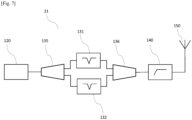
- Fig.7 shows the cellular RF chain 21 in one embodiment of the gateway 2 where it is able to connect to a subgroup of LPWAN networks chosen from a whole group.
- the cellular RF chain 21 has been represented in a variant adapted to two LPWAN networks but can easily be generalized to an indefinite number of LPWAN networks. It comprises several notch filters 131, 132 mounted in parallel and associated respectively with each of the LPWAN networks to which the gateway 2 is able to connect.
- the notch filter associated with a respective LPWAN network attenuates the frequency power emitted by the cellular RF chain 21 (the frequencies in the uplink band of the cellular network) which are within the frequency band of that LPWAN network.
- the notch filters 131, 132 there are multiplexers 135, 136 which make it possible to select the notch filter(s), 131 for example, corresponding to the subgroup of selected LPWAN networks.
- the setting of the multiplexers 135, 136 is therefore linked to that of the multiplexer 180, and when the user chooses an LPWAN network, all the elements, the filtering block 171 of the LPWAN RF chain 11, assuming that it is the one which has been chosen, the multiplexer 180 of the LPWAN RF chain 11, the multiplexers 135, 136 of the cellular RF chain 21, the notch filter 131 of the cellular RF chain 21, assuming that it is the one which corresponds to the filtering block 171 of the RF LPWAN channel, are suitably adjusted at the same time.
- control unit 18 sends to the cellular RF chain 21 for the settings specific to it a command 8 similar to that sent to the LPWAN RF chain. If the user subsequently decides to reprogram the RF LPWAN chain, a new command 8 will be sent accordingly to the two RF chains 11, 21.
Landscapes
- Engineering & Computer Science (AREA)
- Computer Networks & Wireless Communication (AREA)
- Signal Processing (AREA)
- Mobile Radio Communication Systems (AREA)
Claims (16)
- Kommunikations-Gateway (2), das dazu bestimmt ist, mindestens ein LPWAN-Netzwerk und mindestens ein Mobilfunknetz zu verbinden, wobei das Gateway umfasst:• eine erste RF-Kette (10), die dazu bestimmt ist, mit dem mindestens einen LPWAN-Netzwerk zu kommunizieren, wobei die erste RF-Kette eine LPWAN-Antenne (100), einen Transponder (30) mit einem Sender (31) und einen Empfänger (32), welche in Reihe zwischen dem Transponder und der LPWAN-Antenne (100) montiert sind, umfasst:• mindestens einen Filterblock (170), umfassend:• einen Verstärkungsblock (160), der einen Uplink-Kanal und einen Downlink-Kanal umfasst, die parallel montiert sind,• weiterhin in Richtung der LPWAN-Antenne (100), einen gemeinsamen Teil des Uplink-Kanals und des Downlink-Kanals, wobei der gemeinsame Teil einen Bandpassfilter (80) umfasst, der die Frequenzen in einem Frequenzband des mindestens einen LPWAN-Netzwerks durchlässt und die Leistung der Frequenzen außerhalb des Bandes des LPWAN-Netzwerks dämpft,• und einen ersten Hochpassfilter (90); und• eine zweite RF-Kette (20) zu dem Mobilfunknetz, wobei die zweite RF-Kette zum Aufbau von Uplinks und Downlinks mit dem Mobilfunknetz geeignet ist, wobei ein Downlink-Frequenzband und ein Uplink-Frequenzband des Mobilfunknetzes außerhalb des Bandes des LPWAN-Netzwerks liegen, wobei die zweite RF-Kette umfasst eine Mobilfunkantenne (150), ein Modem (120) und, in Reihe zwischen dem Modem und der Antenne montiert:• mindestens einen Bandsperrfilter (130), welcher die Leistung der Frequenzen im Frequenzband des mindestens einen LPWAN-Netzwerks dämpft und die Frequenzen im Downlink-Frequenzband und im Uplink-Frequenzband des Mobilfunknetzes durchlässt.
- Gateway gemäß Anspruch 1, wobei die zweite RF-Kette (20) einen einzelnen Bandsperrfilter (130) und einen zweiten Hochpassfilter (140) zwischen dem Bandsperrfilter (130) und der Mobilfunkantenne (150) umfasst.
- Gateway gemäß Anspruch 1, wobei die zweite RF-Kette (20) einen einzelnen Bandsperrfilter (130) umfasst, der direkt mit der Mobilfunkantenne (150) verbunden ist.
- Gateway gemäß Anspruch 1, das dazu bestimmt ist, einerseits eine Untergruppe von LPWAN-Netzwerken, die aus einer Gruppe von LPWAN-Netzwerken ausgewählt werden, die in jeweiligen Frequenzbändern arbeiten, und andererseits ein Mobilfunknetz zu verbinden, in dem:• der Transponder (35) der ersten RF-Kette (11) ein jeweiliges Transceiver-Paar (36, 37) für jedes der Mitglieder der LPWAN-Netzwerkgruppe umfasst,• die erste RF-Kette eine Vielzahl von Filterblöcken umfasst, wobei jeder der Filterblöcke (171, 172) einem jeweiligen Mitglied der LPWAN-Netzwerkgruppe zugeordnet ist und einen Verstärkungsblock (161, 162), ein Bandpassfilter (81, 82), der Frequenzen innerhalb des Frequenzbands des jeweiligen Mitglieds der LPWAN-Netzwerkgruppe durchlässt und die Leistung der Frequenzen außerhalb des Bands des jeweiligen Mitglieds der LPWAN-Netzwerkgruppe abschwächt, umfasst;• die erste RF-Kette (21) weiterhin einen LPWAN-Netzwerkmultiplexer (180), der zwischen den Filterblöcken (171, 172) und dem ersten Hochpassfilter (90) angeordnet ist, umfasst;• die zweite RF-Kette mehrere Bandsperrfilter (131,132), die parallel montiert und jeweils jedem Mitglied der Gruppe von LPWAN-Netzwerken zugeordnet sind, umfasst, wobei der Bandsperrfilter, der einem jeweiligen Mitglied der Gruppe von LPWAN-Netzwerken zugeordnet ist, die Leistung der Frequenzen in dem Band des jeweiligen Mitglieds der LPWAN-Netzwerkgruppe dämpft und die Frequenzen im Downlink-Frequenzband und im Uplink-Frequenzband des Mobilfunknetzes durchlässt;• die zweite RF-Kette weiterhin einen ersten (135) und zweiten (136) Bandsperrfilter-Multiplexer zum selektiven Verbinden der Bandsperrfilter, die einer Untergruppe ausgewählter LPWAN-Netzwerke zugeordnet sind, umfasst, wobei die ersten (135) und zweiten (136) Bandsperrfilter-Multiplexer die mehreren Bandsperrfilter (131, 132) umgibt, wobei sich der zweite Bandsperr- Multiplexer (136) auf der Seite der Mobilfunkantenne (150) befindet.
- Gateway gemäß Anspruch 4, weiterhin umfassend einen Steuerblock (16), wobei der Steuerblock (16) umfasst:• eine Mensch-Maschine-Schnittstelle (19) zum Auswählen der LPWAN-Netzwerkuntergruppe;• eine Steuereinheit (18), die so konfiguriert ist, dass sie den Multiplexer (180) der ersten RF-Kette (11) so programmiert, dass der Multiplexer (180) die Filterblöcke (171, 172) verbindet, die den jeweiligen Mitgliedern der ausgewählten LPWAN-Netzwerkuntergruppe zugeordnet sind, und um den ersten und zweiten Multiplexer (135, 136) der zweiten RF-Kette zu programmieren, damit sie die Bandsperrfilter (131, 132), die den jeweiligen Mitgliedern der ausgewählten LPWAN-Netzwerkuntergruppe zugeordnet sind, verbinden.
- Gateway gemäß einem der Ansprüche 4 und 5, wobei die zweite RF-Kette (21) einen zweiten Hochpassfilter (140) zwischen dem zweiten Bandsperrfilter-Multiplexer (136) und der Mobilfunkantenne (150) umfasst.
- Gateway gemäß einem der Ansprüche 4 und 5, wobei der zweite Bandsperrfilter-Multiplexer (136) der zweiten RF-Kette direkt mit der Mobilfunkantenne verbunden ist.
- Gateway gemäß einem der Ansprüche 1 bis 7, wobei der oder jeder Filterblock (170, 171, 172) der ersten RF-Kette außerdem einen Kanalwähler (70) umfasst, der zwischen dem Verstärkungsblock (160, 161, 162) und dem Bandpassfilter (80, 81, 82) angeordnet ist und konfiguriert ist, um einen Halbduplexbetrieb im Frequenzband des LPWAN-Netzwerks oder des jeweiligen Mitglieds der zugehörigen LPWAN-Netzwerkgruppe zu erreichen.
- Gateway gemäß einem der Ansprüche 1 bis 8, wobei der Bandpassfilter (80, 81, 82) des oder jeden Filterblocks so konfiguriert ist, dass er die Leistung von Frequenzen außerhalb des Bandes des LPWAN-Netzwerks oder das jeweiligen Mitglieds der zugehörigen LPWAN-Netzwerkgruppe um mindestens 20 dB dämpft.
- Gateway gemäß einem der Ansprüche 1 bis 9, wobei der oder jeder Bandsperrfilter (131, 132) der zweiten RF-Kette so konfiguriert ist, dass er die Leistung der Frequenzen im Frequenzband des LPWAN-Netzwerks oder des jeweiligen Mitglieds der zugehörigen LPWAN-Netzwerkgruppe um mindestens 20 dB dämpft.
- Gateway gemäß einem der vorstehenden Ansprüche, umfassend eine elektronische Karte, auf der die erste RF-Kette (10, 11) und die zweite RF-Kette (20, 21) montiert sind und deren Größe in allen drei Maßen 12 cm nicht überschreitet.
- Gateway gemäß einem der vorstehenden Ansprüche, wobei die ersten (10, 11) und zweiten (20, 21) RF-Ketten an einen Abstand von höchstens 8 MHz zwischen einem beliebigen Frequenzband des Mobilfunknetzes und dem Frequenzband des oder jedes Mitglieds der LPWAN-Netzwerkgruppe angepasst sind.
- Gateway gemäß einem der vorstehenden Ansprüche, wobei die Uplink- oder Downlink-Signale auf der ersten RF-Kette der Norm EN 300 220 entsprechen.
- Gateway gemäß einem der vorstehenden Ansprüche, wobei der oder die Bandpassfilter aus der Gruppe der Oberflächenwellenfilter, Volumenwellenfilter und Keramikfilter ausgewählt sind.
- Gateway gemäß einem der vorstehenden Ansprüche, wobei der oder die Bandsperrfilter aus der Gruppe der Oberflächenwellenfilter, Volumenwellenfilter und Keramikfilter ausgewählt sind.
- Gateway nach einem der vorhergehenden Ansprüche, wobei die Isolierung des ersten und zweiten RF-Kanals durch eine oder mehrere Antennenisolierungstechniken ergänzt ist, die aus der Gruppe Antennenentkopplung, Hinzufügen von parasitären Antennenelementen, fehlerhafte Erdungsstrukturen, neutralisierende Leitungen, dielektrische Wände, Metamaterialien auswählbar ist.
Applications Claiming Priority (2)
| Application Number | Priority Date | Filing Date | Title |
|---|---|---|---|
| FR2005152A FR3110791B1 (fr) | 2020-05-20 | 2020-05-20 | Passerelle de communication destinee a relier un reseau lpwan et un reseau cellulaire |
| PCT/EP2021/063161 WO2021233922A1 (fr) | 2020-05-20 | 2021-05-18 | Passerelle de communication destinee a relier un reseau lpwan et un reseau cellulaire |
Publications (3)
| Publication Number | Publication Date |
|---|---|
| EP4154412A1 EP4154412A1 (de) | 2023-03-29 |
| EP4154412B1 true EP4154412B1 (de) | 2023-11-29 |
| EP4154412C0 EP4154412C0 (de) | 2023-11-29 |
Family
ID=72885618
Family Applications (1)
| Application Number | Title | Priority Date | Filing Date |
|---|---|---|---|
| EP21725776.5A Active EP4154412B1 (de) | 2020-05-20 | 2021-05-18 | Kommunikationsgateway zur verbindung eines lpwan-netzwerks und eines zellularen netzwerks |
Country Status (6)
| Country | Link |
|---|---|
| US (1) | US12401383B2 (de) |
| EP (1) | EP4154412B1 (de) |
| CN (1) | CN115917975A (de) |
| CA (1) | CA3179299A1 (de) |
| FR (1) | FR3110791B1 (de) |
| WO (1) | WO2021233922A1 (de) |
Families Citing this family (1)
| Publication number | Priority date | Publication date | Assignee | Title |
|---|---|---|---|---|
| FR3110791B1 (fr) * | 2020-05-20 | 2022-05-20 | Kerlink | Passerelle de communication destinee a relier un reseau lpwan et un reseau cellulaire |
Family Cites Families (19)
| Publication number | Priority date | Publication date | Assignee | Title |
|---|---|---|---|---|
| US6101228A (en) * | 1997-05-22 | 2000-08-08 | Conexant Systems, Inc. | Receiver of wideband digital signal in the presence of a narrow band interfering signal |
| WO2003105418A2 (en) | 2002-06-07 | 2003-12-18 | Koninklijke Philips Electronics N.V. | Wireless technology co-existence |
| FR2853478A1 (fr) * | 2003-04-01 | 2004-10-08 | St Microelectronics Sa | PROCEDE DE CONFIGURATION D'UN MODEM xDSL ET MODEM xDSL DISPOSANT D'UN TEL PROCEDE |
| US20050141895A1 (en) | 2003-12-31 | 2005-06-30 | Ruiz Everardo D. | Isolating radio frequency components of a wireless device |
| US7653035B2 (en) | 2004-12-20 | 2010-01-26 | Intel Corporation | Interference rejection in wireless receivers |
| US7873385B2 (en) * | 2006-04-05 | 2011-01-18 | Palm, Inc. | Antenna sharing techniques |
| DE102007042979B4 (de) * | 2007-09-10 | 2017-07-20 | Intel Deutschland Gmbh | Integrierte Schaltung für Mobilfunk-Sendeempfänger |
| US8417187B2 (en) | 2008-01-07 | 2013-04-09 | Apple Inc. | Methods and apparatus for wireless device coexistence |
| US8284721B2 (en) | 2008-06-26 | 2012-10-09 | Apple Inc. | Methods and apparatus for antenna isolation-dependent coexistence in wireless systems |
| JP5075188B2 (ja) * | 2009-12-03 | 2012-11-14 | 株式会社エヌ・ティ・ティ・ドコモ | 無線通信端末 |
| US20150049651A1 (en) * | 2013-08-14 | 2015-02-19 | Qualcomm Incorporated | Dynamically updating filtering configuration in modem baseband processing |
| US9929772B2 (en) | 2016-02-05 | 2018-03-27 | Apana Inc. | Low power, high resolution automated meter reading and analytics |
| US9647787B1 (en) * | 2016-07-13 | 2017-05-09 | Corning Optical Communications Wireless Ltd | Activating interference signal rejection filter path based on detection of an interference signal in a wireless distribution system (WDS) |
| JP6788562B2 (ja) * | 2017-09-19 | 2020-11-25 | 株式会社東芝 | 受信回路および無線通信装置 |
| CN109951198B (zh) * | 2017-12-20 | 2022-06-07 | 三星电子株式会社 | 执行选择性噪声滤波的无线通信设备及操作该设备的方法 |
| CN109412631A (zh) * | 2018-11-23 | 2019-03-01 | 北京资信物联科技有限公司 | 可扩展式LoRa网关系统 |
| FR3110791B1 (fr) * | 2020-05-20 | 2022-05-20 | Kerlink | Passerelle de communication destinee a relier un reseau lpwan et un reseau cellulaire |
| US11228328B1 (en) * | 2021-03-15 | 2022-01-18 | SiTune Corporation | Integrated radio frequency transceiver |
| US12255374B2 (en) * | 2022-02-25 | 2025-03-18 | Qualcomm Incorporated | Frequency selective coupler |
-
2020
- 2020-05-20 FR FR2005152A patent/FR3110791B1/fr active Active
-
2021
- 2021-05-18 EP EP21725776.5A patent/EP4154412B1/de active Active
- 2021-05-18 CN CN202180036327.2A patent/CN115917975A/zh active Pending
- 2021-05-18 CA CA3179299A patent/CA3179299A1/en active Pending
- 2021-05-18 WO PCT/EP2021/063161 patent/WO2021233922A1/fr not_active Ceased
- 2021-05-18 US US17/926,202 patent/US12401383B2/en active Active
Also Published As
| Publication number | Publication date |
|---|---|
| CA3179299A1 (en) | 2021-11-25 |
| FR3110791A1 (fr) | 2021-11-26 |
| US20230179243A1 (en) | 2023-06-08 |
| CN115917975A (zh) | 2023-04-04 |
| WO2021233922A1 (fr) | 2021-11-25 |
| FR3110791B1 (fr) | 2022-05-20 |
| US12401383B2 (en) | 2025-08-26 |
| EP4154412C0 (de) | 2023-11-29 |
| EP4154412A1 (de) | 2023-03-29 |
Similar Documents
| Publication | Publication Date | Title |
|---|---|---|
| CN107925889B (zh) | 用于广播多媒体接收机设备的干扰减轻的方法和装置 | |
| JP5855738B2 (ja) | 単一アンテナ、マルチバンド周波数分割多重モバイル通信 | |
| EP2673888B1 (de) | In zwei benachbarten bändern betriebenes doppelband-endgerät mit gleichzeitigem zugriff | |
| FR2785476A1 (fr) | Dispositif de reception de signaux multi-faisceaux | |
| EP2916470B1 (de) | Verfahren zur Detektion eines Ungleichgewichts und zur Kalibrierung eines Multiport-Verstärkers eines Telekommunikationssatelliten | |
| FR2682838A1 (fr) | Recepteur et emetteur radio produisant une diversite. | |
| EP4154412B1 (de) | Kommunikationsgateway zur verbindung eines lpwan-netzwerks und eines zellularen netzwerks | |
| FR3021164A1 (fr) | Systeme d'antennes pour reduire le couplage electromagnetique entre antennes | |
| CA2351119A1 (fr) | Antenne de telecommunication destinee a couvrir une large zone terrestre | |
| EP0977380A1 (de) | Zellulares Funkkommunikationssystem unter verwendung von Datenwiederholung in Abwärtsrichtung von einer Basistation und Datenrelais dafür | |
| FR2849734A1 (fr) | Systeme de reception de signeaux dvb-t avec reemission isofrequence | |
| FR3072526B1 (fr) | Procede de determination d'un biais de phase dans le signal transmis par au moins un des elements rayonnants (er) d'une antenne active (ant) et dispositif associe | |
| EP3900219B1 (de) | Verfahren um eine mobilfunkverbinbung in einem geschlossenen raum durch eine externe fernsehantenne bereitzustellen und entsprechende vorrichtung | |
| EP2876814B1 (de) | Sende- und Empfangsvorrichtung über Satellit mit starker Mehrwegedämpfung, Leistungsverstärker und Satellit, die mit einer solchen Vorrichtung ausgestattet sind | |
| FR3114463A1 (fr) | Systeme et procede de suppression de signaux interferents montants generes a l'interieur d'un systeme spatial de communication multi-spots | |
| FR3109451A1 (fr) | Méta Radar Secondaire | |
| EP2404395B1 (de) | Verfahren zur kalibrierung eines endgeräts mit multisektorantenne und mesh-netzwerkendgerät | |
| RU2830124C1 (ru) | Коммуникационный шлюз, предназначенный для соединения сети lpwan и сотовой сети | |
| FR3017748A1 (fr) | Systeme de telemetrie utilisant une antenne retrodirective a faible consommation d'energie | |
| EP2889955B1 (de) | Kompaktantennenstruktur für Telekommunikationen über Satelliten | |
| EP3422599B1 (de) | Kommunikationsvorrichtung für die verarbeitung von interferenzen zwischen signalen, die aus benachbarten sendespots ausgesendet werden, und entsprechendes verfahren | |
| WO2018073522A1 (fr) | Dispositif antenne | |
| WO2021250342A1 (fr) | Antenne multimode, multiport et multistandard pour systeme de communication adaptable | |
| EP4500933A1 (de) | Integriertes und kompaktes intelligentes sende- und empfangssystem | |
| FR3153484A1 (fr) | Procédé de communication en full-duplex et dispositif de communication sans fil associé |
Legal Events
| Date | Code | Title | Description |
|---|---|---|---|
| STAA | Information on the status of an ep patent application or granted ep patent |
Free format text: STATUS: UNKNOWN |
|
| STAA | Information on the status of an ep patent application or granted ep patent |
Free format text: STATUS: THE INTERNATIONAL PUBLICATION HAS BEEN MADE |
|
| PUAI | Public reference made under article 153(3) epc to a published international application that has entered the european phase |
Free format text: ORIGINAL CODE: 0009012 |
|
| STAA | Information on the status of an ep patent application or granted ep patent |
Free format text: STATUS: REQUEST FOR EXAMINATION WAS MADE |
|
| 17P | Request for examination filed |
Effective date: 20221107 |
|
| AK | Designated contracting states |
Kind code of ref document: A1 Designated state(s): AL AT BE BG CH CY CZ DE DK EE ES FI FR GB GR HR HU IE IS IT LI LT LU LV MC MK MT NL NO PL PT RO RS SE SI SK SM TR |
|
| GRAP | Despatch of communication of intention to grant a patent |
Free format text: ORIGINAL CODE: EPIDOSNIGR1 |
|
| STAA | Information on the status of an ep patent application or granted ep patent |
Free format text: STATUS: GRANT OF PATENT IS INTENDED |
|
| DAV | Request for validation of the european patent (deleted) | ||
| DAX | Request for extension of the european patent (deleted) | ||
| INTG | Intention to grant announced |
Effective date: 20230706 |
|
| GRAS | Grant fee paid |
Free format text: ORIGINAL CODE: EPIDOSNIGR3 |
|
| GRAA | (expected) grant |
Free format text: ORIGINAL CODE: 0009210 |
|
| STAA | Information on the status of an ep patent application or granted ep patent |
Free format text: STATUS: THE PATENT HAS BEEN GRANTED |
|
| AK | Designated contracting states |
Kind code of ref document: B1 Designated state(s): AL AT BE BG CH CY CZ DE DK EE ES FI FR GB GR HR HU IE IS IT LI LT LU LV MC MK MT NL NO PL PT RO RS SE SI SK SM TR |
|
| REG | Reference to a national code |
Ref country code: GB Ref legal event code: FG4D Free format text: NOT ENGLISH |
|
| REG | Reference to a national code |
Ref country code: CH Ref legal event code: EP |
|
| REG | Reference to a national code |
Ref country code: DE Ref legal event code: R096 Ref document number: 602021007331 Country of ref document: DE |
|
| REG | Reference to a national code |
Ref country code: IE Ref legal event code: FG4D Free format text: LANGUAGE OF EP DOCUMENT: FRENCH |
|
| U01 | Request for unitary effect filed |
Effective date: 20231207 |
|
| U07 | Unitary effect registered |
Designated state(s): AT BE BG DE DK EE FI FR IT LT LU LV MT NL PT SE SI Effective date: 20231213 |
|
| PG25 | Lapsed in a contracting state [announced via postgrant information from national office to epo] |
Ref country code: GR Free format text: LAPSE BECAUSE OF FAILURE TO SUBMIT A TRANSLATION OF THE DESCRIPTION OR TO PAY THE FEE WITHIN THE PRESCRIBED TIME-LIMIT Effective date: 20240301 |
|
| PG25 | Lapsed in a contracting state [announced via postgrant information from national office to epo] |
Ref country code: IS Free format text: LAPSE BECAUSE OF FAILURE TO SUBMIT A TRANSLATION OF THE DESCRIPTION OR TO PAY THE FEE WITHIN THE PRESCRIBED TIME-LIMIT Effective date: 20240329 |
|
| PG25 | Lapsed in a contracting state [announced via postgrant information from national office to epo] |
Ref country code: ES Free format text: LAPSE BECAUSE OF FAILURE TO SUBMIT A TRANSLATION OF THE DESCRIPTION OR TO PAY THE FEE WITHIN THE PRESCRIBED TIME-LIMIT Effective date: 20231129 |
|
| PG25 | Lapsed in a contracting state [announced via postgrant information from national office to epo] |
Ref country code: IS Free format text: LAPSE BECAUSE OF FAILURE TO SUBMIT A TRANSLATION OF THE DESCRIPTION OR TO PAY THE FEE WITHIN THE PRESCRIBED TIME-LIMIT Effective date: 20240329 Ref country code: GR Free format text: LAPSE BECAUSE OF FAILURE TO SUBMIT A TRANSLATION OF THE DESCRIPTION OR TO PAY THE FEE WITHIN THE PRESCRIBED TIME-LIMIT Effective date: 20240301 Ref country code: ES Free format text: LAPSE BECAUSE OF FAILURE TO SUBMIT A TRANSLATION OF THE DESCRIPTION OR TO PAY THE FEE WITHIN THE PRESCRIBED TIME-LIMIT Effective date: 20231129 |
|
| U20 | Renewal fee for the european patent with unitary effect paid |
Year of fee payment: 4 Effective date: 20240425 |
|
| PG25 | Lapsed in a contracting state [announced via postgrant information from national office to epo] |
Ref country code: RS Free format text: LAPSE BECAUSE OF FAILURE TO SUBMIT A TRANSLATION OF THE DESCRIPTION OR TO PAY THE FEE WITHIN THE PRESCRIBED TIME-LIMIT Effective date: 20231129 Ref country code: PL Free format text: LAPSE BECAUSE OF FAILURE TO SUBMIT A TRANSLATION OF THE DESCRIPTION OR TO PAY THE FEE WITHIN THE PRESCRIBED TIME-LIMIT Effective date: 20231129 Ref country code: NO Free format text: LAPSE BECAUSE OF FAILURE TO SUBMIT A TRANSLATION OF THE DESCRIPTION OR TO PAY THE FEE WITHIN THE PRESCRIBED TIME-LIMIT Effective date: 20240229 Ref country code: HR Free format text: LAPSE BECAUSE OF FAILURE TO SUBMIT A TRANSLATION OF THE DESCRIPTION OR TO PAY THE FEE WITHIN THE PRESCRIBED TIME-LIMIT Effective date: 20231129 |
|
| PG25 | Lapsed in a contracting state [announced via postgrant information from national office to epo] |
Ref country code: CZ Free format text: LAPSE BECAUSE OF FAILURE TO SUBMIT A TRANSLATION OF THE DESCRIPTION OR TO PAY THE FEE WITHIN THE PRESCRIBED TIME-LIMIT Effective date: 20231129 |
|
| PG25 | Lapsed in a contracting state [announced via postgrant information from national office to epo] |
Ref country code: SK Free format text: LAPSE BECAUSE OF FAILURE TO SUBMIT A TRANSLATION OF THE DESCRIPTION OR TO PAY THE FEE WITHIN THE PRESCRIBED TIME-LIMIT Effective date: 20231129 |
|
| PG25 | Lapsed in a contracting state [announced via postgrant information from national office to epo] |
Ref country code: SM Free format text: LAPSE BECAUSE OF FAILURE TO SUBMIT A TRANSLATION OF THE DESCRIPTION OR TO PAY THE FEE WITHIN THE PRESCRIBED TIME-LIMIT Effective date: 20231129 Ref country code: SK Free format text: LAPSE BECAUSE OF FAILURE TO SUBMIT A TRANSLATION OF THE DESCRIPTION OR TO PAY THE FEE WITHIN THE PRESCRIBED TIME-LIMIT Effective date: 20231129 Ref country code: RO Free format text: LAPSE BECAUSE OF FAILURE TO SUBMIT A TRANSLATION OF THE DESCRIPTION OR TO PAY THE FEE WITHIN THE PRESCRIBED TIME-LIMIT Effective date: 20231129 Ref country code: CZ Free format text: LAPSE BECAUSE OF FAILURE TO SUBMIT A TRANSLATION OF THE DESCRIPTION OR TO PAY THE FEE WITHIN THE PRESCRIBED TIME-LIMIT Effective date: 20231129 |
|
| REG | Reference to a national code |
Ref country code: DE Ref legal event code: R097 Ref document number: 602021007331 Country of ref document: DE |
|
| PLBE | No opposition filed within time limit |
Free format text: ORIGINAL CODE: 0009261 |
|
| STAA | Information on the status of an ep patent application or granted ep patent |
Free format text: STATUS: NO OPPOSITION FILED WITHIN TIME LIMIT |
|
| 26N | No opposition filed |
Effective date: 20240830 |
|
| REG | Reference to a national code |
Ref country code: CH Ref legal event code: PL |
|
| PG25 | Lapsed in a contracting state [announced via postgrant information from national office to epo] |
Ref country code: MC Free format text: LAPSE BECAUSE OF FAILURE TO SUBMIT A TRANSLATION OF THE DESCRIPTION OR TO PAY THE FEE WITHIN THE PRESCRIBED TIME-LIMIT Effective date: 20231129 |
|
| PG25 | Lapsed in a contracting state [announced via postgrant information from national office to epo] |
Ref country code: MC Free format text: LAPSE BECAUSE OF FAILURE TO SUBMIT A TRANSLATION OF THE DESCRIPTION OR TO PAY THE FEE WITHIN THE PRESCRIBED TIME-LIMIT Effective date: 20231129 Ref country code: CH Free format text: LAPSE BECAUSE OF NON-PAYMENT OF DUE FEES Effective date: 20240531 |
|
| U20 | Renewal fee for the european patent with unitary effect paid |
Year of fee payment: 5 Effective date: 20250425 |
|
| PGFP | Annual fee paid to national office [announced via postgrant information from national office to epo] |
Ref country code: GB Payment date: 20250521 Year of fee payment: 5 |
|
| PGFP | Annual fee paid to national office [announced via postgrant information from national office to epo] |
Ref country code: IE Payment date: 20250422 Year of fee payment: 5 |
|
| PG25 | Lapsed in a contracting state [announced via postgrant information from national office to epo] |
Ref country code: CY Free format text: LAPSE BECAUSE OF FAILURE TO SUBMIT A TRANSLATION OF THE DESCRIPTION OR TO PAY THE FEE WITHIN THE PRESCRIBED TIME-LIMIT; INVALID AB INITIO Effective date: 20210518 |
|
| PG25 | Lapsed in a contracting state [announced via postgrant information from national office to epo] |
Ref country code: HU Free format text: LAPSE BECAUSE OF FAILURE TO SUBMIT A TRANSLATION OF THE DESCRIPTION OR TO PAY THE FEE WITHIN THE PRESCRIBED TIME-LIMIT; INVALID AB INITIO Effective date: 20210518 |