EP4151998A1 - Verfahren zur bewertung der wirksamkeit eines uv-blockierenden wirkstoffs für haare - Google Patents
Verfahren zur bewertung der wirksamkeit eines uv-blockierenden wirkstoffs für haare Download PDFInfo
- Publication number
- EP4151998A1 EP4151998A1 EP21803025.2A EP21803025A EP4151998A1 EP 4151998 A1 EP4151998 A1 EP 4151998A1 EP 21803025 A EP21803025 A EP 21803025A EP 4151998 A1 EP4151998 A1 EP 4151998A1
- Authority
- EP
- European Patent Office
- Prior art keywords
- hair sample
- irradiation
- blocking ingredient
- blocking
- ingredient
- Prior art date
- Legal status (The legal status is an assumption and is not a legal conclusion. Google has not performed a legal analysis and makes no representation as to the accuracy of the status listed.)
- Granted
Links
Images

Classifications
-
- G—PHYSICS
- G01—MEASURING; TESTING
- G01N—INVESTIGATING OR ANALYSING MATERIALS BY DETERMINING THEIR CHEMICAL OR PHYSICAL PROPERTIES
- G01N33/00—Investigating or analysing materials by specific methods not covered by groups G01N1/00 - G01N31/00
-
- G—PHYSICS
- G01—MEASURING; TESTING
- G01N—INVESTIGATING OR ANALYSING MATERIALS BY DETERMINING THEIR CHEMICAL OR PHYSICAL PROPERTIES
- G01N21/00—Investigating or analysing materials by the use of optical means, i.e. using sub-millimetre waves, infrared, visible or ultraviolet light
- G01N21/62—Systems in which the material investigated is excited whereby it emits light or causes a change in wavelength of the incident light
- G01N21/63—Systems in which the material investigated is excited whereby it emits light or causes a change in wavelength of the incident light optically excited
- G01N21/64—Fluorescence; Phosphorescence
- G01N21/645—Specially adapted constructive features of fluorimeters
- G01N21/6456—Spatial resolved fluorescence measurements; Imaging
-
- G—PHYSICS
- G01—MEASURING; TESTING
- G01N—INVESTIGATING OR ANALYSING MATERIALS BY DETERMINING THEIR CHEMICAL OR PHYSICAL PROPERTIES
- G01N21/00—Investigating or analysing materials by the use of optical means, i.e. using sub-millimetre waves, infrared, visible or ultraviolet light
- G01N21/17—Systems in which incident light is modified in accordance with the properties of the material investigated
- G01N21/25—Colour; Spectral properties, i.e. comparison of effect of material on the light at two or more different wavelengths or wavelength bands
- G01N21/251—Colorimeters; Construction thereof
-
- G—PHYSICS
- G01—MEASURING; TESTING
- G01N—INVESTIGATING OR ANALYSING MATERIALS BY DETERMINING THEIR CHEMICAL OR PHYSICAL PROPERTIES
- G01N33/00—Investigating or analysing materials by specific methods not covered by groups G01N1/00 - G01N31/00
- G01N33/0078—Testing material properties on manufactured objects
Definitions
- the present disclosure relates to a method for evaluating the efficacy of a UV-blocking ingredient for hair, specifically to a method for evaluating the efficacy of a UV-blocking ingredient by applying the UV-blocking ingredient to a hair sample treated with a fluorescent dye and measuring the difference in chromaticity before and after UV irradiation.
- Hair is made up of the cuticle, the cortex and the medulla and the outermost layer is the cuticle.
- the cuticle is a thin layer that covers the outermost layer of hair and it is overlapped in a shape of scales. It protects hair from outside and affects the gloss of hair. Being composed of hard keratin proteins, it is brittle and vulnerable to friction. Therefore, it can be damaged or exfoliated easily by excessive combing or shampooing.
- the cortex is located inside of the cuticle and accounts for 80-90% of hair. It contains a lot of melanin pigment and is easily damaged by chemicals such as perming agents, hair dyes, etc.
- the medulla is located at the center of hair.
- the thickness of the cuticle is decreased when UV is irradiated to hair, which is easily damaged by the external environment.
- the UV irradiation leads to the destruction of cells, cell membrane complexes and melanin, and the porosis of the cortex occurs due to the exfoliation of the cuticle, resulting in splitting or cutting of hair.
- Korean Patent Publication No. 2006-0127405 discloses a method of evaluating hair damage by specifically fluorescence-labeling the carbonyl group of oxidized proteins in hair, a method for evaluating the efficacy of a UV-blocking ingredient for protecting hair from UV is not known widely.
- Patent document 1 Korean Patent Publication No. 2006-0127405 .
- the inventors of the present disclosure have made efforts to provide a method for evaluating the efficacy of a UV-blocking ingredient by treating a hair sample with a fluorescent dye. As a result, they have found out that the efficacy of a UV-blocking ingredient can be evaluated by applying the UV-blocking ingredient to a hair sample treated with a fluorescent dye or applying the UV-blocking ingredient onto a part of a UV-permeable plate and then calculating a UV cut-off rate based on the difference in chromaticity before and after UV irradiation, and have completed the present disclosure.
- the present disclosure is directed to providing a method for evaluating the efficacy of a UV-blocking ingredient by treating a hair sample with a fluorescent dye.
- the present disclosure provides a method for evaluating the efficacy of a UV-blocking ingredient, which includes:
- the fluorescent dye may be dansyl chloride.
- the hair sample may be immersed in an organic solvent in which the dansyl chloride is dissolved for 0.5-48 hours.
- the UV may be irradiated with an intensity of 1,000-100,000 mJ/cm 2 .
- the chromaticity may be a measured value according to CIE LAB.
- Equation 1 The difference in chromaticity ( ⁇ E 1 ) of the hair sample with the UV-blocking ingredient applied before and after UV irradiation may be calculated according to Equation 1, and the difference in chromaticity ( ⁇ E 2 ) of the hair sample with the UV-blocking ingredient not applied may be calculated according to Equation 2.
- Equation 2 The difference in chromaticity ( ⁇ E 1 ) of the hair sample with the UV-blocking ingredient not applied may be calculated according to Equation 2.
- Equation 2 L 2 * ⁇ L 1 * 2 + a 2 * ⁇ a 1 * 2 + b 2 * ⁇ b 1 * 2 1 / 2
- UV cut-off rate % ⁇ E 2 ⁇ ⁇ E 1 / ⁇ E 2 ⁇ 100
- the difference in brightness ( ⁇ L 1 ) of the hair sample with the UV-blocking ingredient applied before and after UV irradiation may be calculated according to Equation 4, and the difference in brightness ( ⁇ L 2 ) of the hair sample with the UV-blocking ingredient not applied may be calculated according to Equation 5.
- UV cut-off rate % ⁇ L 2 ⁇ ⁇ L 1 / ⁇ L 2 ⁇ 100
- the present disclosure also provides a method for evaluating the efficacy of a UV-blocking ingredient, which includes:
- the efficacy of a UV-blocking ingredient can be evaluated quantitatively by utilizing the difference in chromaticity of a hair sample before and after UV irradiation on the basis of the fact that, when UV is irradiated to the hair sample treated with a fluorescent dye, fluorescence intensity is decreased due to protein damage.
- the present disclosure provides a method for evaluating the efficacy of a UV-blocking ingredient, which includes:
- a hair sample is treated with a fluorescent dye.
- the hair sample may be gray hair, black hair, etc.
- the fluorescent dye may be dansyl chloride.
- the hair sample may be immersed in an organic solvent in which the dansyl chloride is dissolved for 0.5-48 hours, specifically for 0.5-10 hours, more specifically for 2-8 hours, most specifically for 3-5 hours.
- the organic solvent may be acetone. If the immersion time is shorter than the above-described range, fluorescence dyeing may be insufficient. However, if the immersion time is longer than the above-described range, the hair sample may be dissolved.
- a UV-blocking ingredient is applied to the hair sample treated with the fluorescent dye.
- a hair sample with the UV-blocking ingredient applied and a hair sample with the UV-blocking ingredient not applied may be prepared separately, or a part of one hair sample may be applied with the UV-blocking ingredient and the remaining part may be not applied with the UV-blocking ingredient.
- Chromaticity is measured by fluorescence-imaging the hair samples with the UV-blocking ingredient applied and not applied.
- the chromaticity may be a measure value according to CIE LAB. Specifically, brightness (L*), chroma (a*) and yellowness (b*) values may be measured.
- UV is irradiated to the hair sample.
- the UV may be irradiated with an intensity of 1,000-100,000 mJ/cm 2 , specifically 2,000-50,000 mJ/cm 2 , more specifically 3,000-30,000 mJ/cm 2 , most specifically 5,000-10,000 mJ/cm 2 .
- the UV may be irradiated at 500-1,000 uw/cm 2 accumulated for 1-5 hours.
- a UV cut-off rate is calculated by comparing the difference in chromaticity ( ⁇ E 1 ) or difference in brightness ( ⁇ L 1 ) of the hair sample with the UV-blocking ingredient applied before and after UV irradiation with the difference in chromaticity ( ⁇ E 2 ) or difference in brightness ( ⁇ L 2 ) of the hair sample with the UV-blocking ingredient not applied before and after UV irradiation.
- Equation 1 the difference in chromaticity ( ⁇ E 1 ) of the hair sample with the UV-blocking ingredient applied before and after UV irradiation
- Equation 2 the difference in chromaticity ( ⁇ E 2 ) of the hair sample with the UV-blocking ingredient not applied
- ⁇ E 1 L 2 * ⁇ L 1 * 2 + a 2 * ⁇ a 1 * 2 + b 2 * ⁇ b 1 * 2 1 / 2
- UV cut-off rate % ⁇ E 2 ⁇ ⁇ E 1 / ⁇ E 2 ⁇ 100
- the difference in brightness ( ⁇ L 1 ) of the hair sample with the UV-blocking ingredient applied before and after UV irradiation may be calculated according to Equation 4, and the difference in brightness ( ⁇ L 2 ) of the hair sample with the UV-blocking ingredient not applied may be calculated according to Equation 5.
- UV cut-off rate may also be calculated according to Equation 6.
- UV cut ⁇ off rate % ⁇ L 2 ⁇ L 1 / ⁇ L 2 ⁇ 100
- the UV-blocking ingredient has superior efficacy as the UV cut-off rate is higher.
- the average value of the cut-off rates for an entire sample may be used by deriving UV-blocking index for a plurality of hair samples.
- the present disclosure also provides a method for evaluating the efficacy of a UV-blocking ingredient, which includes:
- the UV-permeable plate may be a quartz plate, a band-pass filter, etc.
- PMMA polymethyl methacrylate
- the efficacy of a UV-blocking ingredient may be evaluated by without applying the UV-blocking ingredient directly to a hair sample, applying the UV-blocking ingredient onto a part of the UV-permeable plate and then locating the hair sample below the UV-permeable plate.
- the UV-blocking ingredient is applied directly to the hair sample, cleansing is required for the confirmation of chromaticity.
- the use of the UV-permeable plate allows the evaluation of efficacy without cleansing.
- the conditions of the treatment with the fluorescent dye and the UV irradiation may be the same as those in the method of applying the UV-blocking ingredient directly to the hair sample.
- the chromaticity may be a measured value according to CIE LAB. Specifically, brightness (L*), chroma (a*) and yellowness (b*) values may be measured.
- Equation 7 The difference in chromaticity ( ⁇ E 3 ) of the hair sample located below the part with the UV-blocking ingredient applied before and after UV irradiation may be calculated according to Equation 7, and the difference in chromaticity ( ⁇ E 4 ) of the hair sample below the part with the UV-blocking ingredient not applied before and after UV irradiation may be calculated according to Equation 8.
- Equation 8 the difference in chromaticity ( ⁇ E 3 ) of the hair sample located below the part with the UV-blocking ingredient not applied before and after UV irradiation.
- the difference in brightness ( ⁇ L 3 ) of the hair sample located below the part with the UV-blocking ingredient applied before and after UV irradiation may be calculated according to Equation 10, and the difference in brightness ( ⁇ L 4 ) of the hair sample located below the part with the UV-blocking ingredient not applied before and after UV irradiation may be calculated according to Equation 11.
- the average value of the cut-off rates for an entire sample may be used by deriving UV-blocking index for a plurality of hair samples.
- a black hair sample was dyed by immersing in an acetone solution of 2 wt% dansyl chloride for 24 hours.
- the fluorescence intensity of the dyed hair sample was measured using a UV lamp.
- the fluorescence intensity was decreased from 193.57 before the UV irradiation to 154.66 after the UV irradiation by about 20%.
- FIGS. 1a and 1b The fluorescence scanning microscopic images of the hair sample before and after the UV irradiation are shown in FIGS. 1a and 1b . As seen from FIGS. 1a and 1b , the cuticle was damaged significantly due to the UV irradiation.
- a black hair sample was dyed by immersing in an acetone solution of 2 wt% dansyl chloride for 30 minutes.
- the chromaticity of the dyed hair sample was measured according to CIE LAB using a UV lamp (Visia CR mode).
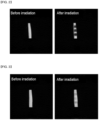
- the UV-blocking ingredient(SPF 35) to be evaluated for efficacy was applied to the hair sample, and UV with a wavelength of 290-400 nm and an intensity of 800 uw/cm 2 was irradiated to the hair sample for 3 hours with a total dose of 8,640 mJ/cm 2 .
- the chromaticity of the hair sample with the UV-blocking ingredient applied was measured according to CIE LAB.
- the images of the hair sample before and after the UV irradiation are shown in FIG. 2 .
- L 2 * is the brightness of the hair sample with the UV-blocking ingredient applied after the UV irradiation
- L 1 * is the brightness of the hair sample with the UV-blocking ingredient applied before the UV irradiation
- a 2 * is the chroma of the hair sample with the UV-blocking ingredient applied after the UV irradiation
- a 1 * is the chroma of the hair sample with the UV-blocking ingredient applied before the UV irradiation
- b 2 * is the yellowness of the hair sample with the UV-blocking ingredient applied after the UV irradiation
- b 1 * is the yellowness of the hair sample with the UV-blocking ingredient applied before the UV irradiation.
- ⁇ E 1 was calculated as 15.33 according to Equation 1.
- ⁇ E 1 L 2 * ⁇ L 1 * 2 + a 2 * ⁇ a 1 * 2 + b 2 * ⁇ b 1 * 2 1 / 2
- a black hair sample was dyed by immersing in an acetone solution of 2 wt% dansyl chloride for 30 minutes.
- the chromaticity of the dyed hair sample was measured according to CIE LAB using a UV lamp (Visia CR mode).
- UV with a wavelength of 290-400 nm and an intensity of 800 uw/cm 2 was irradiated to the hair sample for 3 hours with a total dose of 8,640 mJ/cm 2 .
- the chromaticity of the hair sample was measured according to CIE LAB.
- the images of the hair sample before and after the UV irradiation are shown in FIG. 3 .
- L 4 * is the brightness of the hair sample with the UV-blocking ingredient not applied after the UV irradiation
- L 3 * is the brightness of the hair sample with the UV-blocking ingredient not applied before the UV irradiation
- a 4 * is the chroma of the hair sample with the UV-blocking ingredient not applied after the UV irradiation
- a 3 * is the chroma of the hair sample with the UV-blocking ingredient not applied before the UV irradiation
- b 4 * is the yellowness of the hair sample with the UV-blocking ingredient not applied after the UV irradiation
- b 3 * is the yellowness of the hair sample with the UV-blocking ingredient not applied before the UV irradiation.
- ⁇ E 2 was calculated as 17.44 according to Equation 2.
- ⁇ E 2 L 4 * ⁇ L 3 * 2 + a 4 * ⁇ a 3 * 2 + b 4 * ⁇ b 3 * 2 1 / 2
- UV cut-off rate was calculated as 12.1% according to Equation 3.
- UV cut ⁇ off rate % ⁇ E 2 ⁇ ⁇ E 1 / ⁇ E 2 ⁇ 100
- UV cut-off rate was calculated as 12.4% according to Equations 4-6.
- the efficacy of the UV-blocking ingredient could be evaluated quantitatively by comparing the UV cut-off rate values.
Landscapes
- Health & Medical Sciences (AREA)
- Life Sciences & Earth Sciences (AREA)
- Chemical & Material Sciences (AREA)
- Physics & Mathematics (AREA)
- Pathology (AREA)
- Analytical Chemistry (AREA)
- Biochemistry (AREA)
- General Health & Medical Sciences (AREA)
- General Physics & Mathematics (AREA)
- Immunology (AREA)
- Medicinal Chemistry (AREA)
- Food Science & Technology (AREA)
- Engineering & Computer Science (AREA)
- Spectroscopy & Molecular Physics (AREA)
- Nuclear Medicine, Radiotherapy & Molecular Imaging (AREA)
- Investigating Or Analysing Biological Materials (AREA)
- Cosmetics (AREA)
Applications Claiming Priority (2)
| Application Number | Priority Date | Filing Date | Title |
|---|---|---|---|
| KR1020200056015A KR102414619B1 (ko) | 2020-05-11 | 2020-05-11 | 헤어 자외선 차단 성분의 효능 평가 방법 |
| PCT/KR2021/005322 WO2021230535A1 (ko) | 2020-05-11 | 2021-04-27 | 헤어 자외선 차단 성분의 효능 평가 방법 |
Publications (4)
| Publication Number | Publication Date |
|---|---|
| EP4151998A1 true EP4151998A1 (de) | 2023-03-22 |
| EP4151998A4 EP4151998A4 (de) | 2024-06-12 |
| EP4151998C0 EP4151998C0 (de) | 2025-09-17 |
| EP4151998B1 EP4151998B1 (de) | 2025-09-17 |
Family
ID=78524415
Family Applications (1)
| Application Number | Title | Priority Date | Filing Date |
|---|---|---|---|
| EP21803025.2A Active EP4151998B1 (de) | 2020-05-11 | 2021-04-27 | Verfahren zur bewertung der wirksamkeit eines uv-blockierenden wirkstoffs für haare |
Country Status (4)
| Country | Link |
|---|---|
| EP (1) | EP4151998B1 (de) |
| KR (1) | KR102414619B1 (de) |
| CN (1) | CN115427804A (de) |
| WO (1) | WO2021230535A1 (de) |
Families Citing this family (2)
| Publication number | Priority date | Publication date | Assignee | Title |
|---|---|---|---|---|
| CN114674734A (zh) * | 2022-04-20 | 2022-06-28 | 无限极(中国)有限公司 | 一种评价化妆品产品及原料抗氧化功效的方法 |
| KR102615375B1 (ko) * | 2023-07-14 | 2023-12-19 | 한국콜마주식회사 | 모발에 대한 광 보호 효능의 측정 방법 |
Family Cites Families (8)
| Publication number | Priority date | Publication date | Assignee | Title |
|---|---|---|---|---|
| JPH08271515A (ja) * | 1995-03-28 | 1996-10-18 | Matsushita Electric Works Ltd | ケラチンの損傷度の測定方法および測定装置 |
| JPH09127105A (ja) * | 1995-10-26 | 1997-05-16 | Kanebo Ltd | 毛髪損傷診断法 |
| US20070110670A1 (en) | 2003-12-09 | 2007-05-17 | Shiseido Company, Ltd. | Method for evaluating hair damage using an oxidized protein in hair as an indicator |
| JP5006958B2 (ja) * | 2010-09-17 | 2012-08-22 | 株式会社 資生堂 | 紫外線防御効果の評価方法、評価装置、評価プログラム、及び該プログラムが記録された記録媒体 |
| DE102016208631A1 (de) * | 2016-05-19 | 2017-11-23 | Henkel Ag & Co. Kgaa | Verfahren und Vorrichtung zum Ermitteln eines Schädigungsgrads von Haar und Verfahren zum Ermitteln eines nutzerspezifischen Mittels zur Haarbehandlung |
| KR20200056015A (ko) | 2018-11-14 | 2020-05-22 | 부산대학교 산학협력단 | Cmp 장치 및 다구역 온도 프로파일 제어 방법 |
| CN110157772A (zh) * | 2019-05-20 | 2019-08-23 | 西南医科大学 | 一种抗紫外产品的紫外防护性能的微生物评价方法 |
| KR102615375B1 (ko) * | 2023-07-14 | 2023-12-19 | 한국콜마주식회사 | 모발에 대한 광 보호 효능의 측정 방법 |
-
2020
- 2020-05-11 KR KR1020200056015A patent/KR102414619B1/ko active Active
-
2021
- 2021-04-27 WO PCT/KR2021/005322 patent/WO2021230535A1/ko not_active Ceased
- 2021-04-27 EP EP21803025.2A patent/EP4151998B1/de active Active
- 2021-04-27 CN CN202180030430.6A patent/CN115427804A/zh active Pending
Also Published As
| Publication number | Publication date |
|---|---|
| WO2021230535A1 (ko) | 2021-11-18 |
| EP4151998A4 (de) | 2024-06-12 |
| CN115427804A (zh) | 2022-12-02 |
| EP4151998C0 (de) | 2025-09-17 |
| KR20210138204A (ko) | 2021-11-19 |
| KR102414619B1 (ko) | 2022-06-30 |
| EP4151998B1 (de) | 2025-09-17 |
Similar Documents
| Publication | Publication Date | Title |
|---|---|---|
| Schallreuter et al. | Rapid initiation of repigmentation in vitiligo with Dead Sea climatotherapy in combination with pseudocatalase (PC‐KUS) | |
| EP4151998B1 (de) | Verfahren zur bewertung der wirksamkeit eines uv-blockierenden wirkstoffs für haare | |
| Nogueira et al. | About photo-damage of human hair | |
| Ung et al. | Simultaneous NAD (P) H and FAD fluorescence lifetime microscopy of long UVA–induced metabolic stress in reconstructed human skin | |
| EP2032970B1 (de) | Ortsaufgelöstes messverfahren für die detektion von melanin in fluorophorgemischen in einer festkörperprobe | |
| Wang et al. | Effect of solvent content on resin hybridization in wet dentin bonding | |
| Lee et al. | Multicomponent polymer coating to block photocatalytic activity of TiO 2 nanoparticles | |
| Takahashi et al. | Age‐dependent changes in damage processes of hair cuticle | |
| Camargo Jr et al. | Prevention of chemically induced hair damage by means of treatment based on proteins and polysaccharides | |
| DE3026185A1 (de) | Zusammensetzung geeignet zur untersuchung biologischer gewebe und/oder fluessigkeiten und verfahren zu deren anwendung | |
| DE102016208631A1 (de) | Verfahren und Vorrichtung zum Ermitteln eines Schädigungsgrads von Haar und Verfahren zum Ermitteln eines nutzerspezifischen Mittels zur Haarbehandlung | |
| Ali et al. | Scanning electron microscopy analysis of hair index on K arachi's population for social and professional appearance enhancement | |
| Tsuchida et al. | Skin lightness affects ultraviolet A‐induced oxidative stress: Evaluation using ultraweak photon emission measurement | |
| Deravi et al. | Using cephalopod‐inspired chemistry to extend long‐wavelength ultraviolet and visible light protection of mineral sunscreens | |
| Noda et al. | The relationship among minimal erythema dose, minimal delayed tanning dose, and skin color | |
| US6410333B1 (en) | Assessment of human skin damage following exposure to harmful agents | |
| Springer et al. | Optimization of the measurement procedure during multiphoton tomography of human skin in vivo | |
| EP2087349B1 (de) | Test und verfahren | |
| Stokes et al. | The feasibility of using fluorescence spectroscopy as a rapid, non-invasive method for evaluating sunscreen performance | |
| Petty et al. | A facile method for immunofluorescence microscopy of highly autofluorescent human retinal sections using nanoparticles with large Stokes shifts | |
| BUCKLEY et al. | Reflection spectrophotometry: III. Absorption characteristics and color of human skin | |
| MacInnes et al. | Spectral analysis of the binding of acridine orange to polytene chromosomes. | |
| Shankar et al. | Forensic determination of hair deposition time in crime scenes using electron paramagnetic resonance | |
| Agapie et al. | Tropolone-based treatments for visualising latent fingermarks on porous surfaces | |
| Armstrong | The presence of ultra violet absorbing material and its relation to fluorescence “quenching” effects in carious dentine |
Legal Events
| Date | Code | Title | Description |
|---|---|---|---|
| STAA | Information on the status of an ep patent application or granted ep patent |
Free format text: STATUS: THE INTERNATIONAL PUBLICATION HAS BEEN MADE |
|
| PUAI | Public reference made under article 153(3) epc to a published international application that has entered the european phase |
Free format text: ORIGINAL CODE: 0009012 |
|
| STAA | Information on the status of an ep patent application or granted ep patent |
Free format text: STATUS: REQUEST FOR EXAMINATION WAS MADE |
|
| 17P | Request for examination filed |
Effective date: 20221019 |
|
| AK | Designated contracting states |
Kind code of ref document: A1 Designated state(s): AL AT BE BG CH CY CZ DE DK EE ES FI FR GB GR HR HU IE IS IT LI LT LU LV MC MK MT NL NO PL PT RO RS SE SI SK SM TR |
|
| DAV | Request for validation of the european patent (deleted) | ||
| DAX | Request for extension of the european patent (deleted) | ||
| REG | Reference to a national code |
Ref country code: DE Ref legal event code: R079 Ref country code: DE Ref legal event code: R079 Ref document number: 602021038855 Country of ref document: DE Free format text: PREVIOUS MAIN CLASS: G01N0033000000 Ipc: G01N0021640000 |
|
| A4 | Supplementary search report drawn up and despatched |
Effective date: 20240515 |
|
| RIC1 | Information provided on ipc code assigned before grant |
Ipc: G01N 21/64 20060101AFI20240508BHEP |
|
| GRAP | Despatch of communication of intention to grant a patent |
Free format text: ORIGINAL CODE: EPIDOSNIGR1 |
|
| STAA | Information on the status of an ep patent application or granted ep patent |
Free format text: STATUS: GRANT OF PATENT IS INTENDED |
|
| RIC1 | Information provided on ipc code assigned before grant |
Ipc: G01N 21/64 20060101AFI20250404BHEP |
|
| INTG | Intention to grant announced |
Effective date: 20250417 |
|
| GRAS | Grant fee paid |
Free format text: ORIGINAL CODE: EPIDOSNIGR3 |
|
| GRAA | (expected) grant |
Free format text: ORIGINAL CODE: 0009210 |
|
| STAA | Information on the status of an ep patent application or granted ep patent |
Free format text: STATUS: THE PATENT HAS BEEN GRANTED |
|
| AK | Designated contracting states |
Kind code of ref document: B1 Designated state(s): AL AT BE BG CH CY CZ DE DK EE ES FI FR GB GR HR HU IE IS IT LI LT LU LV MC MK MT NL NO PL PT RO RS SE SI SK SM TR |
|
| REG | Reference to a national code |
Ref country code: GB Ref legal event code: FG4D |
|
| REG | Reference to a national code |
Ref country code: CH Ref legal event code: EP |
|
| REG | Reference to a national code |
Ref country code: IE Ref legal event code: FG4D |
|
| REG | Reference to a national code |
Ref country code: DE Ref legal event code: R096 Ref document number: 602021038855 Country of ref document: DE |
|
| U01 | Request for unitary effect filed |
Effective date: 20251007 |
|
| U07 | Unitary effect registered |
Designated state(s): AT BE BG DE DK EE FI FR IT LT LU LV MT NL PT RO SE SI Effective date: 20251105 |
|
| PG25 | Lapsed in a contracting state [announced via postgrant information from national office to epo] |
Ref country code: NO Free format text: LAPSE BECAUSE OF FAILURE TO SUBMIT A TRANSLATION OF THE DESCRIPTION OR TO PAY THE FEE WITHIN THE PRESCRIBED TIME-LIMIT Effective date: 20251217 |
|
| PG25 | Lapsed in a contracting state [announced via postgrant information from national office to epo] |
Ref country code: HR Free format text: LAPSE BECAUSE OF FAILURE TO SUBMIT A TRANSLATION OF THE DESCRIPTION OR TO PAY THE FEE WITHIN THE PRESCRIBED TIME-LIMIT Effective date: 20250917 |
|
| PG25 | Lapsed in a contracting state [announced via postgrant information from national office to epo] |
Ref country code: GR Free format text: LAPSE BECAUSE OF FAILURE TO SUBMIT A TRANSLATION OF THE DESCRIPTION OR TO PAY THE FEE WITHIN THE PRESCRIBED TIME-LIMIT Effective date: 20251218 |
|
| PG25 | Lapsed in a contracting state [announced via postgrant information from national office to epo] |
Ref country code: RS Free format text: LAPSE BECAUSE OF FAILURE TO SUBMIT A TRANSLATION OF THE DESCRIPTION OR TO PAY THE FEE WITHIN THE PRESCRIBED TIME-LIMIT Effective date: 20251217 |
|
| PG25 | Lapsed in a contracting state [announced via postgrant information from national office to epo] |
Ref country code: SM Free format text: LAPSE BECAUSE OF FAILURE TO SUBMIT A TRANSLATION OF THE DESCRIPTION OR TO PAY THE FEE WITHIN THE PRESCRIBED TIME-LIMIT Effective date: 20250917 |
|
| PG25 | Lapsed in a contracting state [announced via postgrant information from national office to epo] |
Ref country code: ES Free format text: LAPSE BECAUSE OF FAILURE TO SUBMIT A TRANSLATION OF THE DESCRIPTION OR TO PAY THE FEE WITHIN THE PRESCRIBED TIME-LIMIT Effective date: 20250917 |
|
| PG25 | Lapsed in a contracting state [announced via postgrant information from national office to epo] |
Ref country code: IS Free format text: LAPSE BECAUSE OF FAILURE TO SUBMIT A TRANSLATION OF THE DESCRIPTION OR TO PAY THE FEE WITHIN THE PRESCRIBED TIME-LIMIT Effective date: 20260117 |
|
| U20 | Renewal fee for the european patent with unitary effect paid |
Year of fee payment: 6 Effective date: 20260316 |