EP4151616A1 - Compound and method for producing same - Google Patents
Compound and method for producing same Download PDFInfo
- Publication number
- EP4151616A1 EP4151616A1 EP22795570.5A EP22795570A EP4151616A1 EP 4151616 A1 EP4151616 A1 EP 4151616A1 EP 22795570 A EP22795570 A EP 22795570A EP 4151616 A1 EP4151616 A1 EP 4151616A1
- Authority
- EP
- European Patent Office
- Prior art keywords
- formula
- methyl
- compound
- reaction
- adduct
- Prior art date
- Legal status (The legal status is an assumption and is not a legal conclusion. Google has not performed a legal analysis and makes no representation as to the accuracy of the status listed.)
- Pending
Links
- 150000001875 compounds Chemical class 0.000 title claims abstract description 53
- 238000004519 manufacturing process Methods 0.000 title claims abstract description 14
- BWHMMNNQKKPAPP-UHFFFAOYSA-L potassium carbonate Chemical compound [K+].[K+].[O-]C([O-])=O BWHMMNNQKKPAPP-UHFFFAOYSA-L 0.000 claims abstract description 34
- 238000000034 method Methods 0.000 claims abstract description 32
- 125000002496 methyl group Chemical group [H]C([H])([H])* 0.000 claims abstract description 19
- IEJIGPNLZYLLBP-UHFFFAOYSA-N dimethyl carbonate Chemical compound COC(=O)OC IEJIGPNLZYLLBP-UHFFFAOYSA-N 0.000 claims abstract description 17
- 229910000027 potassium carbonate Inorganic materials 0.000 claims abstract description 17
- UFHFLCQGNIYNRP-UHFFFAOYSA-N Hydrogen Chemical compound [H][H] UFHFLCQGNIYNRP-UHFFFAOYSA-N 0.000 claims abstract description 8
- 239000001257 hydrogen Substances 0.000 claims abstract description 6
- 229910052739 hydrogen Inorganic materials 0.000 claims abstract description 6
- 230000001035 methylating effect Effects 0.000 claims abstract description 6
- 238000005984 hydrogenation reaction Methods 0.000 claims description 23
- 238000007069 methylation reaction Methods 0.000 claims description 18
- 239000003054 catalyst Substances 0.000 claims description 14
- 230000011987 methylation Effects 0.000 claims description 10
- 239000007787 solid Substances 0.000 claims description 2
- 238000006243 chemical reaction Methods 0.000 description 30
- RTZKZFJDLAIYFH-UHFFFAOYSA-N Diethyl ether Chemical compound CCOCC RTZKZFJDLAIYFH-UHFFFAOYSA-N 0.000 description 12
- 239000002904 solvent Substances 0.000 description 11
- IJGRMHOSHXDMSA-UHFFFAOYSA-N Atomic nitrogen Chemical compound N#N IJGRMHOSHXDMSA-UHFFFAOYSA-N 0.000 description 8
- CURLTUGMZLYLDI-UHFFFAOYSA-N Carbon dioxide Chemical compound O=C=O CURLTUGMZLYLDI-UHFFFAOYSA-N 0.000 description 8
- 239000000047 product Substances 0.000 description 8
- 238000004817 gas chromatography Methods 0.000 description 7
- QGZKDVFQNNGYKY-UHFFFAOYSA-N Ammonia Chemical compound N QGZKDVFQNNGYKY-UHFFFAOYSA-N 0.000 description 6
- OKKJLVBELUTLKV-UHFFFAOYSA-N Methanol Chemical compound OC OKKJLVBELUTLKV-UHFFFAOYSA-N 0.000 description 6
- INQOMBQAUSQDDS-UHFFFAOYSA-N iodomethane Chemical compound IC INQOMBQAUSQDDS-UHFFFAOYSA-N 0.000 description 6
- LXMSPBCFBKNANN-UHFFFAOYSA-N 2-[4-(1-cyanoethyl)phenyl]propanenitrile Chemical compound N#CC(C)C1=CC=C(C(C)C#N)C=C1 LXMSPBCFBKNANN-UHFFFAOYSA-N 0.000 description 5
- 239000003795 chemical substances by application Substances 0.000 description 5
- 125000000118 dimethyl group Chemical group [H]C([H])([H])* 0.000 description 5
- FWPFXBANOKKNBR-UHFFFAOYSA-N 2-[2-(cyanomethyl)phenyl]acetonitrile Chemical compound N#CCC1=CC=CC=C1CC#N FWPFXBANOKKNBR-UHFFFAOYSA-N 0.000 description 4
- FUQCKESKNZBNOG-UHFFFAOYSA-N 2-[4-(cyanomethyl)phenyl]acetonitrile Chemical compound N#CCC1=CC=C(CC#N)C=C1 FUQCKESKNZBNOG-UHFFFAOYSA-N 0.000 description 4
- PXHVJJICTQNCMI-UHFFFAOYSA-N Nickel Chemical compound [Ni] PXHVJJICTQNCMI-UHFFFAOYSA-N 0.000 description 4
- UORVGPXVDQYIDP-UHFFFAOYSA-N borane Chemical compound B UORVGPXVDQYIDP-UHFFFAOYSA-N 0.000 description 4
- 239000001569 carbon dioxide Substances 0.000 description 4
- 229910002092 carbon dioxide Inorganic materials 0.000 description 4
- 229910017052 cobalt Inorganic materials 0.000 description 4
- 239000010941 cobalt Substances 0.000 description 4
- GUTLYIVDDKVIGB-UHFFFAOYSA-N cobalt atom Chemical compound [Co] GUTLYIVDDKVIGB-UHFFFAOYSA-N 0.000 description 4
- 239000013078 crystal Substances 0.000 description 4
- 238000005194 fractionation Methods 0.000 description 4
- 229910052757 nitrogen Inorganic materials 0.000 description 4
- 239000003960 organic solvent Substances 0.000 description 4
- 239000000758 substrate Substances 0.000 description 4
- XLYOFNOQVPJJNP-UHFFFAOYSA-N water Substances O XLYOFNOQVPJJNP-UHFFFAOYSA-N 0.000 description 4
- LFQSCWFLJHTTHZ-UHFFFAOYSA-N Ethanol Chemical compound CCO LFQSCWFLJHTTHZ-UHFFFAOYSA-N 0.000 description 3
- KFZMGEQAYNKOFK-UHFFFAOYSA-N Isopropanol Chemical compound CC(C)O KFZMGEQAYNKOFK-UHFFFAOYSA-N 0.000 description 3
- LRHPLDYGYMQRHN-UHFFFAOYSA-N N-Butanol Chemical compound CCCCO LRHPLDYGYMQRHN-UHFFFAOYSA-N 0.000 description 3
- 239000007868 Raney catalyst Substances 0.000 description 3
- VYPSYNLAJGMNEJ-UHFFFAOYSA-N Silicium dioxide Chemical compound O=[Si]=O VYPSYNLAJGMNEJ-UHFFFAOYSA-N 0.000 description 3
- BTANRVKWQNVYAZ-UHFFFAOYSA-N butan-2-ol Chemical compound CCC(C)O BTANRVKWQNVYAZ-UHFFFAOYSA-N 0.000 description 3
- BDERNNFJNOPAEC-UHFFFAOYSA-N propan-1-ol Chemical compound CCCO BDERNNFJNOPAEC-UHFFFAOYSA-N 0.000 description 3
- 230000035484 reaction time Effects 0.000 description 3
- GWHJZXXIDMPWGX-UHFFFAOYSA-N 1,2,4-trimethylbenzene Chemical compound CC1=CC=C(C)C(C)=C1 GWHJZXXIDMPWGX-UHFFFAOYSA-N 0.000 description 2
- NPXOKRUENSOPAO-UHFFFAOYSA-N Raney nickel Chemical compound [Al].[Ni] NPXOKRUENSOPAO-UHFFFAOYSA-N 0.000 description 2
- 229910000564 Raney nickel Inorganic materials 0.000 description 2
- DKGAVHZHDRPRBM-UHFFFAOYSA-N Tert-Butanol Chemical compound CC(C)(C)O DKGAVHZHDRPRBM-UHFFFAOYSA-N 0.000 description 2
- MCMNRKCIXSYSNV-UHFFFAOYSA-N Zirconium dioxide Chemical compound O=[Zr]=O MCMNRKCIXSYSNV-UHFFFAOYSA-N 0.000 description 2
- PNEYBMLMFCGWSK-UHFFFAOYSA-N aluminium oxide Inorganic materials [O-2].[O-2].[O-2].[Al+3].[Al+3] PNEYBMLMFCGWSK-UHFFFAOYSA-N 0.000 description 2
- 238000009835 boiling Methods 0.000 description 2
- 229910000085 borane Inorganic materials 0.000 description 2
- 229910052593 corundum Inorganic materials 0.000 description 2
- -1 diamine compound Chemical class 0.000 description 2
- 239000000539 dimer Substances 0.000 description 2
- IVSZLXZYQVIEFR-UHFFFAOYSA-N m-xylene Chemical group CC1=CC=CC(C)=C1 IVSZLXZYQVIEFR-UHFFFAOYSA-N 0.000 description 2
- 150000002825 nitriles Chemical class 0.000 description 2
- NRNCYVBFPDDJNE-UHFFFAOYSA-N pemoline Chemical compound O1C(N)=NC(=O)C1C1=CC=CC=C1 NRNCYVBFPDDJNE-UHFFFAOYSA-N 0.000 description 2
- SUSQOBVLVYHIEX-UHFFFAOYSA-N phenylacetonitrile Chemical compound N#CCC1=CC=CC=C1 SUSQOBVLVYHIEX-UHFFFAOYSA-N 0.000 description 2
- 229910001845 yogo sapphire Inorganic materials 0.000 description 2
- FNAICUMTBJWHPR-UHFFFAOYSA-N 2-[4-(1-aminopropan-2-yl)phenyl]propan-1-amine Chemical compound NCC(C)C1=CC=C(C(C)CN)C=C1 FNAICUMTBJWHPR-UHFFFAOYSA-N 0.000 description 1
- VHUUQVKOLVNVRT-UHFFFAOYSA-N Ammonium hydroxide Chemical compound [NH4+].[OH-] VHUUQVKOLVNVRT-UHFFFAOYSA-N 0.000 description 1
- 239000005909 Kieselgur Substances 0.000 description 1
- 239000004952 Polyamide Substances 0.000 description 1
- 150000001298 alcohols Chemical class 0.000 description 1
- 238000005576 amination reaction Methods 0.000 description 1
- 229910021529 ammonia Inorganic materials 0.000 description 1
- 235000011114 ammonium hydroxide Nutrition 0.000 description 1
- 150000004945 aromatic hydrocarbons Chemical class 0.000 description 1
- 239000012298 atmosphere Substances 0.000 description 1
- 125000001797 benzyl group Chemical group [H]C1=C([H])C([H])=C(C([H])=C1[H])C([H])([H])* 0.000 description 1
- UORVGPXVDQYIDP-BJUDXGSMSA-N borane Chemical class [10BH3] UORVGPXVDQYIDP-BJUDXGSMSA-N 0.000 description 1
- 239000012159 carrier gas Substances 0.000 description 1
- 239000007795 chemical reaction product Substances 0.000 description 1
- 239000003638 chemical reducing agent Substances 0.000 description 1
- 229910052681 coesite Inorganic materials 0.000 description 1
- 229910052906 cristobalite Inorganic materials 0.000 description 1
- 230000000694 effects Effects 0.000 description 1
- 238000005516 engineering process Methods 0.000 description 1
- 238000009776 industrial production Methods 0.000 description 1
- 238000002347 injection Methods 0.000 description 1
- 239000007924 injection Substances 0.000 description 1
- 238000005259 measurement Methods 0.000 description 1
- AUHZEENZYGFFBQ-UHFFFAOYSA-N mesitylene Substances CC1=CC(C)=CC(C)=C1 AUHZEENZYGFFBQ-UHFFFAOYSA-N 0.000 description 1
- 125000001827 mesitylenyl group Chemical group [H]C1=C(C(*)=C(C([H])=C1C([H])([H])[H])C([H])([H])[H])C([H])([H])[H] 0.000 description 1
- 230000004048 modification Effects 0.000 description 1
- 238000012986 modification Methods 0.000 description 1
- 229920002647 polyamide Polymers 0.000 description 1
- 238000001556 precipitation Methods 0.000 description 1
- 239000002994 raw material Substances 0.000 description 1
- 230000009257 reactivity Effects 0.000 description 1
- 239000011347 resin Substances 0.000 description 1
- 229920005989 resin Polymers 0.000 description 1
- 238000011935 selective methylation Methods 0.000 description 1
- 239000000377 silicon dioxide Substances 0.000 description 1
- 239000011949 solid catalyst Substances 0.000 description 1
- 239000000243 solution Substances 0.000 description 1
- 238000003756 stirring Methods 0.000 description 1
- 229910052682 stishovite Inorganic materials 0.000 description 1
- 238000003786 synthesis reaction Methods 0.000 description 1
- 231100000331 toxic Toxicity 0.000 description 1
- 230000002588 toxic effect Effects 0.000 description 1
- 229910052905 tridymite Inorganic materials 0.000 description 1
Classifications
-
- C—CHEMISTRY; METALLURGY
- C07—ORGANIC CHEMISTRY
- C07C—ACYCLIC OR CARBOCYCLIC COMPOUNDS
- C07C211/00—Compounds containing amino groups bound to a carbon skeleton
- C07C211/01—Compounds containing amino groups bound to a carbon skeleton having amino groups bound to acyclic carbon atoms
- C07C211/26—Compounds containing amino groups bound to a carbon skeleton having amino groups bound to acyclic carbon atoms of an unsaturated carbon skeleton containing at least one six-membered aromatic ring
- C07C211/27—Compounds containing amino groups bound to a carbon skeleton having amino groups bound to acyclic carbon atoms of an unsaturated carbon skeleton containing at least one six-membered aromatic ring having amino groups linked to the six-membered aromatic ring by saturated carbon chains
-
- C—CHEMISTRY; METALLURGY
- C07—ORGANIC CHEMISTRY
- C07C—ACYCLIC OR CARBOCYCLIC COMPOUNDS
- C07C253/00—Preparation of carboxylic acid nitriles
- C07C253/30—Preparation of carboxylic acid nitriles by reactions not involving the formation of cyano groups
-
- C—CHEMISTRY; METALLURGY
- C07—ORGANIC CHEMISTRY
- C07C—ACYCLIC OR CARBOCYCLIC COMPOUNDS
- C07C209/00—Preparation of compounds containing amino groups bound to a carbon skeleton
- C07C209/44—Preparation of compounds containing amino groups bound to a carbon skeleton by reduction of carboxylic acids or esters thereof in presence of ammonia or amines, or by reduction of nitriles, carboxylic acid amides, imines or imino-ethers
- C07C209/48—Preparation of compounds containing amino groups bound to a carbon skeleton by reduction of carboxylic acids or esters thereof in presence of ammonia or amines, or by reduction of nitriles, carboxylic acid amides, imines or imino-ethers by reduction of nitriles
-
- C—CHEMISTRY; METALLURGY
- C07—ORGANIC CHEMISTRY
- C07C—ACYCLIC OR CARBOCYCLIC COMPOUNDS
- C07C255/00—Carboxylic acid nitriles
- C07C255/01—Carboxylic acid nitriles having cyano groups bound to acyclic carbon atoms
- C07C255/32—Carboxylic acid nitriles having cyano groups bound to acyclic carbon atoms having cyano groups bound to acyclic carbon atoms of a carbon skeleton containing at least one six-membered aromatic ring
- C07C255/33—Carboxylic acid nitriles having cyano groups bound to acyclic carbon atoms having cyano groups bound to acyclic carbon atoms of a carbon skeleton containing at least one six-membered aromatic ring with cyano groups linked to the six-membered aromatic ring, or to the condensed ring system containing that ring, by saturated carbon chains
Definitions
- the present invention relates to a compound and a method for producing the same.
- a compound in which the benzyl position of para-bezenediethanamine is methylated is useful as a raw material for a resin such as a polyamide.
- a method for producing the methyl-adduct compound a method in which phenylenediacetonitrile is methylated and subsequently hydrogenated is known.
- Patent Document 1 discloses that methyl iodide is used as a methylation agent, and a borane complex is used as a reducing agent.
- Non-Patent Literature 1 also discloses that methyl iodide is used as a methylation agent.
- Non-Patent Literature 2 discloses that if phenyl acetonitrile is used as the substrate, dimethyl carbonate is used as the methylation agent.
- Patent Document 1 JP 2004-503527 T
- methyl iodide is used as the methylation agent, but methyl iodide is toxic to the human body.
- methyl iodide is used, methyl groups are easily introduced in excess, and it is difficult to control the number of methyl groups (in other words, selective methylation is difficult). Therefore, the reaction must be carried out at a low temperature for a short amount of time and is not suited for industrial applications.
- the borane complex is used as a reduction catalyst, but borane complexes are expensive and difficult to reuse, and thus are not industrially suited.
- an object of the present invention is to provide a method for more selectively methylating phenylenediacetonitrile in comparison to a case in which methyl iodide is used as the methylation agent.
- the present invention includes the following embodiments.
- a method for selectively methylating phenylenediacetonitrile can be provided.
- One embodiment of the present invention pertains to a method for producing a methyl-adduct compound by methylating, in the presence of potassium carbonate and dimethyl carbonate, a dinitrile compound represented by Formula (1) below to obtain a methyl-adduct compound represented by Formula (2) below: where in Formula (2), R 1 ⁇ R 4 each independently represent hydrogen or methyl, and from one to three of R 1 ⁇ R 4 are each methyl.
- a dinitrile compound represented by Formula (1) can be selectively methylated by using potassium carbonate and dimethyl carbonate in combination.
- selectively methylated means to control the number of methyl groups to be introduced.
- R 1 ⁇ R 4 are methyl, preferably two of the R 1 ⁇ R 4 are methyl, and more preferably, either R 1 or R 2 , and either R 3 or R 4 are methyl.
- Formula (1) and Formula (2) are preferably Formula (1A) below and Formula (2A) below, respectively: where in Formula (2A), R 1 ⁇ R 4 are as described above.
- a molar ratio of the potassium carbonate to the dinitrile compound is preferably from 2.0 to 3.5, more preferably from 2.0 to 3.0, and even more preferably from 2.0 to 2.5.
- the molar ratio of the dimethyl carbonate to the dinitrile compound is preferably from 3.0 to 18.0, more preferably from 5.0 to 14.0, even more preferably from 7.0 to 10.0. Setting the molar ratio to 3.0 or greater results in an accelerated reaction, and setting the molar ratio to 18.0 or less enables an increase in economic feasibility.
- the reaction temperature of the methylation reaction is preferably from 180 to 230°C, more preferably from 190 to 220°C, and even more preferably from 200 to 210°C.
- the methylation reaction may be carried out until the reaction is completed, but the reaction time may be, for example, from 2 to 16 hours, from 4 to 12 hours, or from 6 to 8 hours.
- the production method according to the present embodiment can further comprise hydrogenating the methyl-adduct compound obtained in the methylation reaction to obtain a diamino compound represented by Formula (3) below: where in Formula (3), R 1 ⁇ R 4 are as described above.
- Formula (3) is preferably Formula (3A) below: where in Formula (3A), R 1 ⁇ R 4 are as described above.
- the hydrogenation reaction is preferably carried out under a hydrogen atmosphere in the presence of a hydrogenation catalyst.
- a hydrogenation catalyst a catalyst used in a normal nitrile hydrogenation reaction can be used, and specifically, a catalyst containing Ni and/or Co can be used.
- a catalyst in which Ni and/or Co is supported by Al 2 O 3 , SiO 2 , diatomaceous earth, SiO 2 -Al 2 O 3 , or ZrO 2 through a precipitation method, or a Raney catalyst such as Raney nickel or Raney cobalt is suitably used.
- a solid catalyst can be used repeatedly, and thus is suitable for industrial production. Among these, from the perspective of more effectively and more reliably advancing the reaction, a Raney cobalt catalyst and a Raney nickel catalyst are preferable.
- One of these catalysts may be used alone, or two or more may be used in combination.
- the mass ratio of the methyl-adduct compound to the hydrogenation catalyst is preferably from 2 to 30, more preferably from 5 to 20, and even more preferably from 8 to 10.
- the mass ratio of the methyl-adduct compound to the hydrogenation catalyst is set to within the range described above, the yield and selectivity of the obtainable diamine compound can be increased.
- a solvent used in a normal hydrogenation reaction can be used in the hydrogenation reaction, and specific examples includes liquid ammonia, ammonia water, alcohols such as methanol, ethanol, 1-propanol, 2-propanol, 1-butanol, 2-butanol, and tert-butanol, and aromatic hydrocarbons such as meta-xylene, mesitylene, and pseudocumene.
- liquid ammonia ammonia water
- alcohols such as methanol, ethanol, 1-propanol, 2-propanol, 1-butanol, 2-butanol, and tert-butanol
- aromatic hydrocarbons such as meta-xylene, mesitylene, and pseudocumene.
- One of these solvents may be used alone, or two or more may be used in combination.
- the molar ratio of ammonia to the methyl-adduct compound is preferably from 10 to 150, more preferably from 25 to 100, and even more preferably from 40 to 50.
- the molar ratio is set to greater than or equal to 10
- there is a downward trend in generation of high boiling point compounds such as dimers and an upward trend in reaction performance and when the molar ratio is set to 150 or less, the time required to remove liquid ammonia thereafter is reduced, and thus production efficiency is improved.
- the reaction temperature of the hydrogenation reaction is preferably from 40 to 160°C, more preferably from 60 to 140°C, and even more preferably from 80 to 120°C. Setting the reaction temperature of the hydrogenation reaction to 40°C or higher improves reactivity, and setting the reaction temperature of the hydrogenation reaction to 160°C or lower tends to decrease high boiling point compounds such as dimers.
- the pressure of the hydrogenation reaction is preferably from 1 to 20 MPa, more preferably from 4 to 16 MPa, and even more preferably from 8 to 12 MPa.
- the pressure of the hydrogenation reaction is set to within the range described above, the yield and the selectivity of the obtainable diamine compound tends to increase.
- the hydrogenation reaction may be carried out until the reaction is completed, but the reaction time may be, for example, from 0.5 to 8 hours, from 1 to 6 hours, or from 2 to 4 hours.
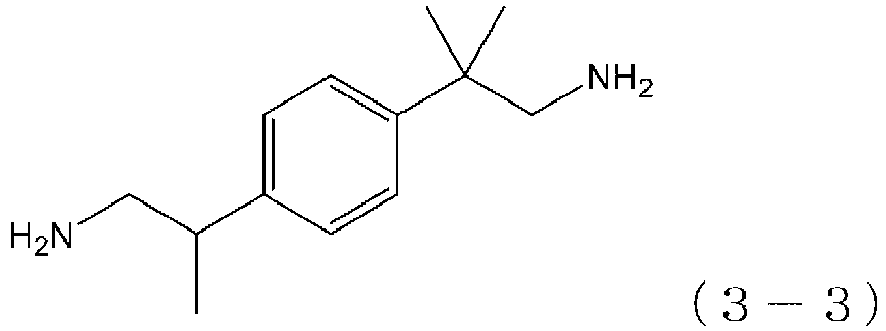
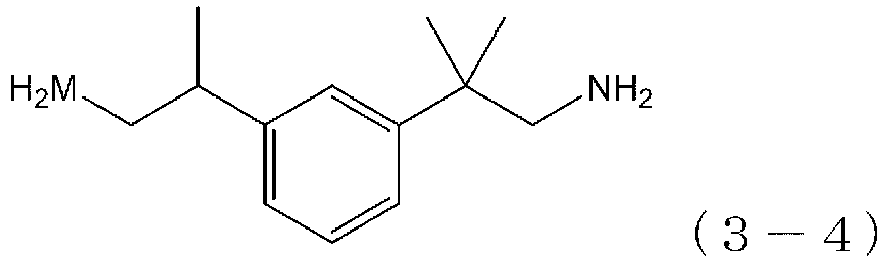
- One embodiment of the present invention relates to a diamino compound represented by Formulas (3-1) to (3-7) below:
- An embodiment of the present invention also relates to a methyl-adduct compound represented by Formulas (2-1) and (2-2) below:
- a 300 mL pressure-resistant reactor made of SUS316 was charged with 25.2 g of 1,4-phenylenediacetonitrile, 125 g of dimethyl carbonate, and 50.5 g of potassium carbonate as a base, the reactor was subjected to nitrogen replacement, the inside of the reactor was heated to 210°C, and a methylation reaction was allowed to proceed for 6.8 hours.
- a 300 mL pressure-resistant reactor made of SUS316 was charged with 29.0 g of the 2,2'-(1,4-phenylene)dipropanenitrile, synthesized as described above, 105 g of liquid ammonia as a solvent, and 2.99 g of Raney cobalt (available from W.R. Grace & Co.) as a catalyst, after which hydrogen gas was introduced into the reactor until the reaction pressure became 4 MPa.
- the inside of the reactor was heated to a reaction temperature of 100°C, and when the predetermined temperature was reached, the contents of the reactor were stirred at 750 rpm with an electromagnetic stirring blade while hydrogen gas was continuously supplied into the reactor such that a reaction pressure of 10 MPa was uniformly maintained, and an amination reaction (nitrile hydrogenation reaction) through hydrogen addition was advanced for 180 minutes.
- the liquid ammonia was distilled off, and the reaction product was dissolved in methanol to remove the catalyst and then analyzed by gas chromatography.
- the reaction yield of a monomethylated product was 0.5%
- the reaction yield of a trimethylated product was 0.7%.
- a 300 mL pressure-resistant reactor made of SUS316 was charged with 5.0 g of 1,4-phenylenediacetonitrile, 56.1 g of dimethyl carbonate, and 18.9 g of potassium carbonate as a base, the reactor was subjected to nitrogen replacement, the inside of the reactor was heated to 205°C, and a methylation reaction was allowed to proceed for 6.7 hours.
- the reactor was cooled to room temperature, and the produced carbon dioxide was released.
- 200 mL of water and 200 mL of a diethyl ether solvent were added, fractionation was implemented, the organic solvent layer was collected, and the solvent was removed by a rotary evaporator .
- the obtained crystals were analyzed by gas chromatography. The results indicated that the reaction yield of 2,2'-(1,4-phenylene)dipropanenitrile, which is a dimethyl adduct (dimethylated product), was 70.0%.
- a 300 mL pressure-resistant reactor made of SUS316 was charged with 5.0 g of 1,4-phenylenediacetonitrile, 55.3 g of dimethyl carbonate, and 18.8 g of potassium carbonate as a base, the reactor was subjected to nitrogen replacement, the inside of the reactor was heated to 170°C, and a methylation reaction was allowed to proceed for 6.7 hours.
- a 300 mL pressure-resistant reactor made of SUS316 was charged with 5.0 g of 1,4-phenylenediacetonitrile, 54.8 g of dimethyl carbonate, and 18.7 g of potassium carbonate as a base, the reactor was subjected to nitrogen replacement, the inside of the reactor was heated to 245°C, and a methylation reaction was allowed to proceed for 6.7 hours.
- Example 1 Example 2
- Example 3 Example 4 Component Substrate mol 0.16 0.03 0.03 0.03 K 2 CO 3 mol 0.37 0.14 0.14 0.14 Dimethyl carbonate mol 1.39 0.62 0.61 0.61 K 2 CO 3 /substrate molar ratio 2.3 4.4 4.3 4.3 Dimethyl carbonate/substrate molar ratio 8.7 19.9 19.6 19.4
- Reaction time hours 6.8 6.7 6.7 6.7 GC Measurements
- Conversion rate GC area% 100 100 83 100 mono-methyl adduct GC area% 0.5 0.1 46.5 0 di-methyl adduct GC area% 90.3 70 30.7 1.3 tri-methyl adduct GC area% 3.2 20.6 0.2 26.2 quad-methyl adduct GC area% 0.8 1.3 0 44.8
Landscapes
- Chemical & Material Sciences (AREA)
- Organic Chemistry (AREA)
- Chemical Kinetics & Catalysis (AREA)
- Organic Low-Molecular-Weight Compounds And Preparation Thereof (AREA)
- Low-Molecular Organic Synthesis Reactions Using Catalysts (AREA)
Abstract


Description
- The present invention relates to a compound and a method for producing the same.
- A compound in which the benzyl position of para-bezenediethanamine is methylated is useful as a raw material for a resin such as a polyamide. As the method for producing the methyl-adduct compound, a method in which phenylenediacetonitrile is methylated and subsequently hydrogenated is known. For example, Patent Document 1 discloses that methyl iodide is used as a methylation agent, and a borane complex is used as a reducing agent. In addition, Non-Patent Literature 1 also discloses that methyl iodide is used as a methylation agent. Incidentally, Non-Patent Literature 2 discloses that if phenyl acetonitrile is used as the substrate, dimethyl carbonate is used as the methylation agent.
- Patent Document 1:
JP 2004-503527 T -
- NPL 1: Tetrahedron, Vol. 32, pp. 487-491 (1976)
- NPL 2: Organic Syntheses, Coll. Vol. 10, p. 640 (2004), Vol. 76, p. 169 (1999)
- In Patent Document 1 and NPL 1, methyl iodide is used as the methylation agent, but methyl iodide is toxic to the human body. In addition, when methyl iodide is used, methyl groups are easily introduced in excess, and it is difficult to control the number of methyl groups (in other words, selective methylation is difficult). Therefore, the reaction must be carried out at a low temperature for a short amount of time and is not suited for industrial applications.
- In Patent Document 1, the borane complex is used as a reduction catalyst, but borane complexes are expensive and difficult to reuse, and thus are not industrially suited.
- Therefore, an object of the present invention is to provide a method for more selectively methylating phenylenediacetonitrile in comparison to a case in which methyl iodide is used as the methylation agent.
- As a result of diligent research, the present inventors discovered that by using potassium carbonate and dimethyl carbonate in combination, phenylenediacetonitrile can be selectively methylated and an industrially-suited production method can be achieved, and thereby the inventors completed the present invention.
- The present invention includes the following embodiments.
- [1] A method for producing a methyl-adduct compound, the method including methylating, in the presence of potassium carbonate and dimethyl carbonate, a dinitrile compound represented by Formula (1) below:


R1∼R4 each represent independently hydrogen or methyl, and from one to three of R1 ∼ R4 are each methyl. - [1-1] The method according to [1], wherein two of R1 ∼ R4 are methyl.
- [1-2] The method according to [1] or [1-1], wherein either R1 or R2, and either R3 or R4 are each methyl.
- [2] The method according to any one of [1] to [1-2], wherein Formula (1) is Formula (1A) below:


- [3] The method according to any one of [1] to [2], wherein a molar ratio of the potassium carbonate to the dinitrile compound is from 2.0 to 3.5.
- [3-1] The method according to any one of [1] to [3], wherein the molar ratio of the potassium carbonate to the dinitrile compound is from 2.0 to 3.0.
- [3-2] The method according to any one of [1] to [3-1], wherein the molar ratio of the potassium carbonate to the dinitrile compound is from 2.0 to 2.5.
- [3-1A] The method according to any one of [1] to [3-2], wherein a molar ratio of the dimethyl carbonate to the dinitrile compound is from 3.0 to 18.0.
- [3-2A] The method according to any one of [1] to [3-1A], wherein the molar ratio of the dimethyl carbonate to the dinitrile compound is from 5.0 to 14.0.
- [3-3A] The method according to any one of [1] to [3-2A], wherein the molar ratio of the dimethyl carbonate to the dinitrile compound is from 7.0 to 10.0.
- [4] The method according to any one of [1] to [3-3A], wherein the methylation is carried out at a temperature of from 180 to 230°C.
- [4-1] The method according to any one of [1] to [4], wherein the methylation is carried out at a temperature of from 190 to 220°C.
- [4-2] The method according to any one of [1] to [4-1], wherein the methylation is carried out at a temperature of from 200 to 210°C.
- [5] A method for producing a diamino compound, the method including hydrogenating a methyl-adduct compound produced by the method according to any one of [1] to [4-2] to obtain a diamino compound represented by Formula (3) below:

- [6] The method according to [5], wherein Formula (3) is Formula (3A) below:

- [7] where in Formula (3A), R1 ~ R4 are as described above. The method according to [5] or [6], wherein the hydrogenation is carried out in the presence of a solid hydrogenation catalyst.
- [7-1] The method according to any one of [5] to [7], wherein the hydrogenation is carried out in the presence of a Raney catalyst.
- [7-2] The method according to any one of [5] to [7-1], wherein the hydrogenation is carried out in the presence of Raney cobalt.
- [8] A compound selected from the group consisting of diamino compounds represented by Formulas (3-1) to (3-7) below:


- [9] A compound selected from the group consisting of methyl-adduct compounds represented by Formulas (2-1) and (2-2) below:


- According to the present invention, a method for selectively methylating phenylenediacetonitrile can be provided.
- Hereinafter, embodiments of the present invention will be described in detail; however, the present invention is not limited to these embodiments, and various modifications may be made within a range that does not depart from the spirit of the invention.
- One embodiment of the present invention pertains to a method for producing a methyl-adduct compound by methylating, in the presence of potassium carbonate and dimethyl carbonate, a dinitrile compound represented by Formula (1) below to obtain a methyl-adduct compound represented by Formula (2) below:


- In the production method according to the present embodiment, a dinitrile compound represented by Formula (1) can be selectively methylated by using potassium carbonate and dimethyl carbonate in combination. Herein, "selectively methylated" means to control the number of methyl groups to be introduced.
- From one to three of the R1 ~ R4 are methyl, preferably two of the R1 ~ R4 are methyl, and more preferably, either R1 or R2, and either R3 or R4 are methyl.
- Although not particularly limited, Formula (1) and Formula (2) are preferably Formula (1A) below and Formula (2A) below, respectively:


- A molar ratio of the potassium carbonate to the dinitrile compound is preferably from 2.0 to 3.5, more preferably from 2.0 to 3.0, and even more preferably from 2.0 to 2.5. By setting the molar ratio to the range described above, a compound in which either R1 or R2, and either R3 or R4 are methyl can be selectively obtained.
- The molar ratio of the dimethyl carbonate to the dinitrile compound is preferably from 3.0 to 18.0, more preferably from 5.0 to 14.0, even more preferably from 7.0 to 10.0. Setting the molar ratio to 3.0 or greater results in an accelerated reaction, and setting the molar ratio to 18.0 or less enables an increase in economic feasibility.
- The reaction temperature of the methylation reaction is preferably from 180 to 230°C, more preferably from 190 to 220°C, and even more preferably from 200 to 210°C. By setting the reaction temperature to the range described above, a compound in which either R1 or R2, and either R3 or R4 are methyl can be selectively obtained.
- The methylation reaction may be carried out until the reaction is completed, but the reaction time may be, for example, from 2 to 16 hours, from 4 to 12 hours, or from 6 to 8 hours.
- The production method according to the present embodiment can further comprise hydrogenating the methyl-adduct compound obtained in the methylation reaction to obtain a diamino compound represented by Formula (3) below:

- Although not particularly limited, Formula (3) is preferably Formula (3A) below:

- The hydrogenation reaction is preferably carried out under a hydrogen atmosphere in the presence of a hydrogenation catalyst. As the hydrogenation catalyst, a catalyst used in a normal nitrile hydrogenation reaction can be used, and specifically, a catalyst containing Ni and/or Co can be used. In general, a catalyst in which Ni and/or Co is supported by Al2O3, SiO2, diatomaceous earth, SiO2-Al2O3, or ZrO2 through a precipitation method, or a Raney catalyst such as Raney nickel or Raney cobalt is suitably used. A solid catalyst can be used repeatedly, and thus is suitable for industrial production. Among these, from the perspective of more effectively and more reliably advancing the reaction, a Raney cobalt catalyst and a Raney nickel catalyst are preferable. One of these catalysts may be used alone, or two or more may be used in combination.
- The mass ratio of the methyl-adduct compound to the hydrogenation catalyst is preferably from 2 to 30, more preferably from 5 to 20, and even more preferably from 8 to 10. When the mass ratio of the methyl-adduct compound to the hydrogenation catalyst is set to within the range described above, the yield and selectivity of the obtainable diamine compound can be increased.
- A solvent used in a normal hydrogenation reaction can be used in the hydrogenation reaction, and specific examples includes liquid ammonia, ammonia water, alcohols such as methanol, ethanol, 1-propanol, 2-propanol, 1-butanol, 2-butanol, and tert-butanol, and aromatic hydrocarbons such as meta-xylene, mesitylene, and pseudocumene. One of these solvents may be used alone, or two or more may be used in combination.
- The molar ratio of ammonia to the methyl-adduct compound is preferably from 10 to 150, more preferably from 25 to 100, and even more preferably from 40 to 50. When the molar ratio is set to greater than or equal to 10, there is a downward trend in generation of high boiling point compounds such as dimers and an upward trend in reaction performance, and when the molar ratio is set to 150 or less, the time required to remove liquid ammonia thereafter is reduced, and thus production efficiency is improved.
- The reaction temperature of the hydrogenation reaction is preferably from 40 to 160°C, more preferably from 60 to 140°C, and even more preferably from 80 to 120°C. Setting the reaction temperature of the hydrogenation reaction to 40°C or higher improves reactivity, and setting the reaction temperature of the hydrogenation reaction to 160°C or lower tends to decrease high boiling point compounds such as dimers.
- The pressure of the hydrogenation reaction is preferably from 1 to 20 MPa, more preferably from 4 to 16 MPa, and even more preferably from 8 to 12 MPa. When the pressure of the hydrogenation reaction is set to within the range described above, the yield and the selectivity of the obtainable diamine compound tends to increase.
- The hydrogenation reaction may be carried out until the reaction is completed, but the reaction time may be, for example, from 0.5 to 8 hours, from 1 to 6 hours, or from 2 to 4 hours.
- One embodiment of the present invention relates to a diamino compound represented by Formulas (3-1) to (3-7) below:




- An embodiment of the present invention also relates to a methyl-adduct compound represented by Formulas (2-1) and (2-2) below:


- Hereinafter, the present invention will be described in further detail with reference to examples, but the technical scope of the present invention is not limited to these examples.
- A 300 mL pressure-resistant reactor made of SUS316 was charged with 25.2 g of 1,4-phenylenediacetonitrile, 125 g of dimethyl carbonate, and 50.5 g of potassium carbonate as a base, the reactor was subjected to nitrogen replacement, the inside of the reactor was heated to 210°C, and a methylation reaction was allowed to proceed for 6.8 hours.
- After the completion of the reaction, the reactor was cooled to room temperature, and the produced carbon dioxide was released. Next, 200 mL of water and 200 mL of a diethyl ether solvent were added, fractionation was implemented, the organic solvent layer was collected, and the solvent was removed by a rotary evaporator. The obtained crystals were analyzed by gas chromatography. The results indicated that the reaction yield of 2,2'-(1,4-phenylene)dipropanenitrile, which is a dimethyl adduct (dimethylated product), was 90.3%.
- Details of the gas chromatography mentioned in the examples are as follows. Note that the reaction yields were all calculated by an area percentage of the components detected by gas chromatography.
- Model: "GC 2010 PLUS", available from Shimadzu Corporation
- Column: Product name "HP-1ms", available from Agilent Technologies, Inc., 30 m length × 0.25 mm inner diameter, 0.25 µm film thickness
- Conditions: Carrier gas, He (constant pressure: 73.9 kPa)
- Injection port temperature: 300°C
- Detector: FID
- Detector temperature: 300°C
- Column oven temperature: Started at 50°C, heated to 175°C at 5°C/min, then heated to 320°C at 20°C/min, and then held at 320°C for 30 minutes.
- A 300 mL pressure-resistant reactor made of SUS316 was charged with 29.0 g of the 2,2'-(1,4-phenylene)dipropanenitrile, synthesized as described above, 105 g of liquid ammonia as a solvent, and 2.99 g of Raney cobalt (available from W.R. Grace & Co.) as a catalyst, after which hydrogen gas was introduced into the reactor until the reaction pressure became 4 MPa. Next, the inside of the reactor was heated to a reaction temperature of 100°C, and when the predetermined temperature was reached, the contents of the reactor were stirred at 750 rpm with an electromagnetic stirring blade while hydrogen gas was continuously supplied into the reactor such that a reaction pressure of 10 MPa was uniformly maintained, and an amination reaction (nitrile hydrogenation reaction) through hydrogen addition was advanced for 180 minutes. After the completion of the reaction, the liquid ammonia was distilled off, and the reaction product was dissolved in methanol to remove the catalyst and then analyzed by gas chromatography. The results indicated that the reaction yield of 2,2'-(1,4-phenylene) bis(propan-1-amine), which is a dimethyl adduct (dimethylated product), was 92.5%. The reaction yield of a monomethylated product was 0.5%, and the reaction yield of a trimethylated product was 0.7%.
- A 300 mL pressure-resistant reactor made of SUS316 was charged with 5.0 g of 1,4-phenylenediacetonitrile, 56.1 g of dimethyl carbonate, and 18.9 g of potassium carbonate as a base, the reactor was subjected to nitrogen replacement, the inside of the reactor was heated to 205°C, and a methylation reaction was allowed to proceed for 6.7 hours.
- After the completion of the reaction, the reactor was cooled to room temperature, and the produced carbon dioxide was released. Next, 200 mL of water and 200 mL of a diethyl ether solvent were added, fractionation was implemented, the organic solvent layer was collected, and the solvent was removed by a rotary evaporator . The obtained crystals were analyzed by gas chromatography. The results indicated that the reaction yield of 2,2'-(1,4-phenylene)dipropanenitrile, which is a dimethyl adduct (dimethylated product), was 70.0%.
- A 300 mL pressure-resistant reactor made of SUS316 was charged with 5.0 g of 1,4-phenylenediacetonitrile, 55.3 g of dimethyl carbonate, and 18.8 g of potassium carbonate as a base, the reactor was subjected to nitrogen replacement, the inside of the reactor was heated to 170°C, and a methylation reaction was allowed to proceed for 6.7 hours.
- After the completion of the reaction, the reactor was cooled to room temperature, and the produced carbon dioxide was released. Next, 200 mL of water and 200 mL of a diethyl ether solvent were added, fractionation was implemented, the organic solvent layer was collected, and the solvent was removed by a rotary evaporator . The obtained crystals were analyzed by gas chromatography. The results indicated that the reaction yield of 2,2'-(1,4-phenylene)dipropanenitrile, which is a dimethyl adduct (dimethylated product), was 30.7%.
- A 300 mL pressure-resistant reactor made of SUS316 was charged with 5.0 g of 1,4-phenylenediacetonitrile, 54.8 g of dimethyl carbonate, and 18.7 g of potassium carbonate as a base, the reactor was subjected to nitrogen replacement, the inside of the reactor was heated to 245°C, and a methylation reaction was allowed to proceed for 6.7 hours.
- After the completion of the reaction, the reactor was cooled to room temperature, and the produced carbon dioxide was released. Next, 200 mL of water and 200 mL of a diethyl ether solvent were added, fractionation was implemented, the organic solvent layer was collected, and the solvent was removed by a rotary evaporator . The obtained crystals were analyzed by gas chromatography. The results indicated that the reaction yield of 2,2'-(1,4-phenylene)dipropanenitrile, which is a dimethyl adduct (dimethylated product), was 1.3%.
- The results of Examples 1 to 4 are shown in Table 1.
Table 1 Example 1 Example 2 Example 3 Example 4 Component Substrate mol 0.16 0.03 0.03 0.03 K2CO3 mol 0.37 0.14 0.14 0.14 Dimethyl carbonate mol 1.39 0.62 0.61 0.61 K2CO3/substrate molar ratio 2.3 4.4 4.3 4.3 Dimethyl carbonate/substrate molar ratio 8.7 19.9 19.6 19.4 Reaction Conditions Reaction temperature °C 210 205 170 245 Reaction time hours 6.8 6.7 6.7 6.7 GC Measurements Conversion rate GC area% 100 100 83 100 mono-methyl adduct GC area% 0.5 0.1 46.5 0 di-methyl adduct GC area% 90.3 70 30.7 1.3 tri-methyl adduct GC area% 3.2 20.6 0.2 26.2 quad-methyl adduct GC area% 0.8 1.3 0 44.8 - This patent application claims priority from the
Japanese Patent Application No. 2021-073893 (filed on April 26, 2021
Claims (9)
- A method for producing a methyl-adduct compound, the method comprising methylating, in the presence of potassium carbonate and dimethyl carbonate, a dinitrile compound represented by Formula (1) below:


R1 ~ R4 each independently represent hydrogen or methyl, and from one to three of R1 ∼ R4 are each methyl. - The method according to claim 1, wherein
Formula (1) is Formula (1A) below:
Formula (2) is Formula (2A) below:
- The method according to claim 1 or 2, wherein a molar ratio of the potassium carbonate to the dinitrile compound is from 2.0 to 2.5.
- The method according to any one of claims 1 to 3, wherein the methylation is carried out at a temperature of from 180 to 230°C.
- A method for producing a diamino compound, the method comprising hydrogenating a methyl-adduct compound produced by the method according to any one of claims 1 to 4 to obtain a diamino compound represented by Formula (3) below:

- The method according to claim 5, wherein Formula (3) is Formula (3A) below:

- The method according to claim 5 or 6, wherein the hydrogenation is carried out in the presence of a solid hydrogenation catalyst.
- A compound selected from the group consisting of diamino compounds represented by Formulas (3-1) to (3-7) below:


- A compound selected from the group consisting of methyl-adduct compounds represented by Formulas (2-1) and (2-2) below:


Applications Claiming Priority (2)
| Application Number | Priority Date | Filing Date | Title |
|---|---|---|---|
| JP2021073893 | 2021-04-26 | ||
| PCT/JP2022/017570 WO2022230656A1 (en) | 2021-04-26 | 2022-04-12 | Compound and method for producing same |
Publications (2)
| Publication Number | Publication Date |
|---|---|
| EP4151616A1 true EP4151616A1 (en) | 2023-03-22 |
| EP4151616A4 EP4151616A4 (en) | 2023-12-20 |
Family
ID=83847519
Family Applications (1)
| Application Number | Title | Priority Date | Filing Date |
|---|---|---|---|
| EP22795570.5A Pending EP4151616A4 (en) | 2021-04-26 | 2022-04-12 | COMPOUND AND PRODUCTION METHOD THEREFOR |
Country Status (5)
| Country | Link |
|---|---|
| US (1) | US11919833B2 (en) |
| EP (1) | EP4151616A4 (en) |
| JP (1) | JP7235184B1 (en) |
| CN (1) | CN115605457B (en) |
| WO (1) | WO2022230656A1 (en) |
Families Citing this family (1)
| Publication number | Priority date | Publication date | Assignee | Title |
|---|---|---|---|---|
| JP2024064798A (en) * | 2022-10-28 | 2024-05-14 | 三菱瓦斯化学株式会社 | Method for removing amine high boilers and method for producing amine product |
Family Cites Families (11)
| Publication number | Priority date | Publication date | Assignee | Title |
|---|---|---|---|---|
| GB9702194D0 (en) * | 1997-02-04 | 1997-03-26 | Lilly Co Eli | Sulphonide derivatives |
| SV2002000205A (en) * | 1999-11-01 | 2002-06-07 | Lilly Co Eli | PHARMACEUTICAL COMPOUNDS REF. X-01095 |
| ES2225558T3 (en) | 2000-06-13 | 2005-03-16 | Eli Lilly And Company | DERIVATIVES OF SULFONAMIDE. |
| US7700780B2 (en) * | 2005-03-04 | 2010-04-20 | Zhi Yuan Wang | Zwitterionic chromophores and macromolecules containing such chromophores |
| JP5076344B2 (en) * | 2006-03-30 | 2012-11-21 | 三菱瓦斯化学株式会社 | Method for producing aromatic diamino compound |
| US8835472B2 (en) * | 2010-09-02 | 2014-09-16 | Boehringer Ingelheim International Gmbh | Compounds, pharmaceutical compositions and uses thereof |
| CN103342663B (en) * | 2013-07-15 | 2015-07-29 | 凯莱英医药集团(天津)股份有限公司 | A kind of preparation method of Anastrozole key intermediate |
| CN104744237B (en) * | 2015-02-16 | 2016-08-24 | 浙江博聚新材料有限公司 | A kind of 2-(4-2-bromomethylphenyl) propanoic acid preparation method |
| WO2019017468A1 (en) * | 2017-07-21 | 2019-01-24 | 三菱瓦斯化学株式会社 | 2,5-bis(aminomethyl)furan production method |
| CN110872235A (en) * | 2018-08-30 | 2020-03-10 | 江苏瑞科医药科技有限公司 | Application of novel methyl carbonate methylation catalyst in preparation of α -methylphenylacetic acid |
| JP7473941B2 (en) | 2019-11-07 | 2024-04-24 | 学校法人産業医科大学 | Method and kit for assisting in the diagnosis of mesothelioma |
-
2022
- 2022-04-12 US US18/252,821 patent/US11919833B2/en active Active
- 2022-04-12 JP JP2022561191A patent/JP7235184B1/en active Active
- 2022-04-12 CN CN202280004169.7A patent/CN115605457B/en active Active
- 2022-04-12 WO PCT/JP2022/017570 patent/WO2022230656A1/en not_active Ceased
- 2022-04-12 EP EP22795570.5A patent/EP4151616A4/en active Pending
Also Published As
| Publication number | Publication date |
|---|---|
| CN115605457A (en) | 2023-01-13 |
| EP4151616A4 (en) | 2023-12-20 |
| JPWO2022230656A1 (en) | 2022-11-03 |
| CN115605457B (en) | 2025-03-18 |
| US20230416187A1 (en) | 2023-12-28 |
| WO2022230656A1 (en) | 2022-11-03 |
| US11919833B2 (en) | 2024-03-05 |
| JP7235184B1 (en) | 2023-03-08 |
Similar Documents
| Publication | Publication Date | Title |
|---|---|---|
| EP2626344B1 (en) | Method for producing trans-1,4-bis(aminomethyl)cyclohexane | |
| JP2014507380A (en) | Method for producing 3-aminomethyl-3,5,5-trimethylcyclohexylamine | |
| EP2626343B1 (en) | Method for producing bis(aminomethyl)cyclohexanes | |
| EP3118181A1 (en) | Composite metal catalyst composition, and method and apparatus for preparing 1,4-cyclohexanedimethanol using same | |
| JP5256024B2 (en) | Method for producing 4-aminodiphenylamine | |
| Ke et al. | Alcohol promoted N-methylation of anilines with CO2/H2 over a cobalt catalyst under mild conditions | |
| EP1873137B1 (en) | Production of Xylenediamines | |
| US11919833B2 (en) | Compound and method for producing same | |
| EP3524590B1 (en) | Method for producing 1, 4-dicyanocyclohexane, 1, 4-bis(aminomethyl)cyclohexane and 1, 4-cyclohexanedicarboxylic acid | |
| JP2702262B2 (en) | Method for producing bis (3-aminophenoxy) compound | |
| EP3670497B1 (en) | Method for producing dicyanocyclohexane | |
| EP3619186B1 (en) | Process for the production of semifluorinated alkanes | |
| JP7673751B2 (en) | Method for producing aromatic aminomethyl | |
| JP4117424B2 (en) | Method for producing trans-type 1,4-bis (aminomethyl) cyclohexane | |
| CN108430962A (en) | Intermolecular Reaction of Propargyl Ether with Dimethylfuran in the Presence of Gold(I) Complex | |
| JPH10259167A (en) | Method for isomerizing bis (aminomethyl) cyclohexane | |
| EP4116286B1 (en) | Method for producing fluorine-containing olefin | |
| JP7389658B2 (en) | Method for producing m-xylylenediamine | |
| CN117486759A (en) | A method for preparing methyl glutadicarbamate using furfurylamine as raw material | |
| CZ352298A3 (en) | Process for producing aromatic methylamines | |
| JP2003221375A (en) | N-cyanoethylated ortho and meta toluenediamine composition and method for manufacturing the same | |
| EP3907002A1 (en) | Catalyst for hydrogenation reaction and method for producing same | |
| KR101669652B1 (en) | The preparation method for the p-phenylenediamine | |
| KR101781022B1 (en) | Process for preparation of isocyanates using Palladium(II)-alkylimidazole catalyst system | |
| EP0619294B1 (en) | Process for producing 1-phenoxy-2-aminopropane |
Legal Events
| Date | Code | Title | Description |
|---|---|---|---|
| STAA | Information on the status of an ep patent application or granted ep patent |
Free format text: STATUS: THE INTERNATIONAL PUBLICATION HAS BEEN MADE |
|
| PUAI | Public reference made under article 153(3) epc to a published international application that has entered the european phase |
Free format text: ORIGINAL CODE: 0009012 |
|
| STAA | Information on the status of an ep patent application or granted ep patent |
Free format text: STATUS: REQUEST FOR EXAMINATION WAS MADE |
|
| 17P | Request for examination filed |
Effective date: 20221214 |
|
| AK | Designated contracting states |
Kind code of ref document: A1 Designated state(s): AL AT BE BG CH CY CZ DE DK EE ES FI FR GB GR HR HU IE IS IT LI LT LU LV MC MK MT NL NO PL PT RO RS SE SI SK SM TR |
|
| A4 | Supplementary search report drawn up and despatched |
Effective date: 20231120 |
|
| RIC1 | Information provided on ipc code assigned before grant |
Ipc: C07C 255/33 20060101ALI20231114BHEP Ipc: C07C 253/30 20060101ALI20231114BHEP Ipc: C07C 211/27 20060101ALI20231114BHEP Ipc: C07C 209/48 20060101AFI20231114BHEP |
|
| DAV | Request for validation of the european patent (deleted) | ||
| DAX | Request for extension of the european patent (deleted) | ||
| STAA | Information on the status of an ep patent application or granted ep patent |
Free format text: STATUS: EXAMINATION IS IN PROGRESS |
|
| 17Q | First examination report despatched |
Effective date: 20241002 |