EP4149208B1 - Backblech für mikrowellenofen - Google Patents
Backblech für mikrowellenofen Download PDFInfo
- Publication number
- EP4149208B1 EP4149208B1 EP21196681.7A EP21196681A EP4149208B1 EP 4149208 B1 EP4149208 B1 EP 4149208B1 EP 21196681 A EP21196681 A EP 21196681A EP 4149208 B1 EP4149208 B1 EP 4149208B1
- Authority
- EP
- European Patent Office
- Prior art keywords
- layer
- plate
- ferritic
- coating layer
- compound
- Prior art date
- Legal status (The legal status is an assumption and is not a legal conclusion. Google has not performed a legal analysis and makes no representation as to the accuracy of the status listed.)
- Active
Links
Images



Classifications
-
- A—HUMAN NECESSITIES
- A47—FURNITURE; DOMESTIC ARTICLES OR APPLIANCES; COFFEE MILLS; SPICE MILLS; SUCTION CLEANERS IN GENERAL
- A47J—KITCHEN EQUIPMENT; COFFEE MILLS; SPICE MILLS; APPARATUS FOR MAKING BEVERAGES
- A47J36/00—Parts, details or accessories of cooking-vessels
- A47J36/02—Selection of specific materials, e.g. heavy bottoms with copper inlay or with insulating inlay
- A47J36/027—Cooking- or baking-vessels specially adapted for use in microwave ovens; Accessories therefor
-
- A—HUMAN NECESSITIES
- A47—FURNITURE; DOMESTIC ARTICLES OR APPLIANCES; COFFEE MILLS; SPICE MILLS; SUCTION CLEANERS IN GENERAL
- A47J—KITCHEN EQUIPMENT; COFFEE MILLS; SPICE MILLS; APPARATUS FOR MAKING BEVERAGES
- A47J37/00—Baking; Roasting; Grilling; Frying
- A47J37/06—Roasters; Grills; Sandwich grills
- A47J37/0623—Small-size cooking ovens, i.e. defining an at least partially closed cooking cavity
- A47J37/0629—Small-size cooking ovens, i.e. defining an at least partially closed cooking cavity with electric heating elements
-
- H—ELECTRICITY
- H05—ELECTRIC TECHNIQUES NOT OTHERWISE PROVIDED FOR
- H05B—ELECTRIC HEATING; ELECTRIC LIGHT SOURCES NOT OTHERWISE PROVIDED FOR; CIRCUIT ARRANGEMENTS FOR ELECTRIC LIGHT SOURCES, IN GENERAL
- H05B6/00—Heating by electric, magnetic or electromagnetic fields
- H05B6/64—Heating using microwaves
- H05B6/6408—Supports or covers specially adapted for use in microwave heating apparatus
-
- H—ELECTRICITY
- H05—ELECTRIC TECHNIQUES NOT OTHERWISE PROVIDED FOR
- H05B—ELECTRIC HEATING; ELECTRIC LIGHT SOURCES NOT OTHERWISE PROVIDED FOR; CIRCUIT ARRANGEMENTS FOR ELECTRIC LIGHT SOURCES, IN GENERAL
- H05B6/00—Heating by electric, magnetic or electromagnetic fields
- H05B6/64—Heating using microwaves
- H05B6/647—Aspects related to microwave heating combined with other heating techniques
- H05B6/6491—Aspects related to microwave heating combined with other heating techniques combined with the use of susceptors
- H05B6/6494—Aspects related to microwave heating combined with other heating techniques combined with the use of susceptors for cooking
Definitions
- the present invention relates to the technical field of the household appliances, in particular the technical field of the microwave ovens and parts thereof. More precisely, the present invention relates to a plate or a dish for supporting, in a microwave oven, food items during a heating or a cooking or a thawing process. Such plate or dish is generally known as "crisp plate" in the technical field of the present disclosure.
- microwave ovens have diffused widely also thanks to the increase of their efficiency and of the possibility of cooking also complex foods provided by advanced functions that in past were not available for this kind of ovens.
- the microwave ovens are provided with a muffle wherein a supporting plate, also known as "crisp plate” is provided.
- the supporting plate is configured to be heated by means of the electromagnetic radiation that the microwave oven in use radiates in the muffle.
- the supporting plate is realized with a material that, once irradiated by an electromagnetic radiation, heats and diffuses the heat to the food; therefore, the supporting plate helps providing a heat source for assisting the cooking of the food from the bottom part thereof.
- the supporting plate may be configured to cause a browning of the food.
- Electromagnetic radiation is generated typically by means of a magnetron arranged outside, but close to, the muffle and the radiation is directed to the muffle by means of a waveguide.
- Today's microwave ovens cook food by irradiating microwaves typically in the range of 2 - 3 GHz, and precisely exploiting the 2,4 - 2,5 GHz band, at least for compliance to national regulations and for the effectiveness these wavelengths have for heating foods.
- Known supporting plates comprise a ferritic coating.
- the purpose of the ferritic coating is to be heated by the microwaves irradiated by the oven.
- the known supporting plates are subject to some drawbacks. Specifically, the known supporting plates have a limiting capability of absorbing microwave radiations, and this limits the amount of heat that they are able to generate. In other words, for reaching a predetermined target temperature, they require a significant amount of electromagnetic radiation power, which may overcook the food. Overcooking of the food may cause a substantial burning, far beyond a wished browning.
- the known supporting plates shown poor capacity of uniformly distributing the heat across their surfaces. A non-uniform distribution of the heat results in some spots or limited areas of the supporting plate being far hotter than others. This impacts on the quality of cooking, since it is known that for the vast majority part of cooking techniques, an uniform cooking temperature of the food is preferable in order to mitigate the risk of obtaining a food wherein some parts are not properly heated and/or wherein some other parts are overcooked or even burnt.
- the materials with which the supporting plates are realized shall have a precise Curie temperature that shall comply with the application. Limitations of the Curie temperature may cause a serious alteration of the behavior of the material, and cause poor heat spreading properties.
- the cooking, in particular the browning of food in a supporting plate is related to the Curie temperature of the compounds forming the plate, and is in particular related to the Curie temperature of the layer that is conceived to generate heat when invested by the microwaves radiation.
- Some supporting plates are at least partially realized in ceramic, which has shown a substantial transparency to the electromagnetic radiations at frequencies typically emitted by today's magnetrons. This implies that for achieving a proper cooking of the food from a bottom part thereof, an extra power is required to the magnetron.
- the Applicant notes that the known supporting plates provide for a substrate having relevant mechanical properties and a coating for causing the heating of the plate.
- the known coatings require relevant thickness and expensive processing techniques.
- the coating may not trap bubbles.
- the air contained in the bubbles may heat thereby causing a cracking of the coating, that therefore may detach from the underlying substrate layer.
- European patent EP3654736B1 discloses a liner for a crisp plate including ceramic nanoparticles in a polymer matrix, with carbon nanoparticles embedded and aligned therein.
- the polymer matrix of the crisp plate is a two-part pre-polymerized polymer.
- the carbon nanoparticles are enclosed in a liner that further comprises aluminum particles and nanocrystalline ceramic nanoparticles.
- An aim of the present disclosure is to provide a plate for a microwave oven, capable of overcoming or at least mitigating the drawbacks of the known supporting plates.
- the present invention provides a plate according to claim 1 and an assembly according to claim 15. Embodiments of the invention are set forth with the appended dependent claims.
- the present disclosure refers to a peculiar plate conceived for overcoming the drawbacks of the known art.
- Reference number 1 shows a plate for a microwave oven (the device referenced with the number 1 may also be defined as a dish because the terms "plate” and “dish” shall be seen as synonyms in the present description).
- the plate 1 is configured to support food to be heated by a microwave oven, in particular by the electromagnetic radiation in use irradiated by the microwave oven 10.
- the plate 1 of the present disclosure is in particular a so-called “crisp plate", configured to allow the browning of the food therein contained when the plate is irradiated with a microwave electromagnetic radiation.
- the plate 1 is configured to be housed in the muffle 11 of the microwave oven 10, which further includes a support for the plate 1 which is installed on the bottom 11f of the muffle 11.
- the support is configured to cause the rotation thereof around an axis that, in use, is substantially vertical (and consequently the rotation of the plate 1).
- the rotation of the plate (caused by the rotation of the support) may be useful for obtaining a uniform cooking of the food, in particular in those cases wherein - e.g. due to the physical configuration of the waveguide that opens in the muffle - it is not possible to achieve a symmetrical and or uniform distribution of the electromagnetic radiations in the muffle 11.
- the microwave oven 10 comprises a microwave source (in particular a magnetron) configured for generating an electromagnetic radiation, a cavity (in particular a muffle 11 internal to the casing of the microwave oven 10 and closable through a door 12) configured for accommodating food items to be heated or cooked or thawed and guiding means (in particular a waveguide) configured for allowing the electromagnetic radiation to be transferred from the microwave source to the cavity.
- Figure 1 further shows some schematic details of the microwave oven 10: a control unit and/or user interface 14, configured to allow the user select and/or see at least one among a proper cooking program, electromagnetic radiation power, cooking time, ventilation of the muffle 11, remaining cooking time, activation or deactivation of the oven.
- the microwave oven 10 further comprises a door 12, which preferably is provided with a transparent section 13, in particular a glass pane, conceived for allowing the user see the food while cooking when the door 12 is closed.
- the aim of the plate 1 is to enhance the uniform heating of the food and the heating efficiency of microwave oven for improving the cooking performances.
- Figure 2 shows a section of the plate 1 according to the present disclosure.
- the plate 1 comprises a central substantially flat portion and an external raised portion 1k.
- the plate 1 presents a substantially axisymmetric shape.
- the external raised portion 1k defines a perimetric raised ring or wall suitable to allow the plate 1 to contain substantially fluid and/or liquid food, while mitigating the risk of dispersion during the cooking in the muffle 11.
- the external raised portion 1k defines at least one wall that is inclined with respect to the central substantially flat portion.
- the external raised portion 1k may be substantially orthogonal with respect to the central substantially flat portion.
- Figure 3 shows a first embodiment of the plate 1 according to the present invention and in detail proposes a detailed view of the layers composing the plate 1.
- Figure 3 could be seen as a section according to line A-A of figure 2 of a portion of the plate 1.
- the plate 1 comprises a substrate layer 1s configured for supporting food items to be cooked in the microwave oven 10.
- the substrate layer 1s is configured to have a robustness and/or has a rigidity sufficient to realize a self-sustaining shape of the plate 1 even without the help of any further layer.
- the substrate 1 is configured to sustain at least the weight of the food that is typically cooked in a microwave oven.
- the thickness of the substrate layer 1s is chosen by the technician in accordance to the overall size of the plate 1.
- the thickness of the substrate layer 1s measured along a direction that is substantially orthogonal to the plane along which the substrate layer 1s mainly extends, is substantially constant.
- the plate 1 comprises at least a first coating layer 1c configured to be heated by means of the electromagnetic radiation in use irradiated by the microwave oven 10.
- the purpose of the coating layer 1c is to generate heat when invested by the electromagnetic radiation irradiated by the microwave oven.
- the material of the coating layer 1c is suitable to generate heat when invested by an electromagnetic radiation in the field of the microwaves (300 MHz to 300 GHz).
- the Applicant notes that, in general, consumer microwave ovens exploit the ISM microwaves band of 2,4 - 2,5 GHz (formally, the carrier lays at 2,45 GHz), and for such reason the coating layer 1c may be preferably particularly configured to generate heat when radiated by a radiation in the 2 - 3 GHz band.
- a preferred thickness of the coating layer 1c lies in the range 1mm to 4.5mm, preferably 1.5mm to 4mm, more preferably 2mm to 3.5mm, even more preferably 2.5mm to 3mm.
- the coating layer 1c is obtained through injection moulding (this however shall not be seen as a limitation since the coating layer 1c may alternatively applied e.g. by being sprayed on the substrate layer 1s).
- the first thickness is greater than the second thickness.
- the thickness of the coating layer 1c measured along a direction that is substantially orthogonal to the plane along which the coating layer 1c mainly extends, is substantially constant.
- the material with which the at least a first coating layer 1c is realized exhibits a selected Curie temperature lower than the desirable maximum temperature which is required by a proper food cooking.
- the Curie temperature is the temperature beyond which a ferromagnetic material loses some intrinsic properties as the non-univocal correspondence between the external field and magnetization and therefore behaves similarly to a paramagnetic material.
- the choice of materials having a proper Curie temperature is important to allow a proper cooking of the food in the microwave oven.
- the irradiation of the plate 1 by means of a microwave electromagnetic radiation below the Curie temperature there is an energy absorption that causes an increase of the temperature of the material.
- the heating of the material causes its temperature to exceed the Curie temperature, independently of the electromagnetic radiation the energy absorption will substantially cease; in the areas of the material wherein the Curie temperature is exceeded, the conduction of heat is substantially stopped.
- the overall behavior of the plate 1 is such that it can reach a temperature ranging between 250°C and 290°C, more preferably, between 260°C and 280°C when subjected to a microwave electromagnetic radiation having a frequency in the range 2 - 3 GHz, more preferably in the range 2,4 - 2,5 GHz at a power of 900 - 950 W.
- a contacting surface is defined between the at least a first coating layer 1c and the substrate layer 1s, this contacting surface being substantially planar; this helps reducing the risk that some air bubbles remain trapped between the two layers.
- the coating layer 1c is specifically configured to improve the heat spreading, the spreading uniformity and the heating rate of the plate 1 when irradiated by such electromagnetic radiation.
- the coating layer 1c is a multilayer coating and comprises at least a first layer 1c' and a second layer 1c".
- the coating layer 1c comprises a ferritic material and a boron nitride compound.
- Boron nitride (hBN) is an optimal choice when there is a requirement of heating by means of an electromagnetic radiation, especially within the 2 - 3 GHz band.
- a substantially planar contacting surface is defined between the first layer 1c' and the second layer 1c".
- the thickness of the first layer 1c' measured along a direction that is substantially orthogonal to the plane along which the first layer 1c' mainly extends, is substantially constant.
- the thickness of the second layer 1c always measured along a direction that is substantially orthogonal to the plane along which the second layer 1c" mainly extends, is substantially constant.
- the ferritic material comprises a manganese-zinc ferritic compound or a nickel-manganese ferritic compound or even a nickel-copper-zinc ferritic compound.
- the Ni 0,5 Mn 0,5 Fe 2 O 4 compound the family (Mn x Zn y Fe 2 +1 -x-y )Fe 3 + 2 O 4 of manganese-zinc ferritic compounds and the Ni 0.60- yCu y Zn 0.42 Fe 1.98 O 0,39 compound are ferritic compounds having Curie temperatures compatible with the scope of allowing a proper cooking, eventually browning, of the food.
- any of the aforementioned compounds may optionally comprise Bi 2 O 2 .
- the Ni 0,5 Mn 0,5 F 2 O 4 compound has a Curie temperature of about 350° C.
- the first layer 1c' is an outer, superficial layer
- the second layer 1c" is an inner (or buried) layer and is in contact with the substrate layer 1s.
- the first layer 1c' of the coating layer 1c is the layer that the user may touch when manipulating the plate 1 and that may also be in contact with the food, so that the first layer 1c' can advantageously have food-compatibility properties.
- the coating layer 1c is applied only to the lower surface of the substrate layer 1s, i.e. only to the surface of the substrate layer 1s opposite to the surface destined for coming into contact with the food.
- the present invention shall not be intended as to be limited in that the coating layer 1c, in use conditions of the plate 1, is necessarily below the substrate layer 1s.
- the plate 1 (due to the food-compatibility of the coating layer 1c) may alternatively have the coating layer 1c above the substrate layer 1s in the conditions of use, i.e. in the spatial orientation depicted in figure 2 wherein the concavity of the plate is directed upwards.
- the substrate layer 1s may be made of metal, e.g. aluminum.
- the substrate layer 1s is at least partially made of an electrically insulating material and, in particular, comprises a glass ceramic material and/or a glass-fiber reinforced plastic.
- This latter material provides a good electric insulation, which is important when the plate 1 is irradiated with such electromagnetic radiation generated by the magnetron of the microwave oven (since otherwise it may conduct the electric current induced by the electromagnetic radiation), and provides also a sufficient robustness to support the weight of the food.
- the glass ceramic material has a very low reacting behavior with any acid or basic substance that may be found in foods.
- the first layer 1c' comprises a boron nitride (hBN) compound.
- the second layer 1c" comprises a polymeric matrix, being provided with a silicone.
- one type of polymer considered to be suitable for the coating of the present concept is RBL-9050-50P Liquid Silicone Rubber.
- Two-pair, 10 to 1 mix, clear, fabric coating grade liquid silicone rubber offers unique homogeneous mixing.
- This two-part pre-polymerized polymer composite is the 10 to 1 mix, clear, fabric coating grade liquid silicone rubber which has an extremely low viscosity, no post-curing requirements, and excellent electrical insulating properties.
- the two-part pre-polymerized polymer composite is equally suitable for spray-on and dip coating applications.
- the 10 to 1 mix of this polymer refers to the 10 to 1 base to catalyst 87-RC ratio of the polymer.
- the Applicant has tested several embodiments for the second layer 1c" comprising a predefined ratio between the ferritic powders and the polymer, especially the silicone.
- the tests were conducted with percentage ratios by weight (wt%) between the ferritic powders and silicones between 70:30 and 90:10, and in particular with percentage ratios by weight (wt%) between the ferritic powders and silicones between 75:25 and 85:15. Tests were conducted with both solid and liquid silicones.
- an excerpt of four tests performed by the Applicant is proposed.
- Test 1 in one non-limiting embodiment the percentage ratio by weight (wt%) between the ferritic powders and the silicone was 78:22; in test 1, the silicone was solid silicone.
- Test 2 in another non-limiting embodiment the percentage ratio by weight (wt%) between the ferritic powders and the silicone was 80:20; in test 2, the silicone was solid silicone.
- Test 3 in another non-limiting embodiment, the percentage ratio by weight (wt%) between the ferritic powders and the silicone was 82:18; in test 3, the silicone was solid silicone.
- Test 4 in another non-limiting embodiment, the percentage ratio by weight (wt%) between the ferritic powders and the silicone was 82:18; in test 4, the silicone was liquid silicone.
- the polymeric matrix comprises a bi-component, pre-polymerized polymer.
- the second layer 1c" may result as a composite ferritic-polymer-carbon layer.
- the second layer 1c" comprises the Ni 0,5 Mn 0,5 Fe 2 O 4 compound and preferably is constituted by the Ni 0,5 Mn 0,5 F 2 O 4 compound, excepting impurities.
- the second layer 1c" comprises the family (Mn x Zn y Fe 2 +1 -x-y )Fe 3 + 2 O 4 of manganese-zinc ferritic compounds and preferably is constituted by the family (Mn x Zn y Fe 2 +1 -x-y )Fe 3 + 2 O 4 of manganese-zinc ferritic compounds, excepting impurities.
- Ni 0,5 Mn 0,5 Fe 2 O 4 compound, or the family (Mn x Zn y Fe 2 +1 -x-y )Fe 3 + 2 O 4 of I manganese-zinc ferritic compounds, and the polymeric matrix are blended together.
- the second layer 1c" of the coating layer 1c further comprises also a carbon material which is further blended, in particular uniformly blended, with the ferritic material.
- the embodiment of figure 4 shows that the second layer 1c" comprises the Ni 0,5 Mn 0,5 Fe 2 O 4 compound uniformly blended with the carbon material.
- Another embodiment comprises the second layer 1c" being provided with any of the compounds of the family (Mn x Zn y Fe 2 +1 -x-y )Fe 3 + 2 O 4 of manganese-zinc ferritic compounds blended with the carbon material.
- Another embodiment comprises the second layer 1c" being provided with the Ni 0.60-y Cu y Zn 0,42 Fe 1,98 O 0,39 compound blended with the carbon material.
- the carbon material comprises a carbon ferritic powder.
- the carbon ferritic powder exhibits a low Curie temperature, which lays around 210° C.
- the Applicant studied several types of carbon materials and realised that a particularly efficient material may comprise carbon nanotubes.
- the Ni 0,5 Mn 0,5 Fe 2 O 4 compound or any of the compounds of the family (Mn x Zn y Fe 2 +1 -x-y )Fe 3 + 2 O 4 of manganese-zinc ferritic compounds, or even the Ni 0.60-y Cu y Zn 0,42 Fe 1,98 O 0,39 compound may comprise ferromagnetic nanowires. Exploiting nanotubes and nanowires properties allows realizing very precise, dense layers, whose property of heating distribution is uniform.
- the nanotubes may be single-walled nanotubes or double-walled nanotubes.
- the nanotubes may have a common, or unidirectional, orientation.
- the carbon material in the second layer 1c" is blended with the ferritic material in an amount of 1.0 wt% to 6.0 wt%.
- wt% it is intended percentage by weight.
- the carbon material is blended with the Ni 0,5 Mn 0,5 Fe 2 O 4 compound or alternatively with any of the compounds of the family (Mn x Zn y Fe 2 +1 -x-y )Fe 3 + 2 O 4 of manganese-zinc ferritic compounds, or even alternatively with the Ni 0.60-y Cu y Zn 0,42 Fe 1,98 O 0,39 compound, optionally comprising Bi 2 O 3 , in an amount of 1.0 wt% to 6.0 wt%.
- the ratio between the carbon material and the ferritic material may be, at the ends of the aforementioned ranges, 1.0 wt% of carbon material and 99.0 wt% of ferritic material or, at the opposite end of the range, 6.0 wt% of carbon material and 94.0 wt% of ferritic material.
- the carbon material is blended with the ferritic material in an amount of 1.5 wt% to 5.5 wt%.
- the carbon material is blended with the Ni 0,5 Mn 0,5 Fe 2 O 4 compound, or alternatively with any of the compounds of the family (Mn x Zn y Fe 2 +1 -x-y )Fe 3 + 2 O 4 of manganese-zinc ferritic compounds, or even alternatively with the Ni 0.60-y Cu y Zn 0,42 Fe 1,98 O 0,39 compound, optionally comprising Bi 2 O 3 , in an amount of 1.5 wt% to 5.5 wt%.
- the ratio between the carbon material and the ferritic material may be, at the ends of the aforementioned ranges, 1.5 wt% of carbon material and 98.5 wt% of ferritic material or, at the opposite end of the range, 6.5 wt% of carbon material and 93.5 wt% of ferritic material.
- the purpose of the aforementioned blending ratio is to keep at least the second layer 1c" substantially electrically insulating and/or showing, when irradiated with the electromagnetic radiation within the specifications as above disclosed, an optimal heating behavior when invested by a field of electromagnetic fields oscillating in the microwaves domain.
- Figure 5 shows an alternative embodiment of the plate 1 herein disclosed, wherein the substrate layer 1s is sandwiched between two coating layers 1c.
- a first coating layer 1c is arranged above the substrate layer 1s and that a second coating layer 1c is arranged below the substrate layer 1s.
- the reference number 2 identifies a contacting surface between the substrate layer 1s and the first coating layer 1c laying below the substrate layer 1s and the reference number 3 identifies a contacting surface between the substrate layer 1s and the second coating layer 1c laying above the substrate layer 1s.
- the first and the second coating layers 1c are arranged respectively at a first and at a second side of the substrate layer 1s and the first side and second side are opposite one with respect to the other.
- Those contacting surfaces are substantially planar, or at least have a plurality of planar portions allowing a proper contact with the juxtaposed layer.
- At least one between the first contacting surface 2 and the second contacting surface 3 is substantially planar and/or is substantially parallel to the contacting surface that lays between the first layer 1c' and the second layer 1c".
- first and the second coating layers have the same composition of materials; in another embodiment the first and the second coating layers may have a different composition of materials, especially concerning the composition of their second layers 1c", which in an embodiment may comprise different ferritic materials.
- the first and the second coating layers 1c have both the respective first layer 1c' comprising boron nitride (hBN) as above described. Said boron nitride is hexagonal boron nitride.
- the coating layer 1c may have a flat surface or a textures surface.
- Figure 6 shows a particular embodiment of the plate 1 of the present disclosure.
- a coating layer 1c in form of a plurality of tiles 1t is applied to the substrate layer 1s.
- the composition of the coating layer 1c is the same as above described, and thus it is not completely repeated here. It is herewith remarked that all the tiles 1t have the first and the second layers 1c', 1c" as above described. Albeit this shall not be considered limiting, at least part of the plurality of tiles 1t has a thickness of 1,5mm to 3,5mm, preferably of 2mm to 3mm, more preferably of 2.5mm to 2.75mm.
- all tiles 1t of the plate 1 have the same composition of materials.
- the plate 1 comprises at least a first tile and a second tile having a different composition of materials.
- the compositions of the tiles follows the axisymmetric shape of the plate 1 and may vary depending on the distance of the tile from the center of the plate 1, so that all tiles having the same distance from the center have the same composition of materials.
- the tiles 1t are separate one with respect to the other, and thus an interspace is left between two adjacent tiles 1t, such an interspace acting as venting channel and/or compensating for possible thermal expansion of the tiles 1t.
- the tiles 1t are closely juxtaposed in such a way that substantially no interspace is left between two adjacent tiles 1t.
- the tiles 1t have almost identical thickness with a substantially flat lower surface (where the lower surface is the surface of the tiles 1t opposite to that which contacts the substrate layer 1s).
- the Applicant specifically notes that, even if the schematic section of figure 6 shows the plurality of tiles 1t forming the coating layer 1c laying below the substrate layer 1s, this shall not be intended that actually the plate 1 has the tiles 1t below the substrate layer 1s in the conditions of use, i.e. in the spatial orientation depicted in figure 2 wherein the concavity of the plate is directed upwards.
- the tiles 1t forming the coating layer 1c may be, in such conditions of use, also above the substrate layer 1s.
- tiles 1t as previously described may be applied to both opposite surfaces of the substrate layer 1s.
- Figure 7 shows another embodiment of the plate 1 according to the present disclosure, wherein a plurality of venting openings 1v is arranged in the coating layer 1c. It is noted that figure 7 shows an embodiment wherein only a single coating layer 1c is juxtaposed on the substrate layer 1s on its lower side. This does not mean that this is the only embodiment wherein the venting openings 1v may be present. In fact, venting openings 1v may be present also in embodiments of the plate 1 wherein the substrate layer 1s is sandwiched between a first and a second coating layers 1c similarly to the embodiment of figure 5 . In this latter case, the venting openings 1v may be present in the first coating layer 1c (i.e. the coating layer laying below the substrate layer 1s) of in the second coating layer 1c (i.e. the coating layer laying above the substrate layer 1s) or in both the first and the second coating layers.
- first coating layer 1c i.e. the coating layer laying below the substrate layer 1s
- the second coating layer 1c
- the venting openings 1v are in a form of holes that extend in a direction substantially transversal with respect to the direction along which the substrate layer 1s and/or the coating layers 1c substantially mainly extend.
- figure 7 shows an embodiment wherein the venting openings 1v are arranged along a direction substantially perpendicular to the direction along which the substrate layer 1s and/or the coating layer 1c mainly extends.
- Figure 7 shows an embodiment wherein the venting openings 1v extend along the entire thickness of the coating layer 1c in such a way to expose substantially part of the underlying substrate layer 1s; this shall not be intended as limiting, since in another embodiment, which is not shown in the annexed figures, the venting openings 1v may extend only for part of the thickness of the coating layer 1c.
- An adequate distance between a couple of consecutive venting openings 1v is 3mm to 28mm, preferably 9mm to 18mm.
- venting openings 1v may have a substantially constant cross-section, or a variable cross-section; the cross-section may assume a substantially rounded shape or any other type of shape.
- venting channels in particular extending along two directions transversal to each other may be envisaged.
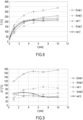
- Figures 8 and 9 shows diagrams of absolute temperature and of temperature differentials over time that are obtained by several examples of plates 1 according to the present disclosure (embodiments 1, 2 and 3, abbreviated with emb.1, emb.2, emb.3) and according to the known art (ref.1, ref.2).
- Embodiments 1, 2, 3 differ to each other in that the active ingredients are present in the matrix in different loading concentrations.
- embodiments 1 and 2 differ to each other because of a different concentration of the carbon nanotubes (around 4,55% in embodiment 1 vs. around 1,5% in embodiment 2).
- the graph of figure 8 is obtained by keeping constant the power of the electromagnetic radiation with which the plate 1 is irradiated (in particular at 950 W). It is noted that the embodiments 1 and 2 obtain the most important temperature increase over the time and this means that they heat more and before other embodiments and the plates known in the art.
- the coating layer 1c is configured to reach at least a surface temperature of 200°C, preferably at least of 210°C, more preferably at least of 220°C in 3 minutes, when the plate 1 is heated by a microwave oven 10 irradiating an electromagnetic radiation at a power of at least 750W or of at least 950W.
- the graph of figure 9 shows a diagram that is obtained by keeping constant the power of the electromagnetic radiation with which the plate 1 is irradiated (in particular at 950 W).
- This diagram shows that the plate according to embodiment 1 has a temperature differential (the difference of the temperature between the hottest and the coldest part of the plate 1) which is higher than that of embodiment 2 and embodiment 3; the temperature differentials of embodiments 2 and 3 indeed are confined respectively within 100 degrees Celsius and within 60 degrees Celsius.
- the coating layer 1c is so configured that the temperature differential is kept in the ranges of 40 degrees Celsius to 60 degrees Celsius, when the plate 1 is heated by a microwave oven 10 irradiating an electromagnetic radiation at a power of at least 750W or of at least 950W.
- Figure 10 shows a thermal image captured by means of a thermal camera and referring to a specific embodiment of the plate 1 according to the present disclosure, being irradiated by an electromagnetic radiation at 2,45 GHz in a microwave oven.
- the zones of the image being darker are colder than the zones of the image being whiter. It is apparent that the central substantially flat portion of the plate 1 is substantially uniform in temperature.
- the plate 1 being provided with the at least one coating layer 1c as above described is configured to keep a temperature difference between an hottest portion of the plate 1 and a coldest portion of the plate 1 within the range 20°C - 80°C, preferably within the range 30°C - 70°C, more preferably within the range 40°C - 60°C.
- Figure 11 discloses a further embodiment of the plate according to the present disclosure (presented in particular as a variant to the embodiment of figure 4 ).
- the plate 1 comprises a substrate layer 1s that has the features already disclosed in the present document, which therefore are not repeated.
- This latter embodiment comprises at least a first coating layer 1c which is provided with a first layer 1c', a second layer 1c" and an auxiliary layer 1a.
- the first layer 1c' and the auxiliary layer 1a comprise a boron nitride compound, which is configured to cause a substantial distribution of heat induced, in use, by the electromagnetic radiation irradiated by the microwave oven 10.
- the thickness of the auxiliary layer 1a measured along a direction that is substantially orthogonal to the plane along which the auxiliary layer 1a mainly extends, is substantially constant.
- the section of the plate 1 is composed as follows.
- the top layer is formed by the substrate layer 1s. This latter is juxtaposed to the auxiliary layer 1a comprising the boron nitride compound.
- the auxiliary layer 1a is juxtaposed to the second layer 1c", and thus results sandwiched between the substrate layer 1s (at the top) and the second layer 1c" (at the bottom).
- the second layer 1c" is juxtaposed to the first layer 1c'.
- the second layer 1c" is sandwiched between the first layer 1c' and the auxiliary layer 1a.
- FIG 11 shows that the coating layer 1c provided with the auxiliary layer 1a is only provided below the substrate layer 1s, it may be noted that according to a further non-limiting embodiment the coating layer 1c provided with such auxiliary layer 1a may be also provided, or alternatively provided, above the substrate layer 1s.
- Venting openings and/or tiles as above described may be provided in the coating layer 1c also when this latter is provided with the auxiliary layer 1a. In this latter case, it may be noted that the venting openings 1v may extend from the first layer 1c up to the auxiliary layer 1a.
- the present invention is open to several variants wherein above described layers are alternated in different ways.
- a variant may be contemplated wherein layers comprising the boron nitride compound are alternated to layers comprising the ferritic material.
- the present invention may contemplate several sandwich structures for the coating of the plate 1, wherein the elements of the sandwich structures are in particular the base matrix with the ferrites, the boron nitride film and the carbon nanotubes.
- the elements of the sandwich structures are in particular the base matrix with the ferrites, the boron nitride film and the carbon nanotubes.
- a sandwich structure formed by base matrix ferrite layers and boron nitride film layers alternating with each other may be envisaged.
- a further sandwich structure wherein several layers of base matrix are covered (internally and/or externally) by a boron nitride layer may be envisaged as well.
- the plate 1 is capable of being heated very efficiently by microwaves radiation and this helps in reducing the power required to properly heat food from the bottom part thereof in a microwave oven.
- the efficient heating obtained by the coating layer of the plate 1 here described indirectly allows to lengthen the lifetime of the magnetron of the microwave oven, since for a same reached cooking temperature, the amount of power required by the magnetron is lower than that is required with supporting plates of the known art.
- the plate 1 helps achieving high-energy efficiency rates; in such a way, when the plate 1 is arranged in the microwave oven, the overall assembly realized by the microwave oven and the plate 1 complies easily with even stringent energy efficiency regulations.
- the plate 1 helps in providing a proper food cooking and mitigates the risk of overcooking of the lateral and top portion of foods with respect to the lower portion of the food.
- the plate 1 helps to achieve a proper uniform cooking and/or browning of the food especially when in use is rotated by the support in the muffle of the microwave oven.
- the plate 1 according to the present disclosure heats fast, and thus a small amount of time is required to achieve a proper cooking temperature of the bottom of the food.
- the plate 1 according to the present disclosure has a very effective heating distribution behavior and, in particular, a very effective heating uniformity behavior; this reduces the impact of the food positioning on the plate 1 on the achievement of an optimal cooking.
- the plate 1 according to the present disclosure is food-compatible, and therefore no issues are present in case any food is directly put in contact with the plate 1, especially with the coating layer 1c and/or with the substrate layer 1s.
- the plate 1 is hence immune from any toxicity threats.
- the plate 1 according to the present disclosure is advantageously conceived in such a way to reduce the risk of permanence of air bubbles within, or between, the layers of the substrate or of the coating. This reduces the risk of detachment of the coating layer from the substrate layer when the plate 1 is heated.
- the plate 1 is realized with materials that allow a cost-saving production and that allow to obtain very smooth surfaces, that provide an overall quality aspect when seen by a user.
- the thickness of the coating layer 1c of the plate 1 according to the present disclosure can be further reduced with respect to the thickness of the coating layers of the known art without compromising the effectiveness of the heating distribution.
- the thermal stability of the coating layer 1c is improved, and this contributes to lengthen the lifetime of the plate 1, mitigating the risk of detachment of the coating layer 1c with respect to the substrate layer 1s.
- the plate 1 according to the present disclosure is very durable.
- the plate 1 according to the present disclosure may be washed in a dishwasher with substantially no risk of significant affection or damaging to the coating layer.
Landscapes
- Physics & Mathematics (AREA)
- Electromagnetism (AREA)
- Engineering & Computer Science (AREA)
- Food Science & Technology (AREA)
- Cookers (AREA)
- Electric Ovens (AREA)
Claims (15)
- Eine Platte (1) für einen Mikrowellen-Herd bzw. -Ofen (10), umfassend:- eine Substratschicht (1s), die dazu konfiguriert ist, Lebensmittel zu tragen, die erhitzt oder gekocht oder aufgetaut werden sollen, die insbesondere im genannten Mikrowellenofen (10) erhitzt oder gekocht oder aufgetaut werden sollen, und- mindestens eine Beschichtung bzw. Überzugsschicht (1c), die zumindest teilweise an die Substratschicht (1s) angrenzt und mit dieser in Kontakt steht, wobei die Überzugsschicht (1c) so konfiguriert ist, dass sie im Gebrauch mittels einer elektromagnetischen Strahlung erwärmt wird, insbesondere mittels einer elektromagnetischen Strahlung, die vom Mikrowellenofen (10) ausgestrahlt wird,wobei die Überzugsschicht (1c) eine mehrschichtige Beschichtung ist, die zumindest eine erste Schicht (1c') und eine zweite Schicht (1c") umfasst,dadurch gekennzeichnet, dass die erste Schicht (1 c') eine Bornitrid-Verbindung umfasst und die zweite Schicht (1c') ein ferritisches Material umfasst.
- Eine Platte (1) nach Anspruch 1, wobei die Substratschicht (1s) ein elektrisch isolierendes Material umfasst, wobei das genannte elektrisch isolierende Material insbesondere Glaskeramik und/oder glasfaserverstärkten Kunststoff umfasst.
- Eine Platte (1) nach Anspruch 1 oder 2, wobei die zweite Schicht (1c") eine Polymermatrix umfasst, wobei die Polymermatrix mit einem Silikon versehen ist, und wobei die Polymermatrix ein präpolymerisiertes Zweikomponenten-Polymer umfasst, wobei optional die zweite Schicht (1c") eine ferritische Polymer-Kohlenstoff-Verbundschicht ist.
- Eine Platte (1) nach einem oder mehreren der vorstehenden Ansprüche, wobei die erste Schicht (1 c') eine äußere, oberflächliche Schicht ist und wobei die zweite Schicht (1c") in Kontakt mit der Substratschicht (1s) steht, wobei die genannte zweite Schicht (1c") zwischen der Substratschicht (1s) und der ersten Schicht (1c') angeordnet ist.
- Eine Platte (1) nach einem oder mehreren der vorstehenden Ansprüche, wobei die zweite Schicht (1c") ein Kohlenstoffmaterial umfasst und wobei die zweite Schicht (1c") eine Verbundschicht ist, in der das Kohlenstoffmaterial mit dem ferritischen Material vermischt, gegebenenfalls gleichmäßig vermischt ist.
- Eine Platte (1) nach Anspruch 5, wobei das Kohlenstoffmaterial Kohlenstoff-Nanoröhren umfasst und wobei das ferritische Material ferromagnetische Nanodrähte umfasst, und wobei die Kohlenstoff-Nanoröhren vermischt werden mit dem genannten ferritischen Material, optional mit den genannten ferromagnetischen Nanodrähten, in einer Menge von 1,0 Gew.-% bis 7,0 Gew.-%, bevorzugt 1,0 Gew.-% bis 6,0 Gew.-%, stärker bevorzugt 1,5 Gew.-% bis 5,5 Gew.-%, noch stärker bevorzugt 4,0 Gew.-% bis 5,0 Gew.-%, und/oder derart, dass die zweite Schicht (1c") im Wesentlichen elektrisch isolierend bleibt.
- Eine Platte (1) nach einem oder mehreren der vorstehenden Ansprüche, wobei das ferritische Material mindestens eine der Verbindungen aus der folgenden Liste umfasst: eine ferritische Nickel-Mangan-Verbindung, eine ferritische Nickel-Kupfer-Zink-Verbindung, eine ferritische Mangan-Zink-Verbindung, eine Kohlenstoff-Ferrit-Verbindung.
- Eine Platte (1) nach Anspruch 7, wobei die ferritische Nickel-Mangan-Verbindung eine Ni0,5Mn0,5Fe2O4-Verbindung umfasst, oder wobei die ferritische Nickel-Kupfer-Zink-Verbindung eine Ni0,60-yCuyZn0,42Fe1,98O0,39-Verbindung ist, die optional Bi2O3 umfasst, oder wobei die ferritische Mangan-Zink-Verbindung eine (MnxZnyFe2 +1 -x-y)Fe3 +2O4-Verbindung umfasst.
- Eine Platte (1) nach einem oder mehreren der vorstehenden Ansprüche, wobei die genannte Überzugsschicht eine Hilfsschicht (1a) umfasst, wobei die Hilfsschicht (1a) im Wesentlichen in Kontakt mit der Substratschicht (1s) steht, wobei die erste Schicht und die Hilfsschicht (1a) die genannte Bornitrid-Verbindung umfassen, wobei optional die genannte erste Schicht (1 c') an einer ersten Seite der zweiten Schicht (1c") und die Hilfsschicht (1a) an einer zweiten Seite der zweiten Schicht (1c") angeordnet ist, wobei die erste Seite der zweiten Seite gegenüberliegt, und die Hilfsschicht (1a) optional in Kontakt mit der Substratschicht (1s) steht.
- Eine Platte (1) nach einem oder mehreren der vorstehenden Ansprüche, wobei die genannte Bornitrid-Verbindung so konfiguriert ist, dass sie im Gebrauch eine substantielle Verteilung der durch die elektromagnetische Strahlung, insbesondere durch die vom Mikrowellenofen (10) eingestrahlte elektromagnetische Strahlung, induzierten Wärme bewirkt, und/oder dass sie eine Temperaturdifferenz zwischen einem wärmsten Abschnitt der genannten Trägerplatte (1) und einem kältesten Abschnitt der genannten Trägerplatte (1) im Bereich von 20°C - 80°C, bevorzugt im Bereich von 30°C - 70°C, stärker bevorzugt im Bereich von 40°C - 60°C, hält.
- Eine Platte (1) nach einem oder mehreren der vorstehenden Ansprüche, wobei die Überzugsschicht (1c) eine texturierte Oberfläche aufweist und eine Vielzahl von Plättchen (tiles) (1t) umfasst, die von der Substratschicht (1s) anliegen, oder eine Vielzahl von Entlüftungsöffnungen (1v) umfasst, die so konfiguriert sind, dass sie ein Entlüften von gasförmigen Rückständen ermöglichen, die in der Überzugsschicht (1c) und/oder in der Substratschicht (1s) eingeschlossen sind.
- Eine Platte (1) nach einem oder mehreren der vorstehenden Ansprüche, wobei die Substratschicht (1s) eine erste Seite und eine zweite Seite aufweist, wobei die erste Seite dazu konfiguriert ist, von den Lebensmitteln berührt zu werden, und wobei die zweite Seite der ersten Seite gegenüberliegt, wobei die Überzugsschicht (1c) an der zweiten Seite der Substratschicht (1s) angeordnet ist, optional mit einer wesentlichen Dickengleichmäßigkeit.
- Eine Platte (1) nach einem oder mehreren der vorstehenden Ansprüche, wobei die Überzugsschicht (1c) eine lebensmittelverträgliche Überzugsschicht ist, wobei optional die Platte (1) eine zweite Überzugsschicht (1c) umfasst, wobei die erste Überzugsschicht (1c) an einer ersten Seite der Substratschicht (1s) angeordnet ist und die zweite Überzugsschicht (1c) an einer zweiten Seite der Substratschicht (1s) angeordnet ist, wobei die zweite Seite der ersten Seite gegenüberliegt.
- Eine Platte (1) nach einem oder mehreren der vorstehenden Ansprüche, wobei die Überzugsschicht (1c) so konfiguriert ist, dass sie eine Oberflächentemperatur von mindestens 200°C, bevorzugt mindestens 210°C, stärker bevorzugt mindestens 220°C in 3 Minuten erreicht, wenn sie durch einen Mikrowellenofen (10) erhitzt wird, der eine elektromagnetische Strahlung mit einer Leistung von mindestens 750W oder mindestens 950W ausstrahlt.
- Eine Anordnung, die Folgendes umfasst:i) einen Mikrowellen-Herd bzw. -Ofen (10), der eine Mikrowellenquelle, einen Hohlraum (11) und Führungsmittel umfasst, wobei die Mikrowellenquelle zur Erzeugung von elektromagnetischer Strahlung konfiguriert ist, der Hohlraum (11) zur Aufnahme von Lebensmitteln konfiguriert ist, die erwärmt oder gekocht oder aufgetaut werden sollen, und die Führungsmittel dazu konfiguriert sind, die Übertragung der elektromagnetischen Strahlung von der Mikrowellenquelle zum Hohlraum (11) zu ermöglichen, undii) eine Platte (1), die so konfiguriert ist, dass sie in den Hohlraum (11) des Mikrowellenofens (10) eingesetzt werden kann,wobei die Platte (1) einem oder mehreren der vorstehenden Ansprüche entspricht.
Priority Applications (2)
| Application Number | Priority Date | Filing Date | Title |
|---|---|---|---|
| EP21196681.7A EP4149208B1 (de) | 2021-09-14 | 2021-09-14 | Backblech für mikrowellenofen |
| US17/941,707 US20230079434A1 (en) | 2021-09-14 | 2022-09-09 | Crisp plate for microwave ovens |
Applications Claiming Priority (1)
| Application Number | Priority Date | Filing Date | Title |
|---|---|---|---|
| EP21196681.7A EP4149208B1 (de) | 2021-09-14 | 2021-09-14 | Backblech für mikrowellenofen |
Publications (2)
| Publication Number | Publication Date |
|---|---|
| EP4149208A1 EP4149208A1 (de) | 2023-03-15 |
| EP4149208B1 true EP4149208B1 (de) | 2024-06-19 |
Family
ID=77801461
Family Applications (1)
| Application Number | Title | Priority Date | Filing Date |
|---|---|---|---|
| EP21196681.7A Active EP4149208B1 (de) | 2021-09-14 | 2021-09-14 | Backblech für mikrowellenofen |
Country Status (2)
| Country | Link |
|---|---|
| US (1) | US20230079434A1 (de) |
| EP (1) | EP4149208B1 (de) |
Families Citing this family (1)
| Publication number | Priority date | Publication date | Assignee | Title |
|---|---|---|---|---|
| US12356533B2 (en) * | 2021-12-22 | 2025-07-08 | Whirlpool Corporation | Tunable nanowires blended rapid heating plate |
Family Cites Families (6)
| Publication number | Priority date | Publication date | Assignee | Title |
|---|---|---|---|---|
| US5449887A (en) * | 1993-03-25 | 1995-09-12 | Martin Marietta Energy Systems, Inc. | Thermal insulation for high temperature microwave sintering operations and method thereof |
| US5523549A (en) * | 1994-05-25 | 1996-06-04 | Ceramic Powders, Inc. | Ferrite compositions for use in a microwave oven |
| US20060237451A1 (en) * | 2002-07-26 | 2006-10-26 | Sameuls Michael R | Ovenware for microwave oven |
| US20040115477A1 (en) * | 2002-12-12 | 2004-06-17 | Bruce Nesbitt | Coating reinforcing underlayment and method of manufacturing same |
| IT1394982B1 (it) * | 2009-07-27 | 2012-08-07 | Alluflon Spa | Contenitore per la cottura di cibi in un forno a microonde. |
| US11234298B2 (en) * | 2018-11-15 | 2022-01-25 | Whirlpool Corporation | Hybrid nanoreinforced liner for microwave oven |
-
2021
- 2021-09-14 EP EP21196681.7A patent/EP4149208B1/de active Active
-
2022
- 2022-09-09 US US17/941,707 patent/US20230079434A1/en active Pending
Also Published As
| Publication number | Publication date |
|---|---|
| EP4149208A1 (de) | 2023-03-15 |
| US20230079434A1 (en) | 2023-03-16 |
Similar Documents
| Publication | Publication Date | Title |
|---|---|---|
| AP1024A (en) | Radio-frequency and microwave-assisted processing of materials. | |
| KR920002093B1 (ko) | 마이크로웨이브 오븐용 발열용기 | |
| US7507938B2 (en) | Speed cooking oven with slotted microwave antenna | |
| US3974354A (en) | Microwave utensil with reflective surface handle | |
| EP2548480B1 (de) | Kochvorrichtung und erhitzungsvorrichtung damit | |
| AU3105699A (en) | Apparatus for supplying microwave energy to a cavity | |
| EP4149208B1 (de) | Backblech für mikrowellenofen | |
| CN110056915B (zh) | 烹饪器具 | |
| JP2009068734A (ja) | 蒸気発生機能付き加熱装置 | |
| JP2008241062A5 (de) | ||
| EP1377130A2 (de) | Mikrowellenofen, und Führungsrolle, Kochplatte, Geschirr die in Mikrowellenofen benützen sind | |
| JP2010230306A (ja) | 蒸気発生機能付き加熱装置 | |
| JPH07318262A (ja) | マイクロ波焼成炉及び焼成釜 | |
| US12101866B2 (en) | Phase-gate hybrid coating crisp plate | |
| JP2013156001A (ja) | 高周波加熱用調理器具及び高周波加熱調理器 | |
| WO2023074551A1 (ja) | マイクロ波加熱装置 | |
| US12356533B2 (en) | Tunable nanowires blended rapid heating plate | |
| KR100937232B1 (ko) | 전자레인지용 발열판 및 그 제조 방법 | |
| EP4017217B1 (de) | Kochzubehör, dielektrisches kochgerät und teilesatz | |
| CN201488057U (zh) | 微波炉多输出口匀场板 | |
| KR101480185B1 (ko) | 오븐 및 오븐의 사용방법 | |
| KR102946403B1 (ko) | 조리기기 | |
| KR200284908Y1 (ko) | 세라믹 발열체가 구비된 전자렌지용 조리용기 | |
| JP5092978B2 (ja) | 加熱調理装置 | |
| JP3588943B2 (ja) | 焦げ目付け皿付き高周波加熱装置 |
Legal Events
| Date | Code | Title | Description |
|---|---|---|---|
| PUAI | Public reference made under article 153(3) epc to a published international application that has entered the european phase |
Free format text: ORIGINAL CODE: 0009012 |
|
| STAA | Information on the status of an ep patent application or granted ep patent |
Free format text: STATUS: THE APPLICATION HAS BEEN PUBLISHED |
|
| AK | Designated contracting states |
Kind code of ref document: A1 Designated state(s): AL AT BE BG CH CY CZ DE DK EE ES FI FR GB GR HR HU IE IS IT LI LT LU LV MC MK MT NL NO PL PT RO RS SE SI SK SM TR |
|
| STAA | Information on the status of an ep patent application or granted ep patent |
Free format text: STATUS: REQUEST FOR EXAMINATION WAS MADE |
|
| 17P | Request for examination filed |
Effective date: 20230915 |
|
| P01 | Opt-out of the competence of the unified patent court (upc) registered |
Effective date: 20230920 |
|
| RBV | Designated contracting states (corrected) |
Designated state(s): AL AT BE BG CH CY CZ DE DK EE ES FI FR GB GR HR HU IE IS IT LI LT LU LV MC MK MT NL NO PL PT RO RS SE SI SK SM TR |
|
| GRAP | Despatch of communication of intention to grant a patent |
Free format text: ORIGINAL CODE: EPIDOSNIGR1 |
|
| STAA | Information on the status of an ep patent application or granted ep patent |
Free format text: STATUS: GRANT OF PATENT IS INTENDED |
|
| INTG | Intention to grant announced |
Effective date: 20231122 |
|
| GRAJ | Information related to disapproval of communication of intention to grant by the applicant or resumption of examination proceedings by the epo deleted |
Free format text: ORIGINAL CODE: EPIDOSDIGR1 |
|
| STAA | Information on the status of an ep patent application or granted ep patent |
Free format text: STATUS: REQUEST FOR EXAMINATION WAS MADE |
|
| GRAP | Despatch of communication of intention to grant a patent |
Free format text: ORIGINAL CODE: EPIDOSNIGR1 |
|
| STAA | Information on the status of an ep patent application or granted ep patent |
Free format text: STATUS: GRANT OF PATENT IS INTENDED |
|
| INTC | Intention to grant announced (deleted) | ||
| INTG | Intention to grant announced |
Effective date: 20240130 |
|
| GRAS | Grant fee paid |
Free format text: ORIGINAL CODE: EPIDOSNIGR3 |
|
| GRAA | (expected) grant |
Free format text: ORIGINAL CODE: 0009210 |
|
| STAA | Information on the status of an ep patent application or granted ep patent |
Free format text: STATUS: THE PATENT HAS BEEN GRANTED |
|
| AK | Designated contracting states |
Kind code of ref document: B1 Designated state(s): AL AT BE BG CH CY CZ DE DK EE ES FI FR GB GR HR HU IE IS IT LI LT LU LV MC MK MT NL NO PL PT RO RS SE SI SK SM TR |
|
| REG | Reference to a national code |
Ref country code: GB Ref legal event code: FG4D |
|
| REG | Reference to a national code |
Ref country code: CH Ref legal event code: EP |
|
| REG | Reference to a national code |
Ref country code: DE Ref legal event code: R096 Ref document number: 602021014532 Country of ref document: DE |
|
| PG25 | Lapsed in a contracting state [announced via postgrant information from national office to epo] |
Ref country code: BG Free format text: LAPSE BECAUSE OF FAILURE TO SUBMIT A TRANSLATION OF THE DESCRIPTION OR TO PAY THE FEE WITHIN THE PRESCRIBED TIME-LIMIT Effective date: 20240619 |
|
| PG25 | Lapsed in a contracting state [announced via postgrant information from national office to epo] |
Ref country code: FI Free format text: LAPSE BECAUSE OF FAILURE TO SUBMIT A TRANSLATION OF THE DESCRIPTION OR TO PAY THE FEE WITHIN THE PRESCRIBED TIME-LIMIT Effective date: 20240619 Ref country code: HR Free format text: LAPSE BECAUSE OF FAILURE TO SUBMIT A TRANSLATION OF THE DESCRIPTION OR TO PAY THE FEE WITHIN THE PRESCRIBED TIME-LIMIT Effective date: 20240619 |
|
| REG | Reference to a national code |
Ref country code: LT Ref legal event code: MG9D |
|
| PG25 | Lapsed in a contracting state [announced via postgrant information from national office to epo] |
Ref country code: GR Free format text: LAPSE BECAUSE OF FAILURE TO SUBMIT A TRANSLATION OF THE DESCRIPTION OR TO PAY THE FEE WITHIN THE PRESCRIBED TIME-LIMIT Effective date: 20240920 |
|
| REG | Reference to a national code |
Ref country code: NL Ref legal event code: MP Effective date: 20240619 |
|
| PG25 | Lapsed in a contracting state [announced via postgrant information from national office to epo] |
Ref country code: LV Free format text: LAPSE BECAUSE OF FAILURE TO SUBMIT A TRANSLATION OF THE DESCRIPTION OR TO PAY THE FEE WITHIN THE PRESCRIBED TIME-LIMIT Effective date: 20240619 |
|
| PG25 | Lapsed in a contracting state [announced via postgrant information from national office to epo] |
Ref country code: NO Free format text: LAPSE BECAUSE OF FAILURE TO SUBMIT A TRANSLATION OF THE DESCRIPTION OR TO PAY THE FEE WITHIN THE PRESCRIBED TIME-LIMIT Effective date: 20240919 Ref country code: LV Free format text: LAPSE BECAUSE OF FAILURE TO SUBMIT A TRANSLATION OF THE DESCRIPTION OR TO PAY THE FEE WITHIN THE PRESCRIBED TIME-LIMIT Effective date: 20240619 Ref country code: HR Free format text: LAPSE BECAUSE OF FAILURE TO SUBMIT A TRANSLATION OF THE DESCRIPTION OR TO PAY THE FEE WITHIN THE PRESCRIBED TIME-LIMIT Effective date: 20240619 Ref country code: GR Free format text: LAPSE BECAUSE OF FAILURE TO SUBMIT A TRANSLATION OF THE DESCRIPTION OR TO PAY THE FEE WITHIN THE PRESCRIBED TIME-LIMIT Effective date: 20240920 Ref country code: FI Free format text: LAPSE BECAUSE OF FAILURE TO SUBMIT A TRANSLATION OF THE DESCRIPTION OR TO PAY THE FEE WITHIN THE PRESCRIBED TIME-LIMIT Effective date: 20240619 Ref country code: BG Free format text: LAPSE BECAUSE OF FAILURE TO SUBMIT A TRANSLATION OF THE DESCRIPTION OR TO PAY THE FEE WITHIN THE PRESCRIBED TIME-LIMIT Effective date: 20240619 Ref country code: RS Free format text: LAPSE BECAUSE OF FAILURE TO SUBMIT A TRANSLATION OF THE DESCRIPTION OR TO PAY THE FEE WITHIN THE PRESCRIBED TIME-LIMIT Effective date: 20240919 |
|
| PG25 | Lapsed in a contracting state [announced via postgrant information from national office to epo] |
Ref country code: NL Free format text: LAPSE BECAUSE OF FAILURE TO SUBMIT A TRANSLATION OF THE DESCRIPTION OR TO PAY THE FEE WITHIN THE PRESCRIBED TIME-LIMIT Effective date: 20240619 |
|
| REG | Reference to a national code |
Ref country code: AT Ref legal event code: MK05 Ref document number: 1696822 Country of ref document: AT Kind code of ref document: T Effective date: 20240619 |
|
| PG25 | Lapsed in a contracting state [announced via postgrant information from national office to epo] |
Ref country code: NL Free format text: LAPSE BECAUSE OF FAILURE TO SUBMIT A TRANSLATION OF THE DESCRIPTION OR TO PAY THE FEE WITHIN THE PRESCRIBED TIME-LIMIT Effective date: 20240619 |
|
| PG25 | Lapsed in a contracting state [announced via postgrant information from national office to epo] |
Ref country code: PT Free format text: LAPSE BECAUSE OF FAILURE TO SUBMIT A TRANSLATION OF THE DESCRIPTION OR TO PAY THE FEE WITHIN THE PRESCRIBED TIME-LIMIT Effective date: 20241021 |
|
| PG25 | Lapsed in a contracting state [announced via postgrant information from national office to epo] |
Ref country code: PT Free format text: LAPSE BECAUSE OF FAILURE TO SUBMIT A TRANSLATION OF THE DESCRIPTION OR TO PAY THE FEE WITHIN THE PRESCRIBED TIME-LIMIT Effective date: 20241021 |
|
| PG25 | Lapsed in a contracting state [announced via postgrant information from national office to epo] |
Ref country code: PL Free format text: LAPSE BECAUSE OF FAILURE TO SUBMIT A TRANSLATION OF THE DESCRIPTION OR TO PAY THE FEE WITHIN THE PRESCRIBED TIME-LIMIT Effective date: 20240619 |
|
| PG25 | Lapsed in a contracting state [announced via postgrant information from national office to epo] |
Ref country code: EE Free format text: LAPSE BECAUSE OF FAILURE TO SUBMIT A TRANSLATION OF THE DESCRIPTION OR TO PAY THE FEE WITHIN THE PRESCRIBED TIME-LIMIT Effective date: 20240619 |
|
| PG25 | Lapsed in a contracting state [announced via postgrant information from national office to epo] |
Ref country code: IS Free format text: LAPSE BECAUSE OF FAILURE TO SUBMIT A TRANSLATION OF THE DESCRIPTION OR TO PAY THE FEE WITHIN THE PRESCRIBED TIME-LIMIT Effective date: 20241019 Ref country code: AT Free format text: LAPSE BECAUSE OF FAILURE TO SUBMIT A TRANSLATION OF THE DESCRIPTION OR TO PAY THE FEE WITHIN THE PRESCRIBED TIME-LIMIT Effective date: 20240619 |
|
| PG25 | Lapsed in a contracting state [announced via postgrant information from national office to epo] |
Ref country code: CZ Free format text: LAPSE BECAUSE OF FAILURE TO SUBMIT A TRANSLATION OF THE DESCRIPTION OR TO PAY THE FEE WITHIN THE PRESCRIBED TIME-LIMIT Effective date: 20240619 |
|
| PG25 | Lapsed in a contracting state [announced via postgrant information from national office to epo] |
Ref country code: RO Free format text: LAPSE BECAUSE OF FAILURE TO SUBMIT A TRANSLATION OF THE DESCRIPTION OR TO PAY THE FEE WITHIN THE PRESCRIBED TIME-LIMIT Effective date: 20240619 Ref country code: SK Free format text: LAPSE BECAUSE OF FAILURE TO SUBMIT A TRANSLATION OF THE DESCRIPTION OR TO PAY THE FEE WITHIN THE PRESCRIBED TIME-LIMIT Effective date: 20240619 |
|
| PG25 | Lapsed in a contracting state [announced via postgrant information from national office to epo] |
Ref country code: SM Free format text: LAPSE BECAUSE OF FAILURE TO SUBMIT A TRANSLATION OF THE DESCRIPTION OR TO PAY THE FEE WITHIN THE PRESCRIBED TIME-LIMIT Effective date: 20240619 Ref country code: ES Free format text: LAPSE BECAUSE OF FAILURE TO SUBMIT A TRANSLATION OF THE DESCRIPTION OR TO PAY THE FEE WITHIN THE PRESCRIBED TIME-LIMIT Effective date: 20240619 |
|
| PG25 | Lapsed in a contracting state [announced via postgrant information from national office to epo] |
Ref country code: SM Free format text: LAPSE BECAUSE OF FAILURE TO SUBMIT A TRANSLATION OF THE DESCRIPTION OR TO PAY THE FEE WITHIN THE PRESCRIBED TIME-LIMIT Effective date: 20240619 Ref country code: SK Free format text: LAPSE BECAUSE OF FAILURE TO SUBMIT A TRANSLATION OF THE DESCRIPTION OR TO PAY THE FEE WITHIN THE PRESCRIBED TIME-LIMIT Effective date: 20240619 Ref country code: RO Free format text: LAPSE BECAUSE OF FAILURE TO SUBMIT A TRANSLATION OF THE DESCRIPTION OR TO PAY THE FEE WITHIN THE PRESCRIBED TIME-LIMIT Effective date: 20240619 Ref country code: PL Free format text: LAPSE BECAUSE OF FAILURE TO SUBMIT A TRANSLATION OF THE DESCRIPTION OR TO PAY THE FEE WITHIN THE PRESCRIBED TIME-LIMIT Effective date: 20240619 Ref country code: IS Free format text: LAPSE BECAUSE OF FAILURE TO SUBMIT A TRANSLATION OF THE DESCRIPTION OR TO PAY THE FEE WITHIN THE PRESCRIBED TIME-LIMIT Effective date: 20241019 Ref country code: ES Free format text: LAPSE BECAUSE OF FAILURE TO SUBMIT A TRANSLATION OF THE DESCRIPTION OR TO PAY THE FEE WITHIN THE PRESCRIBED TIME-LIMIT Effective date: 20240619 Ref country code: EE Free format text: LAPSE BECAUSE OF FAILURE TO SUBMIT A TRANSLATION OF THE DESCRIPTION OR TO PAY THE FEE WITHIN THE PRESCRIBED TIME-LIMIT Effective date: 20240619 Ref country code: CZ Free format text: LAPSE BECAUSE OF FAILURE TO SUBMIT A TRANSLATION OF THE DESCRIPTION OR TO PAY THE FEE WITHIN THE PRESCRIBED TIME-LIMIT Effective date: 20240619 Ref country code: AT Free format text: LAPSE BECAUSE OF FAILURE TO SUBMIT A TRANSLATION OF THE DESCRIPTION OR TO PAY THE FEE WITHIN THE PRESCRIBED TIME-LIMIT Effective date: 20240619 |
|
| PG25 | Lapsed in a contracting state [announced via postgrant information from national office to epo] |
Ref country code: IT Free format text: LAPSE BECAUSE OF FAILURE TO SUBMIT A TRANSLATION OF THE DESCRIPTION OR TO PAY THE FEE WITHIN THE PRESCRIBED TIME-LIMIT Effective date: 20240619 |
|
| REG | Reference to a national code |
Ref country code: DE Ref legal event code: R097 Ref document number: 602021014532 Country of ref document: DE |
|
| REG | Reference to a national code |
Ref country code: DE Ref legal event code: R119 Ref document number: 602021014532 Country of ref document: DE |
|
| PG25 | Lapsed in a contracting state [announced via postgrant information from national office to epo] |
Ref country code: DK Free format text: LAPSE BECAUSE OF FAILURE TO SUBMIT A TRANSLATION OF THE DESCRIPTION OR TO PAY THE FEE WITHIN THE PRESCRIBED TIME-LIMIT Effective date: 20240619 |
|
| PG25 | Lapsed in a contracting state [announced via postgrant information from national office to epo] |
Ref country code: MC Free format text: LAPSE BECAUSE OF FAILURE TO SUBMIT A TRANSLATION OF THE DESCRIPTION OR TO PAY THE FEE WITHIN THE PRESCRIBED TIME-LIMIT Effective date: 20240619 |
|
| PLBE | No opposition filed within time limit |
Free format text: ORIGINAL CODE: 0009261 |
|
| STAA | Information on the status of an ep patent application or granted ep patent |
Free format text: STATUS: NO OPPOSITION FILED WITHIN TIME LIMIT |
|
| REG | Reference to a national code |
Ref country code: CH Ref legal event code: PL |
|
| PG25 | Lapsed in a contracting state [announced via postgrant information from national office to epo] |
Ref country code: LU Free format text: LAPSE BECAUSE OF NON-PAYMENT OF DUE FEES Effective date: 20240914 |
|
| 26N | No opposition filed |
Effective date: 20250320 |
|
| PG25 | Lapsed in a contracting state [announced via postgrant information from national office to epo] |
Ref country code: DE Free format text: LAPSE BECAUSE OF NON-PAYMENT OF DUE FEES Effective date: 20250401 |
|
| REG | Reference to a national code |
Ref country code: BE Ref legal event code: MM Effective date: 20240930 |
|
| PG25 | Lapsed in a contracting state [announced via postgrant information from national office to epo] |
Ref country code: BE Free format text: LAPSE BECAUSE OF NON-PAYMENT OF DUE FEES Effective date: 20240930 |
|
| PG25 | Lapsed in a contracting state [announced via postgrant information from national office to epo] |
Ref country code: FR Free format text: LAPSE BECAUSE OF NON-PAYMENT OF DUE FEES Effective date: 20240930 |
|
| PG25 | Lapsed in a contracting state [announced via postgrant information from national office to epo] |
Ref country code: CH Free format text: LAPSE BECAUSE OF NON-PAYMENT OF DUE FEES Effective date: 20240930 |
|
| PG25 | Lapsed in a contracting state [announced via postgrant information from national office to epo] |
Ref country code: IE Free format text: LAPSE BECAUSE OF NON-PAYMENT OF DUE FEES Effective date: 20240914 |
|
| PG25 | Lapsed in a contracting state [announced via postgrant information from national office to epo] |
Ref country code: SE Free format text: LAPSE BECAUSE OF FAILURE TO SUBMIT A TRANSLATION OF THE DESCRIPTION OR TO PAY THE FEE WITHIN THE PRESCRIBED TIME-LIMIT Effective date: 20240619 |
|
| PG25 | Lapsed in a contracting state [announced via postgrant information from national office to epo] |
Ref country code: CY Free format text: LAPSE BECAUSE OF FAILURE TO SUBMIT A TRANSLATION OF THE DESCRIPTION OR TO PAY THE FEE WITHIN THE PRESCRIBED TIME-LIMIT; INVALID AB INITIO Effective date: 20210914 |
|
| PG25 | Lapsed in a contracting state [announced via postgrant information from national office to epo] |
Ref country code: HU Free format text: LAPSE BECAUSE OF FAILURE TO SUBMIT A TRANSLATION OF THE DESCRIPTION OR TO PAY THE FEE WITHIN THE PRESCRIBED TIME-LIMIT; INVALID AB INITIO Effective date: 20210914 |