EP4147228B1 - System und verfahren zur automatisierten klinischen dokumentation mit mehreren mikrofonen - Google Patents
System und verfahren zur automatisierten klinischen dokumentation mit mehreren mikrofonen Download PDFInfo
- Publication number
- EP4147228B1 EP4147228B1 EP21799808.7A EP21799808A EP4147228B1 EP 4147228 B1 EP4147228 B1 EP 4147228B1 EP 21799808 A EP21799808 A EP 21799808A EP 4147228 B1 EP4147228 B1 EP 4147228B1
- Authority
- EP
- European Patent Office
- Prior art keywords
- audio
- encounter information
- automated clinical
- clinical documentation
- documentation process
- Prior art date
- Legal status (The legal status is an assumption and is not a legal conclusion. Google has not performed a legal analysis and makes no representation as to the accuracy of the status listed.)
- Active
Links
Images








Classifications
-
- G—PHYSICS
- G10—MUSICAL INSTRUMENTS; ACOUSTICS
- G10L—SPEECH ANALYSIS TECHNIQUES OR SPEECH SYNTHESIS; SPEECH RECOGNITION; SPEECH OR VOICE PROCESSING TECHNIQUES; SPEECH OR AUDIO CODING OR DECODING
- G10L15/00—Speech recognition
- G10L15/22—Procedures used during a speech recognition process, e.g. man-machine dialogue
-
- G—PHYSICS
- G01—MEASURING; TESTING
- G01S—RADIO DIRECTION-FINDING; RADIO NAVIGATION; DETERMINING DISTANCE OR VELOCITY BY USE OF RADIO WAVES; LOCATING OR PRESENCE-DETECTING BY USE OF THE REFLECTION OR RERADIATION OF RADIO WAVES; ANALOGOUS ARRANGEMENTS USING OTHER WAVES
- G01S3/00—Direction-finders for determining the direction from which infrasonic, sonic, ultrasonic or electromagnetic waves, or particle emission, not having a directional significance, are being received
- G01S3/80—Direction-finders for determining the direction from which infrasonic, sonic, ultrasonic or electromagnetic waves, or particle emission, not having a directional significance, are being received using ultrasonic, sonic or infrasonic waves
- G01S3/802—Systems for determining direction or deviation from predetermined direction
- G01S3/808—Systems for determining direction or deviation from predetermined direction using transducers spaced apart and measuring phase or time difference between signals therefrom, i.e. path-difference systems
-
- G—PHYSICS
- G06—COMPUTING OR CALCULATING; COUNTING
- G06F—ELECTRIC DIGITAL DATA PROCESSING
- G06F16/00—Information retrieval; Database structures therefor; File system structures therefor
- G06F16/60—Information retrieval; Database structures therefor; File system structures therefor of audio data
- G06F16/65—Clustering; Classification
-
- G—PHYSICS
- G06—COMPUTING OR CALCULATING; COUNTING
- G06F—ELECTRIC DIGITAL DATA PROCESSING
- G06F16/00—Information retrieval; Database structures therefor; File system structures therefor
- G06F16/60—Information retrieval; Database structures therefor; File system structures therefor of audio data
- G06F16/68—Retrieval characterised by using metadata, e.g. metadata not derived from the content or metadata generated manually
- G06F16/686—Retrieval characterised by using metadata, e.g. metadata not derived from the content or metadata generated manually using information manually generated, e.g. tags, keywords, comments, title or artist information, time, location or usage information, user ratings
-
- G—PHYSICS
- G06—COMPUTING OR CALCULATING; COUNTING
- G06N—COMPUTING ARRANGEMENTS BASED ON SPECIFIC COMPUTATIONAL MODELS
- G06N20/00—Machine learning
-
- G—PHYSICS
- G10—MUSICAL INSTRUMENTS; ACOUSTICS
- G10L—SPEECH ANALYSIS TECHNIQUES OR SPEECH SYNTHESIS; SPEECH RECOGNITION; SPEECH OR VOICE PROCESSING TECHNIQUES; SPEECH OR AUDIO CODING OR DECODING
- G10L15/00—Speech recognition
- G10L15/20—Speech recognition techniques specially adapted for robustness in adverse environments, e.g. in noise, of stress induced speech
-
- G—PHYSICS
- G10—MUSICAL INSTRUMENTS; ACOUSTICS
- G10L—SPEECH ANALYSIS TECHNIQUES OR SPEECH SYNTHESIS; SPEECH RECOGNITION; SPEECH OR VOICE PROCESSING TECHNIQUES; SPEECH OR AUDIO CODING OR DECODING
- G10L15/00—Speech recognition
- G10L15/28—Constructional details of speech recognition systems
- G10L15/32—Multiple recognisers used in sequence or in parallel; Score combination systems therefor, e.g. voting systems
-
- G—PHYSICS
- G10—MUSICAL INSTRUMENTS; ACOUSTICS
- G10L—SPEECH ANALYSIS TECHNIQUES OR SPEECH SYNTHESIS; SPEECH RECOGNITION; SPEECH OR VOICE PROCESSING TECHNIQUES; SPEECH OR AUDIO CODING OR DECODING
- G10L17/00—Speaker identification or verification techniques
- G10L17/06—Decision making techniques; Pattern matching strategies
-
- G—PHYSICS
- G10—MUSICAL INSTRUMENTS; ACOUSTICS
- G10L—SPEECH ANALYSIS TECHNIQUES OR SPEECH SYNTHESIS; SPEECH RECOGNITION; SPEECH OR VOICE PROCESSING TECHNIQUES; SPEECH OR AUDIO CODING OR DECODING
- G10L21/00—Speech or voice signal processing techniques to produce another audible or non-audible signal, e.g. visual or tactile, in order to modify its quality or its intelligibility
- G10L21/003—Changing voice quality, e.g. pitch or formants
- G10L21/007—Changing voice quality, e.g. pitch or formants characterised by the process used
- G10L21/01—Correction of time axis
-
- G—PHYSICS
- G10—MUSICAL INSTRUMENTS; ACOUSTICS
- G10L—SPEECH ANALYSIS TECHNIQUES OR SPEECH SYNTHESIS; SPEECH RECOGNITION; SPEECH OR VOICE PROCESSING TECHNIQUES; SPEECH OR AUDIO CODING OR DECODING
- G10L21/00—Speech or voice signal processing techniques to produce another audible or non-audible signal, e.g. visual or tactile, in order to modify its quality or its intelligibility
- G10L21/02—Speech enhancement, e.g. noise reduction or echo cancellation
- G10L21/0208—Noise filtering
-
- G—PHYSICS
- G10—MUSICAL INSTRUMENTS; ACOUSTICS
- G10L—SPEECH ANALYSIS TECHNIQUES OR SPEECH SYNTHESIS; SPEECH RECOGNITION; SPEECH OR VOICE PROCESSING TECHNIQUES; SPEECH OR AUDIO CODING OR DECODING
- G10L21/00—Speech or voice signal processing techniques to produce another audible or non-audible signal, e.g. visual or tactile, in order to modify its quality or its intelligibility
- G10L21/02—Speech enhancement, e.g. noise reduction or echo cancellation
- G10L21/0272—Voice signal separating
- G10L21/028—Voice signal separating using properties of sound source
-
- G—PHYSICS
- G10—MUSICAL INSTRUMENTS; ACOUSTICS
- G10L—SPEECH ANALYSIS TECHNIQUES OR SPEECH SYNTHESIS; SPEECH RECOGNITION; SPEECH OR VOICE PROCESSING TECHNIQUES; SPEECH OR AUDIO CODING OR DECODING
- G10L25/00—Speech or voice analysis techniques not restricted to a single one of groups G10L15/00 - G10L21/00
- G10L25/78—Detection of presence or absence of voice signals
-
- G—PHYSICS
- G10—MUSICAL INSTRUMENTS; ACOUSTICS
- G10L—SPEECH ANALYSIS TECHNIQUES OR SPEECH SYNTHESIS; SPEECH RECOGNITION; SPEECH OR VOICE PROCESSING TECHNIQUES; SPEECH OR AUDIO CODING OR DECODING
- G10L25/00—Speech or voice analysis techniques not restricted to a single one of groups G10L15/00 - G10L21/00
- G10L25/78—Detection of presence or absence of voice signals
- G10L25/84—Detection of presence or absence of voice signals for discriminating voice from noise
-
- G—PHYSICS
- G16—INFORMATION AND COMMUNICATION TECHNOLOGY [ICT] SPECIALLY ADAPTED FOR SPECIFIC APPLICATION FIELDS
- G16H—HEALTHCARE INFORMATICS, i.e. INFORMATION AND COMMUNICATION TECHNOLOGY [ICT] SPECIALLY ADAPTED FOR THE HANDLING OR PROCESSING OF MEDICAL OR HEALTHCARE DATA
- G16H15/00—ICT specially adapted for medical reports, e.g. generation or transmission thereof
-
- H—ELECTRICITY
- H04—ELECTRIC COMMUNICATION TECHNIQUE
- H04R—LOUDSPEAKERS, MICROPHONES, GRAMOPHONE PICK-UPS OR LIKE ACOUSTIC ELECTROMECHANICAL TRANSDUCERS; ELECTRIC HEARING AIDS; PUBLIC ADDRESS SYSTEMS
- H04R1/00—Details of transducers, loudspeakers or microphones
- H04R1/20—Arrangements for obtaining desired frequency or directional characteristics
- H04R1/32—Arrangements for obtaining desired frequency or directional characteristics for obtaining desired directional characteristic only
- H04R1/40—Arrangements for obtaining desired frequency or directional characteristics for obtaining desired directional characteristic only by combining a number of identical transducers
- H04R1/406—Arrangements for obtaining desired frequency or directional characteristics for obtaining desired directional characteristic only by combining a number of identical transducers microphones
-
- H—ELECTRICITY
- H04—ELECTRIC COMMUNICATION TECHNIQUE
- H04R—LOUDSPEAKERS, MICROPHONES, GRAMOPHONE PICK-UPS OR LIKE ACOUSTIC ELECTROMECHANICAL TRANSDUCERS; ELECTRIC HEARING AIDS; PUBLIC ADDRESS SYSTEMS
- H04R29/00—Monitoring arrangements; Testing arrangements
- H04R29/004—Monitoring arrangements; Testing arrangements for microphones
- H04R29/005—Microphone arrays
-
- H—ELECTRICITY
- H04—ELECTRIC COMMUNICATION TECHNIQUE
- H04R—LOUDSPEAKERS, MICROPHONES, GRAMOPHONE PICK-UPS OR LIKE ACOUSTIC ELECTROMECHANICAL TRANSDUCERS; ELECTRIC HEARING AIDS; PUBLIC ADDRESS SYSTEMS
- H04R3/00—Circuits for transducers
- H04R3/005—Circuits for transducers for combining the signals of two or more microphones
-
- H—ELECTRICITY
- H04—ELECTRIC COMMUNICATION TECHNIQUE
- H04R—LOUDSPEAKERS, MICROPHONES, GRAMOPHONE PICK-UPS OR LIKE ACOUSTIC ELECTROMECHANICAL TRANSDUCERS; ELECTRIC HEARING AIDS; PUBLIC ADDRESS SYSTEMS
- H04R3/00—Circuits for transducers
- H04R3/04—Circuits for transducers for correcting frequency response
-
- H—ELECTRICITY
- H04—ELECTRIC COMMUNICATION TECHNIQUE
- H04R—LOUDSPEAKERS, MICROPHONES, GRAMOPHONE PICK-UPS OR LIKE ACOUSTIC ELECTROMECHANICAL TRANSDUCERS; ELECTRIC HEARING AIDS; PUBLIC ADDRESS SYSTEMS
- H04R5/00—Stereophonic arrangements
- H04R5/04—Circuit arrangements, e.g. for selective connection of amplifier inputs/outputs to loudspeakers, for loudspeaker detection, or for adaptation of settings to personal preferences or hearing impairments
-
- H—ELECTRICITY
- H04—ELECTRIC COMMUNICATION TECHNIQUE
- H04S—STEREOPHONIC SYSTEMS
- H04S7/00—Indicating arrangements; Control arrangements, e.g. balance control
- H04S7/30—Control circuits for electronic adaptation of the sound field
- H04S7/307—Frequency adjustment, e.g. tone control
-
- G—PHYSICS
- G10—MUSICAL INSTRUMENTS; ACOUSTICS
- G10L—SPEECH ANALYSIS TECHNIQUES OR SPEECH SYNTHESIS; SPEECH RECOGNITION; SPEECH OR VOICE PROCESSING TECHNIQUES; SPEECH OR AUDIO CODING OR DECODING
- G10L15/00—Speech recognition
- G10L15/26—Speech to text systems
-
- G—PHYSICS
- G10—MUSICAL INSTRUMENTS; ACOUSTICS
- G10L—SPEECH ANALYSIS TECHNIQUES OR SPEECH SYNTHESIS; SPEECH RECOGNITION; SPEECH OR VOICE PROCESSING TECHNIQUES; SPEECH OR AUDIO CODING OR DECODING
- G10L21/00—Speech or voice signal processing techniques to produce another audible or non-audible signal, e.g. visual or tactile, in order to modify its quality or its intelligibility
- G10L21/02—Speech enhancement, e.g. noise reduction or echo cancellation
- G10L21/0208—Noise filtering
- G10L21/0216—Noise filtering characterised by the method used for estimating noise
- G10L2021/02161—Number of inputs available containing the signal or the noise to be suppressed
- G10L2021/02166—Microphone arrays; Beamforming
-
- G—PHYSICS
- G10—MUSICAL INSTRUMENTS; ACOUSTICS
- G10L—SPEECH ANALYSIS TECHNIQUES OR SPEECH SYNTHESIS; SPEECH RECOGNITION; SPEECH OR VOICE PROCESSING TECHNIQUES; SPEECH OR AUDIO CODING OR DECODING
- G10L21/00—Speech or voice signal processing techniques to produce another audible or non-audible signal, e.g. visual or tactile, in order to modify its quality or its intelligibility
- G10L21/02—Speech enhancement, e.g. noise reduction or echo cancellation
- G10L21/0208—Noise filtering
- G10L21/0216—Noise filtering characterised by the method used for estimating noise
-
- G—PHYSICS
- G10—MUSICAL INSTRUMENTS; ACOUSTICS
- G10L—SPEECH ANALYSIS TECHNIQUES OR SPEECH SYNTHESIS; SPEECH RECOGNITION; SPEECH OR VOICE PROCESSING TECHNIQUES; SPEECH OR AUDIO CODING OR DECODING
- G10L21/00—Speech or voice signal processing techniques to produce another audible or non-audible signal, e.g. visual or tactile, in order to modify its quality or its intelligibility
- G10L21/02—Speech enhancement, e.g. noise reduction or echo cancellation
- G10L21/0272—Voice signal separating
-
- G—PHYSICS
- G16—INFORMATION AND COMMUNICATION TECHNOLOGY [ICT] SPECIALLY ADAPTED FOR SPECIFIC APPLICATION FIELDS
- G16H—HEALTHCARE INFORMATICS, i.e. INFORMATION AND COMMUNICATION TECHNOLOGY [ICT] SPECIALLY ADAPTED FOR THE HANDLING OR PROCESSING OF MEDICAL OR HEALTHCARE DATA
- G16H10/00—ICT specially adapted for the handling or processing of patient-related medical or healthcare data
- G16H10/60—ICT specially adapted for the handling or processing of patient-related medical or healthcare data for patient-specific data, e.g. for electronic patient records
-
- G—PHYSICS
- G16—INFORMATION AND COMMUNICATION TECHNOLOGY [ICT] SPECIALLY ADAPTED FOR SPECIFIC APPLICATION FIELDS
- G16H—HEALTHCARE INFORMATICS, i.e. INFORMATION AND COMMUNICATION TECHNOLOGY [ICT] SPECIALLY ADAPTED FOR THE HANDLING OR PROCESSING OF MEDICAL OR HEALTHCARE DATA
- G16H40/00—ICT specially adapted for the management or administration of healthcare resources or facilities; ICT specially adapted for the management or operation of medical equipment or devices
- G16H40/20—ICT specially adapted for the management or administration of healthcare resources or facilities; ICT specially adapted for the management or operation of medical equipment or devices for the management or administration of healthcare resources or facilities, e.g. managing hospital staff or surgery rooms
Definitions
- Automated Clinical Documentation may be used, e.g., to turn transcribed conversational (e.g., physician, patient, and/or other participants such as patient's family members, nurses, physician assistants, etc.) speech into formatted (e.g., medical) reports. Such reports may be reviewed, e.g., to assure accuracy of the reports by the physician, scribe, etc.
- conversational e.g., physician, patient, and/or other participants
- formatted e.g., medical
- Such reports may be reviewed, e.g., to assure accuracy of the reports by the physician, scribe, etc.
- the process of capturing speech may include distant conversation automated speech recognition (DCASR).
- DCASR includes multiple microphone systems configured to record and recognize speech of one or more speakers (e.g., a microphone array and a single mobile microphone carried by a speaker).
- Conventional approaches to DCASR are subject to various challenges. For example, signal acquisition via a number of microphone systems (e.g., one or more microphone arrays and one or more mobile microphones) may be problematic. For example, when beamforming with single microphones, there are single channel noise reduction and de-reverberation methods that cannot be applied to multiple microphone systems. Additionally, conventional approaches to DCASR are unable to manage the combination of enhanced signals from various devices in a room.
- a computer-implemented method executed by a computer may include but is not limited to receiving a plurality of predefined beams associated with a microphone array.
- a plurality of predefined nulls associated with the microphone array may be received.
- One or more predefined beams from the plurality of predefined beams or one or more predefined nulls from the plurality of predefined nulls may be selected.
- a microphone array may obtain audio encounter information, via the microphone array, using at least one of the one or more selected beams and the one or more selected nulls.
- the plurality of predefined beams may include one or more predefined beams configured to receive audio encounter information from one or more target speaker locations within an acoustic environment.
- the plurality of predefined nulls may include one or more predefined nulls configured to limit receiving audio encounter information from the one or more target speaker locations within the acoustic environment.
- Selecting at least one of the one or more beams and the one or more nulls based upon, at least in part, the speaker metadata associated with the one or more portions of the audio encounter information may include selecting the one or more predefined beams configured to receive audio encounter information from the one or more target speaker locations within the acoustic environment based upon, at least in part, the speaker metadata associated with the one or more portions of the audio encounter information.
- Selecting at least one of the one or more beams and the one or more nulls based upon, at least in part, the speaker metadata associated with the one or more portions of the audio encounter information may include selecting the one or more predefined nulls configured to limit receiving audio encounter information from the one or more target speaker locations within the acoustic environment based upon, at least in part, the speaker metadata associated with the one or more portions of the audio encounter information.
- a computer program product resides on a computer readable medium and has a plurality of instructions stored on it. When executed by a processor, the instructions cause the processor to perform operations including but not limited to receiving a plurality of predefined beams associated with a microphone array. A plurality of predefined nulls associated with the microphone array may be received. One or more predefined beams from the plurality of predefined beams or one or more predefined nulls from the plurality of predefined nulls may be selected. A microphone array may obtain audio encounter information, via the microphone array, using at least one of the one or more selected beams and the one or more selected nulls.
- the plurality of predefined beams may include one or more predefined beams configured to receive audio encounter information from one or more target speaker locations within an acoustic environment.
- the plurality of predefined nulls may include one or more predefined nulls configured to limit receiving audio encounter information from the one or more target speaker locations within the acoustic environment.
- Selecting at least one of the one or more beams and the one or more nulls based upon, at least in part, the speaker metadata associated with the one or more portions of the audio encounter information may include selecting the one or more predefined beams configured to receive audio encounter information from the one or more target speaker locations within the acoustic environment based upon, at least in part, the speaker metadata associated with the one or more portions of the audio encounter information.
- Selecting at least one of the one or more beams and the one or more nulls based upon, at least in part, the speaker metadata associated with the one or more portions of the audio encounter information may include selecting the one or more predefined nulls configured to limit receiving audio encounter information from the one or more target speaker locations within the acoustic environment based upon, at least in part, the speaker metadata associated with the one or more portions of the audio encounter information.
- a computing system includes a processor and memory is configured to perform operations including but not limited to, receiving a plurality of predefined beams associated with a microphone array.
- the processor may be further configured to receive a plurality of predefined nulls associated with the microphone array.
- the processor may be further configured to select at least one of: one or more predefined beams from the plurality of predefined beams, thus defining one or more selected beams and one or more predefined nulls from the plurality of predefined nulls, thus defining one or more selected nulls.
- the processor may be further configured to obtain audio encounter information, via the microphone array, using at least one of the one or more selected beams and the one or more selected nulls.
- the plurality of predefined beams may include one or more predefined beams configured to receive audio encounter information from one or more target speaker locations within an acoustic environment.
- the plurality of predefined nulls may include one or more predefined nulls configured to limit receiving audio encounter information from the one or more target speaker locations within the acoustic environment.
- Selecting at least one of the one or more beams and the one or more nulls based upon, at least in part, the speaker metadata associated with the one or more portions of the audio encounter information may include selecting the one or more predefined beams configured to receive audio encounter information from the one or more target speaker locations within the acoustic environment based upon, at least in part, the speaker metadata associated with the one or more portions of the audio encounter information.
- Selecting at least one of the one or more beams and the one or more nulls based upon, at least in part, the speaker metadata associated with the one or more portions of the audio encounter information may include selecting the one or more predefined nulls configured to limit receiving audio encounter information from the one or more target speaker locations within the acoustic environment based upon, at least in part, the speaker metadata associated with the one or more portions of the audio encounter information.
- automated clinical documentation process 10 may be configured to automate the collection and processing of clinical encounter information to generate / store / distribute medical records.
- Automated clinical documentation process 10 may be implemented as a server-side process, a client-side process, or a hybrid server-side / client-side process.
- automated clinical documentation process 10 may be implemented as a purely server-side process via automated clinical documentation process 10s.
- automated clinical documentation process 10 may be implemented as a purely client-side process via one or more of automated clinical documentation process 10cl, automated clinical documentation process 10c2, automated clinical documentation process 10c3, and automated clinical documentation process 10c4.
- automated clinical documentation process 10 may be implemented as a hybrid server-side / client-side process via automated clinical documentation process 10s in combination with one or more of automated clinical documentation process 10c1, automated clinical documentation process 10c2, automated clinical documentation process 10c3, and automated clinical documentation process 10c4.
- automated clinical documentation process 10 may include any combination of automated clinical documentation process 10s, automated clinical documentation process 10c1, automated clinical documentation process 10c2, automated clinical documentation process 10c3, and automated clinical documentation process 10c4.
- Automated clinical documentation process 10s may be a server application and may reside on and may be executed by automated clinical documentation (ACD) computer system 12, which may be connected to network 14 (e.g., the Internet or a local area network).
- ACD computer system 12 may include various components, examples of which may include but are not limited to: a personal computer, a server computer, a series of server computers, a mini computer, a mainframe computer, one or more Network Attached Storage (NAS) systems, one or more Storage Area Network (SAN) systems, one or more Platform as a Service (PaaS) systems, one or more Infrastructure as a Service (IaaS) systems, one or more Software as a Service (SaaS) systems, a cloud-based computational system, and a cloud-based storage platform.
- NAS Network Attached Storage
- SAN Storage Area Network
- PaaS Platform as a Service
- IaaS Infrastructure as a Service
- SaaS Software as a Service
- cloud-based computational system e.g.
- a SAN may include one or more of a personal computer, a server computer, a series of server computers, a mini computer, a mainframe computer, a RAID device and a NAS system.
- the various components of ACD computer system 12 may execute one or more operating systems, examples of which may include but are not limited to: Microsoft Windows Server tm ; Redhat Linux tm ; Unix, or a custom operating system, for example.
- the instruction sets and subroutines of automated clinical documentation process 10s may be stored on storage device 16 coupled to ACD computer system 12, may be executed by one or more processors (not shown) and one or more memory architectures (not shown) included within ACD computer system 12.
- Examples of storage device 16 may include but are not limited to: a hard disk drive; a RAID device; a random access memory (RAM); a read-only memory (ROM); and all forms of flash memory storage devices.
- Network 14 may be connected to one or more secondary networks (e.g., network 18), examples of which may include but are not limited to: a local area network; a wide area network; or an intranet, for example.
- secondary networks e.g., network 18
- networks may include but are not limited to: a local area network; a wide area network; or an intranet, for example.
- IO requests may be sent from automated clinical documentation process 10s, automated clinical documentation process 10cl, automated clinical documentation process 10c2, automated clinical documentation process 10c3 and/or automated clinical documentation process 10c4 to ACD computer system 12.
- Examples of IO request 20 may include but are not limited to data write requests (i.e. a request that content be written to ACD computer system 12) and data read requests (i.e. a request that content be read from ACD computer system 12).
- Storage devices 20, 22, 24, 26 may include but are not limited to: hard disk drives; optical drives; RAID devices; random access memories (RAM); read-only memories (ROM), and all forms of flash memory storage devices.
- ACD client electronic devices 28, 30, 32, 34 may include, but are not limited to, personal computing device 28 (e.g., a smart phone, a personal digital assistant, a laptop computer, a notebook computer, and a desktop computer), audio input device 30 (e.g., a handheld microphone, a lapel microphone, an embedded microphone (such as those embedded within eyeglasses, smart phones, tablet computers and/or watches) and an audio recording device), display device 32 (e.g., a tablet computer, a computer monitor, and a smart television), machine vision input device 34 (e.g., an RGB imaging system, an infrared imaging system, an ultraviolet imaging system, a laser imaging system, a SONAR imaging system, a RADAR imaging system, and a thermal imaging system), a hybrid device (e.g., a single device that includes the functionality of one or more of the above-references devices; not shown), an audio rendering device (e.g., a speaker system, a headphone system, or an earbud system; not
- ACD computer system 12 may be connected to network 14 through secondary network 18, as illustrated with link line 44.
- the various ACD client electronic devices may be directly or indirectly coupled to network 14 (or network 18).
- personal computing device 28 is shown directly coupled to network 14 via a hardwired network connection.
- machine vision input device 34 is shown directly coupled to network 18 via a hardwired network connection.
- Audio input device 30 is shown wirelessly coupled to network 14 via wireless communication channel 46 established between audio input device 30 and wireless access point (i.e., WAP) 48, which is shown directly coupled to network 14.
- WAP 48 may be, for example, an IEEE 802.11a, 802.11b, 802.11g, 802.11n, Wi-Fi, and/or Bluetooth device that is capable of establishing wireless communication channel 46 between audio input device 30 and WAP 48.
- Display device 32 is shown wirelessly coupled to network 14 via wireless communication channel 50 established between display device 32 and WAP 52, which is shown directly coupled to network 14.
- the various ACD client electronic devices may each execute an operating system, examples of which may include but are not limited to Microsoft Windows tm , Apple Macintosh tm , Redhat Linux tm , or a custom operating system, wherein the combination of the various ACD client electronic devices (e.g., ACD client electronic devices 28, 30, 32, 34) and ACD computer system 12 may form modular ACD system 54.
- an operating system examples of which may include but are not limited to Microsoft Windows tm , Apple Macintosh tm , Redhat Linux tm , or a custom operating system, wherein the combination of the various ACD client electronic devices (e.g., ACD client electronic devices 28, 30, 32, 34) and ACD computer system 12 may form modular ACD system 54.
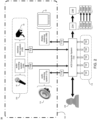
- Modular ACD system 54 may include: machine vision system 100 configured to obtain machine vision encounter information 102 concerning a patient encounter; audio recording system 104 configured to obtain audio encounter information 106 concerning the patient encounter; and a computer system (e.g., ACD computer system 12) configured to receive machine vision encounter information 102 and audio encounter information 106 from machine vision system 100 and audio recording system 104 (respectively).
- machine vision system 100 configured to obtain machine vision encounter information 102 concerning a patient encounter
- audio recording system 104 configured to obtain audio encounter information 106 concerning the patient encounter
- a computer system e.g., ACD computer system 12
- Modular ACD system 54 may also include: display rendering system 108 configured to render visual information 110; and audio rendering system 112 configured to render audio information 114, wherein ACD computer system 12 may be configured to provide visual information 110 and audio information 114 to display rendering system 108 and audio rendering system 112 (respectively).
- Example of machine vision system 100 may include but are not limited to: one or more ACD client electronic devices (e.g., ACD client electronic device 34, examples of which may include but are not limited to an RGB imaging system, an infrared imaging system, a ultraviolet imaging system, a laser imaging system, a SONAR imaging system, a RADAR imaging system, and a thermal imaging system).
- Examples of audio recording system 104 may include but are not limited to: one or more ACD client electronic devices (e.g., ACD client electronic device 30, examples of which may include but are not limited to a handheld microphone, a lapel microphone, an embedded microphone (such as those embedded within eyeglasses, smart phones, tablet computers and/or watches) and an audio recording device).
- Examples of display rendering system 108 may include but are not limited to: one or more ACD client electronic devices (e.g., ACD client electronic device 32, examples of which may include but are not limited to a tablet computer, a computer monitor, and a smart television).
- Examples of audio rendering system 112 may include but are not limited to: one or more ACD client electronic devices (e.g., audio rendering device 116, examples of which may include but are not limited to a speaker system, a headphone system, and an earbud system).
- ACD computer system 12 may be configured to access one or more datasources 118 (e.g., plurality of individual datasources 120, 122, 124, 126, 128), examples of which may include but are not limited to one or more of a user profile datasource, a voice print datasource, a voice characteristics datasource (e.g., for adapting the automated speech recognition models), a face print datasource, a humanoid shape datasource, an utterance identifier datasource, a wearable token identifier datasource, an interaction identifier datasource, a medical conditions symptoms datasource, a prescriptions compatibility datasource, a medical insurance coverage datasource, and a home healthcare datasource. While in this particular example, five different examples of datasources 118, are shown, this is for illustrative purposes only and is not intended to be a limitation of this disclosure, as other configurations are possible and are considered to be within the scope of this disclosure.
- modular ACD system 54 may be configured to monitor a monitored space (e.g., monitored space 130) in a clinical environment, wherein examples of this clinical environment may include but are not limited to: a doctor's office, a medical facility, a medical practice, a medical lab, an urgent care facility, a medical clinic, an emergency room, an operating room, a hospital, a long term care facility, a rehabilitation facility, a nursing home, and a hospice facility.
- a monitored space e.g., monitored space 130
- a clinical environment may include but are not limited to: a doctor's office, a medical facility, a medical practice, a medical lab, an urgent care facility, a medical clinic, an emergency room, an operating room, a hospital, a long term care facility, a rehabilitation facility, a nursing home, and a hospice facility.
- an example of the above-referenced patient encounter may include but is not limited to a patient visiting one or more of the above-described clinical environments (e.g., a doctor's office, a medical facility, a medical practice, a medical lab, an urgent care facility, a medical clinic, an emergency room, an operating room, a hospital, a long term care facility, a rehabilitation facility, a nursing home, and a hospice facility).
- a doctor's office e.g., a doctor's office, a medical facility, a medical practice, a medical lab, an urgent care facility, a medical clinic, an emergency room, an operating room, a hospital, a long term care facility, a rehabilitation facility, a nursing home, and a hospice facility.
- Machine vision system 100 may include a plurality of discrete machine vision systems when the above-described clinical environment is larger or a higher level of resolution is desired.
- examples of machine vision system 100 may include but are not limited to: one or more ACD client electronic devices (e.g., ACD client electronic device 34, examples of which may include but are not limited to an RGB imaging system, an infrared imaging system, an ultraviolet imaging system, a laser imaging system, a SONAR imaging system, a RADAR imaging system, and a thermal imaging system).
- machine vision system 100 may include one or more of each of an RGB imaging system, an infrared imaging systems, an ultraviolet imaging systems, a laser imaging system, a SONAR imaging system, a RADAR imaging system, and a thermal imaging system.
- Audio recording system 104 may include a plurality of discrete audio recording systems when the above-described clinical environment is larger or a higher level of resolution is desired.
- examples of audio recording system 104 may include but are not limited to: one or more ACD client electronic devices (e.g., ACD client electronic device 30, examples of which may include but are not limited to a handheld microphone, a lapel microphone, an embedded microphone (such as those embedded within eyeglasses, smart phones, tablet computers and/or watches) and an audio recording device).
- ACD client electronic devices e.g., ACD client electronic device 30, examples of which may include but are not limited to a handheld microphone, a lapel microphone, an embedded microphone (such as those embedded within eyeglasses, smart phones, tablet computers and/or watches) and an audio recording device).
- audio recording system 104 may include one or more of each of a handheld microphone, a lapel microphone, an embedded microphone (such as those embedded within eyeglasses, smart phones, tablet computers and/or watches) and an audio recording device.
- Display rendering system 108 may include a plurality of discrete display rendering systems when the above-described clinical environment is larger or a higher level of resolution is desired.
- examples of display rendering system 108 may include but are not limited to: one or more ACD client electronic devices (e.g., ACD client electronic device 32, examples of which may include but are not limited to a tablet computer, a computer monitor, and a smart television).
- ACD client electronic device 32 examples of which may include but are not limited to a tablet computer, a computer monitor, and a smart television.
- display rendering system 108 may include one or more of each of a tablet computer, a computer monitor, and a smart television.
- Audio rendering system 112 may include a plurality of discrete audio rendering systems when the above-described clinical environment is larger or a higher level of resolution is desired.
- examples of audio rendering system 112 may include but are not limited to: one or more ACD client electronic devices (e.g., audio rendering device 116, examples of which may include but are not limited to a speaker system, a headphone system, or an earbud system).
- audio rendering system 112 may include one or more of each of a speaker system, a headphone system, or an earbud system.
- ACD computer system 12 may include a plurality of discrete computer systems. As discussed above, ACD computer system 12 may include various components, examples of which may include but are not limited to: a personal computer, a server computer, a series of server computers, a mini computer, a mainframe computer, one or more Network Attached Storage (NAS) systems, one or more Storage Area Network (SAN) systems, one or more Platform as a Service (PaaS) systems, one or more Infrastructure as a Service (IaaS) systems, one or more Software as a Service (SaaS) systems, a cloud-based computational system, and a cloud-based storage platform.
- NAS Network Attached Storage
- SAN Storage Area Network
- PaaS Platform as a Service
- IaaS Infrastructure as a Service
- SaaS Software as a Service
- ACD computer system 12 may include one or more of each of a personal computer, a server computer, a series of server computers, a mini computer, a mainframe computer, one or more Network Attached Storage (NAS) systems, one or more Storage Area Network (SAN) systems, one or more Platform as a Service (PaaS) systems, one or more Infrastructure as a Service (IaaS) systems, one or more Software as a Service (SaaS) systems, a cloud-based computational system, and a cloud-based storage platform.
- NAS Network Attached Storage
- SAN Storage Area Network
- PaaS Platform as a Service
- IaaS Infrastructure as a Service
- SaaS Software as a Service
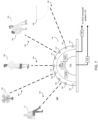
- audio recording system 104 may include directional microphone array 200 having a plurality of discrete microphone assemblies.
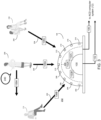
- audio recording system 104 may include a plurality of discrete audio acquisition devices (e.g., audio acquisition devices 202, 204, 206, 208, 210, 212, 214, 216, 218) that may form microphone array 200.
- modular ACD system 54 may be configured to form one or more audio recording beams (e.g., audio recording beams 220, 222, 224) via the discrete audio acquisition devices (e.g., audio acquisition devices 202, 204, 206, 208, 210, 212, 214, 216, 218) included within audio recording system 104.
- modular ACD system 54 may be further configured to steer the one or more audio recording beams (e.g., audio recording beams 220, 222, 224) toward one or more encounter participants (e.g., encounter participants 226, 228, 230) of the above-described patient encounter.
- audio recording beams e.g., audio recording beams 220, 222, 224
- encounter participants e.g., encounter participants 226, 228, 230
- Examples of the encounter participants may include but are not limited to: medical professionals (e.g., doctors, nurses, physician's assistants, lab technicians, physical therapists, scribes (e.g., a transcriptionist) and/or staff members involved in the patient encounter), patients (e.g., people that are visiting the above-described clinical environments for the patient encounter), and third parties (e.g., friends of the patient, relatives of the patient and/or acquaintances of the patient that are involved in the patient encounter).
- medical professionals e.g., doctors, nurses, physician's assistants, lab technicians, physical therapists, scribes (e.g., a transcriptionist) and/or staff members involved in the patient encounter
- patients e.g., people that are visiting the above-described clinical environments for the patient encounter
- third parties e.g., friends of the patient, relatives of the patient and/or acquaintances of the patient that are involved in the patient encounter.
- modular ACD system 54 and/or audio recording system 104 may be configured to utilize one or more of the discrete audio acquisition devices (e.g., audio acquisition devices 202, 204, 206, 208, 210, 212, 214, 216, 218) to form an audio recording beam.
- modular ACD system 54 and/or audio recording system 104 may be configured to utilize audio acquisition device 210 to form audio recording beam 220, thus enabling the capturing of audio (e.g., speech) produced by encounter participant 226 (as audio acquisition device 210 is pointed to (i.e., directed toward) encounter participant 226).
- audio acquisition device 210 e.g., speech
- modular ACD system 54 and/or audio recording system 104 may be configured to utilize audio acquisition devices 204, 206 to form audio recording beam 222, thus enabling the capturing of audio (e.g., speech) produced by encounter participant 228 (as audio acquisition devices 204, 206 are pointed to (i.e., directed toward) encounter participant 228). Additionally, modular ACD system 54 and/or audio recording system 104 may be configured to utilize audio acquisition devices 212, 214 to form audio recording beam 224, thus enabling the capturing of audio (e.g., speech) produced by encounter participant 230 (as audio acquisition devices 212, 214 are pointed to (i.e., directed toward) encounter participant 230). Further, modular ACD system 54 and/or audio recording system 104 may be configured to utilize null-steering precoding to cancel interference between speakers and/or noise.
- null-steering precoding to cancel interference between speakers and/or noise.
- null-steering precoding is a method of spatial signal processing by which a multiple antenna transmitter may null multiuser interference signals in wireless communications, wherein null-steering precoding may mitigate the impact off background noise and unknown user interference.
- null-steering precoding may be a method of beamforming for narrowband signals that may compensate for delays of receiving signals from a specific source at different elements of an antenna array.
- in incoming signals may be summed and averaged, wherein certain signals may be weighted and compensation may be made for signal delays.
- Machine vision system 100 and audio recording system 104 may be stand-alone devices (as shown in FIG. 2 ). Additionally / alternatively, machine vision system 100 and audio recording system 104 may be combined into one package to form mixed-media ACD device 232.
- mixed-media ACD device 232 may be configured to be mounted to a structure (e.g., a wall, a ceiling, a beam, a column) within the above-described clinical environments (e.g., a doctor's office, a medical facility, a medical practice, a medical lab, an urgent care facility, a medical clinic, an emergency room, an operating room, a hospital, a long term care facility, a rehabilitation facility, a nursing home, and a hospice facility), thus allowing for easy installation of the same.
- modular ACD system 54 may be configured to include a plurality of mixed-media ACD devices (e.g., mixed-media ACD device 232) when the above-described clinical environment is larger or a higher level of resolution is desired.
- Modular ACD system 54 may be further configured to steer the one or more audio recording beams (e.g., audio recording beams 220, 222, 224) toward one or more encounter participants (e.g., encounter participants 226, 228, 230) of the patient encounter based, at least in part, upon machine vision encounter information 102.
- mixed-media ACD device 232 and machine vision system 100 / audio recording system 104 included therein may be configured to monitor one or more encounter participants (e.g., encounter participants 226, 228, 230) of a patient encounter.
- machine vision system 100 may be configured to detect humanoid shapes within the above-described clinical environments (e.g., a doctor's office, a medical facility, a medical practice, a medical lab, an urgent care facility, a medical clinic, an emergency room, an operating room, a hospital, a long term care facility, a rehabilitation facility, a nursing home, and a hospice facility).
- clinical environments e.g., a doctor's office, a medical facility, a medical practice, a medical lab, an urgent care facility, a medical clinic, an emergency room, an operating room, a hospital, a long term care facility, a rehabilitation facility, a nursing home, and a hospice facility.
- modular ACD system 54 and/or audio recording system 104 may be configured to utilize one or more of the discrete audio acquisition devices (e.g., audio acquisition devices 202, 204, 206, 208, 210, 212, 214, 216, 218) to form an audio recording beam (e.g., audio recording beams 220, 222, 224) that is directed toward each of the detected humanoid shapes (e.g., encounter participants 226, 228, 230).
- the discrete audio acquisition devices e.g., audio acquisition devices 202, 204, 206, 208, 210, 212, 214, 216, 218
- an audio recording beam e.g., audio recording beams 220, 222, 224
- ACD computer system 12 may be configured to receive machine vision encounter information 102 and audio encounter information 106 from machine vision system 100 and audio recording system 104 (respectively); and may be configured to provide visual information 110 and audio information 114 to display rendering system 108 and audio rendering system 112 (respectively).
- ACD computer system 12 may be included within mixed-media ACD device 232 or external to mixed-media ACD device 232.
- ACD computer system 12 may execute all or a portion of automated clinical documentation process 10, wherein the instruction sets and subroutines of automated clinical documentation process 10 (which may be stored on one or more of e.g., storage devices 16, 20, 22, 24, 26) may be executed by ACD computer system 12 and/or one or more of ACD client electronic devices 28, 30, 32, 34.
- the instruction sets and subroutines of automated clinical documentation process 10 (which may be stored on one or more of e.g., storage devices 16, 20, 22, 24, 26) may be executed by ACD computer system 12 and/or one or more of ACD client electronic devices 28, 30, 32, 34.
- DCASR distant conversation automated speech recognition
- speakers e.g., a microphone array and a single mobile microphone carried by a speaker
- Conventional approaches to DCASR are subject to various challenges when utilizing signals from multiple microphones.
- conventional beamforming techniques combine the multiple microphone signals via spatial filtering, but these are mostly limited to single microphone array devices (i.e. they typically do not provide a mechanism for combining various microphones not part of an array, nor different microphone arrays deployed in a room operating as independent devices).
- Conventional techniques also allow for single channel noise reduction and de-reverberation techniques.
- DCASR digital audio system
- conventional approaches to DCASR may encounter issues when locating where the speakers are at any given time, tracking their movements, and then identifying their identify. This may result in less accurately diarized text transcriptions (i.e., text transcriptions with speaker labels to define who said what and when in a conversation).
- an ASR system that converts the audio to text, may be unable to process the various metadata and audio signals from multiple sources (e.g., multiple microphone systems).
- implementations of the present disclosure may address these challenges experienced by conventional approaches to DCASR by predefining beamforming configurations based upon, at least in part, information associated with an acoustic environment; selecting particular beam patterns and/or null patterns for particular locations (e.g., where beams and nulls are selected to point to certain locations in a room, some which may have a high probability of being occupied by a particular speaker); voice activity detection and localization using spatial and spectral information; speaker identification with spatial and spectral information; and alignment of audio streams from multiple microphone systems based upon, at least in part, voice activity detection.
- automated clinical documentation process 10 may include various hardware and/or software modules configured to perform various DCASR functions within the scope of the present disclosure.
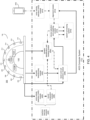
- ACD computer system 12 may be configured to receive machine vision encounter information 102 and audio encounter information 106 from machine vision system 100 and audio recording system 104 (respectively). Specifically, ACD computer system 12 may receive the audio encounter information at a voice activity detection (VAD) module (e.g., VAD module 400); at an acoustic beamforming module (e.g., acoustic beamforming module 402); and/or at a speaker identification and tracking module (e.g., speaker identification and tracking module 404).
- VAD voice activity detection
- acoustic beamforming module e.g., acoustic beamforming module 402
- speaker identification and tracking module e.g., speaker identification and tracking module 404
- ACD computer system 12 may also receive machine vision encounter information 102 at speaker identification and tracking module 404.
- VAD module 400 may communicate with sound localization module 406 to output metadata for speaker identification and tracking module 404.
- acoustic beamforming module 402 may be configured to provide a plurality of beams and/or a plurality of nulls to a beam and null selection module (e.g., beam and null selection module 408).
- Speaker identification and tracking module 404 may be configured to provide speaker identification and tracking information to beam and null selection module 408.
- beam and null selection module 408 may be configured to provide an aligned audio stream from audio recording system 104 to a device selection and weighting module (e.g., device selection and weighting module 410).
- beam and null selection module 408 may be configured to provide the aligned audio stream to an alignment module (e.g., alignment module 412).
- Alignment module 412 may be configured to receive audio encounter information from a VAD module associated with a second microphone system (e.g., VAD module 414 associated with mobile electronic device 416).
- alignment module 412 may be configured to provide an aligned audio stream from mobile electronic device 416 to device selection and weighting module 410.
- device selection and weighting module 410 may provide the aligned audio stream from audio recording system 104, the aligned audio stream from mobile electronic device 416, and metadata from the other modules to one or more speech processing systems (e.g., speech processing system 418).
- speech processing system 418 may be an automated speech recognition (ASR) system.
- ASR automated speech recognition
- automated clinical documentation process 10 may be configured to improve DCASR by providing aligned audio encounter information from multiple microphone systems. In this manner, automated clinical documentation process 10 may improve distant speech recognition using spatial and spectral information determined by the various modules of ACD computer system 12 / automated clinical documentation process 10.
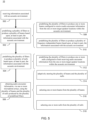
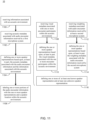
- automated clinical documentation process 10 may receive 500 information associated with an acoustic environment.
- a plurality of filters may be predefined 502 to produce a plurality of beams based upon, at least in part, the information associated with the acoustic environment.
- the plurality of filters may be predefined 504 to produce a plurality of nulls based upon, at least in part, the information associated with the acoustic environment.
- Audio encounter information may be obtained 506, via one or more microphone arrays, using the plurality of beams and the plurality of nulls produced by the plurality of predefined filters.
- automated clinical documentation process 10 may predefine or pre-compute a plurality of filters to produce beams and nulls for targeting specific speakers and/or noise sources to improve DCASR.
- beamformers may use a set of filters associated with a set of input signals to generate a spatially filtered sensitivity pattern formed from beams and nulls with characteristics determined by the filters.
- automated clinical documentation process 10 may receive 500 information associated with an acoustic environment and may predefine filters to produce beams and/or nulls to target or isolate specific speakers and/or noise sources.
- automated clinical documentation process 10 may utilize acoustic environment information to predefine beams and nulls that may be selected for various situations (i.e., selecting certain beams and nulls when a patient is speaking to a medical professional and selecting other beams and nulls when the medical professional is speaking to the patient).
- automated clinical documentation process 10 may receive 500 information associated with an acoustic environment.
- An acoustic environment may represent the layout and acoustic properties of a room or other space where multiple microphone systems may be deployed.
- information associated with the acoustic environment may describe the type / dimensions of a room, the activity zones in the room where the participants are likely to be or operate, the acoustic properties of the room (e.g., the types of noise expected, range of reverberation, etc.), position of the microphone system(s) within the acoustic environment, etc.
- automated clinical documentation process 10 may provide a user interface to receive information associated with the acoustic environment.
- a user and/or automated clinical documentation process 10 may provide the information associated with an acoustic environment (e.g., via the user interface).
- the information associated with the acoustic environment may be received in various ways (e.g., default information for a default acoustic environment, automatically defined by automated clinical documentation process 10, etc.).
- the information associated with the acoustic environment may indicate one or more target speaker locations within the acoustic environment.
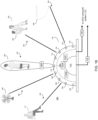
- acoustic environment 600 includes one or more encounter participants (e.g., encounter participants 226, 228, 230) of the above-described patient encounter.
- examples of the encounter participants may include but are not limited to: medical professionals (e.g., doctors, nurses, physician's assistants, lab technicians, physical therapists, scribes (e.g., a transcriptionist) and/or staff members involved in the patient encounter), patients (e.g., people that are visiting the above-described clinical environments for the patient encounter), and third parties (e.g., friends of the patient, relatives of the patient and/or acquaintances of the patient that are involved in the patient encounter).
- medical professionals e.g., doctors, nurses, physician's assistants, lab technicians, physical therapists, scribes (e.g., a transcriptionist) and/or staff members involved in the patient encounter
- patients e.g., people that are visiting the above-described clinical environments for the patient encounter
- third parties e.g., friends of the patient, relatives of the patient and/or acquaintances of the patient that are involved in the patient encounter.
- automated clinical documentation process 10 may receive 500 information associated with acoustic environment 600 that indicates the location of encounter participants 226, 228, 230.
- the information associated with acoustic environment 600 may indicate locations within acoustic environment where the one or more target speakers are likely to be when speaking. For example, suppose automated clinical documentation process 10 determines that an examination table is positioned at approximately e.g., 45° from the base of microphone array 200. In this example, automated clinical documentation process 10 may determine that a patient is most likely to speak while sitting on or near the examination table at approximately 45° from the base of microphone array 200. Further suppose that automated clinical documentation process 10 determines that a doctor's desk is positioned at approximately e.g., 90° from the base of microphone array 200.
- automated clinical documentation process 10 may determine that a doctor is most likely to speak while sitting on or near the desk at approximately 90° from the base of microphone array 200. Additionally, suppose automated clinical documentation process 10 determines that a waiting area is positioned at approximately e.g., 120° from the base of microphone array 200. In this example, automated clinical documentation process 10 may determine that other patients or other third parties are most likely to speak from at approximately 120° from the base of microphone array 200. While three examples of relative locations for target speakers within an acoustic environment have been provided, it will be appreciated that the information associated with the acoustic environment may include any number of target speaker locations or probability-based target speaker locations for any number of target speakers within the scope of the present disclosure.
- automated clinical documentation process 10 may predefine 502 a plurality of filters to produce a plurality of beams based upon, at least in part, the information associated with the acoustic environment.
- a beam may generally include a pattern of constructive interference among microphones of a microphone array that is generated by modifying the phase and/or amplitude of the signal at each microphone of the microphone array via a plurality of filters. The pattern of constructive interference may improve the signal processing performance of the microphone array.
- Predefining 502 a plurality of filters to produce a plurality of beams may generally include defining the plurality of beams at any point in time prior to obtaining 506 audio encounter information via the one or more microphone arrays.
- the plurality of filters may include a plurality of finite impulse response (FIR) filters configured to adjust the phase and/or amplitude of a signal at each microphone of a microphone array.
- automated clinical documentation process 10 may predefine the plurality of filters (e.g., the plurality of FIR filters) to produce a plurality of beams that are configured to "look" or orient in a particular direction based upon, at least in part, the information associated with the acoustic environment.
- automated clinical documentation process 10 may predefine 502 the plurality of filters to produce a plurality of beams by adjusting the phase and/or amplitude of the signal at each microphone of the microphone array.
- automated clinical documentation process 10 may receive 500 information associated with acoustic environment and may determine how the acoustic properties of the acoustic environment impact beams deployed within the acoustic environment. For example, suppose that the information associated with the acoustic environment indicates that a particular reverberation level may be present at particular frequencies and at varying amplitudes at different parts of the acoustic environment. In this example, automated clinical documentation process 10 may predefine 502 the plurality of filters to produce a plurality of beams to account for the layout, acoustic properties, etc. of the acoustic environment. As will be discussed in greater detail below, by predefining 502 the plurality of filters to produce a plurality of beams, automated clinical documentation process 10 may allow for the selection of particular beams for various situations.
- predefining 502 the plurality of filters to produce the plurality of beams based upon, at least in part, the information associated with the acoustic environment may include predefining 508 the plurality of filters to produce one or more beams configured to receive audio encounter information from the one or more target speaker locations within the acoustic environment.
- automated clinical documentation process 10 may predefine 508 the plurality of filters to produce one or more beams configured to receive audio encounter information from the one or more target speaker locations within the acoustic environment.
- automated clinical documentation process 10 determines from the information associated with acoustic environment 600, that a patient is most likely to speak while sitting on or near the examination table at approximately 45° from the base of microphone array 200; a doctor is most likely to speak while sitting on or near the desk at approximately 90° from the base of microphone array 200; and that other patients or other third parties are most likely to speak from at approximately 120° from the base of microphone array 200.
- automated clinical documentation process 10 may predefine 508 the plurality of filters to produce beam 220 for receiving audio encounter information from a patient (e.g., encounter participant 228); beam 222 for receiving audio encounter information from a doctor (e.g., encounter participant 226); and beam 224 for receiving audio encounter information from another patient / third party (e.g., encounter participant 230).
- automated clinical documentation process 10 may select particular beams for receiving audio encounter information when a specific participant is speaking.
- predefining 502 the plurality of filters to produce a plurality of beams based upon, at least in part, the information associated with the acoustic environment may include predefining 510 the plurality of filters to produce a plurality of frequency-independent beams based upon, at least in part, the information associated with the acoustic environment.
- the spatial sensitivity to audio encounter information of a beam may be frequency-dependent. For example, for receiving high frequency signals, the beam of sensitivity may be narrow while the beam of sensitivity for low frequency signals may be wide.
- automated clinical documentation process 10 may predefine 510 the plurality of filters to produce a plurality of frequency-independent beams based upon, at least in part, the information associated with the acoustic environment. For example and as discussed above, automated clinical documentation process 10 may determine particular locations within an acoustic environment where speakers may be located when they speak based upon, at least in part, the information associated with the acoustic environment. Additionally, automated clinical documentation process 10 may receive acoustic properties of the acoustic environment. For example, automated clinical documentation process 10 may determine the location(s) and frequency characteristics of one or more noise sources within the acoustic environment. In this manner, automated clinical documentation process 10 may predefine 510 the plurality of filters to produce a plurality of frequency-independent beams that account for the acoustic properties of the acoustic environment while providing sufficient microphone sensitivity for frequency variations.
- automated clinical documentation process 10 may predefine 502 the plurality of filters to produce beams 220, 222, 224 by modifying the phase and/or amplitude of the signals of each microphone such that the beam is sufficiently sensitive to receive audio encounter information for target speakers within the acoustic environment regardless of the frequency.
- automated clinical documentation process 10 may predefine 510 the plurality of filters to produce a plurality of frequency-independent beams (e.g., frequency-independent beams 220, 222, 224) based upon, at least in part, the information associated with the acoustic environment (e.g., acoustic environment 600).
- automated clinical documentation process 10 may predefine 504 the plurality of filters to produce a plurality of nulls based upon, at least in part, the information associated with the acoustic environment.
- a null may generally include a pattern of destructive interference among microphones of a microphone array that is generated by modifying the phase and/or amplitude of the signal at each microphone of the microphone array. The pattern of destructive interference may limit the reception of signals by the microphone array.
- Predefining 504 the plurality of filters to produce a plurality of nulls may generally include defining the plurality of nulls at any point in time prior to obtaining 506 audio encounter information via one or more microphone arrays.
- the plurality of filters may include a plurality of finite impulse response (FIR) filters configured to adjust the phase and/or amplitude of a signal at each microphone of a microphone array.
- automated clinical documentation process 10 may predefine the plurality of filters (e.g., the plurality of FIR filters) to produce a plurality of nulls that are configured to "look" or orient in a particular direction based upon, at least in part, the information associated with the acoustic environment. In contrast to a beam, a null may limit or attenuate reception at the target direction.
- automated clinical documentation process 10 may predefine 504 the plurality of filters to produce a plurality of nulls by adjusting the phase and/or amplitude of the signal at each microphone of the microphone array.
- automated clinical documentation process 10 may receive 500 information associated with acoustic environment and may determine how the acoustic properties of the acoustic environment impact beams deployed within the acoustic environment. For example and as discussed above, suppose that the information associated with the acoustic environment indicates that a particular noise signal (e.g., sound of an air-conditioning system) may be present at particular frequencies and at varying amplitudes at different parts of the acoustic environment. In this example, automated clinical documentation process 10 may predefine 504 the plurality of filters to produce a plurality of nulls to limit the reception of noise signals. As will be discussed in greater detail below, by predefining 504 the plurality of filters to produce the plurality of nulls, automated clinical documentation process 10 may allow for the selection of particular nulls for various situations.
- a particular noise signal e.g., sound of an air-conditioning system
- automated clinical documentation process 10 may predefine 504 the plurality of filters to produce one or more nulls configured to limit receiving noise signals from one or more noise sources based upon, at least in part, the information associated with the acoustic environment. For example and referring again to FIG. 6 , suppose that automated clinical documentation process 10 determines from the information associated with acoustic environment 600 that a noise source (e.g., fan 244) is positioned e.g., approximately 70° from the base of microphone array 200 and that a second noise source (e.g., a doorway to a busy hallway 246) is positioned e.g., approximately 150° from the base of microphone array 200.
- a noise source e.g., fan 244
- a second noise source e.g., a doorway to a busy hallway 246
- automated clinical documentation process 10 may predefine 512 the plurality of filters to produce null 248 to limit receiving noise signals from a first noise source (e.g., fan 244) and null 250 to limit receiving noise signals from a second noise source (e.g., a doorway to a busy hallway 246). While an example of predefining 504 the plurality of filters to produce two nulls for two noise sources has been described, it will be appreciated that automated clinical documentation process 10 may predefine 504 the plurality of filters to produce any number of nulls for any number of noise sources within the scope of the present disclosure. In some implementations, automated clinical documentation process 10 may select particular nulls to limit receiving noise signals for various situations.
- predefining 504 the plurality of filters to produce the plurality of nulls based upon, at least in part, the information associated with the acoustic environment may include predefining 512 the plurality of filters to produce one or more nulls to limit receiving audio encounter information from the one or more target speaker locations within the acoustic environment.
- automated clinical documentation process 10 may predefine 512 the plurality of filters to produce one or more nulls to limit receiving audio encounter information from the one or more target speaker locations within the acoustic environment.
- automated clinical documentation process 10 determines from the information associated with acoustic environment 600, that a patient is most likely to speak while sitting on or near the examination table at approximately 45° from the base of microphone array 200; a doctor is most likely to speak while sitting on or near the desk at approximately 90° from the base of microphone array 200; and that other patients or other third parties are most likely to speak from at approximately 120° from the base of microphone array 200.
- automated clinical documentation process 10 may predefine 504 the plurality of filters to produce null 252 to limit receiving audio encounter information from a patient (e.g., encounter participant 228); null 254 to limit receiving audio encounter information from a doctor (e.g., encounter participant 226); and null 256 to limit receiving audio encounter information from another patient / third party (e.g., encounter participant 230).
- automated clinical documentation process 10 may select particular nulls to limit audio encounter information from other speakers to focus on audio encounter information from a particular target speaker.
- Automated clinical documentation process 10 may form two output signals where a first signal is the sum a beam pattern oriented toward the doctor (e.g., encounter participant 226) and a null oriented toward the patient (e.g., encounter participant 228); and a second signal is the sum a beam pattern oriented toward the patient (e.g., encounter participant 228) and a null oriented toward the doctor (e.g., encounter participant 226).
- a first signal is the sum a beam pattern oriented toward the doctor (e.g., encounter participant 226) and a null oriented toward the patient (e.g., encounter participant 228); and a second signal is the sum a beam pattern oriented toward the patient (e.g., encounter participant 228) and a null oriented toward the doctor (e.g., encounter participant 226).
- the combination of the two signals formed from the beams and nulls defined for each signal may have a better chance of accurately transcribing what the doctor and the patient said.
- automated clinical documentation process 10 may obtain 506 audio encounter information, via one or more microphone arrays, using the plurality of beams and the plurality of nulls produced by the plurality of predefined filters.
- one or more microphone arrays may utilize beams and nulls to audio encounter information from particular speakers and to limit receiving audio encounter information from other speakers or other sound sources.
- automated clinical documentation process 10 may obtain audio encounter information 106 by combining the plurality of discrete microphone elements (e.g., audio acquisition devices 202, 204, 206, 208, 210, 212, 214, 216, 218) in the microphone array (e.g., microphone array 200) with the plurality of predefined filters in such a way that signals at particular angles experience constructive interference while others experience destructive interference.
- the plurality of discrete microphone elements e.g., audio acquisition devices 202, 204, 206, 208, 210, 212, 214, 216, 21
- obtaining 506 the audio encounter information, via one or more microphone arrays, using the plurality of beams and the plurality of nulls produced by the plurality of predefined filters may include adaptively steering 514 the plurality of beams and the plurality of nulls.
- automated clinical documentation process 10 may allow for the plurality of beams and/or the plurality of nulls to be steered toward a target speaker within the acoustic environment.
- automated clinical documentation process 10 may adaptively steer 514 a beam (e.g., beam 220) to follow the patient (e.g., encounter participant 228)as the patient moves within acoustic environment 600. Further, suppose that while the patient (e.g., encounter participant 228) is speaking, the doctor (e.g., encounter participant 226) begins moving around within acoustic environment 600.
- a beam e.g., beam 220
- automated clinical documentation process 10 may adaptively steer 514 a null (e.g., null 254) to follow the doctor (e.g., encounter participant 226) to limit any noise signals or audio encounter information from the doctor (e.g., encounter participant 226) while the patient (e.g., encounter participant 228) is speaking. While an example of adaptively steering one beam and one null has been provided, it will be appreciated that any number of beams and/or nulls may be adaptively steered for various purposes within the present disclosure.
- a null e.g., null 254
- obtaining 506 audio encounter information from particular speakers and to limit receiving audio encounter information from other speakers may include one or more of: selecting 516 one or more beams from the plurality of beams; and selecting 518 one or more nulls from the plurality of nulls.
- automated clinical documentation process 10 may predefine the plurality of filters to produce the plurality of beams and/or the plurality of nulls based upon, at least in part, information associated with the acoustic environment. Referring again to FIG. 4 , these actions may be generally performed by or associated with acoustic beamforming module 402. In this manner, automated clinical documentation process 10 may provide the predefined filters to beam and null selection module 508.
- beam and null selection module 508 may be configured to select 516 one or more beams from the plurality of beams and/or select 518 one or more nulls from the plurality of nulls for various situations using the plurality of predefined filters.
- Automated clinical documentation process 10 may detect the patient's audio encounter information and may select 516 one or more beams (e.g., beam 220) to receive audio encounter information from the patient (e.g., encounter participant 228). Additionally, automated clinical documentation process 10 may detect speech from another participant (e.g., participant 230). In one example, automated clinical documentation process 10 may select 516 one or more beams (e.g., beam 224) to receive audio encounter information from patient 230 or may select 518 one or more nulls (e.g., null 256) to limit receiving audio encounter information from participant 230. In this manner, automated clinical documentation process 10 may select, from the beams and nulls produced by the predefined plurality of filters, which beams and nulls to utilize when audio encounter information is detected from particular speakers.
- beams e.g., beam 220
- nulls e.g., null 256
- automated clinical documentation process 10 may receive 800 audio encounter information from a microphone array. Speech activity within one or more portions of the audio encounter information may be identified 802 based upon, at least in part, a correlation among the audio encounter information received from the microphone array. Location information for the one or more portions of the audio encounter information may be determined 804 based upon, at least in part, the correlation among the signals received by each microphone of the microphone array. The one or more portions of the audio encounter information may be labeled 806 with the speech activity and the location information.
- automated clinical documentation process 10 may receive 800 audio encounter information from a microphone array.
- a microphone array e.g., microphone array 200
- audio encounter information 106 may include speech signals or other signals recorded by the plurality of audio acquisition devices.
- automated clinical documentation process 10 may receive audio encounter information 106 at a voice activity detection (VAD) module (e.g., VAD module 400) and/or a sound localization module (e.g., sound localization module 406) of ACD computer system 12.
- VAD voice activity detection
- sound localization module e.g., sound localization module 406
- each microphone receives audio encounter information 106 at a plurality of microphones (e.g., audio acquisition devices 202, 204, 206, 208) of microphone array 200. While only four audio acquisition devices are shown, it will be appreciated that this is for ease of explanation and that any number of audio acquisition devices of a microphone array may record audio encounter information within the scope of the present disclosure.
- each microphone receives an audio signal (e.g., audio encounter information 106). Based on the orientation of each microphone, the properties of each microphone, the properties of the audio signals, etc., each microphone may receive a different version of the signal.
- audio encounter information received by microphone 202 may have distinct signal components (i.e., amplitude and phase) relative to the audio encounter information received by microphones 204, 206, and/or 208.
- automated clinical documentation process 10 may utilize correlation between the audio encounter information to detect speech and to determine location information associated with audio encounter information.
- automated clinical documentation process 10 may identify 802 speech activity within one or more portions of the audio encounter information based upon, at least in part, a correlation among the audio encounter information received by the microphone array.
- audio encounter information 106 may include a plurality of portions or frames of audio information (e.g., portions 900, 902, 904, 906, 908, 910, 912, 914, 916, 918, 920, 922, 924, 926). While an example with e.g., 14 portions of audio encounter information 106 have been described, it will be appreciated that this is for example purposes only and that audio encounter information 106 may include or be defined as any number of portions within the scope of the present disclosure. In one example, each portion or frame may represent audio encounter information 106 over a predefined amount of time (e.g., 20 milliseconds).
- automated clinical documentation process 10 may determine a correlation among the audio encounter information received by microphone array 200. For example, automated clinical documentation process 10 may compare the one or more portions (e.g., portions 900, 902, 904, 906, 908, 910, 912, 914, 916, 918, 920, 922, 924, 926) of audio encounter information 106 to determine a degree of correlation between the audio encounter information present in each portion across the plurality of microphones of the microphone array.
- portions e.g., portions 900, 902, 904, 906, 908, 910, 912, 914, 916, 918, 920, 922, 924, 926) of audio encounter information 106 may be determined a degree of correlation between the audio encounter information present in each portion across the plurality of microphones of the microphone array.
- automated clinical documentation process 10 may perform various cross-correlation processes known in the art to determine a degree of similarity between the one or more portions (e.g., portions 900, 902, 904, 906, 908, 910, 912, 914, 916, 918, 920, 922, 924, 926) of audio encounter information 106 across the plurality of microphones of microphone array 200.
- portions 900, 902, 904, 906, 908, 910, 912, 914, 916, 918, 920, 922, 924, 926 of audio encounter information 106 across the plurality of microphones of microphone array 200.
- automated clinical documentation process 10 may determine that the spectrum observed in each microphone channel is different (i.e. uncorrelated at each microphone). However, suppose automated clinical documentation process 10 receives a speech or other 'directional' signal within the audio encounter information. In this example, automated clinical documentation process 10 may determine that one or more portions of the audio encounter information (e.g., the portions of audio encounter information with speech components) are highly correlated at each microphone in the microphone array.
- automated clinical documentation process 10 may identify 802 speech activity within one or more portions of the audio encounter information based upon, at least in part, determining a threshold amount or degree of correlation among the audio encounter information received from the microphone array. For example and as discussed above, various thresholds may be defined (e.g., user-defined, default thresholds, automatically defined via automated clinical documentation process 10, etc.) to determine when portions of audio encounter information are sufficiently correlated. Accordingly, in response to determining at least a threshold degree of correlation among the portions of audio encounter information across the plurality of microphones, automated clinical documentation process 10 may determine or identify speech activity within the one or more portions of the audio encounter information.
- a threshold amount or degree of correlation among the audio encounter information received from the microphone array For example and as discussed above, various thresholds may be defined (e.g., user-defined, default thresholds, automatically defined via automated clinical documentation process 10, etc.) to determine when portions of audio encounter information are sufficiently correlated. Accordingly, in response to determining at least a threshold degree of correlation among the portions of audio encounter information across the plurality
- automated clinical documentation process 10 may identify speech activity using other approaches known in the art for voice activity detection (VAD) such as filtering, noise reduction, the application of classification rules, etc.
- VAD voice activity detection
- filtering such as filtering, noise reduction, the application of classification rules, etc.
- conventional VAD techniques may be used in combination with the determination of a threshold correlation among the one or more portions of the audio encounter information to identify 802 speech activity within the one or more portions of the audio encounter information.
- automated clinical documentation process 10 determines at least a threshold amount or degree of correlation among portions 900, 902, 904, 906, 908, 910, 912 of audio encounter information 106 across microphones 202, 204, 206, 208 and a lack of correlation among portions 914, 916, 918, 920, 922, 924, 926 of audio encounter information 106.
- automated clinical documentation process 10 may identify 802 speech activity within portions 900, 902, 904, 906, 908, 910, 912 of audio encounter information 106 based upon, at least in part, a threshold on the correlation among portions 900, 902, 904, 906, 908, 910, 912 of audio encounter information 106.
- identifying 802 speech activity within the one or more portions of the audio encounter information may include generating timestamps indicating portions of audio encounter information 106 that include speech activity (e.g., start and end times for each portion).
- automated clinical documentation process 10 may generate a vector of start and end times for each portion with detected speech activity.
- automated clinical documentation process 10 may label speech activity as a time domain label (i.e., a set of samples of the signal include or are speech) or as a set of frequency domain labels (i.e., a vector that gives the likelihood that a particular frequency bin in a certain time frame includes or is speech).
- automated clinical documentation process 10 may utilize information associated with the microphone array (e.g., the spacing between microphones of the microphone array; the orientation of the microphones within the microphone array; etc.) to determine 804 location information associated with the audio encounter information received by the microphone array.
- information associated with the microphone array e.g., the spacing between microphones of the microphone array; the orientation of the microphones within the microphone array; etc.
- determining 804 the location information for the one or more portions of the audio encounter information may include determining 808 a time difference of arrival between each pair of microphones of the microphone array for the one or more portions of the audio encounter information.
- a time difference of arrival (TDOA) between a pair of microphones may include locating a signal origin based upon, at least in part, the different arrival times of the signal at various receivers.
- automated clinical documentation process 10 may determine 808 the time difference of arrival (TDOA) between each pair of microphones for the one or more portions of the audio encounter information based upon, at least in part, the correlation among the audio encounter information received by the microphone array.
- a highly correlated signal may allow for accurate determination of the time difference between microphones.
- Automated clinical documentation process 10 may determine that the spectrum observed in each microphone channel will be different (i.e. uncorrelated at each microphone). Accordingly, the time differences between pairs of microphones may be difficult to determine and/or may be inaccurate based upon the lack of correlation among the microphone channels of the microphone array.
- automated clinical documentation process 10 receives a speech or other 'directional' signal within audio encounter information.
- automated clinical documentation process 10 may determine that one or more portions of the audio encounter information (e.g., the portions of audio encounter information with speech components) are highly correlated at each microphone in the microphone array. Accordingly, automated clinical documentation process 10 may more accurately determine the time difference of arrival between pairs of microphones using the highly correlated audio encounter information across the microphone channels of the microphone array.
- portions of the audio encounter information e.g., the portions of audio encounter information with speech components
- automated clinical documentation process 10 may determine a correlation between the audio encounter information across the microphones or microphone channels of the microphone array and may utilize the determined correlation (e.g., by comparing the correlation to a threshold for speech activity detection and a threshold for time difference of arrival determination) to identify 802 speech activity within the one or more audio portions and to determine 804 the time difference of arrival between microphone pairs jointly.
- jointly identifying 802 the speech activity and determining 804 the location information for the one or more portions of the audio encounter information may be performed using a machine learning model.
- automated clinical documentation process 10 may train a machine learning model to "learn" how to jointly identify speech activity and determine location information for the one or more portions of the audio encounter information.
- a machine learning model may generally include an algorithm or combination of algorithms that has been trained to recognize certain types of patterns.
- machine learning approaches may be generally divided into three categories, depending on the nature of the signal available: supervised learning, unsupervised learning, and reinforcement learning.
- supervised learning may include presenting a computing device with example inputs and their desired outputs, given by a "teacher", where the goal is to learn a general rule that maps inputs to outputs.
- Unsupervised learning no labels are given to the learning algorithm, leaving it on its own to find structure in its input.
- Unsupervised learning can be a goal in itself (discovering hidden patterns in data) or a means towards an end (feature learning).
- reinforcement learning may generally include a computing device interacting in a dynamic environment in which it must perform a certain goal (such as driving a vehicle or playing a game against an opponent). As it navigates its problem space, the program is provided feedback that's analogous to rewards, which it tries to maximize. While three examples of machine learning approaches have been provided, it will be appreciated that other machine learning approaches are possible within the scope of the present disclosure.
- automated clinical documentation process 10 may utilize a machine learning model (e.g., machine learning model 420) to identify speech activity within and location information for the one or more portions of the audio encounter information.
- machine learning model e.g., machine learning model 420
- automated clinical documentation process 10 may provide time domain waveform data or frequency domain features as input to machine learning model 420.
- the phase spectrum features may provide spatial information for identifying speech activity and location information for the one or more portions of the audio encounter information.
- automated clinical documentation process 10 may receive 810 information associated with an acoustic environment.
- an acoustic environment may represent the layout and acoustic properties of a room or other space where multiple microphone systems may be deployed.
- information associated with the acoustic environment may describe the type / dimensions of a room, the activity zones in the room where the participants operate, the acoustic properties of the room (e.g., the types of noise expected, range of reverberation, etc.), position of the microphone system(s) within the acoustic environment, etc.
- automated clinical documentation process 10 may provide a user interface to receive information associated with the acoustic environment.
- a user and/or automated clinical documentation process 10 may provide the information associated with an acoustic environment via the user interface.
- the information associated with the acoustic environment may be received in various ways (e.g., default information for a default acoustic environment, automatically defined by automated clinical documentation process 10, etc.).
- the information associated with the acoustic environment may indicate one or more target speaker locations within the acoustic environment.
- acoustic environment 600 includes one or more encounter participants (e.g., encounter participants 226, 228, 230) of the above-described patient encounter.
- examples of the encounter participants may include but are not limited to: medical professionals (e.g., doctors, nurses, physician's assistants, lab technicians, physical therapists, scribes (e.g., a transcriptionist) and/or staff members involved in the patient encounter), patients (e.g., people that are visiting the above-described clinical environments for the patient encounter), and third parties (e.g., friends of the patient, relatives of the patient and/or acquaintances of the patient that are involved in the patient encounter).
- medical professionals e.g., doctors, nurses, physician's assistants, lab technicians, physical therapists, scribes (e.g., a transcriptionist) and/or staff members involved in the patient encounter
- patients e.g., people that are visiting the above-described clinical environments for the patient encounter
- third parties e.g., friends of the patient, relatives of the patient and/or acquaintances of the patient that are involved in the patient encounter.
- automated clinical documentation process 10 may receive 810 information associated with acoustic environment 600 that may indicate locations within acoustic environment 600 where encounter participants 226, 228, 230 may be positioned.
- the information associated with acoustic environment 600 may indicate locations within acoustic environment where the one or more target speakers are likely to be when speaking. For example, suppose automated clinical documentation process 10 determines that an examination table is positioned at approximately e.g., 45° from the base of microphone array 200. In this example, automated clinical documentation process 10 may determine that a patient is most likely to speak while sitting on or near the examination table at approximately 45° from the base of microphone array 200.
- automated clinical documentation process 10 determines that a doctor's desk is positioned at approximately e.g., 90° from the base of microphone array 200. In this example, automated clinical documentation process 10 may determine that a doctor is most likely to speak while sitting on or near the desk at approximately 90° from the base of microphone array 200. Additionally, suppose automated clinical documentation process 10 determines that a waiting area is positioned at approximately e.g., 120° from the base of microphone array 200. In this example, automated clinical documentation process 10 may determine that other patients or other third parties are most likely to speak from at approximately 120° from the base of microphone array 200.
- the information associated with the acoustic environment may include any number of target speaker locations or probability-based target speaker locations for any number of target speakers within the scope of the present disclosure.
- identifying 802 the speech activity within the one or more portions of the audio encounter information may be based upon, at least in part, the location information for the one or more portions of the audio encounter information and the information associated with the acoustic environment.
- automated clinical documentation process 10 may utilize the information associated with the acoustic environment to more accurately identify speech activity within the one or more portions of the audio encounter information.
- automated clinical documentation process 10 receives information associated with the acoustic environment that indicates locations within the acoustic environment where speakers are likely to be.
- automated clinical documentation process 10 may, based upon the location information for the one or more portions of the audio encounter information, determine whether the one or more portions of the audio encounter information are within the potential speaker locations defined by the acoustic environment information. In response to determining that the one or more portions of the audio encounter information originate from a potential speaker location within the acoustic environment, automated clinical documentation process 10 may determine a higher probability that the one or more portions of the audio encounter information include speech activity. Accordingly, automated clinical documentation process 10 may utilize the location information and the acoustic environment information to identify 802 speech activity within the one or more portions of the audio encounter information.
- automated clinical documentation process 10 may label 806 the one or more portions of the audio encounter information with the speech activity and the location information. Labeling one or more portions of the audio encounter information with the speech activity and the location information may generally include generating metadata for the one or more portions of the audio encounter information with the speech activity and location information associated with each respective portion of the audio encounter information. Referring also to FIG. 10 and in some implementations, automated clinical documentation process 10 may label 806 portions 900, 902, 904, 906, 908, 910, 912 with the speech activity and location information associated with each respective portion by generating acoustic metadata for each portion of audio encounter information 106 (e.g., acoustic metadata 1000, 1002, 1004, 1006, 1008, 1010, 1012).
- the acoustic metadata associated with the audio encounter information may include the speech activity and the location information associated with the audio encounter information.
- automated clinical documentation process 10 may generate acoustic metadata 1000, 1002, 1004, 1006, 1008, 1010, 1012 that identifies portions of audio encounter information 106 that includes speech activity (e.g., portions 900, 902, 904, 906, 908, 910, 912).
- automated clinical documentation process 10 may generate acoustic metadata with timestamps indicating portions of audio encounter information 106 that include speech activity (e.g., start and end times for each portion).
- automated clinical documentation process 10 may label 806 speech activity as a time domain label (i.e., a set of samples of the signal include or are speech) or as a set of frequency domain labels (i.e., a vector that gives the likelihood that a particular frequency bin in a certain time frame includes or is speech).
- a time domain label i.e., a set of samples of the signal include or are speech
- a set of frequency domain labels i.e., a vector that gives the likelihood that a particular frequency bin in a certain time frame includes or is speech.
- automated clinical documentation process 10 may provide the acoustic metadata (e.g., acoustic metadata 1014) to speaker identification and tracking module 404 to identify a speaker from the audio encounter information and/or to track the position of a speaker within an acoustic environment based upon, at least in part, acoustic metadata 1014.
- acoustic metadata e.g., acoustic metadata 1014
- speaker identification and tracking module 404 may identify a speaker from the audio encounter information and/or to track the position of a speaker within an acoustic environment based upon, at least in part, acoustic metadata 1014.
- automated clinical documentation process 10 may receive 1100 information associated with an acoustic environment.
- Acoustic metadata associated with audio encounter information received by a first microphone system may be received 1102.
- One or more speaker representations may be defined 1104 based upon, at least in part, the acoustic metadata associated with the audio encounter information and the information associated with the acoustic environment.
- One or more portions of the audio encounter information may be labeled 1106 with the one or more speaker representations and a speaker location within the acoustic environment.
- automated clinical documentation process 10 may receive 1100 information associated with an acoustic environment.
- an acoustic environment may represent the layout and acoustic properties of a room or other space where multiple microphone systems may be deployed.
- information associated with the acoustic environment may describe the type / dimensions of a room, the activity zones in the room where the participants operate, the acoustic properties of the room (e.g., the types of noise expected, range of reverberation, etc.), position of the microphone system(s) within the acoustic environment, etc.
- automated clinical documentation process 10 may provide a user interface to receive information associated with the acoustic environment.
- a user and/or automated clinical documentation process 10 may provide the information associated with an acoustic environment via the user interface.
- the information associated with the acoustic environment may be received in various ways (e.g., default information for a default acoustic environment, automatically defined by automated clinical documentation process 10, etc.).
- the information associated with the acoustic environment may indicate one or more target speaker locations within the acoustic environment.
- acoustic environment 600 includes one or more encounter participants (e.g., encounter participants 226, 228, 230) of the above-described patient encounter.
- examples of the encounter participants may include but are not limited to: medical professionals (e.g., doctors, nurses, physician's assistants, lab technicians, physical therapists, scribes (e.g., a transcriptionist) and/or staff members involved in the patient encounter), patients (e.g., people that are visiting the above-described clinical environments for the patient encounter), and third parties (e.g., friends of the patient, relatives of the patient and/or acquaintances of the patient that are involved in the patient encounter).
- medical professionals e.g., doctors, nurses, physician's assistants, lab technicians, physical therapists, scribes (e.g., a transcriptionist) and/or staff members involved in the patient encounter
- patients e.g., people that are visiting the above-described clinical environments for the patient encounter
- third parties e.g., friends of the patient, relatives of the patient and/or acquaintances of the patient that are involved in the patient encounter.
- automated clinical documentation process 10 may receive 1100 information associated with acoustic environment 600 that may indicate locations within acoustic environment 600 where encounter participants 226, 228, 230 may be positioned.
- the information associated with acoustic environment 600 may indicate locations within acoustic environment where the one or more target speakers are likely to be when speaking. For example, suppose automated clinical documentation process 10 determines that an examination table is positioned at approximately e.g., 45° from the base of microphone array 200. In this example, automated clinical documentation process 10 may determine that a patient is most likely to speak while sitting on or near the examination table at approximately 45° from the base of microphone array 200.
- automated clinical documentation process 10 determines that a doctor's desk is positioned at approximately e.g., 90° from the base of microphone array 200.
- automated clinical documentation process 10 may determine that a doctor is most likely to speak while sitting on or near the desk at approximately 90° from the base of microphone array 200.
- automated clinical documentation process 10 determines that a waiting area is positioned at approximately e.g., 120° from the base of microphone array 200.
- automated clinical documentation process 10 may determine that other patients or other third parties are most likely to speak from at approximately 120° from the base of microphone array 200. While three examples of relative locations for target speakers within an acoustic environment have been provided, it will be appreciated that the information associated with the acoustic environment may include any number of target speaker locations or probability-based target speaker locations for any number of target speakers within the scope of the present disclosure.
- automated clinical documentation process 10 may receive 1102 acoustic metadata associated with audio encounter information received by a first microphone system.
- VAD module 400 and sound localization module 406 may generate acoustic metadata associated with audio encounter information.
- the acoustic metadata associated with the audio encounter information may include speech activity information and signal location information associated with the audio encounter information.
- automated clinical documentation process 10 may identify portions of the audio encounter information (e.g., audio encounter information 106) with speech components. Automated clinical documentation process 10 may associate or label the portions of audio encounter information 106 as having speech activity.
- automated clinical documentation process 10 may generate acoustic metadata that identifies portions of audio encounter information 106 that includes speech activity.
- automated clinical documentation process 10 may generate timestamps indicating portions of audio encounter information 106 that include speech activity (e.g., start and end times for each portion).
- automated clinical documentation process 10 may receive acoustic metadata 1200 for one or more portions of audio encounter information 106 (e.g., portions 1202, 1204, 1206, 1208, 1210, 1212, 1214, 1216, 1218, 1220, 1222, 1224, 1226, 1228).
- automated clinical documentation process 10 may generate acoustic metadata with speech activity and signal location information associated with each portion of the audio encounter information (e.g., represented in FIG.
- automated clinical documentation process 10 may determine location information for audio encounter information 106. For example, automated clinical documentation process 10 may determine spatial information from the microphone array (e.g., time difference of arrival (TDOA) between the microphones). As is known in the art, once a signal is received at two reference points, the difference in arrival time may be used to calculate the difference in distances between the target and the two reference points. In this example, automated clinical documentation process 10 may determine the time difference of arrival (TDOA) between microphones of a microphone array. In some implementations, automated clinical documentation process 10 may generate acoustic metadata with the TDOA for a particular microphone array.
- TDOA time difference of arrival
- automated clinical documentation process 10 may define 1104 one or more speaker representations based upon, at least in part, the acoustic metadata associated with the audio encounter information and the information associated with the acoustic environment.
- a speaker representation may generally include a cluster of data associated with a unique speaker within an acoustic environment.
- automated clinical documentation process 10 may cluster spatial information and spectral information into separate speaker representations to account for the combination of spatial and spectral data that reference unique speakers within an acoustic environment.
- automated clinical documentation process 10 receives 1100 information associated with acoustic environment 600 that may indicate locations within acoustic environment 600 where encounter participants 226, 228, 230 may be positioned. Further suppose that automated clinical documentation process 10 receives 1102 acoustic metadata (e.g., acoustic metadata 1200) associated with audio encounter information 106 received by microphone array 200.
- acoustic metadata 1200 includes spatial information (e.g., location information for audio encounter information 106) and spectral information (e.g., speech activity information).
- the spectral information may include acoustic features (e.g., Mel frequency cepstral coefficients (MFCCs)) associated with particular speakers (e.g., encounter participants 226, 228, 230).
- MFCCs Mel frequency cepstral coefficients
- automated clinical documentation process 10 may define 1104 speaker representations for encounter participants 226, 228, 230 based upon, at least in part, the acoustic metadata associated with the audio encounter information and the information associated with the acoustic environment.
- automated clinical documentation process 10 may use a dynamic model of speaker movements and the information associated with the acoustic environment to cluster the spatial information (e.g., TDOA) and spectral information (e.g., acoustic features like MFCCs) into separate speaker representations (e.g., speaker representation 1300 for encounter participant 226; speaker representation 1302 for encounter participant 228; and speaker representation 1304 for encounter participant 230). While the above example includes defining e.g., three speaker representations, it will be appreciated that any number of speaker representations may be defined by automated clinical documentation process 10 within the scope of the present disclosure.
- automated clinical documentation process 10 may receive 1108 visual metadata associated with one or more encounter participants within the acoustic environment.
- automated clinical documentation process 10 may be configured to track the movement and/or interaction of humanoid shapes within the monitored space (e.g., acoustic environment 600) during the patient encounter (e.g., a visit to a doctor's office).
- automated clinical documentation process 10 may process the machine vision encounter information (e.g., machine vision encounter information 102) to identify one or more humanoid shapes.
- examples of machine vision system 100 may include but are not limited to one or more of an RGB imaging system, an infrared imaging system, an ultraviolet imaging system, a laser imaging system, a SONAR imaging system, a RADAR imaging system, and a thermal imaging system.
- ACD client electronic device 34 When ACD client electronic device 34 includes a visible light imaging system (e.g., an RGB imaging system), ACD client electronic device 34 may be configured to monitor various objects within acoustic environment 600 by recording motion video in the visible light spectrum of these various objects.
- ACD client electronic device 34 includes an invisible light imaging systems (e.g., a laser imaging system, an infrared imaging system and/or an ultraviolet imaging system)
- ACD client electronic device 34 may be configured to monitor various objects within acoustic environment 600 by recording motion video in the invisible light spectrum of these various objects.
- ACD client electronic device 34 includes an X-ray imaging system
- ACD client electronic device 34 may be configured to monitor various objects within acoustic environment 600 by recording energy in the X-ray spectrum of these various objects.
- ACD client electronic device 34 When ACD client electronic device 34 includes a SONAR imaging system, ACD client electronic device 34 may be configured to monitor various objects within acoustic environment 600 by transmitting soundwaves that may be reflected off of these various objects. When ACD client electronic device 34 includes a RADAR imaging system, ACD client electronic device 34 may be configured to monitor various objects within acoustic environment 600 by transmitting radio waves that may be reflected off of these various objects. When ACD client electronic device 34 includes a thermal imaging system, ACD client electronic device 34 may be configured to monitor various objects within acoustic environment 600 by tracking the thermal energy of these various objects.
- ACD computer system 12 may be configured to access one or more datasources 118 (e.g., plurality of individual datasources 120, 122, 124, 126, 128), wherein examples of which may include but are not limited to one or more of a user profile datasource, a voice print datasource, a voice characteristics datasource (e.g., for adapting the automated speech recognition models), a face print datasource, a humanoid shape datasource, a humanoid shape datasource, an utterance identifier datasource, a wearable token identifier datasource, an interaction identifier datasource, a medical conditions symptoms datasource, a prescriptions compatibility datasource, a medical insurance coverage datasource, and a home healthcare datasource.
- datasources 118 e.g., plurality of individual datasources 120, 122, 124, 126, 128, wherein examples of which may include but are not limited to one or more of a user profile datasource, a voice print datasource, a voice characteristics datasource
- automated clinical documentation process 10 may be configured to compare the humanoid shapes defined within one or more datasources 118 to potential humanoid shapes within the machine vision encounter information (e.g., machine vision encounter information 102).
- automated clinical documentation process 10 may track the movement of the one or more humanoid shapes within the monitored space (e.g., acoustic environment 600).
- automated clinical documentation process 10 may add a new humanoid shape to the one or more humanoid shapes when the new humanoid shape enters the monitored space (e.g., acoustic environment 600) and/or may remove an existing humanoid shape from the one or more humanoid shapes when the existing humanoid shape leaves the monitored space (e.g., acoustic environment 600).
- automated clinical documentation process 10 may monitor the trajectories of the various humanoid shapes within acoustic environment 600. Accordingly, assume that when leaving acoustic environment 600, encounter participant 242 walks in front of (or behind) encounter participant 226. As automated clinical documentation process 10 is monitoring the trajectories of (in this example) encounter participant 242 (who is e.g., moving from left to right) and encounter participant 226 (who is e.g., stationary), when encounter participant 242 passes in front of (or behind) encounter participant 226, the identities of these two humanoid shapes may not be confused by automated clinical documentation process 10.
- Automated clinical documentation process 10 may be configured to obtain the encounter information of the patient encounter (e.g., a visit to a doctor's office), which may include machine vision encounter information 102 (in the manner described above) and/or audio encounter information 106.
- automated clinical documentation process 10 may generate visual metadata associated with machine vision encounter information 102.
- automated clinical documentation process 10 may generate visual metadata 1306 indicative of the direction or position of speakers within acoustic environment 600, the number of speakers within acoustic environment 600, and/or the identity of the speakers within acoustic environment 600. As shown in the example of FIG.
- visual metadata 1306 may be defined for each portion of audio encounter information 106 (e.g., portions 1202, 1204, 1206, 1208, 1210, 1212, 1214, 1216, 1218, 1220, 1222, 1224, 1226, 1228 of audio encounter information 106) and represented as separate visual metadata for each portion (e.g., visual metadata 1308, 1310, 1312, 1314, 1316, 1318, 1320, 1322, 1324, 1326, 1328, 1330, 1332, 1334).
- defining 1104 the one or more speaker representations may include defining 1110 the one or more speaker representations based upon, at least in part, the visual metadata associated with the one or more encounter participants within the acoustic environment.
- machine vision system 100 may detect and track location estimates for particular speaker representations by tracking the humanoid shapes within the acoustic environment.
- Automated clinical documentation process 10 may "fuse" the location estimates from the visual metadata with the acoustic localization information to cluster the spatial-spectral features of the visual metadata and the acoustic metadata into the plurality of speaker representations.
- automated clinical documentation process 10 may receive 1108 visual metadata 1306 associated with encounter participants 226, 228, 230.
- visual metadata 1306 may indicate the relative position of each speaker within acoustic environment 600; the number of speakers; and/or the identity of the speakers within acoustic environment 600.
- machine vision system 100 may be configured to identify one or more humanoid shapes and track the movement of the one or more humanoid shapes within the acoustic environment.
- Automated clinical documentation process 10 may receive visual metadata 1306 associated with the identity and/or location of encounter participants 226, 228, 230.
- visual metadata 1306 includes an identity of each participant (e.g., based upon, at least in part, comparing the humanoid shapes defined within one or more datasources 118 to potential humanoid shapes within the machine vision encounter information (e.g., machine vision encounter information 102)).
- Automated clinical documentation process 10 may define 1110 the one or more speaker representations (e.g., speaker representations 1300, 1302, 1304 for encounter participants 226, 228, 230, respectively) based upon, at least in part, visual metadata 1306 associated with encounter participants 226, 228, 230 within acoustic environment 600 and acoustic metadata 1200 associated with the audio encounter information 106.
- speaker representations e.g., speaker representations 1300, 1302, 1304 for encounter participants 226, 228, 230, respectively
- automated clinical documentation process 10 may combine the location estimates from visual metadata 1306 with the location information of acoustic metadata 1200 to cluster the spatial-spectral features of visual metadata 1306 and acoustic metadata 1200 into speaker representations 1300, 1302, 1304 for encounter participants 226, 228, 230, respectively.
- automated clinical documentation process 10 may receive 1112 weighting metadata associated with audio encounter information received by a second microphone system.
- device selection and weighting module 410 of ACD computer system 12 may be configured to weight multiple audio streams (e.g., from different microphone systems) based upon, at least in part, a signal-to-noise ratio for each audio stream, thus defining a weight for each audio stream.
- the weight may be defined for each audio stream such that the estimated speech processing system performance is maximized.
- automated clinical documentation process 10 may train the device selection and weighting module based upon, at least in part, the signal-to-noise (SNR) ratio for each portion or frame of each audio stream.
- SNR signal-to-noise
- automated clinical documentation process 10 may train the device selection and weighting module based upon, at least in part, a reverberation level (e.g., a C50 ratio) for each portion or frame of each audio stream. While two examples of particular metrics that may be used to select and weight each audio stream have been provided, it will be appreciated that any metric or property may be used to select and/or weigh various audio streams within the scope of the present disclosure.
- device selection and weighting module 410 may provide a previously processed or weighted portion of the audio encounter information to define weighting for each audio stream from multiple microphone systems. In this manner, automated clinical documentation process 10 may utilize audio encounter information from multiple microphone systems when tracking and/or identifying a speaker.
- defining 1104 the one or more speaker representations may include defining 1114 the one or more speaker representations based upon, at least in part, the weighting metadata associated with the audio encounter information received by the second microphone system.
- automated clinical documentation process 10 may utilize weighting metadata (e.g., weighting metadata 1336) associated with audio encounter information received by a second microphone system (e.g., second microphone system 416) to help identify which speaker is speaking at a given time within the acoustic environment (e.g., acoustic environment 600).
- encounter participant 226 has a second microphone system (e.g., mobile electronic device 416) nearby (e.g., in a pocket).
- the second microphone system e.g., mobile electronic device 416) may receive audio encounter information 106 from encounter participants 226, 228, 230.
- automated clinical documentation process 10 may apply a weight to portions of the audio encounter information received by the first microphone system (e.g., microphone array 200) and a weight to portions of the audio encounter information received by the second microphone system (e.g., mobile electronic device 416).
- automated clinical documentation process 10 may generate weighting metadata (e.g., weighting metadata 1336) associated with the audio encounter information received by the second microphone system (e.g., mobile electronic device 416).
- weighting metadata 1336 may indicate that, based on audio encounter information received by mobile electronic device 416, encounter participant 226 is speaking.
- automated clinical documentation process 10 may define 1114 the speaker representation for encounter participant 226 based upon, at least in part, weighting metadata 1336 associated with the audio encounter information received by the second microphone system.
- defining 1104 the one or more speaker representations may include defining 1116 one or more of: at least one known speaker representation and at least one unknown speaker representation.
- ACD computer system 12 may be configured to access one or more datasources 118 (e.g., plurality of individual datasources 120, 122, 124, 126, 128), examples of which may include but are not limited to one or more of a user profile datasource, a voice print datasource, a voice characteristics datasource (e.g., for adapting the automated speech recognition models), a face print datasource, a humanoid shape datasource, an utterance identifier datasource, a wearable token identifier datasource, an interaction identifier datasource, a medical conditions symptoms datasource, a prescriptions compatibility datasource, a medical insurance coverage datasource, and a home healthcare datasource.
- datasources 118 e.g., plurality of individual datasources 120, 122, 124, 126, 128, examples of which may include but are not limited to
- process 10 may compare the data included within the user profile (defined within the user profile datasource) to at least a portion of the audio encounter information and/or machine vision encounter information.
- the data included within the user profile may include voice-related data (e.g., a voice print that is defined locally within the user profile or remotely within the voice print datasource), language use patterns, user accent identifiers, user-defined macros, and user-defined shortcuts, for example.
- voice-related data e.g., a voice print that is defined locally within the user profile or remotely within the voice print datasource
- language use patterns e.g., a voice print that is defined locally within the user profile or remotely within the voice print datasource
- language use patterns e.g., a voice print that is defined locally within the user profile or remotely within the voice print datasource
- user accent identifiers e.g., a voice print that is defined locally within the user profile or remotely within the voice print datasource
- user-defined macros e.g., a voice print that
- encounter participant 226 is a medical professional that has a voice print / profile
- that encounter participant 228 is a patient that has a voice print / profile
- that encounter participant 230 is a third party (the acquaintance of encounter participant 228) and, therefore, does not have a voice print / profile.
- automated clinical documentation process 10 will be successful and identify encounter participant 226 when comparing audio encounter information 106A to the various voice prints / profiles included within voice print datasource; assume that automated clinical documentation process 10 will be successful and identify encounter participant 228 when comparing audio encounter information 106B to the various voice prints / profiles included within voice print datasource; and assume that automated clinical documentation process 10 will be unsuccessful and not identify encounter participant 230 when comparing audio encounter information 106C to the various voice prints / profiles included within voice print datasource.
- automated clinical documentation process 10 may associate audio encounter information 106A with the voice print / profile of Doctor Susan Jones and may identify encounter participant 226 as "Doctor Susan Jones”. Automated clinical documentation process 10 may further associate audio encounter information 106B with the voice print / profile of Patient Paul Smith and may identify encounter participant 228 as "Patient Paul Smith”. Further, automated clinical documentation process 10 may not be able to associate audio encounter information 106C with any voice prints / profiles and may identify encounter participant 230 as "Unknown Participant”.
- automated clinical documentation process 10 may define 1116 a known speaker representation for "Doctor Susan Jones” (e.g., speaker representation 1300 for encounter participant 226) and a known speaker representation for "Patient Paul Smith” (e.g., speaker representation 1302 for encounter participant 228) based upon, at least in part, acoustic metadata 1200 associated with audio encounter information 106 and visual metadata 1306 associated with machine vision encounter information 102.
- automated clinical documentation process 10 may define an unknown speaker representation for participant 230 (e.g., speaker representation 1304 for encounter participant 230).
- automated clinical documentation process 10 may label 1106 one or more portions of the audio encounter information with the one or more speaker representations and a speaker location within the acoustic environment.
- labeling 1106 one or more portions of the audio encounter information with the one or more speaker representations and a speaker location within the acoustic environment may generally include associating a speaker representation and speaker location information within the acoustic environment with a particular portion (e.g., a segment or frame) of the audio encounter information.
- automated clinical documentation process 10 may generate labels for each portion of the audio encounter information with the speaker representation and a speaker location within the acoustic environment associated with each portion.
- automated clinical documentation process 10 may label one or more portions of the audio encounter information (e.g., portions 1202, 1204, 1206, 1208, 1210, 1212, 1214, 1216, 1218, 1220, 1222, 1224, 1226, 1228 of audio encounter information 106) with the one or more speaker representations and a speaker location within the acoustic environment.
- portions 1202, 1204, 1206, 1208, 1210, 1212, 1214, 1216, 1218, 1220, 1222, 1224, 1226, 1228 of audio encounter information 106 may label one or more speaker representations and a speaker location within the acoustic environment.
- automated clinical documentation process 10 may, for each portion of audio encounter information 106, generate a "label" or speaker metadata 1400 (e.g., represented as speaker metadata 1402, 1404, 1406, 1408, 1410, 1412, 1414, 1416, 1418, 1420, 1422, 1424, 1426, 1428 defined for portions 1202, 1204, 1206, 1208, 1210, 1212, 1214, 1216, 1218, 1220, 1222, 1224, 1226, 1228, respectively) with the speaker representation and speaker location information associated with that portion of audio encounter information 106.
- speaker metadata 1402, 1404, 1406, 1408, 1410, 1412, 1414, 1416, 1418, 1420, 1422, 1424, 1426, 1428 defined for portions 1202, 1204, 1206, 1208, 1210, 1212, 1214, 1216, 1218, 1220, 1222, 1224, 1226, 1228, respectively
- portions 1202, 1204, 1206, 1208, 1210 include speech from encounter participant 226; portions 1212, 1214, 1216, 1218, 1220 include speech from encounter participant 228; and that portions 1222, 1224, 1226, 1228 include speech from encounter participant 230.
- automated clinical documentation process 10 may label portions 1202, 1204, 1206, 1208, 1210 with speaker representation 1300 and a speaker location within the acoustic environment associated with speaker 226 during the associated portion of the audio encounter information; may label portions 1212, 1214, 1216, 1218, 1220 with speaker representation 1302 and a speaker location within the acoustic environment associated with encounter participant 228 during the associated portions of the audio encounter information; and may label portions 1222, 1224, 1226, 1228 with speaker representation 1304 and a speaker location within the acoustic environment associated with encounter participant 230 during the associated portions of the audio encounter information.
- speaker metadata 1400 may be provided to a beam and null selection module (e.g., beam and null selection module 406) of ACD computing system 12 and may allow for the selection and/or combination of particular beams and/or nulls based upon, at least in part, the speaker representation and speaker location defined within speaker metadata 1400.
- a beam and null selection module e.g., beam and null selection module 406 of ACD computing system 12 and may allow for the selection and/or combination of particular beams and/or nulls based upon, at least in part, the speaker representation and speaker location defined within speaker metadata 1400.
- automated clinical documentation process 10 may receive 1500 a plurality of predefined beams associated with a microphone array.
- a plurality of predefined nulls associated with the microphone array may be received 1502.
- One or more predefined beams from the plurality of predefined beams or one or more predefined nulls from the plurality of predefined nulls may be selected 1504.
- a microphone array may obtain 1506 audio encounter information, via the microphone array, using at least one of the one or more selected beams and the one or more selected nulls.
- automated clinical documentation process 10 may receive 1500 a plurality of predefined beams associated with a microphone array. As discussed above, automated clinical documentation process 10 may predefine a plurality of predefined beams associated with a microphone array. For example, automated clinical documentation process 10 may predefine a plurality of beams based upon, at least in part, information associated with acoustic environment. As discussed above, a beam may generally include a pattern of constructive interference among microphones of a microphone array that is generated by modifying the phase and/or amplitude of the signal at each microphone of the microphone array. The pattern of constructive interference may improve the signal processing performance of the microphone array.
- automated clinical documentation process 10 may predefine the plurality of beams by adjusting the phase and/or amplitude of the signal at each microphone of the microphone array. In some implementations, automated clinical documentation process 10 may provide the predefined beams to beam and null selection module 408. In one example, automated clinical documentation process 10 may receive 1500 the plurality of predefined beams as a vector of phases and/or amplitudes for each signal of each microphone channel of the microphone array to achieve a desired sensitivity pattern. In another example and as discussed above, automated clinical documentation process 10 may receive 1500 the plurality of predefined beams as a plurality of predefined filters that produce the plurality of predefined beams.
- the plurality of predefined beams may include one or more predefined beams configured to receive audio encounter information from one or more target speaker locations within an acoustic environment.
- automated clinical documentation process 10 may receive information associated with an acoustic environment.
- the acoustic environment information may indicate one or more target speaker locations where a speaker is likely to speak from within the acoustic environment. Accordingly, automated clinical documentation process 10 may receive 1500 predefined beams configured to receive audio encounter information from the one or more target speaker locations within the acoustic environment.
- automated clinical documentation process 10 may receive 1500 a plurality of predefined beams configured to receive audio encounter information from the one or more target speaker locations within the acoustic environment.
- automated clinical documentation process 10 determines from the information associated with acoustic environment 600, that a patient is most likely to speak while sitting on or near the examination table at approximately 45° from the base of microphone array 200; a doctor is most likely to speak while sitting on or near the desk at approximately 90° from the base of microphone array 200; and that other patients or other third parties are most likely to speak from at approximately 120° from the base of microphone array 200.
- automated clinical documentation process 10 may receive 1502 a plurality of predefined nulls associated with the microphone array.
- a null may generally include a pattern of destructive interference among microphones of a microphone array that is generated by modifying the phase and/or amplitude of the signal at each microphone of the microphone array. The pattern of destructive interference may limit the reception of signals by the microphone array.
- automated clinical documentation process 10 may predefine the plurality of nulls by adjusting the phase and/or amplitude of the signal at each microphone of the microphone array via a plurality of filters (e.g., a plurality of FIR filters).
- automated clinical documentation process 10 may receive 1502 the plurality of predefined nulls as a vector of phases and/or amplitudes for each signal of each microphone channel of the microphone array to achieve a desired sensitivity pattern.
- automated clinical documentation process 10 may receive 1502 the plurality of predefined nulls as a plurality of predefined filters that produce the plurality of predefined nulls.
- the plurality of predefined nulls may include one or more predefined nulls configured to limit receiving audio encounter information from one or more target speaker locations within an acoustic environment.
- automated clinical documentation process 10 may receive information associated with an acoustic environment.
- the acoustic environment information may indicate one or more target speaker locations where a speaker is likely to speak from within the acoustic environment. Accordingly, automated clinical documentation process 10 may receive 1502 predefined beams configured to limit receiving audio encounter information from the one or more target speaker locations within the acoustic environment.
- automated clinical documentation process 10 may predefine null 252 to limit receiving audio encounter information from a patient (e.g., encounter participant 228); null 254 to limit receiving audio encounter information from a doctor (e.g., encounter participant 226); and null 256 to limit receiving audio encounter information from another patient / third party (e.g., encounter participant 230).
- automated clinical documentation process 10 may select 1504 at least one of: one or more predefined beams from the plurality of predefined beams, thus defining one or more selected beams; and one or more predefined nulls from the plurality of predefined nulls, thus defining one or more selected nulls. Selecting a predefined beam and/or a predefined null may include selecting a pattern or combination of predefined beams and/or predefined nulls to achieve a particular microphone array sensitivity. For example and as will be described in greater detail below, suppose automated clinical documentation process 10 determines that the doctor (e.g., encounter participant 226) is speaking.
- automated clinical documentation process 10 may select 1504 one or more beams and/or nulls to achieve a beamforming pattern that enables microphone array 200 to receive audio encounter information from doctor (e.g., encounter participant 226).
- the one or more selected beams may enable audio encounter information to be received from doctor (e.g., encounter participant 226) and the one or more selected nulls may limit the reception of audio encounter information from other speakers or noise sources.
- automated clinical documentation process 10 may receive 1508 speaker metadata associated with one or more portions of audio encounter information. For example and as discussed above, automated clinical documentation process 10 may, for each portion of audio encounter information 106, generate a "label" or speaker metadata with the speaker representation and speaker location information associated with that portion of the audio encounter information. As discussed above, a speaker representation may include a cluster of data associated with a unique speaker within an acoustic environment and the speaker location information may include information indicating the location of the speaker within the acoustic environment. In some implementations, automated clinical documentation process 10 may utilize the speaker representation and speaker location information to select particular beams and/or nulls for beamforming via a microphone array.
- selecting 1504 at least one of the one or more beams and the one or more nulls may include selecting 1510 at least one of the one or more beams and the one or more nulls based upon, at least in part, the speaker metadata associated with the one or more portions of the audio encounter information.
- automated clinical documentation process 10 may determine a speaker location within the acoustic environment and a speaker identity from the speaker metadata. In one instance, suppose that speaker metadata 1400 indicates that the doctor (e.g., encounter participant 226) is speaking (e.g., based upon, at least in part, speaker metadata including a speaker identity associated with the doctor (e.g., encounter participant 226) and speaker location information indicating that audio encounter information is being received from near the doctor's desk). In this example, automated clinical documentation process 10 may select one or more beams and/or one or more nulls based upon, at least in part, the speaker metadata indicating that the doctor (e.g., encounter participant 226) is speaking.
- selecting 1510 at least one of the one or more beams and the one or more nulls based upon, at least in part, the speaker metadata associated with the one or more portions of the audio encounter information may include selecting 1512 the one or more predefined beams configured to receive audio encounter information from the one or more target speaker locations within the acoustic environment based upon, at least in part, the speaker metadata associated with the one or more portions of the audio encounter information.
- speaker metadata 1400 indicates that the doctor (e.g., encounter participant 226) is speaking
- automated clinical documentation process 10 may determine which beam(s) provide microphone sensitivity for the speaker location included in speaker metadata 1400. For example, suppose automated clinical documentation process 10 determines that beam 222 (as shown in FIG.
- automated clinical documentation process 10 may select 1512 beam 222 for receiving audio encounter information from the doctor (e.g., encounter participant 226). While an example of selecting a single beam has been provided, it will be appreciated that any number of beams may be selected within the scope of the present disclosure.
- null 252 limits microphone sensitivity at or adjacent to a speaker location associated with encounter participant 228 and that null 256 (as shown in FIG. 7 ) limits microphone sensitivity at or adjacent to a speaker location associated with encounter participants 230, 242.
- automated clinical documentation process 10 may select particular beams and/or nulls to account for and/or to minimize signal degradation associated with the reverberation level of acoustic environment 600. Accordingly, automated clinical documentation process 10 may dynamically select beams and/or nulls based upon, at least in part, various acoustic properties of the acoustic environment.
- automated clinical documentation process 10 may provide the audio encounter information obtained 1506 with the selected beams and/or selected nulls to a device selection and weighting module (e.g., device selection and weighting module 410).
- a device selection and weighting module e.g., device selection and weighting module 410
- automated clinical documentation process 10 may provide audio encounter information received from the microphone array (e.g., a first microphone system) to device selection and weighting module 410 to determine which audio stream (i.e., stream of audio encounter information) to process with a speech processing system (e.g., speech processing system 418).
- automated clinical documentation process 10 may receive audio encounter information with one or more portions (e.g., portions 1800, 1802, 1804, 1806, 1808, 1810, 1812, 1814, 1816, 1818, 1820, 1822, 1824, 1826) from a first microphone system (e.g., microphone array 200), thus defining a first audio stream.
- portions 1800, 1802, 1804, 1806, 1808, 1810, 1812, 1814, 1816, 1818, 1820, 1822, 1824, 1826 from a first microphone system (e.g., microphone array 200), thus defining a first audio stream.
- automated clinical documentation process 10 may receive 1702 audio encounter information from a second microphone system, thus defining a second audio stream.
- the second microphone system may be a mobile electronic device.
- automated clinical documentation process 10 may receive audio encounter information from a second microphone system (e.g., mobile electronic device 416).
- a second microphone system e.g., mobile electronic device 416
- the lines with dashes and dots between mobile electronic device 516 and VAD module 414; between VAD module 414 and alignment module 412; and between alignment module 412 and device selection and weighting module 410 may represent first audio stream received from microphone array 200.
- automated clinical documentation process 10 may receive audio encounter information with one or more portions (e.g., portions 1828, 1830, 1832, 1834, 1836, 1838, 1840, 1842, 1844, 1846, 1848, 1850, 1852, 1854) from a second microphone system (e.g., mobile electronic device 416), thus defining a second audio stream.
- a second microphone system e.g., mobile electronic device 416
- automated clinical documentation process 10 may detect 1704 speech activity in one or more portions of the first audio stream, thus defining one or more speech portions of the first audio stream. As discussed above and in some implementations, automated clinical documentation process 10 may identify speech activity within one or more portions of the audio encounter information based upon, at least in part, a correlation among the audio encounter information received from the microphone array. Referring also to the example of FIG. 9 and in some implementations, audio encounter information 106 may include a plurality of portions or frames of audio information. In some implementations, automated clinical documentation process 10 may determine a correlation among the audio encounter information received from microphone array 200.
- automated clinical documentation process 10 may compare the one or more portions of audio encounter information 106 to determine a degree of correlation between the audio encounter information present in each portion across the plurality of microphones of the microphone array.
- automated clinical documentation process 10 may perform various cross-correlation processes to determine a degree of similarity between the one or more portions of audio encounter information 106 across the plurality of microphones of microphone array 200.
- automated clinical documentation process 10 may determine that the spectrum observed in each microphone channel will be different (i.e. uncorrelated at each microphone). However, suppose automated clinical documentation process 10 receives a speech or other 'directional' signal within audio encounter information. In this example, automated clinical documentation process 10 may determine that one or more portions of the audio encounter information (e.g., the portions of audio encounter information with speech components) are highly correlated at each microphone in the microphone array.
- automated clinical documentation process 10 may identify speech activity within one or more portions of the audio encounter information based upon, at least in part, determining a threshold amount or degree of correlation among the audio encounter information received from the microphone array. For example and as discussed above, various thresholds may be defined (e.g., user-defined, default thresholds, automatically defined via automated clinical documentation process 10, etc.) to determine when portions of audio encounter information are sufficiently correlated. Accordingly, in response to determining at least a threshold degree of correlation among the portions of audio encounter information across the plurality of microphones, automated clinical documentation process 10 may determine or identify speech activity within the one or more portions of the audio encounter information.
- a threshold amount or degree of correlation among the audio encounter information received from the microphone array For example and as discussed above, various thresholds may be defined (e.g., user-defined, default thresholds, automatically defined via automated clinical documentation process 10, etc.) to determine when portions of audio encounter information are sufficiently correlated. Accordingly, in response to determining at least a threshold degree of correlation among the portions of audio encounter information across the plurality of microphone
- automated clinical documentation process 10 may identify speech activity using other approaches known in the art for voice activity detection (VAD) such as filtering, noise reduction, the application of classification rules, etc. In this manner, conventional VAD techniques may be used in combination with the determination of a threshold correlation among the one or more portions of the audio encounter information to identify speech activity within the one or more portions of the audio encounter information.
- VAD voice activity detection
- conventional VAD techniques may be used in combination with the determination of a threshold correlation among the one or more portions of the audio encounter information to identify speech activity within the one or more portions of the audio encounter information.
- automated clinical documentation process 10 may detect speech activity in portions 1800, 1802, 1804, 1806, 1808, 1810, 1812.
- automated clinical documentation process 10 may detect 1706 speech activity in one or more portions of the second audio stream, thus defining one or more speech portions of the second audio stream.
- automated clinical documentation process 10 may perform various known voice activity detection (VAD) processes to determine which portions of audio encounter information received by mobile electronic device 416 include speech activity. In this manner, automated clinical documentation process 10 may detect 1706 speech activity in the one or more portions of the second audio stream.
- VAD voice activity detection
- automated clinical documentation process 10 may detect speech activity in portions 1830, 1832, 1834, 1836, 1838, 1840, 1842 using various known VAD processes.
- automated clinical documentation process 10 may align 1708 the first audio stream and the second audio stream based upon, at least in part, the one or more speech portions of the first audio stream and the one or more speech portions of the second audio stream.
- automated clinical documentation process 10 may utilize an echo cancellation-based adaptive filtering approach where the delay between the first audio stream and the second audio stream is estimated from a filter bulk delay and the sparseness of the filter is used to ensure that the two audio streams can be aligned.
- automated clinical documentation process 10 may align first audio stream 1900 and second audio stream 1902 based upon, at least in part, the one or more speech portions of the first audio stream (e.g., speech portions 1800, 1802, 1804, 1806, 1808, 1810, 1812 of first audio stream 1900) and the one or more speech portions of the second audio stream (e.g., speech portions 1830, 1832, 1834, 1836, 1838, 1840, 1842 of second audio stream 1902).
- the first and second audio streams may be temporally-aligned.
- automated clinical documentation process 10 may process 1710 the first audio stream and the second audio stream with one or more speech processing systems.
- automated clinical documentation process 10 may provide the first audio stream and the second audio stream from the device selection and weighting module (e.g., device selection and weighting module 410) to one or more speech processing systems (e.g., speech processing system 418, 2000, 2002).
- speech processing systems may generally include automated speech recognition (ASR) systems, voice biometric systems, emotion detection systems, medical symptom detection systems, hearing enhancement systems, etc.
- ASR automated speech recognition
- automated clinical documentation process 10 may selectively process 1701 particular portions from each audio stream with the one or more speech processing systems.
- processing 1710 the first audio stream and the second audio stream with one or more speech processing systems may include weighting 1712 the first audio stream and the second audio stream based upon, at least in part, a signal-to-noise ratio for the first audio stream and a signal-to-noise ratio for the second audio stream, thus defining a first audio stream weight and a second audio stream weight.
- device selection and weighting module 410 may be a machine learning system or model (e.g., a neural network-based model) configured to be trained to weight each audio stream such that the estimated speech processing system performance is maximized.
- automated clinical documentation process 10 may train the device selection and weighting model based upon, at least in part, the signal-to-noise (SNR) ratio for each portion or frame of each audio stream.
- SNR signal-to-noise
- the machine learning model of the device selection and weighting module may be trained jointly in an end-to-end manner to weight and select particular portions of the audio stream for processing with one or more speech processing systems.
- a doctor e.g., doctor 226) has mobile electronic device 416 near them as they are speaking to a patient (e.g., patient 228).
- a first microphone system e.g., microphone array 200
- a second microphone system e.g., mobile electronic device 416
- automated clinical documentation process 10 may detect speech activity within each audio stream and may align the audio streams based upon, at least in part, the speech activity within each audio stream.
- Automated clinical documentation process 10 may weight 1712 each portion or frame of each audio stream based upon, at least in part, a SNR ratio for each audio stream.
- microphone array 200 may receive lower quality audio encounter information than mobile electronic device 416 (i.e., the audio encounter information received by microphone array 200 may have a lower SNR ratio).
- automated clinical documentation process 10 may weight 1712 the portions of the audio encounter information received from microphone array 200 while the doctor is moving with a lower weight than the audio encounter information received from mobile electronic device 416. Additionally / alternatively, automated clinical documentation process 10 may weight 1712 the portions of audio encounter information received from mobile electronic device 416 while the doctor is moving with a higher weight than the audio encounter information received from microphone array 200. In this manner, automated clinical documentation process 10 may utilize the weighting of portions of each audio stream to automated clinical documentation process 101 each audio stream with one or more speech processing systems.
- processing 1710 the first audio stream and the second audio stream with one or more speech processing systems may include processing 1714 the first audio stream and the second audio stream with a single speech processing system based upon, at least in part, the first audio stream weight and the second audio stream weight.
- automated clinical documentation process 10 may automated clinical documentation process 101 the first audio stream (e.g., represented as a solid line between device selection weighting module 410 and speech processing system 418) and the second audio stream (e.g., represented as a dashed and dotted line between device selection weighting module 410 and speech processing system 418) with a single speech processing system (e.g., speech processing system 418) based upon, at least in part, the first audio stream weight and the second audio stream weight (e.g., where both audio stream weights are represented as the dashed line between the device selection weighting module 410 and speech processing system 418).
- automated clinical documentation process 10 may, via speech processing system 418, select particular portions of either audio stream to process based upon, at least in part, the first audio stream weight and the second audio stream weight.
- processing 1710 the first audio stream and the second audio stream with one or more speech processing systems may include processing 1716 the first audio stream with a first speech processing system, thus defining a first speech processing output; processing 1718 the second audio stream with a second speech processing system, thus defining a second speech processing output; and combining 1720 the first speech processing output with the second speech processing output based upon, at least in part, the first audio stream weight and the second audio stream weight.
- automated clinical documentation process 10 may process 1716 the first audio stream (e.g., represented as a solid line between device selection weighting module 410 and speech processing system 418) with a first speech processing system to generate a first speech processing output (e.g., represented as a solid line between speech processing system 418 and speech processing system 2002).
- Automated clinical documentation process 10 may process 1718 the second audio stream (e.g., represented as a dashed and dotted line between device selection weighting module 410 and speech processing system 2000) with a second speech processing system (e.g., speech processing system 2000) to generate a second speech processing output (e.g., represented as a solid line between speech processing system 2000 and speech processing system 2002).
- automated clinical documentation process 10 may combine 1720, via a third speech processing system (e.g., speech processing system 2002), the first speech processing output with the second speech processing output based upon, at least in part, the first audio stream weight and the second audio stream weight (e.g., where both audio stream weights are represented as the dashed line between the device selection weighting module 410 and speech processing system 2002).
- automated clinical documentation process 10 may, via speech processing system 2002, select particular portions of either audio stream to process or output based upon, at least in part, the first audio stream weight and the second audio stream weight. While an example of e.g., two audio streams has been provided, it will be appreciated that any number of audio streams may be used within the scope of the present disclosure.
- automated clinical documentation process 10 may generate an encounter transcript (e.g., encounter transcript 234) with output of the one or more speech processing systems, wherein at least a portion of the encounter transcript (e.g., encounter transcript 234) may be processed to populate at least a portion of a medical record (e.g., medical record 236) associated with the patient encounter (e.g., a visit to a doctor's office).
- an encounter transcript e.g., encounter transcript 234
- a medical record e.g., medical record 236 associated with the patient encounter (e.g., a visit to a doctor's office).
- automated clinical documentation process 10 may utilize speaker representation to identify speakers in audio encounter information when generating the encounter transcript.
- automated clinical documentation process 10 may generate a diarized encounter transcript (e.g., encounter transcript 234) that identifies the verbal comments and utterances made by particular speakers based upon, at least in part, the speaker representations defined for each encounter participant.
- a diarized encounter transcript e.g., encounter transcript 234
- automated clinical documentation process 10 may generate diarized encounter transcript 234 with verbal comments and utterances may by "Doctor Susan Jones” (e.g., encounter participant 226), "Patient Paul Smith” (e.g., encounter participant 228), and "Unknown Participant” (e.g., encounter participant 230).
- the present disclosure may be embodied as a method, a system, or a computer program product. Accordingly, the present disclosure may take the form of an entirely hardware embodiment, an entirely software embodiment (including firmware, resident software, micro-code, etc.) or an embodiment combining software and hardware aspects that may all generally be referred to herein as a "circuit,” "module” or “system.” Furthermore, the present disclosure may take the form of a computer program product on a computer-usable storage medium having computer-usable program code embodied in the medium.
- the computer-usable or computer-readable medium may be, for example but not limited to, an electronic, magnetic, optical, electromagnetic, infrared, or semiconductor system, apparatus, device, or propagation medium. More specific examples (a non-exhaustive list) of the computer-readable medium may include the following: an electrical connection having one or more wires, a portable computer diskette, a hard disk, a random access memory (RAM), a read-only memory (ROM), an erasable programmable read-only memory (EPROM or Flash memory), an optical fiber, a portable compact disc read-only memory (CD-ROM), an optical storage device, a transmission media such as those supporting the Internet or an intranet, or a magnetic storage device.
- the computer-usable or computer-readable medium may also be paper or another suitable medium upon which the program is printed, as the program can be electronically captured, via, for instance, optical scanning of the paper or other medium, then compiled, interpreted, or otherwise processed in a suitable manner, if necessary, and then stored in a computer memory.
- a computer-usable or computer-readable medium may be any medium that can contain, store, communicate, propagate, or transport the program for use by or in connection with the instruction execution system, apparatus, or device.
- the computer-usable medium may include a propagated data signal with the computer-usable program code embodied therewith, either in baseband or as part of a carrier wave.
- the computer usable program code may be transmitted using any appropriate medium, including but not limited to the Internet, wireline, optical fiber cable, RF, etc.
- Computer program code for carrying out operations of the present disclosure may be written in an object oriented programming language such as Java, Smalltalk, C++ or the like. However, the computer program code for carrying out operations of the present disclosure may also be written in conventional procedural programming languages, such as the "C" programming language or similar programming languages.
- the program code may execute entirely on the user's computer, partly on the user's computer, as a stand-alone software package, partly on the user's computer and partly on a remote computer or entirely on the remote computer or server. In the latter scenario, the remote computer may be connected to the user's computer through a local area network / a wide area network / the Internet (e.g., network 14).
- These computer program instructions may also be stored in a computer-readable memory that may direct a computer or other programmable data processing apparatus to function in a particular manner, such that the instructions stored in the computer-readable memory produce an article of manufacture including instruction means which implement the function/act specified in the flowchart and/or block diagram block or blocks.
- the computer program instructions may also be loaded onto a computer or other programmable data processing apparatus to cause a series of operational steps to be performed on the computer or other programmable apparatus to produce a computer implemented process such that the instructions which execute on the computer or other programmable apparatus provide steps for implementing the functions/acts specified in the flowchart and/or block diagram block or blocks.
- each block in the flowchart or block diagrams may represent a module, segment, or portion of code, which comprises one or more executable instructions for implementing the specified logical function(s).
- the functions noted in the block may occur out of the order noted in the figures. For example, two blocks shown in succession may, in fact, be executed substantially concurrently, or the blocks may sometimes be executed in the reverse order, not at all, or in any combination with any other flowcharts depending upon the functionality involved.
Landscapes
- Engineering & Computer Science (AREA)
- Physics & Mathematics (AREA)
- Acoustics & Sound (AREA)
- Health & Medical Sciences (AREA)
- Signal Processing (AREA)
- Multimedia (AREA)
- Audiology, Speech & Language Pathology (AREA)
- Human Computer Interaction (AREA)
- Theoretical Computer Science (AREA)
- Computational Linguistics (AREA)
- General Physics & Mathematics (AREA)
- Otolaryngology (AREA)
- General Health & Medical Sciences (AREA)
- Data Mining & Analysis (AREA)
- General Engineering & Computer Science (AREA)
- Quality & Reliability (AREA)
- Medical Informatics (AREA)
- Software Systems (AREA)
- Computer Vision & Pattern Recognition (AREA)
- Databases & Information Systems (AREA)
- Public Health (AREA)
- Epidemiology (AREA)
- Primary Health Care (AREA)
- Mathematical Physics (AREA)
- Computing Systems (AREA)
- Evolutionary Computation (AREA)
- Artificial Intelligence (AREA)
- Game Theory and Decision Science (AREA)
- Library & Information Science (AREA)
- Business, Economics & Management (AREA)
- Radar, Positioning & Navigation (AREA)
- Remote Sensing (AREA)
- Circuit For Audible Band Transducer (AREA)
- User Interface Of Digital Computer (AREA)
Claims (14)
- Computerimplementiertes Verfahren (10), das auf einer Computervorrichtung (12, 28, 30, 32, 34, 416, 516) ausgeführt wird, umfassend:Empfangen (1500) einer Vielzahl von vordefinierten Strahlen, die zu einem Mikrofon-Array (200) gehören;Empfangen (1502) einer Vielzahl von vordefinierten Nullen, die zu dem Mikrofon-Array gehören;Auswählen (1504) mindestens eines von:einem oder mehreren vordefinierten Strahlen aus der Vielzahl von vordefinierten Strahlen, wodurch ein oder mehrere ausgewählte Strahlen definiert werden; undeiner oder mehreren vordefinierten Nullen aus der Vielzahl von vordefinierten Nullen, wodurch eine oder mehrere ausgewählte Nullen definiert werden; undErhalten (506, 800, 1506, 1700) von Audiobegegnungsinformationen (106) über das Mikrofon-Array (200) unter Verwendung von mindestens einem der einen oder mehreren ausgewählten Strahlen und der einen oder mehreren ausgewählten Nullen.
- Computerimplementiertes Verfahren nach Anspruch 1, wobei die Vielzahl der vordefinierten Strahlen einen oder mehrere vordefinierte Strahlen umfasst, die konfiguriert sind, um Audiobegegnungsinformationen (106) von einem oder mehreren Ziellautsprecherstandorten innerhalb einer akustischen Umgebung (600) zu empfangen (506, 800, 1506, 1700).
- Computerimplementiertes Verfahren nach Anspruch 2, wobei die Vielzahl von vordefinierten Nullen eine oder mehrere vordefinierte Nullen umfasst, die konfiguriert sind, um den Empfang von Audiobegegnungsinformationen (106) von dem einen oder den mehreren Ziellautsprecherstandorten innerhalb der akustischen Umgebung (600) zu begrenzen.
- Computerimplementiertes Verfahren nach Anspruch 3, ferner umfassend:
Empfangen von Lautsprechermetadaten (1000, 1002, 1004, 1006, 1008, 1010, 1012, 1200, 1400, 1402, 1404, 1406, 1408, 1410, 1412, 1414, 1416, 1418, 1420, 1422, 1424, 1426, 1428), die zu einem oder mehreren Abschnitten (900, 902, 904, 906, 908, 910, 912, 914, 916, 918, 920, 922, 924, 926, 1202, 1204, 1206, 1208, 1210, 1212, 1214, 1216, 1218, 1220, 1222, 1224, 1226, 1228, 1828, 1830, 1832, 1834, 1836, 1838, 1840, 1842, 1844, 1846, 1848, 1850, 1852, 1854) von Audiobegegnungsinformationen gehören. - Computerimplementiertes Verfahren nach Anspruch 4, wobei das Auswählen von mindestens einem der einen oder mehreren Strahlen und der einen oder mehreren Nullen das Auswählen von mindestens einem der einen oder mehreren Strahlen und der einen oder mehreren Nullen mindestens teilweise auf der Grundlage der Lautsprechermetadaten beinhaltet, die zu dem einen oder den mehreren Abschnitten der Audiobegegnungsinformationen gehören.
- Computerimplementiertes Verfahren nach Anspruch 5, wobei das Auswählen von mindestens einem der einen oder mehreren Strahlen und der einen oder mehreren Nullen auf der Grundlage der zu dem einen oder den mehreren Abschnitten der Audiobegegnungsinformationen gehörenden Lautsprechermetadaten mindestens teilweise das Auswählen des einen oder der mehreren vordefinierten Strahlen umfasst, die konfiguriert sind, um Audiobegegnungsinformationen von dem einen oder den mehreren Ziellautsprecherstandorten innerhalb der akustischen Umgebung auf der Grundlage der zu dem einen oder den mehreren Abschnitten der Audiobegegnungsinformationen gehörenden Lautsprechermetadaten mindestens teilweise zu empfangen.
- Computerimplementiertes Verfahren nach Anspruch 5, wobei das Auswählen von mindestens einem der einen oder mehreren Strahlen und der einen oder mehreren Nullen auf der Grundlage der zu dem einen oder den mehreren Abschnitten der Audiobegegnungsinformationen gehörenden Lautsprechermetadaten mindestens teilweise das Auswählen der einen oder mehreren vordefinierten Nullen umfasst, die konfiguriert sind, um den Empfang von Audiobegegnungsinformationen von dem einen oder den mehreren Ziellautsprecherstandorten innerhalb der akustischen Umgebung auf der Grundlage der zu dem einen oder den mehreren Abschnitten der Audiobegegnungsinformationen gehörenden Lautsprechermetadaten mindestens teilweise zu begrenzen.
- Computerprogrammprodukt, das auf einem nicht-übertragbaren computerlesbaren Medium mit einer Vielzahl von darauf gespeicherten Befehlen gespeichert ist, die, wenn sie von einem Prozessor ausgeführt werden, den Prozessor veranlassen, Operationen durchzuführen, die das Verfahren nach einem der vorhergehenden Ansprüche umfassen.
- Datenverarbeitungssystem (10, 12, 28, 30, 32, 34, 416, 516) umfassend:einen Speicher; undeinen Prozessor, der konfiguriert ist, um eine Vielzahl von vordefinierten Strahlen zu empfangen, die zu einem Mikrofon-Array (200) gehören, wobei der Prozessor ferner konfiguriert ist, um eine Vielzahl von vordefinierten Nullen zu empfangen, die zu dem Mikrofon-Array gehören, wobei der Prozessor ferner konfiguriert ist, um mindestens eines auszuwählen von: einem oder mehreren vordefinierten Strahlen aus der Vielzahl von vordefinierten Strahlen, wodurch ein oder mehrere ausgewählte Strahlen definiert werden, und einer oder mehreren vordefinierten Nullen aus der Vielzahl von vordefinierten Nullen, wodurch eine oder mehrere ausgewählte Nullen definiert werden, und wobei der Prozessor ferner konfiguriert ist, um Audiobegegnungsinformationen über das Mikrofon-Array zu erhalten, unter Verwendung von mindestens einem von dem einen oder den mehreren ausgewählten Strahlen und der einen oder den mehreren ausgewählten Nullen.
- Datenverarbeitungssystem nach Anspruch 9, wobei die Vielzahl der vordefinierten Strahlen einen oder mehrere vordefinierte Strahlen umfasst, die konfiguriert sind, um Audiobegegnungsinformationen (106) von einem oder mehreren Ziellautsprecherstandorten innerhalb einer akustischen Umgebung (600) zu empfangen (506, 800, 1506, 1700).
- Datenverarbeitungssystem nach Anspruch 10, wobei die Vielzahl von vordefinierten Nullen eine oder mehrere vordefinierte Nullen beinhaltet, die konfiguriert sind, um den Empfang von Audiobegegnungsinformationen (106) von dem einen oder den mehreren Ziellautsprecherstandorten innerhalb der akustischen Umgebung (600) zu begrenzen.
- Datenverarbeitungssystem nach Anspruch 11, wobei der Prozessor ferner konfiguriert ist zum:
Empfangen von Lautsprechermetadaten (1000, 1002, 1004, 1006, 1008, 1010, 1012, 1200, 1400, 1402, 1404, 1406, 1408, 1410, 1412, 1414, 1416, 1418, 1420, 1422, 1424, 1426, 1428), die zu einem oder mehreren Abschnitten (900, 902, 904, 906, 908, 910, 912, 914, 916, 918, 920, 922, 924, 926, 1202, 1204, 1206, 1208, 1210, 1212, 1214, 1216, 1218, 1220, 1222, 1224, 1226, 1228, 1828, 1830, 1832, 1834, 1836, 1838, 1840, 1842, 1844, 1846, 1848, 1850, 1852, 1854) von Audiobegegnungsinformationen gehören. - Datenverarbeitungssystem nach Anspruch 12, wobei das Auswählen von mindestens einem der einen oder mehreren Strahlen und der einen oder mehreren Nullen das Auswählen von mindestens einem der einen oder mehreren Strahlen und der einen oder mehreren Nullen mindestens teilweise auf der Grundlage der Lautsprechermetadaten umfasst, die zu dem einen oder den mehreren Abschnitten der Audiobegegnungsinformationen gehören.
- Datenverarbeitungssystem nach Anspruch 13, wobei das Auswählen von mindestens einem der einen oder mehreren Strahlen und der einen oder mehreren Nullen auf der Grundlage von mindestens teilweise den Lautsprechermetadaten, die zu dem einen oder den mehreren Abschnitten der Audiobegegnungsinformationen gehören, das Auswählen des einen oder der mehreren vordefinierten Strahlen umfasst, die konfiguriert sind, um Audiobegegnungsinformationen von dem einen oder den mehreren Ziellautsprecherstandorten innerhalb der akustischen Umgebung auf der Grundlage von mindestens teilweise den Lautsprechermetadaten zu empfangen, die zu dem einen oder den mehreren Abschnitten der Audiobegegnungsinformationen gehören.
Applications Claiming Priority (2)
| Application Number | Priority Date | Filing Date | Title |
|---|---|---|---|
| US202063022269P | 2020-05-08 | 2020-05-08 | |
| PCT/US2021/031512 WO2021226573A1 (en) | 2020-05-08 | 2021-05-10 | System and method for multi-microphone automated clinical documentation |
Publications (3)
| Publication Number | Publication Date |
|---|---|
| EP4147228A1 EP4147228A1 (de) | 2023-03-15 |
| EP4147228A4 EP4147228A4 (de) | 2024-03-13 |
| EP4147228B1 true EP4147228B1 (de) | 2024-10-23 |
Family
ID=78413045
Family Applications (6)
| Application Number | Title | Priority Date | Filing Date |
|---|---|---|---|
| EP21800936.3A Active EP4147230B1 (de) | 2020-05-08 | 2021-05-07 | System und verfahren zur datenanreicherung für multimikrofonsignalverarbeitung |
| EP21799503.4A Withdrawn EP4147458A4 (de) | 2020-05-08 | 2021-05-07 | System und verfahren zur datenverstärkung für multimikrofonsignalverarbeitung |
| EP21800532.0A Pending EP4147229A4 (de) | 2020-05-08 | 2021-05-07 | System und verfahren zur datenverstärkung für multimikrofonsignalverarbeitung |
| EP21800149.3A Withdrawn EP4147459A4 (de) | 2020-05-08 | 2021-05-07 | System und verfahren zur datenverstärkung für multimikrofonsignalverarbeitung |
| EP21799808.7A Active EP4147228B1 (de) | 2020-05-08 | 2021-05-10 | System und verfahren zur automatisierten klinischen dokumentation mit mehreren mikrofonen |
| EP21800338.2A Withdrawn EP4147227A4 (de) | 2020-05-08 | 2021-05-10 | System und verfahren zur automatisierten klinischen dokumentation mit mehreren mikrofonen |
Family Applications Before (4)
| Application Number | Title | Priority Date | Filing Date |
|---|---|---|---|
| EP21800936.3A Active EP4147230B1 (de) | 2020-05-08 | 2021-05-07 | System und verfahren zur datenanreicherung für multimikrofonsignalverarbeitung |
| EP21799503.4A Withdrawn EP4147458A4 (de) | 2020-05-08 | 2021-05-07 | System und verfahren zur datenverstärkung für multimikrofonsignalverarbeitung |
| EP21800532.0A Pending EP4147229A4 (de) | 2020-05-08 | 2021-05-07 | System und verfahren zur datenverstärkung für multimikrofonsignalverarbeitung |
| EP21800149.3A Withdrawn EP4147459A4 (de) | 2020-05-08 | 2021-05-07 | System und verfahren zur datenverstärkung für multimikrofonsignalverarbeitung |
Family Applications After (1)
| Application Number | Title | Priority Date | Filing Date |
|---|---|---|---|
| EP21800338.2A Withdrawn EP4147227A4 (de) | 2020-05-08 | 2021-05-10 | System und verfahren zur automatisierten klinischen dokumentation mit mehreren mikrofonen |
Country Status (4)
| Country | Link |
|---|---|
| US (9) | US11837228B2 (de) |
| EP (6) | EP4147230B1 (de) |
| CN (6) | CN115552920A (de) |
| WO (9) | WO2021226507A1 (de) |
Families Citing this family (6)
| Publication number | Priority date | Publication date | Assignee | Title |
|---|---|---|---|---|
| EP4147230B1 (de) | 2020-05-08 | 2024-11-13 | Microsoft Technology Licensing, LLC | System und verfahren zur datenanreicherung für multimikrofonsignalverarbeitung |
| WO2022081962A1 (en) * | 2020-10-16 | 2022-04-21 | Google Llc | Machine learning for microphone style transfer |
| EP4156719A1 (de) * | 2021-09-28 | 2023-03-29 | GN Audio A/S | Audiovorrichtung mit mikrofonempfindlichkeitskompensator |
| US12444423B2 (en) * | 2022-10-27 | 2025-10-14 | Microsoft Technology Licensing, Llc | System and method for single channel distant speech processing |
| US12512089B2 (en) * | 2022-12-07 | 2025-12-30 | International Business Machines Corporation | Testing cascaded deep learning pipelines comprising a speech-to-text model and a text intent classifier |
| US20240304186A1 (en) * | 2023-03-08 | 2024-09-12 | Google Llc | Audio signal synthesis from a network of devices |
Family Cites Families (221)
| Publication number | Priority date | Publication date | Assignee | Title |
|---|---|---|---|---|
| DK170196B1 (da) * | 1993-04-07 | 1995-06-06 | Brueel & Kjaer As | Fremgangsmåde og kobling til at reducere den harmoniske forvrængning af en kapacitiv transducer |
| US5930749A (en) | 1996-02-02 | 1999-07-27 | International Business Machines Corporation | Monitoring, identification, and selection of audio signal poles with characteristic behaviors, for separation and synthesis of signal contributions |
| JP3522954B2 (ja) | 1996-03-15 | 2004-04-26 | 株式会社東芝 | マイクロホンアレイ入力型音声認識装置及び方法 |
| US6130949A (en) | 1996-09-18 | 2000-10-10 | Nippon Telegraph And Telephone Corporation | Method and apparatus for separation of source, program recorded medium therefor, method and apparatus for detection of sound source zone, and program recorded medium therefor |
| US6178248B1 (en) | 1997-04-14 | 2001-01-23 | Andrea Electronics Corporation | Dual-processing interference cancelling system and method |
| US6084973A (en) | 1997-12-22 | 2000-07-04 | Audio Technica U.S., Inc. | Digital and analog directional microphone |
| US20020095290A1 (en) | 1999-02-05 | 2002-07-18 | Jonathan Kahn | Speech recognition program mapping tool to align an audio file to verbatim text |
| JP3863323B2 (ja) | 1999-08-03 | 2006-12-27 | 富士通株式会社 | マイクロホンアレイ装置 |
| US6606388B1 (en) * | 2000-02-17 | 2003-08-12 | Arboretum Systems, Inc. | Method and system for enhancing audio signals |
| JP4815661B2 (ja) | 2000-08-24 | 2011-11-16 | ソニー株式会社 | 信号処理装置及び信号処理方法 |
| US6748086B1 (en) | 2000-10-19 | 2004-06-08 | Lear Corporation | Cabin communication system without acoustic echo cancellation |
| US7039198B2 (en) | 2000-11-10 | 2006-05-02 | Quindi | Acoustic source localization system and method |
| US20030027600A1 (en) | 2001-05-09 | 2003-02-06 | Leonid Krasny | Microphone antenna array using voice activity detection |
| US7349849B2 (en) | 2001-08-08 | 2008-03-25 | Apple, Inc. | Spacing for microphone elements |
| GB0120450D0 (en) | 2001-08-22 | 2001-10-17 | Mitel Knowledge Corp | Robust talker localization in reverberant environment |
| US6570514B1 (en) * | 2001-12-21 | 2003-05-27 | Scott R. Velazquez | Linearity error compensator |
| WO2007106399A2 (en) | 2006-03-10 | 2007-09-20 | Mh Acoustics, Llc | Noise-reducing directional microphone array |
| TW200305854A (en) | 2002-03-27 | 2003-11-01 | Aliphcom Inc | Microphone and voice activity detection (VAD) configurations for use with communication system |
| US20030236663A1 (en) | 2002-06-19 | 2003-12-25 | Koninklijke Philips Electronics N.V. | Mega speaker identification (ID) system and corresponding methods therefor |
| US8947347B2 (en) | 2003-08-27 | 2015-02-03 | Sony Computer Entertainment Inc. | Controlling actions in a video game unit |
| US6788791B2 (en) * | 2002-08-09 | 2004-09-07 | Shure Incorporated | Delay network microphones with harmonic nesting |
| US7039199B2 (en) | 2002-08-26 | 2006-05-02 | Microsoft Corporation | System and process for locating a speaker using 360 degree sound source localization |
| US7643641B2 (en) * | 2003-05-09 | 2010-01-05 | Nuance Communications, Inc. | System for communication enhancement in a noisy environment |
| US6999593B2 (en) | 2003-05-28 | 2006-02-14 | Microsoft Corporation | System and process for robust sound source localization |
| DE60308342T2 (de) | 2003-06-17 | 2007-09-06 | Sony Ericsson Mobile Communications Ab | Verfahren und Vorrichtung zur Sprachaktivitätsdetektion |
| EP1818909B1 (de) | 2004-12-03 | 2011-11-02 | Honda Motor Co., Ltd. | Stimmenerkennungssystem |
| US7991167B2 (en) | 2005-04-29 | 2011-08-02 | Lifesize Communications, Inc. | Forming beams with nulls directed at noise sources |
| DE602005008914D1 (de) | 2005-05-09 | 2008-09-25 | Mitel Networks Corp | Verfahren und System zum Reduzieren der Trainingszeit eines akustischen Echokompensators in einem Vollduplexaudiokonferenzsystem durch akustische Strahlbildung |
| US7702116B2 (en) | 2005-08-22 | 2010-04-20 | Stone Christopher L | Microphone bleed simulator |
| JP2007318438A (ja) | 2006-05-25 | 2007-12-06 | Yamaha Corp | 音声状況データ生成装置、音声状況可視化装置、音声状況データ編集装置、音声データ再生装置、および音声通信システム |
| US8949120B1 (en) | 2006-05-25 | 2015-02-03 | Audience, Inc. | Adaptive noise cancelation |
| US7848529B2 (en) | 2007-01-11 | 2010-12-07 | Fortemedia, Inc. | Broadside small array microphone beamforming unit |
| US20080177536A1 (en) | 2007-01-24 | 2008-07-24 | Microsoft Corporation | A/v content editing |
| US8284951B2 (en) | 2007-05-29 | 2012-10-09 | Livescribe, Inc. | Enhanced audio recording for smart pen computing systems |
| DE602007013626D1 (de) | 2007-06-01 | 2011-05-12 | Univ Graz Tech | Gemeinsame positions-tonhöhenschätzung akustischer quellen zu ihrer verfolgung und trennung |
| US8103027B2 (en) * | 2007-06-06 | 2012-01-24 | Analog Devices, Inc. | Microphone with reduced parasitic capacitance |
| US20090055178A1 (en) | 2007-08-23 | 2009-02-26 | Coon Bradley S | System and method of controlling personalized settings in a vehicle |
| US8954324B2 (en) | 2007-09-28 | 2015-02-10 | Qualcomm Incorporated | Multiple microphone voice activity detector |
| US8213598B2 (en) * | 2008-02-26 | 2012-07-03 | Microsoft Corporation | Harmonic distortion residual echo suppression |
| US8239203B2 (en) | 2008-04-15 | 2012-08-07 | Nuance Communications, Inc. | Adaptive confidence thresholds for speech recognition |
| CN101447190A (zh) * | 2008-06-25 | 2009-06-03 | 北京大学深圳研究生院 | 基于嵌套子阵列的后置滤波与谱减法联合语音增强方法 |
| EP2321978A4 (de) | 2008-08-29 | 2013-01-23 | Dev Audio Pty Ltd | Mikrofonarray und verfahren zur tonerfassung |
| US8401178B2 (en) * | 2008-09-30 | 2013-03-19 | Apple Inc. | Multiple microphone switching and configuration |
| JP5326934B2 (ja) | 2009-01-23 | 2013-10-30 | 株式会社Jvcケンウッド | 電子機器 |
| US8442833B2 (en) | 2009-02-17 | 2013-05-14 | Sony Computer Entertainment Inc. | Speech processing with source location estimation using signals from two or more microphones |
| CN101510426B (zh) | 2009-03-23 | 2013-03-27 | 北京中星微电子有限公司 | 一种噪声消除方法及系统 |
| US9202456B2 (en) | 2009-04-23 | 2015-12-01 | Qualcomm Incorporated | Systems, methods, apparatus, and computer-readable media for automatic control of active noise cancellation |
| WO2011010292A1 (en) * | 2009-07-24 | 2011-01-27 | Koninklijke Philips Electronics N.V. | Audio beamforming |
| GB2473267A (en) | 2009-09-07 | 2011-03-09 | Nokia Corp | Processing audio signals to reduce noise |
| KR101601197B1 (ko) | 2009-09-28 | 2016-03-09 | 삼성전자주식회사 | 마이크로폰 어레이의 이득 조정 장치 및 방법 |
| US8538035B2 (en) * | 2010-04-29 | 2013-09-17 | Audience, Inc. | Multi-microphone robust noise suppression |
| US20110288860A1 (en) | 2010-05-20 | 2011-11-24 | Qualcomm Incorporated | Systems, methods, apparatus, and computer-readable media for processing of speech signals using head-mounted microphone pair |
| US8234111B2 (en) * | 2010-06-14 | 2012-07-31 | Google Inc. | Speech and noise models for speech recognition |
| US9031256B2 (en) | 2010-10-25 | 2015-05-12 | Qualcomm Incorporated | Systems, methods, apparatus, and computer-readable media for orientation-sensitive recording control |
| US8924204B2 (en) | 2010-11-12 | 2014-12-30 | Broadcom Corporation | Method and apparatus for wind noise detection and suppression using multiple microphones |
| CN103339961B (zh) | 2010-12-03 | 2017-03-29 | 弗劳恩霍夫应用研究促进协会 | 用于通过声波三角测量进行空间性选择声音获取的装置及方法 |
| JP5857674B2 (ja) | 2010-12-22 | 2016-02-10 | 株式会社リコー | 画像処理装置、及び画像処理システム |
| US9270807B2 (en) | 2011-02-23 | 2016-02-23 | Digimarc Corporation | Audio localization using audio signal encoding and recognition |
| JP5668553B2 (ja) | 2011-03-18 | 2015-02-12 | 富士通株式会社 | 音声誤検出判別装置、音声誤検出判別方法、およびプログラム |
| CN103597859B (zh) | 2011-06-16 | 2017-07-21 | 松下知识产权经营株式会社 | 阵列话筒装置和增益控制方法 |
| WO2012176199A1 (en) | 2011-06-22 | 2012-12-27 | Vocalzoom Systems Ltd | Method and system for identification of speech segments |
| US9236837B2 (en) | 2011-08-25 | 2016-01-12 | Infineon Technologies Ag | System and method for low distortion capacitive signal source amplifier |
| US8660847B2 (en) * | 2011-09-02 | 2014-02-25 | Microsoft Corporation | Integrated local and cloud based speech recognition |
| GB2495278A (en) * | 2011-09-30 | 2013-04-10 | Skype | Processing received signals from a range of receiving angles to reduce interference |
| EP3471442B1 (de) | 2011-12-21 | 2024-06-12 | Nokia Technologies Oy | Audiolinse |
| US9241228B2 (en) | 2011-12-29 | 2016-01-19 | Stmicroelectronics Asia Pacific Pte. Ltd. | Adaptive self-calibration of small microphone array by soundfield approximation and frequency domain magnitude equalization |
| US9197974B1 (en) | 2012-01-06 | 2015-11-24 | Audience, Inc. | Directional audio capture adaptation based on alternative sensory input |
| US9037461B2 (en) | 2012-01-19 | 2015-05-19 | SpeakWrite, LLC | Methods and systems for dictation and transcription |
| US20130282372A1 (en) | 2012-04-23 | 2013-10-24 | Qualcomm Incorporated | Systems and methods for audio signal processing |
| US20130304476A1 (en) | 2012-05-11 | 2013-11-14 | Qualcomm Incorporated | Audio User Interaction Recognition and Context Refinement |
| AU2013262488A1 (en) * | 2012-05-18 | 2014-12-18 | Apple Inc. | Device, method, and graphical user interface for manipulating user interfaces based on fingerprint sensor inputs |
| US20130332156A1 (en) | 2012-06-11 | 2013-12-12 | Apple Inc. | Sensor Fusion to Improve Speech/Audio Processing in a Mobile Device |
| US8885815B1 (en) | 2012-06-25 | 2014-11-11 | Rawles Llc | Null-forming techniques to improve acoustic echo cancellation |
| US9485556B1 (en) | 2012-06-27 | 2016-11-01 | Amazon Technologies, Inc. | Speaker array for sound imaging |
| WO2014039028A1 (en) | 2012-09-04 | 2014-03-13 | Nuance Communications, Inc. | Formant dependent speech signal enhancement |
| US9232310B2 (en) | 2012-10-15 | 2016-01-05 | Nokia Technologies Oy | Methods, apparatuses and computer program products for facilitating directional audio capture with multiple microphones |
| WO2014064324A1 (en) | 2012-10-26 | 2014-05-01 | Nokia Corporation | Multi-device speech recognition |
| US9471090B2 (en) | 2012-11-21 | 2016-10-18 | Starkey Laboratories, Inc. | Method and apparatus for synchronizing hearing instruments via wireless communication |
| EP2760021B1 (de) * | 2013-01-29 | 2018-01-17 | 2236008 Ontario Inc. | Räumlicher Schallfeldstabilisator |
| US10102850B1 (en) | 2013-02-25 | 2018-10-16 | Amazon Technologies, Inc. | Direction based end-pointing for speech recognition |
| US8666090B1 (en) * | 2013-02-26 | 2014-03-04 | Full Code Audio LLC | Microphone modeling system and method |
| US9363596B2 (en) | 2013-03-15 | 2016-06-07 | Apple Inc. | System and method of mixing accelerometer and microphone signals to improve voice quality in a mobile device |
| US9338551B2 (en) | 2013-03-15 | 2016-05-10 | Broadcom Corporation | Multi-microphone source tracking and noise suppression |
| EP2976897B8 (de) | 2013-03-21 | 2020-07-01 | Cerence Operating Company | System und verfahren zur identifizierung von suboptimaler mikrofonleistung |
| US20140321664A1 (en) | 2013-04-25 | 2014-10-30 | Fortemedia, Inc. | Methods for dynamically programming a microphone |
| US9892729B2 (en) | 2013-05-07 | 2018-02-13 | Qualcomm Incorporated | Method and apparatus for controlling voice activation |
| US9435644B2 (en) * | 2013-05-10 | 2016-09-06 | Schlumberger Technology Corporation | Digital compensation for non-linearity in displacement sensors |
| US9549079B2 (en) | 2013-09-05 | 2017-01-17 | Cisco Technology, Inc. | Acoustic echo cancellation for microphone array with dynamically changing beam forming |
| CN104424953B (zh) | 2013-09-11 | 2019-11-01 | 华为技术有限公司 | 语音信号处理方法与装置 |
| EP3053356B8 (de) | 2013-10-30 | 2020-06-17 | Cerence Operating Company | Verfahren und vorrichtung zur selektiven mikrofonsignalkombination |
| US9532138B1 (en) | 2013-11-05 | 2016-12-27 | Cirrus Logic, Inc. | Systems and methods for suppressing audio noise in a communication system |
| US9472188B1 (en) | 2013-11-15 | 2016-10-18 | Noble Systems Corporation | Predicting outcomes for events based on voice characteristics and content of a contact center communication |
| US9488716B2 (en) | 2013-12-31 | 2016-11-08 | Google Inc. | Microphone autolocalization using moving acoustic source |
| JP2015155975A (ja) | 2014-02-20 | 2015-08-27 | ソニー株式会社 | 音信号処理装置、および音信号処理方法、並びにプログラム |
| US9922667B2 (en) | 2014-04-17 | 2018-03-20 | Microsoft Technology Licensing, Llc | Conversation, presence and context detection for hologram suppression |
| US9516409B1 (en) | 2014-05-19 | 2016-12-06 | Apple Inc. | Echo cancellation and control for microphone beam patterns |
| JP2015222847A (ja) | 2014-05-22 | 2015-12-10 | 富士通株式会社 | 音声処理装置、音声処理方法および音声処理プログラム |
| US9491545B2 (en) | 2014-05-23 | 2016-11-08 | Apple Inc. | Methods and devices for reverberation suppression |
| US9900723B1 (en) | 2014-05-28 | 2018-02-20 | Apple Inc. | Multi-channel loudspeaker matching using variable directivity |
| US9451361B2 (en) | 2014-07-08 | 2016-09-20 | Intel IP Corporation | Apparatus, method and system of communicating acoustic information of a distributed microphone array between mobile devices |
| JP6460676B2 (ja) | 2014-08-05 | 2019-01-30 | キヤノン株式会社 | 信号処理装置および信号処理方法 |
| CN106797512B (zh) * | 2014-08-28 | 2019-10-25 | 美商楼氏电子有限公司 | 多源噪声抑制的方法、系统和非瞬时计算机可读存储介质 |
| US9800981B2 (en) | 2014-09-05 | 2017-10-24 | Bernafon Ag | Hearing device comprising a directional system |
| US9305530B1 (en) | 2014-09-30 | 2016-04-05 | Amazon Technologies, Inc. | Text synchronization with audio |
| US10009676B2 (en) | 2014-11-03 | 2018-06-26 | Storz Endoskop Produktions Gmbh | Voice control system with multiple microphone arrays |
| US10746838B2 (en) | 2014-11-10 | 2020-08-18 | Nec Corporation | Signal processing apparatus, signal processing method, and signal processing program |
| US9508357B1 (en) | 2014-11-21 | 2016-11-29 | Apple Inc. | System and method of optimizing a beamformer for echo control |
| US9298884B1 (en) | 2014-12-17 | 2016-03-29 | Vitaax Llc | Remote instruction and monitoring of health care |
| US10755726B2 (en) * | 2015-01-07 | 2020-08-25 | Google Llc | Detection and suppression of keyboard transient noise in audio streams with auxiliary keybed microphone |
| US9749747B1 (en) | 2015-01-20 | 2017-08-29 | Apple Inc. | Efficient system and method for generating an audio beacon |
| US9412354B1 (en) | 2015-01-20 | 2016-08-09 | Apple Inc. | Method and apparatus to use beams at one end-point to support multi-channel linear echo control at another end-point |
| US9697826B2 (en) | 2015-03-27 | 2017-07-04 | Google Inc. | Processing multi-channel audio waveforms |
| US9769563B2 (en) * | 2015-07-22 | 2017-09-19 | Harman International Industries, Incorporated | Audio enhancement via opportunistic use of microphones |
| US9691413B2 (en) * | 2015-10-06 | 2017-06-27 | Microsoft Technology Licensing, Llc | Identifying sound from a source of interest based on multiple audio feeds |
| KR20240152407A (ko) | 2015-10-08 | 2024-10-21 | 돌비 인터네셔널 에이비 | 압축된 사운드 또는 음장 표현들에 대한 계층화된 코딩 |
| US10070220B2 (en) * | 2015-10-30 | 2018-09-04 | Dialog Semiconductor (Uk) Limited | Method for equalization of microphone sensitivities |
| TWI720052B (zh) | 2015-11-10 | 2021-03-01 | 美商Idac控股公司 | 無線傳輸/接收單元和無線通訊方法 |
| CN108352818B (zh) * | 2015-11-18 | 2020-12-04 | 华为技术有限公司 | 用于增强声音信号的声音信号处理装置和方法 |
| EP3913625B1 (de) | 2015-12-08 | 2024-04-10 | Sony Group Corporation | Sendevorrichtung, sendeverfahren, empfangsvorrichtung und empfangsverfahren |
| US10381022B1 (en) | 2015-12-23 | 2019-08-13 | Google Llc | Audio classifier |
| US9820036B1 (en) | 2015-12-30 | 2017-11-14 | Amazon Technologies, Inc. | Speech processing of reflected sound |
| US10924872B2 (en) | 2016-02-23 | 2021-02-16 | Dolby Laboratories Licensing Corporation | Auxiliary signal for detecting microphone impairment |
| US9992580B2 (en) | 2016-03-04 | 2018-06-05 | Avaya Inc. | Signal to noise ratio using decentralized dynamic laser microphones |
| US9900685B2 (en) | 2016-03-24 | 2018-02-20 | Intel Corporation | Creating an audio envelope based on angular information |
| US10037756B2 (en) | 2016-03-29 | 2018-07-31 | Sensory, Incorporated | Analysis of long-term audio recordings |
| US9858340B1 (en) | 2016-04-11 | 2018-01-02 | Digital Reasoning Systems, Inc. | Systems and methods for queryable graph representations of videos |
| EP3476135A1 (de) | 2016-06-24 | 2019-05-01 | Harman Becker Automotive Systems GmbH | Verfahren zur simulation der gesamten harmonischen verzerrung eines lautsprechers |
| US20180018970A1 (en) | 2016-07-15 | 2018-01-18 | Google Inc. | Neural network for recognition of signals in multiple sensory domains |
| KR102533016B1 (ko) | 2016-07-28 | 2023-05-17 | 에스케이하이닉스 주식회사 | 메모리 장치 및 이의 동작 방법 |
| US10431211B2 (en) * | 2016-07-29 | 2019-10-01 | Qualcomm Incorporated | Directional processing of far-field audio |
| US10482899B2 (en) * | 2016-08-01 | 2019-11-19 | Apple Inc. | Coordination of beamformers for noise estimation and noise suppression |
| US9972339B1 (en) | 2016-08-04 | 2018-05-15 | Amazon Technologies, Inc. | Neural network based beam selection |
| EP3285501B1 (de) * | 2016-08-16 | 2019-12-18 | Oticon A/s | Hörsystem mit einem hörgerät und einer mikrofoneinheit zur erfassung der eigenen stimme des benutzers |
| US9779755B1 (en) * | 2016-08-25 | 2017-10-03 | Google Inc. | Techniques for decreasing echo and transmission periods for audio communication sessions |
| EP3530005A4 (de) * | 2016-10-21 | 2020-06-03 | DTS, Inc. | Verzerrungserfassung, prävention und verzerrungsbewusste bassverstärkung |
| CN207440268U (zh) * | 2016-12-05 | 2018-06-01 | 苏州朗润医疗系统有限公司 | 一种复合式降噪装置 |
| US10015588B1 (en) | 2016-12-20 | 2018-07-03 | Verizon Patent And Licensing Inc. | Beamforming optimization for receiving audio signals |
| US10056091B2 (en) * | 2017-01-06 | 2018-08-21 | Bose Corporation | Microphone array beamforming |
| US9892744B1 (en) | 2017-02-13 | 2018-02-13 | International Business Machines Corporation | Acoustics based anomaly detection in machine rooms |
| US10499139B2 (en) | 2017-03-20 | 2019-12-03 | Bose Corporation | Audio signal processing for noise reduction |
| US10424315B1 (en) | 2017-03-20 | 2019-09-24 | Bose Corporation | Audio signal processing for noise reduction |
| US10643609B1 (en) | 2017-03-29 | 2020-05-05 | Amazon Technologies, Inc. | Selecting speech inputs |
| GB2561408A (en) | 2017-04-10 | 2018-10-17 | Cirrus Logic Int Semiconductor Ltd | Flexible voice capture front-end for headsets |
| CN107221336B (zh) * | 2017-05-13 | 2020-08-21 | 深圳海岸语音技术有限公司 | 一种增强目标语音的装置及其方法 |
| US10297267B2 (en) * | 2017-05-15 | 2019-05-21 | Cirrus Logic, Inc. | Dual microphone voice processing for headsets with variable microphone array orientation |
| WO2018219582A1 (en) * | 2017-05-29 | 2018-12-06 | Harman Becker Automotive Systems Gmbh | Sound capturing |
| US10339950B2 (en) | 2017-06-27 | 2019-07-02 | Motorola Solutions, Inc. | Beam selection for body worn devices |
| US9866308B1 (en) | 2017-07-27 | 2018-01-09 | Quantenna Communications, Inc. | Composite WiFi and acoustic spatial diagnostics for smart home management |
| US10140089B1 (en) * | 2017-08-09 | 2018-11-27 | 2236008 Ontario Inc. | Synthetic speech for in vehicle communication |
| US20210210200A1 (en) | 2017-08-10 | 2021-07-08 | Nuance Communications, Inc. | Automated Clinical Documentation System and Method |
| US20210243412A1 (en) | 2017-08-10 | 2021-08-05 | Nuance Communications, Inc. | Automated Clinical Documentation System and Method |
| US11101022B2 (en) | 2017-08-10 | 2021-08-24 | Nuance Communications, Inc. | Automated clinical documentation system and method |
| US20210233652A1 (en) | 2017-08-10 | 2021-07-29 | Nuance Communications, Inc. | Automated Clinical Documentation System and Method |
| DE202018006448U1 (de) | 2017-08-17 | 2020-10-14 | Google Llc | Skalieren eines Bilds eines Gesichts eines Sprechers basierend auf dem Abstand eines Gesichts und einer Grösse einer Anzeige |
| KR102370642B1 (ko) | 2017-09-11 | 2022-03-07 | 주식회사 디비하이텍 | 멤스 마이크로폰 및 이의 제조 방법 |
| KR102424774B1 (ko) | 2017-09-11 | 2022-07-25 | 주식회사 디비하이텍 | 멤스 마이크로폰 및 이의 제조 방법 |
| US10090000B1 (en) | 2017-11-01 | 2018-10-02 | GM Global Technology Operations LLC | Efficient echo cancellation using transfer function estimation |
| US11430421B2 (en) | 2017-11-01 | 2022-08-30 | Bose Corporation | Adaptive null forming and echo cancellation for selective audio pick-up |
| US10339949B1 (en) | 2017-12-19 | 2019-07-02 | Apple Inc. | Multi-channel speech enhancement |
| US10979805B2 (en) | 2018-01-04 | 2021-04-13 | Stmicroelectronics, Inc. | Microphone array auto-directive adaptive wideband beamforming using orientation information from MEMS sensors |
| US11250383B2 (en) | 2018-03-05 | 2022-02-15 | Nuance Communications, Inc. | Automated clinical documentation system and method |
| US10313786B1 (en) | 2018-03-20 | 2019-06-04 | Cisco Technology, Inc. | Beamforming and gainsharing mixing of small circular array of bidirectional microphones |
| US10957337B2 (en) | 2018-04-11 | 2021-03-23 | Microsoft Technology Licensing, Llc | Multi-microphone speech separation |
| US11276407B2 (en) | 2018-04-17 | 2022-03-15 | Gong.Io Ltd. | Metadata-based diarization of teleconferences |
| US10867610B2 (en) | 2018-05-04 | 2020-12-15 | Microsoft Technology Licensing, Llc | Computerized intelligent assistant for conferences |
| US10621991B2 (en) | 2018-05-06 | 2020-04-14 | Microsoft Technology Licensing, Llc | Joint neural network for speaker recognition |
| EP3575811A1 (de) | 2018-05-28 | 2019-12-04 | Koninklijke Philips N.V. | Optische detektion einer kommunikationsanforderung einer person die mittels magnetresonanzbildgebung untersucht wird |
| US10667071B2 (en) * | 2018-05-31 | 2020-05-26 | Harman International Industries, Incorporated | Low complexity multi-channel smart loudspeaker with voice control |
| CN112335261B (zh) | 2018-06-01 | 2023-07-18 | 舒尔获得控股公司 | 图案形成麦克风阵列 |
| US11062727B2 (en) | 2018-06-13 | 2021-07-13 | Ceva D.S.P Ltd. | System and method for voice activity detection |
| US10540883B1 (en) | 2018-06-19 | 2020-01-21 | Life360, Inc. | Methods and systems for audio-based danger detection and alert |
| CN110164446B (zh) * | 2018-06-28 | 2023-06-30 | 腾讯科技(深圳)有限公司 | 语音信号识别方法和装置、计算机设备和电子设备 |
| NL2021308B1 (en) * | 2018-07-16 | 2020-01-24 | Hazelebach & Van Der Ven Holding B V | Methods for a voice processing system |
| US11288038B2 (en) | 2018-07-30 | 2022-03-29 | John Holst, III | System and method for voice recognition using a peripheral device |
| US10431238B1 (en) | 2018-08-17 | 2019-10-01 | Apple Inc. | Memory and computation efficient cross-correlation and delay estimation |
| US10622004B1 (en) | 2018-08-20 | 2020-04-14 | Amazon Technologies, Inc. | Acoustic echo cancellation using loudspeaker position |
| US10580429B1 (en) | 2018-08-22 | 2020-03-03 | Nuance Communications, Inc. | System and method for acoustic speaker localization |
| CN109121035B (zh) * | 2018-08-30 | 2020-10-09 | 歌尔科技有限公司 | 耳机异常处理方法、耳机、系统及存储介质 |
| EP3847825A4 (de) | 2018-09-03 | 2022-02-09 | Snap Inc. | Akustisches zoomen |
| CN112470496B (zh) | 2018-09-13 | 2023-09-29 | 科利耳有限公司 | 使用正常事物的听力性能和康复和/或复原增强 |
| DE102018216230A1 (de) | 2018-09-24 | 2020-03-26 | Siemens Healthcare Gmbh | Verfahren zu einem Erfassen eines Kommunikationssignals einer innerhalb eines Magnetresonanzuntersuchungsraums befindlichen Person und eine entsprechende Magnetresonanzvorrichtung |
| US10726830B1 (en) | 2018-09-27 | 2020-07-28 | Amazon Technologies, Inc. | Deep multi-channel acoustic modeling |
| WO2020085794A1 (en) | 2018-10-23 | 2020-04-30 | Samsung Electronics Co., Ltd. | Electronic device and method for controlling the same |
| JP7407580B2 (ja) | 2018-12-06 | 2024-01-04 | シナプティクス インコーポレイテッド | システム、及び、方法 |
| EP3675517B1 (de) | 2018-12-31 | 2021-10-20 | GN Audio A/S | Mikrofoneinrichtung und headset |
| CN109905808B (zh) * | 2019-03-13 | 2021-12-07 | 北京百度网讯科技有限公司 | 用于调节智能语音设备的方法和装置 |
| US11158335B1 (en) | 2019-03-28 | 2021-10-26 | Amazon Technologies, Inc. | Audio beam selection |
| US20200312315A1 (en) | 2019-03-28 | 2020-10-01 | Apple Inc. | Acoustic environment aware stream selection for multi-stream speech recognition |
| EP3726529A1 (de) | 2019-04-16 | 2020-10-21 | Fraunhofer Gesellschaft zur Förderung der Angewand | Verfahren und vorrichtung zur bestimmung eines tiefenfilters |
| US11322148B2 (en) | 2019-04-30 | 2022-05-03 | Microsoft Technology Licensing, Llc | Speaker attributed transcript generation |
| CN114051738B (zh) | 2019-05-23 | 2024-10-01 | 舒尔获得控股公司 | 可操纵扬声器阵列、系统及其方法 |
| US11605279B2 (en) | 2019-06-12 | 2023-03-14 | The Quantum Group, Inc. | Remote distress monitor |
| US11227679B2 (en) | 2019-06-14 | 2022-01-18 | Nuance Communications, Inc. | Ambient clinical intelligence system and method |
| US11043207B2 (en) * | 2019-06-14 | 2021-06-22 | Nuance Communications, Inc. | System and method for array data simulation and customized acoustic modeling for ambient ASR |
| US11531807B2 (en) | 2019-06-28 | 2022-12-20 | Nuance Communications, Inc. | System and method for customized text macros |
| US10777214B1 (en) | 2019-06-28 | 2020-09-15 | Amazon Technologies, Inc. | Method for efficient autonomous loudspeaker room adaptation |
| US10887685B1 (en) | 2019-07-15 | 2021-01-05 | Motorola Solutions, Inc. | Adaptive white noise gain control and equalization for differential microphone array |
| US11335331B2 (en) | 2019-07-26 | 2022-05-17 | Knowles Electronics, Llc. | Multibeam keyword detection system and method |
| US20210035563A1 (en) | 2019-07-30 | 2021-02-04 | Dolby Laboratories Licensing Corporation | Per-epoch data augmentation for training acoustic models |
| CN114175152B (zh) | 2019-08-01 | 2025-10-14 | 杜比实验室特许公司 | 用于增强劣化音频信号的系统和方法 |
| CN110337055A (zh) * | 2019-08-22 | 2019-10-15 | 百度在线网络技术(北京)有限公司 | 音箱的检测方法、装置、电子设备及存储介质 |
| CN110517702B (zh) * | 2019-09-06 | 2022-10-04 | 腾讯科技(深圳)有限公司 | 信号生成的方法、基于人工智能的语音识别方法及装置 |
| US11227586B2 (en) | 2019-09-11 | 2022-01-18 | Massachusetts Institute Of Technology | Systems and methods for improving model-based speech enhancement with neural networks |
| US10887709B1 (en) | 2019-09-25 | 2021-01-05 | Amazon Technologies, Inc. | Aligned beam merger |
| US11551670B1 (en) | 2019-09-26 | 2023-01-10 | Sonos, Inc. | Systems and methods for generating labeled data to facilitate configuration of network microphone devices |
| US11670408B2 (en) | 2019-09-30 | 2023-06-06 | Nuance Communications, Inc. | System and method for review of automated clinical documentation |
| US12020696B2 (en) | 2019-10-21 | 2024-06-25 | Soundhound Ai Ip, Llc | Automatic synchronization for an offline virtual assistant |
| US11238853B2 (en) | 2019-10-30 | 2022-02-01 | Comcast Cable Communications, Llc | Keyword-based audio source localization |
| US11478211B2 (en) | 2019-12-03 | 2022-10-25 | Shanghai United Imaging Healthcare Co., Ltd. | System and method for noise reduction |
| US11508379B2 (en) | 2019-12-04 | 2022-11-22 | Cirrus Logic, Inc. | Asynchronous ad-hoc distributed microphone array processing in smart home applications using voice biometrics |
| CN110931007B (zh) * | 2019-12-04 | 2022-07-12 | 思必驰科技股份有限公司 | 语音识别方法及系统 |
| US11227587B2 (en) | 2019-12-23 | 2022-01-18 | Peiker Acustic Gmbh | Method, apparatus, and computer-readable storage medium for adaptive null-voice cancellation |
| US11145319B2 (en) | 2020-01-31 | 2021-10-12 | Bose Corporation | Personal audio device |
| EP4070565A1 (de) | 2020-02-03 | 2022-10-12 | Huawei Technologies Co., Ltd. | Drahtloser kopfhörer mit hörbaren funktionen |
| CN111341341B (zh) * | 2020-02-11 | 2021-08-17 | 腾讯科技(深圳)有限公司 | 音频分离网络的训练方法、音频分离方法、装置及介质 |
| US11039013B1 (en) | 2020-04-10 | 2021-06-15 | Medallia, Inc. | Real-time contact center speech analytics, with critical call alerts, deployed across multiple security zones |
| US11546690B2 (en) | 2020-04-27 | 2023-01-03 | Orcam Technologies Ltd. | Processing audio and video |
| US11443760B2 (en) | 2020-05-08 | 2022-09-13 | DTEN, Inc. | Active sound control |
| EP4147230B1 (de) | 2020-05-08 | 2024-11-13 | Microsoft Technology Licensing, LLC | System und verfahren zur datenanreicherung für multimikrofonsignalverarbeitung |
| WO2021243634A1 (en) | 2020-06-04 | 2021-12-09 | Northwestern Polytechnical University | Binaural beamforming microphone array |
| US11617044B2 (en) | 2021-03-04 | 2023-03-28 | Iyo Inc. | Ear-mount able listening device with voice direction discovery for rotational correction of microphone array outputs |
-
2021
- 2021-05-07 EP EP21800936.3A patent/EP4147230B1/de active Active
- 2021-05-07 EP EP21799503.4A patent/EP4147458A4/de not_active Withdrawn
- 2021-05-07 WO PCT/US2021/031369 patent/WO2021226507A1/en not_active Ceased
- 2021-05-07 EP EP21800532.0A patent/EP4147229A4/de active Pending
- 2021-05-07 US US17/314,601 patent/US11837228B2/en active Active
- 2021-05-07 CN CN202180033647.2A patent/CN115552920A/zh active Pending
- 2021-05-07 US US17/314,660 patent/US11676598B2/en active Active
- 2021-05-07 EP EP21800149.3A patent/EP4147459A4/de not_active Withdrawn
- 2021-05-07 US US17/314,718 patent/US11670298B2/en active Active
- 2021-05-07 CN CN202180033335.1A patent/CN115606198B/zh active Active
- 2021-05-07 WO PCT/US2021/031378 patent/WO2021226515A1/en not_active Ceased
- 2021-05-07 US US17/314,527 patent/US11699440B2/en active Active
- 2021-05-07 CN CN202180033636.4A patent/CN115605953B/zh active Active
- 2021-05-07 WO PCT/US2021/031374 patent/WO2021226511A1/en not_active Ceased
- 2021-05-07 WO PCT/US2021/031363 patent/WO2021226503A1/en not_active Ceased
- 2021-05-07 CN CN202180033325.8A patent/CN115605952A/zh active Pending
- 2021-05-10 US US17/315,890 patent/US11631411B2/en active Active
- 2021-05-10 CN CN202180033171.2A patent/CN115516555A/zh active Pending
- 2021-05-10 CN CN202180033186.9A patent/CN115516553B/zh active Active
- 2021-05-10 WO PCT/US2021/031498 patent/WO2021226568A1/en not_active Ceased
- 2021-05-10 WO PCT/US2021/031516 patent/WO2021226574A1/en not_active Ceased
- 2021-05-10 US US17/315,916 patent/US11335344B2/en active Active
- 2021-05-10 US US17/315,829 patent/US20210350814A1/en not_active Abandoned
- 2021-05-10 EP EP21799808.7A patent/EP4147228B1/de active Active
- 2021-05-10 US US17/315,955 patent/US20210350804A1/en not_active Abandoned
- 2021-05-10 WO PCT/US2021/031504 patent/WO2021226570A1/en not_active Ceased
- 2021-05-10 EP EP21800338.2A patent/EP4147227A4/de not_active Withdrawn
- 2021-05-10 WO PCT/US2021/031512 patent/WO2021226573A1/en not_active Ceased
- 2021-05-10 US US17/315,857 patent/US11232794B2/en active Active
- 2021-05-10 WO PCT/US2021/031508 patent/WO2021226571A1/en not_active Ceased
Also Published As
Similar Documents
| Publication | Publication Date | Title |
|---|---|---|
| EP4147228B1 (de) | System und verfahren zur automatisierten klinischen dokumentation mit mehreren mikrofonen | |
| US11250383B2 (en) | Automated clinical documentation system and method | |
| US20220254358A1 (en) | Multi-channel speech compression system and method | |
| US12308035B2 (en) | System and method for self-attention-based combining of multichannel signals for speech processing | |
| US11515020B2 (en) | Automated clinical documentation system and method | |
| US12579984B2 (en) | Data augmentation system and method for multi-microphone systems | |
| CN116848537A (zh) | 用于动态声学环境中的数据增强和语音处理的系统和方法 | |
| US12456456B2 (en) | Data augmentation system and method for multi-microphone systems | |
| US12243514B2 (en) | Data augmentation system and method for multi-microphone systems | |
| US20230230581A1 (en) | Data augmentation system and method for multi-microphone systems |
Legal Events
| Date | Code | Title | Description |
|---|---|---|---|
| STAA | Information on the status of an ep patent application or granted ep patent |
Free format text: STATUS: THE INTERNATIONAL PUBLICATION HAS BEEN MADE |
|
| PUAI | Public reference made under article 153(3) epc to a published international application that has entered the european phase |
Free format text: ORIGINAL CODE: 0009012 |
|
| STAA | Information on the status of an ep patent application or granted ep patent |
Free format text: STATUS: REQUEST FOR EXAMINATION WAS MADE |
|
| 17P | Request for examination filed |
Effective date: 20221011 |
|
| AK | Designated contracting states |
Kind code of ref document: A1 Designated state(s): AL AT BE BG CH CY CZ DE DK EE ES FI FR GB GR HR HU IE IS IT LI LT LU LV MC MK MT NL NO PL PT RO RS SE SI SK SM TR |
|
| DAV | Request for validation of the european patent (deleted) | ||
| DAX | Request for extension of the european patent (deleted) | ||
| RAP3 | Party data changed (applicant data changed or rights of an application transferred) |
Owner name: NUANCE COMMUNICATIONS, INC. |
|
| REG | Reference to a national code |
Ref country code: DE Free format text: PREVIOUS MAIN CLASS: G10L0015200000 Ref legal event code: R079 Ref document number: 602021020747 Country of ref document: DE Ipc: G10L0021028000 |
|
| RAP1 | Party data changed (applicant data changed or rights of an application transferred) |
Owner name: MICROSOFT TECHNOLOGY LICENSING, LLC |
|
| A4 | Supplementary search report drawn up and despatched |
Effective date: 20240208 |
|
| RIC1 | Information provided on ipc code assigned before grant |
Ipc: H04R 1/40 20060101ALN20240202BHEP Ipc: G10L 21/0216 20130101ALN20240202BHEP Ipc: G01S 3/80 20060101ALI20240202BHEP Ipc: H04R 3/00 20060101ALI20240202BHEP Ipc: G16H 15/00 20180101ALI20240202BHEP Ipc: G06N 20/00 20190101ALI20240202BHEP Ipc: G06F 16/65 20190101ALI20240202BHEP Ipc: G10L 21/0208 20130101ALI20240202BHEP Ipc: G10L 21/028 20130101AFI20240202BHEP |
|
| GRAP | Despatch of communication of intention to grant a patent |
Free format text: ORIGINAL CODE: EPIDOSNIGR1 |
|
| STAA | Information on the status of an ep patent application or granted ep patent |
Free format text: STATUS: GRANT OF PATENT IS INTENDED |
|
| RIC1 | Information provided on ipc code assigned before grant |
Ipc: H04R 1/40 20060101ALN20240507BHEP Ipc: G10L 21/0216 20130101ALN20240507BHEP Ipc: G01S 3/808 20060101ALI20240507BHEP Ipc: H04R 3/00 20060101ALI20240507BHEP Ipc: G16H 15/00 20180101ALI20240507BHEP Ipc: G06N 20/00 20190101ALI20240507BHEP Ipc: G06F 16/65 20190101ALI20240507BHEP Ipc: G10L 21/0208 20130101ALI20240507BHEP Ipc: G10L 21/01 20130101ALI20240507BHEP Ipc: G10L 21/028 20130101AFI20240507BHEP |
|
| INTG | Intention to grant announced |
Effective date: 20240531 |
|
| P01 | Opt-out of the competence of the unified patent court (upc) registered |
Free format text: CASE NUMBER: APP_38146/2024 Effective date: 20240626 |
|
| GRAS | Grant fee paid |
Free format text: ORIGINAL CODE: EPIDOSNIGR3 |
|
| GRAA | (expected) grant |
Free format text: ORIGINAL CODE: 0009210 |
|
| STAA | Information on the status of an ep patent application or granted ep patent |
Free format text: STATUS: THE PATENT HAS BEEN GRANTED |
|
| AK | Designated contracting states |
Kind code of ref document: B1 Designated state(s): AL AT BE BG CH CY CZ DE DK EE ES FI FR GB GR HR HU IE IS IT LI LT LU LV MC MK MT NL NO PL PT RO RS SE SI SK SM TR |
|
| REG | Reference to a national code |
Ref country code: GB Ref legal event code: FG4D |
|
| REG | Reference to a national code |
Ref country code: CH Ref legal event code: EP |
|
| REG | Reference to a national code |
Ref country code: DE Ref legal event code: R096 Ref document number: 602021020747 Country of ref document: DE |
|
| REG | Reference to a national code |
Ref country code: IE Ref legal event code: FG4D |
|
| REG | Reference to a national code |
Ref country code: LT Ref legal event code: MG9D |
|
| REG | Reference to a national code |
Ref country code: NL Ref legal event code: MP Effective date: 20241023 |
|
| REG | Reference to a national code |
Ref country code: AT Ref legal event code: MK05 Ref document number: 1735523 Country of ref document: AT Kind code of ref document: T Effective date: 20241023 |
|
| PG25 | Lapsed in a contracting state [announced via postgrant information from national office to epo] |
Ref country code: NL Free format text: LAPSE BECAUSE OF FAILURE TO SUBMIT A TRANSLATION OF THE DESCRIPTION OR TO PAY THE FEE WITHIN THE PRESCRIBED TIME-LIMIT Effective date: 20241023 |
|
| PG25 | Lapsed in a contracting state [announced via postgrant information from national office to epo] |
Ref country code: NL Free format text: LAPSE BECAUSE OF FAILURE TO SUBMIT A TRANSLATION OF THE DESCRIPTION OR TO PAY THE FEE WITHIN THE PRESCRIBED TIME-LIMIT Effective date: 20241023 |
|
| PG25 | Lapsed in a contracting state [announced via postgrant information from national office to epo] |
Ref country code: PT Free format text: LAPSE BECAUSE OF FAILURE TO SUBMIT A TRANSLATION OF THE DESCRIPTION OR TO PAY THE FEE WITHIN THE PRESCRIBED TIME-LIMIT Effective date: 20250224 Ref country code: IS Free format text: LAPSE BECAUSE OF FAILURE TO SUBMIT A TRANSLATION OF THE DESCRIPTION OR TO PAY THE FEE WITHIN THE PRESCRIBED TIME-LIMIT Effective date: 20250223 Ref country code: HR Free format text: LAPSE BECAUSE OF FAILURE TO SUBMIT A TRANSLATION OF THE DESCRIPTION OR TO PAY THE FEE WITHIN THE PRESCRIBED TIME-LIMIT Effective date: 20241023 |
|
| PG25 | Lapsed in a contracting state [announced via postgrant information from national office to epo] |
Ref country code: FI Free format text: LAPSE BECAUSE OF FAILURE TO SUBMIT A TRANSLATION OF THE DESCRIPTION OR TO PAY THE FEE WITHIN THE PRESCRIBED TIME-LIMIT Effective date: 20241023 |
|
| PG25 | Lapsed in a contracting state [announced via postgrant information from national office to epo] |
Ref country code: BG Free format text: LAPSE BECAUSE OF FAILURE TO SUBMIT A TRANSLATION OF THE DESCRIPTION OR TO PAY THE FEE WITHIN THE PRESCRIBED TIME-LIMIT Effective date: 20241023 |
|
| PG25 | Lapsed in a contracting state [announced via postgrant information from national office to epo] |
Ref country code: ES Free format text: LAPSE BECAUSE OF FAILURE TO SUBMIT A TRANSLATION OF THE DESCRIPTION OR TO PAY THE FEE WITHIN THE PRESCRIBED TIME-LIMIT Effective date: 20241023 |
|
| PG25 | Lapsed in a contracting state [announced via postgrant information from national office to epo] |
Ref country code: NO Free format text: LAPSE BECAUSE OF FAILURE TO SUBMIT A TRANSLATION OF THE DESCRIPTION OR TO PAY THE FEE WITHIN THE PRESCRIBED TIME-LIMIT Effective date: 20250123 |
|
| PG25 | Lapsed in a contracting state [announced via postgrant information from national office to epo] |
Ref country code: LV Free format text: LAPSE BECAUSE OF FAILURE TO SUBMIT A TRANSLATION OF THE DESCRIPTION OR TO PAY THE FEE WITHIN THE PRESCRIBED TIME-LIMIT Effective date: 20241023 Ref country code: AT Free format text: LAPSE BECAUSE OF FAILURE TO SUBMIT A TRANSLATION OF THE DESCRIPTION OR TO PAY THE FEE WITHIN THE PRESCRIBED TIME-LIMIT Effective date: 20241023 Ref country code: GR Free format text: LAPSE BECAUSE OF FAILURE TO SUBMIT A TRANSLATION OF THE DESCRIPTION OR TO PAY THE FEE WITHIN THE PRESCRIBED TIME-LIMIT Effective date: 20250124 |
|
| PG25 | Lapsed in a contracting state [announced via postgrant information from national office to epo] |
Ref country code: PL Free format text: LAPSE BECAUSE OF FAILURE TO SUBMIT A TRANSLATION OF THE DESCRIPTION OR TO PAY THE FEE WITHIN THE PRESCRIBED TIME-LIMIT Effective date: 20241023 |
|
| PG25 | Lapsed in a contracting state [announced via postgrant information from national office to epo] |
Ref country code: RS Free format text: LAPSE BECAUSE OF FAILURE TO SUBMIT A TRANSLATION OF THE DESCRIPTION OR TO PAY THE FEE WITHIN THE PRESCRIBED TIME-LIMIT Effective date: 20250123 |
|
| PG25 | Lapsed in a contracting state [announced via postgrant information from national office to epo] |
Ref country code: SM Free format text: LAPSE BECAUSE OF FAILURE TO SUBMIT A TRANSLATION OF THE DESCRIPTION OR TO PAY THE FEE WITHIN THE PRESCRIBED TIME-LIMIT Effective date: 20241023 |
|
| PGFP | Annual fee paid to national office [announced via postgrant information from national office to epo] |
Ref country code: DE Payment date: 20250423 Year of fee payment: 5 |
|
| PG25 | Lapsed in a contracting state [announced via postgrant information from national office to epo] |
Ref country code: DK Free format text: LAPSE BECAUSE OF FAILURE TO SUBMIT A TRANSLATION OF THE DESCRIPTION OR TO PAY THE FEE WITHIN THE PRESCRIBED TIME-LIMIT Effective date: 20241023 |
|
| PGFP | Annual fee paid to national office [announced via postgrant information from national office to epo] |
Ref country code: GB Payment date: 20250423 Year of fee payment: 5 |
|
| PG25 | Lapsed in a contracting state [announced via postgrant information from national office to epo] |
Ref country code: EE Free format text: LAPSE BECAUSE OF FAILURE TO SUBMIT A TRANSLATION OF THE DESCRIPTION OR TO PAY THE FEE WITHIN THE PRESCRIBED TIME-LIMIT Effective date: 20241023 |
|
| PG25 | Lapsed in a contracting state [announced via postgrant information from national office to epo] |
Ref country code: RO Free format text: LAPSE BECAUSE OF FAILURE TO SUBMIT A TRANSLATION OF THE DESCRIPTION OR TO PAY THE FEE WITHIN THE PRESCRIBED TIME-LIMIT Effective date: 20241023 |
|
| REG | Reference to a national code |
Ref country code: DE Ref legal event code: R097 Ref document number: 602021020747 Country of ref document: DE |
|
| PG25 | Lapsed in a contracting state [announced via postgrant information from national office to epo] |
Ref country code: SK Free format text: LAPSE BECAUSE OF FAILURE TO SUBMIT A TRANSLATION OF THE DESCRIPTION OR TO PAY THE FEE WITHIN THE PRESCRIBED TIME-LIMIT Effective date: 20241023 |
|
| PG25 | Lapsed in a contracting state [announced via postgrant information from national office to epo] |
Ref country code: CZ Free format text: LAPSE BECAUSE OF FAILURE TO SUBMIT A TRANSLATION OF THE DESCRIPTION OR TO PAY THE FEE WITHIN THE PRESCRIBED TIME-LIMIT Effective date: 20241023 |
|
| PG25 | Lapsed in a contracting state [announced via postgrant information from national office to epo] |
Ref country code: IT Free format text: LAPSE BECAUSE OF FAILURE TO SUBMIT A TRANSLATION OF THE DESCRIPTION OR TO PAY THE FEE WITHIN THE PRESCRIBED TIME-LIMIT Effective date: 20241023 |
|
| PLBE | No opposition filed within time limit |
Free format text: ORIGINAL CODE: 0009261 |
|
| STAA | Information on the status of an ep patent application or granted ep patent |
Free format text: STATUS: NO OPPOSITION FILED WITHIN TIME LIMIT |
|
| PG25 | Lapsed in a contracting state [announced via postgrant information from national office to epo] |
Ref country code: SE Free format text: LAPSE BECAUSE OF FAILURE TO SUBMIT A TRANSLATION OF THE DESCRIPTION OR TO PAY THE FEE WITHIN THE PRESCRIBED TIME-LIMIT Effective date: 20241023 |
|
| 26N | No opposition filed |
Effective date: 20250724 |
|
| REG | Reference to a national code |
Ref country code: CH Ref legal event code: H13 Free format text: ST27 STATUS EVENT CODE: U-0-0-H10-H13 (AS PROVIDED BY THE NATIONAL OFFICE) Effective date: 20251223 |
|
| PG25 | Lapsed in a contracting state [announced via postgrant information from national office to epo] |
Ref country code: LU Free format text: LAPSE BECAUSE OF NON-PAYMENT OF DUE FEES Effective date: 20250510 |
|
| PG25 | Lapsed in a contracting state [announced via postgrant information from national office to epo] |
Ref country code: CH Free format text: LAPSE BECAUSE OF NON-PAYMENT OF DUE FEES Effective date: 20250531 |
|
| REG | Reference to a national code |
Ref country code: BE Ref legal event code: MM Effective date: 20250531 |
|
| PG25 | Lapsed in a contracting state [announced via postgrant information from national office to epo] |
Ref country code: MC Free format text: LAPSE BECAUSE OF FAILURE TO SUBMIT A TRANSLATION OF THE DESCRIPTION OR TO PAY THE FEE WITHIN THE PRESCRIBED TIME-LIMIT Effective date: 20241023 |