EP4145007B1 - Elastisches gelenk für einen fahrzeug-lenkerarm - Google Patents
Elastisches gelenk für einen fahrzeug-lenkerarm Download PDFInfo
- Publication number
- EP4145007B1 EP4145007B1 EP22193207.2A EP22193207A EP4145007B1 EP 4145007 B1 EP4145007 B1 EP 4145007B1 EP 22193207 A EP22193207 A EP 22193207A EP 4145007 B1 EP4145007 B1 EP 4145007B1
- Authority
- EP
- European Patent Office
- Prior art keywords
- joint
- regions
- elastomer
- shells
- core
- Prior art date
- Legal status (The legal status is an assumption and is not a legal conclusion. Google has not performed a legal analysis and makes no representation as to the accuracy of the status listed.)
- Active
Links
Images

Classifications
-
- B—PERFORMING OPERATIONS; TRANSPORTING
- B60—VEHICLES IN GENERAL
- B60G—VEHICLE SUSPENSION ARRANGEMENTS
- B60G7/00—Pivoted suspension arms; Accessories thereof
- B60G7/02—Attaching arms to sprung part of vehicle
-
- F—MECHANICAL ENGINEERING; LIGHTING; HEATING; WEAPONS; BLASTING
- F16—ENGINEERING ELEMENTS AND UNITS; GENERAL MEASURES FOR PRODUCING AND MAINTAINING EFFECTIVE FUNCTIONING OF MACHINES OR INSTALLATIONS; THERMAL INSULATION IN GENERAL
- F16C—SHAFTS; FLEXIBLE SHAFTS; ELEMENTS OR CRANKSHAFT MECHANISMS; ROTARY BODIES OTHER THAN GEARING ELEMENTS; BEARINGS
- F16C11/00—Pivots; Pivotal connections
- F16C11/04—Pivotal connections
- F16C11/06—Ball-joints; Other joints having more than one degree of angular freedom, i.e. universal joints
- F16C11/0614—Ball-joints; Other joints having more than one degree of angular freedom, i.e. universal joints the female part of the joint being open on two sides
-
- F—MECHANICAL ENGINEERING; LIGHTING; HEATING; WEAPONS; BLASTING
- F16—ENGINEERING ELEMENTS AND UNITS; GENERAL MEASURES FOR PRODUCING AND MAINTAINING EFFECTIVE FUNCTIONING OF MACHINES OR INSTALLATIONS; THERMAL INSULATION IN GENERAL
- F16C—SHAFTS; FLEXIBLE SHAFTS; ELEMENTS OR CRANKSHAFT MECHANISMS; ROTARY BODIES OTHER THAN GEARING ELEMENTS; BEARINGS
- F16C11/00—Pivots; Pivotal connections
- F16C11/04—Pivotal connections
- F16C11/06—Ball-joints; Other joints having more than one degree of angular freedom, i.e. universal joints
- F16C11/08—Ball-joints; Other joints having more than one degree of angular freedom, i.e. universal joints with resilient bearings
- F16C11/083—Ball-joints; Other joints having more than one degree of angular freedom, i.e. universal joints with resilient bearings by means of parts of rubber or like materials
-
- F—MECHANICAL ENGINEERING; LIGHTING; HEATING; WEAPONS; BLASTING
- F16—ENGINEERING ELEMENTS AND UNITS; GENERAL MEASURES FOR PRODUCING AND MAINTAINING EFFECTIVE FUNCTIONING OF MACHINES OR INSTALLATIONS; THERMAL INSULATION IN GENERAL
- F16C—SHAFTS; FLEXIBLE SHAFTS; ELEMENTS OR CRANKSHAFT MECHANISMS; ROTARY BODIES OTHER THAN GEARING ELEMENTS; BEARINGS
- F16C2326/00—Articles relating to transporting
- F16C2326/01—Parts of vehicles in general
- F16C2326/05—Vehicle suspensions, e.g. bearings, pivots or connecting rods used therein
Definitions
- the present invention relates to an elastic joint for a vehicle control arm, with a central element extending along a longitudinal axis and consisting of two fastening pins and a joint core arranged between them, the joint core being spherically shaped from cross-sections that are exclusively round with respect to the longitudinal axis, the size of which decreases towards the fastening pins, and a joint body that completely encloses the joint core and is composed of at least two partial shells, each of which extends only over a partial circumference of the joint core and each of which consists of a rigid outer shell, which has a partially cylindrical outer surface over at least part of its length, and a deformable inner shell.
- a known elastic joint for a vehicle uses an axially extending central element made up of two fastening pins and a joint core between them, which is predominantly spherical in shape with additional axially running webs to absorb torques and prevent slipping in the circumferential direction.
- Two elastomer bodies enclose the joint core and are in turn supported in a common outer sleeve.
- the elastomer bodies are designed as half shells, which are pushed onto the joint core and its webs in the axial direction during bearing assembly so that full-surface contact is established between the elastomer bodies and the joint core during operation.
- the invention is based on the technical problem of specifying an improved elastic joint for a vehicle control arm which, in the fully assembled state and under the occurring operating loads, in particular experiences a reduced transverse expansion or stress.
- the invention relates to an elastic joint for a vehicle control arm, with a central element extending along a longitudinal axis and consisting of two fastening pins and a joint core arranged between them, the joint core being spherically shaped from cross-sections that are exclusively round in relation to the longitudinal axis and whose size decreases towards the fastening pins, a joint body that completely encloses the joint core and is composed of at least two partial shells, each of which extends only over a partial circumference of the joint core and each consists of a rigid outer shell that has a partially cylindrical outer surface over at least part of its length, and a deformable inner shell.
- the elastic joint is characterized in that the inner shell consists exclusively of an elastomer, that the elastomer is firmly connected to the respective outer shell on the outside and is supported directly against the joint core on the inside, and that in the direction of the longitudinal axis first areas in which the elastomer is supported directly against the joint core are separated from one another by a second area without contact between the elastomer and the joint core.
- the second region is arranged between the first regions and has no contact with the joint core, the transverse strain or stress present in the fully assembled state and under the operating loads that occur is reduced, since the elastomer of the first regions can expand or deform in the direction of the second region forming a cavity.
- the two fastening pins of the central element can be formed on a bolt or be part of a bolt that penetrates the joint core.
- a first end section of the A bolt can form a first of the two fastening pins and a second end portion of the bolt can form a second of the two fastening pins.
- the bolt can comprise a metallic material or consist of a metallic material.
- a central portion of the bolt arranged between the fastening pins is completely enclosed by the joint core.
- the inner shell consists exclusively of an elastomer, this means in particular that the inner shell has no metallic reinforcement and no metallic core or the like that would be partially or completely enclosed by the elastomer.
- Each fastening pin preferably has a substantially circular-cylindrical through-opening as a fastening aid.
- the elastic joint can in particular be designed to be mirror-symmetrical to a plane having the longitudinal axis and to a further plane which is oriented perpendicular to the longitudinal axis.
- the outer shell has a partially cylindrical outer surface or more than one partially cylindrical outer surface over at least part of its length. It can be provided that this at least one partially cylindrical outer surface is designed to be pressed into a surrounding, also cylindrical receiving opening, forming a press fit. In the case of several partially cylindrical outer surfaces, these complement each other when pressed in to form an essentially cylindrical outer surface. In this way, a stable, simple and cost-effective assembly can be achieved against tilting forces.
- the second region can be formed by a groove in the elastomer leading in the circumferential direction around the joint core, and can in particular be molded into the elastomer.
- the grooves in the partial shells can complement each other to form a groove that runs the entire circumference, thus forming an annular cavity. In this way, a uniform elasticity of the joint can be achieved in the axial and radial directions.
- the groove can have a U-shaped cross-section with a rounded groove base.
- the rounding can reduce stress peaks in the groove base.
- the groove cross-section of the groove can be trapezoidal or V-shaped according to alternative designs.
- the number of first regions can be greater than the number of second regions by the numerator 1.
- a tooth-shaped profile can be formed on the elastomer, which has peaks and valleys or teeth and tooth gaps adjacent to one another in the axial direction, similar to a toothed belt, a gear or the like.
- the number of first areas is at least three and the number of second areas is at least two. In particular, it can be provided that the number of first areas is four and the number of second areas is three.
- the dimensions i.e. the axial width and radial height, the number and the shape of the first and second areas can be adjusted.
- the elastomer may be of greater radial thickness in a first region located near the longitudinal center of the joint core than in first regions located closer to the fastening pins.
- the elastomer can be tapered, particularly at the end.
- the outer shells can each be half shells made of cold-formed sheet steel. This means the outer shells can be manufactured easily and inexpensively.
- the elastomer of the inner shells can be bonded to the inner sides of the outer shells by vulcanization, whereby adhesion promoters in particular can be used.
- the outer shells can have tapered areas in which, in particular, the inner diameter of the respective outer shell is reduced.
- the outer shells can in particular have conically tapered areas, with the tapered areas of the outer shells axially enclosing end sections of the inner shells at least in sections. In this way, in the fully assembled state, an axial preload can be achieved through the shape of the outer shells, even without additional components such as support rings or the like.
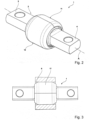
- Fig. 1 shows an elastic joint 1 for a vehicle steering arm with a central element 2 extending on a longitudinal axis A, which extends transversely to the vehicle steering arm.
- the central element 2 is composed of two fastening pins 3, 4 and a joint core 5 arranged between them.
- the joint core 5 is spherically shaped from cross-sections that are exclusively round in relation to the longitudinal axis A, the size of which decreases towards the fastening pins 3, 4.
- the fastening sections 3, 4 are end sections 3, 4 of a bolt 6 which penetrates the joint core 5 on its longitudinal axis A or which is circumferentially enclosed by the joint core 5 in its middle section arranged between the bolts 6.
- the elastic joint 1 has a joint body 10 that completely surrounds the joint core 5 and, in the embodiment, is made up of two equally sized partial shells 11, 12.
- the joint body 10 can be made up of a total of three equally sized partial shells.
- the partial shells 11, 12 each extend in equal parts over a partial circumference of the joint core 5.
- the partial shells 11, 12 each consist of a rigid outer shell 16, which has a cylindrically shaped outer surface 17 over at least part of its length, and of an inner shell 15 made of a deformable material.
- the partial shells 11, 12 are half shells in the embodiment.
- the respective inner shell 15 consists exclusively of an elastomer 20.
- the elastomer 20 has no metallic core or similar reinforcing elements.
- the elastomer 20 is firmly connected to the inside of the respective outer shell 16. On the inside, the elastomer 20 is supported directly against the joint core 5, i.e. without any intermediate layers.
- the elastomer 20 has first regions 21 extending in the direction of the longitudinal axis A, in which the elastomer 20 is supported against the joint core 5. These first regions 21 are separated from one another by second regions 22, wherein the second regions 22 are formed without contact between the elastomer 20 and the joint core 5.
- Every second region 22 of the elastomer 20 is formed by a groove 23 in the elastomer 20 that runs in the circumferential direction around the joint core 5.
- the groove 23 has a trapezoidal cross-section.
- the groove can also have a U-shaped cross-section with a rounded groove base.
- the grooves 23 in the individual partial shells 11, 12 complement each other to form a groove that is fully circumferential in the circumferential direction and therefore forms an annular cavity.
- the number of first regions 21 is greater than the number of second regions 22 by the numerator 1.
- the number of first regions 21 is four and the number of second regions 22 forming cavities is three.
- the elastomer 20 is of greater radial thickness in first regions 21 located near the longitudinal center than in other first regions that are arranged closer to the fastening pins 3, 4.
- the elastomer is tapered at the end in the region of end sections 25. Radial in this case means perpendicular to the axis A and axial in this case means parallel to the axis A.
- the outer shells 16 are here each half shells 11, 12 made of cold-formed sheet steel. They have conically tapered areas 24 in which at least the inner diameter of the respective outer shell 16 is reduced, wherein the tapered areas 24 of the outer shells axially enclose the end sections 25 of the inner shells 15 at least in sections and thus ensure a secure axial connection of the components.
- Each of the fastening pins 3, 4 has, transversely to the longitudinal axis A, a circular cylindrical through-opening 26 as a connection aid.
- the partial shells 11, 12 are pressed against the central element 2 using a tool ( Fig. 2 ) and pressed into a surrounding, circular cylindrical receiving opening 9 of the vehicle control arm to form a press fit ( Fig. 3 ).
- the cylindrical outer surfaces 17 together form a substantially circular-cylindrical outer surface and rest from the inside in the cylindrical receiving opening 9 of the vehicle steering arm.
- the second regions 22 have no contact with the joint core 5
- the transverse strain or stress present in the elastomer 20 in the fully assembled state and under the operating loads that occur is reduced, since the elastomer of the first regions 21 can expand in the direction of the second regions 22 forming the cavities or can deform into these cavities.
Landscapes
- Engineering & Computer Science (AREA)
- General Engineering & Computer Science (AREA)
- Mechanical Engineering (AREA)
- Vehicle Body Suspensions (AREA)
- Springs (AREA)
- Pivots And Pivotal Connections (AREA)
Description
- Die vorliegende Erfindung betrifft ein elastisches Gelenk für einen Fahrzeug-Lenkerarm, mit einem auf einer Längsachse sich erstreckenden Zentralelement aus zwei Befestigungszapfen und einem zwischen diesen angeordneten Gelenkkern, wobei der Gelenkkern ballig geformt ist aus in Bezug auf die Längsachse ausschließlich runden Querschnitten, deren Größe zu den Befestigungszapfen hin jeweils abnimmt, und einem den Gelenkkern vollumfänglich umschließenden Gelenkkörper, der sich aus mindestens zwei Teilschalen zusammensetzt, die sich jeweils nur über einen Teilumfang des Gelenkkerns erstrecken und jeweils aus einer starren Außenschale, die auf zumindest einem Teil ihrer Länge eine teilzylindrische Außenfläche aufweist, und einer verformbaren Innenschale bestehen.
- Ein elastisches Gelenk der eingangs genannten Art ist aus dem Dokument
EP 2 259 935 B1 bekannt. Das aus dem DokumentEP 2 259 935 B1 bekannte Gelenk hat den Nachteil, dass dieses im fertig montierten Zustand und unter den auftretenden Betriebslasten eine hohe Querdehnung bzw. Spannung erfährt. - Ein aus der
DE 10 2014 223 534 A1 bekanntes elastisches Gelenk für ein Fahrzeug verwendet ein axial sich erstreckendes Zentralelement aus zwei Befestigungszapfen und dazwischen einem Gelenkkern, der überwiegend ballig geformt ist mit zusätzlichen, axial verlaufenden Stegen, um so Drehmomente abzufangen und ein Durchrutschen in Umfangsrichtung zu verhindern. Zwei Elastomerkörper umschließen den Gelenkkern und sind ihrerseits in einer gemeinsamen Außenhülse abgestützt. Die Elastomerkörper sind als Halbschalen gestaltet, welche bei der Lagermontage so in Axialrichtung auf den Gelenkkern und dessen Stege aufgeschoben werden, dass sich im Betrieb ein vollflächiger Kontakt zwischen den Elastomerkörpern und dem Gelenkkern einstellt. - Der Erfindung liegt die technische Problemstellung zugrunde, ein verbessertes elastisches Gelenk für einen Fahrzeug-Lenkerarm anzugeben, das im fertig montierten Zustand und unter den auftretenden Betriebslasten insbesondere eine verringerte Querdehnung bzw. Spannung erfährt.
- Diese technische Problemstellung wird durch ein elastisches Gelenk mit den Merkmalen des Anspruchs 1 gelöst. Weitere Ausgestaltungen der Erfindung ergeben sich aus den abhängigen Ansprüchen und aus der nachstehenden Beschreibung.
- Gemäß einem ersten Aspekt betrifft die Erfindung ein elastisches Gelenk für einen Fahrzeug-Lenkerarm, mit einem auf einer Längsachse sich erstreckenden Zentralelement aus zwei Befestigungszapfen und einem zwischen diesen angeordneten Gelenkkern, wobei der Gelenkkern ballig geformt ist aus in Bezug auf die Längsachse ausschließlich runden Querschnitten, deren Größe zu den Befestigungszapfen hin jeweils abnimmt, einem den Gelenkkern vollumfänglich umschließenden Gelenkkörper, der sich aus mindestens zwei Teilschalen zusammensetzt, die sich jeweils nur über einen Teilumfang des Gelenkkerns erstrecken und jeweils aus einer starren Außenschale, die auf zumindest einem Teil ihrer Länge eine teilzylindrische Außenfläche aufweist, und einer verformbaren Innenschale bestehen. Das elastische Gelenk zeichnet sich dadurch aus, dass die Innenschale ausschließlich aus einem Elastomer besteht, dass das Elastomer außen mit der jeweiligen Außenschale fest verbunden und innen unmittelbar gegen den Gelenkkern abgestützt ist, und dass in Richtung der Längsachse erste Bereiche, in denen sich das Elastomer unmittelbar gegen den Gelenkkern abstützt, durch einen zweiten Bereich ohne einen Kontakt zwischen Elastomer und Gelenkkern voneinander getrennt sind.
- Dadurch, dass der zweite Bereich zwischen den ersten Bereichen angeordnet ist und keinen Kontakt zu dem Gelenkkern hat, wird die im fertig montierten Zustand und unter den auftretenden Betriebslasten vorliegende Querdehnung bzw. Spannung reduziert, da sich das Elastomer der ersten Bereiche in Richtung des einen Hohlraum bildenden zweiten Bereichs ausdehnen bzw. verformen kann.
- Die zwei Befestigungszapfen des Zentralelements können z. B. an einem Bolzen gebildet sein bzw. Teil eines Bolzens sein, der den Gelenkkern durchdringt. Ein erster Endabschnitt des Bolzens kann einen ersten der zwei Befestigungszapfen bilden und ein zweiter Endabschnitt des Bolzens kann einen zweiten der zwei Befestigungszapfen bilden. Der Bolzen kann einen metallischen Werkstoff aufweisen oder aus einem metallischen Werkstoff bestehen. Ein zwischen den Befestigungszapfen angeordneter Mittelteil des Bolzens ist vollständig von dem Gelenkkern umschlossen.
- Wenn vorliegend davon gesprochen wird, dass die Innenschale ausschließlich aus einem Elastomer besteht, so bedeutet dies insbesondere, dass die Innenschale keine metallische Armierung und keinen metallischen Kern oder dergleichen aufweist, der von dem Elastomer teilweise oder vollständig umschlossen wäre.
- Jeder Befestigungszapfen weist vorzugsweise eine im Wesentlichen kreiszylindrische Durchgangsöffnung als Befestigungshilfe auf.
- Das elastische Gelenk kann insbesondere spiegelsymmetrisch zu einer die Längsachse aufweisenden Ebene und zu einer weiteren Ebene, die senkrecht zur Längsachse orientiert ist, ausgestaltet sein.
- Die Außenschale weist auf zumindest einem Teil ihrer Länge eine teilzylindrische Außenfläche oder mehr als eine teilzylindrische Außenfläche auf. Es kann vorgesehen sein, dass diese mindestens eine teilzylindrische Außenfläche ausgebildet ist, unter Bildung eines Presssitzes in eine umgebende, ebenfalls zylindrische Aufnahmeöffnung eingepresst zu werden. Im Fall mehrerer teilzylindrischer Außenflächen ergänzen sich diese im eingepressten Zustand zu einer im Wesentlichen zylindrischen Außenfläche. So kann eine gegenüber Kippkräften stabile, einfache und kostengünstige Montage erreicht werden.
- Der zweite Bereich kann durch eine in Umfangsrichtung um den Gelenkkern führende Nut in dem Elastomer gebildet sein, und kann insbesondere in das Elastomer eingeformt sein.
- Die Nuten in den Teilschalen können sich zu einer in Umfangsrichtung vollumfänglichen Nut ergänzen, die daher einen ringförmigen Hohlraum bildet. Auf diese Weise kann eine in axialer und radialer Richtung betrachtet gleichförmige Elastizität des Gelenks erreicht werden
- Die Nut kann von U-förmigem Nutquerschnitt mit gerundetem Nutgrund sein. Durch die Rundung können Spannungsspitzen im Nutgrund reduziert werden.
- Der Nutquerschnitt der Nut kann gemäß alternativer Ausgestaltungen trapezförmig oder V-förmig sein.
- Die Anzahl der ersten Bereiche kann um den Zähler 1 größer als die Anzahl der zweiten Bereiche sein. Insbesondere kann ein zahnförmiges Profil an dem Elastomer gebildet sein, das in axialer Richtung aneinander angrenzende Berge und Täler bzw. Zähne und Zahnlücken aufweist, ähnlich einem Zahnriemen, einem Zahnrad oder dergleichen.
- Es kann vorgesehen sein, dass die Anzahl der ersten Bereiche mindestens drei und die Anzahl der zweiten Bereiche mindestens zwei beträgt. Es kann insbesondere vorgesehen sein, dass die Anzahl der ersten Bereiche vier und die Anzahl der zweiten Bereiche drei beträgt.
- Je nach geforderter Steifigkeit können die Dimensionen, d.h. die axiale Breite und radiale Höhe, die Anzahl und die Form der ersten und zweiten Bereiche angepasst werden.
- Das Elastomer kann in einem nahe der Längsmitte des Gelenkkerns gelegenen ersten Bereich von größerer radialer Dicke sein als in ersten Bereichen, die näher zu den Befestigungszapfen hin angeordnet sind. Das Elastomer kann insbesondere endseitig verjüngt ausgestaltet sein.
- Die Außenschalen können jeweils Halbschalen aus kaltverformtem Stahlblech sein. So können die Außenschalen einfach und kostengünstig hergestellt werden.
- Das Elastomer der Innenschalen kann durch Anvulkanisieren mit den Innenseiten der Außenschalen verbunden sein, wobei insbesondere Haftvermittler eingesetzt werden können.
- Die Außenschalen können verjüngte Bereiche aufweisen, in denen insbesondere die Innendurchmesser der jeweiligen Außenschale reduziert sind. Die Außenschalen können insbesondere konisch verjüngte Bereiche aufweisen, wobei die verjüngten Bereiche der Außenschalen Endabschnitte der Innenschalen zumindest abschnittsweise axial einfassen. Auf diese Weise kann im fertig montierten Zustand durch die Form der Außenschalen eine axiale Vorspannung erreicht werden, und zwar auch ohne zusätzliche Bauteile wie Stützringe oder dergleichen.
- Nachstehend wird die Erfindung anhand einer Ausführungsbeispiele darstellenden Zeichnung näher beschrieben. Es zeigen jeweils schematisch:
- Fig. 1
- ein erfindungsgemäßes elastisches Gelenk für einen Fahrzeug-Lenkerarm in einer perspektivischen Ansicht und vor der abschließenden Montage;
- Fig. 2
- das Gelenk aus
Fig. 1 mit angepressten Teilschalen nach abgeschlossener Montage; - Fig. 3
- das elastische Gelenk aus
Fig. 1 im fertig montierten Zustand innerhalb einer umgebenden Aufnahmeöffnung. -
Fig. 1 zeigt ein elastisches Gelenk 1 für einen Fahrzeug-Lenkerarm mit einem auf einer Längsachse A, die sich quer zu dem Fahrzeug-Lenkerarm erstreckt, sich erstreckenden Zentralelement 2. Das Zentralelement 2 setzt sich zusammen aus zwei Befestigungszapfen 3, 4 und einem zwischen diesen angeordneten Gelenkkern 5. Der Gelenkkern 5 ist ballig geformt aus in Bezug auf die Längsachse A ausschließlich runden Querschnitten, deren Größe zu den Befestigungszapfen 3, 4 hin jeweils abnimmt. - Die Befestigungsabschnitte 3, 4 sind Endabschnitte 3, 4 eines Bolzens 6, der den Gelenkkern 5 auf dessen Längsachse A durchdringt bzw. der in seinem zwischen den Bolzen 6 angeordneten Mittelabschnitt von dem Gelenkkern 5 umfangsseitig eingefasst ist.
- Das elastisches Gelenk 1 hat einen den Gelenkkern 5 vollumfänglich umschließenden Gelenkkörper 10, der sich beim Ausführungsbeispiel aus zwei gleich großen Teilschalen 11, 12 zusammensetzt. In einer alternativen Ausführung kann sich der Gelenkkörper 10 aus insgesamt drei gleich großen Teilschalen zusammensetzen. Die Teilschalen 11, 12 erstrecken sich jeweils in gleichen Teilen über einen Teilumfang des Gelenkkerns 5.
- Die Teilschalen 11, 12 bestehen jeweils aus einer starren Außenschale 16, die auf zumindest einem Teil ihrer Länge eine zylindrisch gestaltete Außenfläche 17 aufweist, und aus einer aus einem verformbaren Material bestehenden Innenschale 15. Die Teilschalen 11, 12 sind beim Ausführungsbeispiel Halbschalen.
- Die jeweilige Innenschale 15 besteht ausschließlich aus einem Elastomer 20. Das Elastomer 20 weist keinen metallischen Kern oder ähnliche Verstärkungselemente auf.
- Außen ist das Elastomer 20 mit der Innenseite der jeweiligen Außenschale 16 fest verbunden. Innen ist das Elastomer 20 unmittelbar, also ohne irgendwelche Zwischenlagen gegen den Gelenkkern 5 abgestützt.
- Das Elastomer 20 hat in Richtung der Längsachse A sich erstreckende erste Bereiche 21, in denen sich das Elastomer 20 gegen den Gelenkkern 5 abstützt. Diese ersten Bereiche 21 sind durch zweite Bereiche 22 voneinander getrennt, wobei die zweiten Bereiche 22 ohne einen Kontakt zwischen Elastomer 20 und Gelenkkern 5 ausgebildet sind. Die ersten und zweiten Bereiche 21, 22 bilden daher gemeinsam betrachtet eine Profilierung nach Art einer Zahnstange.
- Jeder zweite Bereich 22 des Elastomers 20 ist durch eine in Umfangsrichtung um den Gelenkkern 5 führende Nut 23 in dem Elastomer 20 gebildet. Beim Ausführungsbeispiel ist die Nut 23 von trapezförmigem Nutquerschnitt. Die Nut kann auch von U-förmigem Nutquerschnitt mit gerundetem Nutgrund sein.
- Im fertig montierten Zustand ergänzen sich die Nuten 23 in den einzelnen Teilschalen 11, 12 zu einer in Umfangsrichtung vollumfänglichen Nut, die daher einen ringförmigen Hohlraum bildet.
- Die Anzahl der ersten Bereiche 21 ist um den Zähler 1 größer als die Anzahl der zweiten Bereiche 22. Beim Ausführungsbeispiel beträgt die Anzahl der ersten Bereiche 21 vier und die Anzahl der zweiten, Hohlräume bildenden Bereiche 22 drei.
- Das Elastomer 20 ist in nahe der Längsmitte gelegenen ersten Bereichen 21 von größerer radialer Dicke, als in anderen ersten Bereichen, die näher zu den Befestigungszapfen 3, 4 angeordnet sind. Mit anderen Worten ist das Elastomer endseitig im Bereich von Endabschnitten 25 verjüngt. Radial bedeutet vorliegend senkrecht zur Achse A und axial bedeutet vorliegend parallel zur Achse A.
- Die Außenschalen 16 sind hier jeweils Halbschalen 11, 12 aus kaltverformtem Stahlblech. Sie weisen konisch verjüngte Bereiche 24 auf, in denen zumindest der Innendurchmesser der jeweiligen Außenschale 16 reduziert ist, wobei die verjüngten Bereiche 24 der Außenschalen die Endabschnitte 25 der Innenschalen 15 zumindest abschnittsweise axial einfassen und so für eine sichere axiale Verbindung der Bauteile sorgen.
- Jeder der Befestigungszapfen 3, 4 weist, quer zu der Längsachse A, eine kreiszylindrische Durchgangsöffnung 26 als Verbindungshilfsmittel auf.
- Zur Montage werden die Teilschalen 11, 12 mittels eines Werkzeugs gegen das Zentralelement 2 gepresst (
Fig. 2 ) und unter Bildung eines Presssitzes in eine umgebende, kreiszylindrische Aufnahmeöffnung 9 des Fahrzeug-Lenkerarms eingepresst (Fig. 3 ). Die zylindrischen Außenflächen 17 bilden dabei gemeinsam eine im Wesentlichen kreiszylindrische Außenfläche und liegen von innen her in der zylindrischen Aufnahmeöffnung 9 des Fahrzeug-Lenkerarms an. - Indem die zweiten Bereiche 22 keinen Kontakt zu dem Gelenkkern 5 haben, wird in dem Elastomer 20 die im fertig montierten Zustand und unter den auftretenden Betriebslasten vorliegende Querdehnung bzw. Spannung reduziert, da sich das Elastomer der ersten Bereiche 21 in Richtung der Hohlräume bildenden zweiten Bereiche 22 ausdehnen bzw. in diese Hohlräume hinein verformen kann.
-
- 1
- elastisches Gelenk
- 2
- Zentralelement
- 3
- Befestigungszapfen
- 4
- Befestigungszapfen
- 5
- Gelenkkern
- 6
- Bolzen
- 9
- Aufnahmeöffnung
- 10
- Gelenkkörper
- 11
- Teilschale
- 12
- Teilschale
- 15
- Innenschale
- 16
- Außenschale
- 17
- Außenfläche
- 20
- Elastomer
- 21
- erster Bereich
- 22
- zweiter Bereich
- 23
- Nut
- 24
- verjüngter Bereich
- 25
- Endabschnitt
- 26
- Durchgangsöffnung
- A
- Längsachse
Claims (10)
- Elastisches Gelenk für einen Fahrzeug-Lenkerarm, mit- einem auf einer Längsachse (A) sich erstreckenden Zentralelement (2) aus zwei Befestigungszapfen (3, 4) und einem zwischen diesen angeordneten Gelenkkern (5), wobei der Gelenkkern (5) ballig geformt ist aus in Bezug auf die Längsachse (A) ausschließlich runden Querschnitten, deren Größe zu den Befestigungszapfen (3, 4) hin jeweils abnimmt,- einem den Gelenkkern (5) vollumfänglich umschließenden Gelenkkörper (10), der sich aus mindestens zwei Teilschalen (11, 12) zusammensetzt, die sich jeweils nur über einen Teilumfang des Gelenkkerns (5) erstrecken und jeweils aus einer starren Außenschale (16), die auf zumindest einem Teil ihrer Länge eine teilzylindrische Außenfläche (17) ausbildet, und einer verformbaren Innenschale (15) bestehen,dadurch gekennzeichnet, dass die Innenschale (15) ausschließlich aus einem Elastomer (20) besteht, dass das Elastomer (20) außen mit der jeweiligen Außenschale (16) fest verbunden und innen unmittelbar gegen den Gelenkkern (5) abgestützt ist, und dass in Richtung der Längsachse (A) erste Bereiche (21), in denen sich das Elastomer (20) gegen den Gelenkkern (5) abstützt, durch einen zweiten Bereich (22) ohne einen Kontakt zwischen Elastomer (20) und Gelenkkern (5) voneinander getrennt sind.
- Gelenk nach Anspruch 1, dadurch gekennzeichnet, dass die teilzylindrischen Außenflächen (17) ausgebildet sind, unter Bildung eines Presssitzes gemeinsam in eine umgebende zylindrische Aufnahmeöffnung (9) eingepresst zu werden.
- Gelenk nach Anspruch 1 oder 2, dadurch gekennzeichnet, dass der zweite Bereich (22) durch eine in Umfangsrichtung um den Gelenkkern (5) führende Nut (23) in dem Elastomer (20) gebildet wird.
- Gelenk nach Anspruch 3, dadurch gekennzeichnet, dass sich die Nuten (23) in den Teilschalen (11, 12) zu einer in Umfangsrichtung vollumfänglichen Nut ergänzen.
- Gelenk nach Anspruch 3 oder 4, dadurch gekennzeichnet, dass die Nut (23) von U-förmigem Nutquerschnitt mit gerundetem Nutgrund ist.
- Gelenk nach einem der vorangehenden Ansprüche, dadurch gekennzeichnet, dass die Anzahl der ersten Bereiche (21) um den Zähler 1 größer als die Anzahl der zweiten Bereiche (22) ist.
- Gelenk nach einem der vorangehenden Ansprüche, dadurch gekennzeichnet, dass die Anzahl der ersten Bereiche (21) mindestens drei und die Anzahl der zweiten Bereiche (22) mindestens zwei beträgt.
- Gelenk nach Anspruch 7, dadurch gekennzeichnet, dass das Elastomer (20) in einem nahe der Längsmitte gelegenen ersten Bereich (21) von größerer radialer Dicke ist als in ersten Bereichen (21), die näher zu den Befestigungszapfen (3, 4) angeordnet sind.
- Gelenk nach einem der vorangehenden Ansprüche, dadurch gekennzeichnet, dass die Außenschalen (16, 17) jeweils Halbschalen (16, 17) aus kaltverformtem Stahlblech sind.
- Gelenk nach einem der vorangehenden Ansprüche, dadurch gekennzeichnet, dass die Außenschalen (16, 17) verjüngte Bereiche (24) aufweisen, in denen insbesondere ein Innendurchmesser der jeweiligen Außenschale (16, 17) reduziert ist, insbesondere konisch verjüngte Bereiche (24) aufweisen, wobei die verjüngten Bereiche (24) der Außenschalen (16, 17) Endabschnitte (25) der Innenschalen (15) zumindest abschnittsweise axial einfassen.
Applications Claiming Priority (1)
| Application Number | Priority Date | Filing Date | Title |
|---|---|---|---|
| DE102021122875.1A DE102021122875A1 (de) | 2021-09-03 | 2021-09-03 | Elastisches Gelenk für einen Fahrzeug-Lenkerarm |
Publications (2)
| Publication Number | Publication Date |
|---|---|
| EP4145007A1 EP4145007A1 (de) | 2023-03-08 |
| EP4145007B1 true EP4145007B1 (de) | 2024-11-13 |
Family
ID=83149116
Family Applications (1)
| Application Number | Title | Priority Date | Filing Date |
|---|---|---|---|
| EP22193207.2A Active EP4145007B1 (de) | 2021-09-03 | 2022-08-31 | Elastisches gelenk für einen fahrzeug-lenkerarm |
Country Status (2)
| Country | Link |
|---|---|
| EP (1) | EP4145007B1 (de) |
| DE (1) | DE102021122875A1 (de) |
Family Cites Families (5)
| Publication number | Priority date | Publication date | Assignee | Title |
|---|---|---|---|---|
| DE102004045064A1 (de) * | 2004-09-15 | 2006-03-30 | Zf Friedrichshafen Ag | Elastomerlager |
| US20110026862A1 (en) | 2008-04-07 | 2011-02-03 | Sven Bjoerkgard | Reaction rod arrangement |
| DE102010028925A1 (de) * | 2010-05-12 | 2011-11-17 | Zf Friedrichshafen Ag | Anordnung eines Zahnrades |
| DE102014112181A1 (de) * | 2014-08-26 | 2016-03-03 | Bhc Gummi-Metall Gmbh | Elastisches Gelenk für einen Fahrzeug-Lenkerarm |
| DE102014223534A1 (de) * | 2014-11-18 | 2016-05-19 | Zf Friedrichshafen Ag | Elastomerlager für ein Fahrzeug |
-
2021
- 2021-09-03 DE DE102021122875.1A patent/DE102021122875A1/de active Pending
-
2022
- 2022-08-31 EP EP22193207.2A patent/EP4145007B1/de active Active
Also Published As
| Publication number | Publication date |
|---|---|
| DE102021122875A1 (de) | 2023-03-09 |
| EP4145007A1 (de) | 2023-03-08 |
Similar Documents
| Publication | Publication Date | Title |
|---|---|---|
| EP2478254B1 (de) | Elastische buchse, insbesondere verbundlenker-buchse | |
| EP3045763B1 (de) | Gummi-metall-hülsenlager | |
| DE10131075B4 (de) | Aggregatelager in Buchsenform | |
| EP1589251B1 (de) | Lager für ein Kraftfahrzeug | |
| EP0475084B1 (de) | Radial-Buchsenlager | |
| EP3221610B1 (de) | Elastomerlager für ein fahrzeug | |
| DE102020126561B4 (de) | Lager und Lageranordnung | |
| EP3006765A1 (de) | Elastomerlager als buchsenlager | |
| EP2213894A1 (de) | Wälzlagerkäfig | |
| EP1978275B1 (de) | Gelenklager, insbesondere an einem Drehgelenk zwischen einem Vorderwagen und Hinterwagen eines Gelenkbusses | |
| WO2008000249A1 (de) | Lagerkäfig mit einer vielzahl von verbindungslaschen | |
| DE19936014A1 (de) | Gummilager mit axialer Dämpfung | |
| DE102011003376A1 (de) | Segmentkäfig und Verfahren zum Montieren eines Wälzlagers | |
| DE102010017964A1 (de) | Wälzlager | |
| DE102018208298B4 (de) | Koppelstange, Radaufhängung und Verfahren zur Herstellung einer Koppelstange | |
| DE3333130C2 (de) | ||
| EP4145007B1 (de) | Elastisches gelenk für einen fahrzeug-lenkerarm | |
| WO2012076594A1 (de) | Radialwälzlager mit losen abstandskörpern zwischen den wälzkörpern und verfahren zum zusammenbau des wälzlagers | |
| EP1319861B1 (de) | Lagerung mit einem Gummi-Metalllager für einen Getriebeträger | |
| EP1806517A1 (de) | Elastomer-Metall-Gelenklager, insbesondere als Zentralgelenklager eines Dreieckslenkers zur Verbindung eines Achskörpers mit einem Fahrzeugaufbau | |
| DE102017201903B4 (de) | Lagereinheit | |
| EP2078873A1 (de) | Lageranordnung | |
| DE19735753A1 (de) | Drehstabanordnung | |
| DE102011078713B4 (de) | Radlageranordnung | |
| EP3582975B1 (de) | Schienenrad und elastischer körper für ein solches schienenrad |
Legal Events
| Date | Code | Title | Description |
|---|---|---|---|
| PUAI | Public reference made under article 153(3) epc to a published international application that has entered the european phase |
Free format text: ORIGINAL CODE: 0009012 |
|
| STAA | Information on the status of an ep patent application or granted ep patent |
Free format text: STATUS: THE APPLICATION HAS BEEN PUBLISHED |
|
| AK | Designated contracting states |
Kind code of ref document: A1 Designated state(s): AL AT BE BG CH CY CZ DE DK EE ES FI FR GB GR HR HU IE IS IT LI LT LU LV MC MK MT NL NO PL PT RO RS SE SI SK SM TR |
|
| STAA | Information on the status of an ep patent application or granted ep patent |
Free format text: STATUS: REQUEST FOR EXAMINATION WAS MADE |
|
| 17P | Request for examination filed |
Effective date: 20230904 |
|
| RBV | Designated contracting states (corrected) |
Designated state(s): AL AT BE BG CH CY CZ DE DK EE ES FI FR GB GR HR HU IE IS IT LI LT LU LV MC MK MT NL NO PL PT RO RS SE SI SK SM TR |
|
| GRAP | Despatch of communication of intention to grant a patent |
Free format text: ORIGINAL CODE: EPIDOSNIGR1 |
|
| GRAP | Despatch of communication of intention to grant a patent |
Free format text: ORIGINAL CODE: EPIDOSNIGR1 |
|
| STAA | Information on the status of an ep patent application or granted ep patent |
Free format text: STATUS: GRANT OF PATENT IS INTENDED |
|
| RIC1 | Information provided on ipc code assigned before grant |
Ipc: B60G 7/02 20060101ALI20240515BHEP Ipc: B62D 1/00 20060101ALI20240515BHEP Ipc: F16C 11/06 20060101ALI20240515BHEP Ipc: F16C 11/08 20060101AFI20240515BHEP |
|
| INTG | Intention to grant announced |
Effective date: 20240614 |
|
| GRAS | Grant fee paid |
Free format text: ORIGINAL CODE: EPIDOSNIGR3 |
|
| GRAA | (expected) grant |
Free format text: ORIGINAL CODE: 0009210 |
|
| STAA | Information on the status of an ep patent application or granted ep patent |
Free format text: STATUS: THE PATENT HAS BEEN GRANTED |
|
| AK | Designated contracting states |
Kind code of ref document: B1 Designated state(s): AL AT BE BG CH CY CZ DE DK EE ES FI FR GB GR HR HU IE IS IT LI LT LU LV MC MK MT NL NO PL PT RO RS SE SI SK SM TR |
|
| REG | Reference to a national code |
Ref country code: GB Ref legal event code: FG4D Free format text: NOT ENGLISH |
|
| REG | Reference to a national code |
Ref country code: CH Ref legal event code: EP |
|
| REG | Reference to a national code |
Ref country code: DE Ref legal event code: R096 Ref document number: 502022002120 Country of ref document: DE |
|
| REG | Reference to a national code |
Ref country code: IE Ref legal event code: FG4D Free format text: LANGUAGE OF EP DOCUMENT: GERMAN |
|
| REG | Reference to a national code |
Ref country code: LT Ref legal event code: MG9D |
|
| REG | Reference to a national code |
Ref country code: NL Ref legal event code: MP Effective date: 20241113 |
|
| PG25 | Lapsed in a contracting state [announced via postgrant information from national office to epo] |
Ref country code: HR Free format text: LAPSE BECAUSE OF FAILURE TO SUBMIT A TRANSLATION OF THE DESCRIPTION OR TO PAY THE FEE WITHIN THE PRESCRIBED TIME-LIMIT Effective date: 20241113 Ref country code: PT Free format text: LAPSE BECAUSE OF FAILURE TO SUBMIT A TRANSLATION OF THE DESCRIPTION OR TO PAY THE FEE WITHIN THE PRESCRIBED TIME-LIMIT Effective date: 20250313 Ref country code: IS Free format text: LAPSE BECAUSE OF FAILURE TO SUBMIT A TRANSLATION OF THE DESCRIPTION OR TO PAY THE FEE WITHIN THE PRESCRIBED TIME-LIMIT Effective date: 20250313 |
|
| PG25 | Lapsed in a contracting state [announced via postgrant information from national office to epo] |
Ref country code: FI Free format text: LAPSE BECAUSE OF FAILURE TO SUBMIT A TRANSLATION OF THE DESCRIPTION OR TO PAY THE FEE WITHIN THE PRESCRIBED TIME-LIMIT Effective date: 20241113 Ref country code: NL Free format text: LAPSE BECAUSE OF FAILURE TO SUBMIT A TRANSLATION OF THE DESCRIPTION OR TO PAY THE FEE WITHIN THE PRESCRIBED TIME-LIMIT Effective date: 20241113 |
|
| PG25 | Lapsed in a contracting state [announced via postgrant information from national office to epo] |
Ref country code: BG Free format text: LAPSE BECAUSE OF FAILURE TO SUBMIT A TRANSLATION OF THE DESCRIPTION OR TO PAY THE FEE WITHIN THE PRESCRIBED TIME-LIMIT Effective date: 20241113 |
|
| PG25 | Lapsed in a contracting state [announced via postgrant information from national office to epo] |
Ref country code: ES Free format text: LAPSE BECAUSE OF FAILURE TO SUBMIT A TRANSLATION OF THE DESCRIPTION OR TO PAY THE FEE WITHIN THE PRESCRIBED TIME-LIMIT Effective date: 20241113 |
|
| PG25 | Lapsed in a contracting state [announced via postgrant information from national office to epo] |
Ref country code: NO Free format text: LAPSE BECAUSE OF FAILURE TO SUBMIT A TRANSLATION OF THE DESCRIPTION OR TO PAY THE FEE WITHIN THE PRESCRIBED TIME-LIMIT Effective date: 20250213 |
|
| PG25 | Lapsed in a contracting state [announced via postgrant information from national office to epo] |
Ref country code: LV Free format text: LAPSE BECAUSE OF FAILURE TO SUBMIT A TRANSLATION OF THE DESCRIPTION OR TO PAY THE FEE WITHIN THE PRESCRIBED TIME-LIMIT Effective date: 20241113 Ref country code: GR Free format text: LAPSE BECAUSE OF FAILURE TO SUBMIT A TRANSLATION OF THE DESCRIPTION OR TO PAY THE FEE WITHIN THE PRESCRIBED TIME-LIMIT Effective date: 20250214 |
|
| PG25 | Lapsed in a contracting state [announced via postgrant information from national office to epo] |
Ref country code: PL Free format text: LAPSE BECAUSE OF FAILURE TO SUBMIT A TRANSLATION OF THE DESCRIPTION OR TO PAY THE FEE WITHIN THE PRESCRIBED TIME-LIMIT Effective date: 20241113 |
|
| PG25 | Lapsed in a contracting state [announced via postgrant information from national office to epo] |
Ref country code: RS Free format text: LAPSE BECAUSE OF FAILURE TO SUBMIT A TRANSLATION OF THE DESCRIPTION OR TO PAY THE FEE WITHIN THE PRESCRIBED TIME-LIMIT Effective date: 20250213 |
|
| PG25 | Lapsed in a contracting state [announced via postgrant information from national office to epo] |
Ref country code: SM Free format text: LAPSE BECAUSE OF FAILURE TO SUBMIT A TRANSLATION OF THE DESCRIPTION OR TO PAY THE FEE WITHIN THE PRESCRIBED TIME-LIMIT Effective date: 20241113 |
|
| PG25 | Lapsed in a contracting state [announced via postgrant information from national office to epo] |
Ref country code: DK Free format text: LAPSE BECAUSE OF FAILURE TO SUBMIT A TRANSLATION OF THE DESCRIPTION OR TO PAY THE FEE WITHIN THE PRESCRIBED TIME-LIMIT Effective date: 20241113 |
|
| PG25 | Lapsed in a contracting state [announced via postgrant information from national office to epo] |
Ref country code: EE Free format text: LAPSE BECAUSE OF FAILURE TO SUBMIT A TRANSLATION OF THE DESCRIPTION OR TO PAY THE FEE WITHIN THE PRESCRIBED TIME-LIMIT Effective date: 20241113 |
|
| PG25 | Lapsed in a contracting state [announced via postgrant information from national office to epo] |
Ref country code: RO Free format text: LAPSE BECAUSE OF FAILURE TO SUBMIT A TRANSLATION OF THE DESCRIPTION OR TO PAY THE FEE WITHIN THE PRESCRIBED TIME-LIMIT Effective date: 20241113 |
|
| PG25 | Lapsed in a contracting state [announced via postgrant information from national office to epo] |
Ref country code: SK Free format text: LAPSE BECAUSE OF FAILURE TO SUBMIT A TRANSLATION OF THE DESCRIPTION OR TO PAY THE FEE WITHIN THE PRESCRIBED TIME-LIMIT Effective date: 20241113 |
|
| PG25 | Lapsed in a contracting state [announced via postgrant information from national office to epo] |
Ref country code: CZ Free format text: LAPSE BECAUSE OF FAILURE TO SUBMIT A TRANSLATION OF THE DESCRIPTION OR TO PAY THE FEE WITHIN THE PRESCRIBED TIME-LIMIT Effective date: 20241113 |
|
| REG | Reference to a national code |
Ref country code: DE Ref legal event code: R097 Ref document number: 502022002120 Country of ref document: DE |
|
| PG25 | Lapsed in a contracting state [announced via postgrant information from national office to epo] |
Ref country code: SE Free format text: LAPSE BECAUSE OF FAILURE TO SUBMIT A TRANSLATION OF THE DESCRIPTION OR TO PAY THE FEE WITHIN THE PRESCRIBED TIME-LIMIT Effective date: 20241113 |
|
| PLBE | No opposition filed within time limit |
Free format text: ORIGINAL CODE: 0009261 |
|
| STAA | Information on the status of an ep patent application or granted ep patent |
Free format text: STATUS: NO OPPOSITION FILED WITHIN TIME LIMIT |
|
| PGFP | Annual fee paid to national office [announced via postgrant information from national office to epo] |
Ref country code: DE Payment date: 20250901 Year of fee payment: 4 |
|
| PGFP | Annual fee paid to national office [announced via postgrant information from national office to epo] |
Ref country code: TR Payment date: 20250822 Year of fee payment: 4 Ref country code: IT Payment date: 20250901 Year of fee payment: 4 |
|
| PGFP | Annual fee paid to national office [announced via postgrant information from national office to epo] |
Ref country code: FR Payment date: 20250821 Year of fee payment: 4 |
|
| 26N | No opposition filed |
Effective date: 20250814 |
|
| REG | Reference to a national code |
Ref country code: CH Ref legal event code: H13 Free format text: ST27 STATUS EVENT CODE: U-0-0-H10-H13 (AS PROVIDED BY THE NATIONAL OFFICE) Effective date: 20260324 |
|
| PG25 | Lapsed in a contracting state [announced via postgrant information from national office to epo] |
Ref country code: MC Free format text: LAPSE BECAUSE OF FAILURE TO SUBMIT A TRANSLATION OF THE DESCRIPTION OR TO PAY THE FEE WITHIN THE PRESCRIBED TIME-LIMIT Effective date: 20241113 |
|
| PG25 | Lapsed in a contracting state [announced via postgrant information from national office to epo] |
Ref country code: LU Free format text: LAPSE BECAUSE OF NON-PAYMENT OF DUE FEES Effective date: 20250831 |
|
| PG25 | Lapsed in a contracting state [announced via postgrant information from national office to epo] |
Ref country code: CH Free format text: LAPSE BECAUSE OF NON-PAYMENT OF DUE FEES Effective date: 20250831 |