EP4144599B1 - Adapter für reinigungssystem - Google Patents
Adapter für reinigungssystem Download PDFInfo
- Publication number
- EP4144599B1 EP4144599B1 EP22191778.4A EP22191778A EP4144599B1 EP 4144599 B1 EP4144599 B1 EP 4144599B1 EP 22191778 A EP22191778 A EP 22191778A EP 4144599 B1 EP4144599 B1 EP 4144599B1
- Authority
- EP
- European Patent Office
- Prior art keywords
- adapter
- upper wall
- wall
- arm
- locking device
- Prior art date
- Legal status (The legal status is an assumption and is not a legal conclusion. Google has not performed a legal analysis and makes no representation as to the accuracy of the status listed.)
- Active
Links
Images


Classifications
-
- B—PERFORMING OPERATIONS; TRANSPORTING
- B60—VEHICLES IN GENERAL
- B60S—SERVICING, CLEANING, REPAIRING, SUPPORTING, LIFTING, OR MANOEUVRING OF VEHICLES, NOT OTHERWISE PROVIDED FOR
- B60S1/00—Cleaning of vehicles
- B60S1/02—Cleaning windscreens, windows or optical devices
- B60S1/04—Wipers or the like, e.g. scrapers
- B60S1/32—Wipers or the like, e.g. scrapers characterised by constructional features of wiper blade arms or blades
- B60S1/40—Connections between blades and arms
- B60S1/4083—Connections between blades and arms for arms provided with a flat end
- B60S1/4087—Connections between blades and arms for arms provided with a flat end the end being provided with protrusions or holes
-
- B—PERFORMING OPERATIONS; TRANSPORTING
- B60—VEHICLES IN GENERAL
- B60S—SERVICING, CLEANING, REPAIRING, SUPPORTING, LIFTING, OR MANOEUVRING OF VEHICLES, NOT OTHERWISE PROVIDED FOR
- B60S1/00—Cleaning of vehicles
- B60S1/02—Cleaning windscreens, windows or optical devices
- B60S1/04—Wipers or the like, e.g. scrapers
- B60S1/32—Wipers or the like, e.g. scrapers characterised by constructional features of wiper blade arms or blades
- B60S1/40—Connections between blades and arms
-
- B—PERFORMING OPERATIONS; TRANSPORTING
- B60—VEHICLES IN GENERAL
- B60S—SERVICING, CLEANING, REPAIRING, SUPPORTING, LIFTING, OR MANOEUVRING OF VEHICLES, NOT OTHERWISE PROVIDED FOR
- B60S1/00—Cleaning of vehicles
- B60S1/02—Cleaning windscreens, windows or optical devices
- B60S1/04—Wipers or the like, e.g. scrapers
- B60S1/0408—Means for influencing the aerodynamic quality of wipers, e.g. clip-on wind deflectors
-
- B—PERFORMING OPERATIONS; TRANSPORTING
- B60—VEHICLES IN GENERAL
- B60S—SERVICING, CLEANING, REPAIRING, SUPPORTING, LIFTING, OR MANOEUVRING OF VEHICLES, NOT OTHERWISE PROVIDED FOR
- B60S1/00—Cleaning of vehicles
- B60S1/02—Cleaning windscreens, windows or optical devices
- B60S1/04—Wipers or the like, e.g. scrapers
- B60S1/32—Wipers or the like, e.g. scrapers characterised by constructional features of wiper blade arms or blades
- B60S1/38—Wiper blades
- B60S1/3848—Flat-type wiper blade, i.e. without harness
- B60S1/3849—Connectors therefor; Connection to wiper arm; Attached to blade
-
- B—PERFORMING OPERATIONS; TRANSPORTING
- B60—VEHICLES IN GENERAL
- B60S—SERVICING, CLEANING, REPAIRING, SUPPORTING, LIFTING, OR MANOEUVRING OF VEHICLES, NOT OTHERWISE PROVIDED FOR
- B60S1/00—Cleaning of vehicles
- B60S1/02—Cleaning windscreens, windows or optical devices
- B60S1/04—Wipers or the like, e.g. scrapers
- B60S1/32—Wipers or the like, e.g. scrapers characterised by constructional features of wiper blade arms or blades
- B60S1/40—Connections between blades and arms
- B60S1/4083—Connections between blades and arms for arms provided with a flat end
Definitions
- the field of the present invention is that of wiping systems intended for motor vehicles. More particularly, the field of the present invention is that of adapters arranged between a windshield wiper arm and a wiper blade of such wiping systems.
- Such wiping systems comprise at least one wiper arm and a wiper blade driven by the wiper arm.
- the wiper arm is connected to an electric motor of the vehicle and the wiper blade comprises at least one wiper blade adapted to come into contact with the glass surface to be wiped.
- an adapter is arranged between this wiper blade and the wiper arm. More particularly, the adapter is arranged between the wiper arm and a connector connected to the wiper blade. The adapter is then secured to the wiper arm and more particularly to a free end of the wiper arm, such cooperation being removable so that it allows the wiper blade to be changed when it is worn.
- the assembly and/or disassembly of the wiper blade on the arm is also not optimal. Indeed, actuating the locking device without a minimum of precautions can cause it to break or cause irreversible damage, thus limiting its use.
- the aim of the invention is therefore to improve in a simple manner the pressing of the wiper blades against the glass surfaces, while allowing mounting and/or dismounting of the wiper blade without causing the destruction of an element of the wiper blade.
- the pressing of the wiper blades is formed in particular by generating a depression zone at the rear of the adapters, following a direction of air flow against the wiping system, thereby improving the overall performance of the wiping system.
- the main subject of the invention is an adapter for attaching a wiper blade to an arm of a wiping system, the adapter extending along a longitudinal direction, the adapter being configured to be rotatably mounted on a connector of a wiper blade about an axis of rotation transverse to the longitudinal direction, the adapter comprising at least one side wall and an upper wall, the side wall and the upper wall participating in defining an internal volume of the adapter, the adapter comprising an internal wall extending at least partly in the internal volume of the adapter, the adapter comprising a locking device intended to longitudinally secure the adapter relative to the arm of the wiping system, the locking device being pivotally mounted on the upper wall about a pivot axis, the locking device comprising at least one thrust member and one blocking member, the thrust member being inscribed in a profile of the upper wall while the blocking member locking extends at least partly into a receiving housing intended to receive the arm characterized in that the locking device comprises a means for limiting its pivoting which comes to bear against the internal wall.
- the wiper blade and the arm are part of a vehicle wiping system intended to clean at least part of a glass surface of said vehicle.
- the wiping system then comprises the arm driven in rotation by an electric motor of the vehicle and ensuring the rotational movement of the wiper blade, to which it is secured via the adapter and the connector, against the glass surface so that the blade carried by the wiper blade clears said glass surface of raindrops and/or solid debris deposited on the latter.
- the locking device also participates in fixing the adapter to the arm, by blocking the position of the adapter on the arm. By its pivoting, the locking device facilitates the assembly and/or disassembly of the adapter on the arm by limiting the breakage of a constituent element of the adapter and/or the arm.
- the limiting means of the locking device blocks the pivoting of the locking device in at least one pivoting direction of the latter. It is understood here that the limiting means makes it possible in particular, for example by means of a stop, to prevent the locking device from pivoting at too great an angle, and thus limits the risk of breakage of a constituent element of the adapter and/or the arm.
- the pivoting of the locking device is limited by the stop of the limiting means against the internal wall of the adapter.
- the pivot axis is parallel to the longitudinal direction.
- the side wall and the top wall each have a free edge and an edge common to the side wall and the top wall
- the adapter having a triangular section seen in a plane perpendicular to the longitudinal direction and defined by the free edge of the side wall, the free edge of the top wall and by the common edge between the side wall and the top wall, the top wall being curved between the common edge and its free edge seen in the plane perpendicular to the longitudinal direction.
- the free edge of the upper wall corresponds to the edge arranged across the air flow when the wiping system is arranged on the vehicle, the air flow licking the upper wall.
- the free edge of the upper wall is the most forward edge of the vehicle when the wiping system is mounted on said vehicle. It is thus understood that the free edge of the side wall and the side wall itself are arranged at the rear of the wiping system, between the glazed surface and the free edge of the upper wall following a trajectory of the air flow, when the wiping system is mounted on the vehicle.
- the curve of the upper wall between the common edge and its free edge seen in the plane perpendicular to the longitudinal direction is inscribed in a circle.
- the internal wall participates in delimiting at least in part a receiving zone intended to receive the connector. It is understood that the receiving zone is delimited at least by the internal wall, but that other walls can contribute to delimiting this receiving zone. It is understood here that the connector, once mounted on the adapter, is arranged at least in part in the receiving zone of the adapter.
- the internal wall has a contact face facing the limitation means and a guide face participating in delimiting the reception zone, the limitation means coming to bear against the contact face of the wall. internal.
- the thrust member extends by matching the shape of the upper wall, the thrust member being flush with the upper wall for example.
- the thrust member is also the member of the locking device on which a user exerts a force to allow the locking device to pivot.
- the locking member is the member of the locking device configured to be in contact with the arm, securing and/or disconnecting the adapter from the arm.
- the locking device comprises at least one hinge connecting the thrust member to the upper wall, the thrust member being surrounded by a groove separating it from the upper wall.
- the hinge on the one hand allows the pivoting of the locking device around the pivot axis, and on the other hand makes the locking device integral with the upper wall.
- the thrust member takes a parallelepiped shape, the thrust member having at least one upper side and one lower side extending parallel to the longitudinal direction, the hinge being arranged between the lower side of the thrust member and the upper wall, the groove extending on the other three sides of the thrust member.
- the upper side is the side of the thrust member closest to the common edge between the side wall and the upper wall and that the lower side is the side of the thrust member closest to the free edge of the upper wall.
- the pivoting of the locking member makes it possible to position and/or remove the blocking member from the receiving housing, securing and/or disconnecting the adapter from the arm.
- the thrust member has a curved profile seen in a section perpendicular to the longitudinal direction, the curved profile of the thrust member fitting into a profile of the upper wall.
- the thrust member comprises an external face oriented towards the external environment of the adapter and an internal face oriented towards the internal volume of the adapter, the thrust member having on its external face a pattern promoting adhesion.
- This pattern is for example a graining of the external face of the upper wall.
- the limiting means is part of the blocking member.
- the limiting means and the blocking member form a single-piece assembly, i.e. the limiting means and the blocking member cannot be separated from each other without causing the destruction of the limiting means and/or the blocking member.
- the blocking member is delimited longitudinally by an end face of the limiting means.
- end face means a face arranged at a longitudinal end of the limiting means.
- the limiting means is formed by a stop face secant to the end face and facing the internal wall. More precisely, the stop face extends in a plane secant to the plane in which the end face of the limiting means extends.
- the locking device pivots around the pivot axis through a maximum angle of 20°.
- the pivot angle of the locking device is a maximum of 15°.
- the pivot angle of the locking device is a maximum of 10°.
- the locking member extends from the thrust member towards the receiving housing, the locking member comprising a bent portion and a free end arranged in the receiving housing when the locking member is in a position for locking the adapter on the arm.
- the limiting means longitudinally extends the free end of the blocking member.
- the adapter comprises at least one reinforcement extending between the internal wall and the side wall and/or the upper wall.
- the reinforcement comprises in particular a wall extending mainly, for example, in a plane substantially perpendicular to the longitudinal direction. The reinforcement makes it possible to reinforce the structure of the adapter, and to increase its rigidity.
- the reinforcement comprises an opening participating in delimiting at least in part the receiving housing. It is understood that the opening is intended to receive at least part of the arm.
- the receiving housing is laterally offset relative to the receiving area.
- the receiving housing is closer to the side wall than the receiving area.
- the receiving housing is arranged between the receiving area and the side wall.
- the receiving housing extends in a main extension plane parallel to the longitudinal direction, the main extension plane being seen in a median position of said receiving housing, the main extension plane of the receiving housing intersecting the receiving area.
- the upper wall comprises at least one air disturbance device extending along the longitudinal direction and is open to the exterior of the adapter.
- the air disturbance device takes the form of a groove.
- the air disturbance device takes the form of a rib.
- connection device for a wiper blade comprising at least one connector and an adapter according to any one of the preceding characteristics, the connector being mounted in rotation about the axis of rotation by means of a rotation device.
- the invention further relates to a wiper blade comprising at least one connection device according to the preceding characteristic or an adapter according to any one of the preceding characteristics.
- the invention finally relates to a wiping system comprising at least one arm and a wiper blade according to the preceding characteristic, the arm comprising at least one rod housed in the receiving housing of the adapter.
- the term "rod” is understood to mean a solid and elongated element having, for example, a rectangular or discoid section, seen in a plane perpendicular to a direction of main elongation of the rod.
- At least one end of the rod takes a shape complementary to the receiving housing of the adapter, the rod having a notch cooperating with the locking device to longitudinally block the position of the adapter on the rod.
- a longitudinal direction corresponds to a main direction of elongation of an adapter according to the invention, this longitudinal direction being parallel to a longitudinal axis L of an L, V, T illustrated in the figures.
- a transverse direction corresponds to a direction along which a reinforcement mainly extends, this transverse direction being parallel to a transverse axis T of the reference L, V, T and this transverse axis T being perpendicular to the longitudinal axis L.
- a vertical direction corresponds to a direction parallel to a vertical axis V of the reference point L, V, T, this vertical axis V being perpendicular to the longitudinal axis L and the transverse axis T.
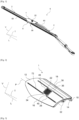
- FIG. 1 illustrates a wiping system 6 configured to ensure the cleaning of a glass surface of a vehicle, for example a windshield, so as to improve the visibility that a driver has of the road located in front of the vehicle, for example in rainy weather or to rid said glass surface of solid debris attached to the latter.
- the wiping system 6 extends mainly along the longitudinal direction L, and comprises at least one wiping arm 4 carrying at one end a wiper blade 2 and being connected at another end opposite in the longitudinal direction L to the vehicle.
- the arm 4 and the wiper blade 2 both extend mainly in the longitudinal direction L of the wiping system 6.
- the arm 4 more precisely comprises a connecting body intended to secure the arm 4 to the vehicle and a rod 60 extending from the connecting body to one end of the arm 4.
- the term “rod” is understood to mean a solid element extending along the longitudinal direction L.
- the rod 60 here has a rectangular section, seen in a plane perpendicular to the longitudinal direction L. However, a rod 60 having a discoid, triangular or other section would not thereby depart from the scope of the invention.
- the wiper blade 2 is particularly adapted to be driven in rotation by the arm 4 against the glass surface of the vehicle, the arm 4 itself being driven in rotation by a motor, not visible, for example an electric motor carried by the vehicle.
- said wiper blade 2 comprises a connection device 56 comprising at least one connector 8 which carries a wiper blade 68 of the wiper blade 2 and an adapter 1 rotatably mounted on the connector 8, the adapter 1 being able to cooperate with the end of the arm 4.
- the wiper blade 68 of the wiper blade 2 is intended to be in contact with the glass surface of the vehicle.
- the connector 8 is configured to carry the wiper blade 68, directly or indirectly.
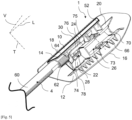
- the rotation of the adapter 1 and the connector 8 is done by means of a rotation device 58 (visible in the figure 3 ), this rotation being carried out around an axis of rotation R substantially parallel to the transverse direction T.
- a rotation device 58 visible in the figure 3
- the adapter 1 extends mainly along the longitudinal direction L.
- the adapter 1 comprises at least one side wall 10 and an upper wall 12, the side wall 10 and the upper wall 12 each having a free edge 14, 16 and a common edge 18 to the side wall 10 and to the upper wall 12.
- the side wall 10 extends mainly in a plane parallel to the longitudinal L and vertical V directions.
- the side wall 10 here has a free edge 14 and a common edge 18 with the upper wall 12, the common edge 18 joining the side wall 10 and the upper wall 12 each extending in separate planes.
- the upper wall 12 also has a free edge 16, and extends between its free edge 16 and the common edge 18 by presenting a curve, as particularly visible in the figure 5 which is a cut made according to the cutting plane M illustrated on the figure 3 . It is understood here that the upper wall 12 has a curved profile between the common edge 18 and its free edge 16 seen in the plane perpendicular to the longitudinal direction L, inscribed in a circle.
- the adapter 1 has a triangular section seen in a plane perpendicular to the longitudinal direction L, the triangle of this section being defined by the free edge 14 of the side wall 10, the free edge 16 of the upper wall 12 and by the common edge 18 between the side wall 10 and the upper wall 12. It is thus possible to define an internal volume of the adapter 1, this internal volume being at least partly delimited by the side wall 10 and the upper wall 12.
- the internal volume extends mainly in the form of a right prism with a triangular base.
- the adapter 1 comprises an inner wall 20 extending at least partly into the internal volume of the adapter 1. More specifically, the inner wall 20 extends in a plane substantially parallel to the longitudinal L and vertical V directions, from the upper wall 12 into the internal volume. It is understood that the inner wall 20 extends substantially parallel to the side wall 10.
- the internal wall 20 participates in delimiting at least in part a reception zone 26 intended to receive the connector 8.
- the connector 8, when the adapter 1 is mounted on the connector 8, is housed at least in part in the reception zone 26.
- the adapter 1 comprises several walls participating in delimiting the reception zone 26, including in particular the inner wall 20. More particularly, these walls extend in the form of a rectangle, the walls extending in a plane substantially perpendicular to the planes in which the neighboring walls extend. It is therefore understood that the adapter 1 comprises a longitudinal wall 66 extending parallel to the inner wall 20, and two side walls 70 extending perpendicular to the longitudinal 66 and inner 20 walls and between the latter.
- the connector 8 once mounted on the adapter 1, is arranged at least partly in the receiving zone 26 of the adapter 1. In other words, the connector 8 is arranged at least partly between the internal wall 20 and the longitudinal wall 66, and between the side walls 70.
- the adapter 1 is rotatably mounted on the connector 8 by means of a rotation device 58.
- the latter comprises several elements cooperating with each other and arranged on the one hand on the connector 8 and on the other hand on the adapter 1.
- the adapter 1 comprises on the one hand a male element 73 on the longitudinal wall 66 configured to cooperate with a female element of the connector 8, and on the other hand a female element 75 intended to cooperate with a male element of the connector 8.
- the male elements take the form of a tab carrying a strand
- the female elements take the form of an orifice in which the strand is intended to be driven in rotation about the axis of rotation R.
- the tab of the adapter 1 extends, for example, in a plane coincident with the plane in which the longitudinal wall 66 extends, and is delimited from said longitudinal wall 66 by at least one groove and advantageously two grooves extending along the vertical direction V.
- the tab is elastically deformable while being movable about a direction of rotation parallel to the longitudinal direction L so as to allow the adapter 1 to be mounted on the connector 8.
- the adapter 1 comprises a locking device 22 intended to longitudinally secure the adapter 1 relative to the arm 4 of the wiping system 6, the locking device 22 being pivotally mounted on the upper wall 12 about a pivot axis P, the locking device 22 comprising a means 24 for limiting its pivoting which comes to bear against the internal wall 20.
- the locking device 22 comprises at least one thrust member 28 and a blocking member 30, the thrust member 28 being inscribed in a profile of the upper wall 12 while the locking member 30 extends at least partly into a receiving housing 32 intended to receive the arm 4.
- a more detailed description of the receiving housing 32 will be given following the description of the locking device 22.
- the thrust member 28, as illustrated in the Figures 2 to 5 extends by matching the shape of the upper wall 12, the thrust member 28 being flush with the upper wall 12.
- the thrust member 28 is also the member of the locking device 22 on which a user exerts a force to allow the locking device 22 to pivot about the pivot axis P.
- the thrust member 28 has a curved profile seen in a section perpendicular to the longitudinal direction L, the curved profile of the thrust member 28 fitting into a profile of the upper wall 12. It is understood here that the upper wall 12 and the thrust member 28 each have a curved profile fitting into the same circle.
- the thrust member 28 is surrounded by a groove 36 separating it from the upper wall 12. It is understood that the groove 36 crosses the upper wall 12 on either side, delimiting the thrust member 28.
- the groove 36 here takes a rectangular shape.
- the thrust member 28 also generally takes a parallelepiped shape, the thrust member 28 having at least one upper side 38 and one lower side 40 extending parallel to the longitudinal direction L, and two transverse sides extending perpendicular to the upper 38 and lower 40 sides and substantially parallel to the transverse direction T. More precisely, the upper side 38 of the thrust member 28 is arranged closer to the common edge 18 between the side wall 10 and the upper wall 12 than to the free edge 16 of the upper wall 12, while the lower side 40 is arranged closer to the free edge 16 of the upper wall 12 than to the common edge 18 between the side wall 10 and the upper wall 12.
- the locking device 22 comprises at least one hinge 34 connecting the thrust member 28 to the upper wall 12 allowing the pivoting of the locking device 22.
- the hinge 34 is arranged between the lower side 40 of the thrust member 28 and the upper wall 12, the groove 36 extending mainly on the other three sides of the thrust member 28.
- the hinge 34 here takes the form of a bridge between the thrust member 28 and the upper wall 12, these three elements thus forming a single-piece element, that is, the separation of one of the elements cannot be done without causing the destruction of one or more of the three elements.
- the groove 36 here extends partially between the lower side 40 of the thrust member 28 and the upper wall 12, optimizing the pivoting of the thrust member 28.
- the thrust member 28 has an external face 42 oriented towards the external environment of the adapter 1 and an internal face 44 oriented towards the internal volume of the adapter 1, the thrust member 28 having on its external face 42 a pattern 46 promoting adhesion. It is understood that a user using the thrust member 28 will have optimized adhesion thanks to the presence of this pattern 46.
- This pattern 46 is, for example, a graining of the external face 42 of the thrust member 28.
- a thrust member 28 comprising another pattern 46 would not depart from the scope of the invention.
- the upper wall 12 also comprises at least one air disturbance device 72 extending along the longitudinal direction L and is open to the exterior of the adapter 1.
- the air disturbance device 72 takes the form of a groove.
- the air disturbance device 72 takes the form of a rib.
- the locking member 30 is the member of the locking device 22 configured to be in contact with the arm 4, securing and/or disconnecting the adapter 1 from the arm 4. It is understood that this is the member which interacts with the arm 4 to fix the adapter 1 on said arm 4.
- the locking member 30 extends from the thrust member 28 towards the receiving housing 32, the locking member 30 comprising a bent portion 74 and a free end 76 arranged in the receiving housing 32 when the locking member is in a position for locking the adapter 1 on the arm 4.
- the bent portion 74 on the one hand comprises a first part extending from the thrust member 28 in a first plane and on the other hand a second portion extending in a second plane intersecting the first plane towards the free end 76, the bent portion 74 comprising a connecting portion connecting the first portion to the second portion.
- the first plane is parallel to the longitudinal L and vertical V directions
- the second plane extending parallel to the longitudinal L and transverse T directions.
- the bent portion 74 may comprise at least one support wall 78 optimizing the rigidity of the bent portion 74.
- the free end 76 takes the form of a shaft extending mainly along the longitudinal direction L.
- the limiting means 24 is part of the blocking member 30. More particularly, the limiting means 24 and the blocking member 30 form a single-piece assembly, that is to say that the limiting means 24 and the blocking member 30 cannot be separated from each other without causing the destruction of the limiting means 24 and/or the blocking member 30.
- the limiting means 24 here longitudinally extends the free end 76 towards the receiving zone 26.
- the free end 76 comprises a protrusion longitudinally extending the shaft forming the free end 76 towards the receiving zone 26, the protrusion acting as the limiting means 24.
- the limiting means 24 here has an end face 48 parallel to the transverse T and vertical V directions and a stop face 50 intersecting the end face 48 and facing the internal wall 20. It can also be understood that the blocking member 30 is delimited longitudinally by the end face 48 of the limiting means 24.
- the internal wall 20 has a contact face facing the limitation means 24 and a guide face participating in delimiting the reception zone 26.
- the limiting means 24 comes to bear against the contact face of the internal wall 20, so as to limit the movement of the locking device 22 during its use to release the adapter relative to the arm 4.
- the limiting means 24 is more particularly formed by the stop face 50 intersecting the end face 48 and facing the contact face of the internal wall 20.
- the stop face 50 and the contact face each extend in a plane parallel to the longitudinal direction.
- the stop face 50 of the limiting means 24 participates in limiting the pivoting amplitude of the locking device 22. More precisely, when the locking device 22 is driven in pivoting about the pivot axis P, the stop face 50 of the limiting means 24 comes into contact with the contact face of the internal wall 20 participating in delimiting the receiving zone 26, thus blocking the pivoting of the locking device 22.
- the limiting means 24 of the locking device 22 blocks the pivoting of the locking device 22 in at least one pivoting direction of the latter. It is understood here that the limiting means 24 makes it possible in particular, for example by means of the stop between the stop face 50 of the limiting means 24 and the internal wall 20, to prevent the locking device 22 from pivoting at too great an angle, and thus limits the risk of breakage of a constituent element of the adapter 1 and/or the arm 4.
- the locking device 22 pivots about the pivot axis P at a maximum angle of 20° measured between a plane in which the stop face 50 extends when the free end 76 is arranged in the receiving housing 32 and the plane in which the contact face of the internal wall 20 extends.
- the pivot angle of the locking device 22 is a maximum of 15°.
- the pivot angle of the locking device 22 is a maximum of 10°.
- the adapter 1 comprises at least one reinforcement 52 extending between the inner wall 20 and the side wall 10 and/or the upper wall 12.
- the reinforcement 52 comprises in particular a wall extending mainly, for example, in a plane substantially perpendicular to the longitudinal direction. The reinforcement 52 makes it possible to reinforce the structure of the adapter 1, and to optimize its rigidity.
- the reinforcement 52 comprises an opening 54 participating in delimiting at least in part the receiving housing 32. It is understood that the opening 54 is intended to receive at least part of the rod 60 of the arm 4.
- the receiving housing 32 is, in addition to the opening 54 of the reinforcement 52, at least partly defined by a sleeve 64, and the side wall 10 and/or the upper wall 12.
- the opening 54 of the reinforcement 52 and the sleeve 64 align along a direction parallel to the longitudinal direction L, the rod 60 of the arm 4 then extending along the longitudinal direction L through the sleeve 64 and the opening 54 of the reinforcement 52.
- the receiving housing 32 is offset laterally relative to the receiving zone 26.
- the position of the receiving housing 32 is offset relative to the receiving zone 26 in the transverse direction T.
- the position of the receiving housing 32 is also offset relative to the receiving zone 26 in the vertical direction V.
- the receiving housing 32 is closer to the side wall 10 than the receiving zone 26.
- the receiving housing 32 is arranged between the receiving zone 26 and the side wall 10.
- the receiving housing 32, the common edge 18 and the receiving zone 26 align along a median direction, the receiving housing 32 being arranged between the common edge 18 and the receiving zone 26. It can thus be defined that the receiving housing 32 extends in a main extension plane parallel to the longitudinal direction and to the longitudinal direction. the median direction, the main extension plane being seen in a median position of said receiving housing 32, the main extension plane of the receiving housing 32 intersecting the receiving area 26.
- At least one end of the rod 60 takes a shape complementary to the receiving housing 32 of the adapter 1, the rod 60 having a notch 62 cooperating with the locking device 22 to longitudinally block the position of the adapter 1 on the rod 60. It is understood that the free end 76 is arranged in the notch 62 of the rod 60 so as to longitudinally block the rod 60 in the receiving housing 32.
- the locking device 22 is driven to pivot about the pivot direction until the limiting means 24 abuts against the internal wall 20. This pivoting is sufficient to unlock the position of the adapter 1 by the arm 4 while limiting the risk of breakage of the locking device 22.
Landscapes
- Engineering & Computer Science (AREA)
- Mechanical Engineering (AREA)
- Physics & Mathematics (AREA)
- Fluid Mechanics (AREA)
- Quality & Reliability (AREA)
- Pivots And Pivotal Connections (AREA)
- Connection Of Plates (AREA)
- Connector Housings Or Holding Contact Members (AREA)
- Snaps, Bayonet Connections, Set Pins, And Snap Rings (AREA)
- Cleaning Implements For Floors, Carpets, Furniture, Walls, And The Like (AREA)
- Mechanical Coupling Of Light Guides (AREA)
Claims (14)
- Adapter (1) zur Befestigung eines Scheibenwischers (2) an einem Arm (4) eines Scheibenwischersystems (6), wobei sich der Adapter (1) in einer Längsrichtung (L) erstreckt, wobei der Adapter (1) so konfiguriert ist, dass er auf einem Verbindungsstück (8) des Scheibenwischers (2) um eine quer zur Längsrichtung (L) verlaufende Drehachse (R) drehbar montiert wird, der Adapter (1) mindestens eine Seitenwand (10) und eine obere Wand (12) umfasst, wobei die Seitenwand (10) und die obere Wand (12) dazu beitragen, ein Innenvolumen des Adapters (1) zu definieren, wobei der Adapter (1) eine Innenwand (20) umfasst, die sich zumindest teilweise in das Innenvolumen des Adapters (1) erstreckt, der Adapter (1) eine Verriegelungsvorrichtung (22) umfasst, die dazu bestimmt ist, den Adapter (1) in Bezug auf den Arm (4) des Scheibenwischersystems (6) in Längsrichtung zu verriegeln, wobei die Verriegelungsvorrichtung (22) an der oberen Wand (12) um eine Schwenkachse (P) schwenkbar angebracht ist, wobei die Verriegelungsvorrichtung (22) mindestens ein Schuborgan (28) und ein Blockierorgan (30) umfasst, wobei die Schubeinheit (28) in ein Profil der oberen Wand (12) integriert ist, während die Blockiereinheit (30) sich zumindest teilweise in eine Aufnahme (32) erstreckt, die dazu bestimmt ist, den Arm (4) aufzunehmen, dadurch gekennzeichnet, dass die Verriegelungsvorrichtung ein Mittel (24) zur Begrenzung ihrer Drehung umfasst, das sich an der Innenwand (20) abstützt.
- Adapter (1) nach dem vorhergehenden Anspruch, wobei die Innenwand (20) zumindest teilweise an der Begrenzung eines Aufnahmebereichs (26) beteiligt ist, der zur Aufnahme des Verbinders (8) ausgebildet ist.
- Adapter (1) nach einem der vorhergehenden Ansprüche, wobei die Seitenwand (10) und die obere Wand (12) jeweils eine freie Kante (14, 16) und eine Kante (18) aufweisen, die der Seitenwand (10) und der oberen Wand (12) gemeinsam ist, wobei der Adapter (1) einen dreieckigen Querschnitt in einer Ebene senkrecht zur Längsrichtung (L) gesehen aufweist, und durch die freie Kante (14) der Seitenwand (10), die freie Kante (16) der oberen Wand (12) und durch die gemeinsame Kante (18) zwischen der Seitenwand (10) und der oberen Wand (12) definiert ist, wobei die obere Wand (12) zwischen der gemeinsamen Kante (18) und ihrer freien Kante (16), gesehen in der Ebene senkrecht zur Längsrichtung (L), gekrümmt ist.
- Adapter (1) nach einem der vorhergehenden Ansprüche, wobei die Verriegelungsvorrichtung (22) mindestens ein Scharnier (34) aufweist, das die Schubeinheit (28) mit der oberen Wand (12) verbindet, wobei die Schubeinheit (28) von einer Nut (36) umgeben ist, die sie von der oberen Wand (12) trennt.
- Adapter (1) nach einem der vorhergehenden Ansprüche, wobei die Schubeinheit (28) eine Parallelepipedform aufweist, wobei die Schubeinheit (28) mindestens eine Oberseite (38) und eine Unterseite (40) aufweist, die sich parallel zur Längsrichtung (L) erstrecken, wobei das Scharnier (34) zwischen der Unterseite (40) der Schubeinheit (28) und der oberen Wand (12) angeordnet ist, wobei sich die Nut (36) über die drei anderen Seiten der Schubeinheit (28) erstreckt.
- Adapter (1) nach einem der vorhergehenden Ansprüche, wobei die Schubeinheit (28) im Querschnitt senkrecht zur Längsrichtung (L) gesehen ein gekrümmtes Profil aufweist, wobei das gekrümmte Profil der Schubeinheit (28) in ein Profil der oberen Wand (12) integriert ist.
- Adapter (1) nach einem der vorhergehenden Ansprüche, wobei die Druckeinheit (28) eine Außenfläche (42), die auf die äußere Umgebung des Adapters (1) ausgerichtet ist, und eine Innenfläche (44) aufweist, die auf das Innenvolumen des Adapters (1) ausgerichtet ist, wobei die Druckeinheit (28) auf ihrer Außenfläche (42) ein Muster (46) aufweist, das die Haftung unterstützt.
- Adapter (1) nach einem der vorhergehenden Ansprüche, wobei das Mittel (24) zur Begrenzung Teil der Blockiereinheit (30) ist.
- Adapter (1) nach einem der vorhergehenden Ansprüche, wobei die Blockiereinheit (30) in Längsrichtung durch eine Endfläche (48) des Begrenzungsmittels (24) begrenzt ist.
- Adapter (1) nach einem der vorhergehenden Ansprüche, wobei das Mittel (24) zur Begrenzung durch eine die Stirnfläche (48) schneidende, der Innenwand (20) zugewandte Anschlagfläche (50) gebildet ist.
- Adapter (1) nach einem der vorhergehenden Ansprüche, wobei die Verriegelungsvorrichtung (22) um die Schwenkachse (P) um einen Winkel von maximal 20° schwenkt.
- Anschlussvorrichtung (56) für einen Scheibenwischer (2) mit mindestens einem Verbinder (8) und einem Adapter (1) nach einem der vorhergehenden Ansprüche, wobei der Verbinder (8) mittels einer Drehvorrichtung (58) drehbar um die Drehachse angebracht ist.
- Abstreifer (2) mit mindestens einer Anschlussvorrichtung (56) nach dem vorhergehenden Anspruch oder einem Adapter (1) nach einem der Ansprüche 1 bis 11.
- Wischanlage (6) mit mindestens einem Arm (4) und einem Wischer (2) nach dem vorhergehenden Anspruch in Verbindung mit Anspruch 1, wobei der Arm (4) mindestens eine Stange (60) aufweist, die in der Aufnahme (32) des Adapters (1) untergebracht ist.
Applications Claiming Priority (1)
| Application Number | Priority Date | Filing Date | Title |
|---|---|---|---|
| FR2109138A FR3126379B1 (fr) | 2021-09-01 | 2021-09-01 | Adaptateur d’un système d’essuyage. |
Publications (2)
| Publication Number | Publication Date |
|---|---|
| EP4144599A1 EP4144599A1 (de) | 2023-03-08 |
| EP4144599B1 true EP4144599B1 (de) | 2024-11-20 |
Family
ID=77913316
Family Applications (1)
| Application Number | Title | Priority Date | Filing Date |
|---|---|---|---|
| EP22191778.4A Active EP4144599B1 (de) | 2021-09-01 | 2022-08-23 | Adapter für reinigungssystem |
Country Status (4)
| Country | Link |
|---|---|
| US (1) | US11975695B2 (de) |
| EP (1) | EP4144599B1 (de) |
| CN (1) | CN115723709B (de) |
| FR (1) | FR3126379B1 (de) |
Families Citing this family (1)
| Publication number | Priority date | Publication date | Assignee | Title |
|---|---|---|---|---|
| FR3148194A1 (fr) * | 2023-04-28 | 2024-11-01 | Valeo Systemes D'essuyage | Adaptateur pour balai d’essuie-glace et dispositif d’essuyage |
Family Cites Families (10)
| Publication number | Priority date | Publication date | Assignee | Title |
|---|---|---|---|---|
| DE1199640B (de) * | 1959-05-14 | 1965-08-26 | Trico Products Corp | Halterung zum Verbinden des Schwenkarms eines Scheibenwischers mit dem Tragbuegel des Wischblatts |
| FR2781741B1 (fr) * | 1998-07-31 | 2000-09-22 | Valeo Systemes Dessuyage | Essuie-glace comprenant au moins un premier et un second element relies par l'intermediaire d'une piece de liaison |
| DE102011053090A1 (de) * | 2011-08-29 | 2013-02-28 | Valeo Systèmes d'Essuyage | Wischblatt für eine Wischeinrichtung eines Kraftfahrzeugs |
| FR2981622B1 (fr) * | 2011-10-25 | 2014-09-12 | Valeo Systemes Dessuyage | Dispositif de fixation d'essuie-glace a position de securite, connecteur et adaptateur d'un tel dispositif et systeme d'essuyage comprenant ledit dispositif de fixation. |
| PL227002B1 (pl) * | 2013-10-09 | 2017-10-31 | Valeo Autosystemy Spółka Z Ograniczoną Odpowiedzialnością | Zaczep dowycieraczki, zwłaszcza samochodowej, pióro wycieraczki obejmujace taki zaczep oraz zespół wycieraczki samochodowej |
| US20160016541A1 (en) * | 2014-07-17 | 2016-01-21 | Valeo Systèmes d'Essuyage | Streamlined flat windscreen wiper |
| EP3383711B1 (de) * | 2015-12-02 | 2020-06-03 | Valeo Systèmes d'Essuyage | Adapter für einen antriebsarm eines wischsystems |
| DE102016211162A1 (de) * | 2016-06-22 | 2017-12-28 | Robert Bosch Gmbh | Wischblattadaptervorrichtung |
| FR3059960B1 (fr) * | 2016-12-13 | 2019-08-23 | Valeo Systemes D'essuyage | Adaptateur pour balai d'essuyage |
| EP3898348B1 (de) * | 2018-12-19 | 2024-07-10 | Trico Belgium S.A. | Scheibenwischervorrichtung mit flachen wischerblättern |
-
2021
- 2021-09-01 FR FR2109138A patent/FR3126379B1/fr active Active
-
2022
- 2022-08-23 EP EP22191778.4A patent/EP4144599B1/de active Active
- 2022-08-31 US US17/823,751 patent/US11975695B2/en active Active
- 2022-08-31 CN CN202211053838.8A patent/CN115723709B/zh active Active
Also Published As
| Publication number | Publication date |
|---|---|
| US11975695B2 (en) | 2024-05-07 |
| FR3126379A1 (fr) | 2023-03-03 |
| CN115723709B (zh) | 2025-02-21 |
| EP4144599A1 (de) | 2023-03-08 |
| CN115723709A (zh) | 2023-03-03 |
| FR3126379B1 (fr) | 2024-05-24 |
| US20230063910A1 (en) | 2023-03-02 |
Similar Documents
| Publication | Publication Date | Title |
|---|---|---|
| EP4144600B1 (de) | Adapter für reinigungssystem | |
| EP0459867A1 (de) | Gelenkverbindung zwischen einem Scheibenwischerarm und einem Scheibenwischerblatt | |
| EP4144599B1 (de) | Adapter für reinigungssystem | |
| FR3059960B1 (fr) | Adaptateur pour balai d'essuyage | |
| EP0791514A2 (de) | Scheibenwischer für Kraftfahrzeuge mit Verkleidung für Endstück | |
| WO2022219097A1 (fr) | Capot pour ensemble d'essuyage pour véhicule automobile | |
| WO2024126418A1 (fr) | Adaptateur d'un système d'essuyage | |
| EP4448344A1 (de) | Endkappe und scheibenwischer für ein kraftfahrzeug | |
| EP3604051B1 (de) | Einheit zum verbinden eines antriebsarms eines scheibenwischers mit einer motorwelle eines fahrzeugs | |
| EP3902721A1 (de) | Adapter für ein wischerblatt eines kraftfahrzeugs | |
| WO2022023225A1 (fr) | Dispositif de connexion pour un système d'essuyage pour un véhicule | |
| WO2023030973A1 (fr) | Adaptateur d'un système d'essuyage | |
| WO2020135959A1 (fr) | Adaptateur pour balai d'essuie-glace de véhicule automobile | |
| WO2023208726A1 (fr) | Ensemble de connexion d'un système d'essuyage | |
| EP4188757B1 (de) | Verbinder für ein wischblatt | |
| WO2020135962A1 (fr) | Adaptateur pour balai d'essuie-glace de véhicule automobile | |
| EP4124521B1 (de) | Verbindungsvorrichtung zwischen wischblatt und antriebsarm | |
| WO2024126417A1 (fr) | Adaptateur d'un système d'essuyage | |
| WO2025146493A1 (fr) | Adaptateur pour l'assemblage d'un balai à un bras d'essuie-glace | |
| WO2022175417A1 (fr) | Système de connexion d'un balai d'essuyage sur un bras d'un système d'essuyage | |
| WO2023222840A1 (fr) | Dispositif de connexion d'un balai d'essuyage | |
| WO2018050326A1 (fr) | Adaptateur pour la connexion d'un balai d'essuyage a un bras d'entrainement d'un systeme d'essuyage pour vehicule automobile | |
| EP3902719A1 (de) | Adapter für scheibenwischerblatt eines kraftfahrzeugs | |
| WO2023222802A1 (fr) | Dispositif de connexion d'un balai d'essuyage | |
| FR3130721A1 (fr) | Embout d’extrémité et balai d’essuie-glace pour véhicule automobile |
Legal Events
| Date | Code | Title | Description |
|---|---|---|---|
| PUAI | Public reference made under article 153(3) epc to a published international application that has entered the european phase |
Free format text: ORIGINAL CODE: 0009012 |
|
| STAA | Information on the status of an ep patent application or granted ep patent |
Free format text: STATUS: THE APPLICATION HAS BEEN PUBLISHED |
|
| AK | Designated contracting states |
Kind code of ref document: A1 Designated state(s): AL AT BE BG CH CY CZ DE DK EE ES FI FR GB GR HR HU IE IS IT LI LT LU LV MC MK MT NL NO PL PT RO RS SE SI SK SM TR |
|
| STAA | Information on the status of an ep patent application or granted ep patent |
Free format text: STATUS: REQUEST FOR EXAMINATION WAS MADE |
|
| 17P | Request for examination filed |
Effective date: 20230821 |
|
| RBV | Designated contracting states (corrected) |
Designated state(s): AL AT BE BG CH CY CZ DE DK EE ES FI FR GB GR HR HU IE IS IT LI LT LU LV MC MK MT NL NO PL PT RO RS SE SI SK SM TR |
|
| GRAP | Despatch of communication of intention to grant a patent |
Free format text: ORIGINAL CODE: EPIDOSNIGR1 |
|
| STAA | Information on the status of an ep patent application or granted ep patent |
Free format text: STATUS: GRANT OF PATENT IS INTENDED |
|
| RIC1 | Information provided on ipc code assigned before grant |
Ipc: B60S 1/38 20060101ALI20240527BHEP Ipc: B60S 1/04 20060101ALI20240527BHEP Ipc: B60S 1/40 20060101AFI20240527BHEP |
|
| INTG | Intention to grant announced |
Effective date: 20240613 |
|
| GRAS | Grant fee paid |
Free format text: ORIGINAL CODE: EPIDOSNIGR3 |
|
| GRAA | (expected) grant |
Free format text: ORIGINAL CODE: 0009210 |
|
| STAA | Information on the status of an ep patent application or granted ep patent |
Free format text: STATUS: THE PATENT HAS BEEN GRANTED |
|
| AK | Designated contracting states |
Kind code of ref document: B1 Designated state(s): AL AT BE BG CH CY CZ DE DK EE ES FI FR GB GR HR HU IE IS IT LI LT LU LV MC MK MT NL NO PL PT RO RS SE SI SK SM TR |
|
| REG | Reference to a national code |
Ref country code: GB Ref legal event code: FG4D Free format text: NOT ENGLISH |
|
| REG | Reference to a national code |
Ref country code: CH Ref legal event code: EP |
|
| REG | Reference to a national code |
Ref country code: DE Ref legal event code: R096 Ref document number: 602022007864 Country of ref document: DE |
|
| REG | Reference to a national code |
Ref country code: IE Ref legal event code: FG4D Free format text: LANGUAGE OF EP DOCUMENT: FRENCH |
|
| REG | Reference to a national code |
Ref country code: LT Ref legal event code: MG9D |
|
| REG | Reference to a national code |
Ref country code: NL Ref legal event code: MP Effective date: 20241120 |
|
| PG25 | Lapsed in a contracting state [announced via postgrant information from national office to epo] |
Ref country code: PT Free format text: LAPSE BECAUSE OF FAILURE TO SUBMIT A TRANSLATION OF THE DESCRIPTION OR TO PAY THE FEE WITHIN THE PRESCRIBED TIME-LIMIT Effective date: 20250320 Ref country code: HR Free format text: LAPSE BECAUSE OF FAILURE TO SUBMIT A TRANSLATION OF THE DESCRIPTION OR TO PAY THE FEE WITHIN THE PRESCRIBED TIME-LIMIT Effective date: 20241120 Ref country code: IS Free format text: LAPSE BECAUSE OF FAILURE TO SUBMIT A TRANSLATION OF THE DESCRIPTION OR TO PAY THE FEE WITHIN THE PRESCRIBED TIME-LIMIT Effective date: 20250320 |
|
| PG25 | Lapsed in a contracting state [announced via postgrant information from national office to epo] |
Ref country code: FI Free format text: LAPSE BECAUSE OF FAILURE TO SUBMIT A TRANSLATION OF THE DESCRIPTION OR TO PAY THE FEE WITHIN THE PRESCRIBED TIME-LIMIT Effective date: 20241120 Ref country code: NL Free format text: LAPSE BECAUSE OF FAILURE TO SUBMIT A TRANSLATION OF THE DESCRIPTION OR TO PAY THE FEE WITHIN THE PRESCRIBED TIME-LIMIT Effective date: 20241120 |
|
| REG | Reference to a national code |
Ref country code: AT Ref legal event code: MK05 Ref document number: 1743320 Country of ref document: AT Kind code of ref document: T Effective date: 20241120 |
|
| PG25 | Lapsed in a contracting state [announced via postgrant information from national office to epo] |
Ref country code: BG Free format text: LAPSE BECAUSE OF FAILURE TO SUBMIT A TRANSLATION OF THE DESCRIPTION OR TO PAY THE FEE WITHIN THE PRESCRIBED TIME-LIMIT Effective date: 20241120 |
|
| PG25 | Lapsed in a contracting state [announced via postgrant information from national office to epo] |
Ref country code: ES Free format text: LAPSE BECAUSE OF FAILURE TO SUBMIT A TRANSLATION OF THE DESCRIPTION OR TO PAY THE FEE WITHIN THE PRESCRIBED TIME-LIMIT Effective date: 20241120 |
|
| PG25 | Lapsed in a contracting state [announced via postgrant information from national office to epo] |
Ref country code: NO Free format text: LAPSE BECAUSE OF FAILURE TO SUBMIT A TRANSLATION OF THE DESCRIPTION OR TO PAY THE FEE WITHIN THE PRESCRIBED TIME-LIMIT Effective date: 20250220 |
|
| PG25 | Lapsed in a contracting state [announced via postgrant information from national office to epo] |
Ref country code: AT Free format text: LAPSE BECAUSE OF FAILURE TO SUBMIT A TRANSLATION OF THE DESCRIPTION OR TO PAY THE FEE WITHIN THE PRESCRIBED TIME-LIMIT Effective date: 20241120 Ref country code: LV Free format text: LAPSE BECAUSE OF FAILURE TO SUBMIT A TRANSLATION OF THE DESCRIPTION OR TO PAY THE FEE WITHIN THE PRESCRIBED TIME-LIMIT Effective date: 20241120 Ref country code: GR Free format text: LAPSE BECAUSE OF FAILURE TO SUBMIT A TRANSLATION OF THE DESCRIPTION OR TO PAY THE FEE WITHIN THE PRESCRIBED TIME-LIMIT Effective date: 20250221 |
|
| PG25 | Lapsed in a contracting state [announced via postgrant information from national office to epo] |
Ref country code: PL Free format text: LAPSE BECAUSE OF FAILURE TO SUBMIT A TRANSLATION OF THE DESCRIPTION OR TO PAY THE FEE WITHIN THE PRESCRIBED TIME-LIMIT Effective date: 20241120 |
|
| PG25 | Lapsed in a contracting state [announced via postgrant information from national office to epo] |
Ref country code: RS Free format text: LAPSE BECAUSE OF FAILURE TO SUBMIT A TRANSLATION OF THE DESCRIPTION OR TO PAY THE FEE WITHIN THE PRESCRIBED TIME-LIMIT Effective date: 20250220 |
|
| PG25 | Lapsed in a contracting state [announced via postgrant information from national office to epo] |
Ref country code: SM Free format text: LAPSE BECAUSE OF FAILURE TO SUBMIT A TRANSLATION OF THE DESCRIPTION OR TO PAY THE FEE WITHIN THE PRESCRIBED TIME-LIMIT Effective date: 20241120 |
|
| PG25 | Lapsed in a contracting state [announced via postgrant information from national office to epo] |
Ref country code: DK Free format text: LAPSE BECAUSE OF FAILURE TO SUBMIT A TRANSLATION OF THE DESCRIPTION OR TO PAY THE FEE WITHIN THE PRESCRIBED TIME-LIMIT Effective date: 20241120 |
|
| PG25 | Lapsed in a contracting state [announced via postgrant information from national office to epo] |
Ref country code: EE Free format text: LAPSE BECAUSE OF FAILURE TO SUBMIT A TRANSLATION OF THE DESCRIPTION OR TO PAY THE FEE WITHIN THE PRESCRIBED TIME-LIMIT Effective date: 20241120 |
|
| PG25 | Lapsed in a contracting state [announced via postgrant information from national office to epo] |
Ref country code: RO Free format text: LAPSE BECAUSE OF FAILURE TO SUBMIT A TRANSLATION OF THE DESCRIPTION OR TO PAY THE FEE WITHIN THE PRESCRIBED TIME-LIMIT Effective date: 20241120 |
|
| PG25 | Lapsed in a contracting state [announced via postgrant information from national office to epo] |
Ref country code: SK Free format text: LAPSE BECAUSE OF FAILURE TO SUBMIT A TRANSLATION OF THE DESCRIPTION OR TO PAY THE FEE WITHIN THE PRESCRIBED TIME-LIMIT Effective date: 20241120 |
|
| PG25 | Lapsed in a contracting state [announced via postgrant information from national office to epo] |
Ref country code: CZ Free format text: LAPSE BECAUSE OF FAILURE TO SUBMIT A TRANSLATION OF THE DESCRIPTION OR TO PAY THE FEE WITHIN THE PRESCRIBED TIME-LIMIT Effective date: 20241120 |
|
| PG25 | Lapsed in a contracting state [announced via postgrant information from national office to epo] |
Ref country code: IT Free format text: LAPSE BECAUSE OF FAILURE TO SUBMIT A TRANSLATION OF THE DESCRIPTION OR TO PAY THE FEE WITHIN THE PRESCRIBED TIME-LIMIT Effective date: 20241120 |
|
| REG | Reference to a national code |
Ref country code: DE Ref legal event code: R097 Ref document number: 602022007864 Country of ref document: DE |
|
| PG25 | Lapsed in a contracting state [announced via postgrant information from national office to epo] |
Ref country code: SE Free format text: LAPSE BECAUSE OF FAILURE TO SUBMIT A TRANSLATION OF THE DESCRIPTION OR TO PAY THE FEE WITHIN THE PRESCRIBED TIME-LIMIT Effective date: 20241120 |
|
| PLBE | No opposition filed within time limit |
Free format text: ORIGINAL CODE: 0009261 |
|
| STAA | Information on the status of an ep patent application or granted ep patent |
Free format text: STATUS: NO OPPOSITION FILED WITHIN TIME LIMIT |
|
| PGFP | Annual fee paid to national office [announced via postgrant information from national office to epo] |
Ref country code: DE Payment date: 20250812 Year of fee payment: 4 |
|
| PGFP | Annual fee paid to national office [announced via postgrant information from national office to epo] |
Ref country code: FR Payment date: 20250828 Year of fee payment: 4 |
|
| 26N | No opposition filed |
Effective date: 20250821 |