EP4144302A1 - Informationsverarbeitungsvorrichtung, -verfahren und -programm - Google Patents
Informationsverarbeitungsvorrichtung, -verfahren und -programm Download PDFInfo
- Publication number
- EP4144302A1 EP4144302A1 EP21796222.4A EP21796222A EP4144302A1 EP 4144302 A1 EP4144302 A1 EP 4144302A1 EP 21796222 A EP21796222 A EP 21796222A EP 4144302 A1 EP4144302 A1 EP 4144302A1
- Authority
- EP
- European Patent Office
- Prior art keywords
- sound pressure
- pressure change
- change acceleration
- information processing
- center
- Prior art date
- Legal status (The legal status is an assumption and is not a legal conclusion. Google has not performed a legal analysis and makes no representation as to the accuracy of the status listed.)
- Pending
Links
Images










Classifications
-
- G—PHYSICS
- G16—INFORMATION AND COMMUNICATION TECHNOLOGY [ICT] SPECIALLY ADAPTED FOR SPECIFIC APPLICATION FIELDS
- G16H—HEALTHCARE INFORMATICS, i.e. INFORMATION AND COMMUNICATION TECHNOLOGY [ICT] SPECIALLY ADAPTED FOR THE HANDLING OR PROCESSING OF MEDICAL OR HEALTHCARE DATA
- G16H50/00—ICT specially adapted for medical diagnosis, medical simulation or medical data mining; ICT specially adapted for detecting, monitoring or modelling epidemics or pandemics
- G16H50/30—ICT specially adapted for medical diagnosis, medical simulation or medical data mining; ICT specially adapted for detecting, monitoring or modelling epidemics or pandemics for calculating health indices; for individual health risk assessment
-
- A—HUMAN NECESSITIES
- A61—MEDICAL OR VETERINARY SCIENCE; HYGIENE
- A61B—DIAGNOSIS; SURGERY; IDENTIFICATION
- A61B5/00—Measuring for diagnostic purposes; Identification of persons
- A61B5/16—Devices for psychotechnics; Testing reaction times ; Devices for evaluating the psychological state
- A61B5/165—Evaluating the state of mind, e.g. depression, anxiety
-
- A—HUMAN NECESSITIES
- A61—MEDICAL OR VETERINARY SCIENCE; HYGIENE
- A61B—DIAGNOSIS; SURGERY; IDENTIFICATION
- A61B5/00—Measuring for diagnostic purposes; Identification of persons
- A61B5/48—Other medical applications
- A61B5/4803—Speech analysis specially adapted for diagnostic purposes
-
- G—PHYSICS
- G10—MUSICAL INSTRUMENTS; ACOUSTICS
- G10L—SPEECH ANALYSIS TECHNIQUES OR SPEECH SYNTHESIS; SPEECH RECOGNITION; SPEECH OR VOICE PROCESSING TECHNIQUES; SPEECH OR AUDIO CODING OR DECODING
- G10L25/00—Speech or voice analysis techniques not restricted to a single one of groups G10L15/00 - G10L21/00
- G10L25/03—Speech or voice analysis techniques not restricted to a single one of groups G10L15/00 - G10L21/00 characterised by the type of extracted parameters
-
- G—PHYSICS
- G10—MUSICAL INSTRUMENTS; ACOUSTICS
- G10L—SPEECH ANALYSIS TECHNIQUES OR SPEECH SYNTHESIS; SPEECH RECOGNITION; SPEECH OR VOICE PROCESSING TECHNIQUES; SPEECH OR AUDIO CODING OR DECODING
- G10L25/00—Speech or voice analysis techniques not restricted to a single one of groups G10L15/00 - G10L21/00
- G10L25/48—Speech or voice analysis techniques not restricted to a single one of groups G10L15/00 - G10L21/00 specially adapted for particular use
- G10L25/51—Speech or voice analysis techniques not restricted to a single one of groups G10L15/00 - G10L21/00 specially adapted for particular use for comparison or discrimination
- G10L25/63—Speech or voice analysis techniques not restricted to a single one of groups G10L15/00 - G10L21/00 specially adapted for particular use for comparison or discrimination for estimating an emotional state
-
- G—PHYSICS
- G10—MUSICAL INSTRUMENTS; ACOUSTICS
- G10L—SPEECH ANALYSIS TECHNIQUES OR SPEECH SYNTHESIS; SPEECH RECOGNITION; SPEECH OR VOICE PROCESSING TECHNIQUES; SPEECH OR AUDIO CODING OR DECODING
- G10L25/00—Speech or voice analysis techniques not restricted to a single one of groups G10L15/00 - G10L21/00
- G10L25/48—Speech or voice analysis techniques not restricted to a single one of groups G10L15/00 - G10L21/00 specially adapted for particular use
- G10L25/51—Speech or voice analysis techniques not restricted to a single one of groups G10L15/00 - G10L21/00 specially adapted for particular use for comparison or discrimination
- G10L25/66—Speech or voice analysis techniques not restricted to a single one of groups G10L15/00 - G10L21/00 specially adapted for particular use for comparison or discrimination for extracting parameters related to health condition
-
- G—PHYSICS
- G16—INFORMATION AND COMMUNICATION TECHNOLOGY [ICT] SPECIALLY ADAPTED FOR SPECIFIC APPLICATION FIELDS
- G16H—HEALTHCARE INFORMATICS, i.e. INFORMATION AND COMMUNICATION TECHNOLOGY [ICT] SPECIALLY ADAPTED FOR THE HANDLING OR PROCESSING OF MEDICAL OR HEALTHCARE DATA
- G16H20/00—ICT specially adapted for therapies or health-improving plans, e.g. for handling prescriptions, for steering therapy or for monitoring patient compliance
- G16H20/70—ICT specially adapted for therapies or health-improving plans, e.g. for handling prescriptions, for steering therapy or for monitoring patient compliance relating to mental therapies, e.g. psychological therapy or autogenous training
-
- G—PHYSICS
- G16—INFORMATION AND COMMUNICATION TECHNOLOGY [ICT] SPECIALLY ADAPTED FOR SPECIFIC APPLICATION FIELDS
- G16H—HEALTHCARE INFORMATICS, i.e. INFORMATION AND COMMUNICATION TECHNOLOGY [ICT] SPECIALLY ADAPTED FOR THE HANDLING OR PROCESSING OF MEDICAL OR HEALTHCARE DATA
- G16H40/00—ICT specially adapted for the management or administration of healthcare resources or facilities; ICT specially adapted for the management or operation of medical equipment or devices
- G16H40/60—ICT specially adapted for the management or administration of healthcare resources or facilities; ICT specially adapted for the management or operation of medical equipment or devices for the operation of medical equipment or devices
- G16H40/63—ICT specially adapted for the management or administration of healthcare resources or facilities; ICT specially adapted for the management or operation of medical equipment or devices for the operation of medical equipment or devices for local operation
-
- G—PHYSICS
- G16—INFORMATION AND COMMUNICATION TECHNOLOGY [ICT] SPECIALLY ADAPTED FOR SPECIFIC APPLICATION FIELDS
- G16H—HEALTHCARE INFORMATICS, i.e. INFORMATION AND COMMUNICATION TECHNOLOGY [ICT] SPECIALLY ADAPTED FOR THE HANDLING OR PROCESSING OF MEDICAL OR HEALTHCARE DATA
- G16H40/00—ICT specially adapted for the management or administration of healthcare resources or facilities; ICT specially adapted for the management or operation of medical equipment or devices
- G16H40/60—ICT specially adapted for the management or administration of healthcare resources or facilities; ICT specially adapted for the management or operation of medical equipment or devices for the operation of medical equipment or devices
- G16H40/67—ICT specially adapted for the management or administration of healthcare resources or facilities; ICT specially adapted for the management or operation of medical equipment or devices for the operation of medical equipment or devices for remote operation
-
- G—PHYSICS
- G16—INFORMATION AND COMMUNICATION TECHNOLOGY [ICT] SPECIALLY ADAPTED FOR SPECIFIC APPLICATION FIELDS
- G16H—HEALTHCARE INFORMATICS, i.e. INFORMATION AND COMMUNICATION TECHNOLOGY [ICT] SPECIALLY ADAPTED FOR THE HANDLING OR PROCESSING OF MEDICAL OR HEALTHCARE DATA
- G16H50/00—ICT specially adapted for medical diagnosis, medical simulation or medical data mining; ICT specially adapted for detecting, monitoring or modelling epidemics or pandemics
- G16H50/20—ICT specially adapted for medical diagnosis, medical simulation or medical data mining; ICT specially adapted for detecting, monitoring or modelling epidemics or pandemics for computer-aided diagnosis, e.g. based on medical expert systems
-
- A—HUMAN NECESSITIES
- A61—MEDICAL OR VETERINARY SCIENCE; HYGIENE
- A61B—DIAGNOSIS; SURGERY; IDENTIFICATION
- A61B5/00—Measuring for diagnostic purposes; Identification of persons
- A61B5/48—Other medical applications
- A61B5/4842—Monitoring progression or stage of a disease
Definitions
- the present invention relates to an information processing apparatus, a method, and a program, and more particularly, to measurement of a health condition of a subject.
- HAMD Hamilton Depression Rating Scale
- This HAMD is not a self-assessment scale of the subject, but is a scale in which scoring is performed in a form in which a doctor or the like in charge of an examination conducts an interview and the depression state of the subject is evaluated according to a result thereof.
- Patent Literature 1 discloses that a medical interview result is input to a health state presentation device to evaluate the medical interview result.
- Patent Literature 1 JP 2016-4507 A
- the present invention has been made in view of such a situation, and an object thereof is to provide an information processing apparatus capable of more easily evaluating presence or absence of depression or severity of the depression.
- the present invention is an information processing apparatus including: means for inputting voice data uttered by a subject; means for acquiring time-series data of sound pressure in the input voice data; and means for obtaining a Sound Pressure Change acceleration index that is an index based on a force toward a center and a force away from the center of the acquired time-series data of the sound pressure.
- an information processing apparatus capable of more easily evaluating presence or absence of depression or severity of the depression.
- FIG. 1 is a block diagram illustrating an example of a configuration of an information processing apparatus according to a first embodiment of the present invention.
- An information processing apparatus 10 includes a control unit 11 that controls entire operation, an input/output unit 12 that performs various types of input/output, a storage unit 13 that stores various types of data, programs, and the like, a communication unit 14 that performs communication with the outside, and an internal bus 15 that connects the blocks so that the blocks can communicate with each other.
- the information processing apparatus 10 is, for example, a computer, and may be a device that can be carried by a subject, such as a smartphone, a PDA, a tablet, or a laptop computer, or may be a computer that is fixed at an installation position without being carried by the subject.
- PDA is an abbreviation for Personal Digital Assistant.
- the control unit 11 is, for example, a device called a CPU, an MCU, or an MPU, and for example, a program stored in the storage unit 13 is executed.
- CPU is an abbreviation for Central Processing Unit.
- MCU is an abbreviation for Micro Controller Unit.
- MPU is an abbreviation for Micro Processor Unit.
- the input/output unit 12 is a device that performs input/output with respect to a subject who operates the information processing apparatus 10.
- the input/output unit 12 inputs and outputs information and signals by a display, a keyboard, a mouse, a button, a touch panel, a printer, a microphone, a speaker, and the like.
- the input/output unit 12 at least functions as a microphone, and inputs voice data by this microphone.
- the input/output unit 12 at least serves as a display, and displays a Sound Pressure Change acceleration index and a depression state to be described later on this display.
- the storage unit 13 is, for example, a device such as a ROM, a RAM, an HDD, or a flash memory, and stores programs executed by the control unit 11 and various data.
- ROM is an abbreviation for Read Only Memory.
- RAM is an abbreviation for Random Access Memory.
- HDD is an abbreviation for Hard Disk Drive.
- the communication unit 16 communicates with the outside. Communication by the communication unit 16 may be wired communication or wireless communication. The communication by the communication unit 16 may use any communication scheme.
- the control unit 11 can transmit and receive various data such as voice data by the communication unit 16.
- the control unit 11 may transmit a Sound Pressure Change acceleration index, presence or absence of depression, or severity of depression to be described later to an external device by the communication unit 16.
- Fig. 2 is a flowchart illustrating an example of processing executed by the information processing apparatus 10.
- the Sound Pressure Change acceleration index (strength of a Sound Pressure Change acceleration) is obtained from an utterance of a subject. Since this Sound Pressure Change acceleration index has a correlation with a HAMD score as described later, it is possible to perform a screening test as an alternative in an environment where the HAMD cannot be performed only by asking the subject to make a simple utterance.
- the control unit 11 inputs voice data of the subject by the input/output unit 12 (for example, a microphone) (step S201). At this time, the subject makes an utterance toward the microphone.
- the Sound Pressure Change acceleration index used in the present embodiment has little phrase dependency as described later. Therefore, accurate measurement can be performed even if the subject does not necessarily speak the same phrase and the number of utterances is small.
- the voice data input in step S201 may be voice data recorded in advance.
- the control unit 11 acquires time-series data of sound pressure from the voice data input in step S201 (step S202). Subsequently, the control unit 11 calculates a Sound Pressure Change acceleration index from the time-series data of the sound pressure acquired in step S202 (step S203).
- the control unit 11 outputs the Sound Pressure Change acceleration index calculated in step S203 by the input/output unit 12 (for example, a display) (step S204).
- the Sound Pressure Change acceleration index itself may be output, the presence or absence of depression or the severity of depression of the subject corresponding to the Sound Pressure Change acceleration index may be output, or the HAMD score corresponding to the Sound Pressure Change acceleration index may be output.
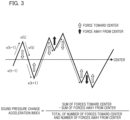
- Fig. 3 is a diagram illustrating an example of time-series data of sound pressure.
- the horizontal axis represents time
- the vertical axis represents sound pressure.
- the sound pressure is obtained for each time from the voice data input in step S201.
- the example of Fig. 3 illustrates that the voice data input in step S201 has the sound pressure of x(t - 1) at time t - 1, the sound pressure of x(t) at time t, and the sound pressure of x(t + 1) at time t + 1.
- an intermediate value between the maximum value and the minimum value of the sound pressure is defined as the center.
- the sound pressure changes from x(t - 1) to x(t) from time t - 1, and the sound pressure increases. Subsequently, the sound pressure changes from x(t) to x(t + 1) from time t to time t + 1, and the sound pressure decreases.
- Formula 1 is an expression for obtaining F(t) indicating a force toward the center and a force away from the center at time t.
- F t ⁇ t ⁇ ⁇ t ⁇ 1 min ⁇ t ⁇ t ⁇ 1
- the strength of the Sound Pressure Change acceleration is, for example, a value obtained by dividing a value obtained by subtracting the sum of forces away from the center from the sum of forces toward the center of the time-series data of the sound pressure by the total of the number of forces toward the center and the number of forces away from the center.
- the following processing (1), (2), and (3) is performed to calculate the Sound Pressure Change acceleration index.
- Fig. 4 is a graph in which data of a plurality of subjects is plotted, with the strength of the Sound Pressure Change acceleration, that is, the Sound Pressure Change acceleration index obtained by the information processing apparatus 10 of Fig. 1 with respect to an utterance made by a subject on the vertical axis and a HAMD score of the subject on the horizontal axis.
- the strength of the Sound Pressure Change acceleration that is, the Sound Pressure Change acceleration index obtained by the information processing apparatus 10 of Fig. 1 with respect to an utterance made by a subject on the vertical axis and a HAMD score of the subject on the horizontal axis.
- a correlation is observed between the strength of the Sound Pressure Change acceleration and the HAMD score, and effectiveness of using the Sound Pressure Change acceleration index as a substitute in an environment where the HAMD score cannot be performed could be confirmed.
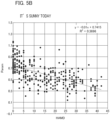
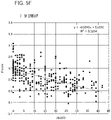
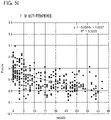
- Figs. 5A to 5J are graphs each illustrating a correlation between the strength of the Sound Pressure Change acceleration and the HAMD score by making a phrase uttered by a subject different to obtain the strength of the Sound Pressure Change acceleration as in Fig. 4 .
- the graph of Fig. 5A is a graph showing the correlation between the strength of the Sound Pressure Change acceleration and the HAMD score when uttering, "i ro ha ni ho he to".
- the graph of Fig. 5B is a graph showing the correlation between the strength of the Sound Pressure Change acceleration and the HAMD score when uttering, "It's sunny today”.
- the graph of Fig. 5C is a graph showing the correlation between the strength of the Sound Pressure Change acceleration and the HAMD score when uttering, "Once upon a time in a certain place”.
- the graph of Fig. 5D is a graph showing the correlation between the strength of the Sound Pressure Change acceleration and the HAMD score when uttering, "Galapagos islands”.
- the graph of Fig. 5E is a graph showing the correlation between the strength of the Sound Pressure Change acceleration and the HAMD score when uttering, "I'm tired and exhausted”.
- the graph of Fig. 5F is a graph showing the correlation between the strength of the Sound Pressure Change acceleration and the HAMD score when uttering, "I'm great”.
- the graph of Fig. 5G is a graph showing the correlation between the strength of the Sound Pressure Change acceleration and the HAMD score when uttering, "I had a good sleep yesterday".
- the graph of Fig. 5H is a graph showing the correlation between the strength of the Sound Pressure Change acceleration and the HAMD score when uttering, "I have a good appetite”.
- the graph of Fig. 5I is a graph showing the correlation between the strength of the Sound Pressure Change acceleration and the HAMD score when uttering, "I'm hot-tempered".
- the graph in Fig. 5J is a graph showing the correlation between the strength of the Sound Pressure Change acceleration and the HAMD score when uttering, "I feel calm".
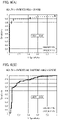
- Fig. 6 is a diagram illustrating an ROC curve of a result of screening healthy persons and depressed patients by the strength of the Sound Pressure Change acceleration obtained by the information processing apparatus 10 in Fig. 1 .
- Fig. 6(A) illustrates a case of screening healthy persons and patients with mild and severe depression.
- an area under the curve (AUC) is 0.92.
- the AUC takes a value from 0.5 to 1, and the closer the value is to 1, the higher the discriminability is. Further, when sensitivity is 89%, the specificity is 91%.
- screening with high discriminability can be performed.
- Fig. 6(B) shows a case of screening healthy persons and patients with No symptoms, mild, and severe depression. As illustrated in Fig. 6(B) , the AUC is 0.86 according to the information processing apparatus 10. Further, when the sensitivity is 810, the specificity is 83%. Thus, according to the information processing apparatus 10 of Fig. 1 , screening with high discriminability can be performed.
- Fig. 7 is a graph illustrating an ROC curve of a result of screening according to the severity of depression by the strength of the Sound Pressure Change acceleration obtained by the information processing apparatus 10 in Fig. 1 .
- Fig. 7(A) illustrates a case of screening patients with No symptoms depression (No depression) and patients with mild and severe depression (Depression). As illustrated in Fig. 7(A) , the AUC is 0.814 according to the information processing apparatus 10. Thus, according to the information processing apparatus 10 of Fig. 1 , screening with high discriminability can be performed.
- Fig. 7(B) illustrates a case of screening patients with No symptoms depression (No depression) and patients with severe depression (Severe). As illustrated in Fig. 7(B) , the AUC is 0.918 according to the information processing apparatus 10. Thus, according to the information processing apparatus 10 of Fig. 1 , screening with high discriminability can be performed.
- Fig. 7(C) illustrates a case of screening patients with No symptoms depression (No depression) and patients with mild depression (Mild). As illustrated in Fig. 7(C) , the AUC is 0.795 according to the information processing apparatus 10. Thus, according to the information processing apparatus 10 of Fig. 1 , screening with high discriminability can be performed.
- Fig. 7(D) shows a case of screening patients with mild depression (Mild) and patients with severe depression (Severe). As illustrated in Fig. 7(D) , the AUC is 0.708 according to the information processing apparatus 10. Thus, according to the information processing apparatus 10 of Fig. 1 , screening with high discriminability can be performed.
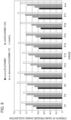
- Fig. 8 is a graph showing, on the vertical axis, the strength of the Sound Pressure Change acceleration Sound Pressure Change acceleration obtained by the information processing apparatus 10 of Fig. 1 for each of the plurality of utterances having different utterance contents by each of the healthy persons and the depressed patients.
- each of the plurality of utterances having different utterance contents by each of the healthy persons and the depressed patients is arranged on the horizontal axis.
- phrases P1 to P12 are phrases having utterance contents different from each other.
- Ave is an average value of the phrases P1 to P12.
- the strength of the Sound Pressure Change acceleration of patients with severe depression is indicated by the leftmost bar graph
- the strength of the Sound Pressure Change acceleration of patients with mild depression is indicated by a second bar graph from the left
- the strength of the Sound Pressure Change acceleration of patients with No symptoms depression is indicated by a third bar graph from the left
- the strength of the Sound Pressure Change acceleration of healthy persons is indicated by the rightmost bar graph.
- the present invention is not limited to the above-described embodiment.
- An object of the present invention is also achieved by supplying a storage medium storing a program code (computer program) for realizing the functions of the above-described embodiment to a system or an apparatus, and reading and executing the program code stored in the storage medium by a computer of the supplied system or apparatus.
- the program code itself read from the storage medium realizes the functions of the above-described embodiment, and the storage medium storing the program code constitutes the present invention.
- the computer executes the program to function as each processing unit, but a part or all of the processing may be configured by a dedicated electronic circuit (hardware).
- the present invention is not limited to the specific embodiment described above, and various modifications and changes can be made within the scope of the gist of the present invention described in the claims, including replacement of each configuration of each embodiment.
Landscapes
- Health & Medical Sciences (AREA)
- Engineering & Computer Science (AREA)
- Public Health (AREA)
- Life Sciences & Earth Sciences (AREA)
- General Health & Medical Sciences (AREA)
- Medical Informatics (AREA)
- Biomedical Technology (AREA)
- Physics & Mathematics (AREA)
- Epidemiology (AREA)
- Psychiatry (AREA)
- Audiology, Speech & Language Pathology (AREA)
- Pathology (AREA)
- Primary Health Care (AREA)
- Surgery (AREA)
- Veterinary Medicine (AREA)
- Signal Processing (AREA)
- Biophysics (AREA)
- Child & Adolescent Psychology (AREA)
- Computational Linguistics (AREA)
- Heart & Thoracic Surgery (AREA)
- Multimedia (AREA)
- Molecular Biology (AREA)
- Human Computer Interaction (AREA)
- Animal Behavior & Ethology (AREA)
- Hospice & Palliative Care (AREA)
- Acoustics & Sound (AREA)
- Psychology (AREA)
- Social Psychology (AREA)
- Developmental Disabilities (AREA)
- Educational Technology (AREA)
- Data Mining & Analysis (AREA)
- Databases & Information Systems (AREA)
- Business, Economics & Management (AREA)
- General Business, Economics & Management (AREA)
- Medical Treatment And Welfare Office Work (AREA)
- Measurement Of The Respiration, Hearing Ability, Form, And Blood Characteristics Of Living Organisms (AREA)
Applications Claiming Priority (2)
| Application Number | Priority Date | Filing Date | Title |
|---|---|---|---|
| JP2020078995 | 2020-04-28 | ||
| PCT/JP2021/010502 WO2021220646A1 (ja) | 2020-04-28 | 2021-03-16 | 情報処理装置、方法、及びプログラム |
Publications (2)
| Publication Number | Publication Date |
|---|---|
| EP4144302A1 true EP4144302A1 (de) | 2023-03-08 |
| EP4144302A4 EP4144302A4 (de) | 2024-05-29 |
Family
ID=78373481
Family Applications (1)
| Application Number | Title | Priority Date | Filing Date |
|---|---|---|---|
| EP21796222.4A Pending EP4144302A4 (de) | 2020-04-28 | 2021-03-16 | Informationsverarbeitungsvorrichtung, -verfahren und -programm |
Country Status (5)
| Country | Link |
|---|---|
| US (1) | US12193818B2 (de) |
| EP (1) | EP4144302A4 (de) |
| JP (1) | JP7466131B2 (de) |
| TW (1) | TW202141523A (de) |
| WO (1) | WO2021220646A1 (de) |
Family Cites Families (10)
| Publication number | Priority date | Publication date | Assignee | Title |
|---|---|---|---|---|
| JP3351746B2 (ja) * | 1997-10-03 | 2002-12-03 | 松下電器産業株式会社 | オーディオ信号圧縮方法、オーディオ信号圧縮装置、音声信号圧縮方法、音声信号圧縮装置,音声認識方法および音声認識装置 |
| JP2003144438A (ja) * | 2001-11-13 | 2003-05-20 | Electronic Navigation Research Institute | カオス論的脳機能診断装置 |
| JP2016004507A (ja) | 2014-06-19 | 2016-01-12 | 株式会社ベネフィットワン・ヘルスケア | 健康状態提示装置、健康状態提示方法および健康状態提示プログラム |
| JP6459818B2 (ja) | 2015-07-22 | 2019-01-30 | ブラザー工業株式会社 | テキスト対応付け装置、テキスト対応付け方法、及びプログラム |
| CN107657964B (zh) * | 2017-08-15 | 2021-01-05 | 西北大学 | 基于声学特征和稀疏数学的抑郁症辅助检测方法及分类器 |
| JP6337362B1 (ja) * | 2017-11-02 | 2018-06-06 | パナソニックIpマネジメント株式会社 | 認知機能評価装置、及び、認知機能評価システム |
| US10687159B2 (en) * | 2018-03-12 | 2020-06-16 | Panasonic Intellectual Property Management Co., Ltd. | Noise reduction device, noise reduction system, and fault detection method for noise reduction device |
| EP3821815A4 (de) * | 2018-07-13 | 2021-12-29 | Life Science Institute, Inc. | System zur abschätzung von störungen des mentalen/nervensystems, abschätzungsprogramm und abschätzungsverfahren |
| US12029579B2 (en) | 2018-07-13 | 2024-07-09 | Pst Inc. | Apparatus for estimating mental/neurological disease |
| JP2020078995A (ja) | 2018-11-13 | 2020-05-28 | 本田技研工業株式会社 | 駆動ユニット |
-
2021
- 2021-03-16 WO PCT/JP2021/010502 patent/WO2021220646A1/ja not_active Ceased
- 2021-03-16 EP EP21796222.4A patent/EP4144302A4/de active Pending
- 2021-03-16 JP JP2022517542A patent/JP7466131B2/ja active Active
- 2021-03-16 US US17/919,608 patent/US12193818B2/en active Active
- 2021-04-22 TW TW110114474A patent/TW202141523A/zh unknown
Also Published As
| Publication number | Publication date |
|---|---|
| JPWO2021220646A1 (de) | 2021-11-04 |
| JP7466131B2 (ja) | 2024-04-12 |
| WO2021220646A1 (ja) | 2021-11-04 |
| US12193818B2 (en) | 2025-01-14 |
| US20230148264A1 (en) | 2023-05-11 |
| TW202141523A (zh) | 2021-11-01 |
| EP4144302A4 (de) | 2024-05-29 |
Similar Documents
| Publication | Publication Date | Title |
|---|---|---|
| JP7804736B2 (ja) | 病状を検出するモデルを構築するための音声特徴の選択 | |
| US11918372B2 (en) | Cognitive function evaluation system, method, and storage medium for dementia by analyzing voice of evaluatee for recognition, remembering or jugment capabilities | |
| Van Nuffelen et al. | Speech technology‐based assessment of phoneme intelligibility in dysarthria | |
| US10902743B2 (en) | Gesture recognition and communication | |
| Van Stan et al. | Differences in daily voice use measures between female patients with nonphonotraumatic vocal hyperfunction and matched controls | |
| JP7834763B2 (ja) | スピーチ分析に基づく自動化された生理学的および病理学的評価 | |
| US11842741B2 (en) | Signal processing system, signal processing device, signal processing method, and recording medium | |
| KR20210050107A (ko) | 파킨슨병 진단용 애플리케이션 | |
| Marks et al. | Estimation of subglottal pressure from neck surface vibration in patients with voice disorders | |
| Kim et al. | A kinematic study of critical and non-critical articulators in emotional speech production | |
| JP7307507B2 (ja) | 病態解析システム、病態解析装置、病態解析方法、及び病態解析プログラム | |
| JP4859125B2 (ja) | 発音評定装置、およびプログラム | |
| CN106847273A (zh) | 语音识别的唤醒词选择方法及装置 | |
| EP4144302A1 (de) | Informationsverarbeitungsvorrichtung, -verfahren und -programm | |
| Montacié | High-level speech event analysis for cognitive load classification | |
| Kumar et al. | Can you hear me now? clinical applications of audio recordings | |
| JP7561358B2 (ja) | 推定方法、プログラムおよび推定装置 | |
| JP2021076623A (ja) | 音声入力支援システム | |
| CN113223559B (zh) | 一种合成语音的评测方法、装置和设备 | |
| JP2025021645A (ja) | 予測システム、予測方法及び予測プログラム | |
| JP2025517080A (ja) | 音声データを用いたai基盤の疾病診断方法及び装置 | |
| US20250299805A1 (en) | Information processing apparatus, care needs assessment support system, and recording medium | |
| CN115380326B (zh) | 助听方法、助听器用语音数据集和加工方法集的修正方法 | |
| Tavakoli et al. | Speech Acoustic Markers Detect APOE-ε4 Carrier Status in Cognitively Healthy Individuals | |
| CN119998879A (zh) | 言语功能评定 |
Legal Events
| Date | Code | Title | Description |
|---|---|---|---|
| STAA | Information on the status of an ep patent application or granted ep patent |
Free format text: STATUS: THE INTERNATIONAL PUBLICATION HAS BEEN MADE |
|
| PUAI | Public reference made under article 153(3) epc to a published international application that has entered the european phase |
Free format text: ORIGINAL CODE: 0009012 |
|
| STAA | Information on the status of an ep patent application or granted ep patent |
Free format text: STATUS: REQUEST FOR EXAMINATION WAS MADE |
|
| 17P | Request for examination filed |
Effective date: 20221117 |
|
| AK | Designated contracting states |
Kind code of ref document: A1 Designated state(s): AL AT BE BG CH CY CZ DE DK EE ES FI FR GB GR HR HU IE IS IT LI LT LU LV MC MK MT NL NO PL PT RO RS SE SI SK SM TR |
|
| DAV | Request for validation of the european patent (deleted) | ||
| DAX | Request for extension of the european patent (deleted) | ||
| REG | Reference to a national code |
Ref country code: DE Ref legal event code: R079 Free format text: PREVIOUS MAIN CLASS: A61B0010000000 Ipc: G16H0050300000 |
|
| A4 | Supplementary search report drawn up and despatched |
Effective date: 20240429 |
|
| RIC1 | Information provided on ipc code assigned before grant |
Ipc: G16H 50/20 20180101ALI20240423BHEP Ipc: A61B 5/16 20060101ALI20240423BHEP Ipc: G10L 25/66 20130101ALI20240423BHEP Ipc: G10L 25/03 20130101ALI20240423BHEP Ipc: A61B 10/00 20060101ALI20240423BHEP Ipc: A61B 5/00 20060101ALI20240423BHEP Ipc: G16H 40/67 20180101ALI20240423BHEP Ipc: G16H 40/63 20180101ALI20240423BHEP Ipc: G16H 20/70 20180101ALI20240423BHEP Ipc: G16H 50/00 20180101ALI20240423BHEP Ipc: G16H 50/30 20180101AFI20240423BHEP |