EP4142653B1 - Modular reverse shoulder prosthesis - Google Patents
Modular reverse shoulder prosthesis Download PDFInfo
- Publication number
- EP4142653B1 EP4142653B1 EP22711244.8A EP22711244A EP4142653B1 EP 4142653 B1 EP4142653 B1 EP 4142653B1 EP 22711244 A EP22711244 A EP 22711244A EP 4142653 B1 EP4142653 B1 EP 4142653B1
- Authority
- EP
- European Patent Office
- Prior art keywords
- shoulder prosthesis
- reverse shoulder
- tray
- liner
- modular
- Prior art date
- Legal status (The legal status is an assumption and is not a legal conclusion. Google has not performed a legal analysis and makes no representation as to the accuracy of the status listed.)
- Active
Links
Images




Classifications
-
- A—HUMAN NECESSITIES
- A61—MEDICAL OR VETERINARY SCIENCE; HYGIENE
- A61F—FILTERS IMPLANTABLE INTO BLOOD VESSELS; PROSTHESES; DEVICES PROVIDING PATENCY TO, OR PREVENTING COLLAPSING OF, TUBULAR STRUCTURES OF THE BODY, e.g. STENTS; ORTHOPAEDIC, NURSING OR CONTRACEPTIVE DEVICES; FOMENTATION; TREATMENT OR PROTECTION OF EYES OR EARS; BANDAGES, DRESSINGS OR ABSORBENT PADS; FIRST-AID KITS
- A61F2/00—Filters implantable into blood vessels; Prostheses, i.e. artificial substitutes or replacements for parts of the body; Appliances for connecting them with the body; Devices providing patency to, or preventing collapsing of, tubular structures of the body, e.g. stents
- A61F2/02—Prostheses implantable into the body
- A61F2/30—Joints
- A61F2/40—Joints for shoulders
- A61F2/4003—Replacing only the epiphyseal or metaphyseal parts of the humerus, i.e. endoprosthesis not comprising an entire humeral shaft
-
- A—HUMAN NECESSITIES
- A61—MEDICAL OR VETERINARY SCIENCE; HYGIENE
- A61F—FILTERS IMPLANTABLE INTO BLOOD VESSELS; PROSTHESES; DEVICES PROVIDING PATENCY TO, OR PREVENTING COLLAPSING OF, TUBULAR STRUCTURES OF THE BODY, e.g. STENTS; ORTHOPAEDIC, NURSING OR CONTRACEPTIVE DEVICES; FOMENTATION; TREATMENT OR PROTECTION OF EYES OR EARS; BANDAGES, DRESSINGS OR ABSORBENT PADS; FIRST-AID KITS
- A61F2/00—Filters implantable into blood vessels; Prostheses, i.e. artificial substitutes or replacements for parts of the body; Appliances for connecting them with the body; Devices providing patency to, or preventing collapsing of, tubular structures of the body, e.g. stents
- A61F2/02—Prostheses implantable into the body
- A61F2/30—Joints
- A61F2/40—Joints for shoulders
-
- A—HUMAN NECESSITIES
- A61—MEDICAL OR VETERINARY SCIENCE; HYGIENE
- A61F—FILTERS IMPLANTABLE INTO BLOOD VESSELS; PROSTHESES; DEVICES PROVIDING PATENCY TO, OR PREVENTING COLLAPSING OF, TUBULAR STRUCTURES OF THE BODY, e.g. STENTS; ORTHOPAEDIC, NURSING OR CONTRACEPTIVE DEVICES; FOMENTATION; TREATMENT OR PROTECTION OF EYES OR EARS; BANDAGES, DRESSINGS OR ABSORBENT PADS; FIRST-AID KITS
- A61F2/00—Filters implantable into blood vessels; Prostheses, i.e. artificial substitutes or replacements for parts of the body; Appliances for connecting them with the body; Devices providing patency to, or preventing collapsing of, tubular structures of the body, e.g. stents
- A61F2/02—Prostheses implantable into the body
- A61F2/30—Joints
- A61F2002/30001—Additional features of subject-matter classified in A61F2/28, A61F2/30 and subgroups thereof
- A61F2002/30316—The prosthesis having different structural features at different locations within the same prosthesis; Connections between prosthetic parts; Special structural features of bone or joint prostheses not otherwise provided for
- A61F2002/30317—The prosthesis having different structural features at different locations within the same prosthesis
- A61F2002/30326—The prosthesis having different structural features at different locations within the same prosthesis differing in height or in length
-
- A—HUMAN NECESSITIES
- A61—MEDICAL OR VETERINARY SCIENCE; HYGIENE
- A61F—FILTERS IMPLANTABLE INTO BLOOD VESSELS; PROSTHESES; DEVICES PROVIDING PATENCY TO, OR PREVENTING COLLAPSING OF, TUBULAR STRUCTURES OF THE BODY, e.g. STENTS; ORTHOPAEDIC, NURSING OR CONTRACEPTIVE DEVICES; FOMENTATION; TREATMENT OR PROTECTION OF EYES OR EARS; BANDAGES, DRESSINGS OR ABSORBENT PADS; FIRST-AID KITS
- A61F2/00—Filters implantable into blood vessels; Prostheses, i.e. artificial substitutes or replacements for parts of the body; Appliances for connecting them with the body; Devices providing patency to, or preventing collapsing of, tubular structures of the body, e.g. stents
- A61F2/02—Prostheses implantable into the body
- A61F2/30—Joints
- A61F2002/30001—Additional features of subject-matter classified in A61F2/28, A61F2/30 and subgroups thereof
- A61F2002/30316—The prosthesis having different structural features at different locations within the same prosthesis; Connections between prosthetic parts; Special structural features of bone or joint prostheses not otherwise provided for
- A61F2002/30329—Connections or couplings between prosthetic parts, e.g. between modular parts; Connecting elements
- A61F2002/30331—Connections or couplings between prosthetic parts, e.g. between modular parts; Connecting elements made by longitudinally pushing a protrusion into a complementarily-shaped recess, e.g. held by friction fit
- A61F2002/30332—Conically- or frustoconically-shaped protrusion and recess
-
- A—HUMAN NECESSITIES
- A61—MEDICAL OR VETERINARY SCIENCE; HYGIENE
- A61F—FILTERS IMPLANTABLE INTO BLOOD VESSELS; PROSTHESES; DEVICES PROVIDING PATENCY TO, OR PREVENTING COLLAPSING OF, TUBULAR STRUCTURES OF THE BODY, e.g. STENTS; ORTHOPAEDIC, NURSING OR CONTRACEPTIVE DEVICES; FOMENTATION; TREATMENT OR PROTECTION OF EYES OR EARS; BANDAGES, DRESSINGS OR ABSORBENT PADS; FIRST-AID KITS
- A61F2/00—Filters implantable into blood vessels; Prostheses, i.e. artificial substitutes or replacements for parts of the body; Appliances for connecting them with the body; Devices providing patency to, or preventing collapsing of, tubular structures of the body, e.g. stents
- A61F2/02—Prostheses implantable into the body
- A61F2/30—Joints
- A61F2002/30001—Additional features of subject-matter classified in A61F2/28, A61F2/30 and subgroups thereof
- A61F2002/30316—The prosthesis having different structural features at different locations within the same prosthesis; Connections between prosthetic parts; Special structural features of bone or joint prostheses not otherwise provided for
- A61F2002/30329—Connections or couplings between prosthetic parts, e.g. between modular parts; Connecting elements
- A61F2002/30433—Connections or couplings between prosthetic parts, e.g. between modular parts; Connecting elements using additional screws, bolts, dowels, rivets or washers e.g. connecting screws
-
- A—HUMAN NECESSITIES
- A61—MEDICAL OR VETERINARY SCIENCE; HYGIENE
- A61F—FILTERS IMPLANTABLE INTO BLOOD VESSELS; PROSTHESES; DEVICES PROVIDING PATENCY TO, OR PREVENTING COLLAPSING OF, TUBULAR STRUCTURES OF THE BODY, e.g. STENTS; ORTHOPAEDIC, NURSING OR CONTRACEPTIVE DEVICES; FOMENTATION; TREATMENT OR PROTECTION OF EYES OR EARS; BANDAGES, DRESSINGS OR ABSORBENT PADS; FIRST-AID KITS
- A61F2/00—Filters implantable into blood vessels; Prostheses, i.e. artificial substitutes or replacements for parts of the body; Appliances for connecting them with the body; Devices providing patency to, or preventing collapsing of, tubular structures of the body, e.g. stents
- A61F2/02—Prostheses implantable into the body
- A61F2/30—Joints
- A61F2002/30001—Additional features of subject-matter classified in A61F2/28, A61F2/30 and subgroups thereof
- A61F2002/30316—The prosthesis having different structural features at different locations within the same prosthesis; Connections between prosthetic parts; Special structural features of bone or joint prostheses not otherwise provided for
- A61F2002/30535—Special structural features of bone or joint prostheses not otherwise provided for
- A61F2002/30604—Special structural features of bone or joint prostheses not otherwise provided for modular
-
- A—HUMAN NECESSITIES
- A61—MEDICAL OR VETERINARY SCIENCE; HYGIENE
- A61F—FILTERS IMPLANTABLE INTO BLOOD VESSELS; PROSTHESES; DEVICES PROVIDING PATENCY TO, OR PREVENTING COLLAPSING OF, TUBULAR STRUCTURES OF THE BODY, e.g. STENTS; ORTHOPAEDIC, NURSING OR CONTRACEPTIVE DEVICES; FOMENTATION; TREATMENT OR PROTECTION OF EYES OR EARS; BANDAGES, DRESSINGS OR ABSORBENT PADS; FIRST-AID KITS
- A61F2/00—Filters implantable into blood vessels; Prostheses, i.e. artificial substitutes or replacements for parts of the body; Appliances for connecting them with the body; Devices providing patency to, or preventing collapsing of, tubular structures of the body, e.g. stents
- A61F2/02—Prostheses implantable into the body
- A61F2/30—Joints
- A61F2/40—Joints for shoulders
- A61F2/4014—Humeral heads or necks; Connections of endoprosthetic heads or necks to endoprosthetic humeral shafts
- A61F2002/4018—Heads or epiphyseal parts of humerus
- A61F2002/4022—Heads or epiphyseal parts of humerus having a concave shape, e.g. hemispherical cups
-
- A—HUMAN NECESSITIES
- A61—MEDICAL OR VETERINARY SCIENCE; HYGIENE
- A61F—FILTERS IMPLANTABLE INTO BLOOD VESSELS; PROSTHESES; DEVICES PROVIDING PATENCY TO, OR PREVENTING COLLAPSING OF, TUBULAR STRUCTURES OF THE BODY, e.g. STENTS; ORTHOPAEDIC, NURSING OR CONTRACEPTIVE DEVICES; FOMENTATION; TREATMENT OR PROTECTION OF EYES OR EARS; BANDAGES, DRESSINGS OR ABSORBENT PADS; FIRST-AID KITS
- A61F2/00—Filters implantable into blood vessels; Prostheses, i.e. artificial substitutes or replacements for parts of the body; Appliances for connecting them with the body; Devices providing patency to, or preventing collapsing of, tubular structures of the body, e.g. stents
- A61F2/02—Prostheses implantable into the body
- A61F2/30—Joints
- A61F2/40—Joints for shoulders
- A61F2/4059—Humeral shafts
- A61F2002/4062—Proximal or metaphyseal parts of shafts
-
- A—HUMAN NECESSITIES
- A61—MEDICAL OR VETERINARY SCIENCE; HYGIENE
- A61F—FILTERS IMPLANTABLE INTO BLOOD VESSELS; PROSTHESES; DEVICES PROVIDING PATENCY TO, OR PREVENTING COLLAPSING OF, TUBULAR STRUCTURES OF THE BODY, e.g. STENTS; ORTHOPAEDIC, NURSING OR CONTRACEPTIVE DEVICES; FOMENTATION; TREATMENT OR PROTECTION OF EYES OR EARS; BANDAGES, DRESSINGS OR ABSORBENT PADS; FIRST-AID KITS
- A61F2310/00—Prostheses classified in A61F2/28 or A61F2/30 - A61F2/44 being constructed from or coated with a particular material
- A61F2310/00005—The prosthesis being constructed from a particular material
- A61F2310/00011—Metals or alloys
- A61F2310/00023—Titanium or titanium-based alloys, e.g. Ti-Ni alloys
Definitions
- the present invention relates to a modular shoulder prosthesis.
- the invention is particularly useful in surgeries for reverse shoulder prosthesis implantation and the following description is made with reference to this specific field of application, to simplify the exposition thereof.
- total shoulder prostheses provide a glenoidal prosthetic component and a humeral component, which articulate with each other.
- a first type of prosthesis intended to reproduce the natural anatomy of the gleno-humeral joint, provides a humeral component with a convex end that articulates on a concave end of a glenoidal component.
- a second type of prosthesis called "reverse” provides instead a convex glenoidal component that articulates on a concave humeral component, after resection of the humeral head; a reverse prosthesis is preferred in critical situations of rotator cuff instability.
- Document US 2014/236304 (A1 ) relates to a modular reverse and convertible shoulder prosthesis, that includes a distal stem, a reverse metaphysis, a reverse insert or liner that can be angled and a modular screw for coupling the reverse metaphysis with the distal stem.
- Document WO 2014/067961 (A1 ) relates to an implantation of a convertible reverse prosthesis including a humeral stem, a reverse tray and a reverse insert or liner made of polyethylene.
- the reverse insert is provided in alternatives having different inclination angles, for example 7.5°, 12.5° and 17.5°.
- a difficulty emerging in the prior art is due to the fact that, especially for modular reverse prostheses, the prosthesis size can involve an excessive tensioning of the surrounding tissues not only making it difficult to reduce the prosthesis at the surgical site but also leading to potential consequences in the short-medium term, among which for example a disadvantageous biomechanical configuration (suboptimal muscle lines of action, over-tensioned muscles, etc.) or bone fractures (acromial fractures due to the excessive tension).
- the design tends to be of the onlay type since it is difficult to maintain the lower point of the humeral concave joint surface in the area below the resection plane (metaphysis), since a connection system between the several modular components that leaves little space available in said area to house the concavity of the joint surface must in fact be provided, and moreover since there are technical limits relating to the minimum thicknesses of the articulating materials.
- An excessive onlay level in a reverse modular prosthesis can therefore worsen the mobility features (rotation, extension, adduction) and in general, as described above, worsen implant performances.
- a general object of the present invention is to provide to the surgeon a shoulder prosthesis that solves the drawbacks of the prior art.
- a further object of the present invention is to limit or reduce the onlay level in a liner of a reverse modular prosthesis.
- a further object of the present invention is to effectively allow different correction angles of a liner of a reverse modular prosthesis.
- a further object of the present invention is to improve the mobility features of a shoulder prosthesis.
- a further object of the present invention is to have a modular prosthesis stem having improved features.
- a further object of the present invention is to have a solution that can be applied to a convertible modular prosthesis, having possible anatomical prosthesis and reverse prosthesis configurations.
- the tray comprises a raised edge supporting a joint concave element of the liner.
- the raised edge has a reduced height on the side where the angled liner is thinned, thus forming an asymmetrical tray with respect to diametrically opposite portions.
- This device allows the liner to have a considerable reduction of the onlay level, but without affecting the liner minimum thicknesses and still allowing a sufficient support of the liner, especially on the full-height portions of the raised edge.
- a modular reverse shoulder prosthesis comprising: a stem comprising a tapered body and a first annular housing; a tray comprising a dome element for insertion into the first annular housing, and further comprising a second annular housing; a liner comprising an engaging element for at least partial insertion into the dome element, and further comprising a joint concave element configured for coupling with the second annular housing.
- the second annular housing of the tray comprises a raised edge configured to support the joint concave element.
- the raised edge defines an overall outline having a different development in height at least in diametrically opposite portions of said tray.
- a shoulder prosthesis system with a great modularity and versatility is thereby manufactured, that allows the implantation of different liners with different correction angles.
- the onlay level i.e., the distance between the bone resection plane and the lower point of the joint surface of the concave liner inserted into the tray, is reduced.
- the mobility features rotation, extension, adduction
- the general performances of the prosthesis are improved.
- the modular reverse shoulder prosthesis 100 further comprises a tray 120 comprising a dome element 121 for insertion into the first annular housing 112 of the stem 110.
- the tray 120 further comprises a second annular housing 122.
- the modular reverse shoulder prosthesis 100 comprises a liner 130 that includes an engaging element 131 configured for at least partial insertion into the dome element 121 of the tray 120.
- the liner 130 further comprises a joint concave element 132 configured for coupling with the second annular housing 122 of the tray 120.
- the joint concave element 132 is configured for a perimetrical coupling with the second annular housing 122 of the tray 120.
- the modular reverse shoulder prosthesis 100 allows a high modularity and versatility, being able to house different liners 130 having different correction angles, as it will be further described.
- the second annular housing 122 of the tray 120 comprises a raised edge 123 configured to support the joint concave element 132 of the liner 130.
- the tray 120 is made of a metal material, preferably of titanium or an alloy thereof.
- the tapered body 111 and the first annular housing 112 are formed as a single piece in the stem 110, also including the plurality of supports 113.
- the liner 130 is instead made of a plastic material, preferably polyethylene, in particular ultra-high molecular weight polyethylene (UHMWPE).
- polyethylene in particular ultra-high molecular weight polyethylene (UHMWPE).
- the tray 120 comprises the dome element 121 and the second annular housing 122.
- the second annular housing 122 comprises a raised edge 123, configured to support the joint concave element 132 of the liner 130 (not visible in figure 2 ).
- Figure 3 shows a lateral section of an exploded view of the modular reverse shoulder prosthesis 100, in which the already-described stem 110, tray 120 and liner 130 are represented.
- the tray 120 is assembled to the stem 110 by means of a conical coupling between the dome element 121 and the first annular housing 112, and preferably by means of a further coupling with a central safety screw 140.
- the liner 130 is assembled to the tray 120 by means of a snap engagement 150 acting between the engaging element 131 and an inner surface of the dome element 121.
- the liner 130 is assembled to the tray 120 by means of a further interference between the engaging element 131 and an inner surface of the dome element 121.
- the overall outline of the raised edge 123 comprises a first slanted portion 123a, configured for coupling with a respective slanted surface 133a (not visible in the figure section) of the joint concave element 132.
- the first portion 123a has a smaller development in height with respect to a second diametrically opposite portion 123b of the raised edge 123.
- the raised edge 123 defines an overall outline having a development in height, evaluated parallelly to the insertion axis 10, that is different at least in diametrically opposite portions 123a and 123b of the tray 120.
- the first portion 123a substantially includes a semicircular half of the raised edge 123.
- the overall outline comprises a planar portion 123b that is diametrically opposite the first portion 123a and having a greater development in height with respect thereto.
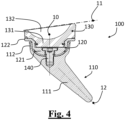
- Figure 4 shows a lateral section that is similar to figure 3 , of an assembled view of the modular reverse shoulder prosthesis 100.
- the dome element 121 is configured for insertion into the first annular housing 112 along the insertion axis 10 and the engaging element 131 as well is configured for insertion into the dome element 121 along the same insertion axis 10. It is also noted that the second annular housing 122 is arranged substantially perpendicular to the insertion axis 10.
- the joint concave element 132 of the liner 130 comprises an upper surface substantially lying on a correction plane 11.
- the correction plane 11 is slanted by a correction angle with respect to a plane that is perpendicular to the insertion axis 10.
- the tapered body 111 defines instead a stem primary axis 12 that is angled with respect to the insertion axis 10.
- the stem 110 is configured for implantation in a humeral bone end, while the liner 130 is configured to articulate with a respective glenoidal spherical element, or glenosphere, of a reverse shoulder prosthesis.
- the stem 110 is further configured to be adopted in a convertible prosthesis, and in this case the first annular housing 112 is further adapted to house prosthesis elements according to an anatomical configuration, in place of the already-described elements 120 and 130.
- Figure 5 shows a lateral view of the partial prosthesis assembly comprising the liner 130 and the tray 120.
- the raised edge 123 comprises a plurality of cutouts 124 configured for coupling with a respective plurality of outer protrusions 134 on the joint concave element 132, that are thus adapted to block a relative rotation between the tray 120 and the liner 130.
- Figure 6 shows the lateral section VI-VI of the assembly of figure 5 .
- the raised edge 123 defines an overall outline that, as can be seen in figure 6 , has a development in height that is different at least in diametrically opposite portions 123a and 123b of the tray 120.
- Figure 7 shows a detail of figure 6 , in which the coupling between the first portion 123a of the raised edge of the annular housing 122 and the respective surface 133a of the joint concave element 132 is better viewed.
- figures 8 and 9 show a comparison between the thicknesses of a liner in a solution according to the present invention, in figure 8 , and according to another example, in figure 9 . Localized magnifications in the portions identified by the dashed lines are also shown.
- a tray 120 and a liner 130 are shown, in which a raised edge of the tray 120 defines an overall outline that has a different development in height at least in diametrically opposite portions, thus being asymmetrical in height.
- a minimum thickness 80 of the liner 130 between the concave surface and the interface with the tray 120 is by way of example 3.9923 mm.
- a general tray and a general liner are shown, having a substantial diameter and size that are similar to those of the example of figure 8 .
- the raised edge of the tray defines an overall outline that has a same development in height in diametrically opposite portions, thus being symmetrical in height.
- the minimum thickness 90 of the liner between the concave surface and the interface with the tray is by way of example only 1.6187 mm, thus considerably smaller with respect to the minimum thickness 80 of the case of figure 8 .
- the onlay level can be reduced to the benefit of the prosthesis functionality and effectiveness.
- Figures 10 and 11 show respective sectional views on planes that are perpendicular to each other of a partial assembly composed of the already-described liner 130 and tray 120, and in addition composed of the already-described central safety screw 140 and snap engagement 150.
- Figure 12 shows a further embodiment of a tray 120' for a modular reverse shoulder prosthesis according to the present invention.
- the overall outline of the raised edge 123' comprises a first planar portion 123a', that still has a smaller development in height with respect to a second diametrically opposite portion 123b of the raised edge 123'.
- the overall outline of the raised edge 123' comprises a first planar portion 123a', configured for coupling with a respective planar surface (not visible in figure 12 ) of a joint concave element.
- the tray 120" has an annular housing 122" comprising an asymmetrical raised edge 123", that has a fully slanted configuration with respect to the only partially slanted configuration of the raised edge 123 of the embodiment already described above.
- the overall outline of the raised edge 123" comprises a first slanted portion 123a" that has a smaller development in height with respect to a second still slanted and diametrically opposite portion 123b".
- the modular reverse shoulder prosthesis 100' comprises the already-described stem 110, tray 120" and liner 130.
- the tray 120" is assembled to the stem 110 by means of a conical coupling between the dome element 121 and the first annular housing 112, and by means of a further coupling with a modular pin 140b.
- the modular pin 140b is preferably pre-assembled to the tray 120".
- the modular pin 140b allows the insertion of the components in the operating room to be facilitated and accelerated, and also the extraction to be accelerated in case of prosthesis revision, since it is sufficient to interpose a fork-like tool to arrange for the extraction of the tray 120" from the stem 110.
- the pin 140b offers a lower resistance to the axial extraction with respect to the screw 140, since only the conical coupling contributes to holding, it still ensures a suitable resistance to "lever-out" since in the shoulder there are basically compressive forces.
- the modular pin 140b is preferably pre-assembled to the tray 120.
- Figure 16 shows a lateral section that is similar to figure 15 , of an assembled view of the modular reverse shoulder prosthesis 100".
- the dome element 121 is configured for insertion into the first annular housing 112 of the stem 110 by means of the cooperation of the pin 140b.
- Figure 17 shows a three-dimensional view of an embodiment of the stem 110 for a modular reverse shoulder prosthesis according to the present invention, while figure 18 shows a front view of the stem 110 and figure 19 shows a lateral view of the stem 110.
- the stem 110 for a modular reverse shoulder prosthesis comprises a tapered body 111 and a first annular housing 112, configured to house other humeral components of the modular prosthesis, for example a tray 120 for the liner 130 as already described.
- the stem 110 is configured for implantation in a humeral bone end.
- the stem 110 is mainly configured for a modular reverse shoulder prosthesis, but it is also further configured for a convertible prosthesis, in which the first annular housing 112 is advantageously adapted to house modular anatomical prosthesis elements.
- the first annular housing 112 externally comprises a trabecular structure 201 configured to obtain a better fixation with the humeral bone.
- the first annular housing 112 allows the load to be transferred to the humerus, just below the resection, thus contributing to promote a better fixation of the metaphyseal type.
- the stem 110 further comprises a plurality of supports 113 connecting the tapered body 111 and the first annular housing 112, keeping them angled to each other.
- both the tapered body 111 and the first annular housing 112 and the plurality of supports 113 are made as a single piece in the stem 110.
- the plurality of supports 113 are configured for a fixation and stabilisation of the prosthesis implant.
- the plurality of supports 113 define a finned portion connecting the tapered body 111 and the first annular housing 112, tapering in turn in the area connecting with the tapered body 111.
- the plurality of supports 113 comprise a first medial support 211, two antero-posterior supports 212a and 212b and a lateral support 213.
- the plurality of supports 113 are configured to provide a rotational stability to the stem 110 as well as to stabilise the bending moment.
- the conformation of the antero-posterior supports 212a and 212b is curved according to the angle between the tapered body 111 and the first annular housing 112.
- the curved implantation direction of the stem 110 is thereby determined, that allows to follow the medial curve of the humerus in the insertion step, better adapting to the anatomy and thus facilitating the implantation step in the operating room.
- the undercut 20 of the stem 110 due to the angle between the tapered body 111 and the first annular housing 112, allows to avoid an excessive bone removal proximally due to an insertion along the diaphisary axis of the humerus.
- the two antero-posterior supports could be straight with respect to the stem primary axis, in order to allow an insertion of the implant in axis with the diaphisis in a more intuitive and reproducible manner.
- the gap created between the plurality of supports 113 allows a greater lateral area of the supports 211, 212a, 212b and 213 to be exposed to the bone, improving the implant bending and torsional stability. Moreover, advantageously, the gap created between the plurality of supports 113 reduces the weight and volume of the overall implant, and considerably decreases the amount of bone to be removed for the implantation; this reduces in turn the filling coefficient (given by the ratio between the volume of bone removed from the prosthesis and the volume of bone without the prosthesis) resulting in a minor invasiveness and a minor "stress-shielding" risk. Finally, the gap created between the plurality of supports 113 allows the distal part of the prosthesis to be accessed in case of a revision intervention.
- the distal portion of the stem 110, at the tapered body 111, has a substantially conical or frustoconical conformation with a circular section, that provides an additional stability to the implant, especially in the periods immediately after the surgery in which the bone is not still integrated in the first annular housing 112.
- the tapered body 111 comprises a polished end portion 202.
- the polished end portion 202 in addition to facilitating the insertion of the stem 110 during the surgical procedure, also allows a local osteointegration to be avoided, thus avoiding the transfer of loads distally and the consequent reabsorption of proximal bone due to "stress-shielding", and problems in the implant revision step, in which it would be otherwise difficult to access the distal portion of the tapered body 111 to detach any adherent bone without being excessively invasive.
- the stem 110 is symmetrical in order to be implanted both in right and left humeri. It has however a lateral average offset 21 between the stem primary axis 12 and a centre 22 of the first annular housing 112, configured to reproduce at best the offset anatomically existing in humeri.
Landscapes
- Health & Medical Sciences (AREA)
- Orthopedic Medicine & Surgery (AREA)
- Cardiology (AREA)
- Oral & Maxillofacial Surgery (AREA)
- Transplantation (AREA)
- Engineering & Computer Science (AREA)
- Biomedical Technology (AREA)
- Heart & Thoracic Surgery (AREA)
- Vascular Medicine (AREA)
- Life Sciences & Earth Sciences (AREA)
- Animal Behavior & Ethology (AREA)
- General Health & Medical Sciences (AREA)
- Public Health (AREA)
- Veterinary Medicine (AREA)
- Prostheses (AREA)
- Materials For Medical Uses (AREA)
Applications Claiming Priority (2)
| Application Number | Priority Date | Filing Date | Title |
|---|---|---|---|
| IT102021000005858A IT202100005858A1 (it) | 2021-03-12 | 2021-03-12 | Protesi di spalla inversa modulare |
| PCT/EP2022/056089 WO2022189532A1 (en) | 2021-03-12 | 2022-03-09 | Modular reverse shoulder prosthesis |
Publications (2)
| Publication Number | Publication Date |
|---|---|
| EP4142653A1 EP4142653A1 (en) | 2023-03-08 |
| EP4142653B1 true EP4142653B1 (en) | 2025-04-16 |
Family
ID=76159742
Family Applications (1)
| Application Number | Title | Priority Date | Filing Date |
|---|---|---|---|
| EP22711244.8A Active EP4142653B1 (en) | 2021-03-12 | 2022-03-09 | Modular reverse shoulder prosthesis |
Country Status (9)
| Country | Link |
|---|---|
| US (2) | US12245946B2 (https=) |
| EP (1) | EP4142653B1 (https=) |
| JP (1) | JP2024512836A (https=) |
| CN (1) | CN115867233A (https=) |
| AU (1) | AU2022235411A1 (https=) |
| BR (1) | BR112022025268A2 (https=) |
| ES (1) | ES3025150T3 (https=) |
| IT (1) | IT202100005858A1 (https=) |
| WO (1) | WO2022189532A1 (https=) |
Families Citing this family (3)
| Publication number | Priority date | Publication date | Assignee | Title |
|---|---|---|---|---|
| USD977643S1 (en) * | 2019-03-12 | 2023-02-07 | Shoulder Innovations, Inc. | Humeral stem implant |
| EP4429604A1 (en) * | 2021-11-11 | 2024-09-18 | Arthrex, Inc. | Arthroplasty implant systems with stemless implants |
| WO2024258699A1 (en) * | 2023-06-13 | 2024-12-19 | Smith & Nephew, Inc. | Tapered protrusions on arthroplasty implant stem |
Family Cites Families (27)
| Publication number | Priority date | Publication date | Assignee | Title |
|---|---|---|---|---|
| US7682398B2 (en) * | 2000-03-14 | 2010-03-23 | Smith & Nephew, Inc. | Variable geometry rim surface acetabular shell liner |
| US6790234B1 (en) * | 2002-01-04 | 2004-09-14 | Frankle Mark A | Reverse shoulder prosthesis system |
| US6916342B2 (en) * | 2002-04-01 | 2005-07-12 | Smith & Nephew, Inc. | Liner assembly for prosthetic components |
| US8062376B2 (en) * | 2002-07-10 | 2011-11-22 | Biomet Manufacturing Corp. | Shoulder implant assembly |
| US7011686B2 (en) * | 2002-09-30 | 2006-03-14 | Depuy Products, Inc. | Reverse-type humeral prosthesis |
| FR2855743B1 (fr) * | 2003-06-06 | 2006-02-10 | Biotechni | Insert pour cupule d'implant cotyloidien pour prothese articulaire, implant cotyloidien et prothese articulaire |
| EP2762107B1 (en) * | 2006-01-20 | 2017-11-29 | Zimmer Technology, Inc. | Shoulder arthroplasty system |
| WO2010105073A1 (en) * | 2009-03-11 | 2010-09-16 | Exactech, Inc. | Motion inducing reverse shoulder assembly |
| US20120004733A1 (en) * | 2010-06-30 | 2012-01-05 | Hodorek Brian C | Modular articulating prostheses and associated methods |
| EP2474289A1 (en) * | 2011-01-11 | 2012-07-11 | Arthrex, Inc. | Humeral component of a shoulder prosthesis |
| AU2012214581A1 (en) * | 2011-02-07 | 2013-08-15 | Exactech, Inc. | Adjustable reverse shoulder prostheses |
| GB201106973D0 (en) * | 2011-04-27 | 2011-06-08 | Finsbury Dev Ltd | A cup |
| EP2604225A1 (en) * | 2011-10-31 | 2013-06-19 | Tornier Orthopedics Ireland Ltd. | Modular reverse shoulder prosthesis |
| EP2638881B1 (en) * | 2012-03-15 | 2015-08-05 | Arthrex, Inc. | Joint implant trial components |
| WO2013181365A1 (en) * | 2012-05-31 | 2013-12-05 | Exactech, Inc. | Reverse shoulder humeral adapter trays |
| WO2014005644A1 (en) * | 2012-07-05 | 2014-01-09 | Limacorporate S.P.A. | Humeral implant for a shoulder prosthesis |
| JP6800584B2 (ja) * | 2012-10-29 | 2020-12-16 | トルニエ オーソペディックス アイルランド エルティーディー.Tornier Orthopedics Ireland Ltd. | 反転型肩関節インプラントのためのシステム及び方法 |
| ITMI20122177A1 (it) * | 2012-12-19 | 2014-06-20 | Permedica S P A | Protesi di spalla di tipo migliorato |
| US9597190B2 (en) * | 2015-01-15 | 2017-03-21 | DePuy Synthes Products, Inc. | Modular reverse shoulder orthopaedic implant and method of implanting the same |
| EP3178446B1 (en) * | 2015-12-03 | 2019-07-03 | Zimmer, Inc. | Multi-curvature liners for reversed shoulder replacement |
| US10172714B2 (en) * | 2016-02-28 | 2019-01-08 | Consortium Of Focused Orthopedists, Llc | Shoulder arthroplasty implant system |
| WO2017184792A1 (en) * | 2016-04-19 | 2017-10-26 | Imascap Sas | Pre-operatively planned humeral implant and planning method |
| US10335283B2 (en) * | 2017-01-10 | 2019-07-02 | Tyler J Zajac | Reverse hip system and method |
| US10898338B1 (en) * | 2018-01-17 | 2021-01-26 | Matthew Budge | Reverse shoulder prosthesis |
| GB2616360B (en) * | 2019-03-12 | 2023-11-29 | Arthrosurface Inc | Humeral and glenoid articular surface implant systems and methods |
| US11571310B2 (en) * | 2019-04-03 | 2023-02-07 | Catalyst Orthoscience Inc. | Stemmed implant |
| WO2021150740A1 (en) * | 2020-01-21 | 2021-07-29 | University Of Maryland, College Park | Dual mobility cup reverse shoulder prosthesis |
-
2021
- 2021-03-12 IT IT102021000005858A patent/IT202100005858A1/it unknown
-
2022
- 2022-03-09 CN CN202280005024.9A patent/CN115867233A/zh active Pending
- 2022-03-09 US US18/010,370 patent/US12245946B2/en active Active
- 2022-03-09 ES ES22711244T patent/ES3025150T3/es active Active
- 2022-03-09 EP EP22711244.8A patent/EP4142653B1/en active Active
- 2022-03-09 WO PCT/EP2022/056089 patent/WO2022189532A1/en not_active Ceased
- 2022-03-09 BR BR112022025268A patent/BR112022025268A2/pt unknown
- 2022-03-09 JP JP2022576874A patent/JP2024512836A/ja active Pending
- 2022-03-09 AU AU2022235411A patent/AU2022235411A1/en active Pending
-
2025
- 2025-02-13 US US19/052,840 patent/US20250339280A1/en active Pending
Also Published As
| Publication number | Publication date |
|---|---|
| JP2024512836A (ja) | 2024-03-21 |
| US20250339280A1 (en) | 2025-11-06 |
| US12245946B2 (en) | 2025-03-11 |
| IT202100005858A1 (it) | 2022-09-12 |
| WO2022189532A1 (en) | 2022-09-15 |
| CN115867233A (zh) | 2023-03-28 |
| BR112022025268A2 (pt) | 2023-11-21 |
| ES3025150T3 (en) | 2025-06-06 |
| US20230414372A1 (en) | 2023-12-28 |
| AU2022235411A1 (en) | 2022-12-15 |
| EP4142653A1 (en) | 2023-03-08 |
Similar Documents
| Publication | Publication Date | Title |
|---|---|---|
| US20220175544A1 (en) | Tri-flange humeral prosthesis | |
| AU2003244030B2 (en) | Reverse-type humeral prosthesis | |
| US11596520B2 (en) | Perfected total shoulder prosthesis | |
| US20250339280A1 (en) | Modular reverse shoulder prosthesis | |
| US6702854B1 (en) | Implantable joint prosthesis | |
| US20250000662A1 (en) | Stemless, convertible, humeral shoulder prosthesis | |
| JP2014069078A (ja) | 可変a/pテーパ角を用いた大腿骨ステムコンポーネントを有する整形外科用股関節プロテーゼ | |
| US20210378830A1 (en) | Elbow arthroplasty apparatus, system, and method | |
| AU2025203015A1 (en) | Implants, systems and methods of using the same | |
| US20170086981A1 (en) | Femoral hip stem | |
| JP2026063230A (ja) | リバース型人工肩関節及び関連する方法 | |
| EP4640187A1 (en) | Reverse shoulder arthroplasty with dual mobility | |
| US20250325376A1 (en) | Reverse shoulder arthroplasty with dual mobility | |
| US20250114132A1 (en) | Anatomically shaped inlay stemless shoulder implant | |
| AU2024360440A1 (en) | Anatomically shaped inlay stemless shoulder implant |
Legal Events
| Date | Code | Title | Description |
|---|---|---|---|
| STAA | Information on the status of an ep patent application or granted ep patent |
Free format text: STATUS: UNKNOWN |
|
| STAA | Information on the status of an ep patent application or granted ep patent |
Free format text: STATUS: THE INTERNATIONAL PUBLICATION HAS BEEN MADE |
|
| PUAI | Public reference made under article 153(3) epc to a published international application that has entered the european phase |
Free format text: ORIGINAL CODE: 0009012 |
|
| STAA | Information on the status of an ep patent application or granted ep patent |
Free format text: STATUS: REQUEST FOR EXAMINATION WAS MADE |
|
| 17P | Request for examination filed |
Effective date: 20221201 |
|
| AK | Designated contracting states |
Kind code of ref document: A1 Designated state(s): AL AT BE BG CH CY CZ DE DK EE ES FI FR GB GR HR HU IE IS IT LI LT LU LV MC MK MT NL NO PL PT RO RS SE SI SK SM TR |
|
| STAA | Information on the status of an ep patent application or granted ep patent |
Free format text: STATUS: EXAMINATION IS IN PROGRESS |
|
| 17Q | First examination report despatched |
Effective date: 20230404 |
|
| P01 | Opt-out of the competence of the unified patent court (upc) registered |
Effective date: 20230520 |
|
| DAV | Request for validation of the european patent (deleted) | ||
| DAX | Request for extension of the european patent (deleted) | ||
| GRAP | Despatch of communication of intention to grant a patent |
Free format text: ORIGINAL CODE: EPIDOSNIGR1 |
|
| STAA | Information on the status of an ep patent application or granted ep patent |
Free format text: STATUS: GRANT OF PATENT IS INTENDED |
|
| INTG | Intention to grant announced |
Effective date: 20241111 |
|
| GRAS | Grant fee paid |
Free format text: ORIGINAL CODE: EPIDOSNIGR3 |
|
| GRAA | (expected) grant |
Free format text: ORIGINAL CODE: 0009210 |
|
| STAA | Information on the status of an ep patent application or granted ep patent |
Free format text: STATUS: THE PATENT HAS BEEN GRANTED |
|
| AK | Designated contracting states |
Kind code of ref document: B1 Designated state(s): AL AT BE BG CH CY CZ DE DK EE ES FI FR GB GR HR HU IE IS IT LI LT LU LV MC MK MT NL NO PL PT RO RS SE SI SK SM TR |
|
| REG | Reference to a national code |
Ref country code: GB Ref legal event code: FG4D |
|
| REG | Reference to a national code |
Ref country code: CH Ref legal event code: EP Ref country code: DE Ref legal event code: R096 Ref document number: 602022013237 Country of ref document: DE |
|
| REG | Reference to a national code |
Ref country code: IE Ref legal event code: FG4D |
|
| REG | Reference to a national code |
Ref country code: ES Ref legal event code: FG2A Ref document number: 3025150 Country of ref document: ES Kind code of ref document: T3 Effective date: 20250606 |
|
| REG | Reference to a national code |
Ref country code: NL Ref legal event code: MP Effective date: 20250416 |
|
| PG25 | Lapsed in a contracting state [announced via postgrant information from national office to epo] |
Ref country code: NL Free format text: LAPSE BECAUSE OF FAILURE TO SUBMIT A TRANSLATION OF THE DESCRIPTION OR TO PAY THE FEE WITHIN THE PRESCRIBED TIME-LIMIT Effective date: 20250416 |
|
| REG | Reference to a national code |
Ref country code: AT Ref legal event code: MK05 Ref document number: 1785039 Country of ref document: AT Kind code of ref document: T Effective date: 20250416 |
|
| PG25 | Lapsed in a contracting state [announced via postgrant information from national office to epo] |
Ref country code: FI Free format text: LAPSE BECAUSE OF FAILURE TO SUBMIT A TRANSLATION OF THE DESCRIPTION OR TO PAY THE FEE WITHIN THE PRESCRIBED TIME-LIMIT Effective date: 20250416 Ref country code: PT Free format text: LAPSE BECAUSE OF FAILURE TO SUBMIT A TRANSLATION OF THE DESCRIPTION OR TO PAY THE FEE WITHIN THE PRESCRIBED TIME-LIMIT Effective date: 20250818 |
|
| REG | Reference to a national code |
Ref country code: LT Ref legal event code: MG9D |
|
| PG25 | Lapsed in a contracting state [announced via postgrant information from national office to epo] |
Ref country code: NO Free format text: LAPSE BECAUSE OF FAILURE TO SUBMIT A TRANSLATION OF THE DESCRIPTION OR TO PAY THE FEE WITHIN THE PRESCRIBED TIME-LIMIT Effective date: 20250716 Ref country code: GR Free format text: LAPSE BECAUSE OF FAILURE TO SUBMIT A TRANSLATION OF THE DESCRIPTION OR TO PAY THE FEE WITHIN THE PRESCRIBED TIME-LIMIT Effective date: 20250717 |
|
| PG25 | Lapsed in a contracting state [announced via postgrant information from national office to epo] |
Ref country code: PL Free format text: LAPSE BECAUSE OF FAILURE TO SUBMIT A TRANSLATION OF THE DESCRIPTION OR TO PAY THE FEE WITHIN THE PRESCRIBED TIME-LIMIT Effective date: 20250416 |
|
| PG25 | Lapsed in a contracting state [announced via postgrant information from national office to epo] |
Ref country code: BG Free format text: LAPSE BECAUSE OF FAILURE TO SUBMIT A TRANSLATION OF THE DESCRIPTION OR TO PAY THE FEE WITHIN THE PRESCRIBED TIME-LIMIT Effective date: 20250416 |
|
| PG25 | Lapsed in a contracting state [announced via postgrant information from national office to epo] |
Ref country code: HR Free format text: LAPSE BECAUSE OF FAILURE TO SUBMIT A TRANSLATION OF THE DESCRIPTION OR TO PAY THE FEE WITHIN THE PRESCRIBED TIME-LIMIT Effective date: 20250416 |
|
| PG25 | Lapsed in a contracting state [announced via postgrant information from national office to epo] |
Ref country code: AT Free format text: LAPSE BECAUSE OF FAILURE TO SUBMIT A TRANSLATION OF THE DESCRIPTION OR TO PAY THE FEE WITHIN THE PRESCRIBED TIME-LIMIT Effective date: 20250416 |
|
| PG25 | Lapsed in a contracting state [announced via postgrant information from national office to epo] |
Ref country code: RS Free format text: LAPSE BECAUSE OF FAILURE TO SUBMIT A TRANSLATION OF THE DESCRIPTION OR TO PAY THE FEE WITHIN THE PRESCRIBED TIME-LIMIT Effective date: 20250716 |
|
| PG25 | Lapsed in a contracting state [announced via postgrant information from national office to epo] |
Ref country code: IS Free format text: LAPSE BECAUSE OF FAILURE TO SUBMIT A TRANSLATION OF THE DESCRIPTION OR TO PAY THE FEE WITHIN THE PRESCRIBED TIME-LIMIT Effective date: 20250816 |
|
| PG25 | Lapsed in a contracting state [announced via postgrant information from national office to epo] |
Ref country code: LV Free format text: LAPSE BECAUSE OF FAILURE TO SUBMIT A TRANSLATION OF THE DESCRIPTION OR TO PAY THE FEE WITHIN THE PRESCRIBED TIME-LIMIT Effective date: 20250416 |
|
| PG25 | Lapsed in a contracting state [announced via postgrant information from national office to epo] |
Ref country code: SM Free format text: LAPSE BECAUSE OF FAILURE TO SUBMIT A TRANSLATION OF THE DESCRIPTION OR TO PAY THE FEE WITHIN THE PRESCRIBED TIME-LIMIT Effective date: 20250416 Ref country code: DK Free format text: LAPSE BECAUSE OF FAILURE TO SUBMIT A TRANSLATION OF THE DESCRIPTION OR TO PAY THE FEE WITHIN THE PRESCRIBED TIME-LIMIT Effective date: 20250416 |
|
| REG | Reference to a national code |
Ref country code: DE Ref legal event code: R097 Ref document number: 602022013237 Country of ref document: DE |
|
| PG25 | Lapsed in a contracting state [announced via postgrant information from national office to epo] |
Ref country code: CZ Free format text: LAPSE BECAUSE OF FAILURE TO SUBMIT A TRANSLATION OF THE DESCRIPTION OR TO PAY THE FEE WITHIN THE PRESCRIBED TIME-LIMIT Effective date: 20250416 |
|
| PG25 | Lapsed in a contracting state [announced via postgrant information from national office to epo] |
Ref country code: EE Free format text: LAPSE BECAUSE OF FAILURE TO SUBMIT A TRANSLATION OF THE DESCRIPTION OR TO PAY THE FEE WITHIN THE PRESCRIBED TIME-LIMIT Effective date: 20250416 |
|
| PG25 | Lapsed in a contracting state [announced via postgrant information from national office to epo] |
Ref country code: SK Free format text: LAPSE BECAUSE OF FAILURE TO SUBMIT A TRANSLATION OF THE DESCRIPTION OR TO PAY THE FEE WITHIN THE PRESCRIBED TIME-LIMIT Effective date: 20250416 |
|
| PLBE | No opposition filed within time limit |
Free format text: ORIGINAL CODE: 0009261 |
|
| STAA | Information on the status of an ep patent application or granted ep patent |
Free format text: STATUS: NO OPPOSITION FILED WITHIN TIME LIMIT |
|
| REG | Reference to a national code |
Ref country code: CH Ref legal event code: L10 Free format text: ST27 STATUS EVENT CODE: U-0-0-L10-L00 (AS PROVIDED BY THE NATIONAL OFFICE) Effective date: 20260225 |
|
| 26N | No opposition filed |
Effective date: 20260119 |
|
| REG | Reference to a national code |
Ref country code: CH Ref legal event code: U11 Free format text: ST27 STATUS EVENT CODE: U-0-0-U10-U11 (AS PROVIDED BY THE NATIONAL OFFICE) Effective date: 20260401 |
|
| PGFP | Annual fee paid to national office [announced via postgrant information from national office to epo] |
Ref country code: GB Payment date: 20260327 Year of fee payment: 5 |
|
| PGFP | Annual fee paid to national office [announced via postgrant information from national office to epo] |
Ref country code: DE Payment date: 20260327 Year of fee payment: 5 |
|
| PGFP | Annual fee paid to national office [announced via postgrant information from national office to epo] |
Ref country code: IT Payment date: 20260319 Year of fee payment: 5 |
|
| PGFP | Annual fee paid to national office [announced via postgrant information from national office to epo] |
Ref country code: FR Payment date: 20260325 Year of fee payment: 5 |