EP4138736B1 - Knochenimplantat - Google Patents
Knochenimplantat Download PDFInfo
- Publication number
- EP4138736B1 EP4138736B1 EP21721485.7A EP21721485A EP4138736B1 EP 4138736 B1 EP4138736 B1 EP 4138736B1 EP 21721485 A EP21721485 A EP 21721485A EP 4138736 B1 EP4138736 B1 EP 4138736B1
- Authority
- EP
- European Patent Office
- Prior art keywords
- vivo
- bone implant
- bone
- degradable
- main body
- Prior art date
- Legal status (The legal status is an assumption and is not a legal conclusion. Google has not performed a legal analysis and makes no representation as to the accuracy of the status listed.)
- Active
Links
Images
Classifications
-
- A—HUMAN NECESSITIES
- A61—MEDICAL OR VETERINARY SCIENCE; HYGIENE
- A61F—FILTERS IMPLANTABLE INTO BLOOD VESSELS; PROSTHESES; DEVICES PROVIDING PATENCY TO, OR PREVENTING COLLAPSING OF, TUBULAR STRUCTURES OF THE BODY, e.g. STENTS; ORTHOPAEDIC, NURSING OR CONTRACEPTIVE DEVICES; FOMENTATION; TREATMENT OR PROTECTION OF EYES OR EARS; BANDAGES, DRESSINGS OR ABSORBENT PADS; FIRST-AID KITS
- A61F2/00—Filters implantable into blood vessels; Prostheses, i.e. artificial substitutes or replacements for parts of the body; Appliances for connecting them with the body; Devices providing patency to, or preventing collapsing of, tubular structures of the body, e.g. stents
- A61F2/02—Prostheses implantable into the body
- A61F2/28—Bones
-
- A—HUMAN NECESSITIES
- A61—MEDICAL OR VETERINARY SCIENCE; HYGIENE
- A61F—FILTERS IMPLANTABLE INTO BLOOD VESSELS; PROSTHESES; DEVICES PROVIDING PATENCY TO, OR PREVENTING COLLAPSING OF, TUBULAR STRUCTURES OF THE BODY, e.g. STENTS; ORTHOPAEDIC, NURSING OR CONTRACEPTIVE DEVICES; FOMENTATION; TREATMENT OR PROTECTION OF EYES OR EARS; BANDAGES, DRESSINGS OR ABSORBENT PADS; FIRST-AID KITS
- A61F2/00—Filters implantable into blood vessels; Prostheses, i.e. artificial substitutes or replacements for parts of the body; Appliances for connecting them with the body; Devices providing patency to, or preventing collapsing of, tubular structures of the body, e.g. stents
- A61F2/02—Prostheses implantable into the body
- A61F2/30—Joints
- A61F2/30721—Accessories
- A61F2/30734—Modular inserts, sleeves or augments, e.g. placed on proximal part of stem for fixation purposes or wedges for bridging a bone defect
-
- A—HUMAN NECESSITIES
- A61—MEDICAL OR VETERINARY SCIENCE; HYGIENE
- A61F—FILTERS IMPLANTABLE INTO BLOOD VESSELS; PROSTHESES; DEVICES PROVIDING PATENCY TO, OR PREVENTING COLLAPSING OF, TUBULAR STRUCTURES OF THE BODY, e.g. STENTS; ORTHOPAEDIC, NURSING OR CONTRACEPTIVE DEVICES; FOMENTATION; TREATMENT OR PROTECTION OF EYES OR EARS; BANDAGES, DRESSINGS OR ABSORBENT PADS; FIRST-AID KITS
- A61F2/00—Filters implantable into blood vessels; Prostheses, i.e. artificial substitutes or replacements for parts of the body; Appliances for connecting them with the body; Devices providing patency to, or preventing collapsing of, tubular structures of the body, e.g. stents
- A61F2/02—Prostheses implantable into the body
- A61F2/30—Joints
- A61F2/30767—Special external or bone-contacting surface, e.g. coating for improving bone ingrowth
-
- A—HUMAN NECESSITIES
- A61—MEDICAL OR VETERINARY SCIENCE; HYGIENE
- A61F—FILTERS IMPLANTABLE INTO BLOOD VESSELS; PROSTHESES; DEVICES PROVIDING PATENCY TO, OR PREVENTING COLLAPSING OF, TUBULAR STRUCTURES OF THE BODY, e.g. STENTS; ORTHOPAEDIC, NURSING OR CONTRACEPTIVE DEVICES; FOMENTATION; TREATMENT OR PROTECTION OF EYES OR EARS; BANDAGES, DRESSINGS OR ABSORBENT PADS; FIRST-AID KITS
- A61F2/00—Filters implantable into blood vessels; Prostheses, i.e. artificial substitutes or replacements for parts of the body; Appliances for connecting them with the body; Devices providing patency to, or preventing collapsing of, tubular structures of the body, e.g. stents
- A61F2/02—Prostheses implantable into the body
- A61F2/30—Joints
- A61F2/30767—Special external or bone-contacting surface, e.g. coating for improving bone ingrowth
- A61F2/30771—Special external or bone-contacting surface, e.g. coating for improving bone ingrowth applied in original prostheses, e.g. holes or grooves
-
- A—HUMAN NECESSITIES
- A61—MEDICAL OR VETERINARY SCIENCE; HYGIENE
- A61L—METHODS OR APPARATUS FOR STERILISING MATERIALS OR OBJECTS IN GENERAL; DISINFECTION, STERILISATION OR DEODORISATION OF AIR; CHEMICAL ASPECTS OF BANDAGES, DRESSINGS, ABSORBENT PADS OR SURGICAL ARTICLES; MATERIALS FOR BANDAGES, DRESSINGS, ABSORBENT PADS OR SURGICAL ARTICLES
- A61L27/00—Materials for grafts or prostheses or for coating grafts or prostheses
- A61L27/02—Inorganic materials
- A61L27/04—Metals or alloys
- A61L27/06—Titanium or titanium alloys
-
- A—HUMAN NECESSITIES
- A61—MEDICAL OR VETERINARY SCIENCE; HYGIENE
- A61L—METHODS OR APPARATUS FOR STERILISING MATERIALS OR OBJECTS IN GENERAL; DISINFECTION, STERILISATION OR DEODORISATION OF AIR; CHEMICAL ASPECTS OF BANDAGES, DRESSINGS, ABSORBENT PADS OR SURGICAL ARTICLES; MATERIALS FOR BANDAGES, DRESSINGS, ABSORBENT PADS OR SURGICAL ARTICLES
- A61L27/00—Materials for grafts or prostheses or for coating grafts or prostheses
- A61L27/28—Materials for coating prostheses
- A61L27/30—Inorganic materials
- A61L27/32—Phosphorus-containing materials, e.g. apatite
-
- A—HUMAN NECESSITIES
- A61—MEDICAL OR VETERINARY SCIENCE; HYGIENE
- A61L—METHODS OR APPARATUS FOR STERILISING MATERIALS OR OBJECTS IN GENERAL; DISINFECTION, STERILISATION OR DEODORISATION OF AIR; CHEMICAL ASPECTS OF BANDAGES, DRESSINGS, ABSORBENT PADS OR SURGICAL ARTICLES; MATERIALS FOR BANDAGES, DRESSINGS, ABSORBENT PADS OR SURGICAL ARTICLES
- A61L27/00—Materials for grafts or prostheses or for coating grafts or prostheses
- A61L27/28—Materials for coating prostheses
- A61L27/34—Macromolecular materials
-
- A—HUMAN NECESSITIES
- A61—MEDICAL OR VETERINARY SCIENCE; HYGIENE
- A61L—METHODS OR APPARATUS FOR STERILISING MATERIALS OR OBJECTS IN GENERAL; DISINFECTION, STERILISATION OR DEODORISATION OF AIR; CHEMICAL ASPECTS OF BANDAGES, DRESSINGS, ABSORBENT PADS OR SURGICAL ARTICLES; MATERIALS FOR BANDAGES, DRESSINGS, ABSORBENT PADS OR SURGICAL ARTICLES
- A61L27/00—Materials for grafts or prostheses or for coating grafts or prostheses
- A61L27/50—Materials characterised by their function or physical properties, e.g. injectable or lubricating compositions, shape-memory materials, surface modified materials
- A61L27/56—Porous materials, e.g. foams or sponges
-
- A—HUMAN NECESSITIES
- A61—MEDICAL OR VETERINARY SCIENCE; HYGIENE
- A61L—METHODS OR APPARATUS FOR STERILISING MATERIALS OR OBJECTS IN GENERAL; DISINFECTION, STERILISATION OR DEODORISATION OF AIR; CHEMICAL ASPECTS OF BANDAGES, DRESSINGS, ABSORBENT PADS OR SURGICAL ARTICLES; MATERIALS FOR BANDAGES, DRESSINGS, ABSORBENT PADS OR SURGICAL ARTICLES
- A61L27/00—Materials for grafts or prostheses or for coating grafts or prostheses
- A61L27/50—Materials characterised by their function or physical properties, e.g. injectable or lubricating compositions, shape-memory materials, surface modified materials
- A61L27/58—Materials at least partially resorbable by the body
-
- A—HUMAN NECESSITIES
- A61—MEDICAL OR VETERINARY SCIENCE; HYGIENE
- A61F—FILTERS IMPLANTABLE INTO BLOOD VESSELS; PROSTHESES; DEVICES PROVIDING PATENCY TO, OR PREVENTING COLLAPSING OF, TUBULAR STRUCTURES OF THE BODY, e.g. STENTS; ORTHOPAEDIC, NURSING OR CONTRACEPTIVE DEVICES; FOMENTATION; TREATMENT OR PROTECTION OF EYES OR EARS; BANDAGES, DRESSINGS OR ABSORBENT PADS; FIRST-AID KITS
- A61F2/00—Filters implantable into blood vessels; Prostheses, i.e. artificial substitutes or replacements for parts of the body; Appliances for connecting them with the body; Devices providing patency to, or preventing collapsing of, tubular structures of the body, e.g. stents
- A61F2/02—Prostheses implantable into the body
- A61F2/30—Joints
-
- A—HUMAN NECESSITIES
- A61—MEDICAL OR VETERINARY SCIENCE; HYGIENE
- A61F—FILTERS IMPLANTABLE INTO BLOOD VESSELS; PROSTHESES; DEVICES PROVIDING PATENCY TO, OR PREVENTING COLLAPSING OF, TUBULAR STRUCTURES OF THE BODY, e.g. STENTS; ORTHOPAEDIC, NURSING OR CONTRACEPTIVE DEVICES; FOMENTATION; TREATMENT OR PROTECTION OF EYES OR EARS; BANDAGES, DRESSINGS OR ABSORBENT PADS; FIRST-AID KITS
- A61F2/00—Filters implantable into blood vessels; Prostheses, i.e. artificial substitutes or replacements for parts of the body; Appliances for connecting them with the body; Devices providing patency to, or preventing collapsing of, tubular structures of the body, e.g. stents
- A61F2/02—Prostheses implantable into the body
- A61F2/30—Joints
- A61F2/38—Joints for elbows or knees
-
- A—HUMAN NECESSITIES
- A61—MEDICAL OR VETERINARY SCIENCE; HYGIENE
- A61F—FILTERS IMPLANTABLE INTO BLOOD VESSELS; PROSTHESES; DEVICES PROVIDING PATENCY TO, OR PREVENTING COLLAPSING OF, TUBULAR STRUCTURES OF THE BODY, e.g. STENTS; ORTHOPAEDIC, NURSING OR CONTRACEPTIVE DEVICES; FOMENTATION; TREATMENT OR PROTECTION OF EYES OR EARS; BANDAGES, DRESSINGS OR ABSORBENT PADS; FIRST-AID KITS
- A61F2/00—Filters implantable into blood vessels; Prostheses, i.e. artificial substitutes or replacements for parts of the body; Appliances for connecting them with the body; Devices providing patency to, or preventing collapsing of, tubular structures of the body, e.g. stents
- A61F2/02—Prostheses implantable into the body
- A61F2/30—Joints
- A61F2002/30001—Additional features of subject-matter classified in A61F2/28, A61F2/30 and subgroups thereof
- A61F2002/30003—Material related properties of the prosthesis or of a coating on the prosthesis
- A61F2002/30004—Material related properties of the prosthesis or of a coating on the prosthesis the prosthesis being made from materials having different values of a given property at different locations within the same prosthesis
- A61F2002/30011—Material related properties of the prosthesis or of a coating on the prosthesis the prosthesis being made from materials having different values of a given property at different locations within the same prosthesis differing in porosity
-
- A—HUMAN NECESSITIES
- A61—MEDICAL OR VETERINARY SCIENCE; HYGIENE
- A61F—FILTERS IMPLANTABLE INTO BLOOD VESSELS; PROSTHESES; DEVICES PROVIDING PATENCY TO, OR PREVENTING COLLAPSING OF, TUBULAR STRUCTURES OF THE BODY, e.g. STENTS; ORTHOPAEDIC, NURSING OR CONTRACEPTIVE DEVICES; FOMENTATION; TREATMENT OR PROTECTION OF EYES OR EARS; BANDAGES, DRESSINGS OR ABSORBENT PADS; FIRST-AID KITS
- A61F2/00—Filters implantable into blood vessels; Prostheses, i.e. artificial substitutes or replacements for parts of the body; Appliances for connecting them with the body; Devices providing patency to, or preventing collapsing of, tubular structures of the body, e.g. stents
- A61F2/02—Prostheses implantable into the body
- A61F2/30—Joints
- A61F2002/30001—Additional features of subject-matter classified in A61F2/28, A61F2/30 and subgroups thereof
- A61F2002/30003—Material related properties of the prosthesis or of a coating on the prosthesis
- A61F2002/30004—Material related properties of the prosthesis or of a coating on the prosthesis the prosthesis being made from materials having different values of a given property at different locations within the same prosthesis
- A61F2002/30028—Material related properties of the prosthesis or of a coating on the prosthesis the prosthesis being made from materials having different values of a given property at different locations within the same prosthesis differing in tissue ingrowth capacity, e.g. made from both ingrowth-promoting and ingrowth-preventing parts
-
- A—HUMAN NECESSITIES
- A61—MEDICAL OR VETERINARY SCIENCE; HYGIENE
- A61F—FILTERS IMPLANTABLE INTO BLOOD VESSELS; PROSTHESES; DEVICES PROVIDING PATENCY TO, OR PREVENTING COLLAPSING OF, TUBULAR STRUCTURES OF THE BODY, e.g. STENTS; ORTHOPAEDIC, NURSING OR CONTRACEPTIVE DEVICES; FOMENTATION; TREATMENT OR PROTECTION OF EYES OR EARS; BANDAGES, DRESSINGS OR ABSORBENT PADS; FIRST-AID KITS
- A61F2/00—Filters implantable into blood vessels; Prostheses, i.e. artificial substitutes or replacements for parts of the body; Appliances for connecting them with the body; Devices providing patency to, or preventing collapsing of, tubular structures of the body, e.g. stents
- A61F2/02—Prostheses implantable into the body
- A61F2/30—Joints
- A61F2002/30001—Additional features of subject-matter classified in A61F2/28, A61F2/30 and subgroups thereof
- A61F2002/30003—Material related properties of the prosthesis or of a coating on the prosthesis
- A61F2002/30004—Material related properties of the prosthesis or of a coating on the prosthesis the prosthesis being made from materials having different values of a given property at different locations within the same prosthesis
- A61F2002/30032—Material related properties of the prosthesis or of a coating on the prosthesis the prosthesis being made from materials having different values of a given property at different locations within the same prosthesis differing in absorbability or resorbability, i.e. in absorption or resorption time
-
- A—HUMAN NECESSITIES
- A61—MEDICAL OR VETERINARY SCIENCE; HYGIENE
- A61F—FILTERS IMPLANTABLE INTO BLOOD VESSELS; PROSTHESES; DEVICES PROVIDING PATENCY TO, OR PREVENTING COLLAPSING OF, TUBULAR STRUCTURES OF THE BODY, e.g. STENTS; ORTHOPAEDIC, NURSING OR CONTRACEPTIVE DEVICES; FOMENTATION; TREATMENT OR PROTECTION OF EYES OR EARS; BANDAGES, DRESSINGS OR ABSORBENT PADS; FIRST-AID KITS
- A61F2/00—Filters implantable into blood vessels; Prostheses, i.e. artificial substitutes or replacements for parts of the body; Appliances for connecting them with the body; Devices providing patency to, or preventing collapsing of, tubular structures of the body, e.g. stents
- A61F2/02—Prostheses implantable into the body
- A61F2/30—Joints
- A61F2002/30001—Additional features of subject-matter classified in A61F2/28, A61F2/30 and subgroups thereof
- A61F2002/30003—Material related properties of the prosthesis or of a coating on the prosthesis
- A61F2002/30004—Material related properties of the prosthesis or of a coating on the prosthesis the prosthesis being made from materials having different values of a given property at different locations within the same prosthesis
- A61F2002/30057—Material related properties of the prosthesis or of a coating on the prosthesis the prosthesis being made from materials having different values of a given property at different locations within the same prosthesis made from both cortical and cancellous adjacent parts
-
- A—HUMAN NECESSITIES
- A61—MEDICAL OR VETERINARY SCIENCE; HYGIENE
- A61F—FILTERS IMPLANTABLE INTO BLOOD VESSELS; PROSTHESES; DEVICES PROVIDING PATENCY TO, OR PREVENTING COLLAPSING OF, TUBULAR STRUCTURES OF THE BODY, e.g. STENTS; ORTHOPAEDIC, NURSING OR CONTRACEPTIVE DEVICES; FOMENTATION; TREATMENT OR PROTECTION OF EYES OR EARS; BANDAGES, DRESSINGS OR ABSORBENT PADS; FIRST-AID KITS
- A61F2/00—Filters implantable into blood vessels; Prostheses, i.e. artificial substitutes or replacements for parts of the body; Appliances for connecting them with the body; Devices providing patency to, or preventing collapsing of, tubular structures of the body, e.g. stents
- A61F2/02—Prostheses implantable into the body
- A61F2/30—Joints
- A61F2002/30001—Additional features of subject-matter classified in A61F2/28, A61F2/30 and subgroups thereof
- A61F2002/30003—Material related properties of the prosthesis or of a coating on the prosthesis
- A61F2002/3006—Properties of materials and coating materials
- A61F2002/30062—(bio)absorbable, biodegradable, bioerodable, (bio)resorbable, resorptive
-
- A—HUMAN NECESSITIES
- A61—MEDICAL OR VETERINARY SCIENCE; HYGIENE
- A61F—FILTERS IMPLANTABLE INTO BLOOD VESSELS; PROSTHESES; DEVICES PROVIDING PATENCY TO, OR PREVENTING COLLAPSING OF, TUBULAR STRUCTURES OF THE BODY, e.g. STENTS; ORTHOPAEDIC, NURSING OR CONTRACEPTIVE DEVICES; FOMENTATION; TREATMENT OR PROTECTION OF EYES OR EARS; BANDAGES, DRESSINGS OR ABSORBENT PADS; FIRST-AID KITS
- A61F2/00—Filters implantable into blood vessels; Prostheses, i.e. artificial substitutes or replacements for parts of the body; Appliances for connecting them with the body; Devices providing patency to, or preventing collapsing of, tubular structures of the body, e.g. stents
- A61F2/02—Prostheses implantable into the body
- A61F2/30—Joints
- A61F2002/30001—Additional features of subject-matter classified in A61F2/28, A61F2/30 and subgroups thereof
- A61F2002/30003—Material related properties of the prosthesis or of a coating on the prosthesis
- A61F2002/3006—Properties of materials and coating materials
- A61F2002/30062—(bio)absorbable, biodegradable, bioerodable, (bio)resorbable, resorptive
- A61F2002/30064—Coating or prosthesis-covering structure made of biodegradable material
-
- A—HUMAN NECESSITIES
- A61—MEDICAL OR VETERINARY SCIENCE; HYGIENE
- A61F—FILTERS IMPLANTABLE INTO BLOOD VESSELS; PROSTHESES; DEVICES PROVIDING PATENCY TO, OR PREVENTING COLLAPSING OF, TUBULAR STRUCTURES OF THE BODY, e.g. STENTS; ORTHOPAEDIC, NURSING OR CONTRACEPTIVE DEVICES; FOMENTATION; TREATMENT OR PROTECTION OF EYES OR EARS; BANDAGES, DRESSINGS OR ABSORBENT PADS; FIRST-AID KITS
- A61F2/00—Filters implantable into blood vessels; Prostheses, i.e. artificial substitutes or replacements for parts of the body; Appliances for connecting them with the body; Devices providing patency to, or preventing collapsing of, tubular structures of the body, e.g. stents
- A61F2/02—Prostheses implantable into the body
- A61F2/30—Joints
- A61F2002/30001—Additional features of subject-matter classified in A61F2/28, A61F2/30 and subgroups thereof
- A61F2002/30108—Shapes
- A61F2002/3011—Cross-sections or two-dimensional shapes
- A61F2002/30112—Rounded shapes, e.g. with rounded corners
-
- A—HUMAN NECESSITIES
- A61—MEDICAL OR VETERINARY SCIENCE; HYGIENE
- A61F—FILTERS IMPLANTABLE INTO BLOOD VESSELS; PROSTHESES; DEVICES PROVIDING PATENCY TO, OR PREVENTING COLLAPSING OF, TUBULAR STRUCTURES OF THE BODY, e.g. STENTS; ORTHOPAEDIC, NURSING OR CONTRACEPTIVE DEVICES; FOMENTATION; TREATMENT OR PROTECTION OF EYES OR EARS; BANDAGES, DRESSINGS OR ABSORBENT PADS; FIRST-AID KITS
- A61F2/00—Filters implantable into blood vessels; Prostheses, i.e. artificial substitutes or replacements for parts of the body; Appliances for connecting them with the body; Devices providing patency to, or preventing collapsing of, tubular structures of the body, e.g. stents
- A61F2/02—Prostheses implantable into the body
- A61F2/30—Joints
- A61F2002/30001—Additional features of subject-matter classified in A61F2/28, A61F2/30 and subgroups thereof
- A61F2002/30108—Shapes
- A61F2002/3011—Cross-sections or two-dimensional shapes
- A61F2002/30112—Rounded shapes, e.g. with rounded corners
- A61F2002/30113—Rounded shapes, e.g. with rounded corners circular
-
- A—HUMAN NECESSITIES
- A61—MEDICAL OR VETERINARY SCIENCE; HYGIENE
- A61F—FILTERS IMPLANTABLE INTO BLOOD VESSELS; PROSTHESES; DEVICES PROVIDING PATENCY TO, OR PREVENTING COLLAPSING OF, TUBULAR STRUCTURES OF THE BODY, e.g. STENTS; ORTHOPAEDIC, NURSING OR CONTRACEPTIVE DEVICES; FOMENTATION; TREATMENT OR PROTECTION OF EYES OR EARS; BANDAGES, DRESSINGS OR ABSORBENT PADS; FIRST-AID KITS
- A61F2/00—Filters implantable into blood vessels; Prostheses, i.e. artificial substitutes or replacements for parts of the body; Appliances for connecting them with the body; Devices providing patency to, or preventing collapsing of, tubular structures of the body, e.g. stents
- A61F2/02—Prostheses implantable into the body
- A61F2/30—Joints
- A61F2002/30001—Additional features of subject-matter classified in A61F2/28, A61F2/30 and subgroups thereof
- A61F2002/30108—Shapes
- A61F2002/3011—Cross-sections or two-dimensional shapes
- A61F2002/30112—Rounded shapes, e.g. with rounded corners
- A61F2002/30125—Rounded shapes, e.g. with rounded corners elliptical or oval
-
- A—HUMAN NECESSITIES
- A61—MEDICAL OR VETERINARY SCIENCE; HYGIENE
- A61F—FILTERS IMPLANTABLE INTO BLOOD VESSELS; PROSTHESES; DEVICES PROVIDING PATENCY TO, OR PREVENTING COLLAPSING OF, TUBULAR STRUCTURES OF THE BODY, e.g. STENTS; ORTHOPAEDIC, NURSING OR CONTRACEPTIVE DEVICES; FOMENTATION; TREATMENT OR PROTECTION OF EYES OR EARS; BANDAGES, DRESSINGS OR ABSORBENT PADS; FIRST-AID KITS
- A61F2/00—Filters implantable into blood vessels; Prostheses, i.e. artificial substitutes or replacements for parts of the body; Appliances for connecting them with the body; Devices providing patency to, or preventing collapsing of, tubular structures of the body, e.g. stents
- A61F2/02—Prostheses implantable into the body
- A61F2/30—Joints
- A61F2002/30001—Additional features of subject-matter classified in A61F2/28, A61F2/30 and subgroups thereof
- A61F2002/30108—Shapes
- A61F2002/3011—Cross-sections or two-dimensional shapes
- A61F2002/30159—Concave polygonal shapes
- A61F2002/30171—Concave polygonal shapes rosette- or star-shaped
-
- A—HUMAN NECESSITIES
- A61—MEDICAL OR VETERINARY SCIENCE; HYGIENE
- A61F—FILTERS IMPLANTABLE INTO BLOOD VESSELS; PROSTHESES; DEVICES PROVIDING PATENCY TO, OR PREVENTING COLLAPSING OF, TUBULAR STRUCTURES OF THE BODY, e.g. STENTS; ORTHOPAEDIC, NURSING OR CONTRACEPTIVE DEVICES; FOMENTATION; TREATMENT OR PROTECTION OF EYES OR EARS; BANDAGES, DRESSINGS OR ABSORBENT PADS; FIRST-AID KITS
- A61F2/00—Filters implantable into blood vessels; Prostheses, i.e. artificial substitutes or replacements for parts of the body; Appliances for connecting them with the body; Devices providing patency to, or preventing collapsing of, tubular structures of the body, e.g. stents
- A61F2/02—Prostheses implantable into the body
- A61F2/30—Joints
- A61F2002/30001—Additional features of subject-matter classified in A61F2/28, A61F2/30 and subgroups thereof
- A61F2002/30108—Shapes
- A61F2002/30199—Three-dimensional shapes
- A61F2002/30205—Three-dimensional shapes conical
-
- A—HUMAN NECESSITIES
- A61—MEDICAL OR VETERINARY SCIENCE; HYGIENE
- A61F—FILTERS IMPLANTABLE INTO BLOOD VESSELS; PROSTHESES; DEVICES PROVIDING PATENCY TO, OR PREVENTING COLLAPSING OF, TUBULAR STRUCTURES OF THE BODY, e.g. STENTS; ORTHOPAEDIC, NURSING OR CONTRACEPTIVE DEVICES; FOMENTATION; TREATMENT OR PROTECTION OF EYES OR EARS; BANDAGES, DRESSINGS OR ABSORBENT PADS; FIRST-AID KITS
- A61F2/00—Filters implantable into blood vessels; Prostheses, i.e. artificial substitutes or replacements for parts of the body; Appliances for connecting them with the body; Devices providing patency to, or preventing collapsing of, tubular structures of the body, e.g. stents
- A61F2/02—Prostheses implantable into the body
- A61F2/30—Joints
- A61F2002/30001—Additional features of subject-matter classified in A61F2/28, A61F2/30 and subgroups thereof
- A61F2002/30108—Shapes
- A61F2002/30199—Three-dimensional shapes
- A61F2002/30205—Three-dimensional shapes conical
- A61F2002/30209—Cones of elliptical or oval basis
-
- A—HUMAN NECESSITIES
- A61—MEDICAL OR VETERINARY SCIENCE; HYGIENE
- A61F—FILTERS IMPLANTABLE INTO BLOOD VESSELS; PROSTHESES; DEVICES PROVIDING PATENCY TO, OR PREVENTING COLLAPSING OF, TUBULAR STRUCTURES OF THE BODY, e.g. STENTS; ORTHOPAEDIC, NURSING OR CONTRACEPTIVE DEVICES; FOMENTATION; TREATMENT OR PROTECTION OF EYES OR EARS; BANDAGES, DRESSINGS OR ABSORBENT PADS; FIRST-AID KITS
- A61F2/00—Filters implantable into blood vessels; Prostheses, i.e. artificial substitutes or replacements for parts of the body; Appliances for connecting them with the body; Devices providing patency to, or preventing collapsing of, tubular structures of the body, e.g. stents
- A61F2/02—Prostheses implantable into the body
- A61F2/30—Joints
- A61F2002/30001—Additional features of subject-matter classified in A61F2/28, A61F2/30 and subgroups thereof
- A61F2002/30108—Shapes
- A61F2002/30199—Three-dimensional shapes
- A61F2002/30205—Three-dimensional shapes conical
- A61F2002/3021—Three-dimensional shapes conical frustoconical
-
- A—HUMAN NECESSITIES
- A61—MEDICAL OR VETERINARY SCIENCE; HYGIENE
- A61F—FILTERS IMPLANTABLE INTO BLOOD VESSELS; PROSTHESES; DEVICES PROVIDING PATENCY TO, OR PREVENTING COLLAPSING OF, TUBULAR STRUCTURES OF THE BODY, e.g. STENTS; ORTHOPAEDIC, NURSING OR CONTRACEPTIVE DEVICES; FOMENTATION; TREATMENT OR PROTECTION OF EYES OR EARS; BANDAGES, DRESSINGS OR ABSORBENT PADS; FIRST-AID KITS
- A61F2/00—Filters implantable into blood vessels; Prostheses, i.e. artificial substitutes or replacements for parts of the body; Appliances for connecting them with the body; Devices providing patency to, or preventing collapsing of, tubular structures of the body, e.g. stents
- A61F2/02—Prostheses implantable into the body
- A61F2/30—Joints
- A61F2002/30001—Additional features of subject-matter classified in A61F2/28, A61F2/30 and subgroups thereof
- A61F2002/30108—Shapes
- A61F2002/30199—Three-dimensional shapes
- A61F2002/30205—Three-dimensional shapes conical
- A61F2002/30217—Three-dimensional shapes conical hollow cones, e.g. tubular-like cones
-
- A—HUMAN NECESSITIES
- A61—MEDICAL OR VETERINARY SCIENCE; HYGIENE
- A61F—FILTERS IMPLANTABLE INTO BLOOD VESSELS; PROSTHESES; DEVICES PROVIDING PATENCY TO, OR PREVENTING COLLAPSING OF, TUBULAR STRUCTURES OF THE BODY, e.g. STENTS; ORTHOPAEDIC, NURSING OR CONTRACEPTIVE DEVICES; FOMENTATION; TREATMENT OR PROTECTION OF EYES OR EARS; BANDAGES, DRESSINGS OR ABSORBENT PADS; FIRST-AID KITS
- A61F2/00—Filters implantable into blood vessels; Prostheses, i.e. artificial substitutes or replacements for parts of the body; Appliances for connecting them with the body; Devices providing patency to, or preventing collapsing of, tubular structures of the body, e.g. stents
- A61F2/02—Prostheses implantable into the body
- A61F2/30—Joints
- A61F2002/30001—Additional features of subject-matter classified in A61F2/28, A61F2/30 and subgroups thereof
- A61F2002/30108—Shapes
- A61F2002/30199—Three-dimensional shapes
- A61F2002/30224—Three-dimensional shapes cylindrical
- A61F2002/30235—Three-dimensional shapes cylindrical tubular, e.g. sleeves
-
- A—HUMAN NECESSITIES
- A61—MEDICAL OR VETERINARY SCIENCE; HYGIENE
- A61F—FILTERS IMPLANTABLE INTO BLOOD VESSELS; PROSTHESES; DEVICES PROVIDING PATENCY TO, OR PREVENTING COLLAPSING OF, TUBULAR STRUCTURES OF THE BODY, e.g. STENTS; ORTHOPAEDIC, NURSING OR CONTRACEPTIVE DEVICES; FOMENTATION; TREATMENT OR PROTECTION OF EYES OR EARS; BANDAGES, DRESSINGS OR ABSORBENT PADS; FIRST-AID KITS
- A61F2/00—Filters implantable into blood vessels; Prostheses, i.e. artificial substitutes or replacements for parts of the body; Appliances for connecting them with the body; Devices providing patency to, or preventing collapsing of, tubular structures of the body, e.g. stents
- A61F2/02—Prostheses implantable into the body
- A61F2/30—Joints
- A61F2002/30001—Additional features of subject-matter classified in A61F2/28, A61F2/30 and subgroups thereof
- A61F2002/30316—The prosthesis having different structural features at different locations within the same prosthesis; Connections between prosthetic parts; Special structural features of bone or joint prostheses not otherwise provided for
- A61F2002/30317—The prosthesis having different structural features at different locations within the same prosthesis
- A61F2002/30324—The prosthesis having different structural features at different locations within the same prosthesis differing in thickness
-
- A—HUMAN NECESSITIES
- A61—MEDICAL OR VETERINARY SCIENCE; HYGIENE
- A61F—FILTERS IMPLANTABLE INTO BLOOD VESSELS; PROSTHESES; DEVICES PROVIDING PATENCY TO, OR PREVENTING COLLAPSING OF, TUBULAR STRUCTURES OF THE BODY, e.g. STENTS; ORTHOPAEDIC, NURSING OR CONTRACEPTIVE DEVICES; FOMENTATION; TREATMENT OR PROTECTION OF EYES OR EARS; BANDAGES, DRESSINGS OR ABSORBENT PADS; FIRST-AID KITS
- A61F2/00—Filters implantable into blood vessels; Prostheses, i.e. artificial substitutes or replacements for parts of the body; Appliances for connecting them with the body; Devices providing patency to, or preventing collapsing of, tubular structures of the body, e.g. stents
- A61F2/02—Prostheses implantable into the body
- A61F2/30—Joints
- A61F2002/30001—Additional features of subject-matter classified in A61F2/28, A61F2/30 and subgroups thereof
- A61F2002/30316—The prosthesis having different structural features at different locations within the same prosthesis; Connections between prosthetic parts; Special structural features of bone or joint prostheses not otherwise provided for
- A61F2002/30535—Special structural features of bone or joint prostheses not otherwise provided for
- A61F2002/30593—Special structural features of bone or joint prostheses not otherwise provided for hollow
-
- A—HUMAN NECESSITIES
- A61—MEDICAL OR VETERINARY SCIENCE; HYGIENE
- A61F—FILTERS IMPLANTABLE INTO BLOOD VESSELS; PROSTHESES; DEVICES PROVIDING PATENCY TO, OR PREVENTING COLLAPSING OF, TUBULAR STRUCTURES OF THE BODY, e.g. STENTS; ORTHOPAEDIC, NURSING OR CONTRACEPTIVE DEVICES; FOMENTATION; TREATMENT OR PROTECTION OF EYES OR EARS; BANDAGES, DRESSINGS OR ABSORBENT PADS; FIRST-AID KITS
- A61F2/00—Filters implantable into blood vessels; Prostheses, i.e. artificial substitutes or replacements for parts of the body; Appliances for connecting them with the body; Devices providing patency to, or preventing collapsing of, tubular structures of the body, e.g. stents
- A61F2/02—Prostheses implantable into the body
- A61F2/30—Joints
- A61F2/30721—Accessories
- A61F2/30734—Modular inserts, sleeves or augments, e.g. placed on proximal part of stem for fixation purposes or wedges for bridging a bone defect
- A61F2002/30736—Augments or augmentation pieces, e.g. wedges or blocks for bridging a bone defect
-
- A—HUMAN NECESSITIES
- A61—MEDICAL OR VETERINARY SCIENCE; HYGIENE
- A61F—FILTERS IMPLANTABLE INTO BLOOD VESSELS; PROSTHESES; DEVICES PROVIDING PATENCY TO, OR PREVENTING COLLAPSING OF, TUBULAR STRUCTURES OF THE BODY, e.g. STENTS; ORTHOPAEDIC, NURSING OR CONTRACEPTIVE DEVICES; FOMENTATION; TREATMENT OR PROTECTION OF EYES OR EARS; BANDAGES, DRESSINGS OR ABSORBENT PADS; FIRST-AID KITS
- A61F2/00—Filters implantable into blood vessels; Prostheses, i.e. artificial substitutes or replacements for parts of the body; Appliances for connecting them with the body; Devices providing patency to, or preventing collapsing of, tubular structures of the body, e.g. stents
- A61F2/02—Prostheses implantable into the body
- A61F2/30—Joints
- A61F2/30721—Accessories
- A61F2/30734—Modular inserts, sleeves or augments, e.g. placed on proximal part of stem for fixation purposes or wedges for bridging a bone defect
- A61F2002/30738—Sleeves
-
- A—HUMAN NECESSITIES
- A61—MEDICAL OR VETERINARY SCIENCE; HYGIENE
- A61F—FILTERS IMPLANTABLE INTO BLOOD VESSELS; PROSTHESES; DEVICES PROVIDING PATENCY TO, OR PREVENTING COLLAPSING OF, TUBULAR STRUCTURES OF THE BODY, e.g. STENTS; ORTHOPAEDIC, NURSING OR CONTRACEPTIVE DEVICES; FOMENTATION; TREATMENT OR PROTECTION OF EYES OR EARS; BANDAGES, DRESSINGS OR ABSORBENT PADS; FIRST-AID KITS
- A61F2/00—Filters implantable into blood vessels; Prostheses, i.e. artificial substitutes or replacements for parts of the body; Appliances for connecting them with the body; Devices providing patency to, or preventing collapsing of, tubular structures of the body, e.g. stents
- A61F2/02—Prostheses implantable into the body
- A61F2/30—Joints
- A61F2/30767—Special external or bone-contacting surface, e.g. coating for improving bone ingrowth
- A61F2/30771—Special external or bone-contacting surface, e.g. coating for improving bone ingrowth applied in original prostheses, e.g. holes or grooves
- A61F2002/30772—Apertures or holes, e.g. of circular cross section
- A61F2002/30784—Plurality of holes
-
- A—HUMAN NECESSITIES
- A61—MEDICAL OR VETERINARY SCIENCE; HYGIENE
- A61F—FILTERS IMPLANTABLE INTO BLOOD VESSELS; PROSTHESES; DEVICES PROVIDING PATENCY TO, OR PREVENTING COLLAPSING OF, TUBULAR STRUCTURES OF THE BODY, e.g. STENTS; ORTHOPAEDIC, NURSING OR CONTRACEPTIVE DEVICES; FOMENTATION; TREATMENT OR PROTECTION OF EYES OR EARS; BANDAGES, DRESSINGS OR ABSORBENT PADS; FIRST-AID KITS
- A61F2/00—Filters implantable into blood vessels; Prostheses, i.e. artificial substitutes or replacements for parts of the body; Appliances for connecting them with the body; Devices providing patency to, or preventing collapsing of, tubular structures of the body, e.g. stents
- A61F2/02—Prostheses implantable into the body
- A61F2/30—Joints
- A61F2/30767—Special external or bone-contacting surface, e.g. coating for improving bone ingrowth
- A61F2/30771—Special external or bone-contacting surface, e.g. coating for improving bone ingrowth applied in original prostheses, e.g. holes or grooves
- A61F2002/30772—Apertures or holes, e.g. of circular cross section
- A61F2002/3079—Stepped or enlarged apertures, e.g. having discrete diameter changes
-
- A—HUMAN NECESSITIES
- A61—MEDICAL OR VETERINARY SCIENCE; HYGIENE
- A61F—FILTERS IMPLANTABLE INTO BLOOD VESSELS; PROSTHESES; DEVICES PROVIDING PATENCY TO, OR PREVENTING COLLAPSING OF, TUBULAR STRUCTURES OF THE BODY, e.g. STENTS; ORTHOPAEDIC, NURSING OR CONTRACEPTIVE DEVICES; FOMENTATION; TREATMENT OR PROTECTION OF EYES OR EARS; BANDAGES, DRESSINGS OR ABSORBENT PADS; FIRST-AID KITS
- A61F2/00—Filters implantable into blood vessels; Prostheses, i.e. artificial substitutes or replacements for parts of the body; Appliances for connecting them with the body; Devices providing patency to, or preventing collapsing of, tubular structures of the body, e.g. stents
- A61F2/02—Prostheses implantable into the body
- A61F2/30—Joints
- A61F2/30767—Special external or bone-contacting surface, e.g. coating for improving bone ingrowth
- A61F2/30771—Special external or bone-contacting surface, e.g. coating for improving bone ingrowth applied in original prostheses, e.g. holes or grooves
- A61F2002/30838—Microstructures
-
- A—HUMAN NECESSITIES
- A61—MEDICAL OR VETERINARY SCIENCE; HYGIENE
- A61F—FILTERS IMPLANTABLE INTO BLOOD VESSELS; PROSTHESES; DEVICES PROVIDING PATENCY TO, OR PREVENTING COLLAPSING OF, TUBULAR STRUCTURES OF THE BODY, e.g. STENTS; ORTHOPAEDIC, NURSING OR CONTRACEPTIVE DEVICES; FOMENTATION; TREATMENT OR PROTECTION OF EYES OR EARS; BANDAGES, DRESSINGS OR ABSORBENT PADS; FIRST-AID KITS
- A61F2/00—Filters implantable into blood vessels; Prostheses, i.e. artificial substitutes or replacements for parts of the body; Appliances for connecting them with the body; Devices providing patency to, or preventing collapsing of, tubular structures of the body, e.g. stents
- A61F2/02—Prostheses implantable into the body
- A61F2/30—Joints
- A61F2/30767—Special external or bone-contacting surface, e.g. coating for improving bone ingrowth
- A61F2/30771—Special external or bone-contacting surface, e.g. coating for improving bone ingrowth applied in original prostheses, e.g. holes or grooves
- A61F2002/30878—Special external or bone-contacting surface, e.g. coating for improving bone ingrowth applied in original prostheses, e.g. holes or grooves with non-sharp protrusions, for instance contacting the bone for anchoring, e.g. keels, pegs, pins, posts, shanks, stems, struts
-
- A—HUMAN NECESSITIES
- A61—MEDICAL OR VETERINARY SCIENCE; HYGIENE
- A61F—FILTERS IMPLANTABLE INTO BLOOD VESSELS; PROSTHESES; DEVICES PROVIDING PATENCY TO, OR PREVENTING COLLAPSING OF, TUBULAR STRUCTURES OF THE BODY, e.g. STENTS; ORTHOPAEDIC, NURSING OR CONTRACEPTIVE DEVICES; FOMENTATION; TREATMENT OR PROTECTION OF EYES OR EARS; BANDAGES, DRESSINGS OR ABSORBENT PADS; FIRST-AID KITS
- A61F2/00—Filters implantable into blood vessels; Prostheses, i.e. artificial substitutes or replacements for parts of the body; Appliances for connecting them with the body; Devices providing patency to, or preventing collapsing of, tubular structures of the body, e.g. stents
- A61F2/02—Prostheses implantable into the body
- A61F2/30—Joints
- A61F2/30767—Special external or bone-contacting surface, e.g. coating for improving bone ingrowth
- A61F2/30771—Special external or bone-contacting surface, e.g. coating for improving bone ingrowth applied in original prostheses, e.g. holes or grooves
- A61F2002/30878—Special external or bone-contacting surface, e.g. coating for improving bone ingrowth applied in original prostheses, e.g. holes or grooves with non-sharp protrusions, for instance contacting the bone for anchoring, e.g. keels, pegs, pins, posts, shanks, stems, struts
- A61F2002/30884—Fins or wings, e.g. longitudinal wings for preventing rotation within the bone cavity
-
- A—HUMAN NECESSITIES
- A61—MEDICAL OR VETERINARY SCIENCE; HYGIENE
- A61F—FILTERS IMPLANTABLE INTO BLOOD VESSELS; PROSTHESES; DEVICES PROVIDING PATENCY TO, OR PREVENTING COLLAPSING OF, TUBULAR STRUCTURES OF THE BODY, e.g. STENTS; ORTHOPAEDIC, NURSING OR CONTRACEPTIVE DEVICES; FOMENTATION; TREATMENT OR PROTECTION OF EYES OR EARS; BANDAGES, DRESSINGS OR ABSORBENT PADS; FIRST-AID KITS
- A61F2/00—Filters implantable into blood vessels; Prostheses, i.e. artificial substitutes or replacements for parts of the body; Appliances for connecting them with the body; Devices providing patency to, or preventing collapsing of, tubular structures of the body, e.g. stents
- A61F2/02—Prostheses implantable into the body
- A61F2/30—Joints
- A61F2/30767—Special external or bone-contacting surface, e.g. coating for improving bone ingrowth
- A61F2/30771—Special external or bone-contacting surface, e.g. coating for improving bone ingrowth applied in original prostheses, e.g. holes or grooves
- A61F2002/30878—Special external or bone-contacting surface, e.g. coating for improving bone ingrowth applied in original prostheses, e.g. holes or grooves with non-sharp protrusions, for instance contacting the bone for anchoring, e.g. keels, pegs, pins, posts, shanks, stems, struts
- A61F2002/30891—Plurality of protrusions
- A61F2002/30894—Plurality of protrusions inclined obliquely with respect to each other
-
- A—HUMAN NECESSITIES
- A61—MEDICAL OR VETERINARY SCIENCE; HYGIENE
- A61F—FILTERS IMPLANTABLE INTO BLOOD VESSELS; PROSTHESES; DEVICES PROVIDING PATENCY TO, OR PREVENTING COLLAPSING OF, TUBULAR STRUCTURES OF THE BODY, e.g. STENTS; ORTHOPAEDIC, NURSING OR CONTRACEPTIVE DEVICES; FOMENTATION; TREATMENT OR PROTECTION OF EYES OR EARS; BANDAGES, DRESSINGS OR ABSORBENT PADS; FIRST-AID KITS
- A61F2/00—Filters implantable into blood vessels; Prostheses, i.e. artificial substitutes or replacements for parts of the body; Appliances for connecting them with the body; Devices providing patency to, or preventing collapsing of, tubular structures of the body, e.g. stents
- A61F2/02—Prostheses implantable into the body
- A61F2/30—Joints
- A61F2/30767—Special external or bone-contacting surface, e.g. coating for improving bone ingrowth
- A61F2002/3092—Special external or bone-contacting surface, e.g. coating for improving bone ingrowth having an open-celled or open-pored structure
-
- A—HUMAN NECESSITIES
- A61—MEDICAL OR VETERINARY SCIENCE; HYGIENE
- A61F—FILTERS IMPLANTABLE INTO BLOOD VESSELS; PROSTHESES; DEVICES PROVIDING PATENCY TO, OR PREVENTING COLLAPSING OF, TUBULAR STRUCTURES OF THE BODY, e.g. STENTS; ORTHOPAEDIC, NURSING OR CONTRACEPTIVE DEVICES; FOMENTATION; TREATMENT OR PROTECTION OF EYES OR EARS; BANDAGES, DRESSINGS OR ABSORBENT PADS; FIRST-AID KITS
- A61F2/00—Filters implantable into blood vessels; Prostheses, i.e. artificial substitutes or replacements for parts of the body; Appliances for connecting them with the body; Devices providing patency to, or preventing collapsing of, tubular structures of the body, e.g. stents
- A61F2/02—Prostheses implantable into the body
- A61F2/30—Joints
- A61F2/30767—Special external or bone-contacting surface, e.g. coating for improving bone ingrowth
- A61F2002/3093—Special external or bone-contacting surface, e.g. coating for improving bone ingrowth for promoting ingrowth of bone tissue
-
- A—HUMAN NECESSITIES
- A61—MEDICAL OR VETERINARY SCIENCE; HYGIENE
- A61F—FILTERS IMPLANTABLE INTO BLOOD VESSELS; PROSTHESES; DEVICES PROVIDING PATENCY TO, OR PREVENTING COLLAPSING OF, TUBULAR STRUCTURES OF THE BODY, e.g. STENTS; ORTHOPAEDIC, NURSING OR CONTRACEPTIVE DEVICES; FOMENTATION; TREATMENT OR PROTECTION OF EYES OR EARS; BANDAGES, DRESSINGS OR ABSORBENT PADS; FIRST-AID KITS
- A61F2/00—Filters implantable into blood vessels; Prostheses, i.e. artificial substitutes or replacements for parts of the body; Appliances for connecting them with the body; Devices providing patency to, or preventing collapsing of, tubular structures of the body, e.g. stents
- A61F2/02—Prostheses implantable into the body
- A61F2/30—Joints
- A61F2/3094—Designing or manufacturing processes
- A61F2002/30971—Laminates, i.e. layered products
-
- A—HUMAN NECESSITIES
- A61—MEDICAL OR VETERINARY SCIENCE; HYGIENE
- A61F—FILTERS IMPLANTABLE INTO BLOOD VESSELS; PROSTHESES; DEVICES PROVIDING PATENCY TO, OR PREVENTING COLLAPSING OF, TUBULAR STRUCTURES OF THE BODY, e.g. STENTS; ORTHOPAEDIC, NURSING OR CONTRACEPTIVE DEVICES; FOMENTATION; TREATMENT OR PROTECTION OF EYES OR EARS; BANDAGES, DRESSINGS OR ABSORBENT PADS; FIRST-AID KITS
- A61F2/00—Filters implantable into blood vessels; Prostheses, i.e. artificial substitutes or replacements for parts of the body; Appliances for connecting them with the body; Devices providing patency to, or preventing collapsing of, tubular structures of the body, e.g. stents
- A61F2/02—Prostheses implantable into the body
- A61F2/30—Joints
- A61F2/3094—Designing or manufacturing processes
- A61F2002/30985—Designing or manufacturing processes using three dimensional printing [3DP]
-
- A—HUMAN NECESSITIES
- A61—MEDICAL OR VETERINARY SCIENCE; HYGIENE
- A61F—FILTERS IMPLANTABLE INTO BLOOD VESSELS; PROSTHESES; DEVICES PROVIDING PATENCY TO, OR PREVENTING COLLAPSING OF, TUBULAR STRUCTURES OF THE BODY, e.g. STENTS; ORTHOPAEDIC, NURSING OR CONTRACEPTIVE DEVICES; FOMENTATION; TREATMENT OR PROTECTION OF EYES OR EARS; BANDAGES, DRESSINGS OR ABSORBENT PADS; FIRST-AID KITS
- A61F2250/00—Special features of prostheses classified in groups A61F2/00 - A61F2/26 or A61F2/82 or A61F9/00 or A61F11/00 or subgroups thereof
- A61F2250/0014—Special features of prostheses classified in groups A61F2/00 - A61F2/26 or A61F2/82 or A61F9/00 or A61F11/00 or subgroups thereof having different values of a given property or geometrical feature, e.g. mechanical property or material property, at different locations within the same prosthesis
- A61F2250/0023—Special features of prostheses classified in groups A61F2/00 - A61F2/26 or A61F2/82 or A61F9/00 or A61F11/00 or subgroups thereof having different values of a given property or geometrical feature, e.g. mechanical property or material property, at different locations within the same prosthesis differing in porosity
-
- A—HUMAN NECESSITIES
- A61—MEDICAL OR VETERINARY SCIENCE; HYGIENE
- A61F—FILTERS IMPLANTABLE INTO BLOOD VESSELS; PROSTHESES; DEVICES PROVIDING PATENCY TO, OR PREVENTING COLLAPSING OF, TUBULAR STRUCTURES OF THE BODY, e.g. STENTS; ORTHOPAEDIC, NURSING OR CONTRACEPTIVE DEVICES; FOMENTATION; TREATMENT OR PROTECTION OF EYES OR EARS; BANDAGES, DRESSINGS OR ABSORBENT PADS; FIRST-AID KITS
- A61F2250/00—Special features of prostheses classified in groups A61F2/00 - A61F2/26 or A61F2/82 or A61F9/00 or A61F11/00 or subgroups thereof
- A61F2250/0014—Special features of prostheses classified in groups A61F2/00 - A61F2/26 or A61F2/82 or A61F9/00 or A61F11/00 or subgroups thereof having different values of a given property or geometrical feature, e.g. mechanical property or material property, at different locations within the same prosthesis
- A61F2250/0023—Special features of prostheses classified in groups A61F2/00 - A61F2/26 or A61F2/82 or A61F9/00 or A61F11/00 or subgroups thereof having different values of a given property or geometrical feature, e.g. mechanical property or material property, at different locations within the same prosthesis differing in porosity
- A61F2250/0024—Special features of prostheses classified in groups A61F2/00 - A61F2/26 or A61F2/82 or A61F9/00 or A61F11/00 or subgroups thereof having different values of a given property or geometrical feature, e.g. mechanical property or material property, at different locations within the same prosthesis differing in porosity made from both porous and non-porous parts, e.g. adjacent parts
-
- A—HUMAN NECESSITIES
- A61—MEDICAL OR VETERINARY SCIENCE; HYGIENE
- A61F—FILTERS IMPLANTABLE INTO BLOOD VESSELS; PROSTHESES; DEVICES PROVIDING PATENCY TO, OR PREVENTING COLLAPSING OF, TUBULAR STRUCTURES OF THE BODY, e.g. STENTS; ORTHOPAEDIC, NURSING OR CONTRACEPTIVE DEVICES; FOMENTATION; TREATMENT OR PROTECTION OF EYES OR EARS; BANDAGES, DRESSINGS OR ABSORBENT PADS; FIRST-AID KITS
- A61F2310/00—Prostheses classified in A61F2/28 or A61F2/30 - A61F2/44 being constructed from or coated with a particular material
- A61F2310/00005—The prosthesis being constructed from a particular material
- A61F2310/00011—Metals or alloys
- A61F2310/00023—Titanium or titanium-based alloys, e.g. Ti-Ni alloys
-
- A—HUMAN NECESSITIES
- A61—MEDICAL OR VETERINARY SCIENCE; HYGIENE
- A61F—FILTERS IMPLANTABLE INTO BLOOD VESSELS; PROSTHESES; DEVICES PROVIDING PATENCY TO, OR PREVENTING COLLAPSING OF, TUBULAR STRUCTURES OF THE BODY, e.g. STENTS; ORTHOPAEDIC, NURSING OR CONTRACEPTIVE DEVICES; FOMENTATION; TREATMENT OR PROTECTION OF EYES OR EARS; BANDAGES, DRESSINGS OR ABSORBENT PADS; FIRST-AID KITS
- A61F2310/00—Prostheses classified in A61F2/28 or A61F2/30 - A61F2/44 being constructed from or coated with a particular material
- A61F2310/00005—The prosthesis being constructed from a particular material
- A61F2310/00179—Ceramics or ceramic-like structures
- A61F2310/00293—Ceramics or ceramic-like structures containing a phosphorus-containing compound, e.g. apatite
-
- A—HUMAN NECESSITIES
- A61—MEDICAL OR VETERINARY SCIENCE; HYGIENE
- A61F—FILTERS IMPLANTABLE INTO BLOOD VESSELS; PROSTHESES; DEVICES PROVIDING PATENCY TO, OR PREVENTING COLLAPSING OF, TUBULAR STRUCTURES OF THE BODY, e.g. STENTS; ORTHOPAEDIC, NURSING OR CONTRACEPTIVE DEVICES; FOMENTATION; TREATMENT OR PROTECTION OF EYES OR EARS; BANDAGES, DRESSINGS OR ABSORBENT PADS; FIRST-AID KITS
- A61F2310/00—Prostheses classified in A61F2/28 or A61F2/30 - A61F2/44 being constructed from or coated with a particular material
- A61F2310/00389—The prosthesis being coated or covered with a particular material
- A61F2310/00592—Coating or prosthesis-covering structure made of ceramics or of ceramic-like compounds
- A61F2310/00796—Coating or prosthesis-covering structure made of a phosphorus-containing compound, e.g. hydroxy(l)apatite
-
- A—HUMAN NECESSITIES
- A61—MEDICAL OR VETERINARY SCIENCE; HYGIENE
- A61L—METHODS OR APPARATUS FOR STERILISING MATERIALS OR OBJECTS IN GENERAL; DISINFECTION, STERILISATION OR DEODORISATION OF AIR; CHEMICAL ASPECTS OF BANDAGES, DRESSINGS, ABSORBENT PADS OR SURGICAL ARTICLES; MATERIALS FOR BANDAGES, DRESSINGS, ABSORBENT PADS OR SURGICAL ARTICLES
- A61L2430/00—Materials or treatment for tissue regeneration
- A61L2430/02—Materials or treatment for tissue regeneration for reconstruction of bones; weight-bearing implants
Definitions
- the invention relates to a bone implant, in particular for the treatment or care of bone defects and/or for anchoring or fixing a joint implant, preferably a knee joint implant.
- complex bone defects pose a significant challenge during revision joint surgery. This is particularly true for the treatment or repair of complex tibial or femoral bone defects.
- the treatment or repair of such bone defects is further complicated by the fact that the shape and/or geometry of the tibia (shinbone) and femur (thighbone) is subject to natural variation depending on a patient's height, gender, and ethnic origin.
- Conventional implants generally have the disadvantage that they only partially replicate the morphological conditions, particularly the shape and/or geometry and/or size of bone defects, especially tibial or femoral bone defects.
- One consequence of this is that the shape and/or geometry and/or size of the bone defect must be adapted to the respective implant in order to achieve optimal cortical support.
- the associated (additional) bone loss creates unfavorable starting conditions with regard to any necessary revision surgeries.
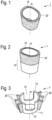
- Such a bone implant which comprises a base body in the form of a hollow body open on both sides in the axial direction, comprising or consisting of a load-bearing material, and a casing body that at least partially surrounds the base body on the outside, or a plurality of shaped bodies that protrude radially from the base body.
- the casing body or the shaped bodies comprise an in vivo degradable/in vivo resorbable material.
- the object of the invention is to provide a bone implant that partially or completely avoids the disadvantages described above in connection with conventional bone implants.
- the bone implant is intended to enable bone-sparing treatment or repair of bone defects and reduce the risk of revision surgery.
- the invention relates to a bone implant, preferably for the treatment or care of bone defects, in particular tibial and/or femoral bone defects, and/or for the fixation or anchoring of a joint implant, in particular a knee joint implant.
- bone implant is to be understood as an implant for treating or treating a bone defect, in particular a tibial or femoral bone defect, and/or for fixing or anchoring a joint implant, in particular a knee joint implant.
- shaped body is to be understood as meaning bodies or components of the bone implant which are designed to effect fixation, anchoring or support of the basic or hollow body at/in a bone defect, in particular at/in a tibial or femoral bone defect.
- the expression "multiplicity of shaped bodies” is to be understood as meaning at least two, in particular more than two, shaped bodies, for example two, three, four, five, six, seven, eight, nine, ten or more shaped bodies.
- bone defect in the context of the present invention means a bone area affected by loss or damage to bone tissue, in particular joint bone tissue, preferably knee or hip joint bone tissue.
- the bone loss or bone damage may be the result of a bone fracture, bone trauma, necrosis, thinning (for example, due to osteoporosis), a bone disease such as tumor disease, a lack of mechanical loading (so-called stress shielding) or the result of a surgical intervention/reintervention, especially a revision, preferably after a total knee or hip replacement.
- in vivo degradable/in vivo resorbable means in vivo degradable or in vivo resorbable in the sense of the present invention.
- not in vivo degradable/not in vivo resorbable means, in the sense of the present invention, not in vivo degradable or not in vivo resorbable.
- vivo degradation rate/in vivo absorption rate means in vivo degradation rate or in vivo absorption rate in the context of the present invention.
- load-bearing material is to be understood as a material which is capable of withstanding forces normally occurring in a bone, such as in particular the tibia and/or femur, without or without significant deformation or destruction.
- the term "in vivo degradable material” refers to a material that can be metabolized in a human or animal body, particularly under the action of enzymes.
- the degradation of the material can proceed completely to mineralization, i.e., the release of chemical elements and their incorporation into inorganic compounds, such as carbon dioxide and/or oxygen and/or ammonia, or it can remain at the stage of degradation-stable intermediate or transformation products.
- in vivo absorbable material is understood to mean a material which can be absorbed into a human or animal body by living cells or living tissue, such as kidneys, without degradation or significant degradation of the material taking place.
- animal body is understood to mean the body of a non-human mammal, such as a horse, cow, goat, sheep, pig or a rodent, such as a rabbit, rat or mouse.
- the expression "in the axial direction" in the sense of the present invention is intended to mean along an axis, in particular the axis of symmetry, of a component or a body, such as the base or hollow body and/or the sheathing body, of the bone implant.
- the term "longitudinal axis" is to be understood as an axis of a component or a body, such as the base or hollow body and/or the sheathing body, of the bone implant, which corresponds to the direction of the greatest extent of the component or the body, such as the base or hollow body and/or the sheathing body.
- the expression "in the radial direction" in the sense of the present invention is intended to mean pointing away from a point of symmetry, in particular the center point, and/or an axis of symmetry, in particular the central axis, of a component or a body, such as the base or hollow body and/or the sheathing body, of the bone implant.
- proximal in the context of the present invention means pointing towards the center of the body or located closer to the center of the body.
- distal in the context of the present invention shall mean pointing away from the center of the body or located away from the center of the body.
- cylindrical hollow body is to be understood in the context of the present invention as a hollow body which has a shell or a shell surface, wherein the shell or the shell surface is inclined at least in sections, in particular only in sections or completely, with respect to an axis of symmetry, in particular the central axis, of the hollow body.
- the base or hollow body has a cornerless, in particular circular, oval or elliptical, cross-section.
- the base or hollow body is conical.
- a conical base or hollow body has the particular advantage of enabling more stable anchoring of an extension shaft of a joint implant.
- the base or hollow body has a tapered, in particular continuously or discontinuously tapered, cross-sectional area and/or a tapered, in particular continuously or discontinuously tapered, inner diameter in the axial or longitudinal direction.
- the base or hollow body can have a constant cross-sectional area and/or a constant inner diameter in the axial direction or longitudinal direction, in particular continuously.
- the base or hollow body can generally have a constant (i.e., uniform) or a varying (i.e., uneven) wall thickness, particularly in the axial or longitudinal direction. This makes it particularly advantageous to accommodate asymmetrically formed bone defects.
- the base or hollow body has a wall thickness of 1 mm to 30 mm, in particular 5 mm to 20 mm, preferably 8 mm to 15 mm.
- the base or hollow body can have a constant, i.e., uniform, or a varying, i.e., irregular, shape, particularly in the axial or longitudinal direction. This makes it particularly advantageous to accommodate (equally) asymmetrical bone defects.
- the base or hollow body can have a wall with a number of openings or recesses in the axial direction, particularly in the longitudinal direction, i.e., only one opening/recess or a plurality of openings/recesses.
- the opening/recess or openings/recesses can be U-shaped, in particular.
- the wall of the base or hollow body has two openings/recesses, particularly two openings/recesses arranged opposite one another. This allows a knee joint implant to be positioned in the base or hollow body with particular advantage. Tibial components of knee joint implants have medio-laterally attached "wings" to ensure stable anchoring and rotational stability.
- the load-bearing material of the base or hollow body is a material that is non-degradable/non-resorbable in vivo. This advantageously allows for particularly effective primary and secondary stability of the bone implant.
- the in vivo non-degradable/in vivo non-resorbable material is preferably selected from the group consisting of metals, alloys, ceramics, plastics and combinations, in particular mixtures, thereof.
- the metal can in particular be selected from the group consisting of tantalum, titanium, iron, zirconium, niobium, gold, and platinum. Titanium is particularly preferred.
- the alloy can be selected, in particular, from the group consisting of magnesium alloy, tantalum alloy, titanium alloy, chromium-cobalt alloy, chromium-cobalt-molybdenum alloy, iron alloy, steel such as stainless steel, zirconium alloy, niobium alloy, gold alloy, platinum alloy, and combinations, in particular mixtures, thereof.
- the plastic can in particular be selected from the group consisting of polyether ketones, polyolefins, polyesters, polyamides, copolymers and combinations, in particular mixtures (blends), thereof.
- the polyetherketones can in particular be selected from the group consisting of polyetherketone (PEK), polyetheretherketone (PEEK), polyetherketoneketone (PEKK), polyetheretheretherketone (PEEEK), polyetherketoneketone (PEEKK), polyetherketoneetherketoneketone (PEKEKK), copolymers thereof, and combinations, in particular mixtures (blends), thereof.
- Polyetheretherketone (PEEK) is particularly preferred.
- the polyolefins can in particular be selected from the group consisting of polyethylene (PE), low density polyethylene, high density polyethylene, high molecular weight polyethylene (HMWPE), ultra-high molecular weight polyethylene (UHMWPE), polypropylene (PP), polytetrafluoroethylene (PTFE), polyvinylidene fluoride, polyvinylidene chloride, polytetrafluoropropylene, polyhexafluoropropylene, copolymers thereof and combinations, in particular mixtures (blends), thereof.
- PE polyethylene
- HMWPE high density polyethylene
- HMWPE high molecular weight polyethylene
- UHMWPE ultra-high molecular weight polyethylene
- PP polypropylene
- PTFE polytetrafluoroethylene
- polyvinylidene fluoride polyvinylidene chloride
- polytetrafluoropropylene polyhexafluoropropylene
- copolymers thereof combinations, in particular mixture
- the sheathing body is formed as a layer or coating on the base or hollow body.
- the sheathing body has a thickness of 0.1 mm to 30 mm, in particular 1 mm to 10 mm, preferably 2 mm to 5 mm.
- the sheathing body can have a constant, i.e. uniform, thickness and/or a constant, i.e. uniform, shape, in particular in the axial direction or longitudinal direction.
- the sheathing body has a varying, i.e., non-uniform, shape and/or thickness, particularly in the axial or longitudinal direction. This makes it particularly advantageous to accommodate (likewise) asymmetrically formed bone defects.
- the thickness of the sheathing body in particular in the axial direction or longitudinal direction, is greater at one end of the sheathing body than at another end of the sheathing body and/or the thickness of the sheathing body increases, in particular in the axial direction or longitudinal direction, towards one end of the sheathing body, in particular continuously or discontinuously, and/or the thickness of the sheathing body increases, in particular in the axial direction or longitudinal direction, from one end of the sheathing body to another end of the sheathing body, in particular continuously or discontinuously.
- the thickness of the sheathing body is preferably greater at a distal end of the sheathing body than at a proximal end of the sheathing body and/or the thickness of the sheathing body increases, in particular in the axial direction or longitudinal direction, preferably in the direction of a distal end of the sheathing body, in particular continuously or discontinuously, and/or the thickness of the sheathing body increases, in particular in the axial direction or longitudinal direction, preferably from a proximal end of the sheathing body to a distal end of the sheathing body, in particular continuously or discontinuously.
- the thickness of the sheathing body is preferably greater at a proximal end of the sheathing body than at a distal end of the sheathing body and/or the thickness of the sheathing body increases, in particular in the axial direction or longitudinal direction, preferably in the direction of a proximal end of the sheathing body, in particular continuously or discontinuously, and/or the thickness of the sheathing body increases, in particular in the axial direction or longitudinal direction, preferably from a distal end of the sheathing body to a proximal end of the sheathing body, in particular continuously or discontinuously.
- the base or hollow body is partially not surrounded on the outside by the sheathing body.
- the base or hollow body has a porous, particularly open-pore, and/or microstructured surface.
- This can induce osteointegration, i.e., the ingrowth or in-growth of natural bone tissue.
- This particularly advantageously promotes stable fixation or anchoring of the base body and thus of the bone implant to/in a bone defect.
- This allows for improved secondary stability.
- the ingrowth or in-growth of bone tissue advantageously reduces the size of the bone defect.
- the porous, in particular open-pored, surface of the base or hollow body has pores with a diameter, in particular an average diameter, determined by scanning electron microscopy and/or mercury porosimetry, of 10 ⁇ m to 400 ⁇ m, in particular 50 ⁇ m to 200 ⁇ m, preferably 100 ⁇ m to 135 ⁇ m.
- the pore diameters disclosed in this paragraph are particularly advantageous with regard to osteointegration of the base or hollow body.
- pores, in particular of the surface, of the base or hollow body can be filled with an in vivo degradable/in vivo resorbable material.
- the pores can in particular be filled only partially or completely with the in vivo degradable/in vivo resorbable material.
- the in vivo degradable/in vivo resorbable material that fills the pores, in particular of the surface, of the base or hollow body, and the in vivo degradable/in vivo resorbable material of the casing body or the plurality of shaped bodies are different from one another. This makes it possible to generate multi-stage, for example two-stage, degradation or resorption kinetics of the bone implant.
- the microstructured surface of the base or hollow body can be formed, for example, by a metal structure, in particular a metal lattice structure.
- the metal structure in particular a metal lattice structure
- a corresponding titanium structure is known, for example, under the designation Structan® is commercially available.
- suitable materials for the base or hollow body reference is made to the materials previously described in connection with the base or hollow body.
- microstructured surface is to be understood as meaning a surface with structural elements, in particular in the form of depressions and/or elevations, wherein the structural elements have dimensions, for example depths and/or heights, on the micrometer scale.
- the microstructured surface of the base or hollow body can have depressions with a depth of 20 ⁇ m to 1000 ⁇ m, in particular 100 ⁇ m to 600 ⁇ m, preferably 300 ⁇ m to 400 ⁇ m, and/or elevations with a height of 20 ⁇ m to 1000 ⁇ m, in particular 100 ⁇ m to 600 ⁇ m, preferably 300 ⁇ m to 400 ⁇ m.
- the surface of the base or hollow body can be formed by a coating of the base or hollow body.
- the surface of the base or hollow body can be a surface of a coating which coats or covers the base or hollow body.
- the coating can coat or cover the base or hollow body at least partially, in particular only partially or completely.
- the coating can have a thickness of 0.01 ⁇ m to 1000 ⁇ m, in particular 1 ⁇ m to 100 ⁇ m, preferably 10 ⁇ m to 50 ⁇ m.
- the coating can have a porosity of 20% to 90%, in particular 50% to 85%, preferably 60% to 80%.
- the coating preferably comprises titanium, i.e. elemental or metallic titanium, or a calcium phosphate, preferably hydroxyapatite.
- the casing body has a porous, in particular open-pored, and/or microstructured surface. This can (also) induce osteointegration and increase the secondary stability of the bone implant. improved and, depending on the material of the sheath body, a reduction in the size of the bone defect can be achieved.
- the porous, in particular open-pored, surface of the sheathing body has pores with a diameter, in particular an average diameter, determined by scanning electron microscopy and/or mercury porosimetry, of 20 ⁇ m to 1000 ⁇ m, in particular 50 ⁇ m to 500 ⁇ m, preferably 100 ⁇ m to 300 ⁇ m.
- the pore diameters disclosed in this paragraph are particularly advantageous with regard to osteointegration of the sheathing body.
- pores, in particular of the surface, of the sheathing body can be filled with an in vivo degradable/in vivo resorbable material.
- the pores can in particular be filled only partially or completely with the in vivo degradable/in vivo resorbable material.
- the in vivo degradable/in vivo resorbable material that fills the pores, in particular of the surface, of the sheathing body, and the in vivo degradable/in vivo resorbable material of the sheathing body are different from one another. This makes it possible to develop multi-stage, for example two-stage, degradation or resorption kinetics of the bone implant.
- the microstructured surface of the sheathing body can have depressions with a depth of 20 ⁇ m to 1000 ⁇ m, in particular 100 ⁇ m to 600 ⁇ m, preferably 300 ⁇ m to 400 ⁇ m, and/or elevations with a height of 20 ⁇ m to 1000 ⁇ m, in particular 100 ⁇ m to 600 ⁇ m, preferably 300 ⁇ m to 400 ⁇ m.
- the surface of the sheathing body can be formed by a coating of the sheathing body.
- the surface of the sheathing body can be a surface of a coating that coats or covers the sheathing body.
- the coating can coat or cover the sheathing body at least partially, in particular only partially or completely.
- the coating can have a thickness of 0.01 ⁇ m to 1000 ⁇ m, in particular 1 ⁇ m to 100 ⁇ m, preferably 10 ⁇ m to 50 ⁇ m.
- the coating can have a porosity of 20% to 90%, in particular 50% to 85%. preferably 60% to 80%.
- suitable materials for the coating reference is made to the materials described below in connection with the sheathing body.
- pores, in particular of the surface, of the molded body can be filled with an in vivo degradable/in vivo resorbable material.
- the pores can in particular be filled only partially or completely with the in vivo degradable/in vivo resorbable material.
- the in vivo degradable/in vivo resorbable material that fills the pores, in particular of the surface, of the molded body, and the in vivo degradable/in vivo resorbable material of the molded body are different from one another. This makes it possible to generate multi-stage, for example two-stage, degradation or resorption kinetics of the bone implant.
- the porous, in particular open-pored, surface of the molded bodies or a portion of the molded bodies can be formed by a coating of the molded bodies.
- the coating can coat or cover the molded bodies at least partially, in particular only partially or completely.
- the coating can have a thickness of 0.01 ⁇ m to 1000 ⁇ m, in particular 1 ⁇ m to 100 ⁇ m, preferably 10 ⁇ m to 50 ⁇ m.
- the coating can have a porosity of 20% to 90%, in particular 50% to 85%, preferably 50% to 70%.
- the microstructured surface of the shaped bodies or of a part of the shaped bodies can have depressions with a depth of 50 ⁇ m to 900 ⁇ m, in particular 150 ⁇ m to 700 ⁇ m, preferably 300 ⁇ m to 400 ⁇ m, and/or elevations with a height of 50 ⁇ m to 900 ⁇ m, in particular 150 ⁇ m to 700 ⁇ m, preferably 300 ⁇ m to 400 ⁇ m.
- the shaped bodies can have a thickness, i.e. wall thickness or height, in particular a constant, i.e. uniform, or varying, i.e. non-uniform, thickness, i.e. wall thickness or height, of 1 mm to 30 mm, in particular 5 mm to 20 mm, preferably 8 mm to 15 mm.
- the shaped bodies are preferably designed as flat structures, i.e., the shaped bodies preferably have a length and a width that are greater than a thickness (height) of the shaped bodies.
- the shaped bodies are preferably plate-shaped and/or disc-shaped.
- the shaped bodies can each have two oppositely arranged main surfaces, which are each delimited by two oppositely arranged transverse side surfaces and by two oppositely arranged longitudinal side surfaces.
- the transverse side surfaces can be flat, i.e., flat or non-curved, and/or curved, in particular curved outwards.
- the longitudinal side surfaces can generally be flat, i.e., flat or non-curved, and/or curved, in particular curved outwards.
- the shaped bodies can each have a curved, in particular outwardly curved, longitudinal side surface and otherwise flat side surfaces, i.e., one flat longitudinal side surface and two flat transverse side surfaces.
- the shaped bodies or a part of the shaped bodies can each have at least one predetermined breaking line, in particular only one predetermined breaking line or a plurality of predetermined breaking lines.
- the predetermined breaking line(s) preferably extend in the longitudinal direction the preformed body.
- the predetermined breaking line(s) can be designed, for example, as perforations, notches, or scratch marks. This allows for additional adaptation of the preformed body and thus the bone implant to the patient's specific bone defects. In particular, this can (additionally) reduce or completely prevent bone loss by adapting a bone defect to the bone implant.
- the in vivo degradable/in vivo resorbable material in particular the at least two different in vivo degradable/in vivo resorbable materials, are selected from the group consisting of metals, polyhydroxyalkanoates, polycaprolactone, poly-p-dioxanone (poly-1,4-dioxan-2-one), polymethylene terephthalate, calcium phosphates, calcium sulfates, calcium oxide (CaO), calcium hydroxide (Ca(OH) 2 ), calcium carbonate ( CaCO3 ), calcium citrate, calcium lactate, calcium acetate, calcium tartrate, calcium chloride ( CaCl2 ), magnesium phosphates, magnesium sulfates, magnesium hydroxide (Mg(OH) 2 ), magnesium hydroxide carbonate (for example as 4 MgCO3 x Mg(OH) 2 x 5 H2O ), magnesium oxide (MgO ) , magnesium citrates (Mg
- the metals used are preferably magnesium.
- the polyhydroxyalkanoates can in particular be selected from the group consisting of polylactide, polyglycolide, poly-3-hydroxybutyrate, poly-4-hydroxybutyrate, copolymers thereof and combinations, in particular mixtures (blends), thereof.
- the calcium phosphates can in particular be selected from the group consisting of tricalcium phosphate (TCP) such as ⁇ -tricalcium phosphate ( ⁇ -TCP) and/or ⁇ -tricalcium phosphate ( ⁇ -TCP), apatites such as hydroxyapatite (HA), calcium-deficient hydroxyapatite (CdHA), substituted hydroxyapatite, non-stoichiometric hydroxyapatite, nanoscale hydroxyapatite, tetracalcium phosphate (TTCP), monocalcium phosphate monohydrate (MCPM), monocalcium phosphate anhydride (MCPA), dicalcium phosphate anhydride (DCPA), dicalcium phosphate dihydrate (DCPD), octacalcium phosphate (OCP), amorphous calcium phosphate (ACP), calcium glycerophosphate and combinations, in particular mixtures, thereof.
- TCP tricalcium phosphate
- ⁇ -TCP ⁇ -tricalc
- the calcium sulfates can in particular be selected from the group consisting of calcium sulfate (CaSO 4 ), calcium sulfate hemihydrate (CaSO 4 x 0.5 H 2 O), calcium sulfate dihydrate (CaSO 4 x 2 H 2 O) and combinations, in particular mixtures, thereof.
- the magnesium phosphates can in particular be selected from the group consisting of magnesium hydrogen phosphate (MgHPO 4 ) in the form of the hydrates or as an anhydrous substance, trimagnesium phosphate (Mg 3 (PO 4 ) 2 ), magnesium dihydrogen phosphate (Mg(H 2 PO 4 ) 2 ) in the form of the hydrates or as an anhydrous substance, magnesium glycerophosphate and combinations, in particular mixtures, thereof.
- MgHPO 4 magnesium hydrogen phosphate
- Mg(H 2 PO 4 ) 2 trimagnesium phosphate
- magnesium dihydrogen phosphate Mg(H 2 PO 4 ) 2
- the in vivo degradable/in vivo resorbable material is particularly preferably tricalcium phosphate.
- the tricalcium phosphate can be in crystalline form.
- the tricalcium phosphate can have a crystallinity of 50% to 99%, in particular 75% to 95%.
- the tricalcium phosphate can be a microcrystalline tricalcium phosphate, i.e. tricalcium phosphate with crystallites which have at least one dimension in the micrometer range, in particular in a range of > 0.5 ⁇ m, in particular 0.6 ⁇ m to 500 ⁇ m, preferably 0.6 ⁇ m to 100 ⁇ m.
- the tricalcium phosphate can be in amorphous form.
- the tricalcium phosphate can be a phase-pure tricalcium phosphate.
- phase-pure is to be understood here in particular as meaning phase-pure in the sense of a relevant standard, preferably according to ASTM F1088.
- the tricalcium phosphate can have a porosity of ⁇ 50%, in particular ⁇ 20%, preferably ⁇ 15%.
- the tricalcium phosphate can be non-porous.
- the tricalcium phosphate is preferably selected from the group consisting of ⁇ -tricalcium phosphate ( ⁇ -TCP), ⁇ -tricalcium phosphate ( ⁇ -TCP), and a mixture thereof.
- the in vivo degradable/in vivo resorbable material can in particular be hydroxyapatite.
- the hydroxyapatite can be in crystalline form.
- the hydroxyapatite can have a crystallinity of 50% to 99%, in particular 75% to 95%.
- the hydroxyapatite can be a microcrystalline hydroxyapatite, i.e. a hydroxyapatite with crystallites which have at least one dimension in the micrometer range, in particular in a range of > 0.5 ⁇ m, in particular 0.6 ⁇ m to 500 ⁇ m, preferably 0.6 ⁇ m to 100 ⁇ m.
- the at least one dimension can be the length and/or the width and/or the thickness or height and/or the diameter, in particular the average diameter, of the crystallites.
- the hydroxyapatite can be a nanocrystalline hydroxyapatite, i.e., a hydroxyapatite with crystallites that have at least one dimension in the nanometer range, in particular in a range from 0.1 nm to 500 nm, preferably 0.1 nm to 100 nm.
- the at least one dimension can be the length and/or the width and/or the thickness or height and/or the diameter, in particular the average diameter, of the crystallites.
- the hydroxyapatite can be a macrocrystalline hydroxyapatite.
- the hydroxyapatite can be a single-phase hydroxyapatite.
- the term "single-phase” is understood to mean single-phase in the sense of a relevant standard, preferably according to ASTM F1185.
- the hydroxyapatite can have a porosity of ⁇ 50%, in particular ⁇ 20%, preferably ⁇ 15%. High mechanical stability can be achieved through low porosity.
- the hydroxyapatite can be non-porous.
- the hydroxyapatite can also be sintered hydroxyapatite.
- the bone implant can be manufactured using an additive or generative manufacturing process.
- the casing body and/or the shaped bodies can be molded or attached to the base or hollow body on the outside, i.e., to an outer surface of the base or hollow body, using an additive or generative manufacturing process.
- the invention relates to a method for producing a bone implant, in particular a bone implant according to the first aspect of the invention.
- the bone implant is manufactured using an additive or generative manufacturing process, i.e., 3D printing.
- a base body in the form of a hollow body which is open or open on both sides in the axial direction and which has a load-bearing material or consists of a load-bearing material is at least partially, in particular only partially or completely, coated, in particular cohesively coated, with a sheathing body which has or consists of an in vivo degradable/in vivo resorbable material by means of the additive or generative manufacturing process, i.e.
- the base body or hollow body is preferably conical in shape.
- additive manufacturing process or “generative manufacturing process” or “3D printing” are understood to refer to processes for the rapid and cost-effective production of models, samples, prototypes, tools, semi-finished products, and end products, such as bone implants. These processes are often also referred to as “rapid prototyping.” Production takes place directly on the basis of computer-internal data models, particularly from formless material, for example, liquids, melts, powders, or the like, or from form-neutral material. for example from strip or wire-shaped material, by means of chemical and/or physical processes.
- the generative manufacturing process can in particular be selected from the group consisting of powder bed processes, free space processes and liquid material processes.
- the free space process can be selected from the group consisting of fused deposition modeling, LOM (laminated object modeling), cladding, wax deposition modeling, contour grafting, cold gas spraying and electron beam melting.
- the liquid material process can be selected from the group consisting of stereolithography, DLP (digital light processing), and LCM.
- the LCM process can be a liquid composite molding process or a lithography-based ceramic manufacturing process.
- the Fig. 1 The schematically illustrated bone implant 1 has a base body 10 and a casing body 20.
- the base body 10 is designed in the form of a hollow body which is open or open on both sides in the axial direction A and is preferably conical.
- the base body 10 is preferred, as in Fig. 1 shown, completely surrounded or encased by the sheathing body 20.
- the sheathing body 20 comprises an in vivo degradable/in vivo resorbable material or consists of such a material.
- the in vivo degradable/in vivo resorbable material can be, for example, a calcium phosphate, in particular ⁇ -tricalcium phosphate and/or hydroxyapatite.
- the in vivo degradable/in vivo resorbable material can be a polymer, such as polycaprolactone, or a metal, such as magnesium.
- further suitable materials for the sheathing body 20 reference is made to the general description.
- the (at least partially) in vivo degradable/in vivo resorbable sheathing body 20 particularly advantageously enables a biological reconstruction of a
- a particularly advantageous approach is that biological reconstruction minimizes the size of the bone defect. This reduces the risk of any revision surgery. If necessary, reducing the size of the bone defect creates more favorable conditions for successful revision surgery.
- the base body 10 can, for example, have a wall thickness of 3 mm to 5 mm, while the sheathing body 20 can, for example, have a sheath thickness of 2 mm to 10 mm.
- the casing body 20 can, as in Fig. 1 shown, have a uniform thickness.
- the sheathing body can have a non-uniform thickness, particularly in the axial or longitudinal direction (not shown). This allows for, in particular, asymmetrically formed bone defect structures to be accommodated.
- the sheathing body 20 can have an open-pore surface.
- the sheathing body 20 can be designed to be completely or continuously open-pore.
- the two aforementioned embodiments for the sheathing body 20 particularly advantageously achieve osteointegration, i.e., the ingrowth and/or ingrowth of bone tissue onto and/or into the sheathing body 20. This, in turn, contributes to an additional improvement in the primary and secondary stability of the bone implant 1.
- Fig. 2 shows a further embodiment of a bone implant 1 according to the invention.
- the bone implant 1 has a base body 10 and a casing body 20 that only partially surrounds the base body 10.
- the base body 10 is in the form of a preferably conical hollow body that is open or open on both sides in the axial direction A.
- the base body 10 has a load-bearing material or consists of a load-bearing material.
- the load-bearing material is preferably a material that is not degradable/resorbable in vivo, such as a titanium alloy, in particular the titanium alloy Ti-6Al-4V.
- the titanium alloy in addition to titanium, has an aluminum content of 5.5 mass percent to 6.75 mass percent, in particular 6 mass percent, a vanadium content of 3.5 mass percent to 4.5 mass percent, in particular 4 mass percent, and optionally an iron content of 0.4 mass percent and/or an oxygen content of 0.2 mass percent and/or a carbon content of 0.08 mass percent and/or a nitrogen content of 0.05 mass percent and/or a hydrogen content of 0.015 mass percent, or consists of the aforementioned elements/components.
- the base body 10 can have a lattice structure, preferably made of Ti-6Al-4V. Regarding further suitable materials for the base body 10, reference is made to the general description and the description of Fig. 1 reference is made.
- the non-covered region 12 of the bone implant 1 is intended to accommodate an extension shaft (not shown) of a joint implant. If the bone implant 1 is a tibial bone implant, the non-covered section 12 represents a proximal section of the bone implant. If, on the other hand, the bone implant 1 is a femoral bone implant, the non-covered section 12 represents a distal section of the bone implant.
- Fig. 3 shows a further embodiment of a bone implant 1 according to the invention.
- the schematically illustrated bone implant system 1 comprises a base body 10 and a plurality of shaped bodies 20. Six shaped bodies 20 are shown as an example. It is understood that the bone implant 1 can also comprise fewer or more shaped bodies.
- the base body 10 is designed as a conical hollow body that is open or opened on both sides in the axial direction A.
- the shaped bodies 20 protrude radially from the base body 10.
- the shaped bodies 20 are integrally connected to the base body 10 or are integrally attached to it.
- the molded bodies 20 are preferably designed as flat structures, in particular in the form of plates or discs. This means that the molded bodies 20 have a length and a width that are smaller than a thickness (height) of the molded bodies 20.
- the molded bodies 20 each have two oppositely arranged main surfaces, which are each delimited by two oppositely arranged transverse side surfaces and by two oppositely arranged longitudinal side surfaces.
- the shaped bodies 20 each have a porous, in particular open-pored, and/or microstructured surface or consist of a porous, in particular open-pored, material.
- a suitable material in this respect, reference is also made to the general description as well as to the description of the Fig. 1 and 2 reference is made.
Landscapes
- Health & Medical Sciences (AREA)
- Public Health (AREA)
- Veterinary Medicine (AREA)
- Oral & Maxillofacial Surgery (AREA)
- Transplantation (AREA)
- Life Sciences & Earth Sciences (AREA)
- Animal Behavior & Ethology (AREA)
- General Health & Medical Sciences (AREA)
- Chemical & Material Sciences (AREA)
- Medicinal Chemistry (AREA)
- Epidemiology (AREA)
- Dermatology (AREA)
- Heart & Thoracic Surgery (AREA)
- Cardiology (AREA)
- Engineering & Computer Science (AREA)
- Biomedical Technology (AREA)
- Orthopedic Medicine & Surgery (AREA)
- Vascular Medicine (AREA)
- Inorganic Chemistry (AREA)
- Dispersion Chemistry (AREA)
- Prostheses (AREA)
- Materials For Medical Uses (AREA)
Description
- Die Erfindung betrifft ein Knochenimplantat, insbesondere zur Behandlung oder Versorgung von Knochendefekten und/oder zur Verankerung oder Fixierung eines Gelenkimplantats, vorzugsweise Kniegelenkimplantats.
- Generell stellen komplexe Knochendefekte bei Revisionsoperationen an einem Gelenk eine große Herausforderung dar. Dies gilt insbesondere für die Behandlung oder Versorgung von komplexen tibialen oder femoralen Knochendefekten. Die Behandlung bzw. Versorgung solcher Knochendefekte wird zusätzlich dadurch erschwert, dass die Form und/oder Geometrie von Tibia (Schienbein) und Femur (Oberschenkelknochen) abhängig von der Größe, des Geschlechts sowie der ethnischen Herkunft eines Patienten einer natürlichen Streuung unterliegt.
- Bei der Behandlung komplexer Gelenkknochendefekte werden in der Regel zwei vorrangige Ziele verfolgt, nämlich eine stabile Verankerung eines für die Behandlung bzw. Versorgung des Knochendefekts verwendeten Knochenimplantats in einem knöchernen Lager mit hoher Primärstabilität sowie eine Rekonstruktion der ursprünglichen biomechanischen Achsen.
- Konventionelle Implantate haben in der Regel den Nachteil, dass sie die morphologischen Gegebenheiten, insbesondere die Form und/oder die Geometrie und/oder die Größenverhältnisse, von Knochendefekten, insbesondere tibialen oder femoralen Knochendefekten, nur eingeschränkt abbilden. Eine Folge hiervon ist, dass die Form und/oder die Geometrie und/oder die Größe des Knochendefekts an das jeweilige Implantat angepasst werden muss, um eine optimale kortikale Abstützung zu erzielen. Der hiermit einhergehende (zusätzliche) Knochenverlust erzeugt wiederum ungünstige Ausgangsbedingungen im Hinblick auf etwaige erforderlich werdende Revisionsoperationen.
- In der
US 2007/118229 A1 ist ein derartiges Knochenimplantat offenbart, welches einen Grundkörper in Form eines in axialer Richtung beidseitig offenen Hohlkörpers umfasst, aufweisend oder bestehend aus einem lasttragenden Material, und einen Ummantelungskörper, der den Grundkörper außenseitig wenigstens teilweise ummantelt, oder eine Vielzahl von Formkörpern, die in radialer Richtung vom Grundkörper abstehen. Der Ummantelungskörper bzw. die Formkörper weisen ein in vivo abbaubares/in vivo resorbierbares Material auf. - Aufgabe der Erfindung ist es, ein Knochenimplantat bereitzustellen, welches die eingangs im Zusammenhang von konventionellen Knochenimplantaten beschriebenen Nachteile teilweise oder vollständig vermeidet. Das Knochenimplantat soll insbesondere eine knochenschonende Behandlung oder Versorgung von Knochendefekten ermöglichen und das Risiko von Revisionsoperationen reduzieren.
- Diese Aufgabe wird gelöst durch ein Knochenimplantat mit den Merkmalen gemäß unabhängigem Anspruch 1 sowie durch ein Verfahren gemäß Anspruch 14. Bevorzugte Ausgestaltungen der Erfindung sind Gegenstand der abhängigen Ansprüche 2 bis 13 sowie der vorliegenden Beschreibung.
- Gemäß einem ersten Aspekt betrifft die Erfindung ein Knochenimplantat, vorzugsweise zur Behandlung oder Versorgung von Knochendefekten, insbesondere tibialen und/oder femuralen Knochendefekten, und/oder zur Fixierung oder Verankerung eine Gelenkimplantats, insbesondere Kniegelenkimplantats.
- Das Knochenimplantat weist Folgendes auf:
- einen Grundkörper in Form eines in axialer Richtung beidseitig offenen Hohlkörpers, aufweisend oder bestehend aus einem lasttragenden Material,
und - einen Ummantelungskörper, der den Grund- oder Hohlkörper außenseitig, d.h. an einer Außenfläche des Grund- oder Hohlkörpers, wenigstens teilweise, insbesondere nur teilweise oder vollständig, ummantelt und ein in vivo abbaubares/in vivo resorbierbares Material aufweist oder aus einem in vivo abbaubaren/in vivo resorbierbaren Material besteht, oder eine Vielzahl von Formkörpern, die in radialer Richtung vom Grund- oder Hohlkörper abstehen und ein in vivo abbaubares/in vivo resorbierbares Material aufweisen oder aus einem in vivo abbaubaren/in vivo resorbierbaren Material bestehen, bestehen, wobei der Ummantelungskörper beziehungsweise die Formköper jeweils wenigstens zwei unterschiedliche in vivo abbaubare/in vivo resorbierbare Materialien aufweisen, die sich in Bezug auf ihre in vivo Abbaugeschwindigkeit/in vivo Resorptionsgeschwindigkeit voneinander unterscheiden. Dadurch ist (ebenfalls) eine zusätzliche zeitliche Steuerung der mechanischen Stabilität des Knochenimplantats sowie einer biologischen Rekonstruktion eines Knochendefektes erzielbar. Insbesondere können hierdurch die mechanische Stabilität des Knochenimplantats, die Knochenstimulierung sowie das Knochenwachstum noch besser aufeinander abgestimmt werden..
- Unter dem Ausdruck "Knochenimplantat" soll im Sinne der vorliegenden Erfindung ein Implantat zur Behandlung oder Versorgung eines Knochendefektes, insbesondere eines tibialen oder femuralen Knochendefektes, und/oder zur Fixierung oder Verankerung eines Gelenkimplantats, insbesondere Kniegelenkimplantats, verstanden werden.
- Unter dem Ausdruck "Formkörper" sollen im Sinne der vorliegenden Erfindung Körper oder Komponenten des Knochenimplantats verstanden werden, die dazu ausgebildet sind, eine Fixierung, Verankerung oder Abstützung des Grund- oder Hohlkörpers an/in einem Knochendefekt, insbesondere an/in einem tibialen oder femuralen Knochendefekt, zu bewirken.
- Unter dem Ausdruck "Vielzahl von Formkörpern" sollen im Sinne der vorliegenden Erfindung wenigstens zwei, insbesondere mehr als zwei, Formkörper, beispielsweise zwei, drei, vier, fünf, sechs, sieben, acht, neun, zehn oder mehr Formkörper, verstanden werden.
- Der Ausdruck "Knochendefekt" bedeutet im Sinne der vorliegenden Erfindung einen durch Verlust oder Beschädigung von Knochengewebe, insbesondere Gelenksknochengewebe, vorzugsweise Knie- oder Hüftgelenksknochengewebe, betroffenen Knochenbereich, insbesondere Gelenksknochenbereich, vorzugsweise Knie- oder Hüftgelenksknochenbereich. Der Knochenverlust oder die Knochenbeschädigung kann die Folge einer Knochenfraktur, eines Knochentraumas, einer Nekrose, einer Ausdünnung (beispielsweise infolge von Osteoporose), einer Knochenerkrankung wie Tumorerkrankung, einer fehlenden mechanischen Belastung (sogenanntes Stress Shielding) oder die Folge einer chirurgischen Intervention/Reintervention, insbesondere einer Revision, vorzugsweise nach einem vollständigen Knie- oder Hüftgelenkersatz, sein.
- Der Ausdruck "in vivo abbaubar/in vivo resorbierbar" bedeutet im Sinne der vorliegenden Erfindung in vivo abbaubar oder in vivo resorbierbar.
- Der Ausdruck "nicht in vivo abbaubar/nicht in vivo resorbierbar" bedeutet im Sinne der vorliegenden Erfindung nicht in vivo abbaubar oder nicht in vivo resorbierbar.
- Der Ausdruck "vivo Abbaugeschwindigkeit/in vivo Resorptionsgeschwindigkeit" bedeutet im Sinne der vorliegenden Erfindung in vivo Abbaugeschwindigkeit oder in vivo Resorptionsgeschwindigkeit.
- Unter dem Ausdruck "lasttragendes Material" soll im Sinne der vorliegenden Erfindung ein Material verstanden werden, welches in der Lage ist, in einem Knochen, wie insbesondere Schienbein und/oder Oberschenkelknochen, üblicherweise auftretenden Kräften ohne oder ohne wesentliche Deformation oder Zerstörung zu widerstehen.
- Unter dem Ausdruck "in vivo abbaubares Material" soll im Sinne der vorliegenden Erfindung ein Material verstanden werden, welches in einem menschlichen oder tierischen Körper, insbesondere unter der Einwirkung von Enzymen, metabolisiert werden kann. Der Abbau des Materials kann dabei vollständig bis zur Mineralisierung, d.h. Freisetzung von chemischen Elementen und deren Einbau in anorganische Verbindungen, wie beispielsweise Kohlendioxid und/oder Sauerstoff und/oder Ammoniak, verlaufen oder auf der Stufe von abbaustabilen Zwischen- oder Transformationsprodukten stehen bleiben.
- Unter dem Ausdruck "in vivo resorbierbares Material" soll im Sinne der vorliegenden Erfindung ein Material verstanden werden, welches in einem menschlichen oder tierischen Körper durch lebende Zellen oder lebendes Gewebe, wie beispielsweise Nieren, aufgenommen werden kann, ohne dass ein Abbau oder ein nennenswerter Abbau des Materials stattfindet.
- Unter dem Ausdruck "tierischer Körper" soll im Sinne der vorliegenden Erfindung der Körper eines nicht humanen Säugetiers, wie beispielsweise von Pferd, Kuh, Ziege, Schaf, Schwein oder einem Nagetier, wie beispielsweise Hase, Ratte oder Maus, verstanden werden.
- Der Ausdruck "in axialer Richtung" soll im Sinne der vorliegenden Erfindung entlang einer Achse, insbesondere Symmterieachse, einer Komponente oder eines Körpers, wie beispielsweise des Grund- oder Hohlkörpers und/oder des Ummantelungskörpers, des Knochenimplantats bedeuten.
- Unter dem Ausdruck "Längsachse" soll im Sinne der vorliegenden Erfindung eine Achse einer Komponente oder eines Körpers, wie beispielsweise des Grund- oder Hohlkörpers und/oder des Ummantelungskörpers, des Knochenimplantats verstanden werden, welche der Richtung der größten Ausdehnung der Komponente bzw. des Körpers, wie beispielsweise des Grund- oder Hohlkörpers und/oder des Ummantelungskörpers, entspricht.
- Der Ausdruck "in radialer Richtung" soll im Sinne der vorliegenden Erfindung von einem Symmetriepunkt, insbesondere Mittelpunkt, und/oder einer Symmetrieachse, insbesondere Mittelachse, einer Komponente oder eines Körpers, wie beispielsweise des Grund- oder Hohlkörpers und/oder des Ummantelungskörpers, des Knochenimplantats wegzeigend bedeuten.
- Der Ausdruck "proximal" soll im Sinne der vorliegenden Erfindung zur Körpermitte zeigend oder näher zur Körpermitte gelegen bedeuten.
- Der Ausdruck "distal" soll im Sinne der vorliegenden Erfindung von der Körpermitte weg zeigend oder von der Körpermitte entfernt gelegen bedeuten.
- Unter dem Ausdruck "konusförmiger Hohlkörper" soll im Sinne der vorliegenden Erfindung ein Hohlkörper verstanden werden, welcher einen Mantel oder eine Mantelfläche aufweist, wobei der Mantel bzw. die Mantelfläche wenigstens abschnittsweise, insbesondere nur abschnittsweise oder vollständig, gegenüber einer Symmetrieachse, insbesondere Mittelachse, des Hohlkörpers geneigt ist.
- Die Erfindung zeichnet sich insbesondere durch nachfolgende Vorteile aus:
- Durch das lasttragende Material des Grund- oder Hohlkörpers ist mit besonderem Vorteil eine unter medizinischen Gesichtspunkten ausreichende Primär- sowie Sekundärstabilität erzielbar. Unter der Primärstabilität wird allgemein die auf Reibung oder Befestigungselementen, wie beispielsweise Knochenschrauben, beruhende Fixierung eines Implantats in den ersten Wochen nach einer Operation verstanden. Unter der Sekundärstabilität wird die auf knöchernen Verwachsungen beruhende Fixierung eines Implantats verstanden. Die Sekundärstabilität setzt in der Regel etwa einen Monat nach einem operativen Eingriff ein und kann bis zu mehrere Jahre andauern.
- Ferner erlaubt das in vivo abbaubare/in vivo resorbierbare Material des Ummantelungskörpers oder der Formkörper vorteilhafterweise eine biologische Rekonstruktion eines Knochendefektes und mithin eine Verkleinerung der Knochendefektgröße. Dadurch können insbesondere verbesserte Ausgangsbedingungen für etwaige Revisionsoperationen geschaffen werden.
- Ferner ist von Vorteil, dass über die Auswahl des in vivo abbaubaren/in vivo resorbierbaren Materials des Ummantelungskörpers oder der Formkörper eine gezielte Steuerung der mechanischen Stabilität des Knochenimplantats und eine gezielte Beeinflussung der Knochenstimulierung sowie des Knochenwachstums vorgenommen werden kann. Insbesondere können hierdurch die mechanische Stabilität des Knochenimplantats, die Knochenstimulierung sowie das Knochenwachstum aufeinander abgestimmt werden.
- Das Knochenimplantat gemäß der vorliegenden Erfindung eignet sich insbesondere zur Behandlung und/oder Versorgung von tibialen und/oder femuralen Knochendekten.
- In Ausgestaltung der Erfindung weist der Grund- oder Hohlkörper einen eckenlosen, insbesondere kreisförmigen, ovalen oder elliptischen, Querschnitt auf.
- In weiterer Ausgestaltung der Erfindung ist der Grund- oder Hohlkörper konusförmig gestaltet. Ein konusförmig gestalteter Grund- oder Hohlkörper hat insbesondere den Vorteil, eine stabilere Verankerung eines Verlängerungsschaftes eines Gelenkimplantats zu ermöglichen. Vorzugsweise weist der Grund- oder Hohlkörper in axialer Richtung oder Längsrichtung eine sich verjüngende, insbesondere eine sich kontinuierlich oder diskontinuierlich verjüngende, Querschnittsfläche und/oder einen sich verjüngenden, insbesondere einen sich kontinuierlich oder diskontinuierlich verjüngenden, Innendurchmesser auf.
- Alternativ kann der Grund- oder Hohlkörper in axialer Richtung oder Längsrichtung, insbesondere durchgehend, eine konstante Querschnittsfläche und/oder einen konstanten Innendurchmesser aufweisen.
- Der Grund- oder Hohlkörper kann grundsätzlich, insbesondere in axialer Richtung oder Längsrichtung, eine konstante, d.h. gleichmäßige, oder eine variierende, d.h. ungleichmäßige, Wanddicke aufweisen. Dadurch kann mit besonderem Vorteil asymmetrisch ausgebildeten Knochendefekten entsprochen werden.
- In weiterer Ausgestaltung der Erfindung weist der Grund- oder Hohlkörper eine Wanddicke von 1 mm bis 30 mm, insbesondere 5 mm bis 20 mm, vorzugsweise 8 mm bis 15 mm, auf.
- Ferner kann der Grund- oder Hohlkörper, insbesondere in axialer Richtung oder Längsrichtung, eine konstante, d.h. gleichmäßige, oder eine variierende, d.h. ungleichmäßige, Form aufweisen. Dadurch kann mit besonderem Vorteil (ebenso) asymmetrisch ausgebildeten Knochendefekten entsprochen werden.
- Ferner kann der Grund- oder Hohlkörper in axialer Richtung, insbesondere in Längsrichtung, eine Wandung mit einer Anzahl von Durchbrüchen oder Aussparungen, d.h. nur einem Durchbruch/eine Aussparung oder einer Vielzahl von Durchbrüchen/Aussparungen, aufweisen. Der Durchbruch/die Aussparung oder die Durchbrüche/Aussparungen kann/können insbesondere u-förmig gestaltet sein. Bevorzugt weist die Wandung des Grund- oder Hohlkörpers zwei Durchbrüche/Aussparungen, insbesondere zwei gegenüberliegend ausgebildete Durchbrüche/Aussparungen, auf. Dadurch kann mit besonderem Vorteil ein Kniegelenksimplantat in den Grund- oder Hohlkörper positioniert werden. Tibiale Komponenten von Kniegelenksimplantaten besitzen nämlich medio-lateral angebrachte "Flügel", um eine stabile Verankerung und eine Rotationsstabilität zu erhalten.
- In weiterer Ausgestaltung der Erfindung handelt es sich bei dem lasttragenden Material des Grund- oder Hohlkörpers um ein in vivo nicht abbaubares/in vivo nicht resorbierbares Material. Dadurch ist mit besonderem Vorteil eine besonders effektive Primär- wie Sekundärstabilität des Knochenimplantats realisierbar.
- Das in vivo nicht abbaubare/in vivo nicht resorbierbare Material ist vorzugsweise ausgewählt aus der Gruppe bestehend aus Metalle, Legierungen, Keramiken, Kunststoffe und Kombinationen, insbesondere Mischungen, davon.
- Das Metall kann insbesondere ausgewählt sein aus der Gruppe bestehend aus Tantal, Titan, Eisen, Zirkonium, Niob, Gold und Platin. Besonders bevorzugt ist Titan.
- Die Legierung kann insbesondere ausgewählt sein aus der Gruppe bestehend aus Magnesiumlegierung, Tantallegierung, Titanlegierung, Chrom-Cobalt-Legierung, Chrom-Cobalt-Molybdän-Legierung, Eisenlegierung, Stahl wie Edelstahl, Zirconiumlegierung, Nioblegierung, Goldlegierung, Platinlegierung und Kombinationen, insbesondere Mischungen, davon. Besonders bevorzugt ist eine Titanlegierung, insbesondere Ti-6Al-4V.
- Der Kunststoff kann insbesondere ausgewählt sein aus der Gruppe bestehend Polyetherketone, Polyolefine, Polyester, Polyamide, Copolymere und Kombinationen, insbesondere Mischungen (Blends), davon.
- Die Polyetherketone können insbesondere ausgewählt sein aus der Gruppe bestehend aus Polyetherketon (PEK), Polyetheretherketon (PEEK), Polyetherketonketon (PEKK), Polyetheretheretherketon (PEEEK), Polyetheretherketonketon (PEEKK), Polyetherketonetherketonketon (PEKEKK), Copolymere davon und Kombinationen, insbesondere Mischungen (Blends), davon. Besonders bevorzugt ist Polyetheretherketon (PEEK).
- Die Polyolefine können insbesondere ausgewählt sein aus der Gruppe bestehend aus Polyethylen (PE), Polyethylen niedriger Dichte, Polyethylen hoher Dichte, hochmolekulares Polyethylen (HMWPE), ultrahochmolekulares Polyethylen (UHMWPE), Polypropylen (PP), Polytetrafluorethylen (PTFE), Polyvinylidenfluorid, Polyvinylidenchlorid, Polytetrafluorpropylen, Polyhexafluorpropylen, Copolymere davon und Kombinationen, insbesondere Mischungen (Blends), davon.
- Die Polyester können insbesondere ausgewählt sein aus der Gruppe bestehend aus Polyethylenterephthalat, Polypropylenterephthalat, Polybutylenterephthalat, Copolymere und Kombinationen, insbesondere Mischungen (Blends), davon.
- In weiterer Ausgestaltung der Erfindung ist der Ummantelungskörper als Schicht oder Beschichtung auf dem Grund- oder Hohlkörper ausgebildet.
- In weiterer Ausgestaltung der Erfindung weist der Ummantelungskörper eine Dicke von 0,1 mm bis 30 mm, insbesondere 1 mm bis 10 mm, vorzugsweise 2 mm bis 5 mm, auf.
- Ferner kann der Ummantelungskörper, insbesondere in axialer Richtung oder Längsrichtung, eine konstante, d.h. gleichmäßige, Dicke und/oder eine konstante, d.h. gleichmäßige, Form aufweisen.
- In weiterer Ausgestaltung der Erfindung weist der Ummantelungskörper, insbesondere in axialer Richtung oder Längsrichtung, eine variierende, d.h. ungleichmäßige, Form und/oder Dicke auf. Dadurch kann mit besonderem Vorteil (ebenfalls) asymmetrisch ausgebildeten Knochendefekten entsprochen werden.
- In weiterer Ausgestaltung der Erfindung ist die Dicke des Ummantelungskörpers, insbesondere in axialer Richtung oder Längsrichtung, an einem Ende des Ummantelungskörpers größer als einem anderen Ende des Ummantelungskörpers und/oder nimmt die Dicke des Ummantelungskörpers, insbesondere in axialer Richtung oder Längsrichtung, in Richtung eines Endes des Ummantelungskörpers, insbesondere kontinuierlich oder diskontinuierlich, zu und/oder nimmt die Dicke des Ummantelungskörpers, insbesondere in axialer Richtung oder Längsrichtung, von einem Ende des Ummantelungskörpers zu einem anderen Ende des Ummantelungskörpers, insbesondere kontinuierlich oder diskontinuierlich, zu.
- Handelt es ich bei dem Knochenimplantat um ein tibiales Implantat, d.h. um ein Implantat zur Behandlung oder Versorgung eines tibialen Knochendefektes, ist die Dicke des Ummantelungskörpers, insbesondere in axialer Richtung oder Längsrichtung, vorzugsweise an einem distalen Ende des Ummantelungskörpers größer als an einem proximalen Ende des Ummantelungskörpers und/oder nimmt die Dicke des Ummantelungskörpers, insbesondere in axialer Richtung oder Längsrichtung, vorzugsweise in Richtung eines distalen Endes des Ummantelungskörpers, insbesondere kontinuierlich oder diskontinuierlich, zu und/oder nimmt die Dicke des Ummantelungskörpers, insbesondere in axialer Richtung oder Längsrichtung, vorzugsweise von einem proximalen Ende des Ummantelungskörpers zu einem distalen Ende des Ummantelungskörpers, insbesondere kontinuierlich oder diskontinuierlich, zu.
- Handelt es ich bei dem Knochenimplantat um ein femurales Implantat, d.h. um ein Implantat zur Behandlung oder Versorgung eines femuralen Knochendefektes, ist die Dicke des Ummantelungskörpers, insbesondere in axialer Richtung oder Längsrichtung, vorzugsweise an einem proximalen Ende des Ummantelungskörpers größer als an einem distalen Ende des Ummantelungskörpers und/oder nimmt die Dicke des Ummantelungskörpers, insbesondere in axialer Richtung oder Längsrichtung, vorzugsweise in Richtung eines proximalen Endes des Ummantelungskörpers, insbesondere kontinuierlich oder diskontinuierlich, zu und/oder nimmt die Dicke des Ummantelungskörpers, insbesondere in axialer Richtung oder Längsrichtung, vorzugsweise von einem distalen Ende des Ummantelungskörpers zu einem proximalen Ende des Ummantelungskörpers, insbesondere kontinuierlich oder diskontinuierlich, zu.
- In weiterer Ausgestaltung der Erfindung ist der Grund- oder Hohlkörper außenseitig teilweise nicht von dem Ummantelungskörper umgeben.
- In weiterer Ausgestaltung der Erfindung weist der Grund- oder Hohlkörper eine poröse, insbesondere offenporige, und/oder mikrostrukturierte Oberfläche auf. Hierdurch kann eine Osteointegration, d.h. ein An- oder Einwachsen von natürlichem Knochengewebe, induziert werden. Dies wiederum begünstigt mit besonderem Vorteil eine stabile Fixierung oder Verankerung des Grundkörpers und mithin des Knochenimplantats an/in einem Knochendefekt. Dadurch sind insbesondere verbesserte Sekundärstabilitäten erreichbar. Ferner bewirkt das An- oder Einwachsen von Knochengewebe in vorteilhafter Weise eine Knochendefektverkleinerung.
- Bevorzugt weist die poröse, insbesondere offenporige, Oberfläche des Grund- oder Hohlkörpers Poren mit einem Durchmesser, insbesondere mittleren Durchmesser, bestimmt mittels Rasterelektronenmikroskopie und/oder Quecksilber-Porosimetrie, von 10 µm bis 400 µm, insbesondere 50 µm bis 200 µm, bevorzugt 100 µm bis 135 µm, auf. Die in diesem Absatz offenbarten Porendurchmesser sind im Hinblick auf eine Osteointegration des Grund- oder Hohlkörpers besonders vorteilhaft.
- Ferner können Poren, insbesondere der Oberfläche, des Grund- oder Hohlkörpers mit einem in vivo abbaubaren/in vivo resorbierbaren Material befüllt sein. Die Poren können insbesondere nur teilweise oder vollständig mit dem in vivo abbaubaren/in vivo resorbierbaren Material befüllt sein. Vorzugsweise sind das in vivo abbaubare/in vivo resorbierbare Material, das die Poren, insbesondere der Oberfläche, des Grund- oder Hohlkörpers befüllt, und das in vivo abbaubare/in vivo resorbierbare Material des Ummantelungskörpers oder der Vielzahl von Formkörpern voneinander verschieden. Dadurch kann eine mehrstufige, beispielsweise zweistufige, Abbau- oder Resorptionskinetik des Knochenimplantats erzeugt werden. Dies stellt vorteilhafterweise eine weitere Möglichkeit dar, die mechanische Stabilität des Knochenimplantats, die Knochenstimulierung sowie das Knochenwachstum aufeinander abzustimmen. Bezüglich geeigneter in vivo abbaubarer/in vivo resorbierbarer Materialien sei auf die in der nachfolgenden Beschreibung im Zusammenhang des Ummantelungskörpers sowie der Vielzahl von Formkörpern offenbarten in vivo abbaubaren/in vivo resorbierbaren Materialien Bezug genommen.
- Die mikrostrukturierte Oberfläche des Grund- oder Hohlkörpers kann beispielsweise von einer Metallstruktur, insbesondere Metallgitterstruktur, gebildet sein. Vorzugsweise handelt es sich bei der Metallstruktur, insbesondere Metallgitterstruktur, um eine Titanstruktur, insbesondere Titangitterstruktur. Eine entsprechende Titanstruktur ist beispielsweise unter der Bezeichnung Structan® kommerziell erhältlich. Bezüglich weiterer geeigneter Materialien für den Grund- oder Hohlkörper wird auf die bisherigen im Zusammenhang des Grund- oder Hohlkörpers beschriebenen Materialien Bezug genommen.
- Unter dem Ausdruck "mikrostrukturierte Oberfläche" soll im Sinne der vorliegenden Erfindung eine Oberfläche mit Strukturelementen, insbesondere in Form von Vertiefungen und/oder Erhebungen, verstanden werden, wobei die Strukturelemente Abmessungen, beispielsweise Tiefen und/oder Höhen, im Mikrometermaßstab besitzen.
- Beispielsweise kann die mikrostrukturierte Oberfläche des Grund- oder Hohlkörpers Vertiefungen mit einer Tiefe von 20 µm bis 1000 µm, insbesondere 100 µm bis 600 µm, bevorzugt 300 µm bis 400 µm, und/oder Erhebungen mit einer Höhe von 20 µm bis 1000 µm, insbesondere 100 µm bis 600 µm, bevorzugt 300 µm bis 400 µm, aufweisen.
- Ferner kann die Oberfläche des Grund- oder Hohlkörpers von einer Beschichtung des Grund- oder Hohlkörpers gebildet sein. Mit anderen Worten kann es sich bei der Oberfläche des Grund- oder Hohlkörpers um eine Oberfläche einer Beschichtung, welche den Grund- oder Hohlkörper beschichtet oder bedeckt, handeln. Die Beschichtung kann den Grund- oder Hohlkörper wenigstens teilweise, insbesondere nur teilweise oder vollständig, beschichten oder bedecken. Ferner kann die Beschichtung eine Dicke von 0,01 µm bis 1000 µm, insbesondere 1 µm bis 100 µm, vorzugsweise 10 µm bis 50 µm, aufweisen. Ferner kann die Beschichtung eine Porosität von 20 % bis 90 %, insbesondere 50 % bis 85 %, bevorzugt 60 % bis 80 %, aufweisen. Bevorzugt weist die Beschichtung Titan, d.h. elementares oder metallisches Titan, oder ein Calciumphosphat, vorzugsweise Hydroxylapatit, auf. Beispielsweise kann es sich bei der Beschichtung um eine reine Titanbeschichtung, d.h. um eine aus Titan bestehende Beschichtung, handeln. Eine entsprechende Beschichtung kann beispielsweise mittels eines von der Anmelderin unter der Bezeichnung Plasmapore® durchgeführten Verfahrens hergestellt werden. Hierbei wird reines Titanpulver mittels eines Plasmabeschichtungsprozesses unter Vakuum oder Unterdruck mit einer Dicke von 150 µm und einer Porosität von 35 % bis 60 % auf ein zu beschichtendes Substrat aufgebracht. Bezüglich weiterer geeigneter Materialien für die Beschichtung wird auf die bisherigen im Zusammenhang des Grund- oder Hohlkörpers beschriebenen Materialien Bezug genommen.
- In weiterer Ausgestaltung der Erfindung weist der Ummantelungskörper eine poröse, insbesondere offenporige, und/oder mikrostrukturierte Oberfläche auf. Hierdurch kann eine Osteointegration (ebenfalls) induziert und die Sekundärstabilität des Knochenimplantats verbessert sowie abhängig vom Material des Ummantelungskörpers eine Reduzierung einer Knochendefektgröße erzielt werden.
- Bevorzugt weist die poröse, insbesondere offenporige, Oberfläche des Ummantelungskörpers Poren mit einem Durchmesser, insbesondere mittleren Durchmesser, bestimmt mittels Rasterelektronenmikroskopie und/oder Quecksilber-Porosimetrie, von 20 µm bis 1000 µm, insbesondere 50 µm bis 500 µm, bevorzugt 100 µm bis 300 µm, auf. Die in diesem Absatz offenbarten Porendurchmesser sind im Hinblick auf eine Osteointegration des Ummantelungskörpers besonders vorteilhaft.
- Ferner können Poren, insbesondere der Oberfläche, des Ummantelungskörpers mit einem in vivo abbaubaren/in vivo resorbierbaren Material befüllt sein. Die Poren können insbesondere nur teilweise oder vollständig mit dem in vivo abbaubaren/in vivo resorbierbaren Material befüllt sein. Vorzugsweise sind das in vivo abbaubare/in vivo resorbierbare Material, das die Poren, insbesondere der Oberfläche, des Ummantelungskörpers befüllt, und das in vivo abbaubare/in vivo resorbierbare Material des Ummantelungskörpers voneinander verschieden. Dadurch lässt sich eine mehrstufige, beispielsweise zweistufige, Abbau- oder Resorptionskinetik des Knochenimplantats ausbilden. Dies stellt vorteilhafterweise eine weitere Möglichkeit dar, die mechanische Stabilität des Knochenimplantats, die Knochenstimulierung sowie das Knochenwachstum aufeinander abzustimmen. Bezüglich geeigneter in vivo abbaubarer/in vivo resorbierbarer Materialien sei auf die in der nachfolgenden Beschreibung im Zusammenhang des Ummantelungskörpers offenbarten in vivo abbaubaren/in vivo resorbierbaren Materialien Bezug genommen.
- Ferner kann die mikrostrukturierte Oberfläche des Ummantelungskörpers Vertiefungen mit einer Tiefe von 20 µm bis 1000 µm, insbesondere 100 µm bis 600 µm, bevorzugt 300 µm bis 400 µm, und/oder Erhebungen mit einer Höhe von 20 µm bis 1000 µm, insbesondere 100 µm bis 600 µm, bevorzugt 300 µm bis 400 µm, aufweisen.
- Ferner kann die Oberfläche des Ummantelungskörpers von einer Beschichtung des Ummantelungskörpers gebildet sein. Mit anderen Worten kann es sich bei der Oberfläche des Ummantelungskörpers um eine Oberfläche einer Beschichtung, welche den Ummantelungskörper beschichtet oder bedeckt, handeln. Die Beschichtung kann den Ummantelungskörper wenigstens teilweise, insbesondere nur teilweise oder vollständig, beschichten oder bedecken. Ferner kann die Beschichtung eine Dicke von 0,01 µm bis 1000 µm, insbesondere 1 µm bis 100 µm, vorzugsweise 10 µm bis 50 µm, aufweisen. Ferner kann die Beschichtung eine Porosität von 20 % bis 90 %, insbesondere 50 % bis 85 %, bevorzugt 60 % bis 80 %, aufweisen. Bezüglich geeigneter Materialien für die Beschichtung wird auf die im Folgenden noch im Zusammenhang des Ummantelungskörpers beschriebenen Materialien Bezug genommen.
- In weiterer Ausgestaltung der Erfindung weisen die Formkörper oder nur ein Teil der Formkörper eine poröse, insbesondere offenporige, und/oder mikrostrukturierte Oberfläche auf.
- Insbesondere kann die poröse, insbesondere offenporige, Oberfläche der Formkörper Poren mit einem Durchmesser, insbesondere mittleren Durchmesser, bestimmt mittels Rasterelektronenmikroskopie und/oder Quecksilber-Porosimetrie, von 50 µm bis 900 µm, insbesondere 150 µm bis 700 µm, besonders bevorzugt 300 µm bis 400 µm, aufweisen. Die mikrostrukturierte Oberfläche der Formkörper kann Vertiefungen mit einer Tiefe von 50 µm bis 900 µm, insbesondere 150 µm bis 700 µm, bevorzugt 300 µm bis 400 µm, und/oder Erhebungen mit einer Höhe von 50 µm bis 900 µm, insbesondere 150 µm bis 700 µm, bevorzugt 300 µm bis 400 µm, aufweisen. Dadurch ist mit besonderem Vorteil (ebenso) eine Osteointegration und abhängig vom Material der Formkörper auch eine biologische Rekonstruktion und mithin Verkleinerung eines zu behandelnden oder zu versorgenden Knochendefekts erzielbar.
- Ferner können Poren, insbesondere der Oberfläche, der Formköper mit einem in vivo abbaubaren/in vivo resorbierbaren Material befüllt sein. Die Poren können insbesondere nur teilweise oder vollständig mit dem in vivo abbaubaren/in vivo resorbierbaren Material befüllt sein. Vorzugsweise sind das in vivo abbaubare/in vivo resorbierbare Material, das die Poren, insbesondere der Oberfläche, der Formkörper befüllt, und das in vivo abbaubare/in vivo resorbierbare Material der Formkörper voneinander verschieden. Dadurch kann eine mehrstufige, beispielsweise zweistufige, Abbau- oder Resorptionskinetik des Knochenimplantats erzeugt werden. Dies stellt vorteilhafterweise eine weitere Möglichkeit dar, die mechanische Stabilität des Knochenimplantats, die Knochenstimulierung sowie das Knochenwachstum aufeinander abzustimmen. Bezüglich geeigneter in vivo abbaubarer/in vivo resorbierbarer Materialien sei auf die in der nachfolgenden Beschreibung im Zusammenhang der Formkörper offenbarten in vivo abbaubaren/in vivo resorbierbaren Materialien Bezug genommen.
- Ferner kann die poröse, insbesondere offenporige, Oberfläche der Formkörper oder eines Teils der Formkörper von einer Beschichtung der Formkörper gebildet sein. Die Beschichtung kann die Formkörper wenigstens teilweise, insbesondere nur teilweise oder vollständig, beschichten oder bedecken. Ferner kann die Beschichtung eine Dicke von 0,01 µm bis 1000 µm, insbesondere 1 µm bis 100 µm, vorzugsweise 10 µm bis 50 µm, aufweisen. Ferner kann die Beschichtung eine Porosität von 20 % bis 90 %, insbesondere 50 % bis 85 %, bevorzugt 50 % bis 70 %, aufweisen. Bezüglich weiterer geeigneter Materialien für die Beschichtung wird auf die im Folgenden noch im Zusammenhang der Formkörper beschriebenen Materialien Bezug genommen.
- Ferner kann die mikrostrukturierte Oberfläche der Formkörper oder eines Teils der Formkörper Vertiefungen mit einer Tiefe von 50 µm bis 900 µm, insbesondere 150 µm bis 700 µm, bevorzugt 300 µm bis 400 µm, und/oder Erhebungen mit einer Höhe von 50 µm bis 900 µm, insbesondere 150 µm bis 700 µm, bevorzugt 300 µm bis 400 µm, aufweisen.
- Ferner können die Formkörper eine Dicke, d.h. Wanddicke oder Höhe, insbesondere eine konstante, d.h. gleichmäßige, oder variierende, d.h. ungleichmäßige, Dicke, d.h. Wanddicke oder Höhe, von 1 mm bis 30 mm, insbesondere 5 mm bis 20 mm, vorzugsweise 8 mm bis 15 mm, aufweisen.
- Vorteilhafterweise kann sowohl über die Dicke der Formkörper oder die Dicke des Ummantelungskörpers als auch über die Wanddicke des Grund- oder Hohlkörpers die Gesamtwanddicke des Knochenimplantats gezielt und mithin anwendungsorientiert gesteuert werden.
- Weiter sind die Formkörper vorzugsweise als Flächengebilde gestaltet, d.h. die Formkörper weisen vorzugsweise eine Länge und eine Breite auf, welche größer sind als eine Dicke (Höhe) der Formkörper. Bevorzugt sind die Formkörper platten- und/oder scheibenförmig gestaltet. Insbesondere können die Formkörper jeweils zwei gegenüberliegend angeordnete Hauptflächen aufweisen, welche jeweils von zwei gegenüberliegend angeordneten Querseitenflächen sowie von zwei gegenüberliegend angeordneten Längsseitenflächen begrenzt sind. Grundsätzlich können die Querseitenflächen plan, d.h. eben oder nicht gewölbt, und/oder gewölbt, insbesondere nach außen gewölbt, sein. Weiter können die Längsseitenflächen grundsätzlich plan, d.h. eben oder nicht gewölbt, und/oder gewölbt, insbesondere nach außen gewölbt, sein. Zum Beispiel können die Formkörper jeweils eine gewölbte, insbesondere nach außen gewölbte, Längsseitenfläche und im Übrigen plane Seitenflächen, d.h. eine plane Längsseitenfläche und zwei plane Querseitenflächen, aufweisen.
- Ferner können die Formkörper oder kann ein Teil der Formkörper jeweils wenigstens eine Sollbruchlinie, insbesondere nur eine Sollbruchlinie oder eine Vielzahl von Sollbruchlinien, aufweisen. Die Sollbruchlinie/Sollbruchlinien erstreckt/erstrecken sich vorzugsweise in Längsrichtung der Formkörper. Die Sollbruchlinie/Sollbruchlinien können beispielsweise als Perforationen, Kerben oder Ritzspuren gestaltet sein. Dadurch ist eine zusätzliche Anpassung der Formkörper und mithin des Knochenimplantats an patientenindividuelle Knochendefekte erzielbar. Insbesondere kann hierdurch (zusätzlich) ein Knochenverlust durch Anpassung eines Knochendefekts an das Knochenimplantat reduziert oder vollständig vermieden werden.
- In weiterer Ausgestaltung der Erfindung ist das in vivo abbaubare/in vivo resorbierbare Material, insbesondere sind die wenigstens zwei unterschiedlichen in vivo abbaubaren/in vivo resorbierbaren Materialien, ausgewählt aus der Gruppe bestehend aus Metalle, Polyhydroxyalkanoate, Polycaprolacton, Poly-p-dioxanon (Poly-1,4-dioxan-2-on), Polymethylenterephthalat, Calciumphosphate, Calciumsulfate, Calciumoxid (CaO), Calciumhydroxid (Ca(OH)2), Calciumcarbonat (CaCO3), Calciumcitrat, Calciumlactat, Calciumacetat, Calciumtartrat, Calciumchlorid (CaCl2), Magnesiumphosphate, Magnesiumsulfate, Magnesiumhydroxid (Mg(OH)2), Magnesiumhydroxidcarbonat (beispielsweise als 4 MgCO3 x Mg(OH)2 x 5 H2O), Magnesiumoxid (MgO), Magnesiumcitrate (Mg3(C6H5O7)2) oder Mg(C6H6O7)), Calcium-Magnesiumcarbonat (CaMg(CO3)2 und Kombinationen, insbesondere Mischungen, davon.
- Bei den Metallen handelt es sich vorzugsweise um Magnesium.
- Die Polyhydroxyalkanoate können insbesondere ausgewählt sein aus der Gruppe bestehend aus Polylactid, Polyglycolid, Poly-3-hydroxybutyrat, Poly-4-hydroxybutyrat, Copolymere davon und Kombinationen, insbesondere Mischungen (Blends), davon.
- Die Calciumphosphate können insbesondere ausgewählt sein aus der Gruppe bestehend aus Tricalciumphosphat (TCP) wie α-Tricalciumphosphat (α-TCP) und/oder β-Tricalciumphosphat (β-TCP), Apatite wie Hydroxylapatit (HA), Calcium-defizientes Hydroxylapatit (CdHA), substituiertes Hydroxylapatit, nicht stöchiometrisches Hydroxylapatit, nanoskaliges Hydroxylapatit, Tetracalciumphosphat (TTCP), Monocalciumphosphat-Monohydrat (MCPM), Monocalciumphosphat-Anhydrid (MCPA), Dicalciumphosphat-Anhydrid (DCPA), Dicalciumphosphat-Dihydrat (DCPD), Octacalciumphosphat (OCP), amorphes Calciumphosphat (ACP), Calciumglycerophosphat und Kombinationen, insbesondere Mischungen, davon.
- Die Calciumsulfate können insbesondere ausgewählt sein aus der Gruppe bestehend aus Calciumsulfat (CaSO4), Calciumsulfat-Hemihydrat (CaSO4 x 0.5 H2O), Calciumsulfat-Dihydrat (CaSO4 x 2 H2O) und Kombinationen, insbesondere Mischungen, davon.
- Die Magnesiumphosphate können insbesondere ausgewählt sein aus der Gruppe bestehend aus Magnesiumhydrogenphosphat (MgHPO4) in Form der Hydrate oder als wasserfreie Substanz, Trimagnesiumphosphat (Mg3(PO4)2), Magnesiumdihydrogenphosphat (Mg(H2PO4)2) in Form der Hydrate oder als wasserfreie Substanz, Magnesiumglycerophosphat und Kombinationen, insbesondere Mischungen, davon.
- Besonders bevorzugt handelt es sich bei dem in vivo abbaubaren/in vivo resorbierbaren Material um Tricalciumphosphat. Das Tricalciumphosphat kann in kristalliner Form vorliegen. Insbesondere kann das Tricalciumphosphat eine Kristallinität von 50 % bis 99 %, insbesondere 75 % bis 95 %, aufweisen. Ferner kann es sich bei dem Tricalciumphosphat um ein mikrokristallines Tricalciumphosphat, d.h. um Tricalciumphosphat mit Kristalliten, welche wenigstens eine Abmessung oder Dimension im Mikrometerbereich, insbesondere in einem Bereich von > 0,5 µm, insbesondere 0,6 µm bis 500 µm, bevorzugt 0,6 µm bis 100 µm, aufweisen, handeln. Bei der wenigstens einen Abmessung bzw. Dimension kann es sich um die Länge und/oder die Breite und/oder die Dicke bzw. Höhe und/oder den Durchmesser, insbesondere mittleren Durchmesser, der Kristallite handeln. Alternativ kann es sich bei dem Tricalciumphosphat um ein nanokristallines Tricalciumphosphat, d.h. um Tricalciumphosphat mit Kristalliten, welche wenigstens eine Abmessung oder Dimension im Nanometerbereich, insbesondere in einem Bereich von 0,1 nm bis 500 nm, bevorzugt 0,1 nm bis 100 nm, aufweisen, handeln. Bei der wenigstens einen Abmessung bzw. Dimension kann es sich um die Länge und/oder die Breite und/oder die Dicke bzw. Höhe und/oder den Durchmesser, insbesondere mittleren Durchmesser, der Kristallite handeln. Alternativ kann es sich bei dem Tricalciumphosphat um ein makrokristallines Tricalciumphosphat handeln. Alternativ kann das Tricalciumphosphat in amorpher Form vorliegen. Weiter kann es sich bei dem Tricalciumphosphat um ein phasenreines Tricalciumphosphat handeln. Unter dem Ausdruck "phasenrein" soll an dieser Stelle insbesondere phasenrein im Sinne einer einschlägigen Vorschrift, vorzugsweise nach ASTM F1088, verstanden werden. Ferner kann das Tricalciumphosphat eine Porosität < 50 %, insbesondere < 20 %, vorzugsweise < 15 %, aufweisen. Alternativ kann das Tricalciumphosphat nicht porös ausgebildet sein. Vorzugsweise ist das Tricalciumphosphat ausgewählt aus der Gruppe bestehend aus α-Tricalciumphosphat (α-TCP), β-Tricalciumphosphat (β-TCP) und eine Mischung davon. Insbesondere bevorzugt handelt es sich bei dem Tricalciumphosphat um ein gesintertes Tricalciumphosphat, vorzugsweise ausgewählt aus der Gruppe bestehend aus gesintertes α-Tricalciumphosphat (gesintertes α-TCP), gesintertes β-Tricalciumphosphat (gesintertes β-TCP) und eine Mischung davon.
- Alternativ kann es sich bei dem in vivo abbaubaren/in vivo resorbierbaren Material insbesondere um Hydroxylapatit handeln. Der Hydroxylapatit kann in kristalliner Form vorliegen. Insbesondere kann der Hydroxylapatit eine Kristallinität von 50 % bis 99 %, insbesondere 75 % bis 95 %, aufweisen. Ferner kann es sich bei dem Hydroxylapatit um einen mikrokristallinen Hydroxylapatit, d.h. um einen Hydroxylapatit mit Kristalliten, welche wenigstens eine Abmessung oder Dimension im Mikrometerbereich, insbesondere in einem Bereich von > 0,5 µm, insbesondere 0,6 µm bis 500 µm, bevorzugt 0,6 µm bis 100 µm, aufweisen, handeln. Bei der wenigstens einen Abmessung bzw. Dimension kann es sich um die Länge und/oder die Breite und/oder die Dicke bzw. Höhe und/oder den Durchmesser, insbesondere mittleren Durchmesser, der Kristallite handeln. Alternativ kann es sich bei dem Hydroxylapatit um einen nanokristallinen Hydroxylapatit, d.h. um einen Hydroxylapatit mit Kristalliten, welche wenigstens eine Abmessung oder Dimension im Nanometerbereich, insbesondere in einem Bereich von 0,1 nm bis 500 nm, bevorzugt 0,1 nm bis 100 nm, aufweisen, handeln. Bei der wenigstens einen Abmessung bzw. Dimension kann es sich um die Länge und/oder die Breite und/oder die Dicke bzw. Höhe und/oder den Durchmesser, insbesondere mittleren Durchmesser, der Kristallite handeln. Alternativ kann es sich bei dem Hydroxylapatit um ein makrokristallines Hydroxylapatit handeln. Weiter kann es sich bei dem Hydroxylapatit um einen phasenreinen Hydroxylapatit handeln. Unter dem Ausdruck "phasenrein" soll in diesem Zusammenhang insbesondere phasenrein im Sinne einer einschlägigen Vorschrift, vorzugsweise nach ASTM F1185, verstanden werden. Ferner kann der Hydroxylapatit eine Porosität < 50 %, insbesondere < 20 %, vorzugsweise < 15 %, aufweisen. Durch eine geringe Porosität kann eine hohe mechanische Stabilität erreicht werden. Alternativ kann der Hydroxylapatit nicht porös ausgebildet sein. Bei dem Hydroxylapatit kann es sich ferner insbesondere um einen gesinterten Hydroxylapatit handeln.
- Ferner können/kann der Ummantelungskörper und/oder die Formkörper oder ein Teil der Formkörper ein in vivo nicht abbaubares/in vivo nicht resorbierbares Material aufweisen oder aus einem solchen Material bestehen. Bezüglich geeigneter in vivo nicht abbaubarer/in vivo nicht resorbierbarer Materialien wird auf die vorangegangenen im Zusammenhang des Grund- oder Hohlkörpers erwähnten Materialien Bezug genommen.
- Ferner können/kann der Ummantelungskörper und/oder die Formkörper oder ein Teil der Formkörper sowohl ein in vivo abbaubares/in vivo resorbierbares Material als auch ein in vivo nicht abbaubares/in vivo nicht resorbierbares Material aufweisen oder sowohl aus einem in vivo abbaubaren/in vivo resorbierbaren Material als auch aus einem in vivo nicht abbaubaren/in vivo nicht resorbierbaren Material bestehen. Bezüglich geeigneter in vivo abbaubarer/in vivo resorbierbarer Materialien sowie vivo nicht abbaubarer/in vivo nicht resorbierbarer Materialien wird vollständig auf die in der bisherigen Beschreibung offenbarten Materialien Bezug genommen.
- Ferner kann das Knochenimplantat mittels eines additiven oder generativen Fertigungsverfahrens hergestellt sein. Insbesondere können/kann der Ummantelungskörper und/oder die Formkörper mittels eines additiven oder generativen Fertigungsverfahrens außenseitig, d.h. an einer Außenfläche des Grund- oder Hohlkörpers, an dem Grund- oder Hohlkörper angeformt oder angefügt sein. Bezüglich weiterer Merkmale und Vorteile eines solchen Verfahrens wird vollumfänglich auf die nachfolgenden im Rahmen des zweiten Erfindungsaspekts gemachten Ausführungen Bezug genommen.
- Gemäß einem zweiten Aspekt betrifft die Erfindung ein Verfahren zum Herstellen eines Knochenimplantats, insbesondere eines Knochenimplantats gemäß erstem Erfindungsaspekt.
- Bei dem Verfahren wird das Knochenimplantat mittels eines additiven oder generativen Fertigungsverfahrens, d.h. mittels 3D-Druck, hergestellt.
- Alternativ oder in Kombination wird ein Grundkörper in Form eines in axialer Richtung beidseitig offenen oder geöffneten Hohlkörpers, der ein lasttragendes Material aufweist oder aus einem lasttragenden Material besteht, mittels des/eines additiven oder generativen Fertigungsverfahrens, d.h. mittels 3D-Druck, wenigstens teilweise, insbesondere nur teilweise oder vollständig, mit einem Ummantelungskörper, aufweisend oder bestehend aus einem in vivo abbaubaren/in vivo resorbierbaren Material, ummantelt, insbesondere stoffschlüssig ummantelt, oder mit einer Vielzahl von Formkörpern, die ein in vivo abbaubares/in vivo resorbierbares Material aufweisen oder aus einem in vivo abbaubaren/in vivo resorbierbaren Material bestehen, derart verbunden, insbesondere derart stoffschlüssig verbunden, werden, dass die Formkörper in radialer Richtung von dem Grundkörper abstehen oder abragen. Der Grund- oder Hohlkörper ist vorzugsweise konusförmig gestaltet.
- Unter dem Ausdruck "additives Fertigungsverfahren" bzw. "generatives Fertigungsverfahren" bzw. "3D-Druck" sollen im Sinne der vorliegenden Erfindung Verfahren zur schnellen und kostengünstigen Fertigung von Modellen, Mustern, Prototypen, Werkzeugen, Halbfabrikaten und Endprodukten wie insbesondere Knochenimplantaten verstanden werden. Diese Verfahren werden häufig auch als "Rapid Prototyping" bezeichnet. Die Fertigung erfolgt direkt auf der Basis von rechnerinternen Datenmodellen aus insbesondere formlosem Material, beispielweise aus Flüssigkeiten, Schmelzen, Pulvern oder Ähnlichem, oder formneutralem Material, beispielsweise aus band- oder drahtförmigem Material, mittels chemischer und/oder physikalischer Prozesse.
- Ein generatives bzw. additives Fertigungsverfahren bietet insbesondere den Vorteil, das Knochenimplantat in Bezug auf Materialien und/oder Form und/oder Geometrie und/oder Oberflächenstruktur gezielt zu beeinflussen.
- Das generative Fertigungsverfahren kann insbesondere ausgewählt sein aus der Gruppe bestehend aus Pulverbettverfahren, Freiraumverfahren und Flüssigmaterialverfahren.
- Das Pulverbettverfahren kann ausgewählt sein aus der Gruppe bestehend aus selektives Laserschmelzen, selektives Lasersintern, selektives Hitzesintern (Selective Heat Sintering), Verfestigen von Pulvermaterial mittels Binder (Binder Jetting) und Elektronenstrahlschmelzen.
- Das Freiraumverfahren kann ausgewählt sein aus der Gruppe bestehend aus Schmelzschichtung (Fused Deposition Modeling), LOM-Verfahren (Laminated-Object-Modeling-Verfahren), Auftragsschweißen (Cladding), Wachs-Depositions-Modellierung (Wax Deposition Modeling), Contour Grafting, Kaltgasspritzen und Elektronenstrahlschmelzen.
- Das Flüssigmaterialverfahren kann ausgewählt sein aus der Gruppe bestehend aus Stereolithografie, DLP-Verfahren (Digital-Light-Processing-Verfahren) und LCM-Verfahren. Das LCM-Verfahren kann ein Liquid-Composite-Molding-Verfahren oder ein Lithography-based-Ceramic-Manufacturing-Verfahren sein.
- Bezüglich weiterer Merkmale und Vorteile des Verfahrens, insbesondere des Knochenimplantats, des Grundkörpers, des Ummantelungskörpers sowie der Formkörper, wird vollständig auf die im Rahmen des ersten Erfindungsaspekts gemachten Ausführungen Bezug genommen. Die dort insoweit gemachten Ausführungen gelten sinngemäß auch für das Verfahren gemäß zweitem Erfindungsaspekt.
- Weitere Merkmale und Vorteile der Erfindung ergeben sich aus den Ansprüchen und aus der nachfolgenden Beschreibung von bevorzugten Ausführungsbeispielen der Erfindung, die nachfolgend anhand der Figuren erläutert sind. Dabei zeigen:
- Fig. 1
- schematisch eine Ausführungsform eines erfindungsgemäßen Knochenimplantats,
- Fig. 2
- schematisch eine weitere Ausführungsform eines erfindungsgemäßen Knochenimplantats und
- Fig. 3
- schematisch eine weitere Ausführungsform eines erfindungsgemäßen Knochenimplantats.
- Das in
Fig. 1 schematisch dargestellte Knochenimplantat 1 weist einen Grundkörper 10 sowie einen Ummantelungskörper 20 auf. - Der Grundkörper 10 ist in Form eines in axialer Richtung A beidseitig offenen oder geöffneten und vorzugsweise konusförmigen Hohlkörpers gestaltet.
- Der Grundkörper 10 weist ein lasttragendes Material auf oder besteht aus einem lasttragenden Material. Bei dem lasttragenden Material handelt es sich vorzugsweise um ein in vivo nicht abbaubares/in vivo nicht resorbierbares Material, wie beispielsweise eine Titanlegierung oder einen Kunststoff, wie beispielsweise Polyetheretherketon. Dadurch ist mit besonderem Vorteil sowohl eine ausreichende Primär- als auch Sekundärstabilität des Knochenimplantats 1 nach dessen Platzierung an/in einem Knochendefekt erzielbar. Bezüglich weiterer geeigneter Materialien für den Grundkörper 10 wird auf die allgemeine Beschreibung Bezug genommen.
- Bevorzugt wird der Grundkörper 10, wie in
Fig. 1 dargestellt, vollständig von dem Ummantelungskörper 20 umgeben oder ummantelt. Der Ummantelungskörper 20 weist ein in vivo abbaubares/in vivo resorbierbares Material auf oder besteht aus einem solchen Material. Bei dem in vivo abbaubaren/in vivo resorbierbaren Material kann es sich beispielsweise um ein Calciumphosphat, insbesondere um β-Tricalciumphosphat und/oder Hydroxylapatit, handeln. Alternativ kann es sich bei dem in vivo abbaubaren/in vivo resorbierbaren Material um ein Polymer, wie beispielsweise Polycaprolacton, oder um ein Metall, wie beispielsweise Magnesium, handeln. Bezüglich weiterer geeigneter Materialien für den Ummantelungskörper 20 wird auf die allgemeine Beschreibung Bezug genommen. - Durch den (wenigsten teilweise) in vivo abbaubar/in vivo resorbierbar ausgebildeten Ummantelungskörper 20 ist mit besonderem Vorteil eine biologische Rekonstruktion eines zu behandelnden oder versorgenden Knochendefekts, wie beispielsweise eines tibialen oder femoralen Knochendefekts, erzielbar. Insbesondere von Vorteil ist, dass durch die biologische Rekonstruktion die Größe des Knochendefekts minimiert werden kann. Hierdurch sinkt das Risiko einer etwaigen Revisionsoperation. Gegebenenfalls werden durch die Verringerung der Knochendefektgröße günstigere Ausgangsbedingungen für eine erfolgreiche Durchführung von Revisionsoperationen erzeugt.
- Der Grundkörper 10 kann beispielsweise eine Wanddicke von 3 mm bis 5 mm aufweisen, während der Ummantelungskörper 20 beispielsweise eine Manteldicke von 2 mm bis 10 mm aufweisen kann.
- Der Ummantelungskörper 20 kann dabei, wie in
Fig. 1 dargestellt, eine gleichmäßige Dicke aufweisen. Alternativ kann der Ummantelungskörper, insbesondere in axialer Richtung oder Längsrichtung, eine ungleichmäßige Dicke aufweisen (nicht dargestellt). Dadurch kann insbesondere asymmetrisch ausgebildeten Knochendefektstrukturen Rechnung getragen werden. - Ferner kann der Ummantelungskörper 20 eine offenporige Oberfläche aufweisen. Alternativ kann der Ummantelungskörper 20 vollständig oder durchgehend offenporig gestaltet sein. Durch die beiden vorgenannten Ausführungsformen für den Ummantelungskörper 20 ist mit besonderem Vorteil eine Osteointegration, d.h. ein An- und/oder Einwachsen von Knochengewebe an und/oder in den Ummantelungskörper 20 hinein, erzielbar. Dies wiederum trägt zu einer zusätzlichen Verbesserung der Primär- wie Sekundärstabilität des Knochenimplantats 1 bei.
- Ferner weist der Ummantelungskörper, insbesondere bereichs- oder schichtweise, unterschiedliche in vivo abbaubare/in vivo resorbierbare Materialien auf, welche sich in Bezug auf ihre in vivo Abbaugeschwindigkeit/in vivo Resorptionsgeschwindigkeit voneinander unterscheiden. Dadurch sind mit besonderem Vorteil unterschiedliche Abbau-/Resorptionskinetiken des Ummantelungskörpers 20 und insbesondere eine Steuerung der mechanischen Stabilität des Knochenimplantats 1, der Knochenstimulierung sowie des Knochenwachstums möglich.
-
Fig. 2 zeigt eine weitere Ausführungsform eines erfindungsgemäßen Knochenimplantats 1. - Das Knochenimplantat 1 weist einen Grundkörper 10 sowie einen den Grundkörper 10 nur teilweise umgebenden Ummantelungskörper 20 auf.
- Der Grundkörper 10 liegt in Form eines in axialer Richtung A beidseitig offenen oder geöffneten, vorzugsweise konusförmigen Hohlkörpers vor. Der Grundkörper 10 weist ein lasttragendes Material auf oder besteht aus einem lasttragenden Material. Bei dem lasttragenden Material handelt es sich vorzugsweise um ein in vivo nicht abbaubares/in vivo nicht resorbierbares Material, wie beispielsweise um eine Titanlegierung, insbesondere um die Titanlegierung Ti-6Al-4V, handeln. Hierbei handelt es sich um eine Titanlegierung, welche Titan, Aluminium und Vanadium sowie optional Verunreinigungen, insbesondere in Form von Eisen und/oder Sauerstoff und/oder Kohlenstoff und/oder Stickstoff und/oder Wasserstoff, aufweist oder aus Titan, Aluminium und Vanadium sowie optional Verunreinigungen, insbesondere in Form von Eisen und/oder Sauerstoff und/oder Kohlenstoff und/oder Stickstoff und/oder Wasserstoff, besteht. Bevorzugt weist die Titanlegierung neben Titan einen Aluminiumanteil von 5,5 Massenprozent bis 6,75 Massenprozent, insbesondere 6 Massenprozent, einen Vanadiumanteil von 3,5 Massenprozent bis 4,5 Massenprozent, insbesondere 4 Massenprozent, sowie optional einen Eisenanteil von 0,4 Massenprozent und/oder einen Sauerstoffanteil von 0,2 Massenprozent und/oder einen Kohlenstoffanteil von 0,08 Massenprozent und/oder einen Stickstoffanteil von 0,05 Massenprozent und/oder einen Wasserstoffanteil von 0,015 Massenprozent auf oder besteht aus den vorgenannten Elementen/Bestandteilen. Insbesondere kann der Grundkörper 10 eine Gitterstruktur, vorzugsweise aus Ti-6Al-4V, besitzen. Bezüglich weiterer geeigneter Materialien für den Grundkörper 10 wird auf die allgemeine Beschreibung sowie auf die Beschreibung zur
Fig. 1 Bezug genommen. - Durch eine nur teilweise Ummantelung des Grundkörpers 10 mit dem Ummantelungskörper 20 ist vorteilhafterweise eine anwendungsorientierte Steuerung der Dicke des Knochenimplantats 1 möglich. Bevorzugt ist der nicht ummantelte Bereich 12 des Knochenimplantats 1 dazu vorgesehen, einen (nicht dargestellten) Verlängerungsschaft eines Gelenkimplantats aufzunehmen. Handelt es sich bei dem Knochenimplantat 1 um ein tibiales Knochenimplantat, stellt der nicht ummantelte Abschnitt 12 einen proximalen Abschnitt des Knochenimplantats dar. Handelt es sich bei dem Knochenimplantat 1 dagegen um ein femorales Knochenimplantat, stellt der nicht ummantelte Abschnitt 12 einen distalen Abschnitt des Knochenimplantats dar.
- Bezüglich weiterer Merkmale und Vorteile des Knochenimplantats 1, insbesondere des Grundkörpers 10 sowie des Ummantelungskörpers 20, wird zur Vermeidung von Wiederholungen vollständig auf die Beschreibung zur
Fig. 1 Bezug genommen. Die dort in Bezug auf das Knochenimplantat 1, insbesondere den Grundkörper 10 sowie den Ummantelungskörper 20, beschriebenen Merkmale und Vorteile gelten sinngemäß auch für das inFig. 2 dargestellte Knochenimplantat 1. -
Fig. 3 zeigt eine weitere Ausführungsform eines erfindungsgemäßen Knochenimplantats 1. - Das in
Fig. 3 schematisch dargestellte Knochenimplantatsystem 1 weist einen Grundkörper 10 sowie eine Vielzahl von Formkörpern 20 auf. Dargestellt sind beispielhaft sechs Formkörper 20. Es versteht sich, dass das Knochenimplantat 1 aber auch weniger oder mehr Formkörper aufweisen kann. - Der Grundkörper 10 ist als ein in axialer Richtung A beidseitig offener oder geöffneter konusförmiger Hohlkörper gestaltet.
- Der Grundkörper 10 weist ein lasttragendes Material, insbesondere eine Titanlegierung, wie beispielsweise Ti-6Al-4V, oder einen Kunststoff, insbesondere Polyetheretherketon, auf oder besteht aus einem solchen Material. Dadurch ist mit besonderem Vorteil eine ausreichende Primär- wie Sekundärstabilität erzielbar. Bezüglich weiterer geeigneter Materialien für den Grundkörper 10 wird auf die allgemeine Beschreibung sowie die Beschreibung zu den
Fig. 1 und 2 Bezug genommen. - Vorzugsweise weist der Grundkörper 10 eine Wandung 11 mit zwei vorzugsweise gegenüberliegend ausgebildeten Durchbrüchen oder Aussparungen 12 auf. Die Durchbrüche bzw. Aussparungen 12 sind vorzugsweise u-förmig gestaltet.
- Die Formkörper 20 weisen ein in vivo abbaubares/in vivo resorbierbares Material auf oder bestehen aus einem solchen Material. Dadurch lässt sich mit besonderem Vorteil eine biologische Rekonstruktion eines Knochendefekts erzielen. Durch die biologische Rekonstruktion des Knochendefekts kommt es vorteilhafterweise zu einer Minimierung der Knochendefektgröße. Dies wiederum reduziert das Risiko von Revisionsoperationen und/oder schafft günstige Voraussetzungen für eine erfolgreiche Durchführung von Revisionsoperationen. Bei dem in vivo abbaubaren/in vivo resorbierbaren Material kann es sich beispielsweise um ein Calciumphosphat, insbesondere um β-Tricalciumphosphat und/oder Hydroxylapatit, handeln. Alternativ kann es sich bei dem in vivo abbaubaren/in vivo resorbierbaren Material um ein Polymer, wie beispielsweise Polycaprolacton, oder um ein Metall, wie beispielsweise Magnesium, handeln. Bezüglich weiterer geeigneter Materialien für den Ummantelungskörper 20 wird auf die allgemeine Beschreibung sowie auf die Beschreibung zu den
Fig. 1 und 2 Bezug genommen. - Die Formkörper 20 ragen in radialer Richtung vom Grundkörper 10 ab. Die Formkörper 20 sind stoffschlüssig mit dem Grundkörper 10 verbunden bzw. stoffschlüssig an diesem angefügt.
- Beispielsweise können die Formkörper 20 mit dem Grundkörper 10 verklebt oder verschweißt sein. Alternativ können die Formkörper 20 mittels eines generativen Fertigungsverfahrens außenseitig, d.h. an einer Außenfläche 12 des Grundkörpers 10, angeformt sein.
- Die Formkörper 20 sind vorzugsweise als Flächengebilde, insbesondere in Form von Platten oder Scheiben, gestaltet. Dies bedeutet, dass die Formkörper 20 eine Länge und eine Breite aufweisen, die kleiner sind als eine Dicke (Höhe) der Formkörper 20. Bevorzugt besitzen die Formkörper 20 jeweils zwei gegenüberliegend angeordnete Hauptflächen, welche jeweils von zwei gegenüberliegend angeordneten Querseitenflächen sowie von zwei gegenüberliegend angeordneten Längsseitenflächen begrenzt sind.
- Zur Verbesserung der Osteointegration des Knochenimplantats 1 kann es ferner bevorzugt sein, wenn die Formkörper 20 jeweils eine poröse, insbesondere offenporige, und/oder mikrostrukturierte Oberfläche aufweisen oder aus einem porösen, insbesondere offenporigen, Material bestehen. Bezüglich eines insoweit geeigneten Materials wird ebenfalls auf die allgemeine Beschreibung sowie auf die Beschreibung zu den
Fig. 1 und 2 Bezug genommen.
Claims (14)
- Knochenimplantat (1), aufweisend- einen Grundkörper (10) in Form eines in axialer Richtung (A) beidseitig offenen Hohlkörpers, aufweisend oder bestehend aus einem lasttragenden Material, und- einen Ummantelungskörper (20), der den Grundkörper (10) außenseitig wenigstens teilweise ummantelt und ein in vivo abbaubares/in vivo resorbierbares Material aufweist oder aus einem in vivo abbaubaren/in vivo resorbierbaren Material besteht, oder eine Vielzahl von Formkörpern (20), die in radialer Richtung vom Grundkörper (10) abstehen und ein in vivo abbaubares/in vivo resorbierbares Material aufweisen oder aus einem in vivo abbaubaren/in vivo resorbierbaren Material bestehen, dadurch gekennzeichnet, dass der Ummantelungskörper (20) beziehungsweise die Formkörper (20) jeweils wenigstens zwei unterschiedliche in vivo abbaubare/in vivo resorbierbare Materialien aufweisen, die sich in Bezug auf ihre in vivo Abbaugeschwindigkeit/in vivo Resorptionsgeschwindigkeit voneinander unterscheiden.
- Knochenimplantat (1) nach Anspruch 1, wobei der Grundkörper (10) einen eckenlosen, insbesondere kreisförmigen, ovalen oder elliptischen, Querschnitt aufweist.
- Knochenimplantat (1) nach Anspruch 1 oder 2, wobeider Grundkörper (10) konusförmig gestaltet ist und einen sich wenigstens abschnittsweise verjüngenden Innendurchmesser aufweist.
- Knochenimplantat (1) nach einem der vorhergehenden Ansprüche, wobei der Grundkörper (10) eine Wanddicke von 1 mm bis 30 mm, insbesondere 5 mm bis 20 mm, vorzugsweise 8 mm bis 15 mm, aufweist.
- Knochenimplantat (1) nach einem der vorhergehenden Ansprüche, wobei es sich bei dem lasttragenden Material des Grundkörpers (10) um ein in vivo nicht abbaubares/in vivo nicht resorbierbares Material handelt.
- Knochenimplantat (1) nach einem der vorhergehenden Ansprüche, insbesondere nach Anspruch 5, wobei das lasttragende Material, insbesondere das in vivo nicht abbaubare/in vivo nicht resorbierbare Material, ausgewählt ist aus der Gruppe bestehend aus Metalle wie Titan und/oder Tantal, Legierungen wie Titanlegierungen, Keramiken, Kunststoffe, Polyetherketone Polyetheretherketon, Polyetherketonketon, Polyetheretheretherketon, Polyetheretherketonketon, Polyetherketonetherketonketon, Polyolefine und Kombinationen davon.
- Knochenimplantat (1) nach einem der vorhergehenden Ansprüche, wobei der Ummantelungskörper (20) als Schicht oder Beschichtung auf dem Grundkörper (10) ausgebildet ist.
- Knochenimplantat (1) nach einem der vorhergehenden Ansprüche, wobei der Ummantelungskörper (20) eine Dicke von 0,1 mm bis 30 mm, insbesondere 1 mm bis 10 mm, vorzugsweise 2 mm bis 5 mm, aufweist.
- Knochenimplantat (1) nach einem der vorhergehenden Ansprüche, wobei der Ummantelungskörper (20) eine in axialer Richtung (A) ungleichmäßige Form und/oder Dicke aufweist.
- Knochenimplantat (1) nach Anspruch 9, wobei die Dicke des Ummantelungskörpers (20) an einem Ende des Ummantelungskörpers (20) größer ist als einem anderen Ende des Ummantelungskörpers (20) und/oder die Dicke des Ummantelungskörpers (20) in Richtung eines Endes des Ummantelungskörpers (20) zunimmt.
- Knochenimplantat (1) nach einem der vorhergehenden Ansprüche, wobei der Grundkörper (10) außenseitig teilweise nicht von dem Ummantelungskörper (20) ummantelt ist.
- Knochenimplantat (1) nach einem der vorhergehenden Ansprüche, wobei der Grundkörper (10) und/oder der Ummantelungskörper (20) und/oder die Formkörper (20) eine poröse, insbesondere offenporige, und/oder mikrostrukturierte Oberfläche aufweisen.
- Knochenimplantat (1) nach einem der vorhergehenden Ansprüche, wobei die wenigstens zwei unterschiedlichen in vivo abbaubaren/in vivo resorbierbaren Materialien ausgewählt sind aus der Gruppe bestehend aus Polyhydroxyalkanoate wie Polylactid und/oder Polyglycolid, Polycaprolacton, Calciumphosphate wie β-Tricalciumphosphat und/oder Hydroxylapatit und Kombinationen davon.
- Verfahren zum Herstellen eines Knochenimplantats (1) nach einem der vorhergehenden Ansprüche, dadurch gekennzeichnet, dass ein Grundkörper (10) in Form eines in axialer Richtung (A) beidseitig offenen Hohlkörpers, aufweisend oder bestehend aus einem lasttragenden Material, mittels eines generativen Fertigungsverfahrens wenigstens teilweise mit einem Ummantelungskörper (20), aufweisend oder bestehend aus einem in vivo abbaubaren/in vivo resorbierbaren Material, ummantelt wird oder mit einer Vielzahl von Formkörpern (20), aufweisend oder bestehend aus einem in vivo abbaubaren/in vivo resorbierbaren Material, derart verbunden wird, dass die Formkörper (20) in radialer Richtung (A) von dem Grundkörper (10) abstehen.
Applications Claiming Priority (2)
| Application Number | Priority Date | Filing Date | Title |
|---|---|---|---|
| DE102020205229.8A DE102020205229A1 (de) | 2020-04-24 | 2020-04-24 | Knochenimplantat |
| PCT/EP2021/060632 WO2021214276A1 (de) | 2020-04-24 | 2021-04-23 | Knochenimplantat |
Publications (2)
| Publication Number | Publication Date |
|---|---|
| EP4138736A1 EP4138736A1 (de) | 2023-03-01 |
| EP4138736B1 true EP4138736B1 (de) | 2025-03-12 |
Family
ID=75674833
Family Applications (1)
| Application Number | Title | Priority Date | Filing Date |
|---|---|---|---|
| EP21721485.7A Active EP4138736B1 (de) | 2020-04-24 | 2021-04-23 | Knochenimplantat |
Country Status (6)
| Country | Link |
|---|---|
| US (1) | US20230149173A1 (de) |
| EP (1) | EP4138736B1 (de) |
| JP (1) | JP7668818B2 (de) |
| AU (1) | AU2021261564A1 (de) |
| DE (1) | DE102020205229A1 (de) |
| WO (1) | WO2021214276A1 (de) |
Families Citing this family (2)
| Publication number | Priority date | Publication date | Assignee | Title |
|---|---|---|---|---|
| EP4353168A1 (de) * | 2022-10-12 | 2024-04-17 | Kumovis GmbH | 3d-gedrucktes halbzeug zur herstellung eines medizinischen implantats und medizinisches implantat daraus |
| CN117340269A (zh) * | 2023-03-29 | 2024-01-05 | 上海交一医学技术(集团)有限公司 | 一种加速骨改建的金属骨植入物及其制备方法 |
Citations (1)
| Publication number | Priority date | Publication date | Assignee | Title |
|---|---|---|---|---|
| EP3203935B1 (de) * | 2014-10-08 | 2019-11-20 | Board of Trustees of the University of Arkansas | Knochenregeneration mittels biologisch abbaubarer polymerer nanokomposite und anwendungen davon |
Family Cites Families (9)
| Publication number | Priority date | Publication date | Assignee | Title |
|---|---|---|---|---|
| GB2370041C (en) * | 2000-12-15 | 2007-01-25 | Stanmore Implants Worldwide | A modular system for formation of a prosthesis |
| US7892290B2 (en) | 2004-05-28 | 2011-02-22 | Smith & Nephew, Inc. | Fluted sleeve hip prosthesis for modular stem |
| US7578851B2 (en) * | 2005-12-23 | 2009-08-25 | Howmedica Osteonics Corp. | Gradient porous implant |
| JPWO2007108411A1 (ja) | 2006-03-17 | 2009-08-06 | 株式会社ハイレックスコーポレーション | 医用材料 |
| US8444699B2 (en) * | 2010-02-18 | 2013-05-21 | Biomet Manufacturing Corp. | Method and apparatus for augmenting bone defects |
| US8932364B2 (en) * | 2010-07-14 | 2015-01-13 | Howmedica Osteonics Corp. | Prosthetic knee void filers with splined fixation |
| AU2015237852B2 (en) * | 2014-03-27 | 2018-11-15 | Medacta International Sa | Multi-layered prosthetic element |
| US20190015212A1 (en) * | 2017-07-17 | 2019-01-17 | Aaron MARLOW | Tapered fixation device for a knee replacement |
| US10610365B2 (en) * | 2017-12-23 | 2020-04-07 | Onkos Surgical, Inc. | Implant with ability to capture extravasating fixation medium |
-
2020
- 2020-04-24 DE DE102020205229.8A patent/DE102020205229A1/de active Pending
-
2021
- 2021-04-23 EP EP21721485.7A patent/EP4138736B1/de active Active
- 2021-04-23 JP JP2022564454A patent/JP7668818B2/ja active Active
- 2021-04-23 US US17/918,028 patent/US20230149173A1/en active Pending
- 2021-04-23 AU AU2021261564A patent/AU2021261564A1/en active Pending
- 2021-04-23 WO PCT/EP2021/060632 patent/WO2021214276A1/de not_active Ceased
Patent Citations (1)
| Publication number | Priority date | Publication date | Assignee | Title |
|---|---|---|---|---|
| EP3203935B1 (de) * | 2014-10-08 | 2019-11-20 | Board of Trustees of the University of Arkansas | Knochenregeneration mittels biologisch abbaubarer polymerer nanokomposite und anwendungen davon |
Also Published As
| Publication number | Publication date |
|---|---|
| WO2021214276A1 (de) | 2021-10-28 |
| US20230149173A1 (en) | 2023-05-18 |
| JP7668818B2 (ja) | 2025-04-25 |
| EP4138736A1 (de) | 2023-03-01 |
| DE102020205229A1 (de) | 2021-10-28 |
| AU2021261564A1 (en) | 2022-11-03 |
| JP2023522462A (ja) | 2023-05-30 |
| BR112022019443A2 (pt) | 2022-12-13 |
Similar Documents
| Publication | Publication Date | Title |
|---|---|---|
| EP3389567B1 (de) | Medizinisches produkt sowie medizinisches kit zur anwendung bei der behandlung, insbesondere zur anwendung beim auffüllen und/oder verschluss, einer knochenkavität | |
| DE69825911T2 (de) | Knochersatzmaterial | |
| EP3909549B1 (de) | Knochenimplantatsystem | |
| DE3784060T2 (de) | Chirurgisches biokompositmaterial und dessen herstellung. | |
| DE69527957T2 (de) | Biomaterial und implantat zur reparatur und ersatz von knochen | |
| EP0366018B1 (de) | Metallspongiosa und Verfahren zu ihrer Herstellung | |
| EP1206292A1 (de) | Resorbierbares knochenersatz- und knochenaufbaumaterial | |
| EP3294357B1 (de) | Knochenersatzmaterialien, verfahren zur herstellung eines knochenersatzmaterials sowie medizinische kits zur behandlung von knochendefekten | |
| EP4138736B1 (de) | Knochenimplantat | |
| EP2836244B1 (de) | Implantat aus einem faserverbundwerkstoff | |
| DE2502884A1 (de) | Mittel zur biologischen implantation von knochen- und gelenkersatz | |
| DE102011107577B4 (de) | Implantat, Bauteilset, Verfahren zur Herstellung eines Implantats und/oder eines Bauteilsets und Vorrichtung zum Durchführen eines Verfahrens zur Herstellung eines Implantats und/oder eines Bauteils | |
| EP3474781B1 (de) | Medizinisches produkt, vorzugsweise zur anwendung bei der behandlung einer knochenkavität, verfahren zur herstellung des medizinischen produkts sowie medizinisches kit | |
| EP2558134B1 (de) | Implantat und verfahren zur herstellung eines implantates | |
| EP3801395B1 (de) | Verfahren und vorrichtung zur herstellung eines implantats | |
| WO2010097413A1 (de) | Implantat, wenigstens teilweise bestehend aus einem verbundwerkstoff, zwischenverbundprodukt und verfahren zur herstellung eines implantats | |
| DE102019108190A1 (de) | Implantat aus mit biologisch aktivem Spendermaterial durchsetzten Trägermaterial und Verfahren zu dessen Herstellung | |
| DE102017205688B4 (de) | Endoprothesenvorrichtung aus Keramik zum Einsetzen in eine Mulde eines Knochens | |
| EP3646894B1 (de) | Implantat, vorzugsweise zum behandeln eines knochen- und/oder knorpeldefekts | |
| US20230190479A1 (en) | Augmentation device, composite and method for producing a composite | |
| DE102012005293A1 (de) | Implantat und Verfahren zur Herstellung desselben | |
| BR112022019443B1 (pt) | Implante ósseo, e seu processo de produção |
Legal Events
| Date | Code | Title | Description |
|---|---|---|---|
| STAA | Information on the status of an ep patent application or granted ep patent |
Free format text: STATUS: UNKNOWN |
|
| STAA | Information on the status of an ep patent application or granted ep patent |
Free format text: STATUS: THE INTERNATIONAL PUBLICATION HAS BEEN MADE |
|
| PUAI | Public reference made under article 153(3) epc to a published international application that has entered the european phase |
Free format text: ORIGINAL CODE: 0009012 |
|
| STAA | Information on the status of an ep patent application or granted ep patent |
Free format text: STATUS: REQUEST FOR EXAMINATION WAS MADE |
|
| 17P | Request for examination filed |
Effective date: 20221124 |
|
| AK | Designated contracting states |
Kind code of ref document: A1 Designated state(s): AL AT BE BG CH CY CZ DE DK EE ES FI FR GB GR HR HU IE IS IT LI LT LU LV MC MK MT NL NO PL PT RO RS SE SI SK SM TR |
|
| DAV | Request for validation of the european patent (deleted) | ||
| DAX | Request for extension of the european patent (deleted) | ||
| GRAP | Despatch of communication of intention to grant a patent |
Free format text: ORIGINAL CODE: EPIDOSNIGR1 |
|
| STAA | Information on the status of an ep patent application or granted ep patent |
Free format text: STATUS: GRANT OF PATENT IS INTENDED |
|
| GRAJ | Information related to disapproval of communication of intention to grant by the applicant or resumption of examination proceedings by the epo deleted |
Free format text: ORIGINAL CODE: EPIDOSDIGR1 |
|
| STAA | Information on the status of an ep patent application or granted ep patent |
Free format text: STATUS: REQUEST FOR EXAMINATION WAS MADE |
|
| INTG | Intention to grant announced |
Effective date: 20241030 |
|
| GRAP | Despatch of communication of intention to grant a patent |
Free format text: ORIGINAL CODE: EPIDOSNIGR1 |
|
| STAA | Information on the status of an ep patent application or granted ep patent |
Free format text: STATUS: GRANT OF PATENT IS INTENDED |
|
| INTC | Intention to grant announced (deleted) | ||
| INTG | Intention to grant announced |
Effective date: 20241219 |
|
| GRAS | Grant fee paid |
Free format text: ORIGINAL CODE: EPIDOSNIGR3 |
|
| GRAA | (expected) grant |
Free format text: ORIGINAL CODE: 0009210 |
|
| STAA | Information on the status of an ep patent application or granted ep patent |
Free format text: STATUS: THE PATENT HAS BEEN GRANTED |
|
| AK | Designated contracting states |
Kind code of ref document: B1 Designated state(s): AL AT BE BG CH CY CZ DE DK EE ES FI FR GB GR HR HU IE IS IT LI LT LU LV MC MK MT NL NO PL PT RO RS SE SI SK SM TR |
|
| REG | Reference to a national code |
Ref country code: GB Ref legal event code: FG4D Free format text: NOT ENGLISH |
|
| REG | Reference to a national code |
Ref country code: CH Ref legal event code: EP |
|
| REG | Reference to a national code |
Ref country code: DE Ref legal event code: R096 Ref document number: 502021006929 Country of ref document: DE |
|
| REG | Reference to a national code |
Ref country code: IE Ref legal event code: FG4D Free format text: LANGUAGE OF EP DOCUMENT: GERMAN |
|
| P01 | Opt-out of the competence of the unified patent court (upc) registered |
Free format text: CASE NUMBER: APP_14873/2025 Effective date: 20250327 |
|
| PG25 | Lapsed in a contracting state [announced via postgrant information from national office to epo] |
Ref country code: RS Free format text: LAPSE BECAUSE OF FAILURE TO SUBMIT A TRANSLATION OF THE DESCRIPTION OR TO PAY THE FEE WITHIN THE PRESCRIBED TIME-LIMIT Effective date: 20250612 |
|
| PG25 | Lapsed in a contracting state [announced via postgrant information from national office to epo] |
Ref country code: FI Free format text: LAPSE BECAUSE OF FAILURE TO SUBMIT A TRANSLATION OF THE DESCRIPTION OR TO PAY THE FEE WITHIN THE PRESCRIBED TIME-LIMIT Effective date: 20250312 |
|
| PGFP | Annual fee paid to national office [announced via postgrant information from national office to epo] |
Ref country code: DE Payment date: 20250429 Year of fee payment: 5 |
|
| PG25 | Lapsed in a contracting state [announced via postgrant information from national office to epo] |
Ref country code: ES Free format text: LAPSE BECAUSE OF FAILURE TO SUBMIT A TRANSLATION OF THE DESCRIPTION OR TO PAY THE FEE WITHIN THE PRESCRIBED TIME-LIMIT Effective date: 20250312 |
|
| PGFP | Annual fee paid to national office [announced via postgrant information from national office to epo] |
Ref country code: GB Payment date: 20250505 Year of fee payment: 5 |
|
| REG | Reference to a national code |
Ref country code: LT Ref legal event code: MG9D |
|
| PG25 | Lapsed in a contracting state [announced via postgrant information from national office to epo] |
Ref country code: NO Free format text: LAPSE BECAUSE OF FAILURE TO SUBMIT A TRANSLATION OF THE DESCRIPTION OR TO PAY THE FEE WITHIN THE PRESCRIBED TIME-LIMIT Effective date: 20250612 |
|
| PG25 | Lapsed in a contracting state [announced via postgrant information from national office to epo] |
Ref country code: HR Free format text: LAPSE BECAUSE OF FAILURE TO SUBMIT A TRANSLATION OF THE DESCRIPTION OR TO PAY THE FEE WITHIN THE PRESCRIBED TIME-LIMIT Effective date: 20250312 |
|
| REG | Reference to a national code |
Ref country code: NL Ref legal event code: MP Effective date: 20250312 |
|
| PG25 | Lapsed in a contracting state [announced via postgrant information from national office to epo] |
Ref country code: LV Free format text: LAPSE BECAUSE OF FAILURE TO SUBMIT A TRANSLATION OF THE DESCRIPTION OR TO PAY THE FEE WITHIN THE PRESCRIBED TIME-LIMIT Effective date: 20250312 |
|
| PGFP | Annual fee paid to national office [announced via postgrant information from national office to epo] |
Ref country code: FR Payment date: 20250505 Year of fee payment: 5 |
|
| PG25 | Lapsed in a contracting state [announced via postgrant information from national office to epo] |
Ref country code: GR Free format text: LAPSE BECAUSE OF FAILURE TO SUBMIT A TRANSLATION OF THE DESCRIPTION OR TO PAY THE FEE WITHIN THE PRESCRIBED TIME-LIMIT Effective date: 20250613 Ref country code: BG Free format text: LAPSE BECAUSE OF FAILURE TO SUBMIT A TRANSLATION OF THE DESCRIPTION OR TO PAY THE FEE WITHIN THE PRESCRIBED TIME-LIMIT Effective date: 20250312 |
|
| PGFP | Annual fee paid to national office [announced via postgrant information from national office to epo] |
Ref country code: AT Payment date: 20250721 Year of fee payment: 5 |
|
| PGFP | Annual fee paid to national office [announced via postgrant information from national office to epo] |
Ref country code: IE Payment date: 20250429 Year of fee payment: 5 |
|
| PG25 | Lapsed in a contracting state [announced via postgrant information from national office to epo] |
Ref country code: NL Free format text: LAPSE BECAUSE OF FAILURE TO SUBMIT A TRANSLATION OF THE DESCRIPTION OR TO PAY THE FEE WITHIN THE PRESCRIBED TIME-LIMIT Effective date: 20250312 |
|
| PG25 | Lapsed in a contracting state [announced via postgrant information from national office to epo] |
Ref country code: SE Free format text: LAPSE BECAUSE OF FAILURE TO SUBMIT A TRANSLATION OF THE DESCRIPTION OR TO PAY THE FEE WITHIN THE PRESCRIBED TIME-LIMIT Effective date: 20250312 |
|
| PG25 | Lapsed in a contracting state [announced via postgrant information from national office to epo] |
Ref country code: SM Free format text: LAPSE BECAUSE OF FAILURE TO SUBMIT A TRANSLATION OF THE DESCRIPTION OR TO PAY THE FEE WITHIN THE PRESCRIBED TIME-LIMIT Effective date: 20250312 |
|
| PG25 | Lapsed in a contracting state [announced via postgrant information from national office to epo] |
Ref country code: PT Free format text: LAPSE BECAUSE OF FAILURE TO SUBMIT A TRANSLATION OF THE DESCRIPTION OR TO PAY THE FEE WITHIN THE PRESCRIBED TIME-LIMIT Effective date: 20250714 |
|
| PG25 | Lapsed in a contracting state [announced via postgrant information from national office to epo] |
Ref country code: IT Free format text: LAPSE BECAUSE OF FAILURE TO SUBMIT A TRANSLATION OF THE DESCRIPTION OR TO PAY THE FEE WITHIN THE PRESCRIBED TIME-LIMIT Effective date: 20250312 Ref country code: PL Free format text: LAPSE BECAUSE OF FAILURE TO SUBMIT A TRANSLATION OF THE DESCRIPTION OR TO PAY THE FEE WITHIN THE PRESCRIBED TIME-LIMIT Effective date: 20250312 |
|
| PG25 | Lapsed in a contracting state [announced via postgrant information from national office to epo] |
Ref country code: EE Free format text: LAPSE BECAUSE OF FAILURE TO SUBMIT A TRANSLATION OF THE DESCRIPTION OR TO PAY THE FEE WITHIN THE PRESCRIBED TIME-LIMIT Effective date: 20250312 Ref country code: CZ Free format text: LAPSE BECAUSE OF FAILURE TO SUBMIT A TRANSLATION OF THE DESCRIPTION OR TO PAY THE FEE WITHIN THE PRESCRIBED TIME-LIMIT Effective date: 20250312 |
|
| PG25 | Lapsed in a contracting state [announced via postgrant information from national office to epo] |
Ref country code: RO Free format text: LAPSE BECAUSE OF FAILURE TO SUBMIT A TRANSLATION OF THE DESCRIPTION OR TO PAY THE FEE WITHIN THE PRESCRIBED TIME-LIMIT Effective date: 20250312 |
|
| PG25 | Lapsed in a contracting state [announced via postgrant information from national office to epo] |
Ref country code: SK Free format text: LAPSE BECAUSE OF FAILURE TO SUBMIT A TRANSLATION OF THE DESCRIPTION OR TO PAY THE FEE WITHIN THE PRESCRIBED TIME-LIMIT Effective date: 20250312 |
|
| PG25 | Lapsed in a contracting state [announced via postgrant information from national office to epo] |
Ref country code: IS Free format text: LAPSE BECAUSE OF FAILURE TO SUBMIT A TRANSLATION OF THE DESCRIPTION OR TO PAY THE FEE WITHIN THE PRESCRIBED TIME-LIMIT Effective date: 20250712 |
|
| REG | Reference to a national code |
Ref country code: CH Ref legal event code: H13 Free format text: ST27 STATUS EVENT CODE: U-0-0-H10-H13 (AS PROVIDED BY THE NATIONAL OFFICE) Effective date: 20251125 |
|
| PG25 | Lapsed in a contracting state [announced via postgrant information from national office to epo] |
Ref country code: LU Free format text: LAPSE BECAUSE OF NON-PAYMENT OF DUE FEES Effective date: 20250423 |