EP4138568B1 - Verfahren zur herstellung von biomasse unter verwendung von wasserstoffoxidierenden bakterien - Google Patents
Verfahren zur herstellung von biomasse unter verwendung von wasserstoffoxidierenden bakterien Download PDFInfo
- Publication number
- EP4138568B1 EP4138568B1 EP21726055.3A EP21726055A EP4138568B1 EP 4138568 B1 EP4138568 B1 EP 4138568B1 EP 21726055 A EP21726055 A EP 21726055A EP 4138568 B1 EP4138568 B1 EP 4138568B1
- Authority
- EP
- European Patent Office
- Prior art keywords
- mol
- biomass
- liquid phase
- hydrogen
- content
- Prior art date
- Legal status (The legal status is an assumption and is not a legal conclusion. Google has not performed a legal analysis and makes no representation as to the accuracy of the status listed.)
- Active
Links
Images


Classifications
-
- A—HUMAN NECESSITIES
- A23—FOODS OR FOODSTUFFS; TREATMENT THEREOF, NOT COVERED BY OTHER CLASSES
- A23K—FODDER
- A23K10/00—Animal feeding-stuffs
- A23K10/10—Animal feeding-stuffs obtained by microbiological or biochemical processes
- A23K10/12—Animal feeding-stuffs obtained by microbiological or biochemical processes by fermentation of natural products, e.g. of vegetable material, animal waste material or biomass
-
- C—CHEMISTRY; METALLURGY
- C12—BIOCHEMISTRY; BEER; SPIRITS; WINE; VINEGAR; MICROBIOLOGY; ENZYMOLOGY; MUTATION OR GENETIC ENGINEERING
- C12N—MICROORGANISMS OR ENZYMES; COMPOSITIONS THEREOF; PROPAGATING, PRESERVING, OR MAINTAINING MICROORGANISMS; MUTATION OR GENETIC ENGINEERING; CULTURE MEDIA
- C12N1/00—Microorganisms, e.g. protozoa; Compositions thereof; Processes of propagating, maintaining or preserving microorganisms or compositions thereof; Processes of preparing or isolating a composition containing a microorganism; Culture media therefor
- C12N1/20—Bacteria; Culture media therefor
- C12N1/205—Bacterial isolates
-
- C—CHEMISTRY; METALLURGY
- C12—BIOCHEMISTRY; BEER; SPIRITS; WINE; VINEGAR; MICROBIOLOGY; ENZYMOLOGY; MUTATION OR GENETIC ENGINEERING
- C12N—MICROORGANISMS OR ENZYMES; COMPOSITIONS THEREOF; PROPAGATING, PRESERVING, OR MAINTAINING MICROORGANISMS; MUTATION OR GENETIC ENGINEERING; CULTURE MEDIA
- C12N1/00—Microorganisms, e.g. protozoa; Compositions thereof; Processes of propagating, maintaining or preserving microorganisms or compositions thereof; Processes of preparing or isolating a composition containing a microorganism; Culture media therefor
- C12N1/20—Bacteria; Culture media therefor
-
- A—HUMAN NECESSITIES
- A23—FOODS OR FOODSTUFFS; TREATMENT THEREOF, NOT COVERED BY OTHER CLASSES
- A23J—PROTEIN COMPOSITIONS FOR FOODSTUFFS; WORKING-UP PROTEINS FOR FOODSTUFFS; PHOSPHATIDE COMPOSITIONS FOR FOODSTUFFS
- A23J1/00—Obtaining protein compositions for foodstuffs; Bulk opening of eggs and separation of yolks from whites
- A23J1/001—Obtaining protein compositions for foodstuffs; Bulk opening of eggs and separation of yolks from whites from waste materials, e.g. kitchen waste
-
- A—HUMAN NECESSITIES
- A23—FOODS OR FOODSTUFFS; TREATMENT THEREOF, NOT COVERED BY OTHER CLASSES
- A23J—PROTEIN COMPOSITIONS FOR FOODSTUFFS; WORKING-UP PROTEINS FOR FOODSTUFFS; PHOSPHATIDE COMPOSITIONS FOR FOODSTUFFS
- A23J1/00—Obtaining protein compositions for foodstuffs; Bulk opening of eggs and separation of yolks from whites
- A23J1/008—Obtaining protein compositions for foodstuffs; Bulk opening of eggs and separation of yolks from whites from microorganisms
-
- A—HUMAN NECESSITIES
- A23—FOODS OR FOODSTUFFS; TREATMENT THEREOF, NOT COVERED BY OTHER CLASSES
- A23K—FODDER
- A23K10/00—Animal feeding-stuffs
- A23K10/10—Animal feeding-stuffs obtained by microbiological or biochemical processes
-
- A—HUMAN NECESSITIES
- A23—FOODS OR FOODSTUFFS; TREATMENT THEREOF, NOT COVERED BY OTHER CLASSES
- A23K—FODDER
- A23K20/00—Accessory food factors for animal feeding-stuffs
- A23K20/10—Organic substances
- A23K20/142—Amino acids; Derivatives thereof
- A23K20/147—Polymeric derivatives, e.g. peptides or proteins
-
- A—HUMAN NECESSITIES
- A23—FOODS OR FOODSTUFFS; TREATMENT THEREOF, NOT COVERED BY OTHER CLASSES
- A23K—FODDER
- A23K50/00—Feeding-stuffs specially adapted for particular animals
- A23K50/10—Feeding-stuffs specially adapted for particular animals for ruminants
-
- A—HUMAN NECESSITIES
- A23—FOODS OR FOODSTUFFS; TREATMENT THEREOF, NOT COVERED BY OTHER CLASSES
- A23K—FODDER
- A23K50/00—Feeding-stuffs specially adapted for particular animals
- A23K50/30—Feeding-stuffs specially adapted for particular animals for swines
-
- A—HUMAN NECESSITIES
- A23—FOODS OR FOODSTUFFS; TREATMENT THEREOF, NOT COVERED BY OTHER CLASSES
- A23K—FODDER
- A23K50/00—Feeding-stuffs specially adapted for particular animals
- A23K50/70—Feeding-stuffs specially adapted for particular animals for birds
- A23K50/75—Feeding-stuffs specially adapted for particular animals for birds for poultry
-
- A—HUMAN NECESSITIES
- A23—FOODS OR FOODSTUFFS; TREATMENT THEREOF, NOT COVERED BY OTHER CLASSES
- A23K—FODDER
- A23K50/00—Feeding-stuffs specially adapted for particular animals
- A23K50/80—Feeding-stuffs specially adapted for particular animals for aquatic animals, e.g. fish, crustaceans or molluscs
-
- B—PERFORMING OPERATIONS; TRANSPORTING
- B01—PHYSICAL OR CHEMICAL PROCESSES OR APPARATUS IN GENERAL
- B01D—SEPARATION
- B01D53/00—Separation of gases or vapours; Recovering vapours of volatile solvents from gases; Chemical or biological purification of waste gases, e.g. engine exhaust gases, smoke, fumes, flue gases, aerosols
- B01D53/34—Chemical or biological purification of waste gases
- B01D53/74—General processes for purification of waste gases; Apparatus or devices specially adapted therefor
- B01D53/84—Biological processes
-
- C—CHEMISTRY; METALLURGY
- C12—BIOCHEMISTRY; BEER; SPIRITS; WINE; VINEGAR; MICROBIOLOGY; ENZYMOLOGY; MUTATION OR GENETIC ENGINEERING
- C12P—FERMENTATION OR ENZYME-USING PROCESSES TO SYNTHESISE A DESIRED CHEMICAL COMPOUND OR COMPOSITION OR TO SEPARATE OPTICAL ISOMERS FROM A RACEMIC MIXTURE
- C12P1/00—Preparation of compounds or compositions, not provided for in groups C12P3/00 - C12P39/00, by using microorganisms or enzymes
- C12P1/04—Preparation of compounds or compositions, not provided for in groups C12P3/00 - C12P39/00, by using microorganisms or enzymes by using bacteria
-
- C—CHEMISTRY; METALLURGY
- C12—BIOCHEMISTRY; BEER; SPIRITS; WINE; VINEGAR; MICROBIOLOGY; ENZYMOLOGY; MUTATION OR GENETIC ENGINEERING
- C12Q—MEASURING OR TESTING PROCESSES INVOLVING ENZYMES, NUCLEIC ACIDS OR MICROORGANISMS; COMPOSITIONS OR TEST PAPERS THEREFOR; PROCESSES OF PREPARING SUCH COMPOSITIONS; CONDITION-RESPONSIVE CONTROL IN MICROBIOLOGICAL OR ENZYMOLOGICAL PROCESSES
- C12Q3/00—Condition responsive control processes
-
- B—PERFORMING OPERATIONS; TRANSPORTING
- B01—PHYSICAL OR CHEMICAL PROCESSES OR APPARATUS IN GENERAL
- B01D—SEPARATION
- B01D2251/00—Reactants
- B01D2251/95—Specific microorganisms
-
- C—CHEMISTRY; METALLURGY
- C12—BIOCHEMISTRY; BEER; SPIRITS; WINE; VINEGAR; MICROBIOLOGY; ENZYMOLOGY; MUTATION OR GENETIC ENGINEERING
- C12R—INDEXING SCHEME ASSOCIATED WITH SUBCLASSES C12C - C12Q, RELATING TO MICROORGANISMS
- C12R2001/00—Microorganisms ; Processes using microorganisms
- C12R2001/01—Bacteria or Actinomycetales ; using bacteria or Actinomycetales
Definitions
- the present invention provides a method for producing a biomass comprising at least 65% protein from hydrogen-oxidising microorganisms using one or more input streams comprising one or more gaseous substrates.
- GOG greenhouse gas
- Microbial protein is considered to be a highly sustainable source of protein, due to the efficiency of land, energy, and water usage in its production.
- Microbes require a source of carbon in order to live, grow and produce chemical products.
- carbon oxides derived from industrial gas effluent represent a potentially cheap, sustainable, and scalable means to obtain carbon for microbially-mediated production of food rich in protein, and a way to reduce the amount of carbon dioxide released directly into the atmosphere.
- Patent US9157058B2 ( WO2013090769A2 ) describes an apparatus and method for growth and maintenance of microorganisms and/or bioprocesses using one or more gases as electron donors, electron acceptors, carbon sources, or other nutrients, and for a bioprocess that converts hydrogen and carbon dioxide, or syngas, or producer gas into lipid products, bio-based oils, or other biochemical products.
- gases as electron donors, electron acceptors, carbon sources, or other nutrients
- a bioprocess that converts hydrogen and carbon dioxide, or syngas, or producer gas into lipid products, bio-based oils, or other biochemical products.
- it does not disclose optimal conditions for growth and maintenance of the microorganisms nor does it disclose a process to optimize their protein production capacity.
- Patent US9206451B2 describes systems and methods for employing chemoautotrophic micro-organisms to capture carbon from industrial waste, but it does not disclose controlled optimal process conditions for growth and maintenance nor a preferred microorganism nor does it disclose a process to optimize their protein production capacity.
- Patent application WO2018144965A1 describes microorganisms and bioprocesses that convert gaseous substrates, such as renewable hydrogen and waste carbon dioxide producer gas, or syngas into high-protein biomass. However, it does not disclose controlled optimal process conditions for growth and maintenance of the microorganisms nor does it disclose a process to optimize their protein production capacity.
- Patent application WO2019010116A1 describes a method for producing multi-carbon compounds from simple gas feedstocks, such as carbon dioxide, hydrogen and oxygen, by cultivating a consortium of microbial cells specially selected for this purpose in an aqueous culture medium.
- simple gas feedstocks such as carbon dioxide, hydrogen and oxygen
- Patent application US2010120104A1 discloses a multistep method for producing biomass by capturing carbon via obligate and/or facultative chemoautotrophic microorganisms, and/or cell extracts containing enzymes from chemoautotrophic microorganisms. A multitude of different electron donors and acceptors and microorganisms for use in the method are disclosed and no specific process parameters are described.
- Patent application WO2011139804A2 discloses a method for producing biomass by capturing carbon with one carbon atom by oxyhydrogen microorganisms and a suitable bioreactor utilizing hydrogen and oxygen gas, wherein the volume of gas occupies at least about 2% of the total volume of the column in which the volume is positioned. No specific process parameters are described for optimization of protein production capacity.
- Patent application WO2017165244A1 discloses a method for producing biomass by the capture and conversion of inorganic and/or organic molecules containing only one carbon atom by chemoautotrophic microorganisms. It is disclosed that Cupriavidus necator was grown on H 2 and CO 2 in standard off-the-shelf lab-scale bioreactors to dry biomass densities above 40 g/liter over 6 days. It is also disclosed that Cupriavidus necator strains DSM 531 and DSM 541 grown in liquid MSM media with an unspecified Knallgas mixture as the sole carbon and energy source accumulated over 70% and over 80% total protein by weight, respectively, for samples taken during the arithmetic growth phase.
- Cupriavidus necator is grown under oxygen-limiting conditions, which is non-optimal for production of biomass with high protein concentrations at a high, industrial rate.
- the disclosed system used for growing Cupriavidus necator is a continuous-fed-batch system, wherein the specific growth rate is a function of gas transfer rates that are not disclosed. Therefore, WO2017165244A1 does not disclose that biomass can be produced at a high rate, wherein the biomass comprises a high protein content, nor are the amounts of carbon dioxide, hydrogen and oxygen used disclosed for obtaining a biomass with a high protein content and/or high biomass production rate.
- the present invention provides a commercially viable method for producing a high-quality biomass containing a high protein content with a high productivity. This is achieved by using an input stream comprising a gaseous carbon and energy source managed by controlled optimal process conditions, a nutrient supply managed by controlled optimal process conditions and a culture of chemoautotrophic hydrogen oxidising microorganisms.
- This solution reduces and optimises substrate limitations and enables higher oxygen utilisation, and thereby improved productivity, preferably in a manner which maintains safe operating conditions within the bioreactor, which may be achieved through mitigation of potentially explosive gas mixtures.
- the invention is defined by the subject matter of the claims. In the following, the invention as defined in the claims is described in more detail. The description has been brought into conformity with the claims as far as possible.
- the object of the present invention is therefore to provide a method for producing a biomass comprising at least 65% protein of total biomass by dry weight from hydrogen-oxidising microorganisms comprising bacteria selected from the genus Cupriavidus sp, using one or more input streams comprising one or more gaseous substrates, comprising hydrogen and oxygen, the method comprising: contacting the microorganisms in a liquid phase with a nutrient composition comprising nitrogen and phosphorous comprising compounds and the gaseous substrates, wherein the one or more gaseous substrates comprises carbon dioxide, or wherein the nutrient composition comprises carbon-comprising compounds, and wherein the input stream and nutrient composition are controlled and wherein the biomass is produced at a rate of more than 10 g/l/d, the method further comprising:
- controlling the input stream comprises maintaining a molar ratio of dissolved hydrogen : oxygen : carbon dioxide of from 0 to 12.748 : 0 to 4.25 : 0 to 2.0 in the liquid phase within a distance of from 0 to 500 mm, preferably of from 0 to 100 mm, from a gaseous phase, which is in direct contact with the liquid phase.
- the invention provides a method of isolating the produced biomass and removing the nutrient composition, comprising downstream processing.
- the invention provides a biomass comprising a lipid content of from 2.3 to 18 % of total biomass dry weight comprising a fatty acid content comprising a C16:0 palmitic acid content of from 23 to 60 % of total biomass dry weight fatty acid content, a C16:1 palmitoleic acid content of from 3.8 to 22.3 % of total biomass dry weight fatty acid content, and a C17:1 heptadecenoic acid content of from 23 to 60 % of total biomass dry weight fatty acid content.
- Another object of the present invention is to provide a use of the biomass, wherein the biomass is used to feed or provide nutrition to one or more organisms.
- Biomass herein is understood to mean the total weight of microorganisms and their progeny, products and/or metabolites.
- Bioreactor is understood herein as to be a system for maintaining and/or growing microorganisms comprising a gaseous phase, commonly called the headspace, and a liquid phase. The microorganisms are grown and maintained in the liquid phase.
- Hydrogen-oxidising microorganisms are meant to be understood to comprise facultative chemoautotrophic bacteria that can use hydrogen as electron donor.
- the group of aerobic hydrogen-oxidizing bacteria also known as Knallgas-bacteria, is physiologically defined and comprises bacteria from different taxonomic units. This group is defined by the ability to use gaseous hydrogen as electron donor with oxygen as electron acceptor and to fix carbon dioxide.
- Input stream is herein understood to mean a supply of nutrients and/or energy for growth and/or maintenance of microorganisms comprising a liquid phase and/or a gaseous phase.
- Liquid phase herein is understood to mean a volume comprising liquid material.
- microorganisms are commonly grown and maintained. Biomass mostly subsists within the liquid phase.
- the liquid phase can also comprise solid material functioning as growth and maintenance substrates for microorganisms to attach to.
- the liquid phase may comprise carbon, nitrogen and/or phosphorous-comprising compounds, wherein carbon-comprising compounds may be formate or methanol, but preferably are understood to be essentially limited to dissolved CO 2 , or urea, wherein the latter may also be considered a bioavailable N 2 source. Formate or methanol can be converted to CO 2 in the liquid phase of the bioreactor, which can for example be catalysed by enzymes present inside or outside microorganisms, thereby indirectly acting as a supply of a gaseous substrate.
- Gaseous phase is understood herein to mean a volume consisting of gaseous material and in contact with a liquid phase.
- the gaseous phase in a bioreactor is commonly called the headspace and is typically located directly above the liquid phase.
- gas or gaseous substrate sparged into the liquid phase is not the gaseous phase, but becomes part of the gaseous phase upon exiting the liquid phase.
- Gaseous substrate is understood to mean a gaseous supply of nutrients and/or energy for growth and/or maintenance of microorganisms.
- Cement kiln is understood to mean a space used for the pyro-processing stage of manufacture of Portland and other types of hydraulic cement, in which calcium carbonate reacts with silica-bearing minerals to form a mixture of calcium silicates.
- Syngas or synthesis gas
- Syngas is herein understood to mean a mixture comprising carbon monoxide, carbon dioxide and hydrogen.
- Syngas is produced by gasification of a carbon containing fuel to a gaseous product.
- the exact chemical composition of syngas varies based on the raw materials and the processes.
- One of the uses of syngas is as a fuel to manufacture steam or electricity.
- Another use is as a basic chemical building block for many petrochemical and refining processes.
- Syngas can be produced from many sources, including natural gas, coal, petroleum-based materials, biomass, other materials that would be rejected as waste, or virtually any hydrocarbon feedstock.
- Kemgas is understood to mean a mixture of hydrogen and oxygen gases, which is highly combustible. A molar ratio of 2 : 1 is sufficient for maximum ignition efficiency.
- Sparging is understood to mean a process in which a gas is bubbled through a liquid.
- Dry weight or dry matter of a material herein is understood to mean the material consisting of all its constituents, but essentially excluding water. Examples of obtaining the dry weight or dry matter of a material are using centrifugation, drum drying, belt drying, evaporation, freeze drying, heating, spray drying, vacuum drying and/or vacuum filtration such that the water content of the material is removed.
- Downstream processing is understood to mean one or more processing steps applied to a liquid phase removed from a bioreactor, which may include a kill-step process, a dewatering process, or a drying process.
- Kill-step is understood to mean a process that achieves the reproductive inactivation of microorganisms. This process may occur within the liquid phase, a dewatered liquid phase, or dried biomass, for example by using an ultra-high-pressure homogeniser, acid, base, solvent, or heat-based microbial killing methods.
- Dewatering is understood herein to mean a first process of removing liquid and/or a nutrient composition from biomass or a composition comprising biomass. Examples of dewatering are centrifugation, evaporation, heating, tangential flow filtration, and vacuum filtration. Dewatering may be followed by further downstream processing.
- Drying is understood to mean a process of removing water from biomass or a composition comprising biomass to produce a biomass consisting of all its constituents, but essentially excluding water. Examples of drying are drum drying, belt drying, freeze drying, spray drying and vacuum drying.
- Purifying carbon dioxide derived from the exhaust gas of a production or combustion process is understood to mean obtaining a volume consisting of essentially only carbon dioxide wherein other elements of the exhaust gas are substantially removed by devices and methods known in the art such as for example by using electrostatic precipitators or baghouses to remove ash and other particulates, using denitrification units to remove nitrogen oxides, using wet scrubbers, spray-dry scrubbers or dry sorbent injection systems to remove sulfur oxides.
- Carbon dioxide can be captured in post-combustion processes by separation methods known in the art, for example by using a solvent such as an amine to form a carbonate salt. The carbon dioxide is absorbed by the solvent after which it can be released by heat to form a highly purified stream of carbon dioxide.
- Bioavailable nitrogen is understood to mean all nitrogen species that are readily available for uptake by microorganisms, including for example urea, ammonia, and aminoacids. For clarity, this is excluding dinitrogen (N 2 ).
- Process limiting is understood to mean an instance where a substance can be measured as zero or close to zero in the liquid phase.
- Chemostat is understood to mean a bioreactor in which the chemical environment is maintained in a more or less steady state with respect to for example microorganism concentration, pH, (dissolved) gaseous substrates, nutrient composition, liquid phase volume and other parameters known to a person skilled in the art.
- the present invention is directed to a process for producing biomass containing at least 65% protein content by dry weight with hydrogen-oxidizing bacteria grown within a bioreactor with economically favourable substrate conversion yields and -and with a high productivity, preferably with a high operating microorganism concentration within the process.
- relevant background process conditions and control parameters have been established for continuous fermentation with hydrogen-oxidizing bacteria. Appropriately controlling the availability of growth substrates (gases, inorganic nitrogen or phosphate), can improve the overall biomass productivity of gas-fermentation systems while simultaneously optimizing the protein concentration within the produced biomass thereby generating an optimal biomass.
- chemoautotrophic metabolism refers to a metabolic mode in which the microorganism takes up inorganic carbon, such as by capturing carbon dioxide or formate or methanol, as a primary carbon source, and obtains energy from a chemical source, such as by oxidizing hydrogen. By converting inorganic carbon to organic carbon these microbes serve as primary producers in natural environments. Many of these chemoautotrophic microbes can be cultured on direct or indirect gas feedstocks in bioreactors for commercial production of biomass, which can be processed into nutritional products such as animal feed, companion animal feed, or even food for humans.
- the microorganisms are fed by an indirect industrial waste gas feedstock which has been purified, filtered and/or concentrated.
- an indirect industrial waste gas feedstock which has been purified, filtered and/or concentrated.
- the desired gaseous substrates for microbial growth industrial waste gas contains other elements which can reduce the growth of the microbes and/or quality of the produced biomass.
- the method of the present invention is a method for producing a biomass comprising at least 65% protein of total biomass by dry weight from hydrogen-oxidising microorganisms comprising bacteria selected from the genus Cupriavidus sp, using one or more input streams comprising one or more gaseous substrates, comprising hydrogen and oxygen, the method comprising contacting the microorganisms in a liquid phase with a nutrient composition comprising nitrogen and phosphorous-comprising compounds and the gaseous substrates, wherein the one or more gaseous substrates comprises carbon dioxide, or wherein the nutrient composition comprises carbon-comprising compounds, and wherein the input stream and nutrient composition are controlled and wherein the biomass is produced at a rate of more than 10 g/l/d, the method further comprising:
- the biomass according to the invention comprises the cell mass of the microorganisms and/or their products, preferably the biomass is the cell mass of the microorganisms and/or their products, more preferably the biomass is the cell mass of the microorganisms.
- the one or more gaseous substrates comprises hydrogen and oxygen.
- the one or more gaseous substrates comprises hydrogen and oxygen and carbon dioxide.
- the nutrient composition comprises nitrogen-comprising-compounds and phosphorous-comprising compounds.
- the nutrient composition comprises carbon-comprising compounds and nitrogen-comprising-compounds and phosphorous-comprising compounds.
- an embodiment of a method according to the invention is a method for producing a biomass comprising at least 65% protein of total biomass by dry weight from hydrogen-oxidising microorganisms comprising bacteria selected from the genus Cupriavidus sp, using one or more input streams comprising one or more gaseous substrates, comprising hydrogen and oxygen, the method comprising contacting the microorganisms in a liquid phase with a nutrient composition comprising nitrogen and phosphorous-comprising compounds and the gaseous substrates, wherein the one or more gaseous substrates comprises carbon dioxide and/or the nutrient composition comprises carbon-comprising compounds, wherein the input stream and nutrient composition are controlled and wherein the biomass is produced at a rate of more than 10 g/l/d, the method further comprising:
- the biomass produced by the method of the present invention is produced at a rate of more than 10 g/l/d.
- a rate of more than 10 g/l/d Preferably, of more than 10.5, 11.0, 11.5, 12.0, 12.5, 13.0, 13.5, 14.0, 14.5, 15.0, 15.5, 16.0, 16.5, 17.0, 17.5, 18.0, 18.5, 19.0, 19.5 or 20.0 g/l/d.
- the biomass is produced at a rate of from 10.0 to 100 g/l/d, from 10.0 to 90 g/l/d, from 10.0 to 80 g/l/d, from 10.0 to 50 g/l/d, from 10.5 to 100 g/l/d, from 10.5 to 90 g/l/d, from 10.5 to 80 g/l/d, from 10.5 to 50 g/l/d, from 11.0 to 100 g/l/d, from 11.0 to 90 g/l/d, from 11.0 to 80 g/l/d, from 11.0 to 50 g/l/d, from 11.5 to 100 g/l/d, from 11.5 to 90 g/l/d, from 11.5 to 80 g/l/d, from 11.5 to 50 g/l/d, from 12.0 to 100 g/l/d, from 12.0 to 90 g/l/d, from 12.0 to 80 g/l/d, from 12.0 to 50 g/l/d, from 11.5 to 100
- gaseous substrates may be added to the liquid phase individually or as any premixed combination.
- the gaseous substrates are preferably added with as low as possible concentrations of non-substrate gases such as nitrogen or carbon monoxide.
- Adding one or more gaseous substrates to the liquid phase comprises contacting the gaseous substrate with the liquid phase such that the gaseous substrate mixes with at least a portion of the liquid phase.
- a concentrated gaseous substrate has a concentration of from 2 to 100% (v/v), from 5 to 100% (v/v), from 10 to 100% (v/v), from 20 to 100% (v/v), from 30 to 100% (v/v), from 40 to 100% (v/v), from 50 to 100% (v/v), from 60 to 100% (v/v), from 70 to 100% (v/v), from 80 to 100% (v/v), from 90 to 100% (v/v), from 95 to 100% (v/v), from 98 to 100% (v/v), from 99 to 100% (v/v), from 2 to 90% (v/v), from 5 to 90% (v/v), from 10 to 90% (v/v), from 20 to 90% (v/v), from 30 to 90% (v/v), from 40 to 90% (v/v), from 50 to 90% (v/v), from 60 to 90% (v/v), from 70 to 90% (v/v), from 80 to 90% (v/v), from 2 to 80% (v/v), from 5 to 80% (v/v), from 10
- gaseous phase consisting only of hydrogen, oxygen and carbon dioxide.
- the input stream is controlled by adding hydrogen in a concentration of from 10 to 100% (v/v), oxygen in a concentration of from 2 to 100% (v/v) and carbon dioxide in a concentration of from 2 to 100 % (v/v) to the liquid phase, individually or as any premixed combination thereof. More preferably, the input stream is controlled by adding hydrogen in a concentration of from 80 to 100 % (v/v), oxygen in a concentration of from 20 to 100 % (v/v) and carbon dioxide in a concentration of from 5 to 100 % (v/v) to the liquid phase, individually or as any premixed combination thereof.
- the input stream is controlled by adding to the liquid phase, individually or as any premixed combination thereof, hydrogen in a concentration of from 20 to 100% (v/v), from 30 to 100% (v/v), from 40 to 100% (v/v), from 50 to 100% (v/v), from 60 to 100% (v/v), from 70 to 100% (v/v), from 80 to 100% (v/v), from 90 to 100% (v/v), from 95 to 100% (v/v), from 10 to 90% (v/v), from 20 to 90% (v/v), from 30 to 90% (v/v), from 40 to 90% (v/v), from 50 to 90% (v/v), from 60 to 90% (v/v), from 70 to 90% (v/v), from 80 to 90% (v/v), from 10 to 80% (v/v), from 20 to 80% (v/v), from 30 to 80% (v/v), from 40 to 80% (v/v), from 50 to 80% (v/v), from 60 to 80% (v/v) or from 70 to 80% (v/v), from
- the input stream is controlled by adding hydrogen in a concentration of from 70 to 100 % (v/v), oxygen in a concentration of from 20 to 100 % (v/v) and carbon dioxide in a concentration of from 5 to 100 % (v/v) to the liquid phase, individually or as any premixed combination thereof.
- Substrate gases are preferably added with as low as possible concentrations of non-substrate gases such as nitrogen or carbon monoxide.
- the microorganisms are fed by an indirect industrial waste gas feedstock which has been purified, filtered and/or concentrated.
- the gaseous substrate is derived from the exhaust gas of a production or combustion process.
- the hydrogen is derived from the exhaust gas of a production or combustion process.
- the carbon dioxide is derived from the exhaust gas of a production or combustion process.
- the carbon dioxide derived from the exhaust gas of a production or combustion process is purified and concentrated to a concentration of from 20 to 100 % (v/v). More preferably, the carbon dioxide is purified and concentrated to a concentration of from 30 to 100 % (v/v), from 40 to 100 % (v/v), from 50 to 100 % (v/v), from 60 to 100 % (v/v), from 70 to 100 % (v/v), from 80 to 100 % (v/v), from 90 to 100 % (v/v), from 95 to 100 % (v/v), from 99 to 100 % (v/v), from 20 to 90 % (v/v), from 30 to 90 % (v/v), from 40 to 90 % (v/v), from 50 to 90 % (v/v), from 60 to 90 % (v/v), from 70 to 90 % (v/v), from 80 to 90 % (v/v), from 20 to 80 % (v/v), from 30 to 80 % (v/v).
- Chemoautotrophic metabolism is mainly found in a number of bacteria, including, but not limited to purple non-sulfur bacteria such as Rhodobacter capsulatus, Rhodobacter sphaeroides, Rhodpsuedamonas palustris, the pseudomonas, such as Pseudomonas carboxydovorans, the aquificales bacteria, such as Hydrogenobacter thermophilus, the methanogenous bacteria, such as Methanobacterium thermoautotrophicum, the alphaproteobacteria, such as Xanthobacter flavus, the betaproteobacteria, such as Ralstonia metallidurans, Cupriavidus necator, the gammaproteobacteria, such as Hydrogenovibrio marinus, the epsilonproteobacteria, such as Helicobacter pylori, the acetogenous bacteria, such as Acetobacterium woodii, or other microbes which express an uptake
- microbes are capable of heterotrophic as well as phototrophic metabolism, or mixed metabolism using both sources of energy and carbon.
- Hydrogen is used as the energy source and carbon dioxide is used as the carbon source.
- Carbon monoxide can also act as an energy source and a carbon source.
- microorganisms according to the method of the invention comprise bacteria selected from preferably, the microorganisms comprise bacteria selected from the species Cupriavidus necator.
- the properties of biomass produced by chemoautotrophic bacteria directly relate to its value for certain applications. For example, for animal feed and food applications, protein content and amino acid composition are essential for nutritional quality.
- the ratios of protein, lipid, DNA, RNA, and other components of cellular biomass are mediated by growth conditions, growth rate, and the carbon-nitrogen ratio. Control of substrate availability and general process conditions therefore directly affect the amount and quality of the biomass produced during fermentation processes. Maximal baseline productivity requires the avoidance of substrate limitation, however as microbial densities increase within a fermentation the rate of substrate utilisation exceeds the supply, particularly in the context of gaseous substrates. This means that high gas flow rates are required to establish and maximize productivity. However, achieving this is challenging in the context of explosive gas mixtures containing hydrogen and oxygen.
- Hydrogen and oxygen containing gas mixtures produce an explosive mixture when combined at ratios containing both more than 5% oxygen and more than 4% hydrogen, as for instance disclosed in R K Kumar; FLAMMABILITY LIMITS OF HYDROGEN-OXYGEN-DILUENT MIXTURES; Journal of Fire Sciences, 1985 .
- oxygen and hydrogen gas inputs are controlled as part of a feedback loop to allow for initial addition of the gas to the system above the explosive limit, as it is injected initially into the liquid media phase.
- the feedback control then ensures that oxygen and/or hydrogen is being sufficiently utilised by the system such that the gas resulting in the headspace can remain below explosive safety limits, of 5% (v/v) for oxygen and 4% (v/v) for hydrogen under standard conditions.
- all three gas inputs are controlled such that oxygen or hydrogen is maintained as the limiting gas within the system.
- controlling the nutrient composition comprises adding at least 10 g bioavailable nitrogen per 100 g biomass dry weight to be produced and which is present in the liquid phase.
- controlling the nutrient composition comprises adding of from 10.0 to 50000 g bioavailable nitrogen per 100 g biomass dry weight to be produced and which is present in the liquid phase.
- controlling the nutrient composition comprises adding of from 10.5 to 50000g, 11.0 to 50000g, 11.5 to 50000g, 12.0 to 50000g, 12.5 to 50000g, from 13.0 to 50000g, from 13.5 to 50000g, from 14.0 to 50000g, from 14.5 to 50000g, from 15.0 to 50000g, from 16 to 50000g, from 17 to 50000g, from 18 to 50000g, from 19 to 50000g, from 20 to 50000g, from 21 to 50000g, from 22 to 50000g, from 23 to 50000g, from 24 to 50000g, from 25 to 50000g, from 26 to 50000g, from 27 to 50000g, from 28 to 50000g, from 29 to 50000g, from 30 to 50000g, from 35 to 50000g, from 40 to 50000g, from 45 to 50000g, from 50 to 50000g, from 60 to 50000g, from 70 to 50000g, from 80 to 50000g, from 90 to 50000g, from 100 to 50000
- controlling the nutrient composition preferably comprises adding a suitable base, such as for example ammonium hydroxide (NH 4 OH) or NaOH, to the liquid phase in order to maintain the pH of the liquid phase at a physiologically suitable pH.
- a suitable base such as for example ammonium hydroxide (NH 4 OH) or NaOH.
- NH 4 OH ammonium hydroxide
- NaOH sodium hydroxide
- the physiologically suitable pH is from 6.0 to 7.5 or 8.0, more preferably the pH is from 6.5 to 7.0.
- controlling the nutrient composition preferably comprises adding a growth medium which has a pH of from 1.0 to 3.0 or 4.0 before being added to the liquid phase.
- the growth medium has a pH of from 2.2 to 3.2, or about 2.8.
- the low pH prevents precipitation of the components of the growth medium when being prepared.
- the components of the growth medium comprise the components or substantially similar components as the growth medium as disclosed in example 1.
- the growth medium is prepared as disclosed in example 1.
- the liquid phase within the bioreactor is replaced with growth medium and/or other liquid input streams at a rate of between 4 to 30 % of the volume per hour in order to maximise the production rate, protein content, and quality of the biomass.
- the liquid phase of a bioreactor where the microorganisms are grown and maintained is replaced per hour at a volume of from 4 to 10 %, from 4 to 20 %, from 4 to 30 %, from 10 to 20 %, from 10 to 30 %, or from 20 to 30 %.
- Consumption of the gaseous substrates by the microorganisms in the system is limited by the dissolution rate of the gas into the liquid phase and its distribution throughout the liquid phase.
- the volumetric mass-transfer coefficient (kLa) represents the dissolution rate or efficiency of translating a concentration gradient of a dissolved gas from its gaseous phase to a liquid phase.
- adding a gaseous substrate to the liquid phase at a concentration as high as possible increases the driving force for dissolution and diffusion of the gas into the bulk liquid phase.
- the gaseous substrate is added at its saturation concentration.
- Controlling the input stream comprises maintaining hydrogen, oxygen and carbon dioxide at a gas transfer coefficient of from 1 to 5000 h -1 in the liquid phase.
- controlling the input stream comprises maintaining hydrogen, oxygen and carbon dioxide in the liquid phase at a gas transfer coefficient of from 10 to 5000 h -1 , 20 to 5000 h -1 , 50 to 5000 h -1 , 100 to 5000 h -1 , 200 to 5000 h -1 , 400 to 5000 h -1 , 600 to 5000 h -1 , 800 to 5000 h -1 , 1000 to 5000 h -1 , 1500 to 5000 h -1 , 2000 to 5000 h -1 , 3000 to 5000 h -1 , 1 to 3000 h -1 , 10 to 3000 h -1 , 20 to 3000 h -1 , 50 to 3000 h -1 , 100 to 3000 h -1 , 200 to 3000 h -1 , 400 to 3000 h -1 , 600 to 3000 h -1 , 800 to 3000 h -1 , 1000 to 3000 h -1 , 1500 to 3000 h -1
- controlling the input stream comprises adding a molar ratio of hydrogen : oxygen : carbon dioxide in the liquid phase of from 2 to 80 : 0.25 to 20 : 0.25 to 20.
- controlling the input stream comprises adding a molar ratio of hydrogen : oxygen : carbon dioxide in the liquid phase of from 3.88 to 51.94 : 0.85 to 2 : 0.75 to 2, from 2 to 51.94 : 0.85 to 2 : 0.75 to 2, from 3 to 51.94 : 0.85 to 2 : 0.75 to 2, from 5 to 51.94 : 0.85 to 2 : 0.75 to 2, from 6 to 51.94 : 0.85 to 2 : 0.75 to 2, from 8 to 51.94 : 0.85 to 2 : 0.75 to 2, from 10 to 51.94 : 0.85 to 2 : 0.75 to 2, from 2 to 60 : 0.85 to 2 : 0.75 to 2, from 3 to 60 : 0.85 to 2 : 0.75 to 2, from 5 to 60 : 0.85 to 2 : 0.75 to 2, from 6 to 60 : 0.85 to 2 : 0.75 to 2, from 8 to 60 : 0.85 to 2 : 0.75 to 2, from 10 to 60 : 0.85 to 2 : 0.75 to 2, from 2 to 60
- Carbon, preferably carbon dioxide, is preferably not metabolically limiting, and this can be controlled using a range of possible methods, including for example:
- controlling the input stream comprises adding a molar ratio of hydrogen : oxygen to the liquid phase of from 1 : 1 to 10 : 1. More preferably, controlling the input stream comprises adding a molar ratio of hydrogen : oxygen in the liquid phase of from 1 : 1 to 10 : 1, from 1 : 1 to 9 : 1, from 1 : 1 to 8 : 1, from 1 : 1 to 7 : 1, from 1 : 1 to 6 : 1, from 1 : 1 to 5 : 1, from 1 : 1 to 4 : 1, from 1 : 1 to 3 : 1, from 1 : 1 to 2 : 1, from 2 : 1 to 10 : 1, from 2 : 1 to 8 : 1, from 2 : 1 to 6 : 1, from 2 : 1 to 4 : 1, from 2.5 : 1 to 10 : 1, from 2.5 : 1 to 8 : 1, from 2.5 : 1 to 6 : 1, from 2.5 : 1 to 5 : 1, from 2.5
- controlling the input stream comprises adding a molar ratio of hydrogen : oxygen in the liquid phase of from 1: 1 to 10 : 1, from 1 : 1 to 9 : 1, from 1: 1 to 8 : 1, from 1: 1 to 7 : 1, from 1: 1 to 6 : 1 or from 1: 1 to 5 : 1.
- controlling the input stream comprises adding a molar ratio of hydrogen : oxygen in the liquid phase of from 1.5 or 1.7 : 1 to 10 : 1, from 1.5 or 1.7 : 1 to 9 : 1, from 1.5 or 1.7 : 1 to 8 : 1, from 1.5 or 1.7 : 1 to 7 : 1, from 1.5 or 1.7 : 1 to 6 or 6.6 : 1 or from 1.5 or 1.7 : 1 to 5 : 1.
- gas hold-up is defined as the volume fraction of gas in the liquid phase in the bioreactor comprising the input gases and any other gases formed in the liquid phase.
- gas hold-up composition ratio is preferably maintained by matching the gas input ratio with the usage ratio for the gases.
- the intended gas hold-up composition is preferably controlled by using this composition or a closely comparable composition as the average input gas composition.
- controlling the input stream comprises maintaining a molar ratio of hydrogen : oxygen gas hold-up in the liquid phase of from 0.5 : 1 to 7 : 1.
- controlling the input stream comprises maintaining a molar ratio of hydrogen : oxygen gas hold-up in the liquid phase of from 0.5 : 1 to 7 : 1, from 0.5 : 1 to 6 : 1, from 0.5 : 1 to 4 : 1, from 0.5 : 1 to 2 : 1, from 1 : 1 to 7 : 1, from 1 : 1 to 6 : 1, from 1 : 1 to 5 : 1, from 1 : 1 to 4 : 1, from 1 : 1 to 3 : 1, from 1 : 1 to 2 : 1, from 2 : 1 to 6 : 1, from 2 : 1 to 4 : 1, from 2 : 1 to 3 or 3.5 : 1, from 2.5 : 1 to 6 : 1, from 2.5 : 1 to 5 : 1, from 2.5 : 1 to 4 : 1, from 3 : 1 to 6 : 1, from 3 : 1 to 4 : 1, from 4 : 1 to 7 : 1, or from 4 : 1 to 6 : 1.
- controlling the input stream comprises maintaining a molar ratio of hydrogen : oxygen gas hold-up in the liquid phase of from 1.2 : 1 to 5 : 1, from 1.2 : 1 to 4.5 : 1, from 1.2 : 1 to 4 : 1, from 1.2 : 1 to 3.5 : 1, from 1.2 : 1 to 3 : 1 or from 1.2 : 1 to 2.5 : 1.
- controlling the input stream comprises maintaining a molar ratio of hydrogen : oxygen gas hold-up in the liquid phase of from 1.5 : 1 to 2.5 : 1, from 1.5 : 1 to 3 : 1, from 1 or 1.5 : 1 to 3.5 or 4 : 1.
- oxygen as a gaseous substrate is preferably added to the liquid phase at an as high concentration as possible while also taking into account other parameters such as for example the hydrogen to oxygen ratio.
- adding a molar ratio of hydrogen : oxygen in the liquid phase according to the invention comprises adding to the liquid phase oxygen in a concentration of from 5 to 100% (v/v).
- adding a molar ratio of hydrogen : oxygen in the liquid phase according to the invention comprises adding to the liquid phase oxygen in a concentration of from 6, 7, 8, 9, 10, 11, 12, 13, 14, 15, 16, 17, 18, 19, 20, 25, 30, 35, 40, 45 or 50 to 100% (v/v), or from 5 to 50, 55, 60, 65, 70, 75, 80, 85, 90 or 95% (v/v).
- adding a molar ratio of hydrogen : oxygen in the liquid phase according to the invention comprises adding to the liquid phase oxygen in a concentration of from 10 to 100% (v/v).
- adding a molar ratio of hydrogen : oxygen in the liquid phase according to the invention comprises adding to the liquid phase oxygen in a concentration of from 20 to 100% (v/v).
- controlling the input stream comprises maintaining a molar ratio of dissolved hydrogen : oxygen : carbon dioxide in the liquid phase of from 1 to 60 : 0.5 to 20 : 0.5 to 20.
- controlling the input stream comprises maintaining a molar ratio of dissolved hydrogen : oxygen : carbon dioxide in the liquid phase of from 3.183 to 12.748 : 0.795 to 4.25 : 0.75 to 2.0, from 1 to 12.748 : 0.795 to 4.25 : 0.75 to 2.0, from 2 to 12.748 : 0.795 to 4.25 : 0.75 to 2.0, from 6 to 12.748 : 0.795 to 4.25 : 0.75 to 2.0, from 1 to 20 : 0.795 to 4.25 : 0.75 to 2.0, from 2 to 20 : 0.795 to 4.25 : 0.75 to 2.0, from 3 to 20 : 0.795 to 4.25 : 0.75 to 2.0, from 6 to 20 : 0.795 to 4.25 : 0.75 to 2.0, from 1 to 30 : 0.795 to 4.25 : 0.75 to 2.0, from 2 to 30 : 0.795 to 4.25 : 0.75 to 2.0, from 3 to 30 : 0.795 to 4.25 : 0.75 to 2.0, from 6 to 30 : 0.7
- controlling the input stream comprises maintaining a concentration of hydrogen of from 0.5 to 20 mg/l, a concentration of oxygen of from 0.5 to 80 mg/l and a concentration of carbon dioxide of from 20 to 2000 mg/l in the liquid phase at a temperature of from 28 to 45 °C and at a pressure in the gaseous phase of from 100 to 2000 kPa.
- controlling the input stream comprises maintaining a concentration of hydrogen, oxygen and carbon dioxide of respectively from 0.5 to 20 mg/l, 0.5 to 80 mg/l and 20 to 2000 mg/l, from 2 to 20 mg/l, 0.5 to 80 mg/l and 20 to 2000 mg/l, from 5 to 20 mg/l, 0.5 to 80 mg/l and 20 to 2000 mg/l, from 10 to 20 mg/l, 0.5 to 80 mg/l and 20 to 2000 mg/l, from 0.5 to 15 mg/l, 0.5 to 10 mg/l and 50 to 250 mg/l, from 0.5 to 15 mg/l, 0.5 to 80 mg/l and 20 to 2000 mg/l, from 2 to 15 mg/l, 0.5 to 80 mg/l and 20 to 2000 mg/l, from 5 to 15 mg/l, 0.5 to 80 mg/l and 20 to 2000 mg/l, from 10 to 15 mg/l, 0.5 to 80 mg/l and 20 to 2000 mg/l, from 0.5 to 10 mg/l, 0.5 to 80 mg/l and 20 to 2000 mg/l, from
- the concentration of a dissolved gas in liquid can preferably be measured by taking a sample of the liquid under vacuum and maintaining it under vacuum up until analysis by gas chromatography.
- Alternative, less accurate and non-preferred methods of measuring are known in the art and comprise in-line measuring by for example optical fibre probes, impedance probes, heat transfer probes or ultrasound probes.
- controlling the input stream comprises maintaining hydrogen at a transfer rate of from 0.03 to 1.2 mol/l/h in the liquid phase and/or oxygen at a transfer rate of from 0.003 to 0.4 mol/l/h in the liquid phase. More preferably, controlling the input stream comprises maintaining hydrogen at a transfer rate of at least 0.03, 0.04, 0.05, 0.06, 0.07, 0.08, 0.09, 0.1, 0.11, 0.12, 0.13, 0.14, 0.15, 0.16, 0.17, 0.18, 0.19, 0.2, 0.21, 0.22, 0.23, 0.24, 0.25, 0.3, 0.35, 0.4 or 0.5 mol/l/h in the liquid phase and/or oxygen at a transfer rate of at least 0.005, 0.01, 0.015, 0.02, 0.025, 0.03, 0.035, 0.04, 0.045, 0.05, 0.06, 0.07, 0.08, 0.09, 0.1, 0.11, 0.12, 0.13, 0.14, 0.15 or 0.2 mol/l/h
- controlling the input stream comprises maintaining hydrogen at a transfer rate of at least 0.1, 0.11, 0.12, 0.13, 0.14, 0.15, 0.16, 0.17, 0.18, 0.19, 0.2, 0.21, 0.22, 0.23, 0.24, 0.25 or 0.3 mol/l/h in the liquid phase and/or oxygen at a transfer rate of at least 0.02, 0.025, 0.03, 0.035, 0.04, 0.045, 0.05, 0.06, 0.07, 0.08, 0.09, 0.1, 0.11, 0.12, 0.13, 0.14, 0.15 or 0.2 mol/l/h in the liquid phase.
- controlling the input stream comprises maintaining hydrogen at a transfer rate of from 0.04, 0.05, 0.06, 0.07, 0.08, 0.09, 0.1, 0.11, 0.12, 0.13, 0.14, 0.15, 0.16, 0.17, 0.18, 0.19, 0.2, 0.21, 0.22, 0.23, 0.24, 0.25 or 0.3 to 0.35, 0.4, 0.45, 0.5, 0.55, 0.6, 0.8, 0.9, 1.0, 1.1, or 1.2mol/l/h in the liquid phase and/or oxygen at a transfer rate of from 0.015, 0.02, 0.025, 0.03, 0.035, 0.04, 0.045, 0.05, 0.06, 0.07, 0.08, 0.09, 0.1, 0.11, 0.12, 0.13, 0.14, 0.15 or 0.2 to 0.25, 0.3 or 0.35 mol/l/h in the liquid phase.
- controlling the input stream comprises maintaining hydrogen at a transfer rate of from 0.1, 0.11, 0.12, 0.13, 0.14, 0.15, 0.16, 0.17, 0.18, 0.19, 0.2, 0.21, 0.22, 0.23, 0.24, 0.25 or 0.3 to 0.35, 0.4, 0.45, 0.5, 0.55, 0.6 or 0.65 mol/l/h in the liquid phase and/or oxygen at a transfer rate of from 0.03, 0.035, 0.04, 0.045, 0.05, 0.06, 0.07 or 0.08 to 0.09, 0.1, 0.11, 0.12, 0.13, 0.14, 0.15, 0.2, 0.25 or 0.3 mol/l/h in the liquid phase.
- oxygen is maintained at a transfer rate of from 0.04, 0.045, 0.05, 0.06, 0.07, 0.08, 0.09, 0.1 to 0.11, 0.12, 0.13, 0.14, 0.15, 0.16, 0.18 or 0.2 mol/l/h in the liquid phase.
- the microorganisms utilise the hydrogen, oxygen, and carbon dioxide respectively at a rate of from 0.03 to 1.0 mol/g/h, 0.01 to 0.5 mol/g/h and 0.01 to 0.5 mol/g/h. More preferably, the microorganisms utilise the hydrogen, oxygen, and carbon dioxide respectively at a rate of from 0.05 to 1.0 mol/g/h, 0.01 to 0.5 mol/g/h and 0.01 to 0.5 mol/g/h, from 0.1 to 1.0 mol/g/h, 0.01 to 0.5 mol/g/h and 0.01 to 0.5 mol/g/h, from 0.2 to 1.0 mol/g/h, 0.01 to 0.5 mol/g/h and 0.01 to 0.5 mol/g/h, from 0.5 to 1.0 mol/g/h, 0.01 to 0.5 mol/g/h and 0.01 to 0.5 mol/g/h, from 0.03 to 0.5 mol/g/h, 0.01 to 0.5 mol/
- 0.05 to 1.0 mol/g/h, 0.03 to 0.5 mol/g/h and 0.02 to 0.5 mol/g/h from 0.1 to 1.0 mol/g/h, 0.03 to 0.5 mol/g/h and 0.02 to 0.5 mol/g/h, from 0.15 to 1.0 mol/g/h, 0.03 to 0.5 mol/g/h and 0.02 to 0.5 mol/g/h, from 0.05 to 0.5 mol/g/h, 0.03 to 0.5 mol/g/h and 0.02 to 0.5 mol/g/h, from 0.1 to 0.5 mol/g/h, 0.03 to 0.5 mol/g/h and 0.02 to 0.5 mol/g/h, from 0.15 to 0.5 mol/g/h, 0.03 to 0.5 mol/g/h and 0.02 to 0.5 mol/g/h, from 0.05 to 0.3 mol/g/h, 0.03 to 0.5 mol/g/h and 0.02 to 0.5 mol/g
- Gaseous substrates are typically sparged into a bioreactor from the bottom. Microorganisms present in the bioreactor utilise the gaseous substrates to produce biomass.
- oxygen and hydrogen gas inputs are controlled as part of a feedback loop to allow for initial addition of the gas to the system above the explosive limit, as it is injected initially into the liquid media phase. The feedback control then ensures that oxygen and/or hydrogen is being sufficiently utilised by the system such that the gas resulting in the headspace can remain below explosive safety limits, of 5% (v/v) for oxygen and 4% (v/v) for hydrogen under standard conditions. Additionally, all three gas inputs are controlled such that oxygen or hydrogen is maintained as the limiting gas within the system.
- Controlling the input stream comprises maintaining a molar ratio of dissolved hydrogen : oxygen : carbon dioxide in the liquid phase within a distance of from 0 to 750 mm from a gaseous phase, which is in direct contact with the liquid phase of from 0 to 40 : 0 to 15 : 0 to 15, from 0 to 12.748 : 0 to 4.25 : 0 to 2.0, from 3.183 to 12.748 : 0 to 1.0625 : 0.75 to 2.0, from 0 to 3.187 : 0.795 to 4.25 : 0.75 to 2.0 or from 3.183 to 12.748 : 0.795 to 4.25 : 0 to 0.5.
- controlling the input stream comprises maintaining a molar ratio of dissolved hydrogen : oxygen : carbon dioxide in the liquid phase within a distance of from 0 to 750 mm from a gaseous phase, which is in direct contact with the liquid phase of from 1 to 12.748 : 0 to 1.0625 : 0.75 to 2.0, from 2 to 12.748 : 0 to 1.0625 : 0.75 to 2.0, from 4 to 12.748 : 0 to 1.0625 : 0.75 to 2.0, from 6 to 12.748 : 0 to 1.0625 : 0.75 to 2.0, from 8 to 12.748 : 0 to 1.0625 : 0.75 to 2.0, from 1 to 20 : 0 to 1.0625 : 0.75 to 2.0, from 2 to 20 : 0 to 1.0625 : 0.75 to 2.0, from 4 to 20 : 0 to 1.0625 : 0.75 to 2.0, from 6 to 20 : 0 to 1.0625 : 0.75 to 2.0, from 8 to 20 : 0 to 1.0625 : 0.
- controlling the input stream comprises maintaining a molar ratio of dissolved hydrogen : oxygen : carbon dioxide in the liquid phase within a distance of from 0 to 750 mm from a gaseous phase, which is in direct contact with the liquid phase of from 0 to 3.187 : 0.25 to 4.25 : 0.75 to 2.0, from 0 to 3.187 : 1.5 to 4.25 : 0.75 to 2.0, from 0 to 3.187 : 2.5 to 4.25 : 0.75 to 2.0, from 0 to 3.187 : 0.25 to 6 : 0.75 to 2.0, from 0 to 3.187 : 0.795 to 6 : 0.75 to 2.0, from 0 to 3.187 : 1.5 to 6 : 0.75 to 2.0, from 0 to 3.187 : 2.5 to 6 : 0.75 to 2.0, from 0 to 3.187 : 0.25 to 10 : 0.75 to 2.0, from 0 to 3.187 : 0.795 to 10 : 0.75 to 2.0, from 0 to 3.187 : 1.5 to 10 : 0.75 to 2.0, from 0 to 3.187
- controlling the input stream comprises maintaining a molar ratio of dissolved hydrogen : oxygen : carbon dioxide in the liquid phase within a distance of from 0 to 750 mm from a gaseous phase, which is in direct contact with the liquid phase of from 3.183 to 12.748 : 0.795 to 4.25 : 0 to 0.5
- controlling the input stream comprises maintaining a molar ratio of dissolved hydrogen : oxygen : carbon dioxide in the liquid phase within a distance of from 0 to 750 mm from a gaseous phase, which is in direct contact with the liquid phase.
- the distance comprises of from 0 to 700 mm, from 0 to 650 mm, from 0 to 600 mm, from 0 to 550 mm, from 0 to 500 mm, from 0 to 450 mm, from 0 to 400 mm, from 0 to 350 mm, from 0 to 300 mm, from 0 to 250 mm, from 0 to 200 mm, from 0 to 150 mm, from 0 to 100 mm, from 0 to 90 mm, from 0 to 80 mm, from 0 to 70 mm, from 0 to 60 mm, from 0 to 50 mm, from 0 to 40 mm, from 0 to 30 mm, from 0 to 20 mm, or from 0 to 10 mm.
- the method according to the invention is preferably executed by using a bioreactor suitable for use in an industrial setting.
- the bioreactor according to the invention is a chemostat.
- a bioreactor suitable for use in an industrial setting adheres to standard requirements in the field of industrial fermentation of microorganisms, preferably hydrogen-oxidising microorganisms.
- a bioreactor suitable for use in an industrial setting typically has a liquid phase volume of about 0.2 to about 10 m 3 for a pilot scale bioreactor and about 2 to about 500 m 3 for a plant scale bioreactor, but in theory has no upper limit volume.
- Standard requirements in the field of industrial fermentation of microorganisms preferably comprise the ability to withstand high thermal stresses and/or high internal gaseous and liquid pressures.
- Standard requirements according to the invention comprise design considerations to prevent and/or withstand the consequences of potentially explosive gas mixtures comprising hydrogen and oxygen.
- a bioreactor suitable for use in an industrial setting according to the invention therefore enables the use of high concentrations of gaseous substrates such as hydrogen and/or oxygen according to the invention.
- the bioreactor and preferably the chemostat, can be used to maintain the physiological status and the specific growth rate of the microorganisms substantially static.
- This is achieved by maintaining various continuous (bio)chemical processes by for example controlling agitation speed, gaseous substrate transfer rate, dilution rate (volumetric flow of supplied nutrients divided by the total volume), temperature, pH, removing culture medium comprising microorganisms and/or adding culture medium, preferably to maintain a substantially constant liquid medium culture volume.
- dilution rate volumemetric flow of supplied nutrients divided by the total volume
- temperature for example, by changing the rate with which medium is added to the bioreactor the specific growth rate of the microorganisms can be controlled. Increasing the dilution rate will increase the growth of the microorganisms.
- the dilution rate needs to be controlled relative to the specific growth rate to prevent wash-out.
- the dilution rate is controlled in order to maximize the protein production rate and protein content of the microorganisms.
- the specific growth rate of the microorganisms is too high the protein content and/or quality of the biomass can be reduced.
- Bioreactors for executing the method according to the invention are preferably selected from the group comprising bubble column, air lift, continuous stirred-tank and loop-type reactors.
- a preferred bioreactor for executing the method according to the invention is a continuous stirred-tank reactor.
- the bioreactor comprises one or more gas and/or liquid recycle systems.
- the rationale behind replacement of the liquid phase within the bioreactor leading to higher levels of protein content and quality of the biomass is to maintain the microorganisms in a physiological steady state under constant environmental conditions. In this steady state, growth occurs at a substantially constant specific growth rate and all culture parameters such as pH, nutrient concentrations, gaseous substrate concentrations, microorganism concentrations, remain substantially constant. It was found that such a physiological steady state of the microorganisms is necessary for the production of a biomass comprising at least 65% protein and at a rate of more than 10 g/l/d.
- the input stream and nutrient composition are preferably controlled to maintain a specific growth rate and/or steady state of the microorganisms, preferably a steady state of the microorganisms, more preferably a specific growth rate of the microorganisms.
- controlling the input stream and nutrient composition comprises maintaining a concentration of the microorganisms in the liquid phase of the bioreactor of at least 10 g/l.
- the input stream and nutrient composition are controlled to achieve or maintain the steady state of the microorganisms by maintaining a concentration of the microorganisms in the liquid phase of the bioreactor of at least 5 g/l, preferably of from 5 to 100 g/l.
- the steady state of the microorganisms can be achieved or maintained by maintaining a concentration of the microorganisms in the liquid phase of the bioreactor of at least 6, 7, 8, 9, 10 to 11, 12, 13, 14, 15, 16, 17, 18, 19, 20, 25 or 30 g/l, preferably of from 6, 7, 8, 9, 10 to 11, 12, 13, 14, 15, 16, 17, 18, 19, 20, 25 or 30 to 50, 60, 70, 80, 90 or 100 g/l.
- the steady state of the microorganisms can be achieved or maintained by maintaining a concentration of the microorganisms in the liquid phase of the bioreactor of from at least 8, 9, 10 to 11, 12, 13, 14 or 15 g/l, preferably of from 8, 9, 10 to 11, 12, 13, 14 or 15 to 25, 30, 35, 40, 45 or 50 g/l.
- controlling the input stream and nutrient composition comprises maintaining a specific growth rate of the microorganisms of from 1.0 to 8.0 d -1 or from 0.04 to 0.3 h -1 .
- controlling the input stream and nutrient composition according to the invention comprises maintaining a specific growth rate of the microorganisms of at least 1.0 d -1 , preferably at least 1.1, 1.2, 1.3, 1.4, 1.5, 1.6, 1.7, 1.8, 1.9, 2.0, 2.1, 2.2, 2.3, 2.4, 2.5, 2.6, 2.7, 2.8, 2.9, 3.0, 3.1, 3.2, 3.3, 3.4, 3.5, 3.6, 3.7, 3.8, 3.9 or 4.0 d -1 .
- controlling the input stream and nutrient composition according to the invention comprises maintaining a specific growth rate of the microorganisms of at least 1.5, 1.6, 1.7, 1.8, 1.9, 2.0, 2.1, 2.2, 2.3, 2.4 or 2.5 d -1 .
- controlling the input stream and nutrient composition according to the invention comprises maintaining a specific growth rate of the microorganisms of at least 0.03 h -1 , preferably at least 0.03, 0.04, 0.05, 0.06, 0.07, 0.08, 0.09, 0.1, 0.11, 0.12, 0.13, 0.14, 0.15, 0.16, 0.17, 0.18, 0.2, 0.21, 0.22, 0.23, 0.24, 0.25 or 0.3 h -1 .
- controlling the input stream and nutrient composition according to the invention comprises maintaining a specific growth rate of the microorganisms of at least 0.05, 0.06, 0.07, 0.08, 0.09 or 0.1 h -1 .
- the protein content and/or quality of the biomass can be reduced.
- the nucleic acid content of the biomass can become too high.
- Controlling the input stream and nutrient composition according to the invention comprises maintaining a specific growth rate of the microorganisms of from 1.0 to 8.0 d -1 . More preferably controlling the input stream and nutrient composition comprises maintaining a specific growth rate of the microorganisms of from 1.1, 1.2, 1.3, 1.4, 1.5, 1.6, 1.7, 1.8, 1.9 or 2.0 to 3.0, 3.1, 3.2, 3.3, 3.4, 3.5, 3.6, 3.7, 3.8, 3.9, 4.0, 4.5, 5.0, 5.5, 6.0 or 7.0 d -1 .
- controlling the input stream and nutrient composition comprises maintaining a specific growth rate of the microorganisms of from 1.5, 1.6, 1.7, 1.8, 1.9, 2.0, 2.1, 2.2, 2.3, 2.4 to 2.6, 2.7, 2.8, 2.9, 3.0, 3.1, 3.2, 3.3, 3.4 or 3.5 d -1 .
- controlling the input stream and nutrient composition according to the invention comprises maintaining a specific growth rate of the microorganisms of from 0.04 to 0.3 h -1 .
- controlling the input stream and nutrient composition comprises maintaining a specific growth rate of the microorganisms of from 0.04, 0.05, 0.06, 0.07, 0.08, 0.09 or 0.1 to 0.11, 0.12, 0.13, 0.14, 0.15, 0.16, 0.17, 0.18, 0.19, 0.2, 0.25, or 0.3 h -1 .
- Even more preferably controlling the input stream and nutrient composition comprises maintaining a specific growth rate of the microorganisms of from 0.05, 0.06, 0.07, 0.08 or 0.09 to 0.11, 0.12, 0.13, 0.14, 0.15, 0.16, 0.17, 0.18, 0.19 or 0.2 h -1 .
- the present invention relates to a method of producing biomass from bacteria selected from the genus Cupriavidus sp, preferably the species Cupriavidus necator.
- the biomass comprises at least 65% protein of total biomass by dry weight.
- the biomass is produced at a rate of more than 10 g/l/d.
- the method of producing biomass comprises using one or more input streams comprising one or more gaseous substrates, comprising hydrogen and oxygen, comprising contacting the microorganisms in a liquid phase with a nutrient composition comprising nitrogen and phosphorous comprising compounds and the gaseous substrates, wherein the one or more gaseous substrates comprises carbon dioxide or wherein the nutrient composition comprises carbon-comprising compounds, wherein the input stream and nutrient composition are controlled.
- the present invention also relates to a method of isolating the produced biomass and removing the nutrient composition, comprising downstream processing.
- the present invention relates to a method of producing biomass from bacteria selected from the genus Cupriavidus sp, preferably the species Cupriavidus necator, isolating the produced biomass and removing the nutrient composition, comprising downstream processing.
- the present invention also relates to a method of isolating the biomass produced according to the method of the invention and removing the nutrient composition, comprising downstream processing.
- the present invention relates to a method of isolating the biomass produced according to the invention and removing the nutrient composition, comprising dewatering and/or drying the biomass such that the biomass comprises a water content of less than 10 % by weight.
- the biomass comprises a water content of less than 9.0 %, 8.0 %, 7.0 %, 6.5%, 6.0 %, 5.5 %, 5.0 %, 4.5 %, 4.0 %, 3.5 %, 3.0 %, 2.5 %, 2.0 %, 1.5 %, 1.0 % or 0.5 % by weight.
- the nutrient composition obtained by isolating the biomass produced according to the method of the invention and removing the nutrient composition, comprising downstream processing or by isolating the biomass produced according to the invention and removing the nutrient composition, comprising dewatering and/or drying the biomass such that the biomass comprises a water content of less than 10 %, 9.0 %, 8.0 %, 7.0 %, 6.5%, 6.0 %, 5.5 %, 5.0 %, 4.5 %, 4.0 %, 3.5 %, 3.0 %, 2.5 %, 2.0 %, 1.5 %, 1.0 % or 0.5 % by weight can be used as a nutrient composition for producing biomass according to the method of the present invention.
- the biomass produced or obtained by any of the methods in the present disclosure can be used to feed or provide nutrition to one or more organisms.
- the agricultural industry typically uses similar feed in organisms such as fish, crustaceans, molluscs, poultry, pigs and cattle. Therefore, the present invention also relates to use of the biomass produced or obtained by any of the methods in the present disclosure to feed or provide nutrition to, for example, fish, crustaceans, molluscs, poultry, pigs and cattle.
- the fish comprise Cyprinidae, Salmonidae, Thunnini, Oreochromis and Siluriformes.
- the poultry comprise Gallus gallus domesticus.
- biomass produced by chemoautotrophic bacteria directly relate to its value for certain applications.
- protein content and amino acid composition are essential for nutritional quality.
- the method of the present invention produces such a biomass of high nutritional quality. Therefore, the invention further relates to biomass obtainable by the method of the present invention comprising protein comprising an amino acid content comprising a histidine content of from 1.2 to 3.2 % of total biomass dry weight protein content, an isoleucine content of from 2.6 to 4.6 % of total biomass dry weight protein content, a leucine content of from 5.0 to 8.0 % of total biomass dry weight protein content, a lysine content of from 4.0 to 7.4 % of total biomass dry weight protein content, a methionine content of from 1.4 to 3.6 % of total biomass dry weight protein content, a phenylalanine content of from 2.3 to 5.7% of total biomass dry weight protein content, a threonine content of from 2.1 to 4.6 % of total biomass dry weight protein content
- the invention relates to biomass obtainable by the method of the present invention, comprising a lipid content of from 2.3 to 18 % of total biomass dry weight comprising a fatty acid content comprising a C16:0 palmitic acid content of from 23 to 60 % of total biomass dry weight fatty acid content, a C16:1 palmitoleic acid content of from 3.8 to 22.3 % of total biomass dry weight fatty acid content, and a C17:1 heptadecenoic acid content of from 23 to 60 % of total biomass dry weight fatty acid content.
- the lipid content comprises of from 3 to 12 % of total biomass dry weight comprising a fatty acid content comprising a C16:0 palmitic acid content of from 30 to 40 % of total biomass dry weight fatty acid content, a C16:1 palmitoleic acid content of from 5 to 15 % of total biomass dry weight fatty acid content, and a C17:1 heptadecenoic acid content of from 30 to 40 % of total biomass dry weight fatty acid content.
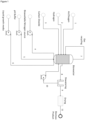
- Figure 1 shows a preferred embodiment of the present invention.
- a feedback loop control of oxygen/air input (1), hydrogen input (2), and carbon dioxide input (3) based on through-gas analysis and/or analysis of their concentrations in the bioreactor is controlled through a defined and adjustable input gas ratio for optimal protein production metabolism.
- pH and OD based feedback loops for inorganic nitrogen (e.g. urea) addition (4) per unit biomass produced and maintenance of pH through addition of a pH buffer (5) are also present.
- Liquid growth media (6) is added to the bioreactor as needed in response to growth of the microorganisms measured through the sensors of the various feedback loops. Unutilised gas may be recycled (7) into the bioreactor.
- the dilution rate allows to reach a certain maintenance time in the reactor, an optimal growth of the microorganisms, and an optimal production of biomass.
- the dilution rate is determined by controlling the inputs of inorganic nitrogen (4), pH buffer (5), liquid growth media (6), and the recycling of removed liquid containing biomass (10) and the output of the removal of liquid containing biomass (8). Removal of liquid containing biomass (8) is followed by a downstream processing step involving dewatering in which a large part of the liquid is separated from the liquid containing biomass.
- the large part of the liquid is then preferably recycled (10) to the bioreactor, while the biomass together with a small part of the remaining liquid is subjected to additional downstream processing steps (9) comprising further dewatering, drying and inactivation of the microorganisms, which via optional additional downstream processing steps (11) ultimately results in a biomass product preferably suitable as a source of nutrition for other organisms.
- additional downstream processing steps (9) comprising further dewatering, drying and inactivation of the microorganisms, which via optional additional downstream processing steps (11) ultimately results in a biomass product preferably suitable as a source of nutrition for other organisms.
- Improved overall system productivity may be achieved by enabling higher oxygen concentrations, and thereby reduced oxygen limitation, within the overall system.
- Responsive oxygen feeding (1) is preferred to improve reactor load while remaining within safe gas mixture concentrations within the headspace.
- Oxygen preferably remains at less than 5% in the headspace of the system but is added at increasing volumes in response to increased consumption of the gas by the microbes, to achieve optimal balancing of protein production and growth rate.
- the maximum protein yield requires optimal availability of inorganic nitrogen compounds, such as ammonia, and/or urea, to the system. By feeding in ammonia (4) in response to defined process conditions, an optimal growth rate can also be achieved.
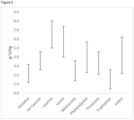
- Figure 2 shows an example of the ranges of amounts of the essential amino acids per 100 g of the total protein content of isolated biomass produced according to the method of the invention.
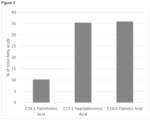
- Figure 3 shows an example of the proportions of the most abundant fatty acids of the total fatty acid content of isolated biomass produced according to the method of the invention.
- the fatty acid content of isolated biomass produced according to the method of the invention is determined by the following method: Samples are heated under reflux for 2 hours with a mixture of Methanol and Sulfuric acid in Toluene. Fats and Oils are trans-esterified to Fatty Acid Methyl Esters (FAMES). A small volume of n-Hexane is used to extract the resultant methyl ester mixture. Anhydrous Sodium Sulfate is then used to dry the n-Hexane solution before transferring the sample to a chromatography vial.
- Fatty Acid Methyl Esters Fatty Acid Methyl Esters
- FAMES fatty acid profiles are obtained by Gas-Liquid Chromatography using an FFAP column (dimensions 25m ⁇ 0.20mm ID) with detection by Flame lonisation Detector. Profiles may be reported with or without an internal standard (C17:0).
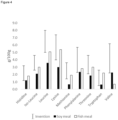
- Figure 4 shows an example of the ranges of amounts of the essential amino acids per 100 g of the total protein content of isolated biomass produced according to the method of the invention compared to those of typical soy meal and fish meal used in animal agriculture, see for instance U.S. Soybean Meal information flyer (accessed online on 20 April 2020: https://ussec.org/wp-content/uploads/2015/10/US-Soybean-Meal-Information.pdf, issued by the US Soybean Export Council ; and fish meal, see for instance M. Das and S. K. Mandal; Oxya hyla hyla (Orthoptera: Acrididae) as an Alternative Protein Source for Japanese Quail; International Scholarly Research Notices, 2014 .
- the amino acid content of isolated biomass produced according to the method of the invention is determined by the following method: A sample is oxidised in a combination of phenol, hydrogen peroxide, and formic acid. The oxidised sample is then hydrolysed with hydrochloric acid. Amino acids are subsequently separated using ion exchange chromatography and determined by post column reaction with ninhydrin using photometric detection.
- biomass produced according to the method of the invention is of superior quality.
- Figures 5 A and B show a projection of biomass production rates at different input concentration percentages of oxygen and hydrogen.
- the oxygen and hydrogen concentrations are of those added to the liquid phase and biomass production rates are those of biomass with at least 65% protein resulting in a biomass production rate of more than 10 g/l/d from specific concentration percentages and up of respectively oxygen ( figure 5 A) or hydrogen ( figure 5 B).
- Figure 5 A is limited with regard to amount of substrates other than oxygen such that they are provided at a minimum amount sufficient for viability of the microorganisms.
- Figure 5 B is limited with regard to amount of substrates other than hydrogen such that they are provided at a minimum amount sufficient for viability of the microorganisms.
- Figure 6 shows a projection of protein content of total biomass by dry weight from hydrogen-oxidising microorganisms produced according to the invention, wherein controlling the input stream comprises adding a molar ratio of hydrogen : oxygen in the liquid phase of from 1 : 1 to 10 : 1, resulting in a biomass production rate of more than 10 g/l/d.
- Figure 7 shows a projection of protein content of total biomass by dry weight from hydrogen-oxidising microorganisms produced according to the invention, wherein controlling the input stream comprises controlling the specific growth rate, resulting in a biomass production rate of more than 10 g/l/d.
- Figure 8 A shows a projection of preferred hydrogen transfer rates in relation to biomass production rate produced according to the invention, wherein the biomass comprises at least 65% protein of total biomass by dry weight.
- the required hydrogen transfer ratee for a target Productivity can be calculated by multiplying the Yield of hydrogen to biomass (Y_ ⁇ H2/X ⁇ ) with the Productivity, where Y_ ⁇ H2/X ⁇ is the g hydrogen used per gram biomass formed.
- Figure 8A identifies the necessary mass transfers required to obtain productivities in excess of 10 g/L/d within the economically preferred metabolic yield range for Hydrogen which are attainable using the method according to the invention.
- Figure 8 B shows a projection of preferred oxygen transfer rates in relation to biomass production rate produced according to the invention, wherein the biomass comprises at least 65% protein of total biomass by dry weight.
- the required hydrogen transfer ratee for a target Productivity can be calculated by multiplying the Yield of oxygen to biomass (Y_ ⁇ O2/X ⁇ ) with the Productivity, where Y_ ⁇ O2/X ⁇ is the g oxygen used per gram biomass formed.
- Figure 8B identifies the necessary mass transfers required to obtain productivities in excess of 10 g/L/d within the economically preferred metabolic yield range for Oxygen which are attainable using the method according to the invention.
- the following, non-limiting examples illustrate the process and materials according to the invention.
- Cupriavidis necator strain H16 also known as DSM 428 ( Little et al.: “Complete Genome Sequence of Cupriavidis necator H16 (DSM 428)”; Microbiol. Resour. Announc. (2019 )) or previously known as Ralstonia eutrophia H16 ( Pohlmann et al.: “Genome sequence of the bioplastic-producing "Knallgas” bacterium Ralstonia eutrophia H16”; Nature Biotechnology (2006 )), is cultured according to the invention in an industrial chemostat bioreactor system as described in figure 1 .
- DSMZ mineral medium for chemolithotrophic growth 81 (H-3) is used, which consists of the following and is prepared as follows:
- the culture is grown for at least 3 days under constant agitation of the culture medium.
- Carbon dioxide gas is added to the liquid phase in a non-limiting concentration.
- Hydrogen and oxygen gas are added to the liquid phase in a ratio of from 1:1 to 10 : 1.
- the gaseous substrates are optionally recycled.
- the liquid culture medium is recycled. Nutrient compounds and culture medium are added and part of the liquid phase is removed from the system during culture. The total volume of the liquid phase is maintained more or less constant. Gas transfer rates are used according to the preferred rates as indicated in figures 8 A and 8 B .
- Biomass was produced and isolated according to the invention resulting in biomass with an amino acid content of figure 2 and a fatty acid content of figure 3 and table 1 below.
- Table 1 Fatty Acid % (of Total Fatty Acids) C08:0 Caprylic Acid 0.09 C12:0 Lauric Acid 0.1 C10:0 Capric Acid 0.11 C18:2 Linoleic Acid 0.14 C18:1 Oleic Acid 0.25 C14:1 Myristoleic Acid 0.26 C18:0 Stearic Acid 0.41 C18:3 Linolenic Acid 1.6 C14:0 Myristic Acid 4.22 C16:1 Palmitoleic Acid 10.19 C17:1 Heptadecenoic Acid 35.41 C16:0 Palmitic Acid 35.96
- a Cupriavidis necator strain is cultured in an industrial bioreactor system as described in figure 1 using the culture conditions as described in example 1.
- the dilution rate is 2 d -1 in figure 5 A and 1 d -1 in figure 5 B .
- a Cupriavidis necator strain is cultured in an industrial bioreactor system as described in figure 1 using the culture conditions as described in example 1.
- the dilution rate is 1.87 d -1
- a Cupriavidis necator strain is cultured in an industrial bioreactor system as described in figure 1 using the culture conditions as described in example 1.
- the dilution rate for the three points is from left to right respectively 1.82, 2.70 and 3.53 d -1 .
- the H2 : O2 ratio is 2 : 1.
- a Cupriavidis necator strain is cultured in an industrial bioreactor system as described in figure 1 using the culture conditions as described in example 1.
- a Cupriavidis necator strain is cultured in an industrial bioreactor system as described in figure 1 using the culture conditions as described in example 1.
Landscapes
- Life Sciences & Earth Sciences (AREA)
- Chemical & Material Sciences (AREA)
- Engineering & Computer Science (AREA)
- Polymers & Plastics (AREA)
- Zoology (AREA)
- Health & Medical Sciences (AREA)
- Food Science & Technology (AREA)
- Biotechnology (AREA)
- Animal Husbandry (AREA)
- Biochemistry (AREA)
- Organic Chemistry (AREA)
- Microbiology (AREA)
- Birds (AREA)
- Wood Science & Technology (AREA)
- Biomedical Technology (AREA)
- Bioinformatics & Cheminformatics (AREA)
- Genetics & Genomics (AREA)
- Molecular Biology (AREA)
- General Engineering & Computer Science (AREA)
- General Health & Medical Sciences (AREA)
- Virology (AREA)
- Tropical Medicine & Parasitology (AREA)
- Medicinal Chemistry (AREA)
- Physiology (AREA)
- Proteomics, Peptides & Aminoacids (AREA)
- Insects & Arthropods (AREA)
- Sustainable Development (AREA)
- Marine Sciences & Fisheries (AREA)
- Environmental & Geological Engineering (AREA)
- General Chemical & Material Sciences (AREA)
- Chemical Kinetics & Catalysis (AREA)
- Analytical Chemistry (AREA)
- Mycology (AREA)
- Immunology (AREA)
- Oil, Petroleum & Natural Gas (AREA)
- Preparation Of Compounds By Using Micro-Organisms (AREA)
- Micro-Organisms Or Cultivation Processes Thereof (AREA)
- Apparatus Associated With Microorganisms And Enzymes (AREA)
- Fodder In General (AREA)
Claims (15)
- Verfahren zum Herstellen einer Biomasse, die mindestens 65% Protein der gesamten Biomasse, bezogen auf das Trockengewicht, umfasst, aus wasserstoffoxidierenden Mikroorganismen, die Bakterien umfassen, die aus der Gattung Cupriavidus sp ausgewählt sind, unter Verwendung eines oder mehrerer Eingangsströme, die ein oder mehrere gasförmige Substrate umfassen, die Wasserstoff und Sauerstoff umfassen, wobei das Verfahren Folgendes umfasst:
Inkontaktbringen der Mikroorganismen in einer flüssigen Phase mit einer Nährstoffzusammensetzung, die Stickstoff und Phosphor umfassende Verbindungen umfasst, und den gasförmigen Substraten, wobei das eine oder die mehreren gasförmigen Substrate Kohlendioxid umfassen oder wobei die Nährstoffzusammensetzung Kohlenstoff umfassende Verbindungen umfasst und wobei der Eingangsstrom und die Nährstoffzusammensetzung gesteuert sind und wobei die Biomasse mit einer Rate von mehr als 10 g/l/d hergestellt wird, wobei das Verfahren ferner Folgendes umfasst:i. Steuern des Eingangsstroms, umfassend Zugeben eines Molverhältnisses von Wasserstoff : Sauerstoff zur flüssigen Phase von 1 : 1 bis 10 : 1;ii. Steuern des Eingangsstroms und der Nährstoffzusammensetzung, umfassend Aufrechterhalten einer spezifischen Wachstumsrate der Mikroorganismen von 1,0 bis 8,0 d-1 oder von 0,04 bis 0,3 h-1;iii. Steuern des Eingangsstroms, umfassend Aufrechterhalten von Wasserstoff bei einer Übergangsrate von 0,03 bis 1,2 mol/l/h in die flüssigen Phase und/oder Sauerstoff bei einer Übergangsrate von 0,003 bis 0,4 mol/l/h in die flüssigen Phase;iv. Steuern des Eingangsstroms, umfassend Aufrechterhalten eines Molverhältnisses eines Gasgehalts von Wasserstoff: Sauerstoff in der flüssigen Phase von 0,5 : 1 bis 7 : 1,v. Steuern des Eingangsstroms und der Nährstoffzusammensetzung, umfassend Aufrechterhalten einer Konzentration der Mikroorganismen in der flüssigen Phase des Bioreaktors von mindestens 10 g/l, undvi. Ersetzen der flüssigen Phase des Bioreaktors, in dem die Mikroorganismen gezüchtet und aufrechterhalten werden, mit einem Volumen von 4 bis 30% pro Stunde. - Verfahren nach Anspruch 1, wobei das Steuern des Eingangsstroms und der Nährstoffzusammensetzung Aufrechterhalten einer Konzentration der Mikroorganismen in der flüssigen Phase des Bioreaktors von 10 bis 100 g/l umfasst.
- Verfahren nach einem der Ansprüche 1 oder 2, wobei das Steuern des Eingangsstroms Zugeben eines Molverhältnisses von Wasserstoff: Sauerstoff: Kohlendioxid von 2 bis 6 : 0,85 bis 2 : 0,75 bis 2 zu der flüssigen Phase umfasst.
- Verfahren nach einem der Ansprüche 1 bis 3, wobei das Steuern des Eingangsstroms Aufrechterhalten eines Molverhältnisses von gelöstem Wasserstoff : Sauerstoff : Kohlendioxid von 3,183 bis 12,748 : 0,795 bis 4,25 : 0,75 bis 2,0 in der flüssigen Phase umfasst.
- Verfahren nach einem der Ansprüche 1 bis 4, wobei das Steuern des Eingangsstroms Aufrechterhalten einer Wasserstoffkonzentration von 0,5 bis 20 mg/l, einer Sauerstoffkonzentration von 0,5 bis 80 mg/l und einer Kohlendioxidkonzentration von 20 bis 2000 mg/l in der flüssigen Phase bei einer Temperatur von 28 bis 45 °C und einem Druck in der Gasphase von 100 bis 2000 kPa umfasst.
- Verfahren nach einem der Ansprüche 1 bis 5, wobei das Steuern des Eingangsstroms Aufrechterhalten eines Molverhältnisses eines Gasgehalts von Wasserstoff: Sauerstoffgas in der flüssigen Phase von 1: 1 bis 3,5 : 1 umfasst.
- Verfahren nach einem der Ansprüche 1 bis 6, wobei die Mikroorganismen den Wasserstoff mit einer Rate von 0,05 bis 0,5 mol/g/h, den Sauerstoff mit einer Rate von 0,04 bis 0,18 mol/g/h und das Kohlendioxid mit einer Rate von 0,03 bis 0,13 mol/g/h verwerten.
- Verfahren nach einem der Ansprüche 1 bis 7, wobei das Kohlendioxid aus dem Abgas eines Herstellungs- oder Verbrennungsprozesses stammt, wobei das Kohlendioxid vorzugsweise gereinigt und auf eine Konzentration von 40 bis 100 % (Vol./Vol.) konzentriert ist.
- Verfahren nach einem der Ansprüche 1 bis 8, wobei das Inkontaktbringen der Mikroorganismen in einer flüssigen Phase mit einer Nährstoffzusammensetzung Zugeben einer Nährstoffzusammensetzung umfasst, die vor dem Zugeben auf einen pH-Wert von 1 bis 4 eingestellt wird, wobei die Nährstoffzusammensetzung vorzugsweise ein Medium für chemolithotrophes Wachstum 81 von DSMZ (H-3) ohne NaHCOs umfasst und wobei vorzugsweise vor dem Zugeben das Medium mit zusätzlich 1,5 g/l Ammoniumchlorid, 3 x 10⁴ g/l NiCl2 x 6H2O und 1,5 x 10⁻³ g/l ZnSO4 x 7H2O und 1,5 x 10⁻⁴ g/l CuCl2 x 2H2O und 0,15 g/l Ammoniumeisen(III)-Citrat supplementiert wird.
- Verfahren nach einem der Ansprüche 1 bis 9, wobei die Mikroorganismen Bakterien umfassen, die aus der Art Cupriavidus necator ausgewählt sind.
- Verfahren nach einem der Ansprüche 1 bis 10, ferner umfassend Entfernen der Nährstoffzusammensetzung und Isolieren der hergestellten Biomasse durch Entwässern und/oder Trocknen der Biomasse, sodass die Biomasse einen Wassergehalt von weniger als 5 Gew.-% umfasst.
- Verfahren zum Herstellen von Biomasse nach Anspruch 11, ferner umfassend Verwenden der durch Entwässern und/oder Trocknen der Biomasse entfernten Nährstoffzusammensetzung als Nährstoffzusammensetzung in dem Verfahren zum Herstellen von Biomasse nach einem der Ansprüche 1 bis 10.
- Biomasse, erhaltbar durch das Verfahren nach einem der Ansprüche 1 bis 11, umfassend Protein, das einen Aminosäuregehalt umfasst, der einen Histidingehalt von 1,2 bis 3,2 % des Proteingehalts des Gesamttrockengewichts der Biomasse, einen Isoleucingehalt von 2,6 bis 4,6 % des Proteingehalts des Gesamttrockengewichts der Biomasse, einen Leucingehalt von 5,0 bis 8,0 % des Proteingehalts des Gesamttrockengewichts der Biomasse, einen Lysingehalt von 4,0 bis 7,4 % des Proteingehalts des Gesamttrockengewichts der Biomasse, einen Methioningehalt von 1,4 bis 3,6 % des Proteingehalts des Gesamttrockengewichts der Biomasse, einen Phenylalaningehalt von 2,3 bis 5,7 % des Proteingehalts des Gesamttrockengewichts der Biomasse, einen Threoningehalt von 2,1 bis 4,6 % des Proteingehalts des Gesamttrockengewichts der Biomasse, einen Tryptophangehalt von 0,5 bis 2,6 % des Proteingehalts des Gesamttrockengewichts der Biomasse und einen Valingehalt von 2,2 bis 6,2 % des Proteingehalts des Gesamttrockengewichts der Biomasse umfasst.
- Biomasse, erhaltbar durch das Verfahren nach einem der Ansprüche 1 bis 11, umfassend einen Lipidgehalt von 2,3 bis 18 % des Gesamttrockengewichts der Biomasse, der einen Fettsäuregehalt umfasst, der einen C16:0-Palmitinsäuregehalt von 23 bis 60 % des Fettsäuregehalts des Gesamttrockengewichts der Biomasse, einen C16:1-Palmitolsäuregehalt von 3,8 bis 22,3 % des Fettsäuregehalts des Gesamttrockengewichts der Biomasse und einen C17:1-Heptadecensäuregehalt von 23 bis 60 % des Fettsäuregehalts des Gesamttrockengewichts der Biomasse umfasst.
- Verwendung der Biomasse nach Anspruch 13 oder 14 zum Füttern oder Bereitstellen einer Nahrung für einen oder mehrere Organismen, wobei die Organismen vorzugsweise Fische, Krebstiere, Weichtiere, Geflügel, Schweine und Rinder umfassen.
Priority Applications (1)
| Application Number | Priority Date | Filing Date | Title |
|---|---|---|---|
| EP24171522.6A EP4417060A3 (de) | 2020-04-24 | 2021-04-26 | Verfahren zur herstellung von biomasse unter verwendung von wasserstoffoxidierenden bakterien |
Applications Claiming Priority (2)
| Application Number | Priority Date | Filing Date | Title |
|---|---|---|---|
| GB2006071.1A GB2594454A (en) | 2020-04-24 | 2020-04-24 | Method for producing biomass using hydrogen-oxidizing bacteria |
| PCT/EP2021/060880 WO2021214345A1 (en) | 2020-04-24 | 2021-04-26 | Method for producing biomass using hydrogen-oxidizing bacteria |
Related Child Applications (2)
| Application Number | Title | Priority Date | Filing Date |
|---|---|---|---|
| EP24171522.6A Division EP4417060A3 (de) | 2020-04-24 | 2021-04-26 | Verfahren zur herstellung von biomasse unter verwendung von wasserstoffoxidierenden bakterien |
| EP24171522.6A Division-Into EP4417060A3 (de) | 2020-04-24 | 2021-04-26 | Verfahren zur herstellung von biomasse unter verwendung von wasserstoffoxidierenden bakterien |
Publications (3)
| Publication Number | Publication Date |
|---|---|
| EP4138568A1 EP4138568A1 (de) | 2023-03-01 |
| EP4138568C0 EP4138568C0 (de) | 2024-05-29 |
| EP4138568B1 true EP4138568B1 (de) | 2024-05-29 |
Family
ID=71080247
Family Applications (2)
| Application Number | Title | Priority Date | Filing Date |
|---|---|---|---|
| EP24171522.6A Pending EP4417060A3 (de) | 2020-04-24 | 2021-04-26 | Verfahren zur herstellung von biomasse unter verwendung von wasserstoffoxidierenden bakterien |
| EP21726055.3A Active EP4138568B1 (de) | 2020-04-24 | 2021-04-26 | Verfahren zur herstellung von biomasse unter verwendung von wasserstoffoxidierenden bakterien |
Family Applications Before (1)
| Application Number | Title | Priority Date | Filing Date |
|---|---|---|---|
| EP24171522.6A Pending EP4417060A3 (de) | 2020-04-24 | 2021-04-26 | Verfahren zur herstellung von biomasse unter verwendung von wasserstoffoxidierenden bakterien |
Country Status (11)
| Country | Link |
|---|---|
| US (1) | US20230203433A1 (de) |
| EP (2) | EP4417060A3 (de) |
| JP (1) | JP2023523040A (de) |
| KR (1) | KR20230041957A (de) |
| CN (2) | CN116056586B (de) |
| AU (2) | AU2021260860B2 (de) |
| CA (1) | CA3176376A1 (de) |
| CL (1) | CL2022002921A1 (de) |
| ES (1) | ES2986299T3 (de) |
| GB (1) | GB2594454A (de) |
| WO (1) | WO2021214345A1 (de) |
Families Citing this family (2)
| Publication number | Priority date | Publication date | Assignee | Title |
|---|---|---|---|---|
| CN115786169B (zh) * | 2022-09-01 | 2025-06-24 | 中国科学院成都生物研究所 | 一株黄黄色杆菌及用其合成生物蛋白质的方法 |
| CN120555179B (zh) * | 2025-07-31 | 2025-10-24 | 成都合气生物科技有限公司 | 一种多气体控制装置、使用方法及应用 |
Family Cites Families (10)
| Publication number | Priority date | Publication date | Assignee | Title |
|---|---|---|---|---|
| US20100120104A1 (en) * | 2008-11-06 | 2010-05-13 | John Stuart Reed | Biological and chemical process utilizing chemoautotrophic microorganisms for the chemosythetic fixation of carbon dioxide and/or other inorganic carbon sources into organic compounds, and the generation of additional useful products |
| WO2011139804A2 (en) * | 2010-04-27 | 2011-11-10 | Sequesco | Use of oxyhydrogen microorganisms for non-photosynthetic carbon capture and conversion of inorganic and/or c1 carbon sources into useful organic compounds |
| JP5839854B2 (ja) * | 2011-06-29 | 2016-01-06 | 株式会社カネカ | 微生物の培養方法 |
| CA2848574A1 (en) * | 2011-09-12 | 2013-03-21 | Oakbio Inc. | Chemoautotrophic conversion of carbon oxides in industrial waste to biomass and chemical products |
| WO2013090769A2 (en) * | 2011-12-14 | 2013-06-20 | Kiverdi, Inc. | Method and apparatus for growing microbial cultures that require gaseous electron donors, electron acceptors, carbon sources, or other nutrients |
| CA3017799A1 (en) * | 2016-03-19 | 2017-09-28 | Kiverdi, Inc. | Microorganisms and artificial ecosystems for the production of protein, food, and useful co-products from c1 substrates |
| KR20190092519A (ko) * | 2016-12-13 | 2019-08-07 | 유니버시티 오브 하와이 | 기체 발효 제품을 위한 방법 및 생물반응기 |
| EA201891926A1 (ru) | 2017-02-03 | 2019-04-30 | Киверди, Инк. | Микроорганизмы и искусственные экосистемы для производства белка, продуктов питания и полезных побочных продуктов из субстратов c1 |
| US11439172B2 (en) * | 2017-07-03 | 2022-09-13 | Oakbio, Inc. | Microbial biomass based feed products |
| CN109423452A (zh) * | 2017-08-21 | 2019-03-05 | 上海吉态来生物技术有限公司 | 一种利用工业废气中二氧化碳的发酵方法 |
-
2020
- 2020-04-24 GB GB2006071.1A patent/GB2594454A/en not_active Withdrawn
-
2021
- 2021-04-26 KR KR1020227040729A patent/KR20230041957A/ko active Pending
- 2021-04-26 JP JP2022564603A patent/JP2023523040A/ja active Pending
- 2021-04-26 CA CA3176376A patent/CA3176376A1/en active Pending
- 2021-04-26 CN CN202180030748.4A patent/CN116056586B/zh active Active
- 2021-04-26 WO PCT/EP2021/060880 patent/WO2021214345A1/en not_active Ceased
- 2021-04-26 ES ES21726055T patent/ES2986299T3/es active Active
- 2021-04-26 CN CN202511107708.1A patent/CN120944993A/zh active Pending
- 2021-04-26 US US17/996,826 patent/US20230203433A1/en active Pending
- 2021-04-26 EP EP24171522.6A patent/EP4417060A3/de active Pending
- 2021-04-26 AU AU2021260860A patent/AU2021260860B2/en active Active
- 2021-04-26 EP EP21726055.3A patent/EP4138568B1/de active Active
-
2022
- 2022-10-21 CL CL2022002921A patent/CL2022002921A1/es unknown
-
2025
- 2025-07-30 AU AU2025210792A patent/AU2025210792A1/en active Pending
Also Published As
| Publication number | Publication date |
|---|---|
| JP2023523040A (ja) | 2023-06-01 |
| KR20230041957A (ko) | 2023-03-27 |
| EP4138568C0 (de) | 2024-05-29 |
| WO2021214345A1 (en) | 2021-10-28 |
| EP4417060A3 (de) | 2024-11-20 |
| CN120944993A (zh) | 2025-11-14 |
| GB202006071D0 (en) | 2020-06-10 |
| ES2986299T3 (es) | 2024-11-11 |
| GB2594454A (en) | 2021-11-03 |
| AU2025210792A1 (en) | 2025-08-21 |
| CA3176376A1 (en) | 2021-10-28 |
| CN116056586B (zh) | 2025-08-08 |
| EP4417060A2 (de) | 2024-08-21 |
| AU2021260860B2 (en) | 2025-08-21 |
| EP4138568A1 (de) | 2023-03-01 |
| US20230203433A1 (en) | 2023-06-29 |
| AU2021260860A1 (en) | 2023-01-05 |
| CL2022002921A1 (es) | 2023-09-29 |
| CN116056586A (zh) | 2023-05-02 |
Similar Documents
| Publication | Publication Date | Title |
|---|---|---|
| Morimoto et al. | Biological production of hydrogen from glucose by natural anaerobic microflora | |
| Yang et al. | Microbial protein production from CO2, H2, and recycled nitrogen: Focusing on ammonia toxicity and nitrogen sources | |
| Dou et al. | Autotrophic, heterotrophic, and mixotrophic nitrogen assimilation for single-cell protein production by two hydrogen-oxidizing bacterial strains | |
| JP4101295B2 (ja) | 廃ガスからの酢酸の生物学的生産 | |
| EP2521790B1 (de) | Biologisches und chemisches verfahren mit chemoautotrophen mikroorganismen zur chemosynthetischen fixierung von kohlendioxid und/oder anderen anorganischen kohlenstoffquellen in organischen verbindungen sowie erzeugung von zusätzlichen nützlichen produkten | |
| KR101375029B1 (ko) | 신규 세균 및 이의 이용 방법 | |
| CN111886345B (zh) | 高氢气利用率和气体再循环 | |
| CN108603201A (zh) | 整合发酵和电解工艺 | |
| AU2025210792A1 (en) | Method for producing biomass using hydrogen-oxidizing bacteria | |
| WO2015058212A1 (en) | Microbial conversion of methane | |
| KR102503672B1 (ko) | 이산화탄소 광물화 공정과 황산화 미생물의 대사반응을 연계한 이산화탄소 전환 공정 | |
| Rigo et al. | Application of different lipases as pretreatment in anaerobic treatment of wastewater | |
| US10301652B2 (en) | Process for hydrogen production from glycerol | |
| CN103031338A (zh) | 一种气相底物发酵连续生产乙醇的方法 | |
| HK40115258A (en) | Method for producing biomass using hydrogen-oxidizing bacteria | |
| WO2024015886A2 (en) | Process | |
| JP4773045B2 (ja) | エネルギー回収システム | |
| US20250019725A1 (en) | Method for producing syngas fermentation products using highly active microorganisms | |
| US20250084444A1 (en) | Fermentation methods using acetogenic carboxydotrophic bacteria | |
| EP4582548A1 (de) | Prozess zur kontinuierlichen produktion von biomethan aus biomasse mit co2-abscheidung | |
| JP4051486B2 (ja) | 一酸化炭素の嫌気性発酵 | |
| TW202417635A (zh) | 使用酵素分解細胞團來提取營養補充劑產物 | |
| Lidstrom et al. | Microbial conversion of methane | |
| Owoh | Statistical Optimisation of Medium Constituent Variables for Biogas Production from N-acetylglucosamine by Clostridium beijerinckii and Clostridium paraputrificum |
Legal Events
| Date | Code | Title | Description |
|---|---|---|---|
| STAA | Information on the status of an ep patent application or granted ep patent |
Free format text: STATUS: UNKNOWN |
|
| STAA | Information on the status of an ep patent application or granted ep patent |
Free format text: STATUS: THE INTERNATIONAL PUBLICATION HAS BEEN MADE |
|
| PUAI | Public reference made under article 153(3) epc to a published international application that has entered the european phase |
Free format text: ORIGINAL CODE: 0009012 |
|
| STAA | Information on the status of an ep patent application or granted ep patent |
Free format text: STATUS: REQUEST FOR EXAMINATION WAS MADE |
|
| 17P | Request for examination filed |
Effective date: 20221117 |
|
| AK | Designated contracting states |
Kind code of ref document: A1 Designated state(s): AL AT BE BG CH CY CZ DE DK EE ES FI FR GB GR HR HU IE IS IT LI LT LU LV MC MK MT NL NO PL PT RO RS SE SI SK SM TR |
|
| DAX | Request for extension of the european patent (deleted) | ||
| RAV | Requested validation state of the european patent: fee paid |
Extension state: TN Effective date: 20221117 Extension state: MA Effective date: 20221117 |
|
| GRAP | Despatch of communication of intention to grant a patent |
Free format text: ORIGINAL CODE: EPIDOSNIGR1 |
|
| STAA | Information on the status of an ep patent application or granted ep patent |
Free format text: STATUS: GRANT OF PATENT IS INTENDED |
|
| INTG | Intention to grant announced |
Effective date: 20230919 |
|
| GRAJ | Information related to disapproval of communication of intention to grant by the applicant or resumption of examination proceedings by the epo deleted |
Free format text: ORIGINAL CODE: EPIDOSDIGR1 |
|
| STAA | Information on the status of an ep patent application or granted ep patent |
Free format text: STATUS: REQUEST FOR EXAMINATION WAS MADE |
|
| INTC | Intention to grant announced (deleted) | ||
| GRAP | Despatch of communication of intention to grant a patent |
Free format text: ORIGINAL CODE: EPIDOSNIGR1 |
|
| STAA | Information on the status of an ep patent application or granted ep patent |
Free format text: STATUS: GRANT OF PATENT IS INTENDED |
|
| INTG | Intention to grant announced |
Effective date: 20231219 |
|
| GRAS | Grant fee paid |
Free format text: ORIGINAL CODE: EPIDOSNIGR3 |
|
| GRAA | (expected) grant |
Free format text: ORIGINAL CODE: 0009210 |
|
| STAA | Information on the status of an ep patent application or granted ep patent |
Free format text: STATUS: THE PATENT HAS BEEN GRANTED |
|
| AK | Designated contracting states |
Kind code of ref document: B1 Designated state(s): AL AT BE BG CH CY CZ DE DK EE ES FI FR GB GR HR HU IE IS IT LI LT LU LV MC MK MT NL NO PL PT RO RS SE SI SK SM TR |
|
| REG | Reference to a national code |
Ref country code: CH Ref legal event code: EP |
|
| REG | Reference to a national code |
Ref country code: IE Ref legal event code: FG4D |
|
| REG | Reference to a national code |
Ref country code: DE Ref legal event code: R096 Ref document number: 602021013857 Country of ref document: DE |
|
| U01 | Request for unitary effect filed |
Effective date: 20240625 |
|
| REG | Reference to a national code |
Ref country code: NL Ref legal event code: MP Effective date: 20240529 |
|
| U07 | Unitary effect registered |
Designated state(s): AT BE BG DE DK EE FI FR IT LT LU LV MT NL PT RO SE SI Effective date: 20240902 |
|
| PG25 | Lapsed in a contracting state [announced via postgrant information from national office to epo] |
Ref country code: HR Free format text: LAPSE BECAUSE OF FAILURE TO SUBMIT A TRANSLATION OF THE DESCRIPTION OR TO PAY THE FEE WITHIN THE PRESCRIBED TIME-LIMIT Effective date: 20240529 |
|
| PG25 | Lapsed in a contracting state [announced via postgrant information from national office to epo] |
Ref country code: GR Free format text: LAPSE BECAUSE OF FAILURE TO SUBMIT A TRANSLATION OF THE DESCRIPTION OR TO PAY THE FEE WITHIN THE PRESCRIBED TIME-LIMIT Effective date: 20240830 |
|
| PG25 | Lapsed in a contracting state [announced via postgrant information from national office to epo] |
Ref country code: PL Free format text: LAPSE BECAUSE OF FAILURE TO SUBMIT A TRANSLATION OF THE DESCRIPTION OR TO PAY THE FEE WITHIN THE PRESCRIBED TIME-LIMIT Effective date: 20240529 |
|
| PG25 | Lapsed in a contracting state [announced via postgrant information from national office to epo] |
Ref country code: PL Free format text: LAPSE BECAUSE OF FAILURE TO SUBMIT A TRANSLATION OF THE DESCRIPTION OR TO PAY THE FEE WITHIN THE PRESCRIBED TIME-LIMIT Effective date: 20240529 Ref country code: HR Free format text: LAPSE BECAUSE OF FAILURE TO SUBMIT A TRANSLATION OF THE DESCRIPTION OR TO PAY THE FEE WITHIN THE PRESCRIBED TIME-LIMIT Effective date: 20240529 Ref country code: GR Free format text: LAPSE BECAUSE OF FAILURE TO SUBMIT A TRANSLATION OF THE DESCRIPTION OR TO PAY THE FEE WITHIN THE PRESCRIBED TIME-LIMIT Effective date: 20240830 Ref country code: RS Free format text: LAPSE BECAUSE OF FAILURE TO SUBMIT A TRANSLATION OF THE DESCRIPTION OR TO PAY THE FEE WITHIN THE PRESCRIBED TIME-LIMIT Effective date: 20240829 |
|
| REG | Reference to a national code |
Ref country code: ES Ref legal event code: FG2A Ref document number: 2986299 Country of ref document: ES Kind code of ref document: T3 Effective date: 20241111 |
|
| PG25 | Lapsed in a contracting state [announced via postgrant information from national office to epo] |
Ref country code: CZ Free format text: LAPSE BECAUSE OF FAILURE TO SUBMIT A TRANSLATION OF THE DESCRIPTION OR TO PAY THE FEE WITHIN THE PRESCRIBED TIME-LIMIT Effective date: 20240529 |
|
| PG25 | Lapsed in a contracting state [announced via postgrant information from national office to epo] |
Ref country code: SK Free format text: LAPSE BECAUSE OF FAILURE TO SUBMIT A TRANSLATION OF THE DESCRIPTION OR TO PAY THE FEE WITHIN THE PRESCRIBED TIME-LIMIT Effective date: 20240529 |
|
| PG25 | Lapsed in a contracting state [announced via postgrant information from national office to epo] |
Ref country code: SM Free format text: LAPSE BECAUSE OF FAILURE TO SUBMIT A TRANSLATION OF THE DESCRIPTION OR TO PAY THE FEE WITHIN THE PRESCRIBED TIME-LIMIT Effective date: 20240529 |
|
| PG25 | Lapsed in a contracting state [announced via postgrant information from national office to epo] |
Ref country code: SM Free format text: LAPSE BECAUSE OF FAILURE TO SUBMIT A TRANSLATION OF THE DESCRIPTION OR TO PAY THE FEE WITHIN THE PRESCRIBED TIME-LIMIT Effective date: 20240529 Ref country code: SK Free format text: LAPSE BECAUSE OF FAILURE TO SUBMIT A TRANSLATION OF THE DESCRIPTION OR TO PAY THE FEE WITHIN THE PRESCRIBED TIME-LIMIT Effective date: 20240529 Ref country code: CZ Free format text: LAPSE BECAUSE OF FAILURE TO SUBMIT A TRANSLATION OF THE DESCRIPTION OR TO PAY THE FEE WITHIN THE PRESCRIBED TIME-LIMIT Effective date: 20240529 |
|
| PLBE | No opposition filed within time limit |
Free format text: ORIGINAL CODE: 0009261 |
|
| STAA | Information on the status of an ep patent application or granted ep patent |
Free format text: STATUS: NO OPPOSITION FILED WITHIN TIME LIMIT |
|
| U1N | Appointed representative for the unitary patent procedure changed after the registration of the unitary effect |
Representative=s name: WILLNEGGER, EVA; BE |
|
| 26N | No opposition filed |
Effective date: 20250303 |
|
| U1K | Transfer of rights of the unitary patent after the registration of the unitary effect |
Owner name: AERBIO A/S; DK |
|
| U20 | Renewal fee for the european patent with unitary effect paid |
Year of fee payment: 5 Effective date: 20250424 |
|
| PGFP | Annual fee paid to national office [announced via postgrant information from national office to epo] |
Ref country code: GB Payment date: 20250423 Year of fee payment: 5 Ref country code: ES Payment date: 20250519 Year of fee payment: 5 |
|
| PGFP | Annual fee paid to national office [announced via postgrant information from national office to epo] |
Ref country code: IS Payment date: 20250423 Year of fee payment: 5 Ref country code: NO Payment date: 20250422 Year of fee payment: 5 |
|
| REG | Reference to a national code |
Ref country code: CH Ref legal event code: H13 Free format text: ST27 STATUS EVENT CODE: U-0-0-H10-H13 (AS PROVIDED BY THE NATIONAL OFFICE) Effective date: 20251125 |