EP4137005B1 - Bürstenvorrichtung mit schnellkupplungen für reinigungselemente - Google Patents
Bürstenvorrichtung mit schnellkupplungen für reinigungselemente Download PDFInfo
- Publication number
- EP4137005B1 EP4137005B1 EP22178251.9A EP22178251A EP4137005B1 EP 4137005 B1 EP4137005 B1 EP 4137005B1 EP 22178251 A EP22178251 A EP 22178251A EP 4137005 B1 EP4137005 B1 EP 4137005B1
- Authority
- EP
- European Patent Office
- Prior art keywords
- connection element
- elements
- cleaning
- connection
- support member
- Prior art date
- Legal status (The legal status is an assumption and is not a legal conclusion. Google has not performed a legal analysis and makes no representation as to the accuracy of the status listed.)
- Active
Links
Images


Classifications
-
- A—HUMAN NECESSITIES
- A46—BRUSHWARE
- A46B—BRUSHES
- A46B7/00—Bristle carriers arranged in the brush body
- A46B7/04—Bristle carriers arranged in the brush body interchangeably removable bristle carriers
- A46B7/042—Clip or snap connection for bristle carriers
-
- A—HUMAN NECESSITIES
- A46—BRUSHWARE
- A46B—BRUSHES
- A46B13/00—Brushes with driven brush bodies or carriers
- A46B13/001—Cylindrical or annular brush bodies
- A46B13/005—Cylindrical or annular brush bodies made up of a series of longitudinal strips or segments
-
- A—HUMAN NECESSITIES
- A46—BRUSHWARE
- A46B—BRUSHES
- A46B13/00—Brushes with driven brush bodies or carriers
- A46B13/02—Brushes with driven brush bodies or carriers power-driven carriers
-
- A—HUMAN NECESSITIES
- A46—BRUSHWARE
- A46B—BRUSHES
- A46B2200/00—Brushes characterized by their functions, uses or applications
- A46B2200/30—Brushes for cleaning or polishing
-
- A—HUMAN NECESSITIES
- A46—BRUSHWARE
- A46B—BRUSHES
- A46B2200/00—Brushes characterized by their functions, uses or applications
- A46B2200/30—Brushes for cleaning or polishing
- A46B2200/3046—Brushes for cleaning cars or parts thereof
Definitions
- the present invention relates to the technical field concerning the washing and/or cleaning of obj ects, such as vehicles, and refers to a brush device with quick couplings for cleaning elements.
- Each of such brush devices is provided with one or more flexible support members fixed to the cylindrical or prismatic outer surface of the respective rotation shaft.
- Each flexible support is equipped with a plurality of concave seats open in the direction opposite to the shaft.
- Each seat is delimited by a respective perimeter wall protruding perpendicularly from the support member and is intended to house a median transverse portion of at least one cleaning element generally in the form of a flexible ribbon-like flap made, for example, of non-woven fabric, felt, or closed-cell synthetic material sheet.
- each cleaning element housed in the respective concave seat, is fixed to the bottom of the seat constituted by the flexible support for the member of fastenings, seams, staples and other types of connections.
- Some types of brushes for example those for the final drying of vehicles or for cleaning delicate surfaces or surfaces to be preserved, require the cleaning elements to be periodically and thoroughly washed. These washings of the cleaning elements cannot be carried out on site and require that an employee, after separating the support members from the rotation shaft, detaches, one by one, each cleaning element from its respective seat by cutting or detaching the fastenings or seams or staples.
- Prior art document US 435304 A discloses a brush device that uses screws to releasable connect cleaning elements to the driven support.
- An object of the present invention is to propose a brush device with quick couplings for cleaning elements which allows to carry out the operations of detaching and fixing the cleaning elements from the respective support member, in a fast and safe way.
- Another object is to allow the detachment and repositioning of the cleaning elements even without the need to separate the support members from the rotation shaft.
- 1 indicates the brush device with quick couplings for cleaning elements object of the present invention.
- Such device 1 comprises at least one rotation shaft, for example of the metal tubular type and made by extrusion of aluminum or similar.
- the rotation shaft being of a known type and not illustrated, can be operated by respective motor elements and has a set of support members 3 carried out in the rotation shaft itself or fixed to it in an irremovable way or, preferably and as illustrated in the figures, in a removable way.
- the support members 3 are rigid and shaped like a portion of the external face of the shaft or, instead and preferably, they are rectangular and flexible. Once mounted onto the rotation shaft, the support members 3 reproduce the shape of the portion of the shaft to which they are removably fixed; for example, the rotation shaft can be cylindrical in shape and each support member 3 is fixed to it with two sides parallel to the longitudinal geometric axis of the rotation shaft assuming the shape of a cylinder portion.
- Each support member 3 is assigned to connect a respective plurality of cleaning elements 5 to said shaft.
- Each cleaning element can consist of a sheet, patch, strip or flat of rectangular, ribbon-like or other elongated shape.
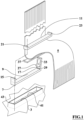
- each cleaning element 5 can be frayed, as illustrated in Figure 1 , or intact and this cleaning element 5 can be made of fabric, of a low density synthetic and/or closed-cell material, of non-woven fabric, of felt or of other flexible materials suitable for washing.
- the device 1 comprises a plurality of first connection elements 7, each assigned to be fixed, for example by welding, gluing, rivets, by interference or by other fastening means, to the respective support member 3, and each provided with a housing 9, assigned to host a portion of at least one cleaning element 5, and with a respective second connection element 11, assigned to fix reversibly, or to lock and unlock, said portion of the at least one cleaning element 5 placed or clamped between said first 7 and second 11 connection elements.
- the portion of the cleaning element 5 intended to be blocked between the first 7 and second 11 connection elements has an elongated rectangular cross section consisting of a layer of the cleaning element material or of multiple folded layers; for example, the ratio between the thickness and the width of the cleaning element, that is the ratio between the dimensions of the cross section of this unfolded element, can be approximately between 1 to 10 and 1 to 300.
- the main dimension of the housing 9 has length equal to or greater than the largest dimension of said section.
- the ends of the housing 9 are delimited by retaining elements first 15 and second 17 placed at the respective end portions of the first connection element 7.
- the ends of the second connection element 11 bear matching members, respectively first 21 and second 23.
- the first 15 and second 17 retaining elements can be rigidly fixed to the ends of the main body of the first connection element 7, or preferably they 15, 17 are made in a single body with the first connection element 7.
- the first 15 and second 17 retaining elements are assigned to house, by reversibly locking them, the first 21 and second 23 matching members of the second connection element 11 blocking it together with the at least one respective cleaning element.
- the first 7 and second 11 connection elements can have an overall shape as a very elongated "C” and as an "I", respectively, and can be made of synthetic material; preferably at least the first connection element 7 is made of plastic material and has a sufficient degree of flexibility and elasticity as better specified below.
- the first 15 and second 17 retaining elements define respective cavities with a shape approximately complementary to that of the first 21 and second 23 matching members.
- At least the second retaining element 17 has a tooth 27 for delimiting the corresponding cavity and intended to reversibly lock the corresponding matching member 21, 23.
- the tooth 27 is cantilevered onto a flexible arm 29 which connects it to the respective end of the main body of the first connecting element 7.
- the tooth or preferably the flexible arm is provided with a driving extension 33 which, in the fastening condition, moves away from the support member 3 protruding outwards.
- the driving extension 33 is fit for the manual actuation of the flexible arm 29 to free the matching member 21, 23 from the tooth 27 allowing the detachment of the second connection element 11 and the cleaning element 5.
- the material of the first connection element 7 has flexibility and elasticity such as to allow for the elastic deformation of the flexible arm 29 which can be provided with grooves or tapering for an easier bending or to obtain a hinged movement.
- the flexible arm 29 can be connected to the main body of the first connection element 7 by means of a hinge with a rotation pin; this hinge can be equipped with elastic elements or the arm 29 can be equipped with reversible joint interlocking retainers to keep the tooth 27 elastically and reversibly in its stop position of the matching member 21, 23.
- a further alternative provides that the matching member 21, 23 and the tooth 23 can be shaped to ensure a certain force which tends to keep them removably coupled to each other until a sufficient detachment force is applied to the flexible arm 29.
- the face of the tooth 27 opposite the corresponding cavity is provided with an inclined surface to facilitate the pressure insertion and the joint block of the connection element 11 and the cleaning element 5.
- the first 21 and second 23 matching members of the second connection element 11 are approximately the same shape and size.
- the cavities of the first 15 and second retaining elements 17 of the first connecting element 7 are approximately the same shape and size.
- the fixing of the cleaning element 5 can be carried out regardless of the mutual orientation of the first 7 and second 11 connection elements, in fact it will be sufficient to align them and press them towards each other.
- the second connection element 11 can be fixed by removable joint to the first connection element 7
- said second connection element 11 is irremovably fixed to the portion of the at least one cleaning element 5 hosted in the housing 9 of the first connection element 7, for example to the face of the latter 5 opposite the first connection element 7.
- This irremovable fixing of the second connection element 11 to the cleaning element 5 speeds up and facilitates the operations of reassembling the cleaning elements to the brush.
- the irremovable fixing can be achieved by gluing, by melting pins protruding from the second connection element 11 and engaged in respective holes of said portion of the at least one cleaning element 5, by means of seams, fastenings, stitches, clips, expansion elements, screws or similar fixings.
- a further alternative of the invention provides that said first 7 and second 11 connection elements are respectively fixed to the cleaning element 5 and to the support member 3.
- the invention optionally provides the adoption of a reinforcement element 37 assigned to be fixed to the second connection element 11 to block between them the portion of the at least one cleaning element 5; in this case the housing 9 and the cavities of the first 15 and second 17 retaining elements of the first connection element 7 are dimensioned to house the reinforcement element 37 and the second connection element 11 with said interposed portion of the cleaning element 5.
- One among the reinforcement element 37 and the second connecting element 11 can be equipped with a set of protruding pins assigned to engage into holes carried out in said portion of the cleaning element 5 to insert into seats made in the other one and in which said pins are blocked for example by thermal welding or with an ultrasonic welder or other.
- the faces of the reinforcement element 37 and of the first connection element 7 which are mutually facing in the fastening condition may possibly bear respective complementary projections and protrusions fit for at least one of:
- Each first connection element 7 is fixed to the respective support member 3 by fusion, with an ultrasonic welder or other, of pins protruding from the first connection element 7 and engaged into respective holes of the support member 3 itself or by gluing, stitches, clips, expansion elements, screws, seams, bonds or similar fixings.
- the support member 3 is provided with a plurality of concave seats 41, for example of rectangular or oval elongated shape, open in the direction opposite to the shaft, each being delimited by a respective perimeter wall 43 protruding perpendicularly from the support member 3.
- Each first connection element 7 is fixed, inside a respective concave seat 41, to the bottom of said seat which is constituted by the main sheet-like body of the support member 3; in the operating condition of the brush, the longitudinal axes of the concave seats are preferably mutually parallel and oriented parallel to the longitudinal axis of the rotation shaft or inclined.
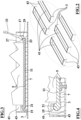
- the complementary shapes of the first retaining element 15 and of the first matching member 21 can be different from those of the second retaining element 17 and of the second matching member 23; in fact, it is sufficient that the complementary shapes of the first retaining element 15 and of the first matching member 21 are such as to prevent mutual distancing in the radial direction with respect to the rotation shaft when they are mutually engaged; for example, the variant of Figures 3 and 4 provides that the first matching member 21 of the second connection element 11 and the cavity of the first retaining element 15 of the first connection element 7 are of approximately cylindrical shape.
- the first matching member 21 and the cavity of the first retaining element 15 have rectangular or prismatic shape.
- the mouth of the cavity of the first retaining element 15 of the first connection element 7 has a dimension smaller than the diameter of the cylindrical shape and the cylindrical first matching member 21 of the second connection element 11 has a flattening positioned and dimensioned such as to allow for the exit of the first matching member 21 from the cylindrical cavity of the first retaining element 15 only if the second connection element 11 is rotated by a certain angle with respect to the first connection element 7.
- the second matching member 23 of the second connection element 11 and the cavity of the second retaining element 17 of the first connection element 7 can be approximately rectangular or prismatic in shape.
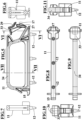
- the second variant of the brush device with quick couplings for cleaning elements illustrated in Figures 5 to 26 , provides that at least a portion of one or more cleaning elements 5 be clamped between the first 7 and second 11 connection elements.
- the first connection element 7 in the operating condition the first connection element 7 is housed in the respective concave seat 41 of the support member 3 and is removably locked there by the second connection member 11 releasably fixed, that is detachable and re-attachable, to the support member 3, where the first 7 and second 11 connection elements irremovably block the interposed portions of the respective cleaning elements or elements blocked therebetween.
- the first retaining element 15 and the second retaining element 17 are placed or carried out in a single body in the respective ends of the second connection element 11.
- the first matching member 21 and the second matching member 23 are placed or carried out in a single body in the respective ends of the support member 3, and are assigned to be housed and reversibly locked in the first 15 and second 17 retaining elements, respectively, for the removable joint fixing of the second connection element 11 and of the first connection element 7 and of the at least one cleaning element 5 associated therewith.
- Said matching members first 21 and second 23 extend transversely along the perimeter of said opening of the support member 3 and consist of transverse elements fit to be engaged in coupling and releasing by the first 15 and second 17 retaining elements.
- the first 21 and second matching members 23 and the first 15 and second 17 retaining elements can take other forms of reciprocal engagement and jointing, for example the matching members can be convex or one convex and the other concave and each retaining element can have a shape complementary to that of the respective matching member.
- the first connection element 7 is rectangular and has two longitudinal walls forming the concave housing 9 assigned to host the portion of the cleaning element 5 assigned to be blocked between the same first connection element 7 and the second connection element 11.
- the ends of the housing 9 are open and flat or preferably delimited by a frame slightly raised with respect to the bottom of the housing itself, that is, less deep than said longitudinal walls, as shown for example in Figures 14 to 19 . Said ends of the housing 9 are therefore partially or totally open to house respectively the first retaining element 15 and the second retaining element 17, abutting the edge of the housing 9.
- the second connection element 11 has a prevalent longitudinal development and has a portion assigned to abut with the respective at least one cleaning element 5; said portion has length equal to or slightly greater than the length of the housing 9 and width lower than that of this housing 9.
- the second connection element 11 has the first retaining element 15at one end, protruding longitudinally, and at its opposite end it has a flexible arm 29 which carries the second retaining element 17.
- the second retaining element 17 comprises a tooth 27 cantilever fixed on the flexible arm 29 and assigned to reversibly lock the corresponding matching member 21, 23.
- the flexible arm 29 ends in a driving extension 33 for the manual elastic operation of the flexible arm 29.
- the second connection element 11 has a longitudinal handle 34 which, in the fastening condition, is parallel to the support member 3 and to the first connection element 7.
- the handle 34 ends in proximity to the driving extension 33 so as to allow an employee to grasp the handle of the connection element 11 with one hand and at the same time to exert, for example with the thumb of the hand, a force on the driving extension 33 to release the second connection element 11 from its fixed condition to the support member 3 to detach from the support member 3 the assembly of the first 7 and second connection elements 11 with the at least one cleaning element 5 blocked between of them.
- the first 15 and second 17 retaining elements cooperating with respective projections or protrusions facing them, define respective cavities with a shape approximately complementary to that of the first 21 and second 23 matching members.
- the first 15 and second 17 retaining elements are dimensioned such as to be inserted into the respective passage of the end wall 44 of the support member 3, and are shaped to ensure a certain force which tends to keep them removably coupled to the respective first 21 and second 23 matching members as long as a sufficient release and detachment force is not applied to the flexible arm 29 and to the handle 34.
- each of the first 21 and second 23 matching members is compatible with the shape and size of only one among the first 15 and second 17 retaining elements and/or of the respective cavities to allow the connection of the second connection element 11 to the support member 3 in one direction only.
- the second matching member 23 is more distant from the bottom of the concave seat 41 than the first matching member 21, and the passage in the end wall 44 of the perimeter wall 43 of the support member 3 delimited by the second matching member 23 is wider than that delimited by the first matching member 21; the second matching member 23 is compatible with jointing only with the second retaining element 17, while the first matching member 21 is compatible only with the first retaining element 15.
- the portion of the flexible arm 29 closest to the second connection element 11, i.e. the face of the tooth 27 opposite the respective cavity, is provided with an inclined surface which, in correspondence with the fastening of the second connection element 11 itself to the support member 3 , slides on the respective matching member 21, 23 to facilitate the pressure insertion and the joint block of the connection element 11, with the cleaning element 5 and the first connection element 7 associated therewith, to the support member 3.
- the second connection element 11 can be fixed by removable interlocking joint to the respective support member 3, said second connection element 11 is irremovably fixed to the first connection element 7, and said at least one portion of the at least one cleaning element 5 is inserted therebetween.
- This fixing simplifies and speeds up the fixing and removal of the cleaning elements 5 from the support member 3, for example in correspondence with the replacement of these cleaning elements 5.
- the irremovable fixing of the second connection element 11 to the first element connection 7 can be made by welding pins 12 protruding from the second connection element 11 and engaged, through suitable openings or perforations of the at least one cleaning element 5, in respective holes 14 of the first connection element 7, or this fixing can be obtained by means of seams, ties, stitches, clips, expansion elements, screws, rivets or similar fixings.
- the portion or portions of the cleaning element 5 or of the cleaning elements are thus irreversibly fixed in the housing 9 between the first 7 and second 11 connection elements.
Landscapes
- Brushes (AREA)
- Cleaning In General (AREA)
- Connector Housings Or Holding Contact Members (AREA)
Claims (10)
- Bürstenvorrichtung mit Schnellkopplungen für Reinigungselemente (5), umfassend mindestens einen Rotationsschaft, der über entsprechende Motorelemente betrieben werden kann, einen Satz Trägerbauteile (3), die in dem Rotationsschaft enthalten sind oder daran befestigt sind und jedes ist jeweils vorgesehen, um eine entsprechende Vielzahl von Reinigungselementen (5) mit diesem Schaft zu verbinden; die Vorrichtung (1) umfasst eine Vielzahl erster Verbindungselemente (7), wobei jedes vorgesehen ist, um an dem entsprechenden Trägerbauteil (3) befestigt zu werden und mit einem Gehäuse (9) versehen ist, um einen Bereich von mindestens einem Reinigungselement (5) aufzunehmen und mit einem entsprechenden zweiten Verbindungselement (11), das vorgesehen ist, um das mindestens eine Reinigungselement reversibel zu befestigen, d.h. zu blockieren und freizugeben; wobei die Vorrichtung (1) ebenfalls erste (15) und zweite (17) Halteelemente umfasst, die angeordnet sind an oder enthalten sind in entsprechenden Enden des ersten Verbindungselements (7) und vorgesehen sind, um passende erste (21) und zweite (23) Bauteile durch reversibles Blockieren aufzunehmen, die an den Enden des zweiten Verbindungselements (11) angeordnet sind, oder die ersten (15) und zweiten (17) Halteelemente sind angeordnet an oder ausgeführt in den entsprechenden Enden des zweiten Verbindungselements (11) und sind vorgesehen, um die ersten (21) und zweiten (23) passenden Elemente durch reversibles Blockieren aufzunehmen, die angeordnet sind an oder enthalten sind in den Enden des entsprechenden Trägerbauteils (3); und die Vorrichtung ist dadurch gekennzeichnet, dass mindestens ein Reinigungselement (5) zwischen den ersten (7) und den zweiten (11) Verbindungselementen angeordnet oder geklemmt ist; die ersten (15) und zweiten (17) Halteelemente definieren entsprechende Hohlräume mit einer Form, die in etwa komplementär zu der Form der ersten (21) und zweiten (23) passenden Elemente ist, und dadurch gekennzeichnet, dass mindestens das zweite Halteelement (17) einen Zahn (27) aufweist, der den entsprechenden Hohlraum begrenzt, einen Hebel, der an einem flexiblen Arm (29) befestigt ist, der ihn mit dem entsprechenden Ende des ersten Verbindungselements (7) oder des zweiten Verbindungselements (11) verbindet; wobei der flexible Arm (29) mit einer Antriebserweiterung (33) vorgesehen ist, die für die manuelle Betätigung des flexiblen Arms selbst geeignet ist, um das passende Element (21, 23) von dem Zahn (27) zu lösen, was das Lösen von mindestens des zweiten Verbindungselements (11) und des Reinigungselements (5) ermöglicht.
- Vorrichtung gemäß Anspruch 1, dadurch gekennzeichnet, dass eine Fläche des Zahns (27) gegenüber dem entsprechenden Hohlraum mit einer geneigten Oberfläche versehen ist, um das Presseinsetzen und das gemeinsame Blockieren des Verbindungselements (11) und des Reinigungselements (5) auf das erste Verbindungselement (7) oder das entsprechende Trägerbauteil (3) zu erleichtern.
- Vorrichtung gemäß Anspruch 1 oder 2, dadurch gekennzeichnet, dass der Bereich des Reinigungselements (5), das vorgesehen ist, um zwischen dem ersten (7) und dem zweiten (11) Verbindungselement blockiert zu werden, einen längsgestreckten rechteckigen Querschnitt aufweist, und dadurch, dass die Hauptabmessung des Gehäuses (9) eine Länge aufweist, die der größten Abmessung dieses Bereichs entspricht oder größer ist.
- Vorrichtung gemäß einem der vorhergehenden Ansprüche, dadurch gekennzeichnet, dass das erste (21) und das zweite (23) passende Bauteil in etwa die gleiche Form und Größe aufweisen und/oder dadurch, dass die Hohlräume des ersten (15) und zweiten (17) Halteelements des ersten Verbindungselements (7) in etwa die gleiche Form und Größe aufweisen oder die Form des entweder ersten (21) oder zweiten (23) passenden Bauteils des zweiten Elements (11) ist kompatibel mit der Form und Größe von nur einem der Hohlräume des ersten (15) und zweiten (17) Halteelements, um die Verbindung in nur eine Richtung zuzulassen.
- Vorrichtung gemäß einem der vorhergehenden Ansprüche, dadurch gekennzeichnet, dass das erste passende Bauteil (21) und der Hohlraum des ersten Halteelements (15) eine ungefähr zylindrische Form aufweisen oder in etwa rechteckig oder prismatisch geformt sind und/oder dadurch, dass das zweite passende Bauteil (23) und der Hohlraum des zweiten Haltelements (17) eine in etwa rechteckige oder prismatische Form aufweisen.
- Vorrichtung gemäß einem der vorhergehenden Ansprüche, dadurch gekennzeichnet, dass dort, wo das zweite Verbindungselement (11) durch eine entfernbare Verbindung zu dem ersten Verbindungselement (7) befestigt werden kann, das zweite Verbindungselement (11) untrennbar mit der Oberfläche des Bereichs des mindestens einen Reinigungselements (5) gegenüber des ersten Verbindungselements (7) mittels Kleben, mittels Ineinandergreifen von Stiften, die von dem zweiten Verbindungselement (11) vorstehen und in entsprechenden Löchern in dem Bereichs des mindestens einen Reinigungselements (5) eingesetzt sind, mittels Nähte, Bänder, Maschen, Klammern, Erweiterungselementen, Schrauben oder ähnlichen Befestigungsmitteln befestigt ist.
- Vorrichtung gemäß Anspruch 6, dadurch gekennzeichnet, dass sie ein Verstärkungselement (37) umfasst, das dafür vorgesehen ist, um an dem zweiten Verbindungselement (11) befestigt zu werden, um dazwischen den Bereich des mindestens einen Reinigungselements (5) zu blockieren, bei dem das Gehäuse (9) und die Hohlräume des ersten (15) und zweiten (17) Halteelements des ersten Verbindungselements (7) so dimensioniert sind, dass sie das Verstärkungselement (37) und das zweite Verbindungselement (11) mit dem dazwischenliegenden Bereich des Reinigungselements (5) aufnehmen.
- Vorrichtung gemäß Anspruch 7, dadurch gekennzeichnet, dass die Oberflächen des Verstärkungselements (37) und des ersten Verbindungselements (7) die in einem Befestigungszustand einander zugewandt sind, entsprechende komplementäre Vorsprünge und Vorwölbungen aufweisen, die geeignet sind für mindestens eines der Folgenden: Verhindern eines inkorrekten Koppelns der Reinigungselemente (5) mit Trägerbauteilen (3) oder Schäften, und Verhindern, im Befestigungszustand, des Gleitens des Verstärkungselements (37) bezogen auf das erste Verbindungselement (7), um eine ungewünschte Trennung des mindestens einen Reinigungselements (5) zu vermeiden.
- Vorrichtung nach einem der vorhergehenden Ansprüche, dadurch gekennzeichnet, dass jedes Verbindungselement (7) an dem entsprechenden Trägerbauteil (3) durch Ineinandergreifen von Stiften befestigt ist, die von dem ersten Verbindungselement (7) vorstehen und in entsprechende Löcher des Trägerbauteils (3) selbst eingesetzt sind, durch Kleben, Maschen, Klammern, Erweiterungselemente, Schrauben, Säume, Verbindungen oder ähnliche Befestigungen; dort, wo das das Trägerbauteil (3) mit einer Vielzahl konkaver Sitze (41) ausgestattet ist, die in die gegenüberliegende Richtung des Schafts geöffnet sind, ist jedes davon durch eine entsprechende Umfassungswand (43) begrenzt, die senkrecht von dem Trägerbauteil (3) vorsteht, bei dem jedes erste Verbindungselement (7) innerhalb eines entsprechenden konkaven Sitzes (41) befestigt ist.
- Vorrichtung nach einem der Ansprüche 1 bis 5, dadurch gekennzeichnet, dass dort, wo das zweite Verbindungselement (11) durch ein entfernbares Gelenk an dem entsprechenden Trägerelement (3) befestigt werden kann, das zweite Verbindungselement (11) untrennbar an dem ersten Verbindungselement (7) befestigt ist, durch Zwischenschalten und Befestigen des Bereichs des mindestens einen Reinigungselements (5) durch Ineinandergreifen von Stiften (12), die von dem zweiten Verbindungselement (11) vorstehen und in entsprechende Löcher (14) des ersten Verbindungselements (7) eingesetzt sind, oder durch Säume, Bänder, Maschen, Klammern, Erweiterungselemente, Schrauben oder ähnliche Befestigungsmittel.
Applications Claiming Priority (1)
| Application Number | Priority Date | Filing Date | Title |
|---|---|---|---|
| IT102021000021929A IT202100021929A1 (it) | 2021-08-16 | 2021-08-16 | Dispositivo a spazzola con attacchi rapidi per elementi pulenti |
Publications (3)
| Publication Number | Publication Date |
|---|---|
| EP4137005A1 EP4137005A1 (de) | 2023-02-22 |
| EP4137005B1 true EP4137005B1 (de) | 2024-02-28 |
| EP4137005C0 EP4137005C0 (de) | 2024-02-28 |
Family
ID=78463819
Family Applications (1)
| Application Number | Title | Priority Date | Filing Date |
|---|---|---|---|
| EP22178251.9A Active EP4137005B1 (de) | 2021-08-16 | 2022-06-09 | Bürstenvorrichtung mit schnellkupplungen für reinigungselemente |
Country Status (4)
| Country | Link |
|---|---|
| US (1) | US20230047957A1 (de) |
| EP (1) | EP4137005B1 (de) |
| ES (1) | ES2977508T3 (de) |
| IT (1) | IT202100021929A1 (de) |
Family Cites Families (2)
| Publication number | Priority date | Publication date | Assignee | Title |
|---|---|---|---|---|
| US435304A (en) * | 1890-08-26 | Broom | ||
| EP3231322A1 (de) * | 2016-04-11 | 2017-10-18 | Weber Bürstensysteme GmbH | Segmente zur anordnung an einem und zur bildung eines tellerbesens |
-
2021
- 2021-08-16 IT IT102021000021929A patent/IT202100021929A1/it unknown
-
2022
- 2022-06-09 ES ES22178251T patent/ES2977508T3/es active Active
- 2022-06-09 EP EP22178251.9A patent/EP4137005B1/de active Active
- 2022-09-22 US US17/934,237 patent/US20230047957A1/en not_active Abandoned
Also Published As
| Publication number | Publication date |
|---|---|
| IT202100021929A1 (it) | 2023-02-16 |
| EP4137005C0 (de) | 2024-02-28 |
| ES2977508T3 (es) | 2024-08-26 |
| EP4137005A1 (de) | 2023-02-22 |
| US20230047957A1 (en) | 2023-02-16 |
Similar Documents
| Publication | Publication Date | Title |
|---|---|---|
| EP1967119B1 (de) | Reinigungswerkzeug | |
| EP1974646B1 (de) | Reinigungselement und Reinigungswerkzeug | |
| EP2255713B1 (de) | Reinigungselement und Reinigungswerkzeug | |
| US7886401B2 (en) | Device for detachably linking a wiper blade with a wiper arm | |
| EP1974648B1 (de) | Reinigungselement und Reinigungswerkzeug | |
| KR100601384B1 (ko) | 청소용구 및 청소용구를 구성하는 청소부의 제조방법 | |
| US9775486B2 (en) | Cleaning pad with support body | |
| US5396680A (en) | Replaceable cloth assembly for a car washing apparatus | |
| CA2663224A1 (en) | Cleaning body and cleaning tool | |
| GB2384972A (en) | Air exhaust structure for an upright-type vacuum cleaner | |
| EP4137005B1 (de) | Bürstenvorrichtung mit schnellkupplungen für reinigungselemente | |
| WO2003039321A1 (en) | Cleaning device | |
| EP3827725B1 (de) | Kehrroboter | |
| PL164185B1 (pl) | Zespól wycieraczki przedniej szyby pojazdów samochodowych PL PL PL PL PL PL | |
| JP4892182B2 (ja) | 清掃用具 | |
| JP3022881U (ja) | 清掃用具 | |
| JP4013095B2 (ja) | 清掃具、該清掃具に使用される取っ手および払拭布 | |
| EP3569132B1 (de) | Kopfteil für ein handreinigungswerkzeug | |
| EP2415381B1 (de) | Reinigungsvorrichtung und reinigungskörper | |
| JP2008173178A (ja) | 清掃用具 | |
| JP4896511B2 (ja) | 洗車機用洗浄ブラシ及び洗車機 | |
| JPH1042645A (ja) | 草刈刃案内保持装置 | |
| KR20060032720A (ko) | 와이퍼 블레이드 조립체에 사용되는 와이퍼 커넥터 조립체 |
Legal Events
| Date | Code | Title | Description |
|---|---|---|---|
| PUAI | Public reference made under article 153(3) epc to a published international application that has entered the european phase |
Free format text: ORIGINAL CODE: 0009012 |
|
| STAA | Information on the status of an ep patent application or granted ep patent |
Free format text: STATUS: THE APPLICATION HAS BEEN PUBLISHED |
|
| AK | Designated contracting states |
Kind code of ref document: A1 Designated state(s): AL AT BE BG CH CY CZ DE DK EE ES FI FR GB GR HR HU IE IS IT LI LT LU LV MC MK MT NL NO PL PT RO RS SE SI SK SM TR |
|
| STAA | Information on the status of an ep patent application or granted ep patent |
Free format text: STATUS: REQUEST FOR EXAMINATION WAS MADE |
|
| 17P | Request for examination filed |
Effective date: 20230808 |
|
| RBV | Designated contracting states (corrected) |
Designated state(s): AL AT BE BG CH CY CZ DE DK EE ES FI FR GB GR HR HU IE IS IT LI LT LU LV MC MK MT NL NO PL PT RO RS SE SI SK SM TR |
|
| GRAP | Despatch of communication of intention to grant a patent |
Free format text: ORIGINAL CODE: EPIDOSNIGR1 |
|
| STAA | Information on the status of an ep patent application or granted ep patent |
Free format text: STATUS: GRANT OF PATENT IS INTENDED |
|
| INTG | Intention to grant announced |
Effective date: 20230928 |
|
| GRAS | Grant fee paid |
Free format text: ORIGINAL CODE: EPIDOSNIGR3 |
|
| GRAA | (expected) grant |
Free format text: ORIGINAL CODE: 0009210 |
|
| STAA | Information on the status of an ep patent application or granted ep patent |
Free format text: STATUS: THE PATENT HAS BEEN GRANTED |
|
| AK | Designated contracting states |
Kind code of ref document: B1 Designated state(s): AL AT BE BG CH CY CZ DE DK EE ES FI FR GB GR HR HU IE IS IT LI LT LU LV MC MK MT NL NO PL PT RO RS SE SI SK SM TR |
|
| REG | Reference to a national code |
Ref country code: GB Ref legal event code: FG4D |
|
| REG | Reference to a national code |
Ref country code: CH Ref legal event code: EP |
|
| REG | Reference to a national code |
Ref country code: DE Ref legal event code: R096 Ref document number: 602022002123 Country of ref document: DE |
|
| REG | Reference to a national code |
Ref country code: IE Ref legal event code: FG4D |
|
| U01 | Request for unitary effect filed |
Effective date: 20240322 |
|
| U07 | Unitary effect registered |
Designated state(s): AT BE BG DE DK EE FI FR IT LT LU LV MT NL PT SE SI Effective date: 20240402 |
|
| PG25 | Lapsed in a contracting state [announced via postgrant information from national office to epo] |
Ref country code: IS Free format text: LAPSE BECAUSE OF FAILURE TO SUBMIT A TRANSLATION OF THE DESCRIPTION OR TO PAY THE FEE WITHIN THE PRESCRIBED TIME-LIMIT Effective date: 20240628 |
|
| PG25 | Lapsed in a contracting state [announced via postgrant information from national office to epo] |
Ref country code: GR Free format text: LAPSE BECAUSE OF FAILURE TO SUBMIT A TRANSLATION OF THE DESCRIPTION OR TO PAY THE FEE WITHIN THE PRESCRIBED TIME-LIMIT Effective date: 20240529 |
|
| PG25 | Lapsed in a contracting state [announced via postgrant information from national office to epo] |
Ref country code: RS Free format text: LAPSE BECAUSE OF FAILURE TO SUBMIT A TRANSLATION OF THE DESCRIPTION OR TO PAY THE FEE WITHIN THE PRESCRIBED TIME-LIMIT Effective date: 20240528 Ref country code: HR Free format text: LAPSE BECAUSE OF FAILURE TO SUBMIT A TRANSLATION OF THE DESCRIPTION OR TO PAY THE FEE WITHIN THE PRESCRIBED TIME-LIMIT Effective date: 20240228 |
|
| PG25 | Lapsed in a contracting state [announced via postgrant information from national office to epo] |
Ref country code: RS Free format text: LAPSE BECAUSE OF FAILURE TO SUBMIT A TRANSLATION OF THE DESCRIPTION OR TO PAY THE FEE WITHIN THE PRESCRIBED TIME-LIMIT Effective date: 20240528 Ref country code: NO Free format text: LAPSE BECAUSE OF FAILURE TO SUBMIT A TRANSLATION OF THE DESCRIPTION OR TO PAY THE FEE WITHIN THE PRESCRIBED TIME-LIMIT Effective date: 20240528 Ref country code: IS Free format text: LAPSE BECAUSE OF FAILURE TO SUBMIT A TRANSLATION OF THE DESCRIPTION OR TO PAY THE FEE WITHIN THE PRESCRIBED TIME-LIMIT Effective date: 20240628 Ref country code: HR Free format text: LAPSE BECAUSE OF FAILURE TO SUBMIT A TRANSLATION OF THE DESCRIPTION OR TO PAY THE FEE WITHIN THE PRESCRIBED TIME-LIMIT Effective date: 20240228 Ref country code: GR Free format text: LAPSE BECAUSE OF FAILURE TO SUBMIT A TRANSLATION OF THE DESCRIPTION OR TO PAY THE FEE WITHIN THE PRESCRIBED TIME-LIMIT Effective date: 20240529 |
|
| PG25 | Lapsed in a contracting state [announced via postgrant information from national office to epo] |
Ref country code: PL Free format text: LAPSE BECAUSE OF FAILURE TO SUBMIT A TRANSLATION OF THE DESCRIPTION OR TO PAY THE FEE WITHIN THE PRESCRIBED TIME-LIMIT Effective date: 20240228 |
|
| U20 | Renewal fee for the european patent with unitary effect paid |
Year of fee payment: 3 Effective date: 20240702 |
|
| REG | Reference to a national code |
Ref country code: ES Ref legal event code: FG2A Ref document number: 2977508 Country of ref document: ES Kind code of ref document: T3 Effective date: 20240826 |
|
| PG25 | Lapsed in a contracting state [announced via postgrant information from national office to epo] |
Ref country code: PL Free format text: LAPSE BECAUSE OF FAILURE TO SUBMIT A TRANSLATION OF THE DESCRIPTION OR TO PAY THE FEE WITHIN THE PRESCRIBED TIME-LIMIT Effective date: 20240228 |
|
| PG25 | Lapsed in a contracting state [announced via postgrant information from national office to epo] |
Ref country code: SM Free format text: LAPSE BECAUSE OF FAILURE TO SUBMIT A TRANSLATION OF THE DESCRIPTION OR TO PAY THE FEE WITHIN THE PRESCRIBED TIME-LIMIT Effective date: 20240228 |
|
| PG25 | Lapsed in a contracting state [announced via postgrant information from national office to epo] |
Ref country code: CZ Free format text: LAPSE BECAUSE OF FAILURE TO SUBMIT A TRANSLATION OF THE DESCRIPTION OR TO PAY THE FEE WITHIN THE PRESCRIBED TIME-LIMIT Effective date: 20240228 |
|
| PG25 | Lapsed in a contracting state [announced via postgrant information from national office to epo] |
Ref country code: SK Free format text: LAPSE BECAUSE OF FAILURE TO SUBMIT A TRANSLATION OF THE DESCRIPTION OR TO PAY THE FEE WITHIN THE PRESCRIBED TIME-LIMIT Effective date: 20240228 |
|
| PG25 | Lapsed in a contracting state [announced via postgrant information from national office to epo] |
Ref country code: SM Free format text: LAPSE BECAUSE OF FAILURE TO SUBMIT A TRANSLATION OF THE DESCRIPTION OR TO PAY THE FEE WITHIN THE PRESCRIBED TIME-LIMIT Effective date: 20240228 Ref country code: SK Free format text: LAPSE BECAUSE OF FAILURE TO SUBMIT A TRANSLATION OF THE DESCRIPTION OR TO PAY THE FEE WITHIN THE PRESCRIBED TIME-LIMIT Effective date: 20240228 Ref country code: RO Free format text: LAPSE BECAUSE OF FAILURE TO SUBMIT A TRANSLATION OF THE DESCRIPTION OR TO PAY THE FEE WITHIN THE PRESCRIBED TIME-LIMIT Effective date: 20240228 Ref country code: CZ Free format text: LAPSE BECAUSE OF FAILURE TO SUBMIT A TRANSLATION OF THE DESCRIPTION OR TO PAY THE FEE WITHIN THE PRESCRIBED TIME-LIMIT Effective date: 20240228 |
|
| REG | Reference to a national code |
Ref country code: DE Ref legal event code: R097 Ref document number: 602022002123 Country of ref document: DE |
|
| PLBE | No opposition filed within time limit |
Free format text: ORIGINAL CODE: 0009261 |
|
| STAA | Information on the status of an ep patent application or granted ep patent |
Free format text: STATUS: NO OPPOSITION FILED WITHIN TIME LIMIT |
|
| PG25 | Lapsed in a contracting state [announced via postgrant information from national office to epo] |
Ref country code: MC Free format text: LAPSE BECAUSE OF FAILURE TO SUBMIT A TRANSLATION OF THE DESCRIPTION OR TO PAY THE FEE WITHIN THE PRESCRIBED TIME-LIMIT Effective date: 20240228 |
|
| 26N | No opposition filed |
Effective date: 20241129 |
|
| PG25 | Lapsed in a contracting state [announced via postgrant information from national office to epo] |
Ref country code: IE Free format text: LAPSE BECAUSE OF NON-PAYMENT OF DUE FEES Effective date: 20240609 |
|
| U20 | Renewal fee for the european patent with unitary effect paid |
Year of fee payment: 4 Effective date: 20250630 |
|
| PGFP | Annual fee paid to national office [announced via postgrant information from national office to epo] |
Ref country code: ES Payment date: 20250710 Year of fee payment: 4 |
|
| PG25 | Lapsed in a contracting state [announced via postgrant information from national office to epo] |
Ref country code: CY Free format text: LAPSE BECAUSE OF FAILURE TO SUBMIT A TRANSLATION OF THE DESCRIPTION OR TO PAY THE FEE WITHIN THE PRESCRIBED TIME-LIMIT; INVALID AB INITIO Effective date: 20220609 |
|
| REG | Reference to a national code |
Ref country code: CH Ref legal event code: H13 Free format text: ST27 STATUS EVENT CODE: U-0-0-H10-H13 (AS PROVIDED BY THE NATIONAL OFFICE) Effective date: 20260127 |
|
| PG25 | Lapsed in a contracting state [announced via postgrant information from national office to epo] |
Ref country code: HU Free format text: LAPSE BECAUSE OF FAILURE TO SUBMIT A TRANSLATION OF THE DESCRIPTION OR TO PAY THE FEE WITHIN THE PRESCRIBED TIME-LIMIT; INVALID AB INITIO Effective date: 20220609 |
|
| PG25 | Lapsed in a contracting state [announced via postgrant information from national office to epo] |
Ref country code: CH Free format text: LAPSE BECAUSE OF NON-PAYMENT OF DUE FEES Effective date: 20250630 |