EP4136708B1 - Antennenvorrichtung - Google Patents
Antennenvorrichtung Download PDFInfo
- Publication number
- EP4136708B1 EP4136708B1 EP20761298.7A EP20761298A EP4136708B1 EP 4136708 B1 EP4136708 B1 EP 4136708B1 EP 20761298 A EP20761298 A EP 20761298A EP 4136708 B1 EP4136708 B1 EP 4136708B1
- Authority
- EP
- European Patent Office
- Prior art keywords
- signal
- transmit
- patch
- antenna
- antenna device
- Prior art date
- Legal status (The legal status is an assumption and is not a legal conclusion. Google has not performed a legal analysis and makes no representation as to the accuracy of the status listed.)
- Active
Links
Images


Classifications
-
- H—ELECTRICITY
- H01—ELECTRIC ELEMENTS
- H01Q—ANTENNAS, i.e. RADIO AERIALS
- H01Q21/00—Antenna arrays or systems
- H01Q21/06—Arrays of individually energised antenna units similarly polarised and spaced apart
- H01Q21/08—Arrays of individually energised antenna units similarly polarised and spaced apart the units being spaced along or adjacent to a rectilinear path
-
- H—ELECTRICITY
- H01—ELECTRIC ELEMENTS
- H01Q—ANTENNAS, i.e. RADIO AERIALS
- H01Q21/00—Antenna arrays or systems
- H01Q21/24—Combinations of antenna units polarised in different directions for transmitting or receiving circularly and elliptically polarised waves or waves linearly polarised in any direction
-
- H—ELECTRICITY
- H01—ELECTRIC ELEMENTS
- H01Q—ANTENNAS, i.e. RADIO AERIALS
- H01Q9/00—Electrically-short antennas having dimensions not more than twice the operating wavelength and consisting of conductive active radiating elements
- H01Q9/04—Resonant antennas
- H01Q9/0407—Substantially flat resonant element parallel to ground plane, e.g. patch antenna
- H01Q9/045—Substantially flat resonant element parallel to ground plane, e.g. patch antenna with particular feeding means
Definitions
- the present invention relates to the field of radio frequency patch antenna devices.
- a patch antenna generally consists of a dielectric substrate sandwiched between a conductive and radiating patch on the top and a ground plane at the bottom of the substrate. Ordinary materials for the patch are copper and gold.
- the patch is a square, though it can have almost any shape, and it is fed close to one edge thereof. If it is resonant there will be a standing wave across it where the current is at maximum at the middle of the patch and the voltage will have maxima at the edges, see Fig. 1 . If the ratio of the current and voltage is properly matched the patch will radiate effectively.
- the feeding can be done in several ways but an electric connection port at an edge of the patch, such as by means of a microstrip connection, or a magnetic connection port through a slot under the patch, such as by means of a microstrip extending below the substrate to the slot, is common.
- Other feeders, such as a coaxial cable, are sometimes used as well.
- the patch antenna is realized as a dual-polarized antenna. Then, a further connection port is provided. An additional electric connection is made at another edge, adjacent to and perpendicular to the edge of the first connection. An additional magnetic connection is made by means of an additional slot perpendicular to and crossing the first slot.
- dual-polarized antennas are realized as one patch independently fed by two transmit paths.
- the transmitted power of the patch antenna is limited to the power from one of them. If both transmitters are active to transmit a diagonal polarization, the patch is forced to resonate in a diagonal direction which is not optimal. If it was, patches would be designed to resonate diagonally.
- US 2013/0057449 discloses such a patch antenna having two electric connection ports connected to a single patch.
- the connection ports are connected to first and second excitation units of the patch, generating first and second linearly polarized waves, being orthogonal to each other.
- the generated output signal is divided into two signals, which are fed to the respective first and second excitation units.
- an antenna device comprising an antenna part having a patch with several edges, a first transmit path connected to a first connection port at a first edge of the patch, and a second transmit path connected to a second connection port at the first edge of the patch, wherein the first and second connection ports are located at a distance from each other along the first edge, and a first transmitter and a second transmitter connected to the antenna part
- both transmit paths By connecting both transmit paths at the same edge it is possible to obtain a mode where both connections are driven in phase. This gives a higher impedance at each port compared to when the patch is driven by one connection only. They can also be driven in a differential mode resulting in an orthogonal polarization compared to the first case.
- the first transmit path comprises a first signal combiner connected to the first and second transmitters and to the first connection port
- the second transmit path comprises a second signal combiner connected to the first and second transmitters and to the second connection port
- the first signal combiner is arranged to generate a difference between signals originating from the first and second transmitters
- the second signal combiner is arranged to generate a sum of the signals originated from the first and second transmitters.
- the first transmit path comprises a first phase shifter and the second transmit path comprises a second phase shifter.
- the first phase shifter is connected to the first signal combiner and to the first connection port, and wherein the second phase shifter is connected to the second signal combiner and to the second connection port.
- the first phase shifter is connected to the first transmitter and to the first and second signal combiners
- the second phase shifter is connected to the second transmitter and to the first and second signal combiners.
- the antenna device comprises a beam controller connected to the phase shifter of each transmit path. Thereby a controlled beamforming is possible.
- the antenna device comprises multiple antenna parts, preferably, the patches of the antenna parts are arranged as an array of desired configuration.
- the first and second transmit paths of each patch are arranged to feed the same transmit signal to the patch in several different modes, including a common mode and a differential mode.
- a method of transmitting a radio frequency signal comprising providing an antenna device comprising an antenna part having a patch with several edges, a first transmit path connected to a first connection port of a first edge of the patch, and a second transmit path connected to a second connection port of the first edge of the patch, wherein the first and second connection ports are located at a distance from each other along the first edge. Further, the method comprises generating a first transmit signal by means of a first transmitter connected to at least the first transmit path, and generating a second transmit signal by means of a second transmitter connected to at least the second transmit path and feeding the first and second transmit signals to the antenna part.
- This method provides the same advantages and solve the same problems as the above antenna device.
- the method further comprises generating a sigma signal comprising a sum of the first transmit signal and the second transmit signal; generating a delta signal comprising a difference between the first transmit signal and the second transmit signal; feeding the sigma signal to the first connection port; and feeding the delta signal to the second connection port, thereby transmitting a first radio frequency signal with a first polarization, and a second radio frequency signal with a second polarization orthogonal to the first polarization from the patch.
- a first structure of an antenna device 1, shown in Fig. 3 shows some principles for using two connection ports associated with the same edge of a patch.
- the antenna device 1 comprises an antenna part 2, having a patch 3 with several edges.
- the patches are illustrated as square patches. Many different shapes are feasible as understood by the person skilled in the art, however rectangular or modified rectangular shapes are preferred.
- the antenna part 2 further comprises a first transmit path 4, connected to a first connection port 5 of the patch 3, and a second transmit path 6 connected to a second connection port 7 of the patch 3.
- the first and second connection ports 5, 7 are provided at a first edge 8 of the patch 3, and they are located at a distance from each other along that first edge 8. Referring to Fig.
- the second connection port 7 is positioned at a distance d2 from the same end, where d2>d1.
- d1 and d2 or between those distances and the total length L of the edge are generally preferable, but the most desirable measures have to be determined for each individual situation as a part of the design work. They depend on impedance levels, which in turn depend on substrate thickness, dielectric permittivity, etc. It is of course impractical to have them too close since there is no room for the feeding terminals.
- connection ports 5, 7 are typically positioned at a distance from the edge displaced towards the centre of the patch 3.
- patch 3 is typically provided with insets at the sides of the microstrip in order to reduce the input impedance of the connection ports 5, 7.
- each transmit path 4, 6 of the antenna part 2 comprises a phase shifter 9, 10
- the antenna device 1 further comprises a beam controller 20 connected to the phase shifters 9, 10 for controlling the phase of the transmit signals fed to the respective first and second connection ports 5, 7.
- the antenna device 1 generally comprises further antenna parts 13 forming a one-dimensional or two-dimensional array.
- Each further antenna part 13 also comprises first and second transmit paths 15, 16 respectively connected to first and second connection ports 17, 18, arranged at a first edge 19 of the patch 14.
- Each transmit path 15, 16 of each further antenna part 13 comprises a phase shifter 11, 12 connected to the beam controller 20.
- the phase shifters 11, 12 are connected to the transmitter 21 as well.
- the antenna device 30 comprises two transmitters, i.e. a first transmitter 31 and a second transmitter 33.
- the first transmitter is connected to the first transmit path 32
- the second transmitter 33 is connected to the second transmit path 34.
- the first transmitter is connected to the first transmit path 32 of each antenna part 39
- the second transmitter 33 is connected to the second transmit path 34 of each antenna part 39.
- the beam controller 42 is connected to the phase shifters 40, 41 as in the firststructure.
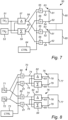
- the antenna device 50 comprises one or more antenna parts 63, and a first transmitter 51 and a second transmitter 53 connected to the/each antenna part 63. More particularly, each antenna part 63 comprises a patch 65, a first transmit path 52 connected to a first connection port 61 of the patch, and a second transmit path 54 connected to a second connection port 62 of the patch 65. Like in the previous structure the connection ports 61, 62 are both associated with one and the same edge of the patch 65.
- the first transmit path 52 comprises a first phase shifter 55 connected to the first connection port 61, and a first signal combiner 57 connected to the first phase shifter 55.
- the second transmit path 54 comprises a second phase shifter 56 connected to the second connection port 62, and a second signal combiner 59 connected to the second phase shifter 56.
- the first transmitter 51 is connected to both the first transmit path 52 and the second transmit path 54.
- the second transmitter 53 is connected to both the first transmit path 52 and the second transmit path 54 as well. More particularly, the first and second transmitters 51, 53 are connected to the signal combiners 57, 59.
- the first signal combiner 57 is a delta element, i.e. a subtractor arranged to generate an output signal, here called delta signal, constituting the difference between a first transmit signal received from the first transmitter 51 and a second transmit signal received from the second transmitter 53.
- the second signal combiner 59 is a sigma element, i.e. an adder arranged to generate an output signal, here called sigma signal, constituting the sum of the first transmit signal and the second transmit signal.
- the antenna device comprises a beam controller 64, which is connected to all phase shifters 55, 56.
- the first transmitter 51 is connected to the first and second transmit paths 52, 54 of each antenna part 63
- the second transmitter 53 is connected to the first and second transmit paths 52, 54 of each antenna part 63.
- the beam controller 64 is connected to the phase shifters 55, 56 of all antenna parts 63 as in the other structures. More particularly, each antenna part 63 comprises a patch 65, and first and second phase shifters 55, 56 connected to the connection ports 61, 62 of the patch 65.
- the first signal combiner 57 is shared by all antenna parts 63, i.e. the output 58 of the first signal combiner 57 is connected to the first phase shifter 55 of each antenna part 63.
- the second signal combiner 59 is shared by all antenna parts 63, i.e. the output 60 of the second signal combiner 59 is connected to the second phase shifter 56 of each antenna part 63.
- the antenna device 70 comprises one or more antenna parts 76, and a first transmitter 71 and a second transmitter 72 connected to the/each antenna part 76. More particularly, each antenna part 76 comprises a patch 77, a first transmit path 74 connected to a first connection port 78 of the patch 77, and a second transmit path 75 connected to a second connection port 79 at the patch 77. Like in the previous structures the connection ports 78, 79 are both associated with one and the same edge of the patch 77.
- the first transmit path 74 comprises a first signal combiner 82 connected to the first connection port 78
- the second transmit path 75 comprises a second signal combiner 84 connected to the second connection port 79.
- the first transmit path 74 comprises a first phase shifter 80 connected to the first signal combiner 82 as well as to the second signal combiner 84
- the second transmit path 75 comprises a second phase shifter 81 connected to both the second signal combiner 84 and the first signal combiner 82.
- the first transmitter 71 is connected to both the first transmit path 74 and the second transmit path 75.
- the second transmitter 72 is connected to the first transmit path 74 and, via the second phase shifter 81, to the second transmit path 75. More particularly, the first transmitter 71 is connected to the first phase shifter 80, and, via the first phase shifter 80, to the second signal combiner 84.
- the second transmitter 72 is connected to the second phase shifter 81 and, via the second phase shifter 81, to the first signal combiner 82. Similar to the third structure, the first signal combiner 82 is a delta element, and the second signal combiner 84 is a sigma element.
- the antenna device 70 comprises a beam controller 73, which is connected to all phase shifters 80, 81.
- the first structure of the antenna device 1 is operated as follows. For each antenna part 2, 13, first and second transmit signals from the transmitter 21 are fed to the patch 3, 14 via the first and second transmit paths 4, 6, 15, 16. The signals originate from the same source. If the first and second transmit signals are fed to the patch 3, 14 in common-mode, that is with the same phase and the same amplitude, the patch 3, 14 works similar to a patch of the prior art having a single port at the edge, but the impedance in each connection port 5, 7, 17, 18 is twice the impedance of the single port. However, the total power transmitted by the patch 3, 14 is doubled as well. That is, the power from both transmit signals is added in phase and thereby the transmitted power is doubled. The total transmitted power is the sum of the power in both connection ports 5, 7, 17, 18 since they work in parallel. The radio frequency signal transmitted from the patch 3 will have a y polarization, see Fig. 6 .
- the transmitted power will be the sum of the power of both ports 5, 7.
- the radio frequency signal transmitted from the patch 3 will have an x polarization, see Fig. 6 .
- the output power will be the sum of the power of the two ports 5, 7.
- the beam controller 20 differentiates the phases of the antenna parts 2, 13 in relation to each other in order to obtain a desired beam forming to the final signal transmitted from the antenna device 1. Since this is done according to methods well known to the person skilled in the art it will not be further described herein.
- a first transmitter Tx1, 31 is included in the first transmit path 32 of each antenna part 39 and it is connected to the first phase shifter 40 of each antenna part 39, which first phase shifter 40 in turn is connected to the first port 35.
- a second transmitter Tx2, 33 is included in the second transmit path of each antenna part 39 and it is connected to the second phase shifter 41 of each antenna part 39, which second phase shifter 41 in turn is connected to the second port 36.
- the first and second transmitters 31, 33 are transmitting the same signal, and the phase controller 42 controls the phases of the phase shifters 40, 41 to form the beam direction and also to determine the polarization.
- the patch becomes polarized in the y-direction.
- the phase difference is 180 degrees the patch 37 becomes polarized in the x-direction.
- the total transmitted power will be the sum of the power of both antenna paths.
- the ports are alternatively activated, causing transmission with x or y polarization, or they are activated in common causing transmission with diagonal polarization with the power of one transmit signal in both cases, since when both ports are activated they do not add in phase.
- the beam forming is provided with the same phase controller 42 by providing phase differences between the antenna parts 39 according to any suitable common technology beam forming method as known to the person skilled in the art.
- the third structure of the antenna device operates as follows.
- the first transmit signal output from the first transmitter 51 is fed to the first signal combiner 57 and to the second signal combiner 59.
- the second transmit signal output from the second transmitter 53 is fed to the second signal combiner 59.
- the delta signal output from the first signal combiner 57 is fed to the first phase shifter 55 of the first transmit path 52, and further to the first connection port 61 of the path 65.
- the sigma signal output from the second signal combiner 59 is fed to the second phase shifter 56 and further to the second connection port 62.
- the first and second phase shifters 55, 56 may be used to mutually phase shift the delta and sigma signals in order to change polarity on the radio frequency signals transmitted from the patch 65 or, in case of several antenna parts 63, in order to steer the beam transmitted from the antenna device 50.
- the first transmit signal tx1 is received in common mode at the first and second connection ports 61, 62, and the second transmit signal tx2 is received in differential mode. Consequently, as explained above, the first transmit signal tx1 is transmitted from the patch 65 as a radio frequency signal in y polarization and the second transmit signal tx2 is transmitted in x polarization from the patch 65. Both signals are transmitted simultaneously. If desired, by means of the phase shifters 55, 56 the polarization of the transmitted signals can be switched such that the first transmit signal tx1 is transmitted in x polarization and the second transmit signal tx2 is transmitted in y polarization.
- the fourth structure of the antenna device 70 generates two simultaneously transmitted radio frequency signals, which are sent with orthogonal polarizations, i.e. x and y polarizations, one originating from the first transmitter 71 and the other originating from the second transmitter 72.
- orthogonal polarizations i.e. x and y polarizations
- the antenna device can be used to receive radio frequency signals as well.
- the inherent isolation between the two polarisations in the patch 65, 77 makes the transmitted signal tx1 independent of the impedance in the transmitter TX2. This allows for transmitting and receiving signals simultaneously in different polarisations, or in time-division mode, without suffering from poor impedance matching in the path that is not active.
- an antenna array is designed that can make use of a number of beamforming channels to control both beam direction and polarization while transmitting power from all channels in both polarizations.
Landscapes
- Variable-Direction Aerials And Aerial Arrays (AREA)
- Waveguide Aerials (AREA)
Claims (14)
- Antennengerät, umfassend einen Antennenteil (39) mit einem Patch (37) mit mehreren Kanten, einem ersten Sendepfad (32), der mit einem ersten Anschlussport (35) an einer ersten Kante (38) des Patches verbunden ist, einem zweiten Sendepfad (34), der mit einem zweiten Anschlussport (36) an der ersten Kante des Patches verbunden ist, wobei der erste und der zweite Anschlussport in einer Entfernung voneinander entlang der ersten Kante angeordnet sind, und ein erster Sender (31) mit wenigstens dem ersten Sendepfad verbunden ist, dadurch gekennzeichnet, dass das Antennengerät weiterhin einen zweiten Sender (33) umfasst, der mit wenigstens dem zweiten Sendepfad verbunden ist.
- Antennengerät nach Anspruch 1, wobei der erste Sendepfad (52) eine erste Signalweiche (57) umfasst, die mit dem ersten und dem zweiten Sender (51, 53) und mit dem ersten Anschlussport (61) verbunden ist, wobei der zweite Sendepfad (54) eine zweite Signalweiche (59) umfasst, die mit dem ersten und dem zweiten Sender und mit dem zweiten Anschlussport (62) verbunden ist, wobei die erste Signalweiche angeordnet ist, um eine Differenz zwischen Signalen zu erzeugen, die von dem ersten und dem zweiten Sender stammen, und wobei die zweite Signalweiche angeordnet ist, um eine Summe der Signale zu erzeugen, die von dem ersten und dem zweiten Sender stammen.
- Antennengerät nach Anspruch 1 oder 2, wobei der erste Sendepfad (32, 52) einen ersten Phasenwechsler (40, 55) umfasst und der zweite Sendepfad (34, 54) einen zweiten Phasenwechsler (41, 56) umfasst.
- Antennengerät nach Anspruch 3, wobei der erste Phasenwechsler (55) mit der ersten Signalweiche (57) und mit dem ersten Anschlussport (61) verbunden ist, und wobei der zweite Phasenwechsler (56) mit der zweiten Signalweiche (59) und mit dem zweiten Anschlussport (62) verbunden ist.
- Antennengerät nach Anspruch 3, wobei der erste Phasenwechsler (80) mit dem ersten Sender (71) und mit der ersten und der zweiten Signalweiche (82, 84) verbunden ist und der zweite Phasenwechsler (81) mit dem zweiten Sender (72) und der ersten und der zweiten Signalweiche (82, 84) verbunden ist.
- Antennengerät nach irgendeinem der Ansprüche 3 bis 5, umfassend eine Strahlensteuerung (42, 64, 73), die mit dem Phasenwechsler (40, 41, 55, 56, 80, 81) jedes Sendepfades (32, 34, 52, 54, 74, 75) verbunden ist.
- Antennengerät nach irgendeinem der vorhergehenden Ansprüche, umfassend zahlreiche Antennenteile (39), wobei der erste und der zweite Sender (31, 33) auf ähnliche Weise mit allen Antennenteilen verbunden sind.
- Verfahren zum Senden eines Funkfrequenzsignals, umfassend:Bereitstellen eines Antennengeräts (30), umfassend einen Antennenteil (39) mit einem Patch (37) mit mehreren Kanten, einem ersten Sendepfad (32), der mit einem ersten Anschlussport (35) einer ersten Kante (38) des Patches verbunden ist, und einen zweiten Sendepfad (34), der mit einem zweiten Anschlussport (36) der ersten Kante des Patches verbunden ist, wobei der erste und der zweite Anschlussport in einer Entfernung voneinander entlang der ersten Kante angeordnet sind; undErzeugen eines ersten Sendesignals mittels eines ersten Senders (31), der mit wenigstens dem ersten Sendepfad verbunden ist, dadurch gekennzeichnet, dass das Verfahren weiterhin das Erzeugen eines zweiten Sendesignals mittels eines zweiten Senders (33) umfasst, der mit wenigstens dem zweiten Sendepfad verbunden ist und das erste und das zweite Sendesignal in den Antennenteil einspeist.
- Verfahren nach Anspruch 8, weiterhin umfassend:Erzeugen eines Sigmasignals, umfassend eine Summe des ersten Sendesignals und des zweiten Sendesignals;Erzeugen eines Deltasignals, umfassend eine Differenz zwischen dem ersten Sendesignal und dem zweiten Sendesignal;Einspeisen des Signalsignals in den zweiten Anschlussport (62); undEinspeisen des Deltasignals in den ersten Anschlussport (61, wodurch ein erstes Funkfrequenzsignal mit einer ersten Polarisierung und ein zweites Funkfrequenzsignal mit einer zweiten Polarisierung orthogonal zur ersten Polarisierung vom Patch (65) übertragen wird.
- Verfahren nach irgendeinem der Ansprüche 8 bis 9, umfassend:
Steuern einer Phasendifferenz zwischen dem ersten und dem zweiten Sendesignal. - Verfahren nach Anspruch 10, wobei das Steuern einer Phasendifferenz das Steuern der Phasendifferenz auf einen von null Grad und 180 Grad umfasst.
- Verfahren nach irgendeinem der Ansprüche 8 bis 9, wobei das erste und das zweite Sendesignal vor dem Erzeugen von Sigma- und Deltasignalen Phasenwechseln unterzogen werden.
- Verfahren nach irgendeinem der Ansprüche 8 bis 9, wobei das Sigmasignal und das Deltasignal vor dem Einspeisen in den ersten und den zweiten Anschlussport Phasenwechseln unterzogen werden.
- Verfahren nach irgendeinem der Ansprüche 8 bis 13, wobei das Antennengerät mehrere Antennenteile umfasst, wobei der erste und der zweite Sender (31, 33) mit allen Antennenteilen (39) verbunden sind, wobei das Verfahren das Steuern einer Phasendifferenz zwischen den Antennenteilen umfasst, um ein Strahlenformen des Ausgangssignals des Antennengeräts (30) zu erhalten.
Applications Claiming Priority (2)
| Application Number | Priority Date | Filing Date | Title |
|---|---|---|---|
| EP19194584.9A EP3787114A1 (de) | 2019-08-30 | 2019-08-30 | Antennenvorrichtung |
| PCT/EP2020/074248 WO2021038110A1 (en) | 2019-08-30 | 2020-08-31 | An antenna device |
Publications (3)
| Publication Number | Publication Date |
|---|---|
| EP4136708A1 EP4136708A1 (de) | 2023-02-22 |
| EP4136708B1 true EP4136708B1 (de) | 2025-03-26 |
| EP4136708C0 EP4136708C0 (de) | 2025-03-26 |
Family
ID=67810454
Family Applications (2)
| Application Number | Title | Priority Date | Filing Date |
|---|---|---|---|
| EP19194584.9A Withdrawn EP3787114A1 (de) | 2019-08-30 | 2019-08-30 | Antennenvorrichtung |
| EP20761298.7A Active EP4136708B1 (de) | 2019-08-30 | 2020-08-31 | Antennenvorrichtung |
Family Applications Before (1)
| Application Number | Title | Priority Date | Filing Date |
|---|---|---|---|
| EP19194584.9A Withdrawn EP3787114A1 (de) | 2019-08-30 | 2019-08-30 | Antennenvorrichtung |
Country Status (5)
| Country | Link |
|---|---|
| US (1) | US11984658B2 (de) |
| EP (2) | EP3787114A1 (de) |
| JP (1) | JP7556940B2 (de) |
| CN (1) | CN114503366B (de) |
| WO (1) | WO2021038110A1 (de) |
Families Citing this family (2)
| Publication number | Priority date | Publication date | Assignee | Title |
|---|---|---|---|---|
| JP2024033165A (ja) * | 2022-08-30 | 2024-03-13 | 古野電気株式会社 | 電力分配器、アンテナ装置、送信機、及びレーダー |
| JP2024033166A (ja) * | 2022-08-30 | 2024-03-13 | 古野電気株式会社 | アンテナ装置、送信機、及びレーダー |
Citations (1)
| Publication number | Priority date | Publication date | Assignee | Title |
|---|---|---|---|---|
| EP3584943A1 (de) * | 2018-06-19 | 2019-12-25 | Samsung Electronics Co., Ltd. | Elektronische vorrichtung mit einer mehrzahl von schaltern, die selektiv eine antenne mit einer mehrzahl von speiseanschlüssen mit einer kommunikationsschaltung verbinden, und ansteuerungsverfahren dafür |
Family Cites Families (15)
| Publication number | Priority date | Publication date | Assignee | Title |
|---|---|---|---|---|
| US5969681A (en) * | 1998-06-05 | 1999-10-19 | Ericsson Inc. | Extended bandwidth dual-band patch antenna systems and associated methods of broadband operation |
| JP3637808B2 (ja) * | 1999-05-19 | 2005-04-13 | 三菱電機株式会社 | マルチビームアンテナ |
| CA2464883A1 (en) * | 2001-11-14 | 2003-05-22 | Louis David Thomas | Antenna system |
| US9780437B2 (en) * | 2005-06-22 | 2017-10-03 | Michael E. Knox | Antenna feed network for full duplex communication |
| US8564439B2 (en) * | 2010-05-27 | 2013-10-22 | The University Of Kansas | Microstrip antenna for RFID device |
| KR100968973B1 (ko) * | 2008-08-11 | 2010-07-14 | 삼성전기주식회사 | 패치 안테나 |
| US10516219B2 (en) * | 2009-04-13 | 2019-12-24 | Viasat, Inc. | Multi-beam active phased array architecture with independent polarization control |
| CN101752664B (zh) * | 2010-01-15 | 2013-07-24 | 华南理工大学 | 基于正交耦合馈电的环形圆极化陶瓷天线 |
| US9203161B2 (en) * | 2010-05-21 | 2015-12-01 | Nec Corporation | Antenna apparatus and method of adjusting the same |
| KR102112904B1 (ko) * | 2014-03-12 | 2020-05-19 | 사브 에이비 | 편파 다이버시티용 안테나 시스템 |
| TWI547015B (zh) * | 2015-01-12 | 2016-08-21 | 均利科技股份有限公司 | 二維天線陣列、一維天線陣列及其單差動饋入天線 |
| KR101743962B1 (ko) * | 2015-02-16 | 2017-06-07 | 주식회사 에이스테크놀로지 | 이중 편파 패치 안테나 |
| CN109361061B (zh) * | 2018-10-29 | 2021-11-02 | 湖南迈克森伟电子科技有限公司 | 天线 |
| US11811146B2 (en) * | 2019-02-28 | 2023-11-07 | Qualcomm Incorporated | Configurable beamforming repeater |
| TWI813371B (zh) * | 2021-07-19 | 2023-08-21 | 創未來科技股份有限公司 | 射頻接收器與用於接收射頻輸入訊號的方法 |
-
2019
- 2019-08-30 EP EP19194584.9A patent/EP3787114A1/de not_active Withdrawn
-
2020
- 2020-08-31 EP EP20761298.7A patent/EP4136708B1/de active Active
- 2020-08-31 WO PCT/EP2020/074248 patent/WO2021038110A1/en not_active Ceased
- 2020-08-31 CN CN202080053848.4A patent/CN114503366B/zh active Active
- 2020-08-31 US US17/638,834 patent/US11984658B2/en active Active
- 2020-08-31 JP JP2022511092A patent/JP7556940B2/ja active Active
Patent Citations (1)
| Publication number | Priority date | Publication date | Assignee | Title |
|---|---|---|---|---|
| EP3584943A1 (de) * | 2018-06-19 | 2019-12-25 | Samsung Electronics Co., Ltd. | Elektronische vorrichtung mit einer mehrzahl von schaltern, die selektiv eine antenne mit einer mehrzahl von speiseanschlüssen mit einer kommunikationsschaltung verbinden, und ansteuerungsverfahren dafür |
Also Published As
| Publication number | Publication date |
|---|---|
| EP3787114A1 (de) | 2021-03-03 |
| US11984658B2 (en) | 2024-05-14 |
| EP4136708C0 (de) | 2025-03-26 |
| CN114503366A (zh) | 2022-05-13 |
| JP7556940B2 (ja) | 2024-09-26 |
| WO2021038110A1 (en) | 2021-03-04 |
| JP2022546682A (ja) | 2022-11-07 |
| CN114503366B (zh) | 2026-01-09 |
| EP4136708A1 (de) | 2023-02-22 |
| US20220278465A1 (en) | 2022-09-01 |
Similar Documents
| Publication | Publication Date | Title |
|---|---|---|
| US11581661B2 (en) | Dual polarized antenna and dual polarized antenna assembly comprising same | |
| US11211720B2 (en) | High-frequency module and communication device | |
| EP2201646B1 (de) | Dualpolarisierte antenne mit niedrigem profil | |
| CN101091287B (zh) | 三极化贴片天线 | |
| KR101127683B1 (ko) | 3중 편파된 패치 안테나 | |
| JP2008510425A (ja) | 導波管ノッチアンテナ | |
| US11063372B2 (en) | Elementary antenna comprising a planar radiating device | |
| US7250908B2 (en) | Beam steering array antenna method and apparatus | |
| JP2003324311A (ja) | 多素子アレー型の平面アンテナ | |
| JPWO2011052238A1 (ja) | アダプティブアレーアンテナ、およびアダプティブアレーアンテナを備えた無線装置 | |
| KR20230072064A (ko) | 이중대역 이중편파 안테나 복사소자 | |
| US10840604B2 (en) | Antenna system | |
| CN107636892A (zh) | 天线 | |
| JPH03166803A (ja) | 二周波分離給電円偏波用マイクロストリップアンテナ | |
| EP1831960B1 (de) | Dreifach polarisierte schlitzantenne | |
| EP4136708B1 (de) | Antennenvorrichtung | |
| JPH09326629A (ja) | アレイアンテナ装置 | |
| JP6577655B2 (ja) | ハイブリッド回路、給電回路、アンテナ装置、及び給電方法 | |
| SE532279C2 (sv) | Förbättrad antennisolation | |
| KR20200132618A (ko) | 시프트 직렬 급전을 이용한 이중편파 안테나 | |
| KR20130046350A (ko) | 통신 시스템에서 다기능 급전 회로 및 안테나 | |
| Trujillo et al. | 3× 3 Multibeam network for a triangular array of three radiating elements: Design and measurement | |
| JPH08130407A (ja) | 偏波角および指向方向制御アンテナ |
Legal Events
| Date | Code | Title | Description |
|---|---|---|---|
| STAA | Information on the status of an ep patent application or granted ep patent |
Free format text: STATUS: UNKNOWN |
|
| STAA | Information on the status of an ep patent application or granted ep patent |
Free format text: STATUS: THE INTERNATIONAL PUBLICATION HAS BEEN MADE |
|
| PUAI | Public reference made under article 153(3) epc to a published international application that has entered the european phase |
Free format text: ORIGINAL CODE: 0009012 |
|
| STAA | Information on the status of an ep patent application or granted ep patent |
Free format text: STATUS: REQUEST FOR EXAMINATION WAS MADE |
|
| 17P | Request for examination filed |
Effective date: 20220128 |
|
| AK | Designated contracting states |
Kind code of ref document: A1 Designated state(s): AL AT BE BG CH CY CZ DE DK EE ES FI FR GB GR HR HU IE IS IT LI LT LU LV MC MK MT NL NO PL PT RO RS SE SI SK SM TR |
|
| GRAP | Despatch of communication of intention to grant a patent |
Free format text: ORIGINAL CODE: EPIDOSNIGR1 |
|
| STAA | Information on the status of an ep patent application or granted ep patent |
Free format text: STATUS: GRANT OF PATENT IS INTENDED |
|
| GRAJ | Information related to disapproval of communication of intention to grant by the applicant or resumption of examination proceedings by the epo deleted |
Free format text: ORIGINAL CODE: EPIDOSDIGR1 |
|
| STAA | Information on the status of an ep patent application or granted ep patent |
Free format text: STATUS: REQUEST FOR EXAMINATION WAS MADE |
|
| INTG | Intention to grant announced |
Effective date: 20240829 |
|
| INTC | Intention to grant announced (deleted) | ||
| GRAP | Despatch of communication of intention to grant a patent |
Free format text: ORIGINAL CODE: EPIDOSNIGR1 |
|
| STAA | Information on the status of an ep patent application or granted ep patent |
Free format text: STATUS: GRANT OF PATENT IS INTENDED |
|
| INTG | Intention to grant announced |
Effective date: 20241023 |
|
| GRAS | Grant fee paid |
Free format text: ORIGINAL CODE: EPIDOSNIGR3 |
|
| GRAA | (expected) grant |
Free format text: ORIGINAL CODE: 0009210 |
|
| STAA | Information on the status of an ep patent application or granted ep patent |
Free format text: STATUS: THE PATENT HAS BEEN GRANTED |
|
| AK | Designated contracting states |
Kind code of ref document: B1 Designated state(s): AL AT BE BG CH CY CZ DE DK EE ES FI FR GB GR HR HU IE IS IT LI LT LU LV MC MK MT NL NO PL PT RO RS SE SI SK SM TR |
|
| REG | Reference to a national code |
Ref country code: GB Ref legal event code: FG4D |
|
| REG | Reference to a national code |
Ref country code: CH Ref legal event code: EP |
|
| REG | Reference to a national code |
Ref country code: DE Ref legal event code: R096 Ref document number: 602020048344 Country of ref document: DE |
|
| REG | Reference to a national code |
Ref country code: IE Ref legal event code: FG4D |
|
| U01 | Request for unitary effect filed |
Effective date: 20250408 |
|
| U07 | Unitary effect registered |
Designated state(s): AT BE BG DE DK EE FI FR IT LT LU LV MT NL PT RO SE SI Effective date: 20250414 |
|
| PG25 | Lapsed in a contracting state [announced via postgrant information from national office to epo] |
Ref country code: RS Free format text: LAPSE BECAUSE OF FAILURE TO SUBMIT A TRANSLATION OF THE DESCRIPTION OR TO PAY THE FEE WITHIN THE PRESCRIBED TIME-LIMIT Effective date: 20250626 |
|
| PG25 | Lapsed in a contracting state [announced via postgrant information from national office to epo] |
Ref country code: NO Free format text: LAPSE BECAUSE OF FAILURE TO SUBMIT A TRANSLATION OF THE DESCRIPTION OR TO PAY THE FEE WITHIN THE PRESCRIBED TIME-LIMIT Effective date: 20250626 |
|
| PG25 | Lapsed in a contracting state [announced via postgrant information from national office to epo] |
Ref country code: HR Free format text: LAPSE BECAUSE OF FAILURE TO SUBMIT A TRANSLATION OF THE DESCRIPTION OR TO PAY THE FEE WITHIN THE PRESCRIBED TIME-LIMIT Effective date: 20250326 |
|
| PG25 | Lapsed in a contracting state [announced via postgrant information from national office to epo] |
Ref country code: GR Free format text: LAPSE BECAUSE OF FAILURE TO SUBMIT A TRANSLATION OF THE DESCRIPTION OR TO PAY THE FEE WITHIN THE PRESCRIBED TIME-LIMIT Effective date: 20250627 |
|
| U20 | Renewal fee for the european patent with unitary effect paid |
Year of fee payment: 6 Effective date: 20250626 |
|
| PG25 | Lapsed in a contracting state [announced via postgrant information from national office to epo] |
Ref country code: SM Free format text: LAPSE BECAUSE OF FAILURE TO SUBMIT A TRANSLATION OF THE DESCRIPTION OR TO PAY THE FEE WITHIN THE PRESCRIBED TIME-LIMIT Effective date: 20250326 |
|
| PG25 | Lapsed in a contracting state [announced via postgrant information from national office to epo] |
Ref country code: ES Free format text: LAPSE BECAUSE OF FAILURE TO SUBMIT A TRANSLATION OF THE DESCRIPTION OR TO PAY THE FEE WITHIN THE PRESCRIBED TIME-LIMIT Effective date: 20250326 |
|
| PG25 | Lapsed in a contracting state [announced via postgrant information from national office to epo] |
Ref country code: PL Free format text: LAPSE BECAUSE OF FAILURE TO SUBMIT A TRANSLATION OF THE DESCRIPTION OR TO PAY THE FEE WITHIN THE PRESCRIBED TIME-LIMIT Effective date: 20250326 |
|
| PGFP | Annual fee paid to national office [announced via postgrant information from national office to epo] |
Ref country code: GB Payment date: 20250708 Year of fee payment: 6 |
|
| PG25 | Lapsed in a contracting state [announced via postgrant information from national office to epo] |
Ref country code: SK Free format text: LAPSE BECAUSE OF FAILURE TO SUBMIT A TRANSLATION OF THE DESCRIPTION OR TO PAY THE FEE WITHIN THE PRESCRIBED TIME-LIMIT Effective date: 20250326 |
|
| PG25 | Lapsed in a contracting state [announced via postgrant information from national office to epo] |
Ref country code: IS Free format text: LAPSE BECAUSE OF FAILURE TO SUBMIT A TRANSLATION OF THE DESCRIPTION OR TO PAY THE FEE WITHIN THE PRESCRIBED TIME-LIMIT Effective date: 20250726 |
|
| PG25 | Lapsed in a contracting state [announced via postgrant information from national office to epo] |
Ref country code: CZ Free format text: LAPSE BECAUSE OF FAILURE TO SUBMIT A TRANSLATION OF THE DESCRIPTION OR TO PAY THE FEE WITHIN THE PRESCRIBED TIME-LIMIT Effective date: 20250326 |
|
| PLBE | No opposition filed within time limit |
Free format text: ORIGINAL CODE: 0009261 |
|
| STAA | Information on the status of an ep patent application or granted ep patent |
Free format text: STATUS: NO OPPOSITION FILED WITHIN TIME LIMIT |
|
| REG | Reference to a national code |
Ref country code: CH Ref legal event code: L10 Free format text: ST27 STATUS EVENT CODE: U-0-0-L10-L00 (AS PROVIDED BY THE NATIONAL OFFICE) Effective date: 20260211 |
|
| 26N | No opposition filed |
Effective date: 20260105 |
|
| REG | Reference to a national code |
Ref country code: CH Ref legal event code: H13 Free format text: ST27 STATUS EVENT CODE: U-0-0-H10-H13 (AS PROVIDED BY THE NATIONAL OFFICE) Effective date: 20260324 |
|
| PG25 | Lapsed in a contracting state [announced via postgrant information from national office to epo] |
Ref country code: MC Free format text: LAPSE BECAUSE OF FAILURE TO SUBMIT A TRANSLATION OF THE DESCRIPTION OR TO PAY THE FEE WITHIN THE PRESCRIBED TIME-LIMIT Effective date: 20250326 |
|
| PG25 | Lapsed in a contracting state [announced via postgrant information from national office to epo] |
Ref country code: CH Free format text: LAPSE BECAUSE OF NON-PAYMENT OF DUE FEES Effective date: 20250831 |
|
| U70 | Rights in rem or legal means of execution for european patent with unitary effect registered |
Designated state(s): AT BE BG DE DK EE FI FR IT LT LU LV MT NL PT RO SE SI Effective date: 20260304 |