EP4136566B1 - Verfahren und system zum trainieren eines maschinenlernmodells zur klassifizierung von komponenten in einem materialstrom - Google Patents
Verfahren und system zum trainieren eines maschinenlernmodells zur klassifizierung von komponenten in einem materialstrom Download PDFInfo
- Publication number
- EP4136566B1 EP4136566B1 EP21717936.5A EP21717936A EP4136566B1 EP 4136566 B1 EP4136566 B1 EP 4136566B1 EP 21717936 A EP21717936 A EP 21717936A EP 4136566 B1 EP4136566 B1 EP 4136566B1
- Authority
- EP
- European Patent Office
- Prior art keywords
- components
- unknown
- material stream
- training
- machine learning
- Prior art date
- Legal status (The legal status is an assumption and is not a legal conclusion. Google has not performed a legal analysis and makes no representation as to the accuracy of the status listed.)
- Active
Links
Images



Classifications
-
- B—PERFORMING OPERATIONS; TRANSPORTING
- B07—SEPARATING SOLIDS FROM SOLIDS; SORTING
- B07C—POSTAL SORTING; SORTING INDIVIDUAL ARTICLES, OR BULK MATERIAL FIT TO BE SORTED PIECE-MEAL, e.g. BY PICKING
- B07C5/00—Sorting according to a characteristic or feature of the articles or material being sorted, e.g. by control effected by devices which detect or measure such characteristic or feature; Sorting by manually actuated devices, e.g. switches
- B07C5/34—Sorting according to other particular properties
- B07C5/342—Sorting according to other particular properties according to optical properties, e.g. colour
-
- B—PERFORMING OPERATIONS; TRANSPORTING
- B09—DISPOSAL OF SOLID WASTE; RECLAMATION OF CONTAMINATED SOIL
- B09B—DISPOSAL OF SOLID WASTE NOT OTHERWISE PROVIDED FOR
- B09B5/00—Operations not covered by a single other subclass or by a single other group in this subclass
-
- G—PHYSICS
- G01—MEASURING; TESTING
- G01N—INVESTIGATING OR ANALYSING MATERIALS BY DETERMINING THEIR CHEMICAL OR PHYSICAL PROPERTIES
- G01N21/00—Investigating or analysing materials by the use of optical means, i.e. using sub-millimetre waves, infrared, visible or ultraviolet light
- G01N21/17—Systems in which incident light is modified in accordance with the properties of the material investigated
- G01N21/25—Colour; Spectral properties, i.e. comparison of effect of material on the light at two or more different wavelengths or wavelength bands
-
- G—PHYSICS
- G01—MEASURING; TESTING
- G01N—INVESTIGATING OR ANALYSING MATERIALS BY DETERMINING THEIR CHEMICAL OR PHYSICAL PROPERTIES
- G01N21/00—Investigating or analysing materials by the use of optical means, i.e. using sub-millimetre waves, infrared, visible or ultraviolet light
- G01N21/62—Systems in which the material investigated is excited whereby it emits light or causes a change in wavelength of the incident light
- G01N21/63—Systems in which the material investigated is excited whereby it emits light or causes a change in wavelength of the incident light optically excited
- G01N21/65—Raman scattering
-
- G—PHYSICS
- G01—MEASURING; TESTING
- G01N—INVESTIGATING OR ANALYSING MATERIALS BY DETERMINING THEIR CHEMICAL OR PHYSICAL PROPERTIES
- G01N21/00—Investigating or analysing materials by the use of optical means, i.e. using sub-millimetre waves, infrared, visible or ultraviolet light
- G01N21/62—Systems in which the material investigated is excited whereby it emits light or causes a change in wavelength of the incident light
- G01N21/71—Systems in which the material investigated is excited whereby it emits light or causes a change in wavelength of the incident light thermally excited
- G01N21/718—Laser microanalysis, i.e. with formation of sample plasma
-
- G—PHYSICS
- G01—MEASURING; TESTING
- G01N—INVESTIGATING OR ANALYSING MATERIALS BY DETERMINING THEIR CHEMICAL OR PHYSICAL PROPERTIES
- G01N23/00—Investigating or analysing materials by the use of wave or particle radiation, e.g. X-rays or neutrons, not covered by groups G01N3/00 – G01N17/00, G01N21/00 or G01N22/00
- G01N23/20—Investigating or analysing materials by the use of wave or particle radiation, e.g. X-rays or neutrons, not covered by groups G01N3/00 – G01N17/00, G01N21/00 or G01N22/00 by using diffraction of the radiation by the materials, e.g. for investigating crystal structure; by using scattering of the radiation by the materials, e.g. for investigating non-crystalline materials; by using reflection of the radiation by the materials
-
- G—PHYSICS
- G01—MEASURING; TESTING
- G01N—INVESTIGATING OR ANALYSING MATERIALS BY DETERMINING THEIR CHEMICAL OR PHYSICAL PROPERTIES
- G01N23/00—Investigating or analysing materials by the use of wave or particle radiation, e.g. X-rays or neutrons, not covered by groups G01N3/00 – G01N17/00, G01N21/00 or G01N22/00
- G01N23/22—Investigating or analysing materials by the use of wave or particle radiation, e.g. X-rays or neutrons, not covered by groups G01N3/00 – G01N17/00, G01N21/00 or G01N22/00 by measuring secondary emission from the material
- G01N23/223—Investigating or analysing materials by the use of wave or particle radiation, e.g. X-rays or neutrons, not covered by groups G01N3/00 – G01N17/00, G01N21/00 or G01N22/00 by measuring secondary emission from the material by irradiating the sample with X-rays or gamma-rays and by measuring X-ray fluorescence
-
- G—PHYSICS
- G01—MEASURING; TESTING
- G01N—INVESTIGATING OR ANALYSING MATERIALS BY DETERMINING THEIR CHEMICAL OR PHYSICAL PROPERTIES
- G01N23/00—Investigating or analysing materials by the use of wave or particle radiation, e.g. X-rays or neutrons, not covered by groups G01N3/00 – G01N17/00, G01N21/00 or G01N22/00
- G01N23/22—Investigating or analysing materials by the use of wave or particle radiation, e.g. X-rays or neutrons, not covered by groups G01N3/00 – G01N17/00, G01N21/00 or G01N22/00 by measuring secondary emission from the material
- G01N23/225—Investigating or analysing materials by the use of wave or particle radiation, e.g. X-rays or neutrons, not covered by groups G01N3/00 – G01N17/00, G01N21/00 or G01N22/00 by measuring secondary emission from the material using electron or ion
- G01N23/2251—Investigating or analysing materials by the use of wave or particle radiation, e.g. X-rays or neutrons, not covered by groups G01N3/00 – G01N17/00, G01N21/00 or G01N22/00 by measuring secondary emission from the material using electron or ion using incident electron beams, e.g. scanning electron microscopy [SEM]
-
- G—PHYSICS
- G01—MEASURING; TESTING
- G01N—INVESTIGATING OR ANALYSING MATERIALS BY DETERMINING THEIR CHEMICAL OR PHYSICAL PROPERTIES
- G01N24/00—Investigating or analyzing materials by the use of nuclear magnetic resonance, electron paramagnetic resonance or other spin effects
- G01N24/08—Investigating or analyzing materials by the use of nuclear magnetic resonance, electron paramagnetic resonance or other spin effects by using nuclear magnetic resonance
-
- G—PHYSICS
- G06—COMPUTING OR CALCULATING; COUNTING
- G06N—COMPUTING ARRANGEMENTS BASED ON SPECIFIC COMPUTATIONAL MODELS
- G06N20/00—Machine learning
-
- G—PHYSICS
- G06—COMPUTING OR CALCULATING; COUNTING
- G06V—IMAGE OR VIDEO RECOGNITION OR UNDERSTANDING
- G06V10/00—Arrangements for image or video recognition or understanding
- G06V10/40—Extraction of image or video features
- G06V10/58—Extraction of image or video features relating to hyperspectral data
-
- G—PHYSICS
- G06—COMPUTING OR CALCULATING; COUNTING
- G06V—IMAGE OR VIDEO RECOGNITION OR UNDERSTANDING
- G06V10/00—Arrangements for image or video recognition or understanding
- G06V10/70—Arrangements for image or video recognition or understanding using pattern recognition or machine learning
-
- G—PHYSICS
- G06—COMPUTING OR CALCULATING; COUNTING
- G06V—IMAGE OR VIDEO RECOGNITION OR UNDERSTANDING
- G06V10/00—Arrangements for image or video recognition or understanding
- G06V10/70—Arrangements for image or video recognition or understanding using pattern recognition or machine learning
- G06V10/77—Processing image or video features in feature spaces; using data integration or data reduction, e.g. principal component analysis [PCA] or independent component analysis [ICA] or self-organising maps [SOM]; Blind source separation
- G06V10/774—Generating sets of training patterns; Bootstrap methods, e.g. bagging or boosting
-
- G—PHYSICS
- G06—COMPUTING OR CALCULATING; COUNTING
- G06V—IMAGE OR VIDEO RECOGNITION OR UNDERSTANDING
- G06V10/00—Arrangements for image or video recognition or understanding
- G06V10/70—Arrangements for image or video recognition or understanding using pattern recognition or machine learning
- G06V10/77—Processing image or video features in feature spaces; using data integration or data reduction, e.g. principal component analysis [PCA] or independent component analysis [ICA] or self-organising maps [SOM]; Blind source separation
- G06V10/776—Validation; Performance evaluation
-
- G—PHYSICS
- G06—COMPUTING OR CALCULATING; COUNTING
- G06V—IMAGE OR VIDEO RECOGNITION OR UNDERSTANDING
- G06V10/00—Arrangements for image or video recognition or understanding
- G06V10/70—Arrangements for image or video recognition or understanding using pattern recognition or machine learning
- G06V10/77—Processing image or video features in feature spaces; using data integration or data reduction, e.g. principal component analysis [PCA] or independent component analysis [ICA] or self-organising maps [SOM]; Blind source separation
- G06V10/778—Active pattern-learning, e.g. online learning of image or video features
-
- G—PHYSICS
- G06—COMPUTING OR CALCULATING; COUNTING
- G06V—IMAGE OR VIDEO RECOGNITION OR UNDERSTANDING
- G06V20/00—Scenes; Scene-specific elements
- G06V20/40—Scenes; Scene-specific elements in video content
-
- G—PHYSICS
- G06—COMPUTING OR CALCULATING; COUNTING
- G06V—IMAGE OR VIDEO RECOGNITION OR UNDERSTANDING
- G06V2201/00—Indexing scheme relating to image or video recognition or understanding
- G06V2201/06—Recognition of objects for industrial automation
Definitions
- the invention relates to a method and system for training a machine learning model configured to perform characterization of components in a material stream with a plurality of unknown components.
- the invention further relates to a computer program product.
- a computer vision application may apply a classifier or a statistical model (e.g. machine learning model, regression model) to captured images or video streams in order to recognize components or objects.
- a statistical model e.g. machine learning model, regression model
- To ensure reliable performance of the classifier it must be trained using a plurality of labeled examples.
- Such systems often rely on human labor to manually label the data.
- the characterization of one or more components in material streams has several important applications, for example in recycling processes, agricultural processes, food productions processes, etc.
- the characterization can for instance be used for quality control, value assessment, and process engineering and control.
- waste processing conventionally many waste streams are sub-optimally recycled due to the lack of characterization data.
- heterogeneous material streams e.g. bulk solid waste streams.
- material stream characterization involves manual inspection of objects by a person, e.g. plant personnel working at a special facility. This approach is slow, subjective and, expensive and eventually it delivers only little information about the particles in the material stream. In some conventional methods, samples are taken and tested/analyzed for instance in a laboratory. This process can take up too much time (chemical analysis make take days, weeks to months), and may result in increased costs. Furthermore, only a small fraction of the total amount of components/materials/objects in the material stream are characterized. Typically, many material streams are sub-optimally identified because the quality of the materials is difficult to measure. There is a need for a fast, objective and/or automated method that delivers data on a more detailed level.
- One example of characterization of material streams is waste characterization.
- a machine learning model is a statistical classifier which can be trained using large amounts of data which can be labeled by humans and/or experimentation. Such labeling can be a labor-intensive and/or expensive process.
- One of the bottlenecks in building an accurate statistical system is the time spent (manual) labeling in order to have high quality labeled data.
- samples to be labeled cf. new data points
- Document CN 110 503 161 A discloses a target detection method for ore slug targets based on a weakly supervised machine learning model.
- the invention provides for a method for training a machine learning model configured to perform characterization of components in a heterogeneous material stream with a plurality of unknown components, the method comprising: scanning the material stream by means of a sensory system configured to perform imaging of the material stream with the plurality of unknown components; predicting one or more prediction labels and associated label prediction probabilities for each of the unknown components in the material stream by means of a machine learning model which is configured to receive as input the imaging of the material stream and/or one or more features of the unknown components extracted from the imaging of the material stream; determining a training reward associated with each unknown component within the plurality of unknown components in the material stream; selecting at least one unknown component from the plurality of unknown components in the material stream based at least partially on the training reward associated with the unknown components, wherein determining a ground truth for said at least one unknown component requires analysis in physical isolation, wherein the selected at least one unknown component is physically isolated from the material stream by means of a separator unit, wherein the separator unit is configured to move the selected unknown component to
- the training reward can be a prediction of the improvement of a (machine learning) model / classifier performance by adding one or more ground truth labels linked to components of the material stream to the database.
- the training reward can be a prediction of increase in a performance of the machine learning model, indicated by a performance indicator.
- performance indicator can be accuracy, purity, yield, etc. Many different performance indicators or scores can be used.
- an analysis can be performed for determining the ground truth label.
- This knowledge can be fed back to the machine learning model during a training process. In this way, the accuracy of the incrementally trained machine learning model can be enhanced.
- One or more of the components in the material stream can be selected which would, if labeled for ground truth determination, maximally improve the performance and/or accuracy of the classification (cf. prediction of labeling) by the machine learning model.
- the system can select and physically isolate those components which would provide more learning improvement of the model than the other components in the material stream.
- the manual/experimental effort for training the machine learning model can be effectively reduced through the combination of active, semi-supervised and unsupervised learning techniques.
- the system includes a separator unit for physically isolating one or more unknown components for further analysis.
- the selection of the one or more unknown components can be carried out by using confidence scores, prediction probabilities, entropy, density in feature space, etc.
- the machine learning model may employ active learning for training.
- the machine learning model can be seen as a learner which can actively select learning data.
- the physical active learning may include means for physically isolating selected components in the material stream to be analyzed for providing the selected learning data. In the active learning, a cycle of experimenting, learning of results, and selection of components of next experiment is repeated, thereby enabling the reduction in a total amount of experiments. The learning of results and selection of components of the next experiment are carried out by the computer.
- the system has a separator unit to physically isolate the selection of components from the material stream. Many results can be obtained from small number or amount of experiments.
- the physical active learning can be employed in an experimental design to design appropriately experiments for analyzing components in the material stream, which experiments may require a lot of cost, a lot of effort, and/or a long time.
- the machine learning model is configured to receive as input one or more user-defined features of the unknown components extracted from the imaging of the material stream.
- the separation unit comprises multiple subunits employing different separation techniques.
- the separation unit has at least a first subunit and a second subunit, wherein one of the first or second subunit is selected for physical isolation of the selected at least one unknown component based on the one or more features of the unknown components extracted from the imaging of the material stream.
- a suitable subunit of the separation unit can be used to separate the unknown component from the material stream.
- different separation techniques may be needed depending on the mass, size, etc. of the unknown components.
- a paper may be better separated using fluid blowing means, and block of metal may be better separated using mechanical means. Since, the one or more features of the unknown components is extracted from the imaging of the material stream, this data is available and can be advantageously used for selecting a suitable subunit.
- the first subunit is used for physical isolation of smaller and/or lighter components in the material stream, and the second subunit being used for physical isolation of larger and/or heavier components in the material stream.
- a machine learning model can further control which separation technique is most appropriately used for physically isolating a selected unknown component from the material stream.
- the first subunit is configured to isolate components by directing a fluid jet towards the components in order to blow the components to the separate accessible compartment, and wherein the second subunit is configured to isolate components by means of a mechanical manipulation device.
- the mechanical manipulation device of the second subunit comprises at least one robotic arm.
- the components in the material stream are scanned by means of a sensory system including an X-ray sensor configured to perform multi-energy imaging for obtaining at least a lower-energy X-ray image and a higher-energy X-ray image.
- a sensory system including an X-ray sensor configured to perform multi-energy imaging for obtaining at least a lower-energy X-ray image and a higher-energy X-ray image.
- Segmentation of images obtained by means of the sensory system can be performed in order to separate one or more distinct objects in the images, wherein data indicative of an area of the segmented objects is determined.
- data indicative of an area density and data indicative of an atom number can be determined by analysis of the lower-energy X-ray image and the higher-energy X-ray image, the data indicative of the area density and atom number being determined by means of a model which is calibrated by performing multi-energy X-ray imaging with different materials with known area densities and atom numbers.
- data indicative of a mass may be calculated based on the data indicative of the area density and the data indicative of the area of each of the segmented objects.
- a resulting force induced by the fluid jet is adjusted based on the mass of the selected at least one unknown component.
- a value indicative of a difficulty for performing physical isolation of the unknown component from the material stream by means of the separation unit is determined and associated to each unknown component, wherein the selection of the at least one unknown component from the plurality of unknown components in the material stream is additionally based on the value of the difficulty for performing physical isolation of the unknown component from the material stream.
- Ranking of difficulty of isolation may allow to vastly improve the efficiency of training the machine model. Separation of components which are difficult to separate from the material stream, may result in failure of ground truth analysis. In such cases, it may be too late to still select the other candidate unknown components for selection, resulting in reduced training performance.
- the invention allows to effectively prevent such situations by also taking the difficulty of separation into account. For example, the extent to which something obstructs the unknow component (e.g. things around) may play an important role in the difficulty in physically isolating the unknown component from the material stream. It may even influence the analysis, since other components may be attached thereto.
- a prediction or estimation of an accuracy and/or purity of separation is determined based on which the at least one unknown component from the plurality of unknown components in the material stream is selected for physical isolation.
- a top number of unknown components are selected from the plurality of unknown components in the material stream based on the training reward associated with the unknown components, wherein a subset of the top number of unknown components is selected for physical isolation based on the value indicative of the difficulty for performing physical isolation by means of the separation unit.
- the training reward is calculated based on one or more reward indicators.
- the training reward is provided by a user (e.g. estimation based on expert knowledge).
- a machine learning models or learning machines may be understood as computational entities that rely on one or more machine learning algorithms for performing a task for which they have not been explicitly programmed to perform.
- the machine learning models may be capable to adjust their behavior to their environment. In the context of component characterization and detection in material streams, this ability can be very important, as the material streams often face changing conditions and requirements.
- the systems can be configured to incorporate fresh incoming data such as to operate in real-time.
- the machine learning model knowledge can be incremented with new data points at any time. In batch mode, a large dataset can be collected, and the entire dataset can be processed at once. In incremental mode, the machine learning model can be incremented with new data points at any time (lightweight and adaptable).
- the incremental version of the machine learning model is periodically trained using data periodically obtained from the analysis of the ground truth label of the isolated at least one unknown component.
- the number of training examples to be labeled can be significantly reduced by employing active learning. Accordingly, unlabeled examples are inspected, and the most informative ones are selectively samples with respect to a given cost function for a human (e.g. at least partially manual) and/or machine to label.
- the active learning algorithm may provide a way to effectively select the examples for (physical) labeling that will have the largest performance improvement.
- the next component to be analyzed is selected based on its distance from (clusters of) other components in the feature space.
- other techniques can also be used. For instance, a statistical approach can be employed, in which components are selected and isolated for analysis such that at least one statistical property of the future machine learning model (e.g. the learner variance) is optimized.
- the selection of the components is performed based on a level of disagreement amount an ensemble of classifiers. It will be appreciated that other approaches are also envisaged for determining a training reward linked to each of the components identified in the material stream.
- the plurality of identified unknown components are divided into one or more clusters such that each cluster contains components having similar features and/or characteristics, wherein identified unknown components are assigned a training reward at least partially based on its distance from the one or more clusters.
- the invention enables control of reward training by means of certainty prediction in a machine learning model e.g. with a neural network implementation.
- determining the training reward based on uncertainty/confidence of the prediction of the prediction label by the machine learning model is one possible implementation.
- Other implementations are also envisaged.
- a component of the material stream can be observed which has never been processed before by the machine learning model.
- the model may determine with fairly high certainty that it belongs to a certain classification (prediction label), while the component in fact belongs to a classification that the model has not yet observed. This may be overcome by analyzing clusters in the feature space instead of uncertainties of the components. If the component is far from all currently observed clusters in the feature space, then selection can be made based on the location of the component or distance of the component to the clusters. This can be seen as an anomaly or outlier detection.
- the physical active machine learning system can select new unknown components (i.e. unlabeled observations) that are diverse across all observed unknown components (i.e. unlabeled observations). In this manner, the (physical) active machine learning system can assemble a higher quality training set.
- Clustering algorithms can be used to distinguish between different clusters, to see if the clusters are intrinsically different from each other. Components that are identified to lie deep in the cluster can have a low uncertainty, while particles that are farther from the core or in between several clusters can have a higher uncertainty.
- the training reward may be linked to the clusters such as to more accurately determine the clusters and their boundaries in one or more dimensions.
- the training reward is at least partially based on a confidence score.
- a training score can be determined based on the uncertainty and diversity of each unlabeled data point linked to the identified components in the material stream.
- data points with top n scores are selected in a batch, wherein n corresponds to a batch size.
- the batch size can be understood as a number of data points (cf. components) to be selected from an unlabeled material stream.
- the selected components can be isolated from other unlabeled components in the material stream for manual and/or experimental annotation.
- the model can be trained from a selected set of unknown components of the plurality of unknown components in the material stream using experimentally-labeled data (e.g. manual determination, automatized determination) rather than manual / human labeled data.
- experimentally-labeled data e.g. manual determination, automatized determination
- the machine learning model may be first trained using a first set of ground truth data.
- This first set may for instance be a small set which is manually generated or automatically generated by means of a model.
- the one or more unknown components from the plurality of unknown components may be recognized as candidates for providing training data.
- training rewards e.g. confidence measures
- the selected one or more unknown components may correspond to cases which are likely to have recognition errors by the used (trained) machine learning model.
- the one or more unknown components can then be physically isolated by a separator unit (e.g. robotic arrangement having one or more sensors for performing the isolation task) enabling further analysis for determining the ground truth.
- a separator unit e.g. robotic arrangement having one or more sensors for performing the isolation task
- a human can verify the isolated selected one or more unknown components manually.
- machines and/or other sensory devices can be used for experimentally determining the isolated selected one or more unknown components.
- multiple components are simultaneously selected and isolated at a single instance at a time. This is relevant in cases where there is a weak correlation between feature and target (label / dependent variable) space.
- the selection of the multiple components for isolation is based on their predicted label by the machine learning model.
- the plurality of identified unknown components are ordered as candidates for selection based on the training reward in order to yield a selectively sampled order, wherein a top number of identified unknown components from the selectively sampled order are isolated and analyzed for determining the ground truth label thereof based on which the incremental version of the machine learning model is trained.
- the machine learning model is configured to employ a pool-based active learning, wherein the machine learning model is exposed to a pool of unlabeled data points linked to the identified components in the material stream, wherein the machine learning model is configured to iteratively select one or more components of the plurality of components in the material stream for at least partially manual and/or at least partially automatic (e.g. using measurement devices) annotation for determining the ground truth.
- a pool-based active learning wherein the machine learning model is exposed to a pool of unlabeled data points linked to the identified components in the material stream
- the machine learning model is configured to iteratively select one or more components of the plurality of components in the material stream for at least partially manual and/or at least partially automatic (e.g. using measurement devices) annotation for determining the ground truth.
- the separate accessible compartment enables a manual removal of the isolated unknown component, wherein an indication of an internal reference of the machine learning model is provided for the isolated unknown component within the separate accessible compartment, wherein the analysis of the at least one selected unknown component is performed at least partially by human annotation.
- the machine learning model is serial query based, wherein a single component is selected and isolated for further analysis at a time.
- the machine learning model is batch mode based, wherein a batch of components are selected and isolated for (e.g. simultaneous) analysis before updating the machine learning model.
- the isolated unknown component is analyzed by means of an analyzing unit.
- the analyzing unit is arranged to perform a characterization of the isolated unknown component within the separate accessible compartment for determining the ground truth label based on the characterization.
- the isolated unknown component can be analyzed automatically by means of the analyzing unit.
- the analyzing unit is configured to perform chemical analysis on isolated components for determining the ground truth label at least partially based thereon.
- the analyzing unit is configured to perform destructive measurements on isolated components for determining the ground truth label at least partially based thereon.
- the analyzing unit is configured to perform at least one of: an energy or wavelength dispersive X-ray fluorescence (XRF) spectrometry, fire assay, inductively coupled plasma optical emission spectrometry (ICP-OES), inductively coupled plasma atomic emission spectroscopy (ICP-AES), inductively coupled plasma mass spectrometry (ICP-MS), laser-induced breakdown spectroscopy (LIBS), (near) infra-red (NIR) spectroscopy, hyperspectral spectroscopy, x-ray diffraction (XRD) analysis, scanning electron microscopy (SEM), nuclear magnetic resonance (NMR), Raman spectroscopy, or the like.
- XRF energy or wavelength dispersive X-ray fluorescence
- ICP-OES inductively coupled plasma optical emission spectrometry
- ICP-AES inductively coupled plasma atomic emission spectroscopy
- ICP-MS inductively coupled plasma mass spectrometry
- LIBS laser-induced breakdown spect
- the analyzing unit may be configured to perform measurements in offline mode with respect to the sensory system.
- the analyzing unit may also be configured to operate in batch processing mode for determining the ground truth label of the isolated objects.
- the analyzing unit is configured to perform measurements in near real time, with a certain time delay (e.g. a couple of minutes). It will be appreciated that in some examples, the analyzing unit may also be configured to provide relatively fast feedback, for example operate in real-time or quasi real-time (e.g. online measurements).
- the analyzing unit may be configured to perform deferred measurements (e.g. non-real-time).
- the analyzing unit is configured to perform discontinuous, periodic, and/or intermittent measurements for determining the ground truth of selected objects.
- the measurement technique performed by the analyzing unit may require an extended, ongoing, or relatively long-term measurement process.
- the one or more measurement techniques employed by the analyzing unit may require preparatory steps which can be time-intensive and/or at least partially destructive. In some examples, the one or more measurement techniques are not performed in real-time.
- the employed measurement technique may be relatively expensive and/or require human effort.
- the analyzing unit performs non-imaging measurements.
- the analyzing unit does not perform (optical) imaging techniques, for example not producing images.
- the analyzing unit is configured to perform measurements based on chemical analysis.
- the sensory system includes an X-ray sensor configured to perform multi-energy imaging for obtaining at least a lower-energy X-ray image and a higher-energy X-ray image, wherein images obtained by means of the sensory system are segmented in order to separate one or more distinct unknown components in the images, wherein data indicative of an area of the segmented objects is determined, wherein for each of the segmented unknown components, data indicative of an area density and data indicative of an atom number and/or a chemical composition are determined by analysis of the lower-energy X-ray image and the higher-energy X-ray image, the data indicative of the density and atom number being determined by means of a model which is calibrated by performing multi-energy X-ray imaging with different materials with known area densities and atom numbers, wherein for each of the segmented unknown components, data indicative of a mass is calculated based on the data indicative of the area density and the data indicative of the area of the segmented objects.
- an X-ray sensor configured to perform multi-energy imaging for obtaining
- the X-ray sensor is a dual energy X-ray sensor.
- the sensory system further includes a depth imaging unit for determining data indicative of a volume of segmented objects.
- the depth imaging unit includes at least one of a three-dimensional laser triangulation unit or three-dimensional camera.
- the sensory system further includes a color imaging unit configured to take color images of the segmented objects.
- data from different subsystems of the sensory system is aligned prior to determining characterizing features for each of the one or more segmented objects.
- each of the one or more segmented objects further characterizing features relating to at least one of a volume, dimension, diameter, shape, texture, color, or eccentricity are determined.
- the material stream is moved on a conveyor, wherein the material stream is scanned by means of the sensory system for characterization of objects in the material stream.
- characterizing features of the one or more segmented objects are stored in order to build a digital twin model.
- the material stream is characterized prior to transportation for determining a first digital identification marker, wherein subsequently after transportation to a remote location, the material stream is characterized for determining a second digital identification marker, wherein the first and second digital identification markers are compared with respect to each other in order to determine change of contents during transportation.
- the material stream is non-homogeneous.
- the material stream is selected from a group consisting of solid waste, produced products, agricultural products, or batteries.
- the conventional approach to object/component characterization in a material stream is manual inspection of objects by a person. This is often done in waste streams. Furthermore, often this is performed by superficial visual inspection of too small and therefore non-representative samples. Besides this task being tedious and time-intensive, its subjective nature implies that the resulting conclusions may not always be reliable. With quality control being an important purpose of component characterization in a material stream (e.g. waste stream), this hampers the transition to a more circular economy, as the variable quality of secondary materials strongly decreases market interest.
- the invention provides for a fast, objective and accurate automated method that utilizes data on a much more detailed level. An automated inspection is performed by means of artificial intelligence (AI), shifting the component characterization of the material stream towards a data-driven and automated approach.
- AI artificial intelligence
- the machine learning model is an on-line or continuous learning model which is configured to update on each new analysis of the selected isolated unknown component (cf. sample).
- the analysis may for instance be performed by classification by a user (e.g. at least partially manual), or fully automated using an analysis unit (e.g. experimental determination).
- An analysis unit e.g. experimental determination.
- a combination of automated and manual analysis for determining the ground truth label is also envisaged.
- Deep learning is a class of machine learning techniques employing representation learning methods that allows a machine to be given raw data and determine the representations needed for data classification. Deep learning can ascertain structure in data sets using backpropagation algorithms which are used to alter internal parameters (e.g., node weights) of the deep learning machine model. Deep learning machines can utilize a variety of multilayer architectures and algorithms
- Deep learning in a neural network environment can include numerous interconnected nodes referred to as neurons.
- Input neurons activated from an outside source, activate other neurons based on connections to those other neurons which are governed by the neural network parameters.
- a neural network can behave in a certain manner based on its own parameters. Training a deep learning model refines the model parameters, representing, the connections between neurons in the network, such that the neural network behaves in a desired manner (better in the task for which it is intended, e.g. classifying components in material stream).
- Deep learning operates on the understanding that many datasets include a hierarchy of features - from low level features (e.g. edges) to high level features (e.g. patterns, objects, etc.). While examining an image, for example, rather than looking for an object, a model starts to look for edges which form motifs which form parts, which form the object being sought. Learned observable features include objects and quantifiable regularities learned by the machine learning model. A machine learning model provided with a large set of well classified data is better equipped to distinguish and extract the features pertinent to successful classification of new data.
- low level features e.g. edges
- high level features e.g. patterns, objects, etc.
- the machine learning model utilizes a convolutional neural network (CNN).
- CNN convolutional neural network
- deep learning can utilize a convolutional neural network segmentation to locate and identify learned, observable features in the data.
- Each filter or layer of the CNN architecture can transform the input data to increase the (feature) selectivity and robustness of the data. This abstraction of the data allows the machine to focus on the features in the data it is attempting to classify and ignore irrelevant background information.
- CNNs convolutional neural networks
- the invention provides for a system for training a machine learning model which is configured to perform characterization of components in a material stream with a plurality of unknown components
- the system including a processor, a computer readable storage medium, a sensory system, and a separator unit, wherein the computer readable storage medium has instructions stored which, when executed by the processor, result in the processor performing operations comprising: operating the sensory system to scan the material stream such as to perform imaging of the material stream with the plurality of unknown components; predicting one or more labels and associated label probabilities for each of the unknown components in the material stream by means of a machine learning model which is configured to receive as input the imaging of the material stream and/or one or more features of the unknown components extracted from the imaging of the material stream; determining a training reward associated with each unknown component within the plurality of unknown components in the material stream; selecting at least one unknown component from the plurality of unknown components in the material stream based at least partially on the training reward associated with the unknown components; operating the separator unit for physically isolating the selected at least
- the method for selecting particular components in the material stream to be included in a training set can be based on an estimate of the 'reward' gained by including each identified component in the training set (estimate of performance increase). Then, the selected particular components of the material stream can be isolated and analyzed, in order to further train the machine learning model.
- the reward can be based on an uncertainty associated with the unlabeled component in the material stream. However, it is also possible to base the training reward to identified clustering of components in a feature space.
- Active learning is a specific area of machine learning in which an algorithm is able to interactively query the information source to obtain a desired output (e.g., at least one of material properties, type of material, material characteristics, chemical analysis, color, shape properties, mass, density, etc., and the like) for a new data point.
- a separator unit is used to physically isolate one or more selected unknown components in the material stream for further analysis providing the one or more new data points.
- the physical active learning model is able to determine the measurement to make, according to a training reward (e.g., a weighted score) indicating an 'optimality' of the input data point. In some examples, this training reward may be determined and/or computed only with input data information.
- a user can impose additional criteria on the selection of components for isolation and analysis.
- the training reward is not always calculated, but it can also be assumed by a user.
- Components may be selected for isolation and analysis for determining the ground truth for training the machine learning model based on predetermined assumptions (e.g. experience/knowledge based).
- the physical isolation of components in material stream can for instance be performed at least partially based on properties of the components (e.g. shape, density,).
- the sensory system includes one or more imaging modalities, such as a 2D-camera, a 3D-camera, an X-ray imaging system, etc. It is also possible to use other imaging modalities, such as a computed tomography (CT) system, a magnetic resonance imaging (MRI) system, etc. A combination of imaging modalities is also possible. For instance, a 3D-camera system can be combined with an X-ray system.
- CT computed tomography
- MRI magnetic resonance imaging
- the invention provides for a method and a system having means to selectively isolate one or more components in a material stream for further analysis to determine a ground truth label, wherein the one or more components are selected based on its specific characteristics, and wherein the ground truth labels are used for active learning training of a machine learning model used for obtaining a prediction label for each of the components in the material stream.
- the selection of the one or more components for isolation and further analysis for ground truth determination can be based on selection criteria, for instance provided by a user (e.g. selection of components with high density, components with some visual characteristics such as color, components with certain shapes, etc.). For example, an expert can estimate whether determining the ground truth for the selected components will provide the model with a larger training reward.
- a sensor-based separation device can be obtained which provides physical isolation of selected components used for training the machine learning model.
- a machine learning model can act on the examples to be labeled, which can be seen as active learning.
- active learning it is possible to get better performances using a subset of the training data.
- the invention employs a physical active learning in which a separator unit is provided arranged for physically isolating components from the material stream.
- the machine learning model may use processing power of computers to execute algorithms to learn predictors of behavior or characteristics of data.
- Machine learning techniques may execute algorithms on a set of training samples (a training set) with a known class or label, such as a set of components known to exhibit particular properties/features, to learn characteristics that will predict the behavior or characteristics of unknown things, such as whether the unknown components belong to a certain class or group.
- labeling can be performed in different ways and by different entities.
- labeling may be performed by the machine learning model (i.e. providing a prediction label).
- labeling can also be performed for determining the ground truth label (e.g. carried out by an analyzed, human annotator, experimental set-up, etc.).
- the training reward can be seen as a learning reward or active reward. It can be understood as a prediction and/or indication for how well that performance would increase if it were labeled with ground truth and used for training the machine learning model.
- the training reward can be indicative of an improvement of the machine learning model by training using the determined ground truth label associated with the selected component of the material stream.
- the training reward can be understood as an learning reward in a machine learning process.
- the active learning techniques may be configured to choose actions which will provide a maximal gain in knowledge or "know-how" in selecting training sets.
- the active learning techniques may differ with regard to the manner in which "knowledge” and gains in knowledge are quantified. They may also differ with regard to the way in which it is decided which action is liable to result in the maximal gain in knowledge. Many variant implementations are possible.
- the model is trained on (large) material streams in which each object is accompanied by a label.
- the labels can denote respective material classes (e.g. metal, wood, glass, ceramics, ...) of the components/objects identified in the material stream, and can be used by the machine learning model to learn how components/objects in the material stream are to be classified correctly. Determination and/or preparation of this labeled data often turns out to be the bottleneck of a training process: meticulously selecting thousands of individual components/particles from a heterogeneous material stream can be a time-consuming and expensive endeavor. Hence, while unlabeled data from material streams can be abundantly available and easily acquired, labeled data can be scarce and difficult to obtain.
- the entire labeling process may have to be repeated from start to finish each time a new material stream is considered.
- the invention employs a data-driven characterization of components in the material stream in which the labeling cost is strongly reduced while substantially retaining an accuracy that is comparable with supervised models which use the entire training dataset.
- the machine learning model itself can selects a small optimal subset of components (cf. objects, particles) in the material stream that require labeling. Training the machine learning model exclusively on this small labeled subset then results in a model performance that can compete with the scenario in which the model would have been trained on the entire stream of components in the material stream.
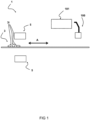
- Fig. 1 shows a schematic diagram of an embodiment of a system 1 for training a machine learning model which is configured to perform characterization of components in a material stream 3 with a plurality of unknown components 3i.
- the system 1 includes a processor, a computer readable storage medium, a sensory system 5, and a separator unit 100, wherein the computer readable storage medium has instructions stored which, when executed by the processor, result in the processor performing operations comprising:
- the separator unit includes a robotic arm for automatically isolating the selected components in the compartment 101.
- a robotic arm for automatically isolating the selected components in the compartment 101.
- other means may also be employed for selectively moving the selected components from the material stream 3 to the compartment 101 for further analysis with regard to ground truth determination. This can be performed in different ways, for instance involving robotic means for performing physical separation.
- Various other techniques may also be employed. For instance, ejection of a selected component from the material stream can be achieved by means of an air jet (e.g. using air nozzles).
- a combination of techniques may also be used (e.g. depending on the size of the component to be separated/isolated from the material stream. For example, larger components may be physically isolated using a robotic arm, while smaller components can be isolated by means of fluid jets using fluid nozzles.
- an active learning method is employed which selects only the promising and exemplar components for manual labeling.
- the selected components in the material stream are automatically physically isolated by means of the separator unit 100.
- a robotic arm is arranged.
- one or more other means may also be employed.
- the machine learning model may be an active learner applying a selection function to physically isolate a component for labeling. Based on the selection, the component can be isolated from the material stream 3 in the separate accessible compartment 101 for manual and/or experimental labeling to determine the ground truth.
- the machine learning model (cf. classifier) can be retrained with the newly labeled data and the process can continue, for example until a predefined stopping criterion is satisfied. Since the components to be labeled for training the machine learning model are selected and isolated based on the training reward, a time consuming process of retraining the classifier based on new data points can be avoided. Hence, the machine learning model can be trained more efficiently.
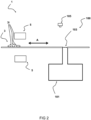
- Fig. 2 shows a schematic diagram of an embodiment of a system 1, similar to that shown in fig. 1 .
- the separator unit 100 includes a operable lid 103 arranged in a path of the material stream 3.
- the material stream may be transported by means of a conveyor belt at which the operable lid 103 may be arranged.
- the system may be configured to selectively open the lid 103 for isolating one or more components in the material stream 3.
- An optional optical unit 105 e.g. camera
- the optical unit 105 may be optional, for instance, in some exemplary embodiments data from the sensory system 5 may be used for detecting when the lid 103 is to be opened for isolating the one or more components from the material stream 3. In some examples, the optional optical unit 105 may also be placed more upstream providing more reaction time when the lid 103 is to be opened.
- the most appropriate data points linked to the identified components in the material stream can be selected for isolation and manual and/or experimental labeling to determine the ground truth.
- the resulting ground truth can then be used for further training the machine learning model. Since the selection is performed based on the training reward, a maximum generalization capability can be ensured of the machine learning model requiring minimum human labeling effort.
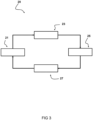
- Fig. 3 shows a schematic diagram of an embodiment of a method 20.
- the method may employ active machine learning in which a set of samples of the material stream 3 are selected for which it is desired to receive training data, rather than passively receiving samples chosen by an external entity.
- active machine learning in which a set of samples of the material stream 3 are selected for which it is desired to receive training data, rather than passively receiving samples chosen by an external entity.
- the model can be allowed to select samples that the model determines will be most helpful for learning (relevance for training), rather than for instance relying only an external human expert or external system to identify and provide samples.
- a pool-based active learning cycle is illustrated in fig. 3 .
- a labeled training set 21 may be used for training a machine learning model 23.
- the machine learning model can be presented with an unlabeled pool 25.
- the machine learning model may predict labels and training rewards associated with components in the material stream.
- queries can be selected for analysis 27 (human annotation and/or experimentation). The selection may be based on training reward.
- the selected components can be physically separated for labeling.
- the results from analysis/labeling can be used a further training set (cf. labeled training set 21) for the machine learning model.
- Active learning or query learning can overcome the labeling bottleneck of a training process by asking queries in the form of unlabeled instances to be labeled by an oracle, e.g. a human annotator and/or automatic analyzer. In this way, the active learner aims to achieve high accuracy using as few labeled instances as possible, thereby minimizing the cost of obtaining labeled data.
- an oracle e.g. a human annotator and/or automatic analyzer.
- Many query strategies exist. For example, a so-called pool-based active learning may be employed wherein the training data is divided in a (small) labeled dataset on the one hand and a large pool of unlabeled instances on the other hand.
- the active learner may operate in a greedy fashion: samples to be queried to the annotator may be selected by evaluating all instances in the unlabeled pool simultaneously.
- the component (cf. sample) that maximizes a certain criterion is sent to the oracle for annotation and added to the labeled training set, after which the classification algorithm can be re-trained on this set.
- the updated results from the model then allow the active learner to make a new selection of queries for the human annotator.
- the active learner can employ one or more criteria for selecting a new component to be isolated and analyzed for annotation. Different approaches exist. In some advantageous embodiments, the query strategy employed is based on uncertainty sampling.
- This criterion is equivalent to selecting the sample that maximizes the machine learning model's belief it will mislabel x, i.e. the sample whose most likely labeling is the least likely among the unlabeled components available for querying.
- a drawback is that the machine learning model only considers information about the most probable label and therefore throws away information about the rest of the posterior distribution.
- entropy is a measure of a variable's average information content, it is commonly used as an uncertainty or impurity measure in machine learning.
- Fig. 4 shows an exemplary feature space.
- the invention employs a physical active learning in which only those components/objects in a material stream are selected and isolated for determining a ground truth label subsequently used for further training of the machine learning model used for predicting the label linked to the components/objects in the material stream.
- the machine learning model e.g. classification model
- the machine learning model can be trained more effectively using automated analysis of particular selected and isolated components/objects.
- the model can be trained very well with much less data.
- the system can automatically select and isolate the components in the material stream for further analysis in order to determine the ground truth label. This is for example very useful for waste processing involving one or more waste material streams.
- the system can be configured to perform waste characterization, wherein the system allows for efficient further training of the employed machine learning model.
- the system may also be configured to perform sorting of materials based on the waste characterization. It will be appreciated that the invention may also be used in other applications for characterization of other material streams.
- Determining the ground truth can be established in different ways, for instance partially involving manual labeling (e.g. at least partially analyzed by a human). However, it can also be determined automatically, for example involving chemical experimentation. A combination of techniques can also be employed, for instance when different properties are to be determined for deriving the ground truth label, e.g. requiring different techniques. Different characterization parameters may be determined for determining the ground truth (e.g. mass, chemistry, weight, geometrical properties, etc.).
- the material stream is an heterogeneous flow of materials or components.
- Various algorithms and techniques may be used for determining which particle contributes most to training the machine learning model. Different active learning methods can be applied for this purpose.
- the system is configured to operate the separator unit 100 to isolate one or more components (cf. sampling) which are selected for ground truth labeling based on a distance to clusters.
- Different techniques can be used, for instance including:
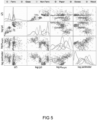
- Fig. 5 shows distributions of features for different component classes.
- the components 3i in the material stream 3 can be sorted into different classes: for example paper, wood, glass, stones, ferrous metals (ferro) and non-ferrous metals (non-ferro).
- Exemplary classes are provided in fig. 5 .
- the machine learning model can be a classification model that is configured to learn to differentiate between these different classes.
- the graphs shown in fig. 5 represent univariate and bivariate distributions of four features. As expected, some features are better suited than others to discriminate between certain materials. For example, the atomic number is able to separate paper from non-ferrous metals well, but fails in distinguishing between stones and glass. This is the other way around for mean density. All exemplary features, 31 in total in this example, can be combined when training a classifier, thereby maximizing the learning potential.
- the diagonal graphs represent kernel density estimates for the distributions of 4 features from the dataset.
- the off-diagonal graphs represent scatterplots of the respective features: mean atomic number ⁇ Z>, the logarithm of the mean density ⁇ >, the logarithm of the standard deviation of the height ⁇ height and the logarithm of the perimeter of the components.
- Selection and isolation of the components of the material stream for ground truth label analysis can be based on a level of confidence of the current machine learning model (cf. classifier) on the unlabeled identified components in the material stream.
- cf. classifier current machine learning model
- Fig. 6 illustrates learning process indicators in different graphs.
- learning curves of different exemplary models random sampling and uncertainty sampling based on the least confidence and entropy criteria, cf. equations (2) and (3) respectively
- SVM support vector machine
- uncertainty sampling requires 77 labeled instances to reach 99% of the baseline accuracy and 195 to reach 99.9% of the baseline accuracy, i.e. more the number of labeled samples needs to be more than doubled to make a mere 0.9 percentage point gain in accuracy. This raises an important issue in practical applications, which is the trade-off between the cost of labeling and the potential cost of making classification errors.
- the lines show the mean results of 250 different random initial conditions, and the boundaries of the shaded regions are defined by the 10% and 90% quantiles. Furthermore, a cross section of the feature space spanned by the mean atomic number Z and density ⁇ at three different stages of the learning process is shown. The first column indicates which samples have been queried up until that point. The second and third columns show the behavior of the least confidence and entropy measures in this two-dimensional cross-section of the feature space. The remaining unlabeled samples are shown, and the one with highest uncertainty is indicated by a cross: this is the next component to be isolated and analyzed (e.g. by human annotator and/or experimentally).
- the active learner starts to recognize the boundary regions between the different material classes, and primarily queries samples in the immediate vicinity of these class boundaries, as these are typically the particles with the highest classification uncertainty for the model. This can also be observed from the second and third columns in fig. 6 , which show the behavior of the confidence and entropy sampling criteria for a two-dimensional model, respectively.
- the boundaries separating the different material classes be-come more pronounced as regions with higher uncertainty. While the class boundaries appear to be smoother for the entropy than for the confidence criterion, the pattern for both measures is roughly the same. This explains why similar samples are queried and the performance of the two is roughly the same.
- the optimal choice of uncertainty measure depends strongly on the dataset at hand.
- the confidence criterion is possibly slightly more appropriate in the case where classification is simply performed by means of majority vote: a component is assigned to the class with the highest posterior probability. If however more complicated rules are used (e.g. in the case of imbalanced datasets), entropy is arguably the more obvious choice.
- Fig. 7 shows a schematic diagram of an embodiment of a system 1.
- at least one of an optional (color) camera 7 or optional 3D laser triangulation unit 9 are arranged in order to enable determining additional characteristics linked to each of the segmented objects.
- the sensory unit 5 includes an X-ray sensor 11 having two X-ray sub-units 11a, 11b for performing dual-energy X-ray imaging.
- the camera 7 and 3D laser triangulation unit 9 are integrated in the sensory unit 5.
- the sensory unit 5 provides a plurality of images which can be aligned and/or fused, for instance by a computer unit 13. Aligning and/or fusing of the imaging data obtained from different camera's/detectors can enable a better determination of the features/characteristics of the segmented objects.
- the one or more materials are segmented and the individual segmented objects 3i are analyzed for determining relevant features/characteristics thereof.
- the following features 15 are determined for each segmented object: density, material, shape, size and mass. It will be appreciated that other sets of features are also possible. From the data it is also possible to derive a relative weight percentage of each of the segmented objects.
- the system according to the invention can be faster and more autonomous in characterization of one or more materials, while requiring less (labor-intensive) input from humans.
- the system can provide important advantages in the application of waste characterization.
- a machine learning model In order to develop a model that recognizes different (images of) waste particles and classifies them into different categories, a machine learning model can be trained by showing it a large number of images, each image accompanied by a label that describes what is in it.
- the conventional approach in which all data is labeled in advance, is known as supervised learning.
- This labeled data represents the fuel of machine learning algorithms.
- labeled data can typically be generated by scanning physical "pure" mono-material streams, which are often manually prepared by meticulously selecting thousands of individual particles from a heterogeneous waste stream.
- the characterization of waste has several important applications in the recycling industry. It can be used for value assessment. Fast and reliable value assessment of complete material streams decreases the risk of exposure to volatility of commodity stock markets. Further, it can be used for quality control. In a circular economy, it is desired that the quality of recycled products is guaranteed.
- the characterization technology helps to establish market trust. Further, it can be used for process engineering. The technical and economic feasibility of waste recycling processes and design of new processes by virtual experimenting can be assessed. Further, it can be used for online process optimization. Sorting processes can be measured, controlled and optimized on-the-fly.
- a direct, inline characterization technology can be provided that assess the materials both qualitatively (material type, chemistry, purity, %) and quantitatively (mass balances, physical properties, 10)
- Such an inline characterization system can be configured to assess heterogeneous and complex material streams completely, eliminating the need for subsampling.
- mass-balances can be produced on-the-fly.
- a digital twin can be created which can be further assessed in a virtual way.
- the invention can provides for a data-driven material characterization using physical active learning that can strongly reduce the labeling effort when gathering training data. While conventional machine learning algorithms require a large and completely labeled dataset for training, it is observed that only a fraction of this data is required to make good predictions. Active learning allows to train the model on a small subset, chosen by the algorithm, and obtain an accuracy that is comparable with the one that is found by training the model on the complete dataset. In some examples, active learning allows to reduce the labeling cost by 70% while retaining 99% of the accuracy that would be obtained by training on the fully labeled dataset.
- the system and method according to the invention can be used for different material streams.
- the materials stream includes construction and demolition waste.
- other waste streams can also be used.
- Fig. 8 shows a schematic diagram of a method 30.
- a first step 31 the objects or components of the one or more materials are identified and segmented. This can be performed by means of object-detection algorithms and/or segmentation algorithms.
- the image is obtained using the sensory unit 5. It is also possible that the acquired image being segmented is obtained after performing alignment and/or fusion of different images, for instance coming from different sensors or sub-units of the sensory unit 5.
- boxes 20 are provided around the segmented objects 3i.
- characteristics/features 15 are determined for each of the segmented objects 3i. In this example, the mass, volume and atom number is determined.
- a label can be predicted by a machine learning model.
- this can be done by providing the data as an input to the trained neural network 25 for obtaining a (predicted) label 17 as output.
- the trained neural network is a deep learning model.
- other machine learning models can also be used, such as for example support vector machines (SVMs), decision tree-based learning systems, random forests, regression models, autoencoder clustering, nearest neighbor (e.g. kNN) machine learning algorithm, etc.
- SVMs support vector machines
- decision tree-based learning systems such as for example, random forests, regression models, autoencoder clustering, nearest neighbor (e.g. kNN) machine learning algorithm, etc.
- kNN nearest neighbor machine learning algorithm
- an alternative regression model is used instead of an artificial neural network.
- the invention provides for a more efficient training of the machine learning model used (e.g. deep neural network).
- the machine learning model used e.g. deep neural network.
- active learning it is possible to reduce a number of training samples to be (manually) labeled by selectively sampling a subset of the unlabeled data (in the material stream). This may be done by inspecting the unlabeled samples, and selecting the most informative ones with respect to a given cost function for human and/or experimental labeling.
- the active learning machine learning model can select samples which can result in the largest increase in performance, and thereby reduce the human and/or experimental labeling effort. Selectively sampling components of the plurality of components in the material stream assumes that there is a pool of candidate components of the plurality of components to label.
- the stream provides for a source for continuously and effectively improve the performance of the machine learning model.
- the selected components can be isolated automatically by the system by means of a separation unit.
- the active learning machine model can derive a smaller subset of all components collected from the material stream for human and/or experimental labeling.
- An initial deep learning neural network can be trained on a set of classified data, for example obtained by human annotation. This set of data builds the first parameters for the neural network, and this would be the stage of supervised learning. During the stage of supervised learning, the neural network can be tested whether the desired behavior has been achieved. Once a desired neural network behavior has been achieved (e.g., a machine learning model has been trained to operate according to a specified threshold), the machine learning model can be deployed for use (e.g., testing the machine with "real" data). During operation, neural network classifications can be confirmed or denied (e.g., by an expert user, expert system, reference database, etc.) to continue to improve neural network behavior.
- a desired neural network behavior e.g., a machine learning model has been trained to operate according to a specified threshold
- the machine learning model can be deployed for use (e.g., testing the machine with "real" data).
- neural network classifications can be confirmed or denied (e.g., by an expert user, expert system, reference database, etc
- the example neural network is then in a state of transfer learning, as parameters for classification that determine neural network behavior are updated based on ongoing interactions.
- the neural network of the machine learning model can provide direct feedback to another process, e.g. changing control parameters of a waste recycling process.
- the neural network outputs data that is buffered (e.g., via the cloud, etc.) and validated before it is provided to another process.
- the sensory system may include various sensors.
- data with respect to the material properties of the particles in the material stream is gathered by means of a multi-sensor characterization device.
- DE-XRT dual-energy X-ray transmission
- a 3D laser triangulation unit can be utilized to measure the shape of the object at high resolution (e.g. sub-mm accuracy).
- a RGB detector may be used, which allows to differentiate the components in the material stream regarding color and shape.
- the above mentioned sensors are used together.
- image processing can be used for segmenting the images into individual components. From these segmented images, various features describing the object's shape may be computed. Examples are the area, eccentricity and perimeter of a component. In some examples, this can be done for all images obtained from all sensors.
- a neural network has the ability to process, e.g. classify, sensor data and/or pre-processed data, cf. determined features characteristics of the segmented objects.
- a neural network can be implemented in a computerized system. Neural networks can serve as a framework for various machine learning algorithms for processing complex data inputs. Such neural network systems may "learn" to perform tasks by considering examples, generally without being programmed with any task-specific rules.
- a neural network can be based on a collection of connected units or nodes called neurons. Each connection, can transmit a signal from one neuron to another neuron in the neural network. A neuron that receives a signal can process it and then signal additional neurons connected to it (cf. activation).
- the output of each neuron is typically computed by some non-linear function of the sum of its inputs.
- the connections can have respective weights that adjust as learning proceeds. There may also be other parameters such as biases.
- the neurons are aggregated into layers. Different layers may perform different kinds of transformations on their inputs to form a deep neural network.
- a deep learning neural network can be seen as a representation-learning method with a plurality of levels of representation, which can be obtained by composing simple but non-linear modules that each transform the representation at one level, starting with the raw input, into a representation at a higher, slightly more abstract level.
- the neural network may identify patterns which are difficult to see using conventional or classical methods.
- the network instead of writing custom code specific to a problem of printing the structure at certain printing conditions, the network can be trained to be able to handle different and/or changing structure printing conditions e.g. using a classification algorithm. Training data may be fed to the neural network such that it can determine a classification logic for efficiently controlling the printing process.
- label can be understood as both categorical variables (e.g. using neural networks) and continuous variables (e.g. using regression models).
- continuous variables e.g. using regression models
- the continuous variables may have uncertainties (e.g. chemical analysis variable).
- the method may include computer implemented steps. All above mentioned steps can be computer implemented steps.
- Embodiments may comprise computer apparatus, wherein processes performed in computer apparatus.
- the invention also extends to computer programs, particularly computer programs on or in a carrier, adapted for putting the invention into practice.
- the program may be in the form of source or object code or in any other form suitable for use in the implementation of the processes according to the invention.
- the carrier may be any entity or device capable of carrying the program.
- the carrier may comprise a storage medium, such as a ROM, for example a semiconductor ROM or hard disk.
- the carrier may be a transmissible carrier such as an electrical or optical signal which may be conveyed via electrical or optical cable or by radio or other means, e.g. via the internet or cloud.
- Some embodiments may be implemented, for example, using a machine or tangible computer-readable medium or article which may store an instruction or a set of instructions that, if executed by a machine, may cause the machine to perform a method and/or operations in accordance with the embodiments.
- Various embodiments may be implemented using hardware elements, software elements, or a combination of both.
- hardware elements may include processors, microprocessors, circuits, application specific integrated circuits (ASIC), programmable logic devices (PLD), digital signal processors (DSP), field programmable gate array (FPGA), logic gates, registers, semiconductor device, microchips, chip sets, et cetera.
- software may include software components, programs, applications, computer programs, application programs, system programs, machine programs, operating system software, mobile apps, middleware, firmware, software modules, routines, subroutines, functions, computer implemented methods, procedures, software interfaces, application program interfaces (API), methods, instruction sets, computing code, computer code, et cetera.
- API application program interfaces
- any reference signs placed between parentheses shall not be construed as limiting the claim.
- the word 'comprising' does not exclude the presence of other features or steps than those listed in a claim.
- the words 'a' and 'an' shall not be construed as limited to 'only one', but instead are used to mean 'at least one', and do not exclude a plurality.
- the mere fact that certain measures are recited in mutually different claims does not indicate that a combination of these measures cannot be used to an advantage.
Landscapes
- Engineering & Computer Science (AREA)
- Physics & Mathematics (AREA)
- Theoretical Computer Science (AREA)
- General Physics & Mathematics (AREA)
- Health & Medical Sciences (AREA)
- General Health & Medical Sciences (AREA)
- Multimedia (AREA)
- Software Systems (AREA)
- Medical Informatics (AREA)
- Evolutionary Computation (AREA)
- Computing Systems (AREA)
- Computer Vision & Pattern Recognition (AREA)
- Artificial Intelligence (AREA)
- Databases & Information Systems (AREA)
- Chemical & Material Sciences (AREA)
- Life Sciences & Earth Sciences (AREA)
- Analytical Chemistry (AREA)
- Biochemistry (AREA)
- Immunology (AREA)
- Pathology (AREA)
- Environmental & Geological Engineering (AREA)
- Spectroscopy & Molecular Physics (AREA)
- Nuclear Medicine, Radiotherapy & Molecular Imaging (AREA)
- High Energy & Nuclear Physics (AREA)
- Mathematical Physics (AREA)
- Crystallography & Structural Chemistry (AREA)
- General Engineering & Computer Science (AREA)
- Optics & Photonics (AREA)
- Plasma & Fusion (AREA)
- Data Mining & Analysis (AREA)
- Image Analysis (AREA)
- Investigating, Analyzing Materials By Fluorescence Or Luminescence (AREA)
- Feedback Control In General (AREA)
Claims (15)
- Verfahren zum Trainieren eines Maschinenlernmodells, dazu konfiguriert, eine Charakterisierung von Komponenten in einem heterogenen Materialstrom (3) mit einer Mehrzahl an unbekannten Komponenten (3i) durchzuführen, wobei das Verfahren umfasst:Abtasten des Materialstroms (3) mittels eines sensorischen Systems (5), dazu konfiguriert, eine Bildgebung des Materialstroms (3) mit der Mehrzahl an unbekannten Komponenten (3i) durchzuführen;Prognostizieren einer oder mehrerer Prognosekennungen und entsprechender Kennungsprognosewahrscheinlichkeiten für jede der unbekannten Komponenten (3i) im Materialstrom (3) mittels eines Maschinenlernmodells, dazu konfiguriert, als Eingang die Bildgebung des Materialstroms (3) und/oder eines oder mehrere Merkmale der unbekannten Komponenten (3i), die aus der Bildgebung des Materialstroms (3) extrahiert wurden, zu empfangen;Bestimmen einer Trainingsbelohnung, die jeder unbekannten Komponente (3i) innerhalb der Mehrzahl an unbekannten Komponenten im Materialstrom (3) zugeordnet ist;Auswählen mindestens einer unbekannten Komponente aus der Mehrzahl an unbekannten Komponenten (3i) im Materialstrom (3), zumindest teilweise basierend auf der den unbekannten Komponenten zugeordneten Trainingsbelohnung,Analysieren der isolierten mindestens einen unbekannten Komponente zum Ermitteln der Grundwahrheitskennung davon, wobei die ermittelte Grundwahrheitskennung der isolierten mindestens einen unbekannten Komponente zu einer Trainingsdatenbank hinzugefügt wird; undTrainieren einer inkrementellen Version des Maschinenlernmodells unter Verwendung der ermittelten Grundwahrheitskennung der physisch isolierten mindestens einen unbekannten Komponente;dadurch gekennzeichnet, dassdas Ermitteln einer Grundwahrheit für die mindestens eine unbekannte Komponente eine Analyse in physischer Isolation erfordert;die ausgewählte mindestens eine unbekannte Komponente mittels einer Separatoreinheit (100) physisch vom Materialstrom (3) isoliert ist, wobei die Separatoreinheit (100) dazu konfiguriert ist, die ausgewählte unbekannte Komponente zu einer separaten zugänglichen Kammer (101) zu bewegen; unddie mindestens eine unbekannte Komponente, die von dem Materialstrom (3) isoliert ist, einer chemischen Analyse zum Bestimmen der zumindest teilweise darauf basierenden Grundwahrheitskennung unterzogen wird.
- Verfahren nach Anspruch 1, wobei das Maschinenlernmodell dazu konfiguriert ist, als Eingang ein oder mehrere benutzerdefinierte Merkmale der aus der Bildgebung des Materialstroms (3) extrahierten unbekannten Komponenten zu empfangen, und wobei für die Auswahl von Komponenten benutzergenerierte Auswahlkriterien verwendet werden.
- Verfahren nach einem der vorhergehenden Ansprüche, wobei die Separationseinheit (100) mehrere Untereinheiten umfasst, die verschiedene Separationstechniken anwenden, wobei die Separationseinheit (100) mindestens eine erste Untereinheit und eine zweite Untereinheit aufweist, wobei eine von der ersten oder zweiten Untereinheit zur physischen Isolation der ausgewählten mindestens einen unbekannten Komponente auf Grundlage des einen oder mehrerer Merkmale der unbekannten Komponenten ausgewählt ist, die aus der Bildgebung des Materialstroms extrahiert wurden.
- Verfahren nach einem der vorhergehenden Ansprüche, wobei die erste Untereinheit zur physischen Isolation kleinerer und/oder leichterer Komponenten im Materialstrom verwendet wird und die zweite Untereinheit zur physischen Isolation größerer und/oder schwererer Komponenten im Materialstrom verwendet wird.
- Verfahren nach einem der vorhergehenden Ansprüche, wobei die erste Untereinheit dazu konfiguriert ist, Komponenten zu isolieren, indem ein Fluidstrahl auf die Komponenten gerichtet wird, um die Komponenten in die separate zugängliche Kammer zu blasen, und wobei die zweite Untereinheit dazu konfiguriert ist, Komponenten mittels einer mechanischen Manipulationseinrichtung zu isolieren.
- Verfahren nach einem der vorhergehenden Ansprüche, wobei für jede unbekannte Komponente im Materialstrom (3) Daten berechnet werden, die für eine Masse bezeichnend sind.
- Verfahren nach Anspruch 6, wobei eine durch den Fluidstrahl induzierte resultierende Kraft auf Grundlage der Masse der ausgewählten mindestens einen unbekannten Komponente angepasst wird.
- Verfahren nach einem der vorhergehenden Ansprüche, wobei ein für eine Schwierigkeit bei der Durchführung einer physischen Isolation der unbekannten Komponente aus dem Materialstrom (3) mittels der Separationseinheit (100) bezeichnender Wert bestimmt und jeder unbekannten Komponente zugeordnet wird, wobei die Auswahl der mindestens einen unbekannten Komponente aus der Mehrzahl an unbekannten Komponenten im Materialstrom (3) zusätzlich auf dem Wert basiert.
- Verfahren nach Anspruch 8, wobei eine maximale Zahl unbekannter Komponenten aus der Mehrzahl an unbekannten Komponenten im Materialstrom (3) basierend auf der mit den unbekannten Komponenten verbundenen Trainingsbelohnung ausgewählt wird, wobei eine Teilmenge der maximalen Zahl unbekannter Komponenten basierend auf dem Wert, der für die Schwierigkeit der Durchführung physischer Isolation mittels der Separationseinheit (100) bezeichnend ist, für die physische Isolation ausgewählt wird.
- Verfahren nach einem der vorhergehenden Ansprüche, wobei die separate zugängliche Kammer (101) ein manuelles Entfernen der isolierten unbekannten Komponente ermöglicht, wobei eine Angabe einer internen Referenz des Maschinenlernmodells für die isolierte unbekannte Komponente innerhalb der separaten zugänglichen Kammer (101) bereitgestellt ist, wobei die Analyse der mindestens einen ausgewählten unbekannten Komponente zumindest teilweise durch menschliche Annotation durchgeführt wird.
- Verfahren nach einem der vorhergehenden Ansprüche 1 bis 9, wobei die isolierte unbekannte Komponente mittels einer Analyseeinheit analysiert wird, wobei die Analyseeinheit dazu angeordnet ist, automatisch eine Charakterisierung der isolierten unbekannten Komponente innerhalb der separaten zugänglichen Kammer zum Bestimmen der Grundwahrheitskennung basierend auf der Charakterisierung durchzuführen.
- Verfahren nach einem der vorhergehenden Ansprüche, wobei die Analyseeinheit dazu konfiguriert ist, zerstörende Messungen an isolierten Komponenten durchzuführen, um zumindest teilweise darauf basierend die Grundwahrheitskennung zu bestimmen.
- Verfahren nach einem der vorhergehenden Ansprüche, wobei die Analyseeinheit dazu konfiguriert ist, mindestens eine von den Folgenden durchzuführen: eine energie- oder wellenlängendispersive Röntgenfluoreszenzspektrometrie, Feuerprobe, optische Emissionsspektrometrie mit induktiv gekoppeltem Plasma, atomare Emissionsspektroskopie mit induktiv gekoppeltem Plasma, Massenspektrometrie mit induktiv gekoppeltem Plasma, laserinduzierte Zersetzungsspektroskopie, Infrarotspektroskopie, hyperspektrale Spektroskopie, Röntgenbeugungsanalyse, Rasterelektronenmikroskopie, nukleare Magnetresonanz, Ramanspektroskopie.
- Verfahren nach einem der vorhergehenden Ansprüche, wobei sich das eine oder mehrere Merkmale auf wenigstens eines von einem Volumen, einer Abmessung, einem Durchmesser, einer Form, einer Textur, einer Farbe oder einer Exzentrizität beziehen.
- System (1) zum Trainieren eines Maschinenlernmodells, dazu konfiguriert, eine Charakterisierung von Komponenten in einem heterogenen Materialstrom (3) mit einer Mehrzahl an unbekannten Komponenten (3i) durchzuführen, wobei das System (1) einen Prozessor, ein computerlesbares Speichermedium, ein sensorisches System (5) und eine Separatoreinheit (100) umfasst, wobei auf dem computerlesbaren Speichermedium Anweisungen gespeichert sind, die, wenn sie vom Prozessor ausgeführt werden, dazu führen, dass der Prozessor Vorgänge ausführt, umfassend:Betreiben des sensorischen Systems (5) zum Abtasten des Materialstroms (3), beispielsweise, um eine Bildgebung des Materialstroms (3) mit der Mehrzahl an unbekannten Komponenten (3i) durchzuführen;Vorhersagen einer oder mehrerer Kennungen und zugeordneter Kennungswahrscheinlichkeiten für jede von den unbekannten Komponenten (3i) im Materialstrom (3) mittels eines Maschinenlernmodells, dazu konfiguriert, als Eingang die Bildgebung des Materialstroms (3) und/oder ein oder mehrere Merkmale der unbekannten Komponenten, extrahiert aus der Bildgebung des Materialstroms (3), zu empfangen;Bestimmen einer Trainingsbelohnung, die jeder unbekannten Komponente (3i) innerhalb der Mehrzahl an unbekannten Komponenten (3i) im Materialstrom (3) zugeordnet ist;Auswählen mindestens einer unbekannten Komponente (3i) aus der Mehrzahl an unbekannten Komponenten im Materialstrom (3), zumindest teilweise basierend auf der den unbekannten Komponenten (3i) zugeordneten Trainingsbelohnung, wobei das Bestimmen einer Grundwahrheit für die mindestens eine unbekannte Komponente eine Analyse in physischer Isolation erfordert;Betreiben der Separatoreinheit (100) zum physischen Isolieren der ausgewählten mindestens einen unbekannten Komponente vom Materialstrom (3), wobei die Separatoreinheit (100) dazu konfiguriert ist, die ausgewählte unbekannte Komponente zu einer separaten zugänglichen Kammer (101) zu bewegen;Empfangen, für die isolierte mindestens eine unbekannte Komponente, der mittels Durchführung einer Analyse bestimmten Grundwahrheitskennung, wobei die bestimmte Grundwahrheitskennung der isolierten mindestens einen unbekannten Komponente zu einer Trainingsdatenbank hinzugefügt wird; undTrainieren einer inkrementellen Version des Maschinenlernmodells unter Verwendung der bestimmten Grundwahrheitskennung der physisch isolierten mindestens einen unbekannten Komponente; undwobei das System (1) dazu konfiguriert ist, die mindestens eine unbekannte Komponente, die aus dem Materialstrom (3) isoliert ist, einer chemischen Analyse zum Bestimmen der zumindest teilweise darauf basierenden Grundwahrheitskennung zu unterziehen.
Applications Claiming Priority (2)
| Application Number | Priority Date | Filing Date | Title |
|---|---|---|---|
| EP20169824.8A EP3896602A1 (de) | 2020-04-16 | 2020-04-16 | Verfahren und system zum trainieren eines maschinenlernmodells zur klassifizierung von komponenten in einem materialstrom |
| PCT/EP2021/059942 WO2021209614A1 (en) | 2020-04-16 | 2021-04-16 | A method and system for training a machine learning model for classification of components in a material stream |
Publications (3)
| Publication Number | Publication Date |
|---|---|
| EP4136566A1 EP4136566A1 (de) | 2023-02-22 |
| EP4136566B1 true EP4136566B1 (de) | 2025-05-28 |
| EP4136566C0 EP4136566C0 (de) | 2025-05-28 |
Family
ID=70292854
Family Applications (2)
| Application Number | Title | Priority Date | Filing Date |
|---|---|---|---|
| EP20169824.8A Withdrawn EP3896602A1 (de) | 2020-04-16 | 2020-04-16 | Verfahren und system zum trainieren eines maschinenlernmodells zur klassifizierung von komponenten in einem materialstrom |
| EP21717936.5A Active EP4136566B1 (de) | 2020-04-16 | 2021-04-16 | Verfahren und system zum trainieren eines maschinenlernmodells zur klassifizierung von komponenten in einem materialstrom |
Family Applications Before (1)
| Application Number | Title | Priority Date | Filing Date |
|---|---|---|---|
| EP20169824.8A Withdrawn EP3896602A1 (de) | 2020-04-16 | 2020-04-16 | Verfahren und system zum trainieren eines maschinenlernmodells zur klassifizierung von komponenten in einem materialstrom |
Country Status (7)
| Country | Link |
|---|---|
| US (1) | US20230169751A1 (de) |
| EP (2) | EP3896602A1 (de) |
| JP (1) | JP7680469B2 (de) |
| KR (1) | KR20230016172A (de) |
| CN (1) | CN115699040A (de) |
| CA (1) | CA3175508A1 (de) |
| WO (1) | WO2021209614A1 (de) |
Families Citing this family (17)
| Publication number | Priority date | Publication date | Assignee | Title |
|---|---|---|---|---|
| US12208421B2 (en) | 2015-07-16 | 2025-01-28 | Sortera Technologies, Inc. | Metal separation in a scrap yard |
| US12403505B2 (en) | 2015-07-16 | 2025-09-02 | Sortera Technologies, Inc. | Sorting of aluminum alloys |
| US11964304B2 (en) | 2015-07-16 | 2024-04-23 | Sortera Technologies, Inc. | Sorting between metal alloys |
| US11278937B2 (en) * | 2015-07-16 | 2022-03-22 | Sortera Alloys, Inc. | Multiple stage sorting |
| US12280404B2 (en) | 2015-07-16 | 2025-04-22 | Sortera Technologies, Inc. | Sorting based on chemical composition |
| US12246355B2 (en) | 2015-07-16 | 2025-03-11 | Sortera Technologies, Inc. | Sorting of Zorba |
| US20250217446A1 (en) * | 2021-05-28 | 2025-07-03 | Nvidia Corporation | Optimizing parameter estimation for training neural networks |
| DE102021116501A1 (de) | 2021-06-25 | 2022-12-29 | Bayerische Motoren Werke Aktiengesellschaft | Verfahren zum Sortieren von Stoffen, insbesondere Werkstofflegierungen, Vorrichtung sowie Verwendung |
| CN114636687B (zh) * | 2022-03-14 | 2025-02-14 | 国能神皖能源有限责任公司 | 基于深度迁移学习的小样本煤质特性分析系统及方法 |
| US20230359927A1 (en) * | 2022-05-09 | 2023-11-09 | GE Precision Healthcare LLC | Dynamic user-interface comparison between machine learning output and training data |
| JP7562597B2 (ja) * | 2022-05-12 | 2024-10-07 | キヤノン株式会社 | 識別装置 |
| CN114677677B (zh) * | 2022-05-30 | 2022-08-19 | 南京友一智能科技有限公司 | 一种质子交换膜燃料电池气体扩散层材料比例预测方法 |
| CN115082742B (zh) * | 2022-08-02 | 2025-04-29 | 浙江医准智能科技有限公司 | 图像分类模型的训练方法、装置、电子设备及存储介质 |
| EP4605735A1 (de) | 2022-10-21 | 2025-08-27 | Sortera Technologies, Inc. | Korrekturtechniken zur materialklassifizierung |
| KR102666454B1 (ko) * | 2023-07-06 | 2024-05-17 | 국립공주대학교 산학협력단 | 도메인지식을 활용한 머신러닝 기반 x선회절 광물조성분석 시스템 및 방법 |
| KR102783744B1 (ko) * | 2023-09-20 | 2025-03-21 | 주식회사 파인브이티 | 과일의 결함 판별 및 당도 판정을 수행하는 과일 선별 시스템 장치 |
| US12368503B2 (en) | 2023-12-27 | 2025-07-22 | Quantum Generative Materials Llc | Intent-based satellite transmit management based on preexisting historical location and machine learning |
Family Cites Families (12)
| Publication number | Priority date | Publication date | Assignee | Title |
|---|---|---|---|---|
| JP3638427B2 (ja) * | 1998-02-19 | 2005-04-13 | 日立造船株式会社 | 重量式選別装置 |
| CN104299315B (zh) * | 2014-10-29 | 2016-09-28 | 云南大学 | 一种垃圾分类回收方法 |
| JP2017109197A (ja) | 2016-07-06 | 2017-06-22 | ウエノテックス株式会社 | 廃棄物選別システム及びその選別方法 |
| WO2018200866A1 (en) * | 2017-04-26 | 2018-11-01 | UHV Technologies, Inc. | Material sorting using a vision system |
| WO2019089825A1 (en) * | 2017-11-02 | 2019-05-09 | AMP Robotics Corporation | Systems and methods for optical material characterization of waste materials using machine learning |
| US11135620B2 (en) | 2018-01-12 | 2021-10-05 | Emerging Acquisitions, Llc | Autonomous data collection and system control for material recovery facilities |
| JP7108283B2 (ja) | 2018-05-08 | 2022-07-28 | ウエノテックス株式会社 | 廃棄物選別システム、教師データ生成装置、教師データ生成システム、および教師データ生成プログラム |
| TWI726229B (zh) * | 2018-08-13 | 2021-05-01 | 國立陽明交通大學 | 基於深度學習及電腦視覺技術之垃圾分類系統及方法 |
| JP6679188B1 (ja) | 2018-10-19 | 2020-04-15 | 株式会社御池鐵工所 | 廃棄物選別装置及び廃棄物選別方法 |
| GB2599859B (en) * | 2019-07-10 | 2023-10-18 | Schlumberger Technology Bv | Active learning for inspection tool |
| CN110503161B (zh) * | 2019-08-29 | 2023-06-27 | 长沙学院 | 一种基于弱监督yolo模型的矿石泥团目标检测方法和系统 |
| CN110513161A (zh) | 2019-09-23 | 2019-11-29 | 天脊煤化工集团股份有限公司 | 一种清洗合成氨生产中汽轮机启动时转子的系统及方法 |
-
2020
- 2020-04-16 EP EP20169824.8A patent/EP3896602A1/de not_active Withdrawn
-
2021
- 2021-04-16 KR KR1020227038292A patent/KR20230016172A/ko active Pending
- 2021-04-16 CN CN202180040877.1A patent/CN115699040A/zh active Pending
- 2021-04-16 CA CA3175508A patent/CA3175508A1/en active Pending
- 2021-04-16 US US17/919,079 patent/US20230169751A1/en active Pending
- 2021-04-16 WO PCT/EP2021/059942 patent/WO2021209614A1/en not_active Ceased
- 2021-04-16 JP JP2022562597A patent/JP7680469B2/ja active Active
- 2021-04-16 EP EP21717936.5A patent/EP4136566B1/de active Active
Also Published As
| Publication number | Publication date |
|---|---|
| US20230169751A1 (en) | 2023-06-01 |
| JP2023521229A (ja) | 2023-05-23 |
| CA3175508A1 (en) | 2021-10-21 |
| CN115699040A (zh) | 2023-02-03 |
| EP4136566C0 (de) | 2025-05-28 |
| WO2021209614A1 (en) | 2021-10-21 |
| EP4136566A1 (de) | 2023-02-22 |
| JP7680469B2 (ja) | 2025-05-20 |
| KR20230016172A (ko) | 2023-02-01 |
| EP3896602A1 (de) | 2021-10-20 |
Similar Documents
| Publication | Publication Date | Title |
|---|---|---|
| EP4136566B1 (de) | Verfahren und system zum trainieren eines maschinenlernmodells zur klassifizierung von komponenten in einem materialstrom | |
| US10607331B1 (en) | Image segmentation into overlapping tiles | |
| Fu et al. | Flotation froth image recognition with convolutional neural networks | |
| Cheng et al. | Automated detection of sewer pipe defects in closed-circuit television images using deep learning techniques | |
| Chen et al. | A robust weakly supervised learning of deep Conv-Nets for surface defect inspection | |
| Gyawali et al. | Comparative analysis of multiple deep CNN models for waste classification | |
| EP3874452B1 (de) | Verfahren und system zur durchführung einer charakterisierung eines oder mehrerer materialien | |
| US11620804B2 (en) | Data band selection using machine learning | |
| Díaz-Romero et al. | Simultaneous mass estimation and class classification of scrap metals using deep learning | |
| Baniukiewicz | Automated defect recognition and identification in digital radiography | |
| WO2023143950A1 (en) | Computer implemented method for the detection and classification of anomalies in an imaging dataset of a wafer, and systems making use of such methods | |
| US11151710B1 (en) | Automatic selection of algorithmic modules for examination of a specimen | |
| Sohrab et al. | Boosting rare benthic macroinvertebrates taxa identification with one-class classification | |
| Mewada et al. | Fabric surface defect classification and systematic analysis using a cuckoo search optimized deep residual network | |
| EP4194107A1 (de) | Vorrichtung und verfahren zum klassifizieren von materialobjekten | |
| Mazanov et al. | Hyperspectral Data Driven Solid Waste Classification | |
| Boehm et al. | Machine learning algorithms for automated NIF capsule mandrel selection | |
| Liu et al. | The pistachio quality detection based on deep features plus unsupervised clustering | |
| Sirisha et al. | Fruit Quality Detection Using Deep Learning for Sustainable Agriculture | |
| Seddini et al. | Computer Vision Techniques for Intelligent Detection and Classification of Waste Sorting | |
| Kögel et al. | Machine Learning Based Data and Signal Analysis Methods for Application in Failure Analysis | |
| US20250252719A1 (en) | System and a method for improving neural network training in object processing | |
| Sevetlidis et al. | Enhancing Weakly Supervised Defect Detection Through Anomaly-Informed Weighted Training | |
| Sinha et al. | Design and optimization of three class object detection modalities for manufacturing steel surface fault diagnosis and dimensionality classification | |
| Dhali et al. | An Automatic Brick Grading System Using Convolutional Neural Network: Bangladesh Perspective |
Legal Events
| Date | Code | Title | Description |
|---|---|---|---|
| STAA | Information on the status of an ep patent application or granted ep patent |
Free format text: STATUS: UNKNOWN |
|
| STAA | Information on the status of an ep patent application or granted ep patent |
Free format text: STATUS: THE INTERNATIONAL PUBLICATION HAS BEEN MADE |
|
| PUAI | Public reference made under article 153(3) epc to a published international application that has entered the european phase |
Free format text: ORIGINAL CODE: 0009012 |
|
| STAA | Information on the status of an ep patent application or granted ep patent |
Free format text: STATUS: REQUEST FOR EXAMINATION WAS MADE |
|
| 17P | Request for examination filed |
Effective date: 20221028 |
|
| AK | Designated contracting states |
Kind code of ref document: A1 Designated state(s): AL AT BE BG CH CY CZ DE DK EE ES FI FR GB GR HR HU IE IS IT LI LT LU LV MC MK MT NL NO PL PT RO RS SE SI SK SM TR |
|
| P01 | Opt-out of the competence of the unified patent court (upc) registered |
Effective date: 20230528 |
|
| DAV | Request for validation of the european patent (deleted) | ||
| DAX | Request for extension of the european patent (deleted) | ||
| REG | Reference to a national code |
Ref country code: DE Ipc: G06V0010774000 Ref country code: DE Ref legal event code: R079 Ref document number: 602021031417 Country of ref document: DE Free format text: PREVIOUS MAIN CLASS: G06K0009000000 Ipc: G06V0010774000 |
|
| GRAP | Despatch of communication of intention to grant a patent |
Free format text: ORIGINAL CODE: EPIDOSNIGR1 |
|
| STAA | Information on the status of an ep patent application or granted ep patent |
Free format text: STATUS: GRANT OF PATENT IS INTENDED |
|
| RIC1 | Information provided on ipc code assigned before grant |
Ipc: G06V 20/40 20220101ALI20241114BHEP Ipc: G06V 10/776 20220101ALI20241114BHEP Ipc: G06V 10/774 20220101AFI20241114BHEP |
|
| INTG | Intention to grant announced |
Effective date: 20241125 |
|
| GRAS | Grant fee paid |
Free format text: ORIGINAL CODE: EPIDOSNIGR3 |
|
| GRAA | (expected) grant |
Free format text: ORIGINAL CODE: 0009210 |
|
| STAA | Information on the status of an ep patent application or granted ep patent |
Free format text: STATUS: THE PATENT HAS BEEN GRANTED |
|
| AK | Designated contracting states |
Kind code of ref document: B1 Designated state(s): AL AT BE BG CH CY CZ DE DK EE ES FI FR GB GR HR HU IE IS IT LI LT LU LV MC MK MT NL NO PL PT RO RS SE SI SK SM TR |
|
| REG | Reference to a national code |
Ref country code: GB Ref legal event code: FG4D |
|
| REG | Reference to a national code |
Ref country code: CH Ref legal event code: EP |
|
| REG | Reference to a national code |
Ref country code: IE Ref legal event code: FG4D Ref country code: DE Ref legal event code: R096 Ref document number: 602021031417 Country of ref document: DE |
|
| U01 | Request for unitary effect filed |
Effective date: 20250604 |
|
| P04 | Withdrawal of opt-out of the competence of the unified patent court (upc) registered |
Free format text: CASE NUMBER: APP_27227/2025 Effective date: 20250607 |
|
| U07 | Unitary effect registered |
Designated state(s): AT BE BG DE DK EE FI FR IT LT LU LV MT NL PT RO SE SI Effective date: 20250612 |
|
| PG25 | Lapsed in a contracting state [announced via postgrant information from national office to epo] |
Ref country code: ES Free format text: LAPSE BECAUSE OF FAILURE TO SUBMIT A TRANSLATION OF THE DESCRIPTION OR TO PAY THE FEE WITHIN THE PRESCRIBED TIME-LIMIT Effective date: 20250528 |
|
| PG25 | Lapsed in a contracting state [announced via postgrant information from national office to epo] |
Ref country code: NO Free format text: LAPSE BECAUSE OF FAILURE TO SUBMIT A TRANSLATION OF THE DESCRIPTION OR TO PAY THE FEE WITHIN THE PRESCRIBED TIME-LIMIT Effective date: 20250828 Ref country code: GR Free format text: LAPSE BECAUSE OF FAILURE TO SUBMIT A TRANSLATION OF THE DESCRIPTION OR TO PAY THE FEE WITHIN THE PRESCRIBED TIME-LIMIT Effective date: 20250829 |
|
| PG25 | Lapsed in a contracting state [announced via postgrant information from national office to epo] |
Ref country code: PL Free format text: LAPSE BECAUSE OF FAILURE TO SUBMIT A TRANSLATION OF THE DESCRIPTION OR TO PAY THE FEE WITHIN THE PRESCRIBED TIME-LIMIT Effective date: 20250528 |
|
| PG25 | Lapsed in a contracting state [announced via postgrant information from national office to epo] |
Ref country code: HR Free format text: LAPSE BECAUSE OF FAILURE TO SUBMIT A TRANSLATION OF THE DESCRIPTION OR TO PAY THE FEE WITHIN THE PRESCRIBED TIME-LIMIT Effective date: 20250528 |
|
| PG25 | Lapsed in a contracting state [announced via postgrant information from national office to epo] |
Ref country code: RS Free format text: LAPSE BECAUSE OF FAILURE TO SUBMIT A TRANSLATION OF THE DESCRIPTION OR TO PAY THE FEE WITHIN THE PRESCRIBED TIME-LIMIT Effective date: 20250828 |
|
| PG25 | Lapsed in a contracting state [announced via postgrant information from national office to epo] |
Ref country code: IS Free format text: LAPSE BECAUSE OF FAILURE TO SUBMIT A TRANSLATION OF THE DESCRIPTION OR TO PAY THE FEE WITHIN THE PRESCRIBED TIME-LIMIT Effective date: 20250928 |