EP4134045A1 - Rosthese zum gehörknöchelchenersatz mit kontrollierbarer stapedialkonformitätsfunktion, herstellungsverfahren dafür und applikatorvorrichtung dafür - Google Patents
Rosthese zum gehörknöchelchenersatz mit kontrollierbarer stapedialkonformitätsfunktion, herstellungsverfahren dafür und applikatorvorrichtung dafür Download PDFInfo
- Publication number
- EP4134045A1 EP4134045A1 EP22189745.7A EP22189745A EP4134045A1 EP 4134045 A1 EP4134045 A1 EP 4134045A1 EP 22189745 A EP22189745 A EP 22189745A EP 4134045 A1 EP4134045 A1 EP 4134045A1
- Authority
- EP
- European Patent Office
- Prior art keywords
- stapedial
- ossicular replacement
- partial ossicular
- replacement prosthesis
- essentially
- Prior art date
- Legal status (The legal status is an assumption and is not a legal conclusion. Google has not performed a legal analysis and makes no representation as to the accuracy of the status listed.)
- Granted
Links
Images






Classifications
-
- A—HUMAN NECESSITIES
- A61—MEDICAL OR VETERINARY SCIENCE; HYGIENE
- A61F—FILTERS IMPLANTABLE INTO BLOOD VESSELS; PROSTHESES; DEVICES PROVIDING PATENCY TO, OR PREVENTING COLLAPSING OF, TUBULAR STRUCTURES OF THE BODY, e.g. STENTS; ORTHOPAEDIC, NURSING OR CONTRACEPTIVE DEVICES; FOMENTATION; TREATMENT OR PROTECTION OF EYES OR EARS; BANDAGES, DRESSINGS OR ABSORBENT PADS; FIRST-AID KITS
- A61F2/00—Filters implantable into blood vessels; Prostheses, i.e. artificial substitutes or replacements for parts of the body; Appliances for connecting them with the body; Devices providing patency to, or preventing collapsing of, tubular structures of the body, e.g. stents
- A61F2/02—Prostheses implantable into the body
- A61F2/18—Internal ear or nose parts, e.g. ear-drums
-
- A—HUMAN NECESSITIES
- A61—MEDICAL OR VETERINARY SCIENCE; HYGIENE
- A61B—DIAGNOSIS; SURGERY; IDENTIFICATION
- A61B17/00—Surgical instruments, devices or methods
-
- A—HUMAN NECESSITIES
- A61—MEDICAL OR VETERINARY SCIENCE; HYGIENE
- A61B—DIAGNOSIS; SURGERY; IDENTIFICATION
- A61B17/00—Surgical instruments, devices or methods
- A61B17/34—Trocars; Puncturing needles
- A61B17/3468—Trocars; Puncturing needles for implanting or removing devices, e.g. prostheses, implants, seeds, wires
-
- A—HUMAN NECESSITIES
- A61—MEDICAL OR VETERINARY SCIENCE; HYGIENE
- A61F—FILTERS IMPLANTABLE INTO BLOOD VESSELS; PROSTHESES; DEVICES PROVIDING PATENCY TO, OR PREVENTING COLLAPSING OF, TUBULAR STRUCTURES OF THE BODY, e.g. STENTS; ORTHOPAEDIC, NURSING OR CONTRACEPTIVE DEVICES; FOMENTATION; TREATMENT OR PROTECTION OF EYES OR EARS; BANDAGES, DRESSINGS OR ABSORBENT PADS; FIRST-AID KITS
- A61F2/00—Filters implantable into blood vessels; Prostheses, i.e. artificial substitutes or replacements for parts of the body; Appliances for connecting them with the body; Devices providing patency to, or preventing collapsing of, tubular structures of the body, e.g. stents
- A61F2/0077—Special surfaces of prostheses, e.g. for improving ingrowth
- A61F2002/0081—Special surfaces of prostheses, e.g. for improving ingrowth directly machined on the prosthetic surface, e.g. holes, grooves
-
- A—HUMAN NECESSITIES
- A61—MEDICAL OR VETERINARY SCIENCE; HYGIENE
- A61F—FILTERS IMPLANTABLE INTO BLOOD VESSELS; PROSTHESES; DEVICES PROVIDING PATENCY TO, OR PREVENTING COLLAPSING OF, TUBULAR STRUCTURES OF THE BODY, e.g. STENTS; ORTHOPAEDIC, NURSING OR CONTRACEPTIVE DEVICES; FOMENTATION; TREATMENT OR PROTECTION OF EYES OR EARS; BANDAGES, DRESSINGS OR ABSORBENT PADS; FIRST-AID KITS
- A61F2/00—Filters implantable into blood vessels; Prostheses, i.e. artificial substitutes or replacements for parts of the body; Appliances for connecting them with the body; Devices providing patency to, or preventing collapsing of, tubular structures of the body, e.g. stents
- A61F2/02—Prostheses implantable into the body
- A61F2/18—Internal ear or nose parts, e.g. ear-drums
- A61F2002/183—Ear parts
-
- A—HUMAN NECESSITIES
- A61—MEDICAL OR VETERINARY SCIENCE; HYGIENE
- A61F—FILTERS IMPLANTABLE INTO BLOOD VESSELS; PROSTHESES; DEVICES PROVIDING PATENCY TO, OR PREVENTING COLLAPSING OF, TUBULAR STRUCTURES OF THE BODY, e.g. STENTS; ORTHOPAEDIC, NURSING OR CONTRACEPTIVE DEVICES; FOMENTATION; TREATMENT OR PROTECTION OF EYES OR EARS; BANDAGES, DRESSINGS OR ABSORBENT PADS; FIRST-AID KITS
- A61F2220/00—Fixations or connections for prostheses classified in groups A61F2/00 - A61F2/26 or A61F2/82 or A61F9/00 or A61F11/00 or subgroups thereof
- A61F2220/0025—Connections or couplings between prosthetic parts, e.g. between modular parts; Connecting elements
- A61F2220/0033—Connections or couplings between prosthetic parts, e.g. between modular parts; Connecting elements made by longitudinally pushing a protrusion into a complementary-shaped recess, e.g. held by friction fit
-
- A—HUMAN NECESSITIES
- A61—MEDICAL OR VETERINARY SCIENCE; HYGIENE
- A61F—FILTERS IMPLANTABLE INTO BLOOD VESSELS; PROSTHESES; DEVICES PROVIDING PATENCY TO, OR PREVENTING COLLAPSING OF, TUBULAR STRUCTURES OF THE BODY, e.g. STENTS; ORTHOPAEDIC, NURSING OR CONTRACEPTIVE DEVICES; FOMENTATION; TREATMENT OR PROTECTION OF EYES OR EARS; BANDAGES, DRESSINGS OR ABSORBENT PADS; FIRST-AID KITS
- A61F2230/00—Geometry of prostheses classified in groups A61F2/00 - A61F2/26 or A61F2/82 or A61F9/00 or A61F11/00 or subgroups thereof
- A61F2230/0002—Two-dimensional shapes, e.g. cross-sections
- A61F2230/0004—Rounded shapes, e.g. with rounded corners
-
- A—HUMAN NECESSITIES
- A61—MEDICAL OR VETERINARY SCIENCE; HYGIENE
- A61F—FILTERS IMPLANTABLE INTO BLOOD VESSELS; PROSTHESES; DEVICES PROVIDING PATENCY TO, OR PREVENTING COLLAPSING OF, TUBULAR STRUCTURES OF THE BODY, e.g. STENTS; ORTHOPAEDIC, NURSING OR CONTRACEPTIVE DEVICES; FOMENTATION; TREATMENT OR PROTECTION OF EYES OR EARS; BANDAGES, DRESSINGS OR ABSORBENT PADS; FIRST-AID KITS
- A61F2230/00—Geometry of prostheses classified in groups A61F2/00 - A61F2/26 or A61F2/82 or A61F9/00 or A61F11/00 or subgroups thereof
- A61F2230/0063—Three-dimensional shapes
- A61F2230/0069—Three-dimensional shapes cylindrical
-
- A—HUMAN NECESSITIES
- A61—MEDICAL OR VETERINARY SCIENCE; HYGIENE
- A61F—FILTERS IMPLANTABLE INTO BLOOD VESSELS; PROSTHESES; DEVICES PROVIDING PATENCY TO, OR PREVENTING COLLAPSING OF, TUBULAR STRUCTURES OF THE BODY, e.g. STENTS; ORTHOPAEDIC, NURSING OR CONTRACEPTIVE DEVICES; FOMENTATION; TREATMENT OR PROTECTION OF EYES OR EARS; BANDAGES, DRESSINGS OR ABSORBENT PADS; FIRST-AID KITS
- A61F2240/00—Manufacturing or designing of prostheses classified in groups A61F2/00 - A61F2/26 or A61F2/82 or A61F9/00 or A61F11/00 or subgroups thereof
- A61F2240/001—Designing or manufacturing processes
-
- A—HUMAN NECESSITIES
- A61—MEDICAL OR VETERINARY SCIENCE; HYGIENE
- A61F—FILTERS IMPLANTABLE INTO BLOOD VESSELS; PROSTHESES; DEVICES PROVIDING PATENCY TO, OR PREVENTING COLLAPSING OF, TUBULAR STRUCTURES OF THE BODY, e.g. STENTS; ORTHOPAEDIC, NURSING OR CONTRACEPTIVE DEVICES; FOMENTATION; TREATMENT OR PROTECTION OF EYES OR EARS; BANDAGES, DRESSINGS OR ABSORBENT PADS; FIRST-AID KITS
- A61F2250/00—Special features of prostheses classified in groups A61F2/00 - A61F2/26 or A61F2/82 or A61F9/00 or A61F11/00 or subgroups thereof
- A61F2250/0004—Special features of prostheses classified in groups A61F2/00 - A61F2/26 or A61F2/82 or A61F9/00 or A61F11/00 or subgroups thereof adjustable
- A61F2250/0007—Special features of prostheses classified in groups A61F2/00 - A61F2/26 or A61F2/82 or A61F9/00 or A61F11/00 or subgroups thereof adjustable for adjusting length
-
- A—HUMAN NECESSITIES
- A61—MEDICAL OR VETERINARY SCIENCE; HYGIENE
- A61F—FILTERS IMPLANTABLE INTO BLOOD VESSELS; PROSTHESES; DEVICES PROVIDING PATENCY TO, OR PREVENTING COLLAPSING OF, TUBULAR STRUCTURES OF THE BODY, e.g. STENTS; ORTHOPAEDIC, NURSING OR CONTRACEPTIVE DEVICES; FOMENTATION; TREATMENT OR PROTECTION OF EYES OR EARS; BANDAGES, DRESSINGS OR ABSORBENT PADS; FIRST-AID KITS
- A61F2250/00—Special features of prostheses classified in groups A61F2/00 - A61F2/26 or A61F2/82 or A61F9/00 or A61F11/00 or subgroups thereof
- A61F2250/0004—Special features of prostheses classified in groups A61F2/00 - A61F2/26 or A61F2/82 or A61F9/00 or A61F11/00 or subgroups thereof adjustable
- A61F2250/001—Special features of prostheses classified in groups A61F2/00 - A61F2/26 or A61F2/82 or A61F9/00 or A61F11/00 or subgroups thereof adjustable for adjusting a diameter
-
- A—HUMAN NECESSITIES
- A61—MEDICAL OR VETERINARY SCIENCE; HYGIENE
- A61F—FILTERS IMPLANTABLE INTO BLOOD VESSELS; PROSTHESES; DEVICES PROVIDING PATENCY TO, OR PREVENTING COLLAPSING OF, TUBULAR STRUCTURES OF THE BODY, e.g. STENTS; ORTHOPAEDIC, NURSING OR CONTRACEPTIVE DEVICES; FOMENTATION; TREATMENT OR PROTECTION OF EYES OR EARS; BANDAGES, DRESSINGS OR ABSORBENT PADS; FIRST-AID KITS
- A61F2250/00—Special features of prostheses classified in groups A61F2/00 - A61F2/26 or A61F2/82 or A61F9/00 or A61F11/00 or subgroups thereof
- A61F2250/0014—Special features of prostheses classified in groups A61F2/00 - A61F2/26 or A61F2/82 or A61F9/00 or A61F11/00 or subgroups thereof having different values of a given property or geometrical feature, e.g. mechanical property or material property, at different locations within the same prosthesis
- A61F2250/0039—Special features of prostheses classified in groups A61F2/00 - A61F2/26 or A61F2/82 or A61F9/00 or A61F11/00 or subgroups thereof having different values of a given property or geometrical feature, e.g. mechanical property or material property, at different locations within the same prosthesis differing in diameter
Definitions
- the present invention pertains to the art of medical devices.
- the invention relates to partial ossicular replacement prosthesis with controllable stapedial conforming function, manufacture method thereof and applicator device.
- a total ossicular replacement prosthesis replaces the entire ossicular chain while a partial ossicular replacement prosthesis (PORP) replaces only the incus and malleus but not the stapes.
- Indications for use of an ossicular replacement prosthesis include: chronic middle ear disease, otosclerosis, congenital fixation of the stapes, secondary surgical intervention to correct for a significant and persistent conductive hearing loss from prior otologic surgery, as well as surgically correctable injury to the middle ear from trauma.
- US7087081 describes a stapedial prosthesis includes a body defining a bucket and a shaft, and a bail handle coupled to the bucket and a method of implanting a stapedial prosthesis.
- the bucket in US7087081 is preferably adjustable in diameter to fit the incus lenticular process.
- the shaft in US7087081 preferably has a varying diameter, with a central portion of a smaller diameter than a distal portion which aids in depth perception during implantation and reduces mass to permit better sound energy transmission by the prosthesis.
- the bail handle in US7087081 is preferably spring-loaded and preferably constructed of titanium.
- the bail handle in US7087081 may be coupled to the body without crimping, twisting or welding and preferably biases the incus toward the bucket.
- a partial ossicular replacement prostheses with controllable stapedial conforming function methods of manufacturing the partial ossicular replacement prostheses with controllable stapedial conforming function, applicator devices for the partial ossicular replacement prostheses with controllable stapedial conforming function and methods of operating the applicator devices for the partial ossicular replacement prostheses with controllable stapedial conforming function.
- a system for partial ossicular replacement with controllable stapedial engaging portion function includes: a partial ossicular replacement prosthesis including: a stapedial part including an essentially cylindrical shell shape with an elongated interior lumen, the stapedial part including: a distal terminal stapedial engaging portion including a plurality of structured elements configured for controllably conforming to a distal portion of a stapes; a centrical applicator operated portion, forming a continuum with the stapedial engaging portion, including a plurality of protruding elements facing inwardly into the elongated interior lumen of the stapedial part, in which the plurality of protruding elements are configured to be operated by an applicator; a proximal basal stem portion, forming a continuum with the centrical portion; a tympanic part including an essentially flattened shape, the tympanic part including: an anterior face,
- the partial ossicular replacement prosthesis is configured to assume a plurality of configurations in-between the divergent configuration and the convergent configuration.
- the plunger is configured to be controllably withdrawn within the elongated interior lumen of the stapedial part, whereby the partial ossicular replacement prosthesis is configured to be gradually altered between the divergent and the convergent configurations.
- the partial ossicular replacement prosthesis includes at least one biocompatible material selected from a group of: a pliable or pliant metal, pliable or pliant alloy, bio-ceramic material, plastic resilient and any combination thereof.
- a prostheses kit including a plurality of the partial ossicular replacement prostheses, in which the essentially cylindrical shell shape with the elongated interior lumen of the stapedial part of each one of the plurality of the partial ossicular replacement prostheses includes at least one different parameter of: a length, diameter and shape.
- At least one edge of the plurality of structured elements of the stapedial engaging portion of the stapedial part of the partial ossicular replacement prosthesis includes a profile selected from a group of: a chamfered profile, filleted profile or beveled profile.
- the tympanic part of the partial ossicular replacement prosthesis includes at least one shape selected from a group of: a discoid shape, egg shape, oval shape, bulb shaped and horseshoe shape.
- the tympanic part of the partial ossicular replacement prosthesis includes at least one structural element selected from a group of: a notch, groove, recess, circular aperture, structured aperture, furrowed surface and textured surface.
- the proximal basal stem portion of the stapedial part of the partial ossicular replacement prosthesis includes external screw threading matching an internal screw threading of the throughout aperture of the tympanic part of the partial ossicular replacement prosthesis, in which the stapedial part of the partial ossicular replacement is configured for length adjustment.
- the plunger forms a perpendicular arrangement with the tab of the applicator device for the partial ossicular replacement prosthesis.
- a process of manufacturing a partial ossicular replacement prosthesis with controllable stapedial engaging function including the steps of: providing a preform of at least stapedial part including an essentially cylindrical shell shape with an elongated interior lumen; forming a plurality of elongated cuts from a terminal distal face of the stapedial part preform, along a substantial length of the essentially cylindrical shell shape, thereby forming a plurality of elongated biasing elements, extending from a proximal basal stem portion of the essentially cylindrical shell shape; shaping the a centrical portion of the plurality of elongated biasing elements to form a plurality of protruding elements facing inwardly into the elongated interior lumen, thereby forming a centrical applicator operated portion of the stapedial part; thereby forming at least a stapedial part of the partial ossicular replacement prosthesis.
- the process of manufacturing a partial ossicular replacement prosthesis further includes shaping a distal terminal portion of the plurality of the plurality of elongated biasing elements to form a plurality of structured elements configured to conform to a distal portion of a stapes, thereby forming a stapedial engaging portion of the stapedial part.
- the process of manufacturing a partial ossicular replacement prosthesis further includes shaping an edge of at least one distal terminal portion of the plurality of elongated biasing elements to form a profile selected from a group of: a chamfered profile, filleted profile or beveled profile.
- the process of manufacturing a partial ossicular replacement prosthesis further includes connecting a tympanic part to the stapedial part, thereby forming the partial ossicular replacement prosthesis.
- the process of manufacturing a partial ossicular replacement prosthesis further includes forming a throughout aperture, essentially at a center of the tympanic part of the partial ossicular replacement prosthesis.
- the process of manufacturing a partial ossicular replacement prosthesis further includes forming a plurality of marquise shaped recesses in-between the elongated biasing elements, following the step of forming a plurality of the elongated cuts from a terminal distal face of the stapedial part preform and preceding the step of shaping the a centrical portion of the plurality of the elongated biasing elements.
- a method of operating an applicator device for a partial ossicular replacement prosthesis with controllable stapedial engaging function including: providing a partial ossicular replacement prosthesis including: a stapedial part including an essentially cylindrical shell shape with an elongated interior lumen, the stapedial part including: a distal terminal stapedial engaging including a plurality of structured elements configured for controllably conforming to a distal portion of a stapes; a centrical applicator operated portion, forming a continuum with the stapedial engaging portion, including a plurality of protruding elements facing inwardly into the elongated interior lumen of the stapedial part; a proximal basal stem portion, forming a continuum with the centrical portion; a tympanic part including an essentially flattened shape, the tympanic part including: an anterior face, associated with a tympanic membrane;
- the method of operating an applicator device further includes displacing the tab of the applicator device, thereby driving the partial ossicular replacement prosthesis to assume a plurality of configurations in-between the divergent configuration and the convergent configuration.
- the method of operating an applicator device further includes controllably withdrawing the plunger within the elongated interior lumen of the stapedial part, thereby gradually altering the partial ossicular replacement prosthesis between the divergent and the convergent configurations.
- readily connectable should be construed as a standardized unit that may be conveniently connected to other components of the system.
- readily connectable however, doesn't necessarily means readily disconnectable or removable.
- readily connectable is optionally satisfied by providing for ease of at least onetime connection or coupling.
- structured as referred to herein is to be construed as including any geometrical shape, exceeding in complexity a plain linear shape or a shape embodying simple cylindrical, elliptical or polygonal contour or profile.
- a more complex shape, a plain linear shape or a shape embodying simple cylindrical, elliptical or polygonal contour or profile, constitutes an example of structured geometry.
- firm rigid, or stiff as referred to herein, are to be construed as having rigidity modulus value, otherwise referred to as the shear modulus, of 4800 MPa or more. Materials are considered to be firm rigid, or stiff but not tensile, when such materials are incapable of being efficiently elastically flexed or bent. Stiff materials, such as steel, are defined as having rigidity modulus value well exceeding 4800 MPa.
- pliable or pliant are to be construed as having high tensile strength and capable of being efficiently elastically flexed or bent but not being resilient and incapable of being efficiently stretched or expanded.
- tensile or tensile strength is to be construed inter alia as a shortcut of the known term ultimate tensile strength, frequently represented acronym as UTS, meaning an intensive property of a material or structure to withstand loads tending to elongate, namely to resist tension, defined as the maximum stress that a material can withstand while been stretched or pulled before sustaining breaking, substantial deformation and/or necking before fracture, such as nylon, relating to essentially non-ductile materials, having UTS value ranging between about 600 and 1000 MPa or more, but not including rigid, firm or stiff materials.
- biasing means or alike should be construed as including any material, structure or mechanism, configured to accumulate mechanical energy, by changing the configuration thereof, upon a force exerted thereon, such as a compressive, tensile, shear or torsional force, and for releasing the energy accumulated therein, by returning to the normal configuration thereof and by performing a mechanical work, typically by linear or radial displacement.
- biasing means in a non-limiting manner include, springs, elastomers, leaf-springs, coil-springs, tension/extension spring, compression spring torsion spring, constant spring, variable spring, variable stiffness spring, flat spring, machined spring, serpentine spring, garter spring, cantilever spring, helical spring, hollow tubing springs, volute spring, V-spring, belleville washer or belleville spring, constant-force spring, gas spring, mainspring, negator spring, progressive rate coil springs, rubber band, spring washer and wave spring.
- operationally connected and operably coupled is meant connected in a specific way (e.g., in a manner allowing water to move and/or electric power to be transmitted) that allows the disclosed system and its various components to operate effectively in the manner described herein.
- any term signifying an action or operation such as: a verb, whether in base form or any tense, gerund or present/past participle, is not to be construed as necessarily to be actually performed but rather in a constructive manner, namely as to be performed merely optionally or potentially.
- compositions, method or structure may include additional ingredients, stages and or parts, but only if the additional ingredients, the stages and/or the parts do not materially alter the basic and new characteristics of the composition, method or structure claimed.
- any disclosure of a particular value can, in various alternate embodiments, also be understood as a disclosure of a range equal to about that particular value (i.e. +/-20%).
- the term or is an inclusive or operator, equivalent to the term and/or, unless the context clearly dictates otherwise; whereas the term and as used herein is also the alternative operator equivalent to the term and/or, unless the context clearly dictates otherwise.
- FIG 1 showing illustrative representation of anatomy of the ear, shown in Figure 4 of US20190192425 .
- Outer ear 10 is the external portion of the organ and is composed of pinna (auricle) 12, auditory canal (external auditory meatus) 14 and the outward facing portion of tympanic membrane 16, colloquially known as the ear drum.
- Pinna 12 which is the fleshy part of outer ear 10 that is visible on the side of the head, collects sound waves and directs them toward auditory canal 14.
- Tympanic membrane 16 is a thin membrane that separates outer ear 10 from middle ear 20.
- the function of outer ear 10 is inter alia to collect and direct sound waves towards tympanic membrane 16 and middle ear 20.
- Middle ear 20 is an air-filled tympanic cavity 22, behind tympanic membrane 16.
- Middle ear 20 lies within the temporal bone, and includes within this space the three ear bones (auditory ossicles): malleus 24, incus 26 and stapes 28.
- the auditory ossicles are linked together via tiny ligaments, which form a bridge across the space of tympanic cavity 22.
- Malleus 24 is attached to tympanic membrane 16 at one end, and is linked to incus 26 at its anterior end.
- Incus 26 is in turn linked to stapes 28.
- Stapes 28 is attached to oval window 30 (elliptical window), one of two windows located within the tympanic cavity.
- a fibrous tissue layer known as the annular stapedial ligament (also called the stapediovestibular joint), forms a ring of fibrous soft tissue that connects the base of the stapes to the oval window of the inner
- Sound waves from outer ear 10 first cause tympanic membrane 16 to vibrate.
- the vibration of tympanic membrane 16 is then transmitted across to cochlea 32 through the auditory ossicles and oval window 30, which transfers the motion to the fluids in auris interna 40.
- the auditory ossicles are arranged to provide a mechanical linkage between tympanic membrane 16 and oval window 30 of fluid-filled auris interna 40, where sound is transformed and transduced to auris interna 40 for further processing.
- Stiffness, rigidity or loss of movement of the auditory ossicles, tympanic membrane 16 or oval window 30 leads to hearing loss, e.g. otosclerosis, or rigidity of the stapes bone.
- Tympanic cavity 22 also connects to the throat via eustachian tube 34.
- Eustachian tube 34 provides the ability to equalize the pressure between the outside air and the middle ear cavity.
- Round window 36 (circular window) is a component of the auris interna 40, which is also accessible within tympanic cavity 22, opens into cochlea 32 of auris interna 40.
- Round window 36 is covered by a round window membrane, which consists of three layers: an external or mucous layer, intermediate or fibrous layer and internal membrane, which communicates directly with the cochlear fluid. Round window 36, therefore, has direct communication with auris interna 40 via the internal membrane.
- oval 30 and round 36 windows are interconnected, i.e. as stapes 28 bone transmits movement from tympanic membrane 16 to oval window 30 to move inward against the auris interna 40 fluid, round window 36 (round window membrane) is correspondingly pushed out and away from the cochlear fluid.
- This movement of round window 36 allows movement of fluid within cochlea 32, which leads in turn to movement of the cochlear inner hair cells, allowing hearing signals to be transduced.
- Stiffness and rigidity in round window 36 membrane leads to hearing loss because of the lack of ability of movement in the cochlear fluid.
- Auris interna 40 is located in part within the osseous or bony labyrinth, an intricate series of passages in the temporal bone of the skull.
- the vestibular apparatus is the organ of balance and consists of the three semi-circular canals 42 and the vestibule. Three semi-circular canals 42 are arranged relative to each other such that movement of the head along the three orthogonal planes in space can be detected by the movement of the fluid and subsequent signal processing by the sensory organs of semi-circular canals 42, called the crista ampullaris.
- the crista ampullaris contains hair cells and supporting cells, and is covered by a dome-shaped gelatinous mass called the cupula.
- the hairs of the hair cells are embedded in the cupula.
- Semi-circular canals 42 detect dynamic equilibrium, the equilibrium of rotational or angular movements.
- the endolymph fluid pushes against the cupula, which tilts to one side. As the cupula tilts, it bends some of the hairs on the hair cells of the crista ampullaris, which triggers a sensory impulse. Because each semi-circular canal 42 is located in a different plane, the corresponding crista ampullaris of each semi-circular canal 42 responds differently to the same movement of the head. This creates a mosaic of impulses that are transmitted to the central nervous system on the vestibular branch of vestibulocochlear nerve 44, which mediates the sense of balance and equilibrium.
- the vestibule is the central portion of auris interna 40 and contains mechanoreceptors bearing hair cells that ascertain static equilibrium, or the position of the head relative to gravity.
- Cochlea 32 is the portion of the auris interna 40 related to hearing.
- Cochlea 32 is a tapered tube-like structure that is coiled into a shape resembling a snail.
- the inside of cochlea 32 is divided into three regions, which is further defined by the position of the vestibular membrane and the basilar membrane.
- the portion above the vestibular membrane is the scala vestibuli, which extends from oval window 30 to the apex of cochlea 32 and contains perilymph fluid, an aqueous liquid low in potassium and high in sodium content.
- the basilar membrane defines the scala tympani region, which extends from the apex of cochlea 32 to round window 36 and also contains perilymph.
- the basilar membrane contains stiff fibers, which gradually increase in length from round window 36 to the apex of cochlea 32.
- the fibers of the basement membrane vibrate when activated by sound.
- the cochlear duct In between the scala vestibuli and the scala tympani is the cochlear duct, which ends as a closed sac at the apex of cochlea 32.
- the cochlear duct contains endolymph fluid, which is similar to cerebrospinal fluid and is high in potassium.
- the organ of Corti the sensory organ for hearing, is located on the basilar membrane and extends upward into the cochlear duct.
- the organ of Corti contains hair cells, which have hairlike projections that extend from their free surface, and contacts a gelatinous surface called the tectorial membrane. Although hair cells have no axons, they are surrounded by sensory nerve fibers that form the cochlear branch of the vestibulocochlear nerve 44 (cranial nerve VIII).
- oval window 30 also known as the elliptical window communicates with stapes 28 to relay sound waves that vibrate from tympanic membrane 16. Vibrations transferred to oval window 30 increase the pressure inside fluid-filled cochlea 32 via the perilymph, scala vestibuli and/or scala tympani, which in turn causes round window 36 membrane to expand in response.
- the concerted inward pressing of the oval window 30 and outward expansion of round window 36 allows for the movement of fluid within cochlea 32 without a change of intra-cochlear pressure.
- vibrations travel through the perilymph in the scala vestibuli, they create corresponding oscillations in the vestibular membrane.
- middle ear 20 The fragile structures of middle ear 20 are sometimes prone to chronic infections, trauma, or congenital or neoplastic causes, which may damage the auditory ossicles (malleus 24, incus 26 and stapes 28). Discontinuity of bone between tympanic membrane 16 and oval window 30 can lead to a decreased in sound conduction resulting in conductive hearing loss. Conductive hearing loss can be cured by a variety of treatments. Ossiculoplasty reconstructs a sound-conducting mechanism between tympanic membrane 16 and oval window 30.
- One of the most common treatment procedures is a surgical intervention to remove one or more of the auditory ossicles, when they are entirely or partially absent or damaged, and to replace them with prostheses. These prostheses are called ossicular replacement prostheses (ORP). Ossicular replacement prostheses are used for ossicular reconstruction and for improving sound transmission.
- Stapes prostheses are fixed to incus 26 and protrude by way of a piston into auris interna 40.
- PORP partial prostheses
- TORP total prostheses
- Stapes prostheses are fixed to incus 26 and protrude by way of a piston into auris interna 40.
- PORP is usually lies against tympanic membrane 16, malleus 24 or incus 26 and establishes a connection with an intact stapes superstructure.
- TORP is usually used when the malleus 24, incus 26 and stapes 28 are absent, but the stapes footplate is intact.
- Ossiculoplasty is performed under local or general anesthesia.
- the ear is prepped and draped in a sterile fashion.
- a tympanomeatal flap is elevated to expose middle ear 20 cavity and access the auditory ossicles.
- the auditory ossicles are inspected for any defects and gently palpated to assess for mobility and continuity.
- Stapes footplate mobility is essential for hearing success. If the distal portion of stapes 28, namrly stapes capitulum, is intact, then a PORP can be used. If the stapes footplate is intact and mobile, a TORP can be used.
- the distance from the mobile stapes 28 superstructure or footplate to tympanic membrane 16 is measured, and the prothesis is then trimmed and/or adjusted accordingly.
- the headplate of the PORP or TORP can be positioned under the native or grafted tympanic membrane 16 and the other prothesis end can be connected to the intact stapes 28 superstructure or footplate.
- the placement of the prothesis should result in good stability and not prone to dislocation or displacement.
- System 100 is configured for partial ossicular replacement with controllable stapedial engaging function.
- system 100 comprises partial ossicular replacement prosthesis 102, hereinafter abbreviated by acronym PORP.
- Partial ossicular replacement prosthesis (PORP) 102 is configured for connecting tympanic membrane 16 with a distal portion of stapes 28.
- PORP 102 is configured in various lengths, widths, diameters and/or shapes.
- At least a portion or part of PORP 102 is made of at least one appropriately biocompatible material, such as Nitinol, gold, tantalum, steel, platinum, titanium and/or other resilient metals and/or composite materials and/or a combination thereof.
- at least a portion or part of PORP 102 is made of at least one bioceramic materials, such as bioglass, glass-ceramic materials, alumina, zirconia, ceramic oxide, carbon, hydroxyapatite and/or other bioceramic materials and/or a combination thereof.
- at least a portion or part of PORP 102 is made of at least one biocompatible plastic, such as silicone, polyethylene, polytetrafluorethylene and/or other biocompatible plastic and/or combination thereof.
- PORP 102 is configured to assume at least two configurations.
- FIG 3A to 3C showing respectively isometric, side and top views of PORP 102, in a convergent configuration.
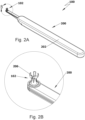
- PORP 102 comprises stapedial part 104, as well as to FIG 2A and 2B .
- Stapedial part 104 is configured for connecting with a distal part of a stapes, such as stapes 28 shown in FIG 1 .
- stapedial part 104 comprises an essentially cylindrical shell shape with elongated interior lumen 105.
- PORP 102 of system 100 is configured to assume a plurality of configurations in-between the divergent configuration and convergent configuration.
- plunger 206 of applicator device 200 plunger is configured to be controllably withdrawn within elongated interior lumen 105 of stapedial part 104.
- PORP 102 is configured to be gradually altered between the divergent and convergent configurations.
- stapedial part 104 comprises proximal basal stem portion 114.
- Proximal basal stem portion 114 forms a continuum with centrical applicator operated portion 110 of stapedial part 104.
- Proximal basal stem portion 114 is configured for being connected with tympanic part 116 of PORP 102.
- tympanic part 116 comprises anterior face 118.
- Anterior face 118 of tympanic part 116 is often directly engaged with tympanic membrane 16.
- a piece of cartilage is firstly placed over anterior face 118 of tympanic part 116, and only then anterior face 118 of tympanic part 116 is covered with tympanic membrane 16.
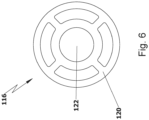
- tympanic part 116 comprises posterior face 120, shown in FIG 6 .
- Posterior face 120 of tympanic part 116 forms a continuum with proximal basal stem portion 114 of stapedial part 104.
- anterior face 118 and/or posterior face 120 of tympanic part 116 comprise/s: a notch, groove, recess, circular aperture, structured aperture, furrowed surface, textured surface and any combination thereof.
- proximal basal stem portion 114 of PORP 102 comprises a screw.
- the screw threading at proximal basal stem portion 114 of PORP 102 is configured for adjusting PORP 102 in length.
- proximal basal stem portion 114 of PORP 102 comprises an external screw threading.
- An external screw threading is configured for matching with an internal screw threading of throughout aperture 122 of tympanic part 116 of PORP 102.
- throughout aperture 122 comprises an internal screw threading.
- An internal screw threading is operatively connectable with stapedial part 104 of PORP 102.
- system 100 comprises applicator device 200.
- Applicator device 200 is configured for partial ossicular replacement with PORP 102, characterized by controllable stapedial engaging function.
- applicator device 200 comprises handpiece 202. Handpiece 202 is configured for manual griping by the operator.
- applicator device 200 comprises essentially planar static face 204. Planar static face 204 is configured for engaging to anterior face 118 of tympanic part 116 of PORP 102.
- applicator device 200 comprises an elongated essentially cylindrically shaped plunger 206.
- Plunger 206 is configured to be introducible into elongated interior lumen 105 of stapedial part 104 of PORP 102 through throughout aperture 122 of tympanic part 116 of PORP 102.
- applicator device 200 comprises tab 208.
- Tab 208 is operatively connected to elongated essentially cylindrically shaped plunger 206.
- Tab 208 is configured for controllably translating essentially cylindrically shaped plunger 206 within elongated interior lumen 105 of stapedial part 104 of PORP 102.
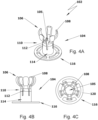
- FIG 4A to 4C showing respectively isometric, side and top views of PORP 102, in a divergent configuration.
- the plurality of inwardly facing elements 112 of centrical portion 110 of stapedial part 102 are driven by a distal portion of plunger 206.
- the divergent configuration of PORP 102 further includes essentially spreading apart the plurality of structured elements 108 of distal terminal stapedial engaging portion 106 of stapedial part 104.
- combination 150B of PORP 102 in the divergent configuration and stapes emulating structure 152 is shown.
- process 301 of manufacturing PORP 102 involves processing preform 302 by at least one machine for producing one-part of the protheses, and/or individual parts thereof, as well as entire PORP 102, such as by a molding machine.
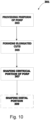
- process 301 of manufacturing PORP 102 commences at step 303 with providing preform 302 of at the least stapedial part.
- preform 302 of at least the stapedial part comprises an essentially cylindrical shell shape with elongated interior lumen 105.
- providing preform 302 comprises manufacturing a plurality of preforms, of different lengths, shapes and diameters.
- process 301 of manufacturing PORP 102 comprises forming a plurality of elongated cuts 304, at step 305.
- forming the plurality of elongated cuts 304 of step 305 is performed from the distal terminal face of preform 302, along a substantial length of essentially cylindrical shell shape of preform 302.
- the plurality of elongated cuts 304 at step 305 forms a plurality of elongated biasing elements 312 extending from proximal basal stem portion 114 of an essentially cylindrical shell shape of preform 302.
- the forming of plurality of elongated cuts 304 at step 305 includes processing preform 302 by at least one machine, such as laser cutting machine, electrical discharge machine, CNC, drills or any other type of subtractive manufacturing, as well as any combination thereof.
- at least one machine such as laser cutting machine, electrical discharge machine, CNC, drills or any other type of subtractive manufacturing, as well as any combination thereof.
- process 301 of manufacturing PORP 300 yet further comprises a step of forming a plurality of mariquose shaped recesses 314, in-between elongated biasing elements 312.
- the step of forming a plurality of mariquose shaped recesses 314, in-between elongated biasing elements 312, is typically performed following the forming of plurality of elongated cuts 304 at step 305 and prior to step 307 of shaping centrical portion of plurality of elongated biasing elements 312.
- process 301 of manufacturing PORP 300 further comprises step 309 of shaping the distal terminal portion of plurality of elongated biasing elements 308.
- step 309 of shaping the distal terminal portion of plurality of elongated biasing elements 312 forms a plurality of structured elements configured to conform to a distal portion of stapes, such as stapes 28 shown in FIG 1 .
- step 309 of shaping the distal terminal portion of the plurality of biasing elements 312 forms stapedial engaging portion 106 of stapedial part 104.
- shaping a distal terminal portion of the plurality of biasing elements 308 includes processing by at least one machine such, as a chamfering and/or filleting machine.
- step 402 of providing PORP 102 comprises selecting PORP 102 with diameter, length and/or shape suitable for specific patient, from a kit comprising a plurality of PORPs with different diameters, lengths and/or shapes.
- step 402, of providing PORP 102 comprises selecting PORP 102 with size, length, diameter and/or shape matching plunger 206 of applicator device 200.
- step 402, of providing a PORP comprises length adjustment of stapedial part 104 of PORP 102.
- step 402, of providing a PORP includes using disinfectants, sterilization, as well as providing of instruments and utensils for proper handling, such as tweezers, scissors and/or forceps.
- method 400 of operating an applicator device for a PORP comprises step 404, of providing an applicator device.
- step 404 of providing an applicator device comprises using disinfectants and/or sterilization of applicator device 200.
- step 404 of providing an applicator device comprises length adjustment of plunger 206 of applicator device 200.
- step 404, of providing an applicator device comprises selecting plunger 206 of applicator device 200 with size, length, diameter and/or shape matching PORP 102.
- method 400 of operating an applicator device for a PORP comprises step 406, of introducing plunger 206 into an elongated interior lumen of the stapedial part of a PORP.
- step 406, of introducing the plunger of applicator device into the elongated interior lumen of the stapedial part is performed by manipulating PORP by sterile instruments, such as forceps.
- method 400 of operating an applicator device for a PORP comprises step 408, of engaging the anterior face of the tympanic part of the PORP to the essentially planar static face of the applicator device.
- Step 408 is configured for stabilizing the engaging of PORP 102 by applicator device 200 onto the stapes.
- method 400 of operating an applicator device for a PORP comprises step 410 of advancing the plunger of an applicator device within an elongated interior lumen of the stapedial part of the PORP.
- step 410 is configured for driving PORP into the divergent configuration.
- step 410 is performed by pressing onto tab 208 of applicator device 200.
- method 400 of operating an applicator device for a PORP comprises step 412 of withdrawing the plunger of an applicator device from the plurality of inwardly facing elements of a stapedial part of the PORP.
- step 412 of withdrawing the plunger of an applicator device from the plurality of inwardly facing elements of a stapedial part of the PORP is configured for driving PORP 102 into the convergent configuration on a distal portion of stapes 28.
- step 412 is performed by gradually pulling tab 208 of applicator device 200 or by releasing tab 208 of applicator device 200.
Landscapes
- Health & Medical Sciences (AREA)
- Life Sciences & Earth Sciences (AREA)
- Veterinary Medicine (AREA)
- Public Health (AREA)
- General Health & Medical Sciences (AREA)
- Animal Behavior & Ethology (AREA)
- Engineering & Computer Science (AREA)
- Biomedical Technology (AREA)
- Heart & Thoracic Surgery (AREA)
- Transplantation (AREA)
- Vascular Medicine (AREA)
- Oral & Maxillofacial Surgery (AREA)
- Cardiology (AREA)
- Pulmonology (AREA)
- Otolaryngology (AREA)
- Surgery (AREA)
- Nuclear Medicine, Radiotherapy & Molecular Imaging (AREA)
- Medical Informatics (AREA)
- Molecular Biology (AREA)
- Prostheses (AREA)
Applications Claiming Priority (1)
| Application Number | Priority Date | Filing Date | Title |
|---|---|---|---|
| IL285583A IL285583A (en) | 2021-08-12 | 2021-08-12 | Middle ear bone replacement prosthesis with controllable snapping function, its manufacturing process and applicator device for it |
Publications (3)
| Publication Number | Publication Date |
|---|---|
| EP4134045A1 true EP4134045A1 (de) | 2023-02-15 |
| EP4134045B1 EP4134045B1 (de) | 2024-02-07 |
| EP4134045C0 EP4134045C0 (de) | 2024-02-07 |
Family
ID=82611042
Family Applications (1)
| Application Number | Title | Priority Date | Filing Date |
|---|---|---|---|
| EP22189745.7A Active EP4134045B1 (de) | 2021-08-12 | 2022-08-10 | Rosthese zum gehörknöchelchenersatz mit kontrollierbarer stapedialkonformitätsfunktion, herstellungsverfahren dafür und applikatorvorrichtung dafür |
Country Status (3)
| Country | Link |
|---|---|
| US (1) | US12564488B2 (de) |
| EP (1) | EP4134045B1 (de) |
| IL (1) | IL285583A (de) |
Citations (14)
| Publication number | Priority date | Publication date | Assignee | Title |
|---|---|---|---|---|
| WO1992018066A1 (fr) | 1991-04-19 | 1992-10-29 | Guy Charvin | Prothese ossiculaire auto-ajustable de l'oreille moyenne |
| DE19845906A1 (de) * | 1997-10-11 | 1999-04-15 | Heinz Kurz Gmbh Medizintechnik | Gehörknöchelprothese |
| US6168625B1 (en) | 1998-12-01 | 2001-01-02 | Anthony D. Prescott | Adjustable length prosthesis useful for ossicular replacement and reconstruction |
| US7087081B2 (en) | 2003-09-19 | 2006-08-08 | Clarity Corporation | Stapedial prosthesis and method of implanting the same |
| US20090149697A1 (en) | 2007-08-31 | 2009-06-11 | Uwe Steinhardt | Length-variable auditory ossicle prosthesis |
| US8192489B2 (en) | 2010-09-10 | 2012-06-05 | Gyrus Ent, L.L.C. | In situ adjustable ossicular implant and instrument for implanting and adjusting an adjustable ossicular implant |
| US8206444B2 (en) | 2003-09-19 | 2012-06-26 | Clarity Corporation | Middle ear prosthesis |
| EP2583639A1 (de) | 2010-01-21 | 2013-04-24 | MED-EL Elektromedizinische Geraete GmbH | Incus Ersatz teilweise Ossicular Ersatz Prothese |
| US8936637B2 (en) | 2011-12-07 | 2015-01-20 | Heinz Kurz Gmbh Medizintechnik | Variable-length passive ossicular prosthesis |
| US20160175093A1 (en) * | 2014-12-19 | 2016-06-23 | Heinz Kurz Gmbh Medizintechnik | Ossicular prosthesis having spikes |
| US20190192425A1 (en) | 2008-07-21 | 2019-06-27 | Otonomy, Inc. | Controlled release delivery devices for the treatment of otic disorders |
| US20190201189A1 (en) | 2016-09-13 | 2019-07-04 | Med-El Elektromedizinische Geraete Gmbh | Passive Middle Ear Prosthesis |
| US10595990B2 (en) * | 2016-09-06 | 2020-03-24 | Gyrus Acmi, Inc. | Osseointegrative adjustable ossicular prosthesis |
| US10646331B2 (en) | 2017-04-26 | 2020-05-12 | University Of Maryland, Baltimore | Ossicular prosthesis and method and system for manufacturing same |
Family Cites Families (3)
| Publication number | Priority date | Publication date | Assignee | Title |
|---|---|---|---|---|
| WO1998016175A1 (de) * | 1996-10-12 | 1998-04-23 | Technische Universität Dresden | Gehörknöchelchenprothese zur schallübertragung im mittelohr |
| US20080097602A1 (en) * | 2006-10-23 | 2008-04-24 | Robert Brosnahan | Otologic Prostheses with Compressive Ossicular Engagement by a Superelastic Structure and Method of Implanting the Same |
| DE102009006047B3 (de) * | 2009-01-24 | 2010-03-25 | Heinz Kurz Gmbh Medizintechnik | Passive Gehörknöchelchenprothese mit Applikator |
-
2021
- 2021-08-12 IL IL285583A patent/IL285583A/en unknown
-
2022
- 2022-08-10 EP EP22189745.7A patent/EP4134045B1/de active Active
- 2022-08-12 US US17/886,967 patent/US12564488B2/en active Active
Patent Citations (14)
| Publication number | Priority date | Publication date | Assignee | Title |
|---|---|---|---|---|
| WO1992018066A1 (fr) | 1991-04-19 | 1992-10-29 | Guy Charvin | Prothese ossiculaire auto-ajustable de l'oreille moyenne |
| DE19845906A1 (de) * | 1997-10-11 | 1999-04-15 | Heinz Kurz Gmbh Medizintechnik | Gehörknöchelprothese |
| US6168625B1 (en) | 1998-12-01 | 2001-01-02 | Anthony D. Prescott | Adjustable length prosthesis useful for ossicular replacement and reconstruction |
| US8206444B2 (en) | 2003-09-19 | 2012-06-26 | Clarity Corporation | Middle ear prosthesis |
| US7087081B2 (en) | 2003-09-19 | 2006-08-08 | Clarity Corporation | Stapedial prosthesis and method of implanting the same |
| US20090149697A1 (en) | 2007-08-31 | 2009-06-11 | Uwe Steinhardt | Length-variable auditory ossicle prosthesis |
| US20190192425A1 (en) | 2008-07-21 | 2019-06-27 | Otonomy, Inc. | Controlled release delivery devices for the treatment of otic disorders |
| EP2583639A1 (de) | 2010-01-21 | 2013-04-24 | MED-EL Elektromedizinische Geraete GmbH | Incus Ersatz teilweise Ossicular Ersatz Prothese |
| US8192489B2 (en) | 2010-09-10 | 2012-06-05 | Gyrus Ent, L.L.C. | In situ adjustable ossicular implant and instrument for implanting and adjusting an adjustable ossicular implant |
| US8936637B2 (en) | 2011-12-07 | 2015-01-20 | Heinz Kurz Gmbh Medizintechnik | Variable-length passive ossicular prosthesis |
| US20160175093A1 (en) * | 2014-12-19 | 2016-06-23 | Heinz Kurz Gmbh Medizintechnik | Ossicular prosthesis having spikes |
| US10595990B2 (en) * | 2016-09-06 | 2020-03-24 | Gyrus Acmi, Inc. | Osseointegrative adjustable ossicular prosthesis |
| US20190201189A1 (en) | 2016-09-13 | 2019-07-04 | Med-El Elektromedizinische Geraete Gmbh | Passive Middle Ear Prosthesis |
| US10646331B2 (en) | 2017-04-26 | 2020-05-12 | University Of Maryland, Baltimore | Ossicular prosthesis and method and system for manufacturing same |
Also Published As
| Publication number | Publication date |
|---|---|
| EP4134045B1 (de) | 2024-02-07 |
| EP4134045C0 (de) | 2024-02-07 |
| IL285583A (en) | 2022-07-01 |
| US20230049803A1 (en) | 2023-02-16 |
| US12564488B2 (en) | 2026-03-03 |
Similar Documents
| Publication | Publication Date | Title |
|---|---|---|
| CN1937970B (zh) | 中耳中具有可变频率响应功能的听小骨假体 | |
| US8888846B2 (en) | Passive ossicle prosthesis comprising applicator | |
| EP3512463B1 (de) | Passive mittelohrprothese | |
| US8262729B2 (en) | Dynamic ossicular prosthesis | |
| US8906090B2 (en) | Auditory ossicle prosthesis | |
| CN104095694A (zh) | 具有衬垫式固定元件的听小骨假体 | |
| US20080058927A1 (en) | Ossicular Prostheses Fabricated From Shape Memory Polymers | |
| HARRISON et al. | Prosthetics in the middle ear: preliminary report on the use of prosthetics to reestablish continuity of the sound pressure transformer of the middle ear | |
| US12564488B2 (en) | Ossicular replacement prothesis with controllable stapedial conforming function, manufacture method thereof and applicator device therefor | |
| CN103037807B (zh) | 带有用于具有形状记忆的听小骨假体的热仿真体的测试装置 | |
| EP1667613A2 (de) | Steigbügelprothese und implantationsverfahren dafür | |
| CN108886664B (zh) | 中耳联接器的预加载反馈 | |
| WO2017033205A1 (en) | Total implant of middle ear prosthesis | |
| RU2766413C1 (ru) | Имплантат в качестве протеза слуховых косточек для замещения поврежденных частей среднего уха | |
| RU2766795C1 (ru) | Имплантат в качестве протеза слуховых косточек для замещения поврежденных частей среднего уха (варианты) | |
| US20260026929A1 (en) | Ossicular prosthesis selectable from a single arrangement | |
| RU236051U1 (ru) | Пассивный тотальный титановый имплант по замене цепи слуховых косточек с повышенной степенью фиксации | |
| CN116196141B (zh) | 一种用于听骨链重建的假体 | |
| CN110538002B (zh) | 人工鼓室 | |
| PL249258B1 (pl) | Proteza ucha środkowego | |
| CN118105209A (zh) | 一种自锁式人造听骨置换体 | |
| Pfister et al. | Aspects of Ossiculoplasty | |
| CN203089287U (zh) | 一种专门用于钛质人工听骨植入的手术器械 | |
| Lenarz | Codacs as new treatment option for patients with severe and profound mixed hearing loss including cases with chronic otitis and cholesteatoma: Presenting Author: Thomas Lenarz | |
| Ganesan et al. | Novel Low Cost Powerless MEMS Based Ossicular System |
Legal Events
| Date | Code | Title | Description |
|---|---|---|---|
| PUAI | Public reference made under article 153(3) epc to a published international application that has entered the european phase |
Free format text: ORIGINAL CODE: 0009012 |
|
| STAA | Information on the status of an ep patent application or granted ep patent |
Free format text: STATUS: THE APPLICATION HAS BEEN PUBLISHED |
|
| AK | Designated contracting states |
Kind code of ref document: A1 Designated state(s): AL AT BE BG CH CY CZ DE DK EE ES FI FR GB GR HR HU IE IS IT LI LT LU LV MC MK MT NL NO PL PT RO RS SE SI SK SM TR |
|
| STAA | Information on the status of an ep patent application or granted ep patent |
Free format text: STATUS: REQUEST FOR EXAMINATION WAS MADE |
|
| 17P | Request for examination filed |
Effective date: 20230529 |
|
| RBV | Designated contracting states (corrected) |
Designated state(s): AL AT BE BG CH CY CZ DE DK EE ES FI FR GB GR HR HU IE IS IT LI LT LU LV MC MK MT NL NO PL PT RO RS SE SI SK SM TR |
|
| GRAP | Despatch of communication of intention to grant a patent |
Free format text: ORIGINAL CODE: EPIDOSNIGR1 |
|
| STAA | Information on the status of an ep patent application or granted ep patent |
Free format text: STATUS: GRANT OF PATENT IS INTENDED |
|
| RIC1 | Information provided on ipc code assigned before grant |
Ipc: A61F 2/18 20060101AFI20230807BHEP |
|
| INTG | Intention to grant announced |
Effective date: 20230905 |
|
| RIN1 | Information on inventor provided before grant (corrected) |
Inventor name: MAZZAWI, SALIM |
|
| GRAS | Grant fee paid |
Free format text: ORIGINAL CODE: EPIDOSNIGR3 |
|
| GRAA | (expected) grant |
Free format text: ORIGINAL CODE: 0009210 |
|
| STAA | Information on the status of an ep patent application or granted ep patent |
Free format text: STATUS: THE PATENT HAS BEEN GRANTED |
|
| AK | Designated contracting states |
Kind code of ref document: B1 Designated state(s): AL AT BE BG CH CY CZ DE DK EE ES FI FR GB GR HR HU IE IS IT LI LT LU LV MC MK MT NL NO PL PT RO RS SE SI SK SM TR |
|
| REG | Reference to a national code |
Ref country code: GB Ref legal event code: FG4D |
|
| REG | Reference to a national code |
Ref country code: CH Ref legal event code: EP |
|
| REG | Reference to a national code |
Ref country code: DE Ref legal event code: R096 Ref document number: 602022001861 Country of ref document: DE |
|
| REG | Reference to a national code |
Ref country code: IE Ref legal event code: FG4D |
|
| U01 | Request for unitary effect filed |
Effective date: 20240301 |
|
| U07 | Unitary effect registered |
Designated state(s): AT BE BG DE DK EE FI FR IT LT LU LV MT NL PT SE SI Effective date: 20240326 |
|
| PG25 | Lapsed in a contracting state [announced via postgrant information from national office to epo] |
Ref country code: IS Free format text: LAPSE BECAUSE OF FAILURE TO SUBMIT A TRANSLATION OF THE DESCRIPTION OR TO PAY THE FEE WITHIN THE PRESCRIBED TIME-LIMIT Effective date: 20240607 |
|
| PG25 | Lapsed in a contracting state [announced via postgrant information from national office to epo] |
Ref country code: GR Free format text: LAPSE BECAUSE OF FAILURE TO SUBMIT A TRANSLATION OF THE DESCRIPTION OR TO PAY THE FEE WITHIN THE PRESCRIBED TIME-LIMIT Effective date: 20240508 |
|
| PG25 | Lapsed in a contracting state [announced via postgrant information from national office to epo] |
Ref country code: HR Free format text: LAPSE BECAUSE OF FAILURE TO SUBMIT A TRANSLATION OF THE DESCRIPTION OR TO PAY THE FEE WITHIN THE PRESCRIBED TIME-LIMIT Effective date: 20240207 Ref country code: RS Free format text: LAPSE BECAUSE OF FAILURE TO SUBMIT A TRANSLATION OF THE DESCRIPTION OR TO PAY THE FEE WITHIN THE PRESCRIBED TIME-LIMIT Effective date: 20240507 |
|
| PG25 | Lapsed in a contracting state [announced via postgrant information from national office to epo] |
Ref country code: ES Free format text: LAPSE BECAUSE OF FAILURE TO SUBMIT A TRANSLATION OF THE DESCRIPTION OR TO PAY THE FEE WITHIN THE PRESCRIBED TIME-LIMIT Effective date: 20240207 |
|
| PG25 | Lapsed in a contracting state [announced via postgrant information from national office to epo] |
Ref country code: RS Free format text: LAPSE BECAUSE OF FAILURE TO SUBMIT A TRANSLATION OF THE DESCRIPTION OR TO PAY THE FEE WITHIN THE PRESCRIBED TIME-LIMIT Effective date: 20240507 Ref country code: NO Free format text: LAPSE BECAUSE OF FAILURE TO SUBMIT A TRANSLATION OF THE DESCRIPTION OR TO PAY THE FEE WITHIN THE PRESCRIBED TIME-LIMIT Effective date: 20240507 Ref country code: IS Free format text: LAPSE BECAUSE OF FAILURE TO SUBMIT A TRANSLATION OF THE DESCRIPTION OR TO PAY THE FEE WITHIN THE PRESCRIBED TIME-LIMIT Effective date: 20240607 Ref country code: HR Free format text: LAPSE BECAUSE OF FAILURE TO SUBMIT A TRANSLATION OF THE DESCRIPTION OR TO PAY THE FEE WITHIN THE PRESCRIBED TIME-LIMIT Effective date: 20240207 Ref country code: GR Free format text: LAPSE BECAUSE OF FAILURE TO SUBMIT A TRANSLATION OF THE DESCRIPTION OR TO PAY THE FEE WITHIN THE PRESCRIBED TIME-LIMIT Effective date: 20240508 Ref country code: ES Free format text: LAPSE BECAUSE OF FAILURE TO SUBMIT A TRANSLATION OF THE DESCRIPTION OR TO PAY THE FEE WITHIN THE PRESCRIBED TIME-LIMIT Effective date: 20240207 |
|
| PG25 | Lapsed in a contracting state [announced via postgrant information from national office to epo] |
Ref country code: PL Free format text: LAPSE BECAUSE OF FAILURE TO SUBMIT A TRANSLATION OF THE DESCRIPTION OR TO PAY THE FEE WITHIN THE PRESCRIBED TIME-LIMIT Effective date: 20240207 |
|
| PG25 | Lapsed in a contracting state [announced via postgrant information from national office to epo] |
Ref country code: PL Free format text: LAPSE BECAUSE OF FAILURE TO SUBMIT A TRANSLATION OF THE DESCRIPTION OR TO PAY THE FEE WITHIN THE PRESCRIBED TIME-LIMIT Effective date: 20240207 |
|
| U20 | Renewal fee for the european patent with unitary effect paid |
Year of fee payment: 3 Effective date: 20240726 |
|
| PG25 | Lapsed in a contracting state [announced via postgrant information from national office to epo] |
Ref country code: SM Free format text: LAPSE BECAUSE OF FAILURE TO SUBMIT A TRANSLATION OF THE DESCRIPTION OR TO PAY THE FEE WITHIN THE PRESCRIBED TIME-LIMIT Effective date: 20240207 |
|
| PG25 | Lapsed in a contracting state [announced via postgrant information from national office to epo] |
Ref country code: CZ Free format text: LAPSE BECAUSE OF FAILURE TO SUBMIT A TRANSLATION OF THE DESCRIPTION OR TO PAY THE FEE WITHIN THE PRESCRIBED TIME-LIMIT Effective date: 20240207 |
|
| PG25 | Lapsed in a contracting state [announced via postgrant information from national office to epo] |
Ref country code: SK Free format text: LAPSE BECAUSE OF FAILURE TO SUBMIT A TRANSLATION OF THE DESCRIPTION OR TO PAY THE FEE WITHIN THE PRESCRIBED TIME-LIMIT Effective date: 20240207 |
|
| PG25 | Lapsed in a contracting state [announced via postgrant information from national office to epo] |
Ref country code: SM Free format text: LAPSE BECAUSE OF FAILURE TO SUBMIT A TRANSLATION OF THE DESCRIPTION OR TO PAY THE FEE WITHIN THE PRESCRIBED TIME-LIMIT Effective date: 20240207 Ref country code: SK Free format text: LAPSE BECAUSE OF FAILURE TO SUBMIT A TRANSLATION OF THE DESCRIPTION OR TO PAY THE FEE WITHIN THE PRESCRIBED TIME-LIMIT Effective date: 20240207 Ref country code: RO Free format text: LAPSE BECAUSE OF FAILURE TO SUBMIT A TRANSLATION OF THE DESCRIPTION OR TO PAY THE FEE WITHIN THE PRESCRIBED TIME-LIMIT Effective date: 20240207 Ref country code: CZ Free format text: LAPSE BECAUSE OF FAILURE TO SUBMIT A TRANSLATION OF THE DESCRIPTION OR TO PAY THE FEE WITHIN THE PRESCRIBED TIME-LIMIT Effective date: 20240207 |
|
| REG | Reference to a national code |
Ref country code: DE Ref legal event code: R097 Ref document number: 602022001861 Country of ref document: DE |
|
| PLBE | No opposition filed within time limit |
Free format text: ORIGINAL CODE: 0009261 |
|
| STAA | Information on the status of an ep patent application or granted ep patent |
Free format text: STATUS: NO OPPOSITION FILED WITHIN TIME LIMIT |
|
| 26N | No opposition filed |
Effective date: 20241108 |
|
| PG25 | Lapsed in a contracting state [announced via postgrant information from national office to epo] |
Ref country code: MC Free format text: LAPSE BECAUSE OF FAILURE TO SUBMIT A TRANSLATION OF THE DESCRIPTION OR TO PAY THE FEE WITHIN THE PRESCRIBED TIME-LIMIT Effective date: 20240207 |
|
| PG25 | Lapsed in a contracting state [announced via postgrant information from national office to epo] |
Ref country code: IE Free format text: LAPSE BECAUSE OF NON-PAYMENT OF DUE FEES Effective date: 20240810 |
|
| U20 | Renewal fee for the european patent with unitary effect paid |
Year of fee payment: 4 Effective date: 20250825 |
|
| PG25 | Lapsed in a contracting state [announced via postgrant information from national office to epo] |
Ref country code: CY Free format text: LAPSE BECAUSE OF FAILURE TO SUBMIT A TRANSLATION OF THE DESCRIPTION OR TO PAY THE FEE WITHIN THE PRESCRIBED TIME-LIMIT; INVALID AB INITIO Effective date: 20220810 |
|
| PG25 | Lapsed in a contracting state [announced via postgrant information from national office to epo] |
Ref country code: HU Free format text: LAPSE BECAUSE OF FAILURE TO SUBMIT A TRANSLATION OF THE DESCRIPTION OR TO PAY THE FEE WITHIN THE PRESCRIBED TIME-LIMIT; INVALID AB INITIO Effective date: 20220810 |
|
| REG | Reference to a national code |
Ref country code: CH Ref legal event code: H13 Free format text: ST27 STATUS EVENT CODE: U-0-0-H10-H13 (AS PROVIDED BY THE NATIONAL OFFICE) Effective date: 20260324 |
|
| PG25 | Lapsed in a contracting state [announced via postgrant information from national office to epo] |
Ref country code: CH Free format text: LAPSE BECAUSE OF NON-PAYMENT OF DUE FEES Effective date: 20250831 |