EP4130878A1 - Active-light-sensitive or radiation-sensitive resin composition, active-light-sensitive or radiation-sensitive film, pattern formation method, method for manufacturing electronic device, active-light-sensitive or radiation-sensitive resin composition for manufacturing photomask, and method for manufacturing photomask - Google Patents
Active-light-sensitive or radiation-sensitive resin composition, active-light-sensitive or radiation-sensitive film, pattern formation method, method for manufacturing electronic device, active-light-sensitive or radiation-sensitive resin composition for manufacturing photomask, and method for manufacturing photomask Download PDFInfo
- Publication number
- EP4130878A1 EP4130878A1 EP21779830.5A EP21779830A EP4130878A1 EP 4130878 A1 EP4130878 A1 EP 4130878A1 EP 21779830 A EP21779830 A EP 21779830A EP 4130878 A1 EP4130878 A1 EP 4130878A1
- Authority
- EP
- European Patent Office
- Prior art keywords
- group
- sensitive
- radiation
- compound
- acid
- Prior art date
- Legal status (The legal status is an assumption and is not a legal conclusion. Google has not performed a legal analysis and makes no representation as to the accuracy of the status listed.)
- Pending
Links
- 238000000034 method Methods 0.000 title claims abstract description 125
- 230000005855 radiation Effects 0.000 title claims abstract description 102
- 239000011342 resin composition Substances 0.000 title claims abstract description 63
- 238000004519 manufacturing process Methods 0.000 title claims abstract description 50
- 230000007261 regionalization Effects 0.000 title 1
- 239000002253 acid Substances 0.000 claims abstract description 112
- 229920005989 resin Polymers 0.000 claims abstract description 99
- 239000011347 resin Substances 0.000 claims abstract description 99
- 230000009471 action Effects 0.000 claims abstract description 46
- 150000007514 bases Chemical class 0.000 claims abstract description 36
- 238000000354 decomposition reaction Methods 0.000 claims abstract description 32
- 125000000217 alkyl group Chemical group 0.000 claims description 186
- 150000001875 compounds Chemical class 0.000 claims description 145
- 125000000753 cycloalkyl group Chemical group 0.000 claims description 139
- 125000003118 aryl group Chemical group 0.000 claims description 119
- 125000004435 hydrogen atom Chemical group [H]* 0.000 claims description 51
- 125000005647 linker group Chemical group 0.000 claims description 25
- 239000007787 solid Substances 0.000 claims description 20
- RTZKZFJDLAIYFH-UHFFFAOYSA-N ether Substances CCOCC RTZKZFJDLAIYFH-UHFFFAOYSA-N 0.000 claims description 16
- MGFYSGNNHQQTJW-UHFFFAOYSA-N iodonium Chemical compound [IH2+] MGFYSGNNHQQTJW-UHFFFAOYSA-N 0.000 claims description 9
- RWSOTUBLDIXVET-UHFFFAOYSA-O sulfonium Chemical compound [SH3+] RWSOTUBLDIXVET-UHFFFAOYSA-O 0.000 claims description 9
- 239000000203 mixture Substances 0.000 abstract description 116
- 125000004432 carbon atom Chemical group C* 0.000 description 149
- 239000002904 solvent Substances 0.000 description 104
- 125000001424 substituent group Chemical group 0.000 description 92
- 239000010408 film Substances 0.000 description 83
- LLHKCFNBLRBOGN-UHFFFAOYSA-N propylene glycol methyl ether acetate Chemical compound COCC(C)OC(C)=O LLHKCFNBLRBOGN-UHFFFAOYSA-N 0.000 description 73
- ARXJGSRGQADJSQ-UHFFFAOYSA-N 1-methoxypropan-2-ol Chemical compound COCC(C)O ARXJGSRGQADJSQ-UHFFFAOYSA-N 0.000 description 69
- -1 sulfonate anion Chemical class 0.000 description 65
- 238000011161 development Methods 0.000 description 60
- 239000007788 liquid Substances 0.000 description 57
- 125000002887 hydroxy group Chemical group [H]O* 0.000 description 55
- 230000007547 defect Effects 0.000 description 41
- 150000001768 cations Chemical group 0.000 description 40
- 125000005842 heteroatom Chemical group 0.000 description 33
- 238000011282 treatment Methods 0.000 description 33
- 230000004304 visual acuity Effects 0.000 description 33
- 239000003960 organic solvent Substances 0.000 description 32
- 239000000463 material Substances 0.000 description 31
- 125000002496 methyl group Chemical group [H]C([H])([H])* 0.000 description 29
- 238000002360 preparation method Methods 0.000 description 29
- 125000005843 halogen group Chemical group 0.000 description 28
- 239000004094 surface-active agent Substances 0.000 description 28
- 239000003513 alkali Substances 0.000 description 27
- 229910052757 nitrogen Inorganic materials 0.000 description 26
- 125000004433 nitrogen atom Chemical group N* 0.000 description 26
- 125000004430 oxygen atom Chemical group O* 0.000 description 24
- 125000002947 alkylene group Chemical group 0.000 description 23
- 229910052731 fluorine Inorganic materials 0.000 description 23
- 229910052751 metal Inorganic materials 0.000 description 23
- 239000002184 metal Substances 0.000 description 23
- 125000002950 monocyclic group Chemical group 0.000 description 22
- 239000003431 cross linking reagent Substances 0.000 description 20
- LYCAIKOWRPUZTN-UHFFFAOYSA-N ethylene glycol Natural products OCCO LYCAIKOWRPUZTN-UHFFFAOYSA-N 0.000 description 20
- 239000000758 substrate Substances 0.000 description 20
- 125000001570 methylene group Chemical group [H]C([H])([*:1])[*:2] 0.000 description 19
- 239000000243 solution Substances 0.000 description 19
- 239000004215 Carbon black (E152) Substances 0.000 description 18
- 125000001931 aliphatic group Chemical group 0.000 description 18
- 229930195733 hydrocarbon Natural products 0.000 description 18
- WGTYBPLFGIVFAS-UHFFFAOYSA-M tetramethylammonium hydroxide Chemical compound [OH-].C[N+](C)(C)C WGTYBPLFGIVFAS-UHFFFAOYSA-M 0.000 description 18
- 125000003545 alkoxy group Chemical group 0.000 description 17
- 239000003759 ester based solvent Substances 0.000 description 17
- 125000001495 ethyl group Chemical group [H]C([H])([H])C([H])([H])* 0.000 description 17
- 238000001914 filtration Methods 0.000 description 17
- 229910052717 sulfur Inorganic materials 0.000 description 17
- 125000004434 sulfur atom Chemical group 0.000 description 17
- 239000011248 coating agent Substances 0.000 description 16
- 238000000576 coating method Methods 0.000 description 16
- 125000000113 cyclohexyl group Chemical group [H]C1([H])C([H])([H])C([H])([H])C([H])(*)C([H])([H])C1([H])[H] 0.000 description 16
- 125000000623 heterocyclic group Chemical group 0.000 description 16
- 150000002596 lactones Chemical group 0.000 description 16
- 125000001153 fluoro group Chemical group F* 0.000 description 15
- 150000002430 hydrocarbons Chemical class 0.000 description 15
- 238000007654 immersion Methods 0.000 description 15
- 238000003860 storage Methods 0.000 description 15
- 150000008053 sultones Chemical group 0.000 description 15
- 150000001338 aliphatic hydrocarbons Chemical class 0.000 description 14
- 125000004453 alkoxycarbonyl group Chemical group 0.000 description 14
- DIOQZVSQGTUSAI-UHFFFAOYSA-N decane Chemical compound CCCCCCCCCC DIOQZVSQGTUSAI-UHFFFAOYSA-N 0.000 description 14
- 125000002868 norbornyl group Chemical group C12(CCC(CC1)C2)* 0.000 description 14
- 125000000962 organic group Chemical group 0.000 description 14
- 125000003367 polycyclic group Chemical group 0.000 description 14
- 125000003178 carboxy group Chemical group [H]OC(*)=O 0.000 description 13
- MTHSVFCYNBDYFN-UHFFFAOYSA-N diethylene glycol Chemical compound OCCOCCO MTHSVFCYNBDYFN-UHFFFAOYSA-N 0.000 description 13
- 239000004210 ether based solvent Substances 0.000 description 13
- 125000004108 n-butyl group Chemical group [H]C([H])([H])C([H])([H])C([H])([H])C([H])([H])* 0.000 description 13
- 125000001997 phenyl group Chemical group [H]C1=C([H])C([H])=C(*)C([H])=C1[H] 0.000 description 13
- 239000005456 alcohol based solvent Substances 0.000 description 12
- JHIVVAPYMSGYDF-UHFFFAOYSA-N cyclohexanone Chemical compound O=C1CCCCC1 JHIVVAPYMSGYDF-UHFFFAOYSA-N 0.000 description 12
- 125000001511 cyclopentyl group Chemical group [H]C1([H])C([H])([H])C([H])([H])C([H])(*)C1([H])[H] 0.000 description 12
- 238000010894 electron beam technology Methods 0.000 description 12
- LZCLXQDLBQLTDK-UHFFFAOYSA-N ethyl 2-hydroxypropanoate Chemical compound CCOC(=O)C(C)O LZCLXQDLBQLTDK-UHFFFAOYSA-N 0.000 description 12
- 125000000524 functional group Chemical group 0.000 description 12
- RSJKGSCJYJTIGS-UHFFFAOYSA-N undecane Chemical compound CCCCCCCCCCC RSJKGSCJYJTIGS-UHFFFAOYSA-N 0.000 description 12
- XUIMIQQOPSSXEZ-UHFFFAOYSA-N Silicon Chemical compound [Si] XUIMIQQOPSSXEZ-UHFFFAOYSA-N 0.000 description 11
- 230000008859 change Effects 0.000 description 11
- 125000004093 cyano group Chemical group *C#N 0.000 description 11
- 239000012535 impurity Substances 0.000 description 11
- 229910052710 silicon Inorganic materials 0.000 description 11
- 230000006866 deterioration Effects 0.000 description 10
- 230000000694 effects Effects 0.000 description 10
- CATSNJVOTSVZJV-UHFFFAOYSA-N heptan-2-one Chemical compound CCCCCC(C)=O CATSNJVOTSVZJV-UHFFFAOYSA-N 0.000 description 10
- JEIPFZHSYJVQDO-UHFFFAOYSA-N iron(III) oxide Inorganic materials O=[Fe]O[Fe]=O JEIPFZHSYJVQDO-UHFFFAOYSA-N 0.000 description 10
- MLFHJEHSLIIPHL-UHFFFAOYSA-N isoamyl acetate Chemical compound CC(C)CCOC(C)=O MLFHJEHSLIIPHL-UHFFFAOYSA-N 0.000 description 10
- 239000005453 ketone based solvent Substances 0.000 description 10
- 230000002265 prevention Effects 0.000 description 10
- 239000002994 raw material Substances 0.000 description 10
- 238000005406 washing Methods 0.000 description 10
- ZMXDDKWLCZADIW-UHFFFAOYSA-N N,N-Dimethylformamide Chemical compound CN(C)C=O ZMXDDKWLCZADIW-UHFFFAOYSA-N 0.000 description 9
- LRHPLDYGYMQRHN-UHFFFAOYSA-N N-Butanol Chemical compound CCCCO LRHPLDYGYMQRHN-UHFFFAOYSA-N 0.000 description 9
- DKGAVHZHDRPRBM-UHFFFAOYSA-N Tert-Butanol Chemical compound CC(C)(C)O DKGAVHZHDRPRBM-UHFFFAOYSA-N 0.000 description 9
- 125000005073 adamantyl group Chemical group C12(CC3CC(CC(C1)C3)C2)* 0.000 description 9
- 125000003710 aryl alkyl group Chemical group 0.000 description 9
- 125000002915 carbonyl group Chemical group [*:2]C([*:1])=O 0.000 description 9
- 125000001436 propyl group Chemical group [H]C([*])([H])C([H])([H])C([H])([H])[H] 0.000 description 9
- 125000000999 tert-butyl group Chemical group [H]C([H])([H])C(*)(C([H])([H])[H])C([H])([H])[H] 0.000 description 9
- XLYOFNOQVPJJNP-UHFFFAOYSA-N water Substances O XLYOFNOQVPJJNP-UHFFFAOYSA-N 0.000 description 9
- YCKRFDGAMUMZLT-UHFFFAOYSA-N Fluorine atom Chemical compound [F] YCKRFDGAMUMZLT-UHFFFAOYSA-N 0.000 description 8
- 239000004743 Polypropylene Substances 0.000 description 8
- 150000001408 amides Chemical class 0.000 description 8
- PGMYKACGEOXYJE-UHFFFAOYSA-N anhydrous amyl acetate Natural products CCCCCOC(C)=O PGMYKACGEOXYJE-UHFFFAOYSA-N 0.000 description 8
- 125000000732 arylene group Chemical group 0.000 description 8
- 238000011156 evaluation Methods 0.000 description 8
- 239000011737 fluorine Substances 0.000 description 8
- 125000001449 isopropyl group Chemical group [H]C([H])([H])C([H])(*)C([H])([H])[H] 0.000 description 8
- 125000001624 naphthyl group Chemical group 0.000 description 8
- ISWSIDIOOBJBQZ-UHFFFAOYSA-N phenol group Chemical group C1(=CC=CC=C1)O ISWSIDIOOBJBQZ-UHFFFAOYSA-N 0.000 description 8
- 229920001155 polypropylene Polymers 0.000 description 8
- 230000035945 sensitivity Effects 0.000 description 8
- 239000010703 silicon Substances 0.000 description 8
- YLQBMQCUIZJEEH-UHFFFAOYSA-N tetrahydrofuran Natural products C=1C=COC=1 YLQBMQCUIZJEEH-UHFFFAOYSA-N 0.000 description 8
- ZCYVEMRRCGMTRW-UHFFFAOYSA-N 7553-56-2 Chemical group [I] ZCYVEMRRCGMTRW-UHFFFAOYSA-N 0.000 description 7
- WKBOTKDWSSQWDR-UHFFFAOYSA-N Bromine atom Chemical group [Br] WKBOTKDWSSQWDR-UHFFFAOYSA-N 0.000 description 7
- 125000003158 alcohol group Chemical group 0.000 description 7
- 230000001476 alcoholic effect Effects 0.000 description 7
- 125000003277 amino group Chemical group 0.000 description 7
- 239000011203 carbon fibre reinforced carbon Substances 0.000 description 7
- 229910052801 chlorine Inorganic materials 0.000 description 7
- 125000001309 chloro group Chemical group Cl* 0.000 description 7
- 238000010494 dissociation reaction Methods 0.000 description 7
- 230000005593 dissociations Effects 0.000 description 7
- WGCNASOHLSPBMP-UHFFFAOYSA-N hydroxyacetaldehyde Natural products OCC=O WGCNASOHLSPBMP-UHFFFAOYSA-N 0.000 description 7
- 229910052740 iodine Inorganic materials 0.000 description 7
- 230000003287 optical effect Effects 0.000 description 7
- 230000008569 process Effects 0.000 description 7
- BDERNNFJNOPAEC-UHFFFAOYSA-N propan-1-ol Chemical compound CCCO BDERNNFJNOPAEC-UHFFFAOYSA-N 0.000 description 7
- 125000002914 sec-butyl group Chemical group [H]C([H])([H])C([H])([H])C([H])(*)C([H])([H])[H] 0.000 description 7
- 239000000126 substance Substances 0.000 description 7
- KBPLFHHGFOOTCA-UHFFFAOYSA-N 1-Octanol Chemical compound CCCCCCCCO KBPLFHHGFOOTCA-UHFFFAOYSA-N 0.000 description 6
- JOLQKTGDSGKSKJ-UHFFFAOYSA-N 1-ethoxypropan-2-ol Chemical compound CCOCC(C)O JOLQKTGDSGKSKJ-UHFFFAOYSA-N 0.000 description 6
- BBMCTIGTTCKYKF-UHFFFAOYSA-N 1-heptanol Chemical compound CCCCCCCO BBMCTIGTTCKYKF-UHFFFAOYSA-N 0.000 description 6
- QQZOPKMRPOGIEB-UHFFFAOYSA-N 2-Oxohexane Chemical compound CCCCC(C)=O QQZOPKMRPOGIEB-UHFFFAOYSA-N 0.000 description 6
- ZPVFWPFBNIEHGJ-UHFFFAOYSA-N 2-octanone Chemical compound CCCCCCC(C)=O ZPVFWPFBNIEHGJ-UHFFFAOYSA-N 0.000 description 6
- HCFAJYNVAYBARA-UHFFFAOYSA-N 4-heptanone Chemical compound CCCC(=O)CCC HCFAJYNVAYBARA-UHFFFAOYSA-N 0.000 description 6
- CSCPPACGZOOCGX-UHFFFAOYSA-N Acetone Chemical compound CC(C)=O CSCPPACGZOOCGX-UHFFFAOYSA-N 0.000 description 6
- DKPFZGUDAPQIHT-UHFFFAOYSA-N Butyl acetate Natural products CCCCOC(C)=O DKPFZGUDAPQIHT-UHFFFAOYSA-N 0.000 description 6
- OKTJSMMVPCPJKN-UHFFFAOYSA-N Carbon Chemical compound [C] OKTJSMMVPCPJKN-UHFFFAOYSA-N 0.000 description 6
- KFZMGEQAYNKOFK-UHFFFAOYSA-N Isopropanol Chemical compound CC(C)O KFZMGEQAYNKOFK-UHFFFAOYSA-N 0.000 description 6
- OKKJLVBELUTLKV-UHFFFAOYSA-N Methanol Chemical compound OC OKKJLVBELUTLKV-UHFFFAOYSA-N 0.000 description 6
- SECXISVLQFMRJM-UHFFFAOYSA-N N-Methylpyrrolidone Chemical compound CN1CCCC1=O SECXISVLQFMRJM-UHFFFAOYSA-N 0.000 description 6
- WYURNTSHIVDZCO-UHFFFAOYSA-N Tetrahydrofuran Chemical compound C1CCOC1 WYURNTSHIVDZCO-UHFFFAOYSA-N 0.000 description 6
- YXFVVABEGXRONW-UHFFFAOYSA-N Toluene Chemical compound CC1=CC=CC=C1 YXFVVABEGXRONW-UHFFFAOYSA-N 0.000 description 6
- 125000002777 acetyl group Chemical group [H]C([H])([H])C(*)=O 0.000 description 6
- 230000015572 biosynthetic process Effects 0.000 description 6
- BTANRVKWQNVYAZ-UHFFFAOYSA-N butan-2-ol Chemical compound CCC(C)O BTANRVKWQNVYAZ-UHFFFAOYSA-N 0.000 description 6
- 150000001732 carboxylic acid derivatives Chemical class 0.000 description 6
- 238000006243 chemical reaction Methods 0.000 description 6
- MWKFXSUHUHTGQN-UHFFFAOYSA-N decan-1-ol Chemical compound CCCCCCCCCCO MWKFXSUHUHTGQN-UHFFFAOYSA-N 0.000 description 6
- 238000004090 dissolution Methods 0.000 description 6
- SNRUBQQJIBEYMU-UHFFFAOYSA-N dodecane Chemical compound CCCCCCCCCCCC SNRUBQQJIBEYMU-UHFFFAOYSA-N 0.000 description 6
- 229940116333 ethyl lactate Drugs 0.000 description 6
- ZSIAUFGUXNUGDI-UHFFFAOYSA-N hexan-1-ol Chemical compound CCCCCCO ZSIAUFGUXNUGDI-UHFFFAOYSA-N 0.000 description 6
- FUZZWVXGSFPDMH-UHFFFAOYSA-N hexanoic acid Chemical compound CCCCCC(O)=O FUZZWVXGSFPDMH-UHFFFAOYSA-N 0.000 description 6
- 125000001183 hydrocarbyl group Chemical group 0.000 description 6
- 125000005462 imide group Chemical group 0.000 description 6
- ZXEKIIBDNHEJCQ-UHFFFAOYSA-N isobutanol Chemical compound CC(C)CO ZXEKIIBDNHEJCQ-UHFFFAOYSA-N 0.000 description 6
- VLKZOEOYAKHREP-UHFFFAOYSA-N n-Hexane Chemical compound CCCCCC VLKZOEOYAKHREP-UHFFFAOYSA-N 0.000 description 6
- VKCYHJWLYTUGCC-UHFFFAOYSA-N nonan-2-one Chemical compound CCCCCCCC(C)=O VKCYHJWLYTUGCC-UHFFFAOYSA-N 0.000 description 6
- 239000011148 porous material Substances 0.000 description 6
- VDZOOKBUILJEDG-UHFFFAOYSA-M tetrabutylammonium hydroxide Chemical compound [OH-].CCCC[N+](CCCC)(CCCC)CCCC VDZOOKBUILJEDG-UHFFFAOYSA-M 0.000 description 6
- BYEAHWXPCBROCE-UHFFFAOYSA-N 1,1,1,3,3,3-hexafluoropropan-2-ol Chemical group FC(F)(F)C(O)C(F)(F)F BYEAHWXPCBROCE-UHFFFAOYSA-N 0.000 description 5
- FCEHBMOGCRZNNI-UHFFFAOYSA-N 1-benzothiophene Chemical group C1=CC=C2SC=CC2=C1 FCEHBMOGCRZNNI-UHFFFAOYSA-N 0.000 description 5
- PTTPXKJBFFKCEK-UHFFFAOYSA-N 2-Methyl-4-heptanone Chemical compound CC(C)CC(=O)CC(C)C PTTPXKJBFFKCEK-UHFFFAOYSA-N 0.000 description 5
- 238000003775 Density Functional Theory Methods 0.000 description 5
- YTPLMLYBLZKORZ-UHFFFAOYSA-N Thiophene Chemical group C=1C=CSC=1 YTPLMLYBLZKORZ-UHFFFAOYSA-N 0.000 description 5
- 230000002378 acidificating effect Effects 0.000 description 5
- 125000003342 alkenyl group Chemical group 0.000 description 5
- 125000004448 alkyl carbonyl group Chemical group 0.000 description 5
- 125000004390 alkyl sulfonyl group Chemical group 0.000 description 5
- 239000003795 chemical substances by application Substances 0.000 description 5
- 125000002993 cycloalkylene group Chemical group 0.000 description 5
- 125000001559 cyclopropyl group Chemical group [H]C1([H])C([H])([H])C1([H])* 0.000 description 5
- 230000007423 decrease Effects 0.000 description 5
- 235000019441 ethanol Nutrition 0.000 description 5
- 238000010438 heat treatment Methods 0.000 description 5
- 125000004051 hexyl group Chemical group [H]C([H])([H])C([H])([H])C([H])([H])C([H])([H])C([H])([H])C([H])([H])* 0.000 description 5
- 229940117955 isoamyl acetate Drugs 0.000 description 5
- 239000011572 manganese Substances 0.000 description 5
- 239000012046 mixed solvent Substances 0.000 description 5
- NOUWNNABOUGTDQ-UHFFFAOYSA-N octane Chemical compound CCCCCCC[CH2+] NOUWNNABOUGTDQ-UHFFFAOYSA-N 0.000 description 5
- 125000002347 octyl group Chemical group [H]C([*])([H])C([H])([H])C([H])([H])C([H])([H])C([H])([H])C([H])([H])C([H])([H])C([H])([H])[H] 0.000 description 5
- 229920013716 polyethylene resin Polymers 0.000 description 5
- SBASXUCJHJRPEV-UHFFFAOYSA-N 2-(2-methoxyethoxy)ethanol Chemical compound COCCOCCO SBASXUCJHJRPEV-UHFFFAOYSA-N 0.000 description 4
- XNWFRZJHXBZDAG-UHFFFAOYSA-N 2-METHOXYETHANOL Chemical compound COCCO XNWFRZJHXBZDAG-UHFFFAOYSA-N 0.000 description 4
- ZNQVEEAIQZEUHB-UHFFFAOYSA-N 2-ethoxyethanol Chemical compound CCOCCO ZNQVEEAIQZEUHB-UHFFFAOYSA-N 0.000 description 4
- SVONRAPFKPVNKG-UHFFFAOYSA-N 2-ethoxyethyl acetate Chemical compound CCOCCOC(C)=O SVONRAPFKPVNKG-UHFFFAOYSA-N 0.000 description 4
- YEJRWHAVMIAJKC-UHFFFAOYSA-N 4-Butyrolactone Chemical compound O=C1CCCO1 YEJRWHAVMIAJKC-UHFFFAOYSA-N 0.000 description 4
- KXDHJXZQYSOELW-UHFFFAOYSA-N Carbamic acid Chemical group NC(O)=O KXDHJXZQYSOELW-UHFFFAOYSA-N 0.000 description 4
- IAZDPXIOMUYVGZ-UHFFFAOYSA-N Dimethylsulphoxide Chemical compound CS(C)=O IAZDPXIOMUYVGZ-UHFFFAOYSA-N 0.000 description 4
- OFBQJSOFQDEBGM-UHFFFAOYSA-N Pentane Chemical compound CCCCC OFBQJSOFQDEBGM-UHFFFAOYSA-N 0.000 description 4
- NQRYJNQNLNOLGT-UHFFFAOYSA-N Piperidine Chemical compound C1CCNCC1 NQRYJNQNLNOLGT-UHFFFAOYSA-N 0.000 description 4
- KAESVJOAVNADME-UHFFFAOYSA-N Pyrrole Chemical compound C=1C=CNC=1 KAESVJOAVNADME-UHFFFAOYSA-N 0.000 description 4
- 229910000831 Steel Inorganic materials 0.000 description 4
- 239000007983 Tris buffer Substances 0.000 description 4
- XSQUKJJJFZCRTK-UHFFFAOYSA-N Urea Chemical compound NC(N)=O XSQUKJJJFZCRTK-UHFFFAOYSA-N 0.000 description 4
- 125000004849 alkoxymethyl group Chemical group 0.000 description 4
- 229940072049 amyl acetate Drugs 0.000 description 4
- 125000002029 aromatic hydrocarbon group Chemical group 0.000 description 4
- 150000004945 aromatic hydrocarbons Chemical class 0.000 description 4
- NMJJFJNHVMGPGM-UHFFFAOYSA-N butyl formate Chemical compound CCCCOC=O NMJJFJNHVMGPGM-UHFFFAOYSA-N 0.000 description 4
- 230000000052 comparative effect Effects 0.000 description 4
- 125000001995 cyclobutyl group Chemical group [H]C1([H])C([H])([H])C([H])(*)C1([H])[H] 0.000 description 4
- BGTOWKSIORTVQH-UHFFFAOYSA-N cyclopentanone Chemical compound O=C1CCCC1 BGTOWKSIORTVQH-UHFFFAOYSA-N 0.000 description 4
- 238000010828 elution Methods 0.000 description 4
- 125000004185 ester group Chemical group 0.000 description 4
- 238000005227 gel permeation chromatography Methods 0.000 description 4
- MNWFXJYAOYHMED-UHFFFAOYSA-M heptanoate Chemical compound CCCCCCC([O-])=O MNWFXJYAOYHMED-UHFFFAOYSA-M 0.000 description 4
- DCAYPVUWAIABOU-UHFFFAOYSA-N hexadecane Chemical compound CCCCCCCCCCCCCCCC DCAYPVUWAIABOU-UHFFFAOYSA-N 0.000 description 4
- 125000004029 hydroxymethyl group Chemical group [H]OC([H])([H])* 0.000 description 4
- 239000003112 inhibitor Substances 0.000 description 4
- 125000000959 isobutyl group Chemical group [H]C([H])([H])C([H])(C([H])([H])[H])C([H])([H])* 0.000 description 4
- 125000000686 lactone group Chemical group 0.000 description 4
- 230000007246 mechanism Effects 0.000 description 4
- 150000002739 metals Chemical class 0.000 description 4
- 125000004123 n-propyl group Chemical group [H]C([H])([H])C([H])([H])C([H])([H])* 0.000 description 4
- 125000000449 nitro group Chemical group [O-][N+](*)=O 0.000 description 4
- 238000000059 patterning Methods 0.000 description 4
- 229920001343 polytetrafluoroethylene Polymers 0.000 description 4
- 239000004810 polytetrafluoroethylene Substances 0.000 description 4
- 150000003839 salts Chemical class 0.000 description 4
- 238000007789 sealing Methods 0.000 description 4
- 239000007921 spray Substances 0.000 description 4
- 239000010959 steel Substances 0.000 description 4
- 125000000542 sulfonic acid group Chemical group 0.000 description 4
- 230000008961 swelling Effects 0.000 description 4
- BFKJFAAPBSQJPD-UHFFFAOYSA-N tetrafluoroethene Chemical compound FC(F)=C(F)F BFKJFAAPBSQJPD-UHFFFAOYSA-N 0.000 description 4
- RYNQKSJRFHJZTK-UHFFFAOYSA-N (3-methoxy-3-methylbutyl) acetate Chemical compound COC(C)(C)CCOC(C)=O RYNQKSJRFHJZTK-UHFFFAOYSA-N 0.000 description 3
- IANQTJSKSUMEQM-UHFFFAOYSA-N 1-benzofuran Chemical group C1=CC=C2OC=CC2=C1 IANQTJSKSUMEQM-UHFFFAOYSA-N 0.000 description 3
- VXQBJTKSVGFQOL-UHFFFAOYSA-N 2-(2-butoxyethoxy)ethyl acetate Chemical compound CCCCOCCOCCOC(C)=O VXQBJTKSVGFQOL-UHFFFAOYSA-N 0.000 description 3
- FPZWZCWUIYYYBU-UHFFFAOYSA-N 2-(2-ethoxyethoxy)ethyl acetate Chemical compound CCOCCOCCOC(C)=O FPZWZCWUIYYYBU-UHFFFAOYSA-N 0.000 description 3
- ZWEHNKRNPOVVGH-UHFFFAOYSA-N 2-Butanone Chemical compound CCC(C)=O ZWEHNKRNPOVVGH-UHFFFAOYSA-N 0.000 description 3
- WFSMVVDJSNMRAR-UHFFFAOYSA-N 2-[2-(2-ethoxyethoxy)ethoxy]ethanol Chemical compound CCOCCOCCOCCO WFSMVVDJSNMRAR-UHFFFAOYSA-N 0.000 description 3
- MFKRHJVUCZRDTF-UHFFFAOYSA-N 3-methoxy-3-methylbutan-1-ol Chemical compound COC(C)(C)CCO MFKRHJVUCZRDTF-UHFFFAOYSA-N 0.000 description 3
- QMYGFTJCQFEDST-UHFFFAOYSA-N 3-methoxybutyl acetate Chemical compound COC(C)CCOC(C)=O QMYGFTJCQFEDST-UHFFFAOYSA-N 0.000 description 3
- VGVHNLRUAMRIEW-UHFFFAOYSA-N 4-methylcyclohexan-1-one Chemical compound CC1CCC(=O)CC1 VGVHNLRUAMRIEW-UHFFFAOYSA-N 0.000 description 3
- MRABAEUHTLLEML-UHFFFAOYSA-N Butyl lactate Chemical compound CCCCOC(=O)C(C)O MRABAEUHTLLEML-UHFFFAOYSA-N 0.000 description 3
- LFQSCWFLJHTTHZ-UHFFFAOYSA-N Ethanol Chemical compound CCO LFQSCWFLJHTTHZ-UHFFFAOYSA-N 0.000 description 3
- XEKOWRVHYACXOJ-UHFFFAOYSA-N Ethyl acetate Chemical compound CCOC(C)=O XEKOWRVHYACXOJ-UHFFFAOYSA-N 0.000 description 3
- SIKJAQJRHWYJAI-UHFFFAOYSA-N Indole Chemical group C1=CC=C2NC=CC2=C1 SIKJAQJRHWYJAI-UHFFFAOYSA-N 0.000 description 3
- FXHOOIRPVKKKFG-UHFFFAOYSA-N N,N-Dimethylacetamide Chemical compound CN(C)C(C)=O FXHOOIRPVKKKFG-UHFFFAOYSA-N 0.000 description 3
- CTQNGGLPUBDAKN-UHFFFAOYSA-N O-Xylene Chemical compound CC1=CC=CC=C1C CTQNGGLPUBDAKN-UHFFFAOYSA-N 0.000 description 3
- 239000004698 Polyethylene Substances 0.000 description 3
- KWYUFKZDYYNOTN-UHFFFAOYSA-M Potassium hydroxide Chemical compound [OH-].[K+] KWYUFKZDYYNOTN-UHFFFAOYSA-M 0.000 description 3
- HEMHJVSKTPXQMS-UHFFFAOYSA-M Sodium hydroxide Chemical compound [OH-].[Na+] HEMHJVSKTPXQMS-UHFFFAOYSA-M 0.000 description 3
- FZWLAAWBMGSTSO-UHFFFAOYSA-N Thiazole Chemical group C1=CSC=N1 FZWLAAWBMGSTSO-UHFFFAOYSA-N 0.000 description 3
- ZMANZCXQSJIPKH-UHFFFAOYSA-N Triethylamine Chemical compound CCN(CC)CC ZMANZCXQSJIPKH-UHFFFAOYSA-N 0.000 description 3
- 150000007513 acids Chemical class 0.000 description 3
- 125000002252 acyl group Chemical group 0.000 description 3
- 125000004429 atom Chemical group 0.000 description 3
- WPYMKLBDIGXBTP-UHFFFAOYSA-N benzoic acid Chemical compound OC(=O)C1=CC=CC=C1 WPYMKLBDIGXBTP-UHFFFAOYSA-N 0.000 description 3
- IOJUPLGTWVMSFF-UHFFFAOYSA-N benzothiazole Chemical compound C1=CC=C2SC=NC2=C1 IOJUPLGTWVMSFF-UHFFFAOYSA-N 0.000 description 3
- 239000001191 butyl (2R)-2-hydroxypropanoate Substances 0.000 description 3
- XUPYJHCZDLZNFP-UHFFFAOYSA-N butyl butanoate Chemical compound CCCCOC(=O)CCC XUPYJHCZDLZNFP-UHFFFAOYSA-N 0.000 description 3
- 229910052799 carbon Inorganic materials 0.000 description 3
- 238000004132 cross linking Methods 0.000 description 3
- 125000004122 cyclic group Chemical group 0.000 description 3
- 150000001924 cycloalkanes Chemical class 0.000 description 3
- 238000009792 diffusion process Methods 0.000 description 3
- 125000001033 ether group Chemical group 0.000 description 3
- BHXIWUJLHYHGSJ-UHFFFAOYSA-N ethyl 3-ethoxypropanoate Chemical compound CCOCCC(=O)OCC BHXIWUJLHYHGSJ-UHFFFAOYSA-N 0.000 description 3
- 125000000816 ethylene group Chemical group [H]C([H])([*:1])C([H])([H])[*:2] 0.000 description 3
- 125000002883 imidazolyl group Chemical group 0.000 description 3
- 229940035429 isobutyl alcohol Drugs 0.000 description 3
- 238000001459 lithography Methods 0.000 description 3
- 238000002156 mixing Methods 0.000 description 3
- GYHFUZHODSMOHU-UHFFFAOYSA-N nonanal Chemical compound CCCCCCCCC=O GYHFUZHODSMOHU-UHFFFAOYSA-N 0.000 description 3
- NUJGJRNETVAIRJ-UHFFFAOYSA-N octanal Chemical compound CCCCCCCC=O NUJGJRNETVAIRJ-UHFFFAOYSA-N 0.000 description 3
- QCCDLTOVEPVEJK-UHFFFAOYSA-N phenylacetone Chemical compound CC(=O)CC1=CC=CC=C1 QCCDLTOVEPVEJK-UHFFFAOYSA-N 0.000 description 3
- 125000003356 phenylsulfanyl group Chemical group [*]SC1=C([H])C([H])=C([H])C([H])=C1[H] 0.000 description 3
- 229920000573 polyethylene Polymers 0.000 description 3
- ILVGAIQLOCKNQA-UHFFFAOYSA-N propyl 2-hydroxypropanoate Chemical compound CCCOC(=O)C(C)O ILVGAIQLOCKNQA-UHFFFAOYSA-N 0.000 description 3
- 239000004065 semiconductor Substances 0.000 description 3
- 238000004528 spin coating Methods 0.000 description 3
- 125000000565 sulfonamide group Chemical group 0.000 description 3
- 125000000383 tetramethylene group Chemical group [H]C([H])([*:1])C([H])([H])C([H])([H])C([H])([H])[*:2] 0.000 description 3
- 125000003396 thiol group Chemical group [H]S* 0.000 description 3
- ZIBGPFATKBEMQZ-UHFFFAOYSA-N triethylene glycol Chemical compound OCCOCCOCCO ZIBGPFATKBEMQZ-UHFFFAOYSA-N 0.000 description 3
- 239000008096 xylene Substances 0.000 description 3
- DTGKSKDOIYIVQL-WEDXCCLWSA-N (+)-borneol Chemical group C1C[C@@]2(C)[C@@H](O)C[C@@H]1C2(C)C DTGKSKDOIYIVQL-WEDXCCLWSA-N 0.000 description 2
- DNIAPMSPPWPWGF-GSVOUGTGSA-N (R)-(-)-Propylene glycol Chemical compound C[C@@H](O)CO DNIAPMSPPWPWGF-GSVOUGTGSA-N 0.000 description 2
- PEVRKKOYEFPFMN-UHFFFAOYSA-N 1,1,2,3,3,3-hexafluoroprop-1-ene;1,1,2,2-tetrafluoroethene Chemical group FC(F)=C(F)F.FC(F)=C(F)C(F)(F)F PEVRKKOYEFPFMN-UHFFFAOYSA-N 0.000 description 2
- TUIWMHDSXJWXOH-UHFFFAOYSA-N 2,5-dimethylhexan-3-one Chemical compound CC(C)CC(=O)C(C)C TUIWMHDSXJWXOH-UHFFFAOYSA-N 0.000 description 2
- OJVAMHKKJGICOG-UHFFFAOYSA-N 2,5-hexanedione Chemical compound CC(=O)CCC(C)=O OJVAMHKKJGICOG-UHFFFAOYSA-N 0.000 description 2
- RXGUIWHIADMCFC-UHFFFAOYSA-N 2-Methylpropyl 2-methylpropionate Chemical compound CC(C)COC(=O)C(C)C RXGUIWHIADMCFC-UHFFFAOYSA-N 0.000 description 2
- SGVYKUFIHHTIFL-UHFFFAOYSA-N 2-methylnonane Chemical compound CCCCCCCC(C)C SGVYKUFIHHTIFL-UHFFFAOYSA-N 0.000 description 2
- 125000003903 2-propenyl group Chemical group [H]C([*])([H])C([H])=C([H])[H] 0.000 description 2
- WVYWICLMDOOCFB-UHFFFAOYSA-N 4-methyl-2-pentanol Chemical compound CC(C)CC(C)O WVYWICLMDOOCFB-UHFFFAOYSA-N 0.000 description 2
- KWOLFJPFCHCOCG-UHFFFAOYSA-N Acetophenone Chemical compound CC(=O)C1=CC=CC=C1 KWOLFJPFCHCOCG-UHFFFAOYSA-N 0.000 description 2
- NIXOWILDQLNWCW-UHFFFAOYSA-M Acrylate Chemical compound [O-]C(=O)C=C NIXOWILDQLNWCW-UHFFFAOYSA-M 0.000 description 2
- FERIUCNNQQJTOY-UHFFFAOYSA-M Butyrate Chemical compound CCCC([O-])=O FERIUCNNQQJTOY-UHFFFAOYSA-M 0.000 description 2
- RGHNJXZEOKUKBD-SQOUGZDYSA-N D-gluconic acid Chemical compound OC[C@@H](O)[C@@H](O)[C@H](O)[C@@H](O)C(O)=O RGHNJXZEOKUKBD-SQOUGZDYSA-N 0.000 description 2
- QUSNBJAOOMFDIB-UHFFFAOYSA-N Ethylamine Chemical compound CCN QUSNBJAOOMFDIB-UHFFFAOYSA-N 0.000 description 2
- ZRALSGWEFCBTJO-UHFFFAOYSA-N Guanidine Chemical compound NC(N)=N ZRALSGWEFCBTJO-UHFFFAOYSA-N 0.000 description 2
- 229920000877 Melamine resin Polymers 0.000 description 2
- CERQOIWHTDAKMF-UHFFFAOYSA-N Methacrylic acid Chemical compound CC(=C)C(O)=O CERQOIWHTDAKMF-UHFFFAOYSA-N 0.000 description 2
- NTIZESTWPVYFNL-UHFFFAOYSA-N Methyl isobutyl ketone Chemical compound CC(C)CC(C)=O NTIZESTWPVYFNL-UHFFFAOYSA-N 0.000 description 2
- UIHCLUNTQKBZGK-UHFFFAOYSA-N Methyl isobutyl ketone Natural products CCC(C)C(C)=O UIHCLUNTQKBZGK-UHFFFAOYSA-N 0.000 description 2
- XYVQFUJDGOBPQI-UHFFFAOYSA-N Methyl-2-hydoxyisobutyric acid Chemical compound COC(=O)C(C)(C)O XYVQFUJDGOBPQI-UHFFFAOYSA-N 0.000 description 2
- 239000004677 Nylon Substances 0.000 description 2
- 229910019142 PO4 Inorganic materials 0.000 description 2
- 239000002033 PVDF binder Substances 0.000 description 2
- 229920001774 Perfluoroether Polymers 0.000 description 2
- GLUUGHFHXGJENI-UHFFFAOYSA-N Piperazine Chemical compound C1CNCCN1 GLUUGHFHXGJENI-UHFFFAOYSA-N 0.000 description 2
- XBDQKXXYIPTUBI-UHFFFAOYSA-M Propionate Chemical compound CCC([O-])=O XBDQKXXYIPTUBI-UHFFFAOYSA-M 0.000 description 2
- JUJWROOIHBZHMG-UHFFFAOYSA-N Pyridine Chemical group C1=CC=NC=C1 JUJWROOIHBZHMG-UHFFFAOYSA-N 0.000 description 2
- VYPSYNLAJGMNEJ-UHFFFAOYSA-N Silicium dioxide Chemical compound O=[Si]=O VYPSYNLAJGMNEJ-UHFFFAOYSA-N 0.000 description 2
- CDBYLPFSWZWCQE-UHFFFAOYSA-L Sodium Carbonate Chemical compound [Na+].[Na+].[O-]C([O-])=O CDBYLPFSWZWCQE-UHFFFAOYSA-L 0.000 description 2
- 239000004115 Sodium Silicate Substances 0.000 description 2
- 239000004809 Teflon Substances 0.000 description 2
- 229920006362 Teflon® Polymers 0.000 description 2
- GWEVSGVZZGPLCZ-UHFFFAOYSA-N Titan oxide Chemical compound O=[Ti]=O GWEVSGVZZGPLCZ-UHFFFAOYSA-N 0.000 description 2
- 229910021536 Zeolite Inorganic materials 0.000 description 2
- 239000006096 absorbing agent Substances 0.000 description 2
- YRKCREAYFQTBPV-UHFFFAOYSA-N acetylacetone Chemical compound CC(=O)CC(C)=O YRKCREAYFQTBPV-UHFFFAOYSA-N 0.000 description 2
- 230000004913 activation Effects 0.000 description 2
- 125000004423 acyloxy group Chemical group 0.000 description 2
- ORILYTVJVMAKLC-UHFFFAOYSA-N adamantane Chemical group C1C(C2)CC3CC1CC2C3 ORILYTVJVMAKLC-UHFFFAOYSA-N 0.000 description 2
- 150000001298 alcohols Chemical class 0.000 description 2
- 125000003172 aldehyde group Chemical group 0.000 description 2
- 125000002723 alicyclic group Chemical group 0.000 description 2
- 125000004183 alkoxy alkyl group Chemical group 0.000 description 2
- 125000005078 alkoxycarbonylalkyl group Chemical group 0.000 description 2
- 125000005196 alkyl carbonyloxy group Chemical group 0.000 description 2
- 125000004414 alkyl thio group Chemical group 0.000 description 2
- 125000003368 amide group Chemical group 0.000 description 2
- QGZKDVFQNNGYKY-UHFFFAOYSA-O ammonium group Chemical group [NH4+] QGZKDVFQNNGYKY-UHFFFAOYSA-O 0.000 description 2
- 125000002490 anilino group Chemical group [H]N(*)C1=C([H])C([H])=C([H])C([H])=C1[H] 0.000 description 2
- RDOXTESZEPMUJZ-UHFFFAOYSA-N anisole Chemical compound COC1=CC=CC=C1 RDOXTESZEPMUJZ-UHFFFAOYSA-N 0.000 description 2
- 239000003963 antioxidant agent Substances 0.000 description 2
- 230000003078 antioxidant effect Effects 0.000 description 2
- 125000004104 aryloxy group Chemical group 0.000 description 2
- 125000000484 butyl group Chemical group [H]C([*])([H])C([H])([H])C([H])([H])C([H])([H])[H] 0.000 description 2
- 239000004202 carbamide Substances 0.000 description 2
- 150000001721 carbon Chemical group 0.000 description 2
- 125000002091 cationic group Chemical group 0.000 description 2
- 239000013522 chelant Substances 0.000 description 2
- 239000011651 chromium Substances 0.000 description 2
- 239000002131 composite material Substances 0.000 description 2
- 238000011109 contamination Methods 0.000 description 2
- 229920001577 copolymer Polymers 0.000 description 2
- 230000007797 corrosion Effects 0.000 description 2
- 238000005260 corrosion Methods 0.000 description 2
- 238000005859 coupling reaction Methods 0.000 description 2
- 125000000640 cyclooctyl group Chemical group [H]C1([H])C([H])([H])C([H])([H])C([H])([H])C([H])(*)C([H])([H])C([H])([H])C1([H])[H] 0.000 description 2
- MAWOHFOSAIXURX-UHFFFAOYSA-N cyclopentylcyclopentane Chemical group C1CCCC1C1CCCC1 MAWOHFOSAIXURX-UHFFFAOYSA-N 0.000 description 2
- 238000001514 detection method Methods 0.000 description 2
- JQVDAXLFBXTEQA-UHFFFAOYSA-N dibutylamine Chemical compound CCCCNCCCC JQVDAXLFBXTEQA-UHFFFAOYSA-N 0.000 description 2
- HNPSIPDUKPIQMN-UHFFFAOYSA-N dioxosilane;oxo(oxoalumanyloxy)alumane Chemical compound O=[Si]=O.O=[Al]O[Al]=O HNPSIPDUKPIQMN-UHFFFAOYSA-N 0.000 description 2
- 238000004821 distillation Methods 0.000 description 2
- 125000003438 dodecyl group Chemical group [H]C([H])([H])C([H])([H])C([H])([H])C([H])([H])C([H])([H])C([H])([H])C([H])([H])C([H])([H])C([H])([H])C([H])([H])C([H])([H])C([H])([H])* 0.000 description 2
- 125000006575 electron-withdrawing group Chemical group 0.000 description 2
- 125000001301 ethoxy group Chemical group [H]C([H])([H])C([H])([H])O* 0.000 description 2
- UHKJHMOIRYZSTH-UHFFFAOYSA-N ethyl 2-ethoxypropanoate Chemical compound CCOC(C)C(=O)OCC UHKJHMOIRYZSTH-UHFFFAOYSA-N 0.000 description 2
- XLLIQLLCWZCATF-UHFFFAOYSA-N ethylene glycol monomethyl ether acetate Natural products COCCOC(C)=O XLLIQLLCWZCATF-UHFFFAOYSA-N 0.000 description 2
- 230000001747 exhibiting effect Effects 0.000 description 2
- 125000002485 formyl group Chemical group [H]C(*)=O 0.000 description 2
- 230000006870 function Effects 0.000 description 2
- 239000011521 glass Substances 0.000 description 2
- 230000009477 glass transition Effects 0.000 description 2
- AOGQPLXWSUTHQB-UHFFFAOYSA-N hexyl acetate Chemical compound CCCCCCOC(C)=O AOGQPLXWSUTHQB-UHFFFAOYSA-N 0.000 description 2
- 230000002209 hydrophobic effect Effects 0.000 description 2
- 239000003999 initiator Substances 0.000 description 2
- 238000007689 inspection Methods 0.000 description 2
- 230000010354 integration Effects 0.000 description 2
- HJOVHMDZYOCNQW-UHFFFAOYSA-N isophorone Chemical compound CC1=CC(=O)CC(C)(C)C1 HJOVHMDZYOCNQW-UHFFFAOYSA-N 0.000 description 2
- JDSHMPZPIAZGSV-UHFFFAOYSA-N melamine Chemical compound NC1=NC(N)=NC(N)=N1 JDSHMPZPIAZGSV-UHFFFAOYSA-N 0.000 description 2
- QSHDDOUJBYECFT-UHFFFAOYSA-N mercury Chemical compound [Hg] QSHDDOUJBYECFT-UHFFFAOYSA-N 0.000 description 2
- 229910052753 mercury Inorganic materials 0.000 description 2
- 125000000956 methoxy group Chemical group [H]C([H])([H])O* 0.000 description 2
- TZIHFWKZFHZASV-UHFFFAOYSA-N methyl formate Chemical compound COC=O TZIHFWKZFHZASV-UHFFFAOYSA-N 0.000 description 2
- 238000012986 modification Methods 0.000 description 2
- 230000004048 modification Effects 0.000 description 2
- 239000000178 monomer Substances 0.000 description 2
- 125000006574 non-aromatic ring group Chemical group 0.000 description 2
- 239000002736 nonionic surfactant Substances 0.000 description 2
- 229920001778 nylon Polymers 0.000 description 2
- 239000003921 oil Substances 0.000 description 2
- 150000002892 organic cations Chemical class 0.000 description 2
- 125000003566 oxetanyl group Chemical group 0.000 description 2
- 125000000466 oxiranyl group Chemical group 0.000 description 2
- 230000036961 partial effect Effects 0.000 description 2
- 125000004817 pentamethylene group Chemical group [H]C([H])([*:2])C([H])([H])C([H])([H])C([H])([H])C([H])([H])[*:1] 0.000 description 2
- 125000001147 pentyl group Chemical group C(CCCC)* 0.000 description 2
- 125000000843 phenylene group Chemical group C1(=C(C=CC=C1)*)* 0.000 description 2
- 235000021317 phosphate Nutrition 0.000 description 2
- 229920003023 plastic Polymers 0.000 description 2
- 239000004033 plastic Substances 0.000 description 2
- 229920000642 polymer Polymers 0.000 description 2
- 238000006116 polymerization reaction Methods 0.000 description 2
- 229920002620 polyvinyl fluoride Polymers 0.000 description 2
- 229920002981 polyvinylidene fluoride Polymers 0.000 description 2
- 230000003449 preventive effect Effects 0.000 description 2
- WGYKZJWCGVVSQN-UHFFFAOYSA-N propylamine Chemical compound CCCN WGYKZJWCGVVSQN-UHFFFAOYSA-N 0.000 description 2
- RUOJZAUFBMNUDX-UHFFFAOYSA-N propylene carbonate Chemical compound CC1COC(=O)O1 RUOJZAUFBMNUDX-UHFFFAOYSA-N 0.000 description 2
- 125000006239 protecting group Chemical group 0.000 description 2
- 125000000168 pyrrolyl group Chemical group 0.000 description 2
- 230000002829 reductive effect Effects 0.000 description 2
- 229910002027 silica gel Inorganic materials 0.000 description 2
- 239000000741 silica gel Substances 0.000 description 2
- 229910052814 silicon oxide Inorganic materials 0.000 description 2
- NTHWMYGWWRZVTN-UHFFFAOYSA-N sodium silicate Chemical compound [Na+].[Na+].[O-][Si]([O-])=O NTHWMYGWWRZVTN-UHFFFAOYSA-N 0.000 description 2
- 229910052911 sodium silicate Inorganic materials 0.000 description 2
- 238000001228 spectrum Methods 0.000 description 2
- 125000003003 spiro group Chemical group 0.000 description 2
- 229910001220 stainless steel Inorganic materials 0.000 description 2
- 125000005463 sulfonylimide group Chemical group 0.000 description 2
- 150000003512 tertiary amines Chemical group 0.000 description 2
- 229910052718 tin Inorganic materials 0.000 description 2
- 239000011135 tin Substances 0.000 description 2
- 125000002023 trifluoromethyl group Chemical group FC(F)(F)* 0.000 description 2
- 125000000391 vinyl group Chemical group [H]C([*])=C([H])[H] 0.000 description 2
- 239000010457 zeolite Substances 0.000 description 2
- YZAZXIUFBCPZGB-QZOPMXJLSA-N (z)-octadec-9-enoic acid Chemical compound CCCCCCCC\C=C/CCCCCCCC(O)=O.CCCCCCCC\C=C/CCCCCCCC(O)=O YZAZXIUFBCPZGB-QZOPMXJLSA-N 0.000 description 1
- UGUHFDPGDQDVGX-UHFFFAOYSA-N 1,2,3-thiadiazole Chemical group C1=CSN=N1 UGUHFDPGDQDVGX-UHFFFAOYSA-N 0.000 description 1
- JYEUMXHLPRZUAT-UHFFFAOYSA-N 1,2,3-triazine Chemical group C1=CN=NN=C1 JYEUMXHLPRZUAT-UHFFFAOYSA-N 0.000 description 1
- NWUYHJFMYQTDRP-UHFFFAOYSA-N 1,2-bis(ethenyl)benzene;1-ethenyl-2-ethylbenzene;styrene Chemical compound C=CC1=CC=CC=C1.CCC1=CC=CC=C1C=C.C=CC1=CC=CC=C1C=C NWUYHJFMYQTDRP-UHFFFAOYSA-N 0.000 description 1
- YMRMDGSNYHCUCL-UHFFFAOYSA-N 1,2-dichloro-1,1,2-trifluoroethane Chemical compound FC(Cl)C(F)(F)Cl YMRMDGSNYHCUCL-UHFFFAOYSA-N 0.000 description 1
- QZJJMHGIQXXGSA-UHFFFAOYSA-N 1,2-dichloro-1,1,2-trifluoroethane;ethene Chemical group C=C.FC(Cl)C(F)(F)Cl QZJJMHGIQXXGSA-UHFFFAOYSA-N 0.000 description 1
- CYSGHNMQYZDMIA-UHFFFAOYSA-N 1,3-Dimethyl-2-imidazolidinon Chemical compound CN1CCN(C)C1=O CYSGHNMQYZDMIA-UHFFFAOYSA-N 0.000 description 1
- BCMCBBGGLRIHSE-UHFFFAOYSA-N 1,3-benzoxazole Chemical compound C1=CC=C2OC=NC2=C1 BCMCBBGGLRIHSE-UHFFFAOYSA-N 0.000 description 1
- 125000000355 1,3-benzoxazolyl group Chemical group O1C(=NC2=C1C=CC=C2)* 0.000 description 1
- OQZAQBGJENJMHT-UHFFFAOYSA-N 1,3-dibromo-5-methoxybenzene Chemical compound COC1=CC(Br)=CC(Br)=C1 OQZAQBGJENJMHT-UHFFFAOYSA-N 0.000 description 1
- RYHBNJHYFVUHQT-UHFFFAOYSA-N 1,4-Dioxane Chemical compound C1COCCO1 RYHBNJHYFVUHQT-UHFFFAOYSA-N 0.000 description 1
- RWNUSVWFHDHRCJ-UHFFFAOYSA-N 1-butoxypropan-2-ol Chemical compound CCCCOCC(C)O RWNUSVWFHDHRCJ-UHFFFAOYSA-N 0.000 description 1
- FUWDFGKRNIDKAE-UHFFFAOYSA-N 1-butoxypropan-2-yl acetate Chemical compound CCCCOCC(C)OC(C)=O FUWDFGKRNIDKAE-UHFFFAOYSA-N 0.000 description 1
- LIPRQQHINVWJCH-UHFFFAOYSA-N 1-ethoxypropan-2-yl acetate Chemical compound CCOCC(C)OC(C)=O LIPRQQHINVWJCH-UHFFFAOYSA-N 0.000 description 1
- ODDDCGGSPAPBOS-UHFFFAOYSA-N 1-ethoxypropan-2-yl propanoate Chemical compound CCOCC(C)OC(=O)CC ODDDCGGSPAPBOS-UHFFFAOYSA-N 0.000 description 1
- DOVZUKKPYKRVIK-UHFFFAOYSA-N 1-methoxypropan-2-yl propanoate Chemical compound CCC(=O)OC(C)COC DOVZUKKPYKRVIK-UHFFFAOYSA-N 0.000 description 1
- QQLIGMASAVJVON-UHFFFAOYSA-N 1-naphthalen-1-ylethanone Chemical compound C1=CC=C2C(C(=O)C)=CC=CC2=C1 QQLIGMASAVJVON-UHFFFAOYSA-N 0.000 description 1
- LNETULKMXZVUST-UHFFFAOYSA-N 1-naphthoic acid Chemical compound C1=CC=C2C(C(=O)O)=CC=CC2=C1 LNETULKMXZVUST-UHFFFAOYSA-N 0.000 description 1
- KWKAKUADMBZCLK-UHFFFAOYSA-N 1-octene Chemical group CCCCCCC=C KWKAKUADMBZCLK-UHFFFAOYSA-N 0.000 description 1
- DMFAHCVITRDZQB-UHFFFAOYSA-N 1-propoxypropan-2-yl acetate Chemical compound CCCOCC(C)OC(C)=O DMFAHCVITRDZQB-UHFFFAOYSA-N 0.000 description 1
- GPBUTTSWJNPYJL-UHFFFAOYSA-N 2,2-dimethyloctane Chemical compound CCCCCCC(C)(C)C GPBUTTSWJNPYJL-UHFFFAOYSA-N 0.000 description 1
- NKIZSFXAIKPBCL-UHFFFAOYSA-N 2,5-dichloro-3,6-dimethylpyrazine Chemical compound CC1=NC(Cl)=C(C)N=C1Cl NKIZSFXAIKPBCL-UHFFFAOYSA-N 0.000 description 1
- SMZOUWXMTYCWNB-UHFFFAOYSA-N 2-(2-methoxy-5-methylphenyl)ethanamine Chemical compound COC1=CC=C(C)C=C1CCN SMZOUWXMTYCWNB-UHFFFAOYSA-N 0.000 description 1
- NIXOWILDQLNWCW-UHFFFAOYSA-N 2-Propenoic acid Natural products OC(=O)C=C NIXOWILDQLNWCW-UHFFFAOYSA-N 0.000 description 1
- URDCARMUOSMFFI-UHFFFAOYSA-N 2-[2-[bis(carboxymethyl)amino]ethyl-(2-hydroxyethyl)amino]acetic acid Chemical compound OCCN(CC(O)=O)CCN(CC(O)=O)CC(O)=O URDCARMUOSMFFI-UHFFFAOYSA-N 0.000 description 1
- XHIUFYZDQBSEMF-UHFFFAOYSA-N 2-methylbutyl acetate Chemical compound CCC(C)COC(C)=O XHIUFYZDQBSEMF-UHFFFAOYSA-N 0.000 description 1
- XLLXMBCBJGATSP-UHFFFAOYSA-N 2-phenylethenol Chemical group OC=CC1=CC=CC=C1 XLLXMBCBJGATSP-UHFFFAOYSA-N 0.000 description 1
- HNNQYHFROJDYHQ-UHFFFAOYSA-N 3-(4-ethylcyclohexyl)propanoic acid 3-(3-ethylcyclopentyl)propanoic acid Chemical compound CCC1CCC(CCC(O)=O)C1.CCC1CCC(CCC(O)=O)CC1 HNNQYHFROJDYHQ-UHFFFAOYSA-N 0.000 description 1
- LDMRLRNXHLPZJN-UHFFFAOYSA-N 3-propoxypropan-1-ol Chemical compound CCCOCCCO LDMRLRNXHLPZJN-UHFFFAOYSA-N 0.000 description 1
- NRJUFUBKIFIKFI-UHFFFAOYSA-N 4-ethyloctane Chemical compound CCCCC(CC)CCC NRJUFUBKIFIKFI-UHFFFAOYSA-N 0.000 description 1
- QTBSBXVTEAMEQO-UHFFFAOYSA-M Acetate Chemical compound CC([O-])=O QTBSBXVTEAMEQO-UHFFFAOYSA-M 0.000 description 1
- 229910000851 Alloy steel Inorganic materials 0.000 description 1
- VHUUQVKOLVNVRT-UHFFFAOYSA-N Ammonium hydroxide Chemical compound [NH4+].[OH-] VHUUQVKOLVNVRT-UHFFFAOYSA-N 0.000 description 1
- 239000005711 Benzoic acid Substances 0.000 description 1
- 229910000975 Carbon steel Inorganic materials 0.000 description 1
- RGHNJXZEOKUKBD-UHFFFAOYSA-N D-gluconic acid Natural products OCC(O)C(O)C(O)C(O)C(O)=O RGHNJXZEOKUKBD-UHFFFAOYSA-N 0.000 description 1
- 229920001780 ECTFE Polymers 0.000 description 1
- KCXVZYZYPLLWCC-UHFFFAOYSA-N EDTA Chemical compound OC(=O)CN(CC(O)=O)CCN(CC(O)=O)CC(O)=O KCXVZYZYPLLWCC-UHFFFAOYSA-N 0.000 description 1
- 239000005977 Ethylene Substances 0.000 description 1
- 101000766096 Halorubrum sodomense Archaerhodopsin-3 Proteins 0.000 description 1
- NHTMVDHEPJAVLT-UHFFFAOYSA-N Isooctane Chemical compound CC(C)CC(C)(C)C NHTMVDHEPJAVLT-UHFFFAOYSA-N 0.000 description 1
- 229910000617 Mangalloy Inorganic materials 0.000 description 1
- CERQOIWHTDAKMF-UHFFFAOYSA-M Methacrylate Chemical compound CC(=C)C([O-])=O CERQOIWHTDAKMF-UHFFFAOYSA-M 0.000 description 1
- QPCDCPDFJACHGM-UHFFFAOYSA-N N,N-bis{2-[bis(carboxymethyl)amino]ethyl}glycine Chemical compound OC(=O)CN(CC(O)=O)CCN(CC(=O)O)CCN(CC(O)=O)CC(O)=O QPCDCPDFJACHGM-UHFFFAOYSA-N 0.000 description 1
- 150000007945 N-acyl ureas Chemical group 0.000 description 1
- UEEJHVSXFDXPFK-UHFFFAOYSA-N N-dimethylaminoethanol Chemical compound CN(C)CCO UEEJHVSXFDXPFK-UHFFFAOYSA-N 0.000 description 1
- CHJJGSNFBQVOTG-UHFFFAOYSA-N N-methyl-guanidine Natural products CNC(N)=N CHJJGSNFBQVOTG-UHFFFAOYSA-N 0.000 description 1
- 229910018487 Ni—Cr Inorganic materials 0.000 description 1
- ZCQWOFVYLHDMMC-UHFFFAOYSA-N Oxazole Chemical compound C1=COC=N1 ZCQWOFVYLHDMMC-UHFFFAOYSA-N 0.000 description 1
- 239000004721 Polyphenylene oxide Substances 0.000 description 1
- 239000004793 Polystyrene Substances 0.000 description 1
- WTKZEGDFNFYCGP-UHFFFAOYSA-N Pyrazole Chemical compound C=1C=NNC=1 WTKZEGDFNFYCGP-UHFFFAOYSA-N 0.000 description 1
- 229910004541 SiN Inorganic materials 0.000 description 1
- 238000006069 Suzuki reaction reaction Methods 0.000 description 1
- ATJFFYVFTNAWJD-UHFFFAOYSA-N Tin Chemical compound [Sn] ATJFFYVFTNAWJD-UHFFFAOYSA-N 0.000 description 1
- RTAQQCXQSZGOHL-UHFFFAOYSA-N Titanium Chemical compound [Ti] RTAQQCXQSZGOHL-UHFFFAOYSA-N 0.000 description 1
- NRTOMJZYCJJWKI-UHFFFAOYSA-N Titanium nitride Chemical compound [Ti]#N NRTOMJZYCJJWKI-UHFFFAOYSA-N 0.000 description 1
- GSEJCLTVZPLZKY-UHFFFAOYSA-N Triethanolamine Chemical compound OCCN(CCO)CCO GSEJCLTVZPLZKY-UHFFFAOYSA-N 0.000 description 1
- WGLPBDUCMAPZCE-UHFFFAOYSA-N Trioxochromium Chemical compound O=[Cr](=O)=O WGLPBDUCMAPZCE-UHFFFAOYSA-N 0.000 description 1
- 229910008812 WSi Inorganic materials 0.000 description 1
- 125000004036 acetal group Chemical group 0.000 description 1
- KXKVLQRXCPHEJC-UHFFFAOYSA-N acetic acid trimethyl ester Natural products COC(C)=O KXKVLQRXCPHEJC-UHFFFAOYSA-N 0.000 description 1
- 125000001539 acetonyl group Chemical group [H]C([H])([H])C(=O)C([H])([H])* 0.000 description 1
- 125000003668 acetyloxy group Chemical group [H]C([H])([H])C(=O)O[*] 0.000 description 1
- 125000003647 acryloyl group Chemical group O=C([*])C([H])=C([H])[H] 0.000 description 1
- 125000005042 acyloxymethyl group Chemical group 0.000 description 1
- 125000005571 adamantylene group Chemical group 0.000 description 1
- 238000012644 addition polymerization Methods 0.000 description 1
- 239000000654 additive Substances 0.000 description 1
- 230000002776 aggregation Effects 0.000 description 1
- 238000004220 aggregation Methods 0.000 description 1
- 125000004450 alkenylene group Chemical group 0.000 description 1
- 125000005079 alkoxycarbonylmethyl group Chemical group 0.000 description 1
- 150000003973 alkyl amines Chemical class 0.000 description 1
- 125000004457 alkyl amino carbonyl group Chemical group 0.000 description 1
- 150000001346 alkyl aryl ethers Chemical class 0.000 description 1
- 125000005278 alkyl sulfonyloxy group Chemical group 0.000 description 1
- 229910052782 aluminium Inorganic materials 0.000 description 1
- 150000001412 amines Chemical class 0.000 description 1
- 125000004103 aminoalkyl group Chemical group 0.000 description 1
- QGZKDVFQNNGYKY-UHFFFAOYSA-N ammonia Natural products N QGZKDVFQNNGYKY-UHFFFAOYSA-N 0.000 description 1
- 229910021417 amorphous silicon Inorganic materials 0.000 description 1
- 238000005349 anion exchange Methods 0.000 description 1
- 125000000129 anionic group Chemical group 0.000 description 1
- 150000001450 anions Chemical class 0.000 description 1
- 125000004653 anthracenylene group Chemical group 0.000 description 1
- 239000002518 antifoaming agent Substances 0.000 description 1
- 239000007864 aqueous solution Substances 0.000 description 1
- 125000005100 aryl amino carbonyl group Chemical group 0.000 description 1
- 125000001769 aryl amino group Chemical group 0.000 description 1
- 125000005161 aryl oxy carbonyl group Chemical group 0.000 description 1
- 125000005163 aryl sulfanyl group Chemical group 0.000 description 1
- 125000005110 aryl thio group Chemical group 0.000 description 1
- RFRXIWQYSOIBDI-UHFFFAOYSA-N benzarone Chemical compound CCC=1OC2=CC=CC=C2C=1C(=O)C1=CC=C(O)C=C1 RFRXIWQYSOIBDI-UHFFFAOYSA-N 0.000 description 1
- 125000003785 benzimidazolyl group Chemical group N1=C(NC2=C1C=CC=C2)* 0.000 description 1
- 235000010233 benzoic acid Nutrition 0.000 description 1
- 125000003236 benzoyl group Chemical group [H]C1=C([H])C([H])=C(C([H])=C1[H])C(*)=O 0.000 description 1
- 125000001231 benzoyloxy group Chemical group C(C1=CC=CC=C1)(=O)O* 0.000 description 1
- 125000001797 benzyl group Chemical group [H]C1=C([H])C([H])=C(C([H])=C1[H])C([H])([H])* 0.000 description 1
- FKPSBYZGRQJIMO-UHFFFAOYSA-M benzyl(triethyl)azanium;hydroxide Chemical compound [OH-].CC[N+](CC)(CC)CC1=CC=CC=C1 FKPSBYZGRQJIMO-UHFFFAOYSA-M 0.000 description 1
- NDKBVBUGCNGSJJ-UHFFFAOYSA-M benzyltrimethylammonium hydroxide Chemical compound [OH-].C[N+](C)(C)CC1=CC=CC=C1 NDKBVBUGCNGSJJ-UHFFFAOYSA-M 0.000 description 1
- 125000002529 biphenylenyl group Chemical group C1(=CC=CC=2C3=CC=CC=C3C12)* 0.000 description 1
- RKTGAWJWCNLSFX-UHFFFAOYSA-M bis(2-hydroxyethyl)-dimethylazanium;hydroxide Chemical compound [OH-].OCC[N+](C)(C)CCO RKTGAWJWCNLSFX-UHFFFAOYSA-M 0.000 description 1
- 239000005380 borophosphosilicate glass Substances 0.000 description 1
- 125000004106 butoxy group Chemical group [*]OC([H])([H])C([H])([H])C(C([H])([H])[H])([H])[H] 0.000 description 1
- IJRVQAXSAHHCNH-UHFFFAOYSA-M butyl(trimethyl)azanium;hydroxide Chemical compound [OH-].CCCC[N+](C)(C)C IJRVQAXSAHHCNH-UHFFFAOYSA-M 0.000 description 1
- 125000004744 butyloxycarbonyl group Chemical group 0.000 description 1
- 229910052791 calcium Inorganic materials 0.000 description 1
- 239000010962 carbon steel Substances 0.000 description 1
- 125000005587 carbonate group Chemical group 0.000 description 1
- 150000007942 carboxylates Chemical group 0.000 description 1
- 150000001735 carboxylic acids Chemical class 0.000 description 1
- 230000015556 catabolic process Effects 0.000 description 1
- 239000000919 ceramic Substances 0.000 description 1
- 150000001805 chlorine compounds Chemical class 0.000 description 1
- ZCDOYSPFYFSLEW-UHFFFAOYSA-N chromate(2-) Chemical class [O-][Cr]([O-])(=O)=O ZCDOYSPFYFSLEW-UHFFFAOYSA-N 0.000 description 1
- 229910052804 chromium Inorganic materials 0.000 description 1
- VNTLIPZTSJSULJ-UHFFFAOYSA-N chromium molybdenum Chemical compound [Cr].[Mo] VNTLIPZTSJSULJ-UHFFFAOYSA-N 0.000 description 1
- OGSYQYXYGXIQFH-UHFFFAOYSA-N chromium molybdenum nickel Chemical compound [Cr].[Ni].[Mo] OGSYQYXYGXIQFH-UHFFFAOYSA-N 0.000 description 1
- VNNRSPGTAMTISX-UHFFFAOYSA-N chromium nickel Chemical compound [Cr].[Ni] VNNRSPGTAMTISX-UHFFFAOYSA-N 0.000 description 1
- 229910000423 chromium oxide Inorganic materials 0.000 description 1
- 239000004567 concrete Substances 0.000 description 1
- 229910052802 copper Inorganic materials 0.000 description 1
- 150000003983 crown ethers Chemical group 0.000 description 1
- 125000004966 cyanoalkyl group Chemical group 0.000 description 1
- 125000005201 cycloalkylcarbonyloxy group Chemical group 0.000 description 1
- 125000005144 cycloalkylsulfonyl group Chemical group 0.000 description 1
- 125000004956 cyclohexylene group Chemical group 0.000 description 1
- 229960002887 deanol Drugs 0.000 description 1
- 230000003247 decreasing effect Effects 0.000 description 1
- SWXVUIWOUIDPGS-UHFFFAOYSA-N diacetone alcohol Chemical compound CC(=O)CC(C)(C)O SWXVUIWOUIDPGS-UHFFFAOYSA-N 0.000 description 1
- 125000004663 dialkyl amino group Chemical group 0.000 description 1
- 235000014113 dietary fatty acids Nutrition 0.000 description 1
- HPNMFZURTQLUMO-UHFFFAOYSA-N diethylamine Chemical compound CCNCC HPNMFZURTQLUMO-UHFFFAOYSA-N 0.000 description 1
- JVSWJIKNEAIKJW-UHFFFAOYSA-N dimethyl-hexane Natural products CCCCCC(C)C JVSWJIKNEAIKJW-UHFFFAOYSA-N 0.000 description 1
- SWSQBOPZIKWTGO-UHFFFAOYSA-N dimethylaminoamidine Natural products CN(C)C(N)=N SWSQBOPZIKWTGO-UHFFFAOYSA-N 0.000 description 1
- 239000012972 dimethylethanolamine Substances 0.000 description 1
- 238000003618 dip coating Methods 0.000 description 1
- 238000007599 discharging Methods 0.000 description 1
- 238000009826 distribution Methods 0.000 description 1
- 238000001312 dry etching Methods 0.000 description 1
- 238000001035 drying Methods 0.000 description 1
- 229920001971 elastomer Polymers 0.000 description 1
- 238000007786 electrostatic charging Methods 0.000 description 1
- 230000002708 enhancing effect Effects 0.000 description 1
- 150000002148 esters Chemical class 0.000 description 1
- 238000005530 etching Methods 0.000 description 1
- KVFVBPYVNUCWJX-UHFFFAOYSA-M ethyl(trimethyl)azanium;hydroxide Chemical compound [OH-].CC[N+](C)(C)C KVFVBPYVNUCWJX-UHFFFAOYSA-M 0.000 description 1
- 229920000840 ethylene tetrafluoroethylene copolymer Polymers 0.000 description 1
- 238000001704 evaporation Methods 0.000 description 1
- 230000008020 evaporation Effects 0.000 description 1
- 239000000194 fatty acid Substances 0.000 description 1
- 229930195729 fatty acid Natural products 0.000 description 1
- 150000004665 fatty acids Chemical class 0.000 description 1
- 239000012530 fluid Substances 0.000 description 1
- 125000006162 fluoroaliphatic group Chemical group 0.000 description 1
- WBJINCZRORDGAQ-UHFFFAOYSA-N formic acid ethyl ester Natural products CCOC=O WBJINCZRORDGAQ-UHFFFAOYSA-N 0.000 description 1
- 239000000499 gel Substances 0.000 description 1
- 239000000174 gluconic acid Substances 0.000 description 1
- 235000012208 gluconic acid Nutrition 0.000 description 1
- 150000002314 glycerols Chemical class 0.000 description 1
- 229910052736 halogen Inorganic materials 0.000 description 1
- 150000002367 halogens Chemical class 0.000 description 1
- BGYICJVBGZQOCY-UHFFFAOYSA-N heptyl propanoate Chemical compound CCCCCCCOC(=O)CC BGYICJVBGZQOCY-UHFFFAOYSA-N 0.000 description 1
- 125000001072 heteroaryl group Chemical group 0.000 description 1
- 125000004836 hexamethylene group Chemical group [H]C([H])([*:2])C([H])([H])C([H])([H])C([H])([H])C([H])([H])C([H])([H])[*:1] 0.000 description 1
- GNOIPBMMFNIUFM-UHFFFAOYSA-N hexamethylphosphoric triamide Chemical compound CN(C)P(=O)(N(C)C)N(C)C GNOIPBMMFNIUFM-UHFFFAOYSA-N 0.000 description 1
- JARKCYVAAOWBJS-UHFFFAOYSA-N hexanal Chemical compound CCCCCC=O JARKCYVAAOWBJS-UHFFFAOYSA-N 0.000 description 1
- GOKKOFHHJFGZHW-UHFFFAOYSA-N hexyl propanoate Chemical compound CCCCCCOC(=O)CC GOKKOFHHJFGZHW-UHFFFAOYSA-N 0.000 description 1
- XLYOFNOQVPJJNP-UHFFFAOYSA-M hydroxide Chemical compound [OH-] XLYOFNOQVPJJNP-UHFFFAOYSA-M 0.000 description 1
- XLSMFKSTNGKWQX-UHFFFAOYSA-N hydroxyacetone Chemical compound CC(=O)CO XLSMFKSTNGKWQX-UHFFFAOYSA-N 0.000 description 1
- 125000002768 hydroxyalkyl group Chemical group 0.000 description 1
- CBOIHMRHGLHBPB-UHFFFAOYSA-N hydroxymethyl Chemical compound O[CH2] CBOIHMRHGLHBPB-UHFFFAOYSA-N 0.000 description 1
- PLZDDPSCZHRBOY-UHFFFAOYSA-N inaktives 3-Methyl-nonan Natural products CCCCCCC(C)CC PLZDDPSCZHRBOY-UHFFFAOYSA-N 0.000 description 1
- PZOUSPYUWWUPPK-UHFFFAOYSA-N indole Natural products CC1=CC=CC2=C1C=CN2 PZOUSPYUWWUPPK-UHFFFAOYSA-N 0.000 description 1
- RKJUIXBNRJVNHR-UHFFFAOYSA-N indolenine Natural products C1=CC=C2CC=NC2=C1 RKJUIXBNRJVNHR-UHFFFAOYSA-N 0.000 description 1
- 125000001041 indolyl group Chemical group 0.000 description 1
- 230000002401 inhibitory effect Effects 0.000 description 1
- 230000003993 interaction Effects 0.000 description 1
- 238000005342 ion exchange Methods 0.000 description 1
- 239000003456 ion exchange resin Substances 0.000 description 1
- 238000005468 ion implantation Methods 0.000 description 1
- 238000010884 ion-beam technique Methods 0.000 description 1
- 229920003303 ion-exchange polymer Polymers 0.000 description 1
- 229930002839 ionone Natural products 0.000 description 1
- 150000002499 ionone derivatives Chemical class 0.000 description 1
- 229910052742 iron Inorganic materials 0.000 description 1
- JMMWKPVZQRWMSS-UHFFFAOYSA-N isopropanol acetate Natural products CC(C)OC(C)=O JMMWKPVZQRWMSS-UHFFFAOYSA-N 0.000 description 1
- 229940011051 isopropyl acetate Drugs 0.000 description 1
- GWYFCOCPABKNJV-UHFFFAOYSA-N isovaleric acid Chemical compound CC(C)CC(O)=O GWYFCOCPABKNJV-UHFFFAOYSA-N 0.000 description 1
- 125000000468 ketone group Chemical group 0.000 description 1
- 229910052745 lead Inorganic materials 0.000 description 1
- 239000011133 lead Substances 0.000 description 1
- 239000004973 liquid crystal related substance Substances 0.000 description 1
- 229910052744 lithium Inorganic materials 0.000 description 1
- 229910052749 magnesium Inorganic materials 0.000 description 1
- 229910052748 manganese Inorganic materials 0.000 description 1
- 238000005259 measurement Methods 0.000 description 1
- UZKWTJUDCOPSNM-UHFFFAOYSA-N methoxybenzene Substances CCCCOC=C UZKWTJUDCOPSNM-UHFFFAOYSA-N 0.000 description 1
- 125000001160 methoxycarbonyl group Chemical group [H]C([H])([H])OC(*)=O 0.000 description 1
- WJSJNBGIABLEGX-UHFFFAOYSA-M methyl(tripentyl)azanium;hydroxide Chemical compound [OH-].CCCCC[N+](C)(CCCCC)CCCCC WJSJNBGIABLEGX-UHFFFAOYSA-M 0.000 description 1
- 125000002816 methylsulfanyl group Chemical group [H]C([H])([H])S[*] 0.000 description 1
- 238000001393 microlithography Methods 0.000 description 1
- 238000004776 molecular orbital Methods 0.000 description 1
- MKQLBNJQQZRQJU-UHFFFAOYSA-N morpholin-4-amine Chemical compound NN1CCOCC1 MKQLBNJQQZRQJU-UHFFFAOYSA-N 0.000 description 1
- 125000004573 morpholin-4-yl group Chemical group N1(CCOCC1)* 0.000 description 1
- GNVRJGIVDSQCOP-UHFFFAOYSA-N n-ethyl-n-methylethanamine Chemical compound CCN(C)CC GNVRJGIVDSQCOP-UHFFFAOYSA-N 0.000 description 1
- 125000004957 naphthylene group Chemical group 0.000 description 1
- 229910052759 nickel Inorganic materials 0.000 description 1
- PXHVJJICTQNCMI-UHFFFAOYSA-N nickel Substances [Ni] PXHVJJICTQNCMI-UHFFFAOYSA-N 0.000 description 1
- MGFYIUFZLHCRTH-UHFFFAOYSA-N nitrilotriacetic acid Chemical compound OC(=O)CN(CC(O)=O)CC(O)=O MGFYIUFZLHCRTH-UHFFFAOYSA-N 0.000 description 1
- 150000002826 nitrites Chemical class 0.000 description 1
- FDJSESZWPWMLEC-UHFFFAOYSA-N nonane Chemical compound CCCCCCCC[CH2+] FDJSESZWPWMLEC-UHFFFAOYSA-N 0.000 description 1
- 229910052755 nonmetal Inorganic materials 0.000 description 1
- BKIMMITUMNQMOS-UHFFFAOYSA-N normal nonane Natural products CCCCCCCCC BKIMMITUMNQMOS-UHFFFAOYSA-N 0.000 description 1
- 238000006384 oligomerization reaction Methods 0.000 description 1
- 125000002971 oxazolyl group Chemical group 0.000 description 1
- 125000004043 oxo group Chemical group O=* 0.000 description 1
- 238000001139 pH measurement Methods 0.000 description 1
- 238000012856 packing Methods 0.000 description 1
- 239000003973 paint Substances 0.000 description 1
- 239000002245 particle Substances 0.000 description 1
- 229960003330 pentetic acid Drugs 0.000 description 1
- TWSRVQVEYJNFKQ-UHFFFAOYSA-N pentyl propanoate Chemical compound CCCCCOC(=O)CC TWSRVQVEYJNFKQ-UHFFFAOYSA-N 0.000 description 1
- 150000002989 phenols Chemical class 0.000 description 1
- 125000000951 phenoxy group Chemical group [H]C1=C([H])C([H])=C(O*)C([H])=C1[H] 0.000 description 1
- 125000006678 phenoxycarbonyl group Chemical group 0.000 description 1
- 239000010452 phosphate Substances 0.000 description 1
- NBIIXXVUZAFLBC-UHFFFAOYSA-K phosphate Chemical compound [O-]P([O-])([O-])=O NBIIXXVUZAFLBC-UHFFFAOYSA-K 0.000 description 1
- 150000003013 phosphoric acid derivatives Chemical class 0.000 description 1
- 150000003014 phosphoric acid esters Chemical class 0.000 description 1
- 125000004437 phosphorous atom Chemical group 0.000 description 1
- 229910052698 phosphorus Inorganic materials 0.000 description 1
- 229920002120 photoresistant polymer Polymers 0.000 description 1
- 239000003504 photosensitizing agent Substances 0.000 description 1
- 125000000587 piperidin-1-yl group Chemical group [H]C1([H])N(*)C([H])([H])C([H])([H])C([H])([H])C1([H])[H] 0.000 description 1
- 239000004014 plasticizer Substances 0.000 description 1
- 238000007747 plating Methods 0.000 description 1
- 239000002798 polar solvent Substances 0.000 description 1
- 238000005498 polishing Methods 0.000 description 1
- 229920002493 poly(chlorotrifluoroethylene) Polymers 0.000 description 1
- 239000005023 polychlorotrifluoroethylene (PCTFE) polymer Substances 0.000 description 1
- 125000005570 polycyclic cycloalkylene group Chemical group 0.000 description 1
- 229920000570 polyether Polymers 0.000 description 1
- 239000002861 polymer material Substances 0.000 description 1
- 229920001296 polysiloxane Polymers 0.000 description 1
- 229920002223 polystyrene Polymers 0.000 description 1
- 229910052700 potassium Inorganic materials 0.000 description 1
- 150000003141 primary amines Chemical class 0.000 description 1
- 238000007639 printing Methods 0.000 description 1
- 125000002572 propoxy group Chemical group [*]OC([H])([H])C(C([H])([H])[H])([H])[H] 0.000 description 1
- 125000004805 propylene group Chemical group [H]C([H])([H])C([H])([*:1])C([H])([H])[*:2] 0.000 description 1
- 125000003373 pyrazinyl group Chemical group 0.000 description 1
- DNXIASIHZYFFRO-UHFFFAOYSA-N pyrazoline Chemical compound C1CN=NC1 DNXIASIHZYFFRO-UHFFFAOYSA-N 0.000 description 1
- SBMSLRMNBSMKQC-UHFFFAOYSA-N pyrrolidin-1-amine Chemical compound NN1CCCC1 SBMSLRMNBSMKQC-UHFFFAOYSA-N 0.000 description 1
- 125000002112 pyrrolidino group Chemical group [*]N1C([H])([H])C([H])([H])C([H])([H])C1([H])[H] 0.000 description 1
- 150000003242 quaternary ammonium salts Chemical class 0.000 description 1
- 238000010526 radical polymerization reaction Methods 0.000 description 1
- 230000004044 response Effects 0.000 description 1
- 238000012552 review Methods 0.000 description 1
- 238000007761 roller coating Methods 0.000 description 1
- 239000005060 rubber Substances 0.000 description 1
- 229930195734 saturated hydrocarbon Natural products 0.000 description 1
- GQKZRWSUJHVIPE-UHFFFAOYSA-N sec-amyl acetate Natural products CCCC(C)OC(C)=O GQKZRWSUJHVIPE-UHFFFAOYSA-N 0.000 description 1
- 150000003335 secondary amines Chemical class 0.000 description 1
- 150000004760 silicates Chemical class 0.000 description 1
- 229910052709 silver Inorganic materials 0.000 description 1
- 239000010944 silver (metal) Substances 0.000 description 1
- 125000003808 silyl group Chemical group [H][Si]([H])([H])[*] 0.000 description 1
- 150000003384 small molecules Chemical class 0.000 description 1
- 239000000344 soap Substances 0.000 description 1
- 229910052708 sodium Inorganic materials 0.000 description 1
- 239000011734 sodium Substances 0.000 description 1
- 229910000029 sodium carbonate Inorganic materials 0.000 description 1
- 235000019795 sodium metasilicate Nutrition 0.000 description 1
- 238000005507 spraying Methods 0.000 description 1
- 239000003381 stabilizer Substances 0.000 description 1
- 239000010935 stainless steel Substances 0.000 description 1
- 125000000547 substituted alkyl group Chemical group 0.000 description 1
- 125000000020 sulfo group Chemical group O=S(=O)([*])O[H] 0.000 description 1
- 125000001273 sulfonato group Chemical class [O-]S(*)(=O)=O 0.000 description 1
- 125000000472 sulfonyl group Chemical group *S(*)(=O)=O 0.000 description 1
- 150000003467 sulfuric acid derivatives Chemical class 0.000 description 1
- 230000001629 suppression Effects 0.000 description 1
- 238000004381 surface treatment Methods 0.000 description 1
- 238000001308 synthesis method Methods 0.000 description 1
- 230000002194 synthesizing effect Effects 0.000 description 1
- 125000004213 tert-butoxy group Chemical group [H]C([H])([H])C(O*)(C([H])([H])[H])C([H])([H])[H] 0.000 description 1
- 150000008027 tertiary esters Chemical group 0.000 description 1
- 150000005622 tetraalkylammonium hydroxides Chemical class 0.000 description 1
- 229940073455 tetraethylammonium hydroxide Drugs 0.000 description 1
- LRGJRHZIDJQFCL-UHFFFAOYSA-M tetraethylazanium;hydroxide Chemical compound [OH-].CC[N+](CC)(CC)CC LRGJRHZIDJQFCL-UHFFFAOYSA-M 0.000 description 1
- DCFYRBLFVWYBIJ-UHFFFAOYSA-M tetraoctylazanium;hydroxide Chemical compound [OH-].CCCCCCCC[N+](CCCCCCCC)(CCCCCCCC)CCCCCCCC DCFYRBLFVWYBIJ-UHFFFAOYSA-M 0.000 description 1
- JVOPCCBEQRRLOJ-UHFFFAOYSA-M tetrapentylazanium;hydroxide Chemical compound [OH-].CCCCC[N+](CCCCC)(CCCCC)CCCCC JVOPCCBEQRRLOJ-UHFFFAOYSA-M 0.000 description 1
- LPSKDVINWQNWFE-UHFFFAOYSA-M tetrapropylazanium;hydroxide Chemical compound [OH-].CCC[N+](CCC)(CCC)CCC LPSKDVINWQNWFE-UHFFFAOYSA-M 0.000 description 1
- 239000010409 thin film Substances 0.000 description 1
- 125000000101 thioether group Chemical group 0.000 description 1
- 229930192474 thiophene Natural products 0.000 description 1
- 239000010936 titanium Substances 0.000 description 1
- 229910052719 titanium Inorganic materials 0.000 description 1
- 239000004408 titanium dioxide Substances 0.000 description 1
- 125000005628 tolylene group Chemical group 0.000 description 1
- 125000005270 trialkylamine group Chemical group 0.000 description 1
- 125000001425 triazolyl group Chemical group 0.000 description 1
- HADKRTWCOYPCPH-UHFFFAOYSA-M trimethylphenylammonium hydroxide Chemical compound [OH-].C[N+](C)(C)C1=CC=CC=C1 HADKRTWCOYPCPH-UHFFFAOYSA-M 0.000 description 1
- JOYRKODLDBILNP-UHFFFAOYSA-N urethane group Chemical group NC(=O)OCC JOYRKODLDBILNP-UHFFFAOYSA-N 0.000 description 1
- 239000002699 waste material Substances 0.000 description 1
- 229910052725 zinc Inorganic materials 0.000 description 1
- 239000011701 zinc Substances 0.000 description 1
- LRXTYHSAJDENHV-UHFFFAOYSA-H zinc phosphate Chemical compound [Zn+2].[Zn+2].[Zn+2].[O-]P([O-])([O-])=O.[O-]P([O-])([O-])=O LRXTYHSAJDENHV-UHFFFAOYSA-H 0.000 description 1
- 229910000165 zinc phosphate Inorganic materials 0.000 description 1
Classifications
-
- G—PHYSICS
- G03—PHOTOGRAPHY; CINEMATOGRAPHY; ANALOGOUS TECHNIQUES USING WAVES OTHER THAN OPTICAL WAVES; ELECTROGRAPHY; HOLOGRAPHY
- G03F—PHOTOMECHANICAL PRODUCTION OF TEXTURED OR PATTERNED SURFACES, e.g. FOR PRINTING, FOR PROCESSING OF SEMICONDUCTOR DEVICES; MATERIALS THEREFOR; ORIGINALS THEREFOR; APPARATUS SPECIALLY ADAPTED THEREFOR
- G03F7/00—Photomechanical, e.g. photolithographic, production of textured or patterned surfaces, e.g. printing surfaces; Materials therefor, e.g. comprising photoresists; Apparatus specially adapted therefor
- G03F7/004—Photosensitive materials
-
- G—PHYSICS
- G03—PHOTOGRAPHY; CINEMATOGRAPHY; ANALOGOUS TECHNIQUES USING WAVES OTHER THAN OPTICAL WAVES; ELECTROGRAPHY; HOLOGRAPHY
- G03F—PHOTOMECHANICAL PRODUCTION OF TEXTURED OR PATTERNED SURFACES, e.g. FOR PRINTING, FOR PROCESSING OF SEMICONDUCTOR DEVICES; MATERIALS THEREFOR; ORIGINALS THEREFOR; APPARATUS SPECIALLY ADAPTED THEREFOR
- G03F7/00—Photomechanical, e.g. photolithographic, production of textured or patterned surfaces, e.g. printing surfaces; Materials therefor, e.g. comprising photoresists; Apparatus specially adapted therefor
- G03F7/004—Photosensitive materials
- G03F7/027—Non-macromolecular photopolymerisable compounds having carbon-to-carbon double bonds, e.g. ethylenic compounds
- G03F7/028—Non-macromolecular photopolymerisable compounds having carbon-to-carbon double bonds, e.g. ethylenic compounds with photosensitivity-increasing substances, e.g. photoinitiators
- G03F7/029—Inorganic compounds; Onium compounds; Organic compounds having hetero atoms other than oxygen, nitrogen or sulfur
-
- G—PHYSICS
- G03—PHOTOGRAPHY; CINEMATOGRAPHY; ANALOGOUS TECHNIQUES USING WAVES OTHER THAN OPTICAL WAVES; ELECTROGRAPHY; HOLOGRAPHY
- G03F—PHOTOMECHANICAL PRODUCTION OF TEXTURED OR PATTERNED SURFACES, e.g. FOR PRINTING, FOR PROCESSING OF SEMICONDUCTOR DEVICES; MATERIALS THEREFOR; ORIGINALS THEREFOR; APPARATUS SPECIALLY ADAPTED THEREFOR
- G03F1/00—Originals for photomechanical production of textured or patterned surfaces, e.g., masks, photo-masks, reticles; Mask blanks or pellicles therefor; Containers specially adapted therefor; Preparation thereof
- G03F1/22—Masks or mask blanks for imaging by radiation of 100nm or shorter wavelength, e.g. X-ray masks, extreme ultraviolet [EUV] masks; Preparation thereof
-
- G—PHYSICS
- G03—PHOTOGRAPHY; CINEMATOGRAPHY; ANALOGOUS TECHNIQUES USING WAVES OTHER THAN OPTICAL WAVES; ELECTROGRAPHY; HOLOGRAPHY
- G03F—PHOTOMECHANICAL PRODUCTION OF TEXTURED OR PATTERNED SURFACES, e.g. FOR PRINTING, FOR PROCESSING OF SEMICONDUCTOR DEVICES; MATERIALS THEREFOR; ORIGINALS THEREFOR; APPARATUS SPECIALLY ADAPTED THEREFOR
- G03F7/00—Photomechanical, e.g. photolithographic, production of textured or patterned surfaces, e.g. printing surfaces; Materials therefor, e.g. comprising photoresists; Apparatus specially adapted therefor
- G03F7/004—Photosensitive materials
- G03F7/0045—Photosensitive materials with organic non-macromolecular light-sensitive compounds not otherwise provided for, e.g. dissolution inhibitors
-
- G—PHYSICS
- G03—PHOTOGRAPHY; CINEMATOGRAPHY; ANALOGOUS TECHNIQUES USING WAVES OTHER THAN OPTICAL WAVES; ELECTROGRAPHY; HOLOGRAPHY
- G03F—PHOTOMECHANICAL PRODUCTION OF TEXTURED OR PATTERNED SURFACES, e.g. FOR PRINTING, FOR PROCESSING OF SEMICONDUCTOR DEVICES; MATERIALS THEREFOR; ORIGINALS THEREFOR; APPARATUS SPECIALLY ADAPTED THEREFOR
- G03F7/00—Photomechanical, e.g. photolithographic, production of textured or patterned surfaces, e.g. printing surfaces; Materials therefor, e.g. comprising photoresists; Apparatus specially adapted therefor
- G03F7/004—Photosensitive materials
- G03F7/038—Macromolecular compounds which are rendered insoluble or differentially wettable
-
- G—PHYSICS
- G03—PHOTOGRAPHY; CINEMATOGRAPHY; ANALOGOUS TECHNIQUES USING WAVES OTHER THAN OPTICAL WAVES; ELECTROGRAPHY; HOLOGRAPHY
- G03F—PHOTOMECHANICAL PRODUCTION OF TEXTURED OR PATTERNED SURFACES, e.g. FOR PRINTING, FOR PROCESSING OF SEMICONDUCTOR DEVICES; MATERIALS THEREFOR; ORIGINALS THEREFOR; APPARATUS SPECIALLY ADAPTED THEREFOR
- G03F7/00—Photomechanical, e.g. photolithographic, production of textured or patterned surfaces, e.g. printing surfaces; Materials therefor, e.g. comprising photoresists; Apparatus specially adapted therefor
- G03F7/004—Photosensitive materials
- G03F7/038—Macromolecular compounds which are rendered insoluble or differentially wettable
- G03F7/0382—Macromolecular compounds which are rendered insoluble or differentially wettable the macromolecular compound being present in a chemically amplified negative photoresist composition
-
- G—PHYSICS
- G03—PHOTOGRAPHY; CINEMATOGRAPHY; ANALOGOUS TECHNIQUES USING WAVES OTHER THAN OPTICAL WAVES; ELECTROGRAPHY; HOLOGRAPHY
- G03F—PHOTOMECHANICAL PRODUCTION OF TEXTURED OR PATTERNED SURFACES, e.g. FOR PRINTING, FOR PROCESSING OF SEMICONDUCTOR DEVICES; MATERIALS THEREFOR; ORIGINALS THEREFOR; APPARATUS SPECIALLY ADAPTED THEREFOR
- G03F7/00—Photomechanical, e.g. photolithographic, production of textured or patterned surfaces, e.g. printing surfaces; Materials therefor, e.g. comprising photoresists; Apparatus specially adapted therefor
- G03F7/004—Photosensitive materials
- G03F7/039—Macromolecular compounds which are photodegradable, e.g. positive electron resists
-
- G—PHYSICS
- G03—PHOTOGRAPHY; CINEMATOGRAPHY; ANALOGOUS TECHNIQUES USING WAVES OTHER THAN OPTICAL WAVES; ELECTROGRAPHY; HOLOGRAPHY
- G03F—PHOTOMECHANICAL PRODUCTION OF TEXTURED OR PATTERNED SURFACES, e.g. FOR PRINTING, FOR PROCESSING OF SEMICONDUCTOR DEVICES; MATERIALS THEREFOR; ORIGINALS THEREFOR; APPARATUS SPECIALLY ADAPTED THEREFOR
- G03F7/00—Photomechanical, e.g. photolithographic, production of textured or patterned surfaces, e.g. printing surfaces; Materials therefor, e.g. comprising photoresists; Apparatus specially adapted therefor
- G03F7/004—Photosensitive materials
- G03F7/039—Macromolecular compounds which are photodegradable, e.g. positive electron resists
- G03F7/0392—Macromolecular compounds which are photodegradable, e.g. positive electron resists the macromolecular compound being present in a chemically amplified positive photoresist composition
-
- G—PHYSICS
- G03—PHOTOGRAPHY; CINEMATOGRAPHY; ANALOGOUS TECHNIQUES USING WAVES OTHER THAN OPTICAL WAVES; ELECTROGRAPHY; HOLOGRAPHY
- G03F—PHOTOMECHANICAL PRODUCTION OF TEXTURED OR PATTERNED SURFACES, e.g. FOR PRINTING, FOR PROCESSING OF SEMICONDUCTOR DEVICES; MATERIALS THEREFOR; ORIGINALS THEREFOR; APPARATUS SPECIALLY ADAPTED THEREFOR
- G03F7/00—Photomechanical, e.g. photolithographic, production of textured or patterned surfaces, e.g. printing surfaces; Materials therefor, e.g. comprising photoresists; Apparatus specially adapted therefor
- G03F7/004—Photosensitive materials
- G03F7/039—Macromolecular compounds which are photodegradable, e.g. positive electron resists
- G03F7/0392—Macromolecular compounds which are photodegradable, e.g. positive electron resists the macromolecular compound being present in a chemically amplified positive photoresist composition
- G03F7/0397—Macromolecular compounds which are photodegradable, e.g. positive electron resists the macromolecular compound being present in a chemically amplified positive photoresist composition the macromolecular compound having an alicyclic moiety in a side chain
-
- G—PHYSICS
- G03—PHOTOGRAPHY; CINEMATOGRAPHY; ANALOGOUS TECHNIQUES USING WAVES OTHER THAN OPTICAL WAVES; ELECTROGRAPHY; HOLOGRAPHY
- G03F—PHOTOMECHANICAL PRODUCTION OF TEXTURED OR PATTERNED SURFACES, e.g. FOR PRINTING, FOR PROCESSING OF SEMICONDUCTOR DEVICES; MATERIALS THEREFOR; ORIGINALS THEREFOR; APPARATUS SPECIALLY ADAPTED THEREFOR
- G03F7/00—Photomechanical, e.g. photolithographic, production of textured or patterned surfaces, e.g. printing surfaces; Materials therefor, e.g. comprising photoresists; Apparatus specially adapted therefor
- G03F7/20—Exposure; Apparatus therefor
- G03F7/2002—Exposure; Apparatus therefor with visible light or UV light, through an original having an opaque pattern on a transparent support, e.g. film printing, projection printing; by reflection of visible or UV light from an original such as a printed image
- G03F7/2004—Exposure; Apparatus therefor with visible light or UV light, through an original having an opaque pattern on a transparent support, e.g. film printing, projection printing; by reflection of visible or UV light from an original such as a printed image characterised by the use of a particular light source, e.g. fluorescent lamps or deep UV light
Definitions
- the present invention relates to an actinic ray-sensitive or radiation-sensitive resin composition, an actinic ray-sensitive or radiation-sensitive film, a pattern forming method, a method for manufacturing an electronic device, an actinic ray-sensitive or radiation-sensitive resin composition for manufacturing a photomask, and a method for manufacturing a photomask.
- the present invention relates to an actinic ray-sensitive or radiation-sensitive resin composition, an actinic ray-sensitive or radiation-sensitive film, a pattern forming method, a method for manufacturing an electronic device, an actinic ray-sensitive or radiation-sensitive resin composition for manufacturing a photomask, and a method for manufacturing a photomask, each of which is suitably used for an ultra-microlithography process applicable to a process for manufacturing an ultra-large scale integration (LSI) and a high-capacity microchip, a process for creating a mold for a nanoimprint, a process for manufacturing a high-density information recording medium, and the like, and other photofabrication processes.
- LSI ultra-large scale integration
- a process for creating a mold for a nanoimprint a process for manufacturing a high-density information recording medium, and the like, and other photofabrication processes.
- JP2013-41257A describes a resist composition containing a resin having an acid-decomposable group, a salt consisting of a specific organic cation and an organic sulfonate anion having an acid-decomposable group and having no nitrogen atom, and a salt consisting of a specific organic cation and an organic sulfonate anion having no nitrogen atom.
- an actinic ray-sensitive or radiation-sensitive resin composition which can further improve a resolving power and further reduce development defects in a pattern forming method by further miniaturization of a pattern formed. Further, there is a demand for an actinic ray-sensitive or radiation-sensitive resin composition which has a high resolving power and fewer development defects even after a lapse of a certain period of time from preparing the actinic ray-sensitive or radiation-sensitive resin composition.
- An object of the present invention is to provide an actinic ray-sensitive or radiation-sensitive resin composition which has a high resolving power and fewer development defects in a pattern forming method, and has a high resolving power and fewer development defects even after a lapse of a certain period of time from preparing the actinic ray-sensitive or radiation-sensitive resin composition; and an actinic ray-sensitive or radiation-sensitive film, a pattern forming method, a method for manufacturing an electronic device, an actinic ray-sensitive or radiation-sensitive resin composition for manufacturing a photomask, and a method for manufacturing a photomask, each of which uses the actinic ray-sensitive or radiation-sensitive resin composition.
- the present inventors have conducted intensive studies and have found that the object can be accomplished by the following configurations.
- an actinic ray-sensitive or radiation-sensitive resin composition which has a high resolving power and fewer development defects in a pattern forming method, and has a high resolving power and fewer development defects even after a lapse of a certain period of time from preparing the actinic ray-sensitive or radiation-sensitive resin composition; and an actinic ray-sensitive or radiation-sensitive film, a pattern forming method, a method for manufacturing an electronic device, an actinic ray-sensitive or radiation-sensitive resin composition for manufacturing a photomask, and a method for manufacturing a photomask, each of which uses the actinic ray-sensitive or radiation-sensitive resin composition.
- Actinic rays or “radiation” in the present specification means, for example, a bright line spectrum of a mercury lamp, far ultraviolet rays typified by an excimer laser, extreme ultraviolet rays (EUV), X-rays, soft X-rays, electron beams (EB), or the like.
- Light in the present specification means actinic rays or radiation.
- exposure in the present specification encompasses not only exposure by a bright line spectrum of a mercury lamp, far ultraviolet rays typified by an excimer laser, extreme ultraviolet rays, X-rays, EUV, or the like, but also lithography by particle beams such as electron beams and ion beams.
- a numerical range expressed using "to” is used in a meaning of a range that includes the preceding and succeeding numerical values of "to” as the lower limit value and the upper limit value, respectively.
- (meth)acrylate represents at least one of acrylate or methacrylate.
- (meth)acrylic acid represents at least one of acrylic acid or methacrylic acid.
- the weight-average molecular weight (Mw), the number-average molecular weight (Mn), and the dispersity (also referred to as a "molecular weight distribution") (Mw/Mn) of a resin are each defined as a value expressed in terms of polystyrene by means of gel permeation chromatography (GPC) measurement (solvent: tetrahydrofuran, flow amount (amount of a sample injected): 10 ⁇ L, columns: TSK gel Multipore HXL-M manufactured by Tosoh Corporation, column temperature: 40°C, flow rate: 1.0 mL/min, detector: differential refractive index detector) using a GPC apparatus (HLC-8120 GPC manufactured by Tosoh Corporation).
- GPC gel permeation chromatography
- an "alkyl group” includes not only an alkyl group having no substituent (unsubstituted alkyl group), but also an alkyl group having a substituent (substituted alkyl group).
- an "organic group” in the present specification refers to a group including at least one carbon atom.
- the types of substituents, the positions of substituents, and the number of substituents in a case where it is described that "a substituent may be contained" are not particularly limited.
- the number of the substituents may be, for example, one, two, three, or more.
- the substituent include a monovalent non-metal atomic group excluding a hydrogen atom, and the substituent can be selected from, for example, the following substituent T.
- substituent T examples include halogen atoms such as a fluorine atom, a chlorine atom, a bromine atom, and an iodine atom; alkoxy groups such as a methoxy group, an ethoxy group, and a tert-butoxy group; aryloxy groups such as a phenoxy group and a p-tolyloxy group; alkoxycarbonyl groups such as a methoxycarbonyl group, a butoxycarbonyl group, and a phenoxycarbonyl group; acyloxy groups such as an acetoxy group, a propionyloxy group, and a benzoyloxy group; acyl groups such as an acetyl group, a benzoyl group, an isobutyryl group, an acryloyl group, a methacryloyl group, and a methoxalyl group; alkylsulfanyl groups such as a methylsulfanyl group
- composition of the embodiment of the present invention contains:
- composition of the embodiment of the present invention is preferably a resist composition, and may be either a positive tone resist composition or a negative tone resist composition.
- composition of the embodiment of the present invention may be either a resist composition for alkali development or a resist composition for organic solvent development.
- composition of the embodiment of the present invention is a positive tone resist composition and is a resist composition for alkali development.
- composition of the embodiment of the present invention is preferably a chemically amplified resist composition, and more preferably a chemically amplified positive tone resist composition.
- the compound (A) included in the composition of the embodiment of the present invention in which the compound (A) has a group (a) having a polarity which changes through decomposition by the action of an acid, and generates an acid (ac1) upon irradiation with actinic rays or radiation, typically has a group having a polarity that increases by the action of an acid as the group (a), a decomposition product obtained after the compound (A) decomposes after exposure can be easily dissolved in an alkali developer, whereby the generation of development defects can be suppressed.
- a dissolution contrast between the exposed portion and the unexposed portion is improved by an increase in the solubility of a developer in the exposed portion, and thus, the resolving power of a fine pattern can be improved.
- the compound (B) that generates an acid (ac2) having a higher pKa than the acid (ac1) generated from the compound (A) in combination a response of the acid generator to exposure is improved and the resolving power of a fine pattern can be further improved.
- the composition of the embodiment of the present invention can alleviate the acidity of the composition by further containing the basic compound (C) in addition to the compound (A) and the compound (B), and the group (a) of the compound (A) can be suppressed from decomposing in the composition even after a lapse of a certain period from the preparation.
- the group (a) of the compound (A) can be suppressed from decomposing in the composition even after a lapse of a certain period from the preparation.
- a resin (P) of which a solubility in a developer changes by the action of an acid also simply referred to as a "resin (P)" will be described.
- One of preferred aspects of the resin (P) is a resin having a solubility that increases in an alkali developer through decomposition by the action of an acid.
- the resin (P) is preferably a resin (also referred to as an "acid-decomposable resin") that has a group having a polarity that increases through decomposition by the action of an acid (also referred to as an "acid-decomposable group").
- the acid-decomposable resin Since the acid-decomposable resin has the acid-decomposable group, it has a solubility with respect to an alkali developer that increases through decomposition by the action of an acid.
- one of the other preferred aspects of the resin (P) is a resin having a solubility in an alkali developer that decreases by the action of an acid.
- the resin (P) of this aspect is preferably a resin having a solubility in an alkali developer that decreases through a crosslinking reaction by the action of an acid.
- the composition of the embodiment of the present invention preferably contains a crosslinking agent. Details of the crosslinking agent will be described later.
- the resin (P) preferably has a repeating unit having an acid-decomposable group.
- the resin (P) a known resin can be appropriately used.
- the known resins disclosed in paragraphs [0055] to [0191] of US2016/0274458A1 , paragraphs [0035] to [0085] of US2015/0004544A1 , or paragraphs [0045] to [0090] of US2016/0147150A1 can be suitably used as the resin (P).
- the acid-decomposable group preferably has a structure in which a polar group is protected by a group that leaves through decomposition by the action of an acid (leaving group).
- the polar group examples include an acidic group (typically a group which dissociates in a 2.38%-by-mass aqueous tetramethylammonium hydroxide solution), such as a carboxyl group, a phenolic hydroxyl group, a fluorinated alcohol group, a sulfonic acid group, a sulfonamide group, a sulfonylimide group, an (alkylsulfonyl)(alkylcarbonyl)methylene group, an (alkylsulfonyl)(alkylcarbonyl)imide group, a bis(alkylcarbonyl)methylene group, a bis(alkylcarbonyl)imide group, a bis(alkylsulfonyl)methylene group, a bis(alkylsulfonyl)imide group, a tris(alkylcarbonyl)methylene group, and a tris(alkylsulfonyl)
- the alcoholic hydroxyl group refers to a hydroxyl group bonded to a hydrocarbon group, which is a hydroxyl group other than a hydroxyl group (phenolic hydroxyl group) directly bonded to an aromatic ring, from which an aliphatic alcohol (for example, a hexafluoroisopropanol group) having the ⁇ -position substituted with an electron-withdrawing group such as a fluorine atom is excluded as a hydroxyl group.
- the alcoholic hydroxyl group is preferably a hydroxyl group having an acid dissociation constant (pKa) from 12 to 20.
- the polar group the carboxyl group, the phenolic hydroxyl group, the fluorinated alcohol group (preferably a hexafluoroisopropanol group), or the sulfonic acid group is preferable.
- Examples of the group that leaves through decomposition by the action of an acid include groups represented by Formulae (Y1) to (Y4).
- Formula (Y1) -C(Rx 1 )(Rx 2 )(Rx 3 )
- Formula (Y3) -C(R 36 )(R 37 )(OR 38 )
- Rx 1 to Rx 3 each independently represent an (linear or branched) alkyl group or a (monocyclic or polycyclic) cycloalkyl group. Furthermore, in a case where all of Rx 1 to Rx 3 are (linear or branched) alkyl groups, it is preferable that at least two of Rx 1 , Rx 2 , or Rx 3 are methyl groups.
- Rx 1 to Rx 3 each independently represent a linear or branched alkyl group, and it is more preferable that Rx 1 to Rx 3 each independently represent a linear alkyl group.
- Rx 1 to Rx 3 may be bonded to each other to form a monocycle or a polycycle.
- an alkyl group having 1 to 4 carbon atoms such as a methyl group, an ethyl group, an n-propyl group, an isopropyl group, an n-butyl group, an isobutyl group, and a t-butyl group, is preferable.
- a monocyclic cycloalkyl group such as a cyclopentyl group and a cyclohexyl group
- a polycyclic cycloalkyl group such as a norbornyl group, a tetracyclodecanyl group, a tetracyclododecanyl group, and an adamantyl group is preferable.
- a monocyclic cycloalkyl group such as a cyclopentyl group and a cyclohexyl group
- a polycyclic cycloalkyl group such as a norbornyl group, a tetracyclodecanyl group, a tetracyclododecanyl group, and an adamantyl group
- a monocyclic cycloalkyl group having 5 or 6 carbon atoms is more preferable.
- one of the methylene groups constituting the ring may be substituted with a heteroatom such as an oxygen atom, or a group having a heteroatom, such as a carbonyl group.
- Rx 1 is a methyl group or an ethyl group
- Rx 2 and Rx 3 are bonded to each other to form a cycloalkyl group
- R 36 to R 38 each independently represent a hydrogen atom or a monovalent organic group.
- R 37 and R 38 may be bonded to each other to form a ring.
- the monovalent organic group include an alkyl group, a cycloalkyl group, an aryl group, an aralkyl group, and an alkenyl group. It is also preferable that R 36 is the hydrogen atom.
- Formula (Y3) a group represented by Formula (Y3-1) is preferable.
- L 1 and L 2 each independently represent a hydrogen atom, an alkyl group, a cycloalkyl group, an aryl group, or a group formed by combination thereof (for example, a group formed by a combination of an alkyl group and an aryl group).
- M represents a single bond or a divalent linking group.
- Q represents an alkyl group which may include a heteroatom, a cycloalkyl group which may include a heteroatom, an aryl group which may include a heteroatom, an amino group, an ammonium group, a mercapto group, a cyano group, an aldehyde group, or a group formed by combination thereof (for example, a group formed by combination of an alkyl group and a cycloalkyl group).
- one of the methylene groups may be substituted with a heteroatom such as an oxygen atom or a group having a heteroatom, such as a carbonyl group.
- one of L 1 or L 2 is a hydrogen atom, and the other is an alkyl group, a cycloalkyl group, an aryl group, or a group formed by combination of an alkylene group and an aryl group.
- At least two of Q, M, or L 1 may be bonded to each other to form a ring (preferably a 5- or 6-membered ring).
- L 2 is preferably a secondary or tertiary alkyl group, and more preferably the tertiary alkyl group.
- the secondary alkyl group include an isopropyl group, a cyclohexyl group, and a norbornyl group
- examples of the tertiary alkyl group include a tert-butyl group and an adamantane group.
- Tg glass transition temperature
- the activation energy are higher, it is possible to suppress fogging in addition to ensuring film hardness.
- Ar represents an aromatic ring group.
- Rn represents an alkyl group, a cycloalkyl group, or an aryl group.
- Rn and Ar may be bonded to each other to form a non-aromatic ring.
- Ar is more preferably the aryl group.
- the resin (P) preferably has an acetal structure.
- the acid-decomposable group preferably has an acetal structure.
- the acetal structure is, for example, a structure in which a polar group such as a carboxyl group, a phenolic hydroxyl group, and a fluorinated alcohol group is protected by the group represented by Formula (Y3).
- a repeating unit represented by General Formula (A) is preferable.
- L 1 represents a divalent linking group
- R 1 to R 3 each independently represent a hydrogen atom or a monovalent substituent
- R 4 represents a group that leaves through decomposition by the action of an acid.
- L 1 represents a divalent linking group.
- the divalent linking group include -CO-, -O-, -S-, -SO-, -SOz-, a hydrocarbon group (for example, an alkylene group, a cycloalkylene group, an alkenylene group, and an arylene group), and a linking group in which a plurality of these groups are linked.
- L 1 is preferably -CO- or the arylene group.
- a phenylene group is preferable.
- the alkylene group may be linear or branched.
- the number of carbon atoms of the alkylene group is not particularly limited, but is preferably 1 to 10, and more preferably 1 to 3.
- R 1 to R 3 each independently represent a hydrogen atom or a monovalent substituent.
- the monovalent substituent include an alkyl group, a cycloalkyl group, and a halogen atom.
- the alkyl group may be linear or branched.
- the number of carbon atoms of the alkyl group is not particularly limited, but is preferably 1 to 10, and more preferably 1 to 3.
- the cycloalkyl group may be monocyclic or polycyclic. This cycloalkyl group preferably has 3 to 8 carbon atoms.
- halogen atom examples include a fluorine atom, a chlorine atom, a bromine atom, and an iodine atom.
- R 4 represents a group that leaves through decomposition by the action of an acid (leaving group).
- examples of the leaving group include the groups represented by Formulae (Y1) to (Y4), and the group represented by Formula (Y3) is preferable.
- each of the groups has a substituent
- substituents include an alkyl group (having 1 to 4 carbon atoms), a halogen atom, a hydroxyl group, an alkoxy group (having 1 to 4 carbon atoms), a carboxyl group, and an alkoxycarbonyl group (having 2 to 6 carbon atoms).
- the substituent preferably has 8 or less carbon atoms.
- a repeating unit having an acid-decomposable group a repeating unit represented by General Formula (AI) is also preferable.
- Rx 1 to Rx 3 may be bonded to each other to form a (monocyclic or polycyclic) cycloalkyl group.
- Examples of the alkyl group represented by Xa 1 include a methyl group and a group represented by -CH 2 -R 11 .
- R 11 represents a halogen atom (a fluorine atom or the like), a hydroxyl group, or a monovalent organic group, examples thereof include an alkyl group having 5 or less carbon atoms and an acyl group having 5 or less carbon atoms, the alkyl group having 3 or less carbon atoms is preferable, and a methyl group is more preferable.
- Xa 1 is preferably a hydrogen atom, a methyl group, a trifluoromethyl group, or a hydroxymethyl group.
- Examples of the divalent linking group of T include an alkylene group, an aromatic ring group, a -COO-Rt- group, and an -O-Rt- group.
- Rt represents an alkylene group or a cycloalkylene group.
- T is preferably the single bond or the -COO-Rt- group.
- Rt is preferably an alkylene group having 1 to 5 carbon atoms, and more preferably a -CH 2 - group, a -(CH 2 ) 2 - group, or a -(CH 2 ) 3 - group.
- an alkyl group having 1 to 4 carbon atoms such as a methyl group, an ethyl group, an n-propyl group, an isopropyl group, an n-butyl group, an isobutyl group, and a t-butyl group, is preferable.
- a monocyclic cycloalkyl group such as a cyclopentyl group and a cyclohexyl group
- a polycyclic cycloalkyl group such as a norbornyl group, a tetracyclodecanyl group, a tetracyclododecanyl group, and an adamantyl group is preferable.
- a monocyclic cycloalkyl group such as a cyclopentyl group and a cyclohexyl group is preferable, and in addition, a polycyclic cycloalkyl group such as a norbornyl group, a tetracyclodecanyl group, a tetracyclododecanyl group, and an adamantyl group is also preferable.
- a monocyclic cycloalkyl group having 5 or 6 carbon atoms is preferable.
- one of the methylene groups constituting the ring may be substituted with a heteroatom such as an oxygen atom, or a group having a heteroatom, such as a carbonyl group.
- Rx 1 is a methyl group or an ethyl group, and Rxz and Rx 3 are bonded to each other to form the above-mentioned cycloalkyl group is preferable.
- each of the groups has a substituent
- substituents include an alkyl group (having 1 to 4 carbon atoms), a halogen atom, a hydroxyl group, an alkoxy group (having 1 to 4 carbon atoms), a carboxyl group, and an alkoxycarbonyl group (having 2 to 6 carbon atoms).
- the substituent preferably has 8 or less carbon atoms.
- the repeating unit represented by General Formula (AI) is preferably an acid-decomposable tertiary alkyl (meth)acrylate ester-based repeating unit (the repeating unit in which Xa 1 represents a hydrogen atom or a methyl group, and T represents a single bond).
- the resin (P) may include only one kind of the repeating units having an acid-decomposable group or a combination of two or more kinds of the repeating units.
- a content of the repeating unit having an acid-decomposable group included in the resin (P) is preferably 10% to 90% by mole, more preferably 20% to 80% by mole, and still more preferably 30% to 70% by mole with respect to all the repeating units of the resin (P).
- the resin (P) may further have a repeating unit having a lactone group or a sultone group.
- any of groups having a lactone structure or a sultone structure can be used, but a group having a 5- to 7-membered ring lactone structure or a 5- to 7-membered ring sultone structure is preferable; and the group in which another ring structure is fused to the 5- to 7-membered ring lactone structure so as to form a bicyclo structure or a spiro structure, or the group in which another ring structure is fused to the 5- to 7-membered ring sultone structure so as to form a bicyclo structure or a spiro structure is more preferable.
- the resin (P) more preferably has a repeating unit having a group having a lactone structure represented by any of General Formulae (LC1-1) to (LC1-21) or a group having a sultone structure represented by any of General Formula (SL1-1), (SL1-2), or (SL1-3). Furthermore, a group having a lactone structure or a sultone structure may be bonded directly to the main chain.
- groups represented by General Formula (LC1-1), General Formula (LC1-4), General Formula (LC1-5), General Formula (LC1-6), General Formula (LC1-13), and General Formula (LC1-14) are preferable.
- the lactone structural moiety or the sultone structural moiety may have a substituent (Rbz).
- Preferred examples of the substituent (Rbz) include an alkyl group having 1 to 8 carbon atoms, a cycloalkyl group having 4 to 7 carbon atoms, an alkoxy group having 1 to 8 carbon atoms, an alkoxycarbonyl group having 1 to 8 carbon atoms, a carboxyl group, a halogen atom, a hydroxyl group, a cyano group, and an acid-decomposable group.
- n 2 represents an integer of 0 to 4. In a case where n 2 is 2 or more, Rbz's which are present in a plural number may be different from each other, and Rbz's which are present in a plural number may be bonded to each other to form a ring.
- repeating unit having the group having a lactone structure or a sultone structure examples include a repeating unit represented by General Formula (AII).
- Rb 0 represents a hydrogen atom, a halogen atom, or an alkyl group having 1 to 4 carbon atoms.
- Preferred examples of the substituent which may be contained in the alkyl group of Rb 0 include a hydroxyl group and a halogen atom.
- halogen atom of Rb 0 examples include a fluorine atom, a chlorine atom, a bromine atom, and an iodine atom.
- Rb 0 is preferably the hydrogen atom or a methyl group.
- Ab represents a single bond, an alkylene group, a divalent linking group having a monocyclic or polycyclic alicyclic hydrocarbon structure, an ether group, an ester group, a carbonyl group, a carboxyl group, or a divalent group formed by combination thereof.
- the single bond or a linking group represented by -Ab 1 -CO 2 - is preferable.
- Ab 1 is a linear or branched alkylene group, or a monocyclic or polycyclic cycloalkylene group, and is preferably a methylene group, an ethylene group, a cyclohexylene group, an adamantylene group, or a norbomylene group.
- V represents a group having a lactone structure or a sultone structure.
- a group represented by any of General Formulae (LC1-1) to (LC1-21) and General Formulae (SL1-1) to (SL1-3) is preferable.
- the repeating unit having the group having a lactone structure or a sultone structure usually has optical isomers, and any of optical isomers may be used.
- one kind of optical isomers may be used alone or a plurality of kinds of optical isomers may be mixed and used.
- an optical purity (ee) thereof is preferably 90 or more, and more preferably 95 or more.
- Rx represents H, CH 3 , CH 2 OH, or CF 3 .
- a content of the repeating unit having a lactone group or a sultone group is preferably 1% to 60% by mole, more preferably 5% to 50% by mole, and still more preferably 10% to 40% by mole with respect to all the repeating units in the resin (P).
- the resin (P) may have a repeating unit having an acid group.
- an acid group having an acid dissociation constant (pKa) of 13 or less is preferable.
- the pKa has the same definition as the pKa in the pKa of an acid generated by a compound (A) which will be described later upon irradiation with actinic rays or radiation.
- a repeating unit represented by Formula (B) is preferable.
- R 3 represents a hydrogen atom or a monovalent organic group.
- L 4 represents a single bond or an ester group.
- R 8 include an alkyl group, a cycloalkyl group, an aryl group, and a group formed by combination thereof.
- R 4 and R 5 each independently represent a hydrogen atom, a halogen atom, or an alkyl group.
- halogen atom examples include a fluorine atom, a chlorine atom, a bromine atom, or an iodine atom.
- L 2 represents a single bond or an ester group.
- L 3 represents an (n + m + 1)-valent aromatic hydrocarbon ring group or an (n + m + 1)-valent alicyclic hydrocarbon ring group.
- the aromatic hydrocarbon ring group include a benzene ring group and a naphthalene ring group.
- the alicyclic hydrocarbon ring group may be either a monocycle or a polycycle, and examples thereof include a cycloalkyl ring group.
- R 6 represents a hydroxyl group or a fluorinated alcohol group (preferably a hexafluoroisopropanol group). Furthermore, in a case where R 6 is a hydroxyl group, L 3 is preferably the (n + m + 1)-valent aromatic hydrocarbon ring group.
- R 7 represents a halogen atom.
- the halogen atom include a fluorine atom, a chlorine atom, a bromine atom, or an iodine atom.
- n represents an integer of 1 or more. m is preferably an integer of 1 to 3 and more preferably an integer of 1 or 2.
- n 0 or an integer of 1 or more. n is preferably an integer of 1 to 4.
- (n + m + 1) is preferably an integer of 1 to 5.
- a repeating unit represented by General Formula (I) is preferable.
- the resin (P) contains a repeating unit represented by General Formula (I) and the composition of the embodiment of the present invention contains a crosslinking agent, the resin (P) and the crosslinking agent react with each other by the action of the acid and the solubility of the resin (P) in an alkali developer decreases.
- an alkyl group having 20 or less carbon atoms such as a methyl group, an ethyl group, a propyl group, an isopropyl group, an n-butyl group, a sec-butyl group, a hexyl group, a 2-ethylhexyl group, an octyl group, and a dodecyl group is preferable, an alkyl group having 8 or less carbon atoms is more preferable, and an alkyl group having 3 or less carbon atoms is still more preferable.
- the cycloalkyl group of each of R 41 , R 42 , and R 43 in General Formula (I) may be monocyclic or polycyclic. Among those, a cycloalkyl group having 3 to 8 carbon atoms, such as a cyclopropyl group, a cyclopentyl group, and a monocyclic cyclohexyl group, is preferable.
- Examples of the halogen atom of each of R 41 , R 42 , and R 43 in General Formula (I) include a fluorine atom, a chlorine atom, a bromine atom, and an iodine atom, and the fluorine atom is preferable.
- alkyl group included in the alkoxycarbonyl group of each of R 41 , R 42 , and R 43 in General Formula (I) the same ones as the alkyl group in each of R 41 , R 42 , and R 43 are preferable.
- Preferred examples of the substituent in each of the groups include an alkyl group, a cycloalkyl group, an aryl group, an amino group, an amide group, a ureide group, a urethane group, a hydroxyl group, a carboxyl group, a halogen atom, an alkoxy group, a thioether group, an acyl group, an acyloxy group, an alkoxycarbonyl group, a cyano group, and a nitro group.
- the substituent preferably has 8 or less carbon atoms.
- Ar 4 represents an (n + 1)-valent aromatic ring group.
- the divalent aromatic ring group in a case where n is 1 may have a substituent, and is preferably, for example, an arylene group having 6 to 18 carbon atoms, such as a phenylene group, a tolylene group, a naphthylene group, and an anthracenylene group, or an aromatic ring group including a heterocyclic ring such as a thiophene ring, a furan ring, a pyrrole ring, a benzothiophene ring, a benzofuran ring, a benzopyrrole ring, a triazine ring, an imidazole ring, a benzimidazole ring, a triazole ring, a thiadiazole ring, and a thiazole ring.
- Specific examples of the (n + 1)-valent aromatic ring group in a case where n is an integer of 2 or more include groups formed by removing any (n - 1) hydrogen atoms from the above-described specific examples of the divalent aromatic ring group.
- the (n + 1)-valent aromatic ring group may further have a substituent.
- Examples of the substituent which can be contained in the alkyl group, the cycloalkyl group, the alkoxycarbonyl group, the alkylene group, and the (n + 1)-valent aromatic ring group, each mentioned above, include the alkyl groups; the alkoxy groups such as a methoxy group, an ethoxy group, a hydroxyethoxy group, a propoxy group, a hydroxypropoxy group, and a butoxy group; the aryl groups such as a phenyl group; and the like, as mentioned for each of R 41 , R 42 , and R 43 in General Formula (I).
- Examples of the alkyl group of R 64 in -CONR 64 - represented by X 4 include an alkyl group having 20 or less carbon atoms, such as a methyl group, an ethyl group, a propyl group, an isopropyl group, an n-butyl group, a sec-butyl group, a hexyl group, a 2-ethylhexyl group, an octyl group, and a dodecyl group, and an alkyl group having 8 or less carbon atoms, is preferable.
- a single bond, -COO-, or -CONH- is preferable, and the single bond or -COO-is more preferable.
- an alkylene group having 1 to 8 carbon atoms such as a methylene group, an ethylene group, a propylene group, a butylene group, a hexylene group, and an octylene group, is preferable.
- an aromatic ring group having 6 to 18 carbon atoms is preferable, and a benzene ring group, a naphthalene ring group, and a biphenylene ring group are more preferable.
- the repeating unit represented by General Formula (1) preferably comprises a hydroxystyrene structure. That is, Ar 4 is preferably the benzene ring group.
- the repeating unit represented by General Formula (I) is preferably a repeating unit represented by General Formula (1).
- R represents a hydrogen atom or a methyl group
- a represents 1, 2, or 3.
- a content of the repeating unit having an acid group is preferably 10% to 80% by mole, more preferably 15% to 75% by mole, and still more preferably 20% to 70% by mole with respect to all repeating units in the resin (P).
- the resin (P) may have a variety of repeating units, in addition to the above-mentioned repeating structural units, for the purpose of adjusting dry etching resistance, suitability for a standard developer, adhesiveness to a substrate, a resist profile, a resolving power, heat resistance, sensitivity, and the like; and other purposes.
- the resin (P) can be synthesized in accordance with an ordinary method (for example, radical polymerization).
- Examples of the general synthesis method include (1) a batch polymerization method in which polymerization is performed by dissolving monomer species and an initiator in a solvent and heating the solution, and (2) a dropwise addition polymerization method in which a solution containing monomer species and an initiator is added dropwise to a heating solvent for 1 to 10 hours.
- the weight-average molecular weight (Mw) of the resin (P) is preferably 1,000 to 200,000, more preferably 2,000 to 30,000, and still more preferably 3,000 to 25,000.
- the dispersity (Mw/Mn) is usually 1.0 to 3.0, preferably 1.0 to 2.6, more preferably 1.0 to 2.0, and still more preferably 1.1 to 2.0.
- the resin (P) may be used alone or in combination of two or more kinds thereof.
- a content of the resin (P) in the composition of the embodiment of the present invention is usually 20% by mass or more in many cases, preferably 40% by mass or more, more preferably 50% by mass or more, and still more preferably 60% by mass or more with respect to the total solid content.
- the upper limit is not particularly limited, but is preferably 99.5% by mass or less, more preferably 99% by mass or less, and still more preferably 98% by mass or less.
- the total solid content of the composition of the embodiment of the present invention is intended to be other components (components that can constitute an actinic ray-sensitive or radiation-sensitive film) excluding the solvent.
- the compound (A) contained in the composition of the embodiment of the present invention which has a group (a) that has a polarity which changes through decomposition by the action of an acid, and generates an acid (ac1) upon irradiation with actinic rays or radiation (also simply referred to as a "compound (A)” or a “photoacid generator (A)", will also be described.
- the compound (A) is a compound that generates an acid upon irradiation with actinic rays or radiation (photoacid generator).
- the molecular weight of the compound (A) is not particularly limited, but is, for example, 5,000 or less, and is preferably 3,000 or less, and more preferably 2,000 or less.
- the compound (A) is preferably a compound having no repeating unit.
- the group (a) having a polarity which changes through decomposition by the action of an acid (also simply referred to as a "group (a)", contained in the compound (A), is preferably a group having a polarity that increases through decomposition by the action of an acid (acid-decomposable group).
- the compound (A) decomposes by the action of an acid and the solubility in an alkali developer increases.
- the acid-decomposable group preferably has a structure in which a polar group is protected by a group that leaves through decomposition by the action of an acid (leaving group).
- the polar group examples include an acidic group (typically a group which dissociates in a 2.38%-by-mass aqueous tetramethylammonium hydroxide solution), such as a carboxyl group, a phenolic hydroxyl group, a fluorinated alcohol group, a sulfonic acid group, a sulfonamide group, a sulfonylimide group, an (alkylsulfonyl)(alkylcarbonyl)methylene group, an (alkylsulfonyl)(alkylcarbonyl)imide group, a bis(alkylcarbonyl)methylene group, a bis(alkylcarbonyl)imide group, a bis(alkylsulfonyl)methylene group, a bis(alkylsulfonyl)imide group, a tris(alkylcarbonyl)methylene group, and a tris(alkylsulfonyl)
- the alcoholic hydroxyl group refers to a hydroxyl group bonded to a hydrocarbon group, which is a hydroxyl group other than a hydroxyl group (phenolic hydroxyl group) directly bonded to an aromatic ring, from which an aliphatic alcohol (for example, a hexafluoroisopropanol group) having the ⁇ -position substituted with an electron-withdrawing group such as a fluorine atom is excluded as a hydroxyl group.
- the alcoholic hydroxyl group is preferably a hydroxyl group having an acid dissociation constant (pKa) from 12 to 20.
- the polar group the carboxyl group, the phenolic hydroxyl group, the fluorinated alcohol group (preferably a hexafluoroisopropanol group), or the sulfonic acid group is preferable.
- Examples of the group that leaves through decomposition by the action of an acid include groups represented by Formulae (Y1) to (Y4).
- Formula (Y1) -C(Rx 1 )(Rx 2 )(Rx 3 )
- Formula (Y3) -C(R 36 )(R 37 )(OR 38 )
- Rx 1 to Rx 3 each independently represent an (linear or branched) alkyl group or a (monocyclic or polycyclic) cycloalkyl group. Furthermore, in a case where all of Rx 1 to Rx 3 are (linear or branched) alkyl groups, it is preferable that at least two of Rx 1 , Rx 2 , or Rx 3 are methyl groups.
- Rx 1 to Rx 3 each independently represent a linear or branched alkyl group, and it is more preferable that Rx 1 to Rx 3 each independently represent a linear alkyl group.
- Rx 1 to Rx 3 may be bonded to each other to form a monocycle or a polycycle.
- an alkyl group having 1 to 4 carbon atoms such as a methyl group, an ethyl group, an n-propyl group, an isopropyl group, an n-butyl group, an isobutyl group, and a t-butyl group, is preferable.
- a monocyclic cycloalkyl group such as a cyclopentyl group and a cyclohexyl group
- a polycyclic cycloalkyl group such as a norbornyl group, a tetracyclodecanyl group, a tetracyclododecanyl group, and an adamantyl group is preferable.
- a monocyclic cycloalkyl group such as a cyclopentyl group and a cyclohexyl group
- a polycyclic cycloalkyl group such as a norbornyl group, a tetracyclodecanyl group, a tetracyclododecanyl group, and an adamantyl group
- a monocyclic cycloalkyl group having 5 or 6 carbon atoms is more preferable.
- one of the methylene groups constituting the ring may be substituted with a heteroatom such as an oxygen atom, or a group having a heteroatom, such as a carbonyl group.
- Rx 1 is a methyl group or an ethyl group
- Rx 2 and Rx 3 are bonded to each other to form a cycloalkyl group
- R 36 to R 38 each independently represent a hydrogen atom or a monovalent organic group.
- R 37 and R 38 may be bonded to each other to form a ring.
- the monovalent organic group include an alkyl group, a cycloalkyl group, an aryl group, an aralkyl group, and an alkenyl group. It is also preferable that R 36 is the hydrogen atom.
- Formula (Y3) a group represented by Formula (Y3-1) is preferable.
- L 1 and L 2 each independently represent a hydrogen atom, an alkyl group, a cycloalkyl group, an aryl group, or a group formed by combination thereof (for example, a group formed by a combination of an alkyl group and an aryl group).
- M represents a single bond or a divalent linking group.
- Q represents an alkyl group which may include a heteroatom, a cycloalkyl group which may include a heteroatom, an aryl group which may include a heteroatom, an amino group, an ammonium group, a mercapto group, a cyano group, an aldehyde group, or a group formed by combination thereof (for example, a group formed by combination of an alkyl group and a cycloalkyl group).
- one of the methylene groups may be substituted with a heteroatom such as an oxygen atom or a group having a heteroatom, such as a carbonyl group.
- one of L 1 or L 2 is a hydrogen atom, and the other is an alkyl group, a cycloalkyl group, an aryl group, or a group formed by combination of an alkylene group and an aryl group.
- At least two of Q, M, or L 1 may be bonded to each other to form a ring (preferably a 5- or 6-membered ring).
- L 2 is preferably a secondary or tertiary alkyl group, and more preferably the tertiary alkyl group.
- the secondary alkyl group include an isopropyl group, a cyclohexyl group, and a norbornyl group
- examples of the tertiary alkyl group include a tert-butyl group and an adamantane group.
- Tg glass transition temperature
- the activation energy are higher, it is possible to suppress fogging in addition to ensuring film hardness.
- Ar represents an aromatic ring group.
- Rn represents an alkyl group, a cycloalkyl group, or an aryl group.
- Rn and Ar may be bonded to each other to form a non-aromatic ring.
- Ar is more preferably the aryl group.
- the group (a) contained in the compound (A) preferably has an acetal structure.
- the acetal structure is, for example, a structure in which a polar group such as a carboxyl group, a phenolic hydroxyl group, and a fluorinated alcohol group is protected by the group represented by Formula (Y3).
- the group (a) contained in the compound (A) is particularly preferably a group represented by General Formula (T-1).
- the compound (A) is preferably a compound represented by General Formula (b1).
- L represents a single bond or a divalent linking group.
- the plurality of L's may be the same as or different from each other.
- A represents the group (a) having a polarity which changes through decomposition by an action of an acid.
- the plurality of A's may be the same as or different from each other.
- n represents an integer from 1 to 5.
- X represents an (n + 1)-valent linking group.
- M + represents a sulfonium ion or an iodonium ion.
- X represents an (n + 1)-valent linking group.
- the linking group represented by X is not particularly limited, but examples thereof include an aliphatic group (which may be linear, branched, or cyclic), an aromatic group, -O-, -CO-, -COO-, -OCO-, and a group formed by a combination of two or more of these groups.
- a group obtained by removing n pieces of hydrogen atoms from an alkyl group (which may be linear or branched, and is preferably an alkyl group having 1 to 20 carbon atoms, and more preferably an alkyl group having 1 to 10 carbon atoms) and a group obtained by removing n pieces of hydrogen atoms from a cycloalkyl group (which may be either a monocycle or a polycycle, and is preferably a cycloalkyl group having 3 to 20 carbon atoms, and more preferably a cycloalkyl group having 5 to 10 carbon atoms) are preferable.
- an alkyl group which may be linear or branched, and is preferably an alkyl group having 1 to 20 carbon atoms, and more preferably an alkyl group having 1 to 10 carbon atoms
- a cycloalkyl group which may be either a monocycle or a polycycle, and is preferably a cycloalkyl group having 3 to 20 carbon atoms,
- the aliphatic group may have a substituent, and examples of the substituent include the substituent T.
- the aliphatic group may have a heteroatom (for example, a sulfur atom, an oxygen atom, and a nitrogen atom) between carbon atoms.
- a heteroatom for example, a sulfur atom, an oxygen atom, and a nitrogen atom
- an aromatic group a group formed by removing n pieces of hydrogen atoms of an aryl group (preferably an aryl group having 6 to 20 carbon atoms, and more preferably an aryl group having 6 to 10 carbon atoms) is preferable.
- the aromatic group may have a substituent, and examples of the substituent include the substituent T.
- the aromatic group may have a heteroatom (for example, a sulfur atom, an oxygen atom, and a nitrogen atom) between carbon atoms.
- a heteroatom for example, a sulfur atom, an oxygen atom, and a nitrogen atom
- X is preferably an (n + 1)-valent aromatic group.
- n represents an integer of 1 to 5, preferably represents an integer of 1 to 3, more preferably represents 2 or 3, and still more preferably represents 3.
- L represents a single bond or a divalent linking group.
- the divalent linking group represented by L is not particularly limited, but examples thereof include an aliphatic group (which may be linear, branched, or cyclic), an aromatic group, -O-, -CO-, -COO-, -OCO-, and a group formed by a combination of two or more of these groups.
- an alkylene group (which may be linear or branched, and is preferably an alkylene group having 1 to 20 carbon atoms, and more preferably an alkylene group having 1 to 10 carbon atoms) and a cycloalkylene group (which may be either a monocycle or a polycycle, and is preferably a cycloalkylene group having 3 to 20 carbon atoms, and more preferably a cycloalkylene group having 5 to 10 carbon atoms) are preferable.
- the aliphatic group may have a substituent, and examples of the substituent include the substituent T.
- the aliphatic group may have a heteroatom (for example, a sulfur atom, an oxygen atom, and a nitrogen atom) between carbon atoms.
- a heteroatom for example, a sulfur atom, an oxygen atom, and a nitrogen atom
- an arylene group (preferably an arylene group having 6 to 20 carbon atoms, and more preferably an arylene group having 6 to 10 carbon atoms) is preferable.
- the aromatic group may have a substituent, and examples of the substituent include the substituent T.
- the aromatic group may have a heteroatom (for example, a sulfur atom, an oxygen atom, and a nitrogen atom) between carbon atoms.
- a heteroatom for example, a sulfur atom, an oxygen atom, and a nitrogen atom
- L is preferably an arylene group.
- A represents the group (a) having a polarity which changes through decomposition by the action of an acid, and preferably represents an acid-decomposable group. Specific examples and preferred ranges of the acid-decomposable group are as described above.
- A is particularly preferably at least one group selected from the group consisting of a group represented by General Formula (T-1) and a group represented by General Formula (T-2), and most preferably the group represented by General Formula (T-1).
- R 11 represents a hydrogen atom or an alkyl group.
- the alkyl group may be linear or branched, and is preferably an alkyl group having 1 to 10 carbon atoms, more preferably an alkyl group having 1 to 5 carbon atoms, and still more preferably an alkyl group having 1 to 3 carbon atoms.
- the alkyl group include a methyl group, an ethyl group, a propyl group, an n-butyl group, a sec-butyl group, a hexyl group, and an octyl group.
- the alkyl group may have a substituent, and examples of the substituent include the substituent T.
- R 11 is preferably the hydrogen atom or the alkyl group having 1 to 3 carbon atoms, and more preferably the hydrogen atom.
- R 12 represents a hydrogen atom, an alkyl group, a cycloalkyl group, or an aryl group.
- the alkyl group may be linear or branched, and is preferably an alkyl group having 1 to 10 carbon atoms, and more preferably an alkyl group having 1 to 5 carbon atoms.
- the alkyl group include a methyl group, an ethyl group, a propyl group, an n-butyl group, a sec-butyl group, a hexyl group, and an octyl group.
- the alkyl group may have a substituent, and examples of the substituent include the substituent T.
- the alkyl group may include an ether bond or a carbonyl bond.
- the cycloalkyl group may be a monocycle or a polycycle, and is preferably a cycloalkyl group having 3 to 20 carbon atoms, more preferably a cycloalkyl group having 5 to 15 carbon atoms, and still more preferably a cycloalkyl group having 5 to 10 carbon atoms.
- cycloalkyl group examples include a cyclopropyl group, a cyclobutyl group, a cyclopentyl group, a cyclohexyl group, a cyclooctyl group, an adamantyl group, a norbornyl group, an isobornyl group, a camphanyl group, a dicyclopentyl group, an ⁇ -pinel group, a tricyclodecanyl group, a tetracyclododecyl group, and an androstanyl group.
- the cycloalkyl group may have a substituent, and examples of the substituent include the substituent T.
- the cycloalkyl group may include an ether bond or a carbonyl bond.
- the aryl group is preferably an aryl group having 6 to 20 carbon atoms, more preferably an aryl group having 6 to 15 carbon atoms, and still more preferably an aryl group having 6 to 10 carbon atoms.
- the aryl group include a phenyl group and a naphthyl group.
- the aryl group may have a substituent, and examples of the substituent include the substituent T.
- R 12 is preferably the hydrogen atom or the alkyl group having 1 to 5 carbon atoms.
- R 13 represents an alkyl group, a cycloalkyl group, or an aryl group.
- the alkyl group, the cycloalkyl group, or the aryl group represented by R 13 is the same as the alkyl group, the cycloalkyl group, or the aryl group described as represented by R 12 , respectively.
- R 13 is preferably the alkyl group having 1 to 5 carbon atoms.
- R 11 and R 12 may be bonded to each other to form a ring.
- the ring formed by the mutual bonding of R 11 and R 12 is preferably an aliphatic ring.
- the aliphatic ring is preferably a cycloalkane having 3 to 20 carbon atoms, and more preferably a cycloalkane having 5 to 15 carbon atoms.
- the cycloalkane may be either a monocycle or a polycycle.
- the aliphatic ring may have a substituent, and examples of the substituent include the substituent T.
- the aliphatic ring may have a heteroatom (for example, a sulfur atom, an oxygen atom, and a nitrogen atom) between carbon atoms.
- a heteroatom for example, a sulfur atom, an oxygen atom, and a nitrogen atom
- R 12 and R 13 may be bonded to each other to form a ring.
- the ring formed by the mutual bonding of R 12 and R 13 is preferably an aliphatic ring containing an oxygen atom as a ring member.
- the aliphatic ring preferably has 3 to 20 carbon atoms, and more preferably has 5 to 15 carbon atoms.
- the aliphatic ring may be either a monocycle or a polycycle.
- the aliphatic ring may have a substituent, and examples of the substituent include the substituent T.
- the aliphatic ring may have a heteroatom other than an oxygen atom (for example, a sulfur atom and a nitrogen atom) between carbon atoms.
- an oxygen atom for example, a sulfur atom and a nitrogen atom
- R 21 , R 22 , and R 23 each independently represent an alkyl group.
- the alkyl group is not particularly limited and may be linear or branched.
- an alkyl group having 1 to 4 carbon atoms such as a methyl group, an ethyl group, an n-propyl group, an isopropyl group, an n-butyl group, an isobutyl group, and a t-butyl group, is preferable.
- the alkyl group may have a substituent.
- substituents include an aryl group (for example, an aryl group having 6 to 15 carbon atoms), a halogen atom, a hydroxyl group, an alkoxy group (for example, an alkoxy group having 1 to 4 carbon atoms), a carboxyl group, and an alkoxycarbonyl group (for example, an alkoxycarbonyl group having 2 to 6 carbon atoms).
- the substituent preferably has 8 or less carbon atoms.
- Two of R 21 to R 23 may be bonded to each other to form a ring.
- the cycloalkyl group may be either a monocyclic cycloalkyl group such as a cyclopentyl group and a cyclohexyl group, or a polycyclic cycloalkyl group such as a norbornyl group, a tetracyclodecanyl group, a tetracyclododecanyl group, and an adamantyl group.
- a monocyclic cycloalkyl group having 5 or 6 carbon atoms is preferable.
- one of the methylene groups constituting the ring may be substituted with a heteroatom such as an oxygen atom or a group having a heteroatom, such as a carbonyl group.
- M + represents a sulfonium ion or an iodonium ion.
- the sulfonium ion or the iodonium ion represented by M + preferably has no nitrogen atom.
- M + is not particularly limited, but is preferably a cation represented by General Formula (ZIA) or General Formula (ZIIA).
- R 201 , R 202 , and R 203 each independently represent an organic group.
- the organic group as each of R 201 , R 202 , and R 203 generally has 1 to 30 carbon atoms, and preferably has 1 to 20 carbon atoms.
- two of R 201 to R 203 may be bonded to each other to form a ring structure, and the ring may include an oxygen atom, a sulfur atom, an ester bond, an amide bond, or a carbonyl group.
- the group formed by the bonding of two of R 201 to R 203 include an alkylene group (for example, a butylene group and a pentylene group) and -CH 2 -CH 2 -O-CH 2 -CH 2 -.
- Suitable aspects of the cation as General Formula (ZIA) include a cation (ZI-11), a cation (ZI-12), a cation represented by General Formula (ZI-13) (cation (ZI-13)), and a cation represented by General Formula (ZI-14) (cation (ZI-14)), each of which will be described later.
- the divalent or higher cation in a case where n is 2 or more may be a cation having a plurality of structures represented by General Formula (ZIA).
- Examples of such the cation include a divalent cation having a structure in which at least one of R 201 , R 202 , or R 203 of a cation represented by General Formula (ZIA) and at least one of R 201 , R 202 , or R 203 of another cation represented by General Formula (ZIA) are bonded via a single bond or a linking group.
- the cation (ZI-11) is a cation, that is, an arylsulfonium cation in which at least one of R 201 , ..., or R 203 of General Formula (ZIA) is an aryl group.
- R 201 to R 203 may be aryl groups, or some of R 201 to R 203 may be an aryl group, and the rest may be an alkyl group or a cycloalkyl group.
- arylsulfonium cation examples include a triarylsulfonium cation, a diarylalkylsulfonium cation, an aryldialkylsulfonium cation, a diarylcycloalkylsulfonium cation, and an aryldicycloalkylsulfonium cation.
- aryl group included in the arylsulfonium cation a phenyl group or a naphthyl group is preferable, and the phenyl group is more preferable.
- the aryl group may be an aryl group which has a heterocyclic structure having an oxygen atom, a nitrogen atom, a sulfur atom, or the like. Examples of the heterocyclic structure include a pyrrole residue, a furan residue, a thiophene residue, an indole residue, a benzofuran residue, and a benzothiophene residue.
- the two or more aryl groups may be the same as or different from each other.
- the alkyl group or the cycloalkyl group contained in the arylsulfonium cation, as necessary, is preferably a linear alkyl group having 1 to 15 carbon atoms, a branched alkyl group having 3 to 15 carbon atoms, or a cycloalkyl group having 3 to 15 carbon atoms, and examples thereof include a methyl group, an ethyl group, a propyl group, an n-butyl group, a sec-butyl group, a t-butyl group, a cyclopropyl group, a cyclobutyl group, and a cyclohexyl group.
- the aryl group, the alkyl group, and the cycloalkyl group of each of R 201 to R 203 may each independently have an alkyl group (for example, having 1 to 15 carbon atoms), a cycloalkyl group (for example, having 3 to 15 carbon atoms), an aryl group (for example, having 6 to 14 carbon atoms), an alkoxy group (for example, having 1 to 15 carbon atoms), a halogen atom, a hydroxyl group, a lactone ring group, or a phenylthio group as a substituent.
- an alkyl group for example, having 1 to 15 carbon atoms
- a cycloalkyl group for example, having 3 to 15 carbon atoms
- an aryl group for example, having 6 to 14 carbon atoms
- an alkoxy group for example, having 1 to 15 carbon atoms
- a halogen atom for example, a hydroxyl group, a lactone ring group, or
- lactone ring group examples include groups obtained by removing a hydrogen atom from a structure represented by any of (KA-1-1) to (KA-1-17) which will be described later.
- the cation (ZI-12) is a compound in which R 201 to R 203 in Formula (ZIA) each independently represent an organic group having no aromatic ring.
- the aromatic ring also includes an aromatic ring including a heteroatom.
- the organic group having no aromatic ring as each of R 201 to R 203 generally has 1 to 30 carbon atoms, and preferably 1 to 20 carbon atoms.
- R 201 to R 203 are each independently preferably an alkyl group, a cycloalkyl group, an allyl group, or a vinyl group, more preferably a linear or branched 2-oxoalkyl group, a 2-oxocycloalkyl group, or an alkoxycarbonylmethyl group, and still more preferably the linear or branched 2-oxoalkyl group.
- Preferred examples of the alkyl group and the cycloalkyl group of each of R 201 to R 203 include a linear alkyl group having 1 to 10 carbon atoms or branched alkyl group having 3 to 10 carbon atoms (for example, a methyl group, an ethyl group, a propyl group, a butyl group, and a pentyl group), and a cycloalkyl group having 3 to 10 carbon atoms (for example, a cyclopentyl group, a cyclohexyl group, and a norbornyl group).
- a linear alkyl group having 1 to 10 carbon atoms or branched alkyl group having 3 to 10 carbon atoms for example, a methyl group, an ethyl group, a propyl group, a butyl group, and a pentyl group
- a cycloalkyl group having 3 to 10 carbon atoms for example, a cyclopenty
- R 201 to R 203 may be further substituted with a halogen atom, an alkoxy group (for example, having 1 to 5 carbon atoms), a hydroxyl group, a cyano group, or a nitro group.
- Q 1 represents an alkyl group, a cycloalkyl group, or an aryl group
- the ring structure may include at least one of an oxygen atom, a sulfur atom, an ester bond, an amide bond, or a carbon-carbon double bond.
- R 6c and R 7c each independently represent a hydrogen atom, an alkyl group, a cycloalkyl group, a halogen atom, a cyano group, or an aryl group.
- R 6c and R 7c may be bonded to each other to form a ring.
- R x and R y each independently represent an alkyl group, a cycloalkyl group, or an alkenyl group.
- R x and R y may be bonded to each other to form a ring.
- at least two selected from Q 1 , R 6c , or R 7c may be bonded to each other to form a ring structure, and the ring structure may include a carbon-carbon double bond.
- a linear alkyl group having 1 to 15 carbon atoms preferably having 1 to 10 carbon atoms
- a branched alkyl group having 3 to 15 carbon atoms preferably having 3 to 10 carbon atoms
- a cycloalkyl group having 3 to 15 carbon atoms preferably having 1 to 10 carbon atoms
- specific examples thereof include a methyl group, an ethyl group, a propyl group, an n-butyl group, a sec-butyl group, a t-butyl group, a cyclopropyl group, a cyclobutyl group, a cyclohexyl group, and a norbornyl group.
- the aryl group represented by Qi is preferably a phenyl group or a naphthyl group, and more preferably the phenyl group.
- the aryl group may be an aryl group which has a heterocyclic structure having an oxygen atom, a sulfur atom, or the like. Examples of the heterocyclic structure include a furan ring, a thiophene ring, a benzofuran ring, and a benzothiophene ring.
- Qi may further have a substituent.
- examples of Qi include a benzyl group.
- the ring structure may include at least one of an oxygen atom, a sulfur atom, an ester bond, an amide bond, or a carbon-carbon double bond.
- Examples of the alkyl group, the cycloalkyl group, and the aryl group represented by each of R 6c and R 7 include the same ones as those of Q 1 as mentioned above, and preferred aspects thereof are also the same.
- R 6c and R 7c may be bonded to each other to form a ring.
- Examples of the halogen atom represented by each of R 6c and R 7c include a fluorine atom, a chlorine atom, a bromine atom, and an iodine atom.
- Examples of the alkyl group and the cycloalkyl group represented by each of R x and R y include the same ones as those of Qi as mentioned above, and preferred aspects thereof are also the same.
- alkenyl group represented by each of R x and R y an allyl group or a vinyl group is preferable.
- R x and R y may further have a substituent.
- examples of each of R x and R y include a 2-oxoalkyl group or an alkoxycarbonylalkyl group.
- Examples of the 2-oxoalkyl group represented by each of R x and R y include those having 1 to 15 carbon atoms (preferably having 1 to 10 carbon atoms), and specifically a 2-oxopropyl group and a 2-oxobutyl group.
- Examples of the alkoxycarbonylalkyl group represented by each of R x and R y include those having 1 to 15 carbon atoms (preferably having 1 to 10 carbon atoms).
- R x and R y may be bonded to each other to form a ring.
- the ring structure formed by the mutual linkage of R x and R y may include an oxygen atom, a sulfur atom, an ester bond, an amide bond, or a carbon-carbon double bond.
- Q 1 and R 6c may be bonded to each other to form a ring structure, and the ring structure formed may include a carbon-carbon double bond.
- the cation (ZI-13) is preferably a cation (ZI-13A).
- the cation (ZI-13A) is a phenacylsulfonium cation represented by General Formula (ZI-13A).
- R 1c , ..., or R 5c , and R x and R y may be bonded to each other to form a ring structure, and the ring structure may each independently include an oxygen atom, a sulfur atom, an ester bond, an amide bond, or a carbon-carbon double bond.
- R 5c and R 6c , or R 5c and R x may be bonded to each other to form a ring structure, and the ring structure may each independently include a carbon-carbon double bond.
- R 6c and R 7c may be bonded to each other to form a ring structure.
- Examples of the ring structure include an aromatic or non-aromatic hydrocarbon ring, an aromatic or non-aromatic heterocycle, and a polycyclic fused ring in which two or more of these rings are combined.
- Examples of the ring structure include a 3- to 10-membered ring and the ring structure is preferably a 4- to 8-membered ring, and more preferably a 5- or 6-membered ring.
- Examples of the group formed by the bonding of any two or more of R 1c , ..., or R 5c , R 6c and R 7c , and R x and R y include a butylene group and a pentylene group.
- a single bond or an alkylene group is preferable.
- the alkylene group include a methylene group and an ethylene group.
- the cation (ZI-14) is represented by General Formula (ZI-14).
- R 14 's each independently represent an alkyl group, a cycloalkyl group, an alkoxy group, an alkylsulfonyl group, a cycloalkylsulfonyl group, an alkylcarbonyl group, an alkoxycarbonyl group, or an alkoxy group having a monocyclic or polycyclic cycloalkyl skeleton. These groups may have a substituent.
- Ris's each independently represent an alkyl group, a cycloalkyl group, or a naphthyl group. These groups may have a substituent.
- Two R 15 's may be bonded to each other to form a ring.
- the ring skeleton may include a heteroatom such as an oxygen atom and a nitrogen atom.
- it is preferable that two Ris's are alkylene groups and are bonded to each other to form a ring structure.
- the alkyl group of each of R 13 , R 14 , and R 15 is linear or branched.
- the alkyl group preferably has 1 to 10 carbon atoms.
- a methyl group, an ethyl group, an n-butyl group, a t-butyl group, or the like is more preferable.
- R 204 and R 205 each independently represent an aryl group, an alkyl group, or a cycloalkyl group.
- the aryl group of each of R 204 and R 205 is preferably a phenyl group or a naphthyl group, and more preferably the phenyl group.
- the aryl group of each of R 204 and R 205 may be an aryl group which has a heterocyclic structure having an oxygen atom, a nitrogen atom, a sulfur atom, or the like. Examples of the skeleton of the aryl group having a heterocyclic structure include pyrrole, furan, thiophene, indole, benzofuran, and benzothiophene.
- a linear alkyl group having 1 to 10 carbon atoms or branched alkyl group having 3 to 10 carbon atoms for example, a methyl group, an ethyl group, a propyl group, a butyl group, and a pentyl group
- a cycloalkyl group having 3 to 10 carbon atoms for example, a cyclopentyl group, a cyclohexyl group, and a norbornyl group
- the aryl group, the alkyl group, and the cycloalkyl group of each of R 204 and R 205 may each independently have a substituent.
- substituents which may be contained in the aryl group, the alkyl group, or the cycloalkyl group of each of R 204 to R 207 include an alkyl group (for example, having 1 to 15 carbon atoms), a cycloalkyl group (for example, having 3 to 15 carbon atoms), an aryl group (for example, having 6 to 15 carbon atoms), an alkoxy group (for example, having 1 to 15 carbon atoms), a halogen atom, a hydroxyl group, a lactone ring group, and a phenylthio group.
- lactone ring group examples include groups obtained by removing a hydrogen atom from a structure represented by any of (KA-1-1) to (KA-1-17).
- the structure containing the lactone ring structure may or may not have a substituent.
- substituents include the substituent T.
- M + represents a methyl group and Bu represents an n-butyl group.
- the compound (A) is preferably represented by General Formula (b2).
- L represents a single bond or a divalent linking group.
- the plurality of L's may be the same as or different from each other.
- A represents the group (a) having a polarity which changes through decomposition by an action of an acid.
- the plurality of A's may be the same as or different from each other.
- n represents an integer from 1 to 5.
- M + represents a sulfonium ion or an iodonium ion.
- L, A, n, and M + in General Formula (b2) are the same as L, A, n, and M + in General Formula (b1) described above, respectively.
- the compound (A) is particularly preferably represented by General Formula (b3).
- L represents a single bond or a divalent linking group.
- the plurality of L's may be the same as or different from each other.
- A represents the group (a) having a polarity which changes through decomposition by an action of an acid.
- the plurality of A's may be the same as or different from each other.
- o, p, and q each independently represent an integer from 0 to 5. It should be noted that a sum of o, p, and q is from 1 to 5.
- M + represents a sulfonium ion or an iodonium ion.
- L, A, and M + in General Formula (b3) are the same as L, A, and M + in General Formula (b1) described above, respectively.
- o, p, and q in General Formula (b3) each independently preferably represent an integer of 0 to 3, more preferably represent an integer of 0 to 2, and still more preferably represent 0 or 1.
- the compound (A) generates an acid (ac1) upon irradiation with actinic rays or radiation.
- the pKa of the acid (ac1) is preferably from -12 to 0, more preferably from -5 to 0, and still more preferably from -2 to 0.
- the compound (A) has a group (a) having a polarity which changes through decomposition by the action of an acid, but in a case where the acid (ac1) has the group (a), the pKa of the acid (ac1) is a pKa in a state before the group (a) decomposes by the action of an acid.
- an acid dissociation constant represents a pKa in an aqueous solution, and is specifically a value determined by computation from a value based on a Hammett's substituent constant and database of publicly known literature values, using the following software package 1. Any of the pKa values described in the present specification indicates values determined by computation using the software package 1 in cases except for a case which will be described later.
- the pKa can also be determined by a molecular orbital computation method.
- specific methods therefor include a method in which an H + dissociation free energy in a solvent is computed and calculated based on a thermodynamic cycle (furthermore, in the present specification, water is usually used as the solvent, and in a case where a pKa is not determined with water, dimethyl sulfoxide (DMSO) is used).
- DMSO dimethyl sulfoxide
- the H + dissociation free energy can be computed by, for example, density functional theory (DFT), but various other methods have been reported in literature and the like, and are not limited thereto. Furthermore, there are a plurality of software applications capable of performing DFT, and examples thereof include Gaussian 16.
- DFT density functional theory
- the pKa in the present specification refers to a value determined by computation from a value based on a Hammett's substituent constant and database of publicly known literature values, using the software package 1, but in a case where the pKa cannot be calculated by the method, a value obtained by Gaussian 16 based on density functional theory (DFT) shall be adopted.
- DFT density functional theory
- Preferred examples of the compound (A) include those used in Examples and a compound obtained by a combination of the anion and the cation.
- the compound (A) can be synthesized, for example, by a method using a coupling reaction.
- the counter cation can be converted into a desired cation by, for example, a known anion exchange method or a conversion method using an ion exchange resin, as described in JP1994-184170A ( JP-H06-184170A ).
- the compound (A) may be used alone or in combination of two or more kinds thereof.
- a content of the compound (A) (in a case where a plurality of the compounds (A) are present, a total content thereof) in the composition of the embodiment of the present invention is preferably 5% to 60% by mass, more preferably 10% to 50% by mass, still more preferably 15% to 50% by mass, and particularly preferably 15% to 40% by mass, with respect to a total solid content of the composition of the embodiment of the present invention.
- the compound (B) that generates an acid (ac2) having a higher pKa than the acid (ac1) generated from the compound (A), upon irradiation of actinic rays or radiation also simply referred to as a "compound (B)” or a “photoacid generator (B)", contained in the composition of the embodiment of the present invention, will be described.
- the compound (B) is a compound that generates an acid upon irradiation with actinic rays or radiation (photoacid generator).
- the pKa of the acid (ac2) generated from the compound (B) is higher than the pKa of the acid (ac1) generated by the compound (A).
- the pKa of the acid (ac2) generated from the compound (B) is preferably 1 or more higher than the pKa of the acid (ac1) generated from the compound (A).
- a difference between the pKa of the acid (ac2) and the pKa of the acid (ac1) is preferably from 2 to 17, more preferably from 2 to 9, and still more preferably from 3 to 5.
- the pKa of the acid (ac2) is preferably from -0.5 to 10, more preferably from 2 to 8, and still more preferably from 3 to 5.
- the compound (B) is preferably a compound represented by General Formula (B-1).
- R 51 represents a monovalent organic group
- M + represents a sulfonium cation or an iodonium cation.
- the monovalent organic group represented by R 51 in General Formula (B-1) is preferably an alkyl group, a cycloalkyl group, an aryl group, or a heterocyclic group, and preferably the aryl group.
- the alkyl group may be linear or branched, and is preferably an alkyl group having 1 to 10 carbon atoms, and more preferably an alkyl group having 1 to 5 carbon atoms.
- the alkyl group include a methyl group, an ethyl group, a propyl group, an n-butyl group, a sec-butyl group, a hexyl group, and an octyl group.
- the alkyl group may have a substituent, and examples of the substituent include the substituent T.
- the alkyl group may include an ether bond or a carbonyl bond.
- the cycloalkyl group may be a monocycle or a polycycle, and is preferably a cycloalkyl group having 3 to 20 carbon atoms, more preferably a cycloalkyl group having 5 to 15 carbon atoms, and still more preferably a cycloalkyl group having 5 to 10 carbon atoms.
- cycloalkyl group examples include a cyclopropyl group, a cyclobutyl group, a cyclopentyl group, a cyclohexyl group, a cyclooctyl group, an adamantyl group, a norbornyl group, an isobornyl group, a camphanyl group, a dicyclopentyl group, an ⁇ -pinel group, a tricyclodecanyl group, a tetracyclododecyl group, and an androstanyl group.
- the cycloalkyl group may have a substituent, and examples of the substituent include the substituent T.
- the cycloalkyl group may include an ether bond or a carbonyl bond.
- the aryl group is preferably an aryl group having 6 to 20 carbon atoms, more preferably an aryl group having 6 to 15 carbon atoms, and still more preferably an aryl group having 6 to 10 carbon atoms.
- the aryl group include a phenyl group and a naphthyl group, and the phenyl group is the most preferable.
- the aryl group may have a substituent, and examples of the substituent include the substituent T.
- the heterocyclic group is preferably a heterocyclic group having 3 to 20 carbon atoms, and more preferably a heterocyclic group having 4 to 15 carbon atoms.
- the heteroatom contained in the heterocyclic group include an oxygen atom, a nitrogen atom, and a sulfur atom.
- the heterocyclic group may have a substituent, and examples of the substituent include the substituent T.
- M + in General Formula (B-1) has the same definition as M + in General Formula (b1), and specific examples and preferred ranges thereof are also the same.
- the compound (B) may be used singly or in combination of two or more kinds thereof.
- a content of the compound (B) (in a case where a plurality of the compounds (B) are present, a total content thereof) in the composition of the embodiment of the present invention is preferably 1% to 30% by mass, more preferably 2% to 30% by mass, still more preferably 5% to 15% by mass, and particularly preferably 5% to 10% by mass, with respect to a total solid content of the composition of the embodiment of the present invention.
- a ratio (A)/(B) of a content of the compound (A) to a content of the compound (B) is preferably from 0.2 to 2.0, and more preferably from 0.2 to 1.5 in terms of a molar ratio.
- the basic compound (C) can function as an acid diffusion control agent.
- the acid diffusion control agent acts as a quencher that suppresses a reaction of an acid-decomposable resin in the unexposed portion by excessive generated acids by trapping the acids generated from a photoacid generator and the like upon exposure.
- the basic compound (C) is preferably a nitrogen-containing compound.
- the basic compound (C) is preferably a compound having a structure represented by any of General Formulae (c1) to (c5).
- alkyl group in each of General Formulae (c1) and (c5) may have a substituent or may be unsubstituted.
- the alkyl group having a substituent is preferably an aminoalkyl group having 1 to 20 carbon atoms, a hydroxyalkyl group having 1 to 20 carbon atoms, or a cyanoalkyl group having 1 to 20 carbon atoms.
- the alkyl group in each of General Formulae (c1) and (c5) are more preferably unsubstituted.
- thiazole, benzothiazole, oxazole, benzoxazole, guanidine, aminopyrrolidine, pyrazole, pyrazoline, piperazine, aminomorpholine, aminoalkylmorpholine, piperidine, or compounds having these structures are preferable; and a compound having a thiazole structure, a benzothiazole structure, an oxazole structure, a benzoxazole structure, an imidazole structure, a diazabicyclo structure, an onium hydroxide structure, an onium carboxylate structure, a trialkylamine structure, an aniline structure, or a pyridine structure, an alkylamine derivative having a hydroxyl group and/or an ether bond, and an aniline derivative having a hydroxyl group and/or an ether bond, or the like is more preferable.
- the basic compound (C) may be a basic compound (CB) having a basicity that is reduced or eliminated upon irradiation with actinic rays or radiation (hereinafter also referred to as a "compound (CB)").
- the compound (CB) is a compound which has a proton-accepting functional group and decomposes under irradiation with actinic rays or radiation to exhibit deterioration in proton-accepting properties, no proton-accepting properties, or a change from the proton-accepting properties to acidic properties.
- the proton-accepting functional group refers to a functional group having a group or an electron which is capable of electrostatically interacting with a proton, and for example, means a functional group with a macrocyclic structure, such as a cyclic polyether, or a functional group having a nitrogen atom having an unshared electron pair not contributing to ⁇ -conjugation.
- the nitrogen atom having an unshared electron pair not contributing to ⁇ -conjugation is, for example, a nitrogen atom having a partial structure represented by the following formula.
- Preferred examples of the partial structure of the proton-accepting functional group include a crown ether structure, an azacrown ether structure, primary to tertiary amine structures, a pyridine structure, an imidazole structure, and a pyrazine structure.
- the compound (CB) decomposes upon irradiation with actinic rays or radiation to generate a compound exhibiting deterioration in proton-accepting properties, no proton-accepting properties, or a change from the proton-accepting properties to acidic properties.
- exhibiting deterioration in proton-accepting properties, no proton-accepting properties, or a change from the proton-accepting properties to acidic properties means a change of proton-accepting properties due to the proton being added to the proton-accepting functional group, and specifically a decrease of the equilibrium constant in chemical equilibrium in a case where a proton adduct is generated from the compound (CB) having the proton-accepting functional group and the proton.
- the proton-accepting properties can be confirmed by performing pH measurement.
- the pKa of the compound generated by decomposition of the compound (CB) upon irradiation with actinic rays or radiation preferably satisfies pKa ⁇ -1, more preferably satisfies -13 ⁇ pKa ⁇ -1, and still more preferably satisfies -13 ⁇ pKa ⁇ -3.
- the basic compound (C) may be a low-molecular-weight compound (CD) having a nitrogen atom and a group that leaves by the action of an acid (hereinafter also referred to as a "compound (CD)").
- the compound (CD) is preferably an amine derivative having a group that leaves by the action of an acid on a nitrogen atom.
- an acetal group, a carbonate group, a carbamate group, a tertiary ester group, a tertiary hydroxyl group, or a hemiaminal ether group is preferable, and the carbamate group or the hemiaminal ether group is more preferable.
- the molecular weight of the compound (CD) is preferably 100 to 1,000, more preferably 100 to 700, and still more preferably 100 to 500.
- the compound (CD) may have a carbamate group having a protective group on the nitrogen atom.
- the protective group constituting the carbamate group is represented by General Formula (d-1).
- Rb's each independently represent a hydrogen atom, an alkyl group (preferably having 1 to 10 carbon atoms), a cycloalkyl group (preferably having 3 to 30 carbon atoms), an aryl group (preferably having 3 to 30 carbon atoms), an aralkyl group (preferably having 1 to 10 carbon atoms), or an alkoxyalkyl group (preferably having 1 to 10 carbon atoms).
- Rb's may be bonded to each other to form a ring.
- the alkyl group, the cycloalkyl group, the aryl group, or the aralkyl group represented by Rb may be each independently substituted with a functional group such as a hydroxyl group, a cyano group, an amino group, a pyrrolidino group, a piperidino group, a morpholino group, and an oxo group, an alkoxy group, or a halogen atom.
- a functional group such as a hydroxyl group, a cyano group, an amino group, a pyrrolidino group, a piperidino group, a morpholino group, and an oxo group, an alkoxy group, or a halogen atom.
- a functional group such as a hydroxyl group, a cyano group, an amino group, a pyrrolidino group, a piperidino group, a morpholino group, and an oxo group, an alkoxy group,
- a linear or branched alkyl group, a cycloalkyl group, or an aryl group is preferable, and the linear or branched alkyl group, or the cycloalkyl group is more preferable.
- Examples of the ring formed by the mutual linkage of two Rb's include an alicyclic hydrocarbon, an aromatic hydrocarbon, a heterocyclic hydrocarbon, and derivatives thereof.
- Examples of the specific structure of the group represented by General Formula (d-1) include, but are not limited to, the structures disclosed in paragraph [0466] of US2012/0135348A1 .
- the compound (CD) preferably has a structure represented by General Formula (6).
- the alkyl group, the cycloalkyl group, the aryl group, and the aralkyl group as Ra may be each independently substituted with the same groups as the group mentioned above as a group which may be substituted in the alkyl group, the cycloalkyl group, the aryl group, and the aralkyl group as Rb.
- alkyl group, the cycloalkyl group, the aryl group, and the aralkyl group (these groups may be substituted with the groups) of Ra include the same groups as the specific examples described above with respect to Rb.
- particularly preferred compound (DD) in the present invention include, but are not limited to, the compounds disclosed in paragraph [0475] of US2012/0135348A1 .
- the basic compound (C) may be an onium salt compound (CE) having a nitrogen atom in a cationic moiety (hereinafter also referred to as a "compound (CE)").
- the compound (CE) is preferably a compound having a basic moiety including a nitrogen atom in the cationic moiety.
- the basic moiety is preferably an amino group, and more preferably an aliphatic amino group. All of the atoms adjacent to the nitrogen atom in the basic moiety are still more preferably hydrogen atoms or carbon atoms.
- an electron-withdrawing functional group such as a carbonyl group, a sulfonyl group, a cyano group, and a halogen atom
- an electron-withdrawing functional group such as a carbonyl group, a sulfonyl group, a cyano group, and a halogen atom
- Preferred specific examples of the compound (CE) include, but are not limited to, the compounds disclosed in paragraph [0203] of US2015/0309408A1 .
- the basic compound (C) may be used alone or in combination of two or more kinds thereof.
- a content of the basic compound (C) in the composition of the embodiment of the present invention is preferably 0.001% to 20% by mass, and more preferably 0.01% to 10% by mass with respect to the total solid content of the composition.
- a ratio (B)/(C) of the content of the compound (B) to the content of the basic compound (C) in the composition of the embodiment of the present invention is preferably from 1.1 to 10, more preferably from 2 to 8, and still more preferably from 2 to 4 in terms of a molar ratio.
- a ratio [(B) + (C)]/[(A) + (B)] of a sum of the content of the compound (B) and the content of the basic compound (C) to a sum of the content of the compound (A) and the content of the compound (B) in the composition of the embodiment of the present invention is preferably from 0.3 to 1.0, more preferably from 0.3 to 0.8, and still more preferably from 0.5 to 0.8 in terms of a molar ratio.
- composition of the embodiment of the present invention preferably contains a solvent.
- a known resist solvent can be appropriately used.
- the known solvents disclosed in paragraphs [0665] to [0670] of US2016/0070167A1 , paragraphs [0210] to [0235] of US2015/0004544A1 , paragraphs [0424] to [0426] of US2016/0237190A1 , and paragraphs [0357] to [0366] of US2016/0274458A1 can be suitably used.
- Examples of the solvent which can be used in the preparation of the composition include organic solvents such as alkylene glycol monoalkyl ether carboxylate, alkylene glycol monoalkyl ether, alkyl lactate ester, alkyl alkoxypropionate, a cyclic lactone (preferably having 4 to 10 carbon atoms), a monoketone compound (preferably having 4 to 10 carbon atoms) which may have a ring, alkylene carbonate, alkyl alkoxyacetate, and alkyl pyruvate.
- organic solvents such as alkylene glycol monoalkyl ether carboxylate, alkylene glycol monoalkyl ether, alkyl lactate ester, alkyl alkoxypropionate, a cyclic lactone (preferably having 4 to 10 carbon atoms), a monoketone compound (preferably having 4 to 10 carbon atoms) which may have a ring, alkylene carbonate, alkyl alkoxyacetate, and alkyl pyruvate.
- organic solvent a mixed solvent obtained by mixing a solvent having a hydroxyl group in the structure and a solvent having no hydroxyl group may be used.
- the above-exemplified compounds can be appropriately selected, but as the solvent having a hydroxyl group, alkylene glycol monoalkyl ether or alkyl lactate is preferable, and propylene glycol monomethyl ether (PGME: 1-methoxy-2-propanol), propylene glycol monoethyl ether (PGEE), methyl 2-hydroxyisobutyrate, or ethyl lactate is more preferable.
- PGME 1-methoxy-2-propanol
- PGEE propylene glycol monoethyl ether
- 2-hydroxyisobutyrate methyl 2-hydroxyisobutyrate
- ethyl lactate is more preferable.
- alkylene glycol monoalkyl ether acetate, alkyl alkoxypropionate, a monoketone compound which may have a ring, a cyclic lactone, alkyl acetate, or the like is preferable, and among these, propylene glycol monomethyl ether acetate (PGMEA; 1-methoxy-2-acetoxypropane), ethyl ethoxypropionate, 2-heptanone, ⁇ -butyrolactone, cyclohexanone, cyclopentanone, or butyl acetate is more preferable, and propylene glycol monomethyl ether acetate, ⁇ -butyrolactone, ethyl ethoxypropionate, cyclohexanone, cyclopentanone, or 2-heptanone is still more preferable.
- a solvent having no hydroxyl group propylene carbonate is also preferable.
- a mixing ratio (mass ratio) of the solvent having a hydroxyl group to the solvent having no hydroxyl group is 1/99 to 99/1, preferably 10/90 to 90/10, and more preferably 20/80 to 60/40.
- a mixed solvent containing 50% by mass or more of the solvent having no hydroxyl group is preferable from the viewpoint of coating evenness.
- the solvent preferably contains propylene glycol monomethyl ether acetate, and may be either a single solvent of propylene glycol monomethyl ether acetate or a mixed solvent of two or more kinds containing propylene glycol monomethyl ether acetate.
- composition of the embodiment of the present invention may further include a surfactant.
- a surfactant By containing the surfactant, in a case where an exposure light source at a wavelength of 250 nm or less, in particular, 220 nm or less is used, it is possible to form a pattern with good sensitivity and resolution, excellent adhesiveness, and fewer development defects.
- fluorine- and/or silicon-based surfactants examples include the surfactants described in [0276] of US2008/0248425A .
- EFTOP EF301 or EF303 manufactured by Shin-Akita Chemical Co., Ltd.
- FLORAD FC430, 431, or 4430 manufactured by Sumitomo 3M Inc.
- MEGAFACE F171, F173, F176, F189, F113, F110, F177, F120, or R08 (manufactured by DIC Corporation), SURFLON S-382, SC101, 102, 103, 104, 105, or 106 (manufactured by Asahi Glass Co., Ltd.); TROYSOL S-366 (manufactured by Troy Chemical Corporation); GF-300 or GF-150 (manufactured by Toagosei Chemical Industry Co., Ltd.); SURFLON S-393 (manufactured by Seimi Chemical Co., Ltd.
- the surfactant may be synthesized using a fluoroaliphatic compound produced by a telomerization method (also referred to as a telomer method) or an oligomerization method (also referred to as an oligomer method), in addition to the known surfactants as shown above.
- a polymer including a fluoroaliphatic group derived from fluoroaliphatic compound may be used as the surfactant.
- the fluoroaliphatic compound can be synthesized in accordance with the method described in JP2002-90991A .
- surfactant other than the fluorine-based and/or silicon-based surfactants, described in [0280] of US2008/0248425A , may also be used.
- the surfactants may be used alone or in combination of two or more kinds thereof.
- composition of the embodiment of the present invention includes a surfactant
- a content thereof is preferably 0% to 2% by mass, more preferably 0.0001% to 2% by mass, and still more preferably 0.0005% to 1% by mass with respect to the total solid content of the composition.
- the composition of the embodiment of the present invention may contain a compound (crosslinking agent) which crosslinks a resin (P) by the action of an acid.
- a crosslinking agent a known compound can be appropriately used.
- the known compounds disclosed in paragraphs [0379] to [0431] of US2016/0147154A1 , and paragraphs [0064] to [0141] of US2016/0282720A1 can be suitably used as the crosslinking agent.
- the crosslinking agent is a compound having a crosslinkable group capable of crosslinking a resin, and examples of the crosslinkable group include a hydroxymethyl group, an alkoxymethyl group, an acyloxymethyl group, an alkoxymethyl ether group, an oxirane ring, and an oxetane ring.
- the crosslinkable group is preferably a hydroxymethyl group, an alkoxymethyl group, an oxirane ring, or an oxetane ring.
- the crosslinking agent is preferably a compound (also including a resin) having two or more crosslinkable groups.
- the crosslinking agent is more preferably a phenol derivative, a urea-based compound (compound having a urea structure), or a melamine-based compound (compound having a melamine structure), which has a hydroxymethyl group or an alkoxymethyl group.
- the crosslinking agents may be used alone or in combination of two or more kinds thereof.
- a content of the crosslinking agent is preferably 1% to 50% by mass, preferably 3% to 40% by mass, and still more preferably 5% to 30% by mass with respect to the total solid content of the composition of the embodiment of the present invention.
- composition of the embodiment of the present invention can contain, in addition to the components described above, a carboxylic acid, an onium carboxylate salt, a dissolution inhibiting compound having a molecular weight of 3,000 or less described in Proceeding of SPIE, 2724,355 (1996) and the like, a dye, a plasticizer, a photosensitizer, a light absorber, an antioxidant, and the like as appropriate.
- the carboxylic acid can be suitably used for improving the performance.
- the carboxylic acid is preferably an aromatic carboxylic acid such as benzoic acid or naphthoic acid.
- the content of the carboxylic acid is preferably 0.01% to 10% by mass, more preferably 0.01% to 5% by mass, and still more preferably 0.01% to 3% by mass with respect to the total solid content of the composition.
- the actinic ray-sensitive or radiation-sensitive resin composition of the embodiment of the present invention is used with a film thickness of preferably 10 to 250 nm, more preferably 20 to 200 nm, and still more preferably 30 to 100 nm, from the viewpoint of improving a resolving power.
- a film thickness can be obtained by setting the concentration of solid contents in the composition to an appropriate range to provide the composition with a suitable viscosity and improve the coating property and the film forming property.
- the concentration of solid contents of the actinic ray-sensitive or radiation-sensitive resin composition in the embodiment of the present invention is usually 1.0% to 10% by mass, preferably 2.0% to 5.7% by mass, and more preferably 2.0% to 5.3% by mass.
- the concentration of solid contents is a mass percentage of the mass of other components excluding the solvent with respect to the total mass of the actinic ray-sensitive or radiation-sensitive resin composition.
- the composition of the embodiment of the present invention relates to an actinic ray-sensitive or radiation-sensitive resin composition having properties which change by undergoing a reaction upon irradiation with actinic rays or radiation. More specifically, the composition of the embodiment of the present invention relates to an actinic ray-sensitive or radiation-sensitive resin composition which is used in a step of manufacturing a semiconductor such as an integrated circuit (IC), for the manufacture of a circuit board for a liquid crystal, a thermal head, or the like, the manufacture of a mold structure for imprinting, other photofabrication steps, or production of a planographic printing plate or an acid-curable composition.
- a pattern formed in the present invention can be used in an etching step, an ion implantation step, a bump electrode forming step, a rewiring forming step, a microelectromechanical system (MEMS), or the like.
- MEMS microelectromechanical system
- the present invention also relates to an actinic ray-sensitive or radiation-sensitive film (preferably a resist film) formed with the actinic ray-sensitive or radiation-sensitive composition of the embodiment of the present invention.
- a film is formed, for example, by applying the composition of the embodiment of the present invention onto a support such as a substrate.
- the thickness of this film is preferably 0.02 to 0.1 ⁇ m.
- a suitable application method such as spin coating, roll coating, flow coating, dip coating, spray coating, and doctor coating is used to apply the composition onto a substrate, but the spin coating is preferable and the rotation speed is preferably 1,000 to 3,000 rotations per minute (rpm).
- the coating film is prebaked at 60°C to 150°C for 1 to 20 minutes, and preferably at 80°C to 120°C for 1 to 10 minutes to form a thin film.
- a silicon wafer for example, in a case of a semiconductor wafer, a silicon wafer can be used, and examples of the material forming the outermost layer include Si, SiOz, SiN, SiON, and TiN, WSi, BPSG, SOG, and an organic antireflection film.
- an antireflection film may be previously coated on the substrate.
- any of an inorganic film type antireflection film such as titanium, titanium dioxide, titanium nitride, chromium oxide, carbon, and amorphous silicon, and an organic film type antireflection film formed of a light absorber and a polymer material can be used.
- an organic antireflection film a commercially available organic antireflection film such as DUV30 series or DUV-40 series manufactured by Brewer Science Inc., or AR-2, AR-3, or AR-5 manufactured by Shipley Co., Ltd. can be used.
- a topcoat may be formed on the upper layer of the resist film. It is preferable that the topcoat is not mixed with the resist film and can be uniformly applied to the upper layer of the resist film.
- the topcoat is not particularly limited, a topcoat known in the related art can be formed by a method known in the related art, and for example, the topcoat can be formed in accordance with the description in paragraphs 0072 to 0082 of JP2014-059543A .
- a topcoat containing a basic compound as described in JP2013-61648A is formed on a resist film.
- Specific examples of the basic compound which can be included in the topcoat include the same ones as those for the above-mentioned acid diffusion inhibitor.
- the topcoat preferably includes a compound which includes at least one group or bond selected from the group consisting of an ether bond, a thioether bond, a hydroxyl group, a thiol group, a carbonyl bond, and an ester bond.
- the topcoat preferably contains a resin.
- the resin which can be contained in the topcoat is not particularly limited, but the same resin as the hydrophobic resin which can be included in the actinic ray-sensitive or radiation-sensitive composition can be used.
- the topcoat preferably includes a resin containing a repeating unit having an aromatic ring.
- a secondary electron-generating efficiency and an acid-generating efficiency from a compound that generates an acid with actinic rays or radiation increase, particularly upon irradiation with electron beams or EUV exposure, and thus, an effect of realizing high sensitivity and high resolution in the formation of a pattern can be expected.
- the topcoat includes at least one resin (XA) having a fluorine atom and/or a silicon atom. It is more preferable that the topcoat composition includes at least one resin (XA) having a fluorine atom and/or a silicon atom, and a resin (XB) having a content of a fluorine atom and/or silicon atom which is smaller than that of the resin (XA).
- the resin (XA) is unevenly distributed on a surface of the topcoat film, and thus, it is possible to improve performance such as development characteristics and immersion liquid followability.
- the topcoat may contain an acid generator and a crosslinking agent.
- the topcoat is typically formed from a composition for forming a topcoat.
- the respective components are dissolved in a solvent and filtered using a filter.
- the filter is preferably made of polytetrafluoroethylene, polyethylene, or nylon, which has a pore size of 0.1 ⁇ m or less, more preferably 0.05 ⁇ m or less, and still more preferably 0.03 ⁇ m or less.
- the pore size of a filter used for filtration using a filter is preferably 3 ⁇ m or less, more preferably 0.5 ⁇ m or less, still more preferably 0.3 ⁇ m or less.
- the filter is preferably a polytetrafluoroethylene-made, polyethylene-made, or nylon-made filter.
- circulation-filtration may be performed or the filtration may be performed by connection of a plurality of kinds of filters in series or in parallel.
- the composition may be filtered in plural times.
- the composition may be subjected to a deaeration treatment or the like before or after filtration using a filter.
- the composition for forming a topcoat preferably does not include impurities such as a metal.
- the content of the metal components included in these materials is preferably 10 ppm or less, more preferably 5 ppm or less, and still more preferably 1 ppm or less, and it is particularly preferable that substantially no metal component is included (below a detection limit of the measuring apparatus).
- a device used in a producing step a step for synthesizing a raw material, and the like
- a raw material a resin, a photoacid generator, and the like
- a resist composition a resist composition to a glass lining treatment
- a content of metal impurities of the resist composition is adjusted to be small (for example, on the order of ppm by mass).
- the topcoat is arranged between the resist film and the immersion liquid, and also functions as a layer which does not bring the resist film into direct contact with the immersion liquid.
- preferred characteristics required for the topcoat are coating suitability onto the resist film, transparency to radiation, particularly to radiation at a wavelength of 193 nm, and sparing solubility in an immersion liquid (preferably water).
- the topcoat is not mixed with the resist film and can be uniformly applied onto a surface of the resist film.
- the composition for forming a topcoat contains a solvent in which the resist film is not dissolved. It is more preferable to use a solvent of a component different from a developer (organic developer) containing an organic solvent which will be described in detail later as the solvent in which the resist film is not dissolved.
- a method for applying the composition for forming a topcoat is not particularly limited, and a spin coating method, a spray method, a roller coating method, a dip method, or the like which is known in the related art can be used.
- the thickness of the topcoat is not particularly limited, but is usually 5 nm to 300 nm, preferably 10 nm to 300 nm, more preferably 20 nm to 200 nm, and still more preferably 30 nm to 100 nm, from the viewpoint of transparency to an exposure light source.
- the substrate is post-baked (PB) as necessary.
- the refractive index of the topcoat is close to that of the resist film.
- the topcoat is preferably insoluble in an immersion liquid, and more preferably insoluble in water.
- the receding contact angle (23°C) of the immersion liquid with respect to the topcoat is preferably 50 to 100 degrees, and more preferably 80 to 100 degrees, from the viewpoint of immersion liquid followability.
- the contact angle of the immersion liquid with respect to the topcoat in a dynamic state is important, and in order to obtain better resist performance, it is preferable that the immersion liquid has a receding contact angle in the range.
- an organic developer may be used, and another release agent may be separately used.
- the release agent a solvent hardly permeating the resist film is preferable.
- the topcoat is preferably releasable by an organic developer.
- the organic developer used for the release is not particularly limited as long as it makes it possible to dissolve and remove a less exposed portion of the resist film.
- the dissolution rate of the topcoat in the organic developer is preferably 1 to 300 nm/sec, and more preferably 10 to 100 nm/sec.
- the dissolution rate of the topcoat in the organic developer is a film thickness decreasing rate in a case where the topcoat is exposed to a developer after film formation, and in the present invention, it is a rate in a case where the topcoat is dipped in butyl acetate at 23°C.
- An effect of reducing development defects after developing a resist film is accomplished by adjusting the dissolution rate of a topcoat in an organic developer to 1 /sec or more, and preferably 10 nm/sec or more.
- the dissolution rate is set to 300 nm/sec or less, and preferably 100 nm/sec, an effect that the line edge roughness of a pattern after the development of the resist film is improved is accomplished, possibly due to an effect of reducing the exposure unevenness during the liquid immersion exposure.
- the topcoat may be removed using another known developer, for example, an aqueous alkali solution.
- an aqueous alkali solution include an aqueous tetramethylammonium hydroxide solution.
- the present invention also relates to a pattern forming method including a resist film forming step of forming a resist film using the actinic ray-sensitive or radiation-sensitive resin composition of the embodiment of the present invention, an exposing step of exposing the resist film, and a developing step of developing the exposed resist film, using a developer.
- the exposure is preferably carried out using electron beams, an ArF excimer laser, or extreme ultraviolet rays, and more preferably electron beams or extreme ultraviolet rays.
- ArF excimer laser ArF excimer laser
- EUV extreme ultraviolet rays
- the exposure amount is approximately 1 to 100 mJ/cm 2 , preferably approximately 20 to 60 mJ/cm 2 ; in a case of the electron beams, the exposure amount is approximately 0.1 to 20 ⁇ C/cm 2 , and preferably approximately 3 to 10 ⁇ C/cm 2 ; and in a case of the extreme ultraviolet rays, the exposure amount is approximately 0.1 to 20 mJ/cm 2 , and preferably approximately 3 to 15 mJ/cm 2 .
- post-exposure baking is performed on a hot plate, preferably at 60°C to 150°C for 5 seconds to 20 minutes, more preferably at 80°C to 120°C for 15 seconds to 10 minutes, and still more preferably at 80°C to 120°C for 1 to 10 minutes, and then development, rinsing, and drying are performed to form a pattern.
- the post-exposure baking is appropriately adjusted depending on the acid decomposability of the repeating unit having an acid-decomposable group in the resin (P). In a case where the acid decomposability is low, it is also preferable that the temperature for post-exposure baking is 110°C or higher and the heating time is 45 seconds or longer.
- the developer is appropriately selected, but an alkali developer (typically an aqueous alkali solution) or a developer containing an organic solvent (also referred to as an organic developer) is preferably used.
- an alkali developer typically an aqueous alkali solution
- a developer containing an organic solvent also referred to as an organic developer
- development is performed with an aqueous alkali solution of tetramethylammonium hydroxide (TMAH), tetrabutylammonium hydroxide (TBAH), or the like at 0.1% to 5% by mass, and preferably 2% to 3% by mass for 0.1 to 3 minutes, and preferably 0.5 to 2 minutes by an ordinary method such as a dip method, a puddle method, a spray method, or the like.
- TMAH tetramethylammonium hydroxide
- TBAH tetrabutylammonium hydroxide
- An appropriate amount of an alcohol and/or a surfactant may be added to the alkali developer.
- the pattern forming method of the embodiment of the present invention has a step of performing development using an alkali developer, as the alkali developer, for example, an aqueous alkali solution of inorganic alkalis such as sodium hydroxide, potassium hydroxide, sodium carbonate, sodium silicate, sodium metasilicate, and aqueous ammonia, primary amines such as ethylamine and n-propylamine, secondary amines such as diethylamine and di-n-butylamine, tertiary amines such as triethylamine and methyldiethylamine, alcohol amines such as dimethylethanolamine and triethanolamine, tetraalkylammonium hydroxides such as tetramethylammonium hydroxide, tetraethylammonium hydroxide, tetrapropylammonium hydroxide, tetrabutylammonium hydroxide, tetrapentylammonium hydro
- aqueous alkali solution can be used after adding an appropriate amount of alcohols or a surfactant thereto.
- the alkali concentration of the alkali developer is usually 0.1 % to 20% by mass.
- the pH of the alkali developer is usually 10.0 to 15.0.
- Pure water may be used as the rinsing liquid in the rinse treatment performed after the alkali development, and an appropriate amount of a surfactant may be added to the pure water.
- a treatment of removing the developer or the rinsing liquid adhering to a pattern with a supercritical fluid can be performed.
- the pattern forming method of the embodiment of the present invention has a step of performing development using a developer containing an organic solvent, as the developer in the step (hereinafter also referred to as an organic developer), a polar solvent such as a ketone-based solvent, an ester-based solvent, an alcohol-based solvent, an amide-based solvent, and an ether-based solvent, or a hydrocarbon-based solvent can be used.
- a polar solvent such as a ketone-based solvent, an ester-based solvent, an alcohol-based solvent, an amide-based solvent, and an ether-based solvent, or a hydrocarbon-based solvent.
- the ester-based solvent is a solvent having an ester group in the molecule
- the ketone-based solvent is a solvent having a ketone group in the molecule
- the alcohol-based solvent is a solvent having an alcoholic hydroxyl group in the molecule
- the amide-based solvent is a solvent having an amide group in the molecule
- the ether-based solvent is a solvent having an ether bond in the molecule.
- a solvent having a plurality of the functional groups in one molecule is also present, but in this case, it is applicable to any of solvent species including the functional group contained in the solvent.
- diethylene glycol monomethyl ether is applicable to any of the alcohol-based solvent and the ether-based solvent in the classification.
- the hydrocarbon-based solvent is a hydrocarbon solvent having no substituent.
- a developer containing at least one solvent selected from the ketone-based solvent, the ester-based solvent, the alcohol-based solvent, or the ether-based solvent is preferable.
- an ester-based solvent having 7 or more carbon atoms preferably 7 to 14 carbon atoms, more preferably 7 to 12 carbon atoms, and still more preferably 7 to 10 carbon atoms, and 2 or less heteroatoms as the developer from the viewpoint that the swelling of the resist film can be suppressed.
- the heteroatom of the ester-based solvent is an atom other than a carbon atom and a hydrogen atom, and examples thereof include an oxygen atom, a nitrogen atom, and a sulfur atom.
- the number of the heteroatoms is preferably 2 or less.
- ester-based solvents having 7 or more carbon atoms and 2 or less heteroatoms include amyl acetate, isoamyl acetate, 2-methylbutyl acetate, 1-methylbutyl acetate, hexyl acetate, pentyl propionate, hexyl propionate, heptyl propionate, butyl butanoate, and isobutyl isobutanoate, and isoamyl acetate or isobutyl isobutanoate is particularly preferably used.
- a mixed solvent of the ester-based solvent and the hydrocarbon-based solvent or a mixed solvent of the ketone-based solvent and the hydrocarbon solvent may be used instead of the ester-based solvent having 7 or more carbon atoms and having 2 or less heteroatoms as mentioned above. Also in this case, it is effective in suppressing the swelling of the resist film.
- ester-based solvent and the hydrocarbon-based solvent are used in combination, it is preferable to use isoamyl acetate as the ester-based solvent.
- a saturated hydrocarbon solvent for example, octane, nonane, decane, dodecane, undecane, and hexadecane
- hydrocarbon-based solvent for example, octane, nonane, decane, dodecane, undecane, and hexadecane
- ketone-based solvent examples include 1-octanone, 2-octanone, 1-nonanone, 2-nonanone, acetone, 2-heptanone (methyl amyl ketone), 4-heptanone, 1-hexanone, 2-hexanone, diisobutyl ketone, 2,5-dimethyl-4-hexanone, diisobutyl ketone, cyclohexanone, methylcyclohexanone, phenylacetone, methyl ethyl ketone, methyl isobutyl ketone, acetyl acetone, acetonyl acetone, ionone, diacetonyl alcohol, acetyl carbinol, acetophenone, methyl naphthyl ketone, isophorone, and propylene carbonate, and diisobutyl ketone and 2,5-dimethyl-4-hexanone are particularly preferably used.
- ester-based solvent examples include methyl acetate, butyl acetate, ethyl acetate, isopropyl acetate, pentyl acetate, isoamyl acetate, amyl acetate, propylene glycol monomethyl ether acetate, ethylene glycol monoethyl ether acetate, diethylene glycol monobutyl ether acetate, diethylene glycol monoethyl ether acetate, ethyl-3-ethoxypropionate, 3-methoxybutyl acetate, 3-methyl-3-methoxybutyl acetate, methyl formate, ethyl formate, butyl formate, propyl formate, ethyl lactate, butyl lactate, propyl lactate, butyl butyrate, and methyl 2-hydroxyisobutyrate.
- the alcohol-based solvent examples include alcohols such as methyl alcohol, ethyl alcohol, n-propyl alcohol, isopropyl alcohol, n-butyl alcohol, sec-butyl alcohol, 4-methyl-2-pentanol, tert-butyl alcohol, isobutyl alcohol, n-hexyl alcohol, n-heptyl alcohol, n-octyl alcohol, and n-decanol, glycol-based solvents such as ethylene glycol, diethylene glycol, and triethylene glycol; and glycol ether-based solvents such as ethylene glycol monomethyl ether, propylene glycol monomethyl ether, ethylene glycol monoethyl ether, propylene glycol monoethyl ether, diethylene glycol monomethyl ether, triethylene glycol monoethyl ether, and methoxymethyl butanol.
- alcohols such as methyl alcohol, ethyl alcohol, n-propyl alcohol, isopropy
- ether-based solvent examples include anisole, dioxane, and tetrahydrofuran, in addition to the glycol ether-based solvents.
- amide-based solvent for example, N-methyl-2-pyrrolidone, N,N-dimethylacetamide, N,N-dimethylformamide, hexamethylphosphoric triamide, 1,3-dimethyl-2-imidazolidinone, or the like can be used.
- hydrocarbon-based solvent examples include aromatic hydrocarbon-based solvents such as toluene and xylene, and aliphatic hydrocarbon-based solvents such as pentane, hexane, octane, decane, and undecane.
- the aliphatic hydrocarbon-based solvent which is a hydrocarbon-based solvent may be a mixture of compounds having the same number of carbon atoms but different structures.
- decane is used as the aliphatic hydrocarbon-based solvent
- 2-methylnonane, 2,2-dimethyloctane, 4-ethyloctane, isooctane, or the like which is a compound having the same number of carbon atoms and different structures, may be included in the aliphatic hydrocarbon-based solvent.
- a plurality of the solvents may be mixed or the solvent may be used in admixture with a solvent other than those described above or water. It should be noted that in order to fully exert the effects of the present invention, the moisture content of the developer as a whole is preferably less than 10% by mass, and the developer is more preferably substantially free of the moisture.
- the concentration of the organic solvent (in a case of mixing a plurality of the organic solvents, a total thereof) in the organic developer is preferably 50% by mass or more, more preferably 50% to 100% by mass, still more preferably 85% to 100% by mass, even still more preferably 90% to 100% by mass, and particularly preferably 95% to 100% by mass.
- the organic solvent consists substantially only of an organic solvent.
- a case of consisting substantially only of an organic solvent includes a case of containing a trace amount of a surfactant, an antioxidant, a stabilizer, an antifoaming agent, or the like.
- the organic developer is preferably a developer containing at least one organic solvent selected from the group consisting of a ketone-based solvent, an ester-based solvent, an alcohol-based solvent, an amide-based solvent, and an ether-based solvent.
- the vapor pressure of the organic developer at 20°C is preferably 5 kPa or less, more preferably 3 kPa or less, and particularly preferably 2 kPa or less.
- organic developer having a vapor pressure of 5 kPa or less examples include ketone-based solvents such as 1-octanone, 2-octanone, 1-nonanone, 2-nonanone, 2-heptanone (methyl amyl ketone), 4-heptanone, 2-hexanone, diisobutyl ketone, cyclohexanone, methylcyclohexanone, phenylacetone, and methyl isobutyl ketone, ester-based solvents such as butyl acetate, pentyl acetate, isoamyl acetate, amyl acetate, propylene glycol monomethyl ether acetate, ethylene glycol monoethyl ether acetate, diethylene glycol monobutyl ether acetate, diethylene glycol monoethyl ether acetate, ethyl-3-ethoxypropionate, 3-methoxybutyl acetate, 3-methyl-3-methoxy
- organic developer having a vapor pressure of 2 kPa or less examples include ketone-based solvents such as 1-octanone, 2-octanone, 1-nonanone, 2-nonanone, 2-heptanone, 4-heptanone, 2-hexanone, diisobutyl ketone, cyclohexanone, methylcyclohexanone, and phenylacetone, ester-based solvents such as butyl acetate, amyl acetate, propylene glycol monomethyl ether acetate, ethylene glycol monoethyl ether acetate, diethylene glycol monobutyl ether acetate, diethylene glycol monoethyl ether acetate, ethyl-3-ethoxypropionate, 3-methoxybutyl acetate, 3-methyl-3-methoxybutyl acetate, ethyl lactate, butyl lactate, and propyl lactate
- ketone-based solvents such as
- the organic developer may include a basic compound.
- Specific examples and preferred examples of the basic compound which can be included in the developer used in the present invention are the same ones as those in the basic compound which can be included in the above-described actinic ray-sensitive or radiation-sensitive composition.
- An appropriate amount of a surfactant can be added to the organic developer, as necessary.
- the surfactant is not particularly limited, but, for example, an ionic or nonionic fluorine-based and/or silicon-based surfactant or the like can be used.
- fluorine- and/or silicon-based surfactant include the surfactants described in, for example, JP1987-36663A ( JP-S62-36663A ), JP1986-226746A ( JP-S61-226746A ), JP1986-226745A ( JP-S61-226745A ), JP1987-170950A ( JP-S62-170950A ), JP1988-34540A ( JP-S63-34540A ), JP1995-230165A ( JP-H07-230165A ), JP1996-62834A ( JP-H08-62834A ), JP1997-54432A ( JP-H09-54432A ), JP1997-5988A ( JP-H09-5988A ), US5405720A
- the amount of the surfactant to be used is preferably 0.0001% to 2% by mass, more preferably 0.0001 % to 1% by mass, and particularly preferably 0.0001 % to 0.1% by mass with respect to the total amount of the developer.
- a method in which a substrate is dipped in a tank filled with a developer for a certain period of time for example, a method in which a substrate is dipped in a tank filled with a developer for a certain period of time (a dip method), a method in which development is performed by heaping a developer up onto the surface of a substrate by surface tension, and then leaving it to stand for a certain period of time (a puddle method), a method in which a developer is sprayed on the surface of a substrate (a spray method), a method in which a developer is continuously jetted onto a substrate rotating at a constant rate while scanning a developer jetting nozzle at a constant rate (a dynamic dispense method), or the like can be applied.
- a dip method a method in which development is performed by heaping a developer up onto the surface of a substrate by surface tension, and then leaving it to stand for a certain period of time
- a spray method a method in which a developer is sprayed on the surface of a
- the jetting pressure of the developer to be jetted is preferably 2 mL/sec/mm 2 or less, more preferably 1.5 mL/sec/mm 2 or less, and still more preferably 1 mL/sec/mm 2 or less.
- the lower limit is preferably 0.2 mL/sec/mm 2 or more in consideration of a throughput.
- the jetting pressure (mL/sec/mm 2 ) of the developer is a value at the outlet of the developing nozzle in the developing device.
- Examples of the method of adjusting the jetting pressure of the developer include a method of adjusting a jetting pressure with a pump or the like, and a method of changing a pressure by adjusting the pressure with a supply from a pressure tank.
- a step of stopping the development may be carried out while substituting the solvent with another solvent.
- a step of performing washing using a rinsing liquid may be included after the step of performing development using a developer including an organic solvent, but from the viewpoint of a throughput (productivity), an amount of the rinsing liquid to be used, and the like, a step of performing washing using a rinsing liquid may not be included.
- the rinsing liquid used in the rinsing step after the developing step using a developer including an organic solvent is not particularly limited as long as the rinsing liquid does not dissolve the resist pattern, and a solution including a common organic solvent can be used.
- a rinsing liquid containing at least one organic solvent selected from the group consisting of a hydrocarbon-based solvent, a ketone-based solvent, an ester-based solvent, an alcohol-based solvent, an amide-based solvent, and an ether-based solvent is preferably used.
- hydrocarbon-based solvent examples include the same ones as those described for the developer including an organic solvent, and in particular, suitable examples thereof include butyl acetate and methyl isobutyl carbinol.
- the hydrocarbon-based solvent is also preferably used, and the aliphatic hydrocarbon-based solvent is more preferably used, as the organic solvent included in the rinsing liquid.
- the aliphatic hydrocarbon-based solvent used in the rinsing liquid from the viewpoint of further improving the effects, an aliphatic hydrocarbon-based solvent having 5 or more carbon atoms (for example, pentane, hexane, octane, decane, undecane, dodecane, and hexadecane) is preferable, an aliphatic hydrocarbon-based solvent having 8 or more carbon atoms is more preferable, and an aliphatic hydrocarbon-based solvent having 10 or more carbon atoms is still more preferable.
- the upper limit value of the number of carbon atoms in the aliphatic hydrocarbon-based solvent is not particularly limited, and for example, is 16 or less, preferably 14 or less, and more preferably 12 or less.
- decane, undecane, or dodecane is particularly preferable, and undecane is the most preferable.
- the hydrocarbon-based solvent in particular, the aliphatic hydrocarbon-based solvent
- the organic solvent included in the rinsing liquid as described above, the developer permeating into the resist film slightly after development is washed away, the swelling is further suppressed, and thus, an effect of suppressing pattern collapse is further exhibited.
- the respective components in a plural number may be mixed or the components may also be used in admixture with an organic solvent other than the solvents.
- the moisture content of the rinsing liquid is preferably 10% by mass or less, more preferably 5% by mass or less, and particularly preferably 3% by mass or less. By setting the moisture content to 10% by mass or less, good development characteristics can be obtained.
- the vapor pressure at 20°C of the rinsing liquid which is used after the step of performing development using a developer including an organic solvent is preferably from 0.05 kPa to 5 kPa, more preferably from 0.1 kPa to 5 kPa, and most preferably from 0.12 kPa to 3 kPa.
- the rinsing liquid can be used after an appropriate amount of a surfactant is added thereto.
- a wafer which has been developed using a developer including an organic solvent is subjected to a washing treatment using a rinsing liquid including an organic solvent.
- a method for the washing treatment is not particularly limited, for example, a method in which a rinsing liquid is continuously jetted on a substrate rotating at a constant rate (a rotation application method), a method in which a substrate is dipped in a tank filled with a rinsing liquid for a certain period of time (a dip method), a method in which a rinsing liquid is sprayed on a substrate surface (a spray method), or the like can be applied, and among these, a method in which a washing treatment is performed using the rotation application method and a substrate is rotated at a rotation speed of 2,000 rpm to 4,000 rpm after washing, thereby removing the rinsing liquid from the substrate, is preferable.
- a heating step is included after the rinsing step.
- the developer and the rinsing liquid remaining between and inside the patterns are removed by the baking.
- the heating step after the rinsing step is performed, usually at 40°C to 160°C, and preferably 70°C to 95°C, usually for 10 seconds to 3 minutes, and preferably for 30 seconds to 90 seconds.
- JP2015-216403A In a case where there is no step of performing washing with a rinsing liquid, for example, the developing treatment method described in paragraphs [0014] to [0086] of JP2015-216403A can be adopted.
- the pattern forming method of the embodiment of the present invention may include a developing step using an organic developer and a developing step using an alkali developer. A portion having a low exposure intensity is removed by development using an organic developer, and a portion having a high exposure intensity is removed by performing development using an alkali developer.
- various materials for example, a resist solvent, a developer, a rinsing liquid, a composition for forming an antireflection film, and a composition for forming a topcoat
- the pattern forming method of the embodiment of the present invention include no impurities such as metals, metal salts including halogen, acids, alkalis, and components including a sulfur atom or a phosphorus atom.
- impurities including a metal atom include Na, K, Ca, Fe, Cu, Mn, Mg, Al, Cr, Ni, Zn, Ag, Sn, Pb, Li, and salts thereof.
- the content of the impurities included in these materials is preferably 1 ppm or less, more preferably 1 part per billion (ppb) or less, still more preferably 100 parts per trillion (ppt) or less, and particularly preferably 10 ppt or less, and it is the most preferable that the impurities are not substantially included (no higher than a detection limit of a measuring apparatus).
- Examples of a method for removing impurities such as metals from the various materials include filtration using a filter.
- the filter pore diameter the pore size is preferably 10 nm or less, more preferably 5 nm or less, and still more preferably 3 nm or less.
- the materials of a filter a filter made of polytetrafluoroethylene, polyethylene, nylon, or the like is preferable.
- the filter may be a composite material in which these materials are combined with an ion exchange medium.
- a filter which has been washed with an organic solvent in advance may be used.
- a plurality of kinds of filters connected in series or in parallel may be used.
- a combination of filters having different pore diameters and/or materials may be used.
- various materials may be filtered plural times, and the step of filtering plural times may be a circulation-filtration step.
- examples of a method for reducing the impurities such as metals included in various materials include a method in which a raw material having a low metal content is selected as a raw material constituting various materials and the raw material constituting the various materials is subjected to filtration using a filter; and a method in which distillation under conditions suppressing contamination as much as possible by performing a lining with TEFLON (registered trademark), or the like in the inside of a device is performed.
- Preferred conditions for the filtration using a filter performed on the raw materials constituting various materials are the same ones as the above-mentioned conditions.
- adsorbing material In addition to the filtration using a filter, removal of impurities by an adsorbing material may be performed, or a combination of filtration using a filter and an adsorbing material may be used.
- adsorbing material known adsorbing materials can be used, and for example, inorganic adsorbing materials such as silica gel and zeolite, and organic adsorbing materials such as activated carbon can be used.
- a method for reducing the impurities such as metals included in the organic treatment liquid of the present invention a method in which a raw material having a low metal content is selected as a raw material constituting various materials, the raw material constituting the various materials is subjected to filtration using a filter; distillation under conditions suppressing contamination as much as possible by performing a lining with TEFLON (registered trademark) in the inside of a device; or the like.
- Preferred conditions for the filtration using a filter performed on the raw materials constituting various materials are the same ones as the above-mentioned conditions.
- adsorbing material In addition to the filtration using a filter, removal of impurities by an adsorbing material may be performed, or a combination of filtration using a filter and an adsorbing material may be used.
- adsorbing material known adsorbing materials can be used, and for example, inorganic adsorbing materials such as silica gel and zeolite, and organic adsorbing materials such as activated carbon can be used.
- organic solvent also referred to as an "organic treatment liquid" which can be used for a developer and a rinsing liquid
- organic treatment liquid it is preferable to use one stored in a storage container for storing an organic treatment liquid for patterning a chemically amplified or non-chemically amplified resist film, in which the storage container has a storage part.
- the storage container is preferably, for example, a storage container for storing an organic treatment liquid for patterning a resist film, in which the inner wall of the storage part being in contact with the organic treatment liquid is formed from a resin different from any of a polyethylene resin, a polypropylene resin, and a polyethylene-polypropylene resin, or of a metal subjected to a rust prevention/metal elution prevention treatment.
- An organic solvent to be used as an organic treatment liquid for patterning a resist film is stored in the storage part of the storage container, and the organic solvent jetted from the storage part can be used at the time of patterning the resist film.
- the sealing part is also preferably formed of a resin different from one or more resins selected from the group consisting of a polyethylene resin, a polypropylene resin, and a polyethylene-polypropylene resin, or of a metal which has been subjected to a rust prevention/metal elution prevention treatment.
- the sealing part refers to a member capable of shielding the storage part from the outside air, and suitable examples thereof include a packing and an O ring.
- the resin different from one or more resins selected from the group consisting of a polyethylene resin, a polypropylene resin, and a polyethylene-polypropylene resin is preferably a perfluoro resin.
- perfluoro resin examples include a tetrafluoroethylene resin (PTFE), a tetrafluoroethylene-perfluoroalkyl vinyl ether copolymer (PFA), a tetrafluoroethylene-hexafluoropropylene copolymerized resin (FEP), a tetrafluoroethylene-ethylene copolymerized resin (ETFE), a trifluoroethylene chloride-ethylene copolymerized resin (ECTFE), a polyvinylidene fluoride resin (PVDF), a trifluoroethylene chloride copolymerized resin (PCTFE), and a polyvinyl fluoride resin (PVF).
- PTFE tetrafluoroethylene resin
- PFA tetrafluoroethylene-perfluoroalkyl vinyl ether copolymer
- FEP tetrafluoroethylene-hexafluoropropylene copolymerized resin
- ETFE tetraflu
- the perfluoro resin include a tetrafluoroethylene resin, a tetrafluoroethylene-perfluoroalkyl vinyl ether copolymer, and a tetrafluoroethylene-hexafluoropropylene copolymerized resin.
- Examples of the metal of the metal which has been subjected to a rust prevention/metal elution prevention treatment include carbon steel, alloy steel, nickel chromium steel, nickel chromium molybdenum steel, chromium steel, chromium molybdenum steel, and manganese steel.
- a coating technique is preferably applied.
- the coating technique is roughly divided into three types of metal coating (various plating), inorganic coating (various chemical conversion treatments, glass, concrete, ceramics, and the like), and organic coating (a rust preventive oil, a paint, rubber, and plastics).
- Preferred examples of the coating technique include a rust preventive oil, a rust inhibitor, a corrosion inhibitor, a chelate compound, a strippable plastic, and a surface treatment with a lining agent.
- corrosion inhibitors such as various chromates, nitrites, silicates, phosphates, oleic acid, dimer acid, carboxylic acids such as naphthenic acid, carboxylic acid metal soaps, sulfonates, amine salts, and esters (glycerol esters of higher fatty acids and phosphate esters), chelate compounds such as ethylenediaminetetraacetic acid, gluconic acid, nitrilotriacetic acid, hydroxyethylethylenediaminetriacetic acid, and diethylenetriaminepentaacetic acid, and a fluorine resin lining are preferable. A phosphate treatment and the fluorine resin lining are particularly preferable.
- pretreatment which is a step prior to a rust prevention treatment, as a treatment method leading to prolongation of the rust prevention period by a coating treatment.
- a treatment for removing a variety of corrosive factors such as chlorides and sulfates present on the metal surface by washing or polishing can be suitably mentioned.
- Specific examples of the storage container include the following ones.
- examples of the storage container which can be used in the present invention include the containers described in paragraphs [0013] to [0030] of JP1999-021393A ( JP-H11-021393A ) and paragraphs [0012] to [0024] of JP1998-45961A ( JP-H10-45961A ).
- a conductive compound may be added to the organic treatment liquid of the present invention.
- the conductive compound is not particularly limited, but examples thereof include methanol.
- the addition amount of the conductive compound is not particularly limited, but is preferably 10% by mass or less, and more preferably 5% by mass or less from the viewpoint of maintaining preferable development characteristics.
- the developer and the rinsing liquid are stored in a waste liquid tank through a pipe after use.
- a hydrocarbon-based solvent is used as the rinsing liquid, there is a method of passing a solvent in which a resist is dissolved through a pipe again in order to prevent the resist dissolved in the developer from being precipitated and adhering to the back surface of the wafer, the side surface of the pipe or the like.
- Examples of the method of passing the solvent through the pipe include a method in which the back surface, the side surface, and the like of a substrate are washed with a solvent in which a resist is dissolved and then the solvent is allowed to flow after performing washing with a rinsing liquid, and a method of flowing a solvent in which a resist is dissolved so as to pass through a pipe while being not in contact with the resist.
- the solvent to be passed through the pipe is not particularly limited as long as it can dissolve the resist, examples thereof include the above-mentioned organic solvents, and propylene glycol monomethyl ether acetate (PGMEA), propylene glycol monoethyl ether acetate, propylene glycol monopropyl ether acetate, propylene glycol monobutyl ether acetate, propylene glycol monomethyl ether propionate, propylene glycol monoethyl ether propionate, ethylene glycol monomethyl ether acetate, ethylene glycol monoethyl ether acetate, propylene glycol monomethyl ether (PGME), propylene glycol monoethyl ether, propylene glycol monopropyl ether, propylene glycol monobutyl ether, ethylene glycol monomethyl ether, ethylene glycol monoethyl ether, 2-heptanone, ethyl lactate, 1-propanol, acetone, or the like can
- the present invention further relates to a method for manufacturing an electronic device, including the above-described pattern forming method.
- the electronic device manufactured by the method for manufacturing an electronic device of an embodiment of the present invention is suitably mounted on electric or electronic equipment (for example, home appliances, office automation (OA)-related equipment, media-related equipment, optical equipment, and telecommunication equipment).
- electric or electronic equipment for example, home appliances, office automation (OA)-related equipment, media-related equipment, optical equipment, and telecommunication equipment.
- composition of the embodiment of the present invention is an actinic ray-sensitive or radiation-sensitive resin composition used for manufacturing a photomask, in which the composition is used for manufacturing a photomask.
- the present invention also relates to a method for manufacturing a photomask using the actinic ray-sensitive or radiation-sensitive resin composition for manufacturing a photomask.
- the structures of the repeating units and the contents (molar ratios) thereof, the weight-average molecular weights (Mw), and the dispersities (Mw/Mn) of the resins (P) used are shown below.
- A-11 and A-12 are not the photoacid generators (A), but were used as photoacid generators in Reference Examples.
- a resist composition was applied onto the 8-inch wafer using a spin coater Mark8 manufactured by Tokyo Electron Limited, and dried on a hot plate at 120°C for 600 seconds to obtain a resist film having a film thickness of 50 nm. That is, a resist-coated wafer was obtained.
- the content (% by mass) of each component other than the solvent means a content ratio with respect to the total solid content in the resist composition.
- the content ratio (% by mass) of the solvent used with respect to all the solvents is described in Table 1 below.
- the resist film obtained in (3) above was subjected to patternwise irradiation using an electron beam drawing apparatus (manufactured by Advantest Corporation; F7000S, accelerating voltage: 50 KeV). After the irradiation, the film was heated on a hot plate at 100°C for 600 seconds, dipped using a 2.38%-by-mass aqueous tetramethylammonium hydroxide (TMAH) solution for 60 seconds, then rinsed with water for 30 seconds, and dried.
- TMAH aqueous tetramethylammonium hydroxide
- sensitivity The irradiation energy upon resolution of a 1:1 line-and-space pattern with a line width of 50 nm was defined as a sensitivity (Eop1).
- the sensitivity (Eop1) was determined by the same procedure as above, and a marginal resolving power at an exposure amount showing the sensitivity (Eop1) was evaluated and taken as a resolving power (also referred to as "r2") (unit: nm) in a case of using the resist composition after a lapse of a certain period of time from the preparation.
- a change (also referred to as " ⁇ r") in a resolving power of the resist composition between before and after a lapse of a period of time was determined from a difference between the resolving power (r2) determined above in a case of using the resist composition after the lapse of a certain period of time from the preparation and the resolving power (r1) in a case of using the resist composition immediately after the preparation.
- ⁇ r was calculated by Expression 1.
- KLA 2360 (trade name), manufactured by KLA Tencor Ltd.
- a 1:1 line-and-space pattern with a line width of 50 nm formed at the sensitivity (Eop1) was measured by setting a pixel size of the defect inspection apparatus to 0.13 ⁇ m and a threshold value to 20 to detect defects (defects/cm 2 ) extracted from a difference produced at the time of superposing pixel units on a reference image, and the number of the defects per unit area (defects/cm 2 ) was calculated.
- the development defects were classified and extracted from all the defects, and the number of development defects per unit area (also referred to as "d1") (unit: defects/cm 2 ) in a case of using the resist composition immediately after the preparation was calculated.
- the number of development defects per unit area (also referred to as "d2") (unit: defects/cm 2 ) in a case of using the resist composition after a lapse of a certain period of time from the preparation was calculated by the same procedure as above.
- a case where the value of the number of development defects per unit area was less than 0.5 was designated as A
- B a case where the value was 0.5 or more and less than 1.0
- C a case where the value was 1.0 or more and less than 5.0
- D a case where the value was 5.0 or more was designated as D.
- a smaller value thereof indicates better performance.
- a change (also referred to as " ⁇ d") in the development defect performance of the resist composition after a lapse of a period of time was determined from a difference between the number of development defects (d2) per unit area in a case of using the resist composition after a lapse of a certain period of time from the preparation and the number of development defects (d1) per unit area in a case of using the resist composition immediately after the preparation.
- a case where ⁇ d was less than 1.0 was designated as A
- B a case where ⁇ d was 1.0 or more and less than 2.0
- C a case where ⁇ d was 2.0 or more and less than 3.0
- D a case where ⁇ d was 3.0 or more was designated as D.
- the results of the resolving power (r2) in a case of using the resist composition after the lapse of a certain period of time from the preparation, the number (d2) of development defects per unit area in a case of using the resist composition after the lapse of a certain period of time from the preparation, the change ( ⁇ r) in the resolving power of the resist composition between before and after the lapse of a period of time, and the change ( ⁇ d) in the development defect performance of the resist composition between before and after the lapse of a period of time are shown in Tables 3 and 4 below.
- the ratio (molar ratio) (B)/(C) of the content of the photoacid generator (B) to the content of the basic compound (C) in the resist composition are also described in Tables 3 and 4 below.
- Example 1 1.33 0.80 1.18 21.6 A 0.4 A
- Example 2 1.49 0.75 1.23 21.8 A 0.2 A
- Example 3 1.66 0.60 1.66 21.1 A 1.1 A
- Example 4 1.80 0.95 0.64 20.4 A 0.8 A
- Example 5 0.90 0.77 1.75 24.2 A 1.9 A
- Example 6 1.69 0.79 1.01 21.0 A 0.0 A
- Example 7 1.77 0.91 0.73 21.1 A 0.0 A
- Example 8 1.41 0.71 1.42 21.3 A 0.2 A
- Example 9 2.43 0.75 0.88 21.9 A 0.2 A
- Example 10 0.65 1.05 1.40 26.3 A 2.6
- Example 11 1.60 0.90 0.80 21.5 A 0.2 A
- Example 12 2.41 0.76 0.85 22.1 A 0.0 A
- Example 13 2.03 0.59 1.52 21.9 A 0.0 A
- Example 14 1.25 0.86 1.10 22.0 A 0.0 A
- Example 15 2.
- the resist composition of the embodiment of the present invention has a high resolving power and fewer development defects, and has a high resolving power and fewer development defects even after a lapse of a certain period of time from the preparation.
- an actinic ray-sensitive or radiation-sensitive resin composition which has a high resolving power and fewer development defects in a pattern forming method, and has a high resolving power and fewer development defects even after a lapse of a certain period of time from preparing the actinic ray-sensitive or radiation-sensitive resin composition; and an actinic ray-sensitive or radiation-sensitive film, a pattern forming method, a method for manufacturing an electronic device, an actinic ray-sensitive or radiation-sensitive resin composition for manufacturing a photomask, and a method for manufacturing a photomask, each of which uses the actinic ray-sensitive or radiation-sensitive resin composition.
Landscapes
- Physics & Mathematics (AREA)
- Spectroscopy & Molecular Physics (AREA)
- General Physics & Mathematics (AREA)
- Chemical & Material Sciences (AREA)
- Inorganic Chemistry (AREA)
- Materials For Photolithography (AREA)
- Nitrogen Condensed Heterocyclic Rings (AREA)
- Organic Low-Molecular-Weight Compounds And Preparation Thereof (AREA)
- Addition Polymer Or Copolymer, Post-Treatments, Or Chemical Modifications (AREA)
- Exposure And Positioning Against Photoresist Photosensitive Materials (AREA)
Abstract
Description
- The present invention relates to an actinic ray-sensitive or radiation-sensitive resin composition, an actinic ray-sensitive or radiation-sensitive film, a pattern forming method, a method for manufacturing an electronic device, an actinic ray-sensitive or radiation-sensitive resin composition for manufacturing a photomask, and a method for manufacturing a photomask. More specifically, the present invention relates to an actinic ray-sensitive or radiation-sensitive resin composition, an actinic ray-sensitive or radiation-sensitive film, a pattern forming method, a method for manufacturing an electronic device, an actinic ray-sensitive or radiation-sensitive resin composition for manufacturing a photomask, and a method for manufacturing a photomask, each of which is suitably used for an ultra-microlithography process applicable to a process for manufacturing an ultra-large scale integration (LSI) and a high-capacity microchip, a process for creating a mold for a nanoimprint, a process for manufacturing a high-density information recording medium, and the like, and other photofabrication processes.
- In processes for manufacturing semiconductor devices such as an integrated circuit (IC) and an LSI, microfabrication by lithography using a photoresist composition has been performed in the related art. In recent years, along with the high integration of integrated circuits, the formation of ultrafine patterns in a submicron region or quarter micron region has been required. Along with this, the exposure wavelength also tends to be shortened from g-line to i-line, and further to KrF excimer laser light, and an exposure machine using an ArF excimer laser having a wavelength of 193 nm as a light source is currently being developed. In addition, the development of a so-called liquid immersion method in which a liquid having a high refractive index (hereinafter also referred to as an "immersion liquid") is filled between a projection lens and a sample as a technique for further enhancing a resolving power has been in progress since the related art.
- Furthermore, at present, the development of lithography using electron beams (EB), X-rays, extreme ultraviolet rays (EUV), or the like in addition to excimer laser light is also in progress.
-
JP2013-41257A - However, in recent years, there has been a demand for an actinic ray-sensitive or radiation-sensitive resin composition which can further improve a resolving power and further reduce development defects in a pattern forming method by further miniaturization of a pattern formed. Further, there is a demand for an actinic ray-sensitive or radiation-sensitive resin composition which has a high resolving power and fewer development defects even after a lapse of a certain period of time from preparing the actinic ray-sensitive or radiation-sensitive resin composition.
- An object of the present invention is to provide an actinic ray-sensitive or radiation-sensitive resin composition which has a high resolving power and fewer development defects in a pattern forming method, and has a high resolving power and fewer development defects even after a lapse of a certain period of time from preparing the actinic ray-sensitive or radiation-sensitive resin composition; and an actinic ray-sensitive or radiation-sensitive film, a pattern forming method, a method for manufacturing an electronic device, an actinic ray-sensitive or radiation-sensitive resin composition for manufacturing a photomask, and a method for manufacturing a photomask, each of which uses the actinic ray-sensitive or radiation-sensitive resin composition.
- The present inventors have conducted intensive studies and have found that the object can be accomplished by the following configurations.
- [1] An actinic ray-sensitive or radiation-sensitive resin composition comprising:
- a resin (P) of which a solubility in a developer changes by an action of an acid;
- a compound (A) that has a group (a) having a polarity which changes through decomposition by an action of an acid, and generates an acid (ac1) upon irradiation with actinic rays or radiation;
- a compound (B) that generates an acid (ac2) having a higher pKa than the acid (ac1) generated from the compound (A), upon irradiation with actinic rays or radiation; and
- a basic compound (C).
- [2] The actinic ray-sensitive or radiation-sensitive resin composition as described in [1],
in which a pKa of the acid (ac2) is 1 or more higher than a pKa of the acid (ac1). - [3] The actinic ray-sensitive or radiation-sensitive resin composition as described in [1] or [2],
in which a ratio (B)/(C) of a content of the compound (B) to a content of the basic compound (C) is from 1.1 to 10 in terms of a molar ratio. - [4] The actinic ray-sensitive or radiation-sensitive resin composition as described in any one of [1] to [3],
in which a ratio [(B) + (C)]/[(A) + (B)] of a sum of a content of the compound (B) and a content of the basic compound (C) to a sum of a content of the compound (A) and the content of the compound (B) is from 0.3 to 1.0 in terms of a molar ratio. - [5] The actinic ray-sensitive or radiation-sensitive resin composition as described in any one of [1] to [4],
in which a content of the compound (A) is from 5% by mass to 60% by mass with respect to a total solid content of the actinic ray-sensitive or radiation-sensitive resin composition. - [6] The actinic ray-sensitive or radiation-sensitive resin composition as described in any one of [1] to [5],
in which the compound (A) is represented by General Formula (b1).
- [7] The actinic ray-sensitive or radiation-sensitive resin composition as described in any one of [1] to [6],
in which the compound (A) is represented by General Formula (b3).
- [8] The actinic ray-sensitive or radiation-sensitive resin composition as described in any one of [1] to [7],
in which the group (a) having a polarity which changes through decomposition by an action of an acid is a group represented by General Formula (T-1).
- Rn represents a hydrogen atom or an alkyl group.
- R12 represents a hydrogen atom, an alkyl group, a cycloalkyl group, or an aryl group, and the alkyl group and the cycloalkyl group may include an ether bond or a carbonyl bond.
- R13 represents an alkyl group, a cycloalkyl group, or an aryl group, and the alkyl group and the cycloalkyl group may include an ether bond or a carbonyl bond.
- Rn and R12 may be bonded to each other to form a ring.
- R12 and R13 may be bonded to each other to form a ring.
- * represents a bond.
- [9] The actinic ray-sensitive or radiation-sensitive resin composition as described in any one of [1] to [8],
in which a ratio (A)/(B) of a content of the compound (A) to a content of the compound (B) is from 0.2 to 2.0 in terms of a molar ratio. - [10] An actinic ray-sensitive or radiation-sensitive film formed of the actinic ray-sensitive or radiation-sensitive resin composition as described in any one of [1] to [9].
- [11] A pattern forming method comprising:
- a resist film forming step of forming a resist film using the actinic ray-sensitive or radiation-sensitive resin composition as described in any one of [1] to [9];
- an exposing step of exposing the resist film; and
- a developing step of developing the exposed resist film by a developer.
- [12] A method for manufacturing an electronic device, comprising the pattern forming method as described in [11].
- [13] An actinic ray-sensitive or radiation-sensitive resin composition for manufacturing a photomask,
in which the actinic ray-sensitive or radiation-sensitive resin composition as described in any one of [1] to [9] is used for manufacturing a photomask. - [14] A method for manufacturing a photomask, using the actinic ray-sensitive or radiation-sensitive resin composition for manufacturing a photomask as described in [13].
- According to the present invention, it is possible to provide an actinic ray-sensitive or radiation-sensitive resin composition which has a high resolving power and fewer development defects in a pattern forming method, and has a high resolving power and fewer development defects even after a lapse of a certain period of time from preparing the actinic ray-sensitive or radiation-sensitive resin composition; and an actinic ray-sensitive or radiation-sensitive film, a pattern forming method, a method for manufacturing an electronic device, an actinic ray-sensitive or radiation-sensitive resin composition for manufacturing a photomask, and a method for manufacturing a photomask, each of which uses the actinic ray-sensitive or radiation-sensitive resin composition.
- Hereinafter, the present invention will be described in detail.
- Description of configuration requirements described below may be made on the basis of representative embodiments of the present invention in some cases, but the present invention is not limited to such embodiments.
- "Actinic rays" or "radiation" in the present specification means, for example, a bright line spectrum of a mercury lamp, far ultraviolet rays typified by an excimer laser, extreme ultraviolet rays (EUV), X-rays, soft X-rays, electron beams (EB), or the like. "Light" in the present specification means actinic rays or radiation. Unless otherwise specified, "exposure" in the present specification encompasses not only exposure by a bright line spectrum of a mercury lamp, far ultraviolet rays typified by an excimer laser, extreme ultraviolet rays, X-rays, EUV, or the like, but also lithography by particle beams such as electron beams and ion beams.
- In the present specification, a numerical range expressed using "to" is used in a meaning of a range that includes the preceding and succeeding numerical values of "to" as the lower limit value and the upper limit value, respectively.
- In the present specification, (meth)acrylate represents at least one of acrylate or methacrylate. In addition, (meth)acrylic acid represents at least one of acrylic acid or methacrylic acid.
- In the present specification, the weight-average molecular weight (Mw), the number-average molecular weight (Mn), and the dispersity (also referred to as a "molecular weight distribution") (Mw/Mn) of a resin are each defined as a value expressed in terms of polystyrene by means of gel permeation chromatography (GPC) measurement (solvent: tetrahydrofuran, flow amount (amount of a sample injected): 10 µL, columns: TSK gel Multipore HXL-M manufactured by Tosoh Corporation, column temperature: 40°C, flow rate: 1.0 mL/min, detector: differential refractive index detector) using a GPC apparatus (HLC-8120 GPC manufactured by Tosoh Corporation).
- In notations for a group (atomic group) in the present specification, in a case where the group is cited without specifying that it is substituted or unsubstituted, the group includes both a group having no substituent and a group having a substituent. For example, an "alkyl group" includes not only an alkyl group having no substituent (unsubstituted alkyl group), but also an alkyl group having a substituent (substituted alkyl group). In addition, an "organic group" in the present specification refers to a group including at least one carbon atom.
- Furthermore, in the present specification, the types of substituents, the positions of substituents, and the number of substituents in a case where it is described that "a substituent may be contained" are not particularly limited. The number of the substituents may be, for example, one, two, three, or more. Examples of the substituent include a monovalent non-metal atomic group excluding a hydrogen atom, and the substituent can be selected from, for example, the following substituent T.
- Examples of the substituent T include halogen atoms such as a fluorine atom, a chlorine atom, a bromine atom, and an iodine atom; alkoxy groups such as a methoxy group, an ethoxy group, and a tert-butoxy group; aryloxy groups such as a phenoxy group and a p-tolyloxy group; alkoxycarbonyl groups such as a methoxycarbonyl group, a butoxycarbonyl group, and a phenoxycarbonyl group; acyloxy groups such as an acetoxy group, a propionyloxy group, and a benzoyloxy group; acyl groups such as an acetyl group, a benzoyl group, an isobutyryl group, an acryloyl group, a methacryloyl group, and a methoxalyl group; alkylsulfanyl groups such as a methylsulfanyl group and a tert-butylsulfanyl group; arylsulfanyl groups such as a phenylsulfanyl group and a p-tolylsulfanyl group; alkyl groups; cycloalkyl groups; aryl groups; heteroaryl groups; a hydroxyl group; a carboxyl group; a formyl group; a sulfo group; a cyano group; an alkylaminocarbonyl group; an arylaminocarbonyl group; a sulfonamide group; a silyl group; an amino group; a monoalkylamino group; a dialkylamino group; an arylamino group, a nitro group; a formyl group; and a combination thereof.
- The bonding direction of divalent groups cited in the present specification is not limited unless otherwise specified. For example, in a compound represented by General Formula "L-M-N", M may be either *1-OCO-C(CN)=CH-*2 or *1-CH=C(CN)-COO-*2, assuming that in a case where M is -OCO-C(CN)=CH-, a position bonded to the L side is defined as * 1 and a position bonded to the N side is defined as *2.
- The actinic ray-sensitive or radiation-sensitive resin composition according to an embodiment of the present invention (hereinafter also referred to as the "composition of the embodiment of the present invention") contains:
- a resin (P) of which a solubility in a developer changes by the action of an acid,
- a compound (A) that has a group (a) having a polarity which changes through decomposition by the action of an acid, and generates an acid (ac1) upon irradiation with actinic rays or radiation,
- a compound (B) that generates an acid (ac2) having a higher pKa than the acid (ac1) generated from the compound (A), upon irradiation with actinic rays or radiation, and
- a basic compound (C).
- The composition of the embodiment of the present invention is preferably a resist composition, and may be either a positive tone resist composition or a negative tone resist composition.
- The composition of the embodiment of the present invention may be either a resist composition for alkali development or a resist composition for organic solvent development.
- It is preferable that the composition of the embodiment of the present invention is a positive tone resist composition and is a resist composition for alkali development.
- In addition, the composition of the embodiment of the present invention is preferably a chemically amplified resist composition, and more preferably a chemically amplified positive tone resist composition.
- A mechanism by which the object can be accomplished by the present invention is not completely clear, but is presumed as follows by the present inventors.
- It is considered that since the compound (A) included in the composition of the embodiment of the present invention, in which the compound (A) has a group (a) having a polarity which changes through decomposition by the action of an acid, and generates an acid (ac1) upon irradiation with actinic rays or radiation, typically has a group having a polarity that increases by the action of an acid as the group (a), a decomposition product obtained after the compound (A) decomposes after exposure can be easily dissolved in an alkali developer, whereby the generation of development defects can be suppressed. Furthermore, it is considered that a dissolution contrast between the exposed portion and the unexposed portion is improved by an increase in the solubility of a developer in the exposed portion, and thus, the resolving power of a fine pattern can be improved. Moreover, it is considered that by using the compound (B) that generates an acid (ac2) having a higher pKa than the acid (ac1) generated from the compound (A) in combination, a response of the acid generator to exposure is improved and the resolving power of a fine pattern can be further improved.
- In addition, it is considered that the composition of the embodiment of the present invention can alleviate the acidity of the composition by further containing the basic compound (C) in addition to the compound (A) and the compound (B), and the group (a) of the compound (A) can be suppressed from decomposing in the composition even after a lapse of a certain period from the preparation. As a result, it is considered that aggregation based on a polar interaction between the decomposition products after a lapse of a certain period of time from the preparation can be suppressed, and the deterioration of the resolving power or the increase in the development defects can be suppressed.
- The same mechanism as described above can be considered to apply to the formation of a negative tone pattern in which a resin having a solubility in an alkali developer that decreases through a crosslinking reaction by the action of an acid and a crosslinking agent are used in combination.
- A resin (P) of which a solubility in a developer changes by the action of an acid (also simply referred to as a "resin (P)") will be described.
- One of preferred aspects of the resin (P) is a resin having a solubility that increases in an alkali developer through decomposition by the action of an acid.
- The resin (P) is preferably a resin (also referred to as an "acid-decomposable resin") that has a group having a polarity that increases through decomposition by the action of an acid (also referred to as an "acid-decomposable group").
- Since the acid-decomposable resin has the acid-decomposable group, it has a solubility with respect to an alkali developer that increases through decomposition by the action of an acid.
- In addition, one of the other preferred aspects of the resin (P) is a resin having a solubility in an alkali developer that decreases by the action of an acid. The resin (P) of this aspect is preferably a resin having a solubility in an alkali developer that decreases through a crosslinking reaction by the action of an acid. Furthermore, in a case of the aspect, the composition of the embodiment of the present invention preferably contains a crosslinking agent. Details of the crosslinking agent will be described later.
- The resin (P) preferably has a repeating unit having an acid-decomposable group.
- As the resin (P), a known resin can be appropriately used. For example, the known resins disclosed in paragraphs [0055] to [0191] of
US2016/0274458A1 , paragraphs [0035] to [0085] ofUS2015/0004544A1 , or paragraphs [0045] to [0090] ofUS2016/0147150A1 can be suitably used as the resin (P). - The acid-decomposable group preferably has a structure in which a polar group is protected by a group that leaves through decomposition by the action of an acid (leaving group).
- Examples of the polar group include an acidic group (typically a group which dissociates in a 2.38%-by-mass aqueous tetramethylammonium hydroxide solution), such as a carboxyl group, a phenolic hydroxyl group, a fluorinated alcohol group, a sulfonic acid group, a sulfonamide group, a sulfonylimide group, an (alkylsulfonyl)(alkylcarbonyl)methylene group, an (alkylsulfonyl)(alkylcarbonyl)imide group, a bis(alkylcarbonyl)methylene group, a bis(alkylcarbonyl)imide group, a bis(alkylsulfonyl)methylene group, a bis(alkylsulfonyl)imide group, a tris(alkylcarbonyl)methylene group, and a tris(alkylsulfonyl)methylene group, and an alcoholic hydroxyl group.
- Moreover, the alcoholic hydroxyl group refers to a hydroxyl group bonded to a hydrocarbon group, which is a hydroxyl group other than a hydroxyl group (phenolic hydroxyl group) directly bonded to an aromatic ring, from which an aliphatic alcohol (for example, a hexafluoroisopropanol group) having the α-position substituted with an electron-withdrawing group such as a fluorine atom is excluded as a hydroxyl group. The alcoholic hydroxyl group is preferably a hydroxyl group having an acid dissociation constant (pKa) from 12 to 20.
- As the polar group, the carboxyl group, the phenolic hydroxyl group, the fluorinated alcohol group (preferably a hexafluoroisopropanol group), or the sulfonic acid group is preferable.
- Examples of the group that leaves through decomposition by the action of an acid (leaving group) include groups represented by Formulae (Y1) to (Y4).
Formula (Y1): -C(Rx1)(Rx2)(Rx3)
Formula (Y2): -C(=O)OC(Rx1)(Rx2)(Rx3)
Formula (Y3): -C(R36)(R37)(OR38)
Formula (Y4): -C(Rn)(H)(Ar)
- In Formula (Y1) and Formula (Y2), Rx1 to Rx3 each independently represent an (linear or branched) alkyl group or a (monocyclic or polycyclic) cycloalkyl group. Furthermore, in a case where all of Rx1 to Rx3 are (linear or branched) alkyl groups, it is preferable that at least two of Rx1, Rx2, or Rx3 are methyl groups.
- Among those, it is preferable that Rx1 to Rx3 each independently represent a linear or branched alkyl group, and it is more preferable that Rx1 to Rx3 each independently represent a linear alkyl group.
- Two of Rx1 to Rx3 may be bonded to each other to form a monocycle or a polycycle.
- As the alkyl group of each of Rx1 to Rx3, an alkyl group having 1 to 4 carbon atoms, such as a methyl group, an ethyl group, an n-propyl group, an isopropyl group, an n-butyl group, an isobutyl group, and a t-butyl group, is preferable.
- As the cycloalkyl group of each of Rx1 to Rx3, a monocyclic cycloalkyl group such as a cyclopentyl group and a cyclohexyl group, or a polycyclic cycloalkyl group such as a norbornyl group, a tetracyclodecanyl group, a tetracyclododecanyl group, and an adamantyl group is preferable.
- As the cycloalkyl group formed by the bonding of two of Rx1 to Rx3, a monocyclic cycloalkyl group such as a cyclopentyl group and a cyclohexyl group, and a polycyclic cycloalkyl group such as a norbornyl group, a tetracyclodecanyl group, a tetracyclododecanyl group, and an adamantyl group is preferable, and a monocyclic cycloalkyl group having 5 or 6 carbon atoms is more preferable.
- In the cycloalkyl group formed by the bonding of two of Rx1 to Rx3, for example, one of the methylene groups constituting the ring may be substituted with a heteroatom such as an oxygen atom, or a group having a heteroatom, such as a carbonyl group.
- With regard to the group represented by Formula (Y1) or Formula (Y2), for example, an aspect in which Rx1 is a methyl group or an ethyl group, and Rx2 and Rx3 are bonded to each other to form a cycloalkyl group is preferable.
- In Formula (Y3), R36 to R38 each independently represent a hydrogen atom or a monovalent organic group. R37 and R38 may be bonded to each other to form a ring. Examples of the monovalent organic group include an alkyl group, a cycloalkyl group, an aryl group, an aralkyl group, and an alkenyl group. It is also preferable that R36 is the hydrogen atom.
- As Formula (Y3), a group represented by Formula (Y3-1) is preferable.

- Here, L1 and L2 each independently represent a hydrogen atom, an alkyl group, a cycloalkyl group, an aryl group, or a group formed by combination thereof (for example, a group formed by a combination of an alkyl group and an aryl group).
- M represents a single bond or a divalent linking group.
- Q represents an alkyl group which may include a heteroatom, a cycloalkyl group which may include a heteroatom, an aryl group which may include a heteroatom, an amino group, an ammonium group, a mercapto group, a cyano group, an aldehyde group, or a group formed by combination thereof (for example, a group formed by combination of an alkyl group and a cycloalkyl group).
- In the alkyl group and the cycloalkyl group, for example, one of the methylene groups may be substituted with a heteroatom such as an oxygen atom or a group having a heteroatom, such as a carbonyl group.
- In addition, it is preferable that one of L1 or L2 is a hydrogen atom, and the other is an alkyl group, a cycloalkyl group, an aryl group, or a group formed by combination of an alkylene group and an aryl group.
- At least two of Q, M, or L1 may be bonded to each other to form a ring (preferably a 5- or 6-membered ring).
- From the viewpoint of pattern miniaturization, L2 is preferably a secondary or tertiary alkyl group, and more preferably the tertiary alkyl group. Examples of the secondary alkyl group include an isopropyl group, a cyclohexyl group, and a norbornyl group, and examples of the tertiary alkyl group include a tert-butyl group and an adamantane group. In these aspects, since the glass transition temperature (Tg) and the activation energy are higher, it is possible to suppress fogging in addition to ensuring film hardness.
- In Formula (Y4), Ar represents an aromatic ring group. Rn represents an alkyl group, a cycloalkyl group, or an aryl group. Rn and Ar may be bonded to each other to form a non-aromatic ring. Ar is more preferably the aryl group.
- The resin (P) preferably has an acetal structure.
- The acid-decomposable group preferably has an acetal structure. The acetal structure is, for example, a structure in which a polar group such as a carboxyl group, a phenolic hydroxyl group, and a fluorinated alcohol group is protected by the group represented by Formula (Y3).
- As the repeating unit having an acid-decomposable group, a repeating unit represented by General Formula (A) is preferable.

- In General Formula (A), L1 represents a divalent linking group, R1 to R3 each independently represent a hydrogen atom or a monovalent substituent, and R4 represents a group that leaves through decomposition by the action of an acid.
- L1 represents a divalent linking group. Examples of the divalent linking group include -CO-, -O-, -S-, -SO-, -SOz-, a hydrocarbon group (for example, an alkylene group, a cycloalkylene group, an alkenylene group, and an arylene group), and a linking group in which a plurality of these groups are linked. Among those, L1 is preferably -CO- or the arylene group.
- As the arylene group, a phenylene group is preferable.
- The alkylene group may be linear or branched. The number of carbon atoms of the alkylene group is not particularly limited, but is preferably 1 to 10, and more preferably 1 to 3.
- R1 to R3 each independently represent a hydrogen atom or a monovalent substituent. Examples of the monovalent substituent include an alkyl group, a cycloalkyl group, and a halogen atom.
- The alkyl group may be linear or branched. The number of carbon atoms of the alkyl group is not particularly limited, but is preferably 1 to 10, and more preferably 1 to 3.
- The cycloalkyl group may be monocyclic or polycyclic. This cycloalkyl group preferably has 3 to 8 carbon atoms.
- Examples of the halogen atom include a fluorine atom, a chlorine atom, a bromine atom, and an iodine atom.
- R4 represents a group that leaves through decomposition by the action of an acid (leaving group).
- Among those, examples of the leaving group include the groups represented by Formulae (Y1) to (Y4), and the group represented by Formula (Y3) is preferable.
- In a case where each of the groups has a substituent, examples of the substituent include an alkyl group (having 1 to 4 carbon atoms), a halogen atom, a hydroxyl group, an alkoxy group (having 1 to 4 carbon atoms), a carboxyl group, and an alkoxycarbonyl group (having 2 to 6 carbon atoms). The substituent preferably has 8 or less carbon atoms.
- As the repeating unit having an acid-decomposable group, a repeating unit represented by General Formula (AI) is also preferable.

- In General Formula (AI),
- Xa1 represents a hydrogen atom or an alkyl group.
- T represents a single bond or a divalent linking group.
- Rx1 to Rx3 each independently represent an (linear or branched) alkyl group or a (monocyclic or polycyclic) cycloalkyl group. It should be noted that in a case where all of Rx1 to Rx3 are (linear or branched) alkyl groups, at least two of Rx1, Rx2, or Rx3 are preferably methyl groups.
- Two of Rx1 to Rx3 may be bonded to each other to form a (monocyclic or polycyclic) cycloalkyl group.
- Examples of the alkyl group represented by Xa1 include a methyl group and a group represented by -CH2-R11. R11 represents a halogen atom (a fluorine atom or the like), a hydroxyl group, or a monovalent organic group, examples thereof include an alkyl group having 5 or less carbon atoms and an acyl group having 5 or less carbon atoms, the alkyl group having 3 or less carbon atoms is preferable, and a methyl group is more preferable. Xa1 is preferably a hydrogen atom, a methyl group, a trifluoromethyl group, or a hydroxymethyl group.
- Examples of the divalent linking group of T include an alkylene group, an aromatic ring group, a -COO-Rt- group, and an -O-Rt- group. In the formulae, Rt represents an alkylene group or a cycloalkylene group.
- T is preferably the single bond or the -COO-Rt- group. In a case where T represents the -COO-Rt-group, Rt is preferably an alkylene group having 1 to 5 carbon atoms, and more preferably a -CH2- group, a -(CH2)2- group, or a -(CH2)3- group.
- As the alkyl group of each of Rx1 to Rx3, an alkyl group having 1 to 4 carbon atoms, such as a methyl group, an ethyl group, an n-propyl group, an isopropyl group, an n-butyl group, an isobutyl group, and a t-butyl group, is preferable.
- As the cycloalkyl group of each of Rx1 to Rx3, a monocyclic cycloalkyl group such as a cyclopentyl group and a cyclohexyl group, or a polycyclic cycloalkyl group such as a norbornyl group, a tetracyclodecanyl group, a tetracyclododecanyl group, and an adamantyl group is preferable.
- As the cycloalkyl group formed by the bonding of two of Rx1 to Rx3, a monocyclic cycloalkyl group such as a cyclopentyl group and a cyclohexyl group is preferable, and in addition, a polycyclic cycloalkyl group such as a norbornyl group, a tetracyclodecanyl group, a tetracyclododecanyl group, and an adamantyl group is also preferable. Among those, a monocyclic cycloalkyl group having 5 or 6 carbon atoms is preferable.
- In the cycloalkyl group formed by the bonding of two of Rx1 to Rx3, for example, one of the methylene groups constituting the ring may be substituted with a heteroatom such as an oxygen atom, or a group having a heteroatom, such as a carbonyl group.
- With regard to the repeating unit represented by General Formula (AI), for example, an aspect in which Rx1 is a methyl group or an ethyl group, and Rxz and Rx3 are bonded to each other to form the above-mentioned cycloalkyl group is preferable.
- In a case where each of the groups has a substituent, examples of the substituent include an alkyl group (having 1 to 4 carbon atoms), a halogen atom, a hydroxyl group, an alkoxy group (having 1 to 4 carbon atoms), a carboxyl group, and an alkoxycarbonyl group (having 2 to 6 carbon atoms). The substituent preferably has 8 or less carbon atoms.
- The repeating unit represented by General Formula (AI) is preferably an acid-decomposable tertiary alkyl (meth)acrylate ester-based repeating unit (the repeating unit in which Xa1 represents a hydrogen atom or a methyl group, and T represents a single bond).
- The resin (P) may include only one kind of the repeating units having an acid-decomposable group or a combination of two or more kinds of the repeating units.
- In a case where the resin (P) contains a repeating unit having an acid-decomposable group, a content of the repeating unit having an acid-decomposable group included in the resin (P) (in a case where a plurality of the repeating units having an acid-decomposable group are present, a total content thereof) is preferably 10% to 90% by mole, more preferably 20% to 80% by mole, and still more preferably 30% to 70% by mole with respect to all the repeating units of the resin (P).
- The resin (P) may further have a repeating unit having a lactone group or a sultone group.
- As the lactone group or the sultone group, any of groups having a lactone structure or a sultone structure can be used, but a group having a 5- to 7-membered ring lactone structure or a 5- to 7-membered ring sultone structure is preferable; and the group in which another ring structure is fused to the 5- to 7-membered ring lactone structure so as to form a bicyclo structure or a spiro structure, or the group in which another ring structure is fused to the 5- to 7-membered ring sultone structure so as to form a bicyclo structure or a spiro structure is more preferable. The resin (P) more preferably has a repeating unit having a group having a lactone structure represented by any of General Formulae (LC1-1) to (LC1-21) or a group having a sultone structure represented by any of General Formula (SL1-1), (SL1-2), or (SL1-3). Furthermore, a group having a lactone structure or a sultone structure may be bonded directly to the main chain. As the preferred structure, groups represented by General Formula (LC1-1), General Formula (LC1-4), General Formula (LC1-5), General Formula (LC1-6), General Formula (LC1-13), and General Formula (LC1-14) are preferable.


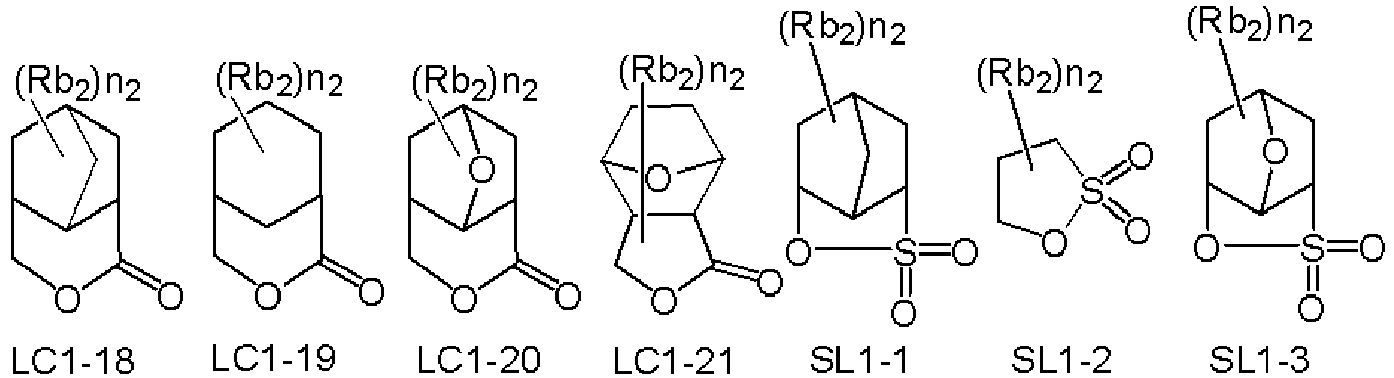
- The lactone structural moiety or the sultone structural moiety may have a substituent (Rbz). Preferred examples of the substituent (Rbz) include an alkyl group having 1 to 8 carbon atoms, a cycloalkyl group having 4 to 7 carbon atoms, an alkoxy group having 1 to 8 carbon atoms, an alkoxycarbonyl group having 1 to 8 carbon atoms, a carboxyl group, a halogen atom, a hydroxyl group, a cyano group, and an acid-decomposable group. n2 represents an integer of 0 to 4. In a case where n2 is 2 or more, Rbz's which are present in a plural number may be different from each other, and Rbz's which are present in a plural number may be bonded to each other to form a ring.
- Examples of the repeating unit having the group having a lactone structure or a sultone structure include a repeating unit represented by General Formula (AII).

- In General Formula (AII), Rb0 represents a hydrogen atom, a halogen atom, or an alkyl group having 1 to 4 carbon atoms.
- Preferred examples of the substituent which may be contained in the alkyl group of Rb0 include a hydroxyl group and a halogen atom.
- Examples of the halogen atom of Rb0 include a fluorine atom, a chlorine atom, a bromine atom, and an iodine atom. Rb0 is preferably the hydrogen atom or a methyl group.
- Ab represents a single bond, an alkylene group, a divalent linking group having a monocyclic or polycyclic alicyclic hydrocarbon structure, an ether group, an ester group, a carbonyl group, a carboxyl group, or a divalent group formed by combination thereof. Among those, the single bond or a linking group represented by -Ab1-CO2- is preferable. Ab1 is a linear or branched alkylene group, or a monocyclic or polycyclic cycloalkylene group, and is preferably a methylene group, an ethylene group, a cyclohexylene group, an adamantylene group, or a norbomylene group.
- V represents a group having a lactone structure or a sultone structure.
- As the group having the lactone structure or the sultone structure of V, a group represented by any of General Formulae (LC1-1) to (LC1-21) and General Formulae (SL1-1) to (SL1-3) is preferable.
- The repeating unit having the group having a lactone structure or a sultone structure usually has optical isomers, and any of optical isomers may be used. In addition, one kind of optical isomers may be used alone or a plurality of kinds of optical isomers may be mixed and used. In a case where one kind of optical isomers is mainly used, an optical purity (ee) thereof is preferably 90 or more, and more preferably 95 or more.
- Specific examples of the repeating unit having the group having a lactone structure or a sultone structure are shown below, but the present invention is not limited thereto. Furthermore, in the formulae, Rx represents H, CH3, CH2OH, or CF3.


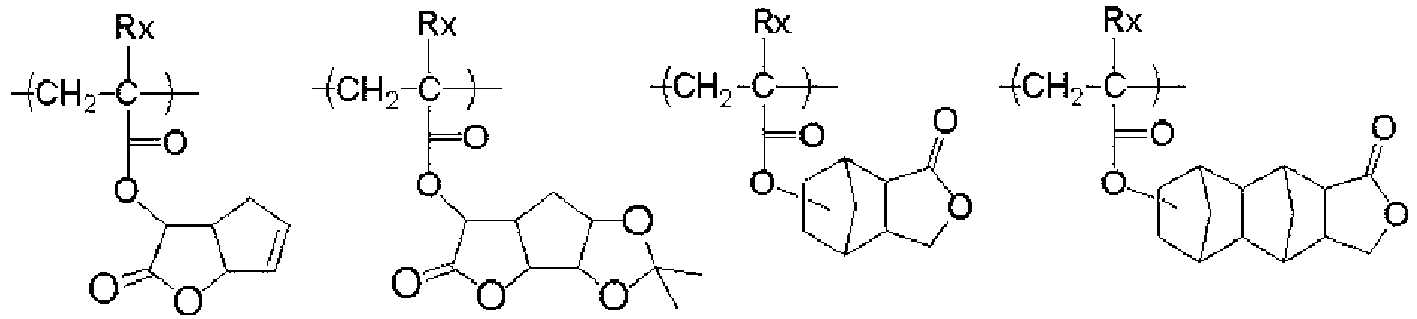

- A content of the repeating unit having a lactone group or a sultone group is preferably 1% to 60% by mole, more preferably 5% to 50% by mole, and still more preferably 10% to 40% by mole with respect to all the repeating units in the resin (P).
- The resin (P) may have a repeating unit having an acid group.
- As the acid group, an acid group having an acid dissociation constant (pKa) of 13 or less is preferable.
- The pKa has the same definition as the pKa in the pKa of an acid generated by a compound (A) which will be described later upon irradiation with actinic rays or radiation.
- As the repeating unit having an acid group, a repeating unit represented by Formula (B) is preferable.

- R3 represents a hydrogen atom or a monovalent organic group.
- As the monovalent organic group, a group represented by -L4-R8 is preferable. L4 represents a single bond or an ester group. Examples of R8 include an alkyl group, a cycloalkyl group, an aryl group, and a group formed by combination thereof.
- R4 and R5 each independently represent a hydrogen atom, a halogen atom, or an alkyl group.
- Examples of the halogen atom include a fluorine atom, a chlorine atom, a bromine atom, or an iodine atom.
- L2 represents a single bond or an ester group.
- L3 represents an (n + m + 1)-valent aromatic hydrocarbon ring group or an (n + m + 1)-valent alicyclic hydrocarbon ring group. Examples of the aromatic hydrocarbon ring group include a benzene ring group and a naphthalene ring group. The alicyclic hydrocarbon ring group may be either a monocycle or a polycycle, and examples thereof include a cycloalkyl ring group.
- R6 represents a hydroxyl group or a fluorinated alcohol group (preferably a hexafluoroisopropanol group). Furthermore, in a case where R6 is a hydroxyl group, L3 is preferably the (n + m + 1)-valent aromatic hydrocarbon ring group.
- R7 represents a halogen atom. Examples of the halogen atom include a fluorine atom, a chlorine atom, a bromine atom, or an iodine atom.
- m represents an integer of 1 or more. m is preferably an integer of 1 to 3 and more preferably an integer of 1 or 2.
- n represents 0 or an integer of 1 or more. n is preferably an integer of 1 to 4.
- Furthermore, (n + m + 1) is preferably an integer of 1 to 5.
- As the repeating unit having an acid group, a repeating unit represented by General Formula (I) is preferable.
- In a case where the resin (P) contains a repeating unit represented by General Formula (I) and the composition of the embodiment of the present invention contains a crosslinking agent, the resin (P) and the crosslinking agent react with each other by the action of the acid and the solubility of the resin (P) in an alkali developer decreases.

- In General Formula (I),
- R41, R42, and R43 each independently represent a hydrogen atom, an alkyl group, a cycloalkyl group, a halogen atom, a cyano group, or an alkoxycarbonyl group. It should be noted that R42 may be bonded to Ar4 to form a ring, in which case R42 represents a single bond or an alkylene group.
- X4 represents a single bond, -COO-, or -CONR64-, and R64 represents a hydrogen atom or an alkyl group.
- L4 represents a single bond or an alkylene group.
- Ar4 represents an (n + 1)-valent aromatic ring group, and in a case where Ar4 is bonded to R42 to form a ring, Ar4 represents an (n + 2)-valent aromatic ring group.
- n represents an integer of 1 to 5.
- As the alkyl group represented by each of R41, R42, and R43 in General Formula (I), an alkyl group having 20 or less carbon atoms, such as a methyl group, an ethyl group, a propyl group, an isopropyl group, an n-butyl group, a sec-butyl group, a hexyl group, a 2-ethylhexyl group, an octyl group, and a dodecyl group is preferable, an alkyl group having 8 or less carbon atoms is more preferable, and an alkyl group having 3 or less carbon atoms is still more preferable.
- The cycloalkyl group of each of R41, R42, and R43 in General Formula (I) may be monocyclic or polycyclic. Among those, a cycloalkyl group having 3 to 8 carbon atoms, such as a cyclopropyl group, a cyclopentyl group, and a monocyclic cyclohexyl group, is preferable.
- Examples of the halogen atom of each of R41, R42, and R43 in General Formula (I) include a fluorine atom, a chlorine atom, a bromine atom, and an iodine atom, and the fluorine atom is preferable.
- As the alkyl group included in the alkoxycarbonyl group of each of R41, R42, and R43 in General Formula (I), the same ones as the alkyl group in each of R41, R42, and R43 are preferable.
- Preferred examples of the substituent in each of the groups include an alkyl group, a cycloalkyl group, an aryl group, an amino group, an amide group, a ureide group, a urethane group, a hydroxyl group, a carboxyl group, a halogen atom, an alkoxy group, a thioether group, an acyl group, an acyloxy group, an alkoxycarbonyl group, a cyano group, and a nitro group. The substituent preferably has 8 or less carbon atoms.
- Ar4 represents an (n + 1)-valent aromatic ring group. The divalent aromatic ring group in a case where n is 1 may have a substituent, and is preferably, for example, an arylene group having 6 to 18 carbon atoms, such as a phenylene group, a tolylene group, a naphthylene group, and an anthracenylene group, or an aromatic ring group including a heterocyclic ring such as a thiophene ring, a furan ring, a pyrrole ring, a benzothiophene ring, a benzofuran ring, a benzopyrrole ring, a triazine ring, an imidazole ring, a benzimidazole ring, a triazole ring, a thiadiazole ring, and a thiazole ring.
- Specific examples of the (n + 1)-valent aromatic ring group in a case where n is an integer of 2 or more include groups formed by removing any (n - 1) hydrogen atoms from the above-described specific examples of the divalent aromatic ring group.
- The (n + 1)-valent aromatic ring group may further have a substituent.
- Examples of the substituent which can be contained in the alkyl group, the cycloalkyl group, the alkoxycarbonyl group, the alkylene group, and the (n + 1)-valent aromatic ring group, each mentioned above, include the alkyl groups; the alkoxy groups such as a methoxy group, an ethoxy group, a hydroxyethoxy group, a propoxy group, a hydroxypropoxy group, and a butoxy group; the aryl groups such as a phenyl group; and the like, as mentioned for each of R41, R42, and R43 in General Formula (I).
- Examples of the alkyl group of R64 in -CONR64- represented by X4 (R64 represents a hydrogen atom or an alkyl group) include an alkyl group having 20 or less carbon atoms, such as a methyl group, an ethyl group, a propyl group, an isopropyl group, an n-butyl group, a sec-butyl group, a hexyl group, a 2-ethylhexyl group, an octyl group, and a dodecyl group, and an alkyl group having 8 or less carbon atoms, is preferable.
- As X4, a single bond, -COO-, or -CONH- is preferable, and the single bond or -COO-is more preferable.
- As the alkylene group in L4, an alkylene group having 1 to 8 carbon atoms, such as a methylene group, an ethylene group, a propylene group, a butylene group, a hexylene group, and an octylene group, is preferable.
- As Ar4, an aromatic ring group having 6 to 18 carbon atoms is preferable, and a benzene ring group, a naphthalene ring group, and a biphenylene ring group are more preferable.
- The repeating unit represented by General Formula (1) preferably comprises a hydroxystyrene structure. That is, Ar4 is preferably the benzene ring group.
- The repeating unit represented by General Formula (I) is preferably a repeating unit represented by General Formula (1).

- In General Formula (1),
- A1 represents a hydrogen atom, an alkyl group, a cycloalkyl group, a halogen atom, or a cyano group.
- R represents a halogen atom, an alkyl group, a cycloalkyl group, an aryl group, an alkenyl group, an aralkyl group, an alkoxy group, an alkylcarbonyloxy group, an alkylsulfonyloxy group, an alkyloxycarbonyl group, or an aryloxycarbonyl group, and in a case where a plurality of R's are present, R's may be the same as or different from each other. In a case where there are a plurality of R's, R's may be bonded to each other to form a ring. As R, the hydrogen atom is preferable.
- a represents an integer of 1 to 3.
- b represents an integer of 0 to (3-a).
- Specific examples of the repeating unit represented by General Formula (I) will be shown below, but the present invention is not limited thereto. In the formulae, a represents 1, 2, or 3.


- Moreover, as the repeating unit having an acid group, a repeating unit specifically described below is preferable. In the formulae, R represents a hydrogen atom or a methyl group, and a represents 1, 2, or 3.
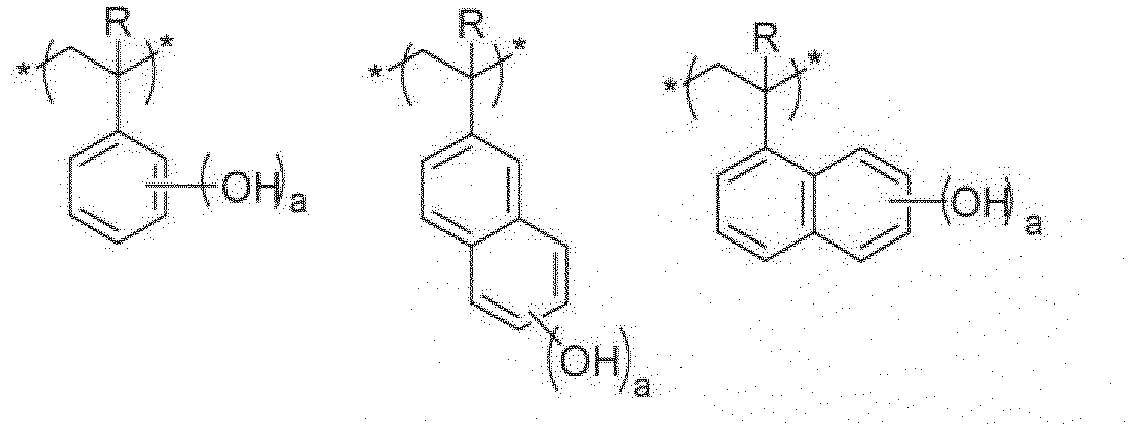


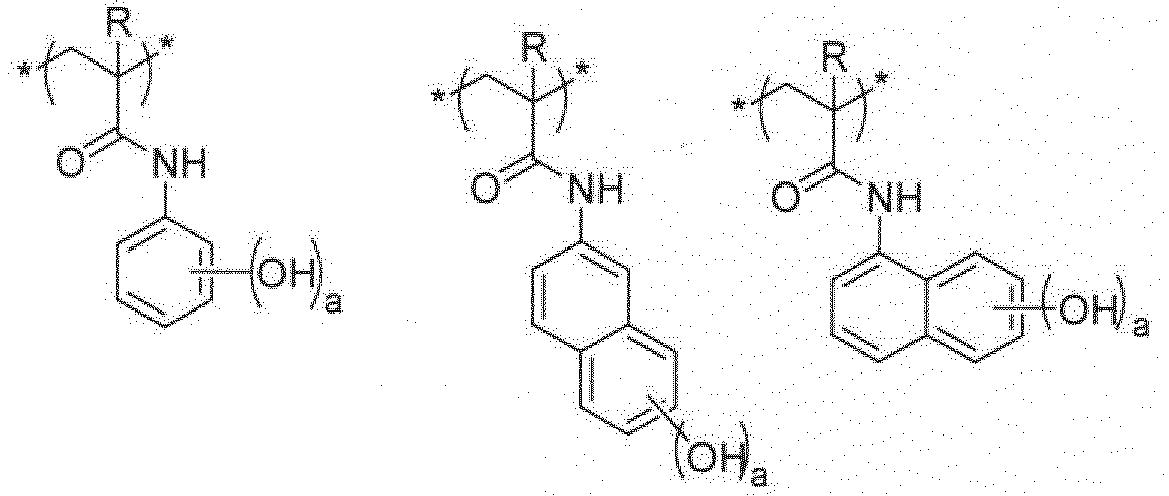


- A content of the repeating unit having an acid group is preferably 10% to 80% by mole, more preferably 15% to 75% by mole, and still more preferably 20% to 70% by mole with respect to all repeating units in the resin (P).
- The resin (P) may have a variety of repeating units, in addition to the above-mentioned repeating structural units, for the purpose of adjusting dry etching resistance, suitability for a standard developer, adhesiveness to a substrate, a resist profile, a resolving power, heat resistance, sensitivity, and the like; and other purposes.
- The resin (P) can be synthesized in accordance with an ordinary method (for example, radical polymerization). Examples of the general synthesis method include (1) a batch polymerization method in which polymerization is performed by dissolving monomer species and an initiator in a solvent and heating the solution, and (2) a dropwise addition polymerization method in which a solution containing monomer species and an initiator is added dropwise to a heating solvent for 1 to 10 hours.
- The weight-average molecular weight (Mw) of the resin (P) is preferably 1,000 to 200,000, more preferably 2,000 to 30,000, and still more preferably 3,000 to 25,000. The dispersity (Mw/Mn) is usually 1.0 to 3.0, preferably 1.0 to 2.6, more preferably 1.0 to 2.0, and still more preferably 1.1 to 2.0.
- The resin (P) may be used alone or in combination of two or more kinds thereof.
- A content of the resin (P) in the composition of the embodiment of the present invention is usually 20% by mass or more in many cases, preferably 40% by mass or more, more preferably 50% by mass or more, and still more preferably 60% by mass or more with respect to the total solid content. The upper limit is not particularly limited, but is preferably 99.5% by mass or less, more preferably 99% by mass or less, and still more preferably 98% by mass or less.
- Furthermore, the total solid content of the composition of the embodiment of the present invention is intended to be other components (components that can constitute an actinic ray-sensitive or radiation-sensitive film) excluding the solvent.
- The compound (A) contained in the composition of the embodiment of the present invention which has a group (a) that has a polarity which changes through decomposition by the action of an acid, and generates an acid (ac1) upon irradiation with actinic rays or radiation (also simply referred to as a "compound (A)" or a "photoacid generator (A)", will also be described.
- The compound (A) is a compound that generates an acid upon irradiation with actinic rays or radiation (photoacid generator).
- The molecular weight of the compound (A) is not particularly limited, but is, for example, 5,000 or less, and is preferably 3,000 or less, and more preferably 2,000 or less.
- The compound (A) is preferably a compound having no repeating unit.
- The group (a) having a polarity which changes through decomposition by the action of an acid (also simply referred to as a "group (a)"), contained in the compound (A), is preferably a group having a polarity that increases through decomposition by the action of an acid (acid-decomposable group).
- In a case where the group (a) contained in the compound (A) is an acid-decomposable group, the compound (A) decomposes by the action of an acid and the solubility in an alkali developer increases.
- The acid-decomposable group preferably has a structure in which a polar group is protected by a group that leaves through decomposition by the action of an acid (leaving group).
- Examples of the polar group include an acidic group (typically a group which dissociates in a 2.38%-by-mass aqueous tetramethylammonium hydroxide solution), such as a carboxyl group, a phenolic hydroxyl group, a fluorinated alcohol group, a sulfonic acid group, a sulfonamide group, a sulfonylimide group, an (alkylsulfonyl)(alkylcarbonyl)methylene group, an (alkylsulfonyl)(alkylcarbonyl)imide group, a bis(alkylcarbonyl)methylene group, a bis(alkylcarbonyl)imide group, a bis(alkylsulfonyl)methylene group, a bis(alkylsulfonyl)imide group, a tris(alkylcarbonyl)methylene group, and a tris(alkylsulfonyl)methylene group, and an alcoholic hydroxyl group.
- Moreover, the alcoholic hydroxyl group refers to a hydroxyl group bonded to a hydrocarbon group, which is a hydroxyl group other than a hydroxyl group (phenolic hydroxyl group) directly bonded to an aromatic ring, from which an aliphatic alcohol (for example, a hexafluoroisopropanol group) having the α-position substituted with an electron-withdrawing group such as a fluorine atom is excluded as a hydroxyl group. The alcoholic hydroxyl group is preferably a hydroxyl group having an acid dissociation constant (pKa) from 12 to 20.
- As the polar group, the carboxyl group, the phenolic hydroxyl group, the fluorinated alcohol group (preferably a hexafluoroisopropanol group), or the sulfonic acid group is preferable.
- Examples of the group that leaves through decomposition by the action of an acid (leaving group) include groups represented by Formulae (Y1) to (Y4).
Formula (Y1): -C(Rx1)(Rx2)(Rx3)
Formula (Y2): -C(=O)OC(Rx1)(Rx2)(Rx3)
Formula (Y3): -C(R36)(R37)(OR38)
Formula (Y4): -C(Rn)(H)(Ar)
- In Formula (Y1) and Formula (Y2), Rx1 to Rx3 each independently represent an (linear or branched) alkyl group or a (monocyclic or polycyclic) cycloalkyl group. Furthermore, in a case where all of Rx1 to Rx3 are (linear or branched) alkyl groups, it is preferable that at least two of Rx1, Rx2, or Rx3 are methyl groups.
- Among those, it is preferable that Rx1 to Rx3 each independently represent a linear or branched alkyl group, and it is more preferable that Rx1 to Rx3 each independently represent a linear alkyl group.
- Two of Rx1 to Rx3 may be bonded to each other to form a monocycle or a polycycle.
- As the alkyl group of each of Rx1 to Rx3, an alkyl group having 1 to 4 carbon atoms, such as a methyl group, an ethyl group, an n-propyl group, an isopropyl group, an n-butyl group, an isobutyl group, and a t-butyl group, is preferable.
- As the cycloalkyl group of each of Rx1 to Rx3, a monocyclic cycloalkyl group such as a cyclopentyl group and a cyclohexyl group, or a polycyclic cycloalkyl group such as a norbornyl group, a tetracyclodecanyl group, a tetracyclododecanyl group, and an adamantyl group is preferable.
- As the cycloalkyl group formed by the bonding of two of Rx1 to Rx3, a monocyclic cycloalkyl group such as a cyclopentyl group and a cyclohexyl group, and a polycyclic cycloalkyl group such as a norbornyl group, a tetracyclodecanyl group, a tetracyclododecanyl group, and an adamantyl group is preferable, and a monocyclic cycloalkyl group having 5 or 6 carbon atoms is more preferable.
- In the cycloalkyl group formed by the bonding of two of Rx1 to Rx3, for example, one of the methylene groups constituting the ring may be substituted with a heteroatom such as an oxygen atom, or a group having a heteroatom, such as a carbonyl group.
- With regard to the group represented by Formula (Y1) or Formula (Y2), for example, an aspect in which Rx1 is a methyl group or an ethyl group, and Rx2 and Rx3 are bonded to each other to form a cycloalkyl group is preferable.
- In Formula (Y3), R36 to R38 each independently represent a hydrogen atom or a monovalent organic group. R37 and R38 may be bonded to each other to form a ring. Examples of the monovalent organic group include an alkyl group, a cycloalkyl group, an aryl group, an aralkyl group, and an alkenyl group. It is also preferable that R36 is the hydrogen atom.
- As Formula (Y3), a group represented by Formula (Y3-1) is preferable.

- Here, L1 and L2 each independently represent a hydrogen atom, an alkyl group, a cycloalkyl group, an aryl group, or a group formed by combination thereof (for example, a group formed by a combination of an alkyl group and an aryl group).
- M represents a single bond or a divalent linking group.
- Q represents an alkyl group which may include a heteroatom, a cycloalkyl group which may include a heteroatom, an aryl group which may include a heteroatom, an amino group, an ammonium group, a mercapto group, a cyano group, an aldehyde group, or a group formed by combination thereof (for example, a group formed by combination of an alkyl group and a cycloalkyl group).
- In the alkyl group and the cycloalkyl group, for example, one of the methylene groups may be substituted with a heteroatom such as an oxygen atom or a group having a heteroatom, such as a carbonyl group.
- In addition, it is preferable that one of L1 or L2 is a hydrogen atom, and the other is an alkyl group, a cycloalkyl group, an aryl group, or a group formed by combination of an alkylene group and an aryl group.
- At least two of Q, M, or L1 may be bonded to each other to form a ring (preferably a 5- or 6-membered ring).
- From the viewpoint of pattern miniaturization, L2 is preferably a secondary or tertiary alkyl group, and more preferably the tertiary alkyl group. Examples of the secondary alkyl group include an isopropyl group, a cyclohexyl group, and a norbornyl group, and examples of the tertiary alkyl group include a tert-butyl group and an adamantane group. In these aspects, since the glass transition temperature (Tg) and the activation energy are higher, it is possible to suppress fogging in addition to ensuring film hardness.
- In Formula (Y4), Ar represents an aromatic ring group. Rn represents an alkyl group, a cycloalkyl group, or an aryl group. Rn and Ar may be bonded to each other to form a non-aromatic ring. Ar is more preferably the aryl group.
- The group (a) contained in the compound (A) preferably has an acetal structure.
- The acetal structure is, for example, a structure in which a polar group such as a carboxyl group, a phenolic hydroxyl group, and a fluorinated alcohol group is protected by the group represented by Formula (Y3).
- The group (a) contained in the compound (A) is particularly preferably a group represented by General Formula (T-1).

- In General Formula (T-1),
- R11 represents a hydrogen atom or an alkyl group.
- R12 represents a hydrogen atom, an alkyl group, a cycloalkyl group, or an aryl group, and the alkyl group and the cycloalkyl group may include an ether bond or a carbonyl bond.
- R13 represents an alkyl group, a cycloalkyl group, or an aryl group, and the alkyl group and the cycloalkyl group may include an ether bond or a carbonyl bond.
- R11 and R12 may be bonded to each other to form a ring.
- R12 and R13 may be bonded to each other to form a ring.
- ∗ represents a bond.
- The group represented by General Formula (T-1) will be described later.
- The compound (A) is preferably a compound represented by General Formula (b1).

- In General Formula (b1), L represents a single bond or a divalent linking group. In a case where there are a plurality of L's, the plurality of L's may be the same as or different from each other. A represents the group (a) having a polarity which changes through decomposition by an action of an acid. In a case where there are a plurality of A's, the plurality of A's may be the same as or different from each other. n represents an integer from 1 to 5. X represents an (n + 1)-valent linking group. M+ represents a sulfonium ion or an iodonium ion.
- In General Formula (b1), X represents an (n + 1)-valent linking group.
- The linking group represented by X is not particularly limited, but examples thereof include an aliphatic group (which may be linear, branched, or cyclic), an aromatic group, -O-, -CO-, -COO-, -OCO-, and a group formed by a combination of two or more of these groups.
- As the aliphatic group, a group obtained by removing n pieces of hydrogen atoms from an alkyl group (which may be linear or branched, and is preferably an alkyl group having 1 to 20 carbon atoms, and more preferably an alkyl group having 1 to 10 carbon atoms) and a group obtained by removing n pieces of hydrogen atoms from a cycloalkyl group (which may be either a monocycle or a polycycle, and is preferably a cycloalkyl group having 3 to 20 carbon atoms, and more preferably a cycloalkyl group having 5 to 10 carbon atoms) are preferable.
- The aliphatic group may have a substituent, and examples of the substituent include the substituent T.
- The aliphatic group may have a heteroatom (for example, a sulfur atom, an oxygen atom, and a nitrogen atom) between carbon atoms.
- As the aromatic group, a group formed by removing n pieces of hydrogen atoms of an aryl group (preferably an aryl group having 6 to 20 carbon atoms, and more preferably an aryl group having 6 to 10 carbon atoms) is preferable.
- The aromatic group may have a substituent, and examples of the substituent include the substituent T.
- The aromatic group may have a heteroatom (for example, a sulfur atom, an oxygen atom, and a nitrogen atom) between carbon atoms.
- X is preferably an (n + 1)-valent aromatic group.
- In General Formula (b1), n represents an integer of 1 to 5, preferably represents an integer of 1 to 3, more preferably represents 2 or 3, and still more preferably represents 3.
- In General Formula (b1), L represents a single bond or a divalent linking group.
- The divalent linking group represented by L is not particularly limited, but examples thereof include an aliphatic group (which may be linear, branched, or cyclic), an aromatic group, -O-, -CO-, -COO-, -OCO-, and a group formed by a combination of two or more of these groups.
- As the aliphatic group, an alkylene group (which may be linear or branched, and is preferably an alkylene group having 1 to 20 carbon atoms, and more preferably an alkylene group having 1 to 10 carbon atoms) and a cycloalkylene group (which may be either a monocycle or a polycycle, and is preferably a cycloalkylene group having 3 to 20 carbon atoms, and more preferably a cycloalkylene group having 5 to 10 carbon atoms) are preferable.
- The aliphatic group may have a substituent, and examples of the substituent include the substituent T.
- The aliphatic group may have a heteroatom (for example, a sulfur atom, an oxygen atom, and a nitrogen atom) between carbon atoms.
- As the aromatic group, an arylene group (preferably an arylene group having 6 to 20 carbon atoms, and more preferably an arylene group having 6 to 10 carbon atoms) is preferable.
- The aromatic group may have a substituent, and examples of the substituent include the substituent T.
- The aromatic group may have a heteroatom (for example, a sulfur atom, an oxygen atom, and a nitrogen atom) between carbon atoms.
- L is preferably an arylene group.
- In General Formula (b1), A represents the group (a) having a polarity which changes through decomposition by the action of an acid, and preferably represents an acid-decomposable group. Specific examples and preferred ranges of the acid-decomposable group are as described above.
- A is particularly preferably at least one group selected from the group consisting of a group represented by General Formula (T-1) and a group represented by General Formula (T-2), and most preferably the group represented by General Formula (T-1).

- In General Formula (T-1),
- Rn represents a hydrogen atom or an alkyl group.
- R12 represents a hydrogen atom, an alkyl group, a cycloalkyl group, or an aryl group, and the alkyl group and the cycloalkyl group may include an ether bond or a carbonyl bond.
- R13 represents an alkyl group, a cycloalkyl group, or an aryl group, and the alkyl group and the cycloalkyl group may include an ether bond or a carbonyl bond.
- R11 and R12 may be bonded to each other to form a ring.
- R12 and R13 may be bonded to each other to form a ring.
- ∗ represents a bond.
- In General Formula (T-2),
- R21, R22, and R23 each independently represent an alkyl group.
- Two of R21 to R23 may be bonded to each other to form a ring.
- ∗ represents a bond.
- In General Formula (T-1), R11 represents a hydrogen atom or an alkyl group.
- In a case where R11 represents the alkyl group, the alkyl group may be linear or branched, and is preferably an alkyl group having 1 to 10 carbon atoms, more preferably an alkyl group having 1 to 5 carbon atoms, and still more preferably an alkyl group having 1 to 3 carbon atoms. Examples of the alkyl group include a methyl group, an ethyl group, a propyl group, an n-butyl group, a sec-butyl group, a hexyl group, and an octyl group.
- The alkyl group may have a substituent, and examples of the substituent include the substituent T.
- R11 is preferably the hydrogen atom or the alkyl group having 1 to 3 carbon atoms, and more preferably the hydrogen atom.
- In General Formula (T-1), R12 represents a hydrogen atom, an alkyl group, a cycloalkyl group, or an aryl group.
- In a case where R12 represents the alkyl group, the alkyl group may be linear or branched, and is preferably an alkyl group having 1 to 10 carbon atoms, and more preferably an alkyl group having 1 to 5 carbon atoms. Examples of the alkyl group include a methyl group, an ethyl group, a propyl group, an n-butyl group, a sec-butyl group, a hexyl group, and an octyl group.
- The alkyl group may have a substituent, and examples of the substituent include the substituent T.
- The alkyl group may include an ether bond or a carbonyl bond.
- In a case where R12 represents the cycloalkyl group, the cycloalkyl group may be a monocycle or a polycycle, and is preferably a cycloalkyl group having 3 to 20 carbon atoms, more preferably a cycloalkyl group having 5 to 15 carbon atoms, and still more preferably a cycloalkyl group having 5 to 10 carbon atoms. Examples of the cycloalkyl group include a cyclopropyl group, a cyclobutyl group, a cyclopentyl group, a cyclohexyl group, a cyclooctyl group, an adamantyl group, a norbornyl group, an isobornyl group, a camphanyl group, a dicyclopentyl group, an α-pinel group, a tricyclodecanyl group, a tetracyclododecyl group, and an androstanyl group.
- The cycloalkyl group may have a substituent, and examples of the substituent include the substituent T.
- The cycloalkyl group may include an ether bond or a carbonyl bond.
- In a case where R12 represents the aryl group, the aryl group is preferably an aryl group having 6 to 20 carbon atoms, more preferably an aryl group having 6 to 15 carbon atoms, and still more preferably an aryl group having 6 to 10 carbon atoms. Examples of the aryl group include a phenyl group and a naphthyl group.
- The aryl group may have a substituent, and examples of the substituent include the substituent T.
- R12 is preferably the hydrogen atom or the alkyl group having 1 to 5 carbon atoms.
- In General Formula (T-1), R13 represents an alkyl group, a cycloalkyl group, or an aryl group.
- The alkyl group, the cycloalkyl group, or the aryl group represented by R13 is the same as the alkyl group, the cycloalkyl group, or the aryl group described as represented by R12, respectively.
- R13 is preferably the alkyl group having 1 to 5 carbon atoms.
- R11 and R12 may be bonded to each other to form a ring.
- The ring formed by the mutual bonding of R11 and R12 is preferably an aliphatic ring.
- The aliphatic ring is preferably a cycloalkane having 3 to 20 carbon atoms, and more preferably a cycloalkane having 5 to 15 carbon atoms. The cycloalkane may be either a monocycle or a polycycle.
- The aliphatic ring may have a substituent, and examples of the substituent include the substituent T.
- The aliphatic ring may have a heteroatom (for example, a sulfur atom, an oxygen atom, and a nitrogen atom) between carbon atoms.
- R12 and R13 may be bonded to each other to form a ring.
- The ring formed by the mutual bonding of R12 and R13 is preferably an aliphatic ring containing an oxygen atom as a ring member.
- The aliphatic ring preferably has 3 to 20 carbon atoms, and more preferably has 5 to 15 carbon atoms. The aliphatic ring may be either a monocycle or a polycycle.
- The aliphatic ring may have a substituent, and examples of the substituent include the substituent T.
- The aliphatic ring may have a heteroatom other than an oxygen atom (for example, a sulfur atom and a nitrogen atom) between carbon atoms.
- An aspect in which in General Formula (T-1), R11 and R12 are not bonded to each other, and R12 and R13 are bonded to each other to form a ring is one of preferred aspects of the present invention.
- In General Formula (T-2), R21, R22, and R23 each independently represent an alkyl group.
- In a case where R21, R22, and R23 represent the alkyl group, the alkyl group is not particularly limited and may be linear or branched. As the alkyl group, an alkyl group having 1 to 4 carbon atoms, such as a methyl group, an ethyl group, an n-propyl group, an isopropyl group, an n-butyl group, an isobutyl group, and a t-butyl group, is preferable.
- The alkyl group may have a substituent. Examples of the substituent include an aryl group (for example, an aryl group having 6 to 15 carbon atoms), a halogen atom, a hydroxyl group, an alkoxy group (for example, an alkoxy group having 1 to 4 carbon atoms), a carboxyl group, and an alkoxycarbonyl group (for example, an alkoxycarbonyl group having 2 to 6 carbon atoms). The substituent preferably has 8 or less carbon atoms.
- Two of R21 to R23 may be bonded to each other to form a ring.
- In a case where two of R21 to R23 are bonded to each other to form a ring, it is preferable that two of R21 to R23 are bonded to each other to form a cycloalkyl group. The cycloalkyl group may be either a monocyclic cycloalkyl group such as a cyclopentyl group and a cyclohexyl group, or a polycyclic cycloalkyl group such as a norbornyl group, a tetracyclodecanyl group, a tetracyclododecanyl group, and an adamantyl group. Among those, a monocyclic cycloalkyl group having 5 or 6 carbon atoms is preferable.
- In the cycloalkyl group, for example, one of the methylene groups constituting the ring may be substituted with a heteroatom such as an oxygen atom or a group having a heteroatom, such as a carbonyl group.
- In General Formula (b1), M+ represents a sulfonium ion or an iodonium ion.
- The sulfonium ion or the iodonium ion represented by M+ preferably has no nitrogen atom.
- M+ is not particularly limited, but is preferably a cation represented by General Formula (ZIA) or General Formula (ZIIA).

- In General Formula (ZIA),
R201, R202, and R203 each independently represent an organic group. - The organic group as each of R201, R202, and R203 generally has 1 to 30 carbon atoms, and preferably has 1 to 20 carbon atoms.
- In addition, two of R201 to R203 may be bonded to each other to form a ring structure, and the ring may include an oxygen atom, a sulfur atom, an ester bond, an amide bond, or a carbonyl group. Examples of the group formed by the bonding of two of R201 to R203 include an alkylene group (for example, a butylene group and a pentylene group) and -CH2-CH2-O-CH2-CH2-.
- Suitable aspects of the cation as General Formula (ZIA) include a cation (ZI-11), a cation (ZI-12), a cation represented by General Formula (ZI-13) (cation (ZI-13)), and a cation represented by General Formula (ZI-14) (cation (ZI-14)), each of which will be described later.
- The divalent or higher cation in a case where n is 2 or more may be a cation having a plurality of structures represented by General Formula (ZIA). Examples of such the cation include a divalent cation having a structure in which at least one of R201, R202, or R203 of a cation represented by General Formula (ZIA) and at least one of R201, R202, or R203 of another cation represented by General Formula (ZIA) are bonded via a single bond or a linking group.
- First, the cation (ZI-11) will be described.
- The cation (ZI-11) is a cation, that is, an arylsulfonium cation in which at least one of R201, ..., or R203 of General Formula (ZIA) is an aryl group.
- In the arylsulfonium cation, all of R201 to R203 may be aryl groups, or some of R201 to R203 may be an aryl group, and the rest may be an alkyl group or a cycloalkyl group.
- Examples of the arylsulfonium cation include a triarylsulfonium cation, a diarylalkylsulfonium cation, an aryldialkylsulfonium cation, a diarylcycloalkylsulfonium cation, and an aryldicycloalkylsulfonium cation.
- As the aryl group included in the arylsulfonium cation, a phenyl group or a naphthyl group is preferable, and the phenyl group is more preferable. The aryl group may be an aryl group which has a heterocyclic structure having an oxygen atom, a nitrogen atom, a sulfur atom, or the like. Examples of the heterocyclic structure include a pyrrole residue, a furan residue, a thiophene residue, an indole residue, a benzofuran residue, and a benzothiophene residue. In a case where the arylsulfonium cation has two or more aryl groups, the two or more aryl groups may be the same as or different from each other.
- The alkyl group or the cycloalkyl group contained in the arylsulfonium cation, as necessary, is preferably a linear alkyl group having 1 to 15 carbon atoms, a branched alkyl group having 3 to 15 carbon atoms, or a cycloalkyl group having 3 to 15 carbon atoms, and examples thereof include a methyl group, an ethyl group, a propyl group, an n-butyl group, a sec-butyl group, a t-butyl group, a cyclopropyl group, a cyclobutyl group, and a cyclohexyl group.
- The aryl group, the alkyl group, and the cycloalkyl group of each of R201 to R203 may each independently have an alkyl group (for example, having 1 to 15 carbon atoms), a cycloalkyl group (for example, having 3 to 15 carbon atoms), an aryl group (for example, having 6 to 14 carbon atoms), an alkoxy group (for example, having 1 to 15 carbon atoms), a halogen atom, a hydroxyl group, a lactone ring group, or a phenylthio group as a substituent.
- Examples of the lactone ring group include groups obtained by removing a hydrogen atom from a structure represented by any of (KA-1-1) to (KA-1-17) which will be described later.
- Next, the cation (ZI-12) will be described.
- The cation (ZI-12) is a compound in which R201 to R203 in Formula (ZIA) each independently represent an organic group having no aromatic ring. Here, the aromatic ring also includes an aromatic ring including a heteroatom.
- The organic group having no aromatic ring as each of R201 to R203 generally has 1 to 30 carbon atoms, and preferably 1 to 20 carbon atoms.
- R201 to R203 are each independently preferably an alkyl group, a cycloalkyl group, an allyl group, or a vinyl group, more preferably a linear or branched 2-oxoalkyl group, a 2-oxocycloalkyl group, or an alkoxycarbonylmethyl group, and still more preferably the linear or branched 2-oxoalkyl group.
- Preferred examples of the alkyl group and the cycloalkyl group of each of R201 to R203 include a linear alkyl group having 1 to 10 carbon atoms or branched alkyl group having 3 to 10 carbon atoms (for example, a methyl group, an ethyl group, a propyl group, a butyl group, and a pentyl group), and a cycloalkyl group having 3 to 10 carbon atoms (for example, a cyclopentyl group, a cyclohexyl group, and a norbornyl group).
- R201 to R203 may be further substituted with a halogen atom, an alkoxy group (for example, having 1 to 5 carbon atoms), a hydroxyl group, a cyano group, or a nitro group.
- Next, the cation (ZI-13) will be described.

- In General Formula (ZI-13), Q1 represents an alkyl group, a cycloalkyl group, or an aryl group, and in a case where M has a ring structure, the ring structure may include at least one of an oxygen atom, a sulfur atom, an ester bond, an amide bond, or a carbon-carbon double bond. R6c and R7c each independently represent a hydrogen atom, an alkyl group, a cycloalkyl group, a halogen atom, a cyano group, or an aryl group. R6c and R7c may be bonded to each other to form a ring. Rx and Ry each independently represent an alkyl group, a cycloalkyl group, or an alkenyl group. Rx and Ry may be bonded to each other to form a ring. In addition, at least two selected from Q1, R6c, or R7c may be bonded to each other to form a ring structure, and the ring structure may include a carbon-carbon double bond.
- In General Formula (ZI-13), as the alkyl group and the cycloalkyl group represented by Qi, a linear alkyl group having 1 to 15 carbon atoms (preferably having 1 to 10 carbon atoms), a branched alkyl group having 3 to 15 carbon atoms (preferably having 3 to 10 carbon atoms), or a cycloalkyl group having 3 to 15 carbon atoms (preferably having 1 to 10 carbon atoms) is preferable, and specific examples thereof include a methyl group, an ethyl group, a propyl group, an n-butyl group, a sec-butyl group, a t-butyl group, a cyclopropyl group, a cyclobutyl group, a cyclohexyl group, and a norbornyl group.
- The aryl group represented by Qi is preferably a phenyl group or a naphthyl group, and more preferably the phenyl group. The aryl group may be an aryl group which has a heterocyclic structure having an oxygen atom, a sulfur atom, or the like. Examples of the heterocyclic structure include a furan ring, a thiophene ring, a benzofuran ring, and a benzothiophene ring.
- Qi may further have a substituent. In this aspect, examples of Qi include a benzyl group.
- In addition, in a case where Qi has a ring structure, the ring structure may include at least one of an oxygen atom, a sulfur atom, an ester bond, an amide bond, or a carbon-carbon double bond.
- Examples of the alkyl group, the cycloalkyl group, and the aryl group represented by each of R6c and R7, include the same ones as those of Q1 as mentioned above, and preferred aspects thereof are also the same. In addition, R6c and R7c may be bonded to each other to form a ring.
- Examples of the halogen atom represented by each of R6c and R7c include a fluorine atom, a chlorine atom, a bromine atom, and an iodine atom.
- Examples of the alkyl group and the cycloalkyl group represented by each of Rx and Ry include the same ones as those of Qi as mentioned above, and preferred aspects thereof are also the same.
- As the alkenyl group represented by each of Rx and Ry, an allyl group or a vinyl group is preferable.
- Rx and Ry may further have a substituent. In this aspect, examples of each of Rx and Ry include a 2-oxoalkyl group or an alkoxycarbonylalkyl group.
- Examples of the 2-oxoalkyl group represented by each of Rx and Ry include those having 1 to 15 carbon atoms (preferably having 1 to 10 carbon atoms), and specifically a 2-oxopropyl group and a 2-oxobutyl group.
- Examples of the alkoxycarbonylalkyl group represented by each of Rx and Ry include those having 1 to 15 carbon atoms (preferably having 1 to 10 carbon atoms). In addition, Rx and Ry may be bonded to each other to form a ring.
- The ring structure formed by the mutual linkage of Rx and Ry may include an oxygen atom, a sulfur atom, an ester bond, an amide bond, or a carbon-carbon double bond.
- In General Formula (ZI-13), Q1 and R6c may be bonded to each other to form a ring structure, and the ring structure formed may include a carbon-carbon double bond.
- Among those, the cation (ZI-13) is preferably a cation (ZI-13A).
- The cation (ZI-13A) is a phenacylsulfonium cation represented by General Formula (ZI-13A).
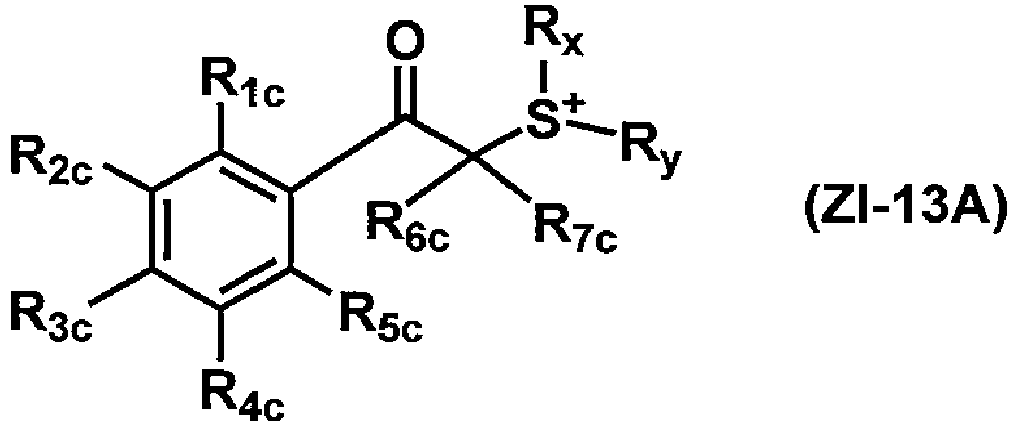
- In General Formula (ZI-13A),
- R1c to R5c each independently represent a hydrogen atom, an alkyl group, a cycloalkyl group, an aryl group, an alkoxy group, an aryloxy group, an alkoxycarbonyl group, an alkylcarbonyloxy group, a cycloalkylcarbonyloxy group, a halogen atom, a hydroxyl group, a nitro group, an alkylthio group, or an arylthio group.
- R6c and R7c have the same definitions as R6c and R7c in General Formula (ZI-13) as mentioned above, respectively, and preferred aspects thereof are also the same.
- Rx and Ry have the same definitions as Rx and Ry, respectively, in General Formula (ZI-13) described above, and preferred aspects thereof are also the same.
- Any two or more of R1c, ..., or R5c, and Rx and Ry may be bonded to each other to form a ring structure, and the ring structure may each independently include an oxygen atom, a sulfur atom, an ester bond, an amide bond, or a carbon-carbon double bond. Furthermore, R5c and R6c, or R5c and Rx may be bonded to each other to form a ring structure, and the ring structure may each independently include a carbon-carbon double bond. In addition, R6c and R7c may be bonded to each other to form a ring structure.
- Examples of the ring structure include an aromatic or non-aromatic hydrocarbon ring, an aromatic or non-aromatic heterocycle, and a polycyclic fused ring in which two or more of these rings are combined. Examples of the ring structure include a 3- to 10-membered ring and the ring structure is preferably a 4- to 8-membered ring, and more preferably a 5- or 6-membered ring.
- Examples of the group formed by the bonding of any two or more of R1c, ..., or R5c, R6c and R7c, and Rx and Ry include a butylene group and a pentylene group.
- As the group formed by the bonding of R5c and R6c, and R5c and Rx, a single bond or an alkylene group is preferable. Examples of the alkylene group include a methylene group and an ethylene group.
- Next, the cation (ZI-14) will be described.
- The cation (ZI-14) is represented by General Formula (ZI-14).
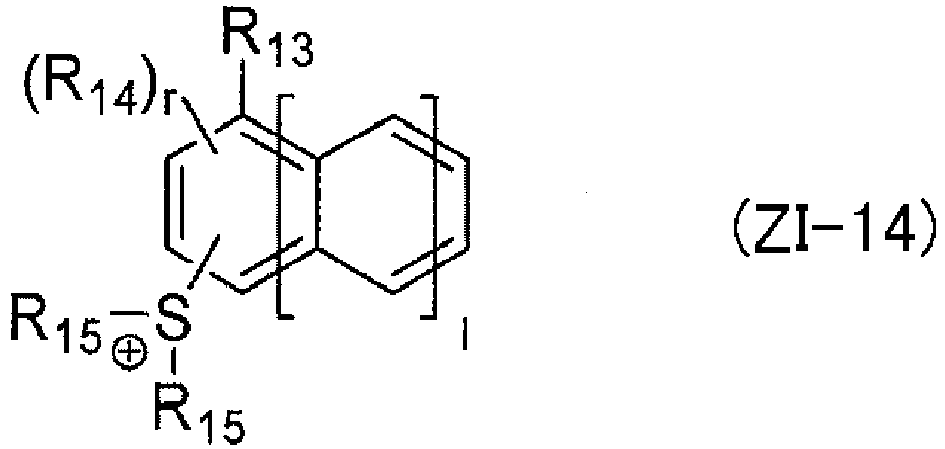
- In General Formula (ZI-14),
- 1 represents an integer of 0 to 2.
- r represents an integer of 0 to 8.
- R13 represents a hydrogen atom, a fluorine atom, a hydroxyl group, an alkyl group, a cycloalkyl group, an alkoxy group, an alkoxycarbonyl group, or a group having a monocyclic or polycyclic cycloalkyl skeleton. These groups may have a substituent.
- In a case where a plurality of R14's are present, R14's each independently represent an alkyl group, a cycloalkyl group, an alkoxy group, an alkylsulfonyl group, a cycloalkylsulfonyl group, an alkylcarbonyl group, an alkoxycarbonyl group, or an alkoxy group having a monocyclic or polycyclic cycloalkyl skeleton. These groups may have a substituent.
- Ris's each independently represent an alkyl group, a cycloalkyl group, or a naphthyl group. These groups may have a substituent. Two R15's may be bonded to each other to form a ring. In a case where two R15's are bonded to each other to form a ring, the ring skeleton may include a heteroatom such as an oxygen atom and a nitrogen atom. In one aspect, it is preferable that two Ris's are alkylene groups and are bonded to each other to form a ring structure.
- In General Formula (ZI-14), the alkyl group of each of R13, R14, and R15 is linear or branched. The alkyl group preferably has 1 to 10 carbon atoms. As the alkyl group, a methyl group, an ethyl group, an n-butyl group, a t-butyl group, or the like is more preferable.
- Next, General Formula (ZIIA) will be described.
- In General Formula (ZIIA), R204 and R205 each independently represent an aryl group, an alkyl group, or a cycloalkyl group.
- The aryl group of each of R204 and R205 is preferably a phenyl group or a naphthyl group, and more preferably the phenyl group. The aryl group of each of R204 and R205 may be an aryl group which has a heterocyclic structure having an oxygen atom, a nitrogen atom, a sulfur atom, or the like. Examples of the skeleton of the aryl group having a heterocyclic structure include pyrrole, furan, thiophene, indole, benzofuran, and benzothiophene.
- As the alkyl group and the cycloalkyl group of each of R204 and R205, a linear alkyl group having 1 to 10 carbon atoms or branched alkyl group having 3 to 10 carbon atoms (for example, a methyl group, an ethyl group, a propyl group, a butyl group, and a pentyl group), or a cycloalkyl group having 3 to 10 carbon atoms (for example, a cyclopentyl group, a cyclohexyl group, and a norbornyl group) is preferable.
- The aryl group, the alkyl group, and the cycloalkyl group of each of R204 and R205 may each independently have a substituent. Examples of the substituent which may be contained in the aryl group, the alkyl group, or the cycloalkyl group of each of R204 to R207 include an alkyl group (for example, having 1 to 15 carbon atoms), a cycloalkyl group (for example, having 3 to 15 carbon atoms), an aryl group (for example, having 6 to 15 carbon atoms), an alkoxy group (for example, having 1 to 15 carbon atoms), a halogen atom, a hydroxyl group, a lactone ring group, and a phenylthio group.
- Examples of the lactone ring group include groups obtained by removing a hydrogen atom from a structure represented by any of (KA-1-1) to (KA-1-17).


- The structure containing the lactone ring structure may or may not have a substituent. Examples of the substituent include the substituent T.
- Preferred examples of M+ are shown below, but the present invention is not limited thereto. Me represents a methyl group and Bu represents an n-butyl group.


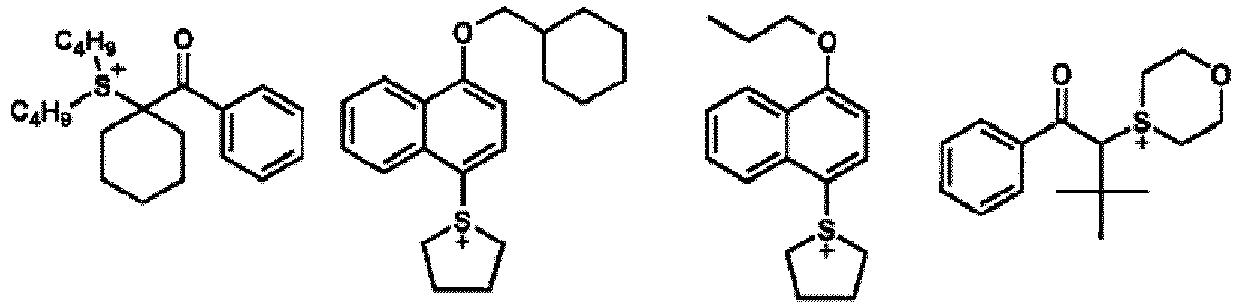


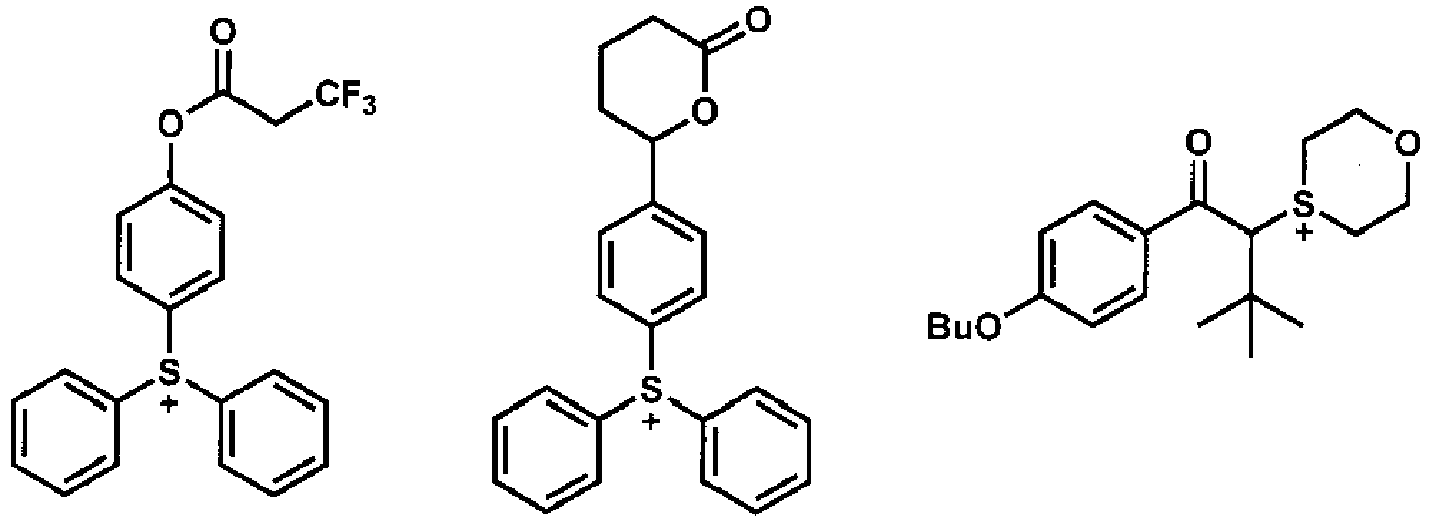


- The compound (A) is preferably represented by General Formula (b2).

- In General Formula (b2), L represents a single bond or a divalent linking group. In a case where there are a plurality of L's, the plurality of L's may be the same as or different from each other. A represents the group (a) having a polarity which changes through decomposition by an action of an acid. In a case where there are a plurality of A's, the plurality of A's may be the same as or different from each other. n represents an integer from 1 to 5. M+ represents a sulfonium ion or an iodonium ion.
- L, A, n, and M+ in General Formula (b2) are the same as L, A, n, and M+ in General Formula (b1) described above, respectively.
- The compound (A) is particularly preferably represented by General Formula (b3).
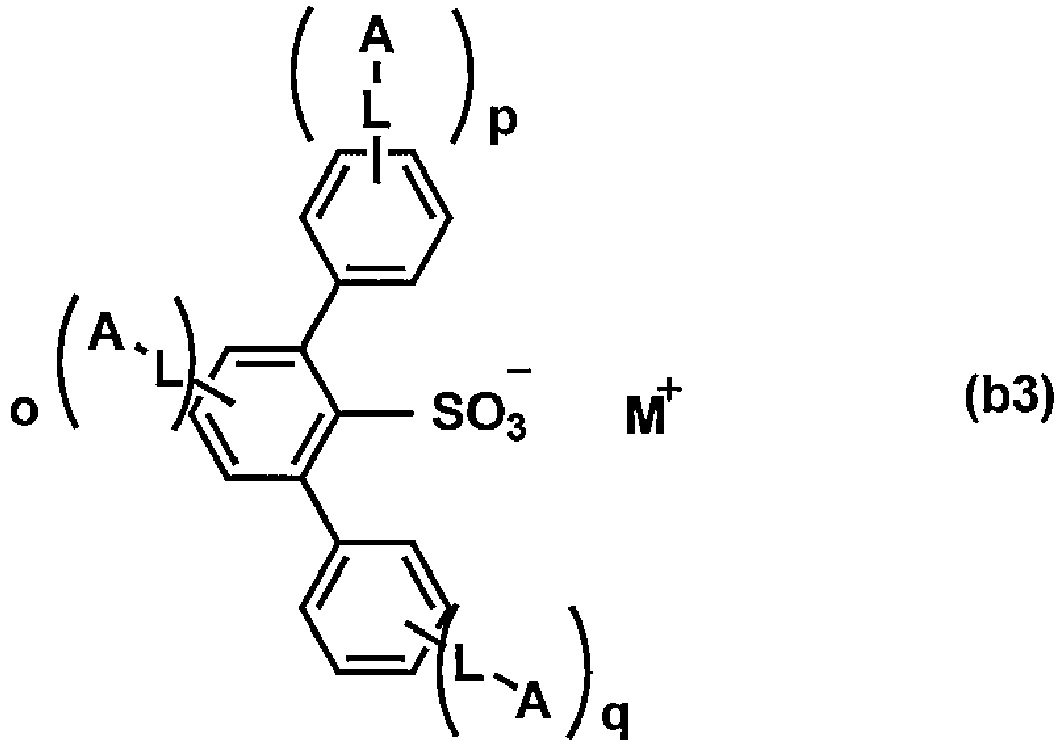
- In General Formula (b3), L represents a single bond or a divalent linking group. In a case where there are a plurality of L's, the plurality of L's may be the same as or different from each other. A represents the group (a) having a polarity which changes through decomposition by an action of an acid. In a case where there are a plurality of A's, the plurality of A's may be the same as or different from each other. o, p, and q each independently represent an integer from 0 to 5. It should be noted that a sum of o, p, and q is from 1 to 5. M+ represents a sulfonium ion or an iodonium ion.
- L, A, and M+ in General Formula (b3) are the same as L, A, and M+ in General Formula (b1) described above, respectively.
- o, p, and q in General Formula (b3) each independently preferably represent an integer of 0 to 3, more preferably represent an integer of 0 to 2, and still more preferably represent 0 or 1.
- Preferred specific examples of the anionic moiety of the compound (A) are shown below, but the present invention is not limited thereto.


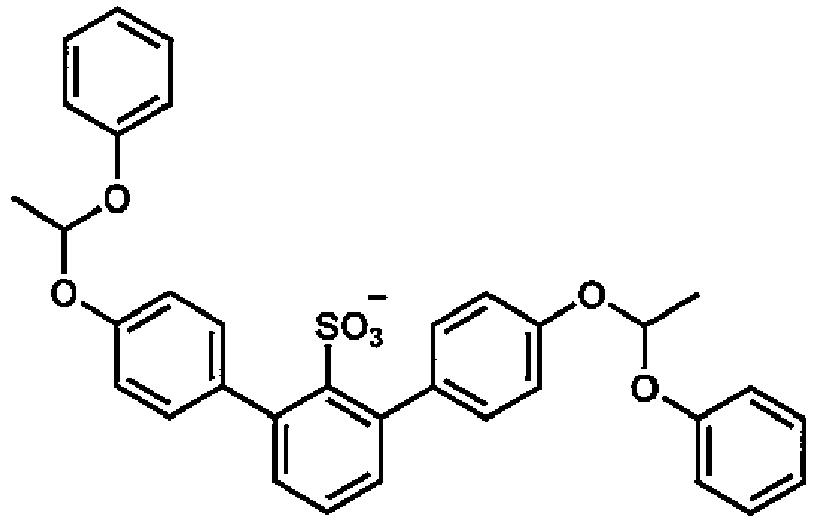

- The compound (A) generates an acid (ac1) upon irradiation with actinic rays or radiation.
- The pKa of the acid (ac1) is preferably from -12 to 0, more preferably from -5 to 0, and still more preferably from -2 to 0.
- The compound (A) has a group (a) having a polarity which changes through decomposition by the action of an acid, but in a case where the acid (ac1) has the group (a), the pKa of the acid (ac1) is a pKa in a state before the group (a) decomposes by the action of an acid.
- In the present specification, an acid dissociation constant (pKa) represents a pKa in an aqueous solution, and is specifically a value determined by computation from a value based on a Hammett's substituent constant and database of publicly known literature values, using the following software package 1. Any of the pKa values described in the present specification indicates values determined by computation using the software package 1 in cases except for a case which will be described later.
- Software Package 1: Advanced Chemistry Development (ACD/Labs) Software V 8.14 for Solaris (1994 - 2007 ACD/Labs).
- On the other hand, the pKa can also be determined by a molecular orbital computation method. Examples of specific methods therefor include a method in which an H+ dissociation free energy in a solvent is computed and calculated based on a thermodynamic cycle (furthermore, in the present specification, water is usually used as the solvent, and in a case where a pKa is not determined with water, dimethyl sulfoxide (DMSO) is used).
- With regard to the method for computing the H+ dissociation free energy, the H+ dissociation free energy can be computed by, for example, density functional theory (DFT), but various other methods have been reported in literature and the like, and are not limited thereto. Furthermore, there are a plurality of software applications capable of performing DFT, and examples thereof include Gaussian 16.
- As described above, the pKa in the present specification refers to a value determined by computation from a value based on a Hammett's substituent constant and database of publicly known literature values, using the software package 1, but in a case where the pKa cannot be calculated by the method, a value obtained by Gaussian 16 based on density functional theory (DFT) shall be adopted.
- Preferred examples of the compound (A) include those used in Examples and a compound obtained by a combination of the anion and the cation.
- The compound (A) can be synthesized, for example, by a method using a coupling reaction.
- For the coupling reaction, for example, Suzuki coupling or the like can be applied. The counter cation can be converted into a desired cation by, for example, a known anion exchange method or a conversion method using an ion exchange resin, as described in
JP1994-184170A JP-H06-184170A - The compound (A) may be used alone or in combination of two or more kinds thereof.
- A content of the compound (A) (in a case where a plurality of the compounds (A) are present, a total content thereof) in the composition of the embodiment of the present invention is preferably 5% to 60% by mass, more preferably 10% to 50% by mass, still more preferably 15% to 50% by mass, and particularly preferably 15% to 40% by mass, with respect to a total solid content of the composition of the embodiment of the present invention.
- The compound (B) that generates an acid (ac2) having a higher pKa than the acid (ac1) generated from the compound (A), upon irradiation of actinic rays or radiation (also simply referred to as a "compound (B)" or a "photoacid generator (B)"), contained in the composition of the embodiment of the present invention, will be described.
- The compound (B) is a compound that generates an acid upon irradiation with actinic rays or radiation (photoacid generator).
- The pKa of the acid (ac2) generated from the compound (B) is higher than the pKa of the acid (ac1) generated by the compound (A).
- The pKa of the acid (ac2) generated from the compound (B) is preferably 1 or more higher than the pKa of the acid (ac1) generated from the compound (A).
- A difference between the pKa of the acid (ac2) and the pKa of the acid (ac1) is preferably from 2 to 17, more preferably from 2 to 9, and still more preferably from 3 to 5.
- The pKa of the acid (ac2) is preferably from -0.5 to 10, more preferably from 2 to 8, and still more preferably from 3 to 5.
- The compound (B) is preferably a compound represented by General Formula (B-1).

- In General Formula (B-1), R51 represents a monovalent organic group, and M+ represents a sulfonium cation or an iodonium cation.
- The monovalent organic group represented by R51 in General Formula (B-1) is preferably an alkyl group, a cycloalkyl group, an aryl group, or a heterocyclic group, and preferably the aryl group.
- In a case where R51 represents the alkyl group, the alkyl group may be linear or branched, and is preferably an alkyl group having 1 to 10 carbon atoms, and more preferably an alkyl group having 1 to 5 carbon atoms. Examples of the alkyl group include a methyl group, an ethyl group, a propyl group, an n-butyl group, a sec-butyl group, a hexyl group, and an octyl group.
- The alkyl group may have a substituent, and examples of the substituent include the substituent T.
- The alkyl group may include an ether bond or a carbonyl bond.
- In a case where R51 represents the cycloalkyl group, the cycloalkyl group may be a monocycle or a polycycle, and is preferably a cycloalkyl group having 3 to 20 carbon atoms, more preferably a cycloalkyl group having 5 to 15 carbon atoms, and still more preferably a cycloalkyl group having 5 to 10 carbon atoms. Examples of the cycloalkyl group include a cyclopropyl group, a cyclobutyl group, a cyclopentyl group, a cyclohexyl group, a cyclooctyl group, an adamantyl group, a norbornyl group, an isobornyl group, a camphanyl group, a dicyclopentyl group, an α-pinel group, a tricyclodecanyl group, a tetracyclododecyl group, and an androstanyl group.
- The cycloalkyl group may have a substituent, and examples of the substituent include the substituent T.
- The cycloalkyl group may include an ether bond or a carbonyl bond.
- In a case where R51 represents the aryl group, the aryl group is preferably an aryl group having 6 to 20 carbon atoms, more preferably an aryl group having 6 to 15 carbon atoms, and still more preferably an aryl group having 6 to 10 carbon atoms. Examples of the aryl group include a phenyl group and a naphthyl group, and the phenyl group is the most preferable.
- The aryl group may have a substituent, and examples of the substituent include the substituent T.
- In a case where R51 represents the heterocyclic group, the heterocyclic group is preferably a heterocyclic group having 3 to 20 carbon atoms, and more preferably a heterocyclic group having 4 to 15 carbon atoms. Examples of the heteroatom contained in the heterocyclic group include an oxygen atom, a nitrogen atom, and a sulfur atom.
- The heterocyclic group may have a substituent, and examples of the substituent include the substituent T.
- M+ in General Formula (B-1) has the same definition as M+ in General Formula (b1), and specific examples and preferred ranges thereof are also the same.
- The compound (B) may be used singly or in combination of two or more kinds thereof.
- A content of the compound (B) (in a case where a plurality of the compounds (B) are present, a total content thereof) in the composition of the embodiment of the present invention is preferably 1% to 30% by mass, more preferably 2% to 30% by mass, still more preferably 5% to 15% by mass, and particularly preferably 5% to 10% by mass, with respect to a total solid content of the composition of the embodiment of the present invention.
- In the composition of the embodiment of the present invention, a ratio (A)/(B) of a content of the compound (A) to a content of the compound (B) is preferably from 0.2 to 2.0, and more preferably from 0.2 to 1.5 in terms of a molar ratio. By setting the molar ratio of (A)/(B) to be from 0.2 to 2.0, the effect of improving the resolving power and reducing the development defects of the compound (B) can be obtained, and a composition with little deterioration in performance can be obtained even after a lapse of a certain period from the preparation.
- The basic compound (C) contained in the composition of the embodiment of the present invention (also simply referred to as a "compound (C)") will be described.
- The basic compound (C) can function as an acid diffusion control agent.
- The acid diffusion control agent acts as a quencher that suppresses a reaction of an acid-decomposable resin in the unexposed portion by excessive generated acids by trapping the acids generated from a photoacid generator and the like upon exposure.
- The basic compound (C) is preferably a nitrogen-containing compound.
- The basic compound (C) is preferably a compound having a structure represented by any of General Formulae (c1) to (c5).

- In General Formulae (c1) and (c5),
- R200, R201, and R202 may be the same as or different from each other, and each independently represent a hydrogen atom, an alkyl group (preferably having 1 to 20 carbon atoms), a cycloalkyl group (preferably having 3 to 20 carbon atoms), or an aryl group (having 6 to 20 carbon atoms). R201 and R202 may be bonded to each other to form a ring.
- R203, R204, R205, and R206 may be the same as or different from each other and each independently represent an alkyl group having 1 to 20 carbon atoms.
- The alkyl group in each of General Formulae (c1) and (c5) may have a substituent or may be unsubstituted.
- With regard to the alkyl group, the alkyl group having a substituent is preferably an aminoalkyl group having 1 to 20 carbon atoms, a hydroxyalkyl group having 1 to 20 carbon atoms, or a cyanoalkyl group having 1 to 20 carbon atoms.
- The alkyl group in each of General Formulae (c1) and (c5) are more preferably unsubstituted.
- As the basic compound (C), thiazole, benzothiazole, oxazole, benzoxazole, guanidine, aminopyrrolidine, pyrazole, pyrazoline, piperazine, aminomorpholine, aminoalkylmorpholine, piperidine, or compounds having these structures are preferable; and a compound having a thiazole structure, a benzothiazole structure, an oxazole structure, a benzoxazole structure, an imidazole structure, a diazabicyclo structure, an onium hydroxide structure, an onium carboxylate structure, a trialkylamine structure, an aniline structure, or a pyridine structure, an alkylamine derivative having a hydroxyl group and/or an ether bond, and an aniline derivative having a hydroxyl group and/or an ether bond, or the like is more preferable.
- The basic compound (C) may be a basic compound (CB) having a basicity that is reduced or eliminated upon irradiation with actinic rays or radiation (hereinafter also referred to as a "compound (CB)"). The compound (CB) is a compound which has a proton-accepting functional group and decomposes under irradiation with actinic rays or radiation to exhibit deterioration in proton-accepting properties, no proton-accepting properties, or a change from the proton-accepting properties to acidic properties.
- The proton-accepting functional group refers to a functional group having a group or an electron which is capable of electrostatically interacting with a proton, and for example, means a functional group with a macrocyclic structure, such as a cyclic polyether, or a functional group having a nitrogen atom having an unshared electron pair not contributing to π-conjugation. The nitrogen atom having an unshared electron pair not contributing to π-conjugation is, for example, a nitrogen atom having a partial structure represented by the following formula.

- Preferred examples of the partial structure of the proton-accepting functional group include a crown ether structure, an azacrown ether structure, primary to tertiary amine structures, a pyridine structure, an imidazole structure, and a pyrazine structure.
- The compound (CB) decomposes upon irradiation with actinic rays or radiation to generate a compound exhibiting deterioration in proton-accepting properties, no proton-accepting properties, or a change from the proton-accepting properties to acidic properties. Here, exhibiting deterioration in proton-accepting properties, no proton-accepting properties, or a change from the proton-accepting properties to acidic properties means a change of proton-accepting properties due to the proton being added to the proton-accepting functional group, and specifically a decrease of the equilibrium constant in chemical equilibrium in a case where a proton adduct is generated from the compound (CB) having the proton-accepting functional group and the proton.
- The proton-accepting properties can be confirmed by performing pH measurement.
- The pKa of the compound generated by decomposition of the compound (CB) upon irradiation with actinic rays or radiation preferably satisfies pKa < -1, more preferably satisfies -13 < pKa < -1, and still more preferably satisfies -13 < pKa < -3.
- The basic compound (C) may be a low-molecular-weight compound (CD) having a nitrogen atom and a group that leaves by the action of an acid (hereinafter also referred to as a "compound (CD)"). The compound (CD) is preferably an amine derivative having a group that leaves by the action of an acid on a nitrogen atom.
- As the group that leaves by the action of an acid, an acetal group, a carbonate group, a carbamate group, a tertiary ester group, a tertiary hydroxyl group, or a hemiaminal ether group is preferable, and the carbamate group or the hemiaminal ether group is more preferable.
- The molecular weight of the compound (CD) is preferably 100 to 1,000, more preferably 100 to 700, and still more preferably 100 to 500.
- The compound (CD) may have a carbamate group having a protective group on the nitrogen atom. The protective group constituting the carbamate group is represented by General Formula (d-1).

- In General Formula (d-1),
Rb's each independently represent a hydrogen atom, an alkyl group (preferably having 1 to 10 carbon atoms), a cycloalkyl group (preferably having 3 to 30 carbon atoms), an aryl group (preferably having 3 to 30 carbon atoms), an aralkyl group (preferably having 1 to 10 carbon atoms), or an alkoxyalkyl group (preferably having 1 to 10 carbon atoms). Rb's may be bonded to each other to form a ring. - The alkyl group, the cycloalkyl group, the aryl group, or the aralkyl group represented by Rb may be each independently substituted with a functional group such as a hydroxyl group, a cyano group, an amino group, a pyrrolidino group, a piperidino group, a morpholino group, and an oxo group, an alkoxy group, or a halogen atom. The same applies to the alkoxyalkyl group represented by Rb.
- As Rb, a linear or branched alkyl group, a cycloalkyl group, or an aryl group is preferable, and the linear or branched alkyl group, or the cycloalkyl group is more preferable.
- Examples of the ring formed by the mutual linkage of two Rb's include an alicyclic hydrocarbon, an aromatic hydrocarbon, a heterocyclic hydrocarbon, and derivatives thereof.
- Examples of the specific structure of the group represented by General Formula (d-1) include, but are not limited to, the structures disclosed in paragraph [0466] of
US2012/0135348A1 . - The compound (CD) preferably has a structure represented by General Formula (6).

- In General Formula (6),
- 1 represents an integer of 0 to 2, m represents an integer of 1 to 3, and these satisfy 1 + m = 3.
- Ra represents a hydrogen atom, an alkyl group, a cycloalkyl group, an aryl group, or an aralkyl group. In a case where 1 is 2, two Ra's may be the same as or different from each other, and the two Ra's may be linked to each other to form a heterocycle with the nitrogen atom in the formula. This heterocycle may include a heteroatom other than the nitrogen atom in the formula.
- Rb has the same definition as Rb in General Formula (d-1), and preferred examples are also the same.
- In General Formula (6), the alkyl group, the cycloalkyl group, the aryl group, and the aralkyl group as Ra may be each independently substituted with the same groups as the group mentioned above as a group which may be substituted in the alkyl group, the cycloalkyl group, the aryl group, and the aralkyl group as Rb.
- Specific examples of the alkyl group, the cycloalkyl group, the aryl group, and the aralkyl group (these groups may be substituted with the groups) of Ra include the same groups as the specific examples described above with respect to Rb.
- Specific examples of the particularly preferred compound (DD) in the present invention include, but are not limited to, the compounds disclosed in paragraph [0475] of
US2012/0135348A1 . - The basic compound (C) may be an onium salt compound (CE) having a nitrogen atom in a cationic moiety (hereinafter also referred to as a "compound (CE)"). The compound (CE) is preferably a compound having a basic moiety including a nitrogen atom in the cationic moiety. The basic moiety is preferably an amino group, and more preferably an aliphatic amino group. All of the atoms adjacent to the nitrogen atom in the basic moiety are still more preferably hydrogen atoms or carbon atoms. In addition, from the viewpoint of improving basicity, it is preferable that an electron-withdrawing functional group (such as a carbonyl group, a sulfonyl group, a cyano group, and a halogen atom) is not directly linked to the nitrogen atom.
- Preferred specific examples of the compound (CE) include, but are not limited to, the compounds disclosed in paragraph [0203] of
US2015/0309408A1 . - Preferred examples of the basic compound (C) are shown below, but the present invention is not limited thereto. Me represents a methyl group.


- The basic compound (C) may be used alone or in combination of two or more kinds thereof.
- A content of the basic compound (C) in the composition of the embodiment of the present invention (in a case where a plurality of kinds of the basic compounds (C) are present, a total content thereof) in the composition of the embodiment of the present invention is preferably 0.001% to 20% by mass, and more preferably 0.01% to 10% by mass with respect to the total solid content of the composition.
- A ratio (B)/(C) of the content of the compound (B) to the content of the basic compound (C) in the composition of the embodiment of the present invention is preferably from 1.1 to 10, more preferably from 2 to 8, and still more preferably from 2 to 4 in terms of a molar ratio. By setting the molar ratio of (B)/(C) to be from 1.1 to 10, the effect of improving the resolving power and reducing the development defects of the compound (B) can be obtained, and a composition with little deterioration in performance can be obtained even after a lapse of a certain period from the preparation.
- A ratio [(B) + (C)]/[(A) + (B)] of a sum of the content of the compound (B) and the content of the basic compound (C) to a sum of the content of the compound (A) and the content of the compound (B) in the composition of the embodiment of the present invention is preferably from 0.3 to 1.0, more preferably from 0.3 to 0.8, and still more preferably from 0.5 to 0.8 in terms of a molar ratio. By setting the molar ratio of [(B) + (C)]/[(A) + (B)] to be from 0.3 to 1.0, the effect of improving the resolving power and reducing the development defects of the compound (B) can be obtained, and a composition with little deterioration in performance can be obtained even after a lapse of a certain period from the preparation.
- The composition of the embodiment of the present invention preferably contains a solvent.
- In the composition of the embodiment of the present invention, a known resist solvent can be appropriately used. For example, the known solvents disclosed in paragraphs [0665] to [0670] of
US2016/0070167A1 , paragraphs [0210] to [0235] ofUS2015/0004544A1 , paragraphs [0424] to [0426] ofUS2016/0237190A1 , and paragraphs [0357] to [0366] ofUS2016/0274458A1 can be suitably used. - Examples of the solvent which can be used in the preparation of the composition include organic solvents such as alkylene glycol monoalkyl ether carboxylate, alkylene glycol monoalkyl ether, alkyl lactate ester, alkyl alkoxypropionate, a cyclic lactone (preferably having 4 to 10 carbon atoms), a monoketone compound (preferably having 4 to 10 carbon atoms) which may have a ring, alkylene carbonate, alkyl alkoxyacetate, and alkyl pyruvate.
- As the organic solvent, a mixed solvent obtained by mixing a solvent having a hydroxyl group in the structure and a solvent having no hydroxyl group may be used.
- As the solvent having a hydroxyl group and the solvent having no hydroxyl group, the above-exemplified compounds can be appropriately selected, but as the solvent having a hydroxyl group, alkylene glycol monoalkyl ether or alkyl lactate is preferable, and propylene glycol monomethyl ether (PGME: 1-methoxy-2-propanol), propylene glycol monoethyl ether (PGEE), methyl 2-hydroxyisobutyrate, or ethyl lactate is more preferable. In addition, as the solvent having no hydroxyl group, alkylene glycol monoalkyl ether acetate, alkyl alkoxypropionate, a monoketone compound which may have a ring, a cyclic lactone, alkyl acetate, or the like is preferable, and among these, propylene glycol monomethyl ether acetate (PGMEA; 1-methoxy-2-acetoxypropane), ethyl ethoxypropionate, 2-heptanone, γ-butyrolactone, cyclohexanone, cyclopentanone, or butyl acetate is more preferable, and propylene glycol monomethyl ether acetate, γ-butyrolactone, ethyl ethoxypropionate, cyclohexanone, cyclopentanone, or 2-heptanone is still more preferable. As a solvent having no hydroxyl group, propylene carbonate is also preferable.
- A mixing ratio (mass ratio) of the solvent having a hydroxyl group to the solvent having no hydroxyl group is 1/99 to 99/1, preferably 10/90 to 90/10, and more preferably 20/80 to 60/40. A mixed solvent containing 50% by mass or more of the solvent having no hydroxyl group is preferable from the viewpoint of coating evenness.
- The solvent preferably contains propylene glycol monomethyl ether acetate, and may be either a single solvent of propylene glycol monomethyl ether acetate or a mixed solvent of two or more kinds containing propylene glycol monomethyl ether acetate.
- The composition of the embodiment of the present invention may further include a surfactant. By containing the surfactant, in a case where an exposure light source at a wavelength of 250 nm or less, in particular, 220 nm or less is used, it is possible to form a pattern with good sensitivity and resolution, excellent adhesiveness, and fewer development defects.
- It is particularly preferable to use a fluorine-based and/or silicon-based surfactant as the surfactant.
- Examples of the fluorine- and/or silicon-based surfactants include the surfactants described in [0276] of
US2008/0248425A . In addition, EFTOP EF301 or EF303 (manufactured by Shin-Akita Chemical Co., Ltd.); FLORAD FC430, 431, or 4430 (manufactured by Sumitomo 3M Inc.); MEGAFACE F171, F173, F176, F189, F113, F110, F177, F120, or R08 (manufactured by DIC Corporation), SURFLON S-382, SC101, 102, 103, 104, 105, or 106 (manufactured by Asahi Glass Co., Ltd.); TROYSOL S-366 (manufactured by Troy Chemical Corporation); GF-300 or GF-150 (manufactured by Toagosei Chemical Industry Co., Ltd.); SURFLON S-393 (manufactured by Seimi Chemical Co., Ltd.); EFTOP EF121, EF122A, EF122B, RF122C, EF125M, EF135M, EF351, EF352, EF801, EF802, or EF601 (manufactured by JEMCO Inc.); PF636, PF656, PF6320, or PF6520 (manufactured by OMNOVA Solutions Inc.); or FTX-204G, 208G, 218G, 230G, 204D, 208D, 212D, 218D, or 222D (manufactured by NEOS COMPANY LIMITED) may be used. In addition, a polysiloxane polymer, KP-341 (manufactured by Shin-Etsu Chemical Co., Ltd.), can also be used as the silicon-based surfactant. - In addition, the surfactant may be synthesized using a fluoroaliphatic compound produced by a telomerization method (also referred to as a telomer method) or an oligomerization method (also referred to as an oligomer method), in addition to the known surfactants as shown above. Specifically, a polymer including a fluoroaliphatic group derived from fluoroaliphatic compound may be used as the surfactant. The fluoroaliphatic compound can be synthesized in accordance with the method described in
JP2002-90991A - In addition, another surfactant other than the fluorine-based and/or silicon-based surfactants, described in [0280] of
US2008/0248425A , may also be used. - The surfactants may be used alone or in combination of two or more kinds thereof.
- In a case where the composition of the embodiment of the present invention includes a surfactant, a content thereof is preferably 0% to 2% by mass, more preferably 0.0001% to 2% by mass, and still more preferably 0.0005% to 1% by mass with respect to the total solid content of the composition.
- The composition of the embodiment of the present invention may contain a compound (crosslinking agent) which crosslinks a resin (P) by the action of an acid. As the crosslinking agent, a known compound can be appropriately used. For example, the known compounds disclosed in paragraphs [0379] to [0431] of
US2016/0147154A1 , and paragraphs [0064] to [0141] ofUS2016/0282720A1 can be suitably used as the crosslinking agent. - The crosslinking agent is a compound having a crosslinkable group capable of crosslinking a resin, and examples of the crosslinkable group include a hydroxymethyl group, an alkoxymethyl group, an acyloxymethyl group, an alkoxymethyl ether group, an oxirane ring, and an oxetane ring.
- The crosslinkable group is preferably a hydroxymethyl group, an alkoxymethyl group, an oxirane ring, or an oxetane ring.
- The crosslinking agent is preferably a compound (also including a resin) having two or more crosslinkable groups.
- The crosslinking agent is more preferably a phenol derivative, a urea-based compound (compound having a urea structure), or a melamine-based compound (compound having a melamine structure), which has a hydroxymethyl group or an alkoxymethyl group.
- The crosslinking agents may be used alone or in combination of two or more kinds thereof.
- In a case where the composition of the embodiment of the present invention contains a crosslinking agent, a content of the crosslinking agent is preferably 1% to 50% by mass, preferably 3% to 40% by mass, and still more preferably 5% to 30% by mass with respect to the total solid content of the composition of the embodiment of the present invention.
- The composition of the embodiment of the present invention can contain, in addition to the components described above, a carboxylic acid, an onium carboxylate salt, a dissolution inhibiting compound having a molecular weight of 3,000 or less described in Proceeding of SPIE, 2724,355 (1996) and the like, a dye, a plasticizer, a photosensitizer, a light absorber, an antioxidant, and the like as appropriate.
- In particular, the carboxylic acid can be suitably used for improving the performance. The carboxylic acid is preferably an aromatic carboxylic acid such as benzoic acid or naphthoic acid.
- In a case where the composition of the embodiment of the present invention includes a carboxylic acid, the content of the carboxylic acid is preferably 0.01% to 10% by mass, more preferably 0.01% to 5% by mass, and still more preferably 0.01% to 3% by mass with respect to the total solid content of the composition.
- The actinic ray-sensitive or radiation-sensitive resin composition of the embodiment of the present invention is used with a film thickness of preferably 10 to 250 nm, more preferably 20 to 200 nm, and still more preferably 30 to 100 nm, from the viewpoint of improving a resolving power. Such a film thickness can be obtained by setting the concentration of solid contents in the composition to an appropriate range to provide the composition with a suitable viscosity and improve the coating property and the film forming property.
- The concentration of solid contents of the actinic ray-sensitive or radiation-sensitive resin composition in the embodiment of the present invention is usually 1.0% to 10% by mass, preferably 2.0% to 5.7% by mass, and more preferably 2.0% to 5.3% by mass. By setting the concentration of solid contents within the range, the resist solution can be uniformly applied onto a substrate, and further, it is possible to form a resist pattern having excellent line width roughness.
- The concentration of solid contents is a mass percentage of the mass of other components excluding the solvent with respect to the total mass of the actinic ray-sensitive or radiation-sensitive resin composition.
- The composition of the embodiment of the present invention relates to an actinic ray-sensitive or radiation-sensitive resin composition having properties which change by undergoing a reaction upon irradiation with actinic rays or radiation. More specifically, the composition of the embodiment of the present invention relates to an actinic ray-sensitive or radiation-sensitive resin composition which is used in a step of manufacturing a semiconductor such as an integrated circuit (IC), for the manufacture of a circuit board for a liquid crystal, a thermal head, or the like, the manufacture of a mold structure for imprinting, other photofabrication steps, or production of a planographic printing plate or an acid-curable composition. A pattern formed in the present invention can be used in an etching step, an ion implantation step, a bump electrode forming step, a rewiring forming step, a microelectromechanical system (MEMS), or the like.
- The present invention also relates to an actinic ray-sensitive or radiation-sensitive film (preferably a resist film) formed with the actinic ray-sensitive or radiation-sensitive composition of the embodiment of the present invention. Such a film is formed, for example, by applying the composition of the embodiment of the present invention onto a support such as a substrate. The thickness of this film is preferably 0.02 to 0.1 µm. As a method for applying the composition on the substrate, a suitable application method such as spin coating, roll coating, flow coating, dip coating, spray coating, and doctor coating is used to apply the composition onto a substrate, but the spin coating is preferable and the rotation speed is preferably 1,000 to 3,000 rotations per minute (rpm). The coating film is prebaked at 60°C to 150°C for 1 to 20 minutes, and preferably at 80°C to 120°C for 1 to 10 minutes to form a thin film.
- For a material constituting a substrate to be processed and an outermost layer thereof, for example, in a case of a semiconductor wafer, a silicon wafer can be used, and examples of the material forming the outermost layer include Si, SiOz, SiN, SiON, and TiN, WSi, BPSG, SOG, and an organic antireflection film.
- Before forming the resist film, an antireflection film may be previously coated on the substrate.
- As the antireflection film, any of an inorganic film type antireflection film such as titanium, titanium dioxide, titanium nitride, chromium oxide, carbon, and amorphous silicon, and an organic film type antireflection film formed of a light absorber and a polymer material can be used. Furthermore, as the organic antireflection film, a commercially available organic antireflection film such as DUV30 series or DUV-40 series manufactured by Brewer Science Inc., or AR-2, AR-3, or AR-5 manufactured by Shipley Co., Ltd. can be used.
- Moreover, in the pattern forming method of the embodiment of the present invention, a topcoat may be formed on the upper layer of the resist film. It is preferable that the topcoat is not mixed with the resist film and can be uniformly applied to the upper layer of the resist film.
- The topcoat is not particularly limited, a topcoat known in the related art can be formed by a method known in the related art, and for example, the topcoat can be formed in accordance with the description in paragraphs 0072 to 0082 of
JP2014-059543A - For example, it is preferable that a topcoat containing a basic compound as described in
JP2013-61648A - In addition, the topcoat preferably includes a compound which includes at least one group or bond selected from the group consisting of an ether bond, a thioether bond, a hydroxyl group, a thiol group, a carbonyl bond, and an ester bond.
- Furthermore, the topcoat preferably contains a resin. The resin which can be contained in the topcoat is not particularly limited, but the same resin as the hydrophobic resin which can be included in the actinic ray-sensitive or radiation-sensitive composition can be used.
- With regard to the hydrophobic resin, reference can be made to the descriptions in [0017] to [0023] of
JP2013-61647A US2013/244438A ), and [0016] to [0165] ofJP2014-56194A - The topcoat preferably includes a resin containing a repeating unit having an aromatic ring. By containing the repeating unit having an aromatic ring, a secondary electron-generating efficiency and an acid-generating efficiency from a compound that generates an acid with actinic rays or radiation increase, particularly upon irradiation with electron beams or EUV exposure, and thus, an effect of realizing high sensitivity and high resolution in the formation of a pattern can be expected.
- In a case where the topcoat includes a plurality of resins, it is preferable that the topcoat includes at least one resin (XA) having a fluorine atom and/or a silicon atom. It is more preferable that the topcoat composition includes at least one resin (XA) having a fluorine atom and/or a silicon atom, and a resin (XB) having a content of a fluorine atom and/or silicon atom which is smaller than that of the resin (XA). As a result, in a case where a topcoat film is formed, the resin (XA) is unevenly distributed on a surface of the topcoat film, and thus, it is possible to improve performance such as development characteristics and immersion liquid followability.
- In addition, the topcoat may contain an acid generator and a crosslinking agent.
- The topcoat is typically formed from a composition for forming a topcoat.
- For the composition for forming a topcoat, it is preferable that the respective components are dissolved in a solvent and filtered using a filter. The filter is preferably made of polytetrafluoroethylene, polyethylene, or nylon, which has a pore size of 0.1 µm or less, more preferably 0.05 µm or less, and still more preferably 0.03 µm or less. Furthermore, in a case where the concentration of solid contents of the composition is high (for example, 25% by mass or more), the pore size of a filter used for filtration using a filter is preferably 3 µm or less, more preferably 0.5 µm or less, still more preferably 0.3 µm or less. The filter is preferably a polytetrafluoroethylene-made, polyethylene-made, or nylon-made filter. In the filtration using a filter, for example, as disclosed in
JP2002-62667A - The composition for forming a topcoat preferably does not include impurities such as a metal. The content of the metal components included in these materials is preferably 10 ppm or less, more preferably 5 ppm or less, and still more preferably 1 ppm or less, and it is particularly preferable that substantially no metal component is included (below a detection limit of the measuring apparatus).
- It is also preferable to partially or wholly subject the inside of a device used in a producing step (a step for synthesizing a raw material, and the like) of a raw material (a resin, a photoacid generator, and the like) of a resist composition to a glass lining treatment such that a content of metal impurities of the resist composition is adjusted to be small (for example, on the order of ppm by mass). Such a method is described, for example, in The Chemical Daily, December 21, 2017.
- In a case where the exposure which will be described later is liquid immersion exposure, the topcoat is arranged between the resist film and the immersion liquid, and also functions as a layer which does not bring the resist film into direct contact with the immersion liquid. In this case, preferred characteristics required for the topcoat (composition for forming a topcoat) are coating suitability onto the resist film, transparency to radiation, particularly to radiation at a wavelength of 193 nm, and sparing solubility in an immersion liquid (preferably water). Furthermore, it is preferable that the topcoat is not mixed with the resist film and can be uniformly applied onto a surface of the resist film.
- Moreover, in order to uniformly apply the composition for forming a topcoat onto a surface of the resist film while not dissolving the resist film, it is preferable that the composition for forming a topcoat contains a solvent in which the resist film is not dissolved. It is more preferable to use a solvent of a component different from a developer (organic developer) containing an organic solvent which will be described in detail later as the solvent in which the resist film is not dissolved.
- A method for applying the composition for forming a topcoat is not particularly limited, and a spin coating method, a spray method, a roller coating method, a dip method, or the like which is known in the related art can be used.
- The thickness of the topcoat is not particularly limited, but is usually 5 nm to 300 nm, preferably 10 nm to 300 nm, more preferably 20 nm to 200 nm, and still more preferably 30 nm to 100 nm, from the viewpoint of transparency to an exposure light source.
- After forming the topcoat, the substrate is post-baked (PB) as necessary.
- From the viewpoint of resolution, it is preferable that the refractive index of the topcoat is close to that of the resist film.
- The topcoat is preferably insoluble in an immersion liquid, and more preferably insoluble in water.
- With regard to the receding contact angle of the topcoat, the receding contact angle (23°C) of the immersion liquid with respect to the topcoat is preferably 50 to 100 degrees, and more preferably 80 to 100 degrees, from the viewpoint of immersion liquid followability.
- In the liquid immersion exposure, from the viewpoint that the immersion liquid needs to move on a wafer following the movement of an exposure head that is scanning the wafer at a high speed and forming an exposure pattern, the contact angle of the immersion liquid with respect to the topcoat in a dynamic state is important, and in order to obtain better resist performance, it is preferable that the immersion liquid has a receding contact angle in the range.
- During the release of the topcoat, an organic developer may be used, and another release agent may be separately used. As the release agent, a solvent hardly permeating the resist film is preferable. From the viewpoint that the release of the topcoat can be carried out at the same time as the development of the resist film, the topcoat is preferably releasable by an organic developer. The organic developer used for the release is not particularly limited as long as it makes it possible to dissolve and remove a less exposed portion of the resist film.
- From the viewpoint of the release with the organic developer, the dissolution rate of the topcoat in the organic developer is preferably 1 to 300 nm/sec, and more preferably 10 to 100 nm/sec.
- Here, the dissolution rate of the topcoat in the organic developer is a film thickness decreasing rate in a case where the topcoat is exposed to a developer after film formation, and in the present invention, it is a rate in a case where the topcoat is dipped in butyl acetate at 23°C.
- An effect of reducing development defects after developing a resist film is accomplished by adjusting the dissolution rate of a topcoat in an organic developer to 1 /sec or more, and preferably 10 nm/sec or more. In addition, by setting the dissolution rate to 300 nm/sec or less, and preferably 100 nm/sec, an effect that the line edge roughness of a pattern after the development of the resist film is improved is accomplished, possibly due to an effect of reducing the exposure unevenness during the liquid immersion exposure.
- The topcoat may be removed using another known developer, for example, an aqueous alkali solution. Specific examples of the usable aqueous alkali solution include an aqueous tetramethylammonium hydroxide solution.
- The present invention also relates to a pattern forming method including a resist film forming step of forming a resist film using the actinic ray-sensitive or radiation-sensitive resin composition of the embodiment of the present invention, an exposing step of exposing the resist film, and a developing step of developing the exposed resist film, using a developer.
- In the present invention, the exposure is preferably carried out using electron beams, an ArF excimer laser, or extreme ultraviolet rays, and more preferably electron beams or extreme ultraviolet rays.
- For exposure (pattern forming step) on a resist film in the production of a precision integrated circuit element, first, irradiation with an ArF excimer laser, electron beams, or extreme ultraviolet rays (EUV) is preferably performed patternwise on the resist film of the present invention. In a case of the ArF excimer laser, the exposure amount is approximately 1 to 100 mJ/cm2, preferably approximately 20 to 60 mJ/cm2; in a case of the electron beams, the exposure amount is approximately 0.1 to 20 µC/cm2, and preferably approximately 3 to 10 µC/cm2; and in a case of the extreme ultraviolet rays, the exposure amount is approximately 0.1 to 20 mJ/cm2, and preferably approximately 3 to 15 mJ/cm2.
- Subsequently, post-exposure baking is performed on a hot plate, preferably at 60°C to 150°C for 5 seconds to 20 minutes, more preferably at 80°C to 120°C for 15 seconds to 10 minutes, and still more preferably at 80°C to 120°C for 1 to 10 minutes, and then development, rinsing, and drying are performed to form a pattern. Here, the post-exposure baking is appropriately adjusted depending on the acid decomposability of the repeating unit having an acid-decomposable group in the resin (P). In a case where the acid decomposability is low, it is also preferable that the temperature for post-exposure baking is 110°C or higher and the heating time is 45 seconds or longer.
- The developer is appropriately selected, but an alkali developer (typically an aqueous alkali solution) or a developer containing an organic solvent (also referred to as an organic developer) is preferably used. In a case where the developer is an aqueous alkali solution, development is performed with an aqueous alkali solution of tetramethylammonium hydroxide (TMAH), tetrabutylammonium hydroxide (TBAH), or the like at 0.1% to 5% by mass, and preferably 2% to 3% by mass for 0.1 to 3 minutes, and preferably 0.5 to 2 minutes by an ordinary method such as a dip method, a puddle method, a spray method, or the like. An appropriate amount of an alcohol and/or a surfactant may be added to the alkali developer. Thus, in the formation of a negative tone pattern, the film in the unexposed portion is dissolved and the exposed portion is hardly dissolved in the developer; and in the formation of a positive tone pattern, the film in the exposed portion is dissolved and the film in the unexposed portion is hardly dissolved in the developer, such that a desired pattern is formed on the substrate.
- In a case where the pattern forming method of the embodiment of the present invention has a step of performing development using an alkali developer, as the alkali developer, for example, an aqueous alkali solution of inorganic alkalis such as sodium hydroxide, potassium hydroxide, sodium carbonate, sodium silicate, sodium metasilicate, and aqueous ammonia, primary amines such as ethylamine and n-propylamine, secondary amines such as diethylamine and di-n-butylamine, tertiary amines such as triethylamine and methyldiethylamine, alcohol amines such as dimethylethanolamine and triethanolamine, tetraalkylammonium hydroxides such as tetramethylammonium hydroxide, tetraethylammonium hydroxide, tetrapropylammonium hydroxide, tetrabutylammonium hydroxide, tetrapentylammonium hydroxide, tetrahexylammonium hydroxide, tetraoctylammonium hydroxide, ethyltrimethylammonium hydroxide, butyltrimethylammonium hydroxide, methyltriamylammonium hydroxide, and dibutyldipentylammonium hydroxide, quaternary ammonium salts such as trimethylphenylammonium hydroxide, trimethylbenzylammonium hydroxide, triethylbenzylammonium hydroxide, and dimethylbis(2-hydroxyethyl)ammonium hydroxide, or cyclic amines such as pyrrole and piperidine can be used.
- Furthermore, the aqueous alkali solution can be used after adding an appropriate amount of alcohols or a surfactant thereto.
- The alkali concentration of the alkali developer is usually 0.1 % to 20% by mass.
- The pH of the alkali developer is usually 10.0 to 15.0.
- In particular, a 2.38%-by-mass aqueous tetramethylammonium hydroxide solution is desirable.
- Pure water may be used as the rinsing liquid in the rinse treatment performed after the alkali development, and an appropriate amount of a surfactant may be added to the pure water.
- In addition, after the developing treatment or the rinsing treatment, a treatment of removing the developer or the rinsing liquid adhering to a pattern with a supercritical fluid can be performed.
- In a case where the pattern forming method of the embodiment of the present invention has a step of performing development using a developer containing an organic solvent, as the developer in the step (hereinafter also referred to as an organic developer), a polar solvent such as a ketone-based solvent, an ester-based solvent, an alcohol-based solvent, an amide-based solvent, and an ether-based solvent, or a hydrocarbon-based solvent can be used.
- In the present invention, the ester-based solvent is a solvent having an ester group in the molecule, the ketone-based solvent is a solvent having a ketone group in the molecule, the alcohol-based solvent is a solvent having an alcoholic hydroxyl group in the molecule, the amide-based solvent is a solvent having an amide group in the molecule, and the ether-based solvent is a solvent having an ether bond in the molecule. Among those, a solvent having a plurality of the functional groups in one molecule is also present, but in this case, it is applicable to any of solvent species including the functional group contained in the solvent. For example, diethylene glycol monomethyl ether is applicable to any of the alcohol-based solvent and the ether-based solvent in the classification. In addition, the hydrocarbon-based solvent is a hydrocarbon solvent having no substituent.
- In particular, a developer containing at least one solvent selected from the ketone-based solvent, the ester-based solvent, the alcohol-based solvent, or the ether-based solvent is preferable.
- It is preferable to use an ester-based solvent having 7 or more carbon atoms (preferably 7 to 14 carbon atoms, more preferably 7 to 12 carbon atoms, and still more preferably 7 to 10 carbon atoms), and 2 or less heteroatoms as the developer from the viewpoint that the swelling of the resist film can be suppressed.
- The heteroatom of the ester-based solvent is an atom other than a carbon atom and a hydrogen atom, and examples thereof include an oxygen atom, a nitrogen atom, and a sulfur atom. The number of the heteroatoms is preferably 2 or less.
- Preferred examples of the ester-based solvents having 7 or more carbon atoms and 2 or less heteroatoms include amyl acetate, isoamyl acetate, 2-methylbutyl acetate, 1-methylbutyl acetate, hexyl acetate, pentyl propionate, hexyl propionate, heptyl propionate, butyl butanoate, and isobutyl isobutanoate, and isoamyl acetate or isobutyl isobutanoate is particularly preferably used.
- As the developer, a mixed solvent of the ester-based solvent and the hydrocarbon-based solvent or a mixed solvent of the ketone-based solvent and the hydrocarbon solvent may be used instead of the ester-based solvent having 7 or more carbon atoms and having 2 or less heteroatoms as mentioned above. Also in this case, it is effective in suppressing the swelling of the resist film.
- In a case where the ester-based solvent and the hydrocarbon-based solvent are used in combination, it is preferable to use isoamyl acetate as the ester-based solvent. In addition, from the viewpoint of adjusting the solubility of the resist film, a saturated hydrocarbon solvent (for example, octane, nonane, decane, dodecane, undecane, and hexadecane) is preferably used as the hydrocarbon-based solvent.
- Examples of the ketone-based solvent include 1-octanone, 2-octanone, 1-nonanone, 2-nonanone, acetone, 2-heptanone (methyl amyl ketone), 4-heptanone, 1-hexanone, 2-hexanone, diisobutyl ketone, 2,5-dimethyl-4-hexanone, diisobutyl ketone, cyclohexanone, methylcyclohexanone, phenylacetone, methyl ethyl ketone, methyl isobutyl ketone, acetyl acetone, acetonyl acetone, ionone, diacetonyl alcohol, acetyl carbinol, acetophenone, methyl naphthyl ketone, isophorone, and propylene carbonate, and diisobutyl ketone and 2,5-dimethyl-4-hexanone are particularly preferably used.
- Examples of the ester-based solvent include methyl acetate, butyl acetate, ethyl acetate, isopropyl acetate, pentyl acetate, isoamyl acetate, amyl acetate, propylene glycol monomethyl ether acetate, ethylene glycol monoethyl ether acetate, diethylene glycol monobutyl ether acetate, diethylene glycol monoethyl ether acetate, ethyl-3-ethoxypropionate, 3-methoxybutyl acetate, 3-methyl-3-methoxybutyl acetate, methyl formate, ethyl formate, butyl formate, propyl formate, ethyl lactate, butyl lactate, propyl lactate, butyl butyrate, and methyl 2-hydroxyisobutyrate.
- Examples of the alcohol-based solvent include alcohols such as methyl alcohol, ethyl alcohol, n-propyl alcohol, isopropyl alcohol, n-butyl alcohol, sec-butyl alcohol, 4-methyl-2-pentanol, tert-butyl alcohol, isobutyl alcohol, n-hexyl alcohol, n-heptyl alcohol, n-octyl alcohol, and n-decanol, glycol-based solvents such as ethylene glycol, diethylene glycol, and triethylene glycol; and glycol ether-based solvents such as ethylene glycol monomethyl ether, propylene glycol monomethyl ether, ethylene glycol monoethyl ether, propylene glycol monoethyl ether, diethylene glycol monomethyl ether, triethylene glycol monoethyl ether, and methoxymethyl butanol.
- Examples of the ether-based solvent include anisole, dioxane, and tetrahydrofuran, in addition to the glycol ether-based solvents.
- As the amide-based solvent, for example, N-methyl-2-pyrrolidone, N,N-dimethylacetamide, N,N-dimethylformamide, hexamethylphosphoric triamide, 1,3-dimethyl-2-imidazolidinone, or the like can be used.
- Examples of the hydrocarbon-based solvent include aromatic hydrocarbon-based solvents such as toluene and xylene, and aliphatic hydrocarbon-based solvents such as pentane, hexane, octane, decane, and undecane.
- In addition, the aliphatic hydrocarbon-based solvent which is a hydrocarbon-based solvent may be a mixture of compounds having the same number of carbon atoms but different structures. For example, in a case where decane is used as the aliphatic hydrocarbon-based solvent, 2-methylnonane, 2,2-dimethyloctane, 4-ethyloctane, isooctane, or the like which is a compound having the same number of carbon atoms and different structures, may be included in the aliphatic hydrocarbon-based solvent.
- In addition, only one kind or a plurality of kinds of the compounds as described above having the same number of carbon atoms and different structures may be included.
- A plurality of the solvents may be mixed or the solvent may be used in admixture with a solvent other than those described above or water. It should be noted that in order to fully exert the effects of the present invention, the moisture content of the developer as a whole is preferably less than 10% by mass, and the developer is more preferably substantially free of the moisture.
- The concentration of the organic solvent (in a case of mixing a plurality of the organic solvents, a total thereof) in the organic developer is preferably 50% by mass or more, more preferably 50% to 100% by mass, still more preferably 85% to 100% by mass, even still more preferably 90% to 100% by mass, and particularly preferably 95% to 100% by mass. Most preferably, the organic solvent consists substantially only of an organic solvent. In addition, a case of consisting substantially only of an organic solvent includes a case of containing a trace amount of a surfactant, an antioxidant, a stabilizer, an antifoaming agent, or the like.
- In particular, the organic developer is preferably a developer containing at least one organic solvent selected from the group consisting of a ketone-based solvent, an ester-based solvent, an alcohol-based solvent, an amide-based solvent, and an ether-based solvent.
- The vapor pressure of the organic developer at 20°C is preferably 5 kPa or less, more preferably 3 kPa or less, and particularly preferably 2 kPa or less. By setting the vapor pressure of the organic developer to 5 kPa or less, evaporation of the developer on the substrate or in the development cup is suppressed, the temperature uniformity in a wafer plane is improved, and as a result, the dimensional uniformity in the wafer plane is improved.
- Specific examples of the organic developer having a vapor pressure of 5 kPa or less include ketone-based solvents such as 1-octanone, 2-octanone, 1-nonanone, 2-nonanone, 2-heptanone (methyl amyl ketone), 4-heptanone, 2-hexanone, diisobutyl ketone, cyclohexanone, methylcyclohexanone, phenylacetone, and methyl isobutyl ketone, ester-based solvents such as butyl acetate, pentyl acetate, isoamyl acetate, amyl acetate, propylene glycol monomethyl ether acetate, ethylene glycol monoethyl ether acetate, diethylene glycol monobutyl ether acetate, diethylene glycol monoethyl ether acetate, ethyl-3-ethoxypropionate, 3-methoxybutyl acetate, 3-methyl-3-methoxybutyl acetate, butyl formate, propyl formate, ethyl lactate, butyl lactate, and propyl lactate, alcohol-based solvents such as n-propyl alcohol, isopropyl alcohol, n-butyl alcohol, sec-butyl alcohol, tert-butyl alcohol, isobutyl alcohol, n-hexyl alcohol, n-heptyl alcohol, n-octyl alcohol, and n-decanol, glycol-based solvents such as ethylene glycol, diethylene glycol, and triethylene glycol, glycol ether-based solvents such as ethylene glycol monomethyl ether, propylene glycol monomethyl ether, ethylene glycol monoethyl ether, propylene glycol monoethyl ether, diethylene glycol monomethyl ether, triethylene glycol monoethyl ether, and methoxymethyl butanol, ether-based solvents such as tetrahydrofuran, amide-based solvents such as N-methyl-2-pyrrolidone, N,N-dimethylacetamide, and N,N-dimethylformamide, aromatic hydrocarbon-based solvents such as toluene and xylene, and aliphatic hydrocarbon-based solvents such as octane and decane.
- Specific examples of the organic developer having a vapor pressure of 2 kPa or less, which is a particularly preferred range, include ketone-based solvents such as 1-octanone, 2-octanone, 1-nonanone, 2-nonanone, 2-heptanone, 4-heptanone, 2-hexanone, diisobutyl ketone, cyclohexanone, methylcyclohexanone, and phenylacetone, ester-based solvents such as butyl acetate, amyl acetate, propylene glycol monomethyl ether acetate, ethylene glycol monoethyl ether acetate, diethylene glycol monobutyl ether acetate, diethylene glycol monoethyl ether acetate, ethyl-3-ethoxypropionate, 3-methoxybutyl acetate, 3-methyl-3-methoxybutyl acetate, ethyl lactate, butyl lactate, and propyl lactate, alcohol-based solvents such as n-butyl alcohol, sec-butyl alcohol, tert-butyl alcohol, isobutyl alcohol, n-hexyl alcohol, n-heptyl alcohol, n-octyl alcohol, and n-decanol, glycol-based solvents such as ethylene glycol, diethylene glycol, and triethylene glycol, glycol ether-based solvents such as ethylene glycol monomethyl ether, propylene glycol monomethyl ether, ethylene glycol monoethyl ether, propylene glycol monoethyl ether, diethylene glycol monomethyl ether, triethylene glycol monoethyl ether, and methoxymethyl butanol, amide-based solvents such as N-methyl-2-pyrrolidone, N,N-dimethylacetamide, and N,N-dimethylformamide, aromatic hydrocarbon-based solvents such as xylene, and aliphatic hydrocarbon-based solvents such as octane, decane, and undecane.
- The organic developer may include a basic compound. Specific examples and preferred examples of the basic compound which can be included in the developer used in the present invention are the same ones as those in the basic compound which can be included in the above-described actinic ray-sensitive or radiation-sensitive composition.
- An appropriate amount of a surfactant can be added to the organic developer, as necessary.
- The surfactant is not particularly limited, but, for example, an ionic or nonionic fluorine-based and/or silicon-based surfactant or the like can be used. Examples of such the fluorine- and/or silicon-based surfactant include the surfactants described in, for example,
JP1987-36663A JP-S62-36663A JP1986-226746A JP-S61-226746A JP1986-226745A JP-S61-226745A JP1987-170950A JP-S62-170950A JP1988-34540A JP-S63-34540A JP1995-230165A JP-H07-230165A JP1996-62834A JP-H08-62834A JP1997-54432A JP-H09-54432A JP1997-5988A JP-H09-5988A US5405720A ,US5360692A ,US5529881A ,US5296330A ,US5436098A ,US5576143A ,US5294511A , andUS5824451A , and nonionic surfactants are preferable. The nonionic surfactant is not particularly limited, but it is more preferable to use a fluorine-based surfactant or a silicon-based surfactant. - The amount of the surfactant to be used is preferably 0.0001% to 2% by mass, more preferably 0.0001 % to 1% by mass, and particularly preferably 0.0001 % to 0.1% by mass with respect to the total amount of the developer.
- As the developing method, for example, a method in which a substrate is dipped in a tank filled with a developer for a certain period of time (a dip method), a method in which development is performed by heaping a developer up onto the surface of a substrate by surface tension, and then leaving it to stand for a certain period of time (a puddle method), a method in which a developer is sprayed on the surface of a substrate (a spray method), a method in which a developer is continuously jetted onto a substrate rotating at a constant rate while scanning a developer jetting nozzle at a constant rate (a dynamic dispense method), or the like can be applied.
- In a case where the various developing methods include a step of jetting a developer from developing nozzles of a developing device toward the resist film, the jetting pressure of the developer to be jetted (flow rate per unit area of the developer to be jetted) is preferably 2 mL/sec/mm2 or less, more preferably 1.5 mL/sec/mm2 or less, and still more preferably 1 mL/sec/mm2 or less. There is no particular lower limit to the flow rate, but the lower limit is preferably 0.2 mL/sec/mm2 or more in consideration of a throughput.
- By setting the jetting pressure of the developer to be jetted within the range, it is possible to significantly reduce the pattern defects derived from resist residues after development.
- Although the details of this mechanism are not clear, it is considered that by setting the jetting pressure to be in the range, the pressure applied to the resist film by the developer is likely to be reduced and the resist film/pattern is prevented from being scraped or broken carelessly.
- In addition, the jetting pressure (mL/sec/mm2) of the developer is a value at the outlet of the developing nozzle in the developing device.
- Examples of the method of adjusting the jetting pressure of the developer include a method of adjusting a jetting pressure with a pump or the like, and a method of changing a pressure by adjusting the pressure with a supply from a pressure tank.
- Furthermore, after a step of performing development using a developer including an organic solvent, a step of stopping the development may be carried out while substituting the solvent with another solvent.
- A step of performing washing using a rinsing liquid may be included after the step of performing development using a developer including an organic solvent, but from the viewpoint of a throughput (productivity), an amount of the rinsing liquid to be used, and the like, a step of performing washing using a rinsing liquid may not be included.
- The rinsing liquid used in the rinsing step after the developing step using a developer including an organic solvent is not particularly limited as long as the rinsing liquid does not dissolve the resist pattern, and a solution including a common organic solvent can be used. As the rinsing liquid, a rinsing liquid containing at least one organic solvent selected from the group consisting of a hydrocarbon-based solvent, a ketone-based solvent, an ester-based solvent, an alcohol-based solvent, an amide-based solvent, and an ether-based solvent is preferably used.
- Specific examples of the hydrocarbon-based solvent, the ketone-based solvent, the ester-based solvent, the alcohol-based solvent, the amide-based solvent, and the ether-based solvent include the same ones as those described for the developer including an organic solvent, and in particular, suitable examples thereof include butyl acetate and methyl isobutyl carbinol.
- It is preferable to perform a step of performing washing, more preferably using a rinsing liquid containing at least one organic solvent selected from the group consisting of an ester-based solvent, an alcohol-based solvent, and a hydrocarbon-based solvent, and still more preferably using a rinsing liquid containing the alcohol-based solvent or the hydrocarbon-based solvent, after the step of performing development using a developer including an organic solvent.
- Among the organic solvents, the hydrocarbon-based solvent is also preferably used, and the aliphatic hydrocarbon-based solvent is more preferably used, as the organic solvent included in the rinsing liquid. As the aliphatic hydrocarbon-based solvent used in the rinsing liquid, from the viewpoint of further improving the effects, an aliphatic hydrocarbon-based solvent having 5 or more carbon atoms (for example, pentane, hexane, octane, decane, undecane, dodecane, and hexadecane) is preferable, an aliphatic hydrocarbon-based solvent having 8 or more carbon atoms is more preferable, and an aliphatic hydrocarbon-based solvent having 10 or more carbon atoms is still more preferable.
- Incidentally, the upper limit value of the number of carbon atoms in the aliphatic hydrocarbon-based solvent is not particularly limited, and for example, is 16 or less, preferably 14 or less, and more preferably 12 or less.
- Among the aliphatic hydrocarbon-based solvents, decane, undecane, or dodecane is particularly preferable, and undecane is the most preferable.
- By using the hydrocarbon-based solvent (in particular, the aliphatic hydrocarbon-based solvent) as the organic solvent included in the rinsing liquid as described above, the developer permeating into the resist film slightly after development is washed away, the swelling is further suppressed, and thus, an effect of suppressing pattern collapse is further exhibited.
- The respective components in a plural number may be mixed or the components may also be used in admixture with an organic solvent other than the solvents.
- The moisture content of the rinsing liquid is preferably 10% by mass or less, more preferably 5% by mass or less, and particularly preferably 3% by mass or less. By setting the moisture content to 10% by mass or less, good development characteristics can be obtained.
- The vapor pressure at 20°C of the rinsing liquid which is used after the step of performing development using a developer including an organic solvent is preferably from 0.05 kPa to 5 kPa, more preferably from 0.1 kPa to 5 kPa, and most preferably from 0.12 kPa to 3 kPa. By setting the vapor pressure of the rinsing liquid to be from 0.05 kPa to 5 kPa, the temperature uniformity in a wafer plane is improved, and further, the dimensional uniformity in a wafer plane is enhanced by suppression of swelling due to the permeation of the rinsing liquid.
- The rinsing liquid can be used after an appropriate amount of a surfactant is added thereto.
- In the rinsing step, a wafer which has been developed using a developer including an organic solvent is subjected to a washing treatment using a rinsing liquid including an organic solvent. A method for the washing treatment is not particularly limited, for example, a method in which a rinsing liquid is continuously jetted on a substrate rotating at a constant rate (a rotation application method), a method in which a substrate is dipped in a tank filled with a rinsing liquid for a certain period of time (a dip method), a method in which a rinsing liquid is sprayed on a substrate surface (a spray method), or the like can be applied, and among these, a method in which a washing treatment is performed using the rotation application method and a substrate is rotated at a rotation speed of 2,000 rpm to 4,000 rpm after washing, thereby removing the rinsing liquid from the substrate, is preferable. Furthermore, it is also preferable that a heating step (postbaking) is included after the rinsing step. The developer and the rinsing liquid remaining between and inside the patterns are removed by the baking. The heating step after the rinsing step is performed, usually at 40°C to 160°C, and preferably 70°C to 95°C, usually for 10 seconds to 3 minutes, and preferably for 30 seconds to 90 seconds.
- In a case where there is no step of performing washing with a rinsing liquid, for example, the developing treatment method described in paragraphs [0014] to [0086] of
JP2015-216403A - Moreover, the pattern forming method of the embodiment of the present invention may include a developing step using an organic developer and a developing step using an alkali developer. A portion having a low exposure intensity is removed by development using an organic developer, and a portion having a high exposure intensity is removed by performing development using an alkali developer. By virtue of multiple development processes in which development is performed a plurality of times in such a manner, a pattern can be formed by keeping only a region with an intermediate exposure intensity from not being dissolved, such that a finer pattern than usual can be formed (the same mechanism as in paragraph [0077] of
JP2008-292975A - It is preferable that various materials (for example, a resist solvent, a developer, a rinsing liquid, a composition for forming an antireflection film, and a composition for forming a topcoat) used in the actinic ray-sensitive or radiation-sensitive composition in the embodiment of the present invention, and the pattern forming method of the embodiment of the present invention include no impurities such as metals, metal salts including halogen, acids, alkalis, and components including a sulfur atom or a phosphorus atom. Here, examples of the impurities including a metal atom include Na, K, Ca, Fe, Cu, Mn, Mg, Al, Cr, Ni, Zn, Ag, Sn, Pb, Li, and salts thereof.
- The content of the impurities included in these materials is preferably 1 ppm or less, more preferably 1 part per billion (ppb) or less, still more preferably 100 parts per trillion (ppt) or less, and particularly preferably 10 ppt or less, and it is the most preferable that the impurities are not substantially included (no higher than a detection limit of a measuring apparatus).
- Examples of a method for removing impurities such as metals from the various materials include filtration using a filter. As for the filter pore diameter, the pore size is preferably 10 nm or less, more preferably 5 nm or less, and still more preferably 3 nm or less. As for the materials of a filter, a filter made of polytetrafluoroethylene, polyethylene, nylon, or the like is preferable. The filter may be a composite material in which these materials are combined with an ion exchange medium. As the filter, a filter which has been washed with an organic solvent in advance may be used. In the step of filter filtration, a plurality of kinds of filters connected in series or in parallel may be used. In a case of using a plurality of kinds of filters, a combination of filters having different pore diameters and/or materials may be used. In addition, various materials may be filtered plural times, and the step of filtering plural times may be a circulation-filtration step.
- Moreover, examples of a method for reducing the impurities such as metals included in various materials include a method in which a raw material having a low metal content is selected as a raw material constituting various materials and the raw material constituting the various materials is subjected to filtration using a filter; and a method in which distillation under conditions suppressing contamination as much as possible by performing a lining with TEFLON (registered trademark), or the like in the inside of a device is performed. Preferred conditions for the filtration using a filter performed on the raw materials constituting various materials are the same ones as the above-mentioned conditions.
- In addition to the filtration using a filter, removal of impurities by an adsorbing material may be performed, or a combination of filtration using a filter and an adsorbing material may be used. As the adsorbing material, known adsorbing materials can be used, and for example, inorganic adsorbing materials such as silica gel and zeolite, and organic adsorbing materials such as activated carbon can be used.
- In addition, as a method for reducing the impurities such as metals included in the organic treatment liquid of the present invention, a method in which a raw material having a low metal content is selected as a raw material constituting various materials, the raw material constituting the various materials is subjected to filtration using a filter; distillation under conditions suppressing contamination as much as possible by performing a lining with TEFLON (registered trademark) in the inside of a device; or the like. Preferred conditions for the filtration using a filter performed on the raw materials constituting various materials are the same ones as the above-mentioned conditions.
- In addition to the filtration using a filter, removal of impurities by an adsorbing material may be performed, or a combination of filtration using a filter and an adsorbing material may be used. As the adsorbing material, known adsorbing materials can be used, and for example, inorganic adsorbing materials such as silica gel and zeolite, and organic adsorbing materials such as activated carbon can be used.
- As an organic solvent (also referred to as an "organic treatment liquid") which can be used for a developer and a rinsing liquid, it is preferable to use one stored in a storage container for storing an organic treatment liquid for patterning a chemically amplified or non-chemically amplified resist film, in which the storage container has a storage part. The storage container is preferably, for example, a storage container for storing an organic treatment liquid for patterning a resist film, in which the inner wall of the storage part being in contact with the organic treatment liquid is formed from a resin different from any of a polyethylene resin, a polypropylene resin, and a polyethylene-polypropylene resin, or of a metal subjected to a rust prevention/metal elution prevention treatment. An organic solvent to be used as an organic treatment liquid for patterning a resist film is stored in the storage part of the storage container, and the organic solvent jetted from the storage part can be used at the time of patterning the resist film.
- In a case where the storage container further has a sealing part for sealing the storage part, the sealing part is also preferably formed of a resin different from one or more resins selected from the group consisting of a polyethylene resin, a polypropylene resin, and a polyethylene-polypropylene resin, or of a metal which has been subjected to a rust prevention/metal elution prevention treatment.
- Here, the sealing part refers to a member capable of shielding the storage part from the outside air, and suitable examples thereof include a packing and an O ring.
- The resin different from one or more resins selected from the group consisting of a polyethylene resin, a polypropylene resin, and a polyethylene-polypropylene resin is preferably a perfluoro resin.
- Examples of the perfluoro resin include a tetrafluoroethylene resin (PTFE), a tetrafluoroethylene-perfluoroalkyl vinyl ether copolymer (PFA), a tetrafluoroethylene-hexafluoropropylene copolymerized resin (FEP), a tetrafluoroethylene-ethylene copolymerized resin (ETFE), a trifluoroethylene chloride-ethylene copolymerized resin (ECTFE), a polyvinylidene fluoride resin (PVDF), a trifluoroethylene chloride copolymerized resin (PCTFE), and a polyvinyl fluoride resin (PVF).
- Particularly preferred examples of the perfluoro resin include a tetrafluoroethylene resin, a tetrafluoroethylene-perfluoroalkyl vinyl ether copolymer, and a tetrafluoroethylene-hexafluoropropylene copolymerized resin.
- Examples of the metal of the metal which has been subjected to a rust prevention/metal elution prevention treatment include carbon steel, alloy steel, nickel chromium steel, nickel chromium molybdenum steel, chromium steel, chromium molybdenum steel, and manganese steel.
- As the rust prevention/metal elution prevention treatment, a coating technique is preferably applied.
- The coating technique is roughly divided into three types of metal coating (various plating), inorganic coating (various chemical conversion treatments, glass, concrete, ceramics, and the like), and organic coating (a rust preventive oil, a paint, rubber, and plastics).
- Preferred examples of the coating technique include a rust preventive oil, a rust inhibitor, a corrosion inhibitor, a chelate compound, a strippable plastic, and a surface treatment with a lining agent.
- Among those, corrosion inhibitors, such as various chromates, nitrites, silicates, phosphates, oleic acid, dimer acid, carboxylic acids such as naphthenic acid, carboxylic acid metal soaps, sulfonates, amine salts, and esters (glycerol esters of higher fatty acids and phosphate esters), chelate compounds such as ethylenediaminetetraacetic acid, gluconic acid, nitrilotriacetic acid, hydroxyethylethylenediaminetriacetic acid, and diethylenetriaminepentaacetic acid, and a fluorine resin lining are preferable. A phosphate treatment and the fluorine resin lining are particularly preferable.
- Although it does not directly prevent rust as compared with a direct coating treatment, it is also preferable to adopt a "pretreatment" which is a step prior to a rust prevention treatment, as a treatment method leading to prolongation of the rust prevention period by a coating treatment.
- As a specific example of such a pretreatment, a treatment for removing a variety of corrosive factors such as chlorides and sulfates present on the metal surface by washing or polishing can be suitably mentioned.
- Specific examples of the storage container include the following ones.
- FluoroPurePFA composite drum manufactured by Entegris Inc. (wetted inner surface; PFA resin lining)
- Steel drum manufactured by JFE Corporation (wetted inner surface; zinc phosphate-coated film)
- Furthermore, examples of the storage container which can be used in the present invention include the containers described in paragraphs [0013] to [0030] of
JP1999-021393A JP-H11-021393A JP1998-45961A JP-H10-45961A - In order to prevent breakdown of a chemical liquid pipe and various parts (a filter, an O-ring, a tube, and the like) due to electrostatic charging and subsequent electrostatic discharging, a conductive compound may be added to the organic treatment liquid of the present invention. The conductive compound is not particularly limited, but examples thereof include methanol. The addition amount of the conductive compound is not particularly limited, but is preferably 10% by mass or less, and more preferably 5% by mass or less from the viewpoint of maintaining preferable development characteristics. With regard to the members of the chemical liquid pipe, it is possible to use various pipes coated with stainless steel (SUS), or a polyethylene resin, a polypropylene resin, or a fluorine resin (a polytetrafluoroethylene resin, a perfluoroalkoxy resin, or the like), which has been subjected to an antistatic treatment. Similarly, a polyethylene resin, a polypropylene resin, or a fluorine resin (a polytetrafluoroethylene resin, a perfluoroalkoxy resin, or the like), which has been subjected to an antistatic treatment, can be used for a filter and an O-ring.
- Moreover, generally, the developer and the rinsing liquid are stored in a waste liquid tank through a pipe after use. At that time, in a case where a hydrocarbon-based solvent is used as the rinsing liquid, there is a method of passing a solvent in which a resist is dissolved through a pipe again in order to prevent the resist dissolved in the developer from being precipitated and adhering to the back surface of the wafer, the side surface of the pipe or the like. Examples of the method of passing the solvent through the pipe include a method in which the back surface, the side surface, and the like of a substrate are washed with a solvent in which a resist is dissolved and then the solvent is allowed to flow after performing washing with a rinsing liquid, and a method of flowing a solvent in which a resist is dissolved so as to pass through a pipe while being not in contact with the resist.
- The solvent to be passed through the pipe is not particularly limited as long as it can dissolve the resist, examples thereof include the above-mentioned organic solvents, and propylene glycol monomethyl ether acetate (PGMEA), propylene glycol monoethyl ether acetate, propylene glycol monopropyl ether acetate, propylene glycol monobutyl ether acetate, propylene glycol monomethyl ether propionate, propylene glycol monoethyl ether propionate, ethylene glycol monomethyl ether acetate, ethylene glycol monoethyl ether acetate, propylene glycol monomethyl ether (PGME), propylene glycol monoethyl ether, propylene glycol monopropyl ether, propylene glycol monobutyl ether, ethylene glycol monomethyl ether, ethylene glycol monoethyl ether, 2-heptanone, ethyl lactate, 1-propanol, acetone, or the like can be used. Among those, PGMEA, PGME, or cyclohexanone can be preferably used.
- In addition, the present invention further relates to a method for manufacturing an electronic device, including the above-described pattern forming method. The electronic device manufactured by the method for manufacturing an electronic device of an embodiment of the present invention is suitably mounted on electric or electronic equipment (for example, home appliances, office automation (OA)-related equipment, media-related equipment, optical equipment, and telecommunication equipment).
- One of preferred aspects of the composition of the embodiment of the present invention is an actinic ray-sensitive or radiation-sensitive resin composition used for manufacturing a photomask, in which the composition is used for manufacturing a photomask.
- In addition, the present invention also relates to a method for manufacturing a photomask using the actinic ray-sensitive or radiation-sensitive resin composition for manufacturing a photomask.
- Hereinbelow, the present invention will be described in more detail with reference to Examples. The materials, the amounts of materials used, the proportions, the treatment details, the treatment procedure, and the like shown in Examples below may be appropriately modified as long as the modifications do not depart from the spirit of the present invention. Therefore, the scope of the present invention should not be construed as being limited to Examples shown below.
- The structures of the repeating units and the contents (molar ratios) thereof, the weight-average molecular weights (Mw), and the dispersities (Mw/Mn) of the resins (P) used are shown below.


- The structures of the photoacid generators (A) used are shown below.


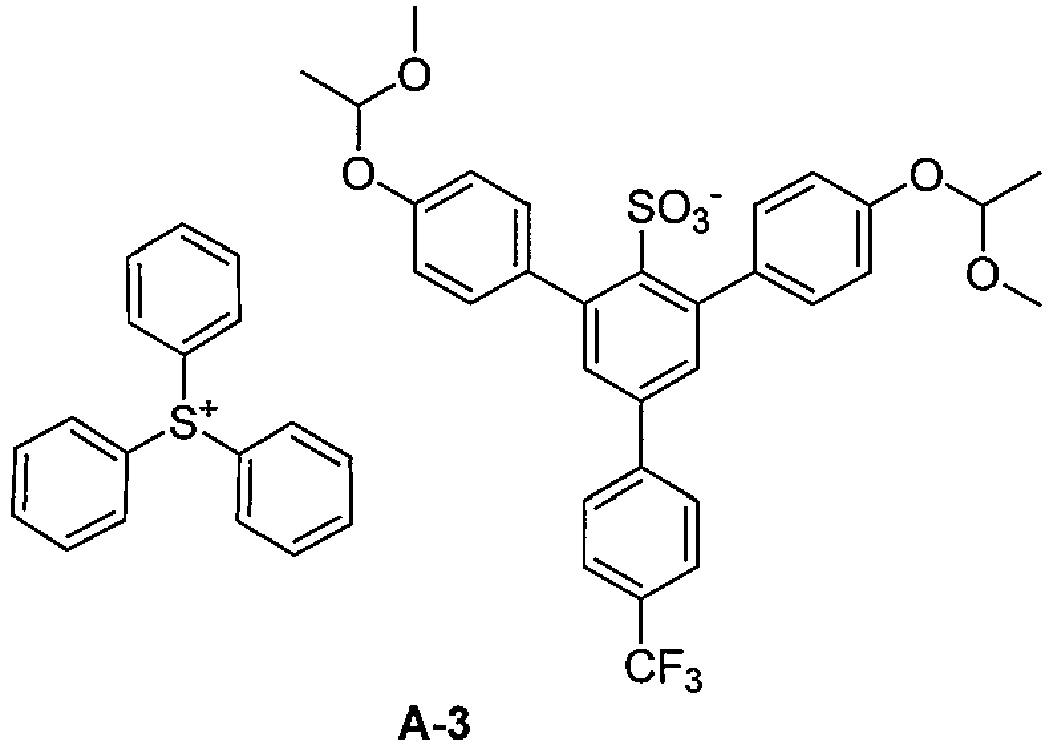


- The following A-11 and A-12 are not the photoacid generators (A), but were used as photoacid generators in Reference Examples.


- The structures of the photoacid generators (B) used are shown below.


- The structures of the basic compounds (C) used are shown below.


- The structures of the crosslinking agents used are shown below.


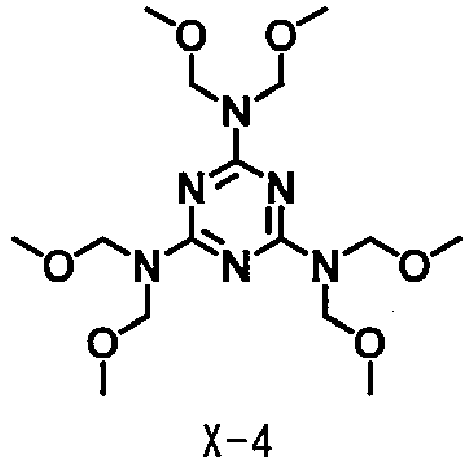
- The solvents used are shown below.
- PGMEA: Propylene glycol monomethyl ether acetate
- PGME: Propylene glycol monomethyl ether
- EL: Ethyl lactate
- An 8-inch wafer on which Cr oxynitride had been vapor-deposited (a product for which a shielding film treatment used for an ordinary photomask blank had been carried out) was prepared.
- The components shown in Tables 1 and 2 below were dissolved in a solvent to prepare a solution having a solid content (concentration of the total solid content) shown in the same tables, and this solution was filtered through a polyethylene filter having a pore size of 0.03 µm to prepare a resist composition.
- A resist composition was applied onto the 8-inch wafer using a spin coater Mark8 manufactured by Tokyo Electron Limited, and dried on a hot plate at 120°C for 600 seconds to obtain a resist film having a film thickness of 50 nm. That is, a resist-coated wafer was obtained.
- In Tables 1 and 2, the content (% by mass) of each component other than the solvent means a content ratio with respect to the total solid content in the resist composition. In addition, the content ratio (% by mass) of the solvent used with respect to all the solvents is described in Table 1 below.
[Table 1] Resin (P) Photoacid generator (A) Photoacid generator (B) Basic compound (C) Crosslinking agent Solvent Concentration of total solid content (% by mass) Type Content (% by mass) Type Content (% by mass) pKa of acid (ac1) Type Content (% by mass) pKa of acid (ac2) Type Content (% by mass) Type Content (% by mass) Type Mass ratio Example 1 P-1 65.24 A-1 21.934 -0.38 B-1 8.21 4.25 Q-1 4.62 - - EL/PGME/PGMEA 70/20/10 2.7 Example 2 P-1 62.52 A-1 25.031 -0.38 B-2 9.39 3.62 Q-3 3.06 - - EL/PGME/PGMEA 50/20/30 2.3 Example 3 P-1 59.32 A-1 27.132 -0.38 B-4 9.03 3.32 Q-4 4.52 - - EL/PGME/PGMEA 40/30/30 2.4 Example 4 P-1 70.26 A-1 16.865 -0.38 B-5 9.72 4.68 Q-5 3.15 - - EL/PGME/PGMEA 50/10/40 2.5 Example 5 P-1 63.31 A-1 24.906 -0.38 B-6 8.38 3.45 Q-5 3.41 - - EL/PGME/PGMEA 50/20/30 2.6 Example 6 P-1 64.68 A-2 22.407 -0.32 B-1 8.95 4.25 Q-1 3.96 - - EL/PGME/PGMEA 20/20/60 2.6 Example 7 P-1 68.83 A-2 17.105 -0.32 B-2 9.91 3.62 Q-2 4.16 - - EL/PGME/PGMEA 10/30/60 1.6 Example 8 P-1 57.00 A-2 28.966 -0.32 B-3 9.49 4.4 Q-2 4.55 - - EL/PGME/PGMEA 10/10/80 1.5 Example 9 P-1 70.79 A-2 16.927 -0.32 B-3 8.93 4.4 Q-4 3.35 - - EL/PGME/PGMEA 80/10/10 2.6 Example 10 P-1 56.24 A-2 29.488 -0.32 B-3 9.76 4.4 Q-6 4.52 - - EL/PGME/PGMEA 70/20/10 2.1 Example 11 P-1 70.39 A-3 16.336 -0.78 B-1 9.05 4.25 Q-1 4.23 - - EL/PGME/PGMEA 70/10/20 2.6 Example 12 P-1 68.15 A-3 18.879 -0.78 B-1 9.82 4.25 Q-2 3.15 - - EL/PGME/PGMEA 20/20/60 1.5 Example 13 P-1 58.51 A-3 28.748 -0.78 B-1 8.41 4.25 Q-4 4.33 - - EL/PGME/PGMEA 30/10/60 1.7 Example 14 P-1 66.26 A-3 20.316 -0.78 B-2 8.53 3.62 Q-1 4.89 - - EL/PGME/PGMEA 20/10/70 1.8 Example 15 P-1 71.45 A-3 16.750 -0.78 B-2 8.47 3.62 Q-4 3.33 - - EL/PGME/PGMEA 60/20/20 2.6 Example 16 P-1 62.45 A-3 25.176 -0.78 B-2 8.12 3.62 Q-6 4.25 - - EL/PGME/PGMEA 40/20/40 2.6 Example 17 P-1 69.54 A-5 17.517 -0.35 B-2 9.25 3.62 Q-1 3.70 - - EL/PGME/PGMEA 10/10/80 1.5 Example 18 P-1 56.95 A-5 29.902 -0.35 B-2 8.57 3.62 Q-2 4.58 - - EL/PGME/PGMEA 20/10/70 1.8 Example 19 P-1 61.42 A-5 25.566 -0.35 B-2 8.59 3.62 Q-3 4.42 - - EL/PGME/PGMEA 50/20/30 2.6 Example 20 P-1 62.10 A-5 26.017 -0.35 B-2 8.31 3.62 Q-4 3.57 - - EL/PGME/PGMEA 30/20/50 2.4 Example 21 P-1 64.59 A-5 22.117 -0.35 B-2 9.86 3.62 Q-5 3.43 - - EL/PGME/PGMEA 30/30/40 2.6 Example 22 P-2 69.40 A-6 17.190 -0.37 B-1 9.61 4.25 Q-4 3.80 - - EL/PGME/PGMEA 20/30/50 2.1 Example 23 P-2 61.68 A-7 25.947 -0.33 B-3 9.32 4.4 Q-1 3.05 - - EL/PGME/PGMEA 50/20/30 2.6 Example 24 P-2 69.91 A-2 16.548 -0.33 B-5 8.86 4.68 Q-5 4.69 - - EL/PGME/PGMEA 50/20/30 2.2 Example 25 P-3 57.65 A-4 29.701 -0.36 B-1 8.25 4.25 Q-2 4.40 - - EL/PGME/PGMEA 70/20/10 2.6 Example 26 P-3 67.00 A-4 19.390 -0.36 B-2 8.67 3.62 Q-3 4.94 - - EL/PGME/PGMEA 70/20/10 2.6 Example 27 P-3 58.45 A-4 28.937 -0.36 B-3 8.46 4.4 Q-4 4.16 - - EL/PGME/PGMEA 50/20/30 2.6 Example 28 P-4 69.93 A-2 16.641 -0.32 B-2 9.91 3.62 Q-1 3.51 - - EL/PGME/PGMEA 50/10/40 2.3 Example 29 P-4 71.50 A-3 15.483 -0.78 B-2 9.84 3.62 Q-4 3.18 - - EL/PGME/PGMEA 80/10/10 1.2 Example 30 P-4 61.28 A-3 26.013 -0.78 B-3 9.38 4.4 Q-6 3.32 - - EL/PGME/PGMEA 70/20/10 1.4 [Table 2] Resin (P) Photoacid generator (A) Photoacid generator (B) Basic compound (C) Crosslinking agent Solvent Concentration of total solid content (% by mass) Type Content (% by mass) Type Content (% by mass) pKa of acid (ac1) Type Content (% by mass) pKa of acid (ac2) Type Content (% by mass) Type Content (% by mass) Type Mass ratio Example 31 P-5 63.24 A-1 22.026 -0.38 B-4 9.76 3.32 Q-4 4.98 - - EL/PGME/PGMEA 60/20/20 2.0 Example 32 P-5 68.03 A-2 19.055 -0.32 B-1 9.02 4.25 Q-4 3.89 - - EL/PGME/PGMEA 40/20/40 2.6 Example 33 P-5 65.76 A-2 20.983 -0.32 B-5 8.28 4.68 Q-2 4.98 - - EL/PGME/PGMEA 10/10/80 2.3 Example 34 P-5 67.23 A-3 18.135 -0.78 B-2 9.72 3.62 Q-2 4.91 - - EL/PGME/PGMEA 20/10/70 2.4 Example 35 P-5 69.69 A-3 18.483 -0.78 B-5 8.06 4.68 Q-2 3.77 - - EL/PGME/PGMEA 50/20/30 2.6 Example 36 P-6 68.44 A-1 16.956 -0.38 B-1 9.87 4.25 Q-1 4.73 - - PGME/PGMEA 40/60 2.2 Example 37 P-6 67.70 A-2 19.835 -0.32 B-5 8.38 4.68 Q-4 4.08 - - EL/PGME/PGMEA 50/20/30 2.6 Example 38 P-6 65.47 A-2 21.460 -0.32 B-5 9.03 4.68 Q-3 4.04 - - EL/PGME/PGMEA 60/20/20 2.2 Example 39 P-6 57.50 A-4 29.402 -0.36 B-3 8.83 4.4 Q-3 4.27 - - EL/PGME/PGMEA 20/10/70 1.3 Example 40 P-6 68.30 A-4 17.677 -0.36 B-3 9.09 4.4 Q-2 4.93 - - EL/PGME/PGMEA 60/20/20 2.6 Example 41 P-7 70.59 A-1 17.517 -0.38 B-4 8.34 3.32 Q-1 3.56 - - EL/PGME/PGMEA 50/20/30 2.6 Example 42 P-7 64.79 A-1 21.298 -0.38 B-5 9.12 4.68 Q-1 4.79 - - EL/PGME/PGMEA 50/20/30 2.1 Example 45 P-1 68.88 A-2 17.105 -0.32 B-7 9.86 1.5 Q-2 4.16 - - EL/PGME/PGMEA 20/10/70 2.1 Example 46 P-1 60.60 A-8 25.947 -0.33 B-3 9.49 4.4 Q-1 3.96 - - EL/PGME/PGMEA 50/20/30 2.6 Example 47 P-3 57.65 A-9 29.701 -0.36 B-1 8.25 4.25 Q-2 4.40 - - EL/PGME/PGMEA 40/20/40 2.6 Example 48 P-5 68.61 A-10 18.135 -0.78 B-2 8.28 3.62 Q-2 4.98 - - EL/PGME/PGMEA 10/10/80 2.6 Example 49 P-6 67.70 A-2 23.730 -0.32 B-5 8.38 4.68 Q-4 1.00 - - EL/PGME/PGMEA 50/20/30 2.6 Example 50 P-1 76.30 A-2 17.105 -0.32 B-7 4.60 1.5 Q-2 2.00 - - EL/PGME/PGMEA 20/10/70 2.1 Example 51 P-1 53.10 A-2 40.300 -0.32 B-7 5.10 1.5 Q-2 1.50 - - EL/PGME/PGMEA 20/10/70 2.1 Example 52 P-1 41.50 A-2 51.000 -0.32 B-7 6.00 1.5 Q-2 1.50 - - EL/PGME/PGMEA 20/10/70 2.1 Example 53 P-8 41.46 A-1 28.937 -0.38 B-1 5.10 4.25 Q-1 4.40 X-1 20.10 EL/PGME/PGMEA 60/20/20 2.3 Example 54 P-8 52.47 A-2 16.641 -0.32 B-2 9.09 3.62 Q-2 6.50 X-2 15.30 EL/PGME/PGMEA 50/20/30 2.4 Example 55 P-9 45.06 A-3 15.483 -0.78 B-3 9.87 4.4 Q-3 4.16 X-3 25.43 EL/PGME/PGMEA 50/20/30 2.5 Example 56 P-9 53.69 A-4 8.000 -0.36 B-4 4.60 3.32 Q-4 3.51 X-4 30.20 EL/PGME/PGMEA 20/10/70 2.6 Comparative Example 1 P-1 70.39 A-3 16.336 -0.78 B-1 9.05 4.25 - - - - EL/PGME/PGMEA 70/10/20 2.6 Comparative Example 2 P-1 70.39 A-3 16.336 -0.78 - - - Q-1 4.23 - - EL/PGME/PGMEA 70/10/20 2.6 Reference Example 1 P-8 57.73 A-12 8.040 -3.3 B-1 5.00 4.25 Q-1 1.02 X-1 28.21 EL/PGME/PGMEA 60/20/20 2.6 Reference Example 2 P-1 77.35 A-11 16.548 -0.33 B-1 5.10 4.25 Q-1 1.00 - - EL/PGME/PGMEA 60/20/20 2.6 - The resist film obtained in (3) above was subjected to patternwise irradiation using an electron beam drawing apparatus (manufactured by Advantest Corporation; F7000S, accelerating voltage: 50 KeV). After the irradiation, the film was heated on a hot plate at 100°C for 600 seconds, dipped using a 2.38%-by-mass aqueous tetramethylammonium hydroxide (TMAH) solution for 60 seconds, then rinsed with water for 30 seconds, and dried.
- The following evaluation was performed on a resist pattern manufactured using the resist composition immediately after the preparation.
- The irradiation energy upon resolution of a 1:1 line-and-space pattern with a line width of 50 nm was defined as a sensitivity (Eop1). A marginal resolving power (a minimum line width at which lines and spaces (line:space = 1:1) are separated and resolved) at an exposure amount showing the sensitivity (Eop1) was taken as a resolving power (also referred to as "r1") (unit: nm) in a case of using the resist composition immediately after the preparation.
- Using a resist composition stored at a temperature of 40°C for 1 month after the preparation, the sensitivity (Eop1) was determined by the same procedure as above, and a marginal resolving power at an exposure amount showing the sensitivity (Eop1) was evaluated and taken as a resolving power (also referred to as "r2") (unit: nm) in a case of using the resist composition after a lapse of a certain period of time from the preparation.
- A change (also referred to as "Δr") in a resolving power of the resist composition between before and after a lapse of a period of time was determined from a difference between the resolving power (r2) determined above in a case of using the resist composition after the lapse of a certain period of time from the preparation and the resolving power (r1) in a case of using the resist composition immediately after the preparation. Specifically, Δr was calculated by Expression 1.

- The smaller the value of Δr, the smaller the deterioration of the performance of the resist composition after the lapse of a period of time, and the better the performance.
- The following evaluation was performed on a resist pattern manufactured using the resist composition immediately after the preparation.
- Using a defect inspection apparatus, KLA 2360 (trade name), manufactured by KLA Tencor Ltd., a 1:1 line-and-space pattern with a line width of 50 nm formed at the sensitivity (Eop1) was measured by setting a pixel size of the defect inspection apparatus to 0.13 µm and a threshold value to 20 to detect defects (defects/cm2) extracted from a difference produced at the time of superposing pixel units on a reference image, and the number of the defects per unit area (defects/cm2) was calculated. Then, by performing a defect review, the development defects were classified and extracted from all the defects, and the number of development defects per unit area (also referred to as "d1") (unit: defects/cm2) in a case of using the resist composition immediately after the preparation was calculated.
- Using a resist composition stored at a temperature of 40°C for 1 month after the preparation, the number of development defects per unit area (also referred to as "d2") (unit: defects/cm2) in a case of using the resist composition after a lapse of a certain period of time from the preparation was calculated by the same procedure as above. A case where the value of the number of development defects per unit area was less than 0.5 was designated as A, a case where the value was 0.5 or more and less than 1.0 was designated as B, a case where the value was 1.0 or more and less than 5.0 was designated as C, and a case where the value was 5.0 or more was designated as D. A smaller value thereof indicates better performance.
- A change (also referred to as "Δd") in the development defect performance of the resist composition after a lapse of a period of time was determined from a difference between the number of development defects (d2) per unit area in a case of using the resist composition after a lapse of a certain period of time from the preparation and the number of development defects (d1) per unit area in a case of using the resist composition immediately after the preparation. Specifically, Δd was calculated by Expression 2.

- The smaller the value of Δd, the smaller the deterioration of the performance of the resist composition after a lapse of a period of time, and the better the performance.
- A case where Δd was less than 1.0 was designated as A, a case where Δd was 1.0 or more and less than 2.0 was designated as B, a case where Δd was 2.0 or more and less than 3.0 was designated as C, and a case where Δd was 3.0 or more was designated as D.
- The results of the resolving power (r2) in a case of using the resist composition after the lapse of a certain period of time from the preparation, the number (d2) of development defects per unit area in a case of using the resist composition after the lapse of a certain period of time from the preparation, the change (Δr) in the resolving power of the resist composition between before and after the lapse of a period of time, and the change (Δd) in the development defect performance of the resist composition between before and after the lapse of a period of time are shown in Tables 3 and 4 below.
- In addition, the ratio (molar ratio) (B)/(C) of the content of the photoacid generator (B) to the content of the basic compound (C) in the resist composition; the ratio (molar ratio) [(B) + (C)]/[(A) + (B)] of the sum of the content of the photoacid generator (B) and the content of the basic compound (C) to the sum of the content of the photoacid generator (A) and the content of the photoacid generator (B); and the ratio (molar ratio) (A)/(B) of the content of the photoacid generator (A) to the content of the photoacid generator (B) are also described in Tables 3 and 4 below.
[Table 3] (B)/(C) [(B) + (C) /(A) + (B)] (A)/(B) r2 (nm) d2 Δr (nm) Δd Example 1 1.33 0.80 1.18 21.6 A 0.4 A Example 2 1.49 0.75 1.23 21.8 A 0.2 A Example 3 1.66 0.60 1.66 21.1 A 1.1 A Example 4 1.80 0.95 0.64 20.4 A 0.8 A Example 5 0.90 0.77 1.75 24.2 A 1.9 A Example 6 1.69 0.79 1.01 21.0 A 0.0 A Example 7 1.77 0.91 0.73 21.1 A 0.0 A Example 8 1.41 0.71 1.42 21.3 A 0.2 A Example 9 2.43 0.75 0.88 21.9 A 0.2 A Example 10 0.65 1.05 1.40 26.3 A 2.6 A Example 11 1.60 0.90 0.80 21.5 A 0.2 A Example 12 2.41 0.76 0.85 22.1 A 0.0 A Example 13 2.03 0.59 1.52 21.9 A 0.0 A Example 14 1.25 0.86 1.10 22.0 A 0.0 A Example 15 2.55 0.73 0.92 22.0 A 0.7 A Example 16 0.64 1.06 1.43 25.8 A 2.3 A Example 17 1.80 0.91 0.72 20.2 A 0.2 A Example 18 1.39 0.74 1.32 21.4 A 0.6 A Example 19 0.94 0.97 1.13 24.5 A 1.7 A Example 20 2.33 0.65 1.19 22.4 A 0.2 A Example 21 1.35 0.94 0.85 22.5 A 0.0 A Example 22 2.64 0.83 0.66 24.9 B 0.0 A Example 23 1.99 0.66 1.29 24.3 B 0.0 A Example 24 1.10 1.25 0.52 23.0 A 0.7 A Example 25 1.45 0.65 1.61 21.9 A 0.0 A Example 26 0.85 1.06 1.04 25.9 A 1.8 A Example 27 1.85 0.56 1.76 21.2 A 0.4 A Example 28 2.02 0.87 0.71 22.5 A 0.2 A Example 29 3.10 0.77 0.73 22.0 A 0.2 A Example 30 0.86 0.90 1.41 24.0 A 1.7 A [Table 4] (B)/(C) [(B) + (C) /(A) + (B)] (A)/(B) r2 (nm) d2 Δr (nm) Δd Example 31 1.63 0.72 1.25 22.3 A 0.0 A Example 32 2.42 0.76 0.86 20.2 A 0.2 A Example 33 1.53 0.89 0.86 22.5 A 0.4 A Example 34 1.47 0.90 0.86 21.0 A 0.4 A Example 35 1.97 0.81 0.85 21.2 A 0.4 A Example 36 1.56 0.93 0.76 20.9 A 0.2 A Example 37 2.55 0.77 0.80 22.3 A 0.0 A Example 38 1.35 0.96 0.81 20.5 A 0.0 A Example 39 0.91 0.77 1.71 24.3 A 1.6 A Example 40 1.25 0.90 1.00 20.5 A 0.2 A Example 41 1.40 0.79 1.16 21.4 A 0.0 A Example 42 1.70 0.85 0.86 21.8 A 0.4 A Example 45 1.87 0.91 0.69 22.0 A 0.2 A Example 46 1.56 0.72 1.27 25.0 B 0.0 A Example 47 1.45 0.66 1.56 20.3 A 0.0 A Example 48 1.23 0.96 0.89 23.7 B 0.0 A Example 49 10.43 0.56 0.96 23.5 A 2.1 A Example 50 1.82 0.63 1.47 25.0 A 0.0 A Example 51 2.69 0.33 3.13 27.3 A 0.3 A Example 52 3.16 0.30 3.37 28.5 B 0.6 A Example 53 0.87 0.61 2.50 28.0 A 0.6 A Example 54 1.04 1.11 0.77 22.1 A 0.4 A Example 55 1.05 1.09 0.80 26.0 A 0.5 A Example 56 1.09 0.97 0.98 27.5 A 0.3 A Comparative Example 1 - 0.55 0.73 35.0 D 11.5 D Comparative Example 2 0.00 0.26 - 37.0 B 6.0 B Reference Example 1 3.20 0.57 1.30 40.0 B 0.5 A Reference Example 2 3.33 0.36 2.61 40.0 B 0.0 A - From the results of Examples, it is found that the resist composition of the embodiment of the present invention has a high resolving power and fewer development defects, and has a high resolving power and fewer development defects even after a lapse of a certain period of time from the preparation.
- In Reference Examples, since the photoacid generator (A) in the present invention was not used, the resolving power was inferior to that in Examples. Furthermore, from the comparison between Reference Examples and Examples, it is found that the problems of a deterioration of the resolving power and an increase in the development defects after a lapse of a certain period of time from the preparation are less likely to occur in Reference Examples in which the photoacid generator (A) was not used.
- According to the present invention, it is possible to provide an actinic ray-sensitive or radiation-sensitive resin composition which has a high resolving power and fewer development defects in a pattern forming method, and has a high resolving power and fewer development defects even after a lapse of a certain period of time from preparing the actinic ray-sensitive or radiation-sensitive resin composition; and an actinic ray-sensitive or radiation-sensitive film, a pattern forming method, a method for manufacturing an electronic device, an actinic ray-sensitive or radiation-sensitive resin composition for manufacturing a photomask, and a method for manufacturing a photomask, each of which uses the actinic ray-sensitive or radiation-sensitive resin composition.
- Although the present invention has been described in detail with reference to specific embodiments, it will be apparent to those skilled in the art that various changes and modifications can be made without departing from the spirit and the scope of the present invention.
- The present application is based on Japanese Patent Application (
JP2020-061655) filed on March 30, 2020
Claims (14)
- An actinic ray-sensitive or radiation-sensitive resin composition comprising:a resin (P) of which a solubility in a developer changes by an action of an acid;a compound (A) that has a group (a) having a polarity which changes through decomposition by an action of an acid, and generates an acid (ac1) upon irradiation with actinic rays or radiation;a compound (B) that generates an acid (ac2) having a higher pKa than the acid (ac1) generated from the compound (A), upon irradiation with actinic rays or radiation; anda basic compound (C).
- The actinic ray-sensitive or radiation-sensitive resin composition according to claim 1,
wherein a pKa of the acid (ac2) is 1 or more higher than a pKa of the acid (ac1). - The actinic ray-sensitive or radiation-sensitive resin composition according to claim 1 or 2,
wherein a ratio (B)/(C) of a content of the compound (B) to a content of the basic compound (C) is from 1.1 to 10 in terms of a molar ratio. - The actinic ray-sensitive or radiation-sensitive resin composition according to any one of claims 1 to 3,
wherein a ratio [(B) + (C)]/[(A) + (B)] of a sum of a content of the compound (B) and a content of the basic compound (C) to a sum of a content of the compound (A) and the content of the compound (B) is from 0.3 to 1.0 in terms of a molar ratio. - The actinic ray-sensitive or radiation-sensitive resin composition according to any one of claims 1 to 4,
wherein a content of the compound (A) is from 5% by mass to 60% by mass with respect to a total solid content of the actinic ray-sensitive or radiation-sensitive resin composition. - The actinic ray-sensitive or radiation-sensitive resin composition according to any one of claims 1 to 5,wherein the compound (A) is represented by the following General Formula (b1),
 in the General Formula (b1), L represents a single bond or a divalent linking group, in a case where there are a plurality of L's, the plurality of L's may be the same as or different from each other, A represents the group (a) having a polarity which changes through decomposition by an action of an acid, in a case where there are a plurality of A's, the plurality of A's may be the same as or different from each other, n represents an integer from 1 to 5, X represents an (n + 1)-valent linking group, and M+ represents a sulfonium ion or an iodonium ion.
 - The actinic ray-sensitive or radiation-sensitive resin composition according to any one of claims 1 to 6,wherein the compound (A) is represented by the following General Formula (b3),
 in the General Formula (b3), L represents a single bond or a divalent linking group, in a case where there are a plurality of L's, the plurality of L's may be the same as or different from each other, A represents the group (a) having a polarity which changes through decomposition by an action of an acid, in a case where there are a plurality of A's, the plurality of A's may be the same as or different from each other, o, p, and q each independently represent an integer from 0 to 5, provided that a sum of o, p, and q is from 1 to 5, and M+ represents a sulfonium ion or an iodonium ion.
 - The actinic ray-sensitive or radiation-sensitive resin composition according to any one of claims 1 to 7,wherein the group (a) having a polarity which changes through decomposition by an action of an acid is a group represented by the following General Formula (T-1),
 in the General Formula (T-1),R11 represents a hydrogen atom or an alkyl group,R12 represents a hydrogen atom, an alkyl group, a cycloalkyl group, or an aryl group, and the alkyl group and the cycloalkyl group may include an ether bond or a carbonyl bond,R13 represents an alkyl group, a cycloalkyl group, or an aryl group, and the alkyl group and the cycloalkyl group may include an ether bond or a carbonyl bond,R11 and R12 may be bonded to each other to form a ring,R12 and R13 may be bonded to each other to form a ring, and∗ represents a bond.
 - The actinic ray-sensitive or radiation-sensitive resin composition according to any one of claims 1 to 8,
wherein a ratio (A)/(B) of a content of the compound (A) to a content of the compound (B) is from 0.2 to 2.0 in terms of a molar ratio. - An actinic ray-sensitive or radiation-sensitive film formed of the actinic ray-sensitive or radiation-sensitive resin composition according to any one of claims 1 to 9.
- A pattern forming method comprising:a resist film forming step of forming a resist film using the actinic ray-sensitive or radiation-sensitive resin composition according to any one of claims 1 to 9;an exposing step of exposing the resist film; anda developing step of developing the exposed resist film by a developer.
- A method for manufacturing an electronic device, comprising the pattern forming method according to claim 11.
- An actinic ray-sensitive or radiation-sensitive resin composition for manufacturing a photomask,
wherein the actinic ray-sensitive or radiation-sensitive resin composition according to any one of claims 1 to 9 is used for manufacturing a photomask. - A method for manufacturing a photomask, using the actinic ray-sensitive or radiation-sensitive resin composition for manufacturing a photomask according to claim 13.
Applications Claiming Priority (2)
| Application Number | Priority Date | Filing Date | Title |
|---|---|---|---|
| JP2020061655 | 2020-03-30 | ||
| PCT/JP2021/010246 WO2021200056A1 (en) | 2020-03-30 | 2021-03-12 | Active-light-sensitive or radiation-sensitive resin composition, active-light-sensitive or radiation-sensitive film, pattern formation method, method for manufacturing electronic device, active-light-sensitive or radiation-sensitive resin composition for manufacturing photomask, and method for manufacturing photomask |
Publications (2)
| Publication Number | Publication Date |
|---|---|
| EP4130878A1 true EP4130878A1 (en) | 2023-02-08 |
| EP4130878A4 EP4130878A4 (en) | 2023-09-27 |
Family
ID=77930319
Family Applications (1)
| Application Number | Title | Priority Date | Filing Date |
|---|---|---|---|
| EP21779830.5A Pending EP4130878A4 (en) | 2020-03-30 | 2021-03-12 | ACTIVE LIGHT SENSITIVE OR RADIATION SENSITIVE RESIN COMPOSITION, ACTIVE LIGHT SENSITIVE OR RADIATION SENSITIVE FILM, PATTERNING METHOD, METHOD FOR PRODUCING AN ELECTRONIC DEVICE, ACTIVE LIGHT SENSITIVE OR RADIATION SENSITIVE RESIN COMPOSITION FOR MAKING A PHOTOMASK AND METHOD FOR MAKING A PHOTOMASK |
Country Status (6)
| Country | Link |
|---|---|
| US (1) | US12510822B2 (en) |
| EP (1) | EP4130878A4 (en) |
| JP (1) | JP7398551B2 (en) |
| KR (1) | KR102834817B1 (en) |
| CN (1) | CN115362412B (en) |
| WO (1) | WO2021200056A1 (en) |
Cited By (1)
| Publication number | Priority date | Publication date | Assignee | Title |
|---|---|---|---|---|
| EP4703797A3 (en) * | 2024-08-30 | 2026-04-01 | Shin-Etsu Chemical Co., Ltd. | Chemically amplified negative resist composition and resist pattern forming process |
Families Citing this family (19)
| Publication number | Priority date | Publication date | Assignee | Title |
|---|---|---|---|---|
| JP7032549B2 (en) * | 2018-08-31 | 2022-03-08 | 富士フイルム株式会社 | Sensitive or radiation sensitive resin compositions, sensitive or radiation sensitive films, pattern forming methods, electronic device manufacturing methods, and compounds. |
| JP7779248B2 (en) | 2022-01-27 | 2025-12-03 | 信越化学工業株式会社 | Resist material and pattern forming method |
| JP7779249B2 (en) | 2022-01-27 | 2025-12-03 | 信越化学工業株式会社 | Resist material and pattern forming method |
| US20230259027A1 (en) | 2022-01-27 | 2023-08-17 | Shin-Etsu Chemical Co., Ltd. | Resist composition and pattern forming process |
| JP7782480B2 (en) | 2022-02-04 | 2025-12-09 | 信越化学工業株式会社 | Resist material and pattern forming method |
| JP2023169812A (en) | 2022-05-17 | 2023-11-30 | 信越化学工業株式会社 | Novel sulfonium salt, resist composition, and patterning process |
| JP2025005767A (en) | 2023-06-28 | 2025-01-17 | 信越化学工業株式会社 | Acetal modifier, polymer, chemically amplified positive resist composition and method for forming resist pattern |
| JP2025009938A (en) | 2023-07-04 | 2025-01-20 | 信越化学工業株式会社 | Onium salt, chemically amplified positive resist composition and method for forming resist pattern |
| CN119613298A (en) | 2023-09-13 | 2025-03-14 | 信越化学工业株式会社 | Onium salt, chemically amplified positive resist composition and resist pattern forming method |
| JP2025134163A (en) | 2024-03-04 | 2025-09-17 | 信越化学工業株式会社 | Chemically amplified positive resist composition and method for forming resist pattern |
| JP2026007396A (en) | 2024-07-03 | 2026-01-16 | 信越化学工業株式会社 | Chemically amplified negative resist composition and method for forming resist pattern |
| JP2026007393A (en) | 2024-07-03 | 2026-01-16 | 信越化学工業株式会社 | Chemically amplified positive resist composition and method for forming resist pattern |
| JP2026036473A (en) | 2024-08-20 | 2026-03-05 | 信越化学工業株式会社 | Sulfonium salt, chemically amplified positive resist composition, and method for forming a resist pattern |
| JP2026036484A (en) | 2024-08-20 | 2026-03-05 | 信越化学工業株式会社 | Iodonium salt, chemically amplified positive resist composition, and method for forming resist pattern |
| JP2026036480A (en) | 2024-08-20 | 2026-03-05 | 信越化学工業株式会社 | Sulfonium salt, chemically amplified positive resist composition, and method for forming a resist pattern |
| JP2026036486A (en) | 2024-08-20 | 2026-03-05 | 信越化学工業株式会社 | Sulfonium salt, chemically amplified positive resist composition, and method for forming a resist pattern |
| JP2026042362A (en) | 2024-08-27 | 2026-03-11 | 信越化学工業株式会社 | Onium salt, chemically amplified positive resist composition and method for forming resist pattern |
| JP2026042374A (en) | 2024-08-27 | 2026-03-11 | 信越化学工業株式会社 | Chemically amplified negative resist composition and method for forming resist pattern |
| JP2026044250A (en) | 2024-08-30 | 2026-03-12 | 信越化学工業株式会社 | Chemically amplified positive-type resist composition and resist pattern formation method |
Family Cites Families (50)
| Publication number | Priority date | Publication date | Assignee | Title |
|---|---|---|---|---|
| JPS61226745A (en) | 1985-03-30 | 1986-10-08 | Japan Synthetic Rubber Co Ltd | Radiation sensitive composition |
| JPS61226746A (en) | 1985-03-30 | 1986-10-08 | Japan Synthetic Rubber Co Ltd | Radiation sensitive composition |
| JPS62123444A (en) | 1985-08-07 | 1987-06-04 | Japan Synthetic Rubber Co Ltd | Radiation sensitive resinous composition |
| JPH0616174B2 (en) | 1985-08-12 | 1994-03-02 | 三菱化成株式会社 | Naphthoquinonediazide compound and positive photoresist composition containing the compound |
| JPH083630B2 (en) | 1986-01-23 | 1996-01-17 | 富士写真フイルム株式会社 | Photosensitive composition |
| JPS6334540A (en) | 1986-07-30 | 1988-02-15 | Mitsubishi Chem Ind Ltd | Positive type photoresist composition |
| JP2717602B2 (en) | 1990-01-16 | 1998-02-18 | 富士写真フイルム株式会社 | Photosensitive composition |
| US5296330A (en) | 1991-08-30 | 1994-03-22 | Ciba-Geigy Corp. | Positive photoresists containing quinone diazide photosensitizer, alkali-soluble resin and tetra(hydroxyphenyl) alkane additive |
| US5576143A (en) | 1991-12-03 | 1996-11-19 | Fuji Photo Film Co., Ltd. | Light-sensitive composition |
| FR2688783A1 (en) | 1992-03-23 | 1993-09-24 | Rhone Poulenc Chimie | NOVEL BORONES OF ONIUM OR ORGANOMETALLIC COMPLEX CATIONIC PRIMERS FOR POLYMERIZATION. |
| JP2753921B2 (en) | 1992-06-04 | 1998-05-20 | 富士写真フイルム株式会社 | Positive photoresist composition |
| JP3112229B2 (en) | 1993-06-30 | 2000-11-27 | 東京応化工業株式会社 | Positive photoresist composition |
| JP3224115B2 (en) | 1994-03-17 | 2001-10-29 | 富士写真フイルム株式会社 | Positive photoresist composition |
| EP0691575B1 (en) | 1994-07-04 | 2002-03-20 | Fuji Photo Film Co., Ltd. | Positive photosensitive composition |
| JPH0862834A (en) | 1994-08-22 | 1996-03-08 | Mitsubishi Chem Corp | Photoresist composition |
| JPH095988A (en) | 1995-06-21 | 1997-01-10 | Mitsubishi Chem Corp | Radiation-sensitive coating composition |
| JP3562599B2 (en) | 1995-08-18 | 2004-09-08 | 大日本インキ化学工業株式会社 | Photoresist composition |
| JP3591549B2 (en) * | 1995-11-02 | 2004-11-24 | 信越化学工業株式会社 | New iodonium salt and chemically amplified positive resist material |
| JPH1045961A (en) | 1996-08-08 | 1998-02-17 | Mitsubishi Gas Chem Co Inc | High purity hydrogen peroxide water container resin composition |
| JPH1121393A (en) | 1997-06-30 | 1999-01-26 | Mitsubishi Gas Chem Co Inc | High purity hydrogen peroxide water container resin composition |
| JP2002062667A (en) | 2000-08-23 | 2002-02-28 | Sumitomo Chem Co Ltd | Method for producing photoresist composition with reduced amount of fine particles |
| JP2002090991A (en) | 2000-09-13 | 2002-03-27 | Fuji Photo Film Co Ltd | Positive type resist composition |
| JP4554665B2 (en) | 2006-12-25 | 2010-09-29 | 富士フイルム株式会社 | PATTERN FORMATION METHOD, POSITIVE RESIST COMPOSITION FOR MULTIPLE DEVELOPMENT USED FOR THE PATTERN FORMATION METHOD, NEGATIVE DEVELOPMENT SOLUTION USED FOR THE PATTERN FORMATION METHOD, AND NEGATIVE DEVELOPMENT RINSE SOLUTION USED FOR THE PATTERN FORMATION METHOD |
| EP1975705B1 (en) | 2007-03-28 | 2016-04-27 | FUJIFILM Corporation | Positive resist composition and pattern-forming method |
| JP5153934B2 (en) | 2010-11-29 | 2013-02-27 | 富士フイルム株式会社 | Actinic ray-sensitive or radiation-sensitive resin composition, actinic ray-sensitive or radiation-sensitive film and pattern forming method |
| JP6049825B2 (en) | 2011-02-24 | 2016-12-21 | 東京エレクトロン株式会社 | Development processing method and development processing apparatus using developer containing organic solvent |
| JP2013041257A (en) | 2011-07-19 | 2013-02-28 | Sumitomo Chemical Co Ltd | Resist composition and production method of resist pattern |
| JP2013061647A (en) | 2011-09-09 | 2013-04-04 | Rohm & Haas Electronic Materials Llc | Photolithographic method |
| JP2013061648A (en) | 2011-09-09 | 2013-04-04 | Rohm & Haas Electronic Materials Llc | Photoresist topcoat composition and method of forming electronic device |
| JP5802510B2 (en) * | 2011-09-30 | 2015-10-28 | 富士フイルム株式会社 | PATTERN FORMING METHOD, ELECTRON-SENSITIVE OR EXTREME UV-SENSITIVE RESIN COMPOSITION, RESIST FILM, AND ELECTRONIC DEVICE MANUFACTURING METHOD USING THEM |
| KR102075960B1 (en) | 2012-03-14 | 2020-02-11 | 제이에스알 가부시끼가이샤 | Photoresist composition, method for forming resist pattern, acid diffusion control agent and compound |
| JP5836299B2 (en) | 2012-08-20 | 2015-12-24 | 富士フイルム株式会社 | PATTERN FORMATION METHOD, ELECTRON-SENSITIVE OR EXTREME UV-SENSITIVE RESIN COMPOSITION, RESIST FILM, AND METHOD FOR PRODUCING ELECTRONIC DEVICE USING THEM |
| JP6060577B2 (en) | 2012-09-13 | 2017-01-18 | Jsr株式会社 | Negative resist pattern forming method |
| US10248020B2 (en) * | 2012-12-28 | 2019-04-02 | Rohm And Haas Electronic Materials Llc | Acid generators and photoresists comprising same |
| JP6088827B2 (en) | 2013-01-10 | 2017-03-01 | 富士フイルム株式会社 | Negative resist composition, resist film and pattern forming method using the same, and mask blanks provided with the resist film |
| JP2014153440A (en) * | 2013-02-05 | 2014-08-25 | Tokyo Ohka Kogyo Co Ltd | Resist composition, polymeric compound, compound and method for forming resist pattern |
| JP6002705B2 (en) | 2013-03-01 | 2016-10-05 | 富士フイルム株式会社 | Pattern forming method, actinic ray-sensitive or radiation-sensitive resin composition, resist film, and electronic device manufacturing method |
| JP5799050B2 (en) * | 2013-03-29 | 2015-10-21 | 富士フイルム株式会社 | Actinic ray-sensitive or radiation-sensitive resin composition, resist film using the same, pattern formation method, and electronic device manufacturing method |
| JP6247858B2 (en) | 2013-08-01 | 2017-12-13 | 富士フイルム株式会社 | Pattern forming method and electronic device manufacturing method using the same |
| JP6313604B2 (en) | 2014-02-05 | 2018-04-18 | 富士フイルム株式会社 | Actinic ray-sensitive or radiation-sensitive resin composition, actinic ray-sensitive or radiation-sensitive film, mask blank provided with actinic ray-sensitive or radiation-sensitive film, pattern formation method, and electronic device manufacturing method |
| JP6222057B2 (en) | 2014-11-25 | 2017-11-01 | 信越化学工業株式会社 | Chemically amplified resist material and pattern forming method |
| US9644056B2 (en) | 2015-02-18 | 2017-05-09 | Sumitomo Chemical Company, Limited | Compound, resin and photoresist composition |
| JP6518475B2 (en) | 2015-03-20 | 2019-05-22 | 東京応化工業株式会社 | Resist composition, method of forming resist pattern, acid generator and compound |
| JP7041359B2 (en) * | 2016-10-13 | 2022-03-24 | Jsr株式会社 | Radiation-sensitive resin composition and resist pattern forming method |
| KR102355757B1 (en) * | 2017-03-31 | 2022-01-26 | 후지필름 가부시키가이샤 | Actinic ray-sensitive or radiation-sensitive resin composition, resist film, pattern formation method, electronic device manufacturing method |
| JP6937834B2 (en) * | 2017-09-20 | 2021-09-22 | 富士フイルム株式会社 | Actinic light-sensitive or radiation-sensitive resin composition, resist film, pattern forming method, and manufacturing method of electronic device |
| JP7032549B2 (en) | 2018-08-31 | 2022-03-08 | 富士フイルム株式会社 | Sensitive or radiation sensitive resin compositions, sensitive or radiation sensitive films, pattern forming methods, electronic device manufacturing methods, and compounds. |
| JP2020061655A (en) | 2018-10-10 | 2020-04-16 | トヨタ自動車株式会社 | Communication system |
| WO2021065450A1 (en) * | 2019-09-30 | 2021-04-08 | 富士フイルム株式会社 | Active light sensitive or radiation sensitive resin composition, active light sensitive or radiation sensitive film, pattern forming method, and method for producing electronic device |
| JP7389892B2 (en) * | 2020-03-31 | 2023-11-30 | 富士フイルム株式会社 | Actinic ray-sensitive or radiation-sensitive resin composition, actinic ray-sensitive or radiation-sensitive film, pattern forming method, and electronic device manufacturing method |
-
2021
- 2021-03-12 KR KR1020227030893A patent/KR102834817B1/en active Active
- 2021-03-12 WO PCT/JP2021/010246 patent/WO2021200056A1/en not_active Ceased
- 2021-03-12 CN CN202180025303.7A patent/CN115362412B/en active Active
- 2021-03-12 JP JP2022511785A patent/JP7398551B2/en active Active
- 2021-03-12 EP EP21779830.5A patent/EP4130878A4/en active Pending
-
2022
- 2022-09-07 US US17/939,660 patent/US12510822B2/en active Active
Cited By (1)
| Publication number | Priority date | Publication date | Assignee | Title |
|---|---|---|---|---|
| EP4703797A3 (en) * | 2024-08-30 | 2026-04-01 | Shin-Etsu Chemical Co., Ltd. | Chemically amplified negative resist composition and resist pattern forming process |
Also Published As
| Publication number | Publication date |
|---|---|
| JP7398551B2 (en) | 2023-12-14 |
| EP4130878A4 (en) | 2023-09-27 |
| CN115362412B (en) | 2026-01-27 |
| US20230038825A1 (en) | 2023-02-09 |
| KR102834817B1 (en) | 2025-07-17 |
| CN115362412A (en) | 2022-11-18 |
| WO2021200056A1 (en) | 2021-10-07 |
| US12510822B2 (en) | 2025-12-30 |
| KR20220139938A (en) | 2022-10-17 |
| JPWO2021200056A1 (en) | 2021-10-07 |
Similar Documents
| Publication | Publication Date | Title |
|---|---|---|
| US12510822B2 (en) | Actinic ray-sensitive or radiation-sensitive resin composition, actinic ray-sensitive or radiation-sensitive film, pattern forming method, method for manufacturing electronic device, actinic ray-sensitive or radiation-sensitive resin composition for manufacturing photomask, and method for manufacturing photomask | |
| US10788754B2 (en) | Pattern forming method and electronic device manufacturing method | |
| KR102129745B1 (en) | Pattern formation method and manufacturing method of electronic device | |
| WO2020158417A1 (en) | Actinic ray-sensitive or radiation-sensitive resin composition, resist film, pattern formation method, and electronic device manufacturing method | |
| TW201936665A (en) | Active ray-sensitive or radiation-sensitive resin composition and production method thereof, active ray-sensitive or radiation-sensitive film, method for forming pattern, and method for manufacturing electronic device | |
| US12535734B2 (en) | Actinic-ray-sensitive or radiation-sensitive resin composition, actinic-ray-sensitive or radiation-sensitive film, method for forming pattern, and method for producing electronic device | |
| WO2018061944A1 (en) | Active light sensitive or radiation sensitive resin composition, pattern forming method and method for producing electronic device | |
| US10599038B2 (en) | Rinsing liquid, pattern forming method, and electronic device manufacturing method | |
| WO2018043255A1 (en) | Active ray-sensitive or radiation-sensitive resin composition, pattern formation method, and electronic device production method | |
| WO2018056369A1 (en) | Resist composition, pattern forming method and method for manufacturing electronic device | |
| CN113166327A (en) | Actinic-ray-or radiation-sensitive resin composition, resist film, pattern forming method, and method for manufacturing electronic device | |
| TW201732429A (en) | Resist composition, resist film, mask blank, pattern forming method, and method for manufacturing electronic device | |
| US12235579B2 (en) | Method for producing actinic ray-sensitive or radiation-sensitive resin composition, pattern forming method, and method for manufacturing electronic device | |
| TW201736386A (en) | Processing liquid, pattern forming method, and method of manufacturing electronic component | |
| JP6633103B2 (en) | Pattern forming method, electronic device manufacturing method | |
| CN114450631A (en) | Actinic-ray-sensitive or radiation-sensitive resin composition, actinic-ray-sensitive or radiation-sensitive film, pattern formation method, and method for producing electronic device | |
| WO2018061512A1 (en) | Pattern forming method, method for producing electronic device, and active light sensitive or radiation sensitive composition | |
| JP2022131762A (en) | Actinic ray- or radiation-sensitive resin composition, actinic ray- or radiation-sensitive film, pattern forming method, and electronic device manufacturing method | |
| US20230067750A1 (en) | Pattern formation method and method for manufacturing electronic device | |
| US20210103217A1 (en) | Actinic ray-sensitive or radiation-sensitive resin composition, actinic ray-sensitive or radiation-sensitive film, pattern forming method, and photo mask |
Legal Events
| Date | Code | Title | Description |
|---|---|---|---|
| STAA | Information on the status of an ep patent application or granted ep patent |
Free format text: STATUS: THE INTERNATIONAL PUBLICATION HAS BEEN MADE |
|
| PUAI | Public reference made under article 153(3) epc to a published international application that has entered the european phase |
Free format text: ORIGINAL CODE: 0009012 |
|
| STAA | Information on the status of an ep patent application or granted ep patent |
Free format text: STATUS: REQUEST FOR EXAMINATION WAS MADE |
|
| 17P | Request for examination filed |
Effective date: 20220831 |
|
| AK | Designated contracting states |
Kind code of ref document: A1 Designated state(s): AL AT BE BG CH CY CZ DE DK EE ES FI FR GB GR HR HU IE IS IT LI LT LU LV MC MK MT NL NO PL PT RO RS SE SI SK SM TR |
|
| DAV | Request for validation of the european patent (deleted) | ||
| DAX | Request for extension of the european patent (deleted) | ||
| A4 | Supplementary search report drawn up and despatched |
Effective date: 20230824 |
|
| RIC1 | Information provided on ipc code assigned before grant |
Ipc: G03F 7/20 20060101ALI20230818BHEP Ipc: G03F 7/039 20060101ALI20230818BHEP Ipc: G03F 7/038 20060101ALI20230818BHEP Ipc: G03F 7/004 20060101AFI20230818BHEP |