CN113166327A - Actinic-ray-or radiation-sensitive resin composition, resist film, pattern forming method, and method for manufacturing electronic device - Google Patents
Actinic-ray-or radiation-sensitive resin composition, resist film, pattern forming method, and method for manufacturing electronic device Download PDFInfo
- Publication number
- CN113166327A CN113166327A CN201980076001.5A CN201980076001A CN113166327A CN 113166327 A CN113166327 A CN 113166327A CN 201980076001 A CN201980076001 A CN 201980076001A CN 113166327 A CN113166327 A CN 113166327A
- Authority
- CN
- China
- Prior art keywords
- group
- radiation
- sensitive
- mass
- repeating unit
- Prior art date
- Legal status (The legal status is an assumption and is not a legal conclusion. Google has not performed a legal analysis and makes no representation as to the accuracy of the status listed.)
- Pending
Links
Images


Classifications
-
- G—PHYSICS
- G03—PHOTOGRAPHY; CINEMATOGRAPHY; ANALOGOUS TECHNIQUES USING WAVES OTHER THAN OPTICAL WAVES; ELECTROGRAPHY; HOLOGRAPHY
- G03F—PHOTOMECHANICAL PRODUCTION OF TEXTURED OR PATTERNED SURFACES, e.g. FOR PRINTING, FOR PROCESSING OF SEMICONDUCTOR DEVICES; MATERIALS THEREFOR; ORIGINALS THEREFOR; APPARATUS SPECIALLY ADAPTED THEREFOR
- G03F7/00—Photomechanical, e.g. photolithographic, production of textured or patterned surfaces, e.g. printing surfaces; Materials therefor, e.g. comprising photoresists; Apparatus specially adapted therefor
- G03F7/004—Photosensitive materials
- G03F7/0048—Photosensitive materials characterised by the solvents or agents facilitating spreading, e.g. tensio-active agents
-
- G—PHYSICS
- G03—PHOTOGRAPHY; CINEMATOGRAPHY; ANALOGOUS TECHNIQUES USING WAVES OTHER THAN OPTICAL WAVES; ELECTROGRAPHY; HOLOGRAPHY
- G03F—PHOTOMECHANICAL PRODUCTION OF TEXTURED OR PATTERNED SURFACES, e.g. FOR PRINTING, FOR PROCESSING OF SEMICONDUCTOR DEVICES; MATERIALS THEREFOR; ORIGINALS THEREFOR; APPARATUS SPECIALLY ADAPTED THEREFOR
- G03F7/00—Photomechanical, e.g. photolithographic, production of textured or patterned surfaces, e.g. printing surfaces; Materials therefor, e.g. comprising photoresists; Apparatus specially adapted therefor
- G03F7/004—Photosensitive materials
-
- C—CHEMISTRY; METALLURGY
- C08—ORGANIC MACROMOLECULAR COMPOUNDS; THEIR PREPARATION OR CHEMICAL WORKING-UP; COMPOSITIONS BASED THEREON
- C08F—MACROMOLECULAR COMPOUNDS OBTAINED BY REACTIONS ONLY INVOLVING CARBON-TO-CARBON UNSATURATED BONDS
- C08F212/00—Copolymers of compounds having one or more unsaturated aliphatic radicals, each having only one carbon-to-carbon double bond, and at least one being terminated by an aromatic carbocyclic ring
- C08F212/02—Monomers containing only one unsaturated aliphatic radical
- C08F212/04—Monomers containing only one unsaturated aliphatic radical containing one ring
- C08F212/14—Monomers containing only one unsaturated aliphatic radical containing one ring substituted by heteroatoms or groups containing heteroatoms
- C08F212/22—Oxygen
- C08F212/24—Phenols or alcohols
-
- C—CHEMISTRY; METALLURGY
- C08—ORGANIC MACROMOLECULAR COMPOUNDS; THEIR PREPARATION OR CHEMICAL WORKING-UP; COMPOSITIONS BASED THEREON
- C08F—MACROMOLECULAR COMPOUNDS OBTAINED BY REACTIONS ONLY INVOLVING CARBON-TO-CARBON UNSATURATED BONDS
- C08F212/00—Copolymers of compounds having one or more unsaturated aliphatic radicals, each having only one carbon-to-carbon double bond, and at least one being terminated by an aromatic carbocyclic ring
- C08F212/02—Monomers containing only one unsaturated aliphatic radical
- C08F212/32—Monomers containing only one unsaturated aliphatic radical containing two or more rings
-
- C—CHEMISTRY; METALLURGY
- C08—ORGANIC MACROMOLECULAR COMPOUNDS; THEIR PREPARATION OR CHEMICAL WORKING-UP; COMPOSITIONS BASED THEREON
- C08F—MACROMOLECULAR COMPOUNDS OBTAINED BY REACTIONS ONLY INVOLVING CARBON-TO-CARBON UNSATURATED BONDS
- C08F220/00—Copolymers of compounds having one or more unsaturated aliphatic radicals, each having only one carbon-to-carbon double bond, and only one being terminated by only one carboxyl radical or a salt, anhydride ester, amide, imide or nitrile thereof
- C08F220/02—Monocarboxylic acids having less than ten carbon atoms; Derivatives thereof
- C08F220/10—Esters
- C08F220/12—Esters of monohydric alcohols or phenols
- C08F220/16—Esters of monohydric alcohols or phenols of phenols or of alcohols containing two or more carbon atoms
- C08F220/18—Esters of monohydric alcohols or phenols of phenols or of alcohols containing two or more carbon atoms with acrylic or methacrylic acids
- C08F220/1807—C7-(meth)acrylate, e.g. heptyl (meth)acrylate or benzyl (meth)acrylate
-
- C—CHEMISTRY; METALLURGY
- C08—ORGANIC MACROMOLECULAR COMPOUNDS; THEIR PREPARATION OR CHEMICAL WORKING-UP; COMPOSITIONS BASED THEREON
- C08F—MACROMOLECULAR COMPOUNDS OBTAINED BY REACTIONS ONLY INVOLVING CARBON-TO-CARBON UNSATURATED BONDS
- C08F220/00—Copolymers of compounds having one or more unsaturated aliphatic radicals, each having only one carbon-to-carbon double bond, and only one being terminated by only one carboxyl radical or a salt, anhydride ester, amide, imide or nitrile thereof
- C08F220/02—Monocarboxylic acids having less than ten carbon atoms; Derivatives thereof
- C08F220/10—Esters
- C08F220/12—Esters of monohydric alcohols or phenols
- C08F220/16—Esters of monohydric alcohols or phenols of phenols or of alcohols containing two or more carbon atoms
- C08F220/18—Esters of monohydric alcohols or phenols of phenols or of alcohols containing two or more carbon atoms with acrylic or methacrylic acids
- C08F220/1808—C8-(meth)acrylate, e.g. isooctyl (meth)acrylate or 2-ethylhexyl (meth)acrylate
-
- C—CHEMISTRY; METALLURGY
- C08—ORGANIC MACROMOLECULAR COMPOUNDS; THEIR PREPARATION OR CHEMICAL WORKING-UP; COMPOSITIONS BASED THEREON
- C08F—MACROMOLECULAR COMPOUNDS OBTAINED BY REACTIONS ONLY INVOLVING CARBON-TO-CARBON UNSATURATED BONDS
- C08F220/00—Copolymers of compounds having one or more unsaturated aliphatic radicals, each having only one carbon-to-carbon double bond, and only one being terminated by only one carboxyl radical or a salt, anhydride ester, amide, imide or nitrile thereof
- C08F220/02—Monocarboxylic acids having less than ten carbon atoms; Derivatives thereof
- C08F220/10—Esters
- C08F220/12—Esters of monohydric alcohols or phenols
- C08F220/16—Esters of monohydric alcohols or phenols of phenols or of alcohols containing two or more carbon atoms
- C08F220/18—Esters of monohydric alcohols or phenols of phenols or of alcohols containing two or more carbon atoms with acrylic or methacrylic acids
- C08F220/1809—C9-(meth)acrylate
-
- C—CHEMISTRY; METALLURGY
- C08—ORGANIC MACROMOLECULAR COMPOUNDS; THEIR PREPARATION OR CHEMICAL WORKING-UP; COMPOSITIONS BASED THEREON
- C08F—MACROMOLECULAR COMPOUNDS OBTAINED BY REACTIONS ONLY INVOLVING CARBON-TO-CARBON UNSATURATED BONDS
- C08F220/00—Copolymers of compounds having one or more unsaturated aliphatic radicals, each having only one carbon-to-carbon double bond, and only one being terminated by only one carboxyl radical or a salt, anhydride ester, amide, imide or nitrile thereof
- C08F220/02—Monocarboxylic acids having less than ten carbon atoms; Derivatives thereof
- C08F220/10—Esters
- C08F220/12—Esters of monohydric alcohols or phenols
- C08F220/16—Esters of monohydric alcohols or phenols of phenols or of alcohols containing two or more carbon atoms
- C08F220/18—Esters of monohydric alcohols or phenols of phenols or of alcohols containing two or more carbon atoms with acrylic or methacrylic acids
- C08F220/1811—C10or C11-(Meth)acrylate, e.g. isodecyl (meth)acrylate, isobornyl (meth)acrylate or 2-naphthyl (meth)acrylate
-
- C—CHEMISTRY; METALLURGY
- C08—ORGANIC MACROMOLECULAR COMPOUNDS; THEIR PREPARATION OR CHEMICAL WORKING-UP; COMPOSITIONS BASED THEREON
- C08F—MACROMOLECULAR COMPOUNDS OBTAINED BY REACTIONS ONLY INVOLVING CARBON-TO-CARBON UNSATURATED BONDS
- C08F220/00—Copolymers of compounds having one or more unsaturated aliphatic radicals, each having only one carbon-to-carbon double bond, and only one being terminated by only one carboxyl radical or a salt, anhydride ester, amide, imide or nitrile thereof
- C08F220/02—Monocarboxylic acids having less than ten carbon atoms; Derivatives thereof
- C08F220/10—Esters
- C08F220/12—Esters of monohydric alcohols or phenols
- C08F220/16—Esters of monohydric alcohols or phenols of phenols or of alcohols containing two or more carbon atoms
- C08F220/18—Esters of monohydric alcohols or phenols of phenols or of alcohols containing two or more carbon atoms with acrylic or methacrylic acids
- C08F220/1818—C13or longer chain (meth)acrylate, e.g. stearyl (meth)acrylate
-
- C—CHEMISTRY; METALLURGY
- C08—ORGANIC MACROMOLECULAR COMPOUNDS; THEIR PREPARATION OR CHEMICAL WORKING-UP; COMPOSITIONS BASED THEREON
- C08F—MACROMOLECULAR COMPOUNDS OBTAINED BY REACTIONS ONLY INVOLVING CARBON-TO-CARBON UNSATURATED BONDS
- C08F220/00—Copolymers of compounds having one or more unsaturated aliphatic radicals, each having only one carbon-to-carbon double bond, and only one being terminated by only one carboxyl radical or a salt, anhydride ester, amide, imide or nitrile thereof
- C08F220/02—Monocarboxylic acids having less than ten carbon atoms; Derivatives thereof
- C08F220/10—Esters
- C08F220/26—Esters containing oxygen in addition to the carboxy oxygen
- C08F220/28—Esters containing oxygen in addition to the carboxy oxygen containing no aromatic rings in the alcohol moiety
-
- C—CHEMISTRY; METALLURGY
- C08—ORGANIC MACROMOLECULAR COMPOUNDS; THEIR PREPARATION OR CHEMICAL WORKING-UP; COMPOSITIONS BASED THEREON
- C08F—MACROMOLECULAR COMPOUNDS OBTAINED BY REACTIONS ONLY INVOLVING CARBON-TO-CARBON UNSATURATED BONDS
- C08F220/00—Copolymers of compounds having one or more unsaturated aliphatic radicals, each having only one carbon-to-carbon double bond, and only one being terminated by only one carboxyl radical or a salt, anhydride ester, amide, imide or nitrile thereof
- C08F220/02—Monocarboxylic acids having less than ten carbon atoms; Derivatives thereof
- C08F220/10—Esters
- C08F220/26—Esters containing oxygen in addition to the carboxy oxygen
- C08F220/28—Esters containing oxygen in addition to the carboxy oxygen containing no aromatic rings in the alcohol moiety
- C08F220/282—Esters containing oxygen in addition to the carboxy oxygen containing no aromatic rings in the alcohol moiety and containing two or more oxygen atoms
-
- C—CHEMISTRY; METALLURGY
- C08—ORGANIC MACROMOLECULAR COMPOUNDS; THEIR PREPARATION OR CHEMICAL WORKING-UP; COMPOSITIONS BASED THEREON
- C08F—MACROMOLECULAR COMPOUNDS OBTAINED BY REACTIONS ONLY INVOLVING CARBON-TO-CARBON UNSATURATED BONDS
- C08F220/00—Copolymers of compounds having one or more unsaturated aliphatic radicals, each having only one carbon-to-carbon double bond, and only one being terminated by only one carboxyl radical or a salt, anhydride ester, amide, imide or nitrile thereof
- C08F220/02—Monocarboxylic acids having less than ten carbon atoms; Derivatives thereof
- C08F220/10—Esters
- C08F220/26—Esters containing oxygen in addition to the carboxy oxygen
- C08F220/28—Esters containing oxygen in addition to the carboxy oxygen containing no aromatic rings in the alcohol moiety
- C08F220/283—Esters containing oxygen in addition to the carboxy oxygen containing no aromatic rings in the alcohol moiety and containing one or more carboxylic moiety in the chain, e.g. acetoacetoxyethyl(meth)acrylate
-
- C—CHEMISTRY; METALLURGY
- C08—ORGANIC MACROMOLECULAR COMPOUNDS; THEIR PREPARATION OR CHEMICAL WORKING-UP; COMPOSITIONS BASED THEREON
- C08L—COMPOSITIONS OF MACROMOLECULAR COMPOUNDS
- C08L33/00—Compositions of homopolymers or copolymers of compounds having one or more unsaturated aliphatic radicals, each having only one carbon-to-carbon double bond, and only one being terminated by only one carboxyl radical, or of salts, anhydrides, esters, amides, imides or nitriles thereof; Compositions of derivatives of such polymers
- C08L33/04—Homopolymers or copolymers of esters
- C08L33/14—Homopolymers or copolymers of esters of esters containing halogen, nitrogen, sulfur, or oxygen atoms in addition to the carboxy oxygen
-
- G—PHYSICS
- G03—PHOTOGRAPHY; CINEMATOGRAPHY; ANALOGOUS TECHNIQUES USING WAVES OTHER THAN OPTICAL WAVES; ELECTROGRAPHY; HOLOGRAPHY
- G03F—PHOTOMECHANICAL PRODUCTION OF TEXTURED OR PATTERNED SURFACES, e.g. FOR PRINTING, FOR PROCESSING OF SEMICONDUCTOR DEVICES; MATERIALS THEREFOR; ORIGINALS THEREFOR; APPARATUS SPECIALLY ADAPTED THEREFOR
- G03F7/00—Photomechanical, e.g. photolithographic, production of textured or patterned surfaces, e.g. printing surfaces; Materials therefor, e.g. comprising photoresists; Apparatus specially adapted therefor
- G03F7/004—Photosensitive materials
- G03F7/0042—Photosensitive materials with inorganic or organometallic light-sensitive compounds not otherwise provided for, e.g. inorganic resists
- G03F7/0043—Chalcogenides; Silicon, germanium, arsenic or derivatives thereof; Metals, oxides or alloys thereof
-
- G—PHYSICS
- G03—PHOTOGRAPHY; CINEMATOGRAPHY; ANALOGOUS TECHNIQUES USING WAVES OTHER THAN OPTICAL WAVES; ELECTROGRAPHY; HOLOGRAPHY
- G03F—PHOTOMECHANICAL PRODUCTION OF TEXTURED OR PATTERNED SURFACES, e.g. FOR PRINTING, FOR PROCESSING OF SEMICONDUCTOR DEVICES; MATERIALS THEREFOR; ORIGINALS THEREFOR; APPARATUS SPECIALLY ADAPTED THEREFOR
- G03F7/00—Photomechanical, e.g. photolithographic, production of textured or patterned surfaces, e.g. printing surfaces; Materials therefor, e.g. comprising photoresists; Apparatus specially adapted therefor
- G03F7/004—Photosensitive materials
- G03F7/038—Macromolecular compounds which are rendered insoluble or differentially wettable
-
- G—PHYSICS
- G03—PHOTOGRAPHY; CINEMATOGRAPHY; ANALOGOUS TECHNIQUES USING WAVES OTHER THAN OPTICAL WAVES; ELECTROGRAPHY; HOLOGRAPHY
- G03F—PHOTOMECHANICAL PRODUCTION OF TEXTURED OR PATTERNED SURFACES, e.g. FOR PRINTING, FOR PROCESSING OF SEMICONDUCTOR DEVICES; MATERIALS THEREFOR; ORIGINALS THEREFOR; APPARATUS SPECIALLY ADAPTED THEREFOR
- G03F7/00—Photomechanical, e.g. photolithographic, production of textured or patterned surfaces, e.g. printing surfaces; Materials therefor, e.g. comprising photoresists; Apparatus specially adapted therefor
- G03F7/004—Photosensitive materials
- G03F7/038—Macromolecular compounds which are rendered insoluble or differentially wettable
- G03F7/0382—Macromolecular compounds which are rendered insoluble or differentially wettable the macromolecular compound being present in a chemically amplified negative photoresist composition
-
- G—PHYSICS
- G03—PHOTOGRAPHY; CINEMATOGRAPHY; ANALOGOUS TECHNIQUES USING WAVES OTHER THAN OPTICAL WAVES; ELECTROGRAPHY; HOLOGRAPHY
- G03F—PHOTOMECHANICAL PRODUCTION OF TEXTURED OR PATTERNED SURFACES, e.g. FOR PRINTING, FOR PROCESSING OF SEMICONDUCTOR DEVICES; MATERIALS THEREFOR; ORIGINALS THEREFOR; APPARATUS SPECIALLY ADAPTED THEREFOR
- G03F7/00—Photomechanical, e.g. photolithographic, production of textured or patterned surfaces, e.g. printing surfaces; Materials therefor, e.g. comprising photoresists; Apparatus specially adapted therefor
- G03F7/004—Photosensitive materials
- G03F7/039—Macromolecular compounds which are photodegradable, e.g. positive electron resists
-
- G—PHYSICS
- G03—PHOTOGRAPHY; CINEMATOGRAPHY; ANALOGOUS TECHNIQUES USING WAVES OTHER THAN OPTICAL WAVES; ELECTROGRAPHY; HOLOGRAPHY
- G03F—PHOTOMECHANICAL PRODUCTION OF TEXTURED OR PATTERNED SURFACES, e.g. FOR PRINTING, FOR PROCESSING OF SEMICONDUCTOR DEVICES; MATERIALS THEREFOR; ORIGINALS THEREFOR; APPARATUS SPECIALLY ADAPTED THEREFOR
- G03F7/00—Photomechanical, e.g. photolithographic, production of textured or patterned surfaces, e.g. printing surfaces; Materials therefor, e.g. comprising photoresists; Apparatus specially adapted therefor
- G03F7/004—Photosensitive materials
- G03F7/039—Macromolecular compounds which are photodegradable, e.g. positive electron resists
- G03F7/0392—Macromolecular compounds which are photodegradable, e.g. positive electron resists the macromolecular compound being present in a chemically amplified positive photoresist composition
-
- G—PHYSICS
- G03—PHOTOGRAPHY; CINEMATOGRAPHY; ANALOGOUS TECHNIQUES USING WAVES OTHER THAN OPTICAL WAVES; ELECTROGRAPHY; HOLOGRAPHY
- G03F—PHOTOMECHANICAL PRODUCTION OF TEXTURED OR PATTERNED SURFACES, e.g. FOR PRINTING, FOR PROCESSING OF SEMICONDUCTOR DEVICES; MATERIALS THEREFOR; ORIGINALS THEREFOR; APPARATUS SPECIALLY ADAPTED THEREFOR
- G03F7/00—Photomechanical, e.g. photolithographic, production of textured or patterned surfaces, e.g. printing surfaces; Materials therefor, e.g. comprising photoresists; Apparatus specially adapted therefor
- G03F7/004—Photosensitive materials
- G03F7/039—Macromolecular compounds which are photodegradable, e.g. positive electron resists
- G03F7/0392—Macromolecular compounds which are photodegradable, e.g. positive electron resists the macromolecular compound being present in a chemically amplified positive photoresist composition
- G03F7/0397—Macromolecular compounds which are photodegradable, e.g. positive electron resists the macromolecular compound being present in a chemically amplified positive photoresist composition the macromolecular compound having an alicyclic moiety in a side chain
-
- G—PHYSICS
- G03—PHOTOGRAPHY; CINEMATOGRAPHY; ANALOGOUS TECHNIQUES USING WAVES OTHER THAN OPTICAL WAVES; ELECTROGRAPHY; HOLOGRAPHY
- G03F—PHOTOMECHANICAL PRODUCTION OF TEXTURED OR PATTERNED SURFACES, e.g. FOR PRINTING, FOR PROCESSING OF SEMICONDUCTOR DEVICES; MATERIALS THEREFOR; ORIGINALS THEREFOR; APPARATUS SPECIALLY ADAPTED THEREFOR
- G03F7/00—Photomechanical, e.g. photolithographic, production of textured or patterned surfaces, e.g. printing surfaces; Materials therefor, e.g. comprising photoresists; Apparatus specially adapted therefor
- G03F7/20—Exposure; Apparatus therefor
-
- G—PHYSICS
- G03—PHOTOGRAPHY; CINEMATOGRAPHY; ANALOGOUS TECHNIQUES USING WAVES OTHER THAN OPTICAL WAVES; ELECTROGRAPHY; HOLOGRAPHY
- G03F—PHOTOMECHANICAL PRODUCTION OF TEXTURED OR PATTERNED SURFACES, e.g. FOR PRINTING, FOR PROCESSING OF SEMICONDUCTOR DEVICES; MATERIALS THEREFOR; ORIGINALS THEREFOR; APPARATUS SPECIALLY ADAPTED THEREFOR
- G03F7/00—Photomechanical, e.g. photolithographic, production of textured or patterned surfaces, e.g. printing surfaces; Materials therefor, e.g. comprising photoresists; Apparatus specially adapted therefor
- G03F7/26—Processing photosensitive materials; Apparatus therefor
Landscapes
- Chemical & Material Sciences (AREA)
- Physics & Mathematics (AREA)
- Health & Medical Sciences (AREA)
- Organic Chemistry (AREA)
- Polymers & Plastics (AREA)
- Medicinal Chemistry (AREA)
- Chemical Kinetics & Catalysis (AREA)
- General Physics & Mathematics (AREA)
- Spectroscopy & Molecular Physics (AREA)
- Engineering & Computer Science (AREA)
- Metallurgy (AREA)
- Emergency Medicine (AREA)
- Materials For Photolithography (AREA)
- Exposure And Positioning Against Photoresist Photosensitive Materials (AREA)
- Furan Compounds (AREA)
- Heterocyclic Carbon Compounds Containing A Hetero Ring Having Oxygen Or Sulfur (AREA)
- Addition Polymer Or Copolymer, Post-Treatments, Or Chemical Modifications (AREA)
Abstract
The present invention addresses the problem of providing an actinic ray-sensitive or radiation-sensitive resin composition which has excellent rectangularity in the cross-sectional shape of a formed pattern and in which the line width dimension of the formed pattern is less likely to vary with the passage of time after production. Another object of the present invention is to provide a resist film using the actinic ray-sensitive or radiation-sensitive resin composition, a pattern forming method, and a method for manufacturing an electronic device. The actinic ray-sensitive or radiation-sensitive resin composition of the present invention comprises: a resin which is decomposed by the action of an acid and has an increased polarity; a compound which generates an acid by irradiation with actinic rays or radiation; and a halogen-based solvent, wherein the content of the halogen-based solvent is 1 ppb by mass or more and 50 ppm by mass or less based on the total mass of the composition.
Description
Technical Field
The present invention relates to an actinic ray-sensitive or radiation-sensitive resin composition, a resist film, a pattern forming method, and a method for manufacturing an electronic device.
Background
In the manufacturing process of semiconductor devices such as ICs (Integrated circuits) and LSIs (Large Scale Integrated circuits), microfabrication by photolithography using a chemically amplified resist composition has been carried out.
For example, patent document 1 discloses a resist composition containing an acid-decomposable resin containing a repeating unit derived from 1-ethyl-1-cyclohexyl methacrylate, a repeating unit derived from γ -butyrolactone methacrylate, and a repeating unit derived from 3-hydroxy-1-adamantyl methacrylate, and a triarylsulfonium salt type photoacid generator such as diphenyl-3-methylbenzenesulfonium nonafluorobutanesulfonate.
Prior art documents
Patent document
Patent document 1: japanese patent laid-open publication No. 2011-227509
The present inventors have studied the resist composition described in patent document 1, and as a result, have found that when the resist composition is stored for a long time, the line width dimension of a pattern obtained after exposure and development fluctuates. That is, it has been found that there is room for further improvement in the stability of the resist composition over time.
On the other hand, it is also required that the cross-sectional shape of the pattern formed from the resist composition is excellent in rectangularity.
Disclosure of Invention
Technical problem to be solved by the invention
Accordingly, an object of the present invention is to provide an actinic ray-sensitive or radiation-sensitive resin composition which is excellent in rectangularity of the cross-sectional shape of a formed pattern and in which the line width dimension of the formed pattern is less likely to vary with the passage of time after production.
Another object of the present invention is to provide a resist film using the actinic ray-sensitive or radiation-sensitive resin composition, a pattern forming method, and a method for manufacturing an electronic device.
Means for solving the technical problem
The present inventors have conducted extensive studies to solve the above problems, and as a result, have found that an actinic ray-sensitive or radiation-sensitive resin composition having a predetermined composition can solve the above problems, and have completed the present invention.
[ 1] an actinic-ray-or radiation-sensitive resin composition comprising: a resin which is decomposed by the action of an acid and has an increased polarity;
a compound which generates an acid by irradiation with actinic rays or radiation; and
a halogen-based solvent, in the actinic ray-sensitive or radiation-sensitive resin composition,
the content of the halogen-based solvent is 1 ppb by mass or more and 50 ppm by mass or less with respect to the total mass of the composition.
The actinic-ray-or radiation-sensitive resin composition according to [ 1], wherein the halogen-based solvent is contained in an amount of 1 ppb by mass or more and 10 ppm by mass or less based on the total mass of the composition.
The actinic-ray-or radiation-sensitive resin composition according to [ 1] or [ 2], wherein the halogen-based solvent is contained in an amount of 1 ppb by mass or more and 1 ppm by mass or less based on the total mass of the composition.
[ 4] the actinic-ray-or radiation-sensitive resin composition according to any one of [ 1] to [ 3], further comprising a metal atom,
the content of the metal atom is 1 mass ppt or more and 30 mass ppb or less with respect to the total mass of the composition.
The actinic-ray-or radiation-sensitive resin composition according to [ 4], wherein the content of the metal atom is 1 ppt or more and 10 ppb or less by mass based on the total mass of the composition.
[ 6] the actinic-ray-or radiation-sensitive resin composition according to [ 4] or [ 5], wherein the content of the metal atom is 1 to 1000 mass ppt based on the total mass of the composition.
[ 7] the actinic-ray-or radiation-sensitive resin composition according to any one of [ 1] to [ 6], wherein the resin contains at least 1 selected from the group consisting of a resin X1 to a resin X3,
resin X1: a resin comprising repeating units A derived from 1 or more monomers selected from the monomer group A described later and repeating units B derived from 1 or more monomers selected from the monomer group B described later,
resin X2: a resin comprising repeating units A derived from 1 or more monomers selected from the monomer group A described later, repeating units B derived from 1 or more monomers selected from the monomer group B described later, and repeating units C derived from 1 or more monomers selected from the monomer group C described later,
resin X3: a resin comprising repeating units containing an aromatic ring, repeating units A derived from 1 or more monomers selected from the monomer group A described later, and at least one repeating unit B derived from 1 or more monomers selected from the monomer group B described later,
the actinic-ray-or radiation-sensitive resin composition according to [ 7], wherein the monomer group A is a monomer group A1 described later.
[ 9] the actinic-ray-or radiation-sensitive resin composition according to [ 7] or [ 8], wherein the monomer group B is a monomer group B1 described later.
[ 10] the actinic-ray-or radiation-sensitive resin composition according to any one of [ 7] to [ 9], wherein the monomer group C is a monomer group C1 described later.
The actinic-ray-or radiation-sensitive resin composition according to any one of [ 7] to [ 10], wherein the repeating unit containing the aromatic ring includes a repeating unit derived from at least one monomer of the formula (d-1) and the formula (d-2) described below.
[ 12] the actinic-ray-or radiation-sensitive resin composition according to any one of [ 1] to [ 11], wherein the resin is selected from the group consisting of a formula (A-1) described later, a formula (A-3) described later, a formula (A-4) described later, a formula (A-6) described later, a formula (A-8) described later, a formula (A-12) described later, a formula (A-13) described later, a formula (A-14) described later, a formula (A-16) described later, a formula (A-19) described later, a formula (A-41) described later, a formula (A-42) described later, a formula (A-43) described later, a formula (A-46) described later, and a formula (A-48) described later.
The actinic-ray-or radiation-sensitive resin composition according to any one of [ 1] to [ 12], wherein the compound which generates an acid by the irradiation with the actinic ray or radiation includes 1 or more compounds selected from the group consisting of the following formulae (P-1) to (P-14).
The actinic-ray-or radiation-sensitive resin composition according to any one of [ 1] to [ 13], which further comprises an acid diffusion controller.
The actinic-ray-or radiation-sensitive resin composition according to any one of [ 1] to [ 14], wherein the halogen-based solvent contains methylene chloride.
A resist film obtained by using the actinic-ray-or radiation-sensitive resin composition according to any one of [ 1] to [ 15 ].
[ 17] A pattern forming method comprising the steps of: a step of forming a resist film on a substrate using the actinic-ray-or radiation-sensitive resin composition described in any one of [ 1] to [ 15 ];
exposing the resist film; and
and a step of forming a pattern by developing the exposed resist film with a developer.
A method for manufacturing an electronic device, comprising the pattern forming method described in [ 17 ].
Effects of the invention
According to the present invention, it is possible to provide an actinic ray-sensitive or radiation-sensitive resin composition which is excellent in rectangularity of the cross-sectional shape of a formed pattern and in which the line width dimension of the formed pattern is less likely to vary with the passage of time after production.
Further, the present invention can provide a resist film using the actinic ray-sensitive or radiation-sensitive resin composition, a pattern forming method, and a method for manufacturing an electronic device.
Drawings
Fig. 1 is a schematic diagram for explaining an evaluation method of shape evaluation after pattern formation.
Fig. 2 is a schematic diagram for explaining an evaluation method of defect evaluation after pattern formation, and is an example of a defect observed by a Scanning Electron Microscope (SEM).
Fig. 3 is a schematic diagram for explaining an evaluation method of defect evaluation after pattern formation, and is another example of defects observed by a Scanning Electron Microscope (SEM).
Detailed Description
An example of an embodiment for carrying out the present invention will be described below.
In the present specification, the numerical range represented by "to" means a range in which the numerical values before and after "to" are included as the lower limit value and the upper limit value.
The term "actinic rays" or "radiation" as used herein refers to, for example, the bright line spectrum of a mercury lamp, far Ultraviolet rays typified by excimer laser, Extreme Ultraviolet rays (EUV light), X-rays, and Electron beams (EB Electron Beam). The term "light" as used herein means actinic rays or radiation.
The term "exposure" in the present specification includes, unless otherwise specified, not only exposure using a bright line spectrum of a mercury lamp, far ultraviolet rays typified by excimer laser, extreme ultraviolet rays, X-rays, EUV light, and the like, but also drawing using particle rays such as electron beams and ion beams.
In the labeling of a group (atomic group) in the present specification, an unrecited substituted or unsubstituted label includes both a group having no substituent and a group having a substituent. For example, "alkyl group" includes not only an alkyl group having no substituent (unsubstituted alkyl group) but also an alkyl group having a substituent (substituted alkyl group).
The "organic group" in the present specification means a group containing 1 or more carbon atoms.
In the present specification, "(meth) propenyl" is a general term including propenyl and methylpropenyl and indicates "at least one of propenyl and methylpropenyl". Similarly, the expression "(meth) acrylic acid" means "at least one of acrylic acid and methacrylic acid". And, similarly, "(meth) acrylate" means "at least one of acrylate and methacrylate".
In the present specification, the weight average molecular weight (Mw), the number average molecular weight (Mn) and the degree of dispersion (also referred to as molecular weight distribution) (Mw/Mn) of the resin are defined as polystyrene conversion values by GPC measurement using a GPC (Gel Permeation Chromatography) apparatus (HLC-8120 GPC manufactured by TOSOH CORPORATION) (solvent: tetrahydrofuran, flow rate (sample injection amount): 10. mu.L, column (column): TSK Gel Multipore HXL-M manufactured by TOSOH CORATION, column temperature: 40 ℃, flow rate: 1.0 mL/min, Detector: differential Index Detector (Refractive Index Detector)).
The acid dissociation constant pKa in the present specification means an acid dissociation constant pKa in an aqueous solution, and is defined, for example, in chemical passage (II) (revised version 4, 1993, edited by japan chemical society, Maruzen Company, Limited). The lower the value of the acid dissociation constant pKa, the greater the acid strength. The acid dissociation constant pKa in the aqueous solution can be actually measured by measuring the acid dissociation constant at 25 ℃. Alternatively, the calculation can be performed by using the following software package 1 and calculating values based on a database of hammett substituent constants and known literature values. All pKa values described in this specification represent values calculated using the software package.
Software package 1: advanced Chemistry Development (ACD/Labs) Software V8.14 for Solaris (1994-2007 ACD/Labs).
Also, in the present specification, "ppm" means "per part per million (parts-per-million)", "ppb" means "per part per billion (parts-per-billion)", and "ppt" means "per part per trillion (parts-per-trillion)".

[ actinic ray-sensitive or radiation-sensitive resin composition ]
The actinic-ray-or radiation-sensitive resin composition (hereinafter also referred to as "resist composition") of the present invention is characterized by containing a halogen-based solvent and having a content of 1 ppb by mass or more and 50 ppm by mass or less based on the total mass of the composition.
The present inventors have now found that a halogen-based solvent such as methylene chloride affects the stability of the resist composition over time (particularly, the variation in the line width dimension of the pattern) and the cross-sectional shape of the formed pattern. It is presumed that a halogen-based solvent such as methylene chloride is generally widely used in synthesizing a photoacid generator (particularly a sulfonium salt structure type photoacid generator), and a large amount thereof is mixed into a resist composition by the photoacid generator.
The present inventors have repeatedly purified the photoacid generator before adding it to the resist composition, and set the content of the halogen-based solvent in the resist composition to 50 mass ppm or less with respect to the total mass of the composition, and as a result, have found that the line width dimension of the formed pattern is less likely to vary with the passage of time after the resist composition is prepared. On the other hand, it was found that when the content of the halogen-based solvent is less than 1 mass ppb with respect to the total mass of the composition, the cross-sectional shape of the pattern formed from the resist composition is deteriorated. Although the mechanism of action is not clear, it is considered that when the halogen-based solvent is less than 1 mass ppb, the solubility in the resist composition of the photoacid generator is lowered, which results in deterioration of the cross-sectional shape of the formed pattern.
Further, the present inventors have now confirmed that when the resist composition contains a metal atom and the content of the metal atom is 1 mass ppt or more and 30 mass ppb or less based on the total mass of the composition, the formed pattern is excellent in etching resistance and defects are less likely to occur in a substrate (for example, a silicon wafer) etched using the upper pattern as a mask.
When the content of the metal atom is less than 1 mass ppt with respect to the total mass of the composition, the etching resistance of the formed pattern is low, and as a result, the cross-sectional shape of the substrate after etching may sometimes be deteriorated. On the other hand, when the content of the metal atom exceeds 30 ppb by mass relative to the total mass of the composition, defects may easily occur on the substrate after etching.
The resist composition of the present invention may be a positive resist composition or a negative resist composition. The resist composition may be an alkali developing resist composition or an organic solvent developing resist composition.
The resist composition of the present invention is typically a chemically amplified resist composition.
Hereinafter, first, various components of the resist composition of the present invention will be described in detail.
[ resin (A) ]
The resist composition of the present invention contains a resin which is decomposed by the action of an acid and has increased polarity (hereinafter, also referred to as "acid-decomposable resin" or "resin (a)").
That is, in the pattern forming method of the present invention, typically, when an alkaline developer is used as the developer, a positive pattern is suitably formed, and when an organic developer is used as the developer, a negative pattern is suitably formed.
The resin (a) generally contains a group whose polarity is increased by decomposition by the action of an acid (hereinafter, also referred to as "acid-decomposable group"), and preferably contains a repeating unit having an acid-decomposable group.
< repeating Unit having acid-decomposable group >
The acid-decomposable group is a group which is decomposed by the action of an acid to generate a polar group. The acid-decomposable group preferably has a structure in which a polar group is protected by a leaving group which is removed by the action of an acid. That is, the resin (a) contains a repeating unit having a group which is decomposed by the action of an acid to generate a polar group. The resin having the repeating unit has increased polarity by the action of the acid, and thus has increased solubility in an alkaline developer and decreased solubility in an organic solvent.
The polar group is preferably an alkali-soluble group, and examples thereof include an acidic group such as a carboxyl group, a phenolic hydroxyl group, a fluorinated alcohol group, a sulfonic acid group, a sulfonamide group, a sulfonimide group, an (alkylsulfonyl) (alkylcarbonyl) methylene group, an (alkylsulfonyl) (alkylcarbonyl) imide group, a bis (alkylcarbonyl) methylene group, a bis (alkylcarbonyl) imide group, a bis (alkylsulfonyl) methylene group, a bis (alkylsulfonyl) imide group, a tris (alkylcarbonyl) methylene group, and a tris (alkylsulfonyl) methylene group, and an alcoholic hydroxyl group.
Among them, the polar group is preferably a carboxyl group, a phenolic hydroxyl group, a fluorinated alcohol group (preferably a hexafluoroisopropanol group), or a sulfonic acid group.
Examples of the leaving group to be removed by the action of an acid include groups represented by formulae (Y1) to (Y4).
Formula (Y1): -C (Rx)1)(Rx2)(Rx3)
Formula (Y2): -C (═ O) OC (Rx)1)(Rx2)(Rx3)
Formula (Y3): -C (R)36)(R37)(OR38)
Formula (Y4): -C (Rn) (H) (Ar)
In the formulae (Y1) and (Y2), Rx1~Rx3Each independently represents an alkyl group (linear or branched) or a cycloalkyl group (monocyclic or polycyclic). In addition, when Rx is used1~Rx3When all of (A) are alkyl groups (linear or branched), Rx is preferred1~Rx3At least 2 of which are methyl groups.
Among them, Rx is preferable1~Rx3Each independently represents a linear or branched alkyl group, more preferably Rx1~Rx3Each independently represents a linear alkyl group.
Rx1~Rx32 of these may also be bonded to form a single ring or multiple rings.
As Rx1~Rx3The alkyl group of (2) is preferably an alkyl group having 1 to 4 carbon atoms such as a methyl group, an ethyl group, an n-propyl group, an isopropyl group, an n-butyl group, an isobutyl group, a tert-butyl group, etc.
As Rx1~Rx3The cycloalkyl group of (b) is preferably a monocyclic cycloalkyl group such as a cyclopentyl group and a cyclohexyl group, or a polycyclic cycloalkyl group such as a norbornyl group, a tetracyclodecyl group, a tetracyclododecyl group, and an adamantyl group.
As Rx1~Rx3The cycloalkyl group in which 2 of these groups are bonded is preferably a monocyclic cycloalkyl group such as a cyclopentyl group or a cyclohexyl group, or a polycyclic cycloalkyl group such as a norbornyl group, a tetracyclodecyl group, a tetracyclododecyl group, or an adamantyl group, and more preferably a monocyclic cycloalkyl group having 5 to 6 carbon atoms.
With respect to Rx1~Rx3The cycloalkyl group in which 2 of them are bonded may be substituted with a group having a heteroatom such as oxygen atom or a heteroatom such as carbonyl group in 1 of methylene groups constituting the ring.
The group represented by the formula (Y1) or the formula (Y2) is preferably, for example, Rx1Is methyl or ethyl, and Rx2And Rx3Bonded to form the above cycloalkyl group.
In the formula (Y3), R36~R38Each independently represents a hydrogen atom or a 1-valent organic group. R37And R38May be bonded to each other to form a ring. Examples of the 1-valent organic group include an alkyl group, a cycloalkyl group, an aryl group, an aralkyl group, and an alkenyl group. R36Also preferred is a hydrogen atom.
The formula (Y3) is preferably a group represented by the following formula (Y3-1).
[ chemical formula 1]

Here, L1And L2Each independently represents a hydrogen atom, an alkyl group, a cycloalkyl group, an aryl group, or a combination thereof (for example, a combination of an alkyl group and an aryl group).
M represents a single bond or a 2-valent linking group.
Q represents an alkyl group which may contain a heteroatom, a cycloalkyl group which may contain a heteroatom, an aryl group which may contain a heteroatom, an amino group, an ammonium group, a mercapto group, a cyano group, an aldehyde group, or a combination thereof (for example, a combination of an alkyl group and a cycloalkyl group).
In the alkyl group and the cycloalkyl group, for example, 1 of the methylene groups may be replaced with a group having a heteroatom such as an oxygen atom or a heteroatom such as a carbonyl group.
In addition, L is preferred1And L2One of them is a hydrogen atom, and the other is an alkyl group, a cycloalkyl group, an aryl group, or a group in which an alkylene group and an aryl group are combined.
Q, M and L1At least 2 of which may be bonded to form a ring (preferably a 5-or 6-membered ring).
From the viewpoint of miniaturization of the pattern, L is preferable2Is a secondary or tertiary alkyl group, more preferably a tertiary alkyl group. Examples of the secondary alkyl group include an isopropyl group, a cyclohexyl group, and a norbornyl group, and examples of the tertiary alkyl group include a tertiary butyl group and an adamantyl group. In these forms, Tg (glass transition temperature) and activation energy are increased, and therefore, film strength can be secured and haze can be suppressed.
In the formula (Y4), Ar represents an aromatic ring group. Rn represents an alkyl group, a cycloalkyl group or an aryl group. Rn and Ar may bond to each other to form a non-aromatic ring. Ar is more preferably an aryl group.
The repeating unit having an acid-decomposable group is also preferably a repeating unit represented by the formula (a).
[ chemical formula 2]

L1Represents a 2-valent linking group which may have a fluorine atom or an iodine atom, R1Represents a hydrogen atom, a fluorine atom, an iodine atom, an alkyl group which may have a fluorine atom or an iodine atom, or an aryl group which may have a fluorine atom or an iodine atom, R2Represents a leaving group which is released by the action of an acid and may have a fluorine atom or an iodine atom. Wherein L is1、R1And R2Has a fluorine atom or an iodine atom.
L1Represents a linking group which may have a valence of 2 of a fluorine atom or an iodine atom. Examples of the linking group having a valence of 2 which may have a fluorine atom or an iodine atom include-CO-, -O-, -S-, -SO-2A hydrocarbon group which may have a fluorine atom or an iodine atom (for example, an alkylene group, a cycloalkylene group, an alkenylene group, an arylene group, etc.), a linking group in which a plurality of these groups are linked, and the like. Wherein as L1preferably-CO-or-arylene-alkylene having a fluorine atom or an iodine atom-.
As the arylene group, a phenylene group is preferable.
The alkylene group may be linear or branched. The number of carbon atoms of the alkylene group is not particularly limited, but is preferably 1 to 10, more preferably 1 to 3.
The total number of fluorine atoms and iodine atoms contained in the alkylene group having a fluorine atom or an iodine atom is not particularly limited, but is preferably 2 or more, more preferably 2 to 10, and further preferably 3 to 6.
R1Represents a hydrogen atom, a fluorine atom, an iodine atom, an alkyl group which may have a fluorine atom or an iodine atom, or an aryl group which may have a fluorine atom or an iodine atom.
The alkyl group may be linear or branched. The number of carbon atoms of the alkyl group is not particularly limited, but is preferably 1 to 10, more preferably 1 to 3.
The total number of fluorine atoms and iodine atoms contained in the alkyl group having a fluorine atom or an iodine atom is not particularly limited, but is preferably 1 or more, more preferably 1 to 5, and still more preferably 1 to 3.
The alkyl group may contain a hetero atom such as an oxygen atom other than a halogen atom.
R2Represents a leaving group which is released by the action of an acid and may have a fluorine atom or an iodine atom.
Among them, examples of the leaving group include groups represented by formulae (Z1) to (Z4).
Formula (Z1): -C (Rx)11)(Rx12)(Rx13)
Formula (Z2): -C (═ O) OC (Rx)11)(Rx12)(Rx13)
Formula (Z3): -C (R)136)(R137)(OR138)
Formula (Z4): -C (Rn)1)(H)(Ar1)
In the formulae (Z1) and (Z2), Rx11~Rx13Each independently represents an alkyl group (linear or branched) which may have a fluorine atom or an iodine atom, or a cycloalkyl group (monocyclic or polycyclic) which may have a fluorine atom or an iodine atom. In addition, when Rx is used11~Rx13All being alkyl (linear or branched)Preferably Rx11~Rx13At least 2 of which are methyl groups.
Rx11~Rx13In (5), the compound (B) may have a fluorine atom or an iodine atom, and the compound (B) may be the same as Rx in (Y1) or (Y2)1~Rx3The same, and the same definitions and preferred ranges as for alkyl and cycloalkyl.
In the formula (Z3), R136~R138Each independently represents a hydrogen atom or an organic group having a valence of 1 which may have a fluorine atom or an iodine atom. R137And R138May be bonded to each other to form a ring. Examples of the 1-valent organic group which may have a fluorine atom or an iodine atom include an alkyl group which may have a fluorine atom or an iodine atom, a cycloalkyl group which may have a fluorine atom or an iodine atom, an aryl group which may have a fluorine atom or an iodine atom, an aralkyl group which may have a fluorine atom or an iodine atom, and a combination thereof (for example, a combination of an alkyl group and a cycloalkyl group).
In addition to the fluorine atom and the iodine atom, the alkyl group, the cycloalkyl group, the aryl group, and the aralkyl group may contain a hetero atom such as an oxygen atom. That is, the alkyl group, the cycloalkyl group, the aryl group and the aralkyl group may be substituted with 1 of the methylene groups having a hetero atom such as an oxygen atom or a hetero atom such as a carbonyl group.
As the formula (Z3), a group represented by the following formula (Z3-1) is preferable.
[ chemical formula 3]

Here, L11And L12Each independently represents a hydrogen atom; an alkyl group which may have a hetero atom selected from the group consisting of a fluorine atom, an iodine atom and an oxygen atom; a cycloalkyl group which may have a hetero atom selected from the group consisting of a fluorine atom, an iodine atom and an oxygen atom; an aryl group which may have a hetero atom selected from the group consisting of a fluorine atom, an iodine atom and an oxygen atom; or a combination thereof (for example, may have a group selected from fluorine atom and iodine atom)And a heteroatom of the group consisting of an oxygen atom, a group in which an alkyl group and a cycloalkyl group are combined).
M1Represents a single bond or a 2-valent linking group.
Q1Represents an alkyl group which may have a hetero atom selected from the group consisting of a fluorine atom, an iodine atom and an oxygen atom; a cycloalkyl group which may have a hetero atom selected from the group consisting of a fluorine atom, an iodine atom and an oxygen atom; an aryl group selected from the group consisting of a fluorine atom, an iodine atom and an oxygen atom; an amino group; an ammonium group; a mercapto group; a cyano group; an aldehyde group; or a combination thereof (for example, a combination of an alkyl group and a cycloalkyl group which may have a hetero atom selected from the group consisting of a fluorine atom, an iodine atom and an oxygen atom).
In the formula (Y4), Ar1Represents an aromatic ring group which may have a fluorine atom or an iodine atom. Rn1Represents an alkyl group which may have a fluorine atom or an iodine atom, a cycloalkyl group which may have a fluorine atom or an iodine atom, or an aryl group which may have a fluorine atom or an iodine atom. Rn1And Ar1May be bonded to each other to form a non-aromatic ring.
The repeating unit having an acid-decomposable group is also preferably a repeating unit represented by the general formula (AI).
[ chemical formula 4]

In the general formula (AI) below,
Xa1represents a hydrogen atom or an alkyl group which may have a substituent.
T represents a single bond or a 2-valent linking group.
Rx1~Rx3Each independently represents an alkyl group (linear or branched) or a cycloalkyl group (monocyclic or polycyclic). Wherein, when Rx is1~Rx3When all are alkyl groups (linear or branched), Rx is preferred1~Rx3At least 2 of which are methyl groups.
Rx1~Rx32 of (3) may also be bondedAnd joined to form a cycloalkyl (monocyclic or polycyclic).
As a result of Xa1The alkyl group which may have a substituent(s) may be represented by, for example, a methyl group or a group represented by-CH2-R11The group shown. R11Examples of the organic group having a halogen atom (e.g., fluorine atom), a hydroxyl group, and a 1-valent organic group include an alkyl group having 5 or less carbon atoms which may be substituted with a halogen atom, an acyl group having 5 or less carbon atoms which may be substituted with a halogen atom, and an alkoxy group having 5 or less carbon atoms which may be substituted with a halogen atom, preferably an alkyl group having 3 or less carbon atoms, and more preferably a methyl group. As Xa1Preferably a hydrogen atom, a methyl group, a trifluoromethyl group or a hydroxymethyl group.
Examples of the linking group having a valence of 2 in T include an alkylene group, an aromatic ring group, -COO-Rt-group, and-O-Rt-group. Wherein Rt represents an alkylene group or a cycloalkylene group.
T is preferably a single bond or a-COO-Rt-group. When T represents a-COO-Rt-group, Rt is preferably an alkylene group having 1 to 5 carbon atoms, more preferably-CH2-radical, - (CH)2)2-radical or- (CH)2)3-a radical.
As Rx1~Rx3The alkyl group of (2) is preferably an alkyl group having 1 to 4 carbon atoms such as a methyl group, an ethyl group, an n-propyl group, an isopropyl group, an n-butyl group, an isobutyl group, a tert-butyl group, etc.
As Rx1~Rx3The cycloalkyl group of (b) is preferably a monocyclic cycloalkyl group such as a cyclopentyl group and a cyclohexyl group, or a polycyclic cycloalkyl group such as a norbornyl group, a tetracyclodecyl group, a tetracyclododecyl group and an adamantyl group.
As Rx1~Rx3The cycloalkyl group in which 2 of these groups are bonded is preferably a monocyclic cycloalkyl group such as a cyclopentyl group or a cyclohexyl group, and is also preferably a polycyclic cycloalkyl group such as a norbornyl group, a tetracyclodecyl group, a tetracyclododecyl group, or an adamantyl group. Among them, monocyclic cycloalkyl groups having 5 to 6 carbon atoms are preferable.
With respect to Rx1~Rx3Wherein 2 of the cycloalkyl groups are bonded, e.g. 1 of methylene groups constituting the ring may be replaced by a hetero atom having an oxygen atom or the likeOr a group having a heteroatom such as a carbonyl group.
The repeating unit represented by the formula (AI) is preferably, for example, Rx1Is methyl or ethyl, and Rx2And Rx3And bonded to form the cycloalkyl group.
When each of the above groups has a substituent, examples of the substituent include an alkyl group (having 1 to 4 carbon atoms), a halogen atom, a hydroxyl group, an alkoxy group (having 1 to 4 carbon atoms), a carboxyl group, and an alkoxycarbonyl group (having 2 to 6 carbon atoms). The number of carbon atoms in the substituent is preferably 8 or less.
The repeating unit represented by the general formula (AI) is preferably a repeating unit (Xa) of a tert-alkyl ester of an acid-decomposable (meth) acrylic acid1A hydrogen atom or a methyl group, and T represents a single bond).
The content of the repeating unit having an acid-decomposable group is preferably 15 mol% or more, more preferably 20 mol% or more, and still more preferably 30 mol% or more, based on all the repeating units in the resin (a). The upper limit is preferably 80 mol% or less, more preferably 70 mol% or less, and still more preferably 60 mol% or less.
Specific examples of the repeating unit having an acid-decomposable group are shown below, but the present invention is not limited thereto. In addition, in the formula, Xa1Representation H, CH3、CF3And CH2Wherein each of OH, Rxa and Rxb represents a linear or branched alkyl group having 1 to 4 carbon atoms.
[ chemical formula 5]

[ chemical formula 6]

[ chemical formula 7]

[ chemical formula 8]

The resin (a) may contain a repeating unit other than the above-mentioned repeating unit.
For example, the resin (a) may also contain at least one repeating unit selected from the group consisting of the following group a and/or at least one repeating unit selected from the group consisting of the following group B.
Group A: a group consisting of the following repeating units (20) to (29).
(20) Repeating units having an acid group described later
(21) Repeating units having fluorine atom or iodine atom as described later
(22) Repeating units having lactone groups described later
(23) Repeating units having photoacid generating group described later
(24) The repeating unit represented by the general formula (V-1) or the general formula (V-2) described later
(25) Repeating units represented by the formula (A) described later
(26) Repeating units represented by the formula (B) described later
(27) Repeating units represented by the formula (C) described later
(28) Repeating units represented by the formula (D) described later
(29) Repeating units represented by the formula (E) described later
Group B: a group consisting of the following repeating units (30) to (32).
(30) The repeating unit having at least one group selected from the group consisting of a lactone group, a hydroxyl group, a cyano group and an alkali-soluble group
(31) Repeating units having alicyclic hydrocarbon structure and not showing acid decomposability as described later
(32) A repeating unit represented by the general formula (III) having neither a hydroxyl group nor a cyano group, which will be described later
When the resist composition of the present invention is used as an actinic-ray-or radiation-sensitive resin composition for EUV, the resin (a) preferably has at least one repeating unit selected from the group consisting of the above group a.
When the resist composition is used as an actinic-ray-sensitive or radiation-sensitive resin composition for EUV, the resin (a) preferably contains a fluorine atom and an iodine atom. When the resin (a) contains both a fluorine atom and an iodine atom, the resin (a) may have 1 repeating unit containing both a fluorine atom and an iodine atom, or the resin (a) may contain 2 kinds of repeating units containing a fluorine atom and a repeating unit containing an iodine atom.
When the resist composition of the present invention is used as an actinic-ray-or radiation-sensitive resin composition for ArF, the resin (a) preferably has at least one repeating unit selected from the group consisting of the above-described group B.
When the resist composition is used as an actinic-ray-or radiation-sensitive resin composition for ArF, the resin (a) preferably does not contain any of a fluorine atom and a silicon atom.
When the resist composition is used as an actinic-ray-or radiation-sensitive resin composition for ArF, the resin (a) preferably does not have an aromatic group.
< repeating unit having acid group >
The resin (a) may also contain a repeating unit having an acid group.
The acid group is preferably an acid group having a pKa of 13 or less.
The repeating unit having an acid group may have a fluorine atom or an iodine atom.
As the repeating unit having an acid group, a repeating unit represented by formula (B) is preferable.
[ chemical formula 9]

R3Represents a hydrogen atom or may have a fluorine atom or an iodine atomAnd (c) a 1-valent organic group of a molecule.
The organic group having a valence of 1, which may have a fluorine atom or an iodine atom, is preferably represented by the formula-L4-R8The group shown. L is4Represents a single bond or an ester group. R8Examples thereof include an alkyl group which may have a fluorine atom or an iodine atom, a cycloalkyl group which may have a fluorine atom or an iodine atom, an aryl group which may have a fluorine atom or an iodine atom, or a combination thereof.
R4And R5Each independently represents a hydrogen atom, a fluorine atom, an iodine atom or an alkyl group which may have a fluorine atom or an iodine atom.
L2Represents a single bond or an ester group.
L3Represents an aromatic hydrocarbon ring group having a valence of (n + m +1) or an alicyclic hydrocarbon ring group having a valence of (n + m + 1). Examples of the aromatic hydrocarbon ring group include a benzene ring group and a naphthalene ring group. The alicyclic hydrocarbon ring group may be monocyclic or polycyclic, and examples thereof include cycloalkyl ring groups.
R6Represents a hydroxyl group or a fluorinated alcohol group (preferably hexafluoroisopropanol group). In addition, when R is6When it is hydroxy, L3Preferably an (n + m +1) -valent aromatic hydrocarbon ring group.
R7Represents a halogen atom. Examples of the halogen atom include a fluorine atom, a chlorine atom, a bromine atom and an iodine atom.
m represents an integer of 1 or more. m is preferably an integer of 1 to 3, preferably an integer of 1 to 2.
n represents 0 or an integer of 1 or more. n is preferably an integer of 1 to 4.
Further, (n + m +1) is preferably an integer of 1 to 5.
As the repeating unit having an acid group, a repeating unit represented by the following general formula (I) is also preferable.
[ chemical formula 10]

In the general formula (I),
R41、R42and R43Each independently represents a hydrogen atom, an alkyl group, a cycloalkyl group, a halogen atom, a cyano group or an alkoxycarbonyl group. Wherein R is42May be reacted with Ar4Bonded to form a ring, in which case R42Represents a single bond or an alkylene group.
X4Represents a single bond, -COO-or-CONR64-,R64Represents a hydrogen atom or an alkyl group.
L4Represents a single bond or an alkylene group.
Ar4An aromatic ring group having a (n +1) valence when it is reacted with R42And (2) an aromatic ring group having a (n +2) valence when bonded to form a ring.
n represents an integer of 1 to 5.
As R in the general formula (I)41、R42And R43The alkyl group (b) is preferably an alkyl group having not more than 20 carbon atoms such as a methyl group, an ethyl group, a propyl group, an isopropyl group, an n-butyl group, a sec-butyl group, a hexyl group, a 2-ethylhexyl group, an octyl group, or a dodecyl group, more preferably an alkyl group having not more than 8 carbon atoms, and still more preferably an alkyl group having not more than 3 carbon atoms.
As R in the general formula (I)41、R42And R43The cycloalkyl group of (b) may be of a monocyclic type or of a polycyclic type. Among them, preferred is a monocyclic cycloalkyl group having 3 to 8 carbon atoms such as a cyclopropyl group, a cyclopentyl group, and a cyclohexyl group.
As R in the general formula (I)41、R42And R43Examples of the halogen atom of (b) include a fluorine atom, a chlorine atom, a bromine atom and an iodine atom, and a fluorine atom is preferable.
As R in the general formula (I)41、R42And R43The alkyl group contained in the alkoxycarbonyl group of (1) is preferably the same as the above-mentioned R41、R42And R43The alkyl group in (1) is the same alkyl group.
Preferred substituents in the above groups include, for example, alkyl groups, cycloalkyl groups, aryl groups, amino groups, amide groups, urea groups, urethane groups, hydroxyl groups, carboxyl groups, halogen atoms, alkoxy groups, thioether groups, acyl groups, acyloxy groups, alkoxycarbonyl groups, cyano groups, and nitro groups. The number of carbon atoms of the substituent is preferably 8 or less.
Ar4Represents an (n +1) -valent aromatic ring group. The 2-valent aromatic ring group in the case where n is 1 is preferably a 2-valent aromatic ring group containing a heterocyclic ring, such as an arylene group having 6 to 18 carbon atoms, a thiophene ring, such as a phenylene group, a tolylene group, a naphthylene group, or an anthracenylene group, a furan ring, a pyrrole ring, a benzothiophene ring, a benzofuran ring, a benzopyrrole ring, a triazine ring, an imidazole ring, a benzimidazole ring, a triazole ring, a thiadiazole ring, or a thiazole ring. The aromatic ring group may have a substituent.
Specific examples of the (n +1) -valent aromatic ring group in the case where n is an integer of 2 or more include groups obtained by removing (n-1) arbitrary hydrogen atoms from the specific examples of the 2-valent aromatic ring group.
The (n +1) -valent aromatic ring group may further have a substituent.
Examples of the substituent which the alkyl group, cycloalkyl group, alkoxycarbonyl group, alkylene group and (n +1) -valent aromatic ring group may have include R in the general formula (I)41、R42And R43Alkoxy groups such as alkyl, methoxy, ethoxy, hydroxyethoxy, propoxy, hydroxypropoxy, and butoxy groups; aryl groups such as phenyl; and the like.
As a result of X4Represented by-CONR64-(R64Represents a hydrogen atom or an alkyl group)64Examples of the alkyl group in (b) include alkyl groups having not more than 20 carbon atoms such as a methyl group, an ethyl group, a propyl group, an isopropyl group, an n-butyl group, a sec-butyl group, a hexyl group, a 2-ethylhexyl group, an octyl group, and a dodecyl group, and preferably an alkyl group having not more than 8 carbon atoms.
As X4Preferably a single bond, -COO-or-CONH-, more preferably a single bond or-COO-.
As L4The alkylene group in (1) is preferably an alkylene group having 1 to 8 carbon atoms such as a methylene group, an ethylene group, a propylene group, a butylene group, a hexylene group, and an octylene group.
As Ar4The aromatic ring group having 6 to 18 carbon atoms is preferable, and benzene is more preferableCyclic groups, naphthalene cyclic groups, and biphenylene (biphenylene) cyclic groups.
The repeating unit represented by the general formula (I) preferably has a hydroxystyrene structure. Namely, Ar4Preferably a benzene ring group.
The repeating unit represented by the general formula (I) is preferably a repeating unit represented by the following general formula (1).
[ chemical formula 11]

In the general formula (1) above,
a represents a hydrogen atom, an alkyl group, a cycloalkyl group, a halogen atom or a cyano group.
R represents a halogen atom, an alkyl group, a cycloalkyl group, an aryl group, an alkenyl group, an aralkyl group, an alkoxy group, an alkylcarbonyloxy group, an alkylsulfonyloxy group, an alkoxycarbonyl group or an aryloxycarbonyl group, and when a plurality of R are present, they may be the same or different. In the case of having a plurality of R, the R may form a ring together with each other. R is preferably a hydrogen atom.
A represents an integer of 1 to 3.
b represents an integer of 0 to (5-a).
Specific examples of the repeating unit represented by the general formula (I) are shown below, but the present invention is not limited thereto. Wherein a represents 1 or 2.
[ chemical formula 12]

[ chemical formula 13]

[ chemical formula 14]

Among the above-mentioned repeating units, the following ones are preferred. Wherein R represents a hydrogen atom or a methyl group, and a represents 2 or 3.
[ chemical formula 15]

The content of the repeating unit having an acid group is preferably 10 mol% or more, more preferably 15 mol% or more, and further preferably 20 mol% or more, based on all the repeating units in the resin (a). The upper limit is preferably 70 mol% or less, more preferably 65 mol% or less, and still more preferably 60 mol% or less.
< repeating units having fluorine atom or iodine atom >
The resin (a) may contain a repeating unit having a fluorine atom or an iodine atom, unlike the repeating unit having an acid-decomposable group > and the repeating unit having an acid group > described above.
As the repeating unit having a fluorine atom or an iodine atom, a repeating unit represented by the formula (C) is preferable.
[ chemical formula 16]

L5Represents a single bond or an ester group.
R9Represents a hydrogen atom or an alkyl group which may have a fluorine atom or an iodine atom.
R10Represents a hydrogen atom, an alkyl group which may have a fluorine atom or an iodine atom, a cycloalkyl group which may have a fluorine atom or an iodine atom, an aryl group which may have a fluorine atom or an iodine atom, or a combination thereof.
The content of the repeating unit having a fluorine atom or an iodine atom is preferably 0 mol% or more, more preferably 5 mol% or more, and further preferably 10 mol% or more, with respect to all the repeating units in the resin (a). The upper limit is preferably 50 mol% or less, more preferably 45 mol% or less, and still more preferably 40 mol% or less.
Further, as described above, since the repeating unit having a fluorine atom or an iodine atom does not include < the repeating unit having an acid-decomposable group > and < the repeating unit having an acid group >, the content of the repeating unit having a fluorine atom or an iodine atom also indicates the content of the repeating unit having a fluorine atom or an iodine atom other than < the repeating unit having an acid-decomposable group > and < the repeating unit having an acid group >.
The total content of the repeating units containing at least one of a fluorine atom and an iodine atom in the repeating units of the resin (a) is preferably 20 mol% or more, more preferably 30 mol% or more, and still more preferably 40 mol% or more, based on all the repeating units of the resin (a). The upper limit is not particularly limited, and is, for example, 100 mol% or less.
Examples of the repeating unit containing at least one of a fluorine atom and an iodine atom include a repeating unit having a fluorine atom or an iodine atom and an acid-decomposable group, a repeating unit having a fluorine atom or an iodine atom and an acid group, and a repeating unit having a fluorine atom or an iodine atom.
< repeating unit having lactone group >
The resin (a) may further contain a repeating unit having a lactone group.
The lactone group may be any group as long as it has a lactone structure, but is preferably a group having a 5 to 7-membered ring lactone structure, and is preferably a group in which another ring structure is fused with a 5 to 7-membered ring lactone structure to form a bicyclic ring structure or a spiro ring structure. More preferably, the resin composition has a repeating unit containing a group having a lactone structure represented by any one of the following general formulae (LC1-1) to (LC 1-17). Also, the group having a lactone structure may be directly bonded to the main chain. The lactone structure is preferably a lactone structure represented by general formula (LC1-1), general formula (LC1-4), general formula (LC1-5), general formula (LC1-6), general formula (LC1-13) or general formula (LC 1-14).
[ chemical formula 17]

The lactone moiety may have a substituent (Rb)2). As preferred substituent (Rb)2) Examples thereof include an alkyl group having 1 to 8 carbon atoms, a cycloalkyl group having 4 to 7 carbon atoms, an alkoxy group having 1 to 8 carbon atoms, an alkoxycarbonyl group having 1 to 8 carbon atoms, a carboxyl group, a halogen atom, a hydroxyl group, a cyano group and the like. n2 represents an integer of 0 to 4. When n2 is 2 or more, Rb is plural2May be different, and there are a plurality of Rb2May be bonded to each other to form a ring.
Examples of the repeating unit containing a group having a lactone structure represented by any one of general formulae (LC1-1) to (LC1-17) include a repeating unit represented by the following general formula (AI).
[ chemical formula 18]

In the general formula (AI), Rb0Represents a hydrogen atom, a halogen atom or an alkyl group having 1 to 4 carbon atoms.
As Rb0Preferable substituents that the alkyl group of (b) may have include a hydroxyl group and a halogen atom.
As Rb0Examples of the halogen atom of (2) include a fluorine atom, a chlorine atom, a bromine atom and an iodine atom. Rb0Preferably a hydrogen atom or a methyl group.
Ab represents a single bond, an alkylene group, a 2-valent linking group having a monocyclic or polycyclic alicyclic hydrocarbon structure, an ether group, an ester group, a carbonyl group, a carboxyl group, or a 2-valent group formed by combining these groups. Among them, preferred is a single bond or a group represented by-Ab1-CO2-a linking group represented by. Ab1Is a linear or branched alkylene group or a monocyclic or polycyclic cycloalkylene group, preferably methyleneAn ethylene group, a cyclohexylene group, an adamantylene group or a norbornylene group.
V represents a group having a lactone structure represented by any one of general formulae (LC1-1) to (LC 1-17).
The repeating unit containing a group having a lactone structure usually exists as an optical isomer, but any optical isomer may be used. Further, 1 kind of optical isomer may be used alone, or a plurality of kinds of optical isomers may be used in combination. When 1 optical isomer is mainly used, the optical purity (ee) is preferably 90% or more, more preferably 95% or more.
Specific examples of the repeating unit containing a group having a lactone structure will be described below, but the present invention is not limited to these.
[ chemical formula 19]
(wherein Rx is H, CH3、CH2OH or CF3)

The content of the repeating unit having a lactone group is preferably 1 mol% or more, more preferably 10 mol% or more, relative to all repeating units in the resin (a). The upper limit is preferably 85 mol% or less, more preferably 80 mol% or less, still more preferably 70 mol% or less, and particularly preferably 60 mol% or less.
< repeating Unit having photoacid generating group >
The resin (a) may contain, as a repeating unit other than the above, a repeating unit having a group that generates an acid by irradiation with actinic rays or radiation (hereinafter, also referred to as a "photoacid generating group").
In this case, the repeating unit having the photoacid generating group is considered to correspond to a compound (also referred to as a "photoacid generator") that generates an acid upon irradiation with actinic rays or radiation, which will be described later.
Examples of such a repeating unit include a repeating unit represented by the following general formula (4).
[ chemical formula 20]

R41Represents a hydrogen atom or a methyl group. L is41Represents a single bond or a 2-valent linking group. L is42Represents a 2-valent linking group. R40The structural site is decomposed by irradiation with actinic rays or radiation to generate an acid in a side chain.
Specific examples of the repeating unit represented by the general formula (4) are shown below, but the present invention is not limited thereto.
[ chemical formula 21]

Further, examples of the repeating unit represented by the general formula (4) include repeating units described in paragraphs [0094] to [0105] of Japanese patent application laid-open No. 2014-041327.
The content of the repeating unit having a photoacid generating group is preferably 1 mol% or more, more preferably 5 mol% or more, with respect to all repeating units in the resin (a). The upper limit is preferably 40 mol% or less, more preferably 35 mol% or less, and still more preferably 30 mol% or less.
< repeating unit represented by the general formula (V-1) or the following general formula (V-2) >
The resin (A) may have a repeating unit represented by the following general formula (V-1) or the following general formula (V-2).
[ chemical formula 22]

In the formula (I), the compound is shown in the specification,
R6and R7Each independently represents a hydrogen atom, a hydroxyl group, an alkyl group, an alkoxy group, an acyloxy group, a cyano group, a nitro group, a,An amino group, a halogen atom, an ester group (-OCOR or-COOR: R is an alkyl group or a fluorinated alkyl group having 1 to 6 carbon atoms), or a carboxyl group. The alkyl group is preferably a linear, branched or cyclic alkyl group having 1 to 10 carbon atoms.
n3Represents an integer of 0 to 6.
n4Represents an integer of 0 to 4.
X4Is methylene, oxygen or sulfur.
Specific examples of the repeating unit represented by the general formula (V-1) or (V-2) are shown below, but the repeating unit is not limited thereto.
[ chemical formula 23]

< repeating unit for reducing mobility of main chain >
The resin (a) preferably has a high glass transition temperature (Tg) from the viewpoint of being able to suppress excessive diffusion of generated acid or pattern collapse at the time of development. The Tg is preferably greater than 90 deg.C, more preferably greater than 100 deg.C, still more preferably greater than 110 deg.C, and particularly preferably greater than 125 deg.C. Since too high Tg decreases the dissolution rate in the developer, Tg is preferably 400 ℃ or less, more preferably 350 ℃ or less.
In the present specification, the glass transition temperature (Tg) of the polymer such as the resin (a) is calculated by the following method. First, the Tg of a homopolymer consisting only of each repeating unit contained in the polymer was calculated by the Bicerano method, respectively. Hereinafter, the calculated Tg is referred to as "repeating unit Tg". Next, the mass ratio (%) of each repeating unit to all repeating units in the polymer was calculated. Next, Tg in each mass ratio is calculated using the Fox formula (described in Materials Letters 62(2008)3152 and the like), and the sum of these is defined as Tg (° c) of the polymer.
The Bicerano method is described in the Prediction of polymer properties, Marcel Dekker Inc, New York (1993), etc. The Tg calculation by the Bicerano method can be performed using Polymer physical property estimation software MDL polymers (MDL Information Systems, Inc.).
In order to make the Tg of the resin (A) higher than 90 ℃, it is preferable to reduce the mobility of the main chain of the resin (A). The following methods (a) to (e) can be mentioned as a method for reducing the mobility of the main chain of the resin (a).
(a) Introduction of bulky substituents into the main chain
(b) Introduction of multiple substituents into the main chain
(c) Introducing a substituent which initiates the interaction between the resins (A) into the vicinity of the main chain
(d) Forming a main chain in a cyclic structure
(e) Linking the ring structure to the main chain
The resin (A) preferably has a repeating unit having a Tg of 130 ℃ or higher, which represents a homopolymer.
The type of the repeating unit having a Tg of 130 ℃ or higher is not particularly limited, and any repeating unit having a Tg of 130 ℃ or higher can be used as long as it is a repeating unit having a Tg of 130 ℃ or higher as calculated by the Bicerano method. Further, the type of the functional group in the repeating unit represented by the formulae (A) to (E) described later corresponds to a repeating unit having a Tg of 130 ℃ or higher, which represents a homopolymer.
(repeating Unit represented by the formula (A))
As an example of a concrete implementation means of the above (a), a method of introducing a repeating unit represented by the formula (a) into the resin (a) can be cited.
[ chemical formula 24]

In the formula (A), RARepresents a group having a polycyclic structure. RxRepresents a hydrogen atom, a methyl group or an ethyl group. The group having a polycyclic structure is a group having a plurality of ring structures, and the plurality of ring structures may be fused or not fused.
Specific examples of the repeating unit represented by the formula (a) include the following repeating units.
[ chemical formula 25]

[ chemical formula 26]

In the above formula, R represents a hydrogen atom, a methyl group or an ethyl group.
Ra represents a hydrogen atom, an alkyl group, a cycloalkyl group, an aryl group, an aralkyl group, an alkenyl group, a hydroxyl group, an alkoxy group, an acyloxy group, a cyano group, a nitro group, an amino group, a halogen atom, an ester group (-OCOR ' "or-COOR '": R ' "is an alkyl group or a fluorinated alkyl group having 1 to 20 carbon atoms), or a carboxyl group. The alkyl group, the cycloalkyl group, the aryl group, the aralkyl group, and the alkenyl group may each have a substituent. Further, the hydrogen atom bonded to the carbon atom in the group represented by Ra may be substituted with a fluorine atom or an iodine atom.
And R 'are each independently an alkyl group, a cycloalkyl group, an aryl group, an aralkyl group, an alkenyl group, a hydroxyl group, an alkoxy group, an acyloxy group, a cyano group, a nitro group, an amino group, a halogen atom, an ester group (-OCOR' or-COOR ': R' is an alkyl group or a fluorinated alkyl group having 1 to 20 carbon atoms), or a carboxyl group. The alkyl group, the cycloalkyl group, the aryl group, the aralkyl group, and the alkenyl group may each have a substituent. Further, the hydrogen atom bonded to the carbon atom in the group represented by R' and R ″ may be replaced by a fluorine atom or an iodine atom.
L represents a single bond or a 2-valent linking group. Examples of the 2-valent linking group include-COO-, -CO-, -O-, -S, -SO-, -SO2An alkylene group, a cycloalkylene group, an alkenylene group, and a linking group formed by linking a plurality of these groups.
m and n each independently represent an integer of 0 or more. The upper limits of m and n are not particularly limited, but are usually 2 or less, and more usually 1 or less.
(repeating Unit represented by the formula (B))
As an example of a concrete means for realizing the above (B), a method of introducing a repeating unit represented by the formula (B) into the resin (a) can be mentioned.
[ chemical formula 27]

In the formula (B), Rb1~Rb4Each independently represents a hydrogen atom or an organic group, Rb1~Rb4At least 2 or more of (a) represent an organic group.
Also, when at least one of the organic groups is a group having a ring structure directly connected to the main chain of the repeating unit, the kind of the other organic group is not particularly limited.
When none of the organic groups is a group having a ring structure directly connected to the main chain of the repeating unit, at least 2 or more of the organic groups are substituents having 3 or more constituent atoms other than hydrogen atoms.
Specific examples of the repeating unit represented by the formula (B) include the following repeating units.
[ chemical formula 28]

In the above formula, R independently represents a hydrogen atom or an organic group. Examples of the organic group include an alkyl group, a cycloalkyl group, an aryl group, an aralkyl group, an alkenyl group, and the like which may have a substituent.
R 'independently represents an alkyl group, a cycloalkyl group, an aryl group, an aralkyl group, an alkenyl group, a hydroxyl group, an alkoxy group, an acyloxy group, a cyano group, a nitro group, an amino group, a halogen atom, an ester group (-OCOR' or-COOR ': R' is an alkyl group having 1 to 20 carbon atoms or a fluorinated alkyl group), or a carboxyl group. The alkyl group, the cycloalkyl group, the aryl group, the aralkyl group, and the alkenyl group may each have a substituent. Further, the hydrogen atom bonded to the carbon atom in the group represented by R' may be substituted with a fluorine atom or an iodine atom.
m represents an integer of 0 or more. The upper limit of m is not particularly limited, but is usually 2 or less, and more usually 1 or less.
(repeating unit represented by the formula (C))
As an example of a concrete means for realizing the above (C), a method of introducing a repeating unit represented by the formula (C) into the resin (a) can be mentioned.
[ chemical formula 29]

In the formula (C), Rc1~Rc4Each independently represents a hydrogen atom or an organic group, Rc1~Rc4At least one of them is a group having a hydrogen-bonding hydrogen atom with an atomic number of 3 or less from the main chain carbon. Among these, it is preferable that the resin (a) has hydrogen-bonding hydrogen atoms in an atomic number of 2 or less (closer to the main chain) in addition to causing interaction between the main chains of the resin (a).
Specific examples of the repeating unit represented by the formula (C) include the following repeating units.
[ chemical formula 30]

In the above formula, R represents an organic group. Examples of the organic group include an alkyl group, a cycloalkyl group, an aryl group, an aralkyl group, an alkenyl group, and an ester group (-OCOR or-COOR: R is an alkyl group or a fluorinated alkyl group having 1 to 20 carbon atoms) which may have a substituent.
R' represents a hydrogen atom or an organic group. Examples of the organic group include an alkyl group, a cycloalkyl group, an aryl group, an aralkyl group, and an alkenyl group. In addition, the hydrogen atom in the organic group may be replaced by a fluorine atom or an iodine atom.
(repeating Unit represented by the formula (D))
As an example of a concrete means for realizing the above (D), a method of introducing a repeating unit represented by the formula (D) into the resin (a) can be mentioned.
[ chemical formula 31]

In the formula (D), "cylic" represents a group having a main chain formed of a cyclic structure. The number of constituent atoms of the ring is not particularly limited.
Specific examples of the repeating unit represented by the formula (D) include the following repeating units.
[ chemical formula 32]

In the above formula, R independently represents a hydrogen atom, an alkyl group, a cycloalkyl group, an aryl group, an aralkyl group, an alkenyl group, a hydroxyl group, an alkoxy group, an acyloxy group, a cyano group, a nitro group, an amino group, a halogen atom, an ester group (-OCOR ' or-COOR ': R ' is an alkyl group or a fluorinated alkyl group having 1 to 20 carbon atoms), or a carboxyl group. The alkyl group, the cycloalkyl group, the aryl group, the aralkyl group, and the alkenyl group may each have a substituent. Further, the hydrogen atom bonded to the carbon atom in the group represented by R may be substituted with a fluorine atom or an iodine atom.
In the above formula, R 'independently represents an alkyl group, a cycloalkyl group, an aryl group, an aralkyl group, an alkenyl group, a hydroxyl group, an alkoxy group, an acyloxy group, a cyano group, a nitro group, an amino group, a halogen atom, an ester group (-OCOR' or-COOR ': R' is an alkyl group having 1 to 20 carbon atoms or a fluorinated alkyl group), or a carboxyl group. The alkyl group, the cycloalkyl group, the aryl group, the aralkyl group, and the alkenyl group may each have a substituent. Further, the hydrogen atom bonded to the carbon atom in the group represented by R' may be substituted with a fluorine atom or an iodine atom.
m represents an integer of 0 or more. The upper limit of m is not particularly limited, but is usually 2 or less, and more usually 1 or less.
(repeating Unit represented by the formula (E))
As an example of a concrete means for realizing the above (E), a method of introducing a repeating unit represented by the formula (E) into the resin (a) can be mentioned.
[ chemical formula 33]

In the formula (E), Re represents a hydrogen atom or an organic group, respectively. Examples of the organic group include an alkyl group, a cycloalkyl group, an aryl group, an aralkyl group, an alkenyl group, and the like which may have a substituent.
"cylic" is a cyclic group containing carbon atoms in the backbone. The number of atoms contained in the cyclic group is not particularly limited.
Specific examples of the repeating unit represented by the formula (E) include the following repeating units.
[ chemical formula 34]

In the above formula, R independently represents a hydrogen atom, an alkyl group, a cycloalkyl group, an aryl group, an aralkyl group, an alkenyl group, a hydroxyl group, an alkoxy group, an acyloxy group, a cyano group, a nitro group, an amino group, a halogen atom, an ester group (-OCOR ' or-COOR ': R ' is an alkyl group or a fluorinated alkyl group having 1 to 20 carbon atoms), or a carboxyl group. The alkyl group, the cycloalkyl group, the aryl group, the aralkyl group, and the alkenyl group may each have a substituent. Further, the hydrogen atom bonded to the carbon atom in the group represented by R may be substituted with a fluorine atom or an iodine atom.
R 'independently represents a hydrogen atom, an alkyl group, a cycloalkyl group, an aryl group, an aralkyl group, an alkenyl group, a hydroxyl group, an alkoxy group, an acyloxy group, a cyano group, a nitro group, an amino group, a halogen atom, an ester group (-OCOR' or-COOR ': R' is an alkyl group having 1 to 20 carbon atoms or a fluorinated alkyl group), or a carboxyl group. The alkyl group, the cycloalkyl group, the aryl group, the aralkyl group, and the alkenyl group may each have a substituent. Further, the hydrogen atom bonded to the carbon atom in the group represented by R' may be substituted with a fluorine atom or an iodine atom.
m represents an integer of 0 or more. The upper limit of m is not particularly limited, but is usually 2 or less, and more usually 1 or less.
In the formulae (E-2), (E-4), (E-6) and (E-8), 2R's may be bonded to each other to form a ring.
< repeating unit having at least one group selected from lactone group, hydroxyl group, cyano group and alkali-soluble group >
The resin (a) may contain a repeating unit having at least one group selected from a lactone group, a hydroxyl group, a cyano group, and an alkali-soluble group.
Examples of the repeating unit having a lactone group of the resin (a) include the repeating units described in the above-mentioned < repeating unit having a lactone group >.
The resin (a) may also contain a repeating unit having a hydroxyl group or a cyano group. This improves the substrate adhesion and developer affinity.
The repeating unit having a hydroxyl group or a cyano group is preferably a repeating unit having an alicyclic hydrocarbon structure substituted with a hydroxyl group or a cyano group.
The repeating unit having a hydroxyl group or a cyano group preferably has no acid-decomposable group. Examples of the repeating unit having a hydroxyl group or a cyano group include repeating units represented by the following general formulae (AIIa) to (AIId).
[ chemical formula 35]

In the general formulae (AIIa) to (AIId),
R1crepresents a hydrogen atom, a methyl group, a trifluoromethyl group or a hydroxymethyl group.
R2c~R4cEach independently represents a hydrogen atom, a hydroxyl group or a cyano group. Wherein R is2c~R4cAt least one of them represents a hydroxyl group or a cyano group. Preferably R2c~R4c1 or 2 of them are hydroxyl groups, and the remainder are hydrogen atoms. More preferably R2c~R4c2 of them are hydroxyl groups, and the rest are hydrogen atoms.
The content of the repeating unit having a hydroxyl group or a cyano group is preferably 5 mol% or more, more preferably 10 mol% or more, with respect to all repeating units in the resin (a). The upper limit is preferably 40 mol% or less, more preferably 30 mol% or less, and still more preferably 25 mol% or less.
Specific examples of the repeating unit having a hydroxyl group or a cyano group are given below, but the present invention is not limited to these.
[ chemical formula 36]

The resin (a) may also contain a repeating unit having an alkali-soluble group.
Examples of the alkali-soluble group include a carboxyl group, a sulfonamide group, a sulfonimide group, a bissulfonylimide group, and an aliphatic alcohol group substituted with an electron-withdrawing group at the α -position (e.g., hexafluoroisopropanol), and a carboxyl group is preferable. By including a repeating unit having an alkali-soluble group in the resin (a), resolution in the use for a contact hole is improved.
As the repeating unit having an alkali-soluble group, a repeating unit in which an alkali-soluble group is directly bonded to the main chain of a resin like a repeating unit formed of acrylic acid and methacrylic acid, or a repeating unit in which an alkali-soluble group is bonded to the main chain of a resin through a linking group can be cited. In addition, the linking group may have a monocyclic or polycyclic cyclic hydrocarbon structure.
As the repeating unit having an alkali-soluble group, a repeating unit formed of acrylic acid or methacrylic acid is preferable.
The content of the repeating unit having an alkali-soluble group is preferably 0 mol% or more, more preferably 3 mol% or more, and further preferably 5 mol% or more, based on all the repeating units in the resin (a). The upper limit value is preferably 20 mol% or less, more preferably 15 mol% or less, and still more preferably 10 mol% or less.
Specific examples of the repeating unit having an alkali-soluble group are shown below, but the present invention is not limited thereto. In the specific example, Rx represents H, CH3、CH2OH or CF3。
[ chemical formula 37]

The repeating unit having at least one group selected from a lactone group, a hydroxyl group, a cyano group and an alkali-soluble group is preferably a repeating unit having at least 2 groups selected from a lactone group, a hydroxyl group, a cyano group and an alkali-soluble group, more preferably a repeating unit having a cyano group and a lactone group, and still more preferably a repeating unit having a structure substituted with a cyano group in the lactone structure represented by the general formula (LC 1-4).
< repeating unit having alicyclic hydrocarbon structure and not showing acid decomposability >
The resin (a) may contain a repeating unit having an alicyclic hydrocarbon structure and not showing acid decomposability. This can reduce elution of low-molecular components from the resist film into the liquid immersion liquid during liquid immersion exposure. Examples of such a repeating unit include a repeating unit derived from 1-adamantane (meth) acrylate, diamantane (meth) acrylate, tricyclodecane (meth) acrylate, or cyclohexyl (meth) acrylate.
< repeating unit not having any one of hydroxyl group and cyano group and represented by the general formula (III) >)
The resin (a) may contain a repeating unit represented by the general formula (III) which does not have any of a hydroxyl group and a cyano group.
[ chemical formula 38]

In the general formula (III), R5Represents a hydrocarbon group having at least one cyclic structure and having no hydroxyl group or cyano group.
Ra represents a hydrogen atom, an alkyl group or-CH2-O-Ra2And (4) a base. In the formula, Ra2Represents a hydrogen atom, an alkyl group or an acyl group.
R5The cyclic structure of the hydrocarbon compound includes a monocyclic hydrocarbon group and a polycyclic hydrocarbon group. Examples of the monocyclic hydrocarbon group include a cycloalkyl group having 3 to 12 carbon atoms (more preferably 3 to 7 carbon atoms) and a cycloalkenyl group having 3 to 12 carbon atoms.
Examples of the polycyclic hydrocarbon group include a cycloassembled hydrocarbon group and a crosslinked cyclic hydrocarbon group. Examples of the crosslinked cyclic hydrocarbon ring include a 2-cyclic hydrocarbon ring, a 3-cyclic hydrocarbon ring, and a 4-cyclic hydrocarbon ring. The crosslinked cyclic hydrocarbon ring may include a condensed ring in which a plurality of 5-to 8-membered cyclic hydrocarbon rings are condensed.
The crosslinked cyclic hydrocarbon group is preferably a norbornyl group, an adamantyl group, a bicyclooctyl group or a tricyclo [5, 2, 1, 0]2,6]A decyl group, more preferably a norbornyl group or an adamantyl group.
The alicyclic hydrocarbon group may have a substituent, and examples of the substituent include a halogen atom, an alkyl group, a hydroxyl group protected by a protecting group, and an amino group protected by a protecting group.
The halogen atom is preferably a bromine atom, a chlorine atom or a fluorine atom.
The alkyl group is preferably a methyl group, an ethyl group, a butyl group or a tert-butyl group. The alkyl group may have a substituent, and examples of the substituent include a halogen atom, an alkyl group, a hydroxyl group protected by a protecting group, and an amino group protected by a protecting group.
Examples of the protective group include an alkyl group, a cycloalkyl group, an aralkyl group, a substituted methyl group, a substituted ethyl group, an alkoxycarbonyl group, and an aralkoxycarbonyl group.
The alkyl group is preferably an alkyl group having 1 to 4 carbon atoms.
The substituted methyl group is preferably a methoxymethyl group, a methoxythiomethyl group, a benzyloxymethyl group, a tert-butoxymethyl group or a 2-methoxyethoxymethyl group.
As the substituted ethyl group, a 1-ethoxyethyl group or a 1-methyl-1-methoxyethyl group is preferred.
The acyl group is preferably an aliphatic acyl group having 1 to 6 carbon atoms such as a formyl group, an acetyl group, a propionyl group, a butyryl group, an isobutyryl group, a valeryl group, and a pivaloyl group.
The alkoxycarbonyl group is preferably an alkoxycarbonyl group having 1 to 4 carbon atoms.
The content of the repeating unit represented by the general formula (III) having no hydroxyl group or cyano group is preferably 0 to 40 mol%, more preferably 0 to 20 mol% with respect to all repeating units in the resin (a).
Specific examples of the repeating unit represented by the general formula (III) are given below, but the present invention is not limited to these. In the concrete example, Ra represents H, CH3、CH2OH or CF3。
[ chemical formula 39]

In addition to the above-mentioned repeating structural units, the resin (a) may have various repeating structural units for the purpose of adjusting dry etching resistance, standard developer compatibility, substrate adhesion, resist profile, resolution, heat resistance, sensitivity, and the like.
As the resin (a), it is preferable that all the repeating units are composed of (meth) acrylate-based repeating units. In this case, any of the following repeating units may be used, that is, all repeating units are repeating units of a methacrylate-based repeating unit, all repeating units are repeating units of an acrylate-based repeating unit, all repeating units are repeating units formed of a methacrylate-based repeating unit and an acrylate-based repeating unit, and the acrylate-based repeating unit is preferably 50 mol% or less of all repeating units.
< embodiment of the resin (A) >
Specific examples of the resin (a) include resins selected from the group consisting of resins X1 to X3 described below.
Resin X1: a resin comprising repeating units A derived from 1 or more monomers selected from the following monomer group A and repeating units B derived from 1 or more monomers selected from the following monomer group B,
resin X2: a resin comprising repeating units A derived from 1 or more monomers selected from the following monomer group A, repeating units B derived from 1 or more monomers selected from the following monomer group B, and repeating units C derived from 1 or more monomers selected from the following monomer group C,
resin X3: a resin comprising repeating units containing an aromatic ring, repeating units A derived from 1 or more monomers selected from the following monomer group A, and at least one repeating unit B derived from 1 or more monomers selected from the following monomer group B,
each of the repeating units B derived from 1 or more monomers selected from the following monomer group B corresponds to a repeating unit having a group whose polarity is increased by decomposition by an action of an acid (acid-decomposable group).
Further, in the resin X3, when the repeating unit containing an aromatic ring corresponds to the repeating unit having an acid-decomposable group, the resin X3 preferably contains the repeating unit B as the repeating unit having an acid-decomposable group.
Monomer group A:
[ chemical formula 40]

Monomer group B:
[ chemical formula 41]

Monomer group C:
[ chemical formula 42]
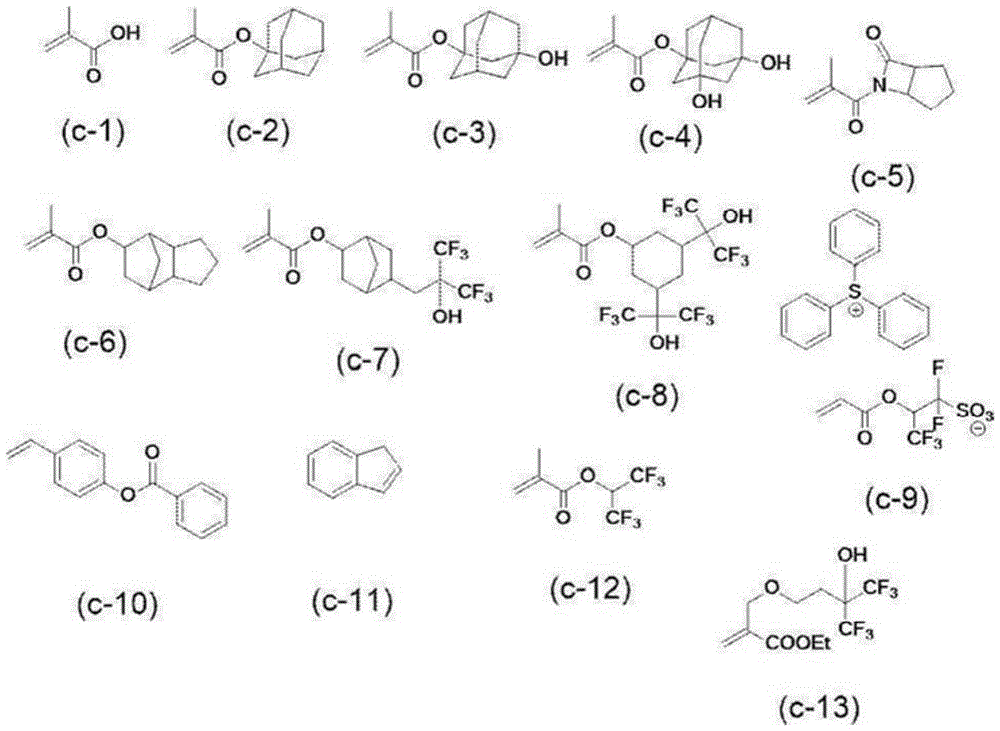
The repeating unit containing the aromatic ring is not particularly limited, and is preferably a repeating unit derived from at least one monomer of the following formula (d-1) and the following formula (d-2), for example.
[ chemical formula 43]

The monomer group a is preferably the following monomer group a 1.
[ chemical formula 44]

The monomer group B is preferably the following monomer group B1.
[ chemical formula 45]

The monomer group C is preferably the following monomer group C1.
[ chemical formula 46]

In the resin X1, the repeating unit a and the repeating unit B may be contained in 1 type individually or in 2 or more types together.
The content of the repeating unit a contained in the resin X1 (the total of a plurality of repeating units a when present) is preferably 20 to 85 mol%, more preferably 20 to 70 mol%, and still more preferably 20 to 60 mol% with respect to all repeating units of the resin X1.
The content of the repeating unit B contained in the resin X1 (the total of a plurality of repeating units B when present) is preferably 15 to 80 mol%, more preferably 25 to 80 mol%, and still more preferably 30 to 70 mol% with respect to all the repeating units of the resin X1.
In the resin X2, the repeating unit a, the repeating unit B, and the repeating unit C may be contained in 1 kind individually or in 2 or more kinds together.
The content of the repeating unit a contained in the resin X2 (the total of a plurality of repeating units a when present) is preferably 20 to 80 mol%, more preferably 20 to 70 mol%, and still more preferably 20 to 60 mol% with respect to all the repeating units of the resin X2.
The content of the repeating unit B contained in the resin X2 (the total of a plurality of repeating units B when present) is preferably 15 to 70 mol%, more preferably 25 to 70 mol%, and still more preferably 30 to 60 mol% with respect to all the repeating units of the resin X2.
The content of the repeating unit C contained in the resin X2 (the total thereof when a plurality of the repeating units C are present) is preferably 5 to 30 mol%, more preferably 5 to 20 mol% with respect to all the repeating units of the resin X2.
In the resin X3, the aromatic ring-containing repeating unit, the repeating unit a, and the repeating unit B may be contained in 1 kind individually or in 2 or more kinds together.
The content of the aromatic ring-containing repeating unit contained in the resin X3 (the total of the aromatic ring-containing repeating units when a plurality of aromatic ring-containing repeating units are present) is preferably 30 to 90 mol%, more preferably 40 to 85 mol%, and further preferably 50 to 85 mol% with respect to all the repeating units of the resin X3.
When the resin X3 contains the repeating unit a, the content of the repeating unit a contained in the resin X3 (the total of the repeating units a when a plurality of the repeating units a are present) is preferably 10 to 70 mol%, more preferably 10 to 40 mol%, and still more preferably 10 to 20 mol% with respect to all the repeating units of the resin X3.
When the resin X3 contains the repeating unit B, the content of the repeating unit B contained in the resin X3 (the total of the repeating units B when present) is preferably 15 to 70 mol%, more preferably 15 to 40 mol% with respect to all the repeating units of the resin X3.
The resins X1 to X3 are preferably resins selected from the group consisting of the following formula (A-1), the following formula (A-3), the following formula (A-4), the following formula (A-6), the following formula (A-8), the following formula (A-12), the following formula (A-13), the following formula (A-14), the following formula (A-16), the following formula (A-19), the following formula (A-41), the following formula (A-42), the following formula (A-43), the following formula (A-46) and the following formula (A-48).
The resin represented by the following formula (A-1), the following formula (A-3), the following formula (A-4), the following formula (A-6), the following formula (A-8), the following formula (A-12), the following formula (A-13), the following formula (A-14), the following formula (A-16), the following formula (A-19), the following formula (A-41), the following formula (A-42), the following formula (A-43), the following formula (A-46) and the following formula (A-48) is a resin containing a repeating unit in each formula, and the content of each repeating unit is not particularly limited. For example, the resin represented by the formula (a-1) may contain 4 repeating units, and the content of each repeating unit is not limited. Wherein denotes a bonding site.
[ chemical formula 47]

[ chemical formula 48]

[ chemical formula 49]

Another example of the resin X1 or the resin X2 that can be used in the present invention is shown below.
[ chemical formula 50]

The resin (a) can be synthesized according to a conventional method (e.g., radical polymerization).
The weight average molecular weight of the resin (A) is preferably 1,000 to 200,000, more preferably 3,000 to 20,000, and still more preferably 5,000 to 15,000 in terms of polystyrene by GPC. By setting the weight average molecular weight of the resin (A) to 1,000 to 200,000, deterioration of heat resistance and dry etching resistance can be further suppressed. Further, deterioration of film forming properties due to deterioration of developability and increase in viscosity can be further suppressed.
The dispersion degree (molecular weight distribution) of the resin (A) is usually 1 to 5, preferably 1 to 3, more preferably 1.2 to 3.0, and still more preferably 1.2 to 2.0. The smaller the degree of dispersion, the more excellent the resolution and resist shape, and the smoother the side wall of the resist pattern, the more excellent the roughness.
In the resist composition, the content of the resin (a) is preferably 50 to 99.9% by mass, more preferably 60 to 99.0% by mass, based on the total solid content of the composition.
The solid component means a component other than the solvent in the composition, and even a liquid component is considered as a solid component as long as it is a component other than the solvent.
Further, 1 kind of resin (a) may be used, or a plurality of resins may be used in combination.
[ (B) photoacid generators ]
The resist composition of the present invention includes a compound that generates an acid by irradiation of actinic rays or radiation (hereinafter, also referred to as a "photoacid generator").
The photoacid generator referred to herein corresponds to an acid generator that is generally used for causing a deprotection reaction of a resin component (deprotection reaction of an acid-decomposable resin) or for causing a crosslinking reaction of the resin component.
The photoacid generator is preferably a compound that generates an organic acid by irradiation with actinic rays or radiation. Examples thereof include sulfonium salt compounds, iodonium salt compounds, diazonium salt compounds, phosphonium salt compounds, imide sulfonate compounds, oxime sulfonate compounds, diazo disulfone compounds, and o-nitrobenzyl sulfonate compounds.
As the photoacid generator, a known compound that generates an acid by irradiation with actinic rays or radiation can be appropriately selected and used alone or as a mixture thereof. For example, known compounds disclosed in paragraphs [0125] to [0319] of the specification of U.S. patent application publication No. 2016/0070167A1, paragraphs [0086] to [0094] of the specification of U.S. patent application publication No. 2015/0004544A1, and paragraphs [0323] to [0402] of the specification of U.S. patent application publication No. 2016/0237190A1 can be preferably used as the photoacid generator.
As the photoacid generator, for example, a compound represented by the following formula (ZI), formula (ZII), or formula (ZIII) is preferable.
[ chemical formula 51]

In the above-mentioned formula (ZI),
R201、R202and R203Each independently represents an organic group.
As R201、R202And R203The organic group (C) has usually 1 to 30 carbon atoms, preferably 1 to 20 carbon atoms.
And, R201~R2032 of them may be bonded to form a ring structure, or may contain an oxygen atom, a sulfur atom, an ester bond, an amide bond or a carbonyl group in the ring. As R201~R203Examples of the group in which 2 of the above groups are bonded include an alkylene group (e.g., butylene group, pentylene group, etc.) and-CH2-CH2-O-CH2-CH2-。
Z-Represents an anion.
Preferred examples of the cation in the formula (ZI) include corresponding groups in the compound (ZI-1), the compound (ZI-2), the compound (ZI-3) and the compound (ZI-4) described later.
The photoacid generator may be a compound having a plurality of structures represented by formula (ZI). For example, R having a compound represented by the formula (ZI) may be used201~R203With R of another compound represented by the formula (ZI)201~R203At least one of them is bonded by a single bond or a linking group.
First, the compound (ZI-1) will be described.
The compound (ZI-1) is R of the above formula (ZI)201~R203An aryl sulfonium compound in which at least one of the aryl groups is an aryl group, that is, a compound in which aryl sulfonium is set as a cation.
In the aryl sulfonium compound, R may be201~R203All are aryl radicals, and may also be R201~R203Some of which are aryl groups and the remainder are alkyl or cycloalkyl groups.
Examples of the aryl sulfonium compound include triarylsulfonium compounds, diarylalkylsulfonium compounds, aryldialkylsulfonium compounds, diarylcycloalkylsulfonium compounds, and aryldicycloalkylsulfonium compounds.
The aryl group contained in the aryl sulfonium compound is preferably a phenyl group or a naphthyl group, and more preferably a phenyl group. The aryl group may be an aryl group containing a heterocyclic structure having an oxygen atom, a nitrogen atom, a sulfur atom or the like. Examples of the heterocyclic structure include a pyrrole residue, a furan residue, a thiophene residue, an indole residue, a benzofuran residue, a benzothiophene residue, and the like. When the aryl sulfonium compound has 2 or more aryl groups, the 2 or more aryl groups may be the same or different.
The alkyl group or cycloalkyl group which the arylsulfonium compound may have is preferably a linear alkyl group having 1 to 15 carbon atoms, a branched alkyl group having 3 to 15 carbon atoms or a cycloalkyl group having 3 to 15 carbon atoms, and examples thereof include a methyl group, an ethyl group, a propyl group, an n-butyl group, a sec-butyl group, a tert-butyl group, a cyclopropyl group, a cyclobutyl group, and a cyclohexyl group.
From R201~R203The aryl, alkyl and cycloalkyl groups represented byIndependently have an alkyl group (e.g., 1 to 15 carbon atoms), a cycloalkyl group (e.g., 3 to 15 carbon atoms), an aryl group (e.g., 6 to 14 carbon atoms), an alkoxy group (e.g., 1 to 15 carbon atoms), a halogen atom, a hydroxyl group or a phenylthio group as a substituent.
Next, the compound (ZI-2) will be described.
The compound (ZI-2) is R in the formula (ZI)201~R203Each independently represents a compound having an organic group having no aromatic ring. Herein, the aromatic ring also includes an aromatic ring containing a hetero atom.
As R201~R203The organic group having no aromatic ring of (2) has usually 1 to 30 carbon atoms, preferably 1 to 20 carbon atoms.
R201~R203Each independently is preferably an alkyl group, a cycloalkyl group, an allyl group or a vinyl group, more preferably a linear or branched 2-oxoalkyl group, a 2-oxocycloalkyl group or an alkoxycarbonylmethyl group, and still more preferably a linear or branched 2-oxoalkyl group.
As R201~R203The alkyl group and the cycloalkyl group in (1) are preferably a linear alkyl group having 1 to 10 carbon atoms, a branched alkyl group having 3 to 10 carbon atoms (for example, a methyl group, an ethyl group, a propyl group, a butyl group and a pentyl group), or a cycloalkyl group having 3 to 10 carbon atoms (for example, a cyclopentyl group, a cyclohexyl group and a norbornyl group).
R201~R203May be further substituted with a halogen atom, an alkoxy group (for example, having 1 to 5 carbon atoms), a hydroxyl group, a cyano group or a nitro group.
Next, the compound (ZI-3) will be described.
The compound (ZI-3) is represented by the following formula (ZI-3) and has a phenacylsulfonium salt structure.
[ chemical formula 52]

In the formula (ZI-3),
R1c~R5ceach independently represents a hydrogen atom, an alkyl group, a cycloalkyl group, an aryl group, an alkoxy group, an aryloxy group, an alkoxycarbonyl group, an alkylcarbonyloxy group, a cycloalkylcarbonyloxy group, a halogen atom, a hydroxyl group, a nitro group, an alkylthio group or an arylthio group.
R6cAnd R7cEach independently represents a hydrogen atom, an alkyl group, a cycloalkyl group, a halogen atom, a cyano group or an aryl group.
RxAnd RyEach independently represents an alkyl group, a cycloalkyl group, a 2-oxoalkyl group, a 2-oxocycloalkyl group, an alkoxycarbonylalkyl group, an allyl group or a vinyl group.
R1c~R5cAt least 2 of R5cAnd R6c、R6cAnd R7c、R5cAnd RxAnd RxAnd RyMay be bonded to form a ring structure, and the ring structures may each independently contain an oxygen atom, a sulfur atom, a ketone group, an ester bond, or an amide bond.
Examples of the ring structure include an aromatic or non-aromatic hydrocarbon ring, an aromatic or non-aromatic heterocyclic ring, and a polycyclic condensed ring in which 2 or more rings are combined. Examples of the ring structure include a 3 to 10-membered ring, preferably a 4 to 8-membered ring, and more preferably a 5-membered ring or a 6-membered ring.
As R1c~R5cAt least 2 of R6cAnd R7cAnd RxAnd RyExamples of the group to which the bond is formed include butylene group and pentylene group.
As R5cAnd R6cAnd R5cAnd RxThe group formed by bonding is preferably a single bond or an alkylene group. Examples of the alkylene group include a methylene group and an ethylene group.
Zc-Represents an anion.
Next, the compound (ZI-4) will be described.
The compound (ZI-4) is represented by the following formula (ZI-4).
[ chemical formula 53]

In the formula (ZI-4),
l represents an integer of 0 to 2.
r represents an integer of 0 to 8.
R13Represents a hydrogen atom, a fluorine atom, a hydroxyl group, an alkyl group, a cycloalkyl group, an alkoxy group, an alkoxycarbonyl group, or a group having a cycloalkyl group. These groups may have a substituent.
R14Represents a hydroxyl group, an alkyl group, a cycloalkyl group, an alkoxy group, an alkoxycarbonyl group, an alkylcarbonyl group, an alkylsulfonyl group, a cycloalkylsulfonyl group, or a group having a cycloalkyl group. These groups may have a substituent. When there are more than one R14In the case, each independently represents the above group such as a hydroxyl group.
R15Each independently represents an alkyl group, a cycloalkyl group or a naphthyl group. These groups may have a substituent. 2R15May be bonded to each other to form a ring. When 2R15When they are bonded to each other to form a ring, they may contain a hetero atom such as an oxygen atom or a nitrogen atom in the ring skeleton. In one embodiment, 2R15The alkylene groups are preferably bonded to each other to form a ring structure.
Z-Represents an anion.
In the formula (ZI-4), the group consisting of R13、R14And R15The alkyl group is linear or branched. The number of carbon atoms of the alkyl group is preferably 1 to 10. The alkyl group is preferably a methyl group, an ethyl group, an n-butyl group or a tert-butyl group.
Next, formulae (ZII) and (ZIII) will be described.
In the formulae (ZII) and (ZIII), R204~R207Each independently represents an aryl group, an alkyl group or a cycloalkyl group.
As a group consisting of R204~R207The aryl group is preferably a phenyl group or a naphthyl group, and more preferably a phenyl group. From R204~R207The aryl group represented may be an aryl group having a heterocyclic structure with an oxygen atom, a nitrogen atom, a sulfur atom or the like. As a skeleton of an aryl group having a heterocyclic structure, for exampleExamples thereof include pyrrole, furan, thiophene, indole, benzofuran and benzothiophene.
As a group consisting of R204~R207The alkyl group and the cycloalkyl group are preferably a linear alkyl group having 1 to 10 carbon atoms, a branched alkyl group having 3 to 10 carbon atoms (for example, a methyl group, an ethyl group, a propyl group, a butyl group, a pentyl group, etc.), or a cycloalkyl group having 3 to 10 carbon atoms (for example, a cyclopentyl group, a cyclohexyl group, a norbornyl group, etc.).
From R204~R207The aryl group, the alkyl group and the cycloalkyl group may each independently have a substituent. As a group consisting of R204~R207Examples of the substituent which the aryl group, the alkyl group and the cycloalkyl group may have include an alkyl group (e.g., having 1 to 15 carbon atoms), a cycloalkyl group (e.g., having 3 to 15 carbon atoms), an aryl group (e.g., having 6 to 15 carbon atoms), an alkoxy group (e.g., having 1 to 15 carbon atoms), a halogen atom, a hydroxyl group and a phenylthio group.
Z-Represents an anion.
As Z in formula (ZI)-Z in the formula (ZII)-Zc in the formula (ZI-3)-And Z in the formula (ZI-4)-The anion represented by the following formula (3) is preferable.
[ chemical formula 54]

In the formula (3), the reaction mixture is,
o represents an integer of 1 to 3. p represents an integer of 0 to 10. q represents an integer of 0 to 10.
Xf represents a fluorine atom or an alkyl group substituted with at least one fluorine atom. The number of carbon atoms of the alkyl group is preferably 1 to 10, more preferably 1 to 4. The alkyl group substituted with at least one fluorine atom is preferably a perfluoroalkyl group.
Xf is preferably a fluorine atom or a perfluoroalkyl group having 1 to 4 carbon atoms, more preferably a fluorine atom or CF3. In particular, it is more preferable that both Xf are fluorine atoms.
R4And R5Each independently represents a hydrogen atom, a fluorine atom, an alkyl group or an alkyl group substituted with at least one fluorine atom. When there are more than one R4And R5When R is4And R5May be the same or different.
From R4And R5The alkyl group may have a substituent, and the number of carbon atoms is preferably 1 to 4. R4And R5Preferably a hydrogen atom.
Specific examples and preferred modes of the alkyl group substituted with at least one fluorine atom are the same as those of Xf in the formula (3).
L represents a linking group having a valence of 2. When a plurality of L's are present, L's may be the same or different.
Examples of the linking group having a valence of 2 include-COO- (-C (═ O) -O-), -OCO-, -CONH-, -NHCO-, -CO-, -O-, -S-, -SO-, -C-O-)2An alkylene group (preferably having 1 to 6 carbon atoms), a cycloalkylene group (preferably having 3 to 15 carbon atoms), an alkenylene group (preferably having 2 to 6 carbon atoms), and a linking group having a valence of 2 obtained by combining a plurality of these groups. Among them, preferred are-COO-, -OCO-, -CONH-, -NHCO-, -CO-, -O-, -SO2-, -COO-alkylene-, -OCO-alkylene-, -CONH-alkylene-or-NHCO-alkylene-, more preferably-COO-, -OCO-, -CONH-, -SO2-, -COO-alkylene-or-OCO-alkylene-.
W represents an organic group containing a cyclic structure. Among them, a cyclic organic group is preferable.
Examples of the cyclic organic group include an alicyclic group, an aryl group, and a heterocyclic group.
The alicyclic group may be monocyclic or polycyclic. Examples of the monocyclic alicyclic group include monocyclic cycloalkyl groups such as cyclopentyl, cyclohexyl, and cyclooctyl groups. Examples of the polycyclic alicyclic group include polycyclic cycloalkyl groups such as norbornyl, tricyclodecanyl, tetracyclodecyl, tetracyclododecyl, and adamantyl. Among them, alicyclic groups having a bulky structure of 7 or more carbon atoms such as norbornyl, tricyclodecanyl, tetracyclodecyl, tetracyclododecyl, and adamantyl groups are preferable.
The aryl group may be monocyclic or polycyclic. Examples of the aryl group include a phenyl group, a naphthyl group, a phenanthryl group, and an anthryl group.
The heterocyclic group may be monocyclic or polycyclic. Polycyclic heterocyclic groups can further inhibit acid diffusion. The heterocyclic group may or may not have aromatic properties. Examples of the aromatic heterocyclic ring include a furan ring, a thiophene ring, a benzofuran ring, a benzothiophene ring, a dibenzofuran ring, a dibenzothiophene ring, and a pyridine ring. Examples of the heterocyclic ring having no aromatic group include a tetrahydropyran ring, a lactone ring, a sultone ring and a decahydroisoquinoline ring. The heterocyclic ring in the heterocyclic group is particularly preferably a furan ring, a thiophene ring, a pyridine ring or a decahydroisoquinoline ring.
The cyclic organic group may have a substituent. Examples of the substituent include an alkyl group (which may be linear or branched, and preferably has 1 to 12 carbon atoms), a cycloalkyl group (which may be monocyclic, polycyclic or spiro ring, and preferably has 3 to 20 carbon atoms), an aryl group (preferably has 6 to 14 carbon atoms), a hydroxyl group, an alkoxy group, an ester group, an amide group, a carbamate group, a urea group, a thioether group, a sulfonamide group and a sulfonate group. In addition, the carbon constituting the cyclic organic group (carbon contributing to the formation of a ring) may be a carbonyl carbon.
As the anion represented by the formula (3), SO is preferable3 --CF2-CH2-OCO-(L)q’-W、SO3 --CF2-CHF-CH2-OCO-(L)q’-W、SO3 --CF2-COO-(L)q’-W、SO3 --CF2-CF2-CH2-CH2- (L) q-W or SO3 --CF2-CH(CF3) -OCO- (L) q' -W. Here, L, q and W are the same as in formula (3). q' represents an integer of 0 to 10.
In one embodiment, Z in formula (ZI) is-Z in the formula (ZII)-Zc in the formula (ZI-3)-And Z in the formula (ZI-4)-Further, an anion represented by the following formula (4) is preferable.
[ chemical formula 55]

In the formula (4), the reaction mixture is,
XB1and XB2Each independently represents a hydrogen atom or a 1-valent organic group having no fluorine atom. XB1And XB2Preferably a hydrogen atom.
XB3And XB4Each independently represents a hydrogen atom or a 1-valent organic group. Preferably XB3And XB4At least one of which is a fluorine atom or an organic group having a valence of 1 of the fluorine atom, more preferably XB3And XB4Both of these are fluorine atoms or organic groups having a valence of 1 of a fluorine atom. Further preferred is XB3And XB4Both of which are alkyl groups substituted with fluorine.
L, q and W are the same as those in formula (3).
As Z in formula (ZI)-Z in the formula (ZII)-Zc in the formula (ZI-3)-And Z in the formula (ZI-4)-The anion represented by the following formula (5) is preferable.
[ chemical formula 56]

In formula (5), Xa each independently represents a fluorine atom or an alkyl group substituted with at least one fluorine atom. Xb independently represents a hydrogen atom or an organic group having no fluorine atom. o, p, q, R4、R5L and W are as defined and preferred in the same manner as in formula (3).
Z in formula (ZI)-Z in the formula (ZII)-Zc in the formula (ZI-3)-And Z in the formula (ZI-4)-The benzene sulfonic acid anion may be a benzene sulfonic acid anion, and is preferably a benzene sulfonic acid anion substituted with a branched alkyl group or a cycloalkyl group.
As formulaZ In (ZI)-Z in the formula (ZII)-Zc in the formula (ZI-3)-And Z in the formula (ZI-4)-Also preferred is an aromatic sulfonic acid anion represented by the following formula (SA 1).
[ chemical formula 57]

In the formula (SA1), the reaction mixture,
ar represents an aryl group, and may have a substituent other than the sulfonic acid anion and the- (D-B) group. Examples of the substituent that may be contained include a fluorine atom and a hydroxyl group.
n represents an integer of 0 or more. N is preferably 1 to 4, more preferably 2 to 3, and still more preferably 3.
D represents a single bond or a 2-valent linking group. Examples of the 2-valent linking group include an ether group, a sulfide group, a carbonyl group, a sulfoxide group, a sulfone group, a sulfonate group, an ester group, and a group formed by combining 2 or more of these groups.
B represents a hydrocarbon group.
D is a single bond, and B is preferably an aliphatic hydrocarbon structure. B is more preferably isopropyl or cyclohexyl.
Preferred examples of the sulfonium cation of the formula (ZI) and the iodonium cation of the formula (ZII) are shown below.
[ chemical formula 58]

The anion Z in the formula (ZI) is shown below-An anion Z in the formula (ZII)-Zc in the formula (ZI-3)-And Z in the formula (ZI-4)-Preferred examples of (3).
[ chemical formula 59]

Any combination of the above cations and anions can be used as the photoacid generator.
Among them, the resist composition of the present invention preferably contains 1 or more kinds of photoacid generators selected from the group consisting of the following formulas (P-1) to (P-14).
[ chemical formula 60]

[ chemical formula 61]

Another example of the photoacid generator which can contain the resist composition of the present invention is shown below. In addition, they may be used together.
[ chemical formula 62]

[ chemical formula 63]

The photoacid generator may be in the form of a low molecular weight compound or may be embedded in a part of the polymer.
As the photoacid generator, a photoacid generator in the form of a low molecular compound may be used together with a photoacid generator in the form embedded in a part of a polymer.
The photoacid generator is preferably in the form of a low molecular weight compound.
When the photoacid generator is in the form of a low-molecular-weight compound, the molecular weight is preferably 3,000 or less, more preferably 2,000 or less, and still more preferably 1,000 or less.
When the photoacid generator is in a form of being embedded in a part of the polymer, it may be embedded in a part of the resin X or may be embedded in a resin different from the resin X.
The photoacid generator may be used alone in 1 kind, or 2 or more kinds may be used in combination.
The content of the photoacid generator in the composition (total thereof when a plurality of photoacid generators are present) is preferably 0.1 to 35.0% by mass, more preferably 0.5 to 25.0% by mass, and still more preferably 3.0 to 20.0% by mass, based on the total solid content of the composition.
When the compound represented by the formula (ZI-3) or (ZI-4) is contained as the photoacid generator, the content of the photoacid generator contained in the composition (the total amount thereof when a plurality of the photoacid generators are present) is preferably 5.0 to 35.0% by mass, and more preferably 7.0 to 30.0% by mass, based on the total solid content of the composition.
[ (C) halogen-based solvent ]
The resist composition of the present invention contains a halogen-based solvent.
The halogen-based solvent may be any of a fluorine-based solvent, a chlorine-based solvent, a bromine-based solvent, and an iodine-based solvent, and among them, a chlorine-based solvent is preferable.
Examples of the chlorine-based solvent include dichloromethane, chloroform, dichloroethane, tetrachloromethane, trichloroethane, and the like, and among them, dichloromethane is preferable.
The halogen-based solvent may be added to the resist composition, or may be unintentionally mixed into the resist composition during the process of producing the resist composition.
Examples of the case where the solvent is unintentionally mixed in the process of producing a resist composition include a case where a raw material (e.g., a photoacid generator) used in producing a resist composition contains a halogen-based solvent as an impurity. In particular, dichloromethane is often used during the synthesis of the sulfonium salt type photoacid generator, and thus, dichloromethane may be included in the photoacid generator in a large amount as an impurity. Therefore, it is preferable to adjust the content of the halogen-based solvent to a predetermined amount by purification and then mix the sulfonium salt type photoacid generator with other raw materials constituting the resist composition.
The content of the halogen-based solvent is 1 ppb by mass or more and 50 ppm by mass or less with respect to the total mass of the composition. When the content of the halogen-based solvent in the resist composition is 50 mass ppm or less with respect to the total mass of the composition, the line width size of the formed pattern is less likely to vary with the passage of time after the resist composition is produced. On the other hand, when the content of the halogen-based solvent in the resist composition is 1 mass ppb or more with respect to the total mass of the composition, the rectangularity of the cross-sectional shape of the pattern formed by the resist composition is excellent. The content of the halogen-based solvent is preferably 1 ppb by mass or more and 10 ppm by mass or less, and more preferably 1 ppb by mass or more and 1 ppm by mass or less, based on the total mass of the composition.
The halogen-based solvent may be used alone in 1 kind, or may be used in combination with 2 or more kinds.
When the resist composition of the present invention contains 2 or more halogen-based solvents, the content represents the total content of 2 or more halogen-based solvents.
The content of the halogen-based solvent is measured by the following method.
First, a solvent is distilled off from a predetermined amount of the resist composition and dried to prepare a dry solid. At this time, the distilled solvent (hereinafter, also referred to as "volatile solvent") is further fractionated according to the boiling point to separate only the halogenated solvent, and the mass thereof (hereinafter, referred to as "mass a") is measured.
Next, the above-obtained dried solid was dissolved in electronic grade NMP (N-methylpyrrolidone) to prepare a measurement sample. Then, the mass of the halogen-based solvent (hereinafter referred to as "mass B") in the measurement sample was measured using a GC system 7890B manufactured by Agilent corporation.
The content (% by mass) of the halogen-based solvent based on the total mass of the resist composition was obtained by converting the total amount (mass a + mass B) of the halogen-based solvent obtained by each of the above measurements.
[ (D) Metal atom ]
The resist composition of the present invention preferably contains a metal atom.
The "metal atom" means Li, Na, Mg, Al, K, Ca, Sc, Ti, V, Cr, Mn, Fe, Co, Ni, Cu, Zn, Ga, Ge, As, Rb, Sr, Y, Zr, Nb, Mo, Ru, Rh, Pd, Ag, Cd, In, Sn, Sb, Cs, Ba, Hf, Ta, W, Re, Os, Ir, Pt, Au, Hg, Tl, Pb and Bi.
These metal atoms are metal atoms that may be contained in the resist composition in normal operations.
The form of the metal atom contained in the resist composition is not limited. That is, the metal atom may be contained in any of an ionic state, a monomer state, and a compound (e.g., salt) state in the resist composition.
The metal atom may be added to the resist composition or may be unintentionally mixed into the resist composition in the process of producing the resist composition.
Examples of the case where the metal atoms are unintentionally mixed in the process of producing the resist composition include a form in which raw materials (for example, a resin, an organic solvent, and the like) used in the production of the resist composition contain metal atoms as impurities, and a form in which the metal atoms are mixed in through metal piping or the like in the process of producing the resist composition.
The content of the metal atom in the resist composition can be adjusted by, for example, mixing various components constituting the resist composition and then purifying the mixed solution.
The content of the metal atom is preferably 1 mass ppt or more and 30 mass ppb or less with respect to the total mass of the composition, from the viewpoint that the formed pattern is excellent in etching resistance and defects are not easily generated on a substrate etched using the pattern as a mask. When the content of the metal atom is 1 mass ppt or more based on the total mass of the composition, the etching resistance of the formed pattern is high, and as a result, the cross-sectional shape of the substrate after etching is excellent. On the other hand, when the content of the metal atom is 30 ppb by mass or less with respect to the total mass of the composition, defects are less likely to occur on the substrate after etching.
The content of the metal atom is more preferably 1 mass ppt or more and 10 mass ppb or less, still more preferably 1 mass ppt or more and 1000 mass ppt or less, and particularly preferably 1 mass ppt or more and 500 mass ppt or less with respect to the total mass of the composition.
The metal atoms can be used alone in 1, or more than 2.
When the resist composition of the present invention contains 2 or more metal atoms, the above content represents the total content of 2 or more metal atoms.
The content of the metal atom can be measured using, for example, ICP-MS (Inductively coupled plasma mass spectrometry).
[ (E) solvent ]
The resist composition may also contain a solvent. The solvent used herein means a solvent other than a halogen-based solvent
When the resist composition is an actinic-ray-or radiation-sensitive resin composition for EUV, the solvent preferably contains at least one of (M1) propylene glycol monoalkyl ether carboxylate and (M2), and the (M2) is at least one selected from the group consisting of propylene glycol monoalkyl ether, lactate, acetate, alkoxypropionate, chain ketone, cyclic ketone, lactone, and alkylene carbonate. The solvent may contain components other than the components (M1) and (M2).
The present inventors have found that when such a solvent is used in combination with the resin (a), the coating property of the composition is improved and a pattern with a small number of development defects can be formed. Although the reason for this is not clear, the present inventors believe that the reason is that the solvent has a good balance among solubility in the resin (a), boiling point, and viscosity, and therefore, the occurrence of unevenness in film thickness of the composition film, the occurrence of precipitates during spin coating, and the like can be suppressed.
As the component (M1), at least one selected from the group consisting of Propylene Glycol Monomethyl Ether Acetate (PGMEA), propylene glycol monomethyl ether propionate and propylene glycol monoethyl ether acetate is preferable, and Propylene Glycol Monomethyl Ether Acetate (PGMEA) is more preferable.
As the component (M2), the following components are preferable.
As the propylene glycol monoalkyl ether, Propylene Glycol Monomethyl Ether (PGME) and propylene glycol monoethyl ether are preferable.
As the lactate, ethyl lactate, butyl lactate, or propyl lactate is preferable.
The acetate is preferably methyl acetate, ethyl acetate, butyl acetate, isobutyl acetate, propyl acetate, isoamyl acetate, methyl formate, ethyl formate, butyl formate, propyl formate, or 3-methoxybutyl acetate.
Also, butyl butyrate is preferable.
As the alkoxypropionate, methyl 3-Methoxypropionate (MMP) or ethyl 3-ethoxypropionate (EEP) is preferable.
The chain ketone is preferably 1-octanone, 2-octanone, 1-nonanone, 2-nonanone, acetone, 2-heptanone, 4-heptanone, 1-hexanone, 2-hexanone, diisobutyl ketone, phenyl acetone, methyl ethyl ketone, methyl isobutyl ketone, acetyl acetone, acetonyl acetone, ionone (ionone), diacetonealcohol, acetyl alcohol, acetophenone, methyl naphthyl ketone, or methyl amyl ketone.
The cyclic ketone is preferably methylcyclohexanone, isophorone or cyclohexanone.
The lactone is preferably γ -butyrolactone.
As the alkylene carbonate, propylene carbonate is preferable.
As the component (M2), Propylene Glycol Monomethyl Ether (PGME), ethyl lactate, ethyl 3-ethoxypropionate, methyl amyl ketone, cyclohexanone, butyl acetate, amyl acetate, γ -butyrolactone, or propylene carbonate is more preferable.
In addition to the above components, an ester-based solvent having 7 or more carbon atoms (preferably 7 to 14, more preferably 7 to 12, and further preferably 7 to 10) and 2 or less hetero atoms is preferably used.
Ester solvents having 7 or more carbon atoms and 2 or less hetero atoms are preferably amyl acetate, 2-methylbutyl acetate, 1-methylbutyl acetate, hexyl acetate, amyl propionate, hexyl propionate, butyl propionate, isobutyl isobutyrate, heptyl propionate, butyl butyrate, and the like, and more preferably isoamyl acetate.
As the component (M2), a component having a flash point (hereinafter, also referred to as fp) of 37 ℃ or higher is preferable. As such a component (M2), propylene glycol monomethyl ether (fp: 47 ℃ C.), ethyl lactate (fp: 53 ℃ C.), ethyl 3-ethoxypropionate (fp: 49 ℃ C.), methyl amyl ketone (fp: 42 ℃ C.), cyclohexanone (fp: 44 ℃ C.), amyl acetate (fp: 45 ℃ C.), methyl 2-hydroxyisobutyrate (fp: 45 ℃ C.), gamma-butyrolactone (fp: 101 ℃ C.) or propylene carbonate (fp: 132 ℃ C.) are preferred. Among them, propylene glycol monoethyl ether, ethyl lactate, amyl acetate, or cyclohexanone is more preferable, and propylene glycol monoethyl ether or ethyl lactate is further preferable.
The "flash point" herein means a value described in a catalog of reagent products of Tokyo Chemical Industry co., ltd., or Sigma-Aldrich.
The solvent preferably contains component (M1). The solvent is more preferably a mixed solvent containing substantially only the component (M1) or the component (M1) and other components. In the latter case, the solvent further preferably contains both the component (M1) and the component (M2).
The mass ratio (M1/M2) of the component (M1) to the component (M2) is preferably in the range of "100/0" to "15/85", more preferably in the range of "100/0" to "40/60", and still more preferably in the range of "100/0" to "60/40". That is, the solvent preferably contains only the component (M1), or contains both the component (M1) and the component (M2), and the mass ratio thereof is as follows. In other words, in the latter case, the mass ratio of the component (M1) to the component (M2) is preferably 15/85 or more, more preferably 40/60 or more, and still more preferably 60/40 or more. With this configuration, the number of development defects can be further reduced.
When the solvent contains both the component (M1) and the component (M2), the mass ratio of the component (M1) to the component (M2) is, for example, 99/1 or less.
As described above, the solvent may contain components other than the components (M1) and (M2). In this case, the content of the components other than the components (M1) and (M2) is preferably in the range of 5 to 30% by mass relative to the total amount of the solvent.
When the resist composition is a actinic-ray-or radiation-sensitive resin composition for ArF, examples of the solvent include organic solvents such as alkylene glycol monoalkyl ether carboxylate, alkylene glycol monoalkyl ether, alkyl lactate, alkyl alkoxypropionate, cyclic lactone (preferably having 4 to 10 carbon atoms), monoketone compound (preferably having 4 to 10 carbon atoms) which may have a ring, alkylene carbonate, alkyl alkoxyacetate, and alkyl pyruvate.
The alkylene glycol monoalkyl ether carboxylate is preferably propylene glycol monomethyl ether acetate, propylene glycol monoethyl ether acetate, propylene glycol monopropyl ether acetate, propylene glycol monobutyl ether acetate, propylene glycol monomethyl ether propionate, propylene glycol monoethyl ether propionate, ethylene glycol monomethyl ether acetate or ethylene glycol monoethyl ether acetate, for example.
The alkylene glycol monoalkyl ether is preferably propylene glycol monomethyl ether, propylene glycol monoethyl ether, propylene glycol monopropyl ether, propylene glycol monobutyl ether, ethylene glycol monomethyl ether or ethylene glycol monoethyl ether, for example.
The alkyl lactate is preferably methyl lactate, ethyl lactate, propyl lactate, or butyl lactate.
The alkyl alkoxypropionate is preferably ethyl 3-ethoxypropionate, methyl 3-methoxypropionate, methyl 3-ethoxypropionate or ethyl 3-methoxypropionate.
The cyclic lactone is preferably β -propiolactone, β -butyrolactone, γ -butyrolactone, α -methyl- γ -butyrolactone, β -methyl- γ -butyrolactone, γ -valerolactone, γ -caprolactone, γ -octanoic acid lactone or α -hydroxy- γ -butyrolactone.
As the monoketone compound which may contain a ring, 2-butanone, 3-methylbutanone, pinacolone (pinacolone), 2-pentanone, 3-methyl-2-pentanone, 4-methyl-2-pentanone, 2-methyl-3-pentanone, 4, 4-dimethyl-2-pentanone, 2, 4-dimethyl-3-pentanone, 2,4, 4-tetramethyl-3-pentanone, 2-hexanone, 3-hexanone, 5-methyl-3-hexanone, 2-heptanone, 3-heptanone, 4-heptanone, 2-methyl-3-heptanone, 5-methyl-3-heptanone, 2, 6-dimethyl-4-heptanone are preferable, 2-octanone, 3-octanone, 2-nonanone, 3-nonanone, 5-nonanone, 2-decanone, 3-decanone, 4-decanone, 5-hexen-2-one, 3-penten-2-one, cyclopentanone, 2-methylcyclopentanone, 3-methylcyclopentanone, 2-dimethylcyclopentanone, 2,4, 4-trimethylcyclopentanone, cyclohexanone, 3-methylcyclohexanone, 4-ethylcyclohexanone, 2-dimethylcyclohexanone, 2, 6-dimethylcyclohexanone, 2, 6-trimethylcyclohexanone, cycloheptanone, 2-methylcycloheptanone, or 3-methylcycloheptanone.
As the alkylene carbonate, propylene carbonate, vinylene carbonate, ethylene carbonate or butylene carbonate is preferable.
As the alkyl alkoxyacetate, 2-methoxyethyl acetate, 2-ethoxyethyl acetate, 2- (2-ethoxyethoxy) ethyl acetate, 3-methoxy-3-methylbutyl acetate or 1-methoxy-2-propyl acetate are preferable.
The pyruvic acid alkyl ester is preferably methyl pyruvate, ethyl pyruvate, or propyl pyruvate.
The solvent is preferably a solvent having a boiling point of 130 ℃ or higher at normal temperature and pressure. Specific examples thereof include cyclopentanone, γ -butyrolactone, cyclohexanone, ethyl lactate, ethylene glycol monoethyl ether acetate, propylene glycol monomethyl ether acetate, ethyl 3-ethoxypropionate, ethyl pyruvate, 2-ethoxyethyl acetate, 2- (2-ethoxyethoxy) ethyl acetate, and propylene carbonate.
In the present invention, the above-mentioned solvents may be used alone, or 2 or more kinds may be used in combination.
As the solvent, a mixed solvent obtained by mixing a solvent having a hydroxyl group in the structure as an organic solvent and a solvent having no hydroxyl group can be used.
The above-mentioned exemplary compounds can be appropriately selected as the hydroxyl group-containing solvent and the non-hydroxyl group-containing solvent, and the hydroxyl group-containing solvent is preferably an alkylene glycol monoalkyl ether or an alkyl lactate, and more preferably propylene glycol monoalkyl ether or ethyl lactate.
The solvent containing no hydroxyl group is preferably an alkylene glycol monoalkyl ether acetate, an alkyl alkoxy propionate, a monoketone compound which may contain a ring, a cyclic lactone, or an alkyl acetate, more preferably propylene glycol monomethyl ether acetate, ethyl ethoxy propionate, 2-heptanone, γ -butyrolactone, cyclohexanone, or butyl acetate, and further preferably propylene glycol monomethyl ether acetate, ethyl ethoxy propionate, or 2-heptanone.
The mixing ratio (by mass) of the hydroxyl group-containing solvent to the non-hydroxyl group-containing solvent is preferably 1/99 to 99/1, more preferably 10/90 to 90/10, and still more preferably 20/80 to 60/40.
From the viewpoint of coating uniformity, a mixed solvent containing 50 mass% or more of a solvent containing no hydroxyl group is particularly preferable.
The solvent is preferably a mixed solvent of 2 or more species containing propylene glycol monomethyl ether acetate.
The content of the solvent in the resist composition is preferably set to a solid content concentration of 0.5 to 30% by mass, more preferably 1 to 20% by mass. Thus, the resist composition is more excellent in coatability.
[ (F) acid diffusion controllers ]
The resist composition may contain an acid diffusion controller.
The acid diffusion controller captures an acid generated from a photoacid generator or the like at the time of exposure, and functions as a quencher that suppresses a reaction of the acid-decomposable resin in the unexposed portion due to the excessively generated acid. As the acid diffusion controlling agent, for example, a basic compound (DA), a basic compound (DB) in which the basicity is reduced or eliminated by irradiation with actinic rays or radiation, an onium salt (DC) which is a relatively weak acid with respect to the acid generator, a low-molecular compound (DD) having a nitrogen atom and having a group which is detached by the action of an acid, an onium salt compound (DE) having a nitrogen atom at a cation portion, and the like can be used. In the resist composition, a known acid diffusion controller can be suitably used. For example, known compounds disclosed in paragraphs [0627] to [0664] of the specification of U.S. patent application publication No. 2016/0070167A1, paragraphs [0095] to [0187] of the specification of U.S. patent application publication No. 2015/0004544A1, paragraphs [0403] to [0423] of the specification of U.S. patent application publication No. 2016/0237190A1, and paragraphs [0259] to [0328] of the specification of U.S. patent application publication No. 2016/0274458A1 can be preferably used as the acid diffusion controlling agent.
The basic compound (DA) is preferably a compound having a structure represented by the following formulae (a) to (E).
[ chemical formula 64]

In the general formula (A) and the general formula (E),
R200、R201and R202May be the same or different and each independently represents a hydrogen atom, an alkyl group (preferably having 1 to 20 carbon atoms), a cycloalkyl group (preferably having 3 to 20 carbon atoms) or an aryl group (preferably having 6 to 20 carbon atoms). R201And R202May be bonded to each other to form a ring.
R203、R204、R205And R206May be the same or different and each independently represents an alkyl group having 1 to 20 carbon atoms.
The alkyl group in the general formula (a) and the general formula (E) may have a substituent or may be unsubstituted.
As the alkyl group having a substituent, an aminoalkyl group having 1 to 20 carbon atoms, a hydroxyalkyl group having 1 to 20 carbon atoms or a cyanoalkyl group having 1 to 20 carbon atoms is preferable.
The alkyl groups in the general formula (a) and the general formula (E) are more preferably unsubstituted.
The basic compound (DA) is preferably guanidine, aminopyrrolidine, pyrazole, pyrazoline, piperazine, aminomorpholine, aminoalkylmorpholine or piperidine, and more preferably an imidazole structure, a diazabicyclo structure, an onium hydroxide structure, an onium carboxylate structure, a trialkylamine structure, a compound having an aniline structure or a pyridine structure, an alkylamine derivative having a hydroxyl group and/or an ether bond, or an aniline derivative having a hydroxyl group and/or an ether bond.
A basic compound (DB) (hereinafter, also referred to as "compound (DB)") having a proton acceptor functional group and having a basicity reduced or disappeared by irradiation with an actinic ray or a radiation is a compound having a proton acceptor property reduced or disappeared or changed from the proton acceptor property to an acidic property by decomposition by irradiation with an actinic ray or a radiation.
The proton acceptor functional group is a functional group having a group or an electron capable of electrostatic interaction with a proton, and represents, for example, a functional group having a structure of a macrocyclic compound such as a cyclic polyether or a functional group having a nitrogen atom with an unshared electron pair not contributing to pi conjugation. The nitrogen atom having an unshared electron pair that does not contribute to pi conjugation is, for example, a nitrogen atom having a partial structure represented by the following formula.
[ chemical formula 65]

Examples of preferable partial structures of the proton acceptor functional group include a crown ether structure, an azacrown ether structure, a primary amine structure, a secondary amine structure, a tertiary amine structure, a pyridine structure, an imidazole structure, and a pyrazine structure.
The compound (DB) is decomposed by irradiation with actinic rays or radiation to reduce or eliminate the proton acceptor property or to change the proton acceptor property to acidic. Here, the decrease or disappearance of the proton acceptor or the change from the proton acceptor to acidity is a change in the proton acceptor property due to the addition of a proton to the proton acceptor functional group, and specifically, it means that when a proton adduct is generated from a compound (DB) having a proton acceptor functional group and a proton, the equilibrium constant in the chemical equilibrium is decreased.
Proton acceptor was confirmed by pH measurement.
The acid dissociation constant pKa of the compound produced by the decomposition of the compound (DB) by irradiation with actinic rays or radiation preferably satisfies pKa < -1, more preferably-13 < pKa < -1, and still more preferably-13 < pKa < -3.
The acid dissociation constant pKa can be determined by the above method.
In the composition of the present invention, an onium salt (DC) which is a relatively weak acid with respect to the photoacid generator can be used as the acid diffusion controller.
When an onium salt that will generate an acid that is a relatively weak acid with respect to an acid generated from a photoacid generator is used in admixture, if an acid generated from the photoacid generator by irradiation of actinic rays or radiation collides with an onium salt having an unreacted weak acid anion, the weak acid is released by salt exchange to generate an onium salt having a strong acid anion. In this process, the strong acid is exchanged for a weak acid having a low catalytic ability, and thus the acid can be significantly deactivated to control the acid diffusion.
As onium salts which are weak acids with respect to the photoacid generator, compounds represented by the following general formulae (d1-1) to (d1-3) are preferable.
[ chemical formula 66]

In the formula, R51Is a hydrocarbon group which may have a substituent, Z2cA hydrocarbon group having 1 to 30 carbon atoms which may have a substituent (wherein, the carbon adjacent to S is a group not substituted by a fluorine atom), R52Is an organic radical, Y3Is a linear, branched or cyclic alkylene or arylene group, Rf is a hydrocarbon group containing a fluorine atom, M is+Each independently an ammonium cation, a sulfonium cation, or an iodonium cation.
As by M+Preferred examples of the sulfonium cation and iodonium cation include the sulfonium cation represented by the general formula (ZI) and the iodonium cation represented by the general formula (ZII).
The onium salt (DC) which becomes a weak acid relative to the photoacid generator may be a compound (hereinafter, also referred to as "compound (DCA)") which has a cationic site and an anionic site in the same molecule and in which the cationic site and the anionic site are linked by a covalent bond.
As the compound (DCA), preferred is a compound represented by any one of the following general formulae (C-1) to (C-3).
[ chemical formula 67]

In the general formula (C-1) to the general formula (C-3),
R1、R2and R3Each independently represents a substituent having 1 or more carbon atoms.
L1Represents a 2-valent linking group or a single bond linking the cationic site and the anionic site.
-X-Represents a group selected from-COO-、-SO3 -、-SO2 -and-N--R4The anionic site in (a). R4Represents a structure having a carbonyl group (-C (-O) -), a sulfonyl group (-S (-O) -), and the adjacent N atom2-) and a sulfinyl group (-S (═ O) -) are provided.
R1、R2、R3、R4And L1May be bonded to each other to form a ring structure. And, in the general formula (C-3), R1~R3Wherein 2 together represent 1 substituent having a valence of 2 and may be bonded to the N atom via a double bond.
As R1~R3Examples of the substituent having 1 or more carbon atoms in (b) include an alkyl group, a cycloalkyl group, an aryl group, an alkoxycarbonyl group, a cycloalkoxycarbonyl group, an aryloxycarbonyl group, an alkylaminocarbonyl group, a cycloalkylaminocarbonyl group, and an arylaminocarbonyl group. Among them, preferred is an alkyl group, a cycloalkyl group or an aryl group.
L as a 2-valent linking group1Examples thereof include a linear or branched alkylene group, a cycloalkylene group, an arylene group, a carbonyl group, an ether bond, an ester bond, an amide bond, a urethane bond, a urea bond, and a combination of 2 or more of these. L is1Preferably alkylene, arylene, ether bond, ester bond or 2 of themA group formed by combining the above.
The low-molecular compound (DD) (hereinafter, also referred to as "compound (DD)") having a nitrogen atom and having a group released by the action of an acid is preferably an amine derivative having a group released by the action of an acid on a nitrogen atom.
The group to be eliminated by the action of an acid is preferably an acetal group, a carbonate group, a carbamate group, a tertiary ester group, a tertiary hydroxyl group, or a hemiaminal ether group, and more preferably a carbamate group or a hemiaminal ether group.
The molecular weight of the compound (DD) is preferably 100 to 1000, more preferably 100 to 700, and further preferably 100 to 500.
The compound (DD) may have a carbamate group having a protective group on a nitrogen atom. The protecting group constituting the carbamate group is represented by the following general formula (d-1).
[ chemical formula 68]

In the general formula (d-1),
Rbeach independently represents a hydrogen atom, an alkyl group (preferably having 1 to 10 carbon atoms), a cycloalkyl group (preferably having 3 to 30 carbon atoms), an aryl group (preferably having 3 to 30 carbon atoms), an aralkyl group (preferably having 1 to 10 carbon atoms) or an alkoxyalkyl group (preferably having 1 to 10 carbon atoms). RbMay be connected to each other to form a ring.
RbThe alkyl group, the cycloalkyl group, the aryl group and the aralkyl group may be each independently substituted with a functional group such as a hydroxyl group, a cyano group, an amino group, a pyrrolidino group, a piperidino group, a morpholino group or an oxo group, an alkoxy group or a halogen atom. For RbThe alkoxyalkyl groups represented are also the same.
As RbThe alkyl group is preferably a linear or branched alkyl group, cycloalkyl group or aryl group, and more preferably a linear or branched alkyl group or cycloalkyl group.
As 2RbRings formed by interconnectingExamples thereof include alicyclic hydrocarbons, aromatic hydrocarbons, heterocyclic hydrocarbons and derivatives thereof.
Specific examples of the structure of the group represented by the general formula (d-1) include, but are not limited to, the structures disclosed in paragraph [0466] in the specification of U.S. patent publication No. US2012/0135348A 1.
The compound (DD) is preferably a compound represented by the following general formula (6).
[ chemical formula 69]

In the general formula (6),
l represents an integer of 0 to 2, m represents an integer of 1 to 3, and l + m is 3.
RaRepresents a hydrogen atom, an alkyl group, a cycloalkyl group, an aryl group or an aralkyl group. When l is 2, 2RaMay be the same or different, 2RaOr may be linked to each other to form a heterocyclic ring together with the nitrogen atom in the formula. The heterocyclic ring may contain a hetero atom other than the nitrogen atom in the formula.
RbHas the same meaning as R in the above general formula (1)bSimilarly, the preferred embodiments are also the same.
In the general formula (6), as RaThe alkyl group, the cycloalkyl group, the aryl group and the aralkyl group of (A) may be each independently substituted with the same groups as described above as the groups RbAlkyl, cycloalkyl, aryl and aralkyl substitution.
As the above-mentioned RaSpecific examples of the alkyl group, cycloalkyl group, aryl group and aralkyl group (these groups may be substituted with the above-mentioned groups) of (A) includebThe same as in the above-mentioned specific examples.
Specific examples of particularly preferred compounds (DD) in the present invention include, but are not limited to, those disclosed in paragraph [0475] of the specification of U.S. patent application publication No. 2012/0135348A 1.
The onium salt compound (DE) having a nitrogen atom in the cation portion (hereinafter, also referred to as "compound (DE)") is preferably a compound having a basic site containing a nitrogen atom in the cation portion. More preferably, the basic site is an amino group or an aliphatic amino group. Further preferably, all atoms adjacent to the nitrogen atom in the basic site are hydrogen atoms or carbon atoms. From the viewpoint of improving the basicity, it is preferable that the electron-withdrawing functional group (such as a carbonyl group, a sulfonyl group, a cyano group, and a halogen atom) is not directly bonded to a nitrogen atom.
Preferred examples of the compound (DE) include, but are not limited to, those disclosed in paragraph [0203] of the specification of U.S. patent application publication No. 2015/0309408A 1.
Preferred examples of the acid diffusion-controlling agent are shown below
[ chemical formula 70]

[ chemical formula 71]

[ chemical formula 72]

When the acid diffusion controller is contained in the resist composition, the content of the acid diffusion controller (the total thereof when plural kinds are present) is preferably 0.1 to 11.0% by mass, more preferably 0.1 to 10.0% by mass, further preferably 0.1 to 8.0% by mass, and particularly preferably 0.1 to 5.0% by mass, relative to the total solid content of the composition.
In the resist composition, 1 kind of the acid diffusion controlling agent may be used alone, or 2 or more kinds may be used in combination.
[ (G) hydrophobic resin ]
The resist composition may contain a hydrophobic resin different from the resin (a) other than the resin (a) described above.
The hydrophobic resin is preferably designed to be biased to the surface of the resist film, but unlike the surfactant, does not necessarily need to have a hydrophilic group in the molecule, and may not contribute to uniformly mixing a polar substance and a non-polar substance.
Examples of the effect of adding the hydrophobic resin include control of static and dynamic contact angles of the surface of the resist film with respect to water, and suppression of outgassing (outgas).
From the viewpoint of being biased toward the film surface layer, the hydrophobic resin preferably has "fluorine atom", "silicon atom" and "CH contained in the side chain moiety of the resin3Any 1 or more, more preferably 2 or more, of the partial structures. The hydrophobic resin preferably has a hydrocarbon group having 5 or more carbon atoms. These groups may be present in the main chain of the resin or may be substituted in the side chain.
When the hydrophobic resin contains a fluorine atom and/or a silicon atom, the fluorine atom and/or the silicon atom in the hydrophobic resin may be contained in the main chain of the resin or may be contained in the side chain.
When the hydrophobic resin contains a fluorine atom, as a partial structure having a fluorine atom, an alkyl group having a fluorine atom, a cycloalkyl group having a fluorine atom, or an aryl group having a fluorine atom is preferable.
The alkyl group having a fluorine atom (preferably having 1 to 10 carbon atoms, more preferably having 1 to 4 carbon atoms) is a linear or branched alkyl group in which at least one hydrogen atom is substituted with a fluorine atom, and may have a substituent other than a fluorine atom.
The cycloalkyl group having a fluorine atom is a monocyclic or polycyclic cycloalkyl group in which at least one hydrogen atom is substituted with a fluorine atom, and may have a substituent other than a fluorine atom.
Examples of the aryl group having a fluorine atom include a group in which at least one hydrogen atom in an aryl group such as a phenyl group or a naphthyl group is substituted with a fluorine atom, and may have a substituent other than a fluorine atom.
Examples of the repeating unit having a fluorine atom or a silicon atom include the repeating unit exemplified in paragraph [0519] of US2012/0251948a 1.
Further, as described above, it is also preferable that the hydrophobic resin contains CH in a side chain portion3And (4) partial structure.
Here, the hydrophobic resin has CH in a side chain moiety3Part of the structure containing CH of ethyl, propyl, etc3And (4) partial structure.
On the other hand, a methyl group directly bonded to the main chain of the hydrophobic resin (for example, an α -methyl group having a repeating unit of a methacrylic acid structure) is not included in the CH in the present invention because it contributes little to the surface localization of the hydrophobic resin due to the influence of the main chain3And (4) partial structure.
As for the hydrophobic resin, reference is made to the descriptions in paragraphs [0348] to [0415] in Japanese patent application laid-open No. 2014-010245, which are incorporated herein by reference.
In addition to these, the hydrophobic resins described in japanese patent application laid-open nos. 2011-248019, 2010-175859 and 2012-032544 can be preferably used.
Preferred examples of the monomer corresponding to the repeating unit constituting the hydrophobic resin are shown below.
[ chemical formula 73]

[ chemical formula 74]

Specific examples of the hydrophobic resin that the composition of the present invention can contain are shown below. In the following specific examples, the content of each repeating unit is not particularly limited, unless the content of the repeating unit is described. Wherein denotes a bonding site.
[ chemical formula 75]

[ chemical formula 76]

When the resist composition contains a hydrophobic resin, the content of the hydrophobic resin is preferably 0.01 to 20% by mass, more preferably 0.1 to 15% by mass, even more preferably 0.1 to 10% by mass, and particularly preferably 0.1 to 6% by mass, based on the total solid content of the composition.
[ (H) surfactant ]
The resist composition may also contain a surfactant. By containing the surfactant, a pattern having more excellent adhesion and less development defects can be formed.
The surfactant is preferably a fluorine-based and/or silicon-based surfactant.
Examples of the fluorine-based and/or silicon-based surfactant include surfactants described in paragraph [0276] of U.S. patent application publication No. 2008/0248425. Also, either Eftop EF301 or EF303 (manufactured by Shin-Akita Kasei co., ltd.) may be used; fluorad FC430, 431, or 4430 (manufactured by Sumitomo 3M Limited); megaface F171, F173, F176, F189, F113, F110, F177, F120 or R08 (manufactured by DIC CORPORATION); surflon S-382, SC101, 102, 103, 104, 105, or 106(ASAHI GLASS CO., LTD.); TroySol S-366 (manufactured by Troy Chemical Industries Inc.); GF-300 or GF-150 (manufactured by Toagosei Chemical Co., Ltd.), Surflon S-393(SEIMI CHEMICAL CO., LTD.); eftop EF121, EF122A, EF122B, RF122C, EF125M, EF135M, EF351, EF352, EF801, EF802, or EF601(Gemco co, ltd.); PF636, PF656, PF6320, or PF6520 (manufactured by OMNOVA Solutions inc.); KH-20 (manufactured by Asahi Kasei Corporation); FTX-204G, 208G, 218G, 230G, 204D, 208D, 212D, 218D or 222D (manufactured by Neos Corporation). Further, as the silicon-based surfactant, polysiloxane polymer KP-341 (manufactured by Shin-Etsu Chemical Co., Ltd.) may be used.
The surfactant may be synthesized using a fluoroaliphatic compound produced by a controlled polymerization (telimer) method (also referred to as a short-chain polymer (telomer) method) or an oligomerization (oligomerization) method (also referred to as an oligomer method), in addition to the known surfactants described above. Specifically, a polymer having a fluoroaliphatic group derived from the fluoroaliphatic compound can be used as the surfactant. The fluoroaliphatic compound can be synthesized, for example, by the method described in Japanese patent application laid-open No. 2002-090991.
The polymer having a fluoroaliphatic group is preferably a copolymer of a monomer having a fluoroaliphatic group and a (poly (oxyalkylene)) acrylate and/or (poly (oxyalkylene)) methacrylate, and may be distributed irregularly or may be block-copolymerized. The poly (oxyalkylene) group may include a poly (oxyethylene) group, a poly (oxypropylene) group, and a poly (oxybutylene) group, and may be a unit having alkylene groups of different chain lengths within the same chain length, such as a poly (oxyethylene, a block conjugate of oxypropylene and oxyethylene), or a poly (block conjugate of oxyethylene and oxypropylene). The copolymer of the fluoroaliphatic group-containing monomer and the (poly (oxyalkylene)) acrylate (or methacrylate) may be not only a binary copolymer but also a ternary or higher copolymer obtained by simultaneously copolymerizing 2 or more different fluoroaliphatic group-containing monomers and 2 or more different (poly (oxyalkylene)) acrylates (or methacrylates).
Examples of commercially available surfactants include Megafac F178, F-470, F-473, F-475, F-476 and F-472 (manufactured by DIC CORPORATION) having C6F13Copolymers of acrylates (or methacrylates) and (poly (oxyalkylene)) acrylates (or methacrylates) having C3F7Copolymers of acrylate (or methacrylate), (poly (oxyethylene)) acrylate (or methacrylate) and (poly (oxypropylene)) acrylate (or methacrylate) of the radical.
Furthermore, surfactants other than the fluorine-based and/or silicon-based surfactants described in paragraph [0280] of U.S. patent application publication No. 2008/0248425 may be used.
These surfactants may be used alone in 1 kind, or may be used in combination of 2 or more kinds.
The content of the surfactant is preferably 0.0001 to 2% by mass, more preferably 0.0005 to 1% by mass, based on the total solid content of the resist composition.
[ (I) onium carboxylate ]
The resist composition may contain an onium carboxylate.
As the carboxylate onium salt, an iodonium salt or a sulfonium salt is preferable. The anion portion is preferably a linear, branched or cyclic (for example, monocyclic or polycyclic) alkylcarboxylic acid anion having 1 to 30 carbon atoms, and more preferably an alkylcarboxylic acid anion in which a part or all of the alkyl group is substituted with fluorine.
The alkyl group may contain an oxygen atom. This ensures transparency to light of 220nm or less, improves sensitivity and resolution, and improves density dependency and exposure margin.
Examples of the anion of the carboxylic acid substituted with fluorine include anions of fluoroacetic acid, difluoroacetic acid, trifluoroacetic acid, pentafluoropropionic acid, heptafluorobutyric acid, nonafluoropentanoic acid, perfluorododecanoic acid, perfluorotridecanoic acid, perfluorocyclohexanecarboxylic acid, and 2, 2-bistrifluoromethylpropionic acid.
The content of the onium carboxylate is preferably 0.1 to 20% by mass, more preferably 0.5 to 10% by mass, and still more preferably 1 to 7% by mass, based on the total solid content of the composition.
[ (J) dissolution-inhibiting compound having a molecular weight of 3000 or less which is decomposed by the action of acid to increase its solubility in an alkaline developer ]
The resist composition may contain a dissolution-inhibiting compound having a molecular weight of 3000 or less (hereinafter, also referred to as "dissolution-inhibiting compound") which is decomposed by the action of an acid to increase the solubility in an alkaline developer.
As the dissolution-inhibiting compound, alicyclic or aliphatic compounds having an acid-decomposable group such as cholic acid derivatives having an acid-decomposable group described in proceedings of SPIE,2724,355(1996) are preferable in order not to decrease the transmittance at 220nm or less.
In addition, when the resist composition of the present invention is exposed to KrF excimer laser light or irradiated with electron beams, a dissolution-inhibiting compound containing a structure in which the phenolic hydroxyl group of the phenol compound is substituted with an acid-decomposable group is preferable. When the dissolution-inhibiting compound is a phenol compound, the phenol compound preferably contains 1 to 9 phenol skeletons, more preferably 2 to 6 phenol skeletons.
The content of the dissolution-inhibiting compound is preferably 3 to 50% by mass, more preferably 5 to 40% by mass, based on the total solid content of the composition.
Specific examples of the dissolution-inhibiting compound are shown below, but the present invention is not limited to these.
[ chemical formula 77]

[ chemical formula 78]

[ (K) crosslinking agent ]
The resist composition of the present invention may contain a compound that crosslinks the resin by the action of an acid (hereinafter, also referred to as "crosslinker").
As the crosslinking agent, a known compound can be suitably used. For example, known compounds disclosed in paragraphs [0379] to [0431] in the specification of U.S. patent application publication No. 2016/0147154A1 and paragraphs [0064] to [0141] in the specification of U.S. patent application publication No. 2016/0282720A1 can be preferably used as the crosslinking agent.
The crosslinking agent is a compound (including a resin) having a crosslinkable group capable of crosslinking the resin.
Examples of the crosslinkable group include a hydroxymethyl group, an alkoxymethyl group, an acyloxymethyl group, an alkoxymethyl ether group, a xylan ring, and an oxetane ring, and the like, and the hydroxymethyl group, the alkoxymethyl group, the xylan ring, and the oxetane ring are preferable.
The number of crosslinkable groups in the crosslinking agent is preferably 2 or more.
Among these crosslinking agents, a phenol derivative, a urea compound (a compound having a urea structure), or a melamine compound (a compound having a melamine structure) containing a hydroxymethyl group or an alkoxymethyl group is more preferable.
The crosslinking agent can be used alone in 1, can also be used in 2 or more.
The content of the crosslinking agent is preferably 3 to 40% by mass, more preferably 5 to 30% by mass, and still more preferably 5 to 20% by mass, based on the total solid content of the resist composition.
[ other additives ]
The resist composition may further contain a dye, a plasticizer, a photosensitizer, a light absorber, and/or a compound that promotes solubility in a developer (for example, a phenol compound having a molecular weight of 1000 or less or an alicyclic or aliphatic compound having a carboxyl group).
Phenol compounds having a molecular weight of 1000 or less can be easily synthesized by those skilled in the art by referring to, for example, the methods described in Japanese patent application laid-open Nos. 4-122938, 2-28531, 4,916,210 and 219294.
Specific examples of the alicyclic or aliphatic compound having a carboxyl group include carboxylic acid derivatives having a steroid structure such as cholic acid, deoxycholic acid, and lithocholic acid, adamantylcarboxylic acid derivatives, adamantylcarboxylic acid, cyclohexanecarboxylic acid, and cyclohexanedicarboxylic acid.
[ Pattern Forming method ]
The process of the pattern forming method using the resist composition is not particularly limited, and preferably includes the following steps.
Step 1: process for forming resist film on substrate using resist composition
And a step 2: process for exposing resist film
Step 3: a step of developing the exposed resist film with a developer to form a pattern
The steps of the above steps will be described in detail below.
[ Process 1: resist film formation Process ]
Step 1 is a step of forming a resist film on a substrate using a resist composition.
The resist composition is defined as above.
A specific example of the method for producing the resist composition is shown below.
In the resist composition used in the pattern forming method of the present invention, as described above, the content of the metal atom is preferably adjusted to a prescribed amount. The metal atom may be added to the resist composition or may be unintentionally mixed into the resist composition in the process of producing the resist composition.
Hereinafter, first, a specific example of a method for reducing the content of metal atoms in a resist composition will be described, and then a specific example of a method for producing a resist composition will be described.
As a method for reducing the content of metal atoms in the resist composition, for example, a conditioning method by filtration using a filter is exemplified. The pore size of the filter is preferably less than 100nm, more preferably 10nm or less, and still more preferably 5nm or less. The filter is preferably a polytetrafluoroethylene filter, a polyethylene filter, or a nylon filter. The filter may be made of a composite material in which the above-described filter raw material and ion exchange medium are combined. The filter may be one previously cleaned with an organic solvent. In the filter filtration step, a plurality of filters may be connected in series or in parallel and used. When a plurality of filters are used, filters having different pore sizes and/or different materials may be used in combination. Further, various materials may be filtered a plurality of times, and the step of filtering a plurality of times may be a circulating filtration step.
Examples of the method for reducing the metal atom content in the resist composition include a method of selecting a raw material having a small metal content as a raw material constituting each material in the resist composition, a method of filtering a raw material constituting each material in the resist composition through a filter, and a method of distilling the inside of an apparatus by lining the inside of the apparatus with teflon (registered trademark) under conditions that minimize contamination.
As a method for reducing the metal atom content in the resist composition, in addition to the above-described filter filtration, the metal atom may be removed by an adsorbent, or a combination of the filter filtration and the adsorbent may be used. As the adsorbent, a known adsorbent can be used, and for example, inorganic adsorbents such as silica gel and zeolite, and organic adsorbents such as activated carbon can be used.
In order to reduce the content of metal atoms in the resist composition, it is necessary to prevent the incorporation of metal impurities in the manufacturing process. Whether or not metal impurities have been sufficiently removed from the production apparatus can be confirmed by measuring the content of metal components contained in the cleaning liquid used when the production apparatus is cleaned.
Next, a specific example of a method for producing the resist composition will be described.
In the production of the resist composition, for example, it is preferable to dissolve various components such as the resin and the photoacid generator in a solvent, and then perform circulation filtration using a plurality of filters of different materials. For example, a method of sequentially connecting a polyethylene filter having a pore size of 50nm, a nylon filter having a pore size of 10nm, and a polyethylene filter having a pore size of 3 to 5nm and performing the circulation filtration 2 or more times is preferable. In addition, the filtering step also has the effect of reducing the content of metal atoms in the resist composition. The smaller the pressure difference between the filters, the better, is usually 0.1MPa or less, preferably 0.05MPa or less, and more preferably 0.01MPa or less. The smaller the pressure difference between the filter and the filling nozzle, the better, and is usually 0.5MPa or less, preferably 0.2MPa or less, and more preferably 0.1MPa or less.
Further, as a method of performing the circulation filtration using a filter in the production of the resist composition, a method of performing the circulation filtration 2 times or more using a polytetrafluoroethylene filter having a pore diameter of 50nm, for example, is also preferable.
In the resist composition, the content of the halogen-based solvent is preferably adjusted to a predetermined amount as described above. The halogen-based solvent may be added to the resist composition, or may be unintentionally mixed into the resist composition during the process of producing the resist composition.
As a method for reducing the content of the halogen-based solvent in the resist composition, for example, a method of purifying a material that can contain a halogen-based solvent such as a photoacid generator by crystallization or the like, and then mixing the material with other raw materials constituting the resist composition is preferable.
The inside of the apparatus for producing the resist composition is preferably replaced with an inert gas such as nitrogen. This can suppress dissolution of active gas such as oxygen into the composition.
After the resist composition was filtered through the filter, the cleaning container was filled. It is preferable that the resist composition filled in the container is refrigerated for storage. This suppresses performance degradation with the passage of time. The shorter the time from the completion of filling the composition container to the start of cold storage, the better, is usually within 24 hours, preferably within 16 hours, more preferably within 12 hours, and still more preferably within 10 hours. The storage temperature is preferably 0 to 15 ℃, more preferably 0 to 10 ℃, and further preferably 0 to 5 ℃.
Next, a method for forming a resist film on a substrate using the resist composition will be described.
As a method for forming a resist film on a substrate using a resist composition, a method of applying a resist composition to a substrate can be mentioned.
The resist composition can be applied to a substrate (e.g., silicon dioxide coating) used in the manufacture of integrated circuit elements by an appropriate coating method such as a spin coater or coater. As the coating method, spin coating using a spin coater is preferable. The rotation speed when spin coating is performed by using a spin coater is preferably 1000 to 3000 rpm.
After the resist composition is applied, the substrate may be dried to form a resist film. In addition, various base films (inorganic film, organic film, antireflection film) may be formed under the resist film as necessary.
As a drying method, a method of drying by heating may be mentioned. The heating may be performed by a device provided in a general exposure machine and/or developing machine, or may be performed using a hot plate or the like. The heating temperature is preferably 80 to 150 ℃, more preferably 80 to 140 ℃, and further preferably 80 to 130 ℃. The heating time is preferably 30 to 1000 seconds, more preferably 60 to 800 seconds, and further preferably 60 to 600 seconds.
The thickness of the resist film is not particularly limited, but is preferably 5 to 150nm, more preferably 10 to 100nm, from the viewpoint of forming a fine pattern with higher accuracy when the exposure method is performed by ArF excimer laser, EUV, X-ray, or electron beam. When the exposure method is performed using a KrF excimer laser, the exposure method is preferably 100nm to 50 μm, and more preferably 100nm to 15 μm, from the viewpoint of forming a fine pattern with higher accuracy.
In the resist film, the content of the halogen-based solvent is preferably 1 mass ppb to 2000 mass ppm, more preferably 1 mass ppb to 400 mass ppm, and further preferably 1 mass ppb to 40 mass ppm, with respect to the total mass of the film.
The content of the halogen-based solvent contained in the resist film can be measured by gas chromatography (for example, GC system 7890B manufactured by Agilent).
In addition, a top coat layer may be formed using the top coat composition on an upper layer of the resist film.
It is preferable that the top coat composition can be further uniformly applied to the upper layer of the resist film without mixing with the resist film.
Also, the resist film is preferably dried before the top coat layer is formed. Next, a top coat layer can be formed on the obtained resist film by applying a top coat composition by the same method as the above-described method for forming a resist film and further drying.
The film thickness of the top coat layer is preferably 10 to 200nm, more preferably 20 to 100 nm.
The top coat layer is not particularly limited, and a conventionally known top coat layer can be formed by a conventionally known method, and for example, a top coat layer can be formed based on the contents described in paragraphs [0072] to [0082] in japanese patent application laid-open No. 2014-059543.
For example, a top coat layer containing a basic compound such as described in Japanese patent laid-open publication No. 2013-061648 is preferably formed on the resist film. Specific examples of the basic compound that can be contained in the top coat layer include basic compounds that can be contained in a resist composition described later.
Also, the topcoat layer preferably includes a compound including at least one group or bond selected from the group consisting of an ether bond, a thioether bond, a hydroxyl group, a thiol group, a carbonyl bond, and an ester bond.
[ step 2: exposure procedure
Step 2 is a step of exposing the resist film.
As a method of exposure, a method of irradiating a resist film formed with actinic rays or radiation through a predetermined mask is given.
The actinic rays or radiation include infrared light, visible light, ultraviolet light, far ultraviolet light, extreme ultraviolet light, X-rays, and electron beams, preferably far ultraviolet light having a wavelength of 250nm or less, more preferably 220nm or less, and particularly preferably 1 to 200nm, and specifically, KrF excimer laser (248nm), ArF excimer laser (193nm), and F2Excimer laser (157nm), EUV (13nm), X-ray, and electron beam.
It is preferable to perform baking (heating) after exposure and before development. The reaction at the exposed portion is accelerated by baking, and the sensitivity and the pattern shape are further improved.
The heating temperature is preferably 80 to 150 ℃, more preferably 80 to 140 ℃, and further preferably 80 to 130 ℃.
The heating time is preferably 10 to 1000 seconds, more preferably 10 to 180 seconds, and further preferably 30 to 120 seconds.
The heating may be performed by a device provided in a general exposure machine and/or developing machine, or may be performed using a hot plate or the like.
This process is also referred to as post-exposure baking.
[ step 3: development procedure
Step 3 is a step of forming a pattern by developing the exposed resist film with a developer.
Examples of the developing method include: a method of immersing the substrate for a certain period of time in a tank filled with a developing solution (dip method); a method of raising the surface of the substrate with a developer by surface tension and allowing the substrate to stand for a certain period of time for development (a paddle method); a method of spraying a developing solution onto a surface of a substrate (spray method); and a method of continuously discharging the developer while scanning the developer discharge nozzle at a constant speed on a substrate rotating at a constant speed (dynamic dispensing method).
After the developing step, the developing step may be stopped while replacing the solvent with another solvent.
The developing time is not particularly limited as long as the resin in the unexposed area is sufficiently dissolved, but is preferably 10 to 300 seconds, and more preferably 20 to 120 seconds.
The temperature of the developing solution is preferably 0-50 ℃, and more preferably 15-35 ℃.
Examples of the developer include an alkaline developer and an organic solvent developer.
The alkali developer preferably uses an aqueous alkali solution containing an alkali. The kind of the aqueous alkali solution is not particularly limited, and examples thereof include aqueous alkali solutions containing quaternary ammonium salts typified by tetramethylammonium hydroxide, inorganic bases, primary amines, secondary amines, tertiary amines, alcohol amines, cyclic amines, and the like. Among them, the alkaline developer is preferably an aqueous solution of a quaternary ammonium salt represented by tetramethylammonium hydroxide (TMAH). An appropriate amount of an alcohol, a surfactant, or the like may be added to the alkaline developer. The alkali concentration of the alkali developer is usually 0.1 to 20% by mass. The pH of the alkaline developer is usually 10.0 to 15.0.
The organic solvent developer refers to a developer containing an organic solvent.
The vapor pressure of the organic solvent contained in the organic solvent developer (in the case of a mixed solvent, the vapor pressure as a whole) is preferably 5kPa or less, more preferably 3kPa or less, and further preferably 2kPa or less at 20 ℃. By setting the vapor pressure of the organic solvent to 5kPa or less, evaporation of the developing solution on the substrate or in the developing cup is suppressed, and temperature uniformity in the wafer surface is improved, resulting in improvement in dimensional uniformity in the wafer surface.
The organic solvent used in the organic solvent developer includes known organic solvents, and examples thereof include ester solvents, ketone solvents, alcohol solvents, amide solvents, ether solvents, and hydrocarbon solvents.
When EUV and electron beam are used in the exposure step, an ester-based solvent having 7 or more carbon atoms (preferably 7 to 14, more preferably 7 to 12, and even more preferably 7 to 10 carbon atoms) and 2 or less hetero atoms is preferably used as the organic solvent contained in the organic solvent developer, from the viewpoint of suppressing swelling of the resist film.
The heteroatom in the ester solvent is an atom other than carbon and hydrogen, and examples thereof include oxygen, nitrogen, and sulfur atoms. The number of hetero atoms is preferably 2 or less.
The ester-based solvent having 7 or more carbon atoms and 2 or less hetero atoms is preferably amyl acetate, isoamyl acetate, 2-methylbutyl acetate, 1-methylbutyl acetate, hexyl acetate, amyl propionate, hexyl propionate, butyl propionate, isobutyl isobutyrate, heptyl propionate, butyl butyrate, or the like, and more preferably isoamyl acetate.
When EUV and electron beam are used in the exposure step, the organic solvent contained in the organic solvent developer may be a mixed solvent of the ester solvent and the hydrocarbon solvent or a mixed solvent of the ketone solvent and the hydrocarbon solvent, instead of the ester solvent having 7 or more carbon atoms and 2 or less hetero atoms. In this case, it is also effective to suppress swelling of the resist film.
When an ester-based solvent is used in combination with a hydrocarbon-based solvent, isoamyl acetate is preferably used as the ester-based solvent. The hydrocarbon solvent is preferably a saturated hydrocarbon solvent (for example, octane, nonane, decane, dodecane, undecane, hexadecane, etc.) from the viewpoint of adjusting the solubility of the resist film.
When a ketone solvent is used in combination with a hydrocarbon solvent, 2-heptanone is preferably used as the ketone solvent. The hydrocarbon solvent is preferably a saturated hydrocarbon solvent (for example, octane, nonane, decane, dodecane, undecane, hexadecane, etc.) from the viewpoint of adjusting the solubility of the resist film.
When the mixed solvent is used, the content of the hydrocarbon-based solvent depends on the solvent solubility of the resist film, and therefore, is not particularly limited, and the required amount may be determined by appropriately preparing the solvent.
A plurality of the above organic solvents may be mixed, or a mixture with a solvent or water other than the above may be used. However, in order to sufficiently exhibit the effects of the present invention, the water content of the entire developer is preferably less than 10% by mass, and more preferably, the developer does not substantially contain water. The concentration of the organic solvent in the developer (in total when a plurality of organic solvents are mixed) is preferably 50% by mass or more, more preferably 50 to 100% by mass, even more preferably 85 to 100% by mass, particularly preferably 90 to 100% by mass, and most preferably 95 to 100% by mass.
[ other procedures ]
The above-described pattern forming method preferably includes a step of cleaning with a rinse solution after step 3.
The rinse liquid used in the rinsing step after the step of developing with the developer includes, for example, pure water. In addition, an appropriate amount of a surfactant may be added to pure water.
An appropriate amount of a surfactant may be added to the rinse solution.
The method of the rinsing step is not particularly limited, and examples thereof include a method of continuously discharging a rinse liquid onto a substrate rotating at a constant speed (spin coating method), a method of immersing the substrate for a constant time in a tank filled with the rinse liquid (immersion method), and a method of spraying the rinse liquid onto the surface of the substrate (spray method).
Also, the pattern forming method of the present invention may include a heating process (Post baker) after the rinsing process. In this step, the developer and rinse solution remaining between the patterns and in the patterns by baking can be removed. In addition, this step has the effect that the resist pattern disappears and the surface roughness of the pattern is improved. The heating step after the rinsing step is usually carried out at 40 to 250 ℃ (preferably 90 to 200 ℃), and usually carried out for 10 seconds to 3 minutes (preferably 30 to 120 seconds).
The substrate may be etched using the formed pattern as a mask. That is, the pattern formed in step 3 may be used as a mask to process the substrate (or the underlayer film and the substrate) to form a pattern on the substrate.
The method of processing the substrate (or the underlayer film and the substrate) is not particularly limited, and a method of forming a pattern on the substrate (or the underlayer film and the substrate) by dry etching using the pattern formed in step 3 as a mask is preferable.
The dry etching may be 1-stage etching or may be etching composed of a plurality of stages. When the etching is performed in a plurality of stages, the etching in each stage may be performed in the same process or in different processes.
The etching may be performed by any known method, and various conditions and the like are appropriately determined depending on the kind of the substrate, the application, and the like. For example, The etching may be performed according to The International Society for Optical Engineering (Proc. of SPIE) Vol.6924, 692420(2008), Japanese patent application laid-open No. 2009-267112, and The like. And, the issuer can also be issued in 2007 as "textbook for semiconductor process documents fourth edition: the method described in "Chapter 4 etching" of SEMI Japan.
Among them, oxygen plasma etching is preferable as the dry etching.
In various materials other than the resist composition used in the pattern forming method of the present invention (for example, a developer, a rinse solution, an antireflective film forming composition, a topcoat layer forming composition, and the like), it is preferable that the amount of impurities such As metals (for example, Na, K, Ca, Fe, Cu, Mg, Al, Li, Cr, Ni, Sn, Ag, As, Au, Ba, Cd, Co, Pb, Ti, V, W, Zn, and the like) is smaller. The content of impurities contained in these materials is preferably 1 mass ppm or less, for example.
As a method for reducing impurities such as metals in various materials other than the resist composition, for example, filtration using a filter can be cited. The pore size of the filter is preferably less than 100nm, more preferably 10nm or less, and still more preferably 5nm or less. The filter is preferably a polytetrafluoroethylene filter, a polyethylene filter, or a nylon filter. The filter may be made of a composite material in which the above-described filter raw material and ion exchange medium are combined. The filter may be one previously cleaned with an organic solvent. In the filter filtration step, a plurality of filters may be connected in series or in parallel and used. When a plurality of filters are used, filters having different pore sizes and/or different materials may be used in combination. Further, various materials may be filtered a plurality of times, and the step of filtering a plurality of times may be a circulating filtration step.
As a method for reducing impurities such as metals in various materials other than the resist composition, a method of selecting a raw material having a small metal content as a raw material constituting the various materials, a method of filtering a raw material constituting the various materials by a filter, a method of distilling the inside of the apparatus by lining the inside of the apparatus with teflon (registered trademark), or the like under conditions that suppress contamination as much as possible, and the like can be cited.
In addition, as a method for reducing impurities such as metals in various materials other than the resist composition, in addition to the above-described filter filtration, impurities may be removed by an adsorbent, or a combination of the filter filtration and the adsorbent may be used. As the adsorbent, a known adsorbent can be used, and for example, inorganic adsorbents such as silica gel and zeolite, and organic adsorbents such as activated carbon can be used. In order to reduce impurities such as metals contained in various materials other than the resist composition, it is necessary to prevent the mixing of metal impurities in the production process. Whether or not metal impurities have been sufficiently removed from the production apparatus can be confirmed by measuring the content of metal components contained in the cleaning liquid used when the production apparatus is cleaned.
In order to prevent the chemical piping and various components (filters, O-rings, hoses, etc.) from malfunctioning due to the electrostatic discharge that is caused by the electrification accompanying the static electricity, a conductive compound may be added to an organic processing liquid such as a rinse liquid. The conductive compound is not particularly limited, and examples thereof include methanol. The amount of addition is not particularly limited, but is preferably 10% by mass or less, and more preferably 5% by mass or less, from the viewpoint of maintaining preferable developing characteristics and developing characteristics.
As the chemical piping, various kinds of piping coated with SUS (stainless steel) or antistatic-treated polyethylene, polypropylene, or fluorine resin (polytetrafluoroethylene, perfluoroalkoxy resin, or the like) can be used. As for the filter and the O-ring, polyethylene, polypropylene, or a fluororesin (polytetrafluoroethylene, perfluoroalkoxy resin, or the like) subjected to antistatic treatment can be used in the same manner.
A method of improving the surface roughness of a pattern formed by the method of the present invention can also be applied. As a method of improving the surface roughness of the pattern, for example, a method of treating the pattern with plasma of a hydrogen-containing gas as disclosed in international publication No. 2014/002808 is given. In addition, known methods such as those described in Japanese patent application laid-open No. 2004-235468, U.S. patent application laid-open No. 2010/0020297, Japanese patent application laid-open No. 2008-083384, And Proc. of SPIE Vol.832883280N-1, "EUV resistance Curing Technique for LWR Reduction And Etch Selectivity Enhancement" can be mentioned.
When the formed pattern is linear, the aspect ratio obtained by dividing the pattern height by the line width is preferably 2.5 or less, more preferably 2.1 or less, and still more preferably 1.7 or less.
When the pattern to be formed is a trench (groove) pattern or a contact hole pattern, the aspect ratio obtained by dividing the pattern height by the trench width or the hole diameter is preferably 4.0 or less, more preferably 3.5 or less, and still more preferably 3.0 or less.
The pattern forming method of the present invention can also be used in guided pattern formation in DSA (Directed Self-Assembly) (refer to, for example, ACS Nano Vol.4No.84815-4823 pages).
The pattern formed by the above method can be used as a core material (core) of a Spacer Process (Spacer Process) disclosed in, for example, japanese patent laid-open nos. h 3-270227 and 2013-164509.
[ method for manufacturing electronic device ]
Also, the present invention relates to a method of manufacturing an electronic device including the above-described pattern forming method and an electronic device manufactured by the manufacturing method.
The electronic device is an electronic device that is suitably mounted on an electric and electronic apparatus (home electric appliances, OA (Office Automation), media-related equipment, optical equipment, communication equipment, and the like).
Examples
The present invention will be described in further detail below with reference to examples. The materials, the amounts used, the ratios, the contents of the processes, the steps of the processes, and the like described in the following examples can be changed as appropriate without departing from the spirit of the present invention. Therefore, the scope of the present invention should not be construed as being limited by the examples shown below.
[ Components ]
[ acid-decomposable resin ]
Table 1 shows the structures of the acid-decomposable resins (resins A-1 to A-51) shown in Table 2.
The weight average molecular weight (Mw) and the dispersity (Mw/Mn) (in terms of polystyrene) of the acid-decomposable resin were measured by GPC (carrier: Tetrahydrofuran (THF)). And, all-purposeFor treating13The composition ratio (mol%) of the resin was measured by C-NMR (nuclear magnetic resonance).
In addition, as the acid-decomposable resins shown in Table 1, those synthesized by the synthesis method of resin A-8 described in the following paragraphs were used.
[ Table 1]

[ Table 2]

The following are various monomers shown in table 1.
[ chemical formula 79]

[ chemical formula 80]

[ chemical formula 81]

[ chemical formula 82]

[ chemical formula 83]

Hereinafter, a method for synthesizing the resin A-8 will be described as an example of the method for synthesizing the acid-decomposable resin.
< Synthesis of resin (A-8) >
Under a nitrogen flow, 8.6g of cyclohexanone was charged into a three-necked flask, and this was heated to 80 ℃. Next, 17.0g of the monomer (b-6), 19.2g of the monomer (a-3), and 8 mol% of a polymerization initiator V-601 (manufactured by Wako Pure Chemical Industries, Ltd.) relative to the total amount of these monomers were dissolved in 100g of cyclohexanone to obtain a solution. Then, the solution was added dropwise to the above three-necked flask over 6 hours. After completion of the dropwise addition, the reaction was further allowed to proceed at 80 ℃ for 2 hours.
The reaction mixture was allowed to cool, and then added dropwise to a mixed solution of 800mL of hexane/200 mL of ethyl acetate over 20 minutes, and the precipitated powder was filtered off and dried to obtain 23g of resin (A-8). The weight average molecular weight of the obtained resin was 17,500 in terms of standard polystyrene, and the dispersity (Mw/Mn) was 1.5.
[ photoacid generators ]
The structures of the photoacid generators (P-1 to P-14, P-X and P-Y) shown in tables 2,4, 6 and 8 are shown below. The photoacid generators shown in tables 2,4, 6, and 8 were synthesized by the method for synthesizing the photoacid generator P-1 described in the following paragraphs.
Further, the content of the halogen-based solvent in the composition described later is adjusted by changing the number of crystallization of the photoacid generator.
[ chemical formula 84]

[ chemical formula 85]

[ chemical formula 86]

< Synthesis of photoacid Generator (P-1) >
[ chemical formula 87]

(Synthesis of P1-2)
16.6g (100mmol) of P1-1 (adamantanemethanol) was dissolved in 160g of dichloromethane in a three-necked flask. Subsequently, 14.9g (115mmol) of diisopropylethylamine (iPr) was further added to the three-necked flask2NEt), cooled to-20 ℃ to obtain a reaction solution. Next, 30.8g (110mmol) of trifluoromethanesulfonic anhydride anhydrous acid (Tf) was added using a dropping funnel2O) was added dropwise to the above reaction solution, and the reaction solution after completion of the dropwise addition was further stirred at-20 ℃ for 1 hour. Subsequently, the stirred reaction solution was added to a three-necked flask in which 400g of a saturated aqueous sodium bicarbonate solution and 300g of hexane were placed, and stirred at room temperature (25 ℃ C.) for 10 minutes. Subsequently, the organic phase was separated, washed with a saturated aqueous ammonium chloride solution, water and a saturated saline solution, and then concentrated to obtain 29.6g of the objective compound P1-2.
(Synthesis of P1-4)
In a three-necked flask, 20g (270mmol) of P1-3 (2-methyl-1-propanol) was dissolved in 200g of Tetrahydrofuran (THF). Subsequently, 38.4g (297mmol) of diisopropylethylamine was added to the three-necked flask and cooled to 0 ℃ to obtain a reaction solution. Subsequently, 32.5g (284mmol) of methanesulfonic acid chloride (MsCl) was added dropwise to the reaction solution using a dropping funnel, and the reaction solution after completion of the addition was further stirred at 0 ℃ for 1 hour. Subsequently, the stirred reaction solution was added to a three-necked flask in which 300g of a saturated aqueous sodium bicarbonate solution was placed, and stirred at room temperature (25 ℃ C.) for 10 minutes. Then, after adding 300g of ethyl acetate, the organic phase was separated, washed with water and saturated brine, and concentrated. The resulting crude product was purified by distillation (5mmHG, external temperature 100 ℃ C.) to obtain 26g of the objective compound P1-4.
(Synthesis of P1-5)
In a three-necked flask 20g (134mmol) of P1-4 were dissolved in 300g THF and 20g DMI (1, 3-dimethyl-2-imidazolidinone) and cooled to-78 ℃. Subsequently, 50.6ml (134mmol) of n-BuLi (2.65M/hexane solution) was added dropwise using a syringe and added to the resulting reaction solution, and after completion of the dropwise addition, further stirred at-78 ℃ for 30 minutes. Subsequently, a solution prepared by dissolving 26.6g (89.3mmol) of P1-2 in 50g of THF was added dropwise to the stirred reaction solution using a dropping funnel. After completion of the dropwise addition, the resulting reaction solution was heated to 0 ℃ and stirred for 1 hour. Subsequently, the stirred reaction solution was added to a three-necked flask in which 1L of hexane and 500g of a saturated aqueous ammonium chloride solution were placed, and stirred at room temperature (25 ℃ C.) for 30 minutes. Subsequently, the organic phase was separated, washed with water and saturated brine, and concentrated. The obtained crude product was purified by silica gel column chromatography (developing solvent: hexane/ethyl acetate 20/1), whereby 19.5g of the objective compound P1-5 was obtained.
(Synthesis of P1-6)
11.1g (37mmol) of P1-5 were dissolved in 60g of THF in a three-necked flask and cooled to-78 ℃. Then, 58ml (111mmol) of sodium bis (trimethylsilyl) amide (NaHMDS) (1.9M/hexane solution) was added dropwise using a syringe and added to the resulting reaction solution, and after completion of the addition, it was further stirred at-78 ℃ for 30 minutes. Subsequently, 35g (111mmol) of NFSi (N-fluorobenzenesulfonylimide) was added to the stirred reaction solution while being divided, and further stirred at-78 ℃ for 2 hours. Subsequently, the stirred reaction solution was added to a three-necked flask in which 500g of hexane and 300g of a saturated aqueous ammonium chloride solution were placed, and stirred at room temperature (25 ℃ C.) for 30 minutes. Subsequently, the organic phase was separated, washed with water and saturated brine, and concentrated. The obtained crude product was purified by silica gel column chromatography (developing solvent: hexane/ethyl acetate 60/1), whereby 4.8g of the objective compound P1-6 was obtained.
(Synthesis of P-1)
In a three-necked flask, 1.9g (5.7mmol) of P1-6 was placed, dissolved in 20g of acetonitrile, and cooled to 0 ℃. Subsequently, 0.85g (5.7mmol) of NaI was added to the above three-necked flask, and the mixture was stirred for 1 hour while the temperature was raised to an inner temperature of 40 ℃. Subsequently, after the internal temperature was set to room temperature (25 ℃), 50g of methylene chloride and 50g of water were added to the reaction solution in the three-necked flask, 1.96g (5.7mmol) of TPS-Br (triphenylsulfonium bromide) was added, and the mixture was further stirred for 2 hours. Then, the organic layer was extracted, washed with 200g of ion-exchanged water, and the solvent was distilled off. The resulting oily crude product was crystallized from diisopropyl ether to give 2.7g of the title compound (P-1).
The compounds (P-2) to (P-14), the compound (P-X) and the compound (P-Y) described later were synthesized by the same synthesis method as the compound (P-1).
Further, the halogen-based solvent content of the composition described later is adjusted by changing the number of crystallization of the compound (photoacid generator).
[ acid diffusion controllers ]
The structures of the acid diffusion controllers (Q-1 to Q-7) shown in tables 2,4, 6 and 8 are shown below.
[ chemical formula 88]

[ hydrophobic resin ]
The structures of the hydrophobic resins (resins E-1 to E-4) shown in Table 2 are shown.
The weight average molecular weight (Mw) and the dispersity (Mw/Mn) (in terms of polystyrene) of the hydrophobic resin were measured by GPC (carrier: Tetrahydrofuran (THF)). And, by13The composition ratio (mol%) of the resin was measured by C-NMR.
[ chemical formula 89]

[ solvent ]
The solvents shown in tables 2,4, 6 and 8 are shown below.
F-1: propylene Glycol Monomethyl Ether Acetate (PGMEA)
F-2: cyclohexanone
F-3: gamma-butyrolactone
F-4: propylene Glycol Monomethyl Ether (PGME)
F-5: 2-heptanone
[ surfactant ]
The surfactants shown in tables 4, 6 and 8 are shown below.
H-1: megafac F176 (fluorine-based surfactant manufactured by DIC CORPORATION)
H-2: megafac R08 (made by DIC CORPORATION, fluorine and silicon based surfactants)
[ crosslinking agent ]
The crosslinking agents shown in Table 8 are shown below.
[ chemical formula 90]

[ preparation of resist composition for ArF Exposure and Pattern formation ]
[ preparation of resist composition for ArF Exposure ]
The components shown in Table 2 were mixed, and the resulting mixture was filtered in the order of first filtering through a polyethylene filter having a pore size of 50nm, then filtering through a nylon filter having a pore size of 10nm, and finally filtering through a polyethylene filter having a pore size of 5 nm. Further, the above filtration was performed for 1 cycle, and as shown in table 3, the content of the metal atom was appropriately adjusted by changing the number of cycles, thereby preparing an actinic ray-sensitive or radiation-sensitive resin composition (hereinafter, also referred to as a resist composition). The resulting resist compositions were used in examples and comparative examples.
[ Table 3]

[ Table 4]

[ identification of halogen-based solvent content ]
The content of the halogen-based solvent in the resist compositions of examples and comparative examples was determined by the following method.
First, a solvent was distilled off from a predetermined amount of each of the resist compositions of examples and comparative examples and dried to prepare a dry solid. At this time, the distilled solvent (volatile solvent) was further fractionated according to boiling point to separate only the halogenated solvent, and the mass (mass a) thereof was measured.
Next, the obtained dried solid was dissolved in electronic grade NMP to prepare a measurement sample, and the mass (mass B) of the halogen-based solvent in the measurement sample was measured using a GC system 7890B manufactured by Agilent corporation.
The content (% by mass) of the halogen-based solvent based on the total mass of the resist composition was obtained in terms of the total amount (mass a + mass B) of the halogen-based solvent obtained by each of the above measurements.
The following shows detailed conditions of the GC system 7890B manufactured by Agilent corporation.
Sample preparation: solution of 5g of dry solid dissolved in 20g of NMP
Pipe column: HP-5 (manufactured by Agilent Co., Ltd.)
Oven temperature: 40 ℃ (hold for 3 minutes) → (10 ℃/minute) → 240 ℃ (hold for 16 minutes)
Injection port temperature: 150 ℃ C
A detector: FID, 250 deg.C
Carrier gas: he, 20kPa (40 ℃ C.)
Injection amount: 1 μ L
[ identification of Metal atom content ]
The contents of metal atoms in the resist compositions of examples and comparative examples were identified by the following methods.
The device comprises the following steps: triple quadrupole inductively coupled plasma Mass spectrometer (8800 made by Agilent Inc.)
Solvent: electronic grade N-methylpyrrolidone (NMP)
Carrier gas: argon gas
Make-up gas: mixed gas of argon and oxygen
Reaction gas: helium/ammonia mixed gas
The other conditions are set as described in japanese patent application laid-open No. 2006-184109.
[ ArF Exposure Pattern formation and evaluation ]
< Pattern formation (1): formation of Positive Pattern
An organic antireflective film-forming composition SOC9110D and an Si-containing antireflective film-forming composition HM9825 were coated on a silicon wafer to form an antireflective film. The resulting antireflection film was coated with a resist composition and baked at 100 ℃ for 60 seconds (PB: Prebake), thereby forming a resist film having a film thickness of 100 nm.
An ArF excimer laser immersion scanner (manufactured by ASML corporation; XT1700i, NA0.85, Annular, outer sigma 0.9, inner sigma 0.6) was used for the resulting wafer and exposure was performed through a 6% halftone mask of a 1:1 line-and-space pattern with a line width of 100 nm. Ultrapure water was used as the immersion liquid. Then, it was baked at 90 ℃ (PEB: Post Exposure Bake) for 60 seconds. Next, development was performed by spin-coating and immersion for 30 seconds using a tetramethylammonium hydroxide aqueous solution (2.38 mass%) as a developing solution, and rinsing was performed with pure water, thereby forming a 1:1 line-and-space (LS) pattern with a line width of 100 nm.
< Pattern formation (2): formation of negative pattern
Pattern formation (2) was performed by the same method as pattern formation (1) except that a negative type developer (butyl acetate) was used and then a pattern was formed by rinsing with methyl isobutyl carbinol (MIBC).
< evaluation >
(measurement of Pattern line Width)
The resulting line and space pattern were observed from the upper part of the pattern with a length-measuring scanning electron microscope (SEM, CG-4100 manufactured by Hitachi, ltd.), and the line widths of 50 points were measured, and the average value thereof was set as the line width of the pattern. The measured value obtained here is referred to as "unused pattern line width".
(evaluation of shape after Pattern formation)
The shape of the LS pattern of the obtained pattern wafer was observed by a cross-sectional SEM (S4800 manufactured by Hitachi, ltd.), the angle X (°) formed by the substrate and the pattern was measured (refer to fig. 1), and evaluation was performed by the following evaluation criteria.
Evaluation criteria
"3": the angle X formed by the substrate 10 and the pattern 12 in the cross-sectional shape is 87 to 93 DEG
"2": the angle X formed by the substrate 10 and the pattern 12 in the cross-sectional shape is 94-100 DEG
"1": the angle X formed by the substrate 10 and the pattern 12 in the cross-sectional shape is 101 DEG or more
In practice, it is preferable to evaluate the value to be "2" or more. When the evaluation is "3", the cross-sectional shape of the formed pattern becomes a rectangular shape, which is more preferable.
The results are shown in Table 3 (column [ B ] in Table 3: shape ").
(evaluation of Defect after Pattern formation)
The resulting patterned wafer was inspected by a defect evaluation apparatus UVision5 manufactured by Applied Materials, and a defect MAP was produced. Then an image of the defect is taken using SEMVision G4 (manufactured by Applied Materials) and the actual number of defects (in) is calculated. In addition, defects generated in the pattern wafer are observed as images as shown in fig. 2 and 3, for example.
The results are shown in Table 3 (column [ C ] in Table 3: "number of defects (after pattern formation)").
(evaluation of shape after etching)
The resist underlayer film in the resulting patterned wafer was etched under the following etching conditions using an etching apparatus M8000 manufactured by Hitachi, ltd. First, under the following etching condition 1, the intermediate layer (film formed from the above-mentioned Si-containing antireflective film-forming composition HM 9825. hereinafter, also referred to as "intermediate layer HM 9825") was processed using the resist upper layer film as a mask, and then, under the etching condition 2, the resist lower layer film (film formed from the above-mentioned organic antireflective film-forming composition SOC 9110D. hereinafter, also referred to as "resist lower layer film SOC 9110D") was processed using the intermediate layer HM9825 as a mask. The shape of the resist underlayer film SOC9110D after processing was observed by a cross-sectional SEM (S4800 manufactured by Hitachi, ltd.), and evaluated by the following evaluation criteria.
(etching Condition 1)
Etching gas: CF (compact flash)4Pressure: 20mTorr, applied power: 100mW/cm2
(etching Condition 2)
Etching gas: o is2Pressure: 20mTorr, applied power: 100mW/cm2
Evaluation criteria
"2": in the cross-sectional shape, the difference between the line width of the pattern after photoetching and the line width of the pattern after etching is less than 10nm
"1": in the cross-sectional shape, the difference between the line width of the pattern after photolithography and the line width of the pattern after etching is larger than 10nm (the line width is greatly reduced by etching).
The results are shown in Table 3 (column [ D ] in Table 3: shape after etching ").
(post-etch defect Performance)
The etched pattern wafer obtained by the above-described procedure was inspected by a defect evaluation apparatus UVision5 manufactured by Applied Materials, and a defect MAP was produced. Then an image of the defect is taken using SEMVision G4 (manufactured by Applied Materials) and the actual number of defects (in) is calculated. In addition, defects generated in the pattern wafer are observed as images as shown in fig. 2 and 3, for example.
The results are shown in Table 3 (column [ E ] in Table 3: "number of defects (number) after etching)".
(evaluation of stability of resist composition over time)
Pattern line width variation after storage of resist composition over time
After storing each of the resist compositions of examples and comparative examples at 40 ℃ for 1 month, a 1:1 line-to-space pattern having a line width of 100nm was formed by the above-described pattern formation (1) or pattern formation method (2) (see table 3). Next, the obtained line and space pattern were observed from the upper part of the pattern with a length-measuring scanning electron microscope (SEM, CG-4100 manufactured by Hitachi, ltd.), and the line widths of 50 points were measured, and the average value thereof was set as the line width of the pattern. The measured value obtained here is referred to as "pattern line width after elapse of time".
The stability of the resist composition over time was evaluated from the pattern line width variation value obtained by the following formula (1).
Formula (1):
pattern line width variation value (nm) ═ i (pattern line width (nm) with time)
The results are shown in Table 3 (column [ G ] in Table 3: "line width change (nm) after 1 month").
Evaluation of defects after Pattern formation after storage of resist composition over time
Patterned wafers formed from each of the resist compositions of the examples and comparative examples after being stored at 40 ℃ for 1 month were examined by a defect evaluation apparatus UVision5 manufactured by Applied Materials, and a defect MAP was produced. The defect image was then acquired using SEMVision G4 (manufactured by Applied Materials Inc.), and the actual number of defects was calculated. In addition, defects generated in the pattern wafer are observed as images as shown in fig. 2 and 3, for example.
The results are shown in Table 3 (column [ H ] in Table 3: "number of defects after 1 month" in Table 3).
Table 3 is shown below.
In table 3, the "number of crystallization of the compound" in the column of "content of halogen-based solvent" means the number of purification steps by crystallization at the time of synthesizing the compound (photoacid generator). The "content" refers to the content of the halogen-based solvent with respect to the total mass of the resist composition.
In addition, it was confirmed that the halogen-based solvent other than methylene chloride was not more than the detection limit value.
In Table 3, the "number of cycles" in the column of "content of metal atoms" means the number of cycles in the case of 1 cycle, in which filtration was performed in the order of first filtration through a polyethylene filter having a pore size of 50nm, then filtration through a nylon filter having a pore size of 10nm, and finally filtration through a polyethylene filter having a pore size of 5 nm. And, "content" is a content of the metal atom with respect to the total mass of the resist composition.
Column [ A ] in Table 3: it is shown whether or not pattern formation is performed by any of the pattern formation methods (1) or (2) in the pattern formation method.
Columns [ B ] to [ E ], [ G ] and [ H ] in Table 3 show the results of the above evaluation methods.
Column [ F ] in Table 3 corresponds to a value obtained by subtracting the number of defects (number) after pattern formation shown in column [ C ] from the number of defects (number) after etching shown in column [ E ].
Column [ I ] in Table 3 corresponds to a value obtained by subtracting the number of defects (number) after pattern formation shown in column [ C ] from the number of defects (number) after 1 month had elapsed shown in column [ H ].
In Table 3, in the column "content of halogen-based solvent" and the column [ content of metal atom ], ppt, ppb and ppm are all the quality standards.
Further, when the content (mass%) of the halogen-based solvent with respect to the total mass of the composition in each resist composition shown in table 3 was compared with the content (mass%) of the halogen-based solvent with respect to the total mass of the film in the resist film after baking (PB) formed from each resist composition, the content of the halogen-based solvent with respect to the total mass of the film in the resist film was 20 to 100% of the content of the halogen-based solvent with respect to the total mass of the composition in the resist composition.


As is clear from the results in table 3, the resist compositions of the examples are excellent in rectangularity of the cross-sectional shape of the formed pattern ("shape": see [ B column ])), and even when the compositions were used over time after the resist compositions were prepared, the line width dimensions of the formed patterns were not easily varied ("line width variation after 1 month: reference [ column G ]). Further, it is found that the resist compositions of the examples can also reduce the number of defects deteriorated with time ([ see column I ]).
Further, from the results in table 3, it is understood that when the content of the halogen-based solvent in the resist composition is 1 ppb by mass or more and 10 ppm by mass or less (preferably 1 ppb by mass or more and 1 ppm by mass or less) based on the total mass of the composition, the line width change after 1 month (see column G) and the number of defect degradations with time (see column I) can be further reduced.
Further, from the results in table 3, it is understood that when the resist composition contains a metal atom and the content of the metal atom is 1 mass ppt or more and 30 mass ppb or less (preferably 1 mass ppt or more and 10 mass ppb or less, more preferably 1 mass ppt or more and 1000 mass ppt or less, and particularly preferably 1 mass ppt or more and 500 mass ppt or less) with respect to the total mass of the composition, the formed pattern is excellent in etching resistance (see [ D column ]), and defects are less likely to occur on a silicon wafer etched using the pattern as a mask (see [ F column ]).
As is clear from the results in table 3, the resist compositions of the comparative examples do not satisfy the desired requirements.
[ preparation of resist composition for KrF Exposure and Pattern formation ]
[ preparation of resist composition for KrF Exposure ]
< preparation of resist composition Re-101 >
The components shown in Table 4 were mixed, and the resulting mixture was filtered in the order of first filtering through a polyethylene filter having a pore size of 50nm, then filtering through a nylon filter having a pore size of 10nm, and finally filtering through a polyethylene filter having a pore size of 5 nm. Further, the above filtration was carried out for 1 cycle, and the number of cycles shown in Table 5 was carried out to appropriately adjust the content of the metal atom, thereby preparing a resist composition Re-101.
< preparation of resist composition Re-102 >
The components shown in Table 4 were mixed, and the resulting mixture was filtered through a polyethylene filter having a pore size of 0.1. mu.m. Further, by conducting the above-mentioned filtration for the times shown in Table 3, the content of the metal atom was appropriately adjusted, thereby preparing a resist composition Re-102.
< preparation of resist composition Re-103-Re-107 >
The components shown in Table 4 were mixed, and the resulting mixture was filtered through a polyethylene filter having a pore size of 0.1. mu.m. Further, by conducting the above-mentioned filtration for the times shown in Table 3, the contents of the metal atoms were appropriately adjusted, thereby preparing resist compositions Re-103 to Re-107.
[ Table 8]

[ identification of halogen-based solvent content ]
The content of the halogen-based solvent was determined in examples and comparative examples by the same method as in example 1. The results are shown in Table 5.
[ identification of Metal atom content ]
The contents of metal atoms in examples and comparative examples were determined in the same manner as in example 1. The results are shown in Table 5.
[ KrF Exposure Pattern formation and evaluation ]
< Pattern formation (3): formation of Positive Pattern
The prepared resist composition was coated on a Si substrate (manufactured by Advanced Materials Technology) subjected to hexamethyldisilazane treatment using a spin coater "ACT-8" manufactured by Tokyo Electron Limited without providing an antireflection layer, and baked (PB) at 130 ℃ for 60 seconds, thereby forming a positive resist film having a film thickness of 3 μm.
The resist film was pattern-exposed using a KrF excimer laser scanner (PAS 5500/850C wavelength 248nm, manufactured by ASML) under exposure conditions of NA (aperture number) 0.68 and σ 0.60 through a mask having a line and space pattern such that the space pattern after reduction projection exposure was 250nm and the line pattern was 1 μm. After the irradiation, the substrate was baked (PEB) at 130 ℃ for 60 seconds, immersed in a 2.38 mass% aqueous tetramethylammonium hydroxide (TMAH) solution for 60 seconds, rinsed with water for 30 seconds, and dried.
(evaluation)
The shape after pattern formation ([ B ] column), the number of defects after pattern formation ([ C ] column) and the line width change (nm) after 1 month elapse ([ G ] column) were evaluated by the same method as in ArF exposure.
< pattern formation (4): formation of Positive Pattern
A substrate coated with a 60nm antireflection film (DUV 42 manufactured by Brewer Science) was uniformly coated with a resist using a spin coater Mark8 manufactured by Tokyo Electron Limited, and baked (PB) at 130 ℃ for 60 seconds to form a positive resist film having a film thickness of 400 nm.
A line and space pattern was formed on the resist film using a KrF excimer laser scanner (PAS 5500/850C wavelength 248nm, manufactured by ASML) under exposure conditions of NA 0.68 and σ 0.60 using a mask of 150 nmLS. After the irradiation, the substrate was baked (PEB) at 130 ℃ for 60 seconds, immersed in a 2.38 mass% aqueous tetramethylammonium hydroxide (TMAH) solution for 60 seconds, rinsed with water for 30 seconds, and dried to obtain an LS pattern of 150 nmLS.
(evaluation)
The shape after pattern formation ([ B ] column), the number of defects after pattern formation ([ C ] column), "shape after etching" ([ D ] column), "number of defects after etching" ([ E ] column), "line width change after 1 month" (column [ G ]), and "number of defects after 1 month" (column [ H ]), were evaluated by the same method as in ArF exposure. Among them, Complus manufactured by SOKUDO corporation was used as a defect evaluation device, and SEMVision G3 (manufactured by Applied Materials) was used as an inspection device. Then, as an etching apparatus, a parallel plate type reactive ion etching apparatus DES-245R manufactured by Plasma System was used, and a pattern after etching was obtained under the above etching condition 2.
< Pattern formation (5): formation of Positive Pattern
The prepared resist composition was coated on a Si substrate (manufactured by Advanced Materials Technology) subjected to hexamethyldisilazane treatment using a spin coater "ACT-8" manufactured by Tokyo Electron Limited without providing an antireflection layer, and baked (PB) at 130 ℃ for 60 seconds, thereby forming a positive resist film having a film thickness of 10 μm.
The resist film was subjected to pattern exposure under exposure conditions of NA (aperture number) 0.68 and σ 0.60 using a KrF excimer laser scanner (PAS 5500/850C wavelength 248nm, manufactured by ASML) through a mask having a line and space pattern with a space pattern of 3 μm and a pitch of 33 μm after reduction projection exposure. After the irradiation, the substrate was baked (PEB) at 130 ℃ for 60 seconds, immersed in a 2.38 mass% aqueous tetramethylammonium hydroxide (TMAH) solution for 60 seconds, rinsed with water for 30 seconds, and dried.
(evaluation)
The shape after pattern formation ([ B ] column), the number of defects after pattern formation ([ C ] column) and the line width change (nm) after 1 month elapse ([ G ] column) were evaluated by the same method as in ArF exposure.
Table 5 is shown below.
In table 5, the "number of crystallization of the compound" in the column of "content of halogen-based solvent" means the number of purification steps by crystallization at the time of synthesizing the compound (photoacid generator). The "content" refers to the content of the halogen-based solvent with respect to the total mass of the resist composition.
In addition, it was confirmed that the halogen-based solvent other than methylene chloride was not more than the detection limit value.
In Table 5, in the column of "content of metal atom", the "filtration frequency" for the resist composition Re-101 means the "cycle number" when filtration was performed for 1 cycle in the order of first filtration through a polyethylene filter having a pore size of 50nm, then filtration through a nylon filter having a pore size of 10nm, and finally filtration through a polyethylene filter having a pore size of 5nm, and the "filtration frequency" for the resist compositions Re-102 to Re-107 means the filtration frequency after filtration through a polyethylene filter having a pore size of 0.1 μm. And, "content" is a content of the metal atom with respect to the total mass of the resist composition.
Column [ A ] in Table 5: it shows whether or not pattern formation was performed by any of the pattern formation methods (3) to (5) in the pattern formation method.
Columns [ B ] to [ I ] in table 5 have the same meaning as the evaluation performed at the time of ArF exposure, and the specific evaluation method is as described above.
In Table 5, "-" indicates no measurement.
In Table 5, in the column "content of halogen-based solvent" and the column [ content of metal atom ], ppt, ppb and ppm are all the quality standards.
Further, when the content (mass%) of the halogen-based solvent with respect to the total mass of the composition in each resist composition shown in table 5 was compared with the content (mass%) of the halogen-based solvent with respect to the total mass of the film in the resist film after baking (PB) formed from each resist composition, the content of the halogen-based solvent with respect to the total mass of the film in the resist film was 60 to 100% of the content of the halogen-based solvent with respect to the total mass of the composition in the resist composition.

As is clear from the results of table 5, the cross-sectional shape of the pattern formed from the resist composition of the example was excellent in rectangularity ("shape": see [ column B ])), and even when the composition was used over time after the resist composition was prepared, the line width size of the formed pattern was not easily varied ("line width change after 1 month: reference [ column G ]).
As is clear from the results in table 5, the resist compositions of the comparative examples do not satisfy the desired requirements.
[ preparation of resist composition for EUV Exposure and Pattern formation ]
[ preparation of resist composition for EUV Exposure ]
< preparation of resist compositions Re-201 to Re-203 >
The components shown in Table 6 were mixed, and the resulting mixture was filtered in the order of first filtering through a polyethylene filter having a pore size of 50nm, then filtering through a nylon filter having a pore size of 10nm, and finally filtering through a polyethylene filter having a pore size of 5 nm. Further, by adjusting the number of times of the above filtration, the content of the metal atom was appropriately adjusted, thereby preparing resist compositions Re-201 to Re-203.
[ Table 10]

[ identification of halogen-based solvent content ]
The content of the halogen-based solvent was determined in examples and comparative examples by the same method as in example 1. The results are shown in Table 7.
[ identification of Metal atom content ]
The contents of metal atoms in examples and comparative examples were determined in the same manner as in example 1. The results are shown in Table 7.
[ EUV Exposure Pattern formation and evaluation ]
< Pattern formation (6): formation of Positive Pattern
AL412 (manufactured by Brewer Science) was applied to a silicon wafer and baked at 205 ℃ for 60 seconds to form an underlayer film having a film thickness of 30 nm. The resist compositions shown in Table 6 were applied thereon, and baked (PB) at 120 ℃ for 60 seconds, thereby forming positive resist films having a film thickness of 30 nm.
The resist film was subjected to pattern irradiation using an EUV Exposure apparatus (Micro Exposure Tool, NA0.3, Quadrupol, outer sigma 0.68, inner sigma 0.36, manufactured by Exitech Corporation). As a mask (reticle), a mask having a line size of 40nm and a line pitch of 1:1 was used.
The resist film after exposure was baked (PEB) at 120 ℃ for 60 seconds, developed with an aqueous tetramethylammonium hydroxide solution (TMAH, 2.38 mass%) for 30 seconds, and then rinsed with pure water for 30 seconds. The silicon wafer was rotated at 4000rpm for 30 seconds and further baked at 90 ℃ for 60 seconds, thereby obtaining a line and space pattern having a pitch of 80nm and a line width of 40nm (a space width of 40 nm).
< Pattern formation (7): formation of negative pattern
Pattern formation (7) was performed in the same manner as pattern formation (6) except that pattern formation was performed using a negative type developer (butyl acetate).
(evaluation)
The shape after pattern formation ([ B ] column), the number of defects after pattern formation ([ C ] column), "line width change after 1 month" (nm) column), and "the number of defects after 1 month" (column [ H ]) were evaluated by the same method as in ArF exposure.
Table 7 is shown below.
In table 7, the "number of crystallization of the compound" in the column of "content of halogen-based solvent" means the number of purification steps by crystallization at the time of synthesizing the compound (photoacid generator). The "content" refers to the content of the halogen-based solvent with respect to the total mass of the resist composition.
In addition, it was confirmed that the halogen-based solvent other than methylene chloride was not more than the detection limit value.
In Table 7, the "number of cycles" in the column of "content of metal atoms" means the number of cycles in the case of 1 cycle, in which filtration was performed in the order of first filtration through a polyethylene filter having a pore size of 50nm, then filtration through a nylon filter having a pore size of 10nm, and finally filtration through a polyethylene filter having a pore size of 5 nm. And, "content" is a content of the metal atom with respect to the total mass of the resist composition.
Column [ A ] in Table 7: it is shown whether or not pattern formation is performed by any of the pattern formation methods (6) and (7) in the pattern formation method.
Columns [ B ] to [ I ] in table 7 have the same meaning as the evaluation performed at the time of ArF exposure, and the specific evaluation method is as described above.
In Table 7, "-" indicates no measurement.
In Table 7, in the column entitled "content of halogen-based solvent" and the column entitled "content of Metal atom", ppt, ppb, and ppm are all quality standards.
Further, when the content (mass%) of the halogen-based solvent with respect to the total mass of the composition in each resist composition shown in table 7 was compared with the content (mass%) of the halogen-based solvent with respect to the total mass of the film in the resist film after baking (PB) formed from each resist composition, the content of the halogen-based solvent with respect to the total mass of the film in the resist film was 20 to 100% of the content of the halogen-based solvent with respect to the total mass of the composition in the resist composition.
[ Table 11]

As is clear from the results of table 7, the cross-sectional shape of the pattern formed from the resist composition of the example was excellent in rectangularity ("shape": see [ column B ])), and even when the composition was used over time after the resist composition was prepared, the line width size of the formed pattern was not easily varied ("line width change after 1 month: reference [ column G ]). Further, it is found that the resist compositions of the examples can also suppress the number of defects deteriorated with time ([ see column I ]).
As is clear from the results in table 7, the resist compositions of the comparative examples do not satisfy the desired requirements.
[ preparation of resist composition for EB Exposure and Pattern formation ]
[ preparation of resist composition for EB Exposure ]
< preparation of resist compositions Re-301 to Re-303 >
The components shown in Table 8 were mixed, and the resulting mixture was filtered through a polytetrafluoroethylene filter having a pore size of 0.03. mu.m. Further, by adjusting the number of times of the above filtration, the content of the metal atom was appropriately adjusted, thereby preparing resist compositions Re-301 to Re-303.
[ Table 12]

[ identification of halogen-based solvent content ]
The content of the halogen-based solvent was determined in examples and comparative examples by the same method as in example 1. The results are shown in Table 9.
[ identification of Metal atom content ]
The contents of metal atoms in examples and comparative examples were determined in the same manner as in example 1. The results are shown in Table 9.
[ EB Exposure Pattern formation and evaluation ]
< Pattern formation (8): [ solution ] A method for producing a polymer
The resist compositions shown in Table 8 were applied to 6-inch wafers using a spin coater Mark8 manufactured by Tokyo Electron Limited, and baked (PB) on a hot plate at 110 ℃ for 90 seconds to obtain resist films having a film thickness of 80 nm.
The resist film was pattern-irradiated using an electron beam drawing apparatus (manufactured by ELIONIX inc., inc.; ELS-7500, acceleration voltage 50 KeV). As a mask (reticle), a mask having a line size of 100nm and a line-to-space ratio of 1:1 was used. After the irradiation, the substrate was baked (PEB) on a hot plate at 110 ℃ for 90 seconds, immersed in a 2.38 mass% aqueous tetramethylammonium hydroxide solution as a developing solution for 60 seconds, rinsed with pure water for 30 seconds, and dried, thereby obtaining a line-and-space pattern having a pitch of 100nm and a line width of 100nm (a space width of 100 nm).
(evaluation)
The shape after pattern formation ([ B ] column), the number of defects after pattern formation ([ C ] column) and the line width change (nm) after 1 month elapse ([ G ] column) were evaluated by the same method as in ArF exposure.
Table 9 is shown below.
In table 9, the "number of crystallization of the compound" in the column of "content of halogen-based solvent" means the number of purification steps by crystallization at the time of synthesizing the compound (photoacid generator). The "content" refers to the content of the halogen-based solvent with respect to the total mass of the resist composition.
In addition, it was confirmed that the halogen-based solvent other than methylene chloride was not more than the detection limit value.
In Table 9, in the column of "content of metal atoms", the "filtration frequency" means the filtration frequency obtained by filtration through a polytetrafluoroethylene filter having a pore size of 0.03 μm. And, "content" is a content of the metal atom with respect to the total mass of the resist composition.
Column [ A ] in Table 9: the case where pattern formation was performed by the method of the pattern formation method (8) among the pattern formation methods is shown.
Columns [ B ] to [ I ] in table 9 have the same meaning as the evaluation performed at the time of ArF exposure, and the specific evaluation method is as described above.
In Table 9, "-" indicates no measurement.
In Table 9, in the column "content of halogen-based solvent" and the column [ content of metal atom ], ppt, ppb and ppm are all the quality standards.
Further, when the content (mass%) of the halogen-based solvent with respect to the total mass of the composition in each resist composition shown in table 9 was compared with the content (mass%) of the halogen-based solvent with respect to the total mass of the film in the resist film after baking (PB) formed from each resist composition, the content of the halogen-based solvent with respect to the total mass of the film in the resist film was 20 to 100% of the content of the halogen-based solvent with respect to the total mass of the composition in the resist composition.
[ Table 13]

As is clear from the results of table 9, the cross-sectional shape of the pattern formed from the resist composition of the example was excellent in rectangularity ("shape": see [ column B ])), and even when the composition was used over time after the resist composition was prepared, the line width size of the formed pattern was not easily varied ("line width change after 1 month: reference [ column G ]).
As is clear from the results in table 9, the resist compositions of the comparative examples did not satisfy the desired requirements.
Description of the symbols
10-pattern, X-angle.
Claims (18)


Applications Claiming Priority (3)
| Application Number | Priority Date | Filing Date | Title |
|---|---|---|---|
| JP2018219441 | 2018-11-22 | ||
| JP2018-219441 | 2018-11-22 | ||
| PCT/JP2019/044308 WO2020105505A1 (en) | 2018-11-22 | 2019-11-12 | Actinic ray-sensitive or radiation-sensitive resin composition, resist film, pattern formation method, and production method for electronic device |
Publications (1)
| Publication Number | Publication Date |
|---|---|
| CN113166327A true CN113166327A (en) | 2021-07-23 |
Family
ID=70774530
Family Applications (1)
| Application Number | Title | Priority Date | Filing Date |
|---|---|---|---|
| CN201980076001.5A Pending CN113166327A (en) | 2018-11-22 | 2019-11-12 | Actinic-ray-or radiation-sensitive resin composition, resist film, pattern forming method, and method for manufacturing electronic device |
Country Status (6)
| Country | Link |
|---|---|
| US (1) | US20210271162A1 (en) |
| EP (1) | EP3885378A4 (en) |
| JP (1) | JPWO2020105505A1 (en) |
| KR (1) | KR20210074372A (en) |
| CN (1) | CN113166327A (en) |
| WO (1) | WO2020105505A1 (en) |
Families Citing this family (8)
| Publication number | Priority date | Publication date | Assignee | Title |
|---|---|---|---|---|
| JPWO2019188595A1 (en) * | 2018-03-26 | 2020-12-03 | 富士フイルム株式会社 | Photosensitive resin composition and its manufacturing method, resist film, pattern forming method, and electronic device manufacturing method |
| JP7292194B2 (en) * | 2019-12-03 | 2023-06-16 | 東京応化工業株式会社 | Resist composition and resist pattern forming method |
| US20240038533A1 (en) * | 2020-08-20 | 2024-02-01 | Tokyo Electron Limited | Substrate processing method and substrate processing apparatus |
| KR20240032123A (en) * | 2021-08-13 | 2024-03-08 | 후지필름 가부시키가이샤 | Testing method for resist composition, method for producing resist composition, resist composition |
| IL311594A (en) * | 2021-09-29 | 2024-05-01 | Fujifilm Corp | Actinic ray-sensitive or radiation-sensitive resin composition and method for producing resist pattern |
| JP7144592B1 (en) | 2021-12-27 | 2022-09-29 | 東京応化工業株式会社 | Resist composition and resist pattern forming method |
| WO2024004598A1 (en) * | 2022-06-29 | 2024-01-04 | 富士フイルム株式会社 | Active-ray-sensitive or radiation-sensitive resin composition, active-ray-sensitive or radiation-sensitive film, pattern formation method, and electronic device production method |
| KR102500679B1 (en) * | 2022-10-21 | 2023-02-17 | 영창케미칼 주식회사 | Chemically amplified positive photoresist composition for improving pattern profile and enhancing etch resistance |
Citations (9)
| Publication number | Priority date | Publication date | Assignee | Title |
|---|---|---|---|---|
| JP2008214554A (en) * | 2007-03-06 | 2008-09-18 | Sumitomo Metal Mining Co Ltd | Heat ray shielding polycarbonate resin composition and molded product obtained therefrom |
| CN103597031A (en) * | 2011-04-15 | 2014-02-19 | 帝人株式会社 | Aromatic polycarbonate resin composition for container for housing/transporting thin film |
| TW201426174A (en) * | 2012-12-28 | 2014-07-01 | Fujifilm Corp | Actinic ray-sensitive or radiation-sensitive resin composition, resist film using the same, pattern forming method, method for manufacturing electronic device and electronic device |
| WO2015033880A1 (en) * | 2013-09-04 | 2015-03-12 | 富士フイルム株式会社 | Resin composition, method for producing cured film, cured film, liquid crystal display device and organic el display device |
| JP2015152669A (en) * | 2014-02-12 | 2015-08-24 | サンアプロ株式会社 | Photoacid generator and resin composition for photolithography |
| TW201632990A (en) * | 2015-03-02 | 2016-09-16 | Fujifilm Corp | Active light sensitive or radiation sensitive resin composition, and active light sensitive or radiation sensitive film |
| TW201736952A (en) * | 2015-12-28 | 2017-10-16 | 富士軟片股份有限公司 | Photosensitive resin composition, method for producing cured film, cured film, liquid crystal display device, organic electroluminescence display device, and touch panel |
| WO2017218286A1 (en) * | 2016-06-16 | 2017-12-21 | Dow Corning Corporation | Silicon-rich silsesquioxane resins |
| WO2018168258A1 (en) * | 2017-03-17 | 2018-09-20 | 富士フイルム株式会社 | Active light sensitive or radiation sensitive resin composition, resist film, pattern forming method and method for producing electronic device |
Family Cites Families (31)
| Publication number | Priority date | Publication date | Assignee | Title |
|---|---|---|---|---|
| DE3662188D1 (en) | 1985-10-08 | 1989-04-06 | Mitsui Petrochemical Ind | Triphenol and polycarbonate polymer prepared therefrom |
| CA1296925C (en) | 1988-04-07 | 1992-03-10 | Patrick Bermingham | Test system for caissons and piles |
| US4916210A (en) | 1988-10-20 | 1990-04-10 | Shell Oil Company | Resin from alpha, alpha', alpha"-tris(4-cyanatophenyl)-1,3,5-triisopropylbenzene |
| JPH03270227A (en) | 1990-03-20 | 1991-12-02 | Mitsubishi Electric Corp | Formation of fine pattern |
| JP2711590B2 (en) | 1990-09-13 | 1998-02-10 | 富士写真フイルム株式会社 | Positive photoresist composition |
| JP2002090991A (en) | 2000-09-13 | 2002-03-27 | Fuji Photo Film Co Ltd | Positive type resist composition |
| JP3963846B2 (en) | 2003-01-30 | 2007-08-22 | 東京エレクトロン株式会社 | Thermal processing method and thermal processing apparatus |
| CN100424822C (en) | 2003-06-06 | 2008-10-08 | 东京毅力科创株式会社 | Method for improving surface roughness of substrate treated film and substrate treating device |
| TWI300165B (en) | 2003-08-13 | 2008-08-21 | Tokyo Ohka Kogyo Co Ltd | Resin for resist, positive resist composition and resist pattern formation method |
| JP2006184109A (en) | 2004-12-27 | 2006-07-13 | Mitsubishi Rayon Co Ltd | Method for analysis of ultra-trace metals in polymers |
| JP2008083384A (en) | 2006-09-27 | 2008-04-10 | Fujifilm Corp | Positive resist composition and pattern forming method using the same |
| EP1975705B1 (en) | 2007-03-28 | 2016-04-27 | FUJIFILM Corporation | Positive resist composition and pattern-forming method |
| JP4550126B2 (en) | 2008-04-25 | 2010-09-22 | 東京エレクトロン株式会社 | Etching mask forming method, etching method, and semiconductor device manufacturing method |
| JP2010175859A (en) | 2009-01-29 | 2010-08-12 | Fujifilm Corp | Actinic ray-sensitive or radiation-sensitive resin composition and pattern formation method using the same |
| JP5618625B2 (en) | 2010-05-25 | 2014-11-05 | 富士フイルム株式会社 | Pattern forming method and actinic ray-sensitive or radiation-sensitive resin composition |
| JP5802369B2 (en) | 2010-07-29 | 2015-10-28 | 富士フイルム株式会社 | Actinic ray-sensitive or radiation-sensitive resin composition, and resist film and pattern forming method using the same |
| JP5153934B2 (en) | 2010-11-29 | 2013-02-27 | 富士フイルム株式会社 | Actinic ray-sensitive or radiation-sensitive resin composition, actinic ray-sensitive or radiation-sensitive film and pattern forming method |
| KR101744608B1 (en) | 2011-03-28 | 2017-06-08 | 후지필름 가부시키가이샤 | Actinic ray-sensitive or radiation-sensitive resin composition, and actinic ray-sensitive or radiation-sensitive film and pattern forming method using the composition |
| JP2013061648A (en) | 2011-09-09 | 2013-04-04 | Rohm & Haas Electronic Materials Llc | Photoresist topcoat composition and method of forming electronic device |
| JP5818710B2 (en) | 2012-02-10 | 2015-11-18 | 東京応化工業株式会社 | Pattern formation method |
| KR102075960B1 (en) | 2012-03-14 | 2020-02-11 | 제이에스알 가부시끼가이샤 | Photoresist composition, method for forming resist pattern, acid diffusion control agent and compound |
| JP6008608B2 (en) | 2012-06-25 | 2016-10-19 | 東京エレクトロン株式会社 | Resist mask processing method |
| JP6012289B2 (en) | 2012-06-28 | 2016-10-25 | 富士フイルム株式会社 | Pattern forming method, actinic ray-sensitive or radiation-sensitive resin composition, resist film, and method for producing electronic device |
| JP5850873B2 (en) | 2012-07-27 | 2016-02-03 | 富士フイルム株式会社 | Actinic ray-sensitive or radiation-sensitive resin composition, resist film using the same, pattern formation method, and electronic device manufacturing method |
| JP5836299B2 (en) | 2012-08-20 | 2015-12-24 | 富士フイルム株式会社 | PATTERN FORMATION METHOD, ELECTRON-SENSITIVE OR EXTREME UV-SENSITIVE RESIN COMPOSITION, RESIST FILM, AND METHOD FOR PRODUCING ELECTRONIC DEVICE USING THEM |
| JP6088827B2 (en) | 2013-01-10 | 2017-03-01 | 富士フイルム株式会社 | Negative resist composition, resist film and pattern forming method using the same, and mask blanks provided with the resist film |
| JP6002705B2 (en) | 2013-03-01 | 2016-10-05 | 富士フイルム株式会社 | Pattern forming method, actinic ray-sensitive or radiation-sensitive resin composition, resist film, and electronic device manufacturing method |
| JP6247858B2 (en) | 2013-08-01 | 2017-12-13 | 富士フイルム株式会社 | Pattern forming method and electronic device manufacturing method using the same |
| JP6313604B2 (en) | 2014-02-05 | 2018-04-18 | 富士フイルム株式会社 | Actinic ray-sensitive or radiation-sensitive resin composition, actinic ray-sensitive or radiation-sensitive film, mask blank provided with actinic ray-sensitive or radiation-sensitive film, pattern formation method, and electronic device manufacturing method |
| US9644056B2 (en) | 2015-02-18 | 2017-05-09 | Sumitomo Chemical Company, Limited | Compound, resin and photoresist composition |
| JP6518475B2 (en) | 2015-03-20 | 2019-05-22 | 東京応化工業株式会社 | Resist composition, method of forming resist pattern, acid generator and compound |
-
2019
- 2019-11-12 JP JP2020558303A patent/JPWO2020105505A1/en active Pending
- 2019-11-12 KR KR1020217014812A patent/KR20210074372A/en not_active Ceased
- 2019-11-12 EP EP19887830.8A patent/EP3885378A4/en not_active Withdrawn
- 2019-11-12 CN CN201980076001.5A patent/CN113166327A/en active Pending
- 2019-11-12 WO PCT/JP2019/044308 patent/WO2020105505A1/en not_active Ceased
-
2021
- 2021-05-07 US US17/314,321 patent/US20210271162A1/en not_active Abandoned
Patent Citations (9)
| Publication number | Priority date | Publication date | Assignee | Title |
|---|---|---|---|---|
| JP2008214554A (en) * | 2007-03-06 | 2008-09-18 | Sumitomo Metal Mining Co Ltd | Heat ray shielding polycarbonate resin composition and molded product obtained therefrom |
| CN103597031A (en) * | 2011-04-15 | 2014-02-19 | 帝人株式会社 | Aromatic polycarbonate resin composition for container for housing/transporting thin film |
| TW201426174A (en) * | 2012-12-28 | 2014-07-01 | Fujifilm Corp | Actinic ray-sensitive or radiation-sensitive resin composition, resist film using the same, pattern forming method, method for manufacturing electronic device and electronic device |
| WO2015033880A1 (en) * | 2013-09-04 | 2015-03-12 | 富士フイルム株式会社 | Resin composition, method for producing cured film, cured film, liquid crystal display device and organic el display device |
| JP2015152669A (en) * | 2014-02-12 | 2015-08-24 | サンアプロ株式会社 | Photoacid generator and resin composition for photolithography |
| TW201632990A (en) * | 2015-03-02 | 2016-09-16 | Fujifilm Corp | Active light sensitive or radiation sensitive resin composition, and active light sensitive or radiation sensitive film |
| TW201736952A (en) * | 2015-12-28 | 2017-10-16 | 富士軟片股份有限公司 | Photosensitive resin composition, method for producing cured film, cured film, liquid crystal display device, organic electroluminescence display device, and touch panel |
| WO2017218286A1 (en) * | 2016-06-16 | 2017-12-21 | Dow Corning Corporation | Silicon-rich silsesquioxane resins |
| WO2018168258A1 (en) * | 2017-03-17 | 2018-09-20 | 富士フイルム株式会社 | Active light sensitive or radiation sensitive resin composition, resist film, pattern forming method and method for producing electronic device |
Also Published As
| Publication number | Publication date |
|---|---|
| KR20210074372A (en) | 2021-06-21 |
| WO2020105505A1 (en) | 2020-05-28 |
| EP3885378A4 (en) | 2022-01-19 |
| JPWO2020105505A1 (en) | 2021-10-21 |
| US20210271162A1 (en) | 2021-09-02 |
| EP3885378A1 (en) | 2021-09-29 |
Similar Documents
| Publication | Publication Date | Title |
|---|---|---|
| TWI827629B (en) | Actinic-ray-sensitive or radiation-sensitive resin composition, method for forming pattern, method for producing electronic device, resin | |
| KR102652547B1 (en) | Actinic ray-sensitive or radiation-sensitive resin composition, resist film, pattern formation method, electronic device manufacturing method | |
| JP7221308B2 (en) | Actinic ray-sensitive or radiation-sensitive resin composition, resist film, pattern forming method, electronic device manufacturing method | |
| KR102450804B1 (en) | Actinic ray-sensitive or radiation-sensitive resin composition, resist film, pattern formation method, electronic device manufacturing method, resin | |
| KR102634581B1 (en) | Actinic ray-sensitive or radiation-sensitive resin composition, resist film, pattern formation method, electronic device manufacturing method | |
| KR102603920B1 (en) | Actinic ray-sensitive or radiation-sensitive resin composition, resist film, pattern formation method, electronic device manufacturing method | |
| KR102707359B1 (en) | Active light-sensitive or radiation-sensitive resin composition, resist film, pattern forming method, method for manufacturing electronic device | |
| WO2019039290A1 (en) | Actinic ray-sensitive or radiation-sensitive resin composition, resist film, pattern-forming method, method for producing electronic device, resist film-equipped mask blank, pattern-forming method for resist film-equipped mask blank | |
| WO2017154345A1 (en) | Active light sensitive or radiation sensitive resin composition, resist film, pattern forming method and method for manufacturing electronic device | |
| US20210271162A1 (en) | Actinic ray-sensitive or radiation-sensitive resin composition, resist film, pattern forming method, and method for manufacturing electronic device | |
| JP6761462B2 (en) | Actinic light-sensitive or radiation-sensitive resin composition, pattern forming method, and manufacturing method of electronic device | |
| WO2016140000A1 (en) | Active light sensitive or radiation sensitive resin composition, and active light sensitive or radiation sensitive film | |
| KR20240027096A (en) | Actinic ray-sensitive or radiation-sensitive resin composition, actinic ray-sensitive or radiation-sensitive film, pattern formation method, and electronic device manufacturing method | |
| JPWO2020095641A1 (en) | Radiation-sensitive resin composition, resist film, pattern forming method, manufacturing method of electronic device | |
| WO2016194839A1 (en) | Pattern formation method and process for producing electronic device | |
| KR102661154B1 (en) | Actinic ray-sensitive or radiation-sensitive resin composition, pattern formation method, resist film, manufacturing method of electronic device | |
| KR102665652B1 (en) | Method for producing actinic ray-sensitive or radiation-sensitive resin composition, method for forming pattern, method for producing electronic device | |
| JP7260643B2 (en) | Methods for purifying compounds that generate acids upon exposure to actinic rays or radiation, methods for producing actinic ray- or radiation-sensitive resin compositions, methods for forming patterns, and methods for producing electronic devices | |
| JP6140583B2 (en) | Actinic ray-sensitive or radiation-sensitive resin composition, resist film and pattern forming method using the same, and electronic device manufacturing method |
Legal Events
| Date | Code | Title | Description |
|---|---|---|---|
| PB01 | Publication | ||
| PB01 | Publication | ||
| SE01 | Entry into force of request for substantive examination | ||
| SE01 | Entry into force of request for substantive examination | ||
| RJ01 | Rejection of invention patent application after publication | ||
| RJ01 | Rejection of invention patent application after publication |
Application publication date: 20210723 |