EP4130205B1 - Fuel production device - Google Patents
Fuel production device Download PDFInfo
- Publication number
- EP4130205B1 EP4130205B1 EP20927176.6A EP20927176A EP4130205B1 EP 4130205 B1 EP4130205 B1 EP 4130205B1 EP 20927176 A EP20927176 A EP 20927176A EP 4130205 B1 EP4130205 B1 EP 4130205B1
- Authority
- EP
- European Patent Office
- Prior art keywords
- internal combustion
- combustion engine
- hydrogen
- reactor
- electrolysis device
- Prior art date
- Legal status (The legal status is an assumption and is not a legal conclusion. Google has not performed a legal analysis and makes no representation as to the accuracy of the status listed.)
- Active
Links
Images



Classifications
-
- F—MECHANICAL ENGINEERING; LIGHTING; HEATING; WEAPONS; BLASTING
- F01—MACHINES OR ENGINES IN GENERAL; ENGINE PLANTS IN GENERAL; STEAM ENGINES
- F01N—GAS-FLOW SILENCERS OR EXHAUST APPARATUS FOR MACHINES OR ENGINES IN GENERAL; GAS-FLOW SILENCERS OR EXHAUST APPARATUS FOR INTERNAL-COMBUSTION ENGINES
- F01N3/00—Exhaust or silencing apparatus having means for purifying, rendering innocuous, or otherwise treating exhaust
- F01N3/005—Exhaust or silencing apparatus having means for purifying, rendering innocuous, or otherwise treating exhaust for draining or otherwise eliminating condensates or moisture accumulating in the apparatus
-
- C—CHEMISTRY; METALLURGY
- C01—INORGANIC CHEMISTRY
- C01B—NON-METALLIC ELEMENTS; COMPOUNDS THEREOF; METALLOIDS OR COMPOUNDS THEREOF NOT COVERED BY SUBCLASS C01C
- C01B3/00—Hydrogen; Gaseous mixtures containing hydrogen; Separation of hydrogen from mixtures containing it; Purification of hydrogen; Reversible storage of hydrogen
- C01B3/0005—Reversible storage of hydrogen, e.g. by hydrogen getters or electrodes
- C01B3/001—Reversible storage of hydrogen, e.g. by hydrogen getters or electrodes characterised by the uptaking media; Treatment thereof
- C01B3/0015—Organic compounds, e.g. liquid organic hydrogen carriers [LOHC] or metalorganic compounds; Solutions thereof
-
- C—CHEMISTRY; METALLURGY
- C10—PETROLEUM, GAS OR COKE INDUSTRIES; TECHNICAL GASES CONTAINING CARBON MONOXIDE; FUELS; LUBRICANTS; PEAT
- C10L—FUELS NOT OTHERWISE PROVIDED FOR; NATURAL GAS; SYNTHETIC NATURAL GAS OBTAINED BY PROCESSES NOT COVERED BY SUBCLASSES C10G OR C10K; LIQUIFIED PETROLEUM GAS; USE OF ADDITIVES TO FUELS OR FIRES; FIRE-LIGHTERS
- C10L3/00—Gaseous fuels; Natural gas; Synthetic natural gas obtained by processes not covered by subclass C10G, C10K; Liquefied petroleum gas
- C10L3/06—Natural gas; Synthetic natural gas obtained by processes not covered by C10G, C10K3/02 or C10K3/04
- C10L3/08—Production of synthetic natural gas
-
- C—CHEMISTRY; METALLURGY
- C25—ELECTROLYTIC OR ELECTROPHORETIC PROCESSES; APPARATUS THEREFOR
- C25B—ELECTROLYTIC OR ELECTROPHORETIC PROCESSES FOR THE PRODUCTION OF COMPOUNDS OR NON-METALS; APPARATUS THEREFOR
- C25B15/00—Operating or servicing cells
- C25B15/08—Supplying or removing reactants or electrolytes; Regeneration of electrolytes
- C25B15/081—Supplying products to non-electrochemical reactors that are combined with the electrochemical cell, e.g. Sabatier reactor
-
- F—MECHANICAL ENGINEERING; LIGHTING; HEATING; WEAPONS; BLASTING
- F01—MACHINES OR ENGINES IN GENERAL; ENGINE PLANTS IN GENERAL; STEAM ENGINES
- F01N—GAS-FLOW SILENCERS OR EXHAUST APPARATUS FOR MACHINES OR ENGINES IN GENERAL; GAS-FLOW SILENCERS OR EXHAUST APPARATUS FOR INTERNAL-COMBUSTION ENGINES
- F01N3/00—Exhaust or silencing apparatus having means for purifying, rendering innocuous, or otherwise treating exhaust
- F01N3/08—Exhaust or silencing apparatus having means for purifying, rendering innocuous, or otherwise treating exhaust for rendering innocuous
-
- F—MECHANICAL ENGINEERING; LIGHTING; HEATING; WEAPONS; BLASTING
- F01—MACHINES OR ENGINES IN GENERAL; ENGINE PLANTS IN GENERAL; STEAM ENGINES
- F01N—GAS-FLOW SILENCERS OR EXHAUST APPARATUS FOR MACHINES OR ENGINES IN GENERAL; GAS-FLOW SILENCERS OR EXHAUST APPARATUS FOR INTERNAL-COMBUSTION ENGINES
- F01N5/00—Exhaust or silencing apparatus combined or associated with devices profiting by exhaust energy
- F01N5/02—Exhaust or silencing apparatus combined or associated with devices profiting by exhaust energy the devices using heat
-
- F—MECHANICAL ENGINEERING; LIGHTING; HEATING; WEAPONS; BLASTING
- F02—COMBUSTION ENGINES; HOT-GAS OR COMBUSTION-PRODUCT ENGINE PLANTS
- F02M—SUPPLYING COMBUSTION ENGINES IN GENERAL WITH COMBUSTIBLE MIXTURES OR CONSTITUENTS THEREOF
- F02M25/00—Engine-pertinent apparatus for adding non-fuel substances or small quantities of secondary fuel to combustion-air, main fuel or fuel-air mixture
- F02M25/10—Engine-pertinent apparatus for adding non-fuel substances or small quantities of secondary fuel to combustion-air, main fuel or fuel-air mixture adding acetylene, non-waterborne hydrogen, non-airborne oxygen, or ozone
- F02M25/12—Engine-pertinent apparatus for adding non-fuel substances or small quantities of secondary fuel to combustion-air, main fuel or fuel-air mixture adding acetylene, non-waterborne hydrogen, non-airborne oxygen, or ozone the apparatus having means for generating such gases
-
- F—MECHANICAL ENGINEERING; LIGHTING; HEATING; WEAPONS; BLASTING
- F02—COMBUSTION ENGINES; HOT-GAS OR COMBUSTION-PRODUCT ENGINE PLANTS
- F02M—SUPPLYING COMBUSTION ENGINES IN GENERAL WITH COMBUSTIBLE MIXTURES OR CONSTITUENTS THEREOF
- F02M27/00—Apparatus for treating combustion-air, fuel, or fuel-air mixture, by catalysts, electric means, magnetism, rays, sound waves, or the like
- F02M27/04—Apparatus for treating combustion-air, fuel, or fuel-air mixture, by catalysts, electric means, magnetism, rays, sound waves, or the like by electric means, ionisation, polarisation or magnetism
-
- F—MECHANICAL ENGINEERING; LIGHTING; HEATING; WEAPONS; BLASTING
- F02—COMBUSTION ENGINES; HOT-GAS OR COMBUSTION-PRODUCT ENGINE PLANTS
- F02M—SUPPLYING COMBUSTION ENGINES IN GENERAL WITH COMBUSTIBLE MIXTURES OR CONSTITUENTS THEREOF
- F02M31/00—Apparatus for thermally treating combustion-air, fuel, or fuel-air mixture
- F02M31/20—Apparatus for thermally treating combustion-air, fuel, or fuel-air mixture for cooling
-
- C—CHEMISTRY; METALLURGY
- C10—PETROLEUM, GAS OR COKE INDUSTRIES; TECHNICAL GASES CONTAINING CARBON MONOXIDE; FUELS; LUBRICANTS; PEAT
- C10L—FUELS NOT OTHERWISE PROVIDED FOR; NATURAL GAS; SYNTHETIC NATURAL GAS OBTAINED BY PROCESSES NOT COVERED BY SUBCLASSES C10G OR C10K; LIQUIFIED PETROLEUM GAS; USE OF ADDITIVES TO FUELS OR FIRES; FIRE-LIGHTERS
- C10L2290/00—Fuel preparation or upgrading, processes or apparatus therefore, comprising specific process steps or apparatus units
- C10L2290/56—Specific details of the apparatus for preparation or upgrading of a fuel
- C10L2290/567—Mobile or displaceable apparatus
-
- C—CHEMISTRY; METALLURGY
- C25—ELECTROLYTIC OR ELECTROPHORETIC PROCESSES; APPARATUS THEREFOR
- C25B—ELECTROLYTIC OR ELECTROPHORETIC PROCESSES FOR THE PRODUCTION OF COMPOUNDS OR NON-METALS; APPARATUS THEREFOR
- C25B1/00—Electrolytic production of inorganic compounds or non-metals
- C25B1/01—Products
- C25B1/02—Hydrogen or oxygen
- C25B1/04—Hydrogen or oxygen by electrolysis of water
- C25B1/042—Hydrogen or oxygen by electrolysis of water by electrolysis of steam
-
- F—MECHANICAL ENGINEERING; LIGHTING; HEATING; WEAPONS; BLASTING
- F01—MACHINES OR ENGINES IN GENERAL; ENGINE PLANTS IN GENERAL; STEAM ENGINES
- F01N—GAS-FLOW SILENCERS OR EXHAUST APPARATUS FOR MACHINES OR ENGINES IN GENERAL; GAS-FLOW SILENCERS OR EXHAUST APPARATUS FOR INTERNAL-COMBUSTION ENGINES
- F01N2240/00—Combination or association of two or more different exhaust treating devices, or of at least one such device with an auxiliary device, not covered by indexing codes F01N2230/00 or F01N2250/00, one of the devices being
- F01N2240/34—Combination or association of two or more different exhaust treating devices, or of at least one such device with an auxiliary device, not covered by indexing codes F01N2230/00 or F01N2250/00, one of the devices being an electrolyser
-
- Y—GENERAL TAGGING OF NEW TECHNOLOGICAL DEVELOPMENTS; GENERAL TAGGING OF CROSS-SECTIONAL TECHNOLOGIES SPANNING OVER SEVERAL SECTIONS OF THE IPC; TECHNICAL SUBJECTS COVERED BY FORMER USPC CROSS-REFERENCE ART COLLECTIONS [XRACs] AND DIGESTS
- Y02—TECHNOLOGIES OR APPLICATIONS FOR MITIGATION OR ADAPTATION AGAINST CLIMATE CHANGE
- Y02E—REDUCTION OF GREENHOUSE GAS [GHG] EMISSIONS, RELATED TO ENERGY GENERATION, TRANSMISSION OR DISTRIBUTION
- Y02E60/00—Enabling technologies; Technologies with a potential or indirect contribution to GHG emissions mitigation
- Y02E60/30—Hydrogen technology
- Y02E60/36—Hydrogen production from non-carbon containing sources, e.g. by water electrolysis
-
- Y—GENERAL TAGGING OF NEW TECHNOLOGICAL DEVELOPMENTS; GENERAL TAGGING OF CROSS-SECTIONAL TECHNOLOGIES SPANNING OVER SEVERAL SECTIONS OF THE IPC; TECHNICAL SUBJECTS COVERED BY FORMER USPC CROSS-REFERENCE ART COLLECTIONS [XRACs] AND DIGESTS
- Y02—TECHNOLOGIES OR APPLICATIONS FOR MITIGATION OR ADAPTATION AGAINST CLIMATE CHANGE
- Y02P—CLIMATE CHANGE MITIGATION TECHNOLOGIES IN THE PRODUCTION OR PROCESSING OF GOODS
- Y02P20/00—Technologies relating to chemical industry
- Y02P20/10—Process efficiency
- Y02P20/133—Renewable energy sources, e.g. sunlight
Definitions
- the present invention relates to a fuel production device.
- Patent Literature 1 describes a method of generating, from an electrical energy source, a hydrocarbon or a hydrocarbon derivative, which includes a step a. of providing the electrical energy source, a step b. of using an electrical energy from the electrical energy source to electrolyze water and generate hydrogen and oxygen, and a step c. of using the generated hydrogen to hydrogenate a carbon dioxide and generate methane.
- the electrical energy source a renewable energy source is used as the electrical energy source.
- WO 2018/234325 A1 describes an energy converting device and method for converting electric energy into chemical energy, including an electrolysis device which is designed to split water into hydrogen and oxygen using electric power; a fuel synthesis device which is fluidically connected to the electrolysis device such that the fuel synthesis device can be supplied with hydrogen generated in the electrolysis device as a reactant, wherein the fuel synthesis device is designed to synthesize a fuel from hydrogen and carbon dioxide; and an internal combustion engine which is fluidically connected to the electrolysis device such that the internal combustion engine can be supplied with oxygen generated in the electrolysis device.
- Patent Literature 1 Japanese Translation of PCT Application No. 2015-513531
- the present inventors have found that, by using an electrolysis device to decompose high-temperature water vapor contained in an exhaust gas discharged from an internal combustion engine into hydrogen and oxygen and convert the hydrogen resulting from the decomposition in a high-temperature state to a fuel, it is possible to produce the fuel by efficiently use an energy from the internal combustion engine.
- the present invention is a fuel production device as set forth in claim 1.
- the device that uses the high-temperature exhaust gas released from the internal combustion engine to produce the fuel is provided.
- Tasks, configurations, and effects other than those described above will be made apparent by the following description of embodiments.
- the present invention relates to a fuel production device including an internal combustion engine, an electrolysis device connected to the internal combustion engine of concern, and a hydrogenation reactor connected to the electrolysis device of concern, wherein the electrolysis device is a device for decomposing high-temperature water vapor contained in an exhaust gas from the internal combustion engine into hydrogen and oxygen, and the hydrogenation reactor is a device for converting the hydrogen resulting from the decomposition to a fuel.
- the internal combustion engine mentioned herein in the present invention indicates an internal combustion engine using a working fluid as a combustion gas, examples of which include a reciprocal engine, a rotary engine, and the like.
- the internal combustion engine in the fuel production device of the present invention can quickly be activated and/or stopped.
- the internal combustion engine can easily follow a fluctuating extra power derived from the renewable energy source.
- the internal combustion engine in the fuel production device of the present invention can reduce a heater operation time of the fuel production device.
- bioethanol or water-containing ethanol can be used as an auxiliary fuel.
- bioethanol as the auxiliary fuel in the internal combustion engine, it is possible to reduce emission of carbon dioxide, which is listed as one of causes of global warming.
- Combustion in the internal combustion engine is performed at a known temperature in the technical field of concern, and is performed at typically 300 °C to 900 °C, or preferably 500 °C to 700 °C.
- a temperature of the exhaust gas discharged from the internal combustion engine of concern is typically 250 °C to 850 °C, preferably 350 °C to 650 °C, or, e.g., 350 °C to 550 °C.
- the temperatures of concern correspond to temperatures for electrolysis in the electrolysis device described below, and therefore water vapor contained in the exhaust gas is efficiently decomposed into hydrogen in the electrolysis device, as will be described below.
- the internal combustion engine is preferably operated after being conditioned (adjusted) so as to effect stoichiometric combustion (stoichiometry hereinafter referred to as stoichiometric combustion) in which an air-fuel ratio (Air/Fuel ratio) is a theoretical air-fuel ratio.
- the exhaust gas to be supplied to the electrolysis device may contain oxygen (O 2 ).
- oxygen oxygen
- electrolysis of the water vapor in the electrolysis device may be suppressed.
- the exhaust gas discharged from the internal combustion engine contains no oxygen, and it is possible to prevent a reduction in efficiency of the electrolysis of the water vapor in the electrolysis device to which the exhaust gas is supplied, consumption of the generated hydrogen, and the like.
- a spark ignition engine appropriate for operation in the stoichiometric combustion is preferred.
- the internal combustion engine is connected to the electrolysis device, and the exhaust gas discharged from the internal combustion engine is supplied to the electrolysis device.
- the electrolysis device in the present invention is a device for performing electrolysis referred to as high-temperature electrolysis or water vapor electrolysis performed at a temperature higher than a room temperature, e.g., typically 250 °C to 850 °C, preferably 350 °C to 650 °C, or, e.g., 350 °C to 550 °C.
- the exhaust gas discharged from the internal combustion engine is at the temperature in the foregoing range in which the electrolysis device is operated.
- the electrolysis device By effecting the electrolysis in the electrolysis device at the foregoing temperature, it is possible to electrolyze the water vapor with high efficiency and generate the hydrogen.
- the water vapor contained in the exhaust gas supplied to a negative electrode receives electrons to be decomposed into hydrogen and an oxygen ion (O 2- ), and the oxygen ion generated from the negative electrode moves to a positive electrode via an electrolyte located between the negative electrode and the positive electrode to generate oxygen in the positive electrode.
- the electrolysis device may also include, as the electrolyte, a solid oxide electrolyte.
- a solid oxide electrolyte examples include yttria-stabilized zirconia ("YSZ" or Y 2 O 3 -added ZrO 2 ).
- the oxygen ion excellently conducts at a high temperature to be able to further accelerate separation of the hydrogen and the oxygen ion from each other.
- the electrolysis device includes, as electrodes, electrodes known in the technical field of concern, and may also use, e.g., nickel cermet vapor/hydrogen electrodes.
- a renewable energy source For electric power to be used for the electrolysis in the electrolysis device, a renewable energy source is used preferably.
- the renewable energy source at least one energy selected from the group consisting of wind power energy, tidal power energy, wave power energy, water power energy, geothermal energy, and solar energy can be listed.
- renewable energy source for the electric power to be used for the electrolysis in the electrolysis device, it is possible to inhibit emission of carbon dioxide which is listed as one of causes of global warming, and efficiently use the variable extra power of the renewable energy.
- the fuel production device of the present invention may also further include, between the internal combustion engine and the electrolysis device, a device for decomposing and/or removing the toxic substances other than the water vapor.
- the fuel production device of the present invention further includes, between the internal combustion engine and the electrolysis device, a catalyst for purifying the exhaust gas such as a three-way catalyst.
- the catalyst for purifying the exhaust gas which is further included by the fuel production device of the present invention, the toxic substances in the exhaust gas discharged from the internal combustion engine are efficiently decomposed and/or removed, and it is possible to prevent degradation and/or corrosion or the like of the electrolysis device to which the exhaust gas is supplied due to the toxic substances.
- the oxygen generated in the electrolysis device may also be supplied to the internal combustion engine for combustion in the internal combustion engine.
- the electrolysis device is connected to the hydrogenation reactor, and the hydrogen generated in the electrolysis device is supplied to the hydrogenation reactor.
- the hydrogenation reactor is a device for converting the hydrogen generated in the electrolysis device to a highly operable fuel.
- the hydrogenation reactor include a methanation reactor that causes a reaction between hydrogen and carbon dioxide to generate methane, an organic hydride reactor that causes a reaction between hydrogen and toluene to generate methylcyclohexane (MCH), and the like.
- the methanation reactor is used as the hydrogenation reactor, and the following reaction occurs in the methanation reactor.
- the methanation reaction is referred to also as a Sabatier reaction, and this reaction is known in the technical field of concern.
- a temperature of typically 200 °C to 300 °C, e.g., 200 °C to 250 °C, or 250 °C to 300 °C is required.
- the hydrogen generated in the electrolysis device operated at a high temperature is also at a high temperature. Accordingly, the hydrogen generated in the electrolysis device need not be heated, and is supplied to the methanation reactor after being adjusted to the temperature range of concern by using a cooling device or a cooling water line as described below, which allows the Sabatier reaction to be efficiently started.
- the carbon dioxide used in the Sabatier reaction may be supplied appropriately from the outside, but the carbon dioxide contained in the exhaust gas is used in the fuel production device of the present invention.
- the carbon dioxide contained in the exhaust gas causes global warming. Accordingly, by using the carbon dioxide contained in the exhaust gas in the reaction of concern, it is possible to reduce an amount of carbon dioxide emission.
- the carbon dioxide contained in the exhaust gas is not decomposed and/or reacted in the electrolysis device disposed between the internal combustion engine and the methanation reactor, and consequently the high temperature is held in the internal combustion engine and the electrolysis device. Therefore, through supply of the carbon dioxide contained in the exhaust gas to the methanation reactor similar to that of the hydrogen described above, the Sabatier reaction can efficiently be started.
- the Sabatier reaction which is an exoergic reaction
- it is normally required to cool a reaction system.
- a reaction temperature significantly exceeds 300 °C
- a reverse reaction is prioritized to result in reduced efficiency, and accordingly the reaction temperature is maintained at a temperature around 300 °C through use of a cooling device or a cooling water line as described below.
- the reaction temperature is typically 200 °C to 400 °C, e.g., 200 °C to 250 °C, preferably 220 °C to 350 °C, more preferably 220 °C to 260 °C, or still more preferably 220 °C to 250 °C.
- a catalyst is used.
- the catalyst is not limited, and a catalyst known in the technical field of concern can be used.
- examples of the catalyst include a ruthenium-supported aluminum catalyst and a nickel catalyst. By using the catalyst of concern, it is possible to obtain an excellent selectivity.
- the organic hydride reactor will be described using an example using the methylcyclohexane mentioned above. While each of the methylcyclohexane and toluene in the foregoing reaction is a cyclic hydrocarbon having the same carbon number, the methylcyclohexane is a saturated hydrocarbon having no double bond, and the toluene is an unsaturated hydrocarbon having a portion in which carbons are double-bonded. In other words, the toluene is obtained by a dehydrogenation reaction of the methylcyclohexane, and the methylcyclohexane is obtained by a hydrogenation reaction of the toluene. Accordingly, by using the dehydrogenation reaction and the hydrogenation reaction of these hydrocarbons, the organic hydride reactor of concern allows hydrogen to be supplied and stored.
- a temperature of typically 70 °C to 100 °C, preferably 80 °C to 100 °C, or more preferably 80 °C to 90 °C is required.
- the hydrogen generated in the electrolysis device operated at the high temperature is also at the high temperature. Accordingly, the hydrogen generated in the electrolysis device need not be heated, and can be supplied to the methanation reactor after being adjusted to the temperature range of concern by using a cooling device or a cooling water line as described below, which allows the hydrogenation reaction to be efficiently started.
- reaction temperature is preferably maintained at a temperature around 100 °C through use of a cooling device or a cooling water line as described below.
- a temperature range is typically 80 °C to 100 °C, preferably 85 °C to 98 °C, or more preferably 85 °C to 96 °C.
- a chain saturated hydrocarbon or a cyclic saturated hydrocarbon can be listed.
- the chain saturated hydrocarbon include pentane, hexane, heptane, octane, nonane, decane, undecane, dodecane, structural isomers thereof, and substitution products thereof.
- Examples of the cyclic saturated hydrocarbon include cyclobutane, cyclopentane, cyclohexane, cycloheptane, cyclooctane, cyclononane, and alkyl substitution products thereof.
- Examples of the alkyl substitution products of the cyclic saturated hydrocarbons include the methycyclohexane mentioned above and the like. It may also be possible to use a plurality of the singly bonded cyclic saturated hydrocarbons. Examples of such compounds include bicyclohexane and the like.
- a bicyclic saturated hydrocarbon As the hydrogenated material that can be used in the organic hydride reactor, a bicyclic saturated hydrocarbon can further be listed.
- the bicyclic saturated hydrocarbon include decalin, tetralin, and alkyl substitution products thereof.
- alkyl substitution products of the bicyclic saturated hydrocarbon include methyldecalin and the like.
- the hydrogenated material not only any one selected from the group consisting of the compounds mentioned above may be used, but also two or more selected from the group consisting of the compounds mentioned above may be used in a mixture as long as the hydrogen, the dehydrogenated material, and the unreacted hydrogenated material can be separated from each other.
- the hydrogenated material may also appropriately contain another compound such as, e.g., a hydrocarbon having no involvement in the hydrogenation reaction or the dehydrogenation reaction or an additive such as a stabilizer as long as there is no interference with the hydrogenation reaction and/or the dehydrogenation reaction in the catalyst described below.
- a catalyst including a metal catalyst and a carrier carrying the metal catalyst can be listed.
- the catalyst of concern further includes a holder for holding the carrier.
- the carrier examples include activated carbon, carbon nanotube, silica, alumina, alumina silicate such as zeolite, porous polyimide, zinc oxide, zirconium oxide, diatom earth, niobium oxide, vanadium oxide, and the like.
- the carrier of concern may have any form in accordance with a fixed form of the catalyst.
- the organic hydride reactor as the hydrogenation reactor in the fuel production device and by using, for the reaction, the high-temperature hydrogen discharged from the electrolysis device without further heating the hydrogen, it is possible to achieve more efficient use of energy.
- liquidizing the hydrogenated material obtained through hydrogenation into, e.g., methylcyclohexane
- the liquid fuel allows infrastructure of gasoline to be utilized.
- FIG. 1 schematically illustrates an example of the hydrogenation reactor.
- a hydrogenation reactor 300 includes a plurality of reaction cells 31 each exhibiting a cylindrical outer shape and a cylindrical first casing 32 for containing the plurality of reaction cells 31.
- the hydrogenation reactor 300 is configured such that the carbon dioxide contained in the exhaust gas, a gas containing the hydrogen produced in the electrolysis device, and a dehydrogenated material such as, e.g., toluene vapor flow in each of the reaction cells 31, while cooling water flows in the first casing 32 outside the reaction cells 31.
- the first casing 32 and a second casing 34 described below are formed of a metal (e.g., SUS) so as to have a high heat conductivity.
- a metal e.g., SUS
- shapes of the first casing 32 and the second casing 34 are not limited to cylindrical shapes, and may also be, e.g., quadratic prisms or polygonal cylinders.
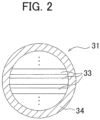
- each of the reaction cells 31 includes a plurality of stacked reaction sheets 33 and the second casing 34 for containing the plurality of reaction sheets 33.
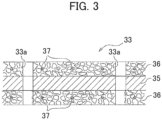
- each of the reaction sheets 33 includes a metal foil 35 serving as a base, porous layers 36 formed on both surfaces of the metal foil 35, and catalysts 37 carried by the porous layers 36.
- each of the reaction sheets 33 has a three-layer structure in which the porous layer 36 carrying the catalysts 37, the metal foil 35, and the porous layer 36 carrying the catalysts 37 are stacked in this order.
- the reaction sheet 33 which is in the form of a sheet, has a small heat capacity to rapidly conduct heat, and is rapidly adjusted to a temperature at which the catalysts 37 excellently perform a catalyst function thereof.
- the hydrogen supplied from the electrolysis device reacts with the carbon dioxide or toluene to be efficiently converted to a hydrogenated material such as methane or methylcyclohexane.
- each of the reaction sheets 33 has a plurality of through holes 33a formed therein.
- the carbon dioxide, the water vapor, and the generated hydrogen and dehydrogenated material such as, e.g., toluene vapor, which are the gas components, excellently flows through the through holes 33a even in the thickness direction.
- each of the reaction sheets 33 does not include the metal foil 35 or includes the porous layer 36 serving as the base instead of the metal foil 35, and the entire reaction sheet 33 has a porous structure.
- the porous layers 36 are layers for supporting the catalysts 37, and have a plurality of tiny holes through which the carbon dioxide, the water vapor, and the generated hydrogen and dehydrogenated material such as, e.g., toluene vapor, which are the gas components, can flow.
- the porous layers 36 thus described are formed of, e.g., an oxide containing alumina as a main component.
- the catalysts 37 are catalysts for generating methane or a hydrogenated material from the generated hydrogen and carbon dioxide or a dehydrogenated material such as toluene vapor, which are the gas components. These catalysts 37 are as described above, and may differ depending on a hydrogenation reaction. Examples of the representative catalyst include at least one selecting from the group consisting of, e.g., platinum, nickel, palladium, rhodium, iridium, ruthenium, molybdenum, rhenium, tungsten, vanadium, osmium, chromium, cobalt, iron, and the like.
- the fuel production device of the present invention also includes a cooling device or a cooling water line so as to adjust a temperature of the hydrogen to be supplied to the hydrogenation reactor or the like or a reaction temperature in the hydrogenation reactor.
- the fuel production device of the present invention it may also be possible to connect the internal combustion engine, the hydrogenation reactor, and optionally the cooling device with the cooling water line for cooling the internal combustion engine.
- the cooling device mentioned herein is a device for adjusting a temperature of the hydrogen to be supplied to the hydrogenation reactor or the like, while the cooling water line is a device for appropriately adjusting a temperature of the internal combustion engine, the cooling device, and/or the hydrogenation device.
- the cooling device and the cooling water line a cooling device and a cooling water line which are known in the technical field of concern can be used.
- the methanation reactor is used as the hydrogenation reactor in the fuel production device of the present invention.
- By connecting the internal combustion engine and the methanation reactor with the cooling water line it is possible to adjust a temperature of the methanation reactor to an appropriate reaction temperature.
- a cooling device that performs cooling with discharged water between the electrolysis device and the methanation reactor it is possible to adjust the generated hydrogen and carbon dioxide into a temperature range appropriate for a methanation reaction starting temperature and, by supplying the discharged water reaching a high temperature due to heat exchange in the cooling device of concern as high-temperature water or water vapor to the electrolysis device, it is possible to improve energy efficiency.
- water contained in a methane mixture gas generated in the methanation reactor can be used. Separation of the water from the methane mixture gas can be carried out by a method of cooling the methane mixture gas to 100 °C or less in the cooling device disposed in a stage subsequent to the methanation reactor and separating gaseous methane and liquid water from each other.
- the organic hydride reactor when used as the hydrogenation reactor in the fuel production device, by connecting the internal combustion engine and the organic hydride reactor with the cooling water line, it is possible to appropriately adjust the reaction temperature in the organic hydride reactor.
- the cooling device between the electrolysis device and the organic hydride reactor, it is possible to adjust the generated hydrogen into a temperature range appropriate for a hydrogenation reaction starting temperature and, by removing excess water vapor from a hydrogen gas supplied to the organic hydride reactor, it is possible to improve reaction efficiency in the organic hydride reactor.
- Fig. 4 illustrates a configuration of a first embodiment of the fuel production device of the present invention.
- the configuration of the first embodiment includes, in series, an internal combustion engine 1, an electrolysis device 2 connected to the internal combustion engine 1 of concern, and the hydrogenation reactor 300 connected to the electrolysis device 2 of concern.
- a fuel tank 4 for supplying a fuel to the internal combustion engine 1 and a power generator 5 operated by a mechanical power from the internal combustion engine 1 are further connected, and the connection between the internal combustion engine 1 and the electrolysis device 2 includes piping for supplying the exhaust gas from the internal combustion engine 1 to the electrolysis device 2 and piping for supplying oxygen generated from the electrolysis device 2 to the internal combustion engine 1.
- a renewable energy source 6 for supplying an electric power to the electrolysis device 2 is further connected.
- a storage tank 700 for storing the fuel generated in the hydrogenation reactor 300 is further connected.
- the fuel supplied from the fuel tank 4 to the internal combustion engine 1 is burned to generate 400 °C water vapor and a mechanical power, and the 400 °C water vapor is supplied to the electrolysis device 2, while the mechanical power is transmitted to the power generator 5.
- the oxygen is substantially entirely consumed during the combustion and prevented from being contained in an exhaust gas.
- the 400 °C water vapor supplied to the electrolysis device 2 operated by the renewable energy source 6 is decomposed into oxygen and hydrogen by the high temperature electrolysis, and the oxygen is supplied to the internal combustion engine 1, while the hydrogen is supplied to the hydrogenation reactor 300.
- the hydrogen supplied to the hydrogenation reactor 300 is converted to a fuel of methane, which is stored in the storage tank 700.
- the hydrogen generated in the electrolysis device 2 is supplied at the high temperature to the hydrogenation reactor 300 connected in series to the electrolysis device 2. Accordingly, the hydrogen need not be heated for a hydrogenation reaction, and can be converted to an easy-to-store form.
- Fig. 5 illustrates a configuration of a second embodiment using a methanation reactor 301 as the hydrogenation reactor in the fuel production device of the present invention.
- the configuration of the second embodiment includes the internal combustion engine 1, the electrolysis device 2 connected to the internal combustion engine 1 of concern, and the methanation reactor 301 connected to the electrolysis device 2 of concern.
- the fuel tank 4 for supplying the fuel to the internal combustion engine 1 and the power generator 5 operated by the mechanical power from the internal combustion engine 1 are further connected, and the connection between the internal combustion engine 1 and the electrolysis device 2 includes piping for supplying the exhaust gas from the internal combustion engine 1 to the electrolysis device 2 and piping for supplying the oxygen generated from the electrolysis device 2 to the internal combustion engine 1.
- the renewable energy source 6 for supplying the electric power to the electrolysis device 2 is further connected.
- a methane storage tank 701 for storing methane generated in the methanation reactor 301 is further connected.
- a cooling device for adjusting hydrogen, carbon dioxide, and the like serving as raw materials for the methanation reaction to a temperature appropriate as a methanation reaction starting temperature e.g., a heat exchanger is disposed.
- the internal combustion engine 1 and the methanation reactor 301 may also be connected with a cooling water line.
- the fuel supplied from the fuel tank 4 to the internal combustion engine 1 is burned first to generate 400 °C water vapor, carbon dioxide, and a mechanical power, and the 400 °C water vapor and the carbon dioxide are supplied to the electrolysis device 2, while the mechanical power is transmitted to the power generator 5.
- the ratio between the fuel and oxygen to be supplied to the internal combustion engine 1 so as to effect the stoichiometric combustion, the oxygen is substantially entirely consumed during the combustion and prevented from being contained in the exhaust gas.
- the 400 °C water vapor supplied to the electrolysis device 2 operated by the renewable energy source 6 is decomposed by the high temperature electrolysis into oxygen and hydrogen, and the oxygen is supplied to the internal combustion engine 1, while the hydrogen is supplied to the methanation reactor 301.
- the carbon dioxide contained in the exhaust gas is also supplied to the methanation reactor without being electrolyzed.
- the hydrogen and carbon dioxide supplied to the methanation reactor are converted to the methane, which is stored in the methane storage tank 701.
- a gas temperature (outlet-side gas temperature) of the methane discharged from the methanation reactor 301 is preferably set to 220 °C to 250 °C by the cooling device and/or the cooling water line disposed in a stage previous to the methanation reactor 301.
- the hydrogen generated in the electrolysis device 2 and the carbon dioxide contained in the exhaust gas are supplied at the high temperature to the methanation reactor 301 connected in series to the electrolysis device 2. Accordingly, the hydrogen and carbon dioxide need not be heated for methanation, and can be converted to easy-to-store methane.
- Fig. 6 illustrates a configuration of a third embodiment into which the second embodiment is further embodied.
- the configuration of the third embodiment includes, in series, the internal combustion engine 1, a three-way catalyst 8 connected to the internal combustion engine 1 of concern to remove toxic substances, the electrolysis device 2 connected to the three-way catalyst 8 of concern, a first cooling device 9 for adjustment to a temperature appropriate for the methanation reaction which is connected to the electrolysis device 2 of concern, and the methanation reactor 301 connected to the first cooling device 9 of concern.
- a second cooling device 10 for cooling water (water vapor) generated in the methanation reactor 301 is connected.
- a water collection tank 11 for collecting the cooled water is connected.
- the methane storage tank 701 for collecting a generated methane mixture gas is connected.
- the internal combustion engine 1 further includes a cooling water line (including a cooling water pump 12, a cooling water tank 13, and a radiator 14) connecting the internal combustion engine 1, the second cooling device 10, and the methanation reactor 301.
- a cooling water line including a cooling water pump 12, a cooling water tank 13, and a radiator 14
- the fuel supplied from the fuel tank to the internal combustion engine e.g., methane is burned to generate water vapor and carbon dioxide at 350 °C to 550 °C (CH 4 + 2O 2 ⁇ CO 2 + 2H 2 O (Formula 1)), and the high-temperature water vapor and carbon dioxide of concern are subjected to removal of toxic substances (such as unburned hydrocarbon, carbon monoxide, and nitric oxide) therefrom in the three-way catalyst 8, and then supplied to the electrolysis device 2.
- toxic substances such as unburned hydrocarbon, carbon monoxide, and nitric oxide
- the high-temperature water vapor supplied to the electrolysis device 2 is decomposed by the high temperature electrolysis into oxygen and hydrogen (CO 2 + 2H 2 O ⁇ 2H 2 + CO 2 + O 2 (Formula 2)), and the hydrogen is adjusted to 250 °C to 300 °C appropriate as the methanation reaction starting temperature in the first cooling device 9 and then supplied to the methanation reactor 301.
- the hydrogen and carbon dioxide contained in the exhaust gas are also supplied to the methanation reactor 301 without being electrolyzed.
- the hydrogen and carbon dioxide supplied to the methanation reactor 301 are converted at an appropriate reaction temperature of 220 °C to 260 °C resulting from adjustment by the cooling water line to methane and water vapor (2H 2 + 2H 2 + CO 2 ⁇ CH 4 + 2H 2 O (Formula 3)).
- the methane and water vapor resulting from the conversion are supplied at a temperature of 220 °C to 260 °C from the methanation reactor 301 to the second cooling device 10.
- the water vapor is cooled to water, which is collected by the water collection tank 11, and a methane mixture gas from which moisture has been separated is collected by the methane storage tank 701 in a stage subsequent to the water collection tank 11.
- nitrogen contained in the exhaust gas (including nitrogen resulting from conversion by the three-way catalyst 8) is contained in a final product.
- the 1 mole of carbon dioxide contained in the exhaust gas discharged from the internal combustion engine 1 cannot entirely be methanated by the 2 moles of hydrogen generated from the 2 moles of water vapor contained in the exhaust gas similarly discharged from the internal combustion engine 1. Accordingly, it is required to newly supply 2 moles of hydrogen equivalent to a shortage or supply additional 2 moles of water vapor to the electrolysis device 2 and thereby generate the 2 moles of hydrogen equivalent to the shortage.
- the additional 2 moles of water vapor is supplied to the electrolysis device 2 to generate the 2 moles of hydrogen
- the 2 moles of water vapor generated in the methanation reactor 301 i.e., 2 moles of the water collected by the water collection tank 11 as the high-temperature water or water vapor to the electrolysis device 2 via the first cooling device 9, it is possible to additionally generate 2 moles of the hydrogen in the electrolysis device 2.
- the additional 2 moles of hydrogen thus generated can be used as the 2 moles of hydrogen equivalent to the shortage in the methanation reactor 301.
- the hydrogen generated in the electrolysis device 2 and the carbon dioxide contained in the exhaust gas are supplied at the high temperature to the methanation reactor 301 connected in series to the electrolysis device 2. Therefore, the hydrogen and carbon dioxide need not be heated for the methanation, and can be converted to easy-to-store methane.
- Fig. 7 illustrates a configuration of a fourth embodiment in which, in the fuel production device, the organic hydride reactor 302 is used as the hydrogenation reactor, and toluene and methylcyclohexane are each used as the organic hydride.
- the configuration of the fourth embodiment includes the internal combustion engine 1, the electrolysis device 2 connected to the internal combustion engine 1 of concern, and the organic hydride reactor 302 connected to the electrolysis device 2 of concern.
- the fuel tank 4 for supplying the fuel to the internal combustion engine 1 and the power generator 5 operated by the mechanical power from the internal combustion engine 1 are further connected, and the connection between the internal combustion engine 1 and the electrolysis device 2 includes piping for supplying the exhaust gas from the internal combustion engine 1 to the electrolysis device 2 and piping for supplying the oxygen generated from the electrolysis device 2 to the internal combustion engine 1.
- the renewable energy source 6 for supplying the electric power to the electrolysis device 2 is further connected.
- a methylcyclohexane storage tank 702 for storing liquid methylcyclohexane generated in the organic hydride reactor 302 and a toluene storage tank 15 for storing toluene as a dehydrogenated material are further connected.
- a cooling device for adjustment to a temperature appropriate as a hydrogenation reaction starting temperature e.g., a heat exchanger may also be disposed.
- the internal combustion engine 1 and the organic hydride reactor 302 may also be connected with a cooling water line.
- the fuel supplied from the fuel tank 4 to the internal combustion engine 1 is burned to generate 400 °C water vapor and a mechanical power, and the 400 °C water vapor is supplied to the electrolysis device 2, while the mechanical power is transmitted to the power generator 5.
- the ratio between the fuel and oxygen to be supplied to the internal combustion engine 1 so as to effect the stoichiometric combustion, the oxygen is substantially entirely consumed during the combustion and prevented from being contained in the exhaust gas.
- the 400 °C water vapor supplied to the electrolysis device 2 operated by the renewable energy source 6 is decomposed by the high temperature electrolysis into oxygen and hydrogen, and the oxygen is supplied to the internal combustion engine 1, while the hydrogen is supplied to the organic hydride reactor 302.
- the hydrogen supplied to the organic hydride reactor 302 reacts with the toluene supplied from the toluene storage tank 15 to be converted to the liquid methylcyclohexane, which is stored in the methylcyclohexane storage tank 702.
- a temperature (outlet-side temperature) of the methylcyclohexane discharged from the organic hydride reactor 302 is preferably set to 85 °C to 98 °C by the cooling device and/or cooling water line disposed in a stage previous to the organic hydride reactor 302.
- the hydrogen generated in the electrolysis device 2 is supplied at a high temperature to the organic hydride reactor 302 connected in series to the electrolysis device 2. Therefore, the hydrogen need not be heated for the hydrogenation reaction, and can be converted to the easy-to-store liquid methylcyclohexane.
- Fig. 8 illustrates a configuration of a fifth embodiment into which the fourth embodiment is further embodied.
- the configuration of the fifth embodiment includes, in series, the internal combustion engine 1, the three-way catalyst 8 connected to the internal combustion engine 1 of concern to remove toxic substances, the electrolysis device 2 connected to the three-way catalyst 8 of concern, the cooling device 16 for adjustment to a temperature appropriate for the hydrogenation reaction which is connected to the electrolysis device 2 of concern, a toluene vaporizer 17 connected to the cooling device 16 of concern, and the organic hydride reactor 302 connected to the toluene vaporizer 17 of concern.
- the toluene storage tank 15 for storing toluene as a dehydrogenated material is further connected.
- the internal combustion engine 1 further includes the cooling water line (including the cooling water pump 12, the cooling water tank 13, and the radiator 14) connecting the internal combustion engine 1, the cooling device 16, and the organic hydride reactor 302.
- the high-temperature water vapor supplied to the electrolysis device 2 is decomposed by the high-temperature electrolysis into oxygen and hydrogen, and the hydrogen is adjusted to 80 °C to 90 °C as a temperature appropriate as a temperature at which a hydrogenation reaction to the toluene is started in the cooling device 16 and then supplied to the toluene vaporizer 17.
- water generated by cooling is removed in the cooling device 16 or in a water separation tank (not shown) connected to the cooling device 16.
- the hydrogen and nitrogen gas supplied to the toluene vaporizer 17 vaporize an amount of the toluene equivalent to a vapor pressure in the toluene vaporizer 17 of concern to be supplied together with toluene vapor to the organic hydride reactor 302.
- the hydrogen and toluene vapor supplied to the organic hydride reactor 302 are converted at an appropriate reaction temperature of 85 °C to 96 °C resulting from adjustment by the cooling water line to methylcyclohexane.
- the methylcyclohexane resulting from the conversion is supplied at a temperature of 85 °C to 96 °C from the organic hydride reactor 302 to the methycyclohexane storage tank 702. Note that the nitrogen contained in the exhaust gas (including the nitrogen resulting from the conversion by the three-way catalyst) is finally discharged from the methylcyclohexane storage tank 702.
- the hydrogen generated in the electrolysis device 2 is supplied at the high temperature to the organic hydride reactor 302 connected in series to the electrolysis device 2. Therefore, the hydrogen need not be heated for the hydrogenation reaction, and can be converted to the easy-to-store liquid methylcyclohexane.
- FIG. 9 illustrates a configuration of a sixth embodiment in which, in the fuel production device of the present invention, each of the methanation reactor 301 and the organic hydride reactor 302 is used as the hydrogenation reactor.
- the configuration of the sixth embodiment includes the internal combustion engine 1, the electrolysis device 2 connected to the internal combustion engine 1 of concern, the methanation rector 301 connected to the electrolysis device 2 of concern, and the organic hydride reactor 302 connected to the methanation reactor 302 of concern.
- the fuel tank 4 for supplying the fuel to the internal combustion engine 1 and the power generator 5 operated by the mechanical power from the internal combustion engine 1 are further connected, and the connection between the internal combustion engine 1 and the electrolysis device 2 includes piping for supplying the exhaust gas from the internal combustion engine 1 to the electrolysis device 2 and piping for supplying the oxygen generated from the electrolysis device 2 to the internal combustion engine 1.
- the renewable energy source 6 for supplying the electric power to the electrolysis device 2 is further connected.
- the methane storage tank 701 for storing the methane generated in the methanation reactor 301 and the organic hydride reactor 302 for further reacting unreacted hydrogen in the methanation rector 301 are further connected.
- the methylcyclohexane storage tank 702 for storing the liquid methylcyclohexane generated in the organic hydride reactor 302 and the toluene storage tank 15 for storing toluene as a dehydrogenated material are further connected.
- cooling devices for adjustment to a temperature appropriate as a methanation reaction and/or hydrogenation reaction starting temperature e.g., heat exchangers are disposed.
- the internal combustion engine 1, the methanation reactor 301, and the organic hydride reactor 302 may also be connected by a cooling water line.
- the fuel supplied from the fuel tank 4 to the internal combustion engine 1 is burned to generate 400 °C water vapor, carbon dioxide, and a mechanical power, and the 400 °C water vapor and the carbon dioxide are supplied to the electrolysis device 2, while the mechanical power is transmitted to the power generator 5.
- the ratio between the fuel and oxygen to be supplied to the internal combustion engine 1 so as to effect the stoichiometric combustion, the oxygen is substantially entirely consumed during the combustion and prevented from being contained in the exhaust gas.
- the 400 °C water vapor supplied to the electrolysis device 2 operated by the renewable energy source 6 is decomposed by the high temperature electrolysis into oxygen and hydrogen, and the oxygen is supplied to the internal combustion engine 1, while the hydrogen is supplied to the methanation reactor 301.
- the carbon dioxide contained in the exhaust gas is also supplied to the methanation reactor 301 without being electrolyzed.
- the hydrogen and carbon dioxide supplied to the methanation reactor 301 are converted to methane, which is stored in the methane storage tank 701.
- the gas temperature (outlet-side gas temperature) of the methane discharged from the methanation rector 301 is set to 220 °C to 250 °C by the cooling device and/or the cooling water line disposed in the stage previous to the methanation reactor 301.
- unreacted hydrogen in the methanation reactor 301 is supplied to the organic hydride reactor 302, while remaining mixed with the methane as a reaction product.
- the hydrogen in the foregoing gas mixture supplied to the organic hydride reactor 302 reacts with the toluene supplied from the toluene storage tank 15 to be converted to the liquid methylcyclohexane, which is stored in the methylcyclohexane storage tank 702.
- the methane in the foregoing gas mixture has no involvement in a methylcyclohexane generation reaction, and can thus be separated by being discharged as a gas.
- the temperature (outlet-side temperature) of the methylcyclohexane discharged from the organic hydride reactor 302 is preferably set to 85 °C to 98 °C by the cooling device and/or the cooling water line disposed in the stage previous to the organic hydride reactor 302.
- the hydrogen generated in the electrolysis device 2, the carbon dioxide contained in the exhaust gas, and the unreacted hydrogen in the methanation reactor 301 are supplied at the high temperature to the methanation reactor 301 connected in series to the electrolysis device 2 and to the organic hydride reactor 302 connected in series to the methanation reactor 301, and therefore the hydrogen, carbon dioxide, and unreacted hydrogen need not be heated for the methanation and hydrogenation reaction, and can be converted to the easy-to-store methane and liquid methylcyclohexane.
Landscapes
- Engineering & Computer Science (AREA)
- Chemical & Material Sciences (AREA)
- Combustion & Propulsion (AREA)
- Mechanical Engineering (AREA)
- General Engineering & Computer Science (AREA)
- Chemical Kinetics & Catalysis (AREA)
- Organic Chemistry (AREA)
- Oil, Petroleum & Natural Gas (AREA)
- General Chemical & Material Sciences (AREA)
- Health & Medical Sciences (AREA)
- General Health & Medical Sciences (AREA)
- Inorganic Chemistry (AREA)
- Electrochemistry (AREA)
- Materials Engineering (AREA)
- Metallurgy (AREA)
- Organic Low-Molecular-Weight Compounds And Preparation Thereof (AREA)
- Electrolytic Production Of Non-Metals, Compounds, Apparatuses Therefor (AREA)
Description
- The present invention relates to a fuel production device.
- In recent years, it has been attempted to effectively use energy in order to preserve global environment and save resources.
- For example,
Patent Literature 1 describes a method of generating, from an electrical energy source, a hydrocarbon or a hydrocarbon derivative, which includes a step a. of providing the electrical energy source, a step b. of using an electrical energy from the electrical energy source to electrolyze water and generate hydrogen and oxygen, and a step c. of using the generated hydrogen to hydrogenate a carbon dioxide and generate methane. In the method of concern, as the electrical energy source, a renewable energy source is used. -
WO 2018/234325 A1 describes an energy converting device and method for converting electric energy into chemical energy, including an electrolysis device which is designed to split water into hydrogen and oxygen using electric power; a fuel synthesis device which is fluidically connected to the electrolysis device such that the fuel synthesis device can be supplied with hydrogen generated in the electrolysis device as a reactant, wherein the fuel synthesis device is designed to synthesize a fuel from hydrogen and carbon dioxide; and an internal combustion engine which is fluidically connected to the electrolysis device such that the internal combustion engine can be supplied with oxygen generated in the electrolysis device. - Patent Literature 1:
Japanese Translation of PCT Application No. 2015-513531 - Meanwhile, it is also a task to efficiently use a thermal energy discharged from a conventionally used internal combustion engine.
- It is therefore a task of the present invention to provide a device that uses a high-temperature exhaust gas released from an internal combustion engine to produce a fuel.
- As a result of examining various means for carrying out the task, the present inventors have found that, by using an electrolysis device to decompose high-temperature water vapor contained in an exhaust gas discharged from an internal combustion engine into hydrogen and oxygen and convert the hydrogen resulting from the decomposition in a high-temperature state to a fuel, it is possible to produce the fuel by efficiently use an energy from the internal combustion engine.
- The present invention is a fuel production device as set forth in
claim 1. - According to the present invention, the device that uses the high-temperature exhaust gas released from the internal combustion engine to produce the fuel is provided. Tasks, configurations, and effects other than those described above will be made apparent by the following description of embodiments.
-
-
Fig. 1 is a diagram schematically illustrating an example of a hydrogenation reactor; -
Fig. 2 is a diagram schematically illustrating an example of a reaction cell in the hydrogenation reactor; -
Fig. 3 is a diagram schematically illustrating an example of a reaction sheet in the reaction cell in the hydrogenation reactor; -
Fig. 4 is a diagram illustrating a configuration of a first embodiment of a fuel production device of the present invention; -
Fig. 5 is a diagram illustrating a configuration of a second embodiment of the fuel production device of the present invention; -
Fig. 6 is a diagram illustrating a configuration of a third embodiment of the fuel production device of the present invention; -
Fig. 7 is a diagram illustrating a configuration of a fourth embodiment of the fuel production device of the present invention; -
Fig. 8 is a diagram illustrating a configuration of a fifth embodiment of the fuel production device of the present invention; and -
Fig. 9 is a diagram illustrating a configuration of a sixth embodiment of the fuel production device of the present invention. Description of Embodiments - Using drawings or the like, a description will be given below of embodiments of the present invention. In the drawings, the size and shape of each part are exaggerated for clarity, and the actual size and shape are not accurately depicted. Therefore, the technical scope of the present invention is not limited to the size and shape of each part illustrated in these drawings. In addition, the following description shows specific examples of details of the present invention, and the present invention is not limited to description thereof and can variously be changed and modified by a person skilled in the art within a scope of a technical idea disclosed in the present description. Throughout the drawings for describing the present invention, the same reference signs are given to components having the same functions, and a repeated description thereof may be omitted.
- The fourth embodiment, illustrated in
Fig. 7 , and the fifth embodiment, illustrated inFig. 8 , are not encompassed by the wording of the claims but are considered as useful for understanding the present invention. - The present invention relates to a fuel production device including an internal combustion engine, an electrolysis device connected to the internal combustion engine of concern, and a hydrogenation reactor connected to the electrolysis device of concern, wherein the electrolysis device is a device for decomposing high-temperature water vapor contained in an exhaust gas from the internal combustion engine into hydrogen and oxygen, and the hydrogenation reactor is a device for converting the hydrogen resulting from the decomposition to a fuel.
- The internal combustion engine mentioned herein in the present invention indicates an internal combustion engine using a working fluid as a combustion gas, examples of which include a reciprocal engine, a rotary engine, and the like.
- The internal combustion engine in the fuel production device of the present invention can quickly be activated and/or stopped. When a renewable energy source is used as an electric power to be used for electrolysis in the electrolysis device, the internal combustion engine can easily follow a fluctuating extra power derived from the renewable energy source. In addition, the internal combustion engine in the fuel production device of the present invention can reduce a heater operation time of the fuel production device.
- Moreover, in the internal combustion engine, bioethanol or water-containing ethanol can be used as an auxiliary fuel.
- By using the bioethanol as the auxiliary fuel in the internal combustion engine, it is possible to reduce emission of carbon dioxide, which is listed as one of causes of global warming.
- Combustion in the internal combustion engine is performed at a known temperature in the technical field of concern, and is performed at typically 300 °C to 900 °C, or preferably 500 °C to 700 °C.
- The combustion performed in the internal combustion engine at a temperature in the range mentioned above allows an external device, e.g., a power generator to operate with a mechanical power from the internal combustion engine. A temperature of the exhaust gas discharged from the internal combustion engine of concern is typically 250 °C to 850 °C, preferably 350 °C to 650 °C, or, e.g., 350 °C to 550 °C. The temperatures of concern correspond to temperatures for electrolysis in the electrolysis device described below, and therefore water vapor contained in the exhaust gas is efficiently decomposed into hydrogen in the electrolysis device, as will be described below.
- Additionally, the internal combustion engine is preferably operated after being conditioned (adjusted) so as to effect stoichiometric combustion (stoichiometry hereinafter referred to as stoichiometric combustion) in which an air-fuel ratio (Air/Fuel ratio) is a theoretical air-fuel ratio.
- When the internal combustion engine is operated in a lean atmosphere in which an air ratio is higher than in the stoichiometric combustion, the exhaust gas to be supplied to the electrolysis device may contain oxygen (O2). When the oxygen is supplied to the electrolysis device, electrolysis of the water vapor in the electrolysis device may be suppressed.
- Accordingly, by operating the internal combustion engine in the stoichiometric combustion in the fuel production device of the present invention, the exhaust gas discharged from the internal combustion engine contains no oxygen, and it is possible to prevent a reduction in efficiency of the electrolysis of the water vapor in the electrolysis device to which the exhaust gas is supplied, consumption of the generated hydrogen, and the like. For the reason described above, as the internal combustion engine in the present embodiment, a spark ignition engine appropriate for operation in the stoichiometric combustion is preferred.
- In the fuel production device of the present invention, the internal combustion engine is connected to the electrolysis device, and the exhaust gas discharged from the internal combustion engine is supplied to the electrolysis device.
- The electrolysis device in the present invention is a device for performing electrolysis referred to as high-temperature electrolysis or water vapor electrolysis performed at a temperature higher than a room temperature, e.g., typically 250 °C to 850 °C, preferably 350 °C to 650 °C, or, e.g., 350 °C to 550 °C.
- As described above, the exhaust gas discharged from the internal combustion engine is at the temperature in the foregoing range in which the electrolysis device is operated. By effecting the electrolysis in the electrolysis device at the foregoing temperature, it is possible to electrolyze the water vapor with high efficiency and generate the hydrogen.
- In the electrolysis device, the following reaction occurs.
Negative Electrode: H2O + 2e- → O2- + H2↑
Positive Electrode: O2- → 2e- + 1/2O2↑
Entire Device: H2O → H2 + 1/2O2
- In other words, in the electrolysis device, the water vapor contained in the exhaust gas supplied to a negative electrode receives electrons to be decomposed into hydrogen and an oxygen ion (O2-), and the oxygen ion generated from the negative electrode moves to a positive electrode via an electrolyte located between the negative electrode and the positive electrode to generate oxygen in the positive electrode.
- The electrolysis device may also include, as the electrolyte, a solid oxide electrolyte. Examples of the solid oxide electrolyte include yttria-stabilized zirconia ("YSZ" or Y2O3-added ZrO2).
- Due to the hermetic solid oxide electrolyte included in the electrolysis device, the oxygen ion excellently conducts at a high temperature to be able to further accelerate separation of the hydrogen and the oxygen ion from each other.
- The electrolysis device includes, as electrodes, electrodes known in the technical field of concern, and may also use, e.g., nickel cermet vapor/hydrogen electrodes.
- For electric power to be used for the electrolysis in the electrolysis device, a renewable energy source is used preferably. As the renewable energy source, at least one energy selected from the group consisting of wind power energy, tidal power energy, wave power energy, water power energy, geothermal energy, and solar energy can be listed.
- By using the renewable energy source for the electric power to be used for the electrolysis in the electrolysis device, it is possible to inhibit emission of carbon dioxide which is listed as one of causes of global warming, and efficiently use the variable extra power of the renewable energy.
- In the electrolysis device, the water vapor contained in the exhaust gas is electrolyzed as described above but, since the exhaust gas may contain, in addition to the water vapor, toxic substances (such as carbon monoxide (CO), unburned hydrocarbon (HC), and a nitrogen oxide (NOx)), the fuel production device of the present invention may also further include, between the internal combustion engine and the electrolysis device, a device for decomposing and/or removing the toxic substances other than the water vapor. For example, the fuel production device of the present invention further includes, between the internal combustion engine and the electrolysis device, a catalyst for purifying the exhaust gas such as a three-way catalyst.
- Due to the catalyst for purifying the exhaust gas which is further included by the fuel production device of the present invention, the toxic substances in the exhaust gas discharged from the internal combustion engine are efficiently decomposed and/or removed, and it is possible to prevent degradation and/or corrosion or the like of the electrolysis device to which the exhaust gas is supplied due to the toxic substances.
- In the fuel production device of the present invention, the oxygen generated in the electrolysis device may also be supplied to the internal combustion engine for combustion in the internal combustion engine.
- By supplying the oxygen generated in the electrolysis device to the internal combustion engine, it is possible to improve combustion efficiency in the internal combustion engine.
- In the fuel production device of the present invention, the electrolysis device is connected to the hydrogenation reactor, and the hydrogen generated in the electrolysis device is supplied to the hydrogenation reactor.
- The hydrogenation reactor is a device for converting the hydrogen generated in the electrolysis device to a highly operable fuel. Examples of the hydrogenation reactor include a methanation reactor that causes a reaction between hydrogen and carbon dioxide to generate methane, an organic hydride reactor that causes a reaction between hydrogen and toluene to generate methylcyclohexane (MCH), and the like.
- In the fuel production device of the present invention, the methanation reactor is used as the hydrogenation reactor, and the following reaction occurs in the methanation reactor.
CO2 +4H2 → CH4 + 2H2O
- The methanation reaction is referred to also as a Sabatier reaction, and this reaction is known in the technical field of concern.
- To start the Sabatier reaction, a temperature of typically 200 °C to 300 °C, e.g., 200 °C to 250 °C, or 250 °C to 300 °C is required. In the fuel production device of the present invention, the hydrogen generated in the electrolysis device operated at a high temperature is also at a high temperature. Accordingly, the hydrogen generated in the electrolysis device need not be heated, and is supplied to the methanation reactor after being adjusted to the temperature range of concern by using a cooling device or a cooling water line as described below, which allows the Sabatier reaction to be efficiently started.
- The carbon dioxide used in the Sabatier reaction may be supplied appropriately from the outside, but the carbon dioxide contained in the exhaust gas is used in the fuel production device of the present invention. When discharged without alteration, the carbon dioxide contained in the exhaust gas causes global warming. Accordingly, by using the carbon dioxide contained in the exhaust gas in the reaction of concern, it is possible to reduce an amount of carbon dioxide emission. In addition, the carbon dioxide contained in the exhaust gas is not decomposed and/or reacted in the electrolysis device disposed between the internal combustion engine and the methanation reactor, and consequently the high temperature is held in the internal combustion engine and the electrolysis device. Therefore, through supply of the carbon dioxide contained in the exhaust gas to the methanation reactor similar to that of the hydrogen described above, the Sabatier reaction can efficiently be started.
- Meanwhile, when the Sabatier reaction, which is an exoergic reaction, is started, it is normally required to cool a reaction system. When a reaction temperature significantly exceeds 300 °C, a reverse reaction is prioritized to result in reduced efficiency, and accordingly the reaction temperature is maintained at a temperature around 300 °C through use of a cooling device or a cooling water line as described below. The reaction temperature is typically 200 °C to 400 °C, e.g., 200 °C to 250 °C, preferably 220 °C to 350 °C, more preferably 220 °C to 260 °C, or still more preferably 220 °C to 250 °C.
- In the Sabatier reaction, a catalyst is used. The catalyst is not limited, and a catalyst known in the technical field of concern can be used. Examples of the catalyst include a ruthenium-supported aluminum catalyst and a nickel catalyst. By using the catalyst of concern, it is possible to obtain an excellent selectivity.
- By using the methanation reactor as the hydrogenation reactor in the fuel production device of the present invention, it is possible to effectively use the carbon dioxide discharged from the internal combustion engine, further use the high-temperature hydrogen and carbon dioxide discharged from the electrolysis device for the reaction without further heating the hydrogen and carbon dioxide, and achieve more efficient use of energy. In addition, methane resulting from the hydrogenation can also be input as a fuel to the internal combustion engine or can also be pipeline transported.
- In a case of using the organic hydride reactor as the hydrogenation reactor, when toluene or methylcyclohexane is used as an example of the organic hydride, the following reaction occurs.
C6H5CH3 + 3H2 → C6H11CH3
- The organic hydride reactor will be described using an example using the methylcyclohexane mentioned above. While each of the methylcyclohexane and toluene in the foregoing reaction is a cyclic hydrocarbon having the same carbon number, the methylcyclohexane is a saturated hydrocarbon having no double bond, and the toluene is an unsaturated hydrocarbon having a portion in which carbons are double-bonded. In other words, the toluene is obtained by a dehydrogenation reaction of the methylcyclohexane, and the methylcyclohexane is obtained by a hydrogenation reaction of the toluene. Accordingly, by using the dehydrogenation reaction and the hydrogenation reaction of these hydrocarbons, the organic hydride reactor of concern allows hydrogen to be supplied and stored.
- When the toluene and the methylcyclohexane are used as the organic hydrides, to start the hydrogenation reaction, a temperature of typically 70 °C to 100 °C, preferably 80 °C to 100 °C, or more preferably 80 °C to 90 °C is required. In the fuel production device of the present invention, the hydrogen generated in the electrolysis device operated at the high temperature is also at the high temperature. Accordingly, the hydrogen generated in the electrolysis device need not be heated, and can be supplied to the methanation reactor after being adjusted to the temperature range of concern by using a cooling device or a cooling water line as described below, which allows the hydrogenation reaction to be efficiently started.
- Meanwhile, when the hydrogenation reaction, which is an exoergic reaction, is started, it is normally required to cool a reaction system. When a reaction temperature significantly exceeds a boiling temperature of 100.9 °C of the methylcyclohexane under an atmospheric pressure, efficiency deteriorates, and accordingly the reaction temperature is preferably maintained at a temperature around 100 °C through use of a cooling device or a cooling water line as described below. A temperature range is typically 80 °C to 100 °C, preferably 85 °C to 98 °C, or more preferably 85 °C to 96 °C.
- When a compound obtained through the hydrogenation reaction in the organic hydride is assumed to be a hydrogenated material and a compound obtained through the dehydrogenation reaction therein is assumed to be a dehydrogenated material, as the hydrogenated material that can be used in the organic hydride reactor, a chain saturated hydrocarbon or a cyclic saturated hydrocarbon can be listed. Examples of the chain saturated hydrocarbon include pentane, hexane, heptane, octane, nonane, decane, undecane, dodecane, structural isomers thereof, and substitution products thereof. Examples of the cyclic saturated hydrocarbon include cyclobutane, cyclopentane, cyclohexane, cycloheptane, cyclooctane, cyclononane, and alkyl substitution products thereof. Examples of the alkyl substitution products of the cyclic saturated hydrocarbons include the methycyclohexane mentioned above and the like. It may also be possible to use a plurality of the singly bonded cyclic saturated hydrocarbons. Examples of such compounds include bicyclohexane and the like.
- As the hydrogenated material that can be used in the organic hydride reactor, a bicyclic saturated hydrocarbon can further be listed. Examples of the bicyclic saturated hydrocarbon include decalin, tetralin, and alkyl substitution products thereof. Examples of the alkyl substitution products of the bicyclic saturated hydrocarbon include methyldecalin and the like.
- Note that, in the case of retrieving hydrogen from the hydrogenated material by using the catalyst shown below, as the hydrogenated material, not only any one selected from the group consisting of the compounds mentioned above may be used, but also two or more selected from the group consisting of the compounds mentioned above may be used in a mixture as long as the hydrogen, the dehydrogenated material, and the unreacted hydrogenated material can be separated from each other. In addition, the hydrogenated material may also appropriately contain another compound such as, e.g., a hydrocarbon having no involvement in the hydrogenation reaction or the dehydrogenation reaction or an additive such as a stabilizer as long as there is no interference with the hydrogenation reaction and/or the dehydrogenation reaction in the catalyst described below.
- As the catalyst that can be used when the hydrogen is retrieved from the hydrogenated material, a catalyst including a metal catalyst and a carrier carrying the metal catalyst can be listed. Preferably, the catalyst of concern further includes a holder for holding the carrier.
- As examples of the metal catalyst, particles formed of one or more transition metals selected from the group consisting of nickel (Ni), palladium (Pd), platinum (Pt), rhodium (Rh), iridium (Ir), rhenium (Re), ruthenium (Ru), molybdenum (Mo), tungsten (W), vanadium (V), osmium (Os), chromium (Cr), cobalt (Co), and iron (Fe) or alloys thereof can be used preferably. The size of each of the particles of the metal catalyst that can be used is, e.g., an average particle diameter of 1 nm to 10 nm or, e.g., about 2 nm, but is not limited thereto. The particle may have any size as long as it is possible to cause the dehydrogenation reaction of the hydrogenated material .
- Examples of the carrier include activated carbon, carbon nanotube, silica, alumina, alumina silicate such as zeolite, porous polyimide, zinc oxide, zirconium oxide, diatom earth, niobium oxide, vanadium oxide, and the like. The carrier of concern may have any form in accordance with a fixed form of the catalyst.
- By using the organic hydride reactor as the hydrogenation reactor in the fuel production device and by using, for the reaction, the high-temperature hydrogen discharged from the electrolysis device without further heating the hydrogen, it is possible to achieve more efficient use of energy. In addition, by liquidizing the hydrogenated material obtained through hydrogenation (into, e.g., methylcyclohexane), it is possible to improve storability, transportability, and operability. In addition, the liquid fuel allows infrastructure of gasoline to be utilized.
- Subsequently, a configuration of the hydrogenation reactor will be described.
FIG. 1 schematically illustrates an example of the hydrogenation reactor. - As illustrated in
FIG. 1 , ahydrogenation reactor 300 includes a plurality ofreaction cells 31 each exhibiting a cylindrical outer shape and a cylindricalfirst casing 32 for containing the plurality ofreaction cells 31. Thehydrogenation reactor 300 is configured such that the carbon dioxide contained in the exhaust gas, a gas containing the hydrogen produced in the electrolysis device, and a dehydrogenated material such as, e.g., toluene vapor flow in each of thereaction cells 31, while cooling water flows in thefirst casing 32 outside thereaction cells 31. - The
first casing 32 and asecond casing 34 described below are formed of a metal (e.g., SUS) so as to have a high heat conductivity. Note that shapes of thefirst casing 32 and thesecond casing 34 are not limited to cylindrical shapes, and may also be, e.g., quadratic prisms or polygonal cylinders. - As illustrated in
FIG. 2 , each of thereaction cells 31 includes a plurality ofstacked reaction sheets 33 and thesecond casing 34 for containing the plurality ofreaction sheets 33. - As illustrated in
FIG. 3 , each of thereaction sheets 33 includes ametal foil 35 serving as a base,porous layers 36 formed on both surfaces of themetal foil 35, andcatalysts 37 carried by the porous layers 36. In other words, each of thereaction sheets 33 has a three-layer structure in which theporous layer 36 carrying thecatalysts 37, themetal foil 35, and theporous layer 36 carrying thecatalysts 37 are stacked in this order. - Note that, between the
reaction sheets 33 adjacent to each other in a thickness direction, a gap is formed to allow the carbon dioxide, water vapor, the generated hydrogen, and the dehydrogenated material such as, e.g., toluene vapor, which are gas components, to flow therethrough. - The
reaction sheet 33, which is in the form of a sheet, has a small heat capacity to rapidly conduct heat, and is rapidly adjusted to a temperature at which thecatalysts 37 excellently perform a catalyst function thereof. As a result, the hydrogen supplied from the electrolysis device reacts with the carbon dioxide or toluene to be efficiently converted to a hydrogenated material such as methane or methylcyclohexane. - In addition, each of the
reaction sheets 33 has a plurality of throughholes 33a formed therein. As a result, the carbon dioxide, the water vapor, and the generated hydrogen and dehydrogenated material such as, e.g., toluene vapor, which are the gas components, excellently flows through the throughholes 33a even in the thickness direction. - The
metal foil 35 is formed of, e.g., an aluminum foil and has a thickness of typically 50 µm to 200 µm. - However, it may also be possible that each of the
reaction sheets 33 does not include themetal foil 35 or includes theporous layer 36 serving as the base instead of themetal foil 35, and theentire reaction sheet 33 has a porous structure. - The
porous layers 36 are layers for supporting thecatalysts 37, and have a plurality of tiny holes through which the carbon dioxide, the water vapor, and the generated hydrogen and dehydrogenated material such as, e.g., toluene vapor, which are the gas components, can flow. Theporous layers 36 thus described are formed of, e.g., an oxide containing alumina as a main component. - The
catalysts 37 are catalysts for generating methane or a hydrogenated material from the generated hydrogen and carbon dioxide or a dehydrogenated material such as toluene vapor, which are the gas components. Thesecatalysts 37 are as described above, and may differ depending on a hydrogenation reaction. Examples of the representative catalyst include at least one selecting from the group consisting of, e.g., platinum, nickel, palladium, rhodium, iridium, ruthenium, molybdenum, rhenium, tungsten, vanadium, osmium, chromium, cobalt, iron, and the like. - The fuel production device of the present invention also includes a cooling device or a cooling water line so as to adjust a temperature of the hydrogen to be supplied to the hydrogenation reactor or the like or a reaction temperature in the hydrogenation reactor.
- In the fuel production device of the present invention, it may also be possible to connect the internal combustion engine, the hydrogenation reactor, and optionally the cooling device with the cooling water line for cooling the internal combustion engine.
- The cooling device mentioned herein is a device for adjusting a temperature of the hydrogen to be supplied to the hydrogenation reactor or the like, while the cooling water line is a device for appropriately adjusting a temperature of the internal combustion engine, the cooling device, and/or the hydrogenation device. As the cooling device and the cooling water line, a cooling device and a cooling water line which are known in the technical field of concern can be used.
- The methanation reactor is used as the hydrogenation reactor in the fuel production device of the present invention. By connecting the internal combustion engine and the methanation reactor with the cooling water line, it is possible to adjust a temperature of the methanation reactor to an appropriate reaction temperature. In addition, by disposing a cooling device that performs cooling with discharged water between the electrolysis device and the methanation reactor, it is possible to adjust the generated hydrogen and carbon dioxide into a temperature range appropriate for a methanation reaction starting temperature and, by supplying the discharged water reaching a high temperature due to heat exchange in the cooling device of concern as high-temperature water or water vapor to the electrolysis device, it is possible to improve energy efficiency. Note that, as the discharged water to be used in the cooling device, water contained in a methane mixture gas generated in the methanation reactor can be used. Separation of the water from the methane mixture gas can be carried out by a method of cooling the methane mixture gas to 100 °C or less in the cooling device disposed in a stage subsequent to the methanation reactor and separating gaseous methane and liquid water from each other.
- For example, when the organic hydride reactor is used as the hydrogenation reactor in the fuel production device, by connecting the internal combustion engine and the organic hydride reactor with the cooling water line, it is possible to appropriately adjust the reaction temperature in the organic hydride reactor. In addition, by disposing the cooling device between the electrolysis device and the organic hydride reactor, it is possible to adjust the generated hydrogen into a temperature range appropriate for a hydrogenation reaction starting temperature and, by removing excess water vapor from a hydrogen gas supplied to the organic hydride reactor, it is possible to improve reaction efficiency in the organic hydride reactor.
-
Fig. 4 illustrates a configuration of a first embodiment of the fuel production device of the present invention. The configuration of the first embodiment includes, in series, aninternal combustion engine 1, anelectrolysis device 2 connected to theinternal combustion engine 1 of concern, and thehydrogenation reactor 300 connected to theelectrolysis device 2 of concern. To theinternal combustion engine 1, afuel tank 4 for supplying a fuel to theinternal combustion engine 1 and apower generator 5 operated by a mechanical power from theinternal combustion engine 1 are further connected, and the connection between theinternal combustion engine 1 and theelectrolysis device 2 includes piping for supplying the exhaust gas from theinternal combustion engine 1 to theelectrolysis device 2 and piping for supplying oxygen generated from theelectrolysis device 2 to theinternal combustion engine 1. To theelectrolysis device 2, arenewable energy source 6 for supplying an electric power to theelectrolysis device 2 is further connected. To thehydrogenation reactor 300, astorage tank 700 for storing the fuel generated in thehydrogenation reactor 300 is further connected. - In the configuration of the first embodiment, the fuel supplied from the
fuel tank 4 to theinternal combustion engine 1 is burned to generate 400 °C water vapor and a mechanical power, and the 400 °C water vapor is supplied to theelectrolysis device 2, while the mechanical power is transmitted to thepower generator 5. At this time, by adjusting a ratio between the fuel and oxygen to be supplied to theinternal combustion engine 1 so as to effect the stoichiometric combustion, the oxygen is substantially entirely consumed during the combustion and prevented from being contained in an exhaust gas. Subsequently, the 400 °C water vapor supplied to theelectrolysis device 2 operated by therenewable energy source 6 is decomposed into oxygen and hydrogen by the high temperature electrolysis, and the oxygen is supplied to theinternal combustion engine 1, while the hydrogen is supplied to thehydrogenation reactor 300. The hydrogen supplied to thehydrogenation reactor 300 is converted to a fuel of methane, which is stored in thestorage tank 700. - In the configuration of the first embodiment, the hydrogen generated in the
electrolysis device 2 is supplied at the high temperature to thehydrogenation reactor 300 connected in series to theelectrolysis device 2. Accordingly, the hydrogen need not be heated for a hydrogenation reaction, and can be converted to an easy-to-store form. -
Fig. 5 illustrates a configuration of a second embodiment using amethanation reactor 301 as the hydrogenation reactor in the fuel production device of the present invention. The configuration of the second embodiment includes theinternal combustion engine 1, theelectrolysis device 2 connected to theinternal combustion engine 1 of concern, and themethanation reactor 301 connected to theelectrolysis device 2 of concern. To theinternal combustion engine 1, thefuel tank 4 for supplying the fuel to theinternal combustion engine 1 and thepower generator 5 operated by the mechanical power from theinternal combustion engine 1 are further connected, and the connection between theinternal combustion engine 1 and theelectrolysis device 2 includes piping for supplying the exhaust gas from theinternal combustion engine 1 to theelectrolysis device 2 and piping for supplying the oxygen generated from theelectrolysis device 2 to theinternal combustion engine 1. To theelectrolysis device 2, therenewable energy source 6 for supplying the electric power to theelectrolysis device 2 is further connected. To themethanation reactor 301, amethane storage tank 701 for storing methane generated in themethanation reactor 301 is further connected. Note that, between theelectrolysis device 2 and themethanation reactor 301, a cooling device for adjusting hydrogen, carbon dioxide, and the like serving as raw materials for the methanation reaction to a temperature appropriate as a methanation reaction starting temperature, e.g., a heat exchanger is disposed. Theinternal combustion engine 1 and themethanation reactor 301 may also be connected with a cooling water line. - In the configuration of the second embodiment, the fuel supplied from the
fuel tank 4 to theinternal combustion engine 1 is burned first to generate 400 °C water vapor, carbon dioxide, and a mechanical power, and the 400 °C water vapor and the carbon dioxide are supplied to theelectrolysis device 2, while the mechanical power is transmitted to thepower generator 5. At this time, by adjusting the ratio between the fuel and oxygen to be supplied to theinternal combustion engine 1 so as to effect the stoichiometric combustion, the oxygen is substantially entirely consumed during the combustion and prevented from being contained in the exhaust gas. Subsequently, the 400 °C water vapor supplied to theelectrolysis device 2 operated by therenewable energy source 6 is decomposed by the high temperature electrolysis into oxygen and hydrogen, and the oxygen is supplied to theinternal combustion engine 1, while the hydrogen is supplied to themethanation reactor 301. Note that the carbon dioxide contained in the exhaust gas is also supplied to the methanation reactor without being electrolyzed. The hydrogen and carbon dioxide supplied to the methanation reactor are converted to the methane, which is stored in themethane storage tank 701. Note that a gas temperature (outlet-side gas temperature) of the methane discharged from themethanation reactor 301 is preferably set to 220 °C to 250 °C by the cooling device and/or the cooling water line disposed in a stage previous to themethanation reactor 301. - In the configuration of the second embodiment, the hydrogen generated in the
electrolysis device 2 and the carbon dioxide contained in the exhaust gas are supplied at the high temperature to themethanation reactor 301 connected in series to theelectrolysis device 2. Accordingly, the hydrogen and carbon dioxide need not be heated for methanation, and can be converted to easy-to-store methane. -
Fig. 6 illustrates a configuration of a third embodiment into which the second embodiment is further embodied. The configuration of the third embodiment includes, in series, theinternal combustion engine 1, a three-way catalyst 8 connected to theinternal combustion engine 1 of concern to remove toxic substances, theelectrolysis device 2 connected to the three-way catalyst 8 of concern, afirst cooling device 9 for adjustment to a temperature appropriate for the methanation reaction which is connected to theelectrolysis device 2 of concern, and themethanation reactor 301 connected to thefirst cooling device 9 of concern. In a stage subsequent to themethanation reactor 301, asecond cooling device 10 for cooling water (water vapor) generated in themethanation reactor 301 is connected. In a stage subsequent to thesecond cooling device 10, awater collection tank 11 for collecting the cooled water is connected. In a stage subsequent to thewater collection tank 11, themethane storage tank 701 for collecting a generated methane mixture gas is connected. Theinternal combustion engine 1 further includes a cooling water line (including acooling water pump 12, a coolingwater tank 13, and a radiator 14) connecting theinternal combustion engine 1, thesecond cooling device 10, and themethanation reactor 301. To thefirst cooling device 9, piping for supplying discharged water that may serve as a cooling medium from thewater collection tank 11 and piping for supplying high-temperature discharged water or water vapor resulting from heat exchange in thefirst cooling device 9 are further connected. - In the configuration of the third embodiment, first, the fuel supplied from the fuel tank to the internal combustion engine, e.g., methane is burned to generate water vapor and carbon dioxide at 350 °C to 550 °C (CH4 + 2O2 → CO2 + 2H2O (Formula 1)), and the high-temperature water vapor and carbon dioxide of concern are subjected to removal of toxic substances (such as unburned hydrocarbon, carbon monoxide, and nitric oxide) therefrom in the three-
way catalyst 8, and then supplied to theelectrolysis device 2. At this time, by adjusting the ratio between the fuel and oxygen to be supplied to theinternal combustion engine 1 so as to effect the stoichiometric combustion, the oxygen is prevented from being contained in the exhaust gas. Subsequently, the high-temperature water vapor supplied to theelectrolysis device 2 is decomposed by the high temperature electrolysis into oxygen and hydrogen (CO2 + 2H2O → 2H2 + CO2 + O2 (Formula 2)), and the hydrogen is adjusted to 250 °C to 300 °C appropriate as the methanation reaction starting temperature in thefirst cooling device 9 and then supplied to themethanation reactor 301. Note that the hydrogen and carbon dioxide contained in the exhaust gas are also supplied to themethanation reactor 301 without being electrolyzed. The hydrogen and carbon dioxide supplied to themethanation reactor 301 are converted at an appropriate reaction temperature of 220 °C to 260 °C resulting from adjustment by the cooling water line to methane and water vapor (2H2 + 2H2 + CO2 → CH4 + 2H2O (Formula 3)). The methane and water vapor resulting from the conversion are supplied at a temperature of 220 °C to 260 °C from themethanation reactor 301 to thesecond cooling device 10. In thesecond cooling device 10, the water vapor is cooled to water, which is collected by thewater collection tank 11, and a methane mixture gas from which moisture has been separated is collected by themethane storage tank 701 in a stage subsequent to thewater collection tank 11. Note that nitrogen contained in the exhaust gas (including nitrogen resulting from conversion by the three-way catalyst 8) is contained in a final product. - Note that, when consideration is given from reaction formulae in
Formulae 1 to 3, 1 mole of the methane serving as the fuel of theinternal combustion engine 1 is burned to generate 1 mole of the carbon dioxide and 2 moles of the water vapor (Formula 1), and the 2 moles of water vapor is electrolyzed in theelectrolysis device 2 to generate 2 moles of the hydrogen (Formula 2). In other words, from the 1 mole of methane, the 1 mole of carbon dioxide and the 2 moles of hydrogen are generated. Meanwhile, to generate 1 mole of the methane in themethanation reactor internal combustion engine 1 cannot entirely be methanated by the 2 moles of hydrogen generated from the 2 moles of water vapor contained in the exhaust gas similarly discharged from theinternal combustion engine 1. Accordingly, it is required to newly supply 2 moles of hydrogen equivalent to a shortage or supply additional 2 moles of water vapor to theelectrolysis device 2 and thereby generate the 2 moles of hydrogen equivalent to the shortage. When the additional 2 moles of water vapor is supplied to theelectrolysis device 2 to generate the 2 moles of hydrogen, by supplying the 2 moles of water vapor generated in themethanation reactor 301, i.e., 2 moles of the water collected by thewater collection tank 11 as the high-temperature water or water vapor to theelectrolysis device 2 via thefirst cooling device 9, it is possible to additionally generate 2 moles of the hydrogen in theelectrolysis device 2. The additional 2 moles of hydrogen thus generated can be used as the 2 moles of hydrogen equivalent to the shortage in themethanation reactor 301. - In the configuration of the third embodiment, the hydrogen generated in the
electrolysis device 2 and the carbon dioxide contained in the exhaust gas are supplied at the high temperature to themethanation reactor 301 connected in series to theelectrolysis device 2. Therefore, the hydrogen and carbon dioxide need not be heated for the methanation, and can be converted to easy-to-store methane. -
Fig. 7 illustrates a configuration of a fourth embodiment in which, in the fuel production device, theorganic hydride reactor 302 is used as the hydrogenation reactor, and toluene and methylcyclohexane are each used as the organic hydride. The configuration of the fourth embodiment includes theinternal combustion engine 1, theelectrolysis device 2 connected to theinternal combustion engine 1 of concern, and theorganic hydride reactor 302 connected to theelectrolysis device 2 of concern. To theinternal combustion engine 1, thefuel tank 4 for supplying the fuel to theinternal combustion engine 1 and thepower generator 5 operated by the mechanical power from theinternal combustion engine 1 are further connected, and the connection between theinternal combustion engine 1 and theelectrolysis device 2 includes piping for supplying the exhaust gas from theinternal combustion engine 1 to theelectrolysis device 2 and piping for supplying the oxygen generated from theelectrolysis device 2 to theinternal combustion engine 1. To theelectrolysis device 2, therenewable energy source 6 for supplying the electric power to theelectrolysis device 2 is further connected. To theorganic hydride reactor 302, amethylcyclohexane storage tank 702 for storing liquid methylcyclohexane generated in theorganic hydride reactor 302 and atoluene storage tank 15 for storing toluene as a dehydrogenated material are further connected. Note that, between theelectrolysis device 2 and theorganic hydride reactor 302, a cooling device for adjustment to a temperature appropriate as a hydrogenation reaction starting temperature, e.g., a heat exchanger may also be disposed. Theinternal combustion engine 1 and theorganic hydride reactor 302 may also be connected with a cooling water line. - In the configuration of the fourth embodiment, first, the fuel supplied from the
fuel tank 4 to theinternal combustion engine 1 is burned to generate 400 °C water vapor and a mechanical power, and the 400 °C water vapor is supplied to theelectrolysis device 2, while the mechanical power is transmitted to thepower generator 5. At this time, by adjusting the ratio between the fuel and oxygen to be supplied to theinternal combustion engine 1 so as to effect the stoichiometric combustion, the oxygen is substantially entirely consumed during the combustion and prevented from being contained in the exhaust gas. Subsequently, the 400 °C water vapor supplied to theelectrolysis device 2 operated by therenewable energy source 6 is decomposed by the high temperature electrolysis into oxygen and hydrogen, and the oxygen is supplied to theinternal combustion engine 1, while the hydrogen is supplied to theorganic hydride reactor 302. The hydrogen supplied to theorganic hydride reactor 302 reacts with the toluene supplied from thetoluene storage tank 15 to be converted to the liquid methylcyclohexane, which is stored in themethylcyclohexane storage tank 702. Note that a temperature (outlet-side temperature) of the methylcyclohexane discharged from theorganic hydride reactor 302 is preferably set to 85 °C to 98 °C by the cooling device and/or cooling water line disposed in a stage previous to theorganic hydride reactor 302. - In the configuration of the fourth embodiment, the hydrogen generated in the
electrolysis device 2 is supplied at a high temperature to theorganic hydride reactor 302 connected in series to theelectrolysis device 2. Therefore, the hydrogen need not be heated for the hydrogenation reaction, and can be converted to the easy-to-store liquid methylcyclohexane. -
Fig. 8 illustrates a configuration of a fifth embodiment into which the fourth embodiment is further embodied. The configuration of the fifth embodiment includes, in series, theinternal combustion engine 1, the three-way catalyst 8 connected to theinternal combustion engine 1 of concern to remove toxic substances, theelectrolysis device 2 connected to the three-way catalyst 8 of concern, thecooling device 16 for adjustment to a temperature appropriate for the hydrogenation reaction which is connected to theelectrolysis device 2 of concern, atoluene vaporizer 17 connected to thecooling device 16 of concern, and theorganic hydride reactor 302 connected to thetoluene vaporizer 17 of concern. To thetoluene vaporizer 17, thetoluene storage tank 15 for storing toluene as a dehydrogenated material is further connected. To theorganic hydride reactor 302, themethylcyclohexane storage tank 702 for storing the liquid methylcyclohexane generated in theorganic hydride reactor 302 is further connected. Theinternal combustion engine 1 further includes the cooling water line (including the coolingwater pump 12, the coolingwater tank 13, and the radiator 14) connecting theinternal combustion engine 1, thecooling device 16, and theorganic hydride reactor 302. - In the configuration of the fifth embodiment, first, the fuel supplied from the fuel tank to the
internal combustion engine 1 is burned to generate high-temperature water vapor, and the high-temperature water vapor of concern is subjected to removal of the toxic substances (such as the unburned hydrocarbon, the carbon monoxide, and the nitric oxide) therefrom in the three-way catalyst 8, and then supplied to theelectrolysis device 2. At this time, by adjusting the ratio between the fuel and oxygen to be supplied to theinternal combustion engine 1 so as to effect the stoichiometric combustion, the oxygen is prevented from being contained in the exhaust gas. Subsequently, the high-temperature water vapor supplied to theelectrolysis device 2 is decomposed by the high-temperature electrolysis into oxygen and hydrogen, and the hydrogen is adjusted to 80 °C to 90 °C as a temperature appropriate as a temperature at which a hydrogenation reaction to the toluene is started in thecooling device 16 and then supplied to thetoluene vaporizer 17. Note that water generated by cooling is removed in thecooling device 16 or in a water separation tank (not shown) connected to thecooling device 16. The hydrogen and nitrogen gas supplied to thetoluene vaporizer 17 vaporize an amount of the toluene equivalent to a vapor pressure in thetoluene vaporizer 17 of concern to be supplied together with toluene vapor to theorganic hydride reactor 302. The hydrogen and toluene vapor supplied to theorganic hydride reactor 302 are converted at an appropriate reaction temperature of 85 °C to 96 °C resulting from adjustment by the cooling water line to methylcyclohexane. The methylcyclohexane resulting from the conversion is supplied at a temperature of 85 °C to 96 °C from theorganic hydride reactor 302 to themethycyclohexane storage tank 702. Note that the nitrogen contained in the exhaust gas (including the nitrogen resulting from the conversion by the three-way catalyst) is finally discharged from themethylcyclohexane storage tank 702. - In the configuration of the fifth embodiment, the hydrogen generated in the
electrolysis device 2 is supplied at the high temperature to theorganic hydride reactor 302 connected in series to theelectrolysis device 2. Therefore, the hydrogen need not be heated for the hydrogenation reaction, and can be converted to the easy-to-store liquid methylcyclohexane. -
FIG. 9 illustrates a configuration of a sixth embodiment in which, in the fuel production device of the present invention, each of themethanation reactor 301 and theorganic hydride reactor 302 is used as the hydrogenation reactor. The configuration of the sixth embodiment includes theinternal combustion engine 1, theelectrolysis device 2 connected to theinternal combustion engine 1 of concern, themethanation rector 301 connected to theelectrolysis device 2 of concern, and theorganic hydride reactor 302 connected to themethanation reactor 302 of concern. To theinternal combustion engine 1, thefuel tank 4 for supplying the fuel to theinternal combustion engine 1 and thepower generator 5 operated by the mechanical power from theinternal combustion engine 1 are further connected, and the connection between theinternal combustion engine 1 and theelectrolysis device 2 includes piping for supplying the exhaust gas from theinternal combustion engine 1 to theelectrolysis device 2 and piping for supplying the oxygen generated from theelectrolysis device 2 to theinternal combustion engine 1. To theelectrolysis device 2, therenewable energy source 6 for supplying the electric power to theelectrolysis device 2 is further connected. To themethanation reactor 301, themethane storage tank 701 for storing the methane generated in themethanation reactor 301 and theorganic hydride reactor 302 for further reacting unreacted hydrogen in themethanation rector 301 are further connected. To theorganic hydride reactor 302, themethylcyclohexane storage tank 702 for storing the liquid methylcyclohexane generated in theorganic hydride reactor 302 and thetoluene storage tank 15 for storing toluene as a dehydrogenated material are further connected. Note that, between theelectrolysis device 2 and themethanation reactor 301 and between themethanation reactor 301 and theorganic hydride reactor 302, cooling devices for adjustment to a temperature appropriate as a methanation reaction and/or hydrogenation reaction starting temperature, e.g., heat exchangers are disposed. Theinternal combustion engine 1, themethanation reactor 301, and theorganic hydride reactor 302 may also be connected by a cooling water line. - In the configuration of the sixth embodiment, first, the fuel supplied from the
fuel tank 4 to theinternal combustion engine 1 is burned to generate 400 °C water vapor, carbon dioxide, and a mechanical power, and the 400 °C water vapor and the carbon dioxide are supplied to theelectrolysis device 2, while the mechanical power is transmitted to thepower generator 5. At this time, by adjusting the ratio between the fuel and oxygen to be supplied to theinternal combustion engine 1 so as to effect the stoichiometric combustion, the oxygen is substantially entirely consumed during the combustion and prevented from being contained in the exhaust gas. Subsequently, the 400 °C water vapor supplied to theelectrolysis device 2 operated by therenewable energy source 6 is decomposed by the high temperature electrolysis into oxygen and hydrogen, and the oxygen is supplied to theinternal combustion engine 1, while the hydrogen is supplied to themethanation reactor 301. Note that the carbon dioxide contained in the exhaust gas is also supplied to themethanation reactor 301 without being electrolyzed. The hydrogen and carbon dioxide supplied to themethanation reactor 301 are converted to methane, which is stored in themethane storage tank 701. Note that the gas temperature (outlet-side gas temperature) of the methane discharged from themethanation rector 301 is set to 220 °C to 250 °C by the cooling device and/or the cooling water line disposed in the stage previous to themethanation reactor 301. Subsequently, unreacted hydrogen in themethanation reactor 301 is supplied to theorganic hydride reactor 302, while remaining mixed with the methane as a reaction product. The hydrogen in the foregoing gas mixture supplied to theorganic hydride reactor 302 reacts with the toluene supplied from thetoluene storage tank 15 to be converted to the liquid methylcyclohexane, which is stored in themethylcyclohexane storage tank 702. The methane in the foregoing gas mixture has no involvement in a methylcyclohexane generation reaction, and can thus be separated by being discharged as a gas. Note that the temperature (outlet-side temperature) of the methylcyclohexane discharged from theorganic hydride reactor 302 is preferably set to 85 °C to 98 °C by the cooling device and/or the cooling water line disposed in the stage previous to theorganic hydride reactor 302. - In the configuration of the sixth embodiment, the hydrogen generated in the
electrolysis device 2, the carbon dioxide contained in the exhaust gas, and the unreacted hydrogen in themethanation reactor 301 are supplied at the high temperature to themethanation reactor 301 connected in series to theelectrolysis device 2 and to theorganic hydride reactor 302 connected in series to themethanation reactor 301, and therefore the hydrogen, carbon dioxide, and unreacted hydrogen need not be heated for the methanation and hydrogenation reaction, and can be converted to the easy-to-store methane and liquid methylcyclohexane. -
- 1
- Internal combustion engine
- 2
- Electrolysis device
- 300
- Hydrogenation reactor
- 301
- Methanation reactor
- 302
- Organic hydride reactor
- 4
- Fuel tank
- 5
- Power generator
- 6
- Renewable energy source
- 7
- Storage tank
- 701
- Methane storage tank
- 702
- Methylcyclohexane storage tank
- 8
- Three-way catalyst
- 9
- First cooling device
- 10
- Second cooling device
- 11
- Water collection tank
- 12
- Cooling water pump
- 13
- Cooling water tank
- 14
- Radiator
- 15
- Toluene storage tank
- 16
- Cooling device
- 17
- Toluene vaporizer
- 31
- Reaction cell
- 32
- First casing
- 33
- Reaction sheet
- 33a
- Through hole
- 34
- Second casing
- 35
- Metal foil
- 36
- Porous layer
- 37
- Catalyst
Claims (4)
- A fuel production device comprising:an internal combustion engine (1);an electrolysis device (2) connected to the internal combustion engine (1); anda hydrogenation reactor (300) connected to the electrolysis device (2), whereinthe electrolysis device (2) is configured for decomposing high-temperature water vapor contained in an exhaust gas from the internal combustion engine (1) into hydrogen and oxygen, and the hydrogenation reactor (300) is configured for converting the hydrogen resulting from the decomposition to a fuel, andthe hydrogenation reactor (300) is a methanation reactor (301), and the methanation reactor (301) is configured for causing a reaction between the hydrogen resulting from the decomposition and a carbon dioxide contained in the exhaust gas to convert the hydrogen and the carbon dioxide to methane, characterized bya cooling device (9) between the electrolysis device (2) and the methanation reactor (301), whereinthe cooling device (9) is configured for adjusting the hydrogen resulting from the decomposition and the carbon dioxide contained in the exhaust gas to 200 °C to 250 °C.
- The fuel production device according to claim 1, further comprising:
piping for supplying the oxygen resulting from the decomposition to the internal combustion engine (1). - The fuel production device according to any one of claims 1 to 2, further comprising:a cooling water line connecting the internal combustion engine (1) and the hydrogenation reactor (300), whereinthe cooling water line is configured for adjusting a reaction temperature in the hydrogenation reactor (300).
- A method of producing a fuel, the method comprising:a first step of causing stoichiometric combustion of the fuel in an internal combustion engine (1) to generate high-temperature water vapor and a high-temperature carbon dioxide;a second step of decomposing the high-temperature water vapor generated in the first step into hydrogen and oxygen by using an electrolysis device (2); anda third step of converting the hydrogen resulting from the decomposition in the second step to the fuel in a hydrogenation reactor (300), whereinin the third step, a methanation reactor (301) is used as the hydrogenation reactor (300) and the hydrogen and carbon dioxide are converted to methane in the methanation reactor (301), characterized in thatin the third step, the hydrogen and the carbon dioxide are adjusted to 200 °C to 250 °C by using a cooling device (9) between the electrolysis device (2) and the methanation reactor (301).
Applications Claiming Priority (1)
| Application Number | Priority Date | Filing Date | Title |
|---|---|---|---|
| PCT/JP2020/013721 WO2021192156A1 (en) | 2020-03-26 | 2020-03-26 | Fuel production device |
Publications (3)
| Publication Number | Publication Date |
|---|---|
| EP4130205A1 EP4130205A1 (en) | 2023-02-08 |
| EP4130205A4 EP4130205A4 (en) | 2024-01-17 |
| EP4130205B1 true EP4130205B1 (en) | 2025-04-23 |
Family
ID=77891001
Family Applications (1)
| Application Number | Title | Priority Date | Filing Date |
|---|---|---|---|
| EP20927176.6A Active EP4130205B1 (en) | 2020-03-26 | 2020-03-26 | Fuel production device |
Country Status (4)
| Country | Link |
|---|---|
| US (1) | US11732624B2 (en) |
| EP (1) | EP4130205B1 (en) |
| JP (1) | JP7253670B2 (en) |
| WO (1) | WO2021192156A1 (en) |
Families Citing this family (1)
| Publication number | Priority date | Publication date | Assignee | Title |
|---|---|---|---|---|
| CN114792992A (en) * | 2022-04-26 | 2022-07-26 | 哈尔滨工业大学(深圳) | Offshore hydropower supply system and method based on offshore renewable energy hydrogen production |
Family Cites Families (16)
| Publication number | Priority date | Publication date | Assignee | Title |
|---|---|---|---|---|
| JP4297488B2 (en) * | 2003-08-21 | 2009-07-15 | 東京瓦斯株式会社 | Internal combustion engine |
| JP4434024B2 (en) | 2005-01-25 | 2010-03-17 | 株式会社デンソー | HYDROGEN GENERATOR AND POWER GENERATION SYSTEM FOR GENERATING POWER GENERATED BY THE HYDROGEN GENERATOR |
| JP2009007547A (en) * | 2007-05-25 | 2009-01-15 | Tokyo Metropolitan Univ | Nucleic acid carrier and nucleic acid delivery method |
| JP2009007647A (en) | 2007-06-29 | 2009-01-15 | Hitachi Ltd | Organic hydride manufacturing device, and distributed power source and automobile using the same |
| CN103429881B (en) * | 2011-03-08 | 2015-07-22 | 丰田自动车株式会社 | Vehicles with mixed gas generation system and vehicles with fuel production system |
| WO2012147157A1 (en) | 2011-04-26 | 2012-11-01 | 株式会社日立製作所 | Energy storage/supply apparatus |
| JP5759263B2 (en) * | 2011-05-24 | 2015-08-05 | Jx日鉱日石エネルギー株式会社 | Monocyclic aromatic hydrocarbon production method |
| GB201202791D0 (en) | 2012-02-20 | 2012-04-04 | Simpson Robert | Methods and system for energy conversion and generation |
| JP5982253B2 (en) * | 2012-10-24 | 2016-08-31 | 株式会社日立製作所 | Cogeneration system |
| KR102225779B1 (en) | 2013-07-09 | 2021-03-11 | 미츠비시 히타치 파워 시스템스 유럽 게엠베하 | Flexibly operable power plant and method for the operation thereof |
| JP2015222712A (en) * | 2014-04-28 | 2015-12-10 | パナソニックIpマネジメント株式会社 | Reactor and operation method for the same |
| JP2015209576A (en) * | 2014-04-28 | 2015-11-24 | パナソニックIpマネジメント株式会社 | Reactor, reactor operating method and reactor system |
| JP6867310B2 (en) | 2015-06-16 | 2021-04-28 | サウジ アラビアン オイル カンパニーSaudi Arabian Oil Company | A method of converting CO2 into fuel on a vehicle and a device for that purpose |
| JP2018204433A (en) * | 2015-09-25 | 2018-12-27 | 株式会社日立製作所 | Internal combustion engine |
| ITUB20155235A1 (en) * | 2015-10-29 | 2017-04-29 | St Microelectronics Srl | POWER UNIT SUPPLY INCLUDING A MIXED FUEL ENGINE, AND METHOD OF FEEDING THIS ENGINE |
| DE102017210324A1 (en) * | 2017-06-20 | 2018-12-20 | Mtu Friedrichshafen Gmbh | Energy conversion device for converting electrical energy into chemical energy, power network with such an energy conversion device, and method for operating such an energy conversion device |
-
2020
- 2020-03-26 JP JP2022510269A patent/JP7253670B2/en active Active
- 2020-03-26 WO PCT/JP2020/013721 patent/WO2021192156A1/en not_active Ceased
- 2020-03-26 EP EP20927176.6A patent/EP4130205B1/en active Active
- 2020-03-26 US US17/639,748 patent/US11732624B2/en active Active
Also Published As
| Publication number | Publication date |
|---|---|
| US11732624B2 (en) | 2023-08-22 |
| JP7253670B2 (en) | 2023-04-06 |
| WO2021192156A1 (en) | 2021-09-30 |
| US20220333515A1 (en) | 2022-10-20 |
| JPWO2021192156A1 (en) | 2021-09-30 |
| EP4130205A4 (en) | 2024-01-17 |
| EP4130205A1 (en) | 2023-02-08 |
Similar Documents
| Publication | Publication Date | Title |
|---|---|---|
| Kojima et al. | Development of 10 kW-scale hydrogen generator using chemical hydride | |
| CN101333667A (en) | Organic hydride production device, distributed power supply and automobile using the same | |
| JP2006248814A (en) | Hydrogen supply apparatus and hydrogen supply method | |
| JP6149030B2 (en) | Fuel cell module and fuel cell system | |
| CN109638324B (en) | Pure hydrogen catalytic device and PEMFC power generation system of many sleeve structures of integration to multiple hydrocarbon fuel | |
| JPWO2007074689A1 (en) | Catalyst having dehydrogenation action or hydrogen addition action, fuel cell using the catalyst, and hydrogen storage / supply device | |
| JP7176025B2 (en) | generator | |
| JP5174602B2 (en) | Hydrogen storage system | |
| KR102168018B1 (en) | Fuel cell system associated with a fuel reformer that additionally performs methanation | |
| JP2005272856A (en) | Ammonia synthesis apparatus, ammonia synthesis method, and system including combustion apparatus | |
| EP4130205B1 (en) | Fuel production device | |
| JP2003007321A (en) | Direct reforming combined system of hybrid fuel cell using low-grade hydrocarbon | |
| JP2010163358A (en) | Hydrogen supply apparatus and method for supplying hydrogen | |
| JP5297251B2 (en) | Hydrogen supply method and hydrogen supply apparatus | |
| JP5575549B2 (en) | Energy generation system | |
| JP7213393B2 (en) | fuel production equipment | |
| JP3297246B2 (en) | Cogeneration method | |
| KR101992635B1 (en) | Catalyst Electrode Reactor with Combined SOEC and RWGS for Production of Syngas from Biogas Comprising Carbon Dioxide | |
| JP5982253B2 (en) | Cogeneration system | |
| US20240059978A1 (en) | One-step process for the production of hydrocarbons from carbon dioxide | |
| WO2017051610A1 (en) | Internal combustion engine | |
| Sameer et al. | Hydrogen production and utilization through electrochemical techniques | |
| CN114132896A (en) | Device and method for preparing hydrogen by oxidizing and reforming ethanol | |
| Maccarrone | Hydrogen production via ammonia decomposition: membrane reactor performance and comparative analysis | |
| Pakseresht et al. | Catalytic H2 extraction from ammonia |
Legal Events
| Date | Code | Title | Description |
|---|---|---|---|
| STAA | Information on the status of an ep patent application or granted ep patent |
Free format text: STATUS: THE INTERNATIONAL PUBLICATION HAS BEEN MADE |
|
| PUAI | Public reference made under article 153(3) epc to a published international application that has entered the european phase |
Free format text: ORIGINAL CODE: 0009012 |
|
| STAA | Information on the status of an ep patent application or granted ep patent |
Free format text: STATUS: REQUEST FOR EXAMINATION WAS MADE |
|
| 17P | Request for examination filed |
Effective date: 20220303 |
|
| AK | Designated contracting states |
Kind code of ref document: A1 Designated state(s): AL AT BE BG CH CY CZ DE DK EE ES FI FR GB GR HR HU IE IS IT LI LT LU LV MC MK MT NL NO PL PT RO RS SE SI SK SM TR |
|
| DAV | Request for validation of the european patent (deleted) | ||
| DAX | Request for extension of the european patent (deleted) | ||
| A4 | Supplementary search report drawn up and despatched |
Effective date: 20231214 |
|
| RIC1 | Information provided on ipc code assigned before grant |
Ipc: F02M 31/20 20060101ALI20231208BHEP Ipc: F02M 27/04 20060101ALI20231208BHEP Ipc: F02M 25/12 20060101ALI20231208BHEP Ipc: C01B 3/00 20060101ALI20231208BHEP Ipc: F01N 5/02 20060101ALI20231208BHEP Ipc: C25B 1/042 20210101ALI20231208BHEP Ipc: C25B 1/02 20060101ALI20231208BHEP Ipc: C10L 3/08 20060101AFI20231208BHEP |
|
| GRAP | Despatch of communication of intention to grant a patent |
Free format text: ORIGINAL CODE: EPIDOSNIGR1 |
|
| STAA | Information on the status of an ep patent application or granted ep patent |
Free format text: STATUS: GRANT OF PATENT IS INTENDED |
|
| RIC1 | Information provided on ipc code assigned before grant |
Ipc: C25B 15/08 20060101ALI20241204BHEP Ipc: F02M 31/20 20060101ALI20241204BHEP Ipc: F02M 27/04 20060101ALI20241204BHEP Ipc: F02M 25/12 20060101ALI20241204BHEP Ipc: C01B 3/00 20060101ALI20241204BHEP Ipc: F01N 5/02 20060101ALI20241204BHEP Ipc: C25B 1/042 20210101ALI20241204BHEP Ipc: C25B 1/02 20060101ALI20241204BHEP Ipc: C10L 3/08 20060101AFI20241204BHEP |
|
| INTG | Intention to grant announced |
Effective date: 20241223 |
|
| GRAS | Grant fee paid |
Free format text: ORIGINAL CODE: EPIDOSNIGR3 |
|
| GRAA | (expected) grant |
Free format text: ORIGINAL CODE: 0009210 |
|
| STAA | Information on the status of an ep patent application or granted ep patent |
Free format text: STATUS: THE PATENT HAS BEEN GRANTED |
|
| AK | Designated contracting states |
Kind code of ref document: B1 Designated state(s): AL AT BE BG CH CY CZ DE DK EE ES FI FR GB GR HR HU IE IS IT LI LT LU LV MC MK MT NL NO PL PT RO RS SE SI SK SM TR |
|
| REG | Reference to a national code |
Ref country code: GB Ref legal event code: FG4D |
|
| REG | Reference to a national code |
Ref country code: CH Ref legal event code: EP |
|
| REG | Reference to a national code |
Ref country code: DE Ref legal event code: R096 Ref document number: 602020050198 Country of ref document: DE |
|
| REG | Reference to a national code |
Ref country code: IE Ref legal event code: FG4D |
|
| REG | Reference to a national code |
Ref country code: NL Ref legal event code: MP Effective date: 20250423 |
|
| PG25 | Lapsed in a contracting state [announced via postgrant information from national office to epo] |
Ref country code: NL Free format text: LAPSE BECAUSE OF FAILURE TO SUBMIT A TRANSLATION OF THE DESCRIPTION OR TO PAY THE FEE WITHIN THE PRESCRIBED TIME-LIMIT Effective date: 20250423 |
|
| REG | Reference to a national code |
Ref country code: AT Ref legal event code: MK05 Ref document number: 1787780 Country of ref document: AT Kind code of ref document: T Effective date: 20250423 |
|
| PG25 | Lapsed in a contracting state [announced via postgrant information from national office to epo] |
Ref country code: FI Free format text: LAPSE BECAUSE OF FAILURE TO SUBMIT A TRANSLATION OF THE DESCRIPTION OR TO PAY THE FEE WITHIN THE PRESCRIBED TIME-LIMIT Effective date: 20250423 Ref country code: PT Free format text: LAPSE BECAUSE OF FAILURE TO SUBMIT A TRANSLATION OF THE DESCRIPTION OR TO PAY THE FEE WITHIN THE PRESCRIBED TIME-LIMIT Effective date: 20250825 Ref country code: ES Free format text: LAPSE BECAUSE OF FAILURE TO SUBMIT A TRANSLATION OF THE DESCRIPTION OR TO PAY THE FEE WITHIN THE PRESCRIBED TIME-LIMIT Effective date: 20250423 |
|
| REG | Reference to a national code |
Ref country code: LT Ref legal event code: MG9D |
|
| PG25 | Lapsed in a contracting state [announced via postgrant information from national office to epo] |
Ref country code: NO Free format text: LAPSE BECAUSE OF FAILURE TO SUBMIT A TRANSLATION OF THE DESCRIPTION OR TO PAY THE FEE WITHIN THE PRESCRIBED TIME-LIMIT Effective date: 20250723 Ref country code: GR Free format text: LAPSE BECAUSE OF FAILURE TO SUBMIT A TRANSLATION OF THE DESCRIPTION OR TO PAY THE FEE WITHIN THE PRESCRIBED TIME-LIMIT Effective date: 20250724 |
|
| PG25 | Lapsed in a contracting state [announced via postgrant information from national office to epo] |
Ref country code: PL Free format text: LAPSE BECAUSE OF FAILURE TO SUBMIT A TRANSLATION OF THE DESCRIPTION OR TO PAY THE FEE WITHIN THE PRESCRIBED TIME-LIMIT Effective date: 20250423 |
|
| PG25 | Lapsed in a contracting state [announced via postgrant information from national office to epo] |
Ref country code: BG Free format text: LAPSE BECAUSE OF FAILURE TO SUBMIT A TRANSLATION OF THE DESCRIPTION OR TO PAY THE FEE WITHIN THE PRESCRIBED TIME-LIMIT Effective date: 20250423 |
|
| PG25 | Lapsed in a contracting state [announced via postgrant information from national office to epo] |
Ref country code: HR Free format text: LAPSE BECAUSE OF FAILURE TO SUBMIT A TRANSLATION OF THE DESCRIPTION OR TO PAY THE FEE WITHIN THE PRESCRIBED TIME-LIMIT Effective date: 20250423 |
|
| PG25 | Lapsed in a contracting state [announced via postgrant information from national office to epo] |
Ref country code: AT Free format text: LAPSE BECAUSE OF FAILURE TO SUBMIT A TRANSLATION OF THE DESCRIPTION OR TO PAY THE FEE WITHIN THE PRESCRIBED TIME-LIMIT Effective date: 20250423 |
|
| PG25 | Lapsed in a contracting state [announced via postgrant information from national office to epo] |
Ref country code: RS Free format text: LAPSE BECAUSE OF FAILURE TO SUBMIT A TRANSLATION OF THE DESCRIPTION OR TO PAY THE FEE WITHIN THE PRESCRIBED TIME-LIMIT Effective date: 20250723 |
|
| PG25 | Lapsed in a contracting state [announced via postgrant information from national office to epo] |
Ref country code: IS Free format text: LAPSE BECAUSE OF FAILURE TO SUBMIT A TRANSLATION OF THE DESCRIPTION OR TO PAY THE FEE WITHIN THE PRESCRIBED TIME-LIMIT Effective date: 20250823 |
|
| PG25 | Lapsed in a contracting state [announced via postgrant information from national office to epo] |
Ref country code: LV Free format text: LAPSE BECAUSE OF FAILURE TO SUBMIT A TRANSLATION OF THE DESCRIPTION OR TO PAY THE FEE WITHIN THE PRESCRIBED TIME-LIMIT Effective date: 20250423 |
|
| PG25 | Lapsed in a contracting state [announced via postgrant information from national office to epo] |
Ref country code: DK Free format text: LAPSE BECAUSE OF FAILURE TO SUBMIT A TRANSLATION OF THE DESCRIPTION OR TO PAY THE FEE WITHIN THE PRESCRIBED TIME-LIMIT Effective date: 20250423 Ref country code: SM Free format text: LAPSE BECAUSE OF FAILURE TO SUBMIT A TRANSLATION OF THE DESCRIPTION OR TO PAY THE FEE WITHIN THE PRESCRIBED TIME-LIMIT Effective date: 20250423 |
|
| PG25 | Lapsed in a contracting state [announced via postgrant information from national office to epo] |
Ref country code: CZ Free format text: LAPSE BECAUSE OF FAILURE TO SUBMIT A TRANSLATION OF THE DESCRIPTION OR TO PAY THE FEE WITHIN THE PRESCRIBED TIME-LIMIT Effective date: 20250423 |
|
| PG25 | Lapsed in a contracting state [announced via postgrant information from national office to epo] |
Ref country code: EE Free format text: LAPSE BECAUSE OF FAILURE TO SUBMIT A TRANSLATION OF THE DESCRIPTION OR TO PAY THE FEE WITHIN THE PRESCRIBED TIME-LIMIT Effective date: 20250423 |
|
| REG | Reference to a national code |
Ref country code: DE Ref legal event code: R097 Ref document number: 602020050198 Country of ref document: DE |
|
| PG25 | Lapsed in a contracting state [announced via postgrant information from national office to epo] |
Ref country code: SK Free format text: LAPSE BECAUSE OF FAILURE TO SUBMIT A TRANSLATION OF THE DESCRIPTION OR TO PAY THE FEE WITHIN THE PRESCRIBED TIME-LIMIT Effective date: 20250423 |
|
| PG25 | Lapsed in a contracting state [announced via postgrant information from national office to epo] |
Ref country code: IT Free format text: LAPSE BECAUSE OF FAILURE TO SUBMIT A TRANSLATION OF THE DESCRIPTION OR TO PAY THE FEE WITHIN THE PRESCRIBED TIME-LIMIT Effective date: 20250423 |
|
| PLBE | No opposition filed within time limit |
Free format text: ORIGINAL CODE: 0009261 |
|
| STAA | Information on the status of an ep patent application or granted ep patent |
Free format text: STATUS: NO OPPOSITION FILED WITHIN TIME LIMIT |
|
| REG | Reference to a national code |
Ref country code: CH Ref legal event code: L10 Free format text: ST27 STATUS EVENT CODE: U-0-0-L10-L00 (AS PROVIDED BY THE NATIONAL OFFICE) Effective date: 20260304 |
|
| 26N | No opposition filed |
Effective date: 20260126 |
|
| PGFP | Annual fee paid to national office [announced via postgrant information from national office to epo] |
Ref country code: GB Payment date: 20260317 Year of fee payment: 7 |
|
| PGFP | Annual fee paid to national office [announced via postgrant information from national office to epo] |
Ref country code: DE Payment date: 20260317 Year of fee payment: 7 |