EP4129531A1 - Silver powder, production method for same, and conductive paste - Google Patents
Silver powder, production method for same, and conductive paste Download PDFInfo
- Publication number
- EP4129531A1 EP4129531A1 EP21776346.5A EP21776346A EP4129531A1 EP 4129531 A1 EP4129531 A1 EP 4129531A1 EP 21776346 A EP21776346 A EP 21776346A EP 4129531 A1 EP4129531 A1 EP 4129531A1
- Authority
- EP
- European Patent Office
- Prior art keywords
- silver
- adherent
- metal oxide
- silver powder
- metal
- Prior art date
- Legal status (The legal status is an assumption and is not a legal conclusion. Google has not performed a legal analysis and makes no representation as to the accuracy of the status listed.)
- Pending
Links
- BQCADISMDOOEFD-UHFFFAOYSA-N Silver Chemical compound [Ag] BQCADISMDOOEFD-UHFFFAOYSA-N 0.000 title claims abstract description 317
- 238000004519 manufacturing process Methods 0.000 title claims description 10
- 229910052709 silver Inorganic materials 0.000 claims abstract description 183
- 239000004332 silver Substances 0.000 claims abstract description 183
- 239000002245 particle Substances 0.000 claims abstract description 116
- 230000001464 adherent effect Effects 0.000 claims abstract description 110
- 229910044991 metal oxide Inorganic materials 0.000 claims abstract description 93
- 150000004706 metal oxides Chemical class 0.000 claims abstract description 93
- 238000002844 melting Methods 0.000 claims abstract description 75
- 230000008018 melting Effects 0.000 claims abstract description 54
- 229910052751 metal Inorganic materials 0.000 claims description 145
- 239000002184 metal Substances 0.000 claims description 144
- 239000007864 aqueous solution Substances 0.000 claims description 53
- 239000003638 chemical reducing agent Substances 0.000 claims description 27
- 239000011521 glass Substances 0.000 claims description 23
- 230000009467 reduction Effects 0.000 claims description 14
- 238000000034 method Methods 0.000 claims description 13
- 239000000243 solution Substances 0.000 claims description 13
- 229910045601 alloy Inorganic materials 0.000 claims description 9
- 239000000956 alloy Substances 0.000 claims description 9
- 239000002904 solvent Substances 0.000 claims description 9
- 239000011230 binding agent Substances 0.000 claims description 6
- 229910052716 thallium Inorganic materials 0.000 claims description 5
- 229910052745 lead Inorganic materials 0.000 claims description 4
- 229910052720 vanadium Inorganic materials 0.000 claims description 3
- 229910052714 tellurium Inorganic materials 0.000 description 33
- 238000005259 measurement Methods 0.000 description 31
- PORWMNRCUJJQNO-UHFFFAOYSA-N tellurium atom Chemical compound [Te] PORWMNRCUJJQNO-UHFFFAOYSA-N 0.000 description 31
- 239000000843 powder Substances 0.000 description 29
- 239000004020 conductor Substances 0.000 description 20
- 230000000052 comparative effect Effects 0.000 description 19
- 239000000853 adhesive Substances 0.000 description 17
- 230000001070 adhesive effect Effects 0.000 description 17
- 238000009826 distribution Methods 0.000 description 17
- LAJZODKXOMJMPK-UHFFFAOYSA-N tellurium dioxide Chemical compound O=[Te]=O LAJZODKXOMJMPK-UHFFFAOYSA-N 0.000 description 17
- WSFSSNUMVMOOMR-UHFFFAOYSA-N Formaldehyde Chemical compound O=C WSFSSNUMVMOOMR-UHFFFAOYSA-N 0.000 description 16
- -1 or V Inorganic materials 0.000 description 16
- 239000000758 substrate Substances 0.000 description 16
- KFZMGEQAYNKOFK-UHFFFAOYSA-N Isopropanol Chemical compound CC(C)O KFZMGEQAYNKOFK-UHFFFAOYSA-N 0.000 description 15
- HEMHJVSKTPXQMS-UHFFFAOYSA-M Sodium hydroxide Chemical compound [OH-].[Na+] HEMHJVSKTPXQMS-UHFFFAOYSA-M 0.000 description 15
- 238000006722 reduction reaction Methods 0.000 description 15
- 238000013507 mapping Methods 0.000 description 11
- 229910003069 TeO2 Inorganic materials 0.000 description 10
- 229910052797 bismuth Inorganic materials 0.000 description 10
- 238000010586 diagram Methods 0.000 description 10
- 230000005484 gravity Effects 0.000 description 10
- 238000004833 X-ray photoelectron spectroscopy Methods 0.000 description 9
- JCXGWMGPZLAOME-UHFFFAOYSA-N bismuth atom Chemical compound [Bi] JCXGWMGPZLAOME-UHFFFAOYSA-N 0.000 description 9
- 238000006243 chemical reaction Methods 0.000 description 9
- 229920005989 resin Polymers 0.000 description 9
- 239000011347 resin Substances 0.000 description 9
- 230000000694 effects Effects 0.000 description 8
- XLYOFNOQVPJJNP-UHFFFAOYSA-N water Substances O XLYOFNOQVPJJNP-UHFFFAOYSA-N 0.000 description 8
- GRYLNZFGIOXLOG-UHFFFAOYSA-N Nitric acid Chemical compound O[N+]([O-])=O GRYLNZFGIOXLOG-UHFFFAOYSA-N 0.000 description 7
- 238000004458 analytical method Methods 0.000 description 7
- 238000010304 firing Methods 0.000 description 7
- 229910017604 nitric acid Inorganic materials 0.000 description 7
- 239000002244 precipitate Substances 0.000 description 7
- 239000002002 slurry Substances 0.000 description 7
- 239000000126 substance Substances 0.000 description 7
- ZWEHNKRNPOVVGH-UHFFFAOYSA-N 2-Butanone Chemical compound CCC(C)=O ZWEHNKRNPOVVGH-UHFFFAOYSA-N 0.000 description 6
- OAKJQQAXSVQMHS-UHFFFAOYSA-N Hydrazine Chemical compound NN OAKJQQAXSVQMHS-UHFFFAOYSA-N 0.000 description 6
- 238000004453 electron probe microanalysis Methods 0.000 description 6
- SQGYOTSLMSWVJD-UHFFFAOYSA-N silver(1+) nitrate Chemical compound [Ag+].[O-]N(=O)=O SQGYOTSLMSWVJD-UHFFFAOYSA-N 0.000 description 6
- 229910000679 solder Inorganic materials 0.000 description 6
- 229910021607 Silver chloride Inorganic materials 0.000 description 5
- GNTDGMZSJNCJKK-UHFFFAOYSA-N divanadium pentaoxide Chemical compound O=[V](=O)O[V](=O)=O GNTDGMZSJNCJKK-UHFFFAOYSA-N 0.000 description 5
- HKZLPVFGJNLROG-UHFFFAOYSA-M silver monochloride Chemical compound [Cl-].[Ag+] HKZLPVFGJNLROG-UHFFFAOYSA-M 0.000 description 5
- 238000003756 stirring Methods 0.000 description 5
- 239000012756 surface treatment agent Substances 0.000 description 5
- DAFHKNAQFPVRKR-UHFFFAOYSA-N (3-hydroxy-2,2,4-trimethylpentyl) 2-methylpropanoate Chemical compound CC(C)C(O)C(C)(C)COC(=O)C(C)C DAFHKNAQFPVRKR-UHFFFAOYSA-N 0.000 description 4
- CIWBSHSKHKDKBQ-JLAZNSOCSA-N Ascorbic acid Chemical compound OC[C@H](O)[C@H]1OC(=O)C(O)=C1O CIWBSHSKHKDKBQ-JLAZNSOCSA-N 0.000 description 4
- VEXZGXHMUGYJMC-UHFFFAOYSA-N Hydrochloric acid Chemical compound Cl VEXZGXHMUGYJMC-UHFFFAOYSA-N 0.000 description 4
- WMWLMWRWZQELOS-UHFFFAOYSA-N bismuth(iii) oxide Chemical compound O=[Bi]O[Bi]=O WMWLMWRWZQELOS-UHFFFAOYSA-N 0.000 description 4
- 239000011248 coating agent Substances 0.000 description 4
- 238000000576 coating method Methods 0.000 description 4
- 230000001186 cumulative effect Effects 0.000 description 4
- XXJWXESWEXIICW-UHFFFAOYSA-N diethylene glycol monoethyl ether Chemical compound CCOCCOCCO XXJWXESWEXIICW-UHFFFAOYSA-N 0.000 description 4
- 238000011156 evaluation Methods 0.000 description 4
- 239000000203 mixture Substances 0.000 description 4
- 239000000523 sample Substances 0.000 description 4
- 238000000926 separation method Methods 0.000 description 4
- XEEYBQQBJWHFJM-UHFFFAOYSA-N Iron Chemical compound [Fe] XEEYBQQBJWHFJM-UHFFFAOYSA-N 0.000 description 3
- MUBZPKHOEPUJKR-UHFFFAOYSA-N Oxalic acid Chemical compound OC(=O)C(O)=O MUBZPKHOEPUJKR-UHFFFAOYSA-N 0.000 description 3
- XUIMIQQOPSSXEZ-UHFFFAOYSA-N Silicon Chemical compound [Si] XUIMIQQOPSSXEZ-UHFFFAOYSA-N 0.000 description 3
- 229910001215 Te alloy Inorganic materials 0.000 description 3
- YXFVVABEGXRONW-UHFFFAOYSA-N Toluene Chemical compound CC1=CC=CC=C1 YXFVVABEGXRONW-UHFFFAOYSA-N 0.000 description 3
- WUOACPNHFRMFPN-UHFFFAOYSA-N alpha-terpineol Chemical compound CC1=CCC(C(C)(C)O)CC1 WUOACPNHFRMFPN-UHFFFAOYSA-N 0.000 description 3
- 229910052782 aluminium Inorganic materials 0.000 description 3
- XAGFODPZIPBFFR-UHFFFAOYSA-N aluminium Chemical compound [Al] XAGFODPZIPBFFR-UHFFFAOYSA-N 0.000 description 3
- 239000008139 complexing agent Substances 0.000 description 3
- 150000001875 compounds Chemical class 0.000 description 3
- SQIFACVGCPWBQZ-UHFFFAOYSA-N delta-terpineol Natural products CC(C)(O)C1CCC(=C)CC1 SQIFACVGCPWBQZ-UHFFFAOYSA-N 0.000 description 3
- 230000008021 deposition Effects 0.000 description 3
- 238000001035 drying Methods 0.000 description 3
- 238000009616 inductively coupled plasma Methods 0.000 description 3
- 229910017053 inorganic salt Inorganic materials 0.000 description 3
- WSFSSNUMVMOOMR-NJFSPNSNSA-N methanone Chemical compound O=[14CH2] WSFSSNUMVMOOMR-NJFSPNSNSA-N 0.000 description 3
- VLKZOEOYAKHREP-UHFFFAOYSA-N n-Hexane Chemical compound CCCCCC VLKZOEOYAKHREP-UHFFFAOYSA-N 0.000 description 3
- 229910052710 silicon Inorganic materials 0.000 description 3
- 239000010703 silicon Substances 0.000 description 3
- 229910001961 silver nitrate Inorganic materials 0.000 description 3
- 229940116411 terpineol Drugs 0.000 description 3
- CXWXQJXEFPUFDZ-UHFFFAOYSA-N tetralin Chemical compound C1=CC=C2CCCCC2=C1 CXWXQJXEFPUFDZ-UHFFFAOYSA-N 0.000 description 3
- OAYXUHPQHDHDDZ-UHFFFAOYSA-N 2-(2-butoxyethoxy)ethanol Chemical compound CCCCOCCOCCO OAYXUHPQHDHDDZ-UHFFFAOYSA-N 0.000 description 2
- VXQBJTKSVGFQOL-UHFFFAOYSA-N 2-(2-butoxyethoxy)ethyl acetate Chemical compound CCCCOCCOCCOC(C)=O VXQBJTKSVGFQOL-UHFFFAOYSA-N 0.000 description 2
- RSWGJHLUYNHPMX-UHFFFAOYSA-N Abietic-Saeure Natural products C12CCC(C(C)C)=CC2=CCC2C1(C)CCCC2(C)C(O)=O RSWGJHLUYNHPMX-UHFFFAOYSA-N 0.000 description 2
- QGZKDVFQNNGYKY-UHFFFAOYSA-N Ammonia Chemical compound N QGZKDVFQNNGYKY-UHFFFAOYSA-N 0.000 description 2
- VHUUQVKOLVNVRT-UHFFFAOYSA-N Ammonium hydroxide Chemical compound [NH4+].[OH-] VHUUQVKOLVNVRT-UHFFFAOYSA-N 0.000 description 2
- IJGRMHOSHXDMSA-UHFFFAOYSA-N Atomic nitrogen Chemical compound N#N IJGRMHOSHXDMSA-UHFFFAOYSA-N 0.000 description 2
- KCXVZYZYPLLWCC-UHFFFAOYSA-N EDTA Chemical compound OC(=O)CN(CC(O)=O)CCN(CC(O)=O)CC(O)=O KCXVZYZYPLLWCC-UHFFFAOYSA-N 0.000 description 2
- QIGBRXMKCJKVMJ-UHFFFAOYSA-N Hydroquinone Chemical compound OC1=CC=C(O)C=C1 QIGBRXMKCJKVMJ-UHFFFAOYSA-N 0.000 description 2
- KHPCPRHQVVSZAH-HUOMCSJISA-N Rosin Natural products O(C/C=C/c1ccccc1)[C@H]1[C@H](O)[C@@H](O)[C@@H](O)[C@@H](CO)O1 KHPCPRHQVVSZAH-HUOMCSJISA-N 0.000 description 2
- 230000002378 acidificating effect Effects 0.000 description 2
- 239000000654 additive Substances 0.000 description 2
- 230000000996 additive effect Effects 0.000 description 2
- 235000011114 ammonium hydroxide Nutrition 0.000 description 2
- 239000011668 ascorbic acid Substances 0.000 description 2
- 235000010323 ascorbic acid Nutrition 0.000 description 2
- 229960005070 ascorbic acid Drugs 0.000 description 2
- FBXVOTBTGXARNA-UHFFFAOYSA-N bismuth;trinitrate;pentahydrate Chemical compound O.O.O.O.O.[Bi+3].[O-][N+]([O-])=O.[O-][N+]([O-])=O.[O-][N+]([O-])=O FBXVOTBTGXARNA-UHFFFAOYSA-N 0.000 description 2
- 239000011575 calcium Substances 0.000 description 2
- PTYMQUSHTAONGW-UHFFFAOYSA-N carbonic acid;hydrazine Chemical compound NN.OC(O)=O PTYMQUSHTAONGW-UHFFFAOYSA-N 0.000 description 2
- JHIVVAPYMSGYDF-UHFFFAOYSA-N cyclohexanone Chemical compound O=C1CCCCC1 JHIVVAPYMSGYDF-UHFFFAOYSA-N 0.000 description 2
- 238000007872 degassing Methods 0.000 description 2
- 238000013461 design Methods 0.000 description 2
- SWXVUIWOUIDPGS-UHFFFAOYSA-N diacetone alcohol Chemical compound CC(=O)CC(C)(C)O SWXVUIWOUIDPGS-UHFFFAOYSA-N 0.000 description 2
- 235000014113 dietary fatty acids Nutrition 0.000 description 2
- MVLVMROFTAUDAG-UHFFFAOYSA-N ethyl octadecanoate Chemical compound CCCCCCCCCCCCCCCCCC(=O)OCC MVLVMROFTAUDAG-UHFFFAOYSA-N 0.000 description 2
- 239000000194 fatty acid Substances 0.000 description 2
- 229930195729 fatty acid Natural products 0.000 description 2
- 150000004665 fatty acids Chemical class 0.000 description 2
- 238000001914 filtration Methods 0.000 description 2
- 230000004907 flux Effects 0.000 description 2
- 239000012535 impurity Substances 0.000 description 2
- 239000007788 liquid Substances 0.000 description 2
- 239000011777 magnesium Substances 0.000 description 2
- 239000011572 manganese Substances 0.000 description 2
- UODXCYZDMHPIJE-UHFFFAOYSA-N menthanol Chemical compound CC1CCC(C(C)(C)O)CC1 UODXCYZDMHPIJE-UHFFFAOYSA-N 0.000 description 2
- 150000002739 metals Chemical class 0.000 description 2
- BDAGIHXWWSANSR-UHFFFAOYSA-N methanoic acid Natural products OC=O BDAGIHXWWSANSR-UHFFFAOYSA-N 0.000 description 2
- 229920002037 poly(vinyl butyral) polymer Polymers 0.000 description 2
- BDERNNFJNOPAEC-UHFFFAOYSA-N propan-1-ol Chemical compound CCCO BDERNNFJNOPAEC-UHFFFAOYSA-N 0.000 description 2
- 150000003839 salts Chemical class 0.000 description 2
- 239000004065 semiconductor Substances 0.000 description 2
- NDVLTYZPCACLMA-UHFFFAOYSA-N silver oxide Chemical compound [O-2].[Ag+].[Ag+] NDVLTYZPCACLMA-UHFFFAOYSA-N 0.000 description 2
- 238000005245 sintering Methods 0.000 description 2
- 239000011734 sodium Substances 0.000 description 2
- 238000004611 spectroscopical analysis Methods 0.000 description 2
- 238000012360 testing method Methods 0.000 description 2
- BGHCVCJVXZWKCC-UHFFFAOYSA-N tetradecane Chemical compound CCCCCCCCCCCCCC BGHCVCJVXZWKCC-UHFFFAOYSA-N 0.000 description 2
- 239000010936 titanium Substances 0.000 description 2
- KHPCPRHQVVSZAH-UHFFFAOYSA-N trans-cinnamyl beta-D-glucopyranoside Natural products OC1C(O)C(O)C(CO)OC1OCC=CC1=CC=CC=C1 KHPCPRHQVVSZAH-UHFFFAOYSA-N 0.000 description 2
- LNAZSHAWQACDHT-XIYTZBAFSA-N (2r,3r,4s,5r,6s)-4,5-dimethoxy-2-(methoxymethyl)-3-[(2s,3r,4s,5r,6r)-3,4,5-trimethoxy-6-(methoxymethyl)oxan-2-yl]oxy-6-[(2r,3r,4s,5r,6r)-4,5,6-trimethoxy-2-(methoxymethyl)oxan-3-yl]oxyoxane Chemical compound CO[C@@H]1[C@@H](OC)[C@H](OC)[C@@H](COC)O[C@H]1O[C@H]1[C@H](OC)[C@@H](OC)[C@H](O[C@H]2[C@@H]([C@@H](OC)[C@H](OC)O[C@@H]2COC)OC)O[C@@H]1COC LNAZSHAWQACDHT-XIYTZBAFSA-N 0.000 description 1
- WRIDQFICGBMAFQ-UHFFFAOYSA-N (E)-8-Octadecenoic acid Natural products CCCCCCCCCC=CCCCCCCC(O)=O WRIDQFICGBMAFQ-UHFFFAOYSA-N 0.000 description 1
- ZXSQEZNORDWBGZ-UHFFFAOYSA-N 1,3-dihydropyrrolo[2,3-b]pyridin-2-one Chemical compound C1=CN=C2NC(=O)CC2=C1 ZXSQEZNORDWBGZ-UHFFFAOYSA-N 0.000 description 1
- RRQYJINTUHWNHW-UHFFFAOYSA-N 1-ethoxy-2-(2-ethoxyethoxy)ethane Chemical compound CCOCCOCCOCC RRQYJINTUHWNHW-UHFFFAOYSA-N 0.000 description 1
- HBNHCGDYYBMKJN-UHFFFAOYSA-N 2-(4-methylcyclohexyl)propan-2-yl acetate Chemical compound CC1CCC(C(C)(C)OC(C)=O)CC1 HBNHCGDYYBMKJN-UHFFFAOYSA-N 0.000 description 1
- POAOYUHQDCAZBD-UHFFFAOYSA-N 2-butoxyethanol Chemical compound CCCCOCCO POAOYUHQDCAZBD-UHFFFAOYSA-N 0.000 description 1
- NQBXSWAWVZHKBZ-UHFFFAOYSA-N 2-butoxyethyl acetate Chemical compound CCCCOCCOC(C)=O NQBXSWAWVZHKBZ-UHFFFAOYSA-N 0.000 description 1
- ZNQVEEAIQZEUHB-UHFFFAOYSA-N 2-ethoxyethanol Chemical compound CCOCCO ZNQVEEAIQZEUHB-UHFFFAOYSA-N 0.000 description 1
- LQJBNNIYVWPHFW-UHFFFAOYSA-N 20:1omega9c fatty acid Natural products CCCCCCCCCCC=CCCCCCCCC(O)=O LQJBNNIYVWPHFW-UHFFFAOYSA-N 0.000 description 1
- OSWFIVFLDKOXQC-UHFFFAOYSA-N 4-(3-methoxyphenyl)aniline Chemical compound COC1=CC=CC(C=2C=CC(N)=CC=2)=C1 OSWFIVFLDKOXQC-UHFFFAOYSA-N 0.000 description 1
- QSBYPNXLFMSGKH-UHFFFAOYSA-N 9-Heptadecensaeure Natural products CCCCCCCC=CCCCCCCCC(O)=O QSBYPNXLFMSGKH-UHFFFAOYSA-N 0.000 description 1
- QTBSBXVTEAMEQO-UHFFFAOYSA-M Acetate Chemical compound CC([O-])=O QTBSBXVTEAMEQO-UHFFFAOYSA-M 0.000 description 1
- 239000004925 Acrylic resin Substances 0.000 description 1
- 229920000178 Acrylic resin Polymers 0.000 description 1
- ZOXJGFHDIHLPTG-UHFFFAOYSA-N Boron Chemical compound [B] ZOXJGFHDIHLPTG-UHFFFAOYSA-N 0.000 description 1
- OYPRJOBELJOOCE-UHFFFAOYSA-N Calcium Chemical compound [Ca] OYPRJOBELJOOCE-UHFFFAOYSA-N 0.000 description 1
- 229920002134 Carboxymethyl cellulose Polymers 0.000 description 1
- 229920000742 Cotton Polymers 0.000 description 1
- LFQSCWFLJHTTHZ-UHFFFAOYSA-N Ethanol Chemical compound CCO LFQSCWFLJHTTHZ-UHFFFAOYSA-N 0.000 description 1
- 239000001856 Ethyl cellulose Substances 0.000 description 1
- ZZSNKZQZMQGXPY-UHFFFAOYSA-N Ethyl cellulose Chemical compound CCOCC1OC(OC)C(OCC)C(OCC)C1OC1C(O)C(O)C(OC)C(CO)O1 ZZSNKZQZMQGXPY-UHFFFAOYSA-N 0.000 description 1
- WQZGKKKJIJFFOK-GASJEMHNSA-N Glucose Natural products OC[C@H]1OC(O)[C@H](O)[C@@H](O)[C@@H]1O WQZGKKKJIJFFOK-GASJEMHNSA-N 0.000 description 1
- DGAQECJNVWCQMB-PUAWFVPOSA-M Ilexoside XXIX Chemical compound C[C@@H]1CC[C@@]2(CC[C@@]3(C(=CC[C@H]4[C@]3(CC[C@@H]5[C@@]4(CC[C@@H](C5(C)C)OS(=O)(=O)[O-])C)C)[C@@H]2[C@]1(C)O)C)C(=O)O[C@H]6[C@@H]([C@H]([C@@H]([C@H](O6)CO)O)O)O.[Na+] DGAQECJNVWCQMB-PUAWFVPOSA-M 0.000 description 1
- WHXSMMKQMYFTQS-UHFFFAOYSA-N Lithium Chemical compound [Li] WHXSMMKQMYFTQS-UHFFFAOYSA-N 0.000 description 1
- FYYHWMGAXLPEAU-UHFFFAOYSA-N Magnesium Chemical compound [Mg] FYYHWMGAXLPEAU-UHFFFAOYSA-N 0.000 description 1
- PWHULOQIROXLJO-UHFFFAOYSA-N Manganese Chemical compound [Mn] PWHULOQIROXLJO-UHFFFAOYSA-N 0.000 description 1
- NTIZESTWPVYFNL-UHFFFAOYSA-N Methyl isobutyl ketone Chemical compound CC(C)CC(C)=O NTIZESTWPVYFNL-UHFFFAOYSA-N 0.000 description 1
- UIHCLUNTQKBZGK-UHFFFAOYSA-N Methyl isobutyl ketone Natural products CCC(C)C(C)=O UIHCLUNTQKBZGK-UHFFFAOYSA-N 0.000 description 1
- ZOKXTWBITQBERF-UHFFFAOYSA-N Molybdenum Chemical compound [Mo] ZOKXTWBITQBERF-UHFFFAOYSA-N 0.000 description 1
- 239000005642 Oleic acid Substances 0.000 description 1
- ZQPPMHVWECSIRJ-UHFFFAOYSA-N Oleic acid Natural products CCCCCCCCC=CCCCCCCCC(O)=O ZQPPMHVWECSIRJ-UHFFFAOYSA-N 0.000 description 1
- OAICVXFJPJFONN-UHFFFAOYSA-N Phosphorus Chemical compound [P] OAICVXFJPJFONN-UHFFFAOYSA-N 0.000 description 1
- 239000004743 Polypropylene Substances 0.000 description 1
- ZLMJMSJWJFRBEC-UHFFFAOYSA-N Potassium Chemical compound [K] ZLMJMSJWJFRBEC-UHFFFAOYSA-N 0.000 description 1
- BUGBHKTXTAQXES-UHFFFAOYSA-N Selenium Chemical compound [Se] BUGBHKTXTAQXES-UHFFFAOYSA-N 0.000 description 1
- 239000006087 Silane Coupling Agent Substances 0.000 description 1
- ATJFFYVFTNAWJD-UHFFFAOYSA-N Tin Chemical compound [Sn] ATJFFYVFTNAWJD-UHFFFAOYSA-N 0.000 description 1
- RTAQQCXQSZGOHL-UHFFFAOYSA-N Titanium Chemical compound [Ti] RTAQQCXQSZGOHL-UHFFFAOYSA-N 0.000 description 1
- 229910008649 Tl2O3 Inorganic materials 0.000 description 1
- GSEJCLTVZPLZKY-UHFFFAOYSA-N Triethanolamine Chemical compound OCCN(CCO)CCO GSEJCLTVZPLZKY-UHFFFAOYSA-N 0.000 description 1
- HCHKCACWOHOZIP-UHFFFAOYSA-N Zinc Chemical compound [Zn] HCHKCACWOHOZIP-UHFFFAOYSA-N 0.000 description 1
- YRXWPCFZBSHSAU-UHFFFAOYSA-N [Ag].[Ag].[Te] Chemical compound [Ag].[Ag].[Te] YRXWPCFZBSHSAU-UHFFFAOYSA-N 0.000 description 1
- 239000002390 adhesive tape Substances 0.000 description 1
- 230000002776 aggregation Effects 0.000 description 1
- 238000004220 aggregation Methods 0.000 description 1
- 150000001298 alcohols Chemical class 0.000 description 1
- 150000001299 aldehydes Chemical class 0.000 description 1
- 125000001931 aliphatic group Chemical group 0.000 description 1
- 239000003513 alkali Substances 0.000 description 1
- 229920000180 alkyd Polymers 0.000 description 1
- 239000004411 aluminium Substances 0.000 description 1
- 229910021529 ammonia Inorganic materials 0.000 description 1
- 150000003863 ammonium salts Chemical class 0.000 description 1
- 229910052787 antimony Inorganic materials 0.000 description 1
- WATWJIUSRGPENY-UHFFFAOYSA-N antimony atom Chemical compound [Sb] WATWJIUSRGPENY-UHFFFAOYSA-N 0.000 description 1
- QZPSXPBJTPJTSZ-UHFFFAOYSA-N aqua regia Chemical compound Cl.O[N+]([O-])=O QZPSXPBJTPJTSZ-UHFFFAOYSA-N 0.000 description 1
- QVGXLLKOCUKJST-UHFFFAOYSA-N atomic oxygen Chemical compound [O] QVGXLLKOCUKJST-UHFFFAOYSA-N 0.000 description 1
- 229910052788 barium Inorganic materials 0.000 description 1
- DSAJWYNOEDNPEQ-UHFFFAOYSA-N barium atom Chemical compound [Ba] DSAJWYNOEDNPEQ-UHFFFAOYSA-N 0.000 description 1
- WQZGKKKJIJFFOK-VFUOTHLCSA-N beta-D-glucose Chemical compound OC[C@H]1O[C@@H](O)[C@H](O)[C@@H](O)[C@@H]1O WQZGKKKJIJFFOK-VFUOTHLCSA-N 0.000 description 1
- 230000005540 biological transmission Effects 0.000 description 1
- 229910052796 boron Inorganic materials 0.000 description 1
- 125000000484 butyl group Chemical group [H]C([*])([H])C([H])([H])C([H])([H])C([H])([H])[H] 0.000 description 1
- 229910052791 calcium Inorganic materials 0.000 description 1
- 150000001720 carbohydrates Chemical class 0.000 description 1
- 239000001768 carboxy methyl cellulose Substances 0.000 description 1
- 235000010948 carboxy methyl cellulose Nutrition 0.000 description 1
- 239000008112 carboxymethyl-cellulose Substances 0.000 description 1
- 239000004359 castor oil Substances 0.000 description 1
- 235000019438 castor oil Nutrition 0.000 description 1
- 239000001913 cellulose Substances 0.000 description 1
- 229920002678 cellulose Polymers 0.000 description 1
- 230000008859 change Effects 0.000 description 1
- 239000013522 chelant Substances 0.000 description 1
- 238000004140 cleaning Methods 0.000 description 1
- 229920001577 copolymer Polymers 0.000 description 1
- 230000003111 delayed effect Effects 0.000 description 1
- 229940019778 diethylene glycol diethyl ether Drugs 0.000 description 1
- 238000007865 diluting Methods 0.000 description 1
- 239000004205 dimethyl polysiloxane Substances 0.000 description 1
- 235000013870 dimethyl polysiloxane Nutrition 0.000 description 1
- 239000002270 dispersing agent Substances 0.000 description 1
- 239000006185 dispersion Substances 0.000 description 1
- 229960001484 edetic acid Drugs 0.000 description 1
- 238000005516 engineering process Methods 0.000 description 1
- 235000010944 ethyl methyl cellulose Nutrition 0.000 description 1
- 239000000706 filtrate Substances 0.000 description 1
- 235000019253 formic acid Nutrition 0.000 description 1
- 239000007789 gas Substances 0.000 description 1
- 239000008103 glucose Substances 0.000 description 1
- ZEMPKEQAKRGZGQ-XOQCFJPHSA-N glycerol triricinoleate Natural products CCCCCC[C@@H](O)CC=CCCCCCCCC(=O)OC[C@@H](COC(=O)CCCCCCCC=CC[C@@H](O)CCCCCC)OC(=O)CCCCCCCC=CC[C@H](O)CCCCCC ZEMPKEQAKRGZGQ-XOQCFJPHSA-N 0.000 description 1
- 229910052736 halogen Inorganic materials 0.000 description 1
- 150000002367 halogens Chemical class 0.000 description 1
- 238000010438 heat treatment Methods 0.000 description 1
- 239000012212 insulator Substances 0.000 description 1
- 150000002500 ions Chemical class 0.000 description 1
- 229910052742 iron Inorganic materials 0.000 description 1
- QXJSBBXBKPUZAA-UHFFFAOYSA-N isooleic acid Natural products CCCCCCCC=CCCCCCCCCC(O)=O QXJSBBXBKPUZAA-UHFFFAOYSA-N 0.000 description 1
- 229910052746 lanthanum Inorganic materials 0.000 description 1
- FZLIPJUXYLNCLC-UHFFFAOYSA-N lanthanum atom Chemical compound [La] FZLIPJUXYLNCLC-UHFFFAOYSA-N 0.000 description 1
- XMFOQHDPRMAJNU-UHFFFAOYSA-N lead(II,IV) oxide Inorganic materials O1[Pb]O[Pb]11O[Pb]O1 XMFOQHDPRMAJNU-UHFFFAOYSA-N 0.000 description 1
- 229910052744 lithium Inorganic materials 0.000 description 1
- 229910052749 magnesium Inorganic materials 0.000 description 1
- 229910052748 manganese Inorganic materials 0.000 description 1
- 239000000463 material Substances 0.000 description 1
- 229910052752 metalloid Inorganic materials 0.000 description 1
- 229920000609 methyl cellulose Polymers 0.000 description 1
- 239000001923 methylcellulose Substances 0.000 description 1
- 235000010981 methylcellulose Nutrition 0.000 description 1
- 229920003087 methylethyl cellulose Polymers 0.000 description 1
- 239000006060 molten glass Substances 0.000 description 1
- 229910052750 molybdenum Inorganic materials 0.000 description 1
- 239000011733 molybdenum Substances 0.000 description 1
- 229910052757 nitrogen Inorganic materials 0.000 description 1
- ZQPPMHVWECSIRJ-KTKRTIGZSA-N oleic acid Chemical compound CCCCCCCC\C=C/CCCCCCCC(O)=O ZQPPMHVWECSIRJ-KTKRTIGZSA-N 0.000 description 1
- 235000006408 oxalic acid Nutrition 0.000 description 1
- QTQRFJQXXUPYDI-UHFFFAOYSA-N oxo(oxothallanyloxy)thallane Chemical compound O=[Tl]O[Tl]=O QTQRFJQXXUPYDI-UHFFFAOYSA-N 0.000 description 1
- 229910052760 oxygen Inorganic materials 0.000 description 1
- 239000001301 oxygen Substances 0.000 description 1
- 239000003208 petroleum Substances 0.000 description 1
- 239000005011 phenolic resin Substances 0.000 description 1
- WVDDGKGOMKODPV-ZQBYOMGUSA-N phenyl(114C)methanol Chemical compound O[14CH2]C1=CC=CC=C1 WVDDGKGOMKODPV-ZQBYOMGUSA-N 0.000 description 1
- 229910052698 phosphorus Inorganic materials 0.000 description 1
- 239000011574 phosphorus Substances 0.000 description 1
- 229920000435 poly(dimethylsiloxane) Polymers 0.000 description 1
- 229920001155 polypropylene Polymers 0.000 description 1
- 229920005749 polyurethane resin Polymers 0.000 description 1
- 229920002689 polyvinyl acetate Polymers 0.000 description 1
- 239000011118 polyvinyl acetate Substances 0.000 description 1
- 229920000915 polyvinyl chloride Polymers 0.000 description 1
- 239000004800 polyvinyl chloride Substances 0.000 description 1
- 229920000036 polyvinylpyrrolidone Polymers 0.000 description 1
- 235000013855 polyvinylpyrrolidone Nutrition 0.000 description 1
- 239000011591 potassium Substances 0.000 description 1
- 229910052700 potassium Inorganic materials 0.000 description 1
- 238000010248 power generation Methods 0.000 description 1
- 238000007639 printing Methods 0.000 description 1
- 230000008569 process Effects 0.000 description 1
- 239000000047 product Substances 0.000 description 1
- 230000009257 reactivity Effects 0.000 description 1
- 239000006254 rheological additive Substances 0.000 description 1
- 238000007650 screen-printing Methods 0.000 description 1
- VSZWPYCFIRKVQL-UHFFFAOYSA-N selanylidenegallium;selenium Chemical compound [Se].[Se]=[Ga].[Se]=[Ga] VSZWPYCFIRKVQL-UHFFFAOYSA-N 0.000 description 1
- 229910052711 selenium Inorganic materials 0.000 description 1
- 239000011669 selenium Substances 0.000 description 1
- LKZMBDSASOBTPN-UHFFFAOYSA-L silver carbonate Substances [Ag].[O-]C([O-])=O LKZMBDSASOBTPN-UHFFFAOYSA-L 0.000 description 1
- 229910001958 silver carbonate Inorganic materials 0.000 description 1
- 229910001923 silver oxide Inorganic materials 0.000 description 1
- YPNVIBVEFVRZPJ-UHFFFAOYSA-L silver sulfate Chemical compound [Ag+].[Ag+].[O-]S([O-])(=O)=O YPNVIBVEFVRZPJ-UHFFFAOYSA-L 0.000 description 1
- 229910000367 silver sulfate Inorganic materials 0.000 description 1
- 229910052708 sodium Inorganic materials 0.000 description 1
- 239000012279 sodium borohydride Substances 0.000 description 1
- 229910000033 sodium borohydride Inorganic materials 0.000 description 1
- GGCZERPQGJTIQP-UHFFFAOYSA-N sodium;9,10-dioxoanthracene-2-sulfonic acid Chemical compound [Na+].C1=CC=C2C(=O)C3=CC(S(=O)(=O)O)=CC=C3C(=O)C2=C1 GGCZERPQGJTIQP-UHFFFAOYSA-N 0.000 description 1
- 238000005476 soldering Methods 0.000 description 1
- 239000007787 solid Substances 0.000 description 1
- 229910052712 strontium Inorganic materials 0.000 description 1
- CIOAGBVUUVVLOB-UHFFFAOYSA-N strontium atom Chemical compound [Sr] CIOAGBVUUVVLOB-UHFFFAOYSA-N 0.000 description 1
- 239000004094 surface-active agent Substances 0.000 description 1
- JBQYATWDVHIOAR-UHFFFAOYSA-N tellanylidenegermanium Chemical compound [Te]=[Ge] JBQYATWDVHIOAR-UHFFFAOYSA-N 0.000 description 1
- 238000009864 tensile test Methods 0.000 description 1
- 150000003505 terpenes Chemical class 0.000 description 1
- 235000007586 terpenes Nutrition 0.000 description 1
- BKVIYDNLLOSFOA-UHFFFAOYSA-N thallium Chemical compound [Tl] BKVIYDNLLOSFOA-UHFFFAOYSA-N 0.000 description 1
- 229910052719 titanium Inorganic materials 0.000 description 1
- WFKWXMTUELFFGS-UHFFFAOYSA-N tungsten Chemical compound [W] WFKWXMTUELFFGS-UHFFFAOYSA-N 0.000 description 1
- 229910052721 tungsten Inorganic materials 0.000 description 1
- 239000010937 tungsten Substances 0.000 description 1
- 238000001291 vacuum drying Methods 0.000 description 1
- LEONUFNNVUYDNQ-UHFFFAOYSA-N vanadium atom Chemical compound [V] LEONUFNNVUYDNQ-UHFFFAOYSA-N 0.000 description 1
- 239000003981 vehicle Substances 0.000 description 1
- 125000000391 vinyl group Chemical group [H]C([*])=C([H])[H] 0.000 description 1
- 229920002554 vinyl polymer Polymers 0.000 description 1
- 238000005406 washing Methods 0.000 description 1
- 239000011701 zinc Substances 0.000 description 1
- 229910052725 zinc Inorganic materials 0.000 description 1
Images

Classifications
-
- B—PERFORMING OPERATIONS; TRANSPORTING
- B22—CASTING; POWDER METALLURGY
- B22F—WORKING METALLIC POWDER; MANUFACTURE OF ARTICLES FROM METALLIC POWDER; MAKING METALLIC POWDER; APPARATUS OR DEVICES SPECIALLY ADAPTED FOR METALLIC POWDER
- B22F1/00—Metallic powder; Treatment of metallic powder, e.g. to facilitate working or to improve properties
- B22F1/16—Metallic particles coated with a non-metal
-
- B—PERFORMING OPERATIONS; TRANSPORTING
- B22—CASTING; POWDER METALLURGY
- B22F—WORKING METALLIC POWDER; MANUFACTURE OF ARTICLES FROM METALLIC POWDER; MAKING METALLIC POWDER; APPARATUS OR DEVICES SPECIALLY ADAPTED FOR METALLIC POWDER
- B22F1/00—Metallic powder; Treatment of metallic powder, e.g. to facilitate working or to improve properties
- B22F1/10—Metallic powder containing lubricating or binding agents; Metallic powder containing organic material
- B22F1/103—Metallic powder containing lubricating or binding agents; Metallic powder containing organic material containing an organic binding agent comprising a mixture of, or obtained by reaction of, two or more components other than a solvent or a lubricating agent
-
- B—PERFORMING OPERATIONS; TRANSPORTING
- B22—CASTING; POWDER METALLURGY
- B22F—WORKING METALLIC POWDER; MANUFACTURE OF ARTICLES FROM METALLIC POWDER; MAKING METALLIC POWDER; APPARATUS OR DEVICES SPECIALLY ADAPTED FOR METALLIC POWDER
- B22F1/00—Metallic powder; Treatment of metallic powder, e.g. to facilitate working or to improve properties
- B22F1/10—Metallic powder containing lubricating or binding agents; Metallic powder containing organic material
- B22F1/107—Metallic powder containing lubricating or binding agents; Metallic powder containing organic material containing organic material comprising solvents, e.g. for slip casting
-
- B—PERFORMING OPERATIONS; TRANSPORTING
- B22—CASTING; POWDER METALLURGY
- B22F—WORKING METALLIC POWDER; MANUFACTURE OF ARTICLES FROM METALLIC POWDER; MAKING METALLIC POWDER; APPARATUS OR DEVICES SPECIALLY ADAPTED FOR METALLIC POWDER
- B22F1/00—Metallic powder; Treatment of metallic powder, e.g. to facilitate working or to improve properties
- B22F1/17—Metallic particles coated with metal
-
- B—PERFORMING OPERATIONS; TRANSPORTING
- B22—CASTING; POWDER METALLURGY
- B22F—WORKING METALLIC POWDER; MANUFACTURE OF ARTICLES FROM METALLIC POWDER; MAKING METALLIC POWDER; APPARATUS OR DEVICES SPECIALLY ADAPTED FOR METALLIC POWDER
- B22F9/00—Making metallic powder or suspensions thereof
- B22F9/16—Making metallic powder or suspensions thereof using chemical processes
- B22F9/18—Making metallic powder or suspensions thereof using chemical processes with reduction of metal compounds
- B22F9/24—Making metallic powder or suspensions thereof using chemical processes with reduction of metal compounds starting from liquid metal compounds, e.g. solutions
-
- C—CHEMISTRY; METALLURGY
- C03—GLASS; MINERAL OR SLAG WOOL
- C03C—CHEMICAL COMPOSITION OF GLASSES, GLAZES OR VITREOUS ENAMELS; SURFACE TREATMENT OF GLASS; SURFACE TREATMENT OF FIBRES OR FILAMENTS MADE FROM GLASS, MINERALS OR SLAGS; JOINING GLASS TO GLASS OR OTHER MATERIALS
- C03C4/00—Compositions for glass with special properties
- C03C4/14—Compositions for glass with special properties for electro-conductive glass
-
- C—CHEMISTRY; METALLURGY
- C03—GLASS; MINERAL OR SLAG WOOL
- C03C—CHEMICAL COMPOSITION OF GLASSES, GLAZES OR VITREOUS ENAMELS; SURFACE TREATMENT OF GLASS; SURFACE TREATMENT OF FIBRES OR FILAMENTS MADE FROM GLASS, MINERALS OR SLAGS; JOINING GLASS TO GLASS OR OTHER MATERIALS
- C03C8/00—Enamels; Glazes; Fusion seal compositions being frit compositions having non-frit additions
- C03C8/14—Glass frit mixtures having non-frit additions, e.g. opacifiers, colorants, mill-additions
- C03C8/16—Glass frit mixtures having non-frit additions, e.g. opacifiers, colorants, mill-additions with vehicle or suspending agents, e.g. slip
-
- C—CHEMISTRY; METALLURGY
- C03—GLASS; MINERAL OR SLAG WOOL
- C03C—CHEMICAL COMPOSITION OF GLASSES, GLAZES OR VITREOUS ENAMELS; SURFACE TREATMENT OF GLASS; SURFACE TREATMENT OF FIBRES OR FILAMENTS MADE FROM GLASS, MINERALS OR SLAGS; JOINING GLASS TO GLASS OR OTHER MATERIALS
- C03C8/00—Enamels; Glazes; Fusion seal compositions being frit compositions having non-frit additions
- C03C8/14—Glass frit mixtures having non-frit additions, e.g. opacifiers, colorants, mill-additions
- C03C8/18—Glass frit mixtures having non-frit additions, e.g. opacifiers, colorants, mill-additions containing free metals
-
- C—CHEMISTRY; METALLURGY
- C22—METALLURGY; FERROUS OR NON-FERROUS ALLOYS; TREATMENT OF ALLOYS OR NON-FERROUS METALS
- C22C—ALLOYS
- C22C1/00—Making non-ferrous alloys
- C22C1/04—Making non-ferrous alloys by powder metallurgy
- C22C1/0466—Alloys based on noble metals
-
- H—ELECTRICITY
- H01—ELECTRIC ELEMENTS
- H01B—CABLES; CONDUCTORS; INSULATORS; SELECTION OF MATERIALS FOR THEIR CONDUCTIVE, INSULATING OR DIELECTRIC PROPERTIES
- H01B1/00—Conductors or conductive bodies characterised by the conductive materials; Selection of materials as conductors
- H01B1/02—Conductors or conductive bodies characterised by the conductive materials; Selection of materials as conductors mainly consisting of metals or alloys
-
- H—ELECTRICITY
- H01—ELECTRIC ELEMENTS
- H01B—CABLES; CONDUCTORS; INSULATORS; SELECTION OF MATERIALS FOR THEIR CONDUCTIVE, INSULATING OR DIELECTRIC PROPERTIES
- H01B1/00—Conductors or conductive bodies characterised by the conductive materials; Selection of materials as conductors
- H01B1/20—Conductive material dispersed in non-conductive organic material
- H01B1/22—Conductive material dispersed in non-conductive organic material the conductive material comprising metals or alloys
-
- H—ELECTRICITY
- H01—ELECTRIC ELEMENTS
- H01B—CABLES; CONDUCTORS; INSULATORS; SELECTION OF MATERIALS FOR THEIR CONDUCTIVE, INSULATING OR DIELECTRIC PROPERTIES
- H01B13/00—Apparatus or processes specially adapted for manufacturing conductors or cables
-
- B—PERFORMING OPERATIONS; TRANSPORTING
- B22—CASTING; POWDER METALLURGY
- B22F—WORKING METALLIC POWDER; MANUFACTURE OF ARTICLES FROM METALLIC POWDER; MAKING METALLIC POWDER; APPARATUS OR DEVICES SPECIALLY ADAPTED FOR METALLIC POWDER
- B22F1/00—Metallic powder; Treatment of metallic powder, e.g. to facilitate working or to improve properties
- B22F1/05—Metallic powder characterised by the size or surface area of the particles
-
- B—PERFORMING OPERATIONS; TRANSPORTING
- B22—CASTING; POWDER METALLURGY
- B22F—WORKING METALLIC POWDER; MANUFACTURE OF ARTICLES FROM METALLIC POWDER; MAKING METALLIC POWDER; APPARATUS OR DEVICES SPECIALLY ADAPTED FOR METALLIC POWDER
- B22F1/00—Metallic powder; Treatment of metallic powder, e.g. to facilitate working or to improve properties
- B22F1/05—Metallic powder characterised by the size or surface area of the particles
- B22F1/052—Metallic powder characterised by the size or surface area of the particles characterised by a mixture of particles of different sizes or by the particle size distribution
-
- B—PERFORMING OPERATIONS; TRANSPORTING
- B22—CASTING; POWDER METALLURGY
- B22F—WORKING METALLIC POWDER; MANUFACTURE OF ARTICLES FROM METALLIC POWDER; MAKING METALLIC POWDER; APPARATUS OR DEVICES SPECIALLY ADAPTED FOR METALLIC POWDER
- B22F1/00—Metallic powder; Treatment of metallic powder, e.g. to facilitate working or to improve properties
- B22F1/08—Metallic powder characterised by particles having an amorphous microstructure
-
- B—PERFORMING OPERATIONS; TRANSPORTING
- B22—CASTING; POWDER METALLURGY
- B22F—WORKING METALLIC POWDER; MANUFACTURE OF ARTICLES FROM METALLIC POWDER; MAKING METALLIC POWDER; APPARATUS OR DEVICES SPECIALLY ADAPTED FOR METALLIC POWDER
- B22F2301/00—Metallic composition of the powder or its coating
- B22F2301/25—Noble metals, i.e. Ag Au, Ir, Os, Pd, Pt, Rh, Ru
- B22F2301/255—Silver or gold
-
- B—PERFORMING OPERATIONS; TRANSPORTING
- B22—CASTING; POWDER METALLURGY
- B22F—WORKING METALLIC POWDER; MANUFACTURE OF ARTICLES FROM METALLIC POWDER; MAKING METALLIC POWDER; APPARATUS OR DEVICES SPECIALLY ADAPTED FOR METALLIC POWDER
- B22F2302/00—Metal Compound, non-Metallic compound or non-metal composition of the powder or its coating
- B22F2302/25—Oxide
-
- B—PERFORMING OPERATIONS; TRANSPORTING
- B22—CASTING; POWDER METALLURGY
- B22F—WORKING METALLIC POWDER; MANUFACTURE OF ARTICLES FROM METALLIC POWDER; MAKING METALLIC POWDER; APPARATUS OR DEVICES SPECIALLY ADAPTED FOR METALLIC POWDER
- B22F2304/00—Physical aspects of the powder
- B22F2304/10—Micron size particles, i.e. above 1 micrometer up to 500 micrometer
-
- Y—GENERAL TAGGING OF NEW TECHNOLOGICAL DEVELOPMENTS; GENERAL TAGGING OF CROSS-SECTIONAL TECHNOLOGIES SPANNING OVER SEVERAL SECTIONS OF THE IPC; TECHNICAL SUBJECTS COVERED BY FORMER USPC CROSS-REFERENCE ART COLLECTIONS [XRACs] AND DIGESTS
- Y02—TECHNOLOGIES OR APPLICATIONS FOR MITIGATION OR ADAPTATION AGAINST CLIMATE CHANGE
- Y02E—REDUCTION OF GREENHOUSE GAS [GHG] EMISSIONS, RELATED TO ENERGY GENERATION, TRANSMISSION OR DISTRIBUTION
- Y02E10/00—Energy generation through renewable energy sources
- Y02E10/50—Photovoltaic [PV] energy
Definitions
- the present invention relates to a silver powder, a method for producing the same, and a conductive paste.
- a conductive paste for example, a conductive paste that contains, as an additive, a low-melting point metal such as metallic tellurium or a tellurium oxide has been proposed (see, for example, Patent Document 1).
- a low-melting point metal such as metallic tellurium or a tellurium oxide
- the contact resistance of the solar cell can be improved.
- the term "low-melting point metal” refers to a metal that has a melting point of 500°C or less.
- Examples of the low-melting point metal include zinc (with a melting point of 419.6°C), lead (with a melting point of 327.5°C), tin (with a melting point of 231.97°C), bismuth (with a melting point of 271.3°C), tellurium (with a melting point of 449.5°C), and selenium (with a melting point of 217°C). Furthermore, it is possible to use, instead of the low-melting point metal, a substance (a low-melting point metal-based compound such as tellurium dioxide) that has a melting point less than or equal to the firing temperature of the conductive paste, or a substance that causes a chemical reaction (physical change) at a temperature less than or equal to the firing temperature of the conductive paste.
- a substance a low-melting point metal-based compound such as tellurium dioxide
- a conductive paste that contains, as an additive, a tellurium alloy compound such as silver telluride has also been proposed (see, for example, Patent Document 2).
- the conductive pattern is required to have a high adhesive strength with respect to an underlying layer.
- the conductive pattern is required to have a high adhesive strength with respect to an Si surface or an SiN surface that serves as the underlying layer.
- the inventors of the present application conducted studies on why it is not possible to increase the adhesive strength of the conductive pattern when the conductive pattern is formed using a conductive paste that contains a low-melting point metal oxide powder together with silver particles. They considered that the reduction in the adhesive strength is caused by the difference in specific gravity between silver and the metal oxide powder.
- the specific gravity of the low-melting point metal oxide is smaller than the specific gravity (about 10.5 g/cm 3 ) of silver.
- the silver powder particles and the metal oxide powder particles can freely migrate in the conductive paste, and thus the particles with a large specific gravity aggregate together and the particles with a small specific gravity aggregate together before or after application of the conductive paste, which may cause the silver particles and the metal oxide powder particles to be distributed unevenly.
- Some metal oxides have the effect of lowering the softening point temperature of a glass frit that is mixed with the conductive paste.
- the softening point temperature of the glass frit being lowered, when the coating film is fired, glass particles can flow rapidly and migrate to the interface between the film and the substrate to form a strong bond and ensure adhesion strength before the silver particles are sintered. If the metal oxide powder particles are distributed unevenly, a variation occurs in the softening point temperature of the glass, as a result of which, it is expected that the effect of lowering the softening point temperature of the glass frit cannot be effectively exhibited. Furthermore, the inside of the conductive pattern film becomes nonuniform after firing, which may increase the possibility of breakage of the film caused by contact points between different phases.
- the inventors of the present application considered that, as long as the metal oxide powder particles are evenly distributed in the film, the contact points that cause the breakage of the film due to the inside of the conductive pattern film becoming nonuniform can be reduced to improve the strength of the conductive pattern.
- the inventors of the present application conducted studies on a method for suppressing an uneven distribution of silver particles and low-melting point metal oxide powder particles, and they paid an attention to a method in which a low-melting point metal oxide is attached in advance to the surfaces of silver particles that have a large specific gravity as an adherent.
- the inventors of the present application found that, by attaching a low-melting point metal oxide to silver particles as described above, even when the resulting silver powder is incorporated in a conductive paste, it is possible to suppress an uneven distribution of the low-melting point metal oxide particles caused by the difference in specific gravity, and increase the adhesive strength of the conductive pattern. As a result, even when the conductive pattern is formed at a high aspect ratio, it is possible to reduce separation of electrodes.
- a first aspect of the present invention relates to a silver powder including: silver particles; and an adherent that is attached to surfaces of the silver particles and contains a metal oxide that has a melting point lower than a melting point of silver.
- a second aspect of the present invention is configured such that, in the first aspect, the metal oxide is at least one of a Te oxide, a Bi oxide, a Pb oxide, a Tl oxide, and a V oxide.
- a third aspect of the present invention is configured such that, in the first or second aspect, an amount of a metal component that constitutes the metal oxide is 0.01 mass% to 10 mass% relative to an amount of silver.
- a fourth aspect of the present invention is configured such that, in any one of the first to third aspects, the adherent includes a first adherent that contains the metal oxide and a second adherent that contains a metal that is the metal component that constitutes the metal oxide or an alloy made of the metal component and silver.
- a fifth aspect of the present invention is configured such that, in the fourth aspect, the metal component is at least one of Te, Bi, Pb, Tl, and V
- a sixth aspect of the present invention is configured such that, in any one of the first to fifth aspect, a total amount of the metal component, excluding silver, that constitutes the metal oxide of the adherent is 0.1 mass% to 10 mass% relative to an amount of silver.
- a seventh aspect of the present invention relates to a method for producing the silver powder according to the first aspect, the method including the step of: adding a reducing agent and an aqueous solution that contains a metal component that constitutes a metal oxide that has a melting point lower than a melting point of silver to a silver complex solution, wherein the metal oxide of the metal component is deposited on the surfaces of the silver particles to attach the metal oxide of the metal component to the surfaces of the silver particles while the silver particles are deposited through reduction.
- An eighth aspect of the present invention relates to a conductive paste including: the silver powder according to any one of the first to sixth aspects; a silver powder that is free of an adherent that contains a metal on a surface of the silver powder; an organic binder; a glass frit; and a solvent.
- a ninth aspect of the present invention is configured such that, in the eighth aspect, an amount of the metal component that constitutes the metal oxide contained in the silver powder according to any one of the first to sixth aspects is 0.001 mass% to 0.03 mass% relative to an amount of silver contained in the conductive paste.
- the expression “silver particles” is used when indicating individual silver particles, and the expression “silver powder” is used when treating a large number of silver particles as a collection of silver particles.
- the range of numerical values indicated by the use of “to” means that the numeral values indicated before and after “to” are included as the lower limit value and the upper limit value.
- a silver powder is incorporated in a conductive paste for forming conductive patterns such as electrodes and circuits in electronic components (for example, solar cells or the like).
- a silver powder according to the present embodiment is a metal oxide-attached silver powder that contains silver particles and an adherent that is attached to the surfaces of the silver particles and contains a metal oxide that has a melting point lower than the melting point of silver.
- the adherent contains a metal oxide that has a melting point lower than the melting point of silver.
- the adherent lowers the softening point temperature of a glass frit that is contained in the conductive paste during the process of sintering the conductive paste.
- By lowering the softening point temperature of the glass it is possible to facilitate glass particles to flow rapidly and evenly migrate to the interface between a coating film and a substrate before the silver particles are sintered.
- micro-cracks can be reduced in a conductor pattern obtained after firing to increase the strength of the conductor pattern, and also increase the adhesive strength with respect to an underlying layer.
- the adherent is attached to the silver particles to cover a portion of or the entire surfaces of the silver particles. It is preferable that the adherent is distributed in a dotted manner on the surfaces of the silver particles to cover a portion of the surfaces of the silver particles.
- the term "attach” refers to a state in which the adherent is more firmly attached to the surfaces of the silver particles as compared with a state in which the adherent simply adheres to the surfaces of the silver particles. In the case where a silver powder and a low-melting point metal oxide powder are simply mixed, if the metal oxide powder adheres to the surfaces of the silver particles, the metal oxide powder easily detaches from the surfaces of the silver particles.
- a low-melting point metal oxide is deposited such that the low-melting point metal oxide is attached to the surfaces of the silver particles when the silver particles are deposited through reduction.
- the adherent can be attached to the silver particles at such a strength that, for example, the adherent does not separate from the surfaces of the silver particles even when the metal oxide-attached silver powder is crushed.
- the adherent can remain present together with the silver particles. That is, an uneven distribution of the silver particles and the low-melting point metal oxide can be suppressed.
- the adherent contains a metal oxide.
- the metal oxide is, for example, a tellurium (Te) oxide, a bismuth (Bi) oxide, a lead (Pb) oxide, a thallium (Tl) oxide, or a vanadium (V) oxide.
- Te oxide, the Bi oxide, the Pb oxide, the Tl oxide, and the V oxide examples include TeO 2 (with a melting point of 733°C), B 2 O 3 (with a melting point of 817°C), Pb ⁇ O 2 (with a melting point of 223°C), Pb 3 O 4 (with a melting point of 686°C), PbO (with a melting point of 290°C), Tl 2 O 3 (with a melting point of 717°C), and V 2 O 5 (with a melting point of 690°C). These oxides have melting points lower than the melting point (962°C) of silver.
- the metal oxide is a tellurium (Te) oxide or a bismuth (Bi) oxide.
- Te tellurium
- Bi bismuth oxide.
- the softening point temperature of the glass frit that is added to the conductive paste can be lowered. Accordingly, for example, the gaps between silver particles can be easily filled with molten glass when the conductive paste is fired, which facilitates the silver particles to adhere and fuse with each other. As a result, the strength of the conductor pattern can be improved. In addition thereto, the contact resistance of the conductor pattern can be reduced by fire-through.
- the adherent of the present embodiment may include a first adherent that contains the above-described metal oxide and a second adherent that is different from the first adherent.
- the second adherent contains a metal that is the metal component that constitutes the metal oxide contained in the first adherent or an alloy made of the metal component and silver.
- the metal oxide contained in the first adherent is a Te oxide, a Bi oxide, a Pb oxide, a Tl oxide, or a V oxide
- the second adherent may contain an elemental metal such as Te, Bi, Pb, Tl, or V, or an alloy made of any one of the elemental metals and silver.
- the second adherent may contain elemental metal Te or an Ag-Te alloy.
- the adherent may contain silver together with the metal oxide, and the metal oxide and silver may be in an amorphous state.
- the ratio of the first adherent to the second adherent is preferably 1:9 to 10:0 (the proportion of the first adherent is preferably 10 to 100%), and more preferably 1:9 to 9:1 (the proportion of the first adherent is more preferably 10 to 90%).
- the term "the ratio of the first adherent to the second adherent" used herein indicates the ratio of the number of atoms of the metal component that constitutes the first adherent to the number of atoms of the metal component that constitutes the second adherent.
- the ratio of the number of atoms of the metal component that constitutes the metal oxide contained in the first adherent to the number of atoms of the metal component (excluding silver in the alloy) contained in the second adherent is determined from results of measurement performed by analyzing the state of the surfaces of the silver particles based on ESCA.
- ESCA measurement a sample in which silver particles are densely present is used, and measurement is performed on the surfaces of a plurality of silver particles (for example, 100 or more silver particles) by setting the analysis area to, for example, 800 ⁇ m ⁇ .
- Tellurium is a metalloid element. However, in the specification of the present application, for the sake of convenience, it will be treated as a metal or a metal that is the metal component or the metal oxide, without distinguishing it from other metal elements.
- the total amount of the metal component, excluding silver, that constitutes the metal oxide of the adherent is preferably 0.1 mass% to 10 mass%, and more preferably 0.1 mass% to 3 mass% relative to the amount of silver contained in the metal oxide-attached silver powder.
- the total amount of the metal component, excluding silver, that constitutes the metal oxide refers to, in the case where, for example, the adherent is made of a metal component, or the adherent is made of a metal oxide and silver in an amorphous state, the amount of the metal component that constitutes the metal oxide.
- the total amount of the metal component, excluding silver, that constitutes the metal oxide refers to the total amount of the metal component that constitutes the metal oxide contained in the first adherent and the metal component (excluding silver in the alloy) contained in the second adherent.
- the proportion of the metal component that constitutes the metal oxide contained in the first adherent is preferably 10 to 100%, and the amount of the metal component that constitutes the metal oxide is preferably 0.01 mass% to 10 mass%, more preferably 0.01 mass% to 9 mass%, and even more preferably 0.1 mass% to 3 mass% relative to the amount of silver contained in the metal oxide-attached silver powder.
- the amount of the low-melting point metal oxide is too large, the resistance of the conductive pattern increases, which may impair conductivity.
- the amount of the metal component that constitutes the metal oxide is set to 10 mass% or less relative to the amount of silver, the conductivity of the conductor pattern can be maintained at a high level while obtaining the advantageous effects produced by the low-melting point metal oxide.
- the amount of silver contained in the metal oxide-attached silver powder and the total amount of the metal component that constitutes the metal oxide contained in the first adherent and the metal component, excluding silver, contained in the second adherent may be measured in the manner described below.
- the amount of silver may be measured based on a weight method (mass method) that includes completely dissolving the metal oxide-attached silver powder in nitric acid, adding hydrochloric acid to precipitate silver chloride, filtering the precipitate, and measuring the mass of silver chloride.
- the total amount of the metal component that constitutes the metal oxide contained in the first adherent and the metal component contained in the second adherent may be obtained by heating and dissolving the metal oxide-attached silver powder in nitric acid, completely dissolving the metal oxide-attached silver powder using aqua regia or the like, where necessary, and performing measurement based on inductively coupled plasma (ICP) spectrometry or the like.
- ICP inductively coupled plasma
- the measurement is performed using nitric acid as described above without distinguishing the first adherent and the second adherent from each other because the Te oxide is dissolved in nitric acid together with Te.
- the amount of the metal component that constitutes the metal oxide in the first adherent may be determined from the amount of the metal oxide recovered through solid-liquid separation, and the amount of the metal component, excluding silver, contained in the second adherent may be determined from the filtrate.
- the particle size of the metal oxide-attached silver powder there is no particular limitation on the particle size of the metal oxide-attached silver powder.
- the volume-based cumulative 50% particle size (D50) is 0.5 ⁇ m to 4 ⁇ m.
- the particle size distribution may be obtained by dispersing 0.1 g of silver powder in isopropyl alcohol (IPA), stirring it for 2 minutes using a biomixer (Model BM-4) available from Nihonseiki Kaisha Ltd., and then performing measurement using a laser diffraction particle size distribution measurement apparatus (Microtrac MT 3300 EXII available from Nikkiso Co., Ltd).
- IPA isopropyl alcohol
- a laser diffraction particle size distribution measurement apparatus Microtrac MT 3300 EXII available from Nikkiso Co., Ltd.
- the shape of an individual particle of the metal oxide-attached silver powder There is no particular limitation on the shape of an individual particle of the metal oxide-attached silver powder.
- the shape of an individual particle of the metal oxide-attached silver powder may be, for example, spherical, elliptic, flaky, or amorphous.
- the specific surface area of the metal oxide-attached silver powder based on the BET single point method.
- the specific surface area is preferably, for example, 0.45 to 1.2 m 2 /g.
- a silver complex solution for forming silver particles is prepared.
- the silver complex solution may be prepared by, for example, adding a complexing agent to an aqueous solution containing silver ions to generate a silver complex.
- the aqueous solution of silver complex may be, for example, an aqueous solution of silver-ammine complex, or the like.
- a known supply source of silver ions can be used.
- an inorganic silver salt such as silver nitrate, silver sulfate, silver carbonate, silver chloride, or silver oxide can be used.
- the concentration of silver ions in the aqueous solution is preferably 0.1 mass% to 10 mass% before adding a reducing agent, which will be described later.
- the complexing agent for silver ions for example, ammonia water, ammonium ions such as an ammonium salt, or a chelate compound such as an ethylene diamine tetraacetic acid (EDTA) salt can be used.
- ammonium ions such as an ammonium salt, or a chelate compound such as an ethylene diamine tetraacetic acid (EDTA) salt
- EDTA ethylene diamine tetraacetic acid
- a reducing agent for reducing the silver complex to deposit silver particles is prepared.
- a conventionally known reducing agent can be used.
- reducing agents may be used alone or in a combination of two or more.
- an aqueous solution that contains a metal component that constitutes a metal oxide that has a melting point lower than the melting point of silver is prepared.
- the aqueous solution that contains the metal component may be prepared by dissolving, for example, an oxide of a metal selected from Te, Bi, Pb, Tl, and V, or an inorganic salt such as a nitric salt in water.
- the aqueous solution becomes acidic or basic as a result of an inorganic salt that contains the metal component being dissolved.
- the aqueous solution has a pH of 9 or more and is basic.
- an alkali solution such as NaOH may be added in advance before a reduction takes place so as to adjust the pH to 9 or more.
- the reducing agent and the aqueous solution that contains the metal component are added to the silver complex solution.
- the reducing agent silver particles are deposited through reduction from the silver complex.
- the aqueous solution that contains the metal component the metal is deposited on the surface of deposited silver particles, and an adherent that contains an oxide of the metal can be formed. In this way, a slurry that contains a metal oxide-attached silver powder is obtained.
- the amount of the reducing agent added is preferably 1 equivalent or more relative to the amount of silver.
- the reducing agent As a method for adding the reducing agent, from the viewpoint of suppressing aggregation of the metal oxide-attached silver powder deposited through reduction, it is preferable to add the reducing agent at a rate of 1 equivalent/min or more relative to the amount of silver ions. Also, it is preferable that the reaction solution is stirred during a period from the time when the reducing agent is added to the time when the deposition through reduction ends. Also, the temperature of the reaction solution during reduction is preferably 5°C to 80°C, and more preferably 5°C to 40°C.
- the aqueous solution may be added during a period from the time when the reducing agent is added to the time when deposition of silver particles ends.
- the aqueous solution may be added during a period in which the reducing power of the reducing agent added to the aqueous solution of silver complex lasts.
- the aqueous solution may be added within several seconds after the reducing agent has been added.
- the reducing agent may be added after the start of adding the aqueous solution to the aqueous solution of silver complex in advance.
- the reducing agent and the aqueous solution that contains the metal component may be added to the silver complex solution, and the reducing agent may be further added after the metal oxide-attached silver powder starts to be deposited. By further adding the reducing agent, the attachment of the metal oxide can be promoted.
- a surface treatment agent may be added to the obtained slurry as needed. Using the surface treatment agent, it is possible to maintain the dispersion of the metal oxide-attached silver powder.
- a conventionally known surface treatment agent such as, for example, a fatty acid or a salt thereof can be used.
- the obtained slurry is filtered to recover the metal oxide-attached silver powder.
- the recovered metal oxide-attached silver powder is washed with water. It is preferable to wash the metal oxide-attached silver powder with water until the electrical conductivity of the liquid that has passed through the metal oxide-attached silver powder reaches 0.2 mS/m or less.
- the water-washed metal oxide-attached silver powder is dried by, for example, vacuum drying.
- the drying condition for example, the metal oxide-attached silver powder may be dried at 73°C for 10 hours. Through the drying, a dried powder is obtained. In the dried powder, a portion of or the entire metal component contained in the adherent may be oxidized.
- the obtained dried powder is crushed to obtain a metal oxide-attached silver powder of the present embodiment.
- the adherent is attached to the surfaces of the silver particles, and thus even when the metal oxide-attached silver powder is crushed, detachment of the adherent can be suppressed.
- the conductive paste according to the present embodiment includes: a silver powder (metal oxide-attached silver powder) that includes an adherent as described above on the surfaces of silver particles; a silver powder that is free of an adherent that contains a metal on the surface thereof; an organic binder; a glass frit; and a solvent.
- a silver powder metal oxide-attached silver powder
- the term "silver powder that is free of an adherent that contains a metal on the surface thereof" described above refers to a silver powder that includes neither a first adherent such as the metal oxide-attached silver powder described above nor a second adherent on the surface thereof, and it is preferable that the silver powder does not contain a metal component other than silver on the surface thereof excluding unavoidable impurities from production.
- the proportion of the metal oxide-attached silver powder in the conductive paste is reduced.
- the amount of the metal component contained in the conductive paste can be reduced to reduce the resistance of the conductive pattern, and increase the conductivity of the conductive pattern.
- a conventionally known surface treatment agent, such as a fatty acid, that is known to be used in a silver powder may be attached to the surface of the silver powder that is free of an adherent that contains a metal on the surface thereof.
- the silver powder that is free of an adherent that contains a metal on the surface thereof, and a conventionally known silver powder can be used.
- the shape of the silver powder is not particularly limited, and can be selected as appropriate from various shapes such as, for example, a spherical shape, a flaky shape, a resin shape, and a wire shape. A plurality of silver powders with different shapes may be used together.
- the ratio of the metal oxide-attached silver powder to the silver powder that is free of an adherent that contains a metal on the surface thereof that are added to the conductive paste is preferably set such that the amount of metal component derived from the adherent in the metal oxide-attached silver powder is 0.001 mass% to 0.03 mass% relative to the total amount of silver in the conductive paste.
- organic binder a known resin or a resin that has been dissolved in a solvent can be used.
- organic binders including: cellulose derivatives such as methyl cellulose, ethyl cellulose, and carboxymethyl cellulose; polivinyl alcohols; polyvinyl pyrrolidones; acrylic resin; alkyd resin; polypropylene resin; polyvinyl chloride resin; polyurethane resin; rosin resin; terpene resin; phenol resin; aliphatic petroleum resin; polyvinyl acetate resin; vinyl acetate-acrylic ester copolymers; and butyral resin derivatives such as polyvinyl butyral. These may be used alone or in a combination of two or more.
- the glass frit it is preferable to use a glass frit that mainly contains a component selected from lead (Pb), tellurium (Te), lithium (Li), zinc (Zn), silicon (Si), aluminum (Al), and bismuth (Bi).
- the glass frit may contain, as other components, sodium (Na), potassium (K), boron (B), tungsten (W), molybdenum (Mo), manganese (Mn), iron (Fe), vanadium (V), phosphorus (P), antimony (Sb), magnesium (Mg), calcium (Ca), strontium (Sr), barium (Ba), titanium (Ti), zirconium (Zr), lanthanum (La), and the like.
- the term "contain” is used when the amount of a component is 0.1 mass% or more in terms of ICP analysis value.
- the glass frit can be selected as appropriate according to the intended application of the conductive paste.
- a glass frit called a "Pb-Te-Bi glass frit”. This glass frit is preferable because it moderately erodes an antireflection layer formed on the semiconductor layer of a solar cell and bonds a fired product of the conductive paste, or in other words, a silver electrode to the semiconductor layer.
- the solvent can be selected as appropriate according to the intended application of the conductive paste.
- one or more solvent can be selected from among the following solvents and used: butyl carbitol acetate (BCA), butyl carbitol (BC), ethyl carbitol acetate (ECA), ethyl carbitol (EC), hexane, toluene, ethyl cellosolve, cyclohexanone, butyl cellosolve, butyl cellosolve acetate, diethylene glycol diethyl ether, diacetone alcohol, terpineol, methyl ethyl ketone, benzyl alcohol, methyl ethyl ketone, methyl isobutyl ketone, tetradecane, tetralin, propyl alcohol, isopropyl alcohol, dihydroterpineol, dihydroterpineol acetate, ethyl carbitol
- the conductive paste may further contain components other than the components described above as needed.
- other components include a surfactant, a dispersing agent, a rheology modifier, a silane coupling agent, an ion collecting material, and the like.
- a metal oxide that has a melting point lower than the melting point of silver is attached to the surfaces of the silver particles.
- the conductive paste that contains the metal oxide-attached silver powder is applied to a substrate, it is possible to suppress the uneven distribution of silver particles and low-melting point metal oxide particles in the coating film caused by the difference in specific gravity between silver and the low-melting point metal oxide.
- the metal oxide that has a melting point lower than the melting point of silver contained in the adherent is preferably at least one of a Te oxide, a Bi oxide, a Pb oxide, a Tl oxide, and a V oxide. Using these oxides, excessive sintering of the silver particles can be more reliably suppressed, and thus the strength and the adhesive strength of the conductive pattern can be further increased. In addition thereto, the softening point temperature of the glass frit can be further lowered using a Te oxide and a Bi oxide, and thus the strength of the conductor pattern can be further increased.
- the amount of the metal oxide is preferably 0.01 mass% to 10 mass% relative to the amount of silver contained in the metal oxide-attached silver powder. Also, in the case where the adherent contains not only the first adherent that contains the metal oxide but also a second adherent that contains a metal component that constitutes a metal oxide or an alloy made of the metal component and silver, the total amount of the metal component is preferably 0.1 mass% to 10 mass% relative to the amount of silver contained in the metal oxide-attached silver powder. With the amount described above, it is possible to obtain the effect of improving the strength and the adhesive strength of the conductor pattern produced by the metal oxide while suppressing a reduction in conductivity caused by the metal oxide.
- a silver complex solution was first prepared. Specifically, an aqueous solution of silver-ammine complex was obtained by placing 3670.1 g of an aqueous solution of silver nitrate at a silver concentration of 1.4 mass% in a glass beaker and adding 161.8 g of ammonia water at a concentration of 28 mass% (2.67 molar equivalent of ammonia relative to 1 mol of silver) to the aqueous solution of silver nitrate.
- An aqueous solution of formaldehyde at a concentration of 21.0 mass% was prepared as a reducing agent by diluting formalin with pure water. Furthermore, an aqueous solution of tellurium was prepared as an aqueous solution containing a metal component for forming a metal oxide that has a melting point lower than the melting point of silver when oxidized.
- the aqueous solution of tellurium was prepared by adding and dissolving 3.4 g of tellurium dioxide (a tellurium dioxide powder with a purity of 99.9% available from Wako Pure Chemical Industries, Ltd.) in 10 g of an aqueous solution of sodium hydroxide at a concentration of 20 mass% and 27 g of pure water.
- the slurry containing precipitated silver particles was filtered, water was passed through the precipitate on filter paper to wash the precipitate with water until the electrical conductivity of cleaning water that had passed through the precipitate reached 0.2 mS/m or less. After that, the precipitate was vacuum-dried at 73°C for 10 hours to obtain a dried powder. The obtained dried powder was introduced into a crushing machine (SK-10 model available from Kyoritsu Riko Co., Ltd.) to perform a crushing operation for 30 seconds two times. In this way, a tellurium-attached silver powder of Example 1 was obtained.
- SK-10 model available from Kyoritsu Riko Co., Ltd.
- the obtained tellurium-attached silver powder of Example 1 was subjected to the following measurements.
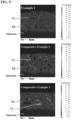
- FIGS. 1 and 2 The measurement was performed on a surface and a cross section of the tellurium-attached silver powder of Example 1 using an electron probe micro analyzer EPMA (apparatus name: JXA-8200 available from JEOL, Ltd.) at a magnification of 15,000 times. The results are shown in FIGS. 1 and 2.
- FIG. 1 is a diagram showing elemental mapping images of a surface of the silver powder of Example 1.
- FIG. 2 is a diagram showing elemental mapping images of a cross section of the silver powder of Example 1. As shown in FIGS. 1 and 2 , it was found that the Te component was attached to the surfaces of the silver particles, and the Te component was partially attached to the surfaces of the silver particles rather than uniformly.
- the amount of tellurium (Te) contained in the silver powder was measured. Specifically, the amount of silver was measured using a weight method (mass method) in which the tellurium-attached silver powder was completely dissolved in nitric acid, hydrochloric acid was then added to precipitate silver chloride, the precipitate was filtered, and the mass of silver chloride was measured. Also, the amount of Te was measured based on inductively coupled plasma (ICP) spectrometry (SPS 5100 available from SII Inc.) after the tellurium-attached silver powder was heated and dissolved in nitric acid. As a result, it was found that the amount of Te relative to the amount of silver was 1.3 mass%.
- ICP inductively coupled plasma
- tellurium in the form of a metal oxide, tellurium in the form of a metal, and tellurium in the form of an alloy were not distinguished therebetween because the measurement was performed after dissolving them, and the total amount of the metal component relative to the amount of silver was 1.3 mass%.
- the state of the surface of the tellurium-attached silver powder was analyzed using an ESCA apparatus (Model 5800 available from ULVAC-PHI, Inc.). Specifically, the measurement was performed to determine whether the tellurium constituting the adherent is in the form of an oxide, an elemental metal or an alloy. As the measurement condition, the analysis area was set to 800 ⁇ m ⁇ , and the applied power was set to 150.0 W.
- the total amount of the metal component relative to the amount of silver was 1.3 mass%, from which the amount of the metal component (Te) constituting the Te oxide was calculated to be 0.48 mass% relative to the amount of silver.
- the tellurium-attached silver powder of Example 1 was subjected to particle size distribution measurement. Specifically, 0.1 g of the tellurium-attached silver powder was dispersed in isopropyl alcohol (IPA), which was then stirred for 2 minutes using a biomixer (Model BM-4) available from Nihonseiki Kaisha Ltd., and then, the measurement was performed using a laser diffraction particle size distribution measurement apparatus (Microtrac MT 3300 EXII available from Nikkiso Co., Ltd.). As a result, the cumulative 10% particle size (D10) was 1.11 ⁇ m, the cumulative 50% particle size was 1.77 ⁇ m, and the cumulative 90% particle size (D90) was 2.93.
- IPA isopropyl alcohol
- the tellurium-attached silver powder of Example 1 was subjected to specific surface area measurement. Specifically, using a BET specific surface area measurement apparatus (Macsorb HM-model 1210 available from Mountech Co., Ltd.), a Ne-N 2 mixed gas (30% nitrogen) was allowed to flow into the measurement apparatus at 60°C for 10 minutes for degassing. After that, the measurement was performed based on the BET single point method. As a result, the specific surface area of the tellurium-attached silver powder of Example 1 was 0.52 m 2 /g.
- a BET specific surface area measurement apparatus Macsorb HM-model 1210 available from Mountech Co., Ltd.
- a conductive paste was produced in the manner described below using the tellurium-attached silver powder of Example 1.
- the tellurium-attached silver powder of Example 1 (the amount of tellurium relative to the amount of silver was 1.3 mass%) and a silver powder that did not contain an adherent containing a metal (AG-4-8F available from DOWA High-tech Co., Ltd.) in a total amount of 89.6 mass%, 6.2 mass% of a vehicle for high speed printing (a mixture of terpineol, texanol, and butyl carpitol acetate) as an organic binder, 1.0 mass% of wax (castor oil), 0.4 mass% of dimethylpolysiloxane 100 cs, 0.2 mass% of triethanolamine, 0.2 mass% of oleic acid, 2.0 mass% of a Pb-Te-Bi glass frit, and 0.4 mass% of a solvent (a mixture of terpineol and texanol) were stirred and mixed at
- the resulting mixture was allowed to pass through a three-roll mill (EXAKT 80S) with a roll gap being set to 100 ⁇ m to 20 ⁇ m, and the mixture was thus kneaded to obtain a conductive paste.
- the ratio of the tellurium-attached silver powder relative to the silver powder was adjusted such that the amount of tellurim was 0.015 mass% relative to the total amount of silver contained in the conductive paste.
- the conductive pattern was formed in the manner described below. First, a 154 mm solid pattern was formed on a silicon substrate for a solar cell (100 ⁇ / ⁇ ) by applying an aluminum paste (ALSOLAR 14-7021 available from Toyo Aluminium K.K.) to the back side of the substrate using a screen printing machine (MT-320TV available from Micro-tec Co., Ltd.). Next, the conductive paste was filtered through a 500 ⁇ m mesh, and then, a finger electrode with a width of 27 ⁇ m on a board design basis and four busbar electrodes, each having a width of 0.95 mm on a board design basis, were printed on the surface side of the substrate at a squeegee speed of 350 mm/sec.
- ALSOLAR 14-7021 available from Toyo Aluminium K.K.
- MT-320TV available from Micro-tec Co., Ltd.
- the substrate was heated with hot air at 200°C for 10 minutes and then fired at a peak temperature of 770°C for an in-out time of 41 seconds using a fast firing IR furnace (Fast Firing Test Four-Chamber Furnace available from NGK Insulators, Ltd.). In this way, a conductive pattern was obtained.
- the conductivity and the adhesive strength of the conductive pattern were measured in the manner described below.
- the conductivity of the conductive pattern was evaluated based on series resistance value and conversion efficiency. Specifically, the series resistance value of the obtained conductive pattern was measured using a digital multimeter (R6551 available from Advantest Corporation). Furthermore, the conversion efficiency of the conductive pattern was measured using a solar simulator (WXS-156S-10, AM 1.5 G available from Wacom Manufacturing Co., Ltd.).
- the adhesive strength of the conductive pattern was evaluated based on a peel strength obtained by peeling the conductive pattern from the substrate. Specifically, the silicon substrate was divided into a size of about 6 cm ⁇ 6 cm, and then, a double-sided adhesive tape was attached to the back side of the substrate, and the substrate was fixed. Then, a non-halogen non-rosin based flux was applied to busbar portions on the surface of the substrate using a cotton swab. Next, on a hot plate set at 50°C, a solder ribbon (with a width of 0.9 mm) was placed on the busbars, and the flux was again applied thereto.
- a soldering iron (set at a temperature of 380°C) was pressed against an end of the solder ribbon from above the solder ribbon, and moved to the other end of the solder ribbon to solder them together for about 2 to 3 seconds. Then, peel strength (180° peel strength) was measured using a universal tensile testing machine EZ-SX (at a test speed of 15 mm/sec and a stroke of 100 mm) available from Shimadzu Corporation by peeling the solder ribbon in a 180° opposite direction.
- EZ-SX at a test speed of 15 mm/sec and a stroke of 100 mm
- a cross section of the conductive pattern that has undergone firing was observed to analyze the distribution of Te atoms based on EPMA.
- the measurement was performed using an electron probe micro analyzer EPMA (apparatus name: JXA-8200 available from JEOL, Ltd.) at a magnification of 3,000 times.
- Example 2 a aqueous solution of silver-ammine complex, an aqueous solution of formaldehyde, and an aqueous solution of tellurium were prepared in the same manner as in Example 1. Furthermore, an aqueous solution of reducing agent for post-addition was prepared by adding 10.0 g of 20% aqueous solution of sodium hydroxide to 71.5 g of 21.0% aqueous solution of formaldehyde.
- Example 2 as in Example 1, the aqueous solution of formaldehyde and the aqueous solution of tellurium were added to the aqueous solution of silver-ammine complex, and 10 seconds after the addition of the aqueous solution of tellurium, the aqueous solution of reducing agent for post-addition was further added to facilitate the reduction. Then, one minute later, 6.01 g of a solution of ethanol stearate at a concentration of 1.55 mass% was added to the slurry containing silver particles to terminate the reduction reaction, and the stirring was stopped to cause the silver particles to settle. After that, the slurry was subjected to filtering, washing, drying, and crushing in the same manner as in Example 1. In this way, a tellurium-attached silver powder of Example 2 was obtained.
- the tellurium-attached silver powder of Example 2 was subjected to measurement to determine the amount of tellurium (Te) contained in the silver powder in the same manner as in Example 1, and it was found that the amount of tellurium (Te) relative to the amount of silver was 3.0 mass%. Also, ESCA measurement was performed, and it was confirmed that elemental metal Te was not present in the adherent, and the adherent was 100% TeO 2 .
- the adherent was subjected to elemental mapping using a field-emission transmission electron microscope (HF-2200 available from Hitachi High-Technologies Corporation), and it was found that Ag, Te, and oxygen were uniformly distributed in the layer of the adherent with a relationship of 1:1:2 in terms of atom%. From the foregoing, it can be expected that Ag and TeO 2 are present in an amorphous state in the adherent. Also, the particle size distribution was measured in the same manner as in Example 1, and it was found that the particle size D10 was 1.1 ⁇ m, the particle size D50 was 1.7 ⁇ m, and the particle size D90 was 2.7 ⁇ m. Also, the specific surface area of the tellurium-attached silver powder was measured in the same manner as in Example 1, and it was found that the specific surface area was 0.68 m 2 /g.
- a conductive paste and a conductor pattern were produced and evaluated in the same manner as in Example 1, except that the silver powder of Example 2 was used.
- Example 3 a tellurium-attached silver powder of Example 3 was obtained by performing the same operations as those performed in Example 2, except that the amount of tellurium dioxide added was increased from 3.4 g to 5.7 g when preparing an aqueous solution of tellurium.
- the tellurium-attached silver powder of Example 3 was subjected to measurement to determine the amount of tellurium (Te) contained in the silver powder in the same manner as in Example 1, and it was found that the amount of tellurium (Te) relative to the amount of silver was 3.6 mass%. Also, ESCA measurement was performed, and it was confirmed that, as in Example 2, elemental metal Te was not present in the adherent, and the adherent was 100% TeO 2 . Also, it was expected that Ag and TeO 2 were present in an amorphous state in the adherent.
- the particle size distribution was measured in the same manner as in Example 1, and it was found that the particle size D10 was 1.1 ⁇ m, the particle size D50 was 1.7 ⁇ m, and the particle size D90 was 2.7 ⁇ m. Also, the specific surface area of the tellurium-attached silver powder was measured in the same manner as in Example 1, and it was found that the specific surface area was 0.68 m 2 /g.
- a conductive paste and a conductor pattern were produced and evaluated in the same manner as in Example 1, except that the silver powder of Example 3 was used.
- Example 4 a bismuth-attached silver powder of Example 4 was produced by performing the same operations as those performed in Example 2, except that an aqueous solution of bismuth was used instead of the aqueous solution of tellurium.
- the aqueous solution of bismuth was prepared by adding and dissolving 4.367 g of bismuth nitrate pentahydrate (available from Wako Pure Chemical Industries, Ltd., the purity of bismuth nitrate pentahydrate > 99.5%) in 10 g of an aqueous solution of sodium hydroxide at a concentration of 20 mass%.
- FIG. 3 is a diagram showing elemental mapping images of a surface of the silver powder obtained in Example 4.
- FIG. 4 is a diagram showing elemental mapping images of a cross section of the silver powder obtained in Example 4. As shown in FIGS. 3 and 4 , it was found that the Bi component was attached to the surfaces of the silver particles, and the Bi component was partially attached to the surfaces of the silver particles rather than uniformly.
- the bismuth-attached silver powder of Example 4 was subjected to measurement to determine the amount of bismuth (Bi) contained in the silver powder in the same manner as in Example 1, and it was found that the amount of bismuth (Bi) relative to the amount of silver was 3.0 mass%. Also, ESCA measurement was performed, and it was confirmed that elemental metal Bi was not present in the adherent, and the adherent was 100% Bi 2 O 3 . Also, the particle size distribution was measured in the same manner as in Example 1, and it was found that the particle size D10 was 1.3 ⁇ m, the particle size D50 was 1.9 ⁇ m, and the particle size D90 was 2.9 ⁇ m. Also, the specific surface area of the bismuth-attached silver powder was measured in the same manner as in Example 1, and it was found that the specific surface area was 0.60 m 2 /g.
- a conductive paste and a conductor pattern were produced and evaluated in the same manner as in Example 1, except that the silver powder of Example 4 was used.
- Comparative Example 1 a conductive paste was produced and evaluated in the same manner as in Example 1, except that only a silver powder free of an adherent containing a metal was added without using the tellurium-attached silver powder.
- Comparative Example 2 a conductive paste was produced and evaluated in the same manner as in Example 1, except that, instead of the tellurium-attached silver powder, a metallic tellurium powder (with a purity of 99.9% available from Kojundo Chemical Lab. Co., Ltd.) was mixed such that the amount of tellurium was 0.015 mass% relative to the total amount of silver contained in the conductive paste.
- a metallic tellurium powder (with a purity of 99.9% available from Kojundo Chemical Lab. Co., Ltd.) was mixed such that the amount of tellurium was 0.015 mass% relative to the total amount of silver contained in the conductive paste.
- a conductive paste was produced and evaluated in the same manner as in Example 1, except that, instead of the tellurium-attached silver powder, a tellurium dioxide powder (a tellurium dioxide powder with a purity of 99.9% available from Wako Pure Chemical Industries, Ltd.) was mixed such that the amount of tellurium was 0.015 mass% relative to the total amount of silver contained in the conductive paste.
- a tellurium dioxide powder a tellurium dioxide powder with a purity of 99.9% available from Wako Pure Chemical Industries, Ltd.
- Table 1 shows the specific surface area, the particle size distribution, the amount of metal component relative to the amount of silver in the adherent, and the result of state analysis of the adherent based on ESCA for each of the silver powders obtained in Examples 1 to 4.
- Table 1 also shows the specific surface area and the particle size distribution of an adherent-free silver powder (AG-4-8F available from DOWA High-tech Co., Ltd.).
- Table 2 shows the conversion efficiency, the series resistance, and the peel strength for each of the conductor patterns produced using the silver powders of Examples 1 to 4 and the silver powders of Comparative Examples 1 to 3.
- Table 1 Silver powder Specific surface area [m 2 /g] D10 [ ⁇ m] D50 [ ⁇ m] D90 [ ⁇ m] Amount of metal component relative to amount of silver in adherent and Result of state analysis based on ESCA
- Example 2 0.68 1.1 1.7 2.7 3.0 wt% Te (100% TeO 2 )
- Example 3 0.68 1.1 1.7 2.7 3.6 wt% Te (100% TeO 2 )
- Example 4 0.60 1.3 1.9 2.9 3.0 wt% Bi (100% Bi 2 O 3 ) AG-4-8F 0.44 1.2 1.9 3.0 -
- the amount of the metal component relative to the amount of silver contained in the adherent was within a range of 0.1 mass% or more and 10 mass% or less. Also, it was confirmed that, in the silver powders obtained in Examples 1 to 4 that contained an adherent, the specific surface area was larger than that of the adherent-free silver powder (AG-4-8F).
- FIG. 5 is a diagram showing elemental mapping images of cross sections of the conductor patterns of Example 1, Comparative Example 2, and Comparative Example 3. It was confirmed, from FIG. 5 , that a conductive pattern (blue: made mainly of silver) including gaps (black) was formed on the substrate (dark blue), and the Te component (light blue, yellow green, and yellow) was distributed in the conductive pattern. Specifically, it was found that, in Comparative Examples 2 and 3, more Te component-present portions (yellow green and yellow) were observed, and the Te component was unevenly distributed, as compared with Example 1.
- Example 1 it was also found that, as in Example 1, by using the silver powder that includes an adherent that contains a metal oxide that has a melting point lower than the melting point of silver on the surfaces of silver particles, it is possible to obtain a conductive pattern in which the metal component that constitutes the metal oxide is appropriately dispersed. As a result, the conductive pattern can have a high adhesive strength.
Landscapes
- Chemical & Material Sciences (AREA)
- Chemical Kinetics & Catalysis (AREA)
- General Chemical & Material Sciences (AREA)
- Engineering & Computer Science (AREA)
- Organic Chemistry (AREA)
- Materials Engineering (AREA)
- Geochemistry & Mineralogy (AREA)
- Life Sciences & Earth Sciences (AREA)
- Dispersion Chemistry (AREA)
- Spectroscopy & Molecular Physics (AREA)
- Physics & Mathematics (AREA)
- Metallurgy (AREA)
- Mechanical Engineering (AREA)
- Manufacturing & Machinery (AREA)
- Crystallography & Structural Chemistry (AREA)
- Conductive Materials (AREA)
- Powder Metallurgy (AREA)
- Non-Insulated Conductors (AREA)
- Adhesives Or Adhesive Processes (AREA)
Abstract
Description
- The present invention relates to a silver powder, a method for producing the same, and a conductive paste.
- In recent years, there is a demand for a silver powder-containing conductive paste that can form a fine-line structure in which a highly dense conductor pattern with miniaturized electronic components and a reduction in the wire thickness are achieved. Also, in order to increase the light collection area of a solar cell to improve the power generation efficiency of the solar cell, a finger electrode that has the fine-line structure is required.
- As the conductive paste, for example, a conductive paste that contains, as an additive, a low-melting point metal such as metallic tellurium or a tellurium oxide has been proposed (see, for example, Patent Document 1). By containing a low-melting point metal, when the conductive paste is used to form, for example, an electrode of a solar cell, the contact resistance of the solar cell can be improved. As used herein, the term "low-melting point metal" refers to a metal that has a melting point of 500°C or less. Examples of the low-melting point metal include zinc (with a melting point of 419.6°C), lead (with a melting point of 327.5°C), tin (with a melting point of 231.97°C), bismuth (with a melting point of 271.3°C), tellurium (with a melting point of 449.5°C), and selenium (with a melting point of 217°C). Furthermore, it is possible to use, instead of the low-melting point metal, a substance (a low-melting point metal-based compound such as tellurium dioxide) that has a melting point less than or equal to the firing temperature of the conductive paste, or a substance that causes a chemical reaction (physical change) at a temperature less than or equal to the firing temperature of the conductive paste.
- Also, for example, as the conductive paste, a conductive paste that contains, as an additive, a tellurium alloy compound such as silver telluride has also been proposed (see, for example, Patent Document 2).
-
- Patent Document 1:
WO 2010/016186 - Patent Document 2:
JP 2018-190967A - In the fine-line structure in which a highly dense conductor pattern and a reduction in the wire thickness are achieved, in order to suppress the conductor resistance while reducing the contact area, there is a demand for an increase in the electrode height (aspect ratio) relative to the contact width.
- Also, in order to enhance the reliability of the conductive pattern, the conductive pattern is required to have a high adhesive strength with respect to an underlying layer. For example, in the case of a solar cell, there is a problem such as separation of electrodes such as a finger electrode and a busbar electrode, and these electrodes are required to have a high adhesive strength with respect to an Si surface or an SiN surface that serves as the underlying layer.
- However, in the conductive pastes disclosed in
Patent Documents - It is an object of the present invention to provide a silver powder that can provide a high adhesive strength when the silver powder is used to form a conductive pattern, and a method for producing the silver powder, and a conductive paste that contains the silver powder.
- The inventors of the present application conducted studies on why it is not possible to increase the adhesive strength of the conductive pattern when the conductive pattern is formed using a conductive paste that contains a low-melting point metal oxide powder together with silver particles. They considered that the reduction in the adhesive strength is caused by the difference in specific gravity between silver and the metal oxide powder. The specific gravity of the low-melting point metal oxide is smaller than the specific gravity (about 10.5 g/cm3) of silver. The silver powder particles and the metal oxide powder particles can freely migrate in the conductive paste, and thus the particles with a large specific gravity aggregate together and the particles with a small specific gravity aggregate together before or after application of the conductive paste, which may cause the silver particles and the metal oxide powder particles to be distributed unevenly.
- Some metal oxides have the effect of lowering the softening point temperature of a glass frit that is mixed with the conductive paste. As a result of the softening point temperature of the glass frit being lowered, when the coating film is fired, glass particles can flow rapidly and migrate to the interface between the film and the substrate to form a strong bond and ensure adhesion strength before the silver particles are sintered. If the metal oxide powder particles are distributed unevenly, a variation occurs in the softening point temperature of the glass, as a result of which, it is expected that the effect of lowering the softening point temperature of the glass frit cannot be effectively exhibited. Furthermore, the inside of the conductive pattern film becomes nonuniform after firing, which may increase the possibility of breakage of the film caused by contact points between different phases. Accordingly, the inventors of the present application considered that, as long as the metal oxide powder particles are evenly distributed in the film, the contact points that cause the breakage of the film due to the inside of the conductive pattern film becoming nonuniform can be reduced to improve the strength of the conductive pattern.
- In view of the above, the inventors of the present application conducted studies on a method for suppressing an uneven distribution of silver particles and low-melting point metal oxide powder particles, and they paid an attention to a method in which a low-melting point metal oxide is attached in advance to the surfaces of silver particles that have a large specific gravity as an adherent. The inventors of the present application found that, by attaching a low-melting point metal oxide to silver particles as described above, even when the resulting silver powder is incorporated in a conductive paste, it is possible to suppress an uneven distribution of the low-melting point metal oxide particles caused by the difference in specific gravity, and increase the adhesive strength of the conductive pattern. As a result, even when the conductive pattern is formed at a high aspect ratio, it is possible to reduce separation of electrodes.
- The following aspects have been made based on the findings described above.
- A first aspect of the present invention relates to a silver powder including: silver particles; and an adherent that is attached to surfaces of the silver particles and contains a metal oxide that has a melting point lower than a melting point of silver.
- A second aspect of the present invention is configured such that, in the first aspect, the metal oxide is at least one of a Te oxide, a Bi oxide, a Pb oxide, a Tl oxide, and a V oxide.
- A third aspect of the present invention is configured such that, in the first or second aspect, an amount of a metal component that constitutes the metal oxide is 0.01 mass% to 10 mass% relative to an amount of silver.
- A fourth aspect of the present invention is configured such that, in any one of the first to third aspects, the adherent includes a first adherent that contains the metal oxide and a second adherent that contains a metal that is the metal component that constitutes the metal oxide or an alloy made of the metal component and silver.
- A fifth aspect of the present invention is configured such that, in the fourth aspect, the metal component is at least one of Te, Bi, Pb, Tl, and V
- A sixth aspect of the present invention is configured such that, in any one of the first to fifth aspect, a total amount of the metal component, excluding silver, that constitutes the metal oxide of the adherent is 0.1 mass% to 10 mass% relative to an amount of silver.
- A seventh aspect of the present invention relates to a method for producing the silver powder according to the first aspect, the method including the step of: adding a reducing agent and an aqueous solution that contains a metal component that constitutes a metal oxide that has a melting point lower than a melting point of silver to a silver complex solution, wherein the metal oxide of the metal component is deposited on the surfaces of the silver particles to attach the metal oxide of the metal component to the surfaces of the silver particles while the silver particles are deposited through reduction.
- An eighth aspect of the present invention relates to a conductive paste including: the silver powder according to any one of the first to sixth aspects; a silver powder that is free of an adherent that contains a metal on a surface of the silver powder; an organic binder; a glass frit; and a solvent.
- A ninth aspect of the present invention is configured such that, in the eighth aspect, an amount of the metal component that constitutes the metal oxide contained in the silver powder according to any one of the first to sixth aspects is 0.001 mass% to 0.03 mass% relative to an amount of silver contained in the conductive paste.
- It is possible to obtain a high adhesive strength when a conductive pattern is formed.
-
-
FIG. 1 is a diagram showing elemental mapping images of a surface of a silver powder obtained in Example 1. -
FIG. 2 is a diagram showing elemental mapping images of a cross section of the silver powder obtained in Example 1. -
FIG. 3 is a diagram showing elemental mapping images of a surface of a silver powder obtained in Example 4. -
FIG. 4 is a diagram showing elemental mapping images of a cross section of the silver powder obtained in Example 4. -
FIG. 5 is a diagram showing elemental mapping images of cross sections of conductor patterns obtained in Example 1, Comparative Example 2, and Comparative Example 3. - Hereinafter, one embodiment of the present invention will be described. In the specification of the present application, the expression "silver particles" is used when indicating individual silver particles, and the expression "silver powder" is used when treating a large number of silver particles as a collection of silver particles. Also, the range of numerical values indicated by the use of "to" means that the numeral values indicated before and after "to" are included as the lower limit value and the upper limit value.
- A silver powder is incorporated in a conductive paste for forming conductive patterns such as electrodes and circuits in electronic components (for example, solar cells or the like). A silver powder according to the present embodiment is a metal oxide-attached silver powder that contains silver particles and an adherent that is attached to the surfaces of the silver particles and contains a metal oxide that has a melting point lower than the melting point of silver.
- The adherent contains a metal oxide that has a melting point lower than the melting point of silver. The adherent lowers the softening point temperature of a glass frit that is contained in the conductive paste during the process of sintering the conductive paste. By lowering the softening point temperature of the glass, it is possible to facilitate glass particles to flow rapidly and evenly migrate to the interface between a coating film and a substrate before the silver particles are sintered. As a result, micro-cracks can be reduced in a conductor pattern obtained after firing to increase the strength of the conductor pattern, and also increase the adhesive strength with respect to an underlying layer.
- The adherent is attached to the silver particles to cover a portion of or the entire surfaces of the silver particles. It is preferable that the adherent is distributed in a dotted manner on the surfaces of the silver particles to cover a portion of the surfaces of the silver particles. Here, the term "attach" refers to a state in which the adherent is more firmly attached to the surfaces of the silver particles as compared with a state in which the adherent simply adheres to the surfaces of the silver particles. In the case where a silver powder and a low-melting point metal oxide powder are simply mixed, if the metal oxide powder adheres to the surfaces of the silver particles, the metal oxide powder easily detaches from the surfaces of the silver particles. In the present embodiment, as will be described later, a low-melting point metal oxide is deposited such that the low-melting point metal oxide is attached to the surfaces of the silver particles when the silver particles are deposited through reduction. For this reason, the adherent can be attached to the silver particles at such a strength that, for example, the adherent does not separate from the surfaces of the silver particles even when the metal oxide-attached silver powder is crushed. With this configuration, even when the metal oxide-attached silver powder is mixed and kneaded with the conductive paste, the adherent can remain present together with the silver particles. That is, an uneven distribution of the silver particles and the low-melting point metal oxide can be suppressed.
- The adherent contains a metal oxide. There is no particular limitation on the metal oxide as long as the metal oxide has a melting point lower than the melting point of silver. However, it is preferable that the metal oxide is, for example, a tellurium (Te) oxide, a bismuth (Bi) oxide, a lead (Pb) oxide, a thallium (Tl) oxide, or a vanadium (V) oxide. Examples of the Te oxide, the Bi oxide, the Pb oxide, the Tl oxide, and the V oxide include TeO2 (with a melting point of 733°C), B2O3 (with a melting point of 817°C), Pb\\\O2 (with a melting point of 223°C), Pb3O4 (with a melting point of 686°C), PbO (with a melting point of 290°C), Tl2O3 (with a melting point of 717°C), and V2O5 (with a melting point of 690°C). These oxides have melting points lower than the melting point (962°C) of silver. Out of these, in particular, it is more preferable that the metal oxide is a tellurium (Te) oxide or a bismuth (Bi) oxide. Using these oxides, the softening point temperature of the glass frit that is added to the conductive paste can be lowered. Accordingly, for example, the gaps between silver particles can be easily filled with molten glass when the conductive paste is fired, which facilitates the silver particles to adhere and fuse with each other. As a result, the strength of the conductor pattern can be improved. In addition thereto, the contact resistance of the conductor pattern can be reduced by fire-through.
- The adherent of the present embodiment may include a first adherent that contains the above-described metal oxide and a second adherent that is different from the first adherent. The second adherent contains a metal that is the metal component that constitutes the metal oxide contained in the first adherent or an alloy made of the metal component and silver. In the case where the metal oxide contained in the first adherent is a Te oxide, a Bi oxide, a Pb oxide, a Tl oxide, or a V oxide, the second adherent may contain an elemental metal such as Te, Bi, Pb, Tl, or V, or an alloy made of any one of the elemental metals and silver. For example, in the case where the first adherent contains a Te oxide, the second adherent may contain elemental metal Te or an Ag-Te alloy. Furthermore, the adherent may contain silver together with the metal oxide, and the metal oxide and silver may be in an amorphous state.
- In the surfaces of the silver particles, the ratio of the first adherent to the second adherent is preferably 1:9 to 10:0 (the proportion of the first adherent is preferably 10 to 100%), and more preferably 1:9 to 9:1 (the proportion of the first adherent is more preferably 10 to 90%). The term "the ratio of the first adherent to the second adherent" used herein indicates the ratio of the number of atoms of the metal component that constitutes the first adherent to the number of atoms of the metal component that constitutes the second adherent. When the second adherent is contained, the adhesion between the first adherent and the surfaces of the silver particles can be further increased. The ratio of the number of atoms of the metal component that constitutes the metal oxide contained in the first adherent to the number of atoms of the metal component (excluding silver in the alloy) contained in the second adherent is determined from results of measurement performed by analyzing the state of the surfaces of the silver particles based on ESCA. In the ESCA measurement, a sample in which silver particles are densely present is used, and measurement is performed on the surfaces of a plurality of silver particles (for example, 100 or more silver particles) by setting the analysis area to, for example, 800 µmϕ.
- Tellurium is a metalloid element. However, in the specification of the present application, for the sake of convenience, it will be treated as a metal or a metal that is the metal component or the metal oxide, without distinguishing it from other metal elements.
- In the metal oxide-attached silver powder, the total amount of the metal component, excluding silver, that constitutes the metal oxide of the adherent is preferably 0.1 mass% to 10 mass%, and more preferably 0.1 mass% to 3 mass% relative to the amount of silver contained in the metal oxide-attached silver powder. As used herein, the total amount of the metal component, excluding silver, that constitutes the metal oxide refers to, in the case where, for example, the adherent is made of a metal component, or the adherent is made of a metal oxide and silver in an amorphous state, the amount of the metal component that constitutes the metal oxide. Also, in the case where, for example, the adherent includes a first adherent and a second adherent, the total amount of the metal component, excluding silver, that constitutes the metal oxide refers to the total amount of the metal component that constitutes the metal oxide contained in the first adherent and the metal component (excluding silver in the alloy) contained in the second adherent. In the case where the adherent includes a first adherent and a second adherent, in the total amount of the metal component, the proportion of the metal component that constitutes the metal oxide contained in the first adherent is preferably 10 to 100%, and the amount of the metal component that constitutes the metal oxide is preferably 0.01 mass% to 10 mass%, more preferably 0.01 mass% to 9 mass%, and even more preferably 0.1 mass% to 3 mass% relative to the amount of silver contained in the metal oxide-attached silver powder. By setting the amount of the metal component that constitutes the metal oxide to 0.01 mass% or more relative to the amount of silver, the advantageous effects produced by the low-melting point metal oxide can be reliably obtained. On the other hand, if the amount of the low-melting point metal oxide is too large, the resistance of the conductive pattern increases, which may impair conductivity. In this regard, by setting the amount of the metal component that constitutes the metal oxide to 10 mass% or less relative to the amount of silver, the conductivity of the conductor pattern can be maintained at a high level while obtaining the advantageous effects produced by the low-melting point metal oxide.
- The amount of silver contained in the metal oxide-attached silver powder and the total amount of the metal component that constitutes the metal oxide contained in the first adherent and the metal component, excluding silver, contained in the second adherent may be measured in the manner described below. The amount of silver may be measured based on a weight method (mass method) that includes completely dissolving the metal oxide-attached silver powder in nitric acid, adding hydrochloric acid to precipitate silver chloride, filtering the precipitate, and measuring the mass of silver chloride. The total amount of the metal component that constitutes the metal oxide contained in the first adherent and the metal component contained in the second adherent may be obtained by heating and dissolving the metal oxide-attached silver powder in nitric acid, completely dissolving the metal oxide-attached silver powder using aqua regia or the like, where necessary, and performing measurement based on inductively coupled plasma (ICP) spectrometry or the like. In the present embodiment, the measurement is performed using nitric acid as described above without distinguishing the first adherent and the second adherent from each other because the Te oxide is dissolved in nitric acid together with Te. However, in the case where the metal oxide is not at all dissolved in nitric acid and thus can be recovered as a precipitate, the amount of the metal component that constitutes the metal oxide in the first adherent may be determined from the amount of the metal oxide recovered through solid-liquid separation, and the amount of the metal component, excluding silver, contained in the second adherent may be determined from the filtrate.
- There is no particular limitation on the particle size of the metal oxide-attached silver powder. However, it is preferable that the volume-based cumulative 50% particle size (D50) is 0.5 µm to 4 µm. The particle size distribution may be obtained by dispersing 0.1 g of silver powder in isopropyl alcohol (IPA), stirring it for 2 minutes using a biomixer (Model BM-4) available from Nihonseiki Kaisha Ltd., and then performing measurement using a laser diffraction particle size distribution measurement apparatus (Microtrac MT 3300 EXII available from Nikkiso Co., Ltd). There is no particular limitation on the shape of an individual particle of the metal oxide-attached silver powder. However, the shape of an individual particle of the metal oxide-attached silver powder may be, for example, spherical, elliptic, flaky, or amorphous. There is no particular limitation on the specific surface area of the metal oxide-attached silver powder based on the BET single point method. However, the specific surface area is preferably, for example, 0.45 to 1.2 m2/g.
- Next, a method for producing the metal oxide-attached silver powder described above will be described.
- First, a silver complex solution for forming silver particles is prepared. The silver complex solution may be prepared by, for example, adding a complexing agent to an aqueous solution containing silver ions to generate a silver complex. The aqueous solution of silver complex may be, for example, an aqueous solution of silver-ammine complex, or the like.
- As the supply source of silver ions, a known supply source of silver ions can be used. For example, an inorganic silver salt such as silver nitrate, silver sulfate, silver carbonate, silver chloride, or silver oxide can be used. The concentration of silver ions in the aqueous solution is preferably 0.1 mass% to 10 mass% before adding a reducing agent, which will be described later.
- As the complexing agent for silver ions, for example, ammonia water, ammonium ions such as an ammonium salt, or a chelate compound such as an ethylene diamine tetraacetic acid (EDTA) salt can be used. Out of these, it is preferable to use ammonium ions because ammonium ions are likely to form a complex with silver ions, and can be easily washed away, and thus impurities are unlikely to remain. When ammonium ions are used as the complexing agent, a silver-ammine complex is formed in the aqueous solution. At this time, the coordination number of the ammine complex is 2, and thus 2 or more moles of ammonium ions may be added per mol of silver ions.
- Also, a reducing agent for reducing the silver complex to deposit silver particles is prepared. As the reducing agent, a conventionally known reducing agent can be used. For example, it is possible to use formalin, ascorbic acid, hydrazine, alkanolamine, hydroquinone, oxalic acid, formic acid, aldehyde, alcohol, organic substances of saccharides, lower oxides of metals, sodium borohydride, and the like. Out of these, it is preferable to use ascorbic acid, glucose, formaldehyde, hydrazine, and hydrazine carbonate, and it is more preferable to use formaldehyde, hydrazine, and hydrazine carbonate because they have stable reactivity and can rapidly reduce silver. The reducing agents may be used alone or in a combination of two or more.
- Also, in the present embodiment, in order to form, on the surfaces of the silver particles, an adherent that contains a metal oxide that has a melting point lower than the melting point of silver, an aqueous solution that contains a metal component that constitutes a metal oxide that has a melting point lower than the melting point of silver (or in other words, a metal component that forms a metal oxide that has a melting point lower than the melting point of silver when it is oxidized) is prepared. Specifically, the aqueous solution that contains the metal component may be prepared by dissolving, for example, an oxide of a metal selected from Te, Bi, Pb, Tl, and V, or an inorganic salt such as a nitric salt in water. The aqueous solution becomes acidic or basic as a result of an inorganic salt that contains the metal component being dissolved. From the viewpoint of preventing the pH of the aqueous solution of silver complex from being varied significantly, it is preferable that the aqueous solution has a pH of 9 or more and is basic. In the case where an aqueous solution obtained by dissolving an inorganic salt that contains the metal component is acidic, an alkali solution such as NaOH may be added in advance before a reduction takes place so as to adjust the pH to 9 or more.
- Next, the reducing agent and the aqueous solution that contains the metal component are added to the silver complex solution. By adding the reducing agent, silver particles are deposited through reduction from the silver complex. Also, by adding the aqueous solution that contains the metal component, the metal is deposited on the surface of deposited silver particles, and an adherent that contains an oxide of the metal can be formed. In this way, a slurry that contains a metal oxide-attached silver powder is obtained.
- There is no particular limitation on the amount of the reducing agent added. However, from the viewpoint of increasing the yield of silver, the amount of the reducing agent added is preferably 1 equivalent or more relative to the amount of silver.
- As a method for adding the reducing agent, from the viewpoint of suppressing aggregation of the metal oxide-attached silver powder deposited through reduction, it is preferable to add the reducing agent at a rate of 1 equivalent/min or more relative to the amount of silver ions. Also, it is preferable that the reaction solution is stirred during a period from the time when the reducing agent is added to the time when the deposition through reduction ends. Also, the temperature of the reaction solution during reduction is preferably 5°C to 80°C, and more preferably 5°C to 40°C.
- As a method for adding the aqueous solution that contains the metal component, the aqueous solution may be added during a period from the time when the reducing agent is added to the time when deposition of silver particles ends. In particular, the aqueous solution may be added during a period in which the reducing power of the reducing agent added to the aqueous solution of silver complex lasts. For example, the aqueous solution may be added within several seconds after the reducing agent has been added. Also, for example, the reducing agent may be added after the start of adding the aqueous solution to the aqueous solution of silver complex in advance. On the other hand, if the addition of the aqueous solution is excessively delayed after the reducing agent has been added, the grain growth of the silver particles preferentially takes place, and thus the deposition of the metal component on the surfaces of the silver particles is inhibited, as a result of which, it may not be possible to form an adherent.
- Also, the reducing agent and the aqueous solution that contains the metal component may be added to the silver complex solution, and the reducing agent may be further added after the metal oxide-attached silver powder starts to be deposited. By further adding the reducing agent, the attachment of the metal oxide can be promoted.
- A surface treatment agent may be added to the obtained slurry as needed. Using the surface treatment agent, it is possible to maintain the dispersion of the metal oxide-attached silver powder. As the surface treatment agent, a conventionally known surface treatment agent such as, for example, a fatty acid or a salt thereof can be used.
- Next, the obtained slurry is filtered to recover the metal oxide-attached silver powder. After that, the recovered metal oxide-attached silver powder is washed with water. It is preferable to wash the metal oxide-attached silver powder with water until the electrical conductivity of the liquid that has passed through the metal oxide-attached silver powder reaches 0.2 mS/m or less.
- Next, the water-washed metal oxide-attached silver powder is dried by, for example, vacuum drying. As the drying condition, for example, the metal oxide-attached silver powder may be dried at 73°C for 10 hours. Through the drying, a dried powder is obtained. In the dried powder, a portion of or the entire metal component contained in the adherent may be oxidized.
- Next, the obtained dried powder is crushed to obtain a metal oxide-attached silver powder of the present embodiment. In the metal oxide-attached silver powder, the adherent is attached to the surfaces of the silver particles, and thus even when the metal oxide-attached silver powder is crushed, detachment of the adherent can be suppressed.
- Next, the conductive paste will be described.
- The conductive paste according to the present embodiment includes: a silver powder (metal oxide-attached silver powder) that includes an adherent as described above on the surfaces of silver particles; a silver powder that is free of an adherent that contains a metal on the surface thereof; an organic binder; a glass frit; and a solvent.
- As used herein, the term "silver powder that is free of an adherent that contains a metal on the surface thereof" described above refers to a silver powder that includes neither a first adherent such as the metal oxide-attached silver powder described above nor a second adherent on the surface thereof, and it is preferable that the silver powder does not contain a metal component other than silver on the surface thereof excluding unavoidable impurities from production. By incorporating the silver powder in the conductive paste, the proportion of the metal oxide-attached silver powder in the conductive paste is reduced. As a result, the amount of the metal component contained in the conductive paste can be reduced to reduce the resistance of the conductive pattern, and increase the conductivity of the conductive pattern. A conventionally known surface treatment agent, such as a fatty acid, that is known to be used in a silver powder may be attached to the surface of the silver powder that is free of an adherent that contains a metal on the surface thereof.
- There is no particular limitation on the silver powder that is free of an adherent that contains a metal on the surface thereof, and a conventionally known silver powder can be used. Also, the shape of the silver powder is not particularly limited, and can be selected as appropriate from various shapes such as, for example, a spherical shape, a flaky shape, a resin shape, and a wire shape. A plurality of silver powders with different shapes may be used together.
- There is no particular limitation on the ratio of the metal oxide-attached silver powder to the silver powder that is free of an adherent that contains a metal on the surface thereof that are added to the conductive paste. However, the ratio is preferably set such that the amount of metal component derived from the adherent in the metal oxide-attached silver powder is 0.001 mass% to 0.03 mass% relative to the total amount of silver in the conductive paste.
- As the organic binder, a known resin or a resin that has been dissolved in a solvent can be used. Examples include organic binders including: cellulose derivatives such as methyl cellulose, ethyl cellulose, and carboxymethyl cellulose; polivinyl alcohols; polyvinyl pyrrolidones; acrylic resin; alkyd resin; polypropylene resin; polyvinyl chloride resin; polyurethane resin; rosin resin; terpene resin; phenol resin; aliphatic petroleum resin; polyvinyl acetate resin; vinyl acetate-acrylic ester copolymers; and butyral resin derivatives such as polyvinyl butyral. These may be used alone or in a combination of two or more.
- As the glass frit, it is preferable to use a glass frit that mainly contains a component selected from lead (Pb), tellurium (Te), lithium (Li), zinc (Zn), silicon (Si), aluminum (Al), and bismuth (Bi). The glass frit may contain, as other components, sodium (Na), potassium (K), boron (B), tungsten (W), molybdenum (Mo), manganese (Mn), iron (Fe), vanadium (V), phosphorus (P), antimony (Sb), magnesium (Mg), calcium (Ca), strontium (Sr), barium (Ba), titanium (Ti), zirconium (Zr), lanthanum (La), and the like. The term "contain" is used when the amount of a component is 0.1 mass% or more in terms of ICP analysis value.
- The glass frit can be selected as appropriate according to the intended application of the conductive paste. For example, for a solar cell application, it is preferable to use a glass frit called a "Pb-Te-Bi glass frit". This glass frit is preferable because it moderately erodes an antireflection layer formed on the semiconductor layer of a solar cell and bonds a fired product of the conductive paste, or in other words, a silver electrode to the semiconductor layer.
- The solvent can be selected as appropriate according to the intended application of the conductive paste. For example, one or more solvent can be selected from among the following solvents and used: butyl carbitol acetate (BCA), butyl carbitol (BC), ethyl carbitol acetate (ECA), ethyl carbitol (EC), hexane, toluene, ethyl cellosolve, cyclohexanone, butyl cellosolve, butyl cellosolve acetate, diethylene glycol diethyl ether, diacetone alcohol, terpineol, methyl ethyl ketone, benzyl alcohol, methyl ethyl ketone, methyl isobutyl ketone, tetradecane, tetralin, propyl alcohol, isopropyl alcohol, dihydroterpineol, dihydroterpineol acetate, ethyl carbitol, 2,2,4-trimethyl-1,3-pentanediol monoisobutyrate (texanol), and the like. The amount of the solvent is preferably 1 to 40 mass% relative to the amount of the conductive paste.
- Also, the conductive paste may further contain components other than the components described above as needed. Examples of other components include a surfactant, a dispersing agent, a rheology modifier, a silane coupling agent, an ion collecting material, and the like.
- According to the present embodiment, one or more of the following advantageous effects can be obtained.
- As a comparative configuration, when, for example, a silver powder and a metal oxide powder that has a melting point lower than the melting point of silver are added to the conductive paste, and the conductive paste is applied to a substrate, particles with a large specific gravity aggregate together and particles with a small specific gravity aggregate together, resulting in an uneven distribution, and thus the metal oxide powder particles may be unevenly distributed. When the coating film in which the particles are unevenly distributed is subjected to firing, a variation occurs in the softening point temperature of the glass frit, which makes the film itself nonuniform and increases the possibility of breakage of the film caused by contact points between different phases. As a result, not only the strength of the resulting conductor pattern is lowered due to the occurrence of cracks, but also a sufficient adhesive strength with respect to the substrate cannot be ensured.
- In this regard, in the metal oxide-attached silver powder of the present embodiment, a metal oxide that has a melting point lower than the melting point of silver is attached to the surfaces of the silver particles. When the conductive paste that contains the metal oxide-attached silver powder is applied to a substrate, it is possible to suppress the uneven distribution of silver particles and low-melting point metal oxide particles in the coating film caused by the difference in specific gravity between silver and the low-melting point metal oxide. As a result, it is possible to reduce micro-cracks in the conductive pattern and increase the strength of the conductor pattern, and also increase the adhesive strength with respect to the substrate of the conductor pattern.
- The metal oxide that has a melting point lower than the melting point of silver contained in the adherent is preferably at least one of a Te oxide, a Bi oxide, a Pb oxide, a Tl oxide, and a V oxide. Using these oxides, excessive sintering of the silver particles can be more reliably suppressed, and thus the strength and the adhesive strength of the conductive pattern can be further increased. In addition thereto, the softening point temperature of the glass frit can be further lowered using a Te oxide and a Bi oxide, and thus the strength of the conductor pattern can be further increased.
- Also, in the case where the adherent contains only a metal oxide that has a melting point lower than the melting point of silver contained in the adherent, the amount of the metal oxide is preferably 0.01 mass% to 10 mass% relative to the amount of silver contained in the metal oxide-attached silver powder. Also, in the case where the adherent contains not only the first adherent that contains the metal oxide but also a second adherent that contains a metal component that constitutes a metal oxide or an alloy made of the metal component and silver, the total amount of the metal component is preferably 0.1 mass% to 10 mass% relative to the amount of silver contained in the metal oxide-attached silver powder. With the amount described above, it is possible to obtain the effect of improving the strength and the adhesive strength of the conductor pattern produced by the metal oxide while suppressing a reduction in conductivity caused by the metal oxide.
- Next, the present invention will be described in further detail based on examples. However, the present invention is not limited to the examples given below.
- A silver complex solution was first prepared. Specifically, an aqueous solution of silver-ammine complex was obtained by placing 3670.1 g of an aqueous solution of silver nitrate at a silver concentration of 1.4 mass% in a glass beaker and adding 161.8 g of ammonia water at a concentration of 28 mass% (2.67 molar equivalent of ammonia relative to 1 mol of silver) to the aqueous solution of silver nitrate.
- An aqueous solution of formaldehyde at a concentration of 21.0 mass% was prepared as a reducing agent by diluting formalin with pure water. Furthermore, an aqueous solution of tellurium was prepared as an aqueous solution containing a metal component for forming a metal oxide that has a melting point lower than the melting point of silver when oxidized. The aqueous solution of tellurium was prepared by adding and dissolving 3.4 g of tellurium dioxide (a tellurium dioxide powder with a purity of 99.9% available from Wako Pure Chemical Industries, Ltd.) in 10 g of an aqueous solution of sodium hydroxide at a concentration of 20 mass% and 27 g of pure water.
- Next, 7.5 g of an aqueous solution of sodium hydroxide at a concentration of 20 mass% was added and stirred in the prepared aqueous solution of silver-ammine complex for 3 minutes. After that, 357.6 g (12.4 molar equivalent relative to 1 mol of silver) of an aqueous solution of formaldehyde was added as a reducing agent while stirring the aqueous solution of silver-ammine complex to deposit silver particles through reduction. The aqueous solution of tellurium was added 5 seconds after the start of adding the reducing agent. Through this, the tellurium oxide was attached to the surfaces of silver particles. One minute later, 6.01 g of solution of ethanol stearate at a concentration of 1.55 mass% was added to the slurry containing silver particles to terminate the reduction reaction, and the stirring was stopped to cause the silver particles to settle.
- Next, the slurry containing precipitated silver particles was filtered, water was passed through the precipitate on filter paper to wash the precipitate with water until the electrical conductivity of cleaning water that had passed through the precipitate reached 0.2 mS/m or less. After that, the precipitate was vacuum-dried at 73°C for 10 hours to obtain a dried powder. The obtained dried powder was introduced into a crushing machine (SK-10 model available from Kyoritsu Riko Co., Ltd.) to perform a crushing operation for 30 seconds two times. In this way, a tellurium-attached silver powder of Example 1 was obtained.
- The obtained tellurium-attached silver powder of Example 1 was subjected to the following measurements.
- The measurement was performed on a surface and a cross section of the tellurium-attached silver powder of Example 1 using an electron probe micro analyzer EPMA (apparatus name: JXA-8200 available from JEOL, Ltd.) at a magnification of 15,000 times. The results are shown in
FIGS. 1 and 2. FIG. 1 is a diagram showing elemental mapping images of a surface of the silver powder of Example 1.FIG. 2 is a diagram showing elemental mapping images of a cross section of the silver powder of Example 1. As shown inFIGS. 1 and 2 , it was found that the Te component was attached to the surfaces of the silver particles, and the Te component was partially attached to the surfaces of the silver particles rather than uniformly. - The amount of tellurium (Te) contained in the silver powder was measured. Specifically, the amount of silver was measured using a weight method (mass method) in which the tellurium-attached silver powder was completely dissolved in nitric acid, hydrochloric acid was then added to precipitate silver chloride, the precipitate was filtered, and the mass of silver chloride was measured. Also, the amount of Te was measured based on inductively coupled plasma (ICP) spectrometry (SPS 5100 available from SII Inc.) after the tellurium-attached silver powder was heated and dissolved in nitric acid. As a result, it was found that the amount of Te relative to the amount of silver was 1.3 mass%. In this measurement, tellurium in the form of a metal oxide, tellurium in the form of a metal, and tellurium in the form of an alloy were not distinguished therebetween because the measurement was performed after dissolving them, and the total amount of the metal component relative to the amount of silver was 1.3 mass%.
- The state of the surface of the tellurium-attached silver powder (at a depth of about several nanometers from the surface of the sample) was analyzed using an ESCA apparatus (Model 5800 available from ULVAC-PHI, Inc.). Specifically, the measurement was performed to determine whether the tellurium constituting the adherent is in the form of an oxide, an elemental metal or an alloy. As the measurement condition, the analysis area was set to 800 µmϕ, and the applied power was set to 150.0 W. As a result, it was found that at least elemental metal Te (or alloyed Te) and TeO2 existed together on the surface of the tellurium-attached silver powder, and the ratio of the number of Te atoms between the elemental metal Te (or the alloyed Te) and TeO2 was 12:7. In the state analysis, the state of the surface of the tellurium-attached silver powder was identified based on the difference in atomic binding energy, and thus it was not possible to make a distinction between elemental metal Te and alloyed Te.
- The total amount of the metal component relative to the amount of silver was 1.3 mass%, from which the amount of the metal component (Te) constituting the Te oxide was calculated to be 0.48 mass% relative to the amount of silver.
- The tellurium-attached silver powder of Example 1 was subjected to particle size distribution measurement. Specifically, 0.1 g of the tellurium-attached silver powder was dispersed in isopropyl alcohol (IPA), which was then stirred for 2 minutes using a biomixer (Model BM-4) available from Nihonseiki Kaisha Ltd., and then, the measurement was performed using a laser diffraction particle size distribution measurement apparatus (Microtrac MT 3300 EXII available from Nikkiso Co., Ltd.). As a result, the cumulative 10% particle size (D10) was 1.11 µm, the cumulative 50% particle size was 1.77 µm, and the cumulative 90% particle size (D90) was 2.93.
- The tellurium-attached silver powder of Example 1 was subjected to specific surface area measurement. Specifically, using a BET specific surface area measurement apparatus (Macsorb HM-model 1210 available from Mountech Co., Ltd.), a Ne-N2 mixed gas (30% nitrogen) was allowed to flow into the measurement apparatus at 60°C for 10 minutes for degassing. After that, the measurement was performed based on the BET single point method. As a result, the specific surface area of the tellurium-attached silver powder of Example 1 was 0.52 m2/g.
- A conductive paste was produced in the manner described below using the tellurium-attached silver powder of Example 1. Specifically, the tellurium-attached silver powder of Example 1 (the amount of tellurium relative to the amount of silver was 1.3 mass%) and a silver powder that did not contain an adherent containing a metal (AG-4-8F available from DOWA High-tech Co., Ltd.) in a total amount of 89.6 mass%, 6.2 mass% of a vehicle for high speed printing (a mixture of terpineol, texanol, and butyl carpitol acetate) as an organic binder, 1.0 mass% of wax (castor oil), 0.4 mass% of dimethylpolysiloxane 100 cs, 0.2 mass% of triethanolamine, 0.2 mass% of oleic acid, 2.0 mass% of a Pb-Te-Bi glass frit, and 0.4 mass% of a solvent (a mixture of terpineol and texanol) were stirred and mixed at 1400 rpm for 30 seconds using a propellerless rotation-revolution stirring and degassing apparatus (AR250 available from Thinky Corporation). After that, the resulting mixture was allowed to pass through a three-roll mill (EXAKT 80S) with a roll gap being set to 100 µm to 20 µm, and the mixture was thus kneaded to obtain a conductive paste. The ratio of the tellurium-attached silver powder relative to the silver powder was adjusted such that the amount of tellurim was 0.015 mass% relative to the total amount of silver contained in the conductive paste.
- The conductive pattern was formed in the manner described below. First, a 154 mm solid pattern was formed on a silicon substrate for a solar cell (100 Ω/□) by applying an aluminum paste (ALSOLAR 14-7021 available from Toyo Aluminium K.K.) to the back side of the substrate using a screen printing machine (MT-320TV available from Micro-tec Co., Ltd.). Next, the conductive paste was filtered through a 500 µm mesh, and then, a finger electrode with a width of 27 µm on a board design basis and four busbar electrodes, each having a width of 0.95 mm on a board design basis, were printed on the surface side of the substrate at a squeegee speed of 350 mm/sec. The substrate was heated with hot air at 200°C for 10 minutes and then fired at a peak temperature of 770°C for an in-out time of 41 seconds using a fast firing IR furnace (Fast Firing Test Four-Chamber Furnace available from NGK Insulators, Ltd.). In this way, a conductive pattern was obtained.
- The conductivity and the adhesive strength of the conductive pattern were measured in the manner described below.
- The conductivity of the conductive pattern was evaluated based on series resistance value and conversion efficiency. Specifically, the series resistance value of the obtained conductive pattern was measured using a digital multimeter (R6551 available from Advantest Corporation). Furthermore, the conversion efficiency of the conductive pattern was measured using a solar simulator (WXS-156S-10, AM 1.5 G available from Wacom Manufacturing Co., Ltd.).
- The adhesive strength of the conductive pattern was evaluated based on a peel strength obtained by peeling the conductive pattern from the substrate. Specifically, the silicon substrate was divided into a size of about 6 cm × 6 cm, and then, a double-sided adhesive tape was attached to the back side of the substrate, and the substrate was fixed. Then, a non-halogen non-rosin based flux was applied to busbar portions on the surface of the substrate using a cotton swab. Next, on a hot plate set at 50°C, a solder ribbon (with a width of 0.9 mm) was placed on the busbars, and the flux was again applied thereto. A soldering iron (set at a temperature of 380°C) was pressed against an end of the solder ribbon from above the solder ribbon, and moved to the other end of the solder ribbon to solder them together for about 2 to 3 seconds. Then, peel strength (180° peel strength) was measured using a universal tensile testing machine EZ-SX (at a test speed of 15 mm/sec and a stroke of 100 mm) available from Shimadzu Corporation by peeling the solder ribbon in a 180° opposite direction.
- A cross section of the conductive pattern that has undergone firing was observed to analyze the distribution of Te atoms based on EPMA. The measurement was performed using an electron probe micro analyzer EPMA (apparatus name: JXA-8200 available from JEOL, Ltd.) at a magnification of 3,000 times.
- In Example 2, a aqueous solution of silver-ammine complex, an aqueous solution of formaldehyde, and an aqueous solution of tellurium were prepared in the same manner as in Example 1. Furthermore, an aqueous solution of reducing agent for post-addition was prepared by adding 10.0 g of 20% aqueous solution of sodium hydroxide to 71.5 g of 21.0% aqueous solution of formaldehyde. In Example 2, as in Example 1, the aqueous solution of formaldehyde and the aqueous solution of tellurium were added to the aqueous solution of silver-ammine complex, and 10 seconds after the addition of the aqueous solution of tellurium, the aqueous solution of reducing agent for post-addition was further added to facilitate the reduction. Then, one minute later, 6.01 g of a solution of ethanol stearate at a concentration of 1.55 mass% was added to the slurry containing silver particles to terminate the reduction reaction, and the stirring was stopped to cause the silver particles to settle. After that, the slurry was subjected to filtering, washing, drying, and crushing in the same manner as in Example 1. In this way, a tellurium-attached silver powder of Example 2 was obtained.
- The tellurium-attached silver powder of Example 2 was subjected to measurement to determine the amount of tellurium (Te) contained in the silver powder in the same manner as in Example 1, and it was found that the amount of tellurium (Te) relative to the amount of silver was 3.0 mass%. Also, ESCA measurement was performed, and it was confirmed that elemental metal Te was not present in the adherent, and the adherent was 100% TeO2. Also, for the tellurium-attached silver powder of Example 2, the adherent was subjected to elemental mapping using a field-emission transmission electron microscope (HF-2200 available from Hitachi High-Technologies Corporation), and it was found that Ag, Te, and oxygen were uniformly distributed in the layer of the adherent with a relationship of 1:1:2 in terms of atom%. From the foregoing, it can be expected that Ag and TeO2 are present in an amorphous state in the adherent. Also, the particle size distribution was measured in the same manner as in Example 1, and it was found that the particle size D10 was 1.1 µm, the particle size D50 was 1.7 µm, and the particle size D90 was 2.7 µm. Also, the specific surface area of the tellurium-attached silver powder was measured in the same manner as in Example 1, and it was found that the specific surface area was 0.68 m2/g.
- A conductive paste and a conductor pattern were produced and evaluated in the same manner as in Example 1, except that the silver powder of Example 2 was used.
- In Example 3, a tellurium-attached silver powder of Example 3 was obtained by performing the same operations as those performed in Example 2, except that the amount of tellurium dioxide added was increased from 3.4 g to 5.7 g when preparing an aqueous solution of tellurium.
- The tellurium-attached silver powder of Example 3 was subjected to measurement to determine the amount of tellurium (Te) contained in the silver powder in the same manner as in Example 1, and it was found that the amount of tellurium (Te) relative to the amount of silver was 3.6 mass%. Also, ESCA measurement was performed, and it was confirmed that, as in Example 2, elemental metal Te was not present in the adherent, and the adherent was 100% TeO2. Also, it was expected that Ag and TeO2 were present in an amorphous state in the adherent. Also, the particle size distribution was measured in the same manner as in Example 1, and it was found that the particle size D10 was 1.1 µm, the particle size D50 was 1.7 µm, and the particle size D90 was 2.7 µm. Also, the specific surface area of the tellurium-attached silver powder was measured in the same manner as in Example 1, and it was found that the specific surface area was 0.68 m2/g.
- A conductive paste and a conductor pattern were produced and evaluated in the same manner as in Example 1, except that the silver powder of Example 3 was used.
- In Example 4, a bismuth-attached silver powder of Example 4 was produced by performing the same operations as those performed in Example 2, except that an aqueous solution of bismuth was used instead of the aqueous solution of tellurium. The aqueous solution of bismuth was prepared by adding and dissolving 4.367 g of bismuth nitrate pentahydrate (available from Wako Pure Chemical Industries, Ltd., the purity of bismuth nitrate pentahydrate > 99.5%) in 10 g of an aqueous solution of sodium hydroxide at a concentration of 20 mass%.
- Measurement was performed on a surface and a cross section of the bismuth-attached silver powder of Example 4 using an EPMA apparatus in the same manner as in Example 1, and the results shown in
FIGS. 3 and 4 were obtained.FIG. 3 is a diagram showing elemental mapping images of a surface of the silver powder obtained in Example 4.FIG. 4 is a diagram showing elemental mapping images of a cross section of the silver powder obtained in Example 4. As shown inFIGS. 3 and 4 , it was found that the Bi component was attached to the surfaces of the silver particles, and the Bi component was partially attached to the surfaces of the silver particles rather than uniformly. - The bismuth-attached silver powder of Example 4 was subjected to measurement to determine the amount of bismuth (Bi) contained in the silver powder in the same manner as in Example 1, and it was found that the amount of bismuth (Bi) relative to the amount of silver was 3.0 mass%. Also, ESCA measurement was performed, and it was confirmed that elemental metal Bi was not present in the adherent, and the adherent was 100% Bi2O3. Also, the particle size distribution was measured in the same manner as in Example 1, and it was found that the particle size D10 was 1.3 µm, the particle size D50 was 1.9 µm, and the particle size D90 was 2.9 µm. Also, the specific surface area of the bismuth-attached silver powder was measured in the same manner as in Example 1, and it was found that the specific surface area was 0.60 m2/g.
- A conductive paste and a conductor pattern were produced and evaluated in the same manner as in Example 1, except that the silver powder of Example 4 was used.
- In Comparative Example 1, a conductive paste was produced and evaluated in the same manner as in Example 1, except that only a silver powder free of an adherent containing a metal was added without using the tellurium-attached silver powder.
- In Comparative Example 2, a conductive paste was produced and evaluated in the same manner as in Example 1, except that, instead of the tellurium-attached silver powder, a metallic tellurium powder (with a purity of 99.9% available from Kojundo Chemical Lab. Co., Ltd.) was mixed such that the amount of tellurium was 0.015 mass% relative to the total amount of silver contained in the conductive paste.
- In Comparative Example 3, a conductive paste was produced and evaluated in the same manner as in Example 1, except that, instead of the tellurium-attached silver powder, a tellurium dioxide powder (a tellurium dioxide powder with a purity of 99.9% available from Wako Pure Chemical Industries, Ltd.) was mixed such that the amount of tellurium was 0.015 mass% relative to the total amount of silver contained in the conductive paste.
- The evaluation results of the silver powders obtained in Examples and Comparative Examples are shown in Table 1 and Table 2 given below. Table 1 shows the specific surface area, the particle size distribution, the amount of metal component relative to the amount of silver in the adherent, and the result of state analysis of the adherent based on ESCA for each of the silver powders obtained in Examples 1 to 4. For the purpose of comparison with the silver powders of Examples 1 to 4 to which a metal oxide or the like was attached, Table 1 also shows the specific surface area and the particle size distribution of an adherent-free silver powder (AG-4-8F available from DOWA High-tech Co., Ltd.). Table 2 shows the conversion efficiency, the series resistance, and the peel strength for each of the conductor patterns produced using the silver powders of Examples 1 to 4 and the silver powders of Comparative Examples 1 to 3.
[Table 1] Silver powder Specific surface area [m2/g] D10 [µm] D50 [µm] D90 [µm] Amount of metal component relative to amount of silver in adherent and Result of state analysis based on ESCA Example 1 0.52 1.1 1.8 2.9 1.3 wt% Te (Te or Te alloy : TeO2 = 12.7) Example 2 0.68 1.1 1.7 2.7 3.0 wt% Te (100% TeO2) Example 3 0.68 1.1 1.7 2.7 3.6 wt% Te (100% TeO2) Example 4 0.60 1.3 1.9 2.9 3.0 wt% Bi (100% Bi2O3) AG-4-8F 0.44 1.2 1.9 3.0 - - As shown in Table 1, in the silver powders obtained in Examples 1 to 4 that contained an adherent made of tellurium or bismuth, the amount of the metal component relative to the amount of silver contained in the adherent was within a range of 0.1 mass% or more and 10 mass% or less. Also, it was confirmed that, in the silver powders obtained in Examples 1 to 4 that contained an adherent, the specific surface area was larger than that of the adherent-free silver powder (AG-4-8F).
[Table 2] Silver powder Short-circuit current [A] Open circuit voltage [V] Fill factor [%] Conversion efficiency (Ave.) [%] Series resistance [ohm] Peel strength (Ave.) [N] Example 1 8.99 0.64 79.5 18.7 0.0064 4.4 Example 2 9.08 0.64 78.8 18.8 0.0068 4.5 Example 3 9.08 0.64 78.9 18.8 0.0068 4.4 Example 4 8.99 0.64 80.7 19.0 0.0063 4.3 Comp. Ex. 1 8.98 0.64 79.6 18.7 0.0064 4.0 Comp. Ex. 2 8.73 0.63 79.4 18.1 0.0068 2.3 Comp. Ex. 3 8.72 0.63 79.7 18.1 0.0066 2.5 - As shown in Table 2, it was confirmed that, with the conductive pastes of Examples 1 to 3 obtained by adding the tellurium-attached silver powder and the conductive paste of Example 4 obtained by adding the bismuth-attached silver powder, the peel strength can be improved while maintaining the conversion efficiency, when compared with the conductive paste of Comparative Example 1 containing only a silver powder free of an adherent containing a metal oxide. Also, it was confirmed that, with the conductive paste of Example 1, not only the series resistance value can be reduced to improve the conversion efficiency, but also the peel strength can be improved significantly, when compared with the conductive paste of Comparative Example 2 obtained by adding the metallic tellurium powder and the silver powder and the conductive paste of Comparative Example 3 obtained by adding the tellurium dioxide powder and the silver powder.
- Also, cross sections of the conductor patterns of Example 1, Comparative Example 2, and Comparative Example 3 were observed using an EPMA apparatus, and the results shown in
FIG. 5 were obtained.FIG. 5 is a diagram showing elemental mapping images of cross sections of the conductor patterns of Example 1, Comparative Example 2, and Comparative Example 3. It was confirmed, fromFIG. 5 , that a conductive pattern (blue: made mainly of silver) including gaps (black) was formed on the substrate (dark blue), and the Te component (light blue, yellow green, and yellow) was distributed in the conductive pattern. Specifically, it was found that, in Comparative Examples 2 and 3, more Te component-present portions (yellow green and yellow) were observed, and the Te component was unevenly distributed, as compared with Example 1. It was also found that, as in Example 1, by using the silver powder that includes an adherent that contains a metal oxide that has a melting point lower than the melting point of silver on the surfaces of silver particles, it is possible to obtain a conductive pattern in which the metal component that constitutes the metal oxide is appropriately dispersed. As a result, the conductive pattern can have a high adhesive strength. - As described above, by attaching an oxide of a metal component that has a melting point lower than the melting point of silver to the surfaces of silver particles, when a conductive paste obtained using the silver particles is sintered to form a conductive pattern, an uneven distribution of silver and the metal component with a low melting point in the thickness direction of the conductive pattern can be suppressed, and thus the adhesive strength of the conductive pattern can be improved while maintaining the conductivity of the conductive pattern at a high level.
Claims (9)
- A silver powder comprising:silver particles; andan adherent that is attached to surfaces of the silver particles and contains a metal oxide that has a melting point lower than a melting point of silver.
- The silver powder according to claim 1,
wherein the metal oxide is at least one of a Te oxide, a Bi oxide, a Pb oxide, a Tl oxide, and a V oxide. - The silver powder according to claim 1 or 2,
wherein an amount of a metal component that constitutes the metal oxide is 0.01 mass% to 10 mass% relative to an amount of silver. - The silver powder according to any one of claims 1 to 3,
wherein the adherent includes a first adherent that contains the metal oxide and a second adherent that contains a metal that is the metal component that constitutes the metal oxide or an alloy made of the metal component and silver. - The silver powder according to claim 4,
wherein the metal component is at least one of Te, Bi, Pb, Tl, and V - The silver powder according to any one of claims 1 to 5,
wherein a total amount of the metal component, excluding silver, that constitutes the metal oxide of the adherent is 0.1 mass% to 10 mass% relative to an amount of silver. - A method for producing the silver powder according to claim 1, the method comprising the step of:adding a reducing agent and an aqueous solution that contains a metal component that constitutes a metal oxide that has a melting point lower than a melting point of silver to a silver complex solution,wherein the metal oxide of the metal component is deposited on the surfaces of the silver particles to attach the metal oxide of the metal component to the surfaces of the silver particles while the silver particles are deposited through reduction.
- A conductive paste comprising:the silver powder according to any one of claims 1 to 6;a silver powder that is free of an adherent that contains a metal on a surface of the silver powder;an organic binder;a glass frit; anda solvent.
- The conductive paste according to claim 8,
wherein an amount of the metal component that constitutes the metal oxide contained in the silver powder according to any one of claims 1 to 6 is 0.001 mass% to 0.03 mass% relative to an amount of silver contained in the conductive paste.
Applications Claiming Priority (2)
| Application Number | Priority Date | Filing Date | Title |
|---|---|---|---|
| JP2020056384 | 2020-03-26 | ||
| PCT/JP2021/012291 WO2021193736A1 (en) | 2020-03-26 | 2021-03-24 | Silver powder, production method for same, and conductive paste |
Publications (2)
| Publication Number | Publication Date |
|---|---|
| EP4129531A1 true EP4129531A1 (en) | 2023-02-08 |
| EP4129531A4 EP4129531A4 (en) | 2024-05-15 |
Family
ID=77892302
Family Applications (1)
| Application Number | Title | Priority Date | Filing Date |
|---|---|---|---|
| EP21776346.5A Pending EP4129531A4 (en) | 2020-03-26 | 2021-03-24 | SILVER POWDER, PRODUCTION PROCESS AND CONDUCTIVE PASTE |
Country Status (7)
| Country | Link |
|---|---|
| US (1) | US11819914B2 (en) |
| EP (1) | EP4129531A4 (en) |
| JP (1) | JP7198855B2 (en) |
| KR (1) | KR20220153572A (en) |
| CN (1) | CN115175777B (en) |
| TW (2) | TWI870798B (en) |
| WO (1) | WO2021193736A1 (en) |
Families Citing this family (2)
| Publication number | Priority date | Publication date | Assignee | Title |
|---|---|---|---|---|
| WO2025204308A1 (en) * | 2024-03-29 | 2025-10-02 | Dowaエレクトロニクス株式会社 | Gallium oxide-deposited silver powder, method for producing same, and conductive paste |
| CN119657938B (en) * | 2024-12-31 | 2025-12-12 | 常德市国银新材料有限公司 | A highly dispersible composite silver powder and its preparation method |
Family Cites Families (27)
| Publication number | Priority date | Publication date | Assignee | Title |
|---|---|---|---|---|
| JP2767729B2 (en) * | 1992-06-30 | 1998-06-18 | アルプス電気株式会社 | Alloy powder, dispersion-type conductor using the alloy powder, and method for producing alloy powder |
| JP3301907B2 (en) * | 1996-02-23 | 2002-07-15 | 京セラ株式会社 | Manufacturing method of wiring board |
| US5837356A (en) | 1995-09-22 | 1998-11-17 | Kyocera Corporation | Wiring board and method for manufacturing the same |
| JP3389240B2 (en) * | 1999-12-21 | 2003-03-24 | 松下電器産業株式会社 | Plasma display panel and method of manufacturing the same |
| JP3901135B2 (en) * | 2001-01-24 | 2007-04-04 | 株式会社ノリタケカンパニーリミテド | Conductor paste |
| JP2004031255A (en) * | 2002-06-28 | 2004-01-29 | Nissan Motor Co Ltd | Battery pack |
| JP4213921B2 (en) * | 2002-08-09 | 2009-01-28 | Dowaエレクトロニクス株式会社 | Method for producing silver powder for conductive paste |
| JP2005267900A (en) * | 2004-03-16 | 2005-09-29 | Sumitomo Osaka Cement Co Ltd | Conductive paste and its manufacturing method |
| JP4583063B2 (en) * | 2004-04-14 | 2010-11-17 | 三井金属鉱業株式会社 | Silver compound-coated silver powder and method for producing the same |
| US7785500B2 (en) * | 2005-11-02 | 2010-08-31 | Panasonic Corporation | Electrically conductive adhesive |
| CN101501864B (en) * | 2006-06-19 | 2012-08-08 | 卡伯特公司 | Photovoltaic conductive features and processes for forming same |
| US20080145633A1 (en) | 2006-06-19 | 2008-06-19 | Cabot Corporation | Photovoltaic conductive features and processes for forming same |
| KR101225909B1 (en) | 2008-08-07 | 2013-01-24 | 교토 에렉스 가부시키가이샤 | Conductive paste for formation of a solar cell element electrode, solar cell element, and manufacturing method for said solar cell element |
| KR20100109416A (en) * | 2009-03-31 | 2010-10-08 | 디아이씨 가부시끼가이샤 | Electroconductive paste composition and the method of producing the same |
| CN101745752B (en) * | 2009-12-17 | 2011-12-14 | 北京有色金属研究总院 | Nanometer reinforced bismuth base lead-free high-temperature solder and preparation method thereof |
| JP2012209148A (en) * | 2011-03-30 | 2012-10-25 | Sony Corp | Conductive particle, conductive paste, and circuit board |
| US20150104625A1 (en) * | 2012-04-27 | 2015-04-16 | Taiyo Ink Mfg. Co., Ltd. | Electroconductive composition |
| KR20150028811A (en) * | 2012-06-12 | 2015-03-16 | 헤레우스 프레셔스 메탈즈 노스 아메리카 콘쇼호켄 엘엘씨 | Electroconductive paste with adhesion enhancer |
| CN104751935A (en) * | 2013-12-26 | 2015-07-01 | 湖南利德电子浆料有限公司 | High-sheet-resistance efficient solar cell front silver paste and preparation method thereof |
| EP2946854A1 (en) * | 2014-05-23 | 2015-11-25 | Heraeus Precious Metals North America Conshohocken LLC | Coated conductive metallic particles |
| CN105728714B (en) * | 2014-12-12 | 2018-12-04 | 施耐德电气工业公司 | Preparation method, device and the application of silver-metallic oxide electrical contact material |
| KR101693841B1 (en) * | 2015-02-27 | 2017-01-09 | 대주전자재료 주식회사 | silver paste composition, a front electrode for solar cell formed using it, and a solar cell employing it |
| EP3329517A4 (en) * | 2015-06-19 | 2019-05-22 | Sun Chemical Corporation | SILVER PULP AND ITS USE IN SEMICONDUCTOR DEVICES |
| CN106653147B (en) * | 2016-12-13 | 2018-02-16 | 中国计量大学 | A kind of silicon solar cell unleaded front side silver paste and preparation method thereof |
| CN106847363B (en) * | 2017-01-22 | 2018-10-23 | 湖南省国银新材料有限公司 | One kind containing aluminium powder, argentiferous powder preparation method, conductive silver paste and conductive silver paste preparation method |
| TWI638793B (en) | 2017-04-28 | 2018-10-21 | 碩禾電子材料股份有限公司 | Conductive paste for solar battery, solar battery, manufacturing method thereof and solar battery module |
| CN109659065B (en) * | 2018-12-14 | 2020-07-28 | 杭州华光焊接新材料股份有限公司 | Silver paste for dielectric ceramic capacitor |
-
2021
- 2021-03-24 KR KR1020227019052A patent/KR20220153572A/en active Pending
- 2021-03-24 US US17/912,997 patent/US11819914B2/en active Active
- 2021-03-24 JP JP2021049666A patent/JP7198855B2/en active Active
- 2021-03-24 EP EP21776346.5A patent/EP4129531A4/en active Pending
- 2021-03-24 CN CN202180016524.8A patent/CN115175777B/en active Active
- 2021-03-24 WO PCT/JP2021/012291 patent/WO2021193736A1/en not_active Ceased
- 2021-03-26 TW TW112109061A patent/TWI870798B/en active
- 2021-03-26 TW TW110111042A patent/TWI869576B/en active
Also Published As
| Publication number | Publication date |
|---|---|
| JP2021158112A (en) | 2021-10-07 |
| CN115175777B (en) | 2025-02-14 |
| US11819914B2 (en) | 2023-11-21 |
| TW202143251A (en) | 2021-11-16 |
| TWI870798B (en) | 2025-01-21 |
| CN115175777A (en) | 2022-10-11 |
| EP4129531A4 (en) | 2024-05-15 |
| TWI869576B (en) | 2025-01-11 |
| JP7198855B2 (en) | 2023-01-04 |
| KR20220153572A (en) | 2022-11-18 |
| WO2021193736A1 (en) | 2021-09-30 |
| US20230159376A1 (en) | 2023-05-25 |
| TW202329160A (en) | 2023-07-16 |
Similar Documents
| Publication | Publication Date | Title |
|---|---|---|
| CN204441302U (en) | Solar cell | |
| US9130075B2 (en) | Silver electrode-forming paste composition, method of production thereof, and solar cell | |
| CN108140451B (en) | Silver-colored tellurium cladding glass powder and its manufacturing method and electrocondution slurry and its manufacturing method | |
| TWI637403B (en) | Conductive paste, method of manufacturing the same, and method of manufacturing solar cell | |
| US11819914B2 (en) | Silver powder, method for producing the same, and conductive paste | |
| US20190027620A1 (en) | Silver-coated copper powder and method for producing same | |
| JP6098858B2 (en) | Conductive paste and glass article | |
| US20230211410A1 (en) | Silver powder for conductive paste having improved viscosity stability, and preparation method therefor | |
| US20170232510A1 (en) | Silver-coated copper powder and method for producing same | |
| US20180272425A1 (en) | Silver-coated copper powder and method for producing same | |
| JP2019052054A (en) | Silver-coated lead tellurium glass powder, method for producing the same, and conductive paste | |
| US20210138542A1 (en) | Photosintering composition and method of forming conductive film using the same | |
| JP6357599B1 (en) | Conductive paste | |
| WO2009145386A1 (en) | Environment-friendly paste for electrode of solar cell and solar cell using the same | |
| JP6400907B2 (en) | Indium-coated silver powder, method for producing the same, conductive paste, and solar cell | |
| JP2025155478A (en) | Gallium oxide coated silver powder, its manufacturing method and conductive paste | |
| CN121709321A (en) | A metallization paste, a conductive thin film, its preparation method and metallization structure | |
| WO2025204308A1 (en) | Gallium oxide-deposited silver powder, method for producing same, and conductive paste |
Legal Events
| Date | Code | Title | Description |
|---|---|---|---|
| STAA | Information on the status of an ep patent application or granted ep patent |
Free format text: STATUS: THE INTERNATIONAL PUBLICATION HAS BEEN MADE |
|
| PUAI | Public reference made under article 153(3) epc to a published international application that has entered the european phase |
Free format text: ORIGINAL CODE: 0009012 |
|
| STAA | Information on the status of an ep patent application or granted ep patent |
Free format text: STATUS: REQUEST FOR EXAMINATION WAS MADE |
|
| 17P | Request for examination filed |
Effective date: 20221006 |
|
| AK | Designated contracting states |
Kind code of ref document: A1 Designated state(s): AL AT BE BG CH CY CZ DE DK EE ES FI FR GB GR HR HU IE IS IT LI LT LU LV MC MK MT NL NO PL PT RO RS SE SI SK SM TR |
|
| DAV | Request for validation of the european patent (deleted) | ||
| DAX | Request for extension of the european patent (deleted) | ||
| REG | Reference to a national code |
Ref country code: DE Ref legal event code: R079 Free format text: PREVIOUS MAIN CLASS: B22F0001000000 Ipc: B22F0001160000 |
|
| A4 | Supplementary search report drawn up and despatched |
Effective date: 20240416 |
|
| RIC1 | Information provided on ipc code assigned before grant |
Ipc: H01B 13/00 20060101ALI20240410BHEP Ipc: H01B 5/00 20060101ALI20240410BHEP Ipc: H01B 1/22 20060101ALI20240410BHEP Ipc: H01B 1/00 20060101ALI20240410BHEP Ipc: B22F 9/24 20060101ALI20240410BHEP Ipc: B22F 1/10 20220101ALI20240410BHEP Ipc: B22F 1/16 20220101AFI20240410BHEP |