EP4128378B1 - Bleifreier piezoelektrischer dreikomponenten-polymerverbundstoff und entsprechendes herstellungsverfahren - Google Patents
Bleifreier piezoelektrischer dreikomponenten-polymerverbundstoff und entsprechendes herstellungsverfahren Download PDFInfo
- Publication number
- EP4128378B1 EP4128378B1 EP21716710.5A EP21716710A EP4128378B1 EP 4128378 B1 EP4128378 B1 EP 4128378B1 EP 21716710 A EP21716710 A EP 21716710A EP 4128378 B1 EP4128378 B1 EP 4128378B1
- Authority
- EP
- European Patent Office
- Prior art keywords
- polymer
- piezoelectric
- composite
- pvdf
- polymer composite
- Prior art date
- Legal status (The legal status is an assumption and is not a legal conclusion. Google has not performed a legal analysis and makes no representation as to the accuracy of the status listed.)
- Active
Links
Images


Classifications
-
- H—ELECTRICITY
- H10—SEMICONDUCTOR DEVICES; ELECTRIC SOLID-STATE DEVICES NOT OTHERWISE PROVIDED FOR
- H10N—ELECTRIC SOLID-STATE DEVICES NOT OTHERWISE PROVIDED FOR
- H10N30/00—Piezoelectric or electrostrictive devices
- H10N30/80—Constructional details
- H10N30/85—Piezoelectric or electrostrictive active materials
- H10N30/852—Composite materials, e.g. having 1-3 or 2-2 type connectivity
-
- C—CHEMISTRY; METALLURGY
- C08—ORGANIC MACROMOLECULAR COMPOUNDS; THEIR PREPARATION OR CHEMICAL WORKING-UP; COMPOSITIONS BASED THEREON
- C08J—WORKING-UP; GENERAL PROCESSES OF COMPOUNDING; AFTER-TREATMENT NOT COVERED BY SUBCLASSES C08B, C08C, C08F, C08G or C08H
- C08J3/00—Processes of treating or compounding macromolecular substances
- C08J3/005—Processes for mixing polymers
-
- C—CHEMISTRY; METALLURGY
- C08—ORGANIC MACROMOLECULAR COMPOUNDS; THEIR PREPARATION OR CHEMICAL WORKING-UP; COMPOSITIONS BASED THEREON
- C08J—WORKING-UP; GENERAL PROCESSES OF COMPOUNDING; AFTER-TREATMENT NOT COVERED BY SUBCLASSES C08B, C08C, C08F, C08G or C08H
- C08J3/00—Processes of treating or compounding macromolecular substances
- C08J3/20—Compounding polymers with additives, e.g. colouring
- C08J3/205—Compounding polymers with additives, e.g. colouring in the presence of a continuous liquid phase
- C08J3/21—Compounding polymers with additives, e.g. colouring in the presence of a continuous liquid phase the polymer being premixed with a liquid phase
- C08J3/215—Compounding polymers with additives, e.g. colouring in the presence of a continuous liquid phase the polymer being premixed with a liquid phase at least one additive being also premixed with a liquid phase
-
- C—CHEMISTRY; METALLURGY
- C08—ORGANIC MACROMOLECULAR COMPOUNDS; THEIR PREPARATION OR CHEMICAL WORKING-UP; COMPOSITIONS BASED THEREON
- C08J—WORKING-UP; GENERAL PROCESSES OF COMPOUNDING; AFTER-TREATMENT NOT COVERED BY SUBCLASSES C08B, C08C, C08F, C08G or C08H
- C08J5/00—Manufacture of articles or shaped materials containing macromolecular substances
- C08J5/18—Manufacture of films or sheets
-
- C—CHEMISTRY; METALLURGY
- C08—ORGANIC MACROMOLECULAR COMPOUNDS; THEIR PREPARATION OR CHEMICAL WORKING-UP; COMPOSITIONS BASED THEREON
- C08K—Use of inorganic or non-macromolecular organic substances as compounding ingredients
- C08K3/00—Use of inorganic substances as compounding ingredients
- C08K3/18—Oxygen-containing compounds, e.g. metal carbonyls
- C08K3/20—Oxides; Hydroxides
- C08K3/22—Oxides; Hydroxides of metals
-
- C—CHEMISTRY; METALLURGY
- C08—ORGANIC MACROMOLECULAR COMPOUNDS; THEIR PREPARATION OR CHEMICAL WORKING-UP; COMPOSITIONS BASED THEREON
- C08L—COMPOSITIONS OF MACROMOLECULAR COMPOUNDS
- C08L27/00—Compositions of homopolymers or copolymers of compounds having one or more unsaturated aliphatic radicals, each having only one carbon-to-carbon double bond, and at least one being terminated by a halogen; Compositions of derivatives of such polymers
- C08L27/02—Compositions of homopolymers or copolymers of compounds having one or more unsaturated aliphatic radicals, each having only one carbon-to-carbon double bond, and at least one being terminated by a halogen; Compositions of derivatives of such polymers not modified by chemical after-treatment
- C08L27/12—Compositions of homopolymers or copolymers of compounds having one or more unsaturated aliphatic radicals, each having only one carbon-to-carbon double bond, and at least one being terminated by a halogen; Compositions of derivatives of such polymers not modified by chemical after-treatment containing fluorine atoms
- C08L27/16—Homopolymers or copolymers or vinylidene fluoride
-
- H—ELECTRICITY
- H10—SEMICONDUCTOR DEVICES; ELECTRIC SOLID-STATE DEVICES NOT OTHERWISE PROVIDED FOR
- H10N—ELECTRIC SOLID-STATE DEVICES NOT OTHERWISE PROVIDED FOR
- H10N30/00—Piezoelectric or electrostrictive devices
- H10N30/01—Manufacture or treatment
- H10N30/09—Forming piezoelectric or electrostrictive materials
- H10N30/092—Forming composite materials
-
- H—ELECTRICITY
- H10—SEMICONDUCTOR DEVICES; ELECTRIC SOLID-STATE DEVICES NOT OTHERWISE PROVIDED FOR
- H10N—ELECTRIC SOLID-STATE DEVICES NOT OTHERWISE PROVIDED FOR
- H10N30/00—Piezoelectric or electrostrictive devices
- H10N30/30—Piezoelectric or electrostrictive devices with mechanical input and electrical output, e.g. functioning as generators or sensors
- H10N30/302—Sensors
-
- C—CHEMISTRY; METALLURGY
- C08—ORGANIC MACROMOLECULAR COMPOUNDS; THEIR PREPARATION OR CHEMICAL WORKING-UP; COMPOSITIONS BASED THEREON
- C08J—WORKING-UP; GENERAL PROCESSES OF COMPOUNDING; AFTER-TREATMENT NOT COVERED BY SUBCLASSES C08B, C08C, C08F, C08G or C08H
- C08J2327/00—Characterised by the use of homopolymers or copolymers of compounds having one or more unsaturated aliphatic radicals, each having only one carbon-to-carbon double bond, and at least one being terminated by a halogen; Derivatives of such polymers
- C08J2327/02—Characterised by the use of homopolymers or copolymers of compounds having one or more unsaturated aliphatic radicals, each having only one carbon-to-carbon double bond, and at least one being terminated by a halogen; Derivatives of such polymers not modified by chemical after-treatment
- C08J2327/12—Characterised by the use of homopolymers or copolymers of compounds having one or more unsaturated aliphatic radicals, each having only one carbon-to-carbon double bond, and at least one being terminated by a halogen; Derivatives of such polymers not modified by chemical after-treatment containing fluorine atoms
- C08J2327/16—Homopolymers or copolymers of vinylidene fluoride
-
- C—CHEMISTRY; METALLURGY
- C08—ORGANIC MACROMOLECULAR COMPOUNDS; THEIR PREPARATION OR CHEMICAL WORKING-UP; COMPOSITIONS BASED THEREON
- C08J—WORKING-UP; GENERAL PROCESSES OF COMPOUNDING; AFTER-TREATMENT NOT COVERED BY SUBCLASSES C08B, C08C, C08F, C08G or C08H
- C08J2427/00—Characterised by the use of homopolymers or copolymers of compounds having one or more unsaturated aliphatic radicals, each having only one carbon-to-carbon double bond, and at least one being terminated by a halogen; Derivatives of such polymers
- C08J2427/02—Characterised by the use of homopolymers or copolymers of compounds having one or more unsaturated aliphatic radicals, each having only one carbon-to-carbon double bond, and at least one being terminated by a halogen; Derivatives of such polymers not modified by chemical after-treatment
- C08J2427/12—Characterised by the use of homopolymers or copolymers of compounds having one or more unsaturated aliphatic radicals, each having only one carbon-to-carbon double bond, and at least one being terminated by a halogen; Derivatives of such polymers not modified by chemical after-treatment containing fluorine atoms
- C08J2427/16—Homopolymers or copolymers of vinylidene fluoride
-
- C—CHEMISTRY; METALLURGY
- C08—ORGANIC MACROMOLECULAR COMPOUNDS; THEIR PREPARATION OR CHEMICAL WORKING-UP; COMPOSITIONS BASED THEREON
- C08J—WORKING-UP; GENERAL PROCESSES OF COMPOUNDING; AFTER-TREATMENT NOT COVERED BY SUBCLASSES C08B, C08C, C08F, C08G or C08H
- C08J2469/00—Characterised by the use of polycarbonates; Derivatives of polycarbonates
-
- C—CHEMISTRY; METALLURGY
- C08—ORGANIC MACROMOLECULAR COMPOUNDS; THEIR PREPARATION OR CHEMICAL WORKING-UP; COMPOSITIONS BASED THEREON
- C08J—WORKING-UP; GENERAL PROCESSES OF COMPOUNDING; AFTER-TREATMENT NOT COVERED BY SUBCLASSES C08B, C08C, C08F, C08G or C08H
- C08J2471/00—Characterised by the use of polyethers obtained by reactions forming an ether link in the main chain; Derivatives of such polymers
- C08J2471/08—Polyethers derived from hydroxy compounds or from their metallic derivatives
- C08J2471/10—Polyethers derived from hydroxy compounds or from their metallic derivatives from phenols
- C08J2471/12—Polyphenylene oxides
-
- C—CHEMISTRY; METALLURGY
- C08—ORGANIC MACROMOLECULAR COMPOUNDS; THEIR PREPARATION OR CHEMICAL WORKING-UP; COMPOSITIONS BASED THEREON
- C08K—Use of inorganic or non-macromolecular organic substances as compounding ingredients
- C08K3/00—Use of inorganic substances as compounding ingredients
- C08K3/18—Oxygen-containing compounds, e.g. metal carbonyls
- C08K3/20—Oxides; Hydroxides
- C08K3/22—Oxides; Hydroxides of metals
- C08K2003/2237—Oxides; Hydroxides of metals of titanium
-
- C—CHEMISTRY; METALLURGY
- C08—ORGANIC MACROMOLECULAR COMPOUNDS; THEIR PREPARATION OR CHEMICAL WORKING-UP; COMPOSITIONS BASED THEREON
- C08K—Use of inorganic or non-macromolecular organic substances as compounding ingredients
- C08K2201/00—Specific properties of additives
- C08K2201/001—Conductive additives
-
- C—CHEMISTRY; METALLURGY
- C08—ORGANIC MACROMOLECULAR COMPOUNDS; THEIR PREPARATION OR CHEMICAL WORKING-UP; COMPOSITIONS BASED THEREON
- C08L—COMPOSITIONS OF MACROMOLECULAR COMPOUNDS
- C08L2203/00—Applications
- C08L2203/16—Applications used for films
-
- C—CHEMISTRY; METALLURGY
- C08—ORGANIC MACROMOLECULAR COMPOUNDS; THEIR PREPARATION OR CHEMICAL WORKING-UP; COMPOSITIONS BASED THEREON
- C08L—COMPOSITIONS OF MACROMOLECULAR COMPOUNDS
- C08L2203/00—Applications
- C08L2203/20—Applications use in electrical or conductive gadgets
-
- C—CHEMISTRY; METALLURGY
- C08—ORGANIC MACROMOLECULAR COMPOUNDS; THEIR PREPARATION OR CHEMICAL WORKING-UP; COMPOSITIONS BASED THEREON
- C08L—COMPOSITIONS OF MACROMOLECULAR COMPOUNDS
- C08L2205/00—Polymer mixtures characterised by other features
- C08L2205/02—Polymer mixtures characterised by other features containing two or more polymers of the same C08L -group
- C08L2205/025—Polymer mixtures characterised by other features containing two or more polymers of the same C08L -group containing two or more polymers of the same hierarchy C08L, and differing only in parameters such as density, comonomer content, molecular weight, structure
Definitions
- the present invention generally relates to piezoelectric materials. More specifically, the present invention relates to polymeric materials with piezoelectric characteristics.
- Piezoelectric materials are materials that have a defined relationship between electric charge accumulated in the material and mechanical stress applied to the material.
- Some conventional piezoelectric materials are inorganic ceramic materials (e.g., piezoelectric ceramic materials) which are heavy and brittle. These inorganic ceramic materials require high temperature processing exceeding 500°C.
- Other conventional piezoelectric materials are piezoelectric polymers, such as PVDF and PVDF-TrFE copolymers. , These piezoelectric polymers have a low piezoelectric charge/strain constant, d, compared to the piezoelectric ceramics.
- Piezoelectric charge/strain constant, d is an important parameter to assess the actuation ability of a piezoelectric material when subjected to an electric field and piezoelectric voltage constant, g, is used to measure the sensing capability of a piezoelectric material.
- Inorganic piezoelectric ceramics exhibit high d (d 33 > 150 pC/N), but the high value of dielectric constant limits their g value (g 33 ⁇ 50mV.m/N).
- piezoelectric polymers show a lower d (d 33 ⁇ 13-28pC/N) and a higher g (g 33 ⁇ 200 mV-m/N).
- the d 33 value refers to induced polarization in direction 3 (parallel to the direction in which the ceramic element is polarized) per unit stress applied in direction 3.
- the g 33 value refers to induced electric field in direction 3 (parallel to the direction in which the ceramic element is polarized) per unit stress applied in direction 3.
- Materials exhibiting higher d 33 and g 33 values are desired.
- the d 33 value is greater than approximately 1 pC/N.
- An example of prior art may be found in the document " Dynamically cured poly(vinylidene fluoride)/epoxidized natural rubber blends filled with ferroelectric ceramic barium titanate" by Subhan Salaeh et al, 2016-11-22, Composites Part A, vol.
- High performing piezoelectric materials are desirable for sensors, actuators, and energy harvesters in healthcare and biomedical applications and wearable electronics. For these and other applications, mechanically-flexible piezoelectric materials are desired.
- Embodiments of the invention provide piezoelectric composite films made using lead-free piezoelectric ceramic filler. Piezoelectric polymer composites provide one or more of a high piezoelectric property with mechanical flexibility, thin film forming ability, both free-standing film and supported film on a substrate, simple process of making the piezoelectric polymer composite, and/or low-temperature processing.
- the invention is defined by the independent claims 1 and 7.
- An example polymer composite includes a polymer matrix of at least two polymers, with a piezoelectric ceramic filler embedded in the polymer matrix.
- the polymer matrix may include a fluorinated polymer and a second polymer having a dielectric constant of less than approximately 20.
- the second polymer characteristics affects the dielectric constant of the matrix and influences the dispersion of filler in the matrix, which in turn can affect the dielectric constant of the piezoelectric polymer composite.
- the second polymer is compatible with the first polymer. Compatibility of polymers may be determined based on a shift in the transition temperature (T m or T g ) of polymers in the blend compared to that in the neat polymer.
- a polymer may be compatible when the shift is greater than 2°C.
- Example polymer materials for use as the second polymer in the polymer matrix that are compatible with PVDF-TrFE-CFE (when PVDF-TrFE-CFE is the fluorinated polymer) include PVDF-TrFE (which has a dielectric constant of between approximately 8-10), PC (which has a dielectric constant of between approximately 3), and PPO (which has a dielectric constant of approximately 2.5), each of which have a dielectric constant of less than 20.
- piezoelectric ceramic filler loading in the polymer matrix may be between approximately 40-70% by volume.
- Piezoelectric ceramic filler loading outside of this range for PVDF-TrFE-CFE-based polymer matrices is mechanically brittle.
- second polymer loading in the polymer matrix may be between 5-20% by weight. Second polymer loading outside of this weight range for PVDF-TrFE-CFE-based polymer matrices showed a drop in piezoelectric properties.
- Manufacturing of piezoelectric polymer composites may include dissolving the two polymers of the polymer matrix in a solvent to form a two-polymer solution, adding the piezoelectric ceramic filler to the two-polymer solution to form a suspension, and forming the polymer composite as a thin film by casting onto the substrate and drying the solvent.
- the piezoelectric polymer composite may be subjected to electric polarization.
- the composite film is annealed and/or the composite film is subjected to a corona poling process.
- melt processing techniques may be used for making piezocomposite film; the piezocomposite film may be ordered as a (0-3) (random), (1-3) (structured) piezocomposite; and/or other ex-situ and in-situ techniques may be used for making the piezocomposites.
- (0-3) piezoelectric polymer composite refers to the connectivity of the ceramic and polymer components. The first digit corresponds to the connectivity in ceramic components, and the second digit corresponds to the connectivity in polymer. Composites in which the piezoelectric ceramic particles are surrounded by a three dimensionally connected polymer phase have (0-3) connectivity. Some (1-3) piezocomposite materials may exhibit higher d 33 values compared to (0-3) piezocomposite.
- Polymer composites according to aspects of the disclosed invention may be deposited on substrates as thin film and formed into piezoelectric devices.
- the polymer composite is a mechanically-flexible thin film formed on a flexible substrate as part of the manufacture of flexible electronic devices.
- An elongation-at-break value (in percent) may be used to demonstrate mechanical flexibility of materials.
- the elongation-at-break (in percent) of the piezoelectric composite film is greater than 25%.
- Such electronic devices may include a piezoelectric sensor configured to generate an analog signal proportional to an amount of deflection applied to the piezoelectric sensor by a user.
- the piezoelectric sensor could be integrated in a mobile device for receiving user input for controlling the mobile device.
- the mechanical vibrations of body organs can be converted into electrical signals and transmitted via Bluetooth, Wi-Fi, or other signal to a smartphone or other computing device.
- the material may be used as a transducer to convert signals for output, such as by configuring the piezoelectric as a speaker or buzzer to convert signals to audible sounds.
- the material may be transparent and incorporated into an electronic display to create a touch-screen device that can display information to a user and receive user feedback on the displayed information through taps on the screen.
- One example piezoelectric material incudes a three-component piezoelectric composite material comprising polymer1/polymer2/piezoelectric filler, in which polymer1 is PVDF-TrFE-CFE, in which polymer2 is a low-dielectric polymer (having a dielectric constant ⁇ 20) that is compatible with PVDF-TrFE-CFE, and in which the piezoelectric filler is barium titanate.
- This example material, and other materials according to the invention may be made using a solvent with dielectric constant > 20 and boiling point ⁇ 80°C, in which the use of the solvent may provide the combination of high d 33 and g 33 of the piezocomposite films.
- a high boiling point and high dielectric solvent may help in filler dispersion within the matrix to improve piezoelectric characteristics of the film.
- the piezoelectric filler loading may be greater than 40% by volume.
- Desirably high d 33 and g 33 values for formed piezocomposite films may be d 33 ⁇ 30-70 pC/N and g 33 ⁇ 100-300 mV-m/N.
- piezoelectric material include a three-component piezoelectric composite material comprising polymer1/polymer2/piezoelectric filler, in which polymer1 is PVDF-TrFE-CFE, in which polymer2 is a low-dielectric polymer (having a dielectric constant ⁇ 20) that is compatible with PVDF-TrFE-CFE, and in which the piezoelectric filler is lithium doped potassium sodium niobate (KNLN).
- polymer1 is PVDF-TrFE-CFE
- polymer2 is a low-dielectric polymer (having a dielectric constant ⁇ 20) that is compatible with PVDF-TrFE-CFE
- the piezoelectric filler is lithium doped potassium sodium niobate (KNLN).
- Piezocomposite materials according to embodiments of the invention, and devices incorporating those piezocomposite materials, may provide a cost benefit over commercial piezoelectric polymers. Further, lead-free piezocomposites are solution processible and cheaper in comparison with commercial piezoelectric polymers. Additionally, a self- standing piezoelectric polymer film of larger dimension can be made by manufacturing processes described herein. Further, piezocomposite films described herein can be made mechanically flexible, because the process is capable of forming a piezoelectric layer of desired thickness at a low temperature of about 110 degrees Celsius, or not exceeding 150 degrees Celsius. Piezoelectric composites can be deposited onto a substrate in some disclosed manufacturing techniques and poled more efficiently than contact poling. In some embodiments, depending on the application requirement, the desired metal electrode patterning can be carried out on top of the active layer after poling.
- Example materials for the piezoelectric filler include any lead-free ceramic or single crystal material.
- Non-limiting examples of piezoelectric materials include inorganic compounds of the perovskite family.
- Non-limiting examples of piezoelectric ceramics with the perovskite structure include barium titanate (BaTiO 3 ), hydroxyapatite, apatite, lithium sulfate monohydrate, sodium potassium niobate, sodium bismuth titanate, quartz, organic materials (for example, tartaric acid, poly(vinylidene difluoride) fibers), or combinations thereof.
- the piezoelectric additive is BaTiO 3 .
- the lead-free piezoelectric particles can have a particle size of 200 nm to 1000 nm, or 250 nm to 350 nm, or at least, equal to, or between any two of 200 nm, 225 nm, 250 nm, 275 nm, 300 nm, 325 nm, 350 nm, 375 nm, 400 nm, 425 nm, 450 nm, 475 nm, 500 nm, 525 nm, 550 nm, 575 nm, 600 nm, 625 nm, 650 nm, 675 nm, 700 nm, 725 nm, 750 nm, 775 nm, 800 nm, 825 nm, 850 nm, 875 nm, 900 nm, 925 nm, 950 nm, 975 nm, and 1000 nm.
- Example materials for the polymers include a thermoset polymer, copolymer and/or monomer, a thermoplastic polymer, copolymer and/or monomer or a thermoset/thermoplastic polymer or copolymer blend.
- Thermoset polymers are malleable prior to heating and capable of forming a mold.
- the matrix can be made from a composition having a thermoplastic polymer and can also include other non-thermoplastic polymers, additives, and the like, that can be added to the composition.
- Thermoset polymeric matrices are cured or become crosslinked and tend to lose the ability to become pliable or moldable at raised temperatures.
- thermoset polymers used to make the polymer film include epoxy resins, epoxy vinylesters, alkyds, amino-based polymers (e.g., polyurethanes, urea-formaldehyde), diallyl phthalate, phenolics polymers, polyesters, unsaturated polyester resins, dicyclopentadiene, polyimides, silicon polymers, cyanate esters of polycyanurates, thermosetting polyacrylic resins, bakelite, Duroplast, benzoxazines, or co-polymers thereof, or blends thereof.
- epoxy resins epoxy vinylesters, alkyds, amino-based polymers (e.g., polyurethanes, urea-formaldehyde), diallyl phthalate, phenolics polymers, polyesters, unsaturated polyester resins, dicyclopentadiene, polyimides, silicon polymers, cyanate esters of polycyanurates, thermosetting polyacrylic resins, bakelite, Duroplast, benzoxaz
- Thermoplastic polymeric matrices have the ability to become pliable or moldable above a specific temperature and solidify below the temperature.
- the polymeric matrix of the composites can include thermoplastic or thermoset polymers, co-polymers thereof, and blends thereof that are discussed throughout the present application.
- thermoplastic polymers include polyvinylidene fluoride (PVDF), PVDF-based polymer, PVDF copolymer (Polyvinylidene fluoride-trifluoroethylene (PVDF-TrFE)), PVDF terpolymer (poly(vinylidene fluoride-trifluoroethylene-chlorofluoroethylene) (PVDF-TrFE-CFE), poly(vinylidene fluoride-trifluoroethylene-chlorotrifluoroethylene) (PVDF-TrFE-CTFE), odd-numbered nylon, cyano-polymer, polyethylene terephthalate (PET), a polycarbonate (PC) family of polymers, polybutylene terephthalate (PBT), poly(1,4-cyclohexylidene cyclohexane-1,4-dicarboxylate) (PCCD), glycol modified polycyclohexyl terephthalate (PCTG), poly(phenylidene flu
- thermoplastic polymers known to those of skill in the art, and those hereinafter developed, can also be used in the context of the present invention.
- the thermoplastic polymer can be included in a composition that includes said polymer and additives.
- additives include coupling agents, antioxidants, heat stabilizers, flow modifiers, colorants, etc., or any combinations thereof.
- a polyvinylidene difluoride (PVDF) polymer, a copolymer thereof, or a terpolymer thereof is used.
- the terpolymer can be poly(vinylidene fluoride-trifluoroethylene-chlorofluoroethylene) (PVDF-TrFE-CFE).
- Example solvents for use in the production of the lead-free piezoelectric composite can be any solvent having dielectric constant ⁇ 20 and boiling point ⁇ 80 °C.
- Non-limiting examples of solvents include dimethyl acetamide (DMAc), dimethyl formamide (DMF), dimethylsulfoxide (DMSO), N-methyl-2-pyrrolidone (NMP), or combinations thereof.
- the solvent is DMAc.
- the dielectric constant of the solvent can be at least, equal to, or greater than 20, 25, 30, 35, 40, 45, 50, 55, 60, 65, 70, 75, 80.
- the boiling point of the solvent can be at least, equal to, or greater than 80 °C, 85 °C, 90 °C, 95 °C, 100 °C, 105 °C, 110 °C, 115 °C, 120 °C, 125 °C, 130 °C, 135 °C, 140 °C, 145 °C, 150 °C, 155 °C, 160 °C, 165 °C, 170 °C, 180 °C, 185 °C, 190 °C, 195 °C, 200 °C, or 210 °C.
- Various combinations of dielectric constant and boiling point can be used as long as both criteria are met.
- wt.% refers to a weight, volume, or molar percentage of a component, respectively, based on the total weight, the total volume, or the total moles of material that includes the component.
- 10 moles of component in 100 moles of the material is 10 mol.% of component.
- inhibiting or “reducing” or “preventing” or “avoiding” or any variation of these terms, when used in the claims and/or the specification, includes any measurable decrease or complete inhibition to achieve a desired result.
- a polymer composite exhibiting piezoelectric properties can be formed for film, sheet, or coating applications, in which the polymer composite includes a polymer matrix and a piezoelectric ceramic filler embedded in the polymer matrix.
- the polymer matrix may include at least two polymers: a first polymer and a second polymer.
- the first polymer may be a fluorinated polymer
- the second polymer may be compatible with the first polymer and have a dielectric constant of less than approximately 20.
- the piezoelectric ceramic filler may be a lead-free ceramic filler, such as barium titanate, and be approximately 40-70% by volume of the polymer composite.
- a method of manufacturing a piezoelectric polymer composite is shown in FIG. 1 .
- the method 100 begins at block 102 with dissolving the two polymers in a solvent to form a two-polymer solution, which may form a two-polymer solution having a concentration of polymer to solvent of at least approximately 12%, such as formed by means 12g PVDF-TrFE-CFE resin dissolved in 100 mL solvent.
- the polymer concentration in the solution used for making piezocomposites may be 5-20% (wt/v), or more preferably 8-15%, or more preferably 10-13% (wt/v).
- a composite with less than 5% (wt/v) may result in a non-continuous film.
- the method 100 continues with optionally adding the piezoelectric ceramic filler to the two-polymer solution to form a dispersion.
- the piezoelectric ceramic filler such as a polymer blend manufactured as a piezoelectric material will not include piezoelectric ceramic filler.
- the polymer composite thin film may be formed by casting on a substrate and drying the solvent.
- the cast piezocomposite film is subjected to an electric polarization.
- the method 100 may be performed without exceeding a temperature of about 120 degrees C, such that the manufacturing process can be used for the manufacturing of the piezoelectric composites on flexible substrates.
- the temperature may be selected as approximately the Curie temperature of the barium titanate piezoelectric ceramic filler and approximately the melting temperature of the PVDF-TrFE-CFE polymer matrix.
- the piezoelectric composite is annealed in an inert atmosphere (such as nitrogen gas).
- piezoelectric composite films based on the semi-crystalline terpolymer Poly(vinylidene fluoride-triflouroethylene-chloroflouroethylene), PVDF-TrFE-CFE, as a first polymer in the polymer matrix were prepared and characterized as described below.
- Four different polymers were tested as the second polymer to prepare three-component piezoelectric composite compositions.
- the example material compositions for piezoelectric composite films according to different embodiments of the invention are shown in Table 1.
- the second polymer was dissolved in the solvent followed by PVDF-TrFE-CFE resin powder.
- the concentration of the solution was approximately 12% (wt/vol).
- the desired amount of barium titanate (BT) was then added slowly under stirring at 200 -250 rpm using a magnetic stirrer. After stirring for 30 minutes, the mixture was casted into a thin film using doctor blade on to a substrate, followed by drying in open air. The drying time was adjusted depending on the solvent used for making the composites. After drying, the films were peeled off from the glass plate and annealed under nitrogen.
- Table 1 The composition of the polymer composite prepared following the procedure mentioned above and the solvent used for making the composites are provided in Table 1. Table 1.
- Piezoelectric polymer composite compositions e.g., films or coatings
- PVDF-TrFE-CFE the first polymer in the polymer matrix.
- Example no Polymer 2 Polymer 2 weight(%) Solvent used for solution casting Barium titanate loading (vol%) 1 PVDF 10 DMAc 60 2 PVDF-TrFE 10 DMAc 60 3 PC 10 DMAc 60 4 PPO 5 DMAc 60 5 PPO 10 DMAc 60 6 PPO 20 DMAc 60 7 PPO 10 MEK 40 8 PPO 10 DMAc 40
- Table 2 describes the aspects of the second polymers used in the polymer matrix according to some embodiments of the invention. In each of these samples, the second polymers has a dielectric constant of less than 20. Table 2. Physical properties of sample second polymers for the polymer matrix. Polymer 2 Dielectric constant Melting temperature (°C) Glass transition temperature (°C) PVDF 8-12 169.5 - PVDF-TrFE 9-12 151 - PC ⁇ 3 - 151 PPO 2-3 - 135
- FIG. 2 shows DSC thermograms for the blends of PVDF-TrFE-CFE with each of the example second polymers as well as for neat PVDF-TrFE-CFE according to some embodiments of the disclosure.
- the melting transition of PVDF-TrFE and PVDF are 142 ( ⁇ T m ⁇ 9°C) and 168.5°C ( ⁇ T m ⁇ 1°C), respectively.
- PVDF-TrFE-CFE Unlike PVDF and PVDF-TrFE, PPO is completely amorphous polymer, and PVDF-TrFE-CFE is semi-crystalline, the melting peak in DSC thermogram only arise from PVDF-TrFE-CFE.
- the melting point of PVDF-TrFE-CFE in the blend with PPO is broadened as compared to that in the neat terpolymer, and the enthalpy of fusion is reduced to 11 J/g from 17 J/g.
- the compatibilities for PVDF, PVDF-TrFE, and PPO with PVDF-TrFE-CFE based on these criteria are incompatible, partially compatible, and compatible, respectively.
- FIGS. 3A-D shows scanning electron microscopy micrographs of top ( FIG. 3A & FIG. 3C ) and bottom ( FIG. 3B and FIG. 3D ) surfaces of a three-component piezoelectric polymer composite with 10 weight %PPO in the matrix having PPO as polymer 2 and 40 volume percent barium titanate loading, fabricated using MEK and DMAc with films in FIGS. 3A-B prepared usingMEK solvent and films in FIGS. 3C-D prepared using DMAc solvent according to some embodiments of the disclosure.
- the barium titanate particles in composites form aggregates which are nearly spherical in shape.
- the filler particles protrude out from the film top surface due to the rapid evaporation of the low boiling solvent, MEK and towards the bottom, polymers form an insulating layer over the filler particles.
- depressions are seen at the top surface, which appears due to the settling down of the high-density filler particles before the evaporation of the high boiling solvent.
- Spherical interconnected filler particles are seen at the bottom surface, the polymer forms network structure. Solvents having different dielectric constants and boiling points impact the filler dispersion in the polymer composite.
- Table 3 shows the effect of different low dielectric polymers on piezoelectric strain constant, d 33 and piezoelectric voltage constant, g 33 , and dielectric constant of piezoelectric polymer composite.
- Table 3 Effect of second polymer in polymer matrix on piezoelectric and dielectric properties of piezoelectric composite compositions (e.g., films or coatings).
- FIG. 4 shows graphs for dielectric constant as a function of frequency for PVDF-TrFE-CFE/BT, and three component piezoelectric polymer composite having 60 volume percent BT loading and with 10 weight% second polymer in the matrix, PVDF, PVDF-TrFE, PC, PPO, with composites are prepared using DMAc according to some embodiments of the disclosure.
- FIG. 5 shows graphs for dielectric constant as a function of frequency of piezoelectric polymer composites with and without PPO in the matrix for composites prepared using MEK according to some embodiments of the disclosure.
- the effect of PPO as the second polymer of the polymer matrix may be significant as compared to a composite having PVDF-TrFE-CFE as polymer matrix.
- the reduction of d 33 and ⁇ r can be attributed to the compatibility between PVDF-TrFE-CFE and second polymers with a low dielectric constant below approximately 20.
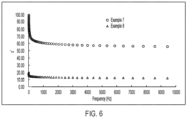
- FIG. 6 shows the effect of two different solvents on the dielectric constant of three-component piezocomposite according to some embodiments of the disclosure.
- a lower dielectric constant of the polymer composite results in an improvement of g 33 .
- PVDF-TrFE, PC and PPO are only three example second polymers with dielectric constants below 20, compatible with PVDF-TrFE-CFE.
- Other polymers may be compatible with PVDF-TrFE-CFE and used in a polymer matrix of a piezoelectric composite film to achieve the desired piezoelectric characteristics.
- first polymer other than PVDF-TrFE-CFE
- second polymers with dielectric constants below 20 compatible with that first polymer.
- each of the example films has a 90%/10% ratio of first polymer to second polymer, other ratios may be used to obtain different characteristics in the piezoelectric composite film.
- the solvent used to combine the first and second polymer should have a dielectric constant greater than 20 and a boiling point ⁇ 80°C in order to achieve desirable d 33 and g 33 values and desired mechanical characteristics.
- the boiling point can be significantly higher than 1000 degrees Celsius, such as around 1800 degrees Celsius or more, while having a dielectric constant of greater than 20.
- An example solvent mixing process for the lead-free three-component PVDF-TrFE-CFE-based piezoelectric composite material begins with dissolving the second polymer in a solvent.
- the second polymer as described above should be selected to be compatible with PVDF-TrFE-CFE and have a dielectric constant of less than 20.
- the solvent as described above should be selected to have a dielectric constant greater than 20 and a boiling point ⁇ 80°C.
- the first polymer, PVDF-TrFE-CFE is then added and stirred until dissolved completely. In the embodiments described above, the concentration of the solution was approximately 12% (w/v). Then, barium titanate (BT) was added slowly to the solution while stirring. After stirring for approximately 30-45 mins duration to ensure approximately complete mixing, the mixture was cast into a thin film using a doctor blade on to a substrate and dried in open air. After drying, the films were peeled off from the substrate and annealed under nitrogen.
- BT barium titanate
- the piezoelectric composite can be made using solution casting or forming methodology.
- a solution of a polymer can be obtained.
- the solution can include a solvent and polymer.
- the solution can include at least, equal to, or between any two of 1.5 wt./vol%, 5 wt./vol%, 10 wt./vol%, 15 wt./vol%, and 20 wt./vol% of the polymer.
- the solution includes and 10 wt.% to 12 wt.% PVDF or PVDF-TRFE-CFE or a blend thereof.
- no compatibility improvers are used to make the lead-free polymeric composites of the present invention.
- the piezoelectric additive can be dispersed or suspended in the polymer solution.
- the piezoelectric additive can be a plurality (e.g., 2 or more, suitably 5 or more, 10 or more, 50 or more, 100 or more, 500 or more, 1000 or more, etc.) of lead-free piezoelectric particles.
- the lead-free piezoelectric particles can be dispersed in the solution via any suitable method, including mixing, stirring, folding or otherwise integrating the lead-free piezoelectric particles in the matrix so as to generate a uniform dispersion or suspension of the particles in the matrix.
- the solution is added to the piezoelectric additive.
- the dispersion or suspension can be subjected to conditions suitable to form the piezoelectric composite of the present invention.
- the following description references dispersion, but it also applies to a suspension.
- the dispersion includes PVDF, PVDF-TRFE, or PVDF-TRFE-CFE or a blend thereof, and barium titanate.
- the dispersion can be shaped or cast. Shaped or shaping, or casting can include a mechanical or physical processes to change to a desired form. Shaping can also include simply placing a dispersion into a desired container or receptacle, thereby providing it with a maintained shape or form.
- the shaped form is not necessarily the final form, as additional processing (e.g., machining, forming, etc.) can be completed on the final, cured composite.
- additional processing e.g., machining, forming, etc.
- the act of shaping the dispersion for use in the methods described herein is primarily to give some initial structure to the dispersion prior to further processing. A rigid or specific shape is not required.
- Casting can be pouring the dispersion on a casting surface.
- casting include air casting (e.g., the dispersion passes under a series of air flow ducts that control the evaporation of the solvents in a particular set period of time such as 24 to 48 hours), solvent or emersion casting, (e.g., the dispersion is spread onto a moving belt and run through a bath or liquid in which the liquid within the bath exchanges with the solvent).
- the spreading of the dispersion on the casting surface can be done with a doctor blade, rolling spreader bar or any of several configurations of flat sheeting extrusion dies.
- the solvent can be removed thereby leaving the dispersion on the substrate or in the mold.
- Heat can be applied to assist the removal of the solvent.
- the shaped material can be heated at a temperature of at least, equal to, or between any two of 50 °C, 55 °C, 60 °C, 65 °C, 70 °C, 75 °C, and 80 °C.
- the resulting shaped polymer composite material can be annealed at a temperature of at least, equal to, or between any two of 80 °C, 85 °C, 90 °C, 95 °C, 100 °C, 105 °C, 110 °C, 115 °C, and 120 °C for a desired amount of time (e.g., 5, 10, 15, 20, 25 hours or any range or value there between).
- the shaped material can be a film, a sheet or the like. Some or all of the solvent can be removed during the heating process.
- heating and/or annealing the lead-free piezoelectric polymer precursor composite material can remove at least, equal to, or between any two of 50, 55, 60, 65, 70, 75, 80, 85, 90, 95, and 100 wt.% of the solvent.
- the shaped polymer composite material can be subjected to conditions to induce electric polarization in the lead-free piezoelectric additive (e.g., plurality of particles) in the polymeric composite material.
- the piezoelectric particles can be connected to one another in a linear or semi-linear manner (e.g., chains of particles). Columns of piezoelectric particles are suitably formed by the stacking or aligning of more than one chain.
- the shaped polymer composite material can be poled.
- the polymer composite material can be poled with a selected electric field at room temperature (e.g., after cooling of the composite), or at a selected electric field at a selected temperature, at least one of the selected electric field and the selected temperature being chosen in accordance with a desired dipole orientation, a desired polarization strength, or property of the article of manufacture.
- the temperature for performing poling can be in accordance with a desired dipole orientation and/or a desired polarization strength, or in accordance with a desired stress state of a finished actuator.
- the poling can be performed at a selected cooling temperature range, through a selected heating temperature, or through a selected heating temperature heating and cooling temperature range.
- the poling may occur over a "range" (e.g., selected range) of temperatures rather than at a specific constant temperature.
- poling can be performed at a temperature of at least, equal to, or between any two of 80 °C, 85 °C, 90 °C, 95 °C, 100 °C, 105 °C, 110 °C, 115 °C, and 120 °C.
- the applied voltage level parameter for the poling can be selected in various ways. For example, the applied voltage level parameter can be selected as constant, or changing (e.g., ramped) over a period of time.
- poling is performed using corona discharge using an electrode gap of 0.5 to 1.5 cm, or about 1 cm for a desired amount of time (e.g., about 1 hour).
- the poled films were maintained at room temperature for 48 hours, and then the piezoelectric strain constant (d 33 ) of the poled films was measured at ambient temperature at a frequency of 110 Hz with a clamping force of 10N and an oscillatory force 0.25N to obtain the values described above in Table 3.
- the piezoelectric composite can include a polymer and a lead-free piezoelectric additive.
- the piezoelectric composite can include at least, equal to, or between any two of 1, 10, 20, 30, 40, 45, 50, 55, 60, 65, 70, 75, 80, 85, 90, 95, and 99 wt.% polymer matrix.
- the amount of lead-free piezoelectric additive present in the polymer matrix can be at least, equal to, or between any two of 15, 20, 25, 30, 35, 40, 45, 50, 55, 60, and 65 vol.%.
- the piezoelectric composite includes PVDF-TRFE-CFE and 20 vol.% to 60 vol.% barium titanate particles having an average particle size of 250 to 350 nm.
- the piezoelectric composite includes, consists of, or consists essentially of PVDF-TRFE-CFE and 20 vol.% to 60 vol.% barium titanate particles having an average particle size of 250 to 350 nm. In some embodiments, the piezoelectric composite can have less than 0.1 wt.% of solvent or between 0 and 0.1 wt.% solvent.
- the piezoelectric composite can have any shape or form.
- the piezoelectric composite is a film or sheet.
- the film or sheet has a thickness dimension of 50 to 200 microns, or at least, equal to, or between any two of 50, 60, 70, 80, 90, 100, 110, 120, 130, 140, 150, 160, 170, 180, 190, and 200 microns.
- Properties of the piezoelectric composite include electrical and mechanical properties.
- electrical properties can include piezoelectric constant, dielectric constant, and the like.
- the d 33 of the piezoelectric composite be at least, equal to, or between 40 pC/N, 45 pC/N, 50 pC/N, 55 pC/N, 56 pC/N, 57 pC/N, 58 pC/N, 59 pC/N, 60 pC/N, 61 pC/N, 62 pC/N, 63 pC/N, 64 pC/N, 65 pC/N, 66 pC/N, 67 pC/N, 68 pC/N, 69 pC/N, and 70 pC/N.
- the piezoelectric composite can have a dielectric constant that is less than, equal to, or between any two of 120, 115, 110, 105, 100, 95, 90, 85, 80, 75, 70, 65, 60, 55, 50, 45, 40, and 35. In some embodiments, the dielectric constant is from 90 to 210.
- the lead-free piezoelectric composite can have a storage modulus can range from 100 to 325 MPa, or at least, equal to, or between any two of 100, 125, 150, 175, 200, 225, 250, 275, 300, and 325 MPa. Storage modulus can be measured according to ISO 6721 at room temperature and a 1 Hz strain of 0.2%.
- the lead-free piezoelectric composite can have an elongation break of 30 to 500% under uniaxial loading at room temperature (e.g., 25 to 35 °C). Elongation break can be measured using standard dynamic mechanical analyzer.
Landscapes
- Chemical & Material Sciences (AREA)
- Engineering & Computer Science (AREA)
- Health & Medical Sciences (AREA)
- Chemical Kinetics & Catalysis (AREA)
- Medicinal Chemistry (AREA)
- Polymers & Plastics (AREA)
- Organic Chemistry (AREA)
- Materials Engineering (AREA)
- Manufacturing & Machinery (AREA)
- Composite Materials (AREA)
- Compositions Of Macromolecular Compounds (AREA)
- Manufacture Of Macromolecular Shaped Articles (AREA)
Claims (11)
- Polymerverbundstoff, umfassend:eine Polymermatrix, umfassend mindestens zwei Polymere: ein erstes Polymer, umfassend ein fluoriertes Polymer; und ein zweites Polymer, das eine Dielektrizitätskonstante von weniger als 20 aufweist, wobei das zweite Polymer mit dem fluorierten Polymer kompatibel ist, wobei die Polymermatrix zu 5-20 Gewichtsprozent oder mehr das zweite Polymer umfasst; undein bleifreier piezoelektrischer Keramikfüller, eingebettet in die Polymermatrix, wobei der piezoelektrische Keramikfüller zu 40-70 Vol.-% den Polymerverbundstoff umfasst.
- Polymerverbundstoff nach Anspruch 1, wobei der Polymerverbundstoff piezoelektrische Eigenschaften vorweist.
- Polymerverbundstoff nach Anspruch 1 oder 2, wobei das erste Polymer PVDF-TrFE-CFE umfasst.
- Polymerverbundstoff nach einem der Ansprüche 1 bis 3, ferner umfassend ein flexibles Substrat, das an einem Dünnfilm des Polymerverbundstoffs befestigt ist, und wobei der Polymerverbundstoffdünnfilm ein mechanisch flexibler Dünnfilm ist.
- Polymerverbundstoff nach einem der Ansprüche 1 bis 4, wobei der Film oder die Folie eine Dicke von 50-200 Mikrometer aufweist.
- Polymerverbundstoffe nach einem der Ansprüche 1 bis 5, wobei der Polymerverbundstoff, der piezoelektrische Eigenschaften vorweist, aufweist: eine piezoelektrische Dehnungskonstante zwischen 30 und 70 pC/N;
und eine piezoelektrische Spannungskonstante zwischen 100 und 300 mV.m/N. - Verfahren zum Herstellen eines Dünnfilms unter Verwendung des Polymerverbundstoffs nach den Ansprüchen 1 bis 6.
- Verfahren nach Anspruch 7, wobei das Verfahren umfasst:Auflösen des ersten Polymers in einer Lösung des zweiten Polymers in einem Lösungsmittel, um eine Zwei-Polymer-Lösung (102) auszubildenwobei das Lösungsmittel eine Dielektrizitätskonstante von mindestens 20 und einen Siedepunkt von mindestens 80 Grad C aufweist;Hinzufügen des piezoelektrischen Keramikfüllers zu der Zwei-Polymer-Lösung (104), um eine Dispersion oder Suspension auszubilden;Ausbilden des Polymerverbundstoffdünnfilms durch ein Gießen und ein Trocknen des Lösungsmittels (106); und Unterziehen des Polymerverbundstoffdünnfilms einer elektrischen Polarisation (108).
- Verfahren nach Anspruch 8, wobei das Auflösen des ersten Polymers in der Lösung des zweiten Polymers die Zwei-Polymer-Lösung produziert, umfassend zu 5 bis 20 Gew.Vol.-% Polymer und vorzugsweise zu 10 Gew.Vol.-% bis 12 Gew.Vol.-% Polymer.
- Verfahren nach einem der Ansprüche 7 bis 9, ferner umfassend das Glühen des Polymerverbundstoffdünnfilms in einer inerten Atmosphäre.
- Piezoelektrischer Sensor, umfassend einen Dünnfilm des Polymerverbundstoffs nach einem der Ansprüche 1 bis 6, wobei der piezoelektrische Sensor konfiguriert ist, um ein analoges Signal zu erzeugen, das proportional zu einer Menge von Auslenkung ist, die auf den piezoelektrischen Sensor durch einen Benutzer ausgeübt wird, wobei der piezoelektrische Sensor in eine mobile Vorrichtung integriert ist.
Applications Claiming Priority (2)
| Application Number | Priority Date | Filing Date | Title |
|---|---|---|---|
| IN202041014651 | 2020-04-02 | ||
| PCT/EP2021/058671 WO2021198448A1 (en) | 2020-04-02 | 2021-04-01 | Lead-free three-component piezoelectric polymer composite |
Publications (2)
| Publication Number | Publication Date |
|---|---|
| EP4128378A1 EP4128378A1 (de) | 2023-02-08 |
| EP4128378B1 true EP4128378B1 (de) | 2025-02-26 |
Family
ID=75396787
Family Applications (1)
| Application Number | Title | Priority Date | Filing Date |
|---|---|---|---|
| EP21716710.5A Active EP4128378B1 (de) | 2020-04-02 | 2021-04-01 | Bleifreier piezoelektrischer dreikomponenten-polymerverbundstoff und entsprechendes herstellungsverfahren |
Country Status (5)
| Country | Link |
|---|---|
| US (1) | US20230141847A1 (de) |
| EP (1) | EP4128378B1 (de) |
| CN (1) | CN115362567A (de) |
| ES (1) | ES3020434T3 (de) |
| WO (1) | WO2021198448A1 (de) |
Families Citing this family (2)
| Publication number | Priority date | Publication date | Assignee | Title |
|---|---|---|---|---|
| US12521937B2 (en) * | 2021-03-23 | 2026-01-13 | Xerox Corporation | Piezoelectric composite filaments and use thereof in additive manufacturing |
| CN116041758B (zh) * | 2022-12-07 | 2024-05-07 | 四川大学 | 高储能、低损耗的聚乙烯/聚偏二氟乙烯复合薄膜及其制备方法和应用 |
Family Cites Families (5)
| Publication number | Priority date | Publication date | Assignee | Title |
|---|---|---|---|---|
| US8878341B2 (en) * | 2012-10-09 | 2014-11-04 | Saudi Basic Industries Corporation | Graphene-based composite materials, method of manufacture and applications thereof |
| JP6867297B2 (ja) * | 2015-04-01 | 2021-04-28 | サビック グローバル テクノロジーズ ビー.ブイ. | 構造化コンポジットの圧電特性向上のための形状制御されたセラミックフィラー |
| US12035632B2 (en) * | 2018-03-20 | 2024-07-09 | Sabic Global Technologies B.V. | Flexible and low cost piezoelectric composites with high d33 values |
| CN109575572B (zh) * | 2018-12-11 | 2020-06-16 | 四川大学 | 一种提高聚合物基复合材料介电性能的方法 |
| WO2020144578A1 (en) * | 2019-01-07 | 2020-07-16 | Sabic Global Technologies B.V. | Piezoelectric compositions and uses thereof |
-
2021
- 2021-04-01 EP EP21716710.5A patent/EP4128378B1/de active Active
- 2021-04-01 ES ES21716710T patent/ES3020434T3/es active Active
- 2021-04-01 WO PCT/EP2021/058671 patent/WO2021198448A1/en not_active Ceased
- 2021-04-01 CN CN202180027037.1A patent/CN115362567A/zh active Pending
- 2021-04-01 US US17/916,235 patent/US20230141847A1/en active Pending
Non-Patent Citations (1)
| Title |
|---|
| SALAEH SUBHAN ET AL: "Dynamically cured poly(vinylidene fluoride)/epoxidized natural rubber blends filled with ferroelectric ceramic barium titanate", COMPOSITES PART A, ELSEVIER, AMSTERDAM, NL, vol. 93, 22 November 2016 (2016-11-22), pages 107 - 116, XP029875651, ISSN: 1359-835X, DOI: 10.1016/J.COMPOSITESA.2016.11.024 * |
Also Published As
| Publication number | Publication date |
|---|---|
| CN115362567A (zh) | 2022-11-18 |
| US20230141847A1 (en) | 2023-05-11 |
| ES3020434T3 (en) | 2025-05-22 |
| EP4128378A1 (de) | 2023-02-08 |
| WO2021198448A1 (en) | 2021-10-07 |
Similar Documents
| Publication | Publication Date | Title |
|---|---|---|
| Wang et al. | Design, synthesis and processing of PVDF‐based dielectric polymers | |
| US12256640B2 (en) | Lead-free piezo composites and methods of making thereof | |
| JP5197945B2 (ja) | 反強誘電性ポリマー複合材料、その製造方法、及びそれを含んでなる物品 | |
| CN113490709B (zh) | 压电组合物及其用途 | |
| US20220158075A1 (en) | Flexible and low cost lead-free piezoelectric composites with high d33 values | |
| US12035632B2 (en) | Flexible and low cost piezoelectric composites with high d33 values | |
| EP4128378B1 (de) | Bleifreier piezoelektrischer dreikomponenten-polymerverbundstoff und entsprechendes herstellungsverfahren | |
| EP4315441B1 (de) | Piezoelektrische verbundwerkstoffe mit beschichteten piezoelektrischen füllstoffen | |
| US12048248B2 (en) | Piezoelectric polymer blend and composite compositions including lithium-doped potassium sodium niobate | |
| CN111755593A (zh) | 压电复合材料、压电复合薄膜及其制备方法和压电器件 | |
| EP4200918B1 (de) | Piezoelektrischer polymerverbundwerkstoff auf polyolefinbasis | |
| CN111697124A (zh) | 压电复合材料、压电复合薄膜及其制备方法和压电器件 | |
| US20240198420A1 (en) | Etchless metal plating using cold sintering | |
| Guhathakurta et al. | Novel Piezoelectric Polymer Composites for Flexible Electronic Device | |
| WO2001066613A1 (en) | Process for preparing electrostrictive polymers and resulting polymers and articles | |
| CN111847985A (zh) | 压电复合材料、压电复合薄膜及其制备方法、应用和压电器件 | |
| KR20030075211A (ko) | 나노 세라믹 복합재 | |
| Arlt et al. | PZT/P (VDF-HFP) 0–3 composites: Preparation, electrical poling and piezoelectric properties |
Legal Events
| Date | Code | Title | Description |
|---|---|---|---|
| STAA | Information on the status of an ep patent application or granted ep patent |
Free format text: STATUS: UNKNOWN |
|
| STAA | Information on the status of an ep patent application or granted ep patent |
Free format text: STATUS: THE INTERNATIONAL PUBLICATION HAS BEEN MADE |
|
| PUAI | Public reference made under article 153(3) epc to a published international application that has entered the european phase |
Free format text: ORIGINAL CODE: 0009012 |
|
| STAA | Information on the status of an ep patent application or granted ep patent |
Free format text: STATUS: REQUEST FOR EXAMINATION WAS MADE |
|
| 17P | Request for examination filed |
Effective date: 20221025 |
|
| AK | Designated contracting states |
Kind code of ref document: A1 Designated state(s): AL AT BE BG CH CY CZ DE DK EE ES FI FR GB GR HR HU IE IS IT LI LT LU LV MC MK MT NL NO PL PT RO RS SE SI SK SM TR |
|
| DAV | Request for validation of the european patent (deleted) | ||
| DAX | Request for extension of the european patent (deleted) | ||
| STAA | Information on the status of an ep patent application or granted ep patent |
Free format text: STATUS: EXAMINATION IS IN PROGRESS |
|
| 17Q | First examination report despatched |
Effective date: 20231222 |
|
| REG | Reference to a national code |
Ref country code: DE Ref legal event code: R079 Free format text: PREVIOUS MAIN CLASS: H01L0041180000 Ipc: H10N0030850000 Ref country code: DE Ref legal event code: R079 Ref document number: 602021026762 Country of ref document: DE Free format text: PREVIOUS MAIN CLASS: H01L0041180000 Ipc: H10N0030850000 |
|
| RIC1 | Information provided on ipc code assigned before grant |
Ipc: H10N 30/85 20230101AFI20240930BHEP |
|
| GRAP | Despatch of communication of intention to grant a patent |
Free format text: ORIGINAL CODE: EPIDOSNIGR1 |
|
| STAA | Information on the status of an ep patent application or granted ep patent |
Free format text: STATUS: GRANT OF PATENT IS INTENDED |
|
| RIC1 | Information provided on ipc code assigned before grant |
Ipc: H10N 30/092 20230101ALI20241022BHEP Ipc: H10N 30/85 20230101AFI20241022BHEP |
|
| INTG | Intention to grant announced |
Effective date: 20241127 |
|
| GRAS | Grant fee paid |
Free format text: ORIGINAL CODE: EPIDOSNIGR3 |
|
| GRAA | (expected) grant |
Free format text: ORIGINAL CODE: 0009210 |
|
| STAA | Information on the status of an ep patent application or granted ep patent |
Free format text: STATUS: THE PATENT HAS BEEN GRANTED |
|
| AK | Designated contracting states |
Kind code of ref document: B1 Designated state(s): AL AT BE BG CH CY CZ DE DK EE ES FI FR GB GR HR HU IE IS IT LI LT LU LV MC MK MT NL NO PL PT RO RS SE SI SK SM TR |
|
| REG | Reference to a national code |
Ref country code: GB Ref legal event code: FG4D |
|
| REG | Reference to a national code |
Ref country code: CH Ref legal event code: EP |
|
| REG | Reference to a national code |
Ref country code: DE Ref legal event code: R096 Ref document number: 602021026762 Country of ref document: DE |
|
| REG | Reference to a national code |
Ref country code: IE Ref legal event code: FG4D |
|
| P01 | Opt-out of the competence of the unified patent court (upc) registered |
Free format text: CASE NUMBER: APP_10246/2025 Effective date: 20250304 |
|
| REG | Reference to a national code |
Ref country code: ES Ref legal event code: FG2A Ref document number: 3020434 Country of ref document: ES Kind code of ref document: T3 Effective date: 20250522 |
|
| REG | Reference to a national code |
Ref country code: NL Ref legal event code: MP Effective date: 20250226 |
|
| PG25 | Lapsed in a contracting state [announced via postgrant information from national office to epo] |
Ref country code: RS Free format text: LAPSE BECAUSE OF FAILURE TO SUBMIT A TRANSLATION OF THE DESCRIPTION OR TO PAY THE FEE WITHIN THE PRESCRIBED TIME-LIMIT Effective date: 20250526 |
|
| PG25 | Lapsed in a contracting state [announced via postgrant information from national office to epo] |
Ref country code: FI Free format text: LAPSE BECAUSE OF FAILURE TO SUBMIT A TRANSLATION OF THE DESCRIPTION OR TO PAY THE FEE WITHIN THE PRESCRIBED TIME-LIMIT Effective date: 20250226 |
|
| PG25 | Lapsed in a contracting state [announced via postgrant information from national office to epo] |
Ref country code: PL Free format text: LAPSE BECAUSE OF FAILURE TO SUBMIT A TRANSLATION OF THE DESCRIPTION OR TO PAY THE FEE WITHIN THE PRESCRIBED TIME-LIMIT Effective date: 20250226 |
|
| PGFP | Annual fee paid to national office [announced via postgrant information from national office to epo] |
Ref country code: DE Payment date: 20250429 Year of fee payment: 5 |
|
| PGFP | Annual fee paid to national office [announced via postgrant information from national office to epo] |
Ref country code: GB Payment date: 20250428 Year of fee payment: 5 Ref country code: ES Payment date: 20250505 Year of fee payment: 5 |
|
| REG | Reference to a national code |
Ref country code: LT Ref legal event code: MG9D |
|
| PG25 | Lapsed in a contracting state [announced via postgrant information from national office to epo] |
Ref country code: NO Free format text: LAPSE BECAUSE OF FAILURE TO SUBMIT A TRANSLATION OF THE DESCRIPTION OR TO PAY THE FEE WITHIN THE PRESCRIBED TIME-LIMIT Effective date: 20250526 Ref country code: IS Free format text: LAPSE BECAUSE OF FAILURE TO SUBMIT A TRANSLATION OF THE DESCRIPTION OR TO PAY THE FEE WITHIN THE PRESCRIBED TIME-LIMIT Effective date: 20250626 |
|
| PG25 | Lapsed in a contracting state [announced via postgrant information from national office to epo] |
Ref country code: NL Free format text: LAPSE BECAUSE OF FAILURE TO SUBMIT A TRANSLATION OF THE DESCRIPTION OR TO PAY THE FEE WITHIN THE PRESCRIBED TIME-LIMIT Effective date: 20250226 |
|
| PGFP | Annual fee paid to national office [announced via postgrant information from national office to epo] |
Ref country code: IT Payment date: 20250422 Year of fee payment: 5 |
|
| PG25 | Lapsed in a contracting state [announced via postgrant information from national office to epo] |
Ref country code: HR Free format text: LAPSE BECAUSE OF FAILURE TO SUBMIT A TRANSLATION OF THE DESCRIPTION OR TO PAY THE FEE WITHIN THE PRESCRIBED TIME-LIMIT Effective date: 20250226 |
|
| PG25 | Lapsed in a contracting state [announced via postgrant information from national office to epo] |
Ref country code: PT Free format text: LAPSE BECAUSE OF FAILURE TO SUBMIT A TRANSLATION OF THE DESCRIPTION OR TO PAY THE FEE WITHIN THE PRESCRIBED TIME-LIMIT Effective date: 20250626 Ref country code: LV Free format text: LAPSE BECAUSE OF FAILURE TO SUBMIT A TRANSLATION OF THE DESCRIPTION OR TO PAY THE FEE WITHIN THE PRESCRIBED TIME-LIMIT Effective date: 20250226 |
|
| PGFP | Annual fee paid to national office [announced via postgrant information from national office to epo] |
Ref country code: FR Payment date: 20250425 Year of fee payment: 5 |
|
| PG25 | Lapsed in a contracting state [announced via postgrant information from national office to epo] |
Ref country code: GR Free format text: LAPSE BECAUSE OF FAILURE TO SUBMIT A TRANSLATION OF THE DESCRIPTION OR TO PAY THE FEE WITHIN THE PRESCRIBED TIME-LIMIT Effective date: 20250527 Ref country code: BG Free format text: LAPSE BECAUSE OF FAILURE TO SUBMIT A TRANSLATION OF THE DESCRIPTION OR TO PAY THE FEE WITHIN THE PRESCRIBED TIME-LIMIT Effective date: 20250226 |
|
| REG | Reference to a national code |
Ref country code: AT Ref legal event code: MK05 Ref document number: 1771984 Country of ref document: AT Kind code of ref document: T Effective date: 20250226 |
|
| PG25 | Lapsed in a contracting state [announced via postgrant information from national office to epo] |
Ref country code: SE Free format text: LAPSE BECAUSE OF FAILURE TO SUBMIT A TRANSLATION OF THE DESCRIPTION OR TO PAY THE FEE WITHIN THE PRESCRIBED TIME-LIMIT Effective date: 20250226 |
|
| PG25 | Lapsed in a contracting state [announced via postgrant information from national office to epo] |
Ref country code: SM Free format text: LAPSE BECAUSE OF FAILURE TO SUBMIT A TRANSLATION OF THE DESCRIPTION OR TO PAY THE FEE WITHIN THE PRESCRIBED TIME-LIMIT Effective date: 20250226 |
|
| PG25 | Lapsed in a contracting state [announced via postgrant information from national office to epo] |
Ref country code: DK Free format text: LAPSE BECAUSE OF FAILURE TO SUBMIT A TRANSLATION OF THE DESCRIPTION OR TO PAY THE FEE WITHIN THE PRESCRIBED TIME-LIMIT Effective date: 20250226 |
|
| PG25 | Lapsed in a contracting state [announced via postgrant information from national office to epo] |
Ref country code: AT Free format text: LAPSE BECAUSE OF FAILURE TO SUBMIT A TRANSLATION OF THE DESCRIPTION OR TO PAY THE FEE WITHIN THE PRESCRIBED TIME-LIMIT Effective date: 20250226 |
|
| PG25 | Lapsed in a contracting state [announced via postgrant information from national office to epo] |
Ref country code: EE Free format text: LAPSE BECAUSE OF FAILURE TO SUBMIT A TRANSLATION OF THE DESCRIPTION OR TO PAY THE FEE WITHIN THE PRESCRIBED TIME-LIMIT Effective date: 20250226 Ref country code: CZ Free format text: LAPSE BECAUSE OF FAILURE TO SUBMIT A TRANSLATION OF THE DESCRIPTION OR TO PAY THE FEE WITHIN THE PRESCRIBED TIME-LIMIT Effective date: 20250226 |
|
| PG25 | Lapsed in a contracting state [announced via postgrant information from national office to epo] |
Ref country code: RO Free format text: LAPSE BECAUSE OF FAILURE TO SUBMIT A TRANSLATION OF THE DESCRIPTION OR TO PAY THE FEE WITHIN THE PRESCRIBED TIME-LIMIT Effective date: 20250226 |
|
| PG25 | Lapsed in a contracting state [announced via postgrant information from national office to epo] |
Ref country code: SK Free format text: LAPSE BECAUSE OF FAILURE TO SUBMIT A TRANSLATION OF THE DESCRIPTION OR TO PAY THE FEE WITHIN THE PRESCRIBED TIME-LIMIT Effective date: 20250226 |
|
| REG | Reference to a national code |
Ref country code: CH Ref legal event code: H13 Free format text: ST27 STATUS EVENT CODE: U-0-0-H10-H13 (AS PROVIDED BY THE NATIONAL OFFICE) Effective date: 20251125 |
|
| REG | Reference to a national code |
Ref country code: DE Ref legal event code: R097 Ref document number: 602021026762 Country of ref document: DE |
|
| PG25 | Lapsed in a contracting state [announced via postgrant information from national office to epo] |
Ref country code: LU Free format text: LAPSE BECAUSE OF NON-PAYMENT OF DUE FEES Effective date: 20250401 |
|
| PG25 | Lapsed in a contracting state [announced via postgrant information from national office to epo] |
Ref country code: MC Free format text: LAPSE BECAUSE OF FAILURE TO SUBMIT A TRANSLATION OF THE DESCRIPTION OR TO PAY THE FEE WITHIN THE PRESCRIBED TIME-LIMIT Effective date: 20250226 |
|
| REG | Reference to a national code |
Ref country code: BE Ref legal event code: MM Effective date: 20250430 |
|
| PLBE | No opposition filed within time limit |
Free format text: ORIGINAL CODE: 0009261 |
|
| STAA | Information on the status of an ep patent application or granted ep patent |
Free format text: STATUS: NO OPPOSITION FILED WITHIN TIME LIMIT |
|
| PG25 | Lapsed in a contracting state [announced via postgrant information from national office to epo] |
Ref country code: BE Free format text: LAPSE BECAUSE OF NON-PAYMENT OF DUE FEES Effective date: 20250430 |
|
| PG25 | Lapsed in a contracting state [announced via postgrant information from national office to epo] |
Ref country code: CH Free format text: LAPSE BECAUSE OF NON-PAYMENT OF DUE FEES Effective date: 20250430 |
|
| 26N | No opposition filed |
Effective date: 20251127 |