EP4315441B1 - Piezoelektrische verbundwerkstoffe mit beschichteten piezoelektrischen füllstoffen - Google Patents
Piezoelektrische verbundwerkstoffe mit beschichteten piezoelektrischen füllstoffen Download PDFInfo
- Publication number
- EP4315441B1 EP4315441B1 EP22718201.1A EP22718201A EP4315441B1 EP 4315441 B1 EP4315441 B1 EP 4315441B1 EP 22718201 A EP22718201 A EP 22718201A EP 4315441 B1 EP4315441 B1 EP 4315441B1
- Authority
- EP
- European Patent Office
- Prior art keywords
- piezoelectric
- coated
- polymer
- filler particles
- volume
- Prior art date
- Legal status (The legal status is an assumption and is not a legal conclusion. Google has not performed a legal analysis and makes no representation as to the accuracy of the status listed.)
- Active
Links
Images


Classifications
-
- H—ELECTRICITY
- H10—SEMICONDUCTOR DEVICES; ELECTRIC SOLID-STATE DEVICES NOT OTHERWISE PROVIDED FOR
- H10N—ELECTRIC SOLID-STATE DEVICES NOT OTHERWISE PROVIDED FOR
- H10N30/00—Piezoelectric or electrostrictive devices
- H10N30/80—Constructional details
- H10N30/85—Piezoelectric or electrostrictive active materials
- H10N30/852—Composite materials, e.g. having 1-3 or 2-2 type connectivity
-
- C—CHEMISTRY; METALLURGY
- C08—ORGANIC MACROMOLECULAR COMPOUNDS; THEIR PREPARATION OR CHEMICAL WORKING-UP; COMPOSITIONS BASED THEREON
- C08J—WORKING-UP; GENERAL PROCESSES OF COMPOUNDING; AFTER-TREATMENT NOT COVERED BY SUBCLASSES C08B, C08C, C08F, C08G or C08H
- C08J5/00—Manufacture of articles or shaped materials containing macromolecular substances
- C08J5/18—Manufacture of films or sheets
-
- C—CHEMISTRY; METALLURGY
- C08—ORGANIC MACROMOLECULAR COMPOUNDS; THEIR PREPARATION OR CHEMICAL WORKING-UP; COMPOSITIONS BASED THEREON
- C08K—Use of inorganic or non-macromolecular organic substances as compounding ingredients
- C08K9/00—Use of pretreated ingredients
- C08K9/08—Ingredients agglomerated by treatment with a binding agent
-
- H—ELECTRICITY
- H10—SEMICONDUCTOR DEVICES; ELECTRIC SOLID-STATE DEVICES NOT OTHERWISE PROVIDED FOR
- H10N—ELECTRIC SOLID-STATE DEVICES NOT OTHERWISE PROVIDED FOR
- H10N30/00—Piezoelectric or electrostrictive devices
- H10N30/01—Manufacture or treatment
- H10N30/09—Forming piezoelectric or electrostrictive materials
- H10N30/092—Forming composite materials
-
- C—CHEMISTRY; METALLURGY
- C08—ORGANIC MACROMOLECULAR COMPOUNDS; THEIR PREPARATION OR CHEMICAL WORKING-UP; COMPOSITIONS BASED THEREON
- C08J—WORKING-UP; GENERAL PROCESSES OF COMPOUNDING; AFTER-TREATMENT NOT COVERED BY SUBCLASSES C08B, C08C, C08F, C08G or C08H
- C08J2327/00—Characterised by the use of homopolymers or copolymers of compounds having one or more unsaturated aliphatic radicals, each having only one carbon-to-carbon double bond, and at least one being terminated by a halogen; Derivatives of such polymers
- C08J2327/02—Characterised by the use of homopolymers or copolymers of compounds having one or more unsaturated aliphatic radicals, each having only one carbon-to-carbon double bond, and at least one being terminated by a halogen; Derivatives of such polymers not modified by chemical after-treatment
- C08J2327/12—Characterised by the use of homopolymers or copolymers of compounds having one or more unsaturated aliphatic radicals, each having only one carbon-to-carbon double bond, and at least one being terminated by a halogen; Derivatives of such polymers not modified by chemical after-treatment containing fluorine atoms
- C08J2327/16—Homopolymers or copolymers of vinylidene fluoride
-
- C—CHEMISTRY; METALLURGY
- C08—ORGANIC MACROMOLECULAR COMPOUNDS; THEIR PREPARATION OR CHEMICAL WORKING-UP; COMPOSITIONS BASED THEREON
- C08K—Use of inorganic or non-macromolecular organic substances as compounding ingredients
- C08K2201/00—Specific properties of additives
- C08K2201/001—Conductive additives
Definitions
- the present invention is directed to the field of piezoelectric composite having polymer coated piezoelectric fillers and in particular to films containing such piezoelectric composite.
- Piezoelectric elements find application in a variety of electro-mechanical devices such as resonators, sensors, buzzers, transducers, ultrasonic receivers and generators. As a result, in recent years there has been a sharp increase in the demand for such piezoelectric elements with several industry practitioners looking at improving the performance of the piezoelectric elements.
- one of the criteria for a suitable piezoelectric material is to have a balance of low dielectric loss (denoted by (tan ⁇ )) while retaining a sufficiently high piezoelectric charge coefficient (d 33 ).
- a material with high piezoelectric charge coefficient (d 33 ) is indicative of its excellent piezoelectric property and signifies the development of suitable electric potential, when a mechanical stress is applied to the material.
- dielectric loss (denoted by (tan ⁇ )) in piezoelectric materials, is indicative of energy loss in the form of heat, when a piezoelectric material is used in electro-mechanical devices.
- Dielectric loss causes internal heating in electro-mechanical devices, affecting both performance efficiency as well as long term durability of such electro-mechanical devices. In other words, minimizing dielectric loss would render the piezoelectric material to be more efficient in its performance.
- Yet another consideration has been to obtain piezoelectric materials that have low dielectric constant or low relative permittivity for certain application. Relative permittivity determines the ability of a material to polarize in response to an applied electric field. It is often preferred to have a material whose relative permittivity is low so as to enable the piezoelectric material to have a high piezoelectric voltage constant (g), and rendering such materials to have improved sensing performance.
- piezoelectric materials upon exposure to high moisture environment, experience increased dielectric loss (tan ⁇ ), which in turn adversely affects the performance of an electro-mechanical device.
- dielectric loss titanium ⁇
- direct exposure of a piezoelectric material to moisture can damage a device, where moisture on contact with the piezo material, may induce unwarranted electrical discharge or short circuiting.
- surface functionalized piezoelectric materials have been used to shield the piezoelectric material from direct moisture contact.
- technical solutions have had limited success.
- the patent US2020/303621 A1 illustrates a polymeric piezoelectric composite comprising a polymer matrix formed from one or more of a monomer or a precursor polymer; and an in-situ dispersion of a piezoelectric ceramic filler and an ionic additive within the polymer matrix.
- the patent WO2020/201922 A1 concerns a lead-free piezoelectric composite that includes a polymeric matrix.
- the polymeric matrix preferably a PVDF-based copolymer like PVDF-TrFE-CFE terpolymer
- the invention relates to a piezoelectric composite, comprising: (a) a polymer matrix; and (b) a plurality of coated piezoelectric filler particles, wherein each of the plurality of coated piezoelectric filler particles is dispersed in the polymer matrix, and further wherein each of the plurality of coated piezoelectric filler particles comprises a piezoelectric material having at least a portion of its outer surface coated with a polymeric material having at least one polar functional group.
- the polymeric material comprises at least one polar functional group selected from hydroxyl group, carboxylate group, ester group, sulfonic acid group, amide group, siloxane group, amino group, sulfhydryl, phosphate, ether group, halogen group, and a nitrile group.
- the plurality of coated piezoelectric filler particles are present in an amount ⁇ 20.0 volume% and ⁇ 80.0 volume%, with regard to the total volume of the piezoelectric composite.
- the piezoelectric material is selected from hydroxyapatite, apatite, lithium sulfate monohydrate, sodium bismuth titanate, quartz, tartaric acid, poly(vinylidene difluoride), barium titanate, potassium sodium niobate (KNaNb)O 3 (KNN), lead zirconate titanate (PZT), lead niobium titanate (PNT), lead scandium niobium titanate (PSNT), lead metaniobate, lithium doped potassium sodium niobate (KNLN) represented by the formula (K 0.5 Na 0.5 ) 1-t Li t NbO 3 , wherein the variable 't' ranges from greater than 0.01 to less than 1.0 (0.01 ⁇ t ⁇ 1.00).
- the polymeric material is selected from polydimethylsiloxane (PDMS), polyvinylpyrrolidone (PVP), grafted polyolefins, acrylate and methacrylate polymers, polyethylene glycol, vinyl acetate polymers polycarbonate, vinylidene fluoride (VDF) polymers, cyano polymers, poly(phenylene oxide) or combinations thereof.
- PDMS polydimethylsiloxane
- PVP polyvinylpyrrolidone
- VDF vinylidene fluoride
- cyano polymers poly(phenylene oxide) or combinations thereof.
- the polymeric material is selected from polydimethylsiloxane (PDMS), polyvinylpyrrolidone (PVP), grafted polyolefins, polyethylene glycol, vinyl acetate polymers, cyano polymers, or combinations thereof. More preferably, in some embodiments of the invention, the polymeric material is selected from polydimethylsiloxane (PDMS), or polyvinylpyrrolidone (PVP).
- PDMS polydimethylsiloxane
- PVP polyvinylpyrrolidone
- the polymeric material is selected from polyvinylpyrrolidone (PVP) or polydimethylsiloxane (PDMS) and the piezoelectric material is a lithium doped potassium sodium niobate (KNLN) represented by the formula (K 0.5 Na 0.5 ) 1-t Li t NbO 3 wherein 't' is 0.03 (KNLN3) or 't' is 0.06 (KNLN6).
- PVP polyvinylpyrrolidone
- PDMS polydimethylsiloxane
- KNLN lithium doped potassium sodium niobate
- the polymeric material is polyvinylpyrrolidone (PVP) and the piezoelectric material is a lithium doped potassium sodium niobate (KNLN) represented by the formula (K 0.5 Na 0.5 ) 1-t Li t NbO 3 wherein 't' is 0.03 (KNLN3) or 't' is 0.06 (KNLN6).
- PVP polyvinylpyrrolidone
- KNLN lithium doped potassium sodium niobate
- the polymeric material is polydimethylsiloxane (PDMS) and the piezoelectric material is a lithium doped potassium sodium niobate (KNLN) represented by the formula (K 0.5 Na 0.5 ) 1-t Li t NbO 3 wherein 't' is 0.03 (KNLN3) or 't' is 0.06 (KNLN6).
- KNLN lithium doped potassium sodium niobate
- the polymer matrix and the polymeric material coating of piezoelectric material are of different polymer composition.
- the polymer matrix is a polymer selected from vinylidene fluoride (VDF) polymer, polycaprolactone, polyolefin co-polymers, polysiloxane-polycarbonate copolymers, acrylate and/or methacrylate copolymers, polyethylene terephthalate (PET), polycarbonate (PC), polybutylene terephthalate (PBT), poly(1,4-cyclohexylidene cyclohexane-1,4-dicarboxylate) (PCCD), glycol modified polycyclohexyl terephthalate (PCTG), poly(phenylene oxide) (PPO), polypropylene (PP), polyethylene (PE), polyvinyl chloride (PVC), polystyrene (PS), polyethyleneimine or polyetherimide (PEI) and their derivatives, terephthalic acid (TPA) polymers, poly(cyclohexanedimethylene terephthalate) (PCT), poly(viny
- the polymer matrix is a polymer selected from vinylidene fluoride (VDF) polymer.
- VDF vinylidene fluoride
- the polymer matrix is a vinylidene fluoride (VDF) polymer selected from polyvinylidene fluoride (PVDF), polyvinylidene fluoride-co-tri-fluoroethylene (PVDF-TrFE), poly(vinylidene fluoride-co-hexafluoropropylene)(PVDF-HFP), polyvinylidene fluoride-co-tetrafluoro ethylene (PVDF-TFE), poly(vinylidene fluoride-co-trifluoroethylene-co-chlorofluoroethylene) (PVDF-TrFE-CFE),poly(vinylidene-fluoride-co-trifluoroethylene-co- chlorotrifluoroethylene)(PVDF-TfFE-CTFE) or combinations thereof.
- VDF vinylidene fluoride
- the polymer matrix is a vinylidene fluoride (VDF) polymer selected from poly(vinylidene fluoride-co-trifluoroethylene-co-chlorofluoroethylene) (PVDF-TrFE-CFE), or polyvinylidene fluoride-co-tri-fluoroethylene (PVDF-TrFE).
- VDF vinylidene fluoride
- the piezoelectric composite comprises:
- the invention is directed to a film comprising the piezoelectric composite of the present invention.
- the invention is directed to an article of manufacture comprising a film, wherein the film comprises the piezoelectric composite of the present invention.
- the invention relates to the use of the film comprising the piezoelectric composite of the present invention, for improving the piezoelectric property of the article of manufacture.
- piezoelectric property includes piezoelectric charge coefficient (d 33 ), relative permittivity and dielectric loss (tan ⁇ ).
- the invention is directed to a method for preparing a film comprising the piezoelectric composite of the present invention, wherein the method comprises:
- the precursor film comprises the piezoelectric composite. In some aspects of the invention, the precursor film comprises ⁇ 99.0 wt.%, preferably ⁇ 99.5 wt.%, preferably 100.0 wt.%, of the piezoelectric composite, with regard to the total weight of the precursor film.
- the electric polarization treatment is conducted at an electric field ⁇ 5 KV/mm and ⁇ 100 KV/mm for a time period ⁇ 1 minute and ⁇ 120 minutes and at a temperature ⁇ 50 °C and ⁇ 120 °C, preferably at a temperature ⁇ 60 °C and ⁇ 110 °C.
- the invention is directed to a film comprising the piezoelectric composite, wherein the film is obtained by a method comprising:
- a piezoelectric composite as described in this disclosure. Accordingly, the invention, is based, in part, on a piezoelectric composite comprising a polymer matrix containing a plurality of polymer coated piezoelectric filler particles dispersed in the polymer matrix.
- the piezoelectric composite or a film comprising such a composite demonstrates a suitable piezoelectric property having a low dielectric loss (tan ⁇ ) while retaining a suitable piezoelectric charge coefficient (d 33 ).
- the invention now enables a skilled artisan to make devices or articles of manufacture comprising such a film, which demonstrate excellent piezoelectric performance even when operating such devices or articles in humid conditions.
- wt.% refers to a weight, volume, or molar percentage of a component, respectively, based on the total weight, the total volume, or the total moles of the material that includes the component.
- Any numerical range used throughout this disclosure shall include all values and ranges there between unless specified otherwise.
- a boiling point range of 50 °C to 100 °C includes all temperatures and ranges between 50 °C and 100 °C including the temperature of 50 °C and 100 °C.
- the present disclosure describes a piezoelectric composite, which demonstrates low dielectric loss even when such a piezoelectric composite is exposed to humid or high moisture environment.
- the piezoelectric composite retains suitable piezoelectric charge coefficient (d 33 ) even when exposed to a high moisture environment.
- the invention relates to a piezoelectric composite, comprising: (a) a polymer matrix; and (b) a plurality of coated piezoelectric filler particles, wherein each of the plurality of coated piezoelectric filler particles is dispersed in the polymer matrix, and further wherein each of the plurality of coated piezoelectric filler particles comprises a having at least one polar functional group.
- plurality of coated piezoelectric filler particles means 2 or more, preferably 5 or more, preferably 10 or more, preferably 50 or more, 100 or more, preferably 500 or more, preferably 1000 or more, preferably 10000 or more of coated piezoelectric filler particles being dispersed throughout the polymer matrix.
- coated piezoelectric filler particles comprises a piezoelectric material having at least a portion of its outer surface coated with a polymeric material
- each of the piezoelectric filler particles is partially or completely coated by a polymeric material or an aggregate of one or more piezoelectric filler material is partially or completely coated by a polymeric material.
- the piezoelectric filler particle is completely coated by a polymeric material such that the particle is encapsulated by the polymeric material.
- the piezoelectric filler particles are coated with the polymeric material prior to dispersing the coated piezoelectric filler particles in the polymer matrix.
- a piezoelectric composite having a coated filler particle may for example be visually distinguished from a piezoelectric composite having uncoated filler by evaluating the surface porosity of a piezoelectric composite using Scanning Electron Microscopy (SEM).
- SEM Scanning Electron Microscopy
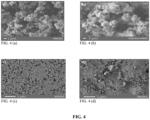
- a piezoelectric composite having uncoated KNLN3 particles may be distinguished from a piezoelectric composite having PDMS coated KNLN3 particles, by evaluating the SEM images of FIG. 4 (c) and FIG. 4(d) .
- a coated filler particle may be distinguished from an uncoated filler particle using a SEM image (e.g. FIG. 4 (a) and FIG. 4 (b) ), thereby enabling a skilled person to clearly distinguish between a coated filler particle and an uncoated filler particle.
- SEM image e.g. FIG. 4 (a) and FIG. 4 (b)
- the lower dielectric loss and improved piezoelectric performance of films containing composites having coated filler particles is clearly evidenced over that of fillers having composites with uncoated filler particles.
- the polymeric material comprises at least one polar functional group selected from hydroxyl group, carboxylate group, ester group, sulfonic acid group, amide group, siloxane group, amino group, sulfhydryl, phosphate, ether group, halogen group, and nitrile group.
- PVP polyvinylpyrolidone
- the presence of a polar functional group aids in the adhesion of the polymeric material on the surface of the piezoelectric material.
- the polymeric material comprises (i) a hydrophilic part which enables the adhesion to the piezoelectric material, and (ii) a hydrophobic part which serves as a moisture barrier coating.
- the plurality of coated piezoelectric filler particles are present in an amount ⁇ 20.0 volume% and ⁇ 80.0 volume%, alternatively ⁇ 30 volume% and ⁇ 60 volume%, alternatively ⁇ 45 volume% and ⁇ 55 volume%, with regard to the total volume of the piezoelectric composite. In some preferred embodiments of the invention, the plurality of coated piezoelectric filler particles are present in an amount of 50 volume% with regard to the total volume of the piezoelectric composite.
- the piezoelectric material is selected from hydroxyapatite, apatite, lithium sulfate monohydrate, sodium bismuth titanate, quartz, tartaric acid, poly(vinylidene difluoride), barium titanate, potassium sodium niobate (KNaNb)O 3 (KNN), lead zirconate titanate (PZT), lead niobium titanate (PNT), lead scandium niobium titanate (PSNT), lead metaniobate, lithium doped potassium sodium niobate (KNLN) represented by the formula (K 0.5 Na 0.5 ) 1-t Li t NbO 3 , wherein the variable 't' ranges from greater than 0.01 to less than 1.0 (0.01 ⁇ t ⁇ 1.00), alternatively greater than 0.02 to less than 0.09.
- the piezoelectric material is a lead free piezoelectric material selected from hydroxyapatite, apatite, lithium sulfate monohydrate, sodium bismuth titanate, quartz, tartaric acid, poly(vinylidene difluoride), barium titanate, potassium sodium niobate (KNaNb)O 3 (KNN), lithium doped potassium sodium niobate (KNLN) represented by the formula (K 0.5 Na 0.5 ) 1-t Li t NbO 3 , wherein the variable 't' ranges from greater than 0.01 to less than 1.0 (0.01 ⁇ t ⁇ 1.00), alternatively greater than 0.02 to less than 0.09.
- the piezoelectric material has a suitable size and morphology for piezoelectric application and can be prepared for example, by a two-step calcination process.
- the steps for preparing the piezoelectric material includes obtaining a precursor product after a first calcination step involving the calcination of a stoichiometric mixture of precursor metal salts such as carbonate metal salts or a mixture of oxide compounds.
- the second calcination step may be carried out for at least nine hours, preferably at least ten hours at a heating rate of 1°C min -1 .
- the precursor metal salts can be sodium carbonate or potassium carbonate or lithium carbonate, while metal oxides can be for example, niobium oxide.
- the coated piezoelectric filler particles can be prepared by following the general procedure: (a) providing a coating solution comprising a solubilized polymer or the corresponding monomer dissolved in a solvent; (b) dispersing one or more piezoelectric particle containing the piezoelectric material in the coating solution and forming a coating precursor solution; (c) removing the solvent from the coating precursor solution under conditions suitable for coating the one or more piezoelectric particle with the polymer and forming the coated piezoelectric filler particle.
- conditions suitable for coating include conditions of polymerizing the monomer to form a coating around the piezoelectric particle.
- the solvent may be removed using a low pressure evaporation in a rotary evaporator. It is believed that by removing the solvent in this manner ensures intimate contact between the piezoelectric particle and polymer.
- the selection of solvent would depend largely upon the solubility of the polymer. For example, when polyvinylpyrolidone (PVP) is used as a coating polymer, the solvent used can be water. On the other hand, when polydimethylsiloxane (PDMS) is used as a coating polymer the solvent is cyclohexane.
- the polymeric material is selected from polydimethylsiloxane (PDMS), polyvinylpyrrolidone (PVP), grafted polyolefins, acrylate and methacrylate polymers, polyethylene glycol, vinyl acetate polymers polycarbonate, vinylidene fluoride (VDF) polymers, cyano polymers, poly(phenylene oxide) or combinations thereof.
- the polymeric material is selected from polydimethylsiloxane (PDMS), or polyvinylpyrrolidone (PVP).
- the polymeric material is selected from polyvinylpyrrolidone (PVP) or polydimethylsiloxane (PDMS) and the piezoelectric material is a lithium doped potassium sodium niobate (KNLN) represented by the formula (K 0.5 Na 0.5 ) 1-t Li t NbO 3 wherein 't' is 0.03 (KNLN3) or 't' is 0.06 (KNLN6).
- PVP polyvinylpyrrolidone
- PDMS polydimethylsiloxane
- KNLN lithium doped potassium sodium niobate
- the polymeric material is polyvinylpyrrolidone (PVP) and the piezoelectric material is a lithium doped potassium sodium niobate (KNLN) represented by the formula (K 0.5 Na 0.5 ) 1-t Li t NbO 3 wherein 't' is 0.03 (KNLN3) or 't' is 0.06 (KNLN6).
- PVP polyvinylpyrrolidone
- KNLN lithium doped potassium sodium niobate
- the polymeric material is polydimethylsiloxane (PDMS) and the piezoelectric material is a lithium doped potassium sodium niobate (KNLN) represented by the formula (K 0.5 Na 0.5 ) 1-t Li t NbO 3 wherein 't' is 0.03 (KNLN3) or 't' is 0.06 (KNLN6).
- KNLN lithium doped potassium sodium niobate
- KNLN3 is used to represent the piezoelectric material of formula (K 0.5 Na 0.5 ) 1-t Li t NbO 3 when the value of 't' is 0.03
- KNLN6 is used to represent the piezoelectric material of the formula (K 0.5 Na 0.5 ) 1-t Li t NbO 3 when the value of 't' is 0.06.
- the polymer matrix is a vinylidene fluoride (VDF) polymer selected from polyvinylidene fluoride (PVDF), polyvinylidene fluoride-co-tri-fluoroethylene (PVDF-TrFE), poly(vinylidene fluoride-co-hexafluoropropylene)(PVDF-HFP), polyvinylidene fluoride-co-tetrafluoro ethylene (PVDF-TFE), poly(vinylidene fluoride-co-trifluoroethylene-co-chlorofluoroethylene) (PVDF-TrFE-CFE), poly(vinylidene-fluoride-co-trifluoroethylene-co-chlorotrifluoroethylene) (PVDF-TrFE-CTFE) or combinations thereof.
- VDF vinylidene fluoride
- the polymer matrix is a polyolefin co-polymer selected from ethylene alpha-olefin copolymers, propylene alpha-olefin copolymers, ethylene-propylene alpha-olefin terpolymers, wherein the copolymers are derived from one or more alpha-olefins moieties selected from 1 -butene, 4-methyl-1-pentene, 1-hexene, 1-octene, 1-decene, 1-dodecene, 1-tetradecene, 1-hexadecene, 1-octadecene and 1-eicosene, or combinations polyolefin thereof.
- the polymer matrix is a polyolefin co- polymer comprising moieties derived from ethylene and 1-octene. In some preferred embodiments of the invention, the polymer matrix is a polyolefin co-polymer comprising moieties derived ethylene and 1 - hexene.
- the polymer matrix and the polymeric material coating of the piezoelectric material are of different polymer composition.
- the polymeric material is selected from polydimethylsiloxane (PDMS), polyvinylpyrrolidone (PVP), grafted polyolefins, polyethylene glycol, vinyl acetate polymers, cyano polymers, or combinations thereof and preferably the polymer matrix is a polymer selected from vinylidene fluoride (VDF) polymer, polycaprolactone, polyolefin co-polymers, polysiloxane-polycarbonate copolymers, acrylate and/or methacrylate copolymers, polyethylene terephthalate (PET), polycarbonate (PC), polybutylene terephthalate (PBT), poly(1,4-cyclohexylidene cyclohexane-1,4-dicarboxylate) (PCCD), glycol modified polycyclohexyl terephthalate (PCTG), poly(phenylene oxide) (PPO), polypropylene (PP), polyethylene (PE), polyvinyl chloride
- the polymeric material is selected from polydimethylsiloxane (PDMS), or polyvinylpyrrolidone (PVP) and the polymer matrix is a polymer selected from vinylidene fluoride (VDF) polymer.
- PDMS polydimethylsiloxane
- PVP polyvinylpyrrolidone
- VDF vinylidene fluoride
- the piezoelectric composite comprises:
- the piezoelectric composite comprises:
- the invention is directed to a film comprising the piezoelectric composite of the present invention.
- film as used throughout this disclosure means a film which is piezo active.
- the invention is directed to a film comprising the piezoelectric composite, wherein the piezoelectric composite comprises:
- the film can be tuned to have suitable mechanical flexibility and thereafter incorporated in various articles of manufacture.
- the invention is directed to a method for preparing a film comprising the piezoelectric composite of the present invention, wherein the method comprises:
- the polymer solution may be in the form of a polymer matrix.
- the piezoelectric filler particles are coated prior to introducing the coated filler particles into the polymer solution.
- the coating of the filler particles prior to dispersing in the polymer solution improves the dispersion of the filler particles and imparts improved piezoelectric property to a film comprising piezoelectric composite of the present invention.
- the invention is directed to a film obtained by a method comprising the steps of:
- the film is piezo-active while the precursor film is not piezo-active.
- the substrate used for casting is a glass plate.
- organic solvent used for preparing the film include tetrahydrofuran (THF), methyl ethyl ketone (MEK), dimethylsulfoxide (DMSO), dimethylformamide (DMF), N-methyl-2-pyrrolidone (NMP), 1,2 dichloro benzene, 1,2,4 trichlorobenzene, cyclehexane, toluene, p-xylene or combinations thereof.
- the organic solvent is a 50/50 volume mixture of tetrahydrofuran (THF) and dimethylformamide (DMF).
- the organic solvent is dimethylformamide (DMF).
- casting of the precursor piezoelectric composite solution can include spreading the precursor piezoelectric composite solution on a substrate.
- the expression "casting" as used for the purposes of this invention includes the process of removing the solvent.
- Non-limiting examples of casting include air casting (e.g., the precursor piezoelectric composite solution can be passed under a series of air flow ducts that controls the evaporation of the organic solvents in a particular set period of time such as 24 to 48 hours), solvent or emersion casting, (e.g., the precursor piezoelectric composite solution is spread onto a moving belt and run through a bath or liquid in which the liquid within the bath exchanges with the organic solvent).
- the spreading of the precursor piezoelectric composite solution on the substrate can be carried out using a doctor blade, rolling spreader bar or any such suitable apparatus.
- the precursor piezoelectric composite solution is dried at any temperature ⁇ 25 °C and ⁇ 80 °C, alternatively ⁇ 45 °C and ⁇ 70 °C, to remove the organic solvent and forming the precursor film.
- the precursor film is annealed prior to poling. The annealing of the precursor film may be carried out at any temperature ⁇ 80 °C and ⁇ 150 °C for any time period ⁇ 1 hour and ⁇ 50 hours, preferably annealing the precursor film at a temperature of 110 °C for any time period ⁇ 5 hours and ⁇ 25 hours.
- the expression "poling" as used throughout this disclosure means a process of inducing electric polarization in a material to specifically orient the piezoelectric filler particles along the direction of the applied field or any such predetermined orientation.
- the coated piezoelectric filler particles can be connected to one another in a linear or a semi-linear manner (e.g., chains of particles). Columns of piezoelectric particles are suitably formed by aligning of more than one chain.
- the film precursor can be poled at a selected electric field at a specific temperature. The selected temperature may for example, be chosen in accordance with a desired dipole orientation, or a desired polarization strength, or as required for an intended application area.
- the applied voltage parameter for poling can be selected in various ways.
- the applied voltage level parameter can be selected as constant, or changing (e.g., ramped) over a period of time.
- poling is performed using corona discharge in a corona polarization instrument having an electrode gap of 0.5 cm to 1.5 cm.
- the electric polarization treatment is conducted at an electric field ⁇ 5 KV/mm and ⁇ 100 KV/mm, alternatively ⁇ 10 KV/mm and ⁇ 80 KV/mm, or alternatively ⁇ 20 KV/mm and 60 KV/mm, for a time period ⁇ 1 minute and ⁇ 120 minutes, alternatively ⁇ 20 minutes and ⁇ 100 minutes, or alternatively ⁇ 50 minutes and ⁇ 80 minutes, and at any temperature ranging ⁇ 50 °C and ⁇ 120 °C, or alternatively from ⁇ 70 °C and ⁇ 100 °C.
- the dielectric loss (tan ⁇ ) for a film comprising the piezoelectric composite is sufficiently low even when the film is exposed to humid or a high moisture environment.
- the film comprising the piezoelectric composite of the present invention is used in devices such as actuators or sensors, internal heating of the devices due to dielectric loss is minimized resulting in a more efficient operation of the device.
- the dielectric loss may for example be measured by applying alternate current voltage and measuring the phase difference between the voltage waveform and the resulting current waveform, which provides the (tan ⁇ ) value or the dielectric loss.
- Dielectric loss may for example be measured using any suitable techniques such as by using impedance analyzer such as Agilent 4294A or the Novocontrol High Frequency Impedance Analyzer, Model Alpha AT.
- the inventors surprisingly found that a film comprising the piezoelectric composite of the present invention, retained sufficiently high piezoelectric charge coefficient (d 33 ) along with low dielectric loss even when the film is exposed to humidity.
- the piezoelectric charge coefficient (d 33 ) ⁇ 2 pC/N and ⁇ 100 pC/N, alternatively from ⁇ 15 pC/N and ⁇ 80 pC/N, or alternatively ⁇ 40 pC/N and ⁇ 60 pC/N, wherein the piezoelectric charge coefficient (d 33 ) is measured at a frequency of 1000 Hz.
- the piezoelectric charge coefficient (d 33 ) may be measured by using any known instruments typically used in the industry such as by the PiezoMeter System, model PM300.
- the dielectric loss, piezoelectric charge coefficient may for example be measured in accordance with the ASTM D 150-18.
- the film comprising the piezoelectric composite of the present, invention has a thickness ⁇ 20 micrometers and ⁇ 500 micrometers, alternatively a thickness ⁇ 60 micrometers and ⁇ 400 micrometers, or alternatively a thickness of ⁇ 100 micrometers and ⁇ 300 micrometers.
- the invention is directed to an article of manufacture comprising the film comprising the piezoelectric composite of the present invention.
- the article of manufacture is a component of a touch panel, a human machine interface, an integrated keyboard, or a wearable device.
- Example 1 illustrates a method of preparation of piezoelectric fillers (KNLN3) having the formula K 0.485 Na 0.485 Li 0.03 NbO 3 .
- Table 1 Material description Precursor Metal salts Purity metal compound precursor Mol.% Required weight for 50 g KNLN3 (g) Supplier Na 2 CO 3 99.5% 0.035 7.51 Sigma Aldrich K 2 CO 3 99.0% 0.035 9.78 Sigma Aldrich Nb 2 O5 99.9% 0.073 38.82 Sigma Aldrich Li 2 CO 3 99.0% 0.0022 0.32 Sigma Aldrich
- First calcination step The calcination of the dried metal salt mixture composition was performed in a closed alumina crucible at a first calcination temperature by heating the samples at a rate of 5° C/min until the first calcination temperature was reached at 1050 °C. Thereafter, the temperature was maintained at the first calcination temperature for 3 hours and subsequently cooled to ambient temperature. After the first calcination, the powder was ball milled for 3 hours to refine the particle size.
- Second calcination step After ball milling, samples were heated to a second calcination temperature at a rate of 1 °C/min until the second calcination temperature was reached at 925 °C and thereafter maintained for 10 hours, and then cooled to ambient temperature. After calcination, the powders were ultrasonicated for 1 hour in a cyclohexane medium, dried at 150 °C for 3 hours and stored in an air ventilated drying oven to avoid moisture absorption.
- Example 2 illustrates the performance of a film comprising piezoelectric composite having 50 volume% of polyvinyl-pyrrollidone (PVP) coated KNLN3 as piezoelectric filler particles which are dispersed in a PVDF-TrFE-CFE polymer matrix.
- the KNLN3 particles are represented by the formula (K 0.5 Na 0.5 ) 1-t Li t NbO 3 at 't' is 0.03 (K 0.485 Na 0.485 Li 0.03 NbO 3 ) and are prepared in accordance with the method described under Example 1.
- Table 2 Piezoelectric composite having PVP coated KNLN3 fillers Components Material Supplier Polymer matrix Poly(vinylidene fluoride-co-trifluoroethylene-co-chlorofluoroethylene) (PVDF-TrFE-CFE) Piezotech Arkema Piezoelectric particle KNLN3 Prepared as described in Example 1 Coating used (polymeric material) Polyvinylpyrrolidone (PVP) Sigma Aldrich Coated piezoelectric filler particle PVP coated KNLN3 particle As prepared by the method described below.
- Method for preparing the coated PVP piezoelectric filler particles About 5 g of KNLN3 was suspended in 2 L of a 0.06 mM aqueous solution containing polyvinylpyrrolidone (PVP) and thereafter stirred for 12 hours. The particles were then isolated by centrifuging for 10 minutes at 4400 rpm and the supernatant was decanted. The piezoelectric filler particles so obtained were subsequently dried overnight at 110 °C to obtain the PVP coated filler particles.
- PVP polyvinylpyrrolidone
- Method for preparing a film containing the piezoelectric composite having PVP coated piezoelectric particles The general method used for preparing the film containing the piezoelectric composite was as follows: (a) dissolving a polymer in an organic solvent and forming a polymer solution; (b) adding a plurality of PVP coated piezoelectric filler particles to the polymer solution and forming a precursor piezoelectric composite solution; (c) thereafter, casting the precursor piezoelectric composite solution on a substrate and forming a precursor film; and (d) subjecting the precursor film to an electric polarization treatment and forming the film.
- the precursor film was annealed prior to the electric polarization treatment.
- a 15 wt.% solution of poly(vinylidene fluoride-co-trifluoroethylene-co-chlorofluoroethylene) obtained from Piezotech Arkema
- DMF dimethylformamide
- the PVP coated KNLN3 particles were mixed into this polymer solution using a Hauschild DAC 150 FVZ planetary speed mixer at 750 rpm for 5 minutes to obtain the precursor piezoelectric composite solution.
- precursor piezoelectric composite solution was subjected to degassing, for several minutes in a vacuum pot, and thereafter the precursor piezoelectric composite solution was casted on a glass plate using a doctor blade technique at a cast height of 1mm to form a precursor film.
- the precursor film was dried in a vacuum oven at 70 °C for 1 hour before annealing at 110 °C for 2 hours.
- poling was carried out in a heated silicone oil bath at 110°C for 10 minutes at a field of 10 kV/mm. Once poling was complete the field was switched off and the precursor film was removed from the bath and thereafter thermally quenched to obtain a film containing the PVP coated KNLN3 filler particles.
- annealing was finished a number of discs (12 mm diameter) were cut from the composite for electrical testing. Gold electrodes were sputtered onto the composite discs using a Quorum Q300T sputter coater.
- the electrical properties of the discs were measured using an Agilent 4263B LCR meter. Broadband dielectric spectroscopy was performed using a Single-Unit Dielectric Alpha Analyzer from Novocontrol. The piezoelectric properties were measured using a PM300 Berlin court-type piezometer from Piezotest with a static force of 10 N and a dynamic force of 0.25 N peak to peak with sinusoidal excitation at 110 Hz. Electrical measurements were performed using a Novocontrol Alpha Dielectric Analyzer in the frequency range from 1 Hz to 10 MHz at room temperature with a fixed potential difference of 1 V.
- the piezoelectric film samples were analyzed for their piezoelectric property under different relative humidity conditions.
- Three different film samples were derived from the film obtained from the practice of Example 2. Subsequently, each of the film samples were aged for two days under a specific relative humidity (Rh) condition (25%, 55%, 95%).
- Rh relative humidity
- the film sample was stored in a chamber under humid conditions for two days.
- the film sample was stored for two days and thereafter exposed to ambient air atmosphere.
- a film sample was stored in a vacuum pot in presence of a desiccating silica gel for two days.
- the incorporation of the PVP coat on the KNLN particle may be further concluded from the Fourier Transformed Infrared spectrograph (FT-IR).
- FT-IR Fourier Transformed Infrared spectrograph
- the spectrograph indicates characteristic signals for the 1) uncoated KNLN3 powder, 2) the isolated PVP coating, and 3) of the KNLN3 powder after functionalization with PVP.
- FIG. 1 (b) illustrates a SEM image where a composite prepared using PVP coated filler particles demonstrates improved microstructure morphology indicating improved compatibilization between the PVP coated filler particles and the polymer matrix, as compared to a composite having uncoated filler particles as shown in FIG.1 (a).
- FIG. 1 (a) may represent a typical piezoelectric composite material in which the piezoelectric filler particles are dispersed in a matrix without the fillers having a surface coating and is therefore outside the scope of the invention.
- Example 3 illustrates the performance of a piezoelectric composite having 50 volume% of polydimethylsiloxane (PDMS) coated KNLN3 as the piezoelectric filler particles dispersed in a polyvinylidene flttoride-co-tri-fluoroethylene polymer matrix.
- the KNLN3 filler particles are represented by the formula (K 0.5 Na 0.5 ) 1-t Li t NbO 3 where 't' is 0.03 (K 0.485 Na 0.485 Li 0.03 NbO 3 ) and are prepared in accordance with the method described under Example 1.
- the piezoelectric particles were obtained in the manner as described in Example 1. Thereafter, the particles were coated with polydimethylsiloxane polymer using the following steps: 0.3 g of dimethyl siloxane (PDMS monomer), was dissolved in 20 mL of cyclohexane to form a solution. About 4.4 g of KNLN3 particles were added to this solution and stirred with a magnetic stirrer for 2 hours before the solvent was removed by low pressure evaporation in a rotary evaporator to obtain polydimethylsiloxane (PDMS) coated piezoelectric filler particles.
- PDMS dimethyl siloxane
- Method for preparing a film containing PDMS coated piezoelectric particles The method of preparing the film was identical to that described in Example 2, except that PDMS coated filler particles were used.
- FIG. 4 (a) illustrates SEM images of an uncoated KNLN3 particles.
- FIG. 4 (b) illustrates a PDMS coated KNLN3 particles.
- FIG. 4 (c) illustrates precursor film cross section comprising uncoated KNLN3 particles and
- FIG.4 (d) illustrates precursor film cross section comprising PDMS coated KNLN3 particles.
- FIG. 4 (c) may represent a typical piezoelectric composite material in which the piezoelectric filler particles are dispersed in a matrix without the fillers having a surface coating and is therefore outside the scope of the invention.
- Example 4 illustrates the performance of a piezoelectric composite having 50 volume% of 3-amino(propyl)-methyl-diethoxysilane (ADS) functionalized KNLN3 as piezoelectric filler particles.
- the KNLN3 particles are represented by the formula (K 0.5 Na 0.5 ) 1-t Li t NbO 3 at 't' is 0.03(K 0.485N a 0.485 Li 0.03 NbO 3 ) and are prepared in accordance with the method described under Example 1.
- the polymer matrix used was poly(vinylidene fluoride-co-trifluoroethylene-co-chlorofluoroethylene) (PVDF-TrFE-CFE).
- the functionalization of the piezoelectric filler particles with ADS was carried out similar to the manner in which PVP was coated on the filler particles except ADS merely surface functionalized the filler particles and did not form an encapsulating polymer coating.
- films having ADS functionalized filler particles perform better than films having uncoated KNLN3 filler particles in most conditions. However, they do not perform as well as the films comprising PVP coated filler piezoelectric particles. It is suspected that the reason that ADS functionalized filler particles do not impart similar levels of performance that of a film having PVP coated filler particles (Example 2) does, is because ADS does not form an encapsulating polymer coating around the filler particles. On the other hand, PVP coating is formed by a relatively simple polymerization process using methods such as solution casting. Therefore, it is believed that PVP forms a more complete shell around the KNLN3 filler particles.
- Example 5 illustrates the performance of a piezoelectric composite having 50 volume% of (3-mercaptopropyl)methyldimethoxysilane (MPMDS) functionalized KNLN3 as piezoelectric filler particles.
- the KNLN3 particles are represented by the formula (K 0.5 Na 0.5 ) 1-t Li t NbO 3 at 't' is 0.03(K 0.485 Na 0.485 Li 0.03 NbO 3 ) and are prepared in accordance with the method described under Example 1.
- the functionalization of the piezoelectric filler particles with MPMDS was carried out similar to the manner in which PVP was coated on the filler particles except MPMDS merely surface functionalized the filler particles and did not form an encapsulating polymer coating around the filler particle.
- the polymer matrix used was poly(vinylidene fluoride-co-trifluoroethylene-co-chlorofluoroethylene) (PVDF-TrFE-CFE).
- Examplel-5 From the results obtained from Examplel-5, it is evident that a film having filler particles coated with a polymeric material, demonstrates lower dielectric loss even when such a film is exposed to a high moisture environment compared to a film having uncoated filler particles or when the filler particles are merely surface functionalized. Surprisingly, it was found that for the films prepared in accordance with the inventive examples Example 2 and Example 3, the piezoelectric charge coefficient (d 33 ) was retained or marginally improved while demonstrating lower dielectric loss.
Landscapes
- Chemical & Material Sciences (AREA)
- Engineering & Computer Science (AREA)
- Materials Engineering (AREA)
- Manufacturing & Machinery (AREA)
- Composite Materials (AREA)
- Health & Medical Sciences (AREA)
- Chemical Kinetics & Catalysis (AREA)
- Medicinal Chemistry (AREA)
- Polymers & Plastics (AREA)
- Organic Chemistry (AREA)
- Compositions Of Macromolecular Compounds (AREA)
Claims (14)
- Piezoelektrischer Verbundstoff, umfassend:a. eine Polymermatrix; undb. eine Vielzahl von beschichteten piezoelektrischen Füllstoffpartikeln, wobei jedes der Vielzahl von beschichteten piezoelektrischen Füllstoffpartikeln in der Polymermatrix dispergiert ist, und ferner wobei jedes der Vielzahl von beschichteten piezoelektrischen Füllstoffpartikeln ein piezoelektrisches Material umfasst, aufweisend mindestens einen Abschnitt seiner Außenoberfläche, die mit einem Polymermaterial beschichtet ist, das mindestens eine polare funktionelle Gruppe aufweist, dadurch gekennzeichnet, dass die Polymermatrix und die Polymermaterialbeschichtung des piezoelektrischen Materials unterschiedliche Polymerzusammensetzungen aufweisen.
- Piezoelektrischer Verbundstoff nach Anspruch 1, wobei das Polymermaterial mindestens eine polare funktionelle Gruppe umfasst, die ausgewählt ist aus einer Hydroxylgruppe, Carboxylatgruppe, Estergruppe, Sulfonsäuregruppe, Amidgruppe, Siloxangruppe, Aminogruppe, Sulfhydrylgruppe, Phosphatgruppe, Ethergruppe, Halogengruppe und einer Nitrilgruppe.
- Piezoelektrischer Verbundstoff nach einem der Ansprüche 1 bis 2, wobei die Vielzahl von beschichteten piezoelektrischen Füllstoffpartikeln in einer Menge von ≥ 20,0 Volumen-% und ≤ 80,0 Volumen-%, bezogen auf das Gesamtvolumen des piezoelektrischen Verbundstoffs, vorhanden sind.
- Piezoelektrischer Verbundstoff nach einem der Ansprüche 1 bis 3, wobei das piezoelektrische Material ausgewählt ist aus Hydroxylapatit, Apatit, Lithiumsulfat-Monohydrat, Natrium-Bismut-Titanat, Quarz, Weinsäure, Poly(vinylidendifluorid), Bariumtitanat, Kalium-Natrium-Niobat (KNaNb)O3 (KNN), Blei-Zirkonat-Titanat (PZT), Blei-Niob-Titanat (PNT), Blei-Scandium-Niob-Titanat (PSNT), Blei-Metaniobat, mit Lithium dotiertem Kalium-Natrium-Niobat (KNLN), dargestellt durch die Formel (K0.5Na0.5)1-tLitNbO3 wobei die Variable "t" in dem Bereich von größer als 0,01 bis kleiner als 1,0 (0,01<t<1,00) liegt.
- Piezoelektrischer Verbundstoff nach einem der Ansprüche 1 bis 4, wobei das Polymermaterial ausgewählt ist aus Polydimethylsiloxan (PDMS), Polyvinylpyrrolidon (PVP), gepfropften Polyolefinen, Acrylat- und Methacrylatpolymeren, Polyethylenglykol, Vinylacetatpolymeren, Polycarbonat, Vinylidenfluoridpolymeren (VDF-Polymeren), Cyanopolymeren, Poly(phenylenoxid) oder Kombinationen davon, vorzugsweise wobei das Polymermaterial ausgewählt ist aus Polydimethylsiloxan (PDMS), Polyvinylpyrrolidon (PVP), gepfropften Polyolefinen, Polyethylenglykol, Vinylacetatpolymeren, Cyanopolymeren oder Kombinationen davon; mehr bevorzugt, wobei das Polymermaterial ausgewählt ist aus Polydimethylsiloxan (PDMS) oder Polyvinylpyrrolidon (PVP).
- Piezoelektrischer Verbundstoff nach einem der Ansprüche 1 bis 5, wobei das Polymermaterial ausgewählt ist aus Polyvinylpyrrolidon (PVP) oder Polydimethylsiloxan (PDMS) und das piezoelektrische Material ein mit Lithium dotiertes Kaliumnatriumniobat (KNLN) ist, dargestellt durch die Formel (K0.5Na0.5)1-tLitNbO3, wobei "t" 0,03 (KNLN3) ist oder "t" 0,06 (KNLN6) ist.
- Piezoelektrischer Verbundwerkstoff nach einem der Ansprüche 1 bis 6, wobei die Polymermatrix ein Polymer ist, ausgewählt aus Vinylidenfluoridpolymer (VDF-Polymer), Polycaprolacton, Polysiloxan, Polydimethylsiloxan (PDMS), Polyolefin-Copolymeren, Polysiloxan-Polycarbonat-Copolymeren, Acrylat- und/oder Methacrylat-Copolymeren, Polyethylenterephthalat (PET), Polycarbonat (PC), Polybutylenterephthalat (PBT), Poly(1,4-cyclohexylidencyclohexan-1,4-dicarboxylat) (PCCD), glykolmodifiziertem Polycyclohexylterephthalat (PCTG), Poly(phenylenoxid) (PPO), Polypropylen (PP), Polyethylen (PE), Polyvinylchlorid (PVC), Polystyrol (PS), Polyethylenimin oder Polyetherimid (PEI) und deren Derivaten, thermoplastischem Elastomer (TPE), Terephthalsäurepolymeren (TPA-Polymeren), Poly(cyclohexandimethylenterephthalat) (PCT), Polyethylennaphthalat (PEN), Polyamid (PA), Polysulfonsulfonat (PSS), Sulfonate von Polysulfonen, Polyetheretherketon (PEEK), Acrylnitril-Butadien-Styrol (ABS), Polyetherketonketon (PEKK), Polyphenylensulfid (PPS) oder Mischungen oder Kombinationen davon, vorzugsweise die Polymermatrix ein Polymer ist, ausgewählt aus Vinylidenfluoridpolymer (VDF-Polymer), Polycaprolacton, Polyolefin-Copolymeren, Polysiloxan-Polycarbonat-Copolymeren, Acrylat- und/oder Methacrylat-Copolymeren, Polyethylenterephthalat (PET), Polycarbonat (PC), Polybutylenterephthalat (PBT), Poly(1,4-cyclohexylidencyclohexan-1,4-dicarboxylat) (PCCD), glykolmodifiziertem Polycyclohexylterephthalat (PCTG), Poly(phenylenoxid) (PPO), Polypropylen (PP), Polyethylen (PE), Polyvinylchlorid (PVC), Polystyrol (PS), Polyethylenimin oder Polyetherimid (PEI) und deren Derivate, Terephthalsäurepolymeren (TPA-Polymeren), Poly(cyclohexandimethylenterephthalat) (PCT), Polyethylennaphthalat (PEN), Polyamid (PA), Polysulfonsulfonat (PSS), Sulfonate von Polysulfonen, Polyetheretherketon (PEEK), Acrylnitril-Butadien-Styrol (ABS), Polyetherketonketon (PEKK), Polyphenylensulfid (PPS) oder Mischungen oder Kombinationen davon, mehr bevorzugt wobei die Polymermatrix ein Polymer ist, ausgewählt aus Vinylidenfluoridpolymer (VDF-Polymer).
- Piezoelektrischer Verbundstoff nach einem der Ansprüche 1 bis 7, wobei die Polymermatrix ein Vinylidenfluoridpolymer (VDF-Polymer) ist, ausgewählt aus Polyvinylidenfluorid (PVDF), Polyvinylidenfluorid-co-tri-fluorethylen (PVDF-TrFE), Poly(vinylidenfluorid-co-hexafluorpropylen)(PVDF-HFP), Polyvinylidenfluorid-cotetrafluorethylen (PVDF-TFE), Poly(vinylidenfluorid-co-trifluorethylen-co-chlorfluorethylen) (PVDF-TrFE-CFE), Poly(vinylidenfluorid-co-trifluorethylen-co-chlortrifluorethylen) (PVDF-TfFE-CTFE) oder Kombinationen davon, vorzugsweise das
Vinylidenfluoridpolymer (VDF-Polymer) ausgewählt ist aus Poly(vinylidenfluorid-co-trifluorethylen-co-chlorfluorethylen) (PVDF-TrFE-CFE) oder Polyvinylidenfluorid-co-trifluorethylen (PVDF-TrFE). - Piezoelektrischer Verbundstoff nach einem der Ansprüche 1 bis 8, wobei der piezoelektrische Verbundstoff umfasst:a. ≥ 20,0 Volumen-% und < 80,0 Volumen-%, vorzugsweise
≥ 30,0 Volumen-% und ≤ 55,0 Volumen-%, bezogen auf das Gesamtvolumen des piezoelektrischen Verbundstoffs der Polymermatrix, wobei die Polymermatrix ein Polymer ausgewählt aus Poly(vinylidenfluorid-co-trifluorethylen-co-chlorfluorethylen) (PVDF-TrFE-CFE) oder Polyvinylidenfluorid-co-trifluorethylen (PVDF-TrFE) umfasst; undb. ≥ 20,0 Volumen-% und ≤ 80,0 Volumen-%, vorzugsweise
≥ 30,0 Volumen-% und ≤ 55,0 Volumen-%, bezogen auf das Gesamtvolumen des piezoelektrischen Verbundstoffs der Vielzahl von beschichteten piezoelektrischen Füllstoffpartikeln, die in der Polymermatrix dispergiert sind, wobei jedes der Vielzahl von beschichteten piezoelektrischen Füllstoffpartikeln ein piezoelektrisches Material umfasst, umfassend mit Lithium dotiertes Kaliumnatriumniobat (KNLN), dargestellt durch die Formel (K0.5Na0.5)1-tLitNbO3, wobei "t" 0,03 (KNLN3) ist oder "t" 0,06 (KNLN6) ist, und wobei jedes piezoelektrische Material mit einem Polymermaterial beschichtet ist, ausgewählt aus Polyvinylpyrrolidon (PVP) oder Polydimethylsiloxan (PDMS). - Folie, umfassend den piezoelektrischen Verbundstoff nach einem der Ansprüche 1 bis 9.
- Verfahren zum Herstellen der Folie nach Anspruch 10, wobei das Verfahren umfasst:a. Auflösen eines Polymers in einem organischen Lösungsmittel und Ausbilden einer Polymerlösung;b. Hinzufügen einer Vielzahl von beschichteten piezoelektrischen Füllstoffpartikeln zu der Polymerlösung und Ausbilden einer Vorläuferlösung eines piezoelektrischen Verbundstoffs;c. Gießen der Vorläuferlösung des piezoelektrischen Verbundstoffs auf ein Substrat und Ausbilden einer Vorläuferfolie; undd. Unterziehen der Vorläuferfolie einer elektrischen Polarisationsbehandlung und Ausbilden der Folie.
- Verfahren nach Anspruch 11, wobei die elektrische Polarisationsbehandlung bei einem elektrischen Feld ≥ 5 KV/mm und < 100 KV/mm für einen Zeitraum ≥ 1 Minute und ≤ 120 Minuten und bei einer Temperatur ≥ 50 °C und ≤ 120 °C durchgeführt wird.
- Erzeugnis einer Herstellung, wie eine Komponente eines Touchpanels oder einer Mensch-Maschine-Schnittstelle oder einer integrierten Tastatur oder einer tragbaren Vorrichtung, umfassend die Folie nach Anspruch 10.
- Verwendung der Folie nach Anspruch 10 zum Verbessern der piezoelektrischen Eigenschaft des Erzeugnisses der Herstellung nach Anspruch 13.
Applications Claiming Priority (2)
| Application Number | Priority Date | Filing Date | Title |
|---|---|---|---|
| EP21166035 | 2021-03-30 | ||
| PCT/EP2022/057985 WO2022207504A1 (en) | 2021-03-30 | 2022-03-25 | Piezoelectric composites having coated piezoelectric fillers |
Publications (2)
| Publication Number | Publication Date |
|---|---|
| EP4315441A1 EP4315441A1 (de) | 2024-02-07 |
| EP4315441B1 true EP4315441B1 (de) | 2025-05-14 |
Family
ID=75302391
Family Applications (1)
| Application Number | Title | Priority Date | Filing Date |
|---|---|---|---|
| EP22718201.1A Active EP4315441B1 (de) | 2021-03-30 | 2022-03-25 | Piezoelektrische verbundwerkstoffe mit beschichteten piezoelektrischen füllstoffen |
Country Status (5)
| Country | Link |
|---|---|
| US (1) | US20240172563A1 (de) |
| EP (1) | EP4315441B1 (de) |
| CN (1) | CN117158132A (de) |
| ES (1) | ES3033344T3 (de) |
| WO (1) | WO2022207504A1 (de) |
Families Citing this family (5)
| Publication number | Priority date | Publication date | Assignee | Title |
|---|---|---|---|---|
| CN116115829A (zh) * | 2022-12-08 | 2023-05-16 | 广东省科学院生物与医学工程研究所 | 一种压电支架及其制备方法和应用 |
| CN116790078A (zh) * | 2023-05-09 | 2023-09-22 | 陕西科技大学 | 一种钛酸铋钠/聚偏氟乙烯溶液、制备方法及其应用 |
| CN117727938B (zh) * | 2024-02-07 | 2024-04-19 | 湖南先钠科技有限公司 | 一种可用于快充的钠离子电池正极材料及其制备方法 |
| CN118185421B (zh) * | 2024-03-27 | 2026-01-02 | 武汉理工大学 | 基于二氧化硅的压电半导体复合涂层和制备方法及应用 |
| TWI869291B (zh) * | 2024-05-27 | 2025-01-01 | 中原大學 | 壓電元件及其製造方法 |
Family Cites Families (3)
| Publication number | Priority date | Publication date | Assignee | Title |
|---|---|---|---|---|
| JPH04315484A (ja) | 1991-04-15 | 1992-11-06 | Nec Corp | 圧電アクチュエータの駆動方法 |
| US12075704B2 (en) * | 2019-03-19 | 2024-08-27 | Sabic Global Technologies B.V. | Polymeric piezoelectric composite compositions including passive polymer matrices |
| WO2020201922A1 (en) * | 2019-04-02 | 2020-10-08 | Sabic Global Technologies B.V. | Flexible and low cost lead-free piezoelectric composites with high d33 values |
-
2022
- 2022-03-25 US US18/552,561 patent/US20240172563A1/en active Pending
- 2022-03-25 CN CN202280025601.0A patent/CN117158132A/zh active Pending
- 2022-03-25 EP EP22718201.1A patent/EP4315441B1/de active Active
- 2022-03-25 WO PCT/EP2022/057985 patent/WO2022207504A1/en not_active Ceased
- 2022-03-25 ES ES22718201T patent/ES3033344T3/es active Active
Also Published As
| Publication number | Publication date |
|---|---|
| EP4315441A1 (de) | 2024-02-07 |
| US20240172563A1 (en) | 2024-05-23 |
| WO2022207504A1 (en) | 2022-10-06 |
| CN117158132A (zh) | 2023-12-01 |
| ES3033344T3 (en) | 2025-08-01 |
Similar Documents
| Publication | Publication Date | Title |
|---|---|---|
| EP4315441B1 (de) | Piezoelektrische verbundwerkstoffe mit beschichteten piezoelektrischen füllstoffen | |
| Luo et al. | Fabrication, characterization, properties and theoretical analysis of ceramic/PVDF composite flexible films with high dielectric constant and low dielectric loss | |
| US8779047B2 (en) | Coating composition | |
| Song et al. | Improving the dielectric constants and breakdown strength of polymer composites: effects of the shape of the BaTiO 3 nanoinclusions, surface modification and polymer matrix | |
| CN113646911B (zh) | 无铅压电复合材料及其制备方法 | |
| KR20100109942A (ko) | 고유전성 필름 형성용 코팅 조성물 및 고유전성 필름 | |
| KR102465218B1 (ko) | 압전 유-무기 하이브리드 나노입자 제조방법 및 이를 이용한 압전 응용제품 | |
| CN113490709B (zh) | 压电组合物及其用途 | |
| Jia et al. | Synthesis and antibacterial investigation of cationic waterborne polyurethane containing siloxane | |
| US12281223B2 (en) | Piezoelectric composite material and method | |
| WO2020201922A1 (en) | Flexible and low cost lead-free piezoelectric composites with high d33 values | |
| CN111065681A (zh) | 用于致动器的基于电活性氟聚合物的制剂 | |
| JP5795976B2 (ja) | 被コーティング物の表面に高圧電率の圧電性樹脂膜を形成する方法 | |
| US20240198420A1 (en) | Etchless metal plating using cold sintering | |
| EP4128378B1 (de) | Bleifreier piezoelektrischer dreikomponenten-polymerverbundstoff und entsprechendes herstellungsverfahren | |
| Liu et al. | Effect of directly added coupling agent on the dielectric properties of ceramic-polymer nanocomposites | |
| EP4128379B1 (de) | Piezoelektrische polymermischung und verbundzusammensetzung mit lithiumdotiertem kaliumnatriumniobat sowie dessen herstellungsverfahren | |
| US20230323077A1 (en) | Polyolefin based piezoelectric polymer composite | |
| Wei et al. | Flexible all-organic composites with ultrahigh energy storage density for wearable electronics | |
| Kwon | Pyroelectric Characteristics of 0-3 PbTiO3/P (VDF/TrFE) Nanocomposites Thin Films for Infrared Sensing |
Legal Events
| Date | Code | Title | Description |
|---|---|---|---|
| STAA | Information on the status of an ep patent application or granted ep patent |
Free format text: STATUS: UNKNOWN |
|
| STAA | Information on the status of an ep patent application or granted ep patent |
Free format text: STATUS: THE INTERNATIONAL PUBLICATION HAS BEEN MADE |
|
| PUAI | Public reference made under article 153(3) epc to a published international application that has entered the european phase |
Free format text: ORIGINAL CODE: 0009012 |
|
| STAA | Information on the status of an ep patent application or granted ep patent |
Free format text: STATUS: REQUEST FOR EXAMINATION WAS MADE |
|
| 17P | Request for examination filed |
Effective date: 20231002 |
|
| AK | Designated contracting states |
Kind code of ref document: A1 Designated state(s): AL AT BE BG CH CY CZ DE DK EE ES FI FR GB GR HR HU IE IS IT LI LT LU LV MC MK MT NL NO PL PT RO RS SE SI SK SM TR |
|
| DAV | Request for validation of the european patent (deleted) | ||
| DAX | Request for extension of the european patent (deleted) | ||
| REG | Reference to a national code |
Ref country code: DE Ref legal event code: R079 Free format text: PREVIOUS MAIN CLASS: H01L0041193000 Ipc: H10N0030850000 Ref country code: DE Ref legal event code: R079 Ref document number: 602022014668 Country of ref document: DE Free format text: PREVIOUS MAIN CLASS: H01L0041193000 Ipc: H10N0030850000 |
|
| RIC1 | Information provided on ipc code assigned before grant |
Ipc: H10N 30/098 20230101ALI20241031BHEP Ipc: H10N 30/092 20230101ALI20241031BHEP Ipc: H10N 30/01 20230101ALI20241031BHEP Ipc: H10N 30/857 20230101ALI20241031BHEP Ipc: H10N 30/85 20230101AFI20241031BHEP |
|
| GRAP | Despatch of communication of intention to grant a patent |
Free format text: ORIGINAL CODE: EPIDOSNIGR1 |
|
| STAA | Information on the status of an ep patent application or granted ep patent |
Free format text: STATUS: GRANT OF PATENT IS INTENDED |
|
| INTG | Intention to grant announced |
Effective date: 20241220 |
|
| GRAS | Grant fee paid |
Free format text: ORIGINAL CODE: EPIDOSNIGR3 |
|
| P01 | Opt-out of the competence of the unified patent court (upc) registered |
Free format text: CASE NUMBER: APP_10262/2025 Effective date: 20250304 |
|
| GRAA | (expected) grant |
Free format text: ORIGINAL CODE: 0009210 |
|
| STAA | Information on the status of an ep patent application or granted ep patent |
Free format text: STATUS: THE PATENT HAS BEEN GRANTED |
|
| AK | Designated contracting states |
Kind code of ref document: B1 Designated state(s): AL AT BE BG CH CY CZ DE DK EE ES FI FR GB GR HR HU IE IS IT LI LT LU LV MC MK MT NL NO PL PT RO RS SE SI SK SM TR |
|
| REG | Reference to a national code |
Ref country code: GB Ref legal event code: FG4D |
|
| REG | Reference to a national code |
Ref country code: CH Ref legal event code: EP |
|
| REG | Reference to a national code |
Ref country code: IE Ref legal event code: FG4D |
|
| REG | Reference to a national code |
Ref country code: DE Ref legal event code: R096 Ref document number: 602022014668 Country of ref document: DE |
|
| REG | Reference to a national code |
Ref country code: ES Ref legal event code: FG2A Ref document number: 3033344 Country of ref document: ES Kind code of ref document: T3 Effective date: 20250801 |
|
| REG | Reference to a national code |
Ref country code: NL Ref legal event code: MP Effective date: 20250514 |
|
| PG25 | Lapsed in a contracting state [announced via postgrant information from national office to epo] |
Ref country code: FI Free format text: LAPSE BECAUSE OF FAILURE TO SUBMIT A TRANSLATION OF THE DESCRIPTION OR TO PAY THE FEE WITHIN THE PRESCRIBED TIME-LIMIT Effective date: 20250514 Ref country code: PT Free format text: LAPSE BECAUSE OF FAILURE TO SUBMIT A TRANSLATION OF THE DESCRIPTION OR TO PAY THE FEE WITHIN THE PRESCRIBED TIME-LIMIT Effective date: 20250915 |
|
| REG | Reference to a national code |
Ref country code: LT Ref legal event code: MG9D |
|
| PG25 | Lapsed in a contracting state [announced via postgrant information from national office to epo] |
Ref country code: NO Free format text: LAPSE BECAUSE OF FAILURE TO SUBMIT A TRANSLATION OF THE DESCRIPTION OR TO PAY THE FEE WITHIN THE PRESCRIBED TIME-LIMIT Effective date: 20250814 Ref country code: GR Free format text: LAPSE BECAUSE OF FAILURE TO SUBMIT A TRANSLATION OF THE DESCRIPTION OR TO PAY THE FEE WITHIN THE PRESCRIBED TIME-LIMIT Effective date: 20250815 |
|
| PG25 | Lapsed in a contracting state [announced via postgrant information from national office to epo] |
Ref country code: PL Free format text: LAPSE BECAUSE OF FAILURE TO SUBMIT A TRANSLATION OF THE DESCRIPTION OR TO PAY THE FEE WITHIN THE PRESCRIBED TIME-LIMIT Effective date: 20250514 Ref country code: NL Free format text: LAPSE BECAUSE OF FAILURE TO SUBMIT A TRANSLATION OF THE DESCRIPTION OR TO PAY THE FEE WITHIN THE PRESCRIBED TIME-LIMIT Effective date: 20250514 |
|
| REG | Reference to a national code |
Ref country code: AT Ref legal event code: MK05 Ref document number: 1795933 Country of ref document: AT Kind code of ref document: T Effective date: 20250514 |
|
| PG25 | Lapsed in a contracting state [announced via postgrant information from national office to epo] |
Ref country code: BG Free format text: LAPSE BECAUSE OF FAILURE TO SUBMIT A TRANSLATION OF THE DESCRIPTION OR TO PAY THE FEE WITHIN THE PRESCRIBED TIME-LIMIT Effective date: 20250514 |
|
| PG25 | Lapsed in a contracting state [announced via postgrant information from national office to epo] |
Ref country code: HR Free format text: LAPSE BECAUSE OF FAILURE TO SUBMIT A TRANSLATION OF THE DESCRIPTION OR TO PAY THE FEE WITHIN THE PRESCRIBED TIME-LIMIT Effective date: 20250514 |
|
| PG25 | Lapsed in a contracting state [announced via postgrant information from national office to epo] |
Ref country code: AT Free format text: LAPSE BECAUSE OF FAILURE TO SUBMIT A TRANSLATION OF THE DESCRIPTION OR TO PAY THE FEE WITHIN THE PRESCRIBED TIME-LIMIT Effective date: 20250514 |
|
| PG25 | Lapsed in a contracting state [announced via postgrant information from national office to epo] |
Ref country code: RS Free format text: LAPSE BECAUSE OF FAILURE TO SUBMIT A TRANSLATION OF THE DESCRIPTION OR TO PAY THE FEE WITHIN THE PRESCRIBED TIME-LIMIT Effective date: 20250814 |
|
| PG25 | Lapsed in a contracting state [announced via postgrant information from national office to epo] |
Ref country code: IS Free format text: LAPSE BECAUSE OF FAILURE TO SUBMIT A TRANSLATION OF THE DESCRIPTION OR TO PAY THE FEE WITHIN THE PRESCRIBED TIME-LIMIT Effective date: 20250914 |
|
| PG25 | Lapsed in a contracting state [announced via postgrant information from national office to epo] |
Ref country code: LV Free format text: LAPSE BECAUSE OF FAILURE TO SUBMIT A TRANSLATION OF THE DESCRIPTION OR TO PAY THE FEE WITHIN THE PRESCRIBED TIME-LIMIT Effective date: 20250514 |
|
| PG25 | Lapsed in a contracting state [announced via postgrant information from national office to epo] |
Ref country code: DK Free format text: LAPSE BECAUSE OF FAILURE TO SUBMIT A TRANSLATION OF THE DESCRIPTION OR TO PAY THE FEE WITHIN THE PRESCRIBED TIME-LIMIT Effective date: 20250514 Ref country code: SM Free format text: LAPSE BECAUSE OF FAILURE TO SUBMIT A TRANSLATION OF THE DESCRIPTION OR TO PAY THE FEE WITHIN THE PRESCRIBED TIME-LIMIT Effective date: 20250514 |
|
| PG25 | Lapsed in a contracting state [announced via postgrant information from national office to epo] |
Ref country code: CZ Free format text: LAPSE BECAUSE OF FAILURE TO SUBMIT A TRANSLATION OF THE DESCRIPTION OR TO PAY THE FEE WITHIN THE PRESCRIBED TIME-LIMIT Effective date: 20250514 |
|
| PG25 | Lapsed in a contracting state [announced via postgrant information from national office to epo] |
Ref country code: EE Free format text: LAPSE BECAUSE OF FAILURE TO SUBMIT A TRANSLATION OF THE DESCRIPTION OR TO PAY THE FEE WITHIN THE PRESCRIBED TIME-LIMIT Effective date: 20250514 |
|
| PG25 | Lapsed in a contracting state [announced via postgrant information from national office to epo] |
Ref country code: SK Free format text: LAPSE BECAUSE OF FAILURE TO SUBMIT A TRANSLATION OF THE DESCRIPTION OR TO PAY THE FEE WITHIN THE PRESCRIBED TIME-LIMIT Effective date: 20250514 |
|
| PLBE | No opposition filed within time limit |
Free format text: ORIGINAL CODE: 0009261 |
|
| STAA | Information on the status of an ep patent application or granted ep patent |
Free format text: STATUS: NO OPPOSITION FILED WITHIN TIME LIMIT |
|
| REG | Reference to a national code |
Ref country code: CH Ref legal event code: L10 Free format text: ST27 STATUS EVENT CODE: U-0-0-L10-L00 (AS PROVIDED BY THE NATIONAL OFFICE) Effective date: 20260325 |