EP4127093B1 - Inerte mischung und ihre verwendung als phasenaustauschmaterial für tieftemperaturanwendungen - Google Patents
Inerte mischung und ihre verwendung als phasenaustauschmaterial für tieftemperaturanwendungen Download PDFInfo
- Publication number
- EP4127093B1 EP4127093B1 EP21719714.4A EP21719714A EP4127093B1 EP 4127093 B1 EP4127093 B1 EP 4127093B1 EP 21719714 A EP21719714 A EP 21719714A EP 4127093 B1 EP4127093 B1 EP 4127093B1
- Authority
- EP
- European Patent Office
- Prior art keywords
- inert mixture
- mixture according
- inert
- present
- range
- Prior art date
- Legal status (The legal status is an assumption and is not a legal conclusion. Google has not performed a legal analysis and makes no representation as to the accuracy of the status listed.)
- Active
Links
Images


Classifications
-
- C—CHEMISTRY; METALLURGY
- C09—DYES; PAINTS; POLISHES; NATURAL RESINS; ADHESIVES; COMPOSITIONS NOT OTHERWISE PROVIDED FOR; APPLICATIONS OF MATERIALS NOT OTHERWISE PROVIDED FOR
- C09K—MATERIALS FOR MISCELLANEOUS APPLICATIONS, NOT PROVIDED FOR ELSEWHERE
- C09K5/00—Heat-transfer, heat-exchange or heat-storage materials, e.g. refrigerants; Materials for the production of heat or cold by chemical reactions other than by combustion
- C09K5/02—Materials undergoing a change of physical state when used
- C09K5/06—Materials undergoing a change of physical state when used the change of state being from liquid to solid or vice versa
- C09K5/063—Materials absorbing or liberating heat during crystallisation; Heat storage materials
-
- Y—GENERAL TAGGING OF NEW TECHNOLOGICAL DEVELOPMENTS; GENERAL TAGGING OF CROSS-SECTIONAL TECHNOLOGIES SPANNING OVER SEVERAL SECTIONS OF THE IPC; TECHNICAL SUBJECTS COVERED BY FORMER USPC CROSS-REFERENCE ART COLLECTIONS [XRACs] AND DIGESTS
- Y02—TECHNOLOGIES OR APPLICATIONS FOR MITIGATION OR ADAPTATION AGAINST CLIMATE CHANGE
- Y02E—REDUCTION OF GREENHOUSE GAS [GHG] EMISSIONS, RELATED TO ENERGY GENERATION, TRANSMISSION OR DISTRIBUTION
- Y02E60/00—Enabling technologies; Technologies with a potential or indirect contribution to GHG emissions mitigation
- Y02E60/14—Thermal energy storage
Definitions
- Thermal energy storage technologies make it possible to accumulate energy from an external source (for example solar energy, but also residual thermal energy of a production process) so that it can then be used, even when the source itself is not available, either for generating electric energy or simply as a heating or cooling medium.
- an external source for example solar energy, but also residual thermal energy of a production process
- the invention relates to an inert mixture and use thereof for accumulating thermal energy.
- Thermal energy storage technologies respond to the need to allow accumulating energy from an external thermal source so that it can then be used either in processes of conversion to electric energy or in thermal processes as a heating or cooling medium, even when the external source is not available.
- thermal energy In recent years, various systems have been proposed to accumulate thermal energy. In general, the strategy used is based on the use of a storage medium that stores the thermal energy acquired during the hours of availability of the external source and then makes the energy available during the hours in which the source itself is no longer able to supply it.
- main thermal energy storage systems there are those stocking thermal energy by heating or cooling a storage material from which, subsequently, the stored energy can be regained by heat exchange, in order to heat or cool or to produce electric energy.
- phase change materials which use a phase change process of the material to accumulate thermal energy.
- the phase change takes place in welldefined and different temperature and pressure ranges for the different types of materials.
- PCMs whose phase change is at temperature ranges appropriate for the concerned application are chosen.
- phase change materials that are currently most studied are generally attributable to five distinct categories: that of paraffinic materials, that of fatty acids and esters, that of hydrated salts, that of eutectic mixtures of salts and that of polyols.
- Octadecyl alcohol, octadecane, octadecanoic acid, paraffin, polyethylene glycol (PEG), pentaerythritol, neopentyl glycol, trimethylolaminomethane, and trimethylolpropane are known phase change materials (see Patent application CN110484213 A ).
- phase change material comprising an inert mixture comprising:
- the inert mixture according to international patent application No. PCT/IB2019/058478 exhibits in a wide temperature window of use, in the range from - 40°C to 200°C, high phase change energy, as well as high thermal conductivity, high chemical stability, chemical inertness characteristics as well as absence of significant sub-cooling phenomena.
- the thermal energy storage material currently most used in domestic heating and sanitary systems is water, which, however, has some functional and applicative limitations.
- the use of water as a thermal energy storage material involves the use of very large tanks. This has a disadvantage in that it requires the installation of large equipment, which takes up space in the home.
- the water since in this temperature range the water accumulates heat as sensitive heat, during the phase of release of the stocked heat, the temperature at which this is supplied decreases in a manner proportional to the % of heat returned.
- thermal energy storage materials alternative to water exist for said application, such as, for example, paraffin-based phase change mixtures, based on hydrated salts such as, for example, Mg(SO 4 ) ⁇ 7H 2 O (melting temperature 48.5°C), CH 3 COONa ⁇ 3H 2 O (melting temperature 58°C), or based on other organic substances such as, for example, fatty acids (stearic acid, palmitic acid), they too may have certain technological and functional limitations.
- paraffins have extremely low solid phase thermal conductivity values, which makes heat recovery from these materials particularly slow.
- the Applicant also observed that the slow heat recovery is a marked disadvantage for use in installations where high heat output is required, such as heating and sanitary installations using condensing boilers and/or heat pumps.
- the primary aim of the present invention is therefore to identify a new type of materials capable of reducing and/or solving the above mentioned drawbacks, and in particular capable of being used for accumulating thermal energy in the range between 40 and 65°C in the presence of a thermal source of charge not exceeding 65°C, necessary for example in heating and sanitary systems that make use of condensing boilers and/or heat pumps, as well as in the industrial, building and air conditioning sectors.
- the Applicant has surprisingly found that these desired characteristics can be achieved by arranging an inert mixture comprising at least one polyether selected from the group consisting of polyethylene glycol (PEG), and methoxy polyethylene glycol and at least one hydroxylated compound selected from the group consisting of: trimethylolpropane, menthol, neopentyl alcohol, and guaiacol, wherein the weight ratio of the at least one polyether to the at least one hydroxylated compound is maintained within a specified range.
- PEG polyethylene glycol
- methoxy polyethylene glycol at least one hydroxylated compound selected from the group consisting of: trimethylolpropane, menthol, neopentyl alcohol, and guaiacol
- the present invention relates to an inert mixture comprising:
- the inert mixture has a suitable window of temperature of use, from 40°C to 65°C, a maximum melting temperature of 60 - 65°C, and a limited hysteresis range of the inert mixture according to the present invention, and in particular less than the hysteresis range of the at least one polyether used alone, with consequent improvement in the usability of the returned heat.
- a suitable window of temperature of use from 40°C to 65°C, a maximum melting temperature of 60 - 65°C, and a limited hysteresis range of the inert mixture according to the present invention, and in particular less than the hysteresis range of the at least one polyether used alone, with consequent improvement in the usability of the returned heat.
- the inert mixture according to the present invention also has further advantages such as thermal conductivity values markedly greater than the thermal conductivity of the at least one polyether used alone, as well as a phase change energy comparable to that of the at least one polyether alone, high chemical stability, chemical inertness characteristics and a reduction in melting/crystallization hysteresis compared to the at least one polyether used alone.
- the present invention also relates to the use of the inert mixture according to the present invention to accumulate thermal energy.
- the inert mixture according to the present invention can be effectively used for accumulating thermal energy, especially in heating and sanitary systems that make use of condensing boilers and/or heat pumps.
- the present invention relates to the use of the inert mixture according to the present invention as a phase change material.
- the inert mixture according to the present invention in fact has at least one phase transition in a window of temperatures normally used in thermal energy storage devices, which makes the use thereof as a phase change material particularly advantageous.
- the inert mixture according to the present invention has at least one phase transition in the temperature range from 40 °C to 65 °C.
- the present invention may shown in one or more of its aspects one or more of the preferred characteristics reported below, which can be combined with one another as preferred according to the application requirements.
- the present invention relates to an inert mixture comprising:
- a material is obtained having characteristics of usability window, hysteresis range, thermal conductivity, phase change energy, chemical stability, characteristics of chemical inertia, which make it particularly effective to be used as a phase change material and in applications related to accumulating thermal energy, for example in heating and sanitary systems using condensing boilers and/or heat pumps, as well as in the industrial, building and air conditioning sectors.
- the inert mixture according to the present invention comprises at least one polyether selected from the group consisting of polyethylene glycol (PEG), and methoxypolyethylene glycol (mPEG).
- PEG polyethylene glycol
- mPEG methoxypolyethylene glycol
- the inert mixture according to the present invention comprises from 55 % by weight to 95 % by weight, more preferably from 60 % by weight to 95 % by weight of said at least one polyether.
- said at least one polyether has an average molecular weight in the range from 2000 to 10000 Da.
- said at least one polyether is polyethylene glycol (PEG).
- said at least one polyether is methoxy polyethylene glycol (mPEG).
- said at least one polyether consists of a mixture of polyethylene glycol (PEG) and methoxy polyethylene glycol (mPEG).
- PEG polyethylene glycol
- mPEG methoxy polyethylene glycol
- PEG xxx polyethylene glycol
- mPEG xxx methoxy polyethylene glycol
- xxx denotes the average molecular weight of the polymer.
- Commercial grades of PEG and mPEG are Carbowax TM , polyethylene glycol PEG(4000) manufactured by Dow Chemical Company, polyethylene glycol 4000 manufactured by Merck Millipore.
- the inert mixture according to the present invention comprises at least one hydroxylated compound selected from the group consisting of: trimethylolpropane, menthol, neopentyl alcohol, and guaiacol.
- said at least one hydroxylated compound is trimethylolpropane.
- the inert mixture according to the present invention comprises at least one polyol selected from the group consisting of: erythritol, mannitol, pentaerythritol, xylitol, dulcitol, sorbitol, ribitol, maltitol, and inositol.
- the at least one polyol is selected from the group consisting of: erythritol, mannitol, xylitol, sorbitol, ribitol, maltitol, and inositol.
- the Applicant has found that the addition of one or more of the polyols listed above contributes positively to the properties of the inert mixture according to the present invention, further increasing its heat capacity and allowing the value of the melting and crystallization temperature thereof to be regulated.
- said at least one polyol is present in the inert mixture according to the present invention in an amount in the range of 1 to 15 % by weight, with respect of the total weight of said inert mixture. More preferably, said at least one polyol is present in an amount in the range from 1 to 10 % by weight, with respect of the total weight of said inert mixture.
- the Applicant has found that the amount of said at least one polyol defined above is particularly effective in increasing the heat capacity of the inert mixture according to the present invention and in regulating the values of the melting and crystallization temperature thereof. At the same time, the Applicant has also found that amounts of said at least one polyol higher than 15%, although still usable, can give rise to immiscibility phenomena between compounds of the mixture in solid phase with solid/liquid phase transition of a part of the mixture outside the temperature range of interest, thus making its properties less desirable and functional.
- the inert mixture according to the present invention comprises at least one inorganic salt, said inorganic salt being of at least one metal selected from the group consisting of: lithium, sodium, potassium, calcium, magnesium, strontium, barium, titanium, vanadium, chromium, manganese, iron, cobalt, nickel, copper, zinc, and aluminum and of at least one anion selected from the group consisting of: a halide, a silicate, and a sulfate.
- said at least one inorganic salt is soluble in the at least one polyol according to the invention.
- inorganic salt soluble in said polyol means an inorganic salt capable of forming, when added to at least one polyol according to the present invention in an amount of at least 2% by weight with respect to the sum of the weight of salt and polyol, with said polyol a molten mixture in homogeneous phase, after heating up to a temperature at least equal to the melting temperature of said mixture.
- the at least one metal is selected from the group consisting of: lithium, sodium, potassium, strontium, barium, titanium, vanadium, chromium, manganese, iron, cobalt, nickel, and copper. More preferably, the at least one metal is selected from the group consisting of: lithium, sodium, potassium, and iron.
- the anion of the at least one inorganic salt according to the invention is selected from the group consisting of: a halide, and a sulfate, more preferably selected from the group consisting of: a halide.
- the at least one inorganic salt is a chloride or a sulfate of at least one metal selected from the group consisting of: lithium, sodium, potassium.
- the at least one inorganic salt according to said particularly preferred embodiment are: lithium chloride, lithium sulfate, sodium chloride, potassium chloride, sodium sulfate, potassium sulphate.
- inorganic salts advantageously usable in the mixture according to the invention are magnesium chloride and calcium chloride.
- the at least one inorganic salt according to the present invention has a melting enthalpy equal to or greater than 110 kJ/kg.
- said at least one inorganic salt is present in the inert mixture according to the present invention in an amount in the range from 1 to 15 % by weight, with respect of the total weight of said inert mixture. More preferably, said at least one inorganic salt is present in an amount in the range from 2 to 10 % by weight, with respect of the total weight of said inert mixture.
- the Applicant has found that the amount of said at least one inorganic salt defined above is particularly effective in increasing the heat capacity of the inert mixture according to the present invention. At the same time, the Applicant has also found that amounts of said at least one inorganic salt higher than 15%, although still usable, may give rise to insolubility phenomena in the mixture, thereby rendering its properties less desirable and functional.
- the inert mixture according to the present invention comprises at least one nucleating agent selected from the group consisting of carbon powder, metallic powder, and silicon carbide.
- the inert mixture according to the present invention does not have significant sub-cooling phenomena under normal conditions of use
- the inert mixture can advantageously comprise at least one nucleating agent, so as to further improve the characteristics of the phase change, such as for example the crystallization kinetics and the global thermal conductivity value thereof.
- said carbon powder is selected from the group consisting of: graphite, carbon black, graphene, nanotubes.
- the at least one nucleating agent is in the form of particles having a size in the range from 1 to 50 microns, more preferably in the range from 5 to 20 microns, measured by the laser diffractometry method according to the ISO standard 13320:2009 (E).
- the at least one nucleating agent is present in an amount in the range from 2% to 20% by weight, more preferably in the range from 5% to 10% by weight, with respect to the total weight of the inert mixture.
- Said amount has in fact been found to be optimal for obtaining an increase in the crystallization kinetics and in the thermal conductivity value of the inert mixture.
- the inert mixture according to the present invention shows phase transition enthalpy values that make the use thereof particularly effective as a phase change material in applications related to accumulating thermal energy in heating and sanitary systems that make use of condensing boilers and/or heat pumps, as well as in the industrial, building and air conditioning sectors.
- the inert mixture according to the present invention has a phase transition enthalpy equal to or greater than 110 kJ/kg, more preferably equal to or greater than 150 kJ/kg.
- An instrument suitable for carrying out such a measurement is, for example, the apparatus shown in figure 1 and described in detail in its conformation and in its operation later in Reference example 1, with which it is possible to observe the behaviour of a sample with a mass much higher than that which can be analysed by a normal DSC apparatus, thus significantly improving the reliability of the measurement.
- said value of enthalpy of phase transition is particularly suitable for applications of the inert mixture according to the present invention in the sector of thermal energy storage technologies, in particular in the sector of heating and sanitary systems that make use of condensing boilers and/or heat pumps, as well as in the industrial, building and air conditioning sectors.
- the inert mixture according to the present invention exhibits at least one phase transition in a temperature window in the range between 40 °C and 65 °C, i.e. under the normal conditions of use of thermal energy storage devices in the sector of heating and sanitary systems making use of condensing boilers and/or heat pumps, as well as in the building and air conditioning sectors.
- the inert mixture according to the present invention has at least one phase transition in the temperature range from 40 °C to 65 °C.
- the at least one phase transition is of the solid-liquid or solid-solid type.
- the mixture according to the present invention may be prepared by any method known to the skilled in the art, whereby the components of said mixture may be mixed.
- the present invention relates to the use of the inert mixture according to the present invention for accumulating thermal energy.
- the inert mixture according to the present invention is effectively usable for accumulating thermal energy.
- the inert mixture according to the present invention thanks to its characteristics, allows accumulating large amounts of thermal energy and then makes it available in a controllable manner, for example by means of heat exchange.
- the present invention relates to a method for accumulating thermal energy which envisages the use of the inert mixture according to the present invention.
- the inert mixture according to the present invention accumulates thermal energy in a temperature window comprised between 40 °C and 65 °C.
- the present invention relates to the use of the inert mixture according to the present invention as a phase change material.
- the inert mixture according to the present invention has at least one phase transition in a temperature window normally used in thermal energy storage devices in the sector of domestic heating and sanitary systems, for example condensing boilers and/or heat pumps, as well as in the industrial, building and air conditioning sectors, which makes the use thereof as a phase change material particularly advantageous.
- the inert mixture according to the present invention has at least one phase transition in the temperature range from 40 °C to 65 °C.
- a sample of technical grade PEG 4000 produced by Lotte Chemical was subjected to density analysis at 25°C, using a 100 ml graduated cylindrical container with a support base and a subdivision equal to 1 ml in Pyrex glass suitable to withstand temperature changes.
- the sample weighed on digital scales (Steinberg Systems SBS-LW-7500A) with an accuracy of 0.1 g was placed in the graduated container, appropriately heated until the sample was completely melted inside a thermostatically controlled stove and brought back to room temperature with a ramp of 2 °C/min to allow the sample to compact at the bottom of the graduated container.
- Table 1 shows the density value ( ⁇ ) obtained.
- the apparatus of figure 1 consists of a high thermal conductivity container (2) provided with a temperature sensor (3) and a thermoregulation coil (4) on the outer wall containing the mixture under test (1).
- the container (2) is contained in a second container (5) suitably insulated and provided with a temperature sensor (6).
- the latter is also provided with the necessary passages to allow the thermostating liquid to reach and return from the coil (4).
- the external circuit is made with:
- All temperature sensors (3), (6), (7), (8), (14) used are J-type thermocouples manufactured by Tersid srl (Milan, Italy) while the flow meter (9) is a Heinrichs TMU010-S coriolis effect with 4 - 20 mA output. Both the temperature sensors and the flow meter are connected to a Keysight 34972A data logger.
- the acquisition of the signals from the temperature sensors and from the flow meter is carried out by means of a multi-channel board model 34901A inserted in the datalogger and the data recording is performed on files in CSV format by means of the "Keysight BenchLink Pro" software of the control computer.
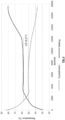
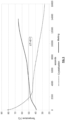
- the acquired file is then processed to obtain the time/Temperature curves shown in figures 2-5 , using libreoffice Calc software (version 6.0).
- the characterization of the PEG 4000 sample was carried out by placing 100 g of sample in the appropriately sealed container (1). It was then proceeded to pre-heat the tank (12) by means of the resistance (15) provided with a manual thermostat up to a temperature of 85°C in order to have a heat transport fluid at a constant temperature. Through the valves (10′′′ and 10 ⁇ ) the heating circuit was opened and the circulation pump (11) was activated. Using a needle valve built into the flow meter (9), the fluid flow rate was regulated to 3 litres/minute to begin characterization.
- thermocouple (3) the temperature of the heating sample was recorded over time, which was then reported in the time/Temperature curve in Figure 2 as the melting (Melting) curve.
- Figure 2 shows the time/Temperature curve obtained and Table 1 shows the data of melting temperature (Tmelt), crystallization temperature (Tcryst), melting enthalpy ( ⁇ Hmelt), and enthalpy of crystallization (AHcryst) obtained through said characterization.
- Tmelt melting temperature
- Tcryst crystallization temperature
- ⁇ Hmelt melting enthalpy
- AHcryst enthalpy of crystallization
- PEG 4000 (technical grade PEG 4000 manufactured by Lotte Chemical) and 15 grams of trimethylolpropane (technical grade manufactured by Perstorp) were fed to a container provided with an agitator and suction system. The mixture was then stirred and heated to a temperature of 80°C under vacuum, progressively bringing the residual pressure in the container to values less than 100 mBar, and then maintaining said vacuum degree for 20 minutes.
- the resulting mixture was subjected to density analysis and thermal characterization using the apparatus in Figure 1 , under the same measurement conditions used in Reference Example 1.
- Figure 3 shows the time/Temperature curve obtained and Table 1 shows the data obtained through said characterizations, in comparison with the data obtained in Reference Example 1.
- Figure 4 shows the time/Temperature curve obtained and Table 1 shows the data obtained through said characterizations, in comparison with the data obtained in Reference Example 1.
- Figure 5 shows the time/Temperature curve obtained and Table 1 shows the data obtained through said characterizations, in comparison with the data obtained in Reference Example 1.
- TABLE 1 ⁇ (kg/l) Tmelt. (°C) Tcryst. (°C) ⁇ Hmelt. (kJ/kg) ⁇ Hcryst. (kJ/kg) Reference Example 1 1.12 59-63 52-50 180-190 170-180
- Example 1 1.07 57 -59 51 - 49 173-183 165-175
- Example 2 1.20 57.5 -59.5 51-49 173-183 165-175
- Example 3 1.19 48 -51.5 44-41 171 - 179 162-171
- the inert mixtures according to the present invention according to Examples 1-3 have hysteresis range values of 6°C, 6.5°C and 6°C, respectively, as also shown in Figures 1-3 by the symbol ⁇ T, which identifies the temperature difference recorded between the melting temperature and the crystallization temperature of the mixtures.
- Said value of the hysteresis range is found to be lower than the hysteresis range of the polyether alone according to Reference Example 1, resulting in an improvement in the usability of the returned heat of the mixtures according to the present invention compared to the use of the polyether alone according to Reference example 1.
- the mixture according to Example 2 thanks to the presence of additional and optional components such as erythritol, sodium chloride and graphite, additionally showed an increase in the thermal capacity of the inert mixture, as highlighted by the increased duration of the flat zone in the phase transition, further improving the performance of said mixtures.
- additional and optional components such as erythritol, sodium chloride and graphite
Landscapes
- Chemical & Material Sciences (AREA)
- Engineering & Computer Science (AREA)
- Physics & Mathematics (AREA)
- Chemical Kinetics & Catalysis (AREA)
- Combustion & Propulsion (AREA)
- Thermal Sciences (AREA)
- Materials Engineering (AREA)
- Organic Chemistry (AREA)
- Compositions Of Macromolecular Compounds (AREA)
- Organic Low-Molecular-Weight Compounds And Preparation Thereof (AREA)
Claims (15)
- Inertes Gemisch umfassend:a. 45 bis 99 Gew.-%, bezogen auf das Gesamtgewicht des inerten Gemisches, mindestens eines Polyethers, das aus der Gruppe bestehend aus Polyethylenglykol (PEG) und Methoxypolyethylenglykol (mPEG) ausgewählt wird; undb. 1 bis 16 Gew.-%, bezogen auf das Gesamtgewicht des inerten Gemisches, mindestens einer hydroxylierten Verbindung, die aus der Gruppe bestehend aus: Trimethylolpropan, Menthol, Neopentylalkohol und Guajakol ausgewählt wird.
- Inertes Gemisch nach Anspruch 1, wobei der mindestens eine Polyether ein durchschnittliches Molekulargewicht im Bereich von 2000 bis 10000 Da aufweist.
- Inertes Gemisch nach Anspruch 1 oder 2, wobei die mindestens eine hydroxylierte Verbindung Trimethylolpropan ist.
- Inertes Gemisch nach einem der Ansprüche 1 bis 3, umfassend mindestens ein Polyol, das aus der Gruppe bestehend aus: Erythrit, Mannit, Pentaerythrit, Xylit, Dulcit, Sorbit, Ribit, Maltit und Inosit ausgewählt wird.
- Inertes Gemisch nach Anspruch 4, wobei das mindestens eine Polyol in einer Menge im Bereich von 1 bis 15 Gew.-%, bezogen auf das Gesamtgewicht des inerten Gemisches vorhanden ist.
- Inertes Gemisch nach einem der Ansprüche 1 bis 5, umfassend mindestens ein anorganisches Salz, wobei das anorganische Salz aus mindestens einem Metall besteht, das aus der Gruppe bestehend aus Lithium, Natrium, Kalium, Calcium, Magnesium, Strontium, Barium, Titan, Vanadium, Chrom, Mangan, Eisen, Kobalt, Nickel, Kupfer, Zink und Aluminium ausgewählt wird und aus mindestens einem Anion, das aus der Gruppe bestehend aus einem Halogenid, einem Silikat und einem Sulfat ausgewählt wird.
- Inertes Gemisch nach Anspruch 6, wobei das mindestens eine anorganische Salz in einer Menge im Bereich von 1 bis 15 Gew.-%, bezogen auf das Gesamtgewicht des inerten Gemisches, vorhanden ist.
- Inertes Gemisch nach einem der Ansprüche 1 bis 7, das mindestens ein Nukleierungsmittel enthält.
- Inertes Gemisch nach Anspruch 8, wobei das Nukleierungsmittel aus der Gruppe bestehend aus Kohlenstoffpulver, Metallpulver und Siliziumkarbid ausgewählt wird.
- Inertes Gemisch nach Anspruch 8 oder 9, wobei das mindestens eine Nukleierungsmittel in Form von Teilchen mit einer Teilchengröße im Bereich von 1 bis 50 Mikron, die mit dem Laserdiffraktometrieverfahren gemäß der Norm ISO 13320: 2009 (E) gemessen wird vorhanden ist.
- Inertes Gemisch nach Anspruch 10, wobei das mindestens eine Nukleierungsmittel in Form von Teilchen mit einer Größe im Bereich von 5 bis 20 Mikron vorhanden ist.
- Inertes Gemisch nach einem der Ansprüche 8 bis 11, wobei das mindestens eine Nukleierungsmittel in einer Menge im Bereich von 2 bis 20 Gew.-%, bezogen auf das Gesamtgewicht des inerten Gemisches, vorhanden ist.
- Verwendung des inerten Gemisches gemäß einem der Ansprüche 1 bis 12 zur Speicherung von Wärmeenergie.
- Verwendung des inerten Gemisches nach einem der Ansprüche 1 bis 12 zur Speicherung von Wärmeenergie in einem Temperaturbereich von 40° C bis 65° C.
- Verwendung des inerten Gemisches gemäß einem der Ansprüche 1 bis 12 als Phasenwechselmaterial.
Applications Claiming Priority (2)
| Application Number | Priority Date | Filing Date | Title |
|---|---|---|---|
| IT102020000006250A IT202000006250A1 (it) | 2020-03-25 | 2020-03-25 | Miscela inerte e suo uso come materiale a cambiamento di fase per applicazioni a bassa temperatura |
| PCT/IB2021/052444 WO2021191817A1 (en) | 2020-03-25 | 2021-03-24 | Inert mixture and its use as phase change material for low temperature applications |
Publications (3)
| Publication Number | Publication Date |
|---|---|
| EP4127093A1 EP4127093A1 (de) | 2023-02-08 |
| EP4127093C0 EP4127093C0 (de) | 2023-09-06 |
| EP4127093B1 true EP4127093B1 (de) | 2023-09-06 |
Family
ID=70918875
Family Applications (1)
| Application Number | Title | Priority Date | Filing Date |
|---|---|---|---|
| EP21719714.4A Active EP4127093B1 (de) | 2020-03-25 | 2021-03-24 | Inerte mischung und ihre verwendung als phasenaustauschmaterial für tieftemperaturanwendungen |
Country Status (3)
| Country | Link |
|---|---|
| EP (1) | EP4127093B1 (de) |
| IT (1) | IT202000006250A1 (de) |
| WO (1) | WO2021191817A1 (de) |
Family Cites Families (5)
| Publication number | Priority date | Publication date | Assignee | Title |
|---|---|---|---|---|
| ITMI20112050A1 (it) * | 2011-11-11 | 2013-05-12 | Ohikia S R L | Miscela per lo stoccaggio di energia termica e dispositivo di accumulo e rilascio del calore utilizzante detta miscela |
| CN106221676B (zh) * | 2016-07-29 | 2019-11-29 | 贺迈新能源科技(上海)有限公司 | 多相变点的相变蓄热材料及其制备工艺 |
| US20200278241A1 (en) | 2017-09-21 | 2020-09-03 | Nec Corporation | Vibration determination device, vibration determination method, and program |
| CN108410430A (zh) * | 2018-02-26 | 2018-08-17 | 苏州甫众塑胶有限公司 | 一种智能建筑用相变储能材料的制备方法 |
| CN110484213B (zh) * | 2019-08-19 | 2021-03-02 | 苏州阿德旺斯新材料有限公司 | 一种定型mof基复合相变材料及其制备方法和应用 |
-
2020
- 2020-03-25 IT IT102020000006250A patent/IT202000006250A1/it unknown
-
2021
- 2021-03-24 EP EP21719714.4A patent/EP4127093B1/de active Active
- 2021-03-24 WO PCT/IB2021/052444 patent/WO2021191817A1/en not_active Ceased
Also Published As
| Publication number | Publication date |
|---|---|
| EP4127093C0 (de) | 2023-09-06 |
| WO2021191817A1 (en) | 2021-09-30 |
| IT202000006250A1 (it) | 2021-09-25 |
| EP4127093A1 (de) | 2023-02-08 |
Similar Documents
| Publication | Publication Date | Title |
|---|---|---|
| Tan et al. | Effect of phase separation and supercooling on the storage capacity in a commercial latent heat thermal energy storage: Experimental cycling of a salt hydrate PCM | |
| Jin et al. | Thermal conductivity enhancement of a sodium acetate trihydrate–potassium chloride–urea/expanded graphite composite phase–change material for latent heat thermal energy storage | |
| Philip et al. | Lauryl alcohol and stearyl alcohol eutectic for cold thermal energy storage in buildings: Preparation, thermophysical studies and performance analysis | |
| Wokon et al. | Thermodynamic and kinetic investigation of a technical grade manganese-iron binary oxide for thermochemical energy storage | |
| US5282994A (en) | Dry powder mixes comprising phase change materials | |
| Liebske et al. | Viscosity of peridotite liquid up to 13 GPa: Implications for magma ocean viscosities | |
| Nagano et al. | Thermal characteristics of magnesium nitrate hexahydrate and magnesium chloride hexahydrate mixture as a phase change material for effective utilization of urban waste heat | |
| US20130180520A1 (en) | Thermal energy storage with molten salt | |
| Lepple et al. | Thermochemistry and phase stability of the polymorphs of yttrium tantalate, YTaO4 | |
| JPWO2019172149A1 (ja) | 蓄冷材組成物およびその利用 | |
| Naresh et al. | Homogeneous molten salt formulations as thermal energy storage media and heat transfer fluid | |
| Müller-Trefzer et al. | Experimental investigations on the design of a dual-media thermal energy storage with liquid metal | |
| EP4127094B1 (de) | Inerte mischung und ihre verwendung als phasenaustauschmaterial für hochtemperaturanwendungen | |
| Ji et al. | Experimental study of thermal energy storage system for solid particles/heat transfer oil in shell and tube heat exchangers with H-shaped fins | |
| Pramod et al. | Novel methodology to prepare homogenous ternary molten salts for concentrated solar power applications and their thermo-physical characterization | |
| Costa et al. | Thermophysical properties of tetrabutylammonium chloride, paraffin and fatty acids for thermal energy applications | |
| US5916477A (en) | Heat storage/heat radiation method | |
| Korchemkin et al. | Thermodynamic properties of caesium–cobalt phosphate CsCoPO4 | |
| EP0070648A1 (de) | Wärmespeichermaterial | |
| WO2021191817A1 (en) | Inert mixture and its use as phase change material for low temperature applications | |
| CN101641421A (zh) | 潜热蓄热性物质、包合水合物或其浆料、制备包合水合物或其浆料的方法、以及潜热蓄热剂 | |
| EP3861086B1 (de) | Inerte mischung und ihre verwendung als phasenwechselmaterial | |
| Saeed | Advancement in thermal energy storage using phase change materials | |
| EP3155063B1 (de) | Phosphatbasierte materialien in wärmeenergiespeichersystemen | |
| Kakiuchi et al. | A study of trimethylolethane hydrate as a phase change material |
Legal Events
| Date | Code | Title | Description |
|---|---|---|---|
| STAA | Information on the status of an ep patent application or granted ep patent |
Free format text: STATUS: UNKNOWN |
|
| STAA | Information on the status of an ep patent application or granted ep patent |
Free format text: STATUS: THE INTERNATIONAL PUBLICATION HAS BEEN MADE |
|
| PUAI | Public reference made under article 153(3) epc to a published international application that has entered the european phase |
Free format text: ORIGINAL CODE: 0009012 |
|
| STAA | Information on the status of an ep patent application or granted ep patent |
Free format text: STATUS: REQUEST FOR EXAMINATION WAS MADE |
|
| 17P | Request for examination filed |
Effective date: 20221020 |
|
| AK | Designated contracting states |
Kind code of ref document: A1 Designated state(s): AL AT BE BG CH CY CZ DE DK EE ES FI FR GB GR HR HU IE IS IT LI LT LU LV MC MK MT NL NO PL PT RO RS SE SI SK SM TR |
|
| GRAP | Despatch of communication of intention to grant a patent |
Free format text: ORIGINAL CODE: EPIDOSNIGR1 |
|
| STAA | Information on the status of an ep patent application or granted ep patent |
Free format text: STATUS: GRANT OF PATENT IS INTENDED |
|
| INTG | Intention to grant announced |
Effective date: 20230406 |
|
| GRAS | Grant fee paid |
Free format text: ORIGINAL CODE: EPIDOSNIGR3 |
|
| GRAA | (expected) grant |
Free format text: ORIGINAL CODE: 0009210 |
|
| STAA | Information on the status of an ep patent application or granted ep patent |
Free format text: STATUS: THE PATENT HAS BEEN GRANTED |
|
| AK | Designated contracting states |
Kind code of ref document: B1 Designated state(s): AL AT BE BG CH CY CZ DE DK EE ES FI FR GB GR HR HU IE IS IT LI LT LU LV MC MK MT NL NO PL PT RO RS SE SI SK SM TR |
|
| REG | Reference to a national code |
Ref country code: GB Ref legal event code: FG4D |
|
| REG | Reference to a national code |
Ref country code: CH Ref legal event code: EP |
|
| REG | Reference to a national code |
Ref country code: IE Ref legal event code: FG4D |
|
| REG | Reference to a national code |
Ref country code: DE Ref legal event code: R096 Ref document number: 602021004984 Country of ref document: DE |
|
| U01 | Request for unitary effect filed |
Effective date: 20231003 |
|
| U07 | Unitary effect registered |
Designated state(s): AT BE BG DE DK EE FI FR IT LT LU LV MT NL PT SE SI Effective date: 20231013 |
|
| PG25 | Lapsed in a contracting state [announced via postgrant information from national office to epo] |
Ref country code: GR Free format text: LAPSE BECAUSE OF FAILURE TO SUBMIT A TRANSLATION OF THE DESCRIPTION OR TO PAY THE FEE WITHIN THE PRESCRIBED TIME-LIMIT Effective date: 20231207 |
|
| PG25 | Lapsed in a contracting state [announced via postgrant information from national office to epo] |
Ref country code: RS Free format text: LAPSE BECAUSE OF FAILURE TO SUBMIT A TRANSLATION OF THE DESCRIPTION OR TO PAY THE FEE WITHIN THE PRESCRIBED TIME-LIMIT Effective date: 20230906 Ref country code: NO Free format text: LAPSE BECAUSE OF FAILURE TO SUBMIT A TRANSLATION OF THE DESCRIPTION OR TO PAY THE FEE WITHIN THE PRESCRIBED TIME-LIMIT Effective date: 20231206 Ref country code: HR Free format text: LAPSE BECAUSE OF FAILURE TO SUBMIT A TRANSLATION OF THE DESCRIPTION OR TO PAY THE FEE WITHIN THE PRESCRIBED TIME-LIMIT Effective date: 20230906 Ref country code: GR Free format text: LAPSE BECAUSE OF FAILURE TO SUBMIT A TRANSLATION OF THE DESCRIPTION OR TO PAY THE FEE WITHIN THE PRESCRIBED TIME-LIMIT Effective date: 20231207 |
|
| U20 | Renewal fee for the european patent with unitary effect paid |
Year of fee payment: 4 Effective date: 20240207 |
|
| PG25 | Lapsed in a contracting state [announced via postgrant information from national office to epo] |
Ref country code: IS Free format text: LAPSE BECAUSE OF FAILURE TO SUBMIT A TRANSLATION OF THE DESCRIPTION OR TO PAY THE FEE WITHIN THE PRESCRIBED TIME-LIMIT Effective date: 20240106 |
|
| PG25 | Lapsed in a contracting state [announced via postgrant information from national office to epo] |
Ref country code: ES Free format text: LAPSE BECAUSE OF FAILURE TO SUBMIT A TRANSLATION OF THE DESCRIPTION OR TO PAY THE FEE WITHIN THE PRESCRIBED TIME-LIMIT Effective date: 20230906 |
|
| PG25 | Lapsed in a contracting state [announced via postgrant information from national office to epo] |
Ref country code: SM Free format text: LAPSE BECAUSE OF FAILURE TO SUBMIT A TRANSLATION OF THE DESCRIPTION OR TO PAY THE FEE WITHIN THE PRESCRIBED TIME-LIMIT Effective date: 20230906 Ref country code: RO Free format text: LAPSE BECAUSE OF FAILURE TO SUBMIT A TRANSLATION OF THE DESCRIPTION OR TO PAY THE FEE WITHIN THE PRESCRIBED TIME-LIMIT Effective date: 20230906 Ref country code: IS Free format text: LAPSE BECAUSE OF FAILURE TO SUBMIT A TRANSLATION OF THE DESCRIPTION OR TO PAY THE FEE WITHIN THE PRESCRIBED TIME-LIMIT Effective date: 20240106 Ref country code: ES Free format text: LAPSE BECAUSE OF FAILURE TO SUBMIT A TRANSLATION OF THE DESCRIPTION OR TO PAY THE FEE WITHIN THE PRESCRIBED TIME-LIMIT Effective date: 20230906 Ref country code: CZ Free format text: LAPSE BECAUSE OF FAILURE TO SUBMIT A TRANSLATION OF THE DESCRIPTION OR TO PAY THE FEE WITHIN THE PRESCRIBED TIME-LIMIT Effective date: 20230906 Ref country code: SK Free format text: LAPSE BECAUSE OF FAILURE TO SUBMIT A TRANSLATION OF THE DESCRIPTION OR TO PAY THE FEE WITHIN THE PRESCRIBED TIME-LIMIT Effective date: 20230906 |
|
| PG25 | Lapsed in a contracting state [announced via postgrant information from national office to epo] |
Ref country code: PL Free format text: LAPSE BECAUSE OF FAILURE TO SUBMIT A TRANSLATION OF THE DESCRIPTION OR TO PAY THE FEE WITHIN THE PRESCRIBED TIME-LIMIT Effective date: 20230906 |
|
| REG | Reference to a national code |
Ref country code: DE Ref legal event code: R097 Ref document number: 602021004984 Country of ref document: DE |
|
| PLBE | No opposition filed within time limit |
Free format text: ORIGINAL CODE: 0009261 |
|
| STAA | Information on the status of an ep patent application or granted ep patent |
Free format text: STATUS: NO OPPOSITION FILED WITHIN TIME LIMIT |
|
| 26N | No opposition filed |
Effective date: 20240607 |
|
| REG | Reference to a national code |
Ref country code: CH Ref legal event code: PL |
|
| PG25 | Lapsed in a contracting state [announced via postgrant information from national office to epo] |
Ref country code: MC Free format text: LAPSE BECAUSE OF FAILURE TO SUBMIT A TRANSLATION OF THE DESCRIPTION OR TO PAY THE FEE WITHIN THE PRESCRIBED TIME-LIMIT Effective date: 20230906 |
|
| PG25 | Lapsed in a contracting state [announced via postgrant information from national office to epo] |
Ref country code: MC Free format text: LAPSE BECAUSE OF FAILURE TO SUBMIT A TRANSLATION OF THE DESCRIPTION OR TO PAY THE FEE WITHIN THE PRESCRIBED TIME-LIMIT Effective date: 20230906 |
|
| PG25 | Lapsed in a contracting state [announced via postgrant information from national office to epo] |
Ref country code: IE Free format text: LAPSE BECAUSE OF NON-PAYMENT OF DUE FEES Effective date: 20240324 |
|
| PG25 | Lapsed in a contracting state [announced via postgrant information from national office to epo] |
Ref country code: IE Free format text: LAPSE BECAUSE OF NON-PAYMENT OF DUE FEES Effective date: 20240324 Ref country code: CH Free format text: LAPSE BECAUSE OF NON-PAYMENT OF DUE FEES Effective date: 20240331 |
|
| U20 | Renewal fee for the european patent with unitary effect paid |
Year of fee payment: 5 Effective date: 20250320 |
|
| PG25 | Lapsed in a contracting state [announced via postgrant information from national office to epo] |
Ref country code: CY Free format text: LAPSE BECAUSE OF FAILURE TO SUBMIT A TRANSLATION OF THE DESCRIPTION OR TO PAY THE FEE WITHIN THE PRESCRIBED TIME-LIMIT; INVALID AB INITIO Effective date: 20210324 |
|
| PG25 | Lapsed in a contracting state [announced via postgrant information from national office to epo] |
Ref country code: HU Free format text: LAPSE BECAUSE OF FAILURE TO SUBMIT A TRANSLATION OF THE DESCRIPTION OR TO PAY THE FEE WITHIN THE PRESCRIBED TIME-LIMIT; INVALID AB INITIO Effective date: 20210324 |
|
| GBPC | Gb: european patent ceased through non-payment of renewal fee |
Effective date: 20250324 |
|
| PG25 | Lapsed in a contracting state [announced via postgrant information from national office to epo] |
Ref country code: TR Free format text: LAPSE BECAUSE OF FAILURE TO SUBMIT A TRANSLATION OF THE DESCRIPTION OR TO PAY THE FEE WITHIN THE PRESCRIBED TIME-LIMIT Effective date: 20230906 |
|
| PG25 | Lapsed in a contracting state [announced via postgrant information from national office to epo] |
Ref country code: GB Free format text: LAPSE BECAUSE OF NON-PAYMENT OF DUE FEES Effective date: 20250324 |