EP4126572B1 - Verbindungsanordnung zwischen einer luftfeder und einem luftfederträger - Google Patents
Verbindungsanordnung zwischen einer luftfeder und einem luftfederträger Download PDFInfo
- Publication number
- EP4126572B1 EP4126572B1 EP21710243.3A EP21710243A EP4126572B1 EP 4126572 B1 EP4126572 B1 EP 4126572B1 EP 21710243 A EP21710243 A EP 21710243A EP 4126572 B1 EP4126572 B1 EP 4126572B1
- Authority
- EP
- European Patent Office
- Prior art keywords
- rolling piston
- pneumatic spring
- connection assembly
- air spring
- spring support
- Prior art date
- Legal status (The legal status is an assumption and is not a legal conclusion. Google has not performed a legal analysis and makes no representation as to the accuracy of the status listed.)
- Active
Links
Images


Classifications
-
- B—PERFORMING OPERATIONS; TRANSPORTING
- B60—VEHICLES IN GENERAL
- B60G—VEHICLE SUSPENSION ARRANGEMENTS
- B60G11/00—Resilient suspensions characterised by arrangement, location or kind of springs
- B60G11/26—Resilient suspensions characterised by arrangement, location or kind of springs having fluid springs only, e.g. hydropneumatic springs
- B60G11/28—Resilient suspensions characterised by arrangement, location or kind of springs having fluid springs only, e.g. hydropneumatic springs characterised by means specially adapted for attaching the spring to axle or sprung part of the vehicle
-
- F—MECHANICAL ENGINEERING; LIGHTING; HEATING; WEAPONS; BLASTING
- F16—ENGINEERING ELEMENTS AND UNITS; GENERAL MEASURES FOR PRODUCING AND MAINTAINING EFFECTIVE FUNCTIONING OF MACHINES OR INSTALLATIONS; THERMAL INSULATION IN GENERAL
- F16F—SPRINGS; SHOCK-ABSORBERS; MEANS FOR DAMPING VIBRATION
- F16F9/00—Springs, vibration-dampers, shock-absorbers, or similarly-constructed movement-dampers using a fluid or the equivalent as damping medium
- F16F9/02—Springs, vibration-dampers, shock-absorbers, or similarly-constructed movement-dampers using a fluid or the equivalent as damping medium using gas only or vacuum
- F16F9/04—Springs, vibration-dampers, shock-absorbers, or similarly-constructed movement-dampers using a fluid or the equivalent as damping medium using gas only or vacuum in a chamber with a flexible wall
- F16F9/0454—Springs, vibration-dampers, shock-absorbers, or similarly-constructed movement-dampers using a fluid or the equivalent as damping medium using gas only or vacuum in a chamber with a flexible wall characterised by the assembling method or by the mounting arrangement, e.g. mounting of the membrane
-
- F—MECHANICAL ENGINEERING; LIGHTING; HEATING; WEAPONS; BLASTING
- F16—ENGINEERING ELEMENTS AND UNITS; GENERAL MEASURES FOR PRODUCING AND MAINTAINING EFFECTIVE FUNCTIONING OF MACHINES OR INSTALLATIONS; THERMAL INSULATION IN GENERAL
- F16F—SPRINGS; SHOCK-ABSORBERS; MEANS FOR DAMPING VIBRATION
- F16F9/00—Springs, vibration-dampers, shock-absorbers, or similarly-constructed movement-dampers using a fluid or the equivalent as damping medium
- F16F9/02—Springs, vibration-dampers, shock-absorbers, or similarly-constructed movement-dampers using a fluid or the equivalent as damping medium using gas only or vacuum
- F16F9/04—Springs, vibration-dampers, shock-absorbers, or similarly-constructed movement-dampers using a fluid or the equivalent as damping medium using gas only or vacuum in a chamber with a flexible wall
- F16F9/05—Springs, vibration-dampers, shock-absorbers, or similarly-constructed movement-dampers using a fluid or the equivalent as damping medium using gas only or vacuum in a chamber with a flexible wall the flexible wall being of the rolling diaphragm type
- F16F9/057—Springs, vibration-dampers, shock-absorbers, or similarly-constructed movement-dampers using a fluid or the equivalent as damping medium using gas only or vacuum in a chamber with a flexible wall the flexible wall being of the rolling diaphragm type characterised by the piston
-
- B—PERFORMING OPERATIONS; TRANSPORTING
- B60—VEHICLES IN GENERAL
- B60G—VEHICLE SUSPENSION ARRANGEMENTS
- B60G2202/00—Indexing codes relating to the type of spring, damper or actuator
- B60G2202/10—Type of spring
- B60G2202/15—Fluid spring
- B60G2202/152—Pneumatic spring
- B60G2202/1524—Pneumatic spring with two air springs per wheel, arranged before and after the wheel axis
-
- B—PERFORMING OPERATIONS; TRANSPORTING
- B60—VEHICLES IN GENERAL
- B60G—VEHICLE SUSPENSION ARRANGEMENTS
- B60G2204/00—Indexing codes related to suspensions per se or to auxiliary parts
- B60G2204/10—Mounting of suspension elements
- B60G2204/12—Mounting of springs or dampers
- B60G2204/126—Mounting of pneumatic springs
Definitions
- the invention relates to a connection arrangement between an air spring and an air spring carrier according to the preamble of patent claim 1.
- Chassis arrangements with air-sprung rigid axles are known from the outset, which are supported on a vehicle frame by one air spring support per vehicle side and a total of two or four air springs.
- the air spring supports are usually connected directly to the rigid axle and the air springs are arranged in a vertical direction of the vehicle between the air spring supports and the longitudinal members of the vehicle frame.
- the air springs are often connected to the respective air spring supports by a screw connection.
- Air springs such as those mentioned above are also generally known and essentially have a cover, a rolling piston and a rolling bellows clamped in between them in an airtight manner.
- the cover, the rolling piston and the rolling bellows delimit a pressure chamber under an operating pressure of, for example, 10 bar.
- the rolling piston is also referred to as a plunger piston.
- a rolling piston of the air spring has a recess in its bottom side facing the air spring carrier, which is referred to as the underside.
- a centering cone is attached to the air spring carrier, which fits into the bottom recess of the rolling piston and is completely covered by the rolling piston.
- the centering cone and the rolling piston have a common central axis, which is also the central axis of the air spring.
- the rolling piston and the centering cone are separate structural parts which engage with one another during normal driving of a vehicle. When the vehicle is loaded by crane or rail, however, the rolling piston and the centering cone can move apart.
- the rolling piston rests over its circumference on a separate base plate which is screwed to the air spring carrier, forming a circular line of contact.
- the The rolling piston and the air spring supports are spaced apart by the base plate.
- the centering cone has the same outside diameter as the rolling piston.
- a peripheral surface of the centering cone which is designed like the peripheral surface of a truncated cone, is exposed during normal driving and has no supporting function.
- a stop buffer is attached to the upper side of the rolling piston, opposite the base side of the rolling piston, which rests against the inside of a cover of the air spring when the air spring is vented.
- the object of the invention is to provide an alternative embodiment of a connection arrangement between an air spring and an air spring carrier.
- the invention therefore provides a connection arrangement between an air spring and an air spring support, wherein the connection arrangement can be released without tools.
- a rolling piston of the air spring has a recess in its base side facing the air spring support.
- a centering cone is attached to the air spring support, which fits into the base recess of the rolling piston and is completely covered by the rolling piston.
- the centering cone and the rolling piston have a common central axis, which is also the central axis of the air spring.
- the rolling piston and the centering cone are made of plastic. At the same time, the rolling piston rests flatly in the direction of the central axis both directly on the centering cone and directly on the air spring support.
- the force component to be transmitted by the connection arrangement which acts in the direction of the central axis, is divided between these two components.
- the flat support of the rolling piston on the two aforementioned components also increases the contact surface available for force transmission in the direction of the central axis. This means that the surface pressure in the common contact surface of the rolling piston, centering cone and air spring support can be kept relatively low, thus enabling the use of plastic components.
- a direct, flat support of the rolling piston on both the centering cone and the air spring support is actually geometrically overdetermined and would practically be impossible to achieve with a virtually non-compliant metallic rolling piston and a likewise virtually non-compliant metallic centering cone. This is because the manufacturing effort to achieve a direct, flat support of the metallic rolling piston, centering cone and air spring support could only be achieved with a disproportionately high machining effort due to tolerances.
- connection arrangement has tolerance-compensating flexibility that allows the rolling piston to be supported directly and flatly on both the centering cone and the air spring carrier.
- the use of a rolling piston and a centering cone made of plastic also results in a weight advantage compared to the use of metal components.
- a connection arrangement that can be released without tools is understood to mean a connection arrangement that can be released by hand and without the aid of auxiliary tools, such as a wrench.
- the rolling piston is designed in one piece and ready for installation.
- the rolling piston consists of a thermoplastic material and is manufactured using an injection molding process.
- the centering cone is part of a centering pin.
- the centering cone is designed in the shape of a truncated cone.
- the rolling piston is supported in the direction of the central axis on a conical surface or on a truncated conical surface of the centering cone.
- the bottom side of the rolling piston is identical to the bottom side of the Air spring.
- the air spring has a pressure chamber that extends into the rolling piston and at the same time extends in the direction of the central axis essentially over the entire length of the rolling piston. A pressure chamber that extends into the rolling piston results in a relatively large pressure chamber in the air spring, which benefits the suspension comfort of the air spring.
- the recess on the bottom of the rolling piston is advantageously designed as a conical dome that is rotationally symmetrical to the center axis of the air spring, into which the centering cone engages in a form-fitting and flat manner.
- the dome is supported on the centering cone, forming a contact surface that is designed like the outer surface of a truncated cone. Radial forces acting perpendicular to the center axis in any direction as well as axial forces acting in the direction of the center axis can be transmitted via the contact surface that is designed like the outer surface of a truncated cone.
- the dome is expediently designed to be conically widened towards the bottom side of the rolling piston and has a diameter on the bottom side that is less than half the outside diameter of the rolling piston.
- the dome has a diameter on the bottom side, i.e. where the dome meets the bottom side, that is essentially one third the outside diameter of the rolling piston.
- a pressure chamber of the air spring is separated from the air spring carrier only by an annular wall of the rolling piston, wherein the annular wall is subjected to an operating pressure from the pressure chamber side in an operating state.
- the formulation according to which a pressure chamber of the air spring is separated from the air spring carrier only by an annular wall of the rolling piston is intended to express that the annular wall of the rolling piston is in direct contact with the air spring carrier, i.e. without an air gap.
- the annular wall of the rolling piston is in contact with the air spring carrier, forming an annular contact surface.
- the annular wall of the rolling piston is also a wall of the pressure chamber.
- the circular wall is also a wall of the pressure chamber, the operating pressure supports the circular wall from the inside against a supporting force acting on the circular wall from the outside through the air spring support, with which the air spring supports itself on the air spring support.
- the wall thickness of the circular wall can therefore be designed to be smaller than would be the case if the support from the inside caused by the operating pressure were not present. It goes without saying that the circular wall is designed to be airtight.
- the rolling piston advantageously has a circular wall that extends perpendicular to the center axis of the air spring and rests flatly directly on the air spring support.
- the circular wall is designed to be airtight.
- the rolling piston and the air spring support form a common contact surface that is designed as a circular surface.
- the rolling piston expediently has a ring-shaped, air-tight partition wall that encloses the circular wall on the bottom side of the rolling piston and is also arranged concentrically to an annular outer wall of the rolling piston and is enclosed by this annular outer wall.
- the air-tightness of the partition wall is advantageous in order to be able to manufacture the rolling piston cost-effectively in one operation using an injection molding process and ready for installation.
- the rolling piston When installed in a motor vehicle, the rolling piston carries part of the mass of a vehicle body. A large part of this mass is transferred to the air spring carrier via the partition wall.
- the partition wall is circumferentially closed and at the same time rotationally symmetrical.
- an essentially hollow-cylindrical intermediate space which is arranged between the intermediate wall and the outer wall, is open towards the bottom side.
- the centering cone advantageously has a cone angle of less than 45 degrees, preferably of around 30 degrees. Due to the relatively slim cone angle, the centering cone sits in the dome in a rotationally inhibited manner. Due to the relatively slim cone angle, the connection arrangement can still be released without tools; however, there is a certain resistance to the centering cone and rolling piston separating. This resistance can be helpful when assembling chassis assemblies in an assembly position that is turned 180 degrees compared to the normal road position, as is sometimes used in manufacturing plants. In such an assembly position, a vehicle frame, to which the air spring is attached via a cover of the same, faces the hall floor.
- a rigid axle together with the air spring carrier and centering pin pre-assembled in it is fed from above by a hall crane and then assembled.
- the centering cones are also inserted from above into the respective domes of the rolling pistons.
- the aforementioned resistance to separation of the centering cone and rolling piston helps to ensure that the centering cone and rolling piston do not separate again unintentionally.
- the centering cone sits in the dome in a rotationally inhibited manner.
- a relatively slim centering cone also has the advantage that it exhibits less geometric distortion during production, particularly in an injection molding process.
- the centering cone is part of a centering pin and also has a shaft that extends in the direction of the center axis of the air spring and passes through the air spring support.
- the centering pin consisting of the centering cone and the shaft is formed in one piece.
- the end of the shaft facing away from the centering cone protrudes from the air spring support in order to enable the attachment of a pull-out protection device, for example a locking ring.
- the shaft has a circumferential groove at the protruding end for receiving the pull-out protection device.
- the shaft and a bore in the air spring support that receives it suitably have a clearance fit with each other, which allows the shaft to rotate in the bore.
- relative movements that occur during driving in a common contact area of the air spring and the air spring support can be easily compensated.
- Such relative movements can be caused, for example, by one-sided compression of a rigid axle, rolling movements of a vehicle body or driving over a curb.
- the rolling piston is supported on a circular receiving plate of the air spring carrier, wherein the receiving plate has at least substantially the same outer diameter as the rolling piston on its base side.
- the rolling piston and the receiving plate are thus arranged at least substantially flush, which prevents the accumulation of contaminants in this area during driving.
- the common center axis of the air spring, the rolling piston and the centering cone is congruent with a center axis of the circular receiving plate.
- an annular outer wall of the rolling piston rests directly on a circular receiving plate of the air spring support with its end face facing the air spring support.
- a further load-bearing surface portion is provided for supporting the air spring on the air spring support.
- the outer wall of the rolling piston has at least essentially the same outer diameter as the receiving plate, which prevents dirt from entering the essentially hollow-cylindrical intermediate space that is open towards the bottom and is arranged between the intermediate wall and the outer wall. Since the annular outer wall is perpendicular to the receiving plate, it can take on a relatively high load-bearing portion.
- the rolling piston can be manufactured ready for installation in one operation using an injection molding process.
- This cost-effective production is possible, among other things, because the essentially hollow-cylindrical intermediate space arranged between the intermediate wall and the outer wall is open towards the bottom.
- the centering cone advantageously has a circumferential bevel on its largest diameter, which is arranged concentrically to the center axis of the air spring and which has a cylinder jacket-shaped surface, wherein the section of the centering cone which has this bevel is positively received by a depression let into the air spring support.
- This arrangement is advantageous in order to be able to safely absorb larger radial forces, which arise for example from a braking process and which act perpendicular to the center axis.
- shear forces are not transmitted, or not only, via the shaft of the centering cone, but (also) via the centering cone, which is significantly thicker in the area of the bevel.
- the depression is cylindrical and centrally let into the receiving plate.
- the center axis of the circular receiving plate is congruent with a center axis of the depression.
- the air spring is designed to be free of stop buffers. This means that the air spring does not have an integrated stop buffer that limits the movement of the air spring in the direction of the central axis. This movement limitation normally also represents a limit for the compression travel of a rigid axle.
- Air springs with an integrated stop buffer have the disadvantage that they are usually only designed for a specific chassis arrangement. Air springs without such an integrated stop buffer have the advantage that they can be used in various chassis arrangements. When using air springs without stop buffers, the corresponding chassis arrangements usually have stop buffers in other places that limit the compression travel of the associated rigid axles.
- Fig.1 shows a chassis arrangement 1 of a motor vehicle, which is designed as a commercial vehicle, known from the prior art.
- the chassis arrangement 1 has an air-sprung rigid axle 2, which is connected to two longitudinal members 5 of a vehicle frame, which extend parallel to one another, via an air spring support 3 on each side of the vehicle and a total of four air springs 4.
- the air springs 4 are connected to the respective longitudinal beam 5 by fastening brackets 12.
- the air spring carrier 3 shown has an air spring 4 attached to the air spring carrier 3 at each of its two ends.
- the two air springs 4 each have a compressed air connection (not shown here) and a fastening bracket 12 (also not shown here) on their upper sides.
- Fig.3 shows the air spring 4 suitable for a commercial vehicle, wherein the air spring 4 has a rolling piston 6 which consists of a thermoplastic material and which is manufactured ready for installation in one operation in an injection molding process.
- a rolling bellows 7 of the air spring 4 is connected in an airtight manner to a nozzle 8 of the rolling piston 6.
- the air spring 4, which is designed without a stop buffer, is suitable for the suspension of an air-sprung rigid axle 2 of a motor vehicle.
- a bottom side 9 of the rolling piston 6 faces the air spring carrier 3 when the air spring 4 is installed.
- the air spring 4 can be connected to a longitudinal member 5 of a vehicle frame of a commercial vehicle via a cover 10 of the air spring 4, which is arranged parallel and spaced apart from the bottom side 9.
- a fastening angle 12 (not shown here) is arranged between the cover 10 and the longitudinal member 5 and is firmly connected to the cover 10.
- a central axis 11 of the rolling piston 6 is congruent with a central axis 11 of the air spring 4.
- An outer surface of an annular outer wall 13 of the rolling piston 6 serves as a contact surface for the rolling bellows 7. In the installed state of the air spring 4, the rolling bellows 7 rolls on the outer surface of the annular outer wall 13 when the air spring 4 is compressed when the air-sprung rigid axle 2 is compressed.
- the rolling piston 6 has a recess 19 which is rotationally symmetrical to the central axis 11 and is designed as a dome 19.
- the dome 19 is part of a connection arrangement 15 between the air spring 4 and the air spring carrier 3 which can be released without tools and serves to connect the rolling piston 6 to the air spring carrier 3.
- the dome 19 is open towards the bottom side 9 and tapers conically away from the bottom side 9 in the direction of the central axis 11.
- An annular, air-impermeable The intermediate wall 20 of the rolling piston 6 is arranged both concentrically to the outer wall 13 and concentrically to the dome 19.
- the intermediate wall 20 encloses an airtight pressure chamber 21 of the air spring 4 that extends into the rolling piston 6.
- the pressure chamber 21 is also designed to be airtight towards the bottom side 9 of the rolling piston 6.
- the pressure chamber 21 has a circular ring-shaped wall 14 towards the bottom side 9 of the rolling piston 6.
- the intermediate wall 20 and the outer wall 13 are connected to one another by outer ribs extending radially away from the intermediate wall 20.
- the plate-shaped outer ribs extend in planes that contain the central axis 11 of the rolling piston 6.
- the intermediate space 22 is not a single intermediate space, but rather several individual intermediate spaces arranged in a circular ring, each of which has a circular ring segment cross-section that is delimited by two adjacent outer ribs, the outer wall 13 and the intermediate wall 20.
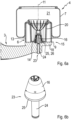
- Fig. 5a shows the connection arrangement 15 between the air spring 4 and the air spring support 3, wherein the connection arrangement 15 can be released without tools.
- the rolling piston 6 of the air spring 4 has the previously described recess in its bottom side 9 facing the air spring support 3, which is designed as a dome 19.
- a centering cone 16 that fits into the dome 19 and is completely covered by the rolling piston 6 is attached to the air spring support 3.
- the common center axis 11 of the air spring 4 and the rolling piston 6 is also the center axis 11 of the centering cone 16.
- the rolling piston 6 and the centering cone 16 are made of a thermoplastic that can be injection molded. The rolling piston 6 rests flat in the direction of the center axis 11 both directly on the centering cone 16 and directly on the air spring support 3.
- the centering cone 16 which has a cone angle ⁇ of 30 degrees, engages in a form-fitting and at the same time flat manner in the conical dome 19 of the rolling piston 6.
- the dome 19 has the bottom side 9 of the rolling piston 6 has a diameter which is essentially one third as large as the outer diameter of the rolling piston 6.
- the pressure chamber 21 of the air spring 4 is separated from the air spring support 3 only by the annular wall 14 of the rolling piston 6, which extends perpendicular to the central axis 11 of the air spring 4 and which rests directly on the air spring support 3.
- the air-impermeable intermediate wall 20 of the rolling piston 6 encloses the annular wall 14 on its bottom side 9 and is at the same time arranged concentrically to the annular outer wall 13 of the rolling piston 6 and is enclosed by the annular outer wall 13.
- the rolling piston 6 is supported on a circular receiving plate 18 of the air spring support 3, wherein the receiving plate 18 has essentially the same outer diameter as the rolling piston 6 on its bottom side 9.
- the annular outer wall 13 of the rolling piston 6 is supported with its end face facing the air spring support 3 directly on the circular receiving plate 18 of the air spring support 3.
- the centering cone 16 is part of a centering pin 23, which also has a shaft 24 extending in the direction of the central axis 11 of the air spring 4 and passing through the air spring support 3.
- the shaft 24 and a bore receiving the shaft in the circular receiving plate 18 of the air spring support 3 have a clearance fit with each other, whereby the shaft 24 can be rotated in the bore.
- the centering pin 23 consisting of the centering cone 16 and the shaft 24 is formed in one piece.
- the end of the shaft 24 facing away from the centering cone 16 protrudes from the air spring support 3 and has a circumferential groove there for receiving a locking ring.
- Fig. 6a shows an alternatively designed connection arrangement 15, which differs from the Fig. 5a only differs in that the centering cone 16 has a circumferential chamfer 24 at its largest diameter (see also Fig. 6b ), which is arranged concentrically to the central axis 11 of the air spring 4 and which has a cylinder-shaped surface, wherein the section of the centering cone 16, which has this chamfer 24, is positively received by a cylindrical recess 26 recessed into the air spring carrier 3.
Landscapes
- Engineering & Computer Science (AREA)
- General Engineering & Computer Science (AREA)
- Mechanical Engineering (AREA)
- Fluid-Damping Devices (AREA)
- Vehicle Body Suspensions (AREA)
Description
- Die Erfindung betrifft eine Verbindungsanordnung zwischen einer Luftfeder und einem Luftfederträger gemäß dem Oberbegriff von Patentanspruch 1.
- Aus dem Stand sind Fahrwerkanordnungen mit luftgefederten Starrachsen bekannt, die sich über jeweils einen Luftfederträger pro Fahrzeugseite und insgesamt zwei oder vier Luftfedern an einen Fahrzeugrahmen abstützen. Dabei sind die Luftfederträger in der Regel unmittelbar an die Starrachse angebunden und die Luftfedern in einer Fahrzeughochrichtung zwischen den Luftfederträgern und den Längsträgern des Fahrzeugrahmens angeordnet. Häufig sind die Luftfedern durch eine Schraubverbindung an die jeweils zugeordneten Luftfederträger angebunden. Luftfedern wie die vorgenannten sind ebenfalls allgemein bekannt und weisen im Wesentlichen einen Deckel, einen Abrollkolben und einen dazwischen luftdicht eingespannten Rollbalg auf. Durch den Deckel, den Abrollkolben und den Rollbalg wird ein unter einem Betriebsdruck von beispielsweise 10 bar stehender Druckraum begrenzt. Der Rollbalg rollt beim Einfedern der Luftfeder unter Ausbildung einer Rollfalte an einer Außenmantelfläche des Abrollkolbens ab. Der Abrollkolben wird auch als Tauchkolben bezeichnet.
- Aus der
DE 42 03 372 C1 ist eine Verbindungsanordnung zwischen einer Luftfeder und einem Luftfederträger bekannt, die werkzeuglos lösbar ist. Ein Abrollkolben der Luftfeder weist in seiner nach dem Luftfederträger hin gewandten Bodenseite, die als Unterseite bezeichnet wird, eine Ausnehmung auf. An dem Luftfederträger ist ein in die bodenseitige Ausnehmung des Abrollkolbens passender Zentrierkegel befestigt, der von dem Abrollkolben vollständig übergriffen ist. Der Zentrierkegel und der Abrollkolben weisen eine gemeinsame Mittelachse auf, die zugleich auch die Mittelachse der Luftfeder ist. Der Abrollkolben und der Zentrierkegel sind voneinander getrennte Konstruktionsteile, die im normalen Fahrbetrieb eines Fahrzeugs ineinandergreifen. Bei einer Kran- und Bahnverladung des Fahrzeugs können sich der Abrollkolben und der Zentrierkegel aber auseinander bewegen. Der Abrollkolben stützt sich im normalen Fahrbetrieb über seinen Umfang unter Ausbildung einer Kreislinienberührung auf einer mit dem Luftfederträger verschraubten, separaten Bodenplatte ab. Der Abrollkolben und die Luftfederträger sind durch die Bodenplatte voneinander beabstandet. Der Zentrierkegel weist den gleichen Außendurchmesser auf wie der Abrollkolben. Eine Mantelfläche des Zentrierkegels, die nach Art einer Mantelfläche eines Kegelstumpfs ausgebildet ist, liegt im normalen Fahrbetrieb frei und hat keine tragende Funktion. Auf einer der Bodenseite des Abrollkolbens gegenüberliegenden Oberseite des Abrollkolbens ist ein Anschlagpuffer befestigt, der sich bei entlüfteter Luftfeder gegen eine Innenseite eines Deckels der Luftfeder legt. - Dokument
DE29615901U wird als nächstliegendes Stand der Technik angesehen. - Aufgabe der Erfindung ist es, eine alternative Ausführung einer Verbindungsanordnung zwischen einer Luftfeder und einem Luftfederträger bereitzustellen.
- Diese Aufgabe wird gemäß der vorliegenden Erfindung gelöst durch eine gattungsgemäße Verbindungsanordnung, welche zusätzlich die kennzeichnenden Merkmale des Patentanspruchs 1 aufweist.
- Bevorzugte Ausführungsformen und Weiterbildungen sind Gegenstand der Unteransprüche und der nachfolgenden Beschreibung. Weitere Merkmale und Details der Erfindung ergeben sich aus den Zeichnungsfiguren.
- Die Erfindung sieht demnach eine Verbindungsanordnung zwischen einer Luftfeder und einem Luftfederträger vor, wobei die Verbindungsanordnung werkzeuglos lösbar ist. Ein Abrollkolben der Luftfeder weist in seiner dem Luftfederträger zugewandten Bodenseite eine Ausnehmung auf. An dem Luftfederträger ist ein in die bodenseitige Ausnehmung des Abrollkolbens passender Zentrierkegel befestigt, der von dem Abrollkolben vollständig übergriffen ist. Der Zentrierkegel und der Abrollkolben weisen eine gemeinsame Mittelachse auf, die zugleich auch die Mittelachse der Luftfeder ist. Erfindungsgemäß sind der Abrollkolben und der Zentrierkegel aus Kunststoff gebildet. Zugleich stützt sich der Abrollkolben in Richtung der Mittelachse sowohl unmittelbar an dem Zentrierkegel als auch unmittelbar an dem Luftfederträger flächig anliegend ab.
- Durch die flächig anliegende Abstützung des Abrollkolbens an zwei Bauteilen, nämlich an dem Zentrierkegel und an dem Luftfederträger, wird die in einem Einbauzustand durch die Verbindungsanordnung zu übertragende Kraftkomponente, die in Richtung der Mittelachse wirkt, auf diese beiden Bauteile aufgeteilt. Durch die flächig anliegende Abstützung des Abrollkolbens an den beiden vorgenannten Bauteilen wird zugleich auch die für eine Kraftübertragung in Richtung der Mittelachse zur Verfügung stehende Kontaktfläche vergrößert. Dadurch kann die Flächenpressung in der gemeinsamen Kontaktfläche von Abrollkolben, Zentrierkegel und Luftfederträger relativ gering gehalten werden und somit der Einsatz von Kunststoffbauteilen ermöglicht werden. Eine unmittelbare, flächig anliegende Abstützung des Abrollkolbens sowohl an dem Zentrierkegel als auch an dem Luftfederträger ist eigentlich geometrisch überbestimmt und wäre mit einem quasi nicht nachgiebigen metallischen Abrollkolben und einem ebenfalls quasi nicht nachgiebigen metallischen Zentrierkegel praktisch nicht erreichbar. Dies liegt darin begründet, dass der Herstellungsaufwand zur Erreichung einer unmittelbaren, flächig anliegenden Abstützung von metallischem Abrollkolben, Zentrierkegel und Luftfederträger toleranzbedingt nur mit unverhältnismäßig hohem Bearbeitungsaufwand erreichbar wäre.
- Dadurch, dass der Abrollkolben und der Zentrierkegel aus Kunststoff gebildet sind, weist die Verbindungsanordnung toleranzausgleichende Nachgiebigkeiten auf, die eine unmittelbare, flächig anliegende Abstützung des Abrollkolbens sowohl an dem Zentrierkegel als auch an dem Luftfederträger ermöglichen. Durch die Verwendung eines Abrollkolbens und eines Zentrierkegels aus Kunststoff ergibt sich zudem ein Gewichtsvorteil gegenüber einer Verwendung von metallischen Bauteilen. Unter einer werkzeuglos lösbaren Verbindungsanordnung ist vorliegend eine Verbindungsanordnung zu verstehen, die von Hand und ohne Zuhilfenahme von Hilfswerkzeugen, wie beispielsweise einem Schraubenschlüssel, gelöst werden kann.
- Insbesondere ist der Abrollkolben einbaufertig in einem Stück ausgebildet. Insbesondere besteht der Abrollkolben aus einem thermoplastischen Kunststoff und ist in einem Spritzgussverfahren hergestellt. Insbesondere ist der Zentrierkegel Bestandteil eines Zentrierzapfens. Insbesondere ist der Zentrierkegel kegelstumpfförmig ausgebildet. Insbesondere stützt sich der Abrollkolben in Richtung der Mittelachse an einer Kegelmantelfläche oder an einer Kegelstumpfmantelfläche des Zentrierkegels ab. Insbesondere ist die Bodenseite des Abrollkolbens identisch mit der Bodenseite der Luftfeder. Insbesondere weist die Luftfeder einen Druckraum auf, der sich in den Abrollkolben hinein erstreckt und der sich zugleich in Richtung der Mittelachse im Wesentlichen über die gesamte Länge des Abrollkolbens erstreckt. Durch einen Druckraum, der sich in den Abrollkolben hinein erstreckt, ergibt sich insgesamt ein relativ großer Druckraum in der Luftfeder was dem Federungskomfort der Luftfeder zugute kommt.
- Vorteilhaft ist die bodenseitige Ausnehmung des Abrollkolbens als ein rotationssymmetrisch zu der Mittelachse der Luftfeder ausgebildeter, konischer Dom ausgebildet, in den der Zentrierkegel formschlüssig und zugleich flächig anliegend eingreift. Insbesondere stützt sich der Dom unter Ausbildung einer Kontaktfläche, die nach Art einer Mantelfläche eines Kegelstumpfs ausgebildet ist, an dem Zentrierkegel ab. Über die nach Art einer Mantelfläche eines Kegelstumpfs ausgebildete Kontaktfläche können sowohl senkrecht zu der Mittelachse wirkende Radialkräfte in beliebigen Richtungen als auch in Richtung der Mittelachse wirkende Axialkräfte übertragen werden.
- Zweckmäßig ist der Dom nach der Bodenseite des Abrollkolbens hin konisch aufgeweitet ausgebildet und weist an der Bodenseite einen Durchmesser auf, der weniger als halb so groß ist wie der Außendurchmesser des Abrollkolbens. Vorteilhaft weist der Dom an der Bodenseite, also beim Übergang des Doms in die Bodenseite, einen Durchmesser auf, der im Wesentlichen ein Drittel so groß ist wie der Außendurchmesser des Abrollkolbens.
- Bevorzugt ist ein Druckraum der Luftfeder lediglich durch eine kreisringförmige Wandung des Abrollkolbens von dem Luftfederträger getrennt, wobei die kreisringförmige Wandung in einem Betriebszustand von der Druckraumseite her mit einem Betriebsdruck beaufschlagt ist. Mit der Formulierung, wonach ein Druckraum der Luftfeder lediglich durch eine kreisringförmige Wandung des Abrollkolbens von dem Luftfederträger getrennt ist, soll zum Ausdruck gebracht werden, dass die kreisringförmige Wandung des Abrollkolbens unmittelbar flächig, also ohne Luftspalt, an dem Luftfederträger anliegt. Insbesondere liegt die kreisringförmige Wandung des Abrollkolbens unter Ausbildung einer kreisringförmigen Kontaktfläche an dem Luftfederträger an. Insbesondere ist die kreisringförmige Wandung des Abrollkolbens zugleich eine Wandung des Druckraums. Dadurch, dass die kreisringförmige Wandung zugleich eine Wandung des Druckraums ist, stützt der Betriebsdruck die kreisringförmige Wandung von innen gegen eine von außen durch den Luftfederträger auf die kreisringförmige Wandung einwirkende Stützkraft ab mit der sich die Luftfeder auf dem Luftfederträger abstützt. Die Wandstärke der kreisringförmigen Wandung kann daher geringer ausgelegt werden als dies der Fall wäre, wenn die durch den Betriebsdruck bewirkte Abstützung von innen nicht gegeben wäre. Es versteht sich, dass die kreisringförmige Wandung luftundurchlässig ausgebildet ist.
- Vorteilhaft weist der Abrollkolben eine kreisringförmige Wandung auf, die sich senkrecht zu der Mittelachse der Luftfeder erstreckt und die sich unmittelbar auf dem Luftfederträger flächig anliegend abstützt. Insbesondere ist die kreisringförmige Wandung luftundurchlässig ausgebildet. Insbesondere bilden der Abrollkolben und der Luftfederträger eine gemeinsame Kontaktfläche aus, die als eine Kreisringfläche ausgebildet ist.
- Zweckmäßig weist der Abrollkolben eine ringförmig ausgebildete, luftundurchlässige Zwischenwand auf, die an der Bodenseite des Abrollkolbens die kreisringförmige Wandung einfasst und die zugleich konzentrisch zu einer ringförmigen Außenwand des Abrollkolbens angeordnet ist sowie von dieser ringförmigen Außenwand umschlossen ist. Die Luftundurchlässigkeit der Zwischenwand ist vorteilhaft, um den Abrollkolben kostengünstig in einem Arbeitsgang in einem Spritzgussverfahren einbaufertig herstellen zu können. In einem Einbauzustand in einem Kraftfahrzeug trägt der Abrollkolben einen Teil der Masse eines Fahrzeugaufbaus. Ein Großteil dieser Masse wird über die Zwischenwand in den Luftfederträger weitergeleitet. Insbesondere ist die Zwischenwand umfänglich geschlossen und zugleich rotationssymmetrisch ausgebildet.
- Bevorzugt ist ein im Wesentlichen hohlzylindrisch ausgebildeter Zwischenraum, der zwischen der Zwischenwand und der Außenwand angeordnet ist, nach der Bodenseite hin offen ausgebildet. Dies ist eine weitere Voraussetzung dafür, dass der Abrollkolben kostengünstig in einem Arbeitsgang in einem Spritzgussverfahren einbaufertig herstellbar ist.
- Vorteilhaft weist der Zentrierkegel einen Kegelwinkel von weniger als 45 Grad, vorzugsweise von circa 30 Grad, auf. Durch den relativ schlanken Kegelwinkel sitzt der Zentrierkegel rotationsgehemmt in dem Dom. Durch den relativ schlanken Kegelwinkel ist die Verbindungsanordnung zwar weiterhin werkzeuglos lösbar; weist aber einen gewissen Widerstand gegen eine Trennung von Zentrierkegel und Abrollkolben auf. Dieser Widerstand kann bei einer Montage von Fahrwerkanordnungen in einer gegenüber der normalen Straßenlage um 180 Grad gewendeten Montagelage, wie sie teilweise in Herstellerwerken angewandt wird, hilfreich sein. In einer solchen Montagelage ist ein Fahrzeugrahmen, an dem die Luftfeder über einen Deckel derselben befestigt ist, dem Hallenboden zugewandt. Zur Komplettierung der Fahrwerkanordnung wird eine Starrachse zusammen mit dem Luftfederträger und darin vormontierten Zentrierzapfen durch einen Hallenkran von oben zugeführt und anschließend montiert. Dabei werden auch die Zentrierkegel von oben in die jeweils zugeordneten Dome der Abrollkolben eingeführt. Bei einem abschließenden Wenden der fertig montierten Fahrwerkanordnung in die Straßenlage hilft der vorgenannte Widerstand gegen eine Trennung von Zentrierkegel und Abrollkolben dabei, dass der Zentrierkegel und der Abrollkolben nicht ungewollt wieder separieren. In der fertig montierten Verbindungsanordnung sitzt der Zentrierkegel insbesondere rotationsgehemmt in dem Dom. Ein relativ schlanker Zentrierkegel hat zudem den Vorteil, dass er bei der Herstellung, insbesondere in einem Spritzgussverfahren, weniger geometrischen Verzug aufweist.
- Bevorzugt ist der Zentrierkegel Bestandteil eines Zentrierzapfens und weist darüber hinaus einen sich in Richtung der Mittelachse der Luftfeder erstreckenden Schaft auf, der den Luftfederträger durchsetzt. Insbesondere ist der aus dem Zentrierkegel und dem Schaft bestehende Zentrierzapfen einstückig ausgebildet. Insbesondere steht das dem Zentrierkegel abgewandte Ende des Schaftes aus dem Luftfederträger vor, um das Anbringen einer Ausziehsicherung, beispielsweise eines Sicherungsrings, zu ermöglichen. Insbesondere weist der Schaft an dem vorstehenden Ende eine umlaufende Nut zur Aufnahme der Ausziehsicherung auf.
- Zweckmäßig weisen der Schaft und eine diesen aufnehmende Bohrung in dem Luftfederträger zueinander eine Spielpassung auf, wodurch der Schaft in der Bohrung drehbar ist. Auf diese Weise können in einem Fahrbetrieb auftretende Relativbewegungen in einem gemeinsamen Kontaktbereich der Luftfeder und des Luftfederträgers auf einfache Weise ausgeglichen werden. Solche Relativbewegungen können beispielsweise hervorgerufen sein durch ein einseitiges Einfedern einer Starrachse, Wankbewegungen eines Fahrzeugaufbaus oder ein Überfahren einer Bordsteinkante.
- Gemäß einer Weiterentwicklung der Erfindung stützt sich der Abrollkolben auf einem kreisrunden Aufnahmeteller des Luftfederträgers ab, wobei der Aufnahmeteller zumindest im Wesentlichen den gleichen Außendurchmesser aufweist wie der Abrollkolben an seiner Bodenseite. Somit sind der Abrollkolben und der Aufnahmeteller zumindest im Wesentlichen bündig angeordnet, wodurch während eines Fahrbetriebs in diesem Bereich eine Ablagerung von Verunreinigungen unterbunden wird. Insbesondere ist die gemeinsame Mittelachse der Luftfeder, des Abrollkolbens und des Zentrierkegels deckungsgleich mit einer Mittelachse des kreisrunden Aufnahmetellers.
- Bevorzugt stützt sich eine ringförmige Außenwand des Abrollkolbens mit ihrer dem Luftfederträger zugewandten Stirnseite unmittelbar auf einem kreisrunden Aufnahmeteller des Luftfederträgers ab. Auf diese Weise wird neben der vorgenannten, kreisringförmigen Kontaktfläche zwischen dem Abrollkolben und dem Luftfederträger sowie der Kontaktfläche zwischen dem Dom des Abrollkolbens und dem Zentrierkegel ein weiterer tragender Flächenanteil zur Abstützung der Luftfeder auf dem Luftfederträger bereitgestellt. Insbesondere weist die Außenwand des Abrollkolbens zumindest im Wesentlichen den gleichen Außendurchmesser auf wie der Aufnahmeteller, wodurch ein Schmutzeintrag in den nach der Bodenseite hin offenen, im Wesentlichen hohlzylindrisch ausgebildeten Zwischenraum, der zwischen der Zwischenwand und der Außenwand angeordnet ist, vermieden wird. Da die ringförmige Außenwand senkrecht auf dem Aufnahmeteller steht, kann sie einen relativ hohen Traganteil übernehmen.
- In vorteilhafter Weise ist der Abrollkolben in einem Arbeitsgang in einem Spritzgussverfahren einbaufertig herstellbar. Diese kostengünstige Herstellung ist unter anderem deshalb möglich, weil der im Wesentlichen hohlzylindrisch ausgebildete Zwischenraum, der zwischen der Zwischenwand und der Außenwand angeordnet ist, nach der Bodenseite hin offen ausgebildet ist.
- Vorteilhaft weist der Zentrierkegel an seinem größten Durchmesser eine umlaufende Fase auf, die konzentrisch zu der Mittelachse der Luftfeder angeordnet ist und die eine zylindermantelförmige Oberfläche aufweist, wobei der Abschnitt des Zentrierkegels, der diese Fase aufweist, durch eine in den Luftfederträger eingelassene Einsenkung formschlüssig aufgenommen ist. Diese Anordnung ist vorteilhaft, um grö-ßere Radialkräfte, die beispielsweise von einem Bremsvorgang herrühren und die senkrecht zu der Mittelachse wirken, sicher aufnehmen zu können. Scherkräfte werden bei dieser Anordnung nicht oder nicht allein über den Schaft des Zentrierkegels übertragen, sondern (auch) über den im Bereich der Fase wesentlich dickeren Zentrierkegel. Insbesondere ist die Einsenkung zylindrisch ausgebildet und zentrisch in den Aufnahmeteller eingelassen. Insbesondere ist die Mittelachse des kreisrunden Aufnahmetellers deckungsgleich mit einer Mittelachse der Einsenkung.
- Zweckmäßig ist die Luftfeder anschlagpufferfrei ausgebildet. Damit ist gemeint, dass die Luftfeder keinen integrierten Anschlagpuffer aufweist, durch den die Bewegung der Luftfeder in Richtung der Mittelachse begrenzt ist. Diese Bewegungsbegrenzung stellt normalerweise zugleich auch eine Begrenzung für einen Einfederweg einer Starrachse dar. Luftfedern mit integriertem Anschlagpuffer haben den Nachteil, dass sie in der Regel nur für eine spezielle Fahrwerkanordnung ausgelegt sind. Luftfedern ohne einen solchen integrieren Anschlagpuffer haben den Vorteil, dass sie in verschiedenen Fahrwerkanordnungen eingesetzt werden können. Bei einer Verwendung von anschlagpufferfreien Luftfedern weisen die entsprechenden Fahrwerkanordnungen in der Regel an anderen Stellen Anschlagpuffer auf, die den Einfederweg der zugehörigen Starrachsen begrenzen.
- Im Folgenden wird die Erfindung anhand lediglich Ausführungsbeispiele darstellender Zeichnungsfiguren näher erläutert, wobei sich gleiche Bezugszeichen auf gleiche Bauteile oder Elemente beziehen. Dabei zeigt:
- Fig. 1
- in einer perspektivischen Ansicht von schräg unten eine Fahrwerkanordnung gemäß dem Stand der Technik;
- Fig. 2
- in einer perspektivischen Ansicht von schräg oben einen Luftfederträger mit zwei Luftfedern gemäß der Erfindung;
- Fig. 3
- in einer Schnittdarstellung eine der beiden Luftfedern aus
Figur 2 ; - Fig. 4
- in einer perspektivischen Darstellung von schräg unten die Luftfeder aus Figur 3;
- Fig. 5a
- in einer Schnittdarstellung eine Verbindungsanordnung gemäß einer ersten Ausführungsform der Erfindung;
- Fig. 5b
- in einer perspektivischen Darstellung von schräg oben einen Zentrierzapfen aus
Figur 5a ; - Fig. 6a
- in einer Schnittdarstellung eine Verbindungsanordnung gemäß einer zweiten Ausführungsform der Erfindung und
- Fig. 6b
- in einer perspektivischen Darstellung von schräg oben einen Zentrierzapfen aus
Figur 6a . -
Fig. 1 zeigt eine aus dem Stand der Technik bekannte Fahrwerkanordnung 1 eines Kraftfahrzeugs, das als ein Nutzfahrzeug ausgebildet ist. Die Fahrwerkanordnung 1 weist eine luftgefederte Starrachse 2 auf, die über jeweils einen Luftfederträger 3 pro Fahrzeugseite und insgesamt vier Luftfedern 4 an zwei, sich parallel zueinander erstreckende, Längsträger 5 eines Fahrzeugrahmens angebunden ist. Die Luftfedern 4 sind durch Befestigungswinkel 12 mit dem jeweils zugeordneten Längsträger 5 verbunden. - Ein in
Fig. 2 dargestellter Luftfederträger 3 weist an jedem seiner beiden Enden jeweils eine an dem Luftfederträger 3 befestigte Luftfeder 4 auf. Die beiden Luftfedern 4 weisen an ihren Oberseiten jeweils einen hier nicht dargestellten Druckluftanschluss und einen hier ebenfalls nicht dargestellten Befestigungswinkel 12 auf. -
Fig. 3 zeigt die für ein Nutzfahrzeug geeignete Luftfeder 4, wobei die Luftfeder 4 einen Abrollkolben 6 aufweist, der aus einem thermoplastischen Kunststoff besteht und der in einem Arbeitsgang in einem Spritzgussverfahren einbaufertig hergestellt ist. Ein Rollbalg 7 der Luftfeder 4 ist luftdicht an einen Stutzen 8 des Abrollkolbens 6 angebunden. Die anschlagpufferfrei ausgebildete Luftfeder 4 ist zur Federung einer luftgefederten Starrachse 2 eines Kraftfahrzeugs geeignet. Eine Bodenseite 9 des Abrollkolbens 6 ist in einem Einbauzustand der Luftfeder 4 dem Luftfederträger 3 zugewandt. Über einen Deckel 10 der Luftfeder 4, der parallel beabstandet zu der Bodenseite 9 angeordnet ist, kann die Luftfeder 4 an einen Längsträger 5 eines Fahrzeugrahmens eines Nutzfahrzeugs angebunden werden. Dabei ist zwischen dem Deckel 10 und dem Längsträger 5 ein hier nicht dargestellter Befestigungswinkel 12 angeordnet, der fest mit dem Deckel 10 verbunden ist. Eine Mittelachse 11 des Abrollkolbens 6 ist deckungsgleich mit einer Mittelachse 11 der Luftfeder 4. Eine Außenmantelfläche einer ringförmigen Außenwand 13 des Abrollkolbens 6 dient als Anlagefläche für den Rollbalg 7. Im Einbauzustand der Luftfeder 4 rollt sich der Rollbalg 7 an der Außenmantelfläche der ringförmigen Außenwand 13 ab, wenn die Luftfeder 4 bei einem Einfedern der luftgefederten Starrachse 2 zusammengedrückt wird. - In seiner Bodenseite 9 weist der Abrollkolben 6 eine rotationssymmetrisch zu der Mittelachse 11 ausgebildete Ausnehmung 19 auf, die als ein Dom 19 ausgebildet ist. Der Dom 19 ist Bestandteil einer werkzeuglos lösbaren Verbindungsanordnung 15 zwischen der Luftfeder 4 und dem Luftfederträger 3 und dient dabei zur Anbindung des Abrollkolbens 6 an den Luftfederträger 3. Der Dom 19 ist nach der Bodenseite 9 hin offen ausgebildet und verjüngt sich von der Bodenseite 9 weg in Richtung der Mittelachse 11 konisch. Eine ringförmig ausgebildete, luftundurchlässige Zwischenwand 20 des Abrollkolbens 6 ist sowohl konzentrisch zu der Außenwand 13 als auch konzentrisch zu dem Dom 19 angeordnet. Die Zwischenwand 20 umschließt einen sich in den Abrollkolben 6 hinein erstreckenden, luftdichten Druckraum 21 der Luftfeder 4. Der Druckraum 21 ist nach der Bodenseite 9 des Abrollkobens 6 hin ebenfalls luftundurchlässig ausgebildet ist. Zwischen der Zwischenwand 20 und der Außenwand 13 ist ein im Wesentlichen hohlzylindrisch ausgebildeter Zwischenraum 22 angeordnet, der nach der Bodenseite 9 hin offen ausgebildet ist.
- In
Fig. 4 ist zu erkennen, dass der Druckraum 21 nach der Bodenseite 9 des Abrollkolbens 6 hin eine kreisringförmig ausgebildete Wandung 14 aufweist. Die Zwischenwand 20 und die Außenwand 13 sind durch sich radial von der Zwischenwand 20 weg erstreckende Außenrippen miteinander verbunden. Dabei erstrecken sich die plattenförmig ausgebildeten Außenrippen in Ebenen, die die Mittelachse 11 des Abrollkolbens 6 beinhalten. Weiterhin ist zu erkennen, dass es sich bei dem Zwischenraum 22 nicht um einen einzigen Zwischenraum, sondern um mehrere kreisringförmig angeordnete Einzelzwischenräume handelt, die jeweils einen Kreisringsegment-Querschnitt aufweisen, der durch zwei benachbarte Außenrippen, die Außenwand 13 und die Zwischenwand 20 begrenzt sind. -
Fig. 5a zeigt die Verbindungsanordnung 15 zwischen der Luftfeder 4 und dem Luftfederträger 3, wobei die Verbindungsanordnung 15 werkzeuglos lösbar ist. Der Abrollkolben 6 der Luftfeder 4 weist in seiner dem Luftfederträger 3 zugewandten Bodenseite 9 die zuvor beschriebene Ausnehmung auf, die als ein Dom 19 ausgebildet ist. An dem Luftfederträger 3 ist ein in den Dom 19 passender Zentrierkegel 16 befestigt, der von dem Abrollkolben 6 vollständig übergriffen ist. Die gemeinsame Mittelachse 11 der Luftfeder 4 und des Abrollkolbens 6 ist zugleich auch die Mittelachse 11 des Zentrierkegels 16. Der Abrollkolben 6 und der Zentrierkegel 16 bestehen aus einem thermoplastischen Kunststoff, der spritzgussfähig ist. Der Abrollkolben 6 stützt sich in Richtung der Mittelachse 11 sowohl unmittelbar an dem Zentrierkegel 16 als auch unmittelbar an dem Luftfederträger 3 flächig anliegend ab. Der Zentrierkegel 16, der einen Kegelwinkel α von 30 Grad aufweist, greift formschlüssig und zugleich flächig anliegend in den konischen Dom 19 des Abrollkolbens 6 ein. Der Dom 19 weist an der Bodenseite 9 des Abrollkolbens 6 einen Durchmesser auf, der im Wesentlichen ein Drittel so groß ist wie der Außendurchmesser des Abrollkolbens 6. - Der Druckraum 21 der Luftfeder 4 ist lediglich durch die kreisringförmige Wandung 14 des Abrollkolbens 6, die sich senkrecht zu der Mittelachse 11 der Luftfeder 4 erstreckt und die sich unmittelbar auf dem Luftfederträger 3 flächig anliegend abstützt, von dem Luftfederträger 3 getrennt. Die luftundurchlässige Zwischenwand 20 des Abrollkolbens 6 fasst an dessen Bodenseite 9 die kreisringförmige Wandung 14 ein und ist zugleich konzentrisch zu der ringförmigen Außenwand 13 des Abrollkolbens 6 angeordnet sowie von der ringförmigen Außenwand 13 umschlossen. Der Abrollkolben 6 stützt sich auf einem kreisrunden Aufnahmeteller 18 des Luftfederträgers 3 ab, wobei der Aufnahmeteller 18 im Wesentlichen den gleichen Außendurchmesser aufweist wie der Abrollkolben 6 an seiner Bodenseite 9. Die ringförmige Außenwand 13 des Abrollkolbens 6 stützt sich mit ihrer dem Luftfederträger 3 zugewandten Stirnseite unmittelbar auf dem kreisrunden Aufnahmeteller 18 des Luftfederträgers 3 ab.
- Wie aus
Fig. 5b in Verbindung mitFig. 5a hervorgeht, ist der Zentrierkegel 16 Bestandteil eines Zentrierzapfens 23, der darüber hinaus einen sich in Richtung der Mittelachse 11 der Luftfeder 4 erstreckenden Schaft 24 aufweist, der den Luftfederträger 3 durchsetzt. Der Schaft 24 und eine diesen aufnehmende Bohrung in dem kreisrunden Aufnahmeteller 18 des Luftfederträgers 3 weisen zueinander eine Spielpassung auf, wodurch der Schaft 24 in der Bohrung drehbar ist. Der aus dem Zentrierkegel 16 und dem Schaft 24 bestehende Zentrierzapfen 23 ist einstückig ausgebildet. Das dem Zentrierkegel 16 abgewandte Ende des Schaftes 24 steht aus dem Luftfederträger 3 vor und weist dort eine umlaufende Nut zur Aufnahme eines Sicherungsrings auf. -
Fig. 6a zeigt eine alternativ ausgebildete Verbindungsanordnung 15, die sich von der gemäßFig. 5a lediglich darin unterscheidet, dass der Zentrierkegel 16 an seinem größten Durchmesser eine umlaufende Fase 24 aufweist (siehe auchFig. 6b ), die konzentrisch zu der Mittelachse 11 der Luftfeder 4 angeordnet ist und die eine zylindermantelförmige Oberfläche aufweist, wobei der Abschnitt des Zentrierkegels 16, der diese Fase 24 aufweist, durch eine in den Luftfederträger 3 eingelassene, zylindrische Einsenkung 26 formschlüssig aufgenommen ist. -
- 1
- Fahrwerkanordnung
- 2
- Starrachse
- 3
- Luftfederträger
- 4
- Luftfeder
- 5
- Längsträger
- 6
- Abrollkolben
- 7
- Rollbalg
- 8
- Stutzen
- 9
- Bodenseite der Luftfeder, des Abrollkolbens und des Zentrierkegels
- 10
- Deckel
- 11
- Mittelachse der Luftfeder, des Abrollkolbens und des Zentrierkegels
- 12
- Befestigungswinkel
- 13
- Außenwand
- 14
- kreisringförmige Wandung
- 15
- Verbindungsanordnung
- 16
- Zentrierkegel
- 17
- Stirnseite des Endbereichs
- 18
- Aufnahmeteller
- 19
- Ausnehmung, Dom
- 20
- Zwischenwand
- 21
- Druckraum
- 22
- Zwischenraum
- 23
- Zentrierzapfen
- 24
- Schaft
- 25
- Fase
- 26
- Einsenkung
- α
- Kegelwinkel
Claims (15)
- Verbindungsanordnung (15) zwischen einer Luftfeder (4) und einem Luftfederträger (3),- wobei die Verbindungsanordnung (15) werkzeuglos lösbar ist,- wobei ein Abrollkolben (6) der Luftfeder (4) in seiner dem Luftfederträger (3) zugewandten Bodenseite (9) eine Ausnehmung (19) aufweist,- wobei an dem Luftfederträger (3) ein in die bodenseitige Ausnehmung (19) des Abrollkolbens (6) passender Zentrierkegel (16) befestigt ist,- wobei der Zentrierkegel (16) von dem Abrollkolben (6) vollständig übergriffen ist und- wobei der Zentrierkegel (16) und der Abrollkolben (6) eine gemeinsame Mittelachse (11) aufweisen, die zugleich auch die Mittelachse (11) der Luftfeder (4) ist,
dadurch gekennzeichnet,- dass der Abrollkolben (6) und der Zentrierkegel (16) aus Kunststoff gebildet sind und- dass sich der Abrollkolben (6) in Richtung der Mittelachse (11) sowohl unmittelbar an dem Zentrierkegel (16) als auch unmittelbar an dem Luftfederträger (3) flächig anliegend abstützt. - Verbindungsanordnung (15) nach Anspruch 1, dadurch gekennzeichnet, dass die bodenseitige Ausnehmung (19) des Abrollkolbens (6) als ein rotationssymmetrisch zu der Mittelachse (11) der Luftfeder (4) ausgebildeter, konischer Dom (19) ausgebildet ist, in den der Zentrierkegel (16) formschlüssig und zugleich flächig anliegend eingreift.
- Verbindungsanordnung (15) nach Anspruch 2, dadurch gekennzeichnet, dass der Dom (19) nach der Bodenseite (9) des Abrollkolbens (6) hin konisch aufgeweitet ausgebildet ist und an der Bodenseite (9) einen Durchmesser aufweist, der weniger als halb so groß ist wie der Außendurchmesser des Abrollkolbens (6).
- Verbindungsanordnung (15) nach einem der vorhergehenden Ansprüche, dadurch gekennzeichnet, dass ein Druckraum (21) der Luftfeder (4) lediglich durch eine kreisringförmige Wandung (14) des Abrollkolbens (6) von dem Luftfederträger (3) getrennt ist, wobei die kreisringförmige Wandung (14) in einem Betriebszustand von der Druckraumseite her mit einem Betriebsdruck beaufschlagt ist.
- Verbindungsanordnung (15) nach einem der vorhergehenden Ansprüche, dadurch gekennzeichnet, dass der Abrollkolben (6) eine kreisringförmige Wandung (14) aufweist, die sich senkrecht zu der Mittelachse (11) der Luftfeder (4) erstreckt und die sich unmittelbar auf dem Luftfederträger (3) flächig anliegend abstützt.
- Verbindungsanordnung (15) nach Anspruch 4 oder 5, dadurch gekennzeichnet, dass der Abrollkolben (6) eine ringförmig ausgebildete, luftundurchlässige Zwischenwand (20) aufweist, die an der Bodenseite (9) des Abrollkolbens (6) die kreisringförmige Wandung (14) einfasst und die zugleich konzentrisch zu einer ringförmigen Außenwand (13) des Abrollkolbens (6) angeordnet ist sowie von dieser ringförmigen Außenwand (13) umschlossen ist.
- Verbindungsanordnung (15) nach Anspruch 6, dadurch gekennzeichnet, dass ein im Wesentlichen hohlzylindrisch ausgebildeter Zwischenraum (22), der zwischen der Zwischenwand (20) und der Außenwand (13) angeordnet ist, nach der Bodenseite (9) hin offen ausgebildet ist.
- Verbindungsanordnung (15) nach einem der vorhergehenden Ansprüche, dadurch gekennzeichnet, dass der Zentrierkegel (16) einen Kegelwinkel (α) von weniger als 45 Grad, vorzugsweise von circa 30 Grad, aufweist.
- Verbindungsanordnung (15) nach einem der vorhergehenden Ansprüche, dadurch gekennzeichnet, dass der Zentrierkegel (16) Bestandteil eines Zentrierzapfens (23) ist und der Zentrierzapfen (23) darüber hinaus einen sich in Richtung der Mittelachse (11) der Luftfeder (4) erstreckenden Schaft (24) aufweist, der den Luftfederträger (3) durchsetzt.
- Verbindungsanordnung (15) nach Anspruch 9, dadurch gekennzeichnet, dass der Schaft (24) und eine diesen aufnehmende Bohrung in dem Luftfederträger (3) zueinander eine Spielpassung aufweisen, wodurch der Schaft (24) in der Bohrung drehbar ist.
- Verbindungsanordnung (15) nach einem der vorhergehenden Ansprüche,
dadurch gekennzeichnet, dass sich der Abrollkolben (6) auf einem kreisrunden Aufnahmeteller (18) des Luftfederträgers (3) abstützt, wobei der Aufnahmeteller (18) zumindest im Wesentlichen den gleichen Außendurchmesser aufweist wie der Abrollkolben (6) an seiner Bodenseite (9). - Verbindungsanordnung (15) nach einem der vorhergehenden Ansprüche,
dadurch gekennzeichnet, dass sich eine ringförmige Außenwand (13) des Abrollkolbens (6) mit ihrer dem Luftfederträger (3) zugewandten Stirnseite unmittelbar auf einem kreisrunden Aufnahmeteller (18) des Luftfederträgers (3) abstützt. - Verbindungsanordnung (15) nach einem der vorhergehenden Ansprüche,
dadurch gekennzeichnet, dass der Abrollkolben (6) in einem Arbeitsgang in einem Spritzgussverfahren einbaufertig herstellbar ist. - Verbindungsanordnung (15) nach einem der vorhergehenden Ansprüche,
dadurch gekennzeichnet, dass der Zentrierkegel (16) an seinem größten Durchmesser eine umlaufende Fase (25) aufweist, die konzentrisch zu der Mittelachse (11) der Luftfeder (4) angeordnet ist und die eine zylindermantelförmige Oberfläche aufweist und dass der Abschnitt des Zentrierkegels (16), der diese Fase (25) aufweist, durch eine in den Luftfederträger (3) eingelassene Einsenkung (26) formschlüssig aufgenommen ist. - Verbindungsanordnung (15) nach einem der vorhergehenden Ansprüche,
dadurch gekennzeichnet, dass die Luftfeder (4) anschlagpufferfrei ausgebildet ist.
Applications Claiming Priority (2)
| Application Number | Priority Date | Filing Date | Title |
|---|---|---|---|
| DE102020203688.8A DE102020203688A1 (de) | 2020-03-23 | 2020-03-23 | Verbindungsanordnung zwischen einer Luftfeder und einem Luftfederträger |
| PCT/EP2021/055416 WO2021190894A1 (de) | 2020-03-23 | 2021-03-04 | Verbindungsanordnung zwischen einer luftfeder und einem luftfederträger |
Publications (2)
| Publication Number | Publication Date |
|---|---|
| EP4126572A1 EP4126572A1 (de) | 2023-02-08 |
| EP4126572B1 true EP4126572B1 (de) | 2024-05-22 |
Family
ID=74859441
Family Applications (1)
| Application Number | Title | Priority Date | Filing Date |
|---|---|---|---|
| EP21710243.3A Active EP4126572B1 (de) | 2020-03-23 | 2021-03-04 | Verbindungsanordnung zwischen einer luftfeder und einem luftfederträger |
Country Status (4)
| Country | Link |
|---|---|
| EP (1) | EP4126572B1 (de) |
| CN (1) | CN114981102B (de) |
| DE (1) | DE102020203688A1 (de) |
| WO (1) | WO2021190894A1 (de) |
Families Citing this family (1)
| Publication number | Priority date | Publication date | Assignee | Title |
|---|---|---|---|---|
| DE102023203390A1 (de) * | 2023-04-14 | 2024-10-17 | Zf Friedrichshafen Ag | Abrollkolben für eine Luftfeder eines Nutzkraftfahrzeugs |
Family Cites Families (6)
| Publication number | Priority date | Publication date | Assignee | Title |
|---|---|---|---|---|
| DE4203372C1 (de) | 1992-02-06 | 1993-03-04 | Bergische Achsenfabrik Fr. Kotz & Soehne, 5276 Wiehl, De | |
| DE29615901U1 (de) * | 1996-09-12 | 1996-10-24 | BPW Bergische Achsen Kommanditgesellschaft, 51674 Wiehl | Luftfeder |
| DE10242436A1 (de) * | 2002-09-11 | 2004-04-01 | Bpw Bergische Achsen Kg | Tauchkolben für eine Luftfeder |
| DE10358792B4 (de) * | 2003-12-12 | 2008-08-28 | Carl Freudenberg Kg | Luftfeder |
| DE102015119579B4 (de) * | 2015-11-12 | 2021-08-12 | Dunlop Systems And Components | Luftfedereinheit |
| CN109291752B (zh) * | 2018-11-05 | 2020-11-27 | 广汽本田汽车有限公司 | 一种新能源汽车用占用空间小可连接app的空气悬挂 |
-
2020
- 2020-03-23 DE DE102020203688.8A patent/DE102020203688A1/de active Pending
-
2021
- 2021-03-04 WO PCT/EP2021/055416 patent/WO2021190894A1/de not_active Ceased
- 2021-03-04 EP EP21710243.3A patent/EP4126572B1/de active Active
- 2021-03-04 CN CN202180010685.6A patent/CN114981102B/zh active Active
Also Published As
| Publication number | Publication date |
|---|---|
| WO2021190894A1 (de) | 2021-09-30 |
| CN114981102B (zh) | 2025-08-19 |
| EP4126572A1 (de) | 2023-02-08 |
| CN114981102A (zh) | 2022-08-30 |
| DE102020203688A1 (de) | 2021-09-23 |
Similar Documents
| Publication | Publication Date | Title |
|---|---|---|
| EP1995088B1 (de) | Einsatzlagerteil, elastisches Einsatzlager und Federbeinlageranordnung | |
| DE68902107T2 (de) | Obere gelenkverbindung zwischen einer feder-daempfer-einheit und dem rahmen eines kraftfahrzeugs. | |
| DE10122796B4 (de) | Kolben-Zylinderaggregat mit einem Faltbalg | |
| DE3919775C2 (de) | Abstützlager | |
| EP0864453B2 (de) | Luftfeder für Luftfederachsen | |
| EP2802789B1 (de) | Federbein für ein fahrzeug | |
| DE102015016142B4 (de) | Elastisches Lager zur Verbindung zweier Bauteile | |
| EP2847487B1 (de) | Luftfeder und verfahren zum umschlagen eines luftfederbalges einer luftfeder | |
| WO2013072241A1 (de) | Luftfeder | |
| DE102011054330A1 (de) | Abrollkolben für einen Luftfederbalg | |
| DE102006015169A1 (de) | Radführungslenker für aktives Fahrwerk | |
| EP4126572B1 (de) | Verbindungsanordnung zwischen einer luftfeder und einem luftfederträger | |
| DE102010026002A1 (de) | Luftfeder | |
| EP1505311A1 (de) | Lagerbuchse | |
| EP2423010A2 (de) | Fahrzeugachslenker sowie Stahlgummibuchse zur Verwendung in einem Fahrzeuglenker | |
| DE10261756A1 (de) | Elastomerlager sowie Verfahren zur Einstellung dessen Dämfpungscharakteristik | |
| EP4127505B1 (de) | Abrollkolben für eine luftfeder eines kraftfahrzeugs | |
| EP0327810A2 (de) | Gummilager für Federn, Achsen und ähnliche Teile an Kraftfahrzeugen | |
| DE29722553U1 (de) | Dämpferlager | |
| DE102019212624B3 (de) | Zusätzlich absenkbare Fahrwerksfederung | |
| DE3512555C2 (de) | Schallisolierendes Lager | |
| DE102020207241B4 (de) | Luftfedereinrichtung mit einem Abrollkolben und einer Wechselschale | |
| WO2022089694A1 (de) | Luftfeder | |
| EP3707050B1 (de) | Niveauregelsystem zur einstellung des niveaus eines fahrzeugs, insbesondere schienenfahrzeugs | |
| EP2402180B1 (de) | Luftgefederte Fahrzeugachse |
Legal Events
| Date | Code | Title | Description |
|---|---|---|---|
| STAA | Information on the status of an ep patent application or granted ep patent |
Free format text: STATUS: UNKNOWN |
|
| STAA | Information on the status of an ep patent application or granted ep patent |
Free format text: STATUS: THE INTERNATIONAL PUBLICATION HAS BEEN MADE |
|
| PUAI | Public reference made under article 153(3) epc to a published international application that has entered the european phase |
Free format text: ORIGINAL CODE: 0009012 |
|
| STAA | Information on the status of an ep patent application or granted ep patent |
Free format text: STATUS: REQUEST FOR EXAMINATION WAS MADE |
|
| 17P | Request for examination filed |
Effective date: 20220809 |
|
| AK | Designated contracting states |
Kind code of ref document: A1 Designated state(s): AL AT BE BG CH CY CZ DE DK EE ES FI FR GB GR HR HU IE IS IT LI LT LU LV MC MK MT NL NO PL PT RO RS SE SI SK SM TR |
|
| DAV | Request for validation of the european patent (deleted) | ||
| DAX | Request for extension of the european patent (deleted) | ||
| GRAP | Despatch of communication of intention to grant a patent |
Free format text: ORIGINAL CODE: EPIDOSNIGR1 |
|
| STAA | Information on the status of an ep patent application or granted ep patent |
Free format text: STATUS: GRANT OF PATENT IS INTENDED |
|
| INTG | Intention to grant announced |
Effective date: 20240110 |
|
| GRAS | Grant fee paid |
Free format text: ORIGINAL CODE: EPIDOSNIGR3 |
|
| GRAA | (expected) grant |
Free format text: ORIGINAL CODE: 0009210 |
|
| STAA | Information on the status of an ep patent application or granted ep patent |
Free format text: STATUS: THE PATENT HAS BEEN GRANTED |
|
| AK | Designated contracting states |
Kind code of ref document: B1 Designated state(s): AL AT BE BG CH CY CZ DE DK EE ES FI FR GB GR HR HU IE IS IT LI LT LU LV MC MK MT NL NO PL PT RO RS SE SI SK SM TR |
|
| REG | Reference to a national code |
Ref country code: GB Ref legal event code: FG4D Free format text: NOT ENGLISH |
|
| REG | Reference to a national code |
Ref country code: CH Ref legal event code: EP |
|
| REG | Reference to a national code |
Ref country code: DE Ref legal event code: R096 Ref document number: 502021003796 Country of ref document: DE |
|
| REG | Reference to a national code |
Ref country code: IE Ref legal event code: FG4D Free format text: LANGUAGE OF EP DOCUMENT: GERMAN |
|
| REG | Reference to a national code |
Ref country code: LT Ref legal event code: MG9D |
|
| REG | Reference to a national code |
Ref country code: NL Ref legal event code: MP Effective date: 20240522 |
|
| PG25 | Lapsed in a contracting state [announced via postgrant information from national office to epo] |
Ref country code: IS Free format text: LAPSE BECAUSE OF FAILURE TO SUBMIT A TRANSLATION OF THE DESCRIPTION OR TO PAY THE FEE WITHIN THE PRESCRIBED TIME-LIMIT Effective date: 20240922 |
|
| PG25 | Lapsed in a contracting state [announced via postgrant information from national office to epo] |
Ref country code: BG Free format text: LAPSE BECAUSE OF FAILURE TO SUBMIT A TRANSLATION OF THE DESCRIPTION OR TO PAY THE FEE WITHIN THE PRESCRIBED TIME-LIMIT Effective date: 20240522 |
|
| PG25 | Lapsed in a contracting state [announced via postgrant information from national office to epo] |
Ref country code: FI Free format text: LAPSE BECAUSE OF FAILURE TO SUBMIT A TRANSLATION OF THE DESCRIPTION OR TO PAY THE FEE WITHIN THE PRESCRIBED TIME-LIMIT Effective date: 20240522 Ref country code: HR Free format text: LAPSE BECAUSE OF FAILURE TO SUBMIT A TRANSLATION OF THE DESCRIPTION OR TO PAY THE FEE WITHIN THE PRESCRIBED TIME-LIMIT Effective date: 20240522 |
|
| PG25 | Lapsed in a contracting state [announced via postgrant information from national office to epo] |
Ref country code: GR Free format text: LAPSE BECAUSE OF FAILURE TO SUBMIT A TRANSLATION OF THE DESCRIPTION OR TO PAY THE FEE WITHIN THE PRESCRIBED TIME-LIMIT Effective date: 20240823 |
|
| PG25 | Lapsed in a contracting state [announced via postgrant information from national office to epo] |
Ref country code: PT Free format text: LAPSE BECAUSE OF FAILURE TO SUBMIT A TRANSLATION OF THE DESCRIPTION OR TO PAY THE FEE WITHIN THE PRESCRIBED TIME-LIMIT Effective date: 20240923 |
|
| PG25 | Lapsed in a contracting state [announced via postgrant information from national office to epo] |
Ref country code: NL Free format text: LAPSE BECAUSE OF FAILURE TO SUBMIT A TRANSLATION OF THE DESCRIPTION OR TO PAY THE FEE WITHIN THE PRESCRIBED TIME-LIMIT Effective date: 20240522 |
|
| PG25 | Lapsed in a contracting state [announced via postgrant information from national office to epo] |
Ref country code: ES Free format text: LAPSE BECAUSE OF FAILURE TO SUBMIT A TRANSLATION OF THE DESCRIPTION OR TO PAY THE FEE WITHIN THE PRESCRIBED TIME-LIMIT Effective date: 20240522 |
|
| PG25 | Lapsed in a contracting state [announced via postgrant information from national office to epo] |
Ref country code: PL Free format text: LAPSE BECAUSE OF FAILURE TO SUBMIT A TRANSLATION OF THE DESCRIPTION OR TO PAY THE FEE WITHIN THE PRESCRIBED TIME-LIMIT Effective date: 20240522 |
|
| PG25 | Lapsed in a contracting state [announced via postgrant information from national office to epo] |
Ref country code: LV Free format text: LAPSE BECAUSE OF FAILURE TO SUBMIT A TRANSLATION OF THE DESCRIPTION OR TO PAY THE FEE WITHIN THE PRESCRIBED TIME-LIMIT Effective date: 20240522 |
|
| PG25 | Lapsed in a contracting state [announced via postgrant information from national office to epo] |
Ref country code: PT Free format text: LAPSE BECAUSE OF FAILURE TO SUBMIT A TRANSLATION OF THE DESCRIPTION OR TO PAY THE FEE WITHIN THE PRESCRIBED TIME-LIMIT Effective date: 20240923 Ref country code: PL Free format text: LAPSE BECAUSE OF FAILURE TO SUBMIT A TRANSLATION OF THE DESCRIPTION OR TO PAY THE FEE WITHIN THE PRESCRIBED TIME-LIMIT Effective date: 20240522 Ref country code: NO Free format text: LAPSE BECAUSE OF FAILURE TO SUBMIT A TRANSLATION OF THE DESCRIPTION OR TO PAY THE FEE WITHIN THE PRESCRIBED TIME-LIMIT Effective date: 20240822 Ref country code: NL Free format text: LAPSE BECAUSE OF FAILURE TO SUBMIT A TRANSLATION OF THE DESCRIPTION OR TO PAY THE FEE WITHIN THE PRESCRIBED TIME-LIMIT Effective date: 20240522 Ref country code: LV Free format text: LAPSE BECAUSE OF FAILURE TO SUBMIT A TRANSLATION OF THE DESCRIPTION OR TO PAY THE FEE WITHIN THE PRESCRIBED TIME-LIMIT Effective date: 20240522 Ref country code: IS Free format text: LAPSE BECAUSE OF FAILURE TO SUBMIT A TRANSLATION OF THE DESCRIPTION OR TO PAY THE FEE WITHIN THE PRESCRIBED TIME-LIMIT Effective date: 20240922 Ref country code: HR Free format text: LAPSE BECAUSE OF FAILURE TO SUBMIT A TRANSLATION OF THE DESCRIPTION OR TO PAY THE FEE WITHIN THE PRESCRIBED TIME-LIMIT Effective date: 20240522 Ref country code: GR Free format text: LAPSE BECAUSE OF FAILURE TO SUBMIT A TRANSLATION OF THE DESCRIPTION OR TO PAY THE FEE WITHIN THE PRESCRIBED TIME-LIMIT Effective date: 20240823 Ref country code: FI Free format text: LAPSE BECAUSE OF FAILURE TO SUBMIT A TRANSLATION OF THE DESCRIPTION OR TO PAY THE FEE WITHIN THE PRESCRIBED TIME-LIMIT Effective date: 20240522 Ref country code: ES Free format text: LAPSE BECAUSE OF FAILURE TO SUBMIT A TRANSLATION OF THE DESCRIPTION OR TO PAY THE FEE WITHIN THE PRESCRIBED TIME-LIMIT Effective date: 20240522 Ref country code: BG Free format text: LAPSE BECAUSE OF FAILURE TO SUBMIT A TRANSLATION OF THE DESCRIPTION OR TO PAY THE FEE WITHIN THE PRESCRIBED TIME-LIMIT Effective date: 20240522 Ref country code: RS Free format text: LAPSE BECAUSE OF FAILURE TO SUBMIT A TRANSLATION OF THE DESCRIPTION OR TO PAY THE FEE WITHIN THE PRESCRIBED TIME-LIMIT Effective date: 20240822 |
|
| PG25 | Lapsed in a contracting state [announced via postgrant information from national office to epo] |
Ref country code: DK Free format text: LAPSE BECAUSE OF FAILURE TO SUBMIT A TRANSLATION OF THE DESCRIPTION OR TO PAY THE FEE WITHIN THE PRESCRIBED TIME-LIMIT Effective date: 20240522 |
|
| PG25 | Lapsed in a contracting state [announced via postgrant information from national office to epo] |
Ref country code: EE Free format text: LAPSE BECAUSE OF FAILURE TO SUBMIT A TRANSLATION OF THE DESCRIPTION OR TO PAY THE FEE WITHIN THE PRESCRIBED TIME-LIMIT Effective date: 20240522 |
|
| PG25 | Lapsed in a contracting state [announced via postgrant information from national office to epo] |
Ref country code: CZ Free format text: LAPSE BECAUSE OF FAILURE TO SUBMIT A TRANSLATION OF THE DESCRIPTION OR TO PAY THE FEE WITHIN THE PRESCRIBED TIME-LIMIT Effective date: 20240522 |
|
| PG25 | Lapsed in a contracting state [announced via postgrant information from national office to epo] |
Ref country code: SK Free format text: LAPSE BECAUSE OF FAILURE TO SUBMIT A TRANSLATION OF THE DESCRIPTION OR TO PAY THE FEE WITHIN THE PRESCRIBED TIME-LIMIT Effective date: 20240522 Ref country code: RO Free format text: LAPSE BECAUSE OF FAILURE TO SUBMIT A TRANSLATION OF THE DESCRIPTION OR TO PAY THE FEE WITHIN THE PRESCRIBED TIME-LIMIT Effective date: 20240522 |
|
| PG25 | Lapsed in a contracting state [announced via postgrant information from national office to epo] |
Ref country code: SK Free format text: LAPSE BECAUSE OF FAILURE TO SUBMIT A TRANSLATION OF THE DESCRIPTION OR TO PAY THE FEE WITHIN THE PRESCRIBED TIME-LIMIT Effective date: 20240522 Ref country code: RO Free format text: LAPSE BECAUSE OF FAILURE TO SUBMIT A TRANSLATION OF THE DESCRIPTION OR TO PAY THE FEE WITHIN THE PRESCRIBED TIME-LIMIT Effective date: 20240522 Ref country code: EE Free format text: LAPSE BECAUSE OF FAILURE TO SUBMIT A TRANSLATION OF THE DESCRIPTION OR TO PAY THE FEE WITHIN THE PRESCRIBED TIME-LIMIT Effective date: 20240522 Ref country code: DK Free format text: LAPSE BECAUSE OF FAILURE TO SUBMIT A TRANSLATION OF THE DESCRIPTION OR TO PAY THE FEE WITHIN THE PRESCRIBED TIME-LIMIT Effective date: 20240522 Ref country code: CZ Free format text: LAPSE BECAUSE OF FAILURE TO SUBMIT A TRANSLATION OF THE DESCRIPTION OR TO PAY THE FEE WITHIN THE PRESCRIBED TIME-LIMIT Effective date: 20240522 |
|
| PG25 | Lapsed in a contracting state [announced via postgrant information from national office to epo] |
Ref country code: IT Free format text: LAPSE BECAUSE OF FAILURE TO SUBMIT A TRANSLATION OF THE DESCRIPTION OR TO PAY THE FEE WITHIN THE PRESCRIBED TIME-LIMIT Effective date: 20240522 |
|
| REG | Reference to a national code |
Ref country code: DE Ref legal event code: R097 Ref document number: 502021003796 Country of ref document: DE |
|
| PLBE | No opposition filed within time limit |
Free format text: ORIGINAL CODE: 0009261 |
|
| STAA | Information on the status of an ep patent application or granted ep patent |
Free format text: STATUS: NO OPPOSITION FILED WITHIN TIME LIMIT |
|
| PG25 | Lapsed in a contracting state [announced via postgrant information from national office to epo] |
Ref country code: SI Free format text: LAPSE BECAUSE OF FAILURE TO SUBMIT A TRANSLATION OF THE DESCRIPTION OR TO PAY THE FEE WITHIN THE PRESCRIBED TIME-LIMIT Effective date: 20240522 |
|
| PGFP | Annual fee paid to national office [announced via postgrant information from national office to epo] |
Ref country code: AT Payment date: 20250417 Year of fee payment: 5 |
|
| 26N | No opposition filed |
Effective date: 20250225 |
|
| PG25 | Lapsed in a contracting state [announced via postgrant information from national office to epo] |
Ref country code: SE Free format text: LAPSE BECAUSE OF FAILURE TO SUBMIT A TRANSLATION OF THE DESCRIPTION OR TO PAY THE FEE WITHIN THE PRESCRIBED TIME-LIMIT Effective date: 20240522 |
|
| PG25 | Lapsed in a contracting state [announced via postgrant information from national office to epo] |
Ref country code: MC Free format text: LAPSE BECAUSE OF FAILURE TO SUBMIT A TRANSLATION OF THE DESCRIPTION OR TO PAY THE FEE WITHIN THE PRESCRIBED TIME-LIMIT Effective date: 20240522 |
|
| REG | Reference to a national code |
Ref country code: CH Ref legal event code: H13 Free format text: ST27 STATUS EVENT CODE: U-0-0-H10-H13 (AS PROVIDED BY THE NATIONAL OFFICE) Effective date: 20251023 |
|
| PG25 | Lapsed in a contracting state [announced via postgrant information from national office to epo] |
Ref country code: LU Free format text: LAPSE BECAUSE OF NON-PAYMENT OF DUE FEES Effective date: 20250304 |
|
| GBPC | Gb: european patent ceased through non-payment of renewal fee |
Effective date: 20250304 |
|
| REG | Reference to a national code |
Ref country code: BE Ref legal event code: MM Effective date: 20250331 |
|
| PG25 | Lapsed in a contracting state [announced via postgrant information from national office to epo] |
Ref country code: GB Free format text: LAPSE BECAUSE OF NON-PAYMENT OF DUE FEES Effective date: 20250304 |
|
| PG25 | Lapsed in a contracting state [announced via postgrant information from national office to epo] |
Ref country code: FR Free format text: LAPSE BECAUSE OF NON-PAYMENT OF DUE FEES Effective date: 20250331 |
|
| PG25 | Lapsed in a contracting state [announced via postgrant information from national office to epo] |
Ref country code: BE Free format text: LAPSE BECAUSE OF NON-PAYMENT OF DUE FEES Effective date: 20250331 |
|
| PG25 | Lapsed in a contracting state [announced via postgrant information from national office to epo] |
Ref country code: CH Free format text: LAPSE BECAUSE OF NON-PAYMENT OF DUE FEES Effective date: 20250331 |
|
| PG25 | Lapsed in a contracting state [announced via postgrant information from national office to epo] |
Ref country code: IE Free format text: LAPSE BECAUSE OF NON-PAYMENT OF DUE FEES Effective date: 20250304 |
|
| PGFP | Annual fee paid to national office [announced via postgrant information from national office to epo] |
Ref country code: DE Payment date: 20260102 Year of fee payment: 6 |