EP4122913B1 - Procédé de production d'acide acrylique - Google Patents
Procédé de production d'acide acrylique Download PDFInfo
- Publication number
- EP4122913B1 EP4122913B1 EP21900815.8A EP21900815A EP4122913B1 EP 4122913 B1 EP4122913 B1 EP 4122913B1 EP 21900815 A EP21900815 A EP 21900815A EP 4122913 B1 EP4122913 B1 EP 4122913B1
- Authority
- EP
- European Patent Office
- Prior art keywords
- acrylic acid
- cooling tower
- discharge stream
- stream
- tower
- Prior art date
- Legal status (The legal status is an assumption and is not a legal conclusion. Google has not performed a legal analysis and makes no representation as to the accuracy of the status listed.)
- Active
Links
Images
Classifications
-
- C—CHEMISTRY; METALLURGY
- C07—ORGANIC CHEMISTRY
- C07C—ACYCLIC OR CARBOCYCLIC COMPOUNDS
- C07C51/00—Preparation of carboxylic acids or their salts, halides or anhydrides
- C07C51/42—Separation; Purification; Stabilisation; Use of additives
- C07C51/487—Separation; Purification; Stabilisation; Use of additives by treatment giving rise to chemical modification
-
- C—CHEMISTRY; METALLURGY
- C07—ORGANIC CHEMISTRY
- C07C—ACYCLIC OR CARBOCYCLIC COMPOUNDS
- C07C51/00—Preparation of carboxylic acids or their salts, halides or anhydrides
- C07C51/347—Preparation of carboxylic acids or their salts, halides or anhydrides by reactions not involving formation of carboxyl groups
- C07C51/377—Preparation of carboxylic acids or their salts, halides or anhydrides by reactions not involving formation of carboxyl groups by splitting-off hydrogen or functional groups; by hydrogenolysis of functional groups
-
- C—CHEMISTRY; METALLURGY
- C07—ORGANIC CHEMISTRY
- C07C—ACYCLIC OR CARBOCYCLIC COMPOUNDS
- C07C51/00—Preparation of carboxylic acids or their salts, halides or anhydrides
- C07C51/42—Separation; Purification; Stabilisation; Use of additives
- C07C51/43—Separation; Purification; Stabilisation; Use of additives by change of the physical state, e.g. crystallisation
- C07C51/44—Separation; Purification; Stabilisation; Use of additives by change of the physical state, e.g. crystallisation by distillation
-
- C—CHEMISTRY; METALLURGY
- C07—ORGANIC CHEMISTRY
- C07C—ACYCLIC OR CARBOCYCLIC COMPOUNDS
- C07C57/00—Unsaturated compounds having carboxyl groups bound to acyclic carbon atoms
- C07C57/02—Unsaturated compounds having carboxyl groups bound to acyclic carbon atoms with only carbon-to-carbon double bonds as unsaturation
- C07C57/03—Monocarboxylic acids
- C07C57/04—Acrylic acid; Methacrylic acid
-
- Y—GENERAL TAGGING OF NEW TECHNOLOGICAL DEVELOPMENTS; GENERAL TAGGING OF CROSS-SECTIONAL TECHNOLOGIES SPANNING OVER SEVERAL SECTIONS OF THE IPC; TECHNICAL SUBJECTS COVERED BY FORMER USPC CROSS-REFERENCE ART COLLECTIONS [XRACs] AND DIGESTS
- Y02—TECHNOLOGIES OR APPLICATIONS FOR MITIGATION OR ADAPTATION AGAINST CLIMATE CHANGE
- Y02P—CLIMATE CHANGE MITIGATION TECHNOLOGIES IN THE PRODUCTION OR PROCESSING OF GOODS
- Y02P20/00—Technologies relating to chemical industry
- Y02P20/10—Process efficiency
Definitions
- the present disclosure relates to a method for producing acrylic acid, and in particular, to a method of, in producing acrylic acid through a dehydration reaction of lactic acid, preventing loss of acrylic acid while effectively removing acetaldehyde produced as a by-product.
- Acrylic acid is used as a polymer raw material used in fibers, adhesives, paints, fiber processing, leather, construction materials and the like, and demands thereon are expanding.
- the acrylic acid is also used as a raw material of absorbent polymers, and is widely used industrially in applications such as absorbent materials such as paper diapers and sanitary napkins, water-retaining agents for agriculture and horticultural uses, and waterstops for industrial uses.
- An existing method for producing acrylic acid generally uses a method of air oxidizing propylene, however, this method is a method of converting propylene to acrolein using a gas-phase catalytic oxidation reaction, and gas-phase catalytic oxidation reacting the result to prepare acrylic acid, and the method produces acetic acid as a by-product, which is difficult to separate from the acrylic acid.
- the method for producing acrylic acid using propylene employs propylene obtained by refining crude oil, a fossil resource, and has problems in terms of raw material costs or environmental pollution considering problems such as recent rises in crude oil prices or global warming.
- a method for producing acrylic acid from a carbon-neutral biomass raw material For example, a method for producing acrylic acid (AA) through a gas-phase dehydration reaction of lactic acid (LA) may be included.
- This method is a method of producing acrylic acid through an intramolecular dehydration reaction of lactic acid generally at a high temperature of 300°C or higher and under the presence of a catalyst.
- a side reaction other than the dehydration reaction occurs herein, which produces, as a reaction product, acetaldehyde (ACHO) as a by-product in addition to the acrylic acid.
- the present disclosure has been made in view of the problems mentioned in the background art, and is directed to providing a method of, in producing acrylic acid through a dehydration reaction of lactic acid, effectively removing acetaldehyde that is a by-product, and minimizing the amount of acrylic acid lost during this process.
- One embodiment of the present disclosure provides a method for producing acrylic acid, the method including a step of preparing a reaction product including acrylic acid by supplying lactic acid to a reactor and going through a dehydration reaction; a step of supplying a reactor discharge stream including the reaction product to a cooling tower and condensing the result to transfer a lower discharge stream including a condensate to an acrylic acid purification unit and supply a non-condensate discharged as an upper discharge stream to a distillation tower; and, in the distillation tower, circulating a lower discharge stream including acrylic acid to the cooling tower, and removing acetaldehyde from an upper discharge stream, wherein an operation pressure of the distillation tower is lower than an operation pressure of the cooling tower.
- a reaction product including acrylic acid is condensed in a cooling tower, and by operating the cooling tower so as to minimize an amount of acetaldehyde effused to the lower portion, the amount of acetaldehyde transferred to an acrylic acid purification unit can be reduced. Through this, quality and productivity of a product can be enhanced by preventing polymer formation in the acrylic acid purification process caused by acetaldehyde.
- the present disclosure is capable of preventing the loss of acrylic acid by placing a distillation tower above the cooling tower, recovering acrylic acid to a lower portion of the distillation tower, and circulating the acrylic acid back to the cooling tower.
- acrylic acid can be recovered without increasing the amount of process energy used by utilizing heat removed from a cooler below the cooling tower as a heat source required for a reboiler below the distillation tower.
- a term “upper portion” may mean a portion corresponding to a height of 50% or greater from the total height of a container or a device, and a term “lower portion” may mean a portion corresponding to a height of less than 50% from the total height of a container or a device.
- a term "stream" may mean a flow of a fluid in a process, or may mean a fluid itself flowing in a pipe.
- the stream may mean a fluid itself flowing in a pipe connecting each device and a flow of the fluid at the same time.
- the fluid may mean a gas, a liquid or the like. A case of the fluid including a solid component is not excluded.
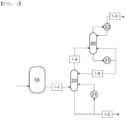
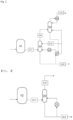
- the method may include a step of preparing a reaction product including acrylic acid by supplying lactic acid to a reactor (10) and going through a dehydration reaction; a step of supplying a reactor (10) discharge stream including the reaction product to a cooling tower (20) and condensing the result to transfer a lower discharge stream including a condensate to an acrylic acid purification unit, and supply a non-condensate discharged as an upper discharge stream to a distillation tower (30); and, in the distillation tower (30), circulating a lower discharge stream including acrylic acid to the cooling tower (20), and removing acetaldehyde from an upper discharge stream, wherein an operation pressure of the distillation tower is lower than an operation pressure of the cooling tower.
- an existing method for producing acrylic acid generally uses a method of air oxidizing propylene, however, this method is a method of converting propylene to acrolein using a gas-phase catalytic oxidation reaction, and gas-phase catalytic oxidation reacting the result to prepare acrylic acid, and the method produces acetic acid as a by-product, which is difficult to separate from the acrylic acid.
- the method for producing acrylic acid using propylene employs propylene obtained by refining crude oil, a fossil resource, and has problems in terms of raw material costs or environmental pollution considering problems such as recent rises in crude oil prices or global warming.
- a method for producing acrylic acid (AA) through a gas-phase dehydration reaction of lactic acid (LA) may be included.
- This method is a method of producing acrylic acid through an intramolecular dehydration reaction of lactic acid generally at a high temperature and under the presence of a catalyst.
- a side reaction other than the dehydration reaction occurs herein, which produces, as a reaction product, acetaldehyde (ACHO) as a by-product in addition to the acrylic acid.
- the present disclosure is directed to providing a method for producing acrylic acid capable of, while producing acrylic acid through a dehydration reaction of lactic acid, effectively removing acetaldehyde produced as a by-product in the manufacturing process, and enhancing quality and productivity of a product as well by preventing loss of acrylic acid.
- a reaction product including acrylic acid may be prepared by supplying lactic acid to a reactor (10) and going through a dehydration reaction.
- the lactic acid may be introduced to the reactor (10) in an aqueous solution state, or the dehydration reaction may be conducted in a gas-phase reaction under the presence of a catalyst.
- the lactic acid may be introduced to the reactor (10) as an aqueous lactic acid solution including lactic acid in 10% by mass to 90% by mass or 20% by mass to 80% by mass.
- the reactor (10) may be a reactor capable of conducting a common dehydration reaction of lactic acid, and examples thereof may include a stirring-type reactor, a fixed-bed reactor, a fluidized bed reactor and the like.
- the reactor (10) may include a reaction pipe filled with a catalyst, and, while passing a reaction gas including a volatile component of the aqueous lactic acid solution, a raw material, through the reaction pipe, lactic acid is dehydrated using a gas-phase catalytic reaction to produce acrylic acid.
- the reaction gas may further include, in addition to lactic acid, any one or more dilution gases of water vapor, nitrogen and air for a concentration adjustment.
- the reactor may be operated under a common dehydration reaction condition of lactic acid, and for example, the temperature may be from 250°C to 500°C, 250°C to 450°C or 300°C to 400°C.
- the operation temperature of the reactor (10) may mean a setting temperature of a heat medium or the like used for controlling the temperature of the reactor (10).
- the reactor (10) may have an operation pressure of 30 kPa to 1000 kPa, 50 kPa to 500 kPa or 60 kPa to 300 kPa.
- the catalyst used in the dehydration reaction of lactic acid may include one or more types selected from the group consisting of sulfate-based catalysts, phosphate-based catalysts and nitrate-based catalysts.
- the sulfate may include Na 2 SO 4 , K 2 SO 4 , CaSO 4 and Al 2 (SO 4 ) 3
- the phosphate may include Na 3 PO 4 , Na 3 HPO 4 , NaH 2 PO 4 , K 3 PO 4 , K 2 HPO 4 , KH 2 PO 4 , CaHPO 4 , Ca 3 (PO 4 ) 2 , AlPO 4 , CaH 2 P 2 O 7 and Ca 2 P 2 O 7
- the nitrate may include NaNO 3 , KNO 3 and Ca(NO 3 ) 2 .
- the catalyst may be supported on a support. Examples of the support may include one or more types selected from the group consisting of diatomite, alumina, silica, titanium dioxide, carbide and ze
- the reaction product produced through the dehydration reaction of lactic acid may further include, in addition to acrylic acid that is a target product, a by-product such as water (H 2 O), acetaldehyde (ACHO), carbon monoxide (CO), carbon dioxide (CO 2 ), a dilution gas and a high-boiling-point material.
- a by-product such as water (H 2 O), acetaldehyde (ACHO), carbon monoxide (CO), carbon dioxide (CO 2 ), a dilution gas and a high-boiling-point material.
- the content of acetaldehyde included in the reaction product may be approximately from 5% to 60% with respect to the content of acrylic acid. Accordingly, a purifying process is required for separating acrylic acid from the reaction product.
- the reactor (10) discharge stream including the reaction product may be supplied to the cooling tower (20) for cooling before transferring to the acrylic acid purification unit.
- the reactor (10) discharge stream including the reaction product may be supplied to the cooling tower (20) and condensed through cooling since it is discharged in a gas phase.
- a condensate condensed in this process is transferred to the acrylic acid purification unit as a cooling tower (20) lower discharge stream, and a non-condensate may be discharged as an upper discharge stream and supplied to the distillation tower (30).
- the condensate may include acrylic acid, and, as a by-product, water, a high-boiling-point material and the like, and the non-condensate may include acetaldehyde, water, carbon monoxide, carbon dioxide, a dilution gas and the like.
- the cooling tower (20) may be operated under a condition of minimizing the content of acetaldehyde in the lower discharge stream. Specifically, the cooling tower (20) lower discharge stream is transferred to the acrylic acid purification unit for purifying acrylic acid, and there is a problem in that quality and productivity of a product decline by facilitating polymer formation caused by acetaldehyde in the acrylic acid purification process. In regard thereto, the present disclosure minimizes the content of acetaldehyde effused as the cooling tower (20) lower discharge stream by controlling an operation condition of the cooling tower (20).
- a flow rate of acetaldehyde in the cooling tower (20) lower discharge stream may be 3% or less, from 0.1% to 2.5% or 0.5% to 2% with respect to a flow rate of acetaldehyde in the reactor (10) discharge stream.
- acetaldehyde having a lower boiling point than water may be mostly included in the cooling tower (20) upper discharge stream.
- the number of levels needs to be increased in the cooling tower (20) to increase separation efficiency, or the type needs to be changed to a distillation tower type by adding a reboiler, which is inefficient.
- the present disclosure is capable of minimizing the amount of acetaldehyde effused as the cooling tower (20) lower discharge stream using an efficient method of including a certain amount of water in the cooling tower (20) upper discharge stream.
- a flow rate of water in the cooling tower (20) upper discharge stream may be from 20% to 50%, 30% to 50% or 35% to 50% with respect to a flow rate of water in the reactor (10) discharge stream.
- acrylic acid when operating the cooling tower (20) so as to include a certain amount of water in the cooling tower (20) upper discharge stream, acrylic acid may be effused together as the cooling tower (20) upper discharge stream.
- a flow rate of acrylic acid in the cooling tower (20) upper discharge stream may be from 5% to 50%, 20% to 50% or 30% to 50% with respect to a flow rate of acrylic acid in the reactor (10) discharge stream. Accordingly, losing an excess amount of acrylic acid has been evitable in the art in order to reduce the content of acetaldehyde in the cooling tower (20) lower portion before transferring the reaction product to the acrylic acid purification unit.
- the present disclosure additionally installs the distillation tower (30) and supplies the cooling tower (20) upper discharge stream to the distillation tower (30), and acrylic acid effused to the cooling tower (20) upper portion may be recovered.
- the operation pressure of the cooling tower (20) may be, for example, from 30 kPa to 1000 kPa, 50 kPa to 500 kPa or 60 kPa to 300 kPa.
- Some stream of the cooling tower (20) lower discharge stream is refluxed to the cooling tower (20) after passing through one or more coolers, and the remaining stream may be transferred to the acrylic acid purification unit.
- some stream of the cooling tower (20) lower discharge stream may be refluxed to the cooling tower (20) after passing through a first cooler (21) or a first cooler (21) and a second cooler (22).
- an operation condition of the first cooler (21), an operation condition of the second cooler (22) and a reflux ratio of the cooling tower (20) lower portion may be properly adjusted depending on the operation condition of the cooling tower (20).
- each of the first cooler (21) and the second cooler (22) one or more types of cooling waters selected from among, for example, cooling water, chilled water and brine may be used as a refrigerant.
- cooling water chilled water
- brine brine
- relatively inexpensive cooling water may be used in the first cooler (21) and the second cooler (22).
- the purification unit may include, for example, a step of separating water for removing water included in the cooling tower (20) lower discharge stream and a step of separating the high-boiling-point material, and through this, acrylic acid separated in high purity may be obtained.
- a non-condensate not condensed in the cooling tower (20) may be discharged as the cooling tower (20) upper discharge stream and supplied to the distillation tower (30).
- the distillation tower (30) may be for separating and recovering acrylic acid included in the cooling tower (20) upper discharge stream.
- acrylic acid separated in the distillation tower (30) is discharged as the distillation tower (30) lower discharge stream and circulated to the cooling tower (20), and acetaldehyde, carbon monoxide, carbon dioxide, a dilution gas and the like may be discharged as a distillation tower (30) upper discharge stream.
- the distillation tower (30) upper discharge stream goes through a condenser (32), and some stream may be refluxed to the distillation tower (30) and the remaining stream may be discharged.
- a reflux ratio of the distillation tower (30) upper portion may be properly adjusted depending on the operation condition of the distillation tower (30).
- the distillation tower (30) upper discharge stream may go through an additional purification process as necessary, and by purifying acetaldehyde included in the distillation tower (30) upper discharge stream therethrough and separately selling the acetaldehyde, production costs of acrylic acid may be lowered, and competitiveness may be secured.
- the distillation tower (30) lower discharge stream is heated by going through a reboiler (31) before being circulated to the cooling tower (20), and then some stream may be circulated to the cooling tower (20) and the remaining stream may be refluxed to the distillation tower (30).
- a reflux ratio of the distillation tower (30) lower portion may be properly adjusted depending on the operation condition of the distillation tower (30).
- distillation tower (30) discharge stream is, before being circulated to the cooling tower (20), heat exchanged with some stream of the cooling tower (20) lower discharge stream in one or more coolers installed below the cooling tower (20) without using a separate reboiler (31), and then some stream is circulated to the cooling tower (20), and the remaining stream may be refluxed to the distillation tower (30).
- the distillation tower (30) lower discharge stream is, before being circulated to the cooling tower (20), supplied to the first cooler (21) as a refrigerant and heat exchanged by a counter-current flow, a co-current flow or a cross flow with some stream of the cooling tower (20) lower discharge stream, and some stream is circulated to the cooling tower (20), and the remaining stream may be refluxed to the distillation tower (30).
- acrylic acid discharged to the cooling tower (20) upper portion is included in wastewater and discharged out of the process, or needs to go through a distillation process to be recovered, which may consume additional energy, however, as described above, acrylic acid may be recovered without increasing the amount of process energy used by utilizing heat removed from the cooler below the cooling tower (20) as a heat source required for the reboiler (31) below the distillation tower (30) lower portion as above.
- the operation pressure of the distillation tower (30) may be from 10 kPa to 900 kPa, 30 kPa to 600 kPa or 40 kPa to 200 kPa.
- a flow rate of acrylic acid in the distillation tower (30) upper discharge stream may be 3% or less, from 0.1% to 3% or 0.1% to 1.5% with respect to a flow rate of acrylic acid in the reactor (10) discharge stream.
- operation pressures of the distillation tower (30) and the cooling tower (20) may be controlled.
- the operation pressure of the distillation tower (30) is controlled to be lower than the operation pressure of the cooling tower (20).
- the operation pressure of the distillation tower (30) may be controlled to be lower than the operation pressure of the cooling tower (20) by 20 kPa to 900 kPa, 30 kPa to 500 kPa or 50 kPa to 200 kPa.
- the distillation tower (30) lower discharge stream and some stream of the cooling tower (20) lower discharge stream may be heat exchanged due to a temperature difference, and through this, acrylic acid may be recovered in the distillation tower (30) without increasing the amount of energy used, and circulated to the cooling tower (20).
- the amount of a refrigerant used may be reduced through heat exchange between the distillation tower (30) lower discharge stream and some stream of the cooling tower (20) lower discharge stream.
- devices such as a distillation tower, a condenser, a reboiler, a value, a pump, a separator and a mixer may be further installed as necessary in the method for producing acrylic acid.
- lactic acid and nitrogen (N 2 ) as a dilution gas were supplied to a reactor (10) and went through a dehydration reaction to prepare a reaction product including acrylic acid (AA), and a reactor (10) discharge stream including the reaction product was supplied to a cooling tower (20) .
- a lower discharge stream of 113°C including acrylic acid was passed through a reboiler (31), and some stream was refluxed to the distillation tower (30) and the remaining stream was circulated to the cooling tower (20).
- an upper discharge stream including acetaldehyde in the distillation tower (30) was passed through a condenser (32), and some stream was refluxed to the distillation tower (30) and the remaining stream was discharged.
- an operation pressure of the distillation tower (30) was controlled at 190 kPa.
- lactic acid and nitrogen (N 2 ) as a dilution gas were supplied to a reactor (10) and went through a dehydration reaction to prepare a reaction product including acrylic acid (AA), and a reactor (10) discharge stream including the reaction product was supplied to a cooling tower (20) .
- the reactor (10) discharge stream was condensed in the cooling tower (20), and the non-condensate was discharged as an upper discharge stream and supplied to a distillation tower (30).
- the condensate was discharged from the cooling tower (20) as a lower discharge stream at a temperature of 117°C, and some stream was refluxed to the cooling tower (20) after passing through a first cooler (21) and a second cooler (22) and the remaining stream was supplied to an acrylic acid purification unit.
- an operation pressure of the cooling tower (20) was controlled at 200 kPa.
- a lower discharge stream of 96°C including acrylic acid was supplied to the first cooler (21) and heat exchanged with some stream of the cooling tower (20) lower discharge stream, and some stream was refluxed to the distillation tower (30) and the remaining stream was circulated to the cooling tower (20).
- an upper discharge stream including acetaldehyde in the distillation tower (30) was passed through a condenser (32), and some stream was refluxed to the distillation tower (30) and the remaining stream was discharged.
- an operation pressure of the distillation tower (30) was controlled at 110 kPa.
- acrylic acid discharged to the cooling tower (20) upper portion was able to be recovered without using additional energy by heat exchanging the distillation tower (30) lower discharge stream and some stream of the cooling tower (20) lower discharge stream in the first cooler (21), and thereby using, as an amount of heat to be supplied to the reboiler (31) in Example 1, an amount of heat of approximately 38.62 kW ("33233 kcal/hr") removed from the first cooler (21).
- lactic acid and nitrogen as a dilution gas were supplied to a reactor (10) and went through a dehydration reaction to prepare a reaction product including acrylic acid (AA), and a reactor (10) discharge stream including the reaction product was supplied to a cooling tower (20).
- the reactor (10) discharge stream was condensed in the cooling tower (20), the non-condensate was discharged as an upper discharge stream, the condensate in the cooling tower (20) was discharged as a lower discharge stream, and some stream was refluxed to the cooling tower (20) after passing through a first cooler (21) and the remaining stream was supplied to an acrylic acid purification unit.
- an operation pressure of the cooling tower (20) was controlled at 200 kPa, and by controlling the circulation flow rate at which the lower discharge stream of the cooling tower (20) is circulated to the cooling tower (20) after going through the first cooler (21), the amount of acetaldehyde effused as the cooling tower (20) lower discharge stream was minimized.
- Comparative Example 2 it was identified that, when the amount of acrylic acid effused as the cooling tower (20) upper discharge stream was minimized compared to in Comparative Example 1, the amount of acetaldehyde in the cooling tower (20) lower discharge stream was very high of approximately 12% of acetaldehyde included in the reaction product.
Landscapes
- Chemical & Material Sciences (AREA)
- Organic Chemistry (AREA)
- Engineering & Computer Science (AREA)
- Oil, Petroleum & Natural Gas (AREA)
- Chemical Kinetics & Catalysis (AREA)
- Crystallography & Structural Chemistry (AREA)
- General Chemical & Material Sciences (AREA)
- Organic Low-Molecular-Weight Compounds And Preparation Thereof (AREA)
Claims (9)
- Procédé de production d'acide acrylique, le procédé comprenant :une étape de préparation d'un produit de réaction incluant un acide acrylique en fournissant un acide lactique à un réacteur et en passant par une réaction de déshydratation ;une étape de fourniture d'un flux de décharge du réacteur incluant le produit de réaction à une tour de refroidissement et de condensation du résultat pour transférer un flux de décharge inférieur incluant un condensat à une unité de purification d'acide acrylique et pour fournir un non-condensat déchargé en tant que flux de décharge supérieur à une tour de distillation ; etdans la tour de distillation, acheminer un flux de décharge inférieur incluant un acide acrylique à la tour de refroidissement, et retirer l'acétaldéhyde d'un flux de décharge supérieur,dans lequel une pression de fonctionnement de la tour de distillation est inférieure à une pression de fonctionnement de la tour de refroidissement.
- Procédé de production d'acide acrylique selon la revendication 1, dans lequel une partie du flux de décharge inférieur de la tour de refroidissement est reflué dans la tour de refroidissement après avoir traversé un premier refroidisseur.
- Procédé de production d'acide acrylique selon la revendication 2, dans lequel une partie du flux de décharge inférieur de la tour de refroidissement traversant le premier refroidisseur traverse en outre un deuxième refroidisseur, et est reflué dans la tour de refroidissement.
- Procédé de production d'acide acrylique selon la revendication 2, dans lequel le flux de décharge inférieur de la tour de distillation est chauffé en passant dans un rebouilleur avant d'être acheminé vers la tour de refroidissement, puis une partie du flux est acheminée vers la tour de refroidissement et le reste du flux est reflué dans la tour de distillation.
- Procédé de production d'acide acrylique selon la revendication 4, dans lequel le flux de décharge inférieur de la tour de distillation est, avant d'être acheminé vers la tour de refroidissement, fourni au premier refroidisseur et sa chaleur est échangée avec une partie du flux de décharge inférieur de la tour de refroidissement, et une partie du flux est acheminée vers la tour de refroidissement et le reste du flux est reflué dans la tour de distillation.
- Procédé de production d'acide acrylique selon la revendication 1, dans lequel la pression de fonctionnement de la tour de distillation est inférieure à la pression de fonctionnement de la tour de refroidissement de 20 kPa à 900 kPa.
- Procédé de production d'acide acrylique selon la revendication 1, dans lequel la tour de refroidissement a une pression de fonctionnement de 30 kPa à 1000 kPa, et la tour de distillation a une pression de fonctionnement de 10 kPa à 900 kPa.
- Procédé de production d'acide acrylique selon la revendication 1, dans lequel un débit d'acétaldéhyde dans le flux de décharge inférieur de la tour de refroidissement est égal ou inférieur à 3 % d'un débit d'acétaldéhyde dans le flux de décharge du réacteur.
- Procédé de production d'acide acrylique selon la revendication 1, dans lequel un débit d'acide acrylique dans le flux de décharge supérieur de la tour de distillation est égal ou inférieur à 3 % d'un débit d'acide acrylique dans le flux de décharge du réacteur.
Applications Claiming Priority (2)
| Application Number | Priority Date | Filing Date | Title |
|---|---|---|---|
| KR1020200167556A KR102721330B1 (ko) | 2020-12-03 | 2020-12-03 | 아크릴산 제조방법 |
| PCT/KR2021/015177 WO2022119127A1 (fr) | 2020-12-03 | 2021-10-27 | Procédé de production d'acide acrylique |
Publications (3)
| Publication Number | Publication Date |
|---|---|
| EP4122913A1 EP4122913A1 (fr) | 2023-01-25 |
| EP4122913A4 EP4122913A4 (fr) | 2023-10-25 |
| EP4122913B1 true EP4122913B1 (fr) | 2024-11-27 |
Family
ID=81853182
Family Applications (1)
| Application Number | Title | Priority Date | Filing Date |
|---|---|---|---|
| EP21900815.8A Active EP4122913B1 (fr) | 2020-12-03 | 2021-10-27 | Procédé de production d'acide acrylique |
Country Status (5)
| Country | Link |
|---|---|
| EP (1) | EP4122913B1 (fr) |
| JP (1) | JP7584840B2 (fr) |
| KR (1) | KR102721330B1 (fr) |
| CN (1) | CN115836046B (fr) |
| WO (1) | WO2022119127A1 (fr) |
Families Citing this family (5)
| Publication number | Priority date | Publication date | Assignee | Title |
|---|---|---|---|---|
| CN112203223B (zh) | 2020-12-02 | 2021-03-02 | 北京大唐高鸿数据网络技术有限公司 | 一种位置确定方法、装置及车联网设备 |
| KR102855127B1 (ko) | 2021-10-15 | 2025-09-03 | 주식회사 엘지화학 | 아크릴산 제조방법 |
| KR20240037087A (ko) * | 2022-09-14 | 2024-03-21 | 주식회사 엘지화학 | 아크릴산 제조방법 |
| KR20240037081A (ko) * | 2022-09-14 | 2024-03-21 | 주식회사 엘지화학 | 아크릴산 제조방법 |
| KR102846320B1 (ko) * | 2022-09-14 | 2025-08-14 | 주식회사 엘지화학 | 아크릴산 제조방법 |
Citations (2)
| Publication number | Priority date | Publication date | Assignee | Title |
|---|---|---|---|---|
| JP2014189510A (ja) * | 2013-03-26 | 2014-10-06 | Nippon Shokubai Co Ltd | アクリル酸の製造方法 |
| EP4129969A1 (fr) * | 2020-12-03 | 2023-02-08 | Lg Chem, Ltd. | Procédé de production d'acide acrylique |
Family Cites Families (6)
| Publication number | Priority date | Publication date | Assignee | Title |
|---|---|---|---|---|
| CN1930108B (zh) * | 2004-08-02 | 2010-12-29 | Lg化学株式会社 | 制备(甲基)丙烯酸的方法 |
| CN101255109B (zh) * | 2008-04-09 | 2011-01-12 | 南京工业大学 | 一种生物质乳酸脱水生产丙烯酸的工艺 |
| US9745244B2 (en) * | 2008-10-01 | 2017-08-29 | Arkeme Inc. | Control of a process for the purification of (meth)acrylic acid using on-line, near IR analysis |
| JP2014189513A (ja) | 2013-03-26 | 2014-10-06 | Nippon Shokubai Co Ltd | アクリル酸および/またはアクリル酸エステルの製造方法 |
| FR3033558B1 (fr) * | 2015-03-12 | 2017-02-24 | Arkema France | Procede ameliore de production d'acide (meth)acrylique |
| FR3049601B1 (fr) * | 2016-03-29 | 2018-03-09 | Arkema France | Procede ameliore de production d'acide (meth)acrylique |
-
2020
- 2020-12-03 KR KR1020200167556A patent/KR102721330B1/ko active Active
-
2021
- 2021-10-27 JP JP2022565678A patent/JP7584840B2/ja active Active
- 2021-10-27 WO PCT/KR2021/015177 patent/WO2022119127A1/fr not_active Ceased
- 2021-10-27 CN CN202180035746.4A patent/CN115836046B/zh active Active
- 2021-10-27 EP EP21900815.8A patent/EP4122913B1/fr active Active
Patent Citations (2)
| Publication number | Priority date | Publication date | Assignee | Title |
|---|---|---|---|---|
| JP2014189510A (ja) * | 2013-03-26 | 2014-10-06 | Nippon Shokubai Co Ltd | アクリル酸の製造方法 |
| EP4129969A1 (fr) * | 2020-12-03 | 2023-02-08 | Lg Chem, Ltd. | Procédé de production d'acide acrylique |
Also Published As
| Publication number | Publication date |
|---|---|
| WO2022119127A1 (fr) | 2022-06-09 |
| JP2023523616A (ja) | 2023-06-06 |
| EP4122913A4 (fr) | 2023-10-25 |
| EP4122913A1 (fr) | 2023-01-25 |
| CN115836046A (zh) | 2023-03-21 |
| KR102721330B1 (ko) | 2024-10-23 |
| US20230131529A1 (en) | 2023-04-27 |
| KR20220078233A (ko) | 2022-06-10 |
| JP7584840B2 (ja) | 2024-11-18 |
| CN115836046B (zh) | 2025-04-08 |
Similar Documents
| Publication | Publication Date | Title |
|---|---|---|
| EP4122913B1 (fr) | Procédé de production d'acide acrylique | |
| EP4361124A1 (fr) | Procédé de préparation d'acide acrylique | |
| CN101687755A (zh) | 将乙酰丙酸转化为戊酸的方法 | |
| CA2731412A1 (fr) | Procede en phase gazeuse en deux etapes pour la fabrication d'alkyleneglycol | |
| US12595224B2 (en) | Method for producing acrylic acid | |
| KR102855127B1 (ko) | 아크릴산 제조방법 | |
| KR102855132B1 (ko) | 아크릴산 제조방법 | |
| EP4249465A1 (fr) | Procédé de préparation d'acide acrylique | |
| KR102855131B1 (ko) | 아크릴산 제조방법 | |
| EP4365160B1 (fr) | Procédé de préparation d'acide acrylique | |
| CN102311323B (zh) | 丙烯与合成气羰基合成制备丁醛的方法 | |
| CN120040293A (zh) | 一种连续催化合成1,2-环己二胺的方法 | |
| JP2011201821A (ja) | プロピレンオキサイドの製造方法 | |
| KR101732771B1 (ko) | 탈거 장치 |
Legal Events
| Date | Code | Title | Description |
|---|---|---|---|
| STAA | Information on the status of an ep patent application or granted ep patent |
Free format text: STATUS: THE INTERNATIONAL PUBLICATION HAS BEEN MADE |
|
| PUAI | Public reference made under article 153(3) epc to a published international application that has entered the european phase |
Free format text: ORIGINAL CODE: 0009012 |
|
| STAA | Information on the status of an ep patent application or granted ep patent |
Free format text: STATUS: REQUEST FOR EXAMINATION WAS MADE |
|
| 17P | Request for examination filed |
Effective date: 20221017 |
|
| AK | Designated contracting states |
Kind code of ref document: A1 Designated state(s): AL AT BE BG CH CY CZ DE DK EE ES FI FR GB GR HR HU IE IS IT LI LT LU LV MC MK MT NL NO PL PT RO RS SE SI SK SM TR |
|
| REG | Reference to a national code |
Ref country code: DE Ref legal event code: R079 Free format text: PREVIOUS MAIN CLASS: C07C0051487000 Ipc: C07C0051377000 Ref country code: DE Ref legal event code: R079 Ref document number: 602021022650 Country of ref document: DE Free format text: PREVIOUS MAIN CLASS: C07C0051487000 Ipc: C07C0051377000 |
|
| A4 | Supplementary search report drawn up and despatched |
Effective date: 20230927 |
|
| RIC1 | Information provided on ipc code assigned before grant |
Ipc: C07C 57/04 20060101ALI20230921BHEP Ipc: C07C 51/44 20060101ALI20230921BHEP Ipc: C07C 51/377 20060101AFI20230921BHEP |
|
| DAV | Request for validation of the european patent (deleted) | ||
| DAX | Request for extension of the european patent (deleted) | ||
| GRAP | Despatch of communication of intention to grant a patent |
Free format text: ORIGINAL CODE: EPIDOSNIGR1 |
|
| STAA | Information on the status of an ep patent application or granted ep patent |
Free format text: STATUS: GRANT OF PATENT IS INTENDED |
|
| GRAS | Grant fee paid |
Free format text: ORIGINAL CODE: EPIDOSNIGR3 |
|
| INTG | Intention to grant announced |
Effective date: 20240912 |
|
| GRAA | (expected) grant |
Free format text: ORIGINAL CODE: 0009210 |
|
| STAA | Information on the status of an ep patent application or granted ep patent |
Free format text: STATUS: THE PATENT HAS BEEN GRANTED |
|
| AK | Designated contracting states |
Kind code of ref document: B1 Designated state(s): AL AT BE BG CH CY CZ DE DK EE ES FI FR GB GR HR HU IE IS IT LI LT LU LV MC MK MT NL NO PL PT RO RS SE SI SK SM TR |
|
| REG | Reference to a national code |
Ref country code: GB Ref legal event code: FG4D |
|
| REG | Reference to a national code |
Ref country code: CH Ref legal event code: EP |
|
| REG | Reference to a national code |
Ref country code: IE Ref legal event code: FG4D |
|
| REG | Reference to a national code |
Ref country code: DE Ref legal event code: R096 Ref document number: 602021022650 Country of ref document: DE |
|
| REG | Reference to a national code |
Ref country code: LT Ref legal event code: MG9D |
|
| REG | Reference to a national code |
Ref country code: NL Ref legal event code: MP Effective date: 20241127 |
|
| PG25 | Lapsed in a contracting state [announced via postgrant information from national office to epo] |
Ref country code: PT Free format text: LAPSE BECAUSE OF FAILURE TO SUBMIT A TRANSLATION OF THE DESCRIPTION OR TO PAY THE FEE WITHIN THE PRESCRIBED TIME-LIMIT Effective date: 20250327 Ref country code: IS Free format text: LAPSE BECAUSE OF FAILURE TO SUBMIT A TRANSLATION OF THE DESCRIPTION OR TO PAY THE FEE WITHIN THE PRESCRIBED TIME-LIMIT Effective date: 20250327 Ref country code: HR Free format text: LAPSE BECAUSE OF FAILURE TO SUBMIT A TRANSLATION OF THE DESCRIPTION OR TO PAY THE FEE WITHIN THE PRESCRIBED TIME-LIMIT Effective date: 20241127 |
|
| PG25 | Lapsed in a contracting state [announced via postgrant information from national office to epo] |
Ref country code: FI Free format text: LAPSE BECAUSE OF FAILURE TO SUBMIT A TRANSLATION OF THE DESCRIPTION OR TO PAY THE FEE WITHIN THE PRESCRIBED TIME-LIMIT Effective date: 20241127 Ref country code: NL Free format text: LAPSE BECAUSE OF FAILURE TO SUBMIT A TRANSLATION OF THE DESCRIPTION OR TO PAY THE FEE WITHIN THE PRESCRIBED TIME-LIMIT Effective date: 20241127 |
|
| REG | Reference to a national code |
Ref country code: AT Ref legal event code: MK05 Ref document number: 1745604 Country of ref document: AT Kind code of ref document: T Effective date: 20241127 |
|
| PG25 | Lapsed in a contracting state [announced via postgrant information from national office to epo] |
Ref country code: BG Free format text: LAPSE BECAUSE OF FAILURE TO SUBMIT A TRANSLATION OF THE DESCRIPTION OR TO PAY THE FEE WITHIN THE PRESCRIBED TIME-LIMIT Effective date: 20241127 |
|
| PG25 | Lapsed in a contracting state [announced via postgrant information from national office to epo] |
Ref country code: ES Free format text: LAPSE BECAUSE OF FAILURE TO SUBMIT A TRANSLATION OF THE DESCRIPTION OR TO PAY THE FEE WITHIN THE PRESCRIBED TIME-LIMIT Effective date: 20241127 |
|
| PG25 | Lapsed in a contracting state [announced via postgrant information from national office to epo] |
Ref country code: NO Free format text: LAPSE BECAUSE OF FAILURE TO SUBMIT A TRANSLATION OF THE DESCRIPTION OR TO PAY THE FEE WITHIN THE PRESCRIBED TIME-LIMIT Effective date: 20250227 |
|
| PG25 | Lapsed in a contracting state [announced via postgrant information from national office to epo] |
Ref country code: GR Free format text: LAPSE BECAUSE OF FAILURE TO SUBMIT A TRANSLATION OF THE DESCRIPTION OR TO PAY THE FEE WITHIN THE PRESCRIBED TIME-LIMIT Effective date: 20250228 Ref country code: AT Free format text: LAPSE BECAUSE OF FAILURE TO SUBMIT A TRANSLATION OF THE DESCRIPTION OR TO PAY THE FEE WITHIN THE PRESCRIBED TIME-LIMIT Effective date: 20241127 Ref country code: LV Free format text: LAPSE BECAUSE OF FAILURE TO SUBMIT A TRANSLATION OF THE DESCRIPTION OR TO PAY THE FEE WITHIN THE PRESCRIBED TIME-LIMIT Effective date: 20241127 |
|
| PG25 | Lapsed in a contracting state [announced via postgrant information from national office to epo] |
Ref country code: PL Free format text: LAPSE BECAUSE OF FAILURE TO SUBMIT A TRANSLATION OF THE DESCRIPTION OR TO PAY THE FEE WITHIN THE PRESCRIBED TIME-LIMIT Effective date: 20241127 |
|
| PG25 | Lapsed in a contracting state [announced via postgrant information from national office to epo] |
Ref country code: RS Free format text: LAPSE BECAUSE OF FAILURE TO SUBMIT A TRANSLATION OF THE DESCRIPTION OR TO PAY THE FEE WITHIN THE PRESCRIBED TIME-LIMIT Effective date: 20250227 |
|
| PG25 | Lapsed in a contracting state [announced via postgrant information from national office to epo] |
Ref country code: SM Free format text: LAPSE BECAUSE OF FAILURE TO SUBMIT A TRANSLATION OF THE DESCRIPTION OR TO PAY THE FEE WITHIN THE PRESCRIBED TIME-LIMIT Effective date: 20241127 |
|
| PG25 | Lapsed in a contracting state [announced via postgrant information from national office to epo] |
Ref country code: DK Free format text: LAPSE BECAUSE OF FAILURE TO SUBMIT A TRANSLATION OF THE DESCRIPTION OR TO PAY THE FEE WITHIN THE PRESCRIBED TIME-LIMIT Effective date: 20241127 |
|
| PG25 | Lapsed in a contracting state [announced via postgrant information from national office to epo] |
Ref country code: EE Free format text: LAPSE BECAUSE OF FAILURE TO SUBMIT A TRANSLATION OF THE DESCRIPTION OR TO PAY THE FEE WITHIN THE PRESCRIBED TIME-LIMIT Effective date: 20241127 |
|
| PG25 | Lapsed in a contracting state [announced via postgrant information from national office to epo] |
Ref country code: RO Free format text: LAPSE BECAUSE OF FAILURE TO SUBMIT A TRANSLATION OF THE DESCRIPTION OR TO PAY THE FEE WITHIN THE PRESCRIBED TIME-LIMIT Effective date: 20241127 |
|
| PG25 | Lapsed in a contracting state [announced via postgrant information from national office to epo] |
Ref country code: SK Free format text: LAPSE BECAUSE OF FAILURE TO SUBMIT A TRANSLATION OF THE DESCRIPTION OR TO PAY THE FEE WITHIN THE PRESCRIBED TIME-LIMIT Effective date: 20241127 |
|
| PG25 | Lapsed in a contracting state [announced via postgrant information from national office to epo] |
Ref country code: CZ Free format text: LAPSE BECAUSE OF FAILURE TO SUBMIT A TRANSLATION OF THE DESCRIPTION OR TO PAY THE FEE WITHIN THE PRESCRIBED TIME-LIMIT Effective date: 20241127 |
|
| PG25 | Lapsed in a contracting state [announced via postgrant information from national office to epo] |
Ref country code: IT Free format text: LAPSE BECAUSE OF FAILURE TO SUBMIT A TRANSLATION OF THE DESCRIPTION OR TO PAY THE FEE WITHIN THE PRESCRIBED TIME-LIMIT Effective date: 20241127 |
|
| REG | Reference to a national code |
Ref country code: DE Ref legal event code: R097 Ref document number: 602021022650 Country of ref document: DE |
|
| PG25 | Lapsed in a contracting state [announced via postgrant information from national office to epo] |
Ref country code: SE Free format text: LAPSE BECAUSE OF FAILURE TO SUBMIT A TRANSLATION OF THE DESCRIPTION OR TO PAY THE FEE WITHIN THE PRESCRIBED TIME-LIMIT Effective date: 20241127 |
|
| PLBE | No opposition filed within time limit |
Free format text: ORIGINAL CODE: 0009261 |
|
| STAA | Information on the status of an ep patent application or granted ep patent |
Free format text: STATUS: NO OPPOSITION FILED WITHIN TIME LIMIT |
|
| PGFP | Annual fee paid to national office [announced via postgrant information from national office to epo] |
Ref country code: GB Payment date: 20250922 Year of fee payment: 5 |
|
| PGFP | Annual fee paid to national office [announced via postgrant information from national office to epo] |
Ref country code: FR Payment date: 20250925 Year of fee payment: 5 |
|
| 26N | No opposition filed |
Effective date: 20250828 |
|
| PGFP | Annual fee paid to national office [announced via postgrant information from national office to epo] |
Ref country code: DE Payment date: 20250922 Year of fee payment: 5 |