EP4122388B1 - Verfahren zum sammeln von atemproben - Google Patents
Verfahren zum sammeln von atemproben Download PDFInfo
- Publication number
- EP4122388B1 EP4122388B1 EP22185935.8A EP22185935A EP4122388B1 EP 4122388 B1 EP4122388 B1 EP 4122388B1 EP 22185935 A EP22185935 A EP 22185935A EP 4122388 B1 EP4122388 B1 EP 4122388B1
- Authority
- EP
- European Patent Office
- Prior art keywords
- cooling block
- unit
- air
- temperature
- sample
- Prior art date
- Legal status (The legal status is an assumption and is not a legal conclusion. Google has not performed a legal analysis and makes no representation as to the accuracy of the status listed.)
- Active
Links
Images



Classifications
-
- A—HUMAN NECESSITIES
- A61—MEDICAL OR VETERINARY SCIENCE; HYGIENE
- A61B—DIAGNOSIS; SURGERY; IDENTIFICATION
- A61B5/00—Measuring for diagnostic purposes; Identification of persons
- A61B5/08—Measuring devices for evaluating the respiratory organs
- A61B5/097—Devices for facilitating collection of breath or for directing breath into or through measuring devices
-
- A—HUMAN NECESSITIES
- A61—MEDICAL OR VETERINARY SCIENCE; HYGIENE
- A61B—DIAGNOSIS; SURGERY; IDENTIFICATION
- A61B5/00—Measuring for diagnostic purposes; Identification of persons
- A61B5/08—Measuring devices for evaluating the respiratory organs
- A61B5/082—Evaluation by breath analysis, e.g. determination of the chemical composition of exhaled breath
-
- G—PHYSICS
- G01—MEASURING; TESTING
- G01N—INVESTIGATING OR ANALYSING MATERIALS BY DETERMINING THEIR CHEMICAL OR PHYSICAL PROPERTIES
- G01N33/00—Investigating or analysing materials by specific methods not covered by groups G01N1/00 - G01N31/00
- G01N33/48—Biological material, e.g. blood, urine; Haemocytometers
- G01N33/483—Physical analysis of biological material
- G01N33/497—Physical analysis of biological material of gaseous biological material, e.g. breath
Definitions
- the object of the invention is a method for collecting breath samples.
- WO 2019/018121 Disclosed in international patent application no. WO 2019/018121 is a device for the collection and storage of samples in the form of exhaled breath condensates. The device, however, features no elements which would cool down the collected breath samples.
- IT 102011901967915 A is a device for the collection of air samples which incorporates a condenser where the sample gets cooled down.
- the device is expensive in use and features a different method of controlling the temperature of the cooling block.
- GB2548122 A Disclosed in the description of invention GB2548122 A is a kit of parts for an exhaled breath condensate collection device, which comprises a mouthpiece module comprising a breath passageway defined in the mouthpiece module providing fluid conduction from a mouthpiece breath inlet port for receiving exhaled breath to a mouthpiece breath outlet port in use.
- the kit further comprises a collection vessel for insertion into the device for cooling in use.
- the collection vessel defines a sealed and resealable chamber for collecting exhaled breath condensate in use.
- the collection vessel has a vessel breath inlet for admitting exhaled breath into the chamber.
- the kit of parts is configured such that the collection vessel is: insertable into the device into an sample collection configuration in which the vessel breath inlet is unsealed and in fluid communication with the mouthpiece breath outlet port of the mouthpiece module; and removable from the device in a sample containment configuration in which the collection vessel chamber is resealed.
- the device and method do not discloses cooling block with an active element and a system for regulation and controlling the cooling process of the condensate container.
- US2020/033323 A1 Disclosed in the description of invention US2020/033323 A1 is an analyser for collecting and analysing a breath condensate comprising a housing having a cooling means and, further, retaining a cartridge device comprising a condensation zone to condense exhaled breath from a subject, and one or more further discrete regions for detection of analyte and measurement of analyte, the cartridge device further comprising a fluid path connecting the condensation zone to the or each discrete region.
- the device features no elements for the collection of breath samples comprising a mouthpiece, a saliva collector and sample receiving unit with active, integrated cooling system which ensure proper quality parameters of the collected air condensate sample.
- WO2021/089992 A1 Disclosed in the description of invention WO2021/089992 A1 is a exhaled breath collection device suitable for collection and measurement of a biomarker in exhaled breath. More particularly, the device comprising a sensor unit configured to measure a biomarker in exhaled breath, a cooling device configured to reduce a temperature of exhaled breath, and a temperature control unit, wherein the temperature control unit can control the cooling device to reach a target temperature greater than 0 °C and less than or equal to 30 °C, wherein the biomarker is hydrogen peroxide (H 2 O 2 ).
- the biomarker is hydrogen peroxide (H 2 O 2 ).
- Effectiveness of the condensate collection process depends directly on the device's ability to keep low temperature stable.
- the cooling chamber heats up; therefore, it is necessary to look for solutions which would guarantee the possibility to keep the low temperature of the exhaled breath condensate sample at a stable level.
- the Inventors solved the problem of obtaining a sample of exhaled breath condensate of proper quality by providing an apparatus serving the purpose. Moreover, it turned out that a sample of the exhaled breath condensate collected with the apparatus according to the invention enables a qualitative and quantitative analyses of the biological substances contained in the sample, which is useful when diagnosing aetiology of infections.
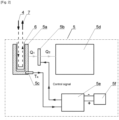
- An object of the disclosure is to provide an apparatus for the collection of breath samples comprising a mouthpiece, a saliva collector and a sample receiving unit that consists of a unit which supplies the inhaled air, comprising the mouthpiece 1 connected to the saliva collector 2 at the bottom, and featuring a pipe 3 at its end, where the pipe 3 is detachably connected to the sample receiving unit via an inlet duct 4, wherein the sample receiving unit consists of a test tube 6 for exhaled breath condensate detachably connected at the bottom to a cooling block 5 characterised in that the cooling block 5 is fitted with a cooling chamber 5a, an active element of the cooling block 5b, a temperature sensor 5c connected to a heat dispersion unit 5d via a system of heat pipes, and where the active element of the cooling block 5b is controlled via a programmable control unit 5e featuring an LCD display and a keyboard which enables setting and monitoring of the apparatus working parameters, and powered by an electric unit 5f, and wherein the cooling block 5 is detachably connected to an outlet
- the apparatus features an active, integrated cooling system which ensures proper quality parameters of the collected air condensate sample.
- the object of the invention is defined by a method of collecting a breath samples, which involves exhaling air from the lungs and collecting the samples, wherein the air exhaled from the lungs through the mouthpiece 1 is directed via the pipe 3 to the sample receiving unit, where the air supplied through the inlet duct 4 cools down in the cooling block 5 to a temperature below the dew point, in effect of which the water vapour contained in the exhaled air condenses and accumulates in the test tube 6.
- the active element of the cooling block 5 used in the method according to the invention is the Peltier cell 5b.
- the cooling chamber 5a is first cooled down to temperature T1 pre-set at -10 °C, whereupon the power supplied to the Peltier cell 5b is reduced so as to keep the temperature of the cooling chamber 5a at the pre-set level, following which the cooling block 5 is connected to the unit which supplies the inhaled air and to the sample receiving unit, following which the patient exhales air from the lungs (for approximately 20 minutes), and once the air is supplied to the cooling block 5 it gets cooled down below the dew point in effect of which the water vapour contained in the exhaled air condensates and the excretion intended for further testing in the form of exhaled breath condensate accumulates on the walls of the test tube 6, and where the unit forcing one-direction flow 8 enables the discharging of the gases and keeping normal pressure inside the test tube 6.
- the cooling chamber 5a heats up in contact with the warm air exhaled from the patient's lungs; that is why the programmable control unit 5e controls the power supplied to the cell 5f so as to keep the pre-set temperature at a stable level within a narrow temperature fluctuation margin range, which enables keeping thermal balance in the cooling chamber 5a.
- test tube 6 is disconnected and the accumulated condensate is used in analyses or subject to further processing aimed at fixing the sample, such as freezing or lyophilisation.
- Another object not forming part of the invention is a method of diagnosing medical condition of the patient characterised in that the breath sample collected as described above is subject to a quantitative or qualitative analysis.
- the inventors of the invention conducted an analysis of the exhaled breath condensates collected using the apparatus according to the invention among paediatric patients suffering from acute lymphoblastic leukemia (ALL), children with diabetes type 1, and bariatric patients. Observed were statistically significant differences in the amino acid profiles measured in the exhaled air (before and after the treatment).
- ALL acute lymphoblastic leukemia
- bariatric patients Observed were statistically significant differences in the amino acid profiles measured in the exhaled air (before and after the treatment).
- the apparatus according to the invention which was used incorporated the Peltier cell 5b as an active element of the cooling block 5.
- the cooling chamber 5a was cooled down to temperature T1 pre-sent at -10 °C, whereupon power supply to the Peltier cell 5b was reduced so as to keep the temperature of the cooling block 5 at the pre-set level, following which the cooling block 5 was connected to the unit which supplies the inhaled air and to the sample receiving unit.
- the patient was exhaling air from the lungs to the mouthpiece for 20 minutes, the air, when supplied to the cooling block 5, was cooled down to -7 °C, in effect of which the water vapour contained in the exhaled air condensed, and the excretion in the form of exhaled breath condensate intended for further testing started to accumulate on the walls of the test tube 6, while the exhaled gases were removed from the test tube 6 by the unit forcing one-direction flow 8.
- the control unit 5e had been set up to keep the pre-set temperature at a stable level, with minor temperature fluctuations remaining within the range of ⁇ 3°C which enabled keeping the thermal balance in the cooling block 5.
- EBC Exhaled breath condensates
- EBC samples are a valuable diagnostic material collected from patients in a totally non-invasive and safe way. Samples of exhaled air are collected when the patient is breathing regularly and calmly and their collection is not inconvenient or tiresome to him/her [1].
- the tested EBC samples were collected from healthy volunteers participating in the research project conducted in cooperation with the MUG's Immunology Clinic, on approval no. 274/2018 from the Bioethical Commission. All participants taking part in the research gave their written consent and were asked to complete a brief questionnaire.
- EBC samples were collected on the same day, on an outpatient basis, at the Clinic of General, Endocrine, and Transplant Surgery at the MUG's Invasive Medicine Centre (CMI). Collection of the samples was performed under the supervision of clinicians. Breath samples were collected by qualified medical staff during an appointment with a physician. On the same day the collected material was transported to the MUG's Chair and Department of Pharmaceutical Chemistry and stored deeply frozen in the temperature of -80°C until the time a LC-MS/MS analysis was performed.
- CMI Invasive Medicine Centre
- the EBC samples were collected with the apparatus according to the invention (as in Example 1) and the commercially available device called Medivac Turbo DECCS, following the manufacturer's user manual.
- the EBC samples were subject to the quantitative analysis of the amino acids present in the condensate.
- Amino acids are small molecule compounds difficult to assay in a reversed phase (RP) system. Because of their hydrophilic nature the molecules do not dissociate in such conditions.
- amino acids were subject to the derivatisation procedure which increased the mass of the monitored ions. In effect, their identification by the mass detector improved, which translated to the higher sensitivity of the method and enhanced analyte signal at the expense of reduced signals generated by noise. This resulted in achieving a low LOD value at the fmol level) [2].
- the properties of amino acids changed from hydrophilic to lipophilic, which made it possible to use the C18 column and enabled perfect separation of the assayed analytes in the reversed phase system.
- the derivatisation was carried out in the pre-column mode, using propyl chloroformate as the derivatizing agent. Because of the short derivatization time and mild conditions (1 min, room temperature), the agent stands out among other earlier used reagents mentioned in the literature.
- samples were transferred to glass 1.2 mL test tubes using an automatic pipette so as to subject them to the process of derivatization.
- a solution of NaOH and 3-picoline in n-propanol was prepared in the volumetric proportion of 3:2 (v/v), 200 ⁇ L per a test tube. Pipette ends filled with a bed were connected to a syringe which was used to place the solution inside the test tube on the sorbent where the analytes got adsorbed. After completion of this phase, the bed was washed with 200 ⁇ L of n-propanol. The solution prepared earlier was used to wash out the bed from the pipette end to the glass test tube.
- the derivatizing agent (propyl chloroformate in chloroform) was added, following which the mixing with a shaker was carried out for about 8 seconds until white emulsion was obtained. The mixing was repeated after one minute. Then 100 ⁇ L of isooctane was added and the mixing was performed again. The top organic layer (approximately 150 ⁇ L) was collected with a pipette and subject to evaporation in vacuum at the temperature of 30°C for 15 min.
- the derivatizing agent propyl chloroformate in chloroform
- phase A 10mM of ammonium formate
- phase B 10 mM of ammonium formate in methanol (33:67, v/v) and subject to the LC-MS/MS analysis.
- a diagram of the amino acid derivatization procedure is shown in Fig.3 .
- the advantage of the amino acid derivatizing agent in the form of propyl chloroformate used in the invention comes down to its easy availability in the market and low price. Moreover, the amino acid derivatisation procedure is swift, and it is possible to derivatise amino acids in a water solution directly. Then, the derivatised compounds are extracted using an organic solvent. The conditions of assaying amino acids in exhaled breath condensate (EBC) using the LC-MS/MS technique.
- EBC exhaled breath condensate
- the derivatized amino acids were assayed using the technique of liquid chromatography coupled with tandem mass spectrometry (LC-MS/MS).
- the mass spectrometer was fitted with a ion source of the electrospray (ESI) type and an analyser of the triple quadrupole type (MS/MS).
- Amino acids were separated on the C18 column (Phenomenex EZ: faast AAA-MS) sized 25 x 2.0 mm; 4 ⁇ m in the reversed phase (RP) system. Gradient elution was used (Tab. 2).
- the mobile phase A was made up of water with 10 mM of ammonium formate and 0.1 % formic acid added to it.
- Phase B consisted of methanol with 10 mM of ammonium formate and 0.1 % formic acid added to it.
- Table 1 presents the results of measurements of the level of amino acids [ng/mL] assayed by a proprietary method employing the LC-MS/MS technique.
- Turbo DECCS means an apparatus for the collection of exhaled breath condensate, manufactured by an Italian company and available in the market on commercial terms
- PG apparatus means the apparatus according to the invention
- NO denotes a non-detectable concentration (value below the detection threshold of the developed analytical method).
- EBC samples were collected and prepared as described in Example 2.
- the samples collected with the device according to the invention (PG apparatus) and a commercially available apparatus Turbo DESC were analysed for the concentration of the selected amino acid.
Landscapes
- Health & Medical Sciences (AREA)
- Life Sciences & Earth Sciences (AREA)
- Engineering & Computer Science (AREA)
- Molecular Biology (AREA)
- Physics & Mathematics (AREA)
- Biomedical Technology (AREA)
- General Health & Medical Sciences (AREA)
- Biophysics (AREA)
- Pathology (AREA)
- Medical Informatics (AREA)
- Physiology (AREA)
- Veterinary Medicine (AREA)
- Public Health (AREA)
- Animal Behavior & Ethology (AREA)
- Chemical & Material Sciences (AREA)
- Surgery (AREA)
- Heart & Thoracic Surgery (AREA)
- Pulmonology (AREA)
- Food Science & Technology (AREA)
- Urology & Nephrology (AREA)
- Immunology (AREA)
- Hematology (AREA)
- General Physics & Mathematics (AREA)
- Biochemistry (AREA)
- Analytical Chemistry (AREA)
- Medicinal Chemistry (AREA)
- Investigating Or Analysing Biological Materials (AREA)
- Sampling And Sample Adjustment (AREA)
Claims (2)
- Ein Verfahren zum Sammeln von Atemproben, das das Ausatmen von Luft aus den Lungen und das Sammeln der Proben unter Verwendung einer Vorrichtung umfasst, die ein Mundstück, einen Speichelsammler und eine Probenaufnahmeeinheit umfasst, die aus einer Einheit besteht, die die eingeatmete Luft zuführt, umfassend das Mundstück (1), das unten mit dem Speichelsammler (2) verbunden ist und an seinem Ende ein Rohr (3) aufweist, wobei das Rohr (3) über einen Einlasskanal (4) lösbar mit der Probenaufnahmeeinheit verbunden ist, wobei die Probenaufnahmeeinheit aus einem Reagenzglas (4) besteht, 6) für ausgeatmetes Atemkondensat, das unten lösbar mit einem Kühlblock (5) verbunden ist, der mit einer Kühlkammer (5a) ausgestattet ist, die einen Temperatursensor (5c) und ein aktives Element des Kühlblocks (5b) aufweist, das über ein System von Wärmerohren mit einer Wärmeabgabeeinheit (5d) verbunden ist, wobei der Kühlblock (5) von einer elektrischen Einheit (5f) angetrieben und über eine programmierbare Steuereinheit (5e) mit einem LCD-Display und einer Tastatur gesteuert wird, wobei der Kühlblock (5) lösbar mit einem Auslasskanal (7) verbunden ist, an den die Einheit angeschlossen ist, die den einseitig abfließenden Strom (8) erzwingt, dadurch gekennzeichnet, dass der Kühlblock (5) vor dem Sammeln der Probe auf die bei -10 °C voreingestellte Temperatur T1 abgekühlt wird, wonach der Kühlblock (5) über eine Leitung (3) mit der Einheit verbunden ist, die die eingeatmete Luft zuführt, und über den Auslasskanal (7) mit der Einheit, die den einseitig abfließenden Strom (8) erzwingt, wonach die Luft aus den Lungen durch das Mundstück (1) wird durch die Leitung (3) zur Probenaufnahmeeinheit geleitet, in der sich die durch einen Einlasskanal (4) zugeführte Luft im Kühlblock (5) auf eine Temperatur unter dem Taupunkt abkühlt, wodurch der in der ausgeatmeten Luft enthaltene Wasserdampf kondensiert und sich im Reagenzglas (6) ansammelt, während die Einheit, die den einseitig abfließenden Strom (8) erzwingt, zum Abführen der Gase verwendet wird, und sobald eine entsprechende Menge an ausgeatmetem Atemkondensat gesammelt ist, wird das Reagenzglas (6) getrennt, wobei die Atemprobe aus dem Reagenzglas (6) in Form von Wasserdampfkondensat in Analysen verwendet wird oder einer weiteren Verarbeitung unterzogen wird, die darauf abzielt, die Probe zu fixieren, wie zum Beispiel Einfrieren oder Gefriertrocknen, und einer quantitativen und/oder qualitativen Analyse unterzogen wird, die eine Analyse des Aminosäureprofils beinhaltet.
- Das Verfahren nach Anspruch 1, wobei die Peltier-Zelle als aktives Element des Kühlblocks (5b) verwendet wird, wobei die zugeführte Leistung der Peltier-Zelle (5b) so eingestellt wird, dass sie erhöht wird, um den Kühlblock (5) abzukühlen, und um die Temperatur des Kühlblocks (5) auf dem voreingestellten Niveau zu halten, wird sie reduziert, wobei die zugeführte Leistung der Peltier-Zelle (5b) mit der Steuereinheit (5e) gesteuert wird.
Applications Claiming Priority (1)
| Application Number | Priority Date | Filing Date | Title |
|---|---|---|---|
| PL438534A PL249479B1 (pl) | 2021-07-20 | Sposób pobierania próbki oddechu i sposób analizy próbki materiału biologicznego pod kątem wykrywania obecności stanu chorobowego pacjenta |
Publications (3)
| Publication Number | Publication Date |
|---|---|
| EP4122388A1 EP4122388A1 (de) | 2023-01-25 |
| EP4122388B1 true EP4122388B1 (de) | 2024-05-22 |
| EP4122388C0 EP4122388C0 (de) | 2024-05-22 |
Family
ID=83355023
Family Applications (1)
| Application Number | Title | Priority Date | Filing Date |
|---|---|---|---|
| EP22185935.8A Active EP4122388B1 (de) | 2021-07-20 | 2022-07-20 | Verfahren zum sammeln von atemproben |
Country Status (2)
| Country | Link |
|---|---|
| EP (1) | EP4122388B1 (de) |
| ES (1) | ES2986894T3 (de) |
Family Cites Families (5)
| Publication number | Priority date | Publication date | Assignee | Title |
|---|---|---|---|---|
| EP2419720A4 (de) * | 2009-04-15 | 2014-05-07 | Nanomix Inc | Atemkondensat-entnahmegerät und -detektor sowie atem-/atemkondensat-entnahmegerät und -detektor |
| GB2548122B (en) * | 2016-03-08 | 2018-09-12 | Univ Of Northumbria At Newcastle | Exhaled breath condensate collection device and a kit of parts therefor |
| GB201704367D0 (en) * | 2017-03-20 | 2017-05-03 | Exhalation Tech Ltd | A breath condensate analyser |
| US20190015081A1 (en) | 2017-07-17 | 2019-01-17 | Spirosure, Inc. | Apparatus and Method for Offline Collection of Breath Samples for Nitric Oxide Measurement |
| GB201916214D0 (en) * | 2019-11-07 | 2019-12-25 | Chen Yu Chih | Exhaled breath collection device |
-
2022
- 2022-07-20 EP EP22185935.8A patent/EP4122388B1/de active Active
- 2022-07-20 ES ES22185935T patent/ES2986894T3/es active Active
Also Published As
| Publication number | Publication date |
|---|---|
| PL438534A1 (pl) | 2023-01-23 |
| EP4122388C0 (de) | 2024-05-22 |
| ES2986894T3 (es) | 2024-11-13 |
| EP4122388A1 (de) | 2023-01-25 |
Similar Documents
| Publication | Publication Date | Title |
|---|---|---|
| US5042501A (en) | Apparatus and method for analysis of expired breath | |
| JP3838671B2 (ja) | 呼気採取装置 | |
| KR102490939B1 (ko) | 호흡 응축물 분석기 | |
| Ligor et al. | Determination of volatile organic compounds in exhaled breath of patients with lung cancer using solid phase microextraction and gas chromatography mass spectrometry. | |
| EP0573060B1 (de) | Vorrichtung und Verfahren zur Untersuchung ausgeatmeter Luft für klinische Zwecke | |
| EP0669531A1 (de) | Methode und Gerät zur Messung von flüchtigen Stoffen, welche von Nahrungsmitteln abgegeben werden | |
| JP4316883B2 (ja) | 生物体及び天然物の状態を評価するための、また主成分と副成分を含む混合気体を分析するための方法及び装置 | |
| Pugliese et al. | Extending PTR based breath analysis to real-time monitoring of reactive volatile organic compounds | |
| Konieczna et al. | Bioanalysis of underivatized amino acids in non-invasive exhaled breath condensate samples using liquid chromatography coupled with tandem mass spectrometry | |
| CN111999375A (zh) | 一种基于实时在线质谱的呼气挥发性有机化合物定量方法 | |
| CN108088712A (zh) | 一种用于直接质谱法检测的呼出气采样装置及采样方法 | |
| Berna et al. | Comparison of breath sampling methods: a post hoc analysis from observational cohort studies | |
| CA3212861A1 (en) | Non-invasive determination of blood glucose levels | |
| Badjagbo | Exhaled breath analysis for early cancer detection: principle and progress in direct mass spectrometry techniques. | |
| Wen et al. | Online detection of HCN in humid exhaled air by gas flow-assisted negative photoionization mass spectrometry | |
| EP4085832A1 (de) | Nichtinvasive bestimmung des blutzuckerspiegels | |
| EP4122388B1 (de) | Verfahren zum sammeln von atemproben | |
| WO2020160753A1 (en) | Method and apparatus to reduce the impact of confounding factors for breath analysis | |
| JP4452783B2 (ja) | 呼気分析装置を用いた肝硬変検査方法及び装置 | |
| RU117078U1 (ru) | Пробоотборник для газового анализа выдыхаемого воздуха | |
| CN111220682B (zh) | 一种离子迁移谱在线监测呼出气麻醉剂的方法 | |
| JPH0647047A (ja) | 臨床用呼気検査方法及び装置 | |
| JPH10186A (ja) | 呼気中の特定ガス成分を分析する方法及び装置 | |
| JP2004077467A (ja) | 終末呼気の採取方法及び装置 | |
| US20130160520A1 (en) | Gas analyzer |
Legal Events
| Date | Code | Title | Description |
|---|---|---|---|
| PUAI | Public reference made under article 153(3) epc to a published international application that has entered the european phase |
Free format text: ORIGINAL CODE: 0009012 |
|
| STAA | Information on the status of an ep patent application or granted ep patent |
Free format text: STATUS: EXAMINATION IS IN PROGRESS |
|
| 17P | Request for examination filed |
Effective date: 20220818 |
|
| AK | Designated contracting states |
Kind code of ref document: A1 Designated state(s): AL AT BE BG CH CY CZ DE DK EE ES FI FR GB GR HR HU IE IS IT LI LT LU LV MC MK MT NL NO PL PT RO RS SE SI SK SM TR |
|
| GRAP | Despatch of communication of intention to grant a patent |
Free format text: ORIGINAL CODE: EPIDOSNIGR1 |
|
| STAA | Information on the status of an ep patent application or granted ep patent |
Free format text: STATUS: GRANT OF PATENT IS INTENDED |
|
| GRAS | Grant fee paid |
Free format text: ORIGINAL CODE: EPIDOSNIGR3 |
|
| INTG | Intention to grant announced |
Effective date: 20240220 |
|
| GRAA | (expected) grant |
Free format text: ORIGINAL CODE: 0009210 |
|
| STAA | Information on the status of an ep patent application or granted ep patent |
Free format text: STATUS: THE PATENT HAS BEEN GRANTED |
|
| AK | Designated contracting states |
Kind code of ref document: B1 Designated state(s): AL AT BE BG CH CY CZ DE DK EE ES FI FR GB GR HR HU IE IS IT LI LT LU LV MC MK MT NL NO PL PT RO RS SE SI SK SM TR |
|
| REG | Reference to a national code |
Ref country code: GB Ref legal event code: FG4D |
|
| REG | Reference to a national code |
Ref country code: CH Ref legal event code: EP |
|
| REG | Reference to a national code |
Ref country code: DE Ref legal event code: R096 Ref document number: 602022003562 Country of ref document: DE |
|
| REG | Reference to a national code |
Ref country code: IE Ref legal event code: FG4D |
|
| U01 | Request for unitary effect filed |
Effective date: 20240614 |
|
| U07 | Unitary effect registered |
Designated state(s): AT BE BG DE DK EE FI FR IT LT LU LV MT NL PT SE SI Effective date: 20240703 |
|
| U20 | Renewal fee for the european patent with unitary effect paid |
Year of fee payment: 3 Effective date: 20240716 |
|
| PG25 | Lapsed in a contracting state [announced via postgrant information from national office to epo] |
Ref country code: IS Free format text: LAPSE BECAUSE OF FAILURE TO SUBMIT A TRANSLATION OF THE DESCRIPTION OR TO PAY THE FEE WITHIN THE PRESCRIBED TIME-LIMIT Effective date: 20240922 |
|
| PG25 | Lapsed in a contracting state [announced via postgrant information from national office to epo] |
Ref country code: HR Free format text: LAPSE BECAUSE OF FAILURE TO SUBMIT A TRANSLATION OF THE DESCRIPTION OR TO PAY THE FEE WITHIN THE PRESCRIBED TIME-LIMIT Effective date: 20240522 |
|
| PG25 | Lapsed in a contracting state [announced via postgrant information from national office to epo] |
Ref country code: GR Free format text: LAPSE BECAUSE OF FAILURE TO SUBMIT A TRANSLATION OF THE DESCRIPTION OR TO PAY THE FEE WITHIN THE PRESCRIBED TIME-LIMIT Effective date: 20240823 |
|
| PG25 | Lapsed in a contracting state [announced via postgrant information from national office to epo] |
Ref country code: PL Free format text: LAPSE BECAUSE OF FAILURE TO SUBMIT A TRANSLATION OF THE DESCRIPTION OR TO PAY THE FEE WITHIN THE PRESCRIBED TIME-LIMIT Effective date: 20240522 |
|
| PG25 | Lapsed in a contracting state [announced via postgrant information from national office to epo] |
Ref country code: PL Free format text: LAPSE BECAUSE OF FAILURE TO SUBMIT A TRANSLATION OF THE DESCRIPTION OR TO PAY THE FEE WITHIN THE PRESCRIBED TIME-LIMIT Effective date: 20240522 Ref country code: NO Free format text: LAPSE BECAUSE OF FAILURE TO SUBMIT A TRANSLATION OF THE DESCRIPTION OR TO PAY THE FEE WITHIN THE PRESCRIBED TIME-LIMIT Effective date: 20240822 Ref country code: IS Free format text: LAPSE BECAUSE OF FAILURE TO SUBMIT A TRANSLATION OF THE DESCRIPTION OR TO PAY THE FEE WITHIN THE PRESCRIBED TIME-LIMIT Effective date: 20240922 Ref country code: HR Free format text: LAPSE BECAUSE OF FAILURE TO SUBMIT A TRANSLATION OF THE DESCRIPTION OR TO PAY THE FEE WITHIN THE PRESCRIBED TIME-LIMIT Effective date: 20240522 Ref country code: GR Free format text: LAPSE BECAUSE OF FAILURE TO SUBMIT A TRANSLATION OF THE DESCRIPTION OR TO PAY THE FEE WITHIN THE PRESCRIBED TIME-LIMIT Effective date: 20240823 Ref country code: RS Free format text: LAPSE BECAUSE OF FAILURE TO SUBMIT A TRANSLATION OF THE DESCRIPTION OR TO PAY THE FEE WITHIN THE PRESCRIBED TIME-LIMIT Effective date: 20240822 |
|
| REG | Reference to a national code |
Ref country code: ES Ref legal event code: FG2A Ref document number: 2986894 Country of ref document: ES Kind code of ref document: T3 Effective date: 20241113 |
|
| PG25 | Lapsed in a contracting state [announced via postgrant information from national office to epo] |
Ref country code: CZ Free format text: LAPSE BECAUSE OF FAILURE TO SUBMIT A TRANSLATION OF THE DESCRIPTION OR TO PAY THE FEE WITHIN THE PRESCRIBED TIME-LIMIT Effective date: 20240522 |
|
| PG25 | Lapsed in a contracting state [announced via postgrant information from national office to epo] |
Ref country code: RO Free format text: LAPSE BECAUSE OF FAILURE TO SUBMIT A TRANSLATION OF THE DESCRIPTION OR TO PAY THE FEE WITHIN THE PRESCRIBED TIME-LIMIT Effective date: 20240522 Ref country code: SK Free format text: LAPSE BECAUSE OF FAILURE TO SUBMIT A TRANSLATION OF THE DESCRIPTION OR TO PAY THE FEE WITHIN THE PRESCRIBED TIME-LIMIT Effective date: 20240522 |
|
| PG25 | Lapsed in a contracting state [announced via postgrant information from national office to epo] |
Ref country code: SK Free format text: LAPSE BECAUSE OF FAILURE TO SUBMIT A TRANSLATION OF THE DESCRIPTION OR TO PAY THE FEE WITHIN THE PRESCRIBED TIME-LIMIT Effective date: 20240522 Ref country code: RO Free format text: LAPSE BECAUSE OF FAILURE TO SUBMIT A TRANSLATION OF THE DESCRIPTION OR TO PAY THE FEE WITHIN THE PRESCRIBED TIME-LIMIT Effective date: 20240522 Ref country code: CZ Free format text: LAPSE BECAUSE OF FAILURE TO SUBMIT A TRANSLATION OF THE DESCRIPTION OR TO PAY THE FEE WITHIN THE PRESCRIBED TIME-LIMIT Effective date: 20240522 |
|
| PG25 | Lapsed in a contracting state [announced via postgrant information from national office to epo] |
Ref country code: MC Free format text: LAPSE BECAUSE OF FAILURE TO SUBMIT A TRANSLATION OF THE DESCRIPTION OR TO PAY THE FEE WITHIN THE PRESCRIBED TIME-LIMIT Effective date: 20240522 |
|
| REG | Reference to a national code |
Ref country code: DE Ref legal event code: R097 Ref document number: 602022003562 Country of ref document: DE |
|
| PLBE | No opposition filed within time limit |
Free format text: ORIGINAL CODE: 0009261 |
|
| STAA | Information on the status of an ep patent application or granted ep patent |
Free format text: STATUS: NO OPPOSITION FILED WITHIN TIME LIMIT |
|
| 26N | No opposition filed |
Effective date: 20250225 |
|
| PG25 | Lapsed in a contracting state [announced via postgrant information from national office to epo] |
Ref country code: IE Free format text: LAPSE BECAUSE OF NON-PAYMENT OF DUE FEES Effective date: 20240720 |
|
| U20 | Renewal fee for the european patent with unitary effect paid |
Year of fee payment: 4 Effective date: 20250701 |
|
| U1N | Appointed representative for the unitary patent procedure changed after the registration of the unitary effect |
Representative=s name: JD&P PATENT ATTORNEYSJOANNA DARGIEWICZ & PARTNERS; PL |
|
| PGFP | Annual fee paid to national office [announced via postgrant information from national office to epo] |
Ref country code: ES Payment date: 20250925 Year of fee payment: 4 |
|
| PG25 | Lapsed in a contracting state [announced via postgrant information from national office to epo] |
Ref country code: CY Free format text: LAPSE BECAUSE OF FAILURE TO SUBMIT A TRANSLATION OF THE DESCRIPTION OR TO PAY THE FEE WITHIN THE PRESCRIBED TIME-LIMIT; INVALID AB INITIO Effective date: 20220720 |
|
| REG | Reference to a national code |
Ref country code: CH Ref legal event code: H13 Free format text: ST27 STATUS EVENT CODE: U-0-0-H10-H13 (AS PROVIDED BY THE NATIONAL OFFICE) Effective date: 20260224 |
|
| PG25 | Lapsed in a contracting state [announced via postgrant information from national office to epo] |
Ref country code: HU Free format text: LAPSE BECAUSE OF FAILURE TO SUBMIT A TRANSLATION OF THE DESCRIPTION OR TO PAY THE FEE WITHIN THE PRESCRIBED TIME-LIMIT; INVALID AB INITIO Effective date: 20220720 |
|
| PG25 | Lapsed in a contracting state [announced via postgrant information from national office to epo] |
Ref country code: SM Free format text: LAPSE BECAUSE OF FAILURE TO SUBMIT A TRANSLATION OF THE DESCRIPTION OR TO PAY THE FEE WITHIN THE PRESCRIBED TIME-LIMIT; INVALID AB INITIO Effective date: 20220720 |