EP4119872B1 - Haushaltsgerät - Google Patents
Haushaltsgerät Download PDFInfo
- Publication number
- EP4119872B1 EP4119872B1 EP22184613.2A EP22184613A EP4119872B1 EP 4119872 B1 EP4119872 B1 EP 4119872B1 EP 22184613 A EP22184613 A EP 22184613A EP 4119872 B1 EP4119872 B1 EP 4119872B1
- Authority
- EP
- European Patent Office
- Prior art keywords
- light
- face
- guide plate
- light guide
- door
- Prior art date
- Legal status (The legal status is an assumption and is not a legal conclusion. Google has not performed a legal analysis and makes no representation as to the accuracy of the status listed.)
- Active
Links
Images


















Classifications
-
- F—MECHANICAL ENGINEERING; LIGHTING; HEATING; WEAPONS; BLASTING
- F25—REFRIGERATION OR COOLING; COMBINED HEATING AND REFRIGERATION SYSTEMS; HEAT PUMP SYSTEMS; MANUFACTURE OR STORAGE OF ICE; LIQUEFACTION SOLIDIFICATION OF GASES
- F25D—REFRIGERATORS; COLD ROOMS; ICE-BOXES; COOLING OR FREEZING APPARATUS NOT OTHERWISE PROVIDED FOR
- F25D11/00—Self-contained movable devices, e.g. domestic refrigerators
- F25D11/02—Self-contained movable devices, e.g. domestic refrigerators with cooling compartments at different temperatures
-
- F—MECHANICAL ENGINEERING; LIGHTING; HEATING; WEAPONS; BLASTING
- F21—LIGHTING
- F21V—FUNCTIONAL FEATURES OR DETAILS OF LIGHTING DEVICES OR SYSTEMS THEREOF; STRUCTURAL COMBINATIONS OF LIGHTING DEVICES WITH OTHER ARTICLES, NOT OTHERWISE PROVIDED FOR
- F21V33/00—Structural combinations of lighting devices with other articles, not otherwise provided for
- F21V33/0004—Personal or domestic articles
- F21V33/0044—Household appliances, e.g. washing machines or vacuum cleaners
-
- F—MECHANICAL ENGINEERING; LIGHTING; HEATING; WEAPONS; BLASTING
- F25—REFRIGERATION OR COOLING; COMBINED HEATING AND REFRIGERATION SYSTEMS; HEAT PUMP SYSTEMS; MANUFACTURE OR STORAGE OF ICE; LIQUEFACTION SOLIDIFICATION OF GASES
- F25D—REFRIGERATORS; COLD ROOMS; ICE-BOXES; COOLING OR FREEZING APPARATUS NOT OTHERWISE PROVIDED FOR
- F25D23/00—General constructional features
- F25D23/02—Doors; Covers
-
- F—MECHANICAL ENGINEERING; LIGHTING; HEATING; WEAPONS; BLASTING
- F25—REFRIGERATION OR COOLING; COMBINED HEATING AND REFRIGERATION SYSTEMS; HEAT PUMP SYSTEMS; MANUFACTURE OR STORAGE OF ICE; LIQUEFACTION SOLIDIFICATION OF GASES
- F25D—REFRIGERATORS; COLD ROOMS; ICE-BOXES; COOLING OR FREEZING APPARATUS NOT OTHERWISE PROVIDED FOR
- F25D23/00—General constructional features
- F25D23/02—Doors; Covers
- F25D23/028—Details
-
- F—MECHANICAL ENGINEERING; LIGHTING; HEATING; WEAPONS; BLASTING
- F25—REFRIGERATION OR COOLING; COMBINED HEATING AND REFRIGERATION SYSTEMS; HEAT PUMP SYSTEMS; MANUFACTURE OR STORAGE OF ICE; LIQUEFACTION SOLIDIFICATION OF GASES
- F25D—REFRIGERATORS; COLD ROOMS; ICE-BOXES; COOLING OR FREEZING APPARATUS NOT OTHERWISE PROVIDED FOR
- F25D27/00—Lighting arrangements
-
- G—PHYSICS
- G02—OPTICS
- G02B—OPTICAL ELEMENTS, SYSTEMS OR APPARATUS
- G02B6/00—Light guides; Structural details of arrangements comprising light guides and other optical elements, e.g. couplings
- G02B6/0001—Light guides; Structural details of arrangements comprising light guides and other optical elements, e.g. couplings specially adapted for lighting devices or systems
- G02B6/0011—Light guides; Structural details of arrangements comprising light guides and other optical elements, e.g. couplings specially adapted for lighting devices or systems the light guides being planar or of plate-like form
- G02B6/0081—Mechanical or electrical aspects of the light guide and light source in the lighting device peculiar to the adaptation to planar light guides, e.g. concerning packaging
- G02B6/0086—Positioning aspects
- G02B6/0088—Positioning aspects of the light guide or other optical sheets in the package
-
- G—PHYSICS
- G02—OPTICS
- G02B—OPTICAL ELEMENTS, SYSTEMS OR APPARATUS
- G02B6/00—Light guides; Structural details of arrangements comprising light guides and other optical elements, e.g. couplings
- G02B6/0001—Light guides; Structural details of arrangements comprising light guides and other optical elements, e.g. couplings specially adapted for lighting devices or systems
- G02B6/0011—Light guides; Structural details of arrangements comprising light guides and other optical elements, e.g. couplings specially adapted for lighting devices or systems the light guides being planar or of plate-like form
- G02B6/0081—Mechanical or electrical aspects of the light guide and light source in the lighting device peculiar to the adaptation to planar light guides, e.g. concerning packaging
- G02B6/0095—Light guides as housings, housing portions, shelves, doors, tiles, windows, or the like
-
- F—MECHANICAL ENGINEERING; LIGHTING; HEATING; WEAPONS; BLASTING
- F25—REFRIGERATION OR COOLING; COMBINED HEATING AND REFRIGERATION SYSTEMS; HEAT PUMP SYSTEMS; MANUFACTURE OR STORAGE OF ICE; LIQUEFACTION SOLIDIFICATION OF GASES
- F25D—REFRIGERATORS; COLD ROOMS; ICE-BOXES; COOLING OR FREEZING APPARATUS NOT OTHERWISE PROVIDED FOR
- F25D2327/00—Lighting arrangements not provided for in other groups of this subclass
- F25D2327/001—Lighting arrangements on the external side of the refrigerator, freezer or cooling box
-
- F—MECHANICAL ENGINEERING; LIGHTING; HEATING; WEAPONS; BLASTING
- F25—REFRIGERATION OR COOLING; COMBINED HEATING AND REFRIGERATION SYSTEMS; HEAT PUMP SYSTEMS; MANUFACTURE OR STORAGE OF ICE; LIQUEFACTION SOLIDIFICATION OF GASES
- F25D—REFRIGERATORS; COLD ROOMS; ICE-BOXES; COOLING OR FREEZING APPARATUS NOT OTHERWISE PROVIDED FOR
- F25D2400/00—General features of, or devices for refrigerators, cold rooms, ice-boxes, or for cooling or freezing apparatus not covered by any other subclass
- F25D2400/18—Aesthetic features
Definitions
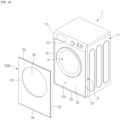
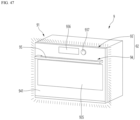
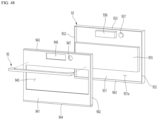
- the present disclosure relates to a home appliance including a panel assembly, e.g. a refrigerator, a dish washer, a laundry machine such as a clothing manager or a washing and/or drying machine, or a cooking device, e.g. an oven.
- a panel assembly e.g. a refrigerator, a dish washer, a laundry machine such as a clothing manager or a washing and/or drying machine, or a cooking device, e.g. an oven.
- a refrigerator is a home appliance for storing food at low temperature in an internal storage space that is shielded by a refrigerator door, and is configured to store the stored food in an optimal state by cooling the inside of the storage space using cold air generated through heat exchange with a refrigerant circulating through the refrigeration cycle.
- Such a refrigerator is gradually being enlarged and multi-functional according to a trend of changes in dietary life and high-quality products, and a refrigerator equipped with various structures and convenience devices in consideration of user convenience is being developed.
- U.S. Patent No. 8789900 discloses a structure in which a deco panel forming an outer appearance is installed on a door front of a refrigerator, and here, the outer appearance of the door front is formed according to a user's preference by detachably configuring the deco panel.
- US 2018/164030 A1 relates to a refrigerator comprising: a cabinet defining a storage space; a door configured to open and close at least a portion of the cabinet, the door defining an opening; and a transparent display assembly that covers the opening of the door and that allows an inner space of the refrigerator to be visible through the transparent display assembly, wherein the transparent display assembly comprises: a front panel defining at least a portion of a front surface of the door, a rear panel defining at least a portion of a rear surface of the door, a display disposed between the front panel and the rear panel, a light guide plate spaced apart from the display and configured to guide light toward the display, a spacer disposed between the front panel and the light guide plate and configured to maintain a predetermined distance between the light guide plate and the display, a display light disposed outside the light guide plate
- the light is not transmitted to the both side ends where the light emitting members are arranged, so that there is a problem that both side ends of the front face of the door do not emit light brightly.
- heat generated from the light emitting member is not effectively dissipated, which may cause excessive deformation of the light guide plate.
- a temperature of the front face of the refrigerator door rises, which may cause the user to feel discomfort when approaching the refrigerator to open the door.
- the shielding portion formed to shield the light source and the light guide plate portion installed in the lighting device may be disposed to prevent the hot-spot from appearing on the front face of the door while the lighting device is turned on, to improve a quality of the outer appearance of the face of the door, and to prevent glare of the user.
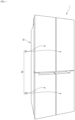
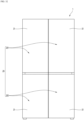
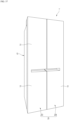
- FIG. 1 is a perspective view of a refrigerator according to an embodiment of the present disclosure.
- the door may include a refrigerating chamber door 201 for opening and closing the refrigerating chamber, and a freezing chamber door 202 for opening and closing the freezing chamber.
- the refrigerating chamber door 201 may be referred to as an upper door
- the freezing chamber door 202 may be referred to as a lower door.
- a refrigerator having a structure in which the refrigerating chamber is disposed at the upper portion and the freezing chamber is disposed at the lower portion is described as an example in the embodiment, the present disclosure may be applied to all types of refrigerators equipped with a door without being limited to a type of a refrigerator.
- the door 20 may form a front appearance of the refrigerator 1 in the closed state and may form the out appearance of the refrigerator 1 viewed from the front in the state in which the refrigerator 1 is installed.
- the door 20 may have a structure in which a front face selectively emits light and may be configured to emit light with set color or brightness. Thus, a user may change the color or the brightness of the front face of the door 20 without separating or disassembling the door 20 and may change the overall outer appearance of the refrigerator 1.
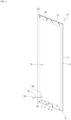
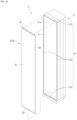
- FIG. 2 is a perspective view of a refrigerator door according to an embodiment present disclosure.
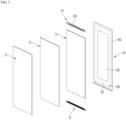
- FIG. 3 is an exploded perspective view of the refrigerator door.
- the door 20 includes a door body 40 which may form the overall shape of the door 20, and a panel assembly 30 which may form a front outer appearance of the door 20. That is, the door 20 is constructed such that the panel assembly 30 is mounted on a front face of the door body 40.
- the door body 40 may include a body plate 41 forming a front face and a door liner 42 forming a rear face.
- the body plate 41 may be made of a metal material and may be formed in a plate shape having a size corresponding to that of the panel assembly 30.
- the door liner 42 may be made of a plastic material and may form a bottom face shape of the door 20.
- the door body 40 may further include side decorations 44 forming right and left side faces of the door body 21.
- the side decorations 44 may connect right and left side ends of the body plate 41 to right and left side ends of the door liner 42.
- the door body 40 may further include an upper cap decoration 43 and a lower cap decoration 45 that respectively form top and bottom faces of the door body 40.
- the upper cap decoration 43 may be connected to an upper end of the side decoration 44, an upper end of the body plate 41, and an upper end of the door liner 42.
- the lower cap decoration 45 may be connected to a lower end of the side decoration 44, a lower end of the body plate 41, and a lower end of the door liner 42.
- An outer appearance of the door body 40 may be formed by the body plate 41, the door liner 42, the side decorations 44, the upper cap decoration 43, and the lower cap decoration 45.
- An insulator may be filled in an internal space of the door body 40, which is formed by coupling the body plate 41, the door liner 42, the side decorations 44, the upper cap decoration 43, and the lower cap decoration 45 to each other, and may provide an insulation structure to prevent heat from being transferred through the door 20.
- the insulator may be formed as time elapses after a foaming liquid is filled, as one example.
- the door body 40 may have an inlet for filling the foaming liquid.
- a panel receiving space 410 that is opened forward may be defined in the front face of the door body 40. That is, front ends of the side decorations 44, the upper cap decoration 43, and the lower cap decoration 45 may protrude more forward than a front face of the body plate 41, and thus the panel receiving space 410 with an open front face may be formed in front of the body plate 41.
- the panel receiving space 410 may be defined with a size corresponding to the size of the panel assembly 30 and the panel assembly 30 may be inserted into the panel receiving space 410.
- a perimeter of the panel assembly 30 may be supported by a peripheral face of the panel receiving space 410, that is, protruding portions of the side decoration 44, the upper cap decoration 43, and the lower cap decoration 45.
- the panel assembly 30 may be formed in a plate shape and may be formed with a size corresponding to that of a front face of the door body 40. Thus, when the panel assembly 30 is mounted on the front face of the door body 40, the panel assembly 30 may shield the front face of the door body 40 and may form a front outer appearance of the door 20. Because the panel assembly 30 may form the front outer appearance of the door 20, the panel assembly 30 may be referred to as a door panel, and because the panel assembly 30 may form the front outer appearance of the refrigerator 1, the panel assembly 30 may also be referred to as an exterior panel.
- a rear face of the panel assembly 30 may be fixed in contact with the body plate 41.
- a lower end of the panel assembly 30 may be caught and restrained with a lower end of the lower cap decoration 45, and an upper end of the panel assembly 30 may be coupled to an upper end of a front face of the upper cap decoration 43 to firmly couple the panel assembly 30 to the door body 40.
- the panel assembly 30 may be detachably mounted from the door body 40 for services and maintenance.
- a front face of the panel assembly 30 may be exposed forward in the state in which the panel assembly 30 is mounted on the door body 40, and the panel assembly 30 may substantially form the front outer appearance of the door 20.
- the panel assembly 30 may be configured to emit light from an entirety of the front face thereof and may be configured to emit light with various colors.
- a lighting device 36 may be disposed inside the panel assembly 30.
- An electrical wire 381 may be connected to the lighting device 36 in order to supply and control power.
- the electrical wire 381 may be exposed outside the rear face of the panel assembly 30, and a connector 382 may be disposed at an end of the wire 381.
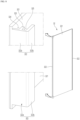
- FIG. 4 is a rear perspective view of a panel assembly according to an embodiment of the present disclosure.
- FIG. 5 is an exploded perspective view of the panel assembly viewed from the front.
- FIG. 6 is an exploded perspective view of the panel assembly viewed from the rear.
- the panel assembly 30 includes a front plate 31 forming a front outer appearance, the lighting device 36 for emitting light to cause the front plate 31 to emit light, and a light guide plate 33 for guiding light emitted from the lighting device 36.
- the front plate 31 may be formed to be transparent to allow light reflected by the light guide plate 33 to be transmitted.
- the transparency may be defined as an amount to which the light reflected by the light guide plate may be transmitted and irradiated to the outside.
- the front plate 31 may be formed to be larger than the light guide plate 33.
- a rear face of the front plate 31 may be coupled to a front face of the support member 32.
- the light guide plate 33 and the front plate 31 are described as being fixedly mounted to the support member 32, but the present disclosure is not limited thereto.
- the lighting device 36 may be mounted on the lower bracket 35.
- the lighting device 36 may be configured to emit light for determining the color and brightness of the front face of the panel assembly and to emit light toward the light guide plate 33.
- the lighting device 36 may be disposed inside the lower bracket 35 and may be assembled and mounted with the lower bracket 35 in the state of being mounted on the lower bracket 35.
- the light guide plate 33 may be formed in a rectangular plate shape.
- the light guide plate 33 may be formed with a size corresponding to or somewhat smaller than the sizes of the front plate 31 and the front portion 321 of the support member 32.
- the light guide plate 33 may be formed with a thickness to be inserted into a side portion of the support member 32, and may be formed such that, in the state in which the light guide plate 33 is mounted on the member 32, a front face of the light guide plate 33 is completely in contact with a rear face of the front portion 321 of the support member 32, and thus a gap is not generated therebetween.
- the light guide plate 33 may be formed to reflect light of the lighting device 36, emitted from below, along the light guide plate 33 and to uniformly transfer the light forward, that is, to an entire face of the front plate 31.
- a pattern for reflecting light emitted along the light guide plate 33 forward may be formed on the light guide plate 33.
- a pattern formed on the light guide plate 33 will be described later with reference to the drawings.
- a reflective layer 331 may be disposed on the rear face of the light guide plate 33.
- the reflective layer 331 may be formed to have the same size as the light guide plate 33 and may be formed in a shape of a sheet.
- the reflective layer 331 may be in close contact with the rear face of the light guide plate 33, and as necessary, may also be adhered to the rear face of the light guide plate 33.
- the reflective layer 331 may be coated or patterned to cause a front face thereof to reflect light, and the front face of the reflective layer 331 may be in contact with the rear face of the light guide plate 33. Thus, light moved along the reflective layer 331 may be reflected by the front face of the reflective layer 331 to be directed forward and may be reflected to the front plate 31.
- the reflective layer 331 may be slidably inserted into the support member 32 in the state of being in contact with the light guide plate 33 and may be maintained in the state of being in contact with the reflective layer 331. To this end, the reflective layer 331 may be configured to be maintained in the state of being in contact with the light guide plate 33 by static electricity or friction force.
- a reflective member 332 may be further disposed along an outer perimeter of the light guide plate 33.
- the reflective member 332 may be made of the same material as that of the reflective layer 331 and may direct light leaking through a perimeter face of the light guide plate 33 again into the light guide plate 33 to further increase the reflection efficiency of the light guide plate 33.
- Light leaking to the outside through a perimeter of the light guide plate 33 may be blocked by the reflective member 332, and thus light may also be prevented from leaking to the outside through the side portion 322 of the support member 32 made of a transparent or translucent material, which is adjacent to an end of the light guide plate 33.
- the reflective member 332 may be adhered to a perimeter of an outer face of the light guide plate 33 by a tape or an adhesive, and a face on which a pattern for reflecting light into the light guide plate 33 is formed may be adhered to a perimeter face of the light guide plate 33.
- the reflective member 332 may be disposed on a portion of the entire perimeter face of the light guide plate 33.
- the reflective member 332 may be disposed along a top face and right and left side faces of the perimeter of the light guide plate 33 except for a bottom face of the perimeter of the light guide plate 33, which faces the lighting device 36.
- the light guide plate 33 may be mounted on the support member 32 in the state in which the reflective layer 331 and the reflective member 332 are in contact with each other.
- FIG. 8 is a rear perspective view of a support member, which is a component of a panel assembly.
- FIG. 9 is a perspective view of FIG. 3 cut along a line 9-9.
- an entirety of the support member 32 may be formed by injection molding of a resin material and may be made of a transparent material, and thus light reflected forward through the light guide plate 33 may be transmitted and directed toward the front plate 31.
- the support member 32 may include the front portion 321 formed in a shape of a plate, and the side portions 322 that protrude rearward from the right and left side ends of the front portion 321.
- the front portion 321 may be disposed between the front plate 31 and the light guide plate 33, the front face thereof may support the front plate 31, and the rear face thereof may support the light guide plate 33.
- the front portion 321 may be formed in a shape of a plate having a size corresponding to that of the front plate 31, and a sealant 313 may be applied on the perimeter of the front face of the front portion 321 to adhere the front plate 31 to the support member 32.
- the sealant 313 may be made of a transparent or light-transmissive material, and the entire area of the front plate 31, which contains an area on which the sealant 313 is applied, may emit light.
- the sealant 313 may be applied on upper, lower, and left and right side edges of the front face of the front portion 321 to have a predetermined width.
- the rear face of the front portion 321 may be maintained in the state of being completely in contact with the front face of the light guide plate.
- the light guide plate 33 may always maintain a predetermined spacing from the front plate 31 and may direct light of an entirety of the light guide plate 33 toward the panel 31 without being interfered.
- the side portions 322 may be formed along the right and left side ends of the light guide plate 33.
- the side portion 322 may be stepped with upper and lower ends of the light guide plate 33 and may be formed to match with side ends of the upper bracket 34 and the lower bracket 35.
- the side portion 322 may include a first face 322a extending rearward from each of the right and left side ends of the front portion 321 and a second face 322b bent at an end of the first face 322a.
- the first face 322a may extend perpendicularly to the front portion 321 from each of the right and left side ends of the front portion 321 and may form a side face of the panel assembly 30. That is, an extended length of the first face 322a may correspond to a width of the side face of the panel assembly 30.
- An internal space of the panel assembly 30 may be defined by the first face 322a and may define a space for mounting at least the light guide plate 33, the upper bracket 34, and the lower bracket 35 therein.
- Upper end and lower end of the first face 322a may be formed to be stepped with respect to the upper end and the lower end of the front portion 321, respectively.
- the second face 322b may be bent inwardly from an extended end of the first face 322a. That is, a pair of second faces 322b respectively formed on a pair of first faces 322a may extend in a direction facing each other.
- the second faces 322b may respectively extend perpendicularly to the first faces 322a, and may be formed to constrain both ends of each of the upper bracket 34 and the lower bracket 35.
- the second face 322b may extend from an upper end to a lower end of the first face 322a, and may support each of the left and right side ends of the back cover 39.
- a side rib 323 may be further formed on an inner face of the first face 322a.
- the side rib 323 may be formed between the front portion 321 and the second face 322b, and may extend perpendicularly to the first face 322a.
- the side rib 323 may extend from the upper end to the lower end of the first face 322a.
- the side rib 323 may be formed to have a width in the left and right direction smaller than that of the second face 322b.
- the side rib 323 may partition a space defined by the side portion 322 in a front and rear direction to define a space into which the light guide plate 33, the upper bracket 34, and the lower bracket 35 are inserted in a sliding manner.
- the side rib 323 may be positioned between the front portion 321 and the second face 322b, and may be formed in parallel with the front portion 321 and the second face 322b.
- the side rib 323 may partition the space between the front portion 321 and the second face 322b to define a light guide plate-inserted space 324 into which the light guide plate 33 is inserted, and a bracket-inserted space 325 into which the upper bracket 34 and lower bracket 35 are inserted.
- the light guide plate-inserted space 324 may be defined between the front portion 321 and the second rib 323. A length in the front and rear direction of the light guide plate-inserted space 324 may correspond to the thickness of the light guide plate 33.
- the light guide plate 33 may be inserted into the light guide plate-inserted space 324 by being slidably moved in the vertical direction, and the right and left side ends of the light guide plate 33 may be restrained at both side ends of the support member 32.
- the front face of the light guide plate 33 may be in contact with the rear face of the front portion 321.
- the lower end of the light guide plate 33 may be positioned at a location for facing the lighting device 36.
- the light guide plate 33 may be disposed on the same extension line as the light source 362 of the lighting device 36, and in the state in which the light guide plate 33 is fixedly inserted into the light guide plate-inserted space 324, movement in the front and rear direction of the light guide plate 33 may be restrained.
- the light guide plate 33 may be in contact with the front portion 321, may be maintained at a predetermined spacing from the front plate 31, and may not deviate from a position at which the light guide plate 33 is originally installed.
- the state in which the light guide plate 33 is disposed on the same extension line as the light source 362 included in the lighting device 36 may be maintained, and thus it may be possible to ensure that light emitted from the light source 362 is directed toward an end of the light guide plate 33.
- the bracket-inserted space 325 may be defined between the second rib 323 and the second face 322b.
- a length in the front and rear direction of the bracket-inserted space 325 may correspond to a thickness of an upper bracket front portion 341 and a lower bracket front face 351 (also called front part 351).
- the upper bracket 34 and the lower bracket 35 may be inserted into the bracket-inserted space 325 from above and below and may be fixedly mounted on the upper and lower ends of the support member 32, respectively.
- the upper bracket 34 and the lower bracket 35 may be inserted into the bracket-inserted space 325, and simultaneously, may be accommodated on stepped portions of the upper and lower ends of the side portion 322 and be firmly coupled to the support member 32. In the state in which the upper bracket 34 and the lower bracket 35 are coupled to the support member 32, the upper and lower ends of the panel assembly 30 may be formed.
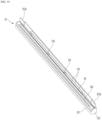
- FIG. 10 is a perspective view in which a lower bracket, a lighting device, and a light supporter, which are components of the panel assembly, are coupled to each other.
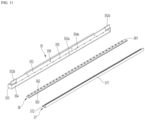
- FIG. 11 is an exploded perspective view of a coupled structure of a lower bracket, a lighting device, and a light supporter viewed from the rear.
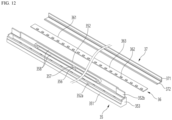
- FIG. 12 is an exploded perspective view of a coupled structure of a lower bracket, a lighting device, and a light supporter viewed from the front.
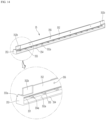
- FIG. 13 is a front perspective view of a lower bracket.
- FIG. 14 is a rear perspective view of a lower bracket.
- FIG. 15 is a perspective view of FIG. 13 cut along a line 14-14.
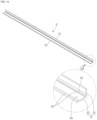
- FIG. 16 is a perspective view of a light supporter.
- the lower bracket 35 may have a length corresponding to the length in the left and right direction of the panel assembly 30.
- the lower bracket 35 may roughly include a lower bracket front face 351 (also called front part 351), a lower bracket rear face 352 (also called rear part 352), a lower bracket side face 353 (also called side part 353) and a lower bracket bottom face 354 (also called bottom part 354).
- the lower bracket front face 351 may form the shape of the front face of the lower bracket 35 and may support the front plate 31. A portion of the lower bracket front face 351 may protrude downwardly of the front plate 31, and may be inserted into the lower end of the door body 40, that is, the lower cap decoration 45, so that the lower bracket 35 is fixed.
- the lower bracket front face 351 may extend upwardly from a front side of the lower bracket bottom face 354.
- the lower bracket front face 351 may include a first lower bracket front face 351f (also called first front part 351f) extending upward from the front side of the lower bracket bottom face 354 and a second lower bracket front face 351b (also called second front part 351b) extending upward from an upper end of the first lower bracket front face 351f.
- first lower bracket front face 351f also called first front part 351f
- second lower bracket front face 351b also called second front part 351b
- the first lower bracket front face 351f and the second lower bracket front face 351b may be referred to as a first front face 351f (also called first front part 351f) and a second front face 351b (also called second front part 351b), respectively.
- the second lower bracket front face 351b may be located rearwardly of the first lower bracket front face 351f.
- the second lower bracket front face 351b may support the front plate 31 from the rear.
- the lower bracket front face 351 may include a first stepped portion 351a, which is a bracket stepped portion.
- the first stepped portion 351a may support a lower end of the front plate 31.
- the first stepped portion 351a may be formed to be stepped rearwardly from a front face of the lower bracket front face 351.
- a front face of the second lower bracket front face 351b may be located rearwardly of a front face of the first lower bracket front face 351f, and a first stepped portion 351a may be positioned in a space between the front face of the second lower bracket front face 351b and the front face of the first lower bracket front face 351f.
- the second lower bracket front face 351b may extend upwardly from a rear end of the first stepped portion 351a.
- lower ends of the first stepped portion 351a and the second lower bracket front face 351b may be positioned on an upper end of the first lower bracket front face 351f, and the first stepped portion 351a may be positioned forwardly of the second lower bracket front face 351b.
- the sealant 313 may be applied to the second lower bracket front face 351b, and the front plate 31 may be firmly fixed to the second lower bracket front face 351b.
- An upper end of the second lower bracket front face 351b may be coupled to the lower end of the support member 32, thus the front face of the second lower bracket front face 351b and the front portion 321 of the support member 32 may be located on the same plane.
- the second lower bracket front face 351b may prevent exposure of the lighting device 36 or a lighting spot (also referred to as a light concentration or a hot-spot) that may be generated by the lighting device 36 while supporting the front plate 31.
- a lighting spot also referred to as a light concentration or a hot-spot
- the lower bracket side face 353 may form the side face of the lower bracket 35, and may protrude upwardly of the lower bracket front face 351.
- the lower bracket side face 353 may protrude upwardly of the second lower bracket front face 351b, so that a stepped portion of a lower end of the side face of the support member 32 may be engaged with the lower bracket front face 351 and the lower bracket side face 353.
- the lower bracket rear face 352 may be formed at a rear end of the lower bracket side face 353.
- the lower bracket rear face 352 may form a rear face of the lower bracket 35, and allow the lower bracket 35 to be fixedly mounted to the support member 32.
- the lower bracket rear face 352 may be formed parallel to the front plate 31 and the light guide plate 33, and may extend in the vertical direction.
- the lower bracket rear face 352 may protrude upwardly of the lower bracket front face 351 and the lower bracket side face 353.
- Lower side portions 352b that are formed to be stepped forward may be formed at left and right side ends of the lower bracket rear face 352.
- the lower side portions 352b may be formed to be stepped with respect to the lower bracket rear face 352, and may be positioned forwardly of the lower bracket rear face 352.
- the lower side portion 352b may be formed with a thickness corresponding to the width of the bracket-inserted space 325 and may be slidably inserted into the second space 325 in an upward direction.
- a plurality of lower bracket boss 357 may be formed on the front face of the lower bracket rear face 352.
- the lower bracket boss 357 which is for the fastening of the screw 399, may have a lower bracket screw hole 356 to which the screw 399 is fastened at a center thereof.
- the lower bracket screw hole 356 may be defined to extend through the lower bracket rear face 352 and may be defined at a position corresponding to the cover screw hole 397.
- the screw 399 may be fastened to sequentially extend through the cover screw hole 397 and the lower bracket screw hole 356.
- the lower bracket boss 357 may protrude forward and may protrude to a position at which the lower bracket boss 357 is in contact with the rear face of the light guide plate 33.
- a protruding end of the lower bracket boss 357 may support the light guide plate 33 from the rear. That is, when the panel assembly 30 is assembled, the lower bracket 35 may support the upper end of the light guide plate 33 from the rear.
- a support rib 358 for connecting the multiple lower bracket bosses 357 to each other may be formed on the front face of the lower bracket rear face 352.
- One pair of support ribs 358 may be arranged in the vertical direction, and the multiple lower bracket bosses 357 may be positioned between one pair of support ribs 358.
- an upper support rib 358 of one pair of support ribs 358 may extend to connect upper ends of the multiple lower bracket bosses 357 to each other, and a lower support rib 358 of one pair of support ribs 358 may extend to connect lower ends of the multiple lower bracket bosses 357 to each other.
- the support rib 358 may protrude with the same height as a protruding height of the lower bracket boss 357. Thus, when the panel assembly 30 is assembled, the support rib 358 may support the light guide plate 33 from the rear together with the lower bracket boss 357.
- the lower bracket 35 may be fixedly coupled to the upper end of the support member 32 and fixed, and may be in the state of being fixed to the back cover 39 by the screw 399, thereby restraining a downward movement of the light guide plate 33 and forming the shape of a bottom face of the panel assembly 30.
- a bracket opening 352a may be defined in the lower bracket rear face 352.
- the bracket opening 352a may extend from a left side end to a right side end of the lower bracket rear face 352 and may be formed at a position facing the lower bracket front face 351.
- the lower bracket bottom face 354 may form a bottom face of the lower bracket 35 and may be connected to a lower end of the lower bracket front fac 351, a lower end of the lower bracket side face 353, and a lower end of the lower bracket rear face 352.
- the lower bracket bottom face 354 may form a bottom face of a space in which the lighting device 36 is mounted.
- a bracket rib 354a for supporting the lighting device 36 or the light supporter 37 from below or supporting the back cover 39 may be formed on the lower bracket bottom face 354.
- the bracket rib 354a may extend rearward from the lower bracket front face 351 and may protrude upward from the lower bracket bottom face 354a. alternatively, the bracket rib 354a may protrude from the lower bracket bottom face 354a at a position spaced apart from the lower bracket front face 351.
- the bracket rib 354a may support the light supporter 37 or support the back cover located beneath the light supporter 37.
- the bracket rib 354a supports the back cover 39 located beneath the light supporter 37.
- the lower bracket front face 351 may include a support on which the light guide plate is supported.
- the support may extend from the lower bracket front face 351 towards the lower bracket rear face 351.
- the support may extend horizontally at a position spaced downwardly apart from the top face of the lower bracket front face 351.
- the support may include a first support 351c extending from the lower bracket front face 351 and a second support 355 extending from the first support 351c towards the lower bracket rear face 352.
- a plurality of second supports 355 may be arranged to be spaced apart from each other at a predetermined spacing along the lower bracket front face 351.
- the light guide plate 33 may be seated on the support via the space between the lower bracket front face 351 and the lower bracket rear face 352.
- the first support 351c may be formed continuously in the left and right direction of the lower bracket front face 351. That is, a length in the left and right direction of the first support 351c may be greater than a sum of lengths in the left and right direction or widths of the plurality of second supports 355.
- the length in the front and rear direction of the second support 355 may be greater than a length in the front and rear direction of the first support 351c.
- the plurality of second supports 355 are arranged to be spaced apart from each other, the light irradiated from the light source 362 may be incident on the light guide plate 33 without interfering with the plurality of second supports 355.
- the support may extend to constrain the lighting device 36 from above.
- the support and the lower bracket bottom face 354 may constrain the lighting device 36 from moving in the vertical direction by constraining the lighting device 36 from above and below.
- the front face of the light guide plate 33 may be in contact with the rear face 351d of the second lower bracket front face 351b.
- the front face of the light guide plate 33 is in contact with the rear face 351d of the second lower bracket front face 351b, the forward movement of the light guide plate 33 is restricted, so that the rear face 351d of the second lower bracket front face 351b may be referred to as a stopper face.
- the lighting device 36 may be accommodated inside the lower bracket 35.
- the lower bracket 35 may include a receiving groove 351e or a receiving portion for receiving a portion of the lighting device 36 therein.
- the receiving groove 351e may be defined at least by the lower bracket front face 351, the lower bracket bottom face 372, and the first support 351c. In one example, a portion of the receiving groove 351e may be positioned between the second lower bracket front face 351b and the first lower bracket front face 351f. Alternatively, it may be described that the first lower bracket front face 351f includes the receiving groove 351e.
- the lighting device 36 includes a substrate 361 and the light source 362.
- the substrate 361 may be formed in a plate shape to be accommodated within the lower bracket 35 and may extend from one end to the other end of the lower bracket 35.
- Multiple light sources 362 may be consecutively arranged at a predetermined spacing on the substrate 361.
- the light source 362 may be disposed to emit light toward the bottom face of the light guide plate 33.
- the substrate 361 may provide a space in which the light sources 362 are consecutively arranged from a left side end to the other side end of the light guide plate 33.
- the left side end and the right side end of the substrate 361 may be in contact with the lower bracket side faces 353 within the lower bracket 35, so that a movement thereof in the left and right direction may be restrained.
- the light source 362 may be disposed at a forwardly biased position based on a center of the substrate 361.
- the light source 362 may be positioned below the lower end of the light guide plate 33 in a vertical direction, that is, may be positioned to face the lower end of the light guide plate 33.
- a circuit 363 of the substrate 361 may be concentrated at a position biased to the rear based on the center of the substrate 361.
- the circuit 363, which is for an operation of the lighting device 36, may be disposed at the rearwardly biased position such that the light source 362 is disposed at a position to face the light guide plate 33.
- the light source 362 may be formed as an LED.
- the light source 362 may be formed as an RGB LED for emitting light with various colors under control of the controller 13. That is, the light source 362 may emit light with the various colors under the control of the controller 13, and thus the front plate 31 may emit light with color set by the controller 13. Based on the color of the front plate 31, color of the front outer appearance of the refrigerator 1 may be determined.
- the light source 362 may be formed as an LED for emitting light with a specific color other than the RGB LED and may be formed as a combination of multiple LEDs for emitting light with different colors.
- the multiple light sources 362 may be formed as red, green, and blue LEDs and may sequentially and repeatedly arranged in order. Under the control of the controller 13, operations of the light sources 362 may be combined to cause the front plate 31 to emit light with a desired color.
- the light sources 362 may be mounted at a predetermined spacing on the substrate 361 and an appropriate number of light sources 362 may be arranged to cause the front plate 31 to emit light with set brightness.
- the light sources 362 may be arranged at a spacing in a range from 6.3 mm to 7.0 mm, so that brightness of the front plate 31 may reach a target brightness, and an entire face of the front plate 31 may emit light with uniform brightness equal to or greater than 80 %.
- the spacing between the light sources 362 may be smaller than a width in the left and right direction of the support 355, and thus the support 355 may be disposed between the light sources 362.
- Elements 364 protruding downward may be further disposed on the bottom face of the substrate 361.
- the light supporter 37 may be disposed within the lower bracket 35.
- the light supporter 37 may support the lighting device 36 within the lower bracket 35.
- the light supporter 37 may dissipate heat generated by the lighting device 36 by conduction.
- the light supporter 37 may be made of a metal material.
- the light supporter 37 may be made of an aluminum material with high heat conductivity.
- the light supporter 37 may be molded by extrusion of the metal material to have the same cross-sectional structure in a longitudinal direction, and may be formed with a size to enter and exit through the bracket opening 352a.
- the light supporter 37 may include a first supporting portion 372 for supporting the lighting device 36 and a second supporting portion 371 in contact with the back cover 39.
- the first supporting portion 372 may be accommodated in the receiving groove 351e during an assembly process of the first supporting portion 372.
- the bottom face of the first supporting portion 372 may be disposed parallel to the lower bracket bottom face 354 and may have a width corresponding to that of the lower bracket bottom face 354.
- a front end of the first supporting portion 372 may extend to a position corresponding to a front end of the substrate 361, and may be positioned in contact with or proximate to the lower bracket front face 351.
- the first supporting portion 372 may be supported from below by the bracket rib 354a.
- Substrate supports 373 for supporting the front end and a rear end of the substrate 361 may be formed at the front end and a rear end of the first supporting portion 372.
- the substrate support 373 may be formed along the front and rear ends of the first supporting portion 372, and may protrude upward. Therefore, the first supporting portion 372 may have a structure supported directly along the substrate 361, and heat generated during the operation of the lighting device 36 may be conducted to the light supporter 37 via the substrate support 373.
- a supporter recessed portion 374 may be defined in the first supporting portion 372.
- the supporter recessed portion 374 may be recessed between one pair of substrate supports 373 and may provide a space in which the elements of the bottom face of the substrate 361 are accommodated when the substrate 361 is supported by the first supporting portion 372.
- the second supporting portion 371 may extend upward from the rear end of the first supporting portion 372.
- the second supporting portion 371 may extend perpendicularly to the first supporting portion 372 and the lower bracket bottom face 354.
- the second supporting portion 371 may shield the at least a portion of the bracket opening 352a while the light supporter 37 is mounted on the lower bracket 35.
- the second supporting portion 371 may be formed to have corresponding size and shape to shield the bracket opening 352a.
- a substrate receiving groove 375 may be defined at the lower end of the second supporting portion 371.
- the substrate receiving groove 375 may be defined along the longitudinal direction of the second supporting portion 371 and may be recessed to accommodate the rear end of the substrate 361 therein. In the state in which the substrate 361 is mounted on the right supporter 37, the rear end of the substrate 361 may be in close contact with an inner face of the substrate receiving groove 375.
- the second supporting portion 371 may extend upwardly, and may be exposed to the outside through the bracket opening 352a.
- the rear face of the second supporting portion 371 may be formed in a shape of a flat plate, and may be in surface contact with the back cover 39 when the back cover 39 is mounted. Accordingly, the heat of the lighting device 36 conducted to the light supporter 37 may be transferred to the back cover 39 and may be dissipated via the back cover 39.
- the lighting device 36 and the light supporter 37 may enter and exit through the bracket opening 352a with the lower bracket 35 mounted. Therefore, when only the back cover 39 shielding the bracket opening 352a is removed, the lighting device 36 and the light supporter 37 may be easily assembled and disassembled.
- the hot-spot may appear at a position adjacent to the light source 362 when viewing the panel assembly 30 from the front.
- Such a hot-spot may deteriorate a quality of the outer appearance of the front face of the door 20 and may dazzle the user.
- the panel assembly 30 includes a shielding portion 351b formed in front of the light source 362 to shield a portion of the light irradiated from the light source 362.
- the shielding portion according to one embodiment of the present disclosure will be further described in detail below.
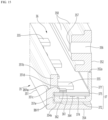
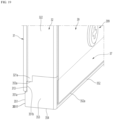
- FIG. 17 is a view showing a state in which a light supporter is coupled to a lower bracket while a lighting device is seated on the light supporter
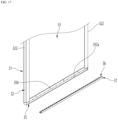
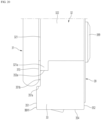
- FIG. 18 is a view showing a state in which a back cover is coupled while a lighting device and a light supporter accommodated in a lower bracket
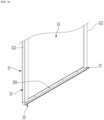
- FIG. 19 is a view showing a state in which assembly of a panel assembly is completed.
- FIG. 20 is a partial side view showing a structure of a lower end of a side face of a panel assembly.
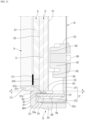
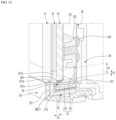
- FIG. 21 is a perspective view of FIG. 4 cut along a line 20-20.
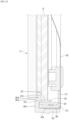
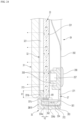
- FIG. 22 is a perspective view of FIG. 4 cut along a line 21-21.
- the lighting device 36 may be seated on the light supporter 37.
- the light supporter 37 may be inserted into the lower bracket 35 through the bracket opening 352a.
- the light supporter 37 may be inserted into the space in the lower bracket 354.
- a gap between the bottom face of the support and the lower bracket bottom face 354 is greater than a sum of vertical dimensions of the substrate 361 and the first supporting portion 372.
- a vertical length between the bracket rib 354a and a top face of the receiving groove 351e may be greater than the sum of the vertical dimensions of the substrate 361 and the first supporting portion 372.
- the lighting device 36 and the first supporting portion 372 may be accommodated in the receiving groove 351e.
- the first supporting portion 372 may be raised by the bracket rib 354.
- the substrate 361 and the first supporting portion 372 may be accommodated in the receiving groove 351e without interfering with the support.
- the light source 362 may be positioned between two adjacent second supports 355, and may come into contact with the first support 351c.
- the insertion of the lighting device 36 may be restricted and the position of the lighting device 36 may be determined.
- the substrate 361 may come into contact with the face defining the receiving groove 351e. In this case, the insertion of the lighting device 36 may be restricted and the position of the lighting device 36 may be determined.
- the first supporting portion 372 may come into contact with the face defining the receiving groove 351e. In this case, the insertion of the lighting device 36 may also be restricted and the position of the lighting device 36 may also be determined.
- the first supporting portion 372 and the substrate 361 may come into contact with the face defining the receiving groove 351e. In this case, the insertion of the lighting device 36 may also be restricted and the position of the lighting device 36 may also be determined.
- the insertion of the lighting device 36 is restricted while the lighting device 36 is accommodated in the lower bracket 35, so that the lighting device 36 stops moving at the insertion restricted position.
- the top face of the substrate 361 may be spaced apart from the bottom face of the support.
- the back cover 39 may be coupled to the lower bracket 35.
- the back cover 39 may be coupled to the lower bracket 35 by the fastening of the screw 399.
- a cover bent portion 396 at a lower end of the back cover 39 may be inserted into the bracket opening 352a.
- the cover bent portion 396 may be inserted between the bottom face of the light supporter 37 and the lower bracket bottom face 354.
- a difference between a vertical length between the bracket rib 354a and the top face of the receiving groove 351e and the sum of the vertical dimensions of the substrate 361 and the first supporting portion 372 may correspond to a thickness of the cover bent portion 396.
- the cover bent portion 396 may be seated on the bracket rib 354a.
- the cover bent portion 396 may raise the light supporter 37, so that the top face of the substrate 361 comes into contact with the bottom face of the support.
- the cover bent portion 396 is positioned between the first supporting portion 327 and the bracket rib 354a, and supports the first supporting portion 327 while being seated on the bracket rib 354a.
- the bracket rib 354a directly supports the light supporter 37
- the top face of the substrate 361 may come into contact with the bottom face of the support.
- the cover bent portion 396 may be in surface contact with the bottom face of the first supporting portion 372, and a lower end of the cover perimeter 392 of the back cover 39 may be in surface contact with an entirety of the rear face of the second supporting portion 371.
- the back cover 39 is fastened to the rear face bracket 35 by the screw 399, and the back cover 39 presses the second supporting portion 371 in the forward direction (toward the lower bracket front face) while the back cover 39 is fastened to the rear face bracket 35 by the screw 399.
- the position of the lighting device 36 in the lower bracket 35 may be determined without the user's separate work or a separate structure, and the movement of the lighting device 36 may be restricted.
- the position of the light guide plate 33 may be determined and the movement of the light guide plate 33 may be restricted. Accordingly, the positions of the light guide plate 33 and the lighting device 36 may be determined without the user's separate work or the separate structure.
- the movement in the vertical direction of the substrate 361 may be restricted.
- a portion of the light guide plate 33 may be seated on the first support 351c, and the remaining portion of the light guide plate 33 may be seated on the second support 355. While the light guide plate 33 is seated on the second support 355, the rear end of the second support 355 may extend further toward the lower bracket rear face 371 than the rear face of the light guide plate 33.
- the second support 355 may limit the upward movement of the entirety of the top face of the substrate 361.
- Left and right side faces of the substrate 361 may be in contact with the lower bracket side faces 353 inside the lower bracket 35, so that the movement in the left and right direction of the substrate 361 may be constrained.
- the lighting device 36 may not move in any direction as the movement is restricted in all directions such as the front and rear direction, the vertical direction, and the left and right direction when the panel assembly 30 is assembled, and may maintain an initial mounted position thereof.
- the center line CL of the light guide plate 33 and the light source 362 may be aligned with each other by simply assembling the light guide plate 33 and the lighting device 36.
- the center line CL of the light guide plate 33 may mean a line that bisects the thickness of the light guide plate 33.
- the light source of the lighting device 36 may also maintain the set position, and may irradiate light from the lower end of the light guide plate 33 toward the light guide plate 33.
- the light source 362 always irradiates the light at a certain position, thereby ensuring that the front plate 31 emits light with a constant brightness.
- the lower end of the light guide plate 33 may be supported by the support.
- the front face 335 of the light guide plate 33 may be in contact with the rear face 351 of the second lower bracket front face 351b in a state supported by the support, and the light guide plate 33 may maintain the state of being in contact with the support by a weight thereof within the panel assembly 30 while being inserted into the side portion 322 of the support member 32 in the sliding manner.
- the top face of the support may be formed higher than the top face of the light source 362, and thus, may not come into contact with the light source 362 during the opening and closing operation of the door 20 of the light guide plate 33 and expansion and contraction of the light guide plate 33. That is, a set gap G may be maintained between the lower end of the light guide plate 33 and the light source 362.
- the set gap G may be designed in consideration of an angle of light irradiated from the light source 362, and may be formed to be 0.4 mm as one example.
- the light irradiated from the light source 362 may be incident on the light guide plate 33 at a designed angle. Therefore, the light irradiated from the light source 362 may be effectively irradiated toward the light guide plate 33, and the light reflected through the light guide plate 33 may make the front plate 31 to emit light with the set brightness.
- the bottom face 333 of the light guide plate 33 serves as a light incident face. Because the front plate 31 is positioned in front of the light guide plate 33, the front face 335 of the light guide plate 33 serves as a light emitting face.
- the light incident face of the light guide plate 33 and the light source 362 are spaced apart from each other, most of the light generated from the light source 362 may be irradiated to the light incident face, but a portion of the light may pass through the gap G between the light incident face and the light source 362.
- the lighting spot (also referred to as the light concentration or the hot-spot) may occur on the front plate 31.
- the top face of the light source 362 may be positioned lower than the bottom face 312 (or the lower end) of the front plate 31. Therefore, the vertical level difference H may exist between the top face of the light source 362 and the bottom face 312 of the front plate 31.
- the vertical level difference H may be smaller than the thickness of the front plate 31. In this case, a size increase of the panel assembly may be minimized while preventing the generation of the lighting spot on the front plate 31.
- the bottom face 333 of the light guide plate 33 may be positioned at the same vertical level as or positioned lower than the bottom face of the bottom face 312 of the front plate 31.
- the top face (a supporting face) of the support 355 may be positioned at the same vertical level as or lower than the bottom face of the bottom face 312 (an opposite face of the supporting face) of the front plate 31.
- the substrate 361 may be positioned lower than the bottom face 312 of the front plate 31 and the light incident face of the light guide plate 33.
- a distance from the geometric center of the front plate 31 to the light source 362 may be greater than a distance from a geometric center of the front plate 31 to a face (for example, the bottom face 312 of the front plate 31) adjacent to the light source 362 among peripheral faces of the front plate 31.
- the top face of the support may be positioned lower than the bottom face 312 of the front plate 31.
- the light source 362 may be positioned lower than the top face of the support.
- the vertical level difference H between the top face of the light source 362 and the bottom face 312 of the front plate 31 may be equal to or greater than a size of the gap G between the light incident face and the light source 362. At least a portion of the space between the light incident face and the light source 362 may be positioned lower than the bottom face of the front plate 31.
- the lighting spot may be prevented from occurring on the front plate 31 primarily by the arrangement of the light source 362, the light guide plate 33, and the front plate 31.
- the lower bracket front face 351 may physically block the light that has passed through the gap G between the light incident face and the light source 362 from being irradiated to the front plate 31.
- the lower bracket front face 351 may support the front plate 31, and at the same time, prevent exposure of the lighting spot that may be caused by the lighting device 36 or the lighting device 36.
- the lower bracket front face 351 may cover the gap G between the light incident face and the light source 362.
- a portion (for example, the second lower bracket front face 351b) of the lower bracket front face 351 may protrude upwardly of the upper end of the light source 362 of the lighting device 36, and may protrude by a set height to prevent the lighting device 36 from being exposed forward.
- the second lower bracket front face 351b may become able to cover an area that may be generated by intensive light irradiation at the lower end of the light guide plate 33 and the lower end of the front plate 31, which are very adjacent to the lighting device 36, thereby preventing the formation of the lighting spot on the front plate 31.
- the second lower bracket front face 351b may be formed to be opaque or translucent, and may be formed to have a specific color as needed. Accordingly, the second lower bracket front face 351b may be referred to as a shielding portion.
- the generation of the lighting spot on the front plate 31 may be prevented by the arrangement of the light source 362, the light guide plate 33, and the front plate 31, so that even when a length of the second lower bracket front face 351b in the lower bracket 35 is shortened, the generation of the lighting spot on the front plate 31 may be prevented.
- the top face 353a of the second lower bracket front face 351b may be at least positioned higher than the bottom face 333 of the light guide plate 33.
- a transmitted length of the light from the front plate 31 is reduced by the length of the second lower bracket front face 351b.
- a light transmitted area in the front plate 31 may be increased.
- first stepped portion 351a does not exist and the first stepped portion 351a and the second lower bracket front face 351b are formed to have the same continuous face.
- FIG. 23 is a perspective view of FIG. 2 cut along a line XIII-XIII'.
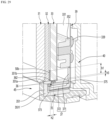
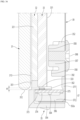
- FIG. 24 is a view showing a cross-section of a lower end of the panel assembly.
- FIG. 25 is a view showing a light emitting state based on a vertical level of a shielding portion when viewing a door panel from the front.
- FIG. 26 is a view showing a state in which a lighting device emits light when viewing a door panel from the front.
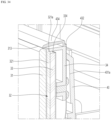
- the shielding portion 351b may be disposed between the front plate 31 and the lighting device 36.
- the light source 362 installed in the lighting device 36 may be disposed below the lower end of the light guide plate 33. The light source 362 irradiates the light from below the light guide plate 33 toward the light guide plate 33, and the light reflected through the light guide plate 33 passes through the front plate 31, so that the panel assembly 30 emits light brightly.
- the shielding portion 351b may be disposed at the lower end of the panel assembly 30 having the lighting device 36.
- the shielding portion 351b may be made of a material through which the light irradiated from the light source 362 does not transmit. That is, the shielding portion 351b may not be limited, but at least may be made of an opaque plastic material rather than a light-transmitting material.
- the shielding portion 351b may be disposed forwardly of the position where the light source 362 is disposed, so that the occurrence of the hot-spot phenomenon in which the light of the light source 362 is transmitted directly and appears to be brighter than the surrounding in a form of a spot when viewing the front plate 31 at the front may be prevented.
- the shielding portion 351b may be located between the front plate 31 and the light source 362.
- the shielding portion 351b is disposed at the rear of the front plate 31, so that when the panel assembly 30 is viewed from the front, the shielding portion 351b does not shield the front face of the front plate 31.
- the shielding portion 351b may not be exposed when the panel assembly 30 is viewed from the front. That is, the front face of the front plate 31 may form an entirety of the front face of the panel assembly 30, thereby providing an improved outer appearance.
- the shielding portion 351b may be integrally formed with the lower bracket 35.
- the lower bracket 35 may include the shielding portion 351b formed by extending upwardly from the front end of the bottom face of the lower bracket 35.
- the shielding portion 351b may be formed to be stepped rearward from the lower bracket front face 351. In this case, there is an advantage in that assembling is simplified and workability increases compared to separately having the shielding portion 351b.
- the lower bracket 35 includes a first stepped portion 351a formed to support the lower end of the front plate 31.
- the first stepped portion 351a is formed so as to support a portion of a load of the front plate 31 in contact with the lower end of the front plate 31.
- the lower end of the front plate 31 may be supported by the lower cap decoration 45 and the lower bracket 35.
- the lower cap decoration 45 may be made of an opaque material.
- the lower end of the front plate 31 may be located above an upper end of the light source 362. That is, the light source 362 may be located below the lower end of the front plate 31. Therefore, the light irradiated from the light source 362 may be prevented from being transmitted directly to the front plate 31. In detail, the light emitted from the light source 362 is reflected through the light guide plate 33, so that an entirety of the front plate 31 may emit light uniformly. Further, the occurrence of the hot-spot caused by the light source 362 below the front plate 31 may be prevented.
- the lower bracket 35 includes a second lower bracket front face 351b formed to be in contact with a portion of the rear face of the front plate 31 so as to support the front plate 31.
- the second lower bracket front face 351b may be formed to shield a portion of the light irradiated from the light source 362 to serve as the shielding portion 351b.
- An upper end of the second lower bracket front face 351b may be located above the upper end of the light source 362. In addition, the upper end of the second lower bracket front face 351b may be located lower than the upper end of the lower bracket side face 353.
- the second lower bracket front face 351b in other words, the shielding portion 351b may be formed to extend upwardly from the front end of the lower bracket bottom face 354.
- the support member 32 may be seated on the upper end of the shielding portion 351b.
- a top face of the shielding portion 351b may be formed to have a size corresponding to that of the bottom face of the support member 32.
- a length in the front and rear direction of the shielding portion 351b may correspond to the length in the front and rear direction of the support member 32, so that the support member 32 may be more stably mounted on the top face of the shielding portion 351b.
- the lower end of the shielding portion 351b may be disposed at a position corresponding to a portion of the light source 362 of the lighting device 36.
- the upper end of the shielding portion 351b may be disposed at a position corresponding to the lower end of the light guide plate 33.
- a spacing portion 351c for the shielding portion 351b and the light source 362 to be spaced apart from each other by a set spacing may be formed at the rear of the shielding portion 351b.
- the spacing portion 351c may be formed integrally with the lower bracket 35 and protrude in a direction in which the light source 362 is disposed.
- the spacing portion 351c may be formed to be in contact with one face of the light source 362 in a state of being disposed between the shielding portion 351b and the light source 362.
- the spacing portion 351c may be formed to be in contact with the front face of the light source 362, thereby allowing the shielding portion 351b and the light source 362 to be spaced apart from each other in the front and rear direction in front of the light source 362 while maintaining the mounted state of the light source 362.
- the spacing portion 351c may be formed to be in contact with a portion of the substrate 361.
- the substrate 361 may be disposed between the light supporter 37 and the spacing portion 351c.
- the substrate 361 may have a bottom face fixed by the substrate support 373, and a top face fixed by the spacing portion 351c.
- the spacing portion 351c is formed to protrude rearward from the lower bracket front face 351 and comes into contact with the light source 362. Therefore, the light source 362 may be prevented from moving in the front and rear direction while the lighting device 36 is mounted on the lower bracket 35.
- the light source 362 may maintain the spacing between the shielding portion 351b and the light guide plate 33 even with the repeated opening and closing operation of the door 20.
- the lighting device 36 is inserted through the bracket opening 352a of the lower bracket 35 and is mounted on the lower bracket 35 while being mounted on the light supporter 37.
- the lighting device 36 is inserted into the lower bracket 35, one face of the light source 362 is inserted until it comes into contact with one face of the spacing portion 351c, so that the spacing portion 351c may guide a position where the light source 362 is disposed.
- the substrate 361 may be placed between the spacing portion 351c and the light supporter 37, thereby confining the movement of the substrate 361.
- the substrate 361 is supported by the light supporter 37, and one face of the light source 362 is disposed to be in surface contact with the spacing portion 351c.
- the movement of the light source 362 may be restricted and the exposure of the hot-spot caused by the movement of the light source 362 may be prevented.
- the shielding portion 351b in order to prevent the hot-spot from appearing, it is necessary to set a length h1 of the shielding portion 351b such that the light does not flow from the light source 362 to the light guide plate 33 and is not directly irradiated to the front plate 31.
- the hot-spot may be exposed depending on an angle for viewing the front plate 31 from the front.
- the length of the shielding portion 351b extending upward relative to the upper end of the light source 362 is too great, the light reflected from the light guide plate 33 is shielded, so that, when the lighting device 36 is turned on, the lower end of the front plate 31 may emit light with relatively low brightness compared to other portions.
- the length h1 of the shielding portion 351b extending upward from the light source 362 may be determined in consideration of an irradiation angle ⁇ 1 of the light source 362, and a distance h2 at which the shielding portion 351b and the light source 362 are spaced apart from each other.
- the length h1 of the shielding portion 351b extending upward from the light source 362 may be determined by Equation 1 below. h 1 ⁇ h 2 * tan 90 - ⁇ 1 / 2
- the irradiation angle ⁇ 1 for irradiating light of the light source 362 may be in a range from about 90 to 150 °, preferably be 120 °.
- the shielding portion 351b When the shielding portion 351b is set to satisfy the Equation 1, the light directly irradiated from the light source 362 to the front plate may be effectively blocked.
- the spacing between the shielding portion 351b and the light source 362 may be constantly maintained by the spacing portion 351c.
- the upper end of the shielding portion 351b may be located lower than the upper end of the lower bracket rear face 352.
- the shielding portion 351b may be located lower than the position where the lower bracket boss 357 is formed.
- the shielding portion 351b may extend upwardly to a position corresponding to the upper end of the second supporting portion 371 of the light supporter 37.
- the upper end of the shielding portion 351b may correspond to the upper end of the second supporting portion 371, or may be located lower than the upper end of the second supporting portion 371.
- the shielding portion 351b has an upwardly extended length relative to the upper end of the light source 362 greater than 5 mm. More specifically, when the upwardly extended length of the shielding portion 351b relative to the upper end of the light source 362 is within a range from 7 to 15 mm, more preferably within a range from 8 to 11 mm, the hot-spot may be effectively prevented from being exposed at all angles for viewing the front plate 31 at the front.
- a shaded section based on a spacing between the light sources may occur, so that the hot-spot may appear.
- a dark section may be generated between the light sources by the irradiation angle (a divergence angle) of the light sources. As the spacing between the light sources is narrower, a vertical dimension of the dark section may be reduced, so that the vertical dimension of the shielding portion may be reduced.
- a degree of appearance of the hot-spot was observed when changing a vertical dimension of a shielding film while the light sources are arranged to have the spacing therebetween of 8.0 mm.
- the shielding portion 351b is not disposed between the front plate 31 and the light guide plate 33, when the lower end of the front plate 31 is viewed from the front at angles of 0 degrees, 40 degrees, 65 degrees, and 80 degrees, the hot-spot that emits light brighter than the periphery in the form of spot was observed at the lower end of the front plate 31.
- the shielding portion 351b is formed to have the vertical dimension of 5 mm, and the lower end of the front plate 31 is viewed from the front at the angles of 0 degrees, 40 degrees, 65 degrees, and 80 degrees, the hot-spot was observed finely at 40 and 80 degrees.
- the shielding portion 351b is formed to have the vertical dimension of 8 mm, and the lower end of the front plate 31 is viewed from the front at the angles of 0 degrees, 40 degrees, 65 degrees, and 80 degrees, the hot-spots was not observed.
- the hot-spot may be prevented from occurring.
- the light guide plate 33 may be spaced apart from the light source 362 by a certain distance h3.
- the light guide plate 33 may be disposed to be spaced apart from the upper end of the light source 362 by a distance in a range from about 0.1 to 1 mm, preferably in a range from 0.1 to 0.5 mm, more preferably in a range from 0.3 to 0.4 mm.
- the distance h3 from the upper end of the light source 362 to the lower end of the light guide plate 33 may be within the range from 0.1 to 1 mm, preferably within the range from 0.1 to 0.5 mm, more preferably within the range from 0.3 to 0.4 mm.
- multiple light sources 362 may be arranged at a regular spacing on the substrate 361.
- the spacing between the neighboring light sources 362 may be set in consideration of the vertical dimension h1 of the shielding portion 351b.
- the height h1 of the shielding portion 351b is 1 to 2.5 times, preferably about 2 times, the spacing between the neighboring light sources 362.
- the spacing between the neighboring light sources 362 is 0.3 to 0.7 times, approximately 0.5 times the vertical dimension h1 of the shielding portion 351b.
- the hot-spot may be exposed forward through the door as the light irradiated from the neighboring light sources is merged in the middle.
- the light sources 362 it is preferable to arrange the light sources 362 such that the spacing between the neighboring light sources 362 is in a range from about 2 to 10 mm, more preferably in a range from 3 to 10 mm.
- the creation of the hot-spot may be effectively prevented.
- the shielding portion 351b shields the light directly irradiated to the front plate 31 from the lighting device 36 mounted on the lower end of the panel assembly 30.
- the light irradiated from the light source 362 and reflected through the light guide plate 33 passes through the front plate 31 and is emitted.
- the hot-spot may be prevented from occurring at the entire angles for the user to view the panel assembly 30 by the shielding portion 351b when the user views the panel assembly 30 at a position in front of the door 20.
- FIG. 27 is a cross-sectional view showing a light emitting state of the panel assembly.
- the light irradiated from the light source 362 may be irradiated to the lower end of the light guide plate 33 and may be diffused and reflected along the light guide plate 33.
- the light guided by the light guide plate 33 may be reflected forward by the reflective layer 331 and transmitted through the front plate 31 to the outside.
- the light may be reflected from a peripheral face of the light guide plate 33 by the reflective member 332 disposed around the light guide plate 33, so that a reflection efficiency inside the light guide plate 33 may be maximized.
- An entirety of the light guided via the light guide plate 33 by the reflection of the reflective layer 331 and the reflective member 332 may be irradiated forward, so that an entirety of the front plate 31 may emit light brightly and the front face of the door 20 may emit light with set brightness or color.
- the lighting device 36 may be disposed at the lower end of the panel assembly 30, and the light source 362 may irradiate the light upwards.
- the lighting device 36 may be fixed so as not to be moved inside the lower bracket 35. Therefore, even with the repeated opening and closing of the door 20, the lighting device 36 may maintain the correct position, and the light irradiated from the light source 362 may be directed toward the lower end of the light guide plate 33, so that the front plate 31 may be guaranteed to emit light with set luminance.
- the light guide plate 33 may have a structure supported from below by the weight thereof, and thus the set gap G may be maintained between the lower end of the light guide plate 33 and the upper end of the light source 362. Therefore, the light irradiated from the light source 362 may be effectively incident on the lower end of the light guide plate 33, the luminance of the front plate 31 may be ensured, and the front plate 31 may emit light with uniform brightness.
- the lighting device 36 may be positioned lower than the upper end of the lower bracket 35.
- the shielding portion 351b may be disposed between the front plate 31 and the lighting device 36.
- the shielding portion 351b may extend further upwards than the upper end of the light source 362 so as to shield a portion of the lighting device 36 from the front. Accordingly, the shielding portion 351b may prevent the lighting device 36 from being exposed when viewed from the front of the door 20. Further, the shielding portion 351b may prevent the lighting spot (the hot-spot) from appearing at a position adjacent to the light source 362, thereby improving the quality of the outer appearance of the front face of the door 20 and preventing the glare for the user.
- the shielding portion 351b may be installed at the position adjacent to the position where the light source 362 is disposed so as to prevent the light at a position closest to the light source 362 from being transmitted directly to the front plate 31, thereby preventing the hot-spot from appearing at the position adjacent to the light source 362.
- the front face of the door 20 may brightly emit light, and the front face of the door 20 may emit light with a set color by the light irradiated from the plurality of the light sources 362.
- the color of the front face of the door 20 may be a color or brightness different from a color in the state in which the lighting device 36 is turned off.
- FIG. 28 is a cross-sectional view showing a cross-section of a door according to another embodiment of the present disclosure.
- the shielding portion 50a according to one embodiment of the present disclosure is integrally formed with the lower bracket 35, but the present disclosure is not limited thereto.
- the shielding portion 50a may be formed as an independent component separated from the lower bracket 35.
- the shielding portion 50a may be disposed between the front plate 31 and the light guide plate 33.
- the shielding portion 50a may be formed in contact with the rear face of the front plate 31 separately from the lower bracket 35.
- the shielding portion 50a may be mounted on the upper end of the lower bracket 35.
- the shielding portion 50a may be disposed in front of the support member 32.
- the shielding portion 50a may be formed such that a thickness thereof in the front and rear direction corresponds to the thickness in the front and rear direction of the support member 32 or is shorter than the thickness in the front and rear direction of the support member 32, but the present disclosure is not limited thereto.
- the shielding portion 50a may be made of an opaque plastic material.
- the shielding portion 50a may be formed as an adhesive tape and adhered to the rear face of the front plate 31.
- the upwardly extended length h1 of the shielding portion 50a from the upper end of the light source 362 is preferably a length greater than approximately 5 mm, and is preferably a length greater than 5 mm and equal to or smaller than 10 mm.
- the distance h2 at which the light source is spaced apart from the shielding portion may be a length satisfying the Equation 1.
- the light guide plate is preferably disposed upwardly spaced apart from the light source 362 at the distance h3 in a range from approximately 0.1 to 0.5 mm.
- FIG. 29 is a cross-sectional view showing a cross-section of a door according to another embodiment of the present disclosure.
- the shielding portion 50b may be disposed separately on the lower bracket 35 as shown in FIG. 29 .
- the shielding portion 50b may be disposed between the front plate 31 and the light guide plate 33.
- the shielding portion 50b may be spaced rearwardly apart from the front plate 31 and may be disposed close to the light guide plate 33.
- the shielding portion 50b may be disposed on the rear face of the support member 32.
- the support member 32 may be further extended downwardly to the upper end of the lower bracket 35.
- the shielding portion 50b may be fixedly attached to the rear face of the support member 32.
- the length of the shielding portion 50b extending upward from the lower end of the support member 32 is too great, an area through which the light is transmitted from the light source 362 becomes small, so that, in the state in which the lighting device 36 is turned on, the lower end of the front plate 31 may become relatively dark.
- the hot-spot may be recognized from the front of the front plate 31 by the light irradiated from the light source 362.
- the upwardly extended length h1 of the shielding portion 50b from the upper end of the light source 362 is preferably a length greater than approximately 5 mm, and is preferably a length greater than 5 mm and equal to or smaller than 10 mm.
- the distance h2 at which the light source is spaced apart from the shielding portion may be a length satisfying the Equation 1.
- the light guide plate is preferably disposed upwardly spaced apart from the light source 362 at the distance h3 in a range from approximately 0.1 to 0.5 mm.
- FIG. 30 is a block diagram showing a flow of a control signal of a refrigerator.
- FIG. 31 is a vertical cross-sectional view showing a light emitting state of a panel assembly.
- FIG. 32 is a front view showing a front outer appearance of a refrigerator with a lighting device turned off.
- FIG. 33 is a front view showing a front outer appearance of a refrigerator with a lighting device turned on.
- the front face of the door 20 may emit light by the operation of the lighting device 36.
- the front face of the door 20 may be turned on and off under control of a controller 13 and may emit light with a color set among a number of colors.
- the operation of the lighting device 36 may be achieved via user's manipulation on manipulation means 14.
- the manipulation means 14 may be disposed at one side of the refrigerator 1, and as one example, may be disposed at one side of the cabinet 10.
- the manipulation means 14 may be disposed on the door 20 as needed, and may receive a command by a touch manipulation of the front plate 31. That is, the user may set the operation of the lighting device 36 by directly manipulating the manipulation means 14, and may turn the lighting device 36 on or off.
- the user may be able to set overall operation states of the lighting device 36, such as an operation time and an operation condition of the lighting device 36, a color of emitted light of the light source 362, and the like via the manipulation on the manipulation means 14.
- the manipulation means 14 may be formed as a display that may display information and may be manipulated.
- the lighting device 36 may be manipulated and set via a remote device 2 away from the refrigerator.
- the refrigerator 1 may communicate with the remote device 2 via the communication device 17 connected to the controller 13, and the user may manipulate the operation of the lighting device 36 via the remote device 2.
- the refrigerator 1 may communicate with the remote device 2 via a communication device 17 connected to the controller 13, and the user may manipulate an operation of the lighting device 36 via the remote device 2.
- the communication device 17 may communicate with the remote device 2 using various schemes.
- the communicator 17 may have a communicable structure using at least one scheme such as wired, wireless, or short range communication (Bluetooth, Wi-Fi, Zigbee, and NFC).
- the remote device 2 may be various devices that are capable of being in communication with devices, such as a dedicated terminal, a mobile phone, a tablet PC, a portable PC, a desktop PC, a remote control, or a Bluetooth speaker.
- the user may manipulate and set the overall operation states of the lighting device 36, such as the operation time and the operation condition of the lighting device 36, the color of emitted light of the light source 362, and the like via the manipulation of the remote device 2.
- the lighting device 36 may be simply manipulated and set via an application or a dedicated program installed in the portable phone of the user.
- the lighting device 36 may also be operated by a sensor.
- the sensor may be, for example, a user detecting sensor 151 for detecting approach of the user.
- the user detecting sensor 151 may use various devices capable of detecting that the user has approached the refrigerator, such as an infrared sensor, an ultrasonic sensor, or a laser sensor.
- the user detecting sensor 151 may be disposed at one side of the cabinet or the door 20, and may be disposed at various positions for detecting the approach of the user. A plurality of sensors may be disposed at different positions.
- the user detecting sensor 151 may detect this and may transfer a signal to the controller 13 to turn on the lighting device 36.
- the user detecting sensor 151 may detect this and may transfer a signal to the controller 13 to turn off the lighting device 35.
- the lighting device 36 may be turned off or the brightness thereof may be gradually dimmed to prevent the glare of the user.
- the lighting device 35 may be turned on again or an original brightness thereof may be restored.
- the sensor may be an illuminance sensor 152.
- the illuminance sensor 152 which detects illuminance of an indoor space, may be disposed at the same position as a position at which the user detecting sensor 151 is disposed.
- the lighting device 36 may be operated based on the detected illuminance of the illuminance sensor 152. For example, when the detected illuminance of the illuminance sensor 152 is equal to or less than a set illuminance and the lighting device 36 is dimmed, the controller 13 may turn on the lighting device 36, and when the detected illuminance of the illuminance sensor 152 is equal to or greater than the set illuminance and the lighting device 36 becomes brighter, the controller 13 may turn off the lighting device 36.
- the sensor may include both the illuminance sensor 152 and the user detecting sensor 151, and the illuminance sensor 152 and the user detecting sensor 151 may be operated in a complex way to cause the controller 13 to turn on and off the lighting device 36.
- the lighting device 36 may be maintained in the OFF state irrespective of whether the user detecting sensor 151 has detected the approach of the user.
- the lighting device 36 may be turned on.
- the sensor may be an in-refrigerator temperature sensor 153.
- the controller 13 may be connected to the in-refrigerator temperature sensor 153.
- the in-refrigerator temperature sensor 153 may detect a temperature inside the refrigerator and may transfer the detected temperature to the controller 13, and the controller 13 may cause the light source 362 to emit light with set color based on the temperature inside the refrigerator and may intuitively display the temperature and a state inside the refrigerator via the color of the front face of the door 20.
- the lighting device 36 may include the state in which the brightness thereof is adjusted in addition to the ON state and the OFF state. That is, depending on the operation state of the refrigerator 1, the controller 13 may adjust the operation state of the refrigerator 1 by changing the brightness of the lighting device 36.
- the controller 13 may be connected to a microphone 18.
- the light source 362 may emit light with set color based on a voice signal received from the microphone 18, and an input state of the voice signal or a setting state of a function may also be displayed via the color of the front face of the door 20.
- the controller 13 may adjust the temperature inside the refrigerator to the set temperature, and may operate the lighting device 36 to change the color of the front face of the door 20 to a color corresponding to the corresponding temperature.
- the lighting device 36 may also be controlled to change the color of the front face of the door 20 in response to play of the music, and the front face of the refrigerator door 20 may be continuously changed in color like an equalizer while interacting with the played music.
- the lighting device 36 may be turned on and off at a time set by a timer 16. That is, the lighting device 36 may be turned on based on a time when the user is mainly active and may be maintained off outside the set time range. In addition, the lighting device 36 may be turned off during the day and on during night irrespective of actual illuminance.
- the brightness and the color of the front face of the door 20 may be adjusted only based on user settings.
- the operation state of the lighting device operated by the controller is now described. As shown in FIG. 31 , when the lighting device 36 is turned on in response to an instruction of the controller 13, the light emitted from the light source 362 may be irradiated toward the bottom face 333 of the light guide plate 33 and may be diffused and reflected along the light guide plate 33.
- the light guided by the light guide plate 33 may be reflected forward by the reflective layer 331 and transmitted through the front plate 31 to the outside.
- Light may also be reflected at a peripheral face the light guide plate 33 by the reflective member 332 disposed around the light guide plate 33 to maximize a reflection efficiency of the inside of the light guide plate 33.
- the light guided via the light guide plate 33 may be entirely emitted forward to cause the entirety of the front plate 31 to brightly emit light, and the front face of the door 20 may emit light with the set brightness or color.
- the lighting device 36 may be disposed on the lower end of the panel assembly 30, and the light source 362 may emit light upward.
- the lighting device 36 may be fixed to be prevented from being moved inside the lower bracket 35.
- the lighting device 36 may be maintained at the exact position, and the front plate 31 may be ensured to emit light with set luminance by directing light emitted from the light source 362 toward the lower end of the light guide plate 33.
- the light guide plate 33 has a structure supported from below by the weight thereof, and thus, the set gap G may be maintained between the lower end of the light guide plate 33 and the upper end of the light source 362. Therefore, the light irradiated from the light source 362 may be effectively incident on the bottom face 333 of the light guide plate 33, and the front plate 31 may emit light with uniform brightness while the luminance thereof is ensured.
- the lighting device 36 may be positioned lower than the bottom face 312 of the front plate 31. Thus, viewed from the front, the lighting device 36 may be prevented from being exposed, and the lighting spot (the hot-spot) may be prevented from appearing at the position adjacent to the light source 362.
- the lighting device 36 may be located lower than the upper end of the lower bracket 35. Therefore, the lighting device 36 may be prevented from being exposed when viewed from the front, and the lighting spot (the hot-spot) may be prevented from appearing at the position adjacent to the light source 362, thereby improving the quality of the outer appearance of the front face of the door 20 and reducing the glare of the user.
- the lighting device 36 may be turned on and the front face of the door 20 may emit light brightly, and the front face of the door 20 may emit light with the set color by the light irradiated from the plurality of the light sources 362.
- the color of the front face of the door 20 may be a different color or brightness from the color in the state in which the lighting device 36 is turned off.
- the color of the front face of the door 20 may be seen as the color of the front plate 31, and a texture and a pattern formed on the front plate 31 may be seen.
- the color of the front plate 31 may be a color with a brightness greater than 0 and may be a color other than black.
- the color of the front face of the door 20 in the state in which the lighting device 36 is turned off may be referred to as a first color.
- the front face of the door 20 may be seen with color of the front plate 31, and in this case, components inside the panel assembly 30 may not be seen to the outside through the front plate 31 by the color of the front plate 31.
- the lighting device 36 may be turned on, and when the lighting device 36 is turned on, the front face of the door 20 may emit light with the color set by the controller 13.
- the controller 13 may instruct the front face of the door 20 to emit light with a second color different from the first color, and the lighting device 36 may cause the light source 362 to emit light with the second color in response to the instruction of the controller 13.
- light of the second color may be transmitted through the front face of the front plate 31 by light reflected by the light guide plate 33, and the front face of the door 20, that is, the outer appearance of the front face of the refrigerator 1 may have the second color.
- the controller 13 instructs change in color of the front face of the refrigerator 1, and the front face of the door 20 may emit light with color that is reset by the controller 13.
- the controller 13 may instruct the front face of the door 20 to emit light with a third color different from the first color and the second color, and the lighting device 36 may cause the light source 362 to emit light with the third color in response to the instruction of the controller 13.
- light with the third color may be transmitted through the front face of the front plate 31 by light reflected by the light guide plate 33, and the outer appearance of the front face of the front face of the door 20, that is, the outer appearance of the front face of the refrigerator 1 may have the third color.
- some of multiple doors 20 forming the outer appearance of the front face of the refrigerator 1 may emit light, or the multiple doors 20 may independently emit light to form the outer appearance of the front face of the refrigerator 1 with set color.
- the refrigerator 1 may be operated to cause some of the multiple doors 20 to emit light or emit light with specific color. That is, only some of the doors 20 may emit light rather than all of the lighting devices 36 included in the doors 20 are operated. For example, one of the refrigerating chamber doors 201 may emit light.
- the left refrigerating chamber door and the right refrigerating chamber door may emit light with different colors. At least two of the doors 20 may be sequentially changed in color and at least two of the doors 20 may be sequentially turned on or off.
- the lighting device 36 included in the panel assembly 30 may be controlled by the controller 13 under the aforementioned various conditions.
- the refrigerating chamber door or the freezing chamber door among the doors may be controlled to emit light with different colors.
- the controller 13 may control the lighting device 36 to cause one pair of refrigerating chamber doors 201 to be seen with the first color.
- the controller 13 may control the lighting device 36 to cause one pair of refrigerating chamber doors 201 to be seen with the second color.
- the refrigerating chamber door 201 and the freezing chamber door 202 may be distinguished from each other with colors, and the colors of the refrigerating chamber door 201 and the freezing chamber door 202 may also be changed based on a temperature change inside the refrigerator.
- the user may intuitively recognize an operation state of each storage space as well as may distinguish the refrigerating chamber and the freezing chamber from each other.
- Another embodiment of the present disclosure is characterized in that the panel assembly has a structure that shields the opened front face of the door body.
- Another embodiment of the present disclosure has the same structure as the above-described embodiment except for some components of the door body and uses the same reference numerals for the same components, and the detailed description thereof will be omitted.
- FIGS. 34 and 35 are vertical cross-sectional views of a refrigerator door according to another embodiment of the present disclosure.
- FIG. 34 is a cross-sectional view of an upper cap decoration in a refrigerator door
- FIG. 35 is a cross-sectional view of a lower cap decoration in a refrigerator door.
- the basic structure of the panel assembly of the present embodiment is the same as that in the previous embodiment, but, the panel assembly additionally includes a lower trim.
- the panel assembly 30 of the present embodiment may further include a lower trim 50 coupled to the lower bracket 35.
- the lower trim 50 may be coupled to surround a portion of the lower bracket 35.
- the lower trim 50 may include a first portion 502 extending in the vertical direction, and a second portion 503 extending in the horizontal direction from a lower end of the first portion 502.
- the first portion 502 may be in contact with the front face of the lower bracket front face 351.
- the first portion 502 may be positioned below the front plate 31 while in contact with the lower bracket front face 351.
- the lower bracket bottom face 354 may be seated on the second portion 503.
- a protrusion 354b may be formed on the lower bracket bottom face 354, and a groove 505 into which the protrusion 354b is inserted may be defined in the second portion 503.
- a plurality of protrusions 354b may be disposed to be spaced apart from each other on the lower bracket bottom face 354, and a plurality of grooves 505 may be defined to be spaced apart from each other in the second portion 503.
- the second portion 503 may include an inclined face 504.
- the inclined face 504 may be inclined downward in a direction away from the first portion 502.
- the lower trim 50 may further include a coupling hook 509 extending from the second portion 503.
- the coupling hook 509 may extend from the second portion 503 in a direction away from the first portion 502.
- the second portion 503 may include a contact face 507 extending upward from an end of the inclined face 504.
- the contact face 507 comes into contact with the front face of the lower cap decoration 45 with the coupling hook 509 coupled to the lower cap decoration 45.
- the coupling hook 509 may be coupled to the lower cap decoration 45.
- a plurality of coupling hooks 509 may be horizontally spaced apart from each other.
- a portion of the coupling hook 509 may be positioned higher than the bottom face of the lower bracket bottom face 354 seated on the second portion 503, and may come into contact with the lower bracket bottom face 354. Accordingly, the lower bracket bottom face 354 may be positioned between the first portion 502 and the coupling hook 509 to limit the movement of the lower bracket bottom face 354 in the front and rear direction.
- An upper portion of the panel assembly 30 may be accommodated in the receiving space 431a of the upper cap decoration 43, and the mounting protrusion 343 described in the previous embodiment may be mounted on a protrusion mounting portion 431 of the upper cap decoration 43.
- the upper cap decoration 45 may include a stopper 432 that is seated on the panel assembly 30 while the panel assembly 30 is accommodated in the receiving space 431a of the upper cap decoration 45.
- the stopper 432 may be mounted on the upper bracket 34 as one example. Therefore, the upward movement of the panel assembly 30 may be restricted by the stopper 432.
- the upper cap decoration 45 may further include an upper extension 434 that covers the upper side of the panel assembly 30 while the panel assembly 30 is accommodated in the receiving space 431a of the upper cap decoration 45.
- a portion of the upper bracket 34 may be seated on the front portion 321.
- a seating groove 321a recessed downward may be defined in the top face of the front portion 321, and the upper bracket 34 may be seated in the seating groove 321a.
- the top face 334 of the light guide plate 33 may be spaced apart from the upper bracket 34. Therefore, even when the light guide plate 33 is expanded by heat, an expansion space of the light guide plate 33 may be secured.
- the top face of the front portion 321 and the top face 313 of the front plate 31 may be positioned higher than the top face of the light guide plate 33.
- the upper extension 434 may be extended to cover at least a portion of the top face 313 of the front plate 33 while covering the entirety of the upper bracket 34 and the front portion 321. That is, the end of the upper extension 434 may be disposed to overlap the front plate 33 in the vertical direction. In this regard, an end of the upper extension 434 may be positioned at the rear of the front face of the front plate 33.
- the lower portion of the panel assembly 30 may be accommodated in the receiving space 460 of the lower cap decoration 45.
- the lower cap decoration 45 may further include a hook groove 461 in which a portion of the coupling hook 509 is positioned, and a lower extension 462 for the second portion 503 of the lower trim 50 to be seated.
- the lower extension 463 may have a hook slot 464 into which the coupling hook 509 is inserted.
- FIG. 36 is across-sectional view showing a variant of FIG. 21 .
- the present embodiment is the same as that described in FIG. 21 except that there is a difference in the positions of the bottom face of the light guide plate, the bottom face of the front plate, and the light source. Therefore, characteristic portions of the present embodiment will be described below.
- the top face of the light source 362 may be positioned at a vertical level equal to or higher than that of the bottom face 313 of the front plate 31 (a vertical level difference H1).
- the bottom face 333 of the light guide plate 33 may also be positioned higher than the bottom face 313 of the front plate 31.
- the gap between the light guide plate 33 and the light source 362 may be horizontally aligned with the front plate 31.
- the light that has passed through the gap between the light guide plate 33 and the light source 362 is directly irradiated to the front plate 31, which may cause the lighting spot.
- the lower bracket 35 includes the lower bracket front face 351 for preventing the light that has passed through the gap between the light guide plate 33 and the light source 362 from being directly irradiated to the front plate 31.
- At least a portion of the lower bracket front face 351 may be located in front of the gap between the light guide plate 33 and the light source 362 to cover the gap. Further, at least a portion of the lower bracket front face 351 may be positioned between the front plate 313 and the light guide plate 33. That is, the top face of the lower bracket front face 351 may be positioned higher than the bottom face 333 of the light guide plate 33.
- the lighting spot may be prevented from being generated on the front plate 31.
- FIG. 37 is a perspective view of a refrigerator according to another embodiment of the present disclosure.
- FIG. 38 is a front view showing a front outer appearance of a refrigerator with a lighting device of the refrigerator turned on.
- an outer appearance of a refrigerator 1' may be formed by the cabinet 10 in which the storage space is defined, and the door 20 for opening and closing the open front face of the cabinet 10.
- the cabinet 10 may be divided into right and left sides. Although not shown, a left space of the cabinet 10 may be constructed as the freezing chamber, and a right space of the cabinet 10 may be constructed as the refrigerating chamber.
- the door 20 may include a freezing chamber door 203 for opening and closing the freezing chamber and a refrigerating chamber door 204 for opening and closing the refrigerating chamber.
- the freezing chamber door 203 and the refrigerating chamber door 204 may be arranged in parallel to each other at right and left sides, and the refrigerating chamber and the freezing chamber may be constructed to be opened and closed by the pivoting of the doors.
- the door 20 may include the door body 40 and the panel assembly 30.
- a detailed structure of the door 20 may be the same as that in the aforementioned embodiment and may be different therefrom only in the size and the placement position, and thus a detailed description or illustration thereof may be omitted and unillustrated reference numerals in the drawings may refer to the aforementioned embodiment.
- Color of the panel assembly 30 may be determined by the front plate 31 constituting the front face of the panel assembly 30.
- the outer appearance of the front face of the refrigerator 1' may be formed with color of the front plate itself.
- the lighting device 36 When the lighting device 36 is turned on under control of the controller 13, light irradiated by the lighting device 36 may transmit the front plate 31 to change the front plate 31 in color or brightness.
- the lighting device 36 under control of the controller 13, the lighting device 36 may emit light with various colors, and the front plate 31 may emit light as the color thereof is changed to various colors. That is, in the state in which the door 20 is maintained to be assembled and mounted, the color or the brightness of the outer appearance of the front face of the refrigerator 1' may be changed, resulting in change in the outer appearance.
- the refrigerating chamber door 204 and the freezing chamber door 203 may emit light with different colors, and the refrigerating chamber door 204 and the freezing chamber door 203 may emit light with color selected to harmonize with surrounding furniture or an installation environment, thereby harmonizing with a surrounding environment.
- the outer appearance of the front face of the refrigerator 1' may be freely changed based on the change.
- a panel assembly forming the exterior may be applied to other home appliances other than a refrigerator to change color of an outer appearance of the home appliance.
- Another embodiment of the present disclosure may have the same structure of the panel as that in the aforementioned embodiment except for the size and shape of a panel and an application target, and thus the same components as in the aforementioned embodiment use the same reference numeral, and a detailed description thereof may be omitted.
- FIG. 39 is a perspective view of an indoor unit of an air conditioner according to another embodiment of the present disclosure.
- FIG. 40 is an exploded perspective view with a panel assembly of the indoor unit separated.
- an indoor unit 5 of an air conditioner may include a casing 51 forming an outer shape, and a panel assembly 52 mounted on a front face of the casing 51 to form an outer appearance of a front face of the indoor unit 5.
- the casing 51 may accommodate therein components making up a refrigeration cycle as well as a heat exchanger and a blower fan, and an absorption port for absorbing indoor air and a discharge port for discharging heat-exchanged air into a room may be formed at one side of the casing 51.
- a casing border 512 may be formed at a perimeter of a casing front face 511.
- the casing border 512 may be formed to correspond to a shape of the panel assembly 52 and may protrude forward from the casing front face 511 to form a panel receiving space 511a for accommodating the panel assembly 52 therein.
- the casing border 512 may include one pair of side borders 512a forming both side faces, an upper border 512b for connecting upper ends of the pair of side borders 512a to each other, and a lower border 512c for connecting lower ends of the pair of side borders 512a to each other.
- the panel assembly 52 may form an appearance of the front face of the indoor unit 5 and may be accommodated on an internal face of the panel receiving space 410.
- a peripheral face of the panel assembly 52 may be supported by the casing border 512.
- a lower end of the panel assembly 52 may be caught and restrained by the lower border 512c, and an upper end of the panel assembly 52 may be coupled to the upper border 512b to fixedly mount the panel assembly 52 on the front face of the casing 51.
- the panel assembly 52 may have the same structure as the panel assembly 30 according to the aforementioned embodiment, and thus the front face of the panel assembly 52 may emit light with various colors under control of the controller 13.
- the panel assembly 52 may include a front plate 521 forming a front face, a support member 522 on which the front plate 521 is mounted, an upper bracket 523 mounted on an upper end of the support member 522 to form a top face of the panel assembly 52, and a lower bracket 524 mounted on a lower end of the support member 522 to form a bottom face of the panel assembly 52.
- the light guide plate 33 may be mounted on the supoprt member 522, and the lighting device 36 for emitting light to the light guide plate 33 may be disposed on the lower bracket 524.
- the back cover 39 may be disposed on a rear face of the panel assembly 52.
- the entirety of the front plate 521 may emit light by the light irradiated from the lighting device 36, and the appearance of the front face of the indoor unit 5 may be formed by color corresponding to the color of the light irradiated from the lighting device 36.
- An operation of the lighting device 36 may be controlled under control of the controller 13.
- the front plate 521 may emit light with various colors, and thus the appearance of the front face of the indoor unit 5 may also have various colors.
- the color of the outer appearance of the front face of the indoor unit 5 may be freely changed under control of the lighting device 36 in the state in which the panel assembly 52 is maintained to be assembled and mounted without replacement of the panel assembly 52.
- the outer appearance of the indoor unit 5 may be changed based on surrounding furniture or environments, and the outer appearance of the indoor unit 5 may be changed based on an operation state of the indoor unit 5, so that the operation state may be intuitively represented.
- FIG. 41 is a perspective view of a laundry treating apparatus according to another embodiment of the present disclosure.
- FIG. 42 is an exploded perspective view of a door of a laundry treating apparatus.
- an outer appearance of a laundry treating apparatus 6 may be formed by a casing 61 forming a laundry receiving space (or a storage section), and a door 62 for opening and closing an open front face of the casing 61.
- the casing 61 may have the laundry receiving space for accommodating the laundry therein, and may have a heat pump, a water tank, a steam generator, an air circulation fan, and the like within a machine room separately formed from the laundry receiving space.
- a discharge port for discharging steam generated from the steam generator and dried air heated by the heat pump, and an absorption port for absorbing air from the laundry receiving space may be formed inside the laundry receiving space.
- the door 62 may be pivotably mounted on the casing 61, and in the state in which the door 62 is closed, the door 62 may form an appearance of a front face of the laundry treating apparatus 6.
- the door 62 may include a door body 63 for opening and closing the laundry receiving space, and a panel assembly 64 mounted on the door body 63 to form a front face of the door 62.
- a body plate 631 may be disposed on the front face of the door body 63 to form the front face of the door body 63.
- Side decorations 632 extending in the vertical direction are arranged along left and right side ends of the door body 63, and both left and right side faces of the door body 63 may be formed by the side decorations 632.
- the top face of the door body 63 may be formed by an upper cap decoration 633 for connecting upper ends of the side decorations 632 on the left and right sides to each other, and a bottom face of the door body 63 may be formed by a lower cap decoration 634 for connecting lower ends of the side decorations 632 on the left and right sides to each other.
- the side decorations 632, the upper cap decoration 633, and the lower cap decoration 634 may protrude more than the front face of the body plate 631, and the panel receiving space 631a in which the panel assembly 64 is accommodated may be defined in front of the body plate 631.
- the lower end may be inserted into the lower cap decoration 634, and the upper end may be coupled to the upper cap decoration 633 and may be fixedly mounted inside the panel receiving space 631a.
- a perimeter of the panel assembly 64 may be supported by the side decorations 632, the upper cap decoration 633, and the lower cap decoration 634.
- the panel assembly 64 may have the same structure as the panel assembly 30 of the above-described embodiment, and thus the front face of the panel assembly 64 may emit light with various colors under the control of the controller 13.
- the panel assembly 64 may include a front plate 541 for forming a front face thereof, a support member 642 to which the front plate 541 is mounted, an upper bracket 643 mounted on an upper end of the support member 642 and forming a top face of the panel assembly 64, and a lower bracket 644 mounted on the lower end of the support member 642 and forming a bottom face of the panel assembly 64.
- the light guide plate 33 may be mounted on the support member 642, and the lower bracket 644 may have the lighting device 36 for irradiating light to the light guide plate 33.
- the back cover 39 may be disposed on the rear face of the panel assembly 64.
- the entirety of the front plate 541 emits light by the light irradiated from the lighting device 36, and the outer appearance of the front face of the laundry treating apparatus 6 may be formed with a color corresponding to the color of the light irradiated from the lighting device 36.
- the operation of the lighting device 36 may be controlled under the control of the controller 13. Accordingly, the front plate 541 may emit light with various colors, and accordingly, the outer appearance of the front face of the laundry treating apparatus 6 may also have various colors.
- the laundry treating apparatus 6 may freely change the color of the outer appearance of the front face thereof via the control of the lighting device 36 while the panel assembly 64 maintains the assembled and mounted state without replacement of the panel assembly 64. Accordingly, the outer appearance of the laundry treating apparatus 6 may be changed based on surrounding furniture or environment, and the outer appearance of the laundry treating apparatus 6 may be changed based on the operation state of the laundry treating apparatus 6 to intuitively express the operation state.
- FIG. 43 is a perspective view of a washing machine according to another embodiment of the present disclosure.
- FIG. 44 is an exploded perspective view with a panel assembly of the washing machine separated.
- a washing machine 7 may include a casing 71 for forming an outer shape, and a panel assembly 73 mounted on a front face of the case 71 to form an outer appearance of a front face of the washing machine 7.
- the casing 71 may accommodate therein a drum and a tub that accommodate laundry therein, and a motor for rotation of the drum, and an opening in communication with the drum may be defined in the front face of the casing 71.
- Manipulation means 711 for manipulating an operation of the washing machine 7 may be formed at an upper end of the front face of the casing 71.
- the manipulation means 711 may include multiple buttons or a knob and may include a display.
- a door 74 for opening and closing the opening may be mounted on the front face of the casing 71.
- the door 74 may be pivotably mounted, and in the state in which the door 74 is closed, an interior of the drum may be seen from the outside.
- a casing border 72 may be formed on a perimeter of a casing front face 712.
- the casing border 72 may be formed to correspond to a shape of the panel assembly 73 and may protrude forward from the casing front face 712 to define a panel receiving space 712a in which the panel assembly 73 is accommodated.
- the casing border 72 may include one pair of side borders 721 forming both side faces, an upper border 722 for connecting upper ends of the pair of side borders 721 to each other, and a lower border 723 for connecting lower ends of the pair of side borders 721 to each other.
- the panel assembly 73 may form an outer appearance of the front face of the washing machine 7 and may be mounted inside the panel receiving space 712a.
- a peripheral face of the panel assembly 73 may be supported by the casing border 72.
- a lower end of the panel assembly 73 may be caught and restrained by the lower border 723, and an upper end of the panel assembly 73 may be coupled to the upper border 722 to fixedly mount the panel assembly 73 on the front face of the casing 71.
- a panel opening 735 may be defined in the panel assembly 73.
- the panel opening 735 may be defined with a size corresponding the door 74, and the door 74 may pass through the panel opening 735 when the panel assembly 73 is mounted.
- a front face of the door 74 may be exposed through the panel assembly 73 when the panel assembly 73 is mounted.
- the panel assembly 73 may have the same structure as the panel assembly 30 according to the aforementioned embodiment except for the panel opening 735, and thus the front face of the panel assembly 73 may emit light with various colors under control of the controller 13.
- the panel assembly 73 may include a front plate 731 forming a front face, a support member 732 on which the front plate 731 is mounted, an upper bracket 733 mounted on an upper end of the support member 732 to form a top face of the panel assembly 73, and a lower bracket 734 mounted on a lower end of the support member 732 to form a bottom face of the panel assembly 73.
- the light guide plate 33 may be mounted on the support member 732, and the lighting device 36 for irradiating light to the light guide plate 33 may be disposed on the lower bracket 734.
- the back cover 39 may be disposed on a rear face of the panel assembly 73.
- the entirety of the front plate 731 may emit light by the light irradiated from the lighting device 36, and the outer appearance of the front face of the washing machine 7 may be formed with color corresponding to the color of the light irradiated from the lighting device 36.
- An operation of the lighting device 36 may be controlled under control of the controller 13.
- the panel 731 may emit light with various colors, and thus the outer appearance of the front face of the washing machine 7 may also have various colors.
- color of the outer appearance of the front face of the washing machine 7 may be freely changed via control of the lighting device 36 in the state in which the panel assembly 73 is maintained to be assembled and mounted without replacement of the panel assembly 73.
- the outer appearance of the washing machine 7 may be changed based on surrounding furniture or environment, and the outer appearance of the washing machine 7 may be changed based on an operation state of the washing machine 7 to intuitively express the operation state.
- a drier having an outer appearance structure the same as that of the outer appearance of the washing machine 7 may also have the same structure of the panel assembly.
- a structure in which the drier and the washing machine are vertically stacked and a structure in which the drier and the washing machine are vertically arranged in one casing may also have the same panel assembly structure.
- FIG. 45 is a perspective view of a dish washer according to another embodiment of the present disclosure.
- FIG. 46 is an exploded perspective view of a door of the dish washer.
- an outer appearance of a dish washer 8 may be formed by a casing 81 for defining a space for accommodating and washing dishes, and a door 82 for opening and closing an open front face of the casing 81.
- a washing space may be defined inside the casing 81, and a rack having a structure of being able to be retracted and extended and on which the dishes are seated, a nozzle for spraying water for washing the dishes, and a pump and a water tank for supplying washing water may be arranged within the washing space.
- a lower end of the door 82 may be pivotably mounted on the casing 81, and in the state in which the door 82 is closed, the door 82 may form an outer appearance of a front face of the dish washer 8.
- the door 82 may include a door body 83 for opening and closing the washing space, and a panel assembly 84 mounted on the door body 83 to form a front face of the door 82.
- a body plate 831 may be disposed on a front face of the door body 83 to form a front face of the door body 83.
- Side decorations 832 extending in the vertical direction may be arranged along right and left side ends of the door body 83, and right and left side faces of the door body 83 may be formed by the side decorations 832.
- An upper cap decoration 833 for connecting upper ends of the side decorations 832 at right and left sides to each other, and a lower cap decoration 834 for connecting lower ends of the side decorations 832 at the right and left sides to each other may be included.
- a handle 835 for opening and closing the door 82 may be recessed at an upper portion of the door body 83.
- Manipulation means for manipulating an operation of the dish washer 8 may also be formed at the upper end of the door body 83.
- the side decorations 832, the upper cap decoration 833, and the lower cap decoration 834 may further protrude than a front face of the body plate 831, and a panel receiving space 831a in which the panel assembly 84 is accommodated may be defined in front of the body plate 831.
- a lower end of the panel assembly 84 may be inserted into the lower cap decoration 834, and an upper end of the panel assembly 84 may be coupled to the upper cap decoration 833 to be fixedly mounted inside the panel receiving space 831a.
- a perimeter of the panel assembly 84 may be supported by the side decoration 832, the upper cap decoration 833, and the lower cap decoration 834.
- the panel assembly 84 may have the same structure as the panel assembly 30 according to the aforementioned embodiment, and thus the front face of the panel assembly 84 may emit light with various colors under control of the controller 13.
- the panel assembly 84 may include a front plate 841 for forming a front face thereof, a support member 842 on which the front plate 841 is mounted, an upper bracket 843 mounted on an upper end of the support member 842 to form a top face of the panel assembly 84, and a lower bracket 844 mounted on a lower end of the support member 842 to form a bottom face of the panel assembly 84.
- the light guide plate 33 may be mounted on the support member 842, and the lighting device 36 for irradiating light to the light guide plate 33 may be disposed on the lower bracket 844.
- the back cover 39 may be disposed on a rear face of the panel assembly 84.
- the entirety of the front plate 841 may emit light by light irradiated from the lighting device 36, and the outer appearance of the front face of the dish washer 8 may be formed with color corresponding to the color of the light irradiated from the lighting device 36.
- An operation of the lighting device 36 may be controlled under control of the controller 13.
- the panel 841 may emit light with various colors, and thus the outer appearance of the front face of the dish washer 8 may also have various colors.
- the color of the outer appearance of the front face of the dish washer 8 may be freely changed via control of the lighting device 36 in the state in which the panel assembly 84 is maintained to be assembled and mounted without replacement of the panel assembly 84.
- the outer appearance of the dish washer 8 may be changed based on surrounding furniture or environments, and the outer appearance of the dish washer 8 may be changed based on an operation state of the dish washer 8 to intuitively express the operation state.
- FIG. 47 is a perspective view of a cooking appliance according to another embodiment of the present disclosure.
- FIG. 48 is an exploded perspective view of a door of the cooking appliance.
- an outer appearance of a cooking device 9 may be formed by a casing 91 for defining a space in which food is accommodated and cooking is performed, and a door 92 for opening and closing an open front face of the casing 91.
- a cooking space may be defined inside the casing 91, and a heater or a magnetron for cooking the food, a fan for air circulation inside the cooking device, or a turntable on which the food is seated and rotating may be arranged inside the cooking space.
- the door 92 may be pivotably mounted on the casing 91, and in the state in which the door 92 is closed, the door 92 may form an outer appearance of a front face of the cooking device 9.
- the door 92 may include a door body 93 for opening and closing the cooking space, and a panel assembly 94 mounted on the door body 93 to form a front face of the door 92.
- a body plate 931 may be disposed on a front face of the door body 93 to form a front face of the door body 93.
- Side decorations 932 extending in the vertical direction may be arranged along right and left side ends of the door body 93, and right and left side faces of the door body 93 may be formed by the side decorations 932.
- An upper cap decoration 933 for connecting upper ends of the side decorations 932 at right and left sides to each other to form a top face of the door body 93, and a lower cap decoration 934 for connecting lower ends of the side decorations 932 at the right and left sides to each other to form a bottom face of the door body 93 may be included.
- Manipulation means for manipulating an operation of the cooking device 9 may be formed at an upper portion of the door body 93.
- the manipulation means may include a display 936, and a knob 936 or a button for manipulation.
- a viewing window 935 for viewing the cooking space therethrough may be formed almost at a center of the door body 93.
- the side decorations 932, the upper cap decoration 933, and the lower cap decoration 934 may further protrude than a front face of the body plate 931, and a panel receiving space 931a in which the panel assembly 94 is accommodated may be defined in front of the body plate 931.
- a lower end of the panel assembly 94 may be inserted into the lower cap decoration 934, and an upper end of the panel assembly 94 may be coupled to the upper cap decoration 933 to be fixedly mounted inside the panel receiving space 931a.
- a perimeter of the panel assembly 94 may be supported by the side decorations 932, the upper cap decoration 933, and the lower cap decoration 934.
- multiple panel openings 945, 946, and 947 may be defined in the panel assembly 94.
- the panel openings 945, 946, and 947 may include a display opening 946 defined at a position corresponding that of the display 936 and with a size corresponding to that of the display 936, a knob opening 947 defined at a position corresponding that of the knob 936 and with a size corresponding to that of the knob 936, and a viewing window opening 945 defined at a position corresponding that of the viewing window 935 and with a size corresponding to that of the viewing window 935.
- the display 936, the knob 936, and the viewing window 935 may be exposed forward through the panel assembly 94.
- remaining components of the panel assembly 94 except for the panel openings 945, 946, and 947 may have the same structure as the panel assembly 30 according to the aforementioned embodiment, and thus the front face of the panel assembly 94 may emit light with various colors under control of the controller 13.
- the panel assembly 94 may include a front plate 941 for forming a front face thereof, a support member 942 on which the front plate 941 is mounted, an upper bracket 943 mounted on an upper end of the support member 942 to form a top face of the panel assembly 94, and a lower bracket 944 mounted on a lower end of the support member 942 to form a bottom face of the panel assembly 94.
- the light guide plate 33 may be mounted on the support member 942, and the lighting device 36 for irradiating light to the light guide plate 33 may be disposed on the lower bracket 944.
- the back cover 39 may be disposed on a rear face of the panel assembly 94.
- a handle 95 for opening and closing the door 92 may be further disposed on a front face of the panel assembly 94.
- the entirety of the front plate 941 may emit light by the light irradiated from the lighting device 36, and the outer appearance of the front face of the cooking device 9 may be formed with color corresponding to the color of the light irradiated from the lighting device 36.
- An operation of the lighting device 36 may be controlled under control of the controller 13.
- the front plate 941 may emit light with various colors, and thus the outer appearance of the front face of the cooking device 9 may also have various colors.
- the color of the outer appearance of the front face of the cooking device 9 may be freely changed via control of the lighting device 36 in the state in which the panel assembly 94 is maintained to be assembled and mounted without replacement of the panel assembly 94.
- the outer appearance of the cooking device 9 may be changed based on surrounding furniture or environments, and the outer appearance of the cooking device 9 may be changed based on an operation state of the cooking device 9 to intuitively express the operation state.
Landscapes
- Engineering & Computer Science (AREA)
- Physics & Mathematics (AREA)
- General Engineering & Computer Science (AREA)
- Chemical & Material Sciences (AREA)
- Combustion & Propulsion (AREA)
- Mechanical Engineering (AREA)
- Thermal Sciences (AREA)
- General Physics & Mathematics (AREA)
- Optics & Photonics (AREA)
- Refrigerator Housings (AREA)
- Devices That Are Associated With Refrigeration Equipment (AREA)
- Planar Illumination Modules (AREA)
Claims (14)
- Haushaltsgerät, das Folgendes umfasst:ein Gehäuse (10), in dem ein Raum vorhanden ist; undeine Tür (20) zum Öffnen und Schließen des Gehäuses (10),wobei die Tür (20) einen Türkörper (40) und eine Plattenanordnung (30) enthält, die an eine vordere Oberfläche des Türkörpers (40) gekoppelt ist,wobei die Plattenanordnung (30) Folgendes umfasst:eine vordere Platte (31), die eine vordere Oberfläche der Tür (20) bildet;eine Lichtleiterplatte (33), die von einer hinteren Oberfläche der vorderen Platte (31) beabstandet ist;eine Beleuchtungsvorrichtung (36), die ein Substrat (361) und eine Lichtquelle (362) auf dem Substrat enthält, um die Lichtleiterplatte (33) mit Licht zu bestrahlen, wobei die Beleuchtungsvorrichtung (36) von der Lichtleiterplatte (33) beabstandet ist; undeine Halterung (35), die einen Aufnahmeraum zum Unterbringen der Beleuchtungsvorrichtung (36) darin aufweist,wobei die Halterung (35) einen vorderen Teil (351) und einen Träger (351c, 355) enthält, der die Lichtleiterplatte (33) trägt und sich im Kontakt mit der Beleuchtungsvorrichtung (36) befindet, um eine Position der Beleuchtungsvorrichtung (36) zu bestimmen,wobei sich der Träger (351c, 355) von dem vorderen Teil (351) in Richtung des Türkörpers (40) erstreckt,wobei sich der vordere Teil (351) im Kontakt mit der Lichtleiterplatte (33) befindet,dadurch gekennzeichnet, dass der Träger (351c, 355) einen ersten Träger (351c), der eine vordere Oberfläche der Lichtquelle (362) trägt, und einen zweiten Träger (355), der eine untere Oberfläche der Lichtleiterplatte (33) trägt, enthält.
- Haushaltsgerät nach Anspruch 1, wobei sich der erste Träger (351c) im Kontakt mit einer unteren Oberfläche der Lichtleiterplatte (33) befindet.
- Haushaltsgerät nach einem der vorhergehenden Ansprüche, wobei der zweite Träger (355) mehrere zweite Träger (355) enthält, die voneinander beabstandet sind,
wobei die Lichtquelle (362) zwischen zwei der zweiten Träger (355), die nebeneinander liegen, angeordnet sind und/oder wobei sich die zweiten Träger (355) im Kontakt mit einer seitlichen Oberfläche von mindestens einer der Lichtquellen (362) befindet. - Haushaltsgerät nach einem der vorhergehenden Ansprüche, wobei der vordere Teil (351) eine Aufnahmenut (351e) enthält, in der ein vorderes Ende des Substrats (361) untergebracht ist.
- Haushaltsgerät nach Anspruch 4, wobei die Aufnahmenut (351e) zwischen dem Träger (351c, 355) und einem unteren Teil (354) der Halterung (35) angeordnet ist, wobei sich der untere Teil (354) von dem vorderen Teil (351) in Richtung des Türkörpers (40) erstreckt.
- Haushaltsgerät nach einem der vorhergehenden Ansprüche, wobei eine obere Oberfläche der Lichtquelle (362) tiefer liegt als eine obere Oberfläche des Trägers (351c, 355) und/oder eine untere Oberfläche des Trägers (351c, 355) sich in Kontakt mit dem Substrat (361) befindet.
- Haushaltsgerät nach einem der vorhergehenden Ansprüche, die ferner einen Lichtträger (37) zum Tragen einer unteren Oberfläche des Substrats (361) enthält,
wobei eine untere Oberfläche des Lichtträgers (37) von der Halterung (35) getragen wird. - Haushaltsgerät nach Anspruch 7, das ferner Folgendes umfasst:eine Rückseitenabdeckung (39), die eine hintere Oberfläche der Plattenanordnung (30) bedeckt und an die Halterung (35) gekoppelt ist,wobei die Rückseitenabdeckung (39) einen gebogener Abschnitt (396) der Abdeckung enthält, der zwischen dem Lichtträger (37) und der Halterung (35) angeordnet ist, und/oder wobei die Rückseitenabdeckung (39) eine hintere Oberfläche des Lichtträgers (37) trägt.
- Haushaltsgerät nach einem der vorhergehenden Ansprüche, wobei die Halterung (35) eine untere Halterung ist, die eine untere Oberfläche der Plattenanordnung (30) bildet.
- Haushaltsgerät nach einem der vorhergehenden Ansprüche, wobei die Halterung (35) ein erstes vorderes Teil (351f) und ein zweites vorderes Teil (351b) enthält,
wobei der Träger (351c, 355) zwischen dem ersten und dem zweiten vorderen Teil (351f, 351b) angeordnet ist. - Haushaltsgerät nach Anspruch 10, wobei sich das zweite vordere Teil (351b) im Kontakt mit einer vorderen Oberfläche der Lichtleiterplatte (33) und/oder mit einer hinteren Oberfläche der vorderen Platte (31) befindet und/oder zwischen der vorderen Platte (31) und der Lichtleiterplatte (33) angeordnet ist.
- Haushaltsgerät nach Anspruch 10 oder 11, wobei ein oberes Ende des zweiten vorderen Teils (351b) höher liegt als ein unteres Ende der Lichtleiterplatte (33).
- Haushaltsgerät nach einem der vorhergehenden Ansprüche, das ferner Folgendes umfasst:
ein Tragelement (32), das zwischen der vorderen Platte (31) und der Lichtleiterplatte (33) angeordnet ist, um diese aneinander zu montieren. - Haushaltsgerät nach einem der vorhergehenden Ansprüche, wobei das Haushaltsgerät ein Kühlschrank, ein Geschirrspüler, eine Wäschemaschine, ein Bekleidungsmanager, eine Wasch- und/oder Trocknungsmaschine, eine Kochvorrichtung oder ein Ofen ist.
Priority Applications (1)
| Application Number | Priority Date | Filing Date | Title |
|---|---|---|---|
| EP25164940.6A EP4549857A3 (de) | 2021-07-13 | 2022-07-13 | Haushaltsgerät |
Applications Claiming Priority (2)
| Application Number | Priority Date | Filing Date | Title |
|---|---|---|---|
| KR1020210091828A KR20230011150A (ko) | 2021-07-13 | 2021-07-13 | 냉장고 및 가전기기 |
| KR1020210091826A KR20230011148A (ko) | 2021-07-13 | 2021-07-13 | 냉장고 및 가전기기 |
Related Child Applications (1)
| Application Number | Title | Priority Date | Filing Date |
|---|---|---|---|
| EP25164940.6A Division EP4549857A3 (de) | 2021-07-13 | 2022-07-13 | Haushaltsgerät |
Publications (2)
| Publication Number | Publication Date |
|---|---|
| EP4119872A1 EP4119872A1 (de) | 2023-01-18 |
| EP4119872B1 true EP4119872B1 (de) | 2025-04-16 |
Family
ID=82594673
Family Applications (2)
| Application Number | Title | Priority Date | Filing Date |
|---|---|---|---|
| EP25164940.6A Pending EP4549857A3 (de) | 2021-07-13 | 2022-07-13 | Haushaltsgerät |
| EP22184613.2A Active EP4119872B1 (de) | 2021-07-13 | 2022-07-13 | Haushaltsgerät |
Family Applications Before (1)
| Application Number | Title | Priority Date | Filing Date |
|---|---|---|---|
| EP25164940.6A Pending EP4549857A3 (de) | 2021-07-13 | 2022-07-13 | Haushaltsgerät |
Country Status (3)
| Country | Link |
|---|---|
| US (2) | US12276828B2 (de) |
| EP (2) | EP4549857A3 (de) |
| CN (1) | CN115615096A (de) |
Family Cites Families (7)
| Publication number | Priority date | Publication date | Assignee | Title |
|---|---|---|---|---|
| DE102005021607A1 (de) | 2005-05-10 | 2006-11-23 | BSH Bosch und Siemens Hausgeräte GmbH | Tür für ein Haushaltsgerät |
| TR201010199A2 (tr) | 2010-12-08 | 2012-06-21 | Bsh Ev Aletleri̇ San. Ve Ti̇c. A.Ş. | Işiklandırılmış kapıya sahip bir soğutucu cihaz |
| KR101351425B1 (ko) * | 2012-03-06 | 2014-01-15 | 엘지디스플레이 주식회사 | 백 라이트 유닛 및 이를 이용한 액정 표시장치 |
| KR101841672B1 (ko) * | 2016-05-25 | 2018-03-27 | 희성전자 주식회사 | 투명 디스플레이를 구비한 냉장고 도어용 이중유리 |
| KR102627962B1 (ko) * | 2016-12-12 | 2024-01-23 | 엘지전자 주식회사 | 냉장고 |
| US12442584B2 (en) * | 2019-12-05 | 2025-10-14 | Lg Electronics Inc. | Refrigerator |
| KR20220146241A (ko) * | 2021-04-23 | 2022-11-01 | 엘지전자 주식회사 | 냉장고 |
-
2022
- 2022-07-13 CN CN202210827663.5A patent/CN115615096A/zh active Pending
- 2022-07-13 EP EP25164940.6A patent/EP4549857A3/de active Pending
- 2022-07-13 US US17/863,956 patent/US12276828B2/en active Active
- 2022-07-13 EP EP22184613.2A patent/EP4119872B1/de active Active
-
2025
- 2025-03-05 US US19/071,204 patent/US20250199235A1/en active Pending
Also Published As
| Publication number | Publication date |
|---|---|
| EP4549857A2 (de) | 2025-05-07 |
| US12276828B2 (en) | 2025-04-15 |
| EP4119872A1 (de) | 2023-01-18 |
| US20230015832A1 (en) | 2023-01-19 |
| EP4549857A3 (de) | 2025-07-16 |
| US20250199235A1 (en) | 2025-06-19 |
| CN115615096A (zh) | 2023-01-17 |
Similar Documents
| Publication | Publication Date | Title |
|---|---|---|
| EP4119873B1 (de) | Haushaltsgerät | |
| US20250164180A1 (en) | Refrigerator and home appliance | |
| US20260016220A1 (en) | Refrigerator | |
| EP4119871B1 (de) | Haushaltsgerät mit einer plattenanordnung | |
| US20250189208A1 (en) | Home appliance | |
| KR20230071577A (ko) | 가전 기기 | |
| US12529512B2 (en) | Refrigerator and home appliance | |
| KR20230011153A (ko) | 냉장고 및 가전기기 | |
| EP4119872B1 (de) | Haushaltsgerät | |
| KR20230011150A (ko) | 냉장고 및 가전기기 | |
| US12215850B2 (en) | Home appliance | |
| KR20230011148A (ko) | 냉장고 및 가전기기 | |
| KR20230011147A (ko) | 냉장고 및 가전기기 | |
| KR20230071625A (ko) | 가전 기기 |
Legal Events
| Date | Code | Title | Description |
|---|---|---|---|
| PUAI | Public reference made under article 153(3) epc to a published international application that has entered the european phase |
Free format text: ORIGINAL CODE: 0009012 |
|
| STAA | Information on the status of an ep patent application or granted ep patent |
Free format text: STATUS: THE APPLICATION HAS BEEN PUBLISHED |
|
| AK | Designated contracting states |
Kind code of ref document: A1 Designated state(s): AL AT BE BG CH CY CZ DE DK EE ES FI FR GB GR HR HU IE IS IT LI LT LU LV MC MK MT NL NO PL PT RO RS SE SI SK SM TR |
|
| STAA | Information on the status of an ep patent application or granted ep patent |
Free format text: STATUS: REQUEST FOR EXAMINATION WAS MADE |
|
| 17P | Request for examination filed |
Effective date: 20230714 |
|
| RBV | Designated contracting states (corrected) |
Designated state(s): AL AT BE BG CH CY CZ DE DK EE ES FI FR GB GR HR HU IE IS IT LI LT LU LV MC MK MT NL NO PL PT RO RS SE SI SK SM TR |
|
| GRAP | Despatch of communication of intention to grant a patent |
Free format text: ORIGINAL CODE: EPIDOSNIGR1 |
|
| STAA | Information on the status of an ep patent application or granted ep patent |
Free format text: STATUS: GRANT OF PATENT IS INTENDED |
|
| RIC1 | Information provided on ipc code assigned before grant |
Ipc: F25D 27/00 20060101ALI20241028BHEP Ipc: F25D 23/02 20060101AFI20241028BHEP |
|
| INTG | Intention to grant announced |
Effective date: 20241108 |
|
| GRAS | Grant fee paid |
Free format text: ORIGINAL CODE: EPIDOSNIGR3 |
|
| GRAA | (expected) grant |
Free format text: ORIGINAL CODE: 0009210 |
|
| STAA | Information on the status of an ep patent application or granted ep patent |
Free format text: STATUS: THE PATENT HAS BEEN GRANTED |
|
| AK | Designated contracting states |
Kind code of ref document: B1 Designated state(s): AL AT BE BG CH CY CZ DE DK EE ES FI FR GB GR HR HU IE IS IT LI LT LU LV MC MK MT NL NO PL PT RO RS SE SI SK SM TR |
|
| REG | Reference to a national code |
Ref country code: GB Ref legal event code: FG4D |
|
| REG | Reference to a national code |
Ref country code: CH Ref legal event code: EP Ref country code: DE Ref legal event code: R096 Ref document number: 602022013145 Country of ref document: DE |
|
| REG | Reference to a national code |
Ref country code: IE Ref legal event code: FG4D |
|
| REG | Reference to a national code |
Ref country code: NL Ref legal event code: MP Effective date: 20250416 |
|
| PG25 | Lapsed in a contracting state [announced via postgrant information from national office to epo] |
Ref country code: NL Free format text: LAPSE BECAUSE OF FAILURE TO SUBMIT A TRANSLATION OF THE DESCRIPTION OR TO PAY THE FEE WITHIN THE PRESCRIBED TIME-LIMIT Effective date: 20250416 |
|
| REG | Reference to a national code |
Ref country code: AT Ref legal event code: MK05 Ref document number: 1785931 Country of ref document: AT Kind code of ref document: T Effective date: 20250416 |
|
| PG25 | Lapsed in a contracting state [announced via postgrant information from national office to epo] |
Ref country code: PT Free format text: LAPSE BECAUSE OF FAILURE TO SUBMIT A TRANSLATION OF THE DESCRIPTION OR TO PAY THE FEE WITHIN THE PRESCRIBED TIME-LIMIT Effective date: 20250818 Ref country code: ES Free format text: LAPSE BECAUSE OF FAILURE TO SUBMIT A TRANSLATION OF THE DESCRIPTION OR TO PAY THE FEE WITHIN THE PRESCRIBED TIME-LIMIT Effective date: 20250416 Ref country code: FI Free format text: LAPSE BECAUSE OF FAILURE TO SUBMIT A TRANSLATION OF THE DESCRIPTION OR TO PAY THE FEE WITHIN THE PRESCRIBED TIME-LIMIT Effective date: 20250416 |
|
| PGFP | Annual fee paid to national office [announced via postgrant information from national office to epo] |
Ref country code: DE Payment date: 20250707 Year of fee payment: 4 |
|
| REG | Reference to a national code |
Ref country code: LT Ref legal event code: MG9D |
|
| PG25 | Lapsed in a contracting state [announced via postgrant information from national office to epo] |
Ref country code: NO Free format text: LAPSE BECAUSE OF FAILURE TO SUBMIT A TRANSLATION OF THE DESCRIPTION OR TO PAY THE FEE WITHIN THE PRESCRIBED TIME-LIMIT Effective date: 20250716 Ref country code: GR Free format text: LAPSE BECAUSE OF FAILURE TO SUBMIT A TRANSLATION OF THE DESCRIPTION OR TO PAY THE FEE WITHIN THE PRESCRIBED TIME-LIMIT Effective date: 20250717 |
|
| PG25 | Lapsed in a contracting state [announced via postgrant information from national office to epo] |
Ref country code: PL Free format text: LAPSE BECAUSE OF FAILURE TO SUBMIT A TRANSLATION OF THE DESCRIPTION OR TO PAY THE FEE WITHIN THE PRESCRIBED TIME-LIMIT Effective date: 20250416 |
|
| PGFP | Annual fee paid to national office [announced via postgrant information from national office to epo] |
Ref country code: IT Payment date: 20250731 Year of fee payment: 4 |
|
| PG25 | Lapsed in a contracting state [announced via postgrant information from national office to epo] |
Ref country code: BG Free format text: LAPSE BECAUSE OF FAILURE TO SUBMIT A TRANSLATION OF THE DESCRIPTION OR TO PAY THE FEE WITHIN THE PRESCRIBED TIME-LIMIT Effective date: 20250416 |
|
| PG25 | Lapsed in a contracting state [announced via postgrant information from national office to epo] |
Ref country code: HR Free format text: LAPSE BECAUSE OF FAILURE TO SUBMIT A TRANSLATION OF THE DESCRIPTION OR TO PAY THE FEE WITHIN THE PRESCRIBED TIME-LIMIT Effective date: 20250416 |
|
| PG25 | Lapsed in a contracting state [announced via postgrant information from national office to epo] |
Ref country code: AT Free format text: LAPSE BECAUSE OF FAILURE TO SUBMIT A TRANSLATION OF THE DESCRIPTION OR TO PAY THE FEE WITHIN THE PRESCRIBED TIME-LIMIT Effective date: 20250416 |
|
| PG25 | Lapsed in a contracting state [announced via postgrant information from national office to epo] |
Ref country code: RS Free format text: LAPSE BECAUSE OF FAILURE TO SUBMIT A TRANSLATION OF THE DESCRIPTION OR TO PAY THE FEE WITHIN THE PRESCRIBED TIME-LIMIT Effective date: 20250716 |
|
| PG25 | Lapsed in a contracting state [announced via postgrant information from national office to epo] |
Ref country code: IS Free format text: LAPSE BECAUSE OF FAILURE TO SUBMIT A TRANSLATION OF THE DESCRIPTION OR TO PAY THE FEE WITHIN THE PRESCRIBED TIME-LIMIT Effective date: 20250816 |
|
| PG25 | Lapsed in a contracting state [announced via postgrant information from national office to epo] |
Ref country code: LV Free format text: LAPSE BECAUSE OF FAILURE TO SUBMIT A TRANSLATION OF THE DESCRIPTION OR TO PAY THE FEE WITHIN THE PRESCRIBED TIME-LIMIT Effective date: 20250416 |
|
| PG25 | Lapsed in a contracting state [announced via postgrant information from national office to epo] |
Ref country code: DK Free format text: LAPSE BECAUSE OF FAILURE TO SUBMIT A TRANSLATION OF THE DESCRIPTION OR TO PAY THE FEE WITHIN THE PRESCRIBED TIME-LIMIT Effective date: 20250416 Ref country code: SM Free format text: LAPSE BECAUSE OF FAILURE TO SUBMIT A TRANSLATION OF THE DESCRIPTION OR TO PAY THE FEE WITHIN THE PRESCRIBED TIME-LIMIT Effective date: 20250416 |
|
| PG25 | Lapsed in a contracting state [announced via postgrant information from national office to epo] |
Ref country code: CZ Free format text: LAPSE BECAUSE OF FAILURE TO SUBMIT A TRANSLATION OF THE DESCRIPTION OR TO PAY THE FEE WITHIN THE PRESCRIBED TIME-LIMIT Effective date: 20250416 |
|
| PG25 | Lapsed in a contracting state [announced via postgrant information from national office to epo] |
Ref country code: EE Free format text: LAPSE BECAUSE OF FAILURE TO SUBMIT A TRANSLATION OF THE DESCRIPTION OR TO PAY THE FEE WITHIN THE PRESCRIBED TIME-LIMIT Effective date: 20250416 |
|
| PG25 | Lapsed in a contracting state [announced via postgrant information from national office to epo] |
Ref country code: SK Free format text: LAPSE BECAUSE OF FAILURE TO SUBMIT A TRANSLATION OF THE DESCRIPTION OR TO PAY THE FEE WITHIN THE PRESCRIBED TIME-LIMIT Effective date: 20250416 |
|
| PG25 | Lapsed in a contracting state [announced via postgrant information from national office to epo] |
Ref country code: RO Free format text: LAPSE BECAUSE OF FAILURE TO SUBMIT A TRANSLATION OF THE DESCRIPTION OR TO PAY THE FEE WITHIN THE PRESCRIBED TIME-LIMIT Effective date: 20250416 |