EP4119600A1 - Polyamidbasierter film, herstellungsverfahren davon, abdeckfenster und anzeigevorrichtung, das denselben umfasst - Google Patents
Polyamidbasierter film, herstellungsverfahren davon, abdeckfenster und anzeigevorrichtung, das denselben umfasst Download PDFInfo
- Publication number
- EP4119600A1 EP4119600A1 EP22161167.6A EP22161167A EP4119600A1 EP 4119600 A1 EP4119600 A1 EP 4119600A1 EP 22161167 A EP22161167 A EP 22161167A EP 4119600 A1 EP4119600 A1 EP 4119600A1
- Authority
- EP
- European Patent Office
- Prior art keywords
- polyamide
- based film
- hit
- compound
- nit
- Prior art date
- Legal status (The legal status is an assumption and is not a legal conclusion. Google has not performed a legal analysis and makes no representation as to the accuracy of the status listed.)
- Pending
Links
Images


Classifications
-
- C—CHEMISTRY; METALLURGY
- C08—ORGANIC MACROMOLECULAR COMPOUNDS; THEIR PREPARATION OR CHEMICAL WORKING-UP; COMPOSITIONS BASED THEREON
- C08J—WORKING-UP; GENERAL PROCESSES OF COMPOUNDING; AFTER-TREATMENT NOT COVERED BY SUBCLASSES C08B, C08C, C08F, C08G or C08H
- C08J5/00—Manufacture of articles or shaped materials containing macromolecular substances
- C08J5/18—Manufacture of films or sheets
-
- B—PERFORMING OPERATIONS; TRANSPORTING
- B32—LAYERED PRODUCTS
- B32B—LAYERED PRODUCTS, i.e. PRODUCTS BUILT-UP OF STRATA OF FLAT OR NON-FLAT, e.g. CELLULAR OR HONEYCOMB, FORM
- B32B27/00—Layered products comprising a layer of synthetic resin
- B32B27/28—Layered products comprising a layer of synthetic resin comprising synthetic resins not wholly covered by any one of the sub-groups B32B27/30 - B32B27/42
- B32B27/281—Layered products comprising a layer of synthetic resin comprising synthetic resins not wholly covered by any one of the sub-groups B32B27/30 - B32B27/42 comprising polyimides
-
- C—CHEMISTRY; METALLURGY
- C08—ORGANIC MACROMOLECULAR COMPOUNDS; THEIR PREPARATION OR CHEMICAL WORKING-UP; COMPOSITIONS BASED THEREON
- C08G—MACROMOLECULAR COMPOUNDS OBTAINED OTHERWISE THAN BY REACTIONS ONLY INVOLVING UNSATURATED CARBON-TO-CARBON BONDS
- C08G69/00—Macromolecular compounds obtained by reactions forming a carboxylic amide link in the main chain of the macromolecule
- C08G69/02—Polyamides derived from amino-carboxylic acids or from polyamines and polycarboxylic acids
- C08G69/26—Polyamides derived from amino-carboxylic acids or from polyamines and polycarboxylic acids derived from polyamines and polycarboxylic acids
- C08G69/32—Polyamides derived from amino-carboxylic acids or from polyamines and polycarboxylic acids derived from polyamines and polycarboxylic acids from aromatic diamines and aromatic dicarboxylic acids with both amino and carboxylic groups aromatically bound
-
- C—CHEMISTRY; METALLURGY
- C08—ORGANIC MACROMOLECULAR COMPOUNDS; THEIR PREPARATION OR CHEMICAL WORKING-UP; COMPOSITIONS BASED THEREON
- C08G—MACROMOLECULAR COMPOUNDS OBTAINED OTHERWISE THAN BY REACTIONS ONLY INVOLVING UNSATURATED CARBON-TO-CARBON BONDS
- C08G73/00—Macromolecular compounds obtained by reactions forming a linkage containing nitrogen with or without oxygen or carbon in the main chain of the macromolecule, not provided for in groups C08G12/00 - C08G71/00
- C08G73/06—Polycondensates having nitrogen-containing heterocyclic rings in the main chain of the macromolecule
- C08G73/10—Polyimides; Polyester-imides; Polyamide-imides; Polyamide acids or similar polyimide precursors
- C08G73/1039—Polyimides; Polyester-imides; Polyamide-imides; Polyamide acids or similar polyimide precursors comprising halogen-containing substituents
-
- C—CHEMISTRY; METALLURGY
- C08—ORGANIC MACROMOLECULAR COMPOUNDS; THEIR PREPARATION OR CHEMICAL WORKING-UP; COMPOSITIONS BASED THEREON
- C08G—MACROMOLECULAR COMPOUNDS OBTAINED OTHERWISE THAN BY REACTIONS ONLY INVOLVING UNSATURATED CARBON-TO-CARBON BONDS
- C08G73/00—Macromolecular compounds obtained by reactions forming a linkage containing nitrogen with or without oxygen or carbon in the main chain of the macromolecule, not provided for in groups C08G12/00 - C08G71/00
- C08G73/06—Polycondensates having nitrogen-containing heterocyclic rings in the main chain of the macromolecule
- C08G73/10—Polyimides; Polyester-imides; Polyamide-imides; Polyamide acids or similar polyimide precursors
- C08G73/1067—Wholly aromatic polyimides, i.e. having both tetracarboxylic and diamino moieties aromatically bound
-
- C—CHEMISTRY; METALLURGY
- C08—ORGANIC MACROMOLECULAR COMPOUNDS; THEIR PREPARATION OR CHEMICAL WORKING-UP; COMPOSITIONS BASED THEREON
- C08G—MACROMOLECULAR COMPOUNDS OBTAINED OTHERWISE THAN BY REACTIONS ONLY INVOLVING UNSATURATED CARBON-TO-CARBON BONDS
- C08G73/00—Macromolecular compounds obtained by reactions forming a linkage containing nitrogen with or without oxygen or carbon in the main chain of the macromolecule, not provided for in groups C08G12/00 - C08G71/00
- C08G73/06—Polycondensates having nitrogen-containing heterocyclic rings in the main chain of the macromolecule
- C08G73/10—Polyimides; Polyester-imides; Polyamide-imides; Polyamide acids or similar polyimide precursors
- C08G73/1075—Partially aromatic polyimides
- C08G73/1078—Partially aromatic polyimides wholly aromatic in the diamino moiety
-
- C—CHEMISTRY; METALLURGY
- C08—ORGANIC MACROMOLECULAR COMPOUNDS; THEIR PREPARATION OR CHEMICAL WORKING-UP; COMPOSITIONS BASED THEREON
- C08G—MACROMOLECULAR COMPOUNDS OBTAINED OTHERWISE THAN BY REACTIONS ONLY INVOLVING UNSATURATED CARBON-TO-CARBON BONDS
- C08G73/00—Macromolecular compounds obtained by reactions forming a linkage containing nitrogen with or without oxygen or carbon in the main chain of the macromolecule, not provided for in groups C08G12/00 - C08G71/00
- C08G73/06—Polycondensates having nitrogen-containing heterocyclic rings in the main chain of the macromolecule
- C08G73/10—Polyimides; Polyester-imides; Polyamide-imides; Polyamide acids or similar polyimide precursors
- C08G73/14—Polyamide-imides
-
- C—CHEMISTRY; METALLURGY
- C08—ORGANIC MACROMOLECULAR COMPOUNDS; THEIR PREPARATION OR CHEMICAL WORKING-UP; COMPOSITIONS BASED THEREON
- C08L—COMPOSITIONS OF MACROMOLECULAR COMPOUNDS
- C08L77/00—Compositions of polyamides obtained by reactions forming a carboxylic amide link in the main chain; Compositions of derivatives of such polymers
- C08L77/06—Polyamides derived from polyamines and polycarboxylic acids
-
- C—CHEMISTRY; METALLURGY
- C08—ORGANIC MACROMOLECULAR COMPOUNDS; THEIR PREPARATION OR CHEMICAL WORKING-UP; COMPOSITIONS BASED THEREON
- C08L—COMPOSITIONS OF MACROMOLECULAR COMPOUNDS
- C08L79/00—Compositions of macromolecular compounds obtained by reactions forming in the main chain of the macromolecule a linkage containing nitrogen with or without oxygen or carbon only, not provided for in groups C08L61/00 - C08L77/00
- C08L79/04—Polycondensates having nitrogen-containing heterocyclic rings in the main chain; Polyhydrazides; Polyamide acids or similar polyimide precursors
- C08L79/08—Polyimides; Polyester-imides; Polyamide-imides; Polyamide acids or similar polyimide precursors
-
- G—PHYSICS
- G02—OPTICS
- G02F—OPTICAL DEVICES OR ARRANGEMENTS FOR THE CONTROL OF LIGHT BY MODIFICATION OF THE OPTICAL PROPERTIES OF THE MEDIA OF THE ELEMENTS INVOLVED THEREIN; NON-LINEAR OPTICS; FREQUENCY-CHANGING OF LIGHT; OPTICAL LOGIC ELEMENTS; OPTICAL ANALOGUE/DIGITAL CONVERTERS
- G02F1/00—Devices or arrangements for the control of the intensity, colour, phase, polarisation or direction of light arriving from an independent light source, e.g. switching, gating or modulating; Non-linear optics
- G02F1/01—Devices or arrangements for the control of the intensity, colour, phase, polarisation or direction of light arriving from an independent light source, e.g. switching, gating or modulating; Non-linear optics for the control of the intensity, phase, polarisation or colour
- G02F1/13—Devices or arrangements for the control of the intensity, colour, phase, polarisation or direction of light arriving from an independent light source, e.g. switching, gating or modulating; Non-linear optics for the control of the intensity, phase, polarisation or colour based on liquid crystals, e.g. single liquid crystal display cells
- G02F1/133—Constructional arrangements; Operation of liquid crystal cells; Circuit arrangements
- G02F1/1333—Constructional arrangements; Manufacturing methods
- G02F1/1337—Surface-induced orientation of the liquid crystal molecules, e.g. by alignment layers
- G02F1/133711—Surface-induced orientation of the liquid crystal molecules, e.g. by alignment layers by organic films, e.g. polymeric films
- G02F1/133723—Polyimide, polyamide-imide
-
- B—PERFORMING OPERATIONS; TRANSPORTING
- B32—LAYERED PRODUCTS
- B32B—LAYERED PRODUCTS, i.e. PRODUCTS BUILT-UP OF STRATA OF FLAT OR NON-FLAT, e.g. CELLULAR OR HONEYCOMB, FORM
- B32B2307/00—Properties of the layers or laminate
- B32B2307/40—Properties of the layers or laminate having particular optical properties
- B32B2307/412—Transparent
-
- B—PERFORMING OPERATIONS; TRANSPORTING
- B32—LAYERED PRODUCTS
- B32B—LAYERED PRODUCTS, i.e. PRODUCTS BUILT-UP OF STRATA OF FLAT OR NON-FLAT, e.g. CELLULAR OR HONEYCOMB, FORM
- B32B2307/00—Properties of the layers or laminate
- B32B2307/50—Properties of the layers or laminate having particular mechanical properties
- B32B2307/51—Elastic
-
- B—PERFORMING OPERATIONS; TRANSPORTING
- B32—LAYERED PRODUCTS
- B32B—LAYERED PRODUCTS, i.e. PRODUCTS BUILT-UP OF STRATA OF FLAT OR NON-FLAT, e.g. CELLULAR OR HONEYCOMB, FORM
- B32B2457/00—Electrical equipment
- B32B2457/20—Displays, e.g. liquid crystal displays, plasma displays
-
- C—CHEMISTRY; METALLURGY
- C08—ORGANIC MACROMOLECULAR COMPOUNDS; THEIR PREPARATION OR CHEMICAL WORKING-UP; COMPOSITIONS BASED THEREON
- C08J—WORKING-UP; GENERAL PROCESSES OF COMPOUNDING; AFTER-TREATMENT NOT COVERED BY SUBCLASSES C08B, C08C, C08F, C08G or C08H
- C08J2377/00—Characterised by the use of polyamides obtained by reactions forming a carboxylic amide link in the main chain; Derivatives of such polymers
- C08J2377/06—Polyamides derived from polyamines and polycarboxylic acids
-
- C—CHEMISTRY; METALLURGY
- C08—ORGANIC MACROMOLECULAR COMPOUNDS; THEIR PREPARATION OR CHEMICAL WORKING-UP; COMPOSITIONS BASED THEREON
- C08J—WORKING-UP; GENERAL PROCESSES OF COMPOUNDING; AFTER-TREATMENT NOT COVERED BY SUBCLASSES C08B, C08C, C08F, C08G or C08H
- C08J2379/00—Characterised by the use of macromolecular compounds obtained by reactions forming in the main chain of the macromolecule a linkage containing nitrogen with or without oxygen, or carbon only, not provided for in groups C08J2361/00 - C08J2377/00
- C08J2379/04—Polycondensates having nitrogen-containing heterocyclic rings in the main chain; Polyhydrazides; Polyamide acids or similar polyimide precursors
- C08J2379/08—Polyimides; Polyester-imides; Polyamide-imides; Polyamide acids or similar polyimide precursors
Definitions
- the invention relates to a polyamide-based film, to a process for preparing the same, and to a cover window and a display device comprising the same.
- Polyamide-based polymers are excellent in resistance to friction, heat, and chemicals. Thus, they are employed in such applications as primary electrical insulation, coatings, adhesives, resins for extrusion, heat-resistant paintings, heat-resistant boards, heat-resistant adhesives, heat-resistant fibers, and heat-resistant films.
- Polyamide is used in various fields.
- polyamide is made in the form of a powder and used as a coating for a metal or a magnetic wire. It is mixed with other additives depending on the application thereof.
- polyamide is used together with a fluoropolymer as a painter for decoration and corrosion prevention. It also plays a role of bonding a fluoropolymer to a metal substrate.
- polyamide is used to coat kitchenware, used as a membrane for gas separation by virtue of its heat resistance and chemical resistance, and used in natural gas wells for filtration of such contaminants as carbon dioxide, hydrogen sulfide, and impurities.
- polyamide has been developed in the form of a film, which is less expensive and has excellent optical, mechanical, and thermal characteristics.
- a polyamide-based film may be applied to display materials for organic light-emitting diodes (OLEDs) or liquid crystal displays (LCDs), and the like, and to antireflection films, compensation films, and retardation films if retardation properties are implemented.
- OLEDs organic light-emitting diodes
- LCDs liquid crystal displays
- optical properties such as transparency and colorlessness and mechanical properties such as flexibility and hardness are required.
- optical properties and mechanical properties are in a trade-off relationship, an improvement in the mechanical properties would impair the optical properties.
- the invention aims to provide a polyamide-based film that is excellent in optical properties and mechanical properties and a cover window and a display device comprising the same.
- the invention aims to provide a process for preparing a polyamide-based film that is excellent in optical properties and mechanical properties.
- the polyamide-based film comprises a polyamide-based polymer, wherein the plasticity characteristic value represented by the following Equation 1 is 18.45 to 19.97%.
- Plasticity characteristic value % 100 ⁇ nIT / HIT / HM
- nIT, HIT, and HM are measured according to the ISO 14577 standard with a nanoindenter, nIT is the elasticity (%), HIT is the indentation hardness (N/mm 2 ), and HM is the composite hardness (N/mm 2 ).
- the polyamide-based film comprises a polyamide-based polymer, wherein the elasticity characteristic value represented by the following Equation 2 is 67 to 69.5%.
- Elasticity characteristic value % nIT / EIT / EIT + HIT
- Equation 2 nIT, EIT, and HIT are measured according to the ISO 14577 standard through a nanoindenter, nIT is the elasticity (%), EIT is the indentation modulus (GPa), and HIT is the indentation hardness (N/mm 2 ).
- the polyamide-based film comprises a polyamide-based polymer, wherein the second plasticity characteristic value represented by the following Equation 3 is 384 to 416%.
- Second plasticity characteristic value % 1 ⁇ nIT / HIT / EIT + HIT
- Equation 3 nIT, EIT, and HIT are measured according to the ISO 14577 standard through a nanoindenter, nIT is the elasticity (%), EIT is the indentation modulus (GPa), and HIT is the indentation hardness (N/mm 2 ).
- the process for preparing a polyamide-based film comprises polymerizing a diamine compound and a dicarbonyl compound in an organic solvent to prepare a solution comprising a polyamide-based polymer; casting the polymer solution to prepare a gel sheet; and thermally treating the gel sheet.
- the cover window for a display device comprises a polyamide-based film and a functional layer, wherein the polyamide-based film has a plasticity characteristic value represented by the above Equation 1 of 18.45 to 19.97%.
- the display device comprises a display unit; and a cover window disposed on the display unit, wherein the cover window comprises a polyamide-based film and a functional layer, and the polyamide-based film has a plasticity characteristic value represented by the above Equation 1 of 18.45 to 19.97%.
- the polyamide-based film according to the invention has a plasticity characteristic value within a predetermined range, its optical properties may be excellent, as well as its mechanical properties at the deep part and surface may be enhanced together. Accordingly, a polyamide-based film having excellent hardness, elasticity, and restoring force against indentation may be provided.
- each film, window, panel, layer, or the like is mentioned to be formed "on” or "under” another film, window, panel, layer, or the like, it means not only that one element is directly formed on or under another element, but also that one element is indirectly formed on or under another element with other element(s) interposed between them.
- the term on or under with respect to each element may be referenced to the drawings.
- the sizes of individual elements in the appended drawings may be exaggeratedly depicted and do not indicate the actual sizes.
- the same reference numerals refer to the same elements throughout the specification.
- substituted means to be substituted with at least one substituent group selected from the group consisting of deuterium, -F, -Cl, -Br, - I, a hydroxyl group, a cyano group, a nitro group, an amino group, an amidino group, a hydrazine group, a hydrazone group, an ester group, a ketone group, a carboxyl group, a substituted or unsubstituted alkyl group, a substituted or unsubstituted alkenyl group, a substituted or unsubstituted alkynyl group, a substituted or unsubstituted alkoxy group, a substituted or unsubstituted alicyclic organic group, a substituted or unsubstituted heterocyclic group, a substituted or unsubstituted aryl group, and a substituted or unsubstituted heteroaryl
- the embodiments provide a polyamide-based film that is not only excellent in optical properties in terms of high transmittance, low haze, and low yellow index but also excellent in mechanical properties such as modulus, hardness, and restoring force.
- the polyamide-based film according to an embodiment comprises a polyamide-base polymer.
- the polyamide-based film has a plasticity characteristic value (or first plasticity characteristic value) represented by the following Equation 1 of 18.45 to 19.97%.
- Plasticity characteristic value % 100 ⁇ nIT / HIT / HM
- nIT, HIT, and HM are measured according to the ISO 14577 standard with a nanoindenter, nIT is the elasticity (%), HIT is the indentation hardness (N/mm 2 ), and HM is the composite hardness (N/mm 2 ).
- nIT elasticity
- the amount of work for the release of indentation may be related to the amount of work by which the film deformed by the indentation is restored.
- the amount obtained by subtracting the amount of work for the restoration from the amount of work for the total deformation may be defined as the amount of plastic work.
- the percentage of the amount of plastic work to the amount of work for the total deformation may be defined as plasticity.
- HIT may indicate indentation hardness for a depth of tens to hundreds of nanometers from the surface of a film.
- HIT may be related to a plastic characteristic of the elastic and plastic characteristics of a film.
- HM Martens hardness and may indicate composite characteristics of elasticity and plasticity against indentation.
- the plasticity characteristic value of Equation 1 may be defined as a relationship between the plasticity, the plastic characteristic of the film surface, and the composite characteristics of elasticity and plasticity of the entire film. If the plasticity characteristic value is adjusted to 18.45 to 19.97%, optical properties such as light transmittance, haze, and yellow index and mechanical properties such as flexibility, resistance to indentation, and restorability to indentation of a polyamide-based film can be improved together.
- the plasticity characteristic value may be 18.45 to 19.95%, 18.45 to 19.93%, 18.5 to 19.97%, 18.5 to 19.95%, 18.5 to 19.93%, 18.7 to 19.97%, 18.7 to 19.95%, 18.7 to 19.93%, 19 to 19.97%, 19 to 19.95%, or 19 to 19.93%.
- the optical properties and mechanical properties can be enhanced.
- the polyamide-based film may have an elasticity characteristic value represented by the following Equation 2 of 67 to 69.5%.
- Elasticity characteristic value % nIT / EIT / EIT + HIT
- Equation 2 nIT, EIT, and HIT are measured according to the ISO 14577 standard through a nanoindenter, nIT is the elasticity (%), EIT is the indentation modulus (GPa), and HIT is the indentation hardness (N/mm 2 ).
- EIT may indicate modulus for a depth of tens to hundreds of nanometers from the surface of a film.
- EIT may be related to an elastic characteristic among the elastic and plastic characteristics of a film.
- the elasticity characteristic value of Equation 2 may be defined as a relationship between the elastic and plastic components of the film surface and the restoring force. If the elasticity characteristic value is adjusted to 67 to 69.5%, optical properties such as light transmittance, haze, and yellow index and mechanical properties such as flexibility, resistance to indentation, and restorability to indentation of a polyamide-based film can be improved together.
- the elasticity characteristic value may be 67 to 69%, 67 to 68.8%, 67.5 to 69.5%, 67.5 to 69%, 67.5 to 68.8%, 68 to 69.5%, 68 to 69%, 68 to 68.8%, 68.2 to 69.5%, 68.2 to 69%, or 68.2 to 68.8%.
- the polyamide-based film may have a second plasticity characteristic value represented by the following Equation 3 of 384 to 416%.
- Second plasticity characteristic value % 1 ⁇ nIT / HIT / EIT + HIT
- Equation 3 nIT, EIT, and HIT are measured according to the ISO 14577 standard through a nanoindenter, nIT is the elasticity (%), EIT is the indentation modulus (GPa), and HIT is the indentation hardness (N/mm 2 ).
- the second plasticity characteristic value of Equation 3 may be defined as a relationship between the plasticity and the elastic and plastic components of the film surface. If the second plasticity characteristic value is adjusted to 384 to 416%, optical properties such as light transmittance, haze, and yellow index and mechanical properties such as flexibility, resistance to indentation, and restorability to indentation of a polyamide-based film can be improved together.
- the second plasticity characteristic value may be 384 to 412%, 384 to 410%, 388 to 416%, 388 to 412%, 388 to 410%, 390 to 416%, 390 to 412%, or 390 to 410%.
- the polyamide-based film according to an embodiment may have an x-direction refractive index (n x ) of 1.60 to 1.70, 1.61 to 1.69, 1.62 to 1.68, 1.64 to 1.68, 1.64 to 1.66, or 1.64 to 1.65.
- the polyamide-based film may have a y-direction refractive index (n y ) of 1.60 to 1.70, 1.61 to 1.69, 1.62 to 1.68, 1.63 to 1.68, 1.63 to 1.66, or 1.63 to 1.64.
- the polyamide-based film may have a z-direction refractive index (n z ) of 1.50 to 1.60, 1.51 to 1.59, 1.52 to 1.58, 1.53 to 1.58, 1.54 to 1.58, or 1.54 to 1.56.
- the x-direction refractive index, the y-direction refractive index, and the z-direction refractive index of the polyamide-based film are within the above ranges, when the film is applied to a display device, its visibility is excellent not only from the front but also from a lateral side, so that a wide angle of view can be achieved.
- the polyamide-based film according to an embodiment may have an in-plane retardation (R o ) of 800 nm or less.
- the in-plane retardation (R o ) of the polyamide-based film may be 700 nm or less, 600 nm or less, 550 nm or less, 100 nm to 800 nm, 200 nm to 800 nm, 200 nm to 700 nm, 300 nm to 700 nm, 300 nm to 600 nm, or 300 nm to 540 nm.
- the polyamide-based film according to an embodiment may have a thickness direction retardation (R th ) of 5000 nm or less.
- the thickness direction retardation (R th ) of the polyamide-based film may be 4,800 nm or less, 4,700 nm or less, 4,650 nm or less, 1,000 nm to 5,000 nm, 1,500 nm to 5,000 nm, 2,000 nm to 5,000 nm, 2,500 nm to 5,000 nm, 3,000 nm to 5,000 nm, 3,500 nm to 5,000 nm, 4,000 nm to 5,000 nm, 3,000 nm to 4,800 nm, 3,000 nm to 4,700 nm, 4,000 nm to 4,700 nm, or 4,200 nm to 4,650 nm.
- ) and ⁇ n yz (
- the in-plane retardation and the thickness direction retardation of the polyamide-based film are within the above ranges, when the film is applied to a display device, it is possible to minimize the optical distortion and color distortion and to minimize the light leakage from a lateral side as well.
- the polyamide-based film may comprise a filler in addition to the polyamide-base polymer.
- the filler may have an average particle diameter of 60 nm to 180 nm.
- the average particle diameter of the first filler may be 80 nm to 180 nm, 100 nm to 180 nm, 110 nm to 160 nm, 120 nm to 160 nm, or 130 nm to 150 nm, but it is not limited thereto. If the average particle diameter of the filler is within the above range, the optical properties may not be deteriorated even when a relatively large amount thereof is employed as compared with other inorganic fillers.
- the filler may have a refractive index of 1.55 to 1.75.
- the refractive index of the filler may be 1.60 to 1.75, 1.60 to 1.70, 1.60 to 1.68, or 1.62 to 1.65, but it is not limited thereto.
- the birefringence values related to n x , n y , and n z can be appropriately adjusted, and the luminance of the film at various angles can be improved.
- the refractive index of the filler is outside the above range, there may arise a problem in that the filler is visually noticeable on the film or that the haze is increased due to the filler.
- the content of the filler may be 100 ppm to 3,000 ppm based on the total weight of the solids content of the polyamide-based polymer. Specifically, the content of the filler may be 100 ppm to 2,500 ppm, 100 ppm to 2,200 ppm, 200 ppm to 2,500 ppm, 200 ppm to 2,200 ppm, 250 ppm to 2,100 ppm, or 300 ppm to 2,000 ppm, based on the total weight of the solids content of the polyamide-based polymer, but it is not limited thereto.
- the haze of the film is steeply increased, and the filler may aggregate with each other on the surface of the film, so that a feeling of foreign matter may be visually observed, or it may cause a trouble in the sliding performance or deteriorate the windability in the preparation process.
- the filler may comprise, for example, silica and barium sulfate, but it is not limited thereto.
- the filler may be employed in the form of particles.
- the surface of the filler is not subjected to special coating treatment, and it may be uniformly dispersed in the entire film.
- the film can secure a wide angle of view without a deterioration in the optical properties.
- the content of residual solvents in the polyamide-based film may be 1,500 ppm or less.
- the content of residual solvents may be 1,200 ppm or less, 1,000 ppm or less, 800 ppm or less, or 500 ppm or less, but it is not limited thereto.
- the residual solvent refers to a solvent that has not been volatilized during the film production and remains in the film finally produced.
- the content of the residual solvents in the polyamide-based film exceeds the above range, the durability of the film may be deteriorated, and it may have an impact on the luminance.
- the number of folding before the fracture may be 200,000 or more.
- the number of folding counts one when the film is folded to have a radius of curvature of 3 mm and then unfolded.
- the number of folding of the polyamide-based film satisfies the above range, it can be advantageously applied to a foldable display device or a flexible display device.
- the polyamide-based film according to an embodiment may have a surface roughness of 0.01 ⁇ m to 0.07 ⁇ m.
- the surface roughness may be 0.01 ⁇ m to 0.07 ⁇ m or 0.01 ⁇ m to 0.06 ⁇ m, but it is not limited thereto.
- the surface roughness of the polyamide-based film satisfies the above range, it may be advantageous for achieving high luminance even when the angle from the normal direction of a surface light source is increased.
- the polyamide-based film according to an embodiment comprises a polyamide-based polymer, and the polyamide-based polymer may comprise an amide repeat unit and, optionally, may comprise an imide repeat unit.
- the polyamide-based polymer may comprise an amide-based repeat unit and an imide-based repeat unit at a molar ratio of 100:0 to 90:10.
- mechanical properties such as flexibility, mechanical strength, and resistance/restoring force to indentation and optical properties such as transparency, transmittance, and haze of the polyamide-based film may be improved together.
- the polyamide-based polymer may comprise an amide-based repeat unit and an imide-based repeat unit at a molar ratio of 99:1 to 97:3 or 99:1 to 95:5.
- the polyamide-based polymer may be prepared by simultaneously or sequentially reacting reactants that comprise a diamine compound and a dicarbonyl compound. Specifically, the polyamide-based polymer may be prepared by polymerizing a diamine compound and a dicarbonyl compound.
- the polyamide-based polymer is prepared by polymerizing a diamine compound, a dianhydride compound, and a dicarbonyl compound.
- the polyamide-based polymer may comprise an imide repeat unit derived from the polymerization of the diamine compound and the dianhydride compound and an amide repeat unit derived from the polymerization of the diamine compound and the dicarbonyl compound.
- the polyamide-based film according to an embodiment may comprise a polyamide-based polymer in which an amide bond is formed by the polymerization of a diamine compound and a dicarbonyl compound.
- the polyamide-based film may optionally comprise a polyamide-imide-based polymer in which an imide bond is formed by the further polymerization of a dianhydride compound.
- the diamine compound is a compound that forms an imide bond with the dianhydride compound and forms an amide bond with the dicarbonyl compound, to thereby form a copolymer.
- the diamine compound is not particularly limited, but it may be, for example, an aromatic diamine compound that contains an aromatic structure.
- the diamine compound may be a compound represented by the following Formula 1. [Formula 1] H 2 N-(E) e -NH 2
- (E) e in Formula 1 may be selected from the groups represented by the following Formulae 1-1b to 1-13b, but it is not limited thereto.
- (E) e in Formula 1 may be the group represented by the above Formula 1-6b or the group represented by the above Formula 1-9b.
- the diamine compound may comprise a compound having a fluorine-containing substituent or a compound having an ether group (-O-).
- the diamine compound may be composed of a compound having a fluorine-containing substituent.
- the fluorine-containing substituent may be a fluorinated hydrocarbon group and specifically may be a trifluoromethyl group. But it is not limited thereto.
- one kind of diamine compound may be used as the diamine compound. That is, the diamine compound may be composed of a single component.
- the diamine compound may comprise 2,2'-bis(trifluoromethyl)-4,4'-diaminobiphenyl (TFDB) represented by the following formula, but it is not limited thereto.
- TFDB 2,2'-bis(trifluoromethyl)-4,4'-diaminobiphenyl
- the dicarbonyl compound is not particularly limited, but it may be, for example, a compound represented by the following Formula 3.
- (J) j in the above Formula 3 may be selected from the groups represented by the following Formulae 3-1b to 3-8b, but it is not limited thereto.
- (J) j in Formula 3 may be the group represented by the above Formula 3-1b, the group represented by the above Formula 3-2b, the group represented by the above Formula 3-3b, or the group represented by the above Formula 3-8b.
- a mixture of at least two kinds of dicarbonyl compounds different from each other may be used as the dicarbonyl compound. If two or more dicarbonyl compounds are used at least two dicarbonyl compounds in which (J) j in the above Formula 3 is selected from the groups represented by the above Formulae 3-lb to 3-8b may be used as the dicarbonyl compound.
- the dicarbonyl compound may be an aromatic dicarbonyl compound that contains an aromatic structure.
- the dicarbonyl compound may comprise terephthaloyl chloride (TPC), 1,1'-biphenyl-4,4'-dicarbonyl dichloride (BPDC), isophthaloyl chloride (IPC), as represented by the following formulae, or a combination thereof. But it is not limited thereto. Preferably, TPC and IPC may be used together.
- TPC terephthaloyl chloride
- BPDC 1,1'-biphenyl-4,4'-dicarbonyl dichloride
- IPC isophthaloyl chloride
- the polyamide-based polymer may comprise two or more types of an amide-based repeat unit.
- the two or more types of an amide-based repeat unit may comprise a first amide-based repeat unit and a second amide-based repeat unit.
- the first amide-based repeat unit may be formed by reacting a first dicarbonyl compound with the diamine compound.
- the second amide-based repeat unit may be formed by reacting a second dicarbonyl compound with the diamine compound.
- the first dicarbonyl compound and the second dicarbonyl compound may be compounds different from each other.
- the first dicarbonyl compound and the second dicarbonyl compound may comprise two carbonyl groups, respectively.
- the angle between the two carbonyl groups contained in the first dicarbonyl compound may be greater than the angle between the two carbonyl groups contained in the second dicarbonyl compound.
- the first dicarbonyl compound and the second dicarbonyl compound may be structural isomers to each other.
- a polyamide-based polymer and a film satisfying Equation 1, Equation 2, and/or Equation 3 above can be formed, thereby enhancing the optical properties and mechanical properties of the polyamide-based polymer.
- the first dicarbonyl compound and the second dicarbonyl compound may be an aromatic dicarbonyl compound, respectively.
- the first dicarbonyl compound and the second dicarbonyl compound may each have one benzene ring (a phenyl group).
- first dicarbonyl compound and the second dicarbonyl compound may be aromatic dicarbonyl compounds different from each other, but they are not limited thereto.
- first dicarbonyl compound and the second dicarbonyl compound are an aromatic dicarbonyl compound, respectively, they comprise a benzene ring. Thus, they can contribute to improvements in the mechanical properties such as surface hardness and tensile strength of a film that comprises the polyamide-based polymer thus produced.
- the angle between the two carbonyl groups contained in the first dicarbonyl compound may be 160 to 180°, and the angle between the two carbonyl groups contained in the second dicarbonyl compound may be 80 to 140°.
- the dicarbonyl compound may comprise a first dicarbonyl compound and/or a second dicarbonyl compound.
- the first dicarbonyl compound may comprise TPC
- the second dicarbonyl compound may comprise IPC, but they are not limited thereto.
- a film that comprises the polyamide-based resin thus produced may have high oxidation resistance, productivity, light transmittance, transparency, hardness, and modulus, low haze, and excellent resistance and restoring force to indentation.
- the diamine compound and the dicarbonyl compound may be polymerized to form a repeat unit represented by the following Formula B.
- the diamine compound and the dicarbonyl compound may be polymerized to form amide repeat units represented by the following Formulae B-1 and B-2.
- y is an integer of 1 to 400.
- y is an integer of 1 to 400.
- the molar ratio of the first amide-based repeat unit to the second amide-based repeat unit may be 25:75 to 75:25.
- the plasticity characteristic value and elasticity characteristic value of the polyamide-based polymer may be adjusted to ranges satisfying Equations 1 to 3 above. Accordingly, it is possible to improve the haze, light transmittance, yellow index, modulus, hardness, and restoring force of the polyamide-based film.
- the molar ratio of the first amide-based repeat unit to the second amide-based repeat unit may be 30:70 to 75:25, 35:65 to 75:25, or 40:60 to 75:25.
- the dianhydride compound is not particularly limited, but it may comprise a cyclic dianhydride compound.
- the dianhydride compound may reduce the birefringence characteristics of the polyamide-based resin and enhance such optical properties as transmittance of the polyamide-based film.
- the cyclic dianhydride compound may comprise an alicyclic dianhydride compound or an aromatic dianhydride compound.
- the alicyclic dianhydride compound may comprise a compound in which two anhydride groups are substituted in the alicyclic ring structure.
- the alicyclic ring structure may contain 4 to 12 carbons and may be fully saturated or partially unsaturated.
- the alicyclic dianhydride compound may comprise, for example, 1,2,3,4-cyclobutanetetracarboxylic dianhydride (CBDA).
- the aromatic dianhydride compound may comprise a compound in which two anhydride groups are substituted in an aromatic ring having 6 to 30 carbon atoms.
- the aromatic ring may comprise benzene, a fused ring such as naphthalene, or a linked ring such as biphenyl.
- the aromatic dianhydride compound may comprise, for example, 3,3',4,4'-biphenyltetracarboxylic dianhydride (BPDA).
- the two anhydride groups in the dianhydride compound may be directly substituted to the cyclic hydrocarbon group or may be substituted at positions symmetrical to each other in the alicyclic ring or the aromatic ring. In such a case, the hardness and restoring force to indentation of the polyamide-based film may be enhanced.
- the dianhydride compound may not comprise a fluorine-containing substituent.
- the plastic component of the film may be excessively increased; thus, its flexibility and restoring force to indentation may be reduced.
- the dianhydride compound may comprise a compound represented by the following Formula 2.
- G in the above Formula 2 may be selected from the groups represented by the following Formulae 2-1a to 2-9a, but it is not limited thereto.
- G in Formula 2 may be the group represented by the above Formula 2-1a or the group represented by the above Formula 2-5a.
- the diamine compound and the dianhydride compound may be polymerized to form an amic acid group.
- amic acid group may be converted to an imide group through a dehydration reaction.
- a polyamide-imide-based polymer comprising a polyimide segment and a polyamide segment may be formed.
- the polyamide-based film has a thickness deviation of 4 ⁇ m or less based on a thickness of 50 ⁇ m.
- the thickness deviation may refer to a deviation between the maximum or minimum value with respect to the average of thicknesses measured at 10 random positions of the film. In such a case, as the polyamide-based film has a uniform thickness, its optical properties and mechanical properties at each point may be uniformly exhibited.
- the polyamide-based film may have a haze of 1% or less.
- the haze may be 0.7% or less or 0.5% or less, but it is not limited thereto.
- the polyamide-based film may have a transmittance of 80% or more.
- the transmittance may be 82% or more, 85% or more, 88% or more, 89% or more, 80% to 99%, 88% to 99%, or 89% to 99%, but it is not limited thereto.
- the light transmittance and/or the haze may be measured using a haze meter, for example, in accordance with the JIS K 7136 standard.
- the polyamide-based film may have a yellow index of 3 or less.
- the yellow index may be 2.8 or less or 2.5 or less, but it is not limited thereto.
- the yellow index may be measured with a spectrophotometer, for example, in accordance with the ASTM-E313 standard.
- the polyamide-based film may have a modulus of 6 GPa or more.
- the modulus may be 6.3 GPa or more or 6.5 GPa or more, but it is not limited thereto.
- the modulus may be measured using a universal testing machine.
- the polyamide-based film may have a compressive strength of 0.4 kgf/ ⁇ m or more.
- the compressive strength may be 0.45 kgf/ ⁇ m or more, or 0.46 kgf/ ⁇ m or more, but it is not limited thereto.
- the maximum diameter (mm) of perforation including a crack is 60 mm or less.
- the maximum diameter of perforation may be 5 to 60 mm, 10 to 60 mm, 15 to 60 mm, 20 to 60 mm, 25 to 60 mm, or 25 to 58 mm, but it is not limited thereto.
- the polyamide-based film may have a surface hardness of HB or higher.
- the surface hardness may be H or higher, or 2H or higher, but it is not limited thereto.
- the polyamide-based film may have a tensile strength of 15 kgf/mm 2 or more.
- the tensile strength may be 18 kgf/mm 2 or more, 20 kgf/mm 2 or more, 21 kgf/mm 2 or more, or 22 kgf/mm 2 or more, but it is not limited thereto.
- the polyamide-based film may have an elongation of 15% or more. Specifically, the elongation may be 16% or more, 17% or more, or 17.5% or more, but it is not limited thereto.
- the polyamide-based film according to an embodiment has excellent optical properties in terms of low haze, low yellow index, and high transmittance, as well as excellent mechanical properties such as modulus, hardness, and elasticity.
- the physical properties of the polyamide-based film as described above are based on a thickness of 40 ⁇ m to 60 ⁇ m.
- the physical properties of the polyamide-based film are based on a thickness of 50 ⁇ m.
- the polyamide-based film comprises a polyamide-based polymer and may have a transmittance of 80% or more, a haze of 1% or less, and a yellow index of 3 or less.
- plasticity characteristic value and elasticity characteristic value of Equations 1 to 3 of the polyamide-based film as described above may be adjusted by combinations of the chemical and physical properties of the components, which constitute the polyamide-based film, along with the conditions in each step of the process for preparing the polyamide-based film as described below.
- composition and content of the components that constitute the polyamide-based film, the polymerization conditions and thermal treatment conditions in the film preparation process, and the like are all combined to achieve the plasticity characteristic value and/or elasticity characteristic value in desired ranges.
- the cover window for a display device comprises a polyamide-based film and a functional layer.
- the polyamide-based film comprises a polyamide-based polymer, wherein the plasticity characteristic value represented by the above Equation 1 is 18.45 to 19.97%.
- the cover window for a display device can be advantageously applied to a display device.
- the polyamide-based film has a plasticity characteristic value and/or an elasticity characteristic value within the above ranges, it may have excellent optical and mechanical properties.
- the display device comprises a display unit; and a cover window disposed on the display unit, wherein the cover window comprises a polyamide-based film and a functional layer.
- the polyamide-based film comprises a polyamide-based polymer, wherein the plasticity characteristic value represented by the above Equation 1 is 18.45 to 19.97%.
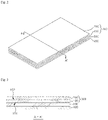
- Fig. 1 is a schematic exploded view of a display device according to an embodiment.
- Fig. 2 is a schematic perspective view of a display device according to an embodiment.
- Fig. 3 is a schematic cross-sectional view of a display device according to an embodiment.
- Figs. 1 to 3 illustrate a display device, which comprises a display unit (400) and a cover window (300) disposed on the display unit (400), wherein the cover window comprises a polyamide-based film (100) having a first side (101) and a second side (102) and a functional layer (200), and an adhesive layer (500) is interposed between the display unit (400) and the cover window (300).
- the cover window comprises a polyamide-based film (100) having a first side (101) and a second side (102) and a functional layer (200), and an adhesive layer (500) is interposed between the display unit (400) and the cover window (300).
- the display unit (400) is for displaying an image, and it may have flexible characteristics.
- the display unit (400) may be a display panel for displaying an image.
- it may be a liquid crystal display panel or an organic electroluminescent display panel.
- the organic electroluminescent display panel may comprise a front polarizing plate and an organic EL panel.
- the front polarizing plate may be disposed on the front side of the organic EL panel. Specifically, the front polarizing plate may be attached to the side on which an image is displayed in the organic EL panel.
- the organic EL panel may display an image by self-emission of a pixel unit.
- the organic EL panel may comprise an organic EL substrate and a driving substrate.
- the organic EL substrate may comprise a plurality of organic electroluminescent units, each of which corresponds to a pixel. Specifically, it may comprise a cathode, an electron transport layer, a light-emitting layer, a hole transport layer, and an anode.
- the driving substrate is operatively coupled to the organic EL substrate. That is, the driving substrate may be coupled to the organic EL substrate so as to apply a driving signal such as a driving current, so that the driving substrate can drive the organic EL substrate by applying a current to the respective organic electroluminescent units.
- an adhesive layer (500) may be interposed between the display unit (400) and the cover window (300).
- the adhesive layer may be an optically transparent adhesive layer, but it is not particularly limited.
- the cover window (300) may be disposed on the display unit (400).
- the cover window is located at the outermost position of the display device to thereby protect the display unit.
- the cover window (300) may comprise a polyamide-based film and a functional layer.
- the functional layer may be at least one selected from the group consisting of a hard coating layer, a reflectance reducing layer, an antifouling layer, and an antiglare layer.
- the functional layer may be coated on at least one side of the polyamide-based film.
- the polyamide-based film according to an embodiment can be applied in the form of a film to the outside of a display device without changing the display driving method, the color filter inside the panel, or the laminated structure, thereby providing a display device having a uniform thickness, low haze, high transmittance, and high transparency. Since neither significant process changes nor cost increases are needed, it is advantageous in that the production costs can be reduced.
- the polyamide-based film according to an embodiment may be excellent in optical properties in terms of high transmittance, low haze, and low yellow index, as well as may have excellent mechanical properties such as hardness, modulus, and elasticity.
- the polyamide-based film according to an embodiment can minimize the optical distortion since it has at most a certain level of in-plane retardation and a thickness direction retardation and can also reduce the light leakage from a lateral side.
- a polyamide-based film having a plasticity characteristic value and/or an elastic characteristic value within the above ranges may have excellent resistance and restoring force to indentation as well as high flexibility.
- a cover window of a touch-type display device to which pressure is continuously applied by a hand or a stylus pen it may have excellent durability and lifespan.
- An embodiment provides a process for preparing a polyamide-based film.
- the process for preparing a polyamide-based film comprises polymerizing a diamine compound and a dicarbonyl compound to prepare a solution comprising a polyamide-based polymer in an organic solvent; casting the polymer solution and then drying it to prepare a gel sheet; and thermally treating the gel sheet.
- the process for preparing a polyamide-based film comprises polymerizing a diamine compound and a dicarbonyl compound in an organic solvent to prepare a solution comprising a polyamide-based polymer (S100); casting the polymer solution to prepare a gel sheet (S200); and thermally treating the gel sheet (S300).
- the process for preparing a polyamide-based film may further comprise adjusting the viscosity of the polyamide-based polymer solution (S110), aging the polyamide-based polymer solution (S120), and/or degassing the polyamide-based polymer solution (S130).
- the polyamide-based film is a film in which a polyamide-based polymer is a main component.
- the polyamide-based polymer is a resin that comprises an amide repeat unit as a structural unit.
- the polyamide-based polymer may comprise an imide repeat unit.
- the polymer solution for preparing a polyamide-based polymer may be prepared by simultaneously or sequentially mixing a diamine compound and a dicarbonyl compound in an organic solvent in a reactor, and reacting the mixture (S100).
- the step of preparing the polymer solution may comprise mixing and reacting the diamine compound and the dicarbonyl compound in a solvent to produce a polyamide (PA) solution.
- the polyamide solution is a solution that comprises a polymer having an amide repeat unit.
- the step of preparing the polymer solution may be carried out by using two kinds of dicarbonyl compounds different from each other as the dicarbonyl compound.
- the two kinds of dicarbonyl compounds may be mixed and reacted simultaneously or sequentially.
- the first dicarbonyl compound and the diamine compound may react to form a prepolymer
- the prepolymer and the second dicarbonyl compound may react to form the polyamide-based polymer.
- the plasticity characteristic value and/or elasticity characteristic value of the polyamide-based polymer may be readily adjusted.
- the polymer contained in the polymer solution comprises an amide repeat unit derived from the polymerization of the diamine compound and the dicarbonyl compound.
- the process may further comprise adjusting the viscosity of the polymer solution (S110) after the step of preparing the polymer solution.
- the viscosity of the polymer solution may be 200,000 cps to 350,000 cps at room temperature. In such an event, the film-forming capability of a polyamide-based film can be enhanced, thereby enhancing the thickness uniformity.
- the step of preparing the polymer solution may comprise simultaneously or sequentially mixing and reacting a diamine compound and a dicarbonyl compound in an organic solvent to prepare a first polymer solution; and further adding the dicarbonyl compound to prepare a second polymer solution having the target viscosity.
- the polymer solutions may have viscosities different from each other.
- the second polymer solution may have a viscosity higher than that of the first polymer solution.
- the stirring speeds may be different from each other.
- the stirring speed when the first polymer solution is prepared may be faster than the stirring speed when the second polymer solution is prepared.
- the first dicarbonyl compound and the second dicarbonyl compound may be sequentially reacted with the diamine compound.
- a first polymer solution having a viscosity of 10,000 to 150,000 cps may be formed.
- the viscosity of the first polymer solution may be 10,000 to 100,000 cps, 10,000 to 80,000 cps, 10,000 to 60,000 cps, 20,000 to 150,000 cps, 20,000 to 100,000 cps, 20,000 to 80,000 cps, 20,000 to 60,000 cps, 40,000 to 150,000 cps, 40,000 to 100,000 cps, 40,000 to 80,000 cps, or 40,000 to 60,000 cps.
- the second dicarbonyl compound may be further reacted with the first polymer solution to form a second polymer solution having a viscosity of 200,000 to 350,000 cps.
- the step of further reacting the second dicarbonyl compound may serve as the step of viscosity adjustment.
- the plasticity characteristic value and elasticity characteristic value in desired ranges can be effectively achieved.
- the viscosity of the polymer solution, plasticity characteristic value, and elasticity characteristic value may be adjusted by controlling the sequence and amounts of the first dicarbonyl compound and the second dicarbonyl compound added.
- the molar ratio of the first dicarbonyl compound to the second dicarbonyl compound for the preparation of the polymer solution may be 25:75 to 75:25, preferably, 30:70 to 75:25, 35:65 to 75:25, or 40:60 to 75:25.
- the first dicarbonyl compound and the second dicarbonyl compound are used at such a ratio, it is possible to prepare a polyamide-based polymer having a plasticity characteristic value and an elasticity characteristic value within the above ranges and to improve the modulus, haze, transmittance, yellow index, and the like of the polyamide-based film.
- a dianhydride compound when the polymer solution (first polymer solution) is formed, a dianhydride compound is reacted with a diamine compound to form a polyamic acid or a polyimide. Then, the polyamic acid or polyimide may be reacted with a dicarbonyl compound to form a polymer solution comprising a polyamide-imide.
- the dianhydride compound as described above may be used. Its amount used may be 1 to 10% by mole, preferably, 1 to 3% by mole or 1 to 5% by mole, based on the total amount of the dicarbonyl compound and the dianhydride compound.
- the viscosities of the polymer solution, the first polymer solution, and the second polymer solution can be adjusted to desired ranges, and a polyamide-based film having a plasticity characteristic value and/or an elasticity characteristic value in the desired ranges can be prepared.
- the mixing and reaction of the solvent, the diamine compound, and the dicarbonyl compound may be carried out at a temperature of -20 to 25°C. If it is outside the above temperature range, excessively few or many polymerization nuclei are formed, thereby making it difficult to form a polyamide-based polymer having the desired plastic characteristics and elastic characteristics. Thus, the mechanical properties and optical properties of the polyamide-based film may be deteriorated. In addition, the viscosity of the polymer solution may be less than a predetermined range.
- the mixing and reaction of the diamine compound and the dicarbonyl compound may be carried out at a temperature of -20 to 20°C, -20 to 15°C, -20 to 10°C, -15 to 20°C, -15 to 15°C, -15 to 10°C, -10 to 20°C, -10 to 15°C, -10 to 10°C, -8 to 20°C, -8 to 15°C, -8 to 10°C, -5 to 20°C, -5 to 15°C, or -5 to 10°C.
- the mixing and reaction of the diamine compound and the dianhydride compound may be carried out at a temperature of 0 to 50°C. If it is outside the above temperature range, excessively few or many polymerization nuclei are formed, thereby making it difficult to form a polyamide-based polymer having the desired plastic characteristics and elastic characteristics. Thus, the mechanical properties and optical properties of the polyamide-based film may be deteriorated. In addition, the viscosity of the polymer solution may be less than a predetermined range.
- the mixing and reaction of the diamine compound and the dianhydride compound may be carried out at a temperature of 0 to 45°C, 0 to 40°C, 10 to 50°C, 10 to 45°C, 10 to 40°C, 20 to 50°C, 20 to 45°C, or 20 to 40°C.
- the content of solids contained in the polymer solution may be 10% by weight to 30% by weight, but it is not limited thereto.
- the content of solids contained in the polymer solution is within the above range, a polyamide-based film can be effectively produced in the casting step.
- the polyamide-based film thus produced may have mechanical properties in terms of an improved modulus and the like and optical properties in terms of a low yellow index and the like.
- the step of preparing the polymer solution may further comprise adjusting the pH of the polymer solution.
- the pH of the polymer solution may be adjusted to 4 to 7, for example, 4.5 to 7.
- the pH of the polymer solution may be adjusted by adding a pH adjusting agent.
- the pH adjusting agent is not particularly limited and may include, for example, amine-based compounds such as alkoxyamine, alkylamine, and alkanolamine.
- the pH adjusting agent may be employed in an amount of 0.1% by mole to 10% by mole based on the total number of moles of monomers in the polymer solution.
- the organic solvent may be at least one selected from the group consisting of dimethylformamide (DMF), dimethylacetamide (DMAc), N-methyl-2-pyrrolidone (NMP), m-cresol, tetrahydrofuran (THF), and chloroform.
- the organic solvent employed in the polymer solution may be dimethylacetamide (DMAc), but it is not limited thereto.
- the polymer solution may be stored at -20°C to 20°C, -20°C to 10°C, -20°C to 5°C, -20°C to 0°C, or 0°C to 10°C.
- the polymer solution or the polymer solution whose viscosity has been adjusted may be aged (S 120).
- the aging may be carried out by leaving the polymer solution at a temperature of - 10 to 10°C for 24 hours or longer.
- the polyamide-based polymer or unreacted materials contained in the polymer solution may complete the reaction or achieve a chemical equilibrium, whereby the polymer solution may be homogenized.
- the mechanical properties, optical properties, and surface energy characteristics of a polyamide-based film formed therefrom may be substantially uniform over the entire area of the film.
- the aging may be carried out at a temperature of -5 to 10°C, -5 to 5°C, or -3 to 5°C.
- the process may further comprise degassing the polyamide-based polymer solution (S 130).
- the step of degassing may remove moisture in the polymer solution and reduce impurities, thereby increasing the reaction yield and imparting excellent surface appearance and mechanical properties to the film finally produced.
- the degassing may comprise vacuum degassing or purging with an inert gas.
- the vacuum degassing may be carried out for 30 minutes to 3 hours after depressurizing the internal pressure of the tank in which the polymer solution is contained to 0.1 bar to 0.7 bar.
- the vacuum degassing under these conditions may reduce bubbles in the polymer solution. As a result, it is possible to prevent surface defects of the film produced therefrom and to achieve excellent optical properties such as haze.
- the purging may be carried out by purging the tank with an inert gas at an internal pressure of 1 atm to 2 atm.
- the purging under these conditions may remove moisture in the polymer solution, reduce impurities to thereby increase the reaction yield, and achieve excellent optical properties such as haze and mechanical properties.
- the inert gas may be at least one selected from the group consisting of nitrogen, helium (He), neon (Ne), argon (Ar), krypton (Kr), xenon (Xe), and radon (Rn), but it is not limited thereto.
- the inert gas may be nitrogen.
- the vacuum degassing and the purging with an inert gas may be carried out in separate steps.
- the step of vacuum degassing may be carried out, followed by the step of purging with an inert gas, but it is not limited thereto.
- the vacuum degassing and/or the purging with an inert gas may improve the physical properties of the surface of a polyamide-based film thus produced.
- a filler may be added to the solution.
- the filler has an average particle diameter of 60 nm to 180 nm and a refractive index of 1.55 to 1.75.
- the content thereof is 100 ppm to 3,000 ppm based on the total weight of the solids content of the polyamide-based polymer.
- the filler may be silica or barium sulfate.
- the polymer solution may be cast to prepare a gel sheet (S200).
- the polymer solution may be extruded, coated, and/or dried on a support to form a gel sheet.
- the casting thickness of the polymer solution may be 200 ⁇ m to 700 ⁇ m.
- the final film produced after the drying and thermal treatment may have an appropriate and uniform thickness.
- the polymer solution may have a viscosity of 200,000 cps to 350,000 cps at room temperature as described above. As the viscosity satisfies the above range, the polymer solution can be cast to a uniform thickness without defects, and a polyamide-based film having a substantially uniform thickness can be formed without local/partial thickness variations during drying. In addition, a film having a plastic characteristic and an elastic characteristic as described above can be produced.
- the polymer solution is cast and then dried at a temperature of 60°C to 150°C for 5 minutes to 60 minutes to prepare a gel sheet. Specifically, the polymer solution is dried at a temperature of 70°C to 90°C for 15 minutes to 40 minutes to prepare a gel sheet.
- the solvent of the polymer solution may be partially or totally volatilized during the drying to prepare the gel sheet.
- the dried gel sheet may be thermally treated to form a polyamide-based film (S300).
- the thermal treatment of the gel sheet may be carried out, for example, through a thermosetting device.
- thermosetting device may thermally treat the gel sheet through hot air.
- the heat may be uniformly supplied. If the heat is not uniformly supplied, a satisfactory surface roughness cannot be achieved, which may raise or lower the surface energy too much.
- the thermal treatment of the gel sheet may be carried out in a temperature range of 60°C to 500°C for 5 minutes to 200 minutes. Specifically, the thermal treatment of the gel sheet may be carried out in a temperature range of 80°C to 300°C at a temperature elevation rate of 1.5°C/minute to 20°C/minute for 10 minutes to 150 minutes.
- the initial temperature of the thermal treatment of the gel sheet may be 60°C or higher. Specifically, the initial temperature of the thermal treatment of the gel sheet may be 80°C to 180°C.
- the maximum temperature in the thermal treatment may be 300°C to 500°C.
- the maximum temperature in the thermal treatment may be 350°C to 500°C, 380°C to 500°C, 400°C to 500°C, 410°C to 480°C, 410°C to 470°C, or 410°C to 450°C.
- the thermal treatment of the gel sheet may be carried out in two or more steps.
- the thermal treatment may comprise a first hot air treatment step carried out for 5 minutes to 30 minutes in a range of 60°C to 120°C; and a second hot air treatment step carried out for 10 minutes to 120 minutes in a range of 120°C to 350°C.
- the thermal treatment under these conditions may cure the gel sheet to have appropriate surface hardness, modulus, and surface energy and may secure high light transmittance, low haze, and an appropriate level of glossiness of the cured film at the same time.
- the thermal treatment may comprise passing it through an IR heater.
- the thermal treatment by an IR heater may be carried out for 1 minute to 30 minutes in a temperature range of 300°C or higher.
- the thermal treatment by an IR heater may be carried out for 1 minute to 20 minutes in a temperature range of 300°C to 500°C.
- the polyamide-based film is prepared by the preparation process as described above such that it may satisfy Equations 1, 2, and/or 3 as described above and may be excellent in optical properties and mechanical properties.
- the polyamide-based film can be applied to various uses that require flexibility, transparency, and a certain level of luminance.
- the polyamide-based film can be applied to solar cells, displays, semiconductor devices, sensors, and the like.
- the polyamide-based film has excellent thickness uniformity and optical properties, it can be advantageously applied to a cover window for a display device and to a display device. Since it has excellent folding characteristics, it can be advantageously applied to a foldable display device or a flexible display device.
- a 1-liter glass reactor equipped with a temperature-controllable double jacket was charged with 675 g of dimethylacetamide (DMAc) as an organic solvent at 10°C under a nitrogen atmosphere. Then, 64.0 g (0.200 mole) of 2,2'-bis(trifluoromethyl)-4,4'-diaminobiphenyl (TFMB) as an aromatic diamine was slowly added thereto and dissolved.
- DMAc dimethylacetamide
- TFMB 2,2'-bis(trifluoromethyl)-4,4'-diaminobiphenyl
- BPDA 3,3',4,4'-biphenyltetracarboxylic dianhydride
- the temperature of the reactor was lowered to 10°C, and 30.37 g (0.15 mole) of terephthaloyl chloride (TPC) was slowly added while the mixture was stirred for 1 hour. Then, 9.13 g (0.05 mole; 94% by mole of the total amount introduced) of isophthaloyl chloride (IPC) was added, followed by stirring the mixture for 1 hour, thereby preparing a first polymer solution.
- TPC terephthaloyl chloride
- IPC isophthaloyl chloride
- the second polymer solution was left at about 0°C for about one day, and it was then coated onto a glass plate and dried for 30 minutes with hot air of 100°C.
- the dried polyamide polymer was peeled off from the glass plate and fixed to a pin frame, which was then thermally treated while the temperature was raised at a temperature elevation rate of 2°C/minute in the temperature range of 80°C to 300°C, thereby obtaining a polyamide-based film having a thickness of 50 ⁇ m.
- the sequence and amounts of the diamine compound, the dianhydride compound, and the dicarbonyl compound introduced are as described in Table 1 below.
- the sequence of introduction was described from the top to the bottom of Table 1 from the compound added first, and the amount introduced is described as the number of moles based on 100 moles of the diamine compound.
- Example 2 1.18 g (0.006 mole) of butane-1,2,3,4-tetra anhydride was used instead of 3,3',4,4'-biphenyltetracarboxylic dianhydride (BPDA).
- BPDA 3,3',4,4'-biphenyltetracarboxylic dianhydride
- a sample was cut out by at least 10 cm in the direction perpendicular to the main shrinkage direction of the film and by 10 cm in the main shrinkage direction. It was fixed by the clips disposed at an interval of 10 cm in a universal testing machine UTM 5566A of Instron.
- a stress-strain curve was obtained until the sample was fractured while it was stretched at a speed of 12.5 mm/minute at room temperature. The slope of the load with respect to the initial strain on the stress-strain curve was taken as the modulus (GPa).
- the light transmittance and haze were measured using a haze meter NDH-5000W manufactured by Nippon Denshoku Kogyo in accordance with the JIS K 7136 standard.
- the yellow index (YI) was measured with a spectrophotometer (UltraScan PRO, Hunter Associates Laboratory) under the conditions of d65 and 10° in accordance with the ASTM-E313 standard.
- the composite hardness (Martens hardness), indentation hardness (Vickers hardness), indentation hardness, indentation modulus, elasticity, and creep of the film samples were measured using FISCHERSCOPE HM2000 of FISCHER. The measurements were carried out in accordance with ISO 14577-1:2015 and 14577-2:2015. Specifically, the film was pressed downward for 20 seconds at a pressure of 30 mN at room temperature with a diamond tip having a shape as shown in Fig. 5 , held for 5 seconds, and then elevated upward again.
- the nanoindenter tip shown in Fig. 5 may be a modified Vickers indenter. Specifically, in a Vickers indenter having a square base and a pyramid shape where four corners of inclined surfaces meet at a point, one vertex where two inclined surfaces extending in a direction (longitudinal direction) parallel to one side of the bottom surface and facing in the width direction meets one of the inclined surfaces facing in the longitudinal direction may be distanced by 0.5 ⁇ m (L) from the other vertex where the two inclined surfaces facing in the width direction meets the other of the inclined surfaces facing in the longitudinal direction.
- the tip (to be in contact with a specimen) of the indenter may be rounded so that the radius of curvature (R) is 0.2 ⁇ m or less.
Landscapes
- Chemical & Material Sciences (AREA)
- Chemical Kinetics & Catalysis (AREA)
- Medicinal Chemistry (AREA)
- Polymers & Plastics (AREA)
- Organic Chemistry (AREA)
- Health & Medical Sciences (AREA)
- Engineering & Computer Science (AREA)
- Manufacturing & Machinery (AREA)
- Physics & Mathematics (AREA)
- Materials Engineering (AREA)
- Nonlinear Science (AREA)
- General Physics & Mathematics (AREA)
- Optics & Photonics (AREA)
- Crystallography & Structural Chemistry (AREA)
- Mathematical Physics (AREA)
- Spectroscopy & Molecular Physics (AREA)
- Manufacture Of Macromolecular Shaped Articles (AREA)
- Polyamides (AREA)
- Devices For Indicating Variable Information By Combining Individual Elements (AREA)
- Extrusion Moulding Of Plastics Or The Like (AREA)
Applications Claiming Priority (1)
| Application Number | Priority Date | Filing Date | Title |
|---|---|---|---|
| KR1020210031079A KR102507133B1 (ko) | 2021-03-09 | 2021-03-09 | 폴리아마이드계 필름, 이의 제조 방법, 이를 포함하는 커버 윈도우 및 디스플레이 장치 |
Publications (1)
| Publication Number | Publication Date |
|---|---|
| EP4119600A1 true EP4119600A1 (de) | 2023-01-18 |
Family
ID=81074143
Family Applications (1)
| Application Number | Title | Priority Date | Filing Date |
|---|---|---|---|
| EP22161167.6A Pending EP4119600A1 (de) | 2021-03-09 | 2022-03-09 | Polyamidbasierter film, herstellungsverfahren davon, abdeckfenster und anzeigevorrichtung, das denselben umfasst |
Country Status (6)
| Country | Link |
|---|---|
| US (1) | US12275828B2 (de) |
| EP (1) | EP4119600A1 (de) |
| JP (1) | JP7358531B2 (de) |
| KR (1) | KR102507133B1 (de) |
| CN (1) | CN115044202B (de) |
| TW (1) | TWI869653B (de) |
Families Citing this family (2)
| Publication number | Priority date | Publication date | Assignee | Title |
|---|---|---|---|---|
| KR102897006B1 (ko) * | 2025-03-11 | 2025-12-08 | 동우 화인켐 주식회사 | 투명 디스플레이 패널, 이를 포함하는 표시장치 및 그 제조방법 |
| KR102897288B1 (ko) * | 2025-03-11 | 2025-12-08 | 동우 화인켐 주식회사 | 투명 디스플레이 패널, 이를 포함하는 표시장치 및 그 제조방법 |
Citations (4)
| Publication number | Priority date | Publication date | Assignee | Title |
|---|---|---|---|---|
| US20200407556A1 (en) * | 2019-06-28 | 2020-12-31 | Skc Co., Ltd. | Polymer film and preparation method thereof |
| US20200407506A1 (en) * | 2019-06-28 | 2020-12-31 | Skc Co., Ltd. | Polyamide-imide film, preparation method thereof, and cover window comprising same |
| US20200407520A1 (en) * | 2019-06-28 | 2020-12-31 | Skc Co., Ltd. | Polyimide-based film and preparation method thereof |
| EP4036153A1 (de) * | 2021-01-29 | 2022-08-03 | SKC Co., Ltd. | Polyamid-imid-folie, verfahren zu ihrer herstellung, abdeckfenster und anzeigevorrichtung damit |
Family Cites Families (17)
| Publication number | Priority date | Publication date | Assignee | Title |
|---|---|---|---|---|
| JP5406615B2 (ja) * | 2009-07-15 | 2014-02-05 | 日東電工株式会社 | 透明フィルムおよび該フィルムを用いた表面保護フィルム |
| US20140084499A1 (en) * | 2012-09-24 | 2014-03-27 | Akron Polymer Systems, Inc. | Solution of aromatic polyamide for producing display element, optical element, or illumination element |
| JP2015120886A (ja) | 2013-11-19 | 2015-07-02 | 東レ株式会社 | 芳香族ポリアミドフィルムおよび積層体 |
| JP6409540B2 (ja) | 2014-12-09 | 2018-10-24 | 東レ株式会社 | フィルム、フィルムの製造方法および積層体 |
| WO2016147373A1 (ja) | 2015-03-19 | 2016-09-22 | 富士通株式会社 | 表示方法、情報処理装置、表示制御装置及びプログラム |
| TWI638843B (zh) * | 2016-06-01 | 2018-10-21 | Lg化學股份有限公司 | 聚醯胺醯亞胺及其製備方法、聚醯胺醯亞胺膜以及顯示器用覆蓋基板 |
| KR102017196B1 (ko) * | 2016-12-20 | 2019-09-02 | 주식회사 엘지화학 | 폴리아미드이미드 공중합체 및 이를 포함하는 무색 투명한 폴리아미드이미드 필름 |
| KR102121440B1 (ko) * | 2017-05-30 | 2020-06-10 | 주식회사 엘지화학 | 폴리(아미드-이미드) 공중합체 조성물 및 이를 포함하는 무색 투명한 폴리(아미드-이미드) 필름 |
| KR102091559B1 (ko) * | 2017-12-28 | 2020-03-20 | 에스케이씨 주식회사 | 폴리(아마이드-이미드) 필름의 제조방법 및 이에 의해 제조된 폴리(아마이드-이미드) 필름 |
| JP2020003781A (ja) * | 2018-06-22 | 2020-01-09 | 住友化学株式会社 | 樹脂フィルム及びその製造方法 |
| KR102718970B1 (ko) * | 2019-01-25 | 2024-10-16 | 주식회사 엘지화학 | 폴리아미드계 (공)중합체의 제조방법, 및 이를 이용한 폴리아미드계 (공)중합 수지 조성물, 고분자 필름 |
| JP7572143B2 (ja) | 2019-03-29 | 2024-10-23 | 大日本印刷株式会社 | 光学フィルムおよび画像表示装置 |
| US11970613B2 (en) * | 2019-06-28 | 2024-04-30 | Sk Microworks Co., Ltd. | Polymer film |
| US11820874B2 (en) | 2019-06-28 | 2023-11-21 | Sk Microworks Co., Ltd. | Polyamide-based film, preparation method thereof, and cover window comprising same |
| JP2021017585A (ja) | 2019-07-17 | 2021-02-15 | 東レ株式会社 | 含フッ素ポリマーフィルム |
| KR20210020395A (ko) * | 2019-08-14 | 2021-02-24 | 에스케이씨 주식회사 | 폴리아마이드-이미드 필름, 이의 제조방법, 및 이를 포함하는 커버 윈도우 및 디스플레이 장치 |
| CN112500567B (zh) * | 2020-12-21 | 2023-03-14 | 奥克控股集团股份公司 | 含酰胺结构的高模量透明聚酰亚胺膜材料及其制备方法 |
-
2021
- 2021-03-09 KR KR1020210031079A patent/KR102507133B1/ko active Active
-
2022
- 2022-02-02 US US17/591,072 patent/US12275828B2/en active Active
- 2022-02-08 TW TW111104580A patent/TWI869653B/zh active
- 2022-02-22 JP JP2022026240A patent/JP7358531B2/ja active Active
- 2022-03-08 CN CN202210220760.8A patent/CN115044202B/zh active Active
- 2022-03-09 EP EP22161167.6A patent/EP4119600A1/de active Pending
Patent Citations (4)
| Publication number | Priority date | Publication date | Assignee | Title |
|---|---|---|---|---|
| US20200407556A1 (en) * | 2019-06-28 | 2020-12-31 | Skc Co., Ltd. | Polymer film and preparation method thereof |
| US20200407506A1 (en) * | 2019-06-28 | 2020-12-31 | Skc Co., Ltd. | Polyamide-imide film, preparation method thereof, and cover window comprising same |
| US20200407520A1 (en) * | 2019-06-28 | 2020-12-31 | Skc Co., Ltd. | Polyimide-based film and preparation method thereof |
| EP4036153A1 (de) * | 2021-01-29 | 2022-08-03 | SKC Co., Ltd. | Polyamid-imid-folie, verfahren zu ihrer herstellung, abdeckfenster und anzeigevorrichtung damit |
Non-Patent Citations (1)
| Title |
|---|
| ROHDE ALISON: "How Does Changing the Temperature Affect the Viscosity & Surface Tension of a Liquid?", 30 April 2018 (2018-04-30), XP093004684, Retrieved from the Internet <URL:https://sciencing.com/changing-temperature-affect-viscosity-surface-tension-liquid-16797.html> [retrieved on 20221205] * |
Also Published As
| Publication number | Publication date |
|---|---|
| KR20220127392A (ko) | 2022-09-19 |
| TW202235487A (zh) | 2022-09-16 |
| KR102507133B1 (ko) | 2023-03-07 |
| CN115044202B (zh) | 2024-12-27 |
| JP7358531B2 (ja) | 2023-10-10 |
| US12275828B2 (en) | 2025-04-15 |
| TWI869653B (zh) | 2025-01-11 |
| US20220289919A1 (en) | 2022-09-15 |
| JP2022138126A (ja) | 2022-09-22 |
| CN115044202A (zh) | 2022-09-13 |
Similar Documents
| Publication | Publication Date | Title |
|---|---|---|
| EP4036153A1 (de) | Polyamid-imid-folie, verfahren zu ihrer herstellung, abdeckfenster und anzeigevorrichtung damit | |
| US11820874B2 (en) | Polyamide-based film, preparation method thereof, and cover window comprising same | |
| US20200407521A1 (en) | Polyamide-imide film, preparation method thereof, and display front plate and display device comprising same | |
| US20200407507A1 (en) | Polymer film, front plate and display device comprising same | |
| US12111687B2 (en) | Base film, preparation method thereof, and cover window and display device comprising same | |
| US20200407557A1 (en) | Polymer film | |
| EP4119600A1 (de) | Polyamidbasierter film, herstellungsverfahren davon, abdeckfenster und anzeigevorrichtung, das denselben umfasst | |
| EP4141053A1 (de) | Polyamidbasierte folie, verfahren zu deren herstellung sowie abdeckfenster und anzeigevorrichtung damit | |
| EP4194489A1 (de) | Polyamidimidbasierte folie, herstellungsverfahren dafür und abdeckfenster und anzeigevorrichtung damit | |
| EP4137538A1 (de) | Polyamid-imid-basierter film, herstellungsverfahren davon sowie ein abdeckfenster und eine anzeigevorrichtung damit | |
| EP4137537A1 (de) | Polyamid-imid-film, verfahren zu seiner herstellung, abdeckfenster und anzeigevorrichtung mit diesem film | |
| EP4223832A1 (de) | Polyamidbasierte folie, herstellungsverfahren dafür sowie abdeckfenster und anzeigevorrichtung damit | |
| EP4092073A1 (de) | Polyamidbasierte folie, verfahren zum herstellen einer polyamidbasierten folie, abdeckfenster und anzeigevorrichtung damit | |
| KR102594722B1 (ko) | 폴리아마이드-이미드 필름, 이의 제조방법, 및 이를 포함하는 커버 윈도우 및 디스플레이 장치 | |
| US11795283B2 (en) | Polyamide-based film, and cover window and display device comprising same | |
| US12071526B2 (en) | Polyamide-based film, preparation method thereof, and cover window and display device comprising same | |
| EP4141054A1 (de) | Polyamidbasierte folie, herstellungsverfahren dafür und abdeckfenster und anzeigevorrichtung damit | |
| EP4372034A1 (de) | Polyamidimidbasierte folie, verfahren zur herstellung davon und abdeckfenster und anzeigevorrichtung damit | |
| KR20230087845A (ko) | 폴리아마이드-이미드계 필름, 이의 제조방법, 및 이를 포함하는 커버 윈도우 및 디스플레이 장치 |
Legal Events
| Date | Code | Title | Description |
|---|---|---|---|
| PUAI | Public reference made under article 153(3) epc to a published international application that has entered the european phase |
Free format text: ORIGINAL CODE: 0009012 |
|
| STAA | Information on the status of an ep patent application or granted ep patent |
Free format text: STATUS: THE APPLICATION HAS BEEN PUBLISHED |
|
| AK | Designated contracting states |
Kind code of ref document: A1 Designated state(s): AL AT BE BG CH CY CZ DE DK EE ES FI FR GB GR HR HU IE IS IT LI LT LU LV MC MK MT NL NO PL PT RO RS SE SI SK SM TR |
|
| STAA | Information on the status of an ep patent application or granted ep patent |
Free format text: STATUS: REQUEST FOR EXAMINATION WAS MADE |
|
| RAP1 | Party data changed (applicant data changed or rights of an application transferred) |
Owner name: SK MICROWORKS CO., LTD. |
|
| 17P | Request for examination filed |
Effective date: 20230718 |
|
| RBV | Designated contracting states (corrected) |
Designated state(s): AL AT BE BG CH CY CZ DE DK EE ES FI FR GB GR HR HU IE IS IT LI LT LU LV MC MK MT NL NO PL PT RO RS SE SI SK SM TR |
|
| RAP1 | Party data changed (applicant data changed or rights of an application transferred) |
Owner name: SK MICROWORKS SOLUTIONS CO., LTD. |
|
| RAP3 | Party data changed (applicant data changed or rights of an application transferred) |
Owner name: MICROWORKS SOLUTIONS CO., LTD. |